
FEATURE image: The Satyr at the Farmer’s (“Der Satyr beim Bauern”), Jacob Jordaens (Flemish, 1593-1678), c.1620.
Housing much of Munich’s most famous artwork, the Alte Pinakotek’s collection includes renowned international works from the 14th through the 18th centuries. A survey of these masterworks illustrates how European painters evolved from traditional craftsmen into divinely inspired creators. Through detailed analyses of artists like Albrecht Dürer, Valentin de Boulogne, and Claude Lorrain, the post demonstrates how these masters utilized religious self-fashioning, classical mythology, and the dramatic use of light (chiaroscuro) to inject profound emotional and psychological depth into Western art

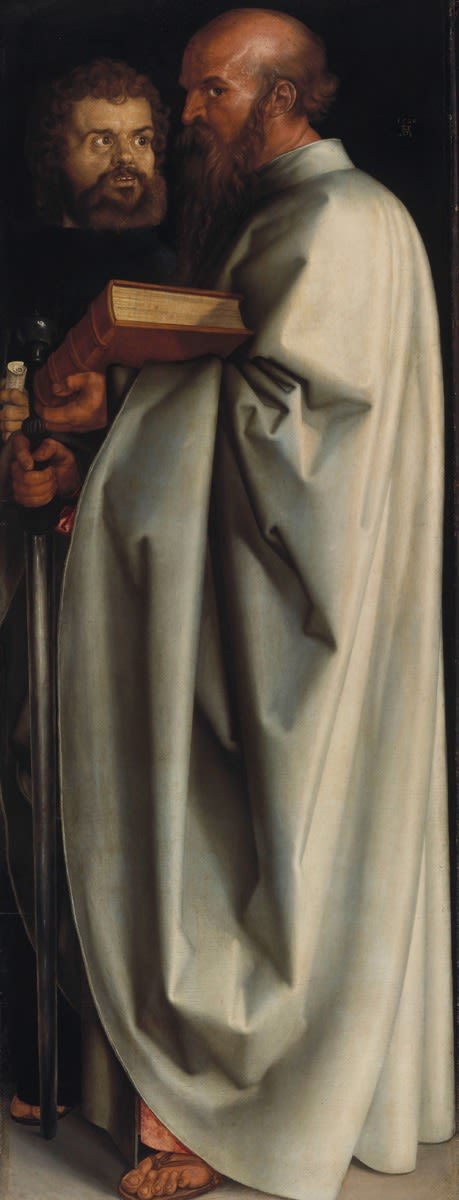
The Artist as Divine Creator: Albrecht Dürer’s Self-Portrait (c. 1520) deliberately uses the iconic, frontal pose of Christ Pantocrator to elevate the status of artists from manual laborers to divinely inspired creators. Humanizing the Divine: In contrast, Rembrandt did not portray himself as Christ but used his own aging, flawed face as a template for Jesus to ground him in human suffering and vulnerability.
Several prominent artists have, at various moments, fashioned their own likenesses in the image of Christ, a strategy that served both devotional and professional aims. This practice participates in the long tradition of imitatio Christi—the aspiration to model one’s life, conduct, and even physical bearing on the figure of Jesus. Within the visual arts, however, the gesture carried additional layers of meaning. By aligning themselves with the divine prototype, artists could elevate their social standing from that of manual laborers to inspired creators whose work partook in sacred authority. At the same time, such self-fashioning could signal profound personal piety, suggesting that the artist’s inner life mirrored the spiritual intensity of the Savior.
The most celebrated example is Albrecht Dürer, whose 1500s self‑portrait adopts the frontal, iconic pose associated with late‑medieval images of Christ Pantocrator. Dürer’s deliberate visual parallel not only asserts his artistic genius but also reflects his conviction that creative imagination was a God‑given faculty. His self‑portrait thus becomes a theological statement: the artist as a vessel of divine creativity.
Other painters engaged the motif in subtler ways. Rembrandt, for instance, did not present himself explicitly as Christ, yet he repeatedly used his own features as a template for the face of Jesus. This choice was less about claiming sacred authority and more about grounding the figure of Christ in lived human experience. By drawing on his own physiognomy—familiar, aging, marked by suffering—Rembrandt infused his depictions of Jesus with psychological depth and emotional immediacy. The result is a Christ who feels palpably human, capable of empathy and vulnerability.
Taken together, these strategies reveal how self‑representation as Christ could function across a spectrum: from bold assertions of artistic status to intimate explorations of spiritual identity. They also underscore the evolving conception of the artist in early modern Europe—not merely a craftsman, but a creator whose work could approach the divine.



Blending Influences: Gossaert integrated French, German, and Netherlandish styles, becoming a key “Romanist” after traveling to Italy. The Erotic Renaissance: In Danaë (c. 1527), he broke away from the medieval practice of treating the Greek myth strictly as a safe, pagan metaphor for the biblical Annunciation, choosing instead to reintroduce its original erotic context.
Jan Gossaert was probably from Maubeuge in France though the artist’s whereabouts are first documented in Antwerp, Belgium, in 1503. His early style is an amalgam of then-popular contemporary French, German, and Netherlandish influences – Hugo Van Der Goes (c.1440-1482), Albrecht Dürer, and Gerard David (c.1460-1523). After a trip to Italy in 1508, Gossaert displayed new flamboyance in his style and detail, particularly using architectual settings as the Alte Pinakothek’s later Danae shows. The northern European Hainault artist never successfully incorporated Italian Renaissance ideas into his artwork and many of his figures’ poses are actually derivative. Yet this level of stylistic incorporation led Gossaert to become an important Romanist. Gossaert was the first northern European artist to introduce nude classical figures into Flanders’ art world.
The Oracle of Delphi prophesied that King Acrisius of Argos would die at the hand of his grandson. To prevent this, the king imprisoned his daughter, Danaë, in an essentially golden cage. However, the King of the gods, Zeus, desired Danaë and came to her by way of a stream of golden rain into her cage where she conceived Perseus. It was Perseus who later, after his own adventures, killed his grandfather by accident during some athletic games.
By the Middle Ages this ancient Greek literary material was used as a pagan reference for the New Testament Annunciation. Gossaert was one of the first artists in the Renaissance period to reintroduce the original subject’s erotic content on its own terms.


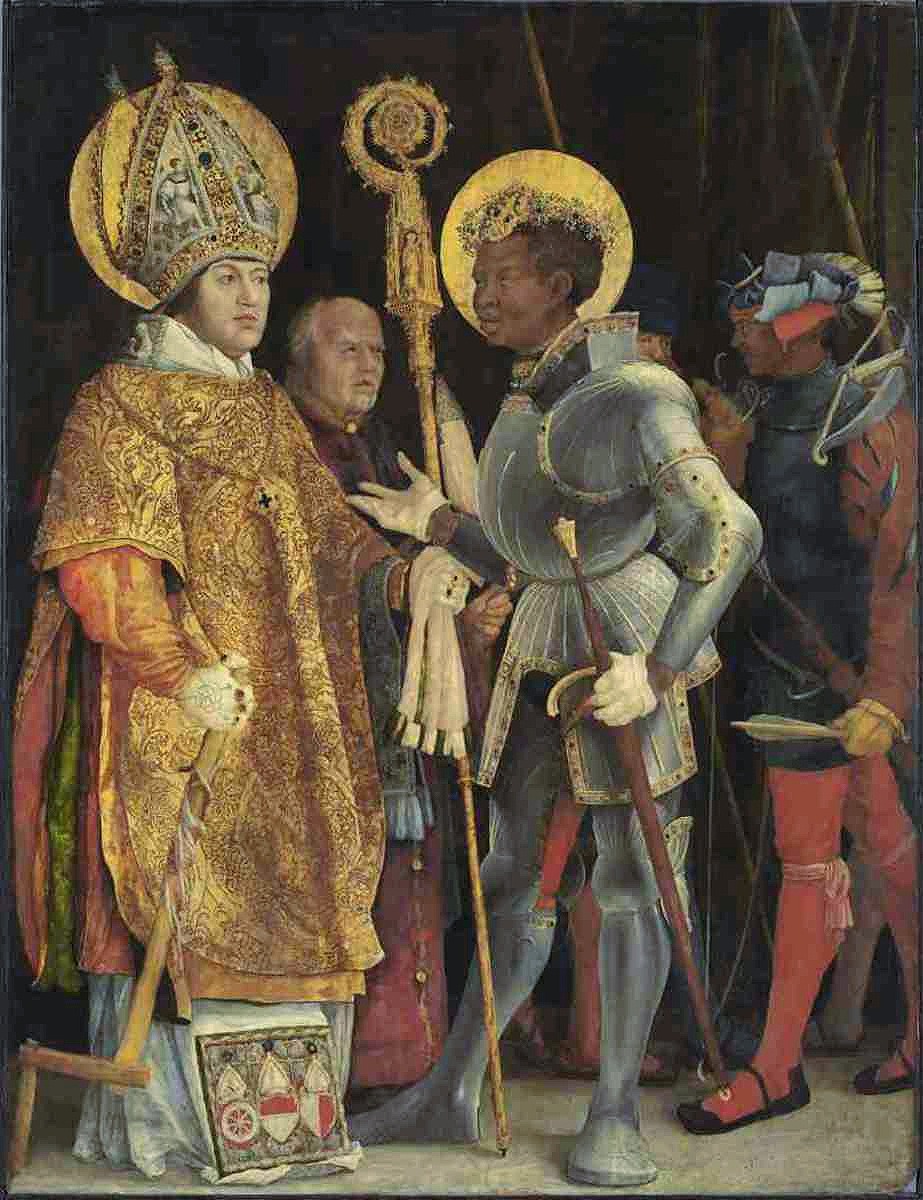
Emotional Weight & Late Gothic Outlook: Unlike his contemporary Dürer, Grünewald did not create prints and prints-making; instead, he used Italian Renaissance techniques solely to heighten the emotional and religious impact of his paintings.
Matthias Grünewald was a German painter of the Renaissance. Born Mathias Neithar(d)t-Gothar(d)t around 1470-75, Grünewald shared virtually the exact birth and death dates of fellow German artist, Albrecht Dürer, though the two artists were exact opposites.
Little is known about the life of Grünewald. He first enters the historical record in 1501 in Seligenstadt. It is believed the artist was also early on in Aschaffenburg and as far off as Würzburg. From 1508 to 1514 Grünewald was court painter to Albrecht of Brandenburg (1490–1545), the archbishop of Magdeburg, administrator of Halberstadt, and the archbishop and elector of Mainz (later Cardinal) who commissioned the Alte Pinakothek panel for the Neue Stift in Halle. By the mid1520s Grünewald was in Frankfurt and, apparently increasingly sympathetic to Lutheran doctrine, north to Halle where he died.
Grünewald’s first datable work is from 1503 though Grünewald is best known for his Isenheim Altarpiece in Colmar, France, produced in the mid1510s. Unlike his contemporary, Dürer, Matthias Grünewald apparently attempted no woodcuts, engravings or even many drawings. Like Dürer, he was familiar with Italian Renaissance ideas, though Grünewald did not pursue its techniques for its own ends. Rather, Grünewald was interested in using these new Italian techniques to heighten his own art’s emotional impact as well as make a religious statement. In this sense Grünewald possessed an essentially Late Gothic outlook and style. Yet, besides the passionate, well-drawn, and colorful Isenheim Altarpiece, few paintings of Grünewald survive.
St. Erasmus (or Elmo) was a late Third Century bishop who was martyred under Diocletian around 303 CE. St. Maurice was martyred around 287 CE. Maurice wears the armor signaling his being an officer in a Roman legion which was composed almost entirely of Christians. Along with other officers and rank-and-file soldiers Maurice was slaughtered for refusing to worship the State’s pagan gods.

Street-Life Idiom: Le Valentin’s The Crowning of Thorns of Christ handles sacred biblical events by populating the scene with expressive characters who resemble everyday people from contemporary street life. Chiaroscuro & Recycle: His later works show a transition toward classical beauty and deep psychological tension, notably painting Crowning with Thorns over a discarded portrait of his patron, Cardinal Barberini.
One of the great artworks of Le Valentin’s early phase in Rome, biblical subjects painted before 1620 such as The Crowning of Thorns of Christ were interpreted in the street-life idiom, with expressive protagonists and bystanders resembling the cast of characters in his genre paintings. Although the painting was earlier believed to be by Caravaggio, it may have been a pendant to Le Valentin’s much-later Abraham Sacrificing Isaac (c. 1629) in The Montreal Museum of Fine Arts.
This is Le Valentin’s most ambitious of 3 such “crowning with thorns” pictures. The artist in horizontal-format depicts Jesus before his going to Calvary. Christ is mocked and tormented; a crown of thorns is pressed onto his head (Matthew 27: 27-31; Mark 15:16-21; Luke 23:11; John 19: 1-3). With its dramatic lighting and shadows, the naturalistic depiction of Christ’s body and soldiers in contemporary costume is Caravaggesque.
Le Valentin’s scene adheres to the Bible episode: a whole cohort of soldiers surrounded Jesus, stripped off his clothes and threw a scarlet military cloak on him. Henchmen have weaved a crown out of thorns and are placing it on Jesus’s head. Another puts a reed as a faux scepter into Jesus’s right hand. To mock him they kneel before him and say: “Hail, King of the Jews!” The soldiers spit on Jesus and then take the reed away and strike him repeatedly with it. When they were done with these violent actions, the soldiers stripped Jesus of the military cloak, dressed him in his own clothes and led him out to be crucified.

Le Valentin’s Passion theme is a later vertical-format picture of a subject he had painted masterly before. In these last years the subject matter had gained in classical beauty as well as psychological involvement compared to Le Valentin’s earlier artwork. The painting covers over a discarded portrait of Cardinal Barberini which suggests Valentin’s close relationship with the ecclesial prince, very likely being in his employ. What caused the artist to revisit the subject of a brutalized Christ is unclear though it may have been based on the artist’s own struggles or that of his employer whose portrait he painted over.
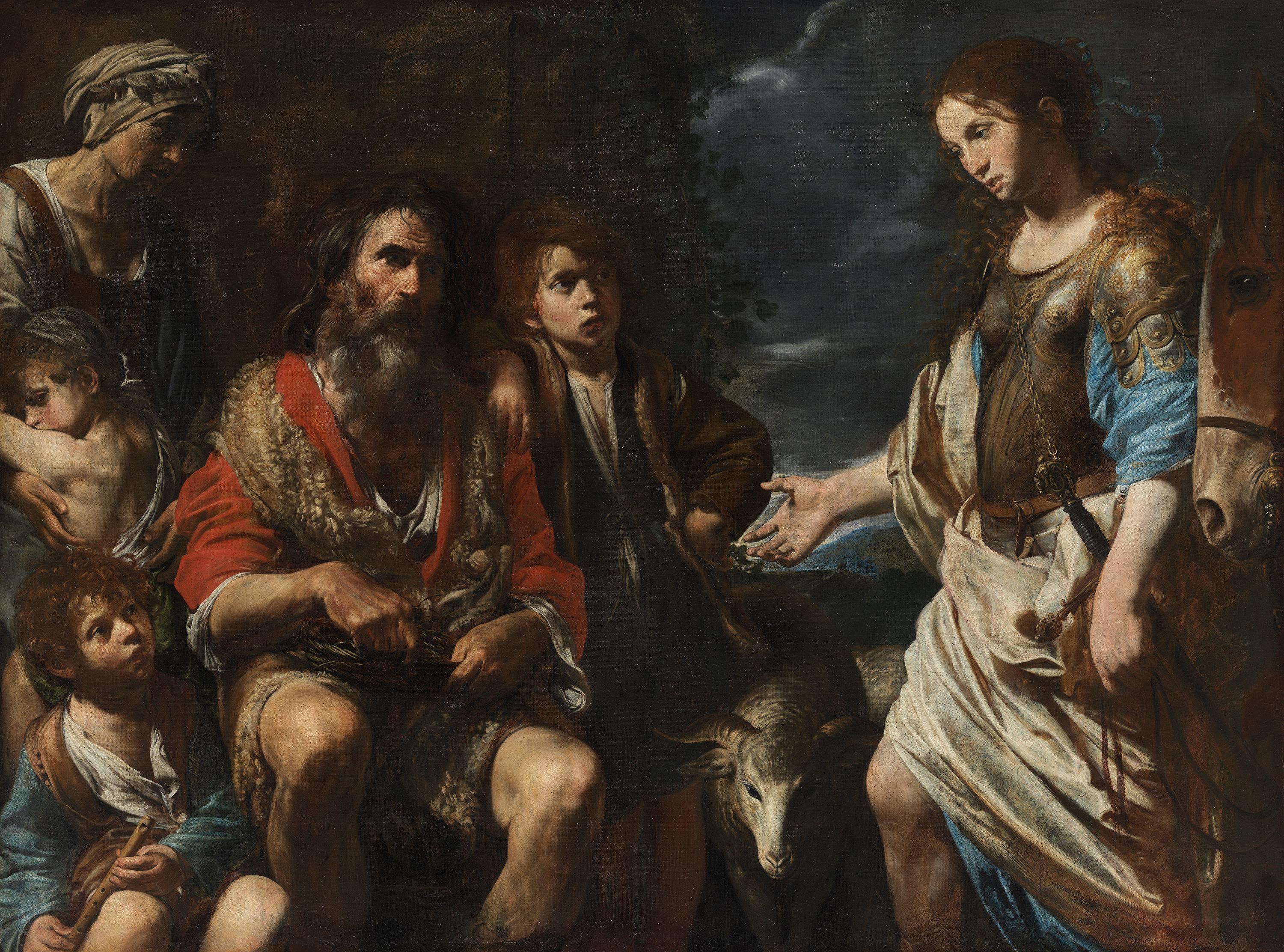
Erminia, the king’s daughter, escapes her persecutors and asks a peaceful shepherd family for shelter. The scene is based on a contemporary (1576) epic poem The Liberated Jerusalem by Torquato Tasso (1544-1595). The picture was a private commission whose patron was likely a Roman art collector and cognoscente. Valentin’s painting combines Caravaggesque chiaroscuro with exquisite coloring. In this realistic depiction of a human encounter between characters who represent contrasting social experiences, the subject matter is rendered psychologically sensitively.

Imaginary Worlds: Lorrain set a template for landscape painting into the 19th century by crafting muted, imaginary, stage-like scenes that blended fragments of classical antiquity with contemporary figures. The Bavarian Commission: Both Seaport at Sunrise and Idyllic Landscape in the Setting Sun were part of a trio of landscapes specifically commissioned by the Bavarian Privy Councillor Franz von Mayer.
The French artist Claude Lorrain arrived in Rome in 1615 and, except for interludes in Naples (1619-1624) and in France (1625-1627), the artist lived and worked in Rome during his life. Lorrain trained under Agostino Tassi (1578-1644), an Italian landscape painter. Lorrain’s compositions were painted in muted tones whose work displayed an ethereal mood. Using fragments from antiquity and a pleasant atmosphere, Lorrain’s mode of landscape painting set a template for such artworks into the 19th century. In Seaport at Sunrise, Lorrain’s depiction of the sunrise itself was bold and original, a haze dissolving within a scene of cities, sea and mountains and which contains contemporary figures yet harkens backwards in time or to the timeless.
In Seaport at Sunrise, the sun begins to bathe a seaport in early light, similar to the way the sun rises over the Gulf of Naples today. A working port, a boat is being loaded while travelers sit waiting on the shore. The place is imaginary – not purely contemporary, historical, mythological, or literary. Lorrain’s landscape transposes figures of everyday life contributing to the development of genre painting as its imaginary effects bend into the weight of medieval and ancient history.
There are fortified castles along the shore and a building to the right which appears very much like the triumphal Arch of Titus (80 A.D.) in Rome. Claude Lorrain’s painting is based on a composition he made from 1634 in the Hermitage in Saint Petersburg, Russia. Seaport at Sunrise is one of three landscape paintings commissioned by Bavarian Privy Councillor Franz von Mayer. The others in that trio are in the Alte Pinakothek (Idyllic Landscape in the Setting Sun – see below) and in the Dulwich Picture Gallery in London.

Before 1640, Claude Lorrain was considered the premier landscape painter in Rome. Most of his paintings are imaginary imitating a stage set for rich landscape narratives.
This painting is the first of the series of three landscape pictures commissioned by Bavarian Privy Councillor Franz von Mayer and that included Seaport at Sunrise (above). In the picture, a herd of cows crosses a ford in the Mediterranean as the sun sets behind mountains. The painting is based on one of Lorrain’s compositions from 1636.
Italian realist painter Caravaggio (1571-1610) remained very influential in contemporary art following his death. His use of targeted light and shadow as well as a muted, mainly brown palette, was key in the depiction of his figural scene. Painters in the 17th century followed this Caravaggesque practice throughout the rest of the century experimenting with using light and increasingly brighter colors as dramatic and aesthetic tools for their painting.
SOURCE: Baroque, Hermann Bauer, Andreas Prater, Ingo F. Walther, Köln: Taschen, 2006.