FEATURE image: Erected in 1939, St. Francis Xavier Church sits within an established, well-maintained residential neighborhood in Wilmette, Illinois, located just blocks inland from Lake Michigan. In designing the structure, the area’s Roman Catholics deliberately sought to blend unobtrusively into the surrounding landscape, ensuring the church harmonized gracefully with the architectural character of Chicago’s North Shore. June 2014. Author’s photograph 3.56mb
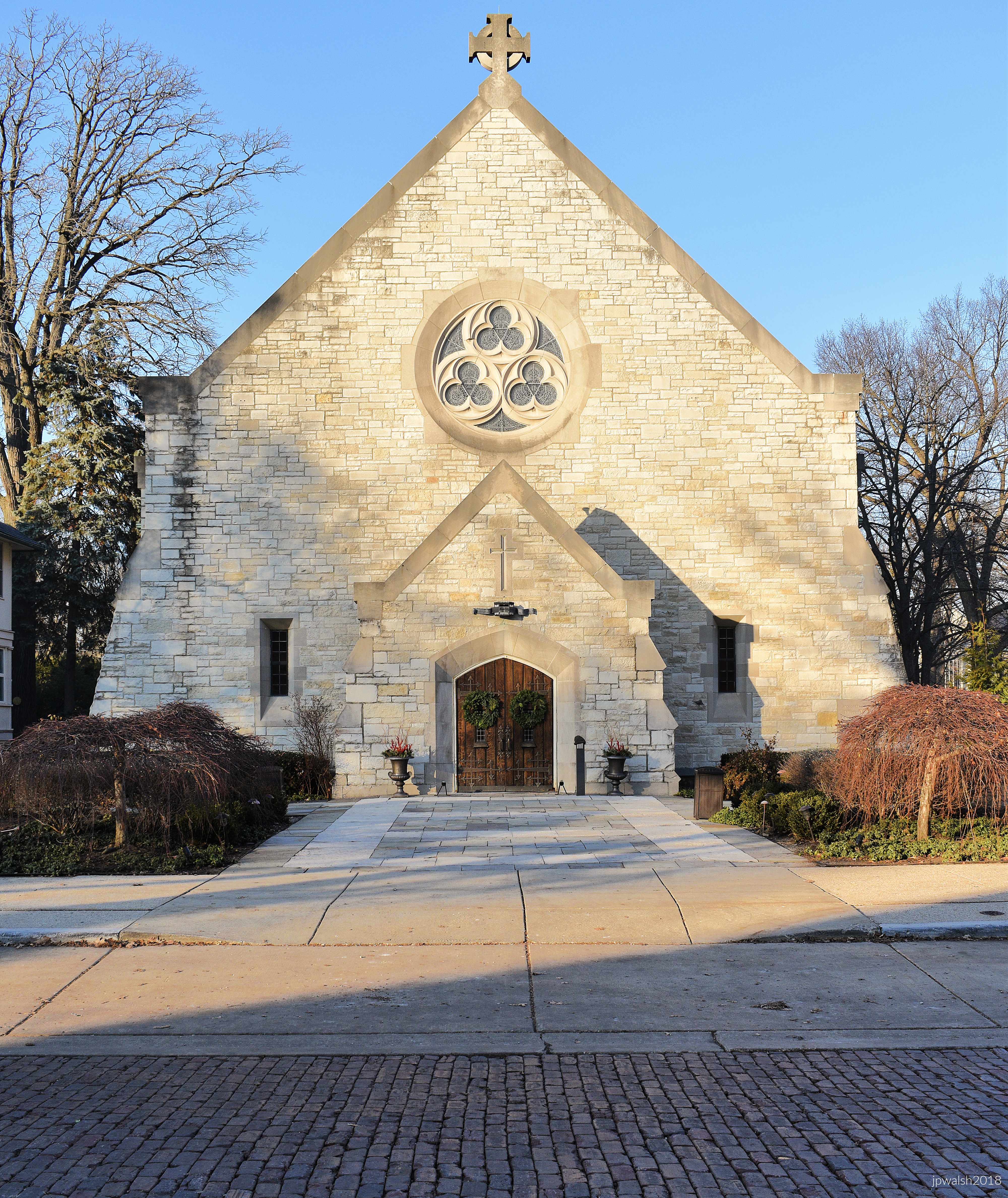
The English Gothic‑style church—typically associated with establishment mainline Protestants—was designed to be both sophisticated and simple. When the parish community formed in 1904, it built a smaller multi‑purpose church‑and‑school on this same corner of 9th Street and Linden Avenue. That first structure supported the parish through its early decades, serving as both classroom and worship space as the community grew into the congregation that would later commission the present building. Built by McCarthy, Smith & Eppig, St. Francis Xavier Church adopts the character of a sturdy country church, marked by low walls, massive external buttresses, and a sloped, elongated roof.

Erected in 1939, St. Francis Xavier Church sits within an established, well‑maintained residential neighborhood in Wilmette, Illinois, just blocks inland from Lake Michigan. The area’s Roman Catholics intentionally sought a design that would blend unobtrusively into the North Shore streetscape, ensuring the church harmonized with its surroundings rather than dominating them or otherwise stand out. Placing the 1904 parish under the patronage of St. Francis Xavier, the premier Jesuit missionary and intellectual, reflected the cultural and educational aspirations of the region’s affluent English‑speaking Catholic families, whose spiritual identity was shaped by the strong Jesuit presence on Chicago’s North Shore.
WHO IS ST. FRANCIS XAVIER (1506-1552), FIRST JESUIT MISSIONARY TO THE FAR EAST AND CO-PATRON OF FOREIGN MISSIONS?

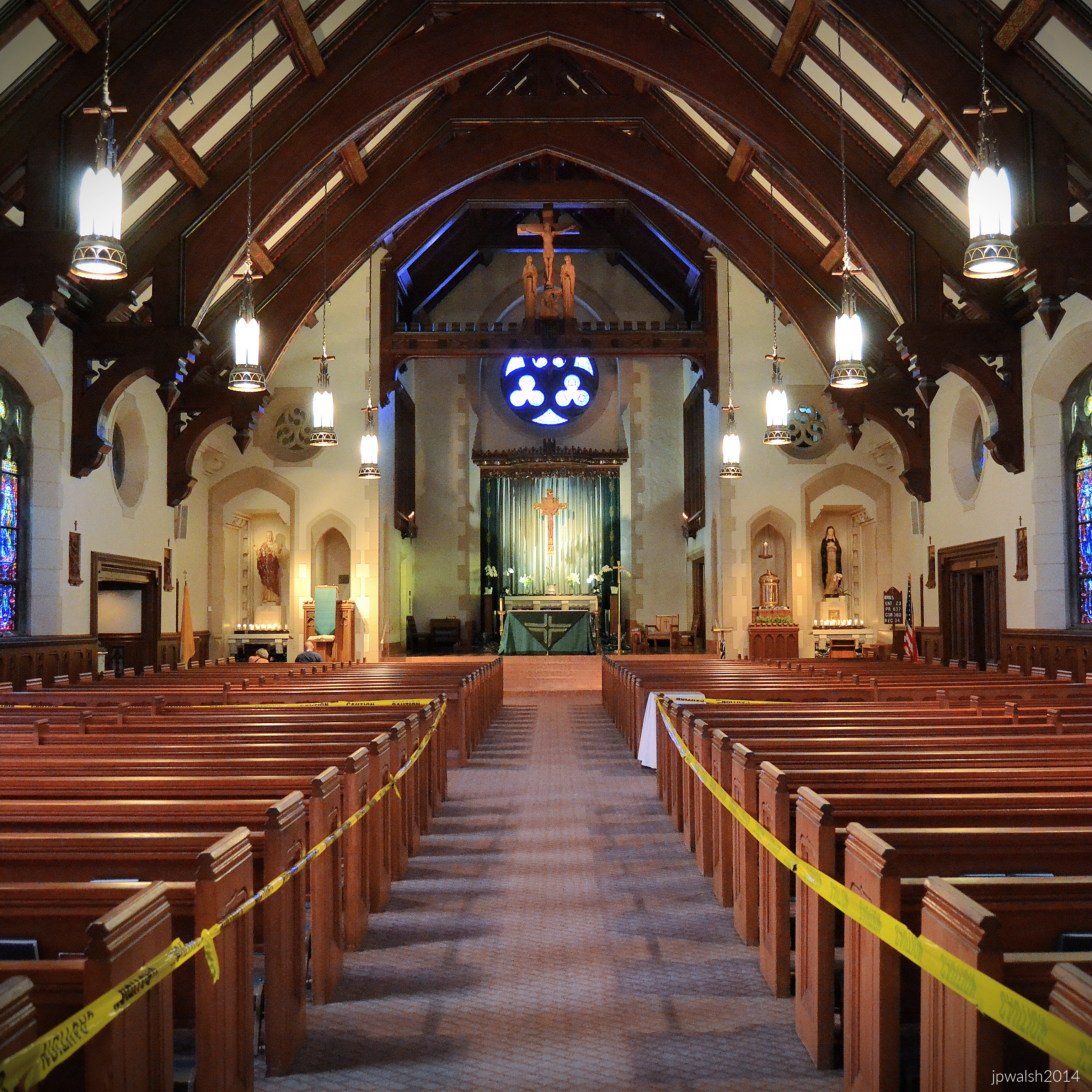
Unobstructed Sanctuary
There are no columns interrupting the view toward the marble altar and crucifix. After Vatican II, the tabernacle was moved to a niche on the right; originally it stood on the main altar beneath the crucifix. The extra‑wide altar rail—with cross‑shaped legs meant to evoke being at table with Christ for communicants—was also removed.
Modern Streamlining
Although St. Francis Xavier Church is traditional in overall form, its detailing is modern, chic, and streamlined, giving the sanctuary a flexible, adaptable character suited to later liturgical changes.
Symbolic Ceiling
The ceiling is shaped like an inverted barque, a visual metaphor for St. Francis Xavier’s missionary voyages across the seas to the Far East.

Architects & Origins
Among the leading ecclesiastical designers of the 1930s, McCarthy, Smith & Eppig worked closely with Chicago’s Cardinal George Mundelein. Joseph W. McCarthy (1884–1965), once a young architect under Daniel Burnham, shaped much of Chicago’s Catholic built environment from the 1910s through the 1930s.
Wilmette Commissions
In 1939, McCarthy completed two major Wilmette churches—St. Francis Xavier and the more monumental St. Joseph—standing barely a mile apart. The design of St. Francis Xavier was executed primarily by the firm’s younger partners, David Smith and Arthur Eppig.
Design & Cost
The church’s restrained architecture, enriched by fine detailing, cost $200,000 to build in the late Depression years—roughly $4 million in 2022.
Beyond Chicago
While most of McCarthy’s work rose in the Chicago region, his portfolio also includes significant projects such as the cathedral in Springfield (1928) and the parish church built in 1918 for what later became the Diocese of Joliet.

There are 8 major stained-glass windows in St. Francis Xavier Church: four in the west wall and four in the east wall.

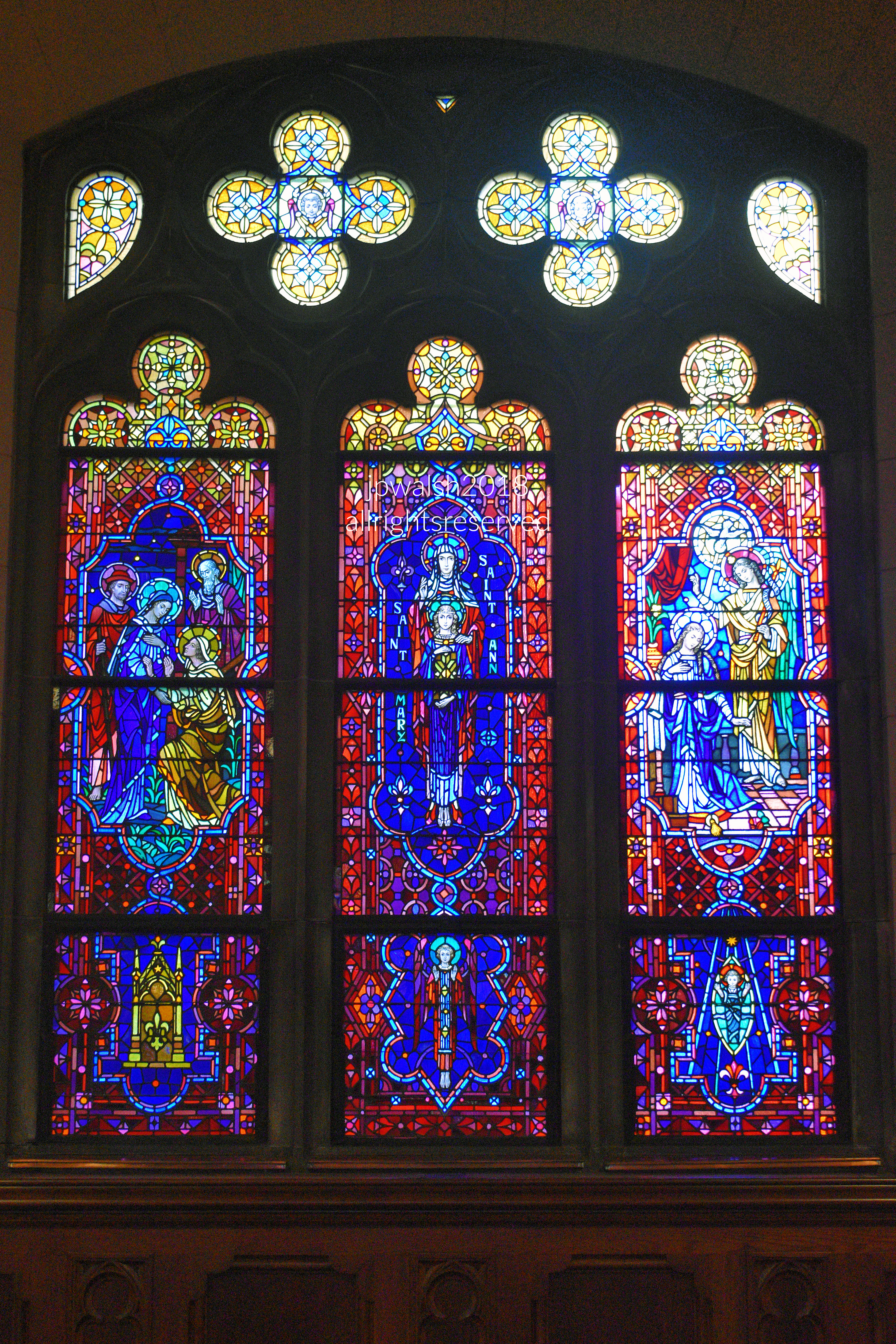
Smaller stained-glass oculi and panels are scattered throughout the interior. These stained-glass windows were designed by parishioner Henry Schmidt. They are quite beautiful, scintillating in their pseudo-English Tudor style, and illumined by the usually soft eastern and tree-obscured western exposures. While their subject matter feels somewhat chaotic—a hodgepodge in its traditional and idiosyncratic admixture of hagiography, scripture, and popular piety—one aspect of their enduring appeal is that the glass can be seen close up and at eye level. This intimate perspective is vividly captured in the side panels: the left detail illustrates the Agony in the Garden, showing Christ kneeling on the Mount of Olives as an angel descends with the chalice of His Passion; the center panel depicts the Finding in the Temple, with the twelve-year-old Jesus teaching the elders while Mary and Joseph look on; and the right panel depicts the Annunciation, capturing the Archangel Gabriel appearing to the Virgin Mary under the illumination of the Holy Spirit.
ST. PETER WINDOW & THE QUEENSHIP OF MARY WINDOW.
The visual program of the St. Peter stained-glass window —particularly its central panel showing St. Peter holding the keys next to the Latin words for Saint Peter, flanked by scenes of Mary’s active intercession by way of her heavenly coronation and Assumption into Heaven—beautifully illustrate this very link between established apostolic authority on earth and the heavenly governance of Christ and His Mother.
The window’s left panel of the Crowning of Mary as Queen of Heaven refers to the moment the Trinity receives her, body and soul, following the Assumption. In Catholic tradition—as in the Fifth Glorious Mystery of the Rosary—the Coronation marks her crown of heavenly glory. Though rooted in Scripture—especially the ‘woman clothed with the sun’ of Revelation 12:1—the literal act of the Trinity placing a crown on Mary is held as pious tradition rather than defined dogma like the Assumption. Consequently, parish practices such as a May Crowning remain devotional customs rather than formal liturgical acts.

CENTER PANEL: Saint Peter, leader of the apostles, holds the keys of the kingdom of heaven (Matthew 16:19). Peter holds a book, a representation of St. Peter’s New Testament letters (1 and 2 Peter) and sermons (Acts). Below is St. Peter’s Basilica in Vatican City in Rome with its famous dome.
LEFT PANEL: Crowning of Mary as Queen of Heaven by Triune God (Father, Son and Holy Spirit). From the Council of Ephesus in 431, depicting the Blessed Virgin Mary wearing a regal crown was used in Christendom.
RIGHT PANEL: While biblical texts point directly to the defined dogma (431) of Mary as Theotokos (Mother of God), the literal event of her Assumption is not explicitly recorded in the New Testament. Instead, this latter dogma (1950) dictates that at the end of her earthly life, she was taken—or ‘assumed’—body and soul into heavenly glory. Scriptural imagery of going ‘up’ to heaven is utilized here to express a profound spiritual reality, drawing a deliberate theological parallel to Jesus’ own Ascension (Acts 1:6–17; Luke 24:50–53). This phenomenon of a bodily assumption is mirrored in the Old Testament accounts of Moses and Elijah, both of whom later appeared alongside Christ at His Transfiguration (Matt 17:1–9; Mark 9:2–10; Luke 9:28–36; 2 Peter 1:16–21). Anchoring these soaring heavenly narratives visually, identical angel figures rest directly below the window panels.

The Queenship of Mary, while in one continuous arc with the crowning of Mary, is an established doctrine of the Church. In 1954, Pope Pius XII formalized this long-standing tradition by issuing the papal encyclical Ad Caeli Reginam (To the Queen of Heaven), establishing the universal Feast of the Queenship of Mary. The systematically-minded Pope Paul VI later moved the memorial to August 22—exactly seven days after the Solemnity of the Assumption—to underscore their inseparable theological connection. The Queenship refers to Mary’s eternal, structural office and state of reigning over the entire Created Order. Catholic theology teaches that her reign is not passive; rather, Mary actively exercises her exalted role as Intercessor, Advocate, and Mediatrix of graces on behalf of the entirety of creation, both the living and the dead, until the end of time. The maternal character of her office stems from the ancient Davidic kingdom, where the queen was not the king’s wife, but the king’s mother. In ancient Israel, this Queen Mother held a powerful office of advocacy, listening to the needs of the citizens and bringing them directly to the King. Mary reigns in this exact Old Testament typological capacity. As Pope Pius XII noted, Mary’s authority is characterized entirely by maternal solicitude and humility. Her power to rule flows directly from her absolute submission to God’s will, meaning her crown is the ultimate reflection of perfect, Christian discipleship and sacrificial agape.
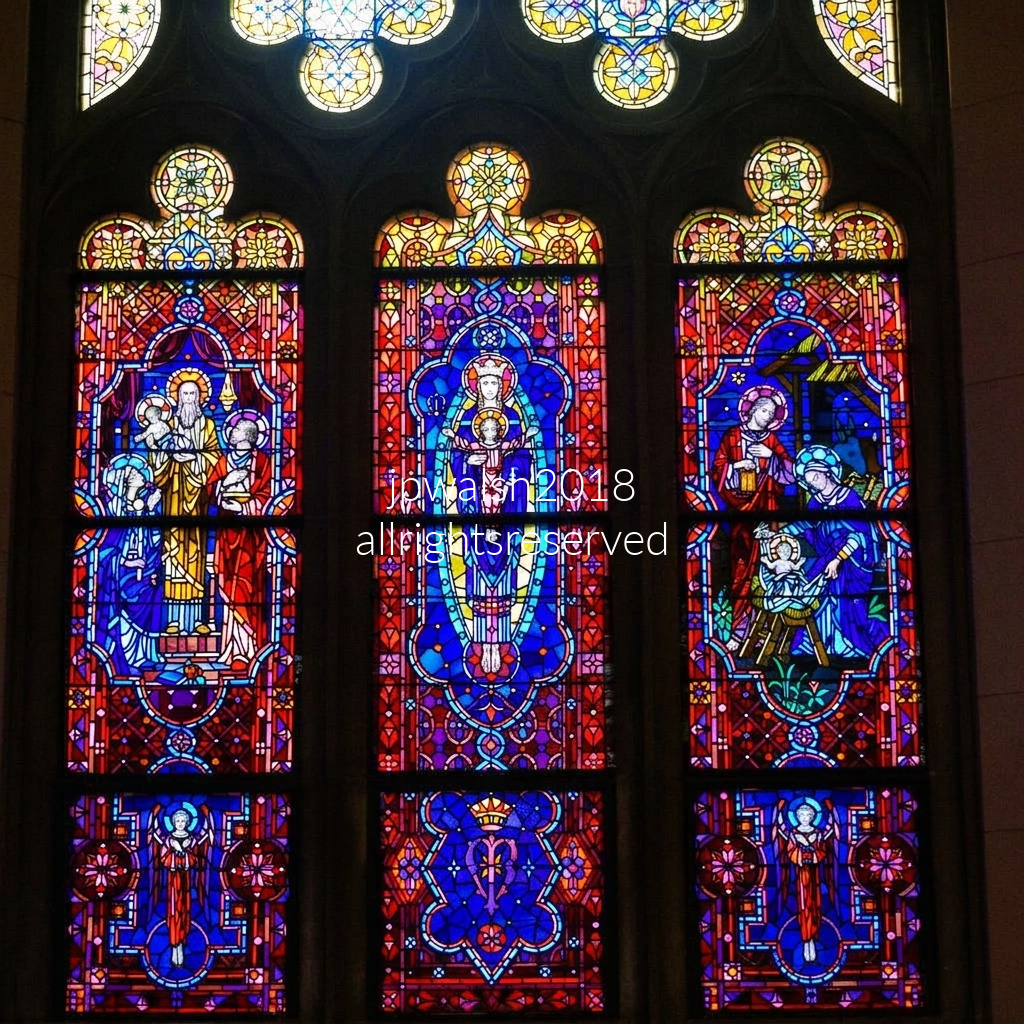
CENTER PANEL: The Queen of Heaven who reigns from the right hand of her son, is depicted in her role as mother of Jesus Christ. Below, a crown hovers over what may be a heart-shaped letter “M” for Mary’s first initial and/or her sacred heart.
LEFT PANEL: The presentation panel depicts Jesus being offered by Mary and Joseph in the Temple, where they meet Simeon, a ‘just and devout’ man of Jerusalem (Luke 2:25–35). Celebrated as the Fourth Joyful Mystery of the Rosary, the Presentation occurs forty days after Jesus’s birth. In accordance with Luke’s narrative, Mary and Joseph journeyed to the Temple in Jerusalem to fulfill the requirements of Mosaic Law: completing Mary’s ritual purification after childbirth and offering the prescription for the redemption of the firstborn son (Leviticus 12; Exodus 13:12–15)
RIGHT PANEL: Nativity of Jesus in Bethlehem (Luke 2: 1-7 and Matthew 1: 18-25) is the Third Joyful Mystery of the Rosary. Below each side panel are identical Angel figures.
ST. BONIFACE WINDOW.

CENTER PANEL: St. Boniface (675–754) is widely regarded as the “St. Patrick of Germany.” A missionary bishop who labored during Europe’s Early Middle Ages, Boniface was primarily responsible for organizing the Church in western Germany. While the ancient sees of Cologne and Mainz already existed, he fundamentally restructured and elevated them to serve as the pillars of his reform movement. Acting under the direct mandate of the Roman pope, Boniface anointed Pepin the Short (714–768)—son of Charles Martel (c. 688–741) and father of Charlemagne (747–814)—as King of the Franks. Pepin’s subsequent 751 coronation established a powerful precedent for future European royal coronations, marking a definitive milestone in the formation of the modern European state
LEFT PANEL: Jesus meets his mother is the fourth station of the cross. The Holy Face, below, is a devotion proclaimed by Pope Leo XIII in 1885.
RIGHT PANEL: Jesus mocked and crowned with thorns (Luke 22:63-65 and John 19:2-3) is the sixth station of the cross.
ST. PATRICK WINDOW.

CENTER PANEL: St. Patrick (418–493) is one of the patron saints of Ireland, alongside St. Brigid (c. 451–525) and St. Columba (540–615). In Wilmette, Illinois, St. Joseph Church was founded in the 1840s to serve German immigrants, while St. Francis Xavier Church was established in 1904 as an English‑speaking territorial parish for the expanding North Shore community.
The depiction of Patrick as the archetypal, bearded Irish bishop—in green vestments, with miter and pastoral staff—rose to prominence in the late 1700s. His iconography includes a book, symbolizing both Holy Scripture and his own Latin works, the Confessio and the Epistola to Coroticus. Patrick also holds the traditional three‑leafed shamrock, the emblem he used to explain the Holy Trinity to the Irish people. Beneath him rests the harp, Ireland’s historic national emblem and one of the world’s oldest musical instruments.
LEFT PANEL: Jesus Christ’s Resurrection from the dead stands as the cornerstone of the Christian faith (1 Cor. 15:17). His empty tomb testifies to Christ’s deity (John 5:26; Rom. 1:4). Through the Resurrection, Christ redeemed humanity from sin (Rom. 4:24–25; Heb. 7:25), granted believers the promise of future resurrection (John 14:19; 1 Cor. 15:20–23), and infused them with spiritual power (Rom. 6:3–4; Eph. 1:19–21).
The window shows the resurrected Jesus holding the banner of victory over death, while a Roman guard collapses before the radiant light of the Risen Christ, accompanied by a ministering angel. Christ’s three‑part cruciform halo traditionally bears the Greek letters ὁ ὤν, meaning “He Who Is” (or “I Am Who Am”), a definitive sign of His divinity.
Although all four Gospels recount the aftermath of the Resurrection, none describe the moment or essence of the event itself — a mystery at the heart of Christian belief.
RIGHT PANEL: The Crucifixion of Jesus shows Him on the cross, flanked by Mary and John the Apostle at its base. Above Christ’s head appear the letters INRI, the Latin initials for Jesus Nazarenus, Rex Judaeorum, the official charge written by Pontius Pilate, meaning “Jesus the Nazarene, King of the Jews.” This title is recorded in John 19:19. Resting symmetrically below each side panel are identical anchoring angel figures, grounding the composition and framing the scene’s solemn balance.

Rood Beam Crucifixion Group:

A striking depiction of the Crucifixion carved in basswood stands atop the sanctuary’s rood beam, positioned at the ceiling line directly above the main altar. Hand‑carved by German sculptor Fritz Muhlhauser, the work revives a medieval English Gothic tradition: the rood beam marking the threshold between nave and chancel, symbolizing the bridge between earth and heaven through Christ’s sacrifice.
Muhlhauser executed the composition in basswood (Lindenwood), a fine‑grained European carving wood prized for holding intricate facial expressions and sharp drapery folds without splitting. The sculptural grouping presents Christ on the cross, His head crowned with thorns beneath the INRI inscription, flanked by Mary on the left and John the Apostle on the right. At the base of the cross, Mary Magdalene, bowed in profound grief, embodies the faithful women who witnessed the Passion (John 19:25; Luke 23:27, 49).
Stylistically, the figures are elongated and vertically dramatic, allowing their features to read clearly from the pews far below while harmonizing with the soaring vertical lines of the church’s late Gothic Revival architecture.
STS. ANN AND MARY WINDOW.
Overview & Architecture
The late Gothic Revival stained-glass window illustrates the sacred maternal lineage that prepared the world for Christ. These nave windows are positioned so that they are sitting almost entirely at eye level. This intimate placement allows parishioners to stand directly beside the glass so that it functions much like an illuminated manuscript page, inviting them to appreciate its rich colors, expressive faces, and intricate details. Compositionally, the window’s narrative layout reads from right to left in terms of scriptural chronology (the Annunciation on the right moving to the Visitation on the left), flanking and bowing inward toward the central, towering figures of Saint Ann and Mary.
Center Panel: St. Ann and the Child Mary
This panel features the child Mary alongside her mother, Saint Ann, celebrating the vital generational link of Mary’s own birth. Because nothing is explicitly recorded in the New Testament about Mary’s parents or her nativity, early apocryphal Christian texts—such as the Protoevangelium of James—provide the vital historical framework. see – CHURCH FATHERS: Protoevangelium of James – retrieved September 8, 2026. These texts detail the miraculous nature of Mary’s birth to her long-barren parents, cementing an enduring legendary tradition of her immaculate beginnings. This familial focus is reinforced by the distinct vertical typography stitched directly into the blue glass background borders, with clean, capital letters clearly marking “SAINT ANN” and “SAINT MARY”—a design that rewards close-up reading from the aisle.
Anchoring the base of this central structure is a miniature depiction of an angel.
Left Panel: The Visitation
The left detail depicts the Visitation of the Blessed Virgin Mary to her cousin Elizabeth (Luke 1:39–45). Following the Annunciation, Mary journeyed into the hill country to remain at the home of Elizabeth and her husband Zechariah for three months. Both women were experiencing miraculous pregnancies—Mary carrying Jesus by virgin birth, and Elizabeth conceiving John the Baptist in her advanced age. The window captures the precise moment John the Baptist leaped with joy in Elizabeth’s womb upon hearing Mary’s greeting (Luke 1:41). The Visitation is celebrated as the Second Joyful Mystery of the Rosary.
Anchoring the base of this left panel scene is a miniature architectural tabernacle or ark; Luke heavily structured his Visitation narrative around Old Testament accounts in 2 Samuel and 1 Kings regarding the physical journey of the Ark of the Covenant. Accordingly, paragraph 2676 of the Catechism of the Catholic Church formally identifies Mary as the Ark of the New Covenant: “Mary, in whom the Lord himself has just made his dwelling, is the daughter of Zion in person, the Ark of the Covenant, the place where the glory of the Lord dwells. She is ‘the dwelling of God . . . with men.’”
Right Panel: The Annunciation
The right panel illustrates the Annunciation, wherein the Archangel Gabriel proclaims that Mary will bear the Son of God, Jesus Christ, greeting her with the words: “Hail Mary, full of grace, the Lord is with you!” It is through Mary’s faithful acceptance of the divine will—“Behold, I am the handmaid of the Lord; let it be to me according to your word” (Luke 1:26–38)—that the Incarnation takes place. A traditional vase of white lilies sits positioned between Gabriel and Mary, serving as a classic art-historical symbol of her perpetual virginity and spiritual purity. The Annunciation constitutes the First Joyful Mystery of the Rosary.
Anchored at the base of this right-panel scene is the fruit of Mary’s womb, the infant Jesus, wrapped in swaddling clothes (Luke 2:7, 2:12). He appears as he did when Mary laid him in a manger in Bethlehem, because there was no room for them at the inn.
ST. JOSEPH WINDOW.

CENTER PANEL: St. Joseph was the foster father of Jesus and served as His guardian protector. Joseph’s symbology includes his holding a carpenter’s square (Matt. 13:55) along with a white lily to symbolize his faithfulness and chastity toward Mary (Matt. 1:25), as well as his absolute holiness and obedience to God (Matt. 1:24; 2:14, 21, 22). This devotional aspect is made explicit by the vertical text framing his figure, reading “SAINT JOSEPH” on the left and “PRAY FOR US” on the right in stark, clean capital letters. An angel figure is positioned directly below St. Joseph.
LEFT PANEL: The left detail depicts the Holy Family in Nazareth, illustrating the hidden years where Jesus was obedient to Mary and Joseph and “progressed steadily in wisdom, age, and grace before God and men” (Luke 2:52). Jesus is shown being instructed by St. Joseph in the carpenter’s trade, holding a prophetic wooden cross upon His knees. The flowering grass below is highly decorative and signifies the flowering staff of St. Joseph, which symbolized that he was specially chosen by God to be Mary’s husband. This imagery was heavily drawn from the Old Testament type where Aaron’s staff, placed before the Ark of the Testimony, miraculously sprouted with almond blossoms as a divine sign of his election (Num. 17:8; Vulgate 17:23).
RIGHT PANEL: The right panel captures Mary and St. Joseph finding the twelve-year-old Jesus in the Temple sitting among the doctors of the Law (Luke 2:41–52), which constitutes the Fifth Joyful Mystery of the Rosary. This scriptural event marks the only time in the Gospels where Jesus makes a public appearance between His infancy narrative and His later baptism in the Jordan by John the Baptist at the start of His public ministry (Matt. 3:3–17; Mark 1:9–11; Luke 3:21–23; John 1:29–33). Compositionally, the twelve-year-old Jesus is visually elevated above the scroll-holding doctors, sitting upon a small stone cathedra or teaching chair, which subtly emphasizes His divine authority over the earthly teachers of the Law.
Compositional Harmony Across the Base
The window’s lowest register displays a deliberate symbolic balance between the two side panels. Directly beneath the Nazareth home scene on the left, an ornate vase holds three stylized lilies representing the domestic purity of the Holy Family. This perfectly counterbalances the stone tablets of the Ten Commandments on the right, which are inscribed with Roman numerals (I through X) beneath the Eye of Providence—a symbol of the Holy Trinity hovering within an equilateral triangle. Together, the window visually tracks Jesus’s growth from the quiet, private household raised by his parents (the left) into the public, formal structures of divine law where He takes up His true spiritual mission as the Son of God (the right).
ST. PAUL THE APOSTLE WINDOW.

CENTER PANEL: This panel features St. Paul, the great Apostle to the Gentiles. He is depicted in a traditional pose of apostolic authority, with his right hand raised in blessing and his left hand holding a large volume representing the Holy Scriptures and his foundational New Testament epistles. The figure is framed by vertical typography in clean capital letters reading “SAINT” on the left and “PAUL” on the right. While Christian iconography and the traditional symbology of martyrs frequently depict Paul holding a sword—both as the historical instrument of his execution by beheading (c. 64–68 CE) and as a metaphor for the ‘sword of the Spirit, which is the word of God’ (Ephesians 6:17)—this specific window replaces that martial emblem with the written word, highlighting his role as the preeminent teacher, theologian, and writer of the early Church. An angel figure is positioned directly below St. Paul.
LEFT PANEL: The left panel portrays Pentecost (Acts 2:1–13), which immediately followed the timeline of the Ascension. The scene depicts the Apostles gathered in prayer alongside Mary, the Mother of Jesus, as they receive the promised outpouring of the Holy Spirit. The divine presence is symbolized by a radiant dove descending from Heaven, casting tongues of fire upon the faithful below. Affixed to the bottom register of this panel is a prominent inscription block that reads: “TEACH YE ALL NATIONS – MATTHEW 28.”
RIGHT PANEL: The right panel illustrates the Ascension of Jesus into Heaven, an event heavily witnessed and detailed throughout the New Testament (Luke 24:50–53; Acts 1:6–12; John 3:13; Romans 8:34; Ephesians 1:19–20). The composition captures the exact moment the Resurrected Christ physically departed from Earth, rising into the heavens before the gaze of His Eleven remaining apostles (Judas Iscariot betrayed Jesus and tragically hung himself). Visually reinforcing this mystery, a cloud of glory reaches down from the upper tracery to receive Christ as His divine humanity enters into the eternal intimacy of the Father, sealing His identity as the perfect God-Man. Symmetrically anchoring the overall window design, a stylized descending dove—the symbol of the Holy Spirit—rests within the lower register directly below this scene.

Thematic and Compositional Harmony
The window’s design displays a brilliant theological and visual unity across its panels. Liturgically and historically, the inscription at the bottom left—“Teach ye all nations” (Matthew 28:19)—functions as the structural catalyst for the entire visual program. The Pentecost panel directly above it provides the Apostles with the supernatural grace and tongues of fire required to execute this Great Commission, while the central panel of St. Paul showcases the ultimate historical fulfillment of that missionary command to the wider world.
Artistically, this narrative is bound together by the striking use of deep cobalt blue glass backgrounds behind all three central figure groupings. This deliberate choice creates a dense, uniform baseline that forces the fiery reds and golden ambers of Christ’s robes and the descending Holy Spirit to pop with staggering visual contrast when sunlight hits the glass.

THE GOOD SHEPHERD WINDOW.

CENTER PANEL: This panel features Jesus Christ declaring Himself the ‘Good Shepherd’ (John 10). This title fulfills the Old Testament prophecies of Ezekiel, who foretold a singular Messiah-Shepherd sent to oversee the people of God (Ezek. 34:23–24; 37:24–25). Christ is depicted holding a pastoral staff with a lamb slung securely over His shoulders, symbolizing His protective care for the faithful. This messianic claim is rendered instantly legible by the stark vertical English typography stitched directly into the blue background glass, reading “I AM THE” on the left and “GOOD SHEPHERD” on the right. Positioned within the lower register directly below His feet is a triumphant Agnus Dei (Lamb of God) panel, portraying a haloed lamb holding the banner of victory over death. This iconography honors John the Baptist’s proclamation (John 1:29) and functions as an Old Testament typological echo of the ram provided by God to replace Isaac on Mount Moriah (Gen. 22:13), foretelling the ultimate sacrifice of the Son of God at Calvary.
LEFT PANEL: The left panel portrays the Scourging at the Pillar, which constitutes the Second Sorrowful Mystery of the Rosary and part of the severe bodily brutalities Jesus endured during His Passion (John 19:1–3). Bound to a marble column, Christ is flanked by two Roman torturers. Resting directly beneath His feet are the instruments of His flagellation: the leather-thonged whip (flagrum) and crossed wooden rods. Symmetrically anchoring the base of this narrative register, a standing angel figure rests directly below.
RIGHT PANEL: The right panel depicts Jesus in the Garden of Gethsemane during His Agony, positioned at the foot of the Mount of Olives the night before His Crucifixion (Luke 22:39–46). Knowing the immediacy of Judas’s impending betrayal, Jesus kneels in intense prayer, pleading: ‘Father, if you are willing, take this cup from me. Yet not my will, but yours be done’ (Luke 22:42). The window captures the exact fulfillment of the subsequent verse, where a ministering angel descends from heaven to strengthen Him (Luke 22:43). This angel holds out a golden Eucharistic chalice directly toward Christ’s face, visually transforming the abstract concept of the spiritual ‘cup of suffering’ into a tangible, liturgical reality. Mirroring the layout of the left side, an identical standing angel figure occupies the register directly below.
Compositional and Structural Balance
Architecturally, the entire triptych is bound together by identical, pointed trefoil-lobed arch borders (or ogival mandorlas) rendered in deep cobalt blue glass. This recurring geometric framing establishes a strict visual symmetry across the three windows, naturally drawing the viewer’s eye away from the chaotic flanking scenes of the Passion and focusing it onto the serene, central icon of the Good Shepherd.
This formal balance extends to the lower register of the window. The identical, standing angel figures flanking the base on the left and right face inward toward the central register. This deliberate layout creates a sacred, heavenly court at eye level, physically framing and guarding the triumphant Agnus Dei panel at the center of the visual program.

SOURCES:
Heavenly City: The Architectural Tradition of Catholic Chicago, Denis Robert McNamara, James Morris, Liturgy Training Publications, Chicago, Illinois, 2005, pp. 138-140
Chicago Churches and Synagogues: An Architectural Pilgrimage, George Lane, S.J., and Algimantas Kezys, Loyola University Press, Chicago, 1981.
Saint Ignatius and His First Companions, Chas. Constantine Pise, P.J. Kenedy & Sons, New York, 1892, pp.105-151.
The Saints: A Concise Biographical Dictionary, edited by John Coulson, Guild Press, New York, 1957.
The New American Bible, Catholic Book Publishing Corp, New York, 1993.
Catechism of the Catholic Church, 2nd Edition, Doubleday, New York, 1997.

St. Francis Xavier statue –
https://traveltriangle.com/japan-tourism/how-to-reach
St. Peter Window –
https://www.christianity.com/jesus/life-of-jesus/teaching-and-messages/what-are-the-keys-of-the-kingdom.html
St. Patrick Window –
https://www.confessio.ie/more/article_kelly#
https://www.moodybible.org/beliefs/positional-statements/resurrection/
https://www.newworldencyclopedia.org/entry/INRI
Basswood crucifix –
Queen of Heaven Window –
https://www.newmanministry.com/saints/presentation-of-jesus-in-the-temple
Sts. Anne and Mary Window –
https://www.catholic.com/magazine/print-edition/mary-the-ark-of-the-new-covenant
St. Joseph Window-
https://virtualstjosephaltar.com/the-symbols-of-st-joseph
St. Paul The Apostle Window –
https://aleteia.org/2018/10/03/why-is-st-paul-depicted-carrying-a-sword/
The Good Shepherd Window –
https://www.christianity.com/wiki/jesus-christ/jesus-called-the-good-shepherd.html
http://www.graspinggod.com/scourging-of-jesus.html