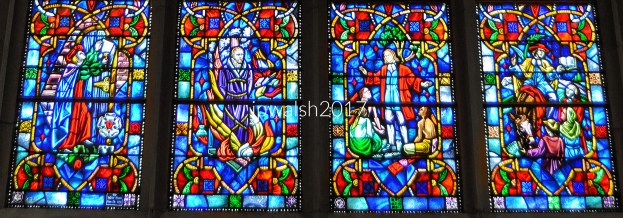
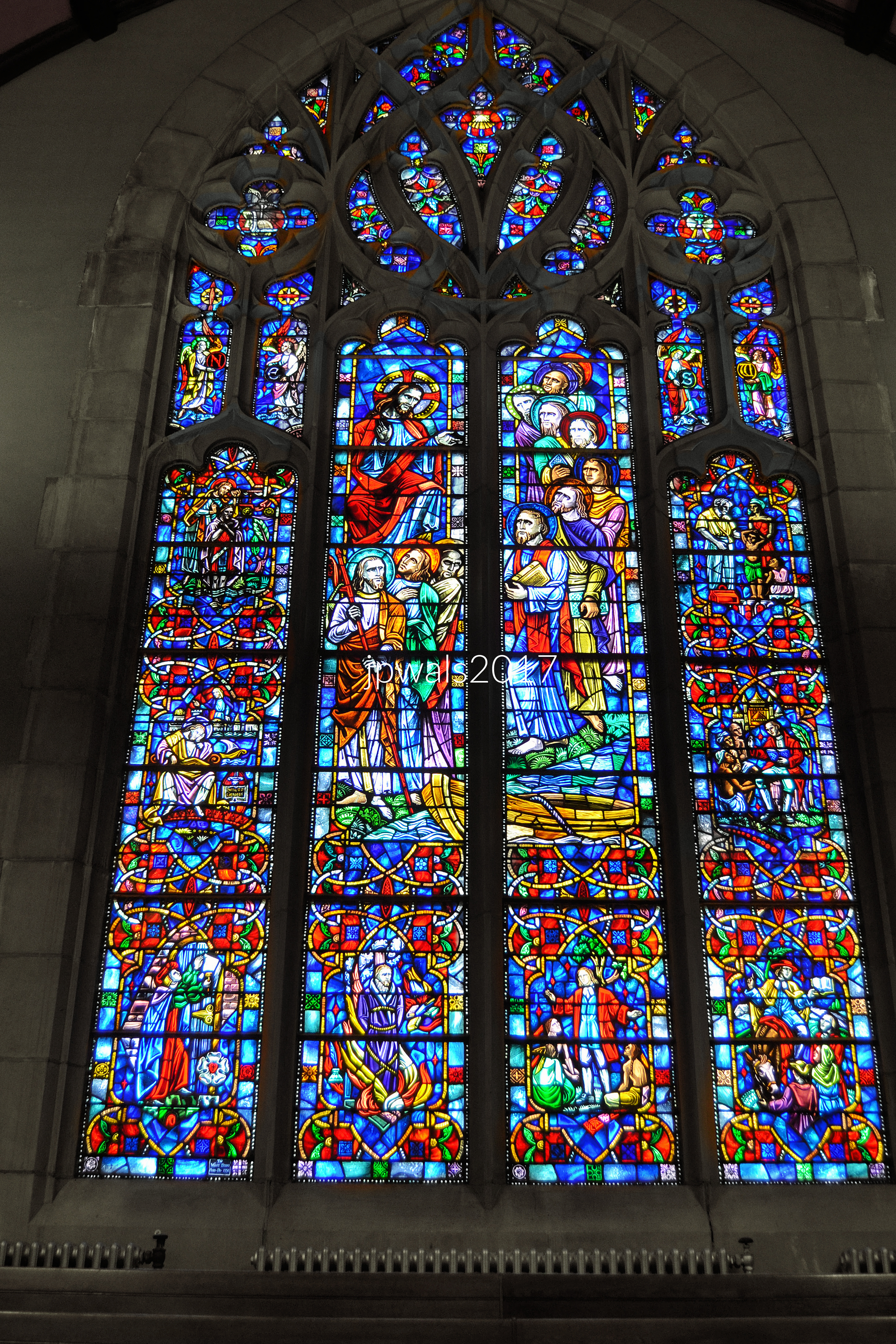
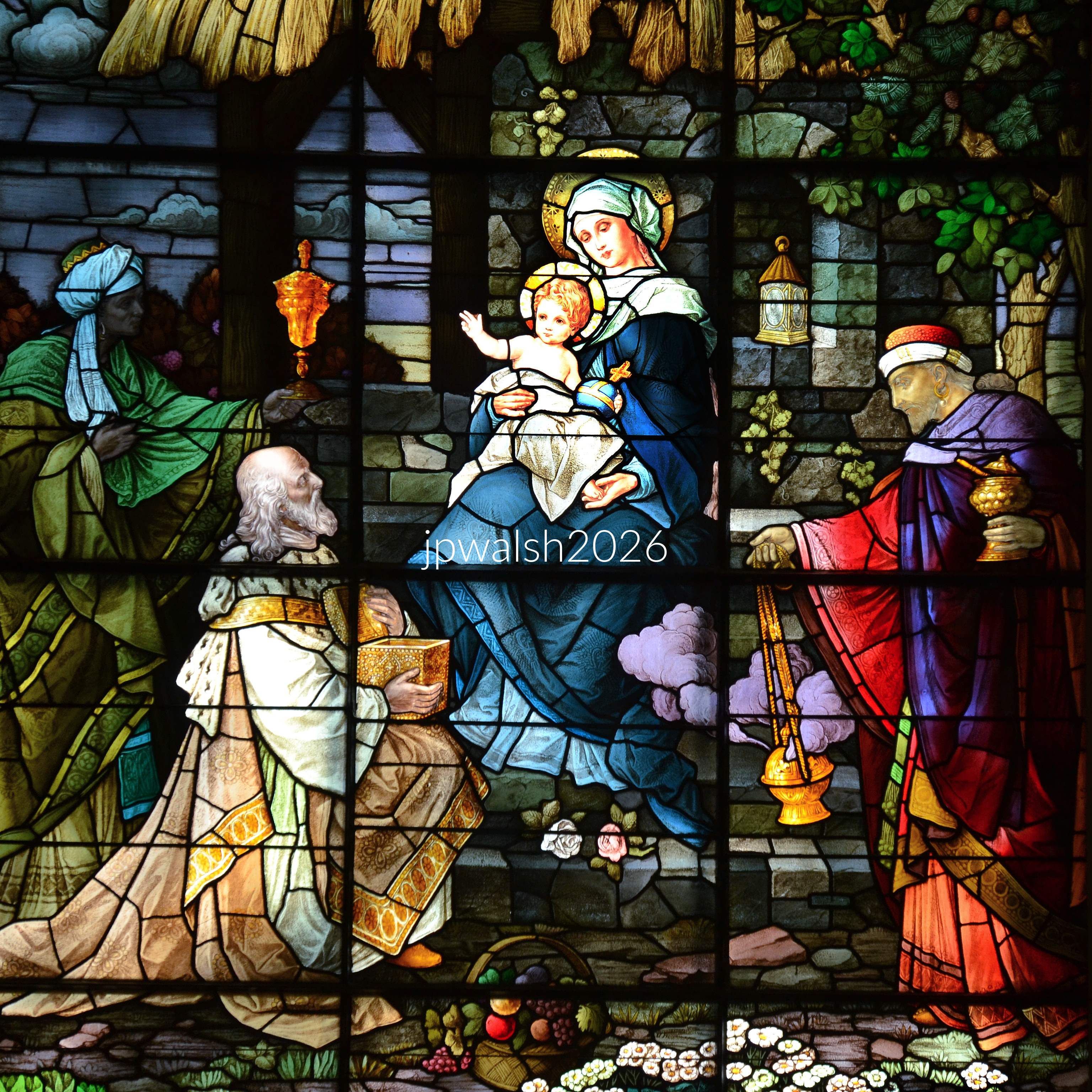
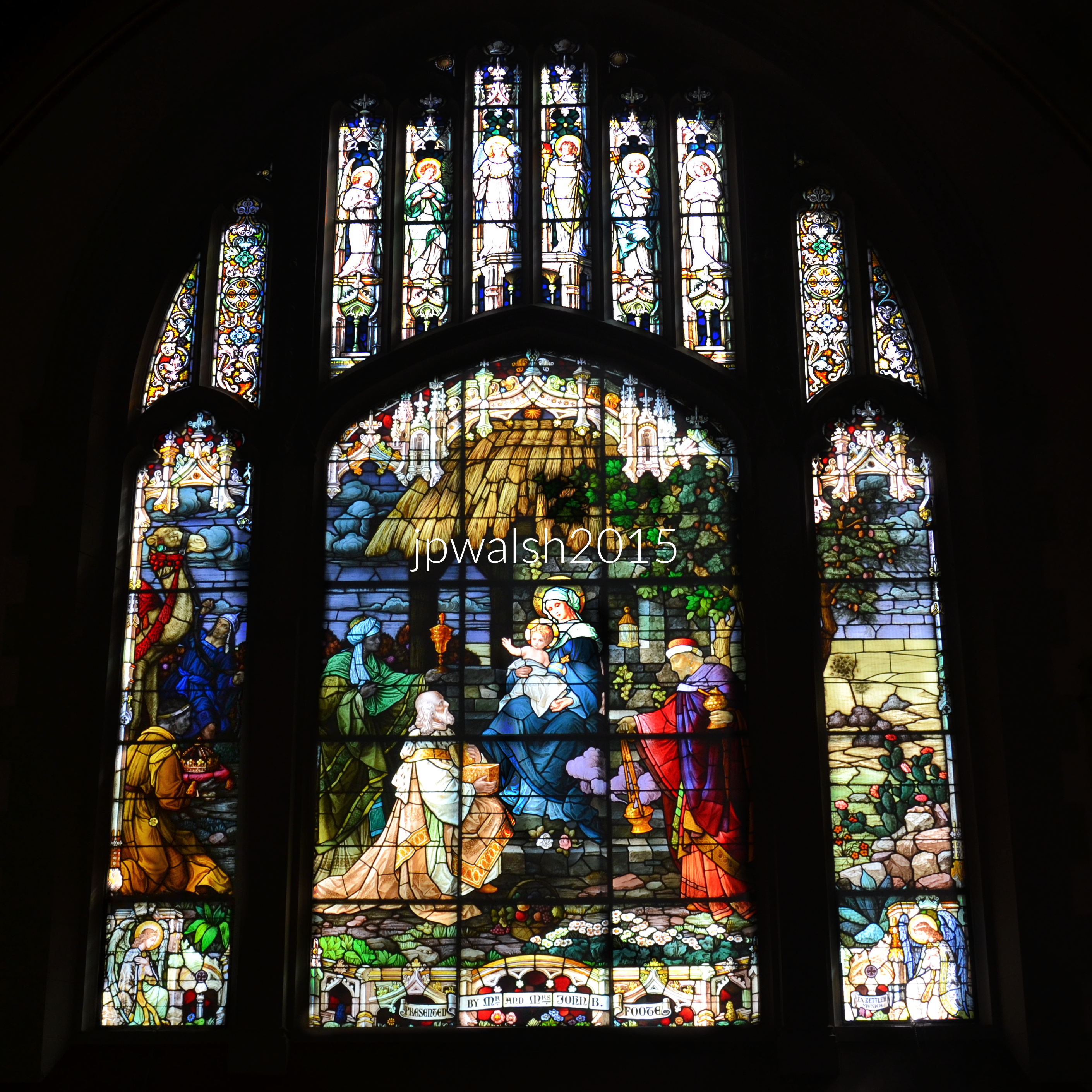
FEATURE Image: Reformation and the 18th century missions of Methodist founder John Wesley, detail of Willet stained- glass window, Trinity United Methodist Church, 1024 Lake Avenue, Wilmette, Illinois. March 2017. Author’s photograph.
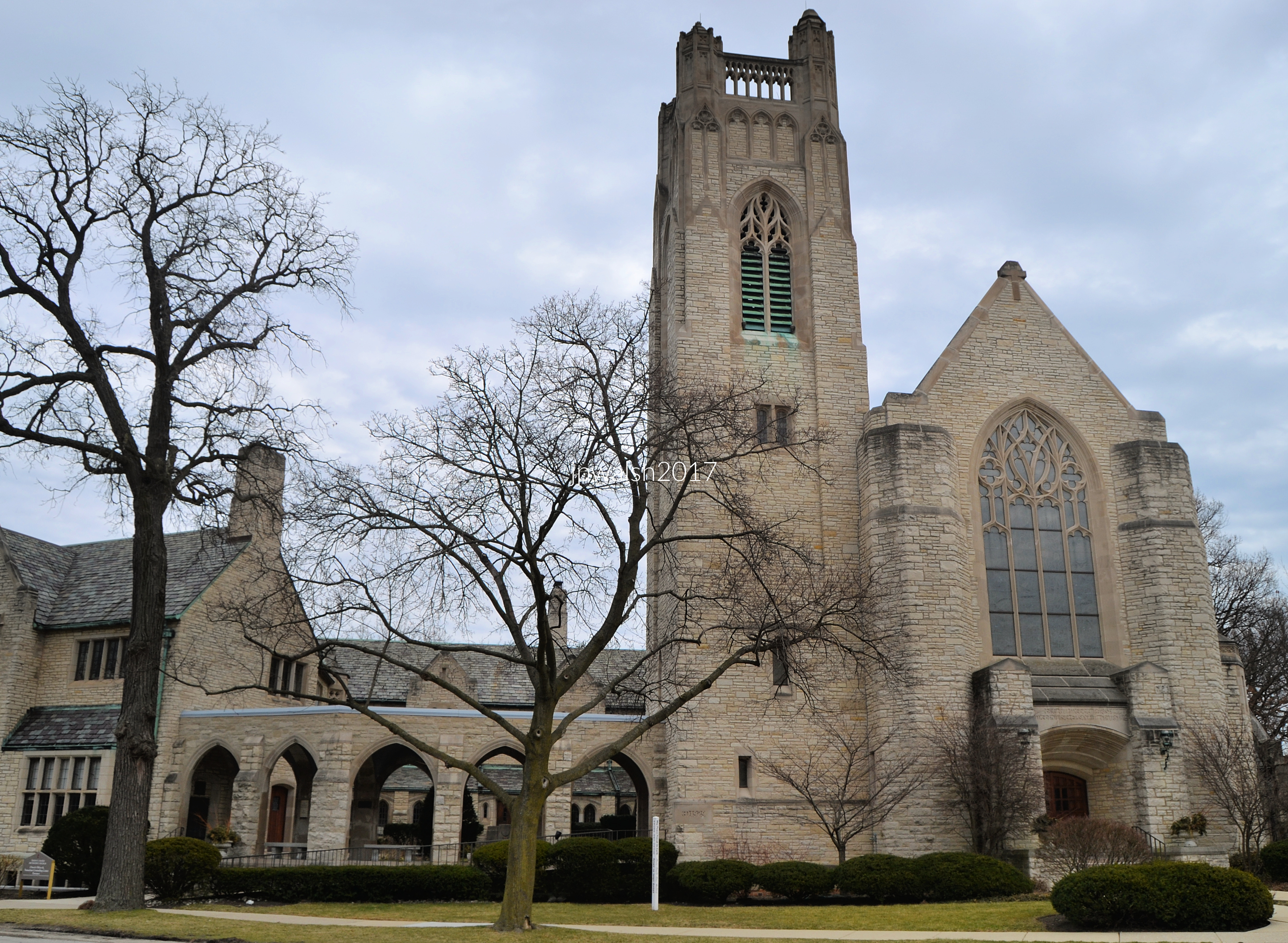
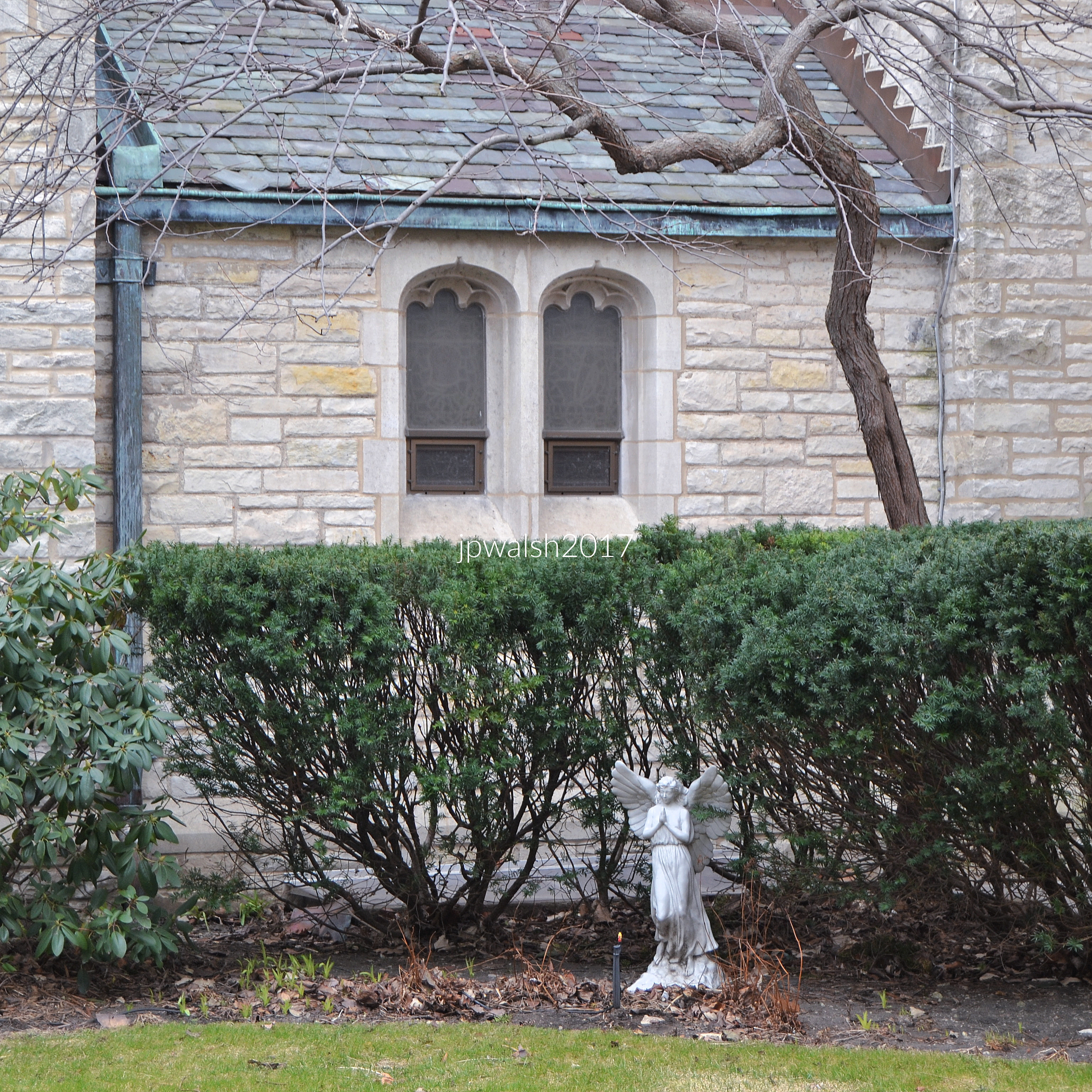
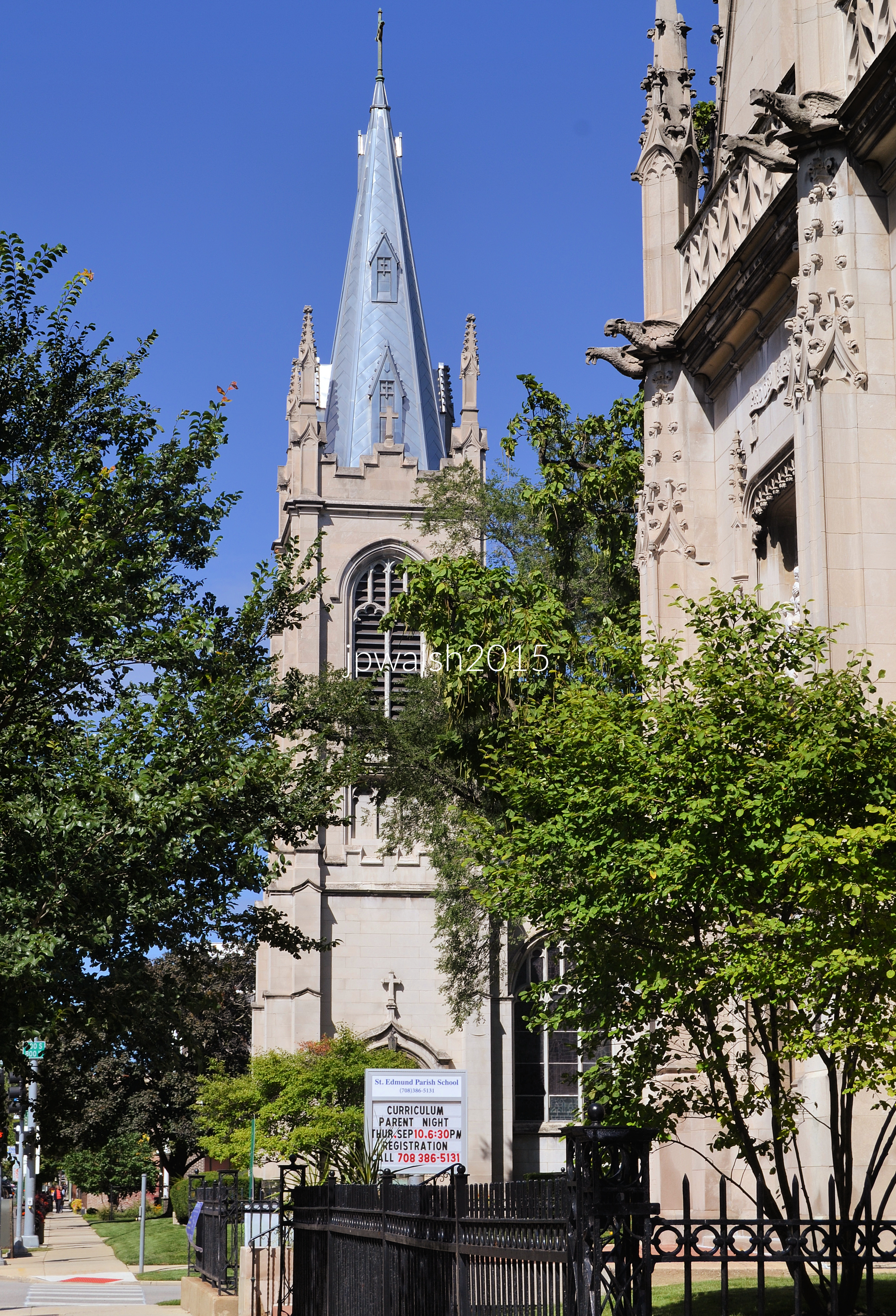
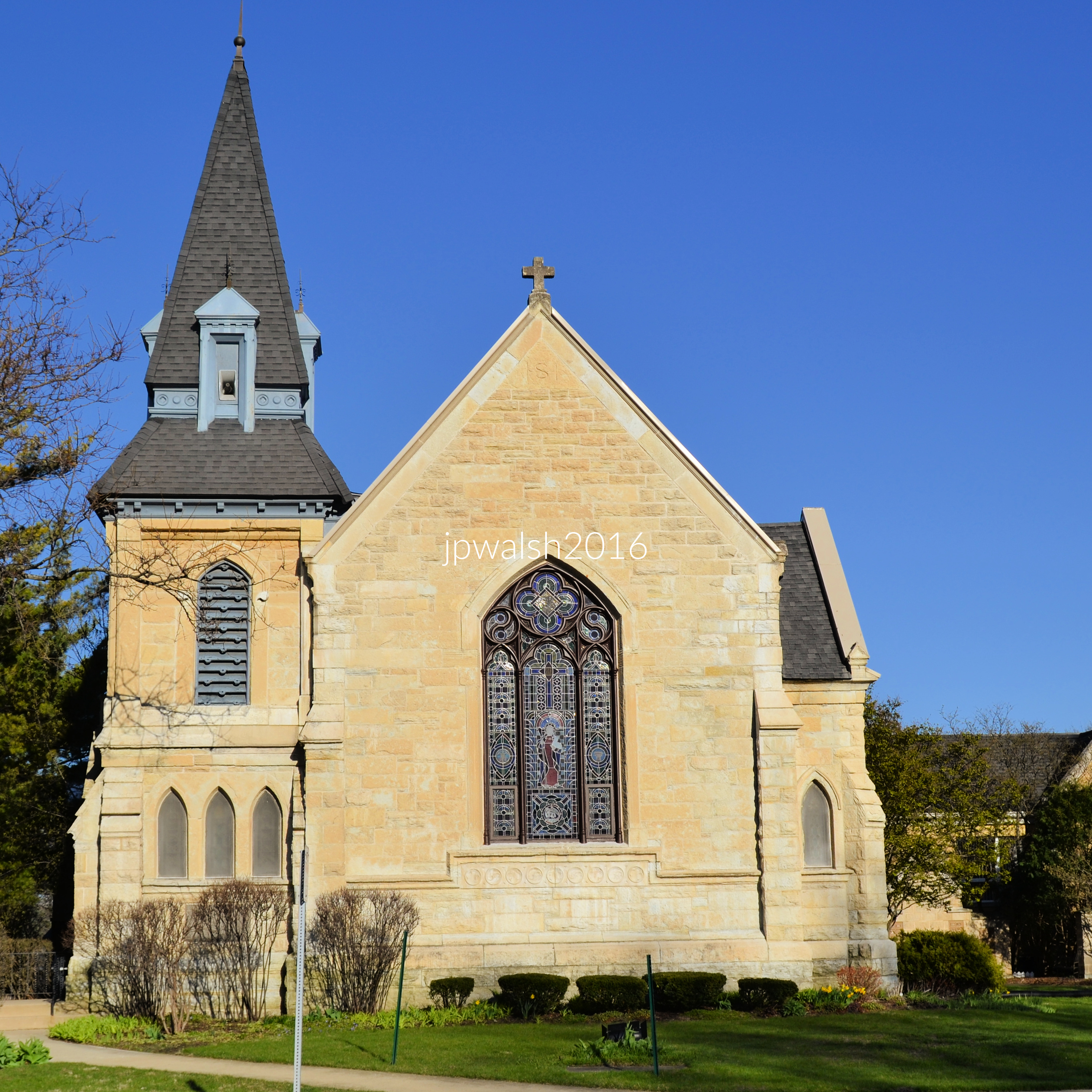
The church buildings complex displays the key ecclesiastical architectural features of late American Gothic Revival style. Trinity UMC, Wilmette. March 2017. Author’s photograph. 4.38mb DSC_0634 (1).
Architecture of Trinity United Methodist Church, Wilmette.
The Ashlar limestone church has stood on a prominent triangular corner of Lake and Wilmette Avenues for nearly 100 years. In the late American Gothic Revival style that flourished in the first third of the 20th century, the church displays in my photo its key ecclesiastical architectural features of (1) pointed‑arch windows with stone tracery, (2) tall bell tower with louvered openings, (3) buttress‑like vertical stonework emphasizing height, (4) a steep slate roof and (5) stained‑glass windows set in deep stone. Designed by Granger & Bollenbacher, the church building completed in 1929 is designed to feel ancient, monumental, and rooted in medieval Christian tradition — exactly what Methodist congregations of the era wanted. Trinity UMC stands out on the North Shore because it is scaled to frame its narrative, more medieval stained glass and not for grandeur comparative to its neighbors such as Christ Church (Episcopal) in Winnetka designed by Bertram Goodhue, or for crisp academic lines such as First Presbyterian in Wilmette designed by Coolidge & Hodgdon, among others. Of Gothic Revival churches built between 1900–1935. Trinity fits squarely into that movement, but with its own personality, specifically its didactic windows. The building was erected when the congregation outgrew its earlier 1908 Romanesque brick church. The church’s current Gothic Revival building, designed by Chicago architects Granger and Bollenbacher, reflects inspiration from European cathedrals. Construction began in the late 1920s, but the 1929 Stock Market Crash halted many of the planned interior details. The stained- glass windows, including the prominent façade window, were designed and installed by Henry Lee Willet in 1954.
Founding History and Its “Home Alone” Legacy.
Trinity United Methodist Church in Wilmette is one of the North Shore’s oldest congregations, with a history that stretches back to the 19th century. Founded on March 24, 1874, the church originally bore the name First Methodist Episcopal Church of Wilmette. Over the decades, it evolved through several identities — Wilmette Parish Methodist Church (1930–1968), Trinity Church of the North Shore (1968–1989), and finally Trinity United Methodist Church of Wilmette, the name it carries today. The church’s historic bell — once used to call worshippers, toll for local deaths, and warn the village of fires — now sits on display near the parking lot.
While its spiritual and community roles define its core identity, Trinity United Methodist Church is also widely recognized for its unexpected place in American pop culture. The church’s exterior appears in two memorable scenes in the 1990 Christmas classic “Home Alone.” In the film, directed by John Hughes, young Kevin McCallister (Macaulay Culkin) first spots the church while fleeing the burglars and hides in the Nativity scene on the lawn. Later, Kevin approaches the church at night, drawn by the sound of the choir singing “O Holy Night.” These moments set the stage for one of the film’s most emotional sequences — Kevin’s conversation with Old Man Marley — though that interior scene was filmed at Grace Episcopal Church in Oak Park. Securing permission to film at Trinity was not straightforward. When Twentieth Century Fox approached the Village of Wilmette in early 1990, the Village Board narrowly approved the request in a 4–3 vote after discussion and date changes. Filming took place in late winter of that year, and the church’s brief but iconic appearance has since become a point of local pride. Today, Trinity embraces this connection, often noting that to many visitors, it is simply “the Home Alone church.”
More than a movie landmark, Trinity United Methodist Church in Wilmette remains a vibrant congregation committed to worship, music, community service, and hospitality — a place where history, faith, and a touch of Hollywood intersect on the corner of Lake and Wilmette Avenues.
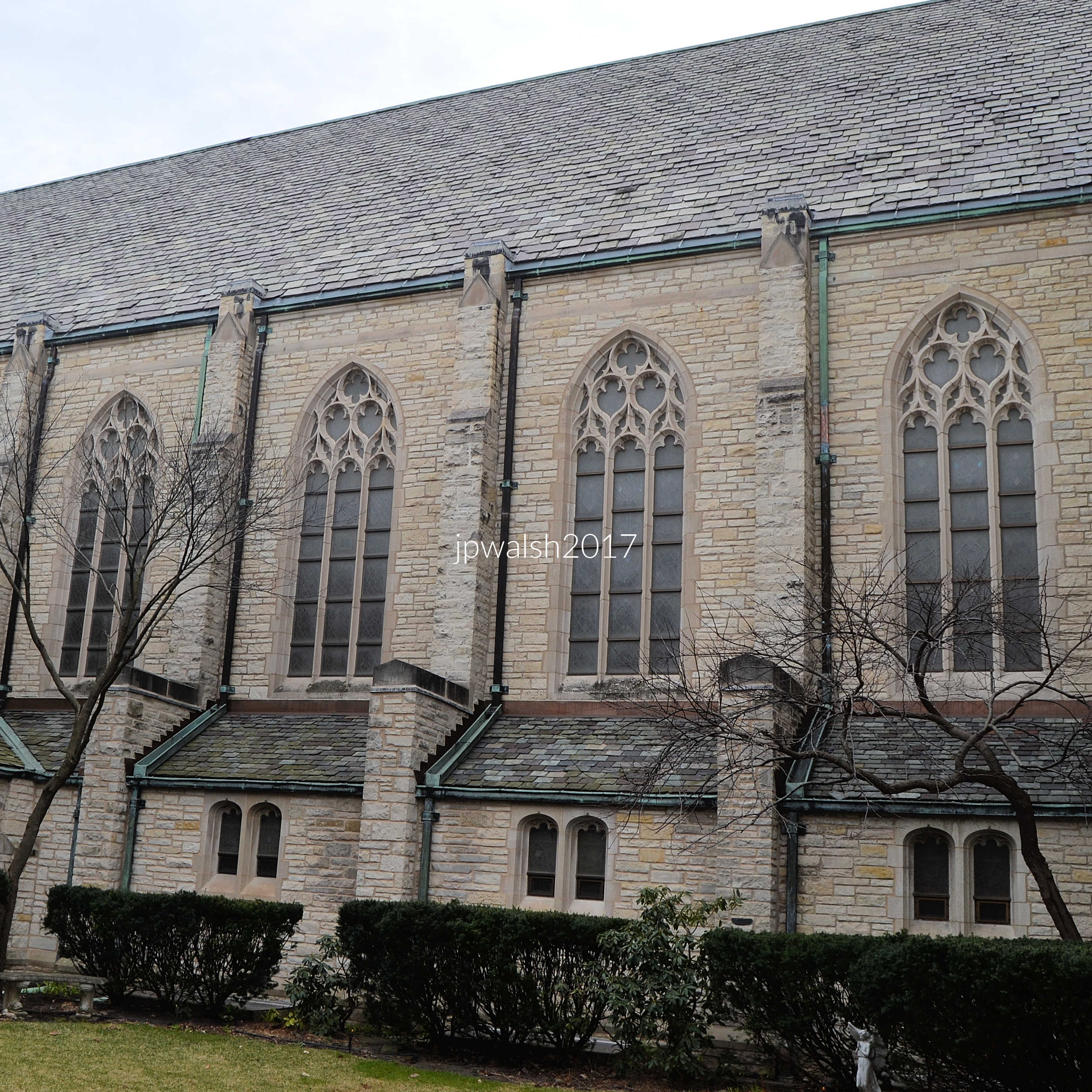
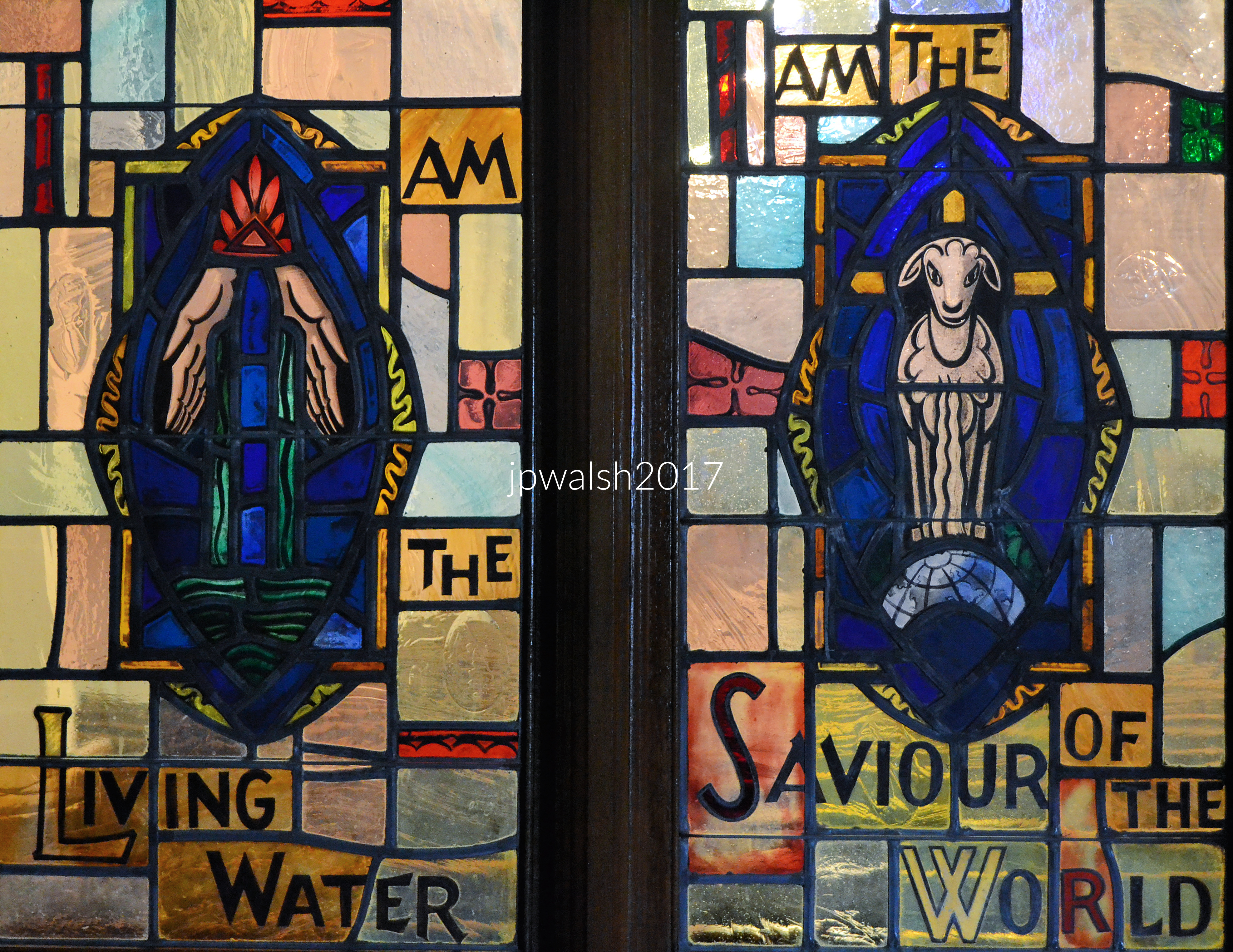
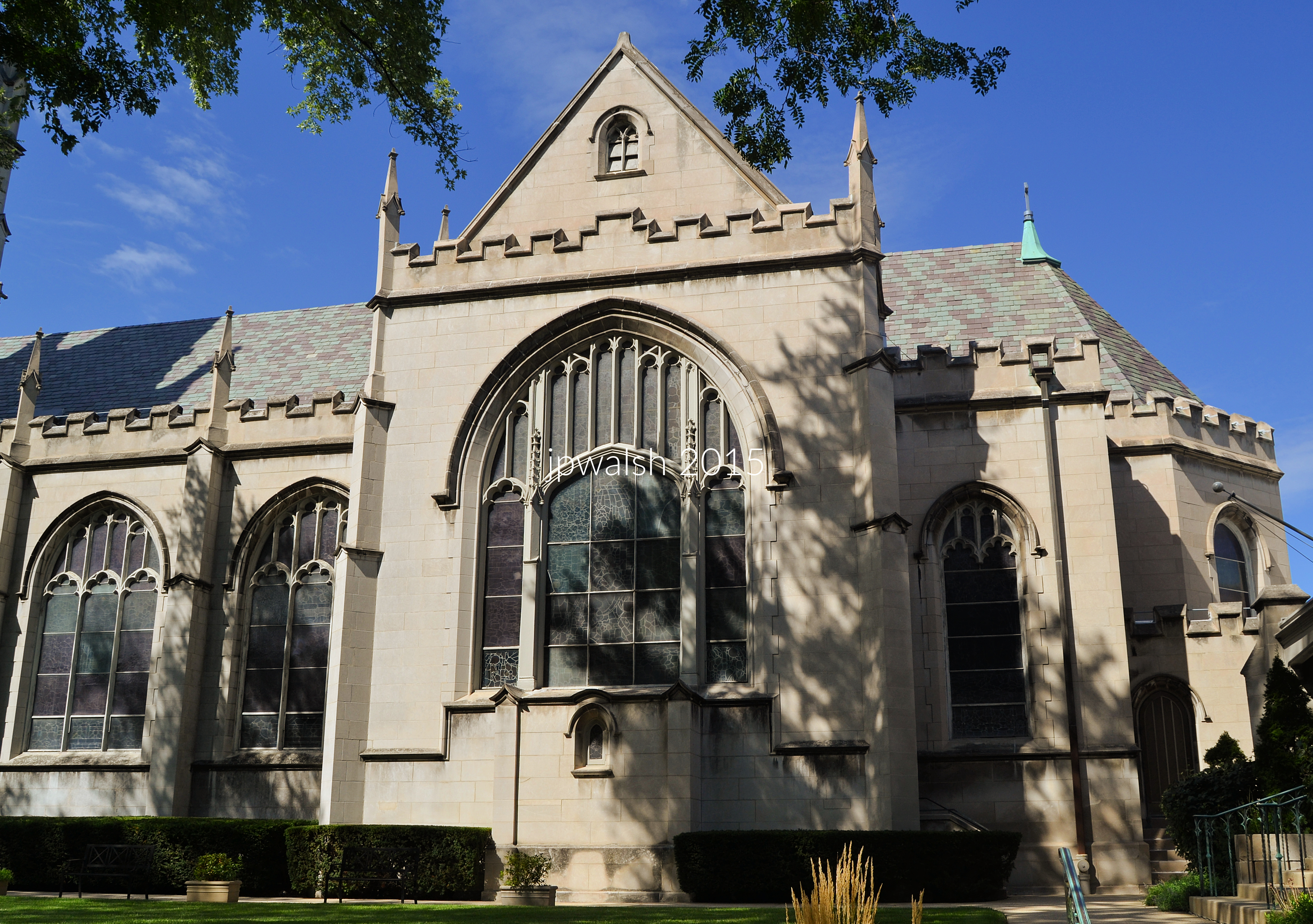
Designed by Granger & Bollenbacher, a procession of stained‑glass windows that line the nave are set in deep stone. Trinity UMC, Wilmette. March 2017. Author’s photograph. 3.40mb DSC_0635 (1)
How the architecture relates to the stained‑glass program.
The stained glass was created by Henry Lee Willett of Willett Stained Glass Studios in Philadelphia, one of the leading American studios of the mid‑20th century. The major façade window, dated February 14, 1954, shows Willett’s signature use of rich blues, jewel‑tone reds, elongated Gothic figures, and clear narrative panels. Its scale and design were chosen for narrative clarity, while the church’s deep window wells intensify color saturation and create a natural shadow‑frame that draws the eye toward the visual telling of Scripture — a hallmark of Methodist stained‑glass design. While Trinity’s windows feel sacred and are tall enough to make a visual statement, they are also narrow enough to keep scenes readable and, like most narrative stained-glass windows, arranged in story cycles. The church’s façade and nave proportions create a natural processional reading of the windows, allowing each panel — and the entire cycle together — to unfold as a coherent theological arc. Methodist churches of the 1920s often used architecture to shape a catechetical journey, with the Gothic style providing both a sense of transcendence and a visual link to the continuity of the church across the millennia. The building and the glass tell the same story: God speaks, calls, teaches, transforms.
Interior Analysis: Gothic Revival Structure.
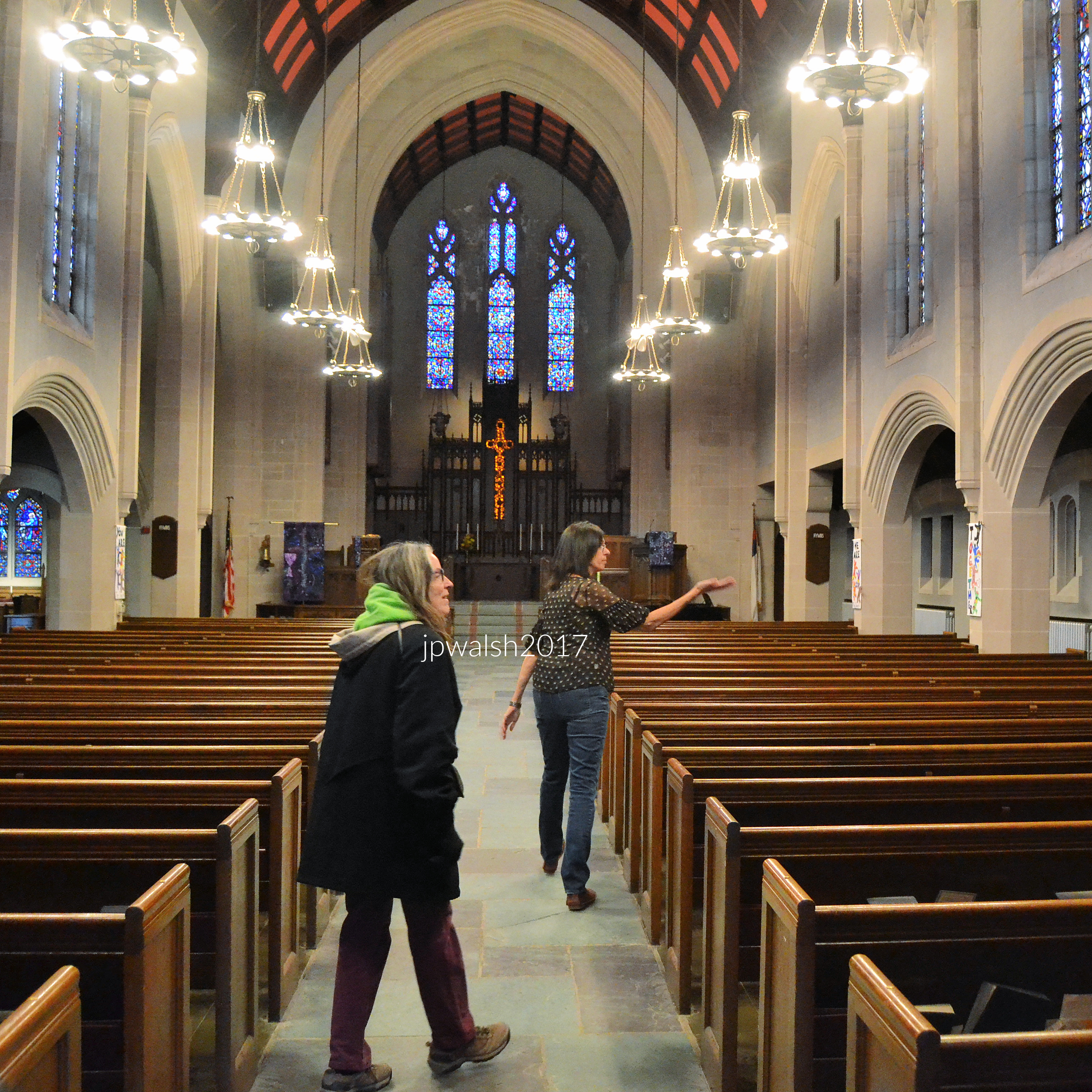
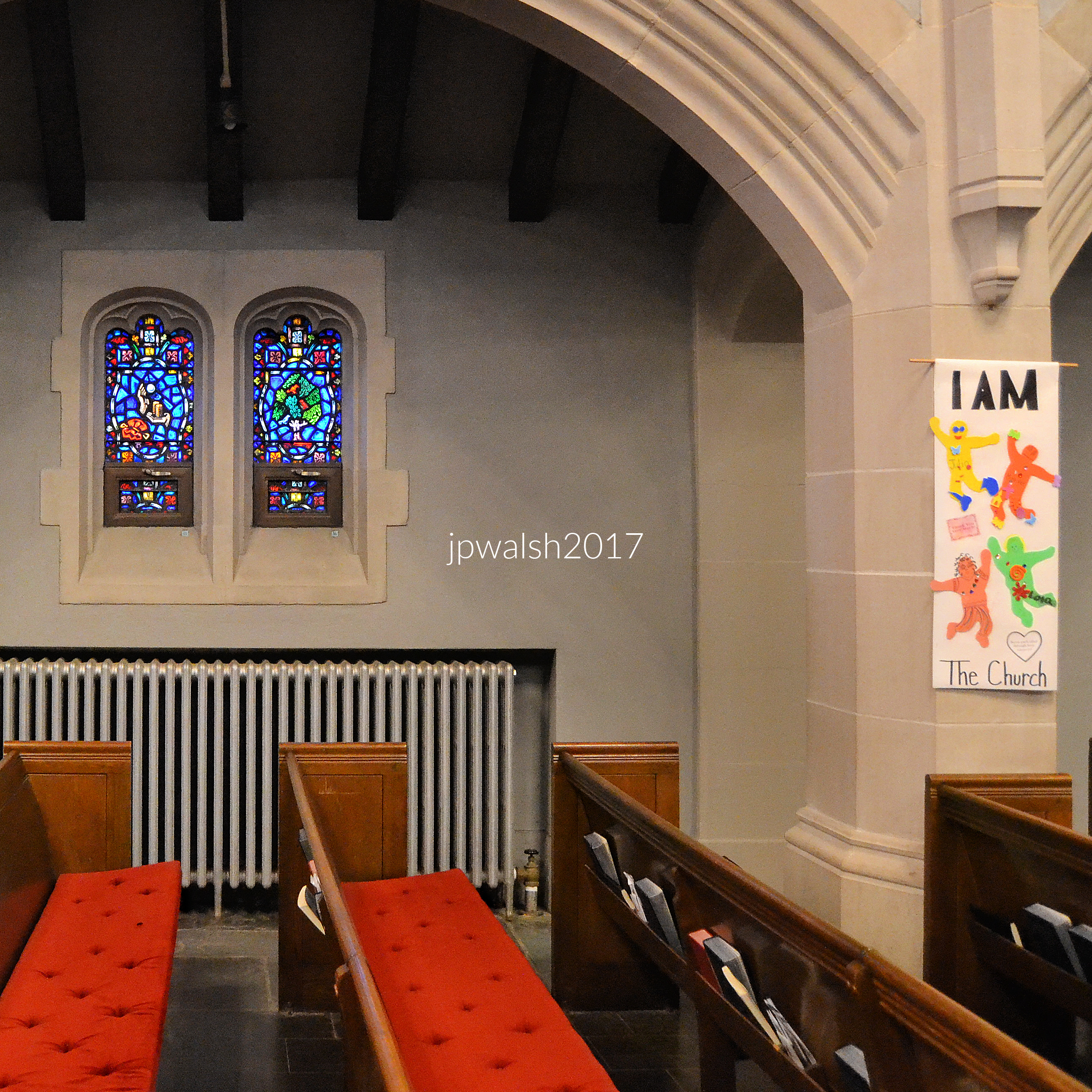
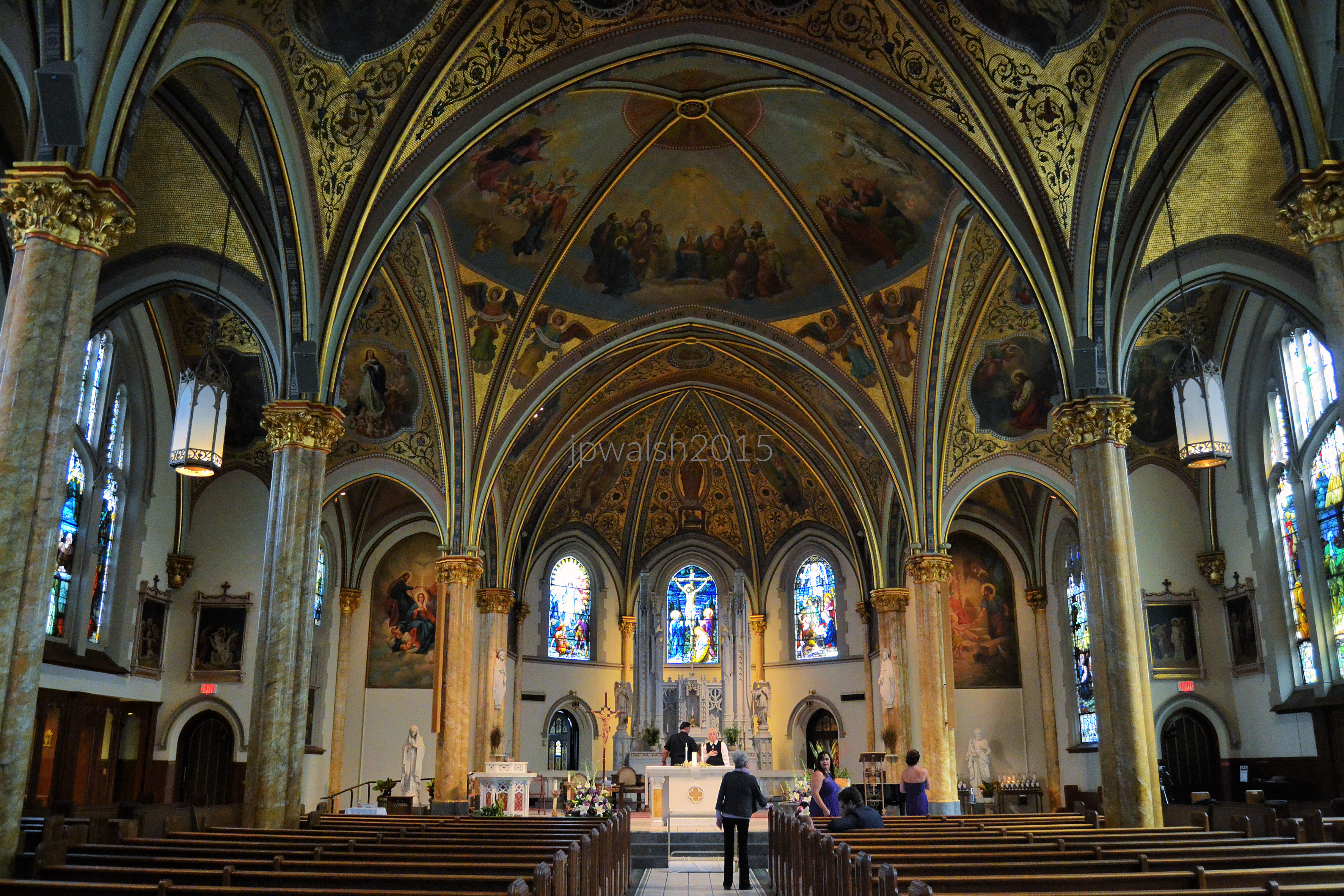
The sanctuary speaks in the familiar Gothic vocabulary. Trinity UMC, Wilmette. March 2017. Author’s photograph. 4.48 mb DSC_0654 (1)
A procession of rounded arches line the nave arcade, a testament to the congregation’s former Romanesque church building, with Gothic pointed-arch stained -glass windows above them guiding the eye upwards and forward. Above these, a ribbed or groin‑vaulted ceiling lifts the gaze further upward into a sense of height and devotion that feels almost instinctive. Reinforcing this vertical pull, the tall, narrow stained‑glass windows have proportions echoing centuries of Gothic design stretching light into color. Stone columns with simple capitals mark each step of the nave, guiding you along the long central aisle toward the chancel. The sanctuary is familiar Gothic interpreted through the American 1920s–30s lens—lighter, more vertical, devotional rather than medieval.
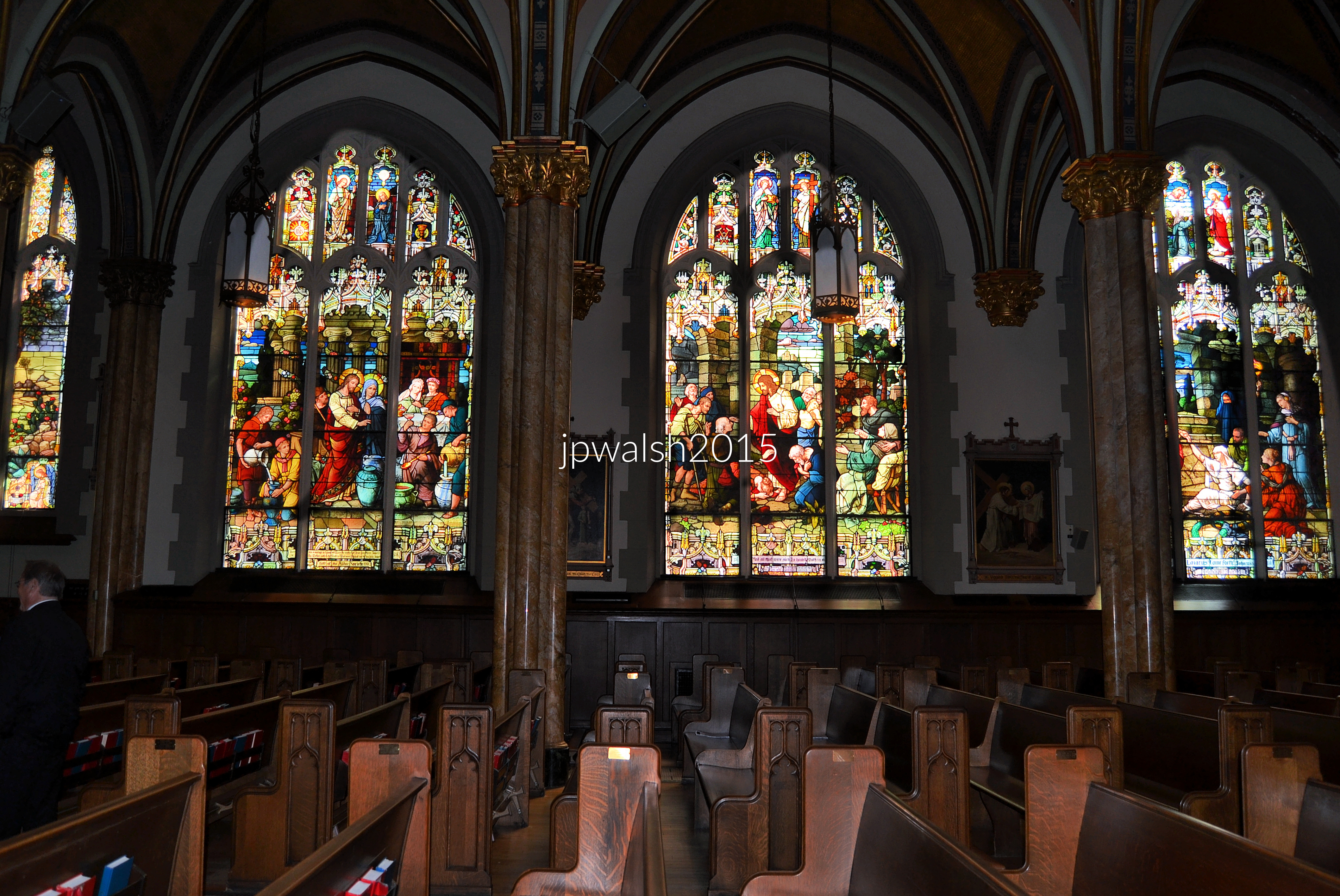
Trinity UMC, Wilmette. March 2017. Author’s photograph. 3.89mb DSC_0657 (1)
The space warms into Methodist Gothic. Dark wood pews, wooden chancel furnishings, a prominent pulpit or lectern, and a central cross create an interior that feels both sacred and approachable. The materials and layout quietly affirm the Methodist emphasis on Scripture, preaching, and congregational participation.
Overhead, hanging lantern chandeliers complete the atmosphere. Their medieval‑inspired metalwork casts a warm glow that softens the stone and wood. Evenly spaced along the nave, they reinforce the processional rhythm, drawing the eye—and the worshipper—toward the chancel and the unfolding narrative held in glass and architecture. Gothic in form, Methodist in function, Willett in storytelling, and 1920s–30s American in craftsmanship, including acoustics shaped for congregational singing, the interior of Trinity UMC is a space designed to make worship feel like a journey: from the world outside, through the nave, toward the light of the chancel and the story told in glass.
How Methodist theology shaped 20th‑century stained glass.
Methodist stained glass in the early–mid 1900s has a distinctive character shaped by Methodist convictions about Scripture, preaching, and discipleship. Because windows were expected to teach, almost every Methodist window cycle from this era functions as a visual sermon. Their imagery is intentionally accessible, with a strong Biblical orientation and a clear narrative movement through salvation history.
Methodists understand themselves as heirs of the Old Testament, followers of Jesus, children of the Reformation, and participants in the church’s ongoing renewal. As a result, their stained‑glass programs blend Old Testament, New Testament, and Reformation themes. Typical cycles include scenes of the prophets, episodes from the Life of Christ, and depictions of key Reformers such as Martin Luther (1483-1546), William Tyndale (c. 1494-1536), and Methodist founder John Wesley (1703-1791).
Trinity UMC, Wilmette. March 2017. Author’s photograph. 5.29mb DSC_0655 (1)
Façade window: Jesus Calling the First Disciples.
Façade window of Jesus Calling the First Disciples.Trinity UMC, Wilmette. March 2017. Author’s photograph. 7.65mb DSC_0649 (2)
A foundational moment in the Gospels — and a favorite subject in mid‑20th‑century Methodist stained glass — is Jesus calling the first disciples. In this scene, Jesus summons fishermen from their boats with the words, “Follow me, and I will make you fishers of men.”
The boat anchors the story in the Sea of Galilee, while the iconography makes the identification unmistakable. Jesus is shown with a cruciform halo and red and blue garments, signaling his dual nature. His authoritative, summoning gesture directs attention to the haloed figures of Peter, Andrew, James, and John, who look up toward him in response to the call.
Detail of Façade window depicting Reformers.
At the bottom of the façade window are four scenes from the life of the Reformers. At LEFT is Martin Luther nailing his 95 theses to the door of the Castle Church (All Saints’ Church) in Wittenberg, Germany, on October 31, 1517, that sparked the Reformation. At the bottom right of the panel is a white rose with a red heart and black cross. That is Luther’s personal emblem, designed in 1530 and used on his letters and publications. He is wearing scholarly robes in the colors of deep red, green, and brown that Willett often used for Reformers.
At LEFT CENTER is the burning at the stake of William Tyndale in 1536 whose crime was translating the Bible into English for the ordinary people. Tyndale believed Scripture should be accessible to ordinary people and died for that conviction. The Reformation’s gift is to take the Bible out of the hands of the elite and place it into the hands of the people.
At CENTER RIGHT is John Wesley, founder of Methodism, preaching in the open air to Native Americans — specifically the Muscogee (Creek) people —during his mission to the Georgia colony between 1735 to 1737 which, after his return to England, accelerated the Methodist Movement which Wesley founded at Oxford in 1729. Wesley began preaching in the open air, embracing traveling ministry and forming societies as he did in America. By 1739, he built the first Methodist meeting house in Bristol, England.
At RIGHT John Wesley preaching to early American settlers. Wesley served as Anglican pastor of Christ Church in Savannah, Georgia, where he introduced strict spiritual disciplines. His time was marked by conflict, including a failed romantic relationship, and backlash from residents against his strictness, causing him to return to England heartbroken and disillusioned after only two years.
Methodist stained glass seeks to be beautiful where clarity is key. The style tends to bold outlines, well delineated figures and readable gestures with minimal abstraction.
Trinity UMC, Wilmette. March 2017. Author’s photograph. 5.20mb DSC_0645 (1)
Traditional enough to feel sacred – Modern enough to feel fresh – narrative enough to teach – artistic enough to inspire: Why Willett Studios was chosen.
Christ the Teacher — sometimes also read as Christ the Good Shepherd window. Trinity UMC, Wilmette. March 2017. Author’s photograph. 3.95mb DSC_0664 (2)
This Willet window is a Life of Christ triptych, arranged in the traditional Methodist/Willett narrative pattern.
At the left, the window shows the ministry of compassion: a haloed Christ blessing or forgiving a kneeling woman, possibly inspired by the woman who washed his feet with her tears and dried them with her hair. Willett often preferred such non‑specific healing scenes, using them to emphasize Christ’s compassion rather than tie the image to a single Gospel episode.
At the center, Christ stands elevated and alone in Willett’s characteristic depiction of Christ the Teacher — sometimes also read as Christ the Good Shepherd when paired with lamb symbolism above. He bears the cruciform halo (reserved only for Jesus) and wears red and blue robes to signify his dual nature as God and Man. His arms extend slightly in a gesture of blessing and invitation.
At the right, the scene shifts to Christ’s agony in the garden before his betrayal and arrest, capturing the moment of solitary struggle that precedes the Passion.
“Do all the good you can.”
Taken together, these panels proclaim a unified message: Christ at the center of the Christian life, the one who heals, restores, and calls disciples to follow. The sequence echoes the Methodist conviction embodied in the familiar motto: “Do all the good you can.”
Trinity UMC, Wilmette. March 2017. Author’s photograph. 4.12.mb DSC_0637 (1)
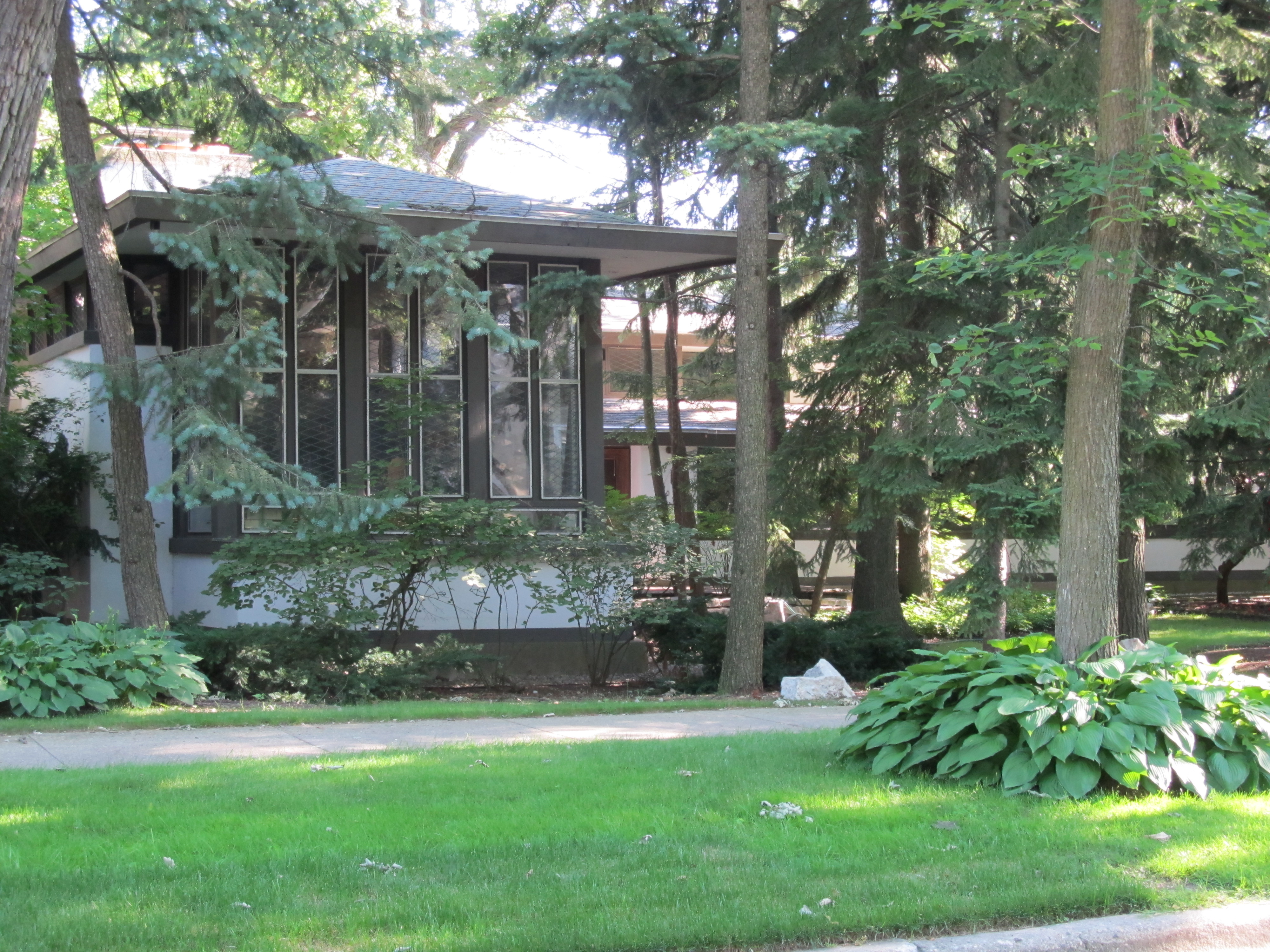
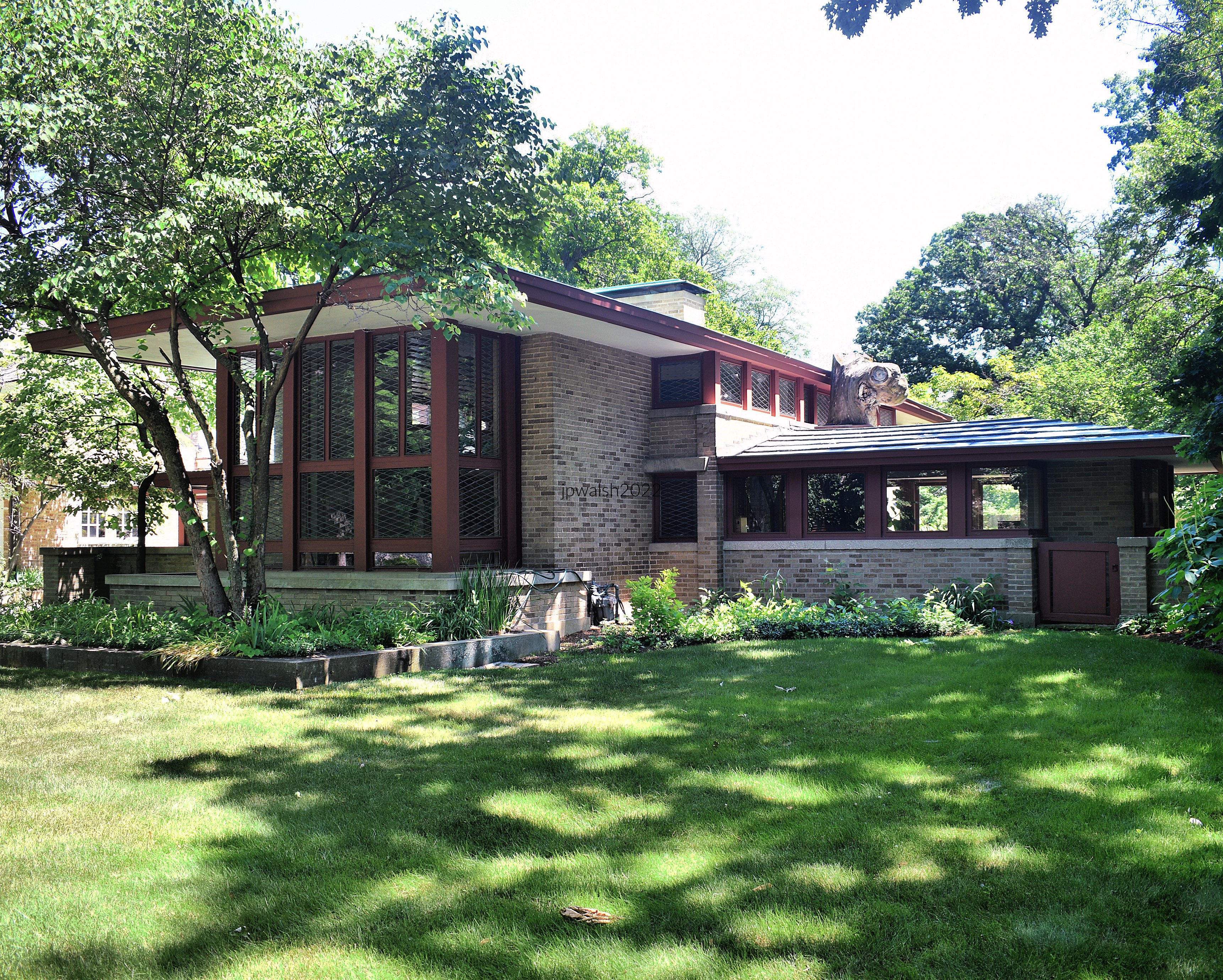
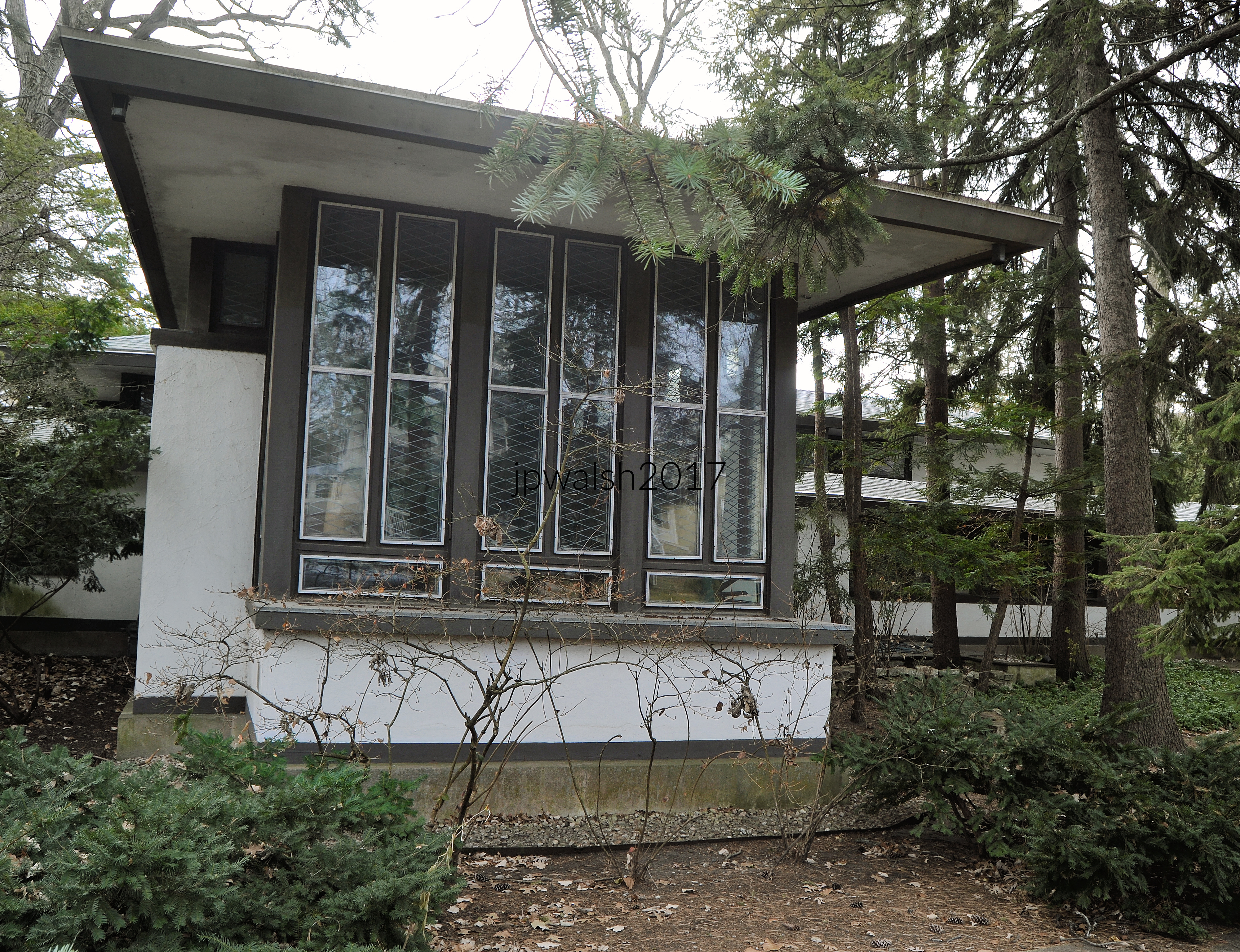
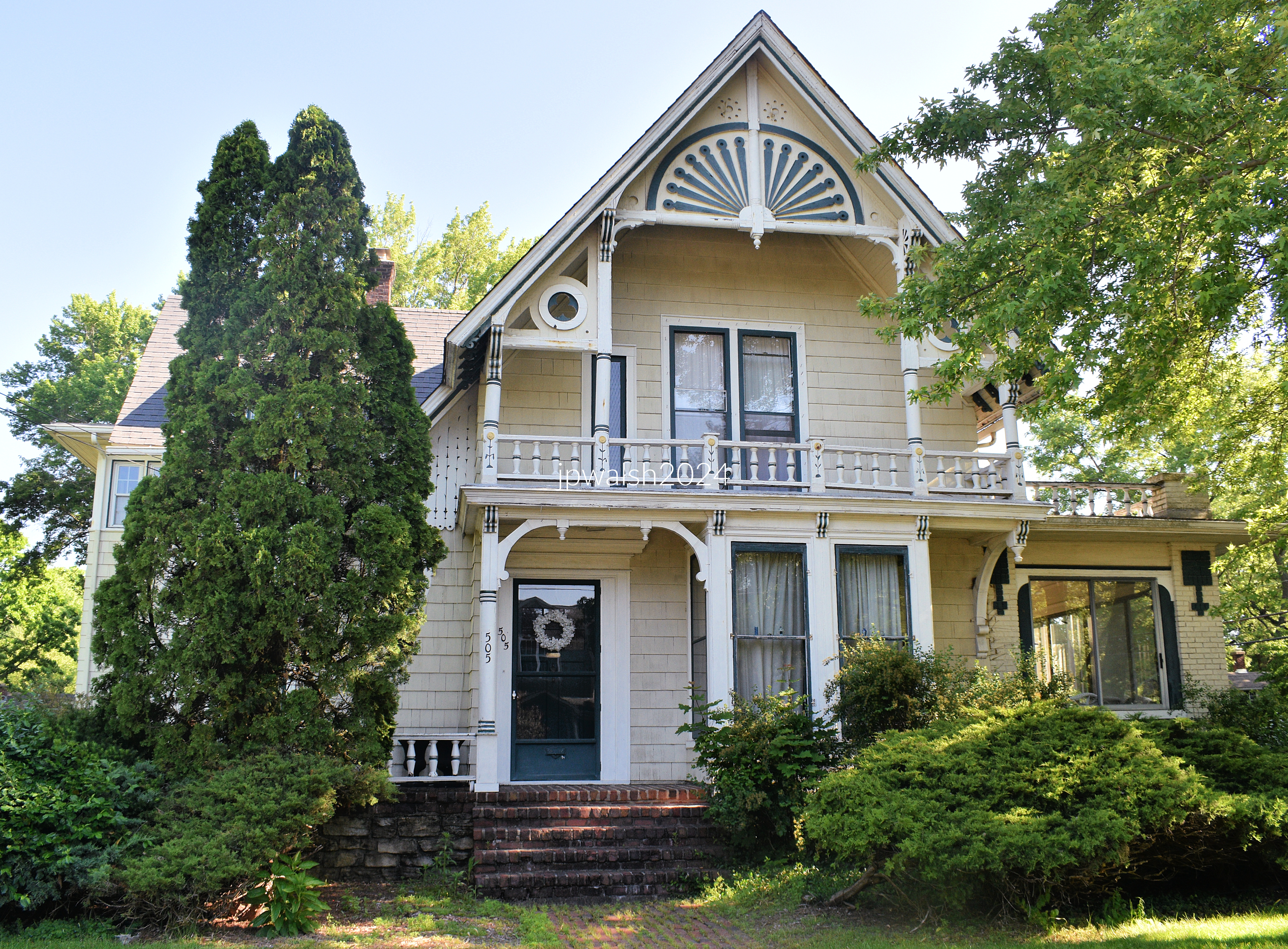
Feature image: Frank J. Baker House, Frank Lloyd Wright, 1909, Wilmette, Illinois. Frank J. Baker (1864–1922) was a driving force in Wilmette’s early growth — a sharp‑minded engineer and influential executive with the North Shore Electric Company and Commonwealth Edison who helped bring electricity to the North Shore. He is most remembered for the remarkable 1909 Frank J. Baker House, a Prairie‑style landmark designed for him by Frank Lloyd Wright. A civic leader as well as an innovator, Baker co‑founded the First National Bank of Wilmette. He died in his Wright‑designed home just a week before Christmas in 1922 at 58 years old. December 2017. 99% 7.20mb DSC_0560. Author’s photograph.
The Frank J. Baker House is a beautiful Frank Lloyd Wright residence and represents a critical moment in Wright’s architectural evolution, when the architect was pushing Prairie School design beyond earlier single-story compositions and experimenting with new approaches to space, volume, and the relationship between horizontality and verticality
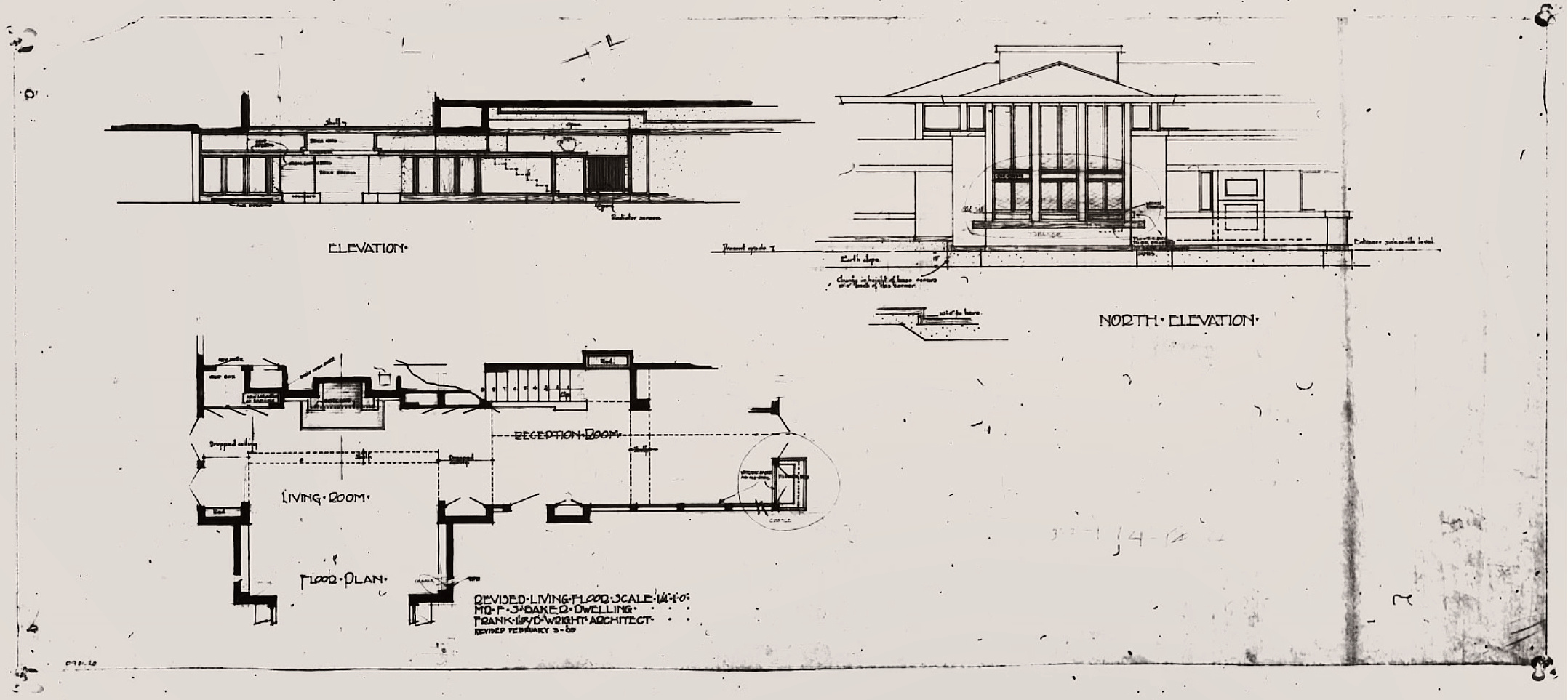
The Frank J. Baker House, situated at 507 Lake Avenue in Wilmette, Illinois, is a 4,800‑square‑foot residence that stands as a significant example of Frank Lloyd Wright’s evolving Prairie School vocabulary. Designed in 1909, the house incorporates five bedrooms, three and a half bathrooms, and three fireplaces, yet its architectural importance lies less in its programmatic elements than in its role within Wright’s broader experimentation with spatial organization and structural expression during this period.
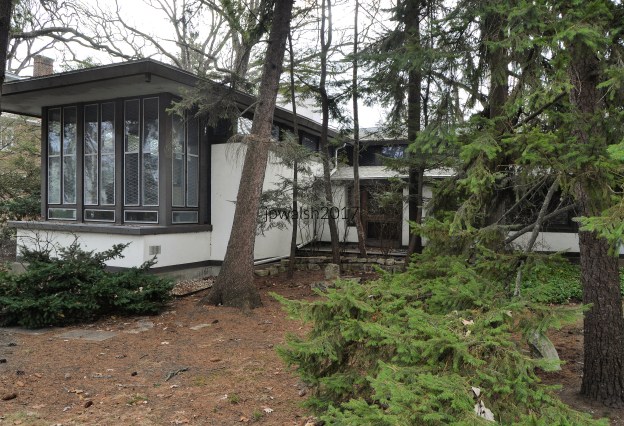
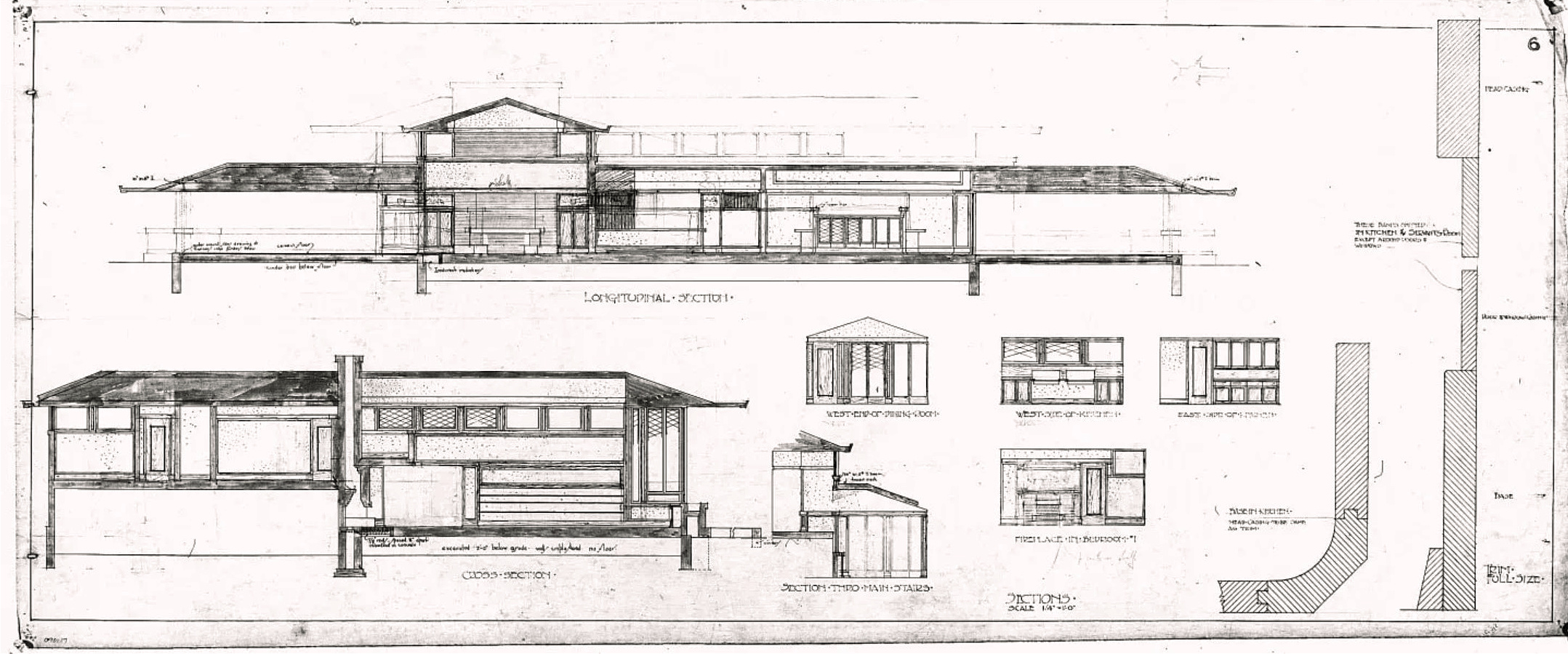
By the first decade of the twentieth century, Wright had begun to move beyond the predominantly single‑story Prairie houses of the late 1890s, exploring the potential of vertically layered two-story domestic space. The Baker House reflects this transitional moment through its T‑shaped floor plan—a configuration Wright employed in several contemporaneous works, including the Isabel Roberts House (below) built the previous year in River Forest, Illinois.
The Frank J. Baker House illustrates a pivotal stage in Frank Lloyd Wright’s Prairie School development, where experimentation with the T-shaped plan, two-story living spaces, and environmental continuity produced one of the architect’s most significant domestic designs of 1909
Isabel Roberts House, 603 Edgewood Place, River Forest, Illinois, 1908, Frank Lloyd Wright. It was remodeled in the 1950s. 69% 7.99 mb Author’s photograph.
The T‑plan allowed Wright to choreograph circulation along a dominant longitudinal axis while creating subsidiary wings that modulated privacy, light, and spatial hierarchy. In the Baker House, this plan form becomes a mechanism for integrating interior volumes with the surrounding landscape, reinforcing the Prairie School’s emphasis on horizontality and environmental continuity.
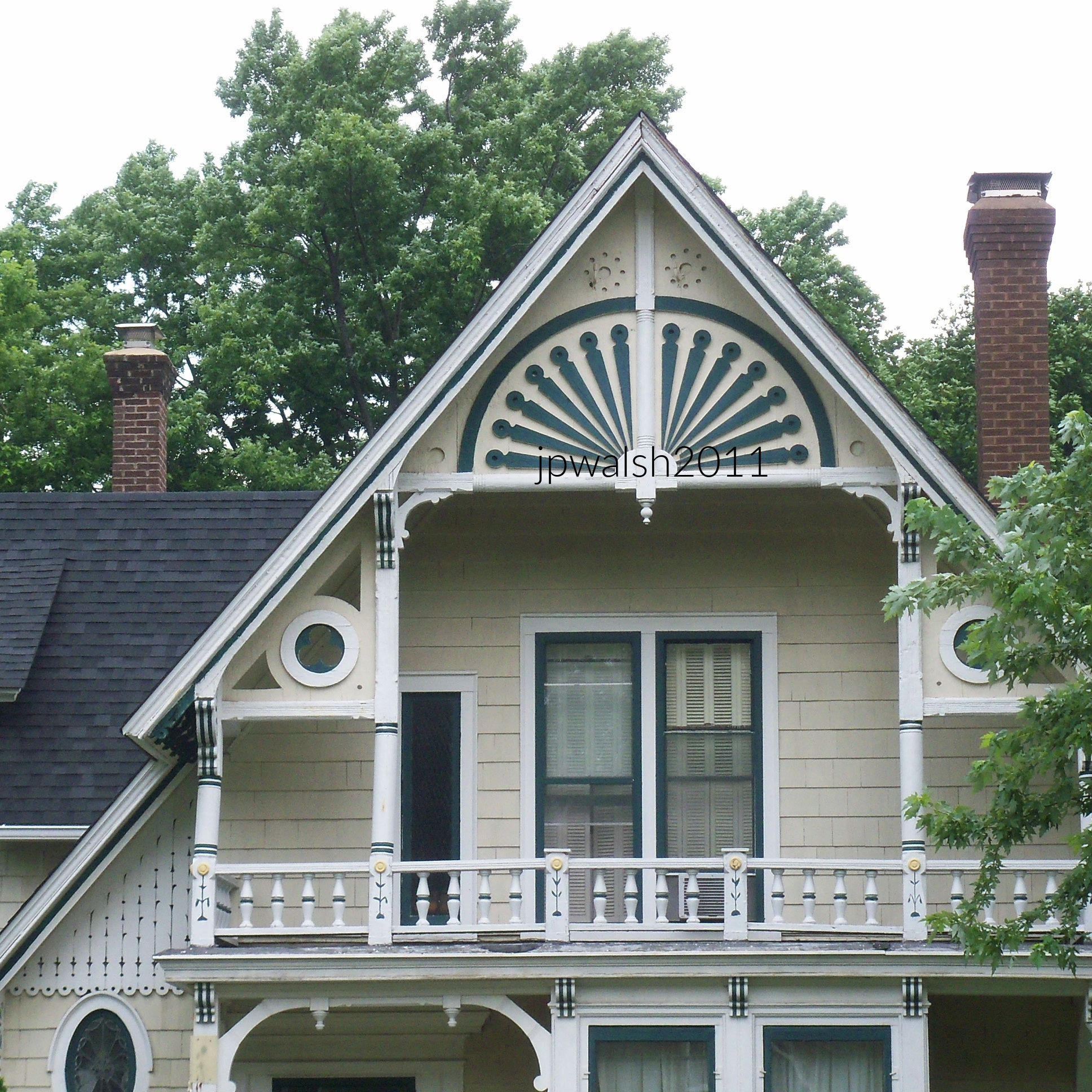
The exterior composition demonstrates Wright’s mature command of Prairie Style principles: a pronounced horizontal orientation, low‑pitched rooflines, and deeply cantilevered overhangs that visually anchor the structure to its site. These elements work in concert to diminish the building’s vertical massing, producing the characteristic “sheltering” effect that Wright associated with Midwestern domestic architecture.
The Frank J. Baker House (1909) and the Isabel Roberts House (1908) are closely related works that belong to Frank Lloyd Wright’s transitional Prairie period. Both employ a T-shaped plan that allowed Wright to organize circulation along a dominant central axis while projecting subsidiary wings outward into the landscape, strengthening the Prairie School ideal of spatial openness and environmental continuity.The Isabel Roberts House can be viewed as a direct precursor to the Frank J. Baker House, with Wright developing it into a more sophisticated architectural statement through greater spatial complexity, a monumental two-story living room, and a richer interplay between horizontality and volume.
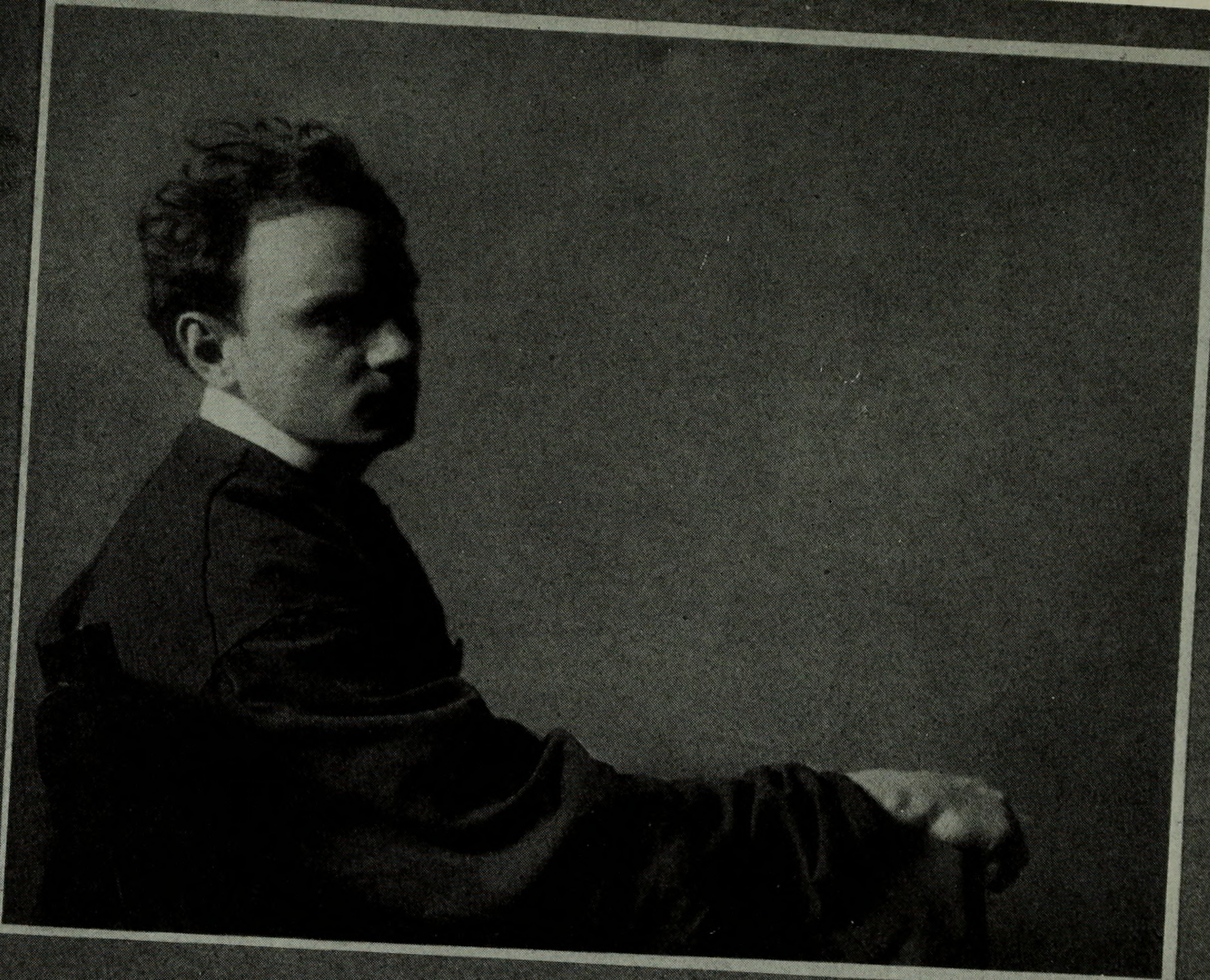
Frank Lloyd Wright in 1903, likely a self-portrait. Public Domain.In 1909 42-year-old Frank Lloyd Wright reportedly personally brought the plans to Baker in Wilmette by horseback. Public domain. see – New owners to breathe life into 1909 Wright home – Wednesday Journal – retrieved March 30, 2026.
The two‑story living room is the spatial and symbolic core of the house. Its brick fireplace—an archetypal Wrightian hearth—functions as both a literal and conceptual center, organizing the surrounding spaces and reinforcing Wright’s belief in the fireplace as the spiritual heart of the home. The sloped ceiling and continuous band of leaded‑glass windows along the north wall create a dynamic interplay of light and volume, while the vertical expansion of the room contrasts deliberately with the home’s otherwise horizontal emphasis. Few surviving Wright houses retain this particular combination of a T‑shaped plan and a two‑story principal interior, making the Baker House an important artifact in understanding Wright’s spatial experimentation.
The property was listed on the National Register of Historic Places on November 8, 1974, acknowledging its architectural significance. A comprehensive restoration initiated in 2020 under new ownership has sought to preserve both the material integrity and the spatial logic of Wright’s original design.
Frank Lloyd Wright’s Prairie‑style design features strong horizontal porches framing a two‑story diamond‑leaded glass window wall in the living room. The home includes five large bedrooms, three‑and‑a‑half bathrooms, and three fireplaces. The second level offers a primary suite with en‑suite bath, fireplace, and private porch, plus two additional en‑suite bedrooms, two more bedrooms, and a sitting room. The kitchen and breakfast room overlook the expansive yard. Wright designed the home’s 1922 addition. Public Domain.
Through a deliberate sequence of compression and release, Wright choreographed movement through the Baker House so that ordinary domestic spaces culminate in a soaring central living room that serves as the spiritual and architectural heart of the home.
Interior Analysis.
Upon entry, the visitor encounters a twenty‑two‑foot dining room articulated with diamond‑patterned leaded‑glass windows, a pitched ceiling, and extensive wood trim. This space exemplifies Wright’s strategy of compressing and releasing volume: the relatively intimate proportions of the dining room heighten the dramatic expansion experienced upon entering the adjacent living room.
The main‑floor kitchen, accompanied by a modest breakfast nook, reflects Wright’s early efforts to modernize domestic workspaces by integrating them more fluidly into the overall plan. The living room, by contrast, adopts a quasi‑ecclesiastical spatial character. Its cantilevered ceiling, which extends into a loft above, creates a sense of upward movement unusual in Prairie houses. The continuous horizontal and vertical window bands dissolve the boundary between interior and exterior, a hallmark of Wright’s belief that architecture should mediate rather than separate human habitation from the natural environment.
At the center of the home stands the principal brick fireplace, accompanied by an overhead balcony that provides an elevated vantage point and reinforces the vertical layering of the space. On the second floor, the master bedroom includes one of the home’s three fireplaces and a private enclosed balcony, further demonstrating Wright’s interest in creating intimate, retreat‑like upper‑level spaces within an otherwise horizontally oriented composition.
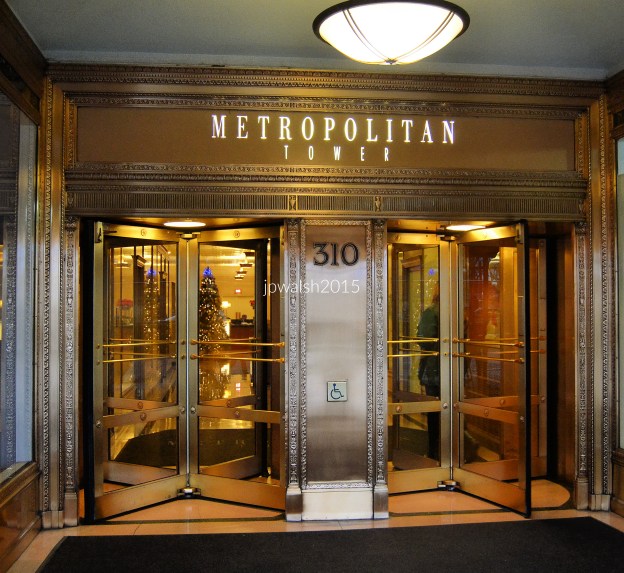
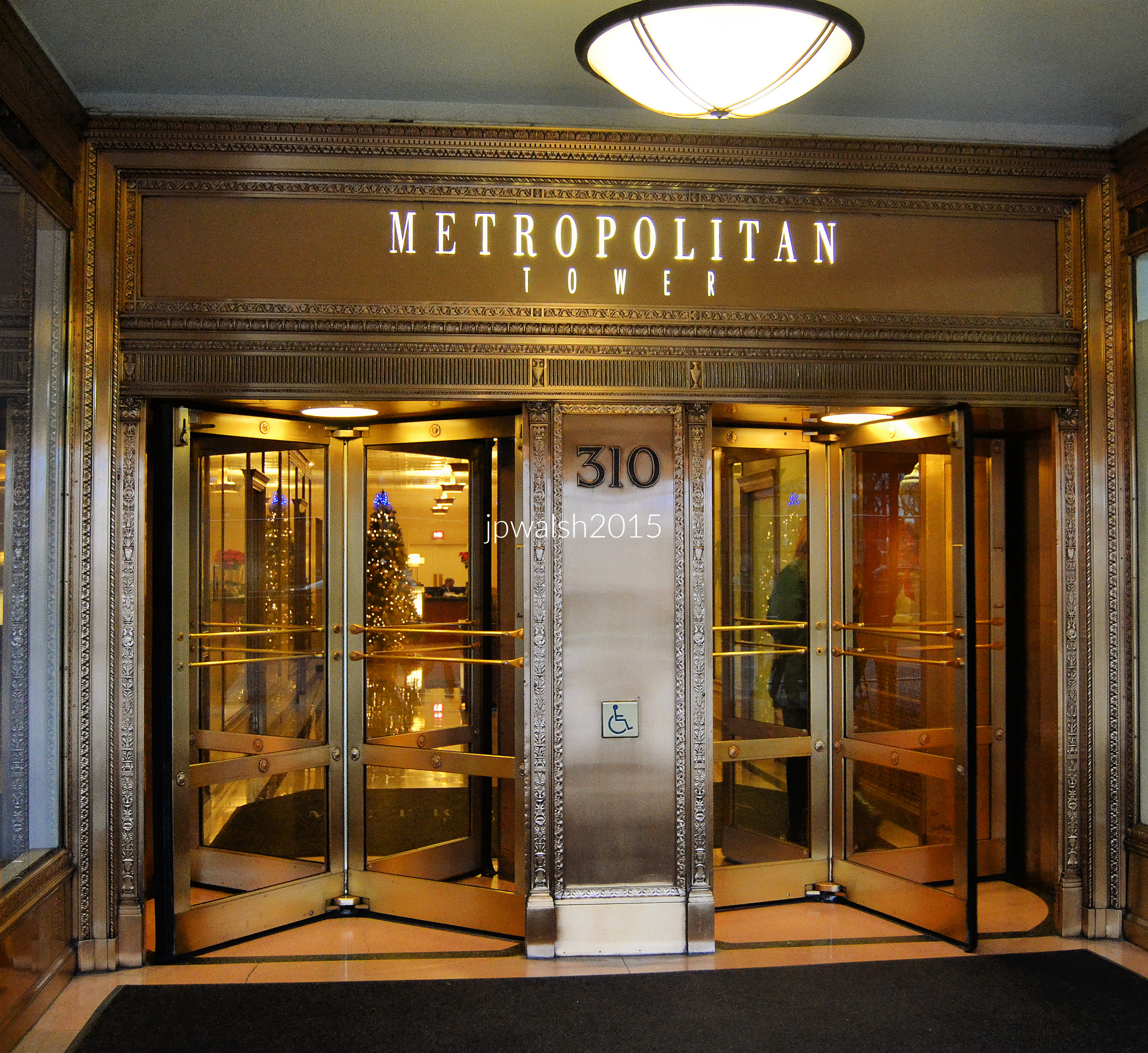
Feature Image: Main Entrance, Metropolitan Tower (1924), 310 South Michigan Avenue, Chicago, was designed by Graham, Anderson, Probst & White. December 2015. 4.89 mb DSC_0963 (1). Author’s photograph.
Metropolitan Tower’s main entrance is more than an architectural detail: it is a surviving gateway to one of Chicago’s most significant early skyscrapers, a building that embodied the ambitions, craftsmanship, and corporate prestige of the 1920s while reflecting the evolution of Michigan Avenue and modern Chicago.
Located at 310 South Michigan Avenue on the southwest corner of Jackson Boulevard, Metropolitan Tower originally served as corporate headquarters for S.W. Straus and Co., a banking and investment firm. The building was erected in 1924 by Graham, Anderson, Probst & White in their signature classical style. The architectural firm was one of the largest in the first half of the twentieth century and went on to build Chicago’s Civic Opera Building in 1929. Founded in 1912, the firm was the successor to D. H. Burnham & Co. by way of partner, Ernest R. Graham (1868-1936), and Burnham’s sons, Hubert and Daniel Jr. Five years later the Burnhams left to form their own firm (Burnham Brothers) and Graham partnered with others of the firm’s members: William Peirce Anderson (1870-1924), Edward Mathias Probst (1870-1942), and Howard Judson White (1870-1936). No expense was spared for the Straus Building’s interior, though of the original lobby’s opulence all that remains are the elaborate bronze elevator doors. The entrance’s coffered bronze doors by Italian sculptor Leo Lentelli (1879-1961) were destroyed. see – Saliga, Pauline A., editor, The Sky’s The Limit A Century of Chicago Skyscrapers, Rizzoli New York, 1990, p. 117.
The Metropolitan Tower was built in 1924 as the headquarters of S.W. Straus & Co. and designed by Graham, Anderson, Probst & White, successors to the Burnham architectural tradition.
Ernest R. Graham (1868-1936).
William Peirce Anderson (1870-1924).
Edward Mathias Probst (1870-1942).
Howard Judson White (1870-1936).
The elaborate entrance and lobby originally featured exceptional decorative work, including bronze doors created by sculptor Leo Lentelli, although many original elements have been lost.
Leo Lentelli (1879-1961). The Italian sculptor created the original main entrance doors for Metropolitan Tower that were later destroyed. Public Domain.
The 30-floor classical-style Straus Building was renamed over the years for other of its famous inhabitants including Continental National Insurance Co. and Britannica Center for Encyclopedia Britannica. Metropolitan Tower was the first building in Chicago that took advantage of the new 1923 zoning ordinance for skyscrapers that allowed buildings taller than 260 feet (30 or more floors) with the necessary setbacks. Metropolitan Tower’s required setbacks begin at the 21st floor on which sits a nine-story tower until there is a second setback and then the final two stories. Crowned by a stepped pyramid and possessed of a powerful beacon that opened in 1924, the building is Chicago’s first Michigan Avenue skyscraper.
Metropolitan Tower was the first skyscraper on Michigan Avenue and one of the earliest buildings to take advantage of Chicago’s new 1923 zoning regulations permitting greater height through setbacks. Its distinctive stepped crown, beacon, and symbolic ornamentation made it a recognizable feature of the Chicago skyline.
Unused for years, the building’s 1,500-pound carillon bells were restored in 1979 for Pope John Paul II’s visit to Chicago. Just steps from Metropolitan Tower, the papal visit included an outdoor mass in Grant Park on October 5, 1979, which attracted over one million attendees, the largest gathering ever in Grant Park history up to that time. see – CBS Chicago Vault: Pope John Paul II enthralls Chicagoans on 1979 visit – CBS Chicago – retrieved March 18, 2026.
At one time, the thirtieth floor was the Straus Tower Observatory, which was open to the public for viewing the city in all four directions. see – Home | Metropolitan Tower – retrieved February 24, 2026. Home to the Continental National Insurance Company soon after it was built, this iconic skyscraper is located within Chicago’s Landmark Historic Michigan Boulevard District. The glass “beehive” supported by four bison figures at the top of the building held the blue light of a four-direction beacon. The ensemble, symbolizing industry, strength, and thrift, saw its beacon, signifying global reach, permanently shut down in 1934 following the financial failure of the S.W. Straus and Company during the Great Depression. The building was converted to residential condominiums in 2007. see – Metropolitan Tower | Powered by Baird & Warner– retrieved February 24, 2026; AIA Guide to Chicago, 2nd Edition, Alice Sinkevitch, Harcourt, Inc., Orlando, 2004, page 42.
The building was constructed in a classical style and represented the high quality and prestige associated with major Chicago commercial architecture of the 1920s. Over time, the building adapted to changing uses and occupants, including Encyclopedia Britannica and residential condominiums, demonstrating its continued relevance and preservation.
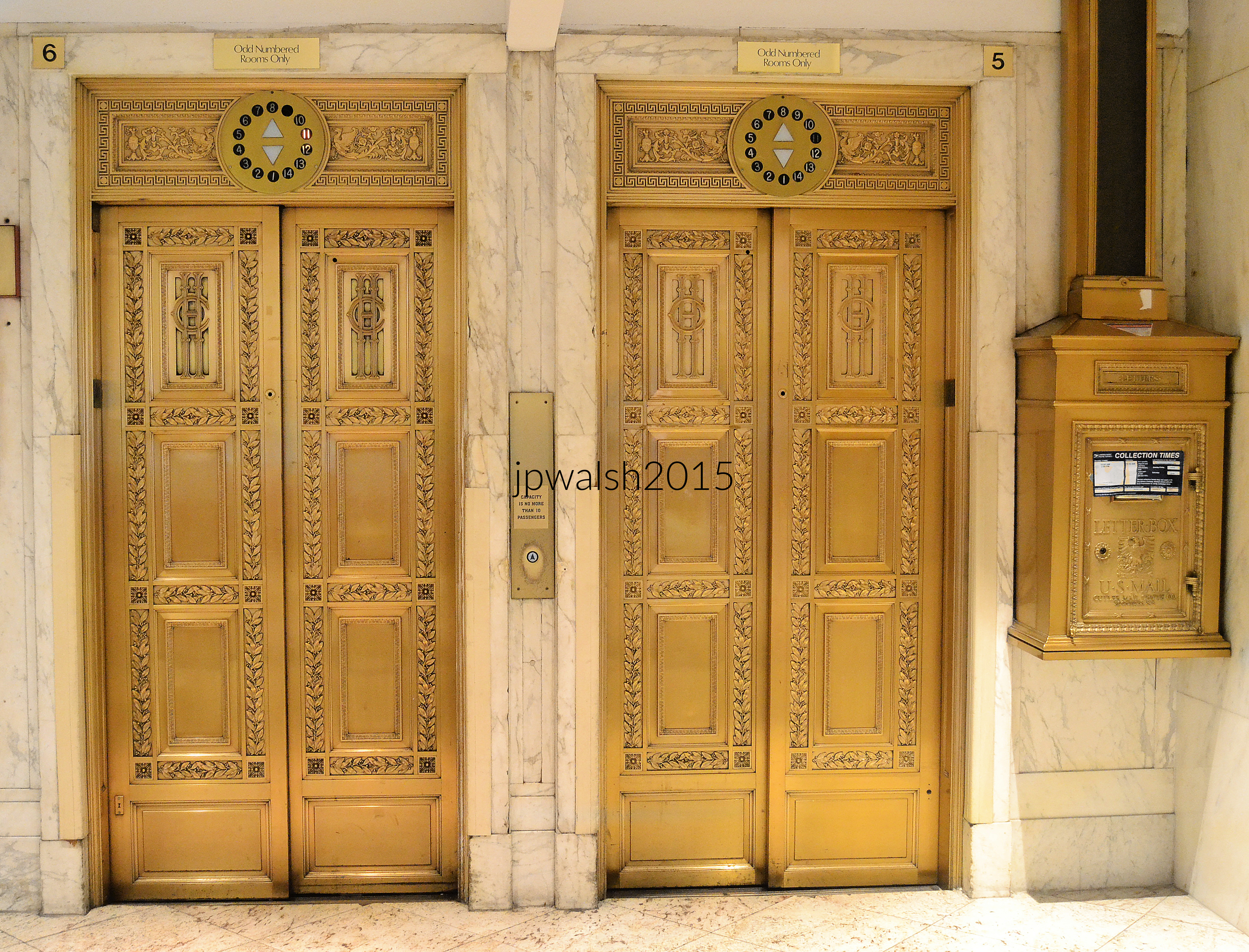
Feature Image: Congress Plaza Hotel in Chicago built in 1893 during the World’s Columbian Exposition features this later ornate Beaux-Arts gold elevator bank and the celebrated Gold Room. December 2015. Author’s photograph. 6.20 mb DSC_0617 (1).
The Congress Plaza Hotel embodies Chicago’s transformation during and after the World’s Columbian Exposition, linking the city’s emergence as a world-class destination with the architectural legacy of Clinton J. Warren and later expansions by Holabird & Roche. Through its strategic location, grand design, continuous operation since 1893, and association with major historical figures, the hotel serves as a living monument to Chicago’s Gilded Age ambitions and early twentieth-century prominence.
A Hotel of the Columbian Exposition Era
The original North Tower was built in 1893 during the World’s Columbian Exposition, held in Chicago from May 1 through October 31 of that year. The project was developed by famed hotel entrepreneur R.H. Southgate and designed by architect Clinton J. Warren (1860-1938), one of Chicago’s most prolific young hotel specialists during the late nineteenth century.
Warren moved from Massachusetts to Chicago in 1879 and joined the firm of Burnham and Root the following year. After establishing his own practice in 1886, he designed an impressive roster of Chicago hotels, including the ten-story Virginia Hotel (1889-1890) at Ohio and Rush Streets; the eight-story Metropole Hotel (1891) at Michigan Avenue and 23rd Street; the Plaza Hotel (1891-1892) at Clark Street and North Avenue; the Lexington Hotel (1892) at 22nd Street and Michigan Avenue; and the Auditorium Annex (1893) at 504 South Michigan Avenue, today known as the Congress Plaza Hotel.
Built in 1893 during the World’s Columbian Exposition and originally opened as the Auditorium Annex, it was designed by architect Clinton J. Warren, one of Chicago’s leading hotel specialists of the era.
By 1900, Warren had returned to Boston. He died in San Diego in 1938, by which time his significant contribution to Chicago architecture had largely faded from public memory. Notably, his New York Times obituary made no mention of his training under Daniel Burnham, his role in shaping Chicago’s hotel architecture over two decades, or the later notoriety of his Lexington Hotel, which served as Al Capone’s headquarters from 1928 to 1931. The obituary read in full:
“Clinton J. Warren SAN DIEGO, Calif., March 17 (AP). Clinton J. Warren, architect, who designed buildings in Europe, Mexico and Eastern United States, died at his home here last night at the age of 80. Mr. Warren formerly lived in Winchester, Mass. His widow and two sons, Clinton Jay Jr. of San Francisco and John of New York, survive.” see – TimesMachine: March 18, 1938 – NYTimes.com and The Chicago Hotels of Architect Clinton J. Warren – Owlcation – retrieved February 22, 2026.
Beaux-Arts elevator banks at 504 S. Michigan Avenue were installed in 1907. December 2015. Author’s photograph. 3.99mb DSC_0958 (2).
The Auditorium Annex and a Strategic Location
Originally known as the Auditorium Annex, the hotel opened in 1893 to accommodate the enormous influx of visitors attending the World’s Columbian Exposition. Remarkably, it has operated continuously as a hotel ever since and has also become well known for its reputed ghost hauntings.
Its location was one of its greatest advantages. The hotel stood only five blocks from both Dearborn Station and Illinois Central Station, making it the closest major hotel to two of Chicago’s principal railroad terminals. It was also the southernmost major hotel in downtown Chicago and sat just a block and a half from the elevated railway line that carried visitors directly to the exposition grounds in Jackson Park.
Expanded with the South Towerbetween 1902 and 1907 designed by Holabird & Roche and featuring the ornate Beaux-Arts gold elevator bank, the hotel grew to more than 1,000 rooms by 1908.
Expansion and the Famous Gold Elevators
The celebrated gold elevator bank is located in the hotel’s South Tower, an addition constructed between 1902 and 1907 and designed by the distinguished architectural firm Holabird & Roche. Executed in an ornate Beaux-Arts style, the elevators remain among the building’s most striking historic features.
The South Tower expansion also included the luxurious Gold Room banquet hall, reinforcing the hotel’s status as one of Chicago’s premier accommodations during the early twentieth century.see – Holabird & Roche. See- Chicago Landmarks – Architect Details – retrieved February 22, 2026.
William Holabird (1854-1923) and Martin Roche (1855-1927) of the architectural firm of Holabird & Roche designed the South Tower of today’s Congress Plaza Hotel between 1902 and 1907. Public Domain.
From Auditorium Annex to Congress Hotel
By 1908, the enlarged complex contained more than 1,000 guest rooms. In 1911, the property adopted the name Congress Hotel, a reference both to nearby Congress Parkway (today Ida B. Wells Drive) and its prominent location facing Grant Park.
Over the years, the hotel welcomed numerous American presidents. Among those who stayed there, and who may well have ridden these gilded elevators, were Theodore Roosevelt, William Howard Taft, Warren G. Harding, and Calvin Coolidge. Today, the elevators stand as elegant reminders of the hotel’s origins in the era of the World’s Columbian Exposition and of its long history as one of Chicago’s most prominent grand hotels. See – Congress Plaza Hotel History | Congress Plaza Hotel – retrieved February 22, 2026.
Renamed the Congress Hotel in 1911, it has hosted numerous U.S. presidents and remains one of Chicago’s longest-operating and most historically significant hotels.
Feature Image: October 2015. Chicago. 5.85mb DSCN1452 (1). Author’s photograph.
October 2016. Chicago 4.90mb DSC_0104 (1)
Chicago skyline from Museum Campus promontory (Northerly Island).
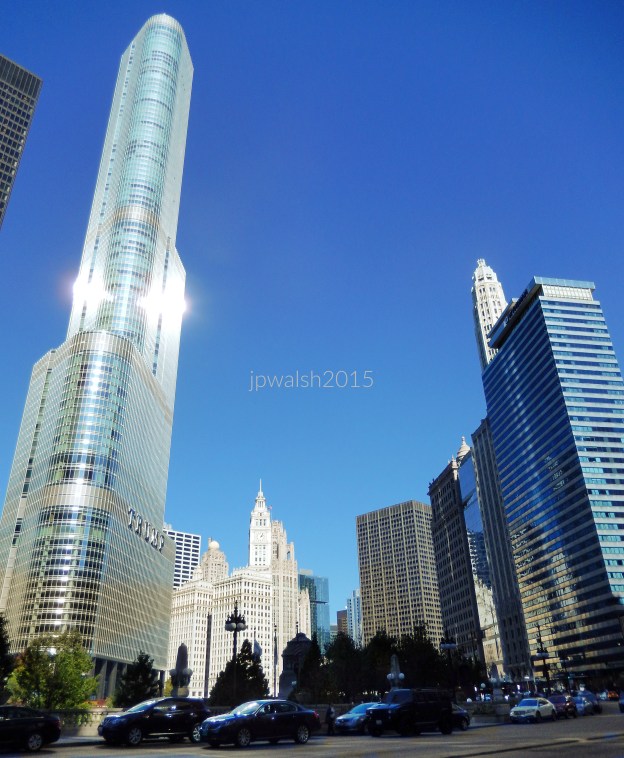
October 2015. Chicago. 5.85mb DSCN1452 (1). Author’s photograph.
Wacker Drive and Wabash Avenue looking east, Chicago. From left: Trump International Hotel and Tower, Adrian Smith, architect (2009). Trump Tower Chicago is a 98-story skyscraper at 401 N Wabash Ave, completed in 2009. Rising 1,389 feet with its spire, it includes 486 condos, a 339-room hotel, and ranks as the 4th tallest building in the United States.
401 N Michigan Avenue (Equitable Building), Skidmore, Owings & Merrill, architect (1965/Facelift 1992/Renovation 2016). The plaza (Pioneer Court) of the Miesian 401 N. Michigan draws over 22,000 pedestrians daily from busy Michigan Avenue. Apple’s global flagship store shares the plaza that provides immediate access to the Riverwalk via the Spanish Steps. see – 401 N Michigan Ave, Chicago, IL 60611 – Office for Lease | LoopNet – retrieved February 13, 2026.
360 N. Michigan Avenue (London Guarantee & Accident Building), Alfred S. Alschuler, architect (1923).
85 E. Wacker Drive (London House).
75 E. Wacker (formerly Lincoln Tower, originally Mather Tower), Herbert Hugh Riddle, architect (1928) and Harry Weese & Assocs. (Renovation/1983).
71 E. Wacker Drive (The Royal Sonesta Chicago Downtown, formerly Executive House Hotel), Milton Schwartz, architect (1959). 71 E. Wacker Drive is the first high-rise hotel in Chicago since the Great Depression. see – Executive House Hotel, 71 E. Wacker, Chicago – retrieved February 13, 2026.
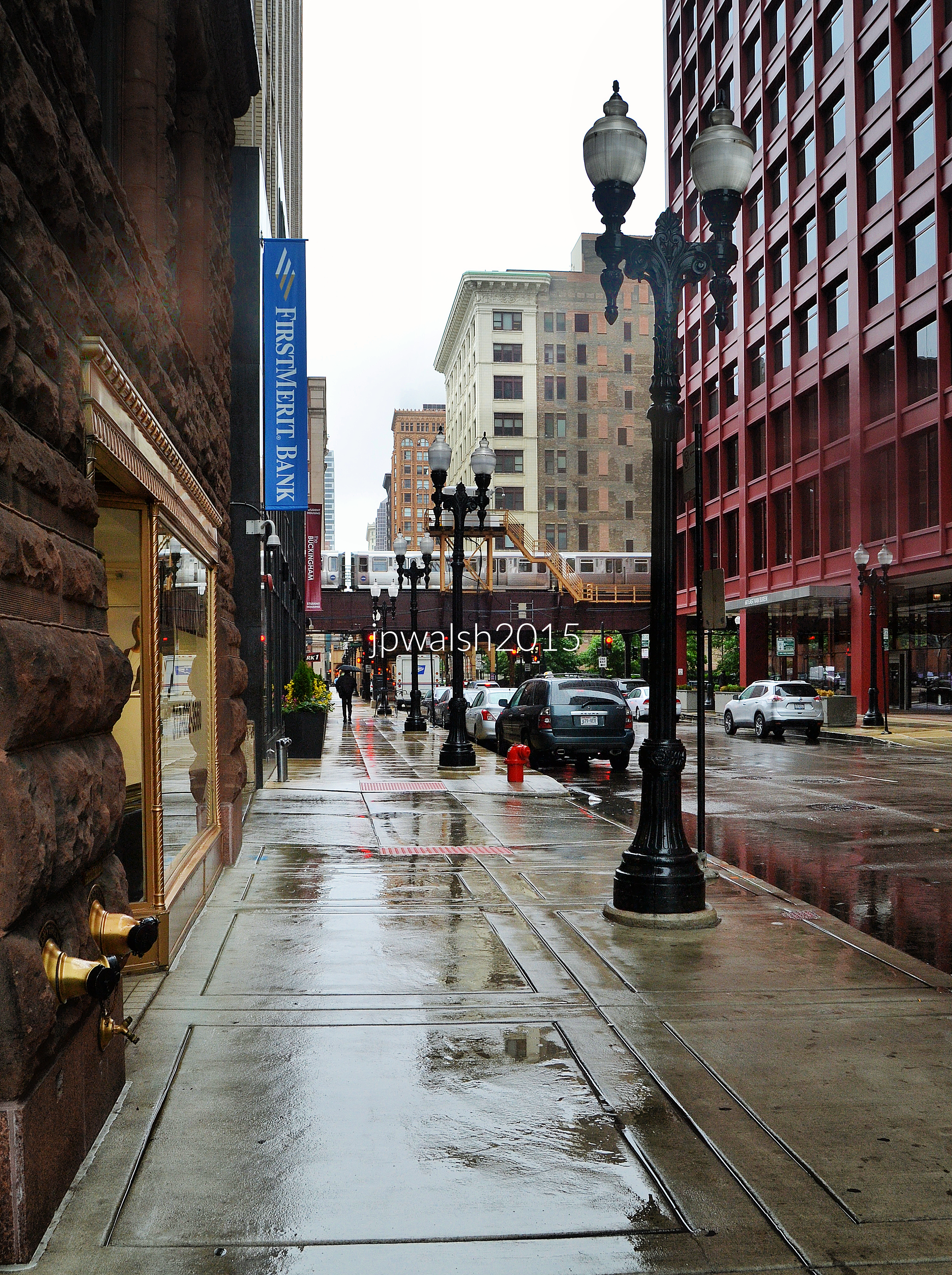
May 2015. Chicago. 99% 7.92mb DSC_0468. Author’s photograph.
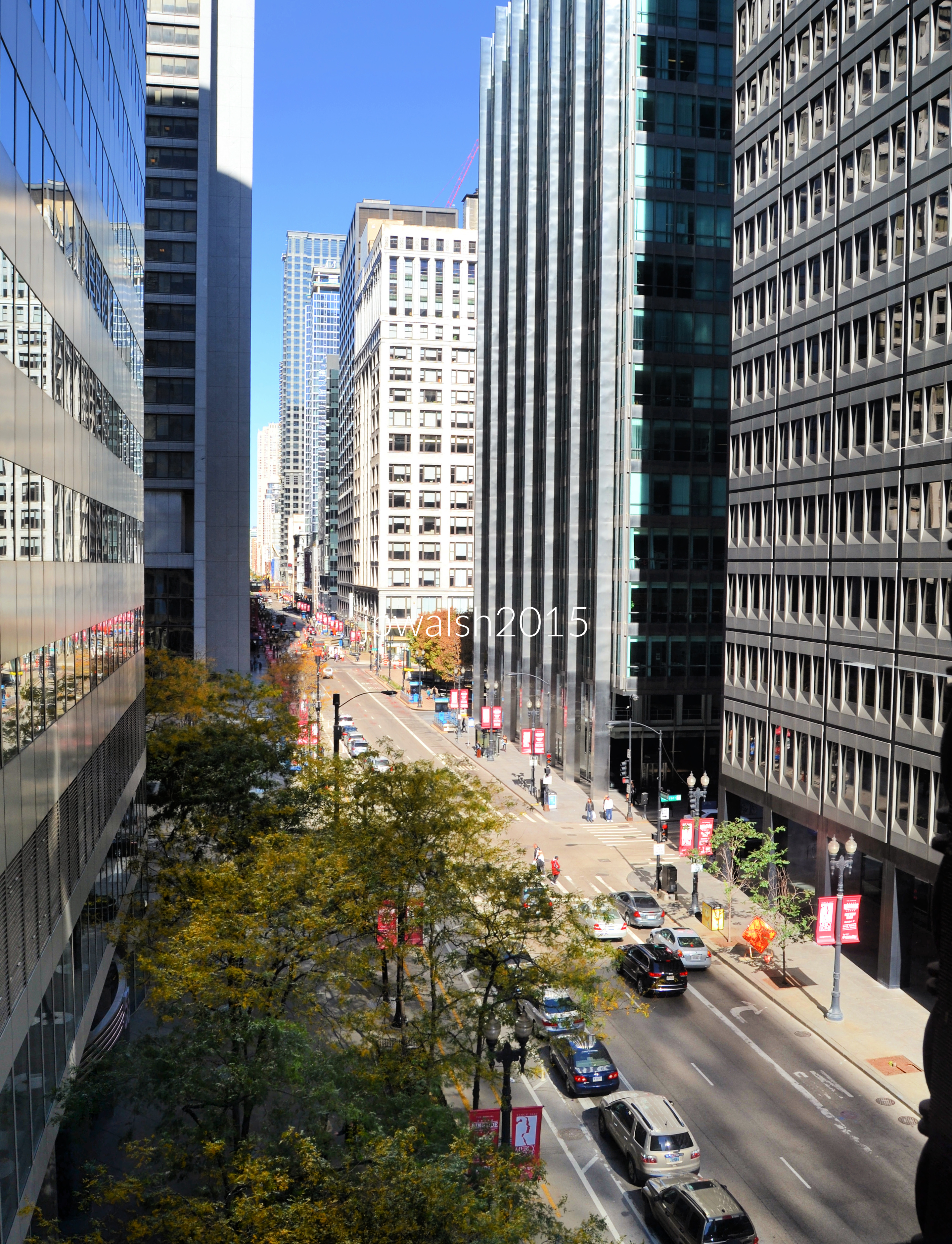
Michigan Avenue and Van Buren Street looking west on Van Buren, Chicago. Left: Chicago Club, 81. E. Van Buren, Granger & Bollenbacher, architect (1929).
Right: CNA Center (333 S. Wabash Avenue), Graham, Anderson, Probst, architect (1972).
Near background: 333 S. State, DePaul Center (formerly Goldblatt’s, originally Rothschild & Co. Store), Holabird & Roche, architect (1912), renovation 1993.
Far background: Fisher Building (343 S. Dearborn Street), D.H. Burnham & Co., architect (1896) and Northern Addition, Peter J. Weber, architect (1907). Restoration and adaptive Reuse, 2001.
October 2015. Chicago. 4.28mb DSC_0061 (1) Author’s photograph.
Adams and Dearborn Streets looking north along Dearborn, Chicago. Left: 55 Xerox Center, 55 West Monroe, Chicago, Helmut Jahn, architect (1977-1980). Behind (partially hidden): Chase Tower (originally First National Bank of Chicago), Perkins & Will; C.F. Murphy Assocs. (1969).
Background: 2 N. State/1 N. Dearborn Streets (originally, Boston Store), Holabird & Roche (1906; 1917), renovation (2001).
November 2015. Chicago. 3.77mb DSC_0384 (1). Author’s photograph.
Halsted Street between Adams Street and Jackson Boulevard looking east, Chicago. Union Station Tower (MidAmerica Commodity Exchange), Skidmore, Owings & Merrill, architect (1971). Willis Tower (originally, Sears Tower), Skidmore, Owings & Merrill, architect (1974).
December 2015. Chicago. 2.40mb DSC_0577 (2). Author’s photograph.
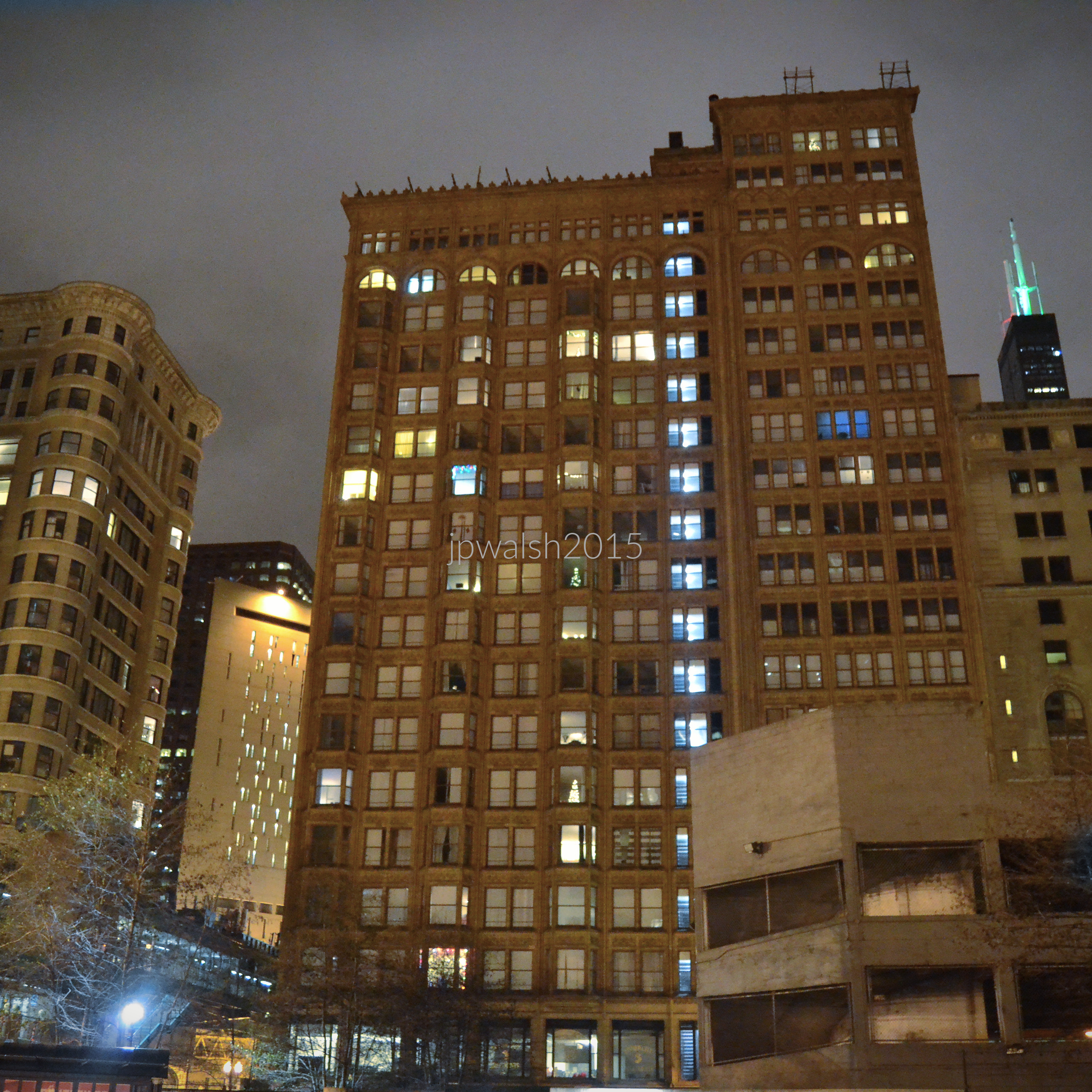
Balbo and Wabash Avenues looking north on Wabash. Left: (with Columbia College wall sign) 33 Ida B. Wells Drive building, Alfred S. Alschuler, architect, (1925/1926). DePaul University College of Law, 25 E. Jackson and, beyond, 230 S. Wabash, a 21-story building built in 1910.
Center: Trump International Hotel and Tower, Adrian Smith, architect (2009).
At right: Roosevelt University: Auditorium Building, Adler & Sullivan, architect (1887-1889) and The Wabash Building, a 32-story zigzagging glass structure, Christopher Groesbeck, AIA, architect (2012). CNA Center (333 S. Wabash Avenue), Graham, Anderson, Probst, architect (1972).
December 2015. Chicago 3.60mb DSC_0986 (2)
From left: Old Colony Building, 407 S. Dearborn Street, Holabird & Roche, architect (1894), Chicago Metropolitan Correctional Center, 71 W. Van Buren Street, Harry Weese & Associates (1975), Fisher Building, 342 S. Dearborn Street, D.H. Burnham, architect (1896) and Northern Addition, Peter Weber, architect (1907) and Sears Tower, 233 S. Wacker Drive, Skidmore, Owings & Merrill, architect (1974).
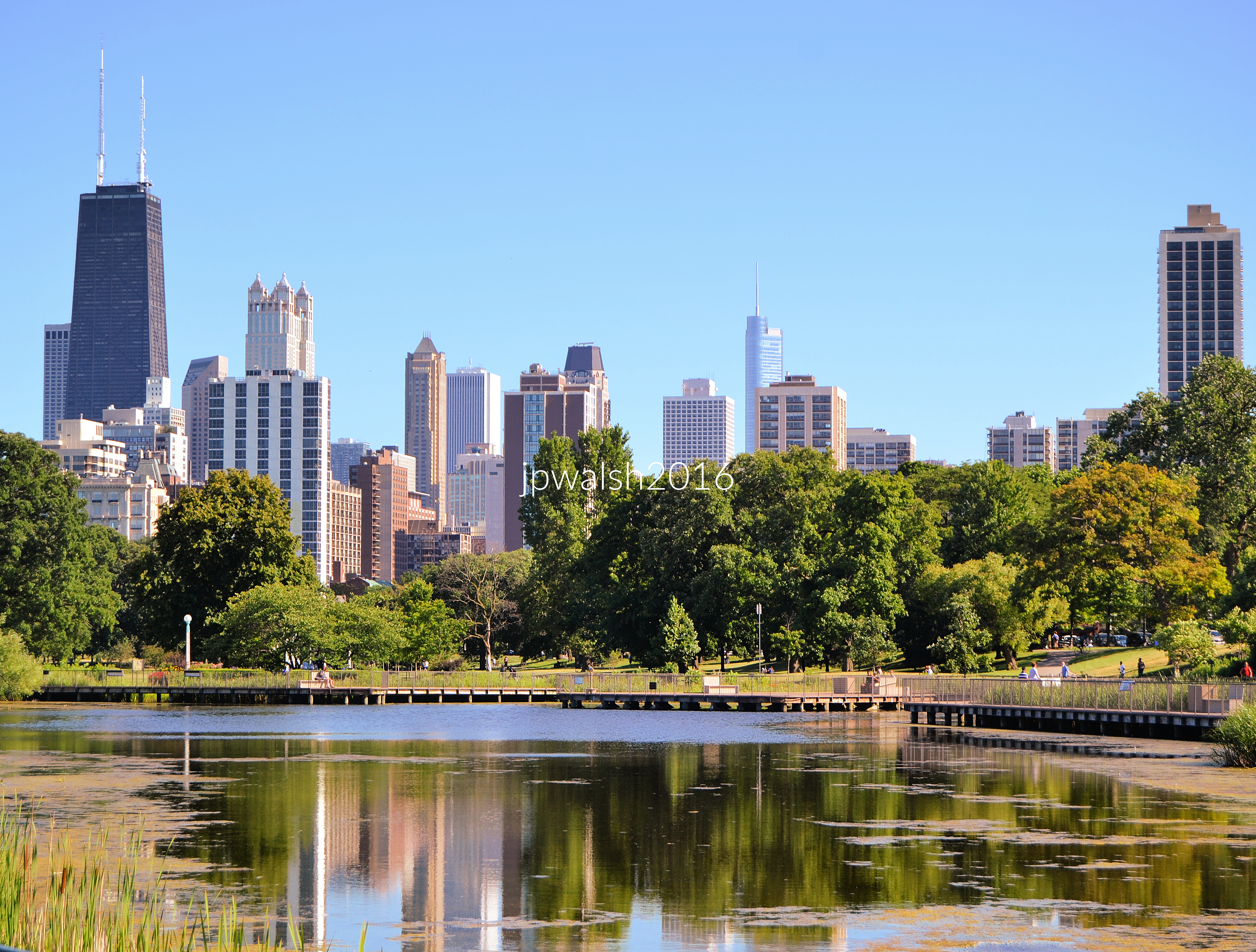
July 2016. Chicago 5.33mb DSC_0743 (1)
Lincoln Park looking over South Pond towards downtown. At left: (partial view) Water Tower Place, 845 N. Michigan Avenue, Loebl, Schlossman & Hackl, architect (1976); John Hancock Building, 875 N. Michigan Avenue, Skidmore, Owings & Merrill, architect (1969); 900 North Michigan Avenue, Kohn Pedersen Fox, architect (1989); Park Tower, 800 N. Michigan Avenue, Lucien LaGrange & Assoc., architect (2000); The Aon Center (formerly, Amoco Building; originally, Standard Oil Building), 200 E. Randolph Street, Edward Durell Stone; Perkins & Will, architects (1973); Trump International Hotel and Tower, Adrian Smith, architect (2009); At right: James House, 1560 North Sandburg Terrace, Solomon Cordwell Buenz, architect (1971).
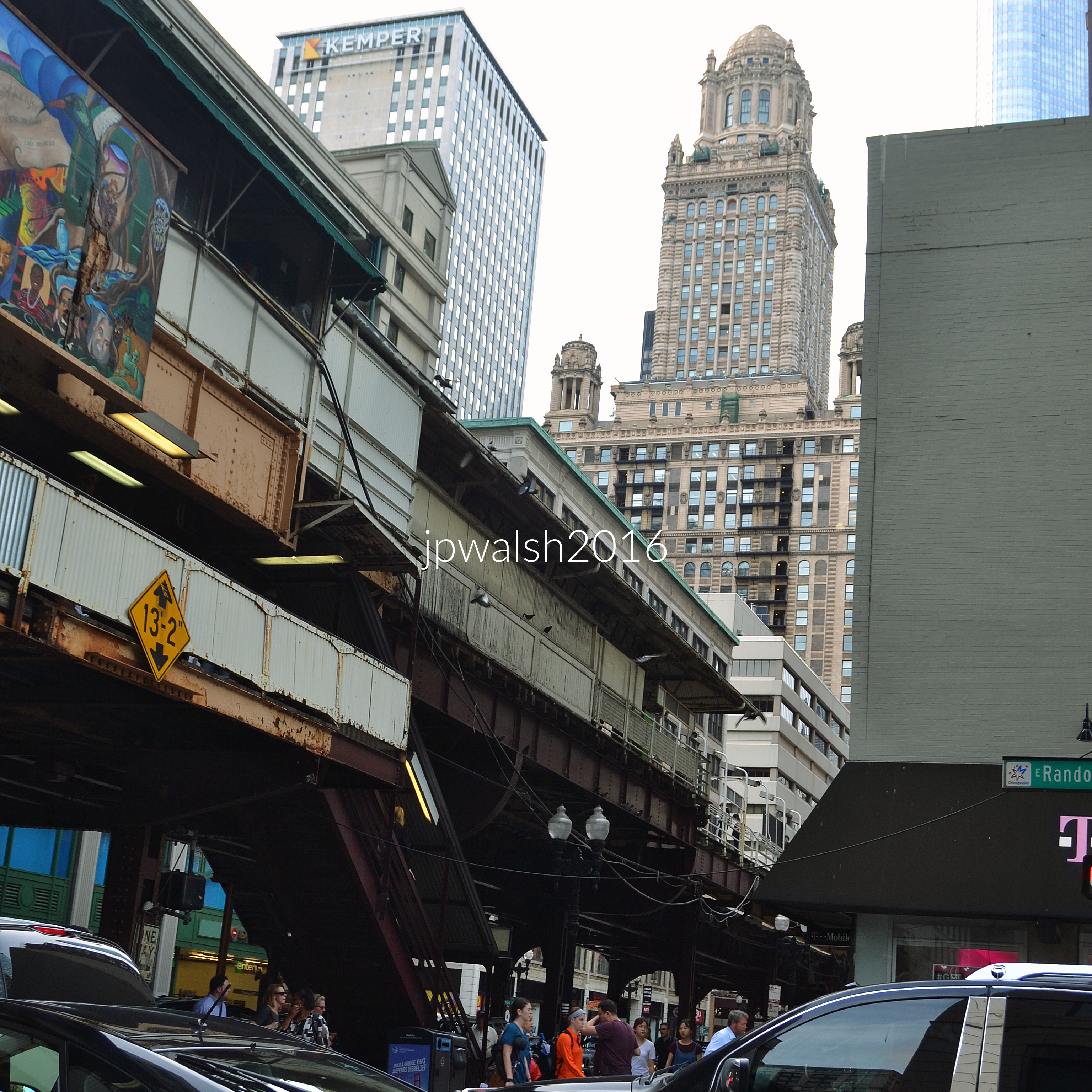
July 2016. Chicago. 3.28 mb DSC_0045 (1)
Looking north on Wabash Avenue from Randolph Street, the Chicago elevated train follows a north-south route along Wabash Avenue and has been part of downtown since the late 1890’s. The “Kemper” sign is on the relatively dull modernist Kemper Building, now One East Wacker, Shaw, Metz & Assoc., architect (1962). Followed by 35 East Wacker Drive (formerly Pure Oil Building; originally, Jewelers Building) with its distinctive dome, Glaver & Dinkelberg; Thielbar & Fugard, Assoc. Archs., architect (1926). Partial view is Trump Tower.
September 2016. Chicago.3.89mb DSC_0740 (1)
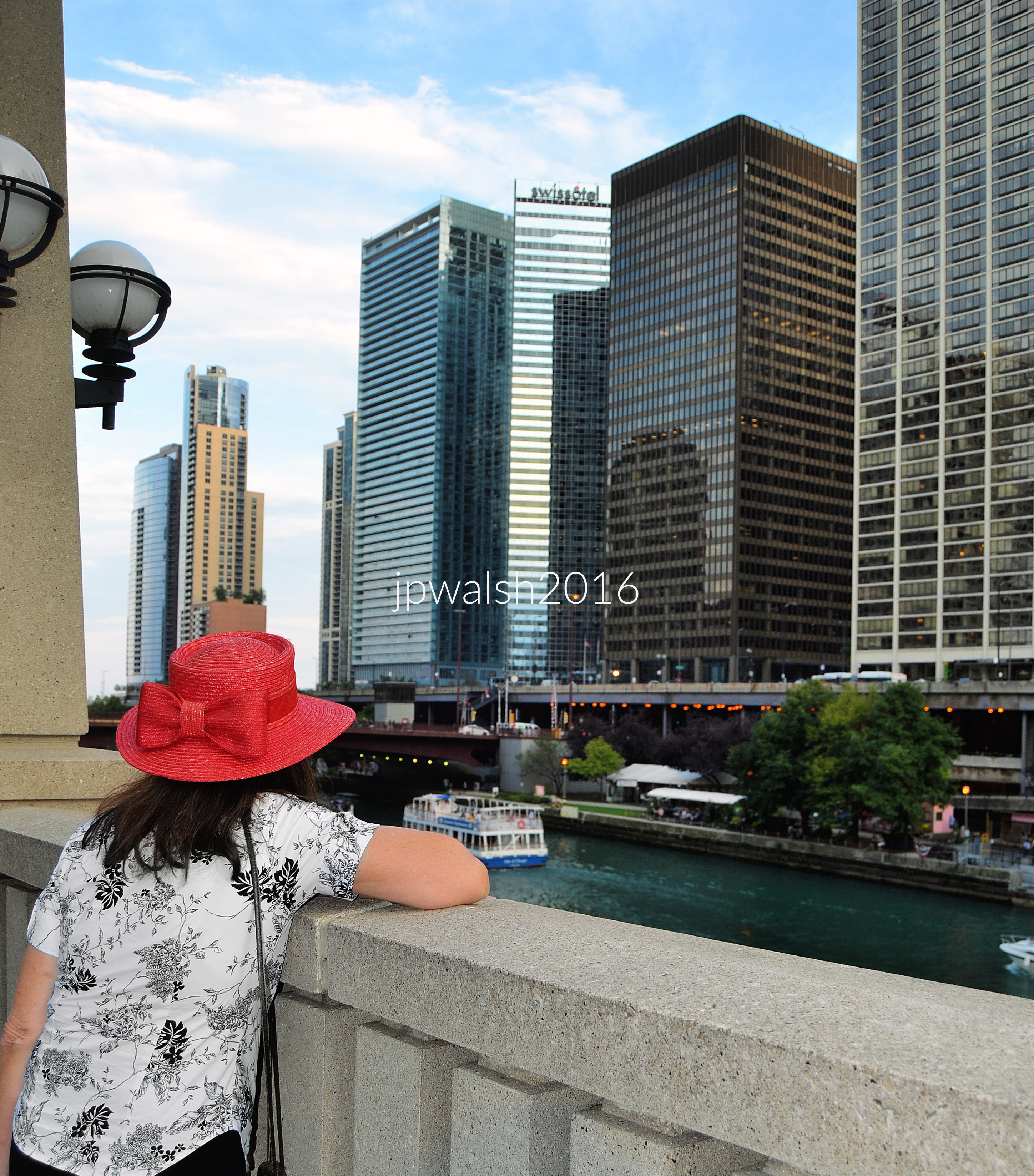
Right to left: The 233 E. Wacker Drive building (known as Columbus Plaza) in Chicago is 48-story apartment building, Fujikawa Conterato Lohan and Associates, architect (1978-1980). The 111 E. Wacker Drive building (known as One Illinois Center) in Chicago, is a 30-story Modernist building featuring bronze anodized aluminum and dark-tinted glass, Ludwig Mies van der Rohe in association with Joseph Fujikawa, architect (1967-1970). The Swissôtel Chicago at 323 E. Wacker Drive, is a 45-story, triangular, all-glass luxury hotel, Harry Weese and Associates, architect (1989). The 345 E. Wacker Drive building (known as Coast at Lakeshore East) in Chicago is a 40-story residential apartment tower, bKL Architecture LLC, architect (2013).
September 2016. Chicago. 4.93mb DSC_0745 (1)
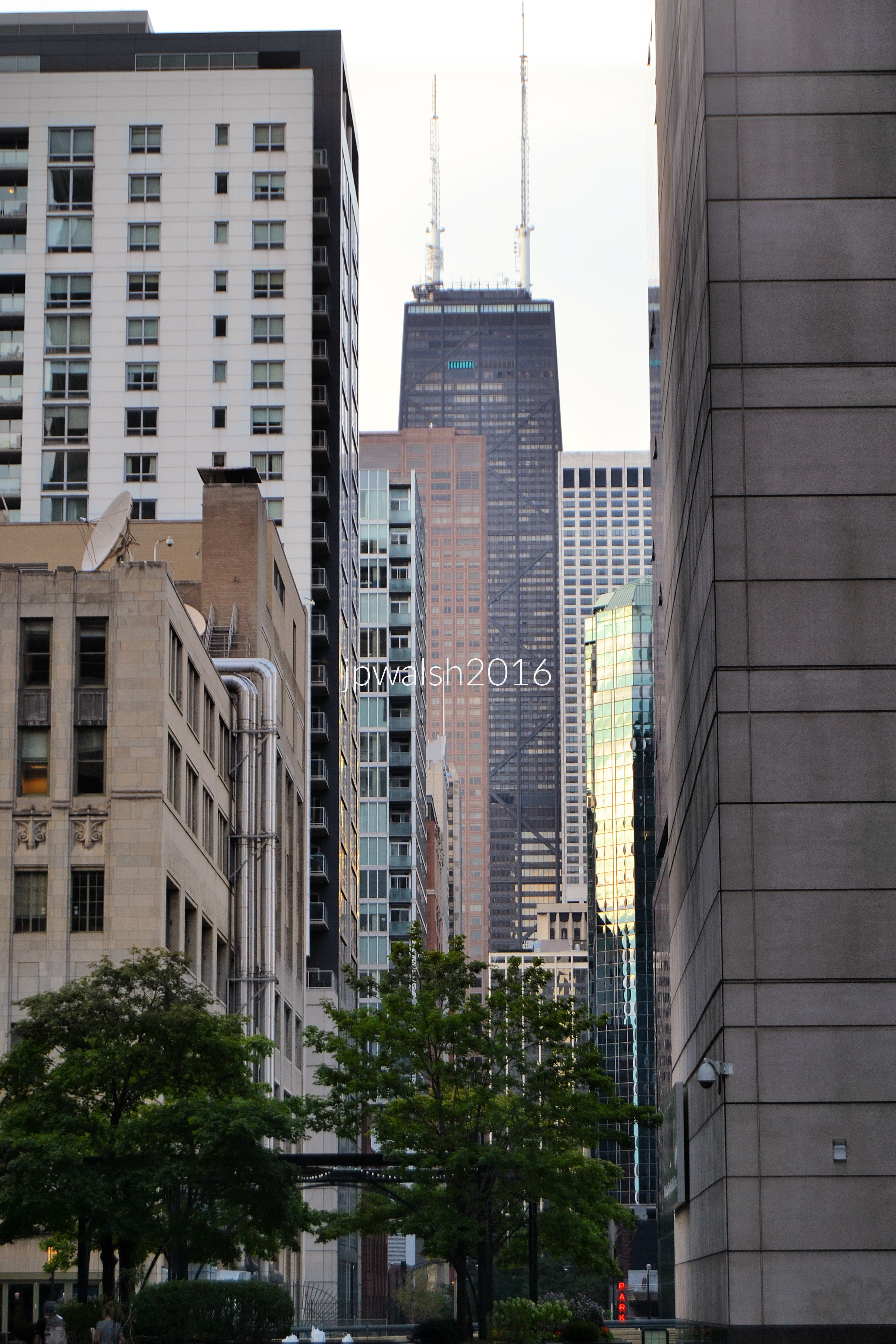
From the Riverwalk looking north along N. St. Clair Street: at right, the 27-story spandrel glass and metal panel 633 N. St Clair St. building, Loebl Schlossman [later; Dart] & Hackl, architect (1991). At left, the 63-story pinkish, rose-hued Swedish granite 161 Chicago Avenue East building (known as Olympia Centre) is a mixed-use retail, office, and residential skyscraper, Skidmore, Owings & Merrill, architect (1984-85). At right, the 74-story gray marble facade Water Tower Place, the first vertical shopping center on Michigan Avenue (8 floors), also includes the Ritz-Carlton hotel, luxury condos, and office space, Edward D. Dart (Loebl Schlossman Bennett and Dart), architect (1975). The John Hancock Center—now officially 875 North Michigan Avenue—is a 100‑story, tapered mixed‑use skyscraper known for its iconic X‑bracing. Often described as a “vertical city,” it is considered one of the first major mixed‑use skyscrapers in the world and includes office space (floors 13–41), about 700 condominiums (floors 44–92), and the highest indoor swimming pool in North America on the 44th floor. Its 94th‑floor observation deck offers panoramic views of Chicago and Lake Michigan. Bruce Graham of the firm Skidmore, Owings & Merrill, architect (1969). It was engineered by Fazlur Rahman Khan, who pioneered the tubular structural system used in the tower.
September 2016. Chicago. 5.06mb DSC_0756 (2)
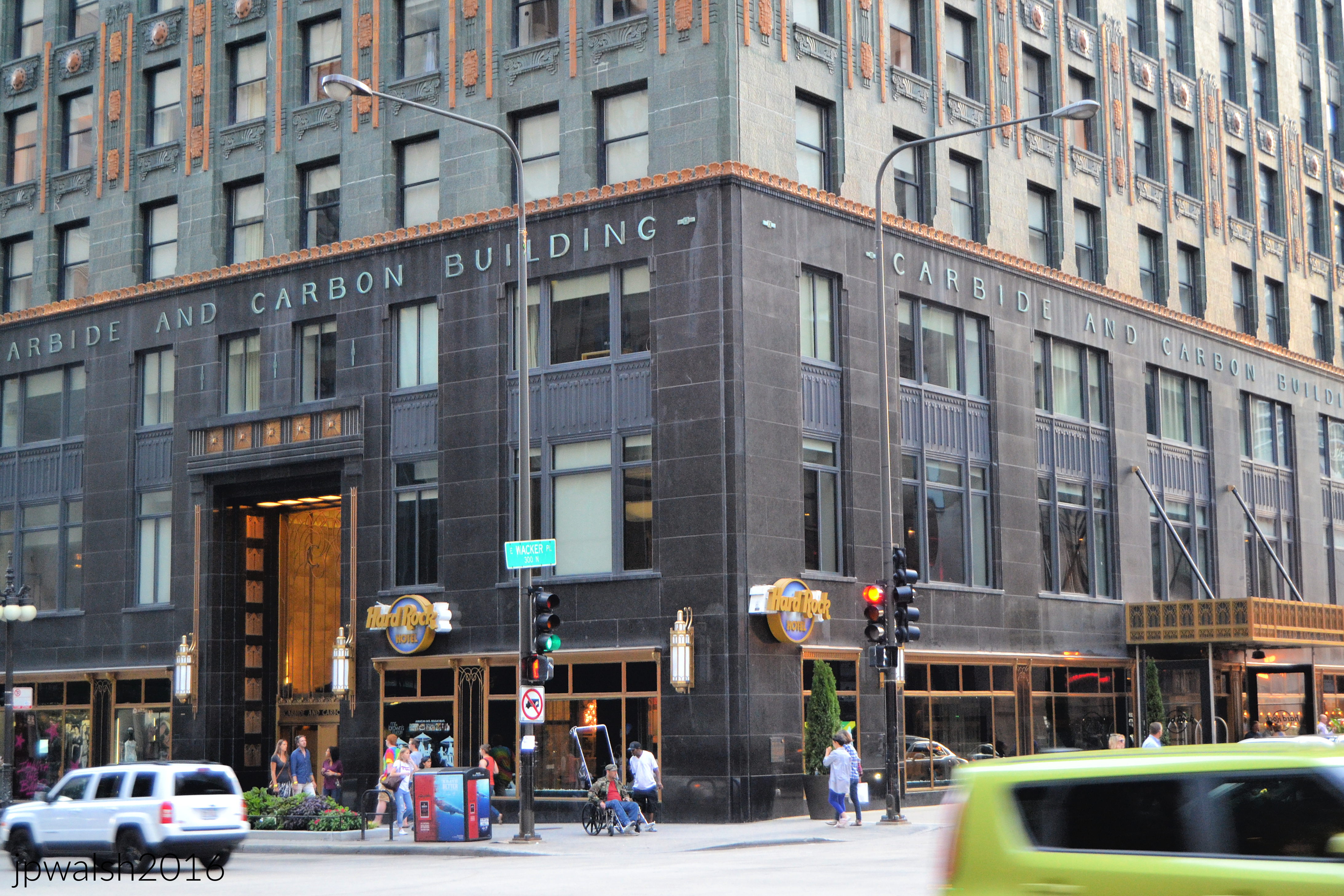
The Carbide and Carbon Building rises from 230 N. Michigan Avenue in Chicago like a gleaming Art Deco toast to the Jazz Age, Burnham Brothers, architect (1929). The 37‑story tower is instantly recognizable: its base wrapped in polished black granite, its shaft clad in deep green terra cotta, and its crown shimmering with 24‑karat gold leaf. Legend has it the architects shaped the building to resemble a champagne bottle — a fitting symbol for a city that never stopped celebrating its own ambition.
October 2015. Author’s photograph. 3.90mb. Above: Alexander Calder’s Flamingo (1974)sits in Federal Plaza designed by modernist architect Mies Van Der Rohe. Behind it is Mies’ 45-floor John C. Kluczynski Building at 230 S. Dearborn Street and on a sunny east side of South Dearborn his 30-story Dirksen Federal Courthouse. Moving south across Jackson Boulevard is the 5-story 33 West Jackson Boulevard building built in 1910 (with additions/remodels stretching through 1917). Next to it is The Standard Club at 321 South Dearborn Street built in 1926 and designed by Albert Kahn. The Fisher Building (1896) at 343 South Dearborn Street and its annex is next further south. Designed by D.H. Burnham & Company, it was completed in 1896. The Old Colony building on the other side of the L tracks was built between 1893 and 1894, When it officially topped out, the 17-story, 215-foot high-rise briefly held the title of the tallest building in Chicago. It was designed by the legendary architectural firm of Holabird & Roche. The framework was engineered by Corydon T. Purdy who designed it with a highly advanced, pioneering skeletal steel-frame structure that carries the entirety of the building’s massive weight allowing the exterior features absolutely no self-supporting walls.
June 2022. Author’s photograph. 7.24 mb Above: On the west side of Clark Street between Adams Street and Jackson Boulevard—visible directly behind Alexander Calder’s Flamingo sculpture—the prominent structures are from left to right: The Commercial Office Building located at 118 South Clark Street (directly tucked between the Bankers Building and Jackson Boulevard)—was completed in 1920 and designed by the prolific Chicago architectural firm Holabird & Roche, Willis Tower in the distance, The Bankers Building (105 West Adams Street, completed in 1927 by the Burnham Brothers, a 476-foot Art Deco masterpiece featuring characteristic deep light courts and upper-tier setbacks), and, on the other side of Adams Street, The Field Building at 140 S. Clark. Completed in 1934 by Graham, Anderson, Probst & White, it stands as one of the finest premier masterpieces of Art Deco skyscraper design in the entire United States. A corner slice of the Edison Building is also pictured.
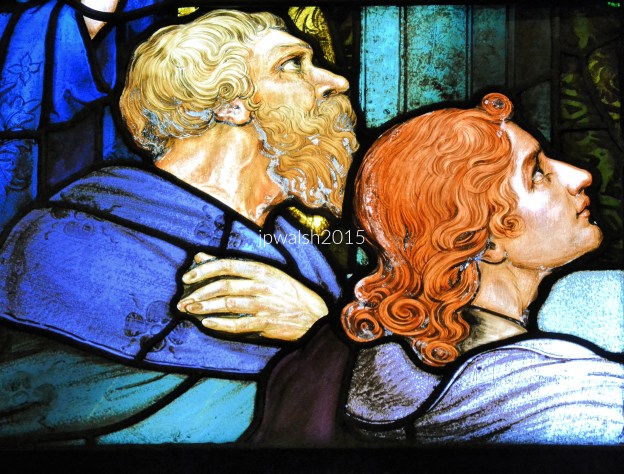
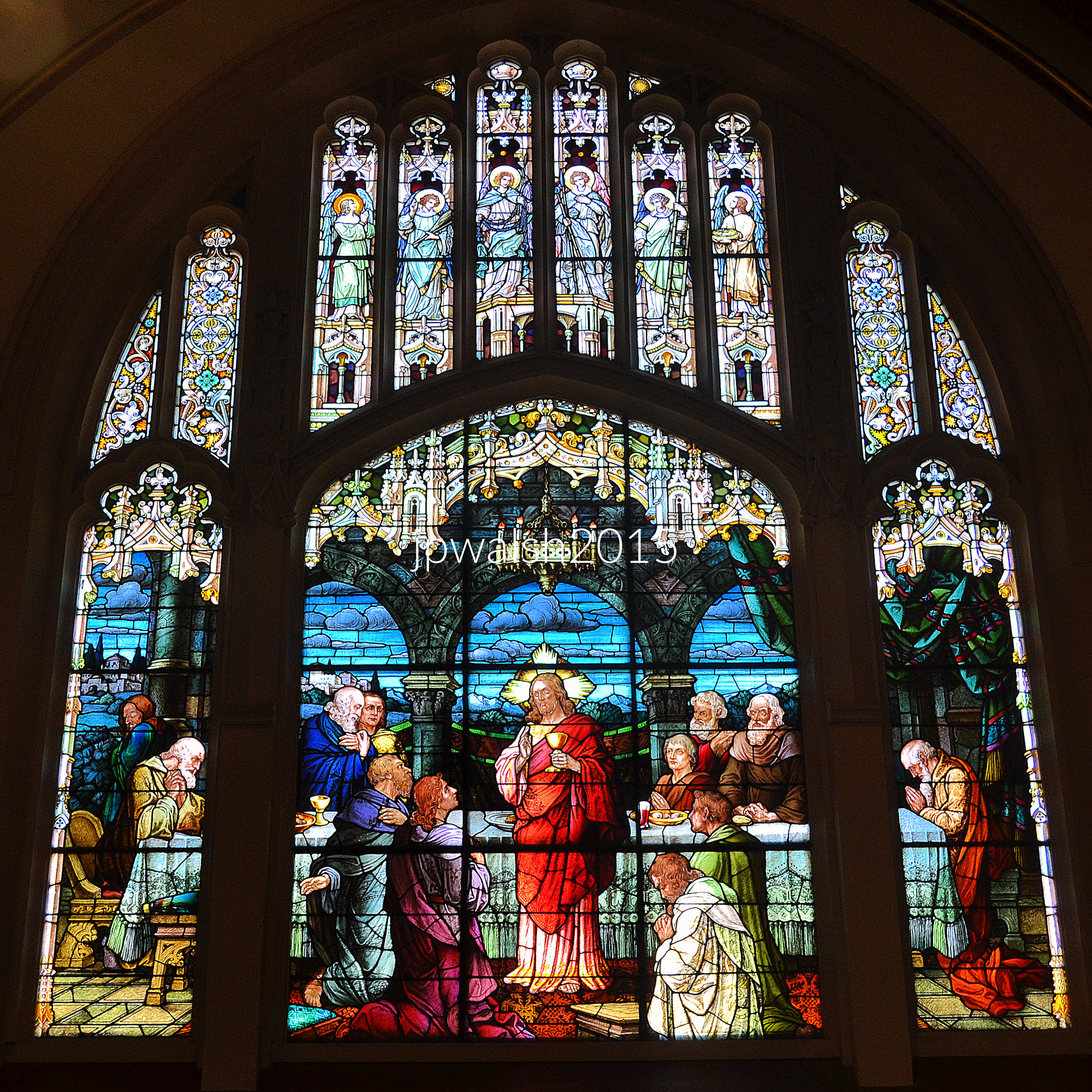
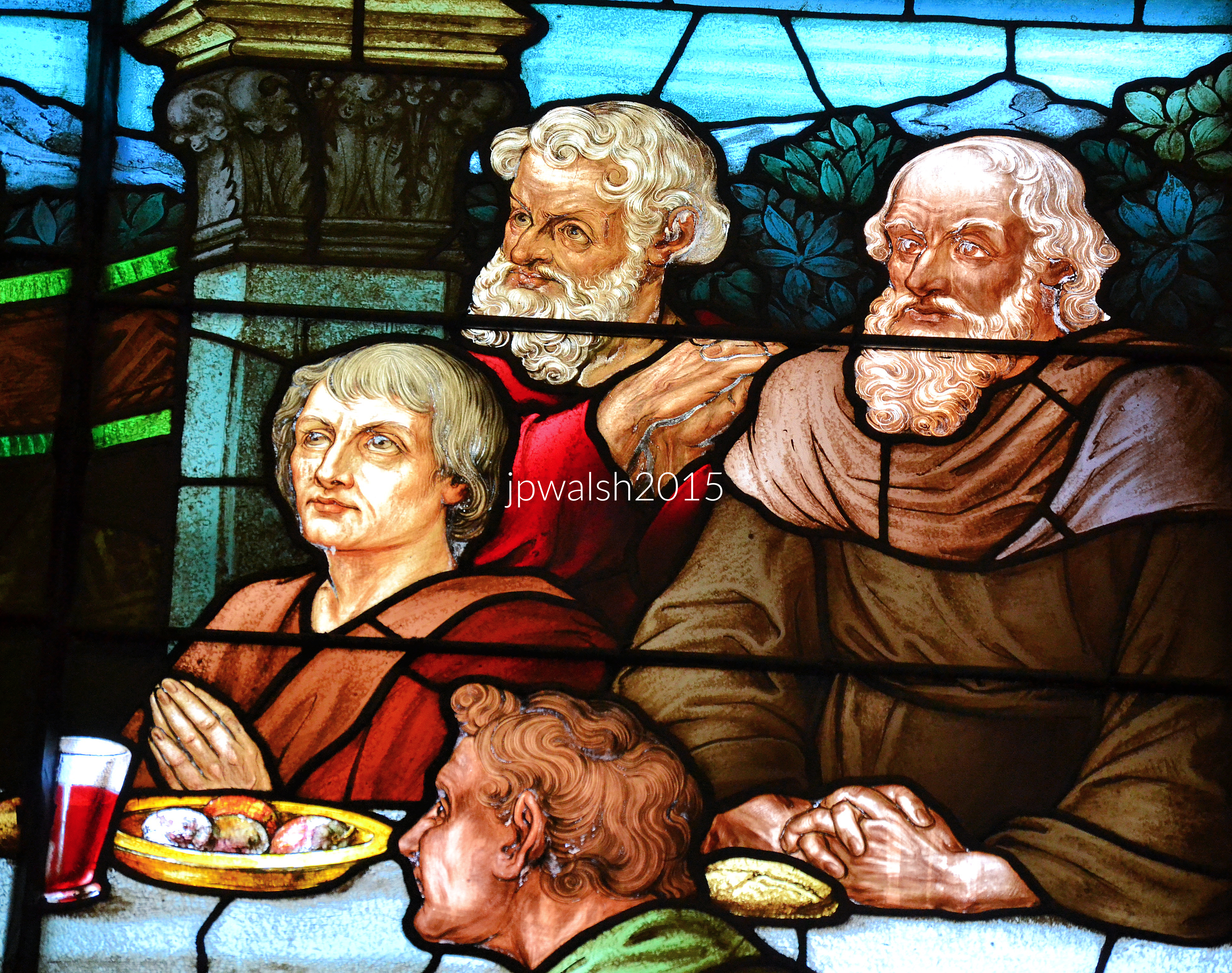
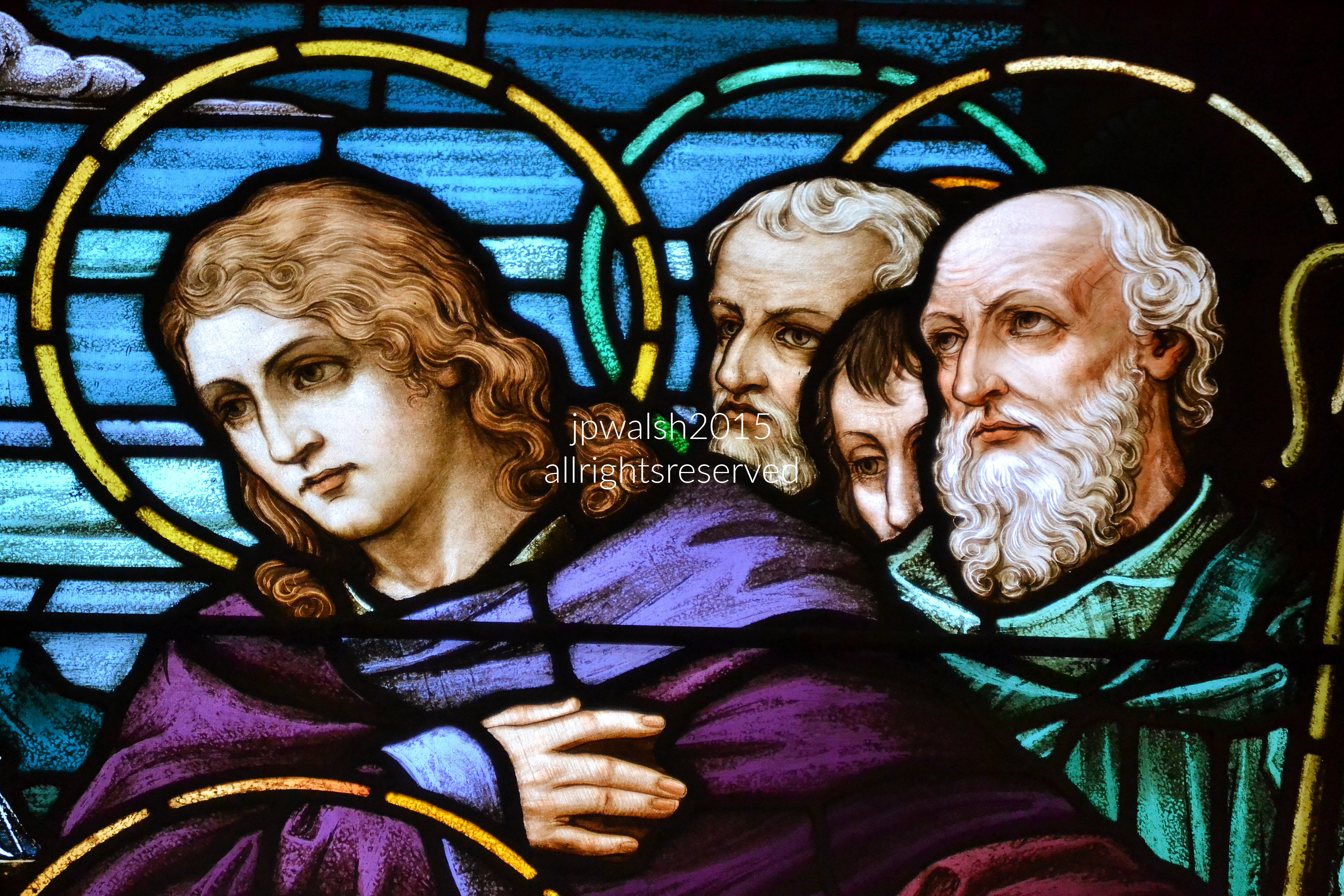
Feature Image: Two apostles, detail, Institution of the Eucharist window, F.X. Zettler, 1907-1910, St. Edmund Church. Author’s photograph. September 2015.
The F.X. Zettler windows at St. Edmund Church are part of a larger story about how German Catholic artistic traditions shaped Chicago-area Catholicism, using sacred art not merely as decoration but as theological instruction, devotional practice, and cultural memory within a church that has survived while many comparable parishes have declined or disappeared.
By 1910 F.X. Zettler’s mastery of the “Munich Style” – characterized by detailed scenes and vibrant colors on glass – made his German company one of the most popular designers in late 19th century and early 20th century American churches. These windows are religious paintings that are pedagogical as well as sacred images. The Roman Catholic Church teaches that Christ is “really present” in the Eucharist (a Greek word, eucharistia,that means “Thanksgiving”) and that his sacrifice on the cross on Calvary is repeated at every Mass as Christ gives His Body and Blood under the appearance or species of bread and wine in Holy Communion as food for eternal life. As parishes offer school children their first holy communion, Christ’s pose evokes that same event for the apostles. Accounts of the Institution of the Eucharist at the Last Supper are in Luke 22, Mark 14, Matthew 26, and its significance explicated in John 6. It is recounted in Paul’s First Letter to the Corinthians, 11. Author’s photograph. September 2015.
Four apostles, detail, Institution of the Eucharist window, F.X. Zettler, 1907-1910, St. Edmund Church. Author’s photograph. September 2015.
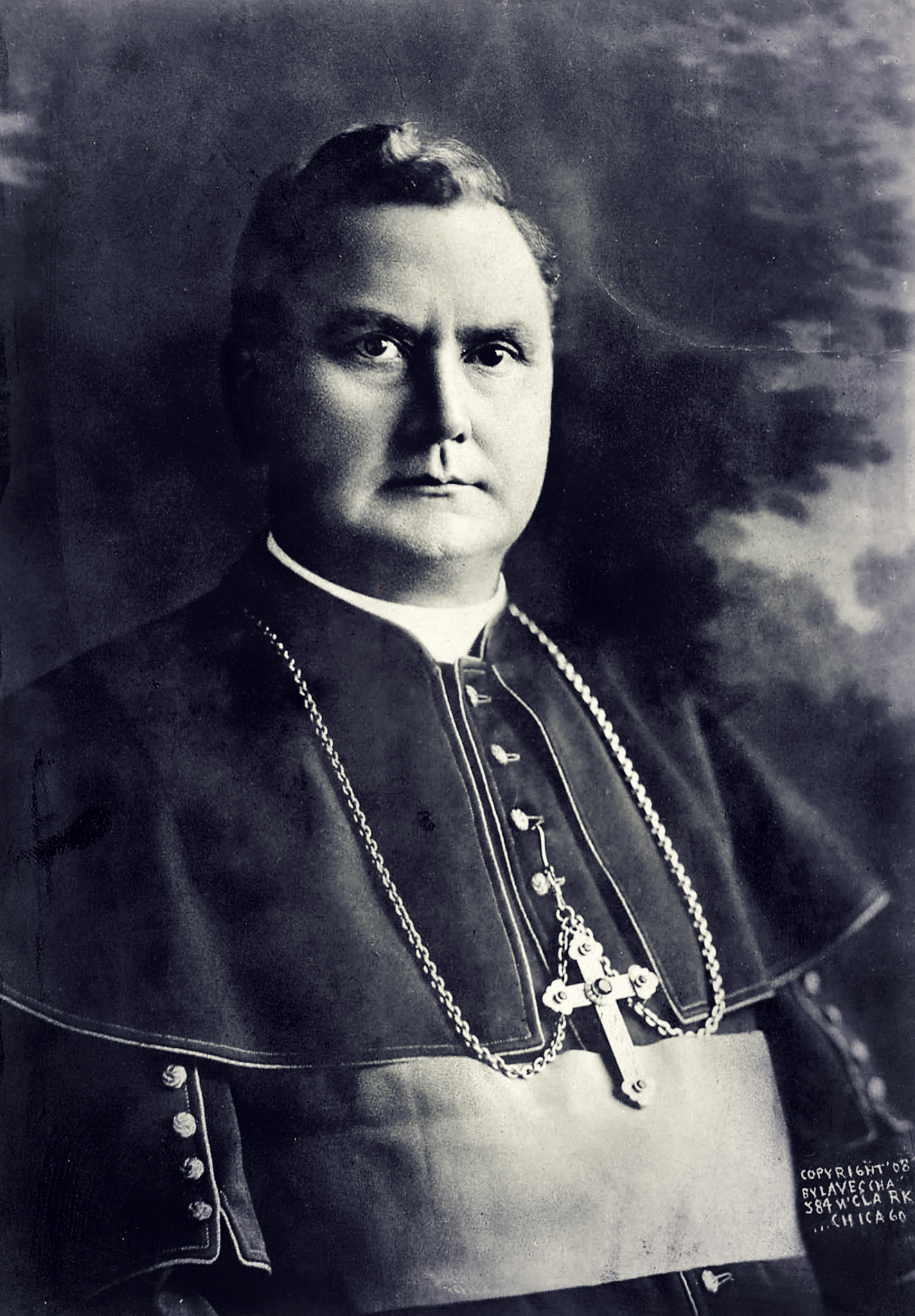
In 2022, owing to continuously declining numbers in the church, St. Edmund Church at 188 S. Oak Park Avenue, Oak Park, IL, located close to the heart of its suburban downtown, was combined with another historic Oak Park parish, Ascension Church, at 808 S. East Avenue, about one mile to the south. Founded by Archbishop James Quigley (1854-1915) in June 1907, St. Edmund was the first Catholic parish in the village and one of the 75 new parishes founded by Quigley during his tenure between 1903 and 1915. James Quigley’s successor was Cardinal George Mundelein (1872-1939) who founded 80 more new parishes during his administration. Trying to fit into the longstanding predominantly Protestant community, St. Edmund was built in generous cooperation with its leading citizens and designed in a refined English neo-Gothic style. Evoking a low-profile parish country church, this kind of Catholic footprint would be imitated in other prosperous Chicago suburbs with strong Protestant roots well into the 20th century so to discreetly integrate into the community.
Most Rev. James Quigley, Archbishop of Chicago (1903-1915). In 1907 Archbishop Quigley traveled by car to Oak Park to attend the opening. Public domain.
Since the mid-1980s reports from 2022 indicate a reduction by the Archdiocese of Chicago of more than 100 parishes from its nearly 450 parishes due to declining attendance and financial problems, of which St. Edmund is another example. It remains fortunate that this beautiful church building continues to exist and be used for worship. The English neo-Gothic style church was designed by prolific Chicago church architect Henry Schlacks (1867-1938) and dedicated in May 1910. The art glass windows were executed by the F.X. Zettler Studios of the Royal Bavarian Art Institute in Munich. Zettler also made mosaics such as at St. Anthony Church in Bridgeport also designed by Schlacks and consolidated first with All Saints parish and then both closed and combined with St. Mary of Perpetual Help. St. Edmund Church has undergone various mid-20th century redecorations that included the addition of paintings and marble upgrades for its altar, pulpit, and baptismal font designed by Chicago-based DaPrato Rigali founded in 1860. Exterior changes to the building were also made in the 1950’s replacing the church’s original red tiles for the roof and steeple to, respectively, slate and steel coverings.
St. Edmund Church, Oak Park, Illinois, dedicated in 1910, was designed in the late 19th century English neo-Gothic style. The later school (right), opened in 1917, was designed in the French neo-Gothic style. Both are the work of architect Henry Schlacks (1867-1938). Author’s photograph. September 2015.
St. Edmund Church, Oak Park, Illinois, part of the nave, transept and apse, south view. Author’s photograph. September 2015.
St. Edmund Church and school have been a work in progress. The school, a flamboyant neo-Gothic structure designed by Henry Schlacks, opened in 1917. During the post-war baby boom, additions to it were built in 1948 and 1959. In June 2016 the school closed. When the parish was young and growing with Catholic families, it purchased an architecturally significant private home in 1929 for the nuns who staffed the school. With post-Vatican II declining vocations of nuns and school enrollment, the convent was sold in the 1980’s. A 2000 renovation of the church included cleaning and restoring the stained-glass windows that portray scenes from the New Testament. In other Chicago churches with Zettler windows, such as, in St. Stanislaus Kosta Church in West Town, there are themes of the Rosary, while St. Adalbert, a Polish parish in Pilsen since closed by the archdiocese and sold for condo development, it was historic saints of Poland. Henry Zimach of HPZA was the architect of the St. Edmund renovation. In its first 49 years the church was led by one pastor: successful fundraiser Msgr. John H. Code. The next 49 years saw 6 pastors until the church had to combine with a nearby parish. Of the $100,000 construction cost for the church, one donor (Mrs. Mary Mulveil) donated half of it. From an operating expenses viewpoint this elite donor model is how even today some Catholic parishes across the Chicago region stay open. In 2026 one leading Catholic parish published tithing information that showed 95% of registered families do not tithe one dime and about a dozen families donate annually between $15,000 and $25,000 each. With pews half full, one can conclude that non-tithing families might not be at Sunday Mass either. With the Vatican discouraging any “pressure” on anyone, there’s little to no outreach by the parish to the vast majority of its wayward flock as long as apparently the affluent pay their church bills. Of course, if things really get untenable, the bishop then can simply decide to close one more parish.
Mid-20th century redecorations at St. Edmund Church included the addition of paintings and marble upgrades for its altar, pulpit, and baptismal font. Author’s photograph. September 2015.
The windows as both pedagogical and sacred images that teach Scripture and aid worship.
These are religious paintings as they serve to teach the viewer by depicting scenes from the earthly episodes of Christ. But they are also sacred images, pure iconography, as they invite the viewer to contemplate and pray to those persons existing in the spiritual and heavenly domain with whom they are surrounded. Further, as Zettler’s stained glass are some of this church setting’s most spectacular art, they play a key role in aiding in worship. Individually and taken together, the gloriously colorful and drawn illuminating images accompany worshipers as they place them in the visual presence of the Trinity, the Blessed Mother, and the angels and saints and carry them upwards into their presence as they participate in the sacraments.
The Zettler windows in St. Edmund in Oak Park fill the church interior with the colorful light of glorious art that is both pedagogical and iconographical of the Biblical Catholic faith. Author’s photograph. September 2015.
German Art Glass.
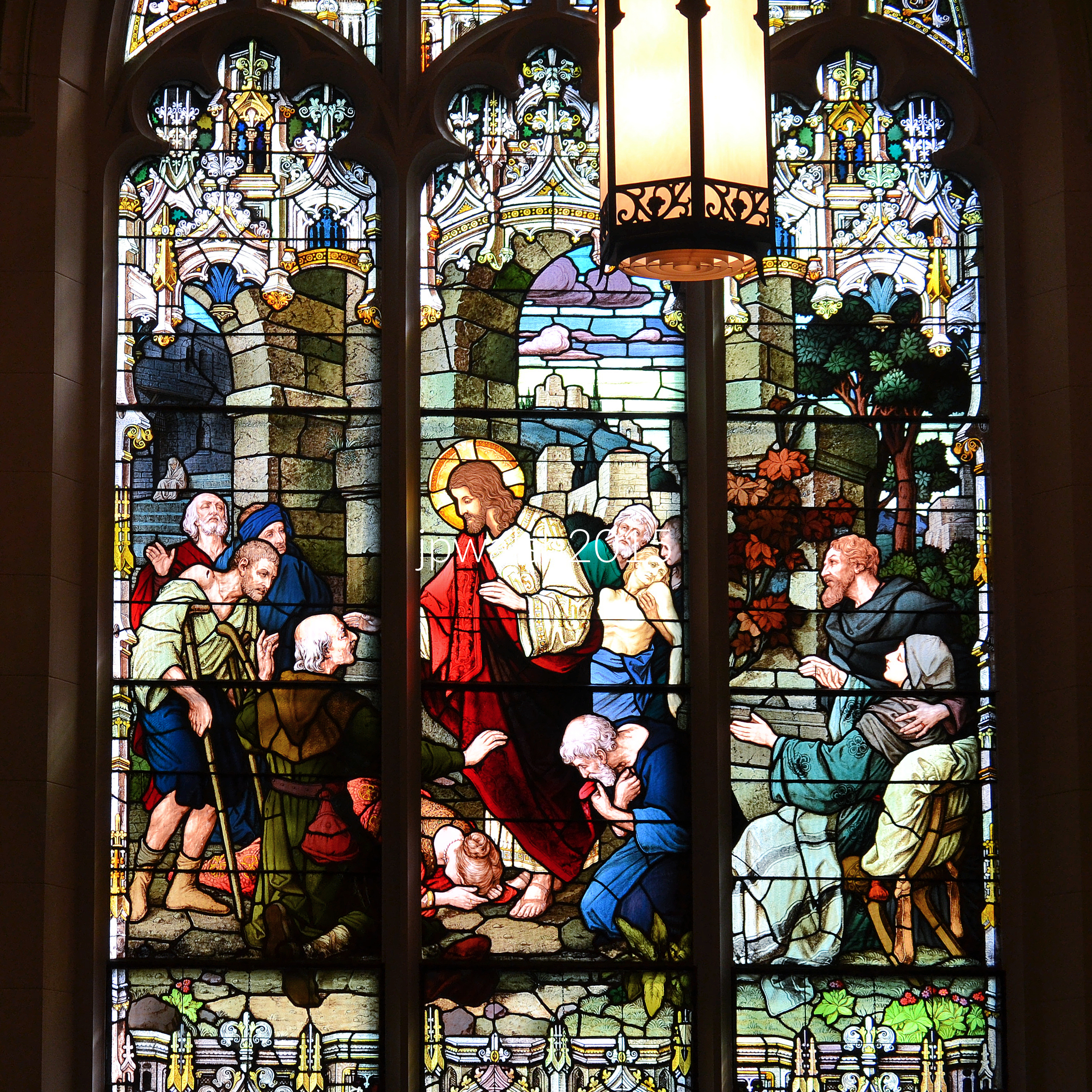
Jesus healing the blind man (above, detail). This window presents healing stories such as found in John 9 (healing the blind man from birth), Mark 8 (healing a blind man at Bethsaida) and healings of two blind men in Matthew 9. The figure of a woman bending down to have her hair touching Jesus’ feet evokes Luke’s gospel (chapter 7) of the sinful woman who washes Jesus’ feet with her hair. The man at right carried by two others alludes to Jesus’s healing miracle of a man who could not walk found in Mark 2 and Luke 5. Author’s photograph. September 2015.
Zettler window of Jesus’s ministry of healing miracles. Author’s photograph. September 2015.
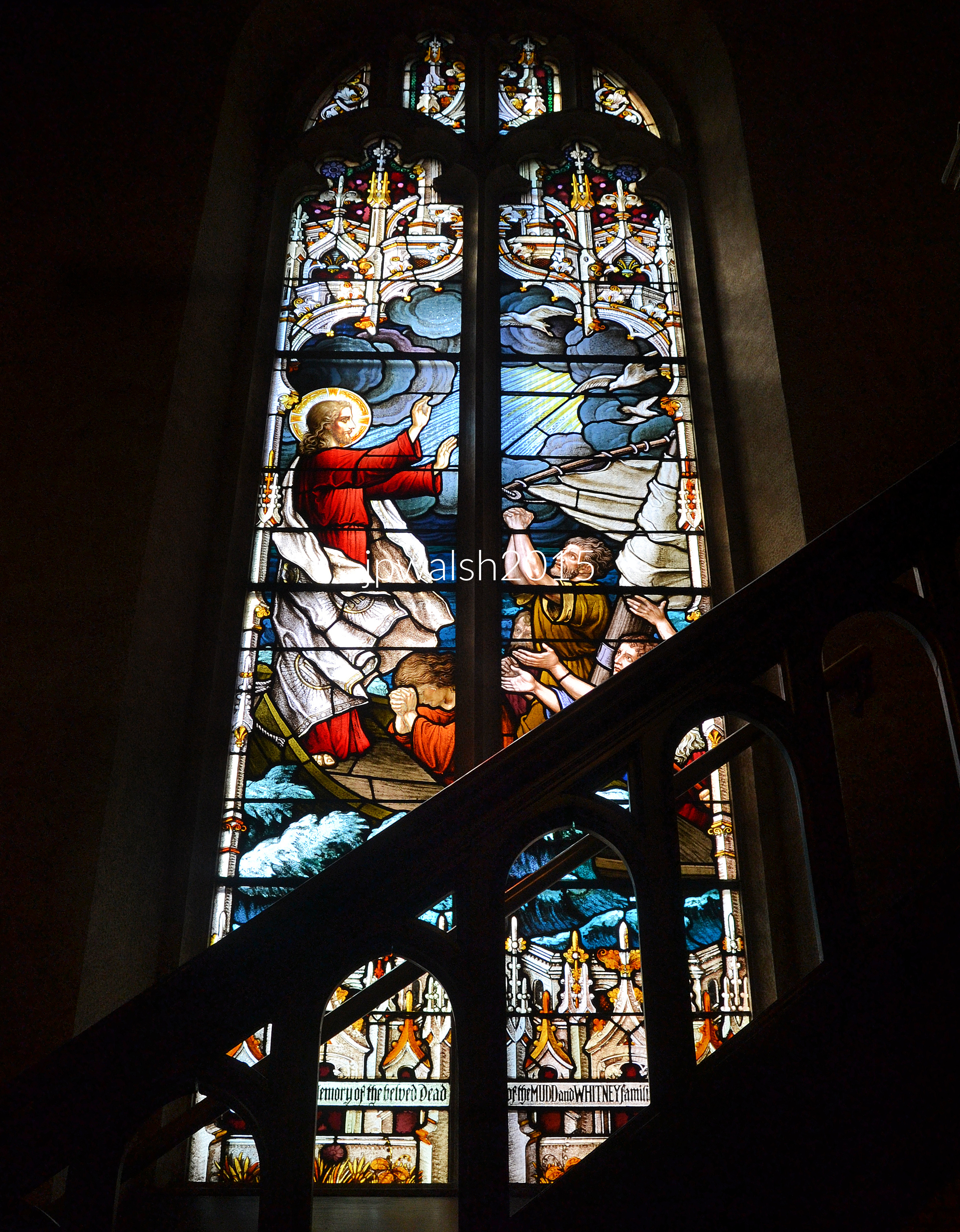
F.X. Zettler’s window of “Jesus Calming the Storm” is a story found various forms in all four gospels. Author’s photograph. September 2015.
The miracle of Jesus walking on the water appears in Matthew 14:22–33, Mark 6:45–52 (the earliest source template), and John 6:16–21. While Luke alone omits this specific walking episode, the overarching theme of Christ’s absolute mastery over the sea is preserved across all four Gospels. Luke instead channels this specific manifestation of divine authority through his account of the Calming of the Storm at Sea in Luke 8:22–25. In that narrative, an exhausted Jesus awakens during a violent squall to rebuke the wind and raging waves, prompting the terrified disciples to echo the central question of the walking narratives: “Who then is this, who commands even the winds and the sea, and they obey him?”
Matthew’s walking account is the most narratively developed. It stands completely unique as the only version to include Peter’s bold attempt to step onto the waves. This exclusive detail masterfully underscores Peter’s psychological profile—highlighting both his impulsive boldness and his recurring need for immediate rescue, creating a direct literary arc that spans from his panic on the water to his bitter tears after later denying Christ. (Every Gospel writer who tracks Peter’s downfalls makes sure to follow it up with his complete vindication. The severity of his critique in the Gospels makes his transformation in the Book of Acts—where he becomes a bold, fearless preacher and healer willing to die for his love of Jesus Christ—crucified upside down by his enemies in Nero’s Rome—all the more powerful.)
John’s version is the briefest and most mystical. It removes the intense atmospheric drama of the Synoptics to reframe the event as a pure revelation of Jesus’s cosmic authority. John completely collapses traditional constraints of time and space by concluding with a distinct dual-miracle: the exact moment Jesus is welcomed into the boat, the vessel is instantly transported across the open water to its final destination on the far shore.
Mark’s narrative remains highly cinematic but structurally severe in its portrayal of the disciples. It ends on an abruptly dark note, stating the disciples were “utterly astounded” because “they did not understand about the loaves, but their hearts were hardened.” Despite this harsh characterization of the inner circle, Mark demonstrates a deep understanding of the Old Testament by incorporating a profound theophanic motif. He deliberately mirrors the sacred moments when God “passed by” Moses and Elijah to reveal His glory in Exodus 33 and 1 Kings 19. Mark applies this exact divine behavior to Jesus, who strides across the lake as a mysterious figure—what the Greek text calls a phantasma (ghost)—and intentionally “meant to pass by them.”
The precise reason behind Luke’s omission of the walking sequence remains a subject of scholarly debate. Most contemporary historical analyses attribute it to narrative economy; because Mark’s version had already established a robust baseline for water miracles, and because Luke had already detailed the dramatic squall of Luke 8, keeping the walking scene would be redundant. Furthermore, omitting the scene aligns with Luke’s consistent pastoral tendency to soften the raw, unpolished depictions found in the other Synoptics that frequently paint the Apostles as dull, uncomprehending, or unfaithful cowards.
Across the Gospels, these water episodes function collectively as a multilayered sign of messianic identity, divine authority, and the fragile nature of human faith. In calming the storms and treading the waves, Jesus demonstrates an absolute sovereignty over chaos, evil, and death that ancient Jewish thought reserved strictly for Yahweh. He deliberately identifies himself using the ultimate divine name—Ego Eimi (“I Am”)—while Peter’s fleeting success on the water illustrates that the impossible becomes reality only when one’s attention is fixed entirely on Christ. The exact moment Peter’s focus shifts to that evening’s storm, the disciple is doomed and must rely on Jesus’s direct, outstretched hand.
Finally, these narratives carry a vital ecclesial dimension that has shaped Christian tradition from the beginning. The historical concept of the Navis Ecclesiae (the Bark of Peter) tossed by a hostile, turbulent world directly mirrors the disciples’ boat being violently battered in the pitch-black isolation of the “fourth watch.” Jesus’s sudden approach across the unknown chaos signifies that he never truly abandons his flock, even during periods of apparent physical absence or “sleep.” His ultimate entry into the vessel (or “waking”) and the immediate silencing of the wind serve as a definitive theological promise: the true, internal peace of the Church is found only in His presence.
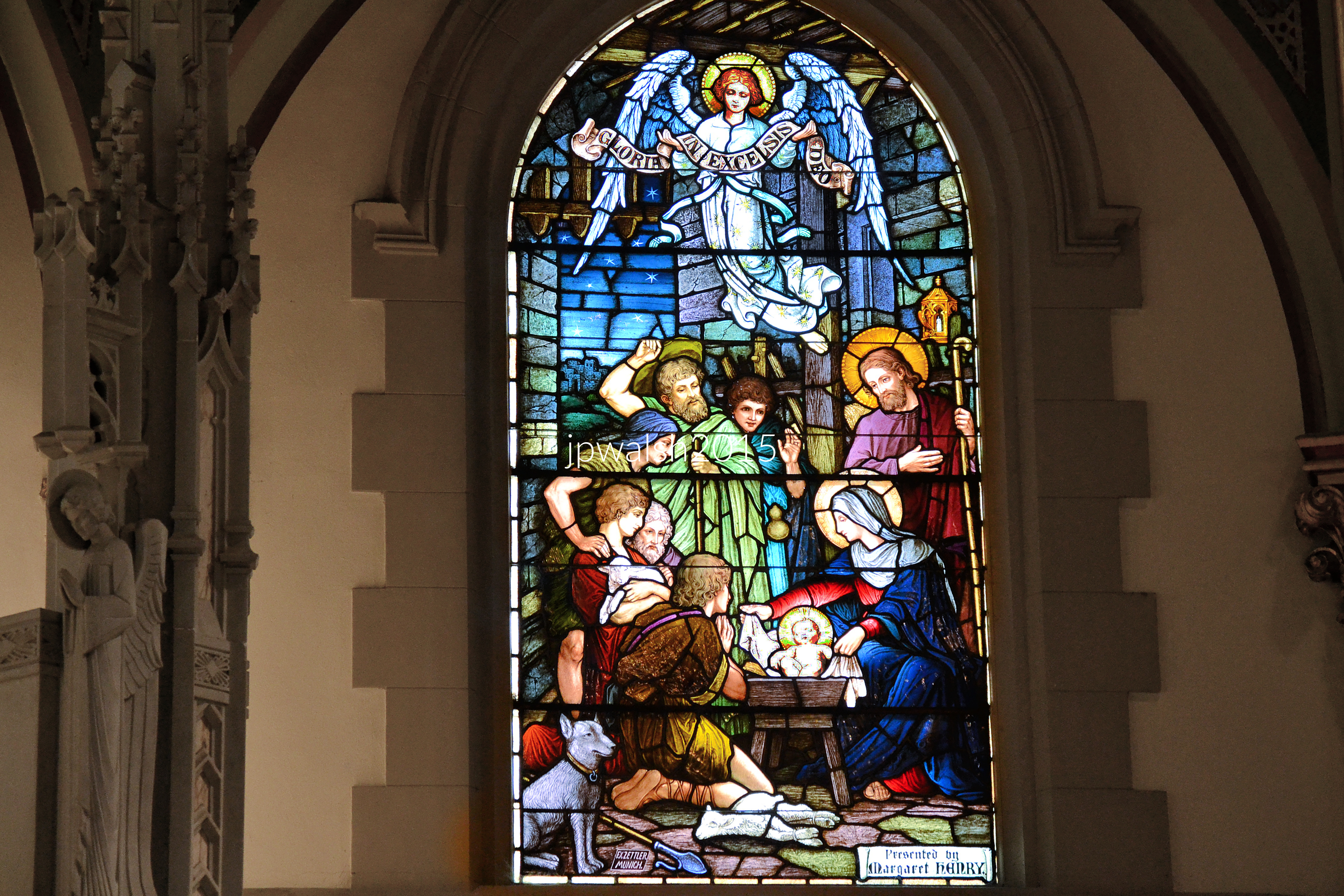
Nativity window found in Matthew and Luke. A dog in the lower left corner is one of many such animals scattered throughout Zettler’s windows in St. Edmund Church. Author’s photograph. September 2015.
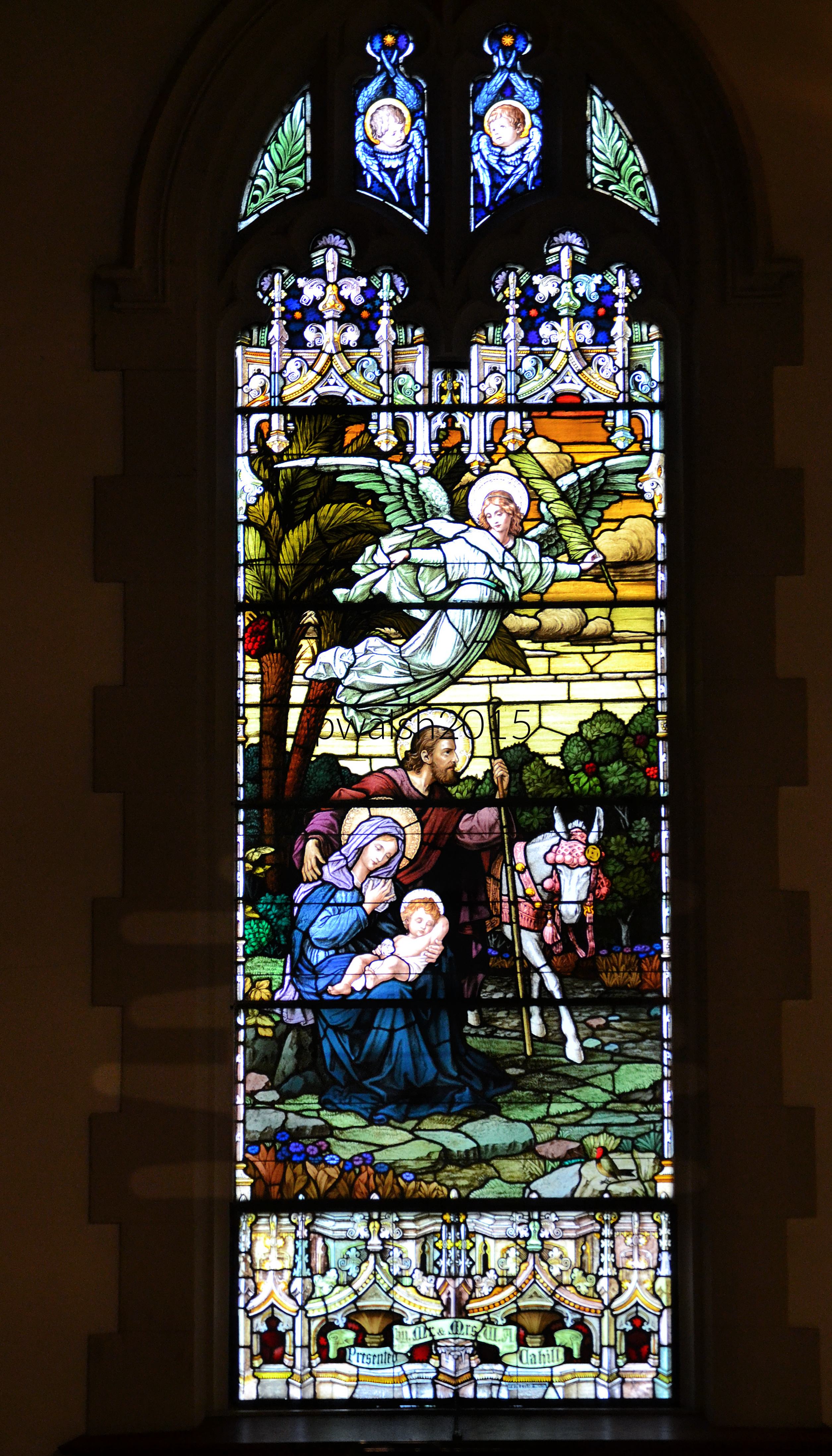
The flight into Egypt window. Recounted in Matthew 2, the story relates how the Holy Family—Mary, Joseph, and infant Jesus—flee to Egypt to escape King Herod, who ordered the killing of young children to eliminate the prophesied King of the Jews. Joseph, warned by an angel in a dream, swiftly carried his family to Egypt, where they stayed until Herod’s death, fulfilling prophecy and symbolizing Christ’s presence in a world of darkness. The episode has long been a popular subject in Christian art, and Zettler depicts the episode focusing on the Holy Family’s determination under angelic protection. In popular piety, the event is one of the “seven sorrows” of Mary which she pondered in her heart. Author’s photograph. September 2015.
Jesus calls Himself the Good Shepherd in John 10. A half-circle stained- glass window depicting Jesus as The Good Shepherd greets visitors above a street entrance door into St. Edmund Church. Author’s photograph. September 2015.
WHO IS ST. EDMUND OF CANTERBURY?
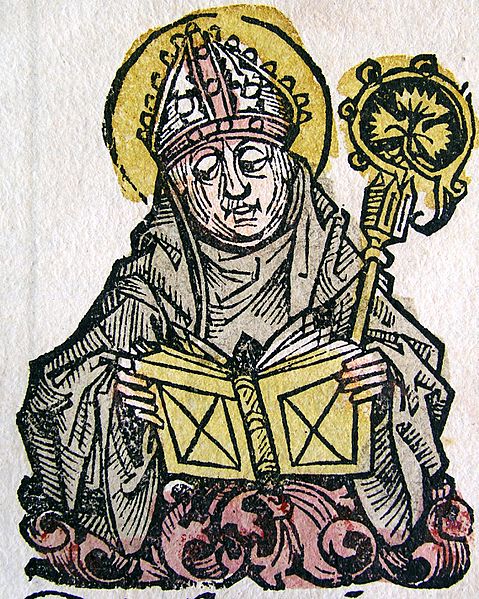
Nuremberg chronicles, Edmund, Archbishop of Canterbury (1493). Public Domain.
St. Edmund church in Oak Park, Illinois, is named for English saint Edmund of Canterbury (c. 1174–1240). Son of Edmund Rich, Edmund is also known as Edmund of Abingdon where he was born and who was made Archbishop of Canterbury in 1233 by Pope Gregory IX (1227-1241). History speaks of his parents as being practicing Catholics with his mother more fastidious and his father more laconic. Edmund, taking after his mother growing up, was considered a bit of a sanctimonious prig. Around the age of puberty, Edmund dedicated himself to the Blessed Mother and took a vow of perpetual chastity. When this vow of purity was later challenged by a young woman Edmund vigorously fought her back sufficiently that, as the young woman recalled, he called her “an offending Eve.” Edmund was educated in Paris but, starting around 1200, returned to Oxford to teach mathematics and philosophy in the circle of Stephen Langton (c. 1150–1228). In Edmund’s time, Langton was an influential English cardinal and Archbishop of Canterbury who participated in the political issues of his day including the Magna Carta crisis in 1215. Edmund is remembered at Oxford for building a Lady’s chapel with funds from his teaching stipend and passing much of his free time in prayer. The site where Edmund lived and taught became an academic hall at Oxford in his lifetime (1236) and remains today part of the college of St Edmund Hall (aka Teddy Hall), claimed to be the oldest surviving academic society to house and educate undergraduates in any university in the world. Notable alumni of St Edmund Hall include, at the time of posting, current British prime minister Keir Starmer.
Author’s photograph. September 2015.
Edmund studied theology between 1205 and 1210 and spent a year with the Augustinian canons of Merton Priory. Afterwards he became a priest and doctor of theology and would take frequent retreats at Reading Abbey in this period. Around 1219 and for the next 12 years the eloquent, learned and virtuous Edmund financed his education by serving as treasurer for Salisbury Cathedral, preached the Sixth Crusade in 1227 (a crusade which led to a shared Christian-Muslim governance situation in Jerusalem) and garnered several influential English friends.
In a mid-14th century manuscript, Frederick II, Holy Roman Emperor (left) meets al-Kamil Muhammad al-Malik (right), whose negotiations led to shared Christian-Muslim governance in Jerusalem during the Sixth Crusade. Vatican Library. Public Domain.
In 1233, the 59-year-old was appointed Archbishop of Canterbury by Pope Gregory IX though the Canterbury chapter recommended several other candidates first. Accepting the position reluctantly, Edmund, consecrated on April 2, 1234, fought for independence of the English church from any foreign influence and this led to an episcopal tenure characterized by incessant and unseemly brawls with King Henry III and the papal delegation as the archbishop admonished the king for a government of baronial favoritism. Threatening the king with excommunication, the crown backed down temporarily but harbored enduring antipathy towards Edmund and looked for relief in Rome. In favor of strict discipline and truthful justice in civil and ecclesial government and life, coupled to a strong stance against any encroachment on the English church, including jealousy for his authorial rights to be enforced by litigation when necessary, the possibly soft spoken but clearly combative Edmund made for a very unpopular figure among the powerful and eventually led to his forced resignation in 1240. In 1236, with the object of freeing himself from Edmund’s control, the king requested a sympathetic legate from the pope who arrived to insult and contradict everything of importance Edmund chose to do and say in relation to current issues – from the marriage of Simon de Montfort and Henry’s sister Eleanor that Edmund found invalid, to Edmund’s own cathedral priests and monks who were opposed to Edmund’s rule. Edmund reacted to the opposition erratically, excommunicating at will, all of which was ignored by the pope who let his legate’s, and not Edmund’s, decisions stand which favored the king. Edmund was left to complain that the discipline of his national church was being undermined by the flaccid standards of world politics. Before thinking to resign, Edmund went to Rome in December 1237 to plead his cause in person before the pope. But already Henry III’s exactions and usurpations were backed up by the papal legate and Edmund’s mission was futile. Edmund returned to England in August 1238 where he was made to heel. Edmund resigned in 1240.
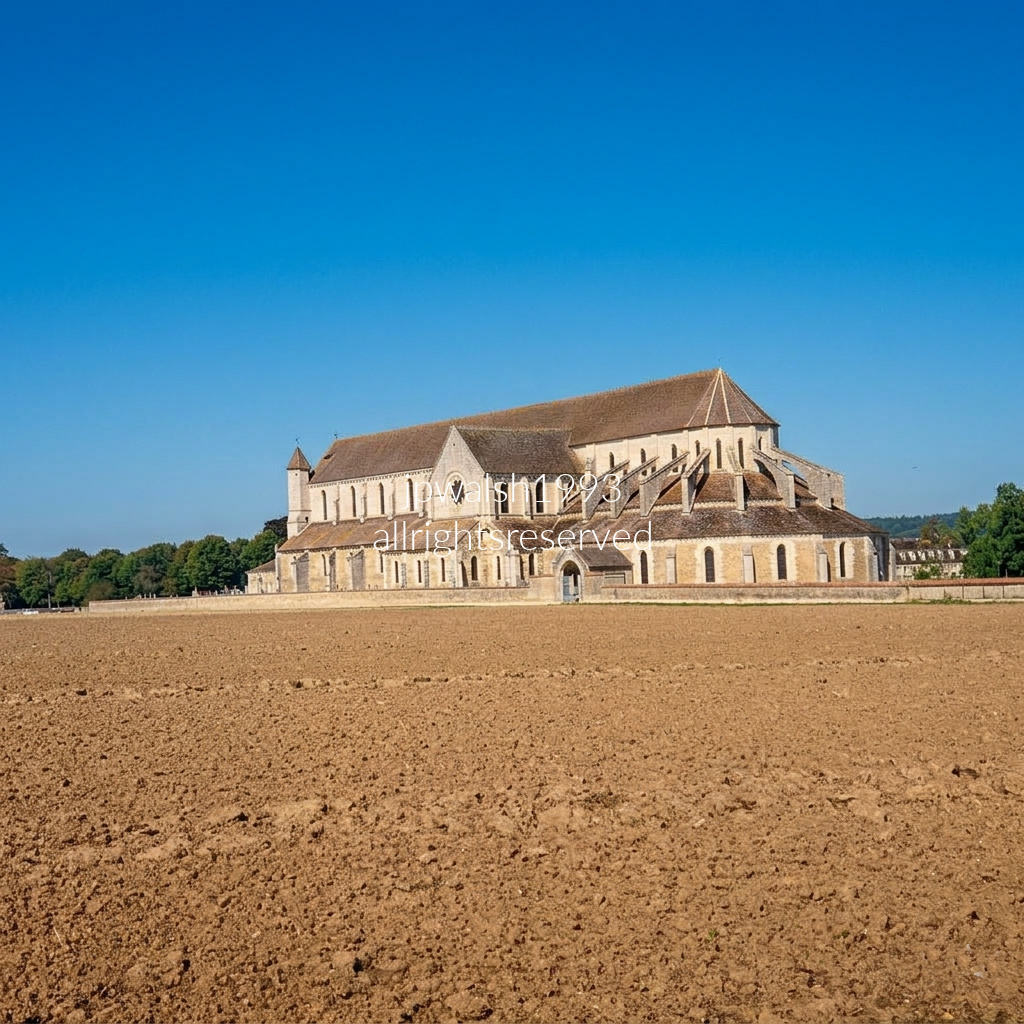
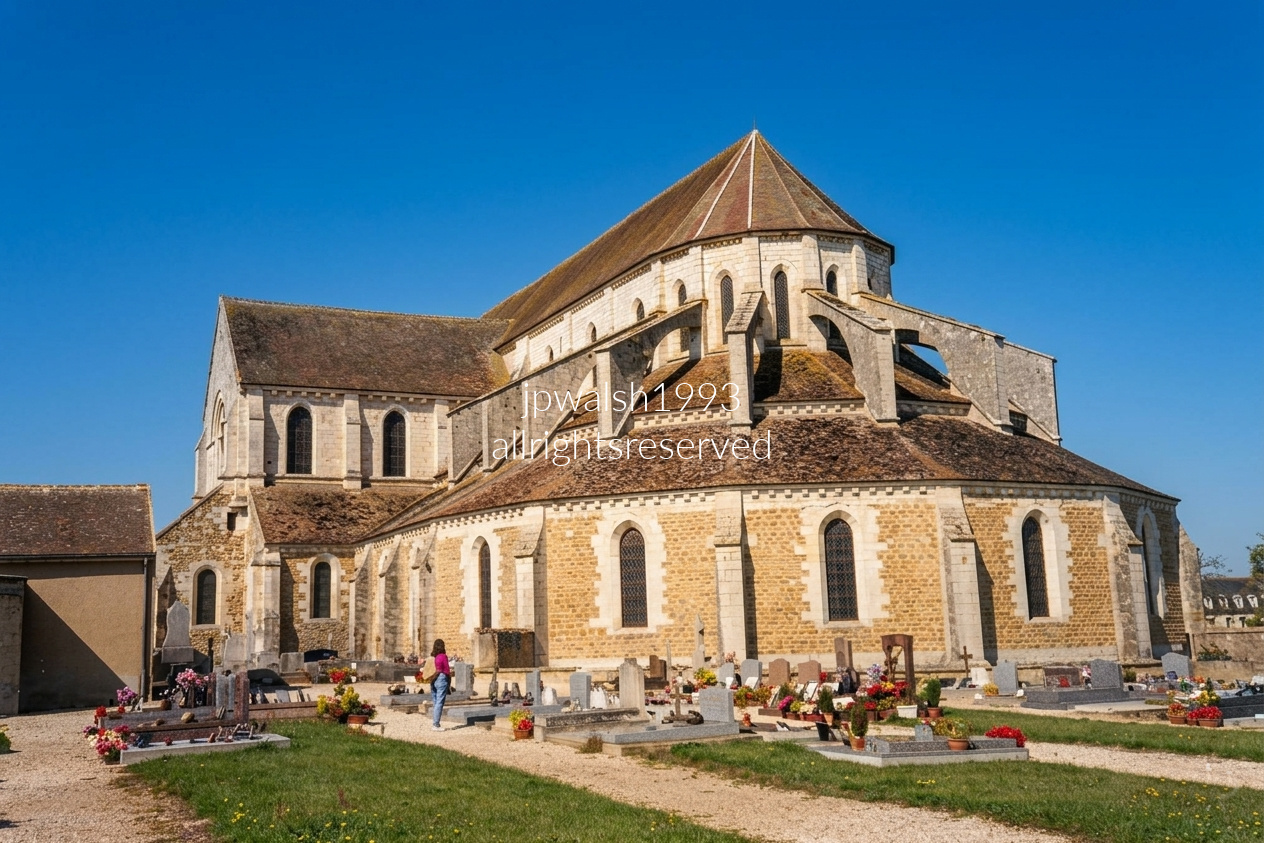
Abbey of Pontigny, France, view from south.The Cistercian abbey of Pontigny was a refuge for England’s persecuted archbishops, including Stephen Langton (c. 1150–1228), and Saints Thomas Becket (1120-1170) and Edmund of Canterbury (c. 1174–1240). Author’s photograph, September 1993.
At that juncture, Edmund set out for the Cistercian Abbey at Pontigny southeast of Paris in France, which had been a refuge for Edmund’s predecessors, Stephen Langton and Thomas Becket (1120-1170). The archbishop’s health soon gave way and, though Edmund decided to return to England, he died en route at Soisy-Buoy in the house of the Augustinian Canons on November 16, 1240.
Abbey church of Pontigny, north aisle, 12th century. Here, at Pontigny, St. Edmund of Canterbury led the life of a simple monk. Author’s photograph. September 1993.
Edmund’s remains were returned to the Abbey of Pontigny where he was buried and lies in state today in a reliquary above the high altar. Miracles were soon reported at Edmund’s tomb leading to his canonization by Pope Innocent IV in December 1246, making Edmund one of the fastest English saints to be canonized. When Blanche of Castile (1188 –1252) and King Louis of France (1214-1270) visited Pontigny, Edmund’s body was exhumed and shown to be incorrupt. His relics survived the French Revolution and when his tomb was opened again in 1849 his body, still incorrupt, had one arm found detached. This major relic was sent to the United States, where it is enshrined today on Enders Island off the coast of Mystic, Connecticut, inside the chapel of Our Lady of the Assumption at St. Edmund’s Retreat, run by the Society of Saint Edmund founded at Pontigny in 1843. Edmund’s life was one of self-sacrifice and devotion to others. From boyhood he practiced austerity and asceticism, fasting, and spending his nights in prayer and meditation. St. Edmund of Canterbury’s feast day is November 16.
St. Edmund of Canterbury, detail from the Westminster Psalter, mid-13th century, British Library. Public domain.
Abbey of Pontigny, France, le chevet/apse.It is the largest intact Cistercian church in the world. Author’s photograph. September 1993.
The Story of F.X. Zettler’s Royal Bavarian Art Institute.
About 100 miles south of Munich, Germany, was the home base of popular and well-regarded stained-glass studios such as Franz Mayer & Company and Zettler of which St. Edmund has a full coterie presented in this post. These photographs were shot by me in September 2015.
Franz Xavier Zettler was born in Munich, Germany in 1841 and worked as an ecclesial artist, founding his stained-glass design company after 1870, until his death in 1916. When he married Anna Mayer, Zettler married into another family of artisans, following a long tradition of artisans doing so. In 1848 Joseph Gabriel Mayer (1808-83) founded the Establishment for Architecture, Sculpture, and Painting (“Institute of Christian Art”) under the patronage of King Ludwig I of Bavaria (1786-1868). With royal commissions in Germany for the massive Cologne and Regensburg Gothic cathedrals as well as the Mariahilfkirche in Munich (Vorstadt Au) – the first German neo-Gothic church whose foundation was laid in 1831 – Mayer directed his son Franz Borgias Mayer, and son-in-law F. X. Zettler, to expand the establishment by including a division for stained glass in 1870.
King Ludwig I of Bavaria in Coronation Regalia (König Ludwig I. von Bayern im Krönungsornat) by Joseph Karl Stieler (1781-1858), 1826, oil on canvas, 96 x 67.3 in., Neue Pinakothek, Munich. see – Sammlung | König Ludwig I. von Bayern im Krönungsornat – retrieved January 14, 2026. Public domain.
Zettler’s company, the Bayerische Hofglasmalerei, enjoyed quick success with his award-winning windows displayed at the 1873 International Exhibition in Vienna. By 1882 Zettler’s firm was decreed as the “Royal Bavarian Art Establishment” by King Ludwig II (1845-1886). Almost immediately, these Munich and Austrian stained-glass companies had a profound relationship with immigrant Catholic churches in the United States as Zettler and the others, provided high quality glasswork that was familiar with Catholic piety and themes.
König Ludwig II. von Bayern als Hubertusritter (King Ludwig II of Bavaria as a Knight of Hubertus), Ferdinand Piloty d. J. (1828-1895), 1879, oil on canvas, 217,5 x 132,5 cm, Neue Pinakothek, Munich. See – Sammlung | König Ludwig II. von Bayern als Hubertusritter – retrieved January 14, 2026. Public domain.
After the Great Chicago Fire in 1871, these stained-glass companies sent representatives to Chicago to sell them on various stained-glass patterns from which to choose in a rebuild or renovation. Before the turn of the 2oth century, these large studios had set up branch offices in America, including Zettler’s, that catered to a booming church-building industry hungry for traditional pious art that had been the Catholic tradition since Ravenna and only slowed in the life of the church following Vatican II’s radical turn. Chicago and its environs particularly became a great center for this traditional German and Austrian made stained glass until just before the Great Depression. From the 1870s to the 1920s, Chicago became the most influential center of Catholic culture in the United States with German and Austrian stained glass, such as the Zettler windows in Saint Edmund Church in Oak Park, having the strongest reach. After 20 years, the predominance of these European glass companies was finally challenged in the last decade of the 19th century by an American company. Though Zettler won a top prize at the World’s Columbian Exposition in Chicago in 1893, Louis Comfort Tiffany (1848-1933) gained notoriety with a display of his designed comprehensive collection in Art Nouveau style of jewelry, pottery, paintings, art glass, leaded-glass windows, lamps, and other decorative interiors that continued to gain in popularity, including in houses of worship, right up to World War II. A steep tariff imposed on imported stained glass in the United States after 1894 impacted some international art purchases though Catholic churches in particular continued to turn to German and Austrian glass for their workmanship and pious imagery taken from the Middle Ages and Renaissance. At some financial cost pastors believed that such traditional art aided their mostly immigrant congregation of professional and industrial factory-workers and their families in worship.
Zettler Studios was innovative in the perfection of the “Munich style” of windows, in which religious scenes were created in a process of painting and melting large sheets of glass in kiln heat. Zettler was also inspired by the German Romantic Nazarene art movement of the early 19th century whose artists rejected Neoclassicism to revive spiritual and religious-focused art of the Italian Renaissance. In Zettler’s array of religious figures depicted in stained glass windows his team used Italian Renaissance art principles of three-point perspective and line drawing that evoked realism in gestures, expressions and various garb.
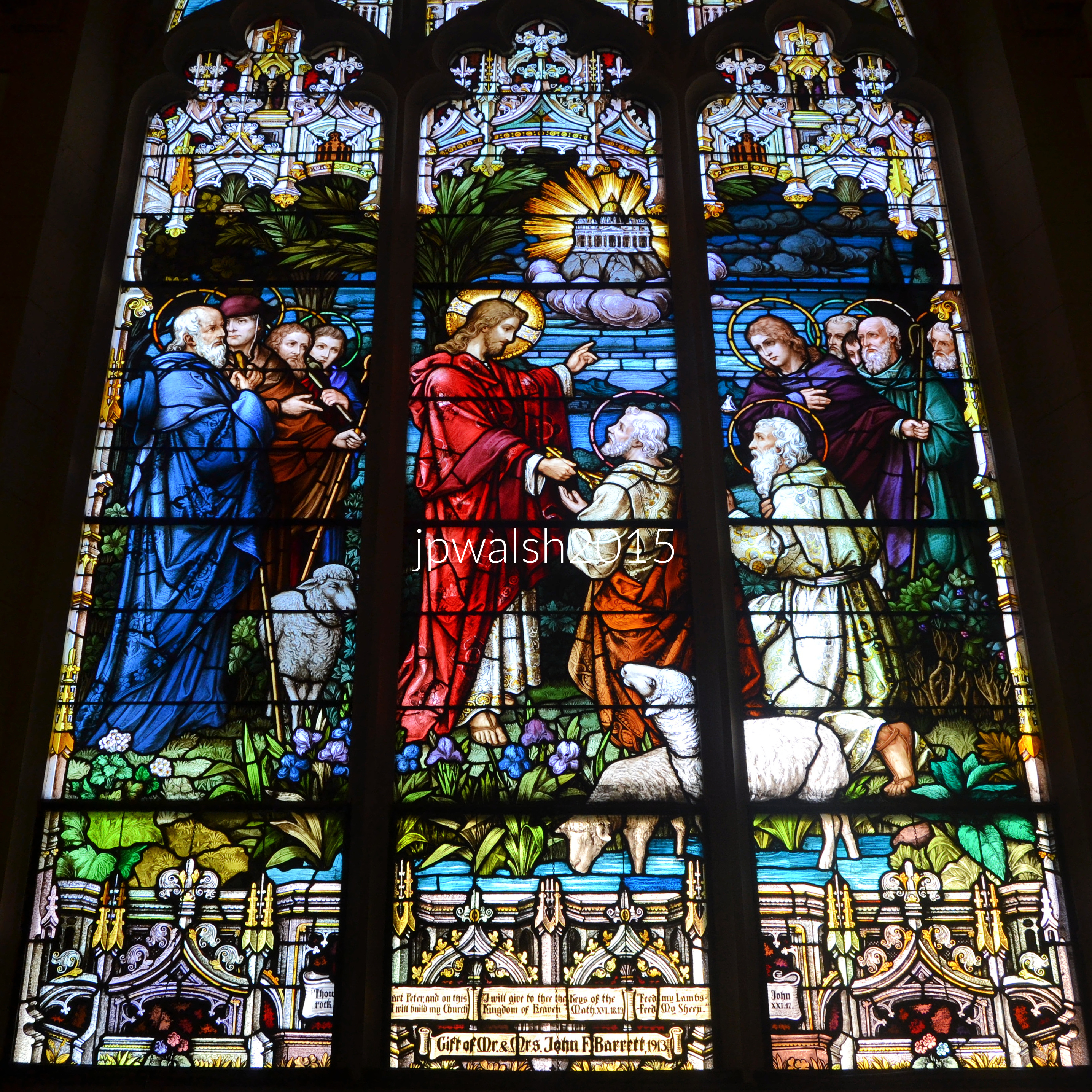
Jesus gives the Keys of the Kingdom of Heaven to Simon Peter. Author’s photograph. September 2015.
The Question at Caesarea Philippi
Jesus asks, “Who do the people say I am?” — a turning point that leads to Peter’s confession of faith. The scene unfolds at Caesarea Philippi, a newly established Gentile city under Philip the Tetrarch. Unlike the Gospel writers’ usual geographic looseness, Matthew locates the moment precisely: about a day’s walk from Capernaum, where the disciples were first called.
This is the juncture where Jesus challenges his followers with the core question: Who am I?
Divergent Accounts in the Synoptics
The story appears in Matthew, Mark, and Luke — but with notable differences.
Matthew has Jesus refer to himself as “the Son of Man.”
Mark and Luke include no title at this moment.
Matthew expands the list of figures people think Jesus might be, adding Jeremiah to the shared roster of John the Baptist and Elijah. (Zeffirelli, in film, even adds Ezekiel.)
It is Simon Peter who answers for the group: “You are the Messiah.” Matthew heightens the Christology: “The Son of the living God.” The simpler confession is likely the earliest form.
Revelation and Commission
The next verses — unique to Matthew — reshape Peter’s role forever.
Jesus attributes Peter’s insight to divine revelation: “Flesh and blood has not revealed this to you, but my heavenly Father.”
Then comes the commission:
Jesus gives Simon a new name — Peter, the Rock.
There is no other verse in the New Testament explaining this name change.
Peter becomes the foundation upon which Jesus will build the church (ecclesia).
The precise meaning of “rock” remains debated, but Peter speaks for the disciples, articulating their collective faith. Jesus declares that this community — grounded in the confession that he is the Messiah — will endure, and “the gates of Sheol” will not overcome it.
The Keys and Royal Authority
Jesus gives Peter the keys, echoing Isaiah 22 — a symbol of royal power.
Peter evokes the master of the palace, the highest official in the Israelite court. His office is not caretaker but chief steward of the church and the kingdom of heaven, terms that scholars see as parallel in this passage.
Jesus grants Peter authority to “bind and loose,” an obscure phrase with no biblical precedent but well attested in rabbinic tradition, where it refers to imposing or lifting obligations.
Peter’s special position is reinforced throughout the Gospels and the Acts of the Apostles.
A Crisis Moment: The Suffering Messiah
Immediately after this confession and commission, Jesus teaches about the suffering of the Messiah — a shocking reveal.
The Judaism of New Testament times expected a triumphant, victorious Messiah. The idea of a Suffering Messiah was foreign and destabilizing. Matthew, Mark, and Luke all record the disciples’ profound disillusionment at this moment, a confusion not fully resolved until after the resurrection.
This is the pivot point in the narrative: from miracles and wonders to the road toward Jerusalem, condemnation, and crucifixion.
Keys of the Kingdom window, detail. Author’s photograph. September 2015.
Jesus at the wedding feast of Cana (John 2). On the prompting of his mother, Jesus performed his first miracle of changing water into wine. The Blessed Mother was the primary catalyst in starting her son Jesus, living a hidden life for 30 years, to begin his public ministry. Author’s photograph. September 2015.
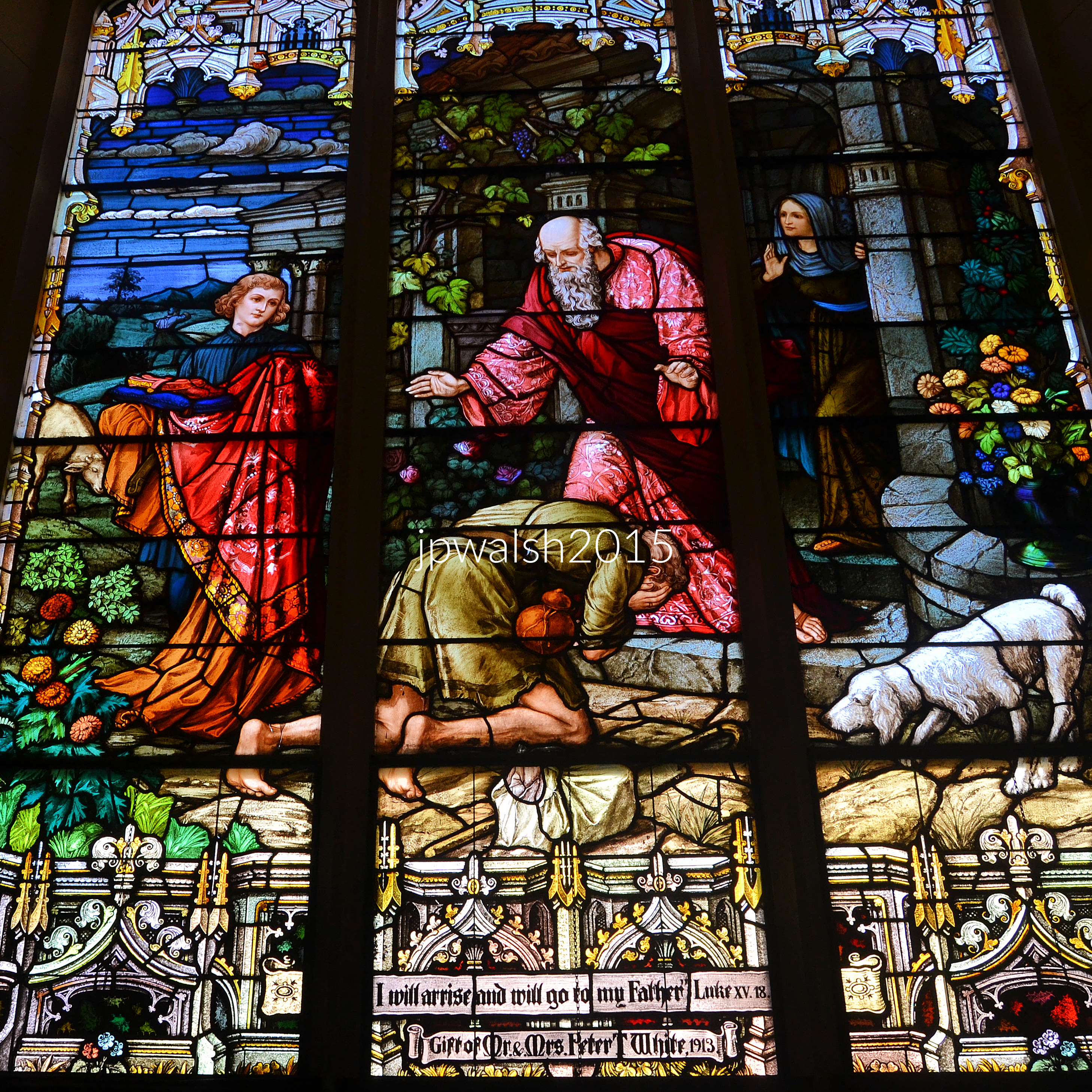
The Prodigal Son window. One of Jesus’ greatest parables, Luke 15 tells the story about a rebellious younger brother and son who demands from his father his share of the inheritance and proceeds to squander it on “riotous living” (Luke 15:13). He returns home destitute, asking only to be a servant in his father’s house, and finds instead that he is awaited, joyfully welcomed, and forgiven by his father, symbolizing God’s boundless love and restoration for repentant sinners. This is contrasted by the antagonist in the story – the self-righteous older brother who resents the celebration. He deems his repentant younger brother as an unredeemable trespasser and whose condemnation extends to this older brother’s envy of the prodigal’s special reception. The father reminds the older brother that “‘You are here with me always. Everything I have is yours” (Luke 15:31) and that it is right to especially celebrate the prodigal son’s return. For the father explains: “Your brother was dead and has come to life again. He was lost and has been found” (Luke 15: 32). Jesus’s parable teaches about sin, grace, and redemption, and the importance of unconditionally celebrating the return of the lost. Author’s photograph. September 2015.
The Jerome Biblical Commentary, edited by Raymond E. Brown, S.S., Joseph A Fitzmeyer, S.J., and Roland E. Murphy, O. Carm., Englewood Cliffs, New Jersey: Prentice-Hall, Inc., 1968.
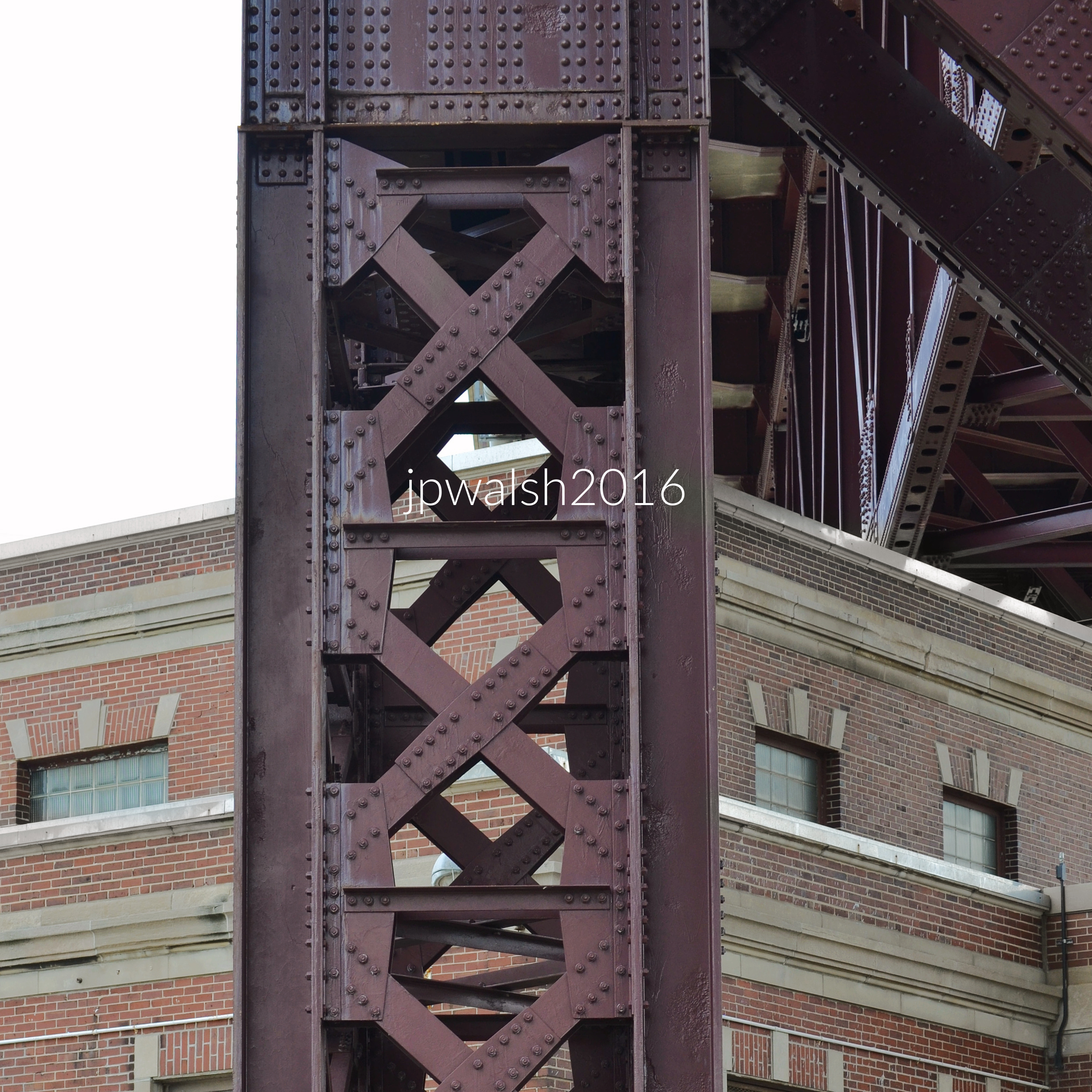
Feature image: Chicago Skyway Toll Bridge, 95th Street & S. Baltimore Avenue, Chicago. July 2016. Author’s photograph. 4.03mb DSC_0774 (1).
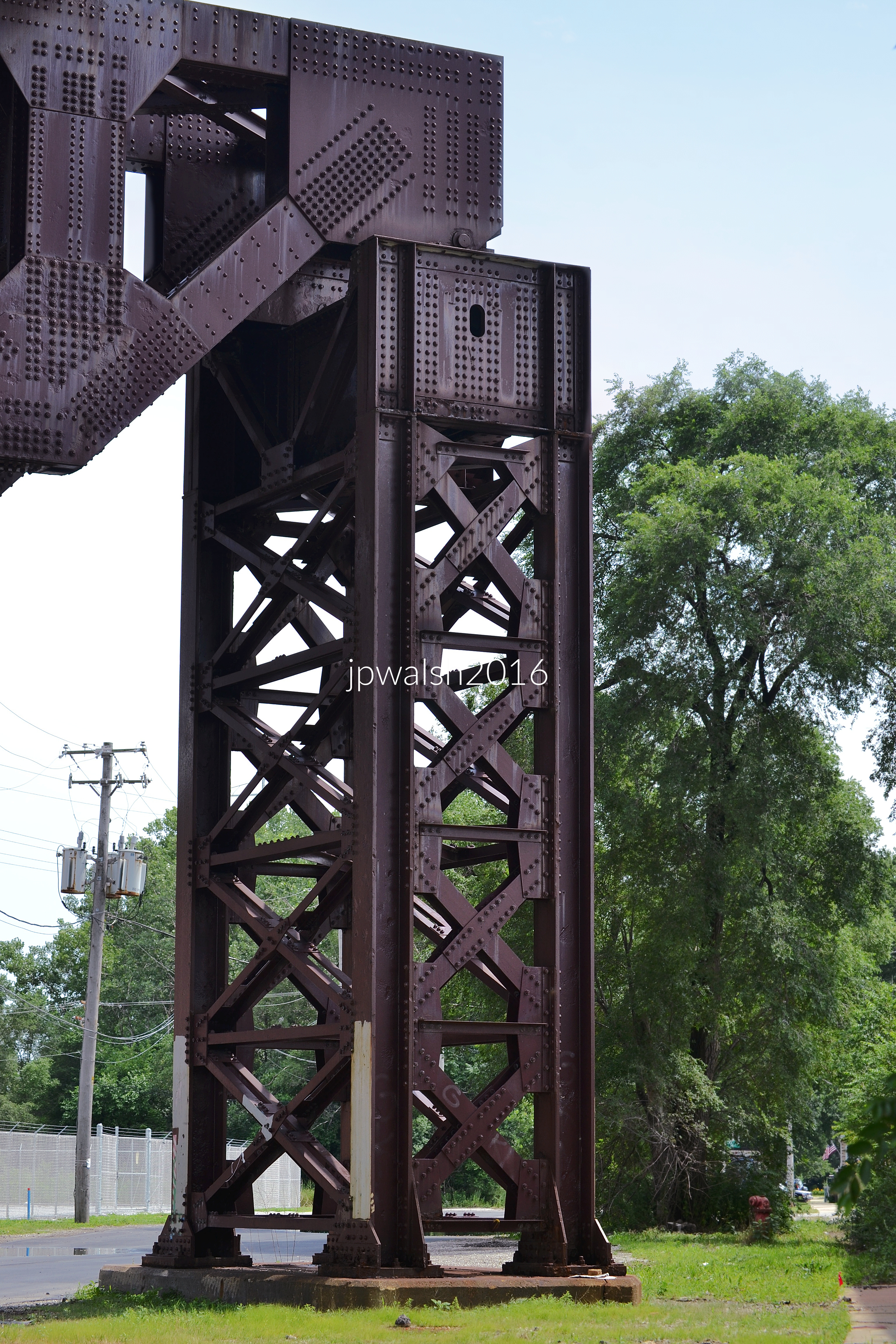
The massive steel infrastructure of the Chicago Skyway Toll Bridge (specifically the “High Bridge” at 95th Street and S. Baltimore Avenue) represents a monumental feat of mid-20th-century engineering, combining structural strength, durability, and commercial utility with a striking architectural aesthetic.
This photograph of the Chicago Skyway Toll Bridge (also known as the “Skyway”) is at the exact point where it spans the Calumet River and Calumet Harbor, a major harbor for industrial ships. Built by the City of Chicago in 1958 this massive steel undergirding is part of the 7.8 miles long expressway toll road that connects Chicago’s Dan Ryan freeway on the South Side to the Indiana Toll Road. The main feature of the Skyway is this half-mile long steel truss bridge known as the “High Bridge” whose maximum vertical clearance allowing ships and objects to pass safely underneath is 125 feet or about 10-12 building stories. The Chicago Skyway truss is primarily made of rolled and built-up steel beams for incredible weight-bearing strength, durability and functionality.
Chicago Skyway, 95th Street & Baltimore Avenue, Chicago. July 2016. Author’s photograph. 4.05 mb DSC_0772 (1)
This intersection is located on the city’s Far South Side in the South Chicago neighborhood. The area is heavily industrial, sitting just west of the Calumet River and directly underneath the massive steel framing of the Chicago Skyway High Bridge. The actual boundary of the city limits sits further east and south toward the Illinois-Indiana state line.
The Skyway was operated and maintained by the City of Chicago until January 2005 when Skyway Concession Company, LLC assumed its operations under a 99-year operating lease. The lease agreement between Skyway and the City of Chicago was the first privatization of an existing toll road in the United States. In February 2016, Skyway was purchased by three Canadian Pension Funds (OMERS Infrastructure, CPP Investment Board, and Ontario Teachers’ Pension Plan) and in December 2022 global toll road operator Atlas Arteria Group based in Australia, acquired 66.67% stake in the Skyway with OTPP retaining the rest. see – The Skyway – Chicago Skyway – retrieved December 19, 2025. While exact current figures go up and down, best estimates put daily vehicular traffic on the Chicago Skyway, both cars and trucks, at between 40,000 and 50,000 per day. see – FHWA – Center for Innovative Finance Support – Value Capture – Case Studies: Hays County, Texas Transportation Reinvestment Zones – retrieved December 19, 2025.
Chicago Skyway. 95th St. & Baltimore Ave. July 2016. Author’s photograph. 4.93mb DSC_0765 (1).
Chicago Skyway. 95th St. & Baltimore Ave. July 2016. Author’s photograph. 2.21mb DSC_0764 (1).
The 1958 steel truss undergirding serves a vital operational purpose—allowing massive industrial shipping to pass underneath into the Calumet River while carrying thousands of daily vehicles above—as it simultaneously serves as a compelling subject for architectural art.
Chicago Skyway. 95th St. & Baltimore Ave. July 2016. Author’s photograph. 5.13mb DSC_0769 (1).
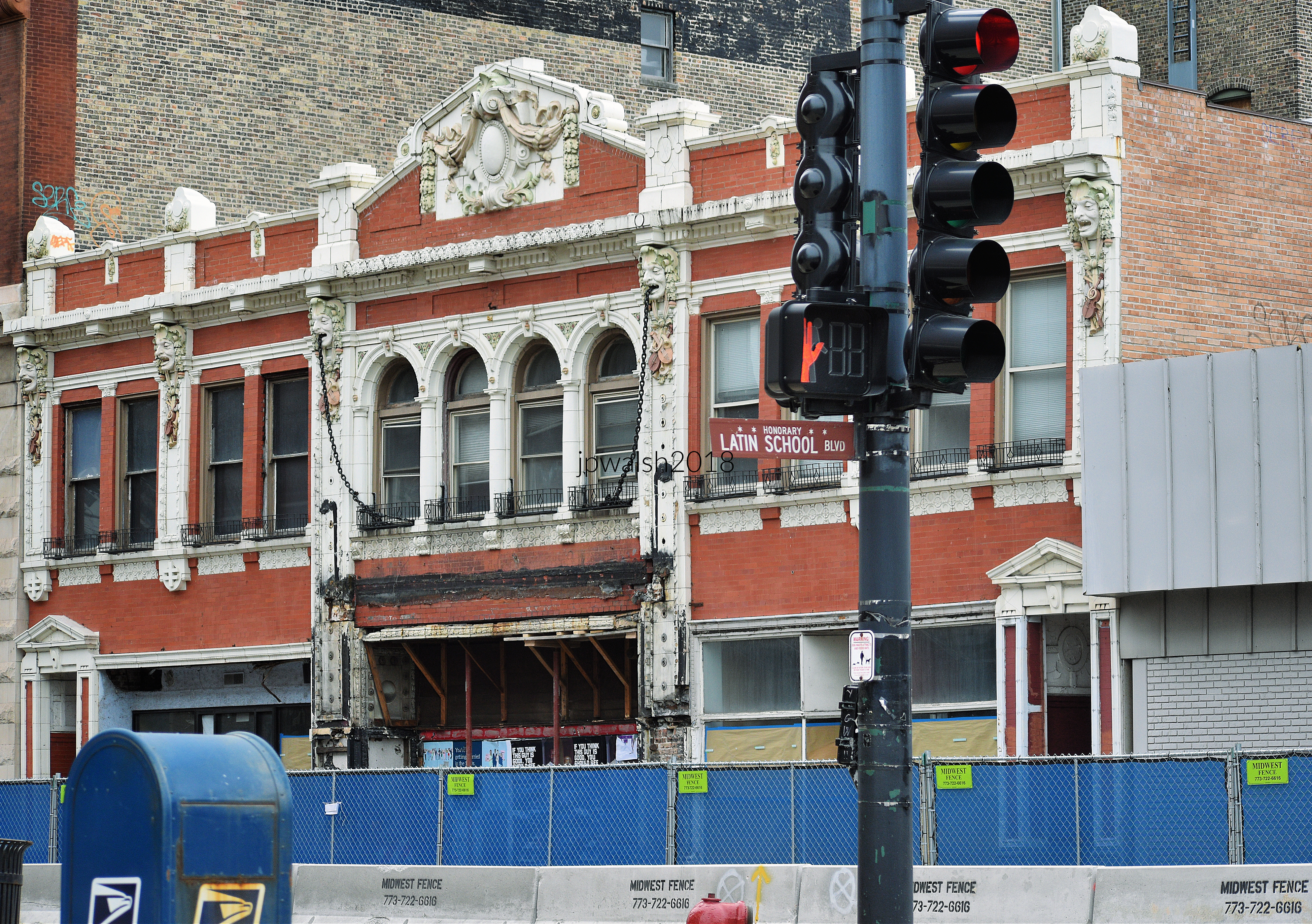
FEATURE Image: February 2018. Village “Art” Theatre, 1548-50 N. Clark Street, Chicago, Illinois 60610. The use of masks had been used in theatre since ancient times. They were usually tied to their dramatic source material and the inherent psychology of the characters. The Landmark Designation Report for the Village Theatre described this polychrome character head with musical instruments as “singing” in honor of the neighboring Germania Club, a German social club with its origins in men’s choral music. The head also wears a Baroque-style “wig” of oak leaves and acorns. In Germany, oak trees are revered, and acorns are a symbol of good luck. A decorative keystone on the theater’s round-arched window also has an acorn ornament. 88% 7.94mb DSC_4799 Author’s photograph.
The Village Art Theatre was more than a neighborhood movie house. It embodied Chicago’s early film culture, immigrant heritage, and evolving urban identity for over a century. Although the building itself was demolished in 2018, the survival of its historic façade highlights both the possibilities and limitations of preserving architectural memory amid redevelopment.
Historical Origins & Opening
Designed by architect Adolphe Woerner (born Stuttgart, Germany 1851- 1926), the Village (Art) Theatre opened as the Germania Theatre on July 29, 1916 and closed in its 91st year in March 2007. The building was erected by German-born Frank Schoeninger exclusively as a movie theater for $75,000 (about $2.2 million in 2025) and leased for an annual $7,000 rent (about $205,000 today) to Herman L. Gumbiner (Germany, 1879- 1952, Santa Monica, Calif.) in a 10-year contract with his company, The Villas Amusement Company (later Gumbiner Theatrical Enterprises).
The Rise of Neighborhood Movie Houses
By 1910, buildings erected solely for the purpose to showcase motion pictures were becoming increasingly popular as the appetite to consume the latest silent motion pictures out of Hollywood was booming everywhere. These neighborhood movie houses, larger than dingy storefront nickelodeons and yet smaller than flamboyantly ornate vaudeville theatres, had movie “palace” touches while fitted conveniently into Chicago’s many local commercial strips.
Scale, Survival, and Target Audience
Nearly all of these first-generation movie theaters in Chicago have been demolished or remodeled for other purposes including those larger-scale theaters developed by major theater operators such as Balaban and Katz, Lubliner and Trinz, and the Marks Brothers. While those palatial theatres could hold between 2,000 and 4,000 movie-goers the Village Theatre, one of the last and best first generation movie houses to survive for so long, originally held 1,000 spectators. Originally named the Germania Theater because it was next door to the Germania Club, it looked to attract affluent club members to its flicks.
The theater reflected the strong German-American presence in the neighborhood through its decorative symbols and association with the neighboring Germania Club.
The Germania Theatre was built in 1916 on Frank Schoeninger’s open land pictured above between the Germania Club (completed in 1889) and his tavern and hotel on the corner of Clark Street and North Avenue. In 1986 the Germania Club, citing the dwindling numbers of members, finally disbanded. Public Domain.
Herman Gumbinger and Expansion to Los Angeles
Herman Gumbinger was a major film exhibitor who was busy in Chicago building his independent theatre chain in the 1910’s, with several new movie house projects and acquisitions throughout the city’s northside primarily. After building Chicago’s first independent movie house chain in the teens, Gumbinger relocated to Los Angeles, California, in 1921 where he built the famous Los Angeles Theatre in the Broadway Historic Theatre District of Downtown L.A. Erected at a cost of over $1.5 million ($31 million today) and designed by renowned movie theatre architect S. Charles Lee (1899-1990) Gumbinger’s theatre premiered Charlie Chaplin’s City Lights. Gumbinger Theatrical Enterprises finally dissolved in 1943.
Herman Gumbinger (1879-1956), c. 1924, built Chicago’s first independent movie chain, including what became the Village Art Theatre. By the end of the 1920s, Chicago had more than thirty of these movie palace theaters. Among its holdings, Herman Gubinger and his brothers operated the New Blaine which was renamed and is today the Music Box Theatre. Public Domain.
Neighborhood Context and Architectural Design
The Germania was one of the first-generation movie theatres built at the intersection of three Chicago neighborhoods – Gold Coast to the south and east, Old Town to the north and west and Lincoln Park to the north. An architectural mix of styles including Classical Revival (triangle pediments, pilasters and cornice with dentils fashioned in terra cotta) and Renaissance Revival (rusticated exterior and round-arched windows with keystones), the movie house also incorporated Germanic symbolism in its details reflecting the area’s then prominent ethnic group.
WWI Impact and a Century of Name Changes
During World War One, in a wave of anti-German sentiment, The Germania Club renamed itself the Lincoln Club. It changed its name back in 1921. The Germania Theatre changed its name to the Parkside and never looked back. In 1931 until 1962 it was known as the Gold Coast theatre. Meanwhile, prohibition closed down Frank Schoeninger’s tavern and he left for Wisconsin. In the 1960’s the theatre was updated and renamed the Globe Theatre. In 1967 the building was renamed the Village Theatre after it survived being demolished by the nearby Sandburg Village development.
Sandburg Village is a Chicago urban renewal project consisting of eight high-rise buildings, a mid-rise building and 60 townhomes and artists’ lofts. The development was first occupied In 1963 and completed in 1971. In the early 1960’s the Village Theatre was to be incorporated into the project until its landowner refused to sell. PHOTO: “20190323 08 Carl Sandburg Village (49490506022)” by David Wilson from Oak Park, Illinois, USA is licensed under CC BY 2.0.
February 2018. The Village Theatre in the last days before its demolition. Its marquee from the 1960’s has been removed. The Village Theatre sat across the street from Latin School of Chicago at North and Clark Streets in Gold Coast/Old Town. In its Landmark Designation Report, the Village Theatre façade is described as having “a symmetrical arrangement, with a central theater entrance and separate entrances to the upstairs offices at opposite ends of the building. Each upper-story entrance has a deeply-recessed alcove lined with brick and white, carved-wood panels. A limestone slab step, inset with hexagonal tiles, is inside each alcove. Each alcove is framed with white terra cotta and brick pilasters on a base of gray terra cotta, made to imitate granite. The pilasters are topped with a triangular, white terra-cotta pediment.” 70% 7.93 mb DSC_4797. Author’s photograph.
Architectural Features and Exterior Appearance
The original two-story façade of red pressed brick and white beige glazed terra cotta decoration competed with a sizeable modern marquee that was removed before its demolition in 2018.
Personal Memories and Moviegoing Experiences
Since after college I was living in Chicago in the 1980s and 1990s, I saw several films at the Village Theatre before it became a multi-plex in 1991 such as House of Games, Fatal Attraction, Wall Street (1987), The Unbearable Lightness of Being (1988), Russia House (1990). In early 1991 the interior of the theater was divided into four screens, and I didn’t stop going to movies there–JFK (1991), Michael Collins (1996), The Red Violin (1999) and more– but not as frequently. Anyway, I moved essentially out of neighborhood in 1995 and sold my condo soon afterwards. The Village Art Theatre in Chicago officially closed as a movie venue in March 2007.
The theater underwent several name changes, including Parkside, Gold Coast, Globe, and finally Village Theatre, adapting to changing audiences and neighborhoods.
Demolition and Modern Condominium Redevelopment
In April 2018, the Village Theatre and neighboring buildings along North Avenue were completely demolished to make way for construction of a condominium building. The ornate Clark Street frontage was stabilized as everything else crumbled to dust around it. The façade was repurposed to serve as the entrance for the new condo development known as Fifteen Fifty on the Park with units priced at opening at $1.625 to $5.85 million.
Beginning in 1969, it became associated with art-house cinema through screenings connected to the Chicago International Film Festival, leading to its “Village Art Theatre” identity. Its run as a core festival venue ended following the October 1989 run.
The Village Theatre took the moniker Village Art Theatre after The Chicago International Film Festival used the Village Theatre as a venue to screen “art house” films starting in 1969.In early 1991, the historic 900-seat single auditorium was completely gutted and divided into four smaller screens. This structural partition broke up the grand theater space, ending its era as a primary, large-format host for the main international film festival tracks. October 2004. PHOTO: “Village Art Theatre” by BWChicago is licensed under CC BY-NC 2.0.
The Village Theatre had at least three distinctive marquees during its history. The first was the original vertical Germania sign, removed almost as soon as it was installed because of anti-German sentiment during World War I. It was followed by a horizontal awning-style marquee, similar to that of Chicago’s Biograph Theater at 2433 N. Lincoln Avenue, installed during the theater’s years as the Gold Coast. The third was the dramatic prow-shaped marquee shown here, paired with steel-and-glass doors and believed to date from the mid-1960s renovations undertaken when the movie house operated as the Globe. PHOTO: “Germania (Parkside, Gold Coast, Globe, Village) Theatre, Chicago, IL” by BWChicago is licensed under CC BY-NC 2.0.
Demolished in 2018 for a luxury condominium development, the building’s ornate façade was retained and incorporated into the new project. October 2018. Author’s collection.
The Village Art Theatre was one of Chicago’s earliest purpose-built neighborhood movie palaces, constructed during the rapid growth of motion-picture exhibition. The building’s history captures its full arc as an architectural, cultural, and neighborhood landmark, ending with the forever tension between preservation and redevelopment.
This explanatory article may be periodically updated.
FEATURE Image: Immanuel United Church of Christ, 1500 Old Church Road, Streamwood, Illinois. Built in 1868, it is the congregation’s second house of worship on the site and remains the congregation’s active sanctuary. March 2016. Author’s photograph. 7.49mb _0979
Immanuel United Church of Christ embodies the transformation of northern Illinois from frontier settlement to modern suburbia, serving as a living link to the German immigrant pioneers who established Hanover Township in 1852 and whose community identity endures amid the vast expansion of metropolitan Chicago.
IMMANUEL UCC in Streamwood, Illinois, has a unique history within the context of the similar histories of other early settlers in Northern Illinois beginning in the 1820’s. Though diverse settlement throughout this part of the state was feverish (Chicago incorporated as a city in 1837), the prairie landscape expanse remained sparsely populated into the 1830’s and 1840’s with its mixture of farms, industry, and trade. The Streamwood church and burial grounds were founded in 1852 when W.G. Hubbard donated its five acres of land for “the sole and exclusive use of erecting a house thereon for religious worship and a burying ground.”
It was a group of 13 farmers who organized the church and chose its name: Deutsche Vereingigte, Evangelische Lutherische Immanuael’s Germeinde. Apparently, as Illinois was the edge of the Western frontier, in those days there wasn’t anyone around, or very many, to enjoin them to state it in English. Of course, it translates as “United Evangelical Lutheran Immanuel Congregation.” Today, Streamwood is in Cook County and sits just on the other side of DuPage County to the south that broke off from Cook and was established in its own right in February 1839. The original relatively open site today is surrounded by tract housing and other modern development for as far as the eye can see or vehicle drives with Elgin about 9 miles to the west.
Old Church Road itself preserves the area’s historical geography and memory.
1851 map of Cook and Dupage Counties. Hanover is between Elgin and Schaumburg Townships. Public Domain.
Streamwood, incorporated in 1957, is one of three communities that comprise the so-called “Tri Village” area that includes Bartlett and Hanover Park. This part of Northern Illinois had served as a seasonal hunting and camping ground for the Cherokee, Miami, Potawatomi, and Ottawa Indians. In their turn, the land had been claimed by France, England, Spain, Virginia, and the Northwest Territory before it became part of the State of Illinois in 1818.
Founded in 1852 to serve German settlers in pioneer Hanover Township, the church reflects the important role immigrant congregations played in establishing stable communities in northern Illinois and its survival illustrates continuity between nineteenth century settlement history and twenty-first century suburban life.
The ImmanuelUCC church and burial ground were created in 1852 for German settlers in Hanover Township in today’s northwest DuPage/Cook Counties. Three U.S. Civil War veterans are buried here, including from the 127th Illinois Infantry; Volunteer 5th Calvary Illinois Regiment; and U.S. Calvary Co. H, 3rd Regiment. All three died and were buried in the cemetery decades after the war had ended. March 2016. Author’s photograph.
While the church started out as Evangelical Lutheran, over time the congregation moved towards becoming part of the United Church of Christ. In 1959 the members changed its name to reflect that reality. The first church building that was completed in 1853 was replaced in 1868 and is the present one. Among other buildings added to the church complex, the same historic sanctuary remains this Chicago suburban congregation’s house of worship today.
Landscape and grounds near ImmanuelUCC church in Streamwood. Hanover Township was an expansive area of farmland settled by mid-19th century German settlers to Illinois. March 2016. Author’s photograph.
Sources:
DuPage Roots, Richard A. Thompson, editor, DuPage County Historical Society, 1985.
FEATURE Image: 143 First Street, c. 1863. Since the 19th century Batavia, Illinois, 40 miles west of Chicago, was a railroad and manufacturing center in addition to its farmsteads. This mid-19th century limestone factory building is testament to Batavia’s industrial heritage. After the U.S. Civil War, Batavia was a major manufacturer of Conestoga wagons used in the country’s westward expansion. May 2024. Author’s photograph. 7.52 mb_6360.
Batavia, Illinois, reveals how a small Fox River community evolved from a frontier settlement and manufacturing center into a town rich with architectural diversity, where industrial buildings, churches, houses, and civic landmarks collectively preserve the story of nineteenth and early twentieth century Illinois.
Text & Photographs John P. Walsh.
143 First Street, c. 1863.
The square shaped south façade’s stone cut is more grandiose than the longer west side indicating that it is the front face of the building. The tower at the north end likely held the building’s water tank and added more room and height for pulleys and other equipment. May 2024. Author’s photograph. 7.52 mb_6360.
Batavia’s architectural heritage reflects its origins as a Fox River settlement established in the 1830s and its later development as a railroad and manufacturing center.
Batavia is one of the towns along the Fox River settled in the 1830’s between Geneva and St. Charles to the north and larger Aurora to the south. May 2024. Author’s photograph. 95% 7.75 mb DSC_6350.
Batavia’s history intersects with larger national stories, including the life of Mary Todd Lincoln, westward expansion, and nearby Fermilab’s scientific legacy.
Fermilab is adjacent and to the east of Batavia. Since 1969 it has housed a herd of bison when Fermilab’s first director, Robert Wilson, established the herd as a symbol of the history of the Midwestern prairie and the laboratory’s pioneering research at the frontiers of particle physics. Each spring new calves are born signaling the herd’s rejuvenation. July 2016. Author’s photograph. 4.70mb _0577 see – https://www.fnal.gov/pub/about/bisoncam/ – retrieved 1.24.25.
Campana Sales Company Factory, Batavia, Illinois, East Elevation, 1936-1937.
The Campana Factory was built in the International Style to manufacture cosmetics for The Campana Company. At the time Campana’s “Italian Balm,” heavily promoted on the radio, was the nation’s best-selling hand lotion. The building was designed by Frank D. Chase & Company (founded in 1913) with Childs and Smith in Chicago. Frank David Chase (1877-1937) built newspaper plants in St. Louis, Milwaukee and Oklahoma City and a number of important buildings in Chicago including hospitals and office buildings. The central tower reflects the 19th-century heritage of Batavia’s limestone factories. The far one-story wings were added in the late 1940’s. The factory was purchased by the laundry detergent brand Purex who later closed Campana operations in 1982. May 2024. Author’s photograph. 77% 7.72mb _6437.
Limestone industrial buildings and former factories testify to the town’s important manufacturing history, including wagon production and later consumer industries such as Campana and Purex.
The main entrance is stainless steel set into black polished marble at the bottom of the tower. May 2024. Author’s photograph. 7.48mb _6446.
Religious institutions played a central role in Batavia’s civic development, with churches tied to abolitionist causes and community building.
The Congregational Church, 21 S. Batavia Avenue, 1856.
The locally quarried limestone central section dates to September 1856. The church displays the eclecticism of New England Colonial and Classical styles. Though the building’s classical detailing of capitals and pilasters is today mostly missing, the precisely cut and laid stone are original. These cut ashlar blocks include neatly finished arches, sills, and entablatures. The church’s design is attributed to architect Elijah Shumway Town (1804-1890) who built Batavia’s Bellevue Place Sanitarium in 1853 where Mary Todd Lincoln was committed for four months in 1875. When the original steeple was knocked down in a storm in 1877 it wasn’t replaced until 97 years later in 1974 and is the tallest steeple in Kane County. There have been additions to the church in the last 60 years. Established in Thompson Paxton’s cabin in 1835 as “Church of the Big and Little Woods” and affiliated with the Presbyterians, the church relocated to Batavia Avenue in 1841. Sharing a common belief in the anti-slavery doctrine, the church was supported by church members and the community-at-large so that the church changed its name to “Congregational Church and Society of Bavaria” in 1843. May 2024. Author’s photograph. 89% 7.73mb _6372.
Methodist church, 355 First Street, 1852.
Batavia’s first Methodist church was built in the Greek Revival. The pilasters are Doric order that meet the main beam resting across the tops of columns (architrave), blank frieze, cornice, and classical pediment. After 1886 the building was used as a schoolhouse in the Batavia school system. Today it is law offices. In 1836 a group meeting in William Van Nortwick’s home in Batavia organized the “First Methodist Class” which marked the establishment of the Methodist church in Batavia. May 2024. Author’s photograph. 96% 7.83mb DSC_6389.
West wall stonework and window of former Methodist Church built in 1852. July 2013. Author’s photograph. 7.02mb _0004
Born in Maine, Elijah Gammon (1819-1891) was a spiritual and business powerhouse in Batavia. After he moved to Illinois, he was the Methodist church’s first preacher in 1854. Having to give up preaching because of health in 1858, he changed careers to the manufacture of harvesting machinery. As he substantially contributed to the industry’s development and earned a fortune, his business responsibilities and success in no way limited his spiritual vision.https://aaregistry.org/story/elijah-gammon-supported-black-ministry/ – retrieved January 23, 2025.
United Methodist Church of Batavia, 8 N. Batavia, 1887.
United Methodist Church of Batavia was built in 1887. The rugged eclectic Richardsonian Romanesque-type building was designed by Solon Spencer Beman (1853 –1914) and inspired by a church in France that its donors had admired. The structure was almost entirely the gift of abolitionist Elijah J. Gammon (1819-1891), the church’s first preacher and local businessman, and Captain Don Carlos Newton (1832-1893), an active local businessman who had a house investment property right across the street.
Noted architect Beman designed the planned Pullman community and Pullman Company factory complex in Chicago as well as Chicago’s Fine Arts Building (1884) on Michigan Avenue. At the top of the church tower is a Palladian window under a pyramidal roof while in the back are hipped roofs. The building’s boulders were taken from the contractor’s farm about one mile south from the building site. The new church building replaced the first Methodist church in Batavia built in 1852 in Greek Revival and which still stands today. May 2024. Author’s photograph. 87%7.91mb _6498.
Chicago-based architect Solon Spencer Beman designed the United Methodist Church of Batavia in 1887. Several of his largest commissions, including the Pullman Office Building, Pabst Building in Milwaukee (1891), and the Romanesque Revival Grand Central Station (1890) in Chicago, have been demolished.A number of architects trained with Beman, including Prairie School architect William L. Steele (1875-1949), church architect Charles Draper Faulkner (1890-1979) and Spencer Solon Beman (1887-1952).
Born in New York, Captain Newton was a very active businessman and described as ”a persevering, self-made man.” He died unexpectedly at his home in Batavia after attending the Chicago World’s Fair for a week with his family in 1893. https://www.findagrave.com/memorial/16849480/don-carlos-newton – retrieved January 23, 2025.
Batavia contains an unusually broad range of architectural styles, including Greek Revival, Italianate, Richardsonian Romanesque, Gothic Revival, Classical influences, and International Style design.
415 Main Street, 1860.
Eclectic Gothic Revival with Italianate features including scroll-cut square brackets tailored to the pitched roof line, segmental arches above the windows, and the heavy outlines of the door entrance. A polygonal bay and wings are informal features found in the Italianate that balances a formal façade. May 2024. Author’s photograph. 89% 7.87mb.
415 Main Street (1860). The door is larger than the windows and offset by the small ventilating window at the top in the gable. July 2011. Author’s photograph. 2.54mb100_3328 (1)
360 Main Street, 1855.
The house is an example of the evolving transition from Greek Revival to Gothic Revival to Italianate. May 2024. Author’s photograph. 74% 7.72mb DSC_6409.
33 S. Lincoln Street, 1850.
The lengthy 1850 Greek Revival is formal and simple. It has corner pilasters and there are four pairs of windows with an architrave, frieze and cornice characteristic of its type. May 2024. Author’s photograph. 73% 7.85mb DSC_6520.
505 Main Street, 1858.
The house is in the Swiss style and has a peacock feather spread motif above the second-floor balcony. There are also trifoils set in circles in the gable. The brick sunroom was added to the east around 1910. May 2024. Author’s photograph. 92% 7.81mb DSC_6426 (1)
505 Main Street. in-vogue late 1850’s peacock feather motif was made by scroll cut boards nailed to a backing and long tubes made by a lathe. To the left under the roof extension there is incised ornamentation with a tall thistle plant motif. July 2011. Author’s photograph. 1.54mb 100_3331 (1)
The Prairie style house was designed by Frank Lloyd Wright (1867-1959) in 1906. It is frame and stucco with massive chimneys. With its horizontals, low pitched roof, casement windows and thin eaves, it is the Prairie style fully developed. May 2024. Author’s photograph.
Frank Lloyd Wright in 1903, likely a self-portrait. Public Domain.
Fabyan Villa was the home of George and Nelle Fabyan from 1908 to 1939. A mid-19th century farmhouse was acquired by the Fabyans in 1905 and extensively remodeled by Frank Lloyd Wright in 1907. The house, on a hilltop looking east to the Fox River was the centerpiece of the Fabyans country estate called “Riverbank.” In 1914, the Fabyans purchased a windmill (photo below) that was located on a farm near Oakbrook, Illinois, and had it relocated opposite Riverbank on acreage that they acquired that same year. July 2013. Author’s phtograph.
The Fabyan Windmill, 1850s.
Between Batavia and Geneva, Illinois, The Fabyan Windmill is an authentic, working Dutch windmill dating from the 1850s. It was built by a German craftsman, Louis Blackhaus, and moved to this location in July 1915 next to the Fox River from its original site near Oakbrook, Illinois. July 2011. 2 mb 100_3357
111 S. Lincoln Street, c. 1850.
Though obscured by modern adaptations, the severe cube of the structure indicates its Greek Revival roots. May 2024. Author’s photograph. 92% 7.84mb DSC_6396.
125 S. Lincoln, 1852.
The Greek Revival design centers on a temple-like main block, where paired pilasters ascend to a pediment. The composition is subtly unconventional, however, as the entablature is only partially realized, one side implied by modest returns above the pilasters. Extending from the central section are a one-story entrance wing and a two-story addition featuring a pronounced cornice, dormers, arched windows, and tiny pitched roofs. May 2024. Author’s photograph. 88% 7.78 mb DSC_6400
432 Main Street, c. 1850.
The front porch may or may not be original but befits the broad formal mid-19th century Greek Revival structure. May 2024. Author’s photograph. 93% 7.82mb DSC_6431 (1)
Batavia’s historic buildings remain visible markers of changing economic, cultural, and social priorities across nearly two centuries.
333 S. Jefferson Street, Batavia Institute, Bellevue Mental Hospital, 1853.
Following the assassination of her husband, President Abraham Lincoln, Bellevue became the residence of Mary Todd Lincoln briefly in 1875. July 2011. Author’s photograph. 2.87mb 100_3332
Mary Todd Lincoln in 1846. Mary Todd was 23 years old when she married 33-year-old Abraham Lincoln in Springfield, Illinois on November 4, 1842. Their four sons were all born in Springfield. In 1875 Robert Todd Lincoln (1843-1926), her eldest son, had her institutionalized following a jury trial. She was committed to this private asylum in Batavia on May 20, 1875. Estranged from her finances and her son, she fell into a deep depression in the mental institution. Making contact with her lawyer and the press, the former First Lady got the wheels of justice and public opinion on her side. The resulting bad publicity for Robert Lincoln prompted the asylum director to pre-emptively change his opinion of Mary’s mental fitness so that in September 1875 she was released into the care of her sister Elizabeth Todd Edwards (1813-1888) with whom she was close and moved to Springfield. Following a second jury trial on June 19, 1876 that declared Mary “restored to reason,” Mary Todd Lincoln was back in charge of her money and freedom and promptly fled the country. She lived in France for the next four years. When she returned to Springfield in poor health in 1880, she lived again with her sister in Springfield. On July 16, 1882. Mary Todd Lincoln died of a stroke in Elizabeth’s home. Mary was 63 years old. Before her burial in Oak Ridge Cemetery next to her slain husband, her funeral was held at First Presbyterian Church in Springfield. Just steps from the Lincoln home, this was the church Abraham Lincoln started attending in 1850 after the death of their second son, four-year-old Eddie. The present church building was dedicated in 1868 and remains standing at 7th Street and Capitol Avenue today. see – https://www.nps.gov/features/liho/25/25.htm – retrieved January 23, 2025.
333 S. Jefferson Street, Batavia Institute, Bellevue Mental Hospital, 1853.
The monumental Italianate structure was designed by Elijah Shumway Town (1804-1890), who also built Batavia’s Congregational Church. The projecting two-story wings, capped by a Mansard roof containing a third story of dormers, were constructed of slightly cruder stone and added before 1870. July 2013.
Details:
July 2013.
July 2013. 5.11mb 0479
419 Union Street, 1863.
The exuberance of the Italianate style is evident in the soaring polygonal bay anchoring one side of the façade and the cupola rising from the other. Large windows and multiple curved brackets are characteristic features of the style. Contrasting textures of stucco and heavy stone add visual interest while creating the impression of more costly materials and construction than were actually employed. The house served as the residence of one of the physicians associated with the Batavia Institute across the street. July 2013. Author’s photograph. 4.77mb _0092 (1)
Calvary Episcopal Church (222 Main Street), 1880.
Designed in the American Gothic style, the church reflects the mid-to-late nineteenth-century revival of medieval Gothic forms that arose in English Protestant architecture as a reaction against the prevailing Neoclassicism of the previous two centuries. American influences are evident in the building’s overall massiveness, particularly in its square tower, which is crowned by a double-pitched roof. Between the tower’s stages is an unusual sheet-metal band ornamented with bosses and discs and encircling the dormers of the steeple. April 2016. Author’s photograph. 2.82 mb DSC_0476 (1)
Through its factories, churches, houses, and landmarks, Batavia offers a remarkably intact architectural record of how industry, religion, transportation, and community shaped a growing Midwestern town from the nineteenth century into the modern era.
Sources:
A Guide to Chicago’s Historic Suburbs on Wheels and on Foot, Ira J. Bach, Swallow Press/Ohio University Press, 1981, pp. 304-319.