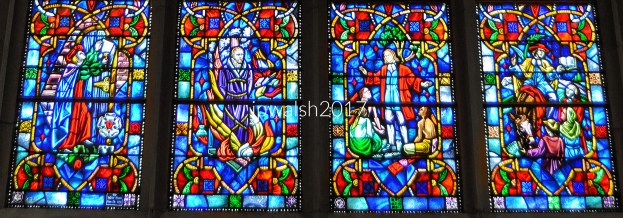
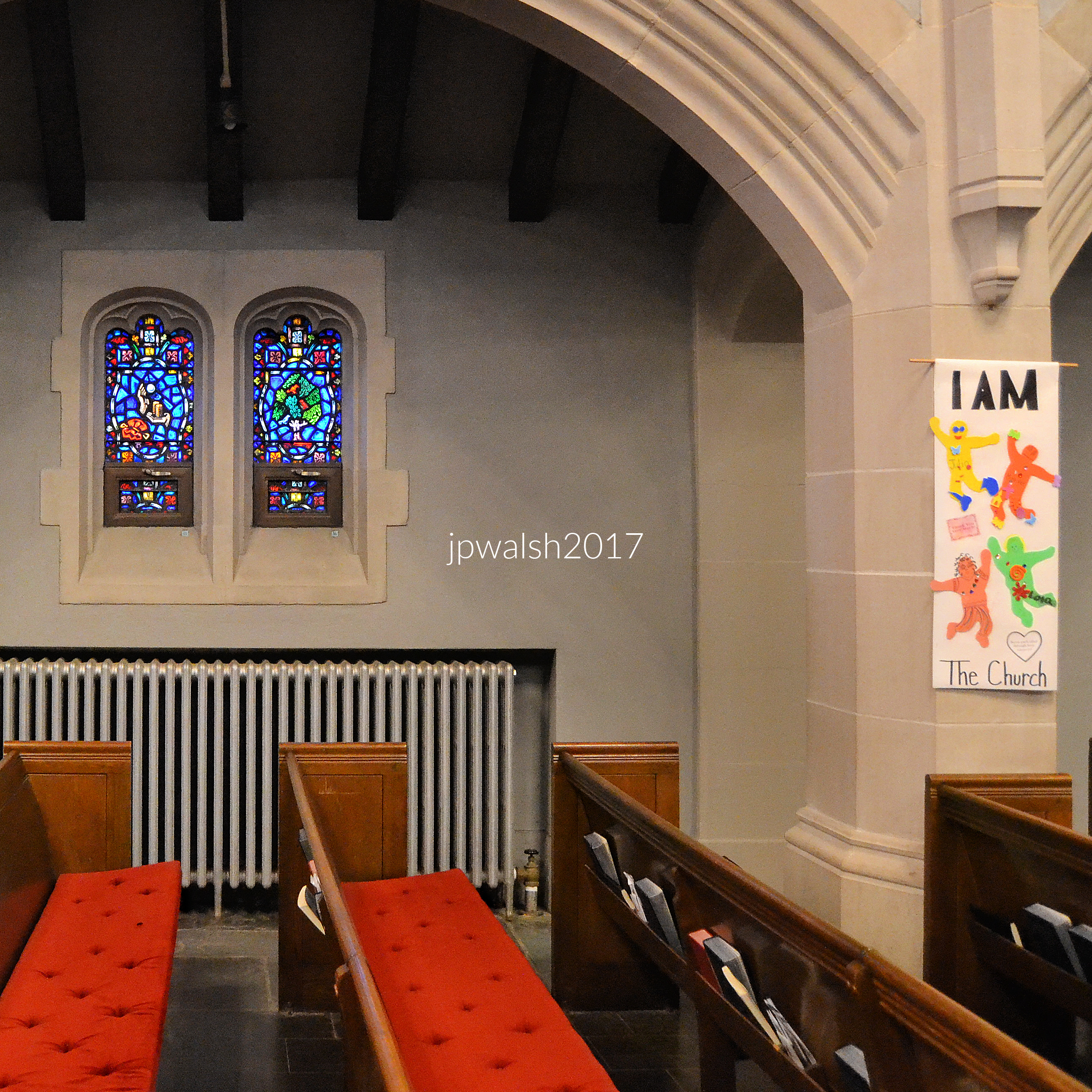
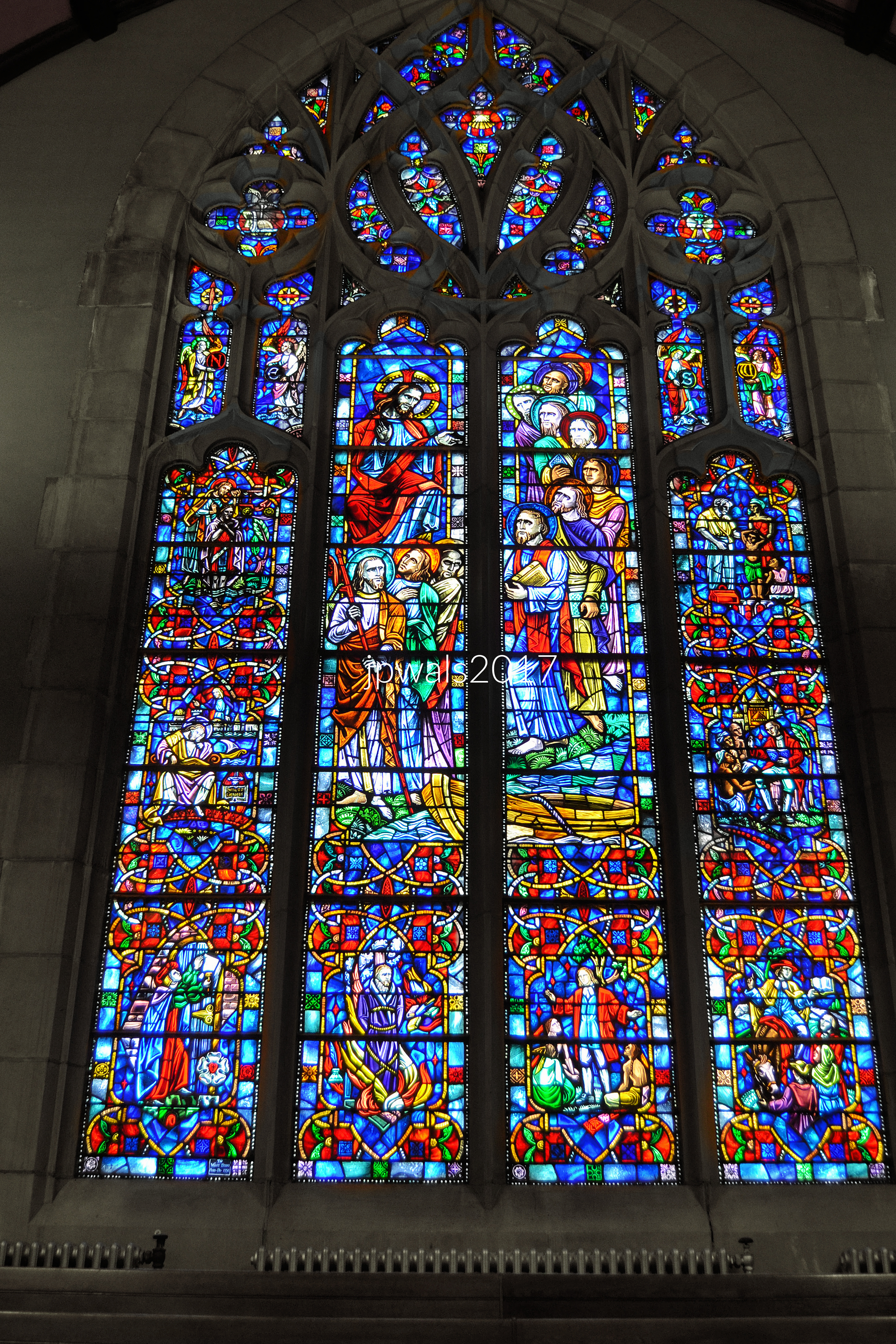
FEATURE Image: Reformation and the 18th century missions of Methodist founder John Wesley, detail of Willet stained- glass window, Trinity United Methodist Church, 1024 Lake Avenue, Wilmette, Illinois. March 2017. Author’s photograph.
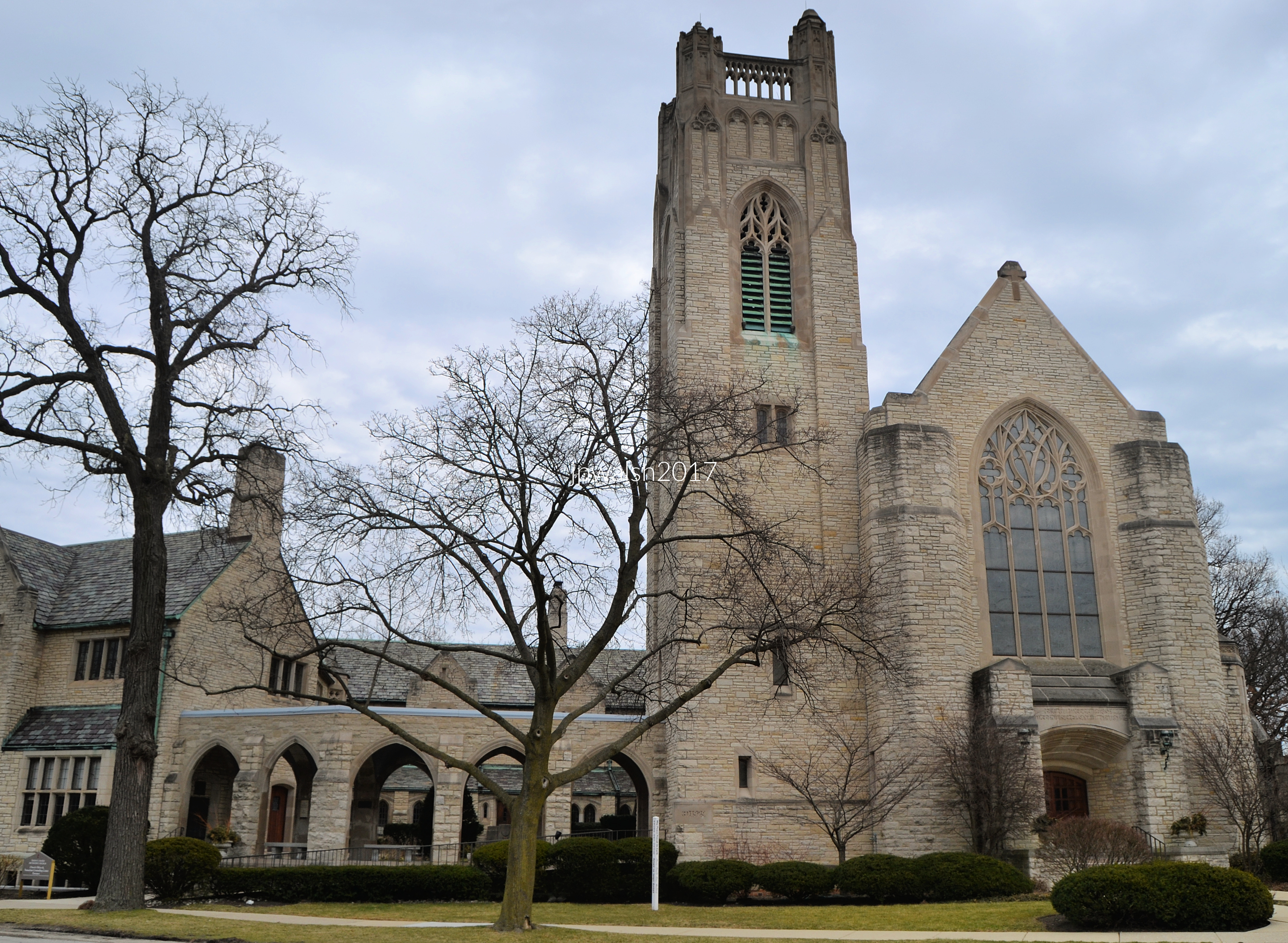
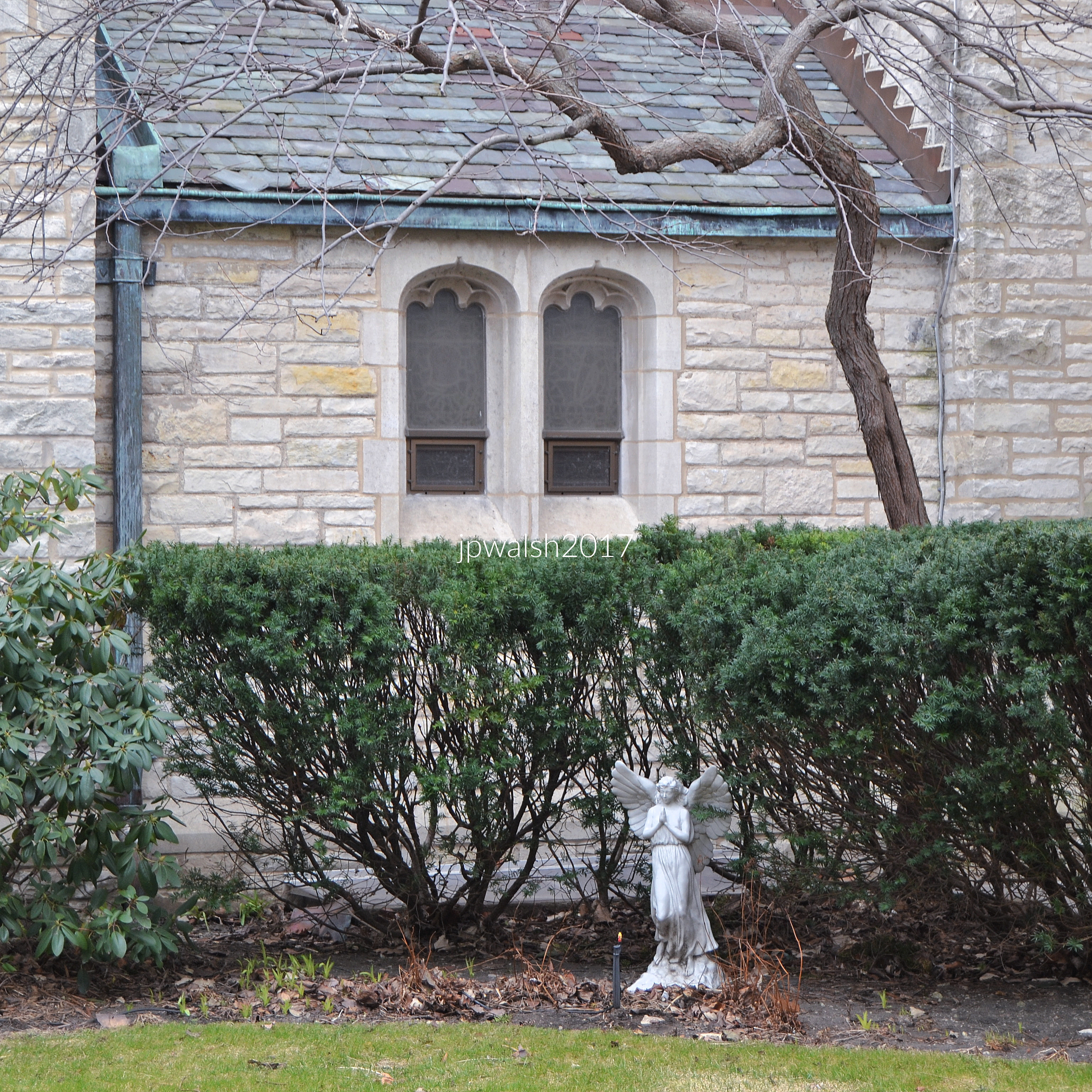
The church buildings complex displays the key ecclesiastical architectural features of late American Gothic Revival style. Trinity UMC, Wilmette. March 2017. Author’s photograph. 4.38mb DSC_0634 (1).
Architecture of Trinity United Methodist Church, Wilmette.
The Ashlar limestone church has stood on a prominent triangular corner of Lake and Wilmette Avenues for nearly 100 years. In the late American Gothic Revival style that flourished in the first third of the 20th century, the church displays in my photo its key ecclesiastical architectural features of (1) pointed‑arch windows with stone tracery, (2) tall bell tower with louvered openings, (3) buttress‑like vertical stonework emphasizing height, (4) a steep slate roof and (5) stained‑glass windows set in deep stone. Designed by Granger & Bollenbacher, the church building completed in 1929 is designed to feel ancient, monumental, and rooted in medieval Christian tradition — exactly what Methodist congregations of the era wanted. Trinity UMC stands out on the North Shore because it is scaled to frame its narrative, more medieval stained glass and not for grandeur comparative to its neighbors such as Christ Church (Episcopal) in Winnetka designed by Bertram Goodhue, or for crisp academic lines such as First Presbyterian in Wilmette designed by Coolidge & Hodgdon, among others. Of Gothic Revival churches built between 1900–1935. Trinity fits squarely into that movement, but with its own personality, specifically its didactic windows. The building was erected when the congregation outgrew its earlier 1908 Romanesque brick church. The church’s current Gothic Revival building, designed by Chicago architects Granger and Bollenbacher, reflects inspiration from European cathedrals. Construction began in the late 1920s, but the 1929 Stock Market Crash halted many of the planned interior details. The stained- glass windows, including the prominent façade window, were designed and installed by Henry Lee Willet in 1954.
Founding History and Its “Home Alone” Legacy.
Trinity United Methodist Church in Wilmette is one of the North Shore’s oldest congregations, with a history that stretches back to the 19th century. Founded on March 24, 1874, the church originally bore the name First Methodist Episcopal Church of Wilmette. Over the decades, it evolved through several identities — Wilmette Parish Methodist Church (1930–1968), Trinity Church of the North Shore (1968–1989), and finally Trinity United Methodist Church of Wilmette, the name it carries today. The church’s historic bell — once used to call worshippers, toll for local deaths, and warn the village of fires — now sits on display near the parking lot.
While its spiritual and community roles define its core identity, Trinity United Methodist Church is also widely recognized for its unexpected place in American pop culture. The church’s exterior appears in two memorable scenes in the 1990 Christmas classic “Home Alone.” In the film, directed by John Hughes, young Kevin McCallister (Macaulay Culkin) first spots the church while fleeing the burglars and hides in the Nativity scene on the lawn. Later, Kevin approaches the church at night, drawn by the sound of the choir singing “O Holy Night.” These moments set the stage for one of the film’s most emotional sequences — Kevin’s conversation with Old Man Marley — though that interior scene was filmed at Grace Episcopal Church in Oak Park. Securing permission to film at Trinity was not straightforward. When Twentieth Century Fox approached the Village of Wilmette in early 1990, the Village Board narrowly approved the request in a 4–3 vote after discussion and date changes. Filming took place in late winter of that year, and the church’s brief but iconic appearance has since become a point of local pride. Today, Trinity embraces this connection, often noting that to many visitors, it is simply “the Home Alone church.”
More than a movie landmark, Trinity United Methodist Church in Wilmette remains a vibrant congregation committed to worship, music, community service, and hospitality — a place where history, faith, and a touch of Hollywood intersect on the corner of Lake and Wilmette Avenues.
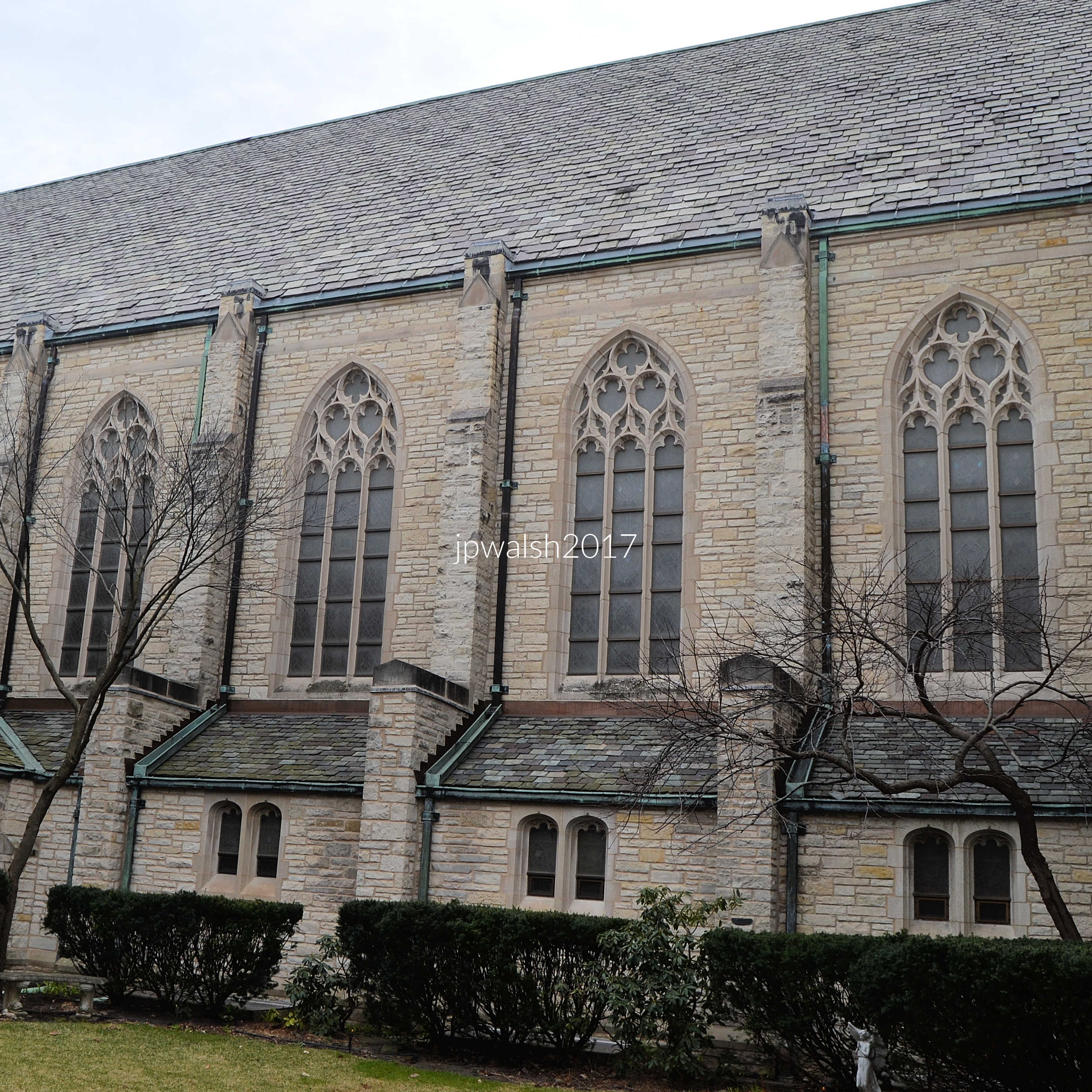
Designed by Granger & Bollenbacher, a procession of stained‑glass windows that line the nave are set in deep stone. Trinity UMC, Wilmette. March 2017. Author’s photograph. 3.40mb DSC_0635 (1)
How the architecture relates to the stained‑glass program.
The stained glass was created by Henry Lee Willett of Willett Stained Glass Studios in Philadelphia, one of the leading American studios of the mid‑20th century. The major façade window, dated February 14, 1954, shows Willett’s signature use of rich blues, jewel‑tone reds, elongated Gothic figures, and clear narrative panels. Its scale and design were chosen for narrative clarity, while the church’s deep window wells intensify color saturation and create a natural shadow‑frame that draws the eye toward the visual telling of Scripture — a hallmark of Methodist stained‑glass design. While Trinity’s windows feel sacred and are tall enough to make a visual statement, they are also narrow enough to keep scenes readable and, like most narrative stained-glass windows, arranged in story cycles. The church’s façade and nave proportions create a natural processional reading of the windows, allowing each panel — and the entire cycle together — to unfold as a coherent theological arc. Methodist churches of the 1920s often used architecture to shape a catechetical journey, with the Gothic style providing both a sense of transcendence and a visual link to the continuity of the church across the millennia. The building and the glass tell the same story: God speaks, calls, teaches, transforms.
Interior Analysis: Gothic Revival Structure.
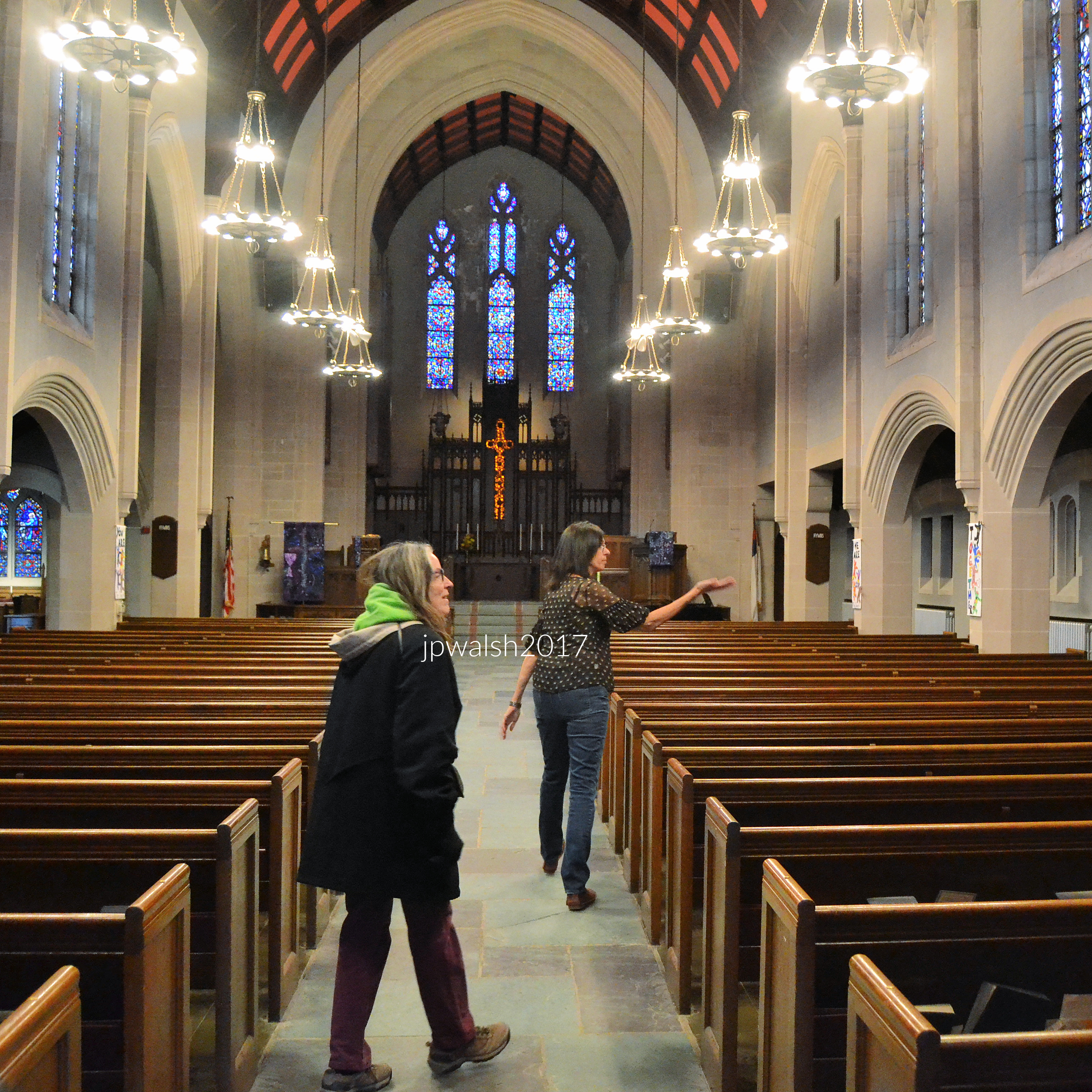
The sanctuary speaks in the familiar Gothic vocabulary. Trinity UMC, Wilmette. March 2017. Author’s photograph. 4.48 mb DSC_0654 (1)
A procession of rounded arches line the nave arcade, a testament to the congregation’s former Romanesque church building, with Gothic pointed-arch stained -glass windows above them guiding the eye upwards and forward. Above these, a ribbed or groin‑vaulted ceiling lifts the gaze further upward into a sense of height and devotion that feels almost instinctive. Reinforcing this vertical pull, the tall, narrow stained‑glass windows have proportions echoing centuries of Gothic design stretching light into color. Stone columns with simple capitals mark each step of the nave, guiding you along the long central aisle toward the chancel. The sanctuary is familiar Gothic interpreted through the American 1920s–30s lens—lighter, more vertical, devotional rather than medieval.
Trinity UMC, Wilmette. March 2017. Author’s photograph. 3.89mb DSC_0657 (1)
The space warms into Methodist Gothic. Dark wood pews, wooden chancel furnishings, a prominent pulpit or lectern, and a central cross create an interior that feels both sacred and approachable. The materials and layout quietly affirm the Methodist emphasis on Scripture, preaching, and congregational participation.
Overhead, hanging lantern chandeliers complete the atmosphere. Their medieval‑inspired metalwork casts a warm glow that softens the stone and wood. Evenly spaced along the nave, they reinforce the processional rhythm, drawing the eye—and the worshipper—toward the chancel and the unfolding narrative held in glass and architecture. Gothic in form, Methodist in function, Willett in storytelling, and 1920s–30s American in craftsmanship, including acoustics shaped for congregational singing, the interior of Trinity UMC is a space designed to make worship feel like a journey: from the world outside, through the nave, toward the light of the chancel and the story told in glass.
How Methodist theology shaped 20th‑century stained glass.
Methodist stained glass in the early–mid 1900s has a distinctive character shaped by Methodist convictions about Scripture, preaching, and discipleship. Because windows were expected to teach, almost every Methodist window cycle from this era functions as a visual sermon. Their imagery is intentionally accessible, with a strong Biblical orientation and a clear narrative movement through salvation history.
Methodists understand themselves as heirs of the Old Testament, followers of Jesus, children of the Reformation, and participants in the church’s ongoing renewal. As a result, their stained‑glass programs blend Old Testament, New Testament, and Reformation themes. Typical cycles include scenes of the prophets, episodes from the Life of Christ, and depictions of key Reformers such as Martin Luther (1483-1546), William Tyndale (c. 1494-1536), and Methodist founder John Wesley (1703-1791).
Trinity UMC, Wilmette. March 2017. Author’s photograph. 5.29mb DSC_0655 (1)
Façade window: Jesus Calling the First Disciples.
Façade window of Jesus Calling the First Disciples.Trinity UMC, Wilmette. March 2017. Author’s photograph. 7.65mb DSC_0649 (2)
A foundational moment in the Gospels — and a favorite subject in mid‑20th‑century Methodist stained glass — is Jesus calling the first disciples. In this scene, Jesus summons fishermen from their boats with the words, “Follow me, and I will make you fishers of men.”
The boat anchors the story in the Sea of Galilee, while the iconography makes the identification unmistakable. Jesus is shown with a cruciform halo and red and blue garments, signaling his dual nature. His authoritative, summoning gesture directs attention to the haloed figures of Peter, Andrew, James, and John, who look up toward him in response to the call.
Detail of Façade window depicting Reformers.
At the bottom of the façade window are four scenes from the life of the Reformers. At LEFT is Martin Luther nailing his 95 theses to the door of the Castle Church (All Saints’ Church) in Wittenberg, Germany, on October 31, 1517, that sparked the Reformation. At the bottom right of the panel is a white rose with a red heart and black cross. That is Luther’s personal emblem, designed in 1530 and used on his letters and publications. He is wearing scholarly robes in the colors of deep red, green, and brown that Willett often used for Reformers.
At LEFT CENTER is the burning at the stake of William Tyndale in 1536 whose crime was translating the Bible into English for the ordinary people. Tyndale believed Scripture should be accessible to ordinary people and died for that conviction. The Reformation’s gift is to take the Bible out of the hands of the elite and place it into the hands of the people.
At CENTER RIGHT is John Wesley, founder of Methodism, preaching in the open air to Native Americans — specifically the Muscogee (Creek) people —during his mission to the Georgia colony between 1735 to 1737 which, after his return to England, accelerated the Methodist Movement which Wesley founded at Oxford in 1729. Wesley began preaching in the open air, embracing traveling ministry and forming societies as he did in America. By 1739, he built the first Methodist meeting house in Bristol, England.
At RIGHT John Wesley preaching to early American settlers. Wesley served as Anglican pastor of Christ Church in Savannah, Georgia, where he introduced strict spiritual disciplines. His time was marked by conflict, including a failed romantic relationship, and backlash from residents against his strictness, causing him to return to England heartbroken and disillusioned after only two years.
Methodist stained glass seeks to be beautiful where clarity is key. The style tends to bold outlines, well delineated figures and readable gestures with minimal abstraction.
Trinity UMC, Wilmette. March 2017. Author’s photograph. 5.20mb DSC_0645 (1)
Traditional enough to feel sacred – Modern enough to feel fresh – narrative enough to teach – artistic enough to inspire: Why Willett Studios was chosen.
Christ the Teacher — sometimes also read as Christ the Good Shepherd window. Trinity UMC, Wilmette. March 2017. Author’s photograph. 3.95mb DSC_0664 (2)
This Willet window is a Life of Christ triptych, arranged in the traditional Methodist/Willett narrative pattern.
At the left, the window shows the ministry of compassion: a haloed Christ blessing or forgiving a kneeling woman, possibly inspired by the woman who washed his feet with her tears and dried them with her hair. Willett often preferred such non‑specific healing scenes, using them to emphasize Christ’s compassion rather than tie the image to a single Gospel episode.
At the center, Christ stands elevated and alone in Willett’s characteristic depiction of Christ the Teacher — sometimes also read as Christ the Good Shepherd when paired with lamb symbolism above. He bears the cruciform halo (reserved only for Jesus) and wears red and blue robes to signify his dual nature as God and Man. His arms extend slightly in a gesture of blessing and invitation.
At the right, the scene shifts to Christ’s agony in the garden before his betrayal and arrest, capturing the moment of solitary struggle that precedes the Passion.
“Do all the good you can.”
Taken together, these panels proclaim a unified message: Christ at the center of the Christian life, the one who heals, restores, and calls disciples to follow. The sequence echoes the Methodist conviction embodied in the familiar motto: “Do all the good you can.”
Trinity UMC, Wilmette. March 2017. Author’s photograph. 4.12.mb DSC_0637 (1)
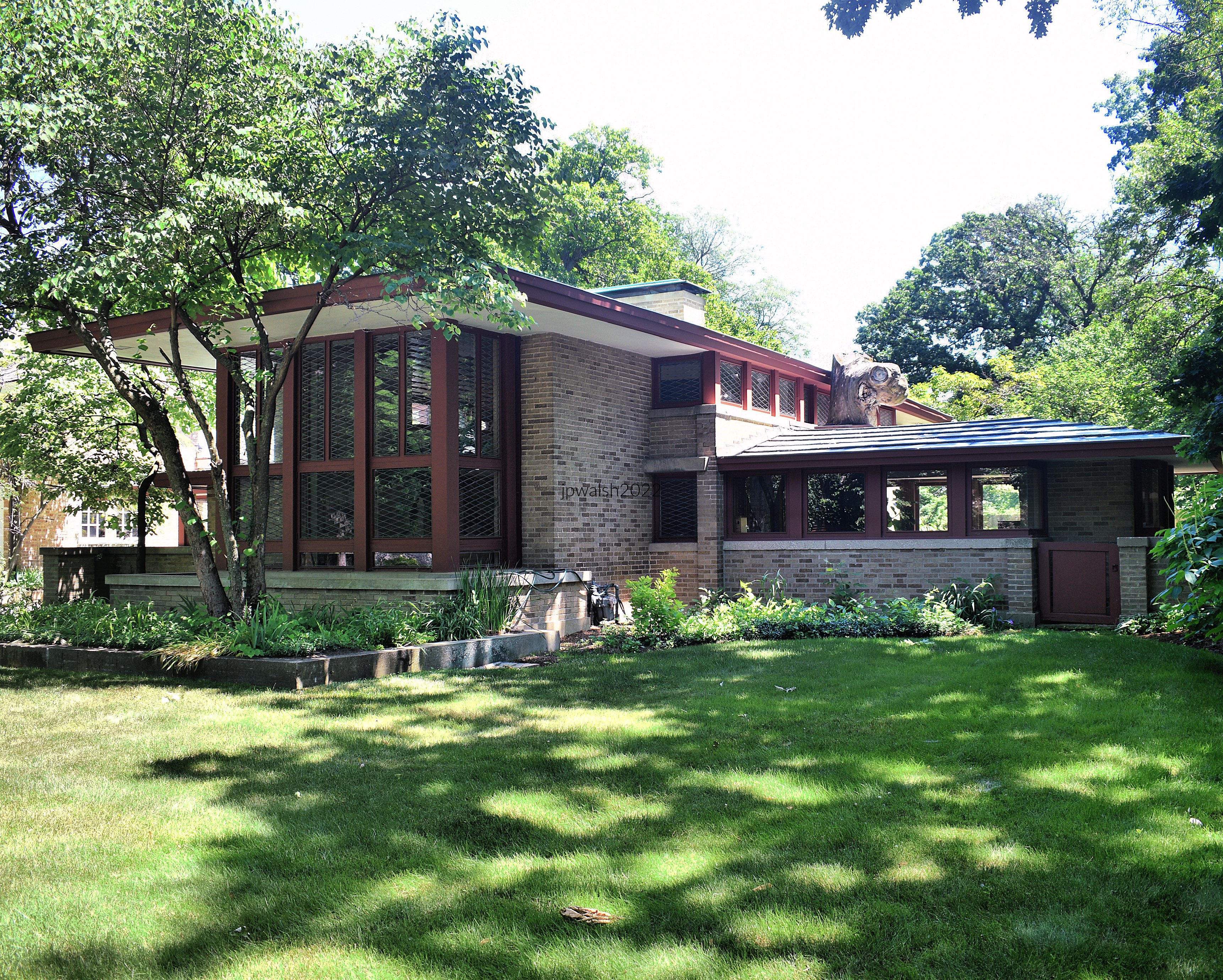
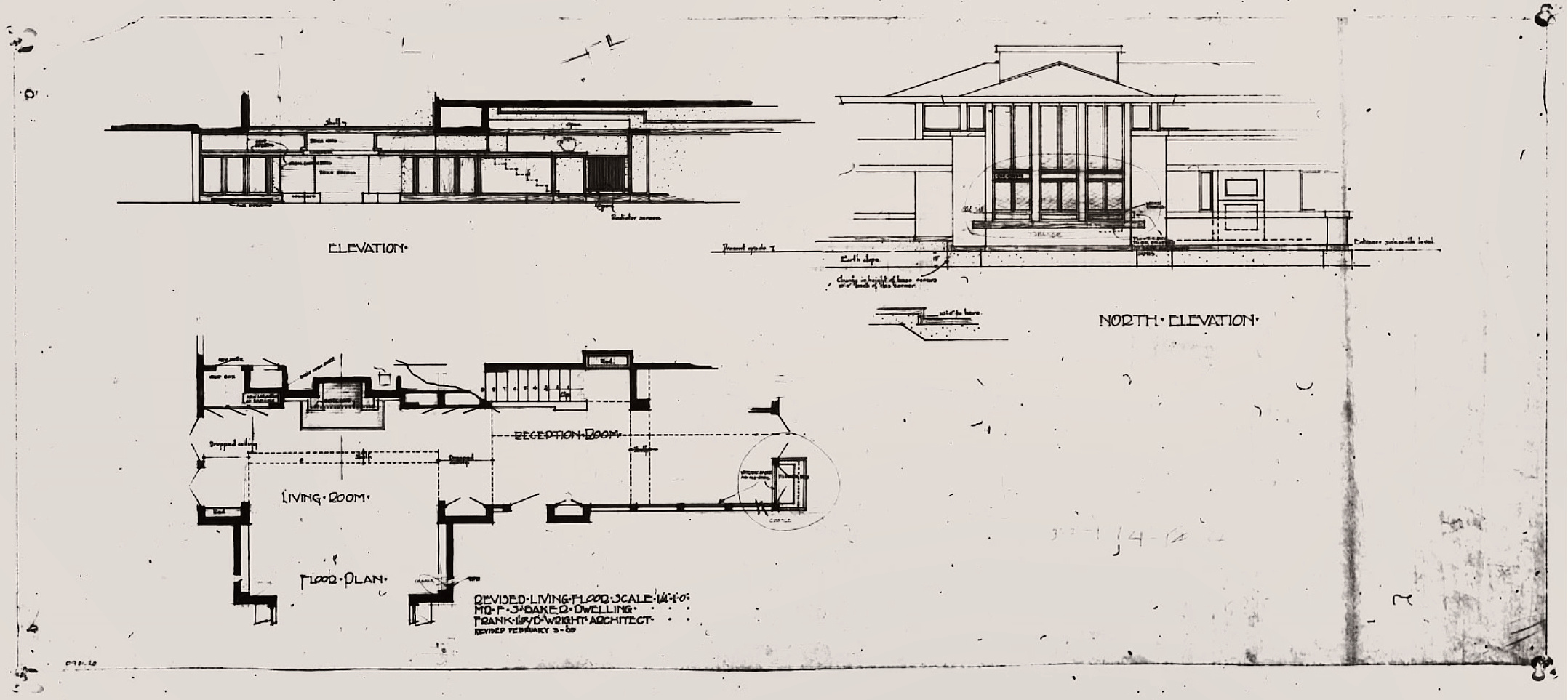
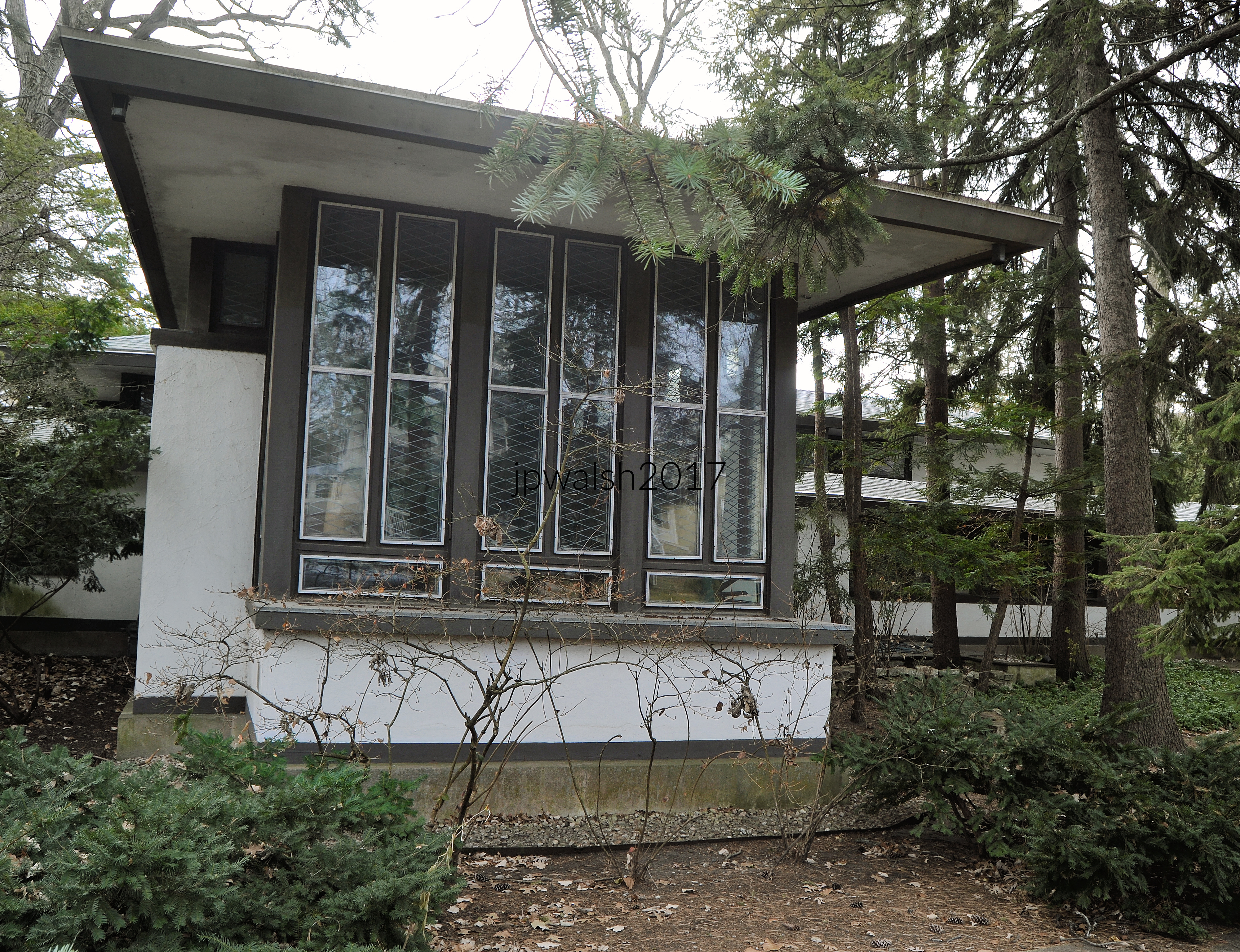
Feature image: Frank J. Baker House, Frank Lloyd Wright, 1909, Wilmette, Illinois. Frank J. Baker (1864–1922) was a driving force in Wilmette’s early growth — a sharp‑minded engineer and influential executive with the North Shore Electric Company and Commonwealth Edison who helped bring electricity to the North Shore. He is most remembered for the remarkable 1909 Frank J. Baker House, a Prairie‑style landmark designed for him by Frank Lloyd Wright. A civic leader as well as an innovator, Baker co‑founded the First National Bank of Wilmette. He died in his Wright‑designed home just a week before Christmas in 1922 at 58 years old. December 2017. 99% 7.20mb DSC_0560. Author’s photograph.
The Frank J. Baker House is a beautiful Frank Lloyd Wright residence and represents a critical moment in Wright’s architectural evolution, when the architect was pushing Prairie School design beyond earlier single-story compositions and experimenting with new approaches to space, volume, and the relationship between horizontality and verticality
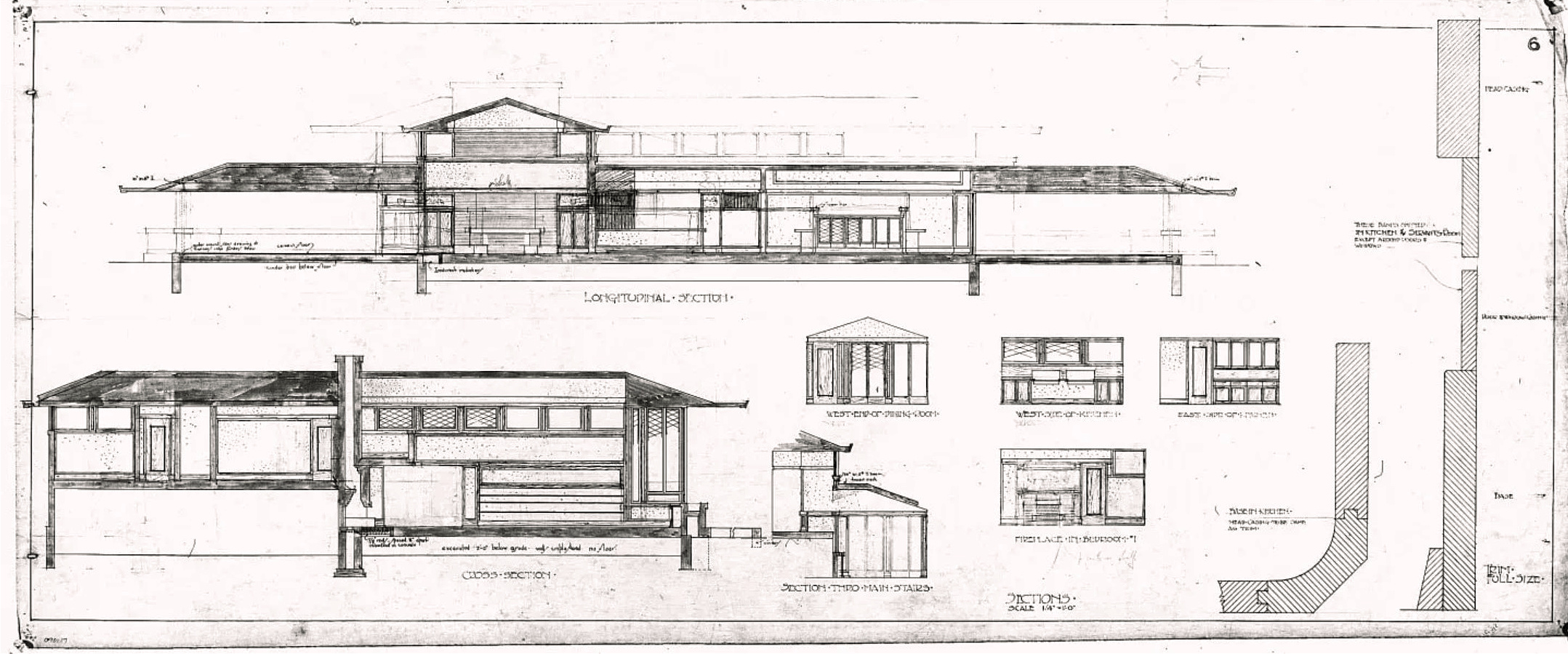
The Frank J. Baker House, situated at 507 Lake Avenue in Wilmette, Illinois, is a 4,800‑square‑foot residence that stands as a significant example of Frank Lloyd Wright’s evolving Prairie School vocabulary. Designed in 1909, the house incorporates five bedrooms, three and a half bathrooms, and three fireplaces, yet its architectural importance lies less in its programmatic elements than in its role within Wright’s broader experimentation with spatial organization and structural expression during this period.
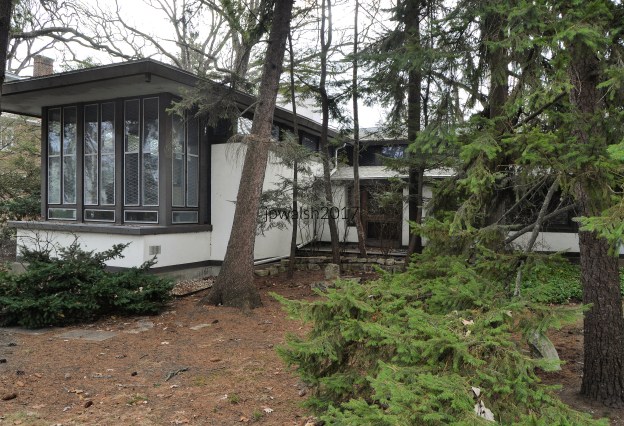
By the first decade of the twentieth century, Wright had begun to move beyond the predominantly single‑story Prairie houses of the late 1890s, exploring the potential of vertically layered two-story domestic space. The Baker House reflects this transitional moment through its T‑shaped floor plan—a configuration Wright employed in several contemporaneous works, including the Isabel Roberts House (below) built the previous year in River Forest, Illinois.
The Frank J. Baker House illustrates a pivotal stage in Frank Lloyd Wright’s Prairie School development, where experimentation with the T-shaped plan, two-story living spaces, and environmental continuity produced one of the architect’s most significant domestic designs of 1909
Isabel Roberts House, 603 Edgewood Place, River Forest, Illinois, 1908, Frank Lloyd Wright. It was remodeled in the 1950s. 69% 7.99 mb Author’s photograph.
The T‑plan allowed Wright to choreograph circulation along a dominant longitudinal axis while creating subsidiary wings that modulated privacy, light, and spatial hierarchy. In the Baker House, this plan form becomes a mechanism for integrating interior volumes with the surrounding landscape, reinforcing the Prairie School’s emphasis on horizontality and environmental continuity.
The exterior composition demonstrates Wright’s mature command of Prairie Style principles: a pronounced horizontal orientation, low‑pitched rooflines, and deeply cantilevered overhangs that visually anchor the structure to its site. These elements work in concert to diminish the building’s vertical massing, producing the characteristic “sheltering” effect that Wright associated with Midwestern domestic architecture.
The Frank J. Baker House (1909) and the Isabel Roberts House (1908) are closely related works that belong to Frank Lloyd Wright’s transitional Prairie period. Both employ a T-shaped plan that allowed Wright to organize circulation along a dominant central axis while projecting subsidiary wings outward into the landscape, strengthening the Prairie School ideal of spatial openness and environmental continuity.The Isabel Roberts House can be viewed as a direct precursor to the Frank J. Baker House, with Wright developing it into a more sophisticated architectural statement through greater spatial complexity, a monumental two-story living room, and a richer interplay between horizontality and volume.
Frank Lloyd Wright in 1903, likely a self-portrait. Public Domain.In 1909 42-year-old Frank Lloyd Wright reportedly personally brought the plans to Baker in Wilmette by horseback. Public domain. see – New owners to breathe life into 1909 Wright home – Wednesday Journal – retrieved March 30, 2026.
The two‑story living room is the spatial and symbolic core of the house. Its brick fireplace—an archetypal Wrightian hearth—functions as both a literal and conceptual center, organizing the surrounding spaces and reinforcing Wright’s belief in the fireplace as the spiritual heart of the home. The sloped ceiling and continuous band of leaded‑glass windows along the north wall create a dynamic interplay of light and volume, while the vertical expansion of the room contrasts deliberately with the home’s otherwise horizontal emphasis. Few surviving Wright houses retain this particular combination of a T‑shaped plan and a two‑story principal interior, making the Baker House an important artifact in understanding Wright’s spatial experimentation.
The property was listed on the National Register of Historic Places on November 8, 1974, acknowledging its architectural significance. A comprehensive restoration initiated in 2020 under new ownership has sought to preserve both the material integrity and the spatial logic of Wright’s original design.
Frank Lloyd Wright’s Prairie‑style design features strong horizontal porches framing a two‑story diamond‑leaded glass window wall in the living room. The home includes five large bedrooms, three‑and‑a‑half bathrooms, and three fireplaces. The second level offers a primary suite with en‑suite bath, fireplace, and private porch, plus two additional en‑suite bedrooms, two more bedrooms, and a sitting room. The kitchen and breakfast room overlook the expansive yard. Wright designed the home’s 1922 addition. Public Domain.
Through a deliberate sequence of compression and release, Wright choreographed movement through the Baker House so that ordinary domestic spaces culminate in a soaring central living room that serves as the spiritual and architectural heart of the home.
Interior Analysis.
Upon entry, the visitor encounters a twenty‑two‑foot dining room articulated with diamond‑patterned leaded‑glass windows, a pitched ceiling, and extensive wood trim. This space exemplifies Wright’s strategy of compressing and releasing volume: the relatively intimate proportions of the dining room heighten the dramatic expansion experienced upon entering the adjacent living room.
The main‑floor kitchen, accompanied by a modest breakfast nook, reflects Wright’s early efforts to modernize domestic workspaces by integrating them more fluidly into the overall plan. The living room, by contrast, adopts a quasi‑ecclesiastical spatial character. Its cantilevered ceiling, which extends into a loft above, creates a sense of upward movement unusual in Prairie houses. The continuous horizontal and vertical window bands dissolve the boundary between interior and exterior, a hallmark of Wright’s belief that architecture should mediate rather than separate human habitation from the natural environment.
At the center of the home stands the principal brick fireplace, accompanied by an overhead balcony that provides an elevated vantage point and reinforces the vertical layering of the space. On the second floor, the master bedroom includes one of the home’s three fireplaces and a private enclosed balcony, further demonstrating Wright’s interest in creating intimate, retreat‑like upper‑level spaces within an otherwise horizontally oriented composition.
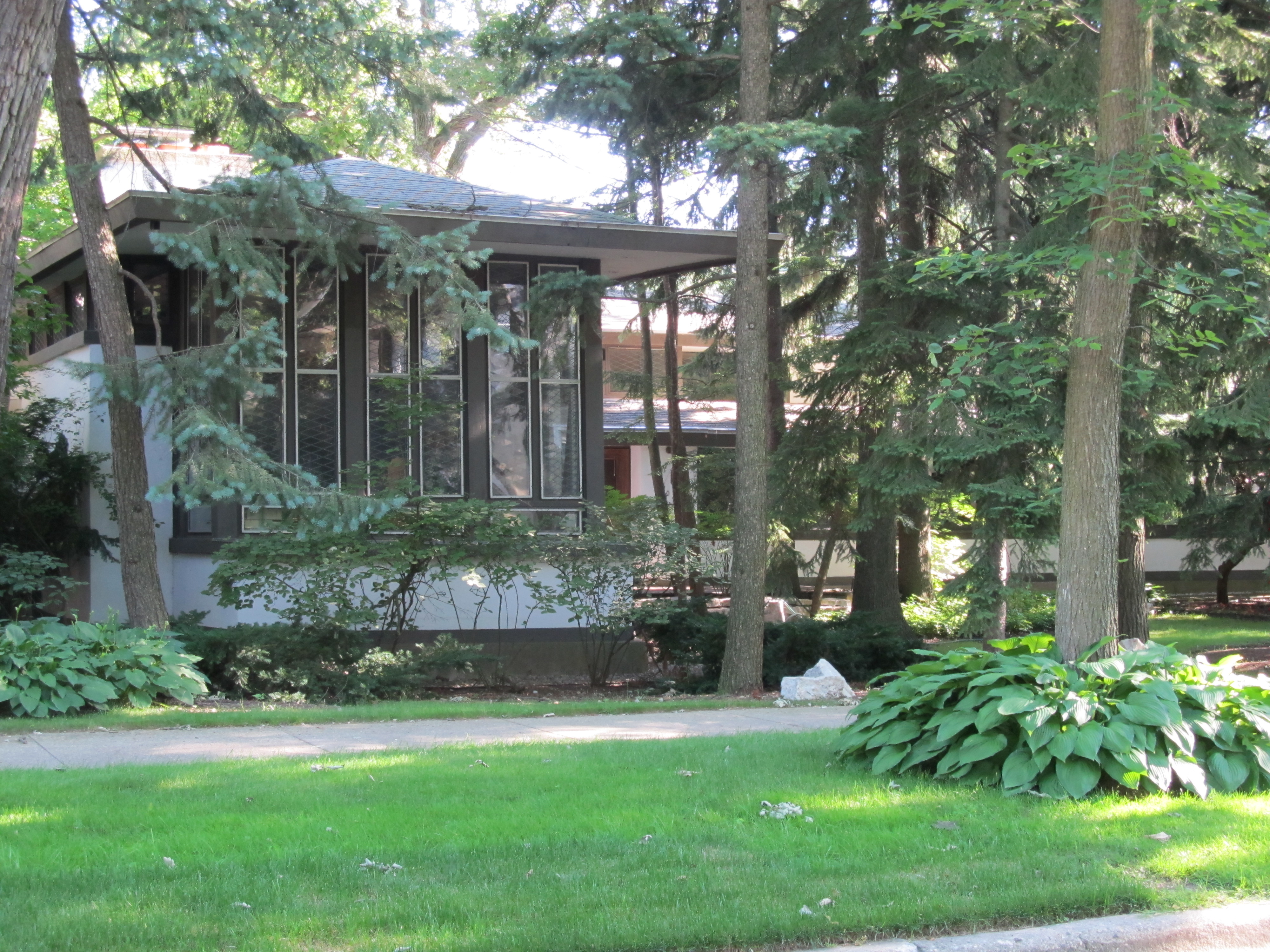
FEATURE image: Detail of 804 Forest Avenue, Wilmette, Illinois. The Prairie style house was built in 1906 by architect George Washington Maher (1864-1926) whose influence on the Midwest was profound and prolonged and, in its time, as great as Frank Lloyd Wright’s. Author’s photograph. 6/2014 3.95mb
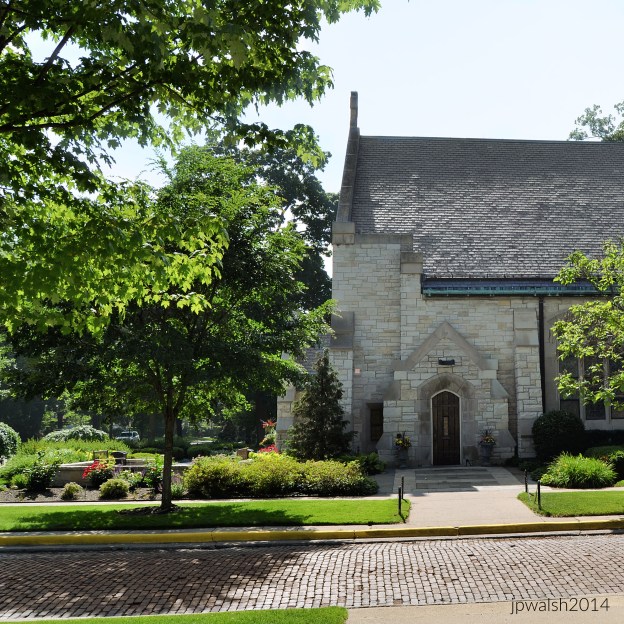
5 – 1231 Forest Avenue, 1898. A two-story clapboard with a flared hipped roof with three dormers, one each in the front and on the sides. The façade-length porch also has a hipped roof. The first floor has a projecting polygonal bay window and a front door and separate square vestibule window. 6/2014 4.76mb6 – 1215 Forest Avenue, c. 1909. The two-story home is built of finely dressed (cut, worked) ashlar stone. The home has a hipped roof and steep pitched pediment with a broken cornice and a false balcony with rounded attic window. In a rigidly centralized composition, there is a slight projecting bay above the entrance that is sheltered by a large porch with a massive projecting pediment held by a masonry pier with short bulging columns. 6/2014 5.67mb 11 – 1041 Forest Avenue, 1873. Masked by later additions, this house was originally Italianate whose hooded windows and small square attic window remain on the façade. 6/2014 4.20mb12- 1020 Forest Avenue, Community Church of Wilmette, 1920, has massing of large rubble ashlar walls with broad arches and a porch. 6/2014 3.57mb12- 1020 Forest Avenue, Community Church of Wilmette, 1920, was a pioneer for a large building tucked unobtrusively onto a residential street that in terms of stance was replicated by other churches that were built later in the suburb. 6/2014 6.05mb
13 – 932 Forest Avenue, 1890s. A grand two-story Classical Revival house with a high hipped roof and ionic pilasters at the corners as well as sides and pediment of the projecting entrance. Ionic columns also support the porch. 6/2014 4.86mb14 – 922 Forest Avenue pre-1873 and c. 1900. The house was originally built in the Italianate style evident in the cornice with double brackets in the front and single brackets on the side of the house along with pedimented windows. The third-floor gables were added around 1900 as well as the broad bow façade. These changes worked to add space and mask the original style. The front porch is even more recent. 6/2014 5.61mbGeorge Washington Maher (1864-1926), born in West Virginia, was an American architect in the Prairie School style who was known for blending with the Arts& Crafts style. According to H. Allen Brooks in The Prairie School – Frank Lloyd Wright and his Midwest Contemporaries (1972) “[Maher’s] influence on the Midwest was profound and prolonged and, in its time, was certainly as great as was [Frank Lloyd] Wright’s. Compared with the conventional architecture of the day, his work showed considerable freedom and originality, and his interiors were notable for their open and flowing…space.” By the time of his death, G.W. Maher had designed over 270 projects; from houses to parks to public buildings. Public Domain. 15 – 804 Forest Avenue, 1906. The Prairie style house was built in 1906. The architect was George Washington Maher (1864-1926). 6/2014 3.95mb15 – 804 Forest Avenue, 1906, by G.W. Maher is a solid 4-square house that is modest compared to a similar-styled project the Prairie-school architect completed in 1899 in Oak Park, IL , known as Pleasant Home. 6/2014 4.85mb
Sources:
A Guide to Chicago’s Historic Suburbs on Wheels and on Foot, Ira J. Bach, Swallow Press/Ohio University Press, 1981, pp. 534-547.
The Prairie School – Frank Lloyd Wright and his Midwest Contemporaries. Brooks, H. Allen New York: W.W. Norton and Company, 1972, p. 330.
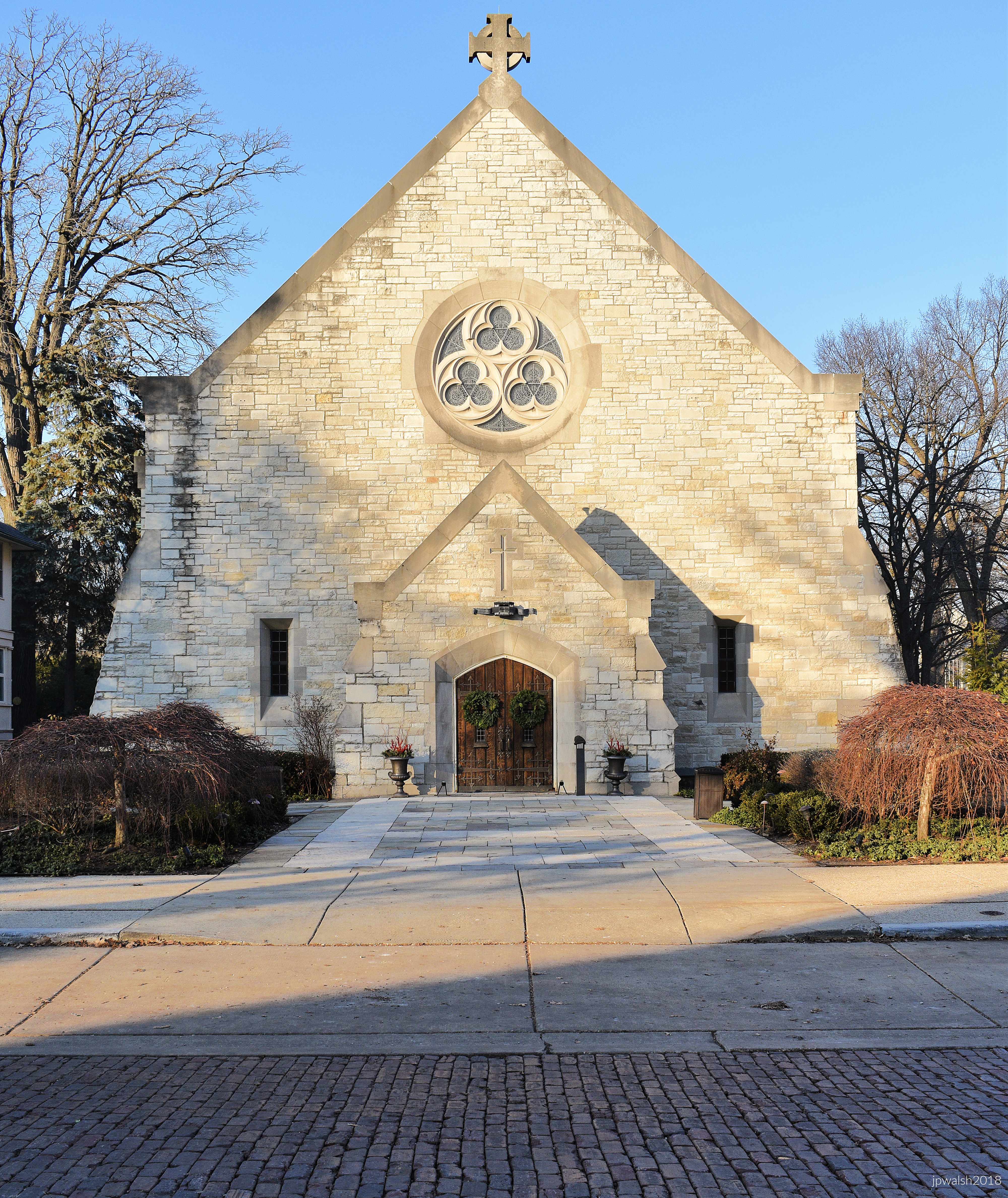
FEATURE image: Erected in 1939, St. Francis Xavier Church sits within an established, well-maintained residential neighborhood in Wilmette, Illinois, located just blocks inland from Lake Michigan. In designing the structure, the area’s Roman Catholics deliberately sought to blend unobtrusively into the surrounding landscape, ensuring the church harmonized gracefully with the architectural character of Chicago’s North Shore.June 2014. Author’s photograph 3.56mb
St. Francis Xavier church, Wilmette, Illinois. December 2018. Author’s photograph. 11.6mb
The English Gothic‑style church—typically associated with establishment mainline Protestants—was designed to be both sophisticated and simple. When the parish community formed in 1904, it built a smaller multi‑purpose church‑and‑school on this same corner of 9th Street and Linden Avenue. That first structure supported the parish through its early decades, serving as both classroom and worship space as the community grew into the congregation that would later commission the present building. Built by McCarthy, Smith & Eppig, St. Francis Xavier Church adopts the character of a sturdy country church, marked by low walls, massive external buttresses, and a sloped, elongated roof.
St. Francis Xavier church, Wilmette, Illinois. June 2014. Author’s photograph. 4.64mb
Erected in 1939, St. Francis Xavier Church sits within an established, well‑maintained residential neighborhood in Wilmette, Illinois, just blocks inland from Lake Michigan. The area’s Roman Catholics intentionally sought a design that would blend unobtrusively into the North Shore streetscape, ensuring the church harmonized with its surroundings rather than dominating them or otherwise stand out. Placing the 1904 parish under the patronage of St. Francis Xavier, the premier Jesuit missionary and intellectual, reflected the cultural and educational aspirations of the region’s affluent English‑speaking Catholic families, whose spiritual identity was shaped by the strong Jesuit presence on Chicago’s North Shore.
WHO IS ST. FRANCIS XAVIER (1506-1552), FIRST JESUIT MISSIONARY TO THE FAR EAST AND CO-PATRON OF FOREIGN MISSIONS?
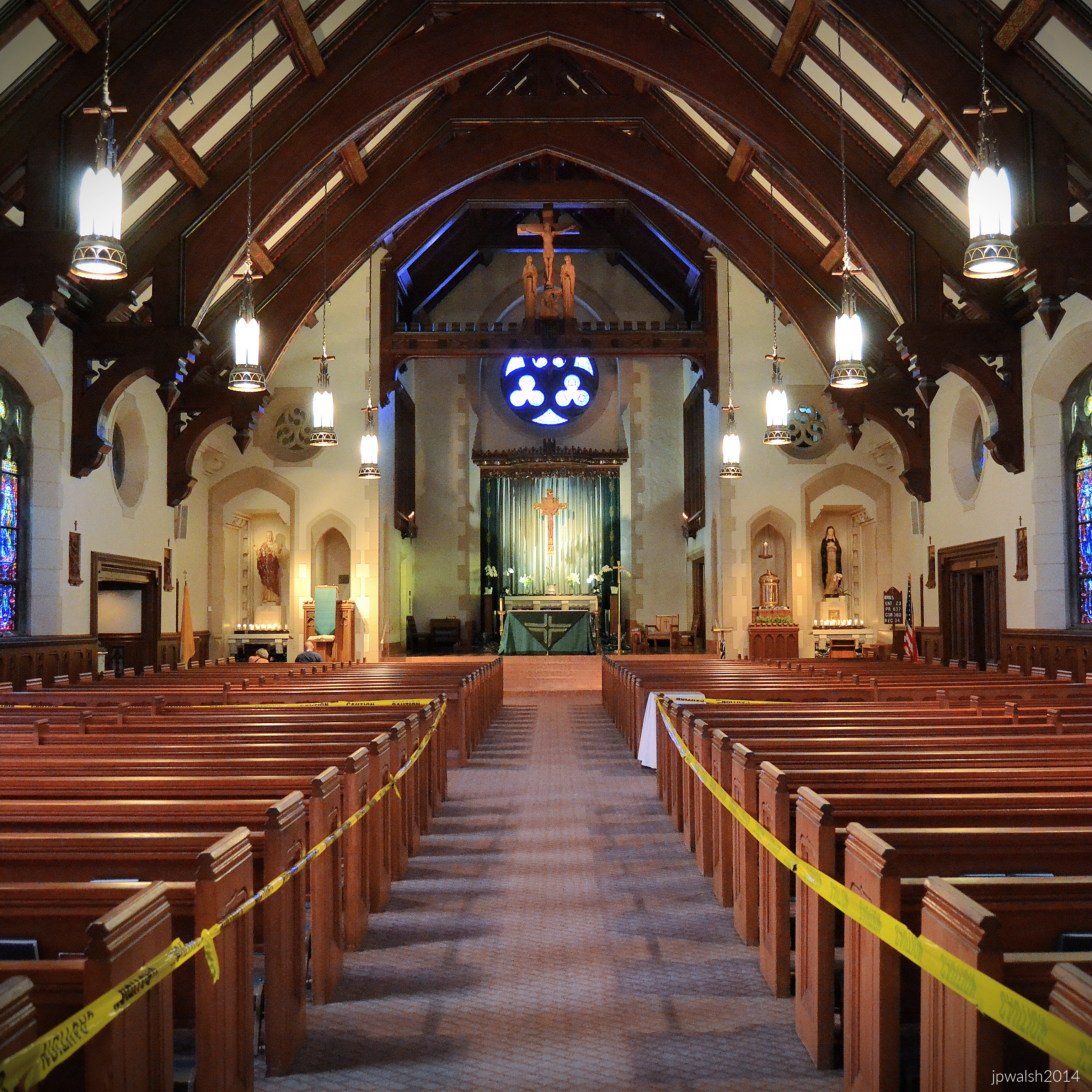
Parish patron and namesake St. Francis Xavier is depicted in marble at the entrance to the sanctuary in Wilmette, Illinois. namesake. Holding a crucifix, the Basque Jesuit priest is dressed in a black cassock draped by an alb and stole. June 2014. Author’s photograph. 4.05 mbNave looking to main altar. June 2014. Author’s photograph. 5.99 mb
Unobstructed Sanctuary
There are no columns interrupting the view toward the marble altar and crucifix. After Vatican II, the tabernacle was moved to a niche on the right; originally it stood on the main altar beneath the crucifix. The extra‑wide altar rail—with cross‑shaped legs meant to evoke being at table with Christ for communicants—was also removed.
Modern Streamlining
Although St. Francis Xavier Church is traditional in overall form, its detailing is modern, chic, and streamlined, giving the sanctuary a flexible, adaptable character suited to later liturgical changes.
Symbolic Ceiling
The ceiling is shaped like an inverted barque, a visual metaphor for St. Francis Xavier’s missionary voyages across the seas to the Far East.
View of sanctuary. July 2014. Author’s photograph. 5.85mb
Architects & Origins
Among the leading ecclesiastical designers of the 1930s, McCarthy, Smith & Eppig worked closely with Chicago’s Cardinal George Mundelein. Joseph W. McCarthy (1884–1965), once a young architect under Daniel Burnham, shaped much of Chicago’s Catholic built environment from the 1910s through the 1930s.
Wilmette Commissions
In 1939, McCarthy completed two major Wilmette churches—St. Francis Xavier and the more monumental St. Joseph—standing barely a mile apart. The design of St. Francis Xavier was executed primarily by the firm’s younger partners, David Smith and Arthur Eppig.
Design & Cost
The church’s restrained architecture, enriched by fine detailing, cost $200,000 to build in the late Depression years—roughly $4 million in 2022.
Beyond Chicago
While most of McCarthy’s work rose in the Chicago region, his portfolio also includes significant projects such as the cathedral in Springfield (1928) and the parish church built in 1918 for what later became the Diocese of Joliet.
Organ loft. December 2017. Author’s photograph. 7.90 mb 77%
There are 8 major stained-glass windows in St. Francis Xavier Church: four in the west wall and four in the east wall.
Panels of three different windows.October 2015. Author’s photographs
Smaller stained-glass oculi and panels are scattered throughout the interior. These stained-glass windows were designed by parishioner Henry Schmidt. They are quite beautiful, scintillating in their pseudo-English Tudor style, and illumined by the usually soft eastern and tree-obscured western exposures. While their subject matter feels somewhat chaotic—a hodgepodge in its traditional and idiosyncratic admixture of hagiography, scripture, and popular piety—one aspect of their enduring appeal is that the glass can be seen close up and at eye level. This intimate perspective is vividly captured in the side panels: the left detail illustrates the Agony in the Garden, showing Christ kneeling on the Mount of Olives as an angel descends with the chalice of His Passion; the center panel depicts the Finding in the Temple, with the twelve-year-old Jesus teaching the elders while Mary and Joseph look on; and the right panel depicts the Annunciation, capturing the Archangel Gabriel appearing to the Virgin Mary under the illumination of the Holy Spirit.
ST. PETER WINDOW & THE QUEENSHIP OF MARY WINDOW.
The visual program of the St. Peter stained-glass window —particularly its central panel showing St. Peter holding the keys next to the Latin words for Saint Peter, flanked by scenes of Mary’s active intercession by way of her heavenly coronation and Assumption into Heaven—beautifully illustrate this very link between established apostolic authority on earth and the heavenly governance of Christ and His Mother.
The window’s left panel of the Crowning of Mary as Queen of Heaven refers to the moment the Trinity receives her, body and soul, following the Assumption. In Catholic tradition—as in the Fifth Glorious Mystery of the Rosary—the Coronation marks her crown of heavenly glory. Though rooted in Scripture—especially the ‘woman clothed with the sun’ of Revelation 12:1—the literal act of the Trinity placing a crown on Mary is held as pious tradition rather than defined dogma like the Assumption. Consequently, parish practices such as a May Crowning remain devotional customs rather than formal liturgical acts.
St. Peter window. June 2014. Author’s photograph. 4.98 mb
CENTER PANEL: Saint Peter, leader of the apostles, holds the keys of the kingdom of heaven (Matthew 16:19). Peter holds a book, a representation of St. Peter’s New Testament letters (1 and 2 Peter) and sermons (Acts). Below is St. Peter’s Basilica in Vatican City in Rome with its famous dome.
LEFT PANEL: Crowning of Mary as Queen of Heaven by Triune God (Father, Son and Holy Spirit). From the Council of Ephesus in 431, depicting the Blessed Virgin Mary wearing a regal crown was used in Christendom.
RIGHT PANEL: While biblical texts point directly to the defined dogma (431) of Mary as Theotokos (Mother of God), the literal event of her Assumption is not explicitly recorded in the New Testament. Instead, this latter dogma (1950) dictates that at the end of her earthly life, she was taken—or ‘assumed’—body and soul into heavenly glory. Scriptural imagery of going ‘up’ to heaven is utilized here to express a profound spiritual reality, drawing a deliberate theological parallel to Jesus’ own Ascension (Acts 1:6–17; Luke 24:50–53). This phenomenon of a bodily assumption is mirrored in the Old Testament accounts of Moses and Elijah, both of whom later appeared alongside Christ at His Transfiguration (Matt 17:1–9; Mark 9:2–10; Luke 9:28–36; 2 Peter 1:16–21). Anchoring these soaring heavenly narratives visually, identical angel figures rest directly below the window panels.
Assumption (right panel), St. Peter Window. October 2015. Author’s photograph. 4.81mb DSC_0504 (1)
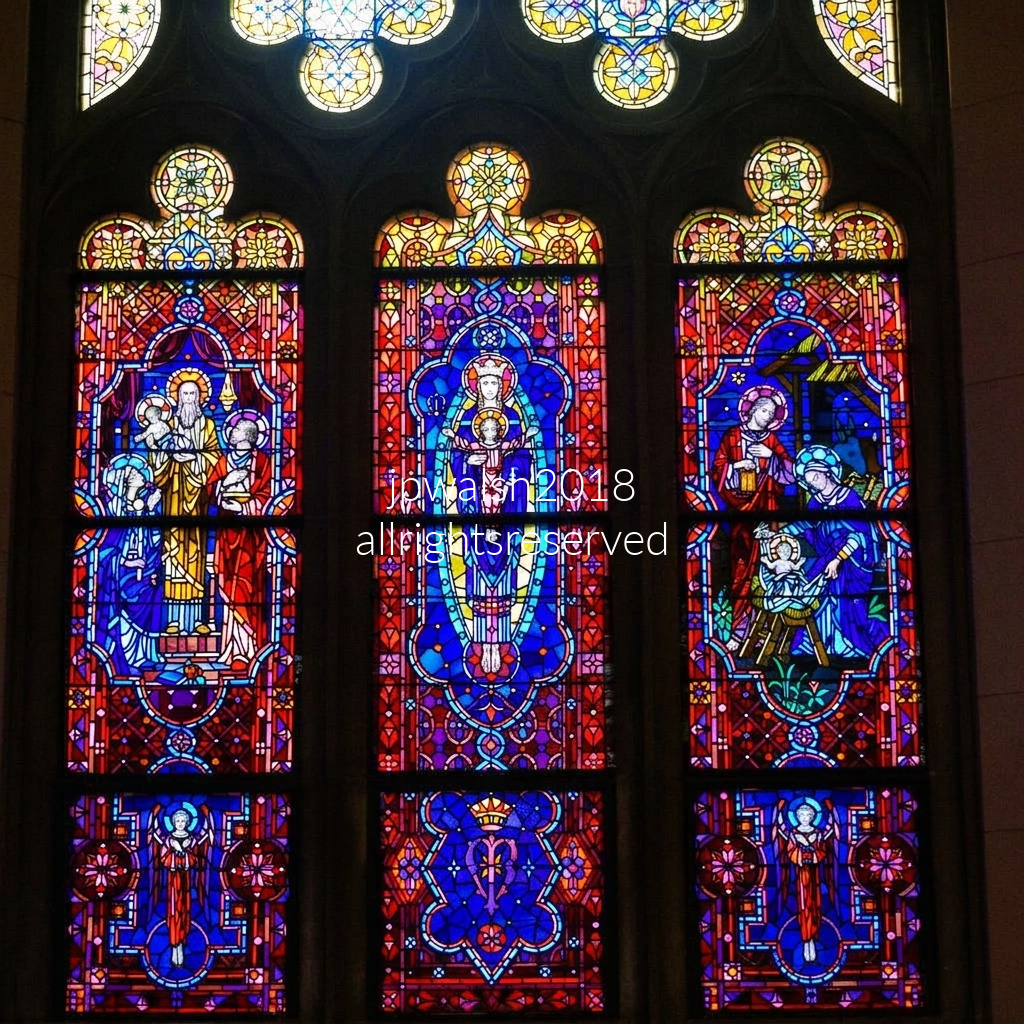
The Queenship of Mary, while in one continuous arc with the crowning of Mary, is an established doctrine of the Church. In 1954, Pope Pius XII formalized this long-standing tradition by issuing the papal encyclical Ad Caeli Reginam (To the Queen of Heaven), establishing the universal Feast of the Queenship of Mary. The systematically-minded Pope Paul VI later moved the memorial to August 22—exactly seven days after the Solemnity of the Assumption—to underscore their inseparable theological connection. The Queenship refers to Mary’s eternal, structural office and state of reigning over the entire Created Order. Catholic theology teaches that her reign is not passive; rather, Mary actively exercises her exalted role as Intercessor, Advocate, and Mediatrix of graces on behalf of the entirety of creation, both the living and the dead, until the end of time. The maternal character of her office stems from the ancient Davidic kingdom, where the queen was not the king’s wife, but the king’s mother. In ancient Israel, this Queen Mother held a powerful office of advocacy, listening to the needs of the citizens and bringing them directly to the King. Mary reigns in this exact Old Testament typological capacity. As Pope Pius XII noted, Mary’s authority is characterized entirely by maternal solicitude and humility. Her power to rule flows directly from her absolute submission to God’s will, meaning her crown is the ultimate reflection of perfect, Christian discipleship and sacrificial agape.
Queenship of Mary window. December 2018. Author’s photograph.
CENTER PANEL: The Queen of Heaven who reigns from the right hand of her son, is depicted in her role as mother of Jesus Christ. Below, a crown hovers over what may be a heart-shaped letter “M” for Mary’s first initial and/or her sacred heart.
LEFT PANEL: The presentation panel depicts Jesus being offered by Mary and Joseph in the Temple, where they meet Simeon, a ‘just and devout’ man of Jerusalem (Luke 2:25–35). Celebrated as the Fourth Joyful Mystery of the Rosary, the Presentation occurs forty days after Jesus’s birth. In accordance with Luke’s narrative, Mary and Joseph journeyed to the Temple in Jerusalem to fulfill the requirements of Mosaic Law: completing Mary’s ritual purification after childbirth and offering the prescription for the redemption of the firstborn son (Leviticus 12; Exodus 13:12–15)
RIGHT PANEL: Nativity of Jesus in Bethlehem (Luke 2: 1-7 and Matthew 1: 18-25) is the Third Joyful Mystery of the Rosary. Below each side panel are identical Angel figures.
ST. BONIFACE WINDOW.
St. Boniface Window. June 2014. 3.93 mb
CENTER PANEL: St. Boniface (675–754) is widely regarded as the “St. Patrick of Germany.” A missionary bishop who labored during Europe’s Early Middle Ages, Boniface was primarily responsible for organizing the Church in western Germany. While the ancient sees of Cologne and Mainz already existed, he fundamentally restructured and elevated them to serve as the pillars of his reform movement. Acting under the direct mandate of the Roman pope, Boniface anointed Pepin the Short (714–768)—son of Charles Martel (c. 688–741) and father of Charlemagne (747–814)—as King of the Franks. Pepin’s subsequent 751 coronation established a powerful precedent for future European royal coronations, marking a definitive milestone in the formation of the modern European state
LEFT PANEL: Jesus meets his mother is the fourth station of the cross. The Holy Face, below, is a devotion proclaimed by Pope Leo XIII in 1885.
RIGHT PANEL: Jesus mocked and crowned with thorns (Luke 22:63-65 and John 19:2-3) is the sixth station of the cross.
ST. PATRICK WINDOW.
St. Patrick Window. July 2014. 7.58mb
CENTER PANEL: St. Patrick (418–493) is one of the patron saints of Ireland, alongside St. Brigid (c. 451–525) and St. Columba (540–615). In Wilmette, Illinois, St. Joseph Church was founded in the 1840s to serve German immigrants, while St. Francis Xavier Church was established in 1904 as an English‑speaking territorial parish for the expanding North Shore community.
The depiction of Patrick as the archetypal, bearded Irish bishop—in green vestments, with miter and pastoral staff—rose to prominence in the late 1700s. His iconography includes a book, symbolizing both Holy Scripture and his own Latin works, the Confessio and the Epistola to Coroticus. Patrick also holds the traditional three‑leafed shamrock, the emblem he used to explain the Holy Trinity to the Irish people. Beneath him rests the harp, Ireland’s historic national emblem and one of the world’s oldest musical instruments.
LEFT PANEL:Jesus Christ’s Resurrection from the dead stands as the cornerstone of the Christian faith (1 Cor. 15:17). His empty tomb testifies to Christ’s deity (John 5:26; Rom. 1:4). Through the Resurrection, Christ redeemed humanity from sin (Rom. 4:24–25; Heb. 7:25), granted believers the promise of future resurrection (John 14:19; 1 Cor. 15:20–23), and infused them with spiritual power (Rom. 6:3–4; Eph. 1:19–21).
The window shows the resurrected Jesus holding the banner of victory over death, while a Roman guard collapses before the radiant light of the Risen Christ, accompanied by a ministering angel. Christ’s three‑part cruciform halo traditionally bears the Greek letters ὁ ὤν, meaning “He Who Is” (or “I Am Who Am”), a definitive sign of His divinity.
Although all four Gospels recount the aftermath of the Resurrection, none describe the moment or essence of the event itself — a mystery at the heart of Christian belief.
RIGHT PANEL: The Crucifixion of Jesus shows Him on the cross, flanked by Mary and John the Apostle at its base. Above Christ’s head appear the letters INRI, the Latin initials for Jesus Nazarenus, Rex Judaeorum, the official charge written by Pontius Pilate, meaning “Jesus the Nazarene, King of the Jews.” This title is recorded in John 19:19. Resting symmetrically below each side panel are identical anchoring angel figures, grounding the composition and framing the scene’s solemn balance.
Altar design includes tall candlesticks and a detailed, compact baldacchino. June 2014. 4.61 mb
Rood Beam Crucifixion Group:
Crucifixion scene in basswood. December 2018. Author’s photograph. 8.47mb
A striking depiction of the Crucifixion carved in basswood stands atop the sanctuary’s rood beam, positioned at the ceiling line directly above the main altar. Hand‑carved by German sculptor Fritz Muhlhauser, the work revives a medieval English Gothic tradition: the rood beam marking the threshold between nave and chancel, symbolizing the bridge between earth and heaven through Christ’s sacrifice.
Muhlhauser executed the composition in basswood (Lindenwood), a fine‑grained European carving wood prized for holding intricate facial expressions and sharp drapery folds without splitting. The sculptural grouping presents Christ on the cross, His head crowned with thorns beneath the INRI inscription, flanked by Mary on the left and John the Apostle on the right. At the base of the cross, Mary Magdalene, bowed in profound grief, embodies the faithful women who witnessed the Passion (John 19:25; Luke 23:27, 49).
Stylistically, the figures are elongated and vertically dramatic, allowing their features to read clearly from the pews far below while harmonizing with the soaring vertical lines of the church’s late Gothic Revival architecture.
STS. ANN AND MARY WINDOW.
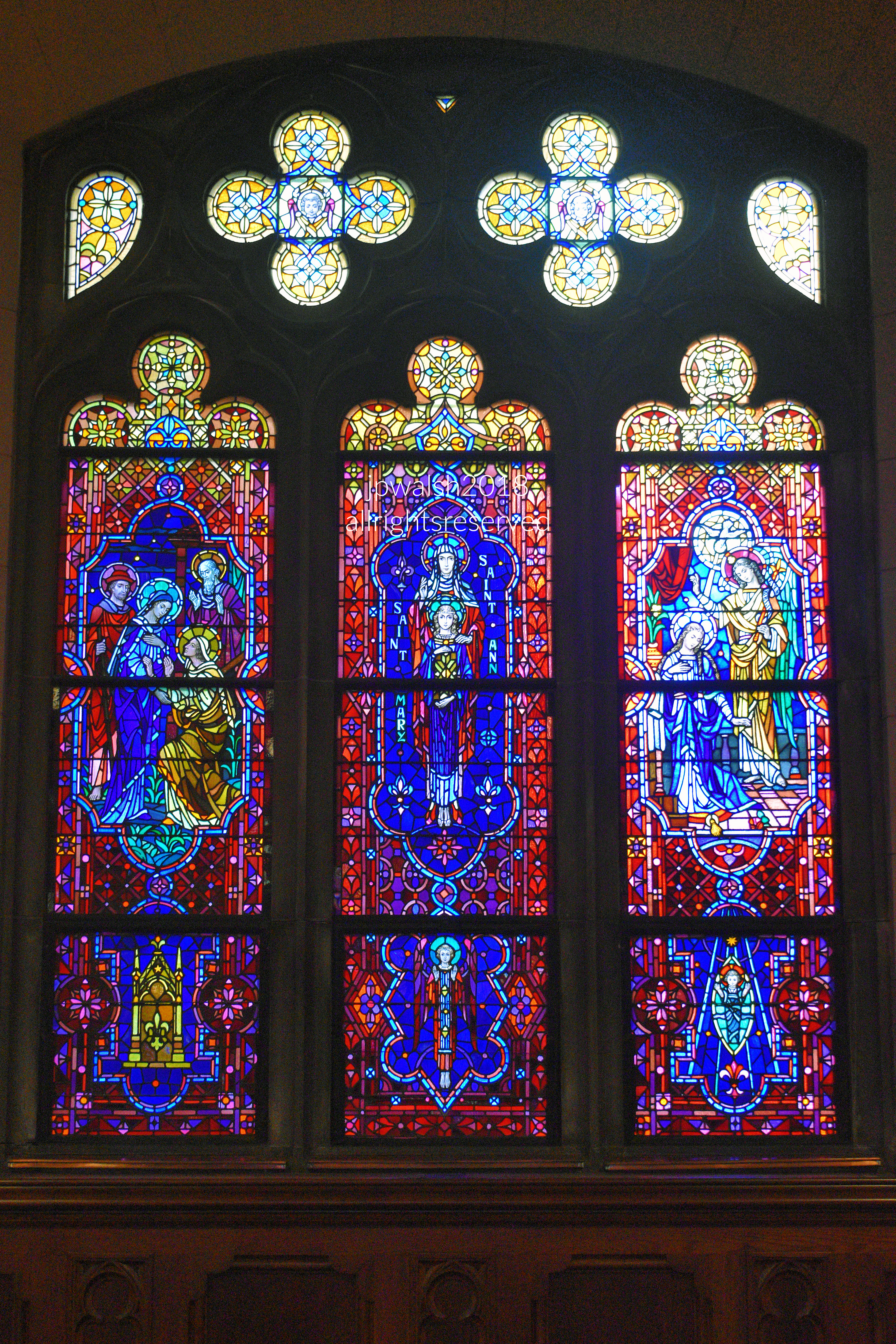
Sts. Ann and Mary Window. December 2018. 16.24mb. Author’s photograph.
Overview & Architecture
The late Gothic Revival stained-glass window illustrates the sacred maternal lineage that prepared the world for Christ. These nave windows are positioned so that they are sitting almost entirely at eye level. This intimate placement allows parishioners to stand directly beside the glass so that it functions much like an illuminated manuscript page, inviting them to appreciate its rich colors, expressive faces, and intricate details. Compositionally, the window’s narrative layout reads from right to left in terms of scriptural chronology (the Annunciation on the right moving to the Visitation on the left), flanking and bowing inward toward the central, towering figures of Saint Ann and Mary.
Center Panel: St. Ann and the Child Mary
This panel features the child Mary alongside her mother, Saint Ann, celebrating the vital generational link of Mary’s own birth. Because nothing is explicitly recorded in the New Testament about Mary’s parents or her nativity, early apocryphal Christian texts—such as the Protoevangelium of James—provide the vital historical framework. see – CHURCH FATHERS: Protoevangelium of James – retrieved September 8, 2026. These texts detail the miraculous nature of Mary’s birth to her long-barren parents, cementing an enduring legendary tradition of her immaculate beginnings. This familial focus is reinforced by the distinct vertical typography stitched directly into the blue glass background borders, with clean, capital letters clearly marking “SAINT ANN” and “SAINT MARY”—a design that rewards close-up reading from the aisle. Anchoring the base of this central structure is a miniature depiction of an angel.
Left Panel: The Visitation
The left detail depicts the Visitation of the Blessed Virgin Mary to her cousin Elizabeth (Luke 1:39–45). Following the Annunciation, Mary journeyed into the hill country to remain at the home of Elizabeth and her husband Zechariah for three months. Both women were experiencing miraculous pregnancies—Mary carrying Jesus by virgin birth, and Elizabeth conceiving John the Baptist in her advanced age. The window captures the precise moment John the Baptist leaped with joy in Elizabeth’s womb upon hearing Mary’s greeting (Luke 1:41). The Visitation is celebrated as the Second Joyful Mystery of the Rosary.
Anchoring the base of this left panel scene is a miniature architectural tabernacle or ark; Luke heavily structured his Visitation narrative around Old Testament accounts in 2 Samuel and 1 Kings regarding the physical journey of the Ark of the Covenant. Accordingly, paragraph 2676 of the Catechism of the Catholic Church formally identifies Mary as the Ark of the New Covenant: “Mary, in whom the Lord himself has just made his dwelling, is the daughter of Zion in person, the Ark of the Covenant, the place where the glory of the Lord dwells. She is ‘the dwelling of God . . . with men.’”
Right Panel: The Annunciation
The right panel illustrates the Annunciation, wherein the Archangel Gabriel proclaims that Mary will bear the Son of God, Jesus Christ, greeting her with the words: “Hail Mary, full of grace, the Lord is with you!” It is through Mary’s faithful acceptance of the divine will—“Behold, I am the handmaid of the Lord; let it be to me according to your word” (Luke 1:26–38)—that the Incarnation takes place. A traditional vase of white lilies sits positioned between Gabriel and Mary, serving as a classic art-historical symbol of her perpetual virginity and spiritual purity. The Annunciation constitutes the First Joyful Mystery of the Rosary. Anchored at the base of this right-panel scene is the fruit of Mary’s womb, the infant Jesus, wrapped in swaddling clothes (Luke 2:7, 2:12). He appears as he did when Mary laid him in a manger in Bethlehem, because there was no room for them at the inn.
ST. JOSEPH WINDOW.
St. Joseph Window. December 2018.12.34 mb
CENTER PANEL: St. Joseph was the foster father of Jesus and served as His guardian protector. Joseph’s symbology includes his holding a carpenter’s square (Matt. 13:55) along with a white lily to symbolize his faithfulness and chastity toward Mary (Matt. 1:25), as well as his absolute holiness and obedience to God (Matt. 1:24; 2:14, 21, 22). This devotional aspect is made explicit by the vertical text framing his figure, reading “SAINT JOSEPH” on the left and “PRAY FOR US” on the right in stark, clean capital letters. An angel figure is positioned directly below St. Joseph.
LEFT PANEL: The left detail depicts the Holy Family in Nazareth, illustrating the hidden years where Jesus was obedient to Mary and Joseph and “progressed steadily in wisdom, age, and grace before God and men” (Luke 2:52). Jesus is shown being instructed by St. Joseph in the carpenter’s trade, holding a prophetic wooden cross upon His knees. The flowering grass below is highly decorative and signifies the flowering staff of St. Joseph, which symbolized that he was specially chosen by God to be Mary’s husband. This imagery was heavily drawn from the Old Testament type where Aaron’s staff, placed before the Ark of the Testimony, miraculously sprouted with almond blossoms as a divine sign of his election (Num. 17:8; Vulgate 17:23).
RIGHT PANEL: The right panel captures Mary and St. Joseph finding the twelve-year-old Jesus in the Temple sitting among the doctors of the Law (Luke 2:41–52), which constitutes the Fifth Joyful Mystery of the Rosary. This scriptural event marks the only time in the Gospels where Jesus makes a public appearance between His infancy narrative and His later baptism in the Jordan by John the Baptist at the start of His public ministry (Matt. 3:3–17; Mark 1:9–11; Luke 3:21–23; John 1:29–33). Compositionally, the twelve-year-old Jesus is visually elevated above the scroll-holding doctors, sitting upon a small stone cathedra or teaching chair, which subtly emphasizes His divine authority over the earthly teachers of the Law.
Compositional Harmony Across the Base
The window’s lowest register displays a deliberate symbolic balance between the two side panels. Directly beneath the Nazareth home scene on the left, an ornate vase holds three stylized lilies representing the domestic purity of the Holy Family. This perfectly counterbalances the stone tablets of the Ten Commandments on the right, which are inscribed with Roman numerals (I through X) beneath the Eye of Providence—a symbol of the Holy Trinity hovering within an equilateral triangle. Together, the window visually tracks Jesus’s growth from the quiet, private household raised by his parents (the left) into the public, formal structures of divine law where He takes up His true spiritual mission as the Son of God (the right).
ST. PAUL THE APOSTLE WINDOW.
St. Paul Window. June 2022. Author’s photograph. 4.28 mb
CENTER PANEL: This panel features St. Paul, the great Apostle to the Gentiles. He is depicted in a traditional pose of apostolic authority, with his right hand raised in blessing and his left hand holding a large volume representing the Holy Scriptures and his foundational New Testament epistles. The figure is framed by vertical typography in clean capital letters reading “SAINT” on the left and “PAUL” on the right. While Christian iconography and the traditional symbology of martyrs frequently depict Paul holding a sword—both as the historical instrument of his execution by beheading (c. 64–68 CE) and as a metaphor for the ‘sword of the Spirit, which is the word of God’ (Ephesians 6:17)—this specific window replaces that martial emblem with the written word, highlighting his role as the preeminent teacher, theologian, and writer of the early Church. An angel figure is positioned directly below St. Paul.
LEFT PANEL: The left panel portrays Pentecost (Acts 2:1–13), which immediately followed the timeline of the Ascension. The scene depicts the Apostles gathered in prayer alongside Mary, the Mother of Jesus, as they receive the promised outpouring of the Holy Spirit. The divine presence is symbolized by a radiant dove descending from Heaven, casting tongues of fire upon the faithful below. Affixed to the bottom register of this panel is a prominent inscription block that reads: “TEACH YE ALL NATIONS – MATTHEW 28.”
RIGHT PANEL: The right panel illustrates the Ascension of Jesus into Heaven, an event heavily witnessed and detailed throughout the New Testament (Luke 24:50–53; Acts 1:6–12; John 3:13; Romans 8:34; Ephesians 1:19–20). The composition captures the exact moment the Resurrected Christ physically departed from Earth, rising into the heavens before the gaze of His Eleven remaining apostles (Judas Iscariot betrayed Jesus and tragically hung himself). Visually reinforcing this mystery, a cloud of glory reaches down from the upper tracery to receive Christ as His divine humanity enters into the eternal intimacy of the Father, sealing His identity as the perfect God-Man. Symmetrically anchoring the overall window design, a stylized descending dove—the symbol of the Holy Spirit—rests within the lower register directly below this scene.
St. Paul Window: Ascension. October 2015. Author’s photograph DSC_0505 (1).
Thematic and Compositional Harmony
The window’s design displays a brilliant theological and visual unity across its panels. Liturgically and historically, the inscription at the bottom left—“Teach ye all nations” (Matthew 28:19)—functions as the structural catalyst for the entire visual program. The Pentecost panel directly above it provides the Apostles with the supernatural grace and tongues of fire required to execute this Great Commission, while the central panel of St. Paul showcases the ultimate historical fulfillment of that missionary command to the wider world.
Artistically, this narrative is bound together by the striking use of deep cobalt blue glass backgrounds behind all three central figure groupings. This deliberate choice creates a dense, uniform baseline that forces the fiery reds and golden ambers of Christ’s robes and the descending Holy Spirit to pop with staggering visual contrast when sunlight hits the glass.
ST. PAUL THE APOSTLE WINDOW in situ on the east wall. June 2014. Author’s photograh
THE GOOD SHEPHERD WINDOW.
The Good Shepherd Window. December 2018. 12.6mb
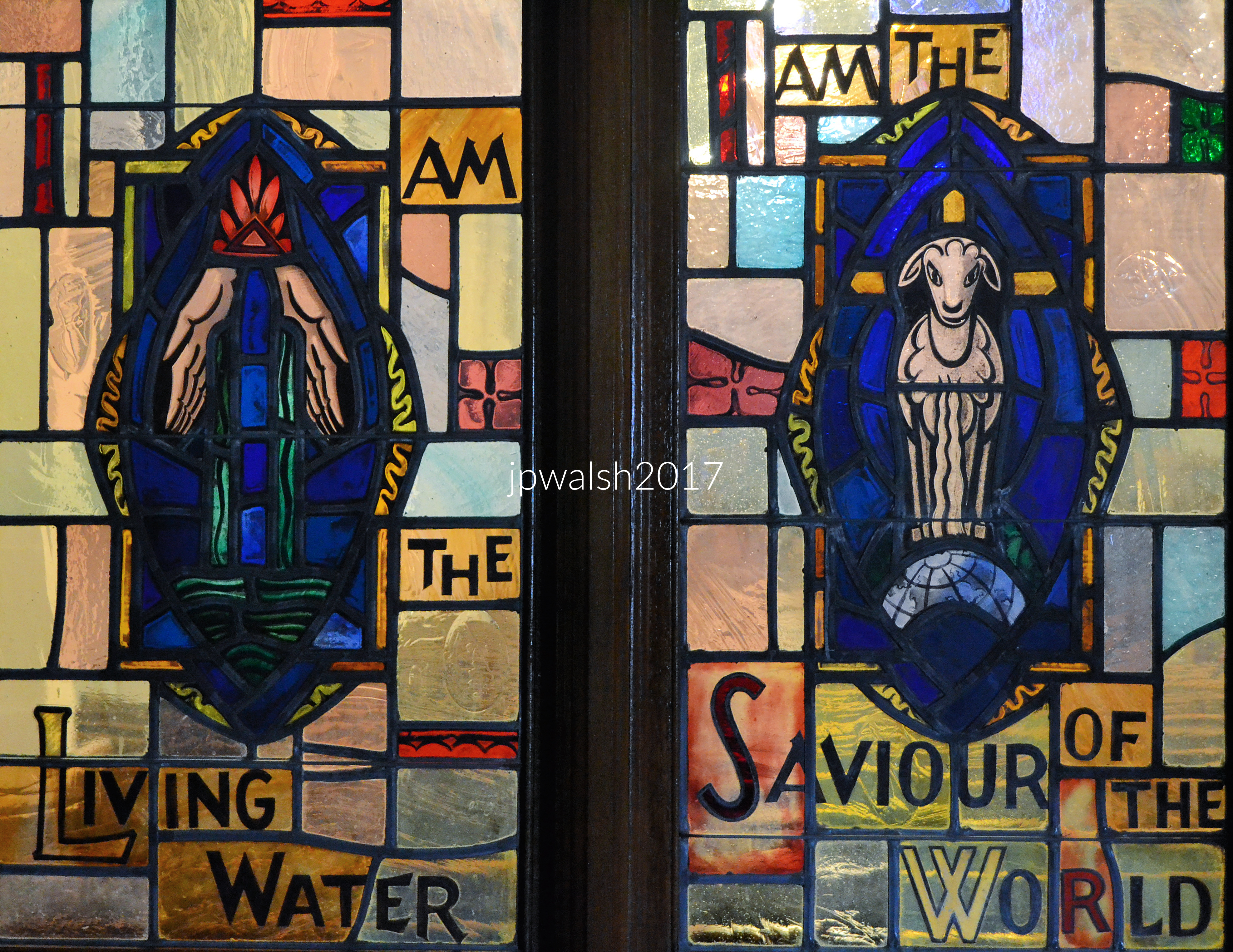
CENTER PANEL: This panel features Jesus Christ declaring Himself the ‘Good Shepherd’ (John 10). This title fulfills the Old Testament prophecies of Ezekiel, who foretold a singular Messiah-Shepherd sent to oversee the people of God (Ezek. 34:23–24; 37:24–25). Christ is depicted holding a pastoral staff with a lamb slung securely over His shoulders, symbolizing His protective care for the faithful. This messianic claim is rendered instantly legible by the stark vertical English typography stitched directly into the blue background glass, reading “I AM THE” on the left and “GOOD SHEPHERD” on the right. Positioned within the lower register directly below His feet is a triumphant Agnus Dei (Lamb of God) panel, portraying a haloed lamb holding the banner of victory over death. This iconography honors John the Baptist’s proclamation (John 1:29) and functions as an Old Testament typological echo of the ram provided by God to replace Isaac on Mount Moriah (Gen. 22:13), foretelling the ultimate sacrifice of the Son of God at Calvary.
LEFT PANEL: The left panel portrays the Scourging at the Pillar, which constitutes the Second Sorrowful Mystery of the Rosary and part of the severe bodily brutalities Jesus endured during His Passion (John 19:1–3). Bound to a marble column, Christ is flanked by two Roman torturers. Resting directly beneath His feet are the instruments of His flagellation: the leather-thonged whip (flagrum) and crossed wooden rods. Symmetrically anchoring the base of this narrative register, a standing angel figure rests directly below.
RIGHT PANEL: The right panel depicts Jesus in the Garden of Gethsemane during His Agony, positioned at the foot of the Mount of Olives the night before His Crucifixion (Luke 22:39–46). Knowing the immediacy of Judas’s impending betrayal, Jesus kneels in intense prayer, pleading: ‘Father, if you are willing, take this cup from me. Yet not my will, but yours be done’ (Luke 22:42). The window captures the exact fulfillment of the subsequent verse, where a ministering angel descends from heaven to strengthen Him (Luke 22:43). This angel holds out a golden Eucharistic chalice directly toward Christ’s face, visually transforming the abstract concept of the spiritual ‘cup of suffering’ into a tangible, liturgical reality. Mirroring the layout of the left side, an identical standing angel figure occupies the register directly below.
Compositional and Structural Balance
Architecturally, the entire triptych is bound together by identical, pointed trefoil-lobed arch borders (or ogival mandorlas) rendered in deep cobalt blue glass. This recurring geometric framing establishes a strict visual symmetry across the three windows, naturally drawing the viewer’s eye away from the chaotic flanking scenes of the Passion and focusing it onto the serene, central icon of the Good Shepherd.
This formal balance extends to the lower register of the window. The identical, standing angel figures flanking the base on the left and right face inward toward the central register. This deliberate layout creates a sacred, heavenly court at eye level, physically framing and guarding the triumphant Agnus Dei panel at the center of the visual program.
Organ loft. St. Francis Xavier Church, Wilmette, IL. December 2018. Author’s photograph. 446 kb 25%
SOURCES:
Heavenly City: The Architectural Tradition of Catholic Chicago, Denis Robert McNamara, James Morris, Liturgy Training Publications, Chicago, Illinois, 2005, pp. 138-140 Chicago Churches and Synagogues: An Architectural Pilgrimage, George Lane, S.J., and Algimantas Kezys, Loyola University Press, Chicago, 1981. Saint Ignatius and His First Companions, Chas. Constantine Pise, P.J. Kenedy & Sons, New York, 1892, pp.105-151. The Saints: A Concise Biographical Dictionary, edited by John Coulson, Guild Press, New York, 1957. The New American Bible, Catholic Book Publishing Corp, New York, 1993. Catechism of the Catholic Church, 2nd Edition, Doubleday, New York, 1997.
WINDOW DETAIL An angel figure graces one of the stained-glass windows in St. Francis Xavier Church. There are several different angel figures throughout the church’s stained glass panels.