




FEATURE image: Profile portrait of director Alfred Hitchcock taken in 1962 by American celebrity photographer Albert Watson. PHOTO: “Alfred Hitchcock Presents” by twm1340 is licensed under CC BY-SA 2.0.
Alfred Hitchcock’s I Confess (1953) transforms the conventions of film noir and psychological suspense into a profound moral drama about conscience, faith, and justice. Through Father Michael Logan’s refusal to violate the seal of confession, Hitchcock examines the conflict between religious duty and the demands of the law, revealing how silence can become an act of sacrifice while guilt, deception, and public prejudice threaten an innocent person.

Montgomery Clift plays a Catholic priest, Father Michael Logan, who becomes a murder suspect because he cannot reveal what he learned about the real murderer in sacramental confession. Hitchcock’s film explores guilt, self-sacrifice, public prejudice, and moral responsibility in a gripping black-and-white noir. PHOTO: Image courtesy of Wikimedia Commons (Public Domain).
In I Confess, a 1953 film noir by Alfred Hitchcock (1899-1980) from Warner Bros., a Catholic priest, Fr. Logan (played by Montgomery Clift) hears the confession of a man who works in the rectory and just killed another man.
For the police Inspector (Karl Malden) and prosecutor (Brian Aherne), that the killer had been dressed as a priest and other circumstantial evidence, points to Fr. Logan as the primary suspect for the murder of Villette, a prominent lawyer.
Because of the seal of confession— that is, when a person confesses his sins to a priest in Confession, the priest must maintain absolute secrecy about anything that the person confesses—Fr. Logan cannot and does not under any circumstances divulge the identity of the confessed killer though he (and the audience) knows it.
Even after Fr. Logan is arrested for the crime and put on trial for the murder, the priest does not reveal the identity of the killer but only protests for his own innocence.
Father Michael Logan hears Otto Keller’s confession to murder. Bound by the seal of confession, Logan cannot disclose the killer’s identity, even when he becomes the principal suspect.
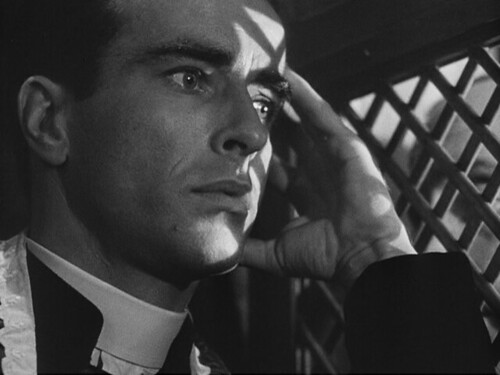
PHOTO: “I, Confess animation” by doc_tor_matt is licensed under CC BY 2.0.
Hitchcock’s black-and-white film was shot by cinematographer Robert Burks (1909-1968) who would later shoot Hitchcock’s The Birds in 1964. It is edited by German-born Rudi Fehr (1911-1999) who would go on to edit Hitchcock’s triumphant color feature, Dial M For Murder, in 1954.
The story in I Confess was based on a 1902 play by Paul Anthelme Bourde (1851-1914), a French journalist and colonialist who coined the term “decadent” for the indecipherable Symbolist poets in his native France in the late 19th century.
The film follows the play which is about a killer who confesses to a priest knowing his crime cannot be betrayed. To complicate matters further, the killer blackmails the priest for a long-ago love affair he had with Ruth Grandfort (Anne Baxter), the wife of a leading citizen, and who still loves him. For the priest, the love affair is in the past though for Mrs. Grandfort it is not.
Father Logan’s former relationship with Ruth Grandfort, played by Anne Baxter, gives Keller an additional means of exploiting the priest’s vulnerability.

A primary conflict between the actress and director was that Hitchcock, who was notoriously fastidious about his leading ladies’ appearances, demanded that Baxter dye her hair. This work is in the public domain in the U.S. because it was published in the U.S. between 1927 and 1977, inclusive, without a copyright notice.
When Alfred Hitchcock’s film noir I Confess was filmed on location in Quebec City in 1952 and released in early 1953, Montgomery Clift and Anne Baxter were among Hollywood’s most prestigious and sought-after young actors. Both had achieved major career-defining successes, yet their approaches to acting—and their relationships with Hitchcock—could hardly have been more different.
By 1952, Montgomery Clift was widely regarded as a revolutionary force in American cinema. He had recently received an Academy Award nomination for A Place in the Sun (1951) and was preparing to film From Here to Eternity (1953), which would earn him another Best Actor nomination. Clift’s deeply introspective, psychologically nuanced approach to performance, however, sometimes clashed with Hitchcock’s preference for technical precision, carefully choreographed blocking, and exact camera placement. Hitchcock reportedly grew impatient with the Method actor’s persistent questions about a character’s motivation. The tension was further complicated by Clift’s heavy drinking, which occasionally left him appearing glazed during filming. Supporting actor Karl Malden sometimes served as an intermediary between Clift and Hitchcock, whose was famously non-confrontational.
Anne Baxter, by contrast, approached I Confess from a different professional perspective. Already an Academy Award-winning actress, she was known for her discipline and versatility, moving with apparent ease between contrasting roles. In 1953, Baxter parted ways with 20th Century Fox to establish herself as a cutting-edge freelance actress. She subsequently signed a lucrative two-picture deal with Warner Bros., with I Confess serving as a high-profile vehicle for this new phase of her career.
For Clift, I Confess remains an important testament to his extraordinary talent. Despite the reported behind-the-scenes tensions, his restrained, inward-looking portrayal of Father Michael Logan has been praised for its unusual intensity and concentration. His performance gives the film much of its emotional and moral force, demonstrating how a deeply internalized portrayal could become one of the most compelling elements of Hitchcock’s filmography.

Clearly, for Hitchcock in I Confess, the priest in this situation is a highly curious figure. By the end of the film, it becomes clear that the seal of confession is a cross for the priest because of his priesthood – and though sins do not always deal with high crime – demonstrates the personified sacramental nature of self-sacrifice that is involved for the priest with each confession he hears. Throughout the film, Fr. Logan is a tragi-comic figure as he simply does not state the obvious of who the murderer is on behalf of social justice and his own innocence, but equally personifying the religious nature of living with and taking on another’s sin particularly when a person refuses their own responsibility and makes amends for it. In I Confess, the murderer has no intention of turning himself in and is content to let the priest under seal of confession take the rap in the courtroom of the law and public opinion.
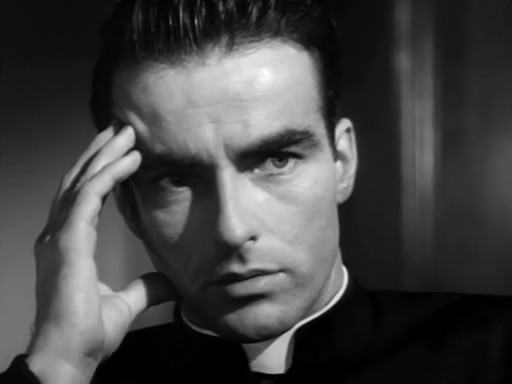
Clift portrays Logan as restrained, vulnerable, and morally resolute, making the priest’s silence central to the film’s emotional tension. PHOTO: Image courtesy of Wikimedia Commons (Public Domain)
Fr. Logan never impedes law enforcement’s investigation. He continually states his own innocence for which a jury of his peers is brought in to decide what to believe.
The sin of commission/omission – and in I Confess it is for and surrounds the gravity of murder – remains with the impenitent Otto Keller (O.E. Hasse) although his loving wife, Alma (Dolly Hass), to whom Keller confessed the crime outside confession’s seal, cannot abide by his secret.

Keller attempts to escape the consequences of his crime by allowing an innocent man to suffer in his place. The contrast between the two men is central to the film’s moral argument. PHOTO: “I, Confess animation” by doc_tor_matt is licensed under CC BY 2.0.
If, despite the seal of confession, crimes can be revealed to government investigators then the sanctuary of the law of the cross is extricated to get at evil – which is not contradiction nor improvement to the confessional box (the priest may ask the penitent for a release from the sacramental seal to discuss the confession) but its obligatory public replacement. As there is often no transparency and plenty of state secrets in and around various government agencies, this becomes no less problematical than breaking down a Catholic (and Lutheran) church’s confessional door as well as, in the United States, violating the free exercise of religion (the First Amendment).
Even after Logan is acquitted, public hostility demonstrates how suspicion and appearances can overpower reasoned judgment.

Though the jury finds Father Logan not guilty due to a lack of definitive physical evidence, the angry mob outside the courthouse is unconvinced by the verdict. They jeer and assault Logan as he tries to leave, believing a guilty murderer has escaped justice on a technicality. PHOTO: “I, Confess animation” by doc_tor_matt is licensed under CC BY 2.0.

The investigation and trial raise questions about whether legal institutions can adequately recognize innocence when crucial evidence cannot be disclosed.

Unable to bear the sight of the innocent priest being attacked, and consumed by escalating panic, the killer’s wife, Alma Keller, snaps. She steps forward to publicly denounce her husband and scream the truth to the crowd. In a frantic attempt to escape, Otto Keller pulls a gun, shoots and kills his wife, and flees into the grand Château Frontenac hotel. PHOTO: “I, Confess animation” by doc_tor_matt is licensed under CC BY 2.0.
Although found “not guilty” for lack of evidence to convict, the presiding judge expresses his disbelief in Fr. Logan’s innocence. When Fr. Logan exits the court building, he is followed and faced by a hostile crowd – “Preach us a sermon, Logan!” The prosecutor, as he watches the ugly scene from his office above, is forced to lament his actions: ”Do you think I enjoyed it?” he says, washing his hands. After Fr. Logan is crashed into a car window in the crowd, Alma, Keller’s wife, (her name means “soul”) rushes in towards the priest to tell what she knows—and which an accompanying police guard relates to the Inspector—“She said he was innocent.”
Trapped by the police, a desperate Keller tries to shoot Father Logan, completely exposing his own guilt. The police return fire, fatally wounding Keller. In his final dying moments, Keller begs for forgiveness, and Father Logan steps forward to administer the last rites and grant absolution to his own framing torturer—fully resolving his priestly duty, clearing his name in the eyes of the public, and permanently closing the door on his past life with Ruth.
Considered Hitchcock’s once most Catholic of films, I Confess is a tight drama with a truly despicable villain, whose murderous rampages do not stop. The film is ahead of its time in terms of direction – presaging camera angles, editing, pacing and themes of later international crime and psychological dramas that came to fruition in the decades ahead.
Black-and-white cinematography, visual tension, dramatic pacing, and psychological suspense reinforce the film’s themes of entrapment and moral isolation.

Original 1953 theatrical poster for Alfred Hitchcock’s I Confess functions as a misleading piece of marketing, deliberately disguising a religious, somber, psychological drama to become a volatile, sensationalized Hollywood romance. “A shame confessed – a sin concealed! This is love with the brand of Hitchcock burned in!” leans into pure melodrama with an implied promise of a romance overflowing with passion, betrayal, and scandalous secrets. The smaller tagline asks the audience a direct moral riddle: “If you knew what he knew, what would you do?” which establishes the film’s high-stakes moral dilemma, keeping the focus on a personal crisis of conscience. In reality, the movie is a dark, slow-burn, atmospheric film noir rooted in guilt and legal bureaucracy. Notably, the poster completely hides Montgomery Clift’s priestly collar in which he spends nearly the film’s entire runtime. Warner Bros. concealed the movie’s religious core, fearing from a marketing perspective that a story about a devout, celibate Catholic priest might alienate mainstream moviegoers looking for a Hollywood romance. As a standard one-sheet theatrical poster, this was displayed in theater lobbies, outside cinemas, and on street billboards in early 1953 to drive ticket sales. Warner Bros. leaned heavily on the bankable star power of Clift and Baxter, placing their names in giant red font across the bottom to draw crowds. Ultimately, while the poster succeeded in getting audiences into theaters, its heavy emphasis on sensationalized romance contributed to mixed reactions at the time, as viewers expecting a passionate thriller instead received a brooding meditation on faith, duty, and the silence of the confessional. PHOTO: Image courtesy of Wikimedia Commons (Public Domain). An online search by title at the US copyright office yielded no copyright renewal. In the absence of renewal of the US copyright, this poster art entered the public domain 28 years after its US publication date.
CONCLUSION
Upon its theatrical release in early 1953, I Confess underperformed at the box office and met with a mixed, largely lukewarm critical reception. While it did not reach the commercial heights or unanimous acclaim of Alfred Hitchcock’s top-tier thrillers, its reputation has evolved significantly over time. Today, the movie has transitioned out of obscurity and holds a solid 84% fresh rating on Rotten Tomatoes, widely re-evaluated by modern film historians as beautifully shot and intellectually challenging and a worthy entry in Hitchcock’s golden era.
In 1953, U.S. critics found the movie heavy-handed and slow, calling the screenplay dull and noting that the killer’s identity being known from the very beginning robbed the narrative of excitement. Most American reviewers felt the central romance flashback was unsuccessful and lacked genuine on-screen chemistry. However, Robert Burks’ moody, German Expressionist shadow cinematography was universally praised. The Catholic Church responded positively to I Confess as it treated Catholic beliefs with dignity and portrayed Father Logan as a devout priest. Yet, in 1950’s Catholic Ireland, the film apparently was not Catholic enough: and it was banned there for what censors considered its unacceptable innuendos. The film’s biggest champions at the time, however, were the young French critics of Cahiers du Cinéma who hailed I Confess as an absolute auteur masterpiece. They argued that the film’s brilliant “transference of guilt” motif and Montgomery Clift’s internalized acting perfectly captured the integrity of the spiritual isolation of the human condition.

text & layout –

