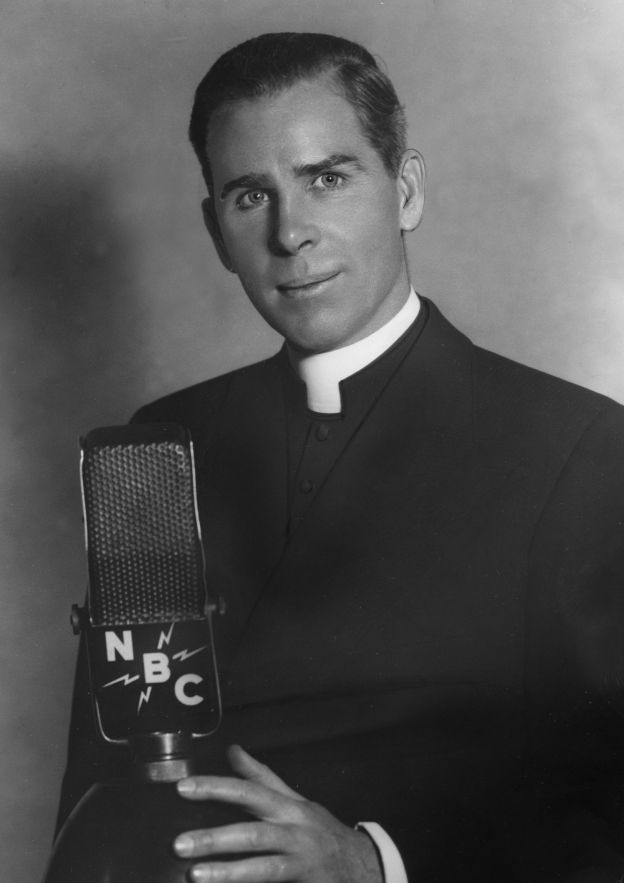
FEATURE image: Feature Image: Newly-Blessed Fulton J. Sheen posing for an official promotional portrait for the wildly popular NBC radio program, The Catholic Hour, which he hosted on Sunday nights. He launched the show with NBC in 1930, where his voice reached millions of households across the America each week, establishing him as America’s first true “media priest.” During his 20-year run on the radio Fulton Sheen pioneered a distinct blend of deep theology, patriotism, and sharp cultural commentary. For example, in the midst of the Great Depression (1929-1941) Sheen frequently attacked the moral failures of unbridled greed and monopoly capitalism, while simultaneously warning the poor not to fall for the “siren song” of class warfare. He consistently hosted sociology and labor experts on the program to advocate for worker rights, fair wages, and interracial justice, declaring that all people “have equal rights as children in the house of the Lord.” Public Domain. Fulton Sheen’s Beatification Illuminates His Message – WSJ – retrieved September 24, 2026.
How Fulton J. Sheen’s Irish-American family heritage, Catholic education, intellectual gifts, academic accomplishments, and disciplined spiritual life combined to form the future priest, bishop, evangelist, and eventual Blessed of the Catholic Church.
On September 24, 2026, the Catholic Church officially beatified Bishop Fulton J. Sheen during a historic ceremony in St. Louis, declaring him a Blessed of the Church. This milestone recognizes a lifetime of profound faith, intellectual brilliance, and pioneering media evangelization that began from immigrant Irish and Midwestern roots.
Family Roots and Early Life
Blessed Bishop Fulton J. Sheen (1895–1979), known for his perfect Catholic school penmanship, rarely made mistakes during his live, unscripted broadcasts. Born into an everyday working-class background in El Paso, Illinois, near Peoria, he was the eldest of four sons of Newton and Delia Sheen, both of Irish descent. Delia (1864–1943) grew up on a farm near Kickapoo in Peoria County, and Newton (1863–1944) was born in El Paso. Bishop Sheen’s maternal grandparents were born in Ireland; his paternal grandfather was from Dublin, Ireland, and his grandmother from Indiana.
Relatives remembered Delia—“Aunt Dee”—as laid back, cordial, sociable, and an excellent cook. Newton, short and slim, was generally quiet with a mechanical bent of mind. Newt first married Ida, a woman from Ohio, in 1886; she died in 1892, leaving him with a daughter (Eva Sheen married Luke Walsh in 1907). Afterward he married Delia, and the couple settled in El Paso, where Newton and his brother opened a hardware store. In 1900, while operating two farms on each side of Peoria, the family moved to 111 Seventh Street in Peoria, where Newt, Delia, their four sons, and Delia’s parents lived together. Fulton inherited his mother’s dark hair and deep-set eyes. The family moved from the farm directly into the city of Peoria for the express purpose that Fulton and his brothers could enroll in school.
Sheen’s holiness, intellectual achievement, disciplined spiritual life, and groundbreaking use of mass media were all deeply rooted in the formative influences of his family, education, and early experiences in Peoria.
Formative Education in Peoria
His parents prioritized their children’s education, enrolling Fulton in St. Mary’s Cathedral grade school and later the elite $60,000 Spalding Institute boys’ academy founded in 1899 by Peoria’s first bishop. There, Sheen not only served as an altar boy and discovered his priestly vocation but, in his class of 43 aspiring boys, graduated as the valedictorian of the class of 1913. His time there was highly influential, formed by the rigorous discipline of the Marianist brothers (not to be confused with the Marist Brothers), a French order founded in Bordeaux in 1817 by Blessed William Joseph Chaminade who staffed the school (Brother Gerald, S.M. was its first principal) from its founding until 1933 when the Benedictines took over (those were the days when they had the numbers to do that!).
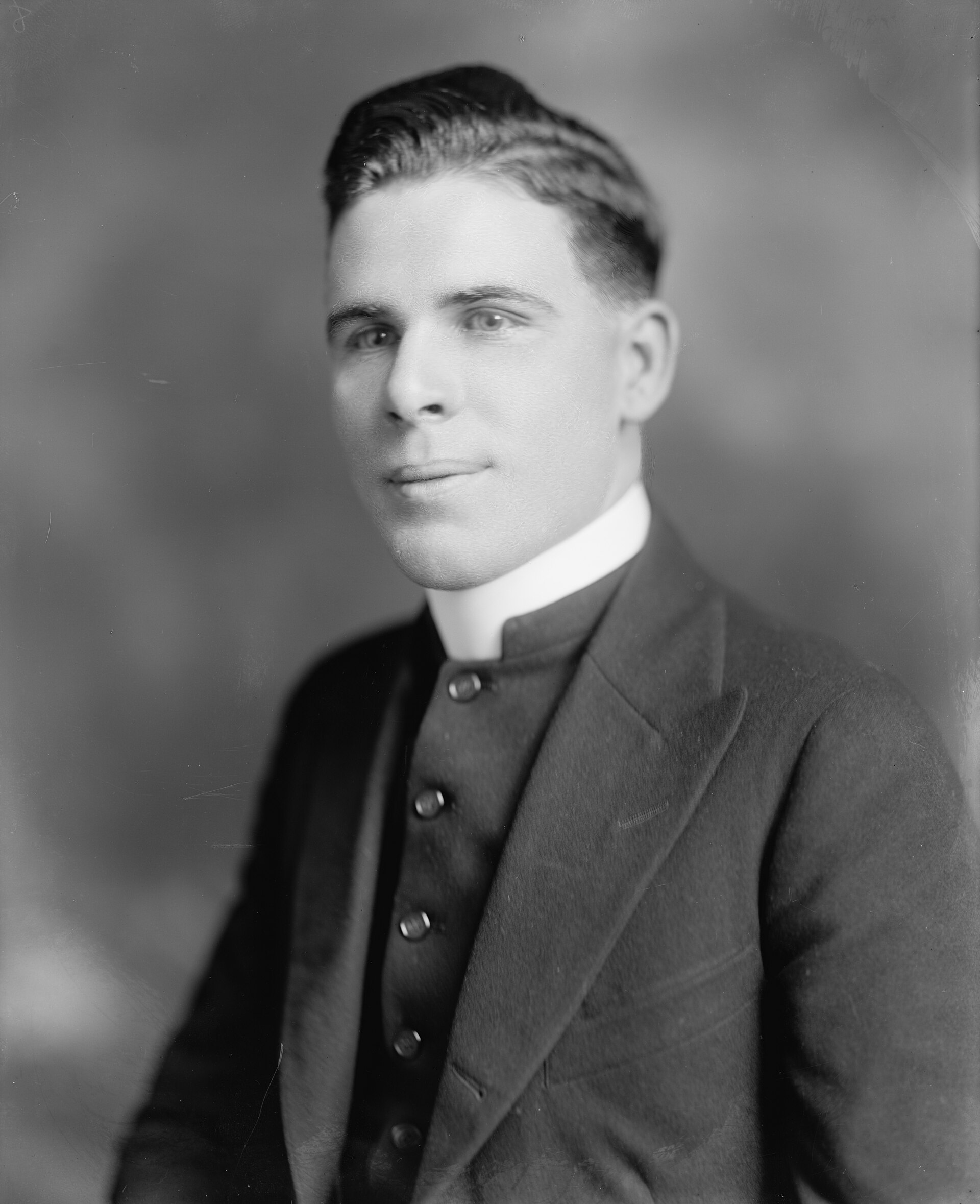
Fulton J. Sheen’s high school graduation portrait from 1913. He was 18 years old having just concluded his time at the Spalding Institute in Peoria, Illinois. It was for this exact graduation milestone that he earned top academic honors and delivered the commencement address as the class valedictorian. A classmate recalled that at 18, Sheen possessed a terrifyingly good memory and a “golden tongue” that kept the entire auditorium pinned to their seats. Core themes of Sheen’s address included moral integrity over intellect, devotion to the truth, and a call to action as the vocation of the educated Christian man. Public Domain.
Higher Education, Debating, and Ordination
Fulton Sheen entered St. Viator College in Bourbonnais, Illinois, where he earned a combined B.A./M.A. in philosophy in 1917. Sheen was a star debater at the school, leading St. Viator to a legendary triumph over the University of Notre Dame, showing the golden dome fellows that the real fighting Irish lay everywhere (though that is a slightly later moniker under Knute Rockne and Notre Dame President Father Matthew Walsh). After college, Sheen entered the seminary in Minnesota and was ordained a priest in September 1919 at St. Mary’s Cathedral, where he had gone to grade school and served as an acolyte.
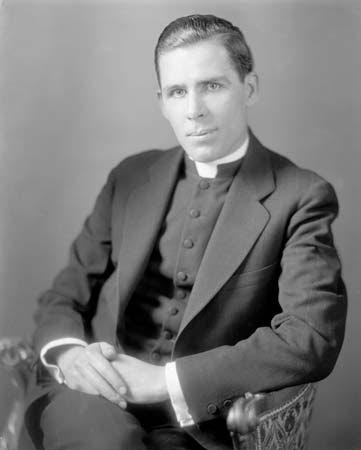
Fulton Sheen’s official ordination portrait taken in September 1919.He was 24 years old and had just been ordained a Roman Catholic priest on September 20, 1919, at St. Mary’s Cathedral in Peoria, Illinois. As a priest he made two resolutions that he kept for the rest of his life: He resolved to offer the Holy Eucharist every Saturday in honor of the Blessed Virgin Mary to petition her lifelong protection over his priesthood. He noted that according to the Epistle to the Hebrews, a priest must offer sacrifices not just for his congregation, but for his own soul. He also resolved to spend one continuous, uninterrupted hour every single day in prayer and adoration directly in front of our Lord in the Blessed Sacrament (the Tabernacle). While the Saturday Masses anchored his weeks, the Daily Holy Hour became the defining spiritual signature of his life. Even when he became a massive television celebrity with an exhausting travel schedule, Blessed Bishop Sheen never broke the vow. PHOTO: Public Domain. https://www.loc.gov/pictures/item/2016860626/
Academic Brilliance and the “Peoria Product”
Sheen’s aspiration and capability led him to become a canon lawyer where he completed his studies at The Catholic University of America in 1920. The arguably not yet over-educated Sheen now earned a Ph.D. in philosophy from the Catholic University of Louvain in Belgium (where he became the first American to win their prestigious Cardinal Mercier Prize) as well as an S.T.D. (Sacrae Theologiae Doctor) at the Angelicum in Rome.
This man from an everyday Midwestern family’s first assignment was a parish priest at St. Patrick’s Catholic Church in Peoria, Illinois, in 1926. This was partly so that the church could show off their new product to the folks at home and to see how he plays in Peoria—a time of perfect joy for Sheen—though some narratives imply it as a mere test of his humility. The only thing humbled is the diocese itself, who closed St. Patrick’s in Sheen’s lifetime in 1976 for dwindling attendance for shattered perceptions of the Church, liturgical confusion, and an unintended loosening of strict church laws after Vatican II. see – Review: Why did so many Catholics leave after Vatican II? – America Magazine – retrieved September 25, 2026.
Young Rev. Sheen in a portrait taken around 1930 by Harris & Ewing Washington D.C. portrait studio. Rev. Sheen was approximately 35 years old. At the time Sheen was a young professor teaching philosophy at The Catholic University of America (CUA). This was the exact year Sheen launched into the national spotlight by becoming the first regular host of The Catholic Hour—a Sunday night NBC radio program that quickly grew to reach an estimated 4 million weekly listeners. Public Domain.
The Catholic University of America and National Fame
The Catholic University of America now called him to Washington to join their School of Theology, become a professor, launch his radio career, and begin his path to international fame and holiness. The first course Sheen regularly taught was “God and Religion in Contemporary Thought.” He taught at CUA until 1950, where his course offerings expanded as he transitioned into the School of Philosophy.
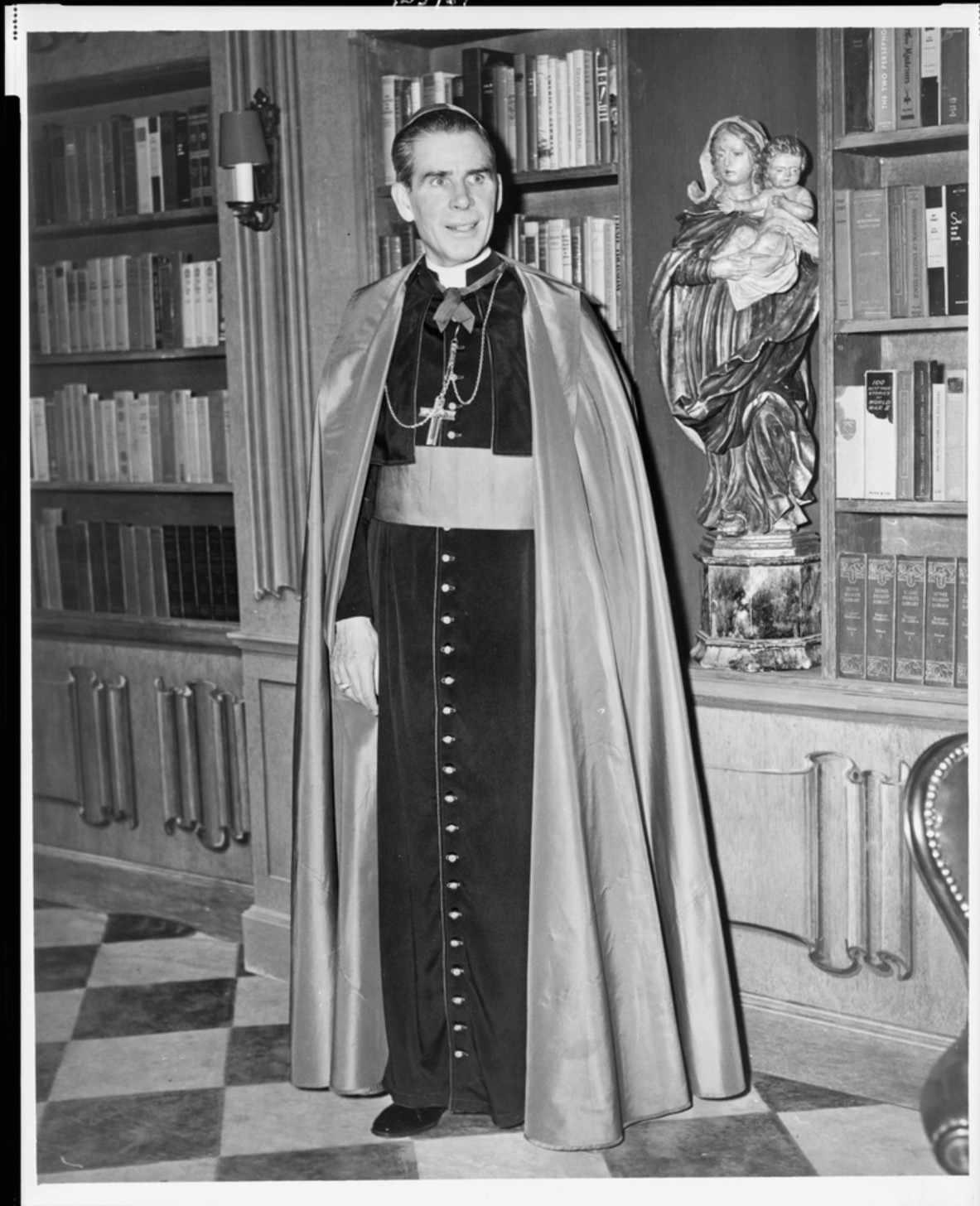
Consecrated as an auxiliary bishop of New York the previous year (1951), this photograph was taken in 1952 on the custom-designed library set of his groundbreaking, Emmy-winning television series, Life Is Worth Living. Dressed in his formal clerical attire—including his cassock, zucchetto, pectoral cross, and flowing structural ferraiolo cape—the image captures him at the absolute height of his national cultural influence. Airing on Tuesday nights on the DuMont Television Network, his unscripted, chalkboard-driven program surprisingly went head-to-head with “Mr. Television” Milton Berle, drawing up to 30 million weekly viewers of all faiths and backgrounds. PHOTO: “Bishop Fulton J. Sheen, full-length” by libraryofcongress is marked with CC0 1.0.
Blessed Bishop Fulton J. Sheen (1895–1979), known for his perfect Catholic school penmanship, rarely made mistakes during his live, unscripted broadcasts.
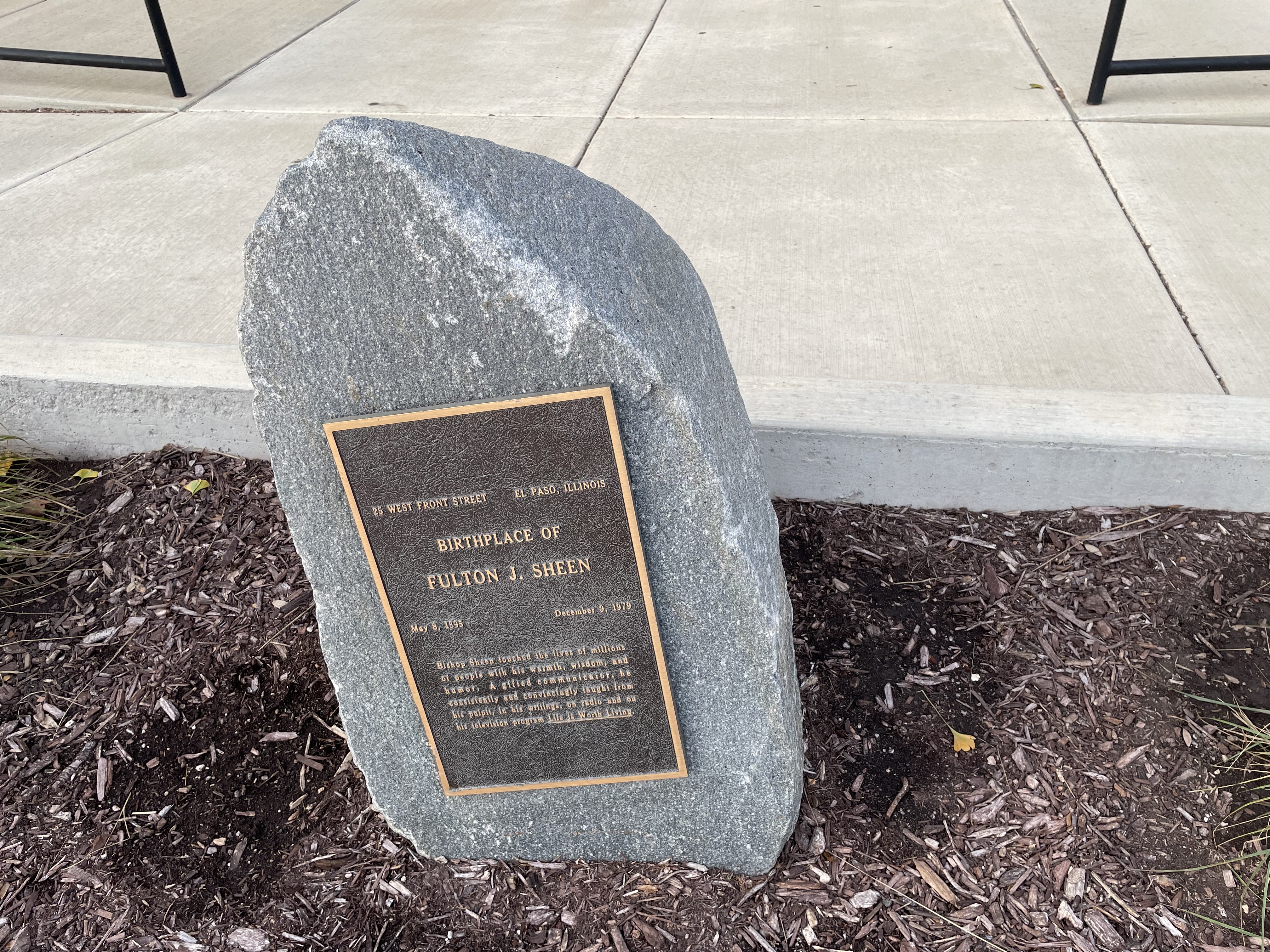
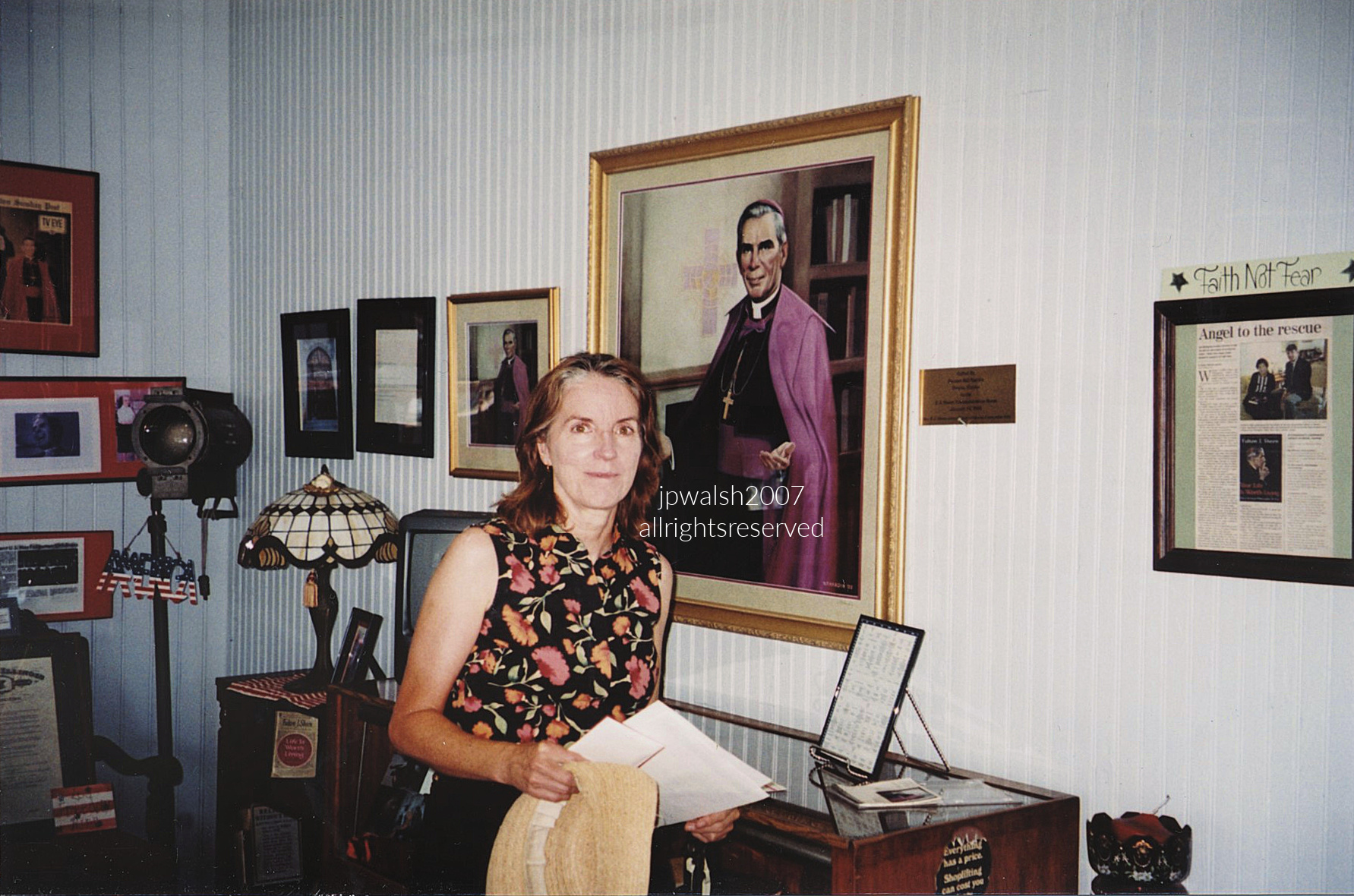
On a personal visit in August 2007 (my wife Deb is pictured) to the Archbishop Fulton John Sheen Spiritual Center and Communication Room, located inside the Historic Railroad Depot in his birthplace of El Paso, Illinois. The vintage studio spotlight on the left, old radios, and typewriter props in the room are deliberate design choices meant to recreate the atmosphere of Bishop Sheen’s pioneering mid-20th-century radio and Emmy-Award-winning television programs like The Catholic Hour and Life Is Worth Living. In October 2000, the museum founder first set up a modest Bishop Sheen exhibit in the “Reading Corner” of the newly restored historic depot. By July 2001 this dedicated, separate large, full-size room officially opened within the depot— the exact space in this photo. At his beatification Mass on September 24, 2026, the papal delegate and presider, Cardinal Luis Antonio Tagle, called Archbishop Fulton J. Sheen a “son of Illinois, son of the United States of America,” and “indeed, son of the world.” Author’s photograph.
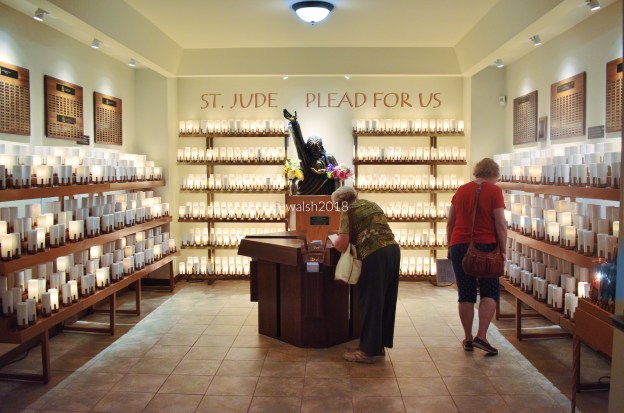
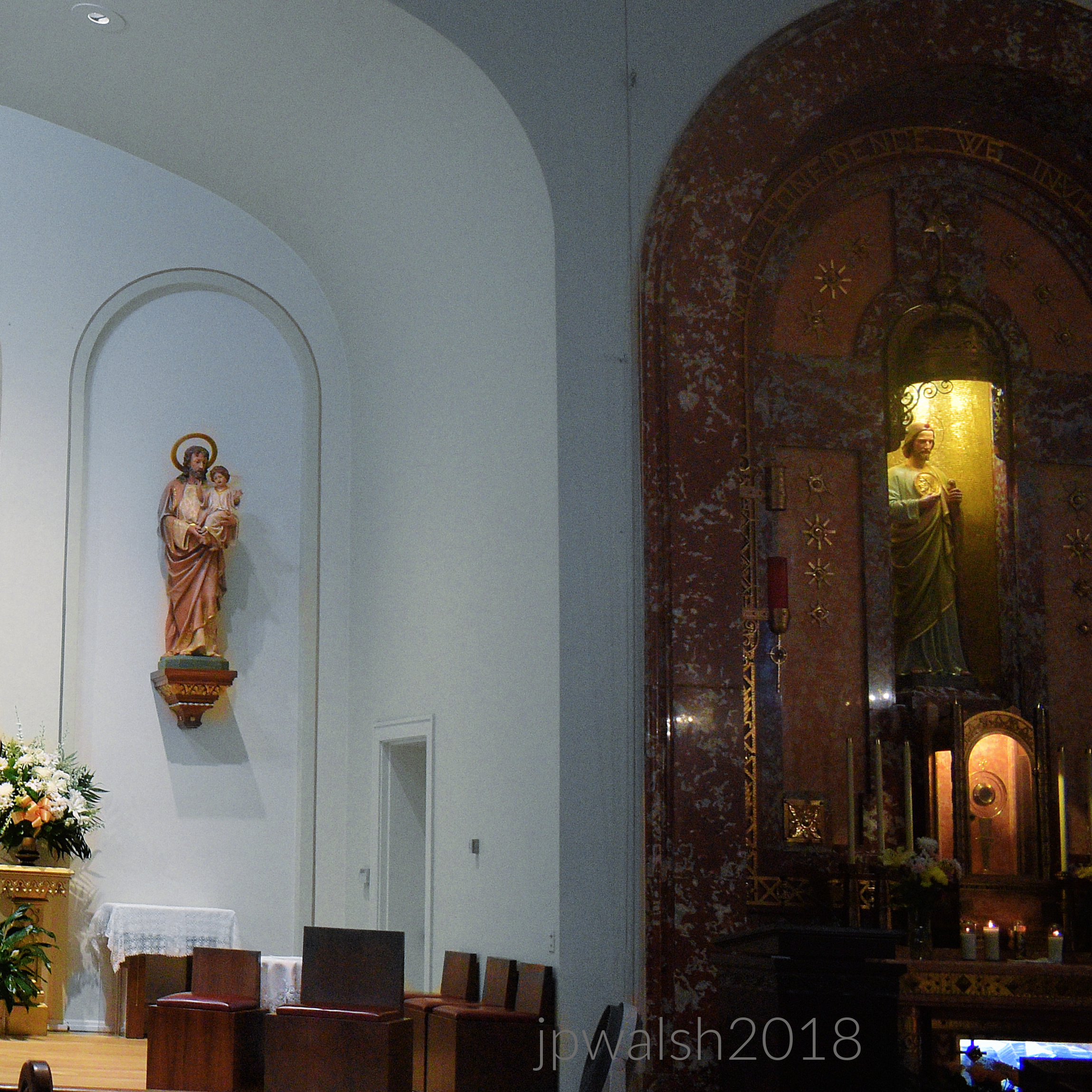
FEATURE Image: The many prayer intentions received at the National Shrine of St. Jude in Chicago are placed at the patron of hopeless cases’ devotional altar in the main sanctuary. These petitions are remembered at the National Shrine’s Masses and devotional prayers throughout the years. June 2018 80% 7.76mb DSC_9191. Author’s photograph.
Chicago’s National Shrine of St. Jude is more than a local religious landmark. It is a place where faith, devotion, and personal transformation intersect, most famously in the life of Danny Thomas, whose prayers to St. Jude here helped inspire a career that ultimately led to the founding of St. Jude Children’s Research Hospital. The shrine stands as a living testament to the powerful role that religious faith and pilgrimage can play in individual lives and broader humanitarian endeavors.
The National Shrine of St. Jude at 3208 E. 91st Street on Chicago’s far southeast side at Our Lady of Guadalupe parish church was canonically established in 1929. Its official decree was promulgated on November 15, 1929, by Chicago Cardinal Archbishop George Mundelein (1872-1939). June 2018 88% 7.72mb DSC_9173. Author’s photograph.
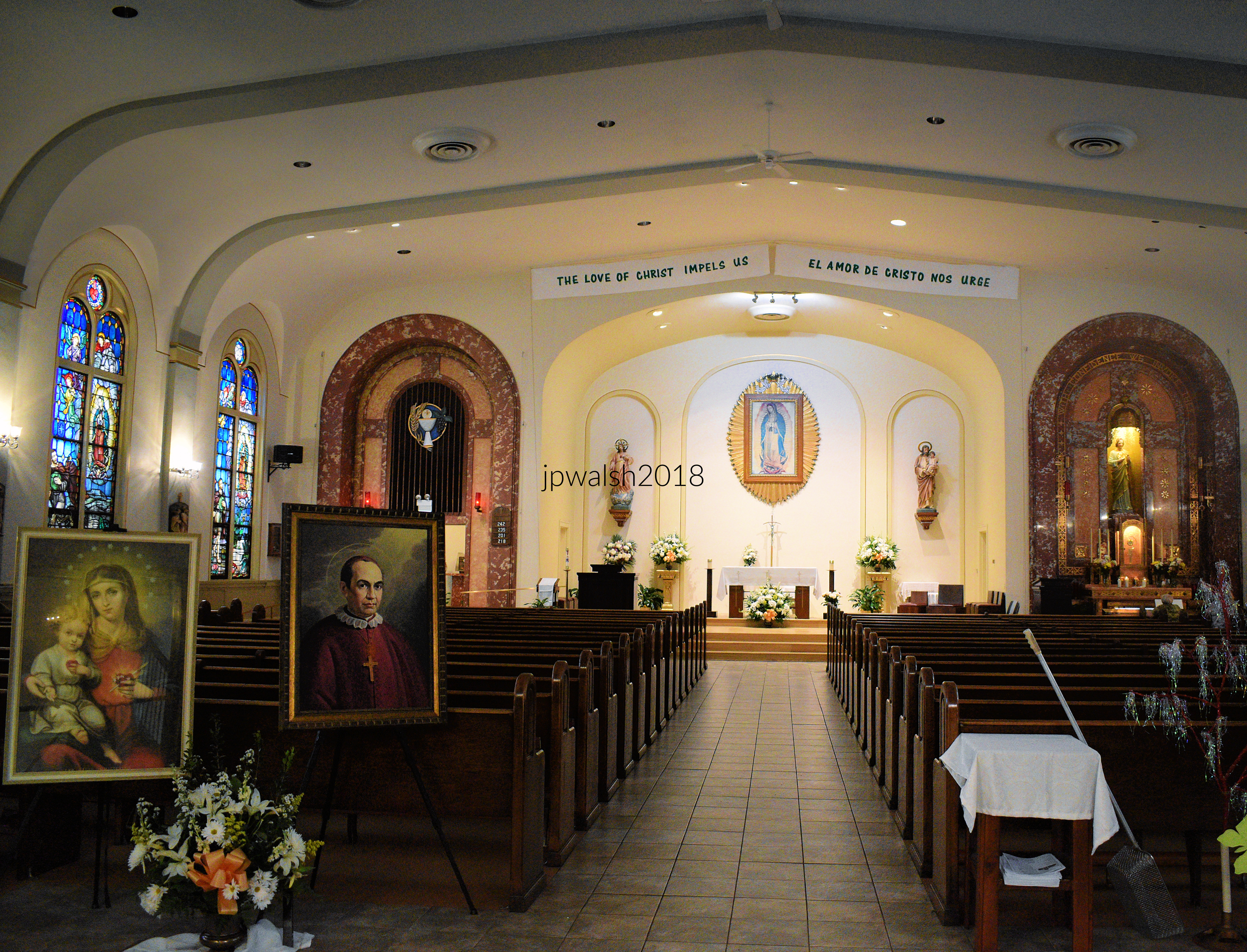
The pastor of the church at the time was Fr. James Tort, a Claretian missionary, who had a deep personal devotion to St. Jude, patron of hopeless cases and those that are almost despaired of. The saint, not to be confused with the traitor, Judas Iscariot, is honored by the church universally as the saint who brings visible and speedy help in most dire circumstances. A portrait of the founder of the Claretians, Spanish priest and bishop, St. Anthony Mary Claret (1807-1870), is one of the artworks that greet visitors into the main sanctuary. The image of Our Lady of Guadalupe is over the main altar. The devotional altar to St. Jude is right of the main altar. The altar to St. Jude contains a major relic of the saint: a piece of his bone. June 2018 84% 7.78 DSC_9177. Author’s photograph.
The shrine contains a major relic of St. Jude and serves as an active center of prayer and pilgrimage.
The shrine altar to St. Jude (right). In the darkest days of the Great Depression, Father Tort petitioned St. Jude with a request to help complete the parish church building for the people. In gratitude for the granting of this great favor. Fr. Tort promised to never cease to honor the saint, a true blood relative of Jesus and Mary, by dedicating a shrine altar to him in the church and to do all in his power to spread devotion to him. June 2018 2.29mb DSC_9186 (1). Author’s photograph.
This is one of the stained-glass windows in Chicago’s St. Jude Shrine. It depicts Jude preaching in Persia. Tradition holds that Saint Jude preached the Gospel in Judea, Samaria, Idumaea, Syria, Mesopotamia and Libya. He is also said to have visited Beirut. In addition to being patron of hopeless cases, Jude is patron of vegetarians. That Jude is portrayed holding an image of Jesus Christ has an interesting origin. During Jesus’s public ministry, a king had an incurable condition and was dying in Edessa. He sent a letter asking for Jesus to come. Instead of going himself, Jesus sent Jude. As Jude set out on this journey, Jesus pressed a cloth against His face, and when he gave it back to Jude, it had the Lord’s image on it. When St. Jude then went to the dying king in Edessa, and the king looked at the cloth with Christ’s miraculous impression, he was immediately healed. June 2018 6.47mbDSC_9184 (4). Author’s photograph.
Danny Thomas, struggling to establish himself in show business, learned of the shrine while in Chicago and prayed to St. Jude for assistance. Soon afterward, Thomas received the career opportunity that launched him to national fame as a comedian, television star, and entertainer.
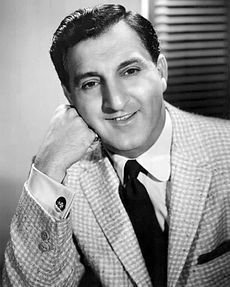
In 1940 when entertainer Danny Thomas (1912-1991) came to Chicago to do radio commercials, he found early success doing stand-up comedy in nightclubs. When work was finished, often around dawn, Thomas went to 6 a.m. Mass at St. Clement Church. There Thomas learned about Chicago’s National Shrine of St. Jude on the far southeast side. A couple of years earlier, Thomas, starting out in show business in Detroit— and with his first child, Marlo Thomas, on the way— had dedicated himself to St. Jude as the patron of hopeless cases. Soon after visiting and praying at the Chicago shrine, Thomas was offered a stand-up comedy job in New York City at La Martinique at 57 West 57th Street. This job launched his entertainment career into the big time. Following World War II, Thomas was performing for $3,750 a week at New York’s Roxy Theater just off Times Square and was performing in nightclubs across the country as well as offered film roles. In 1953 he starred in his own television show, Make Room for Daddy (later, The Danny Thomas Show). The sitcom ran for 11 consecutive seasons and became more popular with each year. By 1957 it was the no.2 show on television and, when the sitcom ended in 1964, it was in the top ten. PHOTO: “Danny thomas kayrouz” by Hany raymond rahme is licensed under CC BY-SA 4.0.
Remembering his promise to give back if he succeeded, Thomas founded St. Jude Children’s Research Hospital in Memphis in 1962, creating one of the world’s most respected pediatric medical institutions.
The National Shrine of St. Jude in Chicago was canonically established in 1929 and became one of the most important centers of devotion to St. Jude in the United States.
Altar of St. Jude, The National Shrine of St. Jude in Chicago. St. Jude Thaddeus was one of Jesus’ 12 apostles and. legend has it, that it was Jude who was the groom at the wedding feast of Cana where Jesus performed his first miracle of turning water into wine (John, chapter 2). Matthew states that Jude was one of the “brothers” of Jesus usually interpreted as a blood cousin. St. Jude, pray for us! June 2018 73% 7.89mb DSC_9182. Author’s photograph.
Derek Worlock was one of the most important ecumenical church leaders in modern Britain, whose lasting legacy was not simply his role as Roman Catholic Archbishop of Liverpool but his determined effort to bridge historic divisions between Catholics and Anglicans through friendship, collaboration, social engagement, and practical Christian unity.
Derek Worlock: Archbishop of Liverpool
Derek Worlock (February 4, 1920 – February 6, 1996) was an English priest of the Roman Catholic Church who served as Archbishop of Liverpool. A leading figure in post‑war British Catholicism, he became known for his pastoral warmth, public presence, and commitment to unity among Christians.
A Ministry Shaped by Collaboration
Worlock devoted his episcopal life to fostering cooperation across Christian traditions. His partnership with Anglican Bishop of Liverpool David Sheppard became one of the most celebrated ecumenical friendships in modern Britain. Together they co‑authored Better Together and With Hope in our Hearts (both 1995), works that embodied their shared vision for a reconciled, outward‑facing Church. His episcopal motto, Caritas Christi eluceat—“For the Shining Light of Christ”—captured the spirit of his ministry.
His partnership with Anglican Bishop David Sheppard became one of Britain’s most influential and visible examples of Christian cooperation. Their efforts sought to overcome centuries of Catholic-Anglican rivalry and demonstrate that reconciliation between churches could help foster reconciliation within society.
Bishop Worlock’s mitre, placed at his tomb, recalls a pivotal moment in his early episcopal ministry. In 1973, while serving as Bishop of Portsmouth, Worlock was preparing to attend the upcoming Roman Synod of Bishops. Asked to suggest a theme for the Synod’s work, he proposed “Evangelization”—a choice Pope Paul VI accepted.Worlock’s proposal did more than set the agenda for a major global gathering. It highlighted two convictions that shaped his entire episcopate:
that evangelization is rooted in the Church’s ancient mission shared by all the baptized, and
that the spirit of Vatican II’s outreach to others—its ecumenical openness, its desire for dialogue, its pastoral warmth—must animate that mission.
In 1994, Worlock received the Freedom of the City of Liverpool, a civic acknowledgment of his decades of service to the city. Two years later, in 1996, he was appointed a Companion of Honour, one of the United Kingdom’s most distinguished awards.
A Memorial on Hope Street
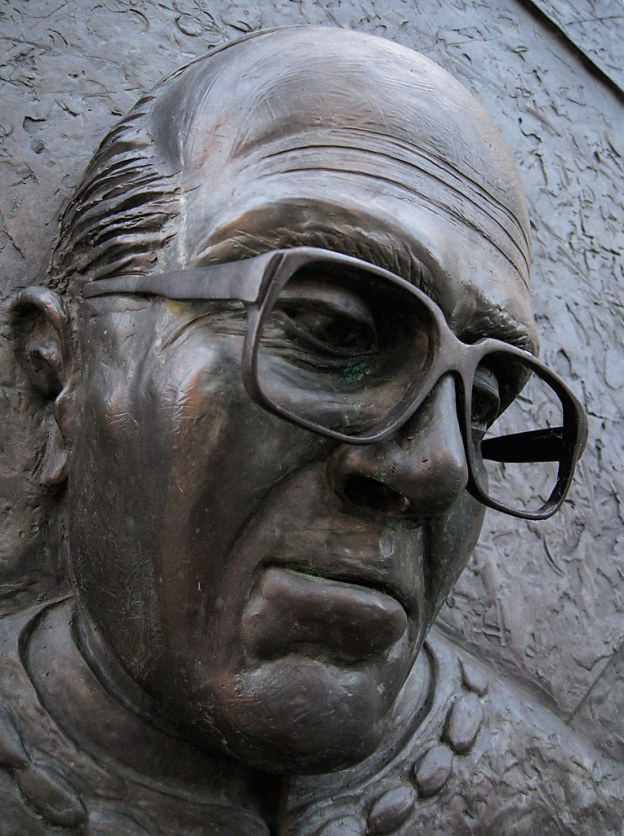
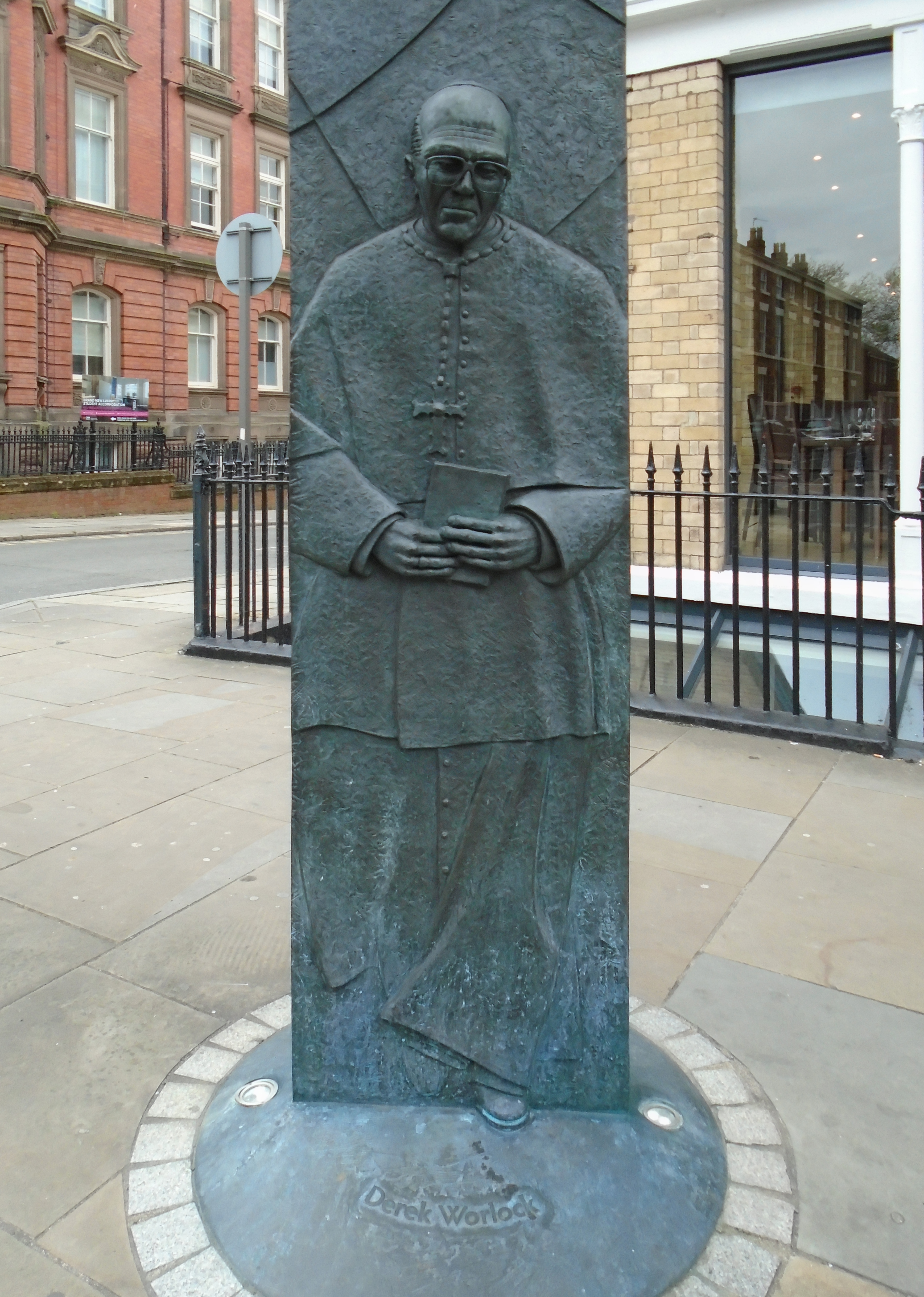
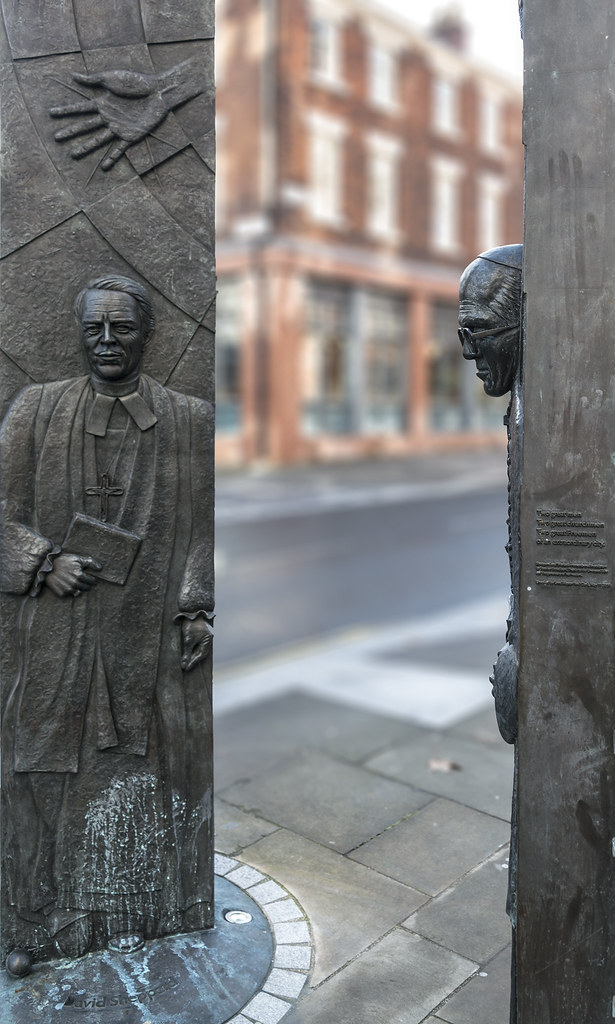
After his death in 1996, plans began for a public memorial. Commissioned in 2005 and funded through widespread public donations, the sculpture was created by British artist Stephen Broadbent (b. 1961). Placed at the midpoint of Liverpool’s Hope Street, the memorial stands symbolically between the city’s Anglican and Roman Catholic cathedrals—an architectural embodiment of the unity Worlock championed throughout his life.See it here: https://www.flickr.com/photos/newfolder/2535308455
Worlock and Sheppard worked together through joint pastoral letters, civic leadership, public appearances, and shared responses to social crises, giving Liverpool a united Christian voice. The Hope Street memorial sculpture symbolizes their shared ministry, standing midway between Liverpool’s Anglican and Catholic cathedrals.
David Sheppard and Derek Worlock memorial, Hope Street, Liverpool.The placement is deliberate: halfway between the two cathedrals, exactly where their work met with space between them for everyone. PHOTO: “DSCF0029” by geraldmurphyx is licensed under CC BY-ND 2.0.
A Shared Mission of Reconciliation
The statue commemorates the extraordinary partnership between Archbishop Derek Worlock and Bishop David Sheppard, two churchmen who refused to let centuries of division define Liverpool’s Christian life. At a time when Catholic–Anglican relations still could be frosty and suspicious, they pointed to a a different path of public friendship, joint action, and a united moral voice for their city.
Their collaboration was not symbolic but deeply practical. They issued joint pastoral letters, appeared together at civic events, and spoke with one voice during moments of crisis. In a city marked by economic hardship, sectarian memory, and social fragmentation, they insisted that Christian leadership must be shared leadership. Their partnership became a model for ecumenical cooperation across Britain.
Healing Historic Divisions
Worlock and Sheppard understood that Liverpool’s religious landscape had long been shaped by rivalry—Catholic and Anglican identities often hardened by class, migration, and political history. Their work aimed to soften those boundaries. They promoted joint prayer services, encouraged cooperation between parishes, and supported community initiatives that crossed denominational lines.
Their message was simple but radical: unity was not an optional ideal but a pastoral necessity. They believed that reconciliation between churches could help foster reconciliation within the city itself.
A Memorial to Unity
The statue’s purpose was to create a permanent reminder of this shared ministry. It honors not only two individual leaders but the ecumenical vision they embodied. Positioned on Liverpool’s Hope Street—linking the Anglican Cathedral at one end and the Catholic Cathedral at the other—the memorial stands as a physical metaphor for the bridge they built.
Above: Archbishop Derek Worlock London‑born Derek Worlock was ordained a Catholic priest in 1944 and began his ministry as curate at Our Lady of Victories, Kensington, then London’s wartime pro‑cathedral. For nearly two decades he served at the heart of English Catholic leadership as private secretary to three Archbishops of Westminster, a role that shaped his administrative skill and national profile. He later spent a year as Rector and Rural Dean of the Church of SS Mary and Michael—one of London’s historically largest parishes—before being appointed Bishop of Portsmouth, serving the English Channel region for eleven years. In 1976 he became Metropolitan Archbishop of Liverpool, the post that defined his public legacy. PHOTO: “File:Sheppard-Worlock Statue 2017-2.jpg” by Rodhullandemu is licensed under CC BY-SA 4.0.
Detail from the Sheppard-Worlock statue Liverpool. Anglican Bishop David Sheppard was Worlock’s closest ecumenical partner and the other half of Liverpool’s most influential Christian alliance. Before Derek Worlock’s appointment as Roman Catholic Archbishop of Liverpool in 1976, the Anglican archbishop of Liverpool, David Sheppard, was consulted over a meal together with Pope Paul VI’s Papal Nuncio in Britain, Archbishop Bruno Heim. Before he became one of Liverpool’s most respected church leaders, David Sheppard was a national sporting hero—a stylish right‑handed batsman whose cricketing career made him a household name across Britain. His cricketing fame gave him a public platform long before he entered the clergy, and he later used that visibility to speak on issues of poverty, racial justice, and urban renewal. Public Domain (Man vyi – Self-photographed. Own work, all rights released).
The ecclesiastical Coat of Arms of Archbishop Derek Worlock, Metropolitan Archbishop of Liverpool. The green galero with fifteen tassels and the golden double-barred cross denote his rank as an archbishop. The shield combines the pallium and Lancaster Rose of Lancashire with a fleur-de-lis and blazing sunburst. The scroll below bears his motto, + CARITAS + CHRISTI + ELUCEAT + (“May the love of Christ shine forth”), expressing the pastoral vision that guided his ministry. PHOTO: “Uk rc liverpool worlock” by EborArmorist is licensed under CC BY 3.0.
Influenced by the reforms of Vatican II, Derek Worlock viewed Christian unity as a pastoral duty rather than an abstract theological goal.
This striking bronze monument honors the powerful ecumenical alliance between Bishop David Sheppard (left) and Archbishop Derek Worlock (right), whose joint leadership provided comfort and unity to Liverpool during severe social and economic hardships in the late 20th century. Designed by sculptor Stephen Broadbent and unveiled on Hope Street in 2008, the statue features two bronze panels facing each other across the sidewalk, symbolizing their historic partnership in building bridges across deep religious and political divides. PHOTO: “5783 Sheppard Worlock Statue” by steeljam is licensed under CC BY-NC-ND 2.0.
Worlock’s commitment to ecumenism predated his Liverpool years. As Bishop of Portsmouth, he developed practical approaches to interchurch cooperation, including the famous “Portsmouth solution” involving a Catholic-Anglican marriage.
Worlock’s Early Ecumenical Leadership
Archbishop Derek Worlock served as bishop and archbishop from 1965 to 1996—years that spanned the close of the Second Vatican Council and the unfolding of its new teaching on ecumenism. From the beginning of his episcopal ministry, he treated the Council’s call to Christian unity not as an abstract ideal but as a pastoral responsibility.
The Portsmouth Years: Learning to Live Together in Love
As Bishop of Portsmouth, Worlock was already experimenting with practical ways for Catholics and Anglicans to share life, sacraments, and community with greater charity. His most famous initiative, later nicknamed the “Portsmouth solution,” emerged in the early 1970s when the daughter of a local Anglican bishop wished to marry a Catholic.Worlock crafted a pastoral compromise that honored both traditions:
The marriage rite and promises were celebrated first in the Catholic church, fulfilling canonical requirements.
Later that same day, the couple’s marriage was celebrated again in the bride’s Anglican parish, with her father—the Anglican bishop—presiding.
This arrangement was bold for its time. It respected Catholic sacramental discipline while acknowledging the Anglican family’s pastoral and emotional needs. More importantly, it modeled the kind of mutual recognition, goodwill, and shared joy that Worlock believed should characterize Christian life.
Worlock played a significant role in broader Church leadership, supporting evangelization, lay participation, justice, peace initiatives, and advocacy for the poor and homeless.
A Foreshadowing of His Liverpool Partnership
The Portsmouth solution was not an isolated gesture but an early sign of the ecumenical instincts that would later define his partnership with David Sheppard in Liverpool. It showed Worlock’s willingness to take risks, to trust the good faith of other Christians, and to build unity through concrete acts rather than theoretical statements.
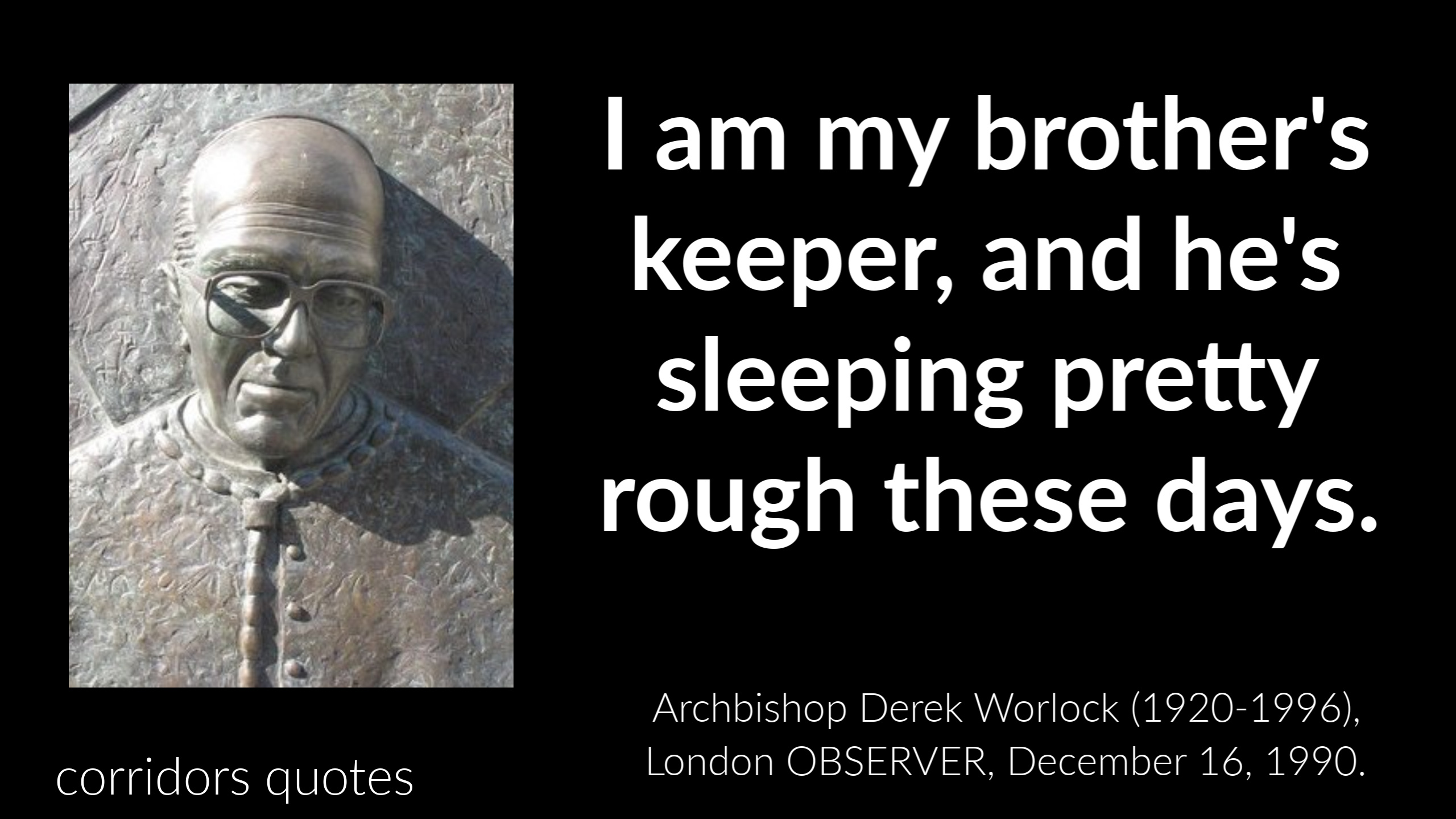
The precise source for this quote is an interview published in the London Observer newspaper on December 16, 1990. In the article, Archbishop Derek Worlock used this poignant phrasing to address the growing homelessness and poverty crisis in the United Kingdom during the winter of 1990. He directly reframed the biblical “brother’s keeper” concept to highlight the urgent moral duty society has toward marginalized individuals struggling with homelessness (“sleeping rough”). This sentence distills the core of his ministry: the conviction that Christian leadership must be measured by its solidarity with the most vulnerable.
Building bridges across historic divisions
Archbishop Worlock’s mitre, resting at his tomb, evokes a churchman whose influence extended far beyond Liverpool. Over more than three decades as bishop and archbishop, he became a driving force within the episcopal conference, shaping how the Catholic Church in Britain engaged with the modern world.
He helped lead national initiatives on the media, the laity, and justice and peace, urging the Church to speak with clarity, courage, and compassion. His advocacy for the poor was especially memorable. When drawing attention to Britain’s growing homelessness crisis, he captured the moral urgency in a single, searing line: “I am my brother’s keeper, and he’s sleeping pretty rough these days.” London OBSERVER, December 16, 1990. (on the homeless).
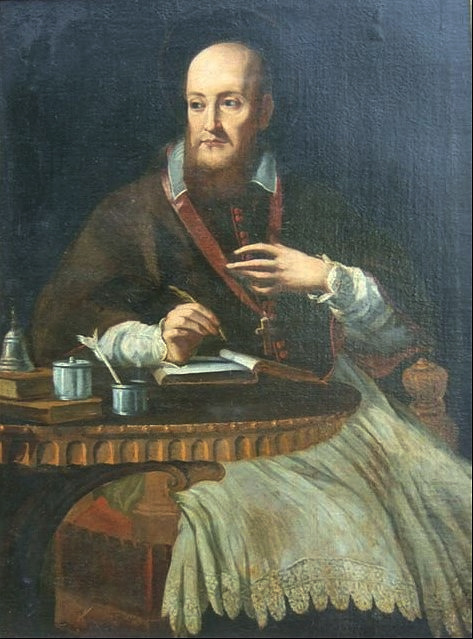
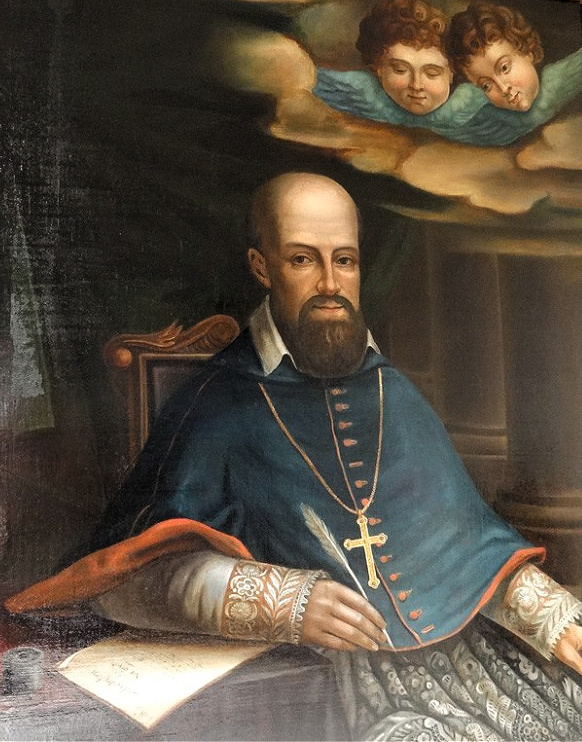
FEATURE Image: St. Francis de Sales, 18th c, Besançon, 96 x 131 cm. Public Domain.
St. Francis de Sales stands as one of Christianity’s most practical and accessible spiritual teachers because he showed that holiness is attainable in ordinary daily life through love, gentleness, humility, perseverance, and faithful acceptance of God’s will. His enduring importance lies not only in his role as Bishop of Geneva and founder of the Visitation Order, but in his ability to translate Catholic doctrine into practical spiritual guidance for everyday people.
Saint Francis de Sales sitting in front of a copy of his work, “Introduction to the Devout Life,” oil on canvas, c.1790s, 77 cm x 99.5 cm, unknown artist. Hovering above the 17th century French Catholic bishop, saint, and Doctor of the Church are two cherubs who regard him with kindness. Public Domain. Francis de Sales became one of the most respected theologians in Christianity. A great preacher and writer, Francis de Sales ascended the seat of Bishop of Geneva, Switzerland, and, with widowed Baroness Jeanne de Chantal (1571-1641), founded the religious order of the Visitation. As a diplomat and man of prayer, Francis de Sales exerted a significant influence within the Catholic Church and among the temporal powers of the day. https://www.antiques-delaval.com/en/paintings/7068-hst-large-portrait-saint-francois-dirty-life-devote-cherubs-xviiieme.html -retrieved January 24, 2023. Public Domain.
CANONIZED ON APRIL 8, 1665, IN ROME BY POPE ALEXANDER VII, ST. FRANCIS DE SALES IS THE PATRON OF WRITERS, JOURNALISTS, THE CATHOLIC PRESS, CONFESSORS, THE DEAF AND EDUCATORS. ST. FRANCIS WAS DECLARED A DOCTOR OF THE CHURCH IN 1877 BY PIUS IX.
INTRODUCTION.
By all accounts, St. Francis de Sales (1567-1622), whose feast day is January 24, was a gracious and holy man. His writings were, similar to the Jesuits of whom Francis was a student, admirer and close friend, directed to society’s well-to-do and concerned with how, as society’s current elites, they can practice, most basically, Christian “noblesse oblige” within their privileged social station. St. Francis de Sales’ writing defended and explained Catholic doctrine to a Europe which, in an age of Renaissance and Reformation, was very much in revolt against it. To preserve and endorse (1) a social order and (2) perfect belief in doctrine, St. Francis de Sales communicated in everything that both were attainable simultaneously, and did so famously in his book, Introduction to the Devout Life (1608).
Like the sons of St. Ignatius of Loyola, St. Francis de Sales was active in the direction of souls. For Introduction to the Devout Life, Jesuit father Jean Fourier, S.J. strongly encouraged a noble lady around 1607 to prevail upon her local bishop (de Sales) to have his personal writings of spiritual direction to her and others printed to reach a wider audience at court and elsewhere among the ruling class. St. Francis de Sales was also eager to have his personal instructions in print for the advancement and perfection of individual souls. Introduction to the Devout Life became an instant international bestseller and, over 400 years later, remains a spiritual classic. As John K. Ryan, S.J. observed, “Its greatness lies in many things: in its originality, its completeness, its sincerity, its balance, its penetration and its style…(and) as such it is beyond adverse criticism in any important way.”1
His spiritual classic, Introduction to the Devout Life (1608), taught that holiness is not reserved for priests or religious but can be pursued by people living ordinary lives in the world. His writings emphasized gentleness over harshness, love over fear, and steady spiritual growth rather than dramatic religious experiences.
Francis Bonaventure was born into nobility in August 1567 in Sales castle in Savoy, France, where there were tremendous social pressures to marry and settle into a life of wealth and prestige. Sent to Paris by his family, they wanted him to attend the prestigious College of Navarre in the fine hôtel de Navarre with its renowned library in rue Saint André des Arts, but Francis chose to attend the new Jesuit College of Clermont, which at that time was known for its religious and moral vision as much as its academic achievement.2 At the Jesuit school St. Francis de Sales came into contact with the post-Tridentine humanism taught by faculty such as Father Possevin, S.J. and Francis took to it like a duck to water so that he could express its intellectual tenets afterwards quite well.3 St. Francis de Sales worked out his spiritual life in prayer in Saint-Étienne-des-Grès in the Latin Quarter. The church (now demolished) on Rue Saint-Jacques was the center for Christianity among students. Another saintly Frenchman who later frequented Saint-Étienne-des-Grès was St. Vincent de Paul (1581-1660). Francis de Sales as a college-age layman was finding he had serious religious scruples and temptations to lust.4 it was in Saint-Étienne-des-Grès that St. Francis de Sales ultimately took a personal vow of chastity before a statue of the Virgin Mary which allowed him to pursue his spiritual desires.
After studying for five more years at the University of Padua, St. Francis de Sales emerged in 1591 with the equivalent of a J.D.- Ph.D. and was ordained a priest in 1593. In those years the young nobleman was surrounded by the Renaissance writings of philosophers and poets such as Marsiglio Ficino (1433-1499), Giovanni della Casa (1503-1556) and contemporary French theologian Pierre Charron (1541-1603).5 Now in his mid-20’s Francis was given by his bishop the nearly impossible task to reconvert John Calvin’s citizens of Geneva to Catholicism. Needless to say, Francis’s efforts failed. In fact, the Wars of Religion (1562-1598) were in full swing and made for impassioned attitudes on all sides and complicated factors in politics. An individual, Protestant or Catholic, had to practice their faith in a fragmented society.6
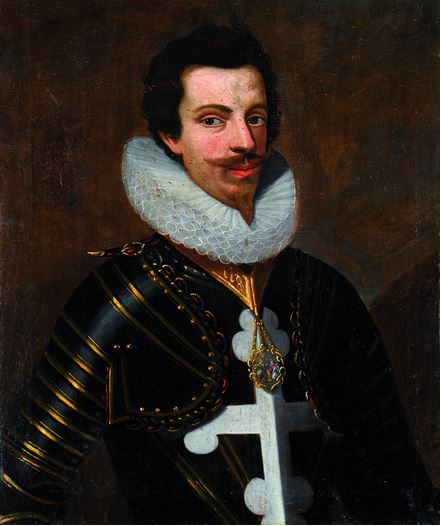
In 1602 St. Francis de Sales was sent to Paris to negotiate the condition of Catholics in reconverted territories in France. As a diplomat St. Francis de Sales was smooth – peaceful, positive, charitable and temperate in his words and persona. At meetings taking place at the court of French King Henry IV ( (1553-1610), St. Francis de Sales met some of the great figures of the religious and mystical revival occurring in France including Henri, Duc de Joyeuse (1563–1608), a General commander in the Wars of Religion and member of the Catholic League who became a Capuchin Franciscan after the death of his wife, Catherine de La Valette; Pierre de Bérulle (1575-1629), one of the most important mystics of 17th century France and, later, a Catholic cardinal; and Madame Acarie (1566-1618), mother of seven children, and foundress and lay sister of the Discalced Carmelites in France. She was perhaps the most widely respected religious person in Paris and certainly the go-to contact for the wealthy whenever they desired to help the poor because she made sure their alms got to the poor and not the professional charitable class. St. Francis de Sales, a respected theologian, also influenced the temporal powers – the dukes of Savoy, Charles Emmanuel I (1562-1630) and Victor Amadeus I (1587-1637), the regent of Savoy Christine de France and kings Henry IV and Louis XIII of France.
Charles Emmanuel I. Duke of Savoy (1562-1630) by Jan Kraeck. Public Domain.
Victor Amadeus I (1587-1637), artist unknown. Public Domain.
St. Francis de Sales (1567-1622) became one of the most respected Catholic theologians, writers, preachers, and spiritual directors of the Counter-Reformation era.
In July 1602 following the death of Bishop Grenier, St. Francis de Sales became Bishop of Geneva. Francis de Sales traveled ceaselessly around the diocese and beyond, preaching and hearing confessions, and the people quickly realized they had a holy bishop. It was by way of one of his penitents, St. Jeanne-Françoise de Chantal (1572-1641), that St. Francis de Sales worked his vision of the foundation of a new order, the Visitation, whose charism was to serve the sick and the poor with “the charity and gentleness of Jesus Christ.”7
St. Francis de Sales with Sisters of the Visitation, Francisco Bayeu y Subias (1734-1795), c. 1760, oil on canvas, 56 x 34 cm, Prado, Madrid, Spain. The 18th century painting, once in the Royal Collection, is today housed in a regional art museum in Salamanca. Public Domain.It was by way of one of his penitents, St. Jeanne-Françoise de Chantal (1572-1641), that St. Francis de Sales worked his vision of the foundation of a new order, the Visitation, whose charism was to serve the sick and the poor with “the charity and gentleness of Jesus Christ.” https://www.museodelprado.es/coleccion/obra-de-arte/san-francisco-de-sales/540cb0b9-ca15-4c43-b011-d2d71f7c5820?searchMeta=san%20francis – retrieved January 24, 2023. Francisco Bayeu y Subías (1734-1795) is one of the leading of Spanish late Baroque painters using quick and fluid touches and vivid and exquisite colors though later assuming neoclassicism with formal, sometimes cold, pictures based rigorous observation of nature. Bayeu, born in Zaragoza, trained there in the workshop of Danish painter Juan Andrés Merklein (1716-1797) and in the drawing classes of José Luzán Martínez (1710-1785). In 1758 at 24 years old he obtained a two-year scholarship to the Academy of San Fernando in Madrid, but left two months later because of disputes with the professor Antonio González Velázquez (1723–1793). Bayeu returned to Zaragoza and painted several commissions for churches and convents. In 1762 he was helping German painter Anton Raphael Mengs (1728-1779) in the decoration of the Palacio Nuevo. Thanks to Mengs’ influence, Bayeu started his decorative collaborative undertakings that earned him the appointment of court painter in 1767. He worked mainly as a fresco painter. In addition to his courtly commissions, he did church commissions such as of the vaults of the Holy Chapel of the Basilica of Nuestra Señora del Pilar completed in 1776. He painted 11 scenes for the the cloister of the Cathedral of Toledo between 1776 and 1787. He was then entrusted with the decoration of the royal chapel in the Palace of Aranjuez. After Mengs’s departure in 1777 for Rome, Francesco Bayeu assumed all Mengs’ duties as first painter, though not obtaining the appointment. Like other Spanish artists he worked developing cartoons for Real Fábrica de Tapices de Santa Bárbara (Royal tapestry Factory). Bayeu supervised the work of a talented newcomer, Francisco Goya (1746- 1828) who was Bayeu’s brother-in-law since 1773. In 1785 Charles III entrusted Bayeu and Mariano Salvador Maella Pérez (1739 –1819) with the restoration of the paintings in the royal collections. When he fell ill in 1786, Goya replaced Bayeu at the Academy of San Fernando, which Bayeu had been director of painting. Despite declining health from overwork, the commissions kept coming in. The Prince and Princess of Asturias hired Bayeu for the decoration of the dining room vault in the Palace of El Pardo. Bayeu returned to Zaragoza in 1788 until he was called again in 1791 to Aranjuez where he painted for the oratory of the Royal Palace and the vault of the King’s bedroom. This would be his last work when he died, in Madrid, in 1795. see – https://www.museodelprado.es/coleccion/artista/bayeu-y-subias-francisco/b218fee4-053b-4656-8577-9aa001ad1989 – retrieved January 24, 2025.
It was in this first decade of the 17th century amidst this flurry of evangelizing and other activity that the 40-something bishop wrote the Introduction to the Devout Life (1608). The book, written in short chapters with titles on topical challenges, problems, and opportunities in the Christian life in the world, provides its responses based on practical counsels. The Introduction to the Devout Life much as his later work, On Love of God, are very reliant on the Bible for its teaching and sprang directly from the bishops’ care of souls that he was doing actively and sacramentally from his diocese in southeastern France. Francis’s generous range of literary sources reflected his education in Renaissance humanism and included classical authors, Montaigne, contemporary poets as well as medieval saints and spiritual writers such as Sts. Anselm, Bonaventure and Bernard. Francis was also familiar with the writings and religious vision of the 16th century Spanish mystics and saints such as Teresa of Avila and Ignatius of Loyola.8
The exceedingly practical St. Vincent de Paul observed about St. Francis de Sales’ On the Love of God: “A truly admirable book, which has as many admirers of the sweetness of its author as it has readers. I have carefully arranged that it shall be read throughout our Society [the Vincentians], as the universal remedy for all feeble ones, the good of slothful ones, the stimulus of love, and the ladder of those who are tending to perfection. Oh! that all would study it as it deserves! There should be no one to escape its heat.”9
A recurring theme in his counsel is that Christians should focus on today’s duties, trust in divine providence, and avoid anxiety about the future. He taught that charity and love are the measure of all Christian action, giving value even to the smallest tasks when performed for God.
St. Francis de Sales by J. J. Owens. c. 1905, based on the Turin portrait. Public Domain.
St. Francis de Sales, now in his early 50s, visited Paris in 1618 where he preached sometimes twice each day. His great work was to show how ordinary daily life, particularly a busy and successful life, could be a path of holiness. No issue was too large or small for the saint to address – from parties, clothes, flirtations, daily life among marrieds – but all directed to the purpose of imitation of Christ and the love of God. St. Francis takes for granted one’s daily life in French society and proposes no maxim which involves any violent upheavals from it. Part of the saint’s genius is to see that there can be no dispute between the social order and the Christian life. At the same time, St. Francis is no easy teacher or grader – he asks that the Christian virtues be upheld and practiced. That insistence on Christian virtue informing one’s daily life is also the genius of his doctrine. While highly educated and imbued with the grace of mind of the Renaissance, St. Francis carried naturally within himself and conveyed the wisdom of the French soil of Savoy, its terroir. As Francis took one’s daily life in French society for granted, he took Catholic doctrine as if for granted. He then explained it with a highly cultivated mind and gracious spirit that expressed itself with a sweetness and gentleness of style that expounded it as “the universal remedy…the stimulus of love…the ladder …to perfection” as St. Vincent de Paul recognized to those with faith or not, or in trouble in day-to-day life.
St. Francis de Sales perhaps speaks to the 21st century most clearly by way of his theology that is presented without sentimentality or melodrama and is clearly explained and lived to be particularly possible and desirable. Francis said: “He who lives for God, frequently thinks of Him during all the occupations of life.”12
January 24 is the memorial feast day of St. Francis de Sales on the General Roman Calendar of 1969. St. Francis de Sales is the patron of writers, journalists, the Catholic press, confessors, the deaf and educators. He was proclaimed a saint and doctor of the Catholic Church. The following quotes are taken from his many published works of spiritual edification, counsel, exhortation, and solace.
Canonized in 1665 and declared a Doctor of the Church in 1877, St. Frances De Sales remains the patron saint of writers, journalists, educators, confessors, and the Catholic press.
NOTES:
Introduction to the Devout Life, St. Francis de Sales, trans. and edited by John K. Ryan, Image books (Doubleday) Garden City New York, 1955, p.11.
Francis de Sales and Jane de Chantal: Letters of Spiritual Direction, trans. by Péronne Marie Thibert, V.H.M. and selected and introduced by Wendy M. Wright and Joseph F. Power, O.S.F.S. Paulist Press New York, 1988 p.19.
CF. Elisabeth Stopp, “St. Francis de Sales at Clermont College,” in Salesian Studies, 6 (Winter 1969). pp. 42-43.
Wright & Power, p. 20.
Wright & Power, p. 22.
The Saints: A Concise Biographical Dictionary, edited by John Coulson, Guild Press, New York, 1957, p. 305.
Maxims and counsels of St. Francis de Sales for every day in the year, Ella McMahon, M.H. Gill & Son, Dublin, 1884, p. 12.
QUOTATIONS.
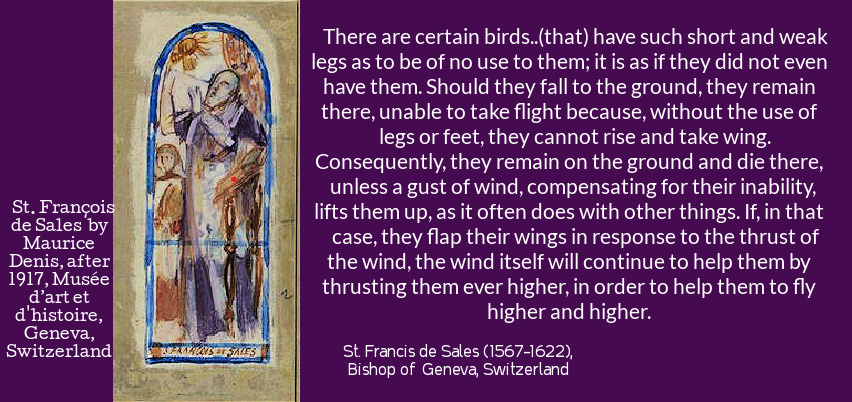
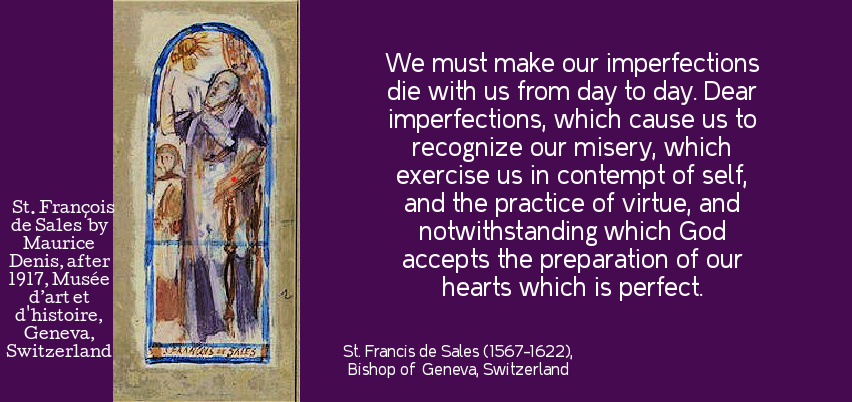
There are certain birds..(that) have such short and weak legs as to be of no use to them; it is as if they did not even have them. Should they fall to the ground, they remain there, unable to take flight because, without the use of legs or feet, they cannot rise and take wing. Consequently, they remain on the ground and die there, unless a gust of wind, compensating for their inability, lifts them up, as it often does with other things. If, in that case, they flap their wings in response to the thrust of the wind, the wind itself will continue to help them by thrusting them ever higher, in order to help them to fly higher and higher.Keep yourself faithfully in the presence of God. Avoid hurry and anxiety, for there are no greater obstacles to our progress in perfection.Cast your heart gently, not violently, into the wounds of our Savior and have an unlimited confidence in his mercy and goodness.To make good progress we must devote ourselves to getting over that portion of the path which lies close before us, and not amuse ourselves with the desire to attain the last step before we have accomplished the first.We must make our imperfections die with us from day to day. Dear imperfections, which cause us to recognize our misery, which exercise us in contempt of self, and the practice of virtue, and notwithstanding which God accepts the preparation of our hearts which is perfect.I recommend simplicity to you; look before you, and not at the dangers which you behold in the distance. Keep your will firmly bent upon serving God with your whole heart. While you are thus occupied in forecasting the future you expose yourself to some false step.Have no care for tomorrow. Think only of doing well today. And when tomorrow shall have become today, then we shall think about it.We must make a provision of manna for each day only. Let us not be afraid that God will fail to send down more upon us tomorrow and the day after tomorrow, and every day of our pilgrimage.Since the Heart of our Lord has no more loving law than meekness, humility, and charity, we must firmly maintain these dear virtues in us.True sanctity lies in love of God, and not in foolish imaginings, raptures, &c. Let us devote ourselves to the practice of true meekness and submission, to renouncement of self, to docility of heart, to love of abjection, to consideration for the wishes of others : this is true sanctity and the most amiable ecstasy of the children of God.May you belong to God forever in this mortal life, serving Him faithfully through its trials, bearing the cross after Him, and may you be His forever in life eternal with the whole celestial court!
Saint Francis gives the rule to Saint Jeanne de Chantal (Study for the Chapel of the Visitation at Nantes), 19th century, Elie Delaunay (1828-1891), Louvre. Public Domain.
The reason persons are in the world is to receive and carry the gentle Jesus: on our tongue by proclaiming him and in our arms by doing good works.I am as human as anyone could possibly be.See the divine lover at the gate. He does not simply knock once. He continues to knock. He calls the soul: come, arise my beloved, hurry!…In short, this divine Savior forgets nothing to show that his mercies are above all his works, are greater than his judgment.Solitude has its assaults, the world its busyness – in either place we must be courageous since in either place divine help is available to those who trust God and humbly and gently ask for his fatherly assistance.Since this congregation does not have as many austerities or indissoluble bonds as formal orders, the fervor of charity and force of a deep personal resolution must supply for all that…so that might be realized the saying of the Apostle which affirms that charity is the perfect bond.
Saint François de Sales blesses Saint Jeanne de Chantal, Chapelle de la Visitation at Nantes n° 61 XIXe siècle. Elie Delaunay (1828-1891), Musée d’Arts de Nantes. Public Domain.
It is the height of holy disinterestedness to be content with naked, dry, and insensible acts carried out by the superior will alone….In the end, the savior wants us to be His so perfectly that nothing else remains for us, and to abandon ourselves to His providence without reservation.Since the heart is the source of all our actions, as the heart is, so are they.For myself, I cannot approve the methods of those who try to reform a person by beginning with external things, such as bearings, dress or hair. On the contrary, it seems to me that we should begin inside.I beg you, my dear Sister, govern your community with a great expansiveness of heart…The more solicitous, open, and supportive you are with them, the more you will win their hearts.I had the courage to my give [my own dying mother] the last blessing, to close her eyes and mouth and to give her the last kiss of peace at the moment she passed away; after which my heart swelled and I wept….
Saint Francis de Sales healing a lame man, Chapelle de la Visitation at Nantes n° 61 XIXe siècle. Elie Delaunay (1828-1891), Musée d’Arts de Nantes. Public Domain.
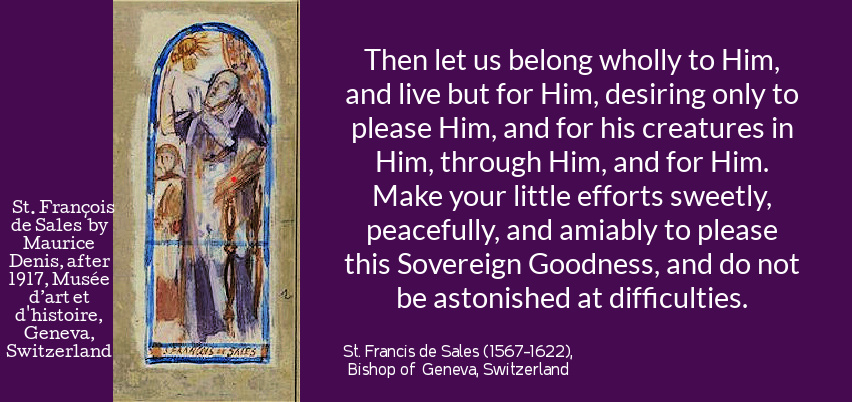
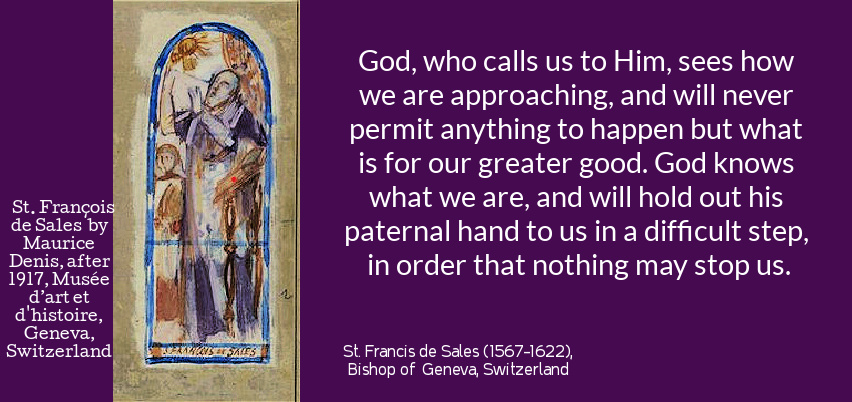
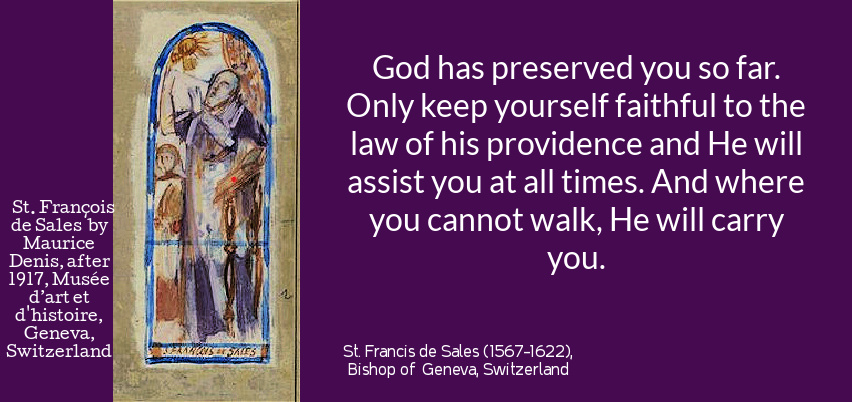
Then let us belong wholly to Him, and live but for Him, desiring only to please Him, and for his creatures in Him, through Him, and for Him. Make your little efforts sweetly, peacefully, and amiably to please this Sovereign Goodness, and do not be astonished at difficulties.We must be constant in aspiring to the perfection of holy love, in order that love may be perfect. For the love which seeks anything less than perfection cannot fail to be imperfect.Never permit your soul to be sad and live in bitterness of spirit or scrupulous fear, since He who loved it and died to give it life is so good, so sweet, so amiable.God, who calls us to Him, sees how we are approaching, and will never permit anything to happen but what is for our greater good. God knows what we are, and will hold out his paternal hand to us in a difficult step, in order that nothing may stop us.God has preserved you so far. Only keep yourself faithful to the law of his providence and He will assist you at all times. And where you cannot walk, He will carry you.
Saint Francis de Sales healing a lame man, Chapelle de la Visitation at Nantes n° 61 XIXe siècle. Elie Delaunay (1828-1891), Musée d’Arts de Nantes. Public Domain.
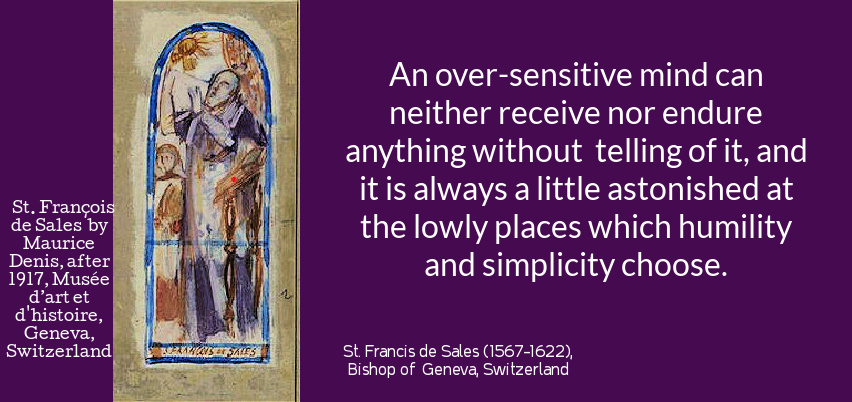
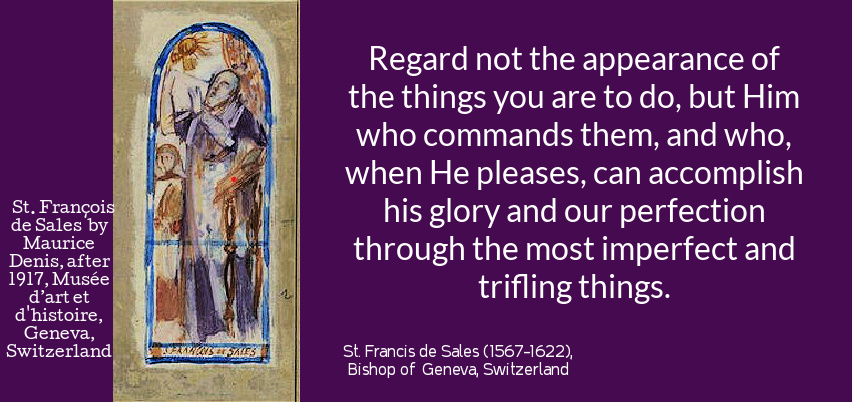
An over-sensitive mind can neither receive nor endure anything without telling of it, and it is always a little astonished at the lowly places which humility and simplicity choose.I see you with your vigorous heart which loves and wills powerfully. I like it, for what are those half -dead hearts good for? We must make a particular exercise once every week of willing to love the will of God more tenderly, more affectionately than anything in the world, and that, too, not only in bearable but in the most unbearable events.Plant in your heart Jesus Christ Crucified, and all the crosses of this world will seem to you like roses.Lord Jesus, without reserve, without an if, or a but, without exception or limitation, may you holy will be done in all things and at all times.Regard not the appearance of the things you are to do, but Him who commands them, and who, when He pleases, can accomplish his glory and our perfection through the most imperfect and trifling things.
Painting of St. Francis de Sales in Don Bosco’s rooms at the Oratory of St. Francis de Sales in Turin. Public Domain.
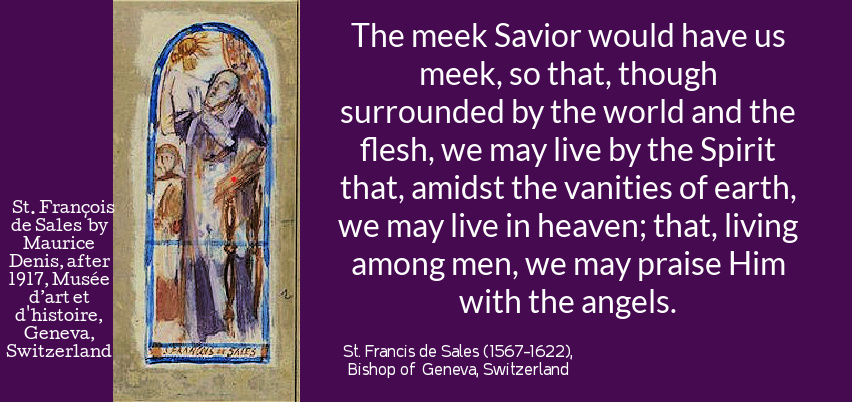
Behold this great Artisan of mercy. He converts our miseries into graces and our iniquities into salutary remedies for our souls. Tell me, I pray, what will He not do with the afflictions, the labors, the persecutions which assail us?Never think you have attained the purity of heart which you owe to God until your will is freely and joyfully resigned to his holy will in all things, even in the most repugnant.Daily strengthen yourself more and more in the resolution, which you formed with so much affection, of serving God according to his good pleasure. Regard Him who commands them and, when He pleases, can accomplish his glory and our perfection through the most imperfect and trifling things.A true servant of God has no care for tomorrow, but performs faithfully what is required today, and tomorrow will do what is required without a word.The meek Savior would have us meek, so that, though surrounded by the world and the flesh, we may live by the Spirit that, amidst the vanities of earth, we may live in heaven; that, living among men, we may praise Him with the angels.
St. Francis de Sales, 18th c, Besançon, 96 x 131 cm. Public Domain.
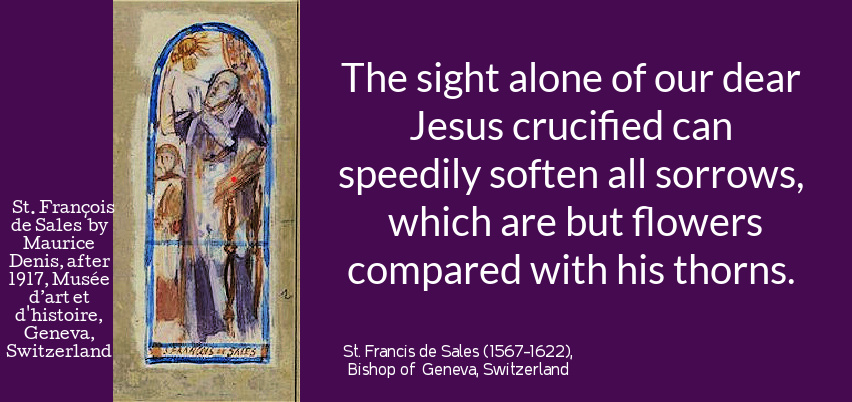
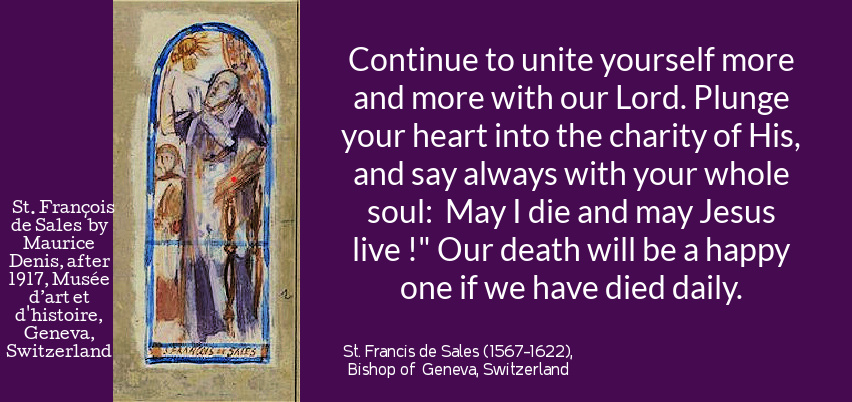
Here is the great lesson – we must discover God’s will, and, recognizing it, endeavor to do it joyfully, or at least courageously.The sight alone of our dear Jesus crucified can speedily soften all sorrows, which are but flowers compared with his thorns.Our great rendezvous is an eternal heaven and compared with the price of eternity, what are the things which end with time?Continue to unite yourself more and more with our Lord. Plunge your heart into the charity of His, and say always with your whole soul: May I die and may Jesus live !” Our death will be a happy one if we have died daily.Lord Jesus, what true happiness for a soul consecrated to God to be strongly exercised in tribulation before leaving this life!
Saint Francis Sales, antique pendant, Lyon, France. Public Domain.
Nothing can give us deeper peace in this world than to frequently contemplate our Lord in all the afflictions He endured from his birth to his death. Contempt, calumnies, poverty, abjection, weariness, suffering, nakedness, wrongs, and grief of every kind.Let us faithfully cultivate that resignation and pure love of God which is never wholly practiced but amid sufferings. For to love God, when He feeds us with sweetness is nothing more than children do. But to love God when He feeds us with gall is to offer Him the cup of our loving fidelity.It is not in my power to propose to Him anything for you, save that He may, according to his holy will, fashion your heart for his dwelling, and reign there eternally. And whether He fashion it with the brush, hammer, or chisel, must be according to his good pleasure.I desire that your cross and mine should be wholly the cross of Jesus. This or that burden, or making any choice, God knows what He is doing and why He does it. It is certainly for our good.God wishes that, like Job, I should serve Him in the midst of dryness, suffering, and temptation. Like St Paul, that I serve Him according to His desire. You will see that one day He will do all and even more than you can desire.
St. Francis de Sales. medallion. Public Domain.
At the very thought of God, one immediately feels a certain delightful emotion of the heart, which testifies that God is God of the human heart.I said everything in just two words, when I told you to refuse nothing and to desire nothing; I have nothing more to say to you.Do you see the baby Jesus in the crib? He accepts all the discomforts of that season, the bitter cold and everything that the Father lets happen to him. He does not refuse the small consolations that his Mother gives him; we are not told that he ever reached out for his Mother’s breast, but left everything to her care and concern. So too, we ourselves should neither desire nor refuse anything, but accept all that God sends us, the bitter cold and the discomforts of the season.It is love that grants perfection to our works. I will tell you much more. Take a person who suffers martyrdom for God with an ounce of love; that person merits much, since he could give nothing greater than his own life. Yet another person who has only suffered a scratch with two ounces of love will have much more merit, because it is charity and love that give value to our works.You know, or you should know, that contemplation is in itself better than activity and the active life; nonetheless, if one finds greater union [with God] in the active life, then that is better. If a Sister in the kitchen holding a pan over the fire has greater love and charity than another Sister, that material fire will not hold her back but instead help her to become more pleasing to God. It frequently happens that people are united to God as much in activity as in solitude; in the end, it always comes back to the question of where the greatest love is to be found.In Holy Church, everything pertains to love, lives in love, is done for love and comes from love.Whatever may happen, Lord, you who hold everything in your hands and whose ways are all justice and truth, … I will love you, Lord, … I will love you here, O my God; I will hope always in your mercy and ever repeat your praise… O Lord Jesus, you will always be my hope and my salvation in the land of the living.I wonder whether another difficulty can also be raised concerning your reform: perhaps those who imposed it on you have treated the wound too harshly… I appreciate their method, although it is not what I am in the habit of using, especially with regard to noble and cultivated spirits like yours. I believe it is better simply to indicate the disease and put the scalpel in their hands, so that they themselves can make the necessary incision. Yet do not for this reason neglect the reform that you need.
Saint Jeanne de Chantal. antique pendant, Lyon, France. Public Domain.
The world is becoming so delicate that, in a little while, no one will dare any longer to touch it except with velvet gloves, or tend its wounds except with perfumed bandages; yet what does it matter, if only men and women are healed and finally saved? Charity, our queen, does everything for her children.My intention is but to represent, with simplicity and straightforwardly, without artifice and certainly without false colors, the history of the birth, progress, decline, operations, properties, advantages and sublime qualities of divine love.The power of grace does not constrain the heart, but attracts it. Grace possesses a holy violence, not to violate our liberty but to guide it to love. Grace acts strongly, yet in such a pleasing way that our will is not overwhelmed by so powerful a force; while pressing us, it does not oppress our liberty. Consequently, we are able, before all its might, to consent to or resist its promptings at our pleasure.God’s inspirations, Theotimos, anticipate us and make themselves felt before we are even aware of them, but once we become aware of them, it is up to us either to consent and follow their lead, or to refuse and reject them. They make themselves felt by us without us; yet without us they do not bring about our consent.All these fine people, commonly considered devout, most surely are not.In the end, charity and devotion can be said to differ from one another as fire from a flame. Charity is a spiritual fire that, when fanned into flame, is called devotion. Devotion thus adds nothing to the fire of charity but the flame that makes charity prompt, active and diligent, not only in the observance of God’s commandments but also in the exercise of his divine counsels and inspirations.Almost all those who have treated of devotion have sought to instruct persons living apart from the world, or at least they have taught a kind of devotion that leads to such isolation. I intend to offer my teachings to those who live in cities, in families, at court and who, by virtue of their state in life, are obliged to live in the midst of others.
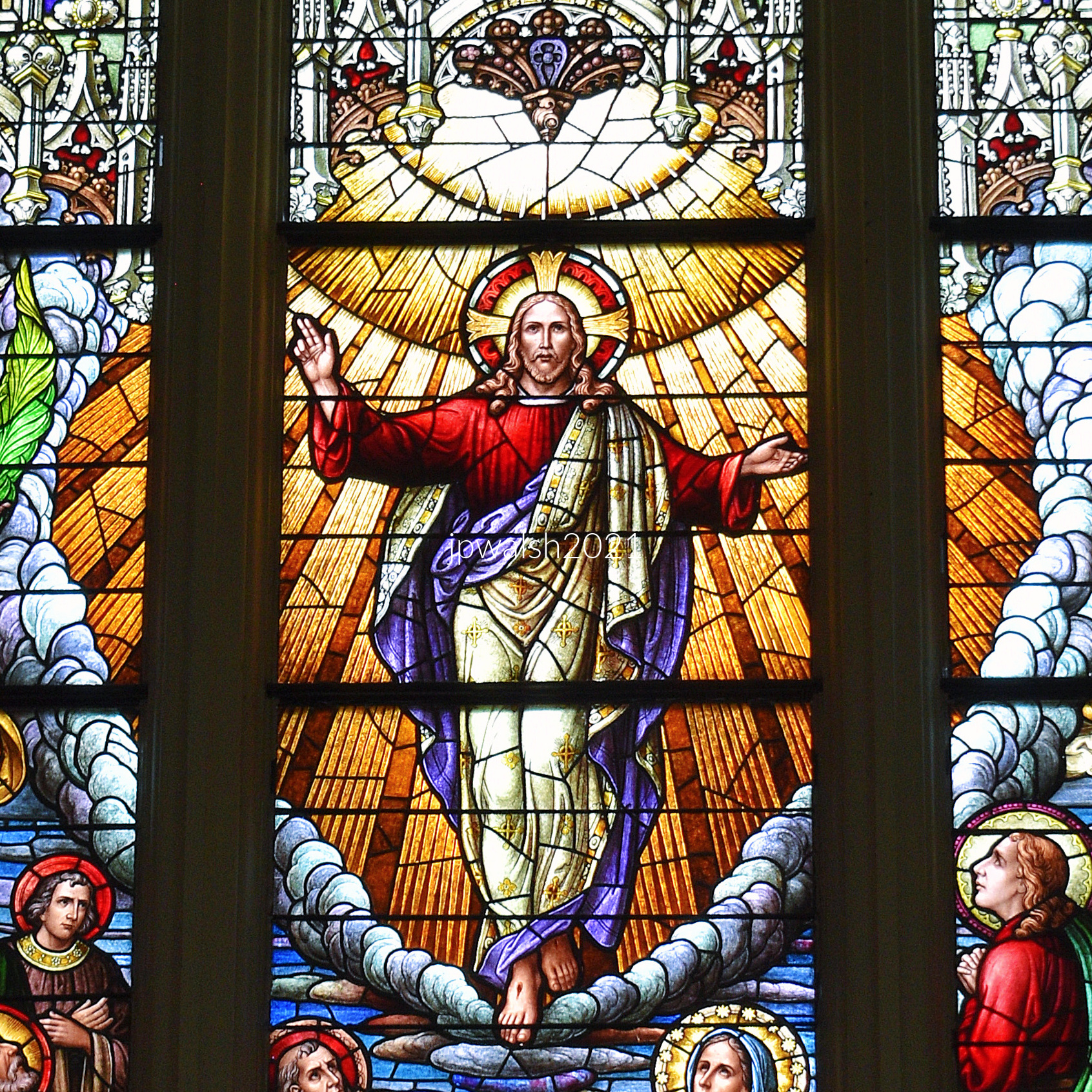
Feature Image: Detail, Ascension of Christ window, Sts. Peter and Paul, Naperville, IL. Author’s photograph
Thee 1927 Tyrol Art Glass Company windows at Sts. Peter and Paul Church in Naperville, Illinois, are not simply decorative religious artworks but important examples of European ecclesiastical craftsmanship that combine theology, biblical storytelling, symbolism, local Catholic history, and immigrant heritage. Through the major Ascension of Christ and Assumption of Mary windows, the stained glass served as a visual catechism and artistic legacy in this and other American Catholic churches during the great era of German and Austrian church art.
Saints Peter and Paul Catholic Church in Naperville, Illinois, a western suburb of Chicago, in July 2021. Looking to the northeast from Central Park, the church building seats 1000 people and was dedicated in September 1927. In 2021 the parish marked its 175th anniversary. Founded in 1846, the parish is the oldest continuously operating Catholic parish in DuPage County. Down the decades its pastors (Frs. Rainaldi, Zuker, Wenker, Stenger, Lennon, Milota, and others) led Saints Peter and Paul adjacent to Naperville’s Historic District to where the parish with its school today serves 4,000 families. Author’s photograph.
Sts. Peter and Paul Church in Naperville was dedicated in 1927 and contains significant stained-glass windows produced by the Tyrol Art Glass Company of Innsbruck, Austria.
A magnificent church building sits on Ellsworth Street in Naperville, Illinois, close by the Historic District. With an orientation out of the darkness of the west into the light of the east, Saints Peter and Paul greets worshippers with two soaring steeples. The neo-Gothic red brick and limestone structure was commissioned in 1922 by the parish’s 350 families and dedicated five years later. Today the parish in Chicago’s western suburb serves 4.000 families and contains historically significant bright colored traditional European painted stained-glass windows from Innsbruck, Austria. In this archival photograph, the view of the church building from around the time of its dedication is looking towards the southeast. Public Domain.
The windows were created during the peak period (1870-1930) when German and Austrian stained-glass studios supplied churches throughout Chicago and the Midwest.
The colorful stained-glass windows in Saints Peter and Paul Catholic Church in Naperville, Illinois, a western suburb of Chicago, were ordered, produced, and installed towards the end of a 60-year-long run for the predominance of German and Austrian-made stained glass found in heritage Chicagoland churches today.
With only a couple of exceptions, the stained glass in Naperville’s historically pioneer and, later, German Catholic parish church was created in the mid1920s in Innsbruck, Austria. Innsbruck at the time was one of the European centers of stained-glass making. It is about 100 miles south of Munich, Germany, the home base of two other popular and well-regarded stained-glass studios – that of Franz Mayer & Company and F.X Zettler Company. These art glass manufacturers notably filled many Chicagoland Catholic churches starting in the 1870s. After the Great Chicago Fire in 1871, a building and population boom commenced in the city and its surrounding communities that went on for over a century unabated. In addition, from the 1870s to the 1920s, Chicago became the most influential center of Catholic culture in the United States.1
It was a unique period of history for Catholic churches in America whose state-of-the-art church design usually included brightly colored art (stained) glass windows. These windows often displayed action-packed scenes from the Bible, including episodes from the life of Christ, His Blessed Mother, or a patron saint.
This continuous appeal over multiple generations for the purchases of vast orders of Munich and Austrian style glass in U.S. Catholic churches declined greatly starting in the 1930’s with the onset of the Great Depression. The European traditional glass market did not recover its former popularity making its stained-glass windows from 1870 to 1930 in Chicagoland churches – including Saints Peter and Paul Church in Naperville – increasingly rare and valuable to preserve and appreciate.
Stained glass made by Tyrol Art Glass Company of Innsbruck, Austria, and Franz Mayer and F.X. Zettler of Munich, Germany, was characterized by its traditional painted stained glass. This style fit into the traditional-style church architecture that Catholic parishes, such as Saints Peter and Paul in Naperville, and many others, built between 1870 and 1930. By the mid20th century these European traditional glass makers faced competition from the rise of American glass manufacturers such as Louis Comfort Tiffany (1848-1933) which extended to quality, price, and style. Tiffany stained glass which frequently incorporated natural scenery elements, contained intricately cut opaque and opalescent glass, overlaid with wide varieties in thickness. This product became better fitted into modern worship spaces which were often smaller. Such modern art and architectural trends worked to displace traditional glass made in Europe used for grandiose classically styled houses of worship that were from an earlier historical period.
In the late 19th century, Tyrol Art Glass Company of Innsbruck, Austria, with the Munich studios of Franz Mayer and F.X. Zettler, began to send representatives to sell their new patterns for churches in Chicago and around the United States. These three studios often worked together and their style is basically interchangeable. In Saints Peter and Paul Church – as well as many other churches with classically-styled architecture – traditional painted stained glass was the stand-out choice, It is usually very colorful whose iconography often depicts highly recognizable religious, often biblical, scenes and religious symbolism. This is definitely the situation with the beautiful stained-glass windows of Saints Peter and Paul in Naperville, including the Ascension of Jesus into Heaven and the Assumption of Mary into Heaven windows.
HOW SAINTS PETER AND PAUL CATHOLIC CHURCH GOT STARTED AND GREW IN NAPERVILLE, ILLINOIS
Naperville, Illinois, a western suburb of Chicago, was founded in 1831 – the oldest town in DuPage County.2With its origins as a mixed settlement of Easterners and Hoosiers, Naperville’s strong religious character was established starting in the 1830s.3 Today it boasts a population of around 150,000 and is one of Illinois’s largest cities. The downtown area is bustling with shops and motor vehicle and foot traffic, yet Naperville’s 19th century origins can still be found in and around the DuPage River with its River Walk and its Historic District that maintain much of the suburb’s original charm and historic significance.
Saints Peter and Paul Catholic Church in Naperville was founded in 1846 and is the oldest continuously operating Catholic parish in DuPage County. The county was established in 1839 with Naperville originally as the county seat. This changed in 1867 when, by county referendum, Wheaton became the county seat which it remains today. Naperville’s first religious institutions were the East Branch Settlement, Congregationalist, Evangelical, and Baptist churches. These churches were all established in Naperville between 1833 and 1843.4
The Catholic parish was originally founded as a mission of the Joliet Catholic Church – Joliet, Illinois, about 20 miles to the south of Naperville is its Diocese headquarters today. In the 1840s, when Illinois was the edge of the frontier, a priest traveled the rigorous 20-mile journey – Naperville did not get a railroad for another 30 years (1864) – once a month to say mass in pioneers’ homes. The first church, named St. Raphael’s for Fr. Raphael Rainaldi, the first pastor, was a small frame structure with a lean-to across the street from today’s church building. In the 1840s the church served about 25 families – 175 years later it serves 4,000 families.5
The first official act at Saints Peter and Paul Church was a festive event – the wedding of Mr. Robert Le Beau to Miss Emily Beaubien, recorded on Tuesday, September 8, 1846. The parish also purchased an acre of land for a cemetery.
In 1852 the church was enlarged by a frame addition and Fr. Charles Zuker established a parish school in the lean-to with a lay headmaster. In 1855 the first school building was built. By 1864 the first frame church building was used for school purposes as the cornerstone was laid for a new stone church on the site of the present church building. By this time the parish was renamed to Saints Peter & Paul by Fr. Peter Fisher and the parish had grown to about 250 families. The stone had been obtained locally from the parish’s own quarry along the DuPage River. The new stone church building was dedicated in 1866 and the school now served around 100 students.6
Continual improvements were made to the parish church and grounds in the 1870s and 1880s so that by the start of the 1890s, following Naperville’s incorporation as a city, the parish launched significant building projects. In 1892, a year where it rained almost all that spring, a new brick school building for the parish’s 200 students was built that cost $30,000. Saints Peter and Paul also built a new rectory in anticipation of the new century.
The history of Sts. Peter and Paul Parish is traced from its 1846 frontier origins to its emergence as one of DuPage County’s most important Catholic parishes.
c. 1874, looking west, the corner of Ellsworth Street and Benton Avenue. the complex of buildings of Saints Peter and Paul parish, Naperville, Illinois. Public Domain.
In the 1880’s Naperville, illinois, like much of the rest of the country, expanded its industrial base, grew its city services, such as the fire department and city hall, and established new utilities including the first public telephone service.
With its new wealth generated by industry, Naperville built some of its first impressive homes. Shops and stores were established to service them. While agrarian in flavor, by the end of the 1880’s and into the early 1890s Naperville was already a bustling, modern, forward-thinking city. In 1893 Naperville hosted its first “Bicycle Parade” – a big public affair whose purpose was to “show our citizens the increased interest lately in this comparatively new mode of locomotion.”
In the 1890s the area that included Saints Peter and Paul Church, other denominational churches, and Northwestern College (renamed North Central College in 1926) affiliated with the United Methodist Church, came to be known around town as “Piety Corners.”
With the appearance of the first cars in the 1900s, Naperville was well on its way to an era of accelerated expansion and growth that continues in the 21st century.7
Saints Peter and Paul’s old stone church is to the far right. In the background left is the belfry of the Main Building at North Western College built in 1870. North Western College was founded in 1861 as Plainfield College in Plainfield, Illinois. It was renamed to North Western College in 1864 and, with the enticement of 8 acres of donated land and $25,000 from Naperville, relocated to Naperville in 1870. In 1926 it was again renamed to today’s North Central College. For over 140 years the college has had a great deal of influence on the educational and cultural life of Naperville. In 2021, with an enrollment of 3,000 students and 700 employees, North Central College is one of Naperville’s top ten employers.8 Public Domain.
c. 1904, view of Sts. Peter and Paul stone church building from the belfry of the College’s Main Building. Public Domain.
In 1911 the school was badly damaged by fire. When a new school opened the next year, 250 students were enrolled.9
In the 1920’s Naperville boasted around 5,000 residents. In June 1922 (sources vary whether it was on June 4 or June 8) the old stone church quarried from the parish’s own quarry and dedicated in 1866 was destroyed by an arsonist’s fire. By this time, the parish’s 350 Naperville families were from mostly German-speaking countries in Europe. Naperville’s quarries had brought waves of German immigrants to the city since the 1850’s since they knew how to mine and cut stone. After the devastating 1922 fire, the parish chose to rebuild their church in a magnificent red brick traditional cruciform-shape. It was dedicated on Sunday, September 25, 1927. The half German, half Irish Cardinal-Archbishop of Chicago, George Mundelein (1872-1939), participated in the dedication ceremony. This remains the church building that exists today and which contains its lovely and historically significant stained glass from Innsbruck, Austria. In 1927 the cost of the church building was $407,785 – or about $6.5 million today.10
WHO WERE SAINTS PETER AND PAUL?
El Greco (1541-1641), Saint Peter in Tears, 1587-1596, oil on canvas, 109 cm (42.9 in) x 88 cm (34.6 in), Toledo, Spain.
St. Peter is the Rock, or “Cephas,” of Jesus Christ’s church. In Matthew 16 Jesus tells Simon, son of John, brother to Andrew the apostle and a married fisherman by trade: “I say to you, you are Peter, and upon this rock I will build my church, and the gates of the netherworld shall not prevail against it. I will give you the keys to the kingdom of heaven. Whatever you bind on earth shall be bound in heaven; and whatever you loose on earth shall be loosed in heaven” (Mt 16: 18-19). Peter denied Christ three times before the crucifixion that is described in all four New Testament Gospels.
After Jesus Christ’s Resurrection (Mark 16, Matthew 28, Luke 24, Acts 1, John 20 and 1 Corinthians 15) and Ascension into Heaven (Luke 24:50. Acts 1, John 3:13, John 6:62, John 20:17, Romans 8:34, Ephesians 1:19-20, Colossians 3:1, Philippians 2:9-11, 1 Timothy 3:16, and 1 Peter 3:21-22) and following the events of Pentecost (Acts 2), Peter led an important life as a Christian evangelist and Church leader.
Though St. Paul’s pastoral heritage in his 13 letters were highly influential for the early church where he writes on church structure, the theology of the Body of Christ, and the nature of the Holy Spirit, St. Peter also has an epistemological heritage which explores the People of God.11These best-known apostles also both died in the 60s. For the rest of that critical first century of Christianity – until when John’s Gospel was written in the 90s – the churches had to go without two of its greatest authoritative figures who had seen the risen Jesus.
St. Peter was martyred by crucifixion in 64 A.D. in Rome. He requested he be crucified upside down on an x-shaped cross, as witness to the apostle’s prolonged sorrow over his denial of Christ. On the church calendar, St. Peter’s feasts are June 29 and February 22.
Rembrandt, The Apostle Paul, oil on canvas, 1633.
St. Paul is one of Church history’s most significant figures. As Saul of Tarsus, the scholar, rabbi, and Roman citizen, zealously persecuted the first Christians and was personally present at the stoning of the first Christian martyr, Stephen (Acts 7: 54-60). On the road to Damascus making “murderous threats” towards Christians (Acts 9:1), Paul encounters the risen Jesus. The passage reads: “Suddenly a light from heaven flashed around him. He fell to the ground and heard a voice say to him, “Saul, Saul, why do you persecute me?” “Who are you, Lord?” Saul asked. “I am Jesus, whom you are persecuting,” he replied. “Now get up and go into the city, and you will be told what you must do.” (Acts 9:4-6).
The jolting event changed Paul’s life and outlook. More than anyone else in the Church’s first years, Paul realized Christianity’s universal message. Paul’s letters to various Christian communities in Corinth, Ephesus, and Rome, show him to be a solicitous and sometimes stern and exhorting pastor who had a deeply personal spiritual experience of the Lord. About half of the books of the New Testament are Paul’s writings that express his profound openness to humanity and its cultures which made him “Apostle of the Gentiles” and “Teacher of the Nations.”
Paul was martyred somewhere between 64 and 68 A. D. The circumstances of his death are not entirely known, although early Christian writers related that Paul was beheaded. St. Paul shares a feast with St. Peter on June 29.
THE WINDOWS: The Ascension of Jesus into Heaven.
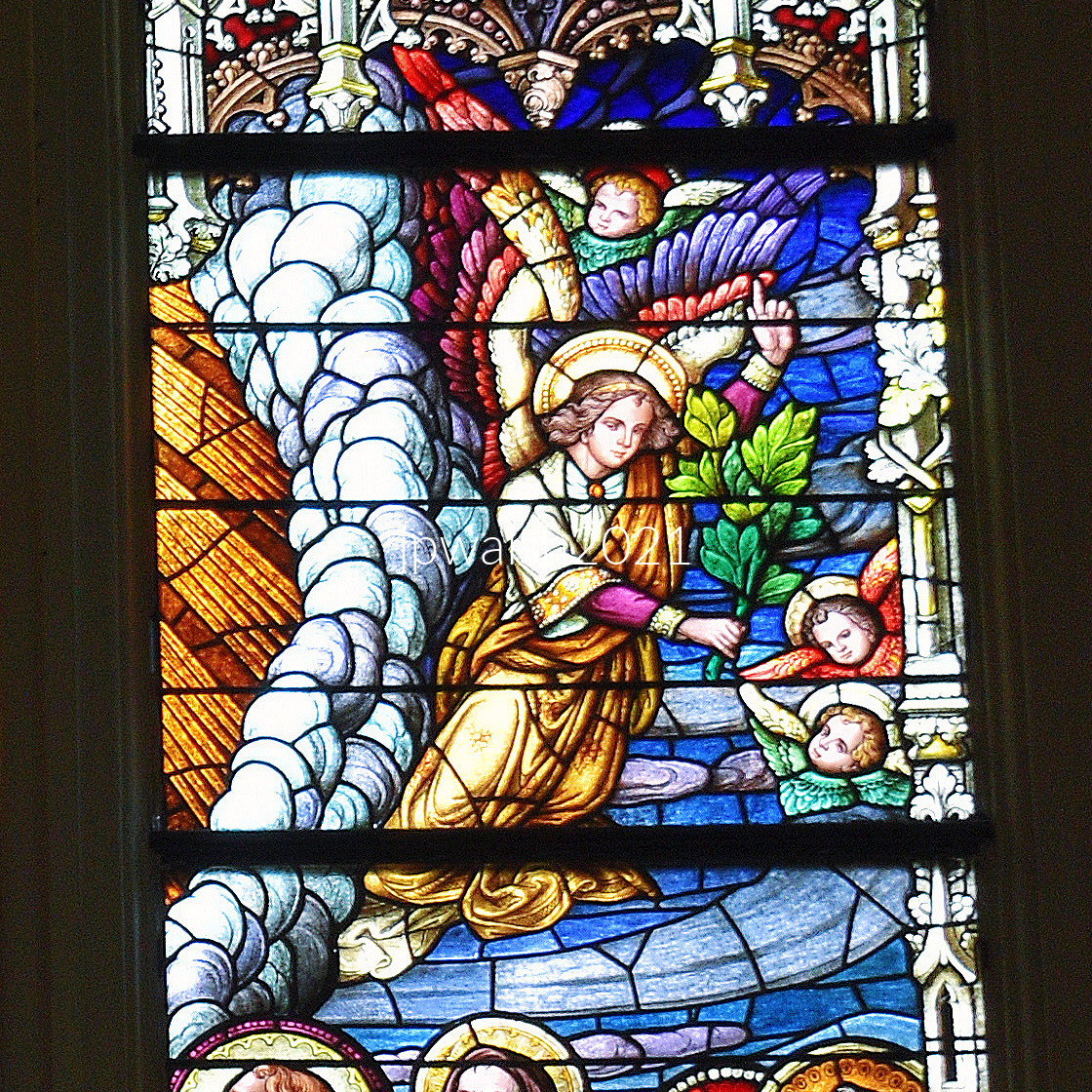
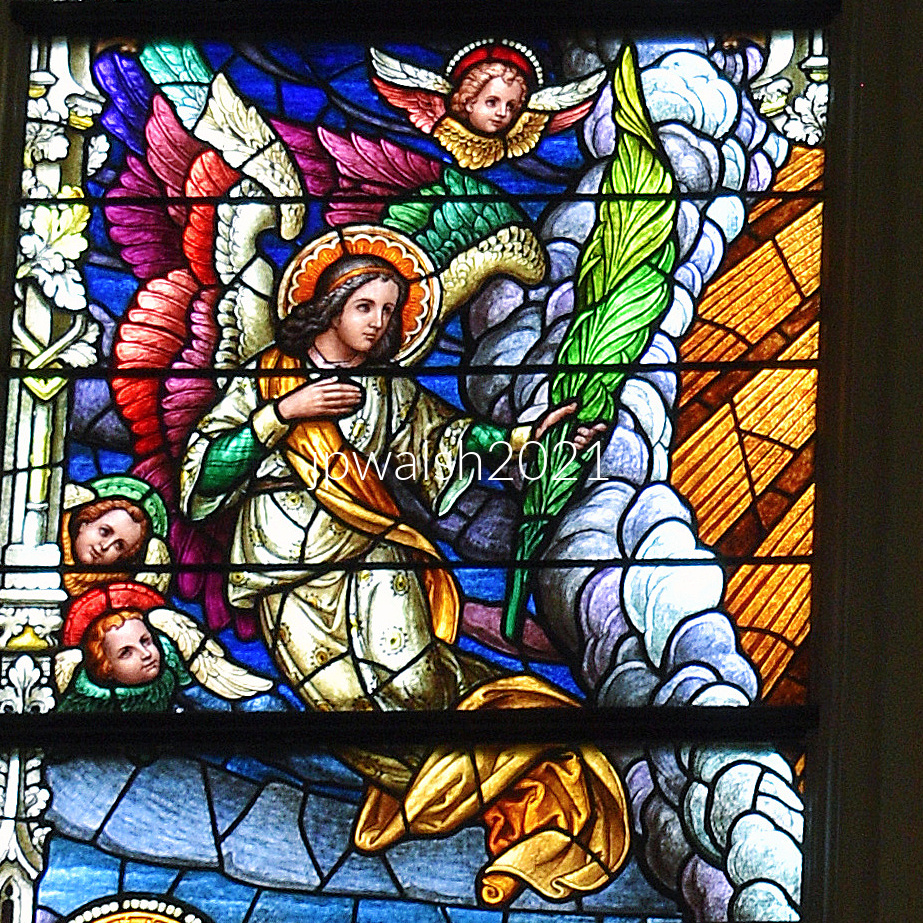
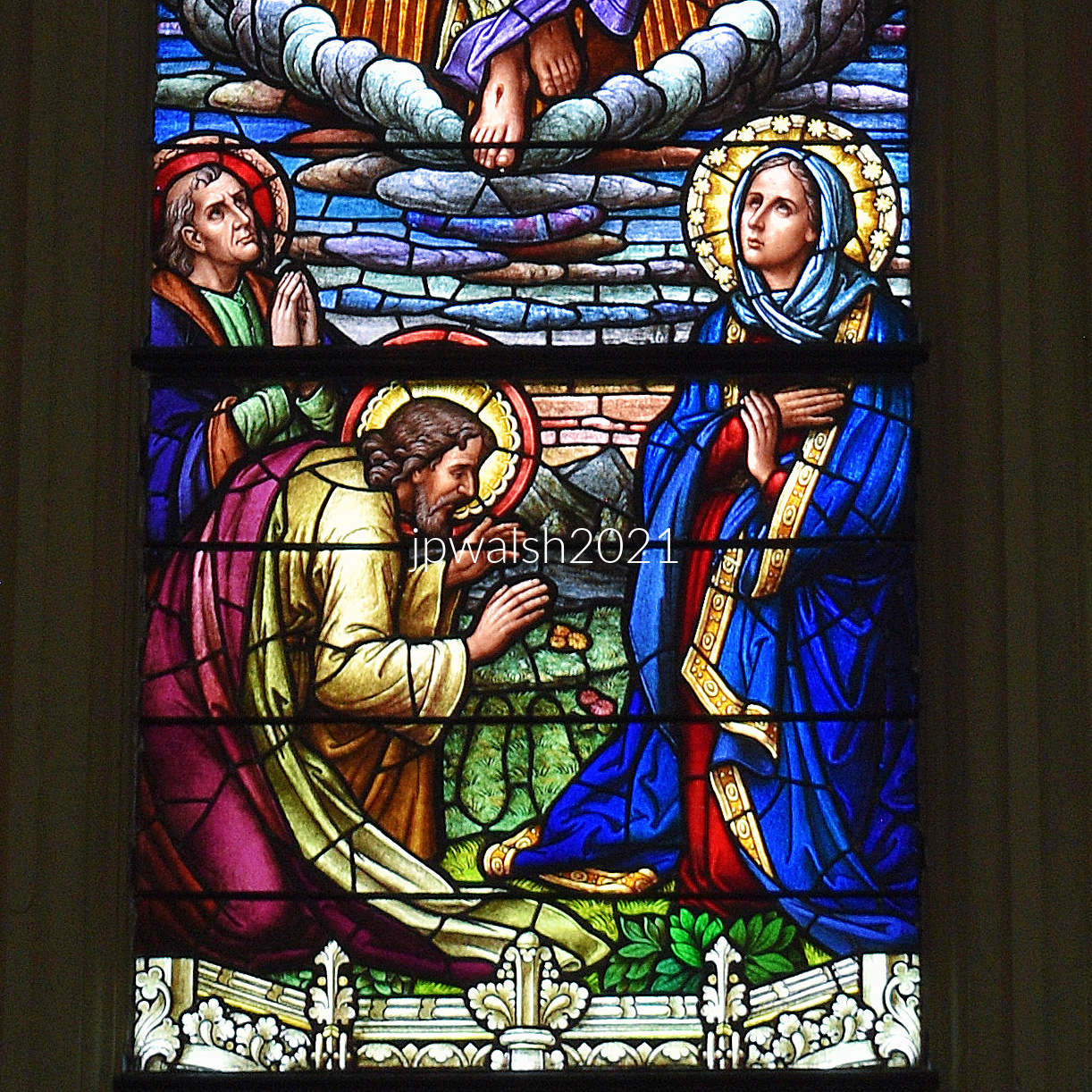
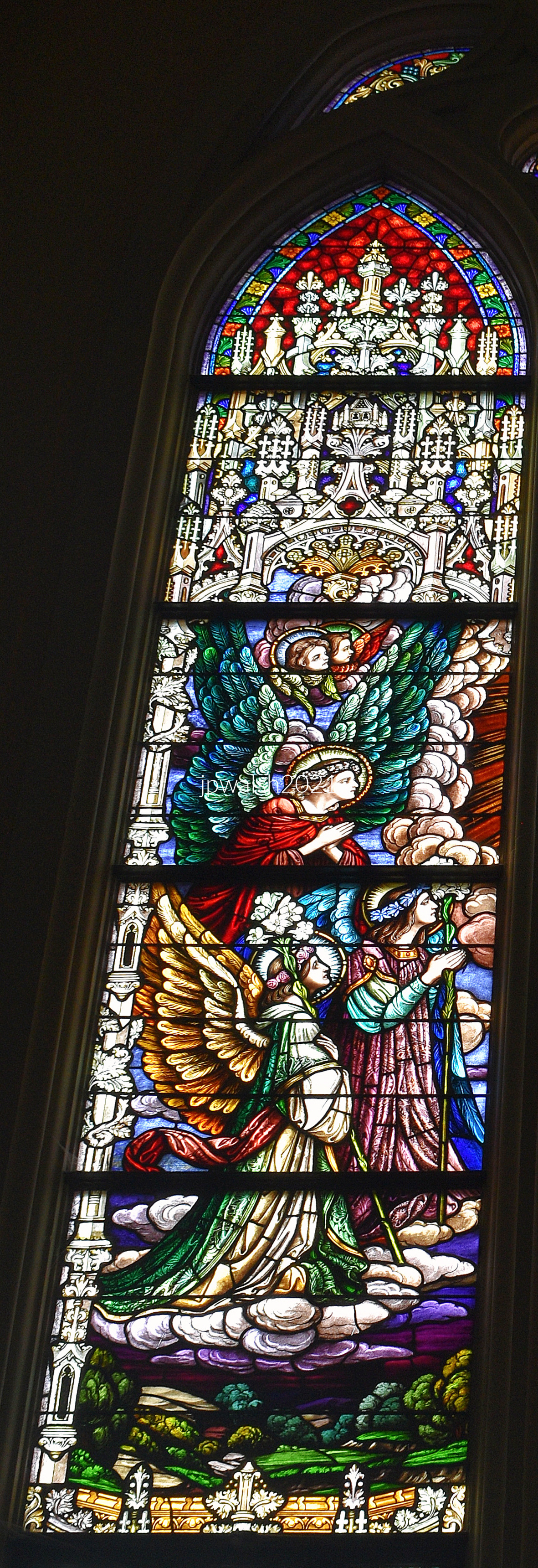
North Transept, Ascension of Christ into Heaven, 1927, Tyrol Art Glass Company, Innsbruck, Austria. Sts. Peter and Paul Church, Naperville, Illinois. Author’s photograph.
The Ascension of Jesus is recounted twice in the New Testament – and both times by Luke the Evangelist. One account is in his Gospel (Luke 24:50-53) and a second is in his Book of Acts of the Apostles (Acts 1: 6-12).
One significant difference in Acts is that Luke sets a time frame of 40 days (1;3) for Jesus’s sustained manifold appearances to the apostles after the Resurrection until His Ascension. The account in Acts also situates the apostles and Christian community into salvation history’s imagery of Israel’s covenant.12Luke’s tradition would likely not have separated the Resurrection and Ascension events in time except that it was used to give clarity to a narrative purpose.13
The account of the Ascension in Acts 1:6-12 reads:
6 ”When they had gathered together they asked him, “Lord, are you at this time going to restore the kingdom to Israel?”
7 He answered them: “It is not for you to know the times or seasons that the Father has established by his own authority.
8 But you will receive power when the Holy Spirit comes upon you, and you will be my witnesses in Jerusalem, throughout Judea and Samaria, and to the ends of the earth.”
9 When he had said this, as they were looking on, he was lifted up, and a cloud took him from their sight.
10 While they were looking intently at the sky as he was going, suddenly two men dressed in white garments stood beside them.
11 They said, “Men of Galilee, why are you standing there looking at the sky? This Jesus who has been taken up from you into heaven will return in the same way as you have seen him going into heaven.”j
12 Then they returned to Jerusalem from the mount called Olivet, which is near Jerusalem, a sabbath day’s journey away. (New American Bible)
When Jesus rose from the dead it became clear to the disciples that he is the Messiah so it was not illogical that they would ask him in Acts when he will restore political self-rule to Israel. Since Luke was writing with future Christians in mind, Jesus‘s reply is indeterminate. Jesus tells them (Acts: 7-8) that the Second Coming (“parousia”) is not a question for them to be asking of God. Rather, it is important for them to bear witness to Him by ways of the power of the Holy Spirit that Jesus will send to them and for whom they should wait. Lastly, as Jerusalem is the Holy City and the place of Jesus’s Paschal Mystery this is the place where the Christian church will start their mission that will reach to the ends of the earth.14
Another important detail Luke includes in Acts is that when Jesus is lifted up into heaven a cloud has intervened to take him from the apostles’ sight. Further, the Ascension takes place on Mount Olivet, which had eschatological (“end times”) meaning. After Jesus is lifted up two figures appear in dazzling garments signaling angels who also appeared at the birth of Jesus (Luke 2:9) and at the Resurrection (Luke 24:4-7). The cloud image Luke uses is also linked to end times (Luke 21:27) or parousia so that Jesus who is bodily taken up to heaven in the Ascension “will come (again) in the same way that you saw him going” (Acts1:11).
The Ascension window presents Christ rising into heaven surrounded by angels, apostles, and elaborate theological symbolism drawn from Scripture and Christian tradition.
Detail, Christ, Ascension window, Sts. Peter and Paul, Naperville, IL. Author’s photograph.
In the Ascension of Christ into Heaven window, Christ is surrounded by a band of clouds and yet remains in a golden area representing the fiery light of God. Christ wears a multi-colored robe – red representing his death by crucifixion; purple representing his Divinity; and white representing martyrdom emblazoned with four-lobed crosses representing the four Gospels or the four corners of the earth.
Christ’s halo is elaborated in three parts. There are usually three Greek letters found in Christ’s cruciform halo that in translation spell out “He Who is” or “ I Am Who Am.” These are absent, however, in this stained-glass window’s cruciform halo.
87% 7.5mb
Hierarchy of angels
There are eight angels in the window representing the hierarchy of angels. The baby heads of the cherubim – the lowest tier of angels – are accompanied by seraphim, the highest order of angels. Their name “archangel” literally means “chief angel.” Traditionally these highest order of angels are warlike in appearance and bear a sword, This is especially the case with the iconography of St. Michael the Archangel who leads God’s angels in battle to cast Satan and his angels out of heaven as told in the New Testament Book of Revelation.
The seraphim in this stained-glass depiction, however, carry palm branches in place of swords. In the years following World War I when this stained glass was made, the Austrian art glass manufacturer may have sought to symbolize angelic power by ways of symbols of peace. The fact that the range of angels from lowest to highest is present in the window appears to signal the presence of the whole choir of angels present at the Ascension of Jesus into heaven.15
Detail, angel, Ascension window, Sts. Peter and Paul, Naperville, IL. Author’s photograph.
Iconographic details such as halos, angels, clouds, stars, crowns, colors, and symbols that enrich the theological meaning of the windows.
Detail, angel, Ascension window, Sts. Peter and Paul, Naperville, IL. Author’s photograph.
Depicted at the bottom of the window is Mary and the 12 apostles. This was not precisely accurate to the New Testament for at the Ascension there were only 11 apostles. However, the replacement of Judas by Matthias took place almost immediately following the Ascension narrative (Acts of the Apostles 1:21–26).
In the center of the window at the bottom between Mary and a kneeling apostle with his right arm stretched out is an interesting detail. It is the outline of Christ’s feet showing where his resurrected body stood and was lifted directly from earth into heaven. This is significant beyond a souvenir of Jesus’s earthly memory, in that Mount Olivet from which the resurrected Jesus was lifted into heaven is exact the place to which “the Son of Man coming in a cloud with power and great glory” (Luke 21:27) will return at the end of the world. In that way, the window is a depiction of the Ascension and one that points to the Second Coming of Christ.
Detail, outline of Jesus’s pierced feet, Ascension window, Sts. Peter and Paul, Naperville, IL. Author’s photograph.
Each of the apostle’s halos are unique. Mary’s halo has 12 stars as she is often pictured with a circle of stars. The Zodiac is an ancient circle of stars where some are symbolically combined into 12-star signs or constellations.
Detail, apostles, Ascension window, Sts. Peter and Paul, Naperville, IL. Author’s photograph.
Detail, apostles, Ascension window, Sts. Peter and Paul, Naperville, IL. Author’s photograph.
Jesus’ Ascension – his going “up” to heaven – is the same imagery used for the Assumption of Mary. It is figurative to express the spiritual. The biblical heaven is mysterious. It is the intimate reserve of God and as God is pure spirit (John 4:24), the question arises, how does Heaven incorporate the resurrected fleshly body of Christ at His Ascension?
It is explained starting with the Incarnation at the Annunciation to Mary (Luke 1:26-38) where the divine humanity of Jesus, the Word who was “with God, and…was God (John 1:1) begins. In the Ascension, the Person of Christ is fulfilled where the “new, saved man” enters heaven into the intimacy of the Father, and becomes the perfect God-Man. As “God is love” (I John 4:16), the manner of being of the body in Christ in heaven, the perfect God-man, is love.16
The Ascension is followed by Pentecost when the Apostles receive the Holy Spirit from Heaven and will speak thereafter of “Christ (in Heaven) in us.”
The window’s imagery emphasizes Christ’s divinity, resurrection, kingship, and future return.
Detail, rondelle, Christ the King, Ascension window, Sts. Peter and Paul, Naperville, IL. Author’s photograph.
The upper rondelle represents Christ the King. Christ’s crown obscures his elaborate three-part halo. The Greek letters on either side represent the “alpha” (“the beginning”) and the “omega” (“the ending”) which indicates Christ’s Godhead. Christ the King holds in his hands the symbols of the sacrament of the Holy Eucharist in the consecration of the Mass. in his right hand is the species of bread and wine that become the Body and Blood of Christ and in his left hand is the wood beam of the cross whose sacrifice on Calvary the Eucharist memorializes. Christ the King also reveals his Sacred Heart – a popular Catholic devotion- inside his chest. His heart is depicted as aflame encircled by a crown of thorns signifying his agape (or sacrificial) love. The entire Ascension window was the gift of Mr. and Mrs. William David Callender, parish members in the mid1920s.
Detail, halo of stars, Ascension window, Sts. Peter and Paul, Naperville, IL. Author’s photograph.
In the New Testament, the Woman of the Apocalypse and the battle of St. Michael the Archangel against the Dragon are bound together in the same dramatic narrative in the Book of Revelation (Rev.12:1-9). The Woman with a crown of 12 stars who is against the Dragon in the Book of Revelation has been identified with Mary, particularly as the Immaculate Conception. This is how Mary is depicted in the Ascension of Christ into Heaven window at Sts. Peter and Paul.
The New Testament passage setting out these images is in Revelation 12:1-9:
1 A great sign appeared in the sky, a womanclothed with the sun, with the moon under her feet, and on her head a crown of twelve stars.
2 She was with child and wailed aloud in pain as she labored to give birth.
3 Then another sign appeared in the sky; it was a huge red dragon, with seven heads and ten horns, and on its heads were seven diadems.
4 Its tail swept away a third of the stars in the sky and hurled them down to the earth. Then the dragon stood before the woman about to give birth, to devour her child when she gave birth.
5 She gave birth to a son, a male child, destined to rule all the nations with an iron rod. Her child was caught up to God and his throne.
6 The woman herself fled into the desert where she had a place prepared by God, that there she might be taken care of for twelve hundred and sixty days.
7 Then war broke out in heaven; Michaeland his angels battled against the dragon. The dragon and its angels fought back,
8 but they did not prevail and there was no longer any place for them in heaven.
9 The huge dragon, the ancient serpent,who is called the Devil and Satan, who deceived the whole world, was thrown down to earth, and its angels were thrown down with it.
EXPLANATION OF IMAGERY IN THE NARRATIVE OF REVELATION 12-14
About the middle of the Book of Revelation (Chapters 12-14), the author portrays the power of evil as represented by the figure of the Dragon who is opposed to God and his people. This Dragon pursues the woman about to give birth to devour the child but the child is born. Then St. Michael and his angels expel the Dragon and the Dragon’s angels out of heaven (Rev. 12:5-9). Adorned with the Old Testament images of sun, moon, and stars (Genesis 37:9-10), the woman symbolizes God’s people. As Israel gave birth to the Messiah (Rev.12:5) and the church suffers persecution by the Dragon (Rev 12: 6, 13-17), the Woman corresponds to an archetype of a pregnant goddess bearing a savior who is pursued by a monster looking to destroy the offspring. But her offspring, a son, in his turn, destroys the monster.
The huge red Dragon is a symbol of the forces of evil – the Devil or Satan (Rev. 12:9, 20:2), or the mythical Leviathan (Ps, 74:13-14) or Rahab (Job 26:12-13; Ps 89:11). It is also the ancient serpent who seduced Eve, the mother of the whole world (Gen 3:1-6).17
THE WINDOWS: The Assumption of Mary into Heaven.
South Transept, Assumption of Mary into Heaven, 1927, Tyrol Art Glass Company, Innsbruck, Austria. Sts. Peter and Paul Church, Naperville, Illinois. Author’s photograph.
There is no mention of the Assumption of Mary into Heaven in the New Testament. There are biblical texts used frequently to point to the doctrine whose imagery is related to the Ascension of Christ into Heaven.
The Assumption of Mary intheology is the doctrine that Mary as Theotokos, or Mother of God, was taken (“Assumed”) into heaven, body and soul, at the moment, or what would be the moment, of her death. This phenomenon is not unprecedented in the Bible. It occurred in the Old Testament to Moses and Elijah who were pivotally important as Old Testament figures and who were present at Christ’s Transfiguration in the New Testament (Matt 17:1-9; Mk 9:2-10: Lk 9:28-36; and 2 Peter 1:16-21).
There has been debate whether Mary was assumed into heaven at death or after death – that is, whether Mary, the Mother of the Savior, experienced death at all. It is a debate not resolved even with the doctrine of the Mary’s Assumption into Heaven declared a dogma of the faith by Pope Pius XII (1876-1958) on November 1, 1950 in the apostolic constitution Munificentissimus Deus.
What is depicted in the window is biblical in the sense that it is the dogmatic theology deduced from it. The Assumption as a theme in Christian art originated in western Europe during the late Middle Ages—starting in the 12th and 13th centuries – a period when devotion to the Virgin Mary was growing in importance. It would be renewed vigorously again in the 16th century during the Protestant Reformation. Before this Renaissance and Reformation period, Mary is represented surrounded by a mandorla, or almond-shaped aureole. But starting in the 16th century the mandorla was replaced by a cluster of clouds as depicted in the window.
•The Assumption window depicts Mary assumed body and soul into heaven and draws upon biblical imagery, Catholic doctrine, and centuries of Marian devotion in Christian art.
Detail. Mary, Assumption window, Sts. Peter and Paul Church, Naperville, Illinois. Author’s photograph.
The window depicts Mary standing upon a brightly-lit crescent moon reflected in imagery from Revelation 12.
Mary wears a blue cloak with a red shirt underneath as seen in the stained glass window by her right arm’s sleeve. The blue of her cloak is interpreted to represent the Virgin’s purity, symbolize the cosmos, and identify Mary as a Queen as blue was associated with royalty.
The red garment color signifies traits connected with motherhood as well as Mary’s presence on Calvary at her son’s crucifixion, particularly her traits of love and devotion.
These symbolic colors Mary wears expresses a universal definition of motherhood for her.
The Virgin Mary is mother to Jesus which expands to the whole of humanity. On Calvary, standing by the cross of Jesus were three Marys – Mary, his mother, Mary, the wife of Clopas, and Mary of Magdala. From the cross, Jesus said in John 19:
26 When Jesus saw his mother and the disciple there whom he loved, he said to his mother, “Woman, behold, your son.”
27 Then he said to the disciple, “Behold, your mother.” And from that hour the disciple took her into his home. (New American Bible)
Mary wears a white robe representing her purity. Her halo has seven eight-pointed stars. In numerology the number 7 represents “perfection” and the number 8 represents “regeneration or rebirth.”
Detail. angels, Assumption window, Sts. Peter and Paul Church, Naperville, Illinois. Author’s photograph
Detail. angels, Assumption window, Sts. Peter and Paul Church, Naperville, Illinois. Author’s photograph.
There are 12 angels, some carrying palms representing peace and victory, others carry lilies representing Mary’s virginity. Angels wear laurels of hyacinths (prudence, peace, and desire for heaven) and of roses (heavenly joy). Another angel holds out a bouquet of thornless roses signifying purity and the triumph of love. Mary will be crowned Queen of Heaven and the angels hold her crown.
God the Father wears a triangular halo as He blesses the scene. The Holy Spirit in the symbol of the dove emanates.18
Detail. rondelle, The Trinity, Assumption window, Sts. Peter and Paul Church, Naperville, Illinois. Author’s photograph.
FEATURE image: At the National Shrine of St. Peregrine at Our Lady of Sorrows Basilica on Chicago’s west side is a painting attributed to the late 17th century painter, Gregorio Lazzarini (1665-1740) entitled Jesus the Healer; St. Peregrine, OSM the Helper. December 2013. Author’s photograph. 3.89mb DSC_0218 (1).
St. Peregrine Laziosi’s enduring significance lies in his transformation from a hot-headed opponent of the Church into a holy servant whose own miraculous healing from a cancerous tumor made him a lasting symbol of hope, healing, and intercession for those facing cancer and other life-threatening illnesses. His medieval life story is connected to the continuing ministry of his shrine in Chicago.
Peregrine Laziosi grew up in Forli near Ravenna in Italy. Peregrine came from a very wealthy family who lived in the town in which half the population was for being part of the Papal States and half were against. Peregrine’s family, and thus Peregrine as a young man, was against the pope’s political rule.
Pope Alexander IV (1254-1261), pope at the time of the birth of Saint Peregrine, is depicted in a fresco in San Marco in Milan, Italy. On September 26, 1255, Alexander IV had canonized Saint Clare of Assisi, founder of the second order of Franciscans, known as the Poor Clares. The following month, on October 29, 1255, Alexander IV, in his bull Benigna Operatio, declared that the stigmata of Saint Francis of Assisi (who was canonized in 1228) was a fact of the pope’s “own knowledge.” Public domain.
Guelphs and Ghibellines.
14th century Illumination on parchment of Pope Martin IV, c. 1335. From the manuscript Vie et miracles de saint Louis. Bibliothèque Nationale de France. Born Simon de Brion (c. 1210 –1285), Martin IV was the last French pope to stay in Rome before the papacy moved to Avignon. He ruled the Papal States from 1281 to 1285. Public Domain.
Filippo Benizzi (1233-1285), fifth general superior of the Servants of Mary (Servite Order), was assigned by Pope Martin IV to go to Forli to try to bring together the two sides. The Servites were a mendicant order that embraced poverty and devoted to preaching and encouraging devotion to the Virgin Mary. General Superior Benizzi was the Order’s chief propagator and organizer. In Forli, the pro-pope group was called Guelphs and pro-Holy Roman Emperor group was called Ghibellines. A political meeting was called where Fr. Benizzi would meet the two sides. Benizzi is also reputed to have healed a leper when in the town by giving him his tunic to wear. The Guelphs represented the interests of wealthy merchants, bankers, and urban elites who viewed the Empire as a threat to their free trade and dominance. This group later split into Black (radical) Guelphs and White (moderate) Guelphs. The Ghibellines represented the landed aristocracy who favored traditional hierarchical structures and sought imperial protection against the expanding papal states that fostered smaller, autonomous communes and free trade practices representing the “new money” merchant class.
Saint Filippo Benizzi, Girolamo Romanino (c,1484-c.1560), c.1524, High Altarpiece, S. Alessandro, Brescia. oil on wood, 74.2 × 64.9 cm, The National Gallery London. Benizzi wears the black scapular, tunic and cowl of his Order. Saint Filippo Benizzi’s body is in the church of the Servants of Mary in Todi, Umbria. He was beatified by Pope Leo X in 1516 and made a saint by Pope Clement X in 1671. see – Girolamo Romanino | Saint Filippo Benizzi | NG297.5 | National Gallery, London – retrieved Jan. 27, 2026.
St. Peregrine born in Forlì, Italy, came from a wealthy family aligned against papal political authority during the bitter Guelph-Ghibelline conflicts. As an 18-year-old, he joined a hostile crowd confronting St. Filippo Benizzi, the Servite leader and papal representative, and even struck him physically. Peregrine repented and moved by Benizzi’s forgiveness and charity, joined the Servite Order, and eventually became a priest.
At the meeting, the crowds that gathered spewed insults at the friar and 18-year-old Peregrine, son of a Ghibelline leader, was among them. They chased the Servite General out of Forli with insults and violence and Peregrine physically struck him. Soon after, Peregrine regretted his violent actions and sought out his victim to apologize. Filippo Benizzi greeted Peregrine with charity which made a lasting impression on the young man. A few years later, Peregrine Laziosi joined the Servites in Siena and became a priest.
Peregrine was sent back to Forli, founded a new Servite house, and became popular for his preaching and well known for charitable work.
Returning to Forlì, Peregrine founded a Servite house and became known for a lifetime of preaching and charitable works.
Miraculous cure.
Saints are often famous for their miracle-working powers. In the case of St Peregrine, he is known for being the recipient of a miracle. At 60 years old, Peregrine found he had a cancerous tumor on his right leg. The doctors had given up hope of a cure and decided to amputate the leg. The night before the operation St. Peregrine had a vision. It is the one depicted in the shrine’s painting: St. Peregrine seeing Jesus descend from the cross to touch and heal his leg.
The artwork depicts the healing miracle of his tumorous leg experienced by St. Peregrine Laziosi.
Detail of painting depicting St. Peregrine’s tumorous leg that was miraculously cured by Jesus Christ in a vision in 1320. Author’s photograph. 5.09mb DSC_0246 (1)
When the doctors arrived the next day to perform the operation, they found that Peregrine had been completely cured, an event unexplained by medical science. The news spread like wildfire through the town. St. Peregrine died of fever 25 years later on May 1, 1345, in his mid 80’s. After his death people who were sick and cured attributed it to St. Peregrine’s miraculous intercession, particularly when it was a life-threatening disease. His saintly cult grew – Peregrine is patron saint of cancer and other life-threatening maladies – and his image often shows him exposing his own tumorous leg that was miraculously cured by Christ.
Around age sixty, Peregrine developed a cancerous tumor in his leg, and doctors planned an amputation. On the eve of the operation, he experienced a vision of Christ descending from the Cross and healing him. The next day, the tumor had disappeared, a cure described as unexplained by medical science.
The shrine through prayer, blessing, pilgrimage, reconciliation and evangelization, accompanies those persons who live with serious illness, traditionally cancer, and their caregivers, as they seek to find healing, support, peace and God in their daily lives. There is also a relic of St. Peregrine Laziosi at the shrine. Author’s photograph. 2.74mbDSC_0260 (1)
After his death in 1345, devotion to St. Peregrine grew as many attributed healings to his intercession were made. He became the patron saint of cancer patients and those suffering from other grave illnesses, often depicted exposing his miraculously healed leg.
Statue of St. Peregrine Laziosi in an outdoor garden near to the Shrine of Christ’s Passion, St. John, Indiana. June 2018. Author’s photograph. 89% 7.93mb DSC_9062
Pope St. John XXIII was far more than the popular “Good Pope John.” Through his humility, warmth, humor, diplomatic skill, commitment to peace, and launching of the Second Vatican Council, he helpedshape the Catholic Church’s relationship with the modern world while leaving a lasting moral vision centered on human dignity, unity, and reconciliation.
“Giovanni, why don’t you sleep? Is it the Pope or the Holy Spirit who governs the church? It’s the Holy Spirit, no? Well, then, go to sleep, Giovanni!” Wit and Wisdom of Good Pope John, collected by Henri Fesquet.
One day John XXIII visited the Hospital of the Holy Spirit in Rome. Deeply stirred by the pope’s visit, the mother superior whose nuns administered the hospital, went up to introduce herself. “Most Holy Father,” she announced, “I am the Superior of the Holy Spirit!” “Well, I must say you’re lucky,” the pope said. “I’m only the Vicar of Jesus Christ!”Wit and Wisdom of Good Pope John, collected by Henri Fesquet.
As Vatican representative in Turkey during World War II, Roncalli participated in humanitarian efforts that helped Jewish refugees fleeing Nazi-occupied Europe.
1943 – Istanbul, Raffaele Guariglia (1889-1970), ambassador to Turkey, and Msgr. Angelo Roncalli, apostolic delegate in Istanbul. Msgr. Angelo Giuseppe Roncalli (the future Pope John XXIII) stands alongside Italian diplomat Raffaele Guariglia (at right, in sunglasses) and another unnamed official from the Italian Embassy in Turkey with his hands resting behind his back. Appointed by Pope Pius XI Roncalli served as the Catholic Church’s Archbishop and Apostolic Delegate to Turkey and Greece from January 1935 until December 1944. Raffaele Guariglia (1889–1970) was a prominent Italian diplomat who served as the Italian Ambassador to Turkey during World War II. The photograph was taken during an official diplomatic meeting in Istanbul, Turkey, in 1943, Roncalli’s base the entirety of the time. During World War II, Istanbul was a critical nexus of quiet diplomacy and intelligence exchange. While stationed there as the Vatican’s Apostolic Delegate, Msgr. Roncalli worked closely with international ambassadors, including Guariglia, to coordinate extensive humanitarian efforts, transit visas, and rescue operations that ultimately saved thousands of Jewish refugees fleeing occupied Europe. PHOTO:”1943 – Istanbul, Raffaele Guariglia, Ambasciatore in Turchia, e Mons. Angelo Roncalli delegato apostolico ad Istanbul” by realizzato da Stefano Baldi is licensed under CC BY-NC-ND 2.0.
Voglio essere buono, ad ogni costo, sempre, con tutti.(“I want to be good, at all costs, always, with everyone.”) Casa Natale di Papa Giovanni, Sotto Il Monte Giovanni XXIII (Bergamo).
In postwar France, he successfully navigated the politically sensitive dispute over bishops associated with the Vichy regime, demonstrating the diplomatic style that later defined his papacy.
1953, Paris, Angelo Roncalli, Apostolic Nuncio in Paris, with some officials of the Embassy. Roberto Gaja (1912-1992), Embassy Counsellor, is the third from the left. Taken in 1953 in Paris, France, Apostolic Nuncio Monsignor Angelo Giuseppe Roncalli (the future Pope John XXIII) gathered with members of the Italian Embassy staff. Roncalli served as the Holy See’s Apostolic Nuncio to France from late 1944 until early 1953. This photo records one of his final diplomatic engagements in Paris before he was elevated to Cardinal and appointed Patriarch of Venice later that year. Third from the left is Roberto Gaja, who was serving as an Embassy Counselor (Consigliere d’Ambasciata) and eventually became Italy’s Ambassador to the United States. Having successfully spent his tenure navigating intense post-war church-state tensions—including de Gaulle’s provisional government demands to purge Vichy-era bishops—Roncalli had become deeply beloved by the Parisian political and diplomatic corps. The event served as both a diplomatic working meeting and part of a series of farewell courtesies before his departure back to Italy.PHOTO: “1953, Parigi, Angelo Roncalli, Nunzio Apostolico a Parigi, con alcuni funzionari dell’Ambasciata. Roberto Gaja, Consigliere d’Ambasciata, è il terzo da sinistra” by realizzato da Stefano Baldi is licensed under CC BY-NC-ND 2.0.
What was the Vichy Bishops Purge in France at the end of World War II?
The Vichy bishops purge was one of the most consequential church-state confrontations in postwar Europe and the principal reason Monsignor Angelo Giuseppe Roncalli was abruptly reassigned from Turkey to France. Following the liberation of France in 1944, General Charles de Gaulle’s provisional government launched the épuration légale (“legal purge”) to remove collaborators from public life. Among the institutions placed under intense scrutiny was the Catholic Church. During the war, most French bishops had supported Marshal Philippe Pétain’s Vichy regime, while some openly encouraged French youth to comply with compulsory labor programs in Germany. The hierarchy’s general silence during the deportation of French Jews further damaged its standing in the eyes of many French citizens.
Supported by prominent Catholic members of the Resistance, who regarded sections of the episcopate as morally compromised, De Gaulle pressed the Vatican to remove approximately thirty to thirty-three bishops accused of collaboration. Rome strongly resisted. Pope Pius XII and senior Vatican officials maintained that the Vichy regime had been the legally constituted government of France and that the bishops had merely dealt with the authorities then in power. From the Vatican’s perspective, De Gaulle’s demands represented an unacceptable intrusion by the state into the internal governance of the Church.
To break the impasse, the Vatican sent Roncalli to Paris in late December 1944, replacing a nuncio whose associations with Vichy had become politically untenable. Arriving on New Year’s Eve, Roncalli approached the crisis not through public confrontation but through patient diplomacy. Unlike some Vatican hardliners who dismissed French grievances, he engaged directly with government officials and accepted that odium plebis (“hatred of the people”) could constitute a legitimate reason for removing a bishop who had lost public confidence and moral authority.
Through a series of discreet negotiations, Roncalli succeeded in dramatically reducing the scope of the proposed purge. De Gaulle’s original list of more than thirty bishops was ultimately narrowed to three diocesan bishops, the Archbishop of Aix-en-Provence, the Bishop of Arras, and the Bishop of Mende, together with several auxiliary bishops and overseas prelates. Their departures were arranged through resignation rather than public dismissal.
By guiding the crisis to a negotiated resolution, Roncalli spared the Vatican a humiliating confrontation while allowing the French government to demonstrate accountability in the aftermath of occupation and collaboration. The episode established his reputation as an exceptionally skilled diplomat and helped lay the foundations for the conciliatory leadership style that would later characterize his pontificate as Pope John XXIII.
John XXIII’s personal spirituality was marked by humility, kindness, simplicity, and optimism, reflected in the collection of quotations featured throughout the article.
Una croce mi ci vuole: Signore Gesù aiutami a portarla umilmente e degnamente(“A cross is needed for me: Lord Jesus, help me to carry it humbly and worthily.”) Casa Natale di Papa Giovanni, Sotto Il Monte Giovanni XXIII (Bergamo).
The President of the Italian Republic, Luigi Einaudi (1874-1961), receives His Eminence Cardinal Angelo Giuseppe Roncalli, Archbishop of Venice.Cardinal Roncalli, the newly appointed Patriarch of Venice meets the President of the Italian Republic, on March 16, 1953. Following his nearly decade-long service as Nuncio to France, Pope Pius XII elevated Roncalli to Cardinal in January 1953. This official photo from the Quirinale Palace Historical Archives captures Roncalli taking his mandatory constitutional oath of allegiance before President Einaudi prior to officially taking control of his new archdiocese in Venice. “Il Presidente della Repubblica Luigi Einaudi riceve Sua Eminenza il Cardinale Angelo Giuseppe Roncalli, Arcivescovo di Venezia” is licensed under CC BY-NC-SA 4.0.
Giuseppe Roncalli, the future Pope John XXIII, was made a cardinal by Pope Pius XII on January 12, 1953. Immediately afterward, he was appointed Patriarch of Venice, a post he held until his election as pope in October 1958. Roncalli holds a cappello romano (literally “Roman hat”), also universally known in Catholic clerical circles as a saturno because its wide, circular brim resembles the rings of the planet Saturn. In strict ecclesiastical etiquette, a premium saturno like the one held here by Cardinal Angelo Roncalli (the future Pope John XXIII) is traditionally fashioned from fine brushed beaver fur (beaver pelt). The interior is typically lined with white silk. The saturno evolved into its shape by 1850, moving away from the “tricorne” cocked hats worn by 18th-century European clergy. Unlike ceremonial headwear like the miter or the square biretta, the saturno has no liturgical function though the color and trim of the hat indicated the rank of the wearer. Roncalli is holding a traditional black saturno outfitted with a red and gold braided silk cord and matching tassels indicating his rank as Cardinal. The saturno fell out of widespread, everyday usage following the modernization reforms of the Second Vatican Council in the mid-1960s, turning it into a rare, historic piece of traditional clerical attire.In 1950’s Venice, Cardinal Roncalli’s leadership stood out: prayerful, humble, effective, and unfailingly affable, he immersed himself in the daily life of the archdiocese with a level of personal engagement locals had not experienced in decades. PHOTO: “Kardinaal Angelo Giuseppe Roncalli, Bestanddeelnr 909-9364” by Anefo is marked with CC0 1.0.
Non cade lacrima dai nostri occhi e non c’è sospiro del nostro cuore senza una riposta di Dio. (“There is no tear that falls from our eyes and no sigh of our heart without a response from God.”) Casa Natale di Papa Giovanni, Sotto Il Monte Giovanni XXIII (Bergamo).
Mi sento più che mai unito ai tanti e tanti che soffrono negli ospedali e nelle case, o sono angustiati in varie forme. (“I feel more than ever united with the many who suffer in hospitals and homes, or are distressed in various forms.”) Casa Natale di Papa Giovanni, Sotto Il Monte Giovanni XXIII (Bergamo).
Elected pope in 1958 at age 77, he was widely expected to be a transitional figure but instead became one of the most consequential popes of the twentieth century.
Installation of Pope John 23 in 1958.The central loggia of Saint Peter’s Basilica overlooking Saint Peter’s Square in Vatican City, Rome, on November 4, 1958 (the Feast of Saint Charles Borromeo). Following a traditional five-hour mass and ceremony inside the basilica, Pope John XXIII (Angelo Giuseppe Roncalli), newly elected as the 261st successor to St. Peter and vested in grand white pontifical vestments, is about to be crowned with the triple-tiered papal tiara (the triregnum) placed on his head by the Senior Cardinal Deacon in full view of the public. This stunning public ritual would turn out to be one of the very last traditional papal coronations in history, as his successor, Pope Paul VI, retired the use of the papal tiara in continuous use for over 1,100 years. PHOTO: “The Coronation of Pope John XXIII (23)” by manhhai is licensed under CC BY 2.0.
In this photograph from November 4, 1958, Pope John XXIII, newly crowned as Supreme Pontiff of the Roman Catholic Church, lifts his hand in blessing before the faithful gathered at the Vatican. The gentle dignity of the moment foreshadows the deep pastoral spirit that would define his pontificate. Decades later, John XXIII would be canonized alongside Pope John Paul II in a solemn Vatican ceremony. (AP Photo) This work is in the public domain in the United States because it was published in the United States between 1931 and 1963, and although there may or may not have been a copyright notice, the copyright was not renewed.
Una gran medicina per i nostri mali è la buona coscienza, soprattutto l’abbandano nella Provvidenza di Dio. (“A great medicine for our ills is a good conscience, especially its abandonment to the Providence of God.”) Casa Natale di Papa Giovanni, Sotto Il Monte Giovanni XXIII (Bergamo).
Per la pace in famiglia tutto bisogna sacrificare e tutto conviene prendere dalla buona parte. (“For peace in the family everything must be sacrificed and everything should be taken from its good part.”) Casa Natale di Papa Giovanni, Sotto Il Monte Giovanni XXIII (Bergamo).
Pope John XXIII convened the Second Vatican Council in 1962. The Council’s proceedings were held in four sessions from 1962 to 1965 as it aimed to define the Church for modern times, or aggiornamento. The First Session was opened by Pope John XXIII in October 1962 and closed in December 1962. John XXIII died on June 3, 1963, and his successor Paul VI (Giovanni Montini) was elected on June 21, 1963. The Second Session, opened by Paul VI in September 1963 closed in December 1963. The Third and Fourth Sessions were also held from September to December in 1964 and 1965, respectively. The Council adjourned on December 8, 1965, which is the feast of The Solemnity of the Immaculate Conception. PHOTO: “50th Anniversary of Vatican II” by Lawrence OP is licensed under CC BY-NC-ND 2.0.
Vatican II produced 16 major documents, including Constitutions (4), Decrees (9), and Declarations (3).
Constitutions: Lumen Gentium: (Dogmatic Constitution on the Church) – Defined Church as the People of God and as sacrament. – promulgated November 21, 1964. Dei Verbum: (Dogmatic Constitution on Divine Revelation) – Cited the Bible and Tradition as sources of divine revelation. – November 18, 1965. Sacrosanctum Concilium: (Constitution on the Sacred Liturgy) – Called for liturgical changes including use of local languages. – December 4, 1963. Gaudium et Spes: (Pastoral Constitution on the Church in the Modern World) – Addressed the Church’s engagement with contemporary human life. – December 7, 1963.
Decrees: Ad Gentes (Mission Activity) – 1965. Apostolicam Actuositatem (Apostolate of the Laity) – November 18, 1965. Christus Dominus (Pastoral Office of Bishops) – October 28, 1965. Inter Mirifica (Media of Social Communications) – December 4, 1963. Orientalium Ecclesiarum (Eastern Catholic Churches) – November 21, 1964. Optatam Totius (Priestly Training) – October 28, 1965. Perfectae Caritatis (Renewal of Religious Life) – October 28, 1965. Presbyterorum Ordinis (Ministry and Life of Priests) – December 7, 1965. Unitatis Redintegratio (Ecumenism) – November 21, 1964.
Declarations: Gravissimum Educationis (On Christian Education) – October 28, 1965. Nostra Aetate (On the Relation of the Church to Non-Christian Religions): A landmark document that opened dialogue and understanding with other faiths, particularly Judaism and Islam, and addressed universal human spiritual heritage. – October 28, 1965. Dignitatis Humanae (On Religious Freedom): Affirmed the human right to religious liberty. – December 7, 1965.
Cardinal Alfredo Ottaviani (Holy Office head), Cardinal Francis Spellman of Boston and Enrico Dante (Master of Ceremonies) gather around John XXIII at the opening ceremonies of the Second Vatican Council on October 11, 1962. Off to the left is Aspreno II Colonna, Prince of Paliano, near Rome. Called by John XXIII on January 25, 1959, the Council was held in four fall sessions between 1962 and 1965, continuing under Pope Paul VI after Pope John XXIII’s death in June 1963. PHOTO: Public Domain. The country of origin of this photograph is Italy. It is in the public domain there because its copyright term has expired.
Figlioli, cercate più quello che unisce che ciò che divide… (“Little children, seek more what unites than what divides…”) Casa Natale di Papa Giovanni, Sotto Il Monte Giovanni XXIII (Bergamo).
Tutti ricordo e per tutti pregherò. (“I remember everyone and I will pray for everyone.”) Casa Natale di Papa Giovanni, Sotto Il Monte Giovanni XXIII (Bergamo).
Published in January 1963, Pope John XXIII was named TIME’s Man of the Year for his decisive global influence, highlighted by his role in convening the Second Vatican Council and his quiet but effective mediation during the Cuban Missile Crisis. Elected in 1958 at age 77 and widely expected to be a short-term “transitional” pope, he surprised the world by reshaping the papacy through openness, pastoral warmth, and a new commitment to ecumenical dialogue. His selection marked the first time a pope received the magazine’s annual distinction, underscoring his impact on both believers and nonbelievers. PHOTO: Time Inc., started renewing the copyrights of Time magazine in 1962 with the 29 January 1934, issue. Therefore, issues that were published before 29 January 1934 are in the public domain. In addition, a few later issues were not renewed. The copyright on this 1963 issue of Time magazine was not renewed, and it is in the public domain.
John XXIII’s encyclical Pacem in Terris (April 1963) became one of the most influential Catholic statements on peace, human rights, and international cooperation during the Cold War.
Thus, in this age which boasts of its atomic power, it no longer makes sense to maintain that war is a fit instrument with which to repair the violation of justice…Their object is not aggression, so they say—and there is no reason for disbelieving them—but to deter others from aggression. Nevertheless, We are hopeful that, by establishing contact with one another and by a policy of negotiation, nations will come to a better recognition of the natural ties that bind them together as men. – Pacem in Terris, April 11, 1963.
Issued on April 11, 1963, in the harrowing shadow of the Cuban Missile Crisis, Pacem in Terris (“Peace on Earth”) served as a vital moral intervention for a world teetering on the edge of nuclear conflict. In a groundbreaking departure from tradition, Pope St. John XXIII addressed this final encyclical not only to the Catholic faithful but to all “men of good will,” signaling a new era of universal engagement. By urging a retreat from the Cold War arms race, the Pope shifted the foundation of global security from the “balance of terror” to a framework of mutual trust, disarmament, and restraint. Within the Church, the document marked a pivotal evolution, embedding religious freedom and universal human rights into the core of Catholic social teaching and establishing the Church as a credible voice in the modern struggle for international justice. Though Pope John XXIII passed away on June 3, 1963—just 53 days after its publication and less than five years into his papacy—his final work remains a prophetic cornerstone. Today, it continues to provide the moral blueprint for the Church’s response to humanitarian crises and the enduring quest for a peaceful global order.
His most significant initiative was convening the Second Vatican Council (Vatican II), which sought to bring the Church into deeper engagement with the modern world through aggiornamento (“updating”).
Pope John XXIII (1958–1963) issued eight encyclicals during his pontificate, focusing on themes of social justice, peace, unity, and pastoral care.
Here is the list of, with links, his 8 encyclicals (1959-1963):
Ad Petri Cathedram (To the Chair of Peter) – June 29, 1959. Purpose: Promotes truth, unity, and peace under the light of charity. Ad Petri Cathedram (June 29, 1959)
Sacerdotii Nostri Primordia (At the Beginning of Our Priesthood) – August 1, 1959. Purpose: Honors St. John Vianney and urges priests toward spiritual perfection. Sacerdotii Nostri Primordia (August 1, 1959)
Grata Recordatio (With Joyful Recollection) – September 26, 1959. Purpose: Encourages praying the Rosary for the success of the upcoming Council. Grata Recordatio (September 26, 1959)
Princeps Pastorum (The Prince of Shepherds) – November 28, 1959. Purpose: Stresses the need for native clergy and lay leadership in mission territories. Princeps Pastorum (November 28, 1959)
Mater et Magistra (Mother and Teacher) – May 15, 1961. Purpose: Explains the Church’s role in social progress including workers’ rights and global economic justice. Mater et Magistra (May 15, 1961)
John 23’s coat of arms with the motto “Obedience and Peace.” This is the official ecclesiastical coat of arms used by Angelo Giuseppe Roncalli during his tenure as Cardinal Patriarch of Venice (1953–1958), before his election as Pope John XXIII. Created in early 1953, the design follows Church heraldic tradition by combining Roncalli’s family arms with the historic symbols of the Venetian patriarchate.
Dominating the shield is the Lion of St. Mark, the traditional emblem retained by Venetian cardinals. The golden winged lion holds an open book bearing the inscription “Pax Tibi Marce Evangelista Meus” (“Peace be with you, Mark, my evangelist”), the ancient heraldic symbol of the Patriarchate of Venice and its patron saint. Beneath it appear Roncalli’s personal family emblems: a stone tower with an open gate representing Sotto il Monte, the Bergamo village where he was born and raised, flanked by two silver lilies symbolizing purity and devotion to the Virgin Mary.
Surrounding the shield is the red galero, the ceremonial hat reserved for cardinals, with its thirty tassels serving as the strict heraldic indication of cardinalatial rank. Above the shield stands the golden patriarchal cross with its distinctive double crossbars, signifying jurisdiction over an archdiocese and patriarchate rather than a standard bishopric.
At the base appears Roncalli’s lifelong episcopal motto, “Oboedientia et Pax” (“Obedience and Peace”), inspired by the writings of St. Caesar Baronius, the sixteenth-century church historian and Oratorian priest. Roncalli carried this motto with him throughout the remainder of his life, including his historic papacy as Pope John XXIII.
Roncalli’s lifelong habits of diplomacy, humility, and compassion prepared him to become Pope John XXIII, whose leadership transformed the Catholic Church and influenced the wider world.
This explanatory article may be periodically updated.
N.B. – Vatican City, July 31, 2025 (UPI) — Pope Leo XIV will bestow St. John Henry Newman, the influential 19th-century Anglican convert, with the honor of “Doctor of the Church” [today].” Cardinal Newman was beatified by Pope Benedict XVI in 2010 and canonized by Pope Francis in 2019. With Pope Leo XIV’s action Card. St. Newman is now one of 38 “Doctors of the Church” whose ranks include four women. St. John Henry Newman became the first saint canonized from Britain since 1976.
FEATURE image: Photographic portrait, John Henry Cardinal Newman, 1880.
Canonized in 2019 and later declared a Doctor of the Church, Newman is a thinker whose relevance extends well beyond the 19th century.
John Henry Newman, Oratory of St. Philip Neri, Birmingham, England. London; New York; Bombay; Calcutta: Longmans, Green. Newman’s method of composing a sermon was to do so by heart and then write it down afterwards. English theologian James Mozley (1813-1878) who was active in the Oxford Movement, observed about these sermons: “A sermon of Mr. Newman’s enters into our feelings, ideas, and modes of viewing things. Persons look into Mr. Newman’s sermons and see their own thoughts in them.”
John Henry Newman was one of the most influential Christian thinkers of the modern era, whose journey from Anglican leader to Catholic cardinal, combined with his profound writings on truth, conscience, faith, reason, and holiness, continues to offer a model for navigating religious, intellectual, and cultural divisions.
Introduction by John P. Walsh
John Henry Newman (1801-1890) was a theologian and poet who was first an Anglican priest and later a Roman Catholic priest and cardinal. In the 1830’s and until his conversion to Catholicism in 1845, Newman was a leading figure in the Oxford Movement. They were a group of Anglicans who looked to create a bridge between the Church of England and the Catholic Church by adopting many Catholic beliefs and liturgical rituals from before the English Reformation. Newman eventually came to believe for himself that these religious efforts proved insufficient and he left the Anglican Communion for the Catholic Church in 1845. Already an articulate and influential religious leader in Britain, Newman’s decision brought with it the burden of having upset his friends as well as being challenged by them and others for his changed religious opinions on polemical grounds. Newman, a longtime writer and speaker, responded after a while with his now-celebrated Apologia Pro Vita Sua (1865–1866), which served as a defense of his religious opinions after he quit his position as Anglican vicar at Oxford. Newman, a 19th-century master of English prose and poetry, had already published The Idea of a University (1852) and went on to publish Grammar of Assent (1870) as well as several poems, some of which were set to music or served as hymns. In 1879, at the age of 78 years old, Pope Leo XIII named Newman a cardinal for his work on behalf of the Catholic Church in England as well as his having co-founded the Catholic University of Ireland in 1854, which today as University College Dublin is Ireland’s largest institution of higher learning. On October 13, 2019, John Henry Newman was canonized a Catholic saint at the Vatican by Pope Francis. St. John Henry Newman became the first saint canonized from Britain since 1976. In remarks by Prince Charles who led the British delegation to the Vatican for Newman’s canonization, the Prince of Wales said: “In the age in which he [Newman] attains sainthood, his example is needed more than ever – for the manner in which, at his best, he could advocate without accusation, could disagree without disrespect and, perhaps most of all, could see differences as places of encounter rather than exclusion.” London-born Cardinal Newman died in England in 1890 at 89 years old. He founded the Oratory at Birmingham in 1848 and through his writings spoke to many about the issues of faith, education, and conscience.
John Henry Newman began as an Anglican priest and leading figure in the Oxford Movement before converting to Catholicism in 1845. Newman became a major Catholic intellectual, publishing influential works on education, belief, doctrine, and the development of Christian thought.
A given opinion, as held by several individuals, even when of the most congenial views, is as distinct as are their faces. Oxford University sermons, 1843.
It is as absurd to argue men, as to torture them, into believing. Oxford University sermon, December 11, 1831.
His conversion cost him friendships and provoked controversy, prompting him to write Apologia Pro Vita Sua, one of the great religious autobiographies and defenses of conscience.
From the age of fifteen, dogma has been the fundamental principle of my religion: I know of no other religion; I cannot enter into the idea of any other sort of religion; religion, as a mere sentiment, is to me a dream and a mockery. Apologia Pro Vita Sua, 1864.
I used to wish the Arabian Tales were true; my imagination ran on unknown influences, on magical powers, and talismans. I thought life might be a dream, or I an Angel, and all this world a deception, my fellow-angels by a playful device concealing themselves from me, and deceiving me from the semblance of a material world. Apologia Pro Vita Sua (Up to 1833).
I was brought up from a child to take great delight in reading the Bible; but I had formed no religious convictions till I was fifteen. Of course I had perfect knowledge of my Catechism. Apologia Pro Vita Sua (Up to 1833).
I read Joseph Milner’s Church History, and was nothing short of enamoured of the long extracts from St. Augustine and the other Fathers which I found there. I read them as being the religion of the primitive Christians.Apologia Pro Vita Sua (Part III).
I read Newton on the Prophecies, and in consequence became most firmly convinced that the Pope was the Antichrist predicted by Daniel, St. Paul and St. John. My imagination was stained by the effects of this doctrine up to the year 1843. Apologia Pro Vita Sua (Part III).
There are virtues indeed, which the world is not fitted to judge about or to uphold, such as faith, hope and charity; but it can judge about Truthfulness; it can judge about the natural virtues, and truthfulness is one of them. Natural virtues may also become supernatural; Truthfulness is such…Apologia Pro Vita Sua (Part II).
Newman sought truth above party loyalty, holiness above comfort, and intellectual honesty above ideological conformity.
Catholics on the other hand shade and soften the awful antagonism between good and evil, which is one of their dogmas, by holding that there are different degrees of justification, that there is a great difference in point of gravity between sin and sin, that there is a possibility and the danger of falling away, and that there is no certain knowledge given to anyone that he is simply in a state of grace, and much less that he is to persevere to the end.Apologia Pro Vita Sua (Part III).
Let us seek the grace of a cheerful heart, an even temper, sweetness, gentleness, and brightness of mind, as well as walking in His light, and by His grace. Let us pray to Him to give us the ever-abundant, ever-springing love, which overpowers and sweeps away the vexations of life by its own richness and strength, and which above all unites us to Him, Who is the fountain and center of all mercy, loving kindness and joy. 17, Religious Joy (Sermon for Christmas Day), 1868.
Ex Umbris et Imaginibus in Veritatem! (From shadows and symbols into the truth!) Epitaph at Edgbaston.
He believed faith and reason worked together and rejected both blind skepticism and rigid rationalism. His writings emphasize the importance of truthfulness, conscience, reverence, humility, and intellectual integrity. His famous hymn Lead, Kindly Light emerged from a difficult period of illness, uncertainty, and spiritual reflection.
Lead, kindly Light, amid the encircling gloom; Lead thou me on! The night is dark, and I am far from home; Lead thou me on! Keep thou my feet: I do not ask to see the distant scene; one step enough for me.The Pillar of the Cloud, 1833.
Lead, Kindly Light is a hymn with words written in 1833 by Saint John Henry Newman as a poem titled “The Pillar of the Cloud.” The impetus for the poem was that young Newman, traveling in Italy, became ill and found himself stranded in Palermo, Sicily, without any passage out for almost a month.
To occupy his time, the 32-year-old Newman visited the many churches in Palermo but only when they were dark, abandoned and silent. Newman, then still an Anglican, didn’t attend any services.
Newman finally got a ship to England that sailed direct for Marseilles yet, between Corsica and Sardinia, the ship lay idle for a week from lack of wind. It was just at that point in his far-flung journey that the words, Lead Kindly Light, articulated themselves in Newman’s mind as he ached to go home.
This is what the Church is said to want, not party men, but sensible, temperate, sober, well-judging persons, to guide it through the channel of no-meaning, between the Scylla and Charybdis of Aye and no. St. John Henry Cardinal Newman (1801-1890), Apologia Pro Vita Sua, “History of My Religious Opinions from 1839-1841” (1864).
Nature was a parable: Scripture was an allegory: pagan literature, philosophy, and mythology, properly understood, were but a preparation for the Gospel. St. John Henry Cardinal Newman (1801-1890), Apologia Pro Vita Sua, “History of My Religious Opinions from 1839-1841” (1864).
The Greek poets and sages were in a certain sense prophets; for “thoughts beyond their thought to those high bards were given.” St. John Henry Cardinal Newman (1801-1890), Apologia Pro Vita Sua, “History of My Religious Opinions from 1839-1841” (1864).
Holy Church in her sacraments and her hierarchical appointments, will remain even to the end of the world. Her mysteries are but expressions in human language of truths to which the human mind is unequal. St. John Henry Cardinal Newman (1801-1890), Apologia Pro Vita Sua, “History of My Religious Opinions from 1839-1841” (1864).
We may not speak of [Jesus] as we speak of any individual man, acting from and governed by a human intelligence within Him, but He was God, acting not only as God, but now through the flesh also, when He would. St. John Henry Cardinal Newman (1801-1890), Parochial and Plain Sermons, volume 6.
[Prophetic tradition] permeates the Church like an atmosphere, irregular in shape from its very profusion and exuberance. St. John Henry Cardinal Newman (1801-1890), Lectures on the Prophetical Office of the Church (1837).
Newman viewed disagreement as an opportunity for encounter rather than exclusion, a theme highlighted by then-Prince Charles at his canonization.
The more claim an idea has to be considered living, the more various will be its aspects; and the more social and political is its nature, the more complicated and subtle will be its issues. St. John Henry Cardinal Newman (1801-1890), An Essay on the Development of Christian Doctrine.
And such mainly is the way in which all men, gifted or not gifted, commonly reason – not by rule, but by an inward faculty. St. John Henry Cardinal Newman (1801-1890), Fifteen Sermons preached before the University of Oxford.
If we insist upon being as sure as is conceivable, in every step of our course, we must be content to creep along the ground, and can never soar. St. John Henry Cardinal Newman (1801-1890), Fifteen Sermons preached before the University of Oxford.
If we are intended for great ends, we are called to great hazards; and, whereas we are given absolute certainty in nothing, we must in all things choose between doubt and inactivity. St. John Henry Cardinal Newman (1801-1890), Fifteen Sermons preached before the University of Oxford.
I am what I am, or I am nothing. I cannot think, reflect, or judge about my being, without starting from the very point which I am concluding…I cannot avoid being sufficient for myself, for I cannot make myself anything else, and to change me is to destroy me. St. John Henry Cardinal Newman (1801-1890), The Grammar of Assent (1870).
A man who said “I cannot trust a cable, I must have an iron bar,” would, in certain given cases, be irrational and unreasonable: so too is a man who says I must have a rigid demonstration, not moral demonstration, of religious truth. St. John Henry Cardinal Newman (1801-1890), Letters & Diaries, volume 21.
We differ in our sense and use of the word “certain.” I use it of minds, you of propositions. I fully grant the uncertainty of all conclusions in your sense of the word, but I maintain that minds may in my sense be certain of conclusions which are uncertain in yours. St. John Henry Cardinal Newman (1801-1890), Letter to William Froude, April 29, 1879.
There is a great attempt to bring a new theory of Papal Infallibility, which would make it a mortal sin not to hold the Temporal Power necessary to the papacy. No one answers them and multitudes are being carried away. The pope gives ear to them and the consequence is there is a very extreme prejudice in the highest quarters at Rome against such as me. St. John Henry Cardinal Newman (1801-1890), Letter to James Hope Scott, April 11, 1867.
Really and truly I am NOT a theologian. A theologian is one who has mastered theology…and a hundred things besides. And this I am not and never shall be. St. John Henry Cardinal Newman (1801-1890), Letter to Maria Giberne, February 10, 1869.
To write theology is like dancing on the tight-rope some hundred feet above ground: it is hard to keep from falling, and the fall is great. St. John Henry Cardinal Newman (1801-1890), Letter to Emily Bowles, April 16, 1866.
Cardinal Henry Edward Manning is not a theologian, the pope is not a theologian, and therefore theology has gone out of fashion. I don’t profess to be a theologian, but at all events I should have been able to show a side of the Catholic religion more theological, more exact, than theirs. St. John Henry Cardinal Newman (1801-1890), Letter to Lord Blatchford, February 5, 1875.
There was true private judgment in the primitive and medieval schools. There are no schools now, no private judgment (in the religious sense of the phrase), no freedom of opinion. That is, no exercise of the intellect. This is a way of things which in God’s own time, will work its own cure of necessity. St. John Henry Cardinal Newman (1801-1890), Letter to Emily Bowles, May 19, 1863.
This age of the Church is peculiar. St. John Henry Cardinal Newman (1801-1890), Letter to Emily Bowles, May 19, 1863.
Everything is good which brings matters to a crisis. It is not the matter of the document, but the animus of its authors, and their mode of doing it, which is so trying. Will not the next century demand Popes who are not Italians? St. John Henry Cardinal Newman (1801-1890), Letter to William Monsell, January 12, 1865.
The Fathers made me a Catholic, and I am not going to kick down the ladder by which I ascended into the Church. It is a ladder quite as serviceable for that purpose now, as it was twenty years ago. St. John Henry Cardinal Newman (1801-1890), Letter to Rev. E. B. Pusey, D.D.
He maintained an independent mind, sometimes criticizing excesses and abuses within church governance while remaining deeply loyal to Catholic doctrine.
We have come to a climax of tyranny. It is not good for a Pope to live 20 years. It is an anomaly and bears no good fruit; he becomes a god, has no one to contradict him, does not know facts, and does cruel things without meaning it. St. John Henry Cardinal Newman (1801-1890), Letter to Lady Simeon, November 18, 1870.
There is no evil without its alleviation. St. John Henry Cardinal Newman (1801-1890), Letter to Bishop David Moriarty, November 14, 1866.
To be at once infallible in religion and a despot in temporals is perhaps too great for mortal man. St. John Henry Cardinal Newman (1801-1890), Letter to Mrs. William Frounde, January 2, 1871.
Truth is the guiding principle of theology and theological inquiries; devotion and edification, of worship; and of government, expedience. St. John Henry Cardinal Newman (1801-1890), The Via Media of the Anglican Church Illustrated in Lectures, Letters and Tracts written between 1830 and 1841.
The instrument of theology is reasoning; of worship, our emotional nature; of rule, command and coercion. Further, as man is, reasoning tends to rationalism; devotion to superstition and enthusiasm; and power to ambition and tyranny. St. John Henry Cardinal Newman (1801-1890), The Via Media of the Anglican Church Illustrated in Lectures, Letters and Tracts written between 1830 and 1841.
Now all of us are sinners, all of us have need to come to God as the Publican did; every one, if he does but search his heart, and watch his conduct, and try to do his duty, will find himself to be full of sins which provoke God’s wrath. I do not mean to say that all men are equally sinners; some are wilful sinners, and of them there is no hope, till they repent; others sin, but they try to avoid sinning, pray to God to make them better, and come to church to be made better; but all men are quite sinners enough to make it their duty to behave as the Publican. Every one ought to come into Church as the Publican did, to say in his heart, “Lord, I am not worthy to enter this sacred place; my only plea for coming is the merits of Jesus Christ my Saviour.” St. John Henry Cardinal Newman (1801-1890), Sermon, Reverence in Worship, October 30, 1836 (PPS-8).
To believe and not to revere, to worship familiarly and at one’s ease, is an anomaly and a prodigy unknown even to false religions, to say nothing of the true one…Worship, forms of worship — such as bowing the knee, taking off the shoes, keeping silence, a prescribed dress and the like — are considered as necessary for a due approach to God. Parochial and Plain Sermons, Vol. VIII — “Reverence in Worship,” October 30, 1836.
[Christ] is not past, He is present now. And though He is not seen, He is here. The same God who walked the water, who did miracles, etc., is in the Tabernacle. We come before Him, we speak to Him just as He was spoken to 1800 years ago, etc. This [is] how He counteracts time and the world… It is this that makes devotion in lives. It is the life of our religion. We are brought into the unseen world. St. John Henry Cardinal Newman (1801-1890), SN 127: May 25, 1856.
To consider the world in its length and breadth, its various history, the many races of man, their starts, their fortunes, their mutual alienation, their conflicts; and then their ways, habits, governments, forms of worship; their enterprises, their aimless courses, their random achievements and acquirements, the impotent conclusion of long-standing facts, the tokens so faint and broken of a superintending design, the blind evolution of what turn out to be great powers or truths, the progress of things, as if from unreasoning elements, not towards final causes, the greatness and littleness of man, his far-reaching aims, his short duration, the curtain hung over his futurity, the disappointments of life, the defeat of good, the success of evil, physical pain, mental anguish, the prevalence and intensity of sin, the pervading idolatries, the corruptions, the dreary hopeless irreligion, that condition of the whole race, so fearfully yet exactly described in the Apostle’s words, “having no hope and without God in the world,”—all this is a vision to dizzy and appal; and inflicts upon the mind the sense of a profound mystery, which is absolutely beyond human solution. St. John Henry Cardinal Newman (1801-1890), Apologia Pro Vita Sua, Chapter 5: Position of My Mind Since 1845.
What shall be said to this heart-piercing, reason-bewildering fact? I can only answer, that either there is no Creator, or this living society of men is in a true sense discarded from His presence. Did I see a boy of good make and mind, with the tokens on him of a refined nature, cast upon the world without provision, unable to say whence he came, his birth-place or his family connections, I should conclude that there was some mystery connected with his history, and that he was one, of whom, from one cause or other, his parents were ashamed. Thus only should I be able to account for the contrast between the promise and the condition of his being. And so I argue about the world;—if there be a God, since there is a God, the human race is implicated in some terrible aboriginal calamity. It is out of joint with the purposes of its Creator. This is a fact, a fact as true as the fact of its existence; and thus the doctrine of what is theologicallycalled original sin becomes to me almost as certain as that the world exists, and as the existence of God. St. John Henry Cardinal Newman (1801-1890), Apologia Pro Vita Sua, Chapter 5: Position of My Mind Since 1845.
On October 13, 2019 in Rome then-Prince Charles attended the canonization of St. John Henry Newman (1801-1890) by Pope Francis. On July 31, 2025 Cardinal Newman—English Catholic theologian, academic, philosopher, historian, writer, and poet—was declared Doctor of the Church by Pope Leo XIV. On September 4, 2025, King Charles III became the first British monarch to visit the Oratory of St. Philip Neri in Birmingham which served as headquarters for the 19th century Catholic cardinal’s life and activities. On his visit, Charles III viewed the cardinal’s library as well as his personal items and the room where Newman died which has remained unchanged. John Henry Newman was born in London and grew up in the Church of England. He became an Anglican priest in 1825 and a leader of the Oxford Movement which sought affinities with Roman Catholicism. In 1845, in his mid-40’s, Newman became a Catholic and studied in Rome where he became a Catholic priest. Newman was always a prolific writer of letters, sermons and articles, and this continued throughout his life. The Cardinal often fell between the cracks – Anglicans mistrusting his Catholic “betrayal” and Catholics mistrusting his having been an Anglican. A cloud lifted in 1879 when Newman was named a cardinal of the Roman Church by Pope Leo XIII (1878-1903). After Rome, Newman returned to England in 1847 and founded the first English Oratory in 1848 here in Birmingham. Newman was soon joined by other English converts, including Father Wilfrid Faber (1814-1863) who Newman sent to London to establish its Oratory in 1849. After Newman was made a Cardinal in 1879, he lived at the Birmingham Oratory and died there in 1890. In 2008 Newman’s grave was opened so to move his remains into the Birmingham Oratory. But his wooden coffin was found to have disintegrated and no bones were found.
St. Philip Neri, Birmingham Oratory.
St. Philip Neri (1515-1595) who founded the Oratory in Rome in 1550 came from Florence where his family were Tuscan nobles who practicied the learned professions. Like some saints do, Philip tore up these family pedigrees in preference for the poor and itinerant. Once in Rome Philip never made study his central occupation and was reticent to talk about it, but he surprised professional scholars not only by his natural wit and humor but his learned depth and the clearness of his theological thinking and knowledge.
“Holiness rather than peace.” St. John Henry Cardinal Newman, (1801-1890), Motto which he had taken from his youth.
His lifelong motto was “Holiness rather than peace,” reflecting his belief that truth and sanctity mattered more than comfort or popularity.
This explanatory article may be periodically updated.