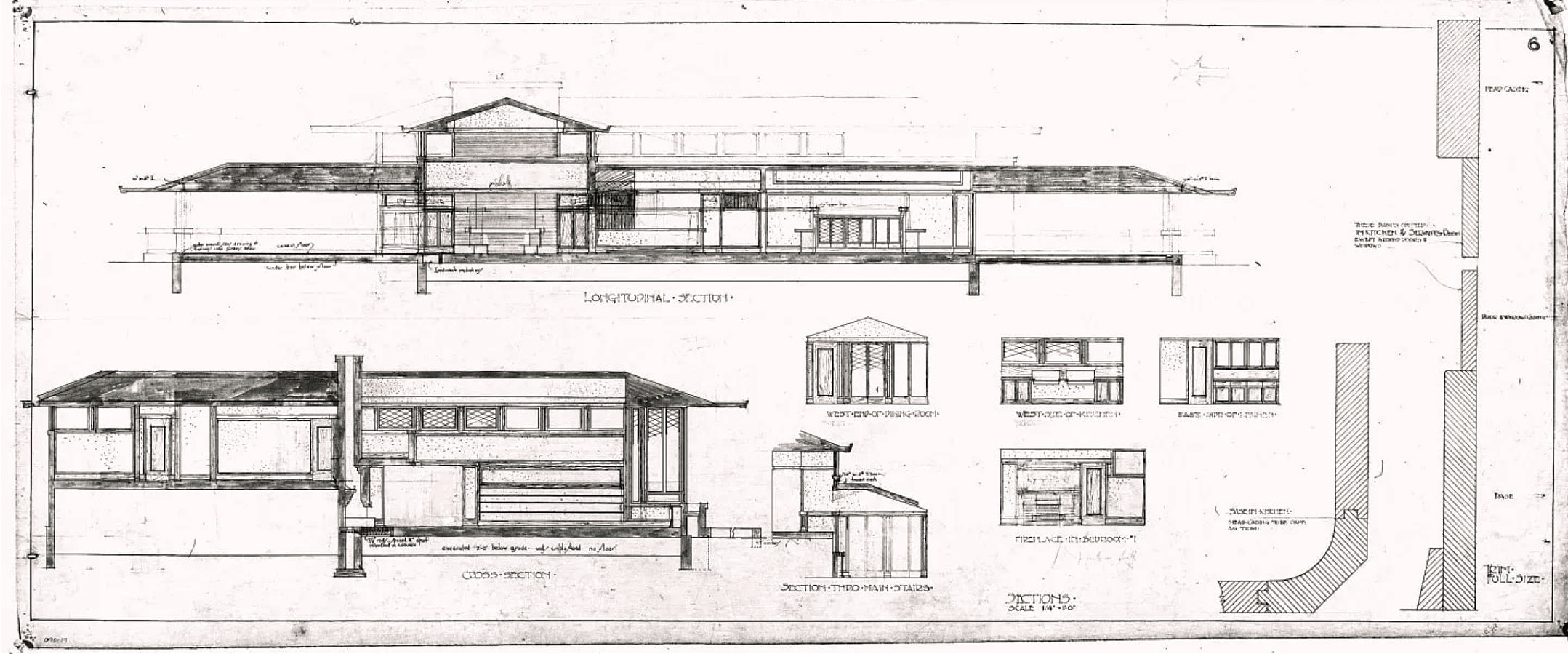
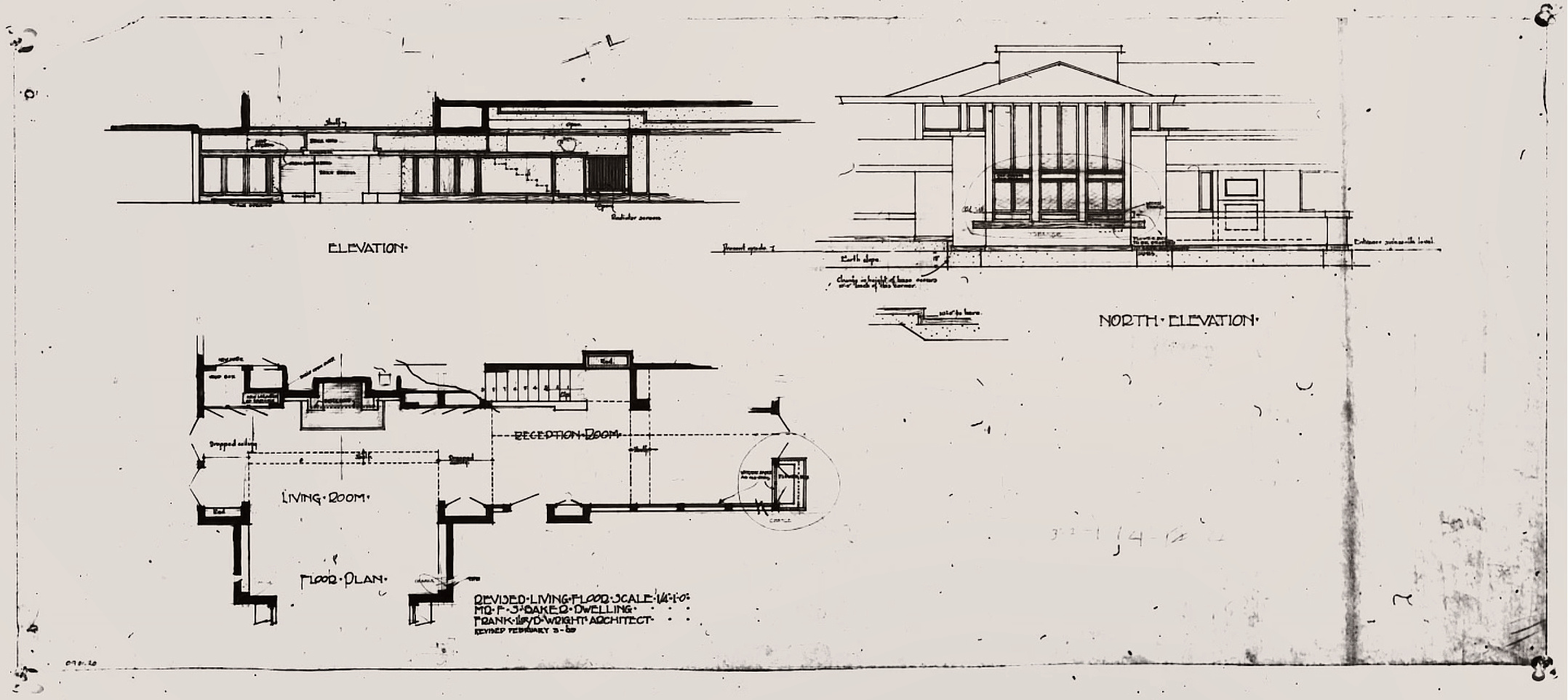
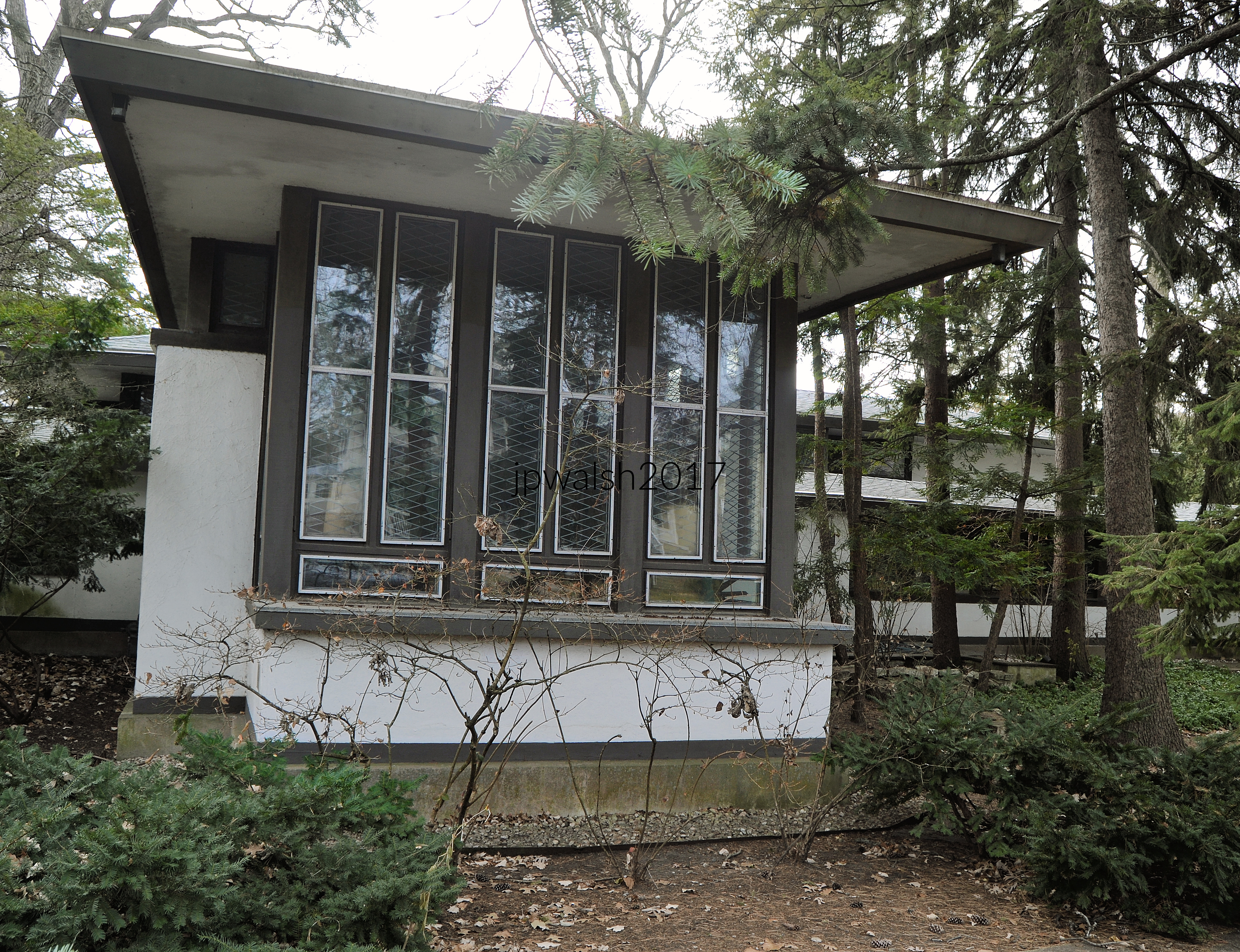
Feature image: Frank J. Baker House, Frank Lloyd Wright, 1909, Wilmette, Illinois. Frank J. Baker (1864–1922) was a driving force in Wilmette’s early growth — a sharp‑minded engineer and influential executive with the North Shore Electric Company and Commonwealth Edison who helped bring electricity to the North Shore. He is most remembered for the remarkable 1909 Frank J. Baker House, a Prairie‑style landmark designed for him by Frank Lloyd Wright. A civic leader as well as an innovator, Baker co‑founded the First National Bank of Wilmette. He died in his Wright‑designed home just a week before Christmas in 1922 at 58 years old. December 2017. 99% 7.20mb DSC_0560. Author’s photograph.
The Frank J. Baker House is a beautiful Frank Lloyd Wright residence and represents a critical moment in Wright’s architectural evolution, when the architect was pushing Prairie School design beyond earlier single-story compositions and experimenting with new approaches to space, volume, and the relationship between horizontality and verticality
The Frank J. Baker House, situated at 507 Lake Avenue in Wilmette, Illinois, is a 4,800‑square‑foot residence that stands as a significant example of Frank Lloyd Wright’s evolving Prairie School vocabulary. Designed in 1909, the house incorporates five bedrooms, three and a half bathrooms, and three fireplaces, yet its architectural importance lies less in its programmatic elements than in its role within Wright’s broader experimentation with spatial organization and structural expression during this period.
By the first decade of the twentieth century, Wright had begun to move beyond the predominantly single‑story Prairie houses of the late 1890s, exploring the potential of vertically layered two-story domestic space. The Baker House reflects this transitional moment through its T‑shaped floor plan—a configuration Wright employed in several contemporaneous works, including the Isabel Roberts House (below) built the previous year in River Forest, Illinois.
The Frank J. Baker House illustrates a pivotal stage in Frank Lloyd Wright’s Prairie School development, where experimentation with the T-shaped plan, two-story living spaces, and environmental continuity produced one of the architect’s most significant domestic designs of 1909
Isabel Roberts House, 603 Edgewood Place, River Forest, Illinois, 1908, Frank Lloyd Wright. It was remodeled in the 1950s. 69% 7.99 mb Author’s photograph.
The T‑plan allowed Wright to choreograph circulation along a dominant longitudinal axis while creating subsidiary wings that modulated privacy, light, and spatial hierarchy. In the Baker House, this plan form becomes a mechanism for integrating interior volumes with the surrounding landscape, reinforcing the Prairie School’s emphasis on horizontality and environmental continuity.
The exterior composition demonstrates Wright’s mature command of Prairie Style principles: a pronounced horizontal orientation, low‑pitched rooflines, and deeply cantilevered overhangs that visually anchor the structure to its site. These elements work in concert to diminish the building’s vertical massing, producing the characteristic “sheltering” effect that Wright associated with Midwestern domestic architecture.
The Frank J. Baker House (1909) and the Isabel Roberts House (1908) are closely related works that belong to Frank Lloyd Wright’s transitional Prairie period. Both employ a T-shaped plan that allowed Wright to organize circulation along a dominant central axis while projecting subsidiary wings outward into the landscape, strengthening the Prairie School ideal of spatial openness and environmental continuity.The Isabel Roberts House can be viewed as a direct precursor to the Frank J. Baker House, with Wright developing it into a more sophisticated architectural statement through greater spatial complexity, a monumental two-story living room, and a richer interplay between horizontality and volume.
Frank Lloyd Wright in 1903, likely a self-portrait. Public Domain.In 1909 42-year-old Frank Lloyd Wright reportedly personally brought the plans to Baker in Wilmette by horseback. Public domain. see – New owners to breathe life into 1909 Wright home – Wednesday Journal – retrieved March 30, 2026.
The two‑story living room is the spatial and symbolic core of the house. Its brick fireplace—an archetypal Wrightian hearth—functions as both a literal and conceptual center, organizing the surrounding spaces and reinforcing Wright’s belief in the fireplace as the spiritual heart of the home. The sloped ceiling and continuous band of leaded‑glass windows along the north wall create a dynamic interplay of light and volume, while the vertical expansion of the room contrasts deliberately with the home’s otherwise horizontal emphasis. Few surviving Wright houses retain this particular combination of a T‑shaped plan and a two‑story principal interior, making the Baker House an important artifact in understanding Wright’s spatial experimentation.
The property was listed on the National Register of Historic Places on November 8, 1974, acknowledging its architectural significance. A comprehensive restoration initiated in 2020 under new ownership has sought to preserve both the material integrity and the spatial logic of Wright’s original design.
Frank Lloyd Wright’s Prairie‑style design features strong horizontal porches framing a two‑story diamond‑leaded glass window wall in the living room. The home includes five large bedrooms, three‑and‑a‑half bathrooms, and three fireplaces. The second level offers a primary suite with en‑suite bath, fireplace, and private porch, plus two additional en‑suite bedrooms, two more bedrooms, and a sitting room. The kitchen and breakfast room overlook the expansive yard. Wright designed the home’s 1922 addition. Public Domain.
Through a deliberate sequence of compression and release, Wright choreographed movement through the Baker House so that ordinary domestic spaces culminate in a soaring central living room that serves as the spiritual and architectural heart of the home.
Interior Analysis.
Upon entry, the visitor encounters a twenty‑two‑foot dining room articulated with diamond‑patterned leaded‑glass windows, a pitched ceiling, and extensive wood trim. This space exemplifies Wright’s strategy of compressing and releasing volume: the relatively intimate proportions of the dining room heighten the dramatic expansion experienced upon entering the adjacent living room.
The main‑floor kitchen, accompanied by a modest breakfast nook, reflects Wright’s early efforts to modernize domestic workspaces by integrating them more fluidly into the overall plan. The living room, by contrast, adopts a quasi‑ecclesiastical spatial character. Its cantilevered ceiling, which extends into a loft above, creates a sense of upward movement unusual in Prairie houses. The continuous horizontal and vertical window bands dissolve the boundary between interior and exterior, a hallmark of Wright’s belief that architecture should mediate rather than separate human habitation from the natural environment.
At the center of the home stands the principal brick fireplace, accompanied by an overhead balcony that provides an elevated vantage point and reinforces the vertical layering of the space. On the second floor, the master bedroom includes one of the home’s three fireplaces and a private enclosed balcony, further demonstrating Wright’s interest in creating intimate, retreat‑like upper‑level spaces within an otherwise horizontally oriented composition.
FEATURE image: Detail of 804 Forest Avenue, Wilmette, Illinois. The Prairie style house was built in 1906 by architect George Washington Maher (1864-1926) whose influence on the Midwest was profound and prolonged and, in its time, as great as Frank Lloyd Wright’s. June 2014. Author’s photograph. 3.95mb
Wilmette’s architectural character reflects the evolution of Chicago’s North Shore from nineteenth-century village to premier suburban community, where distinguished residential, civic, religious, and commercial architecture created an environment of exceptional design quality that remains remarkably intact today.
1231 Forest Avenue, 1898.
A two-story clapboard with a flared hipped roof with three dormers, one each in the front and on the sides. The façade-length porch also has a hipped roof. The first floor has a projecting polygonal bay window and a front door and separate square vestibule window. June 2014. Author’s photograph. 4.76mb
1215 Forest Avenue, c. 1909.
The two-story home is built of finely dressed (cut, worked) ashlar stone. The home has a hipped roof and steep pitched pediment with a broken cornice and a false balcony with rounded attic window. In a rigidly centralized composition, there is a slight projecting bay above the entrance that is sheltered by a large porch with a massive projecting pediment held by a masonry pier with short bulging columns. June 2014. Author’s photograph. 5.67mb
1041 Forest Avenue, 1873.
Masked by later additions, this house was originally Italianate whose hooded windows and small square attic window remain on the façade. June 2014. Author’s photograph. 4.20mb
1020 Forest Avenue, Community Church of Wilmette, 1920.
A pioneer large church building tucked unobtrusively onto a residential street whose type of subdued stance was replicated by other churches built in its wake in the suburb. June 2014. Author’s photograph. 6.05mb
1020 Forest Avenue, Community Church of Wilmette, 1920. The building has massing of large rubble ashlar walls with broad arches and a porch. June 2014. Author’s photograph. 3.57mb
A grand two-story Classical Revival house has a high hipped roof and ionic pilasters at the corners and sides and pediment of the projecting entrance. Ionic columns support the porch. June 2014. Author’s photograph. 4.86mb
922 Forest Avenue pre-1873 and c. 1900.
The house was originally built in the Italianate style evident in the cornice with double brackets in the front and single brackets on the side of the house along with pedimented windows. The third-floor gables were added around 1900 along with the broad bow façade. These changes worked to add space and mask the original style. The front porch is more recent. June 2014. Author’s photograph. 5.61mb
George Washington Maher (1864-1926).
Born in West Virginia, Maher was an American architect in the Prairie School style who was known for blending with the Arts & Crafts style. According to H. Allen Brooks in The Prairie School – Frank Lloyd Wright and his Midwest Contemporaries (1972) “[Maher’s] influence on the Midwest was profound and prolonged and, in its time, was certainly as great as was Wright’s. Compared with the conventional architecture of the day, his work showed considerable freedom and originality, and his interiors were notable for their open and flowing…space.” At the time of his death, G.W. Maher had designed over 270 projects; from houses to parks to public buildings. Public Domain.
804 Forest Avenue, 1906, G.W. Maher.
A solid 4-square house that is modest compared to a similar-styled project the Prairie-school architect completed in 1899 in Oak Park known as Pleasant Home.June 2014. Author’s photograph. 4.85mb
Wilmette combines architectural distinction, affluent residential design, civic beauty, and lakefront suburban development into one of Chicago’s most visually cohesive communities.
Sources:
A Guide to Chicago’s Historic Suburbs on Wheels and on Foot, Ira J. Bach, Swallow Press/Ohio University Press, 1981, pp. 534-547.
The Prairie School – Frank Lloyd Wright and his Midwest Contemporaries. Brooks, H. Allen New York: W.W. Norton and Company, 1972, p. 330.
FEATURE image: Profile portrait of director Alfred Hitchcock taken in 1962 by American celebrity photographer Albert Watson. PHOTO: “Alfred Hitchcock Presents” by twm1340 is licensed under CC BY-SA 2.0.
Alfred Hitchcock’s I Confess (1953) transforms the conventions of film noir and psychological suspense into a profound moral drama about conscience, faith, and justice. Through Father Michael Logan’s refusal to violate the seal of confession, Hitchcock examines the conflict between religious duty and the demands of the law, revealing how silence can become an act of sacrifice while guilt, deception, and public prejudice threaten an innocent person.
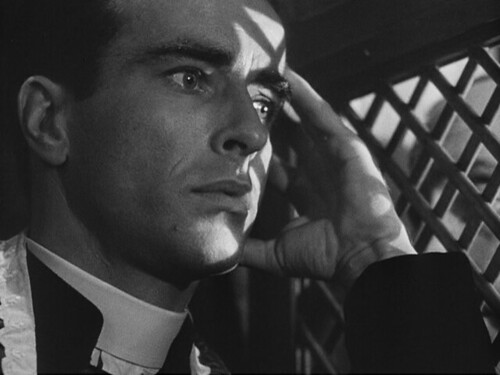
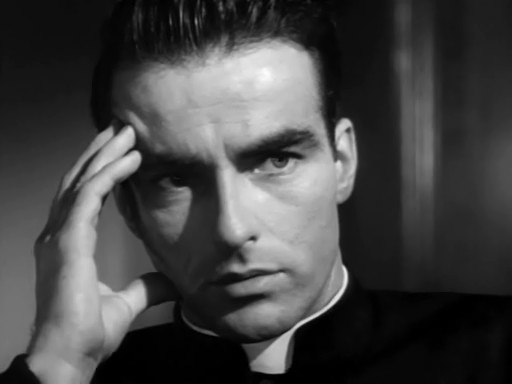
Montgomery Clift plays a Catholic priest, Father Michael Logan, who becomes a murder suspect because he cannot reveal what he learned about the real murderer in sacramental confession. Hitchcock’s film explores guilt, self-sacrifice, public prejudice, and moral responsibility in a gripping black-and-white noir. PHOTO: Image courtesy of Wikimedia Commons (Public Domain).
In I Confess, a 1953 film noir by Alfred Hitchcock (1899-1980) from Warner Bros., a Catholic priest, Fr. Logan (played by Montgomery Clift) hears the confession of a man who works in the rectory and just killed another man.
For the police Inspector (Karl Malden) and prosecutor (Brian Aherne), that the killer had been dressed as a priest and other circumstantial evidence, points to Fr. Logan as the primary suspect for the murder of Villette, a prominent lawyer.
Because of the seal of confession— that is, when a person confesses his sins to a priest in Confession, the priest must maintain absolute secrecy about anything that the person confesses—Fr. Logan cannot and does not under any circumstances divulge the identity of the confessed killer though he (and the audience) knows it.
Even after Fr. Logan is arrested for the crime and put on trial for the murder, the priest does not reveal the identity of the killer but only protests for his own innocence.
Father Michael Logan hears Otto Keller’s confession to murder. Bound by the seal of confession, Logan cannot disclose the killer’s identity, even when he becomes the principal suspect.
Hitchcock’s black-and-white film was shot by cinematographer Robert Burks (1909-1968) who would later shoot Hitchcock’s The Birds in 1964. It is edited by German-born Rudi Fehr (1911-1999) who would go on to edit Hitchcock’s triumphant color feature, Dial M For Murder, in 1954.
The story in I Confess was based on a 1902 play by Paul Anthelme Bourde (1851-1914), a French journalist and colonialist who coined the term “decadent” for the indecipherable Symbolist poets in his native France in the late 19th century.
The film follows the play which is about a killer who confesses to a priest knowing his crime cannot be betrayed. To complicate matters further, the killer blackmails the priest for a long-ago love affair he had with Ruth Grandfort (Anne Baxter), the wife of a leading citizen, and who still loves him. For the priest, the love affair is in the past though for Mrs. Grandfort it is not.
Father Logan’s former relationship with Ruth Grandfort, played by Anne Baxter, gives Keller an additional means of exploiting the priest’s vulnerability.
A primary conflict between the actress and director was that Hitchcock, who was notoriously fastidious about his leading ladies’ appearances, demanded that Baxter dye her hair. This work is in the public domain in the U.S. because it was published in the U.S. between 1927 and 1977, inclusive, without a copyright notice.
When Alfred Hitchcock’s film noir I Confess was filmed on location in Quebec City in 1952 and released in early 1953, Montgomery Clift and Anne Baxter were among Hollywood’s most prestigious and sought-after young actors. Both had achieved major career-defining successes, yet their approaches to acting—and their relationships with Hitchcock—could hardly have been more different.
By 1952, Montgomery Clift was widely regarded as a revolutionary force in American cinema. He had recently received an Academy Award nomination for A Place in the Sun (1951) and was preparing to film From Here to Eternity (1953), which would earn him another Best Actor nomination. Clift’s deeply introspective, psychologically nuanced approach to performance, however, sometimes clashed with Hitchcock’s preference for technical precision, carefully choreographed blocking, and exact camera placement. Hitchcock reportedly grew impatient with the Method actor’s persistent questions about a character’s motivation. The tension was further complicated by Clift’s heavy drinking, which occasionally left him appearing glazed during filming. Supporting actor Karl Malden sometimes served as an intermediary between Clift and Hitchcock, whose was famously non-confrontational.
Anne Baxter, by contrast, approached I Confess from a different professional perspective. Already an Academy Award-winning actress, she was known for her discipline and versatility, moving with apparent ease between contrasting roles. In 1953, Baxter parted ways with 20th Century Fox to establish herself as a cutting-edge freelance actress. She subsequently signed a lucrative two-picture deal with Warner Bros., with I Confess serving as a high-profile vehicle for this new phase of her career.
For Clift, I Confess remains an important testament to his extraordinary talent. Despite the reported behind-the-scenes tensions, his restrained, inward-looking portrayal of Father Michael Logan has been praised for its unusual intensity and concentration. His performance gives the film much of its emotional and moral force, demonstrating how a deeply internalized portrayal could become one of the most compelling elements of Hitchcock’s filmography.
Clearly, for Hitchcock in I Confess, the priest in this situation is a highly curious figure. By the end of the film, it becomes clear that the seal of confession is a cross for the priest because of his priesthood – and though sins do not always deal with high crime – demonstrates the personified sacramental nature of self-sacrifice that is involved for the priest with each confession he hears. Throughout the film, Fr. Logan is a tragi-comic figure as he simply does not state the obvious of who the murderer is on behalf of social justice and his own innocence, but equally personifying the religious nature of living with and taking on another’s sin particularly when a person refuses their own responsibility and makes amends for it. In I Confess, the murderer has no intention of turning himself in and is content to let the priest under seal of confession take the rap in the courtroom of the law and public opinion.
Clift portrays Logan as restrained, vulnerable, and morally resolute, making the priest’s silence central to the film’s emotional tension. PHOTO: Image courtesy of Wikimedia Commons (Public Domain)
Fr. Logan never impedes law enforcement’s investigation. He continually states his own innocence for which a jury of his peers is brought in to decide what to believe.
The sin of commission/omission – and in I Confess it is for and surrounds the gravity of murder – remains with the impenitent Otto Keller (O.E. Hasse) although his loving wife, Alma (Dolly Hass), to whom Keller confessed the crime outside confession’s seal, cannot abide by his secret.
Keller attempts to escape the consequences of his crime by allowing an innocent man to suffer in his place. The contrast between the two men is central to the film’s moral argument. PHOTO: “I, Confess animation” by doc_tor_matt is licensed under CC BY 2.0.
If, despite the seal of confession, crimes can be revealed to government investigators then the sanctuary of the law of the cross is extricated to get at evil – which is not contradiction nor improvement to the confessional box (the priest may ask the penitent for a release from the sacramental seal to discuss the confession) but its obligatory public replacement. As there is often no transparency and plenty of state secrets in and around various government agencies, this becomes no less problematical than breaking down a Catholic (and Lutheran) church’s confessional door as well as, in the United States, violating the free exercise of religion (the First Amendment).
Even after Logan is acquitted, public hostility demonstrates how suspicion and appearances can overpower reasoned judgment.
Though the jury finds Father Logan not guilty due to a lack of definitive physical evidence, the angry mob outside the courthouse is unconvinced by the verdict. They jeer and assault Logan as he tries to leave, believing a guilty murderer has escaped justice on a technicality. PHOTO: “I, Confess animation” by doc_tor_matt is licensed under CC BY 2.0.
The investigation and trial raise questions about whether legal institutions can adequately recognize innocence when crucial evidence cannot be disclosed.
Unable to bear the sight of the innocent priest being attacked, and consumed by escalating panic, the killer’s wife, Alma Keller, snaps. She steps forward to publicly denounce her husband and scream the truth to the crowd. In a frantic attempt to escape, Otto Keller pulls a gun, shoots and kills his wife, and flees into the grand Château Frontenac hotel. PHOTO: “I, Confess animation” by doc_tor_matt is licensed under CC BY 2.0.
Although found “not guilty” for lack of evidence to convict, the presiding judge expresses his disbelief in Fr. Logan’s innocence. When Fr. Logan exits the court building, he is followed and faced by a hostile crowd – “Preach us a sermon, Logan!” The prosecutor, as he watches the ugly scene from his office above, is forced to lament his actions: ”Do you think I enjoyed it?” he says, washing his hands. After Fr. Logan is crashed into a car window in the crowd, Alma, Keller’s wife, (her name means “soul”) rushes in towards the priest to tell what she knows—and which an accompanying police guard relates to the Inspector—“She said he was innocent.”
Trapped by the police, a desperate Keller tries to shoot Father Logan, completely exposing his own guilt. The police return fire, fatally wounding Keller. In his final dying moments, Keller begs for forgiveness, and Father Logan steps forward to administer the last rites and grant absolution to his own framing torturer—fully resolving his priestly duty, clearing his name in the eyes of the public, and permanently closing the door on his past life with Ruth.
Considered Hitchcock’s once most Catholic of films, I Confess is a tight drama with a truly despicable villain, whose murderous rampages do not stop. The film is ahead of its time in terms of direction – presaging camera angles, editing, pacing and themes of later international crime and psychological dramas that came to fruition in the decades ahead.
Black-and-white cinematography, visual tension, dramatic pacing, and psychological suspense reinforce the film’s themes of entrapment and moral isolation.
Original 1953 theatrical poster for Alfred Hitchcock’s I Confess functions as a misleading piece of marketing, deliberately disguising a religious, somber, psychological drama to become a volatile, sensationalized Hollywood romance. “A shame confessed – a sin concealed! This is love with the brand of Hitchcock burned in!” leans into pure melodrama with an implied promise of a romance overflowing with passion, betrayal, and scandalous secrets. The smaller tagline asks the audience a direct moral riddle: “If you knew what he knew, what would you do?” which establishes the film’s high-stakes moral dilemma, keeping the focus on a personal crisis of conscience. In reality, the movie is a dark, slow-burn, atmospheric film noir rooted in guilt and legal bureaucracy. Notably, the poster completely hides Montgomery Clift’s priestly collar in which he spends nearly the film’s entire runtime. Warner Bros. concealed the movie’s religious core, fearing from a marketing perspective that a story about a devout, celibate Catholic priest might alienate mainstream moviegoers looking for a Hollywood romance. As a standard one-sheet theatrical poster, this was displayed in theater lobbies, outside cinemas, and on street billboards in early 1953 to drive ticket sales. Warner Bros. leaned heavily on the bankable star power of Clift and Baxter, placing their names in giant red font across the bottom to draw crowds. Ultimately, while the poster succeeded in getting audiences into theaters, its heavy emphasis on sensationalized romance contributed to mixed reactions at the time, as viewers expecting a passionate thriller instead received a brooding meditation on faith, duty, and the silence of the confessional. PHOTO: Image courtesy of Wikimedia Commons (Public Domain). An online search by title at the US copyright office yielded no copyright renewal. In the absence of renewal of the US copyright, this poster art entered the public domain 28 years after its US publication date.
CONCLUSION
Upon its theatrical release in early 1953, I Confess underperformed at the box office and met with a mixed, largely lukewarm critical reception. While it did not reach the commercial heights or unanimous acclaim of Alfred Hitchcock’s top-tier thrillers, its reputation has evolved significantly over time. Today, the movie has transitioned out of obscurity and holds a solid 84% fresh rating on Rotten Tomatoes, widely re-evaluated by modern film historians as beautifully shot and intellectually challenging and a worthy entry in Hitchcock’s golden era.
In 1953, U.S. critics found the movie heavy-handed and slow, calling the screenplay dull and noting that the killer’s identity being known from the very beginning robbed the narrative of excitement. Most American reviewers felt the central romance flashback was unsuccessful and lacked genuine on-screen chemistry. However, Robert Burks’ moody, German Expressionist shadow cinematography was universally praised. The Catholic Church responded positively to I Confess as it treated Catholic beliefs with dignity and portrayed Father Logan as a devout priest. Yet, in 1950’s Catholic Ireland, the film apparently was not Catholic enough: and it was banned there for what censors considered its unacceptable innuendos. The film’s biggest champions at the time, however, were the young French critics of Cahiers du Cinéma who hailed I Confess as an absolute auteur masterpiece. They argued that the film’s brilliant “transference of guilt” motif and Montgomery Clift’s internalized acting perfectly captured the integrity of the spiritual isolation of the human condition.
FEATURE Image: This color photograph of Marilyn Monroe was made by Bruno Bernard — Bernard of Hollywood — on August 3, 1952, during the poolside press party at bandleader Ray Anthony’s California home. Co‑organized by 20th Century‑Fox, the event was engineered to showcase Monroe’s rapid ascent and to promote Anthony’s novelty song, Marilyn. She is wearing the same dress used in her Niagara publicity stills and scenes, a deliberate continuity meant to reinforce her emerging screen persona. Bernard had known her since 1946, when she was still Norma Jeane, and he remained one of the few photographers able to catch her in genuinely relaxed, luminous moments. His poolside images from this period are among the most candid records of her early stardom. PHOTO: “Marilyn Monroe – 1952, Niagara” by Movie-Fan is licensed under CC BY-NC-SA 2.0.
The 1952 hit single “Marilyn” was more than a popular song. It was part of the carefully coordinated Hollywood publicity machinery that helped transform Marilyn Monroe from a rising actress into a national celebrity. The song, the media campaign surrounding it, and the highly publicized poolside event at bandleader Ray Anthony’s home illustrate how Hollywood, popular music, photography, and publicity worked together to build Monroe’s emerging star image.
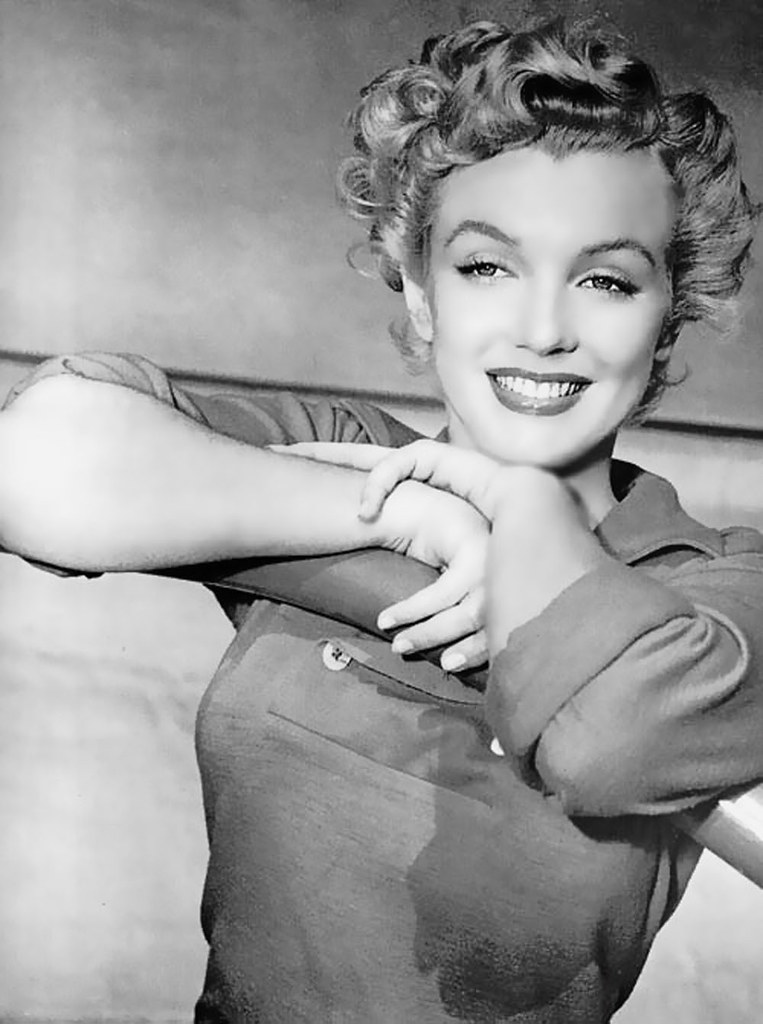
Marilyn Monroe in 1951 was emerging fast, already drawing notice from critics who tagged her as “the new blonde bombshell.” The black‑and‑white portrait of Marilyn Monroe was made in late 1951 by Ernest Bachrach, RKO’s chief portrait photographer, and syndicated widely through 1952. Shot both on location and in the studio spaces at RKO Radio Pictures in Los Angeles, the session was designed as a high‑visibility publicity campaign for Fritz Lang’s Clash by Night (1952). Monroe had pushed hard to be loaned out from 20th Century‑Fox for the supporting role of Peggy, a confident, blue‑collar cannery worker — a part she knew could shift how Hollywood viewed her.
Bachrach, a master of glamour portraiture, photographed her with the explicit aim of presenting her as a credible dramatic actress alongside veterans like Barbara Stanwyck. The film ultimately altered the trajectory of her career: for the first time, Monroe received billing above the title in a major motion picture. Bachrach’s photo campaign amplified that breakthrough, making her a household name even before the film reached theaters. It also demonstrated to studio executives that her magnetism held just as strongly in casual, sporty attire as in tight, high‑glamour wardrobe — a fusion that helped define the emerging “girl next door” aesthetic of 1950s Hollywood photography.PHOTO: “Marilyn Monroe, por Ernest Bachrach, 1951” by Antonio Marín Segovia is licensed under CC BY-NC-ND 2.0.
A widely publicized August 1952 poolside party at bandleader Ray Anthony’s California home was organized partly to promote both Monroe and the song. Hollywood had never seen an actress command the cultural conversation in one year like this. She was the original high-concept, serial franchise film star. Her face and body sold newspapers, magazines, makeup, and movie tickets at an unprecedented velocity.
Marilyn Monroe started 1953 as Hollywood’s “It” girl. The photograph shows Marilyn in a cropped frame from late 1953, captured at the Hollywood film premiere for How to Marry a Millionaire. She is wearing a famous custom white lace gown designed by William Travilla. It does relate to the August 1952 “Marilyn” party in that it is bound together by the explosive phenomenon of her meteoric rise.
In early 1953, Marilyn Monroe transitioned from a hard-working studio starlet into the absolute, undisputed “It Girl” of global popular culture. This specific phenomenon changed her life, transformed Hollywood marketing, and left a permanent mark on entertainment history.
Before 1953, 20th Century Fox viewed Marilyn as a profitable novelty. By January 1953, a perfect storm of media alignment occurred. The groundwork laid by those 1952 events—like the Ray Anthony party, the LIFE magazine cover, and the continuous press blitzes— culminated in a box-office avalanche.
In a single twelve-month span, Monroe released three consecutive, massive cinematic triumphs: Niagara in January 1953 where she starred as a dark, dangerous femme fatale; Gentlemen Prefer Blondes in July 1953 where she cemented her legendary comedic timing and musical icon status in the shocking pink Travilla gown; and How to Marry a Millionaire in November 1953 where she solidified her mass commercial appeal as a whispery “dumb blonde” comedic character.
Marilyn redefined what an “It Girl” could be. It Girls came in all types previously—from the aloof, untouchable elegance of stars like Greta Garbo or Joan Crawford to the gritty, working-class, uninhibited trail that Clara Bow and Jean Harlow blazed. Marilyn introduced a radiant, highly accessible, and deeply vulnerable form of sexuality. She projected a playful, “wink-at-the-camera” warmth that made audiences feel like she was letting them in on the fun.
A tragic irony of Marilyn becoming the ultimate 1953 “It Girl” is that the very phenomenon that made her immortal also trapped her in her “dumb blonde” or “glamour queen” roles and persona, so that in late 1954 she walked away from Hollywood temporarily after refusing typecasting roles and, when she came back, things were never quite the same. Decades later, the visual shorthand established during her 1953 peak remains the definitive blueprint for modern celebrity culture. The hyper-focus on her hair, her outfits, her dating life, and her physical form set the stage for how modern pop stars and icons are scrutinized by the media today. PHOTO: “Marilyn Monroe 1953” by Movie-Fan is licensed under CC BY-NC-SA 2.0.
Bandleader Ray Anthony released the two-minute single Marilyn in 1952 with rising film star Marilyn Monroe definitely in mind. Born Raymond Antonini to an Italian family in Bentleyville, Pennsylvania, in 1922, Ray Anthony is a living bridge to the Big Band era, the last surviving member of the original Glenn Miller Orchestra and the world’s oldest living recorded musician. After serving in the U.S. Navy during World War II, he launched the wildly successful Ray Anthony Orchestra, scoring early 1950s hits with “Marilyn,” “The Bunny Hop,” and “The Hokey Pokey,” while also topping the charts with his iconic instrumental themes for Dragnet and Peter Gunn. Now retired in the Hollywood Hills, Anthony remains one of the last direct links to the golden age of American popular music.
Hollywood mythology claims Marilyn Monroe n a bright pink dress swept into the August 1952 release party for the song Marilyn, touching down in a helicopter before exiting just as theatrically. In reality she arrived by car. The helicopter, brought in separately, became a convenient prop once publicists realized its value: they had her climb aboard and pose with Ray Anthony to manufacture the impression of a dramatic aerial entrance. The afternoon itself had the usual Hollywood chaos — Lassie trotted up to greet her, and Mickey Rooney jumped behind the drums with Anthony’s orchestra to play for her.
By the end of 1951 Marilyn had completed thirteen films, most for 20th Century‑Fox, and by 1952 she was poised on the threshold of major stardom. In 1952 she added five more. In Clash by Night (RKO), Kate Cameron of the New York News tagged her as “the new blonde bombshell.” In Fox’s We’re Not Married, Alton Cook of the New York World‑Telegram wrote that “Marilyn supplies beauty. She is Hollywood’s foremost expert.” Fox’s Monkey Business prompted Paul C. Beckley of the New York Herald Tribune to note the shift underway: “Not seen her before. I now know what’s that about.” She finished the year in Fox’s anthology O. Henry’s Full House, where Archer Winston of the New York Post singled out her “stunning proportions.”
This iconic black‑and‑white close‑up of Marilyn Monroe (above) was made in early 1953 by 20th Century‑Fox’s chief portrait photographer, Frank Powolny, as a publicity image for her breakthrough film Niagara. The styling, the expression, the heavy‑lidded “bedroom eyes” — all echo the Philippe Halsman Life magazine portrait from January 1952 (published April 7, 1952), because both sessions caught her at the exact moment she was standardizing and weaponizing her look.
The 1953 shoot took place at the Fox studios in Los Angeles, a high‑glamour promotional session meant to generate marketing material also for Gentlemen Prefer Blondes. Used widely in posters, press kits, and magazine syndication, the portrait is historically important because it crystallized her trademark expression: head tipped slightly back, eyes half‑closed, lips parted just enough to show her teeth.
Its impact was immediate. The image fixed her aesthetic in the public imagination and helped shift her from rising starlet to fully recognized global symbol of Hollywood glamour. Decades later, the tight crop — platinum curls, parted lips, beauty mark, and that unmistakable gaze — remains one of the most reproduced portraits in pop culture. It was this Powolny series that Andy Warhol appropriated for his 1962 silkscreens after her death. Marilyn didn’t merely suggest the look she had explored with Halsman; she executed it so precisely that the studio seized it and mass‑marketed its power. PHOTO: “Marilyn Monroe – 1952 / fotografiada por Philippe Halsman para LIFE” by Antonio Marín Segovia is licensed under CC BY-NC-ND 2.0.
Monroe’s public image was being carefully shaped through studio publicity, photography, magazine coverage, and promotional appearances.
Taken by Canadian journalist‑photographer Jock Carroll in June 1952 on location in Niagara Falls, Canada, this candid portrait comes from his two‑week assignment for Weekend Magazine, which had commissioned him to profile the 26‑year‑old rising actress as she filmed her breakthrough thriller Niagara. The image captures a candid, windswept moment during one of their informal walks along the Niagara River: Monroe in a simple white sleeveless top, her small medallion pendant visible, her blonde curls blown out by the mist and wind rolling off the falls.
Across the assignment Carroll shot more than 400 candid photographs. The easy rapport they developed allowed him to capture unguarded moments — including the now‑famous sequence of Monroe practicing how to smoke in her room at the General Brock Hotel for an upcoming role. A selection of his images ran with his profile in the August 9, 1952 issue of Weekend Picture Magazine.
Most of the negatives remained unseen for decades until they resurfaced in 1996 in Falling for Marilyn: The Lost Niagara Collection, which established the set as a major historical record. Today, this windswept portrait is celebrated for stripping away the studio‑manufactured bombshell veneer, offering instead an unfiltered, radiant glimpse of Norma Jeane at her most natural and effortlessly charming. PHOTO: “Marilyn Monroe by Jock Carroll, June, 1952” by thefoxling is licensed under CC BY-NC-SA 2.0.
One of Jock Carroll’s 400 candid photographs of Marilyn on location in June 1952 for Niagara, catches her from behind as she breaks into a light jog in her high heels along the concrete pier toward the Maid of the Mist as Niagara Falls thunders behind. Carroll wanted movement rather than a stiff publicity pose, something that showed her responding naturally to the environment. She wears a button‑back, off‑the‑shoulder top and a pale pencil skirt, the outfit emphasizing the clean, unforced lines of her stride.
In the finished 1953 film, director Henry Hathaway devoted 116 uninterrupted feet of film to a single shot of Monroe walking away from the camera in a tight pencil skirt — one of the longest “walking‑away” shots in cinema history. It permanently established her swinging gait as a defining element of her star power, a signature that audiences recognized instantly and never forgot.
Marilyn Monroe’s performance and appearance in Niagara in 1953 from 20th Century-Fox were highly praised. One critic observed: “Seen from any angle…Marilyn Monroe leaves little to be desired.” (A.H. Weiler, New York Times). Public Domain. in the United States. Because it was an uncopyrighted promotional still distributed freely to the public by the movie studio between 1931 and 1963, its copyright was never registered or renewed.
Publicity portrait of Marilyn Monroe as Rose Loomis in the 1953 film Niagara. By Gene Kornman (1897-1978). This work is in the public domain because it was published in the United States between 1931 and 1963, and although there may or may not have been a copyright notice, the copyright was not renewed.
Marilyn Monroe’s momentum in 1953 never faltered. Her three Twentieth Century‑Fox releases that year — Niagara, praised as “seductive,” Gentlemen Prefer Blondes, deemed “alluring,” and How to Marry a Millionaire, celebrated for her “magnificent proportions” — collectively cemented her acting career and her place as America’s enduring screen symbol.
Ray Anthony (b. 1922), one of the last living figures from post‑war Old Hollywood, belongs to the same generation whose era effectively closed with Marilyn’s death in 1962. Four years her senior, he reached his hundredth birthday in California on January 20, 2022.
Most of that remarkable cohort born in 1922 — Ava Gardner, Jason Robards, Betty White, Judy Garland, Doris Day, Cyd Charisse, Kim Hunter, Eleanor Parker, Veronica Lake, and many others — has now passed, leaving only a few witnesses to that vanished world.
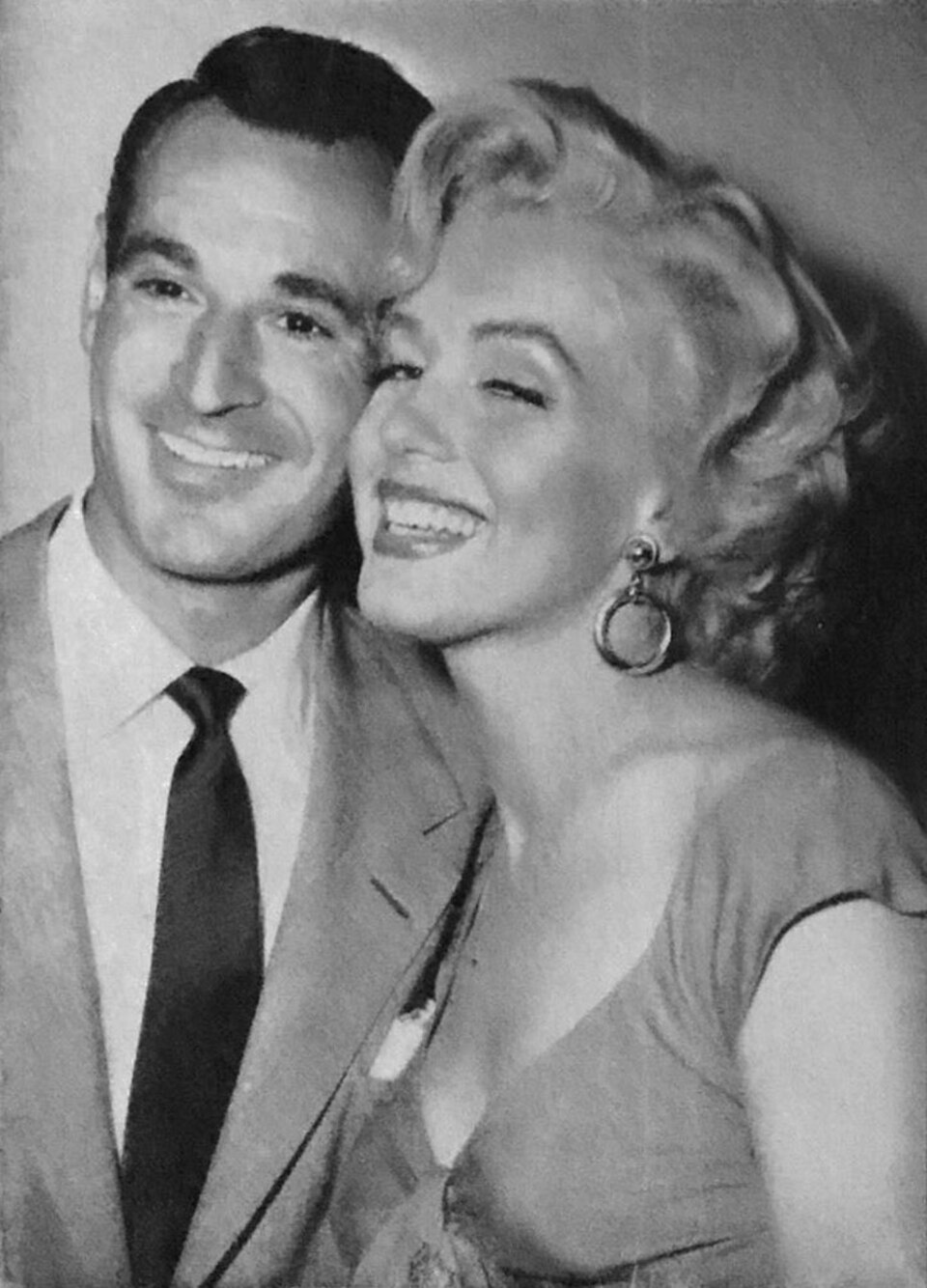
Marilyn Monroe and Joe DiMaggio — the movie star and the former major‑league baseball great — married in 1954. PHOTO: “Evan Esar” by Peter K. Levy is marked with Public Domain Mark 1.0.
Ray Anthony’s rise in the early 1950s came through a wildly popular dance band that kept producing records that instantly entered American social life. Numbers like The Hokey Pokey and The Bunny Hop became fixtures at wedding receptions throughout the 1960s and 1970s, part of the soundtrack of mid‑century celebration.
When Anthony released his single Marilyn, the world’s most famous sex symbol was still unattached, though being actively courted by New York Yankees legend Joe DiMaggio. They would marry in 1954. By then Marilyn had already been declared Hollywood’s “It Girl” of 1952, her career hovering at the edge of full stardom — an excitement that made the Marilyn release party crackle.
Photo of musician Ray Anthony and Marilyn Monroe from the cover of Down Beat magazine in 1952.This work is in the public domain because it was published in the United States between 1931 and 1963, and although there may or may not have been a copyright notice, the copyright was not renewed.
Anthony had a particular fondness for glamorous Hollywood blondes. He married one in 1955: Mamie Van Doren, with whom he had a son before divorcing in 1961. In 1956 he appeared alongside another blonde bombshell, Jayne Mansfield, in the musical comedy The Girl Can’t Help It.
Surrounded by beauty, music, and the energy of post‑war Hollywood, Anthony reached a fitting milestone in 1957 when he received his star on the Hollywood Walk of Fame. Marilyn Monroe received her Hollywood Walk of Fame star on February 8, 1960.
This explanatory article may be periodically updated.