Tag Archives: #Conscience

An Innocent Priest, a Hidden Murderer: Montgomery Clift in Hitchcock’s I Confess (1953).

FEATURE image: Profile portrait of director Alfred Hitchcock taken in 1962 by American celebrity photographer Albert Watson. PHOTO: “Alfred Hitchcock Presents” by twm1340 is licensed under CC BY-SA 2.0.

Alfred Hitchcock’s I Confess (1953) transforms the conventions of film noir and psychological suspense into a profound moral drama about conscience, faith, and justice. Through Father Michael Logan’s refusal to violate the seal of confession, Hitchcock examines the conflict between religious duty and the demands of the law, revealing how silence can become an act of sacrifice while guilt, deception, and public prejudice threaten an innocent person.

Montgomery Clift plays a Catholic priest, Father Michael Logan, who becomes a murder suspect because he cannot reveal what he learned about the real murderer in sacramental confession. Hitchcock’s film explores guilt, self-sacrifice, public prejudice, and moral responsibility in a gripping black-and-white noir. PHOTO: Image courtesy of Wikimedia Commons (Public Domain).

In I Confess, a 1953 film noir by Alfred Hitchcock (1899-1980) from Warner Bros., a Catholic priest, Fr. Logan (played by Montgomery Clift) hears the confession of a man who works in the rectory and just killed another man.

For the police Inspector (Karl Malden) and prosecutor (Brian Aherne), that the killer had been dressed as a priest and other circumstantial evidence, points to Fr. Logan as the primary suspect for the murder of Villette, a prominent lawyer.

Because of the seal of confession— that is, when a person confesses his sins to a priest in Confession, the priest must maintain absolute secrecy about anything that the person confesses—Fr. Logan cannot and does not under any circumstances divulge the identity of the confessed killer though he (and the audience) knows it.

Even after Fr. Logan is arrested for the crime and put on trial for the murder, the priest does not reveal the identity of the killer but only protests for his own innocence.

Father Michael Logan hears Otto Keller’s confession to murder. Bound by the seal of confession, Logan cannot disclose the killer’s identity, even when he becomes the principal suspect.
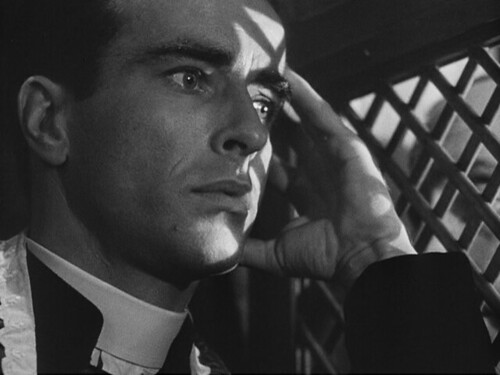
PHOTO: “I, Confess animation” by doc_tor_matt is licensed under CC BY 2.0.

Hitchcock’s black-and-white film was shot by cinematographer Robert Burks (1909-1968) who would later shoot Hitchcock’s The Birds in 1964. It is edited by German-born Rudi Fehr (1911-1999) who would go on to edit Hitchcock’s triumphant color feature, Dial M For Murder, in 1954.

The story in I Confess was based on a 1902 play by Paul Anthelme Bourde (1851-1914), a French journalist and colonialist who coined the term “decadent” for the indecipherable Symbolist poets in his native France in the late 19th century.

The film follows the play which is about a killer who confesses to a priest knowing his crime cannot be betrayed. To complicate matters further, the killer blackmails the priest for a long-ago love affair he had with Ruth Grandfort (Anne Baxter), the wife of a leading citizen, and who still loves him. For the priest, the love affair is in the past though for Mrs. Grandfort it is not.

Father Logan’s former relationship with Ruth Grandfort, played by Anne Baxter, gives Keller an additional means of exploiting the priest’s vulnerability.

A primary conflict between the actress and director was that Hitchcock, who was notoriously fastidious about his leading ladies’ appearances, demanded that Baxter dye her hair. This work is in the public domain in the U.S. because it was published in the U.S. between 1927 and 1977, inclusive, without a copyright notice.

When Alfred Hitchcock’s film noir I Confess was filmed on location in Quebec City in 1952 and released in early 1953, Montgomery Clift and Anne Baxter were among Hollywood’s most prestigious and sought-after young actors. Both had achieved major career-defining successes, yet their approaches to acting—and their relationships with Hitchcock—could hardly have been more different.

By 1952, Montgomery Clift was widely regarded as a revolutionary force in American cinema. He had recently received an Academy Award nomination for A Place in the Sun (1951) and was preparing to film From Here to Eternity (1953), which would earn him another Best Actor nomination. Clift’s deeply introspective, psychologically nuanced approach to performance, however, sometimes clashed with Hitchcock’s preference for technical precision, carefully choreographed blocking, and exact camera placement. Hitchcock reportedly grew impatient with the Method actor’s persistent questions about a character’s motivation. The tension was further complicated by Clift’s heavy drinking, which occasionally left him appearing glazed during filming. Supporting actor Karl Malden sometimes served as an intermediary between Clift and Hitchcock, whose was famously non-confrontational.

Anne Baxter, by contrast, approached I Confess from a different professional perspective. Already an Academy Award-winning actress, she was known for her discipline and versatility, moving with apparent ease between contrasting roles. In 1953, Baxter parted ways with 20th Century Fox to establish herself as a cutting-edge freelance actress. She subsequently signed a lucrative two-picture deal with Warner Bros., with I Confess serving as a high-profile vehicle for this new phase of her career.

For Clift, I Confess remains an important testament to his extraordinary talent. Despite the reported behind-the-scenes tensions, his restrained, inward-looking portrayal of Father Michael Logan has been praised for its unusual intensity and concentration. His performance gives the film much of its emotional and moral force, demonstrating how a deeply internalized portrayal could become one of the most compelling elements of Hitchcock’s filmography.

Clearly, for Hitchcock in I Confess, the priest in this situation is a highly curious figure. By the end of the film, it becomes clear that the seal of confession is a cross for the priest because of his priesthood – and though sins do not always deal with high crime – demonstrates the personified sacramental nature of self-sacrifice that is involved for the priest with each confession he hears. Throughout the film, Fr. Logan is a tragi-comic figure as he simply does not state the obvious of who the murderer is on behalf of social justice and his own innocence, but equally personifying the religious nature of living with and taking on another’s sin particularly when a person refuses their own responsibility and makes amends for it. In I Confess, the murderer has no intention of turning himself in and is content to let the priest under seal of confession take the rap in the courtroom of the law and public opinion.
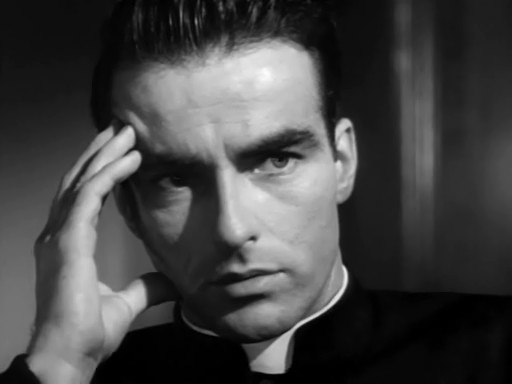
Clift portrays Logan as restrained, vulnerable, and morally resolute, making the priest’s silence central to the film’s emotional tension. PHOTO: Image courtesy of Wikimedia Commons (Public Domain)

Fr. Logan never impedes law enforcement’s investigation. He continually states his own innocence for which a jury of his peers is brought in to decide what to believe.

The sin of commission/omission – and in I Confess it is for and surrounds the gravity of murder – remains with the impenitent Otto Keller (O.E. Hasse) although his loving wife, Alma (Dolly Hass), to whom Keller confessed the crime outside confession’s seal, cannot abide by his secret.

Keller attempts to escape the consequences of his crime by allowing an innocent man to suffer in his place. The contrast between the two men is central to the film’s moral argument. PHOTO: “I, Confess animation” by doc_tor_matt is licensed under CC BY 2.0.

If, despite the seal of confession, crimes can be revealed to government investigators then the sanctuary of the law of the cross is extricated to get at evil – which is not contradiction nor improvement to the confessional box (the priest may ask the penitent for a release from the sacramental seal to discuss the confession) but its obligatory public replacement. As there is often no transparency and plenty of state secrets in and around various government agencies, this becomes no less problematical than breaking down a Catholic (and Lutheran) church’s confessional door as well as, in the United States, violating the free exercise of religion (the First Amendment).

Even after Logan is acquitted, public hostility demonstrates how suspicion and appearances can overpower reasoned judgment.

Though the jury finds Father Logan not guilty due to a lack of definitive physical evidence, the angry mob outside the courthouse is unconvinced by the verdict. They jeer and assault Logan as he tries to leave, believing a guilty murderer has escaped justice on a technicality. PHOTO: “I, Confess animation” by doc_tor_matt is licensed under CC BY 2.0.

The investigation and trial raise questions about whether legal institutions can adequately recognize innocence when crucial evidence cannot be disclosed.

Unable to bear the sight of the innocent priest being attacked, and consumed by escalating panic, the killer’s wife, Alma Keller, snaps. She steps forward to publicly denounce her husband and scream the truth to the crowd. In a frantic attempt to escape, Otto Keller pulls a gun, shoots and kills his wife, and flees into the grand Château Frontenac hotel. PHOTO: “I, Confess animation” by doc_tor_matt is licensed under CC BY 2.0.

Although found “not guilty” for lack of evidence to convict, the presiding judge expresses his disbelief in Fr. Logan’s innocence. When Fr. Logan exits the court building, he is followed and faced by a hostile crowd – “Preach us a sermon, Logan!” The prosecutor, as he watches the ugly scene from his office above, is forced to lament his actions: ”Do you think I enjoyed it?” he says, washing his hands. After Fr. Logan is crashed into a car window in the crowd, Alma, Keller’s wife, (her name means “soul”) rushes in towards the priest to tell what she knows—and which an accompanying police guard relates to the Inspector—“She said he was innocent.”

Trapped by the police, a desperate Keller tries to shoot Father Logan, completely exposing his own guilt. The police return fire, fatally wounding Keller. In his final dying moments, Keller begs for forgiveness, and Father Logan steps forward to administer the last rites and grant absolution to his own framing torturer—fully resolving his priestly duty, clearing his name in the eyes of the public, and permanently closing the door on his past life with Ruth.

Considered Hitchcock’s once most Catholic of films, I Confess is a tight drama with a truly despicable villain, whose murderous rampages do not stop. The film is ahead of its time in terms of direction – presaging camera angles, editing, pacing and themes of later international crime and psychological dramas that came to fruition in the decades ahead.

Black-and-white cinematography, visual tension, dramatic pacing, and psychological suspense reinforce the film’s themes of entrapment and moral isolation.

Original 1953 theatrical poster for Alfred Hitchcock’s I Confess functions as a misleading piece of marketing, deliberately disguising a religious, somber, psychological drama to become a volatile, sensationalized Hollywood romance. “A shame confessed – a sin concealed! This is love with the brand of Hitchcock burned in!” leans into pure melodrama with an implied promise of a romance overflowing with passion, betrayal, and scandalous secrets. The smaller tagline asks the audience a direct moral riddle: “If you knew what he knew, what would you do?” which establishes the film’s high-stakes moral dilemma, keeping the focus on a personal crisis of conscience. In reality, the movie is a dark, slow-burn, atmospheric film noir rooted in guilt and legal bureaucracy. Notably, the poster completely hides Montgomery Clift’s priestly collar in which he spends nearly the film’s entire runtime. Warner Bros. concealed the movie’s religious core, fearing from a marketing perspective that a story about a devout, celibate Catholic priest might alienate mainstream moviegoers looking for a Hollywood romance. As a standard one-sheet theatrical poster, this was displayed in theater lobbies, outside cinemas, and on street billboards in early 1953 to drive ticket sales. Warner Bros. leaned heavily on the bankable star power of Clift and Baxter, placing their names in giant red font across the bottom to draw crowds. Ultimately, while the poster succeeded in getting audiences into theaters, its heavy emphasis on sensationalized romance contributed to mixed reactions at the time, as viewers expecting a passionate thriller instead received a brooding meditation on faith, duty, and the silence of the confessional. PHOTO: Image courtesy of Wikimedia Commons (Public Domain). An online search by title at the US copyright office yielded no copyright renewal. In the absence of renewal of the US copyright, this poster art entered the public domain 28 years after its US publication date.

CONCLUSION

Upon its theatrical release in early 1953, I Confess underperformed at the box office and met with a mixed, largely lukewarm critical reception. While it did not reach the commercial heights or unanimous acclaim of Alfred Hitchcock’s top-tier thrillers, its reputation has evolved significantly over time. Today, the movie has transitioned out of obscurity and holds a solid 84% fresh rating on Rotten Tomatoes, widely re-evaluated by modern film historians as beautifully shot and intellectually challenging and a worthy entry in Hitchcock’s golden era.

In 1953, U.S. critics found the movie heavy-handed and slow, calling the screenplay dull and noting that the killer’s identity being known from the very beginning robbed the narrative of excitement. Most American reviewers felt the central romance flashback was unsuccessful and lacked genuine on-screen chemistry. However, Robert Burks’ moody, German Expressionist shadow cinematography was universally praised. The Catholic Church responded positively to I Confess as it treated Catholic beliefs with dignity and portrayed Father Logan as a devout priest. Yet, in 1950’s Catholic Ireland, the film apparently was not Catholic enough: and it was banned there for what censors considered its unacceptable innuendos. The film’s biggest champions at the time, however, were the young French critics of Cahiers du Cinéma who hailed I Confess as an absolute auteur masterpiece. They argued that the film’s brilliant “transference of guilt” motif and Montgomery Clift’s internalized acting perfectly captured the integrity of the spiritual isolation of the human condition.

https://www.catholiceducation.org/en/religion-and-philosophy/catholic-faith/the-seal-of-the-confessional.html

text & layout –

From Oxford to Rome: How St. John Henry Newman (1801-1890) Followed Conscience in Search of Religious Truth.

N.B. – Vatican City, July 31, 2025 (UPI) — Pope Leo XIV will bestow St. John Henry Newman, the influential 19th-century Anglican convert, with the honor of “Doctor of the Church” [today].” Cardinal Newman was beatified by Pope Benedict XVI in 2010 and canonized by Pope Francis in 2019. With Pope Leo XIV’s action Card. St. Newman is now one of 38 “Doctors of the Church” whose ranks include four women. St. John Henry Newman became the first saint canonized from Britain since 1976.

FEATURE image: Photographic portrait, John Henry Cardinal Newman, 1880.

Canonized in 2019 and later declared a Doctor of the Church, Newman is a thinker whose relevance extends well beyond the 19th century.

 John Henry Newman, Oratory of St. Philip Neri, Birmingham, England.  London; New York; Bombay; Calcutta: Longmans, Green. Newman’s method of composing a sermon was to do so by heart and then write it down afterwards. English theologian James Mozley (1813-1878) who was active in the Oxford Movement, observed about these sermons: “A sermon of Mr. Newman’s enters into our feelings, ideas, and modes of viewing things. Persons look into Mr. Newman’s sermons and see their own thoughts in them.”

John Henry Newman was one of the most influential Christian thinkers of the modern era, whose journey from Anglican leader to Catholic cardinal, combined with his profound writings on truth, conscience, faith, reason, and holiness, continues to offer a model for navigating religious, intellectual, and cultural divisions.

Introduction by John P. Walsh

John Henry Newman (1801-1890) was a theologian and poet who was first an Anglican priest and later a Roman Catholic priest and cardinal. In the 1830’s and until his conversion to Catholicism in 1845, Newman was a leading figure in the Oxford Movement. They were a group of Anglicans who looked to create a bridge between the Church of England and the Catholic Church by adopting many Catholic beliefs and liturgical rituals from before the English Reformation. Newman eventually came to believe for himself that these religious efforts proved insufficient and he left the Anglican Communion for the Catholic Church in 1845. Already an articulate and influential religious leader in Britain, Newman’s decision brought with it the burden of having upset his friends as well as being challenged by them and others for his changed religious opinions on polemical grounds. Newman, a longtime writer and speaker, responded after a while with his now-celebrated Apologia Pro Vita Sua (1865–1866), which served as a defense of his religious opinions after he quit his position as Anglican vicar at Oxford. Newman, a 19th-century master of English prose and poetry, had already published The Idea of a University (1852) and went on to publish Grammar of Assent (1870) as well as several poems, some of which were set to music or served as hymns. In 1879, at the age of 78 years old, Pope Leo XIII named Newman a cardinal for his work on behalf of the Catholic Church in England as well as his having co-founded the Catholic University of Ireland in 1854, which today as University College Dublin is Ireland’s largest institution of higher learning. On October 13, 2019, John Henry Newman was canonized a Catholic saint at the Vatican by Pope Francis. St. John Henry Newman became the first saint canonized from Britain since 1976. In remarks by Prince Charles who led the British delegation to the Vatican for Newman’s canonization, the Prince of Wales said: “In the age in which he [Newman] attains sainthood, his example is needed more than ever – for the manner in which, at his best, he could advocate without accusation, could disagree without disrespect and, perhaps most of all, could see differences as places of encounter rather than exclusion.” London-born Cardinal Newman died in England in 1890 at 89 years old. He founded the Oratory at Birmingham in 1848 and through his writings spoke to many about the issues of faith, education, and conscience.

John Henry Newman began as an Anglican priest and leading figure in the Oxford Movement before converting to Catholicism in 1845. Newman became a major Catholic intellectual, publishing influential works on education, belief, doctrine, and the development of Christian thought.

A given opinion, as held by several individuals, even when of the most congenial views, is as distinct as are their faces. Oxford University sermons, 1843.

It is as absurd to argue men, as to torture them, into believing. Oxford University sermon, December 11, 1831.

His conversion cost him friendships and provoked controversy, prompting him to write Apologia Pro Vita Sua, one of the great religious autobiographies and defenses of conscience.

From the age of fifteen, dogma has been the fundamental principle of my religion: I know of no other religion; I cannot enter into the idea of any other sort of religion; religion, as a mere sentiment, is to me a dream and a mockery. Apologia Pro Vita Sua, 1864.

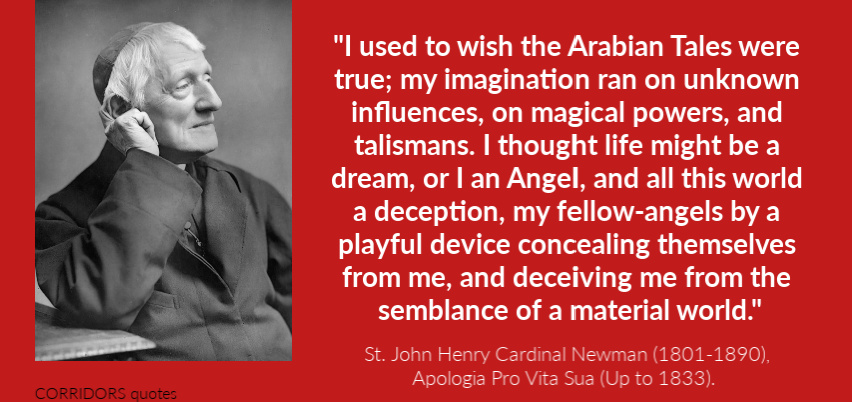
I used to wish the Arabian Tales were true; my imagination ran on unknown influences, on magical powers, and talismans. I thought life might be a dream, or I an Angel, and all this world a deception, my fellow-angels by a playful device concealing themselves from me, and deceiving me from the semblance of a material world. Apologia Pro Vita Sua (Up to 1833).

I was brought up from a child to take great delight in reading the Bible; but I had formed no religious convictions till I was fifteen. Of course I had perfect knowledge of my Catechism. Apologia Pro Vita Sua (Up to 1833).

I read Joseph Milner’s Church History, and was nothing short of enamoured of the long extracts from St. Augustine and the other Fathers which I found there. I read them as being the religion of the primitive Christians. Apologia Pro Vita Sua (Part III).

I read Newton on the Prophecies, and in consequence became most firmly convinced that the Pope was the Antichrist predicted by Daniel, St. Paul and St. John. My imagination was stained by the effects of this doctrine up to the year 1843. Apologia Pro Vita Sua (Part III).

There are virtues indeed, which the world is not fitted to judge about or to uphold, such as faith, hope and charity; but it can judge about Truthfulness; it can judge about the natural virtues, and truthfulness is one of them. Natural virtues may also become supernatural; Truthfulness is such… Apologia Pro Vita Sua (Part II).

Newman sought truth above party loyalty, holiness above comfort, and intellectual honesty above ideological conformity.

John Newman, 1841, Thomas Robinson Green?, collotype, 7 5/8 in. x 10 in. (195 mm x 255 mm). National Portrait Gallery, St Martin’s Place, London. https://www.npg.org.uk/collections/search/portrait/mw39717/John-Newman?LinkID=mp03281&wPage=1&role=sit&rNo=21

Catholics on the other hand shade and soften the awful antagonism between good and evil, which is one of their dogmas, by holding that there are different degrees of justification, that there is a great difference in point of gravity between sin and sin, that there is a possibility and the danger of falling away, and that there is no certain knowledge given to anyone that he is simply in a state of grace, and much less that he is to persevere to the end. Apologia Pro Vita Sua (Part III).

Let us seek the grace of a cheerful heart, an even temper, sweetness, gentleness, and brightness of mind, as well as walking in His light, and by His grace. Let us pray to Him to give us the ever-abundant, ever-springing love, which overpowers and sweeps away the vexations of life by its own richness and strength, and which above all unites us to Him, Who is the fountain and center of all mercy, loving kindness and joy. 17, Religious Joy (Sermon for Christmas Day), 1868.

Ex Umbris et Imaginibus in Veritatem! (From shadows and symbols into the truth!) Epitaph at Edgbaston.

He believed faith and reason worked together and rejected both blind skepticism and rigid rationalism. His writings emphasize the importance of truthfulness, conscience, reverence, humility, and intellectual integrity. His famous hymn Lead, Kindly Light emerged from a difficult period of illness, uncertainty, and spiritual reflection.

Lead, kindly Light, amid the encircling gloom; Lead thou me on! The night is dark, and I am far from home; Lead thou me on! Keep thou my feet: I do not ask to see the distant scene; one step enough for me. The Pillar of the Cloud, 1833.

Lead, Kindly Light is a hymn with words written in 1833 by Saint John Henry Newman as a poem titled “The Pillar of the Cloud.” The impetus for the poem was that young Newman, traveling in Italy, became ill and found himself stranded in Palermo, Sicily, without any passage out for almost a month.

To occupy his time, the 32-year-old Newman visited the many churches in Palermo but only when they were dark, abandoned and silent. Newman, then still an Anglican, didn’t attend any services.

Newman finally got a ship to England that sailed direct for Marseilles yet, between Corsica and Sardinia, the ship lay idle for a week from lack of wind. It was just at that point in his far-flung journey that the words, Lead Kindly Light, articulated themselves in Newman’s mind as he ached to go home.

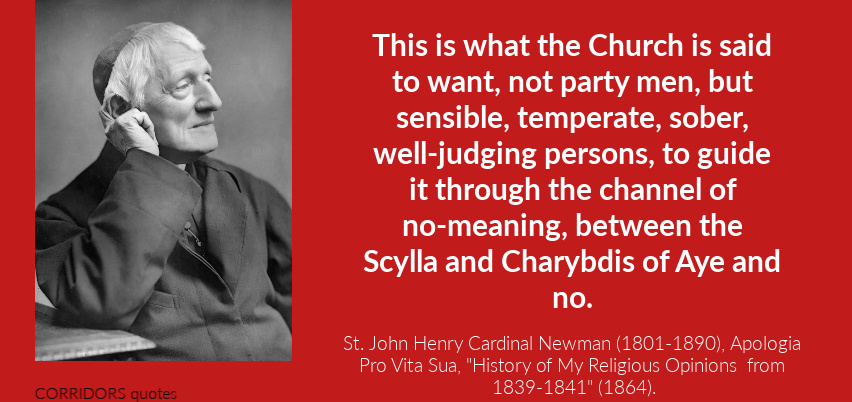
This is what the Church is said to want, not party men, but sensible, temperate, sober, well-judging persons, to guide it through the channel of no-meaning, between the Scylla and Charybdis of Aye and no. St. John Henry Cardinal Newman (1801-1890), Apologia Pro Vita Sua, “History of My Religious Opinions from 1839-1841” (1864).

John Henry Cardinal Newman, 1881, Sir John Everett Millais, 1st Baronet, President Royal Academy of Arts (1829-1896). National Portrait Gallery, London: https://www.npg.org.uk/collections/search/portrait/mw07727/John-Newman

Nature was a parable: Scripture was an allegory: pagan literature, philosophy, and mythology, properly understood, were but a preparation for the Gospel. St. John Henry Cardinal Newman (1801-1890), Apologia Pro Vita Sua, “History of My Religious Opinions from 1839-1841” (1864).

The Greek poets and sages were in a certain sense prophets; for “thoughts beyond their thought to those high bards were given.” St. John Henry Cardinal Newman (1801-1890), Apologia Pro Vita Sua, “History of My Religious Opinions from 1839-1841” (1864).

Holy Church in her sacraments and her hierarchical appointments, will remain even to the end of the world. Her mysteries are but expressions in human language of truths to which the human mind is unequal. St. John Henry Cardinal Newman (1801-1890), Apologia Pro Vita Sua, “History of My Religious Opinions from 1839-1841” (1864).

We may not speak of [Jesus] as we speak of any individual man, acting from and governed by a human intelligence within Him, but He was God, acting not only as God, but now through the flesh also, when He would. St. John Henry Cardinal Newman (1801-1890), Parochial and Plain Sermons, volume 6.

[Prophetic tradition] permeates the Church like an atmosphere, irregular in shape from its very profusion and exuberance. St. John Henry Cardinal Newman (1801-1890), Lectures on the Prophetical Office of the Church (1837).

Newman viewed disagreement as an opportunity for encounter rather than exclusion, a theme highlighted by then-Prince Charles at his canonization.

John Newman by George Richmond, chalk, 1844, 16 1/4 in. x 13 1/4 in. (413 mm x 337 mm), National Portrait Gallery, St Martin’s Place, London. https://www.npg.org.uk/collections/search/portrait/mw04655/John-Newman

John Henry Newman, after 1844. https://archive.org/details/newmanfran00barruoft/page/48/mode/2up?view=theater

The more claim an idea has to be considered living, the more various will be its aspects; and the more social and political is its nature, the more complicated and subtle will be its issues. St. John Henry Cardinal Newman (1801-1890), An Essay on the Development of Christian Doctrine.

And such mainly is the way in which all men, gifted or not gifted, commonly reason – not by rule, but by an inward faculty. St. John Henry Cardinal Newman (1801-1890), Fifteen Sermons preached before the University of Oxford.

If we insist upon being as sure as is conceivable, in every step of our course, we must be content to creep along the ground, and can never soar. St. John Henry Cardinal Newman (1801-1890), Fifteen Sermons preached before the University of Oxford.

If we are intended for great ends, we are called to great hazards; and, whereas we are given absolute certainty in nothing, we must in all things choose between doubt and inactivity. St. John Henry Cardinal Newman (1801-1890), Fifteen Sermons preached before the University of Oxford.

I am what I am, or I am nothing. I cannot think, reflect, or judge about my being, without starting from the very point which I am concluding…I cannot avoid being sufficient for myself, for I cannot make myself anything else, and to change me is to destroy me. St. John Henry Cardinal Newman (1801-1890), The Grammar of Assent (1870).

John Newman, 1864, McLean & Haes, albumen carte-de-visite, 3 5/8 in. x 2 1/4 in. (93 mm x 57 mm). National Portrait Gallery, St Martin’s Place, London. https://www.npg.org.uk/collections/search/portrait/mw125777/John-Newman?LinkID=mp03281&role=sit&rNo=10

A man who said “I cannot trust a cable, I must have an iron bar,” would, in certain given cases, be irrational and unreasonable: so too is a man who says I must have a rigid demonstration, not moral demonstration, of religious truth. St. John Henry Cardinal Newman (1801-1890), Letters & Diaries, volume 21.

We differ in our sense and use of the word “certain.” I use it of minds, you of propositions. I fully grant the uncertainty of all conclusions in your sense of the word, but I maintain that minds may in my sense be certain of conclusions which are uncertain in yours. St. John Henry Cardinal Newman (1801-1890), Letter to William Froude, April 29, 1879.

There is a great attempt to bring a new theory of Papal Infallibility, which would make it a mortal sin not to hold the Temporal Power necessary to the papacy. No one answers them and multitudes are being carried away. The pope gives ear to them and the consequence is there is a very extreme prejudice in the highest quarters at Rome against such as me. St. John Henry Cardinal Newman (1801-1890), Letter to James Hope Scott, April 11, 1867.

Really and truly I am NOT a theologian. A theologian is one who has mastered theology…and a hundred things besides. And this I am not and never shall be. St. John Henry Cardinal Newman (1801-1890), Letter to Maria Giberne, February 10, 1869.

To write theology is like dancing on the tight-rope some hundred feet above ground: it is hard to keep from falling, and the fall is great. St. John Henry Cardinal Newman (1801-1890), Letter to Emily Bowles, April 16, 1866.

Cardinal Henry Edward Manning is not a theologian, the pope is not a theologian, and therefore theology has gone out of fashion. I don’t profess to be a theologian, but at all events I should have been able to show a side of the Catholic religion more theological, more exact, than theirs. St. John Henry Cardinal Newman (1801-1890), Letter to Lord Blatchford, February 5, 1875.

There was true private judgment in the primitive and medieval schools. There are no schools now, no private judgment (in the religious sense of the phrase), no freedom of opinion. That is, no exercise of the intellect. This is a way of things which in God’s own time, will work its own cure of necessity. St. John Henry Cardinal Newman (1801-1890), Letter to Emily Bowles, May 19, 1863.

John Newman, c. 1845, Richard Woodman, after Sir William Charles Ross, stipple engraving, 11 1/2 in. x 9 1/2 in. (291 mm x 241 mm) plate size, National Portrait Gallery, St Martin’s Place, London. https://www.npg.org.uk/collections/search/portrait/mw198540/John-Newman?LinkID=mp03281&wPage=1&role=sit&rNo=24

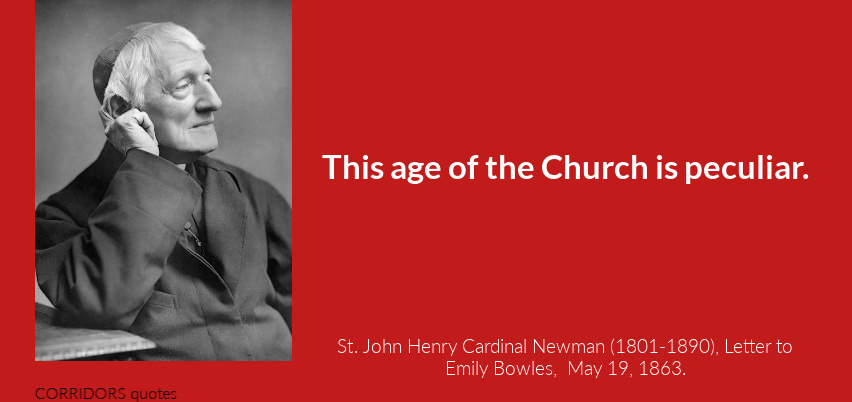
This age of the Church is peculiar. St. John Henry Cardinal Newman (1801-1890), Letter to Emily Bowles, May 19, 1863.

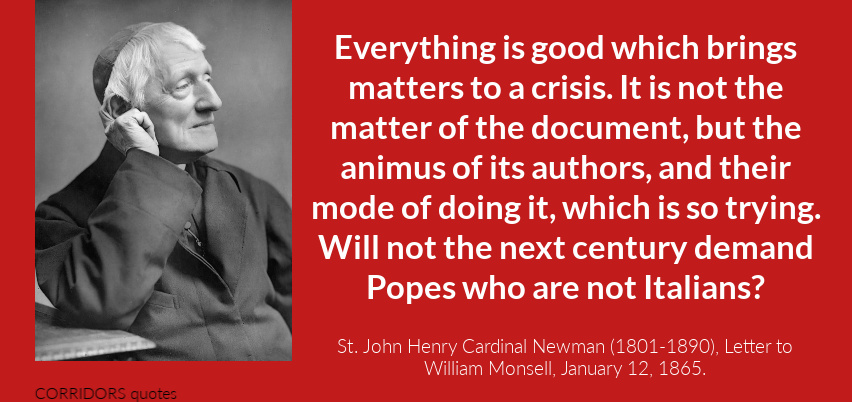
Everything is good which brings matters to a crisis. It is not the matter of the document, but the animus of its authors, and their mode of doing it, which is so trying. Will not the next century demand Popes who are not Italians? St. John Henry Cardinal Newman (1801-1890), Letter to William Monsell, January 12, 1865.

The Fathers made me a Catholic, and I am not going to kick down the ladder by which I ascended into the Church. It is a ladder quite as serviceable for that purpose now, as it was twenty years ago. St. John Henry Cardinal Newman (1801-1890), Letter to Rev. E. B. Pusey, D.D.

He maintained an independent mind, sometimes criticizing excesses and abuses within church governance while remaining deeply loyal to Catholic doctrine.

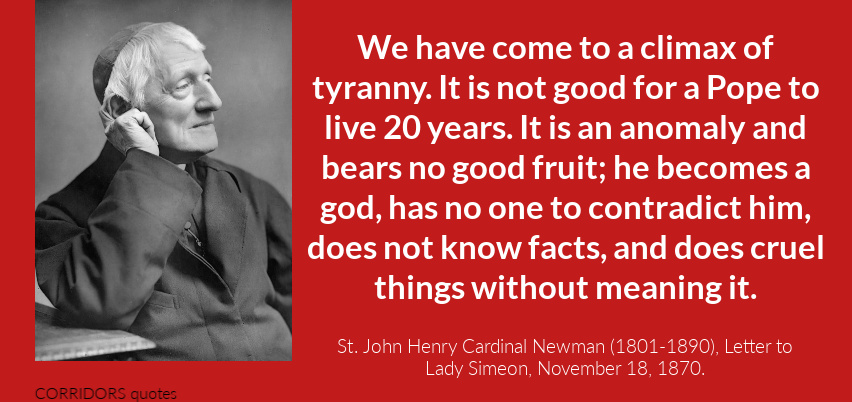
We have come to a climax of tyranny. It is not good for a Pope to live 20 years. It is an anomaly and bears no good fruit; he becomes a god, has no one to contradict him, does not know facts, and does cruel things without meaning it. St. John Henry Cardinal Newman (1801-1890), Letter to Lady Simeon, November 18, 1870.

There is no evil without its alleviation. St. John Henry Cardinal Newman (1801-1890), Letter to Bishop David Moriarty, November 14, 1866.

To be at once infallible in religion and a despot in temporals is perhaps too great for mortal man. St. John Henry Cardinal Newman (1801-1890), Letter to Mrs. William Frounde, January 2, 1871.

Truth is the guiding principle of theology and theological inquiries; devotion and edification, of worship; and of government, expedience. St. John Henry Cardinal Newman (1801-1890), The Via Media of the Anglican Church Illustrated in Lectures, Letters and Tracts written between 1830 and 1841.

The instrument of theology is reasoning; of worship, our emotional nature; of rule, command and coercion. Further, as man is, reasoning tends to rationalism; devotion to superstition and enthusiasm; and power to ambition and tyranny. St. John Henry Cardinal Newman (1801-1890), The Via Media of the Anglican Church Illustrated in Lectures, Letters and Tracts written between 1830 and 1841.

Now all of us are sinners, all of us have need to come to God as the Publican did; every one, if he does but search his heart, and watch his conduct, and try to do his duty, will find himself to be full of sins which provoke God’s wrath. I do not mean to say that all men are equally sinners; some are wilful sinners, and of them there is no hope, till they repent; others sin, but they try to avoid sinning, pray to God to make them better, and come to church to be made better; but all men are quite sinners enough to make it their duty to behave as the Publican. Every one ought to come into Church as the Publican did, to say in his heart, “Lord, I am not worthy to enter this sacred place; my only plea for coming is the merits of Jesus Christ my Saviour.” St. John Henry Cardinal Newman (1801-1890), Sermon, Reverence in Worship, October 30, 1836 (PPS-8).

To believe and not to revere, to worship familiarly and at one’s ease, is an anomaly and a prodigy unknown even to false religions, to say nothing of the true one…Worship, forms of worship — such as bowing the knee, taking off the shoes, keeping silence, a prescribed dress and the like — are considered as necessary for a due approach to God. Parochial and Plain Sermons, Vol. VIII — “Reverence in Worship,” October 30, 1836.

[Christ] is not past, He is present now. And though He is not seen, He is here. The same God who walked the water, who did miracles, etc., is in the Tabernacle. We come before Him, we speak to Him just as He was spoken to 1800 years ago, etc. This [is] how He counteracts time and the world… It is this that makes devotion in lives. It is the life of our religion. We are brought into the unseen world. St. John Henry Cardinal Newman (1801-1890), SN 127: May 25, 1856.

To consider the world in its length and breadth, its various history, the many races of man, their starts, their fortunes, their mutual alienation, their conflicts; and then their ways, habits, governments, forms of worship; their enterprises, their aimless courses, their random achievements and acquirements, the impotent conclusion of long-standing facts, the tokens so faint and broken of a superintending design, the blind evolution of what turn out to be great powers or truths, the progress of things, as if from unreasoning elements, not towards final causes, the greatness and littleness of man, his far-reaching aims, his short duration, the curtain hung over his futurity, the disappointments of life, the defeat of good, the success of evil, physical pain, mental anguish, the prevalence and intensity of sin, the pervading idolatries, the corruptions, the dreary hopeless irreligion, that condition of the whole race, so fearfully yet exactly described in the Apostle’s words, “having no hope and without God in the world,”—all this is a vision to dizzy and appal; and inflicts upon the mind the sense of a profound mystery, which is absolutely beyond human solution. St. John Henry Cardinal Newman (1801-1890), Apologia Pro Vita Sua, Chapter 5: Position of My Mind Since 1845.

What shall be said to this heart-piercing, reason-bewildering fact? I can only answer, that either there is no Creator, or this living society of men is in a true sense discarded from His presence. Did I see a boy of good make and mind, with the tokens on him of a refined nature, cast upon the world without provision, unable to say whence he came, his birth-place or his family connections, I should conclude that there was some mystery connected with his history, and that he was one, of whom, from one cause or other, his parents were ashamed. Thus only should I be able to account for the contrast between the promise and the condition of his being. And so I argue about the world;—if there be a God, since there is a God, the human race is implicated in some terrible aboriginal calamity. It is out of joint with the purposes of its Creator. This is a fact, a fact as true as the fact of its existence; and thus the doctrine of what is theologically called original sin becomes to me almost as certain as that the world exists, and as the existence of God. St. John Henry Cardinal Newman (1801-1890), Apologia Pro Vita Sua, Chapter 5: Position of My Mind Since 1845.

On October 13, 2019 in Rome then-Prince Charles attended the canonization of St. John Henry Newman (1801-1890) by Pope Francis. On July 31, 2025 Cardinal Newman—English Catholic theologian, academic, philosopher, historian, writer, and poet—was declared Doctor of the Church by Pope Leo XIV. On September 4, 2025, King Charles III became the first British monarch to visit the Oratory of St. Philip Neri in Birmingham which served as headquarters for the 19th century Catholic cardinal’s life and activities. On his visit, Charles III viewed the cardinal’s library as well as his personal items and the room where Newman died which has remained unchanged. John Henry Newman was born in London and grew up in the Church of England. He became an Anglican priest in 1825 and a leader of the Oxford Movement which sought affinities with Roman Catholicism. In 1845, in his mid-40’s, Newman became a Catholic and studied in Rome where he became a Catholic priest. Newman was always a prolific writer of letters, sermons and articles, and this continued throughout his life. The Cardinal often fell between the cracks – Anglicans mistrusting his Catholic “betrayal” and Catholics mistrusting his having been an Anglican. A cloud lifted in 1879 when Newman was named a cardinal of the Roman Church by Pope Leo XIII (1878-1903). After Rome, Newman returned to England in 1847 and founded the first English Oratory in 1848 here in Birmingham. Newman was soon joined by other English converts, including Father Wilfrid Faber (1814-1863) who Newman sent to London to establish its Oratory in 1849. After Newman was made a Cardinal in 1879, he lived at the Birmingham Oratory and died there in 1890. In 2008 Newman’s grave was opened so to move his remains into the Birmingham Oratory. But his wooden coffin was found to have disintegrated and no bones were found.

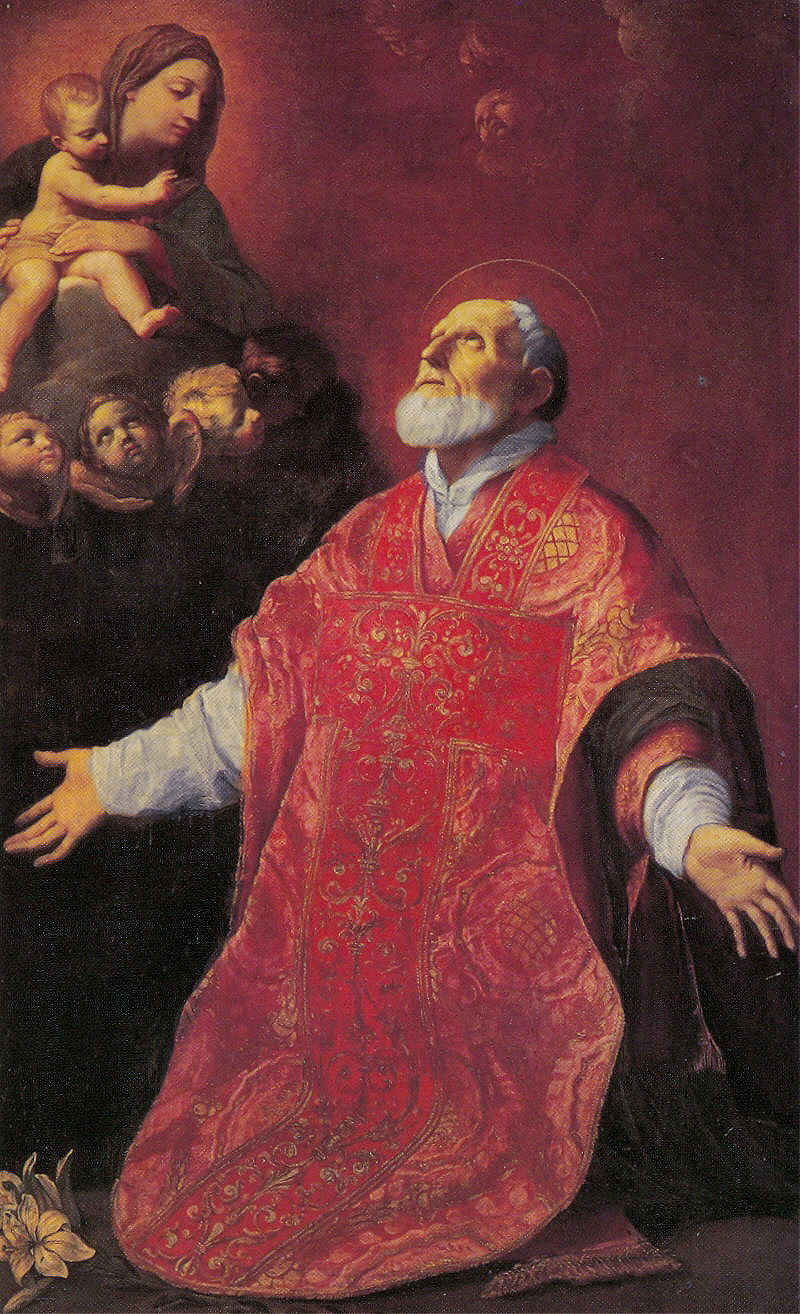
St. Philip Neri, Birmingham Oratory.

St. Philip Neri (1515-1595) who founded the Oratory in Rome in 1550 came from Florence where his family were Tuscan nobles who practicied the learned professions. Like some saints do, Philip tore up these family pedigrees in preference for the poor and itinerant. Once in Rome Philip never made study his central occupation and was reticent to talk about it, but he surprised professional scholars not only by his natural wit and humor but his learned depth and the clearness of his theological thinking and knowledge.

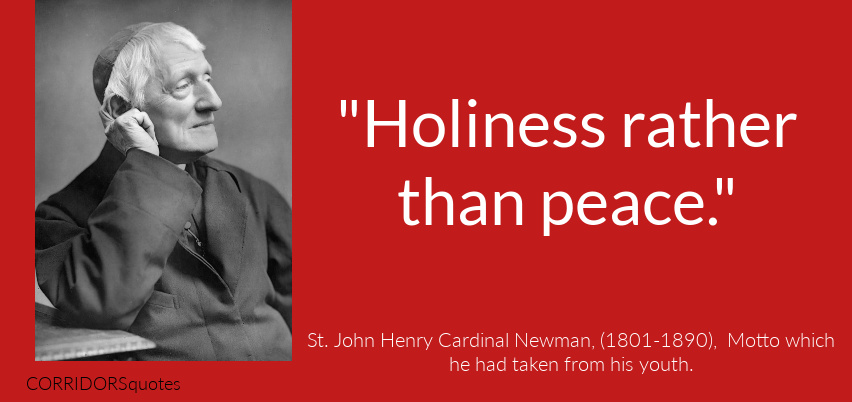
“Holiness rather than peace.” St. John Henry Cardinal Newman, (1801-1890), Motto which he had taken from his youth.

His lifelong motto was “Holiness rather than peace,” reflecting his belief that truth and sanctity mattered more than comfort or popularity.

This explanatory article may be periodically updated.