Tag Archives: #FilmAnalysis

An Innocent Priest, a Hidden Murderer: Montgomery Clift in Hitchcock’s I Confess (1953).

FEATURE image: Profile portrait of director Alfred Hitchcock taken in 1962 by American celebrity photographer Albert Watson. PHOTO: “Alfred Hitchcock Presents” by twm1340 is licensed under CC BY-SA 2.0.

Alfred Hitchcock’s I Confess (1953) transforms the conventions of film noir and psychological suspense into a profound moral drama about conscience, faith, and justice. Through Father Michael Logan’s refusal to violate the seal of confession, Hitchcock examines the conflict between religious duty and the demands of the law, revealing how silence can become an act of sacrifice while guilt, deception, and public prejudice threaten an innocent person.

Montgomery Clift plays a Catholic priest, Father Michael Logan, who becomes a murder suspect because he cannot reveal what he learned about the real murderer in sacramental confession. Hitchcock’s film explores guilt, self-sacrifice, public prejudice, and moral responsibility in a gripping black-and-white noir. PHOTO: Image courtesy of Wikimedia Commons (Public Domain).

In I Confess, a 1953 film noir by Alfred Hitchcock (1899-1980) from Warner Bros., a Catholic priest, Fr. Logan (played by Montgomery Clift) hears the confession of a man who works in the rectory and just killed another man.

For the police Inspector (Karl Malden) and prosecutor (Brian Aherne), that the killer had been dressed as a priest and other circumstantial evidence, points to Fr. Logan as the primary suspect for the murder of Villette, a prominent lawyer.

Because of the seal of confession— that is, when a person confesses his sins to a priest in Confession, the priest must maintain absolute secrecy about anything that the person confesses—Fr. Logan cannot and does not under any circumstances divulge the identity of the confessed killer though he (and the audience) knows it.

Even after Fr. Logan is arrested for the crime and put on trial for the murder, the priest does not reveal the identity of the killer but only protests for his own innocence.

Father Michael Logan hears Otto Keller’s confession to murder. Bound by the seal of confession, Logan cannot disclose the killer’s identity, even when he becomes the principal suspect.
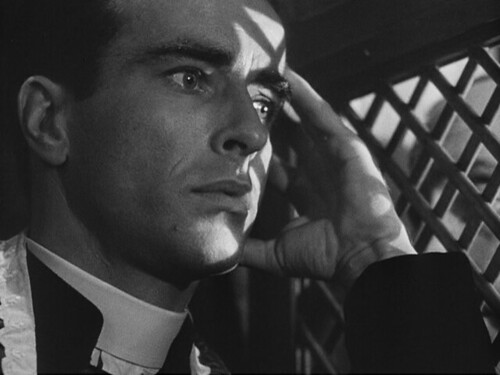
PHOTO: “I, Confess animation” by doc_tor_matt is licensed under CC BY 2.0.

Hitchcock’s black-and-white film was shot by cinematographer Robert Burks (1909-1968) who would later shoot Hitchcock’s The Birds in 1964. It is edited by German-born Rudi Fehr (1911-1999) who would go on to edit Hitchcock’s triumphant color feature, Dial M For Murder, in 1954.

The story in I Confess was based on a 1902 play by Paul Anthelme Bourde (1851-1914), a French journalist and colonialist who coined the term “decadent” for the indecipherable Symbolist poets in his native France in the late 19th century.

The film follows the play which is about a killer who confesses to a priest knowing his crime cannot be betrayed. To complicate matters further, the killer blackmails the priest for a long-ago love affair he had with Ruth Grandfort (Anne Baxter), the wife of a leading citizen, and who still loves him. For the priest, the love affair is in the past though for Mrs. Grandfort it is not.

Father Logan’s former relationship with Ruth Grandfort, played by Anne Baxter, gives Keller an additional means of exploiting the priest’s vulnerability.

A primary conflict between the actress and director was that Hitchcock, who was notoriously fastidious about his leading ladies’ appearances, demanded that Baxter dye her hair. This work is in the public domain in the U.S. because it was published in the U.S. between 1927 and 1977, inclusive, without a copyright notice.

When Alfred Hitchcock’s film noir I Confess was filmed on location in Quebec City in 1952 and released in early 1953, Montgomery Clift and Anne Baxter were among Hollywood’s most prestigious and sought-after young actors. Both had achieved major career-defining successes, yet their approaches to acting—and their relationships with Hitchcock—could hardly have been more different.

By 1952, Montgomery Clift was widely regarded as a revolutionary force in American cinema. He had recently received an Academy Award nomination for A Place in the Sun (1951) and was preparing to film From Here to Eternity (1953), which would earn him another Best Actor nomination. Clift’s deeply introspective, psychologically nuanced approach to performance, however, sometimes clashed with Hitchcock’s preference for technical precision, carefully choreographed blocking, and exact camera placement. Hitchcock reportedly grew impatient with the Method actor’s persistent questions about a character’s motivation. The tension was further complicated by Clift’s heavy drinking, which occasionally left him appearing glazed during filming. Supporting actor Karl Malden sometimes served as an intermediary between Clift and Hitchcock, whose was famously non-confrontational.

Anne Baxter, by contrast, approached I Confess from a different professional perspective. Already an Academy Award-winning actress, she was known for her discipline and versatility, moving with apparent ease between contrasting roles. In 1953, Baxter parted ways with 20th Century Fox to establish herself as a cutting-edge freelance actress. She subsequently signed a lucrative two-picture deal with Warner Bros., with I Confess serving as a high-profile vehicle for this new phase of her career.

For Clift, I Confess remains an important testament to his extraordinary talent. Despite the reported behind-the-scenes tensions, his restrained, inward-looking portrayal of Father Michael Logan has been praised for its unusual intensity and concentration. His performance gives the film much of its emotional and moral force, demonstrating how a deeply internalized portrayal could become one of the most compelling elements of Hitchcock’s filmography.

Clearly, for Hitchcock in I Confess, the priest in this situation is a highly curious figure. By the end of the film, it becomes clear that the seal of confession is a cross for the priest because of his priesthood – and though sins do not always deal with high crime – demonstrates the personified sacramental nature of self-sacrifice that is involved for the priest with each confession he hears. Throughout the film, Fr. Logan is a tragi-comic figure as he simply does not state the obvious of who the murderer is on behalf of social justice and his own innocence, but equally personifying the religious nature of living with and taking on another’s sin particularly when a person refuses their own responsibility and makes amends for it. In I Confess, the murderer has no intention of turning himself in and is content to let the priest under seal of confession take the rap in the courtroom of the law and public opinion.
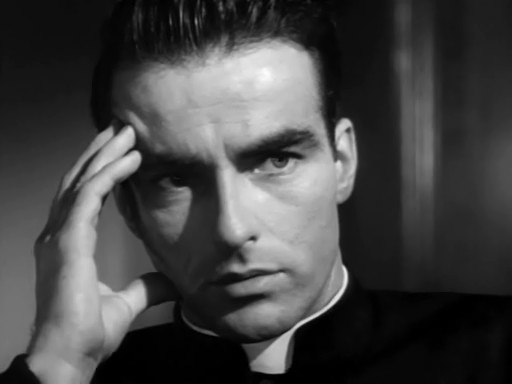
Clift portrays Logan as restrained, vulnerable, and morally resolute, making the priest’s silence central to the film’s emotional tension. PHOTO: Image courtesy of Wikimedia Commons (Public Domain)

Fr. Logan never impedes law enforcement’s investigation. He continually states his own innocence for which a jury of his peers is brought in to decide what to believe.

The sin of commission/omission – and in I Confess it is for and surrounds the gravity of murder – remains with the impenitent Otto Keller (O.E. Hasse) although his loving wife, Alma (Dolly Hass), to whom Keller confessed the crime outside confession’s seal, cannot abide by his secret.

Keller attempts to escape the consequences of his crime by allowing an innocent man to suffer in his place. The contrast between the two men is central to the film’s moral argument. PHOTO: “I, Confess animation” by doc_tor_matt is licensed under CC BY 2.0.

If, despite the seal of confession, crimes can be revealed to government investigators then the sanctuary of the law of the cross is extricated to get at evil – which is not contradiction nor improvement to the confessional box (the priest may ask the penitent for a release from the sacramental seal to discuss the confession) but its obligatory public replacement. As there is often no transparency and plenty of state secrets in and around various government agencies, this becomes no less problematical than breaking down a Catholic (and Lutheran) church’s confessional door as well as, in the United States, violating the free exercise of religion (the First Amendment).

Even after Logan is acquitted, public hostility demonstrates how suspicion and appearances can overpower reasoned judgment.

Though the jury finds Father Logan not guilty due to a lack of definitive physical evidence, the angry mob outside the courthouse is unconvinced by the verdict. They jeer and assault Logan as he tries to leave, believing a guilty murderer has escaped justice on a technicality. PHOTO: “I, Confess animation” by doc_tor_matt is licensed under CC BY 2.0.

The investigation and trial raise questions about whether legal institutions can adequately recognize innocence when crucial evidence cannot be disclosed.

Unable to bear the sight of the innocent priest being attacked, and consumed by escalating panic, the killer’s wife, Alma Keller, snaps. She steps forward to publicly denounce her husband and scream the truth to the crowd. In a frantic attempt to escape, Otto Keller pulls a gun, shoots and kills his wife, and flees into the grand Château Frontenac hotel. PHOTO: “I, Confess animation” by doc_tor_matt is licensed under CC BY 2.0.

Although found “not guilty” for lack of evidence to convict, the presiding judge expresses his disbelief in Fr. Logan’s innocence. When Fr. Logan exits the court building, he is followed and faced by a hostile crowd – “Preach us a sermon, Logan!” The prosecutor, as he watches the ugly scene from his office above, is forced to lament his actions: ”Do you think I enjoyed it?” he says, washing his hands. After Fr. Logan is crashed into a car window in the crowd, Alma, Keller’s wife, (her name means “soul”) rushes in towards the priest to tell what she knows—and which an accompanying police guard relates to the Inspector—“She said he was innocent.”

Trapped by the police, a desperate Keller tries to shoot Father Logan, completely exposing his own guilt. The police return fire, fatally wounding Keller. In his final dying moments, Keller begs for forgiveness, and Father Logan steps forward to administer the last rites and grant absolution to his own framing torturer—fully resolving his priestly duty, clearing his name in the eyes of the public, and permanently closing the door on his past life with Ruth.

Considered Hitchcock’s once most Catholic of films, I Confess is a tight drama with a truly despicable villain, whose murderous rampages do not stop. The film is ahead of its time in terms of direction – presaging camera angles, editing, pacing and themes of later international crime and psychological dramas that came to fruition in the decades ahead.

Black-and-white cinematography, visual tension, dramatic pacing, and psychological suspense reinforce the film’s themes of entrapment and moral isolation.

Original 1953 theatrical poster for Alfred Hitchcock’s I Confess functions as a misleading piece of marketing, deliberately disguising a religious, somber, psychological drama to become a volatile, sensationalized Hollywood romance. “A shame confessed – a sin concealed! This is love with the brand of Hitchcock burned in!” leans into pure melodrama with an implied promise of a romance overflowing with passion, betrayal, and scandalous secrets. The smaller tagline asks the audience a direct moral riddle: “If you knew what he knew, what would you do?” which establishes the film’s high-stakes moral dilemma, keeping the focus on a personal crisis of conscience. In reality, the movie is a dark, slow-burn, atmospheric film noir rooted in guilt and legal bureaucracy. Notably, the poster completely hides Montgomery Clift’s priestly collar in which he spends nearly the film’s entire runtime. Warner Bros. concealed the movie’s religious core, fearing from a marketing perspective that a story about a devout, celibate Catholic priest might alienate mainstream moviegoers looking for a Hollywood romance. As a standard one-sheet theatrical poster, this was displayed in theater lobbies, outside cinemas, and on street billboards in early 1953 to drive ticket sales. Warner Bros. leaned heavily on the bankable star power of Clift and Baxter, placing their names in giant red font across the bottom to draw crowds. Ultimately, while the poster succeeded in getting audiences into theaters, its heavy emphasis on sensationalized romance contributed to mixed reactions at the time, as viewers expecting a passionate thriller instead received a brooding meditation on faith, duty, and the silence of the confessional. PHOTO: Image courtesy of Wikimedia Commons (Public Domain). An online search by title at the US copyright office yielded no copyright renewal. In the absence of renewal of the US copyright, this poster art entered the public domain 28 years after its US publication date.

CONCLUSION

Upon its theatrical release in early 1953, I Confess underperformed at the box office and met with a mixed, largely lukewarm critical reception. While it did not reach the commercial heights or unanimous acclaim of Alfred Hitchcock’s top-tier thrillers, its reputation has evolved significantly over time. Today, the movie has transitioned out of obscurity and holds a solid 84% fresh rating on Rotten Tomatoes, widely re-evaluated by modern film historians as beautifully shot and intellectually challenging and a worthy entry in Hitchcock’s golden era.

In 1953, U.S. critics found the movie heavy-handed and slow, calling the screenplay dull and noting that the killer’s identity being known from the very beginning robbed the narrative of excitement. Most American reviewers felt the central romance flashback was unsuccessful and lacked genuine on-screen chemistry. However, Robert Burks’ moody, German Expressionist shadow cinematography was universally praised. The Catholic Church responded positively to I Confess as it treated Catholic beliefs with dignity and portrayed Father Logan as a devout priest. Yet, in 1950’s Catholic Ireland, the film apparently was not Catholic enough: and it was banned there for what censors considered its unacceptable innuendos. The film’s biggest champions at the time, however, were the young French critics of Cahiers du Cinéma who hailed I Confess as an absolute auteur masterpiece. They argued that the film’s brilliant “transference of guilt” motif and Montgomery Clift’s internalized acting perfectly captured the integrity of the spiritual isolation of the human condition.

https://www.catholiceducation.org/en/religion-and-philosophy/catholic-faith/the-seal-of-the-confessional.html

text & layout –

The Waltz of Illusion: Desire and Psychological Collapse in Minnelli’s Madame Bovary (1949).

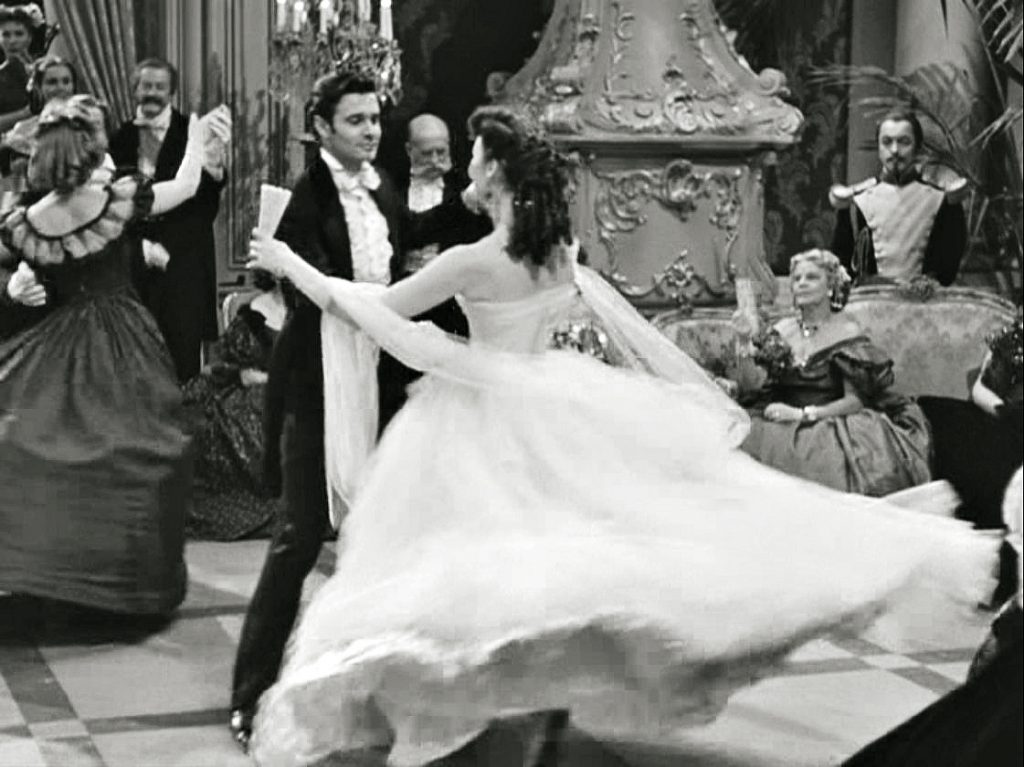
FEATURE image: Madame Bovary (Jennifer Jones) and Rodolphe Boulanger (Louis Jourdan) waltz at the ball in a still from Metro-Goldwyn-Mayer’s 1949 film Madame Bovary directed by Vincente Minnelli. Fair Use.

In Vincente Minnelli’s Madame Bovary (1949), the ballroom waltz transforms Gustave Flaubert’s critique of romantic illusion into a cinematic experience of desire, disorientation, and psychological collapse. Through synchronized choreography, Miklós Rózsa’s expressive score, fluid camera movements, and the extraordinary breaking of the ballroom windows, Minnelli reveals the widening gulf between Emma Bovary’s fantasies of passion and the painful realities of her life. The scene’s visual splendor ultimately becomes an expression of the destructive power of romantic idealism.

In the 1949 film Madame Bovary directed by Vincente Minnelli, a beautiful and charming Madame Bovary (Jennifer Jones) meets wealthy Rodolphe Boulanger (Louis Jourdan) at a ball where he literally sweeps her off her feet. Selfishly aggravated by her husband Charles Bovary (Van Heflin) for not fitting into high society, Madame Bovary begins a love affair with Rodolphe. Though the pair scheme to elope to Italy, Rodolphe does not love Madame Bovary. 

Filming began at M-G-M’s Culver City studios in mid-December 1948. Although producers favored Lana Turner for the role of Emma Bovary, director Vincente Minnelli championed Jennifer Jones instead. Fresh from her Academy Award-winning success in The Song of Bernadette, Jones brought the glamour and emotional intensity needed to portray Flaubert’s restless heroine, a woman whose romantic longings and dissatisfaction propel the story. At the same time, her casting may have helped ease concerns from the Production Code Office, which was already preparing to scrutinize the film’s controversial themes of adultery, desire, and moral transgression.

Minnelli initially presents the waltz as a vision of glamour, sensuality, and romantic fulfillment. Yet the swirling camera, increasingly disoriented movement, and shattered windows gradually undermine that beauty. What appears to be Emma’s moment of romantic triumph becomes a visual premonition of emotional collapse.

The Waltz Scene was Filmed to the Music 

One of the film’s most carefully wrought and delightful scenes is this ballroom sequence. It was one of the last segments to be shot. The film footage was tailored to Miklós Rózsa’s music. Minnelli explained to the composer in advance the camera movements so he could write the music in an arrangement for two pianos. The scene was then filmed to match it. Their artistic collaboration produced one of cinema’s most original scenes uniting robust music with weaving and gliding images on film.

Madame Bovary (Jennifer Jones) and Rodolphe Boulanger (Louis Jourdan) waltz at the ball. It is one of the film’s most delightful scenes and one of the last to be shot. Director Vincente Minnelli made certain its choreography carefully matched the music of Miklós Rózsa. Madame Bovary was nominated for an Oscar for Best Art Direction-Set Decoration, Black-and-White.

Minnelli has the audience experience the seduction of Emma’s fantasy while simultaneously revealing its destructive nature. The waltz is both an expression of her longing for an ideal life and a cinematic enactment of the illusions that will ultimately destroy her.

Beautiful and charming Emma Bovary (Jennifer Jones) is repulsed by her uncouth husband, Charles Bovary (Van Heflin), an undistinguished medical doctor, and begins an affair with Rodolphe Boulanger (Louis Jourdan). Their plans to elope, however, do not materialize as Emma hoped.

“Break the Windows” dramatizes a heroine’s transition into madness

As Rodolphe swirls her, Emma Bovary’s head spins until she becomes dizzy. The viewer sees her disorientation as the camera takes her viewpoint. She keeps dancing but asks for fresh air. Her request leads to an extraordinary and incredible reaction by the stewards. They start to smash the ballroom’s windows with chairs to help her cool down. This fantastically destructive action of broken glass aligns with the destruction of Emma’s romantic illusions throughout the film. 

In reaction to Madame Bovary becoming dizzy while waltzing with a new lover, the stewards smash the ballroom windows to give her air. The extraordinary action ultimately becomes symbolic of the destruction of Madame Bovary’s romantic illusions with handsome, wealthy Rodolphe and her own descent into madness.

Emma imagines that wealth, passion, and an ideal lover will deliver her from the disappointment of her marriage and provincial life.

Night of Repressed Passion

Along with her husband’s boorish behavior at the ball and everywhere else, Madame Bovary’s romantic disappointment leaves her feeling publicly humiliated. Instead of love and excitement, Madame Bovary runs out of the ball in shame. Though she yearns for happiness and excitement, her pursuit of selfish pleasures ends in scandal and ruin.

Jennifer Jones as Madame Bovary offers a performance that is elegant and beautiful. It is equally insightful to the selfish and nervous personality of Flaubert’s fictional character.

A film poster for Vincente Minnelli’s Madame Bovary. Several different versions of the film poster were produced for the marketing of the 1949 film.

This publicity photo for Madame Bovary showed the love triangle of Madame Bovary (Jennifer Jones), her handsome lover Rodolphe Boulanger (Louis Jourdan), and her cuckolded husband Charles Bovary, a medical doctor (Van Heflin).

https://youtu.be/EMo0KZ4q2n4?si=3wKUnhL8anaAWWYI – retrieved January 1, 2019.

Miklós Rózsa’s brilliant score for Vincente Minnelli’s 1949 adaptation of Madame Bovary stands as a landmark in film music history, serving as a deeply psychological portrait of Emma Bovary’s tragic descent.

Beyond this technical triumph of the waltz scene, Rózsa approached the entire soundtrack as a symphonic poem directly tied to the literary essence of Gustave Flaubert’s source material. Instead of relying on passive atmospheric cues, he crafted eight interwoven motifs that map directly onto Emma’s fracturing psyche, tracking her spiral from romantic disillusionment to desperate lust, and finally to her agonizing physical end. Rózsa further deepened this musical architecture by assigning singular melodic themes to the three central men in her life: her husband Charles and her two contrasting lovers, Léon and Rodolphe.

In the role of Madame Bovary Jennifer Jones gives a performance beyond the superficiality of display or machination of melodrama and enters into the inner psychology of the character whose anxious egomania manifesting joy and elation is driven by disillusionment to deterioration and self-destruction. Director Vincente Minnelli worked closely with composer Miklós Rózsa to integrate the image, plot and characters with the musical score which the composer admired for its artistic cinematic outcome.

Thirty-year-old Jennifer Jones plays Gustave Flaubert’s doomed title character, Madame Bovary, from his 1856 serial novel.

Vincente Minnelli’s film of the same name offered two costume and wardrobe managers: Walter Plunkett for women and Valles for men.

Walter Plunkett (1902-1982) was a prolific costume designer who worked on more than 150 projects in his Hollywood career, including Gone With The Wind. In 1951, Plunkett shared an Oscar with Orry-Kelly and Irene Sharaff for An American in Paris.

Valles (1886-1970) specialized in men’s costumes at M-G-M. Valles received two Academy Award nominations, including Spartacus in 1960.

Van Heflin is Charles Bovary, the kind and devoted country physician, whom Emma (Jennifer Jones) marries with hopes he would bring her happiness. But she becomes deeply disillusioned with the ordinariness and lack of ambition he represents.

Production photograph of Louis Jourdan and Jennifer Jones. The scene showcases a unique example of the Valles’ costume design for Louis Jourdan and Walter Plunkett’s costume design for Jennifer Jones for the 1949 film Madame Bovary. The next year, in 1950, both Valles and Walter Plunkett were nominated for the Academy Award for Compton Bennett’s That Forsyte Woman.

Madame Bovary danced wildly with Rodolphe at the ball and loves him. The illicit couple plan to elope to Italy. But Rodolphe leaves for Italy without her and shatters Madame Bovary’s spirit and dreams.

Played by Louis Jourdan, Rodolphe represents the wealthy, sophisticated lover Emma imagines can transform her life, although his desires and intentions do not match her romantic expectations.

Featuring Jennifer Jones as Emma Bovary and Louis Jourdan as her aristocratic lover, Rodolphe Boulanger, this scene captures one of the most revealing moments in Emma’s tragic pursuit of romance and social advancement. Emma wears an extravagant wide-brimmed straw hat draped with delicate lace, paired with a dark, tightly corseted jacket over a voluminous white ruffled gown and a high lace collar tied with a black ribbon. Standing in profile at right, Rodolphe urgently places his hands on her waist while gazing up into her conflicted, downward-cast eyes.

Madame Bovary (Jennifer Jones) is indulged by an unscrupulous shopkeeper as she lives beyond her means in the pursuit of happiness. She takes on a heavy debt that is impossible to pay back. Emma’s costume represents the absolute zenith of her superficial triumph and her complete detachment from financial reality. The massive, structurally complex and heavily layered gown scream aristocratic luxury, yet she has completely abandoned provincial practicality for a wardrobe funded entirely on predatory merchant credit. Her clothing is no longer just an expression of romance; it is a heavy, suffocating visual shroud of debt.

Walter Plunkett’s costume designs are more than period attire; they exemplify how attire functions as a visual chronicle of Emma’s psychological descent and eventual financial ruin. What begins as youthful simplicity evolves into increasing luxury, ornamentation, and display as she falls deeper into a world of desire, status, and debt. Yet the splendor proves fragile and its effects, deadly. After Rodolphe abandons her and creditors close in, the glamour evaporates. The elaborate layers, ruffles, lace, and grand hats disappear, replaced by dark, simplified, and increasingly disheveled garments. Through costume alone, Plunkett traces Emma’s journey from romantic dreamer to a woman stripped of illusion, her vulnerability laid bare as her hopes collapse beneath the weight of betrayal and ruin.

Charles, who never stopped loving his wife, begs her to wait for a doctor to arrive. Madame Bovary sighs, “Oh, Charles, why are you always trying to save me?”

The film plot is told from the point of view of the author, Gustave Flaubert (James Mason). A legal proceedings takes place where Flaubert is accused of corrupting morals by writing Madame Bovary. It is an historical fact that, in 1858, Flaubert and his publisher had faced government charges of immorality for Madame Bovary. But the outcome of the trial was that Flaubert was completely acquitted.

From the waltz scene through to her death scene Jennifer Jones as Madame Bovary offers a performance that is elegant and beautiful. It also provides insight into the contradictions offered by a selfish and nervous personality.

In the end Madame Bovary finds that her own death is more attractive to her than living with her shattered dreams.

The larger tragedy: Emma’s pursuit of idealized love and social prestige leaves her increasingly estranged from reality, contributing to the disillusionment and ruin that define her story.

A 1949 film poster for Madame Bovary that includes a publicity head shot of James Mason as Gustave Flaubert, the novel’s French author.

Minnelli’s film is told in flashback through the character of Flaubert who is on trial for charges of immorality for writing the novel. After Flaubert’s work was serialized in the Revue de Paris in 1856, the government charged and tried the author and his publisher for immorality. Both were acquitted in 1859. After Madame Bovary appeared in book form in France, it became an instant classic.

Vincente Minnelli directs Jennifer Jones and Louis Jourdan in a scene from Madame Bovary. This behind-the-scenes photograph captures a fascinating moment on the set of the 1949 film, showing director Vincente Minnelli (standing) actively coaching his lead actors, Louis Jourdan (Rodolphe) and Jennifer Jones (Emma), right before filming an intimate scene. Minnelli’s presence alongside the script highlights just how meticulously calculated every single “spontaneous” moment of romantic desperation was planned to ensure the film’s psychological themes hit perfectly.

Despite the immense talent involved, Vincente Minnelli’s 1949 adaptation of Madame Bovary failed to connect at the box office, ultimately losing $910,000 for MGM. While it was an artistic triumph in terms of music and costume design, the film’s financial failure and mixed critical legacy remain a fascinating case study in classic Hollywood cinema.

Reviews for Madame Bovary, released in late August 1949, were mixed with the film not recouping its full production costs.

Critical Reception in 1949

When Madame Bovary was released in August 1949, critical reaction was sharply divided. At the heart of the debate was a question that had long shadowed the production: could Gustave Flaubert’s sprawling literary masterpiece successfully be transformed into a glossy Hollywood motion picture? Many reviewers praised the film’s technical accomplishments, including its lush score, lavish costumes, polished performances, and Vincente Minnelli’s assured direction. Others, however, argued that the novel’s biting social satire and moral ambiguity had been softened to satisfy the demands of American censorship.

Critics were also divided over the film’s framing device, which opens with Flaubert, portrayed by James Mason, standing trial and defending his novel against charges of obscenity. For some, the prologue provided valuable historical context; for others, it interrupted the narrative and weakened the emotional impact of Emma’s story.

More fundamentally, the film’s bleak outlook proved challenging for many contemporary viewers. Audiences expecting a conventional Hollywood romance instead encountered a devastating portrait of marital boredom, financial ruin, frustrated desire, and self-destruction. Emma Bovary was not presented as a traditionally sympathetic heroine, nor did her story offer the reassurance of redemption. In an era when postwar cinema often emphasized optimism and emotional uplift, a drama in which virtually no one emerges victorious was a particularly difficult sell.

Modern Reassessment

Today, film historians view Madame Bovary far differently than many critics did in 1949. Rather than judging it primarily as a literary adaptation, modern scholarship tends to regard the film as a significant milestone in Vincente Minnelli’s artistic development and one of Hollywood’s earliest and most visually sophisticated explorations of psychological expressionism.

Minnelli’s use of camera movement, lighting, set design, and costume now receives particular admiration for translating Emma’s inner emotional life into visual form. What some contemporary reviewers dismissed as excessive stylization is today recognized as one of the film’s greatest strengths. Modern critics also continue to praise the production’s technical virtuosity, especially Cedric Gibbons’s art direction, Walter Plunkett’s costumes, and the film’s ambitious visual design, which transformed Flaubert’s nineteenth-century tragedy into one of the most striking prestige productions of the late studio era.

Legacy

While Madame Bovary never achieved the immediate acclaim enjoyed by some of M-G-M’s other prestige productions, its reputation has steadily grown over time. Today it stands as both an ambitious literary adaptation and a fascinating example of how Hollywood filmmakers navigated artistic ambition, censorship, and audience expectations during the classical studio era. What was once criticized as an uneasy compromise between literature and cinema is now better appreciated as a bold and visually compelling interpretation of one of the nineteenth century’s most influential novels.

*The photograph copyright may be believed to belong to the distributor of the film, Metro-Goldwyn-Mayer, the publisher of the film or the graphic artist. The copy is of sufficient resolution for commentary and identification but lower resolution than the original photograph. Copies made from it will be of inferior quality, unsuitable as counterfeit artwork, pirate versions or for uses that would compete with the commercial purpose of the original artwork. The image is used for identification in the context of critical commentary of the work, product or service for which it serves as poster art. It makes a significant contribution to the user’s understanding of the article, which could not practically be conveyed by words alone. As this is a publicity photo (star headshot) taken to promote an actress, these have traditionally not been copyrighted. Since they are disseminated to the public, they are generally considered public domain, and therefore clearance by the studio that produced them is not necessary. (See- Eve Light Honthaner, film production expert, in The Complete Film Production Handbook, Focal Press, 2001 p. 211.) Gerald Mast, further, film industry author, in Film Study and the Copyright Law (1989) p. 87, writes: “According to the old copyright act, such production stills were not automatically copyrighted as part of the film and required separate copyrights as photographic stills. The new copyright act similarly excludes the production still from automatic copyright but gives the film’s copyright owner a five-year period in which to copyright the stills. Most studios have never bothered to copyright these stills because they were happy to see them pass into the public domain, to be used by as many people in as many publications as possible.” Kristin Thompson, committee chairperson of the Society for Cinema and Media Studies writes in the conclusion of a 1993 conference with cinema scholars and editors, that they “expressed the opinion that it is not necessary for authors to request permission to reproduce frame enlargements … [and] some trade presses that publish educational and scholarly film books also take the position that permission is not necessary for reproducing frame enlargements and publicity photographs.”(“Fair Usage Publication of Film Stills,” Kristin Thompson, Society for Cinema and Media Studies.)