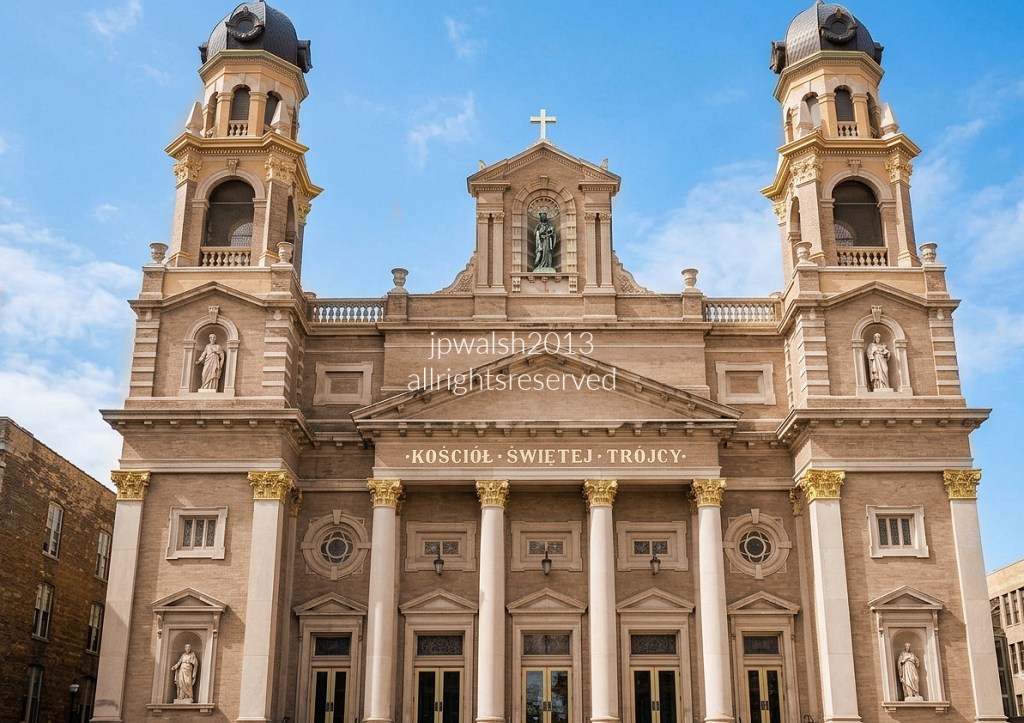

Feature image: Exterior of Holy Trinity Polish Catholic Church, Shots of Holy Trinity Polish Mission can be seen throughout 20th Century-Fox’s 1948 film noir Call Northside 777 starring James Stewart, the first Hollywood feature film to be shot on location in Chicago. July 2013. Author’s photograph.
Holy Trinity Polish Catholic Church in Chicago is more than an architectural landmark. Through its art, stained glass, icons, and devotional imagery, it preserves the religious faith, national memory, and spirit of endurance that sustained Poles through foreign occupation, war, communism, and immigration to the United States.
Founding of a Polish Landmark
Holy Trinity Parish was founded in 1872 to relieve overcrowding at St. Stanislaus Kostka, Chicago’s first Polish parish. The Congregation of the Holy Cross was chosen to serve the new congregation under the leadership of Father Casimir Sztuczko, CSC. From its earliest years, Holy Trinity became closely associated with the Polish National Alliance, as many of the organization’s most active members belonged to the parish.
During the twentieth century, Holy Trinity stood at the heart of Chicago’s historic Polish community. However, construction of the Kennedy Expressway through the center of Polish Downtown displaced thousands of residents and marked the beginning of a long demographic decline for the parish. Despite these changes, Holy Trinity remained an important cultural and spiritual center for Polish Americans.
Attorney General Robert F. Kennedy attended Mass at Holy Trinity during the festivities surrounding Chicago’s annual Polish Constitution Day Parade in 1961. Administration of the parish passed to the Resurrectionists in 1975 and later to the Society of Christ Fathers in 1988, who continue to serve the congregation today. On September 14, 2006, Polish Prime Minister Jarosław Kaczyński visited Holy Trinity and attended a Mass celebrated during his Chicago visit.
Holy Trinity has also appeared on the silver screen. Exterior views of the church can be seen throughout Call Northside 777 (1948), starring James Stewart, the first Hollywood feature film shot on location in Chicago.
Building the Present Church
By the turn of the twentieth century, parish growth demanded a larger church. Initial designs were prepared by Herman Olszewski, better known by his artistic pseudonym Von Herbulis. Because of financial limitations, the plans were scaled back and refined by Chicago architect William Krieg. Construction began in 1905, and the magnificent new church was completed in October 1906.
The imposing façade combines several architectural traditions. Twin towers frame a monumental entrance portico supported by four Corinthian columns. The lower stages of the towers feature Corinthian pilasters and classical pediments, while the upper levels become increasingly Baroque in character, culminating in ornate cupolas. Above the portico rises a dramatic Baroque superstructure of brick and stone, while iron framing supports the segmental vaults and tower interiors. Gothic and Romanesque influences appear throughout the church’s windows and decorative details.
Architecture Inspired by Poland
The church’s eclectic design reflects the architectural history of Poland itself. Many medieval Polish churches evolved over centuries, rebuilt after wars, fires, and other disasters, often incorporating the artistic tastes of successive generations. Frequently, renovations were halted when funds ran out, resulting in interiors and exteriors executed in entirely different styles.
Holy Trinity deliberately follows this tradition. Its mixture of Classical, Gothic, Romanesque, and Baroque elements evokes the appearance of many historic churches in Poland and would have offered immigrant parishioners a powerful reminder of the homeland they had left behind.
A Monumental Interior
The church interior remains remarkably intact and retains much of its original appearance. Measuring approximately 125 by 200 feet, the sanctuary is both spacious and richly ornamented. Iron construction made it possible to create broad vaulted spaces without the forest of support columns found in many churches of comparable scale.
Murals depicting religious scenes cover the walls and ceilings, including compositions honoring the patron saints of Poland. Every stained-glass window was selected to reflect symbols familiar to Polish immigrants. Among the most prominent are depictions of the Black Madonna of Częstochowa and Our Lady of the Gate of Dawn. Other windows portray Polish saints, martyrs, national emblems such as the Polish eagle, and traditional folkloric motifs.
The church’s interior decoration was executed by K. Markiewicz in 1914, while the large vault murals were completed in 1926. Most of the stained-glass windows, selected in 1940 and ultimately installed in 1955, were created by noted Polish artist Irena Lorentowicz.
Sacred Memorials and National Memory
Holy Trinity also serves as a repository of Polish historical memory. In 1990, a statue of Our Lady Queen of Emigrants by Professor Wiktor Zin was installed and blessed by Cardinal Joseph Bernardin. Two years later, an urn containing soil from Kharkiv, Katyn, and Mednoye was placed in the church. Each site contains mass graves of Polish victims murdered by Soviet authorities during World War II.
Additional commemorative plaques were installed in the narthex during 1993 and 1994. One honors Father Casimir Sztuczko, CSC, whose leadership guided the construction of the present church. Another marks the fiftieth anniversary of the Battle of Monte Cassino, one of the most significant Polish military victories of World War II.
Renewal for a New Century
As Holy Trinity approached the centennial of its current church building, an ambitious restoration campaign was launched in 2005. The work included the installation of new copper cupolas atop the towers, new granite flooring in the sanctuary, extensive interior restoration, and conservation of decorative artwork.
New religious imagery was added to reflect figures especially revered by contemporary Polish Catholics. A large mural of St. Cecilia accompanied by an angelic choir was installed above the choir loft. New depictions of St. Faustina, Cardinal Stefan Wyszyński, Cardinal August Hlond, founder of the Society of Christ Fathers, and St. John Paul II further connected the parish’s historic mission with modern Polish spirituality.
The Millennium Doors, created by artist Jerzy Kenar, had already begun welcoming worshippers and visitors into the sanctuary in 2000.
The Catacombs
Among Holy Trinity’s most distinctive features are its remarkable “Catacombs,” located beneath the church. Father Casimir Sztuczko envisioned a place where relics of saints and the blessed could be venerated, drawing inspiration from the underground burial chambers and gathering places used by early Christians during periods of persecution in the Roman Empire.
The resulting devotional space consists of winding passageways lined with niches containing sacred relics. The route culminates in a chamber representing the Tomb of Christ, creating a deeply symbolic pilgrimage experience within the church itself.
The Catacombs became the first major area restored during the centennial renovation campaign after years of neglect, particularly during the period when parish closure was being considered. Since then, the collection has expanded to include relics of newly canonized saints, as well as stones gathered from important biblical sites in the Holy Land. Today, the Catacombs remain open to visitors on Sundays following Masses and throughout the season of Lent.

The interior of Holy trinity Polish Catholic Church (Trójcowo) in Chicago, built in the grand Polish Cathedral style. This architectural style was popular in the late 19th and early 20th centuries for large churches serving Polish immigrant communities in the American Midwest. July 2013. Author’s photograph.
Architectural Style
The building is a monumental blend of Renaissance Revival and Baroque Revival architecture, designed by architect Herman Olszewski and completed in 1906. The style mimics the ornate, historic cathedrals of Poland to evoke a sense of cultural heritage, using monumental scales, vaulted ceilings, and extensive gold leaf.
Key Interior Details
- The Ribbons / Banners: The interior features sweeping, ceremonial colored fabric swags draped across the nave. These include red and white (the national colors of Poland), alongside yellow and white (the colors of the Vatican/Holy See).
- The High Altar: Centered at the front is a towering, white-and-gold carved wooden altarpiece modeled after traditional European Gothic and Renaissance structures, complete with saint statues tucked into delicate architectural niches.
- The Ceiling Vaults and Frescoes: The nave is covered by a barrel-vaulted ceiling adorned with elaborate, large-scale religious frescoes. The walls are completely filled with decorative murals, intricate stenciling, and gilded cornices rather than being left blank.
- Monumental Columns: In the foreground stands a massive, thick supporting pillar with a striking, faux-marble green scagliola finish and decorative gold trim at the top.
- Stained Glass Windows: The side walls are lined with tall, arched stained glass windows featuring intricate geometric borders and detailed figurative portraits of saints, flooding the sanctuary with colored natural light.
- The Pews: Long, polished oak wooden church benches line both sides of a carpeted center aisle, featuring beautifully carved, swirling scroll patterns on each aisle end cap.

The spectacular high altar and vault frescoes inside Holy Trinity Polish Catholic Church (commonly known to the local community as Trójcowo), located in Chicago, Illinois. July 2013. Author’s photograph.
The High Altar Piece
The massive, hand-carved white and gold wooden altarpiece (retable) represents the namesake of the parish—the Holy Trinity:
- The Center Panel: Features a large painting of God the Father and Jesus Christ sitting side-by-side. Between them rests an open book inscribed with “A Ω” (Alpha and Omega, representing the beginning and the end). Hovering directly above them is a glowing white dove representing the Holy Spirit, completing the Trinity.
- The Surrounding Statues: The Gothic-style niches built into the towers of the altar hold painted statues of various Catholic saints, including Saint Peter (holding the keys) and Saint Paul flanking the immediate sides of the central painting.
- The Crucifixion (Foreground): A traditional crucifix stands directly on the lower tabernacle tier, centering the altar around the sacrifice of Christ.

The large, semi-circular mural painted on the wall directly above the altar structure illustrates the Coronation of the Blessed Virgin Mary in Heaven, surrounded by notable figures from Polish religious history. July 2013. Author’s photograph.
The religious figures and iconography of the Vault Wall Painting (The Fresco) by section are:
- The Central Scene (Top Peak): At the absolute top center of the vault, the Holy Trinity (God the Father and Jesus Christ) crowns Mary, Queen of Heaven, while angels watch from the surrounding clouds.
- The Standing Figure (Left): Wearing a dark, hooded habit is Saint Faustina Kowalska, a famous Polish nun and mystic closely associated with the Divine Mercy devotion.
- The Kneeling Cardinal (Far Left): Draped in a red cassock is Cardinal Stefan Wyszyński, the revered Primate of Poland who stood firmly against communist oppression.
- The Pope/Bishop Figure (Right): Draped in a golden mitre and white vestments is Pope John Paul II.
- The Kneeling Cardinal (Far Right): Draped in red vestments is Cardinal August Hlond, another influential 20th-century Polish prelate.
The interior combines religious devotion with specifically Polish historical memory.
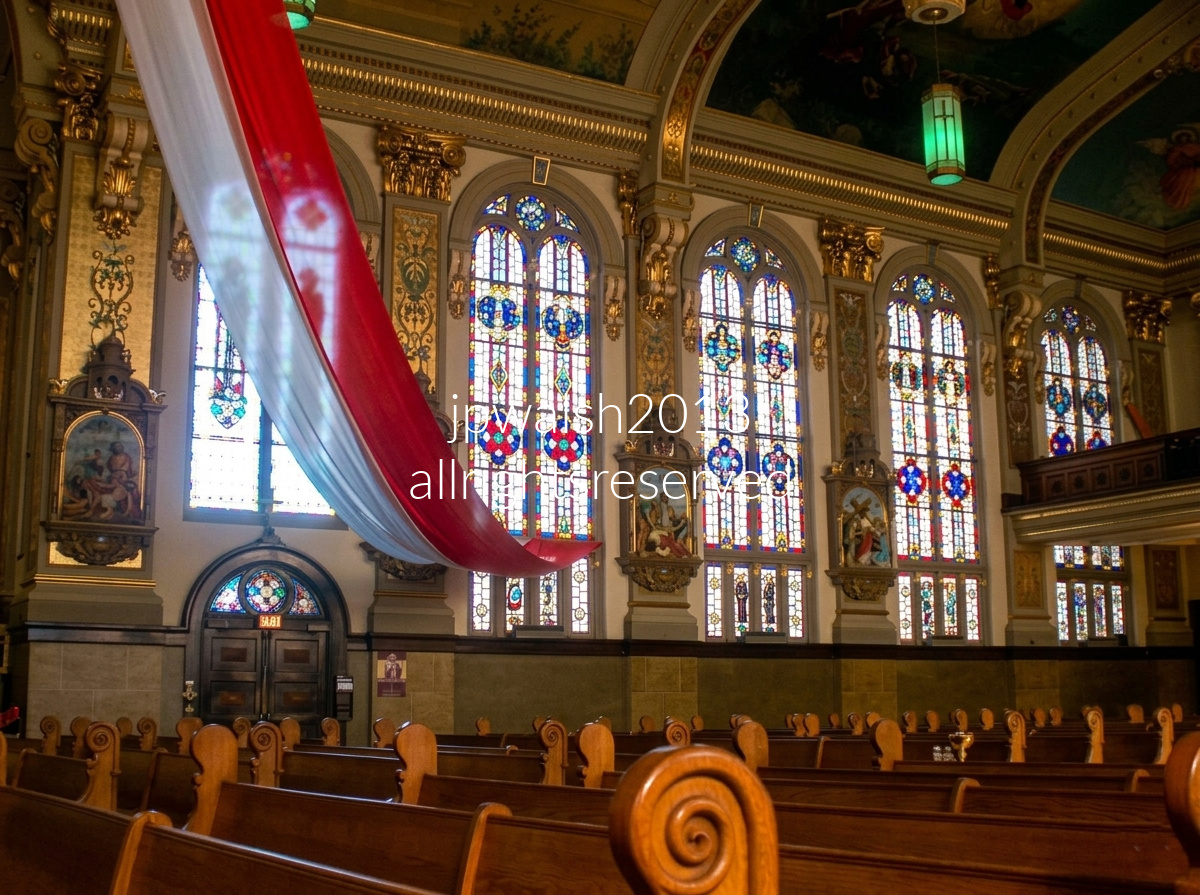
The elements within the sanctuary of Holy Trinity Polish Catholic Church hold deep cultural, architectural, and geographical significance. July 2013. Author’s photograph.
The Meaning of the Banners
The sweeping, decorative fabric banners (swags) draped across the upper nave are intentionally colored to celebrate the parish’s dual identity:
- Red and White: These represent the national colors of Poland, paying homage to the heritage of the immigrant community that built the parish.
- Yellow and White: These represent the official colors of the Vatican (The Holy See), symbolizing the parish’s absolute allegiance to the Roman Catholic Church and the Pope.
Style of the Stained Glass
These windows are executed in the Munich Style (or German Pictorial Style) of stained glass. Unlike medieval windows that used rough patches of colored glass separated by thick lead lines, this late 19th-century technique involved painting highly detailed, realistic religious scenes directly onto large sheets of glass with enamels before firing them in a kiln. The result mimics classic European oil paintings, featuring vibrant colors, lifelike human anatomy, and dramatic depth.
When and Where They Were Made & Installed
- Where They Were Made: The windows were commissioned and custom-made in Munich, Germany, primarily by the renowned F.X. Zettler Studios (The Royal Bavarian Art Institute for Stained Glass), which specialized in producing windows for grand American immigrant churches.
- When They Were Installed: They were fabricated and shipped to Chicago, where they were installed inside the church sanctuary between 1905 and 1906, perfectly aligning with the completion and dedication of the current church building.
The reason these windows look more abstract, ornamental, and geometric than the windows at St. Edmund Church in Oak Park comes down to a major difference in when they were actually made and the specific artistic style the parish chose.
While both sets are attributed to the legendary F.X. Zettler Studios of Munich, they represent completely different eras and design goals:
Different Eras: 1907 vs. 1955
- St. Edmund (Oak Park): These windows were commissioned, crafted, and installed during the church’s initial construction between 1907 and 1910. They feature Zettler’s signature turn-of-the-century “Munich Style”—which behaves like highly realistic, multi-perspective oil paintings saturated with lifelike figures and complex New Testament scenes.
- Holy Trinity (Chicago): While the church building itself was completed in 1906, the parish did not select or order these specific nave windows until 1940, and they were not installed until 1955. Because they were built decades later, Zettler’s post-WWII artisans utilized a more mid-century approach, heavily favoring bold, geometric, and decorative glass frameworks over dense, cinematic storytelling scenes.
Art Nouveau and Folkloric Design Intentions
The interior design of Holy Trinity intentionally veers away from standard, literal Roman-style narratives to celebrate Polish identity. The church’s design scheme relies heavily on Secessionist / Art Nouveau flairs—strongly inspired by the geometric and floral work of legendary Polish artist Stanisław Wyspiański.
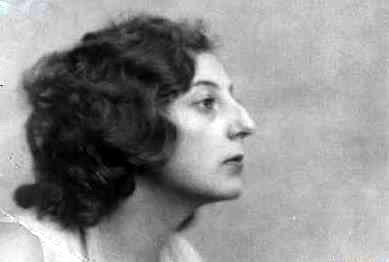
Polish artist Irena Lorentowicz (1908-1985) taken in the late 1920s or early 1930s. This period aligns when she was an art student at the Warsaw School of Fine Arts, studying under celebrated figures like Tadeusz Pruszkowski. Her abstract windows at Holy Trinity weren’t actually fabricated and shipped to Chicago until 1955. Public Domain.
To match this unique interior energy, the lower sections of these windows focus heavily on stylized, abstract geometric borders, folk art color patterns, and prominent Polish eagles and traditional cultural motifs. Instead of massive, full-window portraits, the figurative depictions of Polish saints and martyrs are intentionally condensed into smaller, ornamental medallions nestled within a sea of abstract, light-filtering patterns.
Before the current abstract stained glass windows were installed in 1955, the window frames at Holy Trinity Polish Catholic Church held standard, temporary windows common to newly constructed churches of that era.
When the building was completed in 1906, the parish was entirely out of funds due to the immense cost of constructing such a massive, ornate structure. To get the building open for services, they installed temporary panes of clear or basic frosted cathedral glass, which lacked any of the intricate figures or colorful Polish motifs seen today.
The openings remained this way for nearly 50 years. While internal stenciling was added in 1914 and the monumental ceiling vault frescoes were painted in 1926, the empty clear windows were kept until the parish could finally afford a permanent artistic upgrade. They officially selected the final custom designs from Munich in 1940, but due to the disruptions of World War II and the post-war recovery in Germany, the abstract Irena Lorentowicz windows weren’t actually fabricated and shipped to Chicago until 1955.
A Shift to Polish Folk Art & “Young Poland” Imagery
When the parish finally had the funds to complete the windows, they consciously chose to step away from traditional Roman or German imagery. They hired prominent Polish artist Irena Lorentowicz, a theatrical designer and painter who was deeply influenced by the Młoda Polska (Young Poland) Art Nouveau movement.
Lorentowicz deliberately chose to make the windows more geometric and abstract. Rather than filling the panels with traditional, heavy biblical scenes, she seamlessly wove stylized Polish geometric folk patterns, folkloric textiles, and Polish eagles directly into the light-filtering glass grids. This choice honored the mid-century modern aesthetic while proudly celebrating the specific identity of the Chicago Polish community.
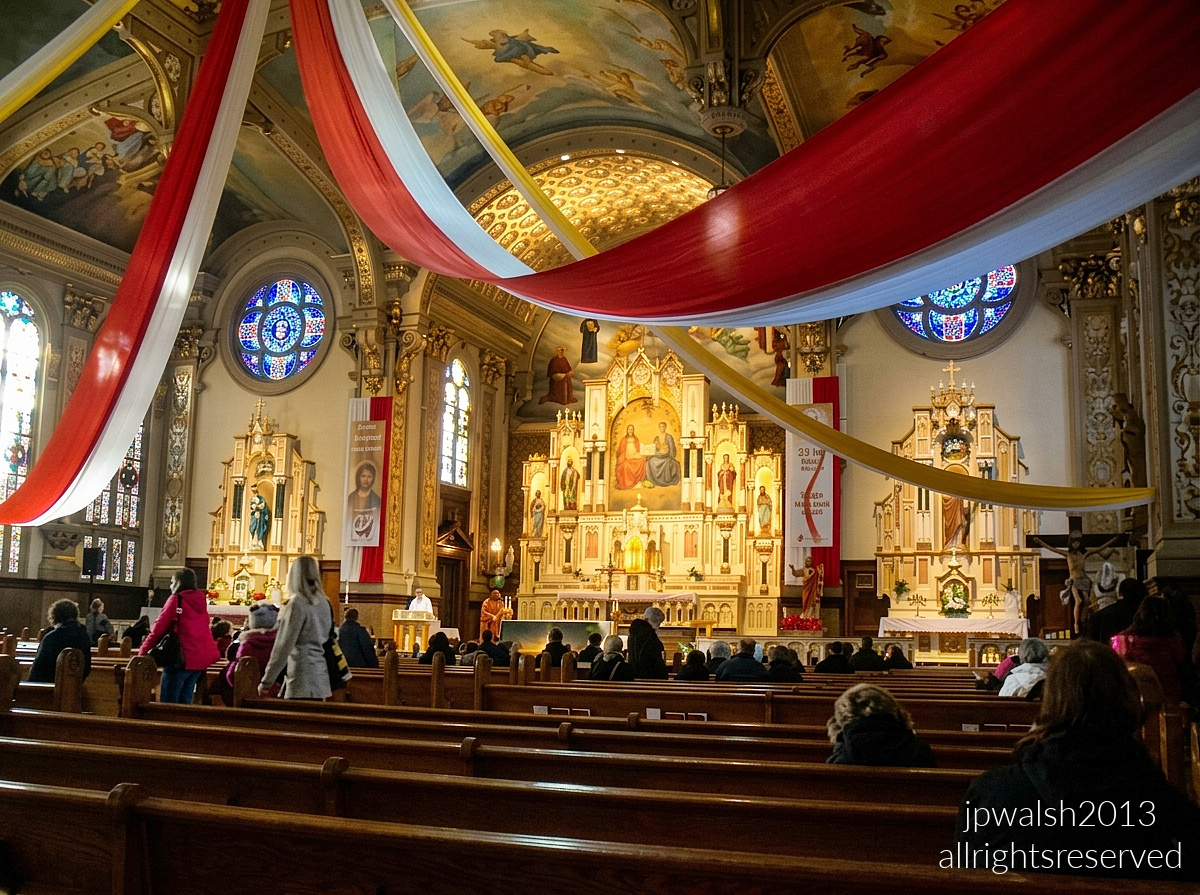
View of the sanctuary inside Holy Trinity Polish Catholic Church (Trójcowo) in Chicago during a service. July 2013. Author’s photograph.
- The Congregation: Parishioners are seated in the rows of dark wooden pews in the foreground, facing the altar area. Several people can be seen standing or moving in the aisle near the front left.
- The High Altar (Center): The illuminated main altar stands out in the back center of the sanctuary. It is a large, multi-tiered white and gold structure featuring a central painting of the Holy Trinity and flanked by statues of saints.
- The Side Altars: Two smaller, matching side altars flank the main altarpiece. The left side altar features a statue of the Virgin Mary, while the right-side altar features another prominent religious figure, with a traditional crucifix nearby.
The Circular Rose Windows
Two vibrant, blue-dominated circular stained glass rose windows are visible on either side of the sanctuary walls above the altars. The two circular rosette (rose) stained glass windows positioned on either side of the high altar are an exception to the later 1950s additions—they are actually part of the original 1906 Munich-style installation.
Who Made Them and When
- The Manufacturer: They were custom-crafted in Germany by F.X. Zettler Studios of Munich (The Royal Bavarian Art Institute for Stained Glass).
- The Date: They were shipped to Chicago and installed between 1905 and 1906, perfectly aligning with the initial completion and dedication of the church building. Unlike the vertical nave windows that feature a more abstract mid-century look, these two transept rose windows follow the highly traditional, literal Munich Pictorial Style. Because they were imported before World War I, they display the signature rich, vibrant blues and multi-layered enamel painting techniques that made early 20th-century Bavarian glass studios world-famous.
- The Left Rose Window: This window represents The Joyful Mysteries and features an intricate central portrait medallion of the Annunciation, surrounded by petal-like geometric panels blooming outward.
- The Right Rose Window: This window honors the Blessed Virgin Mary as Queen of Heaven, showcasing a central portrait medallion of her coronation, matching the theological theme of the massive wall mural painted directly below it.
Ceiling Murals
While the massive, overarching barrel-vaulted ceiling murals were completed in 1926 by artist K. Markiewicz, the artwork on the church walls was painted across multiple decades:
- 1914 Decorating: K. Markiewicz actually began executing the initial intricate ornamental stenciling, borders, and interior decorations along the walls earlier in 1914.
- The 1926 Ceiling Wave: The dramatic, large-scale religious scenes canvas fresco painting on the high roof vaults were executed as a unified phase in 1926.
- Modern Wall Additions (Post-WWII): Many of the specific historical portraits and wall paintings seen today—such as the large fresco directly above the high altar depicting Pope John Paul II and Cardinal Stefan Wyszyński—could not have been painted in 1926. Those modern figures were added much later in the 20th century to honor contemporary Polish religious heroes.
The Black Madonna of Częstochowa represents both faith and national survival. The church became a place where Polish-Americans maintained connections to struggles against Nazism and Communism.
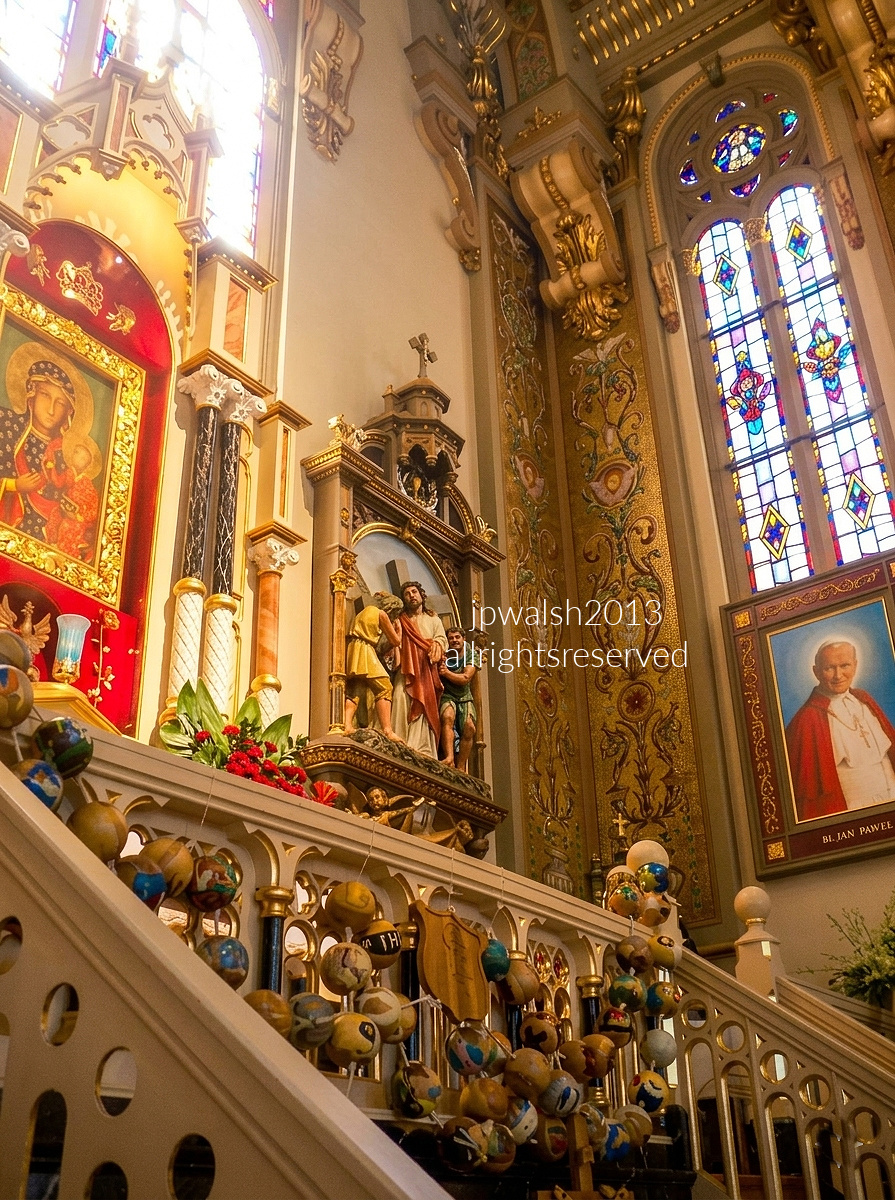
In this corner inside Holy Trinity Polish Catholic Church showcases how the parish blends traditional religious artwork with distinct Polish national identity. The three prominent artworks, their frameworks, and the surrounding architecture are detailed below. July 2013. Author’s photograph.
The Three Artworks & Their Iconography
Our Lady of Częstochowa (Far Left Side Altar)
- The Subject: This is a replica of the Black Madonna of Częstochowa, Poland’s most sacred religious relic. It depicts the Virgin Mary holding the child Jesus. A defining iconographical detail is the two scars on her right cheek, which historically represent slashes made by a Hussite raider’s sword in 1430. Both Mary and Jesus are adorned with elaborate, relief-sculpted gold crowns and gowns (sukienki).
- The Style & Artist: Painted in the strict Byzantine Hodegetria style (meaning “She who shows the Way”), Mary points her hand toward Jesus as the source of salvation. This specific replica was commissioned anonymously by a parishioner and painted by a traditional Polish iconographer in the early 20th century.
The Carrying of the Cross (Center Altar Niches)
- The Subject: This is the Fifth Station of the Cross, depicting Simon of Cyrene helping a weary, thorn-crowned Jesus carry his heavy wooden crucifix toward Calvary. A Roman soldier stands behind them aggressively directing their path.
- The Style & Artist: This is a high-relief, polychrome Academic Realism sculpture made of painted plaster and wood. It was hand-carved by European artisans in the late 19th century and integrated directly into the structural architecture of the side altars.
Portrait of Pope John Paul II (Far Right Wall)
- The Subject: A formal portrait of Pope John Paul II (labeled underneath as Bł. Jan Paweł II, meaning “Blessed John Paul II,” referencing the period after his beatification but prior to his canonization as a saint). He wears his papal white cassock and a bright crimson velvet mozzetta (cape) while looking warmly toward the congregation.
- The Style & Artist: Executed in a traditional Contemporary Realism painting style, this canvas portrait was added to the sanctuary wall in the early 2010s to celebrate the historic Polish pope, who visited Chicago and this specific neighborhood during his lifetime.
Architectural Frames & Wall Details
- The Side Altar Frame (Left & Center): Built in a heavy Renaissance Revival style, the shrines are constructed from polished white marble and matching painted plaster columns. The pillars feature classic Corinthian capitals dipped in gold leaf, supporting an ornate, multi-tiered pediment that mimics a miniature European cathedral facade.
- The Wall Stenciling (Background): The walls are covered in spectacular, intricate Beaux-Arts / Baroque Revival stenciling painted by artist K. Markiewicz. The patterns feature looping gold leaf arabesques, floral cornucopias, and hidden cherubim medallions woven directly into the beige background.
- The Stained Glass Window: Rising above the papal portrait is one of the custom 1955 Munich-style windows. It frames geometric patterns and abstract floral glass panels that echo the shapes of traditional Polish paper-cutting folk art (wycinanki).
- The Staircase Railing (Foreground): The white marble staircase railing leading up toward the sanctuary features a line of open geometric circle-and-scroll cuts, which parishioners have beautifully decorated with hanging ornamental painted globes, adding a unique festive texture to the architecture.
Portraits and memorials honor modern Polish heroes such as John Paul II and Jerzy Popiełuszko.
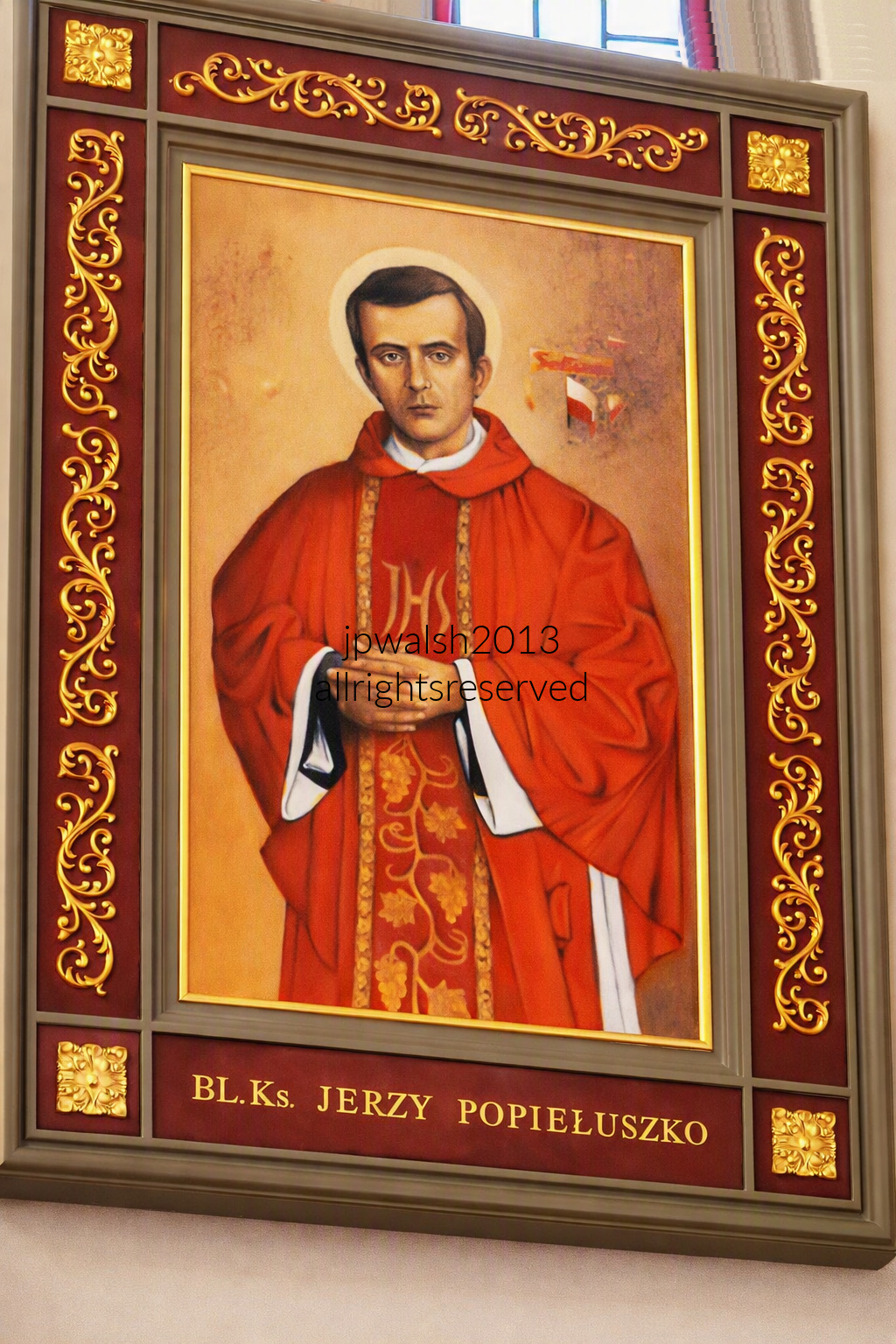
The painting’s subject is Blessed Father Jerzy Popiełuszko, a Polish Roman Catholic priest and martyr. He is depicted wearing red liturgical vestments — a chasuble embroidered with gold, symbolizing martyrdom and sacrifice. His hands are clasped in prayer before his chest, and his expression is solemn yet peaceful, reflecting spiritual strength. A halo encircles his head, marking his beatified status. The ornate red-and-gold frame reinforces reverence and sanctity, while the inscription “BL. Ks. JERZY POPIEŁUSZKO” identifies him as Blessed Father Jerzy Popiełuszko. July 2013. Author’s phograph.
Life and Advocacy
Popiełuszko became a symbol of faith and resistance during Poland’s communist era, known for preaching truth and human dignity until his assassination in 1984. Born in 1947 in northeastern Poland, he was ordained as a priest in 1972 by Cardinal Stefan Wyszyński. Father Popiełuszko became closely linked with “Solidarity” (Solidarność), the first independent, anti-communist trade union bloc in the Soviet zone. He served as the spiritual leader and chaplain for Warsaw factory workers and steelworkers. During the dark years of martial law in Poland, he celebrated monthly “Masses for the Homeland”. His moving sermons centered on truth, human dignity, freedom, and spiritual resistance. He famously urged his followers to “overcome evil with good”.
Martyrdom
Because his speeches drew tens of thousands of people and unified opposition to the state, he became a prime target of communist authorities. On October 19, 1984, at just 37 years old, Father Popiełuszko was ambushed, kidnapped, and brutally beaten to death by three agents of the communist Internal Affairs Security Service. His body was subsequently dumped in a reservoir along the Vistula River. His funeral turned into a massive, peaceful anti-communist demonstration attended by up to one million citizens.
Legacy and Beatification
Recognizing his ultimate sacrifice for his faith and people, Pope Benedict XVI beatified him as a martyr on June 6, 2010. The text at the bottom of the painting reads “Bł. Ks. Jerzy Popiełuszko”, where “Bł.” stands for Błogosławiony (Blessed) and “Ks.” stands for Ksiądz (Priest) in Polish. His vestment is adorned with the IHS christogram.