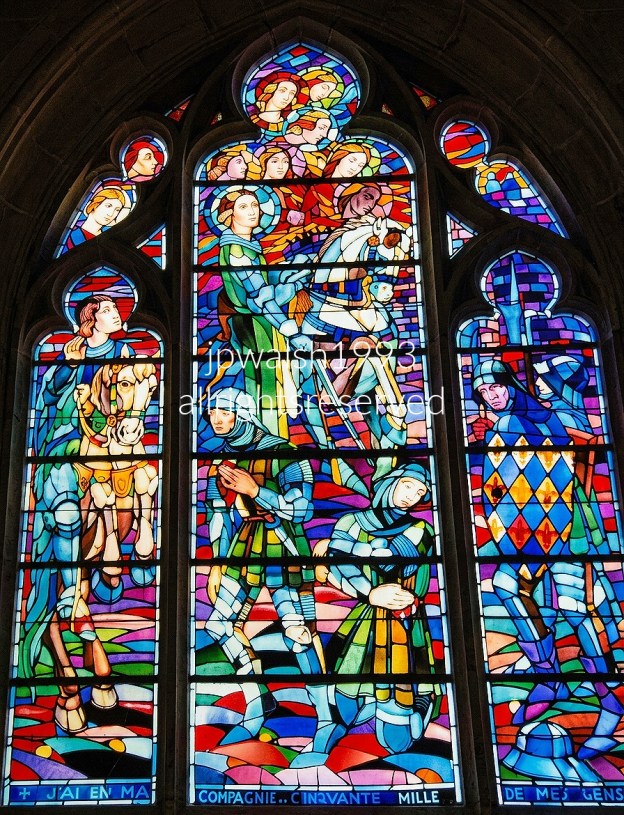
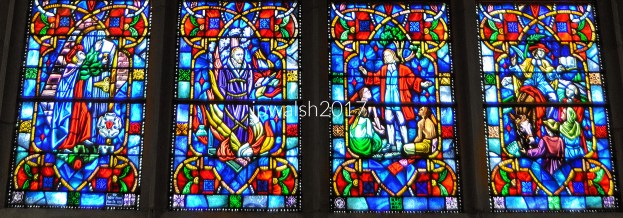
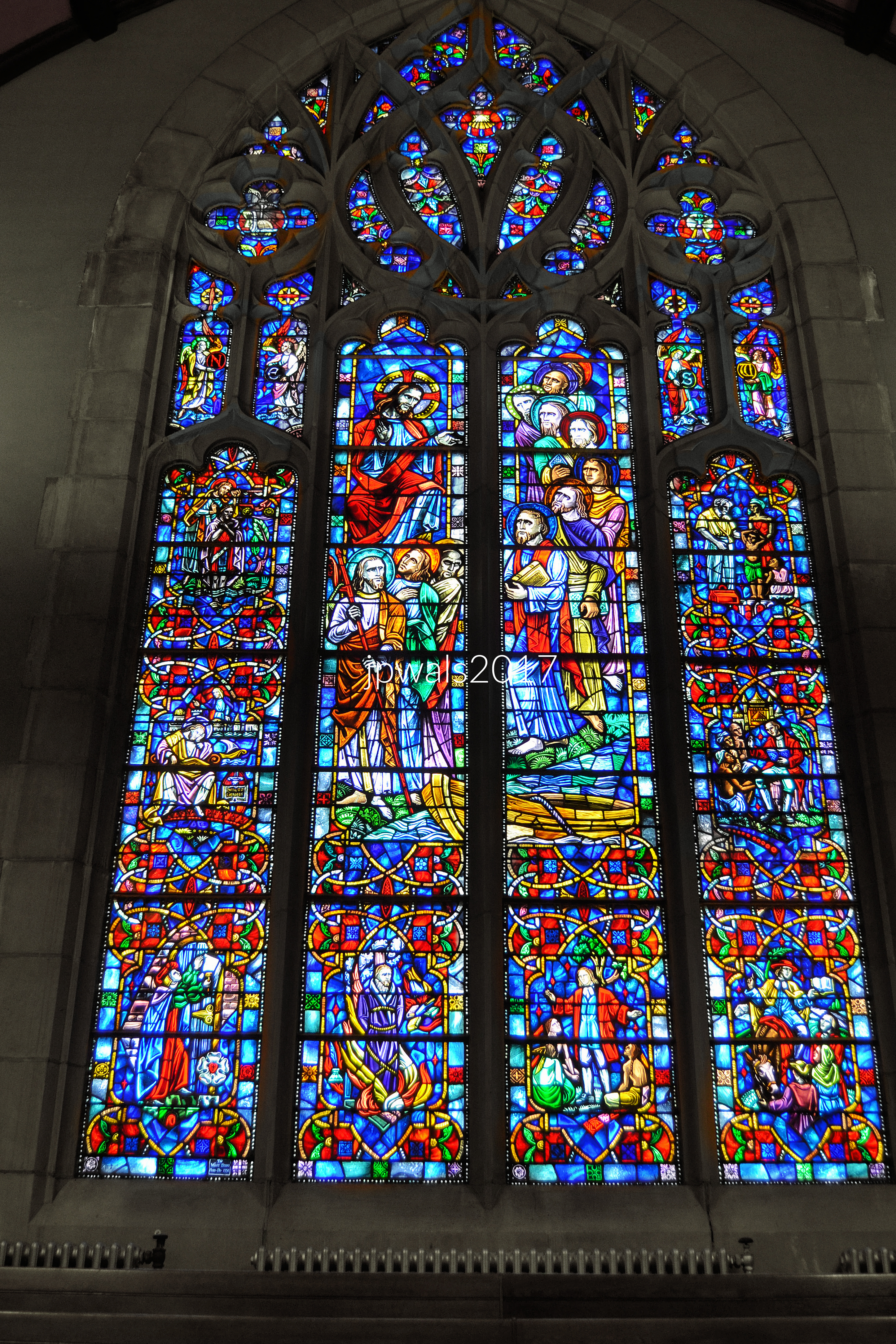
FEATURE Image: St. Joan of Arc’s capture of Saint-Pierre-le-Moûtier from Anglo-Burgundian forces on November 4, 1429, during the Hundred Years War in L’église Saint-Pierre at Saint-Pierre-le-Moûtier, France. Seotember 1993. Author’s photograph.
The stained-glass window at Saint-Pierre-le-Moûtier commemorates a pivotal moment in Joan of Arc’s military career, illustrating how her unwavering faith, personal courage, and conviction in divine assistance transformed a near-defeat into a decisive French victory during the Hundred Years’ War.
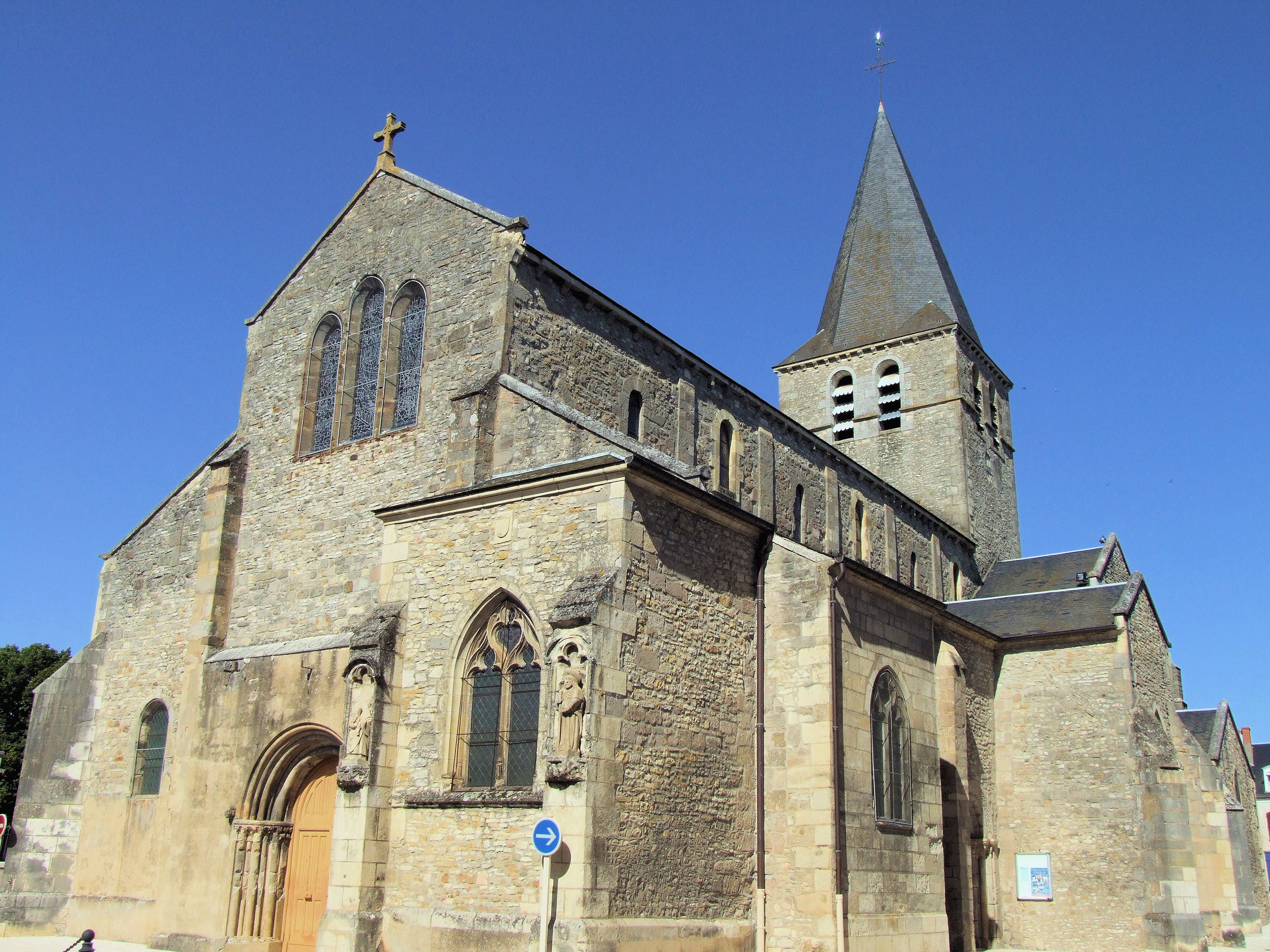
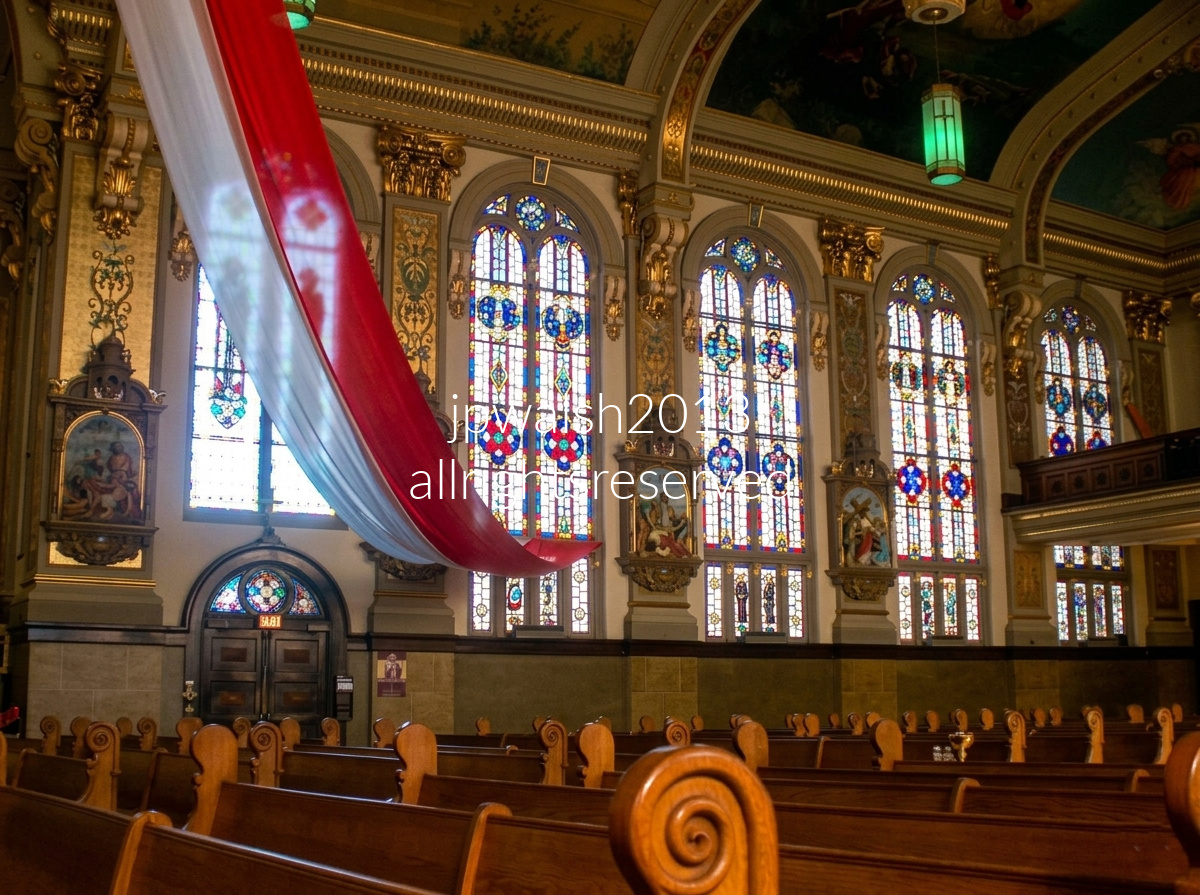
The Saint Peter Church of Saint-Pierre-le-Moûtier (Nièvre) is a 12th-century Roman Catholic building, a former Benedictine priory, classified as a historical monument since 1886. Photo by MOSSOT / Wikimedia Commons / CC BY 3.0
The Window and Its Setting
This stained‑glass window captures one of the most electrifying moments in the epic of Joan of Arc. It is part of a modern cycle in the town church of Saint‑Pierre de Saint‑Pierre‑le‑Moûtier, crafted in the mid‑20th century by the Mauméjean brothers. The artwork commemorates an event that unfolded in this very town — and inside this very church — during the Hundred Years’ War.
On November 4, 1429, Joan led a French royal force to seize Saint‑Pierre‑le‑Moûtier, a fortified stronghold held by Anglo‑Burgundian troops. The attack stalled under fierce resistance. French soldiers broke formation and began to fall back. Amid the chaos, Joan’s officer Jean d’Aulon — wounded during the fighting — suddenly realized she had been left almost alone near the moat with only a handful of men.
Author’s photograph. All rights reserved.
Joan’s Defiance and Her “Fifty Thousand”
D’Aulon mounted a horse, rode to her, and urged her to retreat before she was killed or captured. Joan removed her helmet and shouted that she was not alone. The window preserves her words across its lower banners: “+ J’AI EN MA / COMPAGNIE . . CINQVANTE MILLE / DE MES GENS.” She claimed she had fifty thousand of her people with her — the heavenly host of angels she believed fought at her side. D’Aulon saw only four or five soldiers, but Joan’s unshakable resolve reignited the army.
The Turning of the Battle
Joan ordered her men to gather wood and brush to build a makeshift bridge across the moat. The retreating French troops saw The Maid standing her ground, turned back, and launched a sudden, overwhelming assault that broke the defenses and captured the town. The upper portion of the window shows Joan on her white horse in the heat of battle, while the faces gathered in the arc above represent the “fifty thousand” she invoked — angels, Saint Michael, and the voices she believed guided her.
Aftermath and Joan’s Devotion
Following the victory, Joan prevented her troops from sacking the town. She then spent several days praying inside this church before marching on to her next campaign, leaving behind both a military triumph and a moment of mystic conviction that the Mauméjean window preserves with vivid force.
The nave of Saint-Pierre Church at Saint-Pierre-le-Moûtier, where Joan of Arc spent several days in prayer following her remarkable victory against overwhelming odds at the Battle of Saint-Pierre-le-Moûtier in November 1429. Photo by MOSSOT / Wikimedia Commons / CC BY-SA 3.0
More than a scene of battlefield heroism, the Saint-Pierre-le-Moûtier window presents Joan of Arc’s conviction that military success flowed from divine providence, portraying the inseparable relationship between faith, vision, and leadership that defined her extraordinary career.
This explanatory article may be periodically updated.
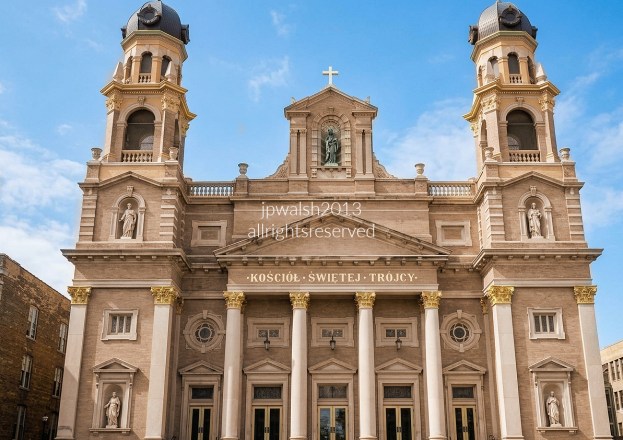
Feature image: Exterior of Holy Trinity Polish Catholic Church, Shots of Holy Trinity Polish Mission can be seen throughout 20th Century-Fox’s 1948 film noir Call Northside 777 starring James Stewart, the first Hollywood feature film to be shot on location in Chicago. July 2013. Author’s photograph.
Holy Trinity Polish Catholic Church in Chicago is more than an architectural landmark. Through its art, stained glass, icons, and devotional imagery, it preserves the religious faith, national memory, and spirit of endurance that sustained Poles through foreign occupation, war, communism, and immigration to the United States.
Founding of a Polish Landmark
Holy Trinity Parish was founded in 1872 to relieve overcrowding at St. Stanislaus Kostka, Chicago’s first Polish parish. The Congregation of the Holy Cross was chosen to serve the new congregation under the leadership of Father Casimir Sztuczko, CSC. From its earliest years, Holy Trinity became closely associated with the Polish National Alliance, as many of the organization’s most active members belonged to the parish.
During the twentieth century, Holy Trinity stood at the heart of Chicago’s historic Polish community. However, construction of the Kennedy Expressway through the center of Polish Downtown displaced thousands of residents and marked the beginning of a long demographic decline for the parish. Despite these changes, Holy Trinity remained an important cultural and spiritual center for Polish Americans.
Attorney General Robert F. Kennedy attended Mass at Holy Trinity during the festivities surrounding Chicago’s annual Polish Constitution Day Parade in 1961. Administration of the parish passed to the Resurrectionists in 1975 and later to the Society of Christ Fathers in 1988, who continue to serve the congregation today. On September 14, 2006, Polish Prime Minister Jarosław Kaczyński visited Holy Trinity and attended a Mass celebrated during his Chicago visit.
Holy Trinity has also appeared on the silver screen. Exterior views of the church can be seen throughout Call Northside 777 (1948), starring James Stewart, the first Hollywood feature film shot on location in Chicago.
Building the Present Church
By the turn of the twentieth century, parish growth demanded a larger church. Initial designs were prepared by Herman Olszewski, better known by his artistic pseudonym Von Herbulis. Because of financial limitations, the plans were scaled back and refined by Chicago architect William Krieg. Construction began in 1905, and the magnificent new church was completed in October 1906.
The imposing façade combines several architectural traditions. Twin towers frame a monumental entrance portico supported by four Corinthian columns. The lower stages of the towers feature Corinthian pilasters and classical pediments, while the upper levels become increasingly Baroque in character, culminating in ornate cupolas. Above the portico rises a dramatic Baroque superstructure of brick and stone, while iron framing supports the segmental vaults and tower interiors. Gothic and Romanesque influences appear throughout the church’s windows and decorative details.
Architecture Inspired by Poland
The church’s eclectic design reflects the architectural history of Poland itself. Many medieval Polish churches evolved over centuries, rebuilt after wars, fires, and other disasters, often incorporating the artistic tastes of successive generations. Frequently, renovations were halted when funds ran out, resulting in interiors and exteriors executed in entirely different styles.
Holy Trinity deliberately follows this tradition. Its mixture of Classical, Gothic, Romanesque, and Baroque elements evokes the appearance of many historic churches in Poland and would have offered immigrant parishioners a powerful reminder of the homeland they had left behind.
A Monumental Interior
The church interior remains remarkably intact and retains much of its original appearance. Measuring approximately 125 by 200 feet, the sanctuary is both spacious and richly ornamented. Iron construction made it possible to create broad vaulted spaces without the forest of support columns found in many churches of comparable scale.
Murals depicting religious scenes cover the walls and ceilings, including compositions honoring the patron saints of Poland. Every stained-glass window was selected to reflect symbols familiar to Polish immigrants. Among the most prominent are depictions of the Black Madonna of Częstochowa and Our Lady of the Gate of Dawn. Other windows portray Polish saints, martyrs, national emblems such as the Polish eagle, and traditional folkloric motifs.
The church’s interior decoration was executed by K. Markiewicz in 1914, while the large vault murals were completed in 1926. Most of the stained-glass windows, selected in 1940 and ultimately installed in 1955, were created by noted Polish artist Irena Lorentowicz.
Sacred Memorials and National Memory
Holy Trinity also serves as a repository of Polish historical memory. In 1990, a statue of Our Lady Queen of Emigrants by Professor Wiktor Zin was installed and blessed by Cardinal Joseph Bernardin. Two years later, an urn containing soil from Kharkiv, Katyn, and Mednoye was placed in the church. Each site contains mass graves of Polish victims murdered by Soviet authorities during World War II.
Additional commemorative plaques were installed in the narthex during 1993 and 1994. One honors Father Casimir Sztuczko, CSC, whose leadership guided the construction of the present church. Another marks the fiftieth anniversary of the Battle of Monte Cassino, one of the most significant Polish military victories of World War II.
Renewal for a New Century
As Holy Trinity approached the centennial of its current church building, an ambitious restoration campaign was launched in 2005. The work included the installation of new copper cupolas atop the towers, new granite flooring in the sanctuary, extensive interior restoration, and conservation of decorative artwork.
New religious imagery was added to reflect figures especially revered by contemporary Polish Catholics. A large mural of St. Cecilia accompanied by an angelic choir was installed above the choir loft. New depictions of St. Faustina, Cardinal Stefan Wyszyński, Cardinal August Hlond, founder of the Society of Christ Fathers, and St. John Paul II further connected the parish’s historic mission with modern Polish spirituality.
The Millennium Doors, created by artist Jerzy Kenar, had already begun welcoming worshippers and visitors into the sanctuary in 2000.
The Catacombs
Among Holy Trinity’s most distinctive features are its remarkable “Catacombs,” located beneath the church. Father Casimir Sztuczko envisioned a place where relics of saints and the blessed could be venerated, drawing inspiration from the underground burial chambers and gathering places used by early Christians during periods of persecution in the Roman Empire.
The resulting devotional space consists of winding passageways lined with niches containing sacred relics. The route culminates in a chamber representing the Tomb of Christ, creating a deeply symbolic pilgrimage experience within the church itself.
The Catacombs became the first major area restored during the centennial renovation campaign after years of neglect, particularly during the period when parish closure was being considered. Since then, the collection has expanded to include relics of newly canonized saints, as well as stones gathered from important biblical sites in the Holy Land. Today, the Catacombs remain open to visitors on Sundays following Masses and throughout the season of Lent.
The interior of Holy trinity Polish Catholic Church (Trójcowo) in Chicago, built in the grand Polish Cathedral style. This architectural style was popular in the late 19th and early 20th centuries for large churches serving Polish immigrant communities in the American Midwest. July 2013. Author’s photograph.
Architectural Style
The building is a monumental blend of Renaissance Revival and Baroque Revival architecture, designed by architect Herman Olszewski and completed in 1906. The style mimics the ornate, historic cathedrals of Poland to evoke a sense of cultural heritage, using monumental scales, vaulted ceilings, and extensive gold leaf.
Key Interior Details
The Ribbons / Banners: The interior features sweeping, ceremonial colored fabric swags draped across the nave. These include red and white (the national colors of Poland), alongside yellow and white (the colors of the Vatican/Holy See).
The High Altar: Centered at the front is a towering, white-and-gold carved wooden altarpiece modeled after traditional European Gothic and Renaissance structures, complete with saint statues tucked into delicate architectural niches.
The Ceiling Vaults and Frescoes: The nave is covered by a barrel-vaulted ceiling adorned with elaborate, large-scale religious frescoes. The walls are completely filled with decorative murals, intricate stenciling, and gilded cornices rather than being left blank.
Monumental Columns: In the foreground stands a massive, thick supporting pillar with a striking, faux-marble green scagliola finish and decorative gold trim at the top.
Stained Glass Windows: The side walls are lined with tall, arched stained glass windows featuring intricate geometric borders and detailed figurative portraits of saints, flooding the sanctuary with colored natural light.
The Pews: Long, polished oak wooden church benches line both sides of a carpeted center aisle, featuring beautifully carved, swirling scroll patterns on each aisle end cap.
The spectacular high altar and vault frescoes inside Holy Trinity Polish Catholic Church (commonly known to the local community as Trójcowo), located in Chicago, Illinois. July 2013. Author’s photograph.
The High Altar Piece
The massive, hand-carved white and gold wooden altarpiece (retable) represents the namesake of the parish—the Holy Trinity:
The Center Panel: Features a large painting of God the Father and Jesus Christ sitting side-by-side. Between them rests an open book inscribed with “A Ω” (Alpha and Omega, representing the beginning and the end). Hovering directly above them is a glowing white dove representing the Holy Spirit, completing the Trinity.
The Surrounding Statues: The Gothic-style niches built into the towers of the altar hold painted statues of various Catholic saints, including Saint Peter (holding the keys) and Saint Paul flanking the immediate sides of the central painting.
The Crucifixion (Foreground): A traditional crucifix stands directly on the lower tabernacle tier, centering the altar around the sacrifice of Christ.
The large, semi-circular mural painted on the wall directly above the altar structure illustrates the Coronation of the Blessed Virgin Mary in Heaven, surrounded by notable figures from Polish religious history. July 2013. Author’s photograph.
Above the altar of Holy Trinity Polish Catholic Church in Chicago, a large semi-circular mural installed during a major restoration and renovation completed in 2007 depicts the Coronation of the Blessed Virgin Mary in Heaven, surrounded by prominent figures from Polish religious history. At left, clad in a red cassock, is Cardinal Stefan Wyszyński (1901-1981), Archbishop of Gniezno and Warsaw, Primate of Poland, and a steadfast spiritual leader who defended the Polish Church during both the Nazi occupation and the Communist era; he was beatified by Pope Francis in 2021. Beside him stands Saint Faustina Kowalska (1905-1938), portrayed in a dark hooded habit. The Polish nun and mystic’s visions of Christ inspired the worldwide Divine Mercy devotion, one of the most influential Catholic spiritual movements of the twentieth century, and she was canonized by Pope John Paul II in 2000. Also represented is Saint John Paul II, the first Polish pope, whose historic pontificate profoundly shaped both the Church and modern Poland; he was canonized by Pope Francis in 2014. At right, vested in red and black, is Cardinal August Hlond (1881-1948), the Polish Salesian prelate who served as Archbishop of Gniezno and Warsaw and Primate of Poland from 1926 until his death. Created cardinal by Pope Pius XI in 1927, he was arrested by the Gestapo in 1944, becoming the only cardinal imprisoned by the Nazis, and after his release in 1945 became an outspoken defender of Church autonomy and religious education against Soviet-backed Communist policies in postwar Poland.
The interior combines religious devotion with specifically Polish historical memory.
The elements within the sanctuary of Holy Trinity Polish Catholic Church hold deep cultural, architectural, and geographical significance. July 2013. Author’s photograph.
The Meaning of the Banners
The sweeping, decorative fabric banners (swags) draped across the upper nave are intentionally colored to celebrate the parish’s dual identity:
Red and White: These represent the national colors of Poland, paying homage to the heritage of the immigrant community that built the parish.
Yellow and White: These represent the official colors of the Vatican (The Holy See), symbolizing the parish’s absolute allegiance to the Roman Catholic Church and the Pope.
Style of the Stained Glass
These windows are executed in the Munich Style (or German Pictorial Style) of stained glass. Unlike medieval windows that used rough patches of colored glass separated by thick lead lines, this late 19th-century technique involved painting highly detailed, realistic religious scenes directly onto large sheets of glass with enamels before firing them in a kiln. The result mimics classic European oil paintings, featuring vibrant colors, lifelike human anatomy, and dramatic depth.
When and Where They Were Made & Installed
Where They Were Made: The windows were commissioned and custom-made in Munich, Germany, primarily by the renowned F.X. Zettler Studios (The Royal Bavarian Art Institute for Stained Glass), which specialized in producing windows for grand American immigrant churches.
When They Were Installed: They were fabricated and shipped to Chicago, where they were installed inside the church sanctuary between 1905 and 1906, perfectly aligning with the completion and dedication of the current church building.
The reason these windows look more abstract, ornamental, and geometric than the windows at St. Edmund Church in Oak Park comes down to a major difference in when they were actually made and the specific artistic style the parish chose.
While both sets are attributed to the legendary F.X. Zettler Studios of Munich, they represent completely different eras and design goals:
Different Eras: 1907 vs. 1955
St. Edmund (Oak Park): These windows were commissioned, crafted, and installed during the church’s initial construction between 1907 and 1910. They feature Zettler’s signature turn-of-the-century “Munich Style”—which behaves like highly realistic, multi-perspective oil paintings saturated with lifelike figures and complex New Testament scenes.
Holy Trinity (Chicago): While the church building itself was completed in 1906, the parish did not select or order these specific nave windows until 1940, and they were not installed until 1955. Because they were built decades later, Zettler’s post-WWII artisans utilized a more mid-century approach, heavily favoring bold, geometric, and decorative glass frameworks over dense, cinematic storytelling scenes.
Art Nouveau and Folkloric Design Intentions
The interior design of Holy Trinity intentionally veers away from standard, literal Roman-style narratives to celebrate Polish identity. The church’s design scheme relies heavily on Secessionist / Art Nouveau flairs—strongly inspired by the geometric and floral work of legendary Polish artist Stanisław Wyspiański.
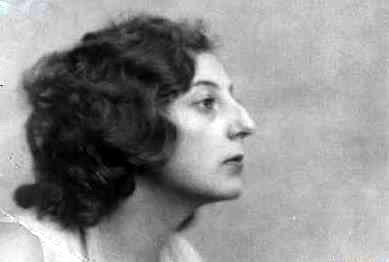
Polish artist Irena Lorentowicz (1908-1985) taken in the late 1920s or early 1930s. This period aligns when she was an art student at the Warsaw School of Fine Arts, studying under celebrated figures like Tadeusz Pruszkowski. Her abstract windows at Holy Trinity weren’t actually fabricated and shipped to Chicago until 1955. Public Domain.
To match this unique interior energy, the lower sections of these windows focus heavily on stylized, abstract geometric borders, folk art color patterns, and prominent Polish eagles and traditional cultural motifs. Instead of massive, full-window portraits, the figurative depictions of Polish saints and martyrs are intentionally condensed into smaller, ornamental medallions nestled within a sea of abstract, light-filtering patterns.
Before the current abstract stained glass windows were installed in 1955, the window frames at Holy Trinity Polish Catholic Church held standard, temporary windows common to newly constructed churches of that era.
When the building was completed in 1906, the parish was entirely out of funds due to the immense cost of constructing such a massive, ornate structure. To get the building open for services, they installed temporary panes of clear or basic frosted cathedral glass, which lacked any of the intricate figures or colorful Polish motifs seen today.
The openings remained this way for nearly 50 years. While internal stenciling was added in 1914 and the monumental ceiling vault frescoes were painted in 1926, the empty clear windows were kept until the parish could finally afford a permanent artistic upgrade. They officially selected the final custom designs from Munich in 1940, but due to the disruptions of World War II and the post-war recovery in Germany, the abstract Irena Lorentowicz windows weren’t actually fabricated and shipped to Chicago until 1955.
A Shift to Polish Folk Art & “Young Poland” Imagery
When the parish finally had the funds to complete the windows, they consciously chose to step away from traditional Roman or German imagery. They hired prominent Polish artist Irena Lorentowicz, a theatrical designer and painter who was deeply influenced by the Młoda Polska (Young Poland) Art Nouveau movement.
Lorentowicz deliberately chose to make the windows more geometric and abstract. Rather than filling the panels with traditional, heavy biblical scenes, she seamlessly wove stylized Polish geometric folk patterns, folkloric textiles, and Polish eagles directly into the light-filtering glass grids. This choice honored the mid-century modern aesthetic while proudly celebrating the specific identity of the Chicago Polish community.
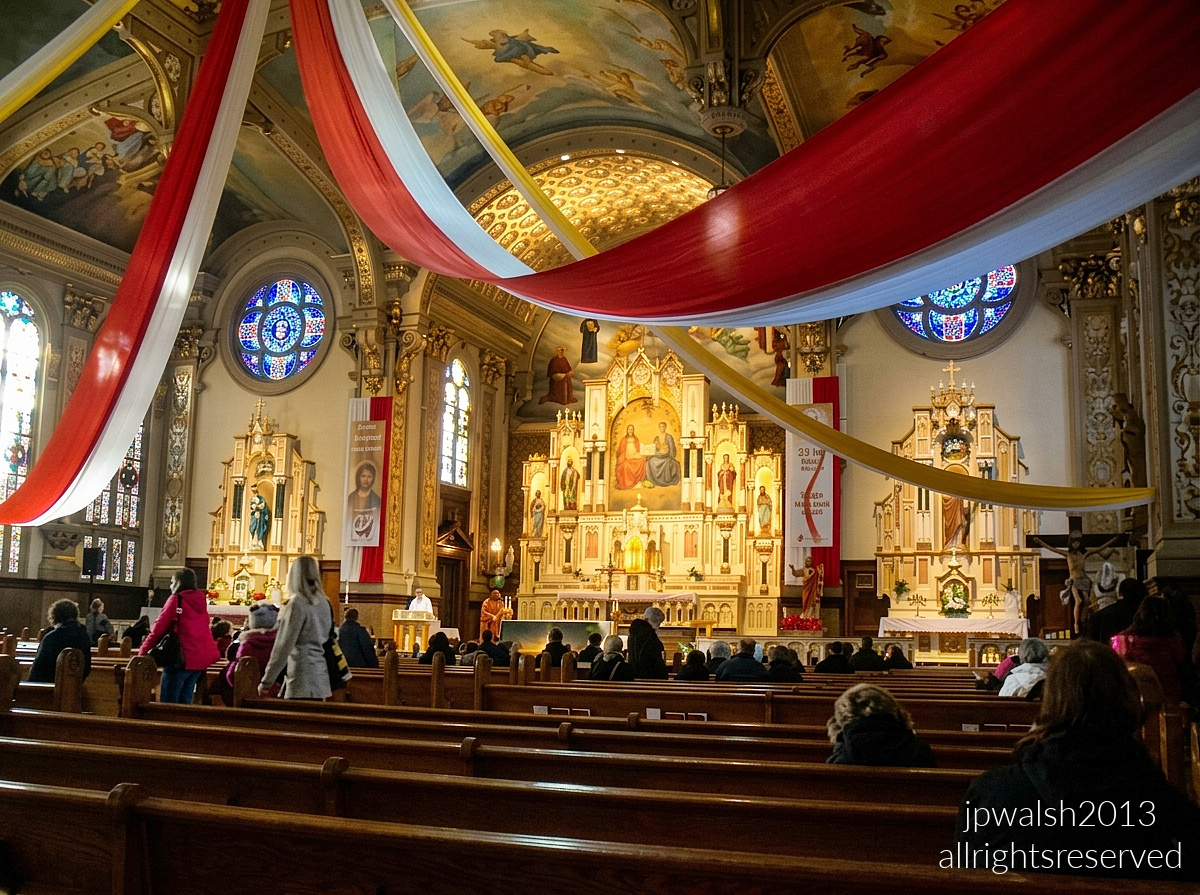
View of the sanctuary inside Holy Trinity Polish Catholic Church (Trójcowo) in Chicago during a service. July 2013. Author’s photograph.
The Congregation: Parishioners are seated in the rows of dark wooden pews in the foreground, facing the altar area. Several people can be seen standing or moving in the aisle near the front left.
The High Altar (Center): The illuminated main altar stands out in the back center of the sanctuary. It is a large, multi-tiered white and gold structure featuring a central painting of the Holy Trinity and flanked by statues of saints.
The Side Altars: Two smaller, matching side altars flank the main altarpiece. The left side altar features a statue of the Virgin Mary, while the right-side altar features another prominent religious figure, with a traditional crucifix nearby.
The Circular Rose Windows
Two vibrant, blue-dominated circular stained glass rose windows are visible on either side of the sanctuary walls above the altars. The two circular rosette (rose) stained glass windows positioned on either side of the high altar are an exception to the later 1950s additions—they are actually part of the original 1906 Munich-style installation.
Who Made Them and When
The Manufacturer: They were custom-crafted in Germany by F.X. Zettler Studios of Munich (The Royal Bavarian Art Institute for Stained Glass).
The Date: They were shipped to Chicago and installed between 1905 and 1906, perfectly aligning with the initial completion and dedication of the church building. Unlike the vertical nave windows that feature a more abstract mid-century look, these two transept rose windows follow the highly traditional, literal Munich Pictorial Style. Because they were imported before World War I, they display the signature rich, vibrant blues and multi-layered enamel painting techniques that made early 20th-century Bavarian glass studios world-famous.
The Left Rose Window: This window represents The Joyful Mysteries and features an intricate central portrait medallion of the Annunciation, surrounded by petal-like geometric panels blooming outward.
The Right Rose Window: This window honors the Blessed Virgin Mary as Queen of Heaven, showcasing a central portrait medallion of her coronation, matching the theological theme of the massive wall mural painted directly below it.
Ceiling Murals
While the massive, overarching barrel-vaulted ceiling murals were completed in 1926 by artist K. Markiewicz, the artwork on the church walls was painted across multiple decades:
1914 Decorating: K. Markiewicz actually began executing the initial intricate ornamental stenciling, borders, and interior decorations along the walls earlier in 1914.
The 1926 Ceiling Wave: The dramatic, large-scale religious scenes canvas fresco painting on the high roof vaults were executed as a unified phase in 1926.
Modern Wall Additions (Post-WWII): Many of the specific historical portraits and wall paintings seen today—such as the large fresco directly above the high altar depicting Pope John Paul II and Cardinal Stefan Wyszyński—could not have been painted in 1926. Those modern figures were added much later in the 20th century to honor contemporary Polish religious heroes.
The Black Madonna of Częstochowa represents both faith and national survival. The church became a place where Polish-Americans maintained connections to struggles against Nazism and Communism.
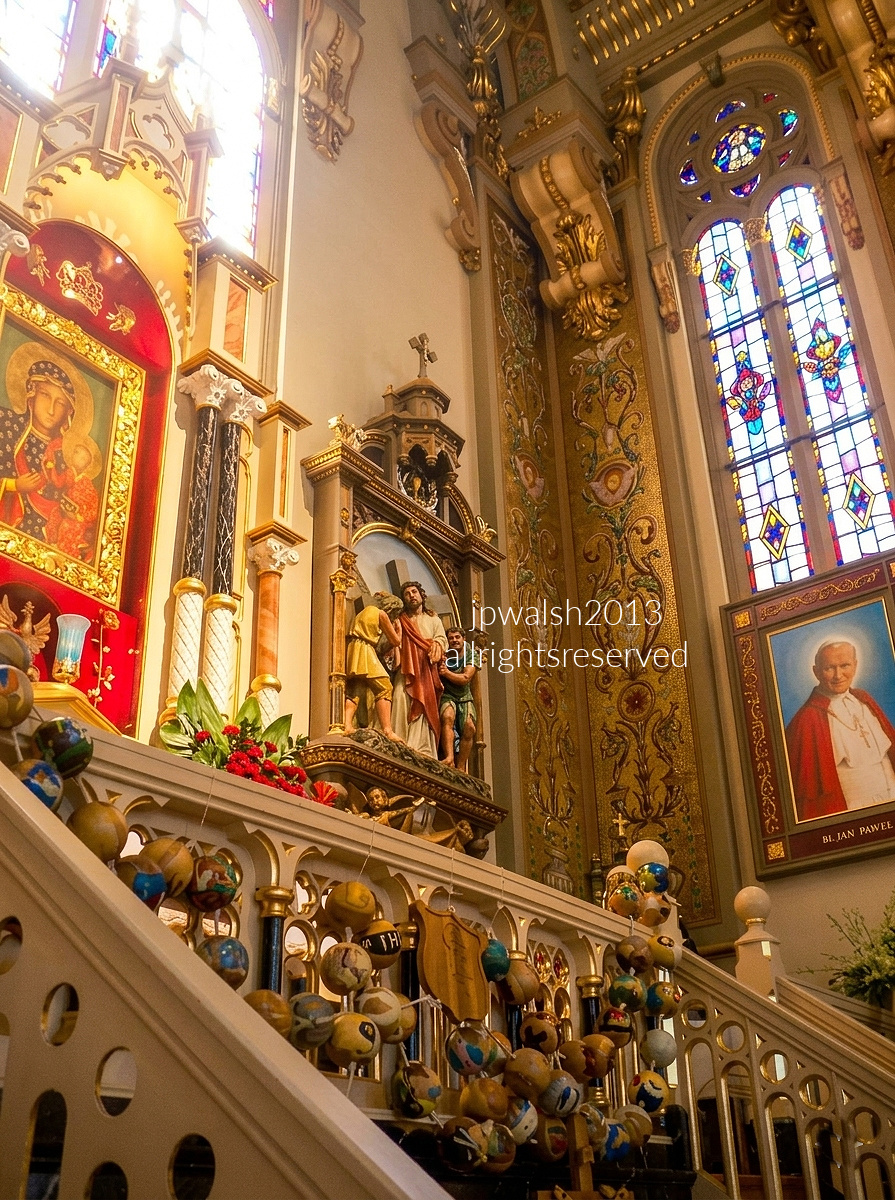
In this corner inside Holy Trinity Polish Catholic Church showcases how the parish blends traditional religious artwork with distinct Polish national identity. The three prominent artworks, their frameworks, and the surrounding architecture are detailed below. July 2013. Author’s photograph.
The Three Artworks & Their Iconography
Our Lady of Częstochowa (Far Left Side Altar)
The Subject: This is a replica of the Black Madonna of Częstochowa, Poland’s most sacred religious relic. It depicts the Virgin Mary holding the child Jesus. A defining iconographical detail is the two scars on her right cheek, which historically represent slashes made by a Hussite raider’s sword in 1430. Both Mary and Jesus are adorned with elaborate, relief-sculpted gold crowns and gowns (sukienki).
The Style & Artist: Painted in the strict Byzantine Hodegetria style (meaning “She who shows the Way”), Mary points her hand toward Jesus as the source of salvation. This specific replica was commissioned anonymously by a parishioner and painted by a traditional Polish iconographer in the early 20th century.
The Carrying of the Cross (Center Altar Niches)
The Subject: This is the Fifth Station of the Cross, depicting Simon of Cyrene helping a weary, thorn-crowned Jesus carry his heavy wooden crucifix toward Calvary. A Roman soldier stands behind them aggressively directing their path.
The Style & Artist: This is a high-relief, polychrome Academic Realism sculpture made of painted plaster and wood. It was hand-carved by European artisans in the late 19th century and integrated directly into the structural architecture of the side altars.
Portrait of Pope John Paul II (Far Right Wall)
The Subject: A formal portrait of Pope John Paul II (labeled underneath as Bł. Jan Paweł II, meaning “Blessed John Paul II,” referencing the period after his beatification but prior to his canonization as a saint). He wears his papal white cassock and a bright crimson velvet mozzetta (cape) while looking warmly toward the congregation.
The Style & Artist: Executed in a traditional Contemporary Realism painting style, this canvas portrait was added to the sanctuary wall in the early 2010s to celebrate the historic Polish pope, who visited Chicago and this specific neighborhood during his lifetime.
Architectural Frames & Wall Details
The Side Altar Frame (Left & Center): Built in a heavy Renaissance Revival style, the shrines are constructed from polished white marble and matching painted plaster columns. The pillars feature classic Corinthian capitals dipped in gold leaf, supporting an ornate, multi-tiered pediment that mimics a miniature European cathedral facade.
The Wall Stenciling (Background): The walls are covered in spectacular, intricate Beaux-Arts / Baroque Revival stenciling painted by artist K. Markiewicz. The patterns feature looping gold leaf arabesques, floral cornucopias, and hidden cherubim medallions woven directly into the beige background.
The Stained Glass Window: Rising above the papal portrait is one of the custom 1955 Munich-style windows. It frames geometric patterns and abstract floral glass panels that echo the shapes of traditional Polish paper-cutting folk art (wycinanki).
The Staircase Railing (Foreground): The white marble staircase railing leading up toward the sanctuary features a line of open geometric circle-and-scroll cuts, which parishioners have beautifully decorated with hanging ornamental painted globes, adding a unique festive texture to the architecture.
The Icon of Our Lady of Częstochowa (The Black Madonna)
Devotion to the Black Madonna of Częstochowa has anchored Polish spirituality since the late 14th century, when Prince Władysław Opolczyk brought the sacred icon to the Jasna Góra Monastery in 1382.
While Catholic and Orthodox pious tradition holds that Saint Luke the Evangelist painted the image on a cedar tabletop crafted by Saint Joseph for the Holy Family, modern art historians classify the artwork as a Byzantine Hodegetria icon—a style depicting Mary pointing toward Christ as the Way—and estimate its original creation between the 6th and 9th centuries.
The icon’s physical composition changed forever on Easter Monday in 1430, when Hussite raiders plundered the monastery, slashed the Virgin Mary’s face with a sword, and shattered the wooden panel. King Władysław Jagiełło commissioned the realm’s finest artists to restore the holy image, but they faced a technical hurdle. The icon had originally been rendered using an ancient, wax-based encaustic technique, which rejected the artists’ medieval tempera paints.
Unable to seamlessly patch the damage, the restorers ultimately repainted the image onto the original holy panel. As lasting testament to the icon’s survival and a reminder of the desecration, the artists intentionally carved the deep slash marks back into the Virgin Mary’s cheek.
The Black Madonna became the ultimate emblem of defiance against 20th century tyranny
Our Lady of Częstochowa, a replica of the Black Madonna, occupies a place of honor within the church. Poland’s most revered religious icon depicts the Virgin Mary holding the Christ Child. A defining feature of the image is the pair of scars on Mary’s right cheek, traditionally associated with sword blows inflicted during a Hussite raid in 1430. Both Mary and Jesus are adorned with elaborate relief-sculpted gold crowns and jeweled gowns (sukienki) as Mary gestures toward Jesus as the source of salvation.
Few images have carried greater significance in Polish history than Our Lady of Częstochowa. Housed at the Jasna Góra Monastery, the Black Madonna became a powerful symbol of national survival, religious faith, and spiritual resistance through successive occupations and political regimes.
Both Nazis and Communists feared her power: the former saw her as a spark of Polish nationalism, the latter as a rallying point for faith and freedom. When Germany invaded in 1939, monks at Jasna Góra Monastery hid the original icon inside a heavy oak table while Nazi officers unknowingly worked on the exact tabletop above it. Despite Nazi bans and threats of public execution, pilgrims still came in the hundreds of thousands, and the monastery’s catacombs became a hub for the Polish Resistance.
After 1945, the Communist regime tried to suppress her veneration, seeing her title as “Queen of Poland” to be subversive. Yet devotion only deepened.
By the 1970s and 1980s, images of Our Lady of Częstochowa appeared widely alongside Pope John Paul II and the emerging Solidarity Movement, symbolizing the enduring connection between faith, human dignity, and the Polish struggle for freedom. Lech Wałęsa famously wore a small image of the Black Madonna on his lapel, helping transform the icon into one of the most recognizable symbols of resistance to Communist rule in Eastern Europe—the same Madonna that Fascists and Communists alike failed to destroy.
Portraits and memorials honor modern Polish heroes such as John Paul II and Jerzy Popiełuszko.
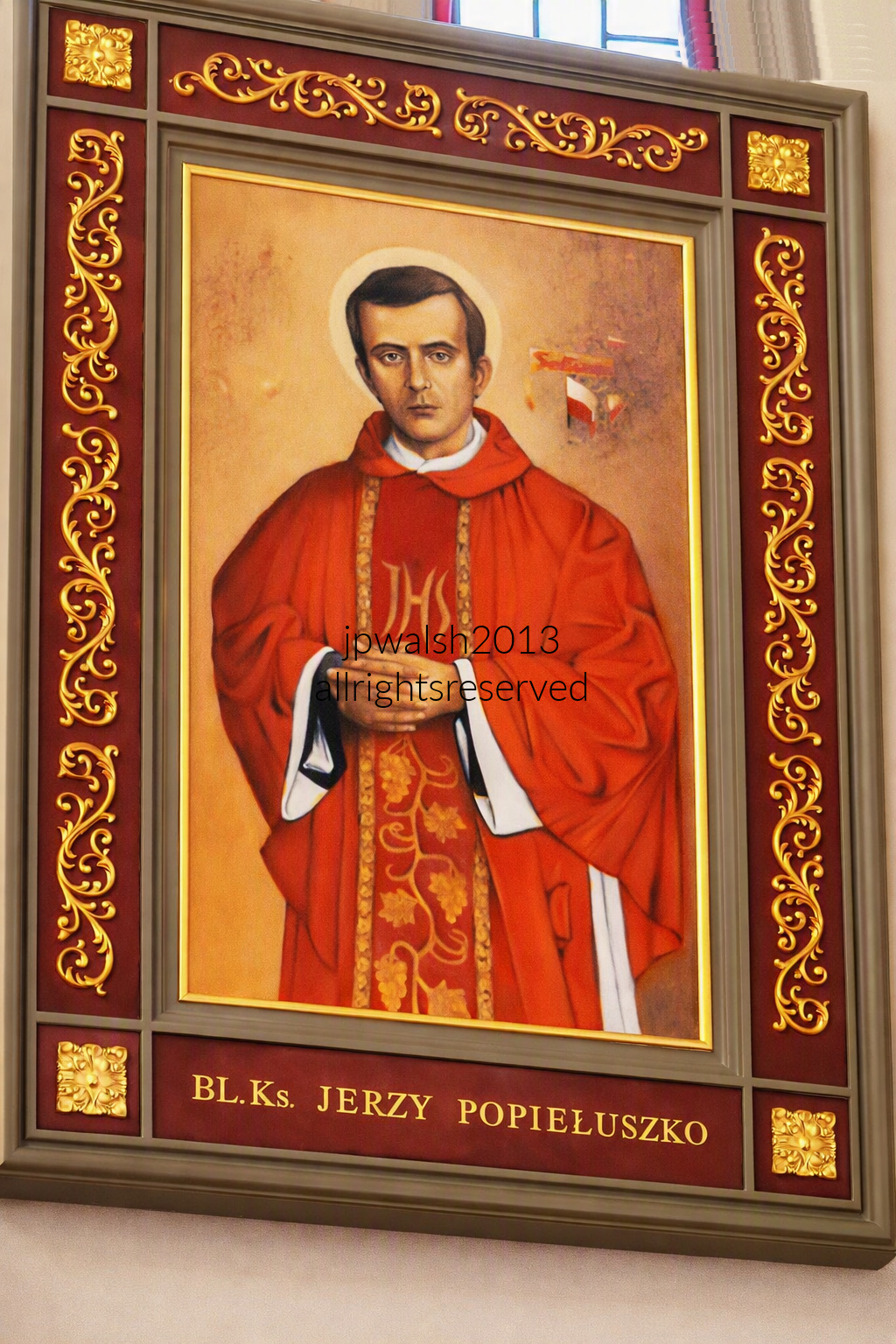
The painting’s subject is Blessed Father Jerzy Popiełuszko, a Polish Roman Catholic priest and martyr. He is depicted wearing red liturgical vestments — a chasuble embroidered with gold, symbolizing martyrdom and sacrifice. His hands are clasped in prayer before his chest, and his expression is solemn yet peaceful, reflecting spiritual strength. A halo encircles his head, marking his beatified status. The ornate red-and-gold frame reinforces reverence and sanctity, while the inscription “BL. Ks. JERZY POPIEŁUSZKO” identifies him as Blessed Father Jerzy Popiełuszko. July 2013. Author’s phograph.
Life and Advocacy
Popiełuszko became a symbol of faith and resistance during Poland’s communist era, known for preaching truth and human dignity until his assassination in 1984. Born in 1947 in northeastern Poland, he was ordained as a priest in 1972 by Cardinal Stefan Wyszyński. Father Popiełuszko became closely linked with “Solidarity” (Solidarność), the first independent, anti-communist trade union bloc in the Soviet zone. He served as the spiritual leader and chaplain for Warsaw factory workers and steelworkers. During the dark years of martial law in Poland, he celebrated monthly “Masses for the Homeland”. His moving sermons centered on truth, human dignity, freedom, and spiritual resistance. He famously urged his followers to “overcome evil with good”.
Martyrdom
Because his speeches drew tens of thousands of people and unified opposition to the state, he became a prime target of communist authorities. On October 19, 1984, at just 37 years old, Father Popiełuszko was ambushed, kidnapped, and brutally beaten to death by three agents of the communist Internal Affairs Security Service. His body was subsequently dumped in a reservoir along the Vistula River. His funeral turned into a massive, peaceful anti-communist demonstration attended by up to one million citizens.
Legacy and Beatification
Recognizing his ultimate sacrifice for his faith and people, Pope Benedict XVI beatified him as a martyr on June 6, 2010. The text at the bottom of the painting reads “Bł. Ks. Jerzy Popiełuszko”, where “Bł.” stands for Błogosławiony (Blessed) and “Ks.” stands for Ksiądz (Priest) in Polish. His vestment is adorned with the IHS christogram.
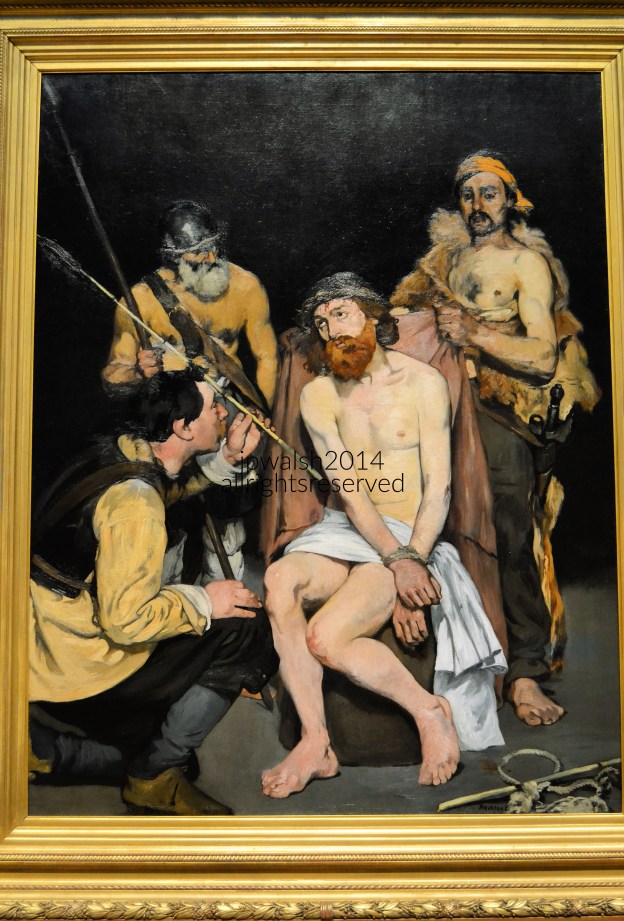
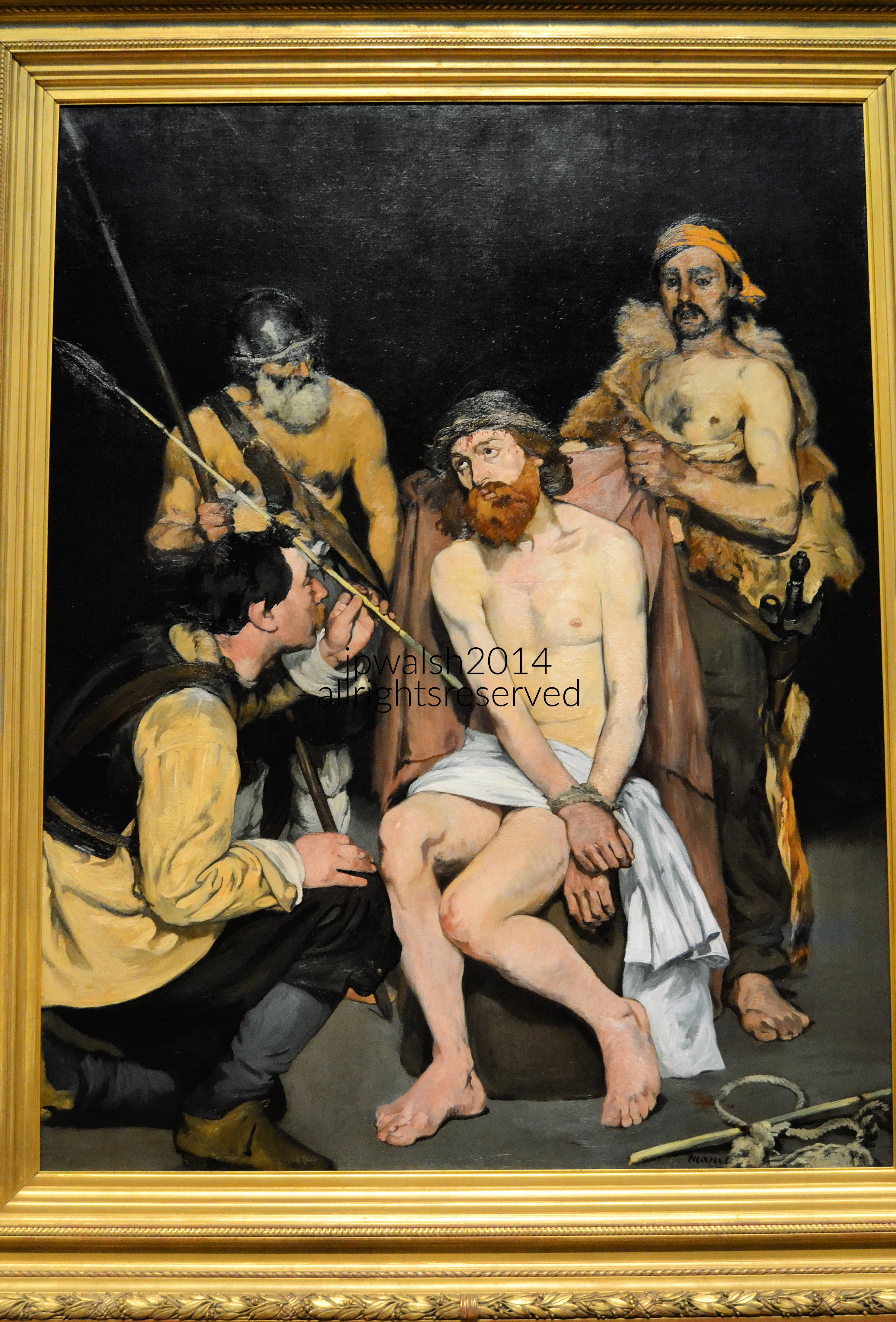
Feature image: Édouard Manet, Jesus Mocked by the Soldiers, 1865, oil on canvas, 190.8 × 148.3 cm (74 7/8 × 58 3/8 in.), transforms a traditional Passion scene into a striking meditation on artistic identity and public judgment. Rather than emphasizing spiritual transcendence, Manet presents Christ with an unsettling immediacy, drawing parallels between the mocked figure and the modern artist subjected to criticism, misunderstanding, and ridicule. Created during a period when Manet’s own work was regularly attacked by critics and rejected by academic convention, the painting blurs the boundary between religious narrative and contemporary experience, turning Christ’s humiliation into a powerful reflection on the costs of innovation and the burden of standing apart from public opinion. The Art Institute of Chicago. See – Jesus Mocked by the Soldiers | The Art Institute of Chicago – retrieved April 18, 2026. May 2014. Author’s photograph, 4.93mb DSC_0577 (1)
Christ as the Modern Artist
Even if Édouard Manet did not literally model Christ’s face on his own in Jesus Mocked by the Soldiers, the painting functions as an unmistakable act of self‑identification. Christ becomes a proxy for the embattled modern artist, a figure exposed, judged, and misunderstood by a hostile public. Manet selects the moment of Christ’s humiliation not to reenact a devotional scene but to stage a parallel between sacred suffering and his own experience before the Salon.
By mid‑century, French painting had turned decisively secular, yet Manet submitted two religious works to the Salons of 1864 and 1865, The Dead Christ with Angels and Jesus Mocked by the Soldiers. Both were accepted, and both were savaged. Critics called them vulgar, ignoble, even “contrary to art.” The public, accustomed to sentimentalized, idealized images of Jesus, recoiled from Manet’s starkly human Christ. Manet admitted to Baudelaire that the hostility unsettled him, even as Degas noted that the uproar made him famous. As Edmond Bazire observed, the Empire preferred idealized piety and bristled at seeing the Passion rendered with unvarnished realism, even when the scene followed Scripture closely.
Painting the Passion in a Secular Age
What, then, is a secular modern artist doing painting the Passion at all? Manet’s answer is to reframe Christ’s suffering as an analogue for the artist’s own embattled position, a truth‑teller punished by a complacent society. While many French moderns had drifted from Catholicism, Manet maintained ties to the faith, and he inherited a Renaissance tradition in which artists increasingly identified with Christ, blurring the line between human and divine as a form of imitatio Christi. By the 1860s this identification was a legitimate, if easily misunderstood, mode of artistic self‑expression. Manet was not conventionally pious, but he was close to several religious thinkers, and his engagement with sacred subjects was sincere enough that these works were conspicuously omitted from the 1884 retrospective after his death.
A Contemporary Christ
What makes Manet’s identification radical is the way he collapses the boundary between sacred history and modern experience. His Christ is rendered with the same realist immediacy, the same studio illumination, the same unidealized physicality that define his contemporary subjects. The result is a figure who is neither fully divine nor fully secular but unsettlingly both, a Christ startlingly contemporary. The frontal, confrontational composition intensifies this effect: Christ appears not as a distant theological symbol but as a vulnerable body exposed to judgment. The ambiguity, devotional image, critique of devotional imagery, or modern psychological drama, was precisely what scandalized a hierarchical society that depended on stable categories.
Édouard Manet’s Jesus Mocked by the Soldiers shocked 1865 Paris Salon critics with its radical portrayal of Christ. According to the Art Institute of Chicago, the painting’s profound ambiguity, heavy emphasis on Christ’s raw humanity, and Manet’s refusal to idealize the sacred figure ignited immediate controversy. Appearing deeply exhausted and vulnerable, Christ conspicuously lacks a traditional halo, forcing viewers to question whether they are looking at a divine being or merely an ordinary man.
Conservatives attacked the work as crude, irreverent, and a total violation of academic standards. Critics were particularly outraged that Manet treated a holy subject with the same blunt realism, flat lighting, and visible brushwork he used for modern, secular street scenes. Public and critical reception was so fiercely negative that the prominent critic Paul de Saint-Victor famously dismissed the masterpiece as “the horrible Ecce Homo by Monsieur Manet.”
The Passion as Artistic Self‑Portrait
The deeper provocation lies in Manet’s intervention into the history of painting. For a secular avant‑garde artist to take up a Passion subject in the 1860s was anomalous; to transform it into a conceptual self‑portrait was unprecedented. Manet’s Christ is not a theological claim but an artistic one: the modern painter, like the historical Jesus, confronts entrenched power, exposes uncomfortable truths, and endures public derision for doing so. The painting becomes a self‑portrait not of Manet’s face but of his artistic condition.
A Mockery of the Mockery
In this light, Jesus Mocked by the Soldiers is not a mockery of the sacred scene but a mockery of the mockery, a doubling of humiliation that implicates both Christ’s tormentors and Manet’s critics. The viewer’s unease arises from this conflation of registers: divine and human, biblical and modern, sacred narrative and artistic identity. Manet’s Christ stands under a bright studio light, stripped of idealization, exposed to judgment, just as Manet stood before the tribunal of the Salon.
The Suffering Artist
The scandal, then, lies not only in the subject but in the claim: that the modern artist, misunderstood and persecuted, belongs to a lineage of suffering truth‑tellers. If not a literal self‑portrait, the painting is unmistakably a portrait of artistic identity, asserting that the modern painter occupies a role once reserved for the sacred.
SOURCES:
Books: Brettell, Richard R. French Salon Artists, 1800–1900. New York: Harry N. Abrams, Inc.; Chicago: The Art Institute of Chicago, 1987. [See pp. 58–62.] Cachin, Françoise, and Charles S. Moffett. Manet, 1832–1883. New York: The Metropolitan Museum of Art and Harry N. Abrams, Inc., Publishers, 1983. [See pp. 226–229.]
Archival Documents & Reviews: Paris Salon of 1865. Historical Exhibition Records and Archives. Paris, 1865. Saint-Victor, Paul de. “Le Salon de 1865.” La Presse, May 28, 1865. Cited in the Bibliography Archives of the Art Institute of Chicago.
Websites: ArtWay. “Historical Essays on Manet.” Accessed September 2026. https://artway.eu. Wikipedia contributors. “Jesus Insulted by the Soldiers.” Wikipedia, The Free Encyclopedia. Accessed September 2026. https://wikipedia.org.
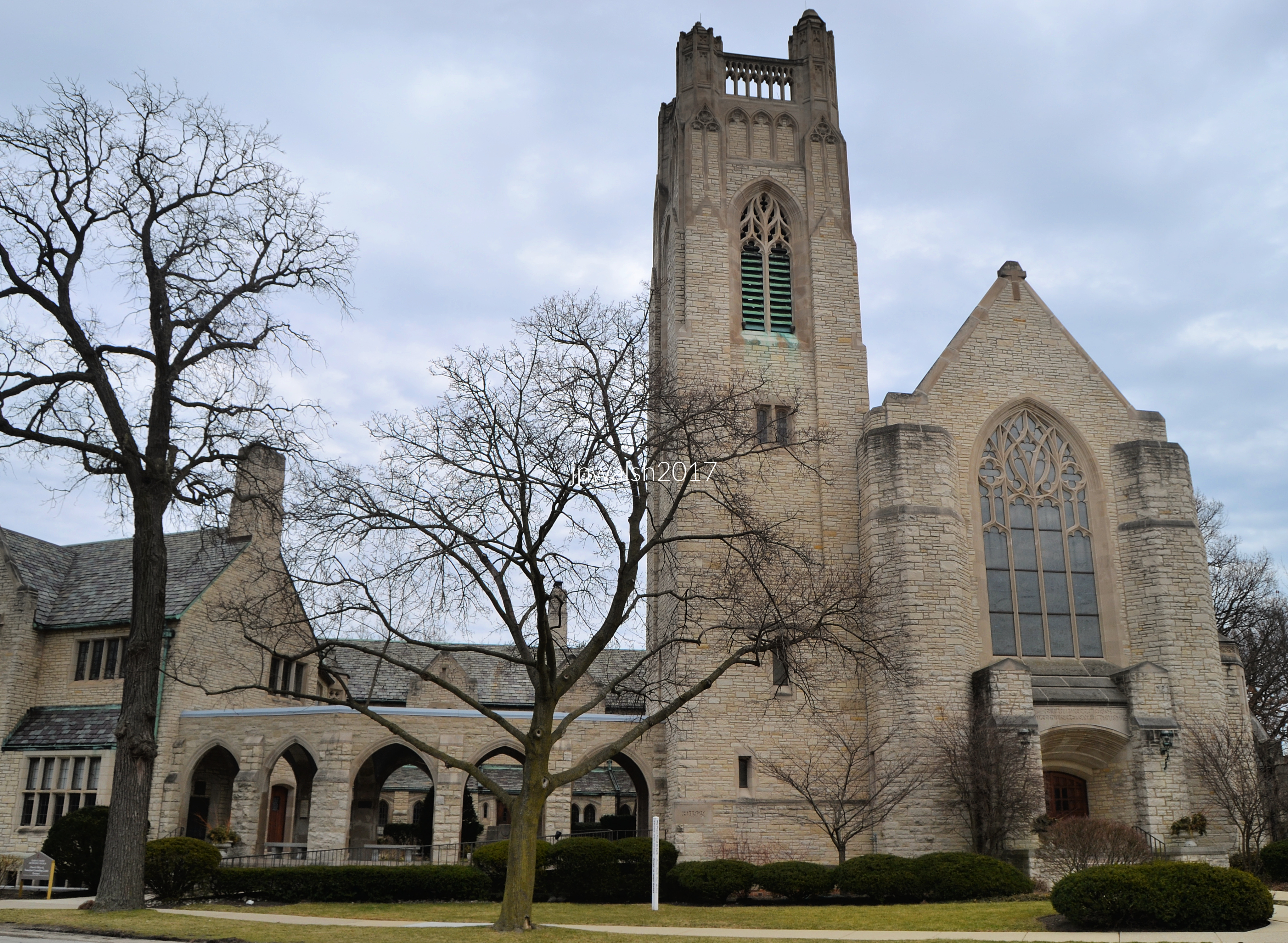
FEATURE Image: Reformation and the 18th century missions of Methodist founder John Wesley, detail of Willet stained- glass window, Trinity United Methodist Church, 1024 Lake Avenue, Wilmette, Illinois. March 2017. Author’s photograph.
Trinity United Methodist Church in Wilmette is a remarkable example of early twentieth-century ecclesiastical architecture whose artistic significance is enriched by its exceptional Willett Studios stained glass and an unexpected place in popular culture through its association with the film Home Alone.
The church buildings complex displays the key ecclesiastical architectural features of late American Gothic Revival style. Trinity UMC, Wilmette. March 2017. Author’s photograph. 4.38mb DSC_0634 (1).
Architecture of Trinity United Methodist Church, Wilmette.
The Ashlar limestone church has stood on a prominent triangular corner of Lake and Wilmette Avenues for nearly 100 years. In the late American Gothic Revival style that flourished in the first third of the 20th century, the church displays in my photo its key ecclesiastical architectural features of (1) pointed‑arch windows with stone tracery, (2) tall bell tower with louvered openings, (3) buttress‑like vertical stonework emphasizing height, (4) a steep slate roof and (5) stained‑glass windows set in deep stone. Designed by Granger & Bollenbacher, the church building completed in 1929 is designed to feel ancient, monumental, and rooted in medieval Christian tradition — exactly what Methodist congregations of the era wanted. Trinity UMC stands out on the North Shore because it is scaled to frame its narrative, more medieval stained glass and not for grandeur comparative to its neighbors such as Christ Church (Episcopal) in Winnetka designed by Bertram Goodhue, or for crisp academic lines such as First Presbyterian in Wilmette designed by Coolidge & Hodgdon, among others. Of Gothic Revival churches built between 1900–1935. Trinity fits squarely into that movement, but with its own personality, specifically its didactic windows. The building was erected when the congregation outgrew its earlier 1908 Romanesque brick church. The church’s current Gothic Revival building, designed by Chicago architects Granger and Bollenbacher, reflects inspiration from European cathedrals. Construction began in the late 1920s, but the 1929 Stock Market Crash halted many of the planned interior details. The stained- glass windows, including the prominent façade window, were designed and installed by Henry Lee Willet in 1954.
Founding History and Its “Home Alone” Legacy.
Trinity United Methodist Church in Wilmette is one of the North Shore’s oldest congregations, with a history that stretches back to the 19th century. Founded on March 24, 1874, the church originally bore the name First Methodist Episcopal Church of Wilmette. Over the decades, it evolved through several identities — Wilmette Parish Methodist Church (1930–1968), Trinity Church of the North Shore (1968–1989), and finally Trinity United Methodist Church of Wilmette, the name it carries today. The church’s historic bell — once used to call worshippers, toll for local deaths, and warn the village of fires — now sits on display near the parking lot.
While its spiritual and community roles define its core identity, Trinity United Methodist Church is also widely recognized for its unexpected place in American pop culture. The church’s exterior appears in two memorable scenes in the 1990 Christmas classic “Home Alone.” In the film, directed by John Hughes, young Kevin McCallister (Macaulay Culkin) first spots the church while fleeing the burglars and hides in the Nativity scene on the lawn. Later, Kevin approaches the church at night, drawn by the sound of the choir singing “O Holy Night.” These moments set the stage for one of the film’s most emotional sequences — Kevin’s conversation with Old Man Marley — though that interior scene was filmed at Grace Episcopal Church in Oak Park. Securing permission to film at Trinity was not straightforward. When Twentieth Century Fox approached the Village of Wilmette in early 1990, the Village Board narrowly approved the request in a 4–3 vote after discussion and date changes. Filming took place in late winter of that year, and the church’s brief but iconic appearance has since become a point of local pride. Today, Trinity embraces this connection, often noting that to many visitors, it is simply “the Home Alone church.”
Beyond its religious and architectural significance, the church gained broader recognition through its connection to the beloved film Home Alone.
More than a movie landmark, Trinity United Methodist Church in Wilmette remains a vibrant congregation committed to worship, music, community service, and hospitality — a place where history, faith, and a touch of Hollywood intersect on the corner of Lake and Wilmette Avenues.
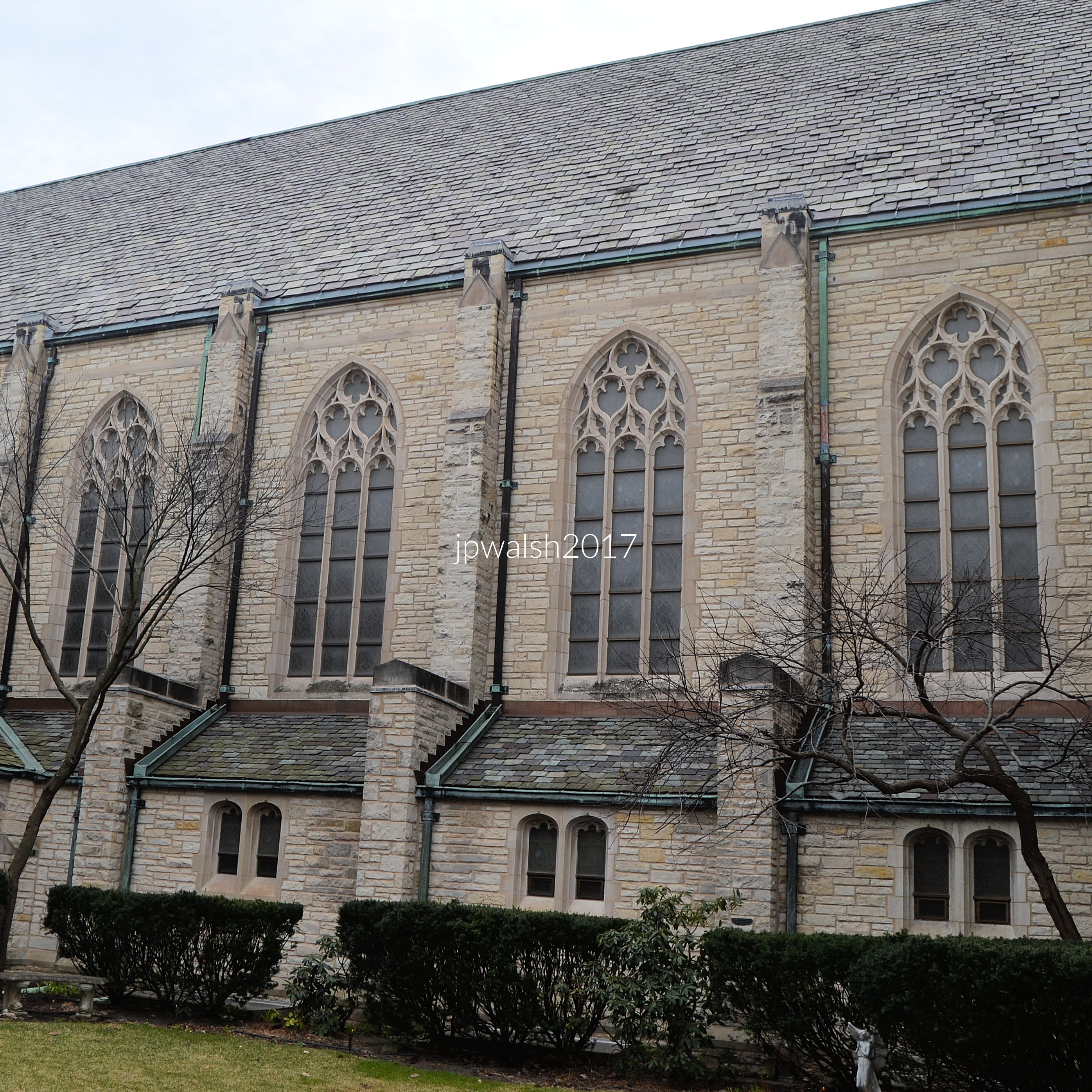
Designed by Granger & Bollenbacher, a procession of stained‑glass windows that line the nave are set in deep stone. Trinity UMC, Wilmette. March 2017. Author’s photograph. 3.40mb DSC_0635 (1)
How the architecture relates to the stained‑glass program.
The stained glass was created by Henry Lee Willett of Willett Stained Glass Studios in Philadelphia, one of the leading American studios of the mid‑20th century. The major façade window, dated February 14, 1954, shows Willett’s signature use of rich blues, jewel‑tone reds, elongated Gothic figures, and clear narrative panels. Its scale and design were chosen for narrative clarity, while the church’s deep window wells intensify color saturation and create a natural shadow‑frame that draws the eye toward the visual telling of Scripture — a hallmark of Methodist stained‑glass design. While Trinity’s windows feel sacred and are tall enough to make a visual statement, they are also narrow enough to keep scenes readable and, like most narrative stained-glass windows, arranged in story cycles. The church’s façade and nave proportions create a natural processional reading of the windows, allowing each panel — and the entire cycle together — to unfold as a coherent theological arc. Methodist churches of the 1920s often used architecture to shape a catechetical journey, with the Gothic style providing both a sense of transcendence and a visual link to the continuity of the church across the millennia. The building and the glass tell the same story: God speaks, calls, teaches, transforms.
Interior Analysis: Gothic Revival Structure.
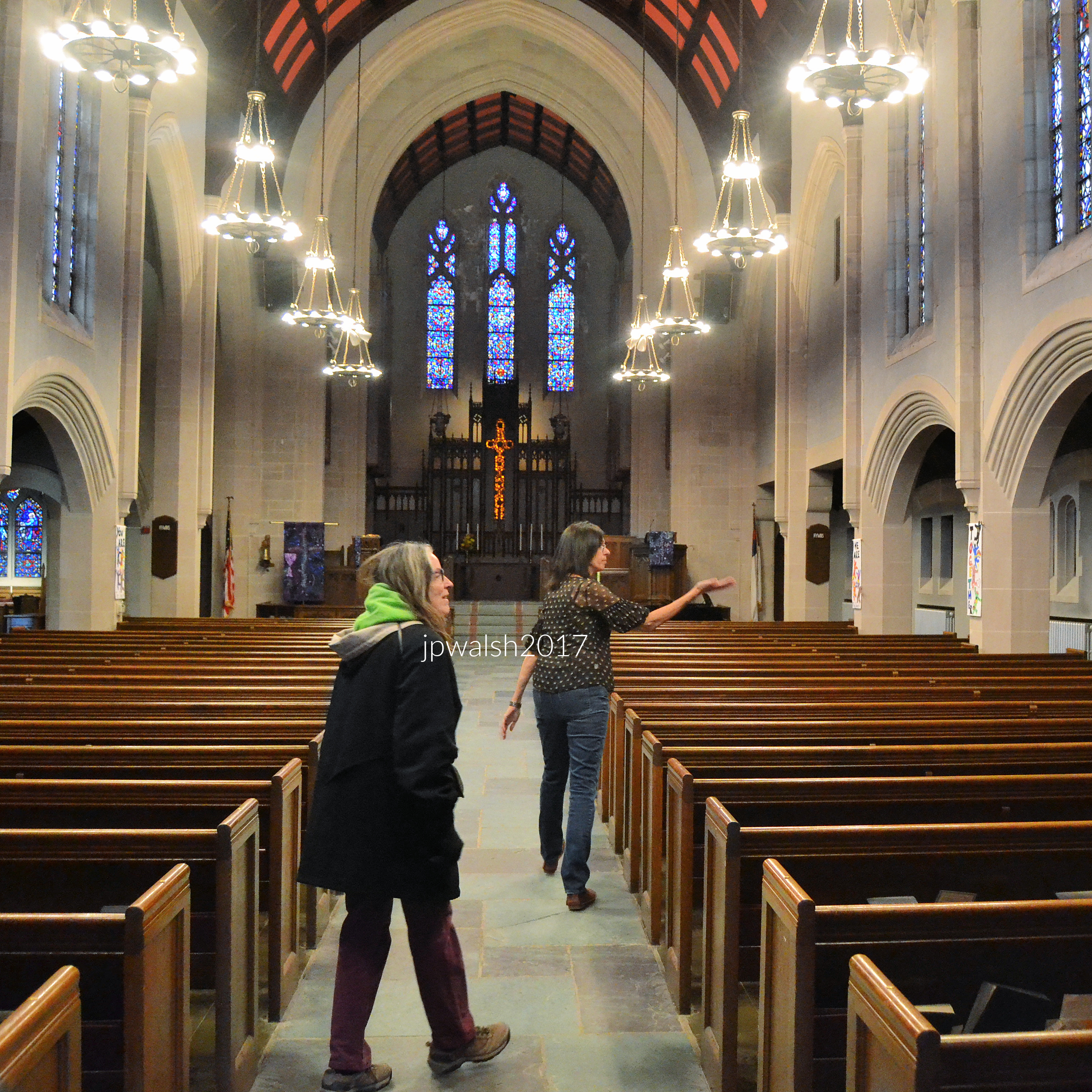
The sanctuary speaks in the familiar Gothic vocabulary. Trinity UMC, Wilmette. March 2017. Author’s photograph. 4.48 mb DSC_0654 (1)
A procession of rounded arches line the nave arcade, a testament to the congregation’s former Romanesque church building, with Gothic pointed-arch stained -glass windows above them guiding the eye upwards and forward. Above these, a ribbed or groin‑vaulted ceiling lifts the gaze further upward into a sense of height and devotion that feels almost instinctive. Reinforcing this vertical pull, the tall, narrow stained‑glass windows have proportions echoing centuries of Gothic design stretching light into color. Stone columns with simple capitals mark each step of the nave, guiding you along the long central aisle toward the chancel. The sanctuary is familiar Gothic interpreted through the American 1920s–30s lens—lighter, more vertical, devotional rather than medieval.
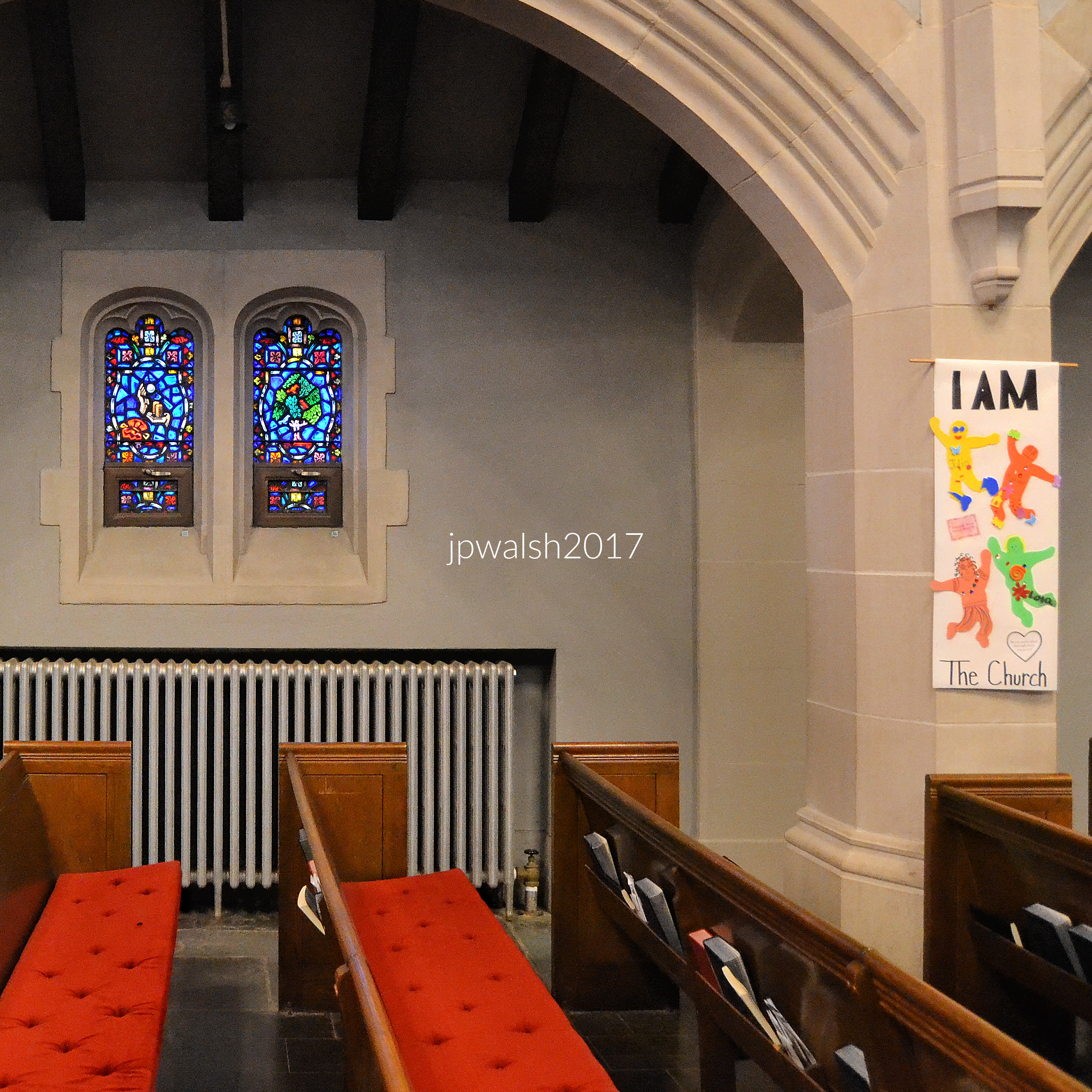
Trinity UMC, Wilmette. March 2017. Author’s photograph. 3.89mb DSC_0657 (1)
The space warms into Methodist Gothic. Dark wood pews, wooden chancel furnishings, a prominent pulpit or lectern, and a central cross create an interior that feels both sacred and approachable. The materials and layout quietly affirm the Methodist emphasis on Scripture, preaching, and congregational participation.
Overhead, hanging lantern chandeliers complete the atmosphere. Their medieval‑inspired metalwork casts a warm glow that softens the stone and wood. Evenly spaced along the nave, they reinforce the processional rhythm, drawing the eye—and the worshipper—toward the chancel and the unfolding narrative held in glass and architecture. Gothic in form, Methodist in function, Willett in storytelling, and 1920s–30s American in craftsmanship, including acoustics shaped for congregational singing, the interior of Trinity UMC is a space designed to make worship feel like a journey: from the world outside, through the nave, toward the light of the chancel and the story told in glass.
How Methodist theology shaped 20th‑century stained glass.
Methodist stained glass in the early–mid 1900s has a distinctive character shaped by Methodist convictions about Scripture, preaching, and discipleship. Because windows were expected to teach, almost every Methodist window cycle from this era functions as a visual sermon. Their imagery is intentionally accessible, with a strong Biblical orientation and a clear narrative movement through salvation history.
Methodists understand themselves as heirs of the Old Testament, followers of Jesus, children of the Reformation, and participants in the church’s ongoing renewal. As a result, their stained‑glass programs blend Old Testament, New Testament, and Reformation themes. Typical cycles include scenes of the prophets, episodes from the Life of Christ, and depictions of key Reformers such as Martin Luther (1483-1546), William Tyndale (c. 1494-1536), and Methodist founder John Wesley (1703-1791).
Trinity UMC, Wilmette. March 2017.Author’s photograph. 5.29mb DSC_0655 (1)
Its stained glass windows were created by the renowned Willett Studios of Philadelphia, among the most respected American ecclesiastical glass firms.
Façade window – Jesus Calling the First Disciples:
Façade window of Jesus Calling the First Disciples.Trinity UMC, Wilmette. March 2017. Author’s photograph. 7.65mb DSC_0649 (2)
A foundational moment in the Gospels — and a favorite subject in mid‑20th‑century Methodist stained glass — is Jesus calling the first disciples. In this scene, Jesus summons fishermen from their boats with the words, “Follow me, and I will make you fishers of men.”
The boat anchors the story in the Sea of Galilee, while the iconography makes the identification unmistakable. Jesus is shown with a cruciform halo and red and blue garments, signaling his dual nature. His authoritative, summoning gesture directs attention to the haloed figures of Peter, Andrew, James, and John, who look up toward him in response to the call.
Detail of Façade window depicting Reformers.
At the bottom of the façade window are four scenes from the life of the Reformers. At LEFT is MARTIN LUTHER nailing his 95 theses to the door of the Castle Church (All Saints’ Church) in Wittenberg, Germany, on October 31, 1517, that sparked the Reformation. At the bottom right of the panel is a white rose with a red heart and black cross. That is Luther’s personal emblem, designed in 1530 and used on his letters and publications. He is wearing scholarly robes in the colors of deep red, green, and brown that Willett often used for Reformers.
At LEFT CENTER is the burning at the stake of WILLIAM TYNDALE in 1536 whose crime was translating the Bible into English for the ordinary people. Tyndale believed Scripture should be accessible to ordinary people and died for that conviction. The Reformation’s gift is to take the Bible out of the hands of the elite and place it into the hands of the people.
At CENTER RIGHT is JJOHN WESLEY, founder of Methodism, preaching in the open air to Native Americans — specifically the Muscogee (Creek) people —during his mission to the Georgia colony between 1735 to 1737 which, after his return to England, accelerated the Methodist Movement which Wesley founded at Oxford in 1729. Wesley began preaching in the open air, embracing traveling ministry and forming societies as he did in America. By 1739, he built the first Methodist meeting house in Bristol, England.
At RIGHT John Wesley preaching to early American settlers. Wesley served as Anglican pastor of Christ Church in Savannah, Georgia, where he introduced strict spiritual disciplines. His time was marked by conflict, including a failed romantic relationship, and backlash from residents against his strictness, causing him to return to England heartbroken and disillusioned after only two years.
Methodist stained glass seeks to be beautiful where clarity is key. The style tends to bold outlines, well delineated figures and readable gestures with minimal abstraction.
Trinity UMC, Wilmette. March 2017. Author’s photograph. 5.20mb DSC_0645 (1)
Traditional enough to feel sacred – Modern enough to feel fresh – narrative enough to teach – artistic enough to inspire: Why Willett Studios was chosen.
Christ the Teacher — sometimes also read as Christ the Good Shepherd window. Trinity UMC, Wilmette. March 2017. Author’s photograph. 3.95mb DSC_0664 (2)
This Willet window is a Life of Christ triptych, arranged in the traditional Methodist/Willett narrative pattern.
At the left, the window shows the ministry of compassion: a haloed Christ blessing or forgiving a kneeling woman, possibly inspired by the woman who washed his feet with her tears and dried them with her hair. Willett often preferred such non‑specific healing scenes, using them to emphasize Christ’s compassion rather than tie the image to a single Gospel episode.
At the center, Christ stands elevated and alone in Willett’s characteristic depiction of Christ the Teacher — sometimes also read as Christ the Good Shepherd when paired with lamb symbolism above. He bears the cruciform halo (reserved only for Jesus) and wears red and blue robes to signify his dual nature as God and Man. His arms extend slightly in a gesture of blessing and invitation.
At the right, the scene shifts to Christ’s agony in the garden before his betrayal and arrest, capturing the moment of solitary struggle that precedes the Passion.
“Do all the good you can.”
Taken together, these panels proclaim a unified message: Christ at the center of the Christian life, the one who heals, restores, and calls disciples to follow. The sequence echoes the Methodist conviction embodied in the familiar motto: “Do all the good you can.”
Trinity UMC, Wilmette. March 2017. Author’s photograph. 4.12.mb DSC_0637 (1)
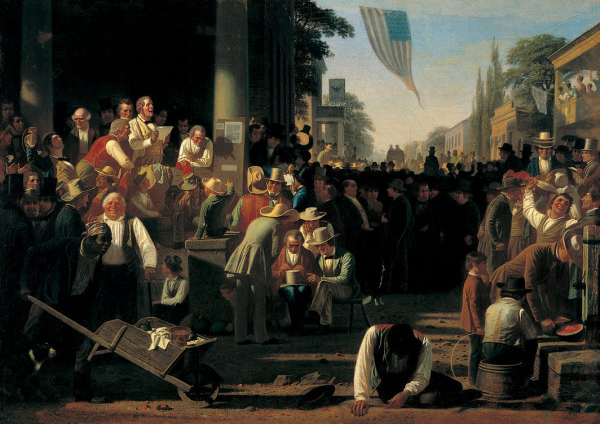
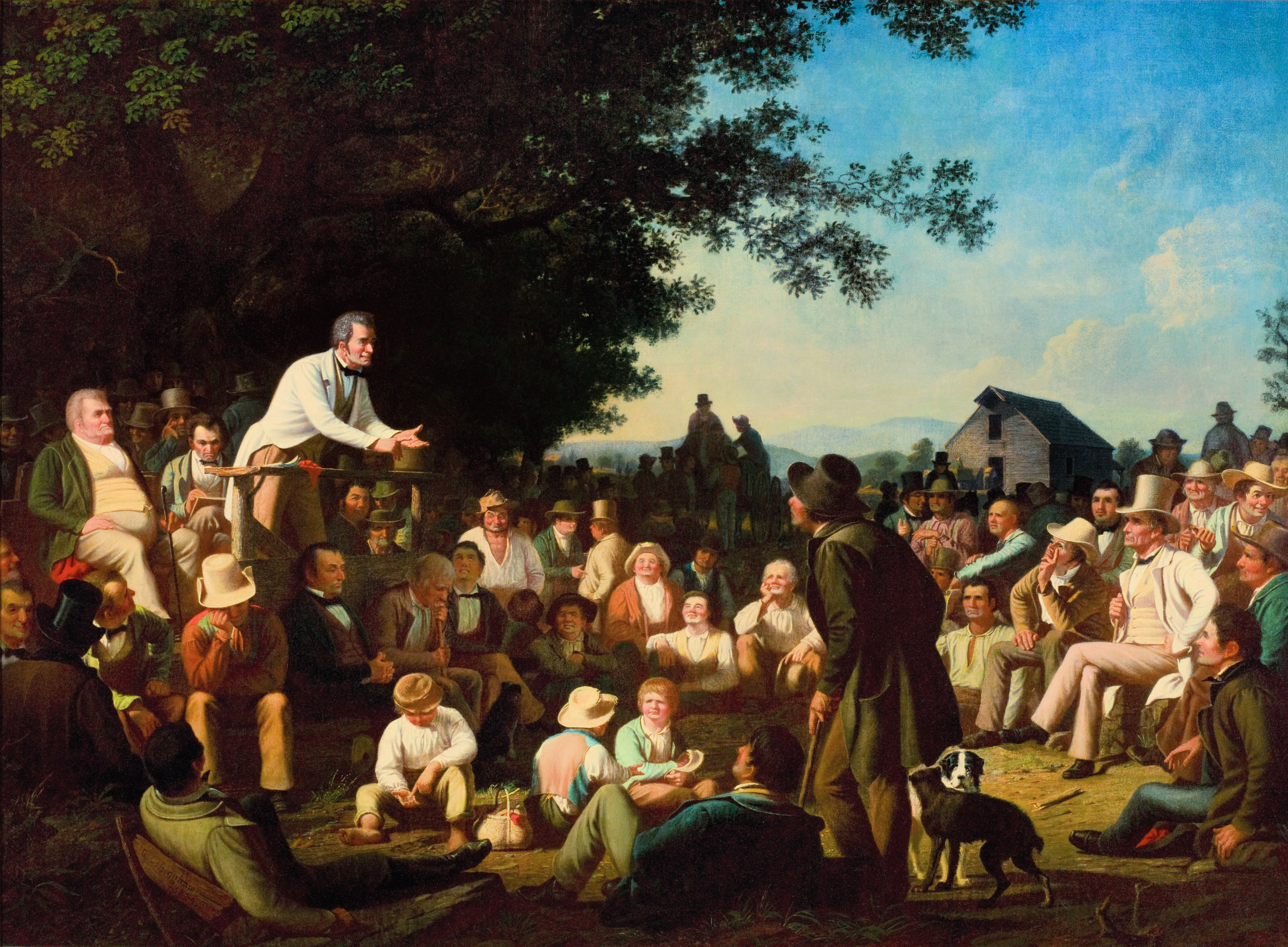
FEATURE IMAGE: George Caleb Bingham (1811-1879), Stump Speaking, 1854, oil on canvas, 42 1/2 x 58 in. (108 x 147.3 cm), St. Louis Art Museum. The painting begun by Bingham in November 1853 was completed in February 1854 in Philadelphia. Stump Speaking is one of three paintings in a series representing to a national audience the idea of the American democratic process. Bingham exhibited Stump Speaking in a series with his The County Election and The Verdict of the People at the influential (1856-1860) Washington Art Association, the Pennsylvania Academy of Art, and the Western Academy of Art in St. Louis. These election series paintings along with Bingham’s Jolly Flatboatmen in Port then went on view at the St. Louis Mercantile Library (founded 1846) until the 1930’s when the election series paintings were loaned to the City Art Museum (the future Saint Louis Art Museum). In 1941, The Mercantile Library sold Stump Speaking and The Verdict of the People to Boatmen’s National Bank of St. Louis (now Bank of America) and, in 2001, Bank of America gave Stump Speaking to the Saint Louis Art Museum. Public Domain. https://www.slam.org/collection/objects/29774/ – retrieved September 13, 2025.
George Caleb Bingham’s mid-19th-century masterpiece Stump Speaking presents a complex, dispassionate portrait of pre-Civil War frontier democracy, utilizing his distinct viewpoint as both a Whig politician and an American realist artist to visualize a civilized, orderly, and deeply participatory American electorate.
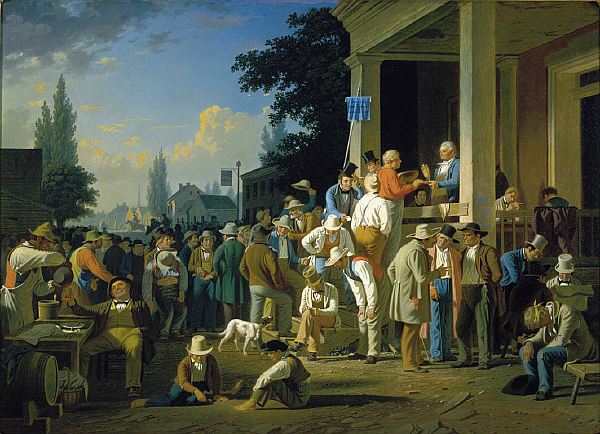
Bingham, The County Election, 1852, oil on canvas, 38 x 52 in. (96.5 x132 cm), St. Louis Art Museum. It depicts an election in 1850 in Saline County, Missouri, located between Columbia and Kansas City in central Missouri. Bingham’s paintings depict a dispassionate electorate before the Civil War reflecting the Founders’ ideals in challenging times. A staunch Unionist, George Caleb Bingham’s own political views rejected radical politics whether an unrestrained northern Abolitionist cause or that of Southern Fire-Eaters and strived toward negotiation and minimally Federal regulation of slavery. Bingham opposed the proslavery wing of Missouri politics represented by Gov. Clairborne Fox Jackson (1806-1862) who appears in Stump Speaking. Though Bingham’s election series is painted before the Lincoln-Douglas debates in 1858 in neighboring Illinois, Bingham, a Whig, tended towards Lincoln’s characterization of democracy that government should provide “a fair chance” to all. Though depicted at the periphery in service roles to whites, Bingham’s artwork presented slaves sympathetically encouraging his viewers to acknowledge the slaves’ existence and to recognize that they are being excluded from the noble American democratic process. Public Domain. See – https://www.nytimes.com/2025/09/15/books/review/born-equal-akhil-reed-amar.html – retrieved September 28, 2025.
Bingham, Verdict of the People, 1854, 74 cm × 93 cm (29 in × 36.5 in), St. Louis Art Museum. When Donald Trump was inaugurated as the 45th president of the United States on Jan. 20, 2017, The Verdict of the People was the chosen painting, hanging on a partition wall behind the ceremonial head table in the Capitol’s Statuary Hall. Public Domain.
Painted between November 1853 and February 1854, Stump Speaking is part of a celebrated three-painting “Election Series” designed to represent the reality and ideals of the American democratic process to a national audience.
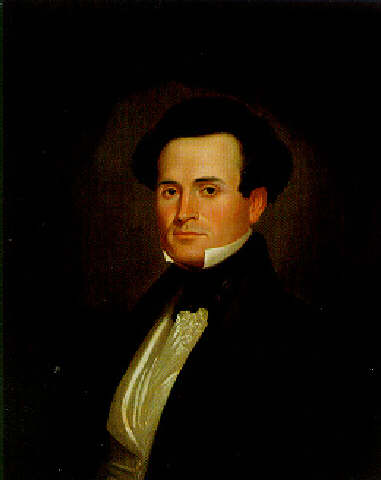
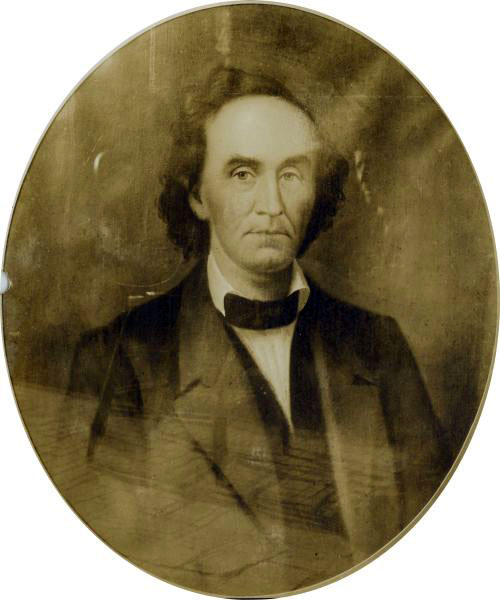
In Stump Speaking, Democrat Erasmus Darwin “E.D.” Sappington (1809-1858), born in Tennessee, is the main speaker shown leaning forward and pleading his case to a crowd of rural citizens. Behind him, with tablet in hand, sits his opponent taking notes in preparation conceivably for his turn at the make-shift podium. Candidate Sappington had married Penelope Breathitt (1822/3-1904), the eldest daughter of Kentucky Governor John Breathitt (1786-1834), and the couple had four children. Gov. Breathitt, a Jacksonian Democrat, had been elected as the Bluegrass State’s 11th Governor in 1832, serving until his death from tuberculosis at age 47. After his death, Breathitt County in Eastern Kentucky was created and named in his honor.
The three primary political figures anchoring the canvas—speaker Erasmus Darwin “E.D.” Sappington, former governor Meredith Miles Marmaduke, and future secessionist governor Claiborne Fox Jackson—were all brothers-in-law linked by marriage to the influential Sappington family.
Bingham – portrait of Erasmus Darwin “E.D.” Sappington, 1844. Public Domain.
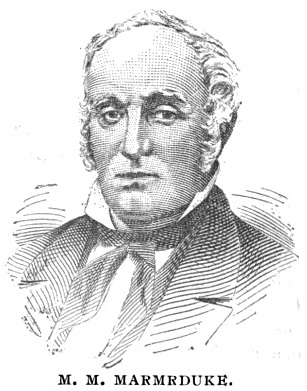
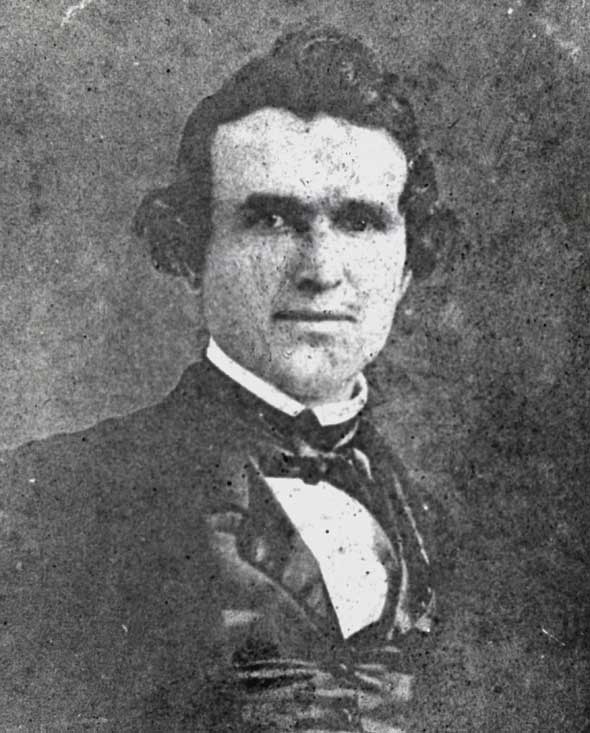
https://www.findagrave.com/memorial/86334793/penelope_c-sappington – retrieved September 26, 2025. https://www.findagrave.com/memorial/60353793/erasmus_darwin-sappington – retrieved September 26, 2025. The rotund man seated behind the speaker is Meredith Miles Marmaduke (1791-1864), part of the Missouri’s Democratic political machine. Born in Virginia, like Bingham, Marmaduke moved to Missouri in 1823 where he married Lavinia Sappington (1807-1885) whose mother, Jane Breathitt (1783-1852), was the older sister of Kentucky Governor Breathitt. The Marmadukes had 10 children together. Marmaduke was a trader on the Santa Fe Trail, surveyed and platted Arrow Rock in Saline County on the Missouri River where he had a plantation and was elected Lt. Governor of Missouri. When Governor Thomas Reynolds (1796-1844) died in office by suicide, Marmaduke assumed the Governorship from February 1844 until November 1844, finishing out the term. The Reynolds administration was heavily criticized by conservative Whigs for championing the abolition of debtor’s prisons in the state which the Missouri General Assembly accomplished in February 1843. Reynolds whom Marmaduke succeeded also freed up voting requirements to provide greater voting access to the state’s residents, another issue opposed by Whigs. When the University of Missouri in Columbia was established in 1839 and became the first public university west of the Mississippi River, the Reynolds Administration achieved the education milestone of enrolling its first class. Meredith Miles Marmaduke, a former slaveholder, was a staunch Unionist during the U.S. Civil War, although four of his sons fought for the Confederacy which was a typical outcome of the conflict in the Border States. After the war, one of those sons, in 1885, became Missouri’s 25th governor.
“Historical, Pictorial and Biographical Record, of Chariton County, Missouri”, p. 30 (1896). Public Domain.
At right in Stump Speaking the man in the white coat and top hat is then-state senator Clairborne Fox Jackson (1806-1862) who became the secessionist governor of Missouri in 1861. Jackson was forced out by the Missouri General Assembly’s Unionist majority on July 30, 1861, and replaced by a former Chief Justice of the State Supreme Court as provisional governor for the rest of the war. During these contentious deliberations, Bingham was in the state capitol to dedicate portraits of Henry Clay and President Andrew Jackson. Asked to say a few words, Bingham praised the seventh president’s suppressing nullifiers in 1832-1833 and called secession treason which almost blew the roof off the Missouri House. See- https://archive.nytimes.com/opinionator.blogs.nytimes.com/2013/09/06/an-artists-revenge/– retrieved September 27, 2025. Removed Gov. Jackson did not recognize the assembly’s actions and issued a proclamation on August 5, 1861, declaring that Missouri would secede from the Union. Jackson then traveled to Richmond, Virginia, to meet Confederate President Jefferson Davis and seek support of local Confederate militia forces and recognition by the Confederate government, both of which the Confederacy did. Union forces, however, had occupied most of Missouri and the state’s Unionist versus Secessionist political impasse was basically moot. Jackson withdrew to Arkansas with Confederate militia but was defeated by Union forces at the Battle of Pea Ridge in March 1862. Violent skirmishes, often savage attacks, continued in Missouri as Confederate guerrillas, called bushwhackers, caused random fear and havoc. Missouri bushwhackers included outlaws Jesse James and his older brother Frank James. Quantrill’s raid on Lawrence, Kansas, in August 1863 killed no less than 150 men and boys and inflamed the border. Fleeing further south to regroup, Jackson died at 56 years old of pneumonia and stomach cancer. Claiborne Fox Jackson having, in 1831, married Jane Breathitt Sappington (1813-1831) and, in 1833, Louisa Catherine Sappington (1814-1838), sisters of Lavina Sappington Marmaduke, was brother-in-law to Meredith Miles Marmaduke. As “E.D.” Sappington was brother to these women, all three men in Bingham’s painting were brothers-in-law.
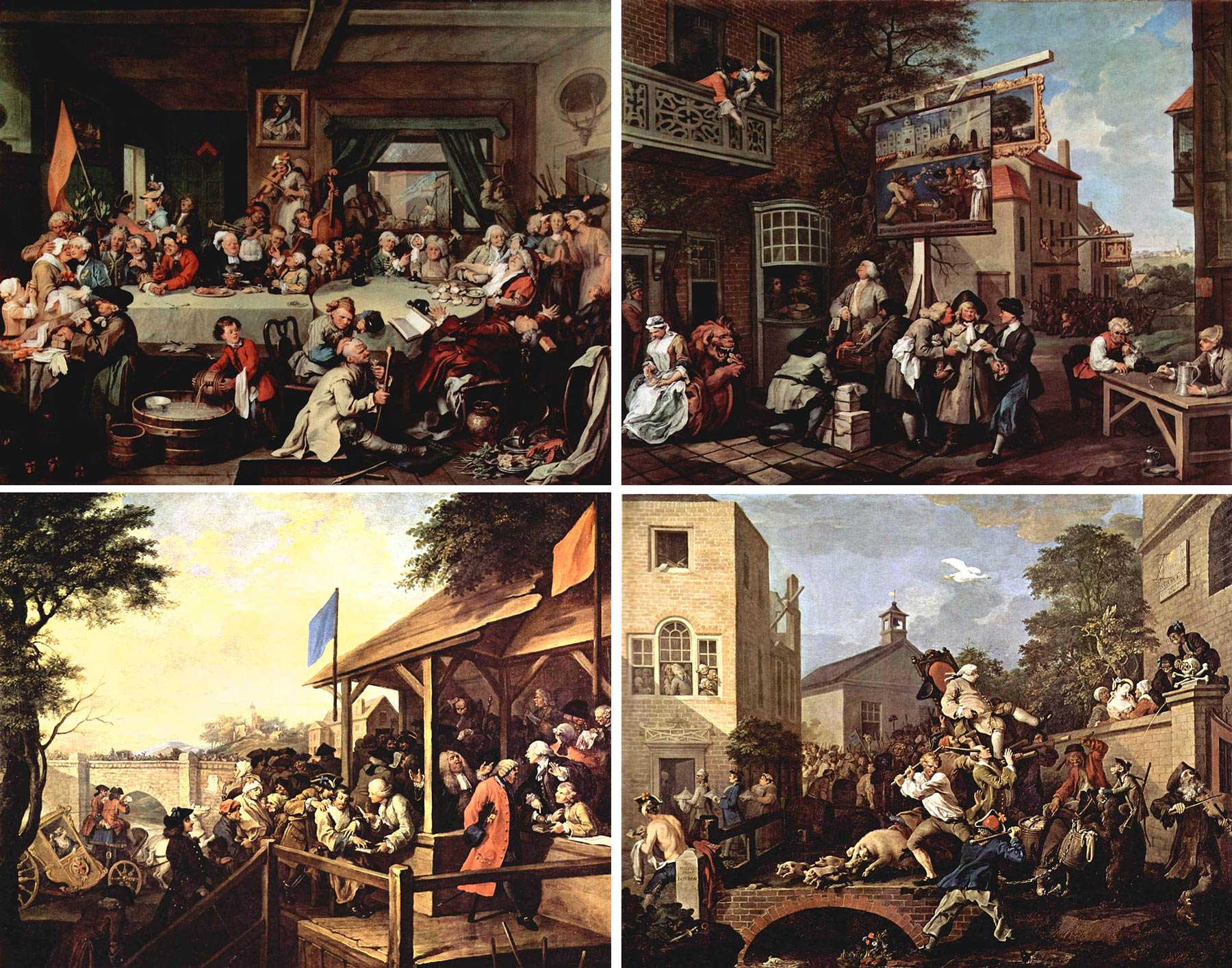
In sharp contrast to the biting cynicism of William Hogarth’s 18th-century British election art, which depicted voters as corrupt fools, Bingham paints the American electorate as a calm, dignified, and inherently ethical collective carrying out a sacred civic duty.
Bingham’s lively crowd evokes William Hogarth’s mid-18th century Election series, but with little to none of the British artist’s turbulent depictions. The American Bingham’s election series is orderly in its business. Bingham’s Stump Speaking depicts none of Hogarth’s corruption where the voter or politician is pictured as an idiot and fool whose election requires that he be bribed, threatened, conned, intoxicated, or generally pushed around. One of Hogarth’s voters has to be carried to the ballot box to cast his vote because he is already dead. By contrast, in mid-19th century America, the democratic process, while popularly engaging and verbally contentious, is a pictorial pantheon of virtue: calm, dignified, respectful, decent, honest, ethical, and incorruptible. The American people carry out their sacred duty of democratic self-governance accompanied by earnest and sober demeanor as all Americans, North and South, as Lincoln observed “pray to the same God.” See – https://www.nytimes.com/2025/09/15/books/review/born-equal-akhil-reed-amar.html – retrieved September 28, 2025. While depicting politicians in American art and illustration had been typical from the Republic’s earliest days, Bingham casts them in a context with their voters laboring together in a noble field of American politics and democracy. In a painting that depicts the nation’s spread of universal suffrage for adult white males in the pre-Civil War era and the mobilization by party organizations of popular politics, Bingham neither depicts an anonymous crowd nor one restricted in social type. It is a real, breathing American landscape attracting and engaging a variety of ages and occupations. One does not find a shouting match, let alone some kind of melée in Bingham’s American electorate. It is quite the opposite: the crowd is civilized. Though assembled haphazardly, they are seated in peaceable order where some, amused by the proceedings, can share their laughter good-naturedly. Bingham’s figures are stalwart and reliable who come to attentively learn and independently decide among candidates. For Americans, listening to and questioning what each candidate has to say, and then voting, is a sacred civic duty since 1789 that Bingham updates to his present day.
Public Domain.
The four panels represent the chronological stages of the election process. Top Left:An Election Entertainment depicts a chaotic banquet staged by the Whig candidates to win over local voters. The room is crowded with gluttony, drunkenness, and political excess. Top Right:Canvassing for Votes shows Whig and Tory agents competing for support outside a local inn, where the innkeeper casually accepts bribes from both sides while a mob tears down the opposition’s sign. Bottom Left:The Polling portrays voters climbing the steps of a makeshift wooden polling station to publicly cast their oral ballots. Hogarth highlights the absurdity and corruption of the electoral system, as the sick, the elderly, and the vulnerable are paraded to the polls in an effort to influence the count. Bottom Right:Chairing the Member depicts the victory procession of the successful Tory candidate, carried triumphantly through the streets in a chair. As so often in Hogarth’s work, the celebration quickly descends into chaos and violence, dissolving into a street brawl.
The Contrast to Bingham
Missouri artist George Caleb Bingham explicitly modeled his own 1850s Election Series on these works. However, while Hogarth viewed democracy as a cynical, corrupted circus of fools, Bingham reimagined the concept for the American frontier as an orderly, civilized field of civic virtue.
About the Artist.
George Caleb Bingham (1811-79), an artist and politician. Born in Virginia, Bingham grew up on the frontier land of the Missouri River, and he was largely self-taught. He is famous for his scenes of manly, everyday life, showing work and play, mostly along the Missouri and Mississippi Rivers. His most celebrated picture is Fur Traders Descending the Missouri. Public Domain.
After his first wife, Sarah Elizabeth Hutchinson Bingham, died in November 1848 at 28 years old following 12 years of marriage, she was buried in Sunset Hills Cemetery in Boonville, Missouri. The next year, on December 3, 1849, Bingham married Eliza Thomas of Columbia, Missouri. Bingham had one child each with both his first and second wife. In 1876, Eliza having developed mental health issues, Bingham was forced to commit her to a state mental institution in Fulton, Missouri. She died there later that same year. Eliza was buried next to her parents in Mount Washington Cemetery in Independence, Missouri. Now 55-year-old Bingham was a two-time widower with a 15-year-old son. Unfortunately, the artist, too, would not be long for this world.
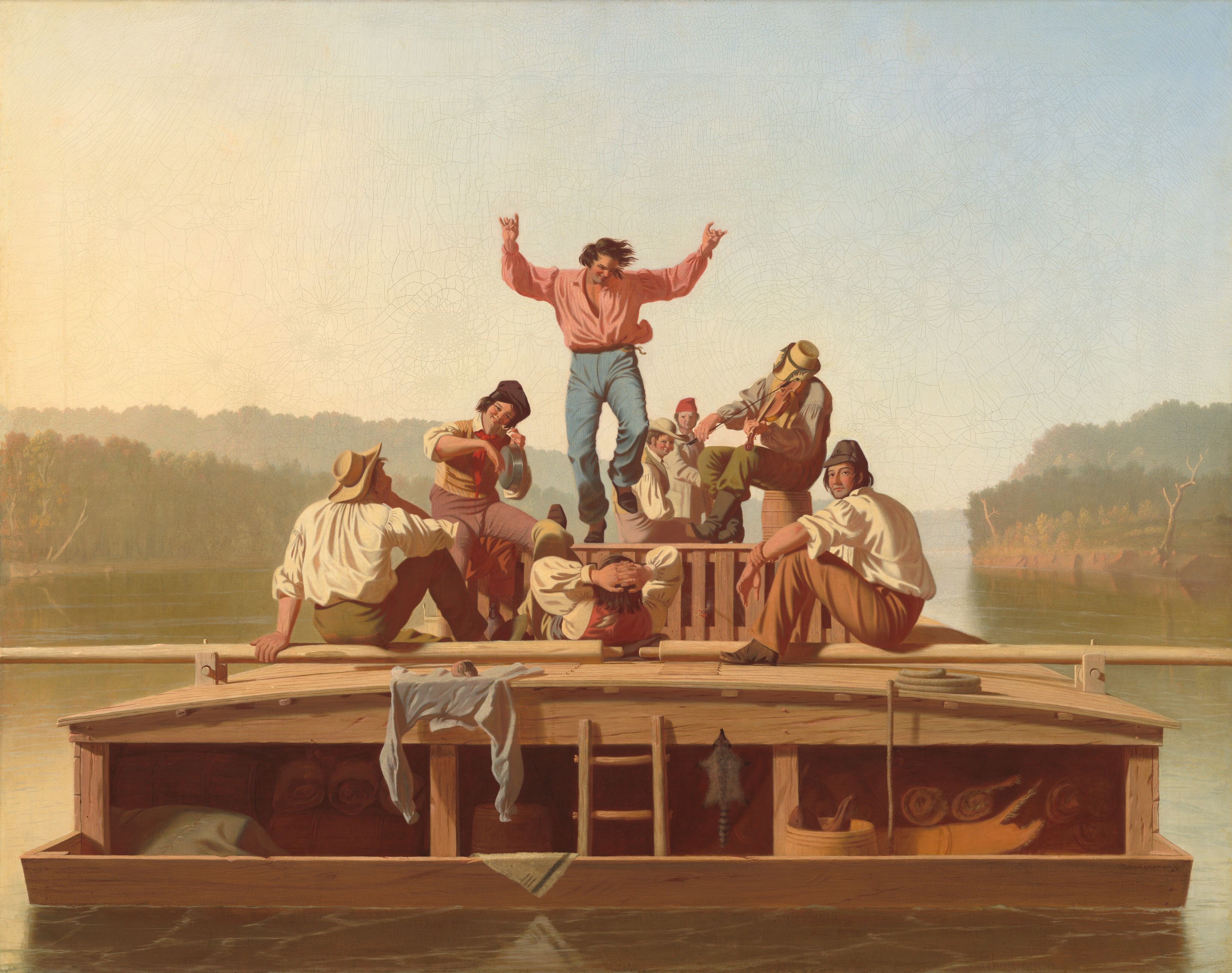
Bingham’s broader frontier scenes mirrored his alignment with Whig Party principles, specifically emphasizing the vital national importance of regional commerce and the critical necessity of federal funding for internal structural improvements.
Bingham – The Jolly Flatboatmen, 1846, 96.8 x 123.2 cm (38 1/8 x 48 1/2 in.), National Gallery of Art, Washington, D.C. https://www.nga.gov/artworks/75206-jolly-flatboatmen – retrieved September 26, 2025. Scholars observe that Bingham’s paintings before the Civil War embody his partisan political views as a Whig Party politician with “his Western scenes a commentary on the importance of commerce and the need for federal funding for internal improvements.” Public Domain. See – https://archive.nytimes.com/opinionator.blogs.nytimes.com/2013/09/06/an-artists-revenge/ – retrieved September 27, 2025.
Bingham – Fur Traders Descending the Missouri, 1845, 29 x 36 1/2 in. (73.7 x 92.7 cm), The Metropolitan Museum of Art, New York, NY. The painting is Bingham’s most celebrated work. Public Domain.https://www.metmuseum.org/art/collection/search/10159 – retrieved September 26, 2025.
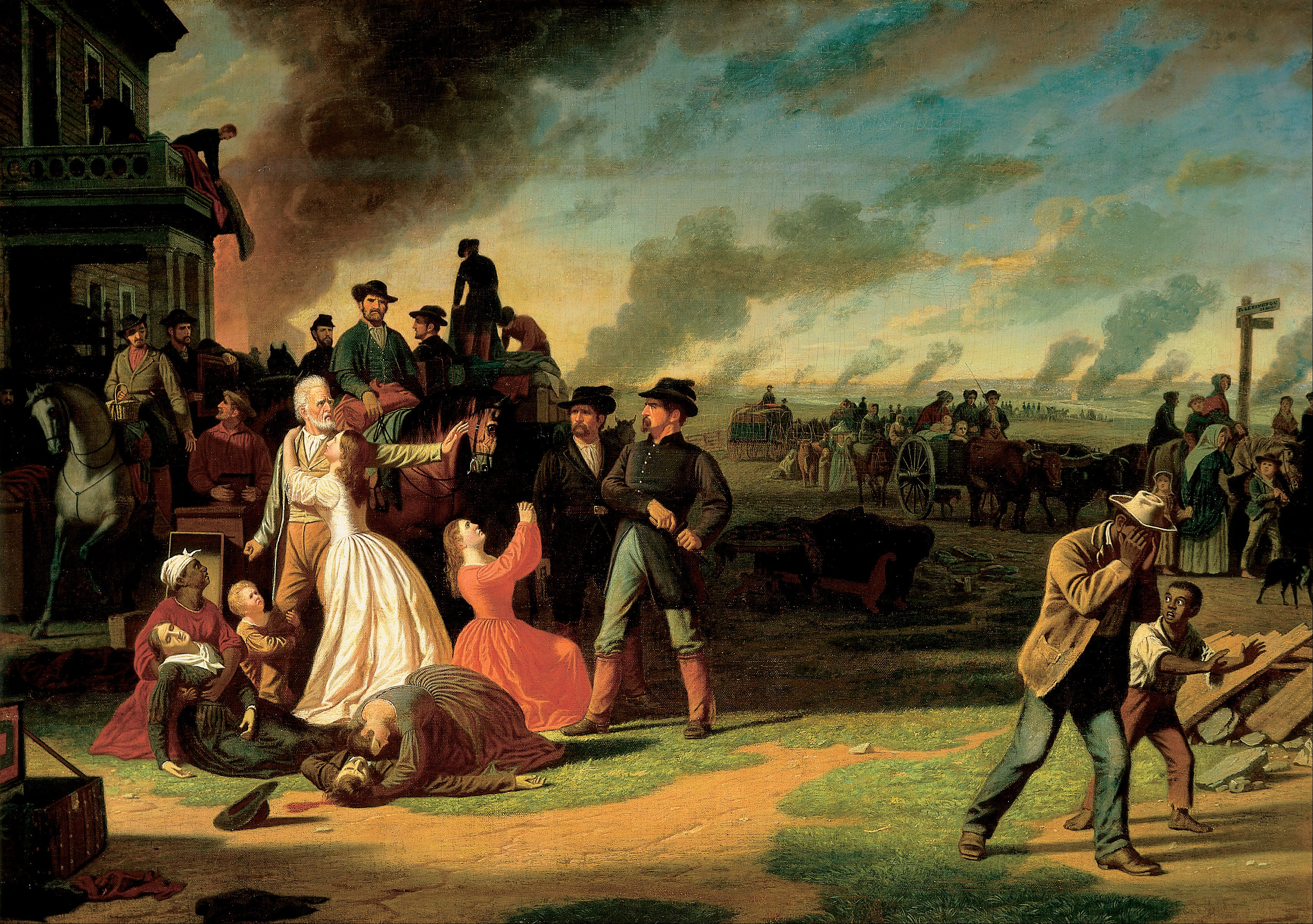
After the death of Eliza, Bingham married a third time in 1878. Martha Ann “Mattie” Livingston Lykins-Bingham (1824-1890) was a recent widow of one of Bingham’s friends in Kansas City. Mattie was a capable and dignified businesswoman with a big personality. Born in Kentucky and living In Lexington until she married Dr. Lykins, the Lykins’ were one of Kansas City’s power couples. At the outbreak of the Civil War, she and Dr. Lykins, along with a large swath of the local population in that part of western Missouri, were southern sympathizers. They and thousands more were expelled from the city by Order No. 11 of Brig. Gen. Thomas Ewing Jr., commander of the District of the Border, to rid Missouri of their political persuasion. The displacement caused tremendous suffering for Missouri civilians and Order No. 11 was very controversial. Bingham, then-state treasurer of Missouri who swore a loyalty oath to the Union, was appalled by the “military tyranny” of Order No. 11 where the refugees’ farms and fields were pillaged and burned. Many of its victims viewed the action as simply anti-American government retribution for the local population’s political beliefs. See – https://archive.nytimes.com/opinionator.blogs.nytimes.com/2013/09/06/an-artists-revenge/ – retrieved September 27, 2025.
As state treasurer and a staunch Unionist, Bingham aggressively opposed military tyranny during the Civil War, channeling his outrage over the forced relocation of civilians into his highly controversial propaganda painting, Order No. 11.
Mattie and Dr. Lykins returned to Kansas City after the war and made a life there until Dr. Lykins’ death in 1876, the same year Eliza Bingham died. Two years later, Mattie married George Caleb Bingham. After Bingham’s death in 1879 from stomach flu, Mattie lived with his young son James Rollins Bingham (1861-1910) who never married. In 1890, following years of trouble with her health, Mattie died following surgery for a stomach tumor. Mrs. Lykins-Bingham was buried In Union Cemetery in Kansas City, Missouri, in the Bingham family plot.
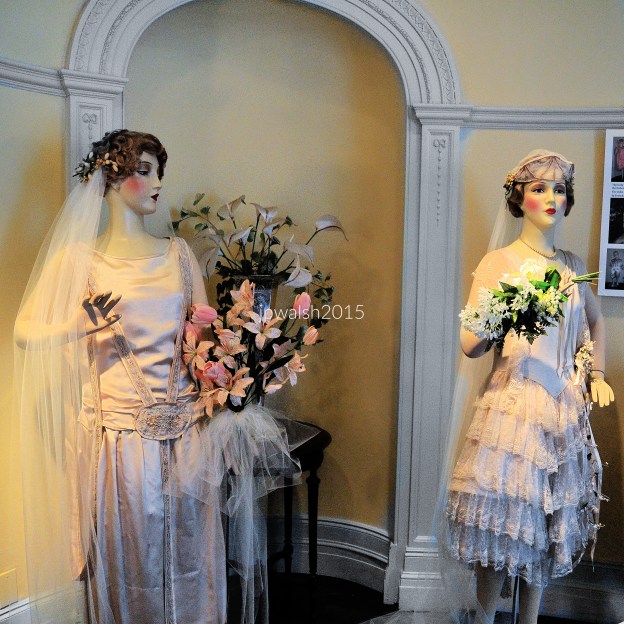
Feature Image: On Saturday, June 7, 1924, Ruth M. Anderson was married in this sleeveless wedding dress (left) to William Noling in Evanston, Illinois. The dress is now on display in the Charles Gates Dawes House in Evanston. Dawes was Vice President of the United States from 1925 to 1929 under President Calvin Coolidge. Author’s photograph (October 2015).
A surviving wedding dress and family home transform a local 1924 wedding into a study of popular culture, showing how the artistic styles and fashions of the Jazz Age reshaped American attitudes toward femininity, modernity, and social convention.
Wedding at the House of the Bride’s family
The Noling-Anderson wedding was held in the house of the bride and her parents, Isak and Jennie (née Johnson) Anderson, at 1035 Ridge Avenue in Evanston. Built in 1914, the house still stands as it did over 100 years ago.
Noling-Anderson Bridal Party Dresses, 1924 in the Charles Gates Dawes House, Evanston, Illinois. October 2015. Author’s photograph. 7.44 mb DSC_0893 (1)
The dress is made of silk satin in an egg shell color. It is accented by an oval medallion with bands also made of silk satin. The medallion is embroidered with faux pearl and other glass beads.
Thoroughly modern flapper style
While her wedding dress was very fashionable for the mid1920’s – sleeveless tops of all shapes and sizes were the rage in 1924 – it probably was not allowed in one of Evanston’s houses of worship. The fact that it was sleeveless and au courant would be deemed by many as risqué for showing too much bare skin inspired by a thoroughly modern flapper style. It was only in 1924, for instance, that the Methodist Episcopal General Conference first lifted its ban on going to the theater as well as dancing though dance music was the radio’s most popular programming.
The bridesmaid dress (right) was the height of women’s style in 1924 – a mainly straight, knee-length skirt gathered slightly or cut with front pleats. Short sleeve and sleeveless tops were the rage in 1924 reflected in Hollywood by the Mack Sennett girls who starred in movies where they pranced on the beach in a chorus line in not much more than bathing caps and short swim suits.
The fashionable bride and her court might have sported the latest style of facial make-up which is hinted at in the display– masklike with garish, even orange, lipstick and heavy red rouge on the cheeks. Popular fashion accessories from 1924 are also evident – pearls knotted at the neck and simple, though elegant, arm bracelets.
Father of the bride was an Evanston banker, local businessman, andSwedish immigrant
The bride’s father, Isak Anderson, was born in Sweden and came to the United States at 20 years old in 1890. In 1891 he married Jennie Johnson and they had Ruth and another child. Ruth’s father was a bank director and partner in a local tailoring business in downtown Evanston at 608 Davis that today is a noodle shop.
The Jazz Age transformed American social customs, fashion, and ideas of modern womanhood, with the bride’s flapper-inspired wedding attire reflecting broader cultural shifts that were fashionable, controversial, and distinctly of their time.
The dance migrated North during the Great Migration. It officially exploded into mainstream American culture on October 29, 1923, when it debuted on Broadway in the all-Black musical revue Runnin’ Wild. The show featured the hit song “The Charleston,” composed by jazz pioneer James P. Johnson, which provided the fast, syncopated 4/4 rhythm that defined the dance. The Charleston was most fashionable during the “Roaring Twenties” (1923–1929), reaching its absolute peak popularity between 1926 and 1927.
It was most popular in major urban centers—particularly New York City, Chicago, Paris and London, where young women called flappers wore short dresses, rolled down their stockings, and kicked up their heels to flout traditional social etiquette
The original Charleston craze effectively ended as a mainstream fad with the onset of the Great Depression in 1929. However, it didn’t completely disappear. The Charleston’s fast kicks, hand-to-knee swivels, and loose movements were absorbed into newer, more complex swing dances, most notably, for the Lindy Hop and the Jitterbug in the 1930s and 1940s.
They served “Prohibition highballs”
With Prohibition starting in 1920, guests at the wedding may have been served the latest popular highball whose recipe called for fruit juice and raw eggs. Their morning might have started with a bowl of Wheaties at breakfast, since the cereal of champions made its first appearance in 1924.
Wearing that dress Ruth Anderson married William Noling in this house at 1035 Ridge Avenue in Evanston, Illinois, on June 7, 1924. May 2024. Author’s photograph. 92% 7.81 mb
The bride’s attire reflected contemporary flapper fashion, including higher hemlines and sleeveless styles.
SOURCES: Charles G. Dawes House. Evanston, Illinois. Ernst Wilhelm Olson, The Swedish Element in Illinois: Survey of the Past Seven Decades (Chicago: Peter-Albin-Publishing, 1917), p. 586. Lois Gordon and Alan Gordon, American Chronicle (New Haven: Yale University Press, 1999), pp. 230–38. Thomas G. Aylesworth and Virginia Aylesworth, Chicago: The Glamour Years (1919-1941) (New York: Gallery Books, 1986), p. 14.
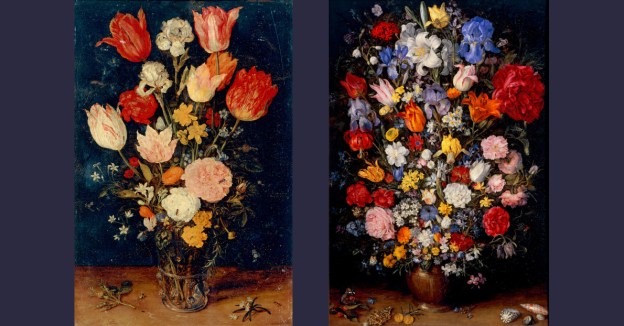
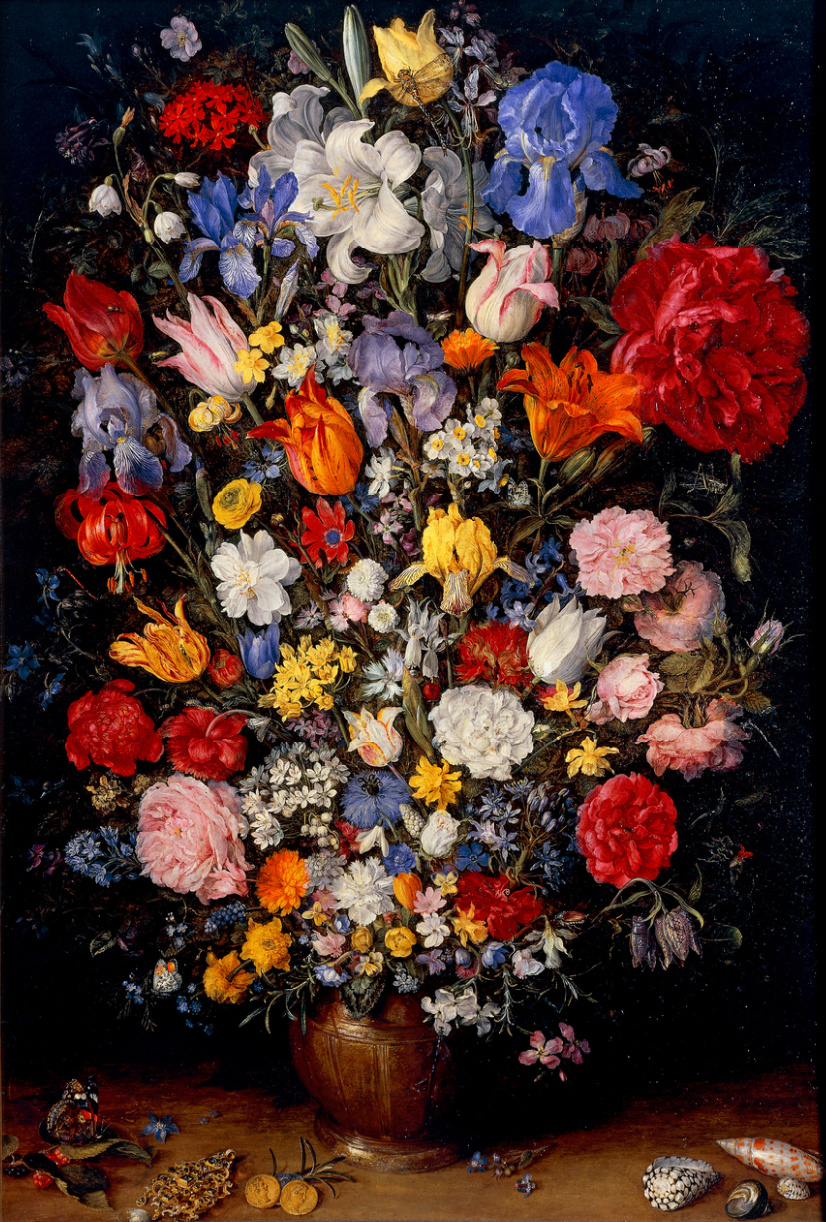
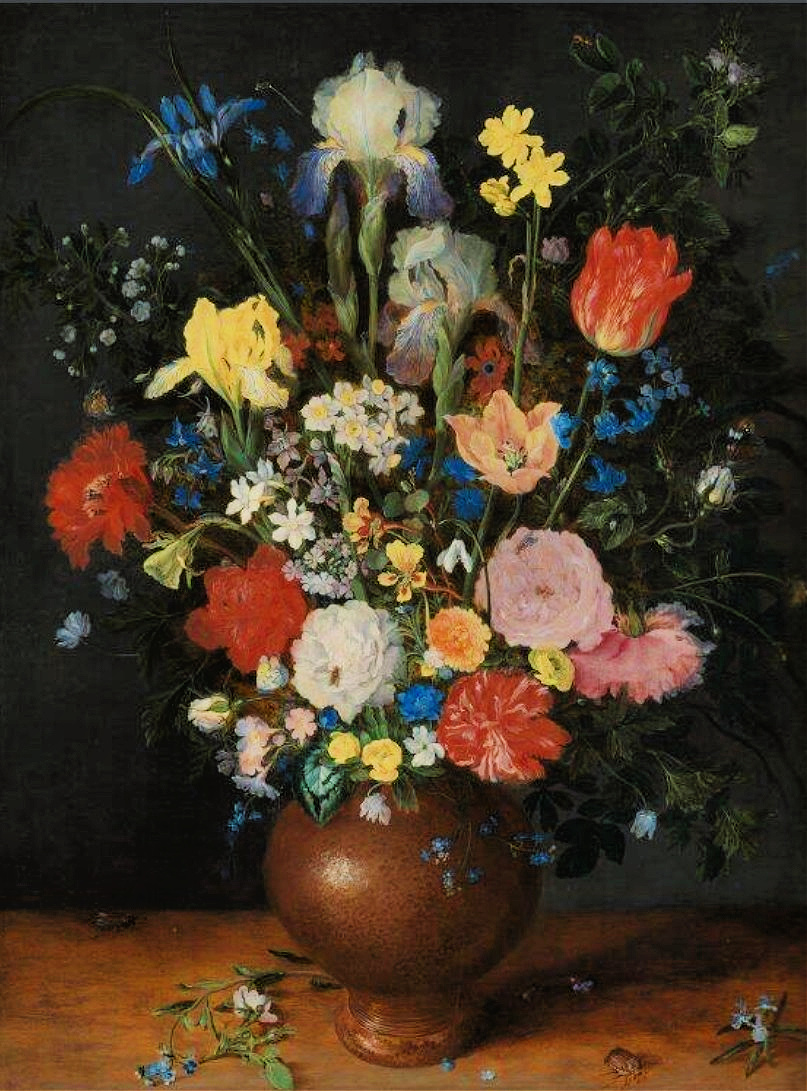
Feature Image: Flowers in a Vase and Flower Vase with Jewel, Coins, and Shells, both 1608, oil on copper, by Jan Brueghel the Elder and in the Pinacoteca Ambrosiana, Milan, Italy.
In these remarkable 1608 flower paintings, Jan Brueghel the Elder transformed floral still life from decorative accompaniment into an independent artistic subject, combining scientific observation, extraordinary technical precision, and spiritual reflection. The works reveal how early seventeenth-century Flemish art celebrated the beauty, diversity, and transience of nature while elevating close observation into an act of wonder and devotion.
Late Renaissance (Mannerist) style façade of the Palazzo dell’Ambrosiana in Milan, Italy, which houses both the Pinacoteca Ambrosiana and the Biblioteca Ambrosiana. The palace was designed by the prominent Italian architect Fabio Mangone. Cardinal Federico Borromeo commissioned Mangone to expand the initial complex—previously handled by Lelio Buzzi and Francesco Maria Richini—specifically to house the art collection and academy. At its center the main entrance features a prominent, classic arched stone portal flanked by two doric columns supporting a structured architrave and pediment. The lower-level features windows protected by prominent metal grilles topped with decorative triangular pediments, while the upper-level windows exhibit simpler rectangular lintels. The cream-colored plaster walls are cleanly partitioned by stringcourses and vertical downspouts, culminating in a decorative bracketed roof cornice. The expansion designed by Mangone began construction around 1611 and was fully operational by 1618, the year the Pinacoteca Ambrosiana was officially founded. PHOTOS: “Milano Ambrosiana” by Welleschik is licensed under CC BY-SA 3.0.
Jan Brueghel the Elder (Flemish, 1568-1625) produced hundreds of paintings by his own hand and in collaboration with other master painters. His painterly skill ranged over an immense variety of subject matter including these innovative still life floral artworks of which the artist is seen as the founder of the genre. These flowers are not allegorical or imaginative accessories nor merely decorative but a stand-alone subject whose sole focus is the opportunity for a close observation of nature through the artistic lens. Brueghel’s pioneering still lifes show a bouquet bursting with a wide variety of colorful flowers seen from an elevated viewpoint that have been carefully delineated and are clearly visible. Born in Brussels in 1568, Jan Brueghel was the son of Pieter Brueghel the Elder (c. 1525–1530-1569) and younger brother of Pieter Brueghel the Younger (1564-1638). Brothers Jan and Pieter were both sent to Antwerp to study oil painting. In 1568, at 20 years old, Jan Brueghel left Antwerp for Italy where he settled and worked in Naples and, by 1592, in Rome. In Rome Jan Brueghel worked for Cardinals Ascanio Colonna (1560-1608), Benedetto Giustiniani (1554-1621), Francesco Maria del Monte (1549-1627) and Federico Borromeo (1564-1631) who patronized Caravaggio and was the official “Cardinal Protector” of the Roman Accademia di San Luca, an artists’ association founded in 1593 by Federico Zuccari (1539-1609).
16th-century portrait of Cardinal Ascanio Colonna (1560–1608), painted by an anonymous Roman master around 1586, the exact year he was elevated to the cardinalate by Pope Sixtus V. The young cardinal enjoyed a profound reputation for eloquence and learning. Dressed in his formal scarlet cardinal biretta and mozzetta, Colonna was celebrated not only for his scholarly mind and diplomatic skill, but also as an immense patron of letters, amassing an extraordinary personal library that would later become a vital asset to the scholarly world.
Portrait of Benedetto Giustiniani (1554–1621) an exceptionally influential Italian nobleman and papal treasurer, who was elevated to the cardinalate by Pope Sixtus V in 1586. Attributed to the Genoese painter Bernardo Castello, the portrait captures the cardinal looking out with a discerning, scholarly gaze, wearing the dark winter mozzetta and academic cap befitting an elite clerical connoisseur. Born into an immensely wealthy Genoese aristocratic family that had previously ruled the Aegean island of Chios, Cardinal Giustiniani went on to become one of the most intellectually distinguished figures of late 16th and early 17th-century Rome. While he was deeply involved in high-stakes papal diplomacy, serving as papal legate to Bologna and participating in multiple papal conclaves, his lasting legacy sits firmly in the history of art. Alongside his younger brother, the prominent banker and aristocratic patron Vincenzo Giustiniani, Benedetto built what became known as the Giustiniani Collection, a cornerstone of the Roman Baroque era. At the time of his death in 1621, his personal post-mortem inventory recorded 280 paintings, demonstrating an immense, voracious appetite for contemporary art including as the absolute earliest and most enthusiastic protector of Caravaggio. Because Benedetto passed away first, his massive share of 280 paintings merged seamlessly into his brother’s holdings, helping form an aggregated collection of over 300 supreme masterpieces and ancient marbles housed inside the family’s Roman palazzo.
The direct-from-life study executed by the master portraitist Ottavio Leoni depicts Cardinal Francesco Maria del Monte (1549–1627). Rendered in black chalk with white heightening on paper 1616 drawing captures him at age 67, radiating the seasoned authority of a high-ranking Vatican diplomat while clad in his formal clerical cap and buttoned cassock. Born in Venice into a noble Tuscan aristocratic family, del Monte rose to become a powerful diplomat, the unofficial cultural ambassador for the Medici family in Rome, and a supreme connoisseur of late-Renaissance and early-Baroque arts. Four centuries later his fame rests on his early patronage of Caravaggio and his vast and meticulously art collection which provides detailed provenance for many important works of the period.
This 17th-century portrait engraving, published by Giovanni Giacomo de Rossi, celebrates the legacy of the Borromeo family in Milan. While the inscription notes that this print specifically commemorates the elevation of his nephew and namesake, diplomat and Cardinal Federico Borromeo the Younger (1617–1673), on December 22, 1670 (MDCLXX), it mirrors the deep-seated connoisseurship pioneered by his elder namesake Federico Borromeo (1564–1631) who was art patron, collector, and founder of the Ambrosiana.
The bouquets combine numerous flower species that would not naturally bloom simultaneously, creating an idealized vision of nature. Every blossom, insect, leaf, and stem is rendered with near-miniaturist precision, reflecting both artistic mastery and a growing scientific interest in the natural world.
FLOWERS IN A VASE, 1608, oil on copper, 43 × 30 cm by Jan Brueghel the Elder. Pinacoteca Ambrosiana, Milan, Italy.
In a Römer glass vase, typical of Rhenish manufactures and often depicted in Northern European painting of this period, there are colorful blooms with tulips used to anchor his bouquet. The painting was likely the one mentioned by Brueghel in a letter dated June 13, 1608. The letter is evidence for the origin of the painting as well as that these Flemish artists, in dialogue with the Italian renaissance, practiced copying nature from life, frequently with a scientific precision. Brueghel, the younger son of Flemish Renaissance painter Pieter Bruegel the Elder (c. 1525-1569), was a close friend and frequent collaborator with Peter Paul Rubens (1577-1640). Both Jan Brueghel and Rubens were the leading Flemish painters in Flemish Baroque painting of the first three decades of the 17th century.
Family of Jan Brueghel the Elder by Peter Paul Rubens. 1613-15. oil on panel, 125.1x 95,2 cm,The Courtauld Gallery, London. Jan Brueghel, painter and friend of Rubens, poses with his second wife, Catherina, and their two children, Peter and Elisabeth. Both children, along with their father, died during the cholera epidemic of 1625. see – https://gallerycollections.courtauld.ac.uk/object-p-1978-pg-362 – retrieved June 24, 2025.
Jan Brueghel the Elder was a pioneer of the floral still life, helping establish flowers as a stand-alone subject worthy of serious artistic treatment. The paintings demonstrate Brueghel’s astonishing attention to detail, earning him the nicknames “Flower Brueghel” and “Velvet Brueghel.”
The painting Flowers in a Vase is in the collection of the Ambrosian Art Gallery (Pinacoteca Ambrosiana) of the Biblioteca Ambrosiana in Milan, Italy. It was in the possession of Cardinal Federico Borromeo, cousin to Saint Charles Borromeo (1538-1584), both cardinal archbishops of Milan.
Saint Charles Borromeo (1538-1584) was a cousin of Federico Borromeo. Both were cardinal archbishops of Milan, Italy. Proclaimed a saint in Rome in 1610, Charles was much loved in his diocese for his numerous good works and for his personal humility as well as a spirit of self-sacrifice that he showed during the plague of 1576 and 1577, Cardinal Borromeo was a great reformer and played an important role in the Council of Trent. There is a colossal statue of him outside Arona on Lake Maggiore. The so-called Sancarlone, it was based on a design by Giovanni Battista Crespi, known as “ il Cerano.” Its sculptors Siro Zanella and Bernardo Falconi made the copper parts to be assembled for a work that was completed in 1698. see – https://terreborromeo.it/en/about-us/history and https://www.statuasancarlo.it/la-statua/– retrieved June 24, 2025.
The colossus of St. Charles Borromeo (1698).
In May 1585 Federico earned a doctorate in theology at the University of Pavia and was sent to Rome where he was made a cardinal at 23 years old by Pope Sixtus V. Federico voted in the papal conclaves of 1590 (Urban VII, Gregory XIV), 1591 (Innocent IX), 1592 (Clement VIII), 1605 (Leo XI, Paul V) and 1623 (Urban VIII). He missed the 1621 conclave (Gregory XV). At the August 1623 papal conclave Cardinal Borromeo received 18 votes out of 54 votes but was opposed by the Spanish party, one of the church’s major factions. The church had to compromise with Urban VIII, a neutral candidate known as the first pope to actively campaign for votes.
The Biblioteca Ambrosiana and a Lasting Legacy In April 1618 Archbishop Federico Borromeo bequeathed Flowers in a Vase with his collection of paintings, drawing, and statues in his will to the Biblioteca Ambrosiana, which he founded on September 7, 1607 and opened on December 8, 1609. Conceived by the cardinal as a center for study and culture it was open to the public from the beginning. The library collections include over one million printed volumes (including thousands of incunabula and books dating from the 16th century), 40,000 manuscripts (including the celebrated Codex Atlanticus) in many languages, 12,000 drawings (including works by Raphael, Pisanello, and Leonardo), 22,000 engravings, and miscellanea including old maps and musical manuscripts. Along with the cardinal’s achievement, other institutions flourished beside it such as the Board of Fellows (Collegio dei Dottori, 1607), the Art Gallery (Pinacoteca Ambrosiana, 1618) and the Academy of Drawing for teaching painting, sculpture and architecture (Accademia del Disegno, 1620).
The Treasures of the Pinacoteca Ambrosiana The Pinacoteca Ambrosiana consists of some of the Italian Renaissance’s great masterpieces such as the Portrait of a Musician by Leonardo da Vinci, The Basket of Fruit by Caravaggio, the cartoon for the School of Athens by Raphael, the Adoration of the Magi by Titian, the Madonna of the Pavilion by Sandro Botticelli and the magnificent Flowers in a Vase by Jan Brueghel. The museum’s collection today includes paintings by 17th-century Lombard artists such as il Morazzone (1573–1626), Giulio Cesare Procaccini (1574–1625), Daniele Crespi (1598 – 1630) and Carlo Francesco Nuvolone (1608-1669) and 18th-century artists such as Giovanni Domenico Tiepolo (1727-1804), Fra’ Galgario (1655-1743), and Francesco Londonio (1723-1783).
Cardinal Federico Borromeo: Scholar, Collector, and Patron Cardinal Federico Borromeo, who lived in Rome from 1586 to 1601, was not particularly interested in politics, but focused on classical and oriental scholarship and prayer. In the Counter-Reformation, the cardinal was a great propagator of the faith using religious art, but also was an avid collector of still life.
Jan Brueghel and the Cardinal’s Cultivated Eye Jan Brueghel the Elder, nicknamed “Velvet,” was a contemporary artist who was erudite and innovative – he invented new types of paintings such as flower garland paintings and paradise landscapes – and his art did not escape the cardinal’s cultivated eye. The Cardinal and young artist met in Rome where the Cardinal became his patron so that the artist took up residence in Cardinal Borromeo’s palazzo.
Cardinal Federico Borromeo by Giulio Cesare Procaccini (1574-1625), Museo diocesano di Milano. The Borromeos, a prominent Italian noble family, started as merchants around 1300 in San Miniato in the province of Pisa in Tuscany and became bankers in Milan after 1370. The elder Cardinal Federico Borromeo was a monumental figure in European art history who transformed Milan into a premier cultural hub by founding the Biblioteca and Pinacoteca Ambrosiana. He held a profound, visionary appreciation for the intrinsic value of art, famously championing the work of northern masters like Jan Brueghel the Elder.
When Borromeo became archbishop of Milan in June 1595, Brueghel followed him and became part of the Cardinal’s household. Cardinal Borromeo was a reformer in the sense of promoting discipline among the clergy, founding new parishes and schools, as the faith flourished in the 50 years since the Council of Trent completed in 1564. The archbishop was accessible to the flock. Under his leadership, Milan underwent both prosperity and significant cultural flourishing and renewed spiritual energy for a generation. Brueghel stayed with the Cardinal for a year where he painted landscapes and flower paintings and then returned to Antwerp where he lived and worked for the rest of his life. Also nicknamed “Flower” Brueghel, the artist’s flower pieces such as Flowers in a Vase, are dominated by floral arrangements placed against a neutral dark background. Brueghel repeated these motifs in his flower pieces and yet each work was imbued with its own singular freshness and vitality.
FLOWER VASE WITH JEWEL, COINS, AND SHELLS. 1608, oil on copper, 65 × 45 cm by Jan Brueghel the Elder. Pinacoteca Ambrosiana, Milan, Italy.
A lush bouquet of flowers, executed by the artist for Cardinal Federico Borromeo (1564-1631), was innovative as a stand-alone bouquet painting of its kind. The subject is composed of around one hundred different species of flowers, some of which are very rare and of great value. In addition to its execution of profuse natural beauty, the picture expressed the nature of the early 17th century culture’s encyclopedic curiosity which extended, among leading collectors, into the natural sciences. It is known by way of a letter that Brueghel was working on the picture in 1606 after he had seen many of these flower varieties in the garden in Brussels of Albert VII, Archduke of Austria (1559-1621) and Isabella Clara Eugenia (1566-1633), who jointly ruled the Spanish Netherlands (1556-1714). The artist’s picture of these flowers was, in a scientific approach, intended to “portray them from nature.” Virtually nothing today remains of the Archdukes Albert and Isabella’s Palace of Codenberg in Brussels nor of their summer retreat at the Château of Mariemont (today’s Morlanwelz in Belgium) south of Brussels which was painted frequently by Jan Brueghel the Elder nor anything of their hunting lodge in nearby Tervuren east of Brussels. In 1633, at the death of Isabella, Albert (who died in 1621) and Isabella’s magnificent collections of art works, scientific instruments, naturalia and artificialia were scattered and much of it lost.
Brueghel’s flowers function as both botanical studies and meditations on beauty, abundance, and the fleeting nature of life. The works embody the Baroque fascination with observation, variety, and visual richness while retaining a spiritual dimension rooted in the wonder of creation.
The Archdukes Albert and Isabella Visiting the Collection of Pierre Roose, c. 1621-1623, Jan Brueghel the Elder and Hieronymus Francken II, oil on panel, 37 × 48 ½ in. (94 × 123.19 cm). see – https://art.thewalters.org/object/37.2010/ – retrieved June 21, 2025.
Some of that magnificence was evoked in a picture from 1621-23 by Jan Brueghel the Elder with Hieronymus Francken II (1578-1623) called Albert and Isabella visiting an art gallery. The large format painting (around 3 feet by 4 feet) in the Walters Art Museum depicts a private gallery (or cabinet) of Pierre Roose in Brussels being visited by the Archdukes Albert and Isabella. It includes in a foreground corner an immense vase of flowers by Jan Brueghel and depicts how these collectors are as interested in natural botany and scientific instruments as they are of paintings and sculpture.
DETAIL of above: Isabella is seated, while her husband standing to her right and their host, Pierre Roose, behind.DETAIL of above:These collectors are as interested in natural botany and scientific instruments as they are of paintings and sculpture.
Isabella’s Rule and the Catholic Restoration of the Southern Netherlands Following Albert’s death, Isabella continued to rule on behalf of her nephew Philip IV of Spain (1605-1665) though it was Albert and Isabella’s reign which marked the consolidation of Catholic rule in the Southern Netherlands following severe persecutions of Protestants that ended only in 1597. Though most Protestants had left the region, in 1609 an act of toleration was granted to the Protestants that remained though they could not publicly practice their religion.
Religious Orders and the Patronage of Power Conversely, Catholic religious orders like the Jesuits, Capuchins, and Discalced Carmelites received large cash grants and endowments by the wealthy governing elite which helped fund many of these religious groups’ ambitious building and artistic programs in Brussels and Antwerp. As a widow Isabella joined the Third Order of Franciscans until her death.
Patrons of the Arts in an Age of Faith Though despotic and kingly, these rulers have earned a well merited reputation in art history as patrons of the arts. A most notable example is that, in 1609, one year after the Pinacoteca Ambrosiana’s flower picture was created, the Archdukes, whose gardens inspired the work in Italy, appointed Peter Paul Rubens (1577-1640) as their court painter.
Borromeo on the Value of Brueghel’s Masterpiece About Brueghel’s masterpiece Flower Vase with Jewel, Coins, and Shells—which Borromeo purchased specifically for his Milano Ambrosiana—the Cardinal wrote a striking passage in his catalog, the Musaeum:
“Brueghel painted a diamond on the lower part of the vase…: the author wanted to indicate that the value of his work was equal to that of the gems and this is the price we paid to the artist.”
This observation perfectly captures the elder Borromeo’s philosophy: that supreme artistic genius was not merely a decorative luxury, but a precious entity whose cultural and intellectual worth directly rivaled the world’s most costly physical gems.
Bouquet in a Clay Vase, 1609, Jan Brueghel the Elder,oil on wood, 56 x 42 cm. The National Gallery, London. see – https://www.nationalgallery.org.uk/paintings/jan-brueghel-the-elder-bouquet-in-a-clay-vase – retrieved June 24, 2025. Jan Brueghel the Elder is considered the 17th century northern painter, active in the Low countries as well as Italy, who invented and mastered the genre of flower still life. While used at times as a decorative or allegorical element within a painting, there are major examples where the artist aesthetically assembled and presented an impressive bouquet from a high viewpoint based on scientific observation of rare garden species as the sole focus of the painting. Bouquet in a Clay Vase in The National Gallery in London is one such artwork.
Jan Brueghel the Elder’s flower paintings of 1608 demonstrate how the Flemish master elevated botanical observation into a new art form, creating images that are at once scientific records, celebrations of beauty, and spiritual reflections on the richness of creation.
SOURCES:
Brueghel, Jan. n.d. “About Jan Brueghel.” Jan Brueghel the Elder: A Virtual Catalogue. Accessed October 25, 2026. janbrueghel.net.
Veneranda Biblioteca Ambrosiana. n.d. “Biblioteca.” Accessed October 25, 2026. ambrosiana.it.
Veneranda Biblioteca Ambrosiana. n.d. “Fiori in un vaso.” Accessed October 25, 2026. ambrosiana.it.
Veneranda Biblioteca Ambrosiana. n.d. “Flowers in a Vase.” Accessed October 25, 2026. ambrosiana.it.
Veneranda Biblioteca Ambrosiana. n.d. “Vase of Flowers with Jewel, Coins, and Shells.” Accessed October 25, 2026. ambrosiana.it.
Veneranda Biblioteca Ambrosiana. n.d. “Vaso di fiori con gioiello, monete e conchiglie.” Accessed October 25, 2026. ambrosiana.it.
Walters Art Museum. n.d. “The Archdukes Albert and Isabella Visiting a Collector’s Cabinet.” Online Collection. Accessed October 25, 2026. thewalters.org.
Wikipedia, s.v. “Albert VII, Archduke of Austria.” Last modified August 29, 2026, 06:39. wikipedia.org.
Wikipedia, s.v. “Isabella Clara Eugenia.” Last modified October 15, 2026, 18:53. wikipedia.org.
Wikipedia, s.v. “The Archdukes Albert and Isabella Visiting a Collector’s Cabinet.” Last modified October 23, 2026, 06:18. wikipedia.org.
This explanatory article may be periodically updated.
Michelangelo Buonarroti was not simply the greatest artist of the Italian Renaissance, but the artist who synthesized and transcended the achievements of his predecessors, transforming Renaissance ideals into works of unprecedented power, realism, and spiritual intensity. Michelangelo absorbed the innovations of artists such as Giotto, Masaccio, Donatello, Paolo Uccello, Verrocchio, and Leonardo da Vinci before elevating the human figure, especially the nude, to its highest artistic expression.
Michelangelo Buonarotti, Madonna della Scala, 1490. Casa Buonarroti, Florence, Italy. Though it is small-sized the relief subject of the Madonna and child presents a monumental scope. The female figure fills the entire space. The meaning of the ladder (“scala”) in the title is ambiguous and may have reference to the children playing and holding a drape behind the Madonna. The date of the relief has been much discussed. However, a placement around 1490, before the Battle of the Centaurs, seems to be confirmed. see – https://artsandculture.google.com/asset/madonna-della-scala/xQF2nwLhAXd26w?hl=it – retrieved March 6, 2025.
Michelangelo Buonarotti, Nude female, 1533, Casa Buonarroti, Florence, Italy. This figure of a female nude is linked to the New Sacristy in Florence to accompany the marble effigy of Giuliano de’ Medici. It has been linked to the figure of the Earth that, together with the Sky, was to be part of Giuliano’s marble effigy. The project of building a proper Medici family mausoleum was conceived in 1520, when Michelangelo began work on the New Sacristy upon the request of Cardinal Giulio de Medici, the future Pope Clement VII, who expressed a desire to erect the mausoleum for some members of his family including Lorenzo the Magnificent and his brother Giuliano assassinated in Florence’s Duomo in 1478. After completing the architectural works in 1524, Michelangelo worked until 1533 on the sculptures and the sarcophagi that were to be featured on the chapel walls. The only ones actually completed were the statues of Lorenzo, the Duke of Urbino; Giuliano, the Duke of Nemours; the four statues of the allegories of Day and Night, and Dawn and Dusk; and the group representing the Madonna and Child. see – https://artsandculture.google.com/asset/nudo-femminile/xgHfNWIKU6r13g?hl=it – retrieved March 6, 2025 and http://www.museumsinflorence.com/musei/Medici_chapels.html#:~:text=The%20project%20of%20building%20a,the%20Magnificent%20and%20his%20brother – retrieved March 6, 2025.
Michelangelo, crucifix, 1493, wood, Santo Spirito, Florence. It was placed by the artist in 1493 above the lunette of the high altar and has been there since.
The Italian Renaissance artist was born in Florentine territory in Caprese in the provinces of Tuscany where his father was a government bureaucrat. The family soon relocated to Florence where Michaelangelo grew up. Becoming friends with Francesco Granacci (1469-1543) who saw Michaelangelo’s drawing talent, at 13 years old Michelangelo announced he wanted to be an artist. Despite his parents objection, they eventually yielded to their son’s aspirations, and he was apprenticed to Domenico Ghirlandaio (1448-1494) for the next three years.
Raised in Florence, Michelangelo trained under Domenico Ghirlandaio and was later influenced by the artistic environment fostered by Lorenzo de’ Medici.
Domenico Ghirlandaio (1448-1494), Expulsion of Joachim From the Temple, fresco (detail), 1486-1490. Santa Maria Novella, Cappella Tornabuoni, Florence. In the background, the mitered high priest receives sacrificial lambs at the altar where a fire burns. Joachim, according to sacred tradition, father of the Virgin Mary and grandfather of Jesus Christ, is sent away at this time since he is childless. He is married to Anne. To the right Ghirlandaio depicts an assembled group of contemporary Florentines including, second from right, Ghirlandaio himself. In 2nd century apocryphal writings, childless Joachim left for the desert where he prayed and fasted for 40 days. Angels appeared to Joachim and his wife Anne, and promised them a child. Joachim then returned to Jerusalem and embraced Anne at the city gate, a scene popularly depicted in medieval and Renaissance art. After this, Anne became pregnant and became the mother of the Virgin Mary and Jesus’s grandmother. This apocryphal relating of Joachim and Anne to Biblical figures Elizabeth and Zechariah and the birth of their son, John the Baptist (Luke 1) and Abraham and Sarah and the birth of their son, Isaac (Genesis 21) was a popular subject depicted in Christian art until the Council of Trent (1545–1563) when the church restricted public displays of these simple stories and events from apocryphal sources in a severe reaction to the Protestant reformation.
Michelangelo’s training was erratic, likely having left Ghirlandaio before his contract was complete, and working under the city’s ruler, Lorenzo de Medici for his contracted master, Bertoldo (1420-1491). Later in life Michelangelo did not advertise his training credentials as he believed art – such as freeing subjects from stone – emerged by the sheer artistic power of the individual. In this period, as a teenager, Michelangelo learned the art of fresco painting and drawing, copying previous masters such as Giotto (1267-1337) and Masaccio (1401-1428). Michelangelo absorbed the artwork of the naturalists, such as Paolo Uccello (1397-1475), whose artwork looked to present subjects with a viewpoint like a scientist interested in objective fact rather than looking to convey some established figural attitude. Where young Michelangelo was materially as great as Giotto and Masaccio, he also possessed a new means undreamt by those previous masters, as he drunk of the art of Donatello (1386-1466), Pollaiuolo (1429-1498), Verrocchio (c.1435-1488) and Leonardo da Vinci (1452-1519). Further, Michelangelo understood better than these others, that the epitome of these Renaissance artistic studies was to be expressed by one subject above all: the human nude.
Michelangelo believed artistic greatness derived from the artist’s own creative power and became especially devoted to expressing the human form, particularly the nude, as the pinnacle of artistic achievement.
Giotto, The Arrest of Christ (Kiss of Judas ), 1304, Padua, Scrovegni Chapel.
The Arena, or Scrovegni Chapel, was commissioned by Enrico Scrovegni in 1303. A nobleman of Padua, Enrico dedicated the chapel as an act of atonement for the sins of his father, Reginaldo, a moneylender whom Dante placed among the damned in the Inferno. The exterior of the chapel is austere, but its interior is filled with Giotto’s frescoes, completed by the time of the chapel’s dedication in late March 1305, with remaining work finished by March 1306. By this point, Giotto—then in his late thirties—was already a mature master, and in this cycle he transformed the course of Italian painting.
What had appeared as youthful brittleness and restlessness in his frescoes at Assisi in the late 1290s—works that had secured his fame and led to the Padua commission—has here developed into a fully realized visual language of narrative concision, solemnity, and decisive, almost fatalistic, plastic form. Although the subjects of the Life of the Virgin, the Life and Passion of Christ, and the Last Judgment draw upon a venerable medieval tradition, Giotto renders them with a striking immediacy. Human emotion, individualized gesture, and the presence of everyday life infuse the sacred narratives with a naturalism that conveys profound dignity and emotional gravity rather than rhetorical flourish.
Bernard Berenson described Michelangelo as “the pupil of nobody, the heir of everybody, who felt profoundly and powerfully what to his precursors had been vague instinct, who saw and expressed the meaning of it all.”
The dramatic center of the Betrayal fresco is the confrontation between Christ and Judas. Once Christ accepts His fate in the agony of the garden, the world wastes no time in presenting Him with the cross He has embraced. One of His own apostles—an unsettling reminder of the failures of religious leaders across the ages—betrays Him with a kiss. Christ’s body nearly disappears beneath Judas’s enveloping cloak, yet His classical profile remains visible, fixed in a calm, penetrating gaze upon His betrayer. Judas’s pursed lips embody the chilling intimacy of treachery. As John 13 recounts, the devil—whether through possession or the alignment of Judas’s will with Satan’s designs—provides the impetus for the betrayal.
Giotto had previously depicted Judas as youthful and handsome, but here the apostle’s features bear the accumulated marks of moral decay. At the left, Peter lashes out at Malchus, the high priest’s servant, severing his ear; at the right, the high priest himself gestures toward the betrayal, yet his posture suggests a momentary hesitation before the full enormity of the act. Through these figures, Giotto constructs a scene of moral and emotional complexity, capturing the decisive moment when divine purpose and fallen humanity collide.
Paolo Uccello, Sacrifice of Noah And Noah’s Drunkenness (detail), 1447-48. Uccello was not interested primarily in conveying in art the possible “artistic” intention of this story’s scene. Instead, as Bernard Berenson described it, the artist produced “nothing but the scientific intention to find out how a man swooping down head-foremost would have looked if at a given instant of his fall he had been suddenly congealed and suspended in space.” These studies of reproducing objects as they really are, in anatomy and perspective, had a great bearing for the art of Leonardo da Vinci and Michelangelo. quoted in Berenson, p.54.
Masaccio, Distribution of Alms and Death of Ananias (detail), 1425-1427, Brancacci Chapel, Florence. An episode from Acts of the Apostles (4:43-37 and 5: 1-11) depicting Ananias’s wife and child whose husband withheld their tithe from the early church leaders with the outcome being that Ananias dropped dead in divine retribution. When it was painted, viewers in the 1420’s and afterwards, read it as an artistic display of a New Testament endorsement of the equitable redistribution of wealth and the divine punishment of death forthwith for those who falsely withheld their fair share. 67% 7.95mb
When the Medici fell and Florence became a theocracy under Savonarola (1452-1498), 19-year-old Michelangelo decided to leave Florence. He lamented the fall of Lorenzo the Magnificent, his artistic patron, and the young artist lived hand to mouth going to Bologna, then to Venice, and back to Bologna, and finally to Rome in June 1496. The popes’ tremendous influence in capitalist Italy started in the 13th century and augmented into the 17th century, leading to what art critic Bernard Berenson (1865-1959) called an encroachment of “soulless Vaticanism” towards modern art. But clearly Rome had no use for a firebrand friar who refused to support the pope’s troops against the invading French army. As Columbus set out to discover America, It was the unpleasant chapter of the Italian War of the 1490s that helped fill the times with ongoing brutality, duplicity, complicity, intrigue, opportunism and expedience. A looming danger of looting and violence of the invading French army were emphasized by the impassioned sermons of Girolamo Savonarola that frightened the people and led to their heightened resentment against the ruling Medici. Florence was traditionally pro-French, but Piero di Lorenzo de’ Medici (“Piero the Unfortunate”) (1472-1504), son of Lorenzo the Magnificent, had deployed against them to defend Naples. Under pressure from citizens and outside French forces promising church reforms and civic transparency, the Medici was forced to flee and the city was proclaimed a Republic. The Florentines, with Savonarola in the lead, facilitated the invasion of French king Charles VIII (1470-1498) and against the pope which they considered corrupt. Pope Alexander VI (1431-1503), a Borgia and one of the most corrupt popes in history, ascended to the papal throne in 1492 and was immediately condemned in fiery sermons by Savonarola. Yet all was not well between “liberator” Charles VIII and his Florentine supporters. Immediately the French king demanded a huge sum of money, a ransom payment of sorts, from the Florentines in appreciation, as well as to pay for, the pro-French liberation. The Florentine government refused and the king threatened to loot the city. Faced with a backlash and real threat of popular revolt, the French bully relented and continued onto Rome. Charles postured, but was constantly fearful of antagonizing the European powers and announced his decision that he would not depose the corrupt old pope after all. By having kidnapped the pope’s mistress Giulia Farnese, wife of the pope’s military ally Orsino Orsini, who commanded 4,000 Neapolitan soldiers freshly landed to defend papal interests on the peninsula, Charles VIII was able to extract full entry into Rome in exchange for her release. Once in Rome the French troops looted the city. The pope, in a panic, arranged a quick safe passage for Charles VIII out of the Papal States towards Naples during which the king’s army massacred many hundreds of local inhabitants.
Charles VIII, roi de France, anonymous, c. 1550. Entering Florence in a power vacuum the invading French king demanded a huge sum of money from the citizens who refused to pay and leading to a stand-off. Public Domain.
Domenico Ghirlandaio’s 15th century portrait of Piero the Unfortunate. Eldest son of Lorenzo the Magnificent, Piero di Lorenzo de’ Medicisucceeded him as ruler of Florence in 1492. When Piero determined in 1494 to stay neutral during French king Charles VIII’s invasion of Italy, effectively defending Naples the object of the king’s campaign, he was challenged. Suffering from an abandonment of the Florentine elite under the spell of Savonarola, Piero totally capitulated to Charles VIIi’s demands. Having succeeded in alienatating everyone in Florence, Piero fled to Venice, aided by a French diplomat, in November 1494. Attempting to make a comeback several times to Florence he was constantly rebuked, Piero drowned in the Garigliano River while attempting to flee the aftermath of the Battle of Garigliano in 1503, Public Domain.
Pope Alexander VI Borgia, c.1495, attributed to Spanish painter Pedro Berruguete (c. 1450-1504), Vatican Museums. Alexander Vi was a wily politician from a prominent family who practiced nepotism and sired several children by way of his many mistresses.
Savonarola played an important role in this French infiltration in Italy — and Rome did not forget. Then, in February 1497, during Mardi Gras of that year, Savonarola, whose message was a combination of religious purist and civic republican preached his most dramatic act of cultural desecration by seeking that artworks, books, clothing items and cosmetics were thrown into a bonfire of the vanities as a sign of monied and other social decadence. The flames became his final undoing: Savonarola was excommunicated for heresy and sedition by Pope Alexander VI on May 12, 1497 after the preacher called “the contemporary Church leadership…a pockmarked whore sitting on Solomon’s throne.” The pope also threatened Florence with severe interdictions if they continued to be a sanctuary for Savonarola and his ilk. Savonarola was imprisoned on April 7, 1498 after failing a literal public trial by fire (it rained). Finally, he was dragged from his prison cell and with two other contemptible friars was condemned as a heretic and schismatic and hanged and burned at the stake on May 23, 1498, with the Vatican and the Medici observing it all from a safe distance. Yet the cult of Savonarola, his person as well as his political and religious ideas, did not go quietly up in smoke. Though seen today as a sort of vile figure, his supporters around 1500 and afterwards saw him as a martyr and encouraged his veneration as a saint to which many complied. In Florence Savonarola’s disputed legacy went on until the Medici more or less permanently re-installed themselves in 1530. Yet Protestant reformers in Germany and Switzerland were intrigued and influenced by Savonarola’s ideas and, in 1558, even Pope Paul IV, who was 22 years old when Savonarola was executed, declared him not a heretic and always in communion with the Catholic Church. Saint Philip Neri (1515-1595), a Florentine established in Rome, and regularly characterized as a most relatable prelate of and for the masses, also defended Savonarola’s memory.
Michelangelo’s early career was within the turbulent political and religious upheavals of Florence, including the rise and fall of Girolamo Savonarola.
Francesco Rosselli (1445-1513), The Execution of Savonarola and Two Companions at Piazza della Signoria, 16th century, oil on canvas, Galeria Corsini.
Bernard Berenson as a young man, Berenson described Michelangelo as “the pupil of nobody, the heir of everybody, who felt profoundly and powerfully what to his precursors had been vague instinct, who saw and expressed the meaning of it all.” quoted in Berenson p. 72. Public Domain.
Verrocchio, Equestrian Statue of Bartolomeo Colleoni, 1480s, Venice. Bartolomeo Colleoni (1400-1475) was an Italian condottiero, who became captain-general of the Republic of Venice. Colleoni gained a reputation as the foremost tactician and disciplinarian of the 15th century. PHOTO: “Bartolomeo Colleoni by Andrea del Verrocchio” by Didier Descouens is licensed under CC BY-SA 4.0.
Antonio del Pollaiuolo, Nude Dancers, 1470s, Fresco Arcetri, Villa La Gallina. A fresco frieze of dancing nude figures, in a villa near Florence, shows the artist’s same interest in extreme body poses. Public Domain.
Meanwhile, in Rome, Michelangelo sculpted his first major marble works. The first, Bacchus, was commissioned by Cardinal Raffaele Riario (1461-1521) in partnership with Jacopo Galli, a Roman collector, that was displayed in Galli’s garden until it was sold in 1572 to the Medici and is today in the Bargello. The second is the sublime Pietà (St. Peter’s Basilica, Vatican City) that was commissioned by a French cardinal in Rome and placed in the Santa Maria della Febbre. Vasari described the Pietà as “a revelation of all the potentialities and force of the art of sculpture.” Though the Pietà made Michelangelo famous in Rome, he returned to Florence following its installation to work on the David, a commission made by the Florentine republic after the expulsion of the Medici.
Michaelangelo’s early masterpieces, including Bacchus, the Pietà, and David, established his reputation as one of Europe’s greatest sculptors.
Michelangelo, Pietà, marble, 1498-1499, St. Peter’s Basilica, Rome. A 24-year-old Michelangelo was all the rage in Rome as an artist in the late 1490’s and wrote his name prominently across the sash of the Blessed Mother. The artist did this after it was completed and heard a group admiring the artwork and attributing it to a different artist. Michelangelo was having none of it and one night whet into the chapel and chiseled his name for none to miss seeing. PHOTO: “Pieta (Michelangelo)” by elixirk is licensed under CC BY-NC-SA 2.0.
Galleria dell’Accademia, Florence, Italy, Michelangelo’s David, created in c. 1501-1504, has been in the Galleria dell’Accademia since 1873, The biblical figure of David came to symbolize the defense of civil liberties embodied in the 1494 constitution of the Republic of Florence, an independent city-state threatened on all sides by more powerful rival states and by the political aspirations of the Medici family.May 1983. Author’s collection.
Michelangelo’s achievement rested on combining Renaissance naturalism, anatomical understanding, classical ideals, and spiritual drama into a unified artistic vision.
Michelangelo, The Last Judgment, 1536-41, Sistine Chapel, Vatican.
The Cosmic Blast of the High Renaissance: Michelangelo’s Last Judgment and the Fracture of Europe
Introduction: A Masterpiece Born of Crisis Michelangelo’s The Last Judgment, painted on the altar wall of the Sistine Chapel between 1536 and 1541, stands as the terminal monument to Renaissance humanism in a unified Europe. It captures the terrifying moment when mortals face the raw justice of the Lord—either attaining eternal bliss or being found profoundly wanting. This monumental fresco was forged in a crucible of profound instability. The traditional religious and political order of Europe was fracturing, a reality mirrored in the turbulent biography of the artist himself and the volatile politics of Rome and Florence.
Decades earlier, in 1498, the execution of the radical friar Girolamo Savonarola had temporarily suppressed the spirit of the Florentine Republic. Yet, when Rome was brutally sacked by imperial troops in 1527, Florence, that normally chafed under Roman authority, seized the papacy’s weakness as an opportunity for renewal, re-establishing its republic. By 1530, however, papal and Medici forces crushed Florentine liberty once again. Michelangelo, a fierce republican and an effective “Never Medici” artist, found himself in an impossible position. He ultimately returned to Rome to work for the papacy, viewing it as the lesser of two political evils.
The commission for the altar wall was initiated by Pope Clement VII, though Michelangelo fought desperately to avoid it, longing instead to finish his decades-long project, the Tomb of Pope Julius II. When Clement died, his successor, Pope Paul III—already an old man at the start of a transformative papacy—commanded the artist to abandon the tomb and begin the fresco. To make room for Michelangelo’s vision, existing masterpieces on the wall were completely destroyed, fundamentally altering the chapel’s visual landscape.
The Architecture of Individuality While earlier medieval and early Renaissance masters like Giotto and Fra Angelico had depicted the Last Judgment with a clear, comforting heavenly hierarchy and orderly rows of the Elect, over a century later Michelangelo elevated the concept to reflect a High Renaissance understanding of radical individuality. It took the master three years of intense conceptualization to finalize the design. Crucially, he developed the principal figures before establishing their exact placement, prioritizing the integrity of the individual soul over the constraints of the composition. Secondary elements like shrouds and skeletal figures were introduced only after the primary figures were locked in place.
At the center of this swirling cosmos stands Christ. He is a dynamic, thunderous figure—striding forward and rising from his seat in a manner that mirrors the physical bursting forth from the tomb at His Resurrection. This is the Risen Christ, whose victory over death makes both resurrection and final judgment conceivable. Yet, even in his power, he displays the wounds in his hands, feet, and side, reminding humanity of the immense cost of eternal life.
Beside him, the Virgin Mary breaks from her traditional role as the active universal Intercessor. She tucks her arms close to her body, turning slightly away as her son takes full, absolute command of the human ledger. While she no longer pleads, some art historians interpret her close proximity to Christ as a sign that cosmic Justice is inherently bound to Mercy.
Pagan Imagery and Copernican Echoes One of the most controversial elements of the fresco was Michelangelo’s depiction of a beardless Christ. To many contemporary critics, this smacked of paganism, as the figure heavily evoked the solar deity Apollo. However, this aesthetic choice may have been a brilliant, prescient nod to contemporary scientific breakthroughs. By 1533, the revolutionary Copernican theory—postulating that the earth revolved around the sun, shattering the old man-centered, geocentric universe—was already circulating within the Vatican intellectual circles, including the pope. Michelangelo painted a brilliant, singular shade of yellow behind Christ’s head, used nowhere else in the fresco, effectively transforming Christ into the Heliocentric Sun of the universe. While the institutional Church would later condemn heliocentrism, the popes and the artist of this era seemed quite fascinated by it.
In the final composition, traditional figures like Saint Michael were eliminated in favor of anonymous angels who blow the trumpets of doom and hold the open books of judgment. Directly above the altar where the Pope and cardinals celebrated Mass, Michelangelo painted the black, fiery caverns of Hell. Here, angels and demons wage an organic, chaotic war over resurrected souls, dragging bodies down or pulling them upward. Some have interpreted the space immediately above the altar as Purgatory—a theological battleground of the era, as Protestants fiercely condemned Purgatory due to the Church’s monetization of the doctrine through its sale of indulgences.
This literal depiction of Hell led to legendary friction. When Biagio da Cesena, the papal Master of Ceremonies, complained bitterly that the fresco’s widespread nudity was better suited for a tavern than a sacred chapel, Michelangelo retaliated by painting Biagio’s face in Hell as Minos, complete with donkey ears and a serpent wrapping around him. When Biagio begged Pope Paul III to intervene, the Pope wittily replied that while his papal authority extended to Heaven and Earth, even Purgatory, he had no power to release anyone from Hell.
The Existential Big Bang Ultimately, Michelangelo’s Last Judgment unfolds like an explosive cosmic Big Bang. Humanity is stripped of all earthly status, titles, and emblems of rank. Kings, bishops, and beggars alike meet the Lord entirely naked, judged solely on a ledger of tension between their selfish earthly cruelties and their altruistic compassion. The entire scene is thrown into terrifying uncertainty, caught in an eternal flux by a force outside themselves.
The destinations of these souls are communicated not by spatial boxes, but through raw human emotion: shock, surprise, ecstatic joy, and absolute horror. Rather than using frames or orderly registers, Michelangelo overlapped and cut off his densely packed figures, creating an organic, swirling motion that leaves the true expansiveness of Heaven and Hell completely unknown.
While the theme of eternal judgment had grown increasingly pessimistic and macabre since the devastation of the Black Death in the 14th century, Michelangelo channeled this pessimism into an exploration of Augustinian theology and existential drama. The absolute pinnacle of this psychological despair is captured in a single, monumental figure: a lone damned man being dragged downward by demons. He does not scream or fight; instead, he covers one eye in a gesture of paralyzing realization. His existential isolation remains far more terrifying than a host of medieval depictions of physical torture in Hell, serving as a permanent witness to the heavy responsibility of human free will.
Four years after the fresco’s unveiling, the Western Church would convene the Council of Trent, embarking on a fifty-year Counter-Reformation effort to preserve institutional Catholicism in the face of Protestant revolution. Europe would remain politically and religiously fractured through centuries of subsequent English, French, and global revolutions – as early as the late 15th century the Church would need to lob onto the explorations to find new converts. Yet on the altar wall of the Sistine Chapel, Michelangelo’s swirling cosmos remains forever frozen at the terrifying brink of eternity.
Michelangelo’s The Last Judgment serves as the ultimate, transitional monument of the Renaissance, capturing the psychological terror and theological uncertainty of a fracturing Europe by replacing traditional, orderly religious hierarchies with an explosive, chaotic focus on radical human individuality and personal moral responsibility.
This explanatory article may be periodically updated.
SOURCES:
Berenson, Bernard. The Italian Painters of the Renaissance. New York: Phaidon, 1959.
FEATURE Image: Paris Bordon/e (1500-1571), Fisherman Presenting a Ring to the Doge Gradenigo, 1534, oil on canvas, 370 x 301 cm (145.7 in × 118.5 in), Gallerie dell’Accademia, Venice.
The Venetian Renaissance was shaped by the wealth, global reach, and humanist culture of the Republic of Venice, whose artists transformed European painting through their mastery of color, light, atmosphere, and poetic invention. From Bellini to Giorgione, Lotto, and Bordone, Venetian painters created a distinctive artistic tradition that reflected both the intellectual ideals and imperial ambitions of one of Renaissance Europe’s most powerful states.
INTRODUCTION TO PART 1.
Venice is one of the great Italian cities for Renaissance art and its wide-ranging influences. Reflecting a city in the sea, its art is characterized by light and color. Its most remarkable artistic production was between 1470 and 1590 – the rise, height, and decline of the Italian Renaissance. Developed into a powerful maritime empire between the 9th and 11th centuries, Venice was an independent city state that rivaled all other Italian maritime empires such as Genoa, Pisa, and Amalfi; and lesser-known Ragusa, Ancona, Gaeta and Noli, and until the fall of the Republic in 1797. From its trade routes Venice inherited and fortified the coloristic tradition of Byzantium and the Eastern Mediterranean, Islamic countries and the Far East, Ravenna along the Italian coast to the south, and Aquileia near Trieste. Trade routes also included to the Free Cities of the North and its medieval Gothic culture. These activities led to a cosmopolitan culture manifested in Venice’s art and architecture. Around 1500 the Republic also had expanded its territorial holdings to a great extent across Italy, Dalmatia, the Alps, and the Aegean Sea.
The Tuscan Renaissance came to Venice starting around 1430 via Padua, a prestigious university town known for its science and philosophy departments, and part of the Venetian state. Artists such as Giotto (c.1267-1337), Filippo Lippi (c. 1406-1469), Donatello (c. 1386– 1466), Andrea Mantegna (1431-1506) and Paolo Uccello (1397-1475) brought essential elements of the Early Florentine Renaissance to Venice. Since 1469 Venice was a publishing center and had been a stop since late medieval times for humanist authors such as Petrarch (1304-1374). As the Mediterranean’s dominant naval force, Venice’s cosmopolitan mercantile culture brought financial and human capital to the lagoon city whose concentration spawned technological innovation. Politically, since Venice was a Republic and not a duchy or bishopric, publications and ideas were unencumbered by censorship present elsewhere. For example, Aldine Press established in 1495 began by printing Greek and Roman classics and later worked with leading humanists such as Desiderius Erasmus (1466 – 1536), Pietro Bembo (1470-1547) and Giovanni Pico (1463-1494). The Aldine Press also produced the first proto-type of today’s lightweight and portable paperbacks. By the 16th century over 250 publishing houses operated in Venice making the city a beacon for humanist writers and artists. (see – https://www.bbc.com/travel/article/20190708-the-city-that-launched-the-publishing-industry – retrieved December 15, 2024).
The legacy of Giovanni Bellini provided the foundation for the Venetian Renaissance.
These propitious contacts and developments led to the establishment of Venetian Renaissance art by GIOVANNI BELLINI (c. 1430-1516). From an old family of painters, Bellini established a dialogue between Florentine artistic principles of space and form and its philosophy of the natural world with man at the center with Venetian painterly practice. His major discovery was, beginning in his artwork of the 1490s, the situating of naturalistic color to replace the urbane decorative palette used in medieval painting. He also moved past the older mythological subject matter to a naturalistic presentation of religious themes.
Bellini was joined by Sicilian painter Antonello da Messina (1430-1479) who studied with Piero della Francesca (c. 1416-1492) and introduced the influential geometric design to his compositions that influenced CIMA DA CONEGLIANO (c. 1459 – c. 1517). More isolated in his work – and thereby more important for art practice – was the work of VITTORE CARPACCIO (1465-1526) who introduced his synthesis of strict realism, including a sense of space and proportion. Carpaccio captured not only Venice’s contemporary architecture in the work of classicist Mauro Codussi (1440-1504) and sculptor Pietro Lombardo (1435-1515) but its social activity as well. Following Antonello da Messina and Piero della Francesca, Carpaccio used original and expressive colors. Though Carpaccio’s output faded before 1510, Bellini’s work continued until 1516 and through him formed a continuity of style between the late 1400’s and early 1500’s in Venice.
Giorgione revolutionized painting through poetic landscapes, atmospheric effects, and ambiguous narrative subjects.
In this first period, GIORGIONE (1478–1510), a student of Bellini, was another important figure in exploring color in Venetian art. Though influenced by Bellini, Giorgione was original in his transformation of his teacher’s stoic elite classicism to a grounding in intimacy and humanity. Many of his religious subjects are based on individualized portraits. In his unidealized landscape painting based on the realism of German Albrecht Dürer (1471-1528), Giorgione replicates feelings produced in nature rather than rigid archeological reconstructions that Bellini, Mantegna and Donatello produced. Giorgione was also imbued in Flemish painting including Gerard David (c.1460-1523) and Hans Memling (c. 1433-1494). When Giorgione died at 32 years old in a pandemic in 1510, he left to others his melancholic contemplation of the natural world as a direction for Venetian painting, particularly TITIAN (1488-1576) who is to be featured in another post.
Titian was part of a family of artists who, in 13th-century and 14th century in Italy, had been civic leaders such as mayors, magistrates, and notaries. In Italian his name is Tiziano Vecellio, but in English the artist is famously known as Titian. Titian became the leading painter in Venice and an influential artist throughout sixteenth-century Italy. In the 15th century, two Vecellio brothers had children who became artists. Titian was the grandson of one of those brothers who was ambassador to Venice where the family had a timber trade. A follower of Giorgione, Titian was more intense and dominating in vision and style than the earlier master including his rich dark hues without drawing. Titian also took advantage of Germanic engraving and painting sources for his art, particularly its compositional realism, dynamism and classical references as manifest in Dürer. Though a perfunctory colorist, PARIS BORDON/E (1500-1571) was another artist who came under the influence of Titian’s imperially theatrical style and made a success of it.
Sebastiano del Piombo carried Venetian colorism to Rome, where he engaged with the artistic world of Michelangelo.
There were other artists who followed Giorgione by way of his subject matter rather than, as Titian had, his color. This included artwork of SEBASTIANO DEL PIOMBO (1485-1547), particularly his early Venetian work before he departed for Rome in 1511, and JACOPO NEGRETTI, CALLED PALMA IL VECCHIO (c.1480–1528) who eventually fell into Titian’s orbit but painted arcadian subject matter inspired by Giorgione.
Lorenzo Lotto developed some of the most psychologically penetrating portraits of the Renaissance.
Prolific Venetian artist LORENZO LOTTO (c. 1480 – 1556) retained his independence and highly individual style in a prolific career influenced by Bellini’s composition, Antonello da Messina’s color, and Dürer’s realism. Lotto started in Treviso in 1503 and returned to Venice in 1525 via Recanati, Rome (where he worked with Raphael in the Vatican apartments making his drawing pliant and coloring mellow) and Bergamo. Lotto’s output was primarily deeply spiritual religious paintings and portraits which plumbed psychological depth, and were very popular. In Venice Lotto became one of the leading artists with Titian and Il Pordenone (1484-1539), painting altarpieces, devotional scenes, and portraits for wealthy patrons in the city. Lotto left Venice in 1533 to return to the papal states of the Marches where he intermittently returned to Venice. In 1554 Lotto became a lay brother at the Santa Casa in Loreto and died there in 1556.
Giovanni Bellini
Giovanni Bellini (c. 1430-1516)Madonna with the Child, 1470-1476, oil on canvas transferred from wood, 20.4 in. x 16.9 in (52 x 43 cm), Museo Correr, Venice.
Giovanni Bellini came from a family of artists and began work in his father, Jacopo’s workshop. The Bellini brothers Giovanni and Gentile (d. 1507) were greatly influenced by their contemporary Andrea Mantegna who married their sister Nicolosia in 1454. The chronology of Bellini’s paintings is challenging to definitively settle upon since he ran a large workshop of pupils and assistants whose production output was signed with his name. Bellini’s pupils and influences extended to great names of Renaissance Venetian painting: Giorgione, Titian, Palma Vecchio, Sebastiano del Piombo and had influence beyond his direct contacts and into the future. Bellini also studied Donatello so to develop his personal style in the 1450’s and 1460’s. This is manifested in this Madonna and child of which there are several which expresses in light and color harmonious formal three-dimensional beauty and human feeling.
Giovanni Bellini (c. 1430-1516), Portrait of Joerg Fugger, 1474, oil on panel, 10.2 in. x 7.8 in., 26 cm x20 cm, Norton Simon Museum, Pasadena, California. https://www.nortonsimon.org/art/detail/M.1969.13.P – retrieved December 17, 2024.
In the mid 1470’s, following a practice popularized by Sicilian Antonello da Messina, Bellini moved from tempura painting to oil. Bellini began to use more rounded figures, also taken from Antonello. He also adapted Piero della Francesca’s perspective system. These artistic elements were evident in Northern European artwork commissioned by Italian families from Rogier Van der Weyden (1399-1464), Hugo Van Der Goes (c.1440-1482), Jan Van Eyck (c. 1385-1441), Petrus Christus (c. 1395-1472), Dieric Bouts (c. 1415-1475) and Hans Memling (c. 1433-1494). Bellini’s oil on panel portrait is the artist’s first. The sitter is of Joerg Fugger, the 21-year-old heir to a wealthy banking family in Germany. Bellini depicts his subject with small blue blossoms in his hair, the sign of a scholar. The portrait is three-quarter length instead of profile and set against a neutral background or, later, with landscape and sky. The portrait informed a coming generation of portraiture and religious images in Italy including Raphael (1483 – 1520), Leonardo da Vinci (1452-1519), and Fra Bartolomeo (1472-1517).
The 1470’s saw Bellini produce his most glorious landscapes including the warm and glowing St. Francis at the Frick. Specific details about this painting’s provenance are speculative. It is presumed to have been painted in the late 1470’s for Venetian patrician Zuan Michiel, and was destined for the monastery of San Francesco del Deserto on a remote Venetian island. By 1525, the painting hung in the palace of Taddeo Contarini in Venice. (further reading- https://www.frick.org/exhibitions/bellini_giorgione – retrieved December 17, 2024.). Francis is shown receiving the stigmata in a natural mystical light surrounded by a variety of animals. Bellini’s setting for this religious event that took place in September 1224 is a valley in the Venetian countryside (it took place in Umbria), with a small hilltop town in the background and Francis standing outside his hermit’s dwelling. Saint Francis is said to have composed his Canticle of Creatures also in late 1224, considered one of the first masterpieces of Italian verse.
“Bellini and Giorgione in the House of Taddeo Contarini” on view until February 4, 2024, reunited for the first time in about four hundred years the Frick’s “St. Francis in Ecstasy” by Giovanni Bellini with Giorgione’s “Three Philosophers,” on rare loan from Vienna’s Kunsthistorisches Museum which hung in the palace of Venetian art collector Taddeo Contarini.Giovanni Bellini (c. 1430-1516), Christ Blessing c. 1500, Tempera, oil, and gold on panel, 23 1/4 x 18 1/2 in. (59 x 47 cm), Kimbell Art Museum, Fort Worth, Texas. https://kimbellart.org/collection/ap-196707 – retrieved December 17, 2024.
In Bellini’s long career he depicted Jesus Christ differently over time. In his early years he often depicted the dead Christ in a lonely solitude. Later he added angels, and grief-stricken figures of his mother Mary and the apostle John. Bellini developed to depict Christ as triumphant or beatified in his miraculous apparitions of the Transfiguration, Resurrection and Ascension. In Christ Blessing Bellini animatedly portrays the God-Man sent to bless the world on one hand and holding the shepherd’s rod to guide his flock in the other (it may also be logically seen, though not completely in view, as his staff with the traditional red cross on a white flag atop symbolizing his triumph over death). A devotional image presenting the Resurrected Savior, its vibrant figure is brought close to the picture plane where his level gaze and shadowed arm of blessing informs the viewer of the matter-of-fact reality of the scene in quiet harmonious colors. Yet, at the same time, golden rays of light emanate from the top and sides of his head, making thoroughly evident His Divinity. In the background Bellini depicts prolific rabbits, shepherds tending their flock and three shrouded figures who likely are the three Marys at the tomb on Easter morning. There is also a lighted church bell tower to convey the presence of Christ in his Church.
Giovanni Bellini (c. 1430-1516), Drunkenness of Noah, oil on canvas, c. 1515, 40.5 in. x 61.8 in (103 cm x 157 cm), Musée des Beaux-Arts et d’Archéologie de Besançon.
In one of Bellini’s last works the master shows how he adapts his work to the developing artistic style after 1510 led by Giorgione and Titian: the composition is fluid and dynamically conceived, with dramatic realism, aqueous colors and excited brushstrokes. Its attribution to Bellini has been accepted by scholars since 1927 though it remains open to debate.
Cima da Conegliano
Cima da Conegliano (c. 1459-c.1518), Virgin and Child in a Landscape, 1496-99, North Carolina Museum of Art, Raleigh, oil on panel, 28 x 24 3/4 in. (71.1 x 62.9 cm). https://ncartmuseum.org/object/virgin-and-child-in-a-landscape/ – retrieved December 12, 2024.
Cima was a Venetian artist who admired Bellini’s use of color and Antonello’s style of the Netherlandish masters. In contrast to renewed classicism which appeared in Venice in its art and architecture, Cima attempted a sophisticated art reliant on the study of nature that was prevalent in the provinces. Born in Treviso in about 1459, Cima worked in Vicenza in Mantegna’s circle and then moved to Venice in 1492. He was associated with the school of Alvise Vivarini (1442/1453–1503/1505), though Cima remained linked to the gentle and rustic naturalism of the provinces. His models included Madonnas and religious figures in peaceful landscapes such as this painting of a peasant mother and her child in a landscape that includes behind them a monastery and hilltop fortification. The crystalline colors and fluid drawing indicate Antonello’s influence while its overall placidness is characteristic of Cimi’s artwork.
Vittore Carpaccio
Vittore Carpaccio (1465-1526), Apparition of the Martyrs of the Mount Ararat in the Church of Sant’ Antonio di Castello, c.1513-14, oil on canvas, 47 5/8 x 68 ½ in. (121x 174 cm), Gallerie dell’ Accademia, Venice.
A pupil of Gentile Bellini (Giovanni’s brother), and a follower of Giovanni and Giorgione, his finest work began in 1490. The Legend of Saint Ursula and other pageant-type pictures was early and masterful Italian genre painting. Carpaccio depicted detailed episodes of sacred history and legend using the settings and minutiae of contemporary everyday Venetian society within a formal pictorial schema. This Apparition of the Martyrs of the Mount Ararat in the Church of Sant’ Antonio di Castello is a small canvas that captures the compelling simplicity and authentic emotion of a religious scene that was present in his earlier larger format cycles and series. The painting is of a vision of the prior of St. Anthony monastery kneeling at the altar on the far left. He turns to see the 10,000 martyrs of Mount Ararat he called upon in prayer during a plague that had broken out among the friars. As the martyrs process into the church, they are blessed by St. Peter, the first pope. Carpaccio depicts the interior of a Gothic Church – including an elaborate wooden screen at left and cargo ships suspended from the ceiling – that was demolished in 1807.
Vittore Carpaccio (1465-1526), Preaching of St. Stephen, 1500-1525, oil on canvas, 1.48 x 1.94m, Louvre. In place until the abolition of the brotherhood in 1806; P. Edwards, 1807; Pinacoteca di Brera, Milan, 1808; entered the Louvre by way of exchange, 1812. https://collections.louvre.fr/en/ark:/53355/cl010062650 – retrieved December 19, 2024. detail. detail. detail.
Preaching of Saint Stephen by Vittore Carpaccio was done on the first quarter of the 16th century. It depicts the first Christian martyr, St. Stephen, giving a sermon whose actions and words involve its audience as active witnesses. Set within a spacious landscape it reflects an ideal city view, reminiscent to Jerusalem. It is suggested that Carpaccio may have been in Jerusalem as this scene is reminiscent of life in that city and of the Haram-ash-Sharif with the Mosque of Omar.
Carpaccio’s realism in numerous portraits in his ceremonial pictures was influenced by the Flemish masters already popular in Italy in the 1490’s. This bust-length independent portrait of a woman set against a plain dark background is almost an abstract construct of eyes, mouth and hairstyle. Her large head is turned slightly in one direction while her limpid eyes look in the other direction. Her reddish hair is pulled loosely back from her face and, at the crown of her head she wears a yellow net to hold some of it. Her square-neck dress is slate blue edged in black, with a white and gold embroidered front panel. Around her neck she wears a choker of white and black beads.
Giorgione who moved to Venice around 1500 is the transitional figure between Bellini and Titian. Instead of a prevailing late 15th century practice of precise brushstrokes and sculptural composition in his art, Giorgio expressed his subject matter in studied tonal gradations of color and precise analysis of human emotional expression described in gentle brushstrokes. Vasari saw Giorgione’s painting as if having no intermediary between art and life. Painted in the same period as Old Woman (Gallerie dell’ Accademia, Venice), this Portrait of a Man epitomizes what Vasari called the “modern manner” where Giorgione sought to paint “living and natural things.” With its plain dark background and close head crop the man’s carefully observed turning gaze and ambiguous expression is wholly engaging and alive.
Giorgione (1478–1510), The Tempest, c. 1508, oil on canvas, 83 cm × 73 cm (33” × 29”), Gallerie dell’Accademia.
With Leonardo da Vinci, Giorgione is ranked as one of the founders of modern art. He was the first artist in Venice who often painted small artworks in oil of mysterious and evocative subjects for private commissions instead of public church works. The Tempest, originally commissioned by a Venetian noble of the House of Vendramin, is one of those artworks. Known as “a landscape of mood,” it has no discernable subject matter outside of expressing the tension and heat of an approaching storm. Its meaning remains elusive today. Giorgione’s career and personal life are equally mysterious. The artist is known to have shared a studio with Venetian painter Vincenzo Catena (c. 1480-1531) in Venice, worked on the Doges’ palace (though these works are lost) and on frescoes on the exterior of the German Merchants headquarters in Venice where Titian was working as well in a lesser role. Giorgione was an innovator but his known output is small, questionable, and, dying in the plague in 1510 at 32 years old, sometimes completed by others including his pupils, Titian and Sebastiano del Piombo, who were profoundly influenced by him.
Because of Giorgione’s early death in 1510 and other circumstances he did not complete many of his later paintings, making their ultimate identification difficult. That Titian completed many of these works is documented. Once in the collection of the House of Vendramin, this painting is such of jumble of painterly hands it is today attributed to the Circle of Titian though when earlier it was attributed to Giorgione the hand of Titian was apparent particularly in the figure of Christ. Titian was more aggressive in his use of colors –such as browns and grays- than Giorgione’s refined yellows and blues. X-rays reveal another composition – believed to be Giorgione-like- over the ponderous right hand of the angel painted over it.
Sebastiano del Piombo
Sebastiano del Piombo (1485-1547), Organ Shutters, Four Saints, c. 1507-09, 115.3 in. x 53.9 in., 293 cm x 137 cm Gallerie delle’ Accademia, Venice (formerly in the Church of San Bartolomeo al Rialto).
When the organ shutter doors closed they formed a single image of two martyrs: Saint Batholomeo and Saint Sebastian. These organ shutters for San Bartolomeo al Rialto are the earliest documented works of Sebastiano. Commissioned by the church’s vicar in late 1507, it was completed in 1509.
Detail of above. St. Louis of Toulouse.
St. Louis of Toulouse was a bishop of Toulouse in France consecrated by Boniface VIII in 1297. Because of his princely standing Louis won the episcopal appointment, but as bishop he turned his office and efforts to meeting the material and spiritual needs of the poor in his diocese, feeding the hungry, and ignoring his own material interests. After six months, exhausted by his labors, he abandoned the position of bishop and died at Brignoles of fever, possibly typhoid, at 23 years old. St. Louis of Toulouse is one of the inside panels inside a niche of gray stone and gold mosaic (the other is St. Sebald of Nürnberg) by Sebastiano in his first documented commission.
Venice emerged as a rival to Florence and Rome, developing a distinctly Venetian style rooted in light, sensuality, and the visual splendor of the maritime republic.
Sebastiano Luciani, a pupil of Giorgione who deeply influenced him, was born in Venice in 1485. He didn’t become “del Piombo” until after 1531 when he became Keeper of the Papal Seal (“Il Piombo”). After Giorgione’s death in 1510 del Piombo may have completed some of Giorgione’s work and, in 1511, moved to Rome. Working at Villa Farnesina in Raphael’s circle that included Baldassare Peruzzi (1481-1536), del Piombo fell out with Raphael and became a devoted follower of Michaelangelo (1475-1564). Both eagerly worked to outperform Raphael, an artistic rival, and Michelangelo lent del Piombo some of his drawings to work from for some of the main figures in the complex composition of The Raising of Lazarus. The gigantic painting was commissioned for Narbonne Cathedral in southern France by Cardinal Giulio de’ Medici (1478-1534), later pope Clement VII, who had also commissioned Raphael’s last painting Transfiguration for the same cathedral.
“The Raising of Lazarus” by Sebastiano del Piombo is introduced by curator Matthias Wivel in this talk as part of the series ‘The History of the National Gallery in Six Paintings.’Sebastiano del Piombo (1485-1547), Portrait of Clement VII, c. 1531, oil on slate, 105.4 × 87.6 cm (41 1/2 × 34 1/2 in.), J. Paul Getty Museum, Los Angeles. https://www.getty.edu/art/collection/object/103RJN – retrieved December 18, 2024.
The pope visited the artist’s studio and was pleased with his original three-quarter length portrait seated in a chair positioned diagonally, and ordered this oil copy on slate. The practice originated in Rome around 1500 in an attempt towards immortality in art. However, the material was heavy and would shatter if not handled with care. After 1531 del Piombo painted rather less and turned to making admirable portraits which combined his Venetian training in color and Roman discipline in form.
Sebastiano del Piombo (1485-1547), Portrait of a Man in Armor, c. 1511-15, oil on canvas, 34 ½ x 26 ¼ in (87.6 x 66.7 cm) Wadsworth Atheneum, Hartford.
Sebastiano made this portrait under the influence of Giorgione in terms of its gentle, engaging expression and subtly dramatic “over the shoulder” pose. Until more recently, this painting was attributed to Giorgione and, as it is Sebastiano, it recalls the deep influence Giorgione had on his pupils who imitated him profoundly. It has been postulated that the sitter is the Florentine general Francesco Ferrucci (1489-1530) who fought in the Italian Wars.
Palma Il Vecchio
Jacopo Negretti called Palma il Vecchio (c. 1480-1528), Diana and Callisto, c. 1525/28, oil on canvas, 30 ½ x 48 ¾ in. (77.5 x 124 cm), Kunsthistorisches Museum, Vienna (Kunsthistorisches Museum Wien, Gemäldegalerie) https://www.khm.at/en/objectdb/detail/1291/?offset=34&lv=list – retrieved December 12, 2024.
Palma Il Vecchio was a Venetian painter who was a pupil of Bellini and influenced by Titian, Giorgione and Lotto. He is chiefly remembered for his paintings of female figures, particularly a blonde Venetian type of ample charm which extended even to paintings of several female saints. The subject of the naked woman located in a natural setting was pioneered by Giorgione and Titian but Palma Il Vecchio progressed the subject to work out the figure in three-dimensions and reliant on the linear curves in and of a complex assembly and interplay of naked female figures. In this painting, Palma il Vecchio adapted the poses of the sculptors of antiquity and drew on Mannerist contemporaries such as Giulio Romano (1499-1546) and Marc Antonio Raimondi (c. 1470/82–c. 1534). The sensuous surface texture typically found in Venetian art has given way to porcelain-like coolness.
Giovanni Cariani
Giovanni Cariani (a. 1490-1547), Portrait of a Man, 1525-30, oil on canvas, 36 1/2 x 36 1/2 in. (92.7 x 92.7 cm), National Gallery of Canada, Ottawa.
Little is known about Cariani’s biography though it is speculated he was born in Bergamo in or before 1490. In his gentle, soft shaded subjects and arcadian elements Cariani’s early work is Venetian influenced by Giorgione. The artist was also inspired by Bellini and close to Palma Il Vecchio. He moved to Bergamo before 1520 and mastered portraiture under the influence of Lorenzo Lotto which are the highlight of his career. One of Cariani’s masterpieces is this portrait of a man of letters holding a seal that is possibly imperial or papal. The luminous colors are influenced by Palma Il Vecchio while the psychological insight of the sitter is learned from Lorenzo Lotto. The sitter is believed to possibly be Giovanni Benedetto da Caravaggio, a professor and administrator at the University of Padua.
Lorenzo Lotto
Lorenzo Lotto (c. 1480 – 1556), Fra Gregorio Belo of Vincenza, 1547, oil on canvas, 34 3/8 x 28 in (87.3 x 71.1 cm) The Metropolitan Museum of Art, New York City. https://www.metmuseum.org/art/collection/search/436917 – December 18, 2024.
The sitter beats his fist into his chest in penance, lifts an open book of Passion meditations, and is surrounded by a brooding sky and background living scene of Calvary, all of which works for the artist to scrutinize the mental state or inner thoughts of his sitter, here a religious brother in an order of poor hermits. Lotto had studied portraits of Albrecht Dürer, who made two trips to Venice, to learn to convey these deeper psychological states. Lotto’s assertively confessional portraits under his intense handling of light and dourly earthy colors, were astutely new and sometimes rejected by clients.
Lotto, a deeply religious man and one of the most independent of the 16th century Venetian artists, had a highly singular artistic vision with penetrating insight into the human personality. This painting is a mixture of the artist’s realism and idealism. The setting is natural as are the donors who Lotto draws with a Northern European Art sensibility. The Madonna and child are not derived from models, but expressed from an artistic conception of spiritual superiority. Kneeling donors in profile with the Virgin and Child was a motif developed in Venice in the 1490’s by Bellini. From the medieval period forward, donors were frequently portrayed in artworks they commissioned and such was more popular than ever in the early 1500’s.
Lorenzo Lotto (c. 1480 – 1556), Madonna and Child with Sts. Jerome and Anthony of Padua, 1521, oil on canvas, 37 1/8 x 30 5/8/ in. (94.3 x 77.8 cm), Museum of Fine Arts, Boston.
While strongly influenced by Bellini at the start Lotto developed an independent chameleon-like style influenced by a range of contemporary Renaissance artists such as Sandro Botticelli (1445-1510), Fra Bartolomeo, Raphael, Corregio (1489-1534), Giorgione, Titian, as well as Germans, Dürer and Hans Holbein the Elder (1460-1524). But Lotto’s well-known character of independence had as much an historical context as a personal one. About Lotto, Bernard Berenson observed that the Venetian painter was “a psychological painter in an age which ended by esteeming little but force and display, a personal painter at a time when personality was getting to be of less account than conformity, evangelical at heart in a country upon which a rigid and soulless Vaticanism was daily strengthening its hold” (quoted in Pignatti, page 66). This painting from the 1520’s is remarkable for its renewed vision of the picture plane, here with an interlocking group of figures filling a shallow foreground like a frieze and a delimited background.
Paris Bordon, or Bordone
Paris Bordon/e (1500-1571), Fisherman Presenting a Ring to the Doge Gradenigo, 1534, oil on canvas, 370 x 301 cm (145.7 in × 118.5 in), Gallerie dell’Accademia, Venice.
It was painted in Venice for the confraternity of San Marco in 1540. Bartolomeo Gradenigo (1263-1342) was the 53rd Doge of Venice for three years, from 1339 to 1342. He was born in Venice to an ancient noble family and was a rich trader who practiced politics from an early age and lived a life of luxury. The painting depicts a famous legend that occurred in Gradenigo’s reign when a storm was pushed back by the intercession of Venice’s saints. Afterwards the saints gave a humble fisherman the “Ring of the Fisherman” to present to the doge.
Accademia – Doge Bartolomeo Gradenigo by Paris Bordon/e.Paris Bordon/e (1500-1571), Portrait of a Knight in Armor, oil on canvas, 36 x 30 in. (91.4 x 76.2 cm) Frame: 44 3/4 x 38 x 3 1/2 in. (113.7 x 96.5 x 8.9 cm), North Carolina Museum of Art, Raleigh. https://ncartmuseum.org/object/portrait-of-a-man-in-armor/ – retrieved December 13, 2024.
Paris Bordon/e was born in Treviso in 1500 and moved to Venice in 1508. where he was based his entire life until his death in 1571. His training is unknown though apparently in Venice where he listed as an independent painter in 1518. As a young professional he reflected the influence of Giorgione in his sentimental portraits and Titian in his use of bold and fluid colors. In the mid 1520s he took on a figural monumentality reminiscent of Pordenone. In the late 1530s Bordon/e was in France at the court of Francis I making realistic portraits and, in 1540, in Augsburg, where he painted for the wealthy Fuggers. Bordon/e was well known for his subjects’ delineated costumes and detailed intellectual landscapes.
Paris Bordon/e (1500-1571). Gladiator fight, c. 1560, oil on canvas, 218 × 329 cm, Kunsthistorisches Museum Wien, Gemäldegalerie. https://www.khm.at/en/objectdb/detail/292/?offset=0&lv=list – retrieved December 13, 2024.Paris Bordon/e.Paris Bordon/e.Paris Bordon/e (1500-1571), Portrait of a Young Woman in a Green Coat, c. 1550, oil on canvas, 40 1/8 x 30 ½ in. (102 cm × 77.5 cm), Kunsthistorisches Museum Wien, Gemäldegalerie.https://www.khm.at/en/objectdb/detail/288/?offset=11&lv=list – retrieved December 13, 2024.
Bordon/e’s painting is closely related to Titian’s style yet in this female figure expresses with elegance and refinement Bordon/e’s own sophisticated stylistic vision. This may be a portrait of Veronica Franco, a Venetian courtesan who played an outsized role in the social and cultural life of the city in the mid16th century.
FEATURE Image:El Greco (Domenikos Theotokopoulos), Laocoön, oil on canvas, 1604-1614, 55 7/8 x 76″, National Gallery of Art, Washington, D.C.In Greek and Roman mythology, Laocoön is a Trojan priest who warned the Trojans to destroy the Trojan Horse sent by the Athenians and is punished with death by the gods for it. More details on the artwork in the post.
El Greco (Doménikos Theotókopoulos) was one of the most original artistic visionaries in history, utilizing a deeply personal, expressive style of Mannerism—characterized by elongated figures, deliberate scale manipulation, and jarring colors—to transform dramatic biblical and mythological narratives into profound mystical events. His artwork beautifully synthesizes his formal Greek icon training, the vibrant oil techniques of the Venetian school, and Roman monumentality to reflect complex theological themes and deep spiritual struggles.
c. 1590 The Agony in the Garden, Domenikos Theotokopoulos, called El Greco, oil on canvas, 40 1/4 x 44 3/4 in. (102.2 x 113.7 cm) Toledo Museum of Art, Gallery 15. November 2012. Author’s photograph.1.32mb 101_0977.
From the Toledo, OH, museum label: With his intensely personal style, El Greco (“the Greek”) is one of the most original artistic visionaries of any era. Born Doménikos Theotókopoulos on the Greek island of Crete, he trained in Venice and Rome before settling in Toledo, Spain, where he painted this picture. Jesus is shown praying in the Garden of Gethsemane, outside Jerusalem, just before his arrest for his teachings (Judas and the Roman soldiers are approaching at the right). His disciples Peter, James, and John sleep at left. The consciously manipulated scale of the elongated figures, the intentionally jarring colors, and the deliberately confusing space (where exactly is the angel in relationship to the sleeping apostles?) add to the drama and emotion of the scene and capture Christ’s spiritual struggle as he agonizes over his coming crucifixion. Combining aspects from all four biblical accounts of the narrative for his own interpretation of the story, El Greco gives visual form to Christ’s metaphor in Matthew 26:42—”Oh my Father, if this cup may not pass away from me, except I drink it, thy will be done.”see – The Agony in the Garden – Search el greco (Objects) – Search – eMuseum – retrieved December 10, 2025.
1590-1595 Agony in the Garden oil on canvas 103 × 131 National Gallery, London
While the two versions of Agony in the Garden by El Greco share an almost identical horizontal composition, the differences between the example in the Toledo Museum of Art and the one in London’s National Gallery are striking. The Toledo painting is fully autograph, executed by El Greco’s own hand, and serves as the prime original prototype for this particular composition. It displays tighter control, greater expressive intensity, and the fluid, energetic drapery that characterizes the master’s finest work. The London version, by contrast, is a later workshop replica produced to satisfy strong demand for the image and executed largely by assistants under El Greco’s supervision. Its forms are somewhat simplified, and its fabric folds appear more rigid and mechanical, reflecting the touch of a copyist rather than the master himself. El Greco’s authentic hand in the Toledo, OH, painting is especially evident in the highly complex, faceted, gemstone-like treatment of Christ’s brilliant crimson robe, where sharp white highlights transition dramatically into saturated reds. Equally characteristic is the deep, cavernous shadow that envelops the sleeping apostles, heightening the painting’s spiritual tension and emotional power.
El Greco’s surviving oeuvre is estimated to be around 500 paintings.
1595–1600 El Greco (Domenikos Theotokopoulos), Self-Portrait or Portrait of an Old Man, oil on canvas, 52.7 cm × 46.7 cm (20.7 in × 18.4 in), The Metropolitian Museum of Art, New York.
Usually identified as a self-portrait, it is supported by the fact that the same figure appears several times in El Greco’s oeuvre and ages alongside the artist. The portrait shows the influence of Titian (1489-1576) and Tintoretto (c.1518-1594) whose artwork El Greco saw in Venice.
Enduring Architectural Inspiration:
The grand backdrops of his paintings often echoed the columned architecture and arcades he witnessed during his foundational time in Venice.
El Greco painted this episode of the Purification of the Temple many times, a story that appears in all four Gospels. The artist used intense colors and exaggerated gestures to express the chaos and disruption of the moment when Jesus Christ, angry that the temple was being used for sinful commerce and not prayer, makes a whip and uses it to drive out the traders selling animals for sacrifice. In the upper left corner is a painted sculpture of the expulsion of Adam and Eve from the Garden by the Angel of God reinforcing the message of sinfulness in the trader’s actions in the scene. At right in contrast, Christ’s apostles stand beneath a painted relief sculpture of faithful Abraham. The story of the Purification of the Temple told in Chapter 2 of John’s Gospel relates: “…Jesus went up to Jerusalem. He found in the temple area those who sold oxen, sheep, and doves, as well as the money-changers seated there. He made a whip out of cords and drove them all out of the temple area, with the sheep and oxen, and spilled the coins of the money-changers and overturned their tables, and to those who sold doves he said, ‘Take these out of here, and stop making my Father’s house a marketplace.'” El Greco painted Christ’s body energetically twisted with his right arm raised and ready to strike the man draped in yellow cloth he is gazing at. The man in yellow mirrors Christ’s pose as he recoils, arching his back and raising his hand to protect himself. The figures behind him lean in the same direction backwards to avoid being struck in the melée. The painting shows El Greco’s debt to Renaissance art such as Titian and Michelangelo (1475-1564) whose artwork El Greco studied during his travels to Venice and Rome. The figures behind Christ are much calmer. The gray-bearded man with his hand on his knee looking up in a yellow and blue costume is identified as Simon Peter. While the foreground setting suggests a grand columned one that is only partially seen, the buildings in the background with their arched arcades were likely inspired by architecture El Greco saw in Venice in 1568.
El Greco arrived in Toledo, Spain, by July 1577 and remained in the city for the rest of his life until his death on April 7, 1614.
1596–1600 View of Toledo oil on canvas 121.3 × 108.6 Metropolitan Museum of Art, New York
Painting around 20 years after El Greco’s arrival to Toledo, it stands as one of the most enigmatic masterpieces in Western art because pure, independent landscape painting essentially did not exist in late 16th-century Spain. When El Greco first arrived in Toledo in 1577, he was still painting with a heavily Italian Renaissance-influenced style focused on monumental human figures and clean perspective. By the late 1590s, he had fully embraced extreme Mannerism—using rhythmic distortion, elongated lines, and supernatural light. Art historians theorize that View of Toledo is an artwork where the artist applied this highly developed, intensely psychological style to a physical place rather than the human figure in a religious or mythological setting.
In 1561, King Philip II had permanently moved the royal court from Toledo to Madrid, stripping Toledo of its status as the political capital. By the late 1590s, the city’s elite intellectual circles—many of whom were El Greco’s closest patrons—were deeply invested in preserving Toledo’s prestige as the spiritual and historical heart of Spain. Scholars believe this painting was commissioned as a form of cultural propaganda where El Greco painted it as a living, breathing testament to the divine forces that his patron circle believed guarded the ancient city and whose swirling, dark, lightning-charged sky marked it with the numinous presence of God.
c. 1608 View and Plan of Toledo, El Greco Museum (Museo del Greco) in Toledo, Spain.
Tavera Hospital rests on the large white cloud in the foreground so that it did not block the view of the city’s grand Bisagra Gate behind it.The artist explains this artistic choice on the large scroll/map held by the young man on the right (often identified as El Greco’s son, Jorge Manuel). At left the golden muscular figure pouring water represents an allegory of the Tagus River, symbolizing the lifeblood and natural wealth of Toledo, while the Virgin Mary and angels float in the heavens directly above the city.
Theological Integration:
His artwork served as a powerful tool of the Counter-Reformation in Toledo, Spain, visually giving form to high Catholic theology, scripture, and mystical stories to combat contemporary heresies.
1577-79 El Greco, The Assumption of the Virgin (Church of Santo Domingo el Antiguo, Toledo, Spain), The Art Institute of Chicago.
Part of an altar ensemble, Assumption of the Virgin is 13 feet high and 7 feet 6 inches wide. In the painting there are two principal groups – the Virgin and angels above and, below, the 12 apostles and an empty sarcophagus. It was the first major commission for El Greco for the Bernadine Convent Santo Domingo el Antiguo in Toledo, Spain. It was in the funerary chapel of Doña María de Silva. El Greco in Spain is first recorded on July 2, 1577 (Toledo Museum of Art, El Greco of Toledo, (exhibition catalog), Boston: Little, Brown and Company, 1982, p.16). On August 8, 1577 a contract was made for the main altar series which included The Assumption of the Virgin. El Greco agreed to complete the project in twenty months for a payment of 1500 ducats. The artist signed and dated The Assumption in 1577 and was paid in full in 1578. The painting was installed in September 1579 and remained in the church for the next almost 250 years. (Ibid., p 152; Wood, James, AIC – Essential Guide, Chicago, 2003, p.131). In 1827 The Assumption of the Virgin was purchased by Infante Don Sebastián Gabriel de Borbón (“S.G.”). An inventory of S.G.’s estate lists The Assumption as #26, one of only two sixteenth century Spanish paintings in his collection of more than 200 works. The listing reads: “Otro en id de 14 pies y 5 pulgadas de alto por 8 pies y 3 pulgadas de cnaho. Su asunto, la Ascension de la Virgen, y los Apóstoles, alrededor de Sepulcro. Esta restaurado por Bueno. Tiene marco tallado y dorado…Dominico Greco.” [“Another in dimension (ideación) of 14 feet and 5 inches high by 8 feet and 3 inches wide. Its subject, the Assumption of the Virgin, and the Apostles, around the sepulcher. It was restored on the up and up. It has carved and gilt markings.” – my translation.] (Agueda, Mercedes, “La colección de pinturas del infante Don Sebastián Gabriel,” Boletín del Museo de Prado, iii/8 (1982), pp.103 and 106; 102-17; American Art News, Jan. 7, 1905, Vol. III, p.1.; Toledo Museum of Art, El Greco of Toledo, p.153). In 1837 S.G.’s collection of paintings was confiscated because of his political (pro-Carlist) activities.Along with pictures acquired from the suppression of the religious orders during the Napoleonic occupation (1800-12) his collection of paintings (including presumably #26 in his 1835 inventory) was exhibited at the Museo de la Trinidad. (Boletín, p. 103; Groveart.com, “Borbón y Braganza, Don Infante Sebastián Gabriel.”) S.G.’s property was returned to him shortly before his death in 1875. The Prado describes events until 1902 like this: “La colección…a la muerte del Infante…fue nuevamente exhibida en publico por sus herederos con motivo de una venta realizada en Pau en 1876, añadiéndose al núcleo primitivo de la colección la parte correspondiente llevada al matrimonio por su segunda esposa, Ma Cristina de Borbón. En 1890, su hijo Pedro pone en venta en el Hotel Druot de Paris parte de la colección y unos años más tarde se hace lo mismo en Madrid, bajo el nombre de la Infanta Maria Cristina. De las tres ventas sucesivas 1876, 1890 y 1902 se desprende como los colecciónistas fueron despojando del conjunto todo lo que podriamos llamar grandes piezas…”[… the collection at the death of the Infante was exhibited anew in public in a sale held in Pau in 1876 for the benefit of his heirs. Adding itself to the primitive nucleus of the collection was that respective part brought to the marriage by his second wife, Mrs. Cristina de Borbón. In 1890, her son Pedro put up for sale at the Hotel Druot in Paris another part of the collection and some years later did the same thing in Madrid under the name of the Infanta Maria Cristina. From these three successive sales of 1876, 1890 and 1902 the collectors were divesting themselves of whatever would be called the great pieces…” – my translation]. It is not yet clear at which of these three sales if any The Assumption of the Virgin found itself. What remained after the final sale in 1902 stayed in the possession of Borbón heirs. (Boletín, p. 104). In January 1905 The Assumption of the Virgin was purchased by Durand-Ruel and exhibited in his Paris gallery. (American Art News, Jan. 7, 1905, vol. III, p.1). Durand-Ruel had purchased it from the Spanish Bourbon family into whose possession it came in 1811. The painting was being exhibited at the Prado when Durand-Ruel purchased it in January 1905. Durand-Ruel was dealing in other El Grecos around that time such as acquiring his Laocoön in 1910 and selling it to Paul Cassirer in Berlin by October 1915 (today it is in the National Gallery of Art in Washington, D.C.). On July 17, 1906, The Assumption of the Virgin was purchased by The Art Institute of Chicago for 200,000ff from Durand-Ruel in Paris. This purchase for an American museum reflected the daring and independent judgment of its purchasers. The painting had always been praised as the artist’s most beautiful and was considered a homage to Titian’s composition in the Church of Santa Maria Gloriosa dei Frari in Venice while also expressing Roman monumentality. (Horowitz, Helen L., Culture and the City: Cultural Philanthropy in Chicago from the 1880s to 1917, Lexington: The University Press of Kentucky, 1976, p. 101; The Art Institute Chicago 28th Annual Report, June 1, 1906-June 1, 1907, pp.20 and 59; Toledo Museum of Art, El Greco of Toledo, p.153). In February 1915 Mrs. Nancy Atwood Sprague, widow of Art Institute of Chicago Trustee Arnold Sprague, gave $50,000 to defray the artwork’s purchase expenses. From the very beginning this El Greco painting was considered the Museum’s most important acquisition of the year and called the greatest work of El Greco outside Spain. (Chicago Art Institute Bulletin, Mar. 1, 1915, p. 34).
1577-79 El Greco (Domenikos Theotokopoulos), The Holy Trinity, 300 x 178 cm, oil on canvas, Museo del Prado, Madrid, Spain.
The painting of the Holy Trinity was part of the altar ensemble for El Greco’s first major commission. It was above The Assumptionof the Virgin with God the Father holding the dead Christ surrounded by angels and a white dove hovering above signifying the Holy Spirit.
1586 The Burial of the Count of Orgaz oil on canvas 480 × 360 Church of San Tomé, Toledo1577-1579 El Greco (Domenikos Theotokopoulos), The Disrobing of Christ (“El Espolio”), oil on canvas, 285 x 173 cm, Sacristy, Cathedral, Toledo.
One of the finest and most important paintings of El Greco’s career, El Espolio was commissioned on July 2, 1577, by Diego de Castilla, the dean of the cathedral in Toledo, Spain, and hung in the vestry (where clergy dress in their vestments). In 1612 it was moved into a re-modelled sacristy (where the sacred vessels are held) and placed in a new post and lintel frame in the 1790’s. El Greco shows Christ looking serenely skyward, a pathway of clouds signaling upwards to his Father in Heaven. In the center of the painting, Christ is dressed in a bright red robe as he is being tormented by his captors. A figure behind his left shoulder points at Christ accusingly while a man in green holds a rope tied around Christ with one hand as the other is ready to disrobe his garment. Two others behind Christ argue over who will get his garments. Christ’s imminent crucifixion is signaled by the man in yellow at the lower right bending over a cross and drilling holes into the wood preparing it for the nails to be driven through Christ’s feet. At the lower left are the three Mary’s who contemplate the crucifixion scene with distress. The man dressed in typical 16th century armor was likely a contemporary portrait and may be intended to represent the Roman centurion. The disrobing incident may be inferred by the mention in all four gospels of the Roman soldiers playing dice for his robe. Apocryphal sources describe this moment of disrobing that include the figural and narrative elements depicted in El Greco’s painting. The artwork was intended for the vestry where a priest dresses for the Mass, a ritual action that mystically re-presents under the sacramental signs of bread and wine the same sacrifice of Christ on Calvary’s cross. This significance becomes El Greco’s main focus in the picture as Christ’s blood red robe is executed with a dynamic and energetic technique. see – El Greco, David Davies, National Gallery Company, London, 2003, p.122.
1597–1599 Saint Joseph and the Christ Child oil on canvas 289 × 147, Capilla de San José (Chapel of Saint Joseph) in Toledo, Spain
El Greco painted this massive piece (289 × 147 cm) specifically for the high altar of the standalone Chapel of Saint Joseph (Capilla de San José) in Toledo, where the original masterpiece remains on display today
1597-1599 El Greco, Saint Martin of Tours and the Beggar, oil on canvas, 193.5 × 103 cm (76 3/16 × 40 9/16 in.), National Gallery of Art, Washington, D.C. https://www.nga.gov/collection/art-object-page.1164.html – retrieved November 11, 2024.
The painting was commissioned by Martín Ramírez for the Chapel of San José in Toledo, Spain. El Greco painted miracles as matter of fact. St. Martin and The Beggar depicts a scene from a low vantage point looking up to a monumental knight sharing his cloak with an attenuated, nearly otherworldly figure of a naked beggar. St. Martin of Tours (d.397), part of the Imperial Calvary stationed near Amiens during the times of Roman Emperor Constantine, sits mounted on a magnificent white Arabian steed and is dressed in stylishly practical soldier regalia from head to foot signifying his noble role and power to survey this emerald green landscape that is Toledo and the Tagus river. Martin’s green cloak is one part of his regalia but, on a cold autumn or winter day, his heart burns to divide it with his sword so to share it with this naked bandaged stranger he meets on the road. The encounter and action are modest and profound simultaneously– a typical social setting yet not merely transactional within a rigidly conceived social order but a tender act of charity. Martin rode off with his half cloak and thought of his soldierly duties. Yet it afforded a miracle. That night, tradition relates, Christ appeared to Martin in a dream revealing that the beggar the knoght shared his cloak with was Him.
1597-1599 Madonna and Child with Saint Martina and Saint Agnes National Gallery of Art in Washington, D.C.
The painting was originally commissioned alongside Saint Martin and the Beggar to decorate the side altars of the Capilla de San José (Chapel of Saint Joseph) in Toledo, Spain. It depicts the Virgin Mary and infant Jesus floating upon celestial clouds, flanked by angels, while looking down upon two early Christian virgin martyrs below: Saint Martina (kneeling next to a lion) and Saint Agnes (holding a lamb).
1595 The Holy Family with Saint Anne (also frequently referred to as Our Lady of Good Milk), Hospital de Tavera (managed by the Fundación Casa Ducal de Medinaceli) in Toledo, Spain.
This particular composition is highly distinct from El Greco’s other versions of the Holy Family. Here, he focuses on an intimate, tender moment by portraying the Virgin Mary as a nursing Madonna (Virgen de la Leche). She is joined by her mother Saint Anne caressing the infant Jesus’s head, while Saint Joseph stands watch protectively on the right. Scientific analysis using X-radiographs has shown that El Greco initially sketched a highly naturalistic portrait of Mary’s face before stylized and elongating it into his iconic, otherworldly Mannerist aesthetic
c.1580 Christ Carrying the Cross oil on canvas 105 × 79 Metropolitan Museum of Art, New York1597–1600 Christ Carrying the Cross oil on canvas 108 × 78 Prado, Madrid.c.1590 Christ on the Cross with two Donors oil on canvas 260 × 171 Louvre Museum, Paris
Next 3 images, detail of above:
1597 -1600 The Resurrection Museo del Prado in Madrid, Spain.
This magnificent canvas was originally commissioned in 1596 as part of a grand multi-painting altarpiece ensemble for the church of the Colegio de Doña María de Aragón in Madrid. The painting displays the absolute height of El Greco’s late Mannerist style. Christ is depicted completely weightless, holding a white banner that symbolizes his triumph over death, while soaring gracefully above a mass of wildly contorted, startled Roman soldiers below. El Greco uses extreme vertical elongation (scorcio) and an ethereal, ghostly light to elevate the physical event into a supernatural, deeply mystical plane.
This painting shows St. John the Evangelist in a half-figure which has a clear precedent in the Venetian school where El Greco completed his training. Crete, where El Greco was born, was a Venetian possession. El Greco arrived to Venice as a teenager in the late 1550s or early 1560s where he worked with Titian (c. 1490-1576) but became the admirer and heir of Tintoretto (c. 1518-1594). El Greco, who studied icon painting in Crete, learned the medium of oil from its virtuoso Titian, but once in Venice, El Greco quite normally was attracted to Tintoretto, the city’s then-modern master. “The Greek” did not simply imitate Tintoretto’s exterior forms but very personally emulated his deeply spiritual and expressive Mannerism. In this later painting, El Greco depicts the tradition that John the Evangelist was in Rome when the Emperor Domitian (51-96) tried to assassinate Jesus of Nazareth’s young apostle by poisoning the wine in his Mass chalice. But the legend relates that the poison turned into a fabulous serpent tipping off John and his holy companions and doing them no harm. Like Lorenzo Lotto (c. 1480-1556), El Greco depicts this story’s externals surrounding John – be it the heavy chalice, poisonous serpent exorcised from it, or the expressive hands of the apostle holding the cup of sacrifice and motioning towards it – to scrutinize the inner conviction or character of the sitter, the young author of the Johannine corpus of a gospel, three letters, and the book of Revelation. On John’s Gospel Cornelius à Lapide (1567-1637) wrote that the Evangelist was indeed the eagle (inspired by a description in Ezekiel) who soars skyward and swoops down to earth for his prey. John wrote the last canonical gospel in 99 with combatting that day’s Christian heresies in mind, specifically those that denied Christ’s divinity – whom in his epistles he called “anti-Christs.” John conveys sacred ideas with a rusticity of style. The 17th century theologian and biblical scholar Cornelius à Lapide affirmed that “John was most like Christ” and that the disciple loved the master supremely and the master held the disciple most dear. Because of the relationship of Jesus and John, the biblical scholar claimed, “when you read and hear John [in his gospel, letters, and book of Revelation] think that you read and hear Christ.” He quotes St. Jerome who claimed that Christ transfused his own spirit and his own love including “the purest streams of Jesus Christ’s Doctrines” into Saint John. This relationship is signaled by John’s reclining on the breast of Christ at the Last Supper. John, now in old age, was pressed by all the bishops in Asia and many others to write a “breakthrough” account claiming of the deepest things of the Divinity of the savior. John agreed with the condition that the whole church fast before he embarked on the project and when the fast ended John began: “In the beginning was the Word, and the Word was with God, and the Word was God. 2He was in the beginning with God. 3All things came to be through him, and without him nothing came to be.” Nothing is stronger to attest to the origin, eternity, and generation of the divinity of the Christ. John wrote in the Greek language because he was addressing Greeks but, again according to Cornelius à Lapide, the gospel is filled with Hebrew phrases and idioms because St. John was a Hebrew who loved his native language. Though John relates Jesus’s miracles as proof that Christ was the Messiah, God as well as man – including the singular accounts of the changing water to wine at the wedding feast of Cana (chapter 2) and the raising of Lazarus from the dead (chapter 11) – John less relates actions of Christ as found in the synoptics Matthew, Mark, and L uke who focused on his humanity and much more of the discourses and disputations that Christ had with the Jews (mostly its rulers), again with none other than the same purpose to prove his theology meant for the whole world that Christ was “God as well as man.” In John’s gospel a careful examination of contexts needs to occur because Christ speaks sometimes as man and sometimes as God. Its high theology which dealt with the inspiration of the Holy Spirit, unity of the Godhead, and divine relations and attributes became that gospel in the next centuries that the bishops referenced to combat their day’s heresies such as Arianism (which denied Christ’s Divinity), the Docetists (who denied Christ’s humanity), and Nestorians (who denied Christ’s dual natures). John had favorite terms and ideas he repeated in his gospel – calling Christ “the Life” and “the Light.” Calling saints “the children of light.” Calling sin “darkness.”
1602–1607 Saint James the Less (Toledo series) oil on canvas 98 × 78 Toledo Cathedral, Toledo, Spain
Mastery of Expressionist Mannerism:
Rather than merely copying Italian masters, he evolved a highly individualistic Mannerist style, bending rules of perspective and physical anatomy to elevate human emotion to a spiritual, otherworldly plane.
c.1600 Portrait of a Cardinal (possibly Fernando Niño de Guevara) oil on canvas 67.2 × 42.5 Metropolitan Museum of Art, New York1609 Portrait of Cardinal Tavera oil on canvas 103 × 82 Tavera Hospital, Toledo, Spain.1587–1600 Portrait of an Elderly Man (also known as An Elderly Gentleman or Portrait of an Old Nobleman), Museo del Prado in Madrid, Spain.
This piece is widely considered one of El Greco’s finest and most psychologically profound portraits. Rather than focusing on grand status symbols, El Greco isolates the subject against a dark, minimalist background to highlight the gentleman’s somber expression and weary eyes.
The signature on the right is written in Greek script as “Doménikos Theotokópoulos epoíei” (Doménikos Theotokópoulos made this), which was the artist’s traditional way of proudly reclaiming his Cretan heritage while operating in Spain.
1592–1595 Saint Louis IX with a Page, oil on canvas, 120 × 96, Louvre Museum, Paris1595 Female Portrait (also known as Portrait of a Lady), Philadelphia Museum of Art.1580 The Nobleman with his Hand on his Chest oil on canvas 81.8 × 65.8 Prado, Madrid.
The Nobleman with his Hand on his Chest is the definitive visual symbol of the Spanish Golden Age aristocrat and stands as one of the most famous portraits in Western art history. After a 1996 restoration, modern art historians now widely agree that the man is Juan de Silva y de Ribera, the Marquis of Montemayor and the military commander of the Alcázar of Toledo. The elongated hand pressed flat against the chest is a solemn declaration of chivalric honor, or an expression of deep Christian piety. He holds a beautifully detailed, gold-gilt sword hilt, a direct symbol of his knightly status and military authority. A gold medallion or pendant hangs from his neck, partially tucked into his doublet, suggesting office in a religious or military order.
Stylistic Evolution & Influence:
Born in Crete and trained in Byzantine icon painting, El Greco moved to Venice and Rome where he absorbed the structural monumentality of Michelangelo and the rich colorito and fluid brushwork of Titian and Tintoretto.
1608–1614 The Saviour The primary version featuring this distinct neutral background and composition is housed in the El Greco Museum (Museo del Greco) in Toledo, Spain. El Greco and his workshop produced a few variations of this subject as the centerpiece for larger Apostle series (Apostolados), meaning very similar authenticated versions can also be found in the Prado Museum in Madrid and the National Galleries of Scotland in Edinburgh.
This composition draws heavily on traditional Byzantine Christian iconography—specifically the Pantocrator (Christ as Ruler of All), reflecting the formal religious icon training El Greco received during his youth in Crete before moving to Italy and Spain. He depicts Christ half-length against a dark, minimalist background, with his right hand raised in a traditional gesture of blessing while his left hand rests atop a crystal-like globe representing the world. The sharp, diamond-shaped (rhombus) halo behind his head and heavily elongated facial features are hallmarks of El Greco’s late, intensely spiritual Mannerist style.
1603 Saint Bernardino of Siena oil on canvas 269 × 144 El Greco Museum, Toledo, (Toledo, Spain) (Property of Prado, Madrid)1609 Saint Jerome oil on canvas 108 × 87 Metropolitan Museum of Art, New York.1609 Portrait of Fray Hortensio Félix Paravacino oil on canvas 112.1 × 86.1 Museum of Fine Arts, Boston
A Matter-of-Fact Approach to Miracles:
He painted divine interventions and mythological events not as distant, impossible magic, but with a stark, contemporary reality, placing ancient tales like Laocoön directly into 16th-century Spanish landscapes.
National Gallery of Art, Washington, D.C.
As mentioned in the feature image caption, Laocoön is a Trojan priest in Greek and Roman mythology who warned the Trojans to destroy the Trojan Horse sent by the Athenians by which they won the war. “I fear the Greeks even when they bear gifts,” he told them (see Edith Hamilton, Mythology, p. 285). Laocoön and his two sons are punished for revealing this truth by the gods. They are attacked by giant serpents sent out of the sea by Apollo and Artemis that bit and crushed them to death and then slithered away into Athena’s Temple in the city. The Trojans, instead of heeding their priest’s warning and seeing his death for what it was — the punishment for telling them the truth of the danger of the Trojan Horse — viewed it as warning not to question the entry of the monumental wooden horse into the city. They pulled it in, set it in front of Athena’s Temple, and went to their homes believing they had won a peace that had not happened in ten years. El Greco set the artwork outside Toledo giving the ancient tale a contemporary context and unique interpretation. Though Laocoön and his two sons’ fates are sealed, the artist captures a unified centrifugal movement with individualized figures in bare-faced struggle after exercising their prudential judgment that is witnessed by dispassionate onlookers as if in a dream.
Laocoön and His Sons, 1st CE?, marble, 242 cm high, Vatican Museums, Vatican City. The classical marble sculpture was unearthed in 1506 and housed in the Belvedere in the Vatican. Its discovery aroused great excitement in the Renaissance art world and numerous copies were made. El Greco’s painted extrapolation was taking this passion of classical suffering to the level of one’s own modern synthetic invention where the colorful sensation of upheaval is dynamic. PHOTO: “Laocoön and His Sons” by JuanMa is licensed under CC BY-SA 3.0.
1614. Opening of the Fifth Seal Metropolitan Museum of Art
This painting depicts a dramatic passage from the Bible’s Book of Revelation (6:9–11), where the souls of martyred saints cry out to God for justice while receiving white robes. The ecstatic figure on the left is Saint John the Evangelist, gesturing toward the heavens.
This piece represents the absolute peak of El Greco’s late, highly abstract Mannerism. Its radical distortion of human anatomy, chaotic drapery, and emotional intensity had a profound, direct influence on 20th-century modern art. In fact, Pablo Picasso spent months studying this exact canvas in Paris before painting his groundbreaking Cubist masterpiece, Les Demoiselles d’Avignon.
SOURCES:
El Greco, Leo Bronstein, Harry N. Abrams, Inc. New York, 1990. El Greco of Toledo, Jonathan Brown, William B. Jordan, Richard L. Kagan, Alfonso E. Perez Sanchez, Little, Brown, Boston. 1982. El Greco, David Davies, National Gallery Company, London, 2003. Mythology Timeless Tales of Gods and Heroes, Edith Hamilton, Grand Central Publishing, New York and Boston (originally published in 1942).