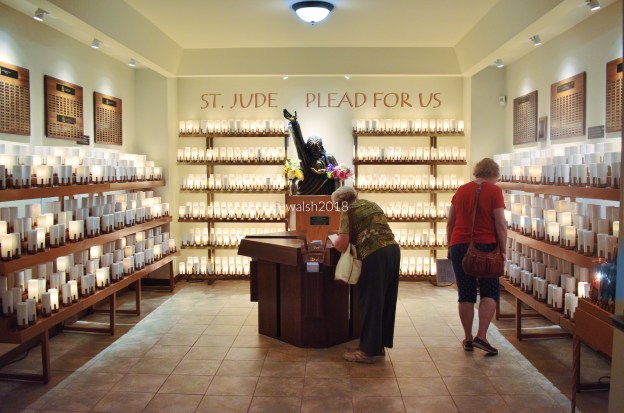
FEATURE Image: The many prayer intentions received at the National Shrine of St. Jude in Chicago are placed at the patron of hopeless cases’ devotional altar in the main sanctuary. These petitions are remembered at the National Shrine’s Masses and devotional prayers throughout the years. June 2018 80% 7.76mb DSC_9191. Author’s photograph.
Chicago’s National Shrine of St. Jude is more than a local religious landmark. It is a place where faith, devotion, and personal transformation intersect, most famously in the life of Danny Thomas, whose prayers to St. Jude here helped inspire a career that ultimately led to the founding of St. Jude Children’s Research Hospital. The shrine stands as a living testament to the powerful role that religious faith and pilgrimage can play in individual lives and broader humanitarian endeavors.
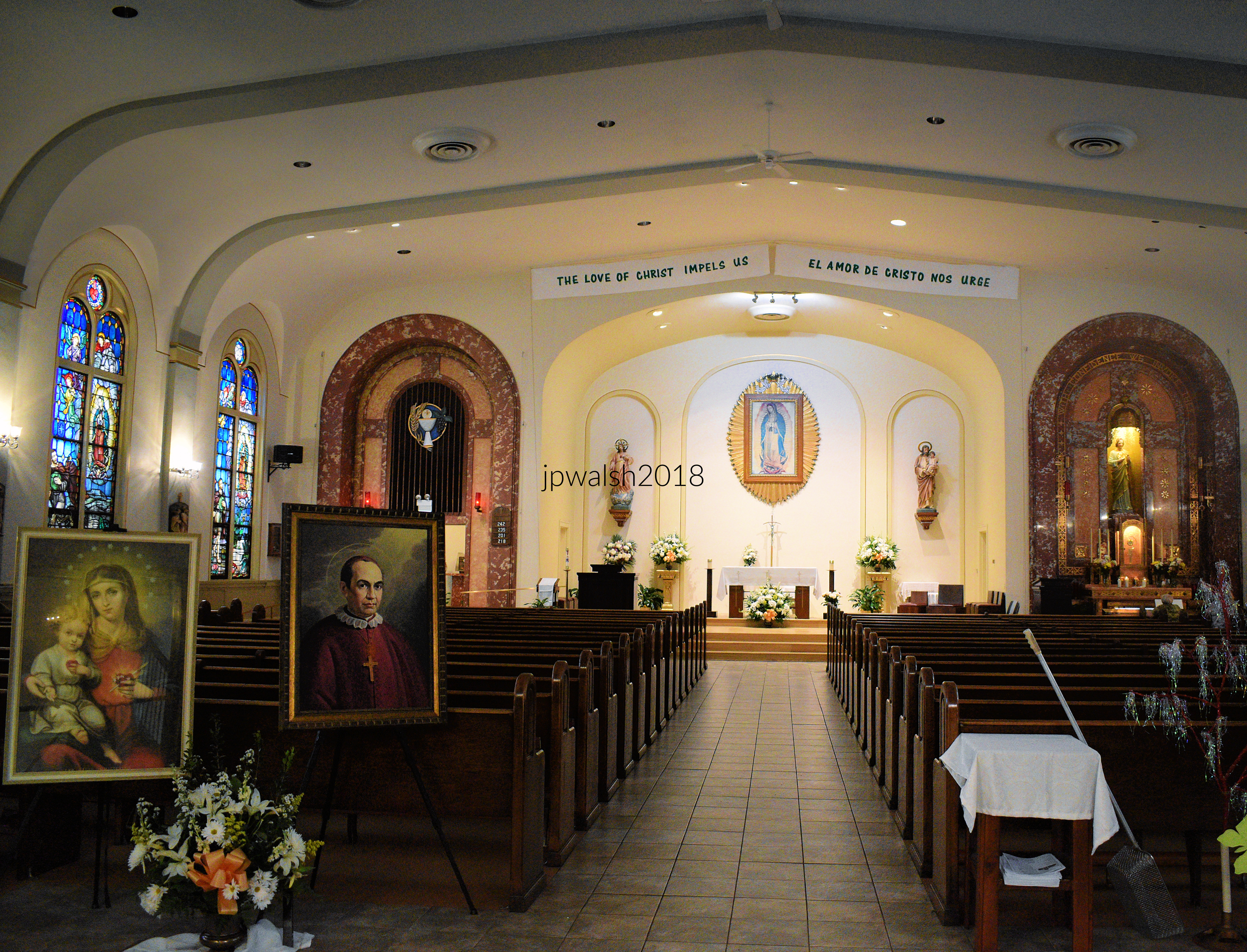
The National Shrine of St. Jude at 3208 E. 91st Street on Chicago’s far southeast side at Our Lady of Guadalupe parish church was canonically established in 1929. Its official decree was promulgated on November 15, 1929, by Chicago Cardinal Archbishop George Mundelein (1872-1939). June 2018 88% 7.72mb DSC_9173. Author’s photograph.
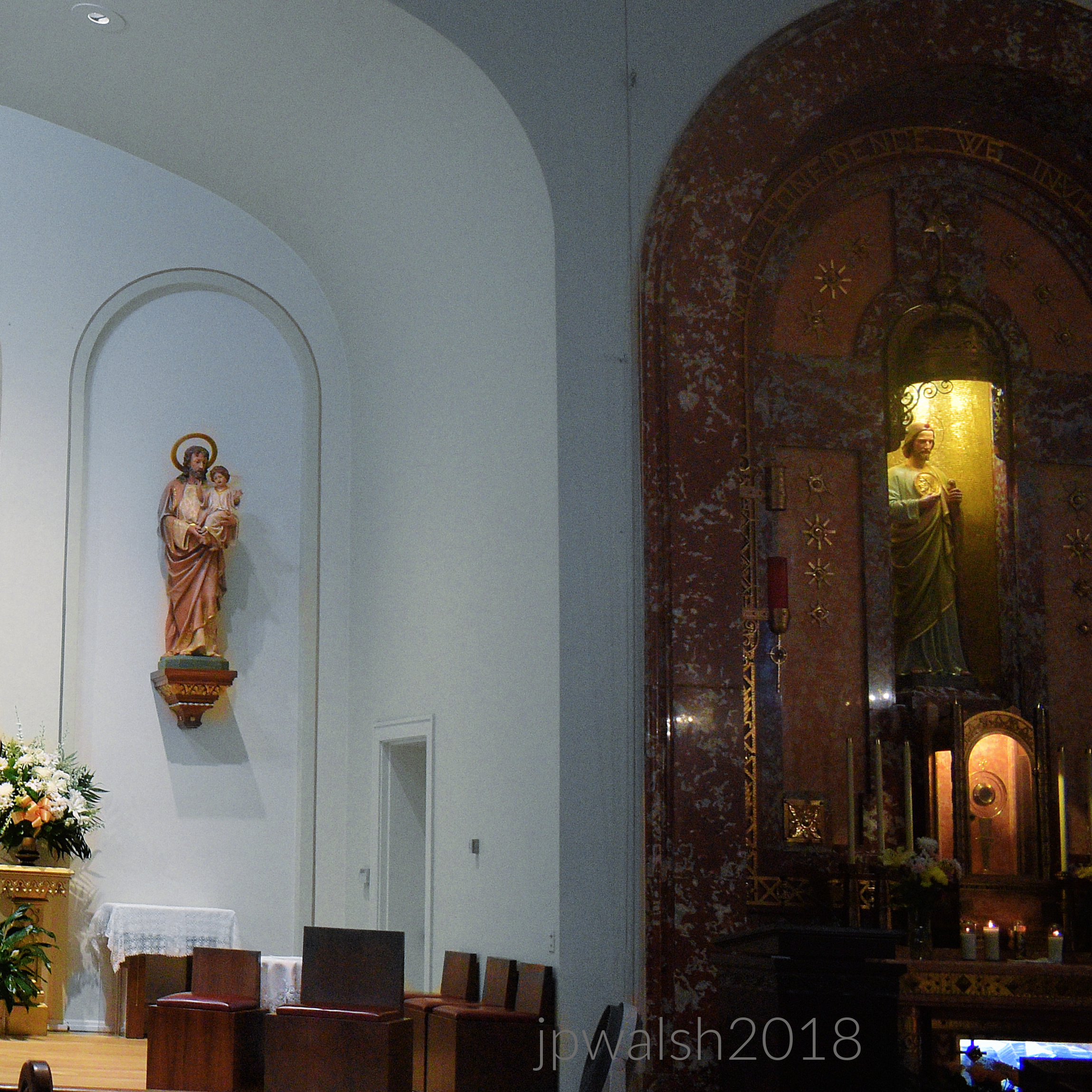
The pastor of the church at the time was Fr. James Tort, a Claretian missionary, who had a deep personal devotion to St. Jude, patron of hopeless cases and those that are almost despaired of. The saint, not to be confused with the traitor, Judas Iscariot, is honored by the church universally as the saint who brings visible and speedy help in most dire circumstances. A portrait of the founder of the Claretians, Spanish priest and bishop, St. Anthony Mary Claret (1807-1870), is one of the artworks that greet visitors into the main sanctuary. The image of Our Lady of Guadalupe is over the main altar. The devotional altar to St. Jude is right of the main altar. The altar to St. Jude contains a major relic of the saint: a piece of his bone. June 2018 84% 7.78 DSC_9177. Author’s photograph.
The shrine contains a major relic of St. Jude and serves as an active center of prayer and pilgrimage.
The shrine altar to St. Jude (right). In the darkest days of the Great Depression, Father Tort petitioned St. Jude with a request to help complete the parish church building for the people. In gratitude for the granting of this great favor. Fr. Tort promised to never cease to honor the saint, a true blood relative of Jesus and Mary, by dedicating a shrine altar to him in the church and to do all in his power to spread devotion to him. June 2018 2.29mb DSC_9186 (1). Author’s photograph.
This is one of the stained-glass windows in Chicago’s St. Jude Shrine. It depicts Jude preaching in Persia. Tradition holds that Saint Jude preached the Gospel in Judea, Samaria, Idumaea, Syria, Mesopotamia and Libya. He is also said to have visited Beirut. In addition to being patron of hopeless cases, Jude is patron of vegetarians. That Jude is portrayed holding an image of Jesus Christ has an interesting origin. During Jesus’s public ministry, a king had an incurable condition and was dying in Edessa. He sent a letter asking for Jesus to come. Instead of going himself, Jesus sent Jude. As Jude set out on this journey, Jesus pressed a cloth against His face, and when he gave it back to Jude, it had the Lord’s image on it. When St. Jude then went to the dying king in Edessa, and the king looked at the cloth with Christ’s miraculous impression, he was immediately healed. June 2018 6.47mbDSC_9184 (4). Author’s photograph.
Danny Thomas, struggling to establish himself in show business, learned of the shrine while in Chicago and prayed to St. Jude for assistance. Soon afterward, Thomas received the career opportunity that launched him to national fame as a comedian, television star, and entertainer.
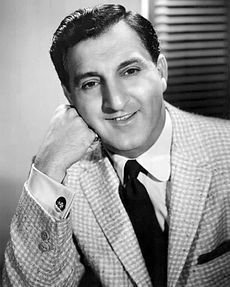
In 1940 when entertainer Danny Thomas (1912-1991) came to Chicago to do radio commercials, he found early success doing stand-up comedy in nightclubs. When work was finished, often around dawn, Thomas went to 6 a.m. Mass at St. Clement Church. There Thomas learned about Chicago’s National Shrine of St. Jude on the far southeast side. A couple of years earlier, Thomas, starting out in show business in Detroit— and with his first child, Marlo Thomas, on the way— had dedicated himself to St. Jude as the patron of hopeless cases. Soon after visiting and praying at the Chicago shrine, Thomas was offered a stand-up comedy job in New York City at La Martinique at 57 West 57th Street. This job launched his entertainment career into the big time. Following World War II, Thomas was performing for $3,750 a week at New York’s Roxy Theater just off Times Square and was performing in nightclubs across the country as well as offered film roles. In 1953 he starred in his own television show, Make Room for Daddy (later, The Danny Thomas Show). The sitcom ran for 11 consecutive seasons and became more popular with each year. By 1957 it was the no.2 show on television and, when the sitcom ended in 1964, it was in the top ten. PHOTO: “Danny thomas kayrouz” by Hany raymond rahme is licensed under CC BY-SA 4.0.
Remembering his promise to give back if he succeeded, Thomas founded St. Jude Children’s Research Hospital in Memphis in 1962, creating one of the world’s most respected pediatric medical institutions.
The National Shrine of St. Jude in Chicago was canonically established in 1929 and became one of the most important centers of devotion to St. Jude in the United States.
Altar of St. Jude, The National Shrine of St. Jude in Chicago. St. Jude Thaddeus was one of Jesus’ 12 apostles and. legend has it, that it was Jude who was the groom at the wedding feast of Cana where Jesus performed his first miracle of turning water into wine (John, chapter 2). Matthew states that Jude was one of the “brothers” of Jesus usually interpreted as a blood cousin. St. Jude, pray for us! June 2018 73% 7.89mb DSC_9182. Author’s photograph.
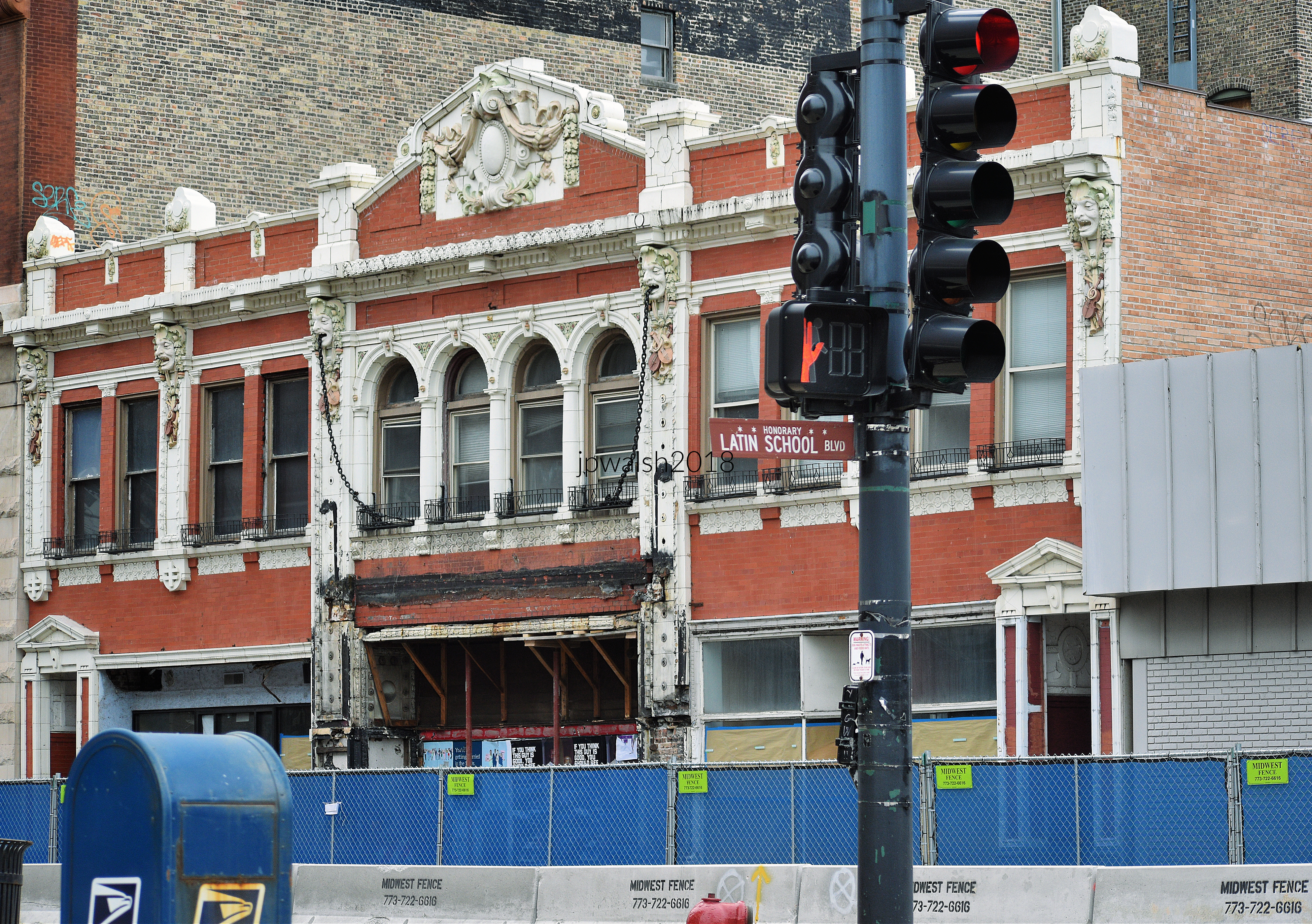
FEATURE Image: February 2018. Village “Art” Theatre, 1548-50 N. Clark Street, Chicago, Illinois 60610. The use of masks had been used in theatre since ancient times. They were usually tied to their dramatic source material and the inherent psychology of the characters. The Landmark Designation Report for the Village Theatre described this polychrome character head with musical instruments as “singing” in honor of the neighboring Germania Club, a German social club with its origins in men’s choral music. The head also wears a Baroque-style “wig” of oak leaves and acorns. In Germany, oak trees are revered, and acorns are a symbol of good luck. A decorative keystone on the theater’s round-arched window also has an acorn ornament. 88% 7.94mb DSC_4799 Author’s photograph.
The Village Art Theatre was more than a neighborhood movie house. It embodied Chicago’s early film culture, immigrant heritage, and evolving urban identity for over a century. Although the building itself was demolished in 2018, the survival of its historic façade highlights both the possibilities and limitations of preserving architectural memory amid redevelopment.
Historical Origins & Opening
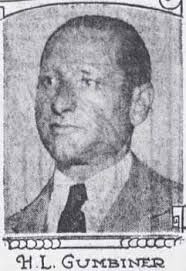
Designed by architect Adolphe Woerner (born Stuttgart, Germany 1851- 1926), the Village (Art) Theatre opened as the Germania Theatre on July 29, 1916 and closed in its 91st year in March 2007. The building was erected by German-born Frank Schoeninger exclusively as a movie theater for $75,000 (about $2.2 million in 2025) and leased for an annual $7,000 rent (about $205,000 today) to Herman L. Gumbiner (Germany, 1879- 1952, Santa Monica, Calif.) in a 10-year contract with his company, The Villas Amusement Company (later Gumbiner Theatrical Enterprises).
The Rise of Neighborhood Movie Houses
By 1910, buildings erected solely for the purpose to showcase motion pictures were becoming increasingly popular as the appetite to consume the latest silent motion pictures out of Hollywood was booming everywhere. These neighborhood movie houses, larger than dingy storefront nickelodeons and yet smaller than flamboyantly ornate vaudeville theatres, had movie “palace” touches while fitted conveniently into Chicago’s many local commercial strips.
Scale, Survival, and Target Audience
Nearly all of these first-generation movie theaters in Chicago have been demolished or remodeled for other purposes including those larger-scale theaters developed by major theater operators such as Balaban and Katz, Lubliner and Trinz, and the Marks Brothers. While those palatial theatres could hold between 2,000 and 4,000 movie-goers the Village Theatre, one of the last and best first generation movie houses to survive for so long, originally held 1,000 spectators. Originally named the Germania Theater because it was next door to the Germania Club, it looked to attract affluent club members to its flicks.
The theater reflected the strong German-American presence in the neighborhood through its decorative symbols and association with the neighboring Germania Club.
The Germania Theatre was built in 1916 on Frank Schoeninger’s open land pictured above between the Germania Club (completed in 1889) and his tavern and hotel on the corner of Clark Street and North Avenue. In 1986 the Germania Club, citing the dwindling numbers of members, finally disbanded. Public Domain.
Herman Gumbinger and Expansion to Los Angeles
Herman Gumbinger was a major film exhibitor who was busy in Chicago building his independent theatre chain in the 1910’s, with several new movie house projects and acquisitions throughout the city’s northside primarily. After building Chicago’s first independent movie house chain in the teens, Gumbinger relocated to Los Angeles, California, in 1921 where he built the famous Los Angeles Theatre in the Broadway Historic Theatre District of Downtown L.A. Erected at a cost of over $1.5 million ($31 million today) and designed by renowned movie theatre architect S. Charles Lee (1899-1990) Gumbinger’s theatre premiered Charlie Chaplin’s City Lights. Gumbinger Theatrical Enterprises finally dissolved in 1943.
Herman Gumbinger (1879-1956), c. 1924, built Chicago’s first independent movie chain, including what became the Village Art Theatre. By the end of the 1920s, Chicago had more than thirty of these movie palace theaters. Among its holdings, Herman Gubinger and his brothers operated the New Blaine which was renamed and is today the Music Box Theatre. Public Domain.
Neighborhood Context and Architectural Design
The Germania was one of the first-generation movie theatres built at the intersection of three Chicago neighborhoods – Gold Coast to the south and east, Old Town to the north and west and Lincoln Park to the north. An architectural mix of styles including Classical Revival (triangle pediments, pilasters and cornice with dentils fashioned in terra cotta) and Renaissance Revival (rusticated exterior and round-arched windows with keystones), the movie house also incorporated Germanic symbolism in its details reflecting the area’s then prominent ethnic group.
WWI Impact and a Century of Name Changes
During World War One, in a wave of anti-German sentiment, The Germania Club renamed itself the Lincoln Club. It changed its name back in 1921. The Germania Theatre changed its name to the Parkside and never looked back. In 1931 until 1962 it was known as the Gold Coast theatre. Meanwhile, prohibition closed down Frank Schoeninger’s tavern and he left for Wisconsin. In the 1960’s the theatre was updated and renamed the Globe Theatre. In 1967 the building was renamed the Village Theatre after it survived being demolished by the nearby Sandburg Village development.
Sandburg Village is a Chicago urban renewal project consisting of eight high-rise buildings, a mid-rise building and 60 townhomes and artists’ lofts. The development was first occupied In 1963 and completed in 1971. In the early 1960’s the Village Theatre was to be incorporated into the project until its landowner refused to sell. PHOTO: “20190323 08 Carl Sandburg Village (49490506022)” by David Wilson from Oak Park, Illinois, USA is licensed under CC BY 2.0.
February 2018. The Village Theatre in the last days before its demolition. Its marquee from the 1960’s has been removed. The Village Theatre sat across the street from Latin School of Chicago at North and Clark Streets in Gold Coast/Old Town. In its Landmark Designation Report, the Village Theatre façade is described as having “a symmetrical arrangement, with a central theater entrance and separate entrances to the upstairs offices at opposite ends of the building. Each upper-story entrance has a deeply-recessed alcove lined with brick and white, carved-wood panels. A limestone slab step, inset with hexagonal tiles, is inside each alcove. Each alcove is framed with white terra cotta and brick pilasters on a base of gray terra cotta, made to imitate granite. The pilasters are topped with a triangular, white terra-cotta pediment.” 70% 7.93 mb DSC_4797. Author’s photograph.
Architectural Features and Exterior Appearance
The original two-story façade of red pressed brick and white beige glazed terra cotta decoration competed with a sizeable modern marquee that was removed before its demolition in 2018.
Personal Memories and Moviegoing Experiences
Since after college I was living in Chicago in the 1980s and 1990s, I saw several films at the Village Theatre before it became a multi-plex in 1991 such as House of Games, Fatal Attraction, Wall Street (1987), The Unbearable Lightness of Being (1988), Russia House (1990). In early 1991 the interior of the theater was divided into four screens, and I didn’t stop going to movies there–JFK (1991), Michael Collins (1996), The Red Violin (1999) and more– but not as frequently. Anyway, I moved essentially out of neighborhood in 1995 and sold my condo soon afterwards. The Village Art Theatre in Chicago officially closed as a movie venue in March 2007.
The theater underwent several name changes, including Parkside, Gold Coast, Globe, and finally Village Theatre, adapting to changing audiences and neighborhoods.
Demolition and Modern Condominium Redevelopment
In April 2018, the Village Theatre and neighboring buildings along North Avenue were completely demolished to make way for construction of a condominium building. The ornate Clark Street frontage was stabilized as everything else crumbled to dust around it. The façade was repurposed to serve as the entrance for the new condo development known as Fifteen Fifty on the Park with units priced at opening at $1.625 to $5.85 million.
Beginning in 1969, it became associated with art-house cinema through screenings connected to the Chicago International Film Festival, leading to its “Village Art Theatre” identity. Its run as a core festival venue ended following the October 1989 run.
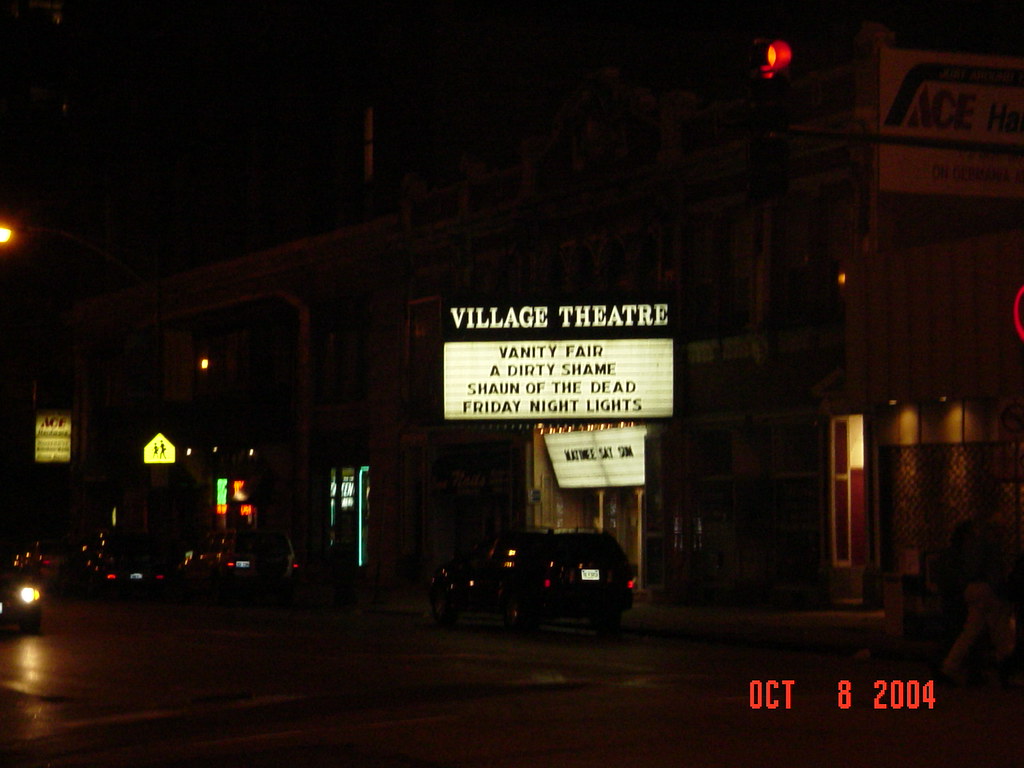
The Village Theatre took the moniker Village Art Theatre after The Chicago International Film Festival used the Village Theatre as a venue to screen “art house” films starting in 1969.In early 1991, the historic 900-seat single auditorium was completely gutted and divided into four smaller screens. This structural partition broke up the grand theater space, ending its era as a primary, large-format host for the main international film festival tracks. October 2004. PHOTO: “Village Art Theatre” by BWChicago is licensed under CC BY-NC 2.0.
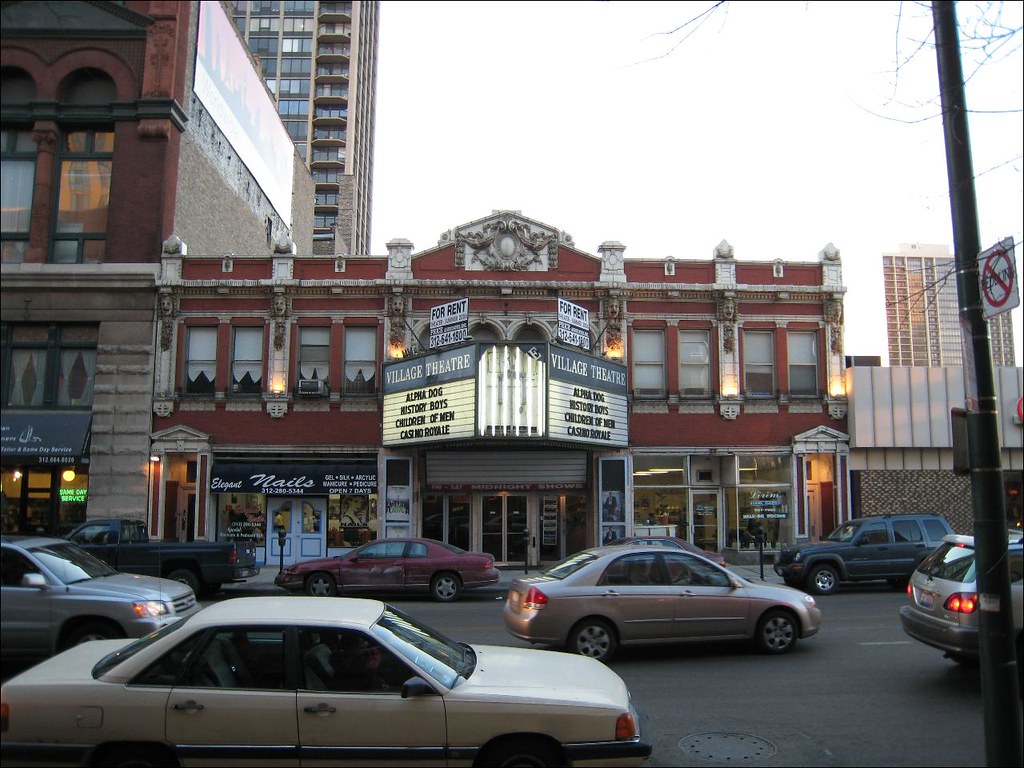
The Village Theatre had at least three distinctive marquees during its history. The first was the original vertical Germania sign, removed almost as soon as it was installed because of anti-German sentiment during World War I. It was followed by a horizontal awning-style marquee, similar to that of Chicago’s Biograph Theater at 2433 N. Lincoln Avenue, installed during the theater’s years as the Gold Coast. The third was the dramatic prow-shaped marquee shown here, paired with steel-and-glass doors and believed to date from the mid-1960s renovations undertaken when the movie house operated as the Globe. PHOTO: “Germania (Parkside, Gold Coast, Globe, Village) Theatre, Chicago, IL” by BWChicago is licensed under CC BY-NC 2.0.
Demolished in 2018 for a luxury condominium development, the building’s ornate façade was retained and incorporated into the new project. October 2018. Author’s collection.
The Village Art Theatre was one of Chicago’s earliest purpose-built neighborhood movie palaces, constructed during the rapid growth of motion-picture exhibition. The building’s history captures its full arc as an architectural, cultural, and neighborhood landmark, ending with the forever tension between preservation and redevelopment.
This explanatory article may be periodically updated.
FEATURE image: Chicago Loop Synagogue with stained glass window, Let There Be Light (1960) by American Expressionist artist Abraham Rattner (1895-1978). The synagogue was built in 1957 with this wall of stained glass. The colorful and semi-abstract artwork contrasts and complements with the architectural minimalism of the rest of the sanctuary. October 2015. Author’s photograph.
The Chicago Loop Synagogue is a remarkable fusion of mid-century modern architecture, Jewish religious symbolism, and monumental art, demonstrating how modern design can create a powerful expression of faith, identity, and spiritual experience.
Chicago Loop Synagogue, exterior. May 2024. Author’s photograph. 97% 7.89 mb
Chicago Loop Synagogue was a midcareer project for a pair of leading Chicago Jewish architects of Modernism — Jerrold Loebl (1899–1978) and Norman Schlossman (1901– 1990). Loeble was a son of Hungarian immigrants and Schlossman was the grandson of immigrants from Germany. Both graduated from the Armour Institute (today’s Illinois Institute of Technology) and became partners in 1925. The third partner changed over the decades and in 2024 the firm is Loebl, Schlossman, & Hackl. Following World War II, the firm was Loebl, Schlossman & Bennett and the team created influential examples of Chicago’s mid-century Modernism. Richard Marsh Bennett (1907-1996) had been chairman of the Yale Architecture Department and stayed with the firm until 1974 when he returned to teach at the Harvard Graduate School of Design. The architectural firm’s designs included Weiss Memorial Hospital (4646 N Marine Drive) and The Darien (3100 N. Lake Shore Drive ) also built in the 1950s.
Above: The exterior of the Chicago Loop Synagogue (above), located at 16 South Clark Street in downtown Chicago. Designed by the prominent mid-century modernist architectural firm Loebl, Schlossman & Bennett, the building was completed in 1957–1958 and occupies a compressed, mid-block urban footprint of roughly 5,000 square feet. Hemmed in closely by soaring office buildings, the synagogue makes a deliberate statement of scale and transparency rather than sheer height. The front wall embraces reserved mid-century minimalism. At street level, it features clear floor-to-ceiling storefront glass that allows a seamless view into the stone-lined lobby. Above the ground floor rises a monumental grid wall of muted, industrial-scale metal and glass framing panels. Capping the massive glass wall is a distinctive, jagged tripartite metal cornice or canopy. These three structural gables jut outward over the sidewalk, adding a playful, geometric crown to an otherwise stark grid facade. The copper/bronze material has weathered into a deep green verdigris hue.
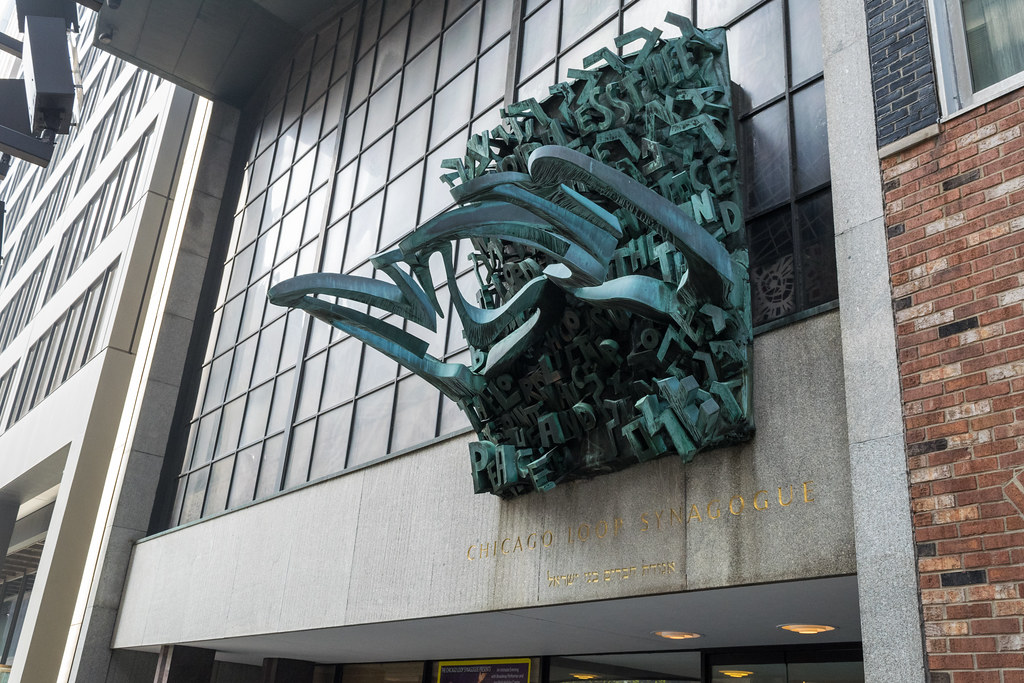
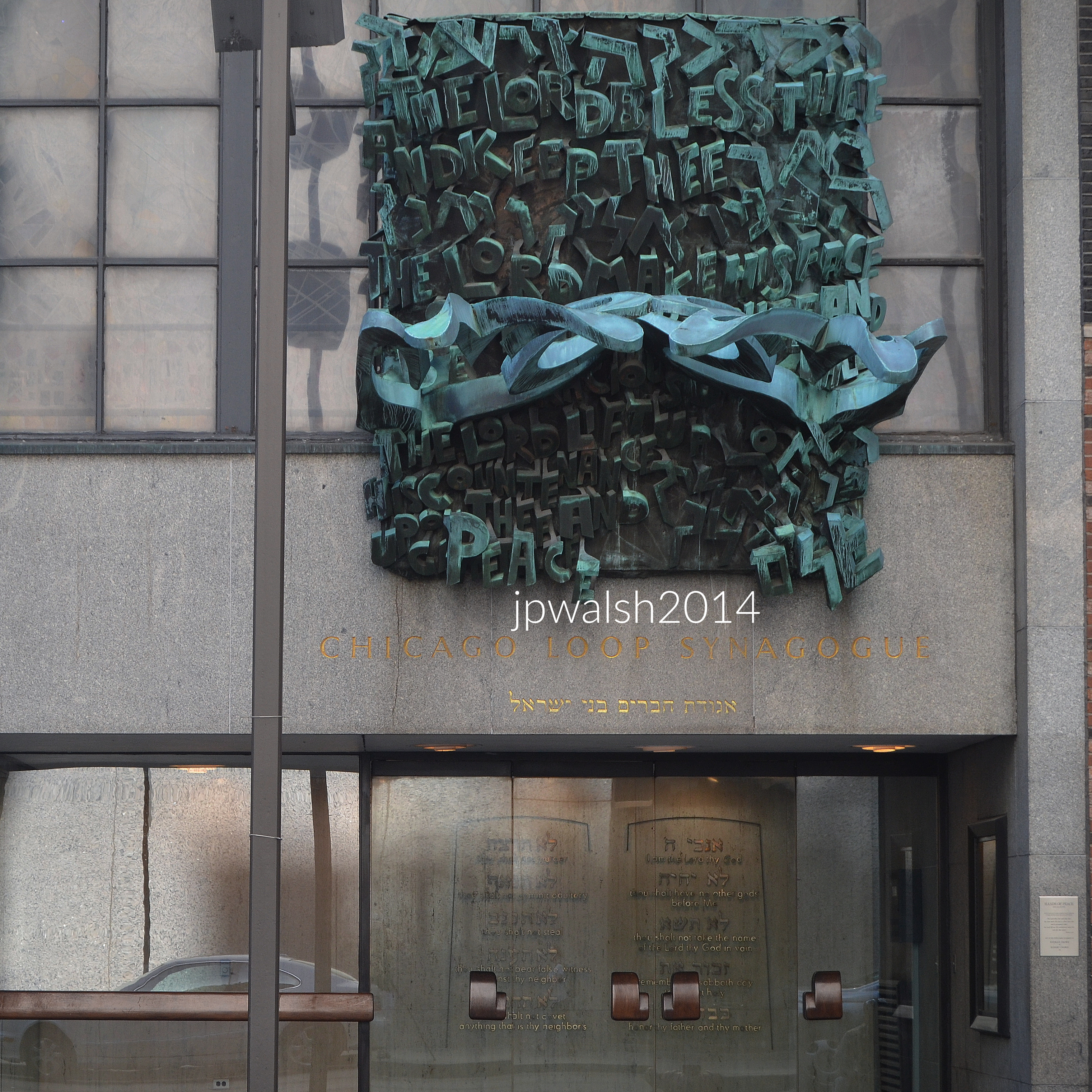
Above and below: Perched directly over the main entry doors is a two-ton bronze sculpture titled Hands of Peace (1963), created by the acclaimed Israeli sculptor Henri Azaz (Nehemia Azaz). The abstract composition features a jumble of bold letters cascading over one another. Emerging directly from the text is a massive pair of stylized, open human hands sloping down toward the street.
Chicago Loop Synagogue: Hands of Peace. May 2014. Author’s photograph. 4.28mb DSC_0055 (3).
Above: The tumbled letters shape the words of the priestly benediction (the Birkat Kohanim) from the Book of Numbers (6:24–26) in both English and Hebrew. The sculpture spells out: “The Lord bless thee and keep thee; the Lord make His face to shine upon thee… and give thee peace.” The pair of down-sloping bronze hands mimic the physical stance used by the Kohanim (priests) when delivering a blessing over a congregation. By suspending this gesture directly over the sidewalk, the architecture acts as an open, perpetual blessing bestowed upon all downtown workers, visitors, and passersby stepping into or walking past the sanctuary.
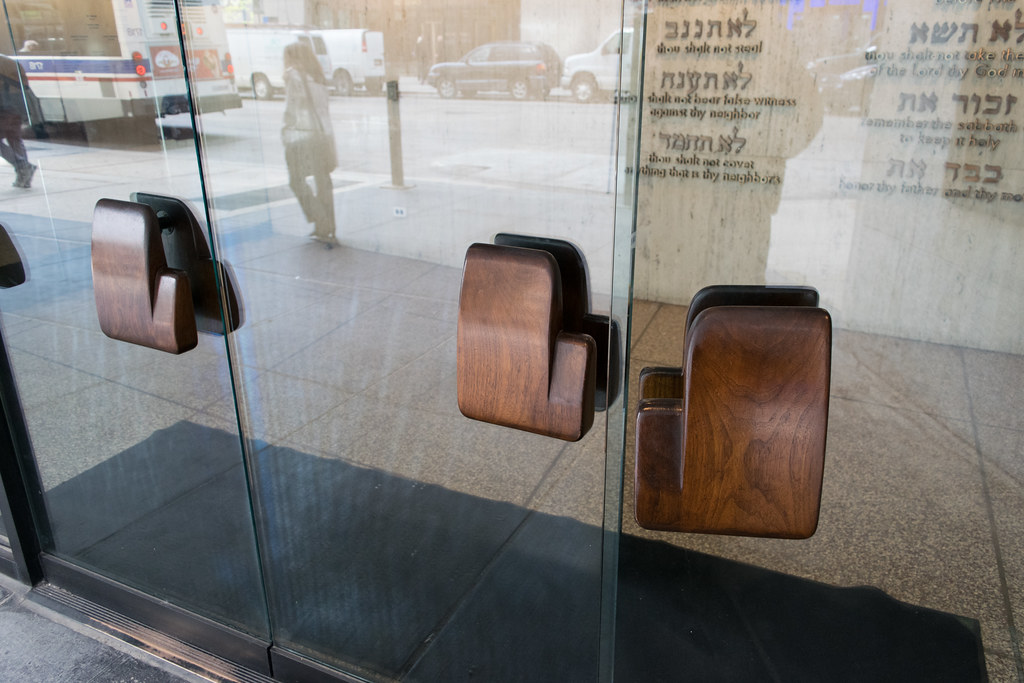
Glass doors with wooden handles define the main entrance into Loop Synagogue off busy Clark Street in Downtown Chicago. PHOTO: “Chicago Loop Synagogue” by _jjph is licensed under CC BY-NC-SA 2.0
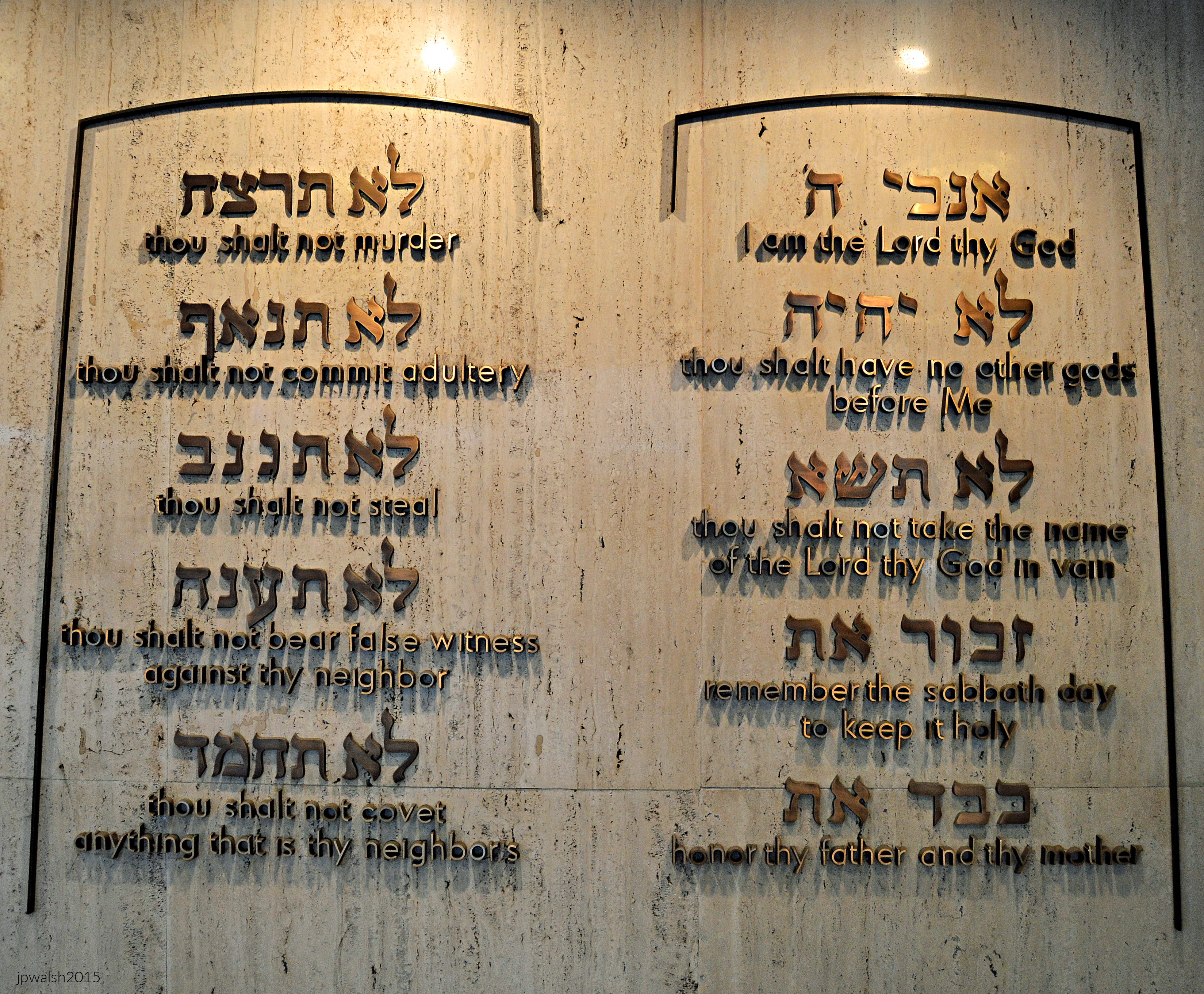
Chicago Loop Synagogue. September 2015. Author’s photograph. 4.73 mb
Above: The Ten Commandments meet the visitors in the foyer upon entering synagogue. For Jews, the Ten Commandments found in Exodus 20:2-17 and Deuteronomy 5: 6-21 are a special set of spiritual laws that the LORD Himself wrote on two stone tablets (luchot) that Moses brought down from Mount Sinai. In the Scriptures these laws are called the “Aseret Ha Devarim,” the “ten words” or “ten utterances.” In rabbinical writings, they are usually referred to as “Aseret Ha Dibrot,” and in Christian theological writings they are called the Decalogue which is derived from the Greek name “dekalogos” (“ten statements”) found in the Septuagint (Exodus 34:28 and Deuteronomy 10:4), which is the Greek translation of the Hebrew name. To the Jews the Torah has a total of 613 commandments which includes the ten from the Decalogue.
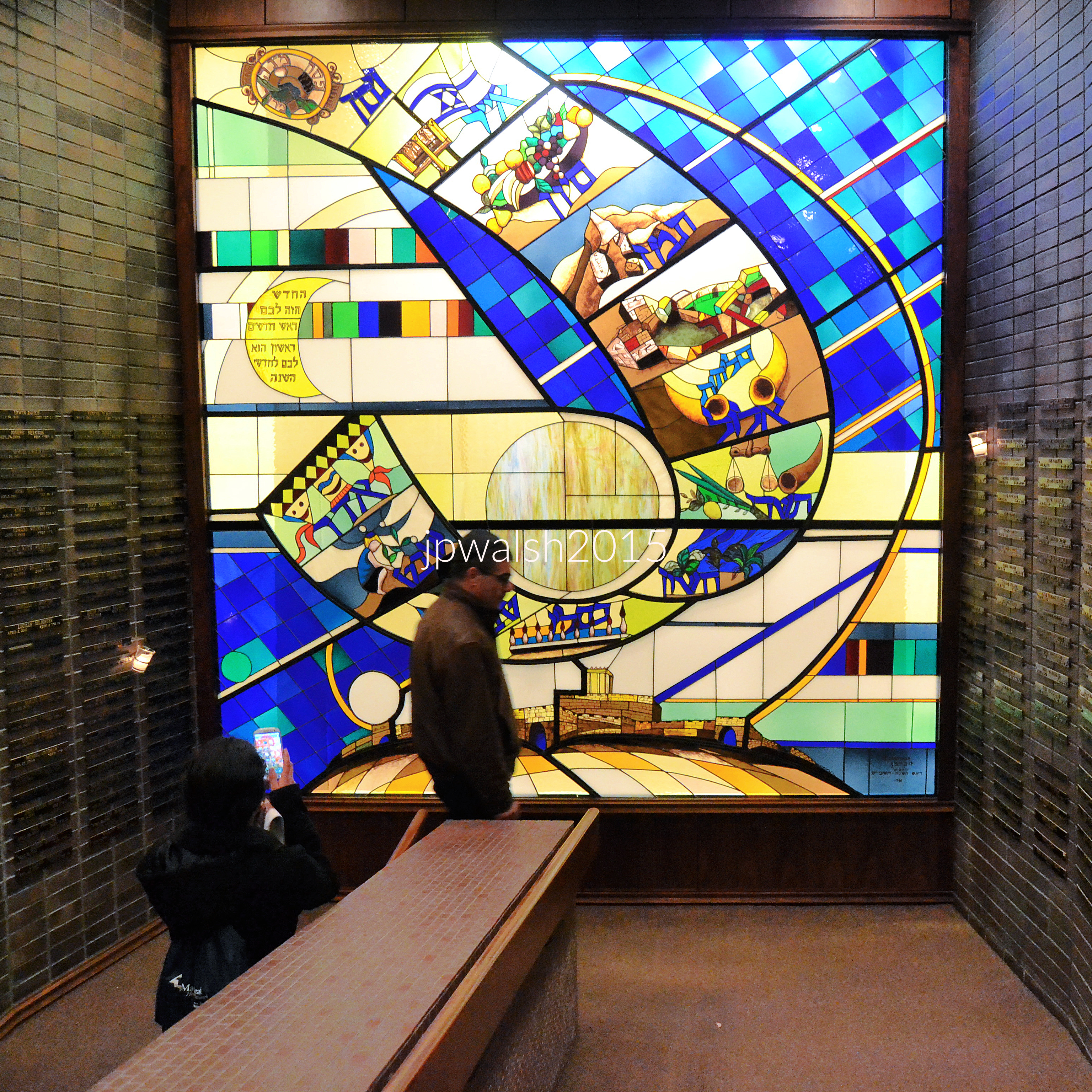
Chicago Loop Synagogue. October 2015. Author’s photograph.5.04mb DSC_0034 (1)
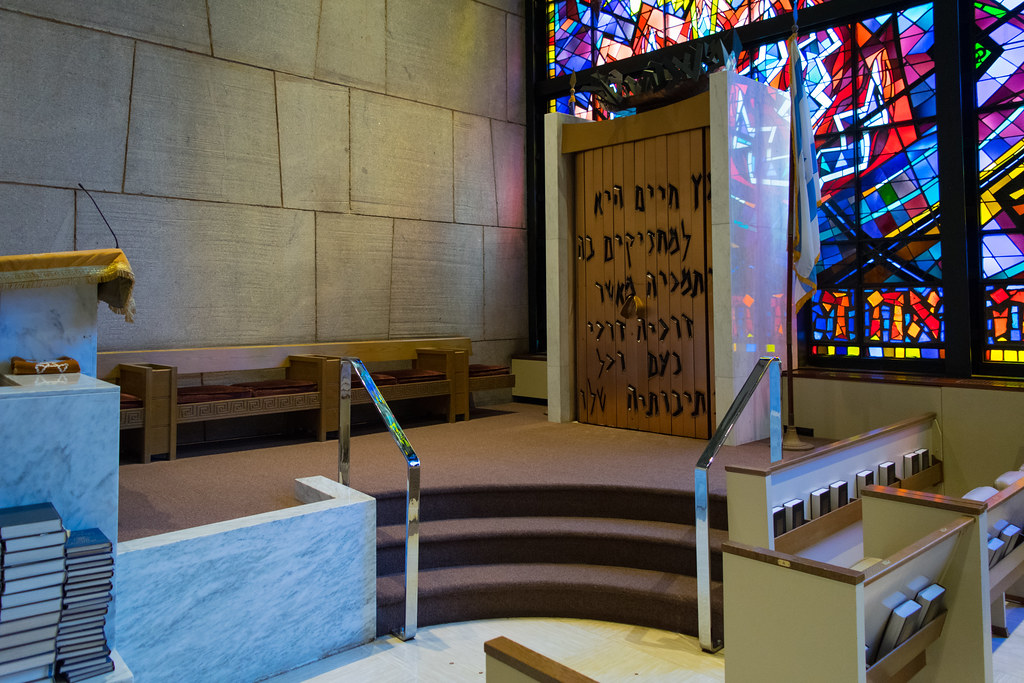
Above: The synagogue’s Memorial space centers on the Memorial Window, a stained-glass work designed by American Expressionist artist Abraham Rattner (1895–1978). Created around 1960–1961, it coincided with the design and installation of his monumental three-story masterpiece, Let There Be Light, in the main sanctuary. Rendered in brilliant blues, golds, and emerald greens, the window presents a dynamic composition of symbolic Jewish imagery and occupies the landing of the main staircase and ramp system connecting the street-level lobby with the lower-level Beit Midrash (house of study) and social hall.
The walls on both sides are lined with illuminated Yahrzeit plaques commemorating past members of the congregation. Within this contemplative setting, Rattner’s window introduces a radiant note of hope, evoking eternal life, cosmic time, and the enduring cycles of Jewish tradition.
The window’s imagery incorporates a wide range of Jewish symbols. At left, a Hebrew inscription quotes Exodus 12:2 concerning the renewal of months: “This month shall be unto you the beginning of months…” Circular medallions depict symbols associated with major Jewish festivals, including the shofar of Rosh Hashanah, a basket representing the Seven Species, and the Lulav and Etrog used during Sukkot. In the upper left section, the Magen David (Star of David) appears alongside stylized references to the modern State of Israel. The lower portions of the composition incorporate views of ancient Jerusalem and the Western Wall, linking the themes of memory and renewal to Judaism’s historic spiritual center.
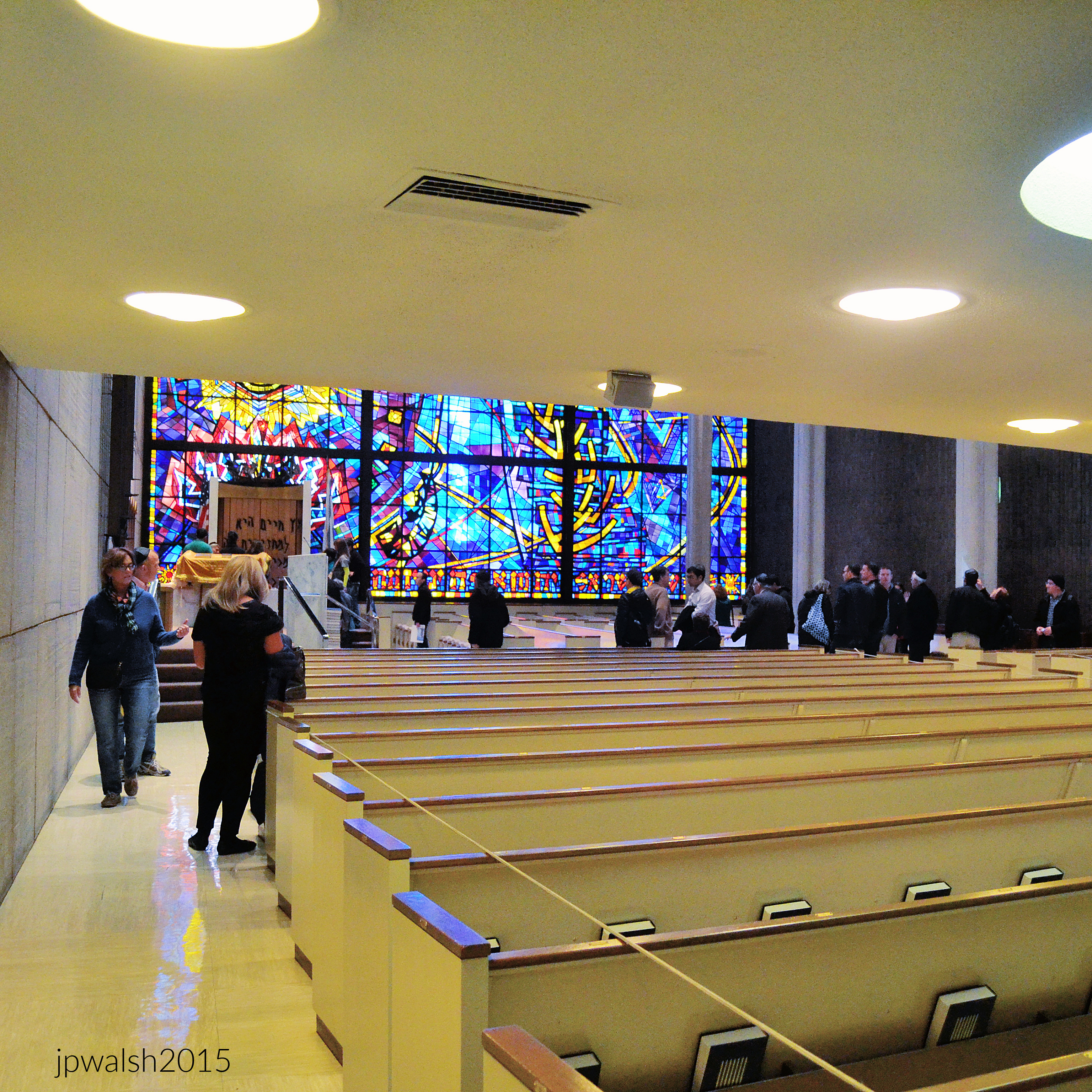
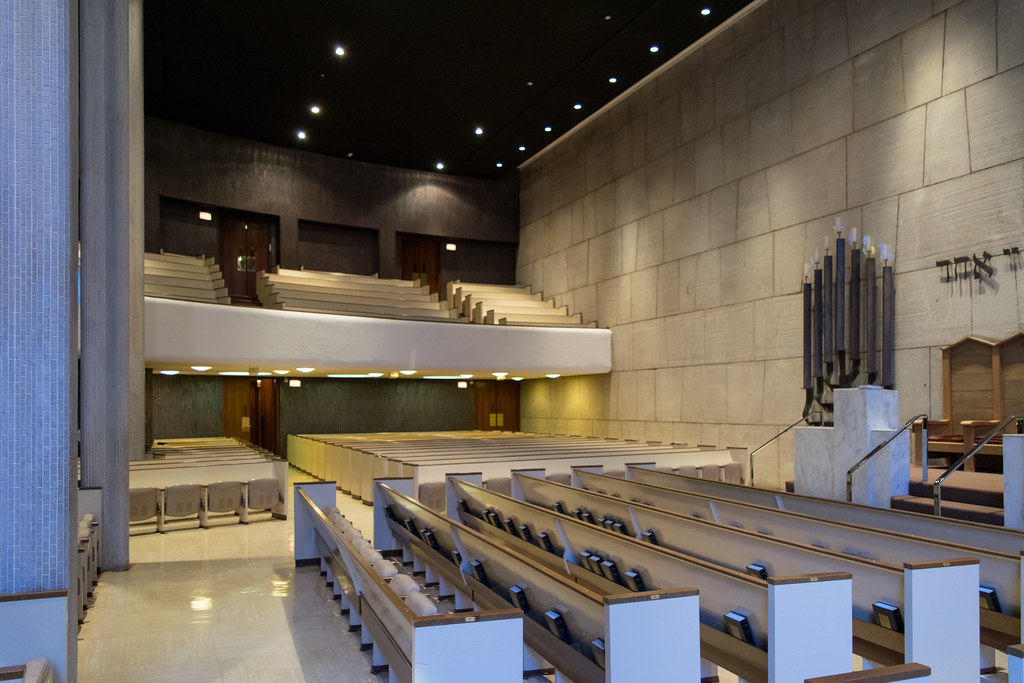
Above: The dramatic contrasts and geometric rigor of The Chicago Loop Synagogues’ Mid-Century Modernist design are evident throughout the sanctuary. Long, sweeping rows of custom-designed wooden pews extend the length of the space, reflecting the era’s characteristic blend of corporate efficiency and spiritual order. A massive floating balcony cantilevers boldly over the rear portion of the sanctuary, emphasizing the building’s structural daring.
The wall beneath and behind the balcony is clad in dark, vertically grooved wood paneling, creating a rich visual counterpoint to the monumental sanctuary wall beyond. Rising to its full height, this soaring surface is constructed of large, ashlar-patterned stone blocks, whose rough, matte texture provides a powerful sense of permanence. The monolithic masonry evokes the ancient stone architecture of Jerusalem while remaining firmly rooted in a clean Modernist aesthetic.
Overhead, a matte-black, non-reflective ceiling seems to hover above the congregation, punctuated by precisely placed recessed spotlights. Their pinpoints of light resemble a star-filled night sky, dissolving the boundaries of the ceiling and enhancing the sanctuary’s remarkable sense of height and openness.
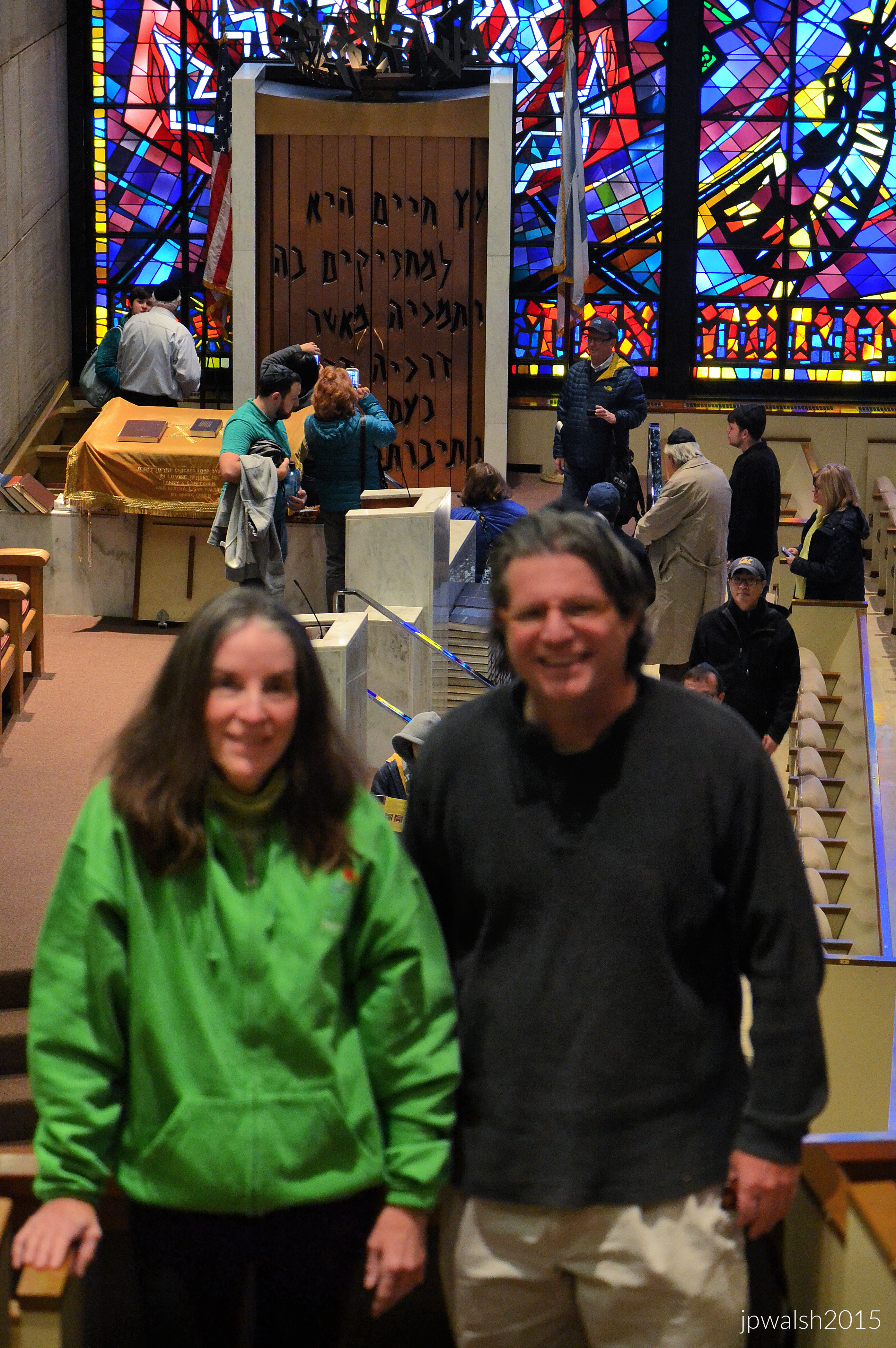
The limestone blocks of the North wall are cut at an angle to evoke the Western Wall of the Temple in Jerusalem. The Hebrew text inscribed on the wall is the Shema Yisrael, which is the central prayer and declaration of faith in Judaism. In English, it translates to: “Hear, O Israel: The Lord our God, the Lord is One.” October 2015. Author’s photograph. 4.41mb DSC_0970
The Holy Ark is made by Israeli sculptor and ceramicist Henri Azaz (1923-2008). Jutting into the prayer space from the far-left corner of the window, Rattner incorporated the ark that would house the Torah scrolls. The artist surrounded the ark with flames, integrated into the glass. leaping up and out, drawing attention to the presence of God in the very heart of the sanctuary. PHOTO: “Chicago Loop Synagogue” by _jjph is licensed under CC BY-NC-SA 2.0.
Chicago Loop Synagogue is a house of worship that is three floors, 450 seats, six Torahs, and a 40-foot-tall stained-glass window that fills the Eastern façade and congregation with filtered sunlight. October 2015. Author’s photograph. 5.25 mb DSC_0990
The Chicago Loop Synagogue was founded in 1929 to serve the religious needs of those whose business activities brought them downtown. October 2015. Author’s photograph. 3.43 mb DSCN1463 (1)
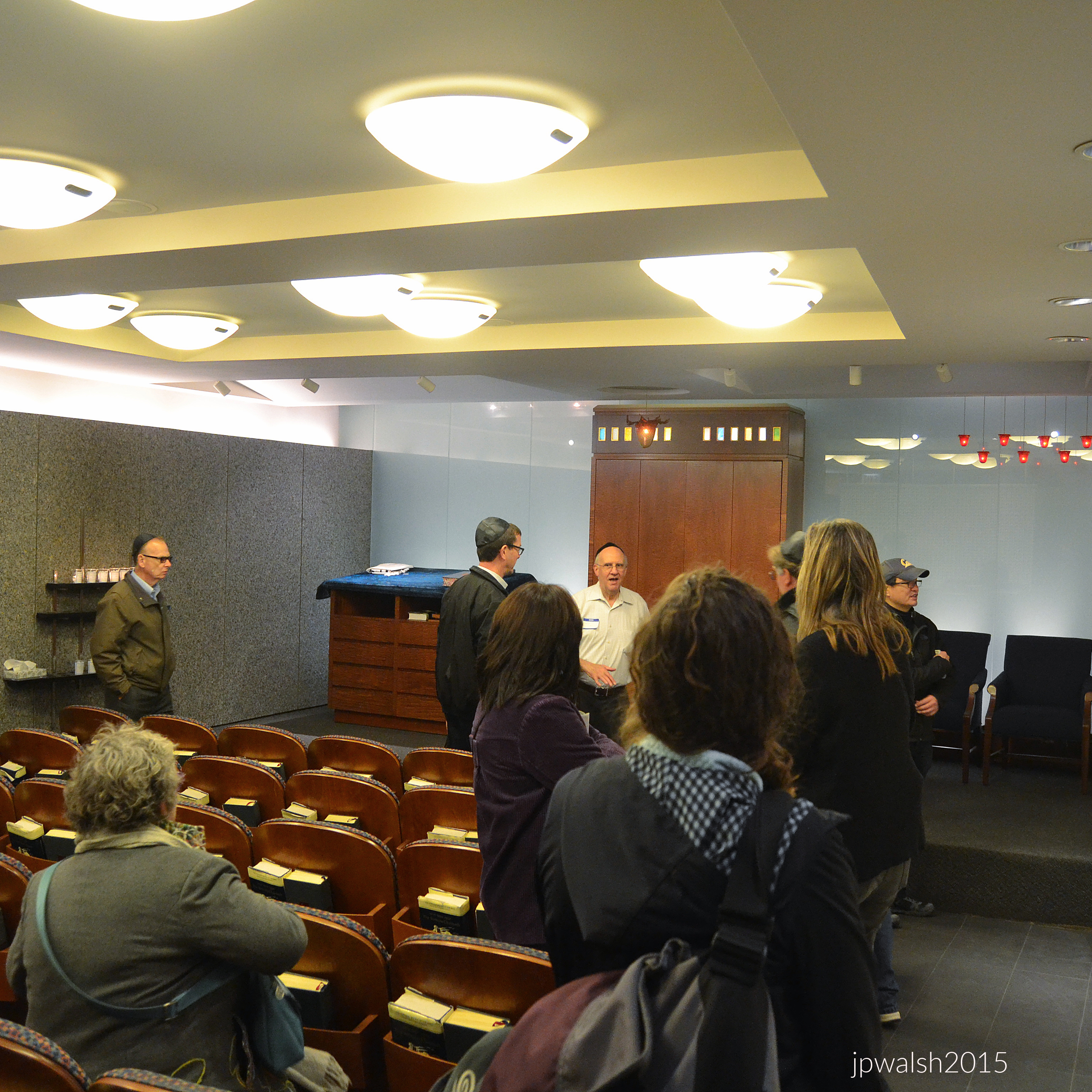
Visitors to the Chicago Loop Synagogue in the Main Sanctuary are guided by one of its members. October 2015. Author’s photograph. 4.26mb DSC_0019
Main Sanctuary. October 2015. Author’s photograph. 91% 7.77mb DSC_0969 (1)
Abraham Rattner, the Expressionist artist of the wall-filling colorful stained-glass window was born in Poughkeepsie, New York to a Russian-Jewish father and a Romanian-Jewish mother. Rattner studied to be architect but turned to painting studying at the Corcoran School of Art in Washington D.C. and the Pennsylvania Academy of the Fine Arts in Philadelphia. Rattner served as a camouflage artist in France during World War I and, after the war, joined many of “the Lost Generation” that writer and critic Gertrude Stein spoke about when referencing the post- war Ernest Hemingway and many others who lived in Europe, mainly Paris, in the 1920s. Rattner lived in Paris for 20 years, from 1920 until late 1939 where, during that extensive time period, he met Claude Monet (1840-1926). To avoid the coming Nazi invasion of France, Rattner and his wife Bettina Bedwell (1889-1947), a journalist and fashion illustrator from Nebraska who studied at the School of the Art Institute of Chicago and who married in 1924, returned to America, where they lived in New York City. Rattner was known for his rich use of color and abstraction in his artwork and whose subject matter often had to do with religion. In the post-World War II era he taught at several schools, including New York’s The New School (1947–55) and at Yale University (1952-1953). In 1949 Rattner married Esther Gentle (1899 – 1991), an artist and art dealer, and was a friend of writer Henry Miller (1891-1980) who wrote about their friendship in 1968 in A Word About Abraham Rattner.
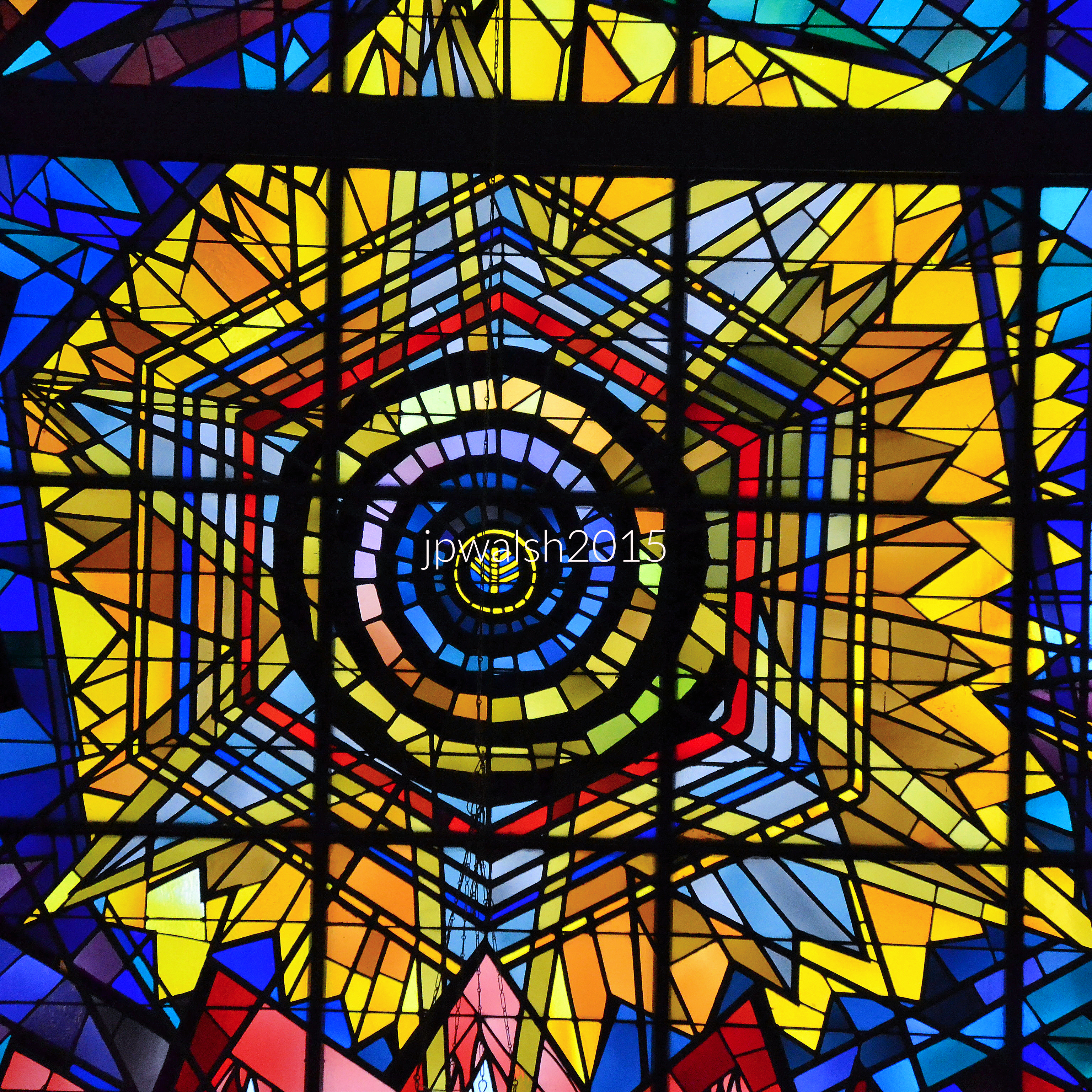
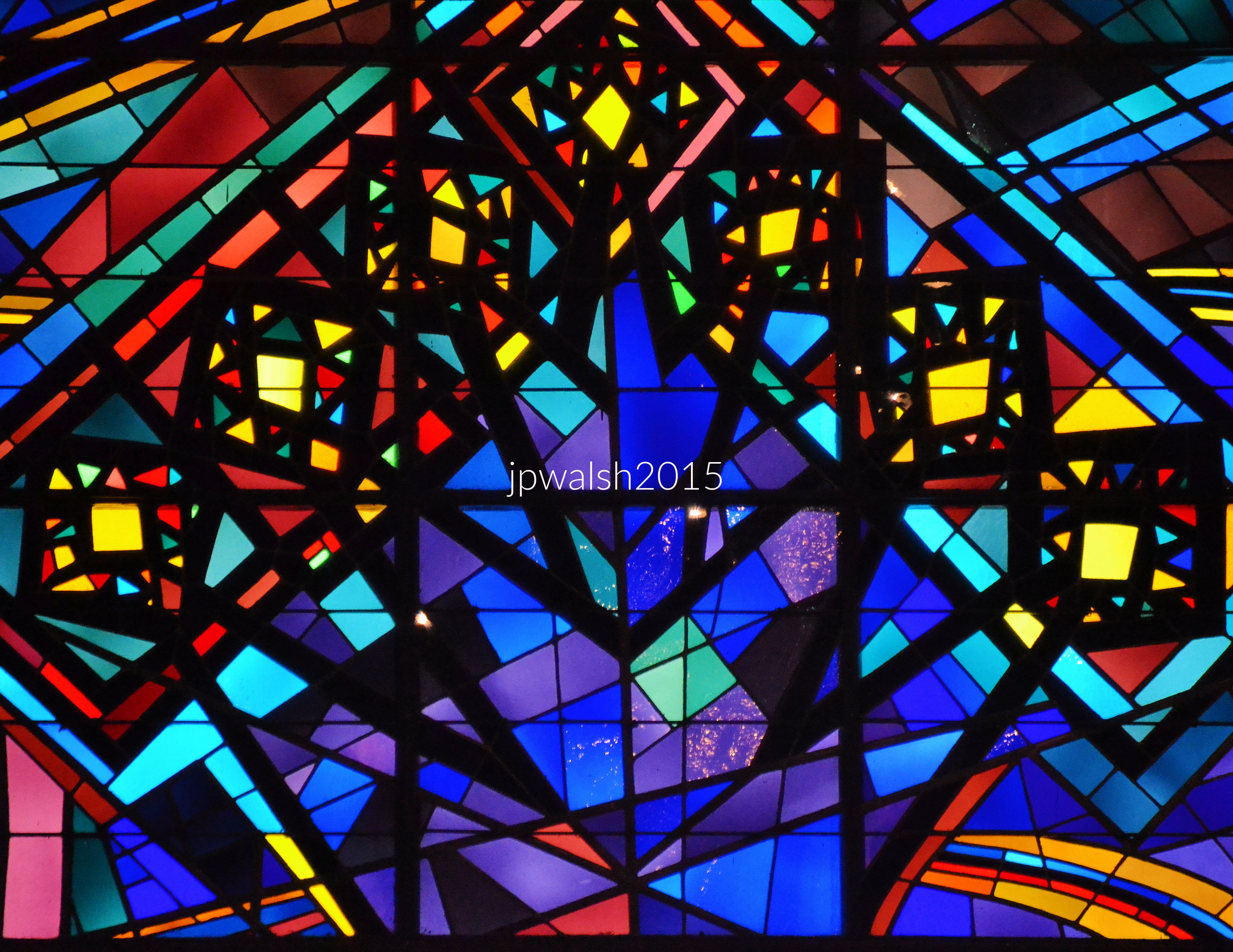
October 2015. Author’s photograph. 7.77 mb 91% DSC_0977 The colors and design elements of this 31 x 40-foot glass artwork signify God’s relationship with the cosmos, humanity, and the Jewish people. After two years working on conceptual and design schemes, the artist Abraham Rattner spent a year fabricating the window – a presentation of cool blues and warm red and yellows studded with purples that take on shapes of planets, trees, Hebrew letters and the Israelite tribes. It was made in Paris’s 15th arrondissement at Atelier Barillet, the house and workshop of master glassmaker Louis Barillet (1880-1948). The artwork was the subject of a 1976 exhibition at the Smithsonian American Art Museum and a 1978 exhibit at the Skirball Cultural Center in Los Angeles. The window was made to fit inside the prayer space for which it was created. To create the stained-glass work, Rattner drew inspiration from the opening passages of Genesis, focusing on the hidden meanings of the words “And there was light” to channel cosmic creative energies of the Divine.
October 2015. Author’s photograph. 5.62 mb DSC_0023 (1) Above: The Tree of Life is also visaged as the Menorah and is identified with the light of innermost perception – the spirit; thought; ideas; life; and of knowledge. This Primal Light, God’s light, radiates outward, extending and expanding throughout the universe.
October 2015. Author’s photograph. 4.68mb DSC_0026 Above: The Menorah poetically conceived as a tree of life and of light. The Menorah is the classic symbol of Judaism.
October 2015. Author’s photograph. 7.77mb DSC_0027 Above: The Star of David and the palm branch used on the Sukkot (Feast of Booths) harvest festival.
October 2015. Author’s photograph. 7.77mb DSC_0027 Above: The shofur or ram’s horn (above) is an ancient instrument used on High Holidays to call the people to repentance. In close proximity to the shofur is the etrog which is a fruit of the Holy Land which expresses earth’s bounty as well as the overflowing love of a human being’s heart for God.
Designed by Loebl, Schlossman & Bennett, the Chicago Loop Synagogue stands as one of Chicago’s most significant modern religious buildings, where architectural restraint is transformed by Abraham Rattner’s monumental stained-glass masterpiece into a profound visual statement of Jewish faith and heritage.
October 2015. Author’s photograph. 6.13mb DSC_0999 (1) Above: View of the sanctuary from the balcony. The near perfect beauty of the Chicago Loop Synagogue is self-evident.
October 2015. Author’s photograph. 3.14mb DSC_0037 (1) The prayer room on the first floor is used for daily prayer and other gatherings. Author’s photograph.
SOURCES AND FURTHER READING:
AIA Guide to Chicago. 2nd ed. Edited by Alice Sinkevitch. Orlando: Harcourt, Inc., 2004.
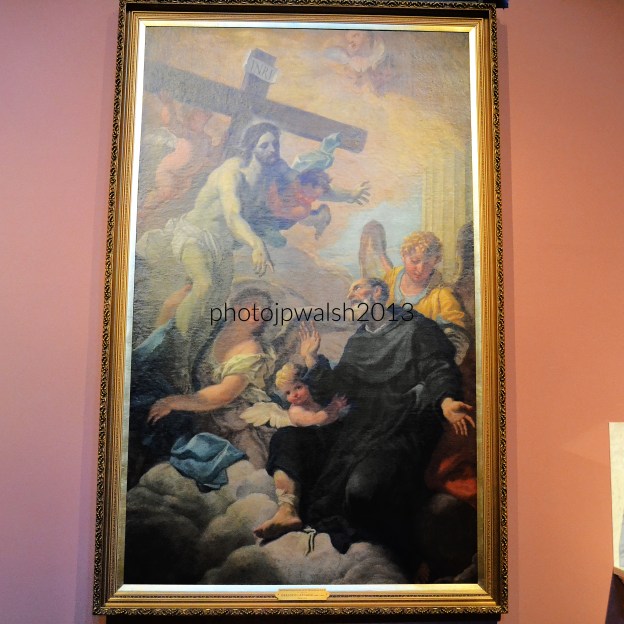
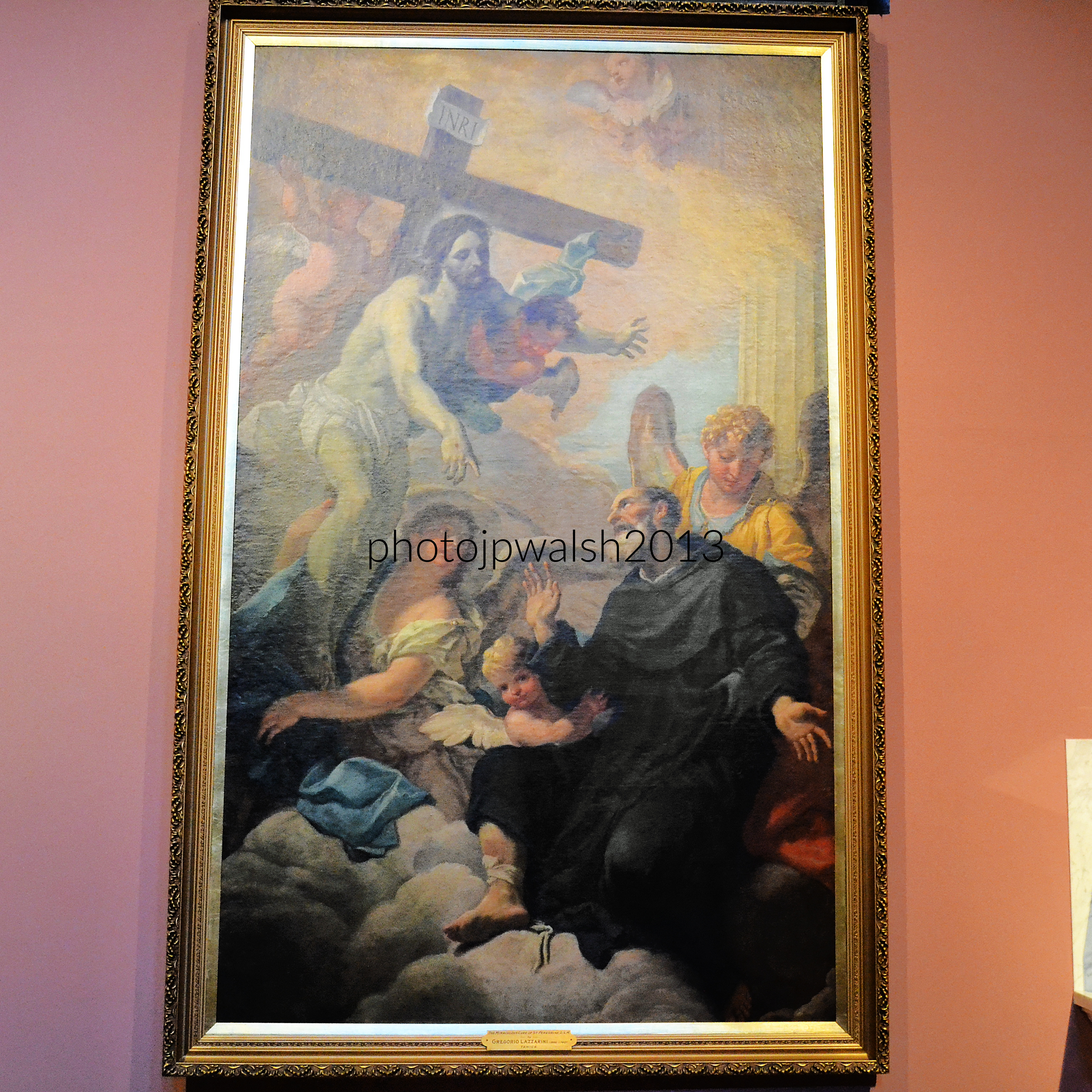
FEATURE image: At the National Shrine of St. Peregrine at Our Lady of Sorrows Basilica on Chicago’s west side is a painting attributed to the late 17th century painter, Gregorio Lazzarini (1665-1740) entitled Jesus the Healer; St. Peregrine, OSM the Helper. December 2013. Author’s photograph. 3.89mb DSC_0218 (1).
St. Peregrine Laziosi’s enduring significance lies in his transformation from a hot-headed opponent of the Church into a holy servant whose own miraculous healing from a cancerous tumor made him a lasting symbol of hope, healing, and intercession for those facing cancer and other life-threatening illnesses. His medieval life story is connected to the continuing ministry of his shrine in Chicago.
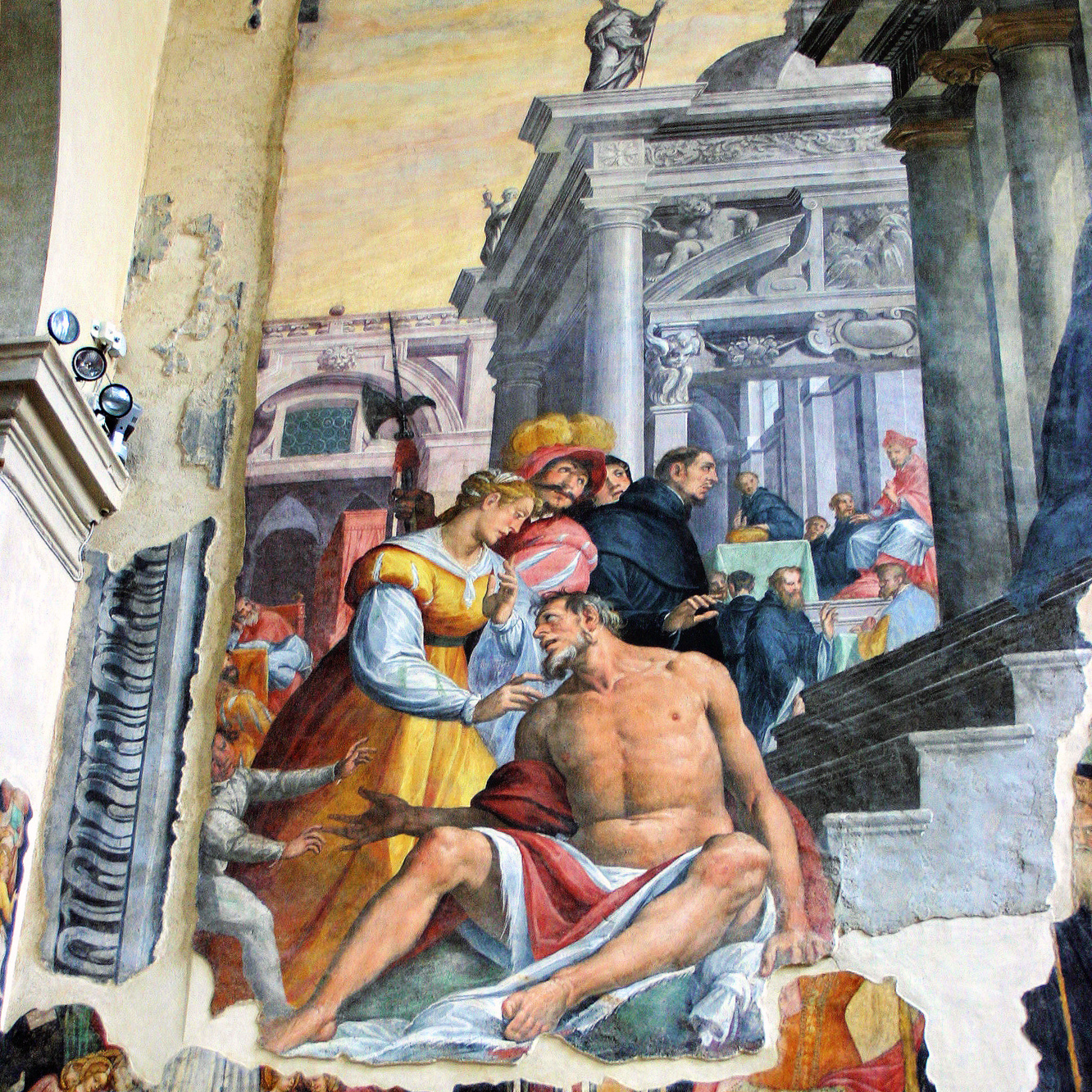
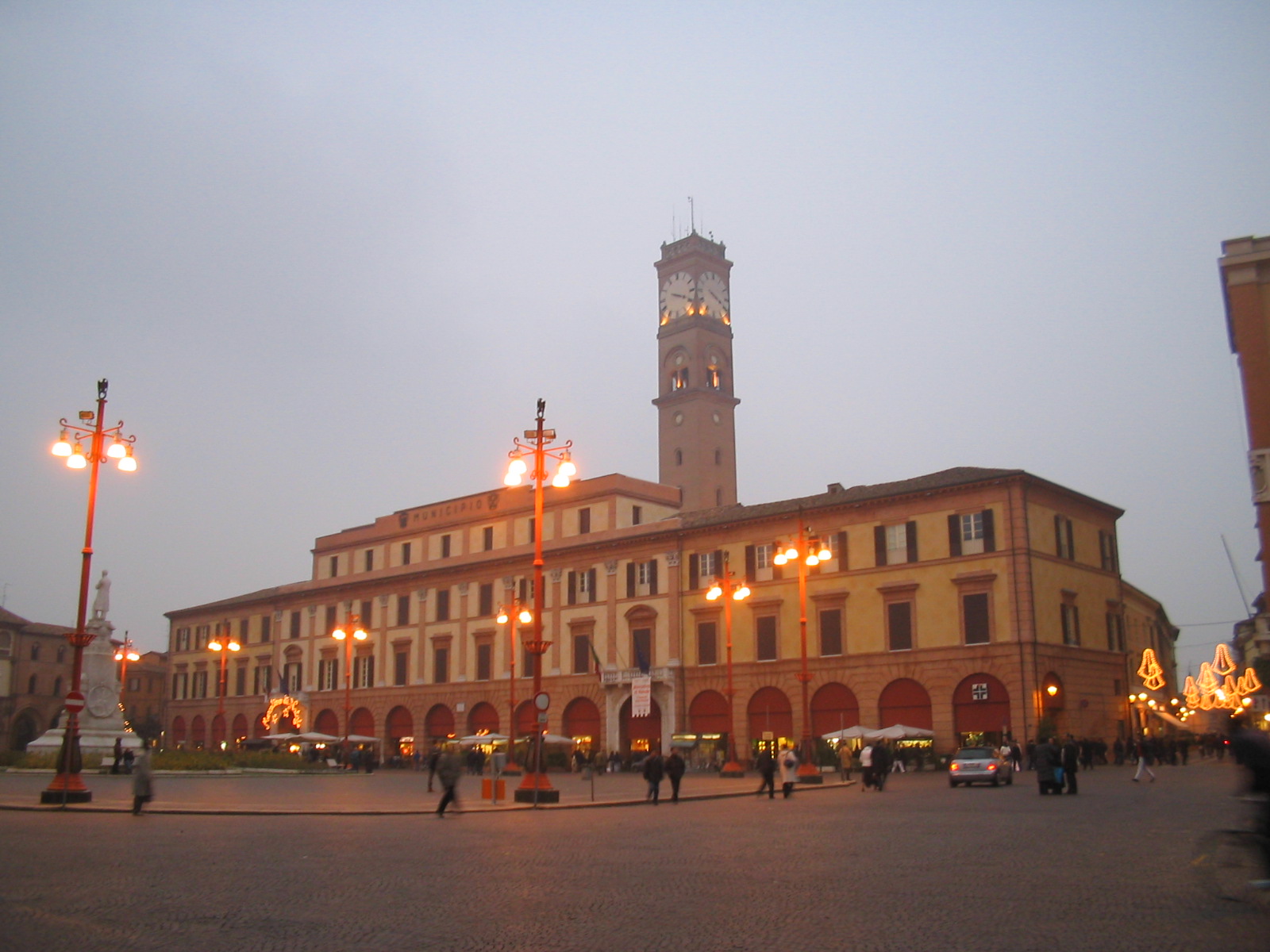
Peregrine Laziosi grew up in Forli near Ravenna in Italy. Peregrine came from a very wealthy family who lived in the town in which half the population was for being part of the Papal States and half were against. Peregrine’s family, and thus Peregrine as a young man, was against the pope’s political rule.
Pope Alexander IV (1254-1261), pope at the time of the birth of Saint Peregrine, is depicted in a fresco in San Marco in Milan, Italy. On September 26, 1255, Alexander IV had canonized Saint Clare of Assisi, founder of the second order of Franciscans, known as the Poor Clares. The following month, on October 29, 1255, Alexander IV, in his bull Benigna Operatio, declared that the stigmata of Saint Francis of Assisi (who was canonized in 1228) was a fact of the pope’s “own knowledge.” Public domain.
Guelphs and Ghibellines.
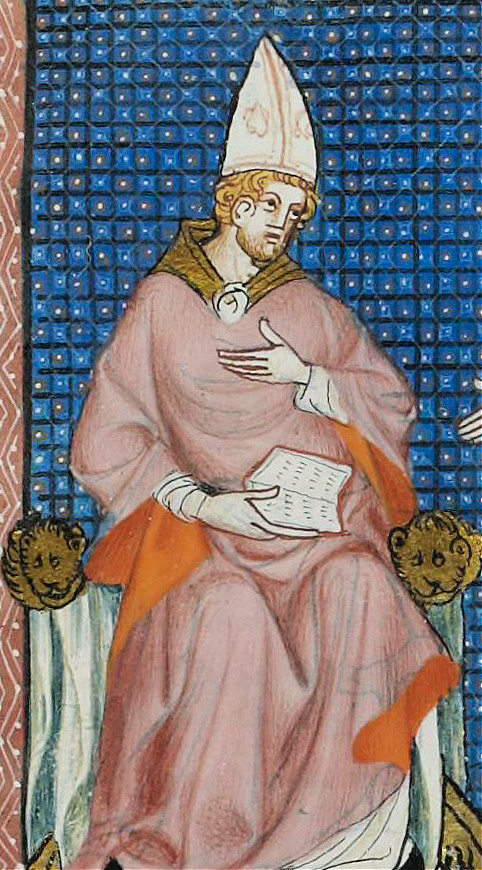
14th century Illumination on parchment of Pope Martin IV, c. 1335. From the manuscript Vie et miracles de saint Louis. Bibliothèque Nationale de France. Born Simon de Brion (c. 1210 –1285), Martin IV was the last French pope to stay in Rome before the papacy moved to Avignon. He ruled the Papal States from 1281 to 1285. Public Domain.
Filippo Benizzi (1233-1285), fifth general superior of the Servants of Mary (Servite Order), was assigned by Pope Martin IV to go to Forli to try to bring together the two sides. The Servites were a mendicant order that embraced poverty and devoted to preaching and encouraging devotion to the Virgin Mary. General Superior Benizzi was the Order’s chief propagator and organizer. In Forli, the pro-pope group was called Guelphs and pro-Holy Roman Emperor group was called Ghibellines. A political meeting was called where Fr. Benizzi would meet the two sides. Benizzi is also reputed to have healed a leper when in the town by giving him his tunic to wear. The Guelphs represented the interests of wealthy merchants, bankers, and urban elites who viewed the Empire as a threat to their free trade and dominance. This group later split into Black (radical) Guelphs and White (moderate) Guelphs. The Ghibellines represented the landed aristocracy who favored traditional hierarchical structures and sought imperial protection against the expanding papal states that fostered smaller, autonomous communes and free trade practices representing the “new money” merchant class.
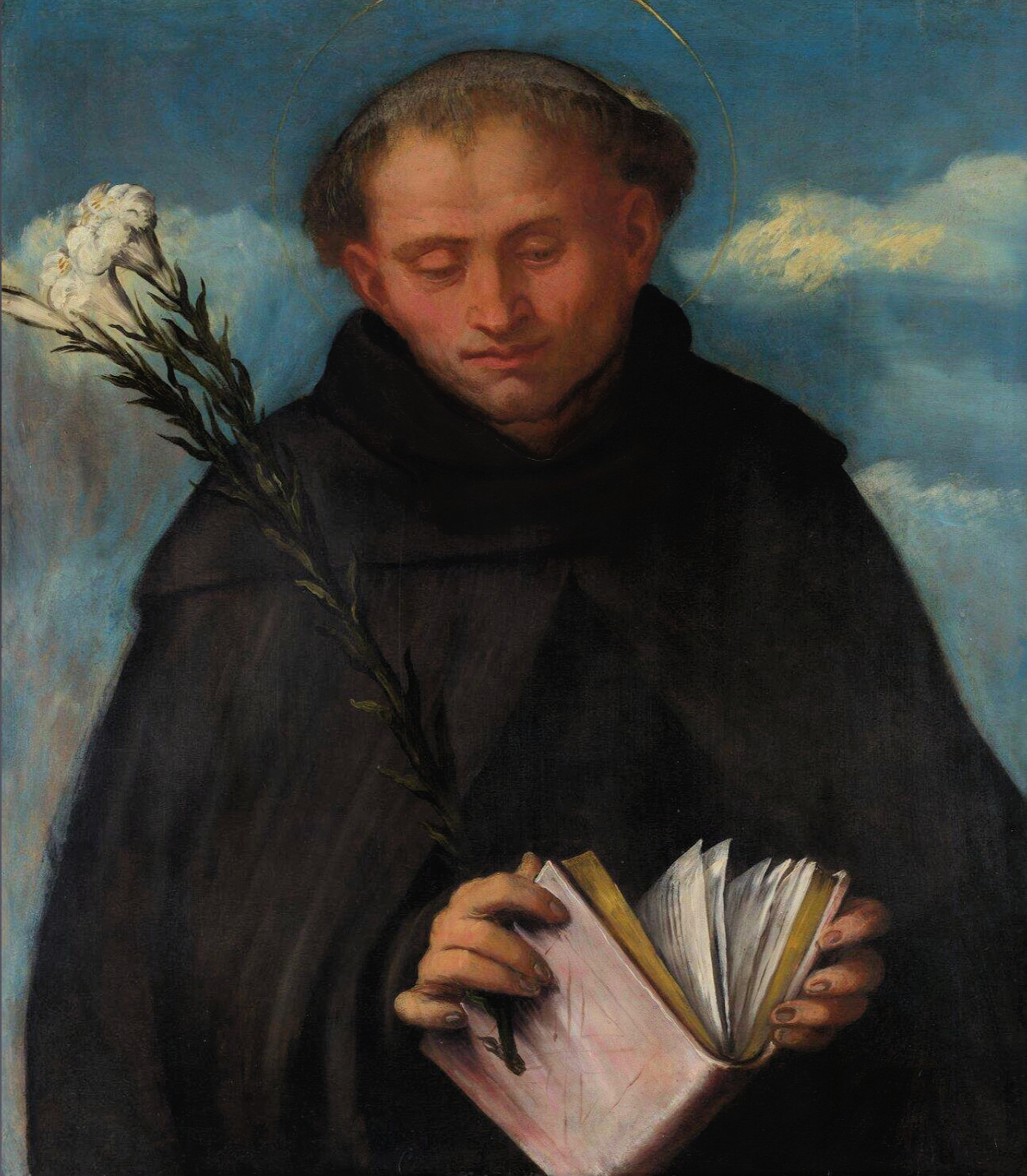
Saint Filippo Benizzi, Girolamo Romanino (c,1484-c.1560), c.1524, High Altarpiece, S. Alessandro, Brescia. oil on wood, 74.2 × 64.9 cm, The National Gallery London. Benizzi wears the black scapular, tunic and cowl of his Order. Saint Filippo Benizzi’s body is in the church of the Servants of Mary in Todi, Umbria. He was beatified by Pope Leo X in 1516 and made a saint by Pope Clement X in 1671. see – Girolamo Romanino | Saint Filippo Benizzi | NG297.5 | National Gallery, London – retrieved Jan. 27, 2026.
St. Peregrine born in Forlì, Italy, came from a wealthy family aligned against papal political authority during the bitter Guelph-Ghibelline conflicts. As an 18-year-old, he joined a hostile crowd confronting St. Filippo Benizzi, the Servite leader and papal representative, and even struck him physically. Peregrine repented and moved by Benizzi’s forgiveness and charity, joined the Servite Order, and eventually became a priest.
At the meeting, the crowds that gathered spewed insults at the friar and 18-year-old Peregrine, son of a Ghibelline leader, was among them. They chased the Servite General out of Forli with insults and violence and Peregrine physically struck him. Soon after, Peregrine regretted his violent actions and sought out his victim to apologize. Filippo Benizzi greeted Peregrine with charity which made a lasting impression on the young man. A few years later, Peregrine Laziosi joined the Servites in Siena and became a priest.
Peregrine was sent back to Forli, founded a new Servite house, and became popular for his preaching and well known for charitable work.
Returning to Forlì, Peregrine founded a Servite house and became known for a lifetime of preaching and charitable works.
Miraculous cure.
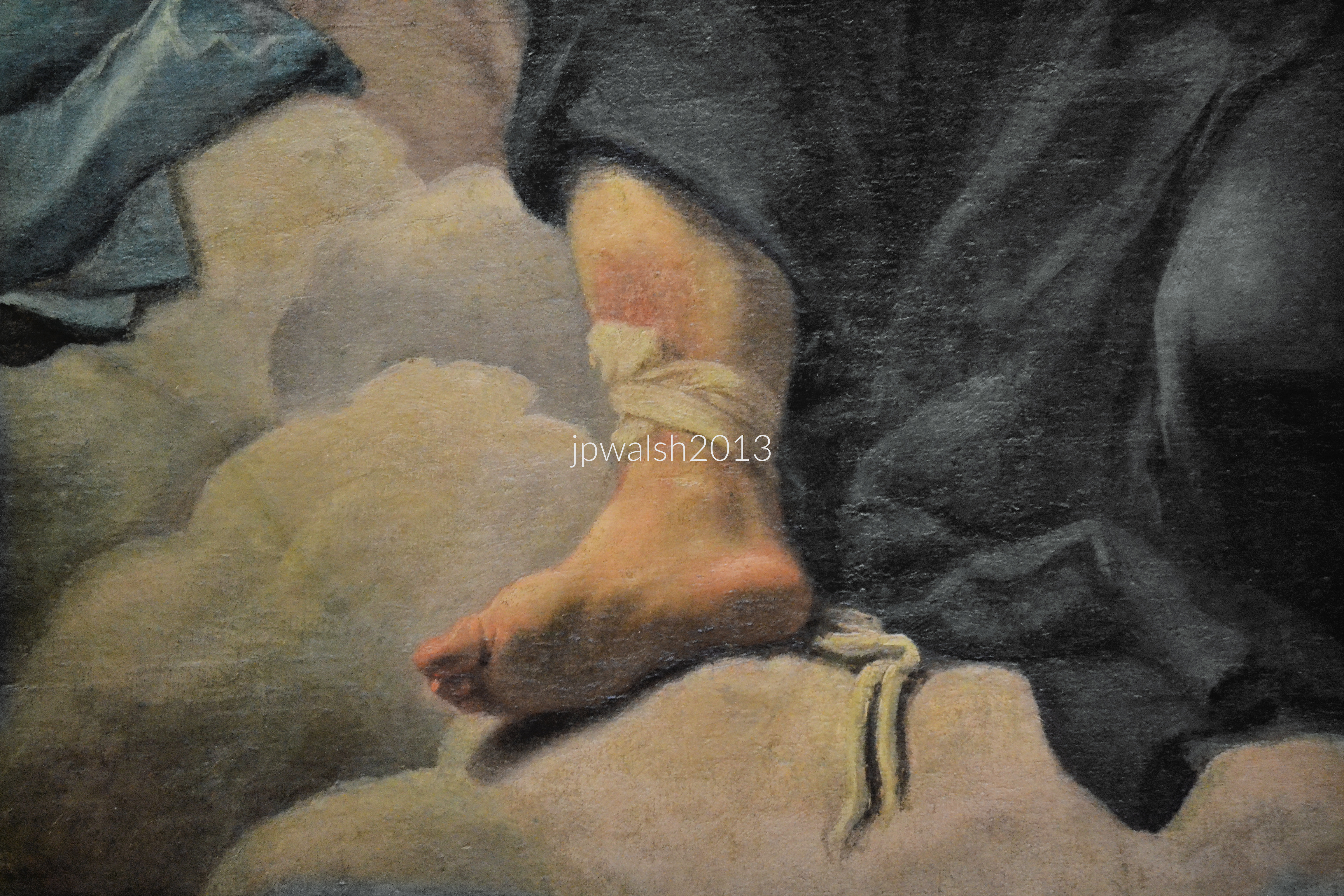
Saints are often famous for their miracle-working powers. In the case of St Peregrine, he is known for being the recipient of a miracle. At 60 years old, Peregrine found he had a cancerous tumor on his right leg. The doctors had given up hope of a cure and decided to amputate the leg. The night before the operation St. Peregrine had a vision. It is the one depicted in the shrine’s painting: St. Peregrine seeing Jesus descend from the cross to touch and heal his leg.
The artwork depicts the healing miracle of his tumorous leg experienced by St. Peregrine Laziosi.
Detail of painting depicting St. Peregrine’s tumorous leg that was miraculously cured by Jesus Christ in a vision in 1320. Author’s photograph. 5.09mb DSC_0246 (1)
When the doctors arrived the next day to perform the operation, they found that Peregrine had been completely cured, an event unexplained by medical science. The news spread like wildfire through the town. St. Peregrine died of fever 25 years later on May 1, 1345, in his mid 80’s. After his death people who were sick and cured attributed it to St. Peregrine’s miraculous intercession, particularly when it was a life-threatening disease. His saintly cult grew – Peregrine is patron saint of cancer and other life-threatening maladies – and his image often shows him exposing his own tumorous leg that was miraculously cured by Christ.
Around age sixty, Peregrine developed a cancerous tumor in his leg, and doctors planned an amputation. On the eve of the operation, he experienced a vision of Christ descending from the Cross and healing him. The next day, the tumor had disappeared, a cure described as unexplained by medical science.
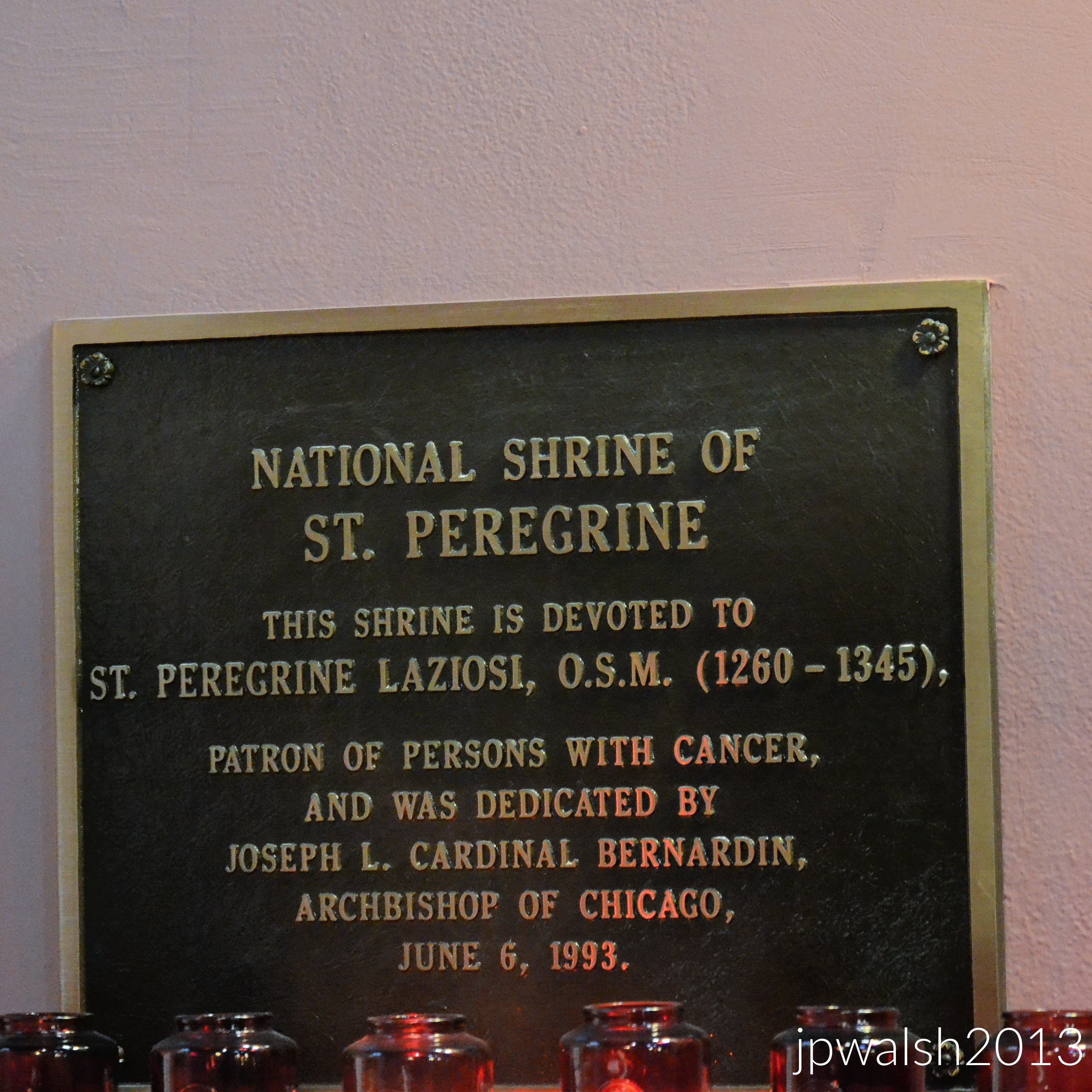
The shrine through prayer, blessing, pilgrimage, reconciliation and evangelization, accompanies those persons who live with serious illness, traditionally cancer, and their caregivers, as they seek to find healing, support, peace and God in their daily lives. There is also a relic of St. Peregrine Laziosi at the shrine. Author’s photograph. 2.74mbDSC_0260 (1)
After his death in 1345, devotion to St. Peregrine grew as many attributed healings to his intercession were made. He became the patron saint of cancer patients and those suffering from other grave illnesses, often depicted exposing his miraculously healed leg.
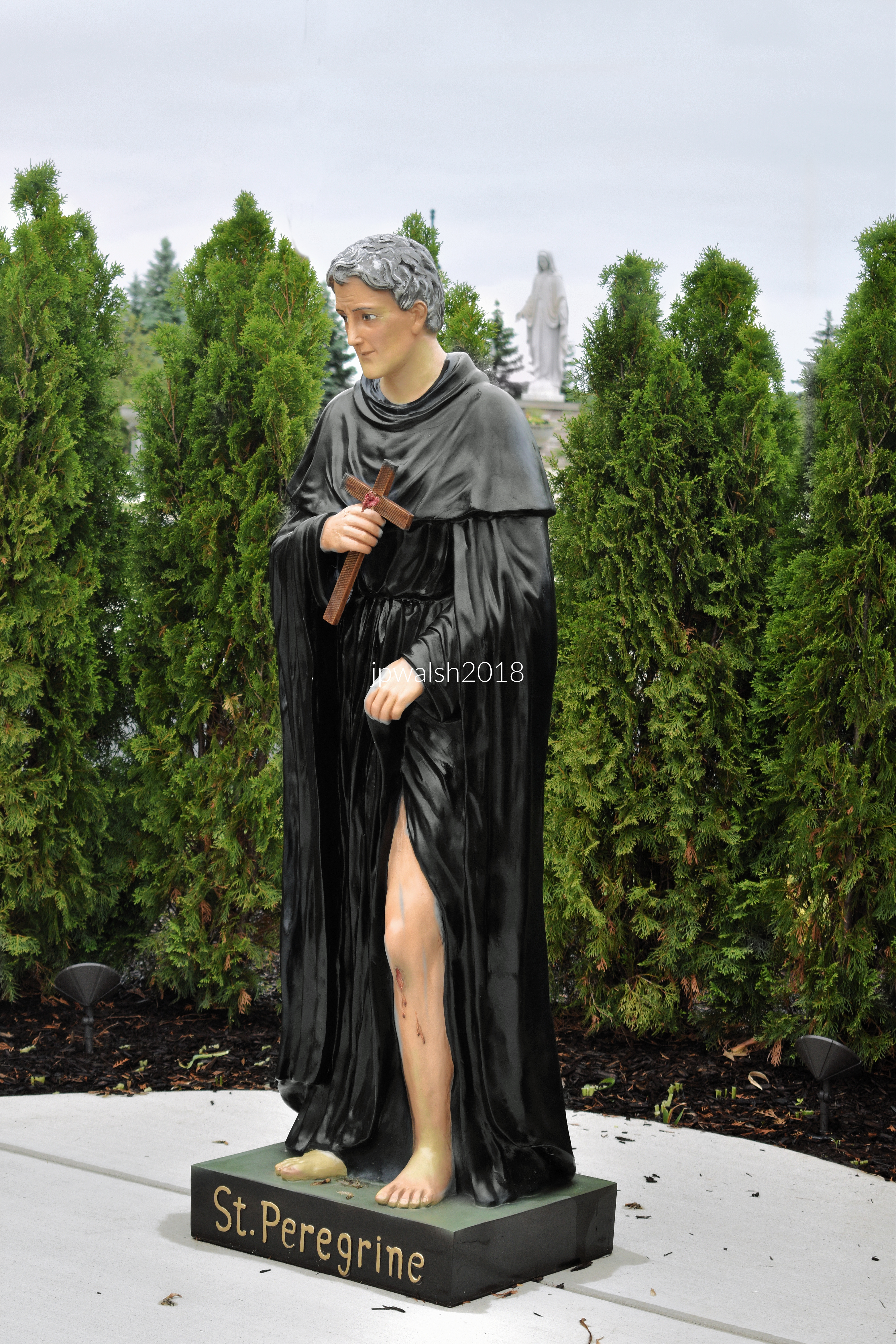
Statue of St. Peregrine Laziosi in an outdoor garden near to the Shrine of Christ’s Passion, St. John, Indiana. June 2018. Author’s photograph. 89% 7.93mb DSC_9062