FEATURE image: The North Porch was constructed at the start of the 13th century. The North Porch, like the North Rose Window (below) crafted in the same time, depicts the glories of the Virgin Mary along with Old Testament figures. PHOTO: “Chartres, North Porch, Central Portal, LeftJamb” by profzucker is licensed under CC BY-NC-SA 2.0.
The Royal Portal of Chartres Cathedral represents one of the defining achievements of early Gothic art, where architecture, sculpture, and theology were fused into a monumental visual statement of Christian belief. Created in the mid-twelfth century and remarkably preserved, its sculpted kings, queens, prophets, and Christ figures reveal the moment when medieval Europe began transforming stone into a sophisticated language of faith, learning, and artistic innovation.
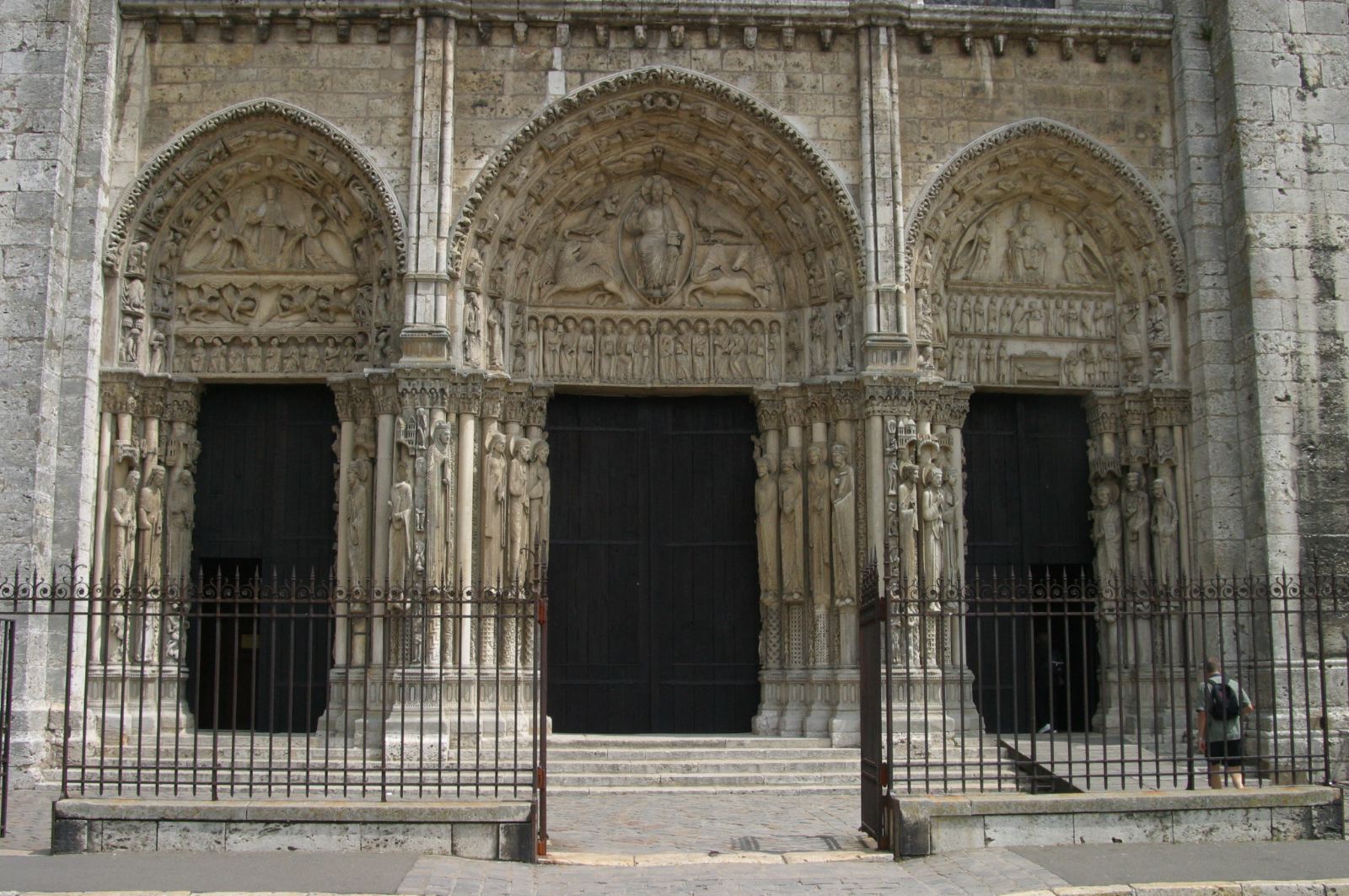
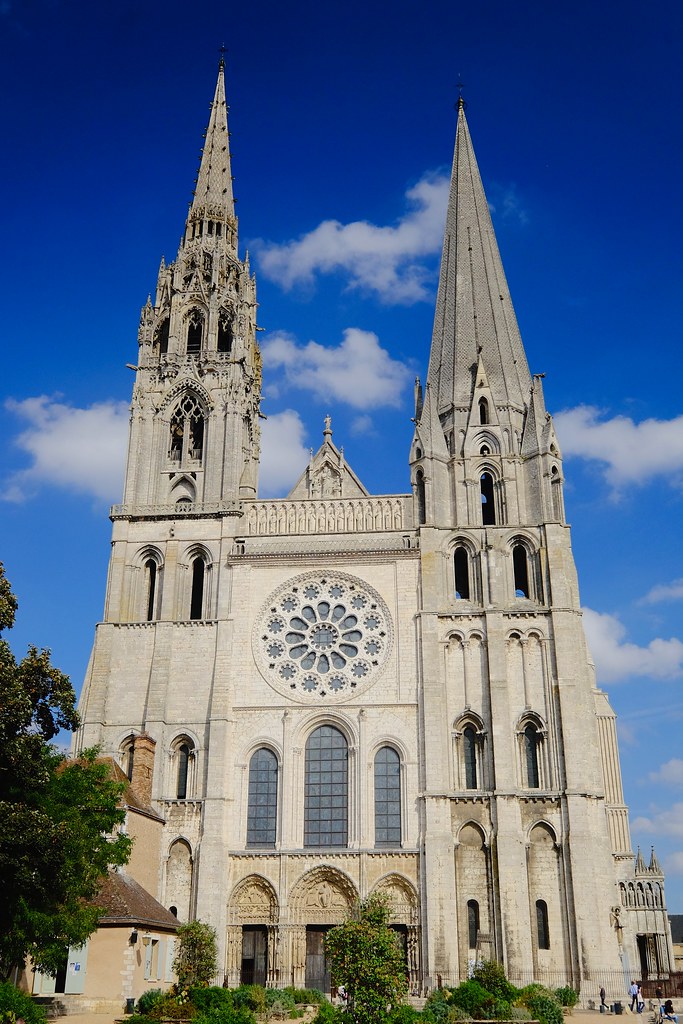
The Royal Portal (Portail Royal) on the west façade of Chartres Cathedral, carved between 1145 and 1155, is one of the finest surviving ensembles of Early Gothic sculpture. Its three richly coordinated doorways present a sweeping vision of Christ’s role in salvation history. Above the left portal, a semicircular tympanum depicts Christ’s Ascension; the central portal illustrates the Apocalypse and the Second Coming of Christ; while the right portal focuses on Christ’s nativity and entrance into human history while crowning the composition is the Sedes Sapientiae (Throne of Wisdom), where the Virgin Mary sits enthroned with the Christ Child in her lap, flanked by two incensing angels. The portals are further enriched by sculpted lintels and archivolts populated with biblical figures and symbolic imagery. Lining the doorways below are the celebrated jamb statues attached to the columns, their elongated, otherworldly forms depicting the kings and queens of the Old Testament. Together, these sculptures create a monumental stone theology that welcomed medieval pilgrims while proclaiming the spiritual and royal lineage of Christ. PHOTO: “Chartres” by Photo:Nina Aldin Thune User:Nina-no is licensed under CC BY 2.5.
The Royal Portal of Chartres is more than a cathedral entrance; it is one of the earliest and most influential masterpieces of Gothic art, transforming carved stone into a timeless expression of faith, knowledge, and medieval imagination.
Jamb statues from the Royal Portal (west façade) of Chartres Cathedral. These columns stand on the right-hand side of the Central Portal. These statues were carved between 1145 and 1155. They represent a critical turning point in Western art history, standing as the definitive bridge between the rigid, blocky Romanesque style and the lifelike naturalism of the Early Gothic period. While individual identities are debated, the overarching program represents the Kings and Queens of the Old Testament. PHOTO: “Cenral tympanum Chartres” by Cancre is licensed under CC BY-SA 2.5.
First Visit and Returning to Chartres Across the Years
I first visited Chartres Cathedral in 1985, returning in 1989, 2002, and 2005. That first visit included a Malcolm Miller tour—my introduction to a guide who, since 1958, had devoted his life to interpreting one building. As I backpacked through Europe, his example showed me how a single enduring monumental work can anchor a lifetime of study.
The Great Glass of Chartres
Chartres is celebrated above all for its 12th‑ and early‑13th‑century stained glass, a nearly intact ensemble unmatched anywhere in Europe. The windows shimmer with deep blues, ruby reds, and jewel‑like greens—colors that have survived more than 800 years. Their narratives unfold left to right, beginning at the base and rising upward, guiding viewers through biblical cycles, guild stories, and royal symbolism.
Layers of Cathedrals on a Roman Site
The cathedral stands on what was once a Roman site, and several earlier churches rose and fell here. Structures were destroyed during the Merovingian era, again in Viking raids, and once more in the fires of the 12th century. Each catastrophe cleared the ground for a new architectural vision, culminating in the High Gothic monument seen today.
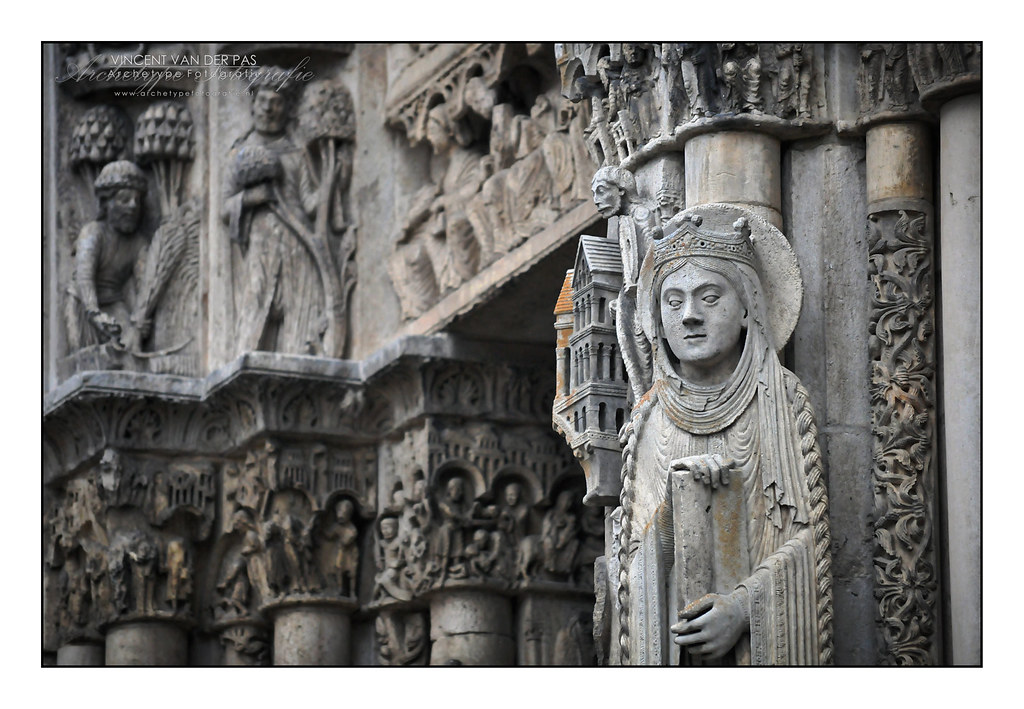
Detail of jamb statue located on the on the Central Doorway of the North Portal (Portail Nord) of Chartres Cathedral. The prominently featured statue is identified as Saint Anne, the mother of the Virgin Mary. While the Royal West Portal y dates to the mid-12th century (1145–1155), the North Portal was constructed later, between 1204 and 1220. This timing difference explains why Saint Anne’s face features a much more advanced, deeply expressive, and three-dimensional High Gothic naturalism compared to the highly stylized, strictly column-like figures of the west façade. PHOTO: “France, Detail ‘Cathédrale Notre-Dame de Chartres’” by Vincent_AF is licensed under CC BY-SA 2.0.
The Cult of the Virgin Mary
A powerful cult of the Virgin Mary developed at Chartres, strengthened by the arrival of the cathedral’s most famous relic in the 9th century: the Sancta Camisa, believed to be the Virgin’s veil. When devotion to Mary surged across Europe in the 12th century, Chartres—already dedicated to Mary’s Assumption—was perfectly positioned to become a major pilgrimage center, drawing travelers from across Christendom.
Arrival in Chartres
On my first visit to Chartres Cathedral in 1985, I left Paris after breakfast, walked to Gare Montparnasse, and boarded a direct train to Chartres. That day’s tour with Malcolm Miller centered on the great windows of the north side: the North Rose Window (c. 1231), the Blue Virgin Window (c. 1194), and portions of the Noah Window (c. 1210). The Noah Window includes a portrait of St. Lubin, the 6th‑century bishop of Chartres and patron of wine merchants—one of the guilds that financed the glass.
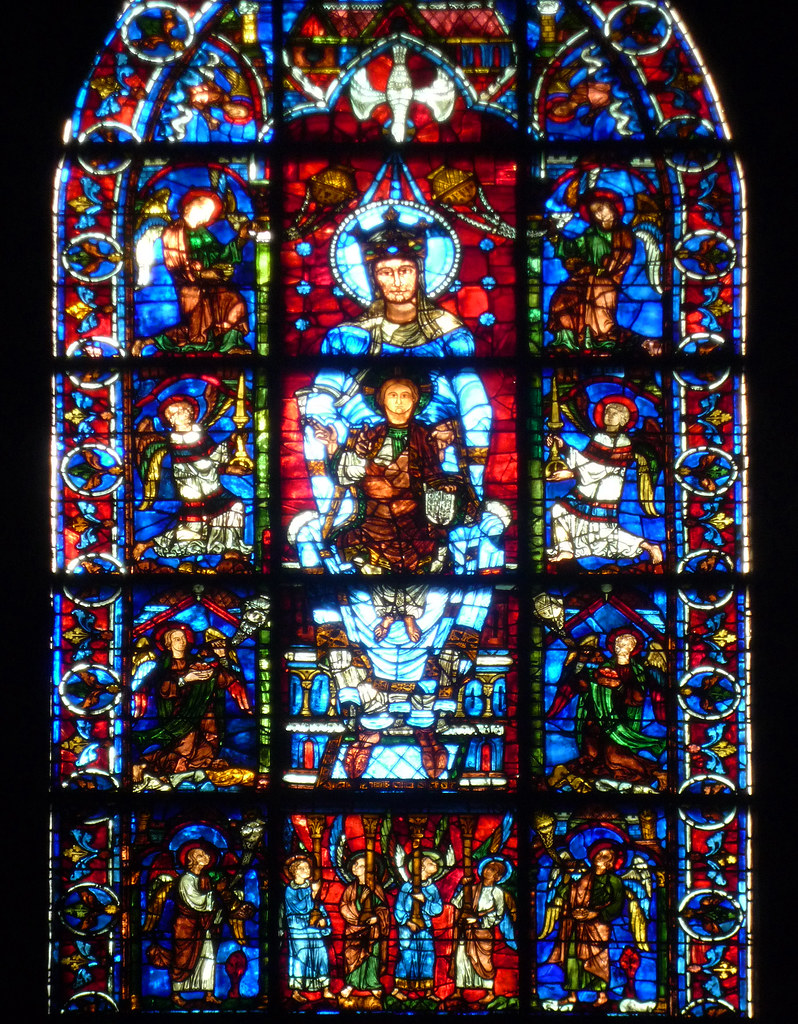
The Blue Virgin Window (Notre-Dame de la Belle-Verrière) is located completely away from the transept roses, tucked into the south aisle of the choir ambulatory (Bay 30). it was one of the incredibly rare pieces of glass that miraculously survived the great cathedral fire of 1194. The central figures of the Virgin Mary and Child date to approximately 1180. When the cathedral was rebuilt in the early 13th century, the master glasiers saved this sacred 12th-century panel and carefully framed it with new 13th-century outer border panels (circa 1215–1220), blending Romanesque and High Gothic glass art seamlessly. PHOTO: “Chartres, Notre-Dame de la Belle-Verrière (detail of Virgin)” by profzucker is licensed under CC BY-NC-SA 2.0.
The portal celebrates Christ’s majesty while emphasizing the relationship between the Old and New Testaments. Its sculptural program unites architecture and theology, turning the cathedral entrance into a visual lesson in Christian belief.
Sculpture of the West Front
Miller also took us outside to study the 12th‑century statuary of the Royal Portal on the west front—figures I photographed again in 1989. These sculptures belong to the cathedral’s Romanesque‑Gothic transitional phase and survived multiple disasters that reshaped the building.
Early Fires and Romanesque Foundations
A major fire in 1120 destroyed the earlier church, prompting construction of a large Romanesque structure contemporary with Vézelay Abbey. Another fire in 1134 damaged the building and led to the construction of the north tower, completed in 1150. The south tower followed roughly a decade later. The Royal Portal itself was built between 1145 and 1155, forming the nucleus of the west front that still stands today.
The 1194 Fire and Gothic Rebuilding
The defining catastrophe came in July 1194, when a devastating fire destroyed nearly the entire church and much of the city. Remarkably, the mid‑12th‑century west front, its royal doors, and the two contrasting towers survived. Everything else—the soaring nave, the sculptural program, and nearly all the stained glass—was rebuilt between 1195 and 1220, creating the unified High Gothic masterpiece seen today.
The survival of the Royal Portal through fires, wars, and centuries of change makes it an extraordinary witness to medieval civilization.
The North Rose window in Chartres Cathedral displays the Virgin Mary and Child in the center surrounded by small circles of doves, angels and thrones. In the outer circles are depicted the 12 kings of Judah (who were Jesus and Mary’s ancestors) and the 12 minor prophets. “Chartres – cathédrale – rosace nord” by Eusebius@Commons is licensed under CC BY 2.0.
Royal Patronage of the North Rose:
In the rebuilding of Chartres, The North Rose Window (created c. 1230-1235) was donated by Blanche de Castile, mother and regent, who ensured the design honored both her lineage and her teenage son, King Louis IX, whose royal patronage helped define the Gothic cathedral’s luminous 13th‑century glass program both here and soon in Paris.
Political Strategy Behind the Glass
The window is not only a devotional masterpiece; it is a calculated piece of 13th‑century political messaging crafted at a moment when Blanche of Castile faced rebellions from French barons who resented both her gender and her foreign birth to rule France. By shaping the iconography, Blanche used the cathedral’s most prominent glass to assert her divinely sanctioned authority.
Heraldry as a Statement of Power
Blanche inserted unmistakable symbols of legitimacy:
the arms of France — golden fleurs‑de‑lis on blue
the arms of Castile — golden castles on red
Placed together, they proclaimed the union of dynasties and the rightful lineage of her son, Louis IX, whose minority she was defending.
The Lancet as a Warning to the Barons
Directly beneath the great rose, Blanche added a lancet window pairing righteous biblical kings standing triumphantly over fallen, corrupt rulers. It was a visual admonition to rebellious nobles: oppose the rightful sovereign, and you align yourself with the defeated enemies of God.
Saint Anne and Blanche of Castile
At the center of the vertical lancets stands Saint Anne, holding the infant Virgin Mary. This was a deliberate, intimate parallel. Blanche positioned herself as a holy mother‑protector, raising the sacred child — Louis IX — to rule France. The imagery reinforced her maternal authority and the sanctity of her regency.
Revolutionary Upheaval and Restoration
During the French Revolution, Chartres Cathedral was desecrated and repurposed as a Temple of Reason, part of the radical de‑Christianization campaign. It was not returned to the Church or reconsecrated until 1855, beginning the long modern era of preservation and study that continues today.
The survival of the Royal Portal through fires, wars, and centuries of change makes it an extraordinary witness to medieval civilization. Chartres became a model for later Gothic cathedrals throughout France and Europe.
The West Front is from the 12th, 13th and 16th centuries. The photograph’s column statues below are on the right side of the West Portal’s central door. Though likely originally intended in the 12th century to be enclosed in a narthex, that structure was not built and these sculptures remained outdoors. “Chartres 2014 – 2” by evocateur is licensed under CC BY-SA 2.0.
The Rise of Cathedral Learning
By the 11th century, Europe experienced a renewed intellectual energy, especially in Northern Europe, where monastic and later cathedral schools became centers of study. One of the pivotal figures in this revival was Gerbert of Aurillac (c. 946–1003), later Pope Sylvester II, who had studied in Spain and led the cathedral school at Reims in the 970s. His most influential pupil, St. Fulbert of Chartres, carried this legacy forward.
Fulbert and the Great School of Chartres
As bishop, St. Fulbert founded the Chartres Cathedral School, which became the most illustrious center of learning in the 12th century. It marked a turning point in Western intellectual life. Scholars there debated emerging philosophical questions about God, humanity, reason, and creation—the very issues that defined the 12th‑century renaissance of thought.
Completion and Consecration of the Gothic Cathedral
Although the present Gothic cathedral was roofed and essentially finished around 1220, it was formally reconsecrated in October 1260. By then, Chartres had already become a magnet for major religious figures. Three popes visited during the 12th century, and in later centuries saints such as Thomas Becket, Bernard of Clairvaux, Francis de Sales, Vincent de Paul, Louis de Montfort, and Benedict Joseph Labre prayed there.
Pilgrimage Through the Centuries
Pilgrimages to Chartres began before the 12th century and remained important through the 16th and 17th centuries, though they declined sharply after the French Revolution. By the late 19th century, pilgrims were returning, but the revival of the traditional Paris‑to‑Chartres route is credited to the French poet Charles Péguy.
Charles Péguy and the Modern Pilgrimage
On June 14, 1912, Péguy set out on the nearly 150‑kilometer walk from Paris to Chartres, completing it in three days. The pilgrimage fulfilled a vow he had made the previous year at the bedside of his ill son. “Chartres is my cathedral,” he later wrote. His life ended two years later: on September 5, 1914, serving as a lieutenant in the 19th Company, 276th Infantry Regiment, he was killed near Villeroy, Seine‑et‑Marne. Péguy was 41.
The Royal Portal is the oldest surviving section of Chartres Cathedral and predates much of the present Gothic structure. Elongated jamb figures of kings and queens bridge Romanesque traditions and the emerging naturalism of Gothic sculpture.
The Royal (West) Portal, 12th century, Cathédrale de Chartres (1145-1220), France. December 1989. Author’s photograph 1.24 mb
Identifying the Figures
While art historians have attempted to identify the portal statuary at Chartres, the conclusions remain speculative. The figures appear to represent Old Testament characters—and in this photograph, the pair may be King Solomon, at right holding a scroll, and the Queen of Sheba beside him. Their identities matter less than the expressive force the sculptor carved into their faces nearly a millennium ago.
Faces Filled With Life
What is striking is the inexpressible joy radiating from these stone faces. The 12th‑century sculptor concentrated the entire vitality of the figures in their expressions—an artistic ambition that still feels modern. Even after 900 years of weather, war, and revolution, the faces retain a startling immediacy.
Statuary at the Height of 12th‑Century Art
Although Chartres is world‑famous for its flying buttresses and stained glass, many art historians argue that the statuary is the cathedral’s most compelling achievement. These portal figures represent 12th‑century sculpture at its zenith, where spiritual intensity, architectural innovation, and human emotion converge in stone.
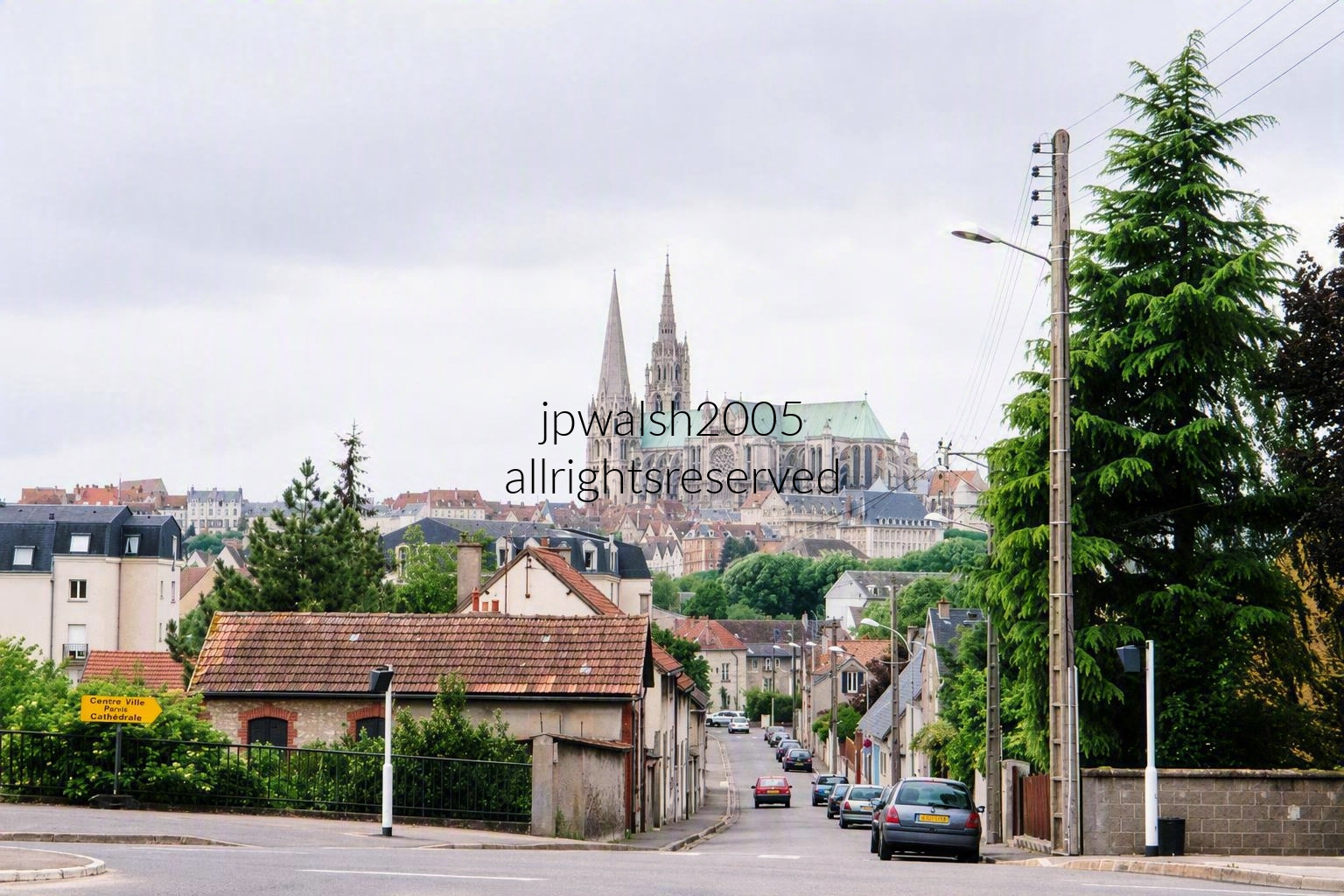
Cathédrale Notre-Dame de Chartres. May 2005. Author’s photograph,
Taken from Jardin de Sakuraï, this view looks west-southwest along 35 Rue du Faubourg Guillaume toward the historic center of Chartres, France, where the world-famous Cathédrale Notre-Dame de Chartres dominates the skyline. This High Gothic masterpiece is instantly recognizable for its asymmetrical spires, soaring flying buttresses, and expansive green copper roof. From this eastern vantage point, the cathedral’s two towering western spires rise at the far left. Following the roofline to the right, the large projecting cross-shaped section in the middle is the north transept façade. Beyond it, the lower rounded end of the church, encircled by an impressive ring of flying buttresses, forms the apse, the cathedral’s eastern termination. Together, these elements reveal the monumental scale and architectural complexity that have made Chartres one of the most celebrated cathedrals in Europe.
Feature Image: Detail, Ascension of Christ window, Sts. Peter and Paul, Naperville, IL. Author’s photograph
Thee 1927 Tyrol Art Glass Company windows at Sts. Peter and Paul Church in Naperville, Illinois, are not simply decorative religious artworks but important examples of European ecclesiastical craftsmanship that combine theology, biblical storytelling, symbolism, local Catholic history, and immigrant heritage. Through the major Ascension of Christ and Assumption of Mary windows, the stained glass served as a visual catechism and artistic legacy in this and other American Catholic churches during the great era of German and Austrian church art.
Saints Peter and Paul Catholic Church in Naperville, Illinois, a western suburb of Chicago, in July 2021. Looking to the northeast from Central Park, the church building seats 1000 people and was dedicated in September 1927. In 2021 the parish marked its 175th anniversary. Founded in 1846, the parish is the oldest continuously operating Catholic parish in DuPage County. Down the decades its pastors (Frs. Rainaldi, Zuker, Wenker, Stenger, Lennon, Milota, and others) led Saints Peter and Paul adjacent to Naperville’s Historic District to where the parish with its school today serves 4,000 families. Author’s photograph.
Sts. Peter and Paul Church in Naperville was dedicated in 1927 and contains significant stained-glass windows produced by the Tyrol Art Glass Company of Innsbruck, Austria.
A magnificent church building sits on Ellsworth Street in Naperville, Illinois, close by the Historic District. With an orientation out of the darkness of the west into the light of the east, Saints Peter and Paul greets worshippers with two soaring steeples. The neo-Gothic red brick and limestone structure was commissioned in 1922 by the parish’s 350 families and dedicated five years later. Today the parish in Chicago’s western suburb serves 4.000 families and contains historically significant bright colored traditional European painted stained-glass windows from Innsbruck, Austria. In this archival photograph, the view of the church building from around the time of its dedication is looking towards the southeast. Public Domain.
The windows were created during the peak period (1870-1930) when German and Austrian stained-glass studios supplied churches throughout Chicago and the Midwest.
The colorful stained-glass windows in Saints Peter and Paul Catholic Church in Naperville, Illinois, a western suburb of Chicago, were ordered, produced, and installed towards the end of a 60-year-long run for the predominance of German and Austrian-made stained glass found in heritage Chicagoland churches today.
With only a couple of exceptions, the stained glass in Naperville’s historically pioneer and, later, German Catholic parish church was created in the mid1920s in Innsbruck, Austria. Innsbruck at the time was one of the European centers of stained-glass making. It is about 100 miles south of Munich, Germany, the home base of two other popular and well-regarded stained-glass studios – that of Franz Mayer & Company and F.X Zettler Company. These art glass manufacturers notably filled many Chicagoland Catholic churches starting in the 1870s. After the Great Chicago Fire in 1871, a building and population boom commenced in the city and its surrounding communities that went on for over a century unabated. In addition, from the 1870s to the 1920s, Chicago became the most influential center of Catholic culture in the United States.1
It was a unique period of history for Catholic churches in America whose state-of-the-art church design usually included brightly colored art (stained) glass windows. These windows often displayed action-packed scenes from the Bible, including episodes from the life of Christ, His Blessed Mother, or a patron saint.
This continuous appeal over multiple generations for the purchases of vast orders of Munich and Austrian style glass in U.S. Catholic churches declined greatly starting in the 1930’s with the onset of the Great Depression. The European traditional glass market did not recover its former popularity making its stained-glass windows from 1870 to 1930 in Chicagoland churches – including Saints Peter and Paul Church in Naperville – increasingly rare and valuable to preserve and appreciate.
Stained glass made by Tyrol Art Glass Company of Innsbruck, Austria, and Franz Mayer and F.X. Zettler of Munich, Germany, was characterized by its traditional painted stained glass. This style fit into the traditional-style church architecture that Catholic parishes, such as Saints Peter and Paul in Naperville, and many others, built between 1870 and 1930. By the mid20th century these European traditional glass makers faced competition from the rise of American glass manufacturers such as Louis Comfort Tiffany (1848-1933) which extended to quality, price, and style. Tiffany stained glass which frequently incorporated natural scenery elements, contained intricately cut opaque and opalescent glass, overlaid with wide varieties in thickness. This product became better fitted into modern worship spaces which were often smaller. Such modern art and architectural trends worked to displace traditional glass made in Europe used for grandiose classically styled houses of worship that were from an earlier historical period.
In the late 19th century, Tyrol Art Glass Company of Innsbruck, Austria, with the Munich studios of Franz Mayer and F.X. Zettler, began to send representatives to sell their new patterns for churches in Chicago and around the United States. These three studios often worked together and their style is basically interchangeable. In Saints Peter and Paul Church – as well as many other churches with classically-styled architecture – traditional painted stained glass was the stand-out choice, It is usually very colorful whose iconography often depicts highly recognizable religious, often biblical, scenes and religious symbolism. This is definitely the situation with the beautiful stained-glass windows of Saints Peter and Paul in Naperville, including the Ascension of Jesus into Heaven and the Assumption of Mary into Heaven windows.
HOW SAINTS PETER AND PAUL CATHOLIC CHURCH GOT STARTED AND GREW IN NAPERVILLE, ILLINOIS
Naperville, Illinois, a western suburb of Chicago, was founded in 1831 – the oldest town in DuPage County.2With its origins as a mixed settlement of Easterners and Hoosiers, Naperville’s strong religious character was established starting in the 1830s.3 Today it boasts a population of around 150,000 and is one of Illinois’s largest cities. The downtown area is bustling with shops and motor vehicle and foot traffic, yet Naperville’s 19th century origins can still be found in and around the DuPage River with its River Walk and its Historic District that maintain much of the suburb’s original charm and historic significance.
Saints Peter and Paul Catholic Church in Naperville was founded in 1846 and is the oldest continuously operating Catholic parish in DuPage County. The county was established in 1839 with Naperville originally as the county seat. This changed in 1867 when, by county referendum, Wheaton became the county seat which it remains today. Naperville’s first religious institutions were the East Branch Settlement, Congregationalist, Evangelical, and Baptist churches. These churches were all established in Naperville between 1833 and 1843.4
The Catholic parish was originally founded as a mission of the Joliet Catholic Church – Joliet, Illinois, about 20 miles to the south of Naperville is its Diocese headquarters today. In the 1840s, when Illinois was the edge of the frontier, a priest traveled the rigorous 20-mile journey – Naperville did not get a railroad for another 30 years (1864) – once a month to say mass in pioneers’ homes. The first church, named St. Raphael’s for Fr. Raphael Rainaldi, the first pastor, was a small frame structure with a lean-to across the street from today’s church building. In the 1840s the church served about 25 families – 175 years later it serves 4,000 families.5
The first official act at Saints Peter and Paul Church was a festive event – the wedding of Mr. Robert Le Beau to Miss Emily Beaubien, recorded on Tuesday, September 8, 1846. The parish also purchased an acre of land for a cemetery.
In 1852 the church was enlarged by a frame addition and Fr. Charles Zuker established a parish school in the lean-to with a lay headmaster. In 1855 the first school building was built. By 1864 the first frame church building was used for school purposes as the cornerstone was laid for a new stone church on the site of the present church building. By this time the parish was renamed to Saints Peter & Paul by Fr. Peter Fisher and the parish had grown to about 250 families. The stone had been obtained locally from the parish’s own quarry along the DuPage River. The new stone church building was dedicated in 1866 and the school now served around 100 students.6
Continual improvements were made to the parish church and grounds in the 1870s and 1880s so that by the start of the 1890s, following Naperville’s incorporation as a city, the parish launched significant building projects. In 1892, a year where it rained almost all that spring, a new brick school building for the parish’s 200 students was built that cost $30,000. Saints Peter and Paul also built a new rectory in anticipation of the new century.
The history of Sts. Peter and Paul Parish is traced from its 1846 frontier origins to its emergence as one of DuPage County’s most important Catholic parishes.
c. 1874, looking west, the corner of Ellsworth Street and Benton Avenue. the complex of buildings of Saints Peter and Paul parish, Naperville, Illinois. Public Domain.
In the 1880’s Naperville, illinois, like much of the rest of the country, expanded its industrial base, grew its city services, such as the fire department and city hall, and established new utilities including the first public telephone service.
With its new wealth generated by industry, Naperville built some of its first impressive homes. Shops and stores were established to service them. While agrarian in flavor, by the end of the 1880’s and into the early 1890s Naperville was already a bustling, modern, forward-thinking city. In 1893 Naperville hosted its first “Bicycle Parade” – a big public affair whose purpose was to “show our citizens the increased interest lately in this comparatively new mode of locomotion.”
In the 1890s the area that included Saints Peter and Paul Church, other denominational churches, and Northwestern College (renamed North Central College in 1926) affiliated with the United Methodist Church, came to be known around town as “Piety Corners.”
With the appearance of the first cars in the 1900s, Naperville was well on its way to an era of accelerated expansion and growth that continues in the 21st century.7
Saints Peter and Paul’s old stone church is to the far right. In the background left is the belfry of the Main Building at North Western College built in 1870. North Western College was founded in 1861 as Plainfield College in Plainfield, Illinois. It was renamed to North Western College in 1864 and, with the enticement of 8 acres of donated land and $25,000 from Naperville, relocated to Naperville in 1870. In 1926 it was again renamed to today’s North Central College. For over 140 years the college has had a great deal of influence on the educational and cultural life of Naperville. In 2021, with an enrollment of 3,000 students and 700 employees, North Central College is one of Naperville’s top ten employers.8 Public Domain.
c. 1904, view of Sts. Peter and Paul stone church building from the belfry of the College’s Main Building. Public Domain.
In 1911 the school was badly damaged by fire. When a new school opened the next year, 250 students were enrolled.9
In the 1920’s Naperville boasted around 5,000 residents. In June 1922 (sources vary whether it was on June 4 or June 8) the old stone church quarried from the parish’s own quarry and dedicated in 1866 was destroyed by an arsonist’s fire. By this time, the parish’s 350 Naperville families were from mostly German-speaking countries in Europe. Naperville’s quarries had brought waves of German immigrants to the city since the 1850’s since they knew how to mine and cut stone. After the devastating 1922 fire, the parish chose to rebuild their church in a magnificent red brick traditional cruciform-shape. It was dedicated on Sunday, September 25, 1927. The half German, half Irish Cardinal-Archbishop of Chicago, George Mundelein (1872-1939), participated in the dedication ceremony. This remains the church building that exists today and which contains its lovely and historically significant stained glass from Innsbruck, Austria. In 1927 the cost of the church building was $407,785 – or about $6.5 million today.10
WHO WERE SAINTS PETER AND PAUL?
El Greco (1541-1641), Saint Peter in Tears, 1587-1596, oil on canvas, 109 cm (42.9 in) x 88 cm (34.6 in), Toledo, Spain.
St. Peter is the Rock, or “Cephas,” of Jesus Christ’s church. In Matthew 16 Jesus tells Simon, son of John, brother to Andrew the apostle and a married fisherman by trade: “I say to you, you are Peter, and upon this rock I will build my church, and the gates of the netherworld shall not prevail against it. I will give you the keys to the kingdom of heaven. Whatever you bind on earth shall be bound in heaven; and whatever you loose on earth shall be loosed in heaven” (Mt 16: 18-19). Peter denied Christ three times before the crucifixion that is described in all four New Testament Gospels.
After Jesus Christ’s Resurrection (Mark 16, Matthew 28, Luke 24, Acts 1, John 20 and 1 Corinthians 15) and Ascension into Heaven (Luke 24:50. Acts 1, John 3:13, John 6:62, John 20:17, Romans 8:34, Ephesians 1:19-20, Colossians 3:1, Philippians 2:9-11, 1 Timothy 3:16, and 1 Peter 3:21-22) and following the events of Pentecost (Acts 2), Peter led an important life as a Christian evangelist and Church leader.
Though St. Paul’s pastoral heritage in his 13 letters were highly influential for the early church where he writes on church structure, the theology of the Body of Christ, and the nature of the Holy Spirit, St. Peter also has an epistemological heritage which explores the People of God.11These best-known apostles also both died in the 60s. For the rest of that critical first century of Christianity – until when John’s Gospel was written in the 90s – the churches had to go without two of its greatest authoritative figures who had seen the risen Jesus.
St. Peter was martyred by crucifixion in 64 A.D. in Rome. He requested he be crucified upside down on an x-shaped cross, as witness to the apostle’s prolonged sorrow over his denial of Christ. On the church calendar, St. Peter’s feasts are June 29 and February 22.
Rembrandt, The Apostle Paul, oil on canvas, 1633.
St. Paul is one of Church history’s most significant figures. As Saul of Tarsus, the scholar, rabbi, and Roman citizen, zealously persecuted the first Christians and was personally present at the stoning of the first Christian martyr, Stephen (Acts 7: 54-60). On the road to Damascus making “murderous threats” towards Christians (Acts 9:1), Paul encounters the risen Jesus. The passage reads: “Suddenly a light from heaven flashed around him. He fell to the ground and heard a voice say to him, “Saul, Saul, why do you persecute me?” “Who are you, Lord?” Saul asked. “I am Jesus, whom you are persecuting,” he replied. “Now get up and go into the city, and you will be told what you must do.” (Acts 9:4-6).
The jolting event changed Paul’s life and outlook. More than anyone else in the Church’s first years, Paul realized Christianity’s universal message. Paul’s letters to various Christian communities in Corinth, Ephesus, and Rome, show him to be a solicitous and sometimes stern and exhorting pastor who had a deeply personal spiritual experience of the Lord. About half of the books of the New Testament are Paul’s writings that express his profound openness to humanity and its cultures which made him “Apostle of the Gentiles” and “Teacher of the Nations.”
Paul was martyred somewhere between 64 and 68 A. D. The circumstances of his death are not entirely known, although early Christian writers related that Paul was beheaded. St. Paul shares a feast with St. Peter on June 29.
THE WINDOWS: The Ascension of Jesus into Heaven.
North Transept, Ascension of Christ into Heaven, 1927, Tyrol Art Glass Company, Innsbruck, Austria. Sts. Peter and Paul Church, Naperville, Illinois. Author’s photograph.
The Ascension of Jesus is recounted twice in the New Testament – and both times by Luke the Evangelist. One account is in his Gospel (Luke 24:50-53) and a second is in his Book of Acts of the Apostles (Acts 1: 6-12).
One significant difference in Acts is that Luke sets a time frame of 40 days (1;3) for Jesus’s sustained manifold appearances to the apostles after the Resurrection until His Ascension. The account in Acts also situates the apostles and Christian community into salvation history’s imagery of Israel’s covenant.12Luke’s tradition would likely not have separated the Resurrection and Ascension events in time except that it was used to give clarity to a narrative purpose.13
The account of the Ascension in Acts 1:6-12 reads:
6 ”When they had gathered together they asked him, “Lord, are you at this time going to restore the kingdom to Israel?”
7 He answered them: “It is not for you to know the times or seasons that the Father has established by his own authority.
8 But you will receive power when the Holy Spirit comes upon you, and you will be my witnesses in Jerusalem, throughout Judea and Samaria, and to the ends of the earth.”
9 When he had said this, as they were looking on, he was lifted up, and a cloud took him from their sight.
10 While they were looking intently at the sky as he was going, suddenly two men dressed in white garments stood beside them.
11 They said, “Men of Galilee, why are you standing there looking at the sky? This Jesus who has been taken up from you into heaven will return in the same way as you have seen him going into heaven.”j
12 Then they returned to Jerusalem from the mount called Olivet, which is near Jerusalem, a sabbath day’s journey away. (New American Bible)
When Jesus rose from the dead it became clear to the disciples that he is the Messiah so it was not illogical that they would ask him in Acts when he will restore political self-rule to Israel. Since Luke was writing with future Christians in mind, Jesus‘s reply is indeterminate. Jesus tells them (Acts: 7-8) that the Second Coming (“parousia”) is not a question for them to be asking of God. Rather, it is important for them to bear witness to Him by ways of the power of the Holy Spirit that Jesus will send to them and for whom they should wait. Lastly, as Jerusalem is the Holy City and the place of Jesus’s Paschal Mystery this is the place where the Christian church will start their mission that will reach to the ends of the earth.14
Another important detail Luke includes in Acts is that when Jesus is lifted up into heaven a cloud has intervened to take him from the apostles’ sight. Further, the Ascension takes place on Mount Olivet, which had eschatological (“end times”) meaning. After Jesus is lifted up two figures appear in dazzling garments signaling angels who also appeared at the birth of Jesus (Luke 2:9) and at the Resurrection (Luke 24:4-7). The cloud image Luke uses is also linked to end times (Luke 21:27) or parousia so that Jesus who is bodily taken up to heaven in the Ascension “will come (again) in the same way that you saw him going” (Acts1:11).
The Ascension window presents Christ rising into heaven surrounded by angels, apostles, and elaborate theological symbolism drawn from Scripture and Christian tradition.
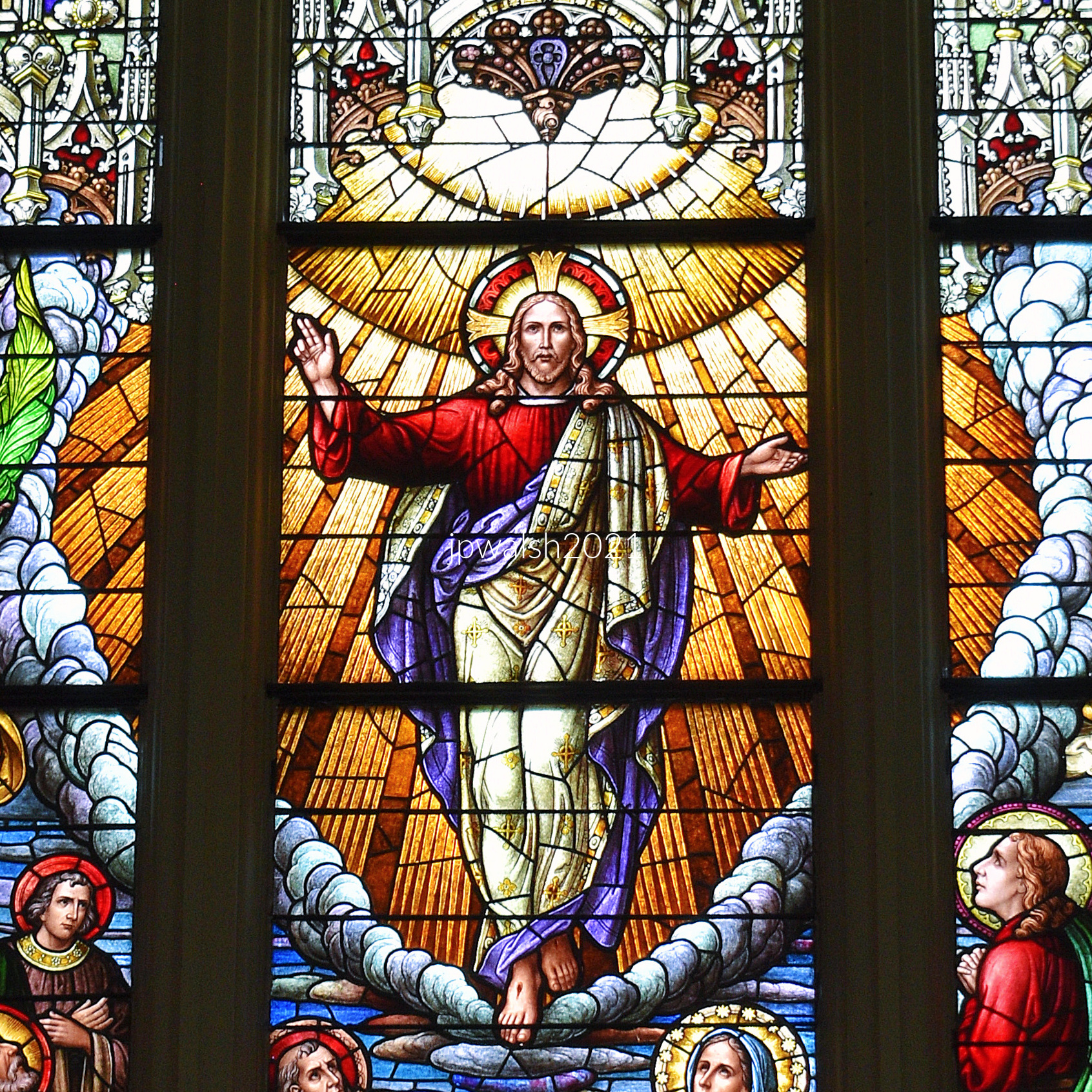
Detail, Christ, Ascension window, Sts. Peter and Paul, Naperville, IL. Author’s photograph.
In the Ascension of Christ into Heaven window, Christ is surrounded by a band of clouds and yet remains in a golden area representing the fiery light of God. Christ wears a multi-colored robe – red representing his death by crucifixion; purple representing his Divinity; and white representing martyrdom emblazoned with four-lobed crosses representing the four Gospels or the four corners of the earth.
Christ’s halo is elaborated in three parts. There are usually three Greek letters found in Christ’s cruciform halo that in translation spell out “He Who is” or “ I Am Who Am.” These are absent, however, in this stained-glass window’s cruciform halo.
87% 7.5mb
Hierarchy of angels
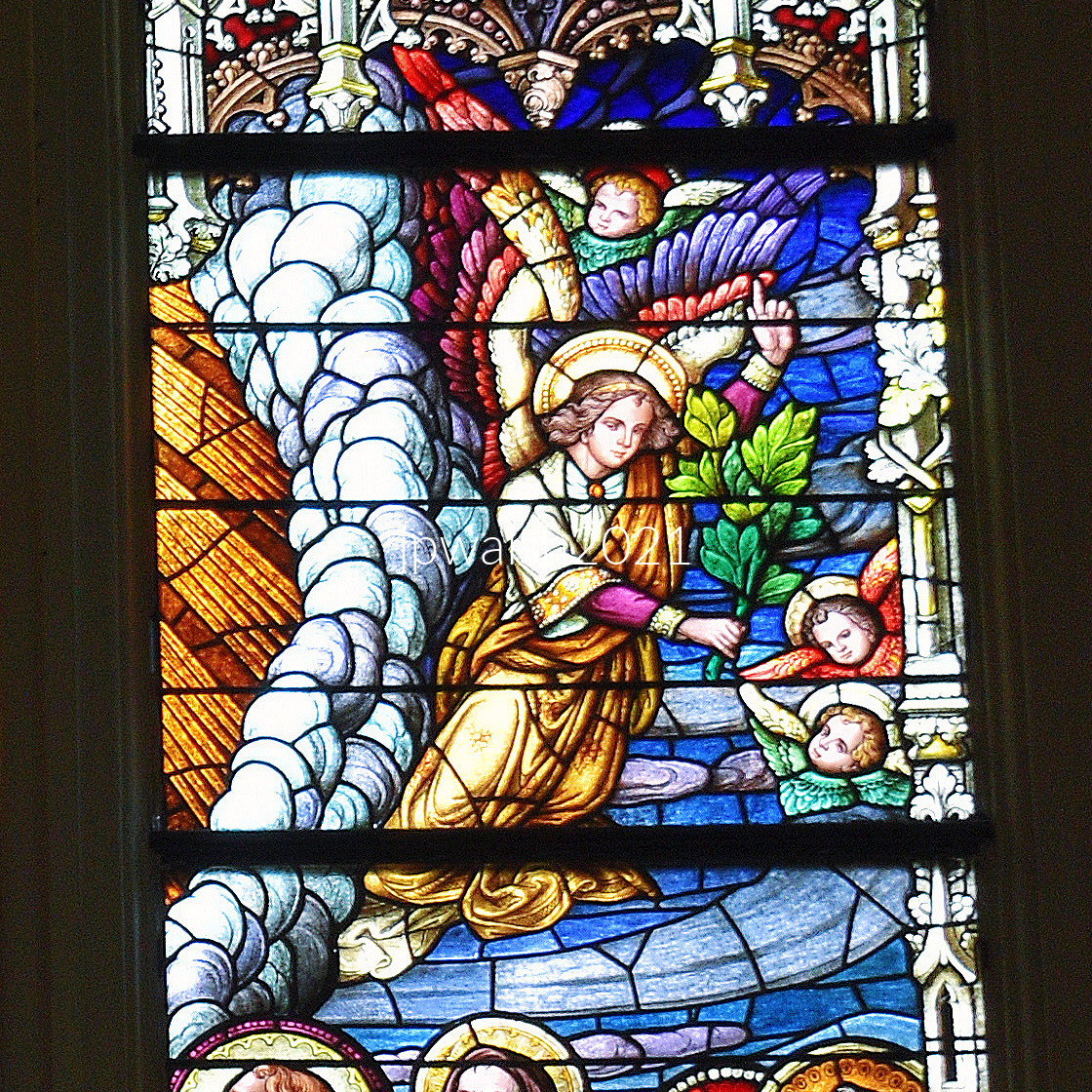
There are eight angels in the window representing the hierarchy of angels. The baby heads of the cherubim – the lowest tier of angels – are accompanied by seraphim, the highest order of angels. Their name “archangel” literally means “chief angel.” Traditionally these highest order of angels are warlike in appearance and bear a sword, This is especially the case with the iconography of St. Michael the Archangel who leads God’s angels in battle to cast Satan and his angels out of heaven as told in the New Testament Book of Revelation.
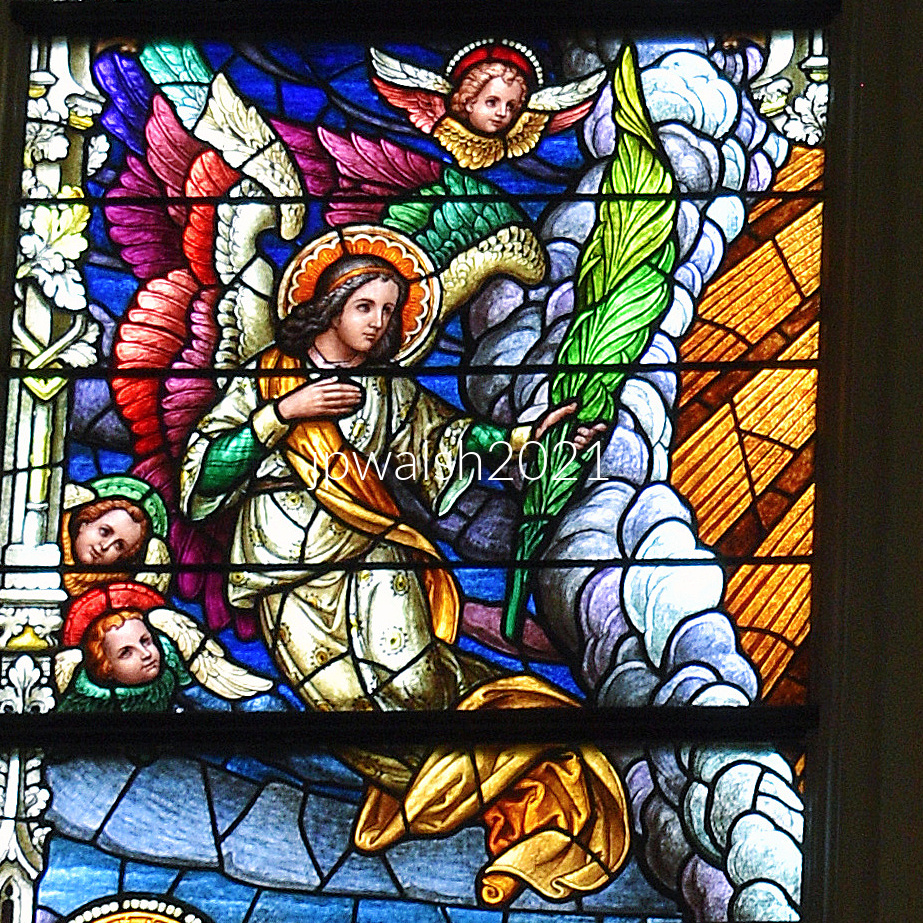
The seraphim in this stained-glass depiction, however, carry palm branches in place of swords. In the years following World War I when this stained glass was made, the Austrian art glass manufacturer may have sought to symbolize angelic power by ways of symbols of peace. The fact that the range of angels from lowest to highest is present in the window appears to signal the presence of the whole choir of angels present at the Ascension of Jesus into heaven.15
Detail, angel, Ascension window, Sts. Peter and Paul, Naperville, IL. Author’s photograph.
Iconographic details such as halos, angels, clouds, stars, crowns, colors, and symbols that enrich the theological meaning of the windows.
Detail, angel, Ascension window, Sts. Peter and Paul, Naperville, IL. Author’s photograph.
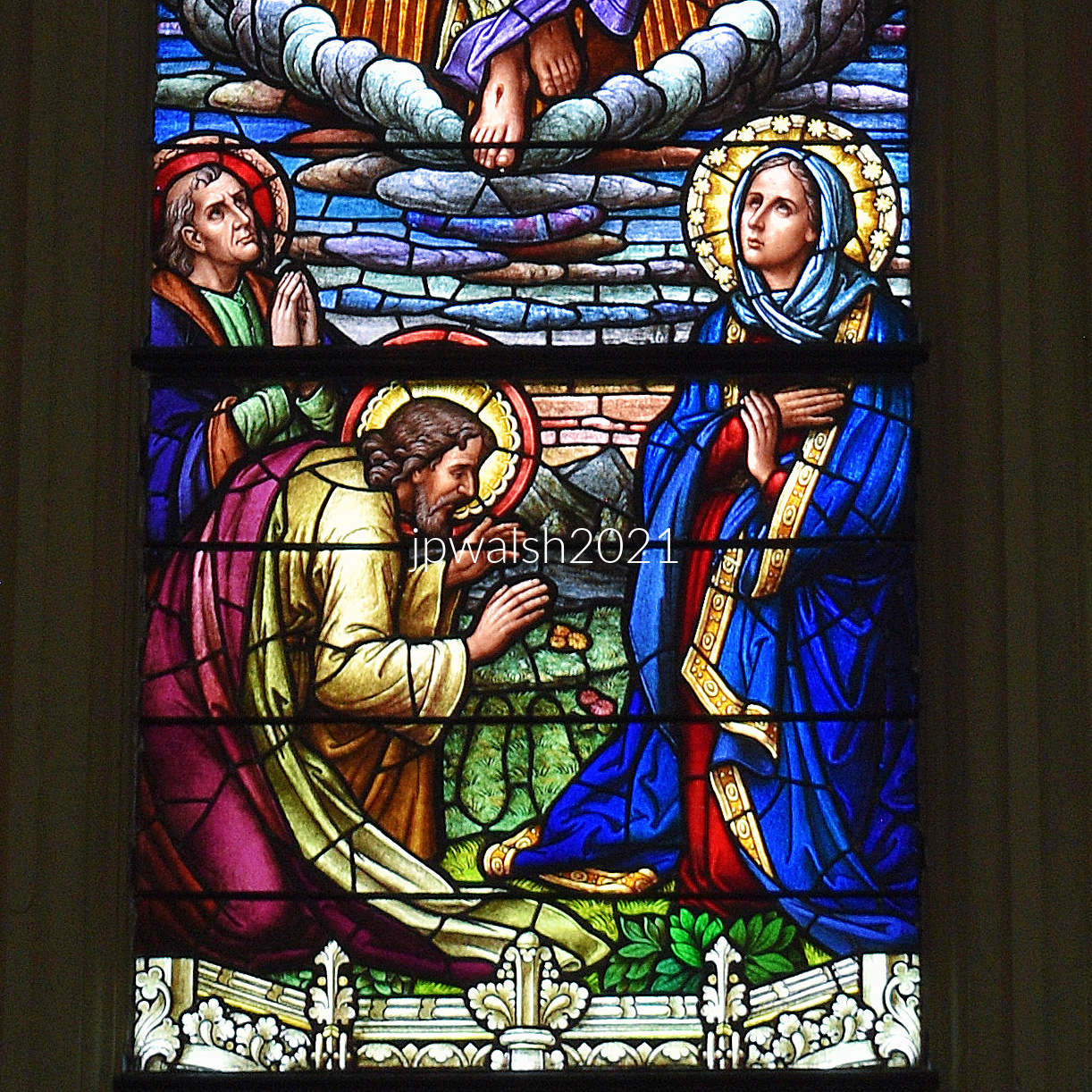
Depicted at the bottom of the window is Mary and the 12 apostles. This was not precisely accurate to the New Testament for at the Ascension there were only 11 apostles. However, the replacement of Judas by Matthias took place almost immediately following the Ascension narrative (Acts of the Apostles 1:21–26).
In the center of the window at the bottom between Mary and a kneeling apostle with his right arm stretched out is an interesting detail. It is the outline of Christ’s feet showing where his resurrected body stood and was lifted directly from earth into heaven. This is significant beyond a souvenir of Jesus’s earthly memory, in that Mount Olivet from which the resurrected Jesus was lifted into heaven is exact the place to which “the Son of Man coming in a cloud with power and great glory” (Luke 21:27) will return at the end of the world. In that way, the window is a depiction of the Ascension and one that points to the Second Coming of Christ.
Detail, outline of Jesus’s pierced feet, Ascension window, Sts. Peter and Paul, Naperville, IL. Author’s photograph.
Each of the apostle’s halos are unique. Mary’s halo has 12 stars as she is often pictured with a circle of stars. The Zodiac is an ancient circle of stars where some are symbolically combined into 12-star signs or constellations.
Detail, apostles, Ascension window, Sts. Peter and Paul, Naperville, IL. Author’s photograph.
Detail, apostles, Ascension window, Sts. Peter and Paul, Naperville, IL. Author’s photograph.
Jesus’ Ascension – his going “up” to heaven – is the same imagery used for the Assumption of Mary. It is figurative to express the spiritual. The biblical heaven is mysterious. It is the intimate reserve of God and as God is pure spirit (John 4:24), the question arises, how does Heaven incorporate the resurrected fleshly body of Christ at His Ascension?
It is explained starting with the Incarnation at the Annunciation to Mary (Luke 1:26-38) where the divine humanity of Jesus, the Word who was “with God, and…was God (John 1:1) begins. In the Ascension, the Person of Christ is fulfilled where the “new, saved man” enters heaven into the intimacy of the Father, and becomes the perfect God-Man. As “God is love” (I John 4:16), the manner of being of the body in Christ in heaven, the perfect God-man, is love.16
The Ascension is followed by Pentecost when the Apostles receive the Holy Spirit from Heaven and will speak thereafter of “Christ (in Heaven) in us.”
The window’s imagery emphasizes Christ’s divinity, resurrection, kingship, and future return.
Detail, rondelle, Christ the King, Ascension window, Sts. Peter and Paul, Naperville, IL. Author’s photograph.
The upper rondelle represents Christ the King. Christ’s crown obscures his elaborate three-part halo. The Greek letters on either side represent the “alpha” (“the beginning”) and the “omega” (“the ending”) which indicates Christ’s Godhead. Christ the King holds in his hands the symbols of the sacrament of the Holy Eucharist in the consecration of the Mass. in his right hand is the species of bread and wine that become the Body and Blood of Christ and in his left hand is the wood beam of the cross whose sacrifice on Calvary the Eucharist memorializes. Christ the King also reveals his Sacred Heart – a popular Catholic devotion- inside his chest. His heart is depicted as aflame encircled by a crown of thorns signifying his agape (or sacrificial) love. The entire Ascension window was the gift of Mr. and Mrs. William David Callender, parish members in the mid1920s.
Detail, halo of stars, Ascension window, Sts. Peter and Paul, Naperville, IL. Author’s photograph.
In the New Testament, the Woman of the Apocalypse and the battle of St. Michael the Archangel against the Dragon are bound together in the same dramatic narrative in the Book of Revelation (Rev.12:1-9). The Woman with a crown of 12 stars who is against the Dragon in the Book of Revelation has been identified with Mary, particularly as the Immaculate Conception. This is how Mary is depicted in the Ascension of Christ into Heaven window at Sts. Peter and Paul.
The New Testament passage setting out these images is in Revelation 12:1-9:
1 A great sign appeared in the sky, a womanclothed with the sun, with the moon under her feet, and on her head a crown of twelve stars.
2 She was with child and wailed aloud in pain as she labored to give birth.
3 Then another sign appeared in the sky; it was a huge red dragon, with seven heads and ten horns, and on its heads were seven diadems.
4 Its tail swept away a third of the stars in the sky and hurled them down to the earth. Then the dragon stood before the woman about to give birth, to devour her child when she gave birth.
5 She gave birth to a son, a male child, destined to rule all the nations with an iron rod. Her child was caught up to God and his throne.
6 The woman herself fled into the desert where she had a place prepared by God, that there she might be taken care of for twelve hundred and sixty days.
7 Then war broke out in heaven; Michaeland his angels battled against the dragon. The dragon and its angels fought back,
8 but they did not prevail and there was no longer any place for them in heaven.
9 The huge dragon, the ancient serpent,who is called the Devil and Satan, who deceived the whole world, was thrown down to earth, and its angels were thrown down with it.
EXPLANATION OF IMAGERY IN THE NARRATIVE OF REVELATION 12-14
About the middle of the Book of Revelation (Chapters 12-14), the author portrays the power of evil as represented by the figure of the Dragon who is opposed to God and his people. This Dragon pursues the woman about to give birth to devour the child but the child is born. Then St. Michael and his angels expel the Dragon and the Dragon’s angels out of heaven (Rev. 12:5-9). Adorned with the Old Testament images of sun, moon, and stars (Genesis 37:9-10), the woman symbolizes God’s people. As Israel gave birth to the Messiah (Rev.12:5) and the church suffers persecution by the Dragon (Rev 12: 6, 13-17), the Woman corresponds to an archetype of a pregnant goddess bearing a savior who is pursued by a monster looking to destroy the offspring. But her offspring, a son, in his turn, destroys the monster.
The huge red Dragon is a symbol of the forces of evil – the Devil or Satan (Rev. 12:9, 20:2), or the mythical Leviathan (Ps, 74:13-14) or Rahab (Job 26:12-13; Ps 89:11). It is also the ancient serpent who seduced Eve, the mother of the whole world (Gen 3:1-6).17
THE WINDOWS: The Assumption of Mary into Heaven.
South Transept, Assumption of Mary into Heaven, 1927, Tyrol Art Glass Company, Innsbruck, Austria. Sts. Peter and Paul Church, Naperville, Illinois. Author’s photograph.
There is no mention of the Assumption of Mary into Heaven in the New Testament. There are biblical texts used frequently to point to the doctrine whose imagery is related to the Ascension of Christ into Heaven.
The Assumption of Mary intheology is the doctrine that Mary as Theotokos, or Mother of God, was taken (“Assumed”) into heaven, body and soul, at the moment, or what would be the moment, of her death. This phenomenon is not unprecedented in the Bible. It occurred in the Old Testament to Moses and Elijah who were pivotally important as Old Testament figures and who were present at Christ’s Transfiguration in the New Testament (Matt 17:1-9; Mk 9:2-10: Lk 9:28-36; and 2 Peter 1:16-21).
There has been debate whether Mary was assumed into heaven at death or after death – that is, whether Mary, the Mother of the Savior, experienced death at all. It is a debate not resolved even with the doctrine of the Mary’s Assumption into Heaven declared a dogma of the faith by Pope Pius XII (1876-1958) on November 1, 1950 in the apostolic constitution Munificentissimus Deus.
What is depicted in the window is biblical in the sense that it is the dogmatic theology deduced from it. The Assumption as a theme in Christian art originated in western Europe during the late Middle Ages—starting in the 12th and 13th centuries – a period when devotion to the Virgin Mary was growing in importance. It would be renewed vigorously again in the 16th century during the Protestant Reformation. Before this Renaissance and Reformation period, Mary is represented surrounded by a mandorla, or almond-shaped aureole. But starting in the 16th century the mandorla was replaced by a cluster of clouds as depicted in the window.
•The Assumption window depicts Mary assumed body and soul into heaven and draws upon biblical imagery, Catholic doctrine, and centuries of Marian devotion in Christian art.
Detail. Mary, Assumption window, Sts. Peter and Paul Church, Naperville, Illinois. Author’s photograph.
The window depicts Mary standing upon a brightly-lit crescent moon reflected in imagery from Revelation 12.
Mary wears a blue cloak with a red shirt underneath as seen in the stained glass window by her right arm’s sleeve. The blue of her cloak is interpreted to represent the Virgin’s purity, symbolize the cosmos, and identify Mary as a Queen as blue was associated with royalty.
The red garment color signifies traits connected with motherhood as well as Mary’s presence on Calvary at her son’s crucifixion, particularly her traits of love and devotion.
These symbolic colors Mary wears expresses a universal definition of motherhood for her.
The Virgin Mary is mother to Jesus which expands to the whole of humanity. On Calvary, standing by the cross of Jesus were three Marys – Mary, his mother, Mary, the wife of Clopas, and Mary of Magdala. From the cross, Jesus said in John 19:
26 When Jesus saw his mother and the disciple there whom he loved, he said to his mother, “Woman, behold, your son.”
27 Then he said to the disciple, “Behold, your mother.” And from that hour the disciple took her into his home. (New American Bible)
Mary wears a white robe representing her purity. Her halo has seven eight-pointed stars. In numerology the number 7 represents “perfection” and the number 8 represents “regeneration or rebirth.”
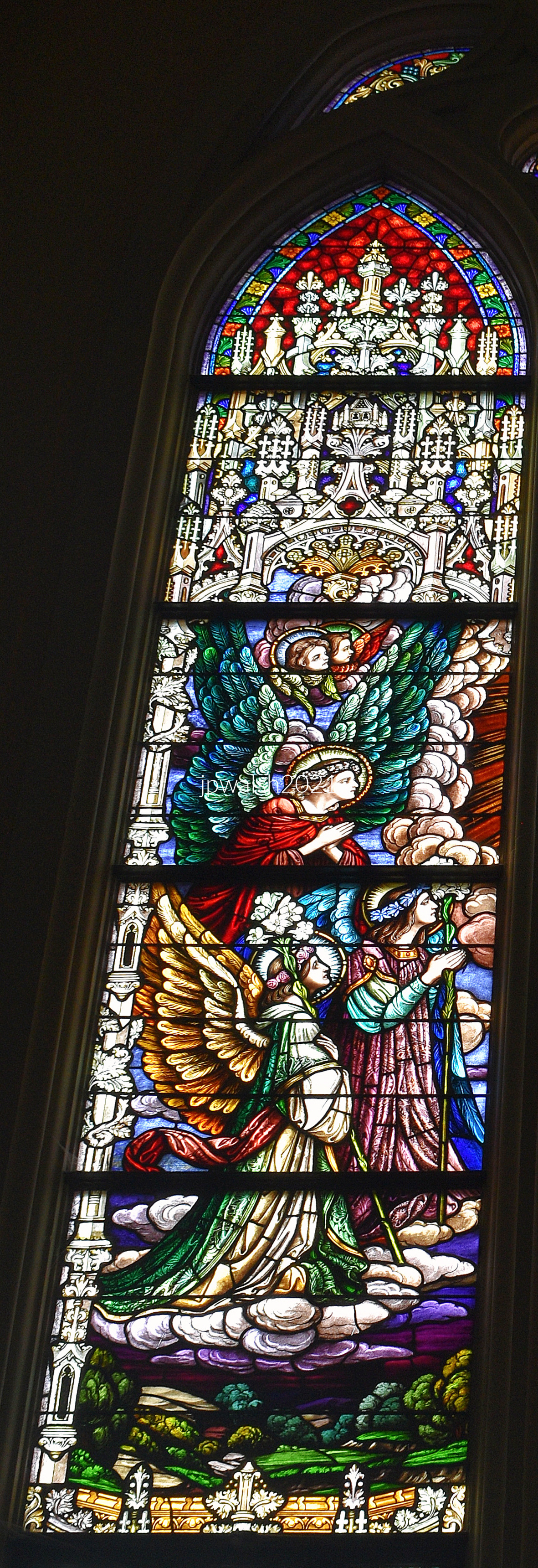
Detail. angels, Assumption window, Sts. Peter and Paul Church, Naperville, Illinois. Author’s photograph
Detail. angels, Assumption window, Sts. Peter and Paul Church, Naperville, Illinois. Author’s photograph.
There are 12 angels, some carrying palms representing peace and victory, others carry lilies representing Mary’s virginity. Angels wear laurels of hyacinths (prudence, peace, and desire for heaven) and of roses (heavenly joy). Another angel holds out a bouquet of thornless roses signifying purity and the triumph of love. Mary will be crowned Queen of Heaven and the angels hold her crown.
God the Father wears a triangular halo as He blesses the scene. The Holy Spirit in the symbol of the dove emanates.18
Detail. rondelle, The Trinity, Assumption window, Sts. Peter and Paul Church, Naperville, Illinois. Author’s photograph.
FEATURE image: (detail) Jesus Appears to Mary Magdalene, John 20:11-18.
The Shrine of Christ’s Passion in St. John, Indiana is much more than a sculpture park or roadside attraction. Through life-sized bronze sculptures, landscaped surroundings, Scripture, and meditation, it offers visitors an immersive experience of Christ’s Passion, Death, Resurrection, and Ascension while serving as a major regional destination for prayer, reflection, and religious art.
INTRODUCTION
A Serene Oasis in Northwest Indiana
The Shrine of Christ’s Passion is located on busy U.S. 41 at 10630 Wicker Avenue in St. John, Indiana—just a one-hour drive (about 40 miles) south of downtown Chicago and 90 minutes from the University of Notre Dame. Settled as a pioneer town in 1837, St. John still sits among rolling farm fields despite increasing modern development near the Indiana-Illinois state line.
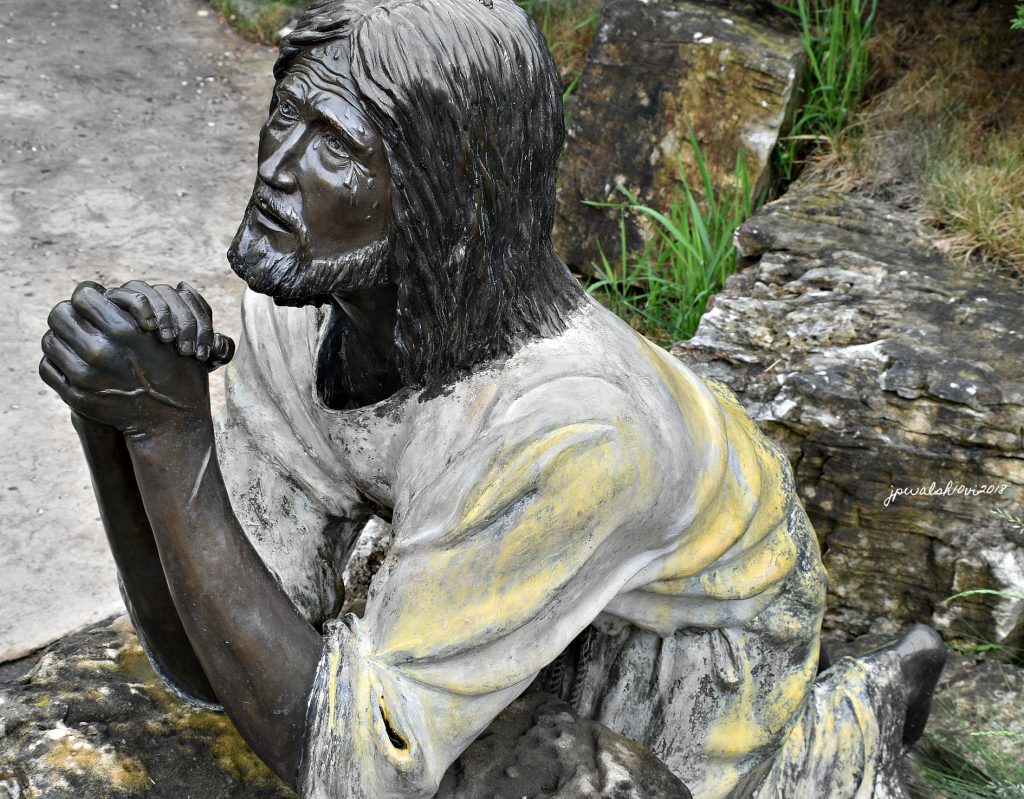
Situated on the historic Wachter family farm, the 30-acre site features an array of multimedia and interactive attractions. Most visitors come to traverse the half-mile winding concrete pathway, which beautifully showcases over 40 life-sized bronze sculptures that dramatize the biblical Passion of Jesus Christ.
Journeying Through the Stations of the Cross
The journey begins inside a well-stocked gift shop before leading directly outdoors to the first dramatic scenes: Jesus at the Last Supper and praying in the Garden of Gethsemane. From there, visitors follow the 14 traditional Stations of the Cross. The trail concludes at the empty tomb, Jesus’s appearance to Mary Magdalene, and a dramatic depiction of the Ascension of the Risen Jesus into Heaven on Mount Olivet.
To build this massive spiritual destination, it required a decade of planning and over $10 million. To enhance the experience, each station features an orientation kiosk. At the push of a button, visitors can listen to a clear, brief English description and short meditation narrated by famed American television journalist Bill Kurtis.
The shrine opened in 2011 and added its latest attraction– namely, a re-creation of the rock-filled path up Mount Sinai to where Moses has received the 10 Commandments –in 2017.
Immersive Landscapes of the Holy Land
The broad concrete pathway is designed for an easy, meditative progression that fosters quiet reflection and personal discovery. The landscape architecture incorporates formed hills, carefully planted trees, bushes, grasses, and large boulders. This self-contained design effectively blocks out the outside world, beautifully evoking the arid climate and terrain of the Holy Land.
Upon exiting the gift shop—where all proceeds fund the upkeep of the shrine—the transition into the pastoral, biblical setting is immediate. While visitors share the trail with pilgrims from around the world, the layout provides ample space and freedom for a deeply personal, intimate experience.
A Space for Reflection and Exploration
Open 361 days a year, the prayer trail maintains a quiet, respectful atmosphere year-round. A large and impressive place, there are plenty of places to sit, rest, and take in the realistic sculpture art detailing “the greatest story ever told.” While a quick visit can be completed in about 30 minutes, visitors should allow at least an hour to fully savor the experience.
Beyond the main prayer trail, the grounds feature several other major attractions:
The Moses, Mount Sinai, and the 10 Commandments Trail
The Sanctity of Life Shrine
Our Lady of The New Millennium: A monumental, 34-foot-tall statue of the Virgin Mary crafted from over 8,000 pounds of stainless steel.
Visitor Information and Hours
The shrine is operated by a non-denominational, nonprofit private foundation, and admission to all attractions is completely free.
The Prayer Trail: Open year-round (weather permitting).
Main Entrance on U.S. 41 at 10630 Wicker Avenue in St. John, Indiana, minutes from the Illinois-Indiana state line. Just 40 minutes from downtown Chicago, there is ample free parking and tour buses are welcome.
The Gift Shoppe.
The Last Supper Luke 22:19
“And he took bread, gave thanks and broke it, and gave it to them, saying, “This is my body given for you; do this in remembrance of me.”
Garden of Gethsemane Mark 14:34
“My
soul is overwhelmed with sorrow to the point of death,” Jesus said to
them. “Stay here and keep watch.”
THE 14 STATIONS OF THE CROSS AT THE SHRINE OF CHRIST’S PASSION, ST. JOHN, INDIANA.
1. Jesus is condemned to death Matthew 27: 19-26.
“When Pilate saw that he was not succeeding at all, but that a riot was breaking out instead, he took water and washed his hands in the sight of the crowd, saying, “I am innocent of this man’s blood. Look to it yourselves.”…Pilate had Jesus flogged, and handed him over to be crucified.”
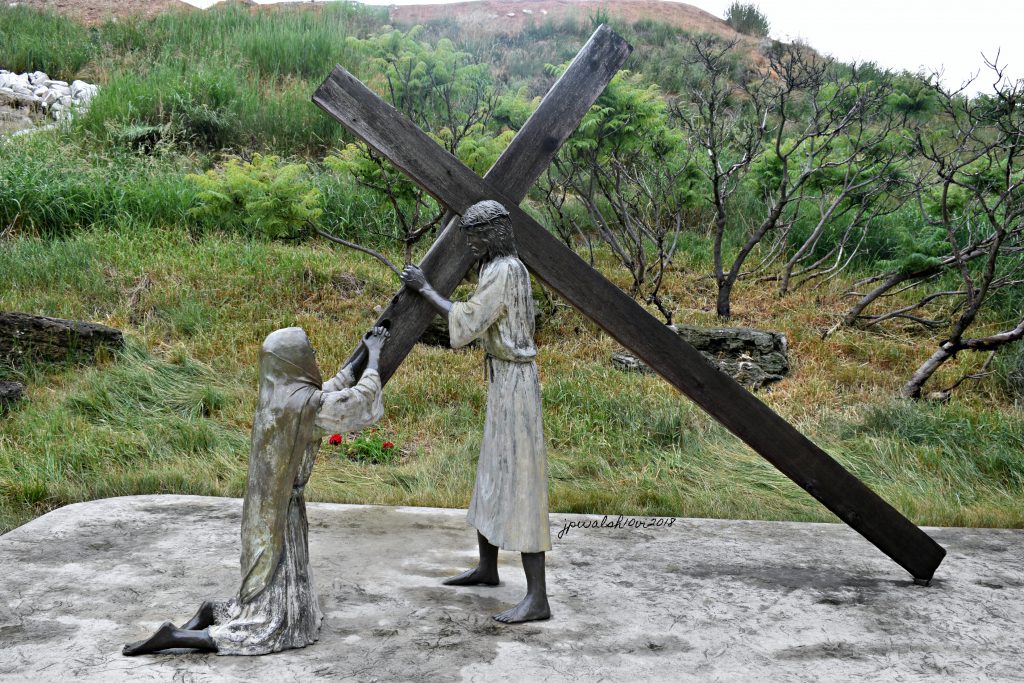
2. Jesus carries His cross John 19:16-17
“Then Pilate handed him over to be crucified. The soldiers took charge of Jesus, who carried his own cross to a location called “The Place of a Skull,” known in Aramaic as Golgotha.”
3. Jesus falls for the first time Isaiah 53:1-3
“He was despised and rejected by mankind, a man of suffering, and familiar with pain. Like one from whom people hide their faces he was despised, and we held him in low esteem.”
4. Jesus meets His mother, Mary Lamentations 1:12
“Is it nothing to you, all you who pass by? Look around and see. Is any suffering like my suffering that was inflicted on me..?”
5. Simon of Cyrene helps Jesus carry the cross Luke 23:26
“They seized Simon from Cyrene, who was on his way in from the country, and put the cross on him and made him carry it behind Jesus.”
6. Veronica wipes the face of Jesus Psalm 17:15
“As for me, I will be vindicated and will see your face; when I awake, I will be satisfied with seeing your likeness.”
7. Jesus falls for the second time Isaiah 53:4-6
“Surely he took up our pain and bore our suffering, yet we considered him punished by God, stricken by him, and afflicted.”
8. Jesus meets the women of Jerusalem Luke 23:27-31
“A large number of people followed him, including women who mourned and wailed for him. 28 Jesus turned and said to them, “Daughters of Jerusalem, do not weep for me; weep for yourselves and for your children.”
9. Jesus falls for the third time Isaiah 53:10-11
“Yet it was the Lord’s will to crush him and cause him to suffer, and though the Lord makes his life an offering for sin, he will see his offspring and prolong his days, and the will of the Lord will prosper in his hand….”
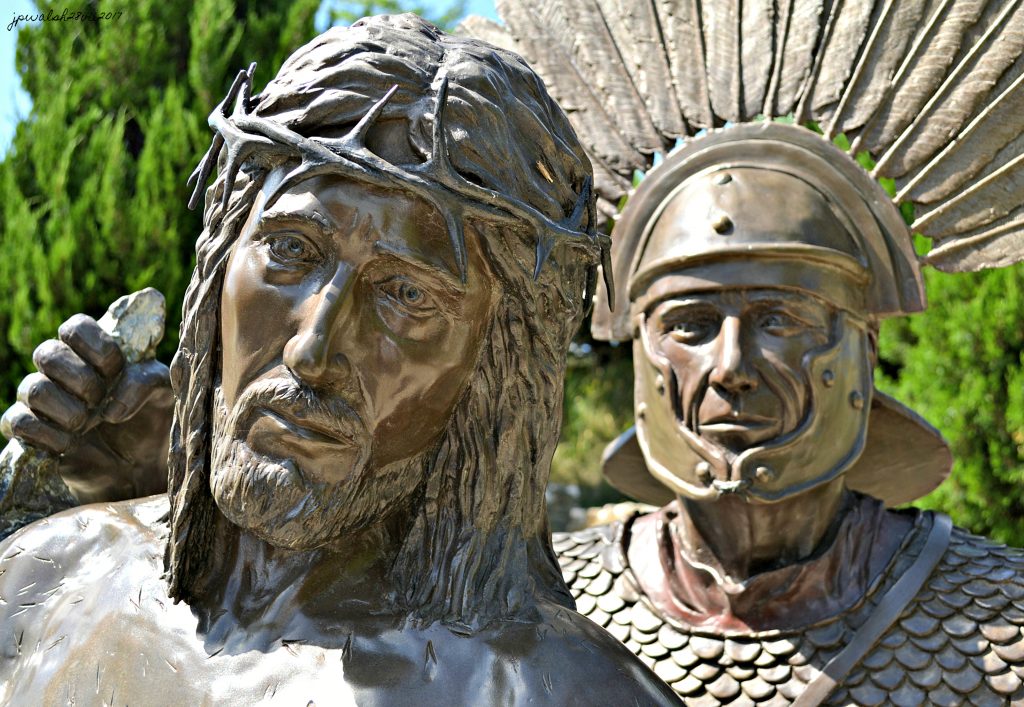
10. Jesus is stripped of His clothes Matthew 27:27-31
“They stripped him and put a scarlet robe on him, and then twisted together a crown of thorns and set it on his head. They put a staff in his right hand. Then they knelt in front of him and mocked him.”
11. Jesus is nailed to the cross Luke 23:33-34
“When they came to the place called the Skull, they crucified him there, along with the criminals—one on his right, the other on his left.”
12. Jesus dies on the cross Luke 23:44-49
“Jesus called out with a loud voice, “Father, into your hands I commit my spirit.” When he had said this, he breathed his last.”
13. Jesus is taken down from the cross Mark 15:39
“When the centurion who stood facing him saw how Jesus breathed his last he said, ‘Truly this man was the Son of God!'”
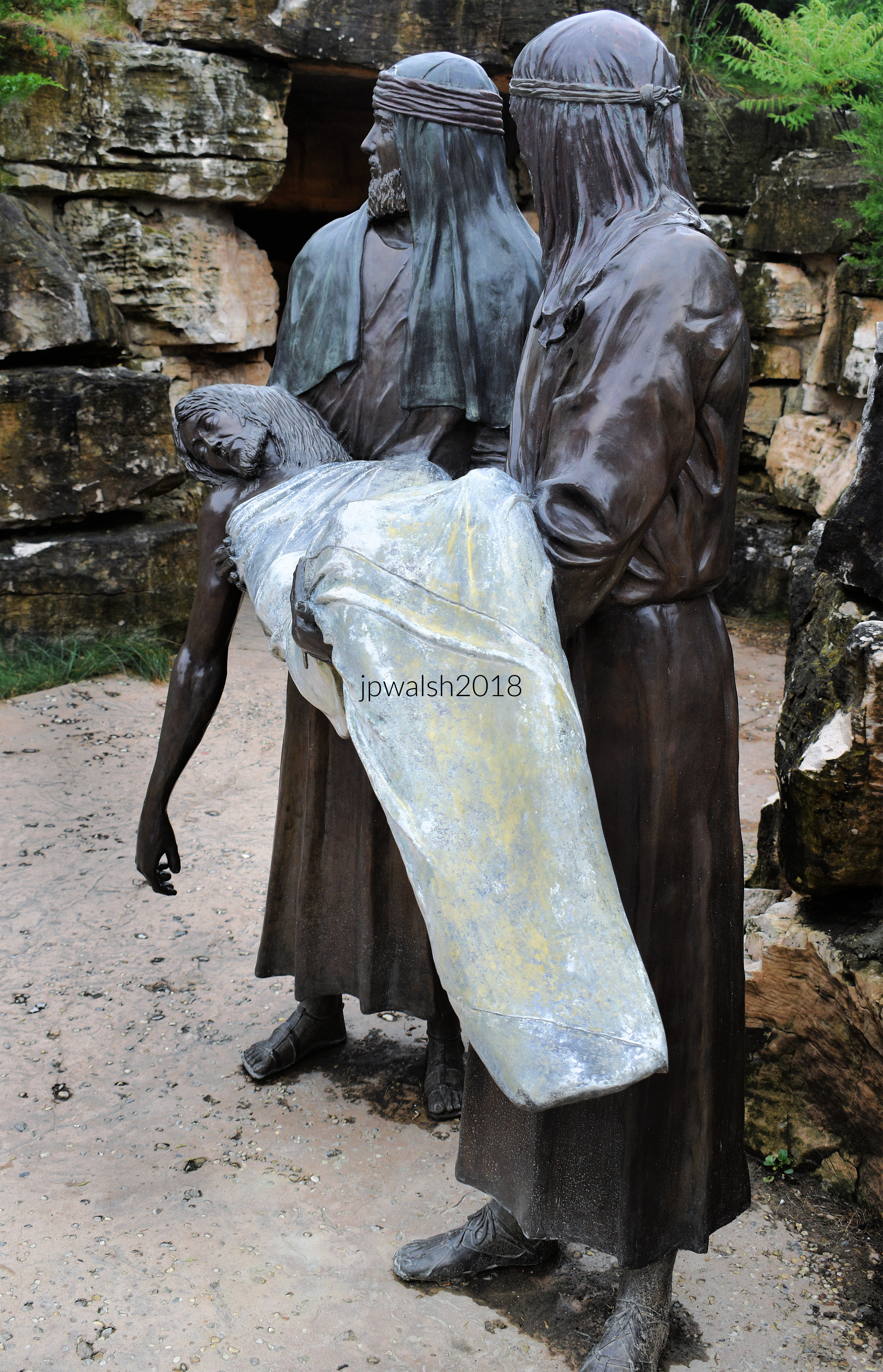
14. Jesus is placed in the tomb Luke 23:50-53
“Going to Pilate, Joseph of Arimathea asked for Jesus’ body. Then he took it down, wrapped it in linen cloth and placed it in a tomb cut in the rock, one in which no one had yet been laid.”
June 2018. 87% 7.94mb DSC_9082
The Resurrection of Jesus.Matthew 28.
1 After the sabbath, as the first day of the week was dawning,* Mary Magdalene and the other Mary came to see the tomb.
2 And behold, there was a great earthquake; for an angel of the Lord descended from heaven, approached, rolled back the stone, and sat upon it.
3 His appearance was like lightning and his clothing was white as snow.
4 The guards were shaken with fear of him and became like dead men.
5 Then the angel said to the women in reply, “Do not be afraid! I know that you are seeking Jesus the crucified.
6 He is not here, for he has been raised just as he said. Come and see the place where he lay.
Jesus Appears to Mary Magdalene John 20:16
“Jesus said to her, “Mary.” She turned
toward him and cried out in Aramaic, “Rabboni!”
MORE of the Prayer Trail:
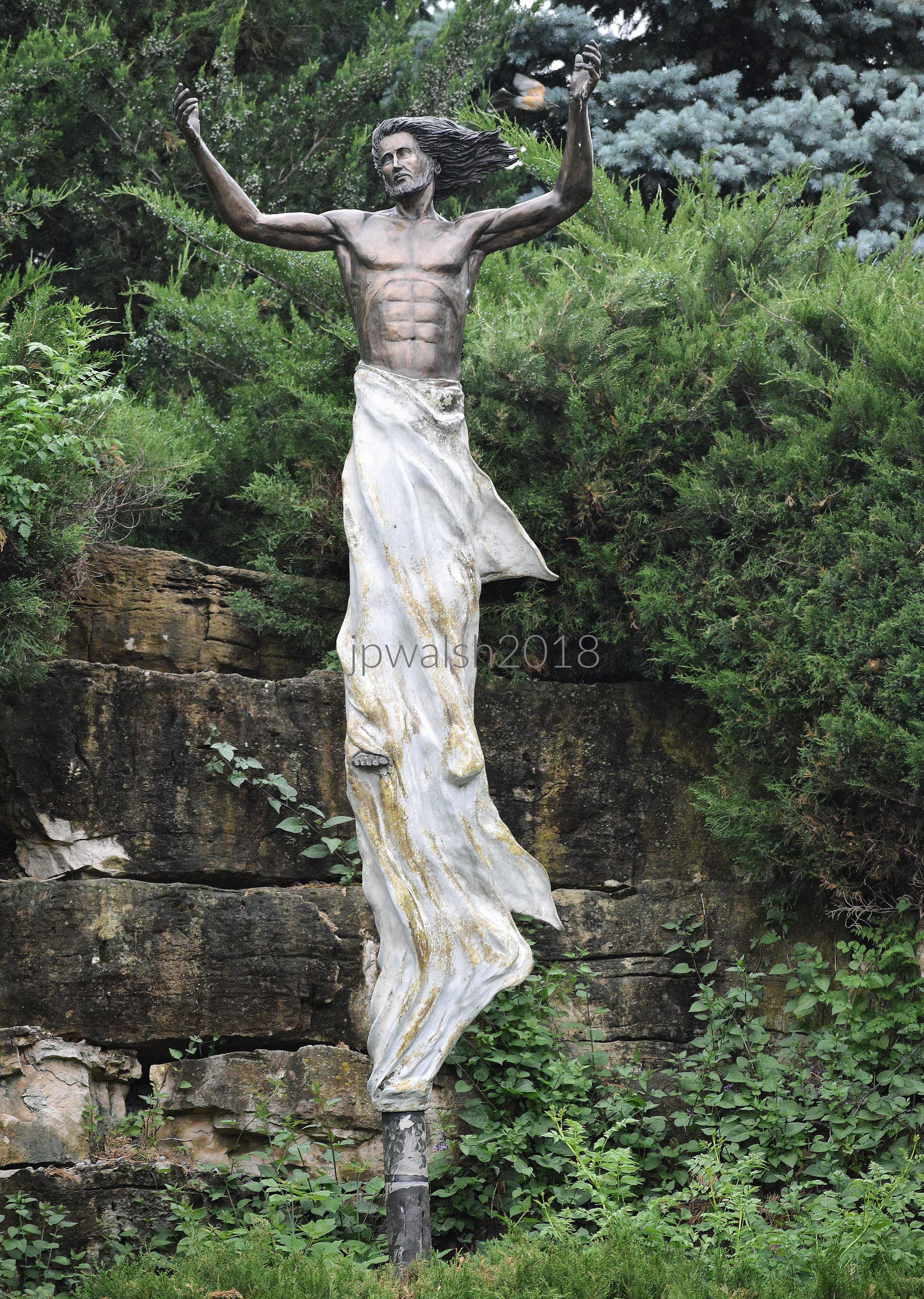
The Ascension Acts of the Apostles 1:9
“…Jesus was taken up before their very eyes,
and a cloud hid him from their sight.”
June 2018. 68% 7.90mb DSC_0310
The Ascension of Jesus: The Double Account of Luke the Evangelist
The Ascension of Jesus is described twice in the New Testament, with both accounts originating from Luke the Evangelist. The first description appears at the very end of his Gospel (Luke 24:50–53), while the second opens the Acts of the Apostles (Acts 1:6–12).
In Acts, Luke introduces a crucial narrative element: a forty‑day period (Acts 1:3) during which the risen Jesus appears to the apostles, teaches them, and prepares them for their upcoming mission. This specific timeframe is not emphasized in the Gospel account. This suggests that Luke separates the Resurrection and the Ascension in Acts not because he inherited conflicting traditions, but because it serves a distinct narrative purpose. Acts utilizes these forty days to firmly situate the apostles within the larger framework of Israel’s covenant history, framing the early Church as the direct continuation of God’s saving work.
Reorienting the Expectations of the Kingdom
Once Jesus rises from the dead, the disciples fully recognize him as the Messiah. It is therefore understandable that, in Acts, they ask whether he will now restore Israel’s political kingdom. Luke, writing for future generations of Christians, places a deliberately open‑ended reply in Jesus’s mouth.
The exact timing of the parousia—the Second Coming—is not for them to know. Instead, their task is entirely different: to wait for the Holy Spirit, whose power will transform them into witnesses “to the ends of the earth.” Jerusalem, the central site of Jesus’s Passion and Resurrection, thus becomes the launching pad for this worldwide mission.
Symbolism and Eschatology on Mount Olivet
Acts adds further symbolic depth to the Ascension through specific biblical motifs:
The Cloud: Jesus is taken from their sight by a cloud, a classic biblical sign of the divine presence and a motif heavily associated with end‑times imagery (Luke 21:27).
The Location: The event occurs on the Mount of Olives, a location already deeply charged with eschatological expectation.
The Two Figures: As Jesus is lifted up, two figures in dazzling garments appear. They match the same angelic type who initially announced his birth (Luke 2:9) and later proclaimed his Resurrection (Luke 24:4–7).
The message delivered by these figures directly links the Ascension to the Second Coming, promising that the Jesus who is taken up in glory “will return in the same way you saw him go” (Acts 1:11).
From Incarnation to Glorification
Christian tradition understands the mystery of Christ by tracing a single, unbroken arc from the Incarnation to the Ascension. This trajectory begins at the Annunciation (Luke 1:26–38), when the eternal Word—the One who “was with God and…was God” (John 1:1)—takes on human nature in the womb of Mary. In this pivotal moment, the divine and human are permanently united in the Person of Jesus.
The Ascension brings this union to its ultimate fulfillment. Here, the “new, saved man” enters into the very life of the Father, revealing the ultimate destiny of redeemed humanity. Christ’s glorified body becomes the perfect expression of what humanity is truly meant to be in God: a life whose very mode of existence is love, for “God is love” (1 John 4:16). In heaven, the God‑Man embodies this reality completely.
Pentecost and the Indwelling Presence
The Ascension is immediately followed by Pentecost, the moment when the apostles receive the promised Holy Spirit from the risen Christ. From that historic day forward, the early believers speak not only of Christ exalted in heaven, but of “Christ in us”—the indwelling presence that dynamically makes all believers active participants in his risen life.
FEATURE Image: Saint Francis kissing the leper, Zacarías González Velázquez, oil on canvas, c. 1787, 217×264 cm, Prado, Madrid. The painting is part of a serial of thirty-three scenes on the “Life of Saint Francis” commissioned for the Basilica of Saint Francis the Great in Madrid done by multiple Spanish painters. The artist was inspired by Saint Bonaventure’s biography of St. Francis that recounts this scene of Francis, dressed in the luxurious clothes of a rich knight, as he dismounts from his steed to kiss a leper. see – Saint Francis Embracing a Leper – The Collection – Museo Nacional del Prado – retrieved October 4, 2017.
By John P. Walsh
The April 20, 1949 photograph of Roberto Rossellini and Ingrid Bergman captures a pivotal turning point at which artistic collaboration, personal scandal, and cinematic innovation converged. As public fascination with their relationship intensified, Rossellini turned toward the creation of The Flowers of St. Francis (1950), a film whose central episode, Francis’s embrace of a leper despite his initial revulsion, presents spiritual transformation as the triumph over fear and self-interest. In doing so, the Italian neorealist director fashioned a work that also served as a retreat from public controversy into a world of humility, simplicity, and faith.
Italian director Roberto Rossellini and Swedish actress Ingrid Bergman are seen in a photograph taken by an uncredited Associated Press photographer on April 20, 1949, during a press conference at Rome’s Excelsior Hotel. Bergman had just arrived in Italy after writing her famous, career-altering letter to Rossellini, and the announced purpose of the gathering was to discuss their forthcoming collaboration, Stromboli.
The image captures a pivotal moment. Rossellini was already celebrated as the leading architect of Italian neorealism through such postwar landmarks as Open City and Paisan, while Bergman was one of the world’s most admired film stars and an Academy Award winner. Their expressions and proximity suggest a shared artistic purpose and creative excitement. Yet the photograph also unintentionally records the beginning of a relationship that would soon become one of the most scrutinized scandals in international celebrity culture, dominating headlines and ultimately leading to their marriage on May 24, 1950.
From Public Scandal to Spiritual Retreat
Ironically, while caught in this intensifying media storm, Rossellini turned toward one of the most serene and spiritually focused projects of his career: Francesco, giullare di Dio (The Flowers of St. Francis, 1950). The film emerged in part from his desire to escape the relentless attention surrounding his private life. In place of scandal, fame, and controversy, Rossellini sought a subject grounded in humility, simplicity, peace, and detachment from worldly concerns.
Co-written with the young Federico Fellini, the film drew its structure and themes from two fourteenth-century Franciscan texts: I Fioretti di San Francesco (The Little Flowers of St. Francis) and La Vita di Frate Ginepro (The Life of Brother Juniper). Rather than constructing a conventional biographical narrative, Rossellini assembled a series of nine loosely connected episodes that celebrate the joy, innocence, and spiritual freedom of Saint Francis and his followers.
Neorealism and Franciscan Simplicity
Remaining faithful to his neorealist principles, Rossellini rejected professional actors and cast actual Franciscan friars from the Monastery of Nocera Inferiore as Francis and his companions. The production sought not spectacle but authenticity. Equally important was Rossellini’s ambition to strip away any cinematic artifice in favor of directness and humanity so to recreate on screen the visual spirit of Giotto’s proto-Renaissance frescoes of the Life of St. Francis.
Viewed in retrospect, the 1949 photograph of Rossellini and Bergman marks far more than the beginning of Stromboli. It stands at the intersection of two parallel stories: one a highly publicized romance that captivated the world, the other the creation of a film devoted to spiritual humility and transcendence. The contrast reveals the remarkable complexity of Rossellini’s career at the very moment his personal and artistic lives became inseparably entwined.
One of the most important episodes in the life of St. Francis of Assisi (c. 1181-1226) appears midway through Roberto Rossellini’s 1950 film Francesco, giullare di Dio (The Flowers of St. Francis). In a powerful five-minute sequence (Beginning at 41:00), Francis deliberately seeks out and embraces a leper, one of the most feared and socially ostracized figures of the medieval world.
This encounter marks a decisive turning point. Until this moment, Francis had recoiled from lepers, sharing the fears and prejudices common to his age. By overcoming that revulsion and embracing the suffering man before him, he crossed the threshold from worldly, military ambition to love, humility and poverty based in spiritual commitment.
A Moment of Spiritual Transformation
Following the embrace, Francis collapses to the ground in tears and cries out, “My God, my Lord and my all! O great God!” The emotional outpouring signals a profound inner conversion. What begins as an act of compassion becomes an encounter with the divine.
For Francis, embracing the leper means more than helping someone in need. It represents the conquest of his own fear, pride, and self-interest. The rich young man from Assisi discovers a new path rooted in humility, love, and obedience to God.
The Bridge Between Two Lives
Historically and spiritually, the embrace of the leper forms the bridge between Francis’s failed military and worldly aspirations and his lifelong dedication to radical poverty, humility, and service. In Christian tradition, it is the pivotal catalyst of his transformation, the moment when he turns away from status and ambition and begins the journey that would make him one of the most beloved saints in history.
Rossellini captures this episode as the emotional and spiritual center of The Flowers of St. Francis. By portraying Francis’s willingness to embrace society’s most vulnerable outcast, the film affirms that true conversion begins not with power or achievement, but with the courage to overcome fear and recognize the dignity and humanity of others.
Is the film scene historically accurate?
The event of the embrace is historically accurate though dramatized in Rossellini’s film after Francis’s brotherhood is established. Rather, in history it occurred at the beginning of the Italian saint’s conversion – in fact, was its cause. This is an important distinction since the embrace was most significant for St. Francis. It could even be argued that without Francis’s embrace of the leper, there would be no St. Francis of Assisi at all.
In Francis’s own Testament written in 1225—one year before his death at 44 or 45 years old—the saint stated directly that his embrace of the leper became the cause of his conversion.
For a rich young man such as Francis in medieval Europe who, during an age of many French popes, sought chivalric glory in military arms, he naturally spurned the contagion of leprosy that was an incurable disease and diligently avoided lepers. As Francis put it, when he embraced the leper he “exercised mercy” to him as Francis bridged his natural ambition and religious doubt with trust in God’s grace by embracing Assisi’s despised.
In that way, the leper— a common sight throughout medieval Europe and one that readily filled the lighthearted Francis with horror—became the astonishing means for the saint’s conversion of faith.
Special order of knights founded by pope cared for lepers in Italy.
In thirteenth-century Europe, by law lepers had to live apart from the rest of society owing to their contagious infectious disease.
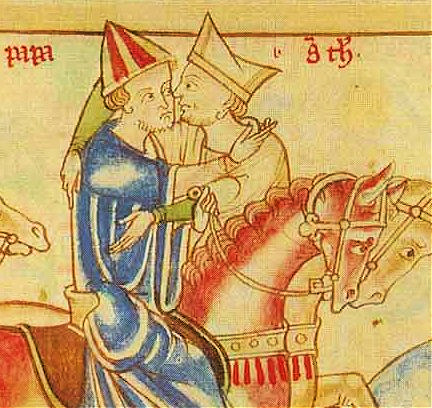
As early as the 6th century under Pope St. Symmachus (495–514) there were general hospitals in Rome that cared for lepers though a network of specialized leper houses became more prevalent by the 11th-century. In 1130, the hospitaller and military Order of Saint Lazarus was established so that at the Third Lateran Council in 1179, two or three years before St. Francis’s birth, Pope Alexander III helped formalize the church’s role in the care of lepers, emphasizing their separation for care rather than mere social isolation.
St. Thomas Becket takes leave of Pope Alexander III in the autumn of 1165. 13th century miniature attributed to Matthew Paris, British Library.Public domain.
In the time period that Rossellini’s poignant film scene is set — it is either 1205 or 1206—there existed in Europe tens of thousands of church-run “hospitals” for lepers. One such leper hospital was a short walk outside Assisi’s town walls. Called San Salvatore delle Pareti, the leper hospital near Assisi that began to intrigue a young Francis is today a farm field.
Before his famous encounter of embracing the leper, Francis —then around 24 years old—had to work up gradually to the crucial moment of embracing a leper.
After Francis gave up his several quests to be a soldier, he returned to Assisi disappointed and disenchanted. Though he found refuge in the embrace of family and childhood friends, the same impulses that led Francis to abandon a military career even before it started, now prompted him to walk beyond the comforts of Assisi’s walls onto the road that led to the leper hospital.
Young Francis visits the leper hospital — and it changes his life.
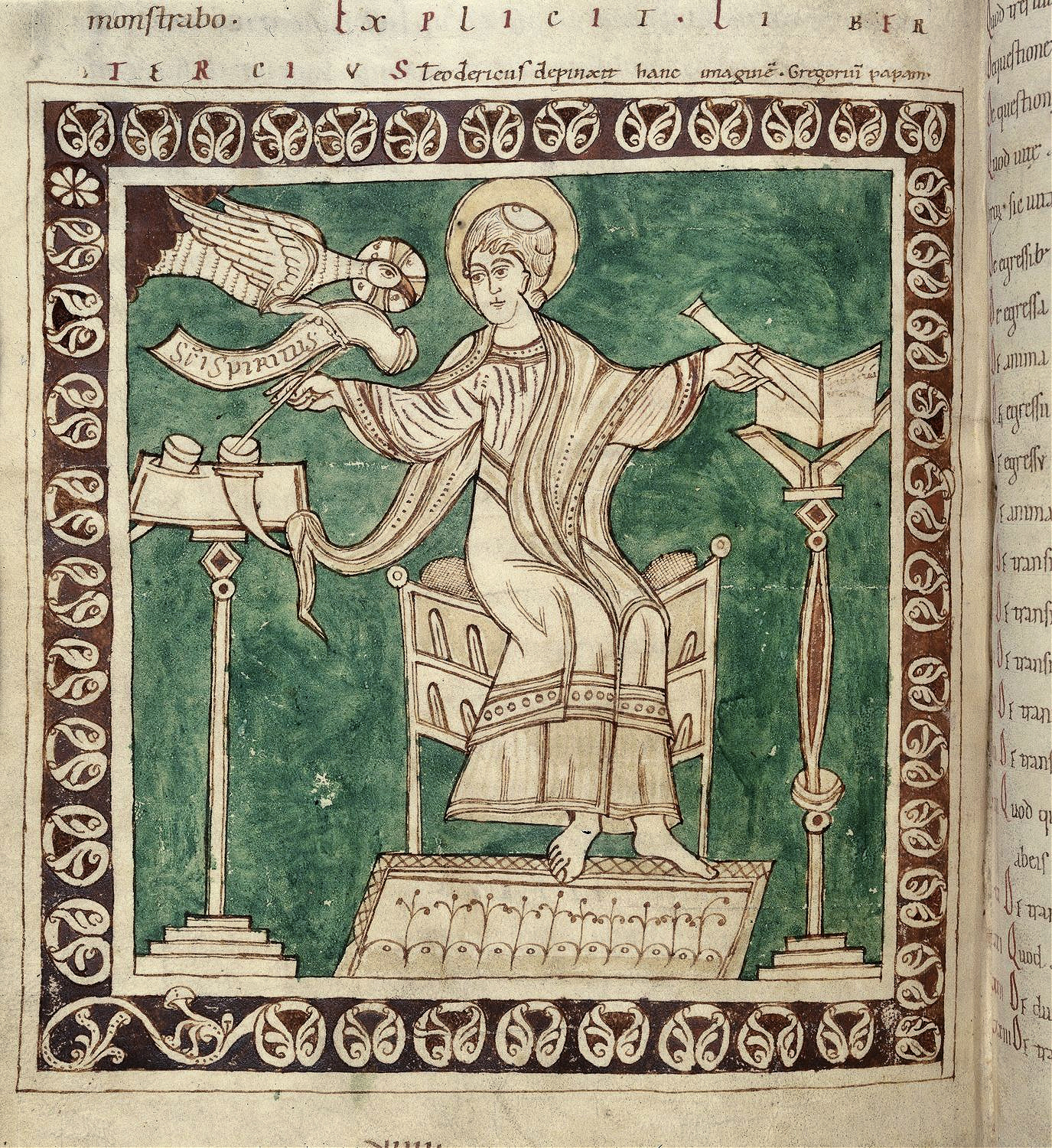
Near the hospital, Francis interacted very tentatively, first with those caring for lepers —a charitable church activity first recognized by Pope Gregory the Great (540-604 CE)—and then at times with the lepers themselves.
Miniature of Gregory the Great writing under the inspiration of the Holy Spirit, in a 12th-century copy of his Dialogues, British Library, London. Public Domain.
Come la notte Francesco pregando nella selva incontro il lebbroso —or, in English, “How St. Francis praying one night meets a leper.” This specific historical and cinematic moment represents the bridge between Francis’s failed worldly, military ambitions and his lifelong commitment to love, humility and poverty based in spiritual commitment.
To start, it was the sickening smell peculiar to the leper hospital wafting into Francis’s nostrils that made him flee.
But as his visits continued Francis—who by now was living as a hermit— journeyed to the leper hospital to leave them a charitable gift. After leaving it on the roadside, Francis vanished as bell-clanging lepers appeared.
It took Francis many more visits to the leper hospital as well as, in solitude, dwelling on his own thoughts and prayers to finally reach what he believed was God’s answer for him.
As clearly dramatized in Roberto Rossellini’s wonderful film, Francis discovered a deeper courage and confidence in himself—and in the same moment a supernatural faith— when along the road to the leper hospital he stepped up to leave for the leper the charitable embrace of one of the rich sons of Assisi.
Yet, following that encounter, Francis realized that the leper had given him a gift also.
After that Francis was free to profoundly pursue whatever track God called him to run. Francis could now be called to renounce the world’s riches. He married his “Lady Poverty” in their joyous mystical marriage so that even today, in the 21st century, poverty remains a major Franciscan charism. Francis and Lady Poverty have been married for over 800 years.
Following a lifetime spent in heroic Franciscan mendicancy, this world-famous Umbrian saint “Francesco” proclaimed to his Franciscan family and the world that it was at that exact moment when he embraced the leper—and the leper embraced him—that a life in and for God truly started.
St. Francis of Assisi has the indelible mark of the leper. He conquered fear and embraced the other in love no matter how godforsaken. Done in the context of divine trust and love, that faith-filled action set each man free.
SOURCE: St Francis of Assisi: A Biography by Johannes Jørgensen (1912). Translated from the Danish with the author’s sanction by T. O’Conor Sloane, Image books, 1955.
Sassetta (c.1392-c.1451), St. Francis in Ecstasy, back of the Sansepolcro altarpiece, 1437-44, Panel, 80 3/4 x 48 inches. Villa I Tatti, Florence.