


FEATURE image: “Cary Grant” by classic film scans is licensed under CC BY 2.0.
By John P. Walsh
Cary Grant made 72 feature films between 1932 and 1966- 34 in the 1930’s, 20 in the 1940’s, 13 in the 1950’s, and 5 in the 1960’s. (Grant also appeared in 10 more short films between 1932 and 1976). His feature films ranged from all classics of the genre. The debonair English-American actor with boundless energy and superb timing tangled with THRILLERS—Suspicion (1941), To Catch a Thief (1955), North by Northwest (1959)— COMEDIES—Bringing Up Baby (1938), His Girl Friday (1940), The Philadelphia Story (1940)— ROMANCES—Notorious (1946), An Affair to Remember (1957) – and much more. Grant was nominated twice for an Academy Award for Best Actor – in 1941 for Penny Serenade (directed by George Stevens) and None but the Lonely Heart in 1944 – but did not win.
In his 34-year Hollywood career Grant made his last films in the 1960’s. These included That Touch of Mink (1962), Charade (1963), Father Goose (1964), and Walk, Don’t Run (1966). These films became some of his best work. Afterwards, Grant decided to retire at what was a professional – and personal – high note. In June 1965 the 61-year-old Grant married actress Dyan Cannon, 33 years his junior, and they both had their first child, a girl, born in February 1966. It was Dyan Cannon’s first marriage; Grant’s fourth. They divorced in 1968.
With an acting career spanning four decades—Grant’s film debut was in 1932 for Paramount Pictures’ comedy, This is the Night—Grant said good-bye to the silver screen at 62 years old. In 1970 he received his sole Oscar, an honorary one, for which he was pleased and humbled in his acceptance speech before the Academy. It was Hollywood’s Golden Age, and in that time, Cary Grant was a household name synonymous with suavity, comedy, drama, romance, and perpetually fit and tanned-and-pressed good looks.

“Ours is a collaborative medium—we all need each other,” Cary Grant said as he accepted his honorary Oscar from presenter and friend Frank Sinatra at the 42nd Annual Academy Awards ceremony on April 7, 1970 at the Dorothy Chandler Pavilion in Los Angeles, California.
Grant’s final film came in 1966 with the summer release of the comedy, Walk, Don’t Run. It was one more film made by one of Grant’s new production companies and distributed by Columbia Pictures. Grant’s departure from film coincided with the birth of his daughter, Jennifer— Grant becoming a father for the first time. Grant called her his “best production”— and now wanted to give her all his time and attention. Grant said: “My life changed the day Jennifer was born. I’ve come to think that the reason we’re put on this earth is to procreate. To leave something behind. Not films, because you know that I don’t think my films will last very long once I’m gone. But another human being. That’s what’s important.”

Cary Grant and wife Dyan Cannon with their baby daughter who was born on February 26, 1966.
Grant starting wooing Dyan Cannon in 1962. Within a three-year whirlwind courtship, she became pregnant with Grant’s baby so that, in1965, the 28-year-old actress wanted a marriage proposal. Cary Grant was the epitome of cinema’s best and most important actors. After their marriage, Dyan Cannon discovered that their relationship turned polite and frostier than she had expected with Hollywood’s quintessential leading man. On March 20, 1968 — less than three years after tying the knot in a secret wedding ceremony in Las Vegas, Nevada followed by a honeymoon in England taking a private jet supplied Howard Hughes – Cannon sought and got a divorce. While Cannon received alimony from Grant to raise their daughter, the young mother and up-and-coming actress had to sort things out more completely after their break-up. Theirs had been a love affair with many memorable romantic moments. But what Grant told her when they were still dating was remembered by Cannon after the marriage failed. Grant said: “I don’t know what it is, but something happens to love when you formalize it. It cuts off the oxygen.”

Grant appears in character as an angel named Dudley in this promotional photograph for the 1947 fantasy romance film, The Bishop’s Wife. By seductively playing a certain song on the harp, Dudley convinces a rich woman to support the bishop’s cathedral building project. In real life, Grant was an ardent piano player.
CHARADE (1963):
When Grant first asked to meet Dyan Cannon, she assumed it was for an acting part. Grant began his romance with then-25-year-old Dyan Cannon in 1962. That fall the couple flew from California to New York where Cannon began rehearsing for The Fun Couple, a Broadway comedy play starring Jane Fonda and directed by Andreas Voutsinas. Grant meanwhile worked with film director Stanley Donen on Charade, a romantic-comedy pseudo-Hitchcock mystery thriller that Grant co-starred in with Audrey Hepburn. Hepburn had been filming another romantic comedy, Paris When it Sizzles, with William Holden.

Promotional poster for Stanley Donen’s Hitchcock-inspired suspense thriller, Charade. The 1963 hit film was made in Paris in 1962 and 1963 and released during Christmas 1963. It starred Cary Grant and Audrey Hepburn.
Charade’s animated Main Title and music follow a widescreen shot of a pre-dawn countryside in Europe as a speeding train finally approaches and screeches past. A body is dumped out of the moving train, plunges down the ravine and stops in a ditch, the camera providing a close-up of the dead victim’s face. Colorful animation follows of pinwheels as the wood-block-driven music heighten tension for what will be two charming lovers, Grant and Hepburn, caught in a mysterious web of criminals after money.
The Main Title for Charade with its punchy animated titles by Maurice Binder (1918-1991) was composed by Henry Mancini (1924-1994). The Main Theme from Charade was the first of a number of successful film score collaborations Mancini had with film director Stanley Donen in the 1960’s.
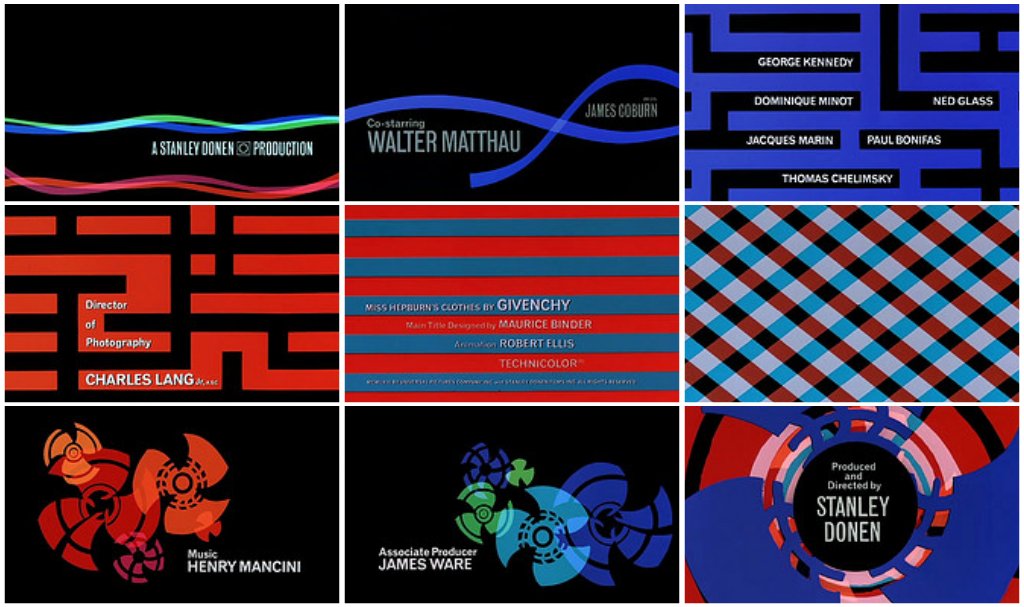
Stills montage of Maurice Binder’s Main Title for Charade that accompanies Henry Mancini’s music.
Grant reluctantly left Cannon and the comforts of his suite at the Plaza Hotel in New York City to make his way to Paris to shoot Charade (Hepburn lived near Paris). Many Paris locations were used in the film: near Notre Dame is the Pont au Double bridge, just below the Quai de Montebello. During the filming of Charade, Cary Grant and Audrey Hepburn walked along the riverbank below this bridge as they discussed who the killer is. Another location was the Musée Cernuschi just outside of Parc Monceau on the Avenue Velasquez. The museum is featured in Charade where it is used as Reggie’s apartment which she finds ransacked after returning from a holiday ski trip. Finally, the Palais Royal near the Louvre appears in Charade in its final scenes when the real Carson Dyle is revealed and shooting begins.

Shooting scenes for Charade involved many locations in Paris.
When Dyan Cannon had her first holiday break from Broadway rehearsals at Christmas 1962, she hopped on a flight to Paris. Arriving on December 26, Grant and Cannon spent the next several days together in his hotel. On New Year’s Eve, the couple were the special guests of Audrey Hepburn and her husband Mel Ferrer at their castle where a sumptuous dinner and many flights of crisp and creamy French champagne were served. Cannon flew back to the States on January 2, 1963, after a most pleasant holiday. She resumed her theater work in New York City while Grant and Hepburn stayed behind in Paris to continue filming Charade.

Cary Grant, making his 70th film, was reluctant to leave the U.S. in late 1962 for Paris to film Charade. The film premiered at Radio City Music Hall in New York City on Christmas Day 1963.

Radio City Music Hall in 2008. Charade opened on December 25, 1963 at Radio City Music Hall. The film made six million dollars while the reviews, though mixed, were mainly positive. Critics did remark on the age difference between the romantic leads –Cary Grant was 59 years and Audrey Hepburn, at 34, was almost half his age. In early 1964 the suave and likeable leading man of the last 30 years was thinking about retirement. But there were still some things he hoped to accomplish first.

The film Charade is well-known for its Hitchcock-style inspiration and screenplay by the original story’s author Peter Stone (1930-2003). From Stone’s 1961 short story, The Unsuspecting Wife, the film Charade offers witty lines and a head-knocking, heart-pounding whodunit. In Charade, Regina “Reggie” Lampert (Hepburn) is on winter holiday in the French Alps. Returning to her home in Paris, she is shocked to find that it has been ransacked of everything of value. The mysterious victim thrown off the train in the Main Title and the mysterious man Reggie met on holiday in Grenoble– Peter Joshua, alias Alexander Dyle, alias Adam Canfield, alias Brian Cruikshank (Cary Grant) –converge into her life to help her solve the mystery of why these crimes have occurred and what they mean. Charade is about hidden money, spies and larcenists, double-crossing and being on the run. In addition to all that, it’s a love story. Charade was one of the last of the suspense-screwball comedy films –a staple of the Hollywood film genre since the 1930’s that faded in the gritty realist films of the 1960’s and 1970’s until its reemergence in the 1980’s.
Father Goose (1964):
With Charade in the rear-view mirror, Grant came home just as Cannon became mostly absent. Throughout 1964 and much of 1965 Cannon had done no film work yet but continued a busy theater career as she was touring the country in the musical How to Succeed in Business Without Really Trying. Looking for something to do with his time, Grant formed a production company and made Father Goose.
Grant’s character, Walter Eckland, played against Grant’s film type. Ecklund was a bedraggled loner in the South Pacific during World War II who reluctantly takes under his protection an unmarried French school teacher (Leslie Caron) and her seven grade school students. They were suddenly made refugees from the war during a Japanese bombing raid. The heart-warming Father Goose was a mega-hit at its release during Christmas 1964 and made millions of dollars. Receipts, however, were significantly less than in each of Grant’s three previous films — Operation Petticoat in 1959 with Tony Curtis, That Touch of Mink in 1962 with Doris Day, and Charade. Despite a lot of pre-Oscar buzz, Grant wasn’t nominated for his performance. Father Goose was one more disappointment for Grant as he worked to possibly be given an Academy Award before he might retire.
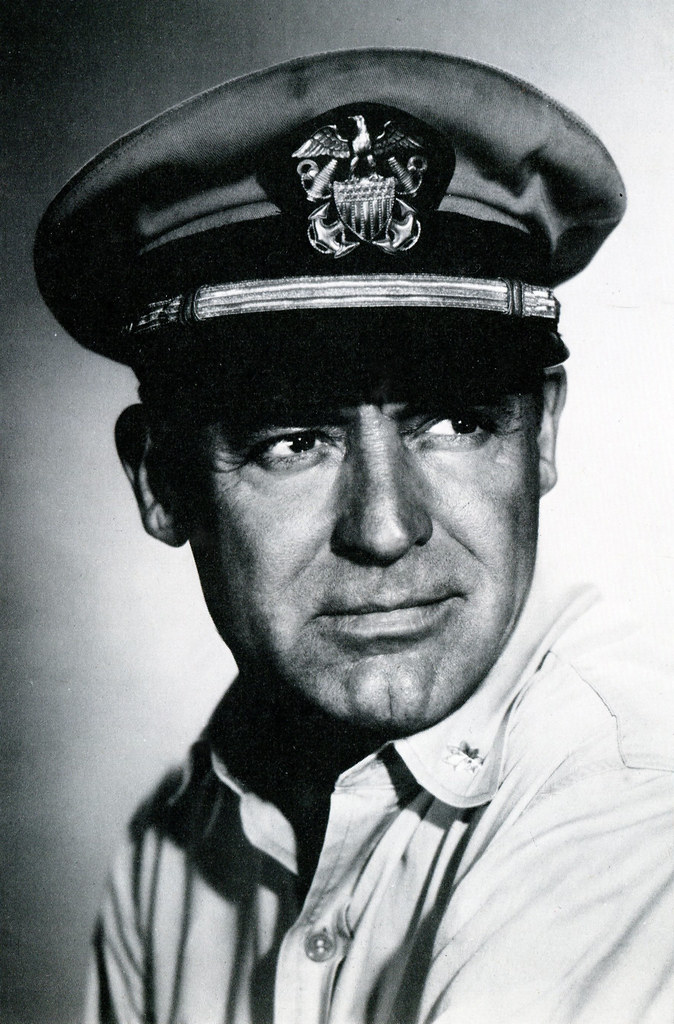
Photographs above and below: Cary Grant in Operation Petticoat (1959).

That Touch of Mink (1962):
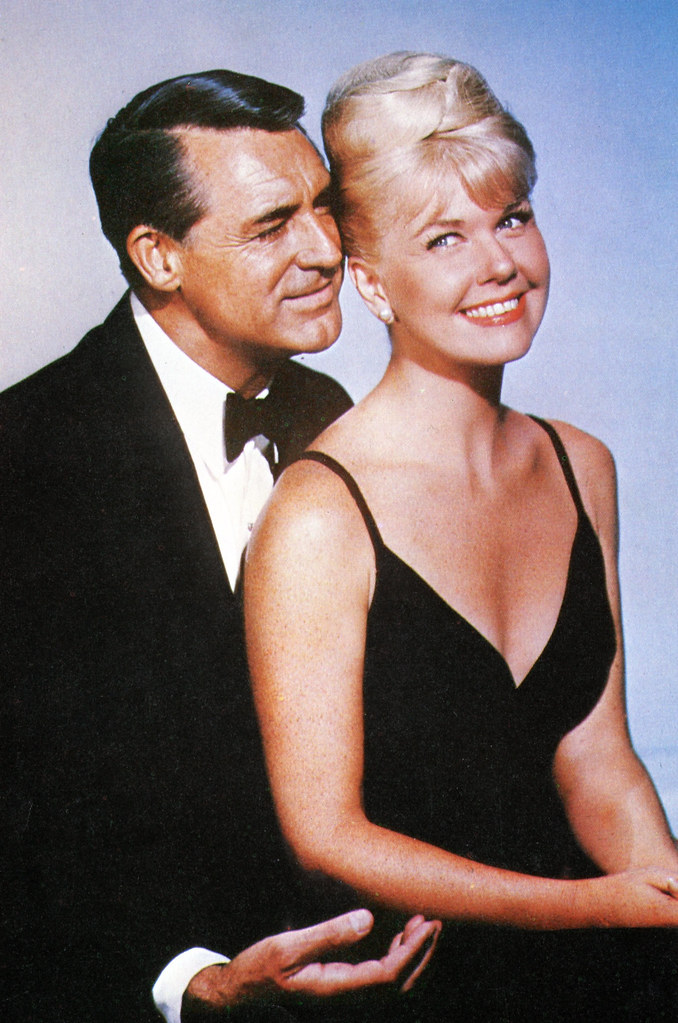
Cary Grant and Doris Day in the hit romantic comedy, That Touch of Mink. Grant was dismayed that his 1964 romantic comedy adventure film Father Goose made less money than Charade and almost $6 million less than That Touch of Mink in 1962 and Operation Petticoat in 1959 combined.
That Touch of Mink co-starred Doris Day and Cary Grant. It was the hit movie of summer of 1962 though outshined in the movie world by Lawrence of Arabia and The Longest Day later that year. The romantic-comedy is great fun—it won a Golden Globe award for Best Comedy Picture-—and became a popular rerun on TV for the next decade.
Cary Grant was cast as wealthy businessman Philip Shane, a role originally meant for Rock Hudson. That Touch of Mink was, above all, intended to be a Doris Day vehicle. From 1962 to 1964 Doris Day was the top box office star in Hollywood. Her presence definitely contributed to Universal Pictures’ bottom line since That Touch of Mink was the fourth biggest money maker of the year.
Playing working girl Cathy Timberlake, the movie is basically a stylish “boy meets girl, boy loses girl, boy gets girl back”—and given a chance to learn his lesson, they get married. American audiences loved the concept as well as Day and Grant together on the big screen. The film was the fastest million-dollar earner of 1962 and set a record at the time for the highest gross earnings in an initial theatrical release.
For Grant it was his second highest grossing film of his 30-year career, which was especially prosperous since the 58-year-old actor was a co-producer. Grant made $4 million for That Touch of Mink (around $35 million in today’s money). Three weeks after its opening, Betsy Drake, Grant’s third wife, filed for divorce.
The court proceedings of the high-profile couple after over a decade of marriage were followed closely in the press. The settlement for Drake who told the papers: “I was always in love with him and I still am…but…he left me long ago,” included more than one million dollars in cash and profit sharing in every Cary Grant film ever made up to that time.
That Touch of Mink, a film thick with early 1960’s conventional sensibilities, was nominated for 3 Academy Awards. Both Grant and Doris Day never won an Academy Award. The story goes that after her exit from films Doris Day was offered the Honorary Oscar multiple times but always turned it down. Grant won and accepted his Honorary Academy Award in 1970. In 1962 That Touch of Mink was nominated for Best Sound, Best Art Direction and Best Screenplay. In the first two categories Oscar went to Lawrence of Arabia and in the third to Divorce Italian Style.
That Touch of Mink was the fastest million-dollar earner of 1962 and set a record at the time for the highest gross earnings in an initial theatrical release. It was mainly a Doris Day vehicle that co-starred Cary Grant who co-produced.

Newly married in June 1965 to Dyan Cannon who was expecting their baby, Grant announced he was flying to Japan to make another movie. Grant returned to California permanently just in time to drive his wife to the hospital to deliver their first child, a baby daughter, born on February 26, 1966.
In June 1965, with Father Goose and the Oscars behind him and Dyan Cannon’s national tour ended—Grant and Cannon, who was now pregnant, got married. After a secret marriage ceremony in Las Vegas and a honeymoon, their news was eventually publicized. As the excitement began to settle down, Grant informed Cannon he would be making another film—and was traveling to Japan by himself for the next many months.
Walk, Don’t Run (1966):
Grant formed another production company and, with producer Sol C. Siegel, signed with Columbia Pictures to distribute his new film. Buying the rights to The More the Merrier, a World War II-era comedy, Grant took the role that had been nominated in the early 1940’s for an Academy Award. Grant’s 1966 remake was called Walk, Don’t Run in which he played a British industrialist, Sir William Rutland.

The music is by Quincy Jones including its main title, “Happy Feet.”
Grant’s mid 1960’s romantic-comedy vehicle is familiar territory that allowed the now-married father to continue to cash in on his popularity. The film is light fare even when compared to other such Grant vehicles such as Dream Wife (1953), Houseboat (1955), and, more recently, Father Goose (1964). Walk, Don’t Run was a safe remake of an Oscar-nominated World War II-era comedy, The More the Merrier, directed by George Stevens, and starring Jean Arthur, Joel McCrea, and Charles Coburn with Grant taking the Coburn part, a role which was Oscar-nominated in 1943 for Best Supporting Actor. Transferred to the 1964 Summer Olympics in Tokyo during a housing shortage, the story is about three strangers who come to share an apartment — industrial magnate Sir William Rutland (Grant), American Olympian Steve Davis (Jim Hutton), and young single British expat Christine Easton (Samantha Eggar). For Grant’s last film he intentionally worked it so he did not get the girl. Instead, Sir William plays matchmaker to Christine, engaged to boring British diplomat Julius Haversack (John Standing), so that she goes for Hutton. Grant personally cast Hutton and Eggar for their roles. Very predictable fare with stodgy stage direction, the decent performances by the leads bestride what amounts to an anachronistic production, despite its contemporary setting and delightful score from Quincy Jones, his first big break in films.
In the film, Christine, whose tiny apartment it is, would prefer a female roommate. She sublets to Sir William because he is pushy, charming and a fellow Brit in need. But he immediately sublets half of his portion to Hutton, making for three. Comedy results from three outsized adults sharing a very small living space as they pursue their lives’ conflicting schedules as normally as possible.
Samantha Eggar glows in each of her scenes in Walk, Don’t Run though she hasn’t much to work with in terms of a script as evidenced here.
Walk, Don’t Run was one of Quincy Jones’s first big breaks. The 33-year-old Chicago-born Jones came to score the film after its star and Executive Producer, Cary Grant, recommended him for the job. Grant met him briefly through their mutual friend, singer Peggy Lee. From that meeting Grant felt Jones’ style would be perfect for the film and he made sure he was hired. Jones went on to enormous success as the composer of numerous film scores such as In the Heat of the Night in 1967 and The Color Purple in 1985 as well as the producer of successful pop rock recordings such as Michael Jackson’s bestselling albums and the 1985 global recording phenomenon, We Are The World. In 2013, Quincy Jones was inducted into the Rock and Roll Hall of Fame.

After Grant returned from Asia and the baby was born, in private and public he insisted that Walk, Don’t Run was his last film. It proved to be true. Grant stated he would not make a film with his wife, Dyan Cannon, a talented actress whose career had just begun. Instead, Grant insisted Cannon should retire from acting and be a stay-at-home mother. Dyan Cannon did not welcome these stay home ideas. Even in 1966 Cannon began to wonder if—following an exciting courtship and a 33-year age difference they barely mentioned—her marriage to Cary Grant was on the rocks.
NOTES:
Best production— “Hollywood loses a legend”. Montreal Gazette. December 1, 1986. p. 1.
That’s what’s important— McCann, Graham (1997). Cary Grant: A Class Apart. Columbia University Press, 1998.
Cuts off the oxygen— http://worldnewsblogx.blogspot.com/2011/10/my-husband-cary-grant-force-fed-me-lsd.html
Charade film locations—https://www.wessexscene.co.uk/travel/2017/02/21/audrey-hepburn-in-paris/
Fastest million-dollar earner of the year and record for highest gross earnings in an initial theatrical release – “Million-$ Gross In 5 Weeks; ‘Mink’ A Radio City Wow”. Variety, July 18, 1962. p.1. and “B’way as Spotty as Weather; ‘Town’ Big $41,000, ‘Guns’ Only Okay $20,000, ‘Grimm’ Giant 59G, ‘Mink’ 151G, 10th” Variety, August 22, 1962. p.9.
Betsy Drake settlement – Eliot, Marc, Cary Grant A Biography, Harmony Books, NY 2004, p 337.
Last film and would not make a film with his wife— Ibid., p. 352.
Might be in trouble—Cannon, Dyan, Dear Cary: My Life with Cary Grant, 2011, p. 217 ff.
PHOTO CREDITS:
FEATURE image-Cary Grant by classic film scans is licensed under CC BY 2.0.
2-Cary Grant by classic film scans is licensed under CC BY 2.0.
3-Fair use.
4-Cary Grant by twm1340 is licensed under CC BY-SA 2.0.
5-CHARADE by Laurel L. Russwurm is marked with CC0 1.0.
6-Public domain published in a collective work i.e. periodical in the US between 1925 and 1977 and no Copyright.
7-Bond Films Openings Montage (Amalgamation) by avhell is licensed under CC BY-SA 2.0.
8-Charade titles by Maurice Bender by Stewf is licensed under CC BY-NC-SA 2.0.
9-Charade_1963_Audrey_Hepburn_and_Cary_Grant public domain because it was published in the United States between 1925 and 1963 and although there may or may not have been a copyright notice, the copyright was not renewed.
10- Cary Grant, in Charade 1963 by Movie-Fan is licensed under CC BY-NC-SA 2.0.
11- Let’s continue this little Charade by Thiophene_Guy is licensed under CC BY-NC-SA 2.0.
12-Radio City Music Hall (2008) by jpellgen (@1179_jp) is licensed under CC BY-NC-ND 2.0.
13-Cary Grant by classic film scans is licensed under CC BY 2.0.
14-MM008600-39 by Florida Keys–Public Libraries is licensed under CC BY 2.0.
15- Cary Grant and Doris Day by classic film scans is licensed under CC BY 2.0,
16-1947 Bristol-born Hollywood film star Cary Grant alighting from Bristol Freighter G-AGVC at Los Angeles, 13 Jan 1947. by Gary Danvers is licensed under CC BY-SA 2.0.
17- Walk, Don’t Run poster. Fair use.
18-Fair use.
CARY GRANT HOLLYWOOD FILMOGRAPHY (1962-1966):
1962:
That Touch of Mink
Cary Grant as Philip Shayne
Directed by Delbert Mann
Released June 14, 1962
Universal Pictures
1963:
Charade
Peter Joshua / Alexander Dyle / Adam Canfield / Brian Cruikshank
Directed by Stanley Donen
Released December 5,1963
Universal Pictures
1964:
Father Goose
Walter Christopher Eckland
Directed by Ralph Nelson
Released December 10, 1964
Universal Pictures
1966:
Walk, Don’t Run
Sir William Rutland
Charles Walters
Released June 29, 1966
Columbia Pictures
This explanatory article may be periodically updated.


*The photograph copyright may be believed to belong to the distributor of the film, Universal Pictures and Columbia Pictures, the publisher of the film or the graphic artist. The copy is of sufficient resolution for commentary and identification but lower resolution than the original photograph. Copies made from it will be of inferior quality, unsuitable as counterfeit artwork, pirate versions or for uses that would compete with the commercial purpose of the original artwork. The image is used for identification in the context of critical commentary of the work, product or service for which it serves as poster art. It makes a significant contribution to the user’s understanding of the article, which could not practically be conveyed by words alone. As this is a publicity photo (star headshot) taken to promote an actress, these have traditionally not been copyrighted. Since they are disseminated to the public, they are generally considered public domain, and therefore clearance by the studio that produced them is not necessary. (See- Eve Light Honthaner, film production expert, in The Complete Film Production Handbook, Focal Press, 2001 p. 211.) Gerald Mast, further, film industry author, in Film Study and the Copyright Law (1989) p. 87, writes: “According to the old copyright act, such production stills were not automatically copyrighted as part of the film and required separate copyrights as photographic stills. The new copyright act similarly excludes the production still from automatic copyright but gives the film’s copyright owner a five-year period in which to copyright the stills. Most studios have never bothered to copyright these stills because they were happy to see them pass into the public domain, to be used by as many people in as many publications as possible.” Kristin Thompson, committee chairperson of the Society for Cinema and Media Studies writes in the conclusion of a 1993 conference with cinema scholars and editors, that they “expressed the opinion that it is not necessary for authors to request permission to reproduce frame enlargements … [and] some trade presses that publish educational and scholarly film books also take the position that permission is not necessary for reproducing frame enlargements and publicity photographs.”(“Fair Usage Publication of Film Stills,” Kristin Thompson, Society for Cinema and Media Studies.)
