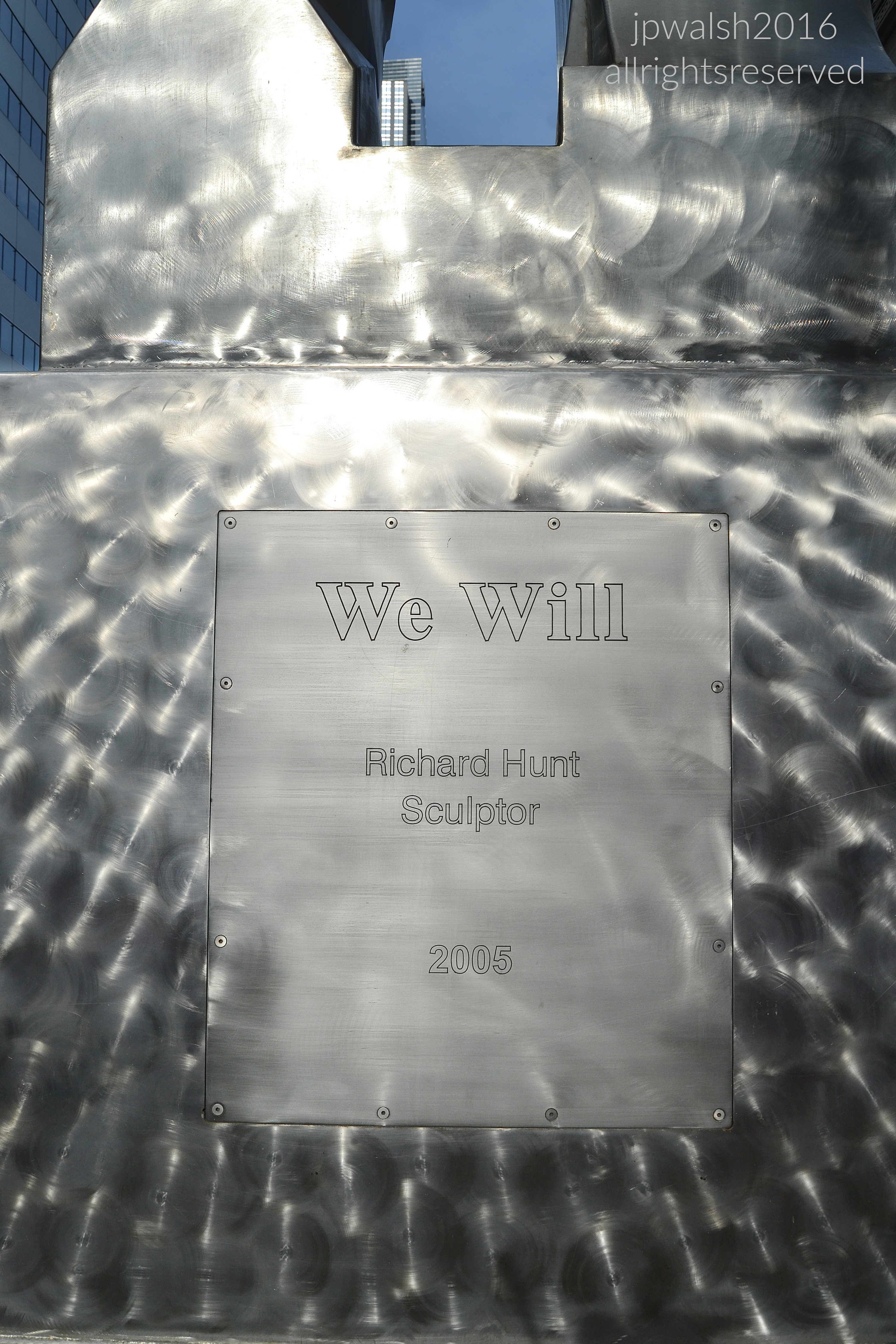
FEATURE Image: Richard Hunt’s monumental welded stainless-steel sculpture We Will serves as a powerful symbol of modern Chicago’s collective resilience, updating the city’s historic “I Will” mantra to reflect a 21st-century spirit of unity and resolve. The sculpture’s flame-like forms evoke the rebuilding of the city after the Great Fire of 1871, showing that Chicagoans continue to move forward bigger and stronger—together. July 2016. Author’s photograph.
A Towering Sentinel in the Loop
Chicagoan Richard Hunt has created over 150 large-scale installations around the globe, but some of his most resonant works reside right in his hometown. Since 2005, Hunt’s We Will has stood proudly on the sidewalk at the intersection of Randolph Street and Garland Court, steps from the Chicago Cultural Center and Millennium Park. Rising 35 feet tall (35’x 8’ x 8’) and crafted from welded stainless steel, this monumental sculpture commands an impressive presence on the downtown streets.
From “I Will” to “We Will”
The piece directly engages with Chicago’s long-standing municipal mantra, “I Will.” The roots of that phrase trace back to the Great Chicago Fire of 1871, reflecting the dogged resiliency of citizens determined to rebuild, reinvent, and grow to new heights. Visually, Hunt’s sculpture evokes the rising licks of flame from that devastating 19th-century event—the catalyst from which the city built back bigger, better, faster, and stronger. By pivoting the title to We Will, Hunt signals that 21st-century Chicagoans continue this tradition of absolute resolve, but choose to look toward the future together.
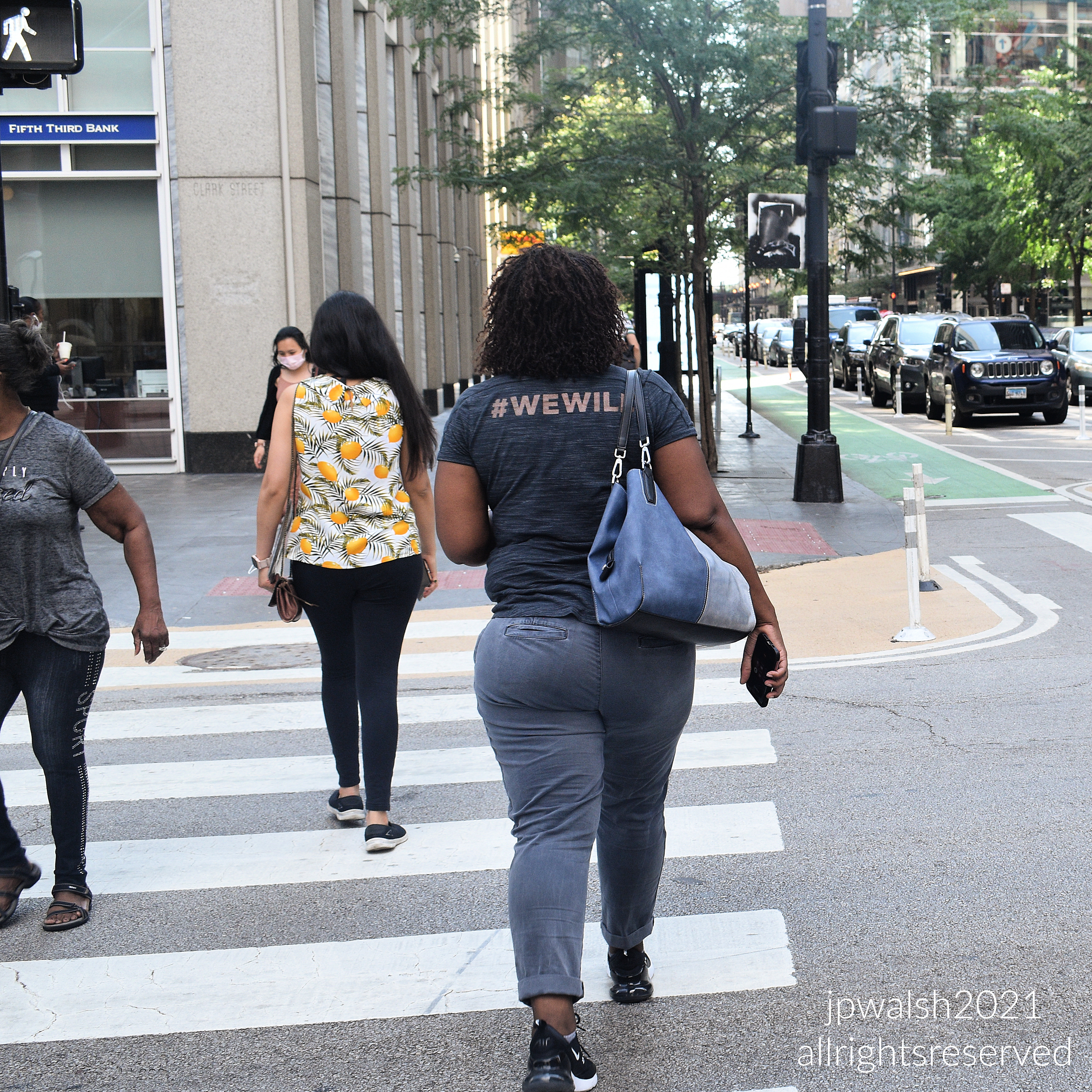
Hunt’s choice to pivot the city’s historic singular mantra into a plural pledge is not just an abstract aesthetic exercise; it is an active, living street-level reality. As seen in a contemporary photograph of Chicago’s Loop, the collective resolve of the city manifests organically on the pavement. A pedestrian crossing the street bears a t-shirt emblazoned on the back with the hashtag #WEWILL, effortlessly carrying the artist’s message into the daily rhythm of the city. While elitist institutions risk domesticating radical art, Hunt’s public monuments thrive precisely because they are met by day-to-day denizens on the ground. By weaving his towering steel forms into the very crosswalks and thoroughfares of civic life, Hunt ensures that his art remains an active participant in Chicago’s ongoing story of shared resilience.
Mapping a Civic Legacy
Commissioned by the Mesa Development Company for a condominium and mixed-use development, We Will is part of a massive footprint Hunt left across the local landscape. His public masterworks define the city’s geography, including the Light of Truth Monument to Ida B. Wells in Bronzeville, Jacob’s Ladder at the Carter G. Woodson Regional Library, Farmer’s Dream at the Museum of Contemporary Art (MCA), and Flightforms at Midway International Airport.
A Fitting Legacy for the South Side
Among these celebrated civic contributions is the first artwork commissioned for the Obama Presidential Center in Chicago. Titled Book Bird, Hunt’s sculpture was designed for the outdoor Library Reading Garden at the center’s Chicago Public Library branch. In a call with the artist, former President Barack Obama observed that Hunt’s “personal story embodies what is hoped to be the experience at the center. To have one of the greatest artists Chicago ever produced and to participate in what we hope is an important cultural institution for the city and the South Side… it feels like a pretty good fit to me.”
Roots of a Chicago Master
Hunt’s deep connection to the city began in 1935 in the Woodlawn neighborhood on the South Side, before his family relocated to Englewood when he was four years old. Educated in local public schools, his family routinely immersed themselves in Chicago’s cultural anchors, fostering a young Hunt’s affinity for The Art Institute of Chicago and the Field Museum. He went on to earn a B.A.E. from the School of the Art Institute of Chicago (SAIC) in 1957, followed by periods of study and travel throughout Europe and service in the U.S. Army.

A 1962 studio portrait of Richard Hunt taken in Chicago, Illinois. In the definitive retrospective volume Richard Hunt published in 2022, explored Hunt’s early life and career trajectory and frames this precise moment as a crucial turning point in American sculpture. In 1955, at age 19, Hunt attended the open-casket funeral of his South Side Chicago neighbor, Emmett Till. This traumatic event deeply radicalized Hunt’s vision of public memory and freedom, inspiring his first welded masterwork, Hero’s Head (1956). Soon after graduating from The School of the Art Institute of Chicago in 1957, The Museum of Modern Art (MoMA) purchased his sculpture Unique Forms of Continuity in Space directly out of his studio. In 1962, the year of this portrait, Hunt received a Guggenheim Memorial Fellowship, giving him the financial freedom to become a full-time, self-sustaining artist. That same year, LIFE magazine featured Hunt as one of their “Red-Hot Hundred” young national leaders. He also stood as the youngest exhibiting artist at the historic Seattle World’s Fair exhibition, Art Since 1950. At the time this photo was taken, Hunt was running a vibrant studio practice centered around transforming urban detritus, frequently scouring junkyards at Clybourn and Sheffield Avenues to construct what he famously termed “three-dimensional drawings in space.”
Breaking Barriers on the Global Stage
Over the course of his monumental seven-decade career, Hunt received more than a dozen honorary degrees from top-tier institutions and served as a professor and artist-in-residence at several prestigious universities. He made history when he became the first African American artist to be honored with a solo retrospective exhibition at the Museum of Modern Art (MoMA) in New York City.
Reflecting on his lifelong commitment to civic spaces, Hunt noted, “There are a range of possibilities for art on public buildings or in public places. To commemorate, to inspire. I think art can enliven and set certain standards for what is going on in and around it.” Richard Hunt passed away in his beloved city on December 16, 2023, at the age of 88, leaving behind a legacy forever welded into the fabric of American art.
“There are a range of possibilities for art on public buildings or in public places. To commemorate, to inspire. I think art can enliven and set certain standards for what is going on in and around it.” – Richard Hunt, sculptor.

Standing on the sidewalk at the intersection of Randolph Street and Garland Court, Richard Hunt’s We Will (2005) interweaves seamlessly into a rich, layered Downtown Chicago streetscape. In the middle-left ground, the 35-foot welded stainless-steel form rises dynamically as an abstract, upward-striving silver monument. This outdoor setting acts as a powerful thesis statement for Hunt’s approach to civic engagement, especially when contrasted with the controlled confinement of traditional gallery spaces. Housed in the open elements, We Will resists institutional “domestication” because it belongs entirely to the street itself. It stands in the literal heart of the Loop—an area fundamentally reshaped by the Great Chicago Fire of 1871—anchoring the neighborhood’s historic recovery. By directly sharing the pavement with pedestrians and motorists navigating their daily routines, the monument demonstrates that Chicago’s resilient spirit is not a fossilized historical concept, but an ongoing, communal reality.
BIBLIOGRAPHY
Los Angeles Times. ““Richard Hunt, Legendary Sculptor Inspired by Civil Rights Movement, Dies at 88.”” Accessed December 19, 2023.
The Barack Obama Foundation. ““Richard Hunt: Inspiring Us All to Take Flight.”” Accessed October 28, 2022.
The Richard Hunt Estate. ““We Will.”” Richard Hunt Studio Portfolio. Accessed October 28, 2022.