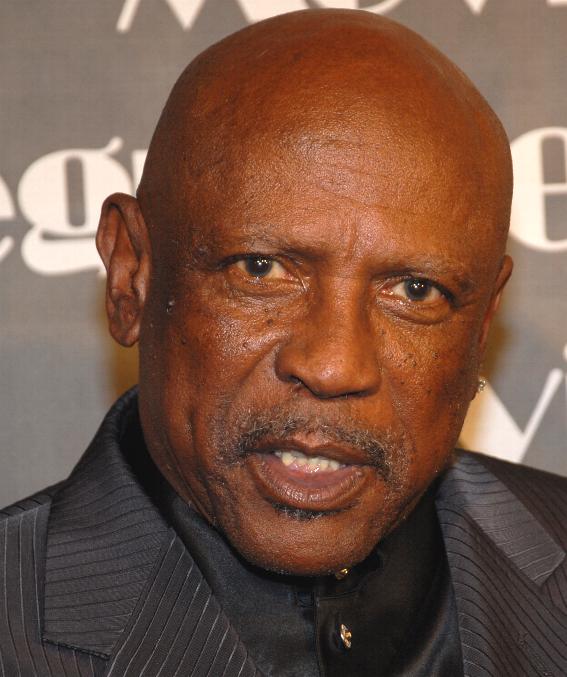
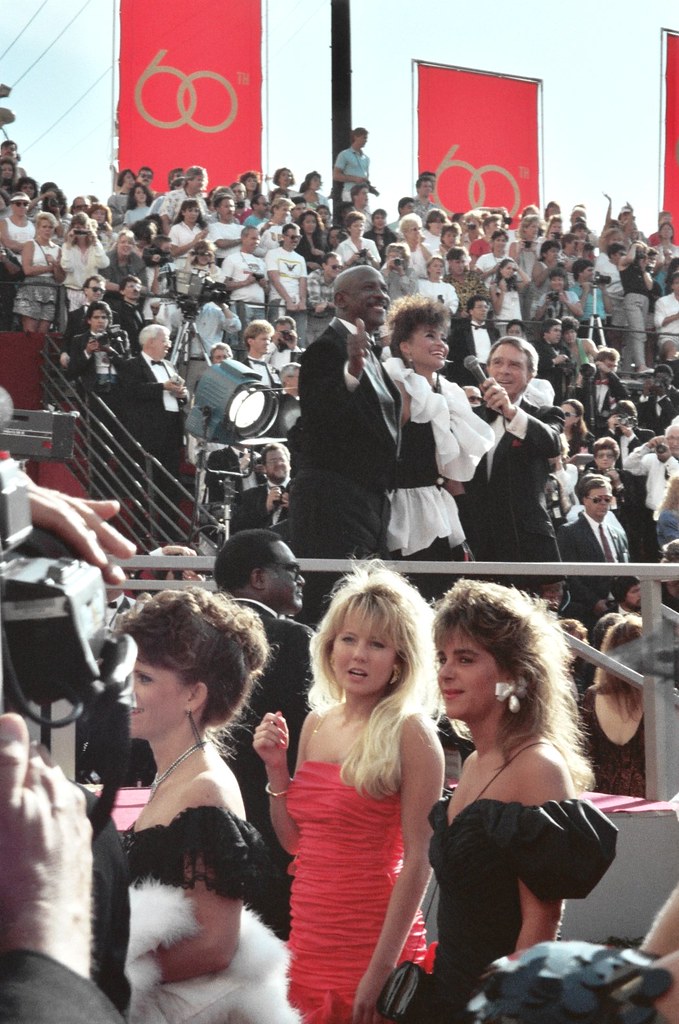
Louis Gossett Jr. at the 60th Academy Awards in 1987 — a moment that captured the authority and ease of a man who had already carved out one of the most decorated careers in American entertainment.
In a stage, film, and television journey that stretched across generations, Gossett made his Broadway debut at 17 and never stopped ascending. Over the decades he collected dozens of Best Actor and Supporting Actor honors, including his historic 1983 Academy Award, along with Golden Globes, Primetime and Daytime Emmys, and multiple NAACP Image Awards. He wasn’t just successful — he was a trailblazer who widened the path for those who followed.
Louis Gossett Jr. died on March 29, 2024, at a rehabilitation center in Santa Monica, California. He was 87.
Released in July 1982, An Officer and a Gentleman landed like a jolt. The 1982 Paramount summer powerhouse directed by Taylor Hackford tracks 13 bruising weeks of aviation officer candidate training under Gunnery Sergeant Emil Foley’s unrelenting command — a crucible designed to strip away candidate ego, expose character, and forge discipline.
At the center is brash aviation officer candidate Zack Mayo (Richard Gere), a young man who enlists in the all-volunteer U.S. armed forces — a system only nine years old at the time. Mayo has the physical and mental chops, but his hustler instincts get the better of him: he’s caught selling polished shoes and buckles to other candidates during inspection. It’s just the first crack in his armor of ego.
U.S. Marine Gunnery Sergeant Emil Foley: “Mayo I want you DOR.(Drop On Request).” Aviation Officer Candidate Zack Mayo: “No Sir. You can kick me out of here but I ain’t quittin’.”
Enter Sergeant Foley (Louis Gossett Jr., in an Oscar‑winning role), the hardest man on the base — a drill instructor who locks onto “Mayonnaise” (Foley’s nickname for Zack) and refuses to let him skate by on ego. Foley’s mandate is blunt and uncompromising: break Mayo down, teach him esprit de corps, and rebuild him into someone worthy of the uniform.
An Officer and a Gentleman became Paramount’s biggest hit that year. It earned $190 million at the box office, over 30 times its $6 million production costs. Audiences responded to its classic architecture: a diverse, believable ensemble; high‑stakes group and individual training sequences; friendships forged under pressure; and a tender romance between Mayo and Paula (Debra Winger), a factory worker and townie with a quiet resilience.
And then there’s the ending — triumphant, cathartic, and instantly iconic.
In the penultimate scene Sgt. Foley’s graduating class lines up to thank the gunnery sergeant who pushed them to the limit.
The grind of classroom drills and field exercises quickly gives way to a deeper contest inside each candidate — strength against insecurity, ambition against fear, and the fragile pull of camaraderie against the urge to walk away. No one carries that tension more visibly than Zack Mayo (Richard Gere), whose swagger masks a lifetime of emotional armor. While Foley’s task is to strip that armor and force a reckoning, the story’s power comes from watching whether Mayo can rebuild himself into someone who can meet that new standard rather than collapse under it.
In the film’s penultimate scene Foley’s graduating class lines up to thank the gunnery sergeant who pushed them to the limit. When Ensign Mayo — the officer candidate most transformed by Foley’s brutal, exacting training — steps forward, he offers his Navy challenge coin. Foley pockets it separately from the others, recognizing it as a symbol of uncommon achievement and hard‑won purpose. Zack Mayo tells Sgt. Foley, “I won’t ever forget you, Sergeant. I wouldn’t have made this if it weren’t for you.” To which Foley responds: “I know. Get the hell out of here.”
While the ingredients weren’t new, the finale of An Officer and a Gentleman refined them into a crowd‑pleasing template that shaped 1980s and 1990s pop culture, cementing the image of the uniformed hero sweeping his love away from the factory floor.
Jack Nitzsche’s career peaked in 1983 when the Chicago‑born composer won both the Academy Award and the BAFTA for Best Original Song for co‑writing “Up Where We Belong” with Buffy Sainte‑Marie (lyrics by Will Jennings). Powered by that anthem and his sweeping main theme, Nitzsche also earned Oscar and BAFTA nominations for Best Original Score.
The song is inseparable from the film’s legendary finale: Zack Mayo (Richard Gere), newly minted as a Naval Aviator, strides into Paula’s (Debra Winger) paper factory in his dress whites, lifts her into his arms, and carries her out as her co‑workers, mouths agape at the what they are seeing, quickly erupt in cheers. It’s a fairy‑tale rescue staged on a factory floor — a “knight in shining armor” moment that resolves two people both of whom were from the wrong‑side‑of‑the‑tracks renewing themselves in their romance with triumphant clarity.
The emotional voltage of the scene is reinforced by Joe Cocker and Jennifer Warnes’ soaring performance of “Up Where We Belong,” which turns the moment into pure catharsis. Ironically, Richard Gere initially pushed back on this scene, calling the ending too sentimental for such a gritty film, but director Taylor Hackford insisted — and created one of the most iconic romantic conclusions in movie history.
From his turn as Will Reeves/Hooded Justice in HBO’s Watchmen (2019) to major film roles in The Color Purple (2023) and his Oscar‑winning performance as Gunnery Sergeant Emil Foley in An Officer and a Gentleman (1982), Louis Gossett Jr. built a career defined by range, authority, and trailblazing impact.
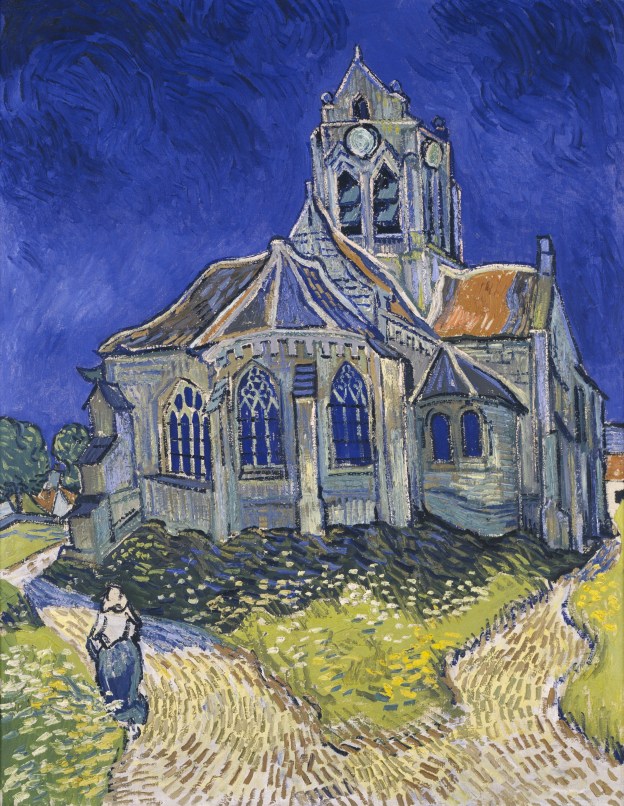
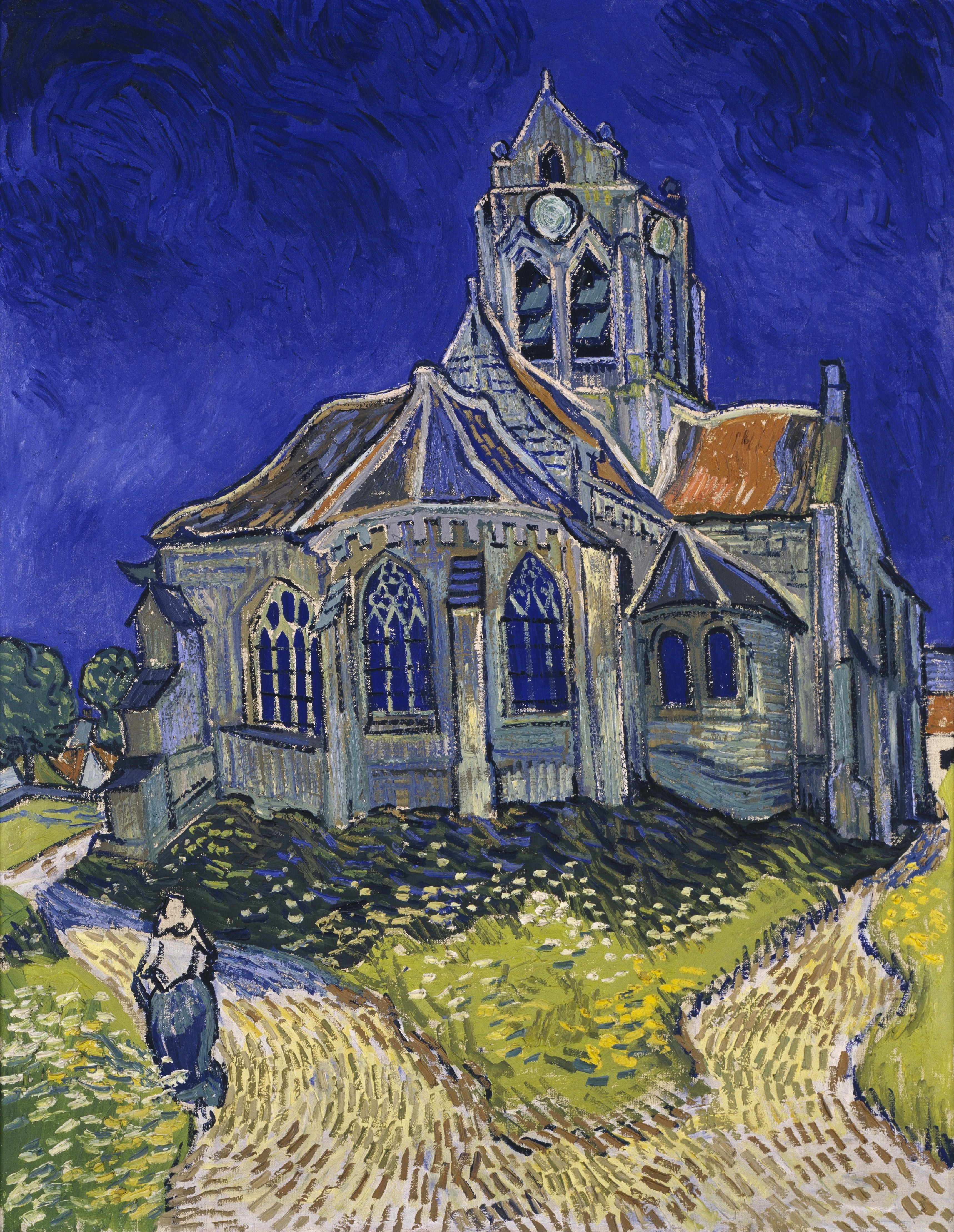
FEATURE Image: Vincent Van Gogh (1853-1890), L’église d’Auvers-sur-Oise, vue du chevet (“The Church at Auvers”), June 1890, oil on canvas, 94 cm x 74 cm (37 in x 29.1 in), Musée d’Orsay, Paris. Vincent Van Gogh (1853-1890), staying in Auvers starting on May 20, 1890, liked the small farm town about 20 miles west of Paris with its artistic pedigree (Corot, Daubigny, Cézanne) and spoke of settling into permanent quarters in the village after renting an attic room in a local café. About his experience at Auvers Van Gogh wrote: “[C]es toiles vous diront ce que je ne sais dire en paroles, ce que je vois de sain et de fortifiant dans la campagne” (“[T]hese canvases will tell you what I can’t say in words, what I consider healthy and fortifying about the countryside.”) During his more than two months stay in Auvers, the artist made more than 100 drawings and paintings of local landscapes, gardens, and village scenes such as its Catholic church. On the evening of July 27, 1890, Van Gogh had acquired a pistol and shot himself in the chest near the Auvers chateau. After languishing in pain for two days, he died on the morning of July 29, 1890. Vincent Van Gogh was 37 years old. Public Domain.
Auvers-sur-Oise was the decisive final chapter of Vincent van Gogh’s life and career, where in just over two months he created an extraordinary body of work that secured his enduring place in artistic modernism, even as his life moved toward its tragic conclusion. In May 2005 I made a pilgrimage to the town where I visited the places associated with the artist’s final days, including Ravoux Inn, Dr. Gachet’s house, the church at Auvers, the wheat fields, and his grave.
Vincent van Gogh, Garden in Auvers, July 1890, oil on canvas, 64×80 cm, private collection. Though Van Gogh died in July 1890 his modernist artistic influence forged deep ties with the European avant-garde art movement throughout the 1890’s and beyond. Public Domain.
By John P. Walsh
Auvers-sur-Oise: Van Gogh’s Final Home
In a peripatetic life, the last place where Vincent Van Gogh (1853-1890) lived was Auvers-sur-Oise, a small commune, a short distance northwest of Paris. Since Auvers was on a rail line in the orbit of Paris, Van Gogh moved to the small town with its farming community so he could live independently yet remain close to his art dealer younger brother Theo Van Gogh (1857-1891) who lived with his wife and family in the hustle and bustle of Paris. After leaving Saint-Paul Asylum, Saint-Rémy, where Van Gogh had admitted himself as a patient since May 1889, he traveled to the French capital in May 1890 where he visited Theo and Jo. He was then onwards to Auvers where, by arrangement of Theo, the artist was under the supervision of Dr. Paul Gachet (1828-1909), a mental health physician who was also an avid modern art collector and had his house, family and practice in the town.
After leaving the asylum at Saint-Rémy in May 1890, Van Gogh settled in Auvers-sur-Oise under the supervision of Dr. Paul Gachet while remaining close to his brother Theo in Paris.
Author at the graves of Vincent Van Gogh (1853-1890) and his brother, Paris art dealer Theo Van Gogh (1857-1891). They have been side by side in the Auvers cemetery in France since 1914. Photo: Author’s collection. May 2005.
During his stay from May to July 1890, Van Gogh produced more than 100 drawings and paintings, making it one of the most prolific periods of his career.
Life at the Ravoux Inn
Vincent arrived to Auvers on May 20, 1890 and stayed in the Saint-Aubin hotel until he moved into a rented attic room in a café of Arthur Gustave Ravoux and his wife, Adeline Louise Touillet, who charged him three and a half francs per night for room and board. Located in Place de la Mairie, a 5-minute walk from the train station, the artist’s daily schedule involved rising at dawn and going outside to draw and paint.
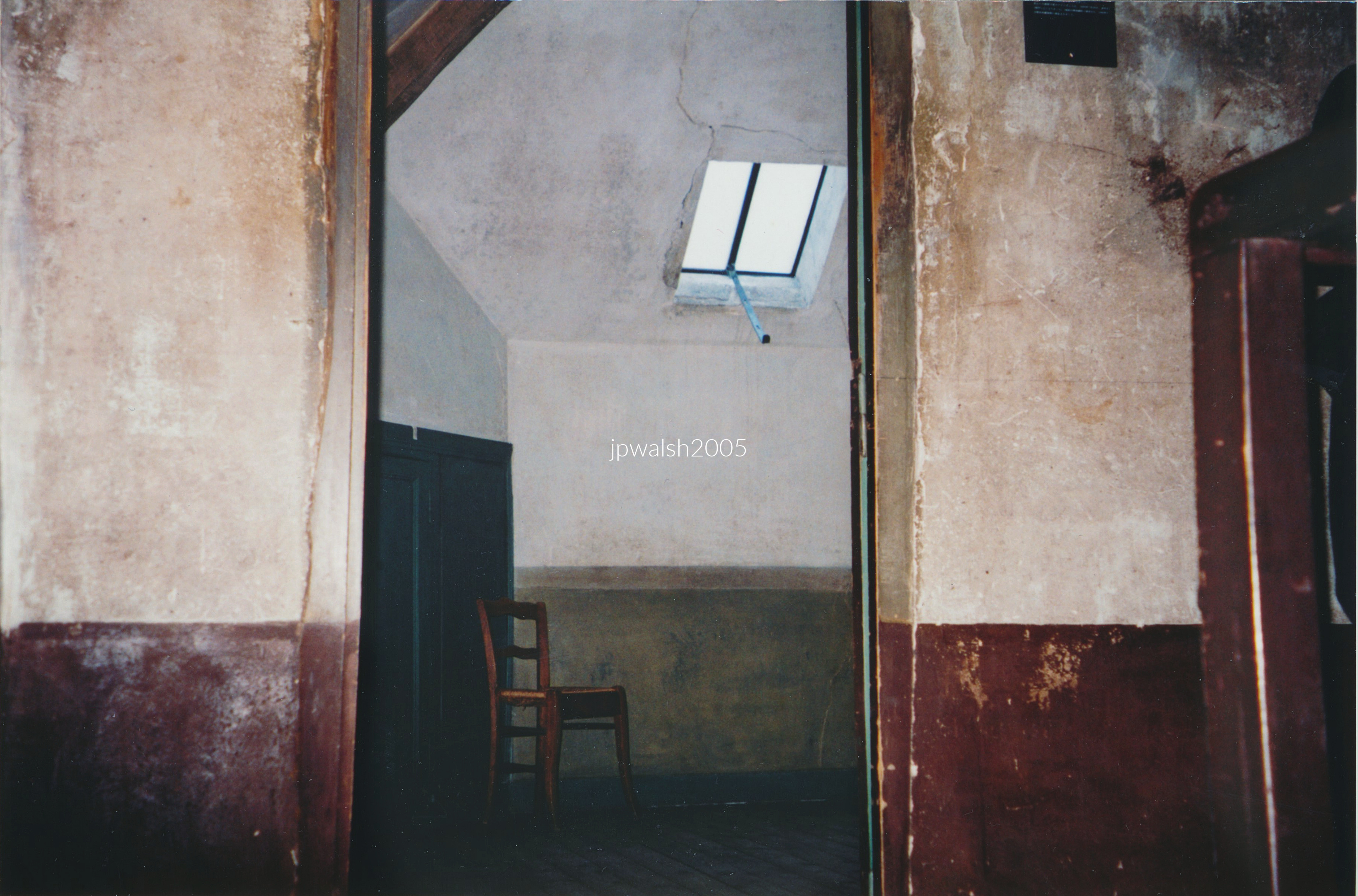
Entrance to Vincent Van Gogh’s rented room in Ravoux’s inn in Auvers. It was here that the artist lived for two months in the town. This is the same room is where Van Gogh returned after he shot himself on July 27, 1890, and died two days later here surrounded by family and friends. Author’s photograph, May 2005.
After roaming the town where he made friends of villagers, visited Dr. Gachet’s, and journeyed into nearby farm fields, Van Gogh returned to Ravoux’s café for lunch that was served at noon. In the afternoon he might sometimes work in the “painters’ room” at the inn or visit with other painters staying at the inn, such as compatriot Anton Matthias Hirschig (1867-1939) and Spanish painter Martinez de Valdivielse. These acquaintances proved more significant for history insofar as they provided eyewitness testimony of Van Gogh’s death and funeral. Following dinner at Ravoux’s, Van Gogh climbed the inn’s simple staircase to his single room in the center of the attic landing and retired at about nine in the evening.
Vincent Van Gogh, View of Vessenots near Auvers, May 1890, oil on canvas, 55×65 cm, Thyssen-Bornemisza, Madrid, Spain. Public Domain.
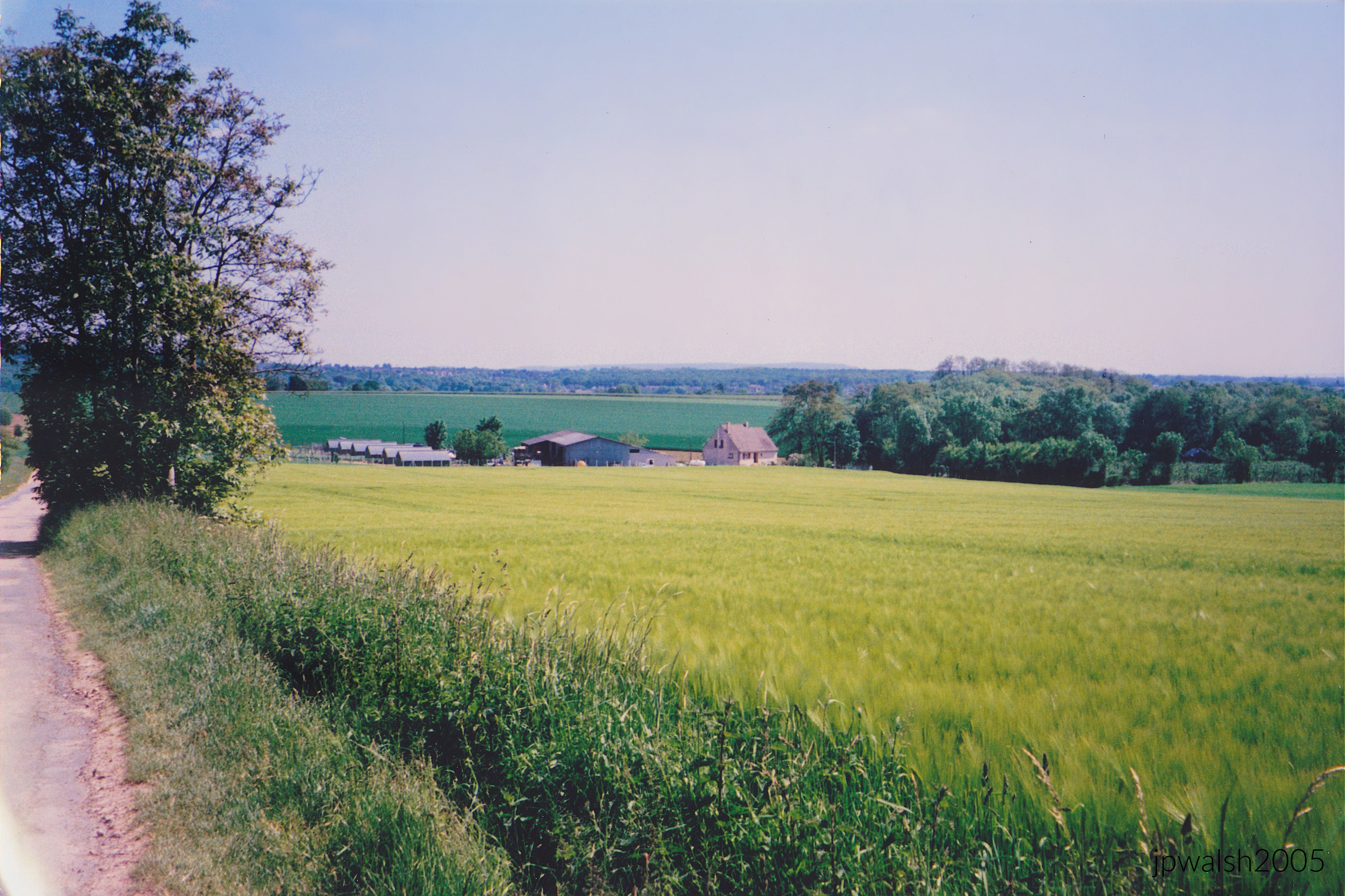
Fields of Auvers. Author’s photograph, May 2005.
Vincent Van Gogh, Daubigny’s Garden, midJune 1890, oil on canvas, 51 cm x 51.2 cm, Van Gogh Museum, Amsterdam. Other versions of Daubigny’s Garden are in the Hiroshima Museum of Art in Japan. see – https://www.hiroshima-museum.jp/en/collection/eu/vangogh.html – retrieved March 11, 2024) and the Van Gogh Museum in Amsterdam (see – https://www.vangoghmuseum.nl/en/collection/s0104V1962 – retrieved March 11, 2024. The square-format flat decorative painting, painted on a simple tea towel that was mounted to canvas, became Van Gogh’s first painted attempt of the garden. It acts as a modernist talisman reminiscent of Paul Sérusier’s 1888 cigar box painting and looks ahead to the decorative landscapes of the Nabis in the 1890’s and of Gustave Klimt (1862-1918) 15 years later. Public Domain.
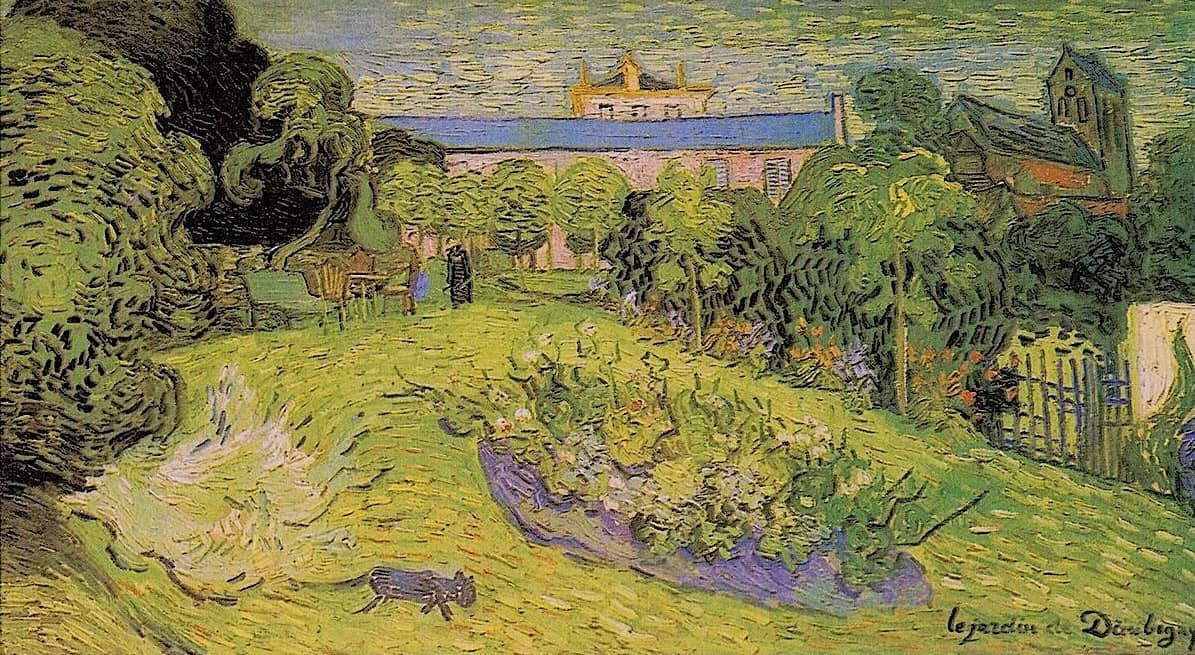
Vincent Van Gogh, Daubigny’s Garden, 1890, oil on canvas, 56 cm × 101 cm (22 in × 39.8 in), Kunstmuseum Basel, Basel, Switzerland. Van Gogh made three versions of the Auvers garden of Barbizon artist Charles-François Daubigny (1817-1878) between May and July 1890. Daubigny, who moved to Auvers in 1860. was a landscape artist who painted en plein aire. A short walk from the Ravoux inn, Daugigny’s widow still lived in the house in Auvers in 1890. For this painting Van Gogh stepped outdoors into Daubigny’s garden to look back towards the house (the Church of Auvers is distinctly drawn in the painting’s upper right corner). Van Gogh admired Daubigny since the 1870’s as he other Barbizon painters such as Jean-François Millet (1814-1875) and Camille Corot (1796-1875). see – https://www.vincentvangogh.org/garden-of-daubigny.jsp – retrieved March 11, 2024. Public Domain.
Van Gogh’s Auvers paintings reveal artistic innovations that anticipated later modernist movements and influenced future generations of artists.
Little has changed in appearance in Auvers from the time of Van Gogh’s stay in May-July 1890. Author’s photograph, May 2005.
Irises bloom along the side of a road in Auvers that leads to Dr. Gachet’s house. Author’s photograph, May 2005.
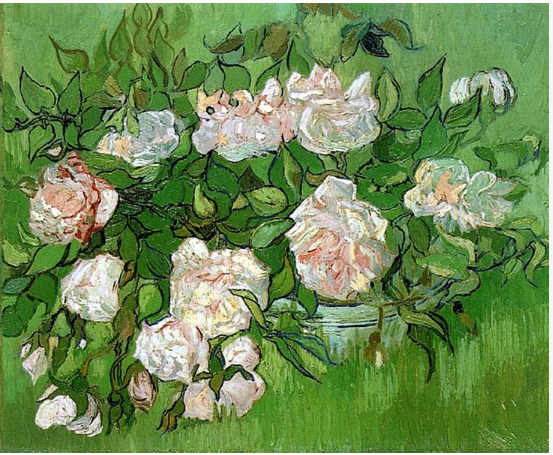
Vincent Van Gogh, Still Life Pink Roses, June 1890, oil on canvas, 32 x 40.5 cm, Ny Carlsberg Glyptotek, Copenhagen, Denmark. Public Domain.
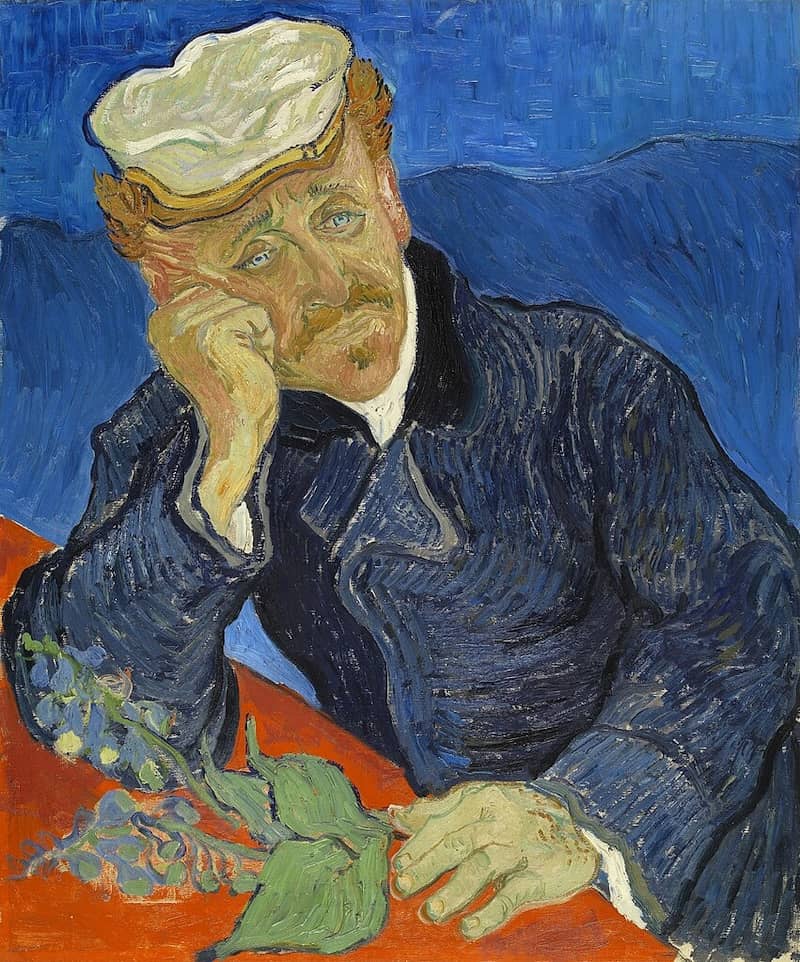
Van Gogh, Dr. Gachet (second version), June 1890, Musée d’Orsay, Paris. As a token of friendship, Van Gogh painted two authenticated versions of Dr. Gachet’s portrait in June 1890 at Auvers. Van Gogh came to Auvers because of the role Dr. Gachet played as the artist’s therapist. The well-regarded physician was an avid modern art collector and painter who hadparticipated in art circles since the 1850’s with Gustave Courbet (1819-1877). Dr. Gachet was instrumental in having Paul Cézanne come to Auvers to paint in 1873. In anticipation of Vincent’s arrival from Saint-Rémy, it was Camille Pissarro (1830-1903) living in Pontoise who recommended Dr. Gachet to Theo Van Gogh. Vincent Van Gogh thought fondly of Dr. Gachet as a brother. When Dr. Gachet visited Theo in Paris in early July 1890, he told him he believed that Vincent was “completely recovered” and “that there need be no fears of a further attack” (quoted in Complete Paintings, p. 718). Van Gogh saw Dr. Gachet as another brand of eccentric and painted him in these portraits as a deep thinker who reflected a sensitive nature tending to melancholy. Public Domain.
Van Gogh, Portrait of Adeline Ravoux, June 1890, oil on canvas, 52x 52 cm, Cleveland Museum of Art. In their therapeutic conversations, Dr. Gachet in June 1890 encouraged Van Gogh to make portraits of local sitters in Auvers. Van Gogh had done portraits of Arlesiens in the “Studio of the South” in 1888 and many self-portraits. Adeline Ravoux was the 15-year-old daughter of Van Gogh’s Auvers innkeepers. About one month after this portrait was made, the girl with her parents witnessed Vincent’s return to the café after he shot himself. Later, in a memoir she wrote: “Vincent walked bent, holding his stomach, again exaggerating his habit of holding one shoulder higher than the other. Mother asked him: “M. Vincent, we were anxious, we are happy to see you to return; have you had a problem?” He replied in a suffering voice: “No, but I have…” He did not finish, crossed the hall, took the staircase and climbed to his bedroom.” see – http://www.vggallery.com/misc/archives/a_ravoux.htm – retrieved March 11, 2024. Public Domain.
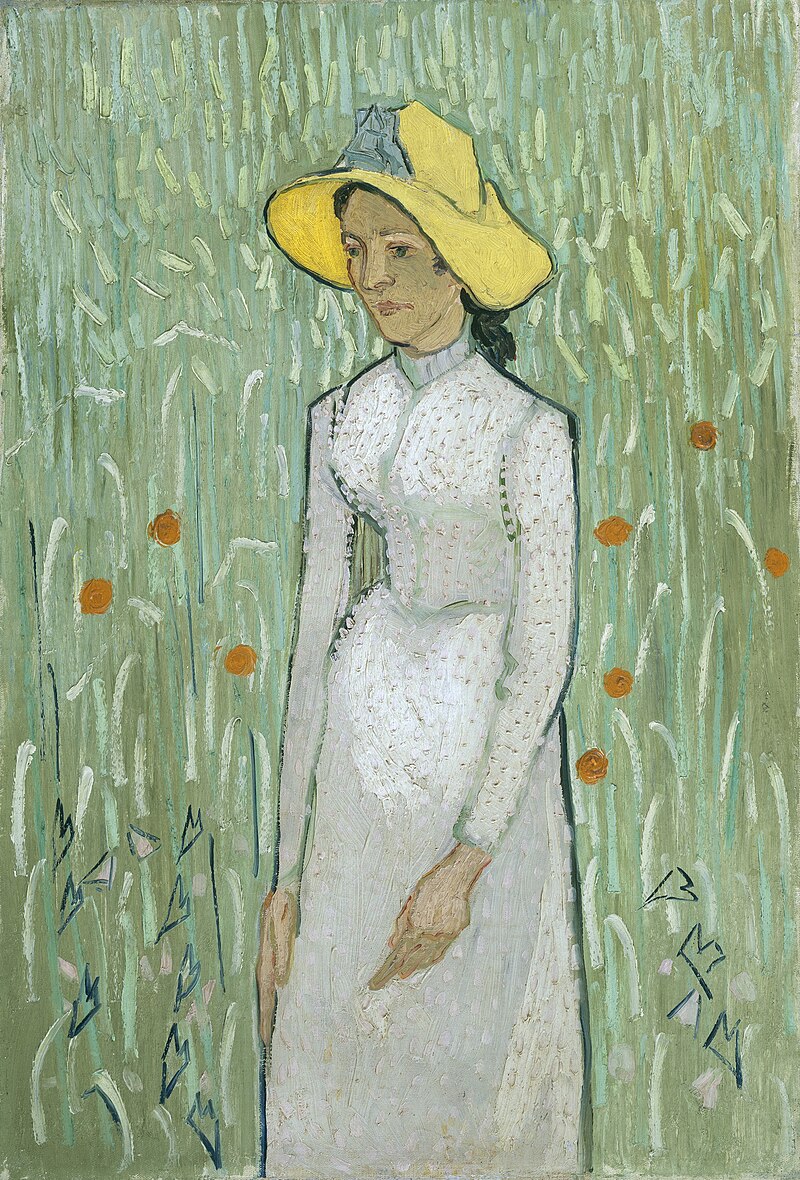
Van Gogh, Young Girl Standing Against Wheat, late June 1890, 66.7 x 45.8 cm (26 1/4 x 18 1/16 in.), National Gallery of Art, Washington, D.C. The painting’s lack of horizon creates a flat wall behind the sitter who appears in close proximity to the picture plane as she fills the pictorial space. Van Gogh shadowed her face under her hat and gave her a “distant, unfocused” gaze. All of these elements contribute to the portrait’s emotional distance. see – Painting the Difference: Sex and Spectator in Modern Art by Charles Harrison, University of Chicago Press, 2006. Public Domain.
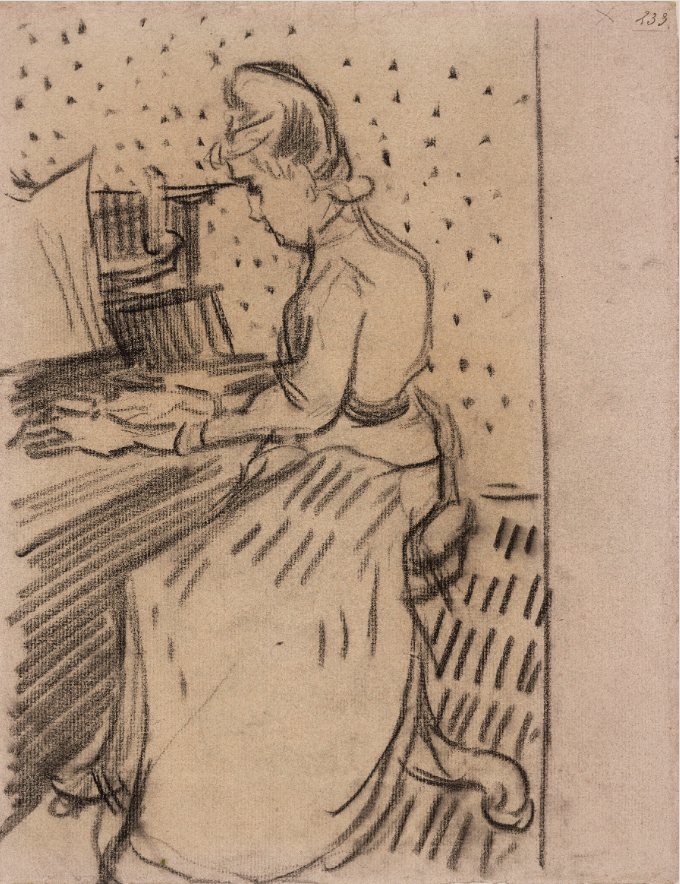
Van Gogh, Marguerite Gachet at the Piano, June 1890, chalk on paper, 30.5 cm x 23.8 cm, Van Gogh Museum, Amsterdam. Marguerite Gachet was the daughter of Dr. Gachet. In this sketch which resulted in a similarly composed painting, the sitter had recently turned 21 years old. For the painting that is today in the Kunstmuseum Basel, Van Gogh made two sketches in late June 1890. https://www.vangoghmuseum.nl/en/collection/d0427V1962r – retrieved March 11, 2024. Public Domain.
Van Gogh, L’église d’Auvers-sur-Oise, vue du chevet (“The Church at Auvers”), June 1890, oil on canvas, 94 cm x 74 cm (37 in x 29.1 in), Musée d’Orsay. Public Domain.
As in Van Gogh’s 1890 painting above, the church at Auvers (“Notre-Dame-de-l’Assomption”), situated in a bright midday sun, sits in deep shadow. Author’s photograph, May 2005.
An Extraordinary Final Burst of Creativity
Van Gogh proved quite productive in Auvers, painting several notable canvasses in and around the town and countryside, particularly landscapes and other outdoor subjects en plein aire. In these two months, the painter produced 74 paintings and 33 drawings, including the portraits of Dr. Gachet and Adeline Ravoux, The Church of Auvers, and Field of Wheat with Crows. In a letter of around July 10, 1890, Van Gogh wrote to Theo and Jo that he painted three large canvases at Auvers since visiting them in Paris on July 6, 1890. During that visit the artist also met with Henri Toulouse-Lautrec (1864-1901) and art critic Gabriel-Albert Aurier (1865-1892). In addition to Daubigny’s Garden, these large canvasses likely included Wheatfield with Crows and Wheatfields Thunderclouds (both Van Gogh Museum Amsterdam). Van Gogh described them as “immense stretches of wheatfields under turbulent skies…searching to express sadness [and] extreme loneliness” (“immenses étendues de blés sous des ciels troublés… chercher à exprimer de la tristesse, de la solitude extreme”). See – https://vangoghletters.org/vg/letters/let898/print.html – retrieved March 11, 2024.
Vincent Van Gogh, Sorrowing Old Man (“At Eternity’s Gate”), 1890, 80 cm × 64 cm (31.5 in × 21.2 in), oil on canvas, Kröller-Müller Museum, Otterlo, The Netherlands. The painting was completed at St. Rémy shortly before Van Gogh moved to Auvers-sur-Oise.
Van Gogh, Wheatfield with Crows. July 1890, oil on canvas, 50.2 cm × 103 cm (19.8 in × 41 in), Van Gogh Museum, Amsterdam. Many have claimed this to be Van Gogh’s last painting.
At the wheatfield in Auvers where Van Gogh painted “Wheatfield with Crows,” one of his last paintings, in July 1890. Author’s photograph, May 2005.
Van Gogh, Wheatfield Thunderclouds, July 1890, oil on canvas, 50.4 cm × 101.3 cm (19.8 in × 39.9 in), Vincent Van Gogh Museum, Amsterdam.
Auvers fields. Author’s photograph, May 2005.
The Tragic Events of July 1890
On July 27, 1890, Vincent, as he did each day, went into the fields to paint. Though the artist appeared to be in good spirits, the artist shot himself later that day near the chateau after going for a walk towards evening. Though able to walk the 10 minutes back mortally wounded to Ravoux’s inn, he told them nothing upon entering the café. The Ravoux’s, sensing something was wrong, called for Mazery, the village doctor and Dr. Gachet. Though these doctors bandage the wound, Van Gogh’s condition is inoperable. In the hot attic room, Van Gogh suffered into the next day, when Theo was sent for. He arrived immediately on July 28 from Paris to be by his brother’s side. Van Gogh died the next morning of July 29, 1890.
Funeral in the Wheat Fields
This suicide sent ripples of shock through the village, as some townspeople had witnessed these events. During my visit to Auvers in May 2005, after exiting Van Gogh’s room where he died, I told the innkeeper that the story was sad (“c’est triste”). She countered, “C’est emouvante” (“It’s moving”). Vincent was buried the next day, July 30, 1890, in Auvers’ new graveyard. His funeral was attended by Theo, Dr. Gachet, the Ravoux’s, assorted villagers, and friends from Paris. These last included artists Emile Bernard (1868-1941), Charles Laval (1862-1894), and Lucien Pissarro (1863- 1944), Camille Pissarro’s son. Petit boulevard art dealer and art materials supplier Julien (Père) Tanguy (1825-1894) was also in attendance. Van Gogh’s casket was strewn with yellow dahlias and sunflowers and Dr. Gachet gave remarks as did Theo Van Gogh. Later, in a letter to his wife, Theo wrote about the proceedings: “[Vincent] was buried in a sunny spot among the cornfields, and the cemetery does not have that unpleasant character of Parisian cemeteries.” (see- Kort geluk, 1999, p. 281). The mortal remains of Van Gogh were transported to the cemetery by a rented hearse from the next town because Auvers’ Catholic priest would not allow the community’s hearse to be used. A proposed church service was also cancelled. The homiletics were left to Dr. Gachet who said: “Vincent was an honest man and a great artist, and there were only two things for him – humanity and art. Art mattered to Vincent Van Gogh more than anything else and he will live on through it” (quoted in Complete Paintings, p. 719).
Graves of Vincent and Theo Van Gogh, Auvers-sur-Oise, France. Author’s photograph, May 2005.
Eyewitness Accounts of Van Gogh’s Last Days
Three days after the funeral, Emile Bernard wrote to Aurier about “our dear friend Vincent.” Aurier had written in January 1890 about the intense fixity of Van Gogh’s art. The art critic conjectured that it may be the catalyst for change in French art. In his essay entitled Les Isolés: Vincent van Gogh published in Mercure de France, Aurier prophesied for an artist-savior figure: “A man must come, a Messiah, a sower of Truth, to rejuvenate our geriatric art, indeed perhaps the whole of our geriatric, feeble minded, industrial society” (quoted in Complete Paintings, p. 698). Van Gogh, aware of these statements, did not think he was Aurier’s man. On August 2, 1890 Emile Bernard wrote to Aurier: “On Sunday evening [Vincent] went out into the countryside near Auvers, placed his easel against a haystack and went behind the chateau and fired a revolver shot at himself. Under the violence of the impact (the bullet entered his body below the heart) he fell, but he got up again, and fell three times more, before he got back to the inn where he was staying (Ravoux, place de la Mairie) without telling anyone about his injury. He finally died on Monday evening, still smoking his pipe which he refused to let go of, explaining that his suicide had been absolutely deliberate and that he had done it in complete lucidity…. On the walls of the room where his body was laid out all his last canvases were hung making a sort of halo for him and the brilliance of the genius that radiated from them made this death even more painful for us artists who were there. The coffin was covered with a simple white cloth and surrounded with masses of flowers, the sunflowers that he loved so much, yellow dahlias, yellow flowers everywhere. It was, you will remember, his favorite color, the symbol of the light that he dreamed of as being in people’s hearts as well as in works of art….The sun was terribly hot outside. We climbed the hill outside Auvers talking about him, about the daring impulse he had given to art, of the great projects he was always thinking about, and of the good he had done to all of us. We reached the cemetery, a small new cemetery strewn with new tombstones. It is on the little hill above the fields that were ripe for harvest under the wide blue sky that he would still have loved…perhaps.Then he was lowered into the grave…Then we returned. Theodore Van Ghog [sic] was broken with grief; everyone who attended was very moved, some going off into the open country while others went back to the station…” see – https://www.webexhibits.org/vangogh/letter/21/etc-Bernard-Aurier.htm – retrieved March 11, 2024.
Van Gogh, Two Women Crossing the Fields, July 1890, oil on paper on canvas, Marion Koogler McNay Art Museum, San Antonio, Texas.
By contrast, Anton Hirschig, the Dutch artist who roomed next door to Van Gogh at Ravoux’s, wrote a letter much later, in 1911, to Albert Plasschaert (1874-1941) in which he recounted a more terrible scene following Van Gogh’s shooting himself. Hirschig wrote: “He lay in his attic room under a tin roof. It was terribly hot. It was August. He stayed there alone for some days. Perhaps only a few. Perhaps many. It seemed to me like a lot. At night he cried out, cried out loud. His bed stood just beside the partition of the other attic room where I slept: Isn’t there anyone willing to open me up! I don’t think there was anyone with him in the middle of the night and it was so hot. I don’t think I ever saw any other doctor like his friend the retired army doctor: It’s your own fault, what did you have to go kill yourself for? He didn’t have any instruments this doctor. He lay there until he died.”
The Beginning of a Legacy
Theo Van Gogh died in Holland on January 25, 1891, nearly 6 months to the day after Vincent’s death. Theo was buried in Holland but exhumed and reinterred next to his older brother Vincent’s grave in Auvers cemetery in 1914. While Vincent Van Gogh, the man, was never larger than life, as an artist he produced an explosion of life on paper and canvas. Van Gogh came to art late (30 years old in 1883) and produced incessantly for the next 7 years. His oeuvre was beautifully powerful, and none of it more remarkably for the future of modernism than that done in Auvers-sur-Oise in May to July 1890.
SOURCES –
Harrison, Charles. Painting the Difference: Sex and Spectator in Modern Art. Chicago: University of Chicago Press, 2006.
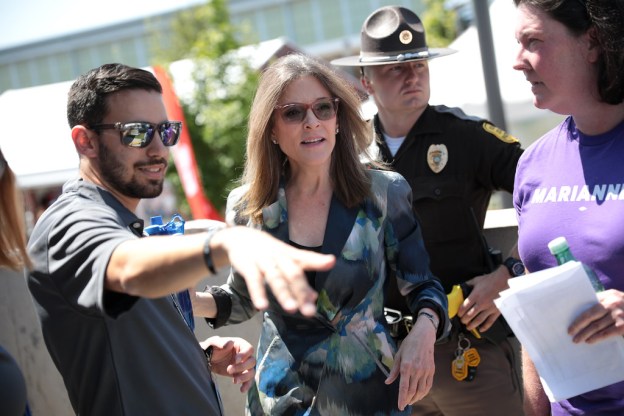
FEATURE Image: Marianne Williamson founded Project Angel Food in Hollywood, California, that prepares and delivers healthy meals to feed people impacted by serious illness, bringing comfort and hope every day. PHOTO: “Marianne Williamson” by Gage Skidmore is licensed under CC BY-SA 2.0.
Marianne Williamson (b. 1952), a Democrat, is running for U.S. president in 2024. She has an interesting biography. For example, Williamson has been active in charity work founding in 1989 Project Angel Food that provides free meals for people too sick to shop and cook for themselves. Sparked in response to a dramatic increase in HIV/AIDS cases in the late 1980s and early 1990’s, Project Angel Food has served its 16 millionth free meal to the sick and infirm in 2023. Within an especially committed and hard-working history, Elizabeth Taylor’s AIDS Foundation gave Project Angel Food its first-ever grant of $150,000 in 1992 and the charity organization obtained its first government grant in 1993. In 1999, Taylor accepted an Angel Award recognizing her impact on increasing awareness of HIV/AIDS at a time in Los Angeles when there were more than 30,000 known cases. In 1998, Marianne Williamson founded the Peace Alliance, a U.S. nonprofit working towards peace building in the U.S. and around the globe. Ms. Williamson is a board member for RESULTS, a nonprofit dedicated to finding long-term solutions to poverty. Ms. Williamson’s candidacy for U.S. President this year (she UNsuspended her campaign this week) should certainly be worth following.
5.29 minutes. “The spirit of this place even though it’s so modern and so huge that little seed that was planted in the very beginning, that spark I swear, Is still here which is so important…”