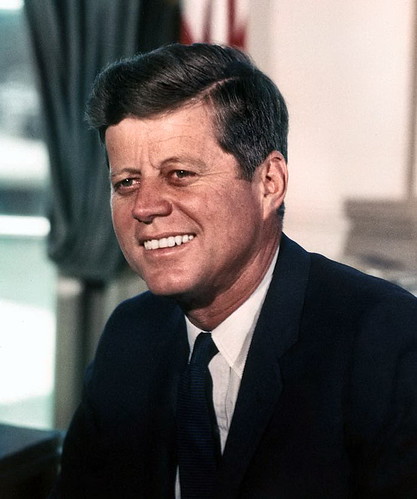
FEATURE image: Portrait of President John F. Kennedy. “President John F. Kennedy” by U.S. Embassy New Delhi is licensed under CC BY-ND 2.0.
January 3, 1960 — Kennedy Confronts Charges of “Divided Loyalties” on Meet the Press:
(20) Looking back at JFK discussing his faith 60 years after his assassination – YouTube – retrieved June 2, 2026.
January 3, 1960 — Announcement: One day after launching his campaign for the Democratic nomination, Kennedy immediately confronted a revived national anxiety: whether a Roman Catholic could serve as president without divided loyalties. As the first Catholic with a viable path to the White House, he faced sharp questioning over whether allegiance to the Pope might compromise his constitutional duties.
Religious Controversy: Kennedy moved quickly to defuse the issue. Kennedy, who happened to be Catholic, argued that religion should neither qualify nor disqualify a candidate. His position was deliberately universal. Though he made no excuses for his Catholic faith, he insisted that the presidency belongs to individuals, not categories. The controversy did not end there. In September 1960, before the Greater Houston Ministerial Association, he faced it down again, declaring that he was not the Catholic candidate for president, but the Democratic Party’s candidate who happened to be Catholic. The speech became the campaign’s clearest statement that personal identity must not become a political litmus test. He pledged to carry out the responsibilities of the presidency independent of any outside religious authority, rejecting both criticism and instruction. He argued for an uncompromising separation of church and state, stating that he would oppose a national church even if “99 percent” of Americans shared his faith.
Electoral Strategy: Beyond addressing religion, Kennedy used the NBC broadcast to outline his broader campaign logic. He rejected identity‑based ticket balancing, insisting that a major party’s presidential ticket should be shaped by geography and political experience rather than religious background.
Vice‑Presidential Speculation: He also dismissed rumors that he might accept the vice‑presidential slot, stating bluntly that he had no interest in “waiting for the president to die.” The unusually candid remark signaled his determination to run on his own terms and set the tone for the rest of his campaign.
September 13, 1962 — News conference:
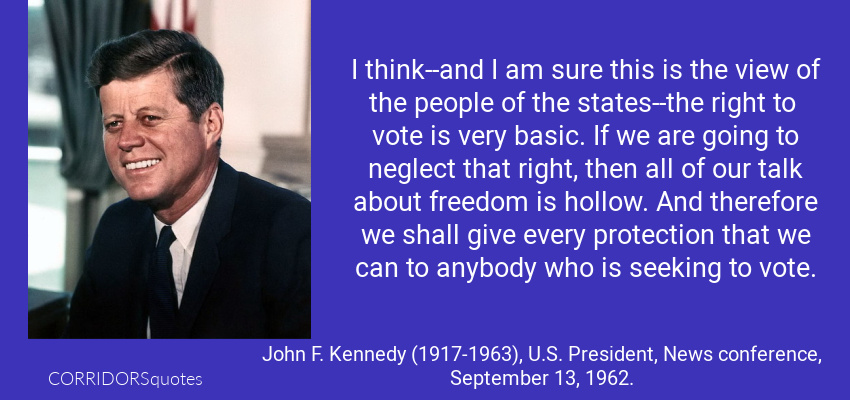
I think – and I am sure this is the view of the people and the states- the right to vote is very basic. If we are going to neglect that right, then all of our talk about freedom is hollow. And therefore we shall give every protection that we can to anybody who is seeking the vote.
October 26, 1963 — Remarks at Amherst College:

The men who create power make an indispensible contribution to the nation’s greatness. But the men who question power make a contribution just as indispensible for they determine whether we use power or power uses us.
September 13, 1960 — Kennedy-Johnson Joint Campaign Appearance, Grand Prairie, Texas:
Above: One of the rare joint appearances of Senators John F. Kennedy and Lyndon B. Johnson—the Democratic presidential ticket—in the 1960 campaign, which ultimately defeated the Republican ticket of Nixon–Lodge. During the second day of their Texas tour, the two men spoke to nearly 6,000 people in the parking lot of the Chance Vought Aircraft factory. It was at this stop that Kennedy was famously presented with a western cowboy hat, joking that he “didn’t have the guts to wear it” immediately. They also rode in a motorcade through the intersection of Main and Center streets in downtown Grand Prairie. Neither man was a natural campaigner: Kennedy’s hands often shook beneath a table or podium as he spoke, his voice growing hoarse, while Johnson, uneasy in crowds, frequently pushed himself into sick exhaustion on the trail.
Campaign Dynamics: Although both candidates wanted more joint appearances, their aides agreed such events mostly hurt the ticket’s image—especially Kennedy’s. Johnson was only nine years older, and both were the first U.S. presidents born in the 20th century, yet aides felt that when they stood together Kennedy looked almost like LBJ’s son. Still, the press and Johnson complained for weeks that the two men should campaign together more often, given the offices they sought.
Press Pressure: When reporters began hinting at a rift between the candidates as the reason for their limited joint schedule, the campaign arranged another appearance in November 1960, five days before Election Day. For that final joint even at the Biltmore in Los Angeles, Johnson flew out specifically to join Kennedy. The appearance received strong national print and television coverage, and on that Thursday before Americans went to the polls, both campaigns regarded it as a major success.
February 18, 1958 — Speech at Loyola College Alumni Banquet, Baltimore, Maryland:
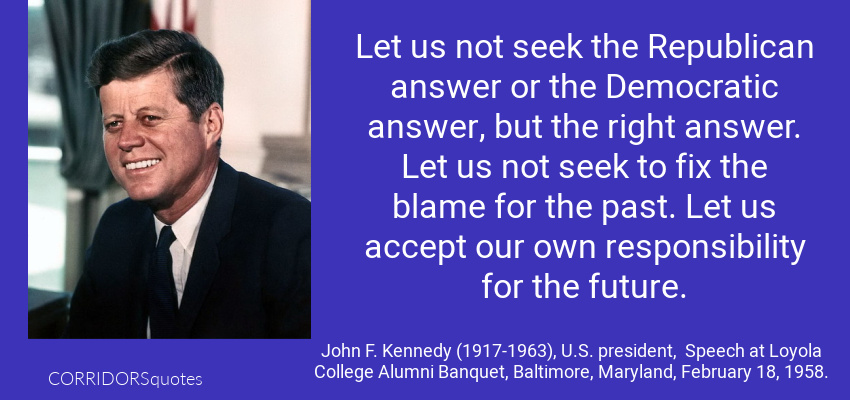
Let us not seek the Republican answer or the Democratic answer, but the right answer. Let us not seek to fix the blame for the past. Let us accept our own responsibility for the future.
The Cuban Missile Crisis lasted from October 16 to October 28, 1962. Critical Milestones:
October 16: Kennedy was first shown U‑2 photographs revealing Soviet nuclear missile installations in Cuba.
October 22: Kennedy announced a naval “quarantine” of Cuba in a televised address to the nation.
October 24: Soviet ships approached the blockade line but stopped or turned back to avoid confrontation.
October 27 — “Black Saturday”: A U‑2 was shot down over Cuba, and a Soviet submarine was forced to surface by U.S. Navy signaling, marking the peak of the crisis.
October 28: Premier Nikita Khrushchev announced that the Soviet Union would dismantle and remove the missiles, ending the 13‑day standoff.
In response to the rapid buildup of Soviet nuclear missiles in Cuba, President John F. Kennedy announced that the United States would impose a naval blockade—officially termed a “quarantine”—around the island. It went into effect on the morning of October 24, 1962, when American warships and aircraft tightened a ring around Cuba with orders to intercept any vessel suspected of carrying offensive military equipment.
Tension spiked almost immediately. Roughly 25 Soviet ships, some believed to be transporting nuclear missile components, continued steaming toward the quarantine line. U.S. commanders had standing instructions: any vessel refusing inspection could be stopped, diverted, and, if necessary, sunk. At 10:00 a.m., as the quarantine became active, Kennedy convened ExComm to assess the situation when new intelligence came in that made the situation immediately more precarious. Reports were that the approaching Soviet ships were joined by a Soviet sub armed with nuclear weapons, raising the risk of an existential, catastrophic confrontation. At the same time, aerial reconnaissance showed Soviet crews working feverishly in western Cuba to complete missile sites armed with nuclear warheads pointed at the U.S.—further evidence that the threat to U.S. national security, already considered imminent by the Kennedy Administration, was growing by the minute.
On the diplomatic front, the crisis was unresolved as it was debated by delegates at the U.N. whether Kennedy’s blockade was even legal under international law. Soviet leaders accused the United States of issuing an ultimatum and warned that force would be met with force. Meanwhile protests were organized on each side across the globe as political maneuvering accelerated.
By the end of October 24, 1962, the first signs of restraint appeared: several Soviet ships slowed or halted before reaching the quarantine line, suggesting Moscow might be reconsidering its next move. Even so, the world understood, some for the first time, that it stood on the precipice of nuclear war. The day ended with both superpowers locked in the most dangerous equilibrium of the crisis so far – both armed, alert, and waiting for the next move – with no one knowing whether diplomacy or confrontation would ultimately prevail.
October 31, 1962 — Three Days After the Cuban Missile Crisis, JFK Meets the Archbishop of Canterbury at the White House:
Above: Rev. Dr. Michael Ramsey (1904–1988), Archbishop of Canterbury, meets with President John F. Kennedy on Halloween, 1962—just three days after the Cuban Missile Crisis ended. The world was still exhaling in relief: armed confrontation between the superpowers had been narrowly avoided, and October 27 had been the crisis’s most perilous day. A U‑2 reconnaissance plane was shot down by Soviet‑supplied SAM missiles, killing the USAF pilot. Kennedy’s ExComm urged immediate military retaliation, but he resisted. That same night, Robert Kennedy met secretly with Soviet Ambassador Anatoly Dobrynin in Washington, where they reached a tentative understanding pending Moscow’s approval. By the next morning, October 28, Radio Moscow announced acceptance of Kennedy’s proposal, ending the 13‑day standoff.
Michael Ramsey had been appointed Archbishop of Canterbury on May 31, 1961, and installed the following month, serving until 1974. In 1962 he was also president of the World Council of Churches (1961–1968). During his archbishopric, the first woman Anglican priest—Chicago‑born high‑altitude balloonist Jeannette Piccard—was ordained in the United States in 1974.
Massachusetts: John F. Kennedy Library, Columbia Point, Boston (June 1989):
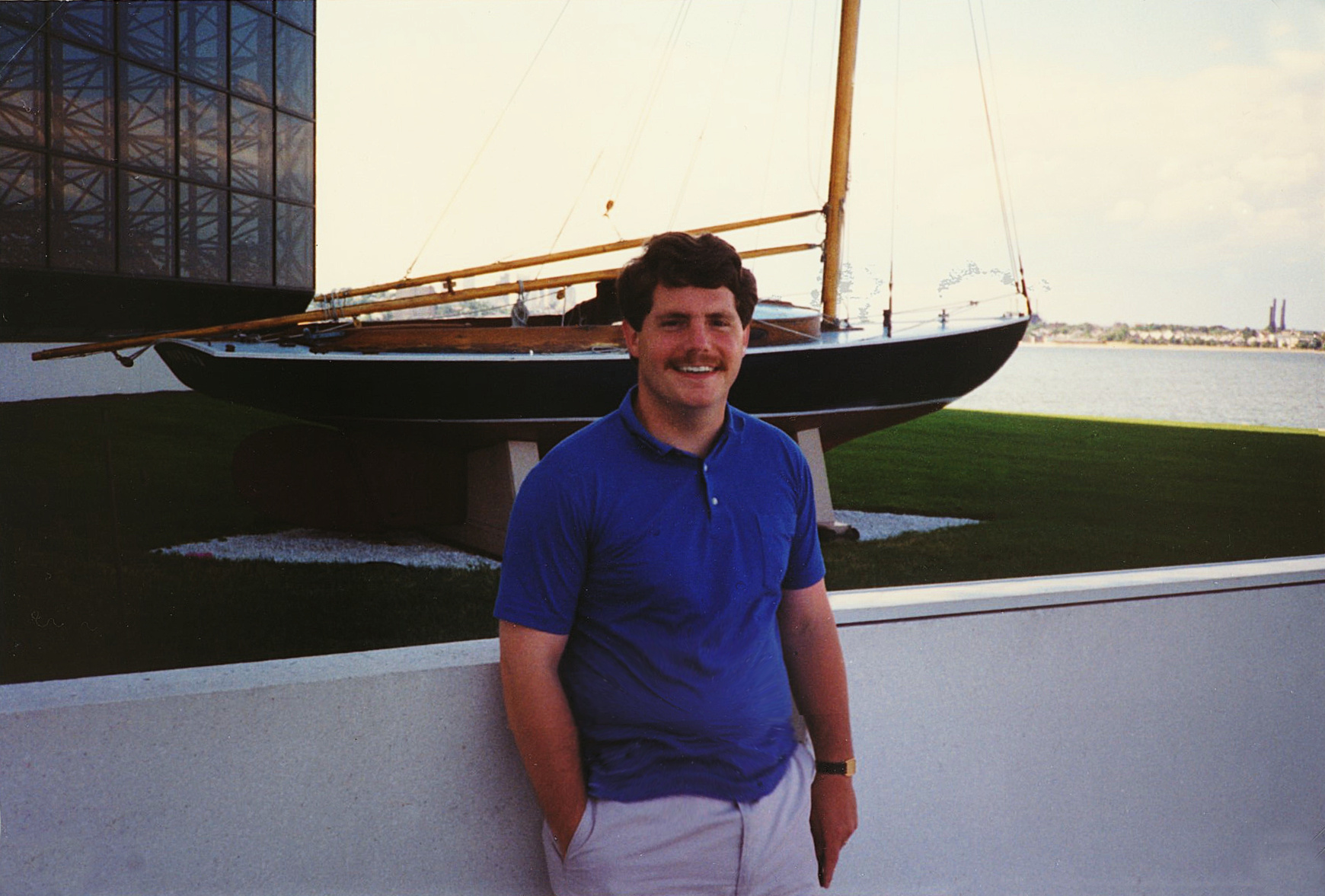
July 1989 — The author at the John F. Kennedy Library, Columbia Point, Boston.
Standing near JFK’s iconic sailboat, 1989 marked the Library’s tenth anniversary, a moment when the institution shifted from a young presidential repository into a fully established center of civic education, political legacy, and architectural study. Its most enduring milestone of 1989 was the formal creation of the Profile in Courage Award by members of the Kennedy family. Just five weeks before this photograph, Columbia Point hosted a major family gathering on May 25, 1989, attended by Jacqueline Kennedy Onassis, Senator Ted Kennedy, Caroline Kennedy, and John F. Kennedy Jr., underscoring the Library’s growing national prominence a decade after its opening
John F. Kennedy Family House (1957), 3307 N Street, Georgetown, Washington, D.C. (October 2003):
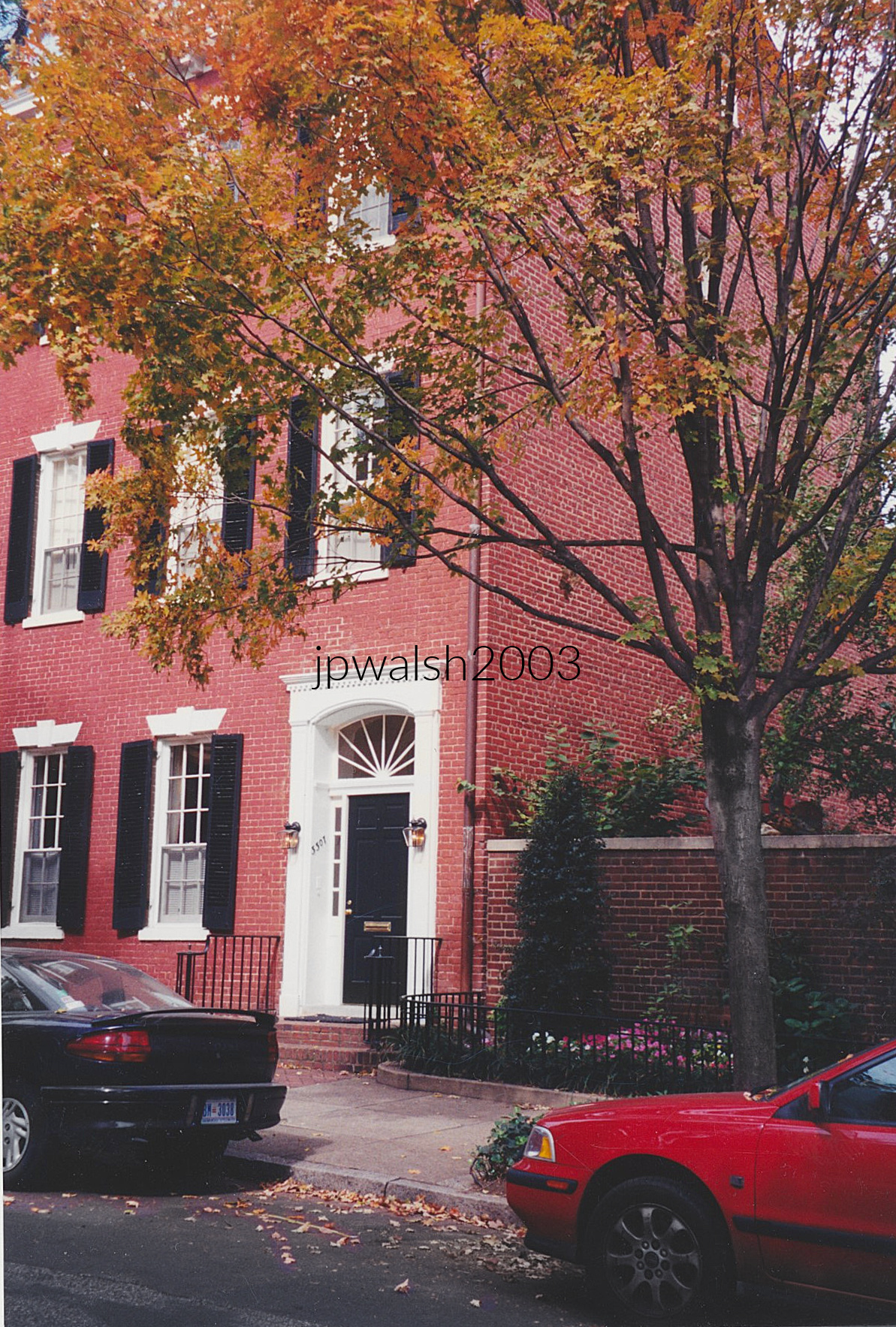
June 1957 — A Georgetown Purchase In June 1957, Massachusetts Senator John F. Kennedy bought this three‑story Federal‑style house as a gift for his wife, Jacqueline Kennedy after the birth of their daughter, Caroline. Their son, John Jr., was also born while the family lived here.
Campaign Life at 3307 N Street During JFK’s 1958 Senate re‑election and the 1960 presidential campaign, Jackie hosted teas in the home’s double living room. The front entrance became nationally recognizable when President‑elect Kennedy stepped outside to announce major appointments — including naming his younger brother and campaign manager, Robert F. Kennedy as U.S. Attorney General.
January 20, 1961 — Departure for History On the morning of January 20, 1961, Kennedy famously left from this doorstep to travel to the U.S. Capitol for his swearing‑in as the 35th President of the United States. The house was sold later that year when the family moved into the White House.
Early 19th‑Century Origins Beyond its presidential associations, the home was originally built in 1811–12 for William Marbury (1762–1835), the financier and plaintiff in the landmark 1803 Supreme Court case Marbury v. Madison — the decision that established the foundational principle of judicial review.
The Garden Refuge The Kennedys used the brick‑walled garden at 3307 N Street as a quiet refuge, especially during the 1960 campaign. With JFK traveling constantly, he rarely found time for his painting hobby, though he did spend occasional Sunday afternoons in the garden with Jackie and Caroline, away from the public spotlight.
Aesthetic Balance Inside the home, Jackie’s classical European taste was balanced with historical maritime art and paintings of naval vessels — a nod to Kennedy’s U.S. Navy service and lifelong passion for the sea.
Massachusetts: The John Fitzgerald Kennedy National Historic Site (Birthplace, 1917), Brookline, Massachusetts (July 1989) (August 2005):
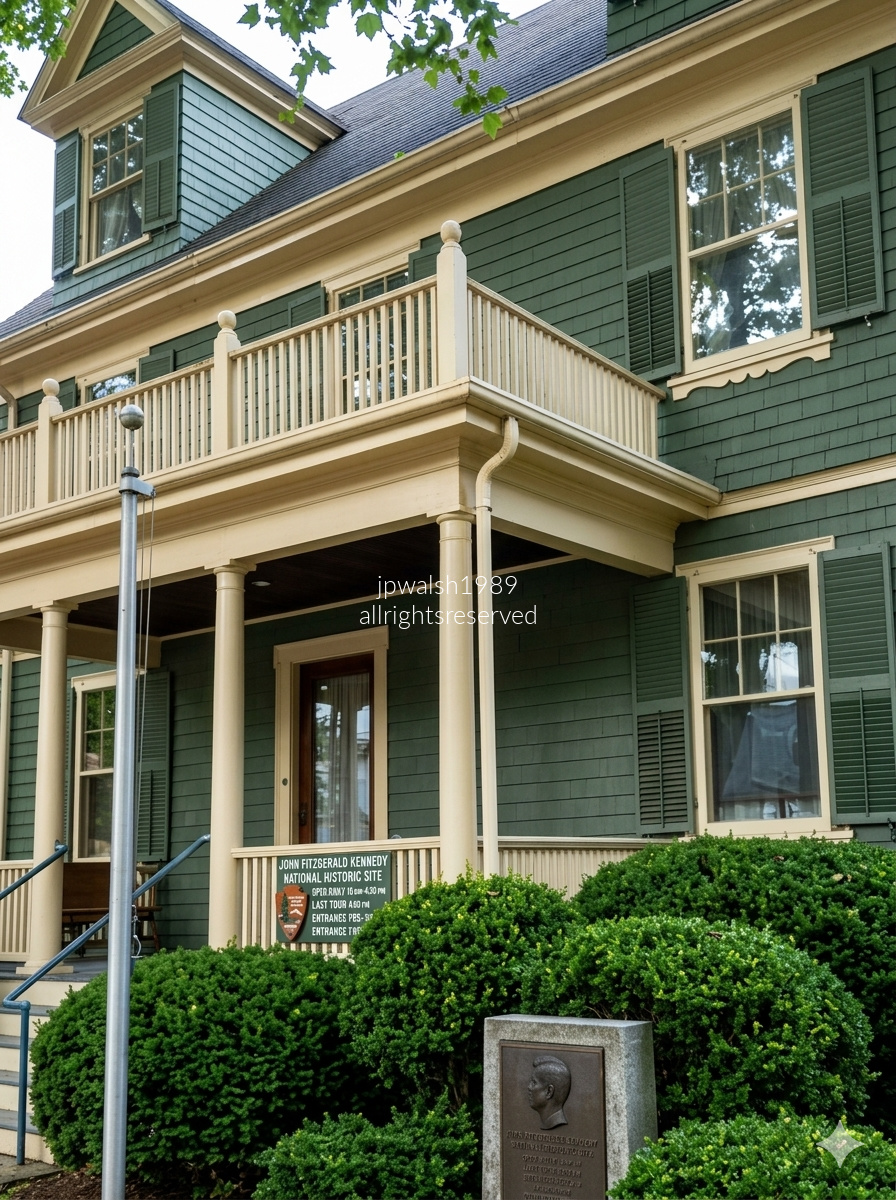
July 1989 — The John Fitzgerald Kennedy National Historic Site at 83 Beals Street preserves the birthplace and early childhood home of the 35th president. The house, built in 1909 by local architect‑builder Robert M. Goode, is a two‑and‑a‑half‑story Colonial Revival structure with a green‑shingled exterior, an asymmetric cross‑gabled roof, prominent dormers, and a front porch topped by an upper balustrade deck. It stands in Brookline’s Coolidge Corner neighborhood, a dense early‑20th‑century streetcar suburb of tree‑lined residential blocks bordering Boston.
Three Kennedy children were born in the second‑floor master bedroom: John F. Kennedy on May 29, 1917; Rosemary Kennedy on September 13, 1918; and Kathleen Kennedy on February 20, 1920. Their older brother, Joseph P. Kennedy Jr., was born in Hull, and the later five siblings — including Bobby and Ted — were born around the corner in the larger family home on Abbottsford Road.

JFK’s birthplace and childhood home—stands on Beals Street in the Boston suburbs. Joseph Patrick Kennedy purchased the house in August 1914, just ahead of his October marriage to Rose Elizabeth Fitzgerald. A driven, opportunistic young bank president and businessman, he began building his fortune during World War I through shipbuilding contracts in the Quincy yards. In Brookline, Joe Kennedy was an affectionate father who fostered a spirited sense of competition among the Kennedy children, shaping the family ethos that would define their later public lives.
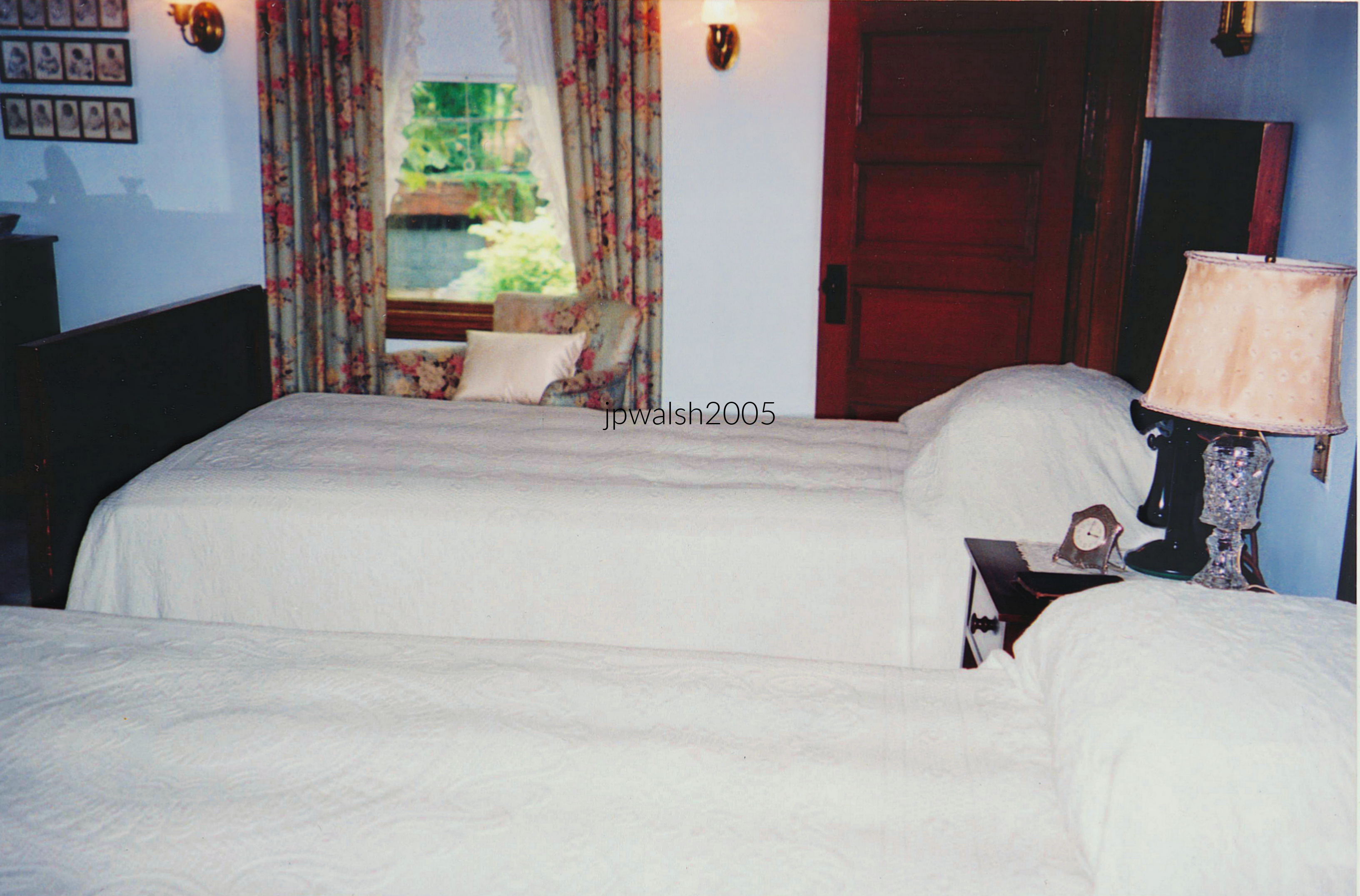
John F. Kennedy was born in this upstairs master bedroom of this Beals Street home in the mid-afternoon (3 p.m.) on Tuesday, May 29, 1917, an unseasonably cold (44 degrees), overcast, and rainy day. The family lived on Beals Street until 1920, then moved a short walk away to a larger house on Abbottsford Road, where they remained until 1927 before relocating to New York. Rose Fitzgerald—daughter of Boston’s first American‑born Irish mayor—had seven of her nine children in Brookline and was reluctant to leave. John F. Kennedy was her second child and son.
In Brookline, Joe Kennedy, son of a local pol and saloonkeeper, instilled a competitive spirit in his children, while Rose, who had studied in Europe, taught them an appreciation for the arts and history. A devout Catholic, Rose took her children on weekday walks to market and then to church, reinforcing their faith as part of daily life, not just Sundays.
After Joseph P. Kennedy sold the Beals Street house to family friend Edward Moore, the property passed through several owners over the next four decades. Following JFK’s assassination in 1963, thousands of mourners visited the home, turning it into an impromptu pilgrimage site. In 1966, the current owners agreed to sell the house back to the Kennedy family so it could be preserved as a permanent memorial.
Rose Fitzgerald Kennedy then led a full restoration of the interior, working from her own memories and period décor to recreate the exact appearance of the home as it looked on the day John F. Kennedy was born in 1917. When the project was complete, the Kennedy family donated the property to the National Park Service in 1969, establishing what is now the John Fitzgerald Kennedy National Historic Site. Rose Kennedy said she gave the house to the American people so that “future generations will be able to visit it and see how people lived in 1917 and thus get a better appreciation of the history of this wonderful country.” see – https://www.nps.gov/jofi/index.htm – retrieved May 29, 2025.
February 26, 1962 — Voice of America speech:
In a 1962 address to the Voice of America, President John F. Kennedy defined the organization’s mission as a duty to champion truth, transparency, and the free flow of information, even when revealing internal “blemishes and warts.” He emphasized that a free nation must not fear truth and that the “burden of truth” serves the cause of freedom.
SPEAKING OF FREEDOM OF INFORMATION IN A FREE COUNTRY TO THE ENTIRE WORLD: “The Voice of America speaks. Today America has been at war for 79 days. Daily at this time we shall speak to you about America and the war, and the news may be good or bad. We shall tell you the truth”…
…We seek a free flow of information across national boundaries and oceans, across iron curtains and stone walls. We are not afraid to entrust the American people with unpleasant facts, foreign ideas, alien philosophies, and competitive values. For a nation that is afraid to let its people judge the truth and falsehood in an open market is a nation that is afraid of its people.
The Voice of America thus carries a heavy responsibility. Its burden of truth is not easy to bear. …And as you tell it, it spreads. And as it spreads, not only is the security of the United States assisted, but the cause of freedom.” See – https://www.presidency.ucsb.edu/documents/remarks-the-20th-anniversary-the-voice-america – retrieved May 29, 2025.
November 22, 1963 — Fort Worth Remarks Before the Texas Hotel:
On a rainy morning in front of the Texas Hotel in Fort Worth, President John F. Kennedy delivered brief remarks at a citizen’s rally. He outlined three pillars of national security: military strength, economic prosperity, and superiority in space exploration, noting that Fort Worth would again “play its proper part.”
KENNEDY: “What we are trying to do in this country and what we are trying to do around the world, I believe, is quite simple: and that is to build a military structure which will defend the vital interests of the United States. And in that great cause, Fort Worth, as it did in World War II, as it did in developing the best bomber system in the world, the B‑58, and as it will now do in developing the best fighter system in the world, the TFX, Fort Worth will play its proper part. And that is why we have placed so much emphasis in the last 3 years in building a defense system second to none, until now the United States is stronger than it has ever been in its history. And secondly, we believe that the new environment, space, the new sea, is also an area where the United States should be second to none.”
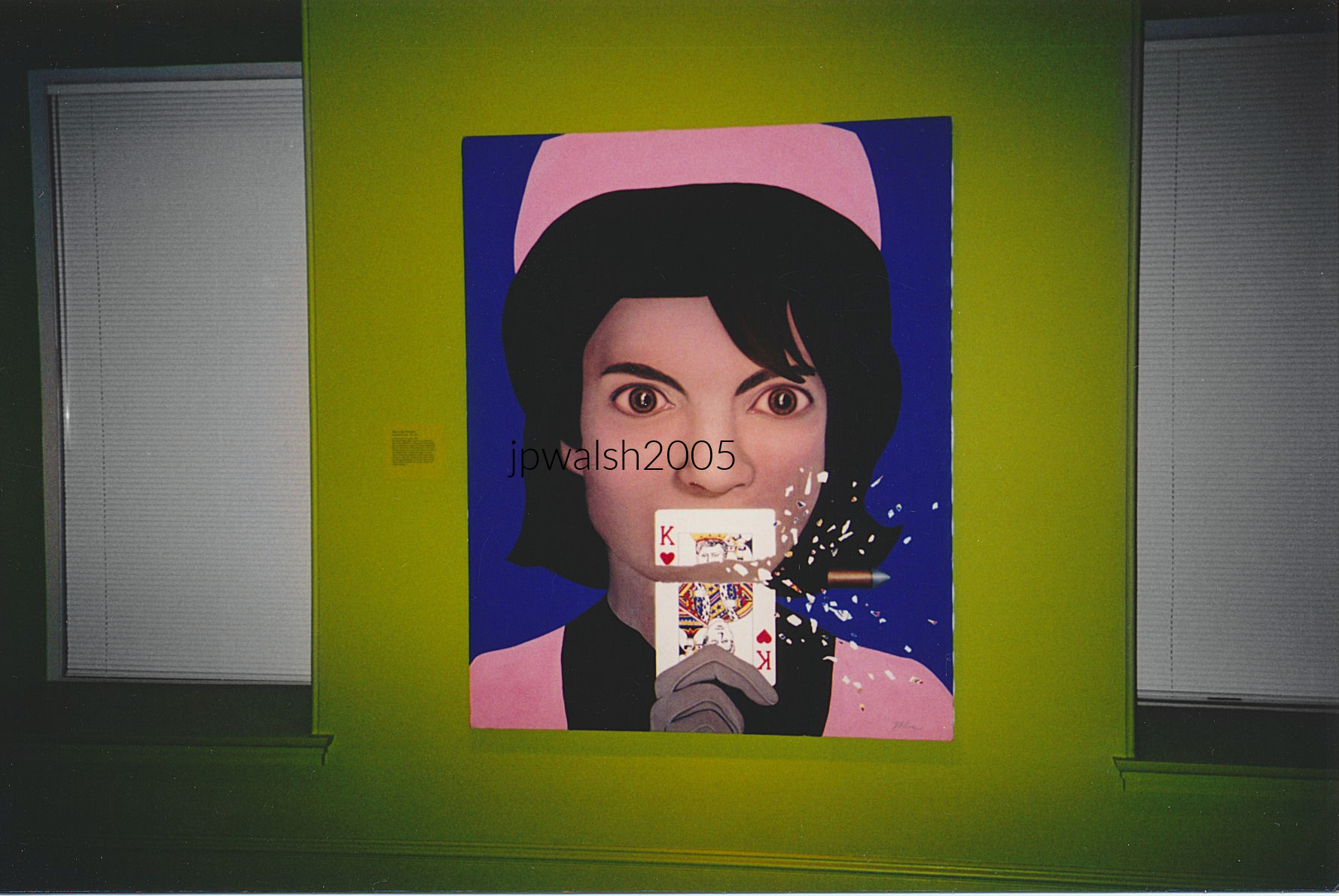
November 22, 1963 — The Johnsons Telephone Their Condolences to Rose Kennedy in the Immediate Aftermath of the Assassination:
November 22, 1963 — Rose and Joe Kennedy at Hyannis Port
On a clear “bluebird” morning at the Hyannis Port compound, Rose Kennedy followed her usual routine, attending morning Mass before returning home for lunch with Joe, who remained severely impaired from his 1961 stroke. After a short drive together, Rose received a call from her son, Attorney General Robert Kennedy: the President—her son Jack—had been shot in Dallas. A second call soon followed, confirming he was dead.
Rose withdrew to grieve in solitude, walking the beach and sitting quietly in her room, later reflecting that she asked God how decades of preparing her children for service could be undone in seconds. At approximately 4:15 p.m., she took a call from the new president, Lyndon Johnson, speaking from Air Force One shortly after being sworn in and as he returned to Washington with President Kennedy’s body. Composed, Rose addressed him as “Mr. President.”
June 11, 1963 — Oval Office Report to the American People on Civil Rights:
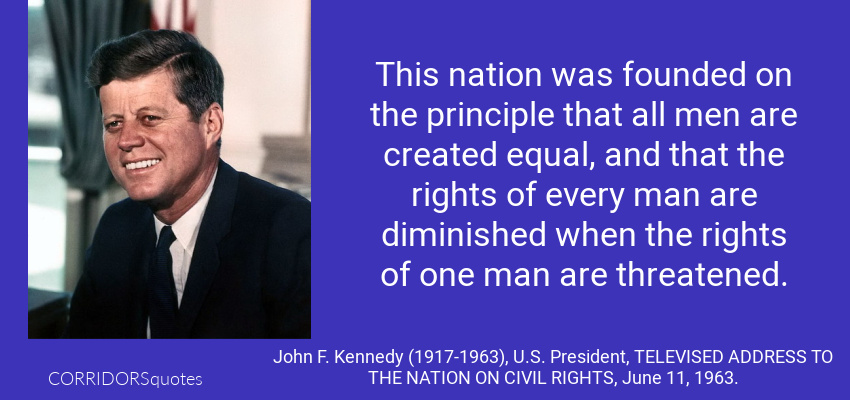
This nation was founded on the principle that all men are created equal, and that the rights of every man are diminished when the rights of one man are threatened.
May 27, 1963 — Supreme Court Signals an End to Evasion of Brown v. Board
On May 27, 1963, the Supreme Court declared that it would no longer tolerate evasions of its 1954 Brown v. Board of Education ruling. The statement came in another desegregation case involving public parks. When the Court issued Brown in 1954, it could not have foreseen the years of delay and resistance that followed.
June 5–10, 1963 — Federal Orders and Kennedy’s Warning to Wallace
On June 5, a federal court enjoined Alabama Governor George Wallace from obstructing the admission of two qualified Black students to the University of Alabama. President John F. Kennedy reinforced the order on June 10, writing to Wallace and urging him not to interfere.
June 11, 1963 — Wallace “Stands in the Schoolhouse Door”
On June 11, Wallace carried out his pledge to “stand in the schoolhouse door,” physically blocking the students from enrolling. When he refused to yield to federal marshals, Kennedy nationalized the Alabama National Guard. Guard troops arrived, Wallace stepped aside, and the students entered and registered for classes.
June 11, 1963 — Kennedy’s Civil Rights Address from the Oval Office
That evening, Kennedy delivered his “Report to the American People on Civil Rights” from the Oval Office. In a 13‑minute address, he set out the moral and legal issues surrounding civil rights and previewed legislation that would become the Civil Rights Act of 1964. After two cautious years, the speech marked a decisive shift: Kennedy gave a full‑throated endorsement of civil rights and federal action to secure them.
June 12–13, 1963 — The Murder of Medgar Evers and Local Repression
In the early hours of June 12, civil rights leader Medgar Evers, who had listened to Kennedy’s remarks, was assassinated outside his home in Jackson, Mississippi. On June 13, Jackson police arrested 82 Black marchers protesting Evers’s murder. Within a week, a white suspect was arrested and charged.
June 19, 1963 — Kennedy Sends His Civil Rights Bill to Congress
On June 19, Kennedy asked Congress to introduce his civil rights bill, seeking desegregation of public facilities, federal action to end job discrimination, and authority for the Attorney General to initiate desegregation suits.
Summer 1963 — Civil Rights Leaders Reject a Pause in Demonstrations
As Congressional debate and filibuster began, Kennedy asked civil rights leaders to suspend protests and marches. They refused. Instead, they announced a March for Jobs and Freedom in Washington, D.C., to take place in August 1963.
See- Kennedy and the Press, edit. Harold W. Chase and Allen H. Lerman, introduction by Pierre Salinger, Thomas Y. Crowell Company, New York, 1965, p. 452.
June 26, 1963 — Berlin speech at Rudolph Wilde Platz
November 21, 1963 —Texas motorcade & remarks at the dedication of the Aerospace Medical Health Center, San Antonio
August 1, 1963—color recording of remarks for “Seas Around Us”
September 12, 1962— Moon speech, Rice University, Houston, Texas
April 27, 1961 — Address before the American Newspaper Publishers Association, Waldorf-Astoria Hotel, New York City:
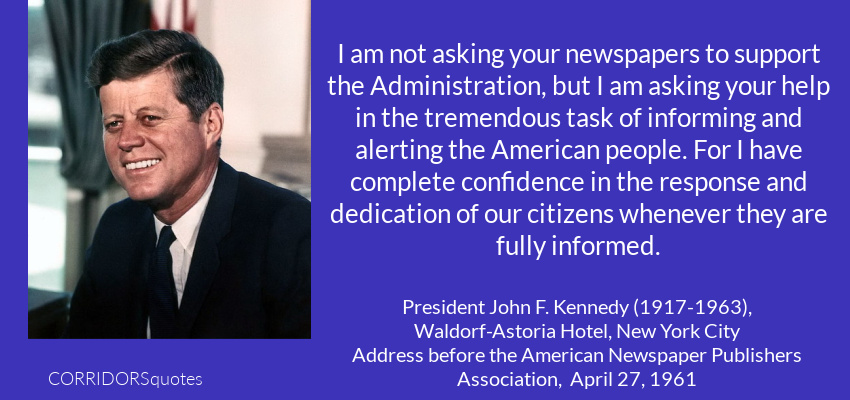
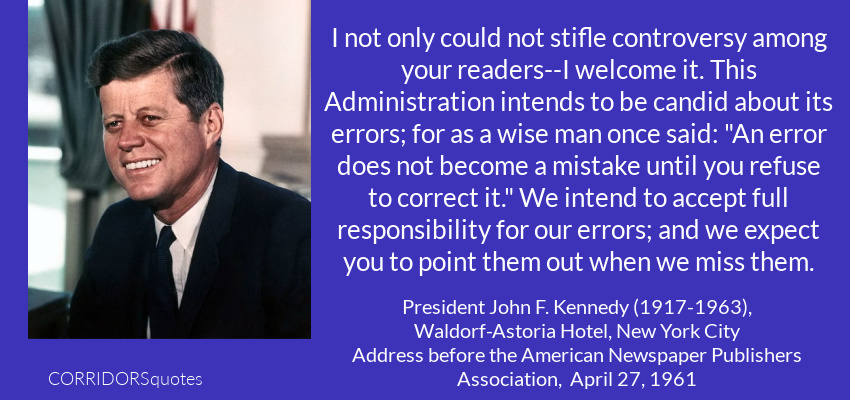
On April 27, 1961, President John F. Kennedy delivered his 2400-word+ major speech known as “President and the Press” before the American Newspaper Publishers Association at the Waldorf-Astoria Hotel in New York City. In the speech delivered just days after the failed Bay of Pigs Invasion the new president made a plea for responsible journalism in the face of Cold War threats. The remarks remain relevant today on the topics of press freedom, misinformation, and national security.

John F. Kennedy 1960 Campaign Ad For Social Security:
The Origins of Social Security
When Franklin D. Roosevelt signed the Social Security Act on August 14, 1935, he called the new federal retirement program a “cornerstone.” It became one of the central pillars of the New Deal and a defining feature of modern American social policy.
A Personal Reflection from 1998
In 1998, at a Chicago book signing for The Virtues of Aging, I met former President Jimmy Carter and asked whether he believed Social Security was destined to disappear. Carter replied that he did not think so, a view reflecting the long‑standing bipartisan commitment to the program’s survival.
Social Security Under Strain in 2026
By 2026, Social Security faces unprecedented pressure. The aging population has surged: 75 million seniors now receive benefits—three times the number in 1975. Meanwhile, a smaller workforce contributes payroll taxes to support a rapidly growing pool of beneficiaries. Trust‑fund reserves are being depleted, and insolvency is projected for the mid‑2030s.
Kennedy’s 1960 Visit to Hyde Park
During the 1960 presidential campaign, Democratic nominee John F. Kennedy visited Hyde Park, New York, the national shrine home of Franklin D. Roosevelt. The occasion marked the 25th anniversary of the Social Security Act. Kennedy addressed 2,000 senior citizens gathered to honor Roosevelt and hear the young senator outline his vision for strengthening the program.
Kennedy’s Proposals for America’s Aging Population
In his remarks, Kennedy advanced a series of proposals aimed at improving the lives of older Americans and modernizing Social Security. Among them:
- Federal medical care — a precursor to Medicare, which would be enacted in 1965.
- Cost‑of‑living adjustments — automatic increases to keep pace with inflation, implemented in 1975.
- Incentives for continued work — allowing older Americans to earn more without losing benefits.
- Vocational guidance — support for retirees seeking new roles or training.
- Adequate housing — expanding federal efforts to provide safe, affordable homes for seniors.
- Medical research — increased study of diseases associated with aging.
- Higher survivor benefits — expanded support for spouses caring for under‑age children.
A Continuity of Purpose
Kennedy’s 1960 message echoed Roosevelt’s original vision: Social Security was not merely a retirement program but a national commitment to dignity, security, and opportunity in old age. His proposals anticipated many reforms that would shape the program in the decades to come.
March 29, 1962—News Conference 29:
The Tax Cut Bill Advances in Congress
The press conference occurred the same week the House Ways and Means Committee approved President Kennedy’s tax cut bill. At the same time, Kennedy emphasized the need to close tax loopholes that permitted and encouraged American industries to invest overseas.
Revenue Neutrality as a Central Congressional Concern
Congress was focused on balancing the revenue lost from tax cuts with revenue gained through tax reforms, aiming to produce a revenue‑neutral bill. The effort was conceived as a targeted economic stimulus—not the broad‑brush solution tax cuts later became in national economic debates, nor the inverse approach of sweeping tax hikes.
Balancing Cuts and Reforms in the 1962 Legislation
The 1962 tax bill was modified and passed with this balancing principle in mind. Kennedy proposed significant reductions in tax rates for individuals and corporations, acknowledging that such cuts would initially reduce federal revenue. Broadly pro‑growth, the plan was not a modern‑style tax giveaway; policymakers believed the country could not afford such an approach. Instead, the goal was to offset revenue losses through reforms that generated compensating gains.
Sources of Revenue Gains
Revenue increases for the government came from several reforms, including:
- Eliminating the dividend credit and exclusion
- Introducing withholding taxes on dividends and interest
- Restricting business expense deductions, particularly for entertainment and meals
- Adjusting tax treatment for cooperatives and financial institutions
- Revising taxation of gains from the sale of depreciable property
Short‑Term Losses and Long‑Term Contrast
Although the final Revenue Act of 1962 resulted in a short‑term net revenue loss, it still reflected Kennedy’s intent to pair tax cuts with offsetting reforms. Later economic approaches—particularly those associated with Reagan‑era tax policy—introduced large tax cuts skewed toward higher‑income earners without corresponding revenue‑generating reforms, relying exclusively on growth‑driven revenue effects to offset massive revenue losses. Combined with increased federal spending, this produced persistent deficit financing that Kennedy could not have imagined.
Kennedy’s Fiscal Aim in 1962
In 1962, Kennedy sought both a tax cut and a balanced budget, a pairing that underscores how different his fiscal strategy was from later eras of tax policy.
March 7, 1962—News Conference 26:
On February 22, 1962, Soviet Premier Khrushchev proposed that at the upcoming U.N.-sponsored Geneva Disarmament Conference on March 14 that the heads of government meet.
Kennedy rejected the offer, though he was afterwards pressured by European allies to reconsider and probed by the U.S. press if he would possibly attend and so backtrack on his statements. He maintained his firm position against attending the opening of the Geneva Disarmament Conference on March 14, 1962. Instead of traveling to Switzerland himself, Kennedy appointed Arthur H. Dean as the Chairman of the U.S. Delegation and sent Secretary of State Dean Rusk to handle the initial high-level negotiations.
Kennedy later outlined the manner of his going to any sort of summit conference in the near future— 1. to ratify an agreement 2. if there was a serious international crisis or the U.S. was on the brink of war 3. To aid the national interest.
The outcome to that spring’s lengthy Geneva talks was announced by Kennedy about 5 weeks after its opening: that negotiators had reached a broad outline for the objectives and principles, basic provisions and timings of a general treaty on nuclear disarmament.
Six months later the Cuban Missile Crisis took place.
April 30, 1963 — April 30, 1963 — Kennedy’s Remarks to Choate Alumni:
On May 4, 1963, President Kennedy broadcast taped remarks to the alumni of his alma mater, The Choate School, commemorating the unveiling of his official portrait on the campus in Wallingford, Connecticut.
A Line That Defined an Inauguration
The phrase most associated with John F. Kennedy’s 1961 Inaugural Address—“Ask not what your country can do for you; ask what you can do for your country”—endured as a defining call to civic action. Delivered by the nation’s first Catholic president, it urged Americans to see national progress as a shared personal duty rather than a service provided by government.
Echoes in Years of Lightning, Day of Drums (1965)
Its resonance appears again in the 1965 documentary Years of Lightning, Day of Drums, one of the earliest films to chronicle Kennedy’s presidency and assassination. Near the conclusion, narrator Gregory Peck reflects, “All this took place in the early 1960s, and someday the early 1960s will be a long time ago.” Hearing that line as a child, I felt its existential reminder: even the most vivid present moments eventually recede into memory and become history.
Possible Origins at Choate
Some historians have suggested that Kennedy’s inaugural exhortation may trace back to his years at Choate, the Connecticut boarding school he entered in 1931 as a ninth‑grade student. In his chapel addresses, headmaster George St. John frequently reminded students: “The youth who loves his alma mater will always ask not ‘what can she do for me?’ but ‘what can I do for her?’” Kennedy would have heard this refrain repeatedly during his formative years.
A Frail Student with a Mischievous Streak
Kennedy arrived at Choate following his older brother, Joe Jr., a standout athlete two years ahead of him. By contrast, Kennedy was frail, thin, and saddled with the nickname “rat face” among classmates. His early years were marked less by distinction than by mischief. He gathered around him a circle of friends he called “The Muckers Club,” a tongue‑in‑cheek embrace of St. John’s term for troublemakers. Their antics were largely harmless—witty pranks and playful irreverence—and the group included Kennedy’s roommate and lifelong friend, Lem Billings.
A Shift in Trajectory
Despite his unremarkable start, Kennedy’s trajectory at Choate changed. By the time he graduated in 1935, he was not valedictorian, but his peers voted him “Most Likely to Succeed,” a judgment that reflected what followed.
JFK, May 4, 1963: First, it is to make sure that our private schools are increasingly representative of the diversity of American life. These schools will not survive if they become the exclusive possession of a single class or creed or color. They will enlarge their influence only as they incorporate within themselves the variety which accounts for so much of the drive and the creativity of the American tradition. The second is to make sure that our private schools prepare young men and women for service to the community and to the Nation. The inheritance of wealth creates responsibilities; so does privilege in education.
May 19, 1962 — Birthday Party for President Kennedy at Madison Square Garden:
On May 19, 1962—ten days before President Kennedy turned 45—more than 15,000 people packed Madison Square Garden for his birthday celebration, a star‑studded night of politicians, entertainers, and Hollywood royalty. The evening became legendary when Marilyn Monroe stepped onto the main stage in a sheer, flesh‑colored gown studded with 2,500 rhinestones and delivered her breathy rendition of “Happy Birthday, Mr. President” as a giant cake was brought out.
Kennedy followed her to the microphone and quipped, “I can now retire from politics after having had Happy Birthday sung to me in such a sweet, wholesome way,” a wink at Monroe’s sultry delivery and famously skintight dress.
Monroe had flown to New York with jazz pianist Hank Jones, leaving the troubled production of Something’s Got to Give to make the cross‑country appearance. The decision cost her: 20th Century‑Fox fired her in June 1962 for violating her contract. Kennedy attended the event alone; Jackie Kennedy skipped the celebration entirely, spending the day at the Loudoun Benefit Horse Show in Virginia with Caroline and John Jr.
The Madison Square Garden performance would become one of Monroe’s final public appearances before her death that August.
February 26, 1962 — President John F. Kennedy presented astronaut John Glenn with the NASA Distinguished Service Medal at the White House:
Astronaut John Glenn, born July 18, 1921, was part of NASA’s first astronaut group and became the first American to orbit Earth three times on February 20, 1962. Six days later, on February 26, 1962, President John F. Kennedy presented him with the NASA Distinguished Service Medal at the White House—a ceremony meant both to honor Glenn and to bolster national confidence during the Space Race.
The color footage (no sound) shows Kennedy awarding the medal with Glenn’s wife, Annie, and their children, John David (16) and Carolyn “Lyn” Glenn (14), standing beside him.
Glenn visited the Kennedy White House at least four times. He returned on May 3, 1962, as JFK welcomed Glenn and Soviet cosmonaut Gherman Titov to the Oval Office to discuss their historic flights and encourage international space cooperation. About six weeks before Dallas, on October 10, 1963, Kennedy presented Glenn, joined by the rest of the Mercury Seven astronauts, with the National Aeronautic Association’s 1962 Robert J. Collier Trophy for pioneering American manned spaceflight.
Glenn retired from NASA in 1964 and became A US Senator from Ohio for a quarter of a century (1974-1999). As a sitting senator, 77-year-old Glenn returned to space in 1999 on shuttle Discovery. John Glenn died on December 8, 2016, at the age of 95
June 23-July 2, 1963 — President Kennedy’s 1963 European Tour:
In June and July 1963, President John F. Kennedy embarked on a historic ten-day European tour, beginning with a four-day visit to West Germany and West Berlin. During a stop in Hanau on June 25, Kennedy stepped out of his motorcade to personally shake hands with the German police motorcycle escort that had guided him through streets lined with dense cheering crowds. The following day, June 26, he traveled to Berlin to deliver his celebrated “Ich bin ein Berliner” address on the steps of Rathbone Schöneberg that was attended by a crowd of 500,000. The trip continued as a triumphal circuit through Western Europe. In Ireland, Kennedy visited his ancestral homestead in Wexford and addressed the Irish Parliament. Moving on to the United Kingdom, he attended Sunday Mass at a small parish church in East Sussex (“Our Lady, Help of Christians”) before meeting with Prime Minister Harold Macmillan. Finally, Kennedy concluded his journey in Italy on July 2 with a private audience with Pope Paul VI—securing a vital diplomatic meeting while carefully avoiding the new Pope’s formal installation ceremony just days prior.
This explanatory article is periodically updated.