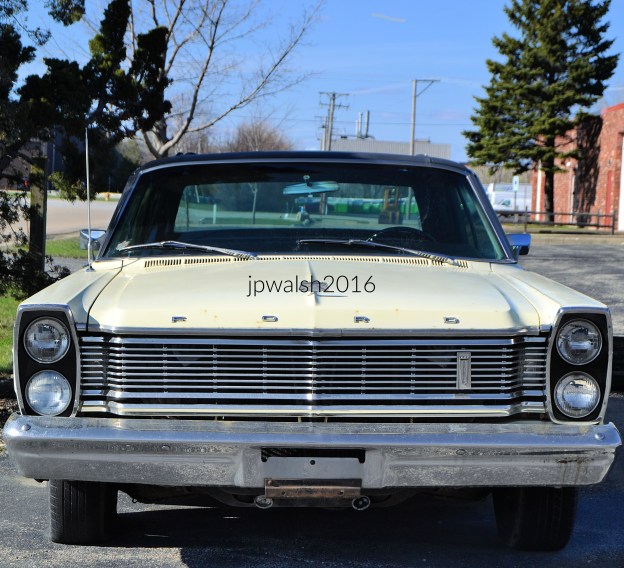
Feature Image: The 1965 Ford Galaxie 500 features a distinctive full-width grille with vertically stacked dual headlights. Available in various body styles, including hardtops and convertibles, the model was part of an all-new design for full-size Fords, highlighting crisp lines and engines that included V8 options such as the 352 cubic inch “Thunderbird Special.” Author’s photograph. April 2016. 3.34mb DSC_0471 (1).
In 1960, 44-year-old Robert McNamara was the new president of Ford Motor Company. In his career at Ford, McNamara was an executive who thought like and fought for the ordinary consumer. Unlike other car industry execs, McNamara was passionate about providing a highly affordable and great car for the ordinary American man and woman. McNamara was ahead of his time and actually might have been more useful or successful in the 1970’s when the introduction of emissions standards and fuel economy made weight and design more significant to meet government mandates. The Falcon was McNamara’s brainchild. Its average price point of $2,100 (about $23,000 today) fulfilled McNamara’s vision for a great American utilitarian car for the masses and it became a bestseller. The middling Ford Fairlane had an average base MSRP of less than $2,300. Next up the lower priced chain of Ford car models was Ford Galaxie. At a little over $2,700 MSRP ($29,500 today) Galaxie was a full-size Ford sedan throughout its production run.
“Meet the aristocrats of the low-priced field“—ad tag line in 1960 for Ford Galaxie.

1965 Ford Galaxie (above). With a classic full-size body, the Ford Galaxie 500 was available with various engines, including a high-performance 427 cubic inch V8. Options included a 3-speed automatic or 4-speed manual transmission. The spacious interior was known for its large bench seats. Author’s photograph. April 2016. 4.32 mb DSC_0468 (1).
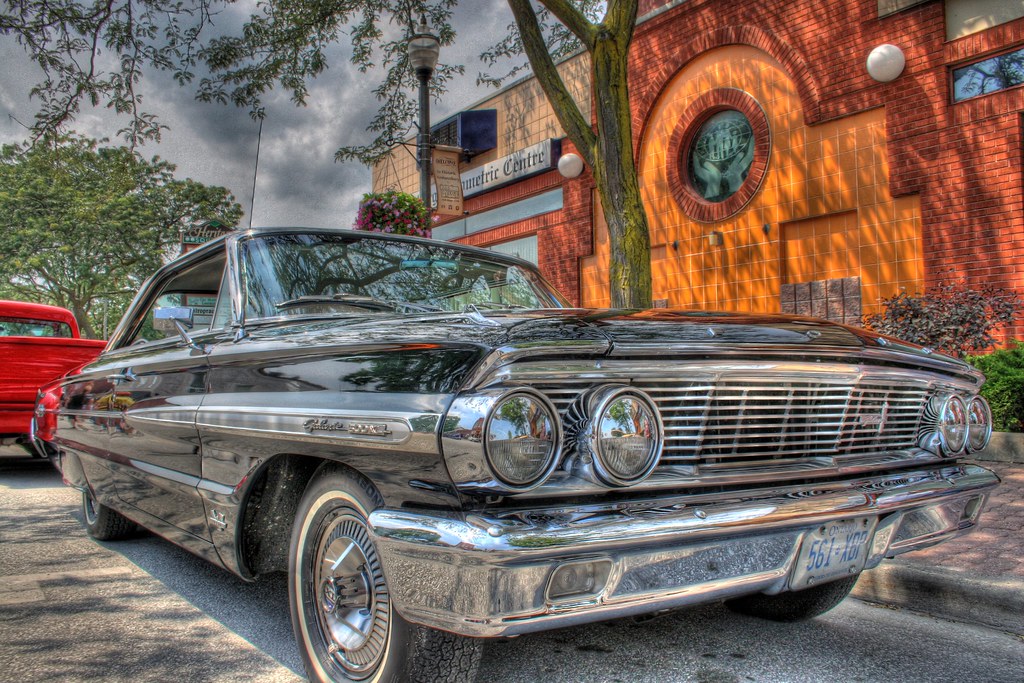
1964 Ford Galaxie 500XL (above). This full-size American car was a top choice in its era combining luxury features and power. The 2-door hardtop coupe could be equipped with a V8 engine, known for robust performance. Between the Custom and the LTD (the XL was discontinued after 1970), the Galaxie remained slotted as the mid-range full-size Ford into the 1970s. “FORD GALAXIE HDR” by abux_77 is licensed under CC BY-NC 2.0.

On November 9, 1960, Robert McNamara (1916-2009) became the youngest president in Ford Motor Company history and the first from outside the Ford family since 1906. One month on the job, McNamara was contacted on December 8, 1960, by president-elect John F. Kennedy’s transition team and offered the job of US Secretary of Defense. Though McNamara’s first reaction was that he wasn’t qualified for the defense job, he finally accepted and became the youngest defense secretary in US history up to that time. McNamara’s compensation at Ford was $3 million a year. At the Defense Department he made $25,000 a year. See – Our Vietnam The War 1954–1975, A.J. Langguth, 2000, Simon & Schuster, pp. 42-43 and McNamara At War: A New History, P. Taubman and W. Taubman, 2025, W.W. Norton, p. 120. PHOTO: “Robert McNamara” by DoDEA Communications is licensed under CC BY-NC-ND 2.0.
In addition to a shiny nameplate, Galaxie included cloth/vinyl bench seating, chrome exterior trim on all windows and body sides and an aluminum rear quarter covering with upgrades available. Under McNamara, Ford took a heavy risk in 1960 when it introduced a totally revamped design on its bestseller compact Falcon as well as its line of full-sized cars. Fords were lighter and sleeker, with a body no longer sculpted but molded from fender to bumper trimmed in chrome. And for the first time in Ford history the full width grill had its headlights inset at each end instead of above. This design choice continued throughout Galaxie’s second generation into 1964.
By 1974, things were very much changed. The Mustang II was that year’s Motor Trend Car of the Year – and it was Galaxie’s last model year. The Galaxie had essentially been co-opted by what started in 1965 as its highest trim level: namely Ford LTD. Strictly Galaxie production had, in fact, fallen from its peak in 1963 of nearly 650,000 vehicles to under 120,000 in 1974.
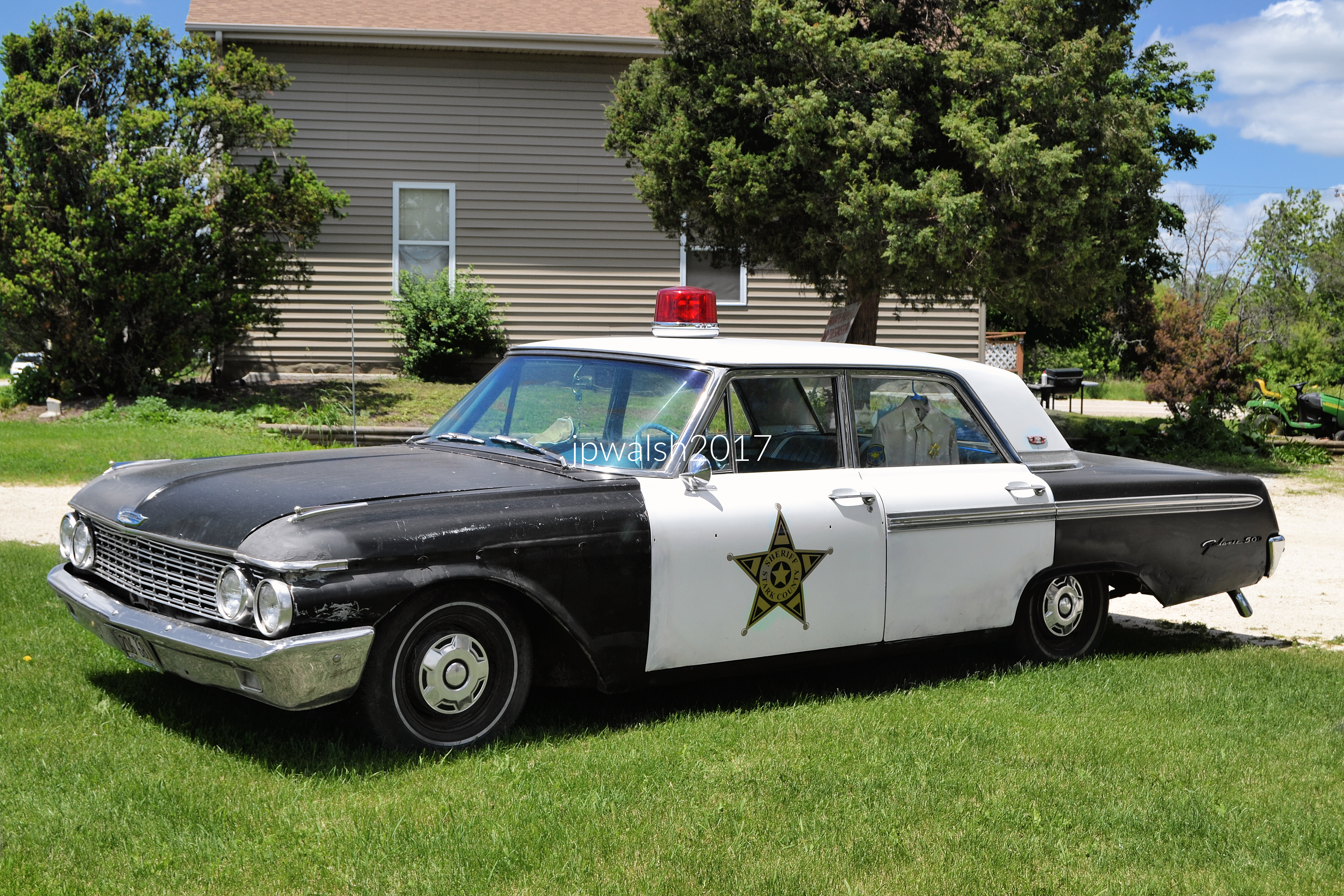
The Andy Griffith Show, which aired from 1960 to 1968, remains one of the era’s most-watched series, spanning 249 episodes across eight seasons. Andy Griffith stars as Sheriff Andy Taylor of Mayberry, North Carolina. For Ford enthusiasts, the show is notable for its recurring lineup of Fairlanes, Galaxies, and Custom sedans. Over the years, fans have built numerous tributes — including this 1962 Ford Galaxie.
The Andy Griffith Show offered a portrait of small‑town life that millions of viewers embraced. Sheriff Andy Taylor’s Ford patrol cars — mostly Fairlanes and Galaxies — became part of the show’s visual identity. Because Ford supplied vehicles to the production, Mayberry’s streets were lined with the latest models, giving the series a consistent look and a subtle sense of realism. Today, that new line of Ford cars in the 1960’s are fan favorites, inspiring countless replicas and restorations.
SOURCES: J. “Kelly” Flory, Jr., American Cars, 1960 to 1965, McFarland & Company, Inc., pp. 41-45; J. “Kelly” Flory, Jr., American Cars, 1973 to1980, McFarland & Company, Inc., pp. 178-179.
This explanatory article may be periodically updated.