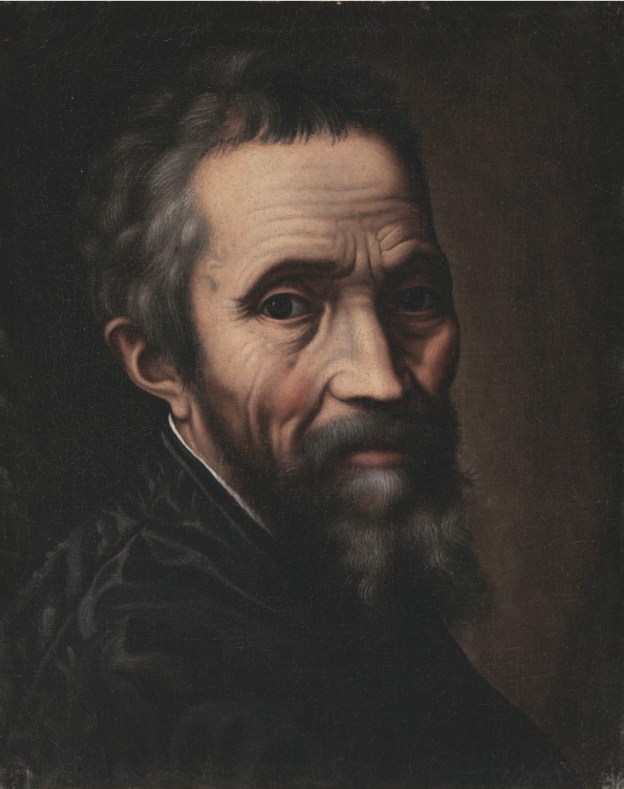
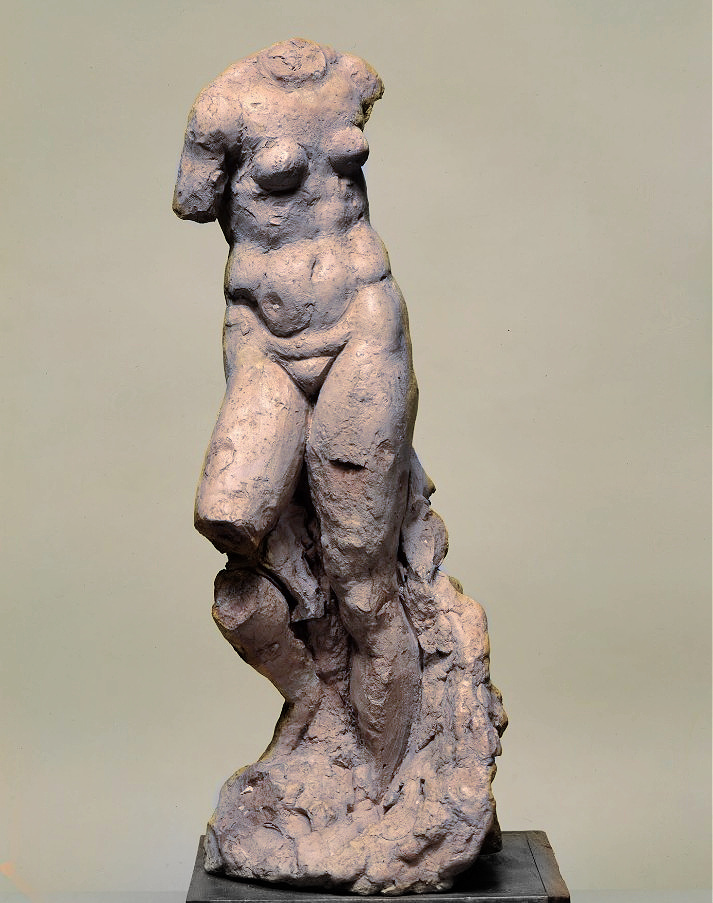
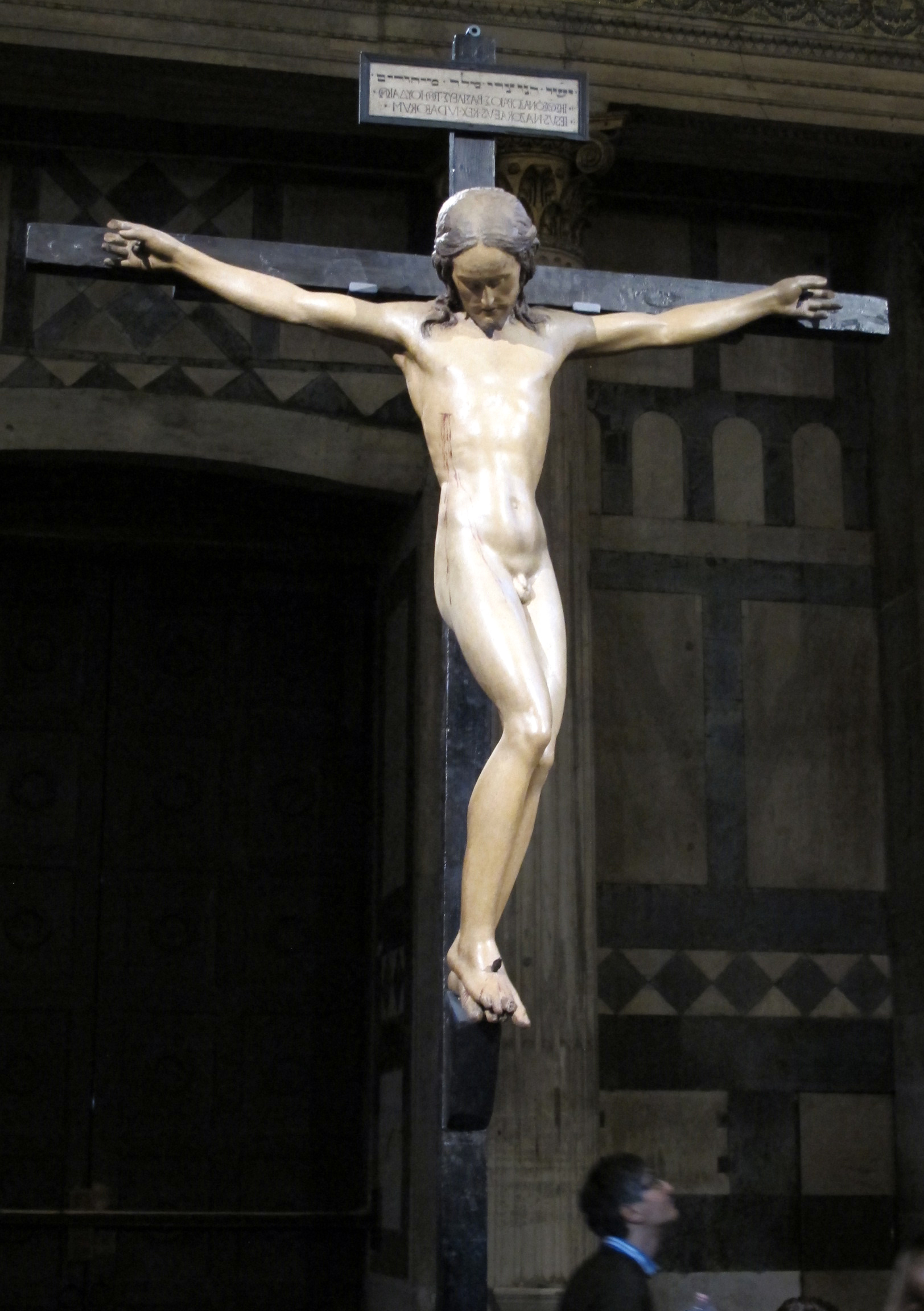
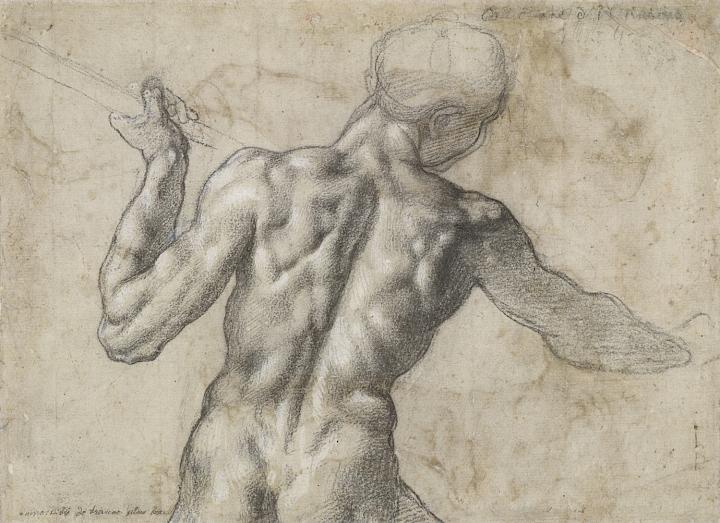
Attributed to Michelangelo Buonarotti, 1513, terracotta, Casa Buonarroti, Florence, Italy. The work is a study of a male torso, conceived to be without the head and upper and lower limbs. The work has been identified as a preparatory model for one of the figures of the Prisoners, intended to decorate the tomb of Julius II in Rome. see – https://artsandculture.google.com/asset/torso-virile/zQGx46asE5jBIg?hl=it&ms=%7B%22x%22%3A0.5%2C%22y%22%3A0.5%2C%22z%22%3A9.086882915528859%2C%22size%22%3A%7B%22width%22%3A3.3866676762513332%2C%22height%22%3A1.2375000000000005%7D%7D – retrieved March 6, 2025. Michelangelo Buonarotti, Madonna della Scala, 1490. Casa Buonarroti, Florence, Italy. Though it is small-sized the relief subject of the Madonna and child presents a monumental scope. The female figure fills the entire space. The meaning of the ladder (“scala”) in the title is ambiguous and may have reference to the children playing and holding a drape behind the Madonna. The date of the relief has been much discussed. However, a placement around 1490, before the Battle of the Centaurs, seems to be confirmed.see – https://artsandculture.google.com/asset/madonna-della-scala/xQF2nwLhAXd26w?hl=it – retrieved March 6, 2025. Michelangelo Buonarotti, Nude female, 1533, Casa Buonarroti, Florence, Italy. This figure of a female nude is linked to the New Sacristy in Florence to accompany the marble effigy of Giuliano de’ Medici. It has been linked to the figure of the Earth that, together with the Sky, was to be part of Giuliano’s marble effigy. The project of building a proper Medici family mausoleum was conceived in 1520, when Michelangelo began work on the New Sacristy upon the request of Cardinal Giulio de Medici, the future Pope Clement VII, who expressed a desire to erect the mausoleum for some members of his family including Lorenzo the Magnificent and his brother Giuliano assassinated in Florence’s Duomo in 1478. After completing the architectural works in 1524, Michelangelo worked until 1533 on the sculptures and the sarcophagi that were to be featured on the chapel walls. The only ones actually completed were the statues of Lorenzo, the Duke of Urbino; Giuliano, the Duke of Nemours; the four statues of the allegories of Day and Night, and Dawn and Dusk; and the group representing the Madonna and Child. see – https://artsandculture.google.com/asset/nudo-femminile/xgHfNWIKU6r13g?hl=it – retrieved March 6, 2025 and http://www.museumsinflorence.com/musei/Medici_chapels.html#:~:text=The%20project%20of%20building%20a,the%20Magnificent%20and%20his%20brother – retrieved March 6, 2025. Michelangelo, crucifix, 1493, wood, Santo Spirito, Florence. It was placed by the artist in 1493 above the lunette of the high altar and has been there since.
The Italian Renaissance artist was born in Florentine territory in Caprese in the provinces of Tuscany where his father was a government bureaucrat. The family soon relocated to Florence where Michaelangelo grew up. Becoming friends with Francesco Granacci (1469-1543) who saw Michaelangelo’s drawing talent, at 13 years old Michelangelo announced he wanted to be an artist. Despite his parents objection, they eventually yielded to their son’s aspirations, and he was apprenticed to Domenico Ghirlandaio (1448-1494) for the next three years.
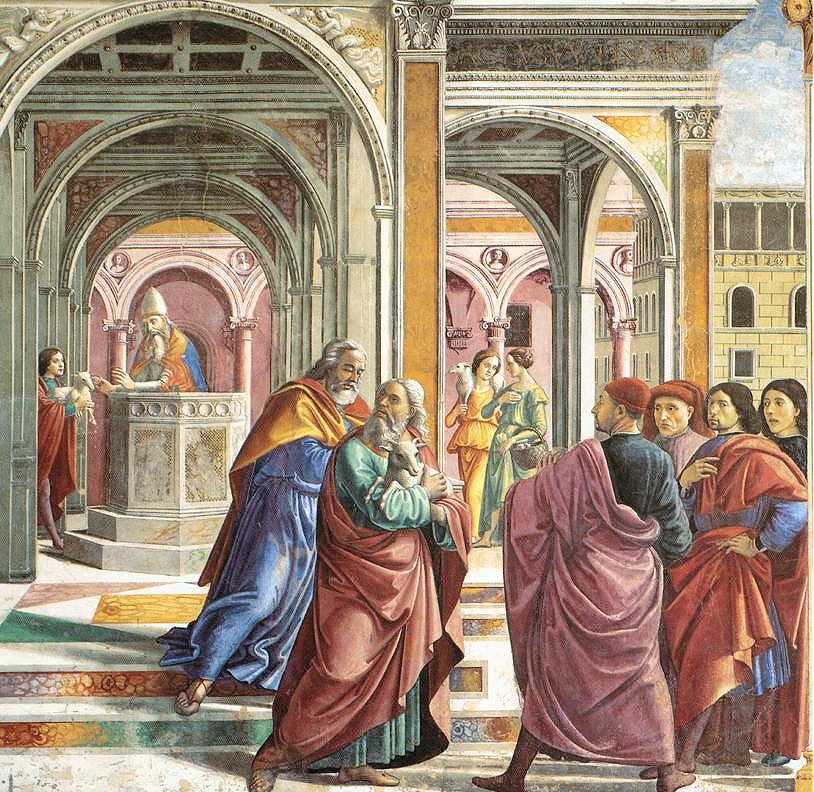
Domenico Ghirlandaio (1448-1494), Expulsion of Joachim From the Temple, fresco (detail), 1486-1490. Santa Maria Novella, Cappella Tornabuoni, Florence. In the background, the mitered high priest receives sacrificial lambs at the altar where a fire burns. Joachim, according to sacred tradition, father of the Virgin Mary and grandfather of Jesus Christ, is sent away at this time since he is childless. He is married to Anne. To the right Ghirlandaio depicts an assembled group of contemporary Florentines including, second from right, Ghirlandaio himself. In 2nd century apocryphal writings, childless Joachim left for the desert where he prayed and fasted for 40 days. Angels appeared to Joachim and his wife Anne, and promised them a child. Joachim then returned to Jerusalem and embraced Anne at the city gate, a scene popularly depicted in medieval and Renaissance art. After this, Anne became pregnant and became the mother of the Virgin Mary and Jesus’s grandmother. This apocryphal relating of Joachim and Anne to Biblical figures Elizabeth and Zechariah and the birth of their son, John the Baptist (Luke 1) and Abraham and Sarah and the birth of their son, Isaac (Genesis 21) was a popular subject depicted in Christian art until the Council of Trent (1545–1563) when the church restricted public displays of these simple stories and events from apocryphal sources in a severe reaction to the Protestant reformation.
Michelangelo’s training was erratic, likely having left Ghirlandaio before his contract was complete, and working under the city’s ruler, Lorenzo de Medici for his contracted master, Bertoldo (1420-1491). Later in life Michelangelo did not advertise his training credentials as he believed art – such as freeing subjects from stone – emerged by the sheer artistic power of the individual. In this period, as a teenager, Michelangelo learned the art of fresco painting and drawing, copying previous masters such as Giotto (1267-1337) and Masaccio (1401-1428). Michelangelo absorbed the artwork of the naturalists, such as Paolo Uccello (1397-1475), whose artwork looked to present subjects with a viewpoint like a scientist interested in objective fact rather than looking to convey some established figural attitude. Where young Michelangelo was materially as great as Giotto and Masaccio, he also possessed a new means undreamt by those previous masters, as he drunk of the art of Donatello (1386-1466), Pollaiuolo (1429-1498), Verrocchio (c.1435-1488) and Leonardo da Vinci (1452-1519). Further, Michelangelo understood better than these others, that the epitome of these Renaissance artistic studies was to be expressed by one subject above all: the human nude.
Bernard Berenson described Michelangelo as “the pupil of nobody, the heir of everybody, who felt profoundly and powerfully what to his precursors had been vague instinct, who saw and expressed the meaning of it all.”
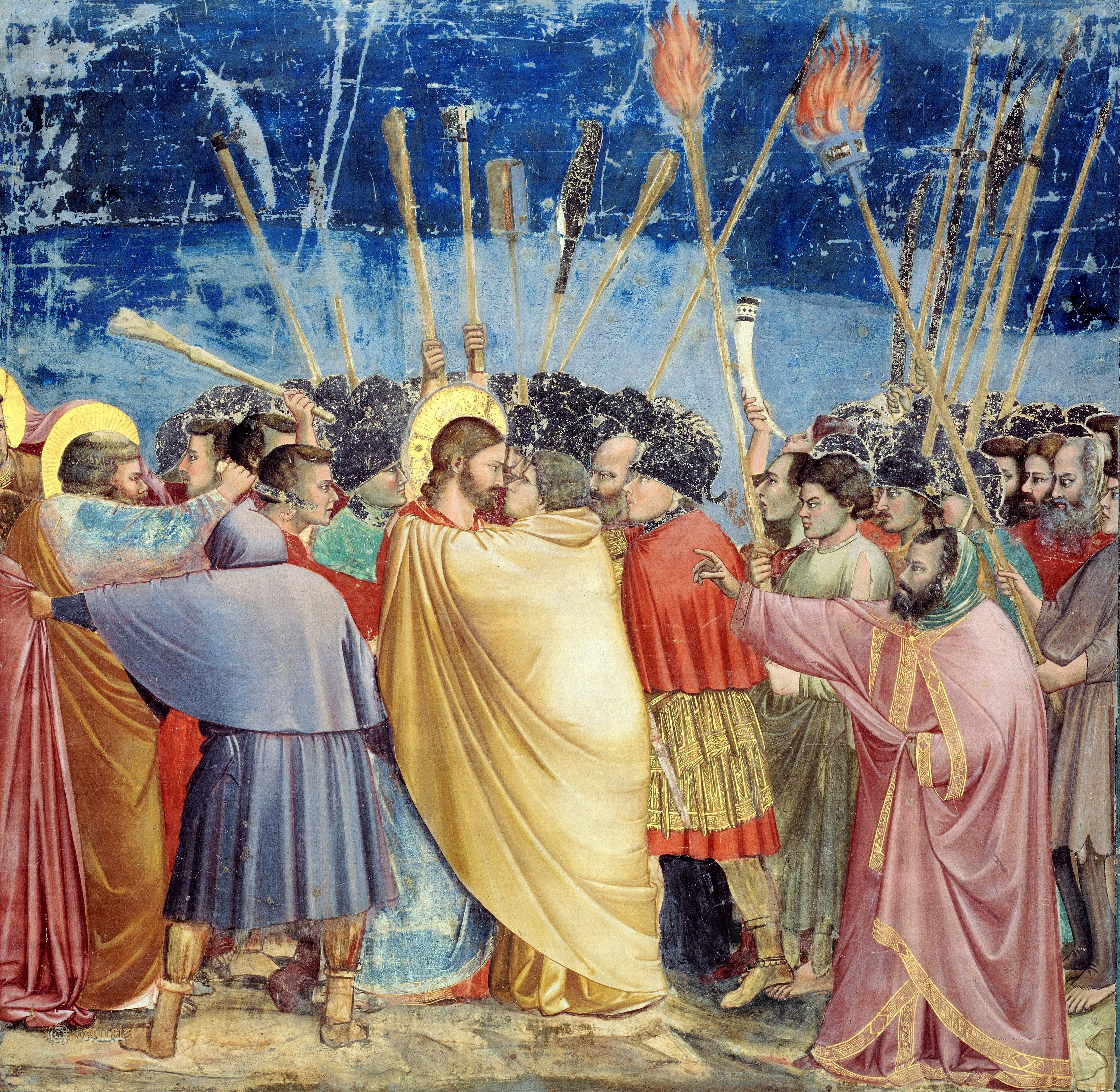
Giotto, The Arrest of Christ (Kiss of Judas ), 1304, Padua, Scrovegni Chapel.
The Arena, or Scrovegni Chapel, was commissioned by Enrico Scrovegni in 1303. A nobleman of Padua, Enrico dedicated the chapel as an act of atonement for the sins of his father, Reginaldo, a moneylender whom Dante placed among the damned in the Inferno. The exterior of the chapel is austere, but its interior is filled with Giotto’s frescoes, completed by the time of the chapel’s dedication in late March 1305, with remaining work finished by March 1306. By this point, Giotto—then in his late thirties—was already a mature master, and in this cycle he transformed the course of Italian painting.
What had appeared as youthful brittleness and restlessness in his frescoes at Assisi in the late 1290s—works that had secured his fame and led to the Padua commission—has here developed into a fully realized visual language of narrative concision, solemnity, and decisive, almost fatalistic, plastic form. Although the subjects of the Life of the Virgin, the Life and Passion of Christ, and the Last Judgment draw upon a venerable medieval tradition, Giotto renders them with a striking immediacy. Human emotion, individualized gesture, and the presence of everyday life infuse the sacred narratives with a naturalism that conveys profound dignity and emotional gravity rather than rhetorical flourish.
The dramatic center of the Betrayal fresco is the confrontation between Christ and Judas. Once Christ accepts His fate in the agony of the garden, the world wastes no time in presenting Him with the cross He has embraced. One of His own apostles—an unsettling reminder of the failures of religious leaders across the ages—betrays Him with a kiss. Christ’s body nearly disappears beneath Judas’s enveloping cloak, yet His classical profile remains visible, fixed in a calm, penetrating gaze upon His betrayer. Judas’s pursed lips embody the chilling intimacy of treachery. As John 13 recounts, the devil—whether through possession or the alignment of Judas’s will with Satan’s designs—provides the impetus for the betrayal.
Giotto had previously depicted Judas as youthful and handsome, but here the apostle’s features bear the accumulated marks of moral decay. At the left, Peter lashes out at Malchus, the high priest’s servant, severing his ear; at the right, the high priest himself gestures toward the betrayal, yet his posture suggests a momentary hesitation before the full enormity of the act. Through these figures, Giotto constructs a scene of moral and emotional complexity, capturing the decisive moment when divine purpose and fallen humanity collide.
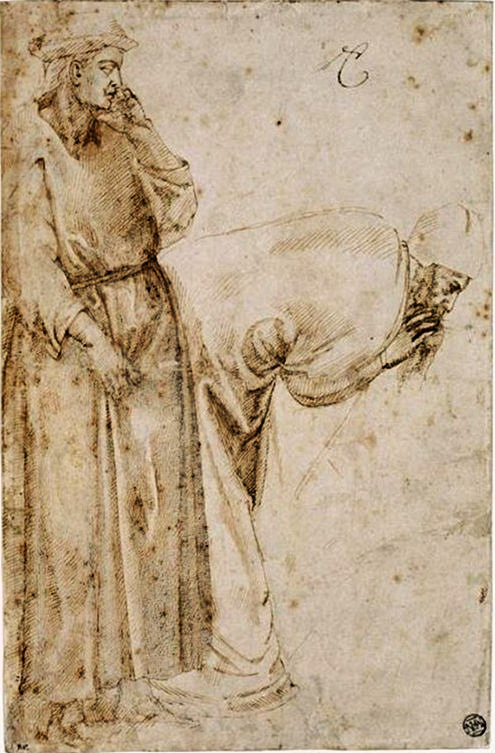
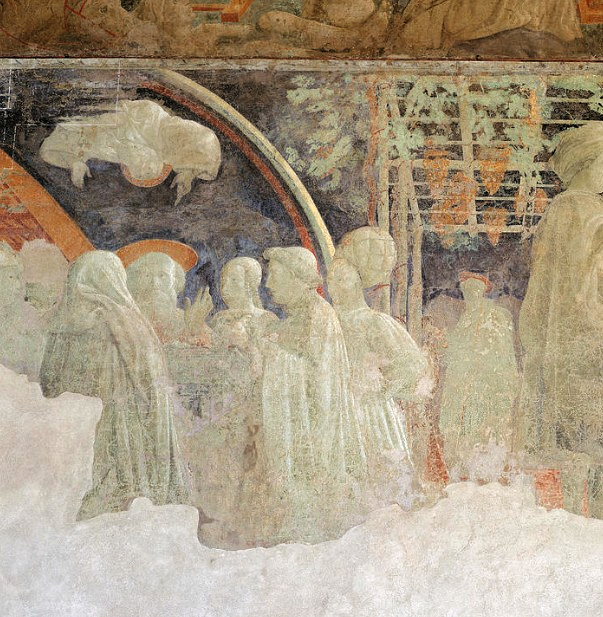
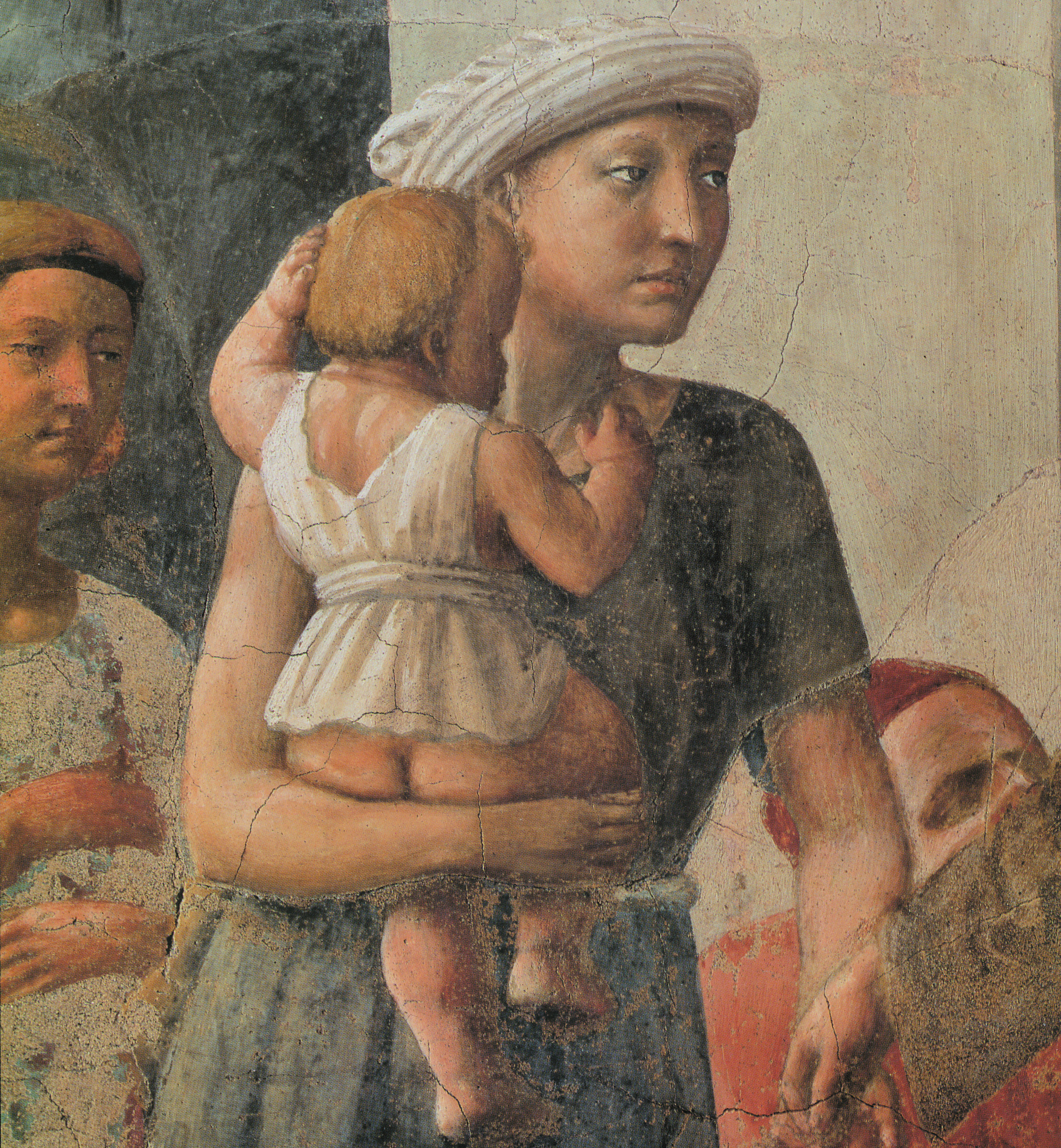
Michelangelo after Giotto, Drawing from “Ascension of the Evangelist,” 1490-1492. Louvre. see – https://collections.louvre.fr/en/ark:/53355/cl020001224 – retrieved March 6, 2025. Paolo Uccello, Sacrifice of Noah And Noah’s Drunkenness (detail), 1447-48. Uccello was not interested primarily in conveying in art the possible “artistic” intention of this story’s scene. Instead, as Bernard Berenson described it, the artist produced “nothing but the scientific intention to find out how a man swooping down head-foremost would have looked if at a given instant of his fall he had been suddenly congealed and suspended in space.” These studies of reproducing objects as they really are, in anatomy and perspective, had a great bearing for the art of Leonardo da Vinci and Michelangelo. quoted in Berenson, p.54.Masaccio, Distribution of Alms and Death of Ananias (detail), 1425-1427, Brancacci Chapel, Florence. An episode from Acts of the Apostles (4:43-37 and 5: 1-11) depicting Ananias’s wife and child whose husband withheld their tithe from the early church leaders with the outcome being that Ananias dropped dead in divine retribution. When it was painted, viewers in the 1420’s and afterwards, read it as an artistic display of a New Testament endorsement of the equitable redistribution of wealth and the divine punishment of death forthwith for those who falsely withheld their fair share. 67% 7.95mb
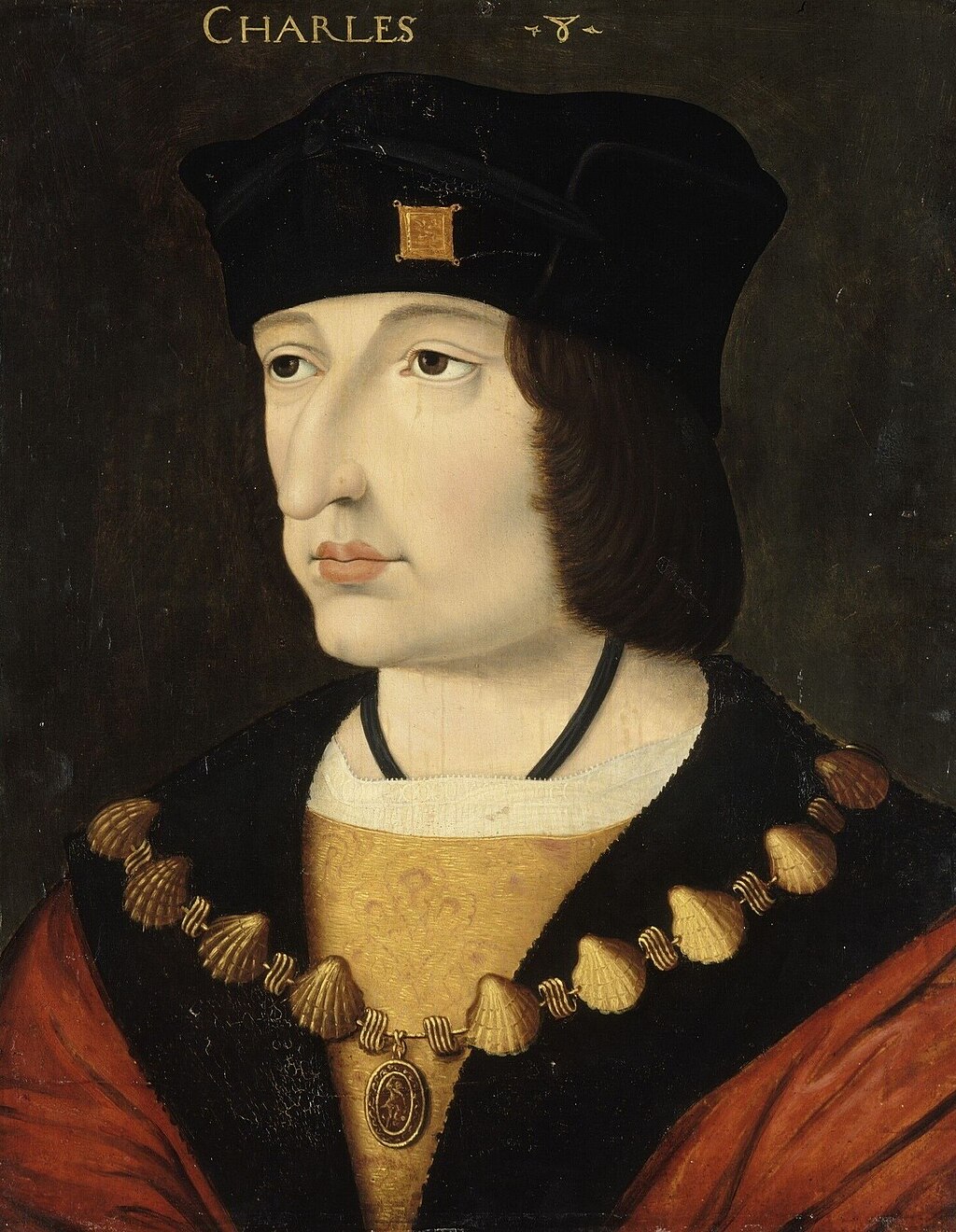
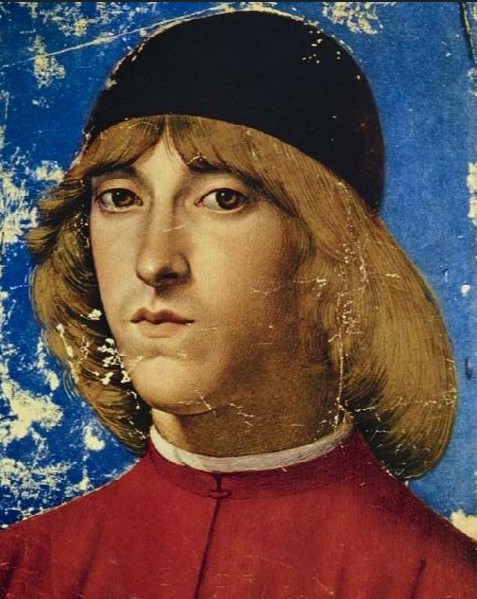
When the Medici fell and Florence became a theocracy under Savonarola (1452-1498), 19-year-old Michelangelo decided to leave Florence. He lamented the fall of Lorenzo the Magnificent, his artistic patron, and the young artist lived hand to mouth going to Bologna, then to Venice, and back to Bologna, and finally to Rome in June 1496. The popes’ tremendous influence in capitalist Italy started in the 13th century and augmented into the 17th century, leading to what art critic Bernard Berenson (1865-1959) called an encroachment of “soulless Vaticanism” towards modern art. But clearly Rome had no use for a firebrand friar who refused to support the pope’s troops against the invading French army. As Columbus set out to discover America, It was the unpleasant chapter of the Italian War of the 1490s that helped fill the times with ongoing brutality, duplicity, complicity, intrigue, opportunism and expedience. A looming danger of looting and violence of the invading French army were emphasized by the impassioned sermons of Girolamo Savonarola that frightened the people and led to their heightened resentment against the ruling Medici. Florence was traditionally pro-French, but Piero di Lorenzo de’ Medici (“Piero the Unfortunate”) (1472-1504), son of Lorenzo the Magnificent, had deployed against them to defend Naples. Under pressure from citizens and outside French forces promising church reforms and civic transparency, the Medici was forced to flee and the city was proclaimed a Republic. The Florentines, with Savonarola in the lead, facilitated the invasion of French king Charles VIII (1470-1498) and against the pope which they considered corrupt. Pope Alexander VI (1431-1503), a Borgia and one of the most corrupt popes in history, ascended to the papal throne in 1492 and was immediately condemned in fiery sermons by Savonarola. Yet all was not well between “liberator” Charles VIII and his Florentine supporters. Immediately the French king demanded a huge sum of money, a ransom payment of sorts, from the Florentines in appreciation, as well as to pay for, the pro-French liberation. The Florentine government refused and the king threatened to loot the city. Faced with a backlash and real threat of popular revolt, the French bully relented and continued onto Rome. Charles postured, but was constantly fearful of antagonizing the European powers and announced his decision that he would not depose the corrupt old pope after all. By having kidnapped the pope’s mistress Giulia Farnese, wife of the pope’s military ally Orsino Orsini, who commanded 4,000 Neapolitan soldiers freshly landed to defend papal interests on the peninsula, Charles VIII was able to extract full entry into Rome in exchange for her release. Once in Rome the French troops looted the city. The pope, in a panic, arranged a quick safe passage for Charles VIII out of the Papal States towards Naples during which the king’s army massacred many hundreds of local inhabitants.
Charles VIII, roi de France, anonymous, c. 1550. Entering Florence in a power vacuum the invading French king demanded a huge sum of money from the citizens who refused to pay and leading to a stand-off. Public Domain. Domenico Ghirlandaio’s 15th century portrait of Piero the Unfortunate. Eldest son of Lorenzo the Magnificent, Piero di Lorenzo de’ Medicisucceeded him as ruler of Florence in 1492. When Piero determined in 1494 to stay neutral during French king Charles VIII’s invasion of Italy, effectively defending Naples the object of the king’s campaign, he was challenged. Suffering from an abandonment of the Florentine elite under the spell of Savonarola, Piero totally capitulated to Charles VIIi’s demands. Having succeeded in alienatating everyone in Florence, Piero fled to Venice, aided by a French diplomat, in November 1494. Attempting to make a comeback several times to Florence he was constantly rebuked, Piero drowned in the Garigliano River while attempting to flee the aftermath of the Battle of Garigliano in 1503, Public Domain.Pope Alexander VI Borgia, c.1495, attributed to Spanish painter Pedro Berruguete (c. 1450-1504), Vatican Museums. Alexander Vi was a wily politician from a prominent family who practiced nepotism and sired several children by way of his many mistresses.
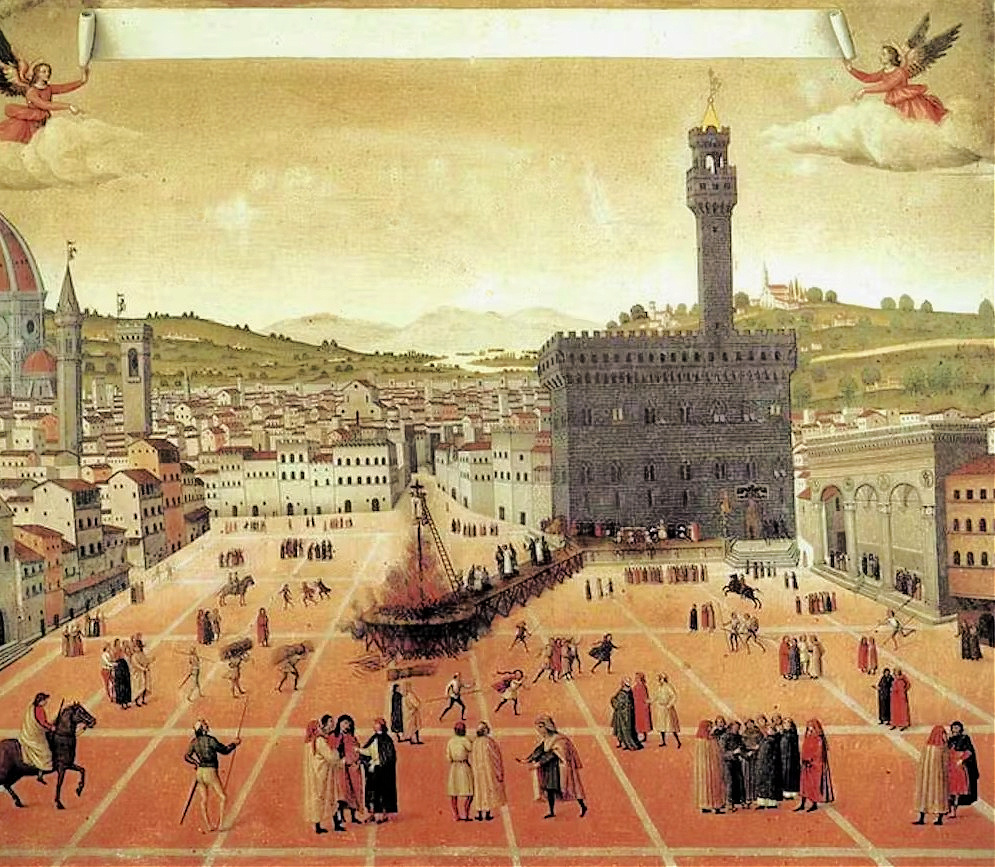
Savonarola played an important role in this French infiltration in Italy — and Rome did not forget. Then, in February 1497, during Mardi Gras of that year, Savonarola, whose message was a combination of religious purist and civic republican preached his most dramatic act of cultural desecration by seeking that artworks, books, clothing items and cosmetics were thrown into a bonfire of the vanities as a sign of monied and other social decadence. The flames became his final undoing: Savonarola was excommunicated for heresy and sedition by Pope Alexander VI on May 12, 1497 after the preacher called “the contemporary Church leadership…a pockmarked whore sitting on Solomon’s throne.” The pope also threatened Florence with severe interdictions if they continued to be a sanctuary for Savonarola and his ilk. Savonarola was imprisoned on April 7, 1498 after failing a literal public trial by fire (it rained). Finally, he was dragged from his prison cell and with two other contemptible friars was condemned as a heretic and schismatic and hanged and burned at the stake on May 23, 1498, with the Vatican and the Medici observing it all from a safe distance. Yet the cult of Savonarola, his person as well as his political and religious ideas, did not go quietly up in smoke. Though seen today as a sort of vile figure, his supporters around 1500 and afterwards saw him as a martyr and encouraged his veneration as a saint to which many complied. In Florence Savonarola’s disputed legacy went on until the Medici more or less permanently re-installed themselves in 1530. Yet Protestant reformers in Germany and Switzerland were intrigued and influenced by Savonarola’s ideas and, in 1558, even Pope Paul IV, who was 22 years old when Savonarola was executed, declared him not a heretic and always in communion with the Catholic Church. Saint Philip Neri (1515-1595), a Florentine established in Rome, and regularly characterized as a most relatable prelate of and for the masses, also defended Savonarola’s memory.
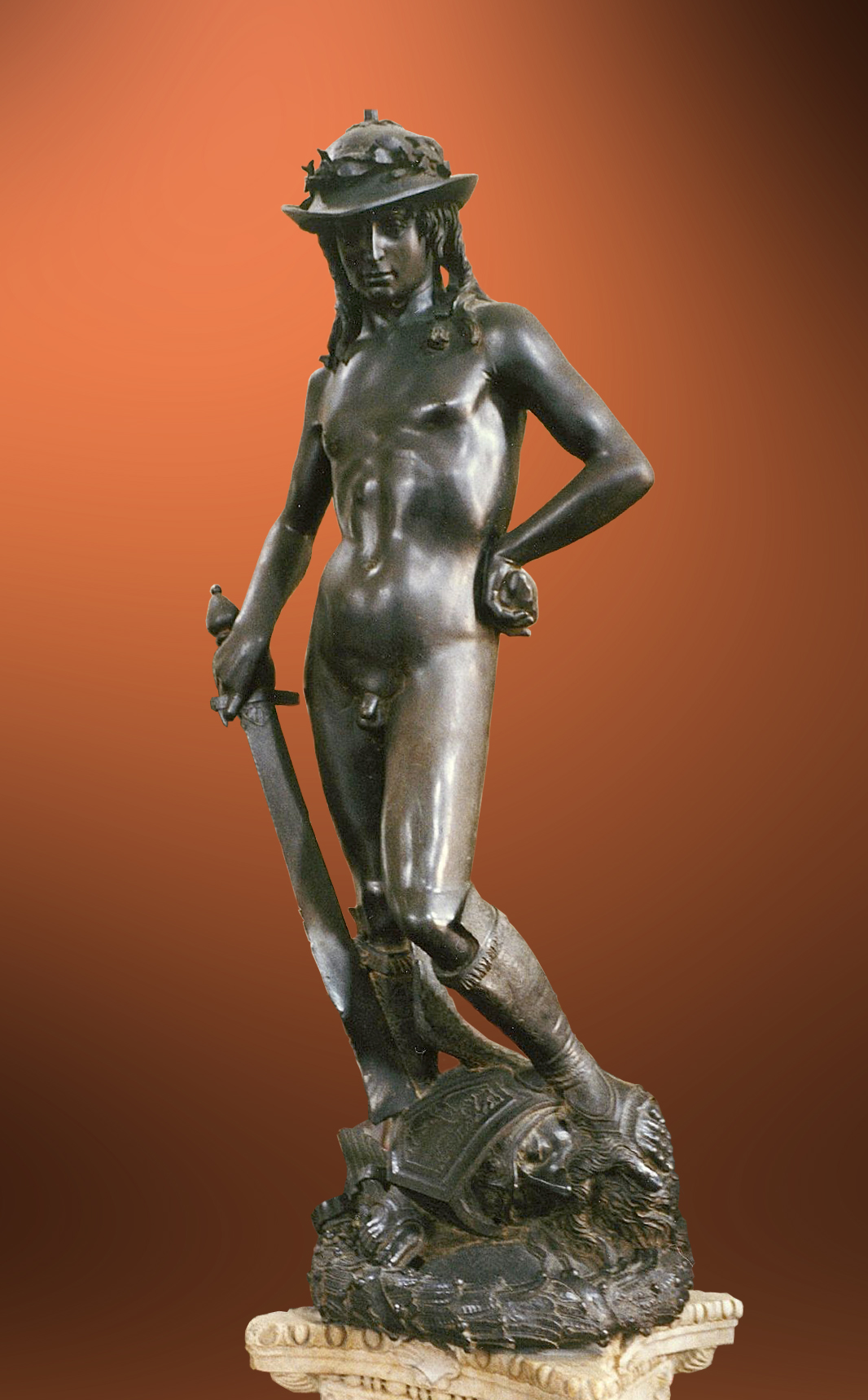
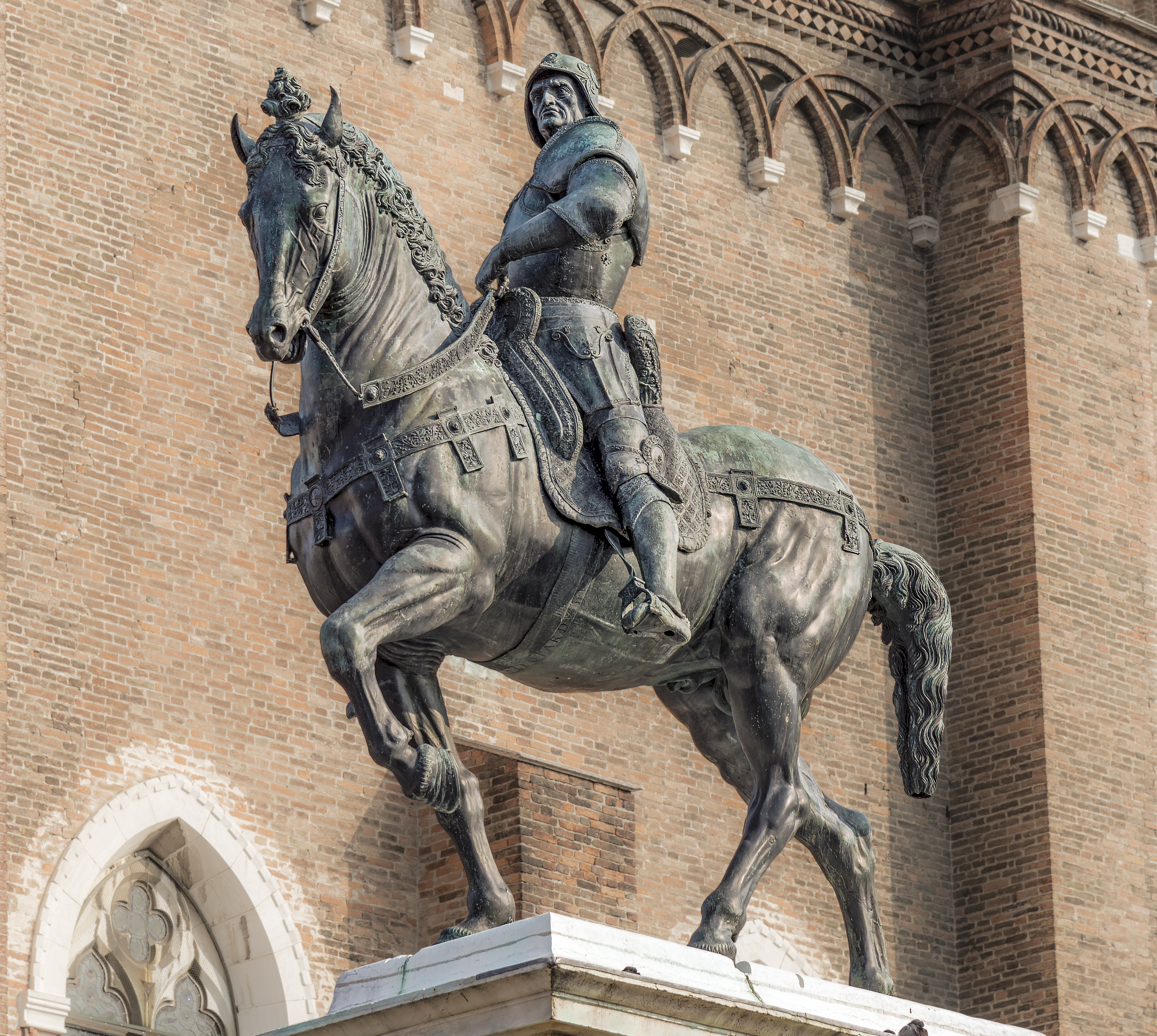
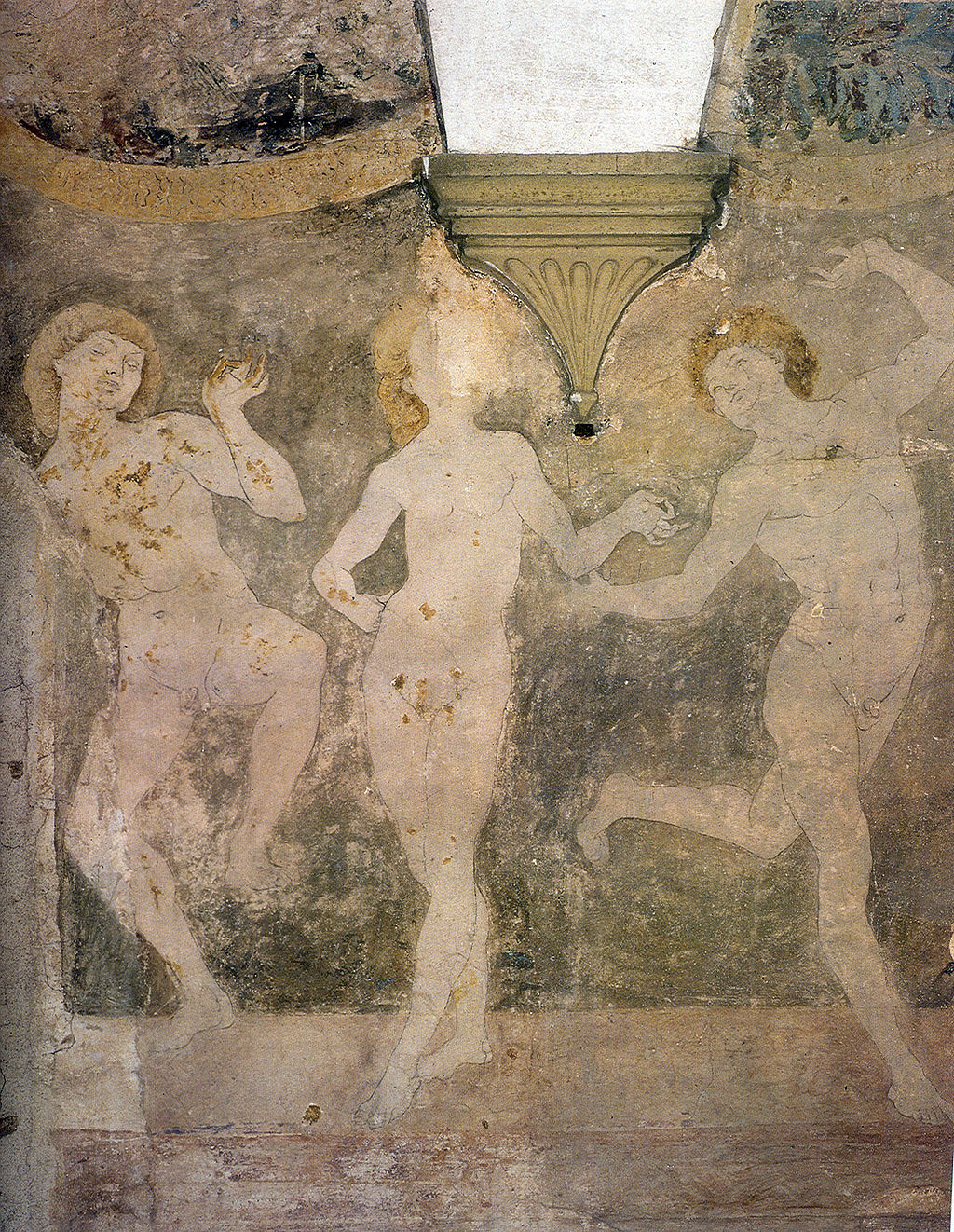
Francesco Rosselli (1445-1513), The Execution of Savonarola and Two Companions at Piazza della Signoria, 16th century, oil on canvas, Galeria CorsiniBernard Berenson as a young man, Berenson described Michelangelo as “the pupil of nobody, the heir of everybody, who felt profoundly and powerfully what to his precursors had been vague instinct, who saw and expressed the meaning of it all.” quoted in Berenson p. 72. Public Domain. “Donatello – David – Florença” by original file by Patrick A. Rodgers is licensed under CC BY-SA 2.0. Verrocchio, Equestrian Statue of Bartolomeo Colleoni, 1480s, Venice. Bartolomeo Colleoni (1400-1475) was an Italian condottiero, who became captain-general of the Republic of Venice. Colleoni gained a reputation as the foremost tactician and disciplinarian of the 15th century. “Bartolomeo Colleoni by Andrea del Verrocchio” by Didier Descouens is licensed under CC BY-SA 4.0.Antonio del Pollaiuolo, Nude Dancers, 1470s, Fresco Arcetri, Villa La Gallina. A fresco frieze of dancing nude figures, in a villa near Florence, shows the artist’s same interest in extreme body poses. Public Domain.
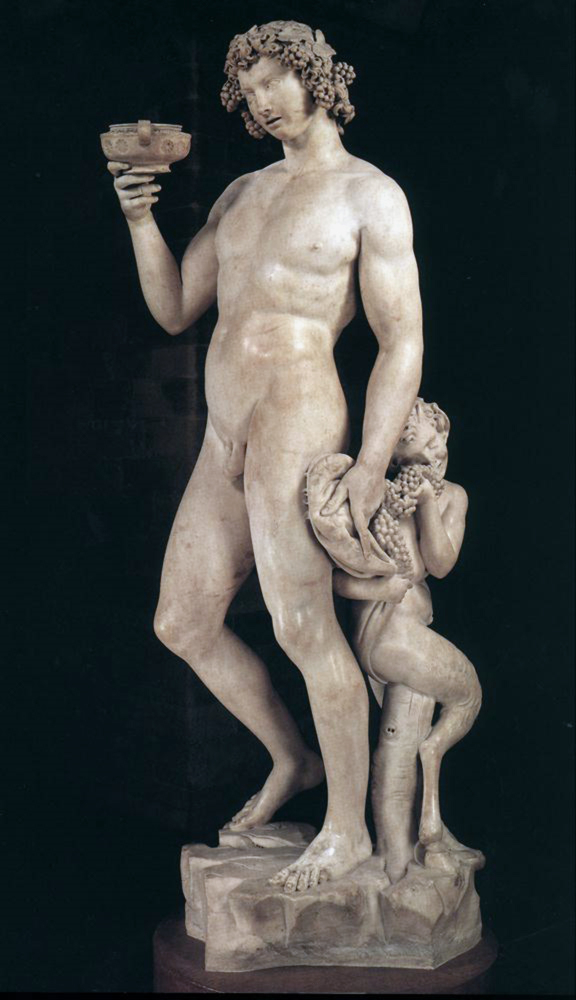
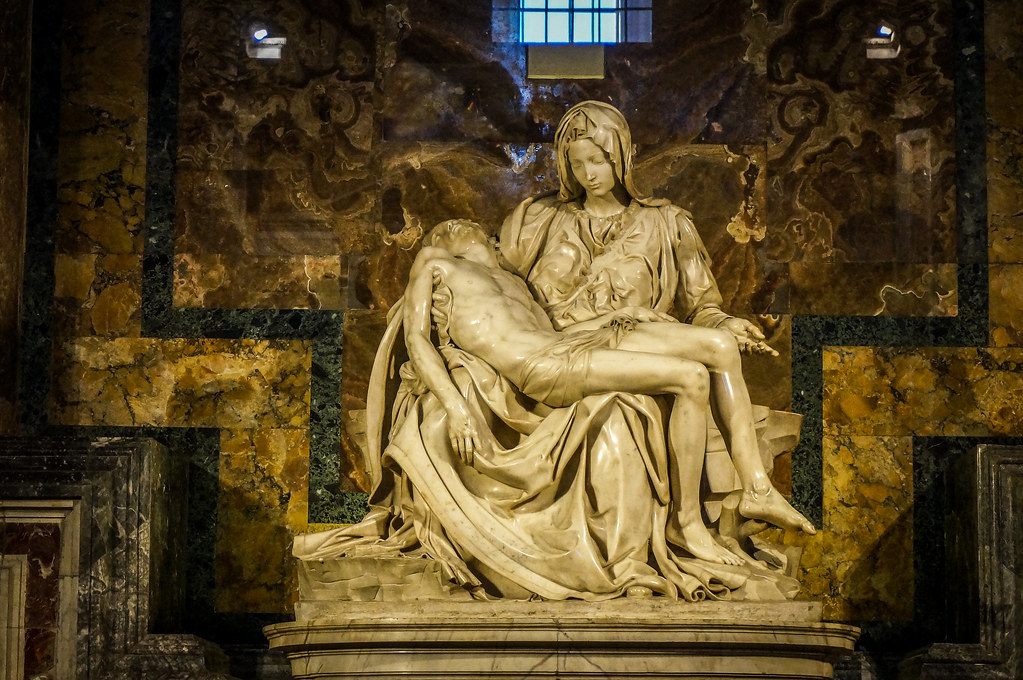
Meanwhile, in Rome, Michelangelo sculpted his first major marble works. The first, Bacchus, was commissioned by Cardinal Raffaele Riario (1461-1521) in partnership with Jacopo Galli, a Roman collector, that was displayed in Galli’s garden until it was sold in 1572 to the Medici and is today in the Bargello. The second is the sublime Pietà (St. Peter’s Basilica, Vatican City) that was commissioned by a French cardinal in Rome and placed in the Santa Maria della Febbre. Vasari described the Pietà as “a revelation of all the potentialities and force of the art of sculpture.” Though the Pietà made Michelangelo famous in Rome, he returned to Florence following its installation to work on the David, a commission made by the Florentine republic after the expulsion of the Medici.
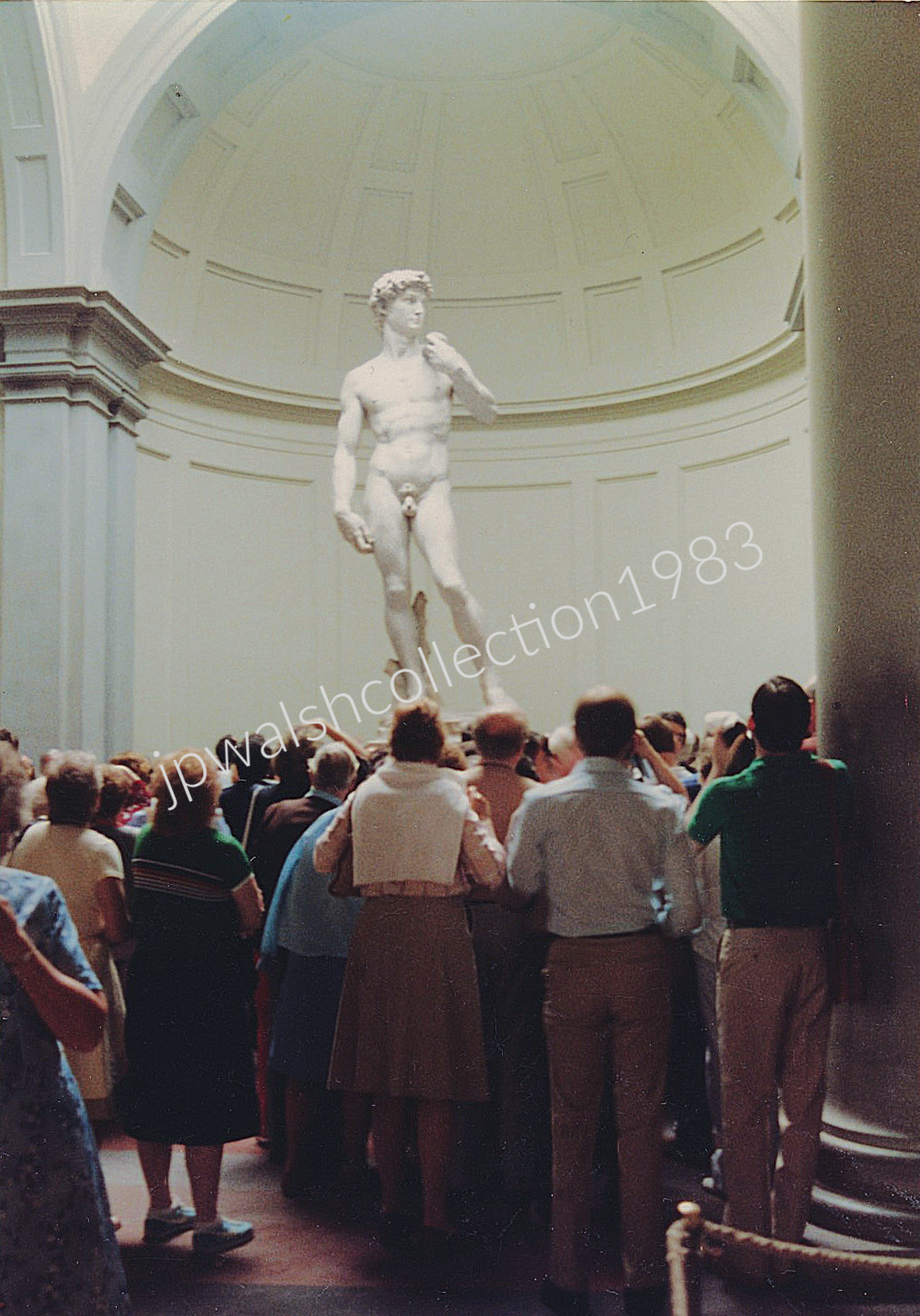
Michelangelo, Bacchus, marble. 1497, Bargello, Florence.Michelangelo, Pietà, marble, 1498-1499, St. Peter’s Basilica, Rome. A 24-year-old Michelangelo was all the rage in Rome as an artist in the late 1490’s and wrote his name promonently across the sash of the Blessed Mother. The artist did this after it was completed and heard a group admiring the artwork and attributing it to a different artist. Michelangelo was having none of it and one night whet into the chapel and chiseled his name for none to miss seeing. “Pieta (Michelangelo)” by elixirk is licensed under CC BY-NC-SA 2.0.Galleria dell’Accademia, Florence, Italy, May 1983. Author’s collection.
Michelangelo’s David, created in c. 1501-1504, has been in the Galleria dell’Accademia since 1873, The biblical figure of David came to symbolize the defense of civil liberties embodied in the 1494 constitution of the Republic of Florence, an independent city-state threatened on all sides by more powerful rival states and by the political aspirations of the Medici family.
This explanatory article may be periodically updated.
SOURCES:
Bernard Berenson, The Italian Painters of the Renaissance, Phaidon, New York, 1959.
Ornella Casazza, Masaccio and the Brancacci Chapel, Scala, 1990.
Enzo Carli, translated by Susan Bellamy, Giotto and His Contemporaries, Crown Publishers, 1958.
Andreas Quermann, Ghirlandaio, Könemann, 1998.
A Dictionary of Art and Artists, Peter and Linda Murray, Penguin Books; Revised,1998.
Giorgio Vasari, trans. George Bull, Lives of the Artists, Penguin Books, Harmondsworth, Middlesex, England, 1965.
FEATURE Image: Raphael, Portraits of Agnolo Doni and Maddalena Doni, c. 1506, oil on panel, 24 ¾ x 17 ¾” Pitti Gallery, Florence.
Raphael, Self-portrait at 23 years old, 1504–1506. Tempera on panel, 47.5 cm × 33 cm (18.7 in × 13 in), Palazzo Pitti, Florence, Italy.
INTRODUCTION.
Born in Urbino in 1483, an environment rich in the arts and humanist learning, Raphael had a remarkable capacity for personal growth and branded new incarnations of his artistic style regularly. He moved to Florence toward the end of 1504. Giorgio Vasari in his chapter on Raphael describes an episode where the artist of Urbino, already in his thirties with a reputation as a master, went back to study the nude (male) form with Michelangelo as his guide. Vasari’s admiration in telling this story goes beyond Raphael’s humility in assuming the role of student again (he studied constantly anyway) but that his learning always improved his artistic output. In the study of nudes, however, artistic growth came perhaps not as the artist expected or intended. Whether Raphael entered the workshop of Perugino at that time or, as seems more likely, many years later when he was already an acknowledged artist, he quickly mastered Perugino’s delicate, ornamental style, with its open landscapes and gentle figures. It was said that contemporaries had trouble distinguishing Perugino’s work from Raphael’s, but Raphael’s compositions were more sophisticated even when he was a young artist. While Raphael mastered Michelangelo’s (and Leonardo’s) art forms convincingly, he also realized he was no match for the creator of the Sistine Chapel and other chiseled works insofar as the nude male forms.1 Yet Raphael consolidated his strengths by testing his limits. A major strength, Vasari believed, was Raphael’s ability to draw and compose a wide range of subjects, such as landscape, architecture, draperies, and the human figure. Up to that time that had been what the artist was doing and would now unflinchingly continue to do on a grander scale, for example, in the Stanzae. In 1508 the pope called Raphael to Rome. Influenced by the idealized, classical art of the city’s ancient past, Raphael’s work took on a new grandeur. He also responded to the more energetic and physical style of Michelangelo, whose works he had already begun to study in Florence. Vasari believed Raphael had the gift to congeal the “poetic moment” by depicting in his painting the most significant gesture and force of action. With the possible exception of Leonardo, he is probably the unparalleled master of excellent design.2 The precocious Raphael Sanzio also benefited from early opportunities given to him by his father to cultivate his talent. The artist’s own determination to succeed in his métier paid off when he was summoned to work at the Vatican by the Pope in 1509, arguably the greatest art patron in an age of art patrons. 3 The early sixteenth century was an age where patrons were as luminous as their artists and the coming together of Raphael and Julius II, and later Leo X, made for a celebrity team. While Vasari meticulously tells the reader of the artist’s “judicious” character – and that Raphael was extremely “amatory” and implying it aided in his death – the chronicler describes, often from memory, his preferences in Raphael’s art work. His collective response, for example, to all four frescos in the Camera d’Eliodoro is that he is most impressed by Raphael’s interesting decorative details, beautiful movements and gestures, the sheer number of figures portrayed, and his ability to express complex ideas and stories on a two-dimensional surface.4 With Leonardo da Vinci (1452-1519) and Michelangelo (1475-1564) Raphael is one of the great masters of the High Renaissance. Raphael and his large team of assistants left behind a large body of influential work, especially in the Vatican where the artist spent the last 12 years of his life, although Raphael died at 37 years old. For most of the history of Western art, the easy grace and harmonious balance of Raphael’s style has represented an ideal of perfection. His work became widely influential through the dissemination of prints. Raphael was also the city’s leading portraitist, creating penetrating psychological images that engaged viewer and sitter with a new intensity.
ARTWORKS.
Raphael, S. Niccolo Da Tolentino Altarpiece, 1501, oil on panel, 44 x45 ¼ in., Capodimonte Museum, Naples, Italy.
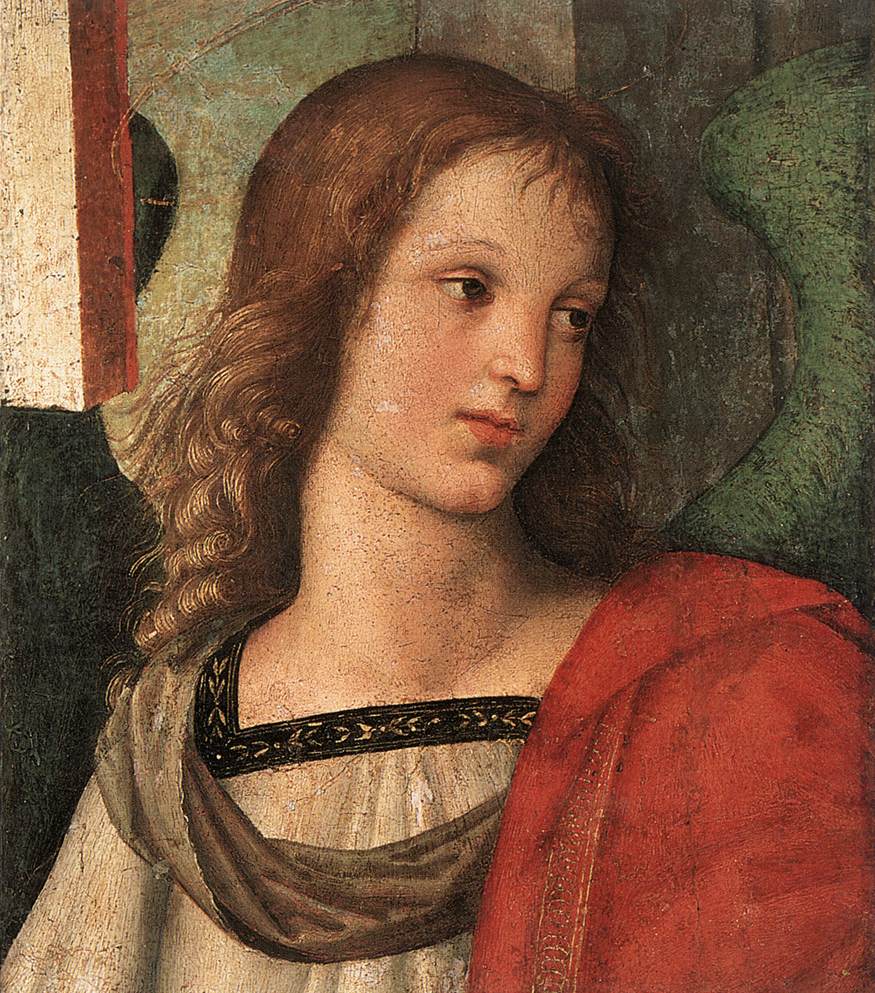
The Baronci Altarpiece is Raphael’s first recorded commission. It was made for the patron’s chapel in the church of Sant’Agostino in Città di Castello, a commune between Arezzo and Urbino, north of Perugia. In 1789 the artwork was badly damaged in an earthquake and surviving fragments were acquired by the Vatican until they mysteriously dispersed in the mid-19th century and found their way into different collections. Raphael’s commission of 1501 was to paint a large altarpiece dedicated to the Augustinian saint Nicholas of Tolentino (c. 1246– September 10, 1305). Nicholas was canonized by Augustinian Pope Eugene IV in 1446. While today’s saints require 1-2 miracles, St. Nicolas Tolentino was credited at his canonization with 300 miracles – including 3 resurrections. (see – Encyclopedia of the Middle Ages, Volume 2, André Vauchez, Richard Barrie Dobson, Michael Lapidge. Chicago: Fitzroy, Dearborn, 2000).
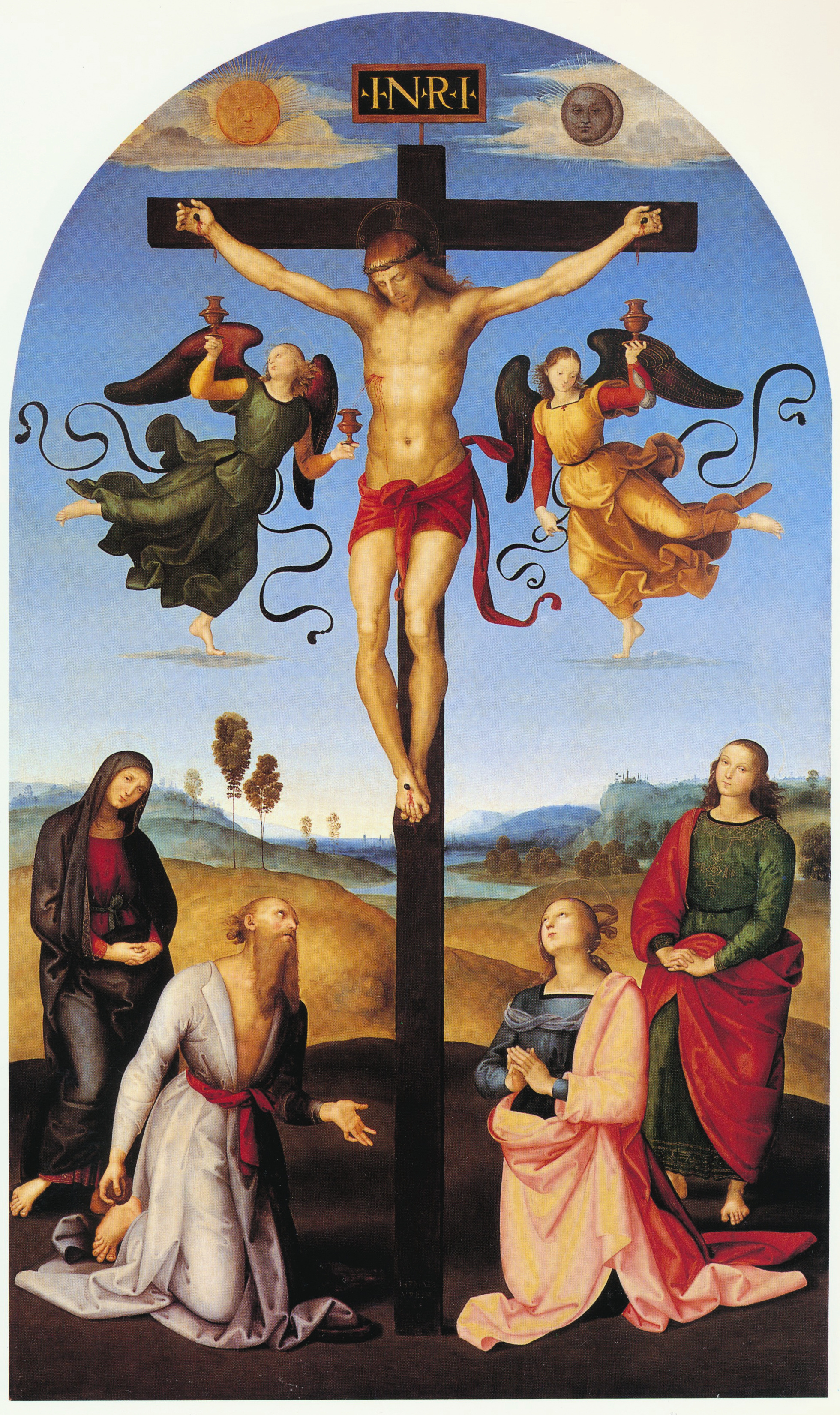
Raphael, angel, fragment Baronci altarpiece. Pinacoteca Tosio Martinengo, Brescia. Raphael, The Crucifixion, 1502-03, oil on polar, 283.3 × 167.3 cm, National Gallery, London.
The painting was done in 1503 for Domenico Gavari for his S. Domenico chapel in Città di Castello. Angels are poised on toes on a cloud as their cups catch Christ’s dripping blood. Mary Magdelene and St. Jerome (holding a rock) are on their knees while the Virgin Mary and St. John stand. The sun and moon in the sky was characteristic of Crucifixion paintings in Umbria (p. 13, Jones & Penny). It was bequeathed to the National Gallery in 1924. Gavari was a close friend of Andrea Baronci, for whom Raphael painted the Saint Nicholas of Tolentino Altarpiece for the church of S. Agostino, also in Città di Castello. Saint Jerome, of course, was not present at the Crucifixion but is included in this scene because the chapel was dedicated to him. The overall design is based on several versions of the crucified Christ in a landscape painted by Perugino in the late 1480s and 1490s, and is especially similar to his altarpiece of the Crucifixion for the convent of S. Francesco al Monte in Perugia, commissioned in 1502 and completed 1506. https://www.nationalgallery.org.uk/paintings/raphael-the-mond-crucifixion – retrieved September 5, 2024.
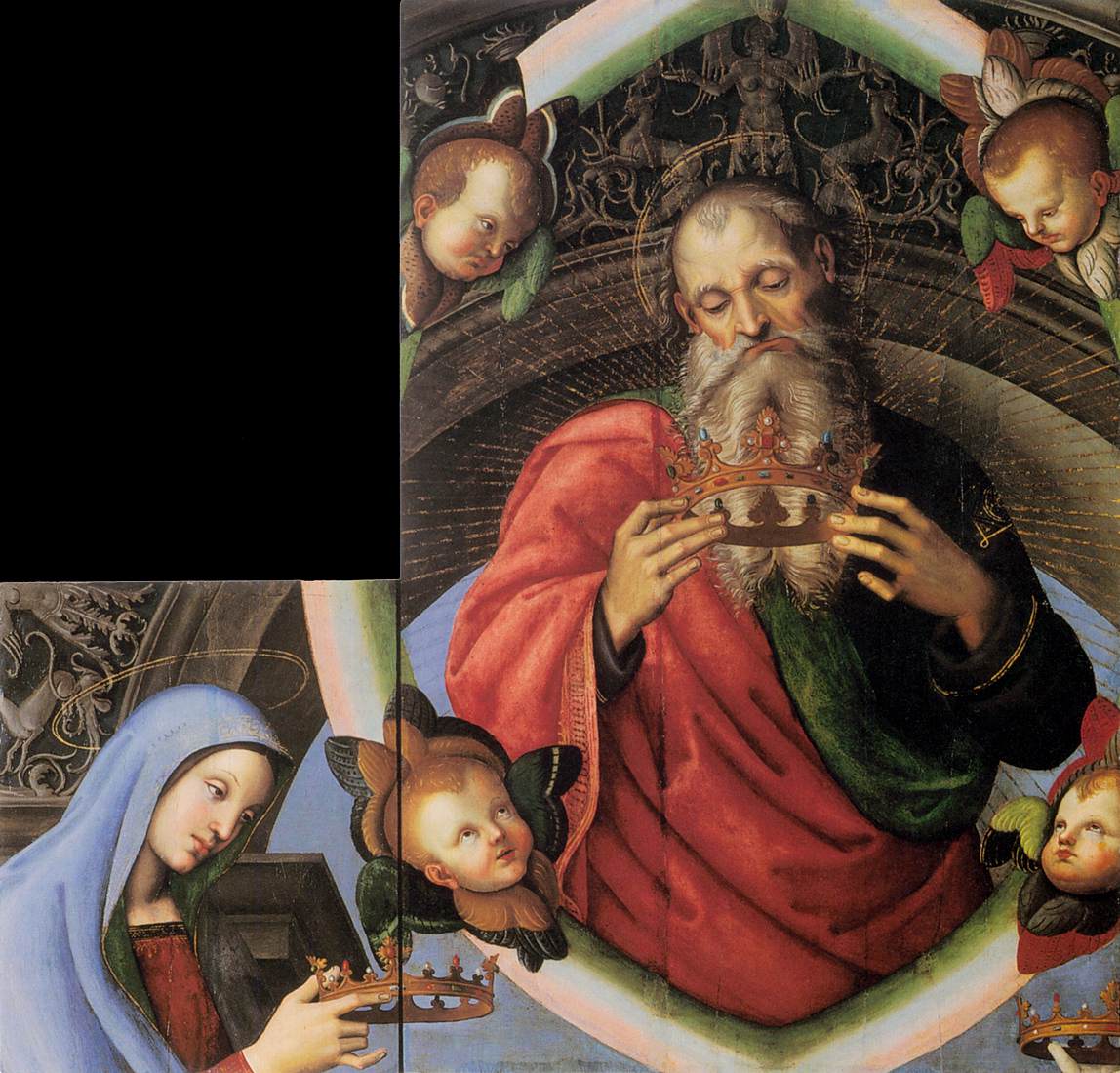
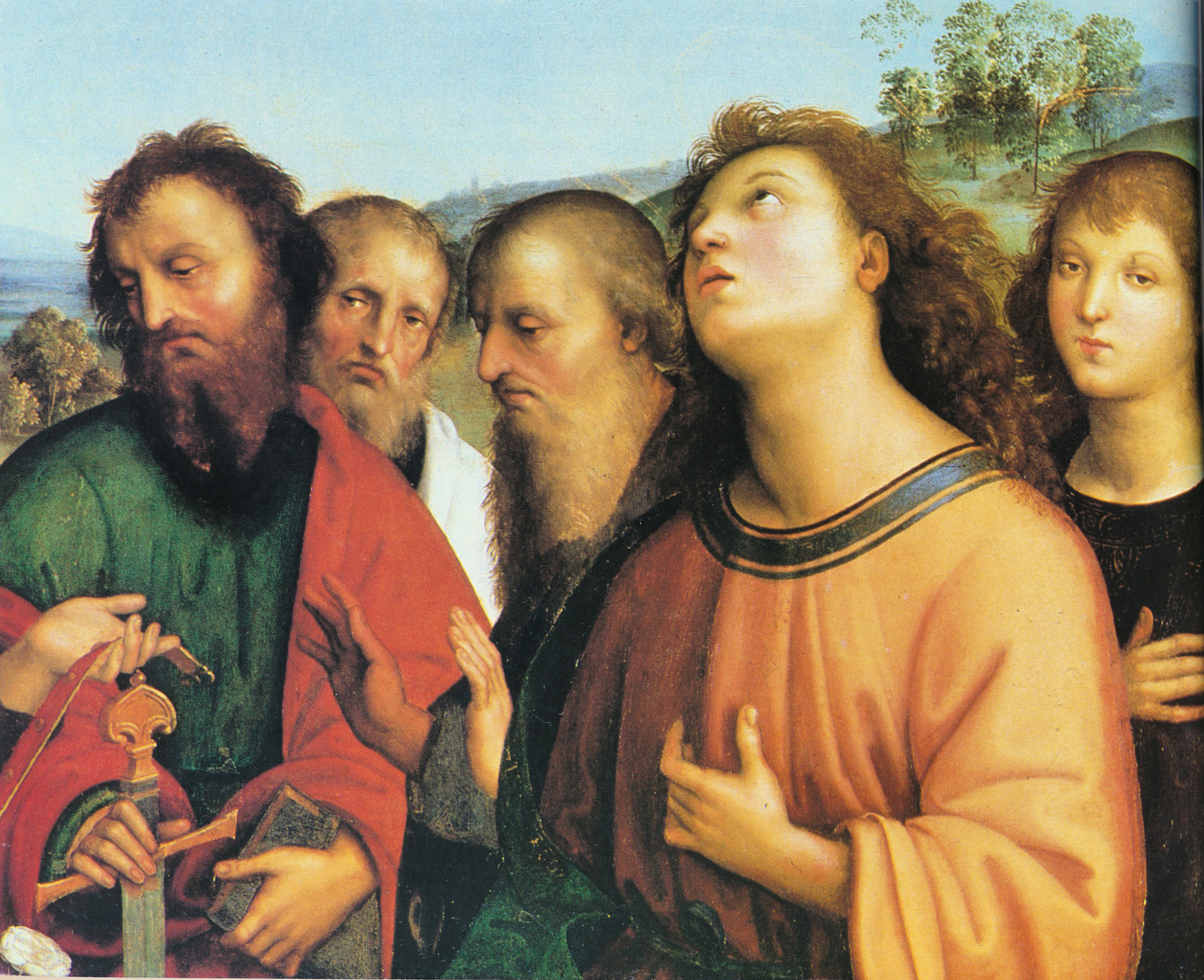
Raphael, Coronation of the Virgin (Oddi Altarpiece), 1503-1504, Oil on canvas, 8’9” x 5’4”, Pinacoteca, Vatican, Rome.Raphael, Coronation of the Virgin (Oddi Altarpiece), 1503-1504, Oil on canvas, 8’9” x 5’4”, Pinacoteca, Vatican, Rome. DETAIL.
Raphael painted altarpieces for the Augustinians and Dominicans and the Oddi altarpiece (above) was done for the Franciscans. It was commissioned by the Oddi family chapel in S. Francesco al Prato. The Oddi were in exile from Perugia since 1495 because of battles between families and returned in 1503. The altarpiece was part of honoring their family members. The painting is divided into an upper part depicting the coronation of the Virgin and, in the lower part, the Apostles at the time of the Assumption. In the center, the apostle Thomas holds the Virgin’s girdle that the Virgin lowered to him as a token of these supernatural events. This display of theology was precious to the Franciscans at the time who were promoting the Virgin Mary. They were likely very involved in directing the artist in its composition. (Roger & Jones, pp. 15-16).
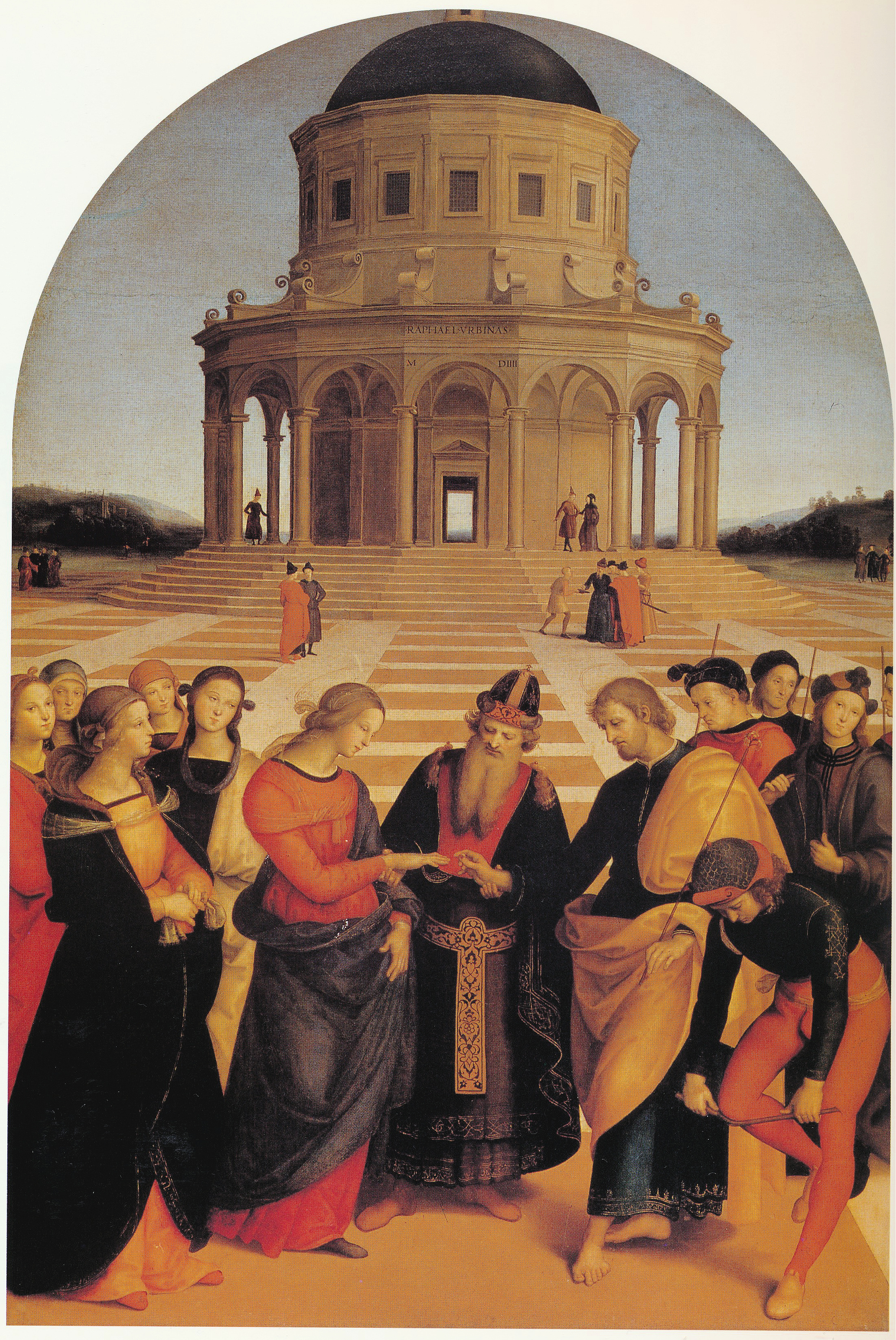
Raphael, Spozalizio (The Engagement of the Virgin Mary), 1504, oil on panel, 67 x 46 ½” Brera Gallery, Milan.
The painting’s composition reflects the influence of Perugino, specifically the fresco done by him in the Sistine Chapel in 1484. In terms of its architectural setting, Raphael was influenced by Piero della Francesca (c.1416-1492) and Bramante (1444-1514). The painting’s architectural structure shares centrality in the painting with the foreground figures done in a perspectival arrangement. Within the figures are members of the party positioned in depth. Joseph places a ring on Mary’s finger whose positioning bisects the artwork. A tawny gold tone pervades the painting. It was commissioned by the Alberini family for a chapel in S. Francesco of the Friars Minor at Città di Castello in Perugia. (Brera Milan, p 34)
Raphael, The Madonna and Child Enthroned with Five Saints (Colonna Altarpiece), c. 1504-1505, oil on panel, 68 x 68” The Metropolitan Museum of Art, New York City.
Raphael painted this altarpiece for the Franciscan convent of Sant’Antonio in Perugia. It hung in a part of the church reserved for the nuns. The pair of voluminous saints straddling each side of the throne reflect the progressive style of Leonardo da Vinci and Fra Bartolomeo (1472-1517) that Raphael was studying in Florence. The lunette above the main panel depicts God the Father holding a globe and raising his right hand in blessing situated between two angels and two seraphim. https://www.metmuseum.org/art/collection/search/437372 – retrieved September 5, 2024.
Raphael, The Small Cowper Madonna, c. 1505 59.5 x 44 cm (23 7/16 x 17 5/16 in.), National Gallery of Art, Washington D.C.
The Cowper Madonna includes an agreeable background landscape. In a vertical painting, a haloed woman and nude child sit before an expansive grass field extending behind them to a group of trees and buildings on a hill in the distance among hazy blue hills beneath a blue sky.https://www.nga.gov/collection/art-object-page.1196.html – retrieved September 8, 2024.
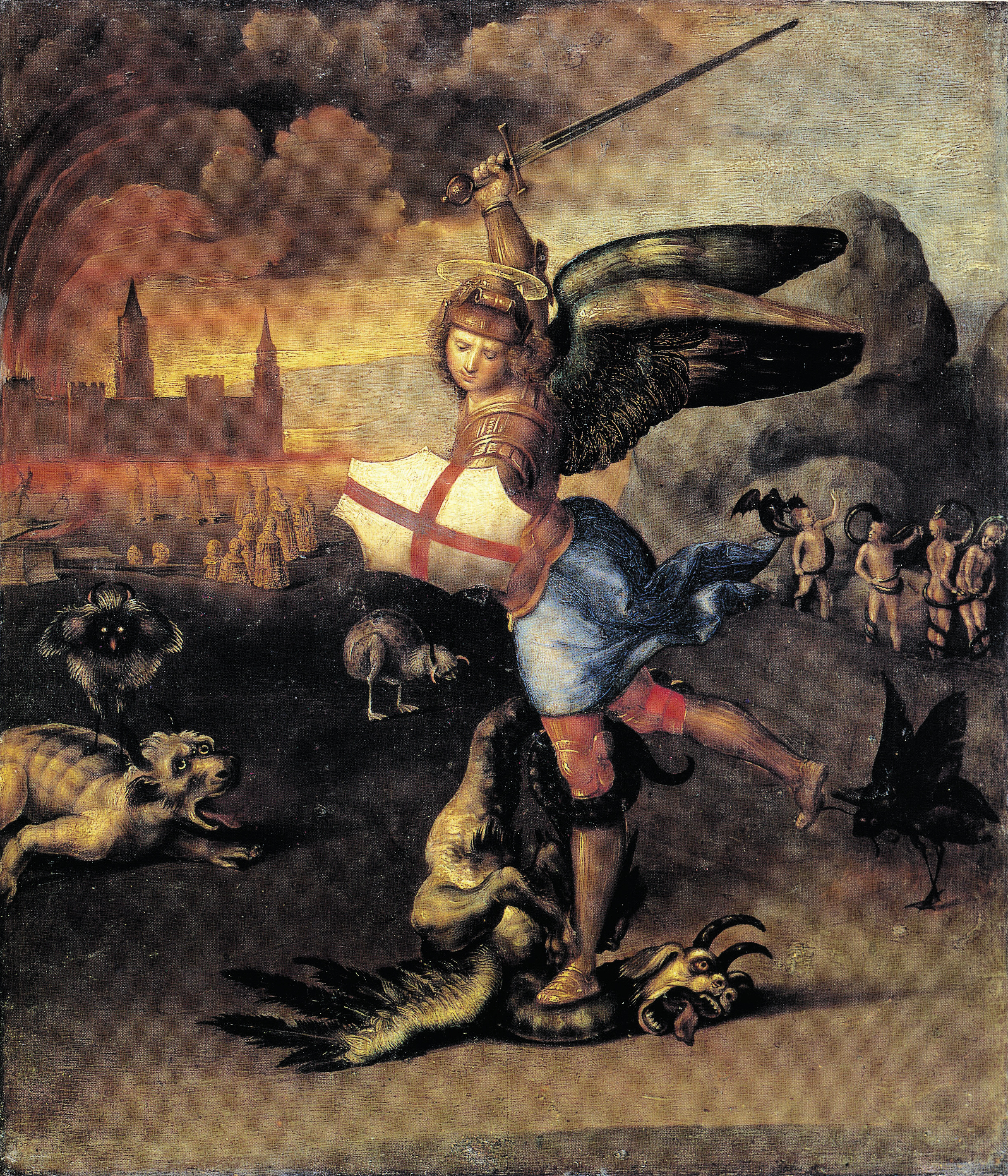
Raphael, Saint Michael and The Dragon, c. 1505, oil on panel, 12 ¼” x 10 ¼” The Louvre Paris https://collections.louvre.fr/en/ark:/53355/cl010060773 – retrieved September 4, 2024Raphael, Saint Michael and The Dragon, c. 1505, oil on panel, 12 1/4 x 10 ¼” The Louvre, Paris https://collections.louvre.fr/en/ark:/53355/cl010060772 – retrieved September 4, 2024.Raphael, Saint George and the Dragon, c. 1506, National Gallery of Art, Washington, D.C.
These early works by the artist depict the popular subjects of St. Michael the Archangel vanquishing Satan and Saint George slaying the Dragon, each showing the martial subject of good combatting evil. These were early private commissions for the court of Urbino. Saint George was a Christian Roman soldier who, pious legend informs, subdued a dragon and, with the daughter of a pagan king, brought it to the city, where St. George killed it with his sword. These heroic actions witnessed by the king and his subjects led to their conversion to Christianity. The historic figure of Saint George was martyred around the year 290. https://www.nga.gov/collection/art-object-page.28.html – retrieved September 4, 2024.
Raphael, The Three Graces, 1505-1506, oil on panel, 6 ¾ x 6 ¾” Condé Museum, Chantilly.
The panel was recorded in the Borghese collection in 1650. It accompanied the Dream of Scipio, an oil on panel, today in the National Gallery of London. The figures were derived from ancient classical sculpture and depict, likely, Chastity, Beauty and Love. Chastity’s lower torso is veiled and an arm covers her breasts from view. Amor’s breasts, by contrast, are revealed. Chastity also wears no adornment as do Beauty and Amor. While the figures are modeled similarly, the space between them is disparate and Beauty blocks Chastity’s leg. (Jones & Penny, p. 8; Beck, pp. 62-63).
Raphael, Portrait of Agnolo Doni, c. 1506, oil on panel, 24 ¾ x 17 ¾” Pitti Gallery, Florence.Raphael, Portrait of Maddalena Doni, c. 1506, oil on panel, 24 ¾ x 17 ¾” Pitti Gallery, Florence.
Agnolo Doni is the only Florentine portrait in these first years mentioned by Vasari though paired with its companion portrait of Maddalena Doni. Doni was an art collector who married the daughter of Giovanni Strozzi in 1503. Agnolo was 10 years older than his wife who was in her teens. The portraits are painted on identically sized panel and are intended to hang next to one another. Raphael took great care in depicting the corporeal reality of his subjects, particularly appreciated in their faces and hands (though Agnolo Doni’s portrait is more detailed than his wife’s.) In both Doni portraits the sitters show-off their jewelry – such as rings and, in Maddalena’s portrait, a large pearl hanging around her neck. (Roger & Penny, p. 29-30)
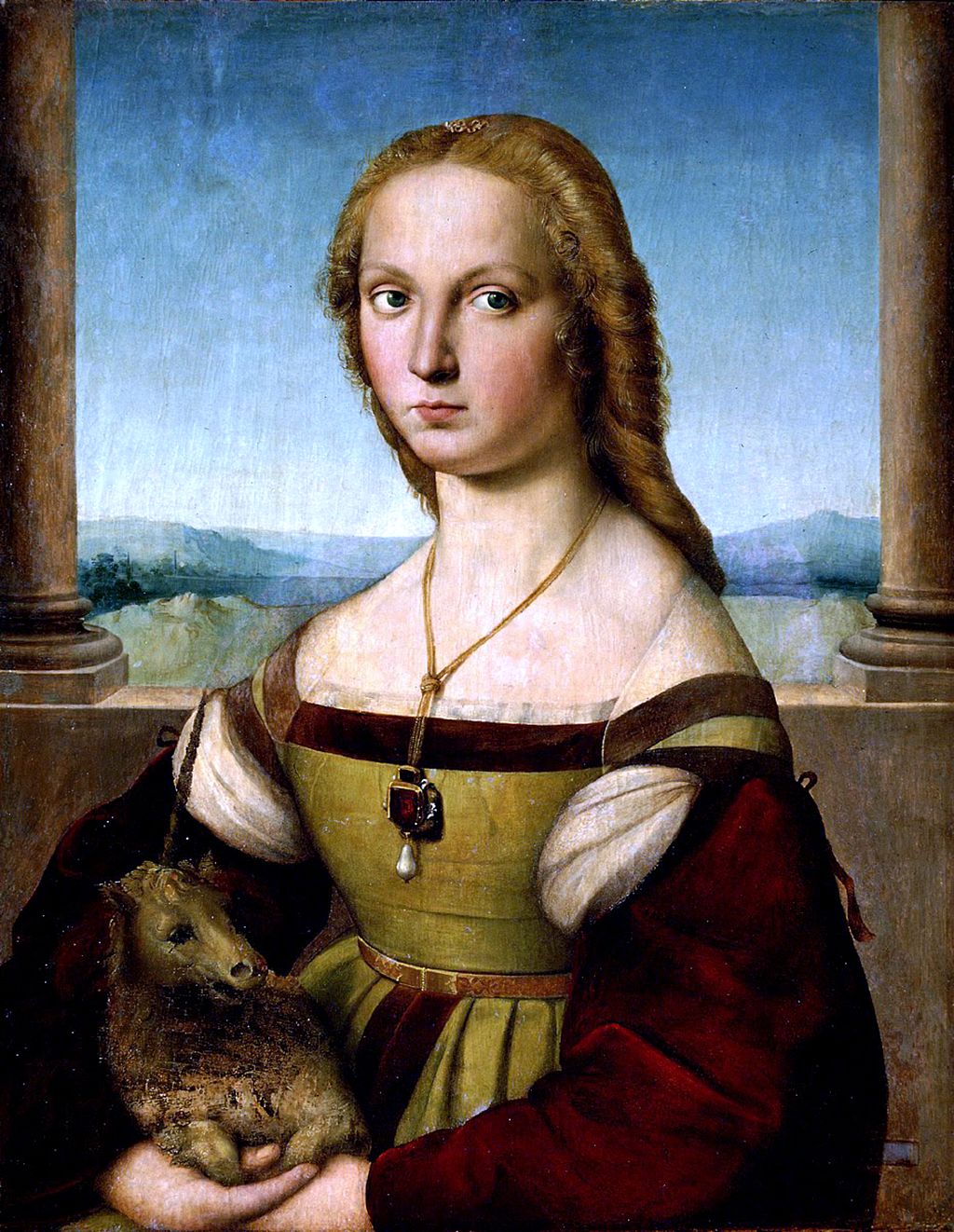
Raphael, The Madonna of the Granduca, c. 1506, Oil on panel, 33 x 21 1/2 “ Pitti gallery, Florence.Raphael, Lady with a Unicorn, 1506, oil on panel, 65 cm × 51 cm (26 in × 20 in), Galleria Borghese, Rome, Italy.
The work was of uncertain attribution until recent times. In the 1760 inventory of the Gallery, the subject of the painting was identified as Saint Catherine of Alexandria and attributed to Perugino. A restoration of the painting in 1934 revealed a unicorn, the medieval symbol for chastity, and led to the pianting’s attribution to Raphael. In 1959 an x-ray revealed a small dog under the unicorn which symbolized conjugal fidelity.https://en.wikipedia.org/wiki/Young_Woman_with_Unicorn – retrieved September 7, 2024.
Raphael, The Holy Family With Saints Elizabeth and John (The Canigiani Holy Family), c. 1506-07, oil on panel, 51 ½ x 42 1/8” Alte Pinakothek, Munich.
Visible on the hem of the Madonna’s scarf is inscribed, “Rapahel Urbanas.” The fresco and easel painter was active mainly in Umbria, in Florence after 1504, and in Rome in 1509 until his death. It was painted for Domenico Canigiani where Vasari saw it later. It entered the Medici collection and when a Medici daughter married an Elector Palatine it accompanied her over the Alps to Germany. (Pinakothek Munich Great Museums of the World, Roberto Salvini, et. al., Newsweek NY 1969 pp. 126).
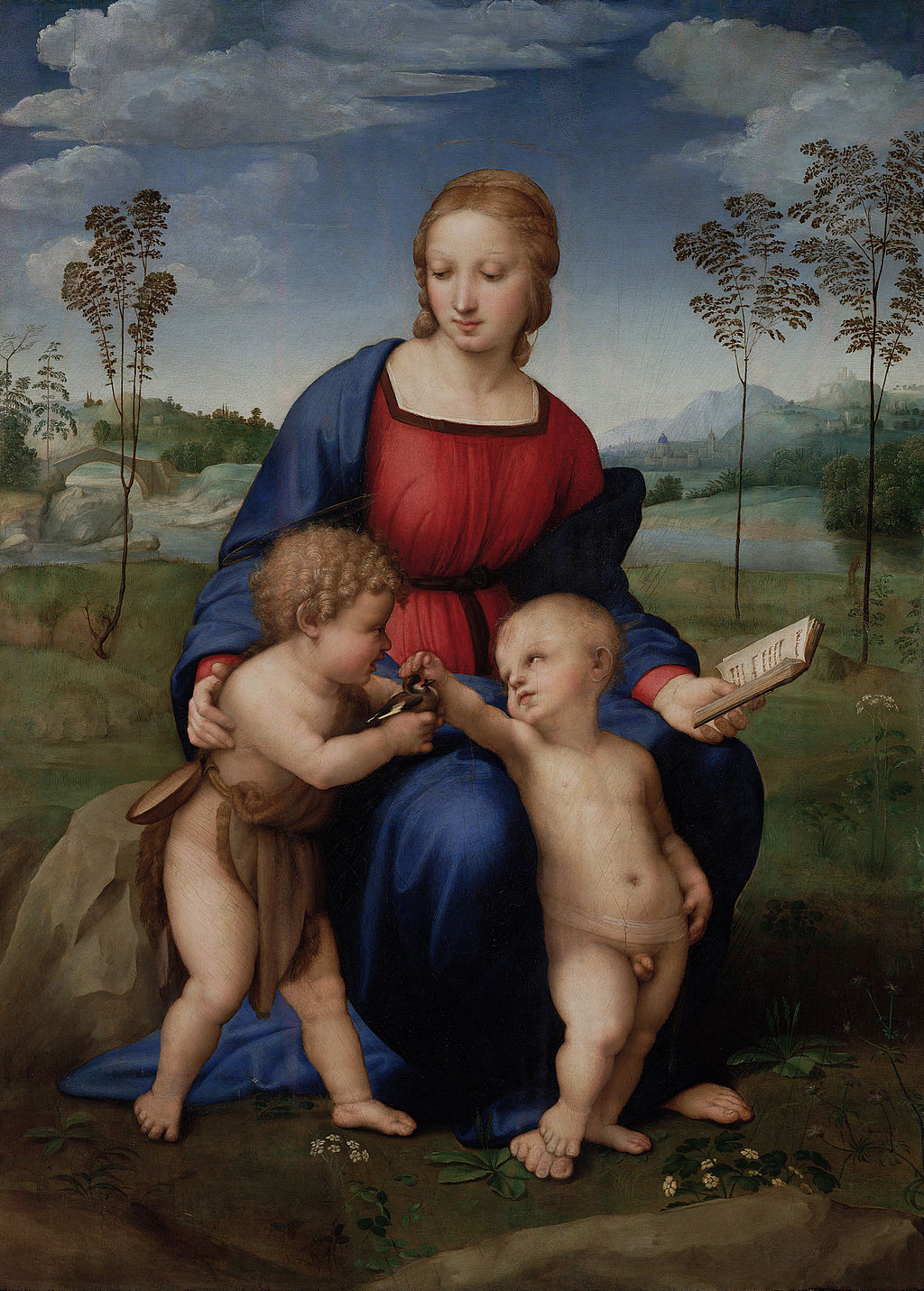
Raphael, Madonna del Cardellino, 1506-07, oil on panel, 42 1/8 x 30 ¼” Uffizi Gallery Florence.
The three figures are closely integrated as well as displaying a greater sense of volume. The painting is dated 1507, again on the hem of the Virgin’s garment. In the painting St. John the Baptist presents a goldfinch (cardellino) to the Christ child – a symbol of the Passion. (Roger & Penny, p. 33)
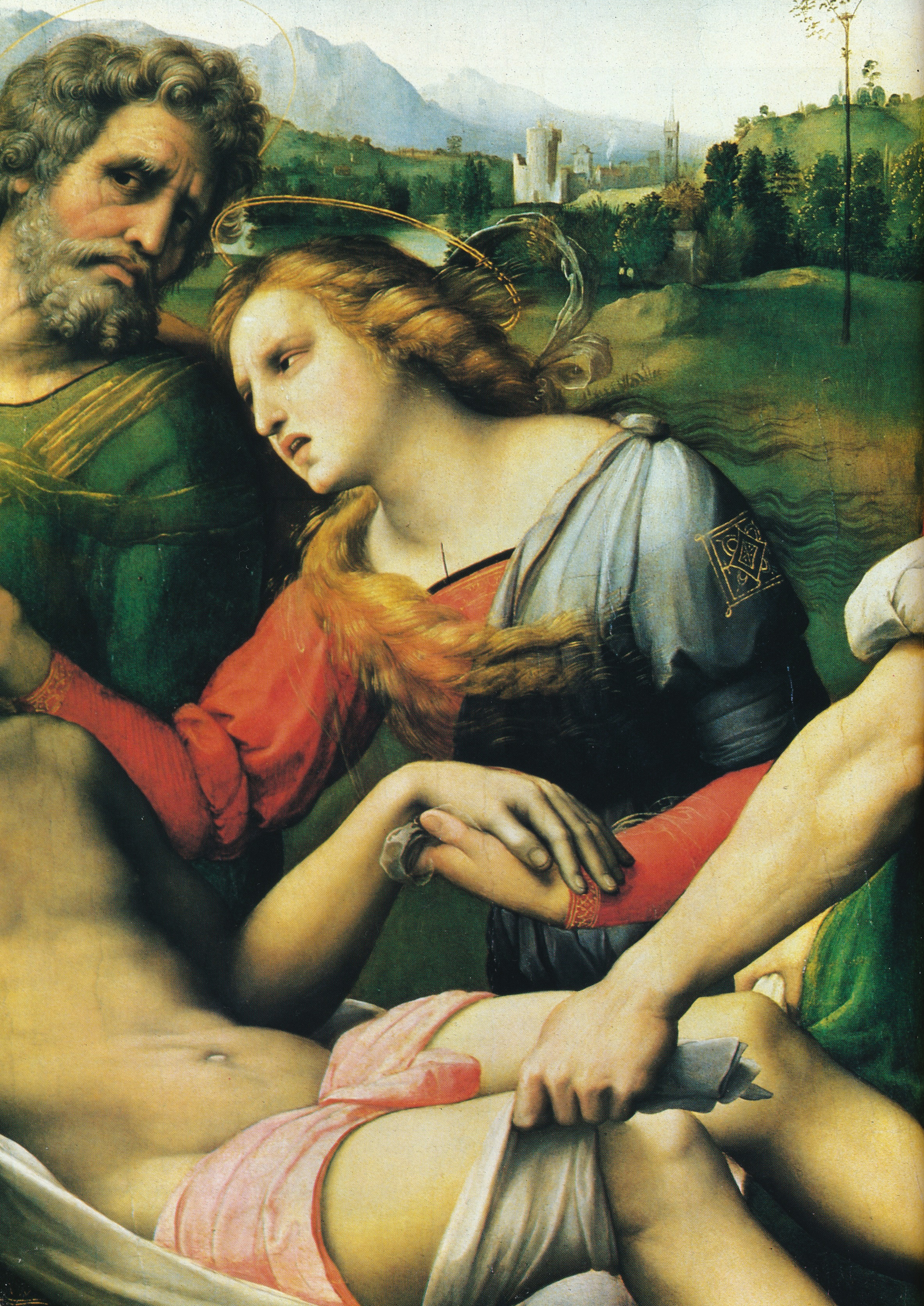
The Deposition, 1507, oil on panel, 72 ½ x 69 ¼” Borghese Gallery, Rome.The Deposition, 1507, oil on panel, 72 ½ x 69 ¼” Borghese Gallery, Rome. DETAIL.
Upon seeing Leonardo’s Battle of Anghiari and Michelangelo’s Battle of Cascia in Florence Raphael’s style applied its innovative principles immediately changing the trajectory of his artwork up to that point. Leonardo da Vinci and Michelangelo were in a pitched artistic battle for the future of modern art in the first decade of the 16th century in central Italy. Their artwork was for a fabled competition to decorate the Great Council Hall in Florence. Raphael studied closely these complex drawings of heroic violence. Though Raphael was familiar with violent combat in Perugia and elsewhere, it was its containment in these artworks in Florence that such dynamic convolutions appeared as in his own work such as The Deposition though he may have had in mind also Perugino’s work in 1495 of the Lamentation over the Dead Christ. In the finished painting the action takes place from right to left – a group of women attending to a swooning Virgin to the Magdalene grasping Christ’s hand to look into his face. (Roger & Penny, pp. 37-44).
Raphael, La Belle Jardinière, 1507-08, oil on panel, 48 x 31 ½” The Louvre, Paris.
In this painting John the Baptist kneels before the Christ child. The painting has an arched top. It was Leonardo da Vinci who formulated the pyramidal structure for the Holy Family and half-length portrait and it seems Raphael looked to explore his idea for his narrative of the Virgin Mary with cousins Jesus Christ and John the Baptist. (Roger & Penny, p. 33)
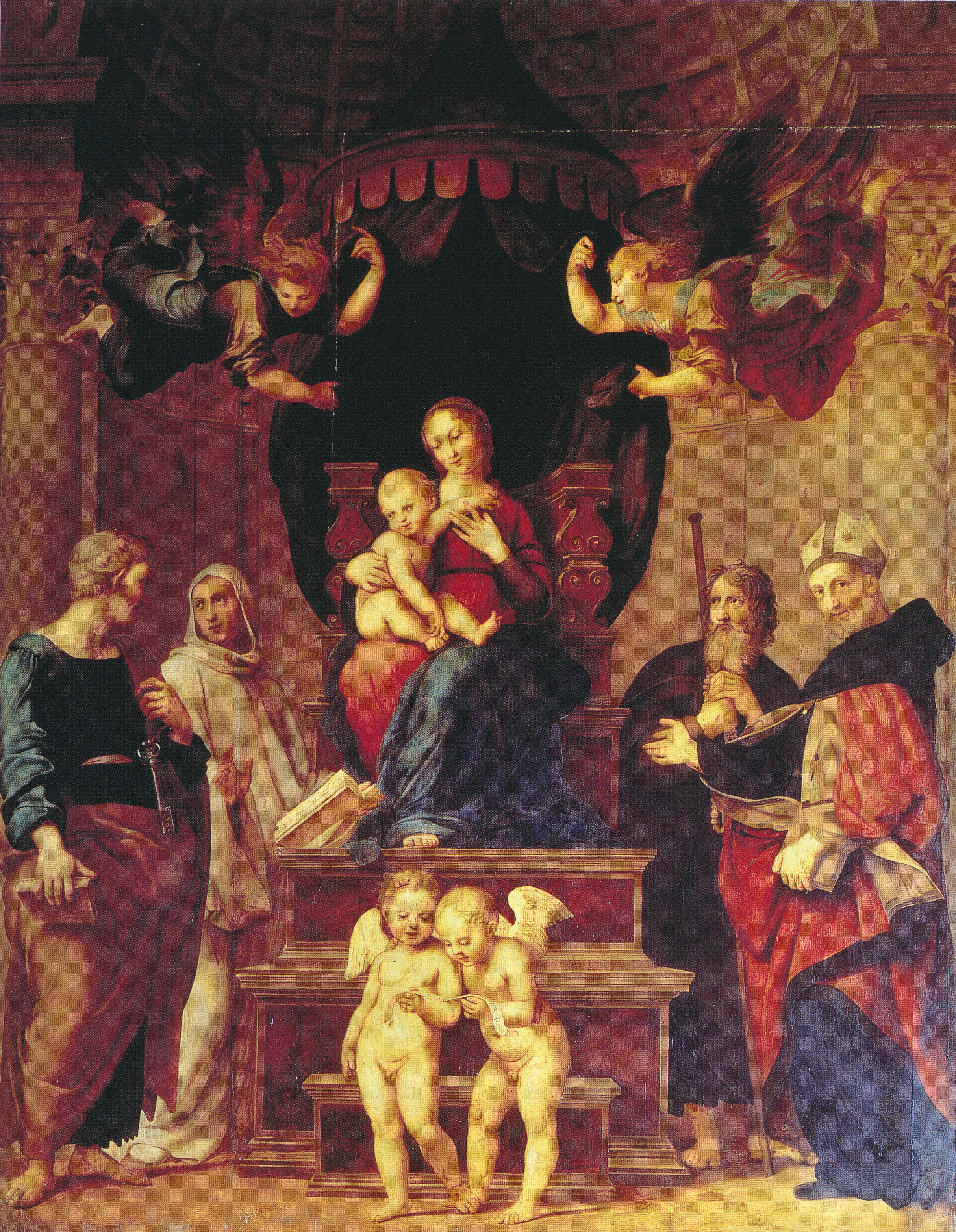
Raphael, The Madonna of the Baldacchino, 1508, oil on canvas, 9’ x7’4” Pitti Gallery Florence.
The painting was started by Raphael and finished after his death (Roger & Penny, p. 44). It was Raphael’s first major commission in Florence for the Dei family chapel in the Santo Spirito basilica (1487) and remained unfinished when the 25-year-old artist was summoned to Rome by Pope Julius II, nicknamed the Fearsome, who reigned on Peter’s chair from 1503 to 1513. Pope Julius, born Giuliano della Rovere in 1443, took his name specifically from Julius Caesar (d. 44 BCE). In 1508, this “Battle Pope” as he was also known, commissioned the Raphael Rooms and Michelangelo’s paintings in the Sistine Chapel at the Vatican. Raphael’s enthroned Madonna and Child is with, from left, Sts. Peter, Bernard of Clairvaux, James the Greater and St. Augustine of Hippo. The group is joined by two putti at the foot of the throne’s high pedestal steps. It is a large format painting whose size was increased when it was restored and “completed” at the end of the 17th century to meet the tastes of a Medici prince. Raphael is cited for being an imitator more than originator and this is exampled in the Christ Child playing with his toes whose pudgy type derives from the workshop of Florentine sculptor Luca Della Robbia (c. 1400-1482). The painting can be read right to left as St. Augustine, looking at the viewer, gestures, with St. James gazing in a similar direction, towards the throne and its occupants and then crosses to St. Bernard whose backward glance ends in conversation with St. Peter holding a book and large key. Once in Rome, Raphael continued these simple straight forward readings of his artworks’ often complex network of figures beginning in his famous frescoes in the Stanza della Segnatura (1508-1511) yet by then with greater refinement and heroism. In 1799 The Madonna of the Baldacchino was confiscated by French forces and taken to Paris only to be returned to Florence in 1813. (Beck, pp. 78-79).
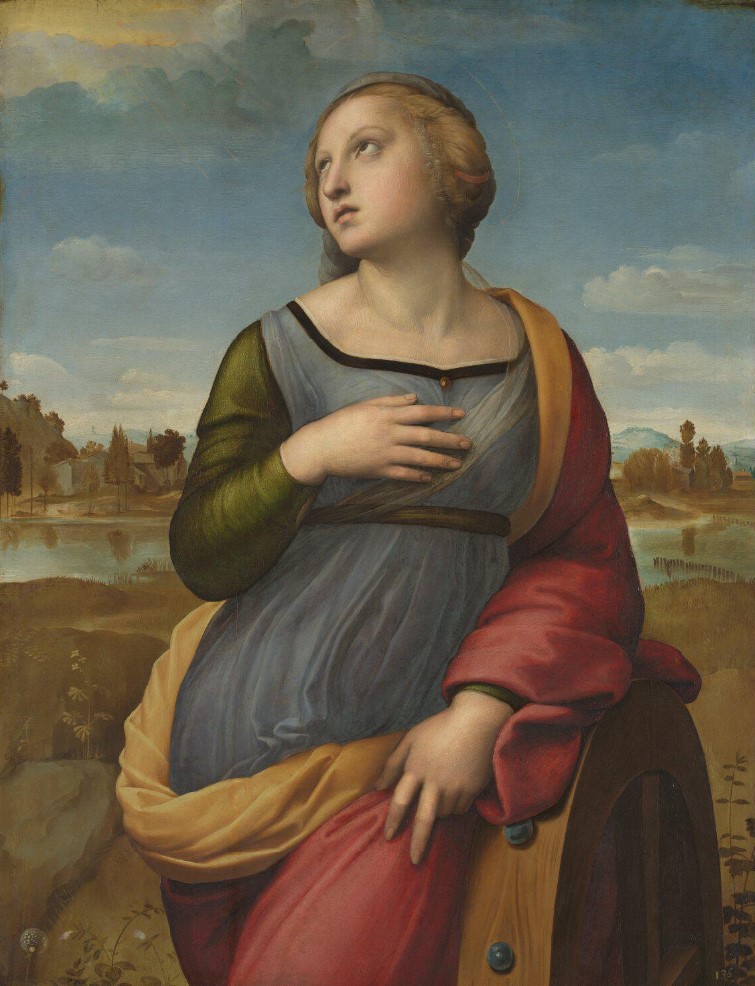
Raphael, St. Catherine of Alexandria, oil on panel, c. 1507, 71 x 56 cm, National Gallery of Art, London.
Raphael’s saint, a 4TH century mystic and martyr, is not an object for devotion but dramatizes an example of devotion. The turned figure derives from Leonardo da Vinci and expresses an emotional animation that is one of the strongest depictions in Raphael’s oeuvre. (Roger & Penny, p. 44). The portrait is joined to a landscape as the saint leans on a spiked wheel which is her symbol as it was the manner of her death. Raphael looks to capture the mystical or visionary aspect of the saint as she places her hand over her heart and gazes upwards to a golden break in the sky. The figure is very dynamic moving beyond Perugino’s influence of angelic air and distant landscapes and towards Michelangelo and Leonardo da Vinci whose monumentality and detailed arrangements Raphael studied in Florence. It is unknown who commissioned the artwork and for exactly what purpose it served. https://www.nationalgallery.org.uk/paintings/raphael-saint-catherine-of-alexandria – retrieved September 6, 2024.
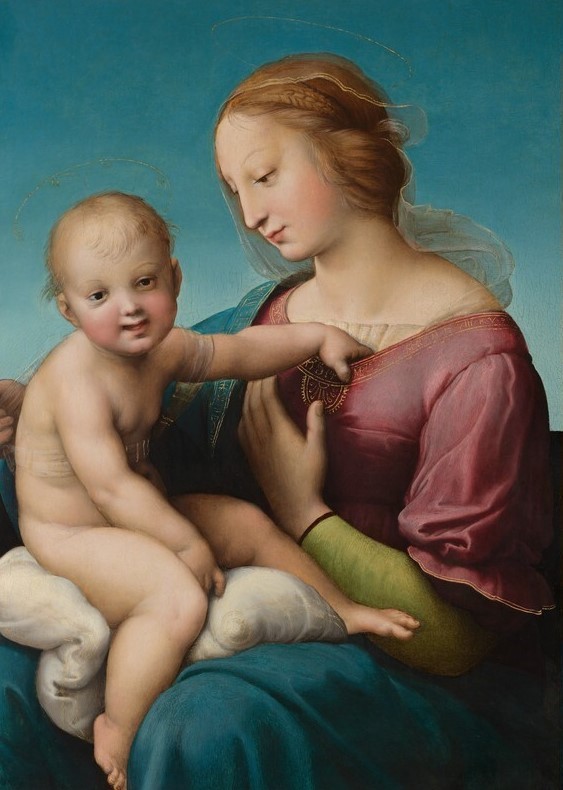
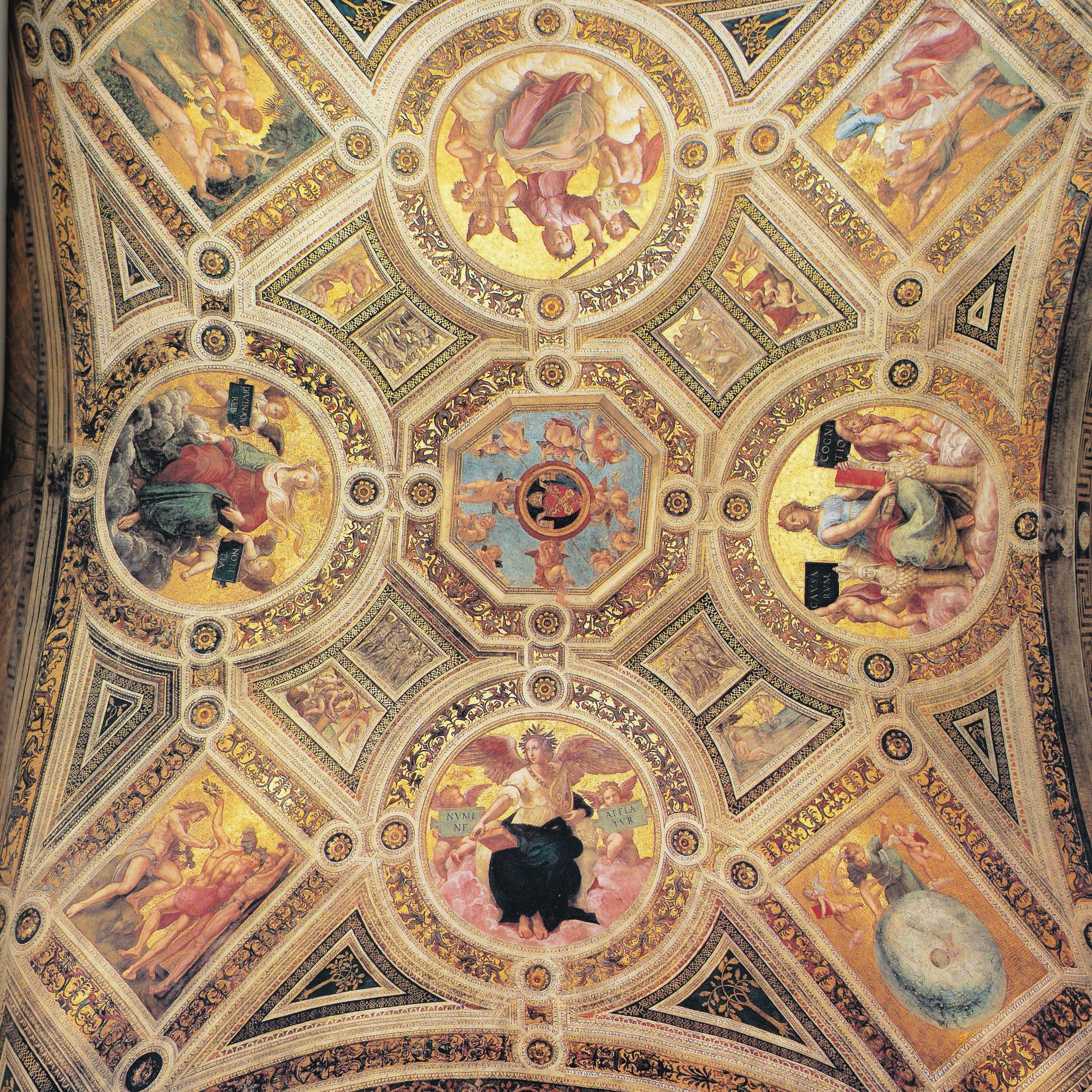
Raphael, The Niccolini-Cowper Madonna, 1508, oil on panel, 80.7 x 57.5 cm (31 3/4 x 22 5/8 in., National Gallery of Art, Washington, D.C. https://www.nga.gov/collection/art-object-page.27.html – retrieved September 8, 2024.Raphael, c. 1509, fresco, 47 ½ x 41 ½” Ceiling, Stanza della Segnatura, Vatican, Rome.Raphael, The Fall, c. 1509, fresco, 47 ½ x 41 ½” Ceiling, Stanza della Segnatura, Vatican, Rome.DETAIL.
At the time of the papal commission Raphael had little experience painting large frescos but would revolutionize the tradition. The basic scheme of the decoration presents four tondi of abstract ideas of Theology, Poetry, Philosophy and Law. The Fall – or Adam and Eve on the Brink of Disobedience along with the Judgment of Solomon on the ceiling relates to themes of Theology and Law as the ceiling’s admixture of pagan scenes including Urania and Apollo and Marsyas relate to Poetry and Philosophy. (Roger & Penny – pp 50-52).
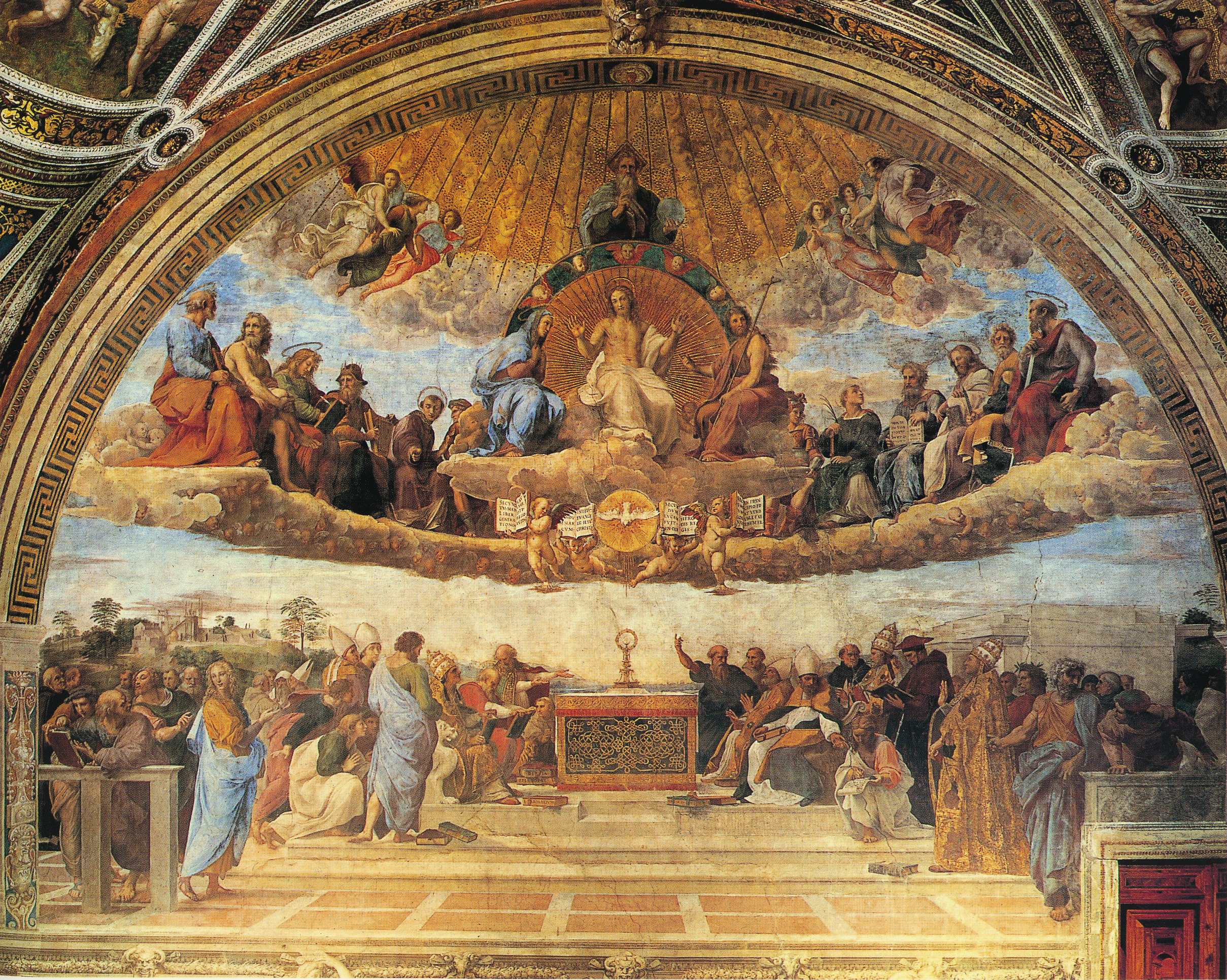
Raphael, The Disputation over the Sacrament (Disputa), 1509-10, fresco, 25’3” at base, Stanza della Segnatura, Vatican, Rome.Raphael, The Disputation over the Sacrament (Disputa), 1509-10, fresco, 25’3” at base, Stanza della Segnatura, Vatican, Rome. DETAIL.
Raphael’s artwork has the effect of cinema in presenting nearly life-sized figures in space that, hoisted onto the wall like a massive theatre screen, fills the room’s field of vision. Further, as a modern-day film dispels incredulity to its medium and any message it conveys, absorbing the viewer, Raphael’s fresco makes intensely real the Catholic faith. Angels in the vault accompany God the Father as a white-robed God the Son sits enthroned before a golden disc displaying his sacrificial wounds of the Cross. On each side sit the Virgin Mary and St. John the Baptist while on the raised tier sits figures from the Bible. The Holy Spirit descends in the form of a dove on the monstrance holding the Eucharist. Many preparatory drawings survive for this fresco. (Roger & Penny, pp.57-58)
Raphael, The School of Athens, 1510-11, Fresco, 25’3” at base, Stanza della Segnatura, Vatican, Rome.Raphael, The School of Athens, 1510-11, Fresco, 25’3” at base, Stanza della Segnatura, Vatican, Rome. DETAIL.
Raphael creatively adapted figures or figural groupings from one fresco to another. Raphael also utilized Michaelangelo’s newly publicly accessible Sistine Chapel ceiling’s prophets and sibyls. Beyond Michaelangelo, Raphael was interested in foreshortening and also arranging numerous figures in a mathmatically constructed perspectival space. Compared to the architecture in his Spozalizio from 1504, Raphael’s architecture in The School of Athens is more massive and yet whose angular lines are softened by curvacious colossal statues in niches. One statue is Minerva above Jurisprudence while Apollo is on the left (and closest to the Parnassus fresco). The central figures below the arches, open sky behind them, are Plato with his Timaeus and Aristotle with his Ethics. Other recognizable figures include Socrates to the left of Plato and Pythagoras to the right of the door. Euclid bends down to use one of his compasses surrounded by students and disciples. (Roger & Penny p 74-78).
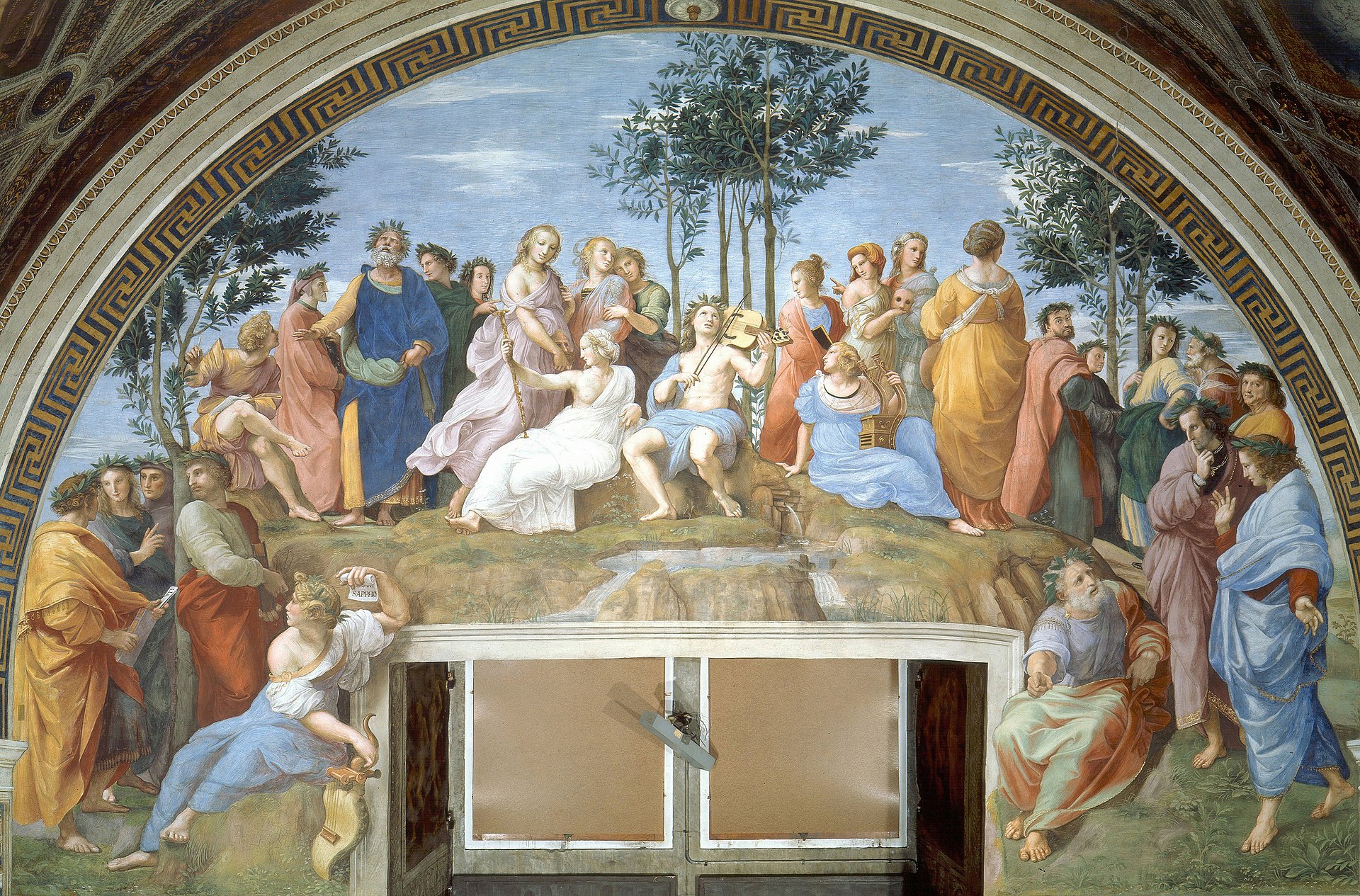
Raphael, Parnassus, c. 1511, fresco, 22’1 ½” at base. Stanza della Segnatura, Vatican, Rome.
Raphael painted a poet’s paradise where Apollo has the central place. The window which interupts the base of the artwork looked out onto a hill in Rome called Mons Vaticanus that was known since classical times as sacred to Apollo. This fact with the fresco’s other siting challenges (window glare) Raphael was well aware of. Apollo plays the fiddle surrounded by poets and gorgeous muses with a background of laurel trees. Mortals are below on either side of the window. (Roger & Penny, pp. 68-69)
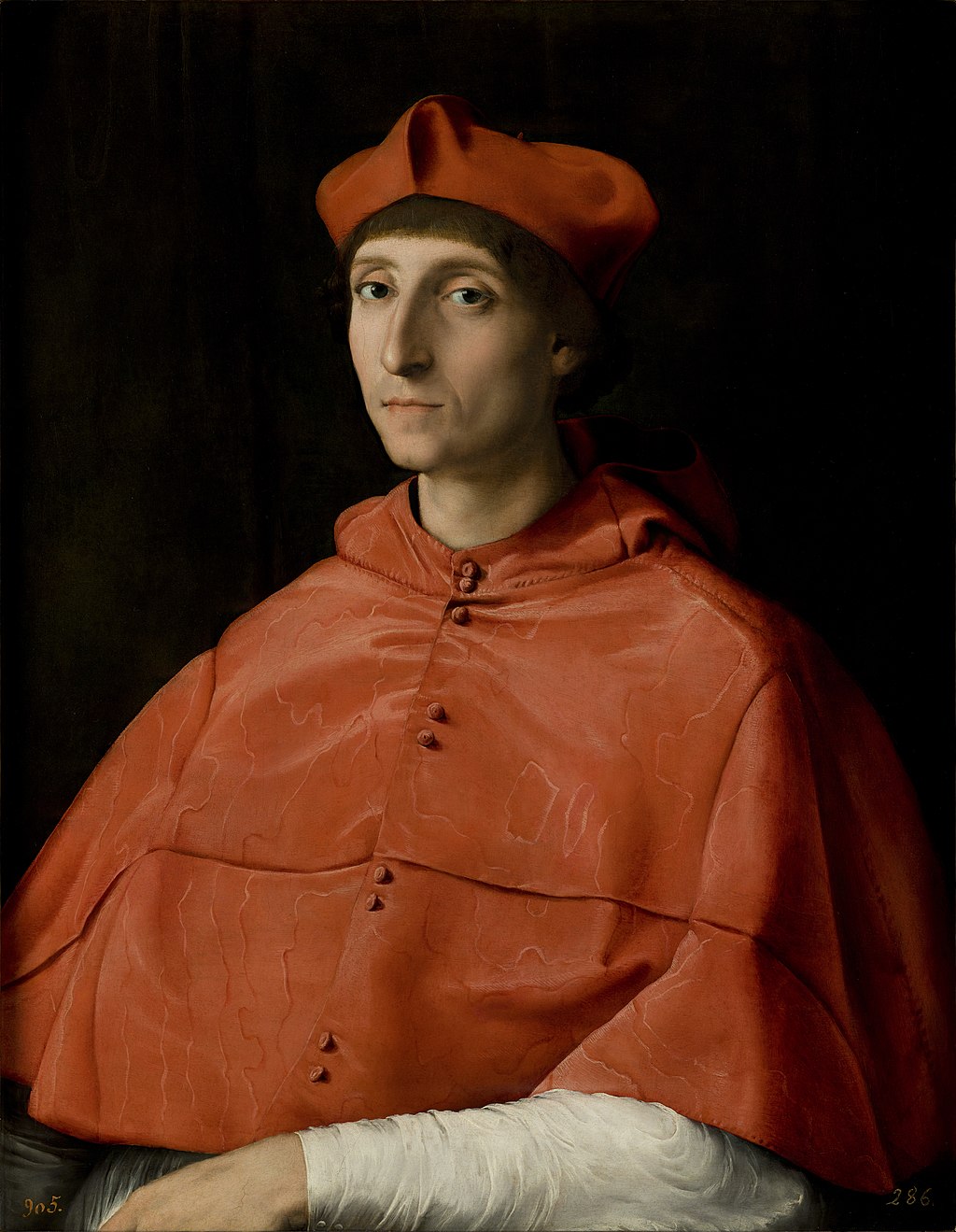
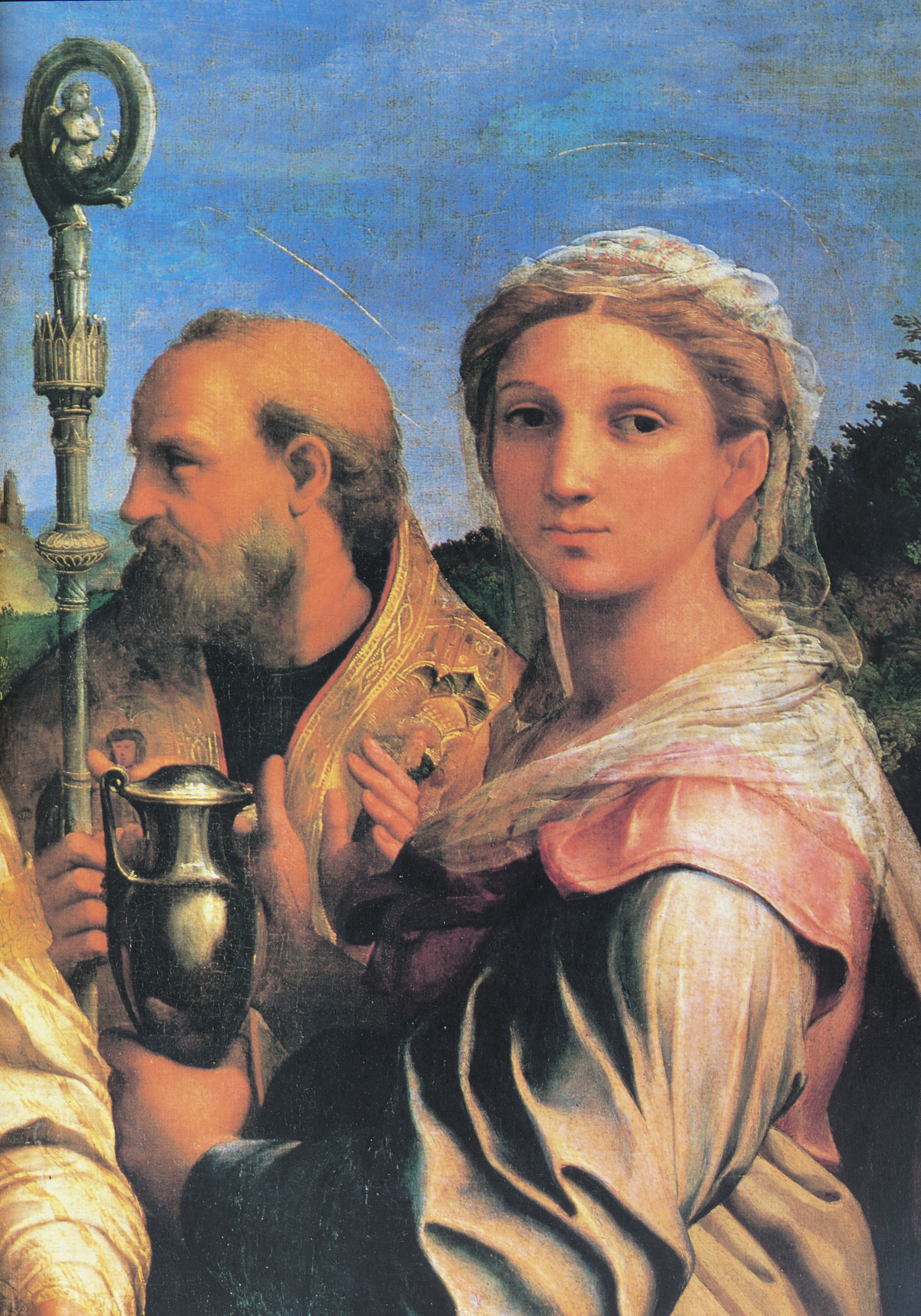
Raphael was working on the frescos in the Vatican Palace when he painted this oil on panel portrait of a “Young Cardinal.” The sitter is not known though it likely is Cardinal Francesco Alidosi (1455-1511). Cdl. Alidosi was an influential diplomat and military leader and a favorite of Julius II (1503-1513). The sitter’s expression and pose of a resting arm on the edge of the painting’s base and the slight turn of the body seems to owe much to Leonardo da Vinci. The body is monumental compared to a placid and yet almost inscrutable slightly smaller head whose depiction, while directly observed, is somewhat idealized. When Della Rovere was elected as Pope Julius II in 1503, Alidosi became his secretary and primary collaborator. He was appointed papal chamberlain and then treasurer. Though labeled “unholy” by Venetian cardinal Pietro Bembo (1470-1547), Cld. Alidosi helped guide the vocation of Bl. Elena Duglioli dall’ Olio (1472-1520), an Italian aristocrat, who wanted to be a Poor Clare nun but was forced to marry by her family and for whose endowed chapel in Bologna Raphael painted an altar-piece. In 1504 Alidosi became a bishop whose sees ranged up and down all Italy – of Mileto in 1504 and of Pavia in 1505. He occupied the seat of Pavia until he was murdered in broad daylight in 1511. There were accusations traded back and forth that Cdl. Alidosi was a traitor in a time when the French occupied parts of Italy among its warring Italian families and an independently powerful pope who acted to protect his favorite as long as possible. About Alidosi, one historian noted, ”A favorite has no friends” and there were many unconcerned witnesses to the brutal crime whose attack included blows that split open his head. (Beck, pp. 92-93; Herbert M. Vaughan, B.A., The Medici Popes (Leo X and Clement VII), Methuen & Co., London, 1910, p. 64-65; “Alidosi, Francesco, detto il Cardinal di Pavia”. Dizionario Biografico degli Italiani – Volume 2 (in Italian). Treccani. 1960.)
Raphael, The Alba Madonna, c. 1511, oil on canvas (transferred from panel), diameter 37 ¼” National Gallery of Art, Washington, D.C.
Raphael’s major commissions for papal and aristocratic patrons did not interrupt his sustained engagement with the Madonna theme, a subject he had refined since his years in Umbria and Florence. The Alba Madonna exemplifies this continuity. The Virgin is presented as a Virgin of Humility, seated directly on the ground, her pose reinforcing the theological emphasis on Christ’s lowly Incarnation. She wears a rose‑pink gown beneath a topaz‑blue mantle, her hair drawn back from her face, and one finger marking a page in the book resting on her lap.
The Virgin occupies the dominant share of the tondo’s surface, receiving the young John the Baptist as he approaches with flowers gathered in the fold of his garment — a visual shorthand for his role as the forerunner who prepares and presents Christ to the world. All three figures direct their attention toward the small cross held by the Christ Child, a sign of his identity as the Lamb of God and of the sacrificial destiny that defines his mission.
Raphael integrates figure and format with characteristic finesse: the Madonna’s rounded features and gently curving posture echo the circular panel on which the scene is painted. The background opens onto an expansive plain leading to a turquoise body of water, with distant mountains rendered in deeper blue beneath a luminous sky, establishing a serene atmospheric recession typical of Raphael’s mature style. (Roger & Penny, p. 88.) https://www.nga.gov/collection/art-object-page.26.html – retrieved September 4, 2024.
Raphael, Galatea, c. 1512, fresco, 9’8 1/8” x 7’4”, Villa farnesina, Rome.
Raphael took a poem by Florentine poet Poliziano (1454-1494) for inspiration for this fresco. The poet gives a detailed description of the Palace of Venus. Galatea is described as riding on the sea in a chariot pulled by a pair of dolphins whose reins she holds. Around her is her entourage playing amorously in the sea. In 2007, the bodies of Poliziano and philosopher Giovanni Pico della Mirandola (1463-1464) were exhumed from Florence’s Church of San Marco to determine the causes of their deaths. Forensic tests showed that both men of letters likely were poisoned but how and by whom are only speculation. (see – http://news.bbc.co.uk/2/hi/europe/6920443.stm – retrieved September 7, 2024). (Roger & Penny, p. 93).
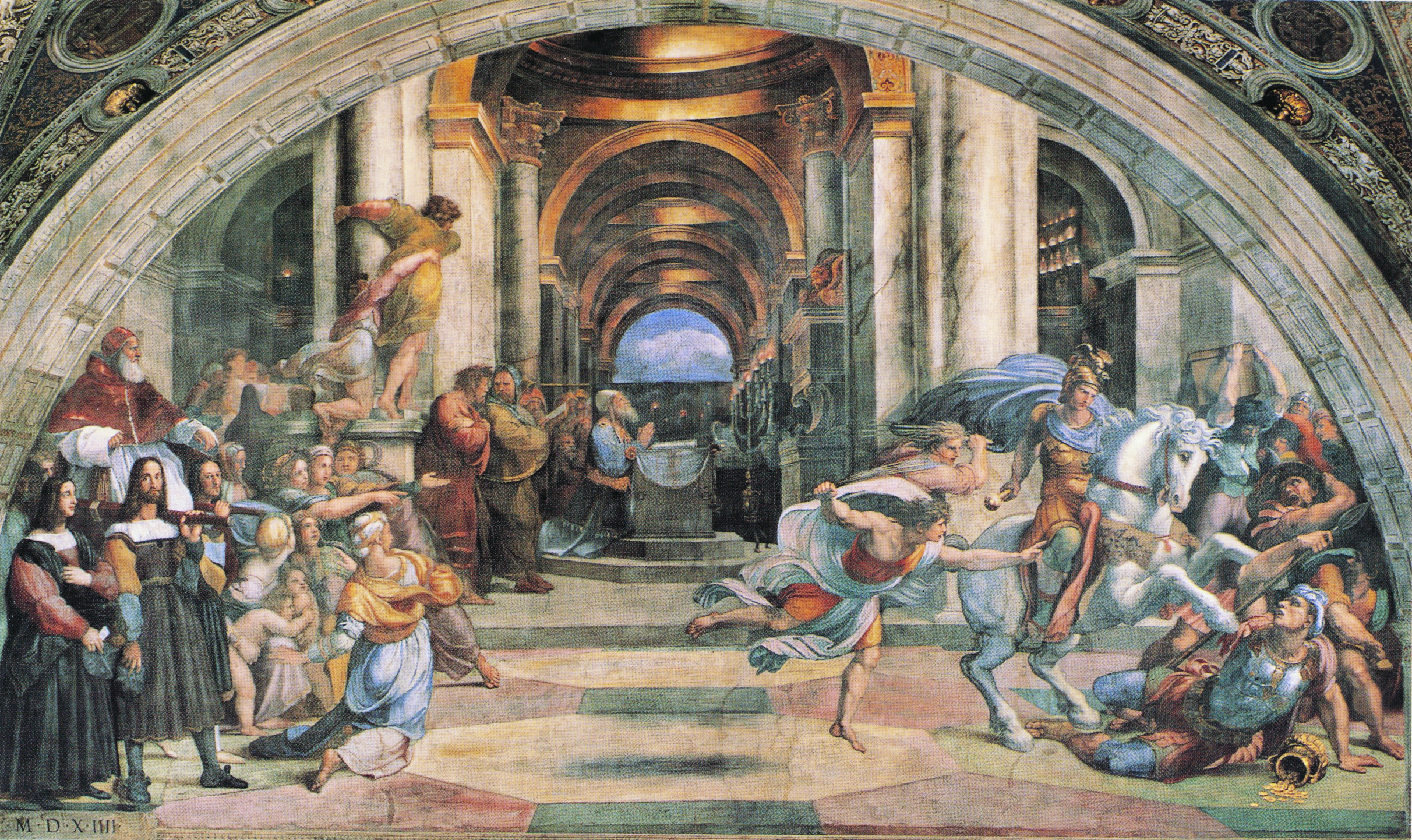
Raphael, The Expulsion of Heliodoris From the Temple, 1512-13, Fresco, 24’7” at base. Stanza D’Eliodoro, Vatican, Rome.
The Stanza D’Eliodoro served as a Vatican audience chamber for the Pope. Each fresco depicts a story of divine intervention and the Pope felt impelled to record them like a civic authority would record an important battle scene in the town hall. The Pope had control over the message and even had himself inserted into these works and one of the best portraits of the pope by Raphael.5 Vasari believed that in the Expulsion of Heliodorus the message was clear: it was the Pope chasing avarice out of the church. Still others, more realistic perhaps, believed the theme to be the defense of the Church’s right to worldly possessions.6While Julius II kept the treasury full and spent lavishly on public works, he also formally condemned his predecessor’s self-enrichment as well as the Church practice of buying and selling its offices. Others impute Pope Julius II making a parallel between Heliodorus’ expulsion and the Pope’s battle to expel rebellious cardinals who supported the French king against Rome.7 The first fresco painted in the Stanza D’Eliodoro and the one the room is named for is also, in my opinion, the finest: The Expulsion of Heliodorus. Heinrich Wölfflin in his book Classic Art provides the most satisfying brief account of this fresco, although there are other observers who offer insight and detail. The painting is based on an account found in 2 Maccabees, a book that treats of the events in Jewish history from the time of the high priest Onias III and King Seleucus IV to the defeat of Nicanor’s army (around 170 B.C). The biblical account of Heliodorus’ attempt to profane the Temple is a rich one and, in terms of the painting’s iconography, can be synopsized as such:
“There was great distress throughout the city. Priests prostrated themselves in their priestly robes before the altar, and loudly begged him in heaven…to keep the deposits safe for those who had made them…(T)he changed color of the (high priest’s) face manifested the anguish of his soul. The terror and bodily trembling that had come over the man clearly showed…People rushed out…in crowds to make public supplication because the Place was in danger of being profaned…Women, girded…filled the streets…While they were imploring the almighty Lord to keep the deposits safe and secure… Heliodorus went on with his plan. But just as he was approaching the treasury with his bodyguards, the Lord of spirits… (struck). There appeared to them a richly caparisoned horse, mounted by a dreadful rider. Charging furiously the horse attacked Heliodorus with his front hoofs…Then two other young men, remarkably strong…beautiful…splendidly attired, appeared…they flogged (Heliodorus) unceasingly…Suddenly, he fell to the ground enveloped in a great darkness…The man who a moment ago had entered that treasury with a great retinue and his whole bodyguard was carried away helpless…” (2 Maccabees, Chapter 3:14-28)
Raphael followed the biblical text closely. He depicts the three major parties in the religious story: the divine rider, two youths and Heliodorus; the figure of the anguished priest; and the “girded” women. As he does in The Deliverance of Saint Peter, the Pope identifies with one of the major priestly characters in the art work if one detects, as some scholars do, the features of Julius II in the High Priest Onias III.8 The Stanza D’Eliodoro and its first fresco The Explusion of Heliodorus is a milestone for its scale, its composition, its form, its treatment of subject, its color, its narrative power, and its graceful draughtmanship.
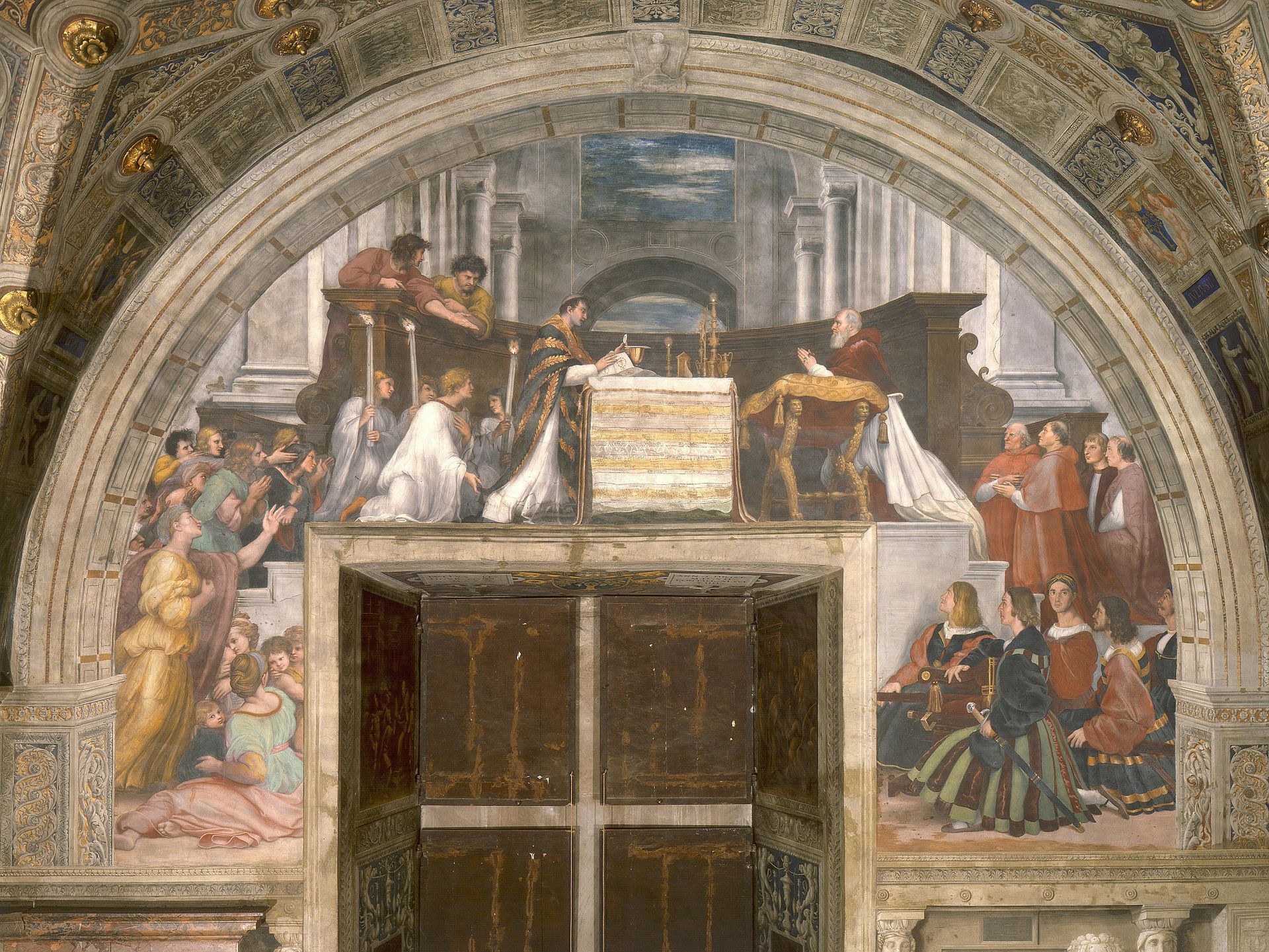
Raphael, The Mass of Bolsena, c. 1512 Fresco 21’8” Stanza d’Eliodoro, Vatican, Rome.
The fresco depicts a 13th century miracle connected to the Eucharist when a traveling priest, doubting the Real Presence of Jesus in the consecrated host, is given proof of its reality when the altar cloth he uses for Mass becomes stained with blood from the Host. The cloth relic was revered by Julius II and housed in Orvieto Cathedral where it is today. From its inception, the five handsome youths in the bottom right section of the fresco have been admired for their sturdy monumentality perhaps influenced by Michelangelo as well as its colors and costumes showing Venetian influence. (Beck, pp. 100-101).
Raphael, The Mass of Bolsena, c. 1512 Fresco 21’8” Stanza d’Eliodoro, Vatican, Rome. DETAIL. Raphael, The Mass of Bolsena, c. 1512 Fresco 21’8” Stanza d’Eliodoro, Vatican, RomeDETAIL.
Giuliano della Rovere (1443-1513) was described by Machiavelli in his works as an ideal prince. Becoming pope in 1503, he took the name Julius II in honor of Julius Caesar and was nicknamed the Warrior Pope. In 1506 Julius II organized the famous Swiss Guard for his personal protection and established the Vatican Museums. He was also the pope who instigated the rebuilding of St. Peter’s Basilica that exists today. The pope increased the power of the Papal States and, in 1508, he commissioned the Raphael Rooms and Michelangelo’s paintings in the Sistine Chapel. It was Julius II who also established the first bishoprics in the New World. Although the Tomb of Pope Julius II with its famous sculpture of Moses by Michelangelo is in San Pietro in Vincoli in Rome, the ensemble, extensively abbreviated than originally planned, was not finished until 1545, long after Julius II’s death in 1520. In fact, Julius II is buried in St. Peter’s Basilica.
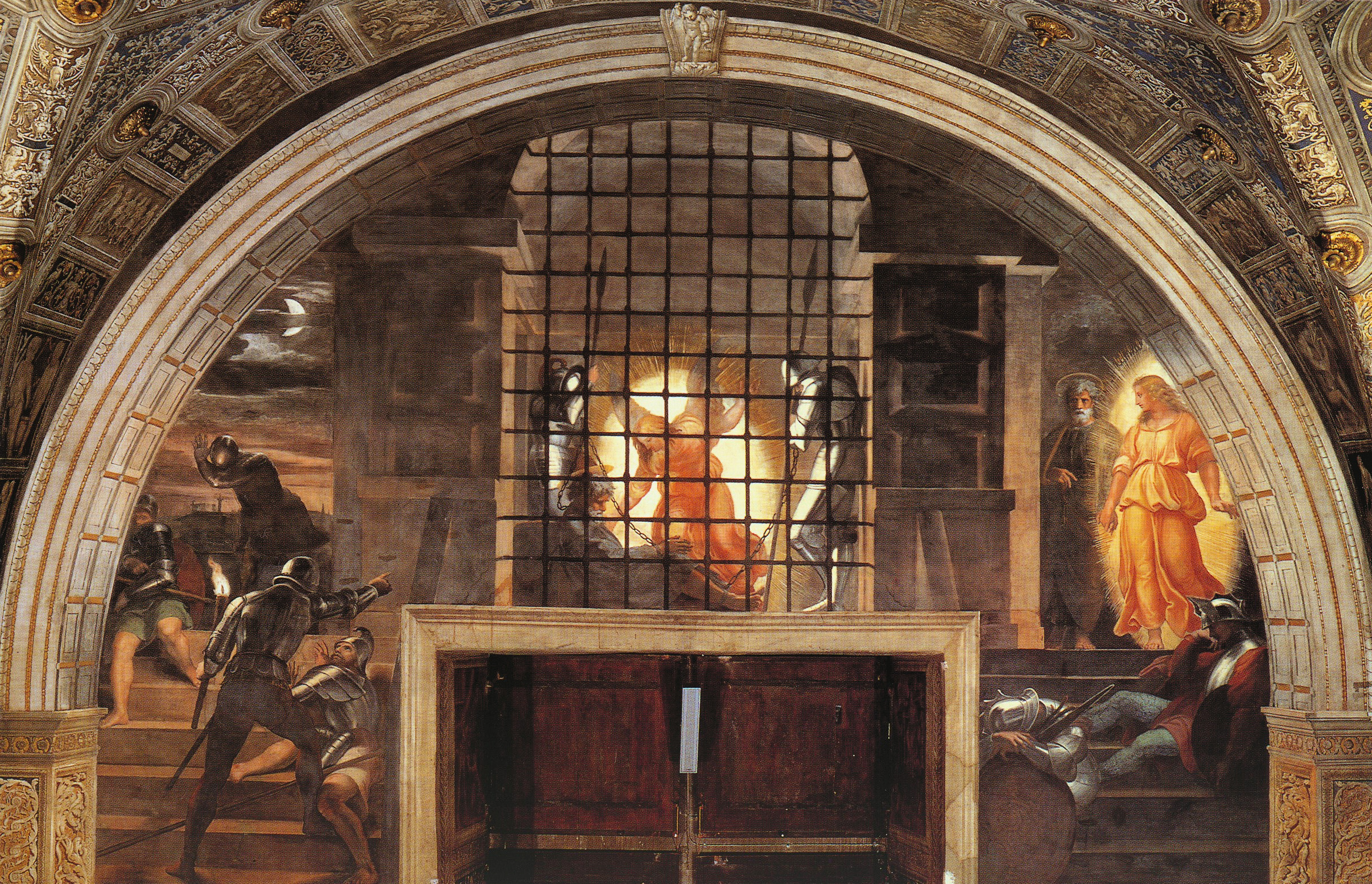
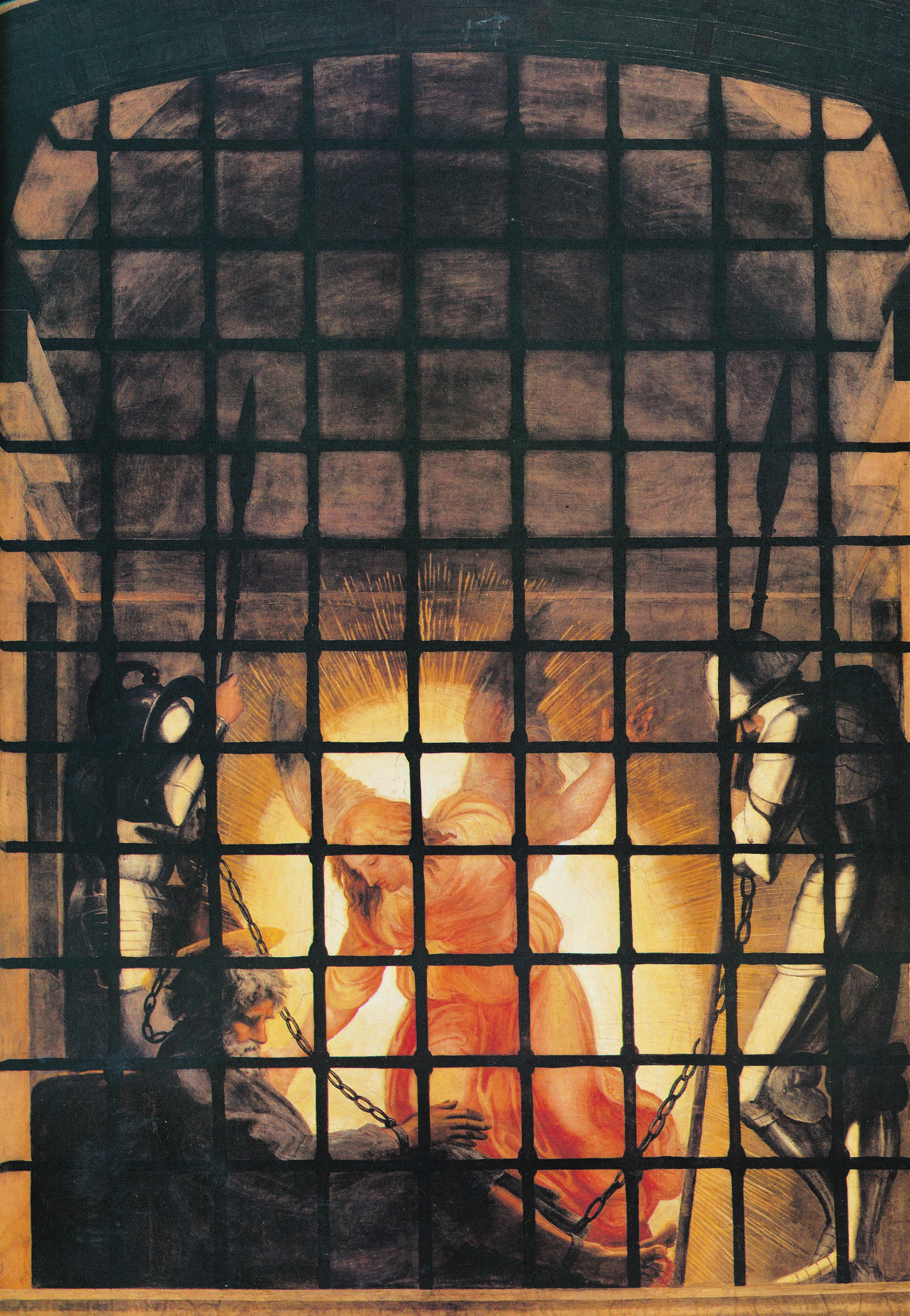
Raphael, The Liberation of Saint Peter From Prison, 1512-13, Fresco, 22’8” at base. Stanza d’Eliodoro, Vatican, Rome.
San Pietro in Vincoli in Rome (“St. Peter in Chains”) was Julius II’s titular church when he was a cardinal before becoming pope. It was also his uncle’s church before him, pope Sixtus IV (1471-1484). When pope, Julius II made pilgrimage to the church in 1512 after the French evacuated from Italy. The liberation in the title of Raphael’s concurrent fresco probably refers to that of the Papal States with St. Peter taking on the physical characteristics of Julius II. The fresco was being painted during the year when the pope was dying which took place in February 1513. Raphael’s use of light in this fresco is probably the boldest in art taking place at night in the whole of Renaissance art. (Beck, pp. 102-3).
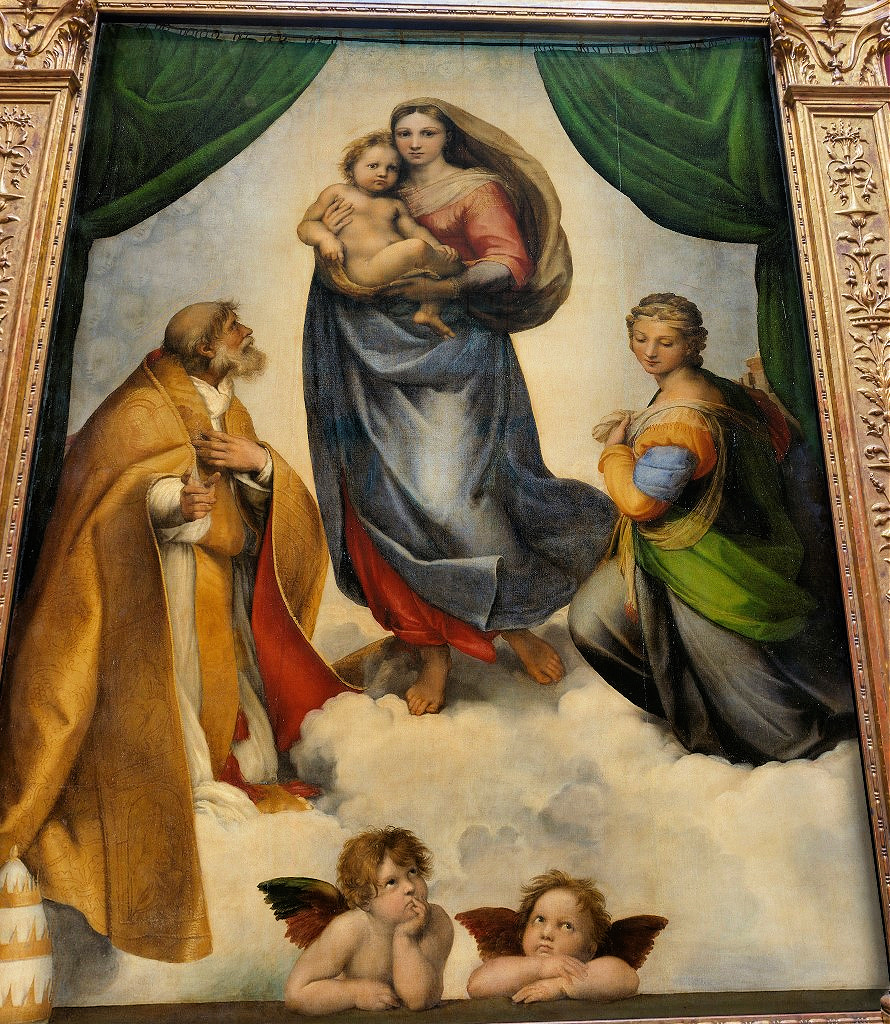
Raphael, The Liberation of Saint Peter From Prison, 1512-13, Fresco, 22’8” at base. Stanza d’Eliodoro, Vatican, Rome.Raphael, The Sistine Madonna, 1512-13, oil on canvas, 8’8” x 6’5”Gemäldegalerie Alte Meister Staatliche Kunstsammlungen, Dresden.
Raphael’s painting was made for the high altar of a newly rebuilt church of Pope St. Sixtus (d. 257) in Piacenza, Italy. St. Sixtus kneels on a cloud before the Virgin and Christ Child with a hand over his heart. The saint is interceding for the worshippers of Piacenza to whom he gestures outward with his other hand. Opposite is St. Barbara, patron of soldiers, with the symbol of a tower behind her. (Roger & Penny p. 128)
The painting also includes Sts. Paul, John the Evangelist, Augustine and Mary Magdalene. It was an altarpiece for a chapel in S. Giovanni in Monte in Bologna founded by Elena Duglioli dall’ Olio (1472-1520). The Italian aristocrat wanted to become a Poor Clare nun but was forced to marry by her family. She persuaded her husband, however, not to consummate the marrage attributed to her devotion to St. John (patron of virginity) and St. Cecilia and of which Raphael was commissioned to execute the altarpiece. Elena’s benefactor in this enterprise of her religious vocation was the influential Cardinal Alidosi. Raphael depicts St. Cecilia with an organetto slipping from her hands as she looks skyward to the preferred sound of heavenly music. Elena died on September 23, 1520 and her remains are incorrupt in her church of San Giovanni in Monte. In 1828 she was beatified by Pope Leo XII (1760-1829). Her feast day is September 23. (Roger & Penny, pp. 144-146).
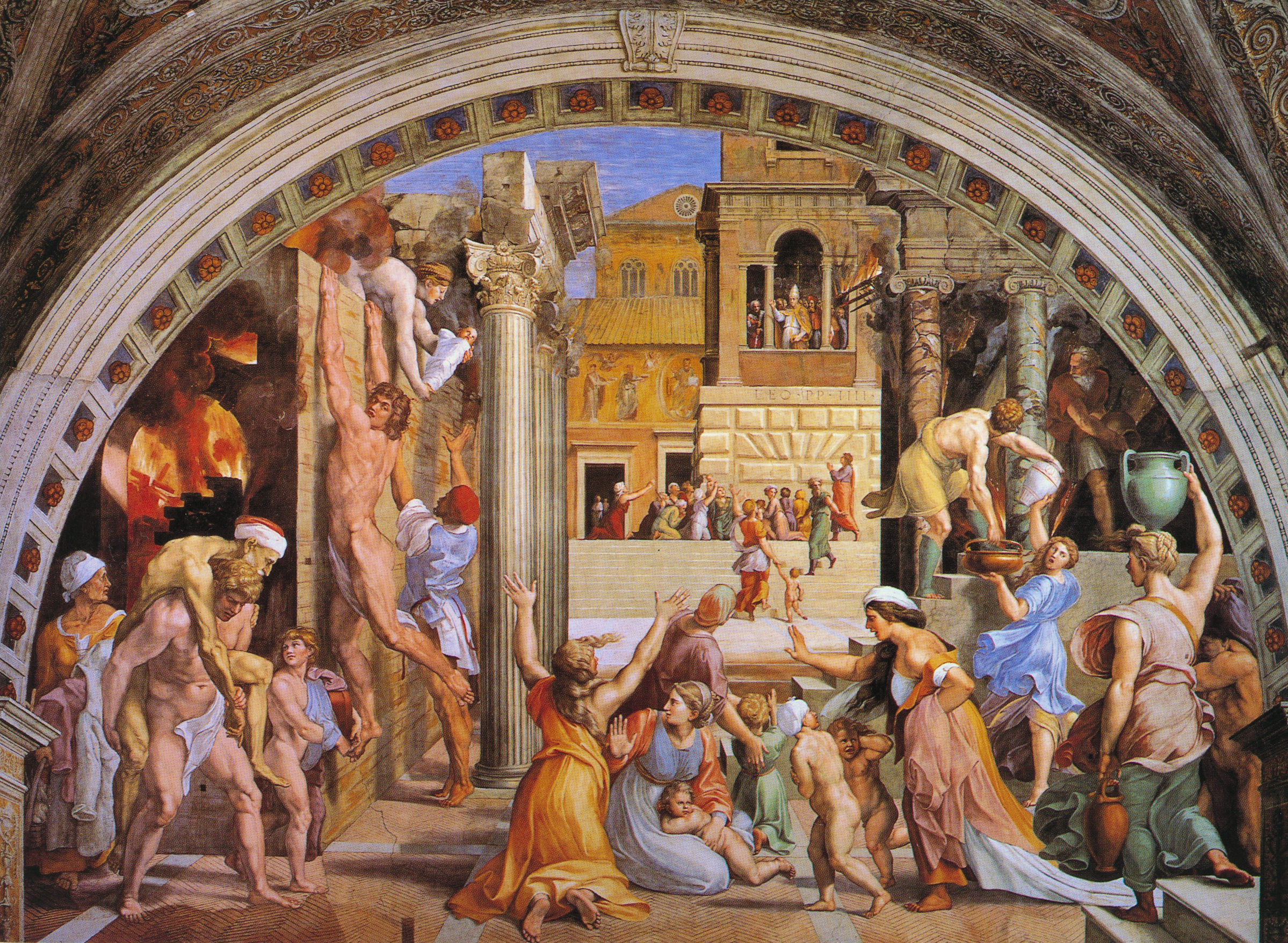
Santi, Raffaello, dit Raphaël Rencontre entre Léon Ier et Attila 1512/1513 LOUVRE https://collections.louvre.fr/en/ark:/53355/cl020101100 – retrieved September 4, 2024.Raphael, the Fire in the Borgo, 1514-15, fresco, 22’1″ at base, Stanza dell’ Incendio, Vatican, Rome.
The name of the room comes from this fresco which Raphael began work on in the summer of 1514. It depicts a newly imagined historical event from the mid-9th century when a fire broke out in Rome. The pope (Leo IV) is seen giving a blessing from the balcony of Old St. Peter’s which, the story goes, tamped down the flames. In the meantime Raphael depicted the event’s panic and drama among its foreground figures in its throes. Once more Raphael is re-inventing his art from only a couple of years earlier. As Raphael continued the practice of borrow ing certain figures and themes from previous frescos, the overall classical style of the Segnatura and Eliodoro frescos are remarkably more spatially complex and intriguing in The Fire in the Borgo. Raphael absorbed what Rome offered – from Michelangelo’s latest art to architecture, both contemporary and ancient, in the city. The Ionic columns of Old St. Peter’s are accurately rendered as are the building fragment of Corinthian columns. (Beck, p. 110).
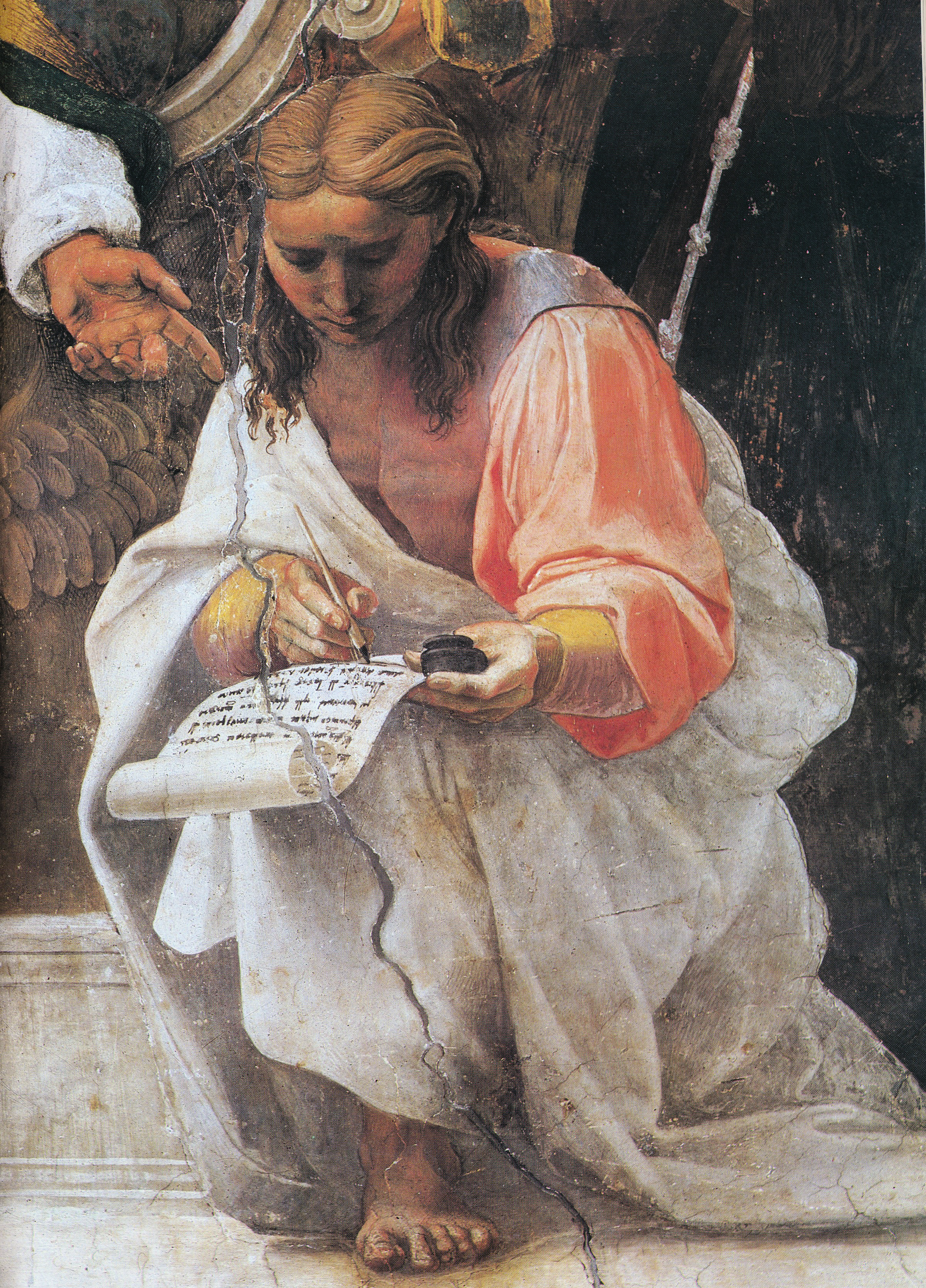
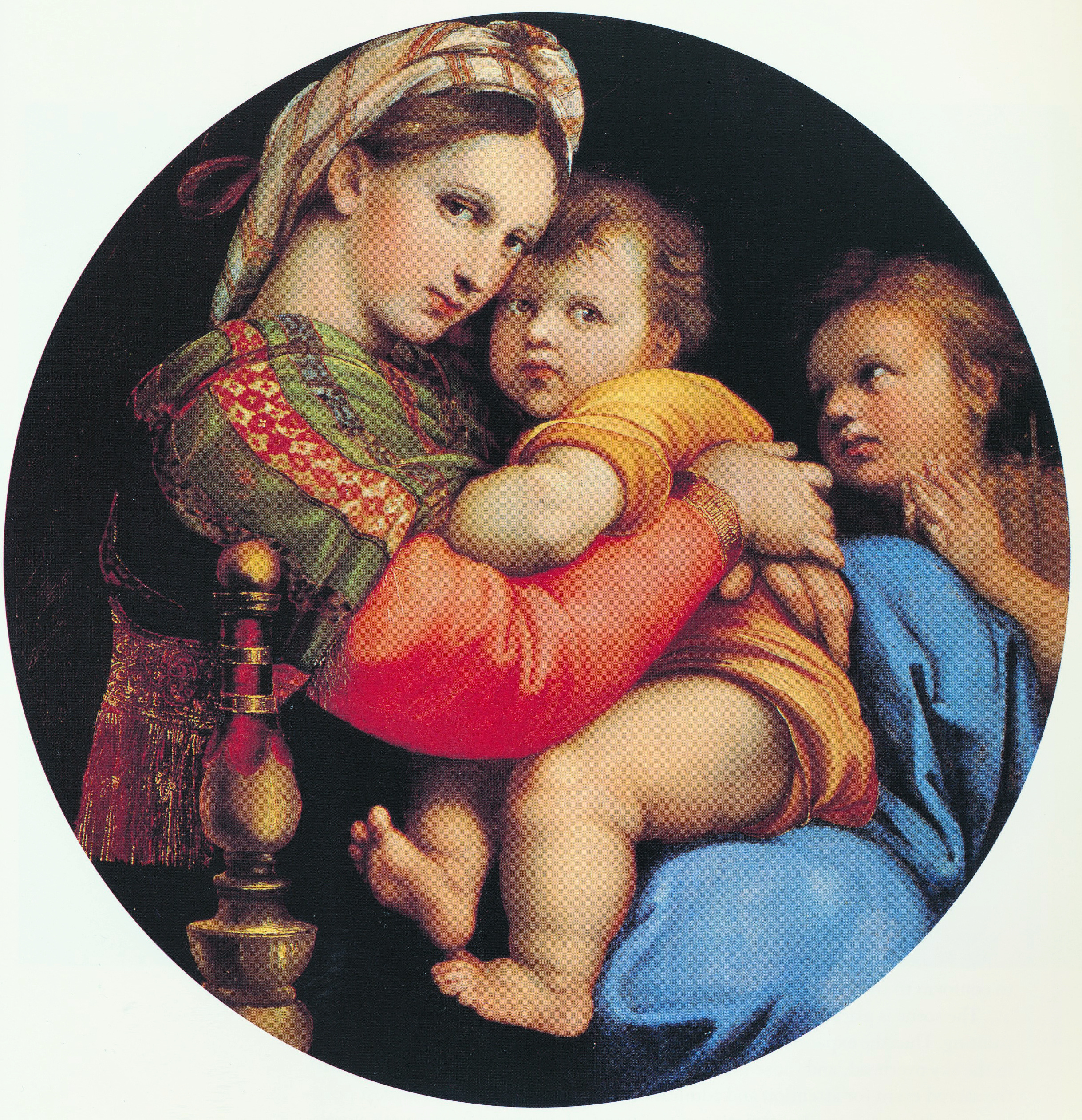
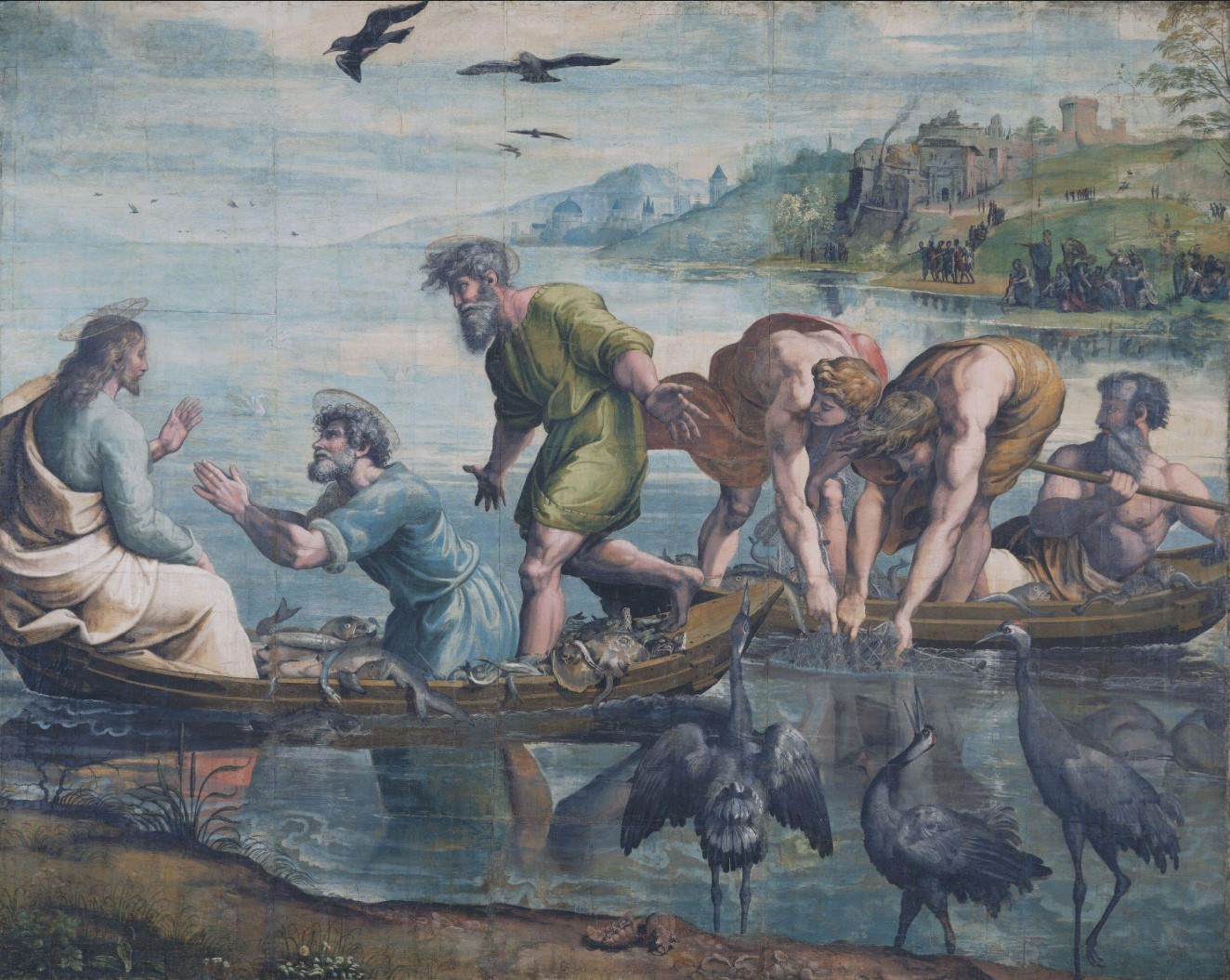
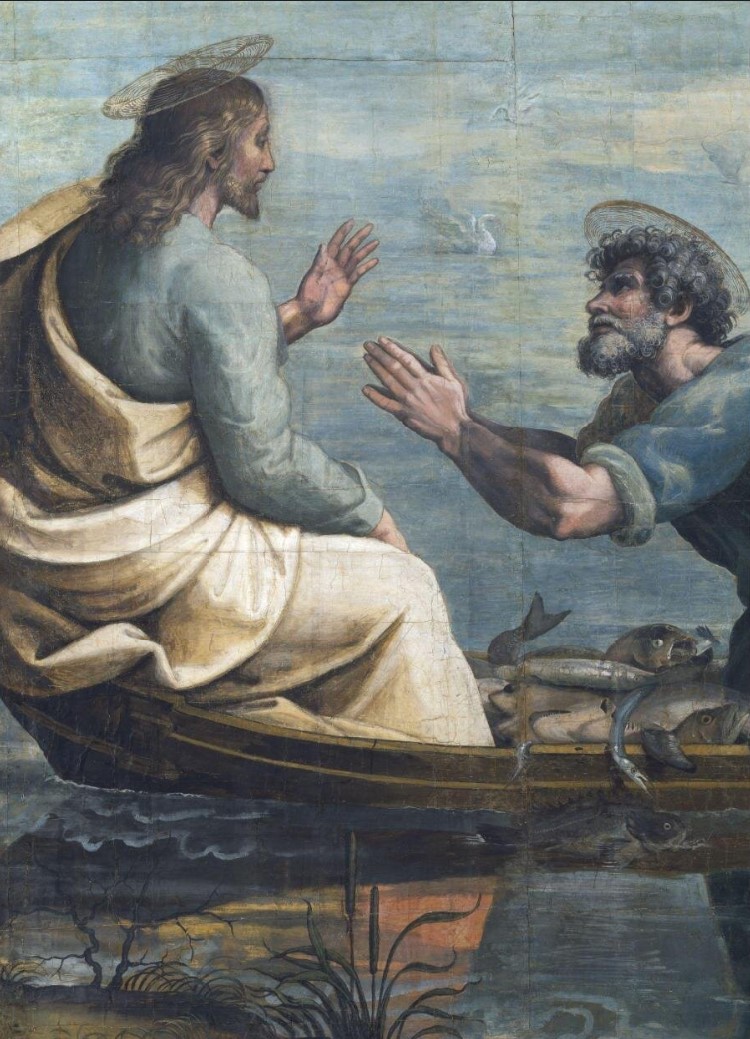
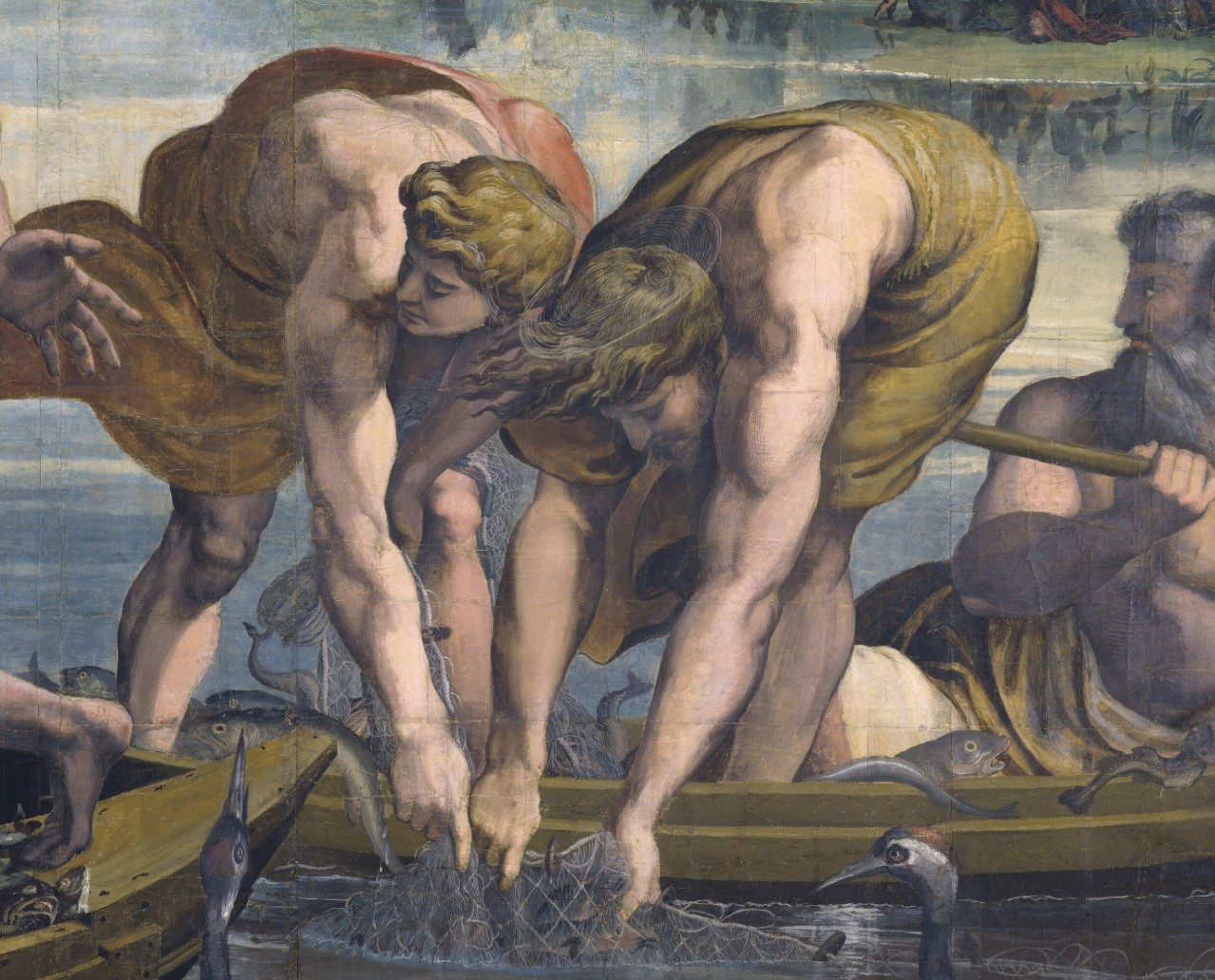
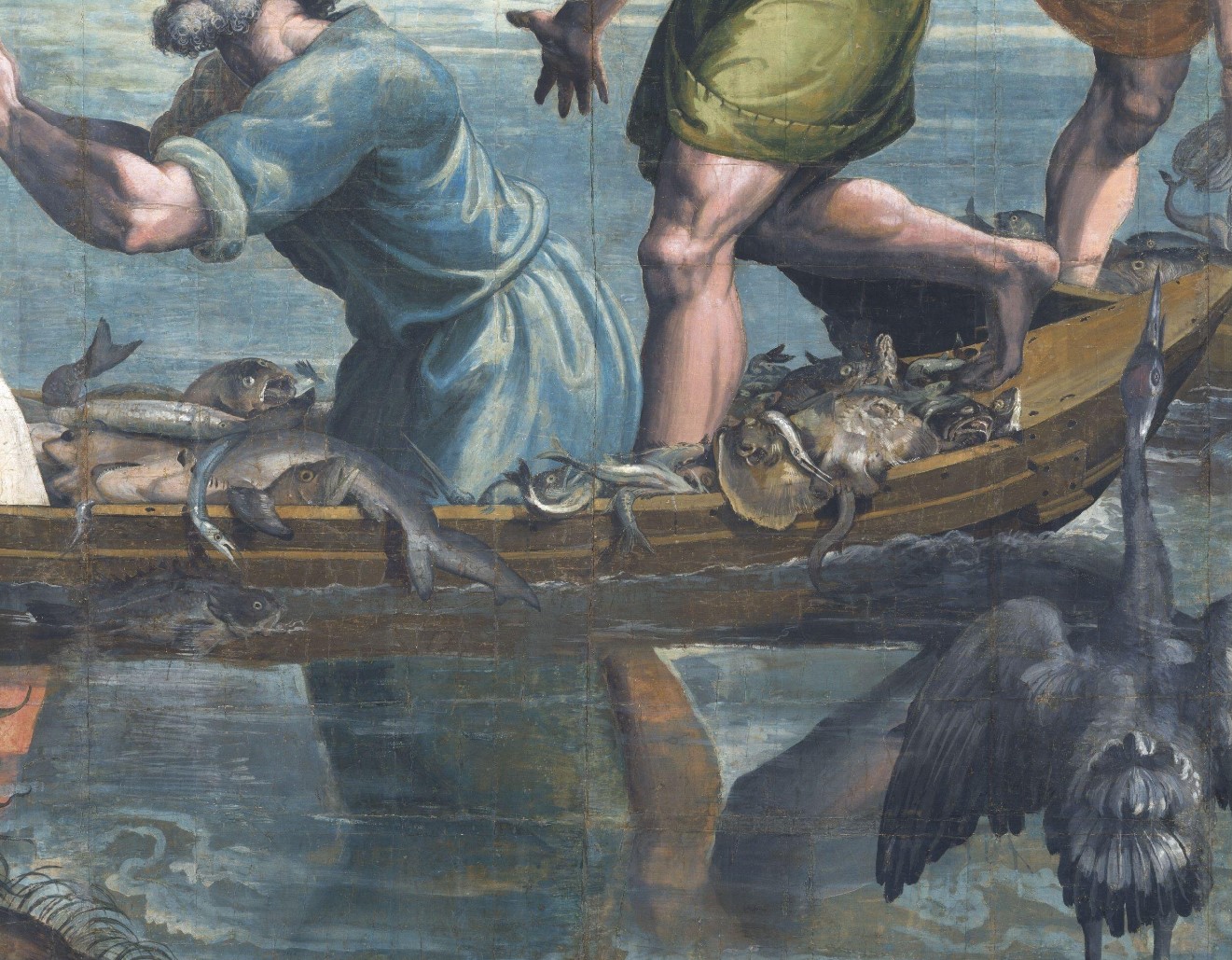
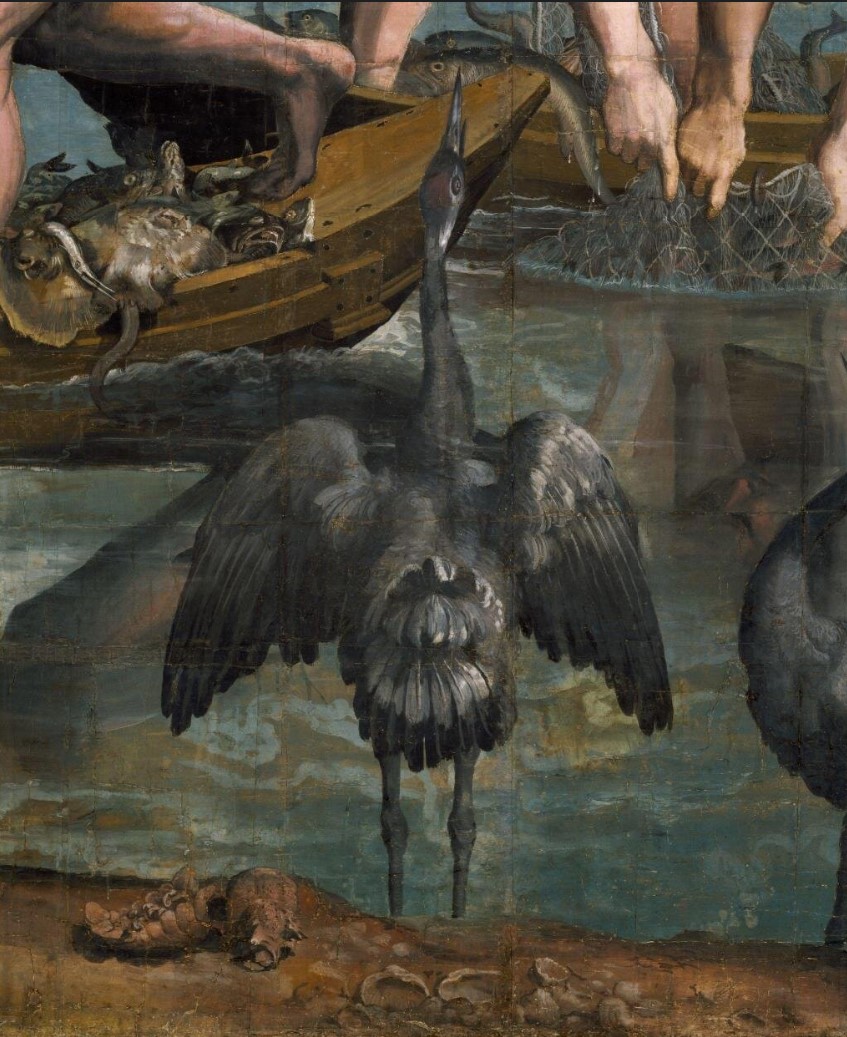
Raphael, the Fire in the Borgo, 1514-15, fresco, 22’1″ at base, Stanza dell’ Incendio, Vatican, Rome. DETAIL.Raphael, Madonna della Sedia (The Madonna of the Chair), 1514-15, Oil on Panel, diameter 28” Pitti Gallery, Florence.Raphael, Portrait of a Nude woman (“Fornarina”), oil on panel, c. 1518, 85 x 80cm, galleria Nazionale ( Palazzo Barberini), Rome.Raphael, The Miraculous Draught of Fishes (Luke 5: 1-11), 1514-15, Tempera on paper, 11’10” x 13’2” Victoria and Albert Museum, London
The Raphael Cartoons are designs for tapestries and were commissioned from Raphael by Pope Leo X (1513-21) shortly after his election in 1513. The tapestries were intended to hang in the Sistine Chapel in Rome, built by Pope Sixtus IV (1471-84). The decoration of the chapel under Sixtus addressed the lives of Moses and Christ. The tapestries continued this theme, illustrating scenes from the lives of St. Peter and St. Paul.
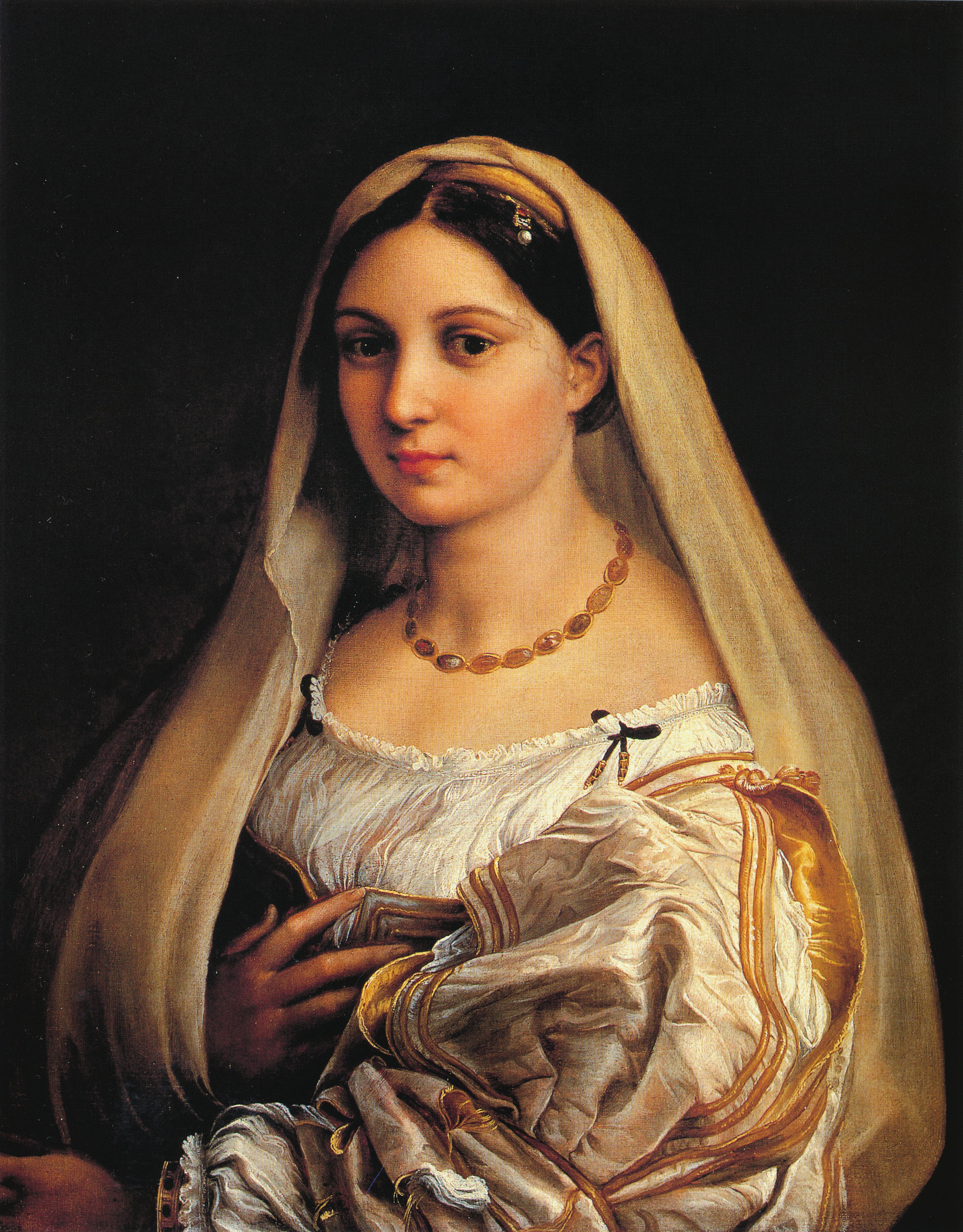
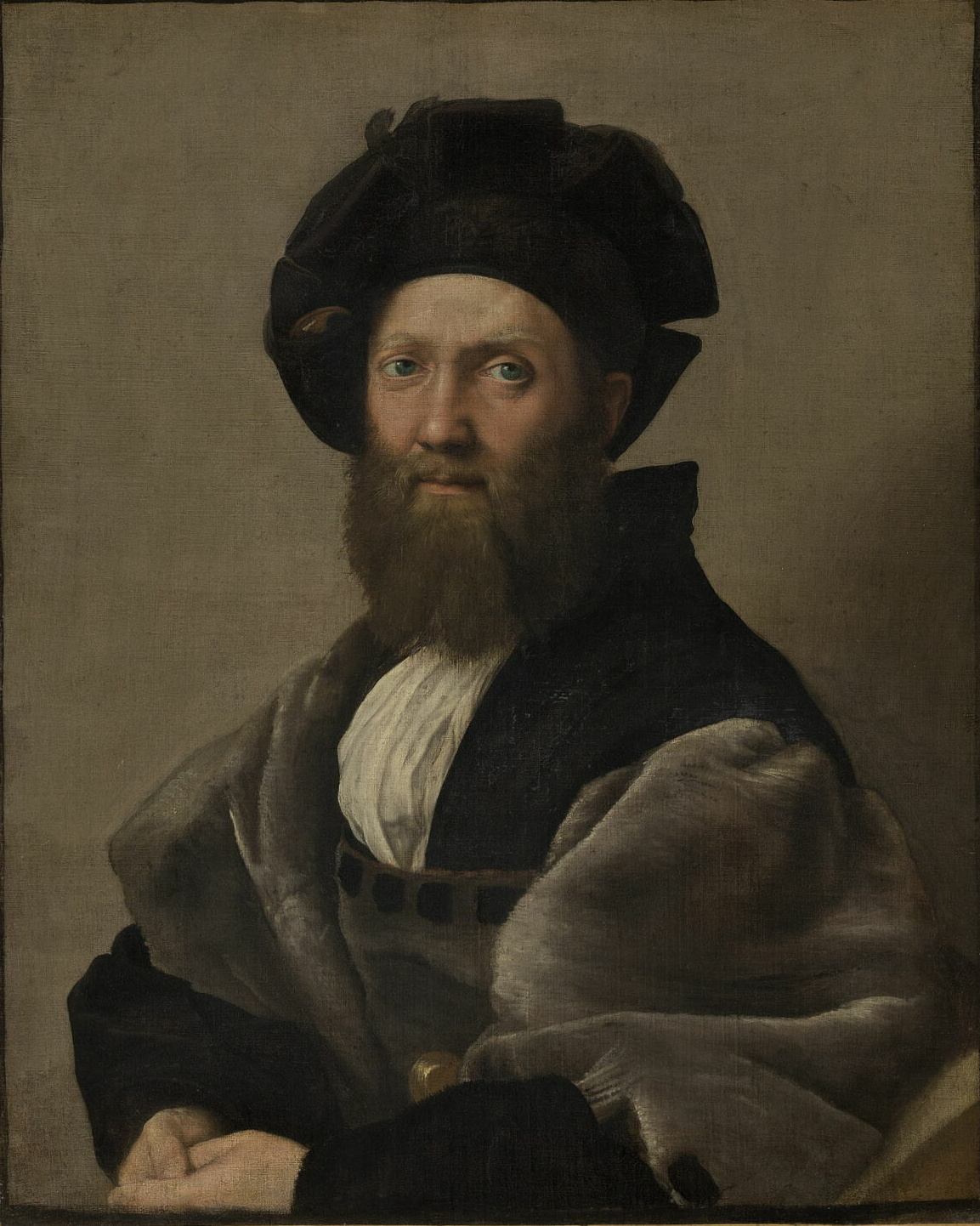
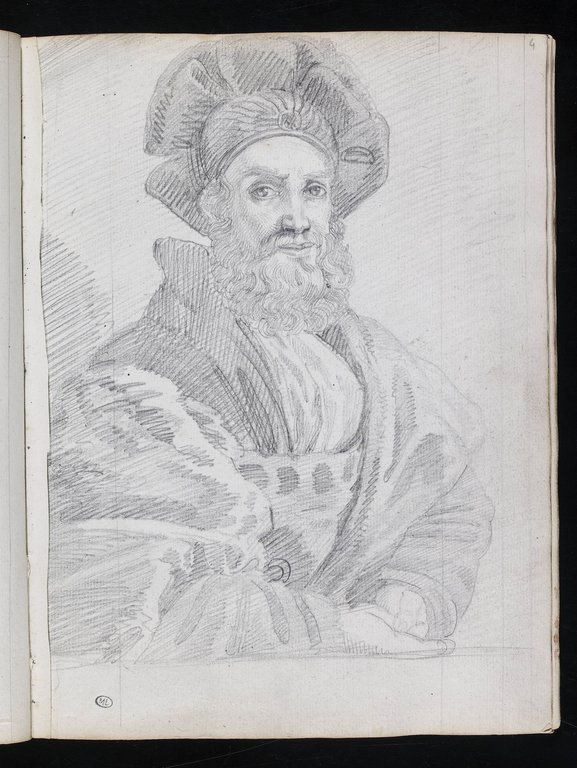
Raphael, La Donna Velata, c. 1514, oil on canvas, 33 ½ x 25 ¼” Pitti Gallery, Florence. Portrait of Baldassare Castiglione, c. 1515, oil on canvas, 32 ¼” x 26” the Louvre Paris https://collections.louvre.fr/en/ark:/53355/cl010066418 – retrieved September 4, 2024.Raphael’s artwork inspired making copies by many later artists. This is “Etude d’après le portrait de Balthazar Castiglione par Raphaël” by Eugène Delacroix, c. 1818/1820 in the Louvre. https://collections.louvre.fr/en/ark:/53355/cl020142954 – retrieved September 4, 2024.
In La Donna Velata and Portrait of Baldassare Castiglione, Raphael, the master portraitist, present near ideal depictions. Both portraits are of almost identical dimensions. The model Raphael used for La Donna Velata he used in other artworks of this period, including The Sistine Madonna. These mid 1510s’ portraits have progressively become gentler in their modeling than a tight, detailed study of corporeal features done before. Raphael begins a display of a mastery of forms and colors that had great influence on future artists such as Rubens and Rembrandt. However, Raphael’s painting does not forgo his mastery of draughtmanship exampled in the female sitter’s sleeve or the overall nobility of the male sitter. (Beck, pp. 108-09; 116-17).
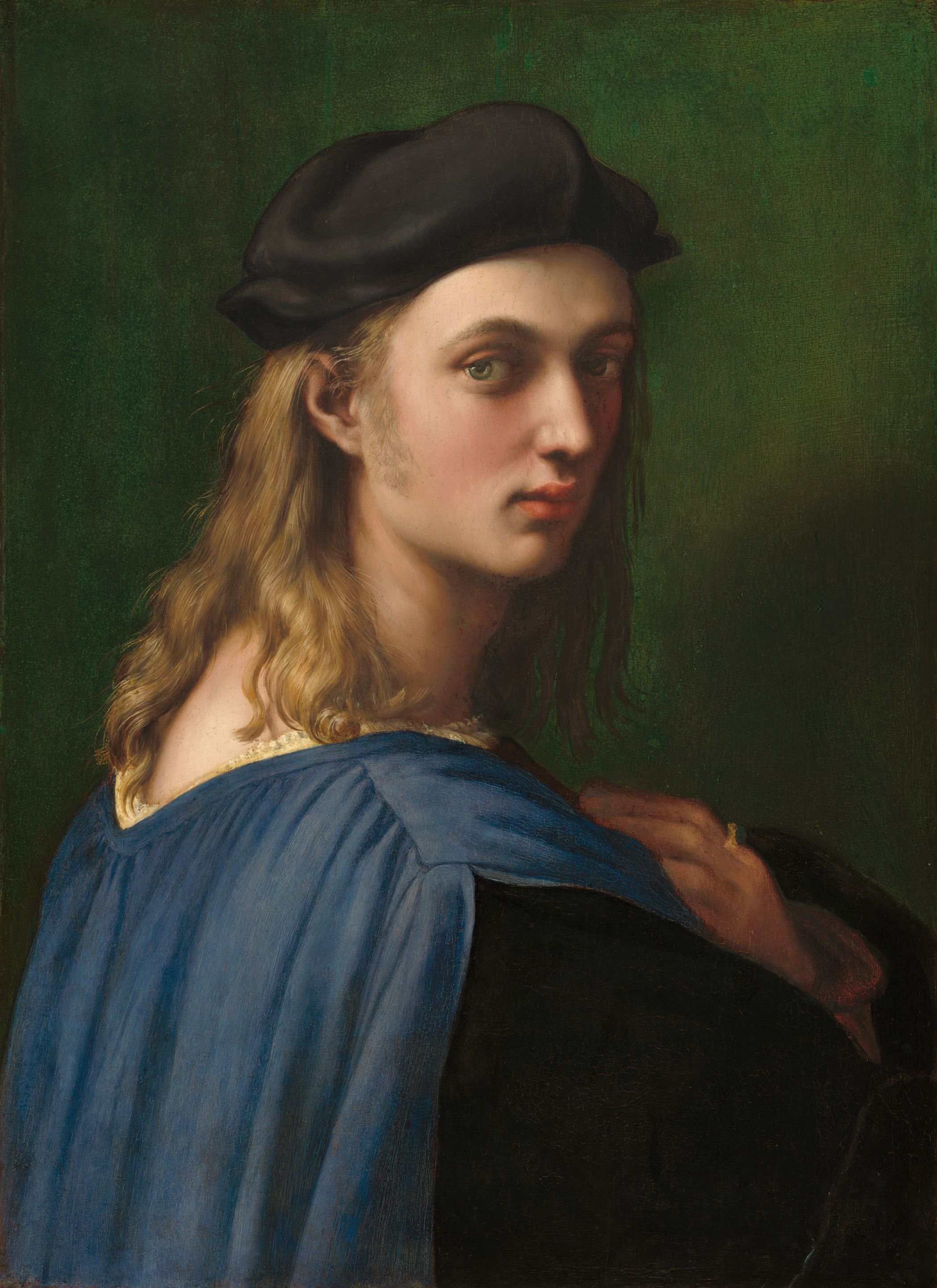
Raphael. Portrait of Bindo Altoviti c. 1515:Oil on panel 59,7 x 43,8 (24 in × 17 in), National Gallery of Art of Washington, D.C. https://www.nga.gov/collection/art-object-page.12131.html – retrieved September 5, 2024.Raphael, The Way to Calvary (Lo Spasimo), 1516-17, oil on canvas, 10 ½ x 7’ 6 1/2” The Prado Madrid.
Raphael, Portrait of Leo X and Two cardinals, 1517-18, oil on panel, 60 5/8 x 46 7/8” Uffizi Gallery Florence
This was an important group portrait commission for Raphael: the current Pope Leo X Medici (1513-1521) seated by his cousins, Cardinals Giulio de’ Medici on the left and Luigi de’ Rossi on the right. Giulio de’ Medici was soon to become the future pope Clement VII (1523-1534). Though highly individualized, Raphael captures a family resemblance between these three Medici – then the most powerful family in Italy – who are all about the same age. In 1517 Cardinal Giulio was an important art patron and already commissioned Raphael to do The Transfiguration, his last painting. Raphael demonstrates a wide range of artistic experience and skills so that he pulls from his tool-box whatever is required for a successful outcome of any commission. In Urbino Raphael had been exposed to Flemish art and deploys its detailed technique in the bell and manuscript which 42-year-old Leo X uses a magnifier to see. The setting of the monumental portrait, in a room in the Vatican, is subtly captured by way of Flemish art ingenuity. The doorknob in front of newly-made cardinal Luigi de’ Rossi shows the reflection of an open window while the cape and biretta of the pope are highly detailed by the artist in its natural light. The Portrait of Leo X and Two Cardinals is considered the greatest group portrait of the 16th century. (Beck, pp. 120-121)
This painting was commissioned by Giovanni Branconio, the Apostolic Protonotary, at the behest of his father, Marino Branconio, for the family chapel at the church of San Silvestre de Aquila. Marino´s choice of subject matter was undoubtedly guided by the fact that his wife was named Elizabeth and his son, John. In 1655, this work was acquired by Felipe IV (1605-1665), who deposited it at El Escorial. It entered the Prado Museum in 1837.
Raphael, The Holy Family of Francis I. 1518 Oil on canvas 81 ½ x 55 1/8” The Louvre Paris.Raphael, The Transfiguration, 1518-20, oil on panel, 13’3 ¾ x 9’1 ½” Pinacoteca, Vatican, Rome.
Raphael died in April 1520 while working on The Transfiguration. Although most of the painting was already complete, his sudden passing marked the abrupt end of a brilliant but short career—Raphael was only 37 years old. Cardinal Giulio de’ Medici, the future Pope Clement VII, had commissioned the work for the Cathedral of Narbonne in France, but following the artist’s untimely death, it was instead displayed at his funeral in the Pantheon.
During its creation, the project was fueled by intense artistic rivalry. Sebastiano del Piombo, who was mentored by Michelangelo in Florence, was simultaneously producing The Raising of Lazarus for the exact same cathedral, creating a direct competition for Raphael’s work. Today, Sebastiano’s anxious letters to Michelangelo serve as our primary historical record for the progress and development of Raphael’s painting.
Initially, Raphael planned to depict only the mountaintop Transfiguration. This episode is detailed in the Synoptic Gospels but completely omitted from the Gospel of John. This omission is particularly notable because Matthew, Mark, and Luke all record that John was personally present for the magnificent event, alongside Peter and James the Greater. Ultimately, John’s omission makes thematic sense: while the Synoptic writers use the Transfiguration as a dramatic, mid-narrative revelation of Jesus’s heavenly nature, John’s entire Gospel establishes that exact divine premise right from its opening verses.
Raphael’s depiction ultimately became the definitive template for how the event on Mount Tabor has been popularly imagined ever since. He captured Christ rising majestically into the air, His face and clothes turned a dazzling white, elevated above Moses and Elijah, whom the Gospels describe Jesus as being in conversation with. Below them, the three chosen Apostles careen in various prostrations of overwhelming wonderment, shielding themselves from the brilliant light.
Raphael famously expanded the traditional scene to include the scriptural episode that immediately follows: the story of a demoniac boy whom the remaining Apostles fail to heal. In the biblical account, Christ descends the mountain after His transfiguration and cures the child, who appears here frantically gesturing in the lower right corner. In the composition, the divine peace of the Transfiguration sits elevated and farther back from this earthly, chaotic turmoil below. On the left side of the canvas, two figures—identified as the patron saints of Narbonne—can be seen making their way up the mountain to pay homage.
This inclusion was a nod to the patrons, if not a guarantee of Raphael’s full fee. As the Renaissance biographer Giorgio Vasari famously noted, Raphael lived more like a prince than a painter. His lifestyle was expensive, and Giulio Romano, one of Raphael’s chief artistic and financial heirs, eventually had to sue the benefactors in 1522 to secure the final payment for the masterpiece.
Debate continues among art historians over exactly how much of Raphael’s studio executed the final canvas, particularly in the wake of his sudden death. Even so, it is clear the workshop assisted extensively during Raphael’s lifetime, as his highly productive working method required. Nevertheless, the core invention, the preparatory drawings, and the vast majority of the brushwork were distinctly Raphael’s own. Art historians Roger Jones and Nicholas Penny note that for this final painting, Raphael looked back to the very beginning of his career, modeling many of the expressive heads in The Transfiguration after Leonardo da Vinci’s unfinished 1481 masterpiece, The Adoration of the Magi.
Just as in the Gospel narrative, light drives the artistic coloration, invention, and emotion of the painting. A blinding, heavenly radiance engulfs Peter, James, and John at the top, while a second, much sharper earthly light isolates the expressive faces, hands, and frantic gestures from deep shadows below. This complex illumination and intense contrast became an essential touchstone for later, highly influential Baroque painters, most notably Caravaggio. Vasari remarkably notes that when Raphael passed away, the loss plunged the entire papal court into deep, unmitigated grief, so much so that the Pope quite openly and bitterly wept at the tragic passing of this noble craftsman.
FOOTNOTES:
1. Giorgio Vasari, Lives of the Artists, translated by George Bull (Penguin Books, Harmondsworth, Middlesex, England, 1965) pages 316-18.
2. Ibid., page 318 and Edizioni Musei Vaticani, Michelangelo and Raphael in the Vatican, (Tipografia Vaticana, Città del Vaticano, 1995) page 169.
3. Vasari, Lives, pages 285 and 291.
4. Ibid., pages 299-302.
5. Roger Jones and Nicholas Penny, Raphael, Yale University Press, New Haven and London, 1983, page 113 and 17. Carlo Ludivico, Vatican Museums Rome, page 119
6. Roger Jones and Nicholas Penny, Raphael, Yale University Press, New Haven and London, 1983, page 117 and Vasari, Lives, page 301.
7. Frederick Hartt, History of Italian Renaissance Art: Painting, Sculpture, Architecture, Harry N. Abrams, Inc. New York, Third Edition, 1987, page 513.
8. New American Bible, (Catholic Book Publishing Company, New York) page 546 and 550; Beck, Raphael, page 98.
BIBLIOGRAPHY:
Brera Milan Great Museums of the World, Carlo Ludovico Ragghianti, Newsweek NY 1970 pp. 34
Pinakothek Munich Great Museums of the World, Roberto Salvini, et. al., Newsweek NY 1969 pp. 126
Lives of the Artists, Giorgio Vasari, translated by George Bull, Penguin Books, Harmondsworth, Middlesex, England, 1965, pages 316-18
Michelangelo and Raphael in the Vatican, Edizioni Musei Vaticani, Tipografia Vaticana, Città del Vaticano, 1995 p. 169
Raffaello. Franzese, Paolo (2008). Milano: Mondadori Arte.
Raphael, James H. Beck, harry N. Abrams, Inc., Publishers, New York, 1994.
Raphael, Roger Jones and Nicholas Penny, Yale University Press, New Haven and London, 1983.
Encyclopedia of the Middle Ages, Volume 2, André Vauchez, Richard Barrie Dobson, Michael Lapidge, Chicago: Fitzroy, Dearborn, 2000.
History of Italian Renaissance Art: Painting, Sculpture, Architecture, Frederick Hartt, Harry N. Abrams, Inc. New York, Third Edition, 1987.
Raphael, Beck, James H., Harry N. Abrams, Inc. Publishers, New York, 1994.
The Medici Popes (Leo X and Clement VII), Herbert M. Vaughan, B.A., Methuen & Co., London, 1908.
“Alidosi, Francesco, detto il Cardinal di Pavia”. Dizionario Biografico degli Italiani – Volume 2. Treccani. 1960.
This explanatory article may be periodically updated.
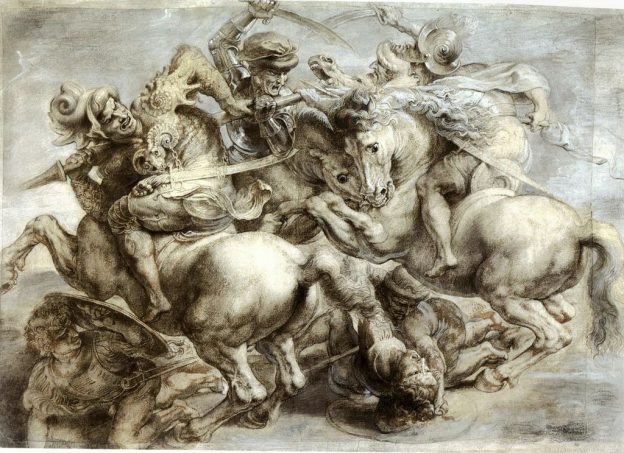
FEATURE image: Peter Paul Rubens, Copy of Leonardo’s Battle of the Standard (from the Battle of Anghiari), 1603, Louvre.
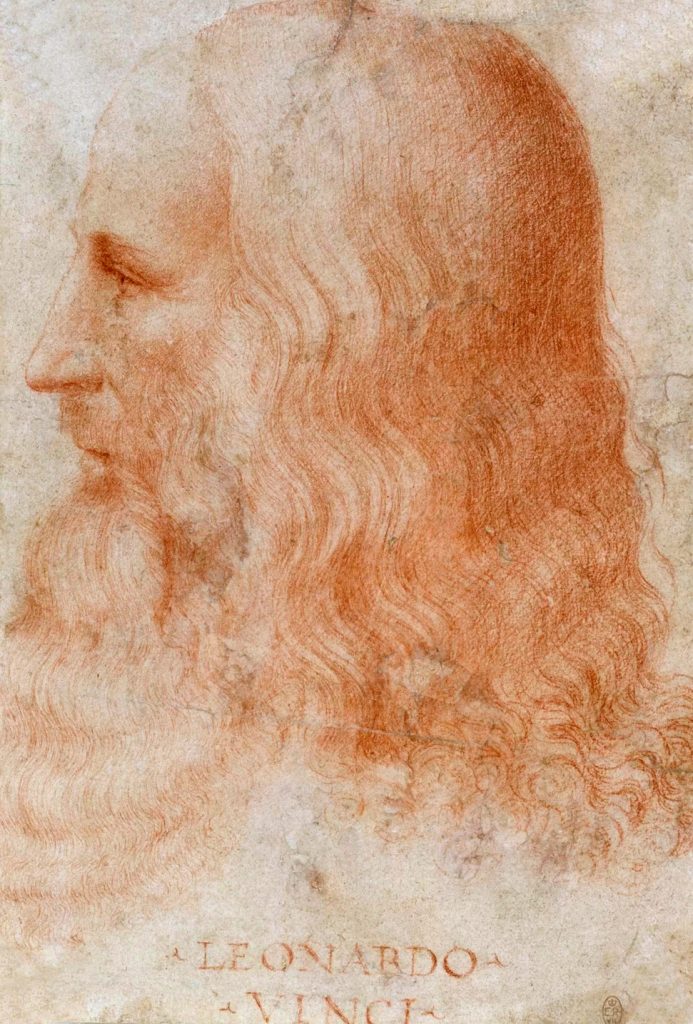
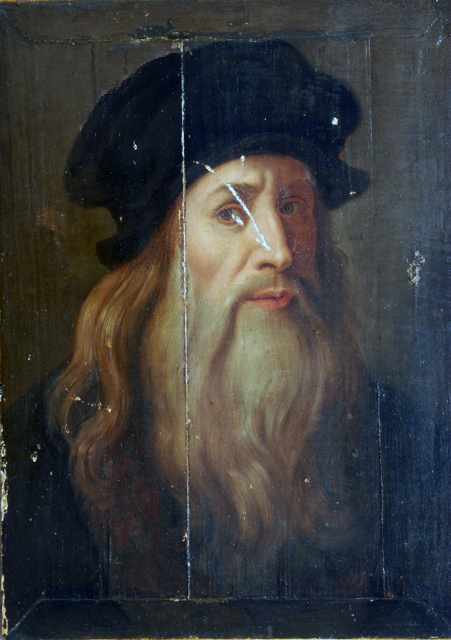
Profile Portrait of Leonardo da Vinci, attributed to Francesco Melzi, circa 1515–1517, Royal Trust Collection.
On May 2, 2019,
the world remembered the day 500 years ago when Leonardo da Vinci (1452-1519),
Italian Renaissance artist and polymath, died. The 67-year-old applied the
spheres of the human brain to its many branches of knowledge and voraciously
fused his interests and studies into one lifetime that inspired universal
learning in Europe.
Leonardo da Vinci made original contributions as an inventor, draftsman, painter, sculptor, architect, scientist, musician, mathematician, engineer, writer, anatomist, geologist, astronomer, botanist, paleontologist and cartographer.1Leonardo was involved in military science, hydraulics, aerodynamics, and optics. Used by princes and admired by kings, charming and handsome Leonardo da Vinci could show in his notebooks that he was often misanthropic.2 A significant part of his important visionary achievements is that Leonardo da Vinci painted two of the most reproduced artistic masterpieces of all time: the Mona Lisa (1503, Louvre, Paris) and The Last Supper (1490s, Convent of Santa Maria delle Grazie, Milan). Leonardo, after a lifetime of adventure, curiosity, and solid achievement died in Amboise, France, following a short illness.
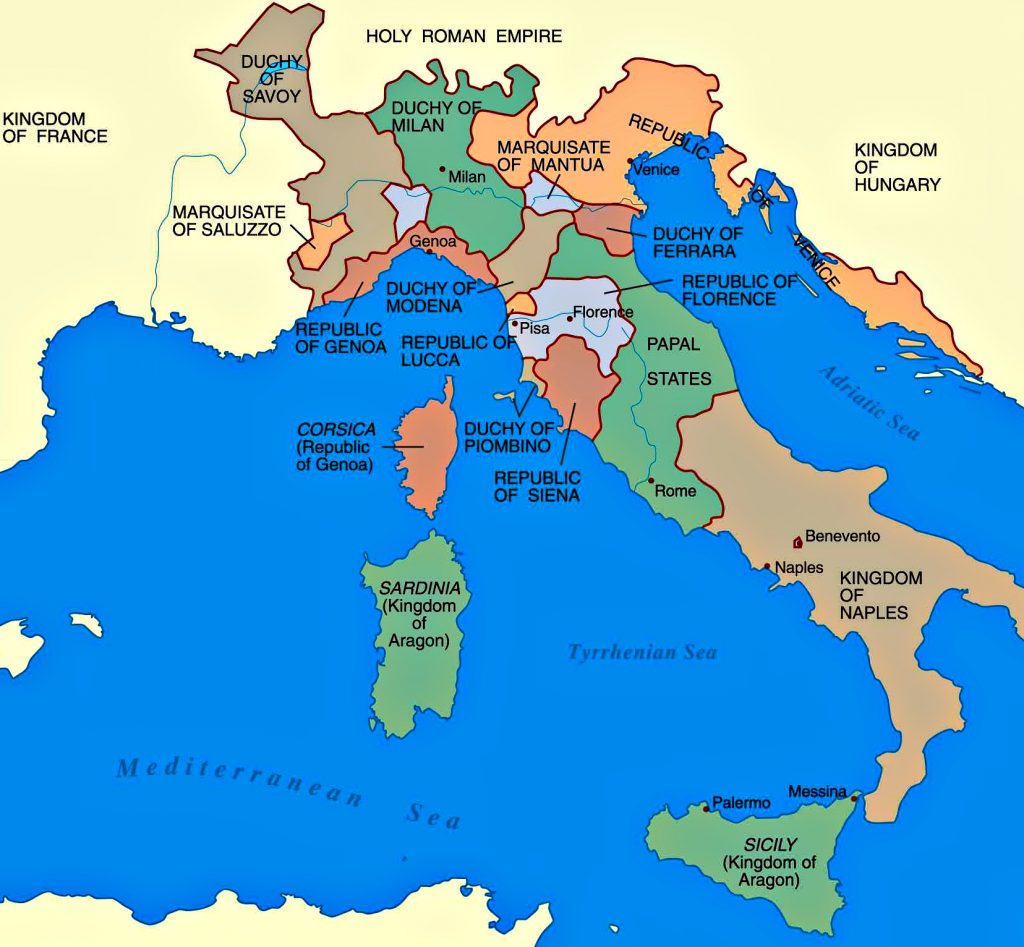
Italy, c. 1500.
In 1516 Leonardo left Italy for the first time to live in France under the protection of its most cultured young French king, François I (1494-1547). As a dedicated artist, Leonardo experienced a lifetime of disappointment from most of his would-be patrons starting with his father through to Lorenzo de’ Medici, the Magnificent (1449-1492), hapless Milanese duke Ludovico Sforza (1452-1508), Milanese governor Charles II d’Amboise (1473-1511), and Lorenzo’s son and a papal brother, Giuliano di Lorenzo de’ Medici (1479-1516), among others. As Leonardo was ahead of his times it can be said that only at the end of the artist’s life—in 1516, under the wing of François I—that the bulk of his times, that is, the temporarily powerful men in them, had failed him and mankind’s enduring greatness. François I was Leonardo’s first unconditional patron3—while the rest, relatively speaking, are history’s minor players.
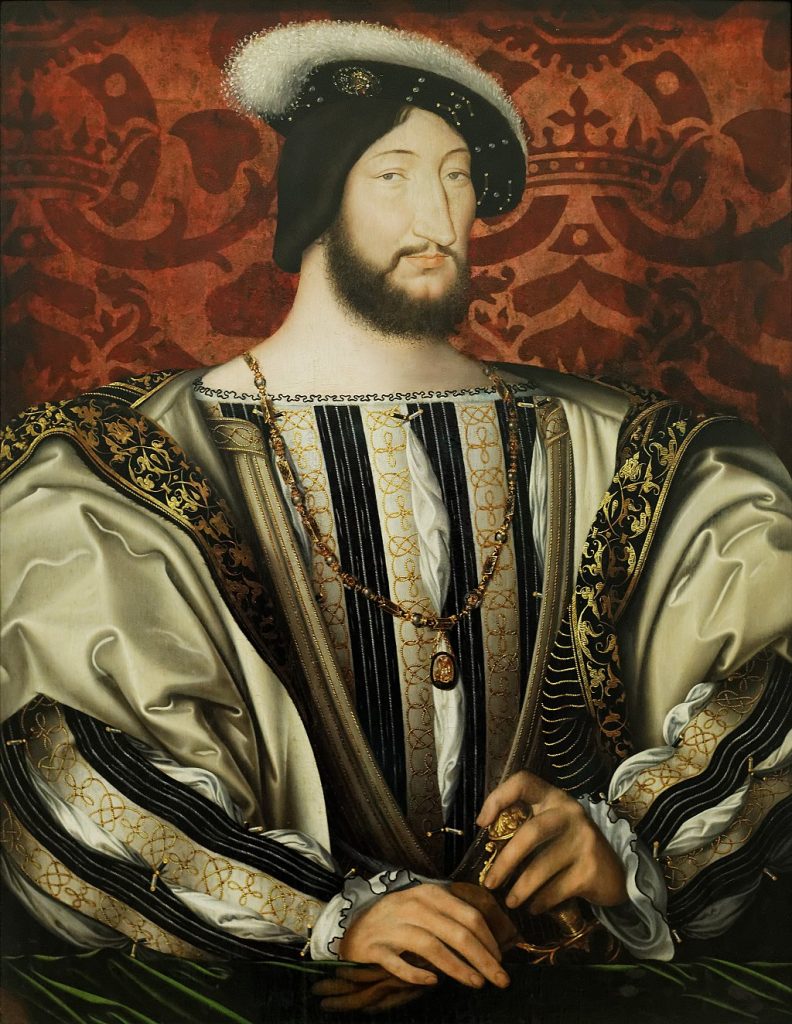
François I, Jean Clouet, c. 1530. Louvre, Paris. Lorenzo the Magnificent, Agnolo Bronzino (1503-1572), Uffizi, Florence, Italy. Ludovico Sforza (detail), Master of the Pala Sforzesca, c.1495, Pinacoteca di Brera, Milan, Italy. Charles II d’Amboise, Andrea Solario, 1507. Giuliano de’ Medici, Raphael.
At Leonardo’s
death his reputation as an artist and man rested, as Giorgio Vasari (1511-1574)
relates, on his physical strength, generosity, and artistic innovations which
brought art and society out of its reliance on the past and its well-intentioned
model books into a future of science and art which characterized the best of
the Renaissance period. Because of Leonardo’s lifetime of study and work, mostly
in isolation from a majority of his fellow artists’ and other practitioners’
careers, he bore the fruit of innovation, including new and creative forms and
motifs for art. These emanated out of the imagination of the individual artist who
closely observed the workings of nature. Leonardo’s artistic innovations
included the subtle skill of sfumato
(shadowing) and, as a draughtsman, progressive chalk and cross-hatching
techniques. These inspired other great artists, like Michelangelo Buonarroti
(1475-1564), and only begins to account for the knowledge Leonardo gained from
the physical sciences, particularly anatomy.
Leonardo spent his final three years in Italy in the Vatican (1513-1516), effectively a refuge from petty Italian tyrants. He departed for France in 1516 under the protection of its warrior and cultured 21-year-old new king, François I, whom 64-year-old Leonardo first met in late 15154. Like his cousin and father-in-law predecessor King Louis XII of France (1462-1515) and his cultured mother Louise de Savoie (1476-1531), François I worked hard to recruit the Italian High Renaissance’s most inventive artist for the Gallic Kingdom. When Leonardo finally crossed the Alps he carried with him his recent paintings of the Mona Lisa, Saint John the Baptist, and the Virgin and Child with Saint Anne—all works in the Louvre in Paris today.5 In the second edition of Vasari’s Lives of the Artists6 he described Leonardo in his last months of life in France. In 1519, after a happy period in France at the Château de Cloux, Leonardo was a sick and bedridden man. At the very end, Vasari writes, Leonardo “could not stand [and had to be] supported by his friends and servants.”7. The King paid Leonardo “affectionate visits” in these last days. Vasari intimates that the dying artist consciously felt himself honored to be ministered to by François I Vasari and that Leonardo realized the distinct privilege to “[breathe] his last in [the king’s] arms.”8 This death bed scene, particularly Vasari’s tender detail, has been subsequently imagined in the artwork of artists, including Ingres’ famous painting dated 1818 in the collection of the Petit Palais in Paris.
Louis XII of France, Workshop of Jean Perréal, c. 1514. Cousin and father-in-law of François I Louis admired and collected Leonardo and passed down this admiration to France. Bemberg fondation Toulouse – Portrait de Louise de Savoie, mère de François Ier – École De Jean Clouet (1475;1485-1540) 22×17 Inv.1013
The mother of François I, Louise de Savoie (above), worked hard to convince Leonardo to leave Italy for France.
Leonardo carried with him over the Alps to France three of his recent paintings (above) – Mona Lisa (1503), Saint John the Baptist (1513), and the Virgin and Child with Saint Anne (1503). All are in the Louvre today.
Châteaux de Cloux (Clos Lucé), Amboise, France.Leonardo’s room, Châteaux de Cloux.Death of Leonardo, Cesare Mussini (1804-1888).Death of Leonardo, pencil, 11 x 8½ in. (28 x 21.8 cm.), Jean-Auguste-Dominique Ingres (1780-1867).Death Of Leonardo da Vinci, 1818, oil on canvas, Jean-Auguste-Dominique Ingres, Petit Palais, Paris.
Ink consecrated to the artistry of Leonardo da Vinci is vast. The Bible-like exhibition catalog for Leonardo da Vinci, Master Draftsman from the 2003 show at The Metropolitan Museum of Art in New York City is a 786-page testament. That tome presents and discusses about 100 drawings by the master. This article focuses on one image – Leonardo’s Battle of Anghiari, particularly its central section called the Battle of The Standard.
In October 1503 Leonardo’s commission by the Florentine Republic was to commemorate the military victory of the Florentines over the Milanese in 1440. It would be one of the major artworks in the newly-built Sala de Gran Consiglio (Grand Council Hall) by IL Cronaca (“The Chronicler”) to the rear of the Palazzo della Signoria, also known as the Palazzo Vecchio.9 The commission was given to Leonardo by Republican standard-bearer Piero Soderini (1450-1522) with one of Leonardo’s contracts signed by Niccolò Machiavelli (1469-1527)—and so entered into the annals of what became a fabled art competition (“concorrenza”).
Ink consecrated to Leonardo da Vinci’s art is vast.
View of Florence (detail, Arno River, Palazzo Vecchio, Duomo), c. 1561, Giorgio Vasari.Piero Soderini (1450-1522) by Ridolfo del Ghirlandaio.
Statesman Piero Soderini of the Florentine Republic awarded Leonardo the mural commission for the Battle of Anghiari in October 1503.
Today’s Salone dei Cinquecento by Giorgio Vasari, 1563-1572.
In the process of re-decorating this room with its coffered ceiling and walls with paintings of battle scenes dedicated to the exaltation of Cosimo I de’ Medici, Leonardo da Vinci’s innovative fresco of the Battle of Anghiari was lost or destroyed.
Battle of Marciano by Giorgio Vasari, 1571, Palazzo Vecchio, Florence, Italy.Peter Paul Rubens’ copy of 1603 of the lost Battle for the Standard.
Peter Paul Rubens’ copy of 1603 of the lost Battle for the Standard, the central section of the Battle of Anghiari fresco by Leonardo, 1503-06, in Palazzo della Signoria (also, Palazzo Vecchio) in Florence. While Rubens’ copy is the best known, there are copies of Leonardo’s work by other 16th century artists.
After Leonardo Da Vinci, Fight For the Standard (from the Battle of Anghiari), oil on canvas, 28.625 x 33.125 in. (72.8 x 84 cm).After Leonardo Da Vinci, Fight For the Standard (from the Battle of Anghiari) oil on canvas, 16th century, Museo Horne, Florence.
In 1503 Leonardo da Vinci was at the height of his artistic powers. The
Battle
of Anghiari was a commission for a large scale, complex and dramatic fresco mural
on one wall of the Sala de Gran Consiglio in Florence during
the short-lived restored Republic (c.1492-1512). Leonardo looked to paint the fresco
in dazzling oils and glazes but his complicated experimental techniques to
adhere the pigment to the wall largely failed.10 With the fresco’s ultimate destruction in the early 1560’s
under Vasari who redecorated the Great Council Hall with six of his own massive
battle scenes, he and his Medici rulers were faced with another of Leonardo’s
deteriorating frescos similar to the disastrous flaking of The Last Supper in Milan. The Battle of
Anghiari was not in an obscure
monastery refectory but the central hall of changing political power in
Florence.11
Leonardo’s Last Supper, Santa Maria delle Grazie, Milan.
Leonardo’s Last Supper fresco in Milan started flaking almost as soon as it was painted in the 1490’s. Leonardo’s experimental painting techniques for that project had largely failed.
Fragmentary remains by Leonardo of his Florentine project are his preparatory
drawings whose subjects include horses, riders, and combatants on the
battlefield in various stages of creative development. Some of these drawings
were made by Leonardo immediately upon receiving his commission in late 1503.12
Several copies and copies of copies made by other artists also survive. While
the preparatory drawings do not complete the full composition— though
contemporary written sources lend credence to books of sketches that are lost13—Leonardo
possibly did not even complete a cartoon before he started painting on the
wall.14 While copies by others
intrigue, they are problematic to envision Leonardo’s final fresco of the Battle
of Anghiari—yet each of these sources provide insights.
The Battle of Anghiari is arguably Leonardo’s most important
public commission.15 It manifested itself in the context of
impactful local history, civic pride, city government, and the artist’s own
vision and skills in its employ. Florence was Leonardo’s native city and he
wanted to make a strong impression. Sixty years after Leonardo left his
brilliant fresco on the west wall.16 Vasari,
whose redecoration of the Palazzo Vecchio included a fresco cycle of his own almost
certainly covered over all or part of Leonardo’s unfinished fresco. A desire
for new artwork to showcase the Medici restoration under Cosimo I de’ Medici
(1519-1574) naturally extended to the Grand Council Hall. The late-fifteenth-century
Republic had commissioned Leonard’s battle fresco—and that form of government
had ended in Florence in 1512.
Portrait of Cosimo I de’ Medici, 1535, Alessandro Allori (1536-1607), oil on poplar, 86 x 65 cm (34 x 25 5/8 in.), Florence.
Cosimo I de’ Medici (1519 -1574) ruled Florence from 1537 until his death.
Cosimo I de’ Medici (detail), c. 1564, by Giorgio Vasari, Palazzo Vecchio, Florence.
As Vasari
relates in his Lives of the Artists, Leonardo depicted a scene from the
life of Niccolò Piccinino (1386-1444), an Italian mercenary officer or “condottiere”
in the service of the politically brilliant and physically repulsive duke of
Milan, Filippo Maria Visconti (1392-1447). Fighting for Milan, Piccinino—aided
by two score of cavalry squadron, many foot soldiers17and
treacherous Florentine exiles—was defeated by a force led by the Republic of
Florence under Francesco I Sforza
(1401-1466). The victory at the Battle of Anghiari on June 29, 1440 handed the
Florentines domination of central Italy. At the turn of the sixteenth century
the new republic of Florence continued to face warring tyrants as neighbors
including Cesare Borgia (1475-1507). At the start of a new century and Republic
the timing was ripe to depict in its government hall valorous Florentine
warriors defeating political enemies. In 1503, Florentine officials gave
Leonardo an in-depth orientation of the 1440 battle using historical texts but
the artist brushed these aside as he conceived the scene to be depicted, a
virtually cinematic induction of the battle’s climax —the mortal contest by the
Florentines to capture the standard from the Milanese. Leonardo’s first sketches
for it are of a condensed melée full of the swirling movement and
stirring sensations of battle.18 The actual standards taken during
the battle had been kept in the Grand Council Hall as a trophy.19
Niccolò Piccinino. Defeated at the Battle of Anghiari, the Italian mercenary becomes the central protagonist of Leonardo’s fresco.
Front (Recto) of a medal of Duke of Milan, Filippo Maria Visconti, by Pisanello (1395-1455).
Local battles such as the Battle of Anghiari were usually
part of larger campaigns— in this instance, The Lombardy Wars of 1423-1454— and
fought by hired warriors. Mercenaries usually provided terms to competing foes
that protected the mercenary’s best interest. Following the Battle of Anghiari,
Piccinino, who had been captured, was soon after released. In the next battle
at Martinengo, he defeated and captured Sforza. Because of these endless war
games, Niccolò Machiavelli (1469-1527)
advised in The Prince that
a ruler should not be tempted to use these swords for hire – and cited Francesco
Sforza by example.20
Mercenary Francesco Sforza, Pinacoteca di Brera, Milan.Niccolò Machiavelli by Santi di Tito (1536-1603).
Machiavelli, author of The Prince, signed an order to commission Leonardo to create the fresco commemorating the Battle of Anghiari for Florence’s newly-built Sala de Gran Consiglio (Grand Council Hall).
Leonardo’s sketches of probably Cesare Borgia.
Cosimo I de’ Medici who ruled Florence starting in 1547 was interested in that which supports power— including art. Vasari’s new paintings of Cosimo I de’ Medici’s wartime exploits was partly a political act. By ridding the hall of Leonardo’s Battle of Anghiari — a Republican military victory from long ago — Vasari worked his political masters’ desires. The ultimate reasons and fate of Leonardo’s artwork is not known but if Vasari destroyed the mural he would not be the first Italian artist to destroy a competitor’s artwork as shall be seen.
In late 1503 Leonardo, installed in a temporary workshop at Santa Maria Novella, about a fifteen-minute walk to the Palazzo, was given a deadline for the mural’s completion of February 1505. Like the fabled competition between Leonardo and Michelangelo that was intentionally arranged by Florence’s political operatives, the deadline for completion was also a demand for Leonardo’s art outside the artist’s concerns. The first late winter deadline passed as did those in spring and summer. Setbacks included Leonardo’s meticulously slow work, other projects he took up that kept him away from the fresco, and even bad weather.21
Santa Maria Novella, Florence.
Leonardo’s designated workshop for the mural commission was the Dominican church built in 1420, Santa Maria Novella.
In early 1504
the wall painting of the Battle of Anghiari and its 51-year-old artist
was joined by Michelangelo Buonarroti who would paint his Battle of Cascina
in the same room and possibly on the same wall. Michelangelo, recently turned
28 years old, would depict the Florentine military victory over Pisa in 1364.
Neither this imposed rivalry or proximity encouraged their friendship.22
Michelangelo was intense, pious, and unwashed contrasting to Leonardo’s genial,
independent, and stylish manner.23 However, their professional
relationship temporarily influenced each other’s artmaking.
Michelangelo, Self-Portrait.Leonardo da Vinci, (Lucan) Self-Portrait.
In 1504 and
1505, Michelangelo learned to use Leonardo’s innovative stylus cross-hatching
technique along with the chalk technique that Leonardo was continuing to exploit
in the Battle of Anghiari. Inspired by Michelangelo, Leonardo did
masterful drawings of nude figures though he did not use them. In
Michelangelo’s preparatory drawings for the Battle of Cascina—that and
copies by others are what survive of the project– the younger artist used
Leonardo’s cross hatching technique for the pull of the skin. He experimented
with Leonardo’s chalk technique to display types and degrees of muscular
tension on figures.24 Yet, according
to Vasari, the two clashed at almost every turn. Michelangelo’s use of
Leonardo’s advanced techniques was restricted to the short period of their
common commission and Leonardo openly disparaged Michelangelo’s cartoon of male
nude bathers as coldly analytical.25
Two Michelangelo chalk studies. ABOVE: Male Nude Seen From the Back With a Flag Staff, c. 1504, The Albertina Museum, Vienna. BELOW: Life Study for a bathing soldier in the lost cartoon for theBattle of Cascina, black chalk, 404 x 258 cm, Teylers Museum, Haarlem, The Netherlands.
Leonardo da Vinci, Anatomical Studies of the Nude, connected with the Battle of Anghiari, c. 1504, Royal Library, Windsor. Though influenced by Michelangelo’s nude drawings in this time, Leonardo’s design and imagery for his battle scene looked to invention and unexpected drama rather than the nude.
In spring 1505
Michelangelo’s cartoon was finished but his painting barely started—and the
younger artist left Florence for Rome. Michelangelo accepted the commission to
build the tomb of Pope Julius II (1443-1513) although it would not be completed
until 1545 and on a much-reduced scale. He returned to Florence the following
spring but was soon back in Rome to paint, between 1508 and 1512, the Sistine
Chapel ceiling. In 1506 Leonardo’s gradual departure for Milan, complete by
1508, began. Leonardo stayed in Milan until 1513 when he was invited by the
pope to the Vatican. Leonardo and Michelangelo had in Florence shared a common
commission from the Republic. Their two battle scenes presented, each in their
own way, a tangle of intertwined figures. Otherwise, each artist created compositions of varying subject matter and
style which proved seminal for art-making schools of the future. Leonardo’s
swirling horsemen in the Battle of
Anghiari inspired the Baroque
style and Michelangelo’s bathers in the Battle of Cascina
displayed a perfect template for Classicism. These two great artists also
shared, despite their age difference or varying temperaments, the fact that
neither of them completed their commissioned work.
Michelangelo, The Tomb of Pope Julius II, completed 1545, San Pietro in Vincoli, Rome.Michelangelo, Sistine Chapel ceiling, 1508-1512, Rome (The Vatican).Michelangelo, David, 1501-1504, Galleria dell’ Accademia, Florence, Italy.
Michelangelo’s David had just been placed Florence’s central square when the painting competition (“concorrenza“) between himself and Leonardo da Vinci began. Leonardo had served on his native city’s committee which decided where to place Michelangelo’s 17-foot tall marble sculpture. Today a copy stands outside the Palazzo Vecchio.
At the time of the public commission in Florence, Leonardo had just finished his Mona Lisa (1503, Louvre, Paris) and Michelangelo had just installed, in the city square, his David (1501-1504, Accademia Gallery Museum, Florence). Leonardo had been part of the city committee to recommend where Michelangelo’s David should be placed.26 Over the next decade, until 1512, Leonardo’s and Michelangelo’s unfinished wall paintings—that they both had abandoned (a worthy reason for a later Medici to paint it over)—adorned the same room possibly side by side. Michelangelo’s work was mutilated first with the fall of the Republic. Young artists had flocked to study and copy these unfinished artworks, including a young Raphael.27 In 1512 one of these artists, a 24-year-old named Bartolommeo Bandinelli (1488-1560)—he had been obsessive in studying Michelangelo’s cartoon to the point of sneaking in to the Council Hall at night—in one moment grabbed the cartoon and cut it into pieces. The motivation for Bandinelli’s destruction is unclear. The center section of Leonardo’s Battle of Anghiari – namely, Battle of the Standard– remained intact on the wall and for decades saw copies and written descriptions made of it. After 1508, neither Michelangelo nor Leonardo were anywhere near Florence as both moved on to larger opportunities.28
Michelangelo, Battle of Cascina, 1504-6, destroyed copy by Aristotile da Sangallo, grisaille on panel, 30 x 52 in. The Courtauld Institute of Art, London.
Leonardo openly disparaged Michelangelo’s cartoon of male nude bathers as coldly analytical. Younger artists preferred the noble and expressive form of Michelangelo’s nudes to Leonardo’s messier constructions.
Focusing on
Leonardo’s Battle of Anghiari, and, particularly, the Battle of the
Standard, its central panel, one is impressed by Leonardo’s revolutionary
approach to drawing. Leonardo shattered
tradition, specifically in drawing. First, Leonardo was not tidy in his
drawing. Medieval tradition was fundamentally concerned with conserving the
controlled line. A draftsman’s artistic ability was judged by patrons and cultural
tastemakers by the accurate lines he created directly out of an existing
model-book. Leonardo’s early silverpoint
drawing of a Bust of a Warrior in the
British Museum demonstrates his ability to masterfully fulfill this Renaissance
expectation.29 As Leonardo the artist developed, by the end of the
fifteenth century he was attacking this long-held linear tradition in his
notebooks as a failed technique.30 The fiery scribbling of
Leonardo’s drawing style expresses his process of creative exploration but
equally his rebellion towards the old technique. In its place, Leonardo shows
himself in his drawings to be actively pushing outside the linear restraint of quattrocento drawing and formulating a
new artistic standard derived from orientation to the model. As an avant-garde
artist in this mode Leonardo practiced it alone for 25 years.31 The
profligacy of his drawings – often multiple images on the same page of paper
expressing his changing primo pensiero
(“first thoughts”) – indicates the brilliancy of Leonardo’s creativity. His
drawing technique points to the artist seeking to free the immaginativa to emphasize dramatic invention that included
individual details (such as heads) and unto an entire scene. Leonardo’s artistic practice worked to
overturn, or revolutionize, the tradition-bound formulas imposed on art. He replaced
it with a new and radical conception of nature ever-changing as the drawing
framework.
Leonardo da Vinci, Bust of a Warrior in profile, 28.7 x 21.1 cm, silverpoint, c.1478, The British Museum.Model-book page, 1390’s, pen and ink with wash and watercolors on parchment, workshop of Giovannino de’ Grassi (1350-1398).Giorgio Vasari, Self-portrait, 1560’s.
Vasari goes into admirable detail on Leonardo’s Battle of Anghiari in his Lives of the Artists in editions of 1550 and 1568. That Vasari destroyed or painted over this same work by Leonardo around the same time during a re-decoration of Florence’s Grand Council Hall is difficult to reconcile with his writings.
Invested
Quattrocento cultural taste-makers and practitioners found danger in
Leonardo’s new artistic direction. Art producers and patrons could not
understand why a single artist for his own personal exploration would forsake
generations of practiced skill and systematics. The challenge for Leonardo after
he discarded the model-book was difficult and clear– to invent figures and
forms to replace it. This monumental task helps explain some of the artist’s
motivation for working in many areas such as anatomy, mechanics, botany, and
geophysics. Wide study was certainly owing to Leonardo’s “unquenchable curiosity”32
but its practical application worked to fulfill his ambition to locate source
material to replace the model-book’s groupings, movements, and forms that he
had audaciously sacked. The culmination of his approach is manifest in the Battle of Anghiari. To discover some of Leonardo’s unfolding
revolutionary creative process makes this artwork exciting to consider as Vasari
describes it in detail in his Lives:
“The great achievements of this inspired artist so increased his prestige that everyone who loved art, or rather every single person in Florence, was anxious for him to leave the city some memorial; and it was being proposed everywhere that Leonardo should be commissioned to do some great and notable work which would enable the state to be honored and adorned by his discerning talent, grace, and judgement. As it happened the great hall of the council was being constructed under the architectural direction of Giuliano Sangallo, Simone Pollaiuolo (known as Cronaca), Michelangelo Buonarroti and Baccio d’ Agnolo, as I shall relate at greater length in the right place. It was finished in a hurry, after the head of the government and the chief citizens had conferred together, it was publicly announced that a splendid painting would be commissioned from Leonardo. And then he was asked by Piero Soderini, the Gonfalonier of Justice, to do a decorative painting for the council hall. As a start, therefore, Leonardo began work in the Hall of the Pope, in Santa Maria Novella, on a cartoon illustrating an incident in the life of Niccolò Piccinino, a commander of Duke Filippo of Milan. He showed a group of horsemen fighting for a standard, in a drawing which was regarded as very fine and successful because of the wonderful ideas he expressed in his interpretation of the battle. In the drawing, rage, fury, and vindictiveness are displayed both by the men and by the horses, two of which with their forelegs interlocked are battling with their teeth no less fiercely than their riders are struggling for the standard, the staff of which has been grasped by a soldier who, as he turns and spurs his horse to flight, is trying by the strength of his shoulders to wrest it by force from the hands of four others. Two of them are struggling for it with one hand and attempting with the other to cut the staff with their raised swords; and an old soldier in a red cap roars out as he grips the staff with one hand and with the other raises a scimitar and aims a furious blow to cut off both the hands of those who are gnashing their teeth and ferociously defending their standard. Besides this, on the ground between the legs of the horses there are two figures, foreshortened, shown fighting together; the one on the ground has over him a soldier who has raised his arm as high as possible to plunge his dagger with greater force into the throat of his enemy, who struggles frantically with his arms and legs to escape death.
It is impossible to convey the fine draughtsmanship with which Leonardo depicted the soldiers’ costumes, with their distinctive variations, or the helmet-crests and the other ornaments, not to speak of the incredible mastery that he displayed in the forms and lineaments of the horses which with their bold spirit and muscles and shapely beauty, Leonardo portrayed better than any other artist. It is said that to draw the cartoon Leonardo constructed an ingenious scaffolding that he could raise or lower by drawing it together or extending it. He also conceived the wish to paint the picture in oils, but to do this he mixed such a thick composition for laying on the wall that, as he continued his painting in the hall, it started to run and spoil what had been done, So shortly afterwards he abandoned the work.”33
It seems nearly
inconceivable that Vasari could write so appreciably of Leonardo’s fresco and
then destroy it. Yet its removal, whether wholly destroyed, or lost by being
painted over or misplaced, is a fact. Leonardo who no longer relied on the
model-book as his authority the artist answered with his own creative immaginativa and all of the facets of nature.
In this revolutionary creative process, Leonardo further anticipated the modern
era’s introduction of the psychological component into a drawing. The
psychological element that Leonardo introduced extended to the figures Leonardo
depicted in drawings but it benefited the individual artist’s ability to think
and dream creatively. To this end Leonardo consciously devised mental exercises
to produce psychological effects in himself.34
Leonardo da Vinci, Head of a Warrior in Profile, black chalk, 220 x 116 mm, Gallerie dell’Accademia, Venice.
Leonardo anticipated the modern era’s introduction of the psychological component into a drawing.
Leonardo da Vinci, Study of a Warrior’s Head for the Battle of Anghiari (Recto), Red chalk on prepared paper, 22.6 × 18.6 cm. Museum of Fine Arts, Budapest.
It is half life size from a live model. Over the years some scholars have doubted its authenticity as a Leonardo drawing.
Verso of Study of a Warrior’s Head for the Battle of Anghiari (above drawing).
Leonardo da Vinci, Study of Two Warriors’ Heads for Battle of Anghiari (c. 1504–5). Black chalk or charcoal, traces of red chalk on paper, Museum of Fine Arts, Budapest.
This is one of the most famous drawing studies by Leonardo da Vinci for the Battle of Anghiari fresco mural project.
Within wide
study in the physical sciences, Leonardo attempted everything̱– and did not
always finish. It was the immensity of his study and his loathing of the
finished quality of the model-book that allowed Leonardo to abandon projects and
pick up new and creative directions and methods. Leonardo’s world view as an
artist for his art was universal—indeed, he personified the popular definition
of “Renaissance Man.” In his artistic boldness and innovation, Leonardo’s
methods and objectives found him its sole practitioner for years—even decades.
Yet Leonardo was a man of his times. The era of the mid-to-late fifteenth
century was one of social awakening to the globe and its conquest by nations
and kingdoms. The historical period saw great changes in cultural perceptions
based on European cities achieving charters of economic and political freedom as
well as new scientific and other discoveries. These included the heliocentric
model of the solar system by astronomer and mathematician Nicolaus Copernicus
(1473-1543) and the international voyages of discovery by Christopher Columbus
(1451-1506). It was an age of revolutionary ideas and technology and Leonardo
da Vinci had no doubt it included art.
In Leonardo’s drawings there is the
untidy immaginativa quality in its hasty,
scribbled animations. Studies for the Battle
of Anghiari present a cacophony of images—drapery studies; grotesque heads;
armory; horses. For each area, Leonardo’s drawing between 1503 and 1506 had
reached mature stylistic development.35 Not since Leonardo’s The Adoration of the Magi in 1482 had he
created a composition achieving the cohesion of gestures and
inter-relationships among figures.
Nikolaus Copernicus (The Torun portrait), Anonymous, c. 1580.Leonardo da Vinci, Adoration of the Magi, 1482, oil on wood, 246 cm × 243 cm (97 in. × 96 in.), Uffizi, Florence.
There are
speculatively three panels or sections completed for the Battle of Anghiari. The
most recognizable is the large central panel or section known as the Battle for the Standard. It is known by its copies by other
artists. Leonardo’s central panel depicts four men, one partially hidden,
riding war horses. They are engaged in the heat of combat, frozen in a frame of
animated movement, for the capture of a standard during the battle. Other
sections of the Battle of Anghiari—derived
from Leonardo’s small preparatory sketches—depict a wild, galloping horse and a
pair of belligerents on horseback. These are briefly discussed below. The most
well-known copy of the central section of Leonardo’s fresco (the only section
he apparently painted) is by the great artist Peter Paul Rubens (1577-1640). In
the collection of the Louvre, Rubens’ copy dates from 1603 and is, in fact, a copy
of a copy. Rubens copies Lorenzo Zacchia’s (1524-c.1587) copy dating from 1553
which he possibly took directly from the fresco or a lost cartoon. There are
three extant copies by other artists of Ruben’s copy of a copy of the possibly
original artwork.36 These copies at various removes provide insight
into the impact for art through the centuries. The rest of Leonardo’s composition
is conjectured based on drawings.37 The left panel or section Leonardo
could have intended to be horsemen charging into battle while the right panel
or section could be the taking of the bridge over the Tiber on horseback which
was a key action for victory. The preparatory drawing sheets have images on top
and below and may be related as part of a narrative sequence that Leonardo
worked to clarify and simplify as a design until he started painting the
composition.38 Throughout the project
Leonardo had detail and atmospherics in mind though in its piece meal condition
today, a full aspect of his creative process is irretrievably lost.39
Peter Paul Rubens, Copy of Leonardo’s Battle of the Standard (from the Battle of Anghiari), 1603, Louvre.
Horses are one
of Leonardo’s favorite subjects. The Battle for the Standard portrays three
soldiers on three horses with swords brandished in the smoke and flame of
hand-to-hand combat. A fourth soldier on horseback is partially hidden. Two more
soldiers have fallen beneath the hooves of their reeling horses and attempt to
cover themselves with their shields. The weight of the horses is depicted in
their meaty haunches. The horses’ heads are ancient and noble. They crush,
bite, and plow into the heat of battle. The screaming head of Niccolò Piccinino
–the protagonist of the Battle for the Standard — and from whose hands
the standard is wrested away by Florentine soldiers (the profile on his
immediate right) wore a large red cap as described by Vasari.40
The overall
configuration of the scene is Leonardo’s Renaissance construction of the type
of dense figures discovered on ancient Greek and Roman sarcophagi. The
stylistic effect of Rubens’ copy of Leonardo’s Battle of the Standard
is, by virtue of its similarity, carried forward into the seventeenth century
as witnessed by Rubens’ The Hippopotamus Hunt (1616) and The Lion Hunt (1621) both in the Alte
Pinakoteck in Munich. The question can be posed: to what degree is Rubens’
stylistic effect, by virtue of his 1603 copy of a 1553 copy of Leonardo’s 1503
image, inferred into Leonardo’s Battle of the Standard? Yet Leonardo’s
battle, seen by thousands over decades before its demise, can be said to have
directly influenced battle scene depictions whose style continued into the
Romantic Period in mid19th century France.41
Fall of Phaeton, Greek marble Roman sarcophagus, 62 x 220 cm, c. 150 AD, Uffizi Gallery, Florence.Peter Paul Rubens, The Hippopotamus Hunt, 1616, Alte Pinakothek, Munich.Peter Paul Rubens, The Lion Hunt, 1621, Alte Pinakothek, Munich.Tintoretto, Saint George and the Dragon, oil on canvas, 157.5 x 110.3 cm, The National Gallery, London.Eugène Delacroix, The Combat of the Giaour and Hassan, 1826, The Art Institute of Chicago.Bronzino, Allegory of Venus and Cupid, c. 1560, The National Gallery, London.
The screaming head in the background on the left side of the painting is speculatively based on the head of Leonardo’s protagonist in the Battle of the Standard.
Along with
these artistic innovations and achievements by Leonardo in a long, lonely
process of exploration the hallmark achievement of the Battle of Anghiari
is its reckless artistic inspiration.
While historical construction of Leonardo’s drawing method requires speculation,
existing studies for the work, including those specific to the Battle of
Anghiari, provide insights. For instance, Leonardo deployed the pen as well
as chalk in preparatory drawings for the Battle of Anghiari. This
practice continued the spontaneous and dynamic plasticity of his drawing
technique from the 1490s42 and
contained psychophysical and temporal effects.43 Up to Leonardo, the
general practice for using a pen or stylus was by way of short parallel lines.
In the Battle of Anghiari Leonardo is the first Italian artist to
systematically use curvilinear hatching.44 A complementary contrast
to Leonardo’s inventiveness is that he valued and paid attention to his work
experiences. After the early 1480s he retained his sense of form and design and
continued to work through particular problems that interested him within a
general trend of development.45
Leonardo da Vinci, Study of Rearing Horse, light fine red chalk and hatching with traces pen and brown ink, 153 x 142 mm, Royal Library, Windsor.
The horse drawn from life shows a tense rider pivoting.
Leonardo’s
drawings, including his preparatory studies, convey a sensational appearance of
continuous movement. Formed into a triangle the figures of combatants in the
central section of the Battle of Anghiari and elsewhere move in a
swirling motion similar to the apocalyptic liquid cascades Leonardo would later
draw. Facial expressions, gnarled and strained on both man and beast, add their
distinctive vitality to the animated whole. The Battle of the Standard
works similarly to Leonardo’s mechanical drawings in their careful
construction. The “machine” operates as an expression of the physicality and
emotional and psychological intensity of men fighting to the death. Leonardo,
as discussed, based this key scene for the city-state commission on an episode
described in historical written texts.46
Leonardo in his
first draft of a drawing worked to establish this general sense of movement. In
first drafts he attempts the pictorial pitch that he will develop. In the
second stage (“per ripruova”) Leonardo begins to create major motifs.47
The two most important primi pensieri for the Battle of Anghiari
are pen and ink drawings from the Gallerie dell’ Accademia in Venice, Italy.
Scholarship’s quest to reconstruct Leonardo’s creation of the Battle of
Anghiari has been identified as “quixotic,”48 yet these drawings while no larger than the size of a
clenched fist give out significant clues.
Leonardo da Vinci, Battle Study, two skirmishes between horsemen and foot soldiers, c.1503, pen and brown ink, brush and brown wash, 147 x 154 mm (6 x 6 in.) Gallerie dell’ Accademia, Venice, Italy.Leonardo da Vinci, Battle Study, Skirmish between Horsemen, Foot soldiers and Foot soldiers Wielding Long Weapons, pen and brown ink over black chalk and stylus, c.1503, 147 x 154 mm (6 x 6 in.), Gallerie dell’ Accademia, Venice, Italy.
In one of the
preparatory drawings the horseman on the left is looking back over the horse’s
haunches, a dramatic image among the handful of fighters in close combat that
Leonardo will condense into a dominant motif in the Battle of the Standard.
The artist’s steady progression belies his reputation as a slow worker though
this inventive stage of drawing appealed to him most. For each stage,
Leonardo’s drawing is a fully animated artistic expression of his subject
matter. While the creative process of Leonardo’s drawing brings the image, as
Heinrich Wöfflin observed, to the “verge of the unclear,”49 it also
begins to reveal some of the inner workings of Leonardo’s brilliance. In exchange
for the free and kinetic character of drawing studies taken to the brink, the
later and final work becomes increasingly plastic and compact.50
Leonardo da Vinci, Fight for the Standard at the Bridge and Two Foot Soldiers, pen and brown ink, 99 x 141 mm, Gallerie dell’Accademia, Venice.
It is speculated that this preparatory drawing was for the right panel (or section) of the fresco. It depicted the taking of the bridge over the Tiber River that was a key historical action to military victory for the Florentines over the Milanese at the Battle of Anghiari on June 29, 1440.
Leonardo da Vinci, Study of charging horses and Soldiers, red chalk on paper, 167 x 240 mm, Royal Library, Windsor.
Anticipating Degas’s racehorses 350 years in the future, this drawing of horsemen charging to battle may represent the left panel (or section) of the Battle of Anghiari that Leonardo envisioned as a three-part narrative sequence.
Copy of a horseman from the Battle of Anghiari, pen and brown ink, brush and gray wash, white gouache on paper, 267 x 237 mm, The British Museum.
In the drawings
for the Battle of Anghiari he communicates in lively action and
engrossing drama the close physical contact of the horses and their riders
encircling and falling upon one another in the passion and violence of war.51
The fresco in the Florentine council chambers would remind leaders of war’s
brutality and, though a glorification of civic heroism and pride, the
wall-sized image served to show the fury of slaughter that military battles
cost. The Battle of the Standard was an image that conveyed the phrase
that typified the meaning of war for Leonardo: pazzia bestialissima (“beastly
madness.”)52Recalling
Bertoldo’s battle scene that originally decorated the Florentine palazzo of
Lorenzo de’ Medici (“the Magnificent’) and based on an ancient Roman
sarcophagus, proffered to the viewer no identifiable sides. War is not a
glorious narrative, but combatants falling into one another. In addition to its
classical and Renaissance allusions, its plastic form appealed to Leonardo’s
beliefs and attitudes about the intrinsic nature of combat that he then looked
to dramatize in the Battle of Anghiari.
Leonardo da Vinci, Study of horses for the Battle of Anghiari. Leonardo depicts horses displaying emotion.
Leonardo da Vinci, Study of group of riders in the Battle of Anghiari, c. 1503, charcoal and black chalk reworked with brush and brown wash, Royal Library, Windsor.
The left-handed hatching is for a drawing taken from a clay or wax model.
Bertoldo di Giovanni (ca. 1440–1491), Battle, c. 1480–85, Bronze, 17 3/4 × 39 1/8 in. (45 × 99.5 cm), Museo Nazionale del Bargello, Florence.
The artistic drawings that survive which reveal Leonardo’s artistic process are an invaluable piece of a final enterprise that ultimately failed to materialize on several levels despite Leonardo believing the high-level commission was vital to his reputation as an artist.53 In the end, Leonardo was viewed by the oligarchs as not only procrastinating but having not fulfilled his contract and they sued Leonardo for breach. Yet more enduring than a legal concern was the art project involving Leonardo da Vinci and Michelangelo Buonarroti. The work accomplished by these two giants of art reverberates through the centuries to today. Theirs is a legacy of the individual artist still being sought out—though by chairmen and presidents rather than popes and princes. A legacy that says artists are no longer craftsmen or tradesmen but artistic personalities in their own right with a unique and appealing style who are thus engaged for their singular brilliance.54 In the face of what was an incomplete, sometimes failed, and ultimately abandoned project—its competitive nature notwithstanding—all the variations of Leonardo’s creative activity funnels into a tremendous example for the mission of the artist –that is, to serve first neither patron nor purse nor artistic reputation —but the glory of making one’s art.
Leonardo, Self-Portrait, c. 1512, Royal Library of Turin, Italy.
BIBLIOGRAPHY:
Acidini Luchinat, Christina, Butters, Suzanne B., Chiarini,
Marco, Cox-Rearick, Janet, Darr, Alan P., Feinberg, Larry J., Giusti,
Annamaria, Goldthwaite, Richard A. , Meoni, Lucia, Piacenti, Kirsten
Aschengreen, Pizzorusso, Claudio, Testaverde, Anna Maria, The Medici,
Michelangelo, And The Art of Late Renaissance Florence, Yale University
Press in association with The Detroit Institute of Arts, New Haven and London,
2002.
Ames-Lewis, Francis, Drawing in Early Renaissance Italy,
Revised Edition, Yale University Press, New Haven & London, Second Edition,
2000 (originally published 1981).
Ames-Lewis, Francis, The Intellectual Life of the Early Renaissance
Artist, Yale University Press, New Haven & London, 2000.
Bambach, Carmen C., editor, Leonardo da Vinci, Master
Draftsman, The Metropolitan Museum of Art, New York, and Yale University
Press, New Haven and London, 2003.
Berenson, Bernard, The Italian Painters of the
Renaissance, Phaidon Press, London, 1959.
Braham, Allan, Italian Paintings of the Sixteenth Century,
The National Gallery, London in association with William Collins Sons & Co.
Ltd, London, 1985.
Braudel, Fernand, Out of Italy: 1450-1650, trans. Siân
Reynolds, Flammarion, Paris, 1991.
Clark, Kenneth, Selected Drawings from Windsor
Castle: Leonardo da Vinci, Phaidon
Press, London, 1954.
Durant, Will, The Renaissance: A History of Civilization
in Italy from 1304-1576 A.D., Simon and Schuster, New York, 1953.
Gombrich, E. H., Norm and Form: Studies in the Art of the
Renaissance, Phaidon Press, London, 1966.
Hartt, Frederick, History of Italian Renaissance
Art: Painting, Sculpture, Architecture,
Harry N. Abrams, Inc., New York, Third Edition, 1987.
Hohenstaat, Peter, Leonardo da Vinci, Könemann,
Köln,
1998.
Isaacson, Walter, Leonardo da Vinci, Simon &
Schuster, New York, 2017.
Machiavelli, Niccolò, trans. William J. Connell, The Prince,
Bedford/St. Martin’s, Boston and New York, Second Edition, 2016 (originally
published 2005).
Meiss, Millard, The Great Age of Fresco Discoveries, Recoveries
and Survivals, George Braziller, Inc. in association with The Metropolitan
Museum of Art, New York, 1970.
Popham, A.E., The Drawings of Leonardo da Vinci,
Jonathon Cape, London, 1977 (first published 1946
Saviotti, Franco, Florence, Edizione – SAFRA,
Firenze, 1981.
Steinberg, Leo, Leonardo’s Incessant Last Supper,
Zone Books, New York, 2001.
Turner, Jane, editor, Encyclopedia of Italian Renaissance
& Mannerist Art, Volume 1 and II, Grove Dictionaries, Inc., New
York, 2000.
Vasari, Giorgio, trans. George Bull, Lives of the Artists,
Penguin Books, Harmondsworth, Middlesex, England, 1965.
Wöfflin, Heinrich, Classic Art: An Introduction to the Italian Renaissance, Phaidon Press Limited, London, 1994 (first published 1952).