Monthly Archives: August 2025

My Street Photography. GENERAL MOTORS: BUICK GS455 (1970-1972).

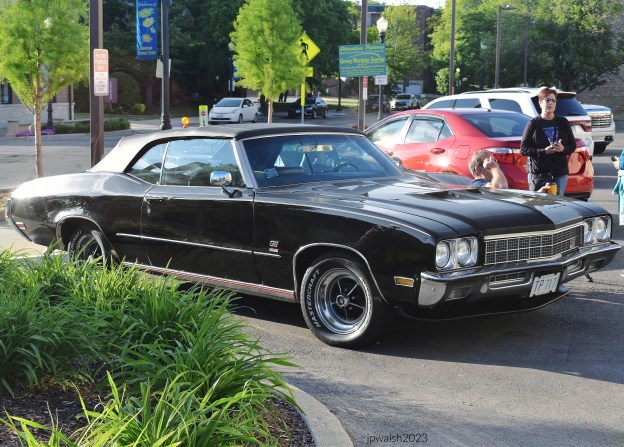
Feature Image: May 2023. 1971 Buick (Gran Sport)GS455 Convertible 7.72 mb 73%

Wouldn’t you really rather have a Buick? 1971’s advertising tag line for this GM American automobile maker.

The GS 455 was an option to the base GS during the 1971 and 1972 model years. The GM A-body platform was the base for many iconic American cars including Buick. Approximately 81 GS 455 Stage 1 convertibles were produced for the model year. Just as manufacturers were producing some of the most desirable muscle cars of all time the U.S. government required unleaded gasoline that reduced these machines’ power (compression). Due to these government mandates starting for 1971, the advertised power of the car’s 455ci V8 with a single four-barrel carburetor and factory-rated 345 horsepower and 460 lb-ft of torque dropped variously at installation. The GS 455 engine was the same basic big-block that had been introduced in the 1970 model year. The Stage 2 version of the 455 did not go much further than Stage 1 and there was about the same number produced as Stage 1 though aftermarket did take things further. GS buyers could choose between automatic or manual transmission. The Turbo Hydra-matic had an option of column-mounted lever or full-length center console. Manual was a 3- or 4-speed floor-shift stick. The 1971 Buick GS 455 convertible is one of the rarest of Buick muscle cars. Major standard equipment exclusive to the GS included dual exhausts, functional hood air scoops, and heavy duty springs, shocks and stabilizer bar. In 1971, total GS 2-Door Convertible production was 902 vehicles with a base MRSP of $3,476 ($27,726.29 in 2025 dollars). In 2025 the Buick GS 455 had an average resale price of $52, 250.

SOURCES: See – https://bringatrailer.com/listing/1971-buick-gs-9/ https://www.classic.com/m/buick/gran-sport/455/year-1971/
https://www.hemmings.com/stories/1971-72-buick-gs-455/ https://classiccarsbay.com/for-sale-1971-buick-gs-455-in-mooresville-north-carolina-49118 – retrieved August 30, 2025.
J. “Kelly” Flory, Jr., American Cars, 1966 to 1972, McFarland & Company, Inc. pp. 396-399.

This explanatory article may be periodically updated.

My Street Photography. GENERAL MOTORS: CHEVROLET CAMARO (1967-2002; 2010-2014).

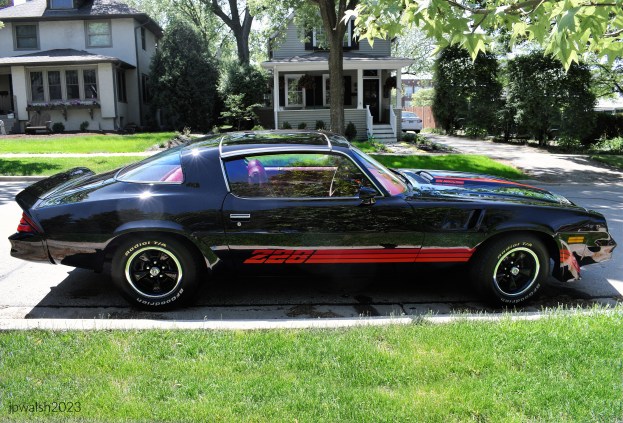
Feature Image: 1979-1981 Chevrolet Camaro Z28 (Details in post). May 2023. 7.72 mb 66%. Author’s photograph.

1979-1981 Chevrolet Camaro. May 2023. 7.74 mb 88% Author’s photograph.

Interior packages included cloth and custom cloth, and vinyl and custom vinyl. In 1980 the five interior colors included oyster, black, blue, carmine and tan. In 1981 the five interior colors changed to silver, black, blue, camel and red. In 1980, to save gas during the gas crisis, the car’s 130-mph speedometer was reduced to an 85-mph speedometer. See – https://mikeduman.com/blog/history-z28https://www.caranddriver.com/news/a43578551/2025-chevrolet-camaro-z28-future-cars/https://www.hemmings.com/stories/article/1980-81-chevrolet-camaro-z-28 – retrieved May 22, 2023.

1979-1981 Chevrolet Camaro (above). The name Z/28 was introduced by General Motors in December 1966. In 1967 to 1969, Chevrolet continued to improve the car’s list of engine and performance options. The year 1970 introduced Gen II in a new Camaro design. In 1982 the car was redesigned again marking Gen III. There have been more redesigns over the decades with Chevrolet announcing that production of the Gen VI Camaro would officially end in December 2023, with the 2024 model year serving as the final run and the Z/28s with it.

Classic muscle car.

Among debates about classic muscle cars, none gets hotter than the Chevrolet Camaro versus the Ford Mustang. With the exception of the 6.6-liter Trans Am, the Z/28 represents the best Detroit had to offer in the early 1980s, and an excellent entry point. A great car with its own ups and downs as its model developments moved ahead, the Camaro Z/28 at the outset was known for its good looks and sleek, crisp styling. It hugged the road and moved fast with superb handling. By 1980, the standard wheel cover was matched by a rear deck spoiler and hood and deck stripes and, soon, a front spoiler to reduce drag. The 1980 models were the last that offered the quintessential muscle car power-train combination-a 350-cu.in. V-8 with four-speed transmission. The loaded Z in 1981 would cost around $12,000 (or $40,000 in 2023 dollars). The Z/28 was 197.6 inches long and rode on a 108-inch wheelbase. It stood at a height of 49.2 inches and was 74.5 inches wide. The body was all steel. Author’s photograph. May 2023. 7.72 mb 66%.

2018 Chevrolet Camaro 2LT Coupe. Author’s photograph. June 2024. 73% 7.83 mb 8246

2011(?) Chevrolet Camaro. Author’s photograph, June 2017. 4.19 mb

2010 Chevrolet Camaro. The Chevrolet Camaro is a pony car that began production in model year 1967. It ceased production in model year 2002 in its Gen IV. Starting in 1993 the iconic American car was produced exclusively in Canada in Sainte-Thérèse, Quebec. In 2008 GM faced a severe liquidity crisis, having lost over $30 billion in 2008. In 2009 Chevrolet restarted its Camaro production in Gen V that was built exclusively in Canada though shifted to Oshawa, Ontario. Then-GM Chairman and CEO Rick Wagoner said about his Canadian-made car: “Camaro is much more than a car; it symbolizes America’s spirit and its love affair with the automobile.” That same year the Obama administration demanded he resign for GM to receive a massive taxpayer-funded federal bailout. Without this federal assistance, the company was expected to go into liquidation, which officials estimated would cost more than one million jobs. The total bailout for General Motors and Chrysler amounted to approximately $80 billion, with the government taking a majority stake in GM during the process to guide its reorganization. The 2010 Camaro became the model’s best seller (81,299 units) since 1995 (122,738 units). The first half of the 2010s was a renaissance for Camaro though its heyday remained the late 1960’s and 1970’s. The 2010 Camaro was intentionally designed and produced along the lines of the 1969 model and is almost identical to the car’s original concept. The original MSRP for a 2010 Chevrolet Camaro ranged from $22,680 ($33,187.71 in 2025) for the LS coupe to $33,945 ($49,671.82 in 2025) for the 2SS coupe. Author’s photograph. April 2025. 7.16mb DSC_8471

1998(?) Chevrolet Camaro SS. The Chevrolet Camaro SS model is equipped with a 6.2L LT1 V8 engine and offered as a 6-speed manual and 8-speed automatic. The SS is capable of 455 horsepower and 455 lb.-ft. of torque, performing a 0-60 in 4.0 seconds. Author’s photograph. May 2018. 7.39 mb

May 2023. 1969 Chevrolet Camaro Z28. 7.85mb 98%

This explanatory article may be periodically updated.

Jazz-Age WEDDING DRESS with high skirts and sleeveless blouses, was flapper style à la mode and believed risqué. On June 7, 1924, Noling-Anderson nuptials took place in the bride’s family home at 1035 Ridge Avenue in Evanston, Illinois. The house still stands today.

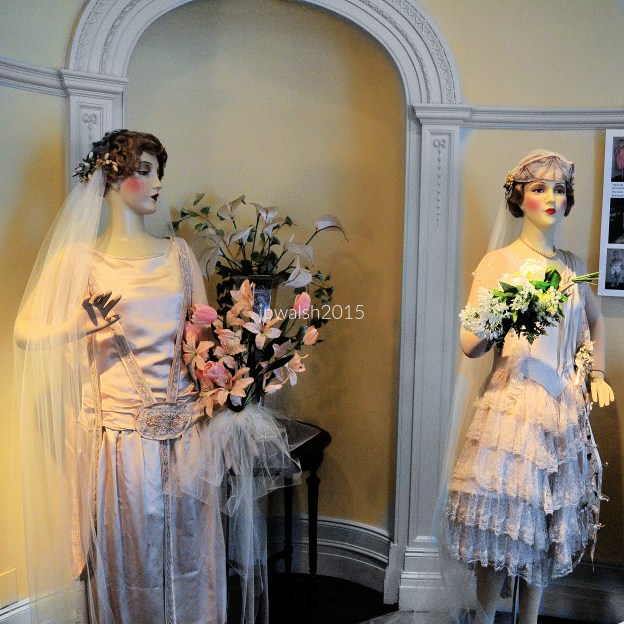
Feature Image: On Saturday, June 7, 1924, Ruth M. Anderson was married in this sleeveless wedding dress (left) to William Noling in Evanston, Illinois. The dress is now on display in the Charles Gates Dawes House in Evanston. Dawes was Vice President of the United States from 1925 to 1929 under President Calvin Coolidge. Author’s photograph (October 2015).

Wedding at the House of the Bride’s family

The Noling-Anderson wedding was held in the house of the bride and her parents, Isak and Jennie (née Johnson) Anderson, at 1035 Ridge Avenue in Evanston. Built in 1914, the house still stands as it did over 100 years ago.

Noling-Anderson Bridal Party Dresses, 1924. Charles Gates Dawes House, Evanston, Illinois. Author’s photograph, October 2015. 7.44 mb DSC_0893 (1)

The dress is made of silk satin in an egg shell color. It is accented by an oval medallion with bands also made of silk satin. The medallion is embroidered with faux pearl and other glass beads.

Thoroughly modern flapper style

While her wedding dress was very fashionable for the mid1920’s – sleeveless tops of all shapes and sizes were the rage in 1924 – it probably was not allowed in one of Evanston’s houses of worship. The fact that it was sleeveless and au courant would be deemed by many as risqué for showing too much bare skin inspired by a thoroughly modern flapper style. It was only in 1924, for instance, that the Methodist Episcopal General Conference first lifted its ban on going to the theater as well as dancing though dance music was the radio’s most popular programming.

The bridesmaid dress (right) was the height of women’s style in 1924 – a mainly straight, knee-length skirt gathered slightly or cut with front pleats. Short sleeve and sleeveless tops were the rage in 1924 reflected in Hollywood by the Mack Sennett girls who starred in movies where they pranced on the beach in a chorus line in not much more than bathing caps and short swim suits.

The fashionable bride and her court might have sported the latest style of facial make-up which is hinted at in the display– masklike with garish, even orange, lipstick and heavy red rouge on the cheeks. Popular fashion accessories from 1924 are also evident – pearls knotted at the neck and simple, though elegant, arm bracelets.

Father of the bride was an Evanston banker, local businessman, and Swedish immigrant

The bride’s father, Isak Anderson, was born in Sweden and came to the United States at 20 years old in 1890. In 1891 he married Jennie Johnson and they had Ruth and another child. Ruth’s father was a bank director and partner in a local tailoring business in downtown Evanston at 608 Davis that today is a noodle shop.  

They served “Prohibition highballs”

With Prohibition starting in 1920, guests at the wedding may have been served the latest popular highball whose recipe called for fruit juice and raw eggs. Their morning might have started with a bowl of Wheaties at breakfast, since the cereal of champions made its first appearance in 1924.

Ruth Anderson married William Noling in this house wearing that dress at 1035 Ridge Avenue in Evanston, Illinois, on June 7, 1924. Author’s photograph, May 2024 92% 7.81 mb

SOURCES: Dawes House, Evanston Illinois; The Swedish Element in Illinois: Survey of the Past Seven Decades, Ernst Wilhelm Olson, p. 586; American Chronicle, Lois Gordon & Alan Gordon, Yale University Press, New Haven & London,1999, pp. 230-238; Chicago: The Glamour Years (1919-1941), Thomas G. Aylesworth & Virginia Aylesworth, Gallery Books, NY, 1986, p.14.