
Monthly Archives: June 2025

ITALY. Two Flower Paintings from 1608 in the Pinacoteca Ambrosiana, Milan, Italy by Flemish artist Jan Brueghel the Elder (1568-1625), nicknamed  the “Flower” and “Velvet” Artist.

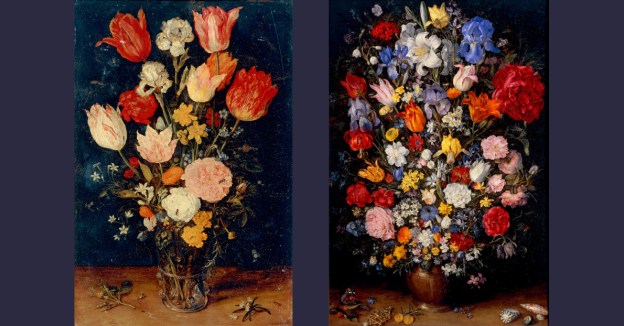
Feature Image: Flowers in a Vase and Flower Vase with Jewel, Coins, and Shells, both 1608, oil on copper, by Jan Brueghel the Elder and in the Pinacoteca Ambrosiana, Milan, Italy.
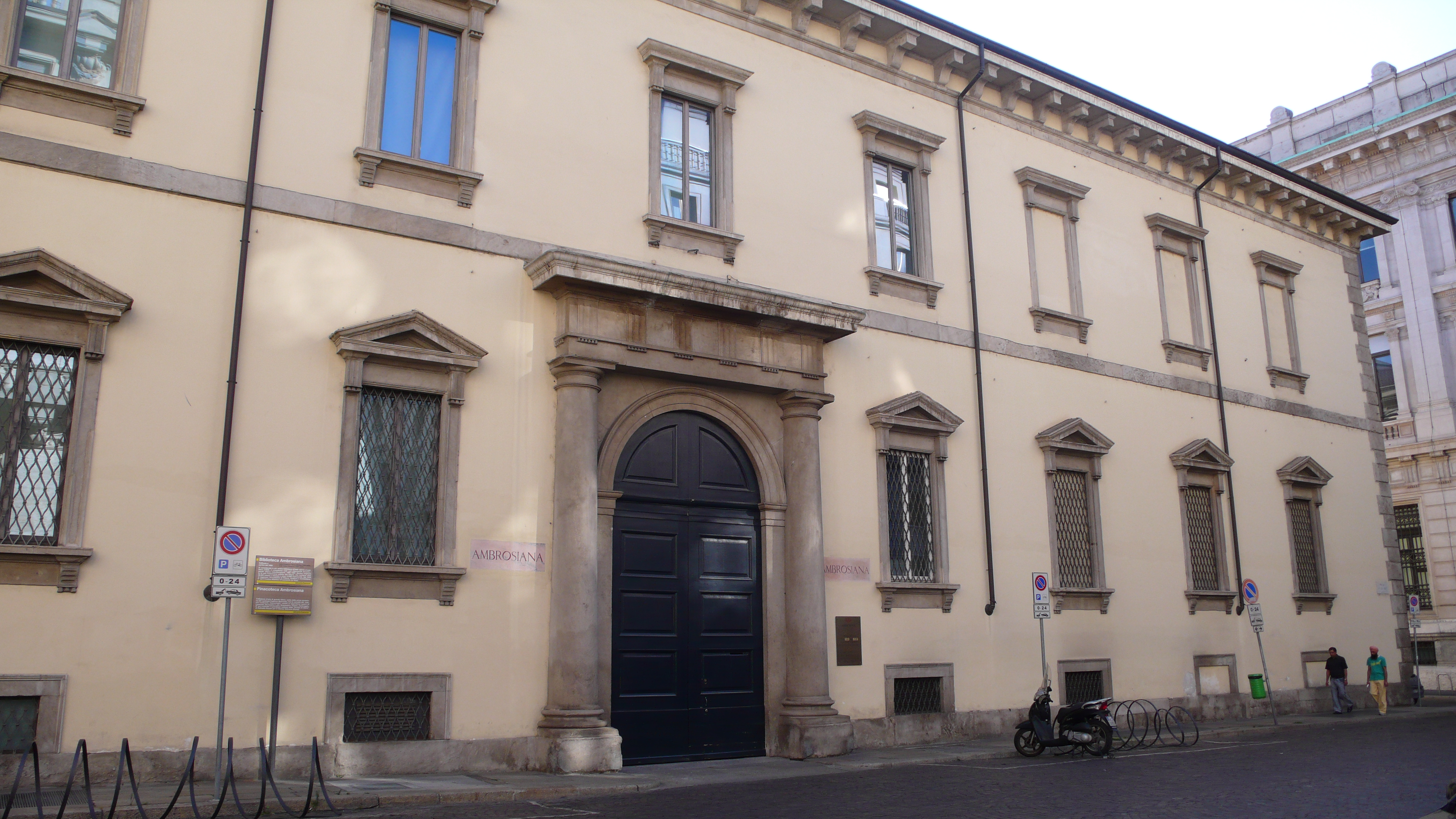
PHOTOS: Milano Ambrosiana” by Welleschik is licensed under CC BY-SA 3.0.

Jan Brueghel the Elder (Flemish, 1568-1625) produced hundreds of paintings by his own hand and in collaboration with other master painters. His painterly skill ranged over an immense variety of subject matter including these innovative still life floral artworks of which the artist is seen as the founder of the genre. These flowers are not allegorical or imaginative accessories nor merely decorative but a stand-alone subject whose sole focus is the opportunity for a close observation of nature through the artistic lens. Brueghel’s pioneering still lifes show a bouquet bursting with a wide variety of colorful flowers seen from an elevated viewpoint that have been carefully delineated and are clearly visible. Born in Brussels in 1568, Jan Brueghel was the son of Pieter Brueghel the Elder (c. 1525–1530-1569) and younger brother of Pieter Brueghel the Younger (1564-1638). Brothers Jan and Pieter were both sent to Antwerp to study oil painting. In 1568, at 20 years old, Jan Brueghel left Antwerp for Italy where he settled and worked in Naples and, by 1592, in Rome. In Rome Jan Brueghel worked for Cardinals Ascanio Colonna (1560-1608), Benedetto Giustiniani (1554-1621), Francesco Maria del Monte (1549-1627) and Federico Borromeo (1564-1631) who patronized Caravaggio and was the official “Cardinal Protector” of the Roman Accademia di San Luca, an artists’ association founded in 1593 by Federico Zuccari (1539-1609).
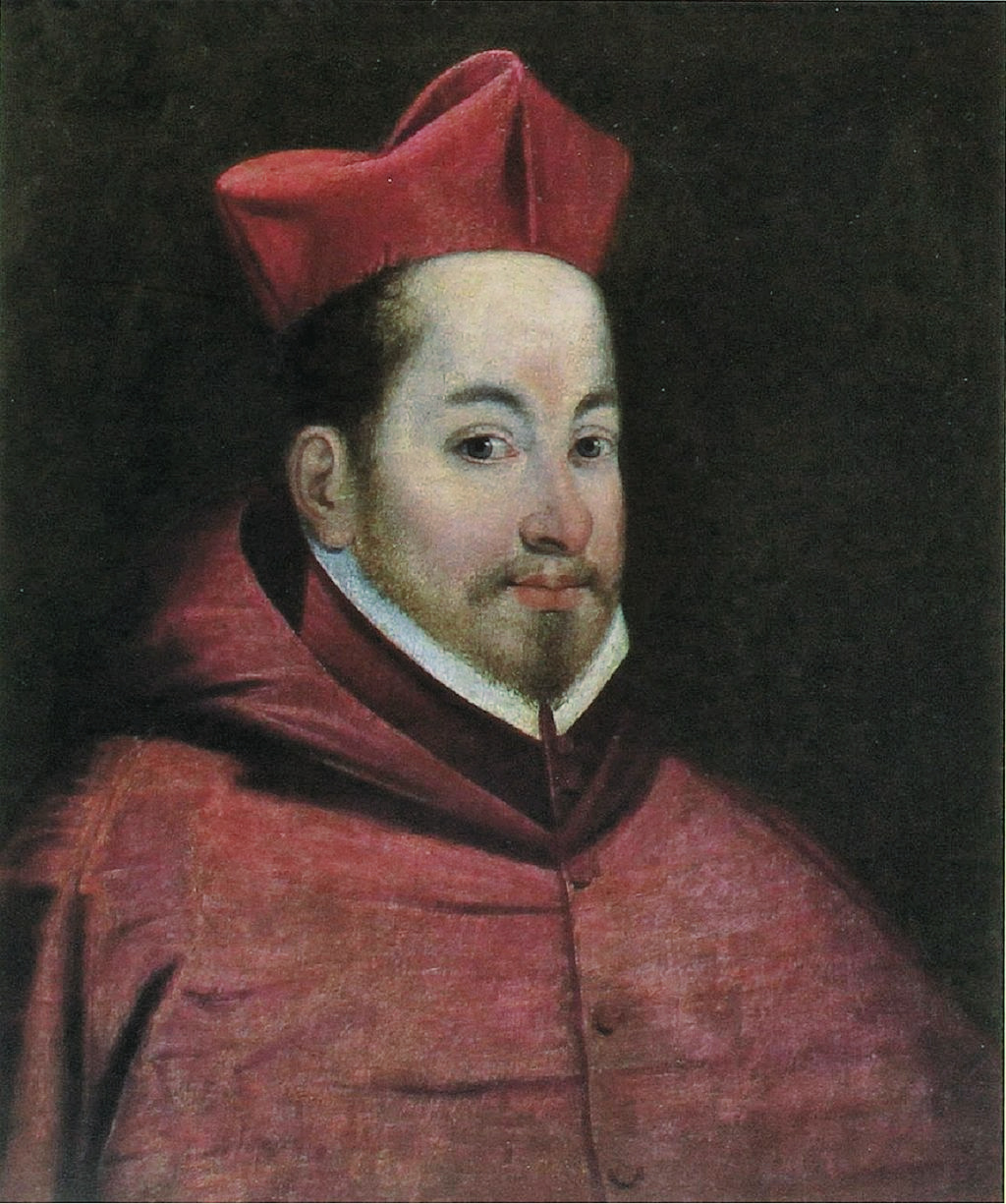
Ascanio Colonna (1560-1608). The cardinal enjoyed a reputation for eloquence and learning.
Benedetto Giustiniani (1554-1621). The clergyman’s inventory at death included 280 paintings.
Ottavio Leoni, Francesco Maria del Monte ((1549-1627) in 1616. Born in Venice of a Tuscan aristocratic family, Cardinal del Monte was an important connoisseur of the arts.  Four centuries later his fame rests on his early patronage of Caravaggio and his art collection which provides detailed provenance for many important works of the period.


Federico Borromeo (1564-1631). About Flower Vase with Jewel, Coins, and Shells (discussed later below) by Jan Brueghel the Elder purchased for his Milano Ambrosiana, Cardinal Borromeo wrote in the Musaeum: “Brueghel painted a diamond on the lower part of the vase…: the author wanted to indicate that the value of his work was equal to that of the gems and this is the price we paid to the artist.”

FLOWERS IN A VASE, 1608, oil on copper, 43 × 30 cm by Jan Brueghel the Elder. Pinacoteca Ambrosiana, Milan, Italy.

In a Römer glass vase, typical of Rhenish manufactures and often depicted in Northern European painting of this period, there are colorful blooms with tulips used to anchor his bouquet. The painting was likely the one mentioned by Brueghel in a letter dated June 13, 1608. The letter is evidence for the origin of the painting as well as that these Flemish artists, in dialogue with the Italian renaissance, practiced copying nature from life, frequently with a scientific precision. Brueghel, the younger son of Flemish Renaissance painter Pieter Bruegel the Elder (c. 1525-1569), was a close friend and frequent collaborator with Peter Paul Rubens (1577-1640). Both Jan Brueghel and Rubens were the leading Flemish painters in Flemish Baroque painting of the first three decades of the 17th century.
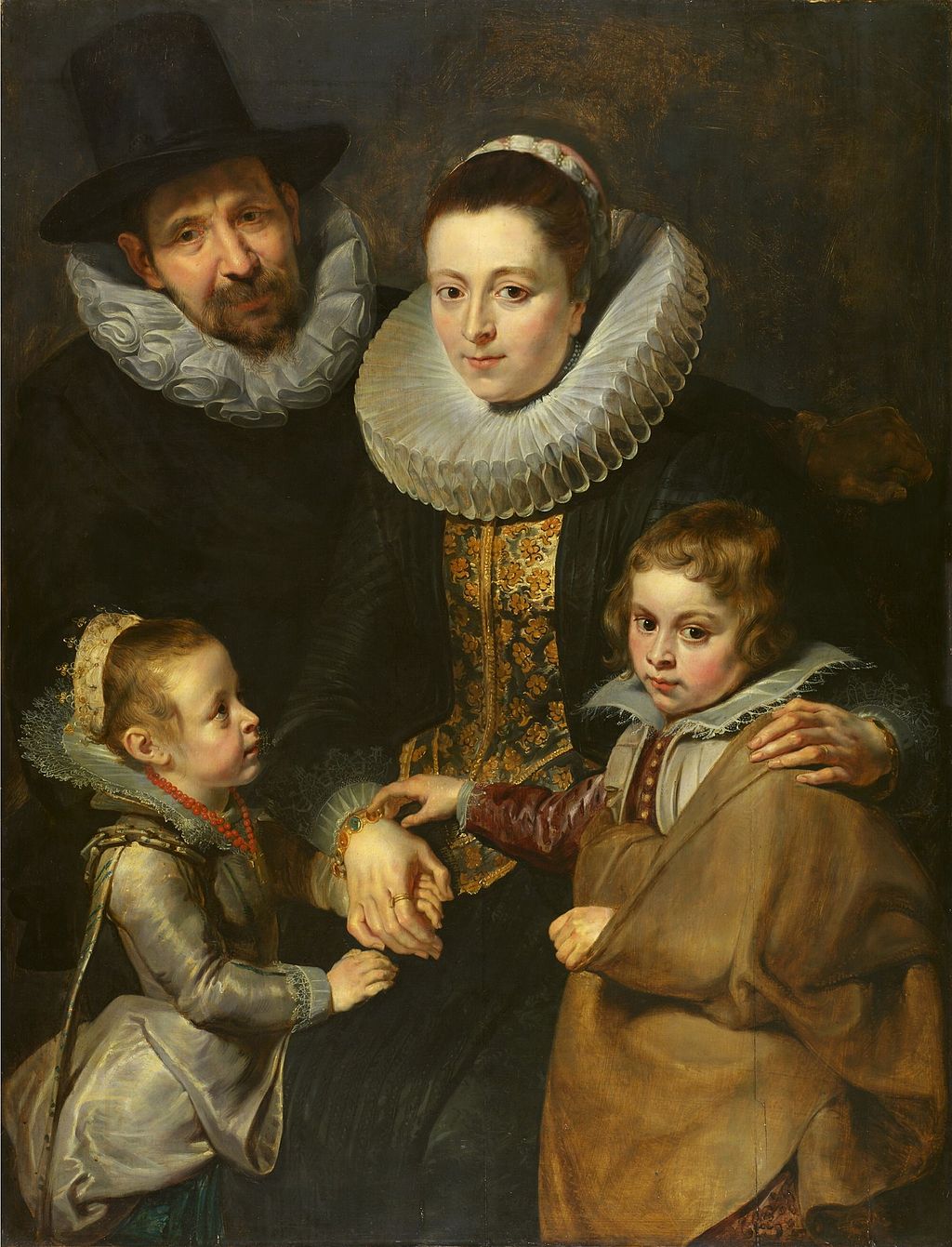
Family of Jan Brueghel the Elder by Peter Paul Rubens. 1613-15. oil on panel, 125.1x 95,2 cm,The Courtauld Gallery, London. Jan Brueghel, painter and friend of Rubens, poses with his second wife, Catherina, and their two children, Peter and Elisabeth. Both children, along with their father, died during the cholera epidemic of 1625. see – https://gallerycollections.courtauld.ac.uk/object-p-1978-pg-362 – retrieved June 24, 2025.

The painting Flowers in a Vase is in the collection of the Ambrosian Art Gallery (Pinacoteca Ambrosiana) of the Biblioteca Ambrosiana in Milan, Italy. It was in the possession of Cardinal Federico Borromeo, cousin to Saint Charles Borromeo (1538-1584), both cardinal archbishops of Milan.

Saint Charles Borromeo (1538-1584) was a cousin of Federico Borromeo. Both were cardinal archbishops of Milan, Italy. Proclaimed a saint in Rome in 1610, Charles was much loved in his diocese for his numerous good works and for his personal humility as well as a spirit of self-sacrifice that he showed during the plague of 1576 and 1577, Cardinal Borromeo was a great reformer and played an important role in the Council of Trent. There is a colossal statue of him outside Arona on Lake Maggiore. The so-called Sancarlone, it was based on a design by  Giovanni Battista Crespi, known as “ il Cerano.” Its sculptors Siro Zanella and  Bernardo Falconi made the copper parts to be assembled for a work that was completed in 1698. see – https://terreborromeo.it/en/about-us/history and https://www.statuasancarlo.it/la-statua/– retrieved June 24, 2025.
The colossus of St. Charles Borromeo (1698).

In May 1585 Federico earned a doctorate in theology at the University of Pavia and was sent to Rome where he was made a cardinal at 23 years old by Pope Sixtus V. Federico voted in the papal conclaves of 1590 (Urban VII, Gregory XIV), 1591 (Innocent IX), 1592 (Clement VIII), 1605 (Leo XI, Paul V) and 1623 (Urban VIII). He missed the 1621 conclave (Gregory XV). At the August 1623 papal conclave Cardinal Borromeo received 18 votes out of 54 votes but was opposed by the Spanish party, one of the church’s major factions. The church had to compromise with Urban VIII, a neutral candidate known as the first pope to actively campaign for votes.
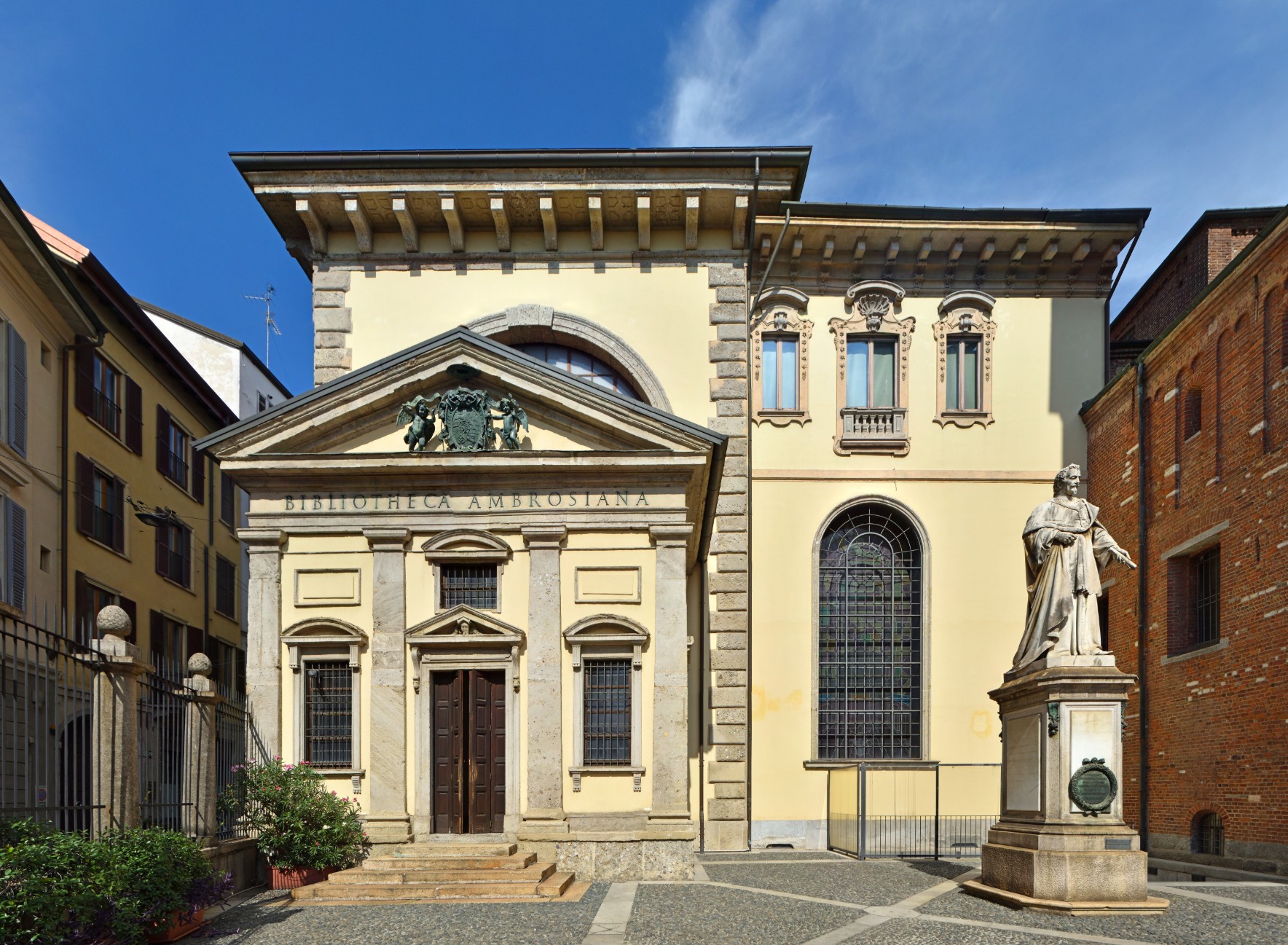
Biblioteca Ambrosiana, Milan. Since 1609 its collections have been open to the public. Milan Biblioteca Ambrosiana 016 4839” by Ludvig14 is licensed under CC BY-SA 4.0.

In April 1618 Archbishop Federico Borromeo bequeathed Flowers in a Vase with his collection of paintings, drawing, and statues in his will to the Biblioteca Ambrosiana, which he founded on September 7, 1607 and opened on December 8, 1609. Conceived by the cardinal as a center for study and culture it was open to the public from the beginning. The library collections include over one million printed volumes (including thousands of incunabula and books dating from the 16th century), 40,000 manuscripts (including the celebrated Codex Atlanticus) in many languages, 12,000 drawings (including works by Raphael, Pisanello, and Leonardo), 22,000 engravings, and miscellanea including old maps and musical manuscripts. Along with the cardinal’s achievement, other institutions flourished beside it such as the Board of Fellows (Collegio dei Dottori, 1607), the Art Gallery (Pinacoteca Ambrosiana, 1618) and the Academy of Drawing for teaching painting, sculpture and architecture (Accademia del Disegno, 1620). The Pinacoteca Ambrosiana consists of some of the Italian Renaissance’s great masterpieces such as the Portrait of a Musician by Leonardo da Vinci, The Basket of Fruit by Caravaggio, the cartoon for the School of Athens by Raphael, the Adoration of the Magi by Titian, the Madonna of the Pavilion by Sandro Botticelli and the magnificent Flowers in a Vase by Jan Brueghel. The museum’s collection today includes paintings by 17th-century Lombard artists such as il Morazzone (1573–1626), Giulio Cesare Procaccini (1574–1625), Daniele Crespi (1598 – 1630) and Carlo Francesco Nuvolone (1608-1669) and 18th-century artists such as Giovanni Domenico Tiepolo (1727-1804), Fra’ Galgario (1655-1743), and Francesco Londonio (1723-1783). Cardinal Federico Borromeo, who lived in Rome from 1586 to 1601, was not particularly interested in politics, but focused on classical and oriental scholarship and prayer. In the Counter-Reformation, the cardinal was a great propagator of the faith using religious art, but also was an avid collector of still life. Jan Brueghel the Elder, nicknamed “Velvet,” was a contemporary artist who was erudite and innovative – he invented new types of paintings such as flower garland paintings and paradise landscapes – and his art did not escape the cardinal’s cultivated eye. The Cardinal and young artist met in Rome where the Cardinal became his patron so that the artist took up residence in Cardinal Borromeo’s palazzo.
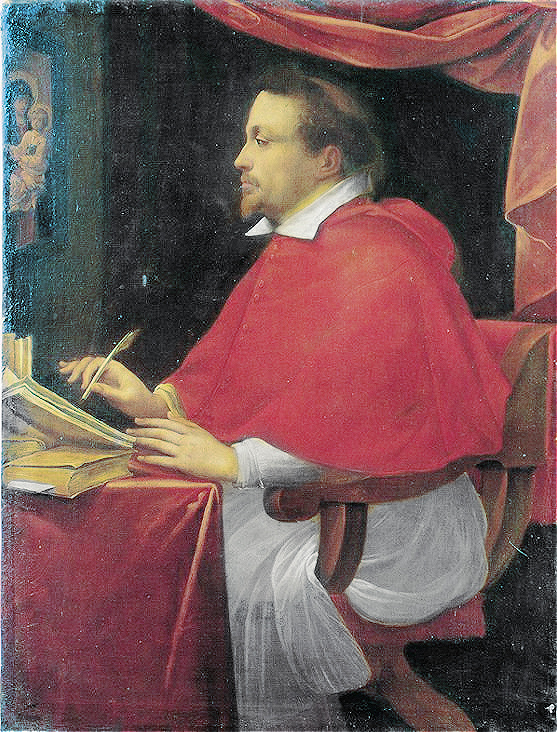
Cardinal Federico Borromeo by Giulio Cesare Procaccini (1574-1625), Museo diocesano di Milano. The Borromeos, a prominent Italian noble family, started as merchants around 1300 in San Miniato in the province of Pisa in Tuscany and became bankers in Milan after 1370. 

When Borromeo became archbishop of Milan in June 1595, Brueghel followed him and became part of the Cardinal’s household. Cardinal Borromeo was a reformer in the sense of promoting discipline among the clergy, founding new parishes and schools, as the faith flourished in the 50 years since the Council of Trent completed in 1564. The archbishop was accessible to the flock. Under his leadership, Milan underwent both prosperity and significant cultural flourishing and renewed spiritual energy for a generation. Brueghel stayed with the Cardinal for a year where he painted landscapes and flower paintings and then returned to Antwerp where he lived and worked for the rest of his life. Also nicknamed “Flower” Brueghel, the artist’s flower pieces such as Flowers in a Vase, are dominated by floral arrangements placed against a neutral dark background. Brueghel repeated these motifs in his flower pieces and yet each work was imbued with its own singular freshness and vitality.

FLOWER VASE WITH JEWEL, COINS, AND SHELLS. 1608, oil on copper, 65 × 45 cm by Jan Brueghel the Elder. Pinacoteca Ambrosiana, Milan, Italy.
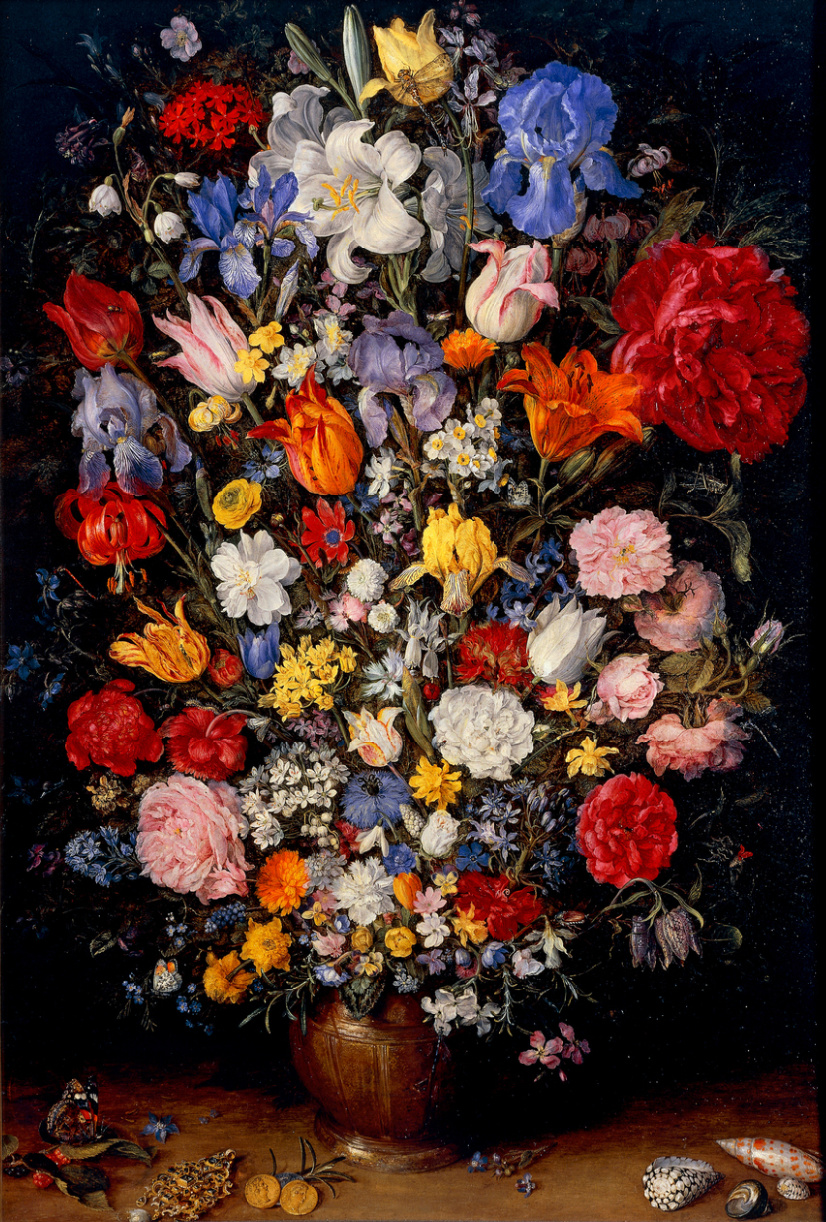
A lush bouquet of flowers, executed by the artist for Cardinal Federico Borromeo (1564-1631), was innovative as a stand-alone bouquet painting of its kind. The subject is composed of around one hundred different species of flowers, some of which are very rare and of great value. In addition to its execution of profuse natural beauty, the picture expressed the nature of the early 17th century culture’s encyclopedic curiosity which extended, among leading collectors, into the natural sciences. It is known by way of a letter that Brueghel was working on the picture in 1606 after he had seen many of these flower varieties in the garden in Brussels of Albert VII, Archduke of Austria (1559-1621) and Isabella Clara Eugenia (1566-1633), who jointly ruled the Spanish Netherlands (1556-1714). The artist’s picture of these flowers was, in a scientific approach, intended to “portray them from nature.” Virtually nothing today remains of the Archdukes Albert and Isabella’s Palace of Codenberg in Brussels nor of their summer retreat at the Château of Mariemont (today’s Morlanwelz in Belgium) south of Brussels which was painted frequently by Jan Brueghel the Elder nor anything of their hunting lodge in nearby Tervuren east of Brussels. In 1633, at the death of Isabella, Albert (who died in 1621) and Isabella’s magnificent collections of art works, scientific instruments, naturalia and artificialia were scattered and much of it lost.

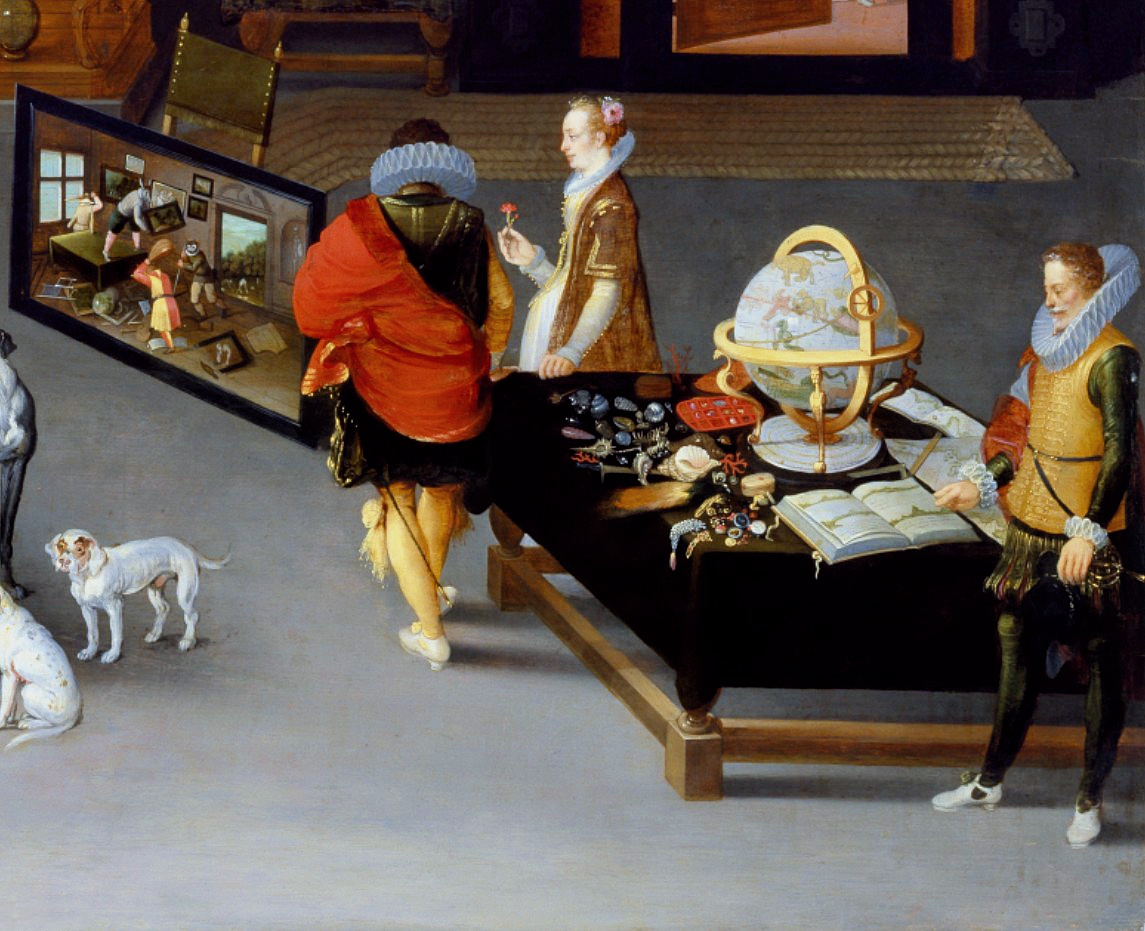
The Archdukes Albert and Isabella Visiting the Collection of Pierre Roose, c. 1621-1623, Jan Brueghel the Elder and Hieronymus Francken II, oil on panel, 37 ×  48 ½ in. (94 × 123.19 cm). see – https://art.thewalters.org/object/37.2010/ – retrieved June 21, 2025.

Some of that magnificence was evoked in a picture from 1621-23 by Jan Brueghel the Elder with Hieronymus Francken II (1578-1623) called Albert and Isabella visiting an art gallery. The large format painting (around 3 feet by 4 feet) in the Walters Art Museum depicts a private gallery (or cabinet) of Pierre Roose in Brussels being visited by the Archdukes Albert and Isabella. It includes in a foreground corner an immense vase of flowers by Jan Brueghel and depicts how these collectors are as interested in natural botany and scientific instruments as they are of paintings and sculpture.
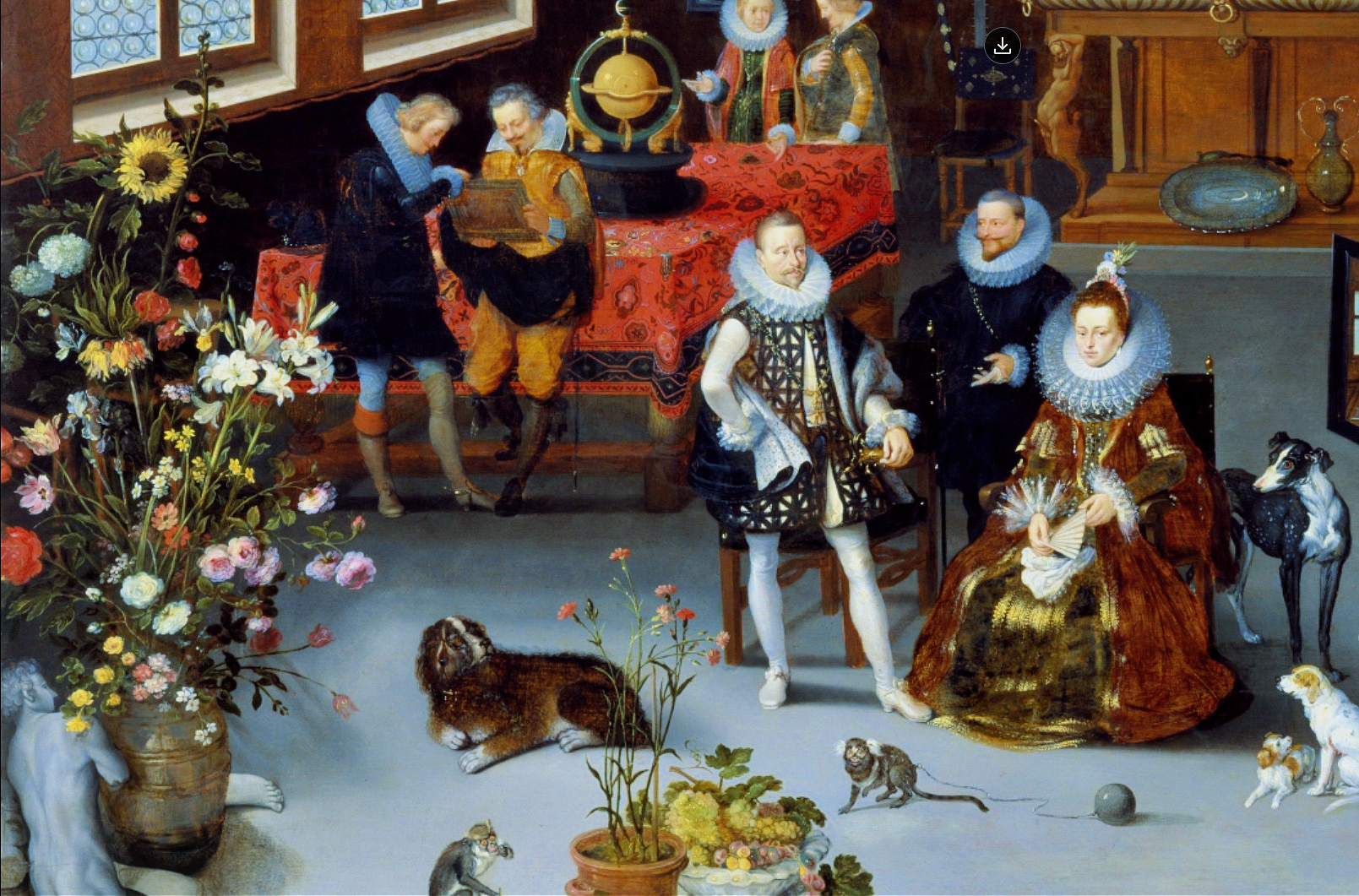
DETAIL of above: Isabella is seated, while her husband standing to her right and their host, Pierre Roose, behind.
DETAIL of above: These collectors are as interested in natural botany and scientific instruments as they are of paintings and sculpture.

Following Albert’s death, Isabella continued to rule on behalf of her nephew Philip IV of Spain (1605-1665) though it was Albert and Isabella’s reign which marked the consolidation of Catholic rule in the Southern Netherlands following severe persecutions of Protestants that ended only in 1597. Though most Protestants had left the region, in 1609 an act of toleration was granted to the Protestants that remained though they could not publicly practice their religion. Conversely, Catholic religious orders like the Jesuits, Capuchins, and Discalced Carmelites received large cash grants and endowments by the wealthy governing elite which helped fund many of these religious groups’ ambitious building and artistic programs in Brussels and Antwerp. As a widow Isabella joined the Third Order of Franciscans until her death. Though despotic and kingly, these rulers have earned a well merited reputation in art history as patrons of the arts. A most notable example is that, in 1609, one year after the Pinacoteca Ambrosiana’s flower picture was created, the Archdukes, whose gardens inspired the work in Italy, appointed Peter Paul Rubens (1577-1640) as their court painter. Commenting on this flower artwork in Milan, Cardinal Borromeo wrote in the Musaeum: “Brueghel painted a diamond on the lower part of the vase…: the author wanted to indicate that the value of his work was equal to that of the gems and this is the price we paid to the artist.”
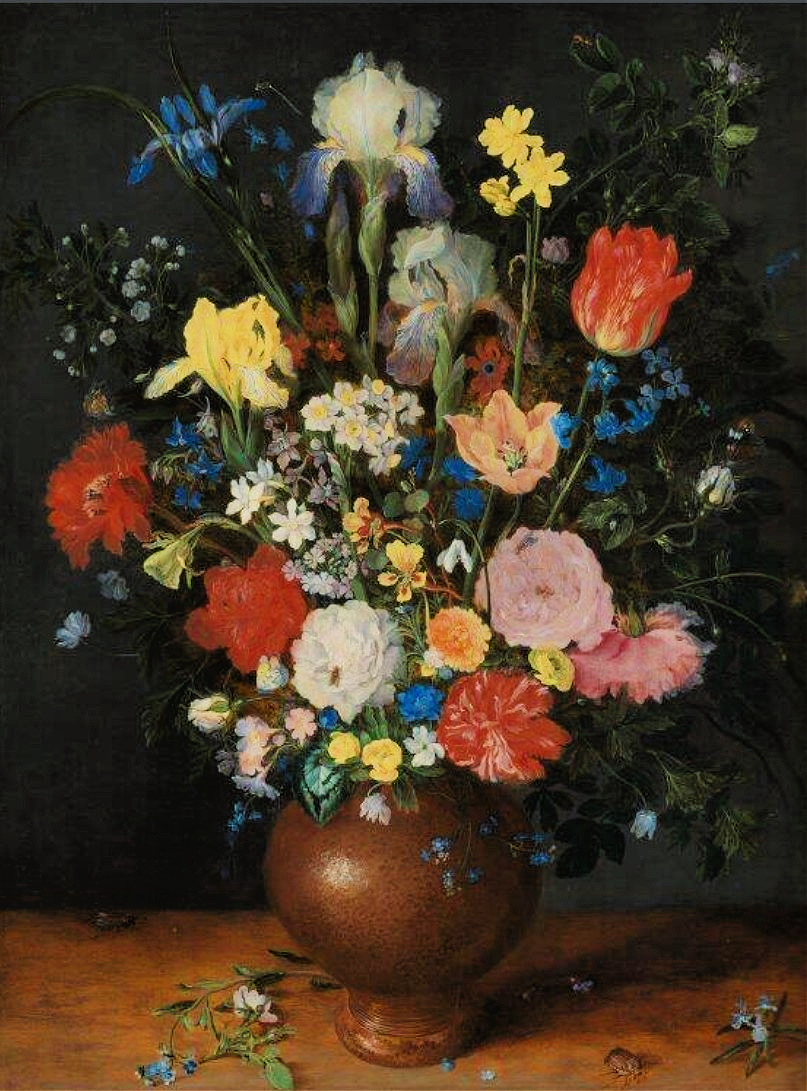
Bouquet in a Clay Vase, 1609, Jan Brueghel the Elder,oil on wood, 56 x 42 cm. The National Gallery, London. see – https://www.nationalgallery.org.uk/paintings/jan-brueghel-the-elder-bouquet-in-a-clay-vase – retrieved June 24, 2025. Jan Brueghel the Elder is considered the 17th century northern painter, active in the Low countries as well as Italy, who invented and mastered the genre of flower still life. While used at times as a decorative or allegorical element within a painting, there are major examples where the artist aesthetically assembled and presented an impressive bouquet from a high viewpoint based on scientific observation of rare garden species as the sole focus of the painting. Bouquet in a Clay Vase in The National Gallery in London is one such artwork.

This explanatory article may be periodically updated.

SOURCES:

https://art.thewalters.org/object/37.2010

https://en.wikipedia.org/wiki/Isabella_Clara_Eugenia

https://en.wikipedia.org/wiki/Albert_VII,_Archduke_of_Austria

https://en.wikipedia.org/wiki/The_Archdukes_Albert_and_Isabella_Visiting_a_Collector%27s_Cabinet

http://janbrueghel.net/janbrueghel/about-janbrueghel/

Brian Wilson Dies at 82, the Beach Boys Visionary Who Reimagined Pop with Intimate Songs and Ethereal Harmonies like “God Only Knows” from Pet Sounds in May 1966.

Feature image: Brian Wilson of the Beach Boys in West Los Angeles, 1990. PHOTO: Brian Wilson of the Beach Boys in West Los Angeles 1990 photographed by Ithaka Darin Pappas” by IthakaDarinPappas is licensed under CC BY-SA 4.0.

Founding a Family Band

In 1961, Brian Wilson formed the Beach Boys with his brothers Carl and Dennis, their cousin Mike Love, and school friend Al Jardine. Brian, the eldest Wilson brother, quickly emerged as the group’s musical center of gravity. The family story would later carry deep shadows: Dennis drowned in 1983, and Carl died of cancer in 1998. But in the early 1960s, the band’s rise was swift and bright.

Chart Breakthrough and an American Peak

By December 1963, the Beach Boys had reached a national summit with “Surfin’ U.S.A.”, the number‑one song in America. Their sound—sun‑drenched, harmony‑driven, and unmistakably Californian—seemed to define the country’s musical mood. Brian’s melodic instincts and arranging talent were already pushing the group beyond surf‑rock formulas toward something more ambitious.

The British Invasion Arrives

Everything changed two months later. On February 9, 1964, the Beatles appeared on The Ed Sullivan Show before an audience of 73 million Americans (see – https://www.edsullivan.com/the-beatles-on-the-ed-sullivan-show-on-february-9-1964/ – retrieved June 11, 2025). Overnight, the British Invasion reshaped the pop landscape. For Brian Wilson, the moment landed like a challenge. The Beach Boys—still riding high—suddenly found themselves in an informal, transatlantic competition with the Fab Four, especially Paul McCartney, for the artistic future of 1960s pop.

Brian Wilson’s Creative Response

Rather than retreat, Brian accelerated. He began writing more original material, experimenting with new arrangements, unusual instrumentation, and increasingly sophisticated harmonic structures. His goal was not imitation but innovation—a new sound that could stand beside the Beatles’ evolving artistry and, at times, even inspire it.

A Remarkable Run of Hits

The result was one of the most productive bursts in American pop history. Between “Surfin’ U.S.A.” (1963) and “God Only Knows” (1966), the Beach Boys scored 15 top‑20 hits, including two number‑ones that held the top spot for multiple weeks. Brian’s studio experiments—lush textures, emotional directness, and fluid four‑part harmonies—reshaped what pop music could be and earned the admiration of McCartney himself.

A New Era of Studio Experimentation

Pet Sounds marked a turning point for rock and pop bands, ushering in an era of studio experimentation. It predated—and directly inspired—the Beatles’ Sgt. Pepper’s Lonely Hearts Club Band in 1967, one of pop’s first concept albums and a catalyst for the psychedelic imagery that shaped mainstream culture into the mid‑1970s.

God Only Knows” by andreboeni is licensed under CC BY 2.0.

Crafting the Sound of “God Only Knows”

For God Only Knows, the Beach Boys assembled a 15‑piece orchestra alongside a rock band of top Los Angeles session players to realize Brian Wilson’s “sophisticated soundscape.” The group’s 11th studio album represented a clear break from their earlier catalog—described not as rock and roll but as “futuristic, progressive and experimental.” (Stebbins, The Beach Boys FAQ, p. 74)

Writing a Song of Faith and Vulnerability

According to Brian Wilson, God Only Knows was written in about 45 minutes. For many listeners, it stands as the greatest Beach Boys song—and, for some, the greatest song of its era or perhaps of all time. Its lyrics revolve around faith, emotion, and the fear of losing a deep personal connection. The stakes are high throughout.

Carl Wilson’s Defining Vocal

Brian gave the lead vocal to his brother Carl, believing Carl could deliver the words with clarity and meaning—without the self‑consciousness Brian feared in his own voice. Carl’s performance became one of the defining moments of the Beach Boys’ recorded legacy.

A Private Vision of the Divine and Message of Feeling and Eternity

Wilson’s use of the word “God” was unusual in a pop context. But it was not the public God of church or country. For him, God was a private force who “helps a person control their hopes and doubts.” (I Am Brian Wilson, p. 180). Brian Wilson remained most proud of God Only Knows because he believed it carried a genuine message—one rooted in feeling, vulnerability, and a sense of eternity.

When Pet Sounds was released in May 1966, reviews In America were largely tepid and sales did not match previous albums. The album—featuring Brian Wilson and Tony Asher’s God Only Knows—would not be certified Gold for 30 years. At the time, critics were praising Dylan’s Blonde on Blonde, the Rolling Stones’ Aftermath, and the Beatles’ Revolver, artists whose roles as rock’s new masters were already clear. Brian Wilson, still reinventing himself, was instead seen as a poignant and possibly troubled pop figure. Later reevaluations of Pet Sounds, including God Only Knows, now regard the album as the trendsetting work of a genius.

Carl Wilson’s Voice and the Song’s Reception

Mike Love agreed that God Only Knows “became one of the album’s most celebrated numbers,” noting that Carl Wilson’s “dulcet voice” actually heightened the song’s “spiritual dimensions.” Love also believed it marked a moment when Carl—four and a half years younger than Brian—emerged as a talented leader within the Beach Boys. (Love, Good Vibrations, pp. 130–131)

Brian Wilson’s Studio Authority

During the Pet Sounds sessions, Brian acted as a virtual dictator in the studio, prompting Love to nickname him “General Patton,” a reference to the four‑star American general of World War II. Other nicknames were less patriotic. Love also confirmed Brian’s reluctance to use the word “God” in the song and, by inference, the courage and honesty required to include it.

A Narrative of Devotion

With Carl Wilson on lead vocals, the lyrics of God Only Knows speak from the perspective of someone who believes that life without his lover can only be fathomed by God. Brian Wilson was married to Marilyn Rovell at the time, though in a 1976 radio interview he said the song was not written for anyone in particular, even if he had written other songs with specific girls in mind. Wilson and Rovell divorced amicably in 1979.

Brian Wilson on Love and Meaning

In 2016, Brian Wilson reflected on the emotional core that shaped so much of his writing: “I wasn’t in love often. I thought about girls, but if they didn’t think about me, how was that love? …When friends would tell me that they were seeing a new girl, I would ask them if they were really in love. That was important to me. It seemed like a real thing. Were they in love? Did something happen inside them that made them feel closer to that other person and closer to themselves? It’s why I wrote so many love songs, because it’s the real thing.” (I Am Brian Wilson, p. 124)

Brian Wilson (June 20, 1942 – June 11, 2025). PHOTO: “Tonight I got to watch Brian Wilson sing ‘God Only Knows’ in a tiny room. #swoons #dies” by LibraryatNight is licensed under CC BY-NC 2.0.

Release and Chart Performance

God Only Knows was issued in the United States in July 1966 as the B‑side to “Wouldn’t It Be Nice,” peaking at no. 39 on the Billboard Hot 100. Abroad, the song fared far better, reaching no. 2 in the United Kingdom and entering the top ten in Canada and across Europe.

Bruce Johnston remembered squeezing into the tiny studio one Wednesday night as Brian Wilson recorded “God Only Knows” with a full ensemble jammed shoulder‑to‑shoulder — violinists practically perched on the French horn players, Carl playing his guitar from the booth, and the room overflowing with sound and bodies. It was, he said, incredible.

A Shared Session and a Distinctive Sound

Both God Only Knows and “Wouldn’t It Be Nice” were recorded during the same session on April 11, 1966. Brian Wilson worked on an 8‑track recorder at Columbia, and Terry Melcher—California producer and singer‑songwriter—was present to provide backup vocals for “God Only Knows.” The session reflected Wilson’s increasingly intricate studio methods during the Pet Sounds period.

A Song Written for Carl

Carl Wilson later said that Brian told him he had written God Only Knows for him to sing as recognition of his “beautiful spirit” (Badman, The Beach Boys: The Definitive Diary, Backbeat Books, 2004, p. 126). Carl’s vocal would become one of the defining performances in the Beach Boys’ catalog, carrying the emotional clarity Brian believed the song required.

A Closing Perspective

Taken together—the modest U.S. chart showing, the strong international reception, the shared April 11 session, Melcher’s presence, and Brian’s intention for Carl’s voice—God Only Knows stands as a carefully crafted work whose meaning was shaped as much by the people in the room as by the song on the page. It remains one of the most personal statements in Brian Wilson’s body of work, anchored in the bond between two brothers and the evolving artistry of the Beach Boys at their creative peak.

God Only Knows LYRICS
I may not always love you
But long as there are stars above you
You never need to doubt it
I’ll make you so sure about it
God only knows what I’d be without you
If you should ever leave me
Though life would still go on, believe me
The world could show nothing to me
So what good would living do me?
God only knows what I’d be without you
If you should ever leave me
Though life would still go on, believe me
The world could show nothing to me
So what good would living do me?
God only knows what I’d be without you
(God only knows what I’d be without you)
God only knows what I’d be without you (ooh-ooh)
(God only knows what I’d be without you) God only knows
God only knows what I’d be without you (ooh-ooh)
(God only knows what I’d be without you) God only knows
God only knows what I’d be without you (ooh-ooh)
(God only knows what I’d be without you) God only knows
God only knows what I’d be without you (ooh-ooh)
(God only knows what I’d be without you) God only knows
God only knows what I’d be without you (ooh-ooh)
(God only knows what I’d be without you) God only knows

SOURCES:

The Beach Boys: America’s Band, Johnny Morgan, Union Square & Co.; Illustrated edition, 2015, pp. 108-109.

i am Brian Wilson a memoir, Brian Wilson with Ben Greenman, Da Capo Press, Boston, Massachusetts. pp. 124 and 180.

Good Vibrations: My Life as a Beach Boy, Penguin Publishing Group, Mike Love, 2016, pp. 130-131.

The Beach Boys FAQ, All That’s Left to Know about America’s Band, Jon Stebbins, Backbeat Books, 2011, p. 74.

The Beach Boys: The Definitive Diary of America’s Greatest Band on Stage and in the Studio, Keith Badman, Backbeat Books; First Edition, 2004, p. 126.