
FEATURE Image: The Worker, Willow Springs, Illinois. June 2018. Author’s photograph 6mb.The Civilian Conservation Corps (CCC) stands as one of the most successful and far-reaching initiatives of FDR’s New Deal, providing vital economic relief during the Great Depression while leaving a permanent legacy of environmental conservation and infrastructural development that is beautifully commemorated today by The Worker statue in Willow Springs, Illinois.
FDR’s “Tree Army” Arrives in Illinois
The Civilian Conservation Corps (CCC) was a cornerstone program of President Franklin D. Roosevelt’s New Deal, engineered to combat the devastating economic and social effects of the Great Depression. Affectionately dubbed “Mr. Roosevelt’s Tree Army,” the initiative established over 50 camps and launched more than 1,000 special projects across Illinois.
The camp at Willow Springs was among the very first wave of camps established under FDR’s vision. According to the Civilian Conservation Corps Legacy, Camp Chicago-Lemont, Company 612 officially opened its doors in Willow Springs on June 4, 1933.
Commemorating the Legacy of Company 612
To honor the unwavering dedication and work ethic of the young men—aged 17 to 28—who served in the CCC, a commemorative monument was dedicated on June 3, 2001. This larger-than-life bronze sculpture, titled The Worker, stands proudly at the intersection of Archer Avenue (Route 171) and Willow Boulevard in the Willow Springs Woods. Today, it serves as a striking local landmark and stands as one of many identical tribute statues scattered across the American landscape to honor the enduring spirit of the CCC.
A Blueprint for Economic Relief
As one of the New Deal’s most successful “alphabet soup” agencies, the CCC served a critical, multi-faceted purpose. Its immediate motivation was to combat staggering national unemployment rates that soared to 25% following the catastrophic Wall Street crash of October 1929. By providing meaningful manual labor jobs to young men, the program injected vital financial relief directly into struggling families who had spent years facing severe economic hardship.
Established on June 4, 1933, Civilian Conservation Corps Legacy, Camp Chicago-Lemont, Company 612 was one of the nation’s very first CCC camps located in Willow Springs, Illinois.
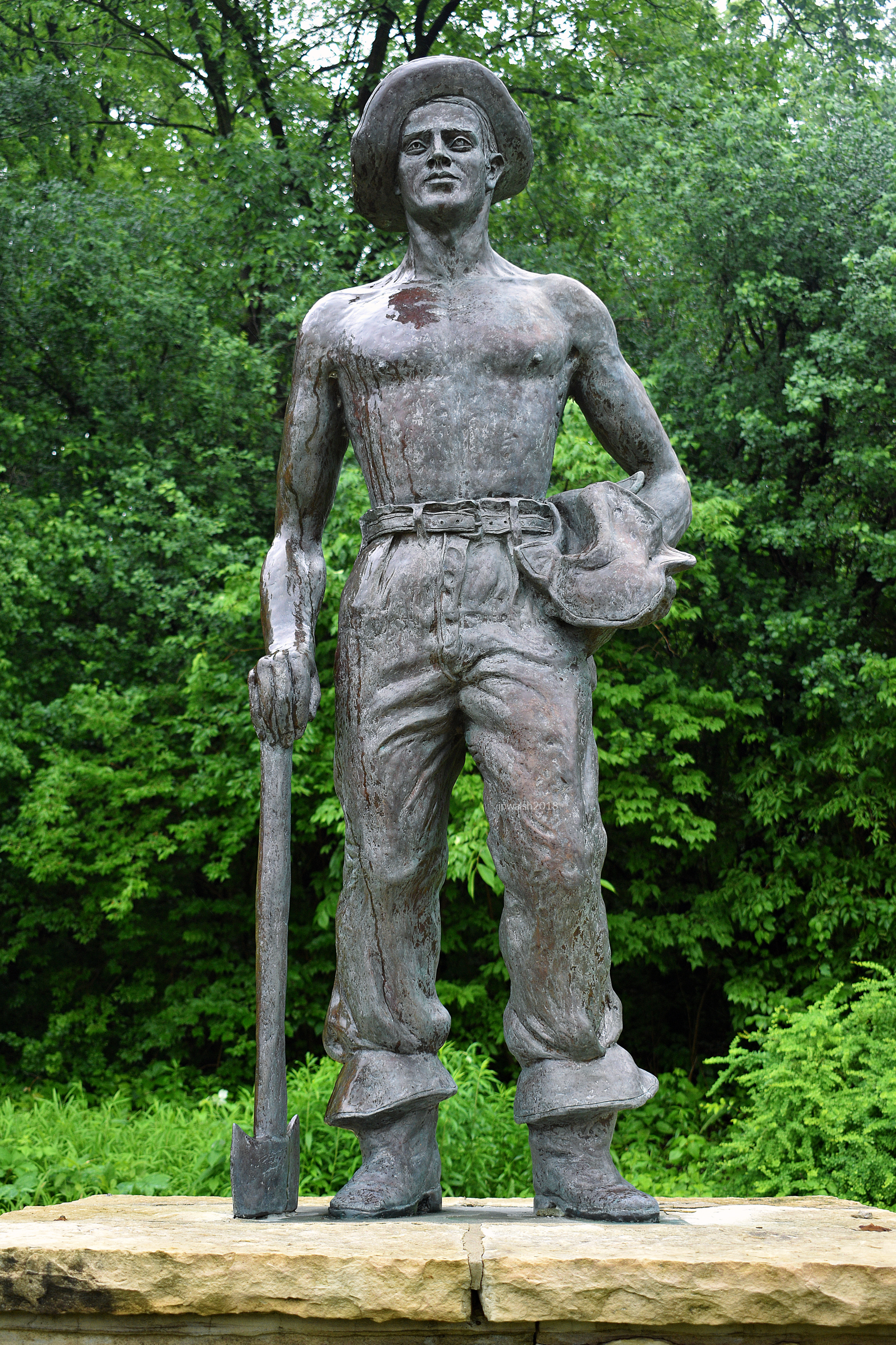
The Worker portrays a young man standing firmly atop a stone plinth in a setting of forest greenery. He is depicted with a muscular, bare chest, rolled-up work trousers, and heavy boots, capturing the demanding nature of manual field labor required for $30 a month government salary. In his right hand, he holds a standard planting spade or shovel resting on the ground, while his left hand holds a cloth work cap against his hip. His facial expression is determined and forward-looking, wearing a wide-brimmed campaign hat. June 2018. Author’s photograph. 6mb DSC_9132 (1)
How the Hard Work of Young Men Rebuilt an Era
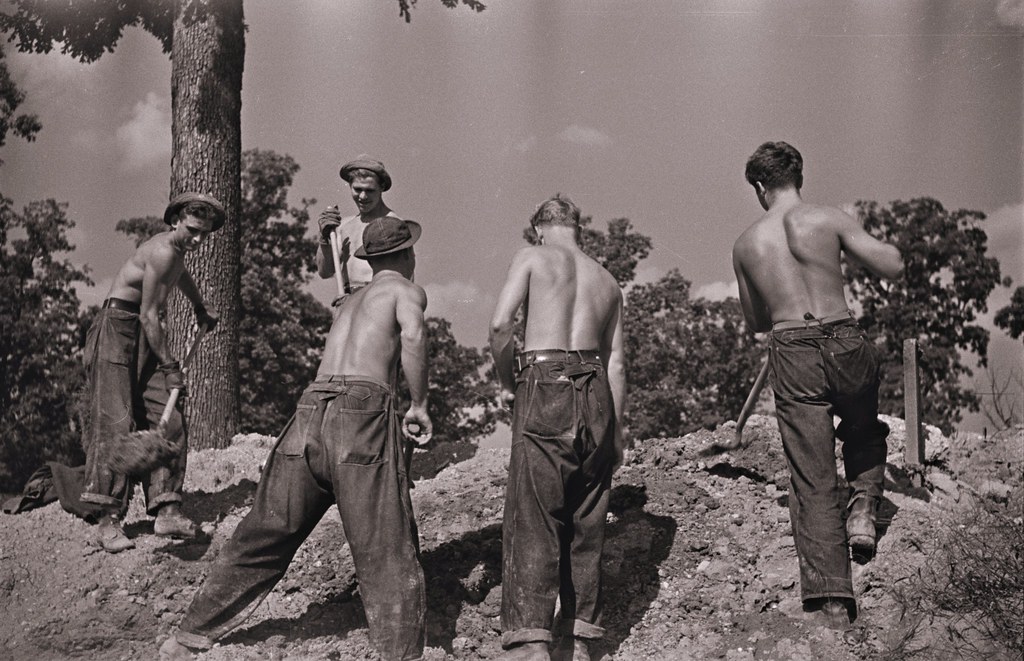
CCC (Civilian Conservation Corps) boys working, 1935. Globally recognized as a massive infrastructure success, the CCC boys planted over 3 billion trees, built 800 state parks, upgraded thousands of miles of public roads, and constructed public structural features that laid the foundation for modern American conservation and forestry. PHOTO: “CCC (Civilian Conservation Corps) boys working, Prince George’s County, Maryland 1935 LOC 8a00074u” by over 26 MILLION views Thanks is licensed under CC BY-NC-SA 2.0.

This specific monument—dedicated on June 3, 2001—stands as a lasting local and national reminder of how manual civic labor rescued a generation of American boys from urban poverty while structurally rebuilding the country’s natural landscape. June 2018. Author’s photograph. 12.87mb.

CCC plaque, Willow Springs, Illinois. June 2013. Author’s photograph. 3.33mb
Life in the Camps and the $30 Promise
As the program expanded, camps quickly proliferated across every state in the nation. Over its nine years and three months of operation, the CCC employed upwards of three million young men. In exchange for their manual conservation labor, enrollees received essential provisions: food, clothing, lodging, and both medical and dental care.
They were also given a paycheck of $30 a month (equivalent to roughly $600 today), with a strict legal caveat: $25 of that sum had to be sent directly home to support their struggling families. Each camp housed around 200 men. While the lifestyle was notoriously basic and disciplined, for most enrollees, it was a far better alternative to panhandling on city streets. Consequently, the program enjoyed immense public and bipartisan support.

FDR during a presidential radio broadcast in 1933. Library of Congress. Public Domain.
The First 100 Days and the Mobilization of a Nation
The legislative foundation for the program began during the famous Emergency Session of the 73rd Congress, which FDR called on March 9, 1933, just days after taking office. Roosevelt boldly promised that if granted emergency powers, he would mobilize 250,000 men into field camps by the end of July. Senate Bill S. 598 was introduced on March 27, passed both houses swiftly, and was signed into law on March 31—less than a month into FDR’s first term.
The initiative faced early friction from Big Labor leaders, who worried this massive influx of non-union workers would undercut the private job market. Undeterred, the Roosevelt administration went ahead with a peacetime mobilization of men, materials, and transportation on a scale never before seen in American history. On April 15, 1933, Executive Order 6101 officially authorized the program, appointing labor leader Robert Fechner as its first director. Backed by an advisory council spanning the War, Labor, Agriculture, and Interior departments, the CCC became a hallmark achievement of FDR’s legendary “First 100 Days.”
Transforming the American Landscape
Operating primarily on public and government-owned rural lands, the federal program left a permanent environmental and physical mark on the country. CCC workers are widely credited with saving and renewing America’s decimated timberlands, planting an astonishing three billion trees between 1933 and 1942. Simultaneously, their labor laid the groundwork for modern infrastructure by building parks, fire towers, and access roads where none had existed before.

CCC, 1940. The CCC was a cornerstone “alphabet soup” relief program launched by President Franklin D. Roosevelt in 1933 as part of the New Deal. It addressed a catastrophic 25% national unemployment rate by recruiting unmarried young men, ages 17–28, for resource conservation tasks. PHOTO: “Leaders and Assistant Leaders, Civilian Conservation Corps, Company 229, Camp Willow Creek F-188, 1940 – Emida, Idaho” by Shook Photos is licensed under CC BY 2.0.
Pearl Harbor and the End of an Era
Despite its overwhelming popularity, the CCC came to an abrupt end following the attack on Pearl Harbor and America’s entry into World War II. With the establishment of the military draft and the rapid wartime mobilization of domestic manufacturing, the economic need for government-subsidized labor relief evaporated. By mid-1942, the final CCC camps were dismantled or repurposed as training grounds for the U.S. Army.
A Lasting Legacy in Illinois
With the exceptions of Social Security and the Rural Electrification Act, few New Deal programs have matched the profound, long-term influence of the CCC. In Illinois alone, the historical impact remains staggering. Over 92,000 men served within the state’s borders. Through their hard work, they successfully planted an estimated 60 million trees, constructed 400 bridges, cleared 1,200 miles of public trails, and installed nearly 5,000 flood-control structures that continue to shape the state’s parks and forest preserves today.
The historical setting of The Worker statue in Willow Springs, Illinois, standing as a permanent tribute to the legacy of the Civilian Conservation Corps (CCC). highlights the intersection of public memory, art, and the natural landscape that the CCC boys worked so hard to preserve during the Great Depression.

This exact site commemorates Camp Chicago-Lemont (Company 612), which was officially established on June 4, 1933, as one of the very first emergency New Deal camps in Illinois. The rustic limestone wall holding up the statue is highly symbolic. Constructing stone retaining walls, bridges, and erosion-control barriers was exactly the type of heavy manual labor the CCC boys performed across the state’s forest preserves.
SOURCES:
Civilian Conservation Corps Legacy. “CCC Camps Illinois.” Accessed May 16, 2023. https://ccclegacy.org/CCC_Camps_Illinois.html.
McDonald, Jerry. “The Story of the CCC and Its Legacy in Illinois.” Illinois Country Living Magazine, January 2018. Accessed May 16, 2023. https://icl.coop/story-ccc-legacy-illinois/.
Wilde, Ryan Andrew, prod. “CCC in Illinois, Past and Future.” The 21st Show. Illinois Public Media, May 19, 2021. Audio, 33:57. Accessed May 16, 2023. https://will.illinois.edu/21stshow/story/ccc-in-illinois-past-and-future.