
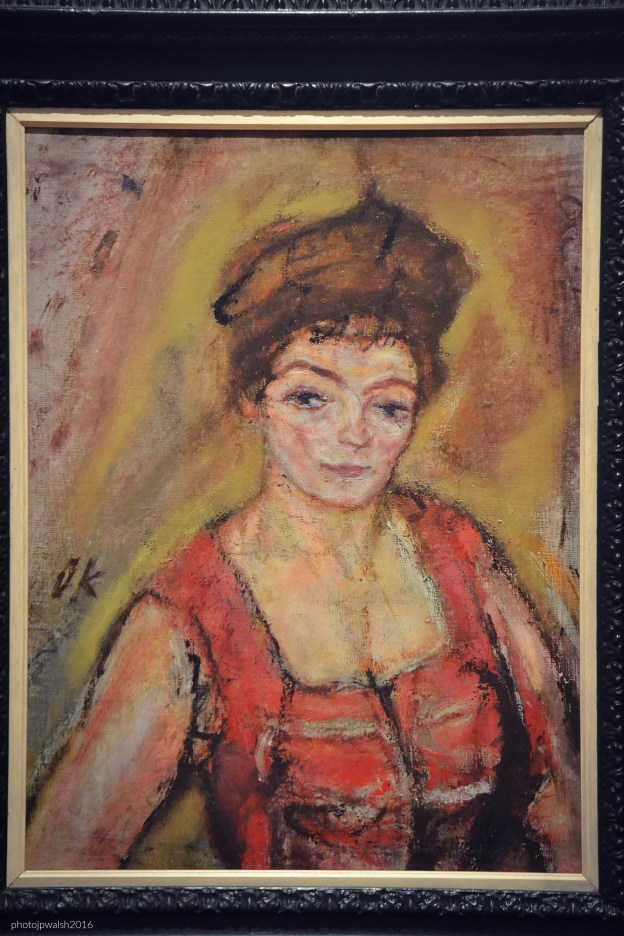
Feature Image: Oskar Kokoschka (Austrian, 1886-1980), Lady in Red (Dame in Rot), 1911, oil on canvas, 21 11/16 × 16 in. (55.09 × 40.64 cm), Milwaukee Art Museum. see – Collection | Milwaukee Art Museum – retrieved June 5, 2026. Author’s photograph, 2016.
Lady in Red is not merely a portrait but a declaration of Oskar Kokoschka’s fiercely independent artistic identity at a pivotal moment in his early career. The painting embodies his emerging commitment to psychological intensity, expressive distortion, and individual vision while resisting easy classification within German Expressionism. Rather than offering a conventional likeness, Kokoschka sought to reveal the sitter’s inner life through emotionally charged color, fractured form, and confrontational presence. Kokoschka’s greatness stems precisely from his refusal to submit to artistic movements or ideological programs. Lady in Red (Dame in Rot) is an early manifestation of the independence that would define Kokoschka’s career and make him one of modern art’s most distinctive voices.
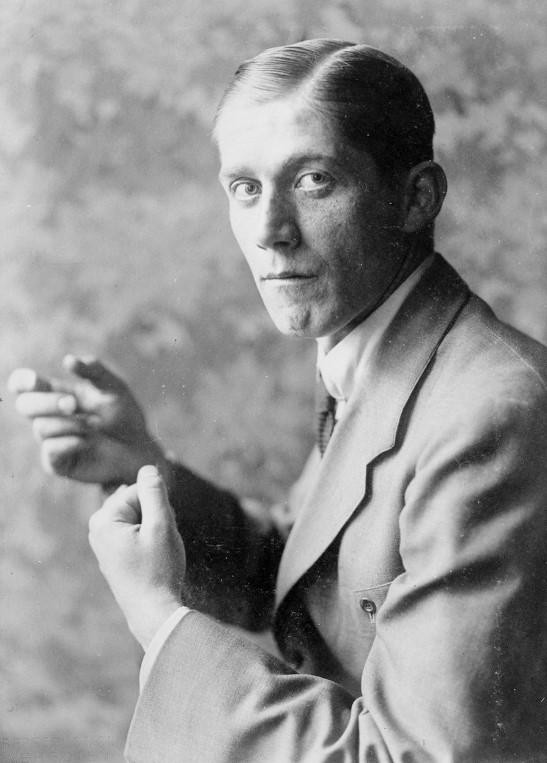
Oskar Kokoschka in 1916, photographed by Marta Wolff (1871–1942), a Berlin‑based portrait photographer. Wolff’s career—and life—were cut short under Nazi persecution. On September 1, 1942, she was deported from her last residence in Wiesbaden to Theresienstadt, where she died of pneumonia on September 22, 1942. see – https://oskar-kokoschka.ch/fr/1001/Biographie – retrieved May 1, 2024. Public Domain.
Early Berlin Years
When Austrian painter Oskar Kokoschka (1886–1980) created Lady in Red, now in the Milwaukee Art Museum, he was a struggling young artist living in Berlin. At just twenty‑four, he entered the city’s avant‑garde circles, moving among writers, painters, and theatre figures who were reshaping modern culture.
Connections to the Avant‑Garde
Kokoschka knew several members of Die Brücke as well as artists and writers associated with Der Sturm, the influential art and literary magazine. His visibility rose quickly: in June 1910, dealer Paul Cassirer organized Kokoschka’s first major exhibition, placing him in the center of Berlin’s experimental art world.
Independence from Expressionism
Despite these associations, Kokoschka’s involvement with the German Expressionists remained limited. He resisted being absorbed into any movement, insisting on developing his own artistic language. Reflecting on this independence, he later wrote that he was “not going to submit…to anyone else’s control. That is freedom as I understand it” (Oskar Kokoschka, My Life, translated from the German by David Britt, New York, Macmillan, 1974, p. 67).
Developing the Art of “Seeing”
As Kokoschka refined what he called the art of “seeing”—a method grounded in heightened depth perception and psychological intensity—the Berlin press seized on his volatility. Critics labeled him “the wildest beast of all,” a phrase that captured both his unpredictability and the raw emotional force of his early work.

Between 1900 and 1930, Berlin emerged as a world capital of modern art. Among its most influential figures was Paul Cassirer (1871–1926), a dynamic tastemaker with strong ties to the Paris market, particularly Galerie Durand‑Ruel. In 1910 Kunstsalon Paul Cassirer organized Oskar Kokoschka’s first major exhibition, the same year he mounted Berlin’s first significant show devoted to Édouard Manet. As secretary of the Berlin Secession (1898), the influential dealer Paul Cassirer had long championed artists working outside academic conventions. His decision to organize Kokoschka’s first major exhibition in 1910 introduced the young Austrian painter to Berlin’s avant-garde public and affirmed Cassirer’s commitment to artistic innovation. Although Kokoschka resisted affiliation with any movement, the dealer recognized in his psychologically intense and radically independent work the same spirit of rebellion that had inspired the Secession’s break with official art institutions. Public Domain.
Exchanges with the Expressionists
Though Kokoschka studied the art of past masters to forge a distinct personal style, he remained in conversation with the artists of Die Brücke. Their shared debates over form, color, and the expressive possibilities of the figure helped create the artistic climate of Berlin and Vienna in the years before the First World War.
Lady in Red: A Key Early Statement
Painted around 1911, Lady in Red at the Milwaukee Art Museum stands at a pivotal moment in Kokoschka’s early career, when he was forging the fiercely independent artistic identity that would define his oeuvre. The portrait belongs to the same period in which he was debating formal problems with Die Brücke, resisting the codification of Expressionism, and articulating his belief that the artist’s task was existential rather than ideological. In this sense, Lady in Red is not simply a portrait—it is a declaration of Kokoschka’s emerging stance as a radically individual modernist.

Oskar Kokoschka (Austrian, 1886-1980), Lady in Red, c. 1911. Author’s photograph, 2016.
Within Kokoschka’s oeuvre, Lady in Red stands as an early, forceful articulation of the qualities that would define his mature work:
- Psychological penetration rather than surface likeness
- Expressive distortion used as a tool of revelation
- Emotional aggression that challenges the viewer
- A refusal to submit to any movement’s stylistic program
Psychological Intensity and the Art of “Seeing”
The painting exemplifies Kokoschka’s developing method of “seeing,” his term for a heightened perceptual and psychological engagement with the sitter. Rather than offering a flattering likeness, Lady in Red confronts the viewer with the sitter’s emotional presence—rendered through agitated brushwork, acidic color contrasts, and angular distortions that destabilize the composition. These qualities align with the emotionally aggressive canvases meant to unsettle, provoke, and force the viewer into an encounter with the subject’s inner life.
A Portrait That Defies the “-ism” and Shaped by Upheaval
Although the painting shares Expressionism’s interest in subjective intensity, Lady in Red resists the movement’s stylistic conventions. Kokoschka’s palette is harsher, his forms more fractured, his psychological probing more confrontational than those of his contemporaries.
Created just before his catastrophic affair with Alma Mahler and the wartime traumas that would scar him physically and psychologically, Lady in Red captures Kokoschka at a moment of intense personal searching. The painting’s emotional volatility anticipates the turbulence that would soon engulf his life.
It is a portrait that embodies the very independence that earned him the label “the wildest beast of all.”
The Alma Mahler Affair
In 1912, Kokoschka entered a turbulent and ultimately destructive relationship with Alma Mahler (1879–1964), widow of composer Gustav Mahler (1860–1911). The affair consumed him emotionally and creatively. When it collapsed in 1915, the rupture was so profound that Kokoschka volunteered for frontline service in World War I.
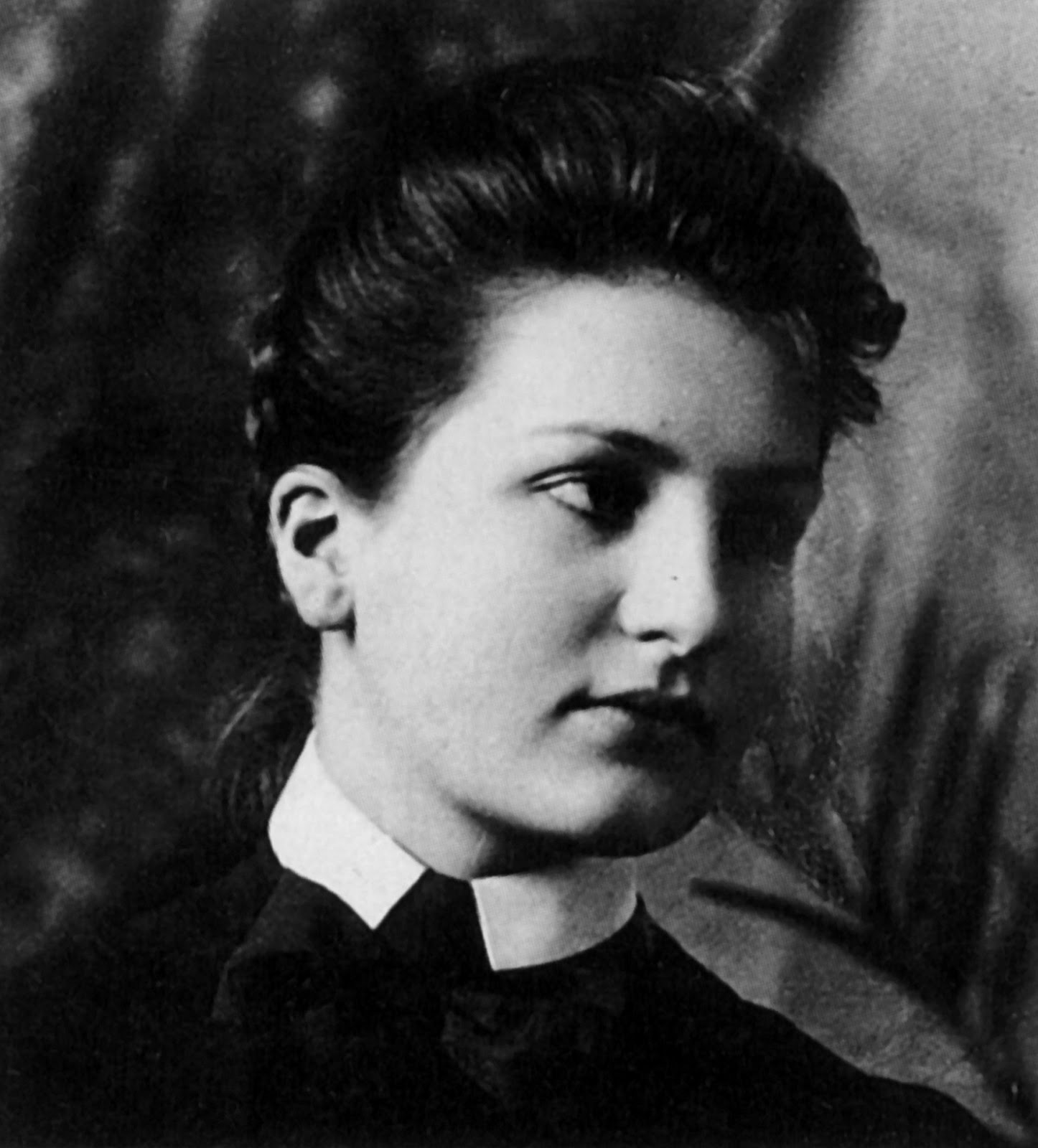
Alma Mahler, the young widow of composer Gustav Mahler (1860–1911), began a tumultuous affair with Kokoschka in 1912. During their 1913 trip to Italy, he cast their relationship into art, immortalizing them together in his 1914 masterpiece Die Windsbraut (Bride of the Wind), a swirling, dreamlike vision of passion and instability.
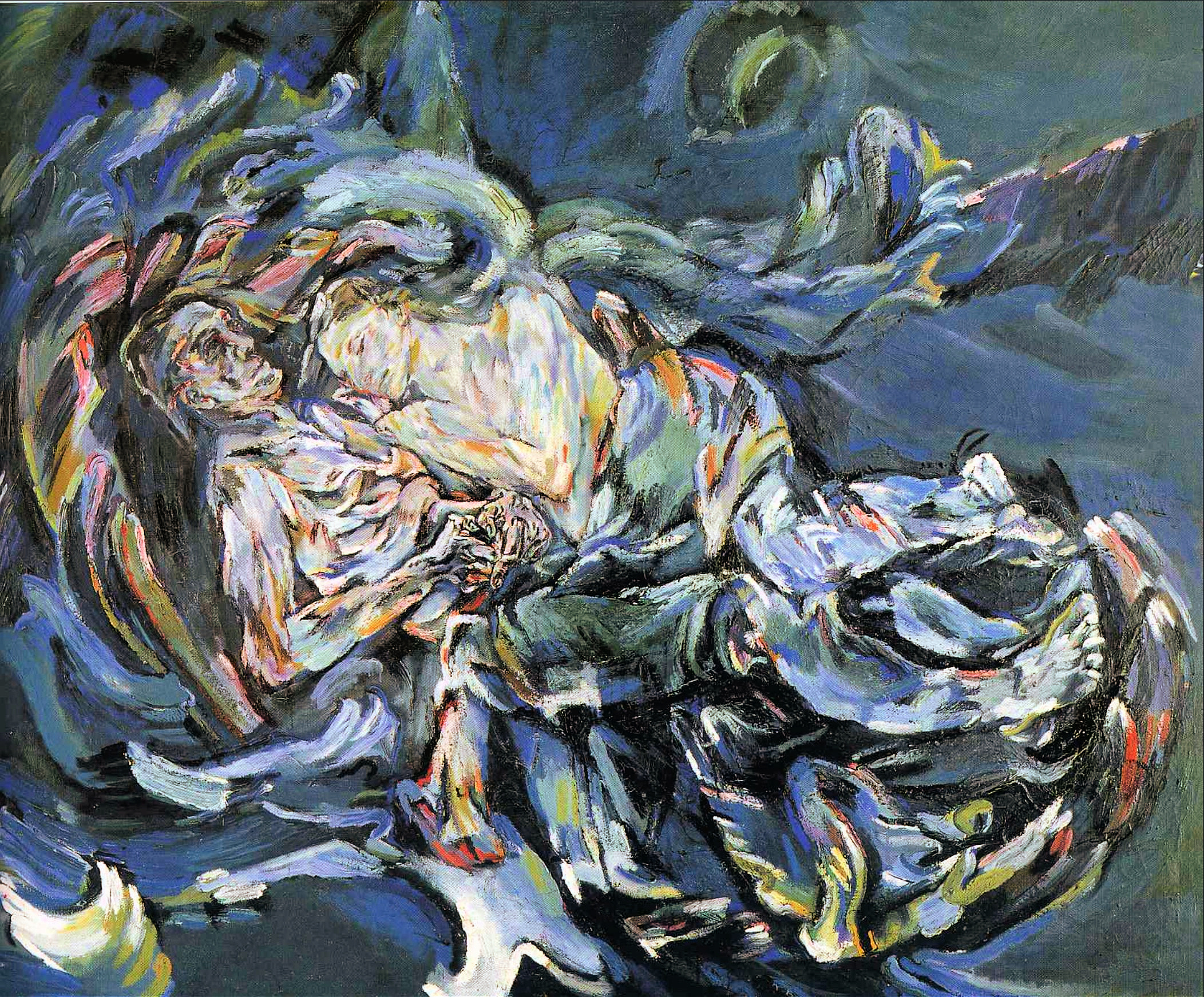
Oskar Kokoschka, Die Windsbraut (The Bride of the Wind), 1913. Oil on canvas, 180.4 x 220.2 cm, Kunstmuseum, Basel, Switzerland. Often read as an autobiographical testament to Kokoschka’s relationship with Alma Mahler, the painting features portrait‑like evocations of both figures. Alma, widow of composer Gustav Mahler, had begun a turbulent affair with the artist in 1912. Upon completing the work, Kokoschka described it to Berlin dealer Herwarth Walden as his “Tristan und Isolde” (Spielmann 2003, p. 153), invoking the unfulfillable nature of a difficult love. Later in 1914, the title Die Windsbraut (Bride of the Wind) emerged in conversation with the poet Georg Trakl. see – Kunstmuseum Basel – Sammlung Online – Die Windsbraut – retrieved May 1, 2024.
War Service and Wounds
Kokoschka enlisted in the 15th Austrian Dragoon Regiment, where he saw brutal combat. In 1915, on the Ukrainian front, he suffered a bullet wound to the head and a bayonet wound to the chest, injuries that nearly killed him. The following year, he was wounded again—this time by grenade fire on the Isonzo Front—adding to the physical and psychological scars that would shape his postwar work.
Expressionism and the Artist’s Role
The Expressionists’ intense engagement with the upheavals of their time influenced each artist’s creative process. Amid this turbulence, Kokoschka insisted that the artist’s vocation was not rooted in prefabricated ideologies or party programs, but in the existential task of forging a personal vision. For him, artistic identity was not a stylistic allegiance but a way of being in the world. “There is no such thing as a German, French, or Anglo‑American Expressionism!” he argued. “There are only young people trying to find their bearings in the world” (Kokoschka, My Life, p. 37).
Defying the “-ism”
Kokoschka’s fierce individualism made him one of the great masters of Expressionism precisely because he refused to be contained by it. His canvases—charged with harsh, clashing colors, fractured angles, and psychological intensity—were designed to unsettle. They confront the viewer, provoking discomfort, agitation, even rage. In rejecting the dominant currents of modernism to pursue his own path, Kokoschka became, like Max Beckmann, one of the major figures who often sits uneasily within the standard narratives of twentieth‑century art.
The Outsider as Master
This marginal position, however, aligns with Kokoschka’s self‑image. His refusal to conform—to movements, to expectations, to the tidy categories of art history—was central to his identity. For the artist once branded “the wildest beast of all,” exclusion from the mainstream was not a failure but a vindication of the independence he prized.
SOURCES:
- Art Story, The. “Oskar Kokoschka Artist Overview and Analysis.” Accessed May 1, 2024. https://www.theartstory.org/artist/kokoschka-oskar.
- Cassirer Restitution Project. “Kunstsalon Paul Cassirer.” Up Close: Christie’s Restitution Services. Accessed May 1, 2024. https://upclose.christies.com/restitution/kunstsalon-cassirer.
- Elson, Simon. “The Godfather.” Gallery Weekend Berlin Journal. Accessed May 1, 2024. https://www.gallery-weekend-berlin.de/journal/simon-elson-pate/.
- Fondation Oskar Kokoschka. “Biographie.” Accessed May 1, 2024. https://oskar-kokoschka.ch/fr/1001/Biographie.
- Fraser, Carol Hoorn. “Kokoschka: Knight Errant of 20th Century Painting.” Jottings. Section III. Accessed May 1, 2024. http://www.jottings.ca/carol/kokoschka.html#3.
- Kokoschka, Oskar. Letters I: 1905–1919. Edited by Olda Kokoschka and Heinz Spielmann. Düsseldorf: Claassen, 1984.
- Kokoschka, Oskar. My Life. Translated by David Britt. New York: Macmillan, 1974.
- Mahler Foundation. “Oskar Kokoschka (1886-1980).” Contemporaries. Accessed May 1, 2024. https://mahlerfoundation.org/mahler/contemporaries/oskar-kokoschka.
- Paret, Peter. The Berlin Secession: Modernism and Its Enemies in Imperial Germany. Cambridge, MA: Belknap Press of Harvard University Press, 1980.
- Wikimedia Commons. “Category: Marta Wolff.” Last modified April 16, 2026. https://commons.wikimedia.org/wiki/Category:Marta_Wolff.


