FEATURE Image: This color photograph of Marilyn Monroe was made by Bruno Bernard — Bernard of Hollywood — on August 3, 1952, during the poolside press party at bandleader Ray Anthony’s California home. Co‑organized by 20th Century‑Fox, the event was engineered to showcase Monroe’s rapid ascent and to promote Anthony’s novelty song, Marilyn. She is wearing the same dress used in her Niagara publicity stills and scenes, a deliberate continuity meant to reinforce her emerging screen persona. Bernard had known her since 1946, when she was still Norma Jeane, and he remained one of the few photographers able to catch her in genuinely relaxed, luminous moments. His poolside images from this period are among the most candid records of her early stardom. “Marilyn Monroe – 1952, Niagara” by Movie-Fan is licensed under CC BY-NC-SA 2.0.
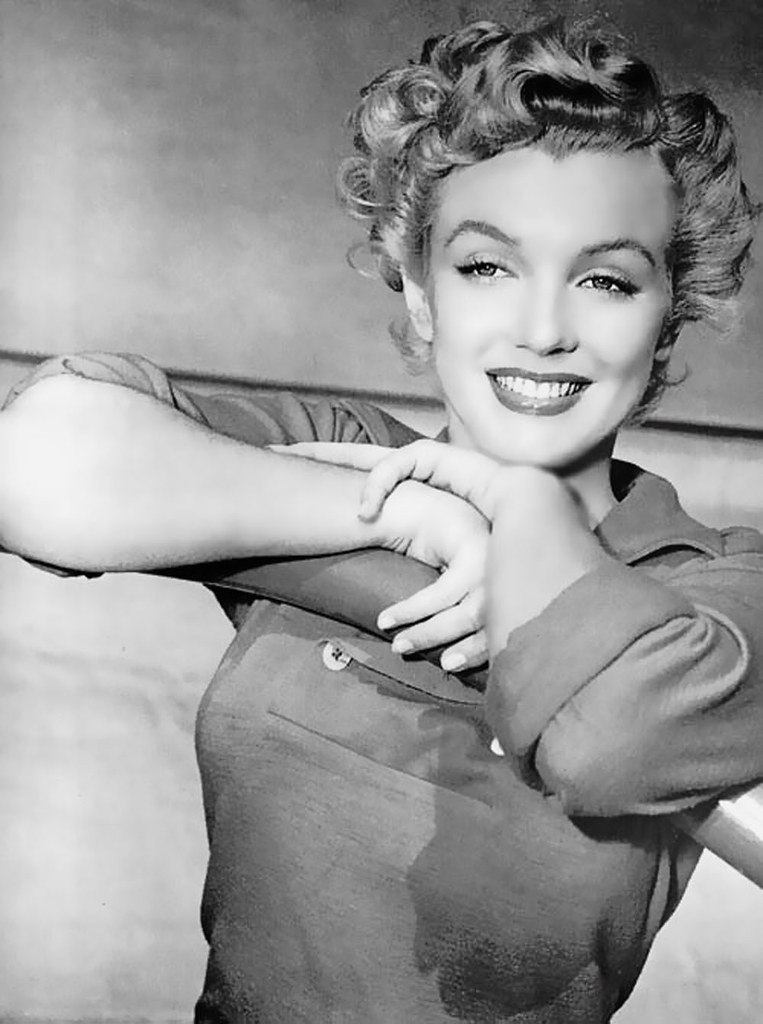
Marilyn Monroe in 1951 was emerging fast, already drawing notice from critics who tagged her as “the new blonde bombshell.” The black‑and‑white portrait of Marilyn Monroe was made in late 1951 by Ernest Bachrach, RKO’s chief portrait photographer, and syndicated widely through 1952. Shot both on location and in the studio spaces at RKO Radio Pictures in Los Angeles, the session was designed as a high‑visibility publicity campaign for Fritz Lang’s Clash by Night (1952). Monroe had pushed hard to be loaned out from 20th Century‑Fox for the supporting role of Peggy, a confident, blue‑collar cannery worker — a part she knew could shift how Hollywood viewed her.
Bachrach, a master of glamour portraiture, photographed her with the explicit aim of presenting her as a credible dramatic actress alongside veterans like Barbara Stanwyck. The film ultimately altered the trajectory of her career: for the first time, Monroe received billing above the title in a major motion picture. Bachrach’s photo campaign amplified that breakthrough, making her a household name even before the film reached theaters. It also demonstrated to studio executives that her magnetism held just as strongly in casual, sporty attire as in tight, high‑glamour wardrobe — a fusion that helped define the emerging “girl next door” aesthetic of 1950s Hollywood photography. “Marilyn Monroe, por Ernest Bachrach, 1951” by Antonio Marín Segovia is licensed under CC BY-NC-ND 2.0.

Marilyn Monroe started 1953 as Hollywood’s “It” girl. PHOTO: “Marilyn Monroe 1953” by Movie-Fan is licensed under CC BY-NC-SA 2.0. The photograph has absolutely nothing to do with the 1952 Ray Anthony party. It shows Marilyn in a cropped frame from late 1953, captured at the spectacular Hollywood film premiere for How to Marry a Millionaire. She is wearing a famous custom white lace gown designed by William Travilla. But it does relate to the party in that it is bound together by the explosive phenomenon of her meteoric rise.
In early 1953, Marilyn Monroe transitioned from a hard-working studio starlet into the absolute, undisputed “It Girl” of global popular culture. This specific phenomenon changed her life, transformed Hollywood marketing, and left a permanent mark on entertainment history.
Before 1953, 20th Century Fox viewed Marilyn as a profitable novelty. But by January 1953, a perfect storm of media alignment occurred. The groundwork laid by those 1952 events—like the Ray Anthony party, the LIFE magazine cover, and the continuous press blitzes—finally culminated in a box-office avalanche.
In a single twelve-month span, Monroe released three consecutive, massive cinematic triumphs: January 1953 (Niagara) where she starred as a dark, dangerous femme fatale; July 1953 (Gentlemen Prefer Blondes) where she cemented her legendary comedic timing and musical icon status in the shocking pink Travilla gown; and November 1953 (How to Marry a Millionaire) where she solidified her mass commercial appeal as a whispery “dumb blonde” comedic character.
Hollywood had never seen an actress command the cultural conversation in one year like this. She was the original high-concept, serial franchise film star. Her face and body sold newspapers, magazines, makeup, and movie tickets at an unprecedented velocity.
At the same time, Marilyn redefined what an “It Girl” could be. It Girls came in all types previously—from the aloof, untouchable elegance of stars like Greta Garbo or Joan Crawford to the gritty, working-class, uninhibited trail that Bow and Harlow blazed. Marilyn introduced a radiant, highly accessible, and deeply vulnerable form of sexuality. She projected a playful, “wink-at-the-camera” warmth that made audiences feel like she was letting them in on the fun.
A tragic irony of Marilyn becoming the ultimate 1953 “It Girl” is that the very phenomenon that made her immortal also trapped her in her “dumb blonde” or “glamour queen” roles and persona, so that in late 1954 she walked away from Hollywood temporarily – and when she came back things were not quite the same. Decades later, the visual shorthand established during her 1953 peak remains the definitive blueprint for modern celebrity culture. The hyper-focus on her hair, her outfits, her dating life, and her physical form set the stage for how modern pop stars and icons are scrutinized by the media today.
Bandleader Ray Anthony released the two-minute single Marilyn in 1952 with rising film star Marilyn Monroe definitely in mind.
Hollywood lore claims Marilyn Monroe swept into the 1952 release party for the song Marilyn in a bright pink dress, briefly touching down in a wobbling helicopter before vanishing just as theatrically. In reality she arrived quietly by car. The helicopter, brought in separately, became a convenient prop once publicists realized its value: they had her climb aboard and pose with Ray Anthony to manufacture the impression of a dramatic aerial entrance. The afternoon itself had the usual Hollywood chaos — Lassie trotted up to greet her, and Mickey Rooney jumped behind the drums with Anthony’s orchestra to play for her.
By the end of 1951 she had completed thirteen films, most for 20th Century‑Fox, and by 1952 she was poised on the threshold of major stardom.
In 1952 she added five more. In Clash by Night (RKO), Kate Cameron of the New York News tagged her as “the new blonde bombshell.” In Fox’s We’re Not Married, Alton Cook of the New York World‑Telegram wrote that “Marilyn supplies beauty. She is Hollywood’s foremost expert.” Fox’s Monkey Business prompted Paul C. Beckley of the New York Herald Tribune to note the shift underway: “Not seen her before. I now know what’s that about.” She finished the year in Fox’s anthology O. Henry’s Full House, where Archer Winston of the New York Post singled out her “stunning proportions.”

This iconic black‑and‑white close‑up of Marilyn Monroe (above) was made in early 1953 by 20th Century‑Fox’s chief portrait photographer, Frank Powolny, as a deliberate publicity image for her breakthrough film Niagara. The styling, the expression, the heavy‑lidded “bedroom eyes” — all echo the Philippe Halsman Life magazine portrait from January 1952 (published April 7, 1952), because both sessions caught her at the exact moment she was standardizing and weaponizing her look.
The 1953 shoot took place at the Fox studios in Los Angeles, a high‑glamour promotional session meant to generate marketing material for Niagara and Gentlemen Prefer Blondes. Used widely in posters, press kits, and magazine syndication, the portrait is historically important because it crystallized her trademark expression: head tipped slightly back, eyes half‑closed, lips parted just enough to show her teeth.
Its impact was immediate. The image fixed her aesthetic in the public imagination and helped shift her from rising starlet to fully recognized global symbol of Hollywood glamour. Decades later, the tight crop — platinum curls, parted lips, beauty mark, and that unmistakable gaze — remains one of the most reproduced portraits in pop culture. It was this Powolny series that Andy Warhol appropriated for his 1962 silkscreens after her death. Marilyn didn’t merely suggest the look she had explored with Halsman; she executed it so precisely that the studio seized it and mass‑marketed its power. “Marilyn Monroe – 1952 / fotografiada por Philippe Halsman para LIFE” by Antonio Marín Segovia is licensed under CC BY-NC-ND 2.0.

Marilyn Monroe, June 1952 by Jock Carroll. “Marilyn Monroe by Jock Carroll, June, 1952” by thefoxling is licensed under CC BY-NC-SA 2.0.
Taken by Canadian journalist‑photographer Jock Carroll in June 1952 on location in Niagara Falls, Canada, this candid portrait (above) comes from his two‑week assignment for Weekend Magazine, which had commissioned him to profile the 26‑year‑old rising actress as she filmed her breakthrough thriller Niagara. The image captures a candid, windswept moment during one of their informal walks along the Niagara River: Monroe in a simple white sleeveless top, her small medallion pendant visible, her blonde curls blown out by the mist and wind rolling off the falls.
Across the assignment Carroll shot more than 400 candid photographs. The easy rapport they developed allowed him to capture unguarded moments — including the now‑famous sequence of Monroe practicing how to smoke in her room at the General Brock Hotel for an upcoming role. A selection of his images ran with his profile in the August 9, 1952 issue of Weekend Picture Magazine.
Most of the negatives remained unseen for decades until they resurfaced in 1996 in Falling for Marilyn: The Lost Niagara Collection, which established the set as a major historical record. Today, this windswept portrait is celebrated for stripping away the studio‑manufactured bombshell veneer, offering instead an unfiltered, radiant glimpse of Norma Jeane at her most natural and effortlessly charming.

Marilyn Monroe by Jock Carroll, June, 1952.
“Marilyn Monroe by Jock Carroll, June, 1952” by thefoxling is licensed under CC BY-NC-SA 2.0.
Jock Carroll’s candid photograph (above) catches Marilyn Monroe from behind as she suddenly breaks into a light jog in her high heels along the concrete pier toward the Maid of the Mist, Niagara Falls thundering behind her. Carroll wanted movement rather than a stiff publicity pose, something that showed her responding naturally to the environment. She wears a button‑back, off‑the‑shoulder top and a pale pencil skirt, the outfit emphasizing the clean, unforced lines of her stride.
In the finished 1953 film, director Henry Hathaway devoted 116 uninterrupted feet of film to a single shot of Monroe walking away from the camera in a tight pencil skirt — one of the longest “walking‑away” shots in cinema history. It permanently established her swinging gait as a defining element of her star power, a signature that audiences recognized instantly and never forgot.

Marilyn Monroe’s performance and appearance in Niagara in 1953 from 20th Century-Fox were highly praised. One critic observed: “Seen from any angle…Marilyn Monroe leaves little to be desired.” (A.H. Weiler, New York Times). Public Domain. in the United States. Because it was an uncopyrighted promotional still distributed freely to the public by the movie studio between 1931 and 1963, its copyright was never registered or renewed.

Publicity portrait of Marilyn Monroe as Rose Loomis in the 1953 film Niagara. By Gene Kornman (1897-1978). This work is in the public domain because it was published in the United States between 1931 and 1963, and although there may or may not have been a copyright notice, the copyright was not renewed.
Marilyn Monroe’s momentum in 1953 never faltered. Her three Twentieth Century‑Fox releases that year — Niagara, praised as “seductive,” Gentlemen Prefer Blondes, deemed “alluring,” and How to Marry a Millionaire, celebrated for her “magnificent proportions” — collectively cemented her acting career and her place as America’s enduring screen symbol.
Ray Anthony (b. 1922), one of the last living figures from post‑war Old Hollywood, belongs to the same generation whose era effectively closed with Marilyn’s death in 1962. Four years her senior, he reached his hundredth birthday in California on January 20, 2022.
Most of that remarkable cohort born in 1922 — Ava Gardner, Jason Robards, Betty White, Judy Garland, Doris Day, Cyd Charisse, Kim Hunter, Eleanor Parker, Veronica Lake, and many others — has now passed, leaving only a few witnesses to that vanished world.

Marilyn Monroe and Joe DiMaggio — the movie star and the former major‑league baseball great — married in 1954. “Evan Esar” by Peter K. Levy is marked with Public Domain Mark 1.0.
Ray Anthony’s rise in the early 1950s came through a wildly popular dance band that kept producing records that instantly entered American social life. Numbers like The Hokey Pokey and The Bunny Hop became fixtures at wedding receptions throughout the 1960s and 1970s, part of the soundtrack of mid‑century celebration.
When Anthony released his single Marilyn, the world’s most famous sex symbol was still unattached, though being actively courted by New York Yankees legend Joe DiMaggio. They would marry in 1954. By then Marilyn had already been declared Hollywood’s “It Girl” of 1952, her career hovering at the edge of full stardom — an excitement that made the Marilyn release party crackle.
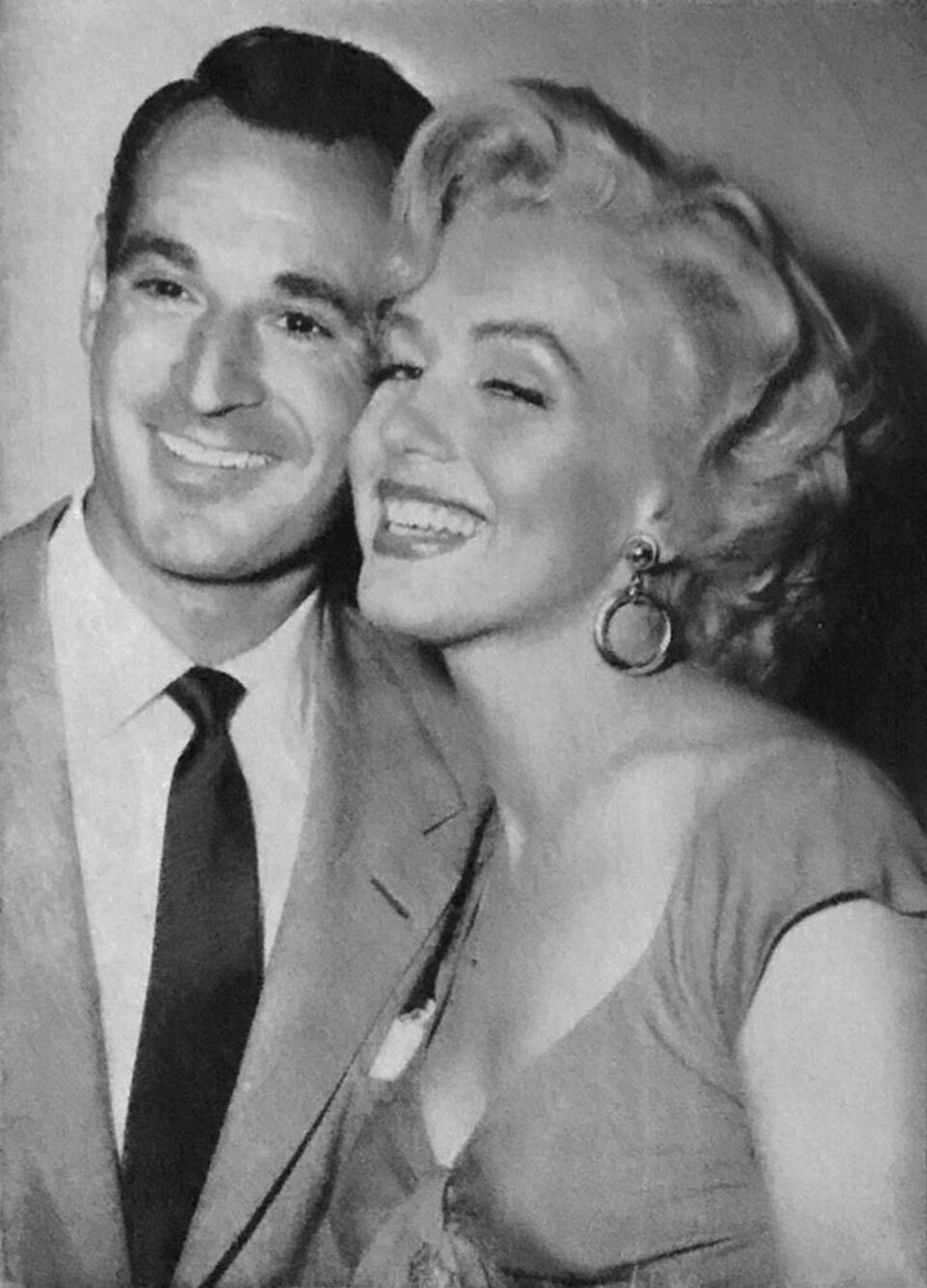
Photo of musician Ray Anthony and Marilyn Monroe from the cover of Down Beat magazine in 1952. This work is in the public domain because it was published in the United States between 1931 and 1963, and although there may or may not have been a copyright notice, the copyright was not renewed.
Anthony had a particular fondness for glamorous Hollywood blondes. He married one in 1955: Mamie Van Doren, with whom he had a son before divorcing in 1961. In 1956 he appeared alongside another blonde bombshell, Jayne Mansfield, in the musical comedy The Girl Can’t Help It.
Surrounded by beauty, music, and the energy of post‑war Hollywood, Anthony reached a fitting milestone in 1957 when he received his star on the Hollywood Walk of Fame. Marilyn Monroe received her Hollywood Walk of Fame star on February 8, 1960. see – Marilyn Monroe – Hollywood Walk of Fame – retrieved July 16, 2026.
This explanatory article may be periodically updated.