
FEATURE Image: June 2023 85% 7.86 mb.



























































“Storm line breaking over the fields as the last light pushes through.”























FEATURE Image: June 2023 85% 7.86 mb.
“Storm line breaking over the fields as the last light pushes through.”


Feature Image: The Beach Boys in 1964; clockwise from left: Al Jardine, Mike Love, Brian Wilson, Carl Wilson, Dennis Wilson. Trade ad for The Beach Boys’s single “California Girls”/”Let Him Run Wild.” Public Domain.*

When the Beach Boys Grew Up: The Transformative Year of 1964
On November 2, 1964, the Beach Boys landed in London for a television appearance and concert, arriving as one of America’s most successful rock bands. Their visit came just months after the Beatles had launched the British Invasion in the United States, making the Beach Boys’ trip something of a musical counteroffensive. At a London press conference, 22-year-old Brian Wilson spoke confidently about the group’s future and even expressed a desire to record in Europe someday. (Eventually in 1972 they did record in Holland.)
Yet Wilson was equally determined to redefine the band’s image. Frustrated by attempts to pigeonhole the group as a novelty act built on surfing and hot rods, he heatedly argued that the Beach Boys had not originated the genre and had moved beyond those subjects. Their music was just their sound that people liked to listen to. Their music, he insisted, was about the experiences and concerns of young people in the mid1960’s, not simply beaches and automobiles.

Mike Love and Brian Wilson wrote “When I Grow Up (To be a Man)” and most of “The Beach Boys Today!” released in March 1965 on which it appeared. Trade ad for The Beach Boys’s single “California Girls”/”Let Him Run Wild.” Public Domain.*
The clearest example of that evolution was “When I Grow Up (To Be a Man),” released in August 1964 and written by Brian Wilson and Mike Love. Unlike the carefree themes that had dominated earlier Beach Boys records, the song confronted uncertainty about adulthood, identity, relationships, and the future. The song’s concerns about adulthood may have reflected Brian Wilson’s own life. During the Beach Boys’ January 1964 tour of Australia and New Zealand, Wilson repeatedly telephoned 16-year-old Marilyn Rovell to ask for her hand in marriage. Back in California, he continued working closely with Marilyn and her group, the Honeys, producing their single “He’s a Doll.” Mike Love later suggested that “When I Grow Up (To Be a Man)” reflected tensions surrounding Brian Wilson’s impending marriage to Marilyn Rovell as well as criticisms from Brian’s father, Murry Wilson, who frequently questioned his son’s maturity and masculinity in the “glitzy” music business. As his December 1964 wedding approached, Brian was navigating the pressures of fame, and questions about maturity, commitment, and the future that were no longer merely lyrical themes but real-life concerns.
Originally performing as the Rovell Sisters, the Los Angeles girl group was rechristened The Honeys in 1962 by Brian Wilson, who served as their primary songwriter and visionary record producer. Intended as a female vocal counterpart to the Beach Boys, the trio became an essential ingredient in crafting the sun-drenched “California Sound.” Their creative alliance quickly turned personal when Wilson married group member Marilyn Rovell in December 1964. Pictured from left are Marilyn Rovell, Diane Rovell, and Ginger Blake.

This 1964 Premier Gas Station marketing photo captures the hot-rod car culture The Beach Boys soundtracked that year. The open hood of the 1964 Chevrolet Impala embodies the automotive freedom of “I Get Around,” where status meant cruising to the hippest local spots; while the carefree youth contrasts some of the anxious vulnerability of “When I Grow Up (To Be a Man),” where Brian Wilson questioned if his idealized teenage dream world as he moved towards adulthood. PHOTO: “New gas station, Fort Worth, Texas 1964” by | El Caganer – Over 8.5 Million views! is licensed under CC BY 2.0.
The Beach Boys entered 1964 as one of the hottest acts in music. Since 1963 they had piled up hit records, including “Surfin’ U.S.A.,” which became Billboard’s top song of the year. But everything changed in February 1964 when the Beatles appeared on The Ed Sullivan Show before an audience of 74 million viewers.
Brian Wilson later admitted that the impact of Beatlemania was profound. For a moment he considered giving up, stunned by how quickly the British quartet had captured the public imagination. Instead, he responded creatively. Wilson threw himself into songwriting, arranging, and studio experimentation, determined to push the Beach Boys into new musical territory. The result was not retrenchment but a period of artistic innovation that would soon be matched by profound changes in Wilson’s personal life.
Peaking at No. 3 in May 1963, The Beach Boys’ “Surfin’ U.S.A.” exploded into Billboard’s No. 1 song of the year, transforming a niche California counterculture into a global phenomenon. Capturing a burgeoning youth movement, the track became the definitive anthem for the “California Sound”—soundtracking a sun-drenched lifestyle found in popular feature films and magazines built on surfboards, loud print apparel, and a universal love for the ocean.
That growth was already evident in “I Get Around,” the Beach Boys’ first No. 1 single, released in May 1964. More sophisticated than their early surf hits, the song reflected a band growing restless with fame and searching for new experiences.
Their sixth album, All Summer Long, released in July 1964 with “I Get Around” its first track, became the group’s first truly unified artistic statement. Songs that once celebrated youthful freedom increasingly revealed a deeper awareness of ambition, identity, and change. Critics and historians have often pointed to the album as the moment when the Beach Boys began their transition from wunderkind into serious artists. As Dennis Wilson biographer Jon Stebbins wrote about “I Get Around,” the song “is clearly ahead of its time, and it signals the speed at which Brian had developed. With its edgy guitar/sax bursts doubled with trebly reverbed Fender flicks, electric-organ fills, and an arrangement that stops, goes, accelerates, and then stops and goes a few more times, the song is nearly otherworldly in its inventiveness. Each band member’s voice is showcased, and this helps to make this single as good as any pop record ever made.”
By the time they arrived in Britain in November 1964, they were carrying considerable momentum: a No. 1 single, a string of Top 10 hits, successful albums, and a rapidly expanding international audience.
Released on May 11, 1964, the Brian Wilson-Mike Love composition “I Get Around” paired with the equally brilliant “Don’t Worry Baby” on its B-side. By mid-June, the single was racing up the Billboard Hot 100, reaching No. 1 for the first two weeks of July. Yet success brought little time for celebration. As Mike Love later recalled, every chart-topping hit simply increased the pressure to deliver the next one. In 1964, the Beach Boys were caught in a relentless cycle of writing, recording, and promoting new music, determined to keep their remarkable streak alive.
“Carl’s Big Chance,” the final surfer instrumental on a Beach Boys studio album, was recorded to showcase Carl Wilson’s guitar playing.
Another sign of the band’s evolution could be found in Shut Down Volume Two, released in March 1964 (no. 13 on the Billboard 200). Although much of the material had been written before Beatlemania exploded, songs such as “The Warmth of the Sun” hinted at a new degree of emotional sophistication. The lead track, Fun, Fun, Fun was recorded in the first week of January 1964 and released as a single on February 3, 1964, less than a week before the Beatles’ first appearance on The Ed Sullivan Show.
Written by Brian Wilson and Mike Love on the night of President Kennedy’s assassination in November 1963, “The Warmth of the Sun” possessed a reflective melancholy rarely heard in early rock and roll. While the Beatles were helping usher in a new era of popular music, the Beach Boys freely admitted to the passing of their car and surfer craze and the carefree California themes that had first made them famous. Whether “The Warmth of the Sun” was written for JFK and Camelot, or not, it marked the era’s ending.
Written on the night of JFK’s assassination, “The Warmth of the Sun” became one of Brian Wilson’s most poignant early compositions. Released just a week before the Beatles’ historic debut on The Ed Sullivan Show, it stood at the crossroads of pop history, closing one chapter as the British Invasion opened another.
A creative rivalry was beginning to emerge as well. As the mid-1960s unfolded, Brian Wilson and Paul McCartney would become two of popular music’s most innovative young composers, each inspiring the other to reach new artistic heights. All Summer Long (I Get Around; Wendy) in July 1964 had anticipated The Beach Boys Today! (When I Grow Up (To Be a Man); Help Me, Rhonda) in March 1965. Both studio LPs (the Beach Boys’ sixth and eighth). grabbed back some of the rock pop critical and popular initiative they had prior to the Beatles.
Broadcast on April 18, 1964, the Beach Boys appeared on American Bandstand. They lip-synched “Don’t Worry Baby” and host Dick Clark interviewed them. The rest of the show was dedicated to the music of the Beatles. In 1964 the Beach Boys decided it was time to move past popular surfer and car songs.
Following the release of Shut Down Volume Two, the Beach Boys appeared on the Steve Allen Show. Allen in his introduction said, “I’m sure you’re familiar with them they’ve had so many big hit records this last year. Let’s welcome the Beach Boys with Fun, Fun, Fun.”
“When I Grow Up (To Be a Man)” stands today as one of the most groundbreaking songs of 1964. Instead of celebrating cars, surfing, or romance, it explored the anxieties of present a teenager thinking in the first person about serious matters on future adulthood.
The narrator wonders whether adulthood will change his tastes, his ambitions, or even his capacity to love. Questions such as “Will I love my wife for the rest of my life?” gave the song a level of personal introspection that was rare in Top 40 music. Number one Iin Canada and number nine in the U.S. it is one of the first to use the idiomatic term “turn on” as in “Will I dig the same things that turned me on as a kid?” It also asks an intelligent question, in Mike Love’s part, of what sort of woman he will pursue in the near future as a man.
Because Brian Wilson himself was preparing for marriage, the lyrics carried an authenticity that resonated beyond simple teenage curiosity. The song managed to examine serious issues while maintaining an innocent optimism, making it one of the first genuinely mature statements in mainstream rock.

The Beach Boys Today! was recorded starting in August 1964 and released in March 1965. It peaked at no. 4 on the Billboard 200 and was certified Gold. “beach boys- today!” by cdrummbks is licensed under CC BY 2.0.
The year also marked a major turning point in Brian Wilson’s personal life. Before the March 1965 album, The Beach Boys Today!, was completed whose recording started with “When I Grow Up (To Be A Man)” in August 1964, Murry Wilson was fired by Brian and didn’t return. The band’s manager and Brian’s domineering father, Murry increasingly clashed with his son over creative and business matters. The move represented a declaration of independence and cemented Brian’s role as the group’s unquestioned creative leader.
Surrounded by the smell of cannabis that Brian started smoking regularly, new musical insight is heard in When I Grow Up (To Be A Man). It is one of the first Beach Boys’ songs featuring unusual chord changes, sophisticated harmonies, and a harpsichord arrangement that foreshadowed the innovations that would later define records such as Pet Sounds. The young producer also again deployed a harpsichord – it can be heard in I Get Around – which was a creative use of a 16th century Baroque instrument which was unusual for a mid-1960’s pop rock song. The Beach Boys’ example led to its use, and that of other classical music instruments, by other rock bands soon afterwards. The track also features, as Jon Stebbins maintains, “one of Dennis’s best studio drum performances.”
The Beach Boys Today! started recording in August 1964 and was completed in January 1965. It was recorded at three different studios in Hollywood: United Western Recorders, Gold Star Studios, and RCA Studios and deployed over 30 session musicians. It was released on March 8, 1965. Creative breakthroughs came at a personal cost. During the recording of The Beach Boys Today!, Wilson found himself overwhelmed by constant touring, producing, arranging, songwriting, and performing. The relentless schedule eventually led to emotional and physical exhaustion. Even as his music reached new heights, Wilson struggled to balance artistic ambition with the demands of stardom. Said Brian Wlsion later: “I used to be Mr. Everything.” Mike Love attributed some of it to the psychedelic drug culture and Brian’s limited involvement. Murry stayed in Hawthorne at home where Carl Wilson was living and, in his room, listening intently to Introducing… The Beatles and Meet the Beatles!
In April and May 1964, members of the Beach Boys appeared in two films, while Brian Wilson’s songs surfaced in several others. In April, Wilson spent two days on the set of Girls on the Beach (released in 1965), performing “Lonely Sea” from Surfin’ U.S.A. for a group of teenagers. The film centers on a sorority house trying to book the Beatles for a benefit concert, only to settle for the Beach Boys. That era of corny, low-budget beach and surf movies was soon eclipsed when A Hard Day’s Night arrived in August 1964. The Beatles played themselves in a sharp, witty film that showcased both their music and personalities, a world away from the California surfer boys and girls who populated Beach Boys screen vehicles.
Yet the pressure also fueled some of Brian Wilson’s most important work. “When I Grow Up (To Be a Man)” became the first recording session for The Beach Boys Today! and signaled the band’s future direction. Rock critic Richard Meltzer would later write that the song marked the moment when the Beach Boys “abruptly ceased to be boys.”
In June 1964 they recorded The Beach Boys’ Christmas Album (released in November 1964) and since July had been in Hawaii and Arizona to begin their 33-day, 42-concert Surfin’ Safari tour. After Murry was fired the Beach Boys became more involved in their concert date strategy, such as playing nearby secondary and tertiary cities as well as playing in big ones (see Love, p. 98). In early August 1964, “When I Grow Up (To Be A Man)” was the first song recorded for The Beach Boys Today! and released as a single on August 24, 1964. It is a philosophical song whose music is an artistic progression for Brian Wilson and the Beach Boys with its rich and profound instrumental arrangement and 4-part vocal harmonies that are fluid and ethereal. In his 2016 memoir, Love wrote that the song was “probably influenced” by Murry Wilson who constantly challenged Brian’s manhood.
In May 1964, the Beach Boys were still on the rise when they appeared alongside Annette Funicello in the opening credits of Disney’s Monkey’s Uncle, released the following summer. Lip-synching a lively Sherman Brothers tune, the group provided the vocal spark for Funicello’s final Disney film. Looking back, she praised the Beach Boys’ remarkable harmonies and recalled how enjoyable they were to work with, both on the film and during appearances at Disneyland. At the time, they were simply a talented young band on the way up. Only later would it become clear that they were destined to become one of the biggest acts in popular music.
In September 1964 the Beach Boys picked up the Surfin Safari tour that they broke off in August 1964 to return to the studio to record and release When I Grow Up (To Be a Man). After touring up and down the East Coast from Florida to New York, they made an appearance on The Ed Sullivan Show on September 27, 1964. In front of screaming fans they performed “I Get Around,” their no.1 hit that year and what would become a top-5 Billboard song of the year.
Released October 19, 1964, the live album Beach Boys Concert was the first Beach Boys album to be no. 1 on the Billboard 200. The only other album to achieve the top spot is Endless Summer in 1974. Recorded in Sacramento, California, Beach Boys Concert was the first live album to top the pop music record charts (see – Moskowitz, David V., ed. (2015). The 100 Greatest Bands of All Time: A Guide to the Legends Who Rocked the World, p.42). It was on the charts for nearly a year and in the no. 1 spot for 4 consecutive weeks. Because Brian Wilson was not going to perform live with the group in the future, it is a relatively rare recording of the original line-up.
In October of 1964, the Beach Boys, crowd pleasers mostly wherever they went, played four songs at the T.A.M. I. (Teenage Awards Music International show) in Santa Monica, California. The Beach Boys played Surfin’ USA, I Get Around, Surfer Girl, Dance, Dance, Dance. Others in that show included Chuck Berry, James Brown, the Supremes, Smokey Robinson and the Rolling Stones who played right before the Beach Boys. According to Mike Love’s “Good Vibrations,” he met and made friends with Marvin Gaye at that show. “Surfin’ U.S.A.” peaked at no. 3 in May 1963 and became Billboard’s no.1 song for the year. The concert was held at the Santa Monica Civic Auditorium on October 28 and 29, 1964.
When the Beach Boys touched down in London, they were no longer simply America’s premier surf band. They had become serious competitors in a rapidly changing musical landscape dominated by the Beatles. There was an electricity in the air surrounding the Beach Boys in Europe. Since February they had a top 5 hit (“Fun, Fun, Fun”), no. 1 song (“I Get Around”), a no.1 album (“Beach Boys Concert”), and numerous TV and movie appearances and live concert tours. The band had two follow-up top 10 singles (“When I Grow Up (To Be Man)” and “Dance, Dance, Dance”) – and their leader, Brian Wilson, was getting married in December.
Brian Wilson married Marilyn Rovell on December 7, 1964, but only weeks later suffered a breakdown brought on by the pressures of maintaining the Beach Boys’ momentum. On December 23, 1964, Brian Wilson was on an airplane from L.A. to Houston, Texas, to start a 25-date concert tour when he announced he was stepping away from touring. Glen Campbell temporarily filled his place on the road. Brian returned to the vacant family homestead in Hawthorne and had a long talk with his mother who “sort of straightened me out,” the Beach Boys’ leader said (quoted in The Beach Boys’ America’s Band, Johnny Morgan, p.81).
The decision marked the end of one chapter and the beginning of another. As 1965 dawned, Brian Wilson would increasingly focus on studio creation, launching the Beach Boys toward their most innovative and influential period.
In November 1964, after eight days of television and radio appearances in England, the Beach Boys embarked on their first major European tour, traveling through France, Italy, Germany, Denmark, and Sweden. During their first visit to Paris, the band played the role of wide-eyed American tourists, exploring Montmartre with cameras in hand before performing at the Olympia, where they were greeted by thousands of screaming French fans. The trip left a lasting impression on Mike Love, who later said that the experiences of seeing beautiful women across Europe, while also thinking fondly of home, helped inspire the lyrics to “California Girls” the following year.
If “Surfin’ U.S.A.” defined who the Beach Boys were, “When I Grow Up (To Be a Man)” revealed who they were becoming. In 1964, Brian Wilson and his bandmates moved beyond carefree images of California youth and began exploring deeper emotional and musical territory. It was the year they stopped being America’s favorite boys and started becoming one of rock music’s most important artistic forces.
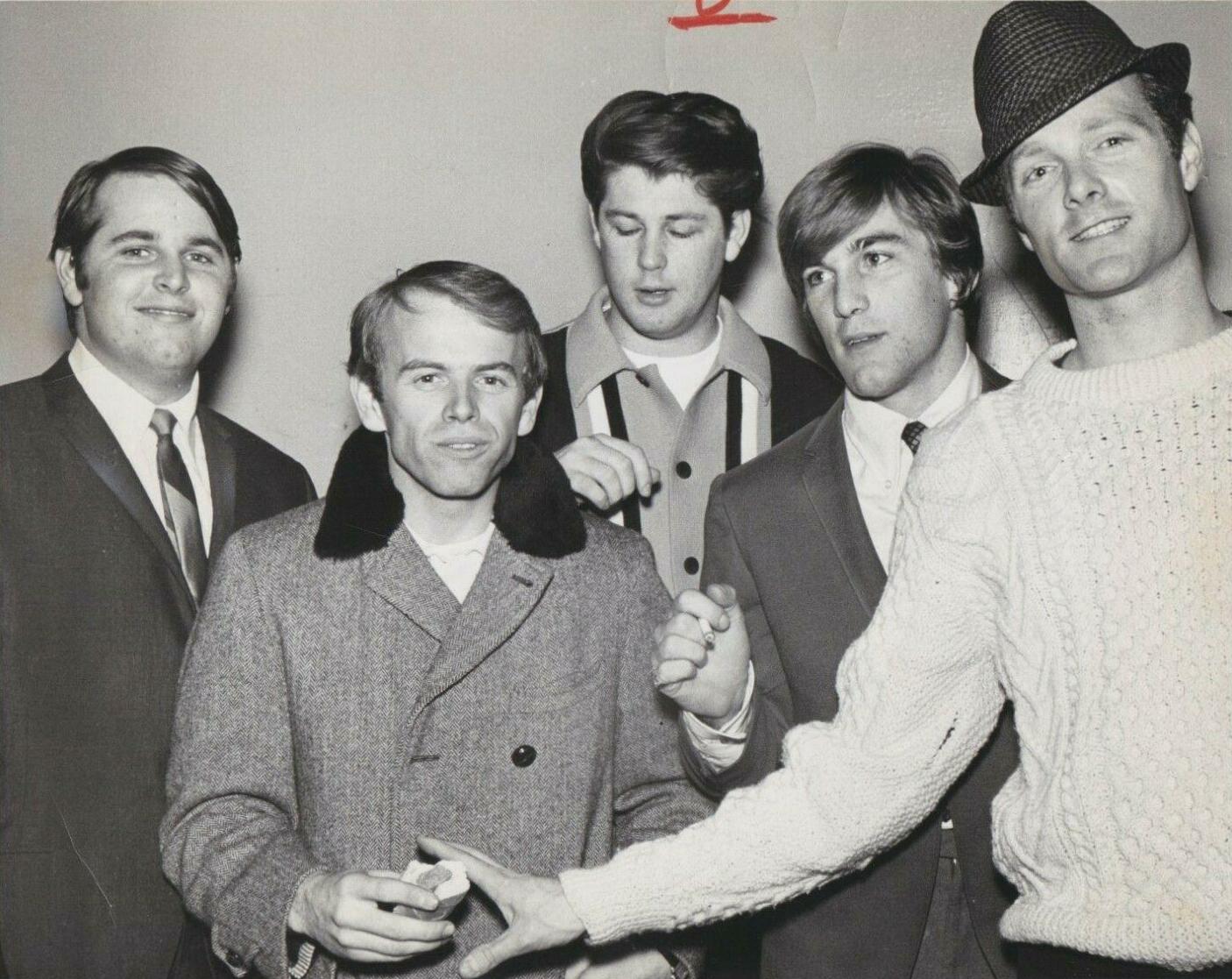
Beach Boys in 1965. Public Domain.
*Permission details The ad appeared in the 11 September 1965 issue of Billboard and can be dated from that publication; it is pre-1978. There are no copyright markings as can be seen at the full view link. The ad is not covered by any copyrights for Billboard. US Copyright Office page 3-magazines are collective works (PDF) “A notice for the collective work will not serve as the notice for advertisements inserted on behalf of persons other than the copyright owner of the collective work. These advertisements should each bear a separate notice in the name of the copyright owner of the advertisement.”
SOURCES:
Badman, Keith. The Beach Boys: The Definitive Diary of America’s Greatest Band on Stage and in the Studio. 1st ed. San Francisco: Backbeat Books, 2004.
Funicello, Annette, and Patricia Romanowski. A Dream Is a Wish Your Heart Makes: My Story. New York: Hyperion, 199, p.13.
Love, Mike. Good Vibrations: My Life as a Beach Boy. New York: Penguin Publishing Group, 2016, p. 97; pp. 159-160.
Morgan, Johnny. The Beach Boys: America’s Band. Illustrated ed. New York: Union Square & Co., 2015, pp. 63-81.
O’Regan, Jody. “When I Grow Up: The Development of the Beach Boys’ Sound (1962–1966).” PhD diss., Queensland Conservatorium, 2014.
Santoli, Lorraine. “Annette—As Ears Go By.” Disney News Magazine, Spring 1993.
Songfacts. “Lyrics for The Warmth Of The Sun by The Beach Boys.” Accessed April 16, 2024. https://www.songfacts.com/lyrics/the-beach-boys/the-warmth-of-the-sun.
Stebbins, Jon. Dennis Wilson: The Real Beach Boy. Toronto: ECW Press, 2000, p.39.
———. The Beach Boys FAQ: All That’s Left to Know about America’s Band. San Francisco: Backbeat Books, 2011.
Wikipedia. “Billboard Year-End Hot 100 singles of 1963.” Last modified May 11, 2026. Retrieved April 12, 2024. https://en.wikipedia.org/wiki/Billboard_Year-End_Hot_100_singles_of_1963.
———. “Billboard Year-End Hot 100 singles of 1964.” Last modified May 11, 2026. Retrieved April 10, 2024. https://en.wikipedia.org/wiki/Billboard_Year-End_Hot_100_singles_of_1964.
———. “List of Billboard Hot 100 number ones of 1964.” Last modified June 3, 2026. Retrieved April 12, 2024. https://en.wikipedia.org/wiki/List_of_Billboard_Hot_100_number_ones_of_1964.
———. “List of Billboard Hot 100 top-ten singles in 1963.” Last modified June 3, 2026. Retrieved April 12, 2024. https://en.wikipedia.org/wiki/List_of_Billboard_Hot_100_top-ten_singles_in_1963.
———. “List of Billboard Hot 100 top-ten singles in 1964.” Last modified June 3, 2026. Retrieved April 12, 2024. https://en.wikipedia.org/wiki/List_of_Billboard_Hot_100_top-ten_singles_in_1964.
———. “The Beach Boys.” Last modified September 7, 2026. Retrieved April 10, 2024. https://en.wikipedia.org/wiki/The_Beach_Boys.
———. “The Beach Boys Today!” Last modified August 27, 2026. Retrieved April 10, 2024. https://en.wikipedia.org/wiki/The_Beach_Boys_Today!.
———. “When I Grow Up (To Be a Man).” Last modified September 16, 2026. Retrieved April 10, 2024. https://en.wikipedia.org/wiki/When_I_Grow_Up_(To_Be_a_Man).



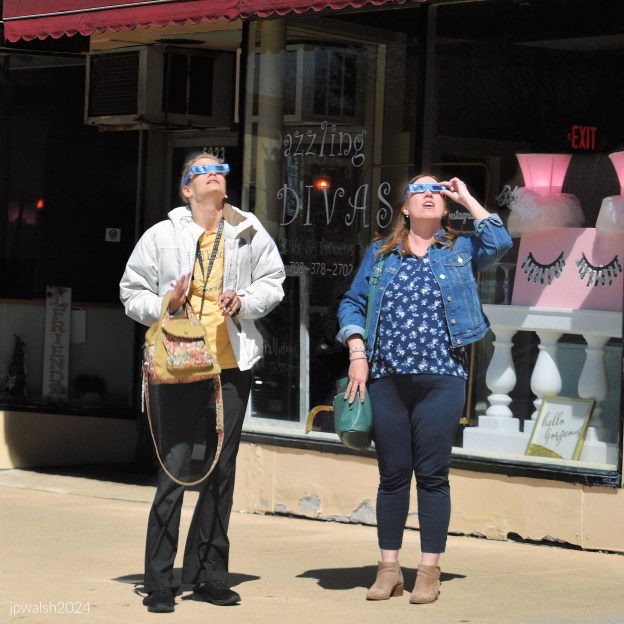
FEATURE image: Viewers near Chicago, Illinois, of the Total Eclipse of the Sun, April 8, 2024. Author’s photograph. All rights reserved.
On Monday, April 8, 2024, a total solar eclipse crossed North America, passing over Mexico, the United States, and Canada. The path of the eclipse first entered into Mexico then into the United States in Texas and into Canada in southern Ontario province. In the U.S., the solar eclipse’s “path of totality” traveled through Oklahoma, Arkansas, Missouri, Illinois, Kentucky, Indiana, Ohio, Pennsylvania, New York, Vermont, New Hampshire, and Maine. The central event took less than two hours. See – https://science.nasa.gov/eclipses/future-eclipses/eclipse-2024/where-when/ – retrieved April 8, 2024. In the U.S. over 30 million people resided in the path of the April 8, 2024 solar eclipse. The next total solar eclipse in the mainland U.S. and Canada won’t be for more than 20 years. See – https://www.nytimes.com/live/2024/04/08/science/total-solar-eclipse#what-to-know-about-the-great-north-american-eclipse – retrieved April 9, 2024. The last total solar eclipse across the U.S. was August 21, 2017 and, before that, one must return to the 1970’s for a total solar eclipse in the U.S. though their paths do not begin to match the 2024 event in terms of crossing the center of the country.
Yet, a “total eclipse of the sun” is, if not one of science’s misnomers, clearly one of nature’s optical illusions. If 1.3 million Earths can fit in the sun (https://www.iflscience.com/how-many-earths-can-fit-inside…) and 50 moons can fit in the Earth (https://www.reference.com/…/many-moons-fit-inside-earth…) then 65 MILLION moons would fit in the sun. That science can learn much from the tiny moon “covering” the sun – more akin to a visual pinprick – can only be limited despite the belief (like the ancients) that it signifies more. Yet as Einstein’s Theory of Relativity demonstrates (i.e., that light bends by gravity) even a limited empirical physical footprint’s significance such as a solar eclipse can be outsized to learned points greater than its intrinsic data range – that is when viewed and processed by the universe’s most vast body – the human imagination.
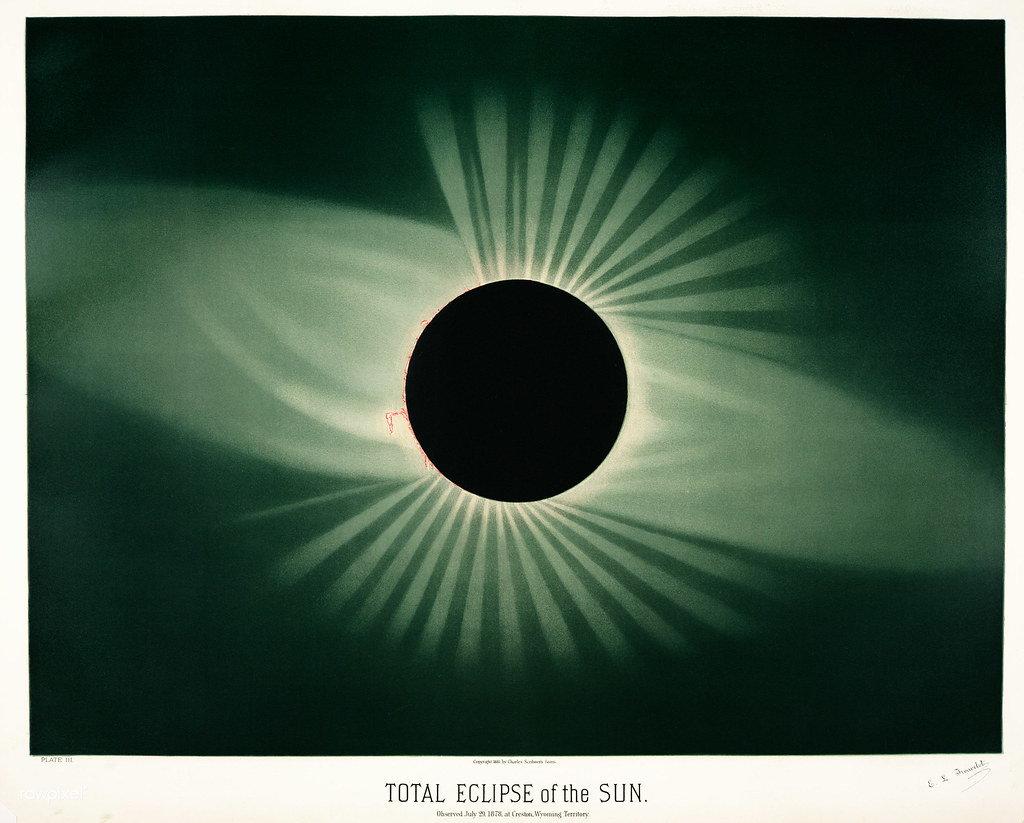

In the media, everything is hyped and what’s important is ignored; as if earth’s tiny moon is going to block the solar system’s sun. At best it’s a dim overcast for 5 minutes where, afterwards, many express some disappointment in the drama of expectations. A lunar eclipse (that happened March 25, 2024) is more interesting for the masses of naked-eye low-tech earthlings. As far as a cosmic event, the solar eclipse is eagerly anticipated whatever its scale as it will contribute to science and scientific knowledge based on its rare natural phenomenon and the development of astronomers’ newest tools. Yet humankind’s imagination by itself is the more interesting aspect of the cosmos, starting here on earth, and ascending to the stars and planets.
