Since the Great Depression years Chrysler Plymouth was the number three budget brand car in America following Ford and Chevrolet. By the1960’s that number three position had been held by General Motors’ Pontiac though Chrysler Plymouth reached that third position on occasion. In the 1970’s Plymouth would be overshadowed by Oldsmobile but in the late 1960’s that was a near future not yet revealed and, starting in 1968, Plymouth had a couple of incredible end-of-decade model years. In 1969 the two-door pony car Plymouth Barracuda (1964-1974) continued to have its own identity in the Chrysler line up and received only a modest makeover that year that included a new grill, interior trim and optional ‘Cuda 340 package. The mid-sized Belvedere (1954-1970) in its seventh generation and Satellite (1965-1974) in its second generation returned in 1969 with slight new treatments as did the compact Plymouth Valiant (1960-1976) in its third generation with a new grill and taillights. In 1969, after four years, The Plymouth Fury (1955/1959-1989) entered a fifth generation with a totally redesigned model line.
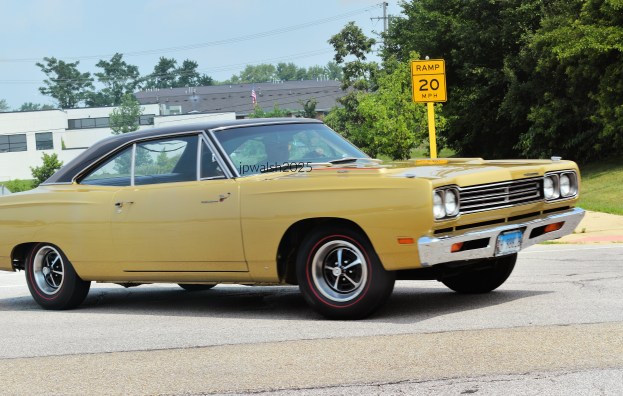
In 1969 Plymouth’s advertising tag line was Look what Plymouth’s up to now and it was the new Plymouth Road Runner that captured the car world’s imagination. A Plymouth first, Motor Trend magazine selected the 2-door convertible and 2-door coupe Road Runner as their 1969 Car of the Year. A powerful engine with a spartan trim level, the Road Runner muscle car was introduced by Chrysler in 1968. In 1969 Plymouth added a new Road Runner Convertible. Initially based on the lower-priced Plymouth Belvedere, the sporty Road Runner was a mid-size, performance-focused car designed to itself be a lower-priced option compared to the upscale Plymouth GTX or Pontiac GTO. In its heyday the Chrysler Plymouth Road Runner was the spartan alternative to the highly equipped Plymouth (Belvedere) GTX. All these Plymouth mid-sized models (along with the Satellite) were sold in 1969 with the tag line: The name of the game this year is “sport.” In 1969, the base price for a Plymouth Road Runner coupe was approximately $2,945 ($25,888 in 2025 dollars). The hardtop version listed for around $3,083 ($27,099) and the convertible model was $3,313 ($29,121). The mid-size Road Runner was introduced as a 2-door pillared coupe whose spare interior belied an exclusive “Roadrunner” 383 cu in B-series V8 engine with a 4-barrel Carter Carburetor and high-performance camshaft under the hood.
“Beep, Beep.”
Plymouth paid $50,000 to Warner Bros.-Seven Arts (about $465,500 today) to use the Road Runner name and likeness including the “beep, beep” horn sound that Plymouth developed for its customers with an investment of around $100,000 in today’s money. Produced from 1968 to 1980, the Road Runner was built on the mid-sized B-Platform for three generations. Like most muscle cars, in the 1970’s its performance capabilities declined — and, with it, sales — as the car industry was mandated to focus on fuel economy and emission standards. In 1976 the Road Runner nameplate became a trim and graphics package for the new Plymouth F-body compact two-door Volaré platform until discontinued in 1980. Having no special performance capability and with car manufacturers actively downsizing their lineups, the Volaré was discontinued on the same day in 1980 the Dodge Main Assembly plant in Detroit, Michigan, closed after being in continuous operation since 1911.
SOURCES: See – J. “Kelly” Flory, Jr., American Cars, 1966 to 1972, McFarland & Company, Inc. pp. 297-303.
This explanatory article may be periodically updated.
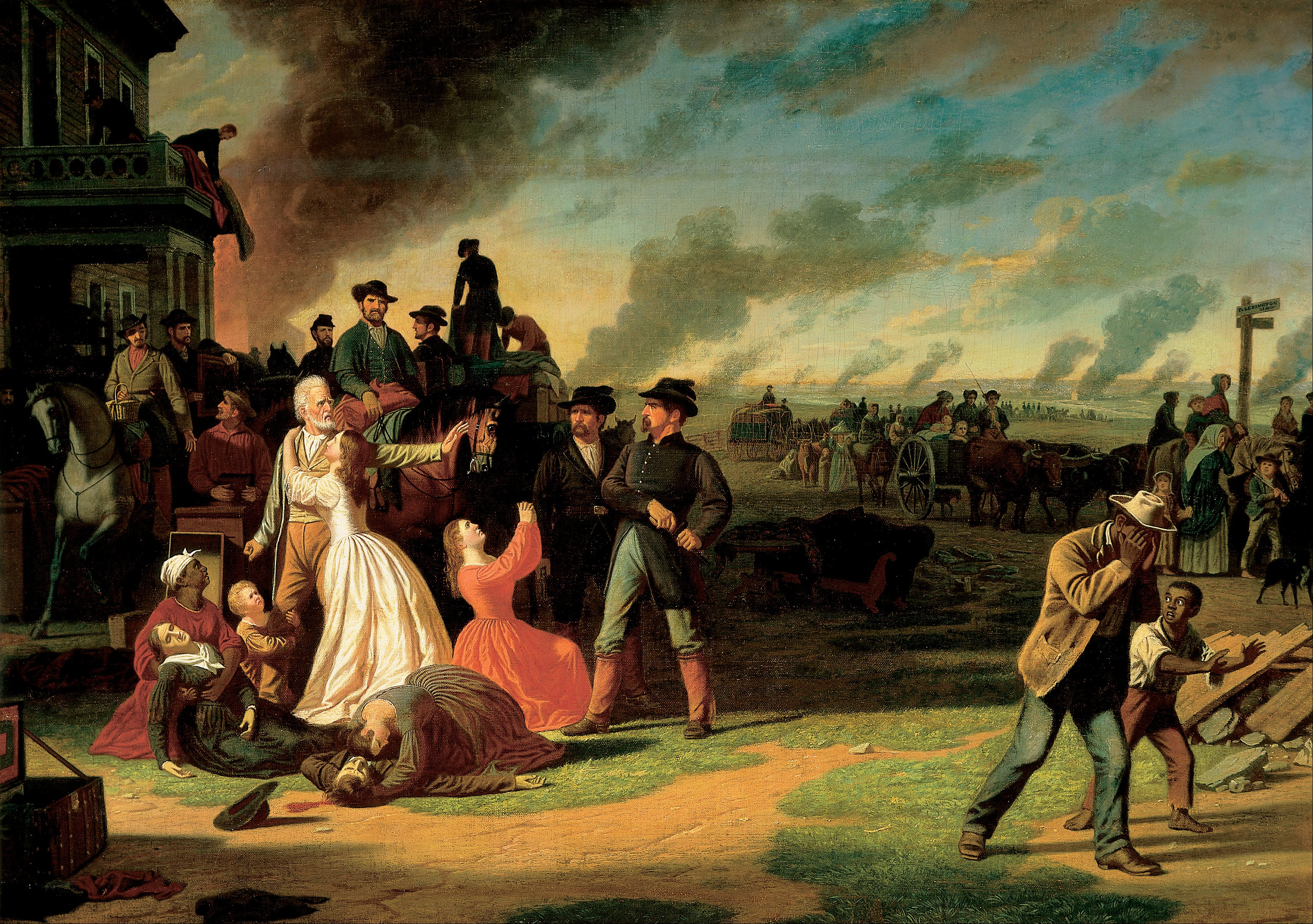
FEATURE IMAGE: George Caleb Bingham (1811-1879), Stump Speaking, 1854, oil on canvas, 42 1/2 x 58 in. (108 x 147.3 cm), St. Louis Museum of Art. The painting begun by Bingham in November 1853 was completed in February 1854 in Philadelphia. Stump Speaking is one of three paintings in a series representing to a national audience the idea of the American democratic process. Bingham exhibited Stump Speaking in a series with his The County Election and The Verdict of the People at the influential but short-lived (1856-1860) Washington Art Association, the Pennsylvania Academy of Art, and the Western Academy of Art in St. Louis. These election series paintings along with Bingham’s Jolly Flatboatmen in Port (see below) then went on view at the St. Louis Mercantile Library (founded 1846) until the 1930’s when the election series paintings were loaned to the City Art Museum (the future Saint Louis Art Museum). In 1941, The Mercantile Library sold Stump Speaking and The Verdict of the People to Boatmen’s National Bank of St. Louis (now Bank of America) and, in 2001, Bank of America gave Stump Speaking to the Saint Louis Art Museum. Public Domain. https://www.slam.org/collection/objects/29774/ – retrieved September 13, 2025.
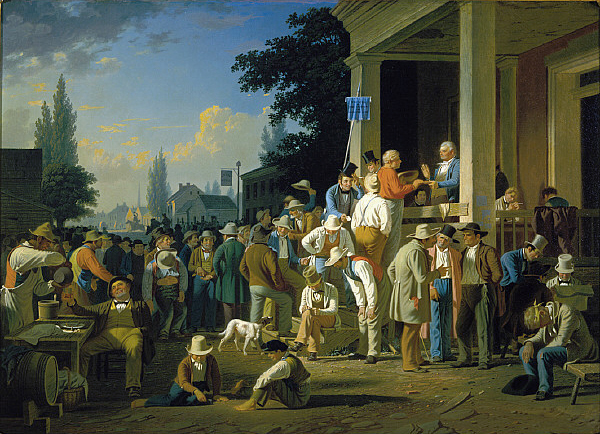
Bingham, The County Election, 1852, oil on canvas, 38 x 52 in. (96.5 x132 cm), St. Louis Art Museum. It depicts an election in 1850 in Saline County, Missouri, located between Columbia and Kansas City in central Missouri. Bingham’s paintings depict a dispassionate electorate before the Civil War reflecting the Founders’ ideals in challenging times. A staunch Unionist, George Caleb Bingham’s own political views rejected radical politics whether an unrestrained northern Abolitionist cause or that of Southern Fire-Eaters and strived toward negotiation and minimally Federal regulation of slavery. Bingham opposed the proslavery wing of Missouri politics represented by Gov. Clairborne Fox Jackson (1806-1862) who appears in Stump Speaking. Though Bingham’s election series is painted before the Lincoln-Douglas debates in 1858 in neighboring Illinois, Bingham, a Whig, tended towards Lincoln’s characterization of democracy that government should provide “a fair chance” to all. Though depicted at the periphery in service roles to whites, Bingham’s artwork presented slaves sympathetically encouraging his viewers to acknowledge the slaves’ existence and to recognize that they are being excluded from the noble American democratic process. Public Domain. See – https://www.nytimes.com/2025/09/15/books/review/born-equal-akhil-reed-amar.html – retrieved September 28, 2025.
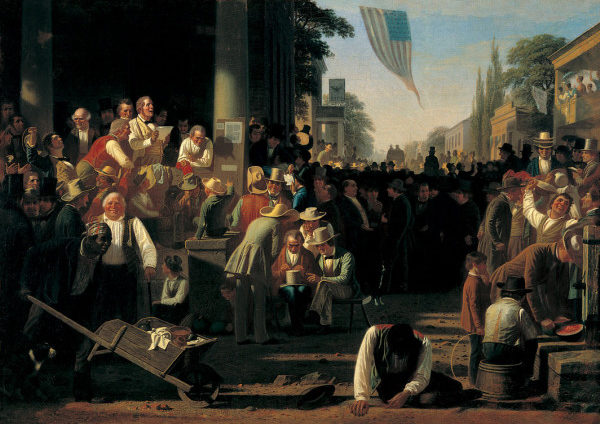
Bingham, Verdict of the People, 1854, 74 cm × 93 cm (29 in × 36.5 in), St. Louis Art Museum. When Donald Trump was inaugurated as the 45th president of the United States on Jan. 20, 2017, The Verdict of the People was the chosen painting, hanging on a partition wall behind the ceremonial head table in the Capitol’s Statuary Hall. Public Domain.
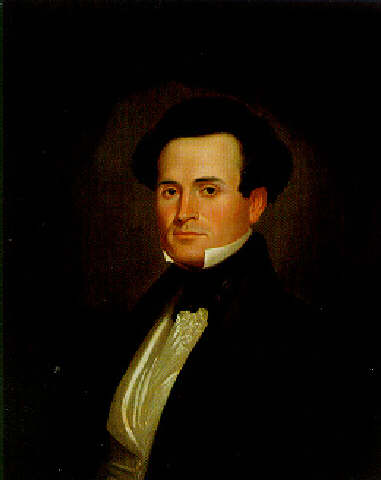
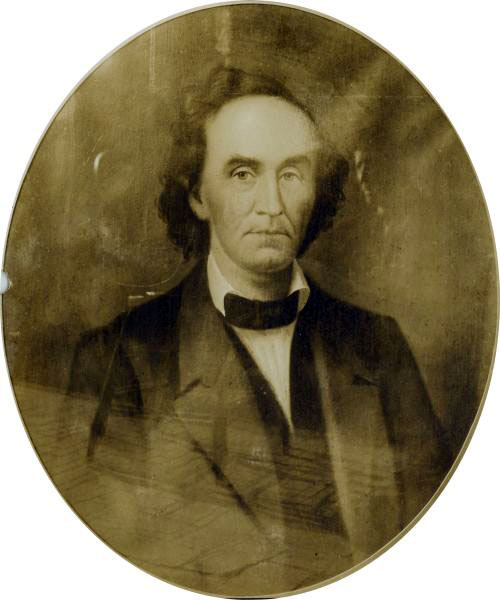
In Stump Speaking, Democrat Erasmus Darwin “E.D.” Sappington (1809-1858), born in Tennessee, is the main speaker shown leaning forward and pleading his case to a crowd of rural citizens. Behind him, with tablet in hand, sits his opponent taking notes in preparation for his turn at the make-shift podium. Candidate Sappington had married the eldest daughter of Kentucky Governor John Breathitt (1786-1834), Penelope Breathitt (1822/3-1904), and the couple had four children. Gov. Breathitt, a Jacksonian Democrat, had been elected as the Bluegrass State’s 11th Governor in 1832, serving until his death from tuberculosis at age 47. After his death, Breathitt County in Eastern Kentucky was created and named in his honor.
Bingham – portrait of Erasmus Darwin “E.D.” Sappington, 1844. Public Domain.
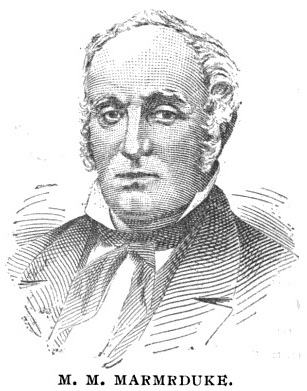
https://www.findagrave.com/memorial/86334793/penelope_c-sappington – retrieved September 26, 2025. https://www.findagrave.com/memorial/60353793/erasmus_darwin-sappington – retrieved September 26, 2025. The rotund man seated behind the speaker is Meredith Miles Marmaduke (1791-1864), part of the Missouri’s Democratic political machine. Born in Virginia, like Bingham, Marmaduke moved to Missouri in 1823 where he married Lavinia Sappington (1807-1885) whose mother, Jane Breathitt (1783-1852), was the older sister of Kentucky Governor Breathitt. The Marmadukes had 10 children together. Marmaduke was a trader on the Santa Fe Trail, surveyed and platted Arrow Rock in Saline County on the Missouri River where he had a plantation and was elected Lt. Governor of Missouri. When Governor Thomas Reynolds (1796-1844) died in office by suicide, Marmaduke assumed the Governorship from February 1844 until November 1844, finishing out the term. The Reynolds Administration was heavily criticized by conservative Whigs for championing the abolition of debtor’s prisons in the state which the Missouri General Assembly accomplished in February 1843. Reynolds whom Marmaduke succeeded also freed up voting requirements to provide greater voting access to the state’s residents, another issue opposed by Whigs. When the University of Missouri in Columbia was established in 1839 and became the first public university west of the Mississippi River, the Reynolds Administration achieved the education milestone of enrolling its first class. Meredith Miles Marmaduke, a former slaveholder, was a staunch Unionist during the U.S. Civil War, although four of his sons fought for the Confederacy which was a typical outcome of the conflict in the Border States. After the war, one of those sons, in 1885, became Missouri’s 25th governor.
“Historical, Pictorial and Biographical Record, of Chariton County, Missouri”, p. 30 (1896). Public Domain.
At right in Stump Speaking the man in the white coat and top hat is then-state senator Clairborne Fox Jackson (1806-1862) who became the secessionist governor of Missouri in 1861. Jackson was forced out by the Missouri General Assembly’s Unionist majority on July 30, 1861, and replaced by a former Chief Justice of the State Supreme Court as provisional governor for the rest of the war. During these contentious deliberations, Bingham was in the state capitol to dedicate portraits of Henry Clay and President Andrew Jackson. Asked to say a few words, Bingham praised the 7th president’s suppressing nullifiers in 1832-1833 and called secession treason which almost blew the roof off the Missouri House. See- https://archive.nytimes.com/opinionator.blogs.nytimes.com/2013/09/06/an-artists-revenge/– retrieved September 27, 2025. Removed Gov. Jackson did not recognize the assembly’s actions and issued a proclamation on August 5, 1861, declaring that Missouri would secede from the Union. Jackson then traveled to Richmond, Virginia, to meet Confederate President Jefferson Davis and seek support of local Confederate militia forces and recognition by the Confederate government, both of which the Confederacy did. Union forces, however, had occupied most of Missouri and the state’s Unionist versus Secessionist political impasse was basically moot. Jackson withdrew to Arkansas with Confederate militia but was defeated by Union forces at the Battle of Pea Ridge in March 1862. Violent skirmishes, often savage attacks, continued in Missouri as Confederate guerrillas, called bushwhackers, caused random fear and havoc. Missouri bushwhackers included outlaws Jesse James and his older brother Frank James. Quantrill’s raid on Lawrence, Kansas, in August 1863 killed no less than 150 men and boys and inflamed the border. Fleeing further south to regroup, Jackson died at 56 years old of pneumonia and stomach cancer. Claiborne Fox Jackson having, in 1831, married Jane Breathitt Sappington (1813-1831) and, in 1833, Louisa Catherine Sappington (1814-1838), sisters of Lavina Sappington Marmaduke, was brother-in-law to Meredith Miles Marmaduke. As “E.D.” Sappington was brother to these women, all three men in Bingham’s painting were brothers-in-law.
Bingham’s lively crowd evokes William Hogarth’s mid-18th century Election series, but with little to none of the British artist’s turbulent depictions. The American Bingham’s election series is orderly in its business. Bingham’s Stump Speaking depicts none of Hogarth’s corruption where the voter or politician is pictured as an idiot and fool whose election requires that he be bribed, threatened, conned, intoxicated, or generally pushed around. One of Hogarth’s voters has to be carried to the ballot box to cast his vote because he is already dead. By contrast, in mid-19th century America, the democratic process, while popularly engaging and verbally contentious, is a pictorial pantheon of virtue: calm, dignified, respectful, decent, honest, ethical, and incorruptible. The American people carry out their sacred duty of democratic self-governance accompanied by earnest and sober demeanor as all Americans, North and South, as Lincoln observed “pray to the same God.” See – https://www.nytimes.com/2025/09/15/books/review/born-equal-akhil-reed-amar.html – retrieved September 28, 2025. While depicting politicians in American art and illustration had been typical from the Republic’s earliest days, Bingham casts them in a context with their voters laboring together in a noble field of American politics and democracy. In a painting that depicts the nation’s spread of universal suffrage for adult white males in the pre-Civil War era and the mobilization by party organizations of popular politics, Bingham neither depicts an anonymous crowd nor one restricted in social type. It is a real, breathing American landscape attracting and engaging a variety of ages and occupations. One does not find a shouting match, let alone some kind of melée in Bingham’s American electorate. It is quite the opposite: the crowd is civilized. Though assembled haphazardly, they are seated in peaceable order where some, amused by the proceedings, can share their laughter good-naturedly. Bingham’s figures are stalwart and reliable who come to attentively learn and independently decide among candidates. For Americans, listening to and questioning what each candidate has to say, and then voting, is a sacred civic duty since 1789 that Bingham updates to his present day.
About the Artist.
George Caleb Bingham (1811-79), an artist and politician. Born in Virginia, Bingham grew up on the frontier land of the Missouri River, and he was largely self-taught. He is famous for his scenes of manly, everyday life, showing work and play, mostly along the Missouri and Mississippi Rivers. His most celebrated picture is Fur Traders Descending the Missouri. Public Domain.
After his first wife, Sarah Elizabeth Hutchinson Bingham, died in November 1848 at 28 years old following 12 years of marriage, she was buried in Sunset Hills Cemetery in Boonville, Missouri. The next year, on December 3, 1849, Bingham married Eliza Thomas of Columbia, Missouri. Bingham had one child each with both his first and second wife. In 1876, Eliza having developed mental health issues, Bingham was forced to commit her to a state mental institution in Fulton, Missouri. She died there later that same year. Eliza was buried next to her parents in Mount Washington Cemetery in Independence, Missouri. Now 55-year-old Bingham was a two-time widower with a 15-year-old son. Unfortunately, the artist, too, would not be long for this world.
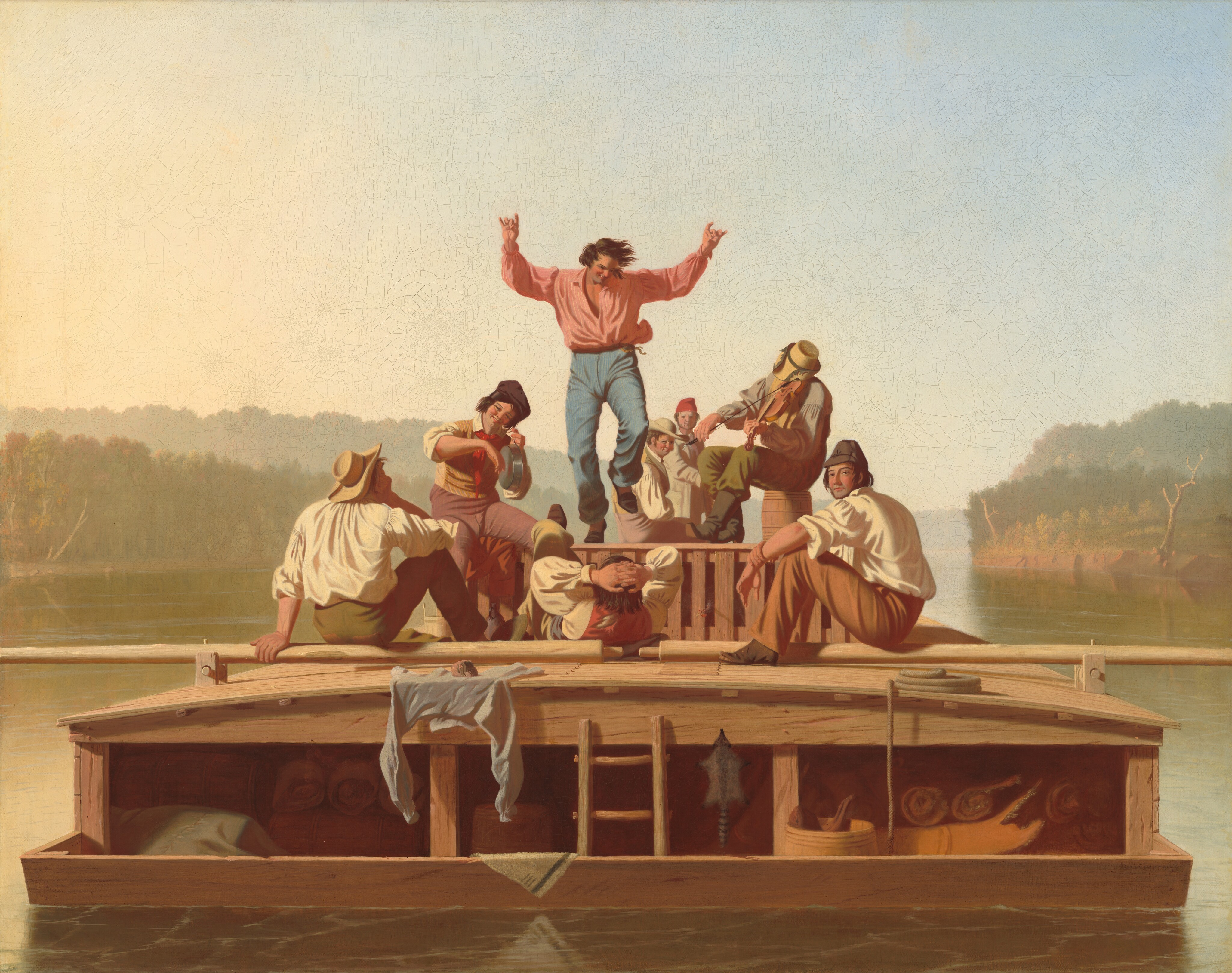
Bingham – The Jolly Flatboatmen, 1846, 96.8 x 123.2 cm (38 1/8 x 48 1/2 in.), National Gallery of Art, Washington, D.C. https://www.nga.gov/artworks/75206-jolly-flatboatmen – retrieved September 26, 2025. Scholars observe that Bingham’s paintings before the Civil War embody his partisan political views as a Whig Party politician with “his Western scenes a commentary on the importance of commerce and the need for federal funding for internal improvements.” Public Domain. See – https://archive.nytimes.com/opinionator.blogs.nytimes.com/2013/09/06/an-artists-revenge/ – retrieved September 27, 2025.
Bingham – Fur Traders Descending the Missouri, 1845, 29 x 36 1/2 in. (73.7 x 92.7 cm), The Metropolitan Museum of Art, New York, NY. The painting is Bingham’s most celebrated work. Public Domain.https://www.metmuseum.org/art/collection/search/10159 – retrieved September 26, 2025.
After the death of Eliza, Bingham married a third time in 1878. Martha Ann “Mattie” Livingston Lykins-Bingham (1824-1890) was a recent widow of one of Bingham’s friends in Kansas City. Mattie was a capable and dignified businesswoman with a big personality. Born in Kentucky and living In Lexington until she married Dr. Lykins, the Lykins’ were one of Kansas City’s power couples. At the outbreak of the Civil War, she and Dr. Lykins, along with a large swath of the local population in that part of western Missouri, were southern sympathizers. They and thousands more were expelled from the city by Order No. 11 of Brig. Gen. Thomas Ewing Jr., commander of the District of the Border, to rid Missouri of their political persuasion. The displacement caused tremendous suffering for Missouri civilians and Order No. 11 was very controversial. Bingham, then-state treasurer of Missouri who swore a loyalty oath to the Union, was appalled by the “military tyranny” of Order No. 11 where the refugees’ farms and fields were pillaged and burned. Many of its victims viewed the action as simply anti-American government retribution for the local population’s political beliefs. See – https://archive.nytimes.com/opinionator.blogs.nytimes.com/2013/09/06/an-artists-revenge/ – retrieved September 27, 2025.
Mattie and Dr. Lykins returned to Kansas City after the war and made a life there until Dr. Lykins’ death in 1876, the same year Eliza Bingham died. Two years later, Mattie married George Caleb Bingham. After Bingham’s death in 1879 from stomach flu, Mattie lived with his young son James Rollins Bingham (1861-1910) who never married. In 1890, following years of trouble with her health, Mattie died following surgery for a stomach tumor. Mrs. Lykins-Bingham was buried In Union Cemetery in Kansas City, Missouri, in the Bingham family plot.
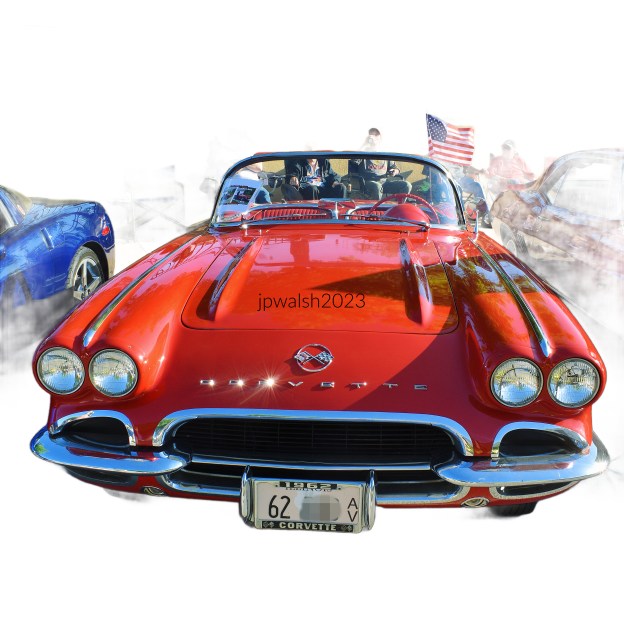
Feature Image: 1962 Corvette. Advertising in 1962 included the tag line: New power. New profile for America’s sports car! May 2023. 4.20mb DSC_2074 (1). Author’s photograph.
While in 1962 Chevrolet was focused on its competition with Ford Motor Company in compact cars (Chevy Corvair; Chevy II), there was a big change in 1962 under the hood for the sporty Corvette. A 250 h.p,, 327-cid V8 engine came standard and was an option on full-sized Chevys as well. The engine was more powerful and weighed no more than its 283 predecessor on which it was built. The 327-cid V8 engine was so efficiently made that with fuel injection it increased to 375 horses under the hood.
1962 Chevrolet Corvette. July 2022. 96% 7.89 mb DSC_6582 Author’s photograph.1962 corvette July 2022. 88% 7.92mb DSC_6581 Author’s photograph.1962 Corvette May 2023 92% 7.90 DSC_2078 Author’s photograph.1962 Corvette. May 2023. 82% 7.90mb DSC_2076 Author’s photograph.1962 Chevy Corvette August 2025. 7.66mb DSC_4553. Author’s photograph.
The Corvette originated in 1953 and in its first generation introduced a new body for the 1956 model year that featured a revised front end and side coves that continued through the 1962 model year. The first generation Corvette was equipped with deep contoured bucket seats, deep pile carpeting, and complete instrumentation. In 1962 the two -door convertible Corvette listed for $4,038 ($43,129.18 in 2025 dollars).
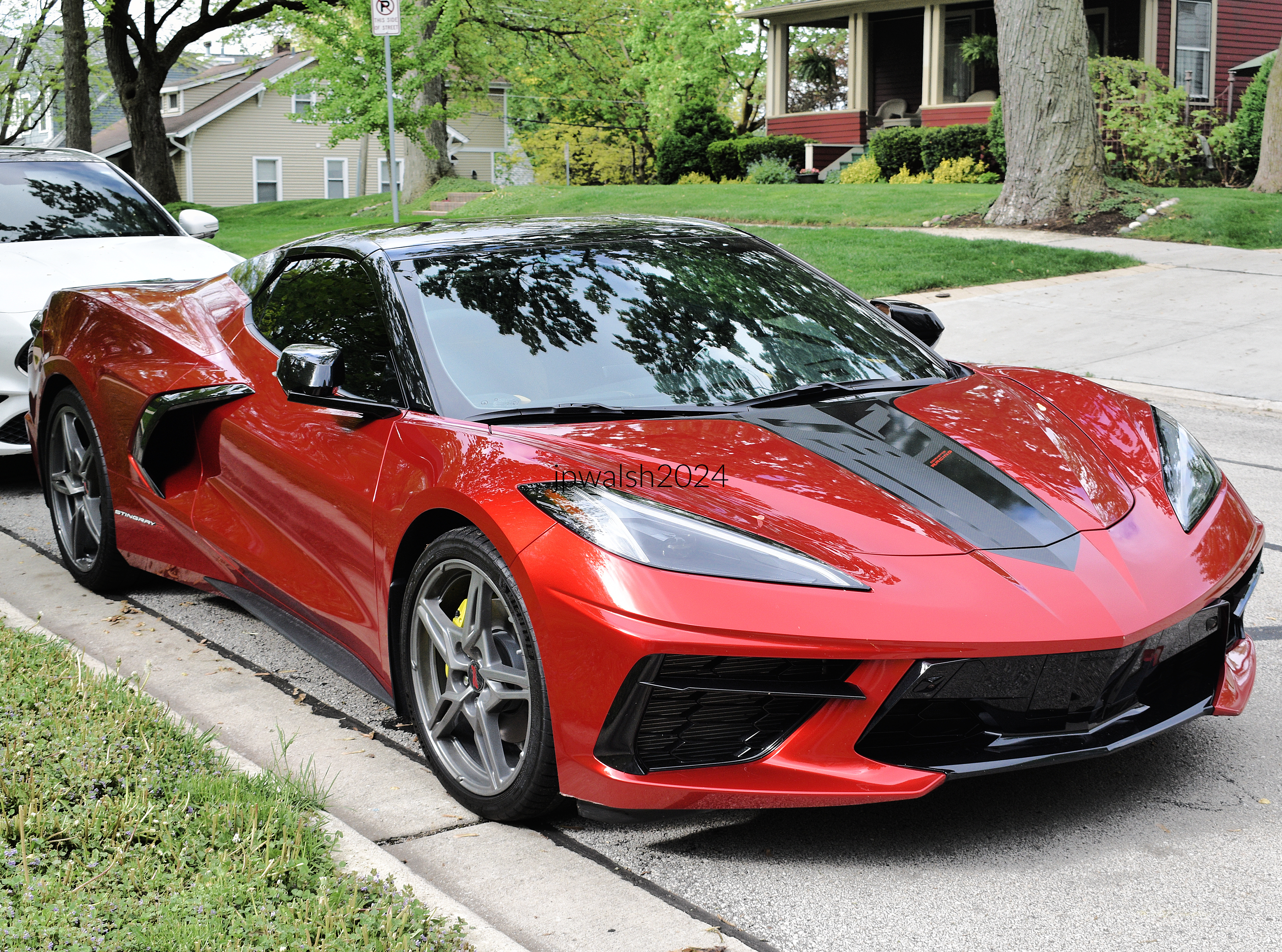
2023 Chevrolet Corvette Stingray, May 2024. 7.93mb DSC_5381 Author’s photograph.
Since the 2020 model year the Chevrolet Corvette Stingray is in its eighth generation. The sports car is assembled in Bowling Green, Kentucky. The 8th generation Corvette introduced GM’s first rear mid-engine since the Pontiac Fiero was discontinued in 1988. The engine has two radiators, one on each side in the front and offers an 8-speed dual-clutch automated transmission which is the first time Corvette offered a no manual transmission option since model year 1982 (third generation). The C8 features a new design from previous Corvettes with aluminum architecture, coil-over springs and more aggressive aerodynamics such as bigger air intakes and prominent side scoops. The base price for the 2023 1LT coupe was $65,595 and $70,795 to $73,095 for the 1LT convertible. – https://www.motorauthority.com/news/1136183_2023-chevy-corvette-price-increases-again-this-time-by-2-300– retrieved April 9, 2025.
1970 Chevrolet Corvette Stingray. September 2023. 87% 7.76mb.Author’s photograph.
In 1970 the advertising pitch line for the Corvette was People have the idea you can tell what cars of the future will be like looking at Chevrolet’s Corvette. They’re right. Well, the future is here and unfortunately cars on the road in 2025 don’t look much like this gem of classic sports car. Major standard equipment in the 1970 Corvette included all-vinyl bucket seats with full-length center floor console, complete instrumentation, Astro ventilation, removable roof panels on the coupe and manually operating folding top on the convertible, 4-wheel disc brakes and F70x 15 WSW tires and wheels with trim ring and ribbed center hub. In 1970 a Corvette 2-Door-Coupe set the customer back $5,192 ($43,228.48 in 2025 dollars).
1965 Corvette. September 2014. 3.74 mb Author’s photograph.
From rubber to roof, still America’s true sports car. In a league all its own, the Corvette was in the midst of its second generation in 1965. It was the same year that saw the introduction of the popular Ford Mustang. There were only minor trim changes from the year before including tweaking the hood design, sill moldings and a new grille. For the $4,022 Base MRSP ($41,247.59 in 2025 dollars) major standard equipment included bucket seats, cockpit cluster console, walnut-like steering wheel, full carpeting, complete instrumentation, manually operating folding top and 6.70 x 15 BSW tires.
2016 Chevy Corvette. May 2022 7.92 mb 82% Author’s photograph.
The 2016 Corvette is 7th generation. By the 2000’s the 50 year old Corvette was increasingly viewed as a car purchased by the older buyer (55 years and up). Though in development since 2007, the Corvette 7th generation was delayed until the 2014 model to make the classic sports car more appealing to younger buyers including a design that kept production costs lower. The new generation Corvette in 2014 started using the “Stingray” name again which started in 1963 and was discontinued in 1976. Whereas the 1965 Corvette Stingray weighed less than 3,000 pounds (2,980) the C7 was almost 15% heavier at 3,444 pounds. For 2017 model year Chevrolet also re-introduced the Grand Sport (GS) model that cost $66,446 (87,570.36 in 2025 dollars). “2017 Corvette Grand Sport Priced at $66,445”. media.gm.com (Press release).
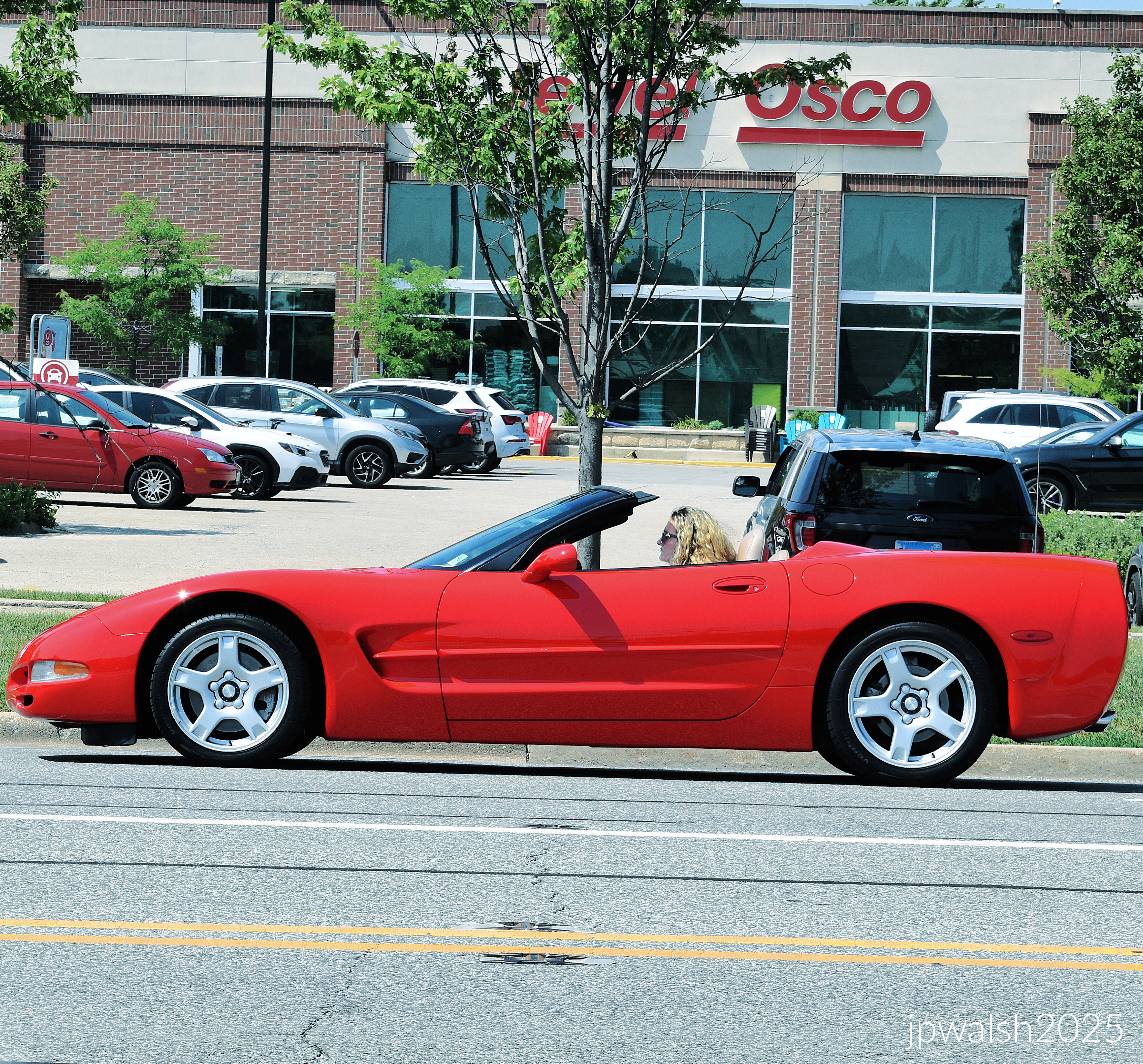
2001 Chevy Corvette. April 2025. 5.89mb DSC_9337 (1) Author’s photograph.1999 Chevrolet Corvette Convertible in Torch Red. July 2025. 99% 7.63mb DSC_3802 (1) Author’s photograph.
The two cars above and the one below are all C5 (5th Gen) Chevrolet Corvettes produced between 1997 and 2004. The base-model Chevrolet Corvette C5 includes a 5.7-liter V8 LS1 engine that from 1997 to 2000 produced 345 horsepower and 350 lb-ft of torque. For 2001, Chevrolet revised the LS1, raising output to 350 horsepower and up to 365 lb-ft of torque, a specification that carried through the end of C5 production in 2004. The C5 is equipped with a 4-speed automatic or 6-speed manual transmission and includes rear wheel drive.
2000 C5 Corvette. April 2026. 83% 7.95mb DSC_4179 Author’s photograph. 2014 Corvette Stingray. October 2015. 3.54 mb Author’s photograph.
A green premium edition 2014 Chevrolet Corvette Stingray (C7 generation) with chrome wheels and a carbon fiber hood. The model is powered by an all-new 6.2-liter LT1 V8 engine with 455 horsepower and 460 lb-ft of torque. Active Fuel Management is a feature that allows cylinder deactivation so that the engine can run as a 3.1-liter V4 under light loads to improve fuel efficiency.
2020 Chevrolet Corvette Stingray. June 2022. C7.66 mb 74% Author’s photograph.
Available in 1LT, 2LT, and 3LT trim levels, it offers a 6.2-liter V8 engine producing 490-495 horsepower.
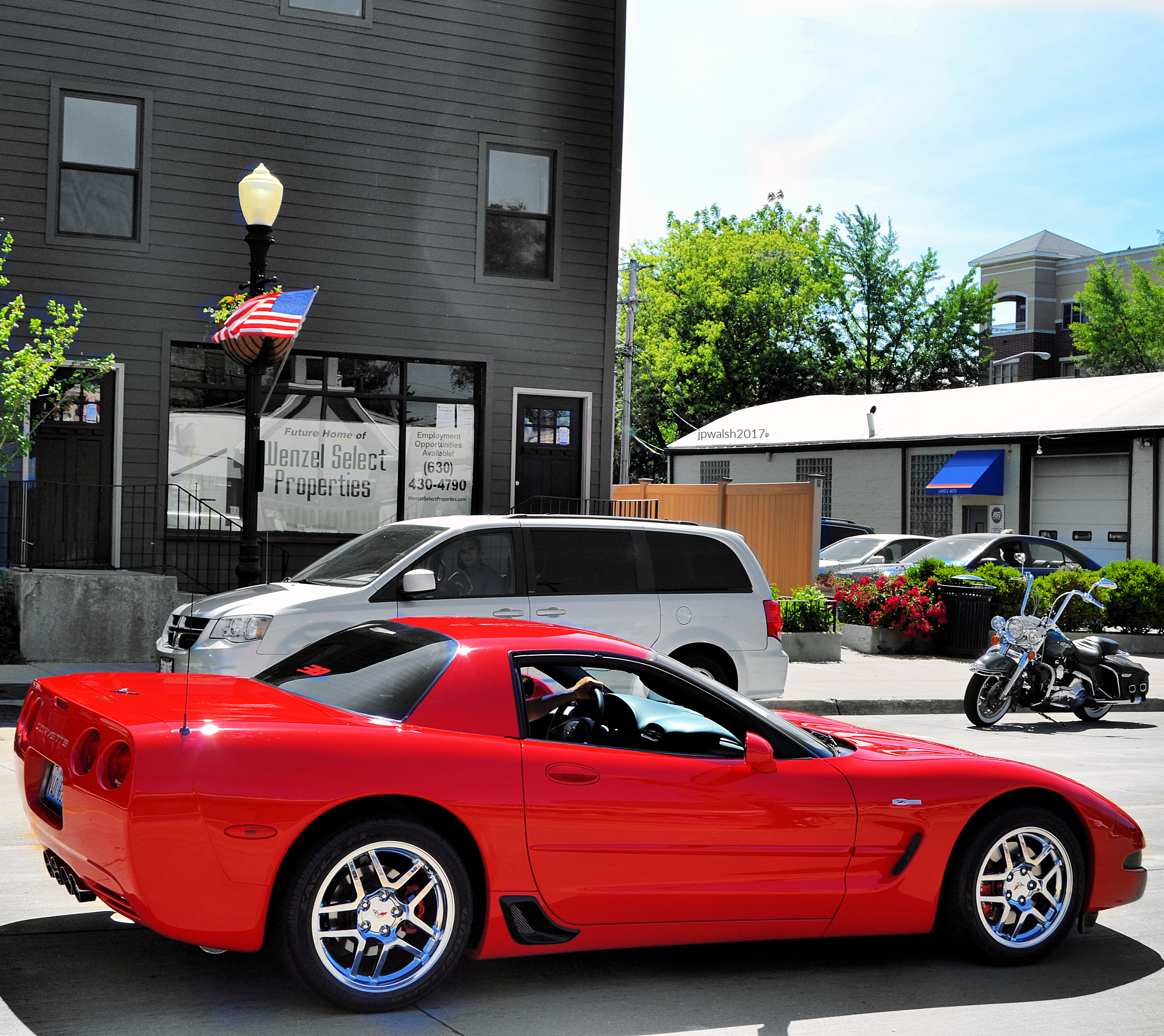
2003(?) Chevrolet Corvette. June 2017. 3.08 mb Author’s photograph.
Torch Red Chevrolet Corvette Z06, 2001-2004, C5 generation. Powered by a 5.7-liter LS6 V8 engine that produces 405 horsepower paired with a 6-speed manual transmission. Distinguishing features include a fixed-roof coupe design, functional rear brake cooling scoops, and lightweight alloy wheels.
SOURCES:
J. “Kelly” Flory, Jr., American Cars, 1960 to 1965, McFarland & Company, Inc. pps. 155-156; 352, 357-358; J. “Kelly” Flory, Jr., American Cars, 1966 to 1972, McFarland & Company, Inc. page 338.
This explanatory article may be periodically updated.