


FEATURE Image: Caravaggio (Michelangelo Merisi), Judith Beheading Holofernes, c. 1598, oil on canvas, 56 ¾ x 76 ¾” 145 x 195cm Galleria Nazionale d’Arte Antica, Rome. https://barberinicorsini.org/opera/giuditta-e-oloferne/ – retrieved October 12, 2024.

Ottavio Leoni (1578-1630), Portrait of Caravaggio, c. 1621/25, red and white chalk on blue paper, 23.4 x 16.3 cm, Biblioteca Marucelliana, Florence.
INTRODUCTION.
The chalk portrait above is probably the most faithful likeness of Caravaggio. Born Michelangelo Merisi in 1571, Caravaggio became an influential figure in Italian and European art in and well after his lifetime. He revolutionized painting by his theatrical use of light, dramatic narrative, and the naturalistic physical depiction of everyday people. His depiction of figures in historical narrative using dramatic interplay of light and shadow called chiaroscuro along with its naturalistic composition was further modernized in its scenes’ inclusion of the emotional and psychological human state. These artistic qualities were admired and emulated by many young European artists going forward into the balance of the seventeenth century.
Caravaggio came to Rome around 1592 from Lombardy, where he was influenced by the works of Giovanni Girolamo Savoldo (c.1480-1548), Lorenzo Lotto (c. 1480-1557), Romanino (c.1484-1566) and Moretto (c. 1498-1554?). For a while he worked in the workshop of the leading late mannerist Giuseppe Cesari (1568-1640), but soon broke away from the established course in Roman-Florentine artistic mannerism. His completely new approach of intense realism and chiaroscuro — that is, dramatic use of light and darkness to situate a scene – made him the “master of darkness” and completely revolutionized art in Rome around 1600. Along with Annibale Carracci (1560-1609), Adam Elsheimer (1578-1610) and Peter Paul Rubens (1577-1640), Michelangelo Merisi, called Caravaggio, was one of the progenitors of 17th century painting.
Artworks.
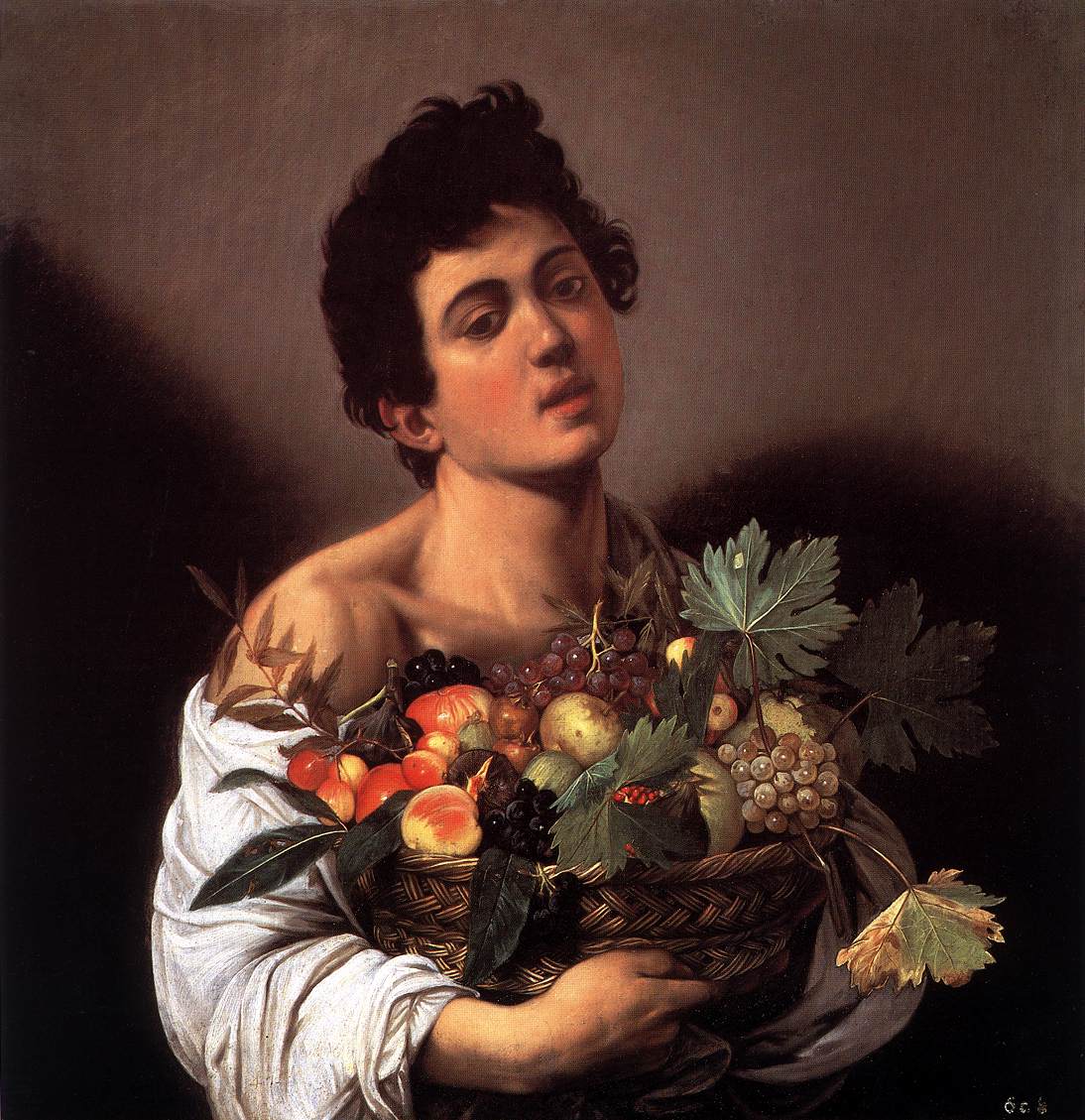
Caravaggio (Michelangelo Merisi), Boy With a Basket of Fruit (“Il Fruttaiuolo”), c. 1593/94, oil on canvas, 27 ½ x 26 3/8” 70 x 67 cm, Galleria Borghese, Rome. https://borghese.gallery/collection/paintings/boy-with-a-basket-of-fruit.html – retrieved October 10, 2024.
Caravaggio’s Il Fruttaiuolo (“Boy with a Basket of Fruit”) presents a remarkable contrast of the detailed, colorful, and sensuous depiction of fruits of the season and the refined and delicate innocence of an adolescent boy holding its basket. The placid scene of typical everyday life is enhanced by an expressive and careful execution. The model was Caravaggio’s friend, Sicilian painter Mario Minniti, at about 16 years old. According to Giovanni Pietro Bellori (1613-1696) who included Caravaggio in his Lives of the Artists, the artist learned “to paint flowers and fruit so well imitated that everybody came to learn from him how to create the beauty that is so popular today.”
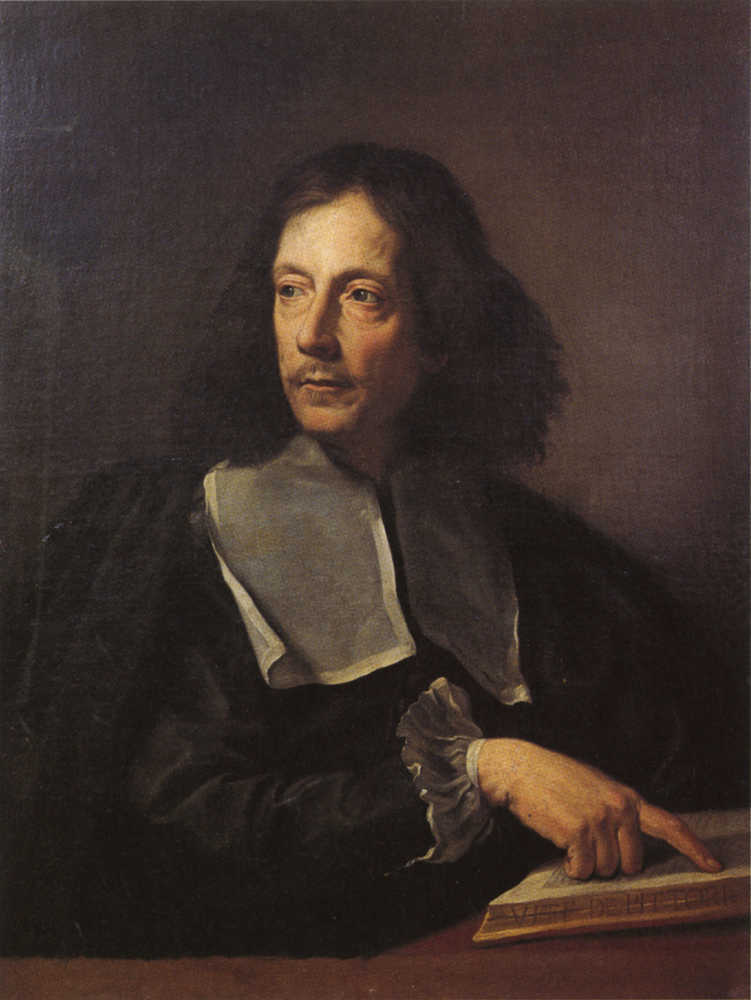
Carlo Maratta (1625-1713), Portrait of Gian Pietro Bellori who was Caravaggio’s most important biographer. Other early biographies of Caravaggio’s life were written by his doctor, Giulio Mancini (1559-1630) and by Giovanni Baglione (1566-1643), a rival artist.

Caravaggio (Michelangelo Merisi), The Young Sick Bacchus (Bacchino Malato), c. 1593/94, oil on canvas, 67 x 53 cm, Galleria Borghese, Rome. https://borghese.gallery/collection/paintings/young-sick-bacchus.html – Retrieved October 10, 2024.
https://www.collezionegalleriaborghese.it/en/opere/self-portrait-as-bacchus-known-as-sick-bacchus – retrieved October 10, 2024.
Caravaggio’s Il Bacchino Malato (“The Young Sick Bacchus”), also known as Bacchino malato (“The Sick Bacchus”) or Autoritratto in veste di Bacco (“The Self-Portrait as Bacchus”), is an early self-portrait by Michelangelo Merisi da Caravaggio, dated between 1593 and 1594. The artwork dates from Caravaggio’s first years in Rome when he moved to the Eternal City from his native Milan in 1592. The painting was in the collection of Giuseppe Cesari (1568-1640), Caravaggio’s early employer. In 1607 it was confiscated from Cesari by the Pope in exchange for the Italian mannerist’s freedom following an illegal firearms charge. The pope gifted it to his nephew, Cardinal Scipione Borghese (1577-1633), together with the Boy Peeling Fruit and Boy with a Basket of Fruit (“Il Fruttaiuolo“).
The painting is a realist portrait of a young man displaying the typical attributes of Bacchus, the god of drunkenness. The sitter is turned to the viewer in a three-quarter pose, holding in his hands a bunch green grapes held next to his ailing greenish complexion. The sitter has been identified as the artist since it is documented that he was in the Ospedale della Consolazione in Rome around this time for undefined reasons. This interpretation provides the origin for the artwork’s title.
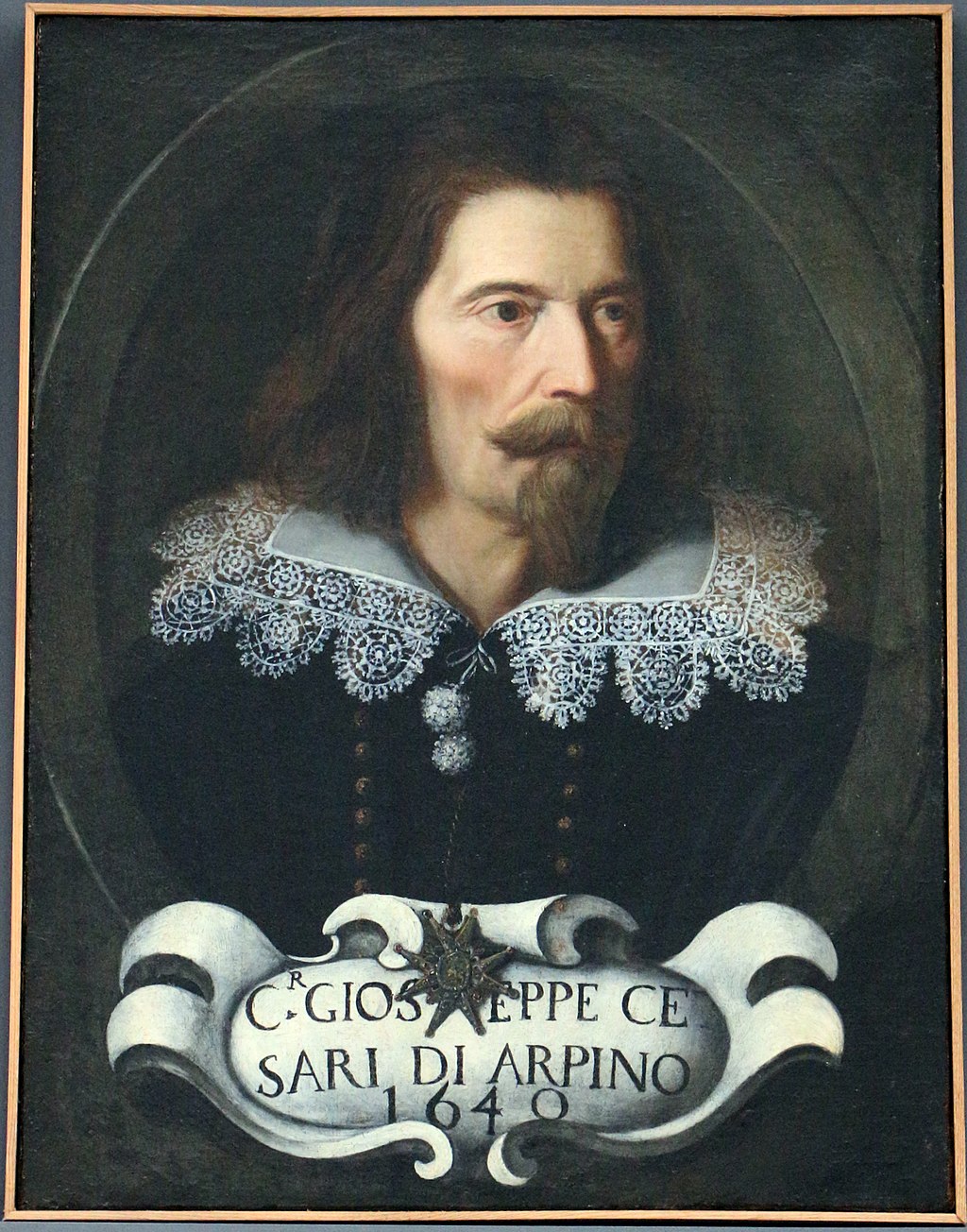
Giuseppe Cesari, Self-portrait, 1640, Accademia di San Luca. Cesari was Caravaggio’s first employer and in possession of The Young Sick Bacchus that was confiscated by the pope.

Ottavio Leoni, Portrait of Cardinal Scipione Borghese. The sitter was not only the pope’s nephew and a Cardinal in the Catholic Church but the recipient of early Caravaggio paintings by gift. Such a gift was not at random: the cardinal’s growing art collection, including Caravaggio and Bernini, formed the basis of the Villa Borghese in Rome.
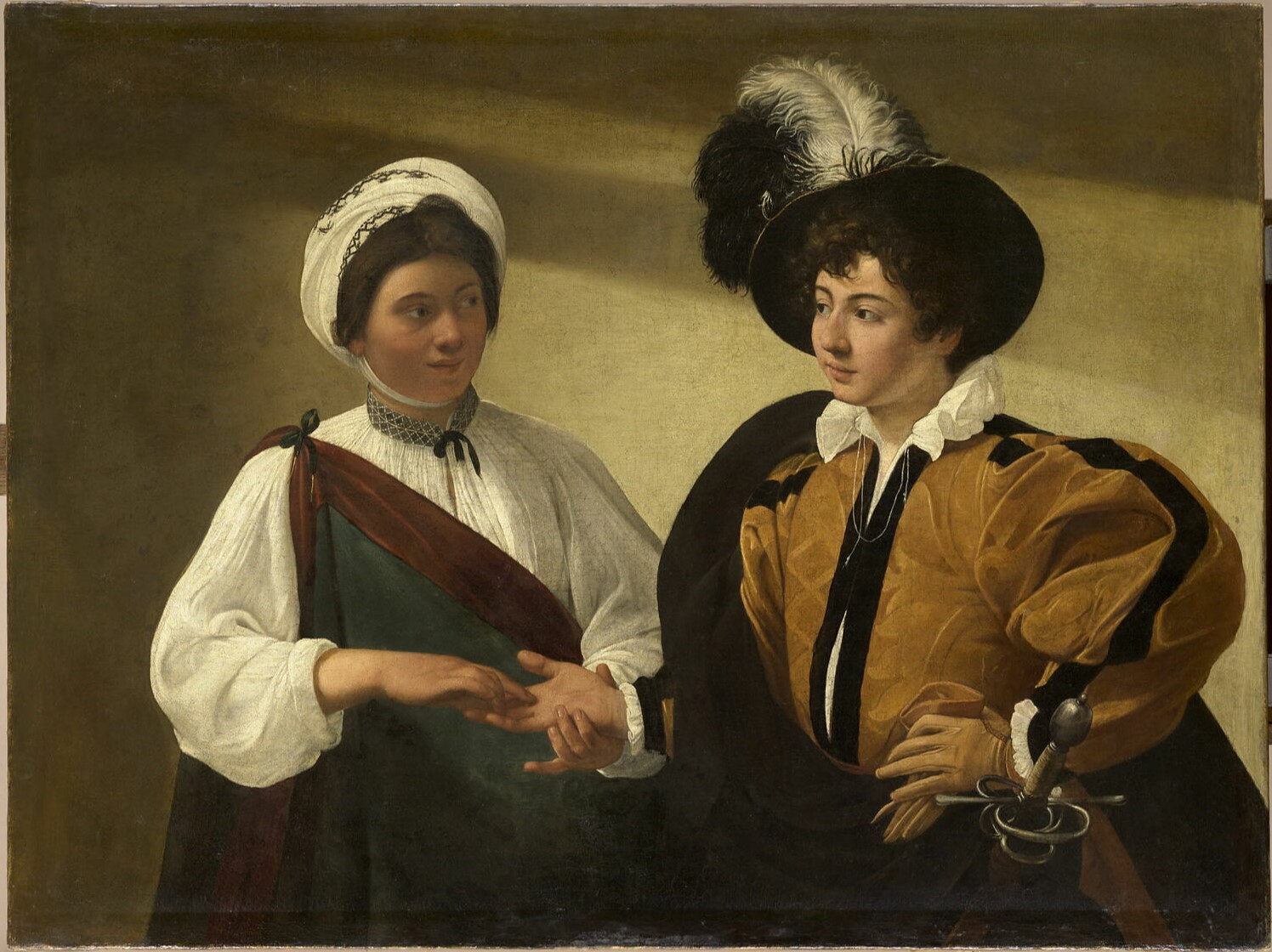
Caravaggio (Michelangelo Merisi), The Fortune-Teller (“La Buona Ventura”), c. 1594, oil on canvas, 39 x 52 3/8”, Louvre, Paris. https://collections.louvre.fr/en/ark:/53355/cl010062329 – retrieved October 10, 2024
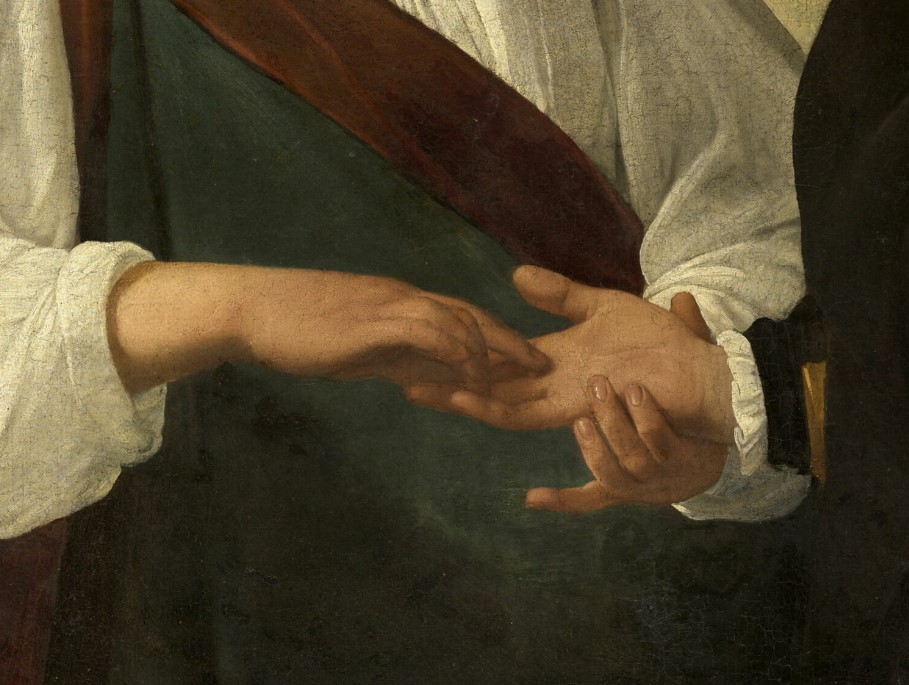
According to Giulio Mancini, Caravaggio painted The Fortune-Teller for a proverbial song while staying with Archbishop Fantino Petrignani (1577-1601). By 1620 when Mancini was writing, the painting was owned by Roman art collector and Catholic prelate Alessandro Vittrici (d. 1650). Later (1657) it was in the collection of Catholic Cardinal Camillo Francesco Maria Pamphili (1622-1666) who sent it with Bernini (1598-1680) to Paris as a gift to Louis XIV.
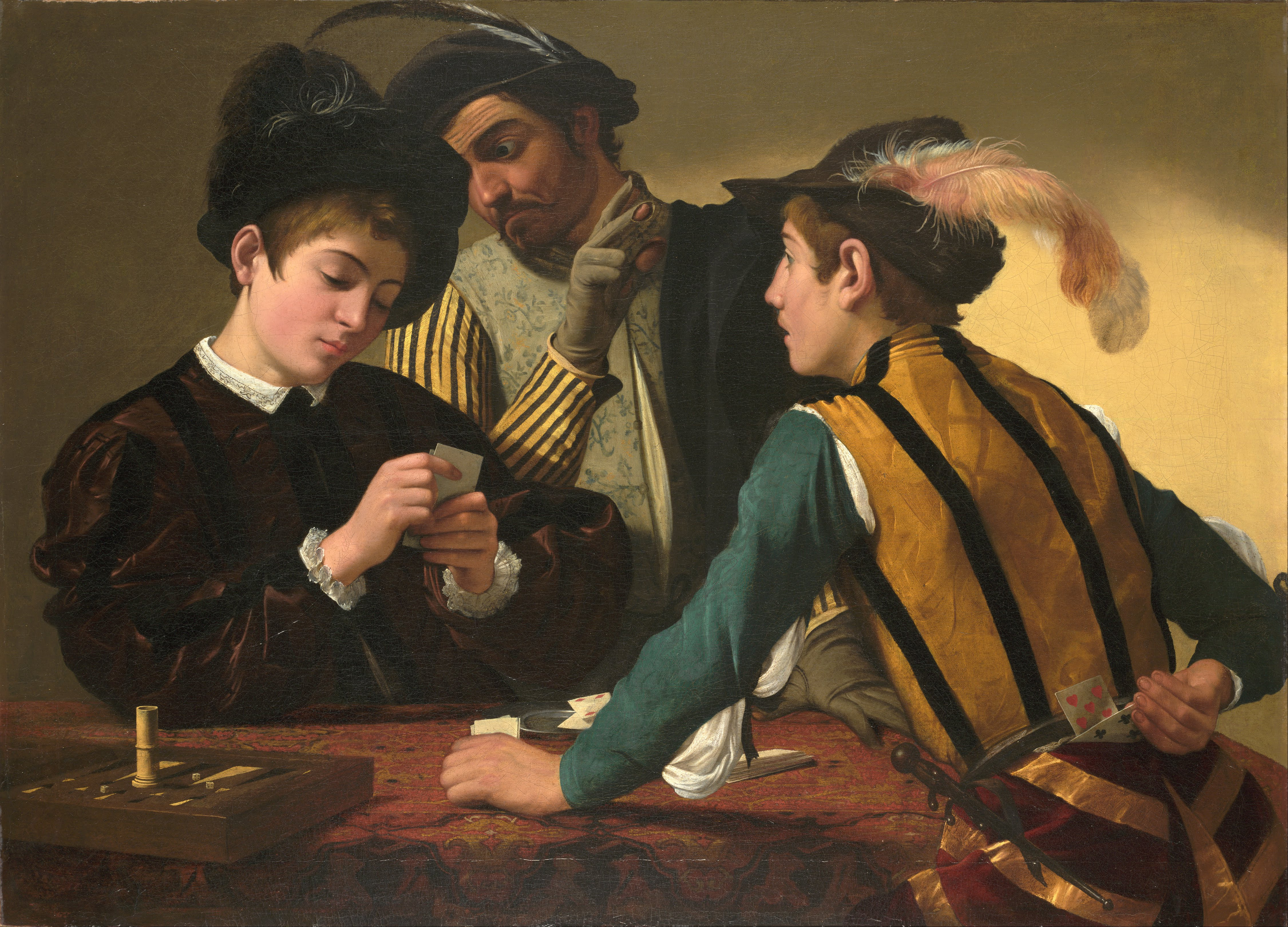
Caravaggio (Michelangelo Merisi), cardsharps,1594/95, oil on canvas, 37 1/16 x 51 9/16 in. (94.2 x 130.9 cm), Fort Worth, Kimbell Art Museum, Fort Worth, Texas. https://kimbellart.org/collection/ap-198706 – retrieved October 18, 2024.
Playing the game of primero the player at left is oblivious to a bearded cardsharp who uses his gloved fingers to signal to the other player the content of the cards. The other cheater is reaching for a hidden card from his pants behind his back. Caravaggio’s composition is novel with a naturalistic treatment of the figures whose distinct expressions and gestures convey a realistic and hard drama of being cheated and cheating. This painting was owned and stamped by Cardinal del Monte and in his inventory of 1627 following his death. It had been lost for almost a century when it was discovered in a European private collection and purchased by the Kimbell in 1987.
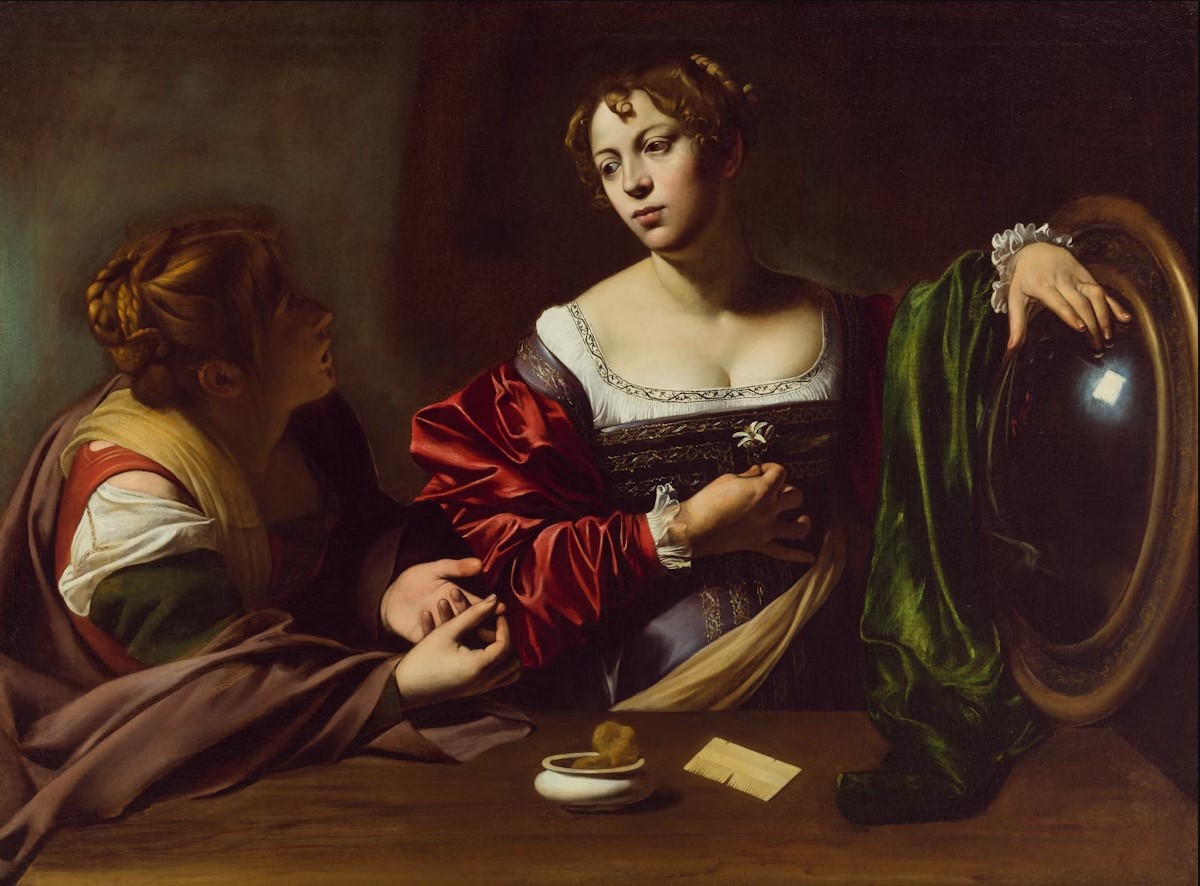
Caravaggio (Michelangelo Merisi), Martha and Mary Magdalene, c. 1598 Detroit Institute of Arts.
“Caravaggio helped to popularize half-length religious paintings like this, made for private collectors rather than for public church settings. His greatest innovation was in depicting biblical characters as if they belonged to contemporary Roman society, basing them on studio models and dressing them in 17th-century attire, as he does here.” https://www.artic.edu/articles/1071/caravaggio-s-dramatic-life-and-paintings – retrieved October 15, 2024.
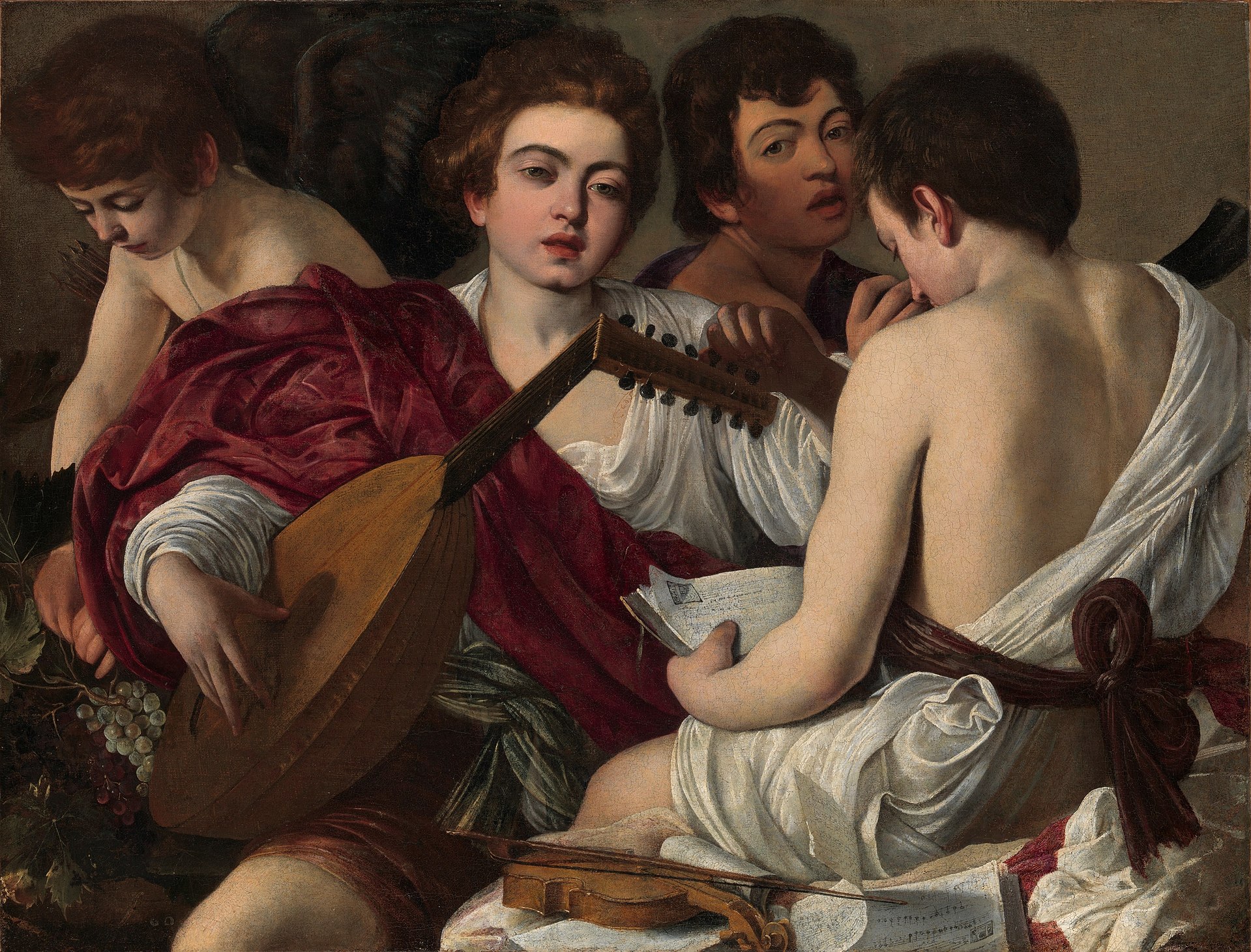
Caravaggio (Michelangelo Merisi), The Musicians, 1595/96, oil on canvas, 36 ¼ x 46 5/8” (92.1 x 118.4 cm), The Metropolitan Museum of Art, New York. https://www.metmuseum.org/art/collection/search/435844 – retrieved October 10, 2024.
The Musicians, painted by Caravaggio and now in The Metropolitan Museum of Art, was commissioned by Cardinal Francesco Maria del Monte (1549–1627), one of Rome’s most influential patrons of the arts. Conceived as an allegory of music—signaled by the presence of Cupid in the background—it is equally a portrait of contemporary musical practice, featuring individualized sitters. Among them is Caravaggio himself, second from the right, offering one of his rare youthful self-portraits.
During the Counter‑Reformation, the Catholic Church actively promoted a revival of music, and Cardinal del Monte was at the center of this cultural movement. At his residence, the Palazzo Madama, he hosted composers, rehearsals, and experiments in progressive musical forms, especially the emerging solo vocal style that departed from older polyphonic traditions. The Musicians was designed specifically for the Cardinal’s music room, its subject and atmosphere echoing the live performances that took place there.
In keeping with Caravaggio’s modernizing approach, the figures are not idealized classical types but real young men posed in quasi‑antique white robes. The self‑portrait—directly engaging the viewer—shows the artist holding a cornetto, a popular wind instrument of the period. Caravaggio also employs a spatial device familiar in later eighteenth‑century art: the prominently placed violin and open music manuscript in the immediate foreground. These objects project into the viewer’s space, drawing the spectator into the scene as an implied participant.

Ottavio Leoni, Francesco Maria del Monte, 1616.
Born in Venice of a Tuscan aristocratic family, Cardinal del Monte was an important connoisseur of the arts. Four centuries later his fame rests on his early patronage of Caravaggio and an art collection which provides detailed provenance for many important works of the period. Del Monte was the single most influential force in Caravaggio’s life. Between 1595 and 1601, the Catholic cardinal became not only the painter’s primary patron but his intellectual mentor, legal shield, and diplomatic strategist—an alliance that lifted the volatile outsider into the ranks of Rome’s most sought‑after, and most controversial, artistic prodigies. Their bond was complicated by each’s share of eccentricities, intense legal vulnerabilities, and the uneasy overlap between church politics and the city’s street‑level underworld.
As mentioned, the relationship began when Del Monte purchased The Cardsharps from a local dealer and immediately recognized the raw, disruptive talent behind it. He brought Caravaggio into his official residence, the Palazzo Madama, granting him a stipend, room and board, and a dedicated studio. Within those walls, Caravaggio entered a rarefied world. Del Monte—an intimate friend and protector of Galileo —surrounded himself with mathematicians, natural philosophers, and experimenters in optics. Immersed in this court of scientific inquiry, Caravaggio refined the radical, directional lighting that would become his signature, transforming observation into revelation.
Del Monte also understood that private cabinet pictures could only carry an artist so far. Leveraging his position as a Vatican insider, he secured Caravaggio’s first major public commission: the Contarelli Chapel cycle in San Luigi dei Francesi. It was a turning point—Caravaggio’s explosive debut on the public stage and the moment his reputation as a revolutionary painter crystallized.
But the Cardinal’s protection had limits. Caravaggio’s temperament grew increasingly erratic, his nights spent among gamblers, swordsmen, and fugitives. By 1606, after the fatal brawl with Ranuccio Tomassoni, even Del Monte could no longer shield him. Caravaggio fled Rome under threat of execution, bringing to an abrupt end one of the most fertile and consequential artistic partnerships of the Baroque age.

Caravaggio (Michelangelo Merisi), The Lute Player, 1595/96, oil on canvas, 37 x 46 7/8” The Hermitage Leningrad.
The Lute Player was owned by Cardinal del Monte. It was sold to Vincenzo Giustiniani (1564-1637), an aristocrat Italian banker, art collector and intellectual, and appeared in his inventory in 1638. Caravaggio’s model for the painting is the same as for The Musicians.

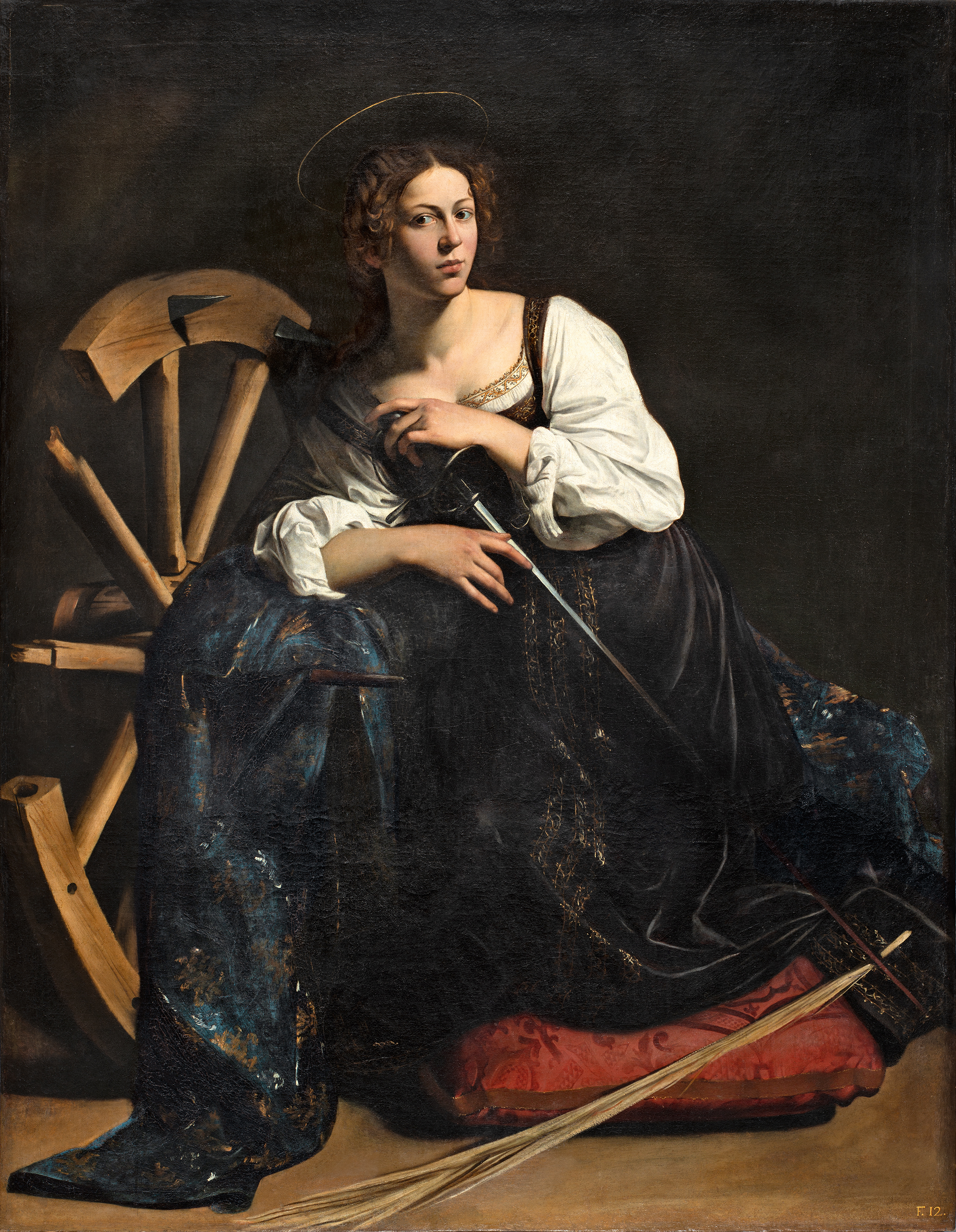
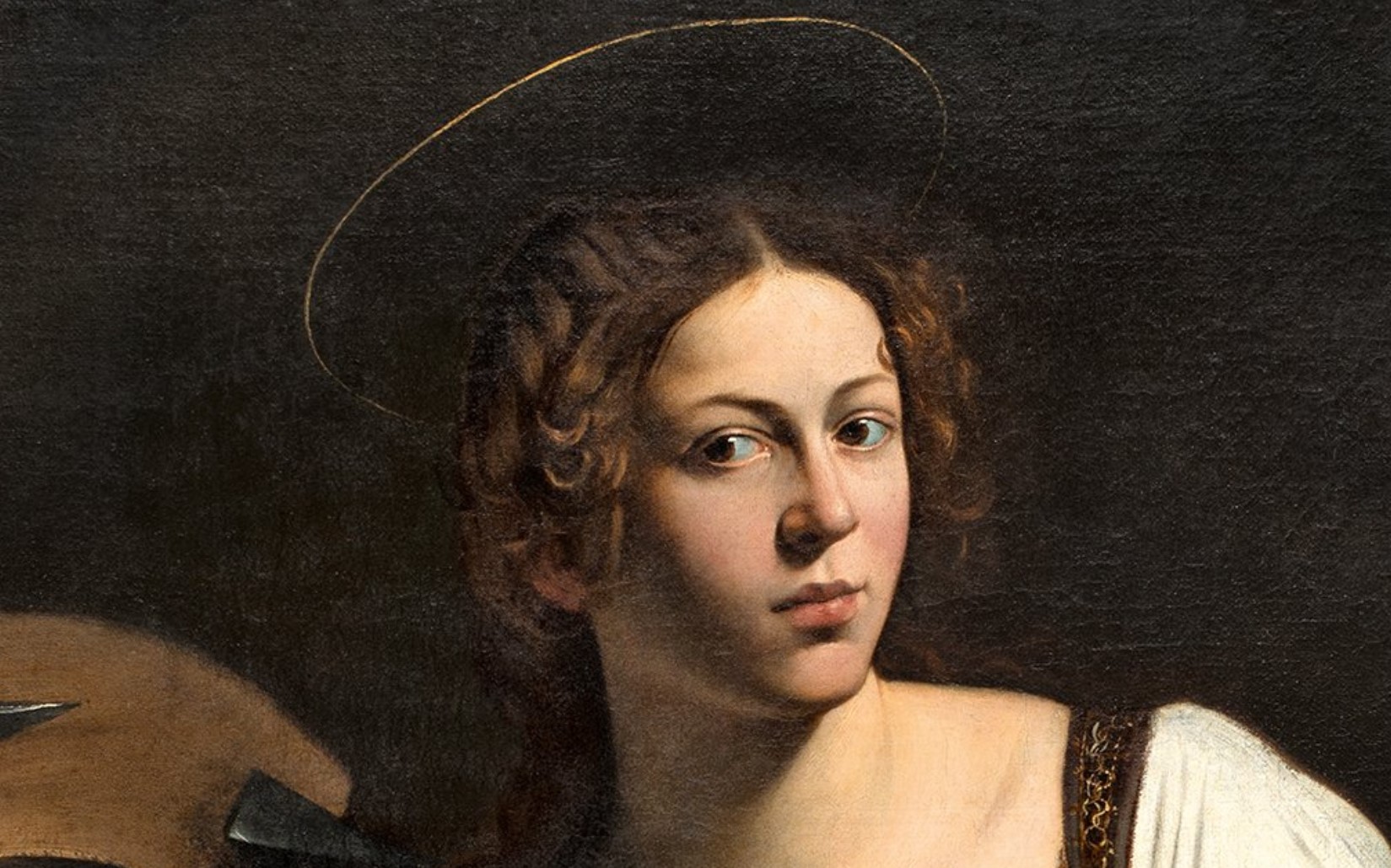
CARAVAGGIO (Michelangelo Merisi), Santa Catalina de Alejandría (St. Catherine of Alexandria), c. 1598-1599, oil on canvas, oil on canvas, 173 x 133 cm, Museo Nacional Thyssen-Bornemisza, Madrid. https://www.museothyssen.org/en/collection/artists/caravaggio-michelangelo-merisi/saint-catherine-alexandria – retrieved October 15, 2024.
Commissioned by Cardinal Francesco Maria del Monte, Caravaggio’s St. Catherine of Alexandria presents the saint in the unmistakable likeness of Fillide Melandroni, a well‑known Roman courtesan who played a decisive role in the painter’s artistic and personal life. Young artists routinely turned to women like Fillide for models—respectable women were simply unavailable for such work—and Caravaggio, more than most, transformed these marginalized figures into icons of startling dignity and psychological depth.
Richly robed and kneeling on a cushion, Catherine occupies the canvas with commanding stillness. She rests one hand on the spiked breaking wheel and gently cradles the sword—emblems of her martyrdom—while the dramatic fall of light isolates her against the darkness in Caravaggio’s signature chiaroscuro. The effect is intimate yet monumental: a saint rendered not as an ethereal ideal but as a living woman whose presence feels immediate, almost breathing qualities which would have an immense impact on European art in the 17th century.
Caravaggio heightens this immediacy with a device that would also echo through seventeenth‑century European painting: the saint’s body and attributes press toward the viewer’s space, collapsing the distance between sacred history and the spectator. It is precisely this fusion of realism, theatrical light, and emotional proximity that made works like St. Catherine so influential across the Baroque world.

Caravaggio (Michelangelo Merisi), Saint Francis of Assisi in Ecstasy, c. 1595-96, Oil on canvas, 36 3/8 x 50 5/8” 94 x 129.5 cm Wadsworth Atheneum, Hartford, CT. https://5058.sydneyplus.com/argus/final/Portal/Public.aspx?lang=en-US&p_AAEE=tab4&p_AABB=tab8 – retrieved October 11, 2024.
Caravaggio’s Saint Francis of Assisi in Ecstasy stands as his earliest known religious composition, and already the hallmarks of his mature style—intimacy, theatrical light, and emotional immediacy—are unmistakable. The subject, Saint Francis of Assisi (1182–1226), the Umbrian mystic famed for his radical poverty and fierce asceticism, often withdrew into solitude for forty‑day fasts, seeking to imitate Christ as literally as Scripture allowed. Medieval tradition holds that, like Christ in the wilderness, Francis was ministered by angels during these periods of spiritual extremity.
Caravaggio seizes on one such moment. In September 1224, on Mount La Verna in central Italy, Francis received the stigmata, the wounds of the crucified Christ—an experience granted to only a handful of saints. Caravaggio renders the episode with striking restraint: the saint collapses into the arms of an angel, his body slack with awe, while shepherds linger in the obscured background, half‑witnesses to a mystery they cannot fully comprehend. A faint trace of the wound appears beneath the rough folds of Francis’s tunic, a subtle but potent sign of the miracle.
The entire scene is carved out of darkness by Caravaggio’s directional light, a technique shaped by the scientific culture surrounding his patrons. Here, the light does not merely illuminate; it consecrates. It isolates Francis and the angel in a suspended moment of revelation, while the world around them recedes into shadow.
Caravaggio painted the work in Rome for Ottavio Costa (1554–1639), a Genoese banker and discerning collector who became one of his most loyal supporters. Centuries later, in 1943, Saint Francis of Assisi in Ecstasy became the first Caravaggio to enter a public collection in the United States, marking a milestone in the American reception of the Baroque master.

Caravaggio (Michelangelo Merisi), Rest on the Flight to Egypt, c, 1595/98, oil on canvas, 51 ¼ x 63” Galleria Doria- Pamphili, Rome.
La fête champêtre is a musical picnic whose tradition originated in Italy. Caravaggio’s composition is lyrical and complicated. As it is in the setting of the Holy Family’s flight to Egypt in Matthew’s Gospel, the characters are dressed humbly accompanied by the presence of an angel.

Caravaggio (Michelangelo Merisi), Boy Bitten By A Lizard, 1596/97, oil on cavas, 27 ½ 2 22 3/8”, The National Gallery, London.
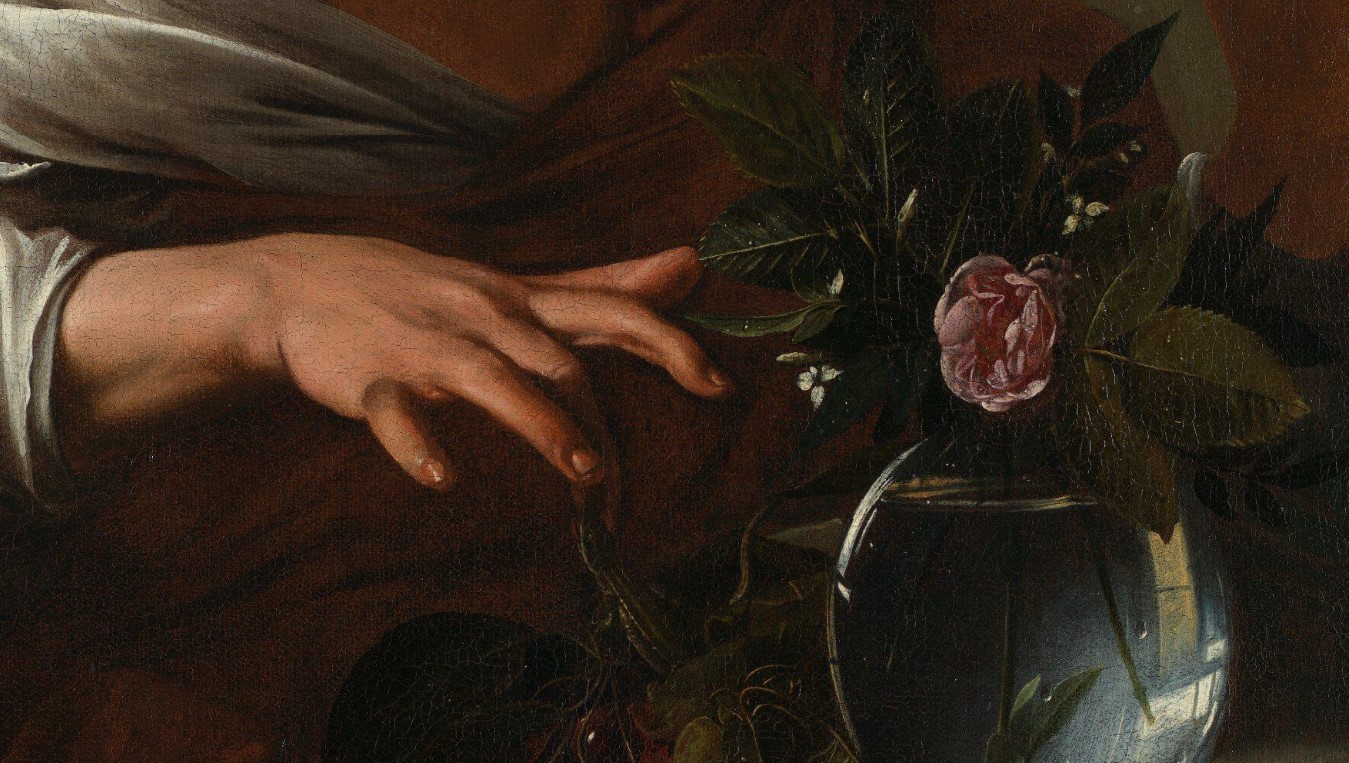
Mancini relates that Caravaggio painted the subject when staying with an old Catholic prelate named Pandolfo Pucci. By the end of his residence Caravaggio nicknamed his temporary benefactor Monsignor Insalata, or “Mister Salad,” for the pittance of solid food he served his artist boarder. The mock heroic painting may be allegorical with the lizard conveying its traditional meaning of lust or death joined to cherries symbolic of love and roses that of sexually transmitted disease — and warning of all three. see – https://www.britannica.com/biography/Caravaggio/First-apprenticeships-in-Rome-Pucci-Cesari-and-Petrigiani – retrieved October 15, 2024.

Caravaggio (Michelangelo Merisi), Bacchus, c. 1597, oil on canvas, 37 3/8 x 33 ½”, Uffizi, Florence.
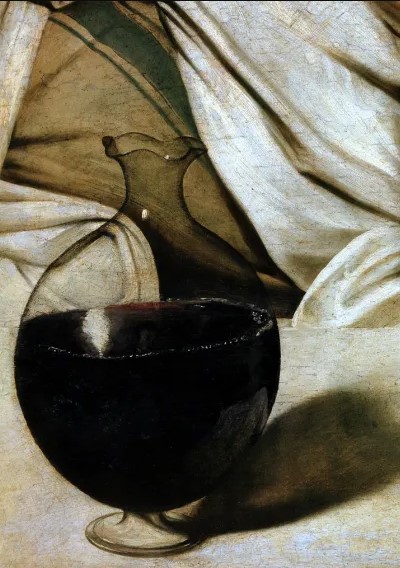
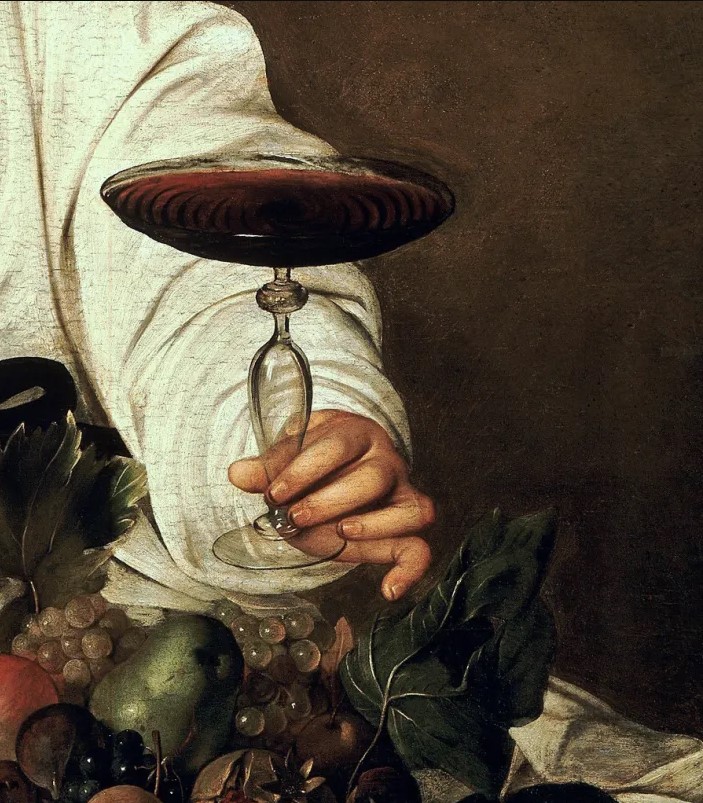
Commissioned by his principal patron, Cardinal Francesco Maria del Monte, Caravaggio’s Bacchus was presented as a diplomatic gift to Grand Duke Ferdinando I de’ Medici to mark his son’s wedding—a gesture that secured the painting’s place in the Medici collections for centuries. Today it stands as a cornerstone of early Baroque art, celebrated for its audacious rejection of idealized Renaissance classicism in favor of a startlingly earthbound realism.
Instead of a radiant, godlike deity, Caravaggio gives us a working‑class Roman youth—almost certainly his friend and frequent model Mario Minniti—costumed as the god of wine. Any pretense of antiquity is deliberately dismantled. Bacchus reclines not on a marble couch but on a striped mattress folded to imitate a Roman triclinium. His white “toga” is nothing more than a contemporary bedsheet, loosely draped over his body. The effect is both intimate and unsettling: a classical god rendered as a boy you might meet in the streets of Rome, invited into myth by costume alone.
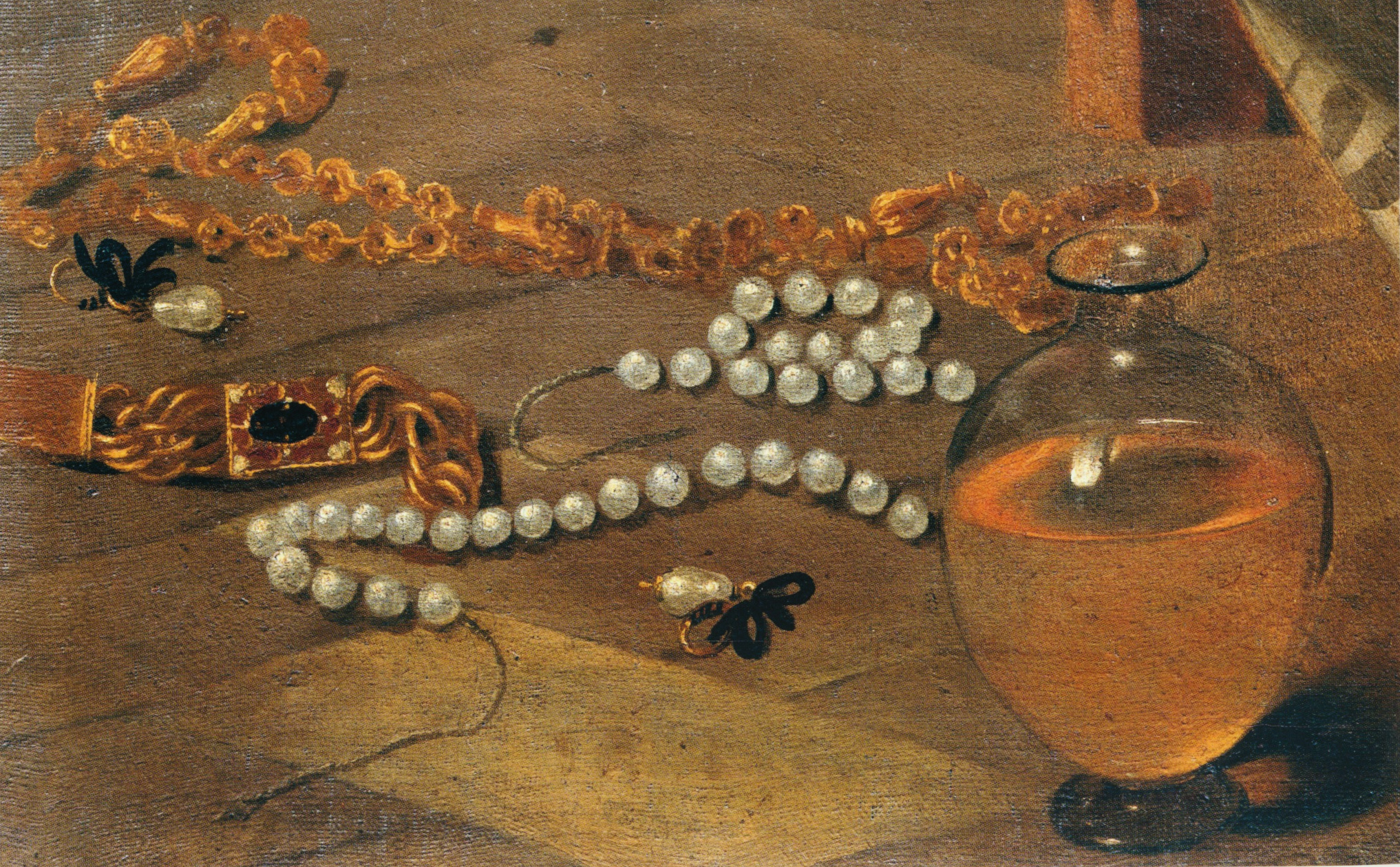
The lower half of the canvas deepens the painting’s moral tension. Caravaggio arranges a sumptuous still life—apples, grapes, figs, a carafe of wine—but it is also a vanitas. The apples are bruised and worm‑eaten, the grapes overripe, the leaves already curling toward decay. This quiet rot serves as a memento mori, a reminder that youth, beauty, and sensual pleasure are as fleeting as the fruit that embodies them. Caravaggio’s realism becomes a form of philosophy.
Despite its current fame, Bacchus nearly vanished from history. After the fall of the Medici dynasty, the painting was relegated to a dark storage room in the Uffizi reserves—unframed, uncatalogued, and obscured beneath yellowed varnish. It remained forgotten until 1913, when art historians rediscovered and authenticated it as an irreplaceable treasure of the Baroque.

Caravaggio (Michelangelo Merisi), Jupiter, Neptune, and Pluto, 1597, oil on stucco, about 9/9”” x 5’11” Villa Ludovisi, Rome. https://villaludovisi.org/ – retrieved October 12, 2024.
The building and grounds of Villa Ludovisi in Rome, and their rich artwork, includes masterpiece frescoes by Guercino (1591-1666) and other leading lights of the 17th century Bolognese school. Caravaggio’s Jupiter, Neptune and Pluto is his only known oil painting on plaster. Cardinal de Monte purchased the villa and took up residence there in 1596. The cardinal sold it to the Ludovisi in 1621. Bellori relates that the subject matter for the fresco of these gods was to express the cardinal’s interest in medicinal chemistry (today’s pharmaceuticals).

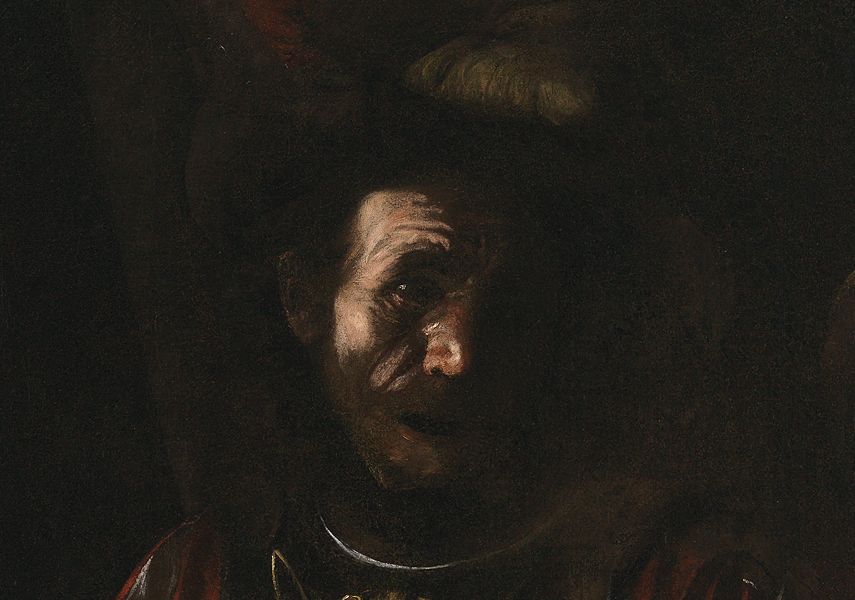
Caravaggio (Michelangelo Merisi), Judith Beheading Holofernes, c. 1598, oil on canvas, 56 ¾ x 76 ¾” 145 x 195cm Galleria Nazionale d’Arte Antica, Rome. https://barberinicorsini.org/opera/giuditta-e-oloferne/ – retrieved October 12, 2024.
Commissioned by Ottavio Costa, one of Caravaggio’s most loyal Roman patrons, the painting passed through several prominent Roman families before entering the Galleria Nazionale d’Arte Antica in 1970. Its subject is the famous episode from the Book of Judith, a Biblical tale of courage, seduction, and divine deliverance that had long captured the Christian imagination.
Judith—beautiful, eloquent, and revered in her community—is a widow living in the besieged city of Bethulia, threatened with destruction by the Assyrian general Holofernes. Because he is captivated by her beauty, Judith is granted unusual freedom within the enemy camp. She joins Holofernes at a banquet in his tent, where he drinks himself into oblivion. As the text puts it, “Holofernes, charmed by her, drank a great quantity of wine, more than he had ever drunk on any day since he was born” (Judith 12:20).
Once the attendants withdraw, Judith seizes her moment. The biblical account describes the scene with stark intensity: she stands beside the general’s bed and prays silently for strength, saying: “O Lord, God of all might, in this hour look graciously on the work of my hands for the exaltation of Jerusalem. Now is the time for aiding your heritage and for carrying out my design to shatter the enemies who have risen against us” (Judith 13:4–5). Taking Holofernes’ own sword from the bedpost, she grasps his hair, invokes the God of Israel, and strikes twice, severing his head. She then rolls his body aside and hands the severed head to her maid, who conceals it in a food bag before the two women slip back into the night (Judith 13:4–10).
Caravaggio chooses the exact instant when violence erupts—his first painting to depict action with such visceral, kinetic force. The scene unfolds like a frieze suspended in time: Judith leaning forward with grim resolve, her maid assisting with practiced efficiency, and Holofernes recoiling in shock as the blade bites into his neck. The theatrical light isolates the figures against darkness, heightening the sense of immediacy and moral gravity.
This painting marks a turning point in Caravaggio’s career. With Judith Beheading Holofernes, he demonstrates not only his mastery of chiaroscuro but also his ability to transform a biblical narrative into a moment of raw human drama—one that reverberated across the Baroque world.
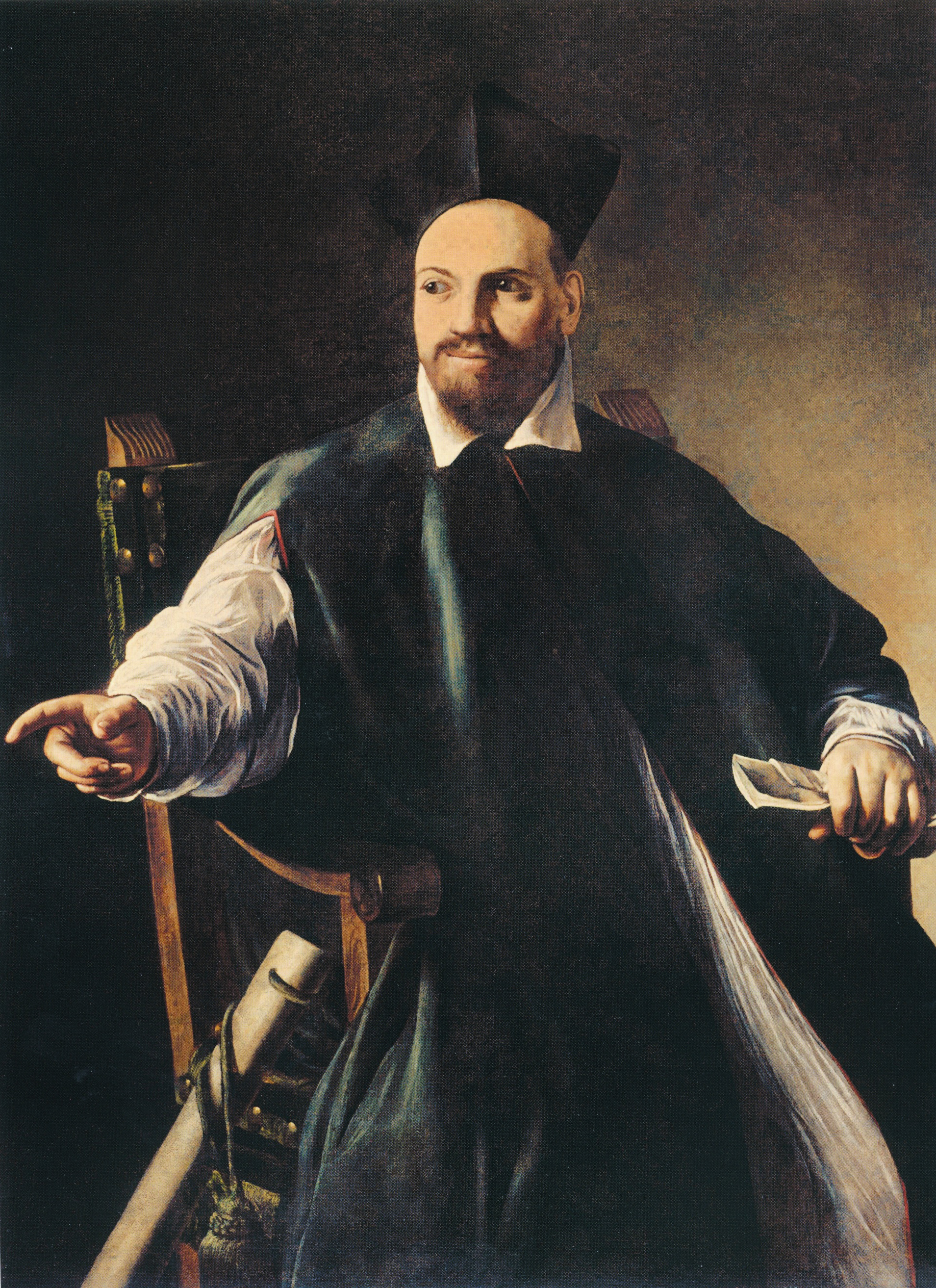
Caravaggio (Michelangelo Merisi), Portrait of Monsignor Maffeo Barberini, c. 1603, Private Collection, Firenze. Maffeo Vincenzo Barberini (1568-1644) became the future Pope Urban VIII whose reign began in 1623.
The words of Christ, who is there, have been spoken. But now time is suspended. How will Matthew reply? Christ is calling him. Do I go or not? Do I follow him or not? These paintings are completely dramatic. Caravaggio uses natural light but turns it into an astonishing symbol of divine illumination.
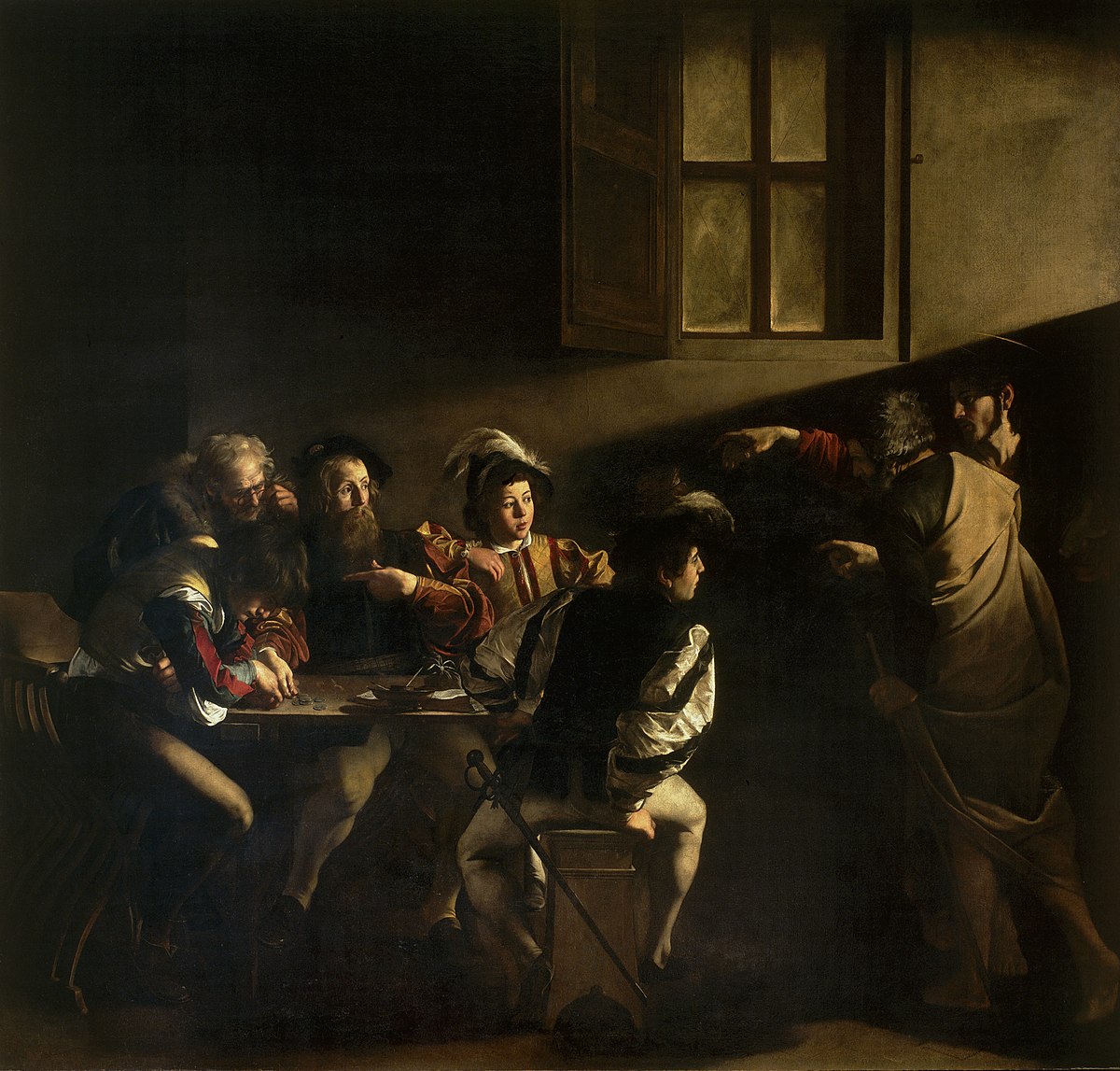
Caravaggio (Michelangelo Merisi), The Calling of Saint Matthew, 1599-1600, oil on canvas, 10’7 1/2 “ x 11’ 2” Contarelli Chapel, Church of Luigi dei Francesi, Rome.
Caravaggio’s The Calling of Saint Matthew (1599–1600), a monumental oil on canvas measuring 10’7½” × 11’2” (322 × 340 cm), occupies the left wall of the Contarelli Chapel in San Luigi dei Francesi, Rome. Commissioned as his first major public work when the artist was 28 years old, it quickly became a defining masterpiece of the Baroque—an image that rewired the expectations of religious art for an entire generation.
Caravaggio stages the biblical moment described in Matthew 9:9—Christ summoning the tax collector Levi (Matthew) to discipleship—not in a distant, idealized past but in a dark, contemporary Roman tavern, thick with shadow. The sacred enters the profane unexpectedly.
The composition unfolds in two distinct worlds. Around the counting table sit Matthew and his companions, absorbed in their unseemly gains, dressed in sumptuous late‑16th‑century velvet doublets, feathered hats, and sidearms—figures of worldly wealth and casual corruption. Into this scene step Christ and Saint Peter, barefoot and clothed in rough robes. Their presence feels out of sorts, yet the room shifts around them.
A single, razor‑sharp beam of light—Caravaggio’s signature tenebrism —enters from the upper right, cutting diagonally across the darkness. It travels in parallel to Christ’s extended hand, making the light itself a metaphor for divine grace and spiritual awakening penetrating a den of exploitation and greed. As the light strikes the faces at the table—some oblivious, others looking up startled— it settles fully on Matthew, who points to himself in shock.
In Counter‑Reformation Rome, the message was unmistakable. Caravaggio’s painting declared that the divine could break into the most ordinary, compromised corners of daily life—that salvation could arrive unannounced, even in a backroom thick with schemes of greed. It was a psychological jolt to the city’s viewers, a reminder that grace was not confined to altars or idealized visions but could happen anywhere to anyone, at any moment.
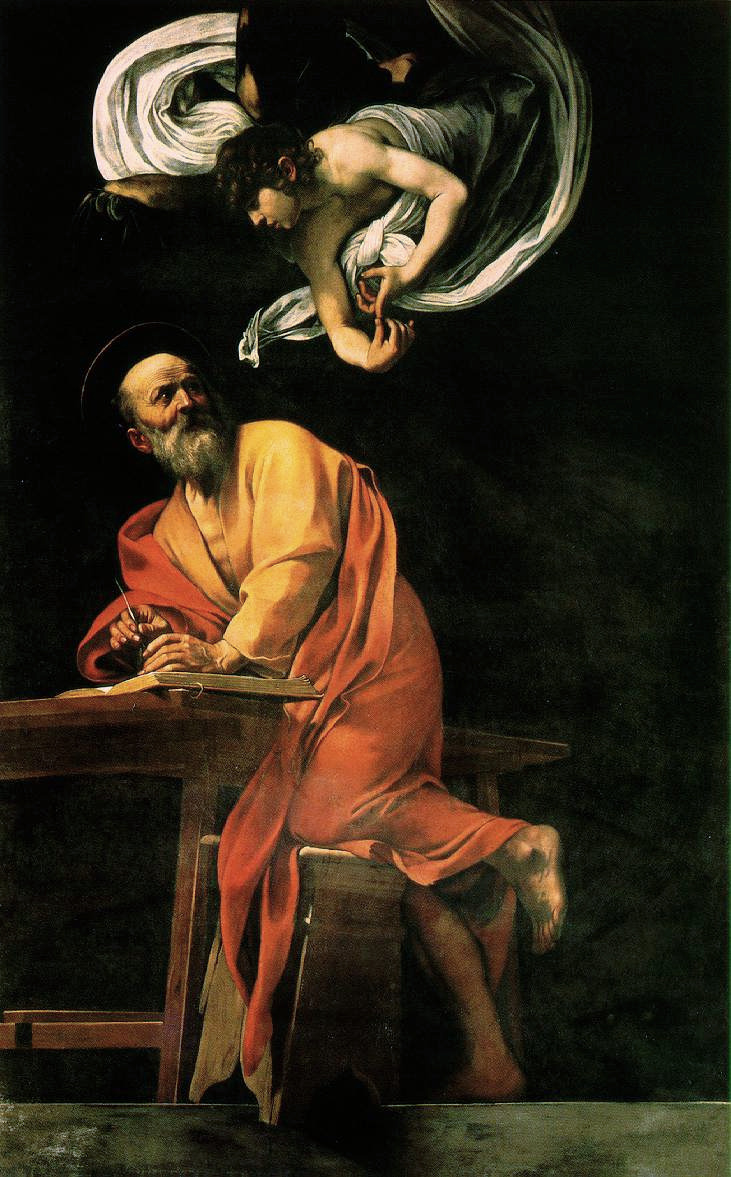
Caravaggio (Michelangelo Merisi), The Inspiration of Saint Matthew, 1602, oil on canvas, 9’8 1/2 “ x 6’ 2 ½” Contarelli Chapel, Church of Luigi dei Francesi, Rome.
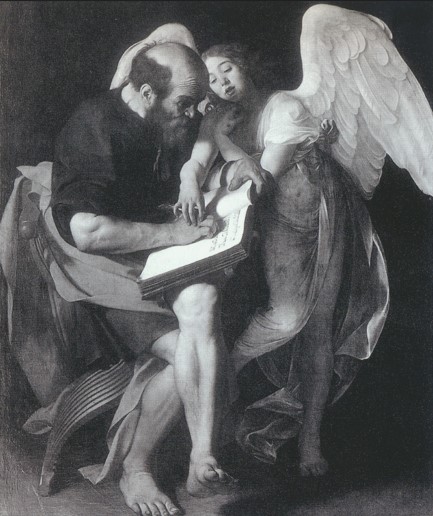
This first version of The Inspiration of St. Matthew by Caravaggio was rejected because the evangelist was considered too crude and the angel too familiar. The painting was destroyed during the Fall of Berlin in 1945 and known by photographs.
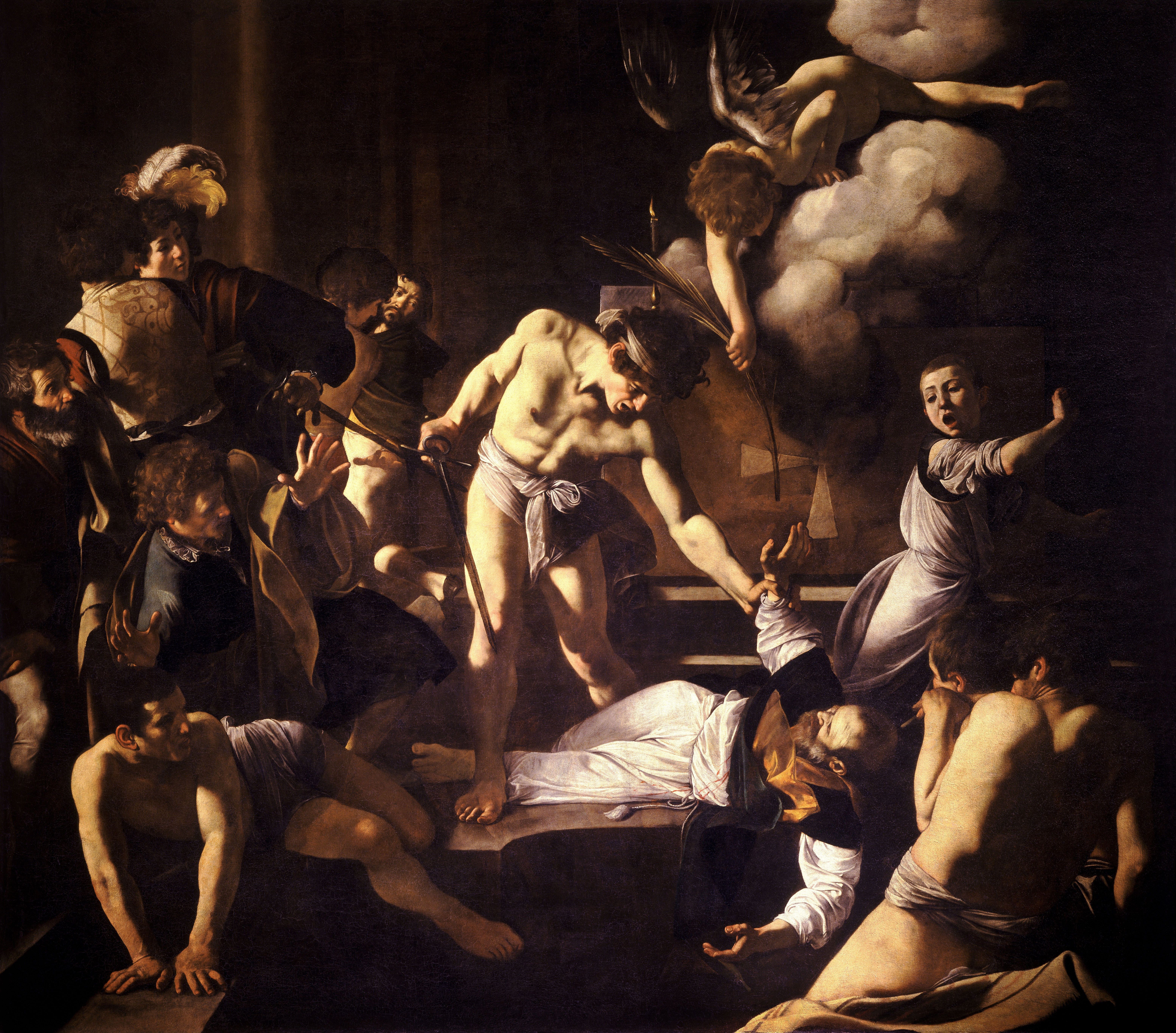
Caravaggio (Michelangelo Merisi), The Martyrdom of Saint Matthew, 1599-1600, oil on canvas, 10’7 1/2 “ x 11’ 3” Contarelli Chapel, Church of Luigi dei Francesi, Rome.
Permanently installed on the right wall of the Contarelli Chapel in San Luigi dei Francesi, Caravaggio’s The Martyrdom of Saint Matthew erupts across the canvas in a chaotic, centrifugal burst of bodies and motion. The composition radiates outward from a single, horrifying fulcrum—the moment of the apostle’s death—captured with explosive, almost cinematic intensity. With this work, Caravaggio established himself as the unrivaled master of psychological violence in early Baroque art.
The narrative follows the traditional account in the Golden Legend. Saint Matthew, having publicly condemned King Hirticus of Ethiopia for lusting after his own niece, the consecrated virgin Iphigenia, is murdered in retaliation. Caravaggio distills the entire hagiography into one blinding instant: the assassin, a half‑nude royal soldier, lunges forward to strike the fatal blow as Matthew collapses, bleeding, onto the altar steps.
Caravaggio pushes tenebrism to its outer limit. The saint lies sprawled on the ground, his arms flung open in a gesture that hovers between defense and surrender. The executioner grips Matthew’s wrist, towering above him with a drawn sword, his face twisted in a scream of fury. Around them, witnesses recoil in terror, their bodies spiraling outward as if blasted by the force of the violence.
Yet amid the earthly chaos, the supernatural breaks through. A cloud gathers above the altar, and an angel descends—not to rescue Matthew, but to complete the drama of martyrdom. Leaning down from heaven, the angel extends the palm of victory, placing it into the saint’s wounded hand at the very moment the assassin’s sword arcs downward.
The intersection of these three elements—the angel’s arm, the soldier’s blade, and Matthew’s reaching hand—forms a powerful diagonal axis, a visual declaration that divine salvation overrides mortal execution. In this collision of heaven and earth, Caravaggio transforms a brutal killing into a moment of transcendent destiny.
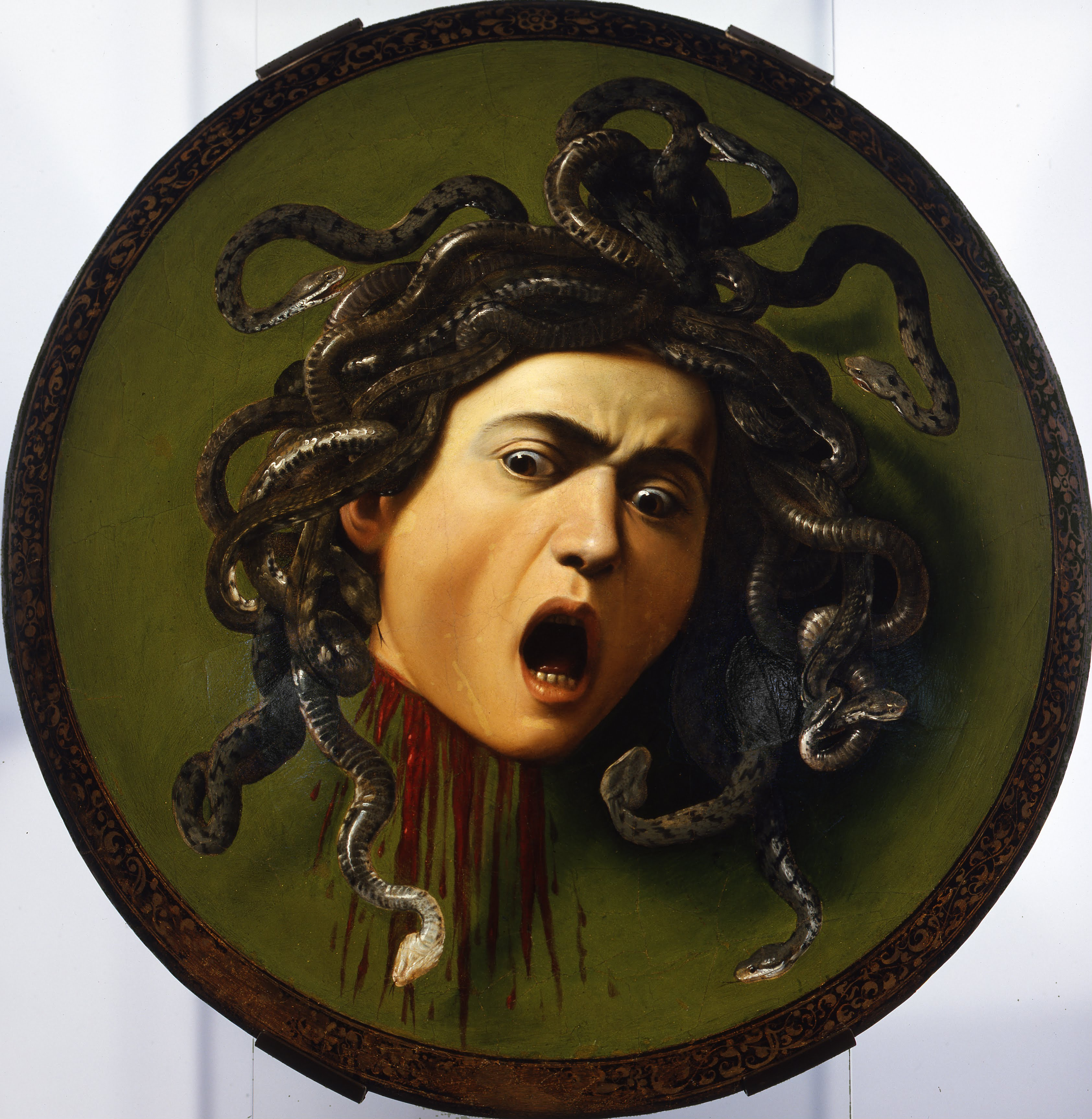
Caravaggio’s Medusa is painted on an actual parade shield.
Caravaggio’s Medusa (1600/01), now in the Uffizi Gallery, is one of the most astonishing feats of early Baroque engineering and psychological terror. Painted in oil on canvas and mounted onto a convex poplar shield, the work fuses myth, optics, and raw anatomy into a single, unnervingly lifelike apparition. Commissioned by Cardinal Francesco Maria del Monte and presented as a diplomatic gift to Grand Duke Ferdinando I de’ Medici, it was proudly displayed in the Medici Armory as both a marvel of craftsmanship and a symbol of dynastic power.
Because the surface curves outward, Caravaggio had to deploy advanced foreshortening and perspectival distortion to counteract the shield’s bulge. He subtly elongates Medusa’s cheeks and distorts her jawline so that, when viewed head‑on, the surface appears flat—or even concave—a technical sleight of hand that would have impressed both artists and scientists in Del Monte’s Roman circle.
Caravaggio captures the exact, electric instant between life and death. Perseus has already struck, yet Medusa’s nervous system still fires. Her face becomes a study in catastrophic realization: eyes bulging with shock and fury, brow knotted in disbelief, mouth wrenched open in a silent, blood‑freezing scream. True to his radical naturalism, Caravaggio did not invent stylized serpents; he studied real vipers, painting them mid‑coil, mid‑strike, writhing in panic as their host dies beneath them. From the severed neck, bright arterial blood spurts outward in jagged, hyper‑realistic streams.
To deepen the mythic resonance, Caravaggio anchors the work in the classical story as told by Ovid. According to the Metamorphoses, Perseus could only approach Medusa safely by looking at her reflection in the polished bronze shield given to him by Athena. By painting Medusa’s head directly onto a shield, Caravaggio transforms the viewer into Perseus himself—the one who sees the monster only through a mediated surface. The painting becomes a weapon, a mirror, and a mythic reenactment all at once.
For modern viewers, the shield reads as pure horror: a severed head frozen in the moment of its final scream. But for the Medici, it carried a very different charge. Medusa—whose gaze could immobilize armies—became a potent emblem of political dominion, a symbol of a ruler whose power could paralyze enemies before they even approached.

Caravaggio (Michelangelo Merisi), Basket of fruit (canestra di frutta), c. 1600/01, oil on canvas, 18 1/8 x 25 3/8, Biblioteca Ambrosiana, Milan. https://www.ambrosiana.it/opere/canestra-di-frutta/ – retrieved October 13, 2024.
Caravaggio’s Basket of Fruit is the only autonomous still life by the artist known to survive, though his figure paintings are filled with exquisitely rendered fruit that function as symbolic subtexts. Across his oeuvre, these arrangements vary widely in species, ripeness, and composition, yet they share a distinctive naturalism—blemishes, curling leaves, and the quiet drama of decay rendered with almost scientific precision.
The painting belonged to Cardinal Federico Borromeo (1564–1631), cousin of Saint Charles Borromeo and, like him, Archbishop of Milan. A towering figure of the Counter‑Reformation, Federico championed religious art as a tool of pastoral instruction, yet he was also an unusually passionate collector of still life, a genre often dismissed as minor. Whether he commissioned Caravaggio’s painting or received it as a gift remains uncertain, but he valued it enough to bequeath it in his will to the Ambrosiana in Milan, the scholarly gallery and library he co‑founded in 1618.
The basket itself is instantly recognizable to anyone familiar with Caravaggio’s work. A nearly identical arrangement appears in the Supper at Emmaus in London’s National Gallery, painted around the same time. In both works, the fruit leans precariously over the edge, as if about to tumble into the viewer’s space—a hallmark of Caravaggio’s desire to collapse the boundary between the painting and the viewer.
Cardinal Borromeo lived in Rome from 1586 to 1601, precisely the years when Caravaggio’s reputation was rising with meteoric speed. During this period, he became deeply familiar with the painter’s radical naturalism. For a prelate devoted to both doctrinal clarity and the beauty of the created world, Caravaggio’s still life—so attentive to the fragile, transient nature of living things—would have held profound appeal.

Giulio Cesare Procaccini ((1574–1625), Cardinal-Archbishop Federico Borromeo, 1610, Museo diocesano di Milano.
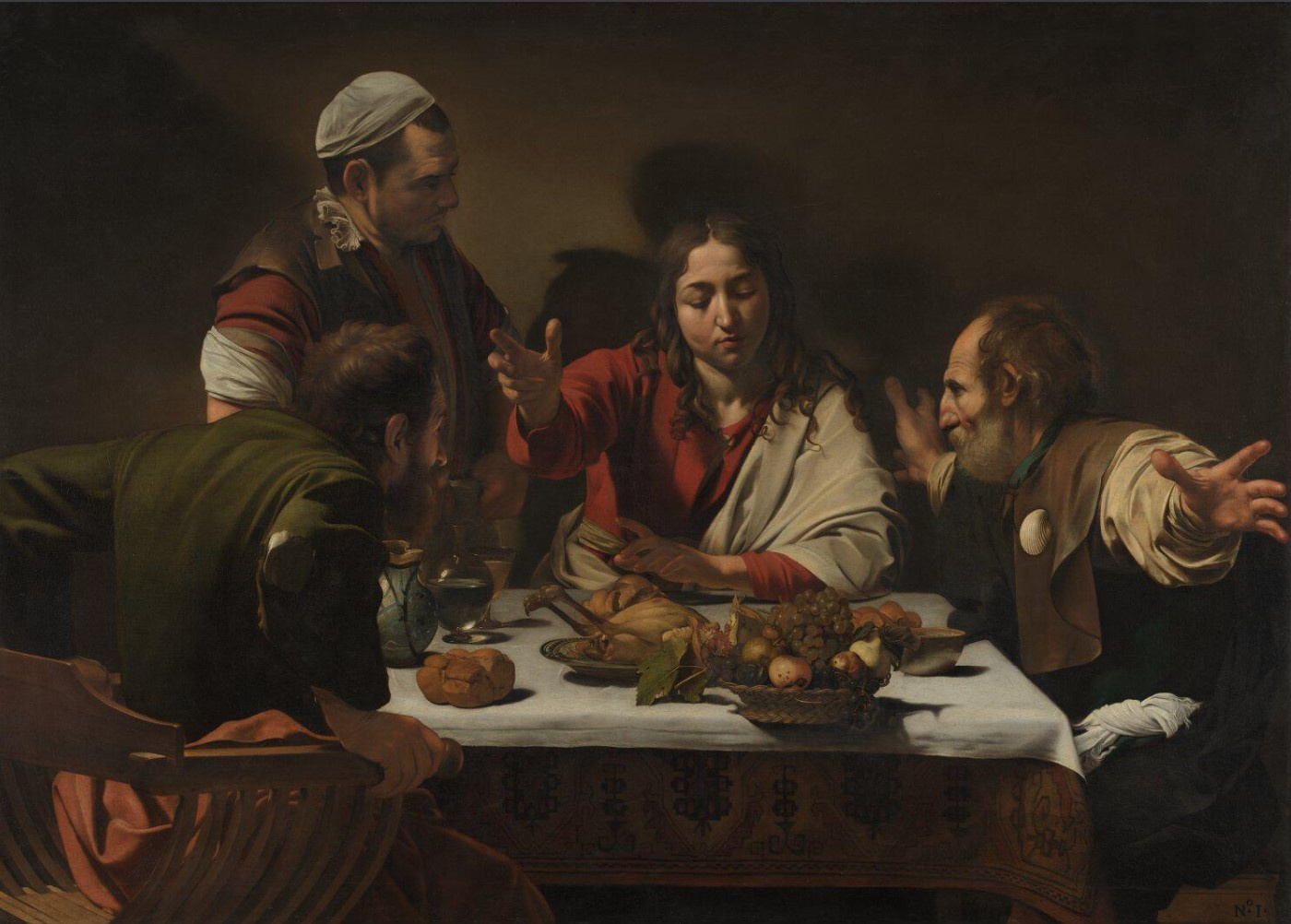
Caravaggio (Michelangelo Merisi), Supper at Emmaus, c. 1600/01, oil on canvas, 54 ¾ x 76 ¾” The National Gallery, London.
Caravaggio’s Roman career accelerated rapidly after the triumph of the Contarelli Chapel commissions. Almost immediately he was engaged for another prestigious project in Santa Maria del Popolo, decorating the Cerasi Chapel. Although these were technically private commissions, their placement in major Roman churches ensured that Caravaggio’s work circulated before a broad public. By 1600 he had become one of the most sought‑after painters in the city, attracting both established patrons and ambitious newcomers such as the wealthy Mattei brothers, prominent Roman bankers. For one of them, in the family palazzo, Caravaggio produced The Supper at Emmaus (1601), a work executed at the apex of his early fame and artistic maturity.
What distinguishes this painting is not only Caravaggio’s reliance on live models and his anatomically precise naturalism, but his increasingly sophisticated deployment of light as a bearer of meaning rather than mere aesthetic embellishment. Instead of depicting the journey to Emmaus, Caravaggio selects the climactic instant at the supper table when the risen Christ blesses and breaks the bread and the disciples suddenly recognize him—just before he vanishes from their sight. Light becomes the visual analogue of recognition itself: a revelatory force that cuts through the scene with theological and psychological clarity.
Caravaggio dramatizes this moment with unprecedented immediacy. One disciple thrusts himself forward, his elbow projecting into the viewer’s space; the other flings his arms wide in astonished realization. Meanwhile the innkeeper, who has not grasped the miracle unfolding before him, remains enveloped in the darker register of Caravaggio’s chiaroscuro, his face still in shadow. The contrast is not incidental: it marks the divide between those who have entered the “light” of recognition and those who remain outside it.
The composition’s theatricality intensifies this effect. Caravaggio’s half‑length, tightly cropped figures press against the picture plane, collapsing the distance between sacred narrative and beholder. Everyday objects—fruit basket, tablecloth, the disciples’ garments—jut outward with near sculptural immediacy, creating a sensuous, almost tactile realism that anchors the miracle in the viewer’s own world. The result is a painting that is simultaneously grounded in contemporary Roman life and elevated by a supratemporal luminosity that signals divine presence.
Yet the work was not universally admired. Critics objected that Caravaggio’s Christ looked too youthful and unbearded—“a man posing as Christ who certainly was not Christ,” as Bellori complained in 1672. Caravaggio got the criticism though Michaelangelo Buonarroti did the same thing in the pope’s Sistine Chapel. Others scoffed that the fruit on the table could not have been in season during the post‑Easter episode. Such criticisms, however, reveal the very innovation of Caravaggio’s method: his commitment to inventing a world that is believable precisely because it is rooted in the observable, even when that realism unsettles traditional expectations. Unlike earlier artists who idealized sacred history, Caravaggio insisted on painting from life, even in a religious history painting intended for private devotion.
The Supper at Emmaus thus exemplifies Caravaggio’s distinctive achievement: a fusion of radical naturalism and spiritual intensity that collapses historical distance, bringing the sacred into the viewer’s present while simultaneously lifting the everyday into a realm of revelation.
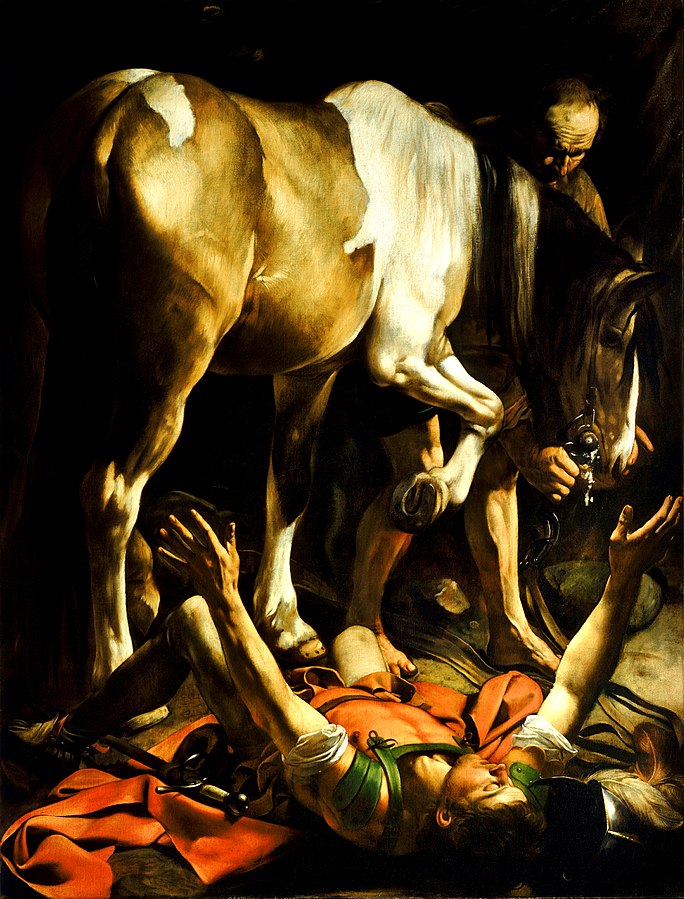
Caravaggio (Michelangelo Merisi), The Conversion of Saint Paul, 100/01, oil on canvas, 90 ½ x 70” Cerasi Chapel, Santa Maria de Popolo, Rome.
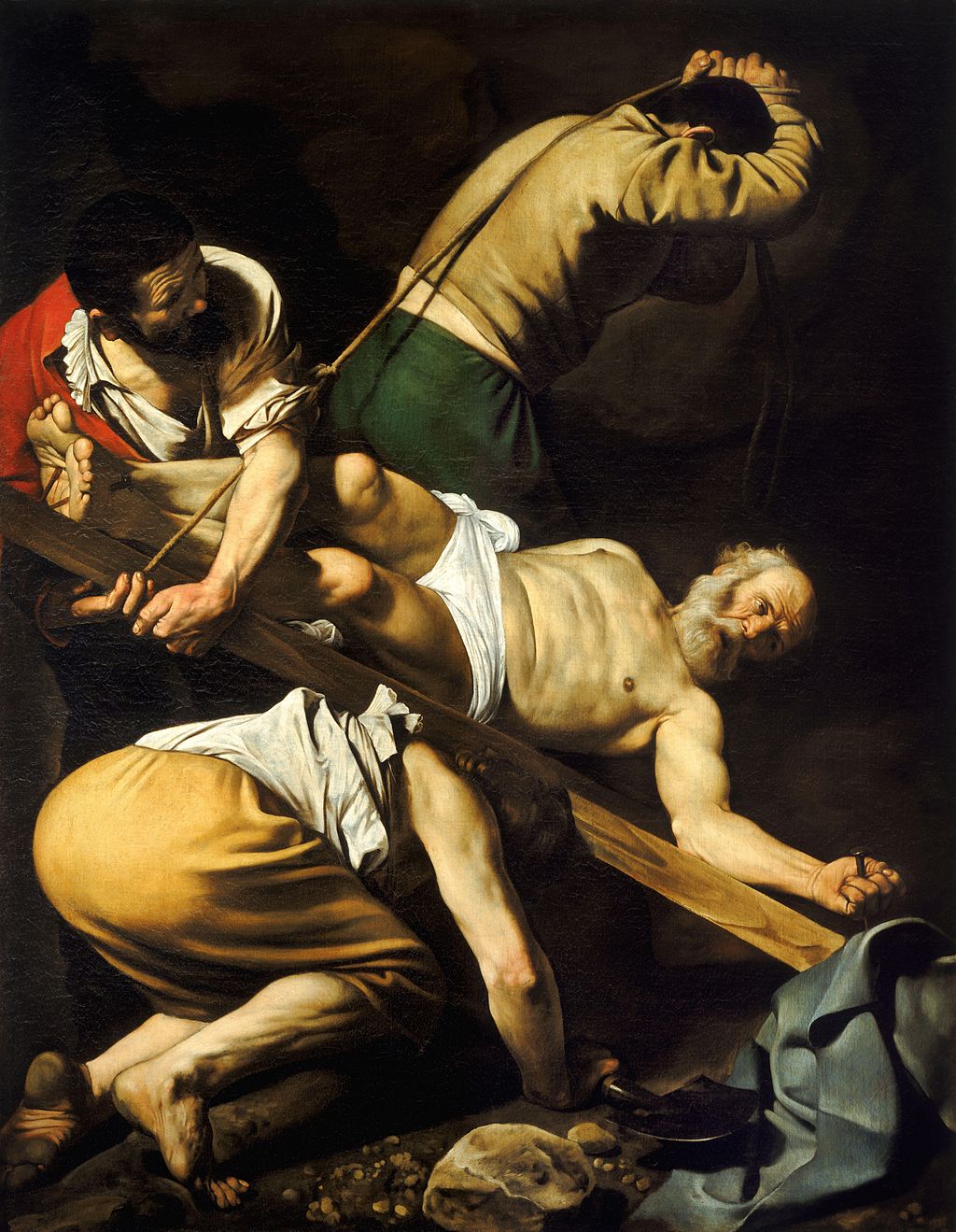
Caravaggio (Michelangelo Merisi), The Crucifixion of St. Peter, 1600/01, oil on canvas, 90 ½ x70” Cerasi Chapel, Santa Maria de Popolo, Rome.
The chapel was purchased by Tiberio Cerasi (1544-1601) in 1600 who worked as Treasurer-General for Pope Clement VIII. Cerasi had the chapel redone by Carlo Maderno (1556-1629). In 1601 Cerasi hired Caravaggio to paint The Conversion of St. Paul and The Crucifixion of St. Paul. Notably, his paintings’ first versions were rejected. The final paintings were installed in 1605 and the chapel consecrated in 1506. The Assumption of Mary over the altar was painted at the same time by Annibale Caracci. See – https://en.wikipedia.org/wiki/Cerasi_Chapel– retrieved October 14, 2024.
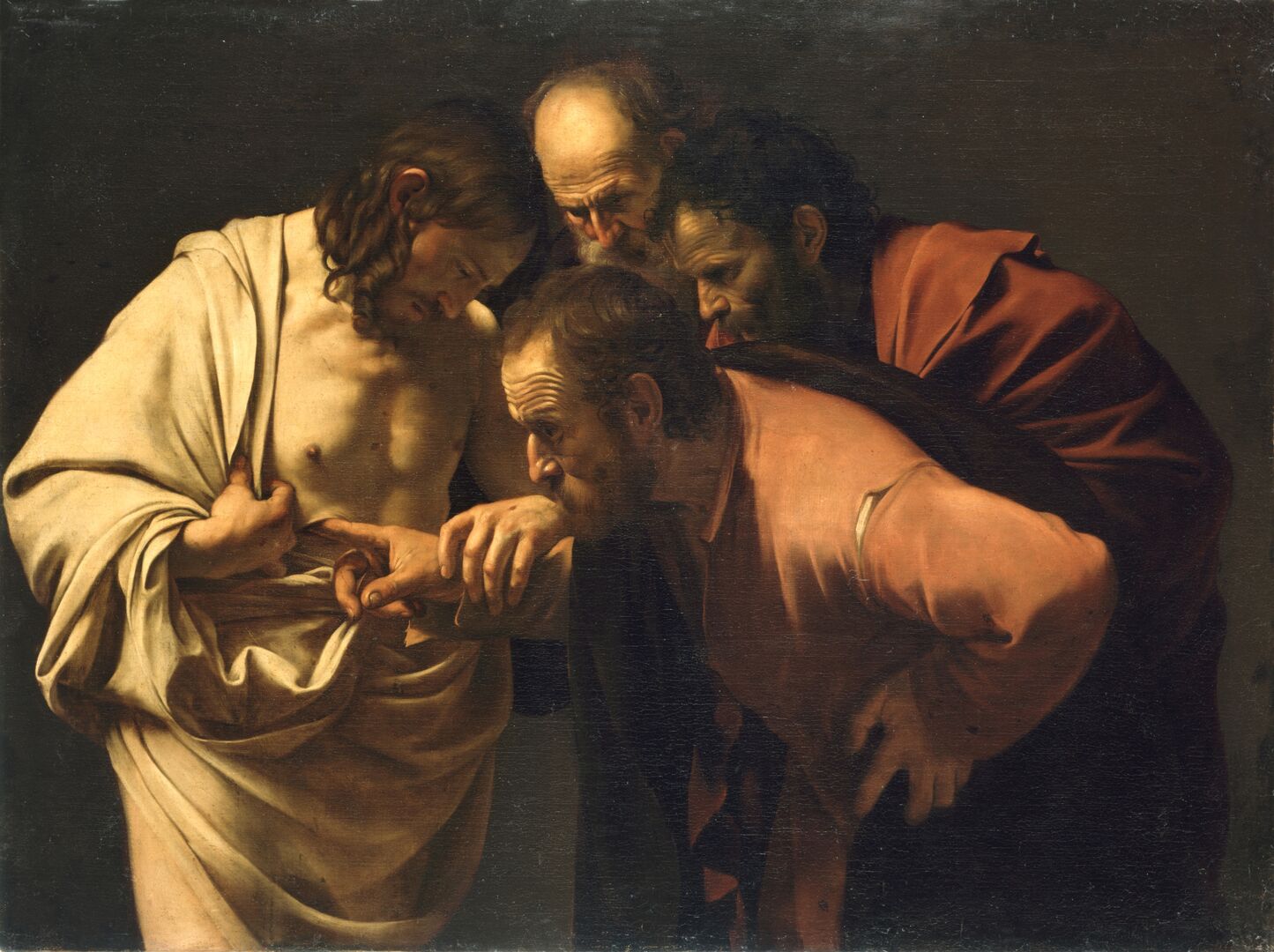
Caravaggio (Michelangelo Merisi), The Incredulity of Saint Thomas, 1601/02, oil on canvas, 42 1/8 x 57 ½” 118 × 156.5 cm Neues Palais, Potsdam.
Caravaggio’s The Incredulity of Saint Thomas presents the New Testament encounter (John 20:27–31) with uncompromising naturalism and the stark drama of chiaroscuro. The painting’s later history is as turbulent as its subject. Originally owned by the powerful Giustiniani family, it was sold under financial duress and purchased in 1815 from a Paris dealer by King Frederick William III of Prussia (1770–1840). The king intended to assemble a public art museum for Berlin, yet this work—astonishingly—was initially judged “lower quality,” perhaps because Caravaggio offers no visible markers of Christ’s divinity. Instead, he renders the risen Christ with the same corporeal immediacy as the apostles, a choice that unsettled early nineteenth‑century connoisseurs.
Of the five Caravaggios acquired by the Prussian monarch, only three ultimately entered the museum collection, including Cupid as Victorious at the Gemäldegalerie. The Incredulity of Saint Thomas was instead hung in the Berlin Palace, and later, in 1856, installed in the picture gallery at Sanssouci, where its psychological intensity found a more appreciative audience.
Caravaggio’s interpretation of the biblical scene is uncompromisingly direct. Christ guides Thomas’s hand into the wound in his side, the gesture rendered with surgical clarity. The apostles crowd around, their faces lit by a single, directional beam that isolates the moment of recognition. There is no halo, no ethereal glow—only flesh, shadow, and the shock of belief forced into being. Caravaggio transforms a theological lesson into a moment of tactile revelation, collapsing the distance between viewer and miracle. https://brandenburg.museum-digital.de/object/11898 – retrieved October 11, 2024.
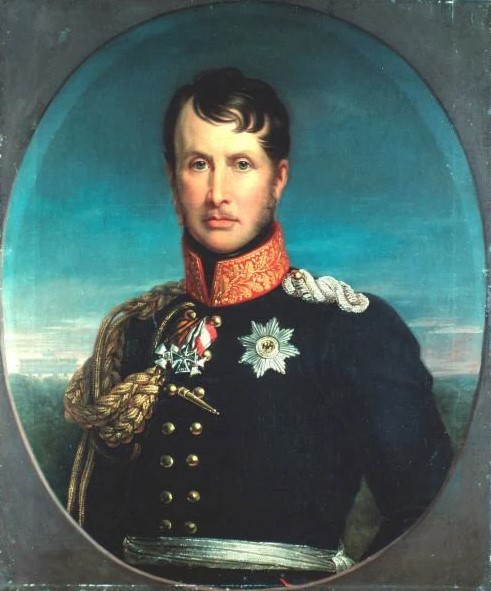
Frederick William III ruled Prussia during the Napoleonic Wars and, while shy and quiet by nature, reluctantly participated in the coalition against Napoleon in the German campaign of 1813. After Napoleon’s defeat in 1815, he took part in the Congress of Vienna and helped established the new postwar order in Europe. For the remainder of his reign, Frederick William III set about reforming Prussian institutions and centralizing royal control.

Caravaggio shows Eros prevailing over other human endeavors: war, music, science, government.
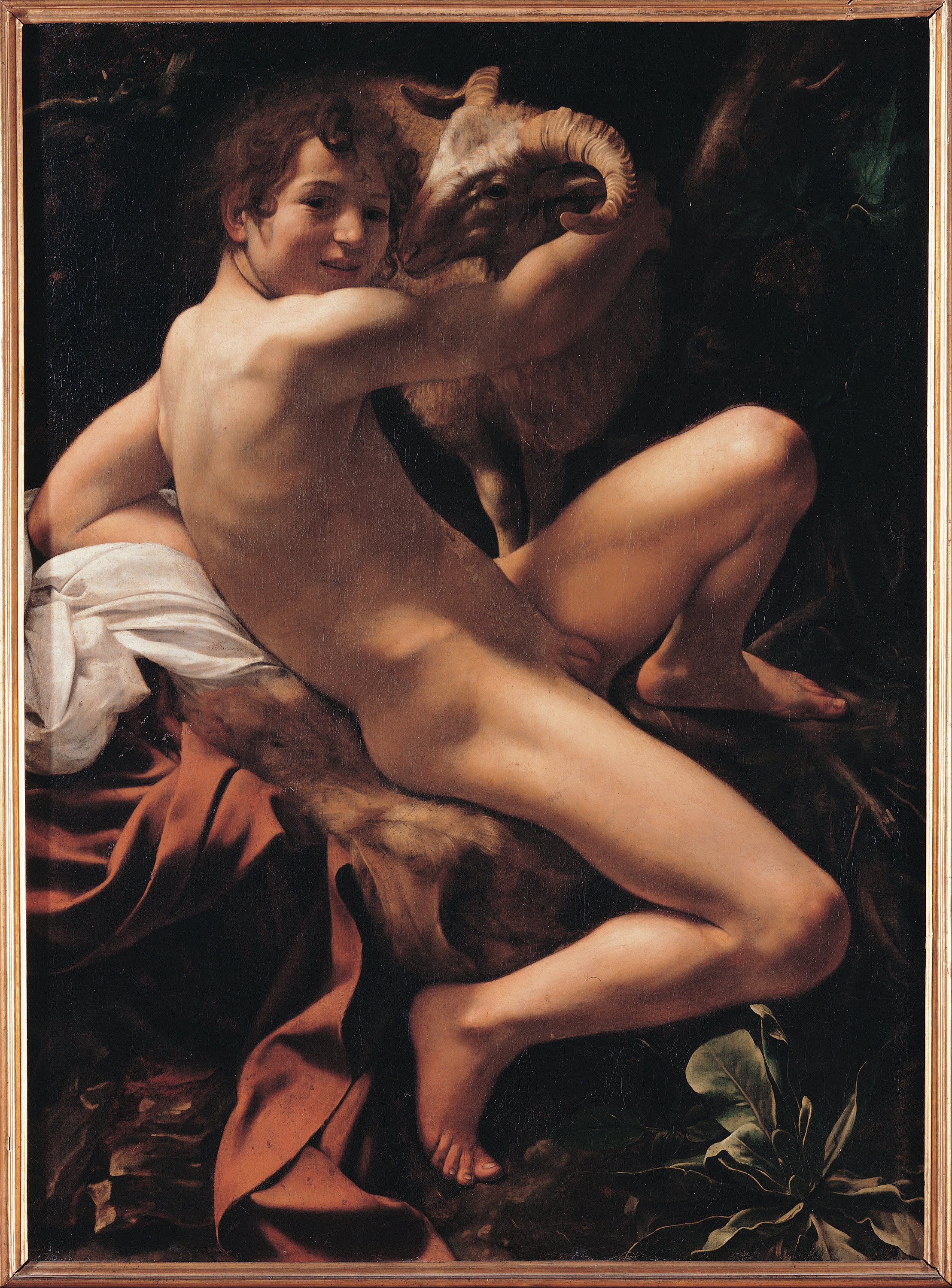
Youth With A Ram was painted for Ciriaco Mattei (d.1614), one of the foremost art collectors of his time, and given to Cardinal del Monte by his son before his death. Mattei also commissioned Caravaggio’s Supper at Emmaus and The Taking of Christ.
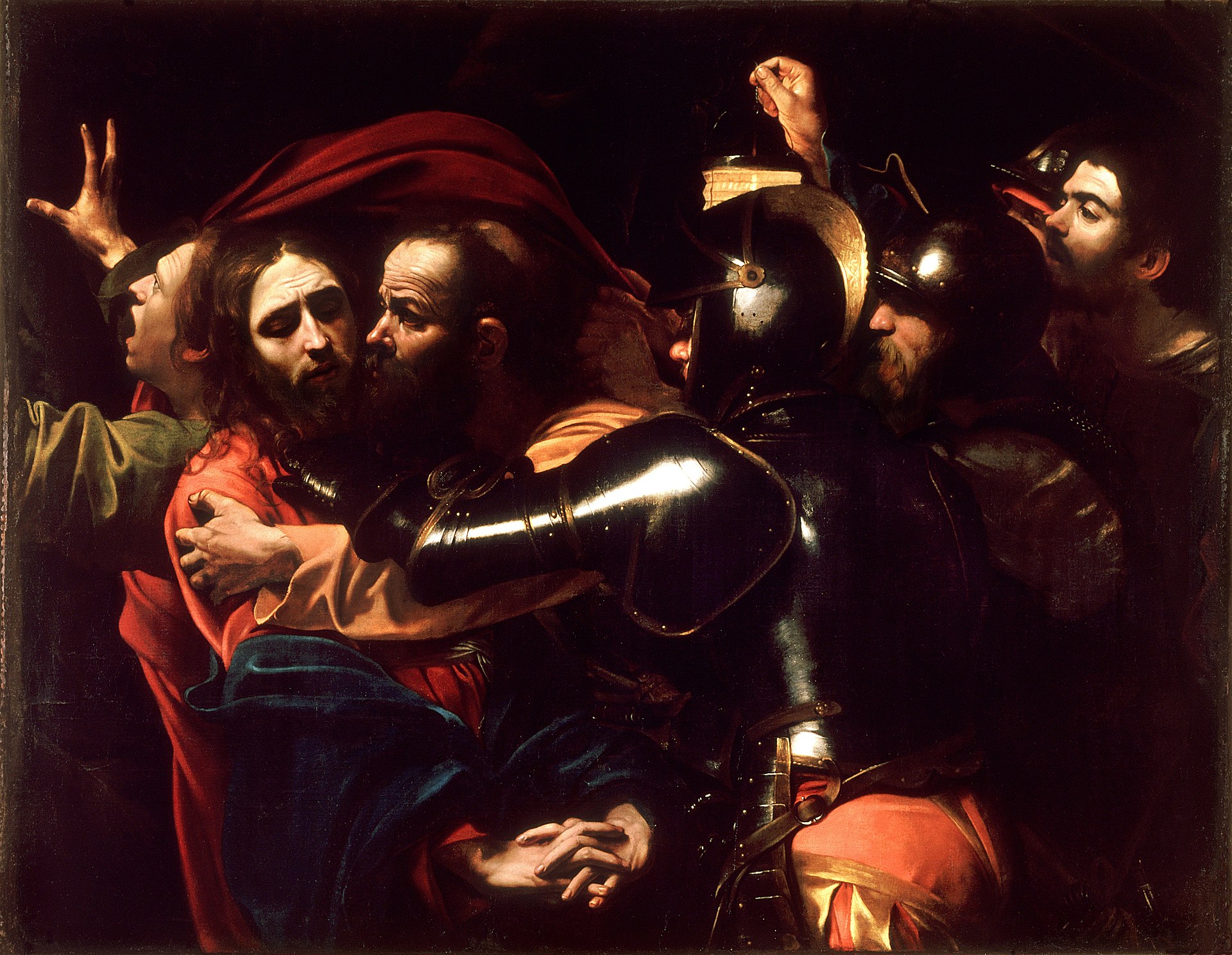

The painting illustrates the Old Testament story in which God subjected Abraham to an extraordinary test of obedience by ordering him to sacrifice his only son Isaac (Genesis 22: 1-19). Caravaggio faithfully depicts the crucial moment of this dramatic story, when old Abraham, at the very moment he is about to immolate a screaming Isaac, is blocked by an angel sent by the Lord.
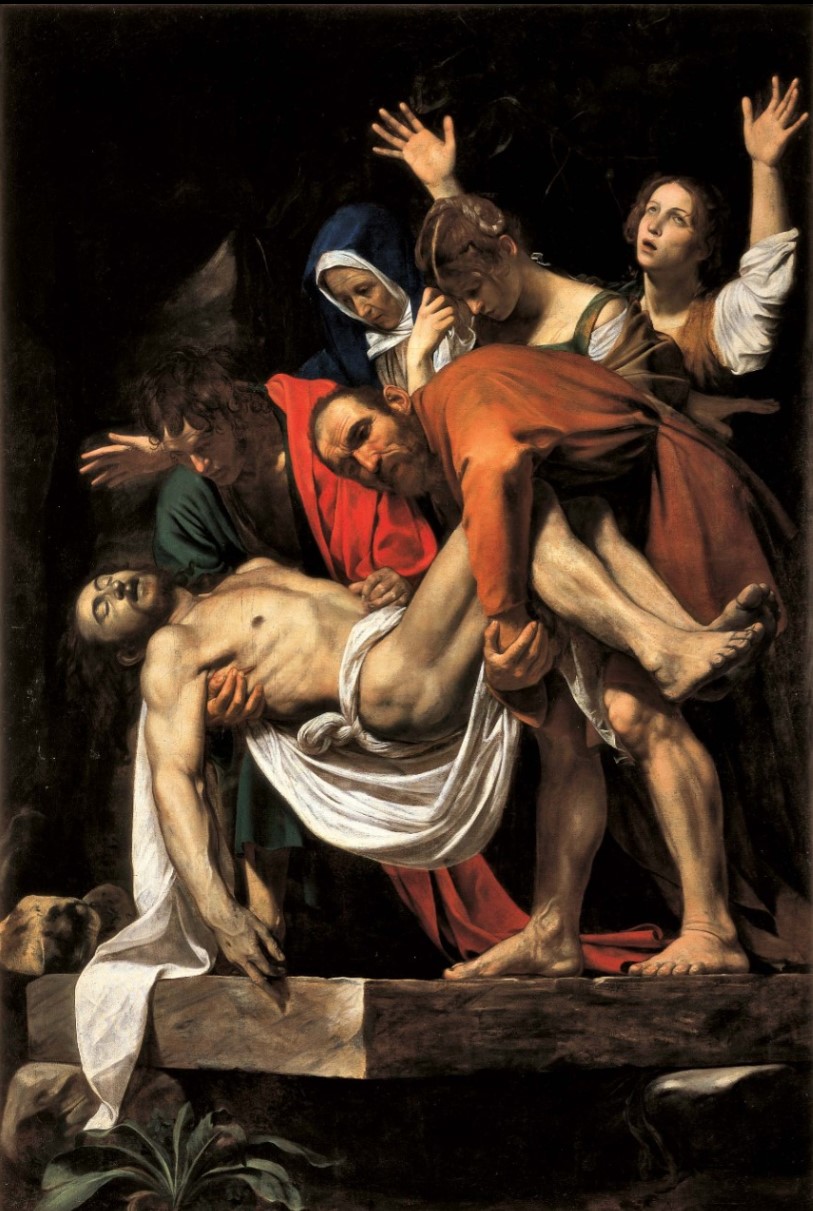
The Deposition, considered one of Caravaggio’s greatest masterpieces, was commissioned by Girolamo Vittrice for his family chapel in Santa Maria in Vallicella (Chiesa Nuova) in Rome. In 1797 it was included in the group of works transferred to Paris in execution of the Treaty of Tolentino. After its return in 1817 it became part of Pius VII’s Pinacoteca.
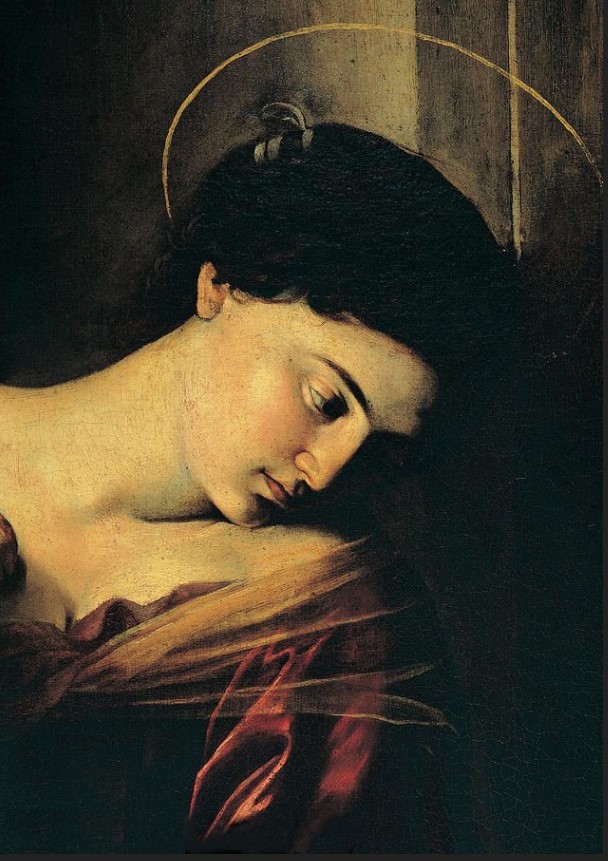

The painting has been in the Cavalletti chapel in Rome since it was installed at the end of 1604.
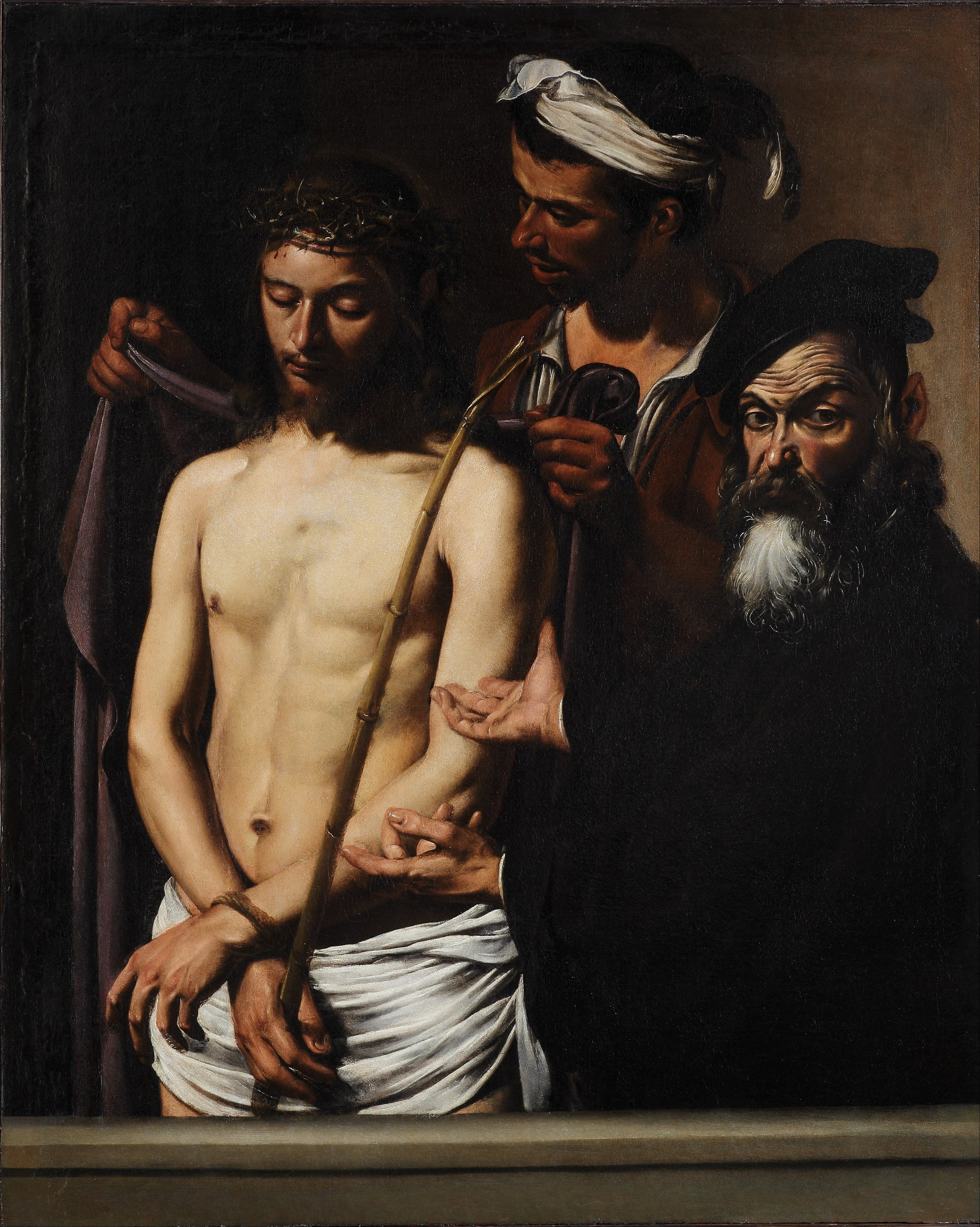
The painting was made for a competition with Domenico Passignano (1559-1638) and Lodovico Cardi (“Il Cigoli”) (1559-1613) soon after Il Cigoli first arrived in Rome. Il Cigoli won the compettion and the whereabouts of Caravaggio’s painting until it arrived to Genoa is uncertain. It may be that Caravaggio himself took it to Genoa when he visited there in 1605.
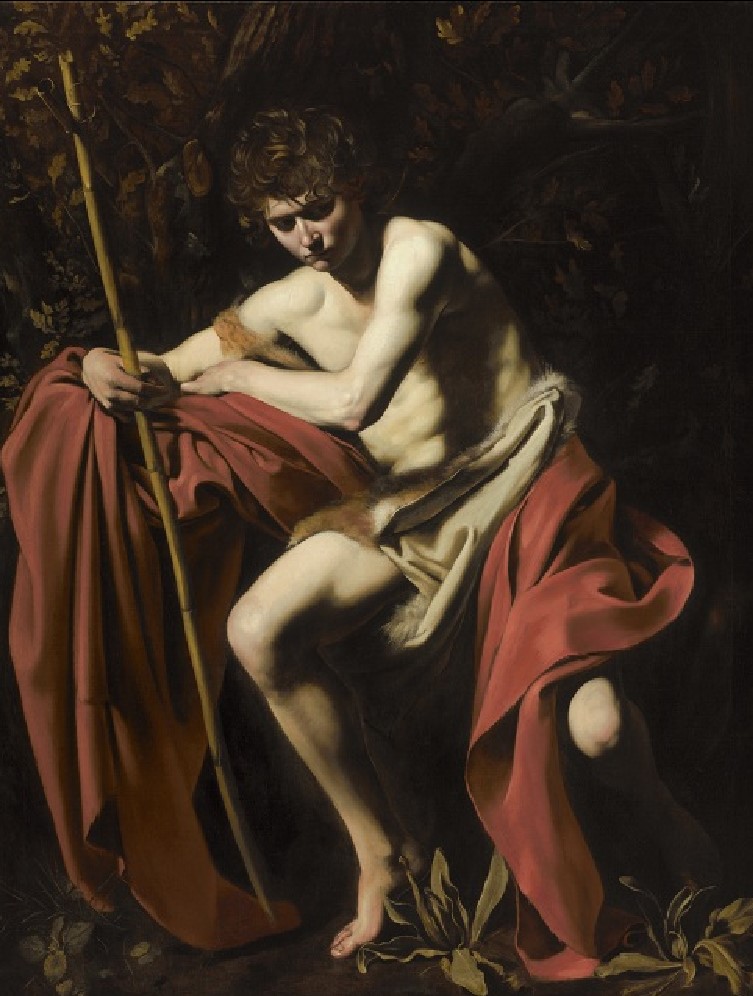
The painting was made for Ottavio Costa who then had a copy made for his chapel in Liguria while the original was lost. It resurfaced in the mid 19th century in England and was acquired by the Nelson-Atkins Museum of Art in the 1950s. Caravaggio reveals the qualities of the saint by his expression and pose. He is sober and downcast with a tense energy as his pose manifests the monumentality of the prophets on the Sistine Chapel ceiling. With his staff he quietly and contemplatively conveys zeal, passion and vitality. There is a sense of his singleness of purpose, joined even to a little madness, as a man driven by making straight the paths of the Lord.
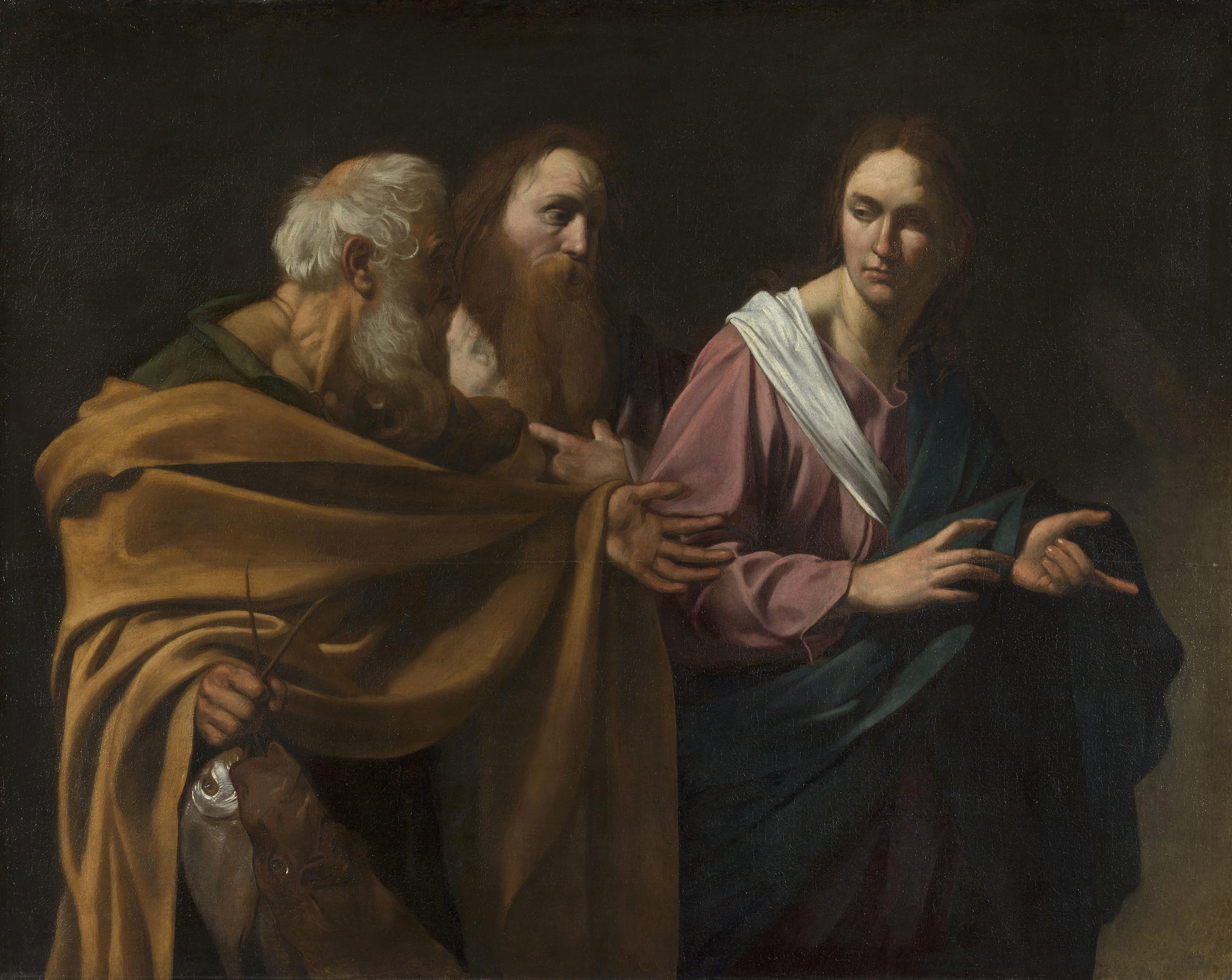
Michelangelo Merisi, called the Caravaggio, Call of Andrew and Simon,1602-1604, oil on canvas,140.1 x 176 cm, Royal Collection Trust, Hampton Court Palace, London, England. https://www.rct.uk/collection/402824/the-calling-of-saints-peter-and-andrew – retrieved November 15, 2024.
The painting was bought by King Charles I of England (1600-1649) in 1637. After the monarch’s defeat in the English Civil War (1642-1645), he was imprisoned and executed for high treason in 1649. During the Commonwealth (1649-1660), the painting was sold in 1651 and recovered at the Restoration. Caravaggio’s painting depicts the call of the very first disciples in the very first New Testament Gospel by Mark: “As he passed by the Sea of Galilee, he saw Simon and his brother Andrew casting their nets into the sea; they were fishermen. Jesus said to them, “Come after me, and I will make you fishers of men.” Then they abandoned their nets and followed him” (Mk 1:16-18). Caravaggio depicts Jesus without a beard as he turns back to invite them to follow him as he moves ahead. Fishermen, Simon Peter holds skewered fish on a stick while Andrew points to himself identifying the object of Jesus’s invitation.
As recently as 1987 this painting came to be attributed to Caravaggio and as the original of this painting’s subject matter. In varying copies of the work the furrow in Christ’s brow is painted faithfully though in this original it is not a painted feature but a canvas fold. There are other design features that, after recent cleaning and conservation, point to a later work of Caravaggio. Many small incisions are present in the artwork’s lower layers of paint that is an uncanny method used by the artist to lay out important points on the canvas for his design. Although the attribution can be argued to the contrary – such as the unusual use of the color blue which Caravaggio saw, according to Bellori, as the “poison of colors” – he did use the color and mostly softened as it is here. Blue, for instance, occurs in the Baptism of Christ (National Gallery of Ireland, c. 1603) and the Annunciation (Nancy, c. 1604). At the Supper at Emmaus (Brera, 1605-6) Christ also wears a robe of softened blue. In its telling broad brushwork, restrained colors, and minimal detail the painting was understood to be a Road to Emmaus painting as discussed by Giulio Mancini and Giovanni Baglione. But these early biographers’ references are likely to the Supper at Emmaus (National Gallery London, 1601). Dated stylistically by its economical, shadowed, and expressive manner, The Calling of Saints Peter and Andrew appears to be from the period of 1603-1606. This would be before Caravaggio killed Ranuccio Tomassoni (c. 1580-1606) in a brawl and fled Rome in May 1606. During the first years of the 17th century, the sensuous surface detail of Caravaggio’s art had become spare, dark and expressive. Further, The Calling of Saints Peter and Andrew places half-length figures interacting against a stark background, similar to such paintings as Doubting Thomas (Sanssouci, Potsdam) and the Betrayal of Christ (National Gallery of Ireland, Dublin), both of 1603. Before this painting reached England, there was a broadly interpreted copy of it that is today in a private collection by Bernardo Strozzi (1582-1644). Strozzi lived and worked in Rome, Genoa and Venice where he may have seen this painting by Caravaggio. When Charles I’s buying agent was later in Italy, he visited the same places as Strozzi had been, except Genoa.
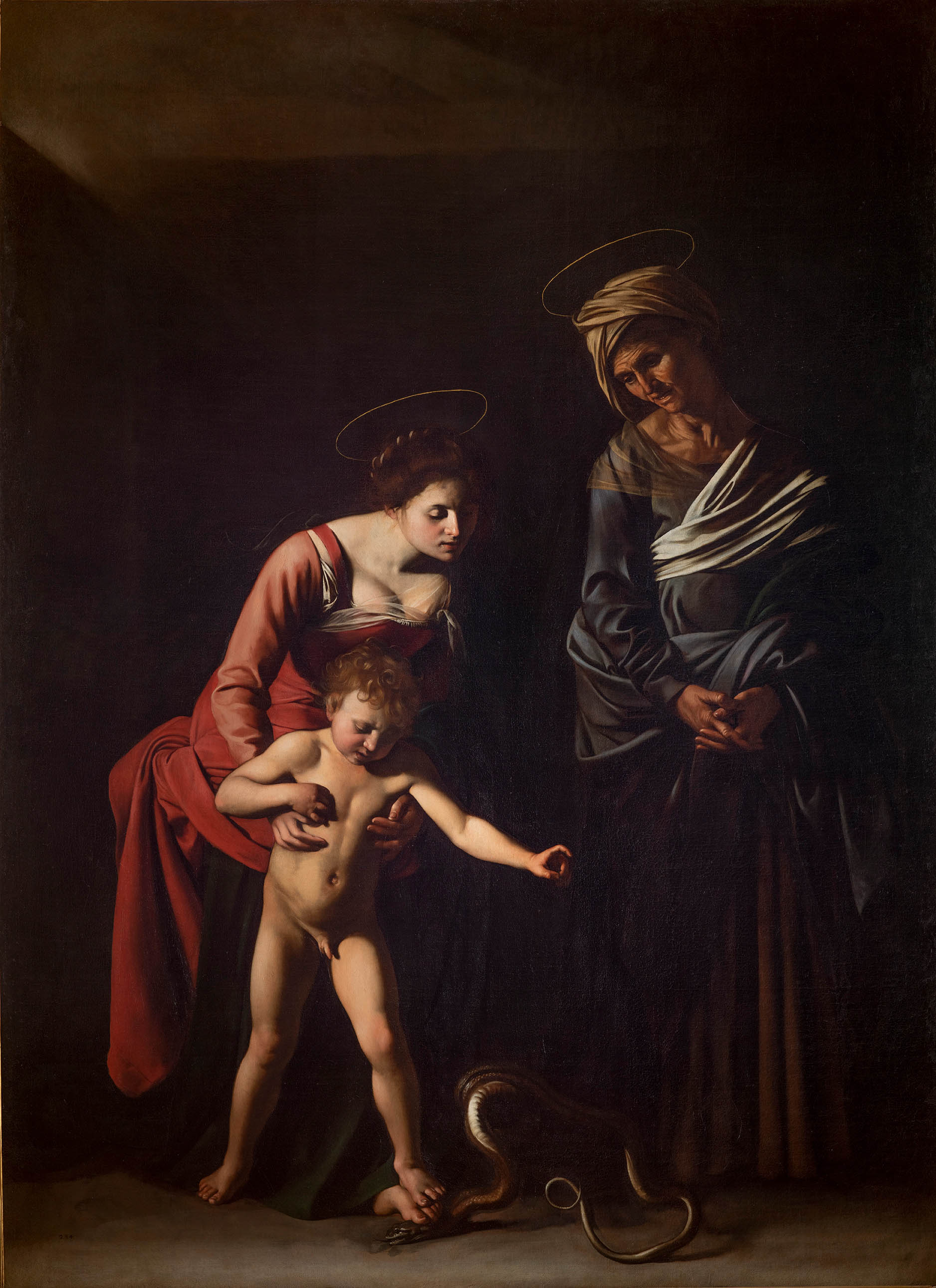
The painting was commissioned in 1605 by members of the powerful archconfraternity of the Palafrenieri who, following the renovation of St. Peter’s Basilica, asked the painter for a new work intended to replace an old painting that decorated the altar of their chapel dedicated to St. Anne. Painted within a few months, in April 1606 the work was exhibited and shortly afterwards moved to the nearby church of Sant’Anna dei Palafrenieri where, seen by Scipione Borghese, it was bought by him. For whatever reason the painting was controversial – perhaps the cleavage of the Madonna or the rendering of the nudity of the child – but Scipione Borghese proudly hung it in his own picture gallery. The painting depicts Mary as she crushes a snake – a symbol of sin – at her feet with the help of Jesus and witnessed by Anna, mother of the Virgin.
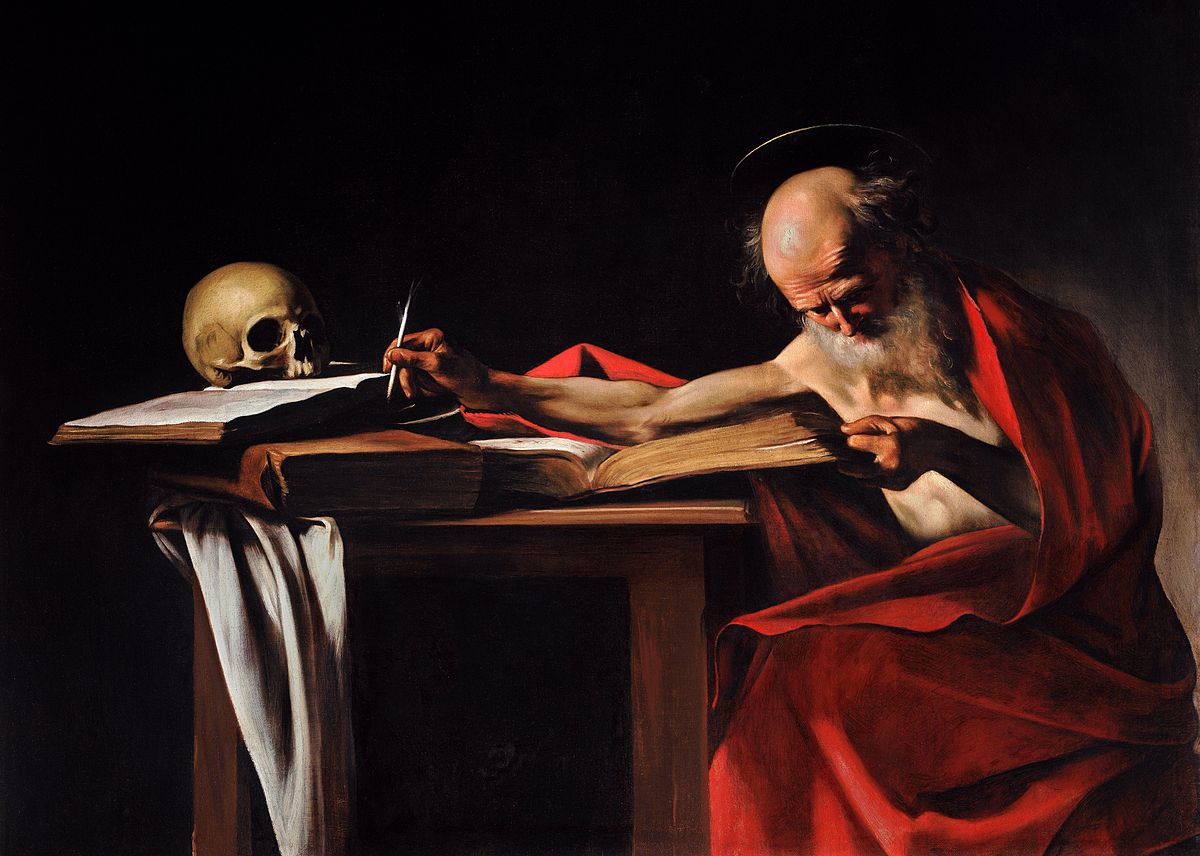
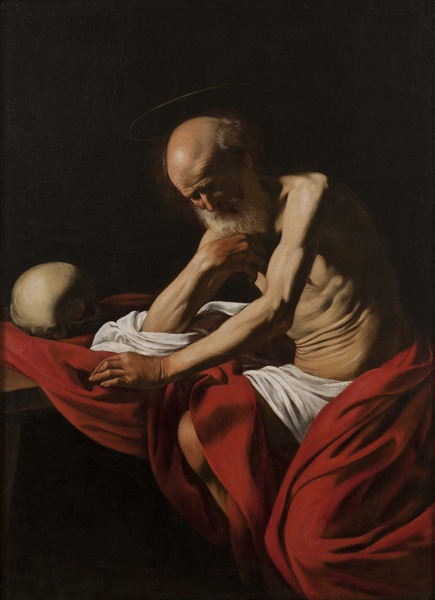
According to Bellori, the painting was made by Caravaggio for Cardinal Scipione Borghese. The cardinal was not only an avid and refined art collector but one of young Caravaggio’s earliest and greatest admirers recognizing the Lombard’s talent despite personality flaws or lack of connections in Rome. The painting depicts Saint Jerome (c. 340s-420), Doctor of the Church, best known for his translation of the Bible from Greek into Latin as well as his commentaries on the Bible. Caravaggio depicts the priest and confessor writing and studying the Holy Scriptures as a scholar, now in old age, who has dedicated his life as a humanist engaged in the complex translation and exegesis of the Church’s sacred text. The composition is divided into large fields of color in warm tones (the saint’s complexion and reddish mantle) and cold tones (the skull and shroud-like white cloth) with Jerome’s arm outstretched with writing instrument in hand across the picture to symbolically portray the unity of the scholar-saint’s dialogue with these opposites of nature including life and death, past and present. As there are many unfinished details in the painting, the artist’s style points to his rapid execution of the work. https://www.collezionegalleriaborghese.it/opere/san-girolamo – retrieved October 13, 2024.

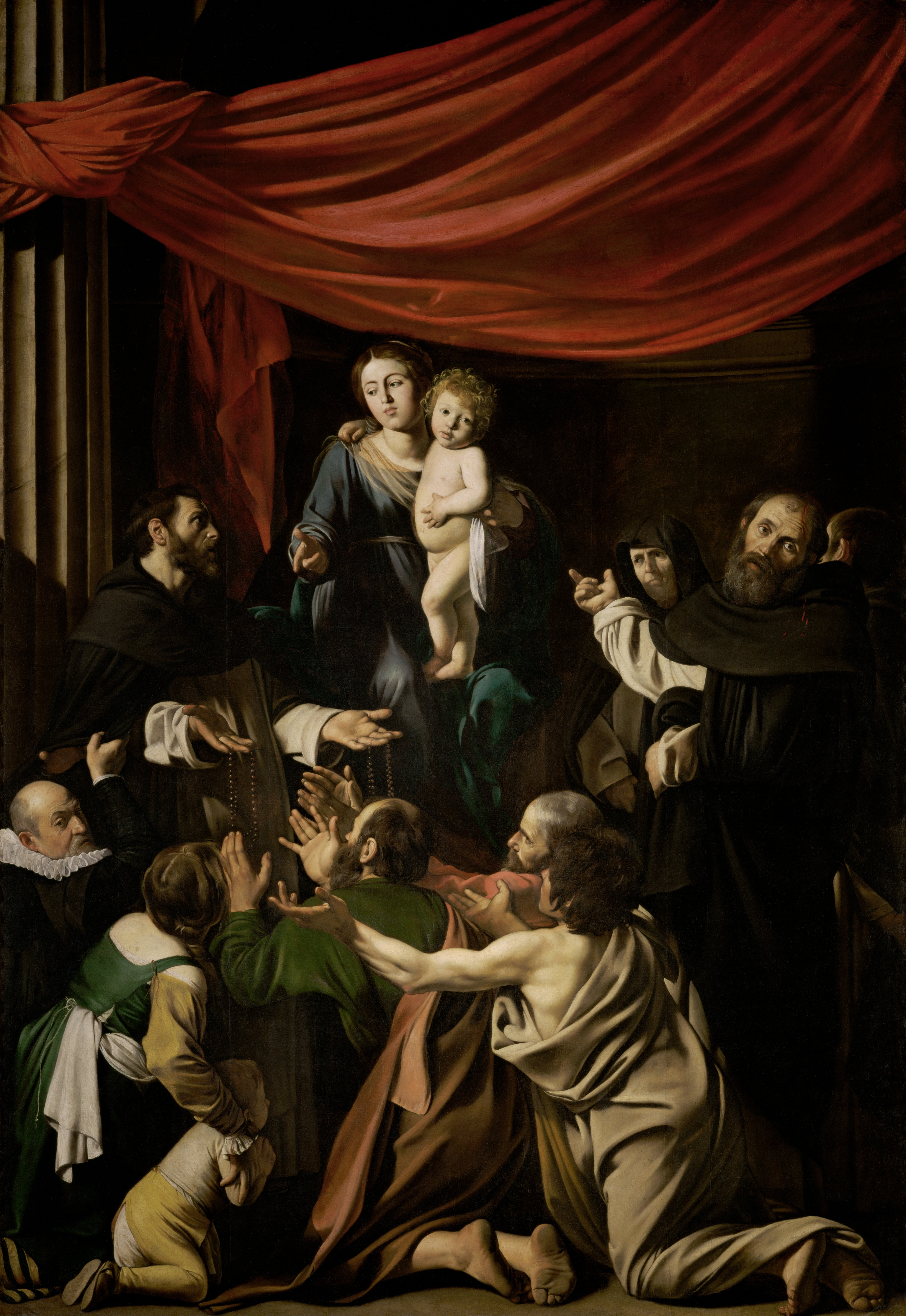
The Madonna of the Rosary (1605-1607) is a monumental work of the Italian Baroque and one of the few large-scale, traditional altarpieces Caravaggio ever completed. Although its original patron remains unknown, the commission may have come from the powerful Colonna family, who sheltered the artist after he fled to Naples in 1606. Whoever commissioned it ultimately rejected the painting. It was taken to Naples and sold to Flemish art dealers, who transported it to Antwerp. There, a committee of artists, including Peter Paul Rubens and Jan Brueghel the Elder, purchased it for St. Paul’s Dominican Church.
The painting unfolds as both visual drama and Catholic Counter-Reformation theology, collapsing heaven and earth into a single charged moment. High above, the Madonna sits enthroned with the Christ Child as she presents the rosary to Saint Dominic, clad in the black-and-white habit of his order. The rosary serves as heaven’s answer to Dominic’s prayers in the struggle against the thirteenth-century Albigensian heresy. At right stands Saint Peter Martyr, the first canonized martyr of the Dominican Order, elevated to sainthood by Pope Innocent IV only eleven months after his death and even before the canonization of the order’s founder, Saint Dominic. To this day, Peter Martyr, the fiery preacher who fought heresy throughout Northern Italy and was murdered by an axe blow to the head in 1252, remains the fastest canonization in Catholic Church history. Gazing directly at the viewer, he points toward the Christ Child, identifying Jesus as the ultimate source of divine grace.
Below, Caravaggio brings sacred history to the world’s barefoot and struggling poor. Kneeling in the dirt, their grimy feet and outstretched hands reach for the rosaries being distributed through Saint Dominic. In the left foreground, a wealthy donor in a black coat and crisp white ruff kneels while looking directly outward, drawing viewers into the drama.
In 1781, the painting was confiscated from St. Paul’s Dominican Church when Emperor Joseph II pressured the Dominicans to surrender, or “donate,” the masterpiece to his imperial collection. Today, it remains one of Caravaggio’s essential late works and a centerpiece of the Kunsthistorisches Museum in Vienna, where its powerful blend of realism, devotion, and theatrical display continues to command attention.
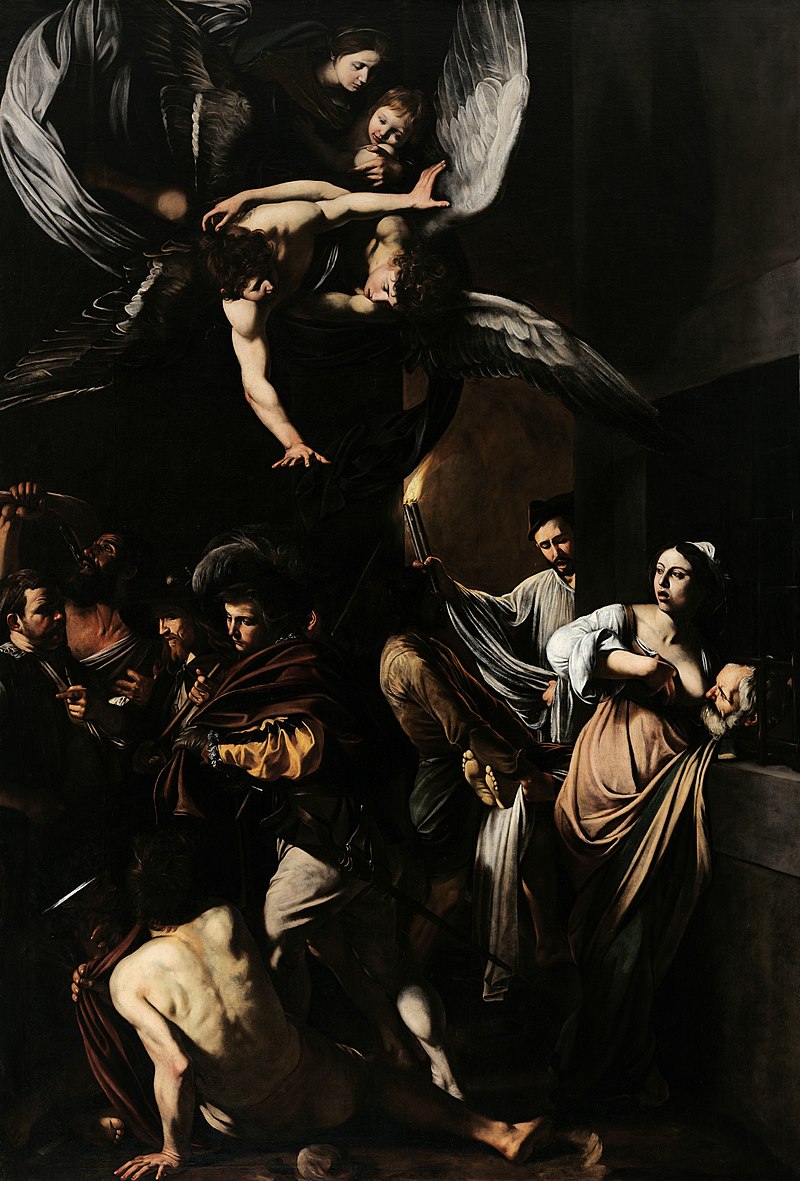
The Seven Acts of Mercy altarpiece was painted between September 23, 1606 and January 9, 1607 for which Caravaggio was paid 400 ducats. The commission required that the artist include the figure of the Madonna of the Misericordia and all the acts of mercy in one vertical canvas and whose overall achievement was a first in Italian art.
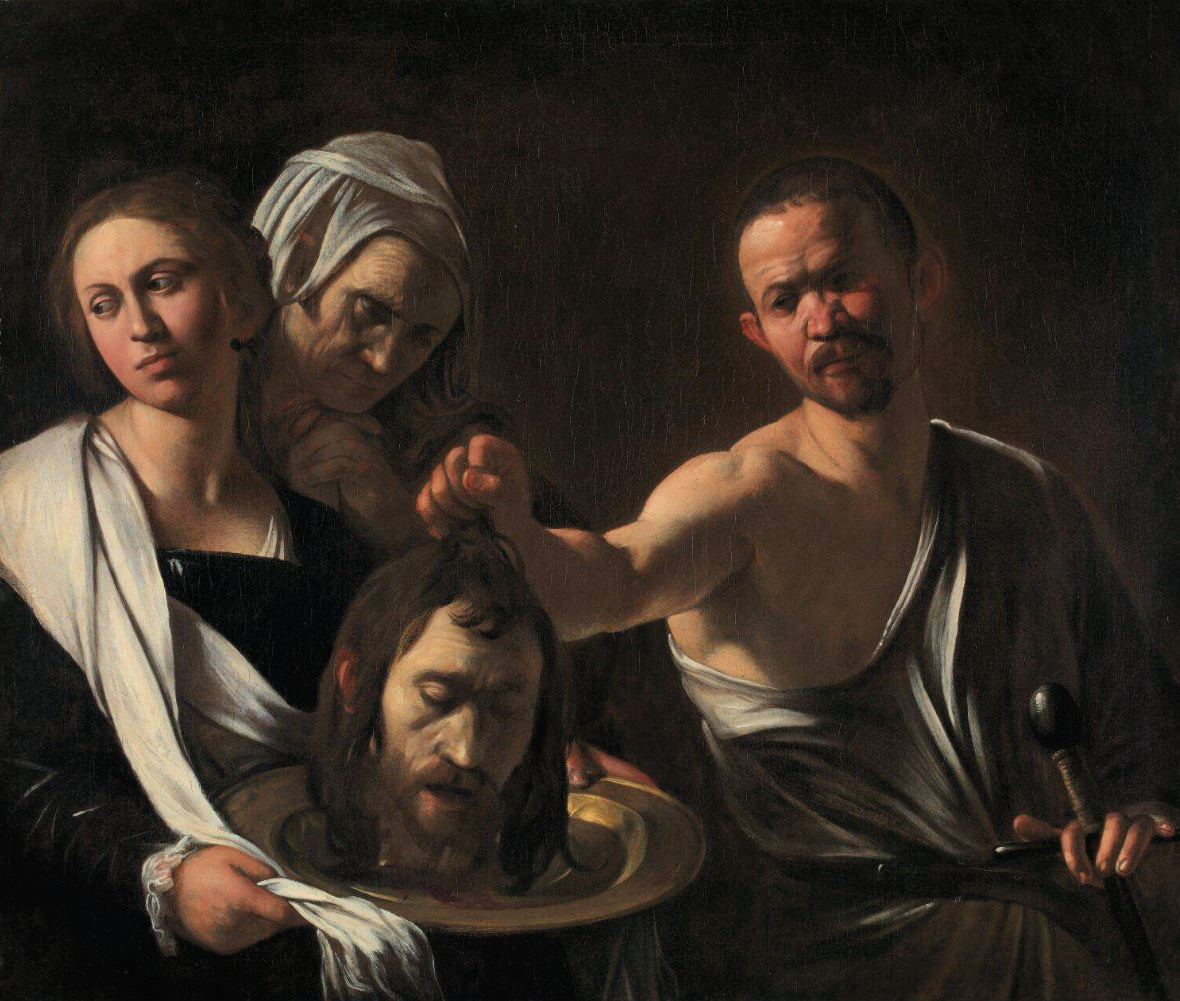

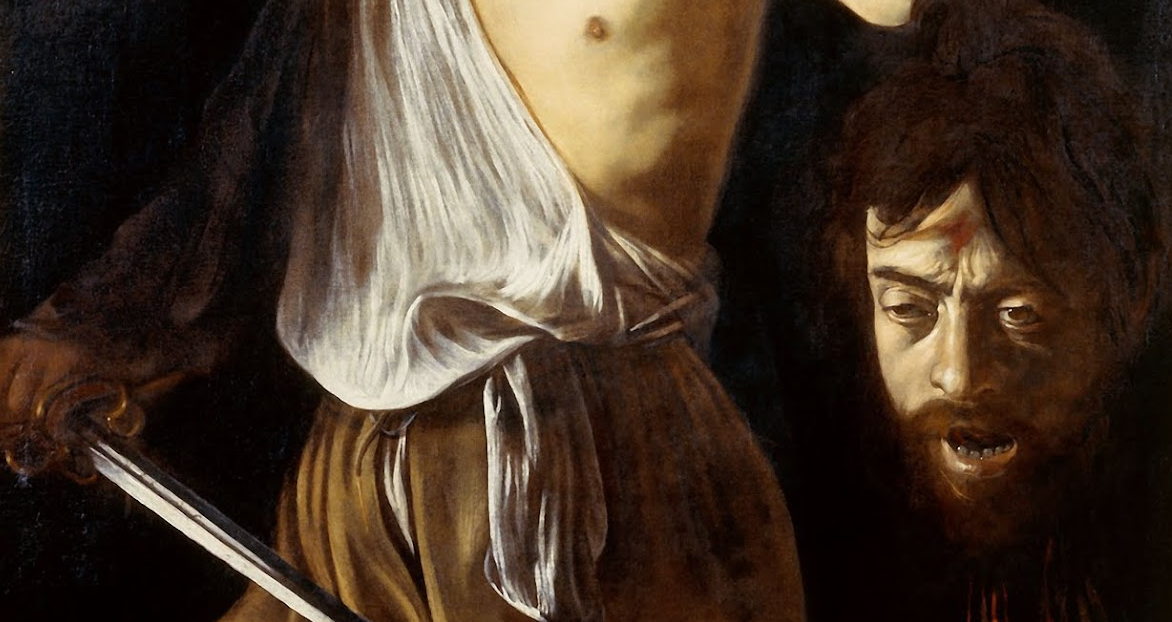
The dramatic play of light and shadow throws into relief the melancholic expression on David’s face and the hauntingly lifelike head of Goliath, creating a palpable sense of guilt and redemption that resonates deeply with the viewer.
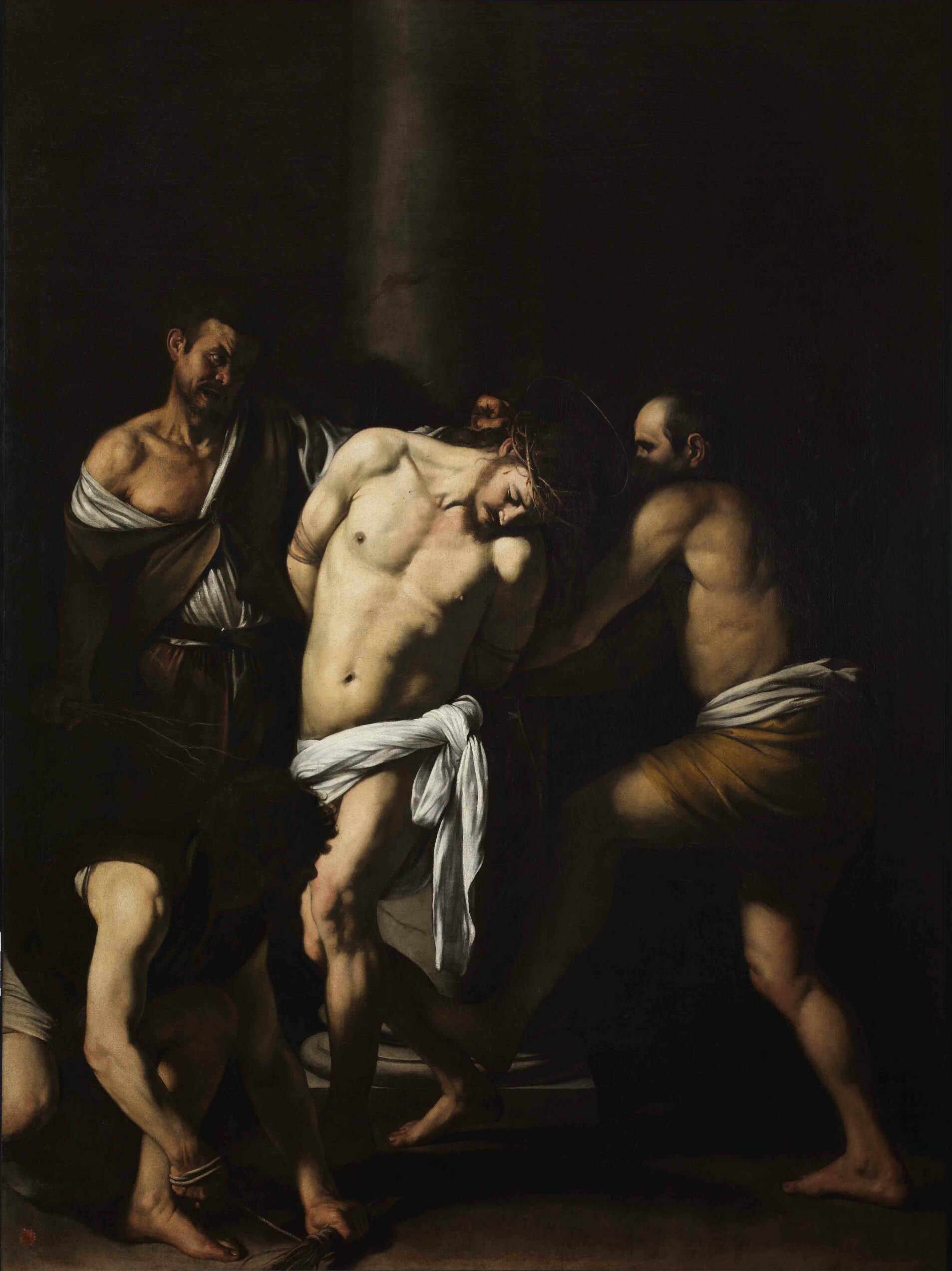
In addition to developing a considerable name as an artist, Caravaggio was a reputably volatile, bad-tempered and violent man. On May 29, 1606 Caravaggio killed Ranuccio Tomassoni in a fight, the cause of which is disputed, though it may have been over a Roman prostitute, Fillide Melandroni who had posed for Caravaggio several times. The capital crime forced Caravaggio to flee to Naples. A report written by the local coroner declared that the male victim died by Caravaggio’s attempt to castrate him, the code on the Roman street meriting it for a man who insulting another man’s woman. Caravaggio became a fugitive from the law though he continued to paint (Supper at Emmaus) and fled to Naples by the end of 1606. In Naples he painted Flagellation and Seven Works of Mercy, among others. He fled further to Malta and then to Sicily where Caravaggio moved from town to town across the island fearing some unnamed retribution. It was presumed that 38-year-old Caravaggio died from syphilis or perhaps malaria or the Malta Fever though there is current speculation the artist may have been murdered in revenge for his crimes by perhaps members of the Tomassoni family or the Royal Knights. see – https://www.italianartsociety.org/2018/05/on-29-may-1606-the-great-italian-baroque-painter-caravaggio-killed-ranuccio-tommasoni-in-rome/ ; https://thecinemaholic.com/ranuccio-tomassoni-caravaggio/– retrieved October 15, 2024.

Caravaggio’s later Supper at Emmaus in Milan’s Brera Gallery intensifies the drama and imposes greater stylistic discipline compared to the earlier London version painted five years prior. The gestures are more restrained and the palette more muted, allowing the dramatic accents to emerge with heightened clarity despite the overall reduction of detail. Objects are rendered with deliberate precision—the urn angled toward the viewer, the plates catching narrow rims of reflected light—each contributing to the painting’s controlled visual rhetoric.
The composition organizes itself in a semicircular sweep of gestures around the table, rising diagonally from Christ’s head to the sharply profiled disciple and then to the standing figures beyond. The entire scene is suffused with a concentrated, directional illumination that culminates on the face of the risen Christ, reinforcing the painting’s theological and dramatic center.
SOURCE: Brera Milan: Great Museums of the World (Great Museums of the World, volume 14), Newsweek, Inc. & Arnoldo Monadori Editore, 1970, pp. 68-69.

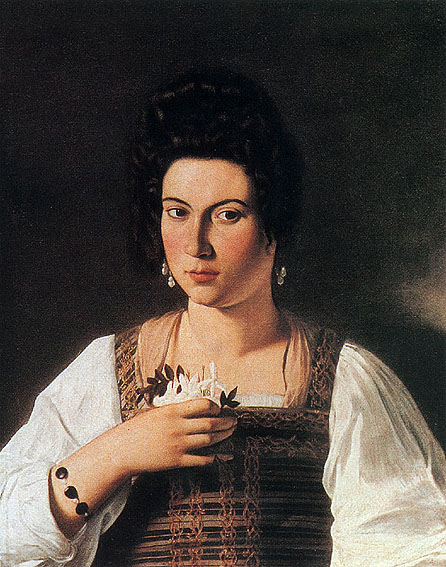
The subject was the Grand Master of the Knights of Malta. In exchange for this grand portrait, according to Bellori and Baglione, Caravaggio became a Knight of Malta on an accelerated timetable though soon after the artist fled the island in disgrace.
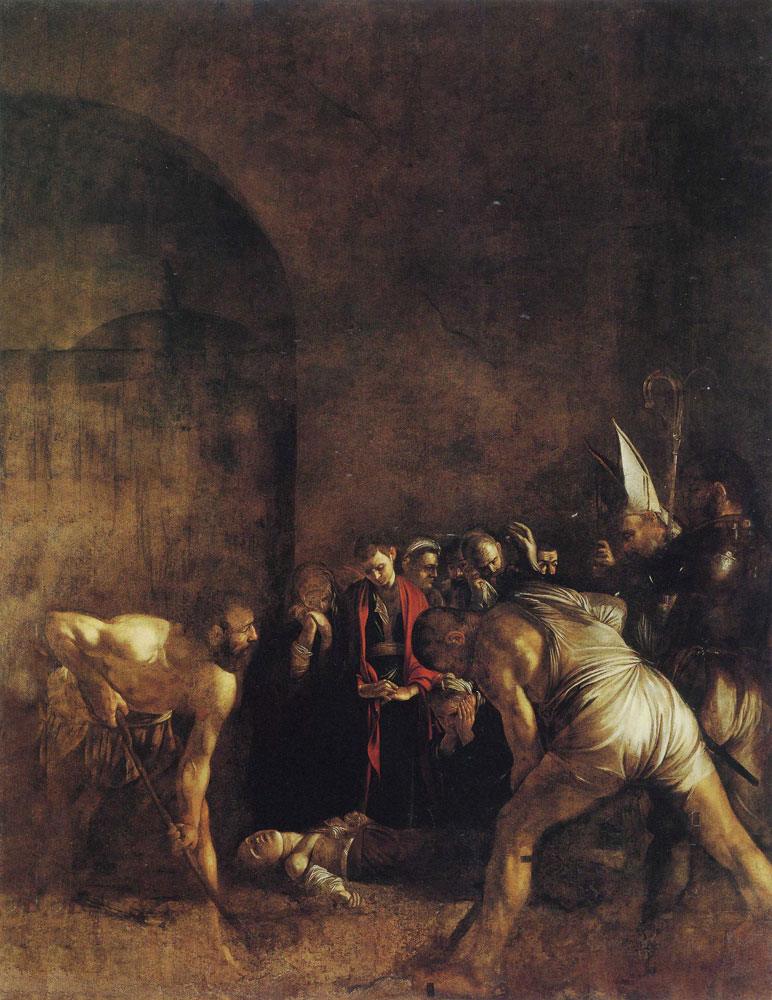
The famous Caravaggio painting depicting the burial of Santa Lucia once hung in the Church of Santa Lucia al Sepolcro, but today is in Siracusa’s Palazzo Bellomo museum. The original church, built as early as the 6th century, was on the site of Saint Lucy’s martyrdom in the early 4th century. Beneath the sanctuary is a vast labyrinth of dark catacombs dating from the 3rd century which have never been completely explored and are closed to the public. Once containing the tomb of the decapitated saint, her remains were relocated to Venice during the Crusades and where they can be found today. This painting was made by Caravaggio between October 1608 in Malta and early 1609 in Sicily in a commission arranged by his old friend painter Mario Minniti. Caravaggio was on the run in Sicily starting in late 1608 when he arrived into Siracusa, and then onto Messina followed by Palermo. In Sicily, the exile Caravaggio painted Resurrection of Lazarus, The Adoration of the Shepherds (Adorazione dei pastori) and Ecce Homo. In late 1609 he returned to Naples and continued painting, including another St. John the Baptist and, his final artwork, The Martyrdom of St. Ursula. In Naples the artist was attacked in the street by four armed men shortly after his arrival where Caravaggio was seriously injured. see – https://www.frommers.com/destinations/syracuse-and-ortygia-island/attractions/santa-lucia-al-sepolcro; https://www.great-sicily.com/post/the-byzantine-era-in-sicily – retrieved October 15, 2024.

The work was painted for the Church of Santa Maria della Concezione in Messina. Francesco Susinno (1670-1739) states that the commision was a civic not religious one, though apparently the Archbishop of Messina, Franciscan Bonaventura Secusio (d. 1618), supported the project. see – https://federica90.wixsite.com/emozionearte/post/caravaggio-in-sicilia-l-adorazione-dei-pastori-di-messina – retrieved October 15, 2024.
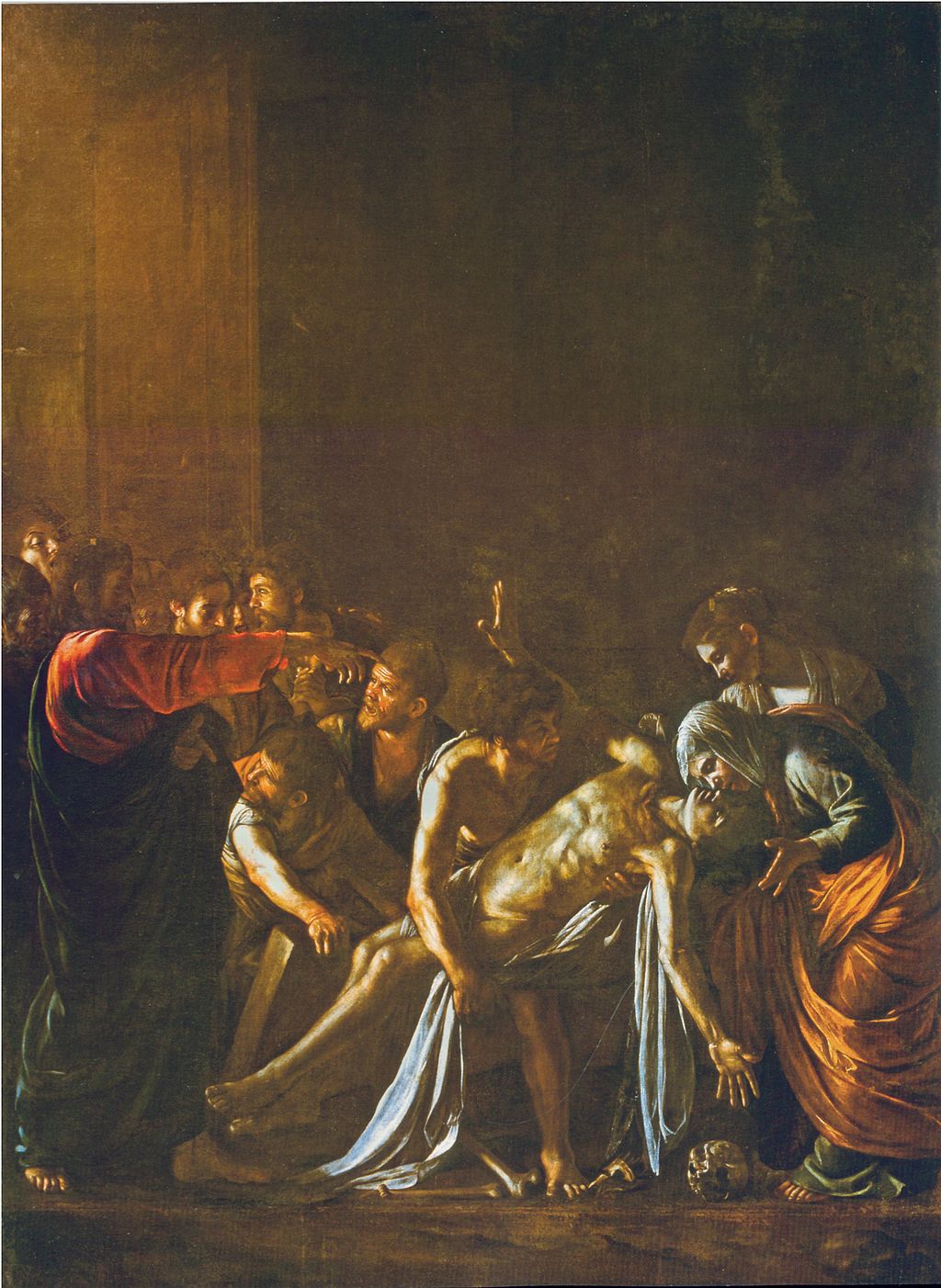
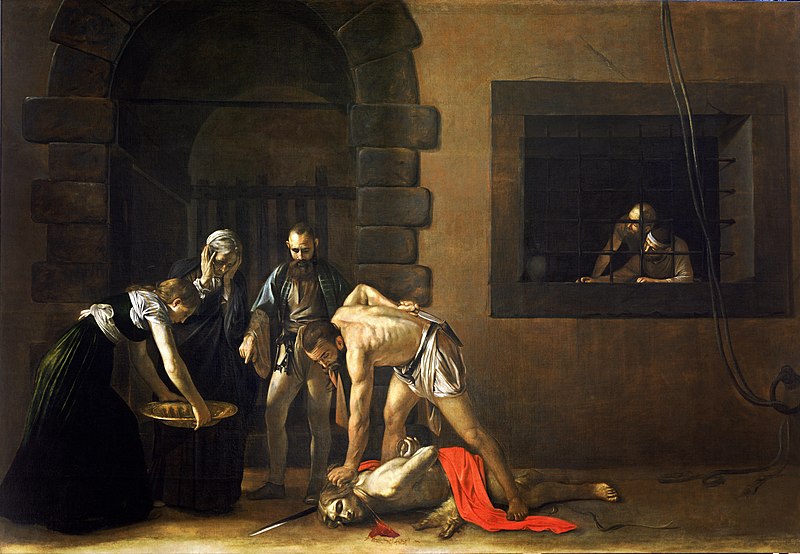
In Malta Caravaggio became a Knight of Malta but got into another violent group brawl where a knight was badly injured. With a warrant put out for his arrest Caravaggio managed to flee to Sicily in October 1608. By December 1608 Caravaggio was found guilty in abstentia and removed from the Maltese order. The commission for this painting came from Giovanni Battista de’ Lazzari, a merchant of Genoese origin who had obtained permission to be buried in the choir chapel of the church of Saints Peter and Paul de’ Pisani (demolished in 1880) in Messina where Camillo de’ Lellis’ religious order, founded in 1591 and dedicated to the care of the sick, had a house. De’Lazzari’s signed contract on December 6, 1608, declared that his new altarpiece would have the Madonna and St. John with saints as its subject. But that was changed to the resurrection of Lazarus (Gospel of John, chapter 11). It is very likely the change was made by De’Lazzari in agreement with the Camillians. According to Susinno, the artwork’s 13 figures were staff members of the hospital where Caravaggio did the painting. see – https://federica90.wixsite.com/emozionearte/post/caravaggio-in-sicilia-la-resurrezione-di-lazzaro – retrieved October 15, 2024.
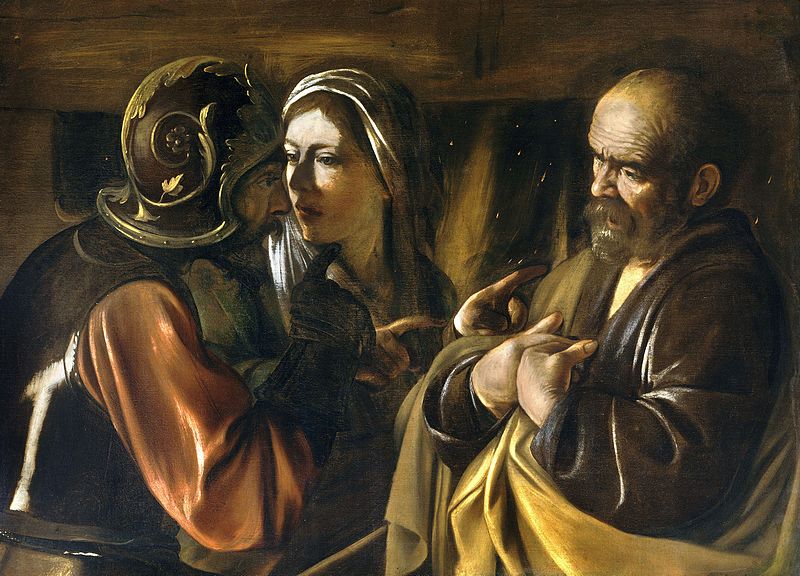
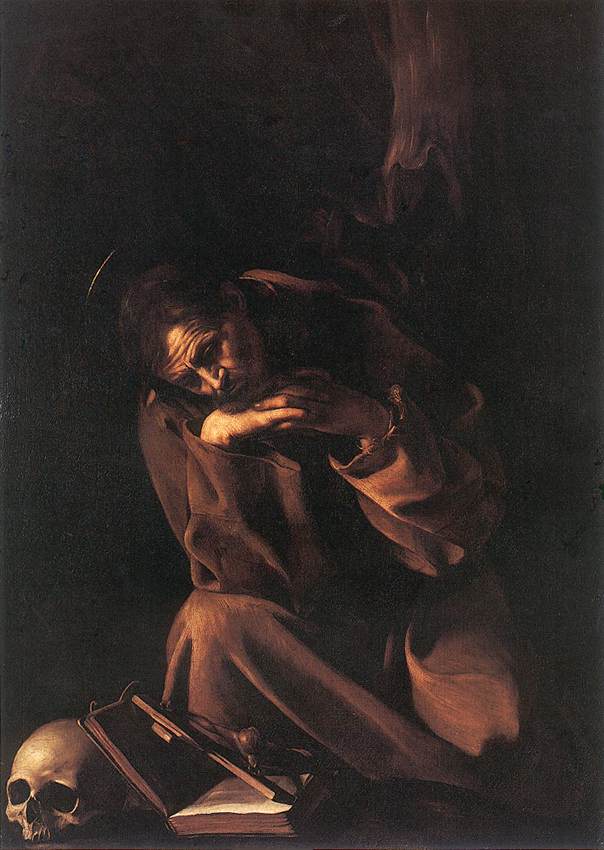
The Denial of Saint Peter is generally thought to be one of the last pair of artworks by Caravaggio, the other being The Martyrdom of Saint Ursula. It was probably finished at Naples in the summer of 1610.
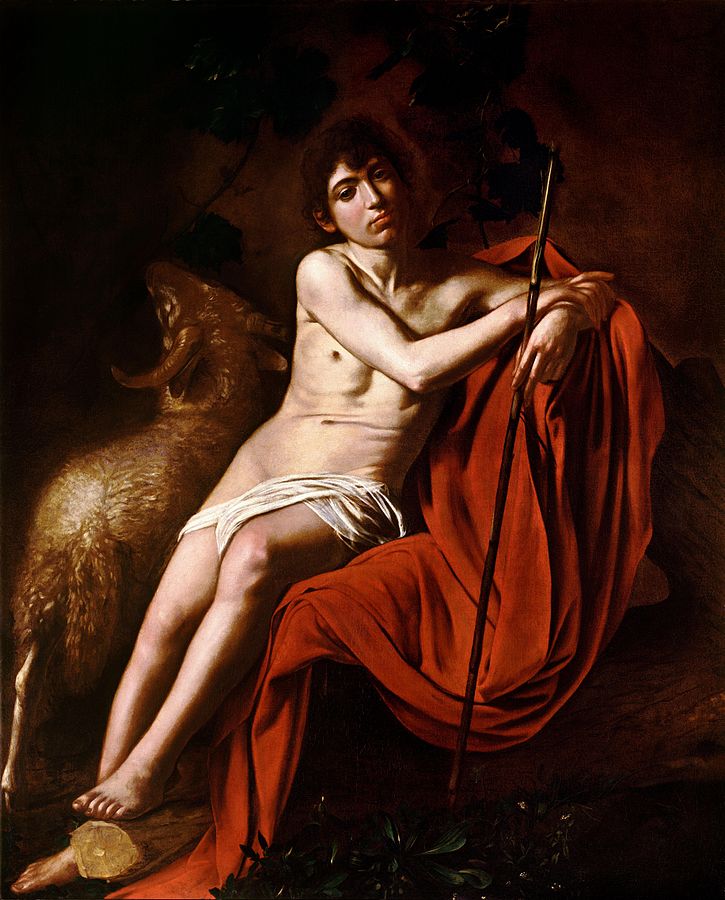
Caravaggio carried this painting and others sailing from Naples to Rome hoping for a pardon from the pope. Instead, when the desperate artist landed he was arrested and the boat was sent back to Naples with the paintings. Caravaggio died on July 18, 1610 in Porto Ercole. The papal nuncio secured this painting for Cardinal Scipione Borghese. see – https://www.dailyartmagazine.com/caravaggios-martyrdom-of-saintt-ursula/ – retrieved October 15, 2024.
LAST PAINTING.
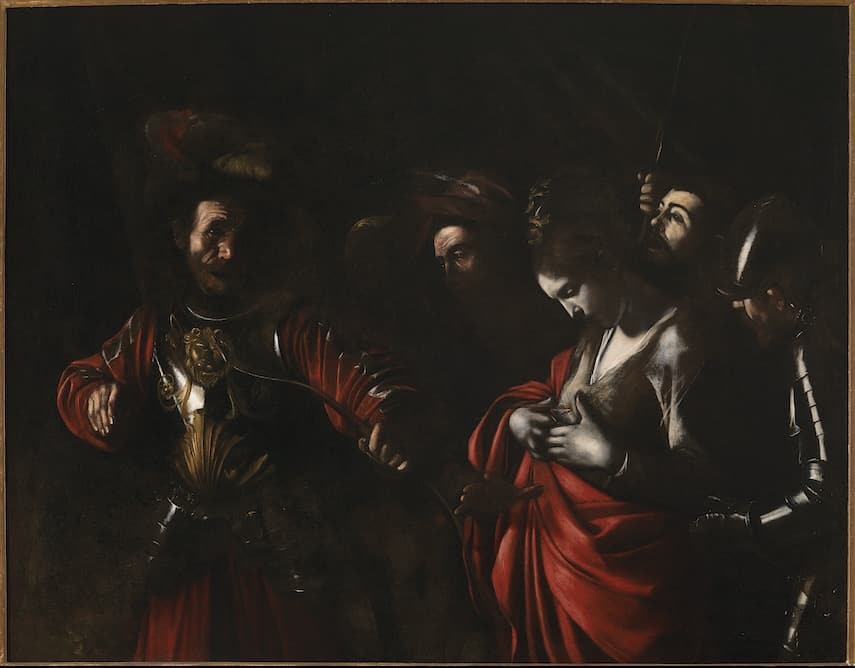
Naples, Galleria di Palazzo Zevallos Stigliano.
Caravaggio’s The Martyrdom of Saint Ursula was painted in the last month of his life. It contains his characteristic and revolutionary chiaroscuro, naturalism, and depiction of psychological and physical emotion. The Martyrdom of Saint Ursula was commissioned by Genoese art patron Marcantonio Doria. The painting was finished in May and arrived in Genoa in mid-June 1610. Ursula was a venerated but almost completely legendary figure. In typical fashion Caravaggio dispels traditional religious iconography associated with Ursula — a crown, halo, palm branch, the 11,000 virgin martyr companions — for the painful moment in her story when the Barbarian king shoots the arrow into Ursula’s chest that kills her.
Caravaggio’s The Martyrdom of Saint Ursula marked a watershed in European art. His revolutionary style inspired subsequent generations of painters, such as Artemisia Gentileschi (1593—1651), Giovanni Baglione (1566-1643), and Orazio Gentileschi (1563–1639), that became known as the Caravaggisti. He also influenced international Baroque artists including Spaniard Diego Velázquez (1599-1660) and Dutchman Rembrandt van Rijn (1606-1669). see – https://www.widewalls.ch/magazine/the-martyrdom-of-saint-ursula-caravaggio – retrieved October 15, 2024.
SOURCES –
Caravaggio, Gilles Lambert, Taschen, Cologne, 2007.
Caravaggio, Alfred Moir, Harry N. Abrams, Inc., New York, 1989.
Caravaggio: The Complete Works, Sebastian Schütze, Taschen, Cologne, 2021.
Caravaggio, Timothy Wilson-Smith, Phaidon, London, 1998.
Caravaggio, Howard Hibbard, Harper & Row Publishers, New York, 1983.
Caravaggio The Artist and His Work, Sybille Ebert-Schifferer, Getty, 2012.
This explanatory article may be periodically updated.



