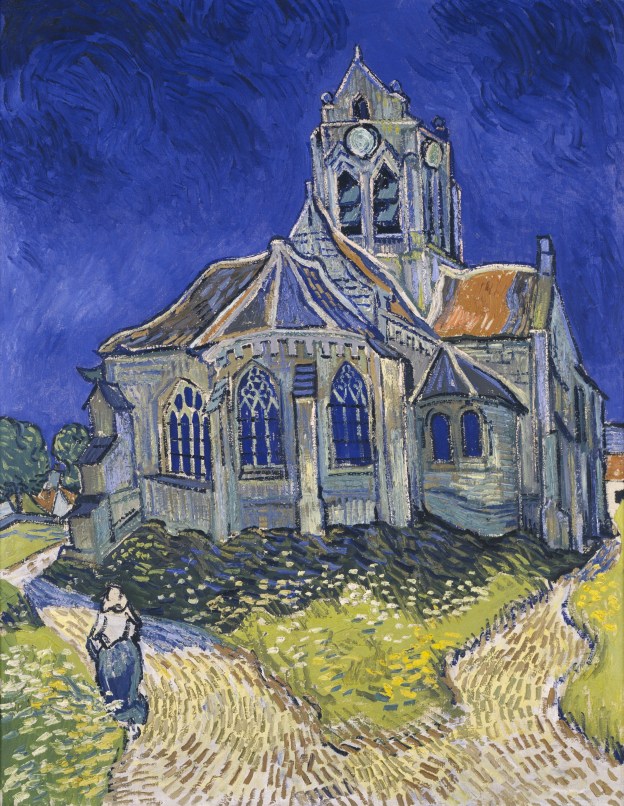
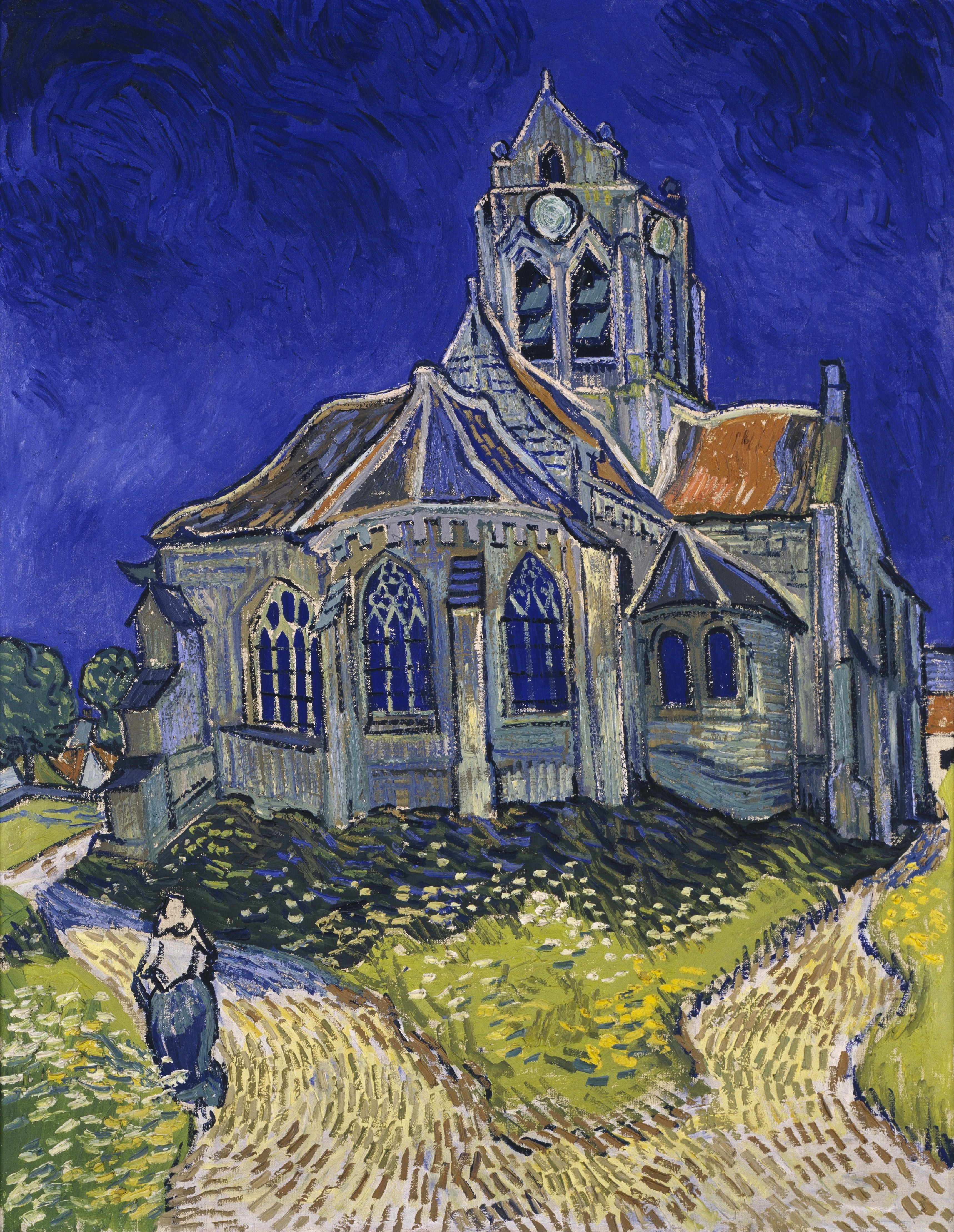
FEATURE Image: Vincent Van Gogh (1853-1890), L’église d’Auvers-sur-Oise, vue du chevet (“The Church at Auvers”), June 1890, oil on canvas, 94 cm x 74 cm (37 in x 29.1 in), Musée d’Orsay, Paris. Vincent Van Gogh (1853-1890), staying in Auvers starting on May 20, 1890 liked the country town with its artistic pedigree (Corot, Daubigny, Cézanne) and spoke of settling into permanent quarters in the village after renting an attic room in a local café. The artist continued about his experience at Auvers as he wrote: “[C]es toiles vous diront ce que je ne sais dire en paroles, ce que je vois de sain et de fortifiant dans la campagne” (“[T]hese canvases will tell you what I can’t say in words, what I consider healthy and fortifying about the countryside.”) During his more than two months stay in Auvers, a small farm town about 20 miles west of Paris, the post-impressionist did more than 100 drawings and paintings of local landscapes, gardens, and village scenes such as this Catholic church. On the evening of July 27, 1890 Van Gogh had acquired a pistol and shot himself in the chest near the Auvers chateau. After languishing in pain for two days, he died on the morning of July 29, 1890. Vincent Van Gogh was 37 years old. Public Domain.
The graves of both Vincent Van Gogh (1853-1890) and his younger brother and Paris art dealer Theo Van Gogh (1857-1891). They have been side by side in the Auvers cemetery in France since 1914. Photo: Author’s collection. May 2005.
By John P. Walsh
In a peripatetic life, the last place where Vincent Van Gogh (1853-1890) lived was Auvers-sur-Oise, a small commune, a short distance northwest of Paris. Since Auvers was on a rail line in the orbit of Paris, Van Gogh moved to the small town with its farming community so he could live independently yet remain close to his art dealer younger brother Theo Van Gogh (1857-1891) who lived with his wife and family in the hustle and bustle of Paris. After leaving Saint-Paul Asylum, Saint-Rémy, where Van Gogh had admitted himself as a patient since May 1889, he traveled to the French capital in May 1890 where he visited Theo and Jo. He was then onwards to Auvers where, by arrangement of Theo, the artist was under the supervision of Dr. Paul Gachet (1828-1909), a mental health physician who was also an avid modern art collector and had his house, family and practice in the town. Vincent arrived to Auvers on May 20, 1890 and stayed in the Saint-Aubin hotel until he moved into a rented attic room in a café of Arthur Gustave Ravoux and his wife, Adeline Louise Touillet, who charged him three and a half francs per night for room and board. Located in Place de la Mairie, a 5-minute walk from the train station, the artist’s daily schedule involved rising at dawn and going outside to draw and paint.
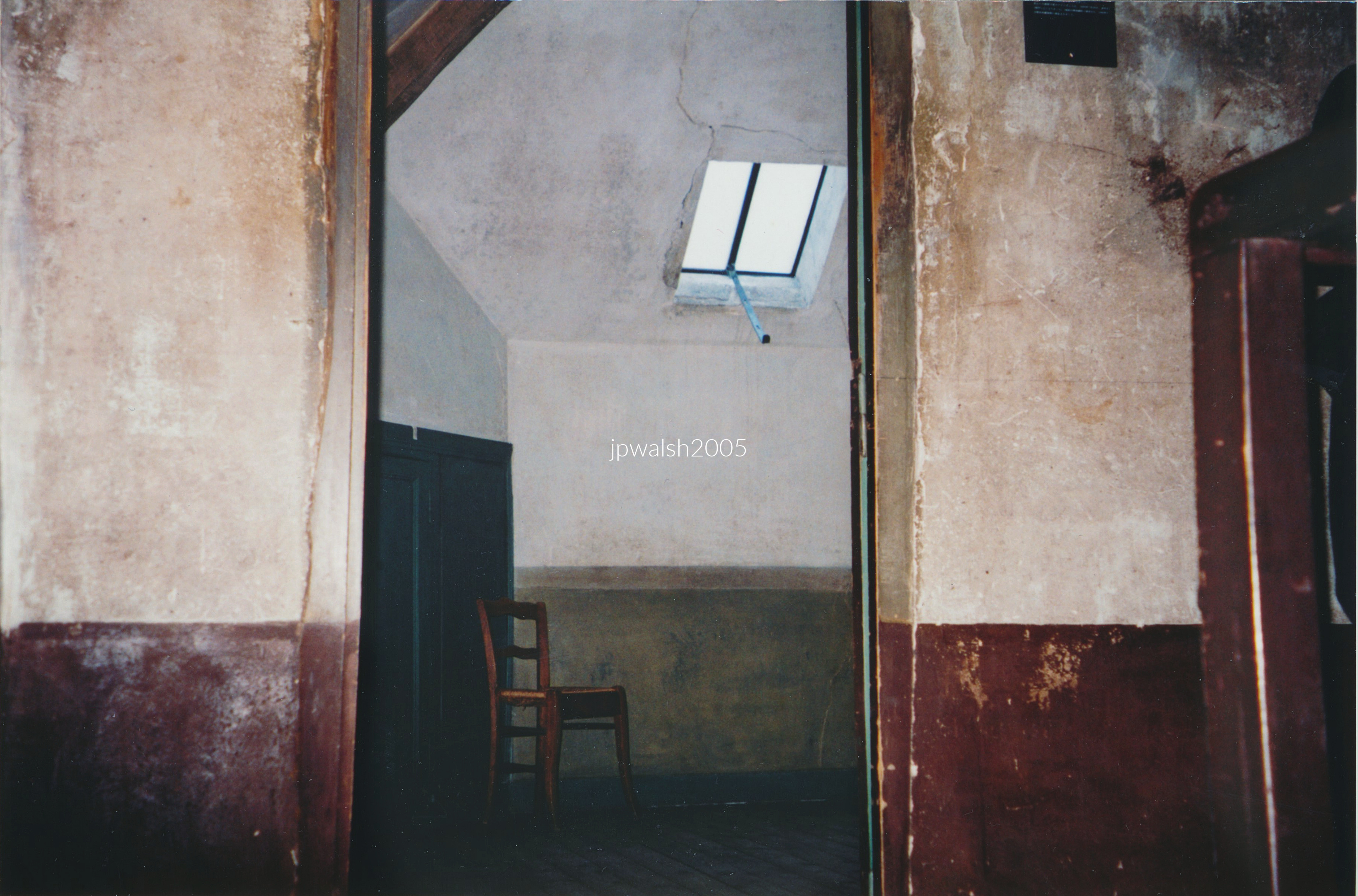
Entrance to Vincent Van Gogh’s rented room in Ravoux’s inn in Auvers. It was here that the artist lived for two months as he made more than 100 drawings and paintings in the town. The room is where Van Gogh returned after he shot himself on July 27, 1890 and died two days later surrounded by family and friends. Author’s photograph, May 2005.
After roaming the town where he made friends of villagers, visited Dr. Gachet’s, and journeyed into nearby farm fields, Van Gogh returned to Ravoux’s café for lunch that was served at noon. In the afternoon he might sometimes work in the “painters’ room” at the inn or visit with other painters staying at the inn, such as compatriot Anton Matthias Hirschig (1867-1939) and Spanish painter Martinez de Valdivielse. These acquaintances proved more significant for history insofar as they provided eyewitness testimony of Van Gogh’s death and funeral. Following dinner at Ravoux’s, Van Gogh climbed the inn’s simple staircase to his single room in the center of the attic landing and retired at about nine in the evening.
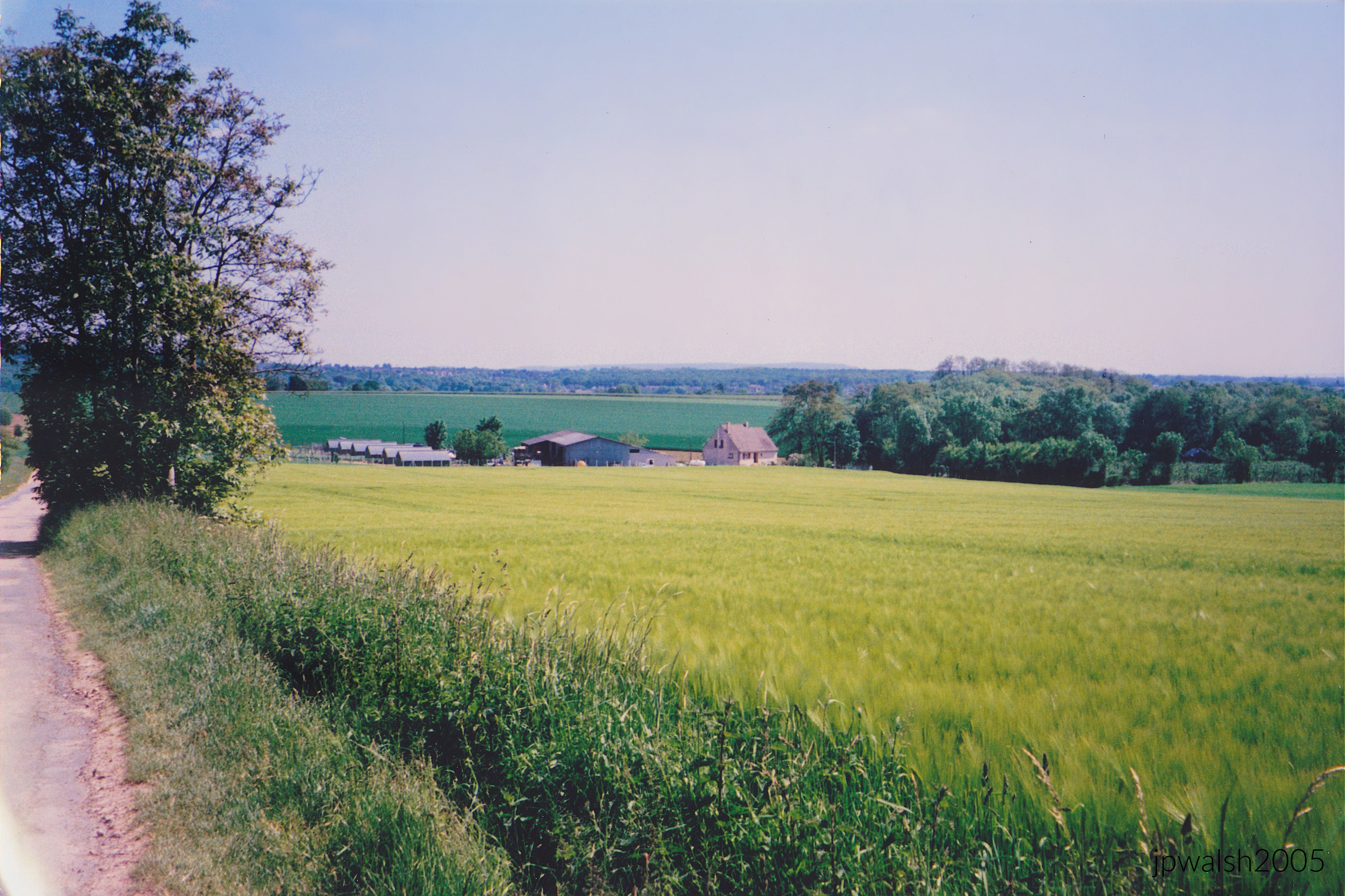
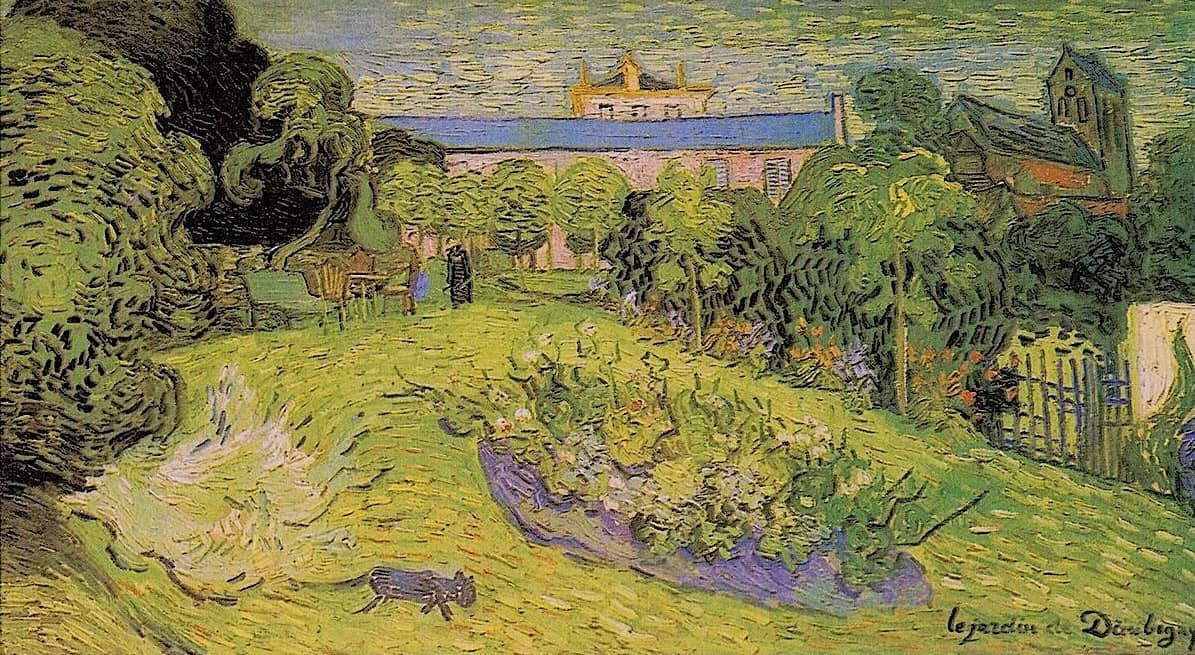
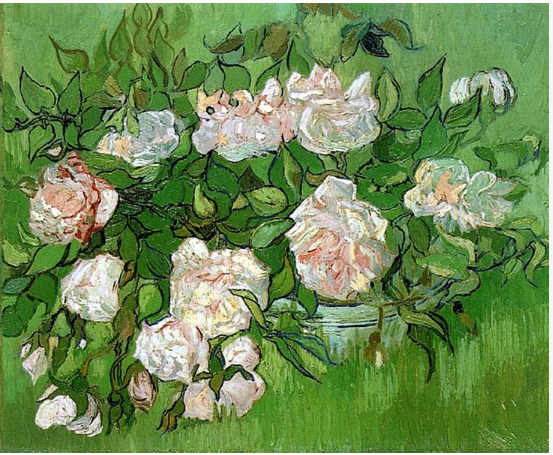
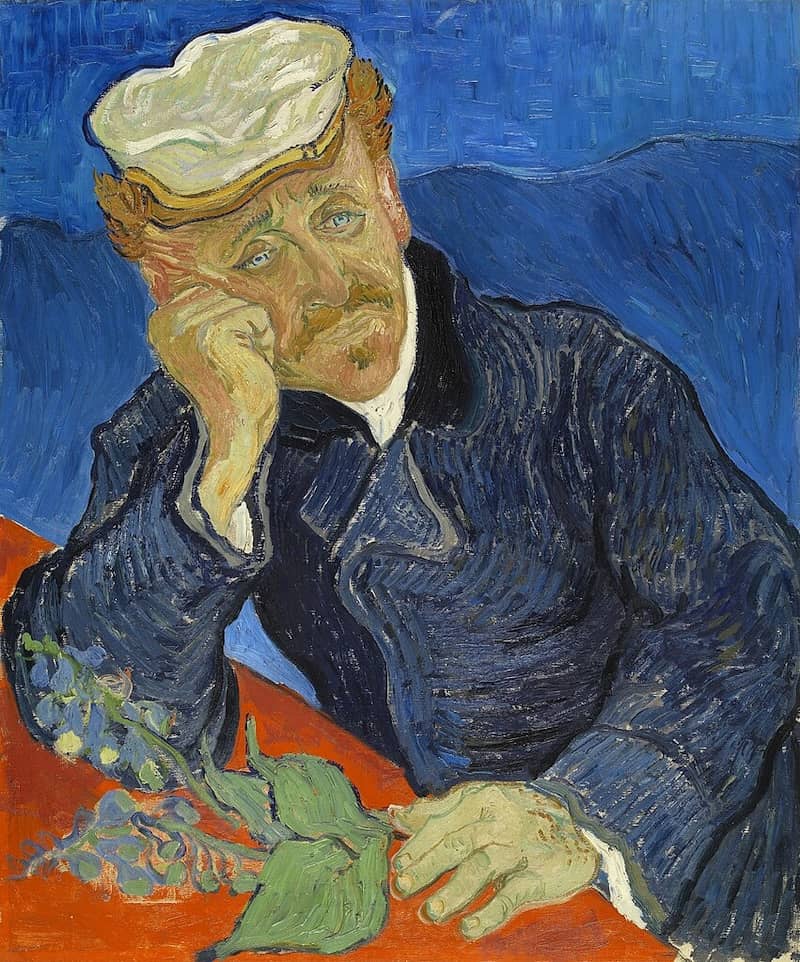
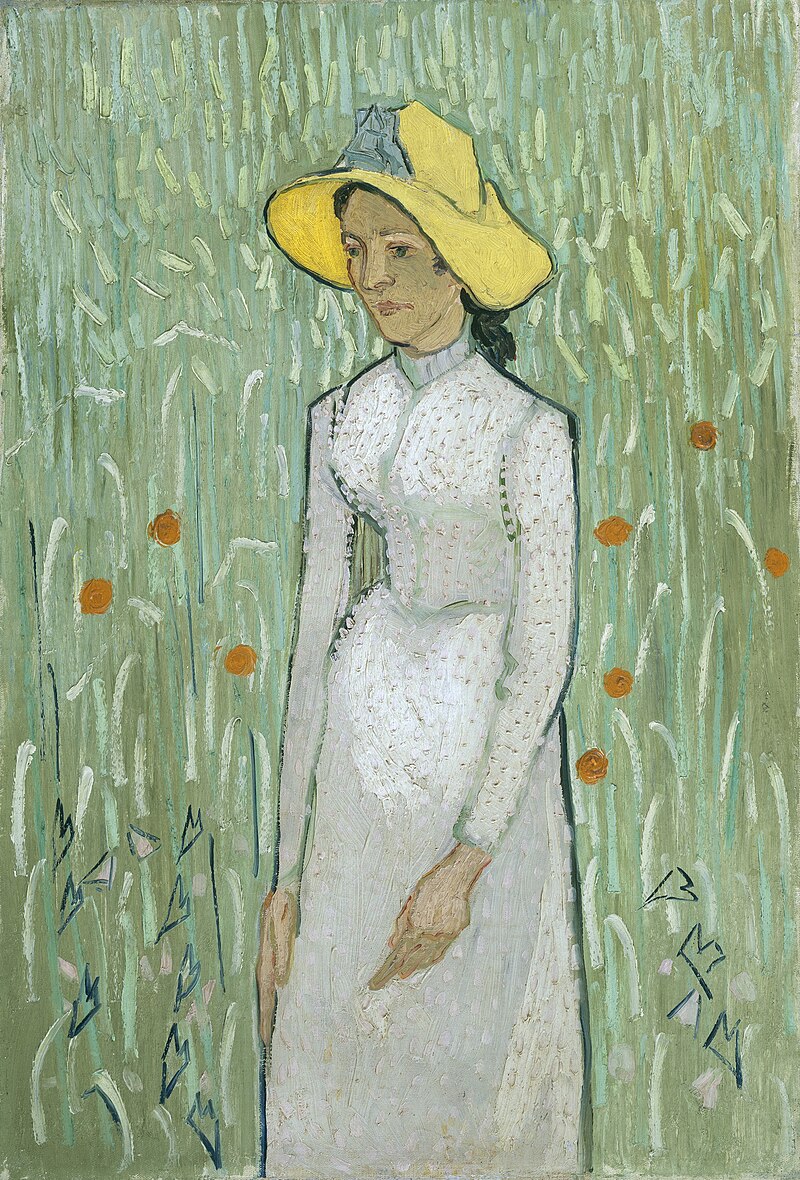
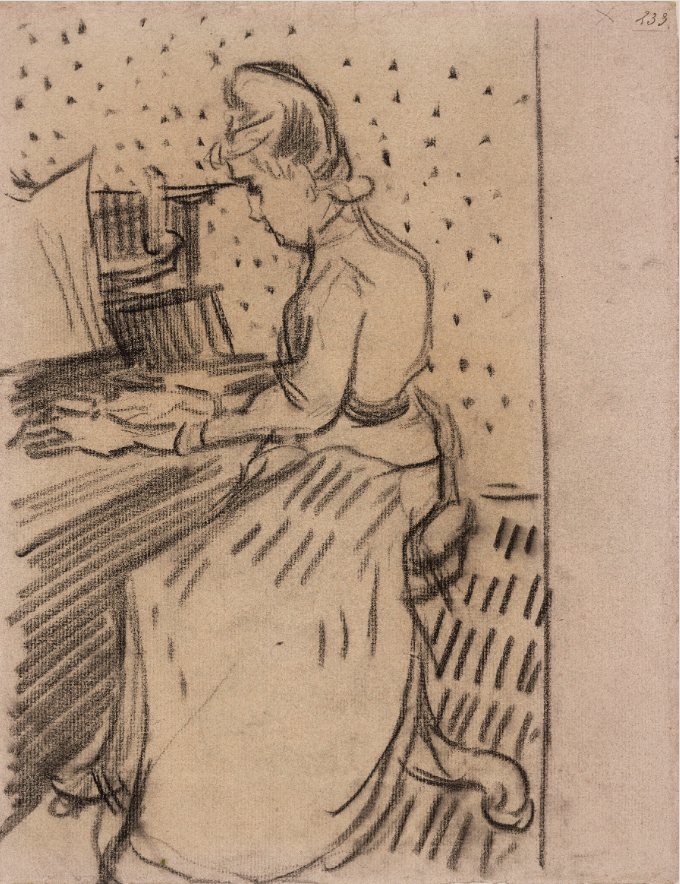
Fields of Auvers. Author’s photograph, May 2005.Vincent Van Gogh, View of Vessenots near Auvers, May 1890, oil on canvas, 55×65 cm, Thyssen-Bornemisza, Madrid, Spain. Public Domain.Vincent Van Gogh, Daubigny’s Garden, 1890, oil on canvas, 56 cm × 101 cm (22 in × 39.8 in), Kunstmuseum Basel, Basel, Switzerland. There are three versions by Van Gogh of this Auvers garden of the late Barbizon artist Charles-François Daubigny (1817-1878) who had moved to Auvers in 1860. All three paintings by Van Gogh were made between May and July 1890. Daubigny, a landscape artist who painted en plein aire, died in 1878 and his widow still lived in the house in Auvers that was a short walk from Ravoux’s inn. Van Gogh stepped outdoors into Daubigny’s garden to look back towards the house for the painting’s subject (the Church of Auvers is distinctly drawn in the painting’s upper right corner). Since the 1870’s Van Gogh admired Daubigny and mentioned him with other Barbizon painters, Jean-François Millet (1814-1875) and Camille Corot (1796-1875) (see – https://www.vincentvangogh.org/garden-of-daubigny.jsp – retrieved March 11, 2024). Public Domain.Vincent Van Gogh, Daubigny’s Garden, midJune 1890, oil on canvas, 51 cm x 51.2 cm, Van Gogh Museum, Amsterdam. Other versions of Daubigny’s Garden are in the Hiroshima Museum of Art in Japan (see – https://www.hiroshima-museum.jp/en/collection/eu/vangogh.html – retrieved March 11, 2024) and the Van Gogh Museum in Amsterdam (see – https://www.vangoghmuseum.nl/en/collection/s0104V1962 – retrieved March 11, 2024.). The square-format flat decorative painting, painted on a simple tea towel that was mounted to canvas, became Van Gogh’s first painted attempt of the garden. It acts as a modernist talisman reminiscent of Paul Sérusier’s 1888 cigar box painting and looks ahead to the decorative landscapes of the Nabis in the 1890’s and of Gustave Klimt (1862-1918) 15 years later. Public Domain.Vincent van Gogh, Garden in Auvers, July 1890, oil on canvas, 64×80 cm, private collection. Though Van Gogh died in 1890 his modernist artistic influence had deep ties with the European avant-garde art movement in the 1890’s and beyond. Public Domain.Setting for, and approach to, the Church of Auvers hardly differs from the time of Van Gogh’s stay in the town in May to July 1890. Author’s photograph, May 2005.Irises and other flowering plants on the side of an Auvers road that leads to Dr. Gachet’s house. Author’s photograph, May 2005.Vincent Van Gogh, Still Life Pink Roses, June 1890, oil on canvas, 32 x 40.5 cm, Ny Carlsberg Glyptotek, Copenhagen, Denmark. Public Domain.Van Gogh, Dr. Gachet (second version), June 1890, Musée d’Orsay, Paris. As a token of friendship, Van Gogh painted two authenticated versions of Dr. Gachet’s portrait in June 1890 at Auvers. Reasons that Van Gogh came to Auvers included the role played by Dr. Gachet as the artist’s therapist, as well as that the well-regarded physician contributed to his town’s modern art pedigree. Dr. Gachet was himself an avid collector and painter and participated in art circles since the 1850’s with Gustave Courbet (1819-1877). Later, Dr. Gachet saw to it that Paul Cézanne (1839-1906) came to Auvers to paint in 1873. It was Camille Pissarro (1830-1903) living in nearby Pontoise who recommended Dr. Gachet to Theo Van Gogh in anticipation of Vincent’s arrival from Saint-Rémy. Vincent Van Gogh was completely enamored with the doctor and thought of him as a brother. When Dr. Gachet visited Theo in Paris in early July 1890, he told him he believed that Vincent was “completely recovered” and “that there need be no fears of a further attack” (quoted in Complete Paintings, p. 718). As Van Gogh found Dr. Gachet to be another brand of eccentric, he painted him in these portraits as a deep thinker who reflected a sensitive nature tending to slight melancholy. Public Domain.Van Gogh, Portrait of Adeline Ravoux, June 1890, oil on canvas, 52x 52 cm, Cleveland Museum of Art. In their therapeutic and other conversations, it was Dr. Gachet in June 1890 who encouraged Van Gogh to make portraits of other sitters in Auvers. Van Gogh had done portraits of local Arlesiens in the “Studio of the South” in 1888 as well as many self-portraits. Adeline Ravoux was the 15-year-old daughter of his Auvers innkeepers, the Ravoux’s. About one month after this portrait was made, the girl was with her parents to witness Vincent’s return to the café after he shot himself. She wrote later in a memoir: “Vincent walked bent, holding his stomach, again exaggerating his habit of holding one shoulder higher than the other. Mother asked him: “M. Vincent, we were anxious, we are happy to see you to return; have you had a problem?” He replied in a suffering voice: “No, but I have…” He did not finish, crossed the hall, took the staircase and climbed to his bedroom.” (see – http://www.vggallery.com/misc/archives/a_ravoux.htm – retrieved March 11, 2024). Public Domain.Van Gogh, Young Girl Standing Against Wheat, late June 1890, 66.7 x 45.8 cm (26 1/4 x 18 1/16 in.), National Gallery of Art, Washington, D.C. The painting’s lack of horizon creates a flat wall behind the sitter who appears in close proximity to the picture plane as she fills the pictorial space. Van Gogh shadowed her face under her hat and gave her a “distant, unfocused” gaze, all of which works to give the portrait emotional distance. (see – Painting the Difference: Sex and Spectator in Modern Art by Charles Harrison, University of Chicago Press, 2006). Public Domain.Van Gogh, Marguerite Gachet at the Piano, June 1890, chalk on paper, 30.5 cm x 23.8 cm, Van Gogh Museum, Amsterdam. Marguerite Gachet was the daughter of Dr. Gachet. At the time of this drawing which resulted in a similarly composed painting, the sitter had recently turned 21 years old. In anticipation of the painting that is today in the Kunstmuseum Basel, Van Gogh made two sketches in late June 1890 of which this is one. https://www.vangoghmuseum.nl/en/collection/d0427V1962r – retrieved March 11, 2024. Public Domain.As in Van Gogh’s 1890 painting of the same subject, the church at Auvers (“Notre-Dame-de-l’Assomption”) today is brightly lit in the sun, while the church itself sits in its own shadow. Author’s photograph, May 2005.Van Gogh, L’église d’Auvers-sur-Oise, vue du chevet (“The Church at Auvers”), June 1890, oil on canvas, 94 cm x 74 cm (37 in x 29.1 in), Musée d’Orsay. Public Domain.
Van Gogh proved quite productive in Auvers, painting several notable canvasses in and around the town and countryside, particularly landscapes and other outdoor subjects en plein aire. In these two months, the painter produced 74 paintings and 33 drawings, including the portraits of Dr. Gachet and Adeline Ravoux, The Church of Auvers, and Field of Wheat with Crows. In a letter of around July 10, 1890, Van Gogh wrote to Theo and Jo that he painted three large canvases at Auvers since visiting them in Paris on July 6, 1890. During that visit the artist also met with Henri Toulouse-Lautrec (1864-1901) and art critic Gabriel-Albert Aurier (1865-1892). In addition to Daubigny’s Garden, these large canvasses likely included Wheatfield with Crows and Wheatfields Thunderclouds (both Van Gogh Museum Amsterdam). Van Gogh described them as “immense stretches of wheatfields under turbulent skies…searching to express sadness [and] extreme loneliness” (“immenses étendues de blés sous des ciels troublés… chercher à exprimer de la tristesse, de la solitude extreme”). See – https://vangoghletters.org/vg/letters/let898/print.html – retrieved March 11, 2024.
Vincent Van Gogh, Sorrowing Old Man (“At Eternity’s Gate”), 1890, 80 cm × 64 cm (31.5 in × 21.2 in), oil on canvas, Kröller-Müller Museum, Otterlo, The Netherlands. The painting was completed at St. Rémy shortly before Van Gogh moved to Auvers-sur-Oise.At the wheatfield in Auvers where Van Gogh painted “Wheatfield with Crows,” one of his last paintings, in July 1890. Author’s photograph, May 2005.Van Gogh, Wheatfield with Crows. July 1890, oil on canvas, 50.2 cm × 103 cm (19.8 in × 41 in), Van Gogh Museum, Amsterdam. Public Domain. Many have claimed this to be Van Gogh’s last painting.Auvers fields. Author’s photograph, May 2005.
Van Gogh, Wheatfield Thunderclouds, July 1890, oil on canvas, 50.4 cm × 101.3 cm (19.8 in × 39.9 in), Vincent Van Gogh Museum, Amsterdam.
On July 27, 1890, Vincent, as he did each day, went into the fields to paint. Though the artist appeared to be in good spirits, the artist shot himself later that day near the chateau after going for a walk towards evening. Though able to walk the 10 minutes back mortally wounded to Ravoux’s inn, he told them nothing upon entering the café. The Ravoux’s, sensing something was wrong, called for Mazery, the village doctor and Dr. Gachet. Though these doctors bandage the wound, Van Gogh’s condition is inoperable. In the hot attic room, Van Gogh suffered into the next day, when Theo was sent for. He arrived immediately on July 28 from Paris to be by his brother’s side. Van Gogh died the next morning of July 29, 1890. This suicide sent ripples of shock through the village, as some townspeople had witnessed these events. During my visit to Auvers in May 2005, after exiting Van Gogh’s room where he died, I told the innkeeper that the story was sad (“c’est triste”). She countered, “C’est emouvante” (“It’s moving”). Vincent was buried the next day, July 30, 1890, in Auvers’ new graveyard. His funeral was attended by Theo, Dr. Gachet, the Ravoux’s, assorted villagers, and friends from Paris. These last included artists Emile Bernard (1868-1941), Charles Laval (1862-1894), and Lucien Pissarro (1863- 1944), Camille Pissarro’s son. Petit boulevard art dealer and art materials supplier Julien (Père) Tanguy (1825-1894) was also in attendance. Van Gogh’s casket was strewn with yellow dahlias and sunflowers and Dr. Gachet gave remarks as did Theo Van Gogh. Later, in a letter to his wife, Theo wrote about the proceedings: “[Vincent] was buried in a sunny spot among the cornfields, and the cemetery does not have that unpleasant character of Parisian cemeteries.” (see- Kort geluk, 1999, p. 281). The mortal remains of Van Gogh were transported to the cemetery by a rented hearse from the next town because Auvers’ Catholic priest would not allow the community’s hearse to be used. A proposed church service was also cancelled. The homiletics were left to Dr. Gachet who said: “Vincent was an honest man and a great artist, and there were only two things for him – humanity and art. Art mattered to Vincent Van Gogh more than anything else and he will live on through it” (quoted in Complete Paintings, p. 719).
Graves of Vincent and Theo Van Gogh, Auvers-sur-Oise, France. Author’s photograph, May 2005.
Three days after the funeral, Emile Bernard wrote to Aurier about “our dear friend Vincent.” Aurier had written in January 1890 about the intense fixity of Van Gogh’s art. The art critic conjectured that it may be the catalyst for change in French art. In his essay entitled Les Isolés: Vincent van Gogh published in Mercure de France, Aurier prophesied for an artist-savior figure: “A man must come, a Messiah, a sower of Truth, to rejuvenate our geriatric art, indeed perhaps the whole of our geriatric, feeble minded, industrial society” (quoted in Complete Paintings, p. 698). Van Gogh, aware of these statements, did not think he was Aurier’s man. On August 2, 1890 Emile Bernard wrote to Aurier: “On Sunday evening [Vincent] went out into the countryside near Auvers, placed his easel against a haystack and went behind the chateau and fired a revolver shot at himself. Under the violence of the impact (the bullet entered his body below the heart) he fell, but he got up again, and fell three times more, before he got back to the inn where he was staying (Ravoux, place de la Mairie) without telling anyone about his injury. He finally died on Monday evening, still smoking his pipe which he refused to let go of, explaining that his suicide had been absolutely deliberate and that he had done it in complete lucidity…. On the walls of the room where his body was laid out all his last canvases were hung making a sort of halo for him and the brilliance of the genius that radiated from them made this death even more painful for us artists who were there. The coffin was covered with a simple white cloth and surrounded with masses of flowers, the sunflowers that he loved so much, yellow dahlias, yellow flowers everywhere. It was, you will remember, his favorite color, the symbol of the light that he dreamed of as being in people’s hearts as well as in works of art….The sun was terribly hot outside. We climbed the hill outside Auvers talking about him, about the daring impulse he had given to art, of the great projects he was always thinking about, and of the good he had done to all of us. We reached the cemetery, a small new cemetery strewn with new tombstones. It is on the little hill above the fields that were ripe for harvest under the wide blue sky that he would still have loved…perhaps.Then he was lowered into the grave…Then we returned. Theodore Van Ghog [sic] was broken with grief; everyone who attended was very moved, some going off into the open country while others went back to the station…” (see – https://www.webexhibits.org/vangogh/letter/21/etc-Bernard-Aurier.htm – retrieved March 11, 2024.)
Van Gogh, Two Women Crossing the Fields, July 1890, oil on paper on canvas, Marion Koogler McNay Art Museum, San Antonio, Texas.
By contrast, Anton Hirschig, the Dutch artist who roomed next door to Van Gogh at Ravoux’s, wrote a letter much later, in 1911, to Albert Plasschaert (1874-1941) in which he recounted a more terrible scene following Van Gogh’s shooting himself. Hirschig wrote: “He lay in his attic room under a tin roof. It was terribly hot. It was August. He stayed there alone for some days. Perhaps only a few. Perhaps many. It seemed to me like a lot. At night he cried out, cried out loud. His bed stood just beside the partition of the other attic room where I slept: Isn’t there anyone willing to open me up! I don’t think there was anyone with him in the middle of the night and it was so hot. I don’t think I ever saw any other doctor like his friend the retired army doctor: It’s your own fault, what did you have to go kill yourself for? He didn’t have any instruments this doctor. He lay there until he died.”
Theo Van Gogh died in Holland on January 25, 1891, nearly 6 months to the day after Vincent’s death. Theo was buried in Holland but exhumed and reinterred next to his older brother Vincent’s grave in Auvers cemetery in 1914. While Vincent Van Gogh, the man, was never larger than life, as an artist he produced an explosion of life on paper and canvas. Van Gogh came to art late (30 years old in 1883) and produced incessantly for the next 7 years. His oeuvre was beautifully powerful, and none of it more remarkably for the future of modernism than that done in Auvers-sur-Oise in May to July 1890.
SOURCES –
Ingo F. Walther/Painer Metzger, Vincent Van Gogh The Complete Paintings, Benedikt Taschen, 1996.
Charles Harrison, Painting the Difference: Sex and Spectator in Modern Art, University of Chicago Press, 2006.
FEATURE Image: Petrus Christus (c. 1395-1472), Pietà, c. 1455–60. 39 ¾ x 75 ½ inches, Royal Museums of Fine Arts of Belgium, Brussels.
Jan Van Eyck (or John of Bruges) (c. 1385-1441), detail, Marriage of Giovanni Arnolfini and Giovanna Cenami, 1434; National Gallery, London.
Brief Introduction to Flemish art in the 15th century.
Flemish art, as the name suggests, originates in Flanders which includes the Low Countries (Netherlands and Belgium) as well as northeastern France. The centers of Flemish art in the 15th century are Brussels, Bruges, and, later, Antwerp as well as other cities such as Liège and Tournai. Though the area had been settled as early as the 6th century, great growth and prosperity came to the region starting in the 14th century. As an international trade center centered in Bruges and, following the silting up of Bruges’ port, in Antwerp starting around 1525, Flanders experienced an influx of tremendous wealth joined to its attendant political connections and power. Such factors led to a high demand for Flemish art locally and far beyond its borders to royal courts, churches and other public and private patrons having marked influence on the European Renaissance. These rich cultural conditions in and around Flanders provided incentive for leading Flemish art masters to perfect their art technique and create magnificent pictures, particularly altarpieces, and display the latest naturalist styles, delineated forms, and bright colors within a European context. Flemish art developed systematically including its use of oil painting. This newly discovered and controversial medium greatly affected Flemish paintings’ surface luminosity by way of its range of cool colors and its ability to be applied in smooth facile layers. Most of these noteworthy Flemish painters in the 15th century found positions at court or as officials in prosperous urban centers. They became leading citizens whose workshops trained artists and made artwork for public and private consumption which worked to assure Flemish art’s primacy for the Northern European Renaissance into the 16th century.
Hugo Van Der Goes (c. 1440-1482), Detail, Portinari Altarpiece, 1476-78, Uffizi Gallery, Florence, Italy.
PAINTINGS.
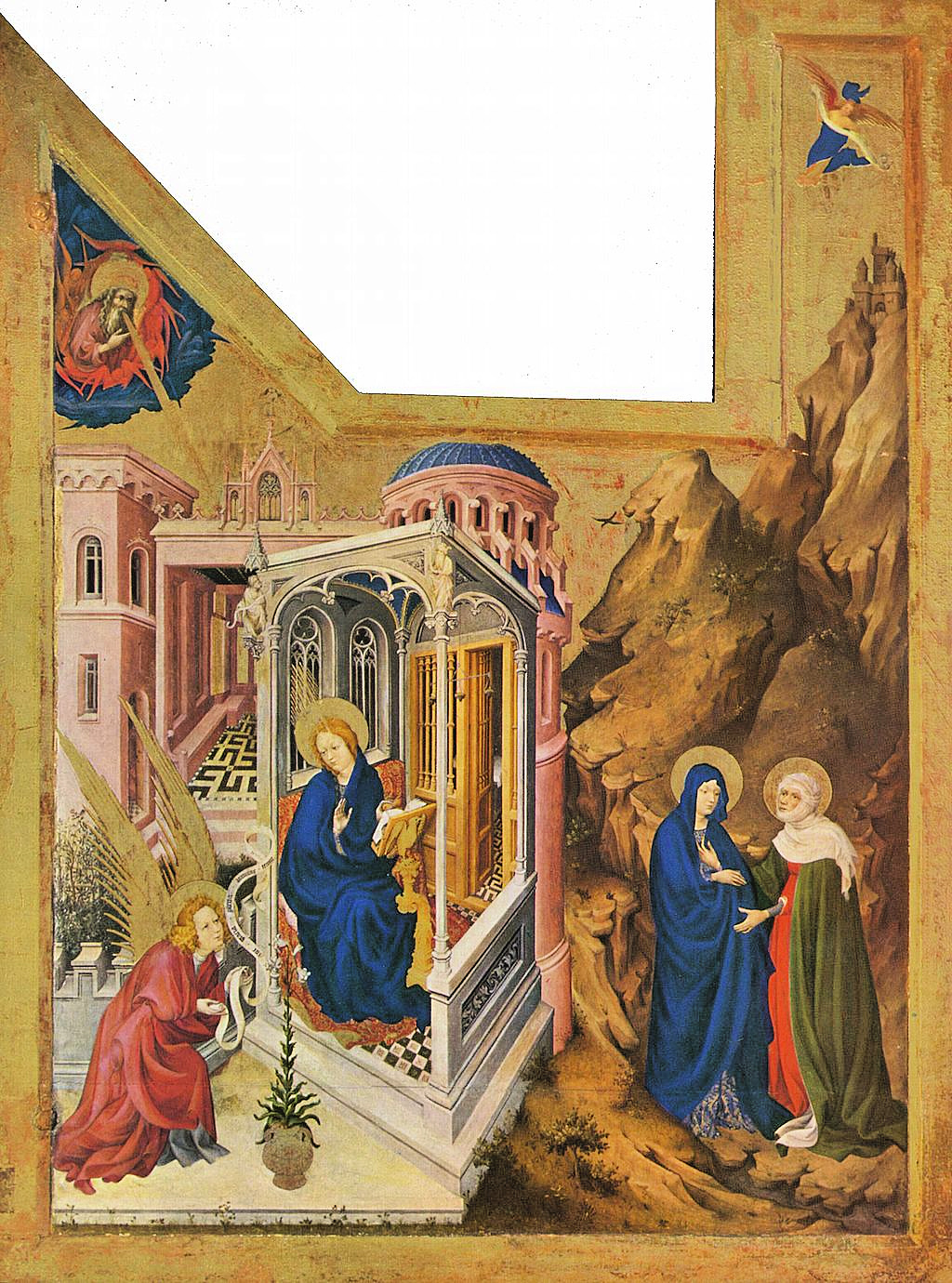
1 – Melchior Broederlam (c. 1350-1409), Champmol Altarpiece (The Annunciation and Meeting of Mary and Elizabeth), oil on wood, 1399, 65 ½ x 48 ¼ inches and 66 3/8 x 511/4 inches. Musée des Beaux-Arts de Dijon, France. 1 – Melchior Broederlam (c. 1350-1409), Champmol Altarpiece (The presentation in the Temple and Flight Into Egypt), oil on wood, 1399, 65 ½ x 48 ¼ inches and 66 3/8 x 511/4 inches. Musée des Beaux-Arts de Dijon, France.
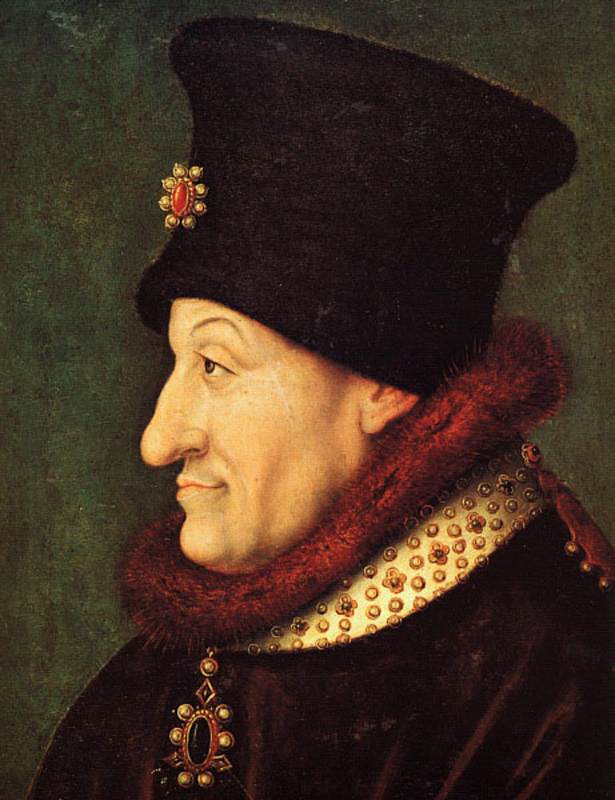
Melchior Broederlam was a painter in Ypres, Belgium, who entered the service as painter to Philip the Bold, Duke of Burgundy (1342-1402) in 1385 and was in Paris in the early 1390’s. The Champol Altarpiece is likely the earliest example of International Gothic in painting. The large diptych done for Philip the Bold is certainly painted by Broederlam.
Philip II the Bold, anonymous, 16th century, 40 cm (15.7 in); width: 30 cm (11.8 in), Palace of Versailles, oil on wood.
Broederlam presents four stories in the life of the Virgin – The Annunciation, the Visitation, the Presentation in the Temple, and The Flight into Egypt. There is an attempt at realism by its placid gesturing figures in a landscape of crags and paths yet also flowers at the foot of these imposing structures. At the same time there remains a sense of unreality, that is, a theatrical or stage setting in its flat, unitive display.
2 – Jan Van Eyck (c. 1385-1441), Madonna of Chancellor Rolin (or The Virgin of Autun), Oil on wood, c. 1435, 26 x 24 ¾ inches (66x 62 cm), Musée du Louvre, Paris.
From 1422 to 1424 Jan Van Eyck (or John of Bruges) worked for John III the Pitiless (1374–1425) of the House of Wittelsbach, who was bishop of Liège (1389–1418) as well as duke of Bavaria-Straubing and count of Holland and Hainaut (1418–1425). The artist was appointed court painter to Philip III the Good (1396-1467) who was born in Dijon and died in Bruges and who founded the Burgundian state that was France’s rival in the 15th century. Philip III was the most important of the Valois dukes of Burgundy.
Philip III wearing the chain of office. Copy of painting by Rogier Van der Weyden, c, 1450.
Van Eyck lived in Lille between 1425 and 1429 but relocated to bustling Bruges in 1430 where he bought a house and lived until his death in 1441. On behalf of the Duke’s business concerns (including a secret marriage), Jan Van Eyck made trips to Spain and Portugal in 1427-28, and several others into the mid1430’s. There are many authenticated paintings by Jan Van Eyck, although Madonna of Chancellor Rolin is considered highly likely. The concept of composing the work to be divided into a shadowed interior and bright exterior landscape – and unified in the picture – is original. The contrasts of light, subject and form and their relation is appealing to the eye. The figures of the Virgin and the Child are delineated gently and beautifully for the donor, who is depicted behind a prayer desk, to adore. Like Italian master Leonardo da Vinci (1452-1519), Van Eyck had many cultural interests and talents in the service of Philip III such as studies in anatomy, cartography, geometry and perspective that created the illusion of three-dimensional space. These artists’ common preoccupations and concerns in the arts united the Northern and Italian Renaissance more closely. If Van Eyck did not actually invent oil painting, his work perfected its techniques. Van Eyck’s abilities make him the major artist of the Early Netherlandish School whose position is challenged only by the Master of Flémalle (Robert Campin). It was painted for the chancellor of Philip III, Nicolas Rolin (c. 1376/80-1462) to decorate a personal chapel (Saint-Sébastien chapel) that he decided to build in 1426-1428 (completed in 1430) in the church of Notre-Dame-du-Châtel in Autun, a church destroyed in 1793.
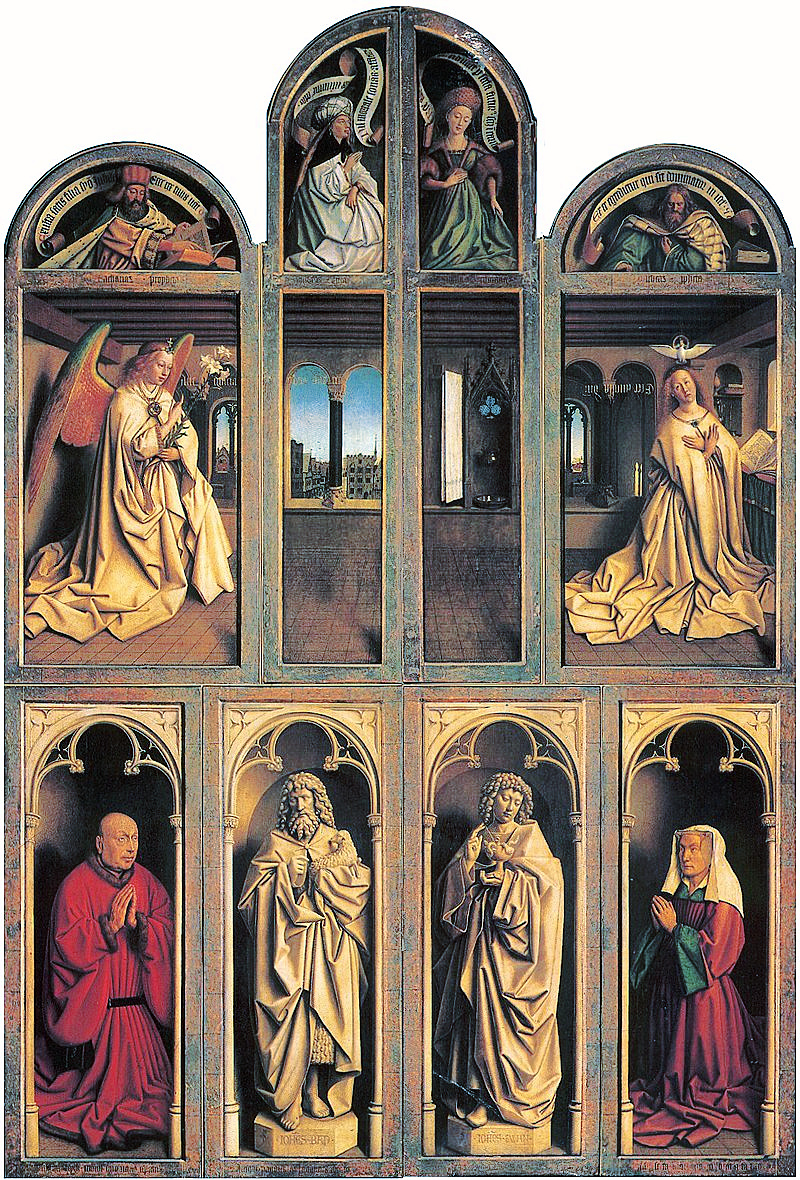
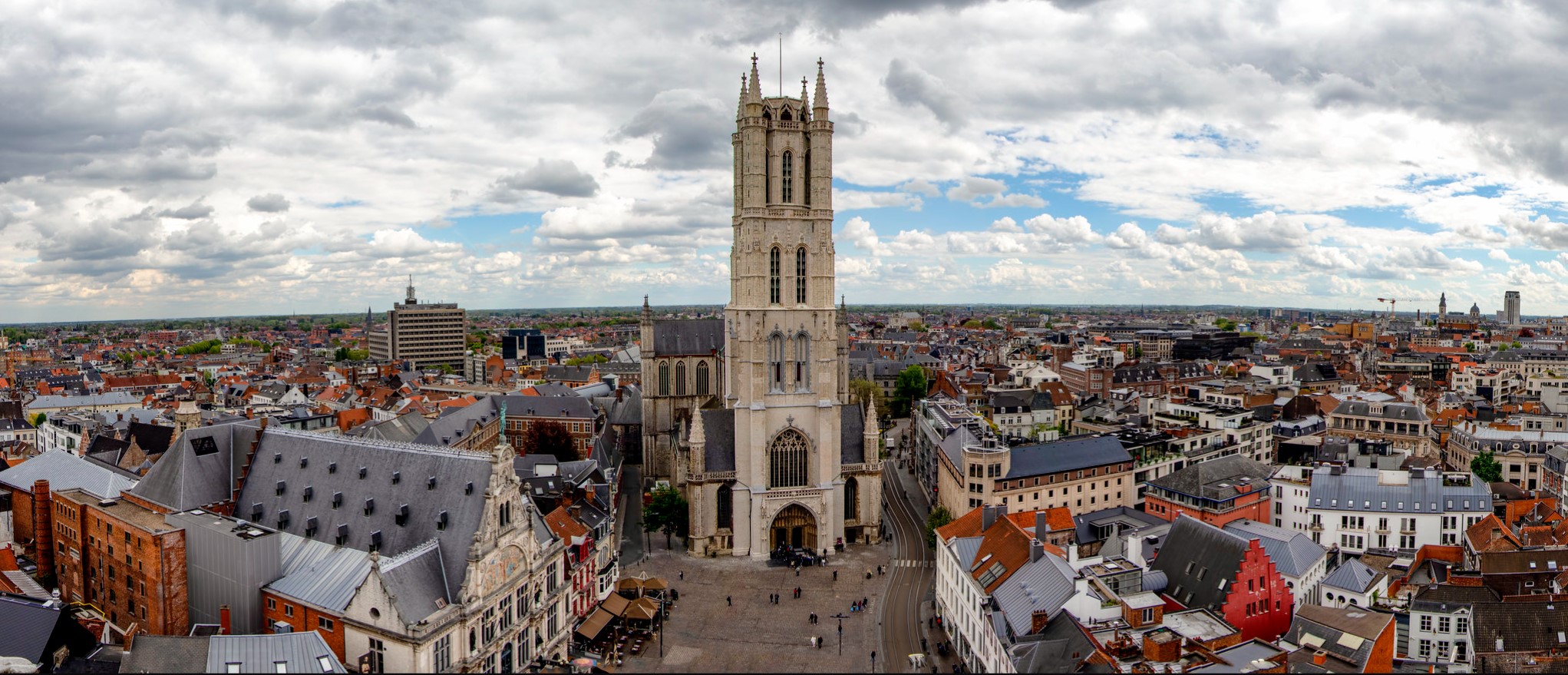
3 – 4 Hubert Van Eyck (c. 1370-1426) and Jan Van Eyck (c. 1385-1441), Closed (above) and open panel of The Ghent Altarpiece, also called the Adoration of the Mystic Lamb, c. 1425, 53 ¾ x 93 ¼ inches, Saint Bavo’s Cathedral, Ghent.St. Bavo’s Cathedral, Ghent, houses the Van Eyck brothers’ Ghent altarpiece. “Saint Bavo’s Cathedral, Ghent” by Arran Bee is licensed under CC BY 2.0.
Jan Van Eyck’s masterpiece is Adoration of the Mystic Lamb (1432), known as the Ghent Altarpiece, which he painted with his brother Hubert Van Eyck (c. 1370–1426). The Van Eycks’ artwork is known for its technical brilliance, intellectual complexity, and rich symbolism of which this very large (almost eight feet wide) and complex 15th-century polyptych is a prime testament. It was begun in the mid-1420s and completed by 1432. It marks a transition from the Middle Ages to the Renaissance in Northern European art. Its 22 panels opens and closes. When open, inside there are two rows of paintings. The middle section is Christ the King flanked by the Virgin and Saint John the Baptist. Other panels depict musicians, singing angels, and Adam and Eve. The center lower row depicts the Adoration of the Lamb with knights, hermits. judges and pilgrims who stream to behold the Lamb. In its 600-year history, there have been re-paintings, restorations and modern replacements (the original Judges panel was stolen in 1934). Little is known about Hubert Van Eyck to the point where he has been speculated in his obscurity to be a mythical figure, though this is quite unfounded. The painting was done for a nobleman’s family chapel in what become St. Bavo’s church in Ghent. The Eycks’ detail, fullness of form and luminous colors presents the mystery of the Mass whose subject is the miracle of the unity of heaven and earth in eternity. In contrast, the closed panel is beautifully calm and restrained in colors and composition. But it is just as masterful and, as it sits closed, offers a different mood for devotion.
5 – Jan Van Eyck (c. 1385-1441), Portrait of Margaret van Eyck, 12 7/8 x 11 ½ inches (41.2cm x 34.6 cm), 1439, oil on wood, Groeningemuseum, Bruges, Belgium.
The portrait is of the artist’s wife executed in Bruges. The Van Eycks married in 1439. Like his other portraits the sitter is turned three-quarters to the left. Painted 60 years before Leonardo Da Vinci’s Mona Lisa (1503), there are affinities between them – a placid enigmatic female sitter, leftward turn, hands crossed at the lap, a possible landscape background that in the Van Eyck has been repainted.
Leonardo da Vinci, Mona Lisa (1503), Musée du Louvre, Paris.6 – Petrus Christus (c. 1395-1472), The Legend of Saints Eligius and Godeberta, 38 5/8 x 33 ½ inches, 1449, The Metropolitan Museum of Art, New York.
Following the death of Jan Van Eyck, Petrus Christus became the most important modern painter in Bruges who had settled there in 1444. The artwork was commissioned by the jewelers’ corporation in Bruges and depicts seventh century Saints Godeberta being given a ring by Saint Eligius to marry the Lord God as she decided to enter religious life. Though a religious painting, it is essentially a 15th century Flemish genre painting. And while not as graceful as Van Eyck’s artwork, the painting holds interest for its bold forms of figures and objects and the authority of a well-observed still life.
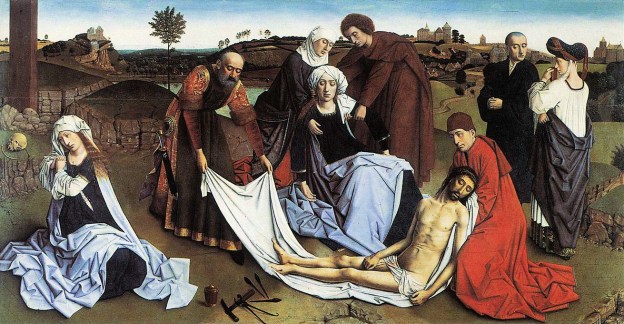
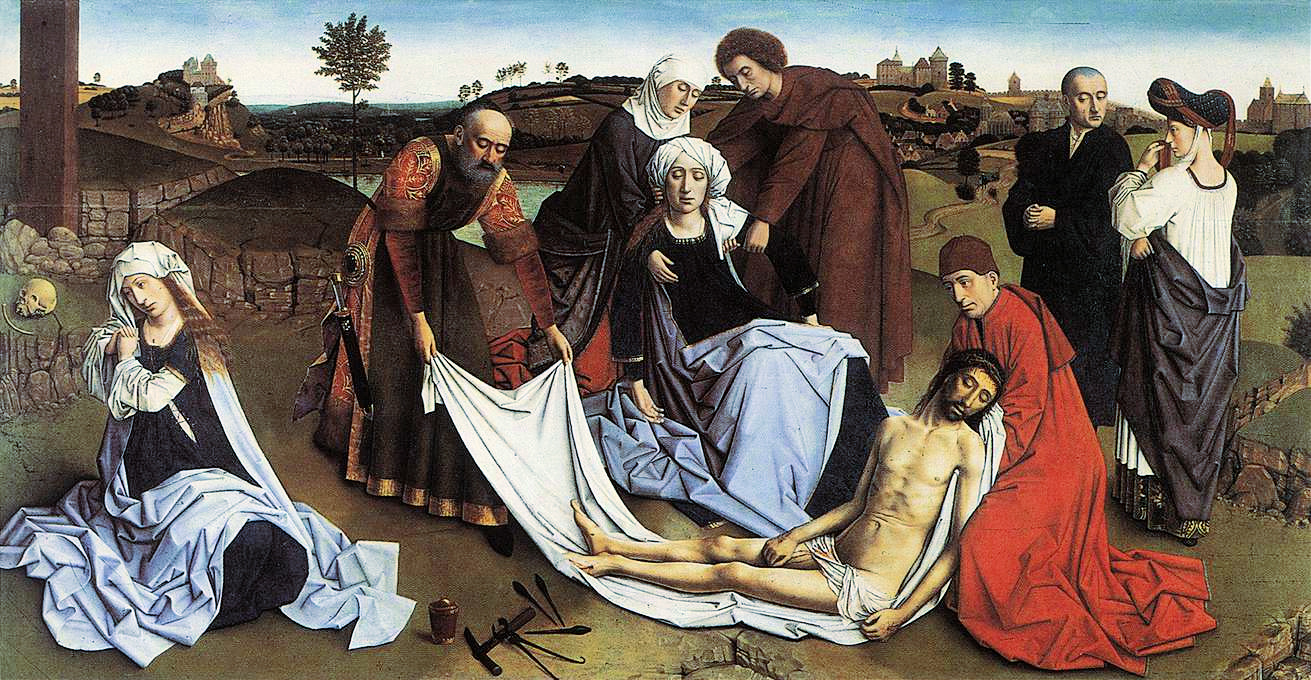
7 – Petrus Christus (c. 1395-1472), Pietà, c. 1455–60. 39 ¾ x 75 ½ inches, Royal Museums of Fine Arts of Belgium, Brussels.
One of Petrus Christus’s most important works, the scene of the Deposition is poetically rendered in a mother’s lamentation over the dead Christ, her son, within the setting of a late afternoon landscape which is also perfectly rendered. The figures in the foreground are large and emphasize their placement in the space. The face of the Virgin constitutes the painting’s center. Holding the dead Christ in a sheet is NIcodemus and Joseph of Arimathea who asked Pilate for the body of Jesus so to bury him. The three figures who stand apart from the narrative’s central figures are depicted with equal stylistic power and whose strained grief they share.
Gustave Courbet, 1849-50, A Burial at Ornans, 315 cm × 660 cm (124 in × 260 in), Musée d’Orsay, Paris. The 19th century French realist artist made a trip to Amsterdam before he painted The Burial at Ornans and was likely influenced by Netherlandish painting he had seen on that trip. 8 – Master of Flémalle/Robert Campin (1375-1444), workshop, The Bad Thief (fragment), c. 1420, 56 ¾ x 20 3/8, Städel Museum, Frankfurt am Main, Germany.
The painterly style of the Master of Flémalle is earlier than Jan Van Eyck yet also progressing a naturalism that is realistic and of ordinary folk. The Master of Flémalle has been identified by consensus as Robert Campin whose pupils were Rogier van der Weyden (1399-1464) and Jacques Daret (c. 1404- c. 1470). Campin is known to have lived and worked in Tournai, Belgium. This imposing, cruelly exact image depicts the corpse of one of the two criminals crucified with Jesus. Executed in the workshop of Robert Campin in Tournai around 1420 – around the same time as the Van Eycks’ Ghent Altarpiece – the fragment is all that remains though copies of the rest exist that show the Deposition and John the Baptist. The painting presents the bad thief in a corporeal monumentality next to an embossed gold background which is a legacy of medieval art. The painting’s unwavering physicality, however, is 15th century modern. The well-constructed faces of the two observers are modeled by shadows as foreshortening suggests movement. The lower left of the picture at the thief’s broken legs reveals, as Delevoy states, “the perspective of a landscape that is concisely constructed, geometric, and intellectual.”
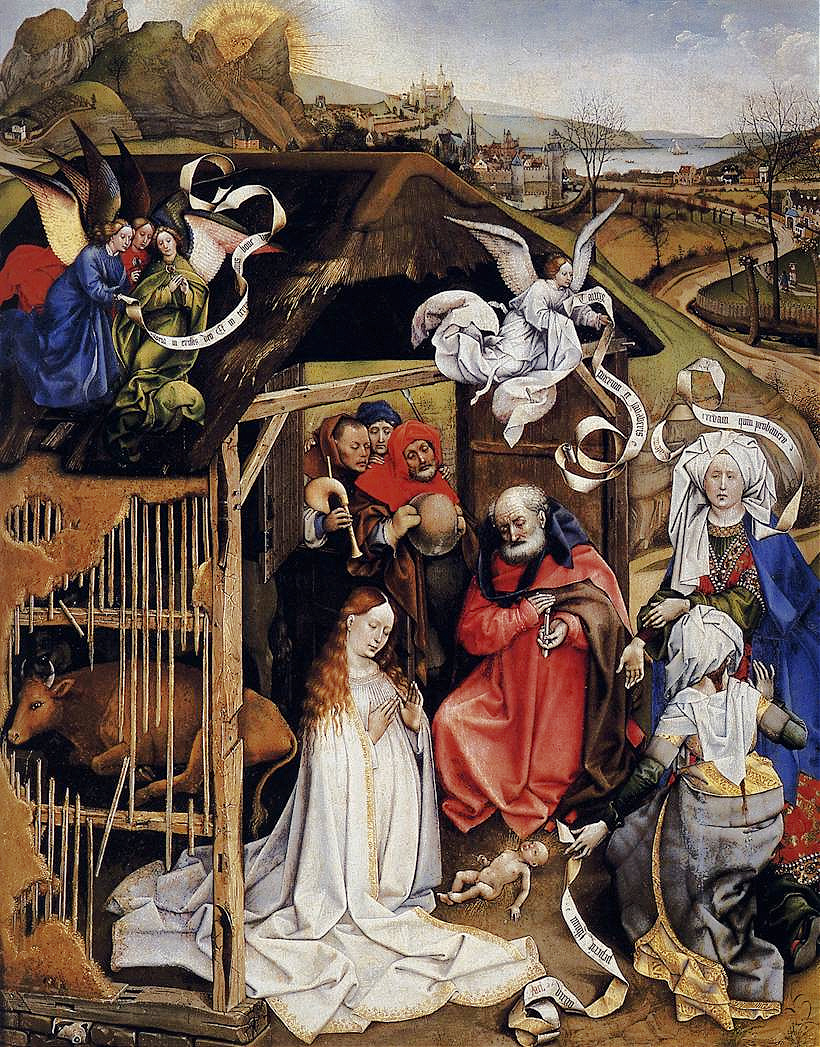
9 – Master of Flémalle/Robert Campin (1375-1444), The Nativity, c. 1420, oil on wood 87 x 70 cm, 32 5/8 x 27 ½, Musée des Beaux-Arts de Dijon, France.
The Nativity is the most famous work of the Master of Flémalle (Robert Campin). The single panel combines dreamed up images, and meticulous objective observation and rational knowledge to depict three episodes – (1) the legend of the midwives, (2) adoration of the shepherds, (3) the Nativity. The wooden stable, with its ox and ass, has a broken wall and holes in the roof. The Virgin dressed in white is kneeling with her hands held up in adoration as the Christ Child lies naked on the ground. Joseph is depicted as an old man and holds a lit candle that he shelters. The legend of the midwives is an apocryphal Gospel tale regarding Joseph’s anxiety during the birth and summoning these midwives with complicated headdresses. The stable door is swung open and three shepherds enter behind Mary and Joseph. Four angel figures hover above the scene holding strips of parchment with messages. There is an extensive, condensed, and detailed winter landscape in the background with a wide, curving road and castle perched on a hill.
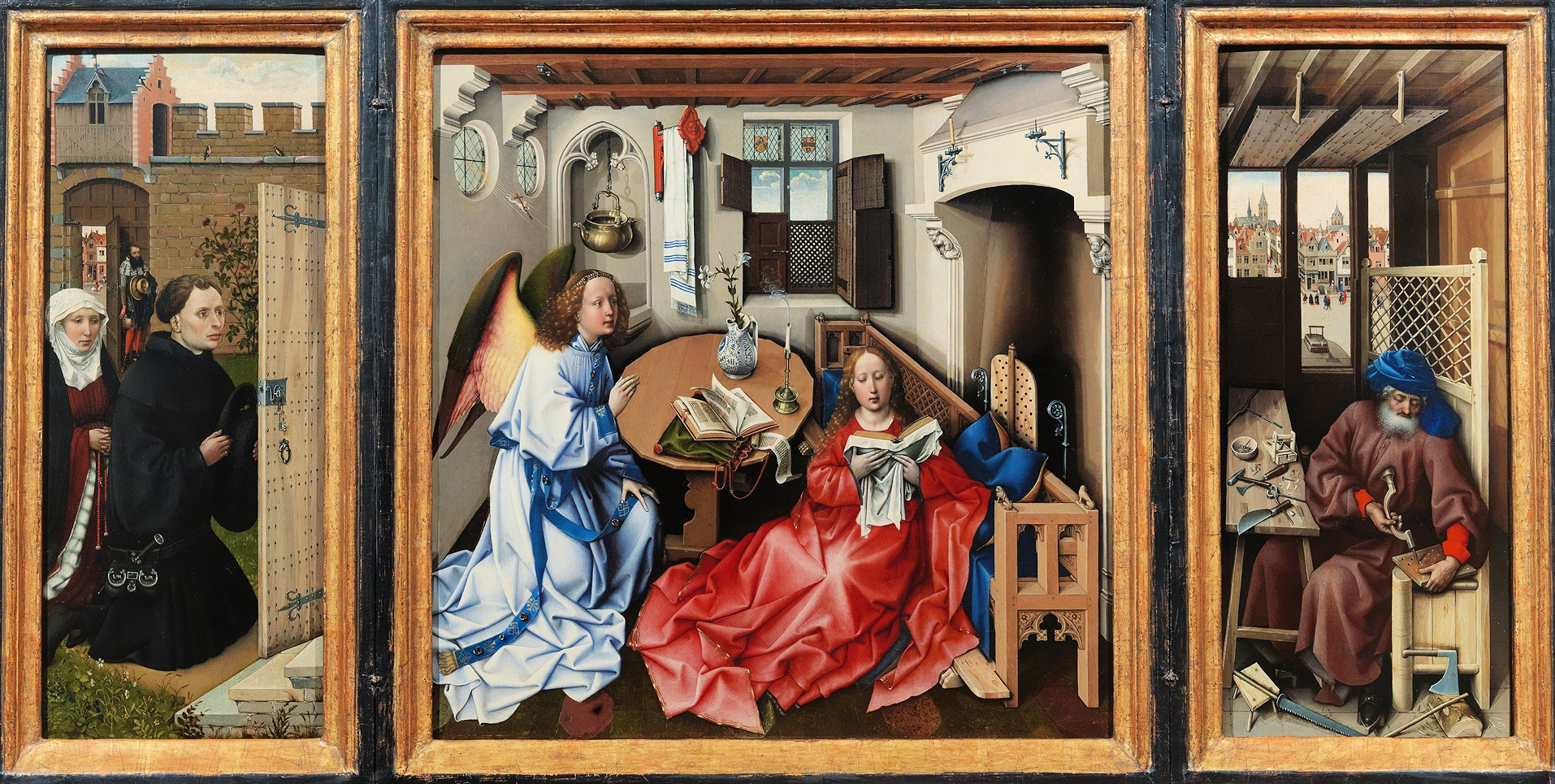
10– Master of Flémalle/Robert Campin (1375-1444), Annunciation Triptych (Merode Altarpiece), c. 1427-32, The Cloisters (Metropolitan Museum of Art), New York.
St. Luke 1: 26-29. “In the sixth month, the angel Gabriel was sent from God to a town of Galilee called Nazareth, to a virgin betrothed to a man named Joseph, of the house of David, and the virgin’s name was Mary. And coming to her, he said, “Hail, favored one! The Lord is with you.” Placid depiction of the Annunciation at the moment when the angel Gabriel alights in the Virgin’s chamber. The setting is a middle-class home and Mary is, for the moment, still completely unaware of the mystery that will now be told to her. A miniature figure with a cross comes through the oculus above the angel. The objects in the room– a lily, an immaculate towel, an extinguished taper– may be symbolic but certainly work to hold realistic tactile value. The robes in the foreground, one red, the other light blue, provide focus for the painting’s harmony and color. The Master of Flémalle experiments with Renaissance applications of perspective, depth, proportion (foreshortening) with material objects such as open shutters, an open door (left panel), and an unforgiving diagonal of the room’s bench. These material objects in varying perspectival space as well as varying light sources give the painting complexity. The right panel depicts old Joseph in his carpenter workshop. The left panel shows the painting’s donors on their knees witnessing this remarkable scene through the open door. There is speculation that the Master of Flémalle had painted the center panel and, as buyers showed interest, these donors commissioned the wings that were painted by workshop artists such as, likely, young Rogier van der Weyden (ca. 1400–1464) and Jacques Daret (ca. 1404–1468).
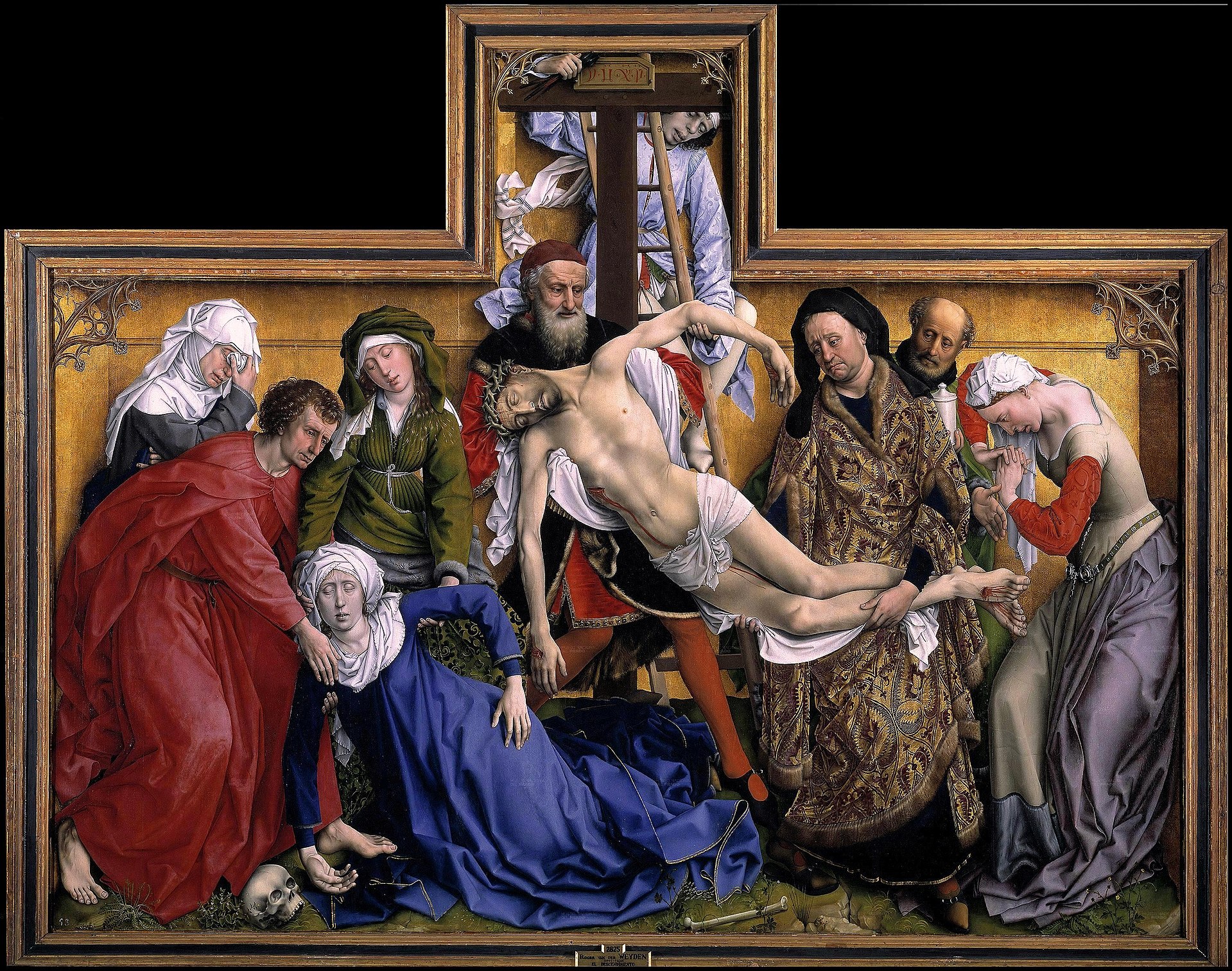
11-Rogier Van der Weyden (1399-1464), The Deposition or The Descent from the Cross, c. 1435, oil on oak panel, 86 ¾ x 110 inches, 220 × 262 cm. El Museo Nacional del Prado, Madrid.
Rogier Van der Weyden was a major artist in Flanders in the mid15th century. He was a pupil of Robert Campin, the Master of Flémalle, from which he imbued his realistic, ordinary naturalism with, what Murray said, was “more emotion, warmth and sensitiveness.” Insofar as the power of his artistic technique, Van der Weyden is a peer of Jan Van Eyck. Van der Weyden’s colors are cooler than Van Eyck’s and he subordinates his technical abilities to display the feelings of his paintings’ subject matter, typically religious. In terms of composition the striking difference between Van Eyck and Van der Weyden is that Van Eyck crafts a setting for his panorama of iconic vignettes while Van der Weyden paints flat-on action, often intensely emotional – all of which contributes to the artwork as a whole. Both Van Eyck’s Adoration of the Lamb and Van der Weyden’s The Deposition or Descent from the Cross are the most influential Flemish paintings of the mid15th century. Van der Weyden’s overall oeuvre makes him, arguably, 15th century Flemish art’s most influential figure.
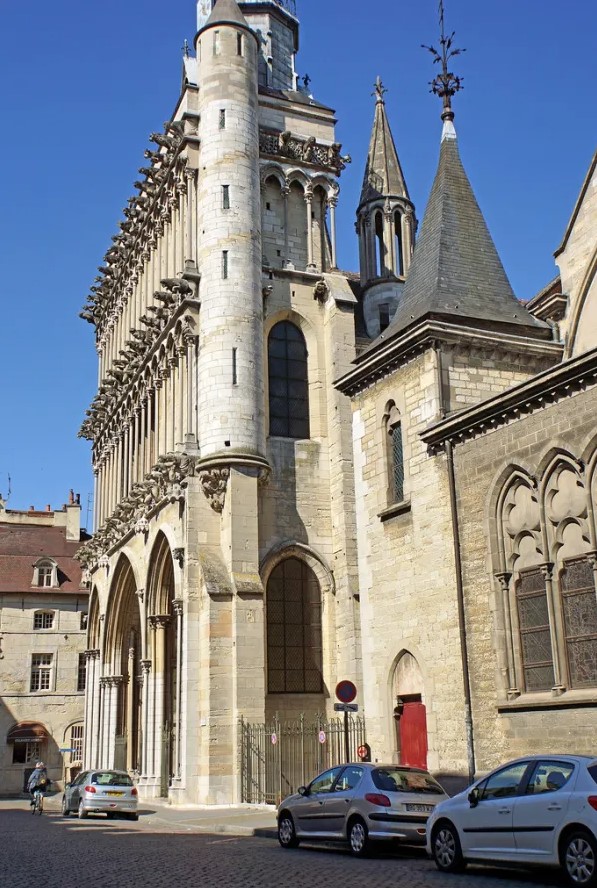
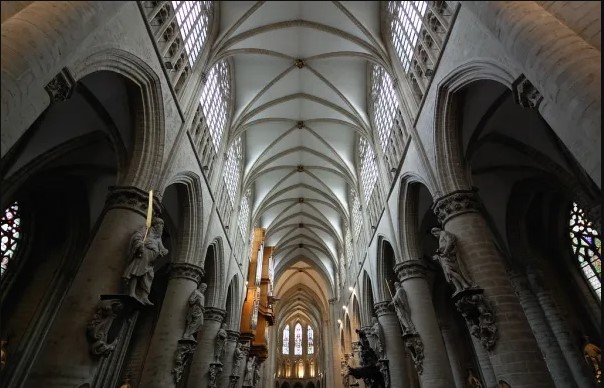
Van der Weyden’s The Deposition or Descent from the Cross are the most influential Flemish paintings of the mid15th century. The altarpiece was commissioned by the Grand Order of Crossbowman for the Church of Notre-Dame-Outside-the Walls of Dijon (13th century). PHOTO CREDIT: “France-003095 – Notre-Dame of Dijon” by archer10 (Dennis) is licensed under CC BY-SA 2.0.12- Rogier Van der Weyden (1399-1464), Triptych of the Seven Sacraments Altarpiece, c. 1445–1450, 78 ¾ x 87 ¾ inches. Royal Museum of Fine Arts, Antwerp.Van de Weyden’s painting, The Seven Sacraments, set in St. Gudule Church in Brussels, makes evident that the purpose for this grand and modern building is to manifest the presence of Jesus Christ in the sacraments. “St. Michael and St. Gudula Cathedral, Brussels” by tabula_electronica is licensed under CC BY-NC 2.0.
Van der Weyden married a woman from Brussels and relocated to that growing and prosperous city in the marshes of Flanders in 1426. By the mid1430’s Van der Weyden was the City Painter and did work for the Burgundian Court. In 1450 the artist traveled to Rome and Florence where the early Italian Renaissance was in full swing and whose art greatly influenced the Flemish master’s art through the 1450s and into the 1460’s. The Triptych of the Seven Sacraments Altarpiece was a return to the artist’s native city as it was painted for the Bishop of Tournai whose coat of arms appear on the upper portions of each panel. Set in the impressive Cathedral of St. Michael and St. Gudula in Brussels, the painting presents profound religious content in a finely drafted and colorful work – the left panel depicting the sacraments of initiation (baptism, confession and confirmation), the center of the Eucharist under a giant cross, and the right panel depicting the sacraments of ordination, marriage, and last rites.
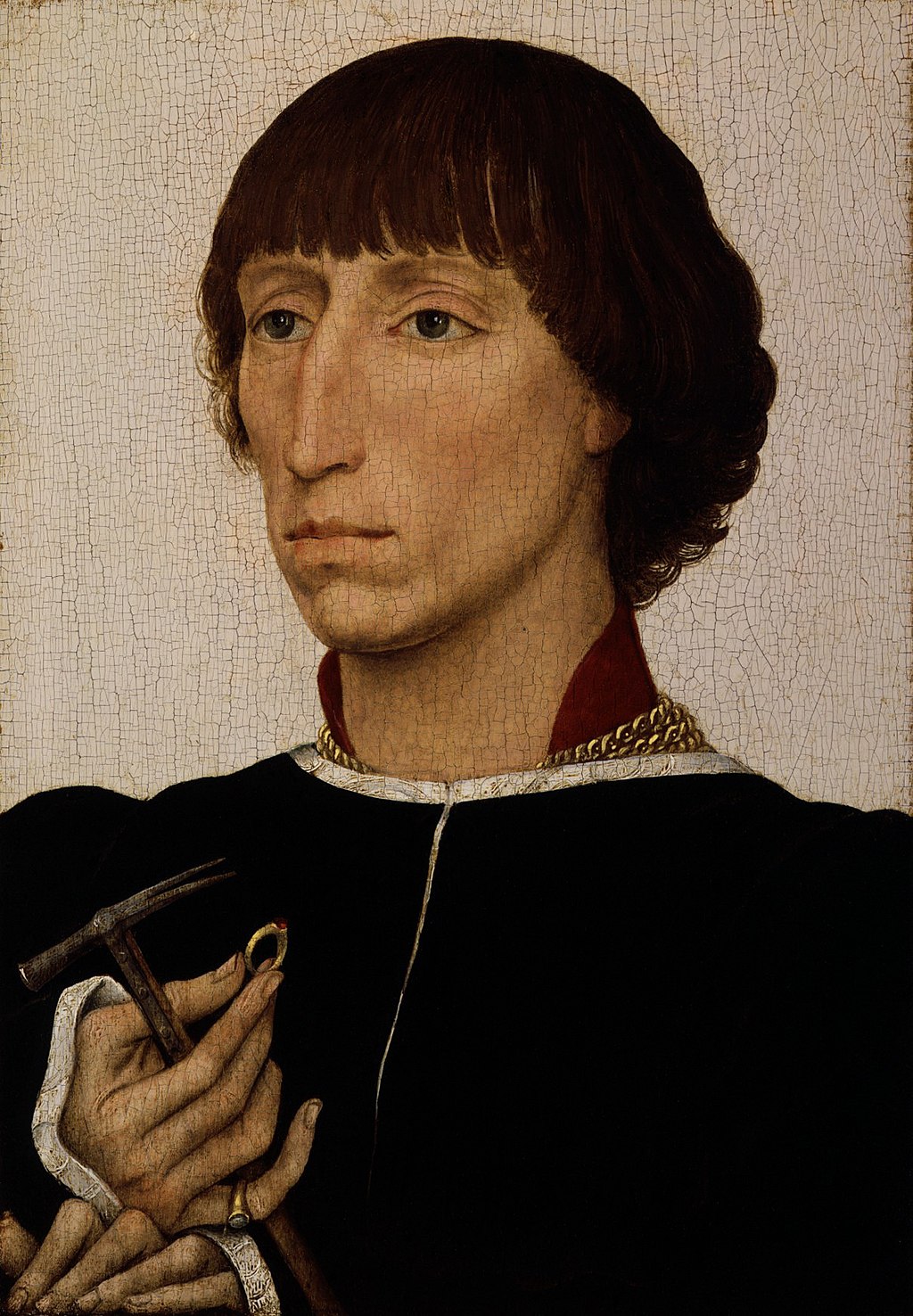
13- Rogier Van der Weyden (1399-1464), Portrait of Francesco d’Este (c. 1429-1476), ca. 1460, Oil on wood, 11 9/16 x 7 7/8 inches, The Metropolitan Museum of Art, New York.
Rogier van der Weyden painted several superb and sensitive portraits including Charles the Bold (Berlin), Le Grand Bâtard of Burgundy (Brussels), a Lady (National Gallery of Art, D.C.). Francesco d’Este was an Italian who received an education at the Burgundian Court. The d’Este family in Ferrara, Italy, was all-powerful when Rogier Van der Weyden visited there in 1450, though this portrait is done later. The sitter holds a hammer and ring whose significance is not explained with certainty.
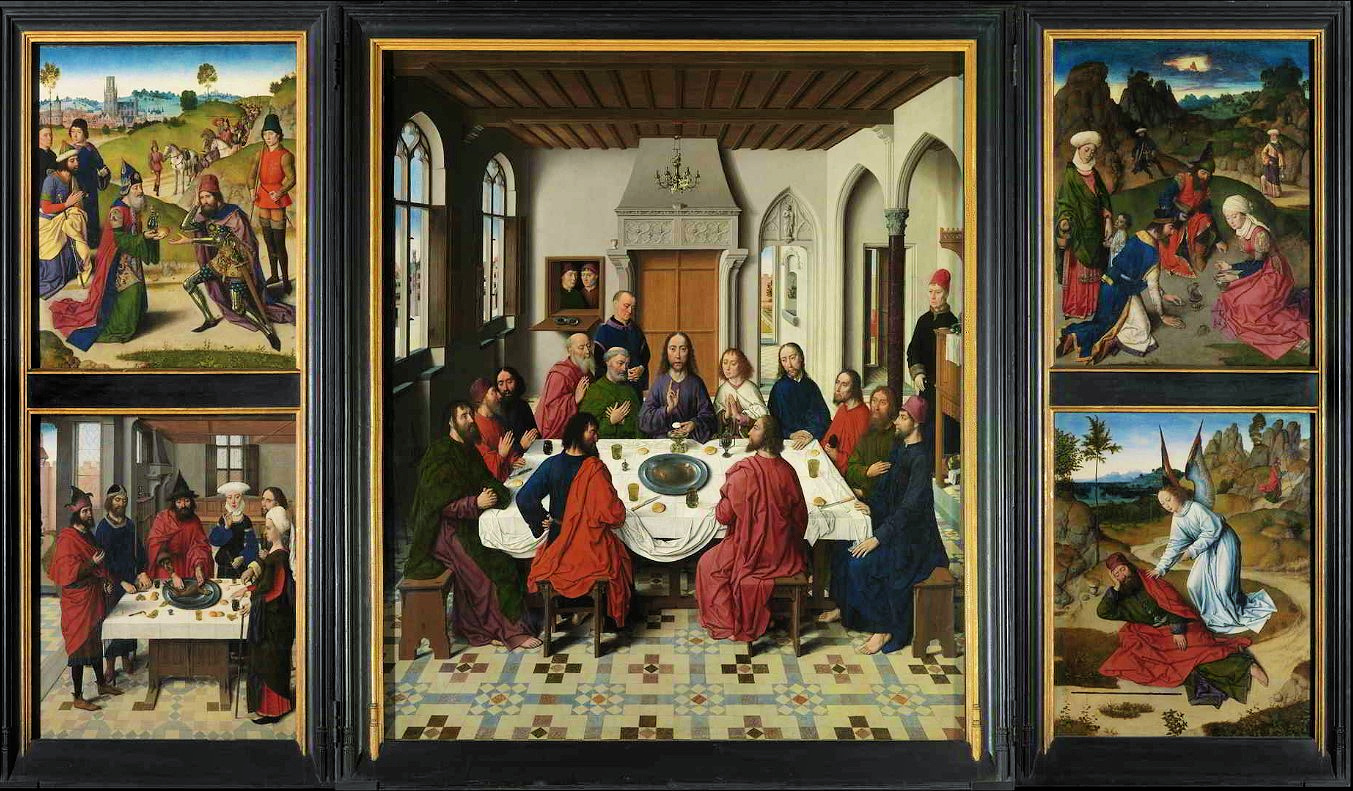
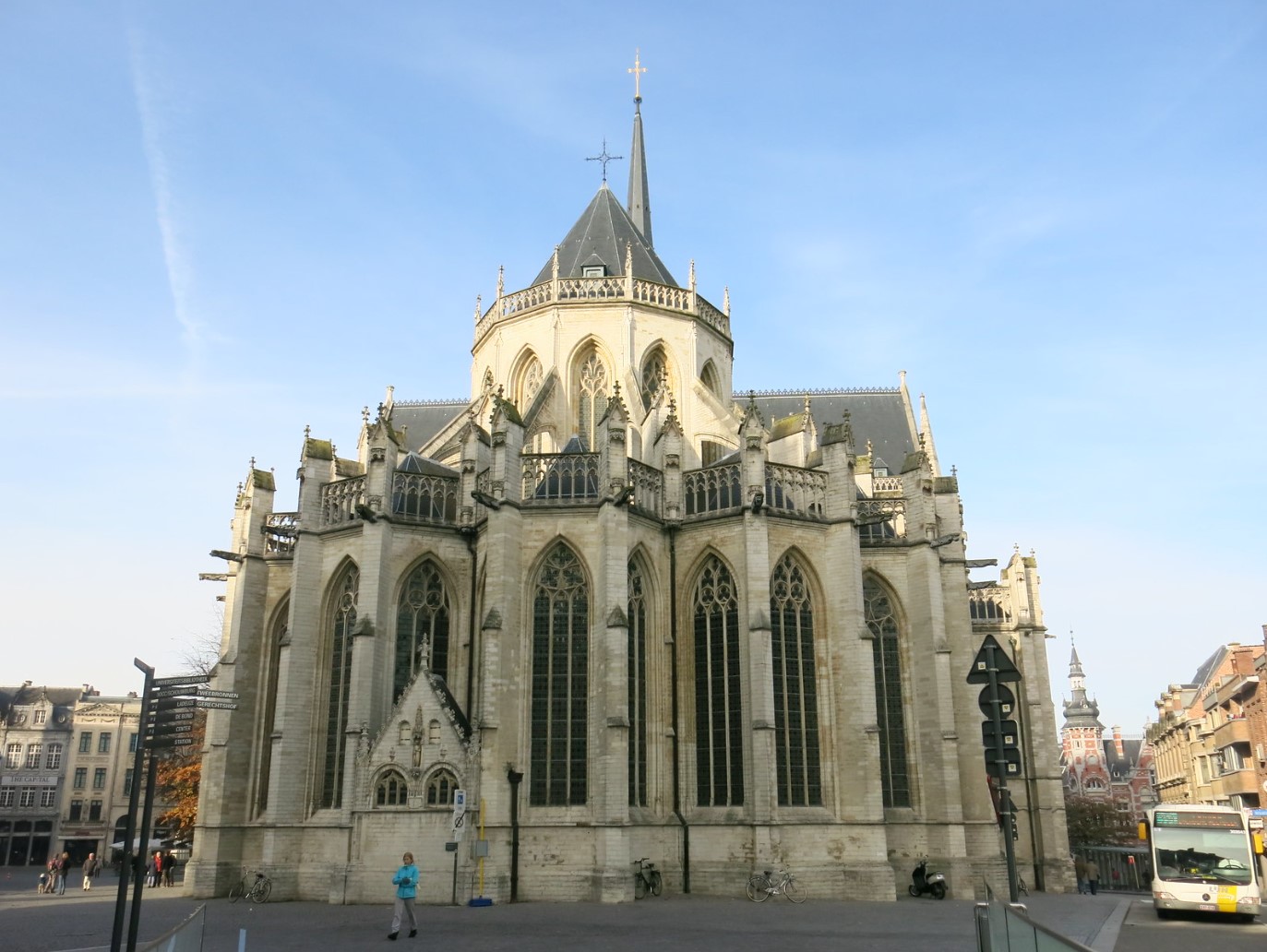
14 – Dieric Bouts (c. 1415-1475), The Altarpiece of the Last Supper or Five Mystic Meals, 1464-67, 70 ¾ x 114 inches, Church of St. Peter, Louvain, Belgium.
Dieric Bouts was born in Haarlem, the Netherlands, around 1415, where little is known of his early life. Before 1448 Bouts was working in Louvain where he married a wealthy Catharina Van der Brugghen and would work there until his death in 1475. Bouts’ finest paintings are characterized by their subtle depiction of colors and light on semi-inert and dignified and emotionally calm figures in detailed and delicately beautiful landscapes. Rogier van der Weyden influenced Bouts’ earlier work (Bouts may have trained with him in Brussels) in its greater emotionalism. In the year of Van der Weyden’s death the Brotherhood of the Blessed Sacrament of Louvain commissioned an altarpiece to place in St. Peter’s Church in Louvain. The artist worked with theologians to establish an iconography for the Eucharist which he then translated to contemporary Louvain with an exceptional plasticity whose result is that it is one of 15th century Europe’s greatest artworks. Jan Van Eyck’s influence is manifest in Bouts’ elegant intellectuality (in turn, Bouts was influential on 15th century German painting). Its perspectival calculus is matched to shapes and forms that convey emotion within the work’s compositional rigor. The head of Christ whose raised hand blesses the bread occupies the center of the artwork as the apostles gather in groupings around a table which itself develops within the room’s structure. The four side panels are scenes from the Old Testament transmitted likely by those same Catholic theologians who advised Bouts as to Biblical precedents to Christ’s Last Supper – here, the Feast of the Passover, Elijah in the Desert, the Gathering of Manna, and Abraham and Melchizedek. In 1472, Bouts was appointed city painter in Louvain, an honorary title at a time when the city was undergoing massive urban development. After Bouts’ wife died in 1473, the artist remarried in 1474 but died himself in 1475. Bouts was buried beside his first wife in the Franciscan church in Louvain. His sons, Dieric and Albrecht, were artists who continued the family tradition into the 16th century.
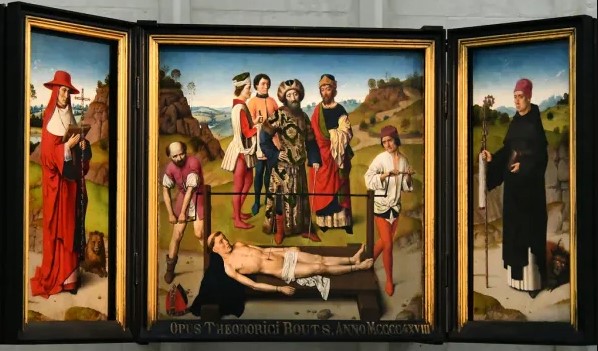
Bouts’ The Altarpiece of the Last Supper of Five Mystic Meals was to be placed in a chapel across from Bouts’ The Martyrdom of St. Erasmus in St. Peter’s, Louvain. Both artworks are hanging in the same place where it was intended for almost 600 years. “BELGIUM – LEUVEN – St Peter’s Church (7)” by eso2 is licensed under CC BY-NC-ND 2.0.St. Peter’s, Louvain. Choir and ridge 15th century. “St. Peter’s Church, Leuven” by dungodung is licensed under CC BY-SA 2.0.15 – Dieric Bouts (c. 1415-1475), The Martyrdom St. Hippolytus Triptych, 1470 – 1475 oil on wood, 35 ¾ x 35 ¾“ Groeningemuseum, Bruges, Belgium.
Unusual for Bouts this painting depicts the torture of martyrdom. There are many figures named Hippolytus in the early church. According to Prudentius’ 5th century account, one was the martyr Hippolytus who was dragged to his death by wild horses. The account led to this Hippolytus being considered the patron saint of horses. The square format panel preferred by Bouts depicts the martyrdom from above with foreshortened horsemen shown from the front. It is the first Flemish painting to depict movement not simply by using gesture. As Delevoy assesses, “The success of the picture lies in its timeless definition, its iconographic originality, its pictorial poetry, its popular feeling, its anecdotal interest.”
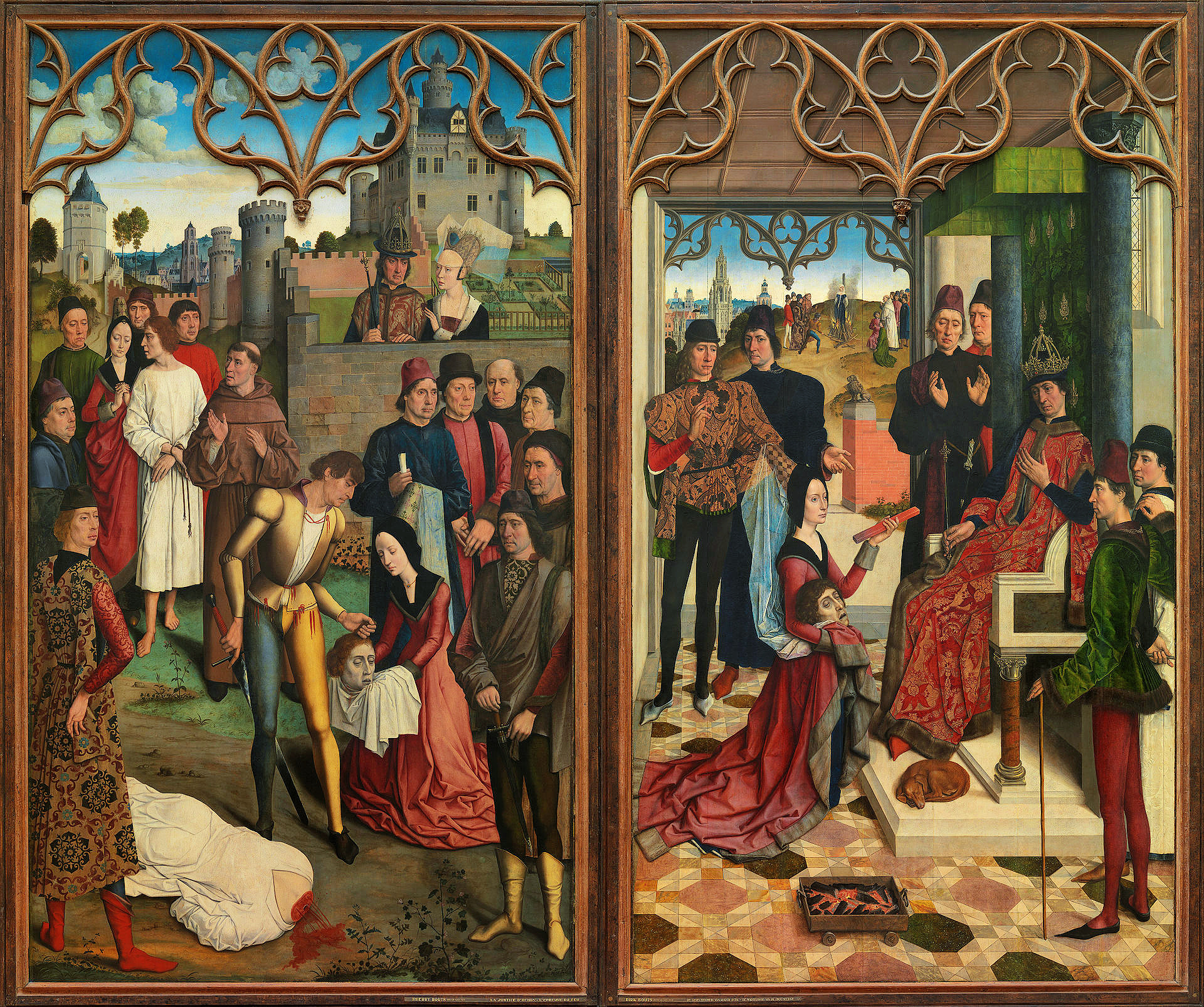
16 – Dieric Bouts (c. 1415-1475), Justice of Emperor Otto III Beheading of the Innocent Count and Ordeal by Fire, 1470 – 1475. oil on wood, 127 ½ x 72 ¼ inches, Royal Museums of Fine Arts, Brussels.
This is one of two paintings that is certain to be by Bouts (the other is Five Mystic Meals). It was commissioned in 1468 by a Louvain magistrate for the new city hall and intended to be an ambitious project on the Last Judgment. But it remained uncompleted at Bouts’s death. Panels representing heaven and hell survive and these two thematically related panels illustrating an episode from the legend of the Holy Roman emperor Otto III (980-1002). A 13th century chronicle tells how the Empress falsely accused an innocent man of a crime and persuades Otto and his court to behead him (left panel). The second panel shows the beheaded man’s wife, convinced of her husband’s innocence, approaching Otto’s throne with his head and a hot iron. Calling on God as judge, the Empress’s guilt is revealed and the royal is burned at the stake depicted in the distance. There is no lack of drama in the skillfully drawn episodes with elongated bodies, fanciful clothes, and unique facial expressions. The central focus of the panels is neither Otto nor his court but the put-upon widow of the innocent man murdered by the state through duplicity.
17 – Hugo Van Der Goes (c.1440-1482), Portinari Altarpiece: The Adoration of the Shepherds, 1476-78, 96 ½ x228 Inches, Le Gallerie degli Uffizi, Florence, Italy.
Hugo Van Der Goes (c.1440-1482) was the most important Netherlandish painter working in Ghent after Jan Van Eyck. A Ghent native, Van der Goes was in a guild there in 1467 and rose to its leadership between 1473 and 1475. Soon afterwards, the artist completed the Portinari Altarpiece for an Italian who was then residing in the Netherlands. The painting was sent immediately to Florence. Though not having the opportunity to have any great influence in the Netherlands, the Flemish 15th century art practice of cool colors and exquisite oil technique impressed the Renaissance Italians, notably Domenico Ghirlandaio (1448-1494). Also, its immense size – eight feet tall and 19 feet wide – and its virtuosity made an impact. By synthesizing Van der Weyden’s drama and sensuous expression and Bouts’ three-dimensional space, Van der Goes gives increased everyday tangible reality to his sacred subjects. Sharing Broederlam’s inquiries for visual appearances, Van Der Goes’ artwork creates new forms, types, and the impetus behind them based in popular sentiments and an edgy mysticism. So, in a 15th century sort of way, this is not your father’s Nativity (i.e, Master of Flémalle’s in 1420). It is ponderable, dense, significantly tactile and spatially voluminous. The Virgin, in prayer and in maternal caress, is in the exact center of the immense triptych. Also in the circle are St. Joseph, the shepherds, angels in the air and the Christ Child. The painting is a masterpiece of contrasts – between religious, secular, and rustic architectures; heavenly and earthly figures; peace and agitation; filled space and void; warm tones and cool colors.
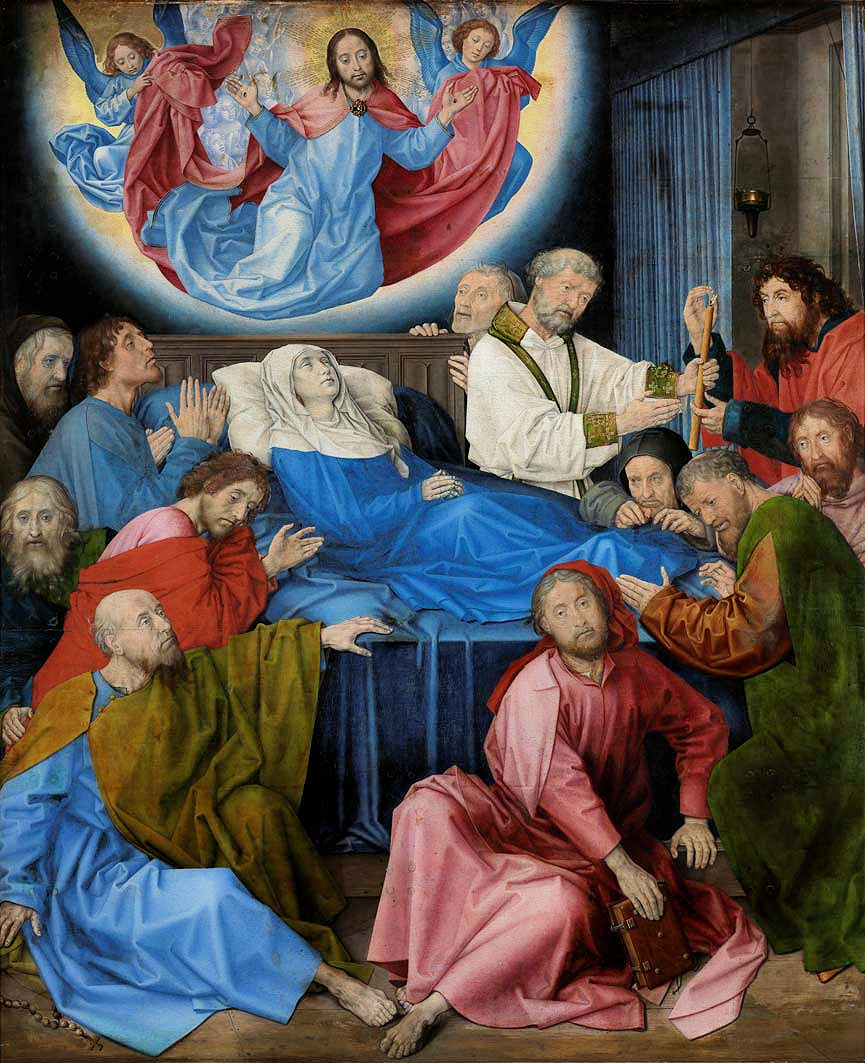
Hugo Van Der Goes (c.1440-1482), Portinari Altarpiece (detail).18 – Hugo Van Der Goes (c.1440-1482), The Death of the Virgin, c 1472–1480. 58 ½ x 47 ¾ inches, 147.8cm x 122.5cm. Groeningemuseum, Bruges, Belgium.
Around 1475 Hugo Van Der Goes became a lay brother in an Augustinian Priory, the Roode Cloister. Founded in 1367, the cloister is on the southeastern edge of modern Brussels. The artist continued to paint and receive visitors there, traveled to Louvain and Cologne, and died in 1482.
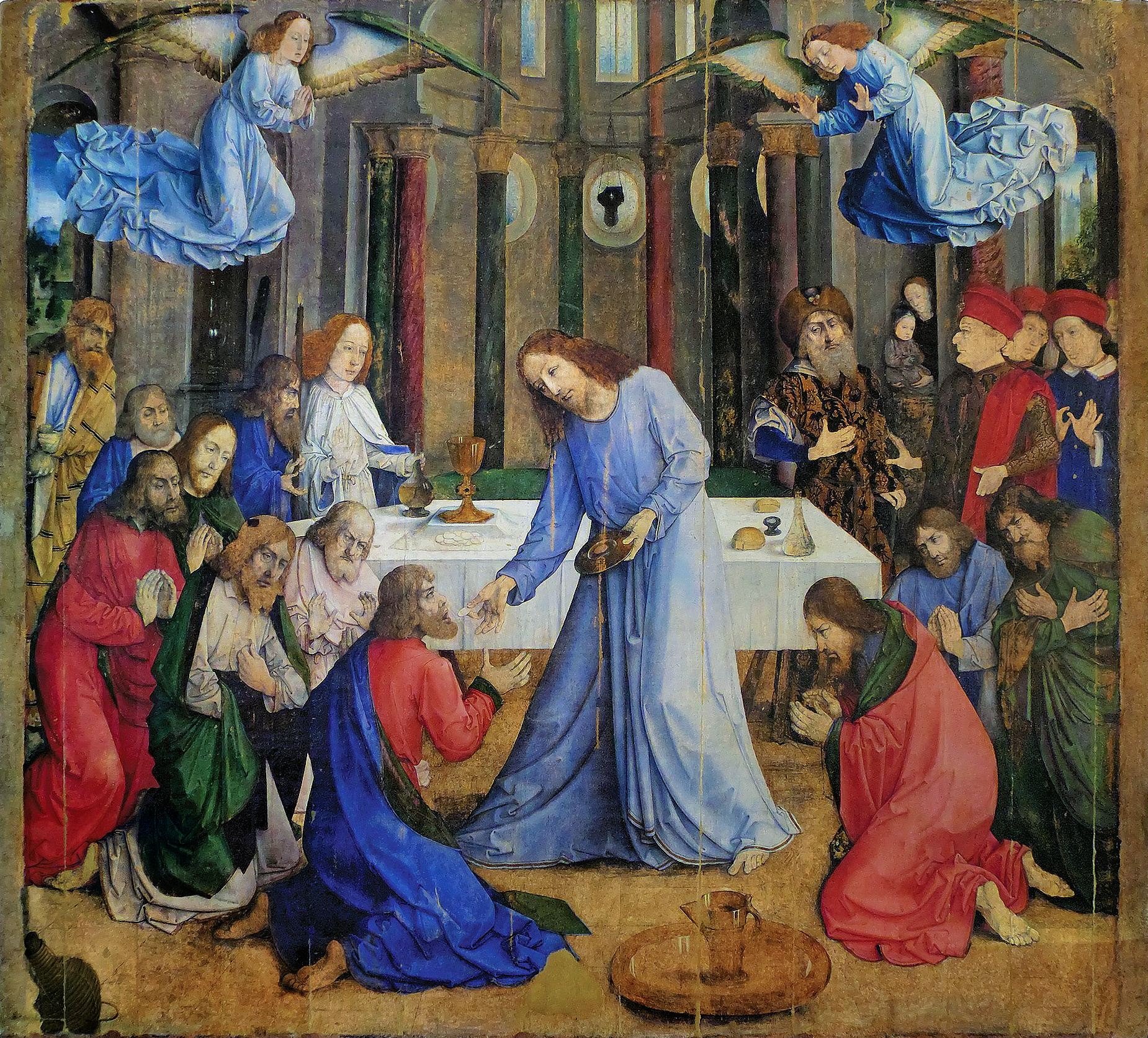
19 – Justus (Joos) van Gent (c.1435-1475), Communion of the Apostles or Institution of the Eucharist, 1473-75, 113 x125 inches, Ducal Palace, Urbino, Italy.
Justus van Ghent was a master in Antwerp in 1460 and in Ghent four years later where he met Hugo van der Goes. By the time of his death Justus van Ghent was in Rome, a city that was increasingly attracting international artists, including from northern Europe. Van Ghent was in Urbino where he painted Institution of the Eucharist in Urbino. The commission was originally given to Italian artist Piero della Francesca (1415-1492) and its predella (the altarpiece’s painting at its lower edge) was completed by Uccello (1397-1475).
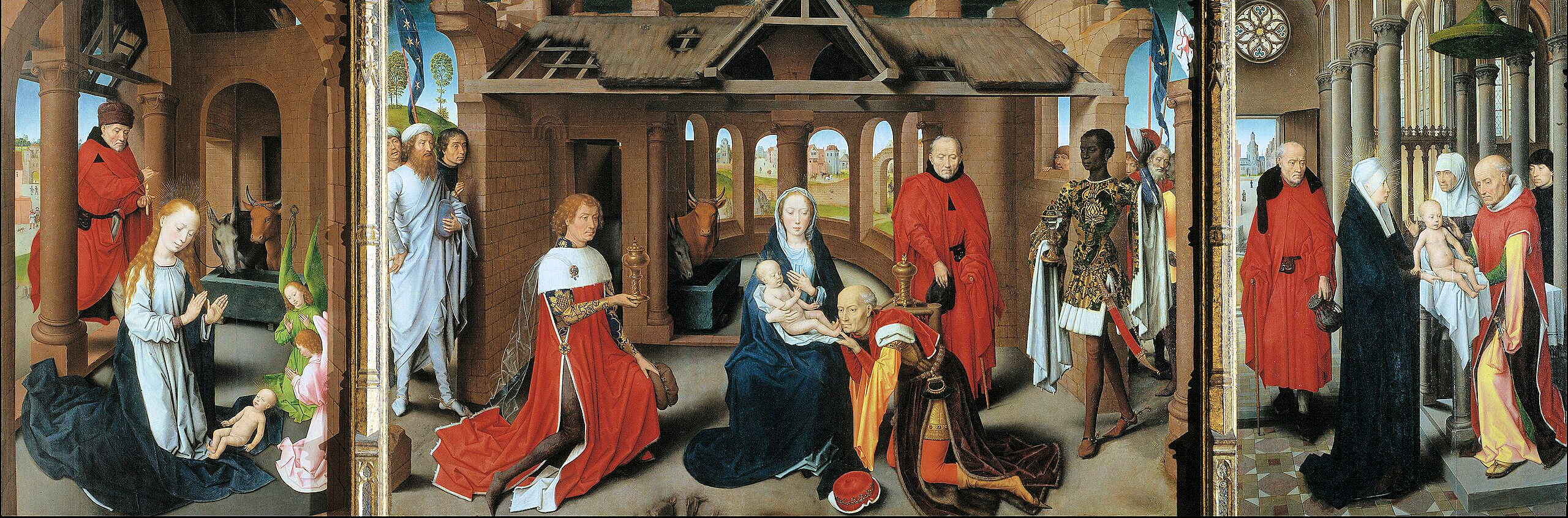
20 – Hans Memling (c. 1433-1494), The Adoration of the Magi (c. 1470), 37 ¼ x 57 inches, c. 1480, oil on panel, El Museo Nacional del Prado, Madrid.
Hans Memling was a German, born near Frankfurt-am-Main. Memling was likely a student of Rogier van der Weyden and completely Netherlandish in his artistic style. Memling lived in Bruges and became a citizen in 1465. By 1480 the successful artist was one Bruges denizen who was paying the city’s largest amount of taxes. Though not innovative, Memling’s artwork depicts calm and peaceful figures full of piety. Memling also painted portraits successfully. Examples of his artwork are in collections all over the world.
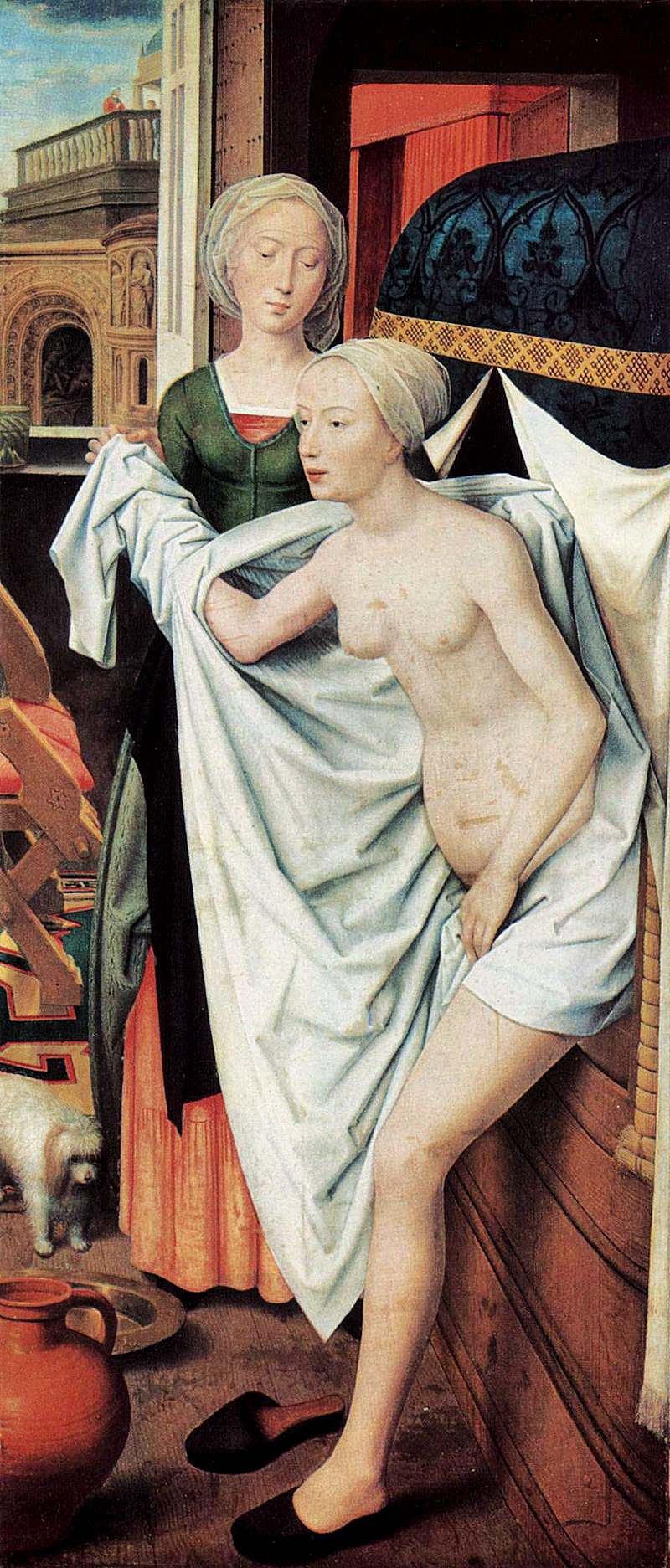
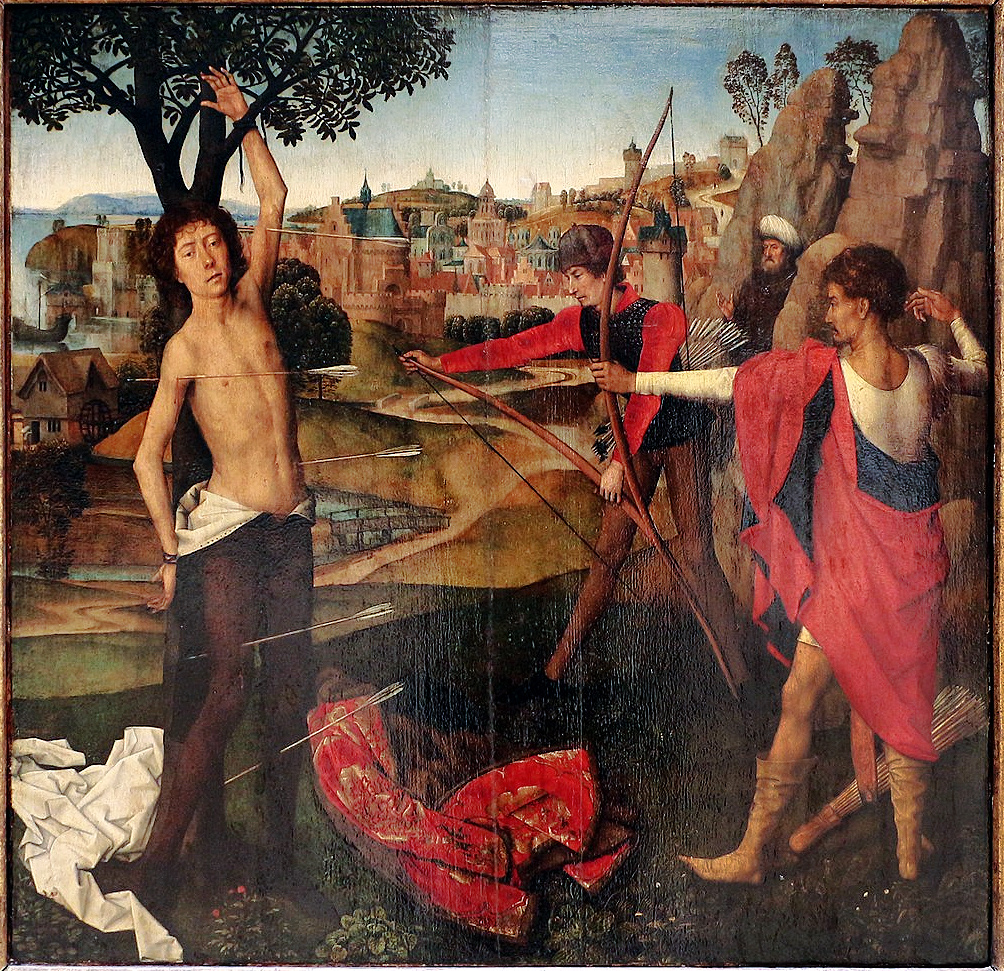
21 – Hans Memling (c. 1433-1494), Bathsheba at her Bath, c. 1480-1485, 37 ¾ x 33 inches, Staatsgalerie Stuttgart, Germany.22 – Hans Memling (c. 1433-1494), The Martyrdom of Saint Sebastian, c. 1475, 26 ¼ x 25 ½ (67.4 x 67.7 cm), oil on wood, Royal Museums of Fine Arts of Belgium, Brussels.23 – Gerard David (c.1460-1523), The Justice of Cambyses: the arrest of the Dishonest Judge, 1498, Groeningemuseum, Bruges, Belgium.
Gerard David was a Dutch painter born in Oudewater. David was in Bruges by 1484. He was the last major painter from Bruges and painted pious pictures in a gentle Netherlandish style right before the rise of a new Italianate style in Antwerp. David traveled to Antwerp in 1515 and joined the Guild but returned to Bruges and died there in 1523. Though many pictures are attributed to David, the pair of Justice paintings are certainly his.
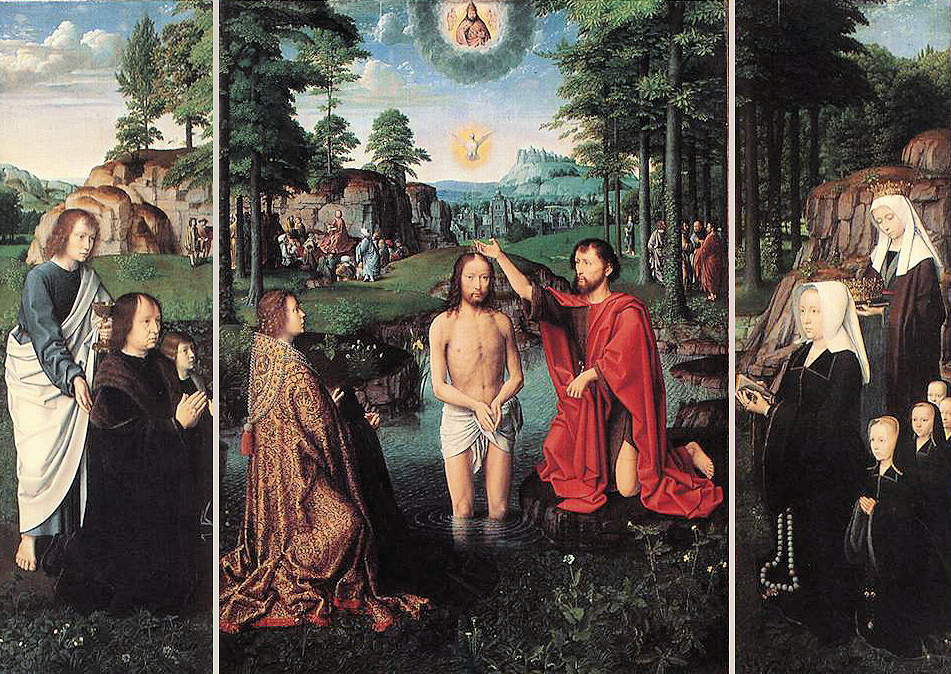
24 – Gerard David (c.1460-1523), Altarpiece of the Baptism of Christ, 1502-1508, 52 ¾ x 73 ½ inches, Groeningemuseum, Bruges, Belgium.
SOURCES:
A Dictionary of Art and Artists, Peter and Linda Murray, Penguin Books; Revised,1998.
Early Flemish Painting, Robert L. Delevoy, New York: McGraw-Hill Book Company, Inc., 1963.
All three versions of Van Gogh’s “The Bedroom” at The Art Institute of Chicago, February 14 to May 10, 2016. Author’s photograph.
The photograph above depicts the three versions of Van Gogh’s “Bedroom” in Arles, France, in this blockbuster exhibition’s penultimate gallery.
From the collections (left to right) of the Musée d’Orsay, Paris (1889), The Art Institute of Chicago (1889), and the Van Gogh Museum, Amsterdam (1888).
The three masterworks were gathered together side by side in North America for the first time in art history.
By John P. Walsh. May 6, 2016.
I saw the Van Gogh’s Bedrooms exhibition at The Art Institute of Chicago (February 14-May 10, 2016) on the last Friday afternoon before the show closed. The museum that day was drawing a large crowd and it was challenging to navigate through the multi-room art show in a mass of frequently immobile art lovers. Exactly for what cause some stationary patrons might be transfixed could only be speculated upon but often no art was present. No one I think comes to art shows to be caught in a logjam of people yet that recurrent phenomenon in Van Gogh’s Bedrooms soon became one of its unpleasant features. The expansive exhibition space—striking for its illogical reasoning to display three relatively small masterpieces—proved impractical, or at least a two-edged sword, in terms of containing its throngs.
Those three featured paintings are this show’s raison d’être and prove a marvelous highlight after reaching them by way of a dozen or so high-ceiling galleries. Once arrived to the show’s penultimate room, my eyes settled on the Van Gogh Museum, Amsterdam’s version as the most intriguing of the three superficially identical works. The other two versions are from the collections of The Art Institute of Chicago and the Musée d’Orsay in Paris.
When 35-year-old Van Gogh painted his The Bedroom series starting in October 1888, the Dutchman had been an artist only a short while: about 7 years. This had followed a variety of other occupations, although Van Gogh began his professional life as an art dealer. By late 1888—less than two years before his death by self-inflicted gunshot in Auvers-sur-Oise in July 1890—Van Gogh had traveled long and far from his beginnings in North Brabant. He arrived into Paris in 1885 to paint and join his brother Theo who was an avant-garde art dealer in the Rue Montmartre. Looking to sell more of his artwork, he began painting in the bright Impressionist style for which Van Gogh is probably most famous today. By February 1888 Van Gogh relocated to Arles in the South of France on account of his health and to possibly start an art colony. Still quite poor and alone, this roughly 15-month period in Arles proved to be prolific for the artist’s production when Van Gogh completed 200 paintings, and over 100 drawings and watercolors. Many of Van Gogh’s most famous works were created in this fecund period—for example, his portraits of Eugène Boch (Musée d’Orsay), Postman Joseph Roulin and Augustine Roulin (both Museum of Fine Arts, Boston) and Madame Ginoux (Metropolitan Museum of Art, New York) among several others; sunflowers and irises such as Still Life: Vase with Fourteen Sunflowers (National Gallery, London), Still Life: Vase with Fourteen Sunflowers (Neue Pinakothek, Munich) and Irises (Getty Museum, Los Angeles); 15 canvases of cypresses; and his iconic Self-Portrait Dedicated to Paul Gauguin in the Harvard Art Museums.
None of these contextual artworks were in the Chicago show but demonstrate the range and depth of Van Gogh’s artistic vision in the same time period that The Bedrooms—which shared his body of work’s intoxication with color and decorative strategies—were painted.Despite its title—Van Gogh’s Bedrooms—this show is not content to let their presence in Chicago suffice. Instead, much of the other parts of this massive show were from the Art Institute’s permanent collection of mostly Barbizon and Impressionist artwork. Perhaps if they had been left on whatever museum walls from which they had come, these fine artworks might have maintained an even greater impact for themselves and this show’s ultimate purpose than crowding them onto walls into this special exhibition space. That said, the condensed interpretive curatorial exercise of parts of the permanent collection in this show could prove interesting for visitors who are not willing or able to visit other parts of the museum. In a show that took on the formula of a typical Regenstein Hall blockbuster, its propensity for Impressionist rehash (“delve” was the museum’s word) had a boring art textbook’s sensibility. That the show dipped into the museum storehouse to retrieve the life-size maquette of the Yellow House from AIC’s vastly superior exhibition Van Gogh and Gauguin: The Studio of the South in 2001, produced a dispiriting effect on at least one viewer who recognized it.But so far I am quibbling: this AIC exhibition brings together the powerful canon of all three versions of Van Gogh’s The Bedroom for the first time in North America which is very special and undoubtedly sufficient to any museum goer’s time and interest. I don’t believe, however, that their full artistic power was best served by being able to see these objects intensely advertised in the media markets and then only hung at the show’s virtual end following a cacophony of mostly extraneous art historical resources however severely earnestly presented. Instead, a surfeit of front-loaded artistic riches labors to obscure these significant Van Goghs that finally appear in the second to last gallery, all of which are jam-packed with art, people, various filmic explorations, somewhat bloviating wall texts, whole house reconstructions, etc.
Van Gogh Museum Amsterdam, October 1888. 72.4 x 91.3 cm.
Chicago, 1889. 72.4 x 91.3 cm. Version Van Gogh painted in the asylum at St. Rémy.
Paris, 1889. 57.5 x 74 cm. Destitute bachelor artist Van Gogh gave this version to his mother and sister to assure them in part that he was working..
It is certainly obvious that Van Gogh’s Bedrooms possibly could have benefited by not pulling out all the stops (AIC: “in-depth study”) but to focus on the three colorful masterpieces uniquely gathered in their essential power. If one wants to read blow by blow explanations of virtually every curatorial application in the show, one might turn to other reviews cited in “Further Reading” below. The equitably in-depth appreciation of this trio of Van Gogh works—and minus the Disney World trappings—might be advanced using timed tickets (as done for Van Gogh and Gauguin: The Studio of the South) and within a pared down and simpler exhibition scope. The way things are constructed by the show’s curator Gloria Groom, Chair of European Painting and Sculpture at The Art Institute of Chicago, the exhibition transmits encyclopedic knowledge while largely missing a tangible evocation of bachelor Van Gogh’s humble petit boulevard persona who produced in Arles in 1888 and in Saint-Rémy in 1889 these bold canvases of his simple bedroom and even gifting one of the versions (the one now in Paris) to his aged mother and sister to reassure them in his destitution. For Van Gogh the motif of his private and hard-featured bedroom in Arles continued his bold self-expression in a tightly woven and complex painting composed in broad outlines using a many-hued post-impressionistic palette in thick impasto. Despite Van Gogh’s reputation as mad—he mutilated his ear in this bedroom in December 1888—he soon carried on painting two more versions of The Bedroom (the last one slightly reduced) with the apparent added intention to express to his family and friends that the artist was as stable and restful as his artistic subject.
What should an exhibition advertised as Van Gogh’s Three Bedrooms wish to have its spectators looking for and come away with? By the time a visitor reaches Van Gogh’s three paintings after plowing through the aforesaid gauntlet of people and well-known Chicago art resources, the exhibition almost runs the danger of displaying these highly-prized artworks not as denouement but incidental. These Van Gogh paintings are hardly allowed to speak freely for themselves. Of course they have a fascinating history but to what degree should these particular artworks’ written history be simultaneous to their exhibition? Thinking of the viewer, does the display of three paintings of an artist’s bedroom (albeit Vincent Van Gogh’s) that when placed side by side measures the whole of about ten feet across merit thousands of cubic feet of mostly academic groundwork before a viewer can even see them? To what degree are artistic exhibition and their intellectual exposition necessarily complementary since many museum art shows follow this tactic?
The final gallery after the display of the three bedrooms continued Van Gogh’s Bedrooms’ devotion to comprehensive information and theatricality—although a side-by-side blow-up of the bedrooms’ diverging painterly details was perhaps the most useful techie display so to appreciate the artist’s handling of the individual paintings. Yet it begged a question: could this orientation to detail, to seeing the painting, somehow serve as the exhibition’s primary or sole introduction, such as in a film theater? This last gallery then led directly to the ubiquitous and depressing gift shop hosting the galleries’ multitude disporting themselves basically as they did in and among the art. Hearing its timbre I wondered if a unique opportunity to view together these three Van Gogh bedroom paintings—“the first time in North America”—had under- or overplayed its hand? As its elemental objective, had the exhibition Van Gogh’s Bedrooms rightly oriented and imparted to its viewers an intimate and perhaps personally revealing look into these three sensitive treasures of Van Gogh’s oeuvre? Or had the artist Van Gogh merely omitted to paint into his own scene the proverbial kitchen sink?