Monthly Archives: January 2026

Beginning of the end of a life of violent crime: the story of John Dillinger’s first hideout in Chicago at 3512 North Halsted on March 3, 1934, to his being killed at the Biograph Theater on July 22, 1934, by the FBI.

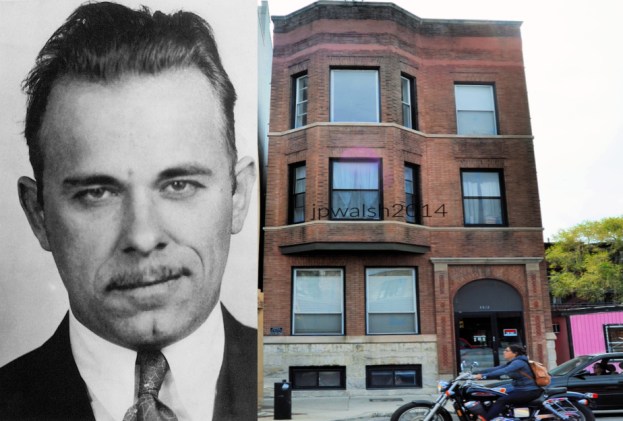
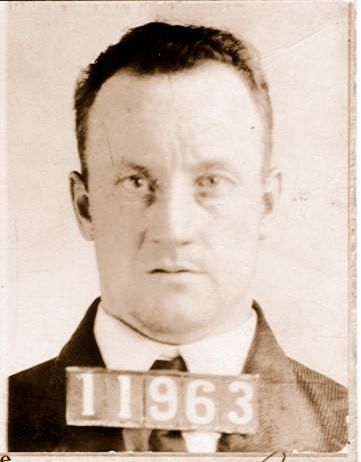
FEATURE IMAGE:  On March 3, 1934, John Dillinger (left in a mug shot) used the second floor of this three-flat building on Chicago’s north side as his first hide out after he and another criminal, murderer Henry Youngblood, drove directly here from a jail in Crown Point, Indiana following their break-out. In January 1934 Dillinger had been extradited to Indiana from Arizona. Public domain. Author’s photograph. May 2014.

In the Great Depression many banks had failed wiping out entire savings of millions of ordinary Americans. Banks that stayed open saw their primary business becoming foreclosures on ordinary American’s homes, farms, and businesses. And the economy was not improving. Bank robberies were viewed by some as a sort of just retribution in desperate times or even sometimes more favorably since bank robberies could involve the destruction of bank records, including mortgages, so that the bank could not as easily foreclose. There was a myth of the glamorous getaway involving handsome celebrity robbers. Such was the story of John Dillinger (1903-1934) with his gangs including Harry “Pete” Pierpont, Lester “Baby Face Nelson” Gillis, John “Red” Hamilton, and Homer Van Meter and their girlfriends. John Dillinger, declared Public Enemy No. 1 by the FBI in June 1934, epitomized the early 1930’s Depression-era bank robber in America as he terrorized the Midwest following his release from jail from September 1933 until July 1934.  In this period other robbers included “Pretty Boy” Floyd, “Machine Gun” Kelly, and Bonnie and Clyde who died in a hail of gunfire in May 1934 as these territorial and nomadic robbers’ crime sprees were splashed across newspaper headlines that the public consumed like that week’s latest movie serial. 
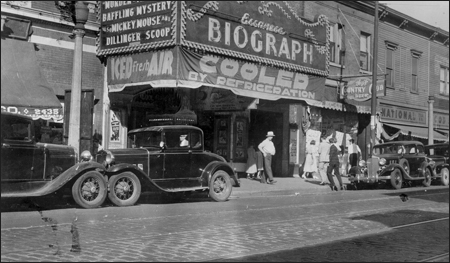
FBI photograph of the Biograph Theater in 1934 shortly after the shooting of Public Enemy No.1, John Dillinger. Public Domain

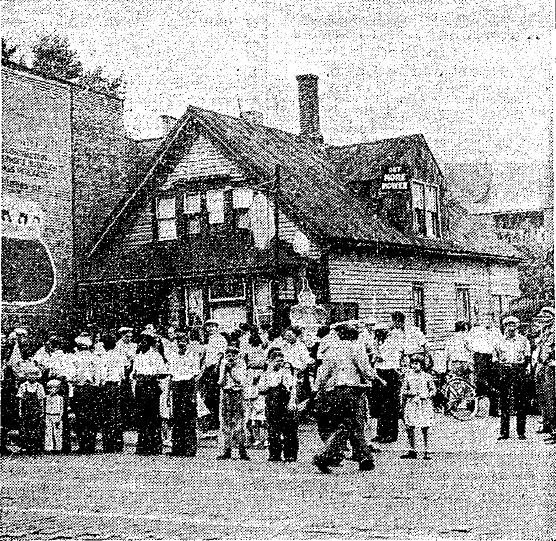
New federal anticrime laws targeted interstate criminals that made bank robbery, the transport of stolen goods or the flight of a felon over state lines, a federal crime and came under the jurisdiction of the FBI. That is where this three-flat in Chicago enters criminal and criminal law history. About midway between Lake Michigan and Wrigley Field in Chicago sits John Dillinger’s Hideout, a red brick three-flat at 3512 N. Halsted in the Uptown neighborhood. After his Indiana jail break on Saturday, March 3, 1934, John Dillinger, with murderer Henry Youngblood, headed directly to Chicago and hid out for one night in this building. Dillinger stayed on the second floor of an apartment owned by Frances “Patsy” Frechette, the half-sister of Dillinger’s girlfriend, Evelyn “Billie” Frechette (1907-1969). This break out gave FBI chief J. Edgar Hoover his first big chance to apply federal anticrime laws after Dillinger broke out of the “escape-proof” jail in Crown Point, Indiana, having used a fake gun, stole Sheriff Lillian Holley’s car and drove the 50 miles or so across state lines to this building in Chicago, Illinois. Dillinger violated the Dyer Act and put himself in the jurisdictional sights of the FBI. On March 7, 1934, Hoover mounted a special operation to capture Dillinger, dead or alive, that would come to a successful, and bloody, conclusion on the evening of July 22, 1934, outside the Biograph Theater, about a mile and half straight south from this site. On a swelteringly hot night, Dillinger went to the air-conditioned movies and, having been set up there by the “Woman in Red,” would find himself hours later chilling in a morgue.
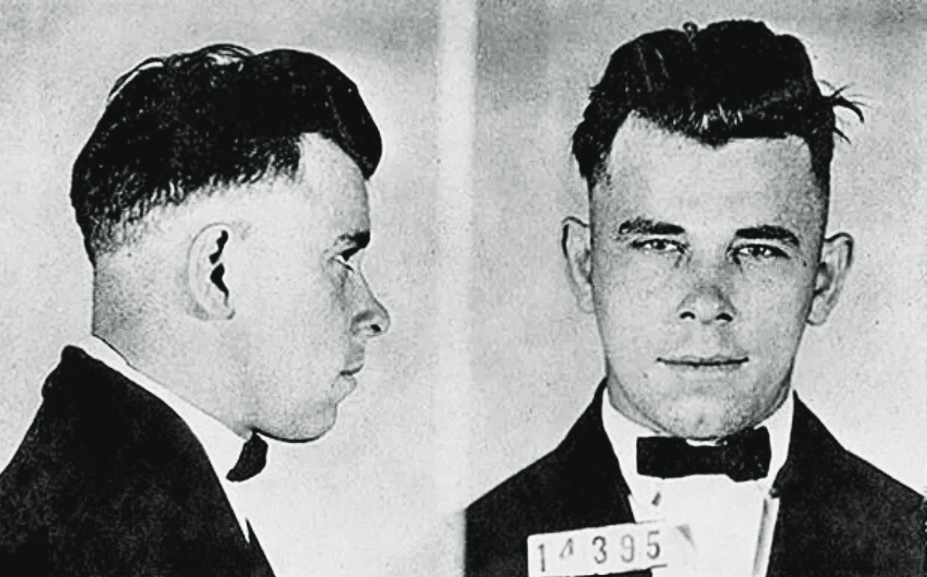
John Dillinger mug shot. Public domain.

Dillinger started early in a life of crime so that when he was 21 years old, he was serving what would be a nine-year sentence in an Indiana prison for robbery. Originally from Mooresville, Indiana, near Indianapolis, Dillinger and Chicago were paired for much of his adult criminal life. He joined the US Navy in Chicago in 1923 to escape an auto theft rap in Indiana. But 6 months later Dillinger gave up the ship, the USS Utah, and was dishonorably discharged. He was behind bars for that nine-year sentence for robbery starting in fall of 1924. When he was paroled in 1933, the ex-con turned to a life of violence as a bank robber. During his final 10-month crime spree Dillinger and his gang killed at least 10 people including a sheriff during one of their three jail breaks, and wounded seven more.
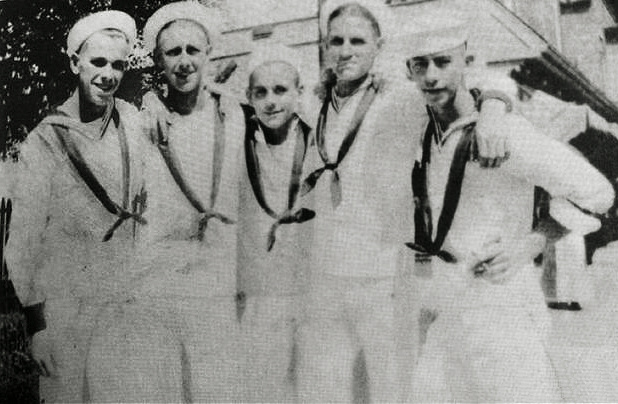
John Dillinger (left) with navy buds. Public domain.

To go from this hideout on March 3, 1934, to Dillinger’s death on July 22, 1934, was nearly half of Dillinger’s final 10-month episodic crime spree. In late January 1934 Dillinger and Billie and most of his gang was in Tucson, Arizona, with Dillinger checking escape routes to Mexico. Some of the gang was on the lam from a bank robbery in East Chicago, Indiana. Caught by local police, Dillinger was extradited by airplane to Indiana via Chicago and jailed in Crown Point, Indiana. It was there that he first hired Louis P. Piquett, a Chicago attorney known for close ties to the Chicago mob. Billie Frechette visited Dillinger at Crown Point in mid-February 1934. But, on March 3, 1934, Dillinger broke out of the jail and remained free until his death in late July 1934 at the hands of law enforcement.

3512 North Halsted, Chicago. Author’s photograph. May 2014.

There are many hideouts for Dillinger and his gang as they were highly peripatetic. But this hideout is significant since it is the first hideout for Dillinger on his final way to capture and death as Public Enemy No. 1 but also an American folk anti-hero. Dillinger arrived at the apartment of Patsy Frechette to hide out and reunite with Billie after crossing the state line in the stolen sheriff’s car. Dillinger was here for a significant rendezvous and transition though for too short a time for any law enforcement raid occurring at this specific address during his stay. The hideout is just steps – a literal 3-minute walk – from the long-established (1872) 42nd Precinct “Town Hall” police station.  Instead, the FBI’s first major violent confrontation with the Dillinger gang following his escape took place weeks later at the Little Bohemia Lodge in northern Wisconsin in April 1934.

The next day, March 4, 1934, Dillinger set out for Minneapolis with Billie and rented an apartment (the Indiana sheriff’s stolen car was ditched in Edgewater) at Lincoln Court Apartments, Unit 303, at 95 Lexington Parkway in St Paul. On March 6, 1934, escaped con man Dillinger driving a 1934 Packard robbed a bank in Sioux Falls, North Dakota with gang members Homer Van Meter, Eddie Green, Tommy Carroll, and Baby Face Nelson. In the robbery a policeman was wounded and the gang took almost $50,000 ($1.2 million in 2026). One week later, on March 13, 1934, Dillinger, driving a Buick, robbed a bank in Mason City, Iowa, with the same gang members plus John Hamilton. Taking $52,000 in cash ($1.25 million today), a bystander was wounded as was Dillinger and Hamilton who returned to St. Paul for medical attention. That same day (March 14, 1934), Henry Youngblood, the murderer who escaped prison with Dillinger less than two weeks before, was shot and killed by law enforcement in Michigan. A deputy sheriff was killed in the capture.
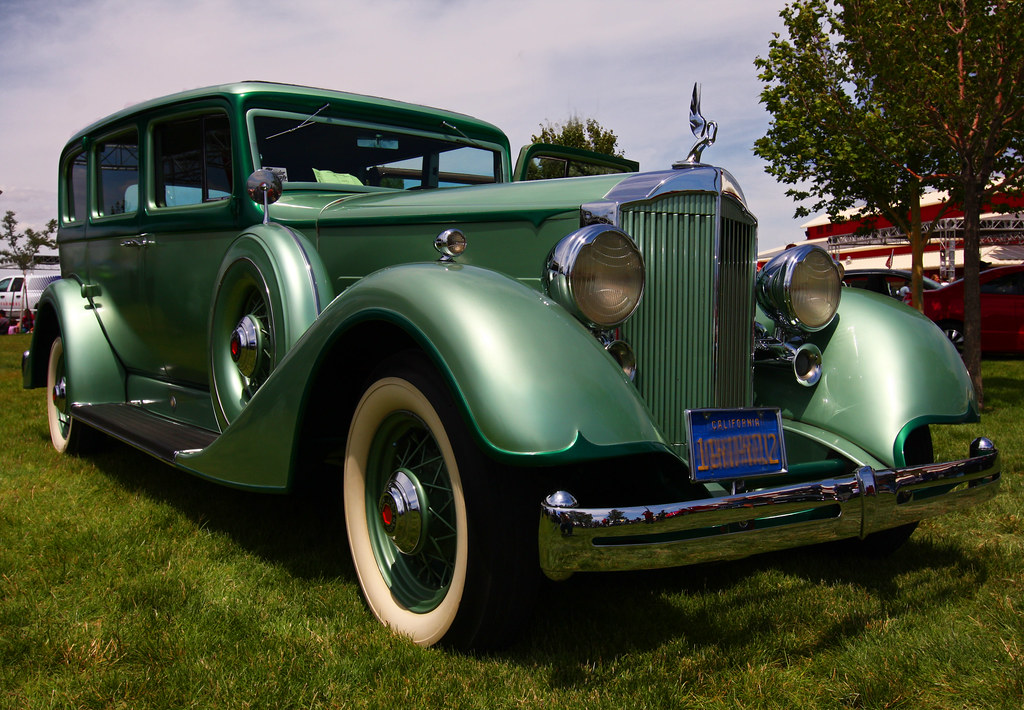
1934 Green Packard. “1934 Packard” by Rennett Stowe is licensed under CC BY 2.0.

Two days later, March 16, 1934, Dillinger and Billie return to Chicago. Days later he and Billie are back in St. Paul living together in the apartment under an alias (rent is $60 a month – about $1440 today). The criminal bank robber Dillinger drove to Ohio to see if he could spring from jail his mentor and partner Harry Pierpoint who had an impending death sentence but Pierpont, on October 17, 1934, was executed in the electric chair. On March 30, 1934, Dillinger was back in St. Paul with Billie and his gang members with girlfriends. At the same time, the FBI was tipped off as to Dillinger’s whereabouts and when three agents arrived at the apartment to investigate on March 31, 1934, Dillinger and Billie escaped though Dillinger was wounded in the leg. He sought medical attention across town in Minneapolis where he recovered during the next week though Eddie Green was shot and mortally wounded. The FBI, hot on Dillinger’s trail, raided the house of Dillinger’s half-brother Hubert in Indianapolis after Dillinger and Billie bought a car there with hot money and listed Hubert’s address as theirs. On Monday, April 9, 1934, Dillinger and Billie were back in Chicago where Billie was arrested at 416 North State as Dillinger escaped. Billie was held on a $60,000 bond ($1.44 million today) in response to the pair’s fleeing that shootout with law enforcement in St. Paul, Minnesota. Her trial in May 1934 resulted in a conviction. By Friday, April 13, 1934, Dillinger with Homer Van Meter had robbed a police supply station in Warsaw, Indiana, and stole firearms (Dillinger was partial to .38 revolvers throughout his career) and bulletproof vests.

Billie Frechette (1907-1969) was born on a Menominee Indian Reservation in Wisconsin. After her arrest she was tried and convicted of violating a federal law of harboring a criminal and served a two-year prison sentence without parole in a federal pen in Milan, Michigan. Public domain.
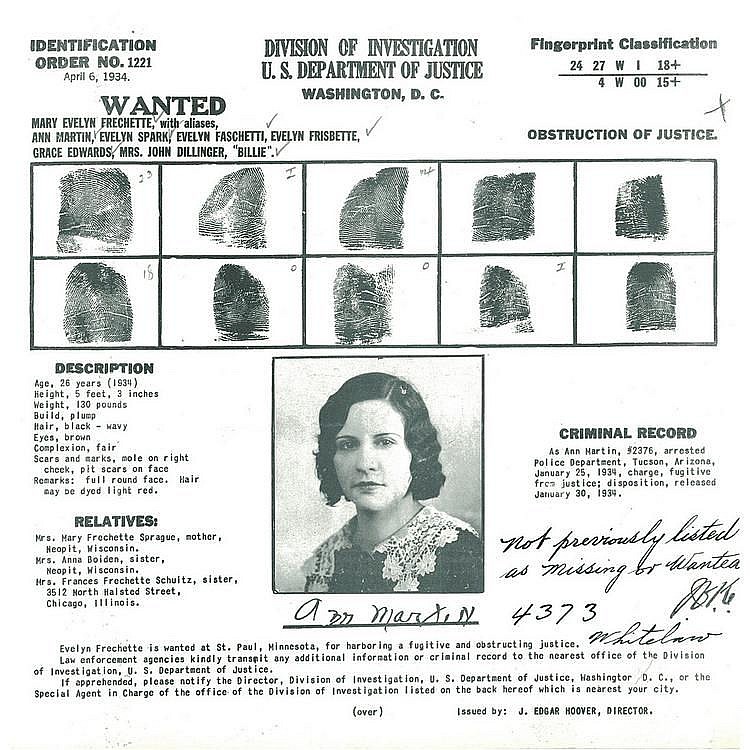
FBI wanted poster for Billie Frechette. Public Domain.

The next day Dillinger and Van Meter were in Cedar Rapids, Iowa where they broke into a tourist camp and stayed in a cabin for a few days. Dillinger then drove to Sault Ste. Marie, Michigan with John Hamilton. Meanwhile Homer Van Meter, Marie Comforti, and Pat Reilly arrived at Little Bohemia Lodge in Manitowish, Wisconsin where that evening of Friday, April 20, 1934, Dillinger, Hamilton, and others arrived for a three-day paid stay. The lodge was owned and built in 1929 by a Dillinger friend. The proprietor’s wife, hoping to secure the FBI’s $10,000 reward for Dillinger’s capture (about $250,000 today), tipped off law enforcement on many fronts after an elaborate feint of trust/ mistrust among the lodge’s owners and Dillinger’s gang. The G-men immediately chartered two airplanes full of agents from St. Paul and Chicago to Rhinelander Airport. Agents in communities surrounding the lodge were summoned to assist in the raid. There were complications: the weather was bad (snow and ice), and the agents on arrival found they had only one car when they needed 6 or 7. Meanwhile Dillinger announced he changed plans and was leaving the Lodge early.  After renting cars agents arrived by nightfall of April 22, 1934, and surrounded the lodge on foot. The agents were protected by bulletproof vests and armed with machine guns, revolvers, and tear gas.

Little Bohemia Lodge where the FBI bungled the capture of Dillinger on April 22, 1934, and killed an innocent guest. It was a human and public relations disaster for the newly minted federal law enforcement group. Built in 1929, bullet holes can still be seen from that night in the northern Wisconsin lodge building today.Little Bohemia Lodge” by nanaze is licensed under CC BY-NC-SA 2.0.

Inside the Lodge, it was Sunday night and the bar was busy with patrons. John Morris and Eugene Boiseneau, two young CCC workers, and a gas station attendant named John Hoffman had just finished their Sunday dinner and were about to leave. The snow in the night obscured everyone’s vision and when they approached the exit of the lodge they were ordered to halt by the FBI who thought they were Dillinger and his gang. The FBI soon opened fire. Their bullets pierced the car’s steel and hit its three occupants – wounding Morris and Hoffman and killing Boiseneau.

Mug shot of Lester Gillis, aka “Baby Face” Nelson. On July 22, 1934, Dillinger was ambushed and killed by FBI agents outside the Biograph Theater in Lincoln Park, Chicago. The next day the FBI announced that “Pretty Boy” Floyd was now Public Enemy No. 1. On October 22, 1934, Floyd was killed in a shootout with agents including Melvin Purvis. Subsequently, J. Edgar Hoover announced that Nelson was now Public Enemy No. 1.  Unlike Dillinger who could be polite, the owners of the Little Bohemia Lodge thought Nelson was a “psychopath.” He died from gunshot wounds sustained in a fierce shootout with FBI agents on November 27, 1934, near Barrington, Illinois, though he managed to kill both agents. Fleeing, Nelson died in a safe house in Wilmette, Illinois. Public domain.

This gunfire alerted Dillinger inside the lodge playing cards to law enforcement’s presence. Agents then surrounded the Little Bohemia Lodge and opened fire with a hailstorm of bullets believing Dillinger and his gang inside. But Dillinger, Homer Van Meter, John Red Hamilton and Tommy Carroll escaped as did Baby Face Nelson who killed one agent and left the proprietor and wife with their other guests to suffer the carnage. The FBI left emptyhanded but for some of the gang’s girlfriends who surrendered without incident.
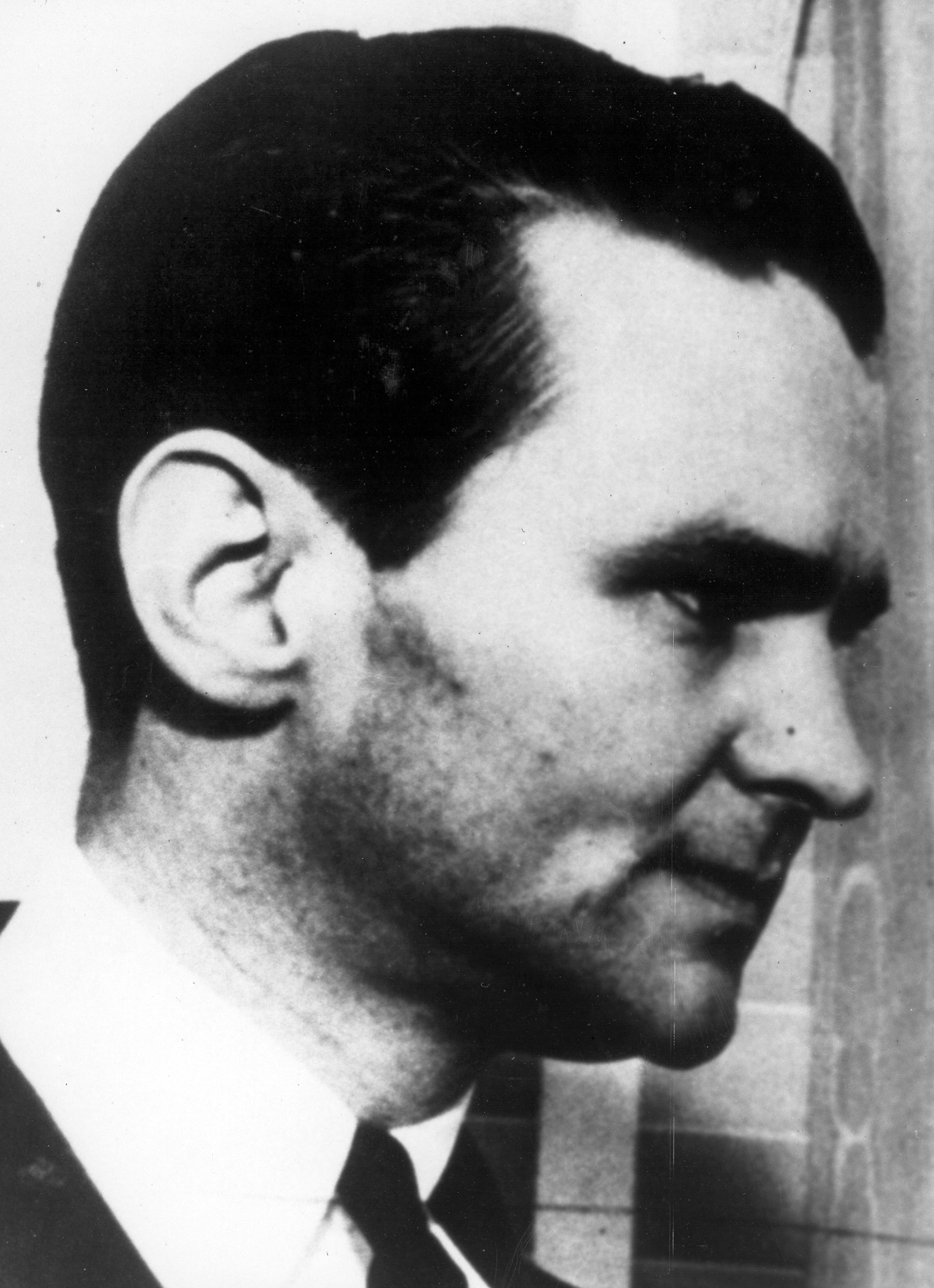
Head of the FBI case in Chicago to get Dillinger and his gang dead or alive was Melvin Purvis. Public domain.

Later that day (April 23, 1934), Dillinger, Van Meter and Hamilton engaged in a gun battle with police in Hastings, Minnesota, near St. Paul. When Hamilton was wounded Dillinger drove back to Chicago but failed to get him medical attention so that, a few days later, Hamilton died in Aurora, Illinois, and was buried by Dillinger and others in a gravel pit near Oswego, Illinois. The getaway car Dillinger stole in Wisconsin that night after escaping the lodge was found blood stained in Chicago at 3333 North Leavitt on May 2, 1934. The raid, led by FBI chief in Chicago Melvin Purvis (1903-1960), who liked publicity, was heavily criticized in the press for the agents’ brutal methods and stupidity and was one of the worst public relations fiascos in FBI history.
John “Red’ Hamilton. Mug shot. Public domain.

With the FBI in hot pursuit of Dillinger and his gang, episodes of violence occurred between law enforcement and gang members and other criminals throughout the Chicago area where people were killed. Dillinger, who had become an internationally known superstar criminal, had been thinking about getting plastic surgery to conceal his identity. His legal counsel, Louis P. Piquett, put Dillinger in touch with an off-the-books operating room by way of James Probasco, another of Piquett’s clients. The surgery price was high and almost all profit for Probasco: $80,000 cash (about $2 million today). Probasco recruited Dr. William Loeser, a German immigrant who fled to Mexico to escape serving time for violating the Harrison Anti-Narcotic Act of 1914 and developed a procedure to remove fingerprints. He was assisted by Dr. Harold Cassidy. Dillinger moved into Probasco’s home on Chicago’s north Crawford Road (now Pulaski Road) on May 27, 1934. The surgery took place the next day, with Dillinger opting to receive a general anesthetic. But a glitch in its application (Dillinger was swallowing his own tongue) made him choose a local anesthetic. For the next several hours, the doctors removed a mole from his forehead, dimple from his cheek, and changed the shape of his face and erased seams in his cheeks. They employed Loeser’s acid method to burn off Dillinger’s fingerprints.
Tavern owner James Probasco’s house at 2509 N. Crawford Road in Chicago where Dillinger underwent plastic surgery on May 28, 1934. Public domain.

The surgery, however, was more cosmetic than plastic so that Dillinger was still completely recognizable and his fingerprints remained after he recovered. James Probasco, four days after Dillinger’s death, on July 26, 1934, was brought under questioning for this episode by the FBI at the Bankers’ Building in downtown Chicago. Mysteriously, a window was open and Probasco leapt to his death falling onto the pavement. Attorney Louis Piquett went on trial for harboring a fugitive (Dillinger) but was found not guilty. In 1936, Piquett was retried for the same charge regarding Homer van Meter. Found guilty he served two years in prison, was fined $10,000, and disbarred in Illinois. In 1950, Piquett was pardoned by President Truman. Dr. Loeser was sentenced to one day in prison but had to serve 18 months for the Harrison narcotics case from which he fled. Dr. Cassidy received probation, served honorably in the army medical corps in World War II, but in 1946 had a breakdown and committed suicide.

All My Life I wanted to be a bank robber. Carry a gun and wear a mask. Now that it’s happened, I guess I’m just the best bank robber they ever had. And I am sure happy.” – John Dillinger. On the alley wall in Chicago near the Biograph Theater where the bank robber was captured, dead, by law enforcement.

On June 22, 1934, the same day Dillinger was officially named Public Enemy No. 1, the high-profile criminal celebrated his 31st birthday with his new girlfriend, 26-year-old Polly Hamilton (1908-1969) at the French Casino nightclub in The Rainbo [sic] Building, 4812-4836 North Clark Street, in Chicago’s Uptown. A former employee and friend of brothel madam Anna Sage (1889-1947), Polly Hamilton met Dillinger at a Chicago nightclub in early June 1934 when she was working as a waitress and prostitute.
Polly Hamilton. Fair use.

The Rainbo, like many entertainment venues, struggled during the Great Depression. For a few months in 1934, the second year of the Century of Progress exposition in Chicago, the Rainbo Casino reopened as the “French Casino” (the building was demolished in 2003). A few days later (June 26, 1934), as Dillinger was watching the Chicago Cubs beat the Brooklyn Dodgers in Wrigley Field, his gang members, as informants increasingly came forward, were being squeezed around the city and in the Midwest by law enforcement, whether by being killed, or captured and tried. On June 30, 1934, Dillinger, driving a Hudson, with Van Meter, Baby Face Nelson and John Paul Chase pulled off their last bank heist in South Bend, Indiana, stealing $30,000 (over $700,000 today). One police officer was killed in the melée as a bank cashier, vice president, a bystander and a motorist, as well as Van Meter, were wounded. 

Wanted poster: John Dillinger, published by U.S. Department of Justice. Public domain. Special Collections at Wofford College “[Recto] Wanted poster: John Dillinger, published by U.S. Department of Justice” by Special Collections at Wofford College is licensed under CC BY-NC-ND 2.0.

In July Dillinger began the month discussing Billie’s appeal, going to the movies, and attending the Chicago Century of Progress. On July 22, 1934, Anna Sage (the “Woman in Red”) contacted FBI head Melvin Purvis at 5:30 p.m. to inform him that Dillinger and their mutual friend, Polly Hamilton would be going to the movies that evening either at the Biograph Theater at 2433 N. Lincoln Avenue in Lincoln Park or at the palatial Marbro Theatre at 4110 W. Madison Street in West Garfield Park (the theater was demolished in 1964 and in 2026 its site remains an empty parking lot).
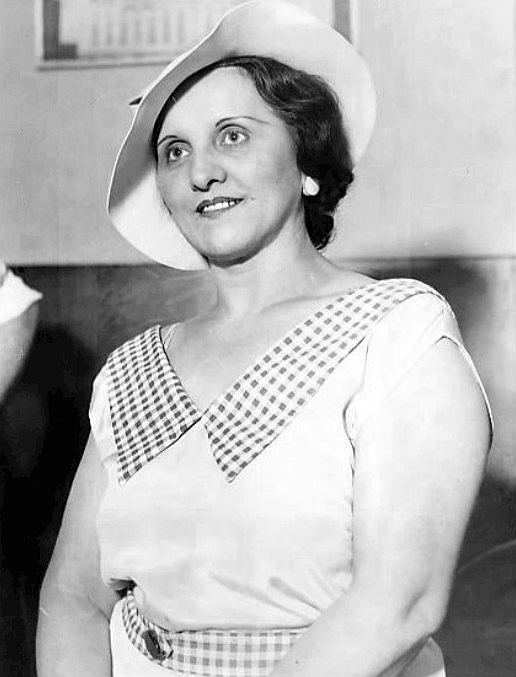
Anna Sage, “the woman in red” who set up John Dillinger to be shot outside the Biograph Theater in Chicago on July 22, 1934. Public domain. 

At 8.15 p.m. Dillinger arrived at the Biograph Theater wearing a straw hat, white shirt, gray tie, white canvas shoes and gray trousers with Sage and Polly. When they entered the Biograph Theater to see “Manhattan Melodrama” with Clark Gable, 15 federal agents (according to the next day’s headline in the Altoona Tribune), including five East Chicago officers, descended on the area and staked it out. A little after 10:30 p.m. when the show emptied out, Sage, who was dressed in a bright orange-red dress, alerted officers to Dillinger’s identity in the crowd. Ambushed and shot without warning, Dillinger was killed instantly when two shots hit the face, one bullet exiting beneath the right eye. Witnesses described Dillinger being shot at very close range. The event caused a spectacle, with many onlookers dipping handkerchiefs and scraps of newspaper in his blood.

Dillinger’s body after the shooting was transported to Alexian Brothers Hospital at West Belden and North Racine Avenues (above). It then went to the Cook County morgue at West Polk and South Wood streets where large crowds gathered. There, an impromptu public display of the body took place, where thousands of the general public shambled by. A plaster death mask was made of the dead criminal at the morgue.  See – Medical – Hospitals – Chicago History In Postcards – retrieved Jan. 24, 2026. Fair Use.

Dillinger’s remains were taken back to Mooresville, Indiana by Dillinger’s father, half-brother, and their undertaker who came to fetch it out from the crowds. In Indiana, Dillinger was identified by his sister and then buried on July 25, 1934, in Crown Hill Cemetery in Indianapolis. Anna and Polly had escaped Dillinger’s capture unharmed and relocated temporarily to Detroit. Sage collected the $5,000 reward (about $120,000 today) from the FBI but, two years later, was deported to Romania due to her conviction for operating a brothel where she died on April 25, 1947. Polly Hamilton moved back to Chicago under an assumed name, married, and died in 1969.

SOURCES

John Dillinger: Bank Robber or Robin Hood? – Crime Library – retrieved Jan. 22, 2026

Uptown Update: Notorious Uptown – retrieved Jan 22 2026

23rd District Police Station, Weather Underground Target, … | Flickr – retrieved Jan 22, 2026.

Vintage Chicago Tribune: John Dillinger’s final days — and the ‘Lady in red’ who helped trap him – Chicago Sports Today – retrieved Jan. 22, 2026.

History – LITTLE BOHEMIA LODGE – retrieved Jan. 23, 2026.

April 1934 – Dillinger LLC – retrieved Jan. 23, 2026.

The Chicago Crime Scenes Project: Dillinger’s Plastic Surgery on Pulaski Rd. (or Crawford Ave.?) – retrieved Jan. 23, 2026.

The Digital Research Library of Illinois History Journal™ : The Rainbo Building’s History, 4812-4836 North Clark Street, Chicago (Uptown Community), Illinois. – retrieved Jan. 23, 2026.

John Dillinger | Notable People Buried at Crown Hill Cemetery | Crown Hill Foundation | Indianapolis – retrieved Jan. 23, 2026.

Edyth Gertrude “Polly” Hamilton Black (1908-1969) – Find a Grave Memorial – retrieved Jan. 24, 2026.

http://www.historictwincities.com/2019/12/05/lincoln-court-apartments-st-paul/ – retrieved Jan. 25, 2026.

My Art Photography: Stained Glass of New Testament Scenes by F.X. ZETTLER STUDIOS OF THE ROYAL BAVARIAN ART INSTITUTE, Munich, Germany, 1907-1910, in St. Edmund Church in Oak Park, Illinois.

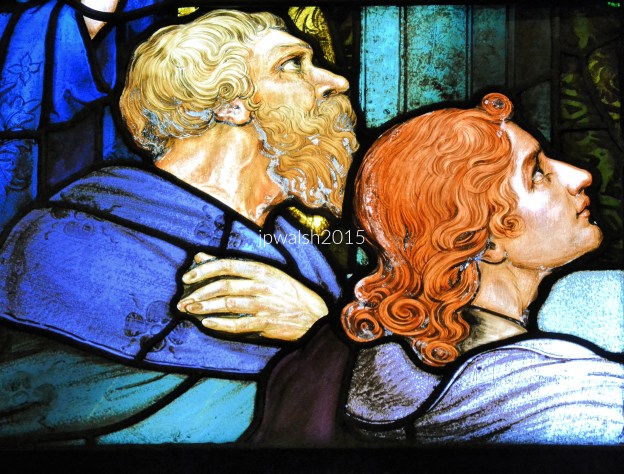
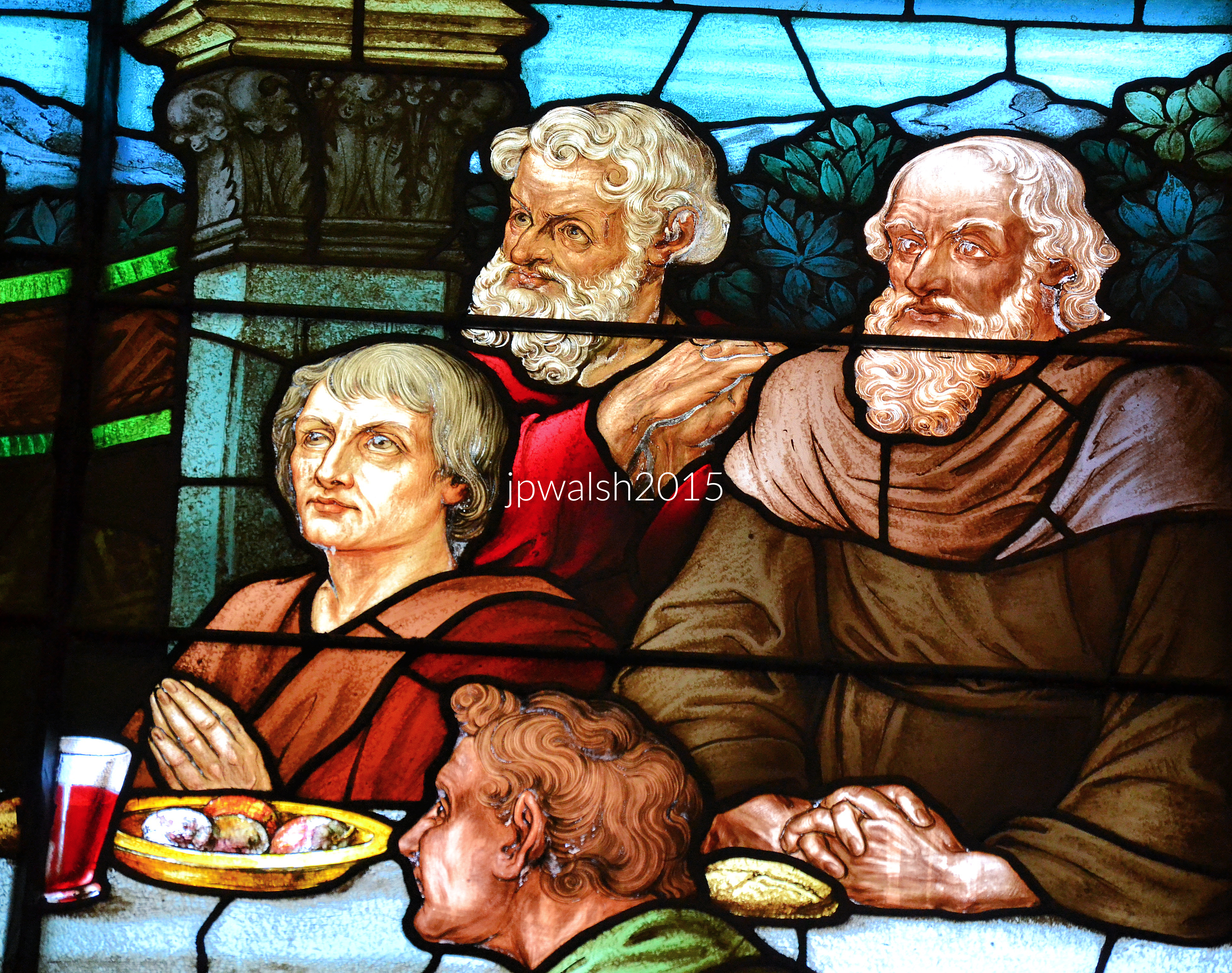
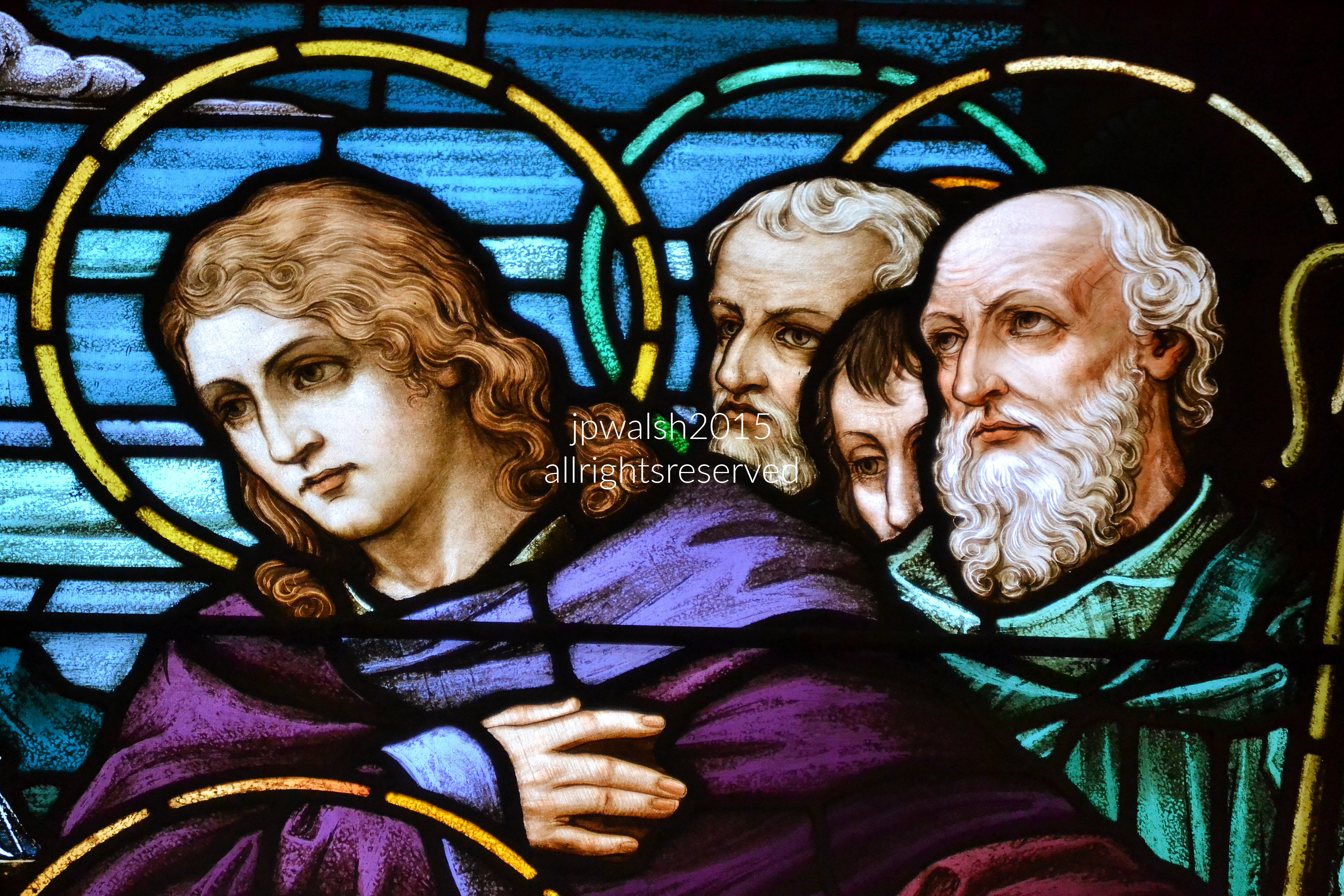
Feature Image: Two apostles, detail, Institution of the Eucharist window, F.X. Zettler, 1907-1910, St. Edmund Church. Author’s photograph. September 2015.

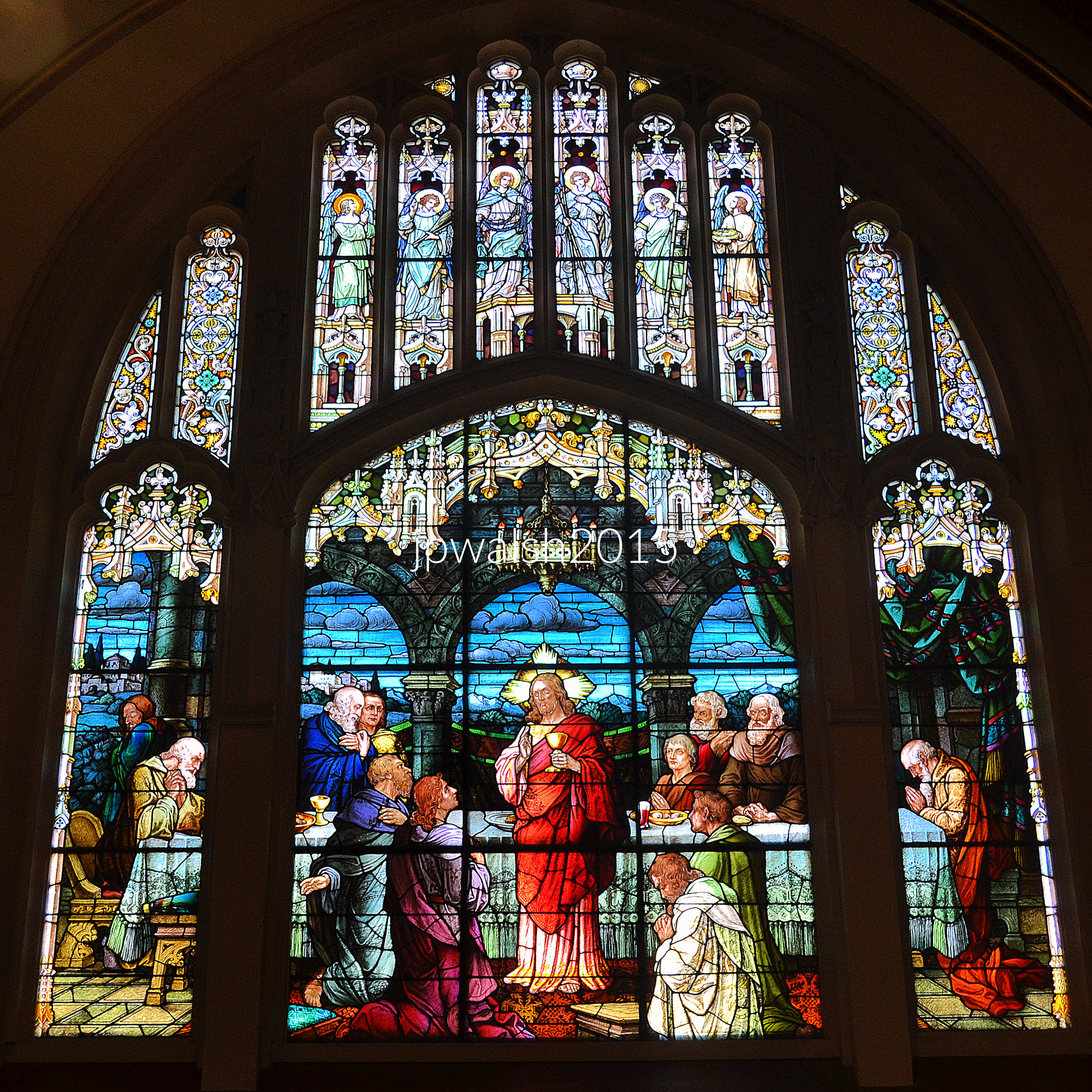
By 1910 F.X. Zettler’s mastery of the “Munich Style” – characterized by detailed scenes and vibrant colors on glass – made his German company one of the most popular designers in late 19th century and early 20th century American churches. These windows are religious paintings that are pedagogical as well as sacred images. The Roman Catholic Church teaches that Christ is “really present” in the Eucharist (a Greek word, eucharistia,that means “Thanksgiving”) and that his sacrifice on the cross on Calvary is repeated at every Mass as Christ gives His Body and Blood under the appearance or species of bread and wine in Holy Communion as food for eternal life. As parishes offer school children their first holy communion, Christ’s pose evokes that same event for the apostles. Accounts of the Institution of the Eucharist at the Last Supper are in Luke 22, Mark 14, Matthew 26, and its significance explicated in John 6. It is recounted in Paul’s First Letter to the Corinthians, 11. Author’s photograph. September 2015.

Four apostles, detail, Institution of the Eucharist window, F.X. Zettler, 1907-1910, St. Edmund Church. Author’s photograph. September 2015.

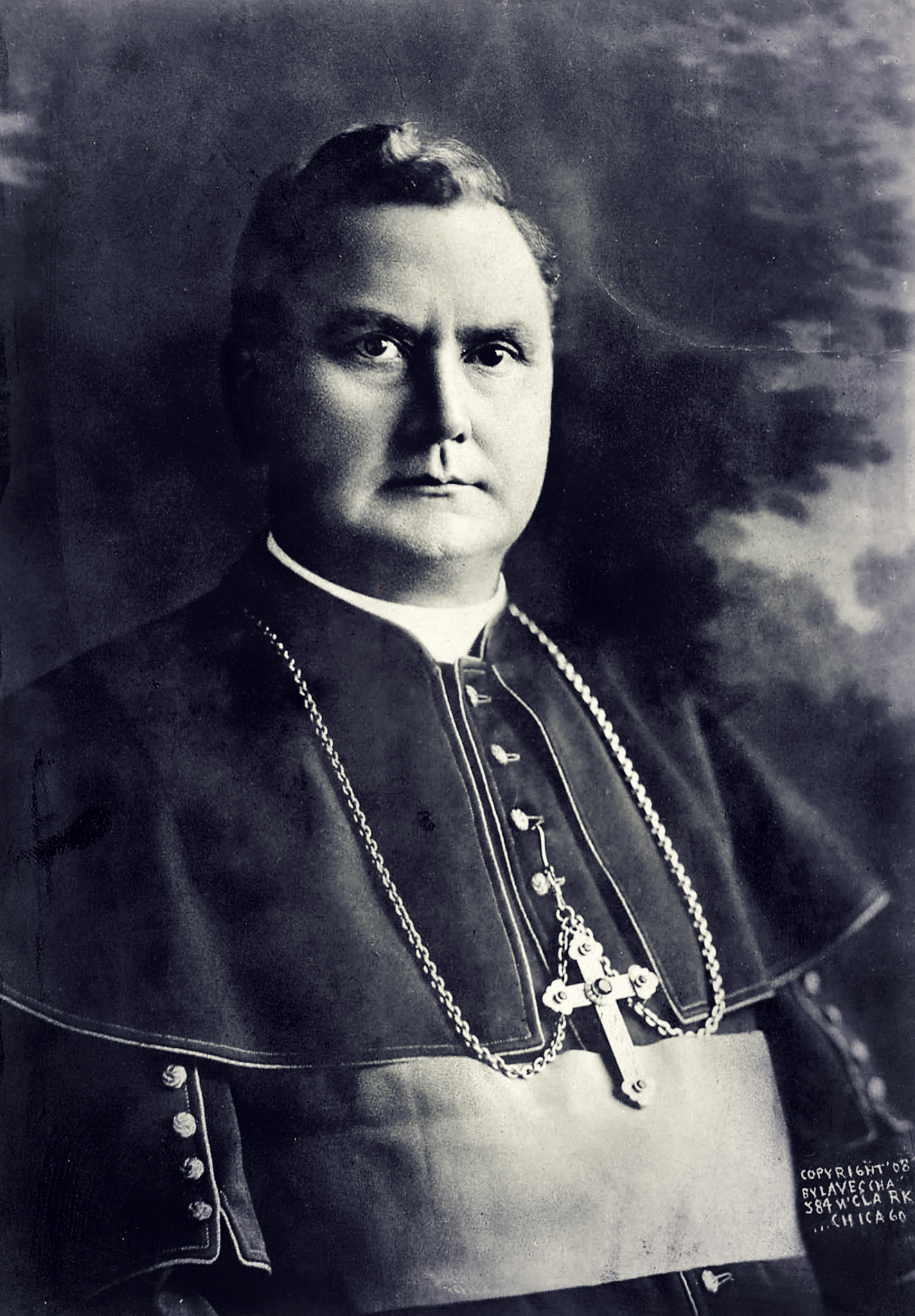
In 2022, owing to continuously declining numbers in the church, St. Edmund Church at 188 S. Oak Park Avenue, Oak Park, IL, located close to the heart of its suburban downtown, was combined with another historic Oak Park parish, Ascension Church, at 808 S. East Avenue, about one mile to the south. Founded by Archbishop James Quigley (1854-1915) in June 1907, St. Edmund was the first Catholic parish in the village and one of the 75 new parishes founded by Quigley during his tenure between 1903 and 1915. James Quigley’s successor was Cardinal George Mundelein (1872-1939) who founded 80 more new parishes during his administration. Trying to fit into the longstanding predominantly Protestant community, St. Edmund was built in generous cooperation with its leading citizens and designed in a refined English neo-Gothic style. Evoking a low-profile parish country church, this kind of Catholic footprint would be imitated in other prosperous Chicago suburbs with strong Protestant roots well into the 20th century so to discreetly integrate into the community.

Most Rev. James Quigley, Archbishop of Chicago (1903-1915). In 1907 Archbishop Quigley traveled by car to Oak Park to attend the opening. Public domain.

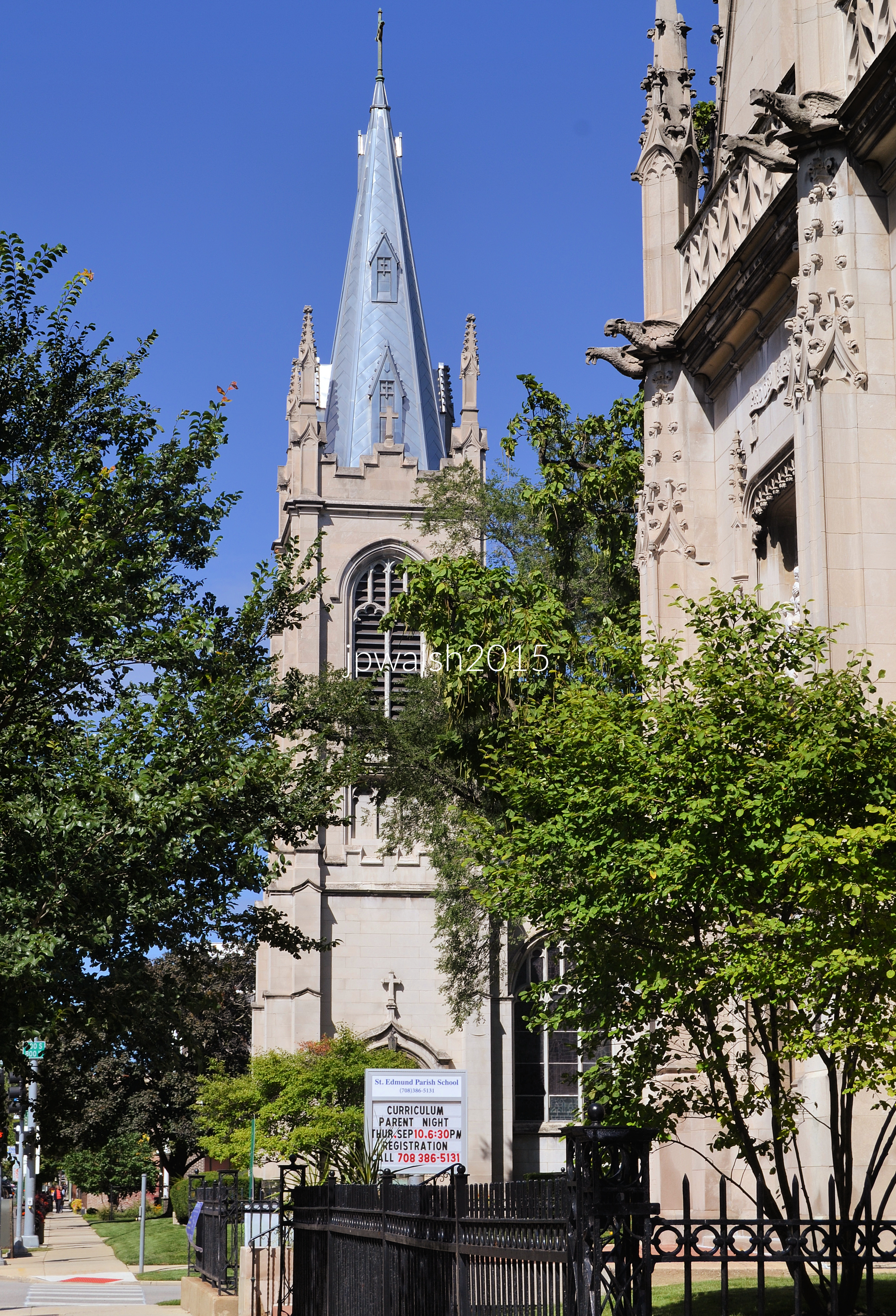
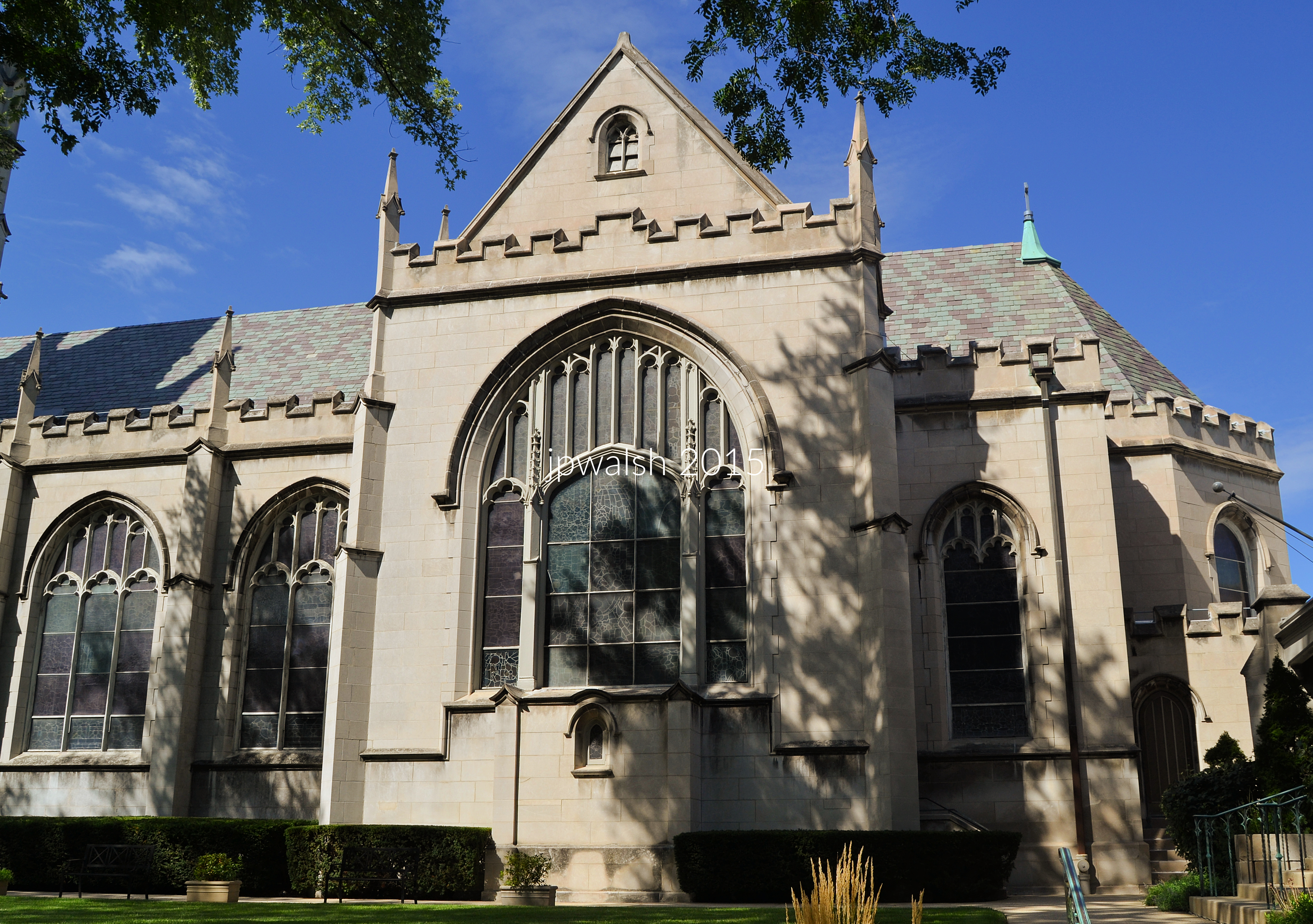
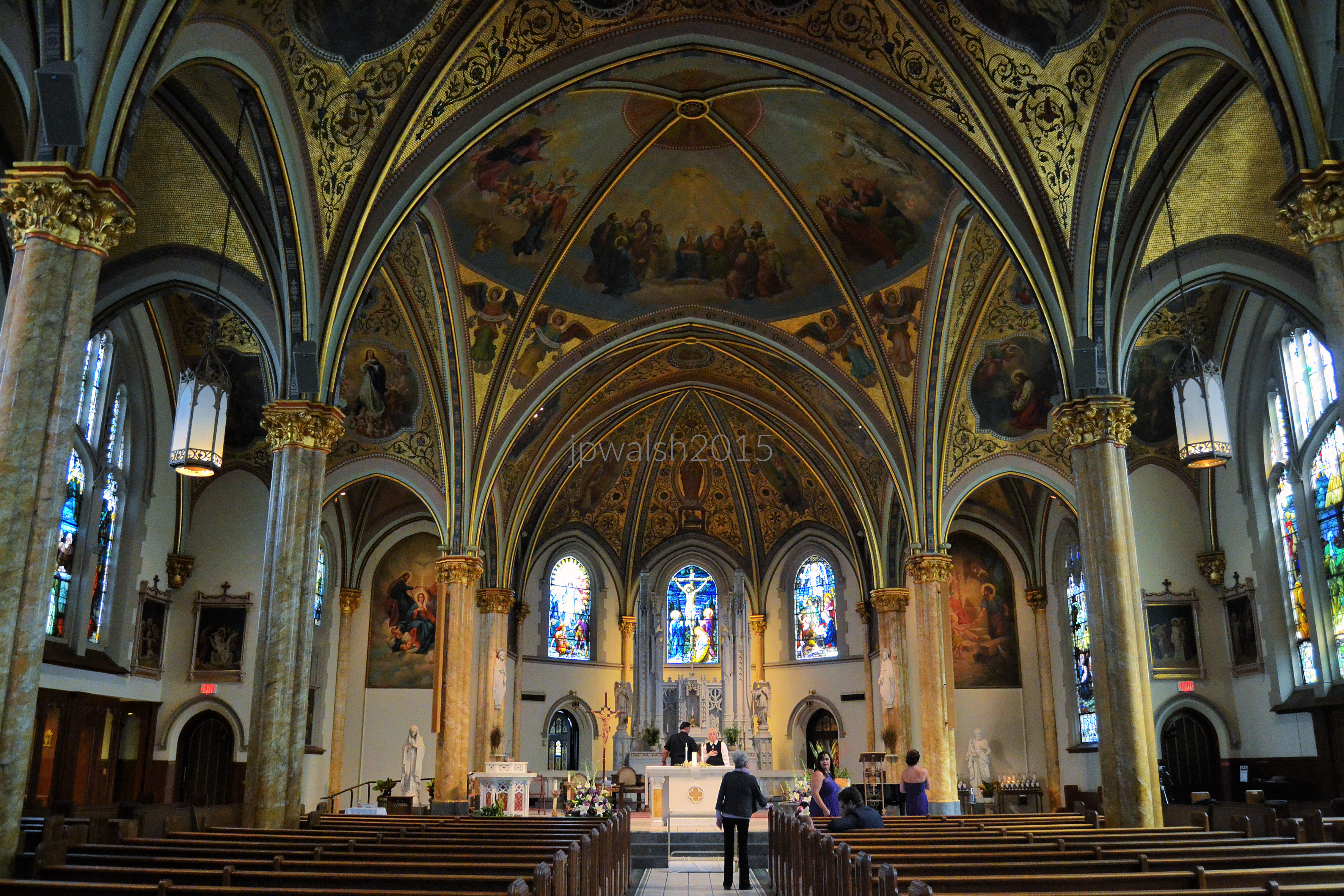
Since the mid-1980s reports from 2022 indicate a reduction by the Archdiocese of Chicago of more than 100 parishes from its nearly 450 parishes due to declining attendance and financial problems, of which St. Edmund is another example. It remains fortunate that this beautiful church building continues to exist and be used for worship. The English neo-Gothic style church was designed by prolific Chicago church architect Henry Schlacks (1867-1938) and dedicated in May 1910. The art glass windows were executed by the F.X. Zettler Studios of the Royal Bavarian Art Institute in Munich. Zettler also made mosaics such as at St. Anthony Church in Bridgeport also designed by Schlacks and consolidated first with All Saints parish and then both closed and combined with St. Mary of Perpetual Help. St. Edmund Church has undergone various mid-20th century redecorations that included the addition of paintings and marble upgrades for its altar, pulpit, and baptismal font designed by Chicago-based DaPrato Rigali founded in 1860. Exterior changes to the building were also made in the 1950’s replacing the church’s original red tiles for the roof and steeple to, respectively, slate and steel coverings.

St. Edmund Church, Oak Park, Illinois, dedicated in 1910, was designed in the late 19th century English neo-Gothic style. The later school (right), opened in 1917, was designed in the French neo-Gothic style. Both are the work of architect Henry Schlacks (1867-1938). Author’s photograph. September 2015.

St. Edmund Church, Oak Park, Illinois, part of the nave, transept and apse, south view. Author’s photograph. September 2015.

St. Edmund Church and school have been a work in progress. The school, a flamboyant neo-Gothic structure designed by Henry Schlacks, opened in 1917. During the post-war baby boom, additions to it were built in 1948 and 1959. In June 2016 the school closed. When the parish was young and growing with Catholic families, it purchased an architecturally significant private home in 1929 for the nuns who staffed the school. With post-Vatican II declining vocations of nuns and school enrollment, the convent was sold in the 1980’s. A 2000 renovation of the church included cleaning and restoring the stained-glass windows that portray scenes from the New Testament. In other Chicago churches with Zettler windows, such as, in St. Stanislaus Kosta Church in West Town, there are themes of the Rosary, while St. Adalbert, a Polish parish in Pilsen since closed by the archdiocese and sold for condo development, it was historic saints of Poland. Henry Zimach of HPZA was the architect of the St. Edmund renovation. In its first 49 years the church was led by one pastor: successful fundraiser Msgr. John H. Code. The next 49 years saw 6 pastors until the church had to combine with a nearby parish. Of the $100,000 construction cost for the church, one donor (Mrs. Mary Mulveil) donated half of it. From an operating expenses viewpoint this elite donor model is how even today some Catholic parishes across the Chicago region stay open. In 2026 one leading Catholic parish published tithing information that showed 95% of registered families do not tithe one dime and about a dozen families donate annually between $15,000 and $25,000 each. With pews half full, one can conclude that non-tithing families might not be at Sunday Mass either. With the Vatican discouraging any “pressure” on anyone, there’s little to no outreach by the parish to the vast majority of its wayward flock as long as apparently the affluent pay their church bills. Of course, if things really get untenable, the bishop then can simply decide to close one more parish.

Mid-20th century redecorations at St. Edmund Church included the addition of paintings and marble upgrades for its altar, pulpit, and baptismal font. Author’s photograph. September 2015.

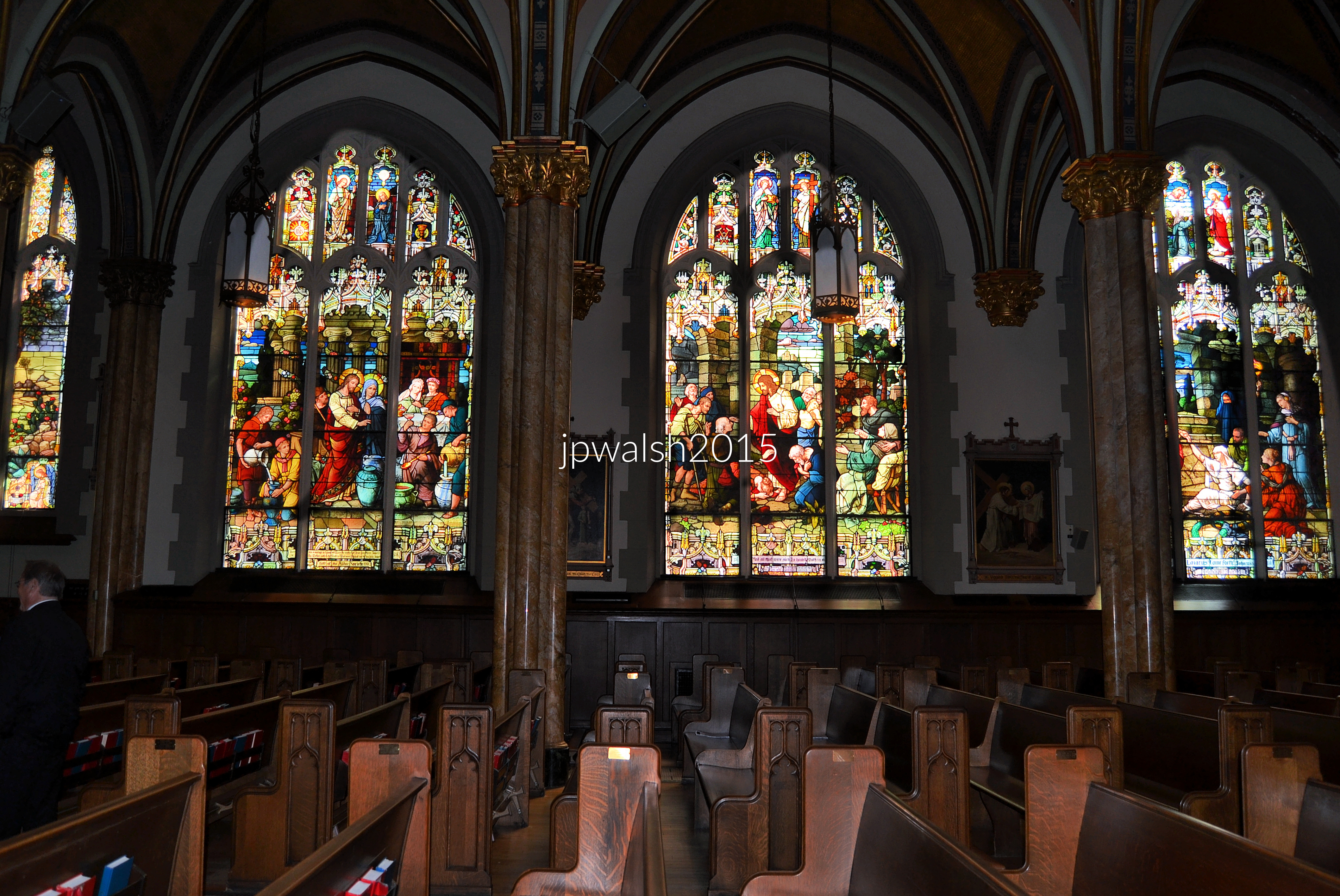
These are religious paintings as they serve to teach the viewer by depicting scenes from the earthly episodes of Christ. But they are also sacred images, pure iconography, as they invite the viewer to contemplate and pray to those persons existing in the spiritual and heavenly domain with whom they are surrounded. Further, as Zettler’s stained glass are some of this church setting’s most spectacular art, they play a key role in aiding in worship. Individually and taken together, the gloriously colorful and drawn illuminating images accompany worshipers as they place them in the visual presence of the Trinity, the Blessed Mother, and the angels and saints and carry them upwards into their presence as they participate in the sacraments.

The Zettler windows in St. Edmund in Oak Park fill the church interior with the colorful light of glorious art that is both pedagogical and iconographical of the Biblical Catholic faith. Author’s photograph. September 2015.

German Art Glass.

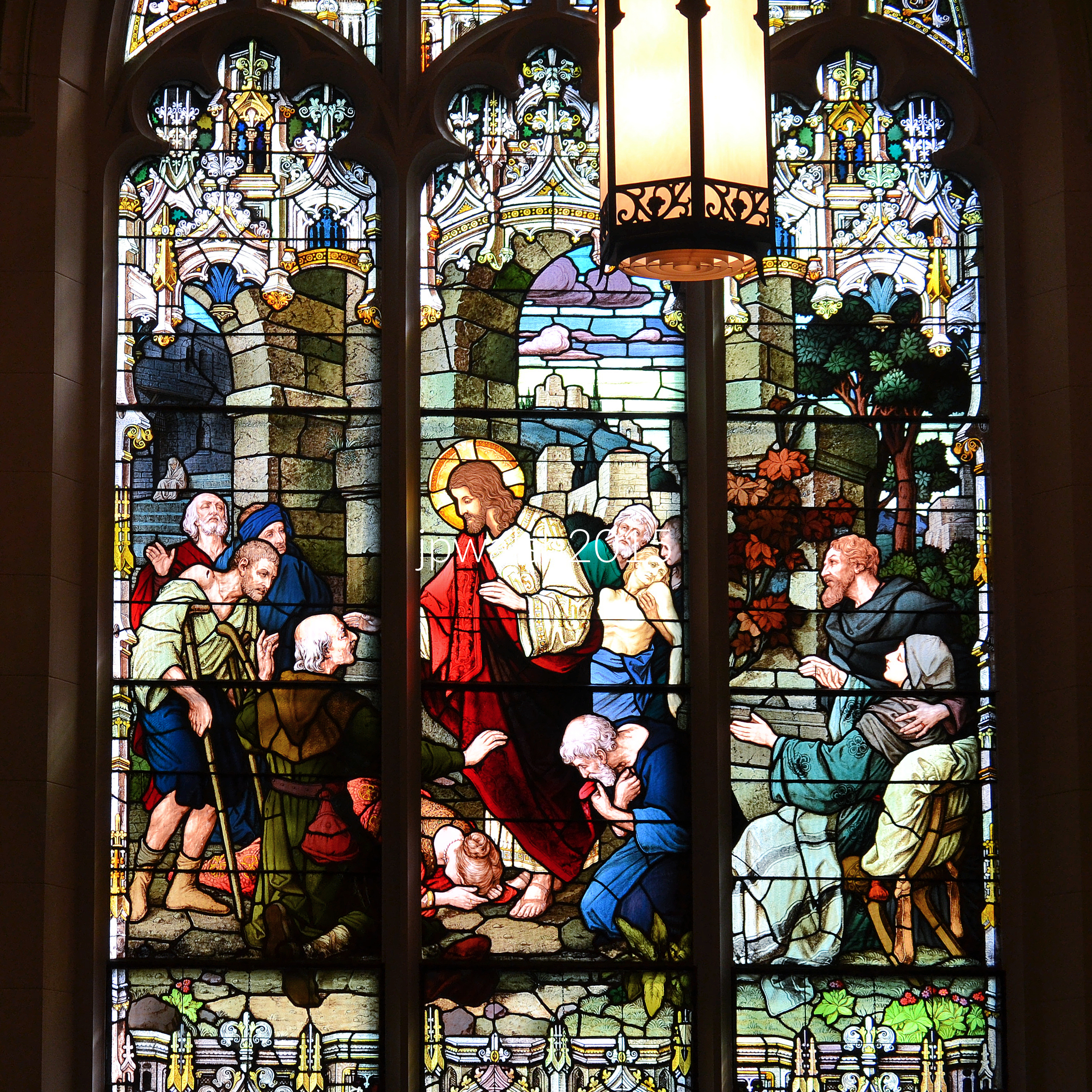
Jesus healing the blind man (above, detail). This window presents healing stories such as found in John 9 (healing the blind man from birth), Mark 8 (healing a blind man at Bethsaida) and healings of two blind men in Matthew 9. The figure of a woman bending down to have her hair touching Jesus’ feet evokes Luke’s gospel (chapter 7) of the sinful woman who washes Jesus’ feet with her hair. The man at right carried by two others alludes to Jesus’s healing miracle of a man who could not walk found in Mark 2 and Luke 5. Author’s photograph. September 2015.

Zettler window of Jesus’s ministry of healing miracles. Author’s photograph. September 2015.

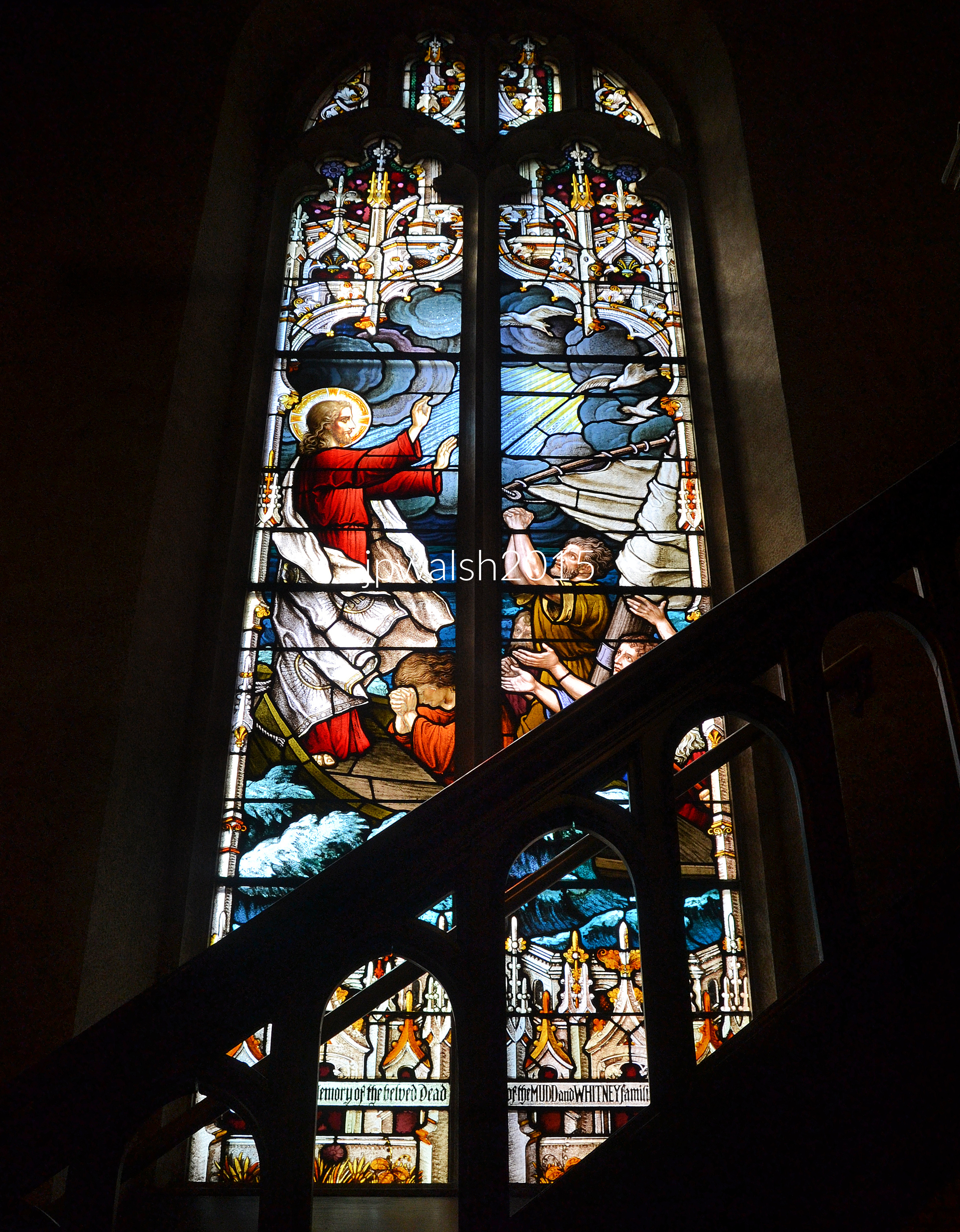
Zettler Window of Jesus calming the storm found in Luke 8, Matthew 8, Mark 4, and John 6. The event demonstrates the God-Man’s authority over nature. Author’s photograph. September 2015.

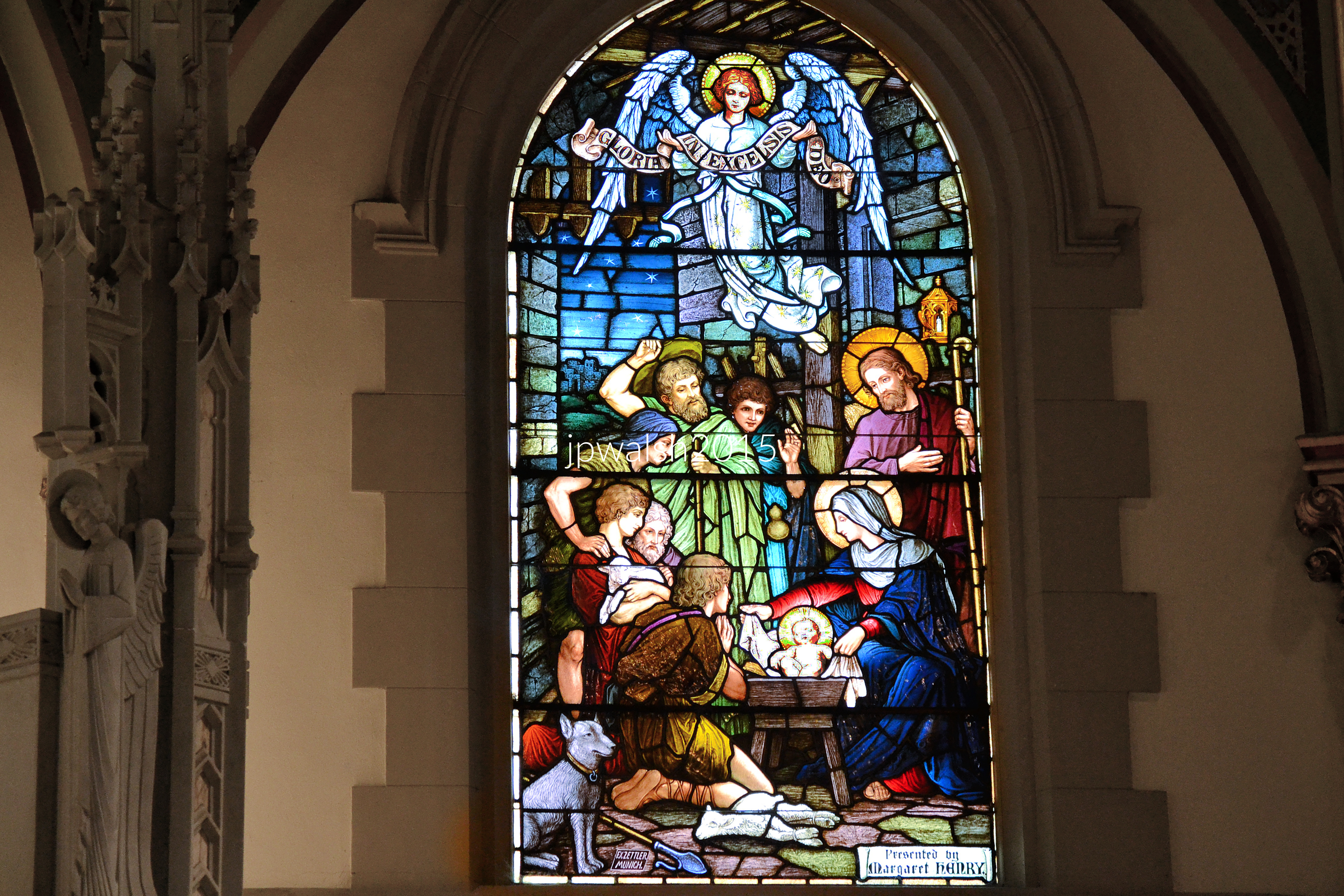
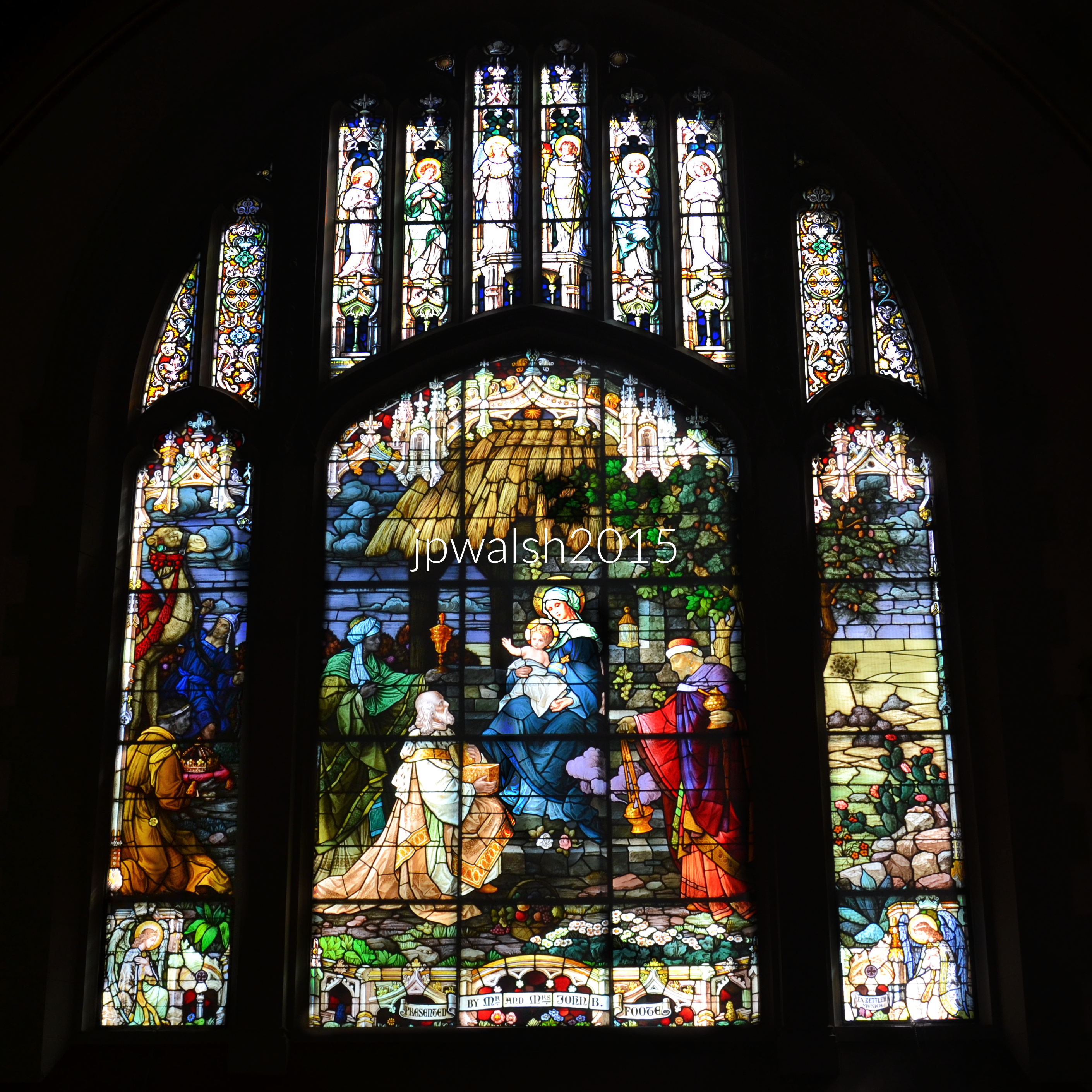
Nativity window found in Matthew and Luke. A dog in the lower left corner is one of many such animals scattered throughout Zettler’s windows in St. Edmund Church. Author’s photograph. September 2015.

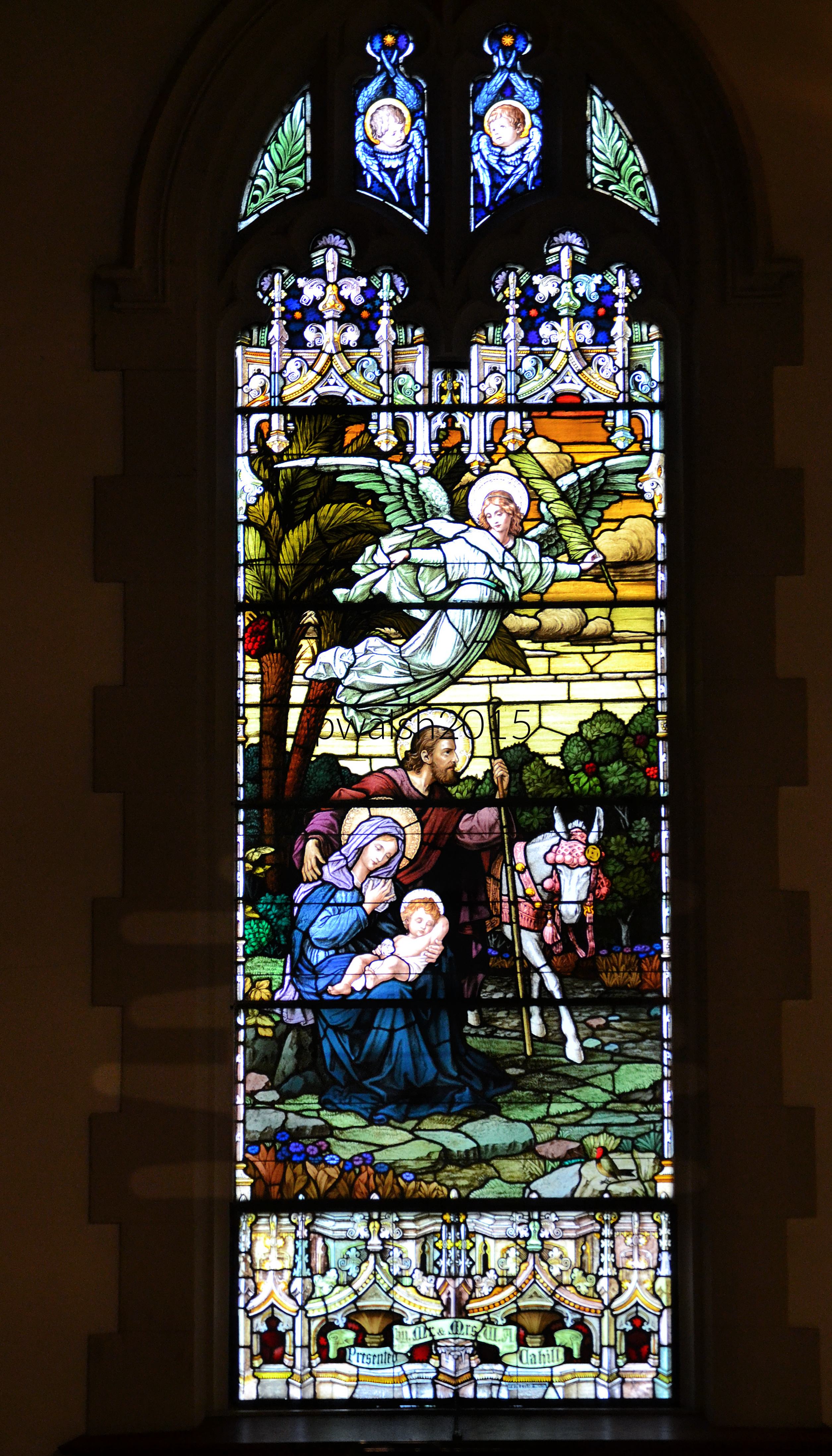
The flight into Egypt window. Recounted in Matthew 2, the story relates how the Holy Family—Mary, Joseph, and infant Jesus—flee to Egypt to escape King Herod, who ordered the killing of young children to eliminate the prophesied King of the Jews. Joseph, warned by an angel in a dream, swiftly carried his family to Egypt, where they stayed until Herod’s death, fulfilling prophecy and symbolizing Christ’s presence in a world of darkness. The episode has long been a popular subject in Christian art, and Zettler depicts the episode focusing on the Holy Family’s determination under angelic protection. In popular piety, the event is one of the “seven sorrows” of Mary which she pondered in her heart. Author’s photograph. September 2015.

Jesus calls Himself the Good Shepherd in John 10. A half-circle stained- glass window depicting Jesus as The Good Shepherd greets visitors above a street entrance door into St. Edmund Church.  Author’s photograph. September 2015.

WHO IS ST. EDMUND OF CANTERBURY?

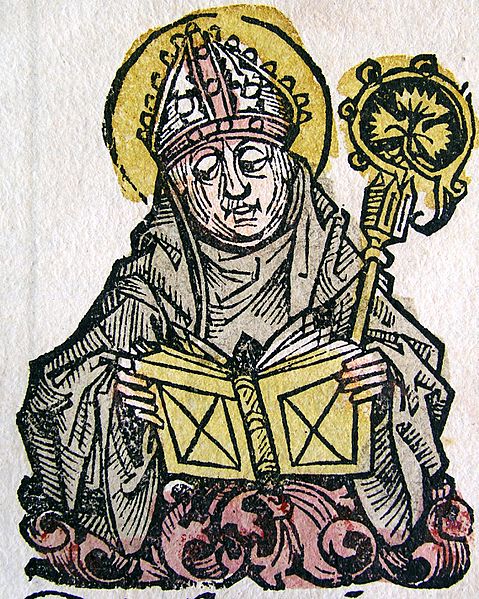
Nuremberg chronicles, Edmund, Archbishop of Canterbury (1493). Public Domain.

St. Edmund church in Oak Park, Illinois, is named for English saint Edmund of Canterbury (c. 1174–1240). Son of Edmund Rich, Edmund is also known as Edmund of Abingdon where he was born and who was made Archbishop of Canterbury in 1233 by Pope Gregory IX (1227-1241). History speaks of his parents as being practicing Catholics with his mother more fastidious and his father more laconic. Edmund, taking after his mother growing up, was considered a bit of a sanctimonious prig. Around the age of puberty, Edmund dedicated himself to the Blessed Mother and took a vow of perpetual chastity. When this vow of purity was later challenged by a young woman Edmund vigorously fought her back sufficiently that, as the young woman recalled, he called her “an offending Eve.” Edmund was educated in Paris but, starting around 1200, returned to Oxford to teach mathematics and philosophy in the circle of Stephen Langton (c. 1150–1228). In Edmund’s time, Langton was an influential English cardinal and Archbishop of Canterbury who participated in the political issues of his day including the Magna Carta crisis in 1215. Edmund is remembered at Oxford for building a Lady’s chapel with funds from his teaching stipend and passing much of his free time in prayer. The site where Edmund lived and taught became an academic hall at Oxford in his lifetime (1236) and remains today part of the college of St Edmund Hall (aka Teddy Hall), claimed to be the oldest surviving academic society to house and educate undergraduates in any university in the world. Notable alumni of St Edmund Hall include, at the time of posting, current British prime minister Keir Starmer.

Author’s photograph. September 2015.

Edmund studied theology between 1205 and 1210 and spent a year with the Augustinian canons of Merton Priory. Afterwards he became a priest and doctor of theology and would take frequent retreats at Reading Abbey in this period. Around 1219 and for the next 12 years the eloquent, learned and virtuous Edmund financed his education by serving as treasurer for Salisbury Cathedral, preached the Sixth Crusade in 1227 (a crusade which led to a shared Christian-Muslim governance situation in Jerusalem) and garnered several influential English friends.

In a mid-14th century manuscript, Frederick II, Holy Roman Emperor (left) meets al-Kamil Muhammad al-Malik (right), whose negotiations led to shared Christian-Muslim governance in Jerusalem during the Sixth Crusade. Vatican Library. Public Domain.

In 1233, the 59-year-old was appointed Archbishop of Canterbury by Pope Gregory IX though the Canterbury chapter recommended several other candidates first. Accepting the position reluctantly, Edmund, consecrated on April 2, 1234, fought for independence of the English church from any foreign influence and this led to an episcopal tenure characterized by incessant and unseemly brawls with King Henry III and the papal delegation as the archbishop admonished the king for a government of baronial favoritism. Threatening the king with excommunication, the crown backed down temporarily but harbored enduring antipathy towards Edmund and looked for relief in Rome. In favor of strict discipline and truthful justice in civil and ecclesial government and life, coupled to a strong stance against any encroachment on the English church, including jealousy for his authorial rights to be enforced by litigation when necessary, the possibly soft spoken but clearly combative Edmund made for a very unpopular figure among the powerful and eventually led to his forced resignation in 1240.  In 1236, with the object of freeing himself from Edmund’s control, the king requested a sympathetic legate from the pope who arrived to insult and contradict everything of importance Edmund chose to do and say in relation to current issues – from the marriage of Simon de Montfort and Henry’s sister Eleanor that Edmund found invalid, to Edmund’s own cathedral priests and monks who were opposed to Edmund’s rule. Edmund reacted to the opposition erratically, excommunicating at will, all of which was ignored by the pope who let his legate’s, and not Edmund’s, decisions stand which favored the king. Edmund was left to complain that the discipline of his national church was being undermined by the flaccid standards of world politics. Before thinking to resign, Edmund went to Rome in December 1237 to plead his cause in person before the pope.  But already Henry III’s exactions and usurpations were backed up by the papal legate and Edmund’s mission was futile. Edmund returned to England in August 1238 where he was made to heel. Edmund resigned in 1240.

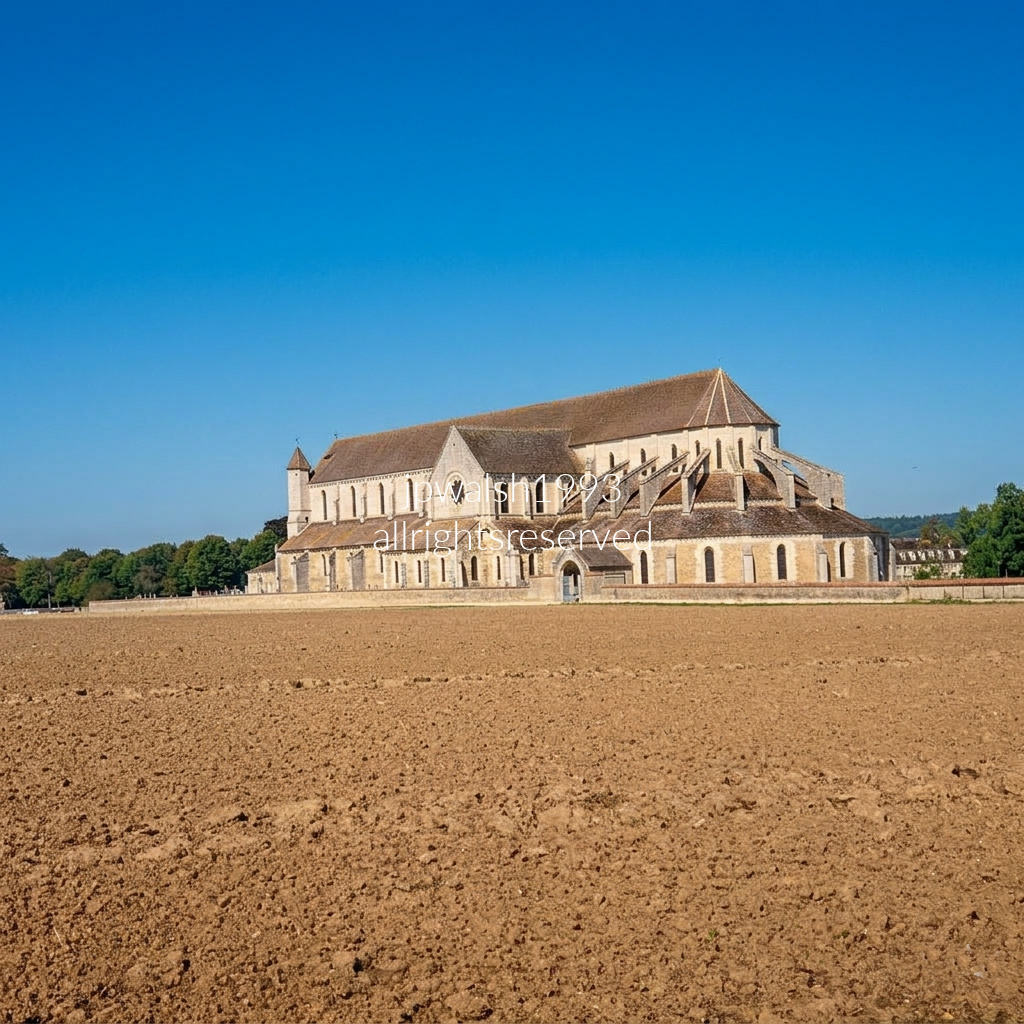
Abbey of Pontigny, France, view from south. The Cistercian abbey of Pontigny was a refuge for England’s persecuted archbishops, including Stephen Langton (c. 1150–1228), and Saints Thomas Becket (1120-1170) and Edmund of Canterbury (c. 1174–1240). Author’s photograph, September 1993.

At that juncture, Edmund set out for the Cistercian Abbey at Pontigny southeast of Paris in France, which had been a refuge for Edmund’s predecessors, Stephen Langton and Thomas Becket (1120-1170). The archbishop’s health soon gave way and, though Edmund decided to return to England, he died en route at Soisy-Buoy in the house of the Augustinian Canons on November 16, 1240.

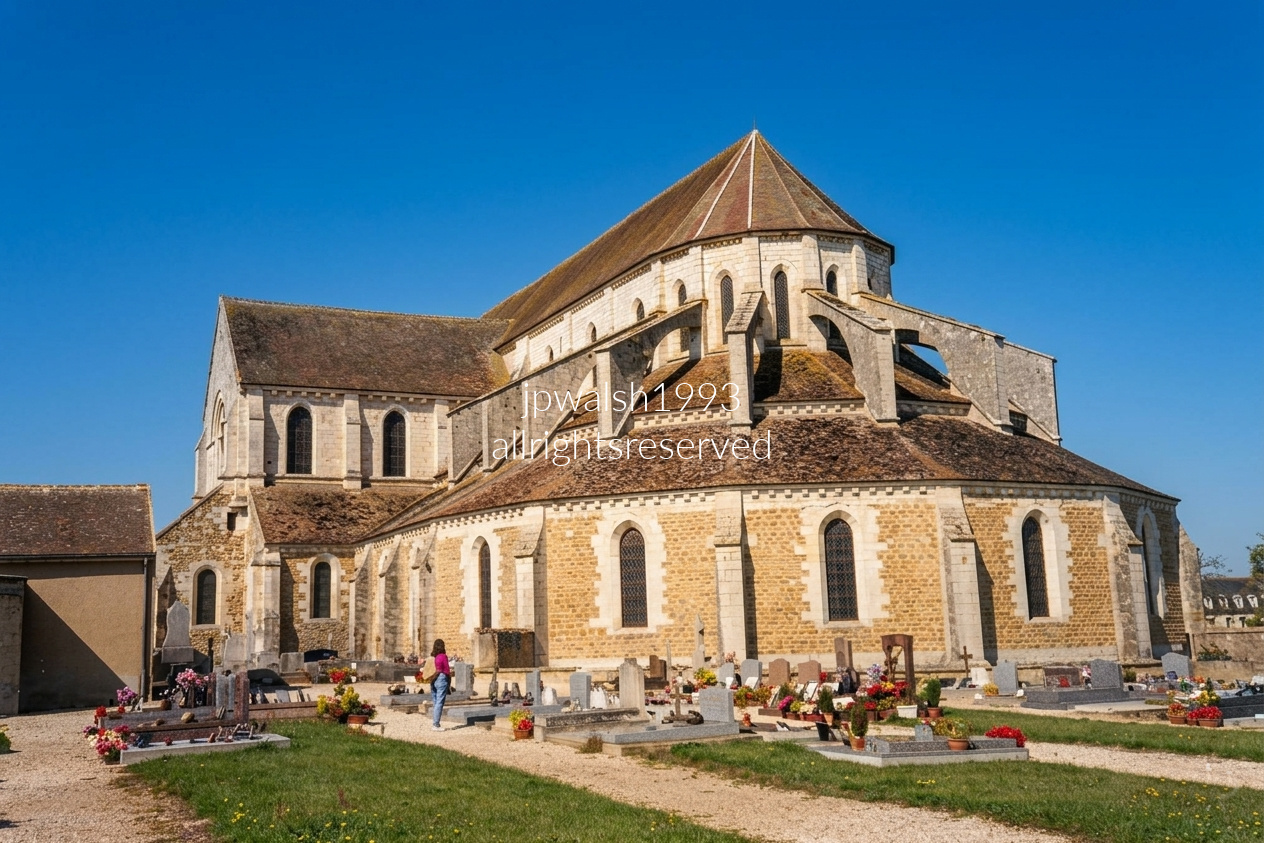
Abbey church of Pontigny, north aisle, 12th century. Here, at Pontigny, St. Edmund of Canterbury led the life of a simple monk. Author’s photograph. September 1993.

Edmund’s remains were returned to the Abbey of Pontigny where he was buried and lies in state today in a reliquary above the high altar. Miracles were soon reported at Edmund’s tomb leading to his canonization by Pope Innocent IV in December 1246, making Edmund one of the fastest English saints to be canonized. When Blanche of Castile (1188 –1252) and King Louis of France (1214-1270) visited Pontigny, Edmund’s body was exhumed and shown to be incorrupt. His relics survived the French Revolution and when his tomb was opened again in 1849 his body, still incorrupt, had one arm found detached. This major relic was sent to the United States, where it is enshrined today on Enders Island off the coast of Mystic, Connecticut, inside the chapel of Our Lady of the Assumption at St. Edmund’s Retreat, run by the Society of Saint Edmund founded at Pontigny in 1843. Edmund’s life was one of self-sacrifice and devotion to others. From boyhood he practiced austerity and asceticism, fasting, and spending his nights in prayer and meditation. St. Edmund of Canterbury’s feast day is November 16. 

St. Edmund of Canterbury, detail from the Westminster Psalter, mid-13th century, British Library. Public domain.

The Story of F.X. Zettler’s Royal Bavarian Art Institute.

About 100 miles south of Munich, Germany, was the home base of popular and well-regarded stained-glass studios such as Franz Mayer & Company and Zettler of which St. Edmund has a full coterie presented in this post. These photographs were shot by me in September 2015.

Franz Xavier Zettler was born in Munich, Germany in 1841 and worked as an ecclesial artist, founding his stained-glass design company after 1870, until his death in 1916. When he married Anna Mayer, Zettler married into another family of artisans, following a long tradition of artisans doing so. In 1848 Joseph Gabriel Mayer (1808-83) founded the Establishment for Architecture, Sculpture, and Painting (“Institute of Christian Art”) under the patronage of King Ludwig I of Bavaria (1786-1868). With royal commissions in Germany for the massive Cologne and Regensburg Gothic cathedrals as well as the Mariahilfkirche in Munich (Vorstadt Au) – the first German neo-Gothic church whose foundation was laid in 1831 – Mayer directed his son Franz Borgias Mayer, and son-in-law F. X. Zettler, to expand the establishment by including a division for stained glass in 1870.

King Ludwig I of Bavaria in Coronation Regalia (König Ludwig I. von Bayern im Krönungsornat) by Joseph Karl Stieler (1781-1858), 1826, oil on canvas, 96 x 67.3 in., Neue Pinakothek, Munich. see – Sammlung | König Ludwig I. von Bayern im Krönungsornat – retrieved January 14, 2026. Public domain.
Zettler’s company, the Bayerische Hofglasmalerei, enjoyed quick success with his award-winning windows displayed at the 1873 International Exhibition in Vienna. By 1882 Zettler’s firm was decreed as the “Royal Bavarian Art Establishment” by King Ludwig II (1845-1886). Almost immediately, these Munich and Austrian stained-glass companies had a profound relationship with immigrant Catholic churches in the United States as Zettler and the others, provided high quality glasswork that was familiar with Catholic piety and themes.

König Ludwig II. von Bayern als Hubertusritter (King Ludwig II of Bavaria as a Knight of Hubertus), Ferdinand Piloty d. J. (1828-1895), 1879, oil on canvas, 217,5 x 132,5 cm, Neue Pinakothek, Munich. See – Sammlung | König Ludwig II. von Bayern als Hubertusritter – retrieved January 14, 2026. Public domain.

After the Great Chicago Fire in 1871, these stained-glass companies sent representatives to Chicago to sell them on various stained-glass patterns from which to choose in a rebuild or renovation. Before the turn of the 2oth century, these large studios had set up branch offices in America, including Zettler’s, that catered to a booming church-building industry hungry for traditional pious art that had been the Catholic tradition since Ravenna and only slowed in the life of the church following Vatican II’s radical turn. Chicago and its environs particularly became a great center for this traditional German and Austrian made stained glass until just before the Great Depression. From the 1870s to the 1920s, Chicago became the most influential center of Catholic culture in the United States with German and Austrian stained glass, such as the Zettler windows in Saint Edmund Church in Oak Park, having the strongest reach. After 20 years, the predominance of these European glass companies was finally challenged in the last decade of the 19th century by an American company. Though Zettler won a top prize at the World’s Columbian Exposition in Chicago in 1893, Louis Comfort Tiffany (1848-1933) gained notoriety with a display of his designed comprehensive collection in Art Nouveau style of jewelry, pottery, paintings, art glass, leaded-glass windows, lamps, and other decorative interiors that continued to gain in popularity, including in houses of worship, right up to World War II.  A steep tariff imposed on imported stained glass in the United States after 1894 impacted some international art purchases though Catholic churches in particular continued to turn to German and Austrian glass for their workmanship and pious imagery taken from the Middle Ages and Renaissance. At some financial cost pastors believed that such traditional art aided their mostly immigrant congregation of professional and industrial factory-workers and their families in worship. 

Zettler Studios was innovative in the perfection of the “Munich style” of windows, in which religious scenes were created in a process of painting and melting large sheets of glass in kiln heat. Zettler was also inspired by the German Romantic Nazarene art movement of the early 19th century whose artists rejected Neoclassicism to revive spiritual and religious-focused art of the Italian Renaissance. In Zettler’s array of religious figures depicted in stained glass windows his team used Italian Renaissance art principles of three-point perspective and line drawing that evoked realism in gestures, expressions and various garb.

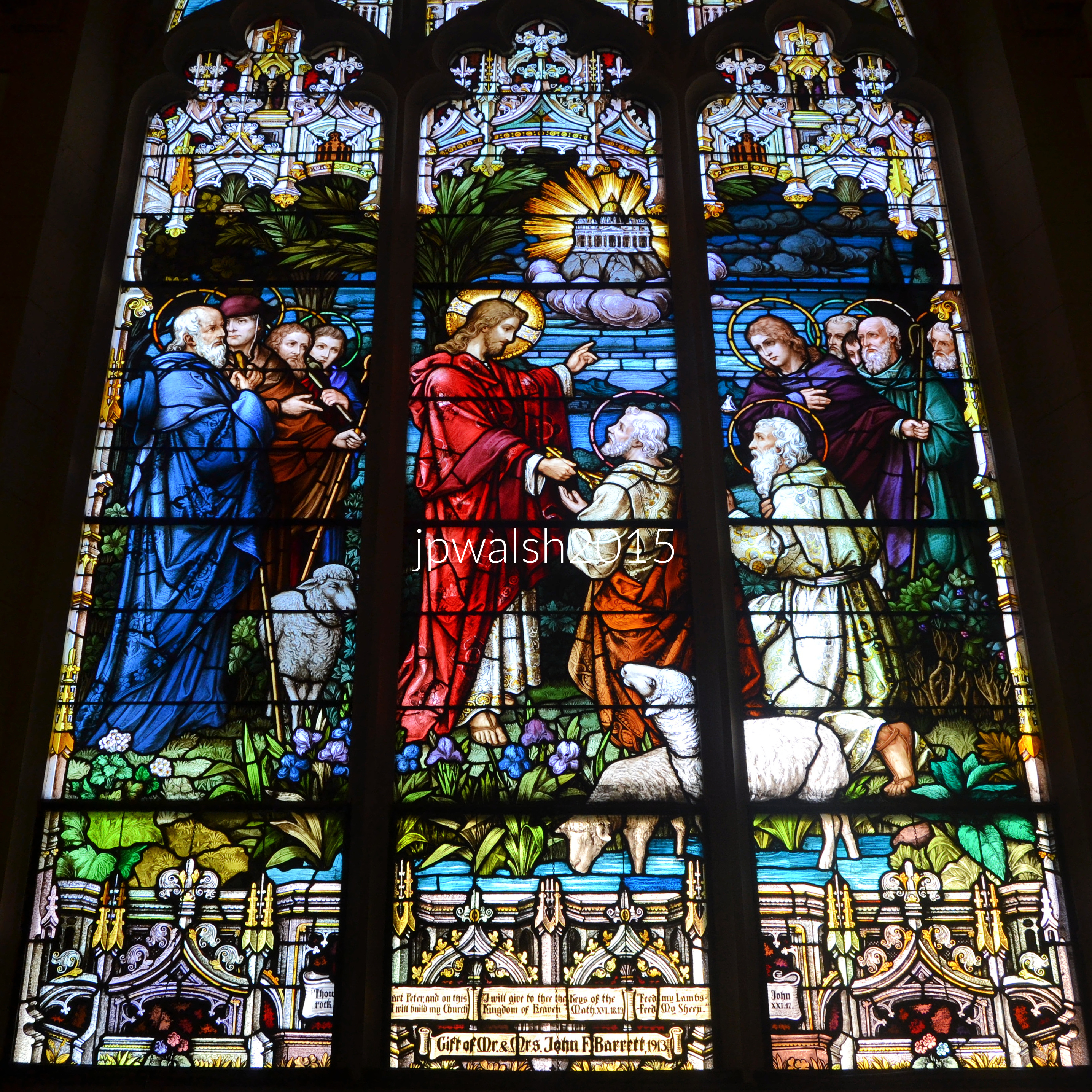
Jesus gives the Keys of the Kingdom of Heaven to Simon Peter. Author’s photograph. September 2015.
Jesus asks, “Who do the people say I am?” leads to Peter’s confession of faith in Jesus as the Christ. it took place at Caesarea Philippi, a new city established by Philip the Tetrarch and was a Gentile community. The gospel writers usually show a lack of understanding of geography, but Matthew was better than Mark and in this incident the location is explicit and about a day’s journey on foot from Capernaum on the Galilee Sea where the disciples were first called. At this juncture in his mission Jesus lays down a challenge to his disciples and asks: Who am I? The story also appears in Mark and Luke and, again, there are differences with Matthew’s account. in Matthew Jesus calls himself by the title “son of man” (Mark and Luke have no title at that point) and Matthew adds Jeremiah to their common list of figures like John the Baptist and Elijah (Zeffirelli adds Ezekiel) that the people think Jesus is. it is “Simon Peter” that answers for the group: “You are the messiah.” Once again Matthew reflects a higher Christology, adding: “The son of the living God,” though the simpler statement is likely the original. These next verses are not in Mark or Luke. Jesus attributes Simon Peter’s confession to divine revelation (“for flesh and blood has not revealed this to you but my heavenly father”). Jesus Christ then elects Simon Peter to a new commission of authority with a new name. There is no other verse in the New Testament that explains Peter’s name change. It is clear Peter is the rock upon which the church is built as his commission from Christ. What is its precise or working sense as that foundation is mysterious. Peter is the rock because as representative and mouthpiece of the disciples he has gathered up and articulated their faith as a group. Jesus makes a bold claim that the group he has formed, the church, will endure as long as there is faith among them that he is the Messiah and that by that enduring faith “the gates of Sheol (the biblical abode of death) shall not prevail against it.” Giving Peter the keys at the establishment of the church following his confession of faith as representative of the disciples echoes Isaiah 22 and is a sure sign of royal power and authority that Jesus confers on Peter. This, as Jesus himself journeys to Jerusalem to his condemnation and crucifixion. Peter evokes the master of the palace, the highest officer in the Israelite royal court. The office of Peter is not as a caretaker or underling but master of the church (ecclesia) and the kingdom of heaven that scholars say here carries a similar meaning. Jesus bestows broad authority to Peter to “bind and loose” which is an obscure phrase with no biblical background but found in the role of rabbis who could impose and remove. Peter’s special position in the church is also made clear from other passages in the gospels as well as Acts of the Apostles. This confession of faith and charge of authority is followed by an instruction on the suffering of the Messiah, making this a crisis moment in the gospel narrative. Following miracles and wonders, the Suffering Messiah was entirely foreign to the Judaism of New Testament times and Matthew, Luke and Mark (the Synoptics) here briefly relate some of the early great disillusionment in the minds of the disciples at this point about the teacher which was never fully remedied until after the resurrection.

Keys of the Kingdom window, detail. Author’s photograph. September 2015.

Jesus at the wedding feast of Cana (John 2). On the prompting of his mother, Jesus performed his first miracle of changing water into wine. The Blessed Mother was the primary catalyst in starting her son Jesus, living a hidden life for 30 years, to begin his public ministry. Author’s photograph. September 2015.

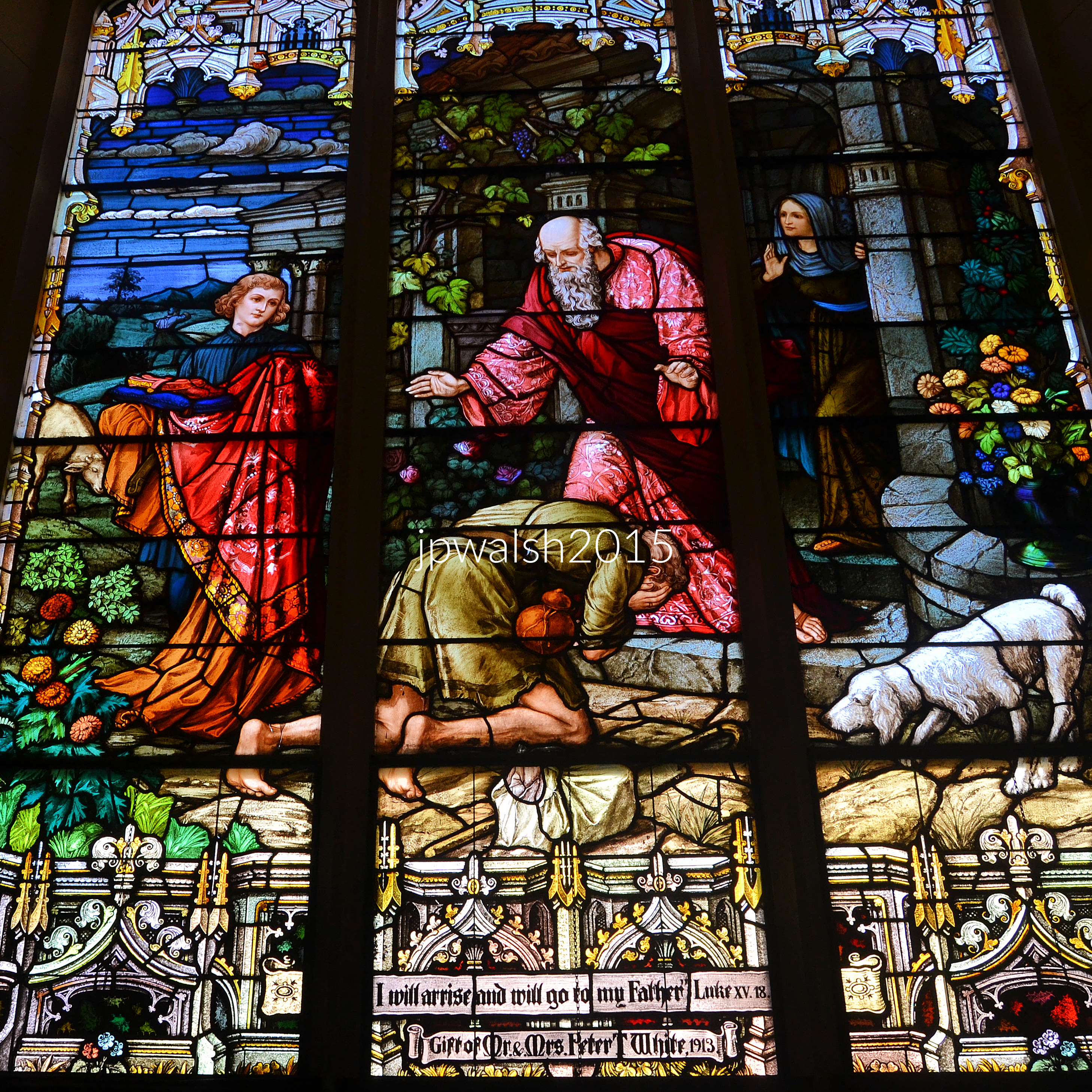
The Prodigal Son window. One of Jesus’ greatest parables, Luke 15 tells the story about a rebellious younger brother and son who demands from his father his share of the inheritance and proceeds to squander it on “riotous living” (Luke 15:13). He returns home destitute, asking only to be a servant in his father’s house, and finds instead that he is awaited, joyfully welcomed, and forgiven by his father, symbolizing God’s boundless love and restoration for repentant sinners. This is contrasted by the antagonist in the story – the self-righteous older brother who resents the celebration. He deems his repentant younger brother as an unredeemable trespasser and whose condemnation extends to this older brother’s envy of the prodigal’s special reception. The father reminds the older brother that “‘You are here with me always. Everything I have is yours” (Luke 15:31) and that it is right to especially celebrate the prodigal son’s return. For the father explains: “Your brother was dead and has come to life again. He was lost and has been found” (Luke 15: 32). Jesus’s parable teaches about sin, grace, and redemption, and the importance of unconditionally celebrating the return of the lost. Author’s photograph. September 2015.

SOURCES:

First-ever Sacred Spaces House of Worship Walk in Oak Park this weekend – Wednesday Journal  – retrieved January 13, 2026.

https://oprfmuseum.org/this-month-in-history/st-edmunds-parish-dedicates-new-oak-park-church – retrieved January 13, 2026.

Chicago Churches and Synagogues: An Architectural Pilgrimage, George Lane, S.J., and Algimantas Kezys, Loyola University Press, Chicago, 1981.

AIA Guide to Chicago, 2nd Edition, Alice Sinkevitch, Harcourt, Inc., Orlando, 2004.

Franz Xaver Zettler – Wikipedia – – retrieved January 13, 2026.

Ascension and St. Edmund Parish – Catholic Communities of Oak Park and Neighbors – Archdiocese of Chicago – Oak Park, IL – retrieved January 12, 2026.

Louis C. Tiffany Stained Glass Windows in Western New York – retrieved January 12, 2026.

Stained Glass Legacy – Ecclesiastical Sewing – retrieved January 13, 2026.

German Stained Glass in Buffalo – retrieved January 13, 2026.

Munich Mayer — Gelman Stained Glass Museum – retrieved January 13, 2026.

Zettler Stained Glass Window | Campus Crucifixes | University of Notre Dame – January 13, 2026.

The New Iconoclasm: What We’ve Forgotten – The Catholic Thing – retrieved January 14, 2026.

Saint Edmund Rich of Canterbury (1175-1240) – Find a Grave Memorial – January 14, 2026.

Our Lady of the Assumption Chapel – St. Edmund’s Retreat Inc. – Mystic, CT – retrieved January 14, 2026.

The New American Bible, Catholic Book Publishing Corp, New York, 1993.

The Saints: A Concise Biographical Dictionary, edited by John Coulson, Guild Press, New York, 1957, pp. 249-250.

CATHOLIC ENCYCLOPEDIA: St. Edmund Rich – – retrieved January 14, 2026.

Saint Edmund of Abingdon | Biography & Facts | Britannica – retrieved January 14, 2026.

The Jerome Biblical Commentary, edited by Raymond E. Brown, S.S., Joseph A Fitzmeyer, S.J., and Roland E. Murphy, O. Carm., Englewood Cliffs, New Jersey: Prentice-Hall, Inc., 1968.