Tag Archives: Museum – National Gallery London

ITALY. Venetian art in the 16th Century: Bellini, Conegliano, Carpaccio, Giorgione, del Piombo, Vecchio, Cariani, Lotto, Bordon/e.

FEATURE Image: Paris Bordon/e (1500-1571), Fisherman Presenting a Ring to the Doge Gradenigo, 1534, oil on canvas, 370 x 301 cm (145.7 in × 118.5 in), Gallerie dell’Accademia, Venice.

INTRODUCTION TO PART 1.

Venice is one of the great Italian cities for Renaissance art and its wide-ranging influences. Reflecting a city in the sea, its art is characterized by light and color. Its most remarkable artistic production was between 1470 and 1590 – the rise, height, and decline of the Italian Renaissance. Developed into a powerful maritime empire between the 9th and 11th centuries, Venice was an independent city state that rivaled all other Italian maritime empires such as Genoa, Pisa, and Amalfi; and lesser-known Ragusa, Ancona, Gaeta and Noli, and until the fall of the Republic in 1797. From its trade routes Venice inherited and fortified the coloristic tradition of Byzantium and the Eastern Mediterranean, Islamic countries and the Far East, Ravenna along the Italian coast to the south, and Aquileia near Trieste. Trade routes also included to the Free Cities of the North and its medieval Gothic culture. These activities led to a cosmopolitan culture manifested in Venice’s art and architecture. Around 1500 the Republic also had expanded its territorial holdings to a great extent across Italy, Dalmatia, the Alps, and the Aegean Sea.

The Tuscan Renaissance came to Venice starting around 1430 via Padua, a prestigious university town known for its science and philosophy departments, and part of the Venetian state. Artists such as Giotto (c.1267-1337), Filippo Lippi (c. 1406-1469), Donatello (c. 1386– 1466), Andrea Mantegna (1431-1506) and Paolo Uccello (1397-1475) brought essential elements of the Early Florentine Renaissance to Venice. Since 1469 Venice was a publishing center and had been a stop since late medieval times for humanist authors such as Petrarch (1304-1374). As the Mediterranean’s dominant naval force, Venice’s cosmopolitan mercantile culture brought financial and human capital to the lagoon city whose concentration spawned technological innovation. Politically, since Venice was a Republic and not a duchy or bishopric, publications and ideas were unencumbered by censorship present elsewhere. For example, Aldine Press established in 1495 began by printing Greek and Roman classics and later worked with leading humanists such as Desiderius Erasmus (1466 – 1536), Pietro Bembo (1470-1547) and Giovanni Pico (1463-1494). The Aldine Press also produced the first proto-type of today’s lightweight and portable paperbacks. By the 16th century over 250 publishing houses operated in Venice making the city a beacon for humanist writers and artists. (see – https://www.bbc.com/travel/article/20190708-the-city-that-launched-the-publishing-industry – retrieved December 15, 2024).

These propitious contacts and developments led to the establishment of Venetian Renaissance art by GIOVANNI BELLINI (c. 1430-1516). From an old family of painters, Bellini established a dialogue between Florentine artistic principles of space and form and its philosophy of the natural world with man at the center with Venetian painterly practice. His major discovery was, beginning in his artwork of the 1490s, the situating of naturalistic color to replace the urbane decorative palette used in medieval painting. He also moved past the older mythological subject matter to a naturalistic presentation of religious themes.

Bellini was joined by Sicilian painter Antonello da Messina (1430-1479) who studied with Piero della Francesca (c. 1416-1492) and introduced the influential geometric design to his compositions that influenced CIMA DA CONEGLIANO (c. 1459 – c. 1517). More isolated in his work – and thereby more important for art practice – was the work of VITTORE CARPACCIO (1465-1526) who introduced his synthesis of strict realism, including a sense of space and proportion. Carpaccio captured not only Venice’s contemporary architecture in the work of classicist Mauro Codussi (1440-1504) and sculptor Pietro Lombardo (1435-1515) but its social activity as well. Following Antonello da Messina and Piero della Francesca, Carpaccio used original and expressive colors. Though Carpaccio’s output faded before 1510, Bellini’s work continued until 1516 and through him formed a continuity of style between the late 1400’s and early 1500’s in Venice.

In this first period, GIORGIONE (1478–1510), a student of Bellini, was another important figure in exploring color in Venetian art. Though influenced by Bellini, Giorgione was original in his transformation of his teacher’s stoic elite classicism to a grounding in intimacy and humanity. Many of his religious subjects are based on individualized portraits. In his unidealized landscape painting based on the realism of German Albrecht Dürer (1471-1528), Giorgione replicates feelings produced in nature rather than rigid archeological reconstructions that Bellini, Mantegna and Donatello produced. Giorgione was also imbued in Flemish painting including Gerard David (c.1460-1523) and Hans Memling (c. 1433-1494). When Giorgione died at 32 years old in a pandemic in 1510, he left to others his melancholic contemplation of the natural world as a direction for Venetian painting, particularly TITIAN (1488-1576) who is to be featured in another post.

Titian was part of a family of artists who, in 13th-century and 14th century in Italy, had been civic leaders such as mayors, magistrates, and notaries. In Italian his name is Tiziano Vecellio, but in English the artist is famously known as Titian. Titian became the leading painter in Venice and an influential artist throughout sixteenth-century Italy. In the 15th century, two Vecellio brothers had children who became artists. Titian was the grandson of one of those brothers who was ambassador to Venice where the family had a timber trade. A follower of Giorgione, Titian was more intense and dominating in vision and style than the earlier master including his rich dark hues without drawing. Titian also took advantage of Germanic engraving and painting sources for his art, particularly its compositional realism, dynamism and classical references as manifest in Dürer. Though a perfunctory colorist, PARIS BORDON/E (1500-1571) was another artist who came under the influence of Titian’s imperially theatrical style and made a success of it.

There were other artists who followed Giorgione by way of his subject matter rather than, as Titian had, his color. This included artwork of SEBASTIANO DEL PIOMBO (1485-1547), particularly his early Venetian work before he departed for Rome in 1511, and JACOPO NEGRETTI, CALLED PALMA IL VECCHIO (c.1480–1528) who eventually fell into Titian’s orbit but painted arcadian subject matter inspired by Giorgione.

Prolific Venetian artist LORENZO LOTTO (c. 1480 – 1556) retained his independence and highly individual style in a prolific career influenced by Bellini’s composition, Antonello da Messina’s color, and Dürer’s realism. Lotto started in Treviso in 1503 and returned to Venice in 1525 via Recanati, Rome (where he worked with Raphael in the Vatican apartments making his drawing pliant and coloring mellow) and Bergamo. Lotto’s output was primarily deeply spiritual religious paintings and portraits which plumbed psychological depth, and were very popular. In Venice Lotto became one of the leading artists with Titian and Il Pordenone (1484-1539), painting altarpieces, devotional scenes, and portraits for wealthy patrons in the city. Lotto left Venice in 1533 to return to the papal states of the Marches where he intermittently returned to Venice. In 1554 Lotto became a lay brother at the Santa Casa in Loreto and died there in 1556.

ARTWORKS.

Giovanni Bellini (c. 1430-1516) Madonna with the Child, 1470-1476, oil on canvas transferred from wood, 20.4 in. x 16.9 in (52 x 43 cm), Museo Correr, Venice.

Giovanni Bellini came from a family of artists and began work in his father, Jacopo’s workshop. The Bellini brothers Giovanni and Gentile (d. 1507) were greatly influenced by their contemporary Andrea Mantegna who married their sister Nicolosia in 1454. The chronology of Bellini’s paintings is challenging to definitively settle upon since he ran a large workshop of pupils and assistants whose production output was signed with his name. Bellini’s pupils and influences extended to great names of Renaissance Venetian painting: Giorgione, Titian, Palma Vecchio, Sebastiano de Piombo and had influence beyond his direct contacts and into the future. Bellini also studied Donatello so to develop his personal style in the 1450’s and 1460’s. This is manifested in this Madonna and child of which there are several which expresses in light and color harmonious formal three-dimensional beauty and human feeling.

Giovanni Bellini (c. 1430-1516), Portrait of Joerg Fugger, 1474, oil on panel, 10.2 in. x 7.8 in., 26 cm x20 cm, Norton Simon Museum, Pasadena, California. https://www.nortonsimon.org/art/detail/M.1969.13.P – retrieved December 17, 2024.

In the mid 1470’s, following a practice popularized by Sicilian Antonello da Messina, Bellini moved from tempura painting to oil. Bellini began to use more rounded figures, also taken from Antonello. He also adapted Piero della Francesca’s perspective system. These artistic elements were evident in Northern European artwork commissioned by Italian families from Rogier Van der Weyden (1399-1464), Hugo Van Der Goes (c.1440-1482),  Jan Van Eyck (c. 1385-1441), Petrus Christus (c. 1395-1472), Dieric Bouts (c. 1415-1475) and Hans Memling (c. 1433-1494). Bellini’s oil on panel portrait is the artist’s first. The sitter is of Joerg Fugger, the 21-year-old heir to a wealthy banking family in Germany. Bellini depicts his subject with small blue blossoms in his hair, the sign of a scholar. The portrait is three-quarter length instead of profile and set against a neutral background or, later, with landscape and sky. The portrait informed a coming generation of portraiture and religious images in Italy including Raphael (1483 – 1520), Leonardo da Vinci (1452-1519), and Fra Bartolomeo (1472-1517).

Giovanni Bellini (c. 1430-1516). St. Francis in Ecstasy, c. 1475-1480, 49 1/16 x 55 7/8 in. (124.6 x 142 cm), Frick Collection, New York. https://collections.frick.org/objects/39/st-francis-in-the-desert?ctx=852c9ba455cb52cd75e5f9beca0c0713376389db&idx=4

The 1470’s saw Bellini produce his most glorious landscapes including the warm and glowing St. Francis at the Frick. Specific details about this painting’s provenance are speculative. It is presumed to have been painted in the late 1470’s for Venetian patrician Zuan Michiel, and was destined for the monastery of San Francesco del Deserto on a remote Venetian island. By 1525, the painting hung in the palace of Taddeo Contarini in Venice. (further reading- https://www.frick.org/exhibitions/bellini_giorgione – retrieved December 17, 2024.). Francis is shown receiving the stigmata in a natural mystical light surrounded by a variety of animals. Bellini’s setting for this religious event that took place in September 1224 is a valley in the Venetian countryside (it took place in Umbria), with a small hilltop town in the background and Francis standing outside his hermit’s dwelling. Saint Francis is said to have composed his Canticle of Creatures also in late 1224, considered one of the first masterpieces of Italian verse.
“Bellini and Giorgione in the House of Taddeo Contarini” on view until February 4, 2024, reunited for the first time in about four hundred years the Frick’s “St. Francis in Ecstasy” by Giovanni Bellini with Giorgione’s “Three Philosophers,” on rare loan from Vienna’s Kunsthistorisches Museum which hung in the palace of Venetian art collector Taddeo Contarini.
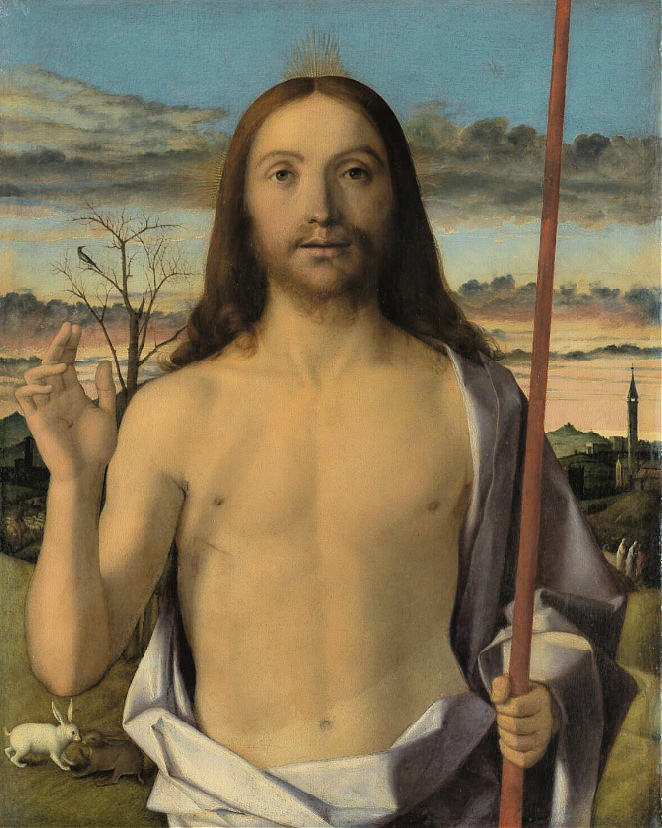
Giovanni Bellini (c. 1430-1516), Christ Blessing c. 1500, Tempera, oil, and gold on panel, 23 1/4 x 18 1/2 in. (59 x 47 cm), Kimbell Art Museum, Fort Worth, Texas. https://kimbellart.org/collection/ap-196707 – retrieved December 17, 2024.

In Bellini’s long career he depicted Jesus Christ differently over time. In his early years he often depicted the dead Christ in a lonely solitude. Later he added angels, and grief-stricken figures of his mother Mary and the apostle John. Bellini developed to depict Christ as triumphant or beatified in his miraculous apparitions of the Transfiguration, Resurrection and Ascension. In Christ Blessing Bellini animatedly portrays the God-Man sent to bless the world on one hand and holding the shepherd’s rod to guide his flock in the other (it may also be logically seen, though not completely in view, as his staff with the traditional red cross on a white flag atop symbolizing his triumph over death). A devotional image presenting the Resurrected Savior, its vibrant figure is brought close to the picture plane where his level gaze and shadowed arm of blessing informs the viewer of the matter-of-fact reality of the scene in quiet harmonious colors. Yet, at the same time, golden rays of light emanate from the top and sides of his head, making thoroughly evident His Divinity. In the background Bellini depicts prolific rabbits, shepherds tending their flock and three shrouded figures who likely are the three Marys at the tomb on Easter morning. There is also a lighted church bell tower to convey the presence of Christ in his Church.

Giovanni Bellini (c. 1430-1516), Drunkenness of Noah,  oil on canvas, c. 1515, 40.5 in. x 61.8 in (103 cm x 157 cm), Musée des Beaux-Arts et d’Archéologie de Besançon.

In one of Bellini’s last works the master shows how he adapts his work to the developing artistic style after 1510 led by Giorgione and Titian: the composition is fluid and dynamically conceived, with dramatic realism, aqueous colors and excited brushstrokes. Its attribution to Bellini has been accepted by scholars since 1927 though it remains open to debate.

Cima da Conegliano (c. 1459-c.1518), Virgin and Child in a Landscape, 1496-99, North Carolina Museum of Art, Raleigh, oil on panel, 28 x 24 3/4 in. (71.1 x 62.9 cm). https://ncartmuseum.org/object/virgin-and-child-in-a-landscape/ – retrieved December 12, 2024.

Cima was a Venetian artist who admired Bellini’s use of color and Antonello’s style of the Netherlandish masters. In contrast to renewed classicism which appeared in Venice in its art and architecture, Cima attempted a sophisticated art reliant on the study of nature that was prevalent in the provinces. Born in Treviso in about 1459, Cima worked in Vicenza in Mantegna’s circle and then moved to Venice in 1492. He was associated with the school of Alvise Vivarini (1442/1453–1503/1505), though Cima remained linked to the gentle and rustic naturalism of the provinces. His models included Madonnas and religious figures in peaceful landscapes such as this painting of a peasant mother and her child in a landscape that includes behind them a monastery and hilltop fortification. The crystalline colors and fluid drawing indicate Antonello’s influence while its overall placidness is characteristic of Cimi’s artwork.

Vittore Carpaccio (1465-1526), Apparition of the Martyrs of the Mount Ararat in the Church of Sant’ Antonio di Castello, c.1513-14, oil on canvas, 47 5/8 x 68 ½ in. (121x 174 cm), Gallerie dell’ Accademia, Venice.

A pupil of Gentile Bellini (Giovanni’s brother), and a follower of Giovanni and Giorgione, his finest work began in 1490. The Legend of Saint Ursula and other pageant-type pictures was early and masterful Italian genre painting. Carpaccio depicted detailed episodes of sacred history and legend using the settings and minutiae of contemporary everyday Venetian society within a formal pictorial schema. This Apparition of the Martyrs of the Mount Ararat in the Church of Sant’ Antonio di Castello is a small canvas that captures the compelling simplicity and authentic emotion of a religious scene that was present in his earlier larger format cycles and series. The painting is of a vision of the prior of  St. Anthony monastery kneeling at the altar on the far left. He turns to see the 10,000 martyrs of Mount Ararat he called upon in prayer during a plague that had broken out among the friars. As the martyrs process into the church, they are blessed by St. Peter, the first pope. Carpaccio depicts the interior of a Gothic Church  – including an elaborate wooden screen at left and cargo ships suspended from the ceiling – that was demolished in 1807.

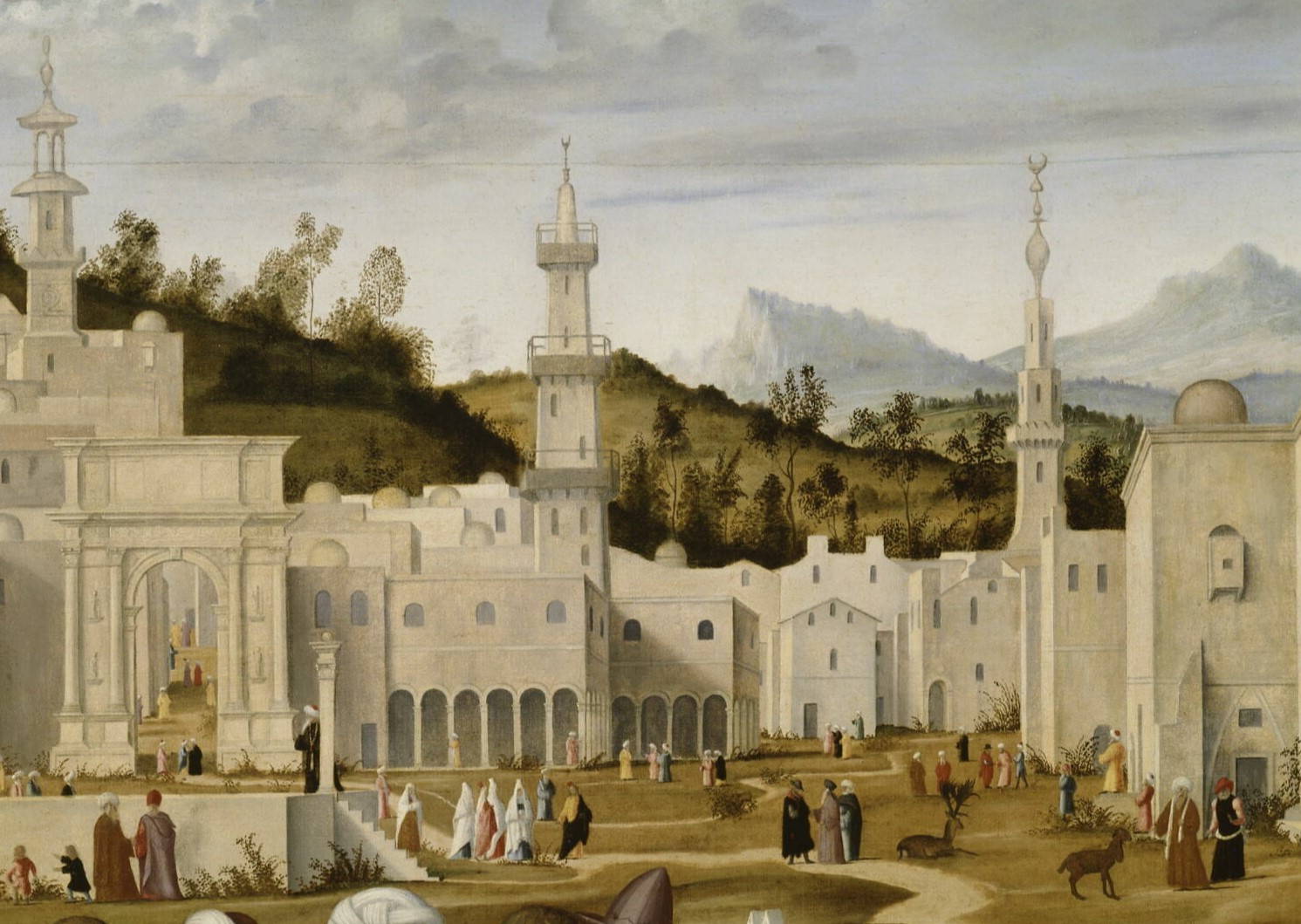
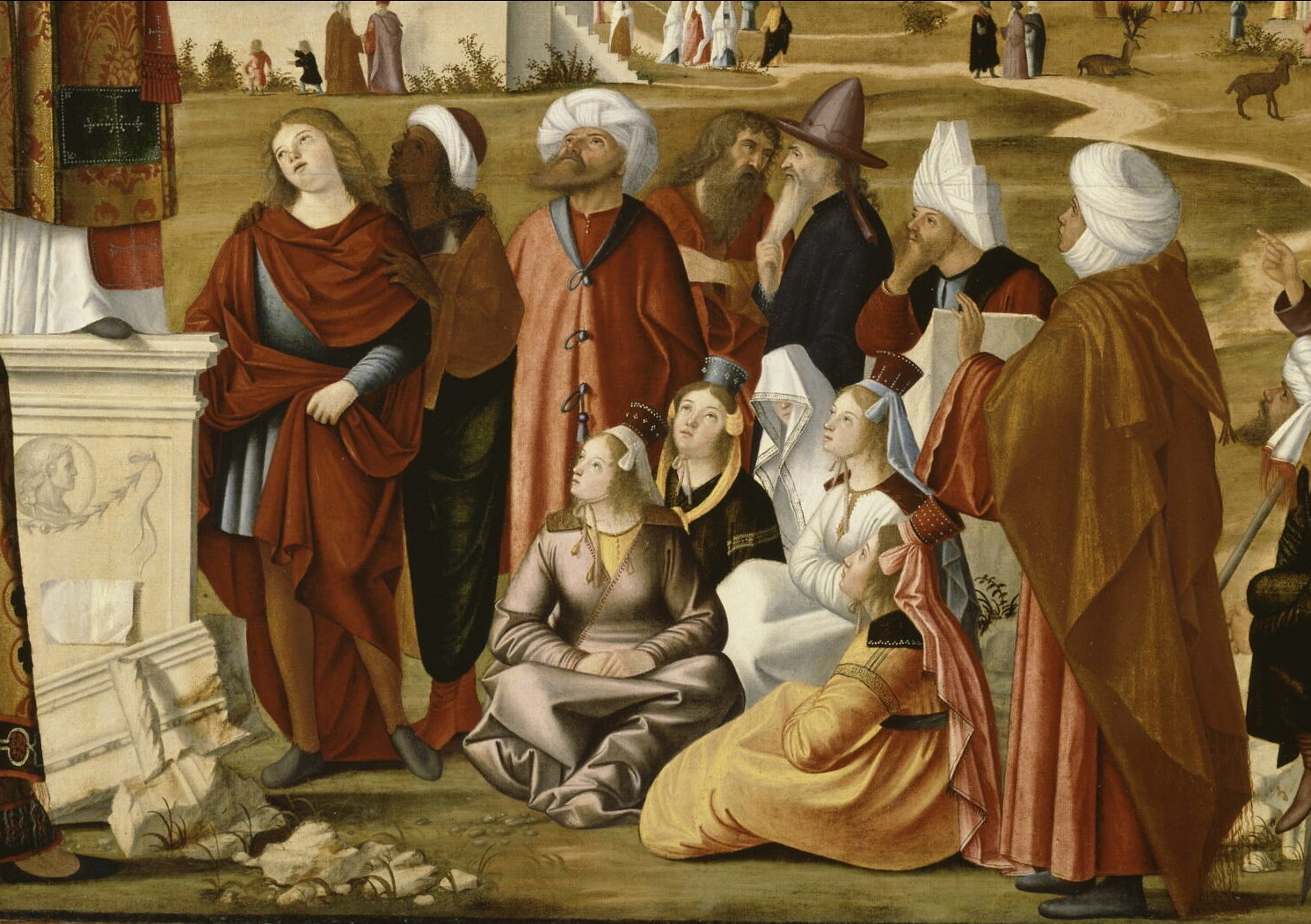
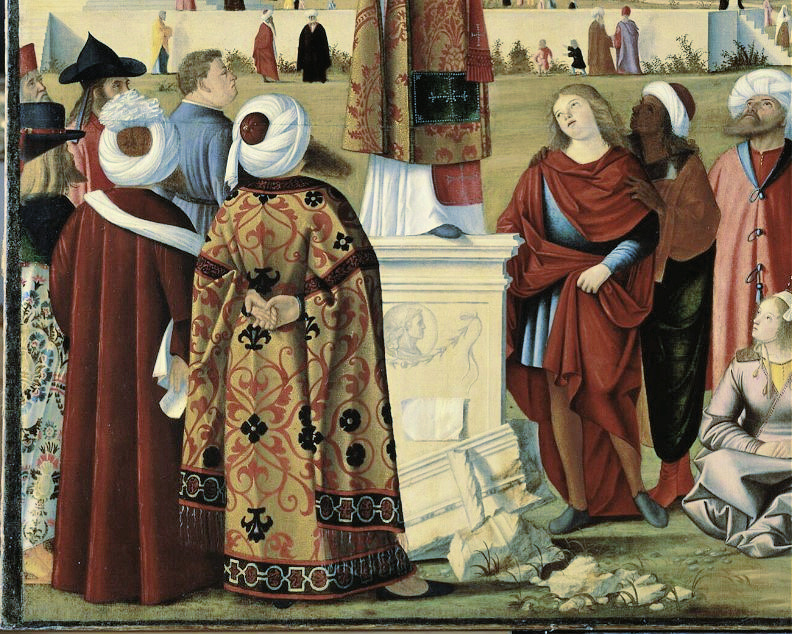
Vittore Carpaccio (1465-1526), Preaching of St. Stephen, 1500-1525, oil on canvas, 1.48 x 1.94m, Louvre. In place until the abolition of the brotherhood in 1806; P. Edwards, 1807; Pinacoteca di Brera, Milan, 1808; entered the Louvre by way of exchange, 1812. https://collections.louvre.fr/en/ark:/53355/cl010062650 – retrieved December 19, 2024.
detail.
detail.
detail.

Preaching of Saint Stephen by Vittore Carpaccio was done on the first quarter of the 16th century. It depicts the first Christian martyr, St. Stephen, giving a sermon whose actions and words involve its audience as active witnesses. Set within a spacious landscape it reflects an ideal city view, reminiscent to Jerusalem. It is suggested that Carpaccio may have been in Jerusalem as this scene is reminiscent of life in that city and of the Haram-ash-Sharif with the Mosque of Omar.
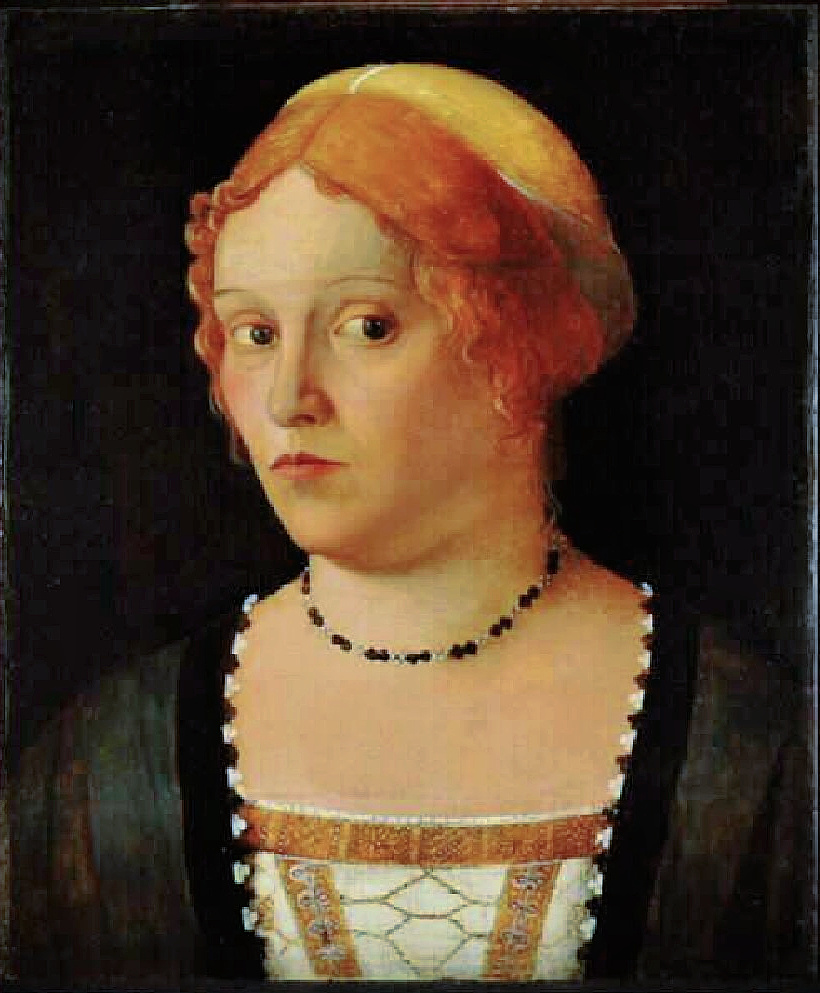
Portrait of a Lady, formerly attributed to Vittore Carpaccio (Italian, 1465 – 1526),:ca. 1505, Oil on panel with traces of tempera, 10 7/16 × 8 13/16 × 7/8 inches (26.47 × 22.4 × 2.21 cm) see – https://art.nelson-atkins.org/objects/16018/portrait-of-a-venetian-woman?ctx=0721b3e2-2547-4733-9f9a-582aecdcd7b0&idx=0 – retrieved December 5, 2024.

Carpaccio’s realism in numerous portraits in his ceremonial pictures was influenced by the Flemish masters already popular in Italy in the 1490’s. This bust-length independent portrait of a woman set against a plain dark background is almost an abstract construct of eyes, mouth and hairstyle. Her large head is turned slightly in one direction while her limpid  eyes look in the other direction. Her reddish hair is pulled loosely back from her face and, at the crown of her head she wears a yellow net to hold some of it. Her square-neck dress is slate blue edged in black, with a white and gold embroidered front panel. Around her neck she wears a choker of white and black beads.
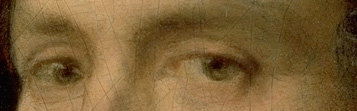
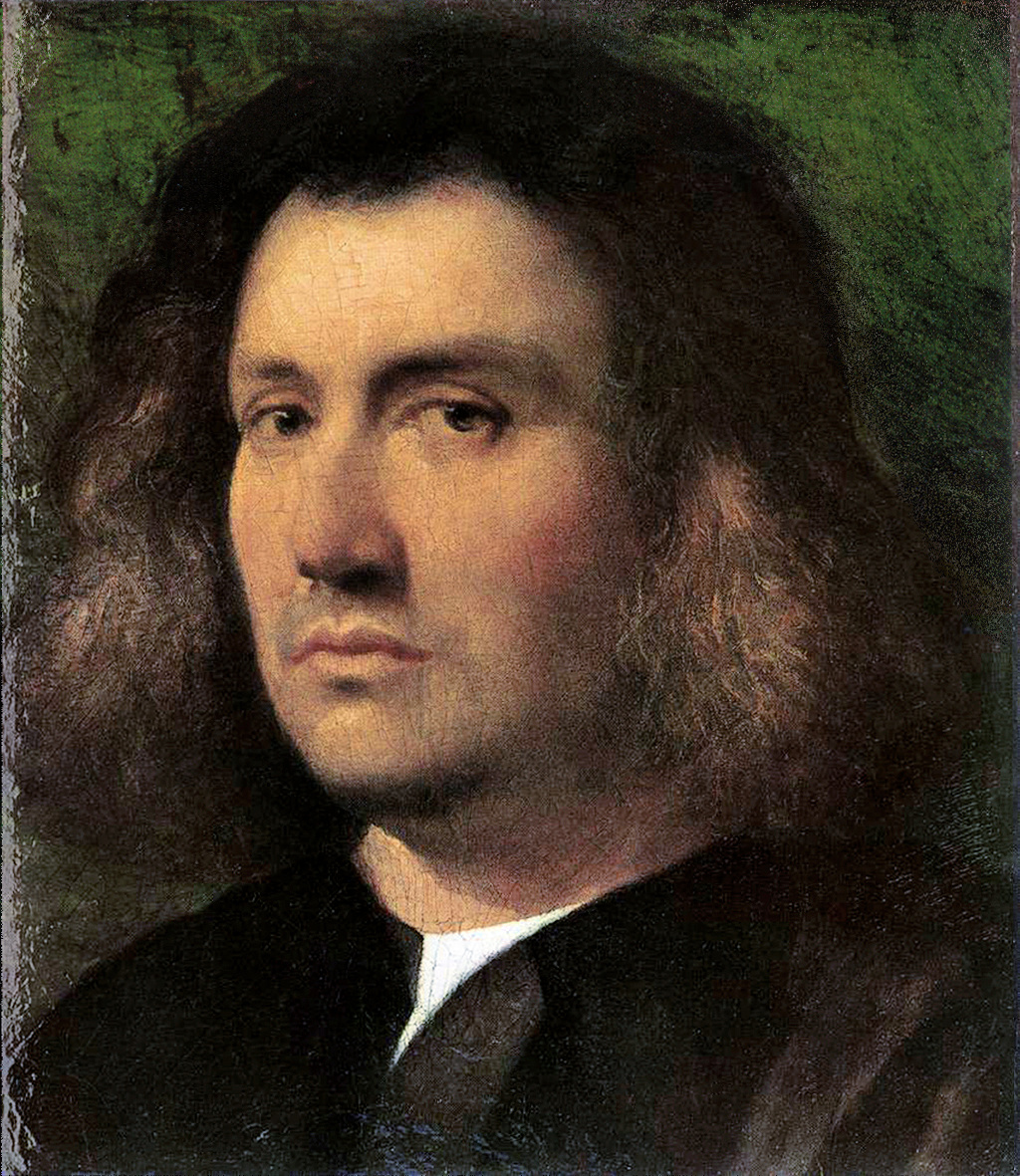
detail of picture below.
Giorgione (1478–1510), Portrait of a Man, 1506-10, oil on panel, 11 7/8 x 10 1/8 in. (30.16 x 25.72 cm), San Diego Museum of Art.https://collection.sdmart.org/objects-1/portfolio?records=50&query=sort_artist%20has%20words%20%22giorgione%22&sort=9 – December 18, 2024.

Giorgione who moved to Venice around 1500 is the transitional figure between Bellini and Titian. Instead of a prevailing late 15th century practice of precise brushstrokes and sculptural composition in his art, Giorgio expressed his subject matter in studied tonal gradations of color and precise analysis of human emotional expression described in gentle brushstrokes. Vasari saw Giorgione’s painting as if having no intermediary between art and life. Painted in the same period as Old Woman (Gallerie dell’ Accademia, Venice), this Portrait of a Man epitomizes what Vasari called the “modern manner” where Giorgione sought to paint “living and natural things.” With its plain dark background and close head crop the man’s carefully observed turning gaze and ambiguous expression is wholly engaging and alive.
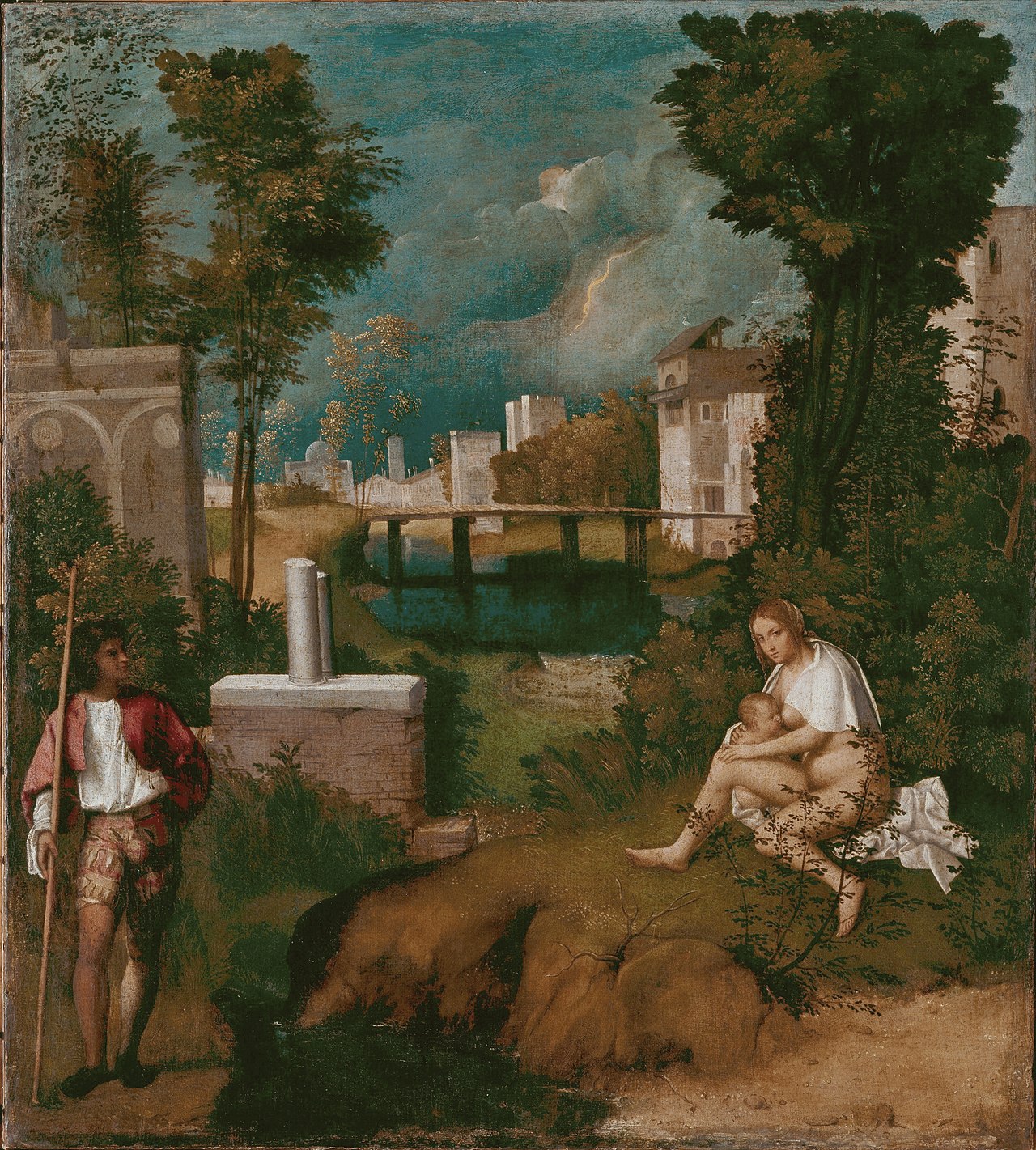
Giorgione (1478–1510), The Tempest, c. 1508, oil on canvas, 83 cm × 73 cm (33” × 29”), Gallerie dell’Accademia.

With Leonardo da Vinci, Giorgione is ranked as one of the founders of modern art. He was the first artist in Venice who often painted small artworks in oil of mysterious and evocative subjects for private commissions instead of public church works. The Tempest, originally commissioned by a Venetian noble of the House of Vendramin, is one of those artworks. Known as “a landscape of mood,” it has no discernable subject matter outside of expressing the tension and heat of an approaching storm. Its meaning remains elusive today. Giorgione’s career and personal life are equally mysterious. The artist is known to have shared a studio with Venetian painter Vincenzo Catena (c. 1480-1531) in Venice, worked on the Doges’ palace (though these works are lost) and on frescoes on the exterior of the German Merchants headquarters in Venice where Titian was working as well in a lesser role. Giorgione was an innovator but his known output is small, questionable, and, dying in the plague in 1510 at 32 years old, sometimes completed by others including his pupils, Titian and Sebastiano del Piombo, who were profoundly influenced by him.

Circle of Titian, formerly Giorgione, The Dead Christ supported by an Angel, oil on canvas, 1508-1510, 77.7 x 64.5 cm.; 30½ x 25⅜ in. Property from the Estate of Barbara Piasecka Johnson (1937–2013), https://www.sothebys.com/en/buy/auction/2022/old-masters-evening-sale/the-dead-christ-supported-by-an-angel – retrieved December 5, 2024.

Because of Giorgione’s early death in 1510 and other circumstances he did not complete many of his later paintings, making their ultimate identification difficult. That Titian completed many of these works is documented. Once in the collection of the House of Vendramin, this painting is such of jumble of painterly hands it is today attributed to the Circle of Titian though when earlier it was attributed to Giorgione the hand of Titian was apparent particularly in the figure of Christ. Titian was more aggressive in his use of colors –such as browns and grays- than Giorgione’s refined yellows and blues. X-rays reveal another composition – believed to be Giorgione-like- over the ponderous right hand of the angel painted over it.
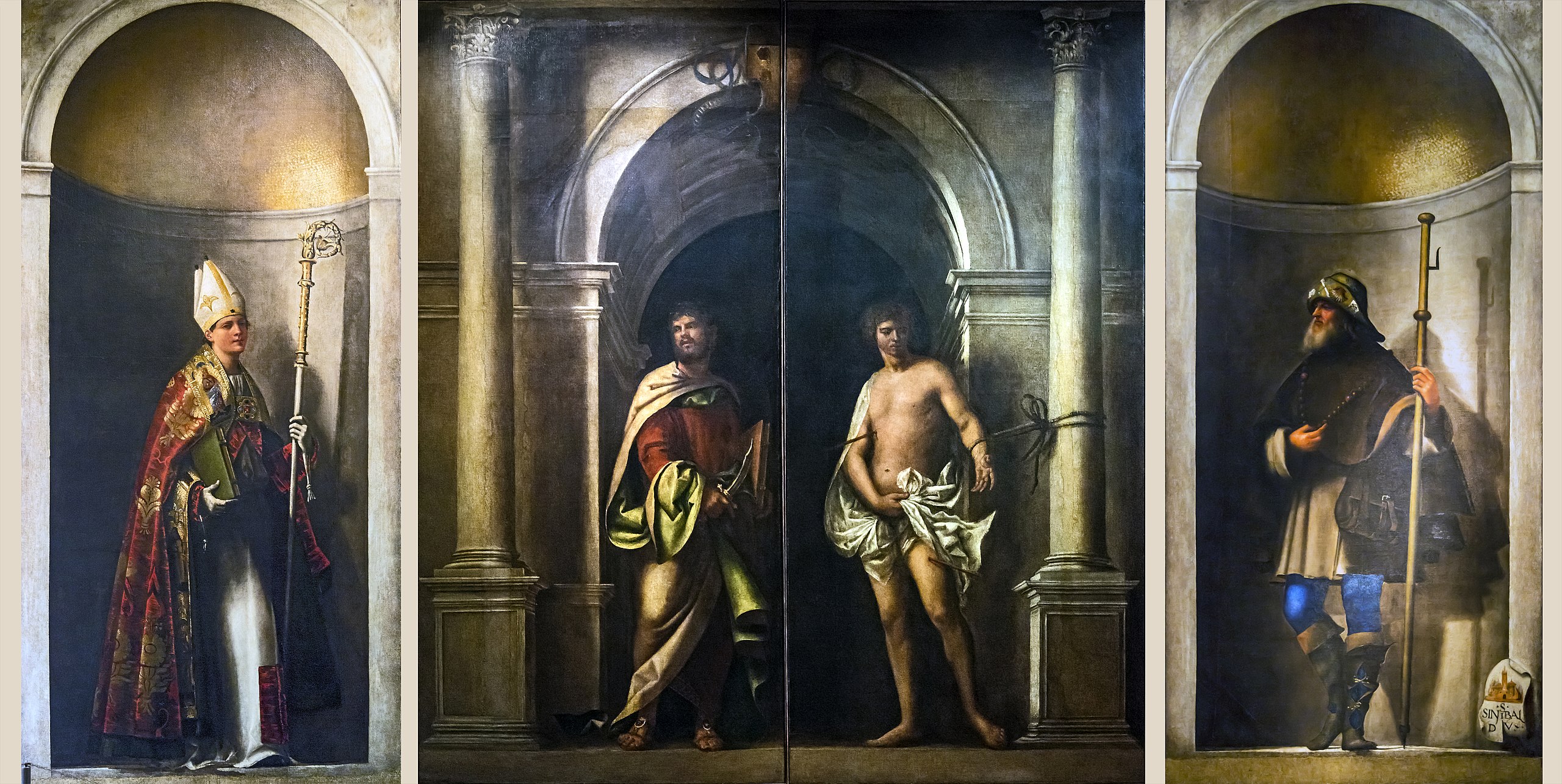
Sebastiano de Piombo (1485-1547), Organ Shutters, Four Saints, c. 1507-09, 115.3 in. x 53.9 in., 293 cm  x 137 cm  Gallerie delle’ Accademia, Venice (formerly in the Church of San Bartolomeo al Rialto).

When the organ shutter doors closed they formed a single image of two martyrs: Saint Batholomeo and Saint Sebastian. These organ shutters for San Bartolomeo al Rialto are the earliest documented works of Sebastiano. Commissioned by the church’s vicar in late 1507, it was completed in 1509.

Detail of above. St. Louis of Toulouse.

St. Louis of Toulouse was a bishop of Toulouse in France consecrated by Boniface VIII in 1297. Because of his princely standing Louis won the episcopal appointment, but as bishop he turned his office and efforts to meeting the material and spiritual needs of the poor in his diocese, feeding the hungry, and ignoring his own material interests. After six months, exhausted by his labors, he abandoned the position of bishop and died at Brignoles of fever, possibly typhoid, at 23 years old. St. Louis of Toulouse is one of the inside panels inside a niche of gray stone and gold mosaic (the other is St. Sebald of Nürnberg) by Sebastiano in his first documented commission.
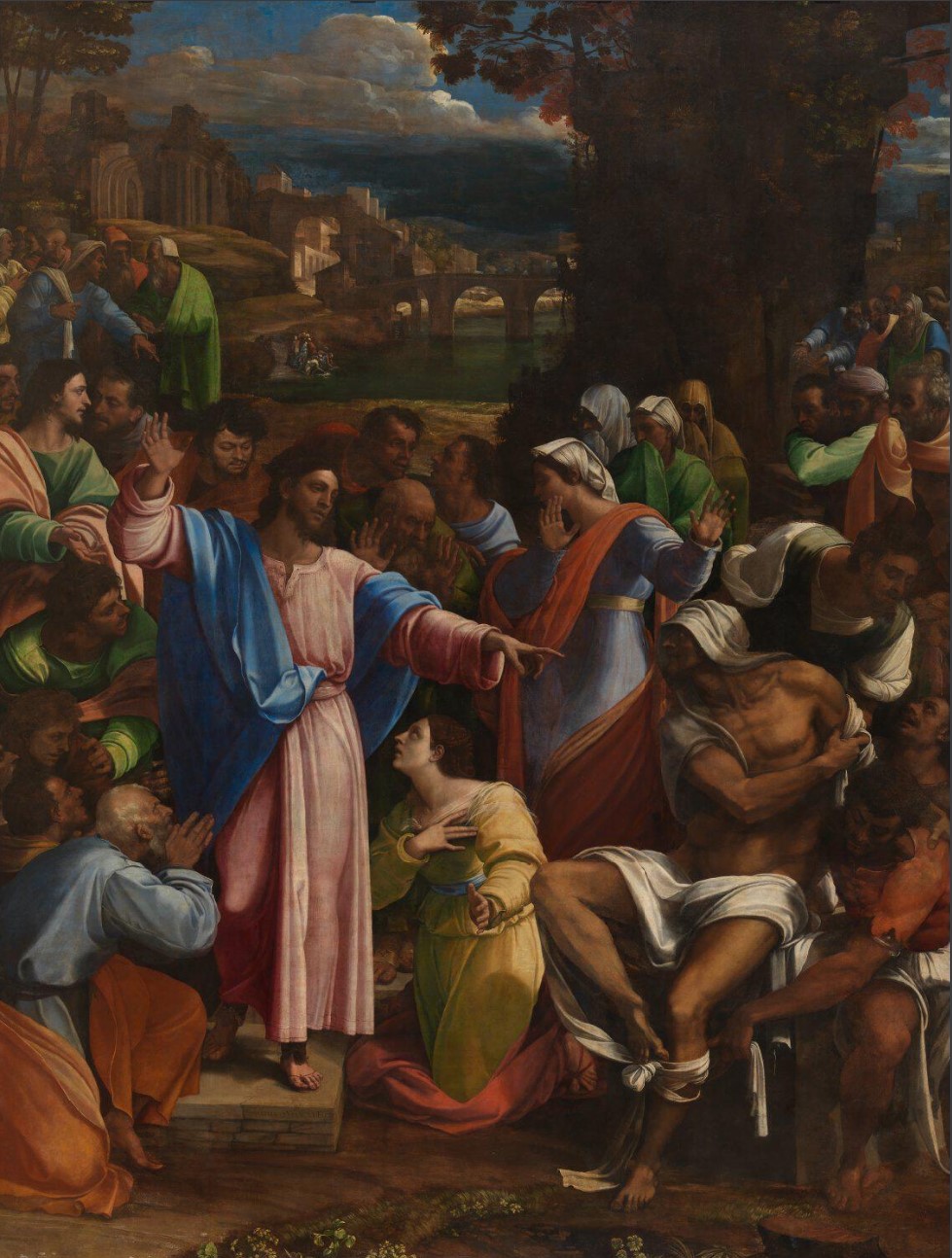
Sebastiano del Piombo (1485-1547), The Raising of Lazarus, 1517-19, oil, originally on wood, transferred to board, 381 × 289.6 cm, National Gallery of Art London. https://www.nationalgallery.org.uk/paintings/sebastiano-del-piombo-incorporating-designs-by-michelangelo-the-raising-of-lazarus – retrieved December 18, 2024.

Sebastiano Luciani, a pupil of Giorgione who deeply influenced him, was born in Venice in 1485. He didn’t become “del Piombo” until after 1531 when he became Keeper of the Papal Seal (“Il Piombo”). After Giorgione’s death in 1510 del Piombo may have completed some of Giorgione’s work and, in 1511, moved to Rome. Working at Villa Farnesina in Raphael’s circle that included Baldassare Peruzzi (1481-1536), del Piombo fell out with Raphael and became a devoted follower of Michaelangelo (1475-1564). Both eagerly worked to outperform Raphael, an artistic rival, and Michelangelo lent del Piombo some of his drawings to work from for some of the main figures in the complex composition of The Raising of Lazarus. The gigantic painting was commissioned for Narbonne Cathedral in southern France by Cardinal Giulio de’ Medici (1478-1534), later pope Clement VII, who had also commissioned Raphael’s last painting Transfiguration for the same cathedral.

“The Raising of Lazarus” by Sebastiano del Piombo is introduced by curator Matthias Wivel in this talk as part of the series ‘The History of the National Gallery in Six Paintings.’
Sebastiano del Piombo (1485-1547), Portrait of Clement VII, c. 1531, oil on slate, 105.4 × 87.6 cm (41 1/2 × 34 1/2 in.), J. Paul Getty Museum, Los Angeles. https://www.getty.edu/art/collection/object/103RJN – retrieved December 18, 2024.

The pope visited the artist’s studio and was pleased with his original three-quarter length portrait seated in a chair positioned diagonally, and ordered this oil copy on slate. The practice originated in Rome around 1500 in an attempt towards immortality in art. However, the material was heavy and would shatter if not handled with care. After 1531 del Piombo painted rather less and turned to making admirable portraits which combined his Venetian training in color and Roman discipline in form.
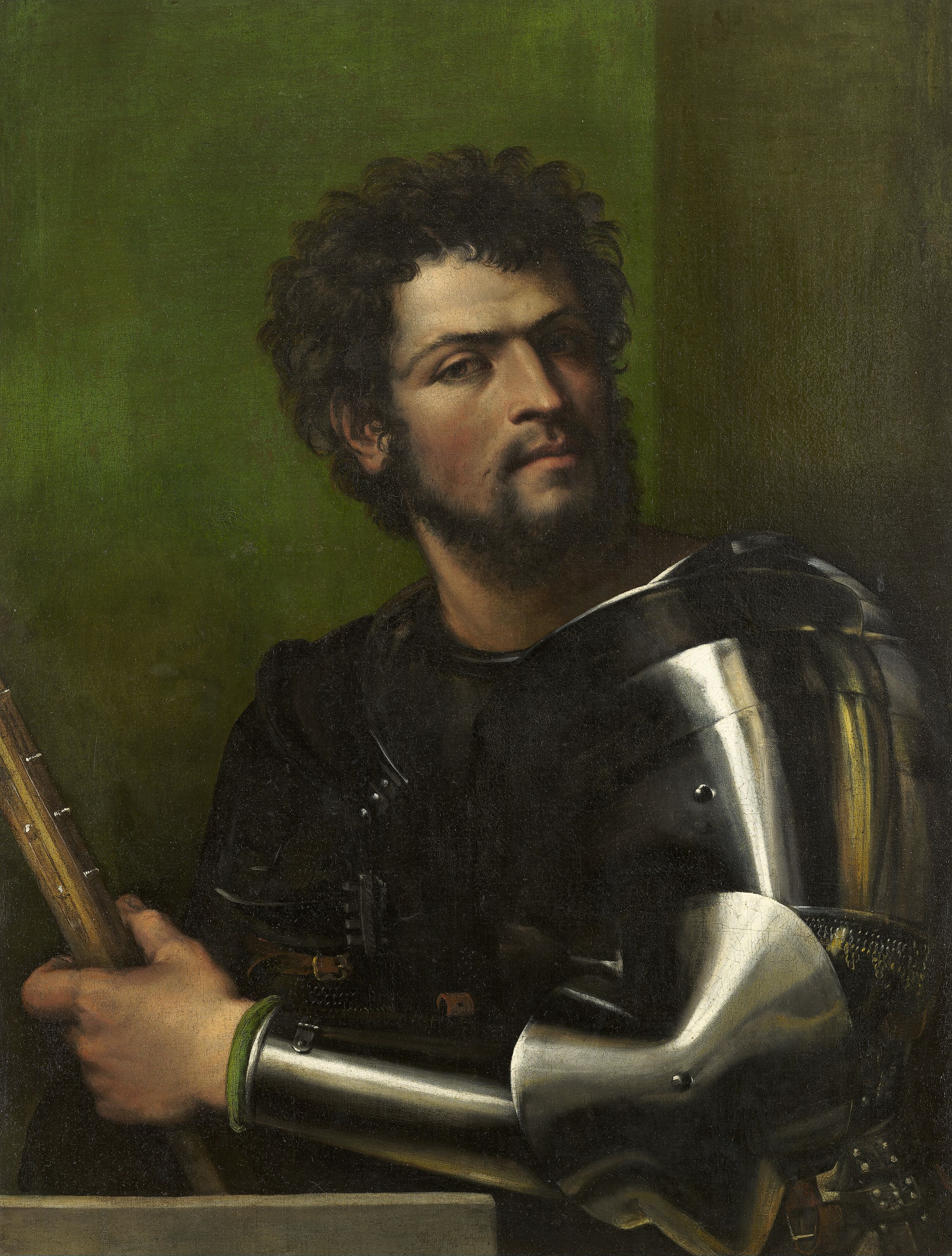
Sebastiano del Piombo (1485-1547), Portrait of a Man in Armor, c. 1511-15, oil on canvas, 34 ½ x 26 ¼ in (87.6 x 66.7 cm) Wadsworth Atheneum, Hartford.

Sebastiano made this portrait under the influence of Giorgione in terms of its gentle, engaging expression and subtly dramatic “over the shoulder” pose. Until more recently, this painting was attributed to Giorgione and, as it is Sebastiano, it recalls the deep influence Giorgione had on his pupils who imitated him profoundly. It has been postulated that the sitter is the Florentine general Francesco Ferrucci (1489-1530) who fought in the Italian Wars.

Jacopo Negretti called Palma il Vecchio (c. 1480-1528), Diana and Callisto, c. 1525/28, oil on canvas, 30 ½ x 48 ¾ in. (77.5 x 124 cm), Kunsthistorisches Museum, Vienna (Kunsthistorisches Museum Wien, Gemäldegalerie) https://www.khm.at/en/objectdb/detail/1291/?offset=34&lv=list – retrieved December 12, 2024.

Palma Il Vecchio was a Venetian painter who was a pupil of Bellini and influenced by Titian, Giorgione and Lotto. He is chiefly remembered for his paintings of female figures, particularly a blonde Venetian type of ample charm which extended even to paintings of several female saints. The subject of the naked woman located in a natural setting was pioneered by Giorgione and Titian but Palma Il Vecchio progressed the subject to work out the figure in three-dimensions and reliant on the linear curves in and of a complex assembly and interplay of naked female figures. In this painting, Palma il Vecchio adapted the poses of the sculptors of antiquity and drew on Mannerist contemporaries such as Giulio Romano (1499-1546) and Marc Antonio Raimondi (c. 1470/82–c. 1534). The sensuous surface texture typically found in Venetian art has given way to porcelain-like coolness.
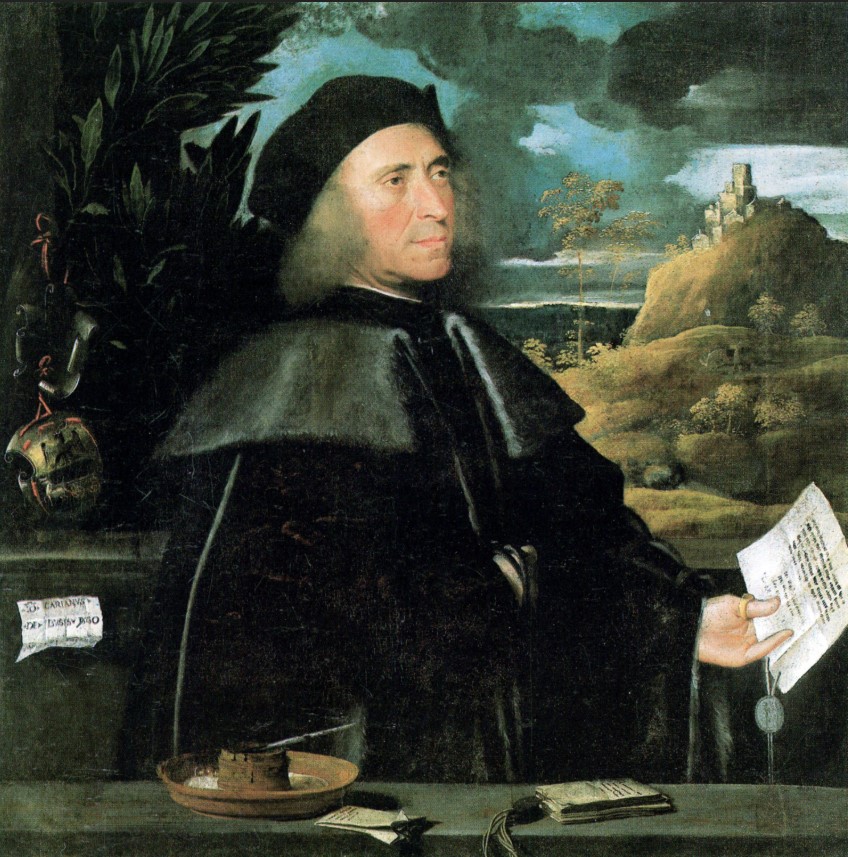
Giovanni Cariani (a. 1490-1547), Portrait of a Man, 1525-30, oil on canvas, 36 1/2 x 36 1/2 in. (92.7 x 92.7 cm), National Gallery of Canada, Ottawa.

Little is known about Cariani’s biography though it is speculated he was born in Bergamo in or before 1490. In his gentle, soft shaded subjects and arcadian elements Cariani’s early work is Venetian influenced by Giorgione. The artist was also inspired by Bellini and close to Palma Il Vecchio. He moved to Bergamo before 1520 and mastered portraiture under the influence of Lorenzo Lotto which are the highlight of his career. One of Cariani’s masterpieces is this portrait of a man of letters holding a seal that is possibly imperial or papal. The luminous colors are influenced by Palma Il Vecchio while the psychological insight of the sitter is learned from Lorenzo Lotto. The sitter is believed to possibly be Giovanni Benedetto da Caravaggio, a professor and administrator at the University of Padua.
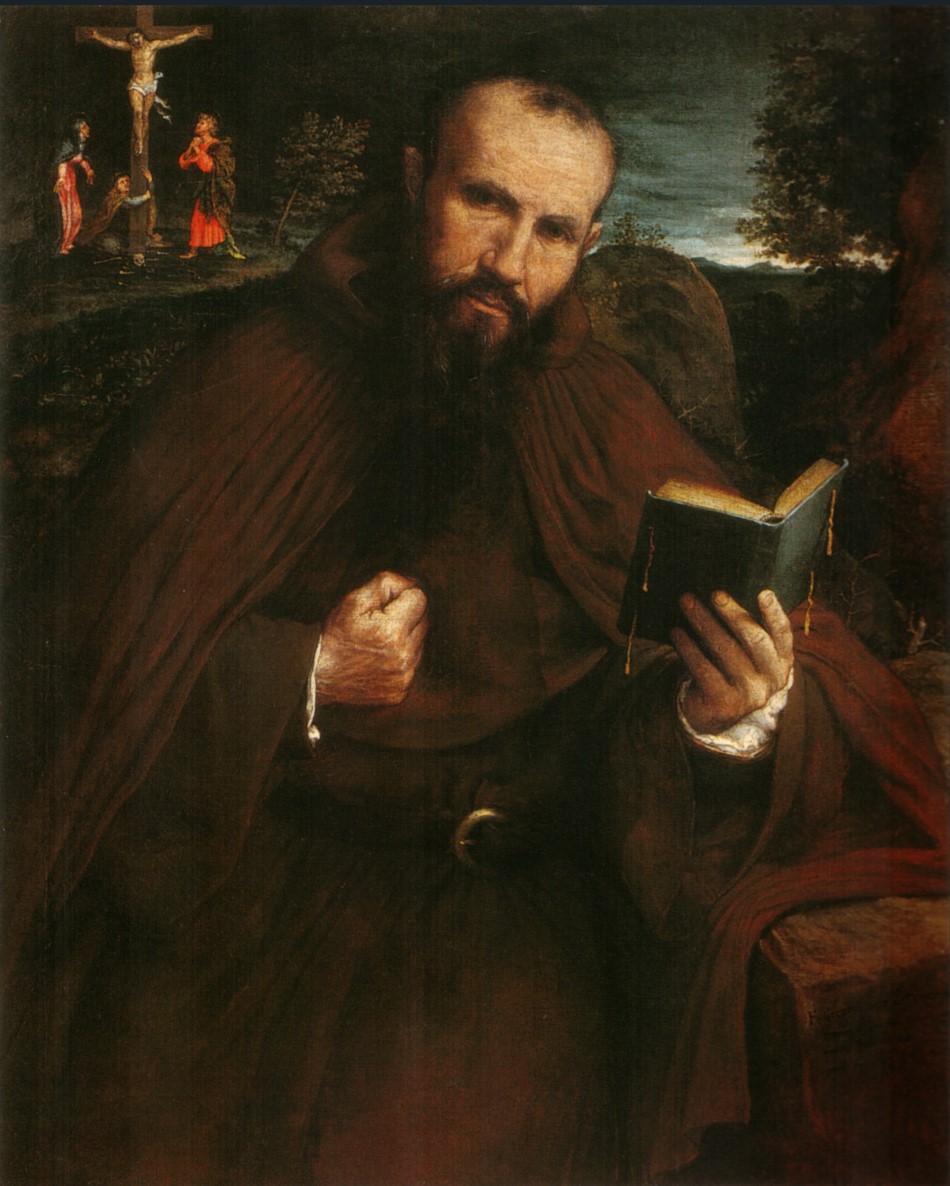
Lorenzo Lotto (c. 1480 – 1556), Fra Gregorio Belo of Vincenza, 1547, oil on canvas, 34 3/8 x 28 in (87.3 x 71.1 cm) The Metropolitan Museum of Art, New York City. https://www.metmuseum.org/art/collection/search/436917 – December 18, 2024.

The sitter beats his fist into his chest in penance, lifts an open book of Passion meditations, and is surrounded by a brooding sky and background living scene of Calvary, all of which works for the artist to scrutinize the mental state or inner thoughts of his sitter, here a religious brother in an order of poor hermits. Lotto had studied portraits of Albrecht Dürer, who made two trips to Venice, to learn to convey these deeper psychological states. Lotto’s assertively confessional portraits under his intense handling of light and dourly earthy colors, were astutely new and sometimes rejected by clients.
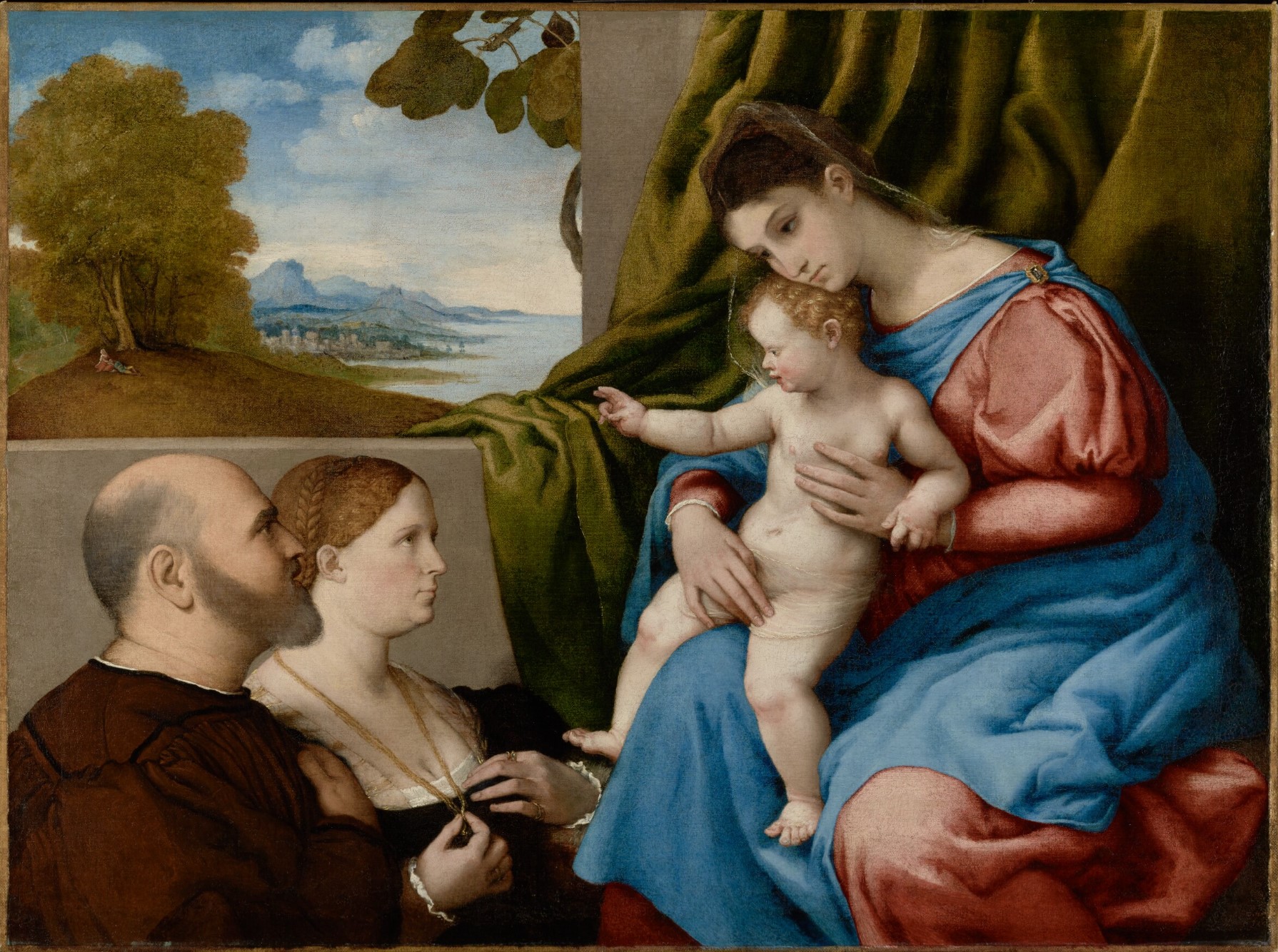
Lorenzo Lotto (c. 1480 – 1556), Madonna and Child with Two Donors, about 1525–1530, Getty Center https://www.getty.edu/art/collection/object/103RDE – retrieved December 11, 2024.

Lotto, a deeply religious man and one of the most independent of the 16th century Venetian artists, had a highly singular artistic vision with penetrating insight into the human personality. This painting is a mixture of the artist’s realism and idealism. The setting is natural as are the donors who Lotto draws with a Northern European Art sensibility. The Madonna and child are not derived from models, but expressed from an artistic conception of spiritual superiority. Kneeling donors in profile with the Virgin and Child was a motif developed in Venice in the 1490’s by Bellini. From the medieval period forward, donors were frequently portrayed in artworks they commissioned and such was more popular than ever in the early 1500’s.
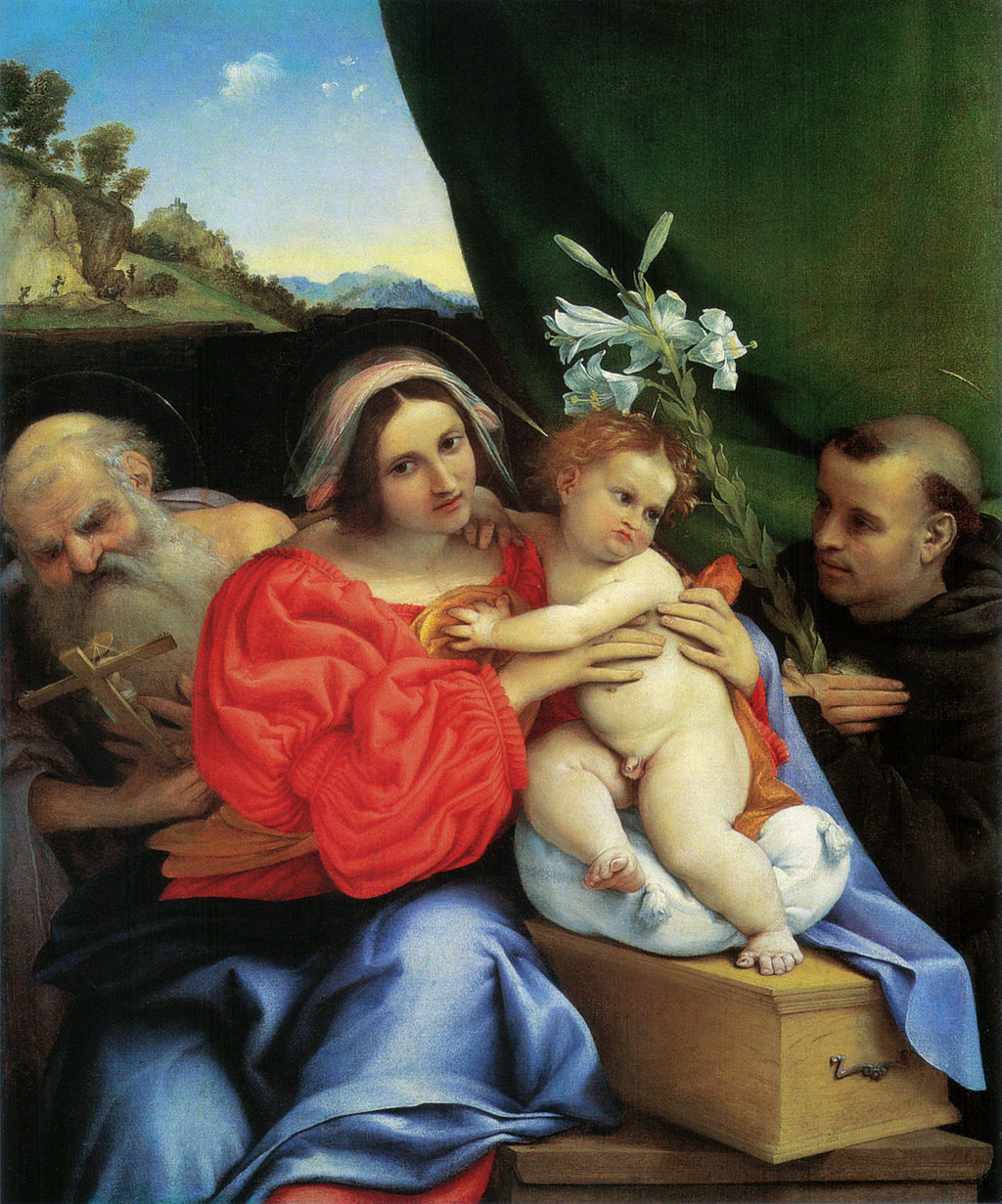
Lorenzo Lotto (c. 1480 – 1556), Madonna and Child with Sts. Jerome  and Anthony of Padua, 1521, oil on canvas, 37 1/8 x 30 5/8/ in. (94.3 x 77.8 cm),  Museum of Fine Arts, Boston.

While strongly influenced by Bellini at the start Lotto developed an independent chameleon-like style influenced by a range of contemporary Renaissance artists such as Sandro Botticelli (1445-1510), Fra Bartolomeo, Raphael, Corregio (1489-1534), Giorgione, Titian, as well as Germans, Dürer and Hans Holbein the Elder (1460-1524). But Lotto’s well-known character of independence had as much an historical context as a personal one. About Lotto, Bernard Berenson observed that the Venetian painter was “a psychological painter in an age which ended by esteeming little but force and display, a personal painter at a time when personality was getting to be of less account than conformity, evangelical at heart in a country upon which a rigid and soulless Vaticanism was daily strengthening its hold” (quoted in Pignatti, page 66). This painting from the 1520’s is remarkable for its renewed vision of the picture plane, here with an interlocking group of figures filling a shallow foreground like a frieze and a delimited background.
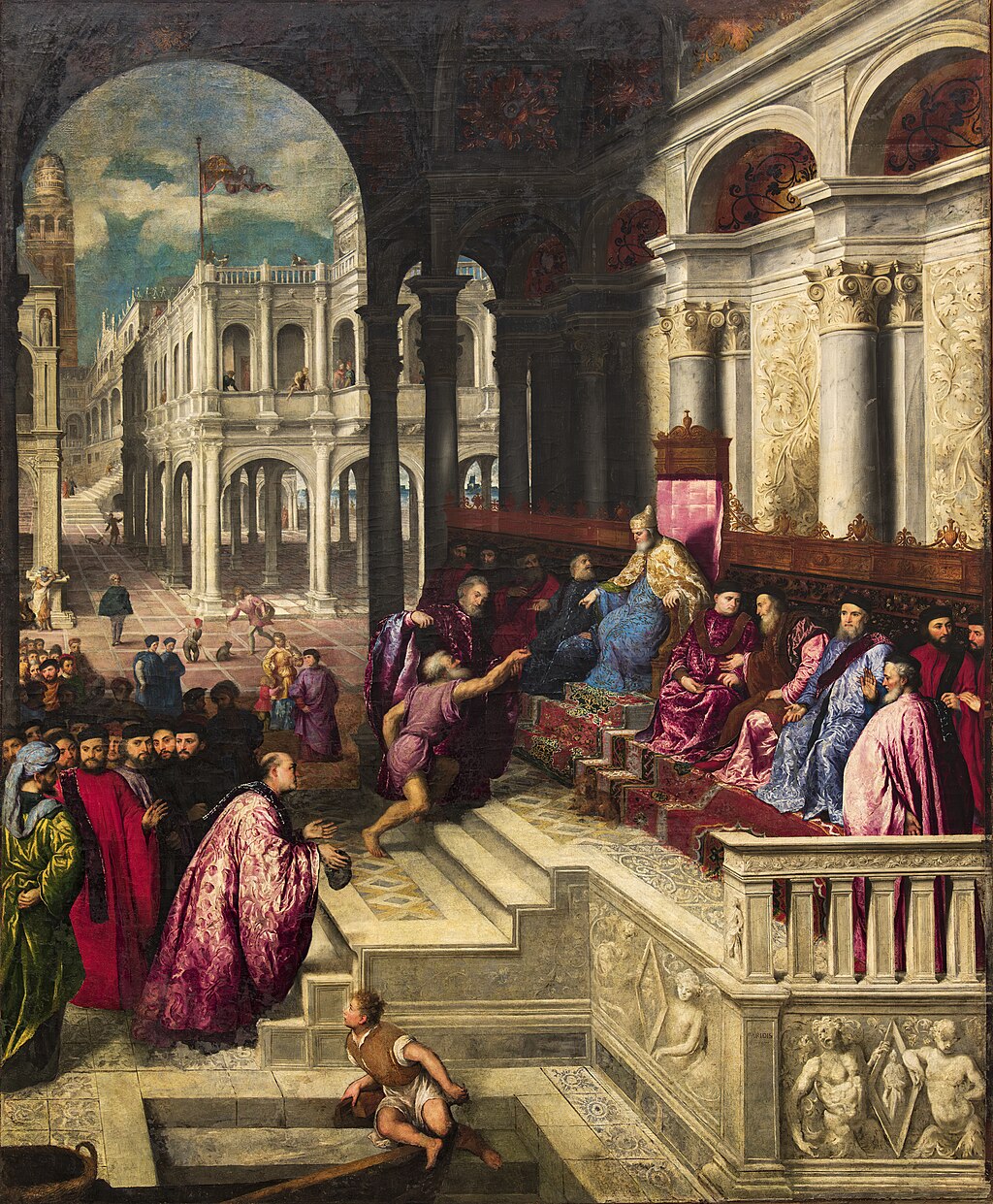
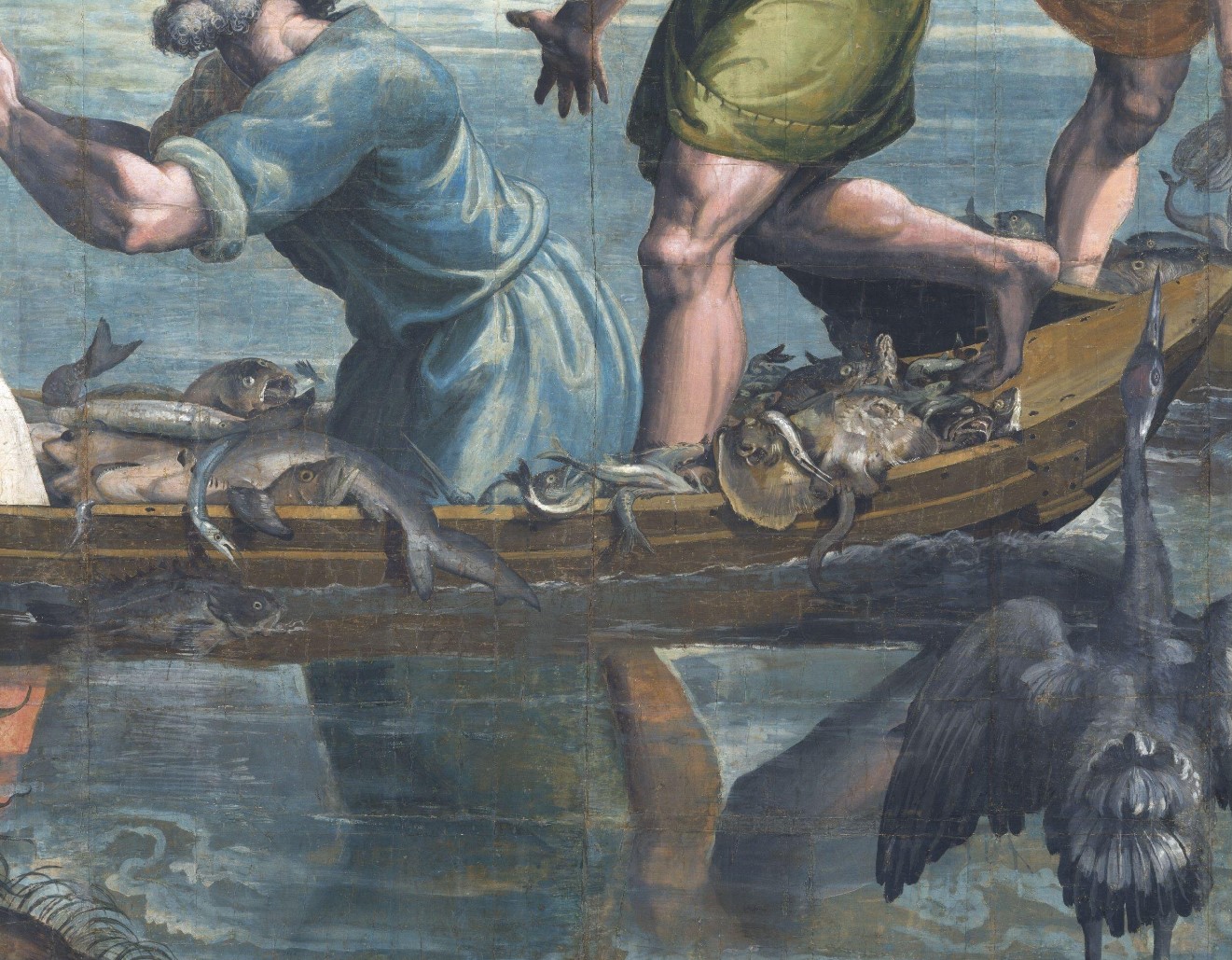
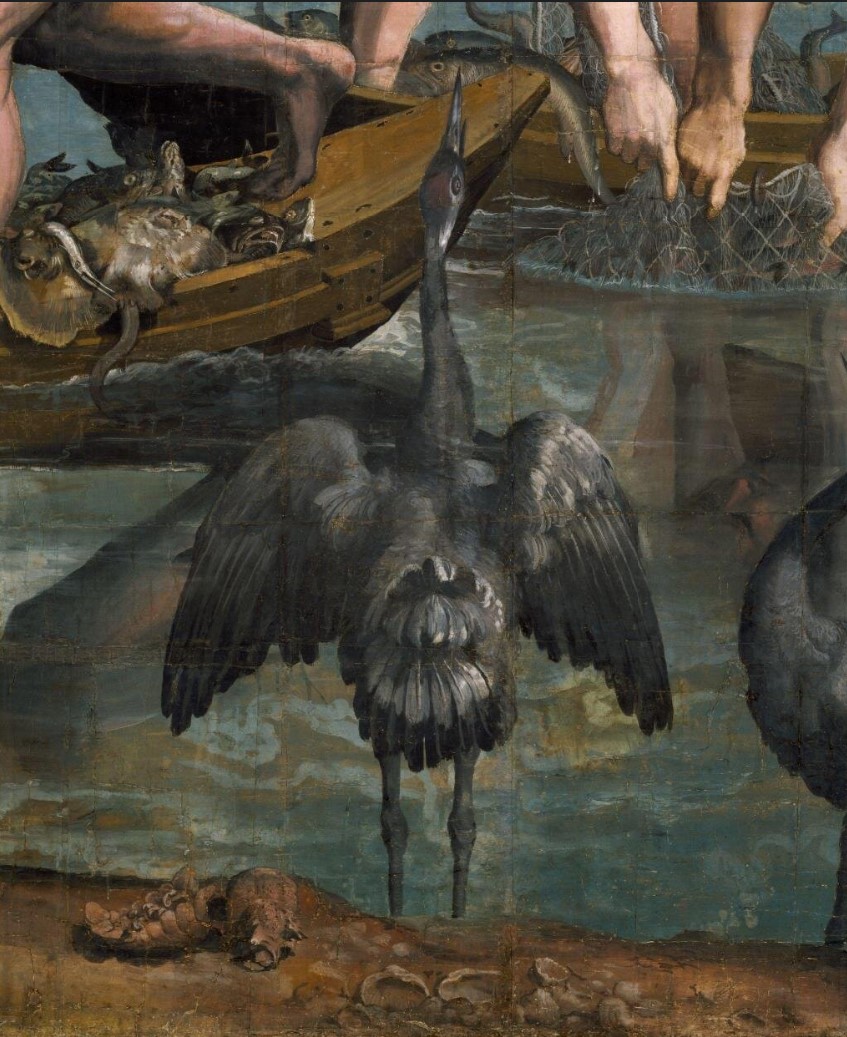
Paris Bordon/e (1500-1571), Fisherman Presenting a Ring to the Doge Gradenigo, 1534, oil on canvas, 370 x 301 cm (145.7 in × 118.5 in), Gallerie dell’Accademia, Venice.

It was painted in Venice for the confraternity of San Marco in 1540. Bartolomeo Gradenigo (1263-1342) was the 53rd Doge of Venice for three years, from 1339 to 1342. He was born in Venice to an ancient noble family and was a rich trader who practiced politics from an early age and lived a life of luxury. The painting depicts a famous legend that occurred in Gradenigo’s reign when a storm was pushed back by the intercession of Venice’s saints. Afterwards the saints gave a humble fisherman the “Ring of the Fisherman” to present to the doge.
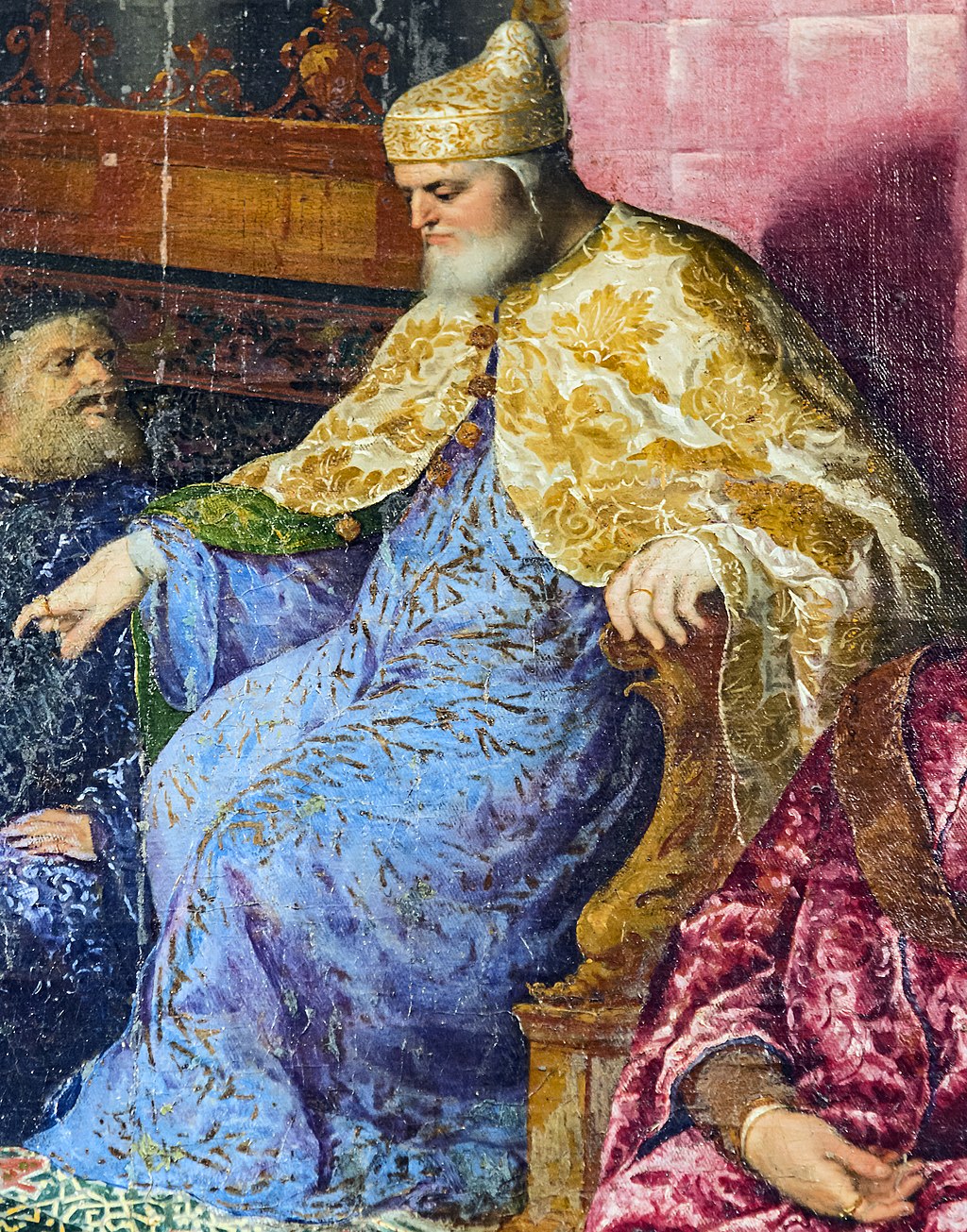
Accademia – Doge Bartolomeo Gradenigo by Paris Bordon/e.
Paris Bordon/e (1500-1571), Portrait of a Knight in Armor, oil on canvas, 36 x 30 in. (91.4 x 76.2 cm) Frame: 44 3/4 x 38 x 3 1/2 in. (113.7 x 96.5 x 8.9 cm), North Carolina Museum of Art, Raleigh. https://ncartmuseum.org/object/portrait-of-a-man-in-armor/ – retrieved December 13, 2024.

Paris Bordon/e was born in Treviso in 1500 and moved to Venice in 1508. where he was based his entire life until his death in 1571. His training is unknown though apparently in Venice where he listed as an independent painter in 1518. As a young professional he reflected the influence of Giorgione in his sentimental portraits and Titian in his use of bold and fluid colors. In the mid 1520s he took on a figural monumentality reminiscent of Pordenone. In the late 1530s Bordon/e was in France at the court of Francis I making realistic portraits and, in 1540, in Augsburg, where he painted for the wealthy Fuggers. Bordon/e was well known for his subjects’ delineated costumes and detailed intellectual landscapes.

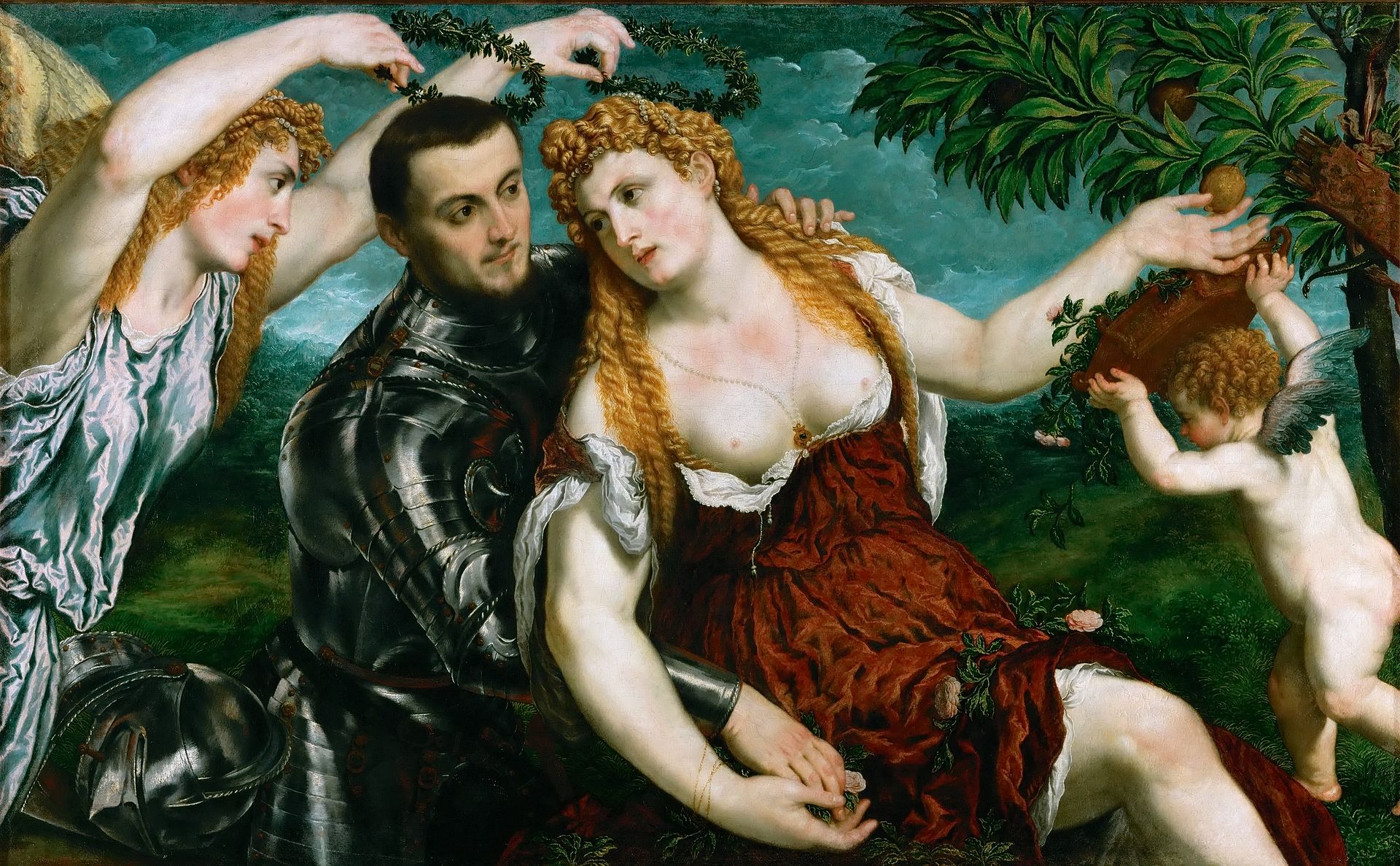
Paris Bordon/e (1500-1571). Gladiator fight, c. 1560, oil on canvas, 218 × 329 cm, Kunsthistorisches Museum Wien, Gemäldegalerie. https://www.khm.at/en/objectdb/detail/292/?offset=0&lv=list – retrieved December 13, 2024.
Paris Bordon/e.
Paris Bordon/e.
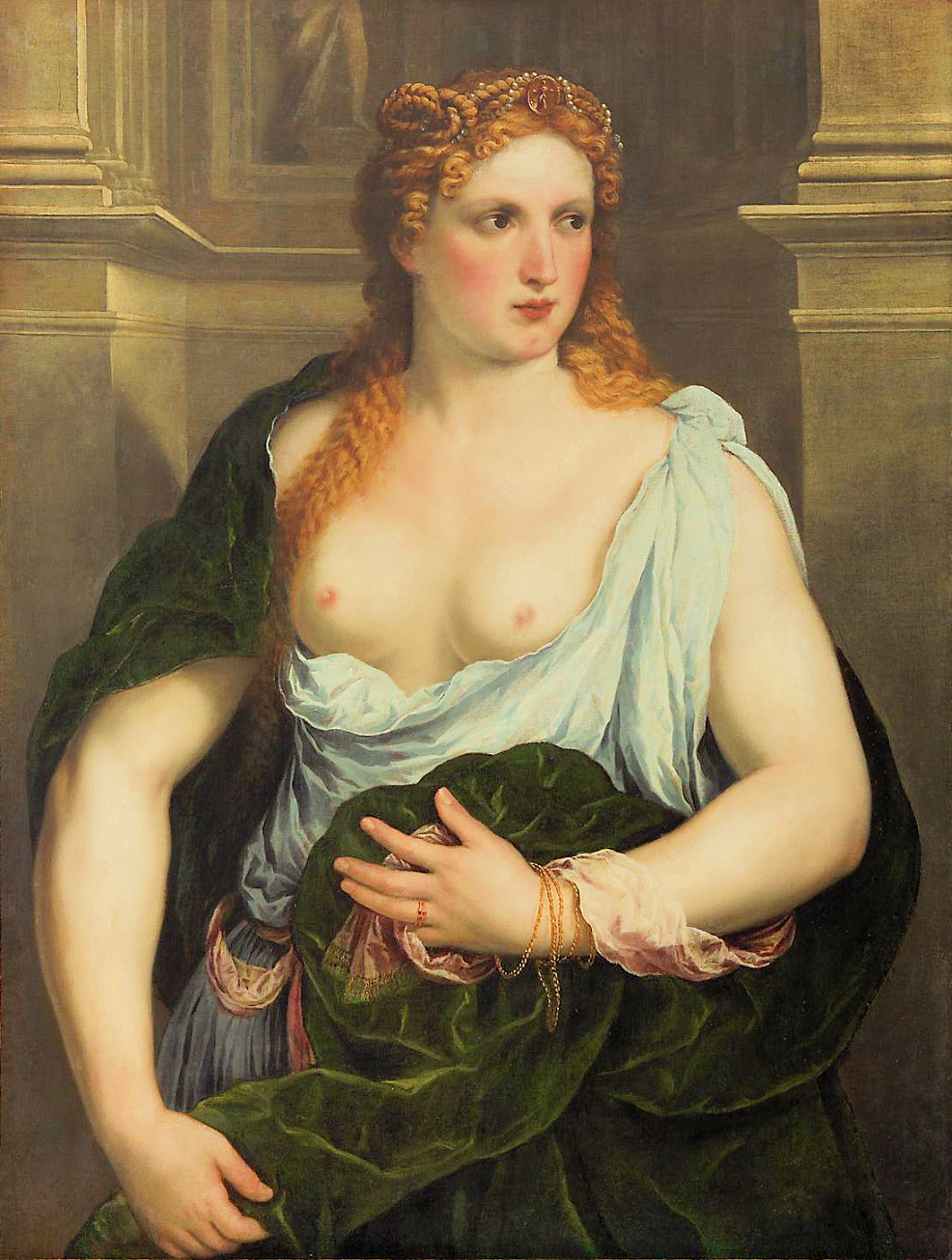
Paris Bordon/e (1500-1571), Portrait of a Young Woman in a Green Coat, c. 1550, oil on canvas, 40 1/8 x 30 ½ in. (102 cm × 77.5 cm), Kunsthistorisches Museum Wien, Gemäldegalerie.https://www.khm.at/en/objectdb/detail/288/?offset=11&lv=list – retrieved December 13, 2024.

Bordon/e’s painting is closely related to Titian’s style yet in this female figure expresses with elegance and refinement Bordon/e’s own sophisticated stylistic vision. This may be a portrait of Veronica Franco, a Venetian courtesan who played an outsized role in the social and cultural life of the city in the mid16th century.
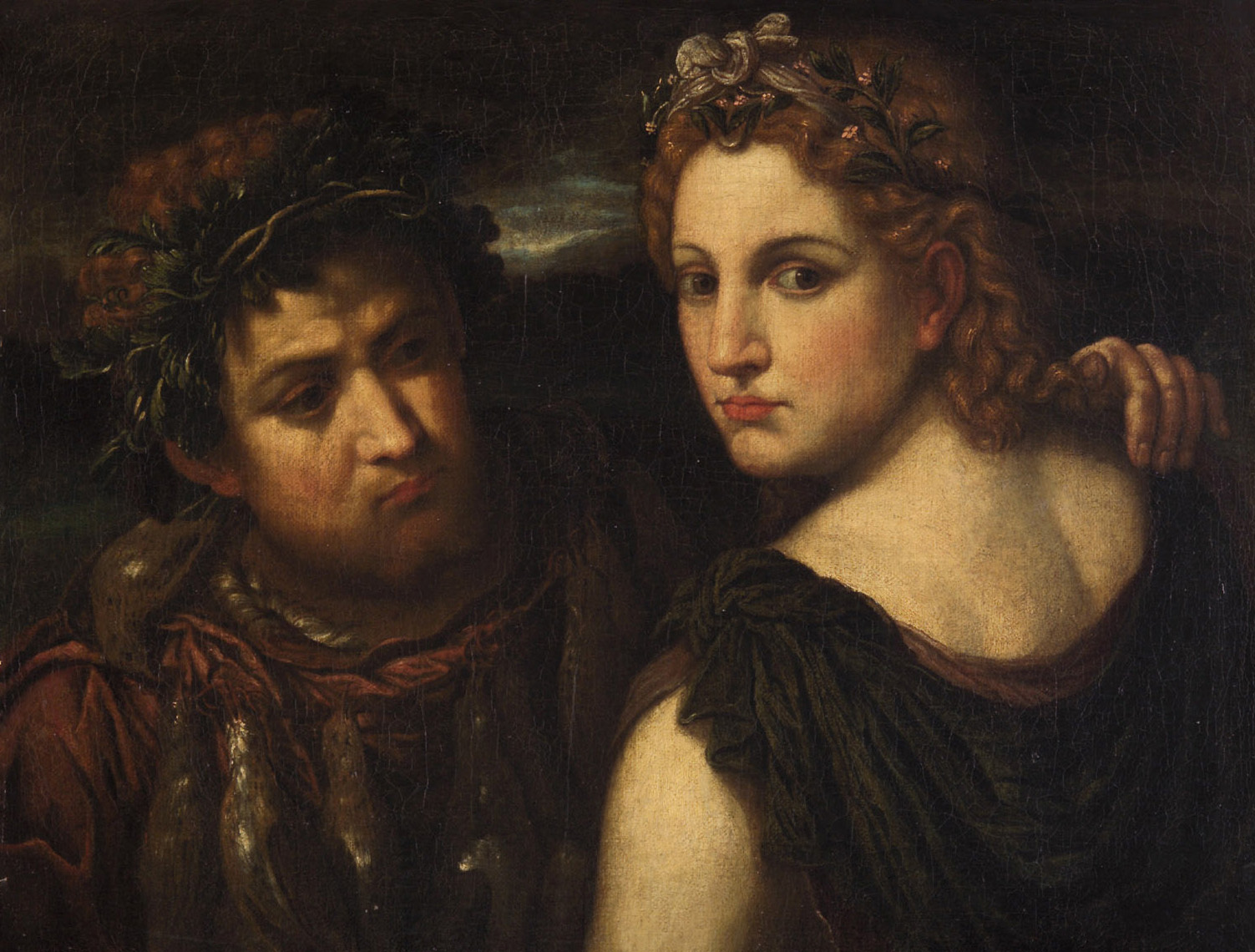
Paris Bordon/e (1500-1571), Nymph and hunter, 1550s, 45 × 61 × 2.4 cm, Kunsthistorisches Museum Wien, Gemäldegalerie. https://www.khm.at/en/objectdb/detail/294/?offset=1&lv=list – retrieved December 13, 2024.
Titian (c.1511-1576), The Death of Actaeon. c. 1559-75, oil on canvas, 178.8 × 197.8 cm. National Gallery London.

SOURCES: The Golden Century of Venetian Painting,  Terisio Pignatti, Los Angeles County Museum of Art and New York: George Braziller, Inc., 1979.

A Dictionary of Art and Artists, Peter and Linda Murray, Penguin Books; Revised,1998.

History of Italian Renaissance Art, 2nd edition, Frederick Hartt, Harry N Abrams. 1987.

Architectural History of Venice, 2nd edition, Deborah Howard, Yale University Press, New Haven and London, 2004.


SPAIN. EL GRECO (Domenikos Theotokopoulos)(Greek, 1541-1614), Brilliant painter of mystical events.

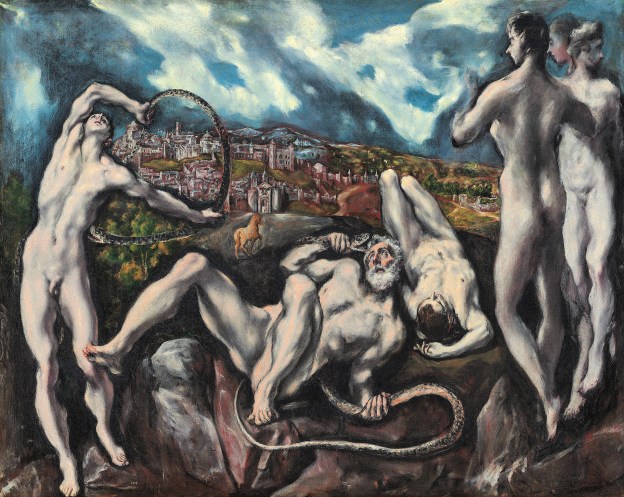
FEATURE Image: El Greco (Domenikos Theotokopoulos), Laocoön, oil on canvas, 1604-1614, 55 7/8 x 76″, National Gallery of Art, Washington, D.C. In Greek and Roman mythology, Laocoön is a Trojan priest who warned the Trojans to destroy the Trojan Horse sent by the Athenians and is punished with death by the gods for it. See the artwork again below for details about El Greco’s painting.

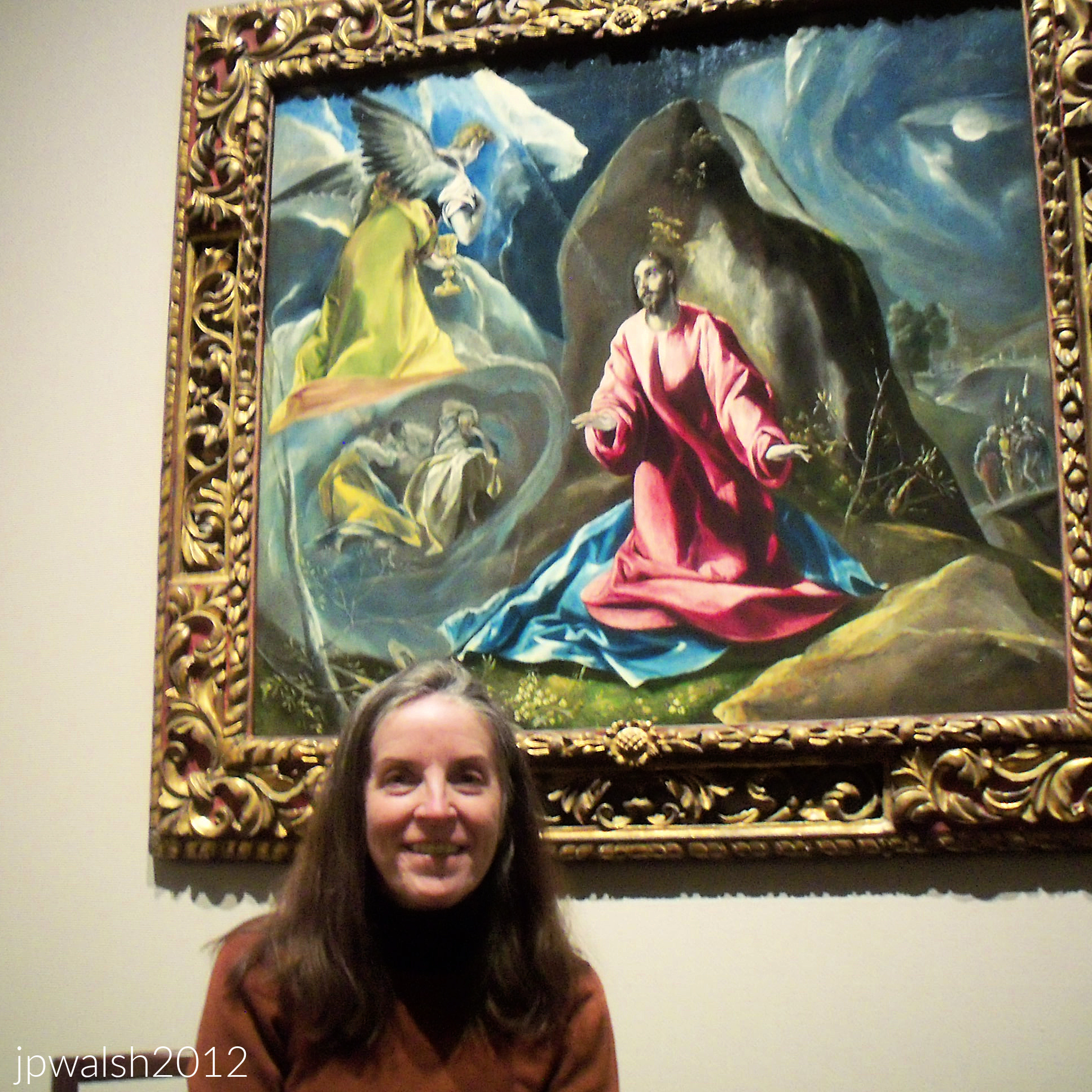
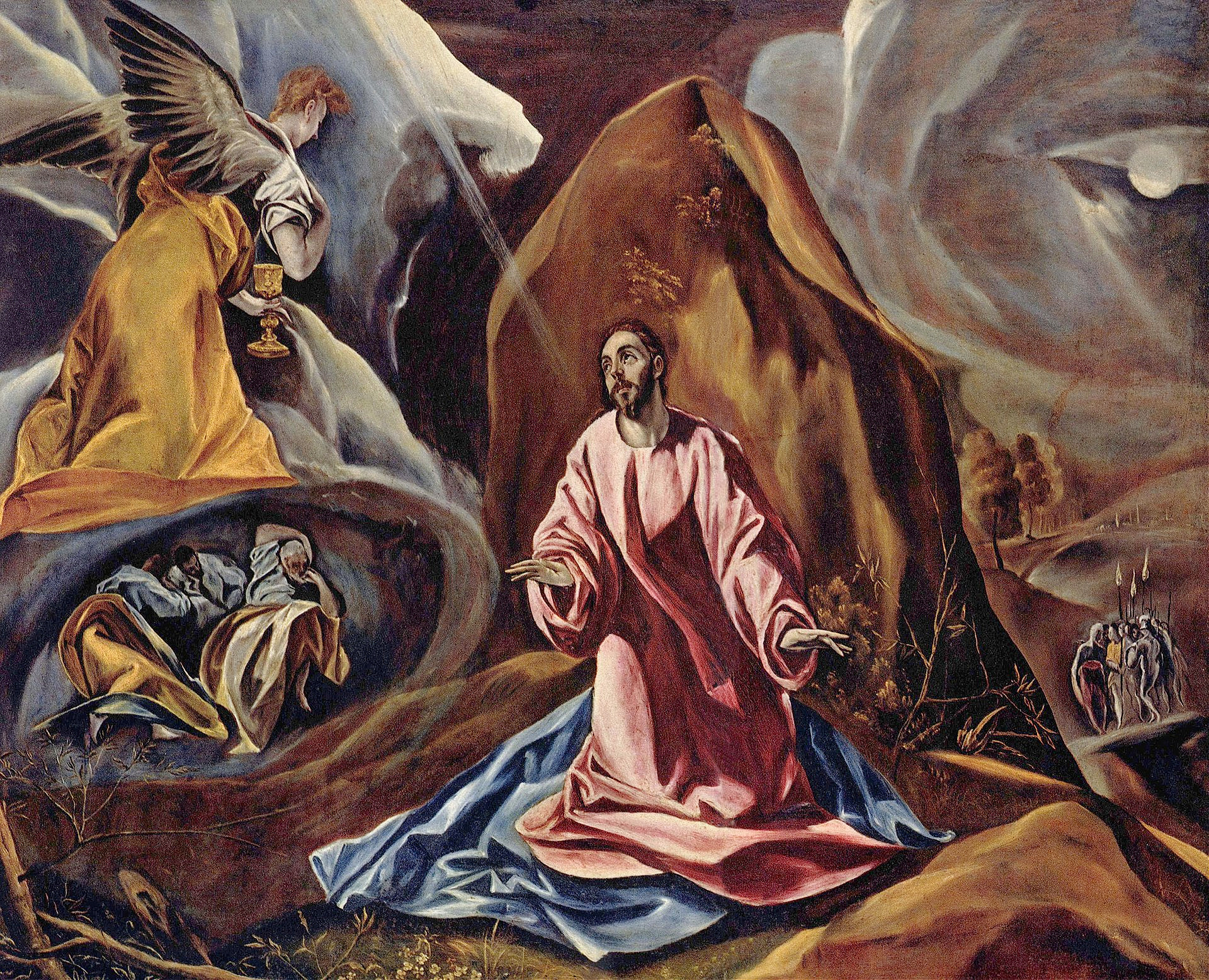
The Agony in the Garden, Domenikos Theotokopoulos, called El Greco, c. 1590-1595, oil on canvas, 40 1/4 x 44 3/4 in. (102.2 x 113.7 cm) Toledo Museum of Art, Gallery 15. November 2012 .1.32mb 101_0977.

From the museum label: With his intensely personal style, El Greco (“the Greek”) is one of the most original artistic visionaries of any era. Born Doménikos Theotókopoulos on the Greek island of Crete, he trained in Venice and Rome before settling in Toledo, Spain, where he painted this picture. Jesus is shown praying in the Garden of Gethsemane, outside Jerusalem, just before his arrest for his teachings (Judas and the Roman soldiers are approaching at the right). His disciples Peter, James, and John sleep at left. The consciously manipulated scale of the elongated figures, the intentionally jarring colors, and the deliberately confusing space (where exactly is the angel in relationship to the sleeping apostles?) add to the drama and emotion of the scene and capture Christ’s spiritual struggle as he agonizes over his coming crucifixion. Combining aspects from all four biblical accounts of the narrative for his own interpretation of the story, El Greco gives visual form to Christ’s metaphor in Matthew 26:42—”Oh my Father, if this cup may not pass away from me, except I drink it, thy will be done.” see – The Agony in the Garden – Search el greco (Objects) – Search – eMuseum – retrieved December 10, 2025.

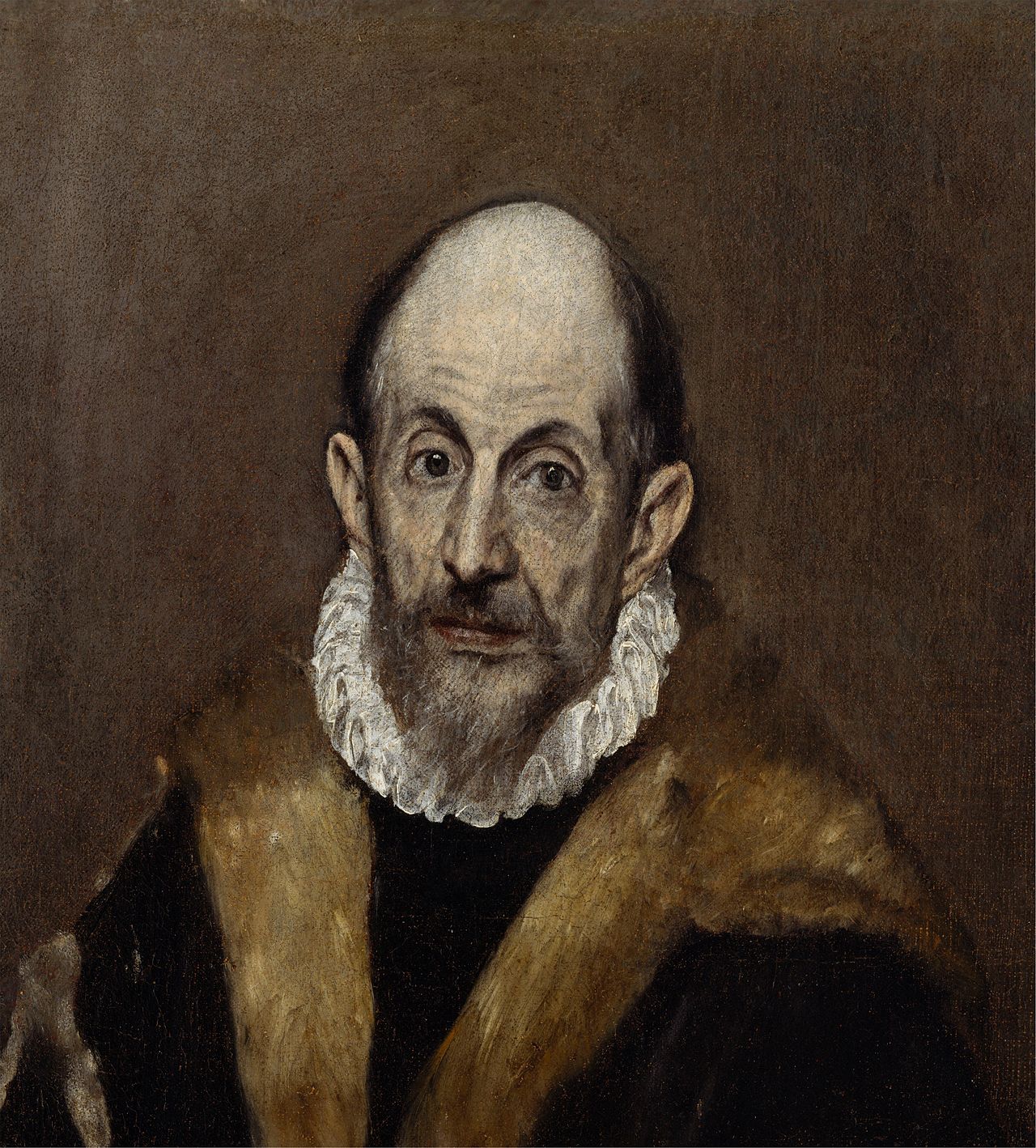
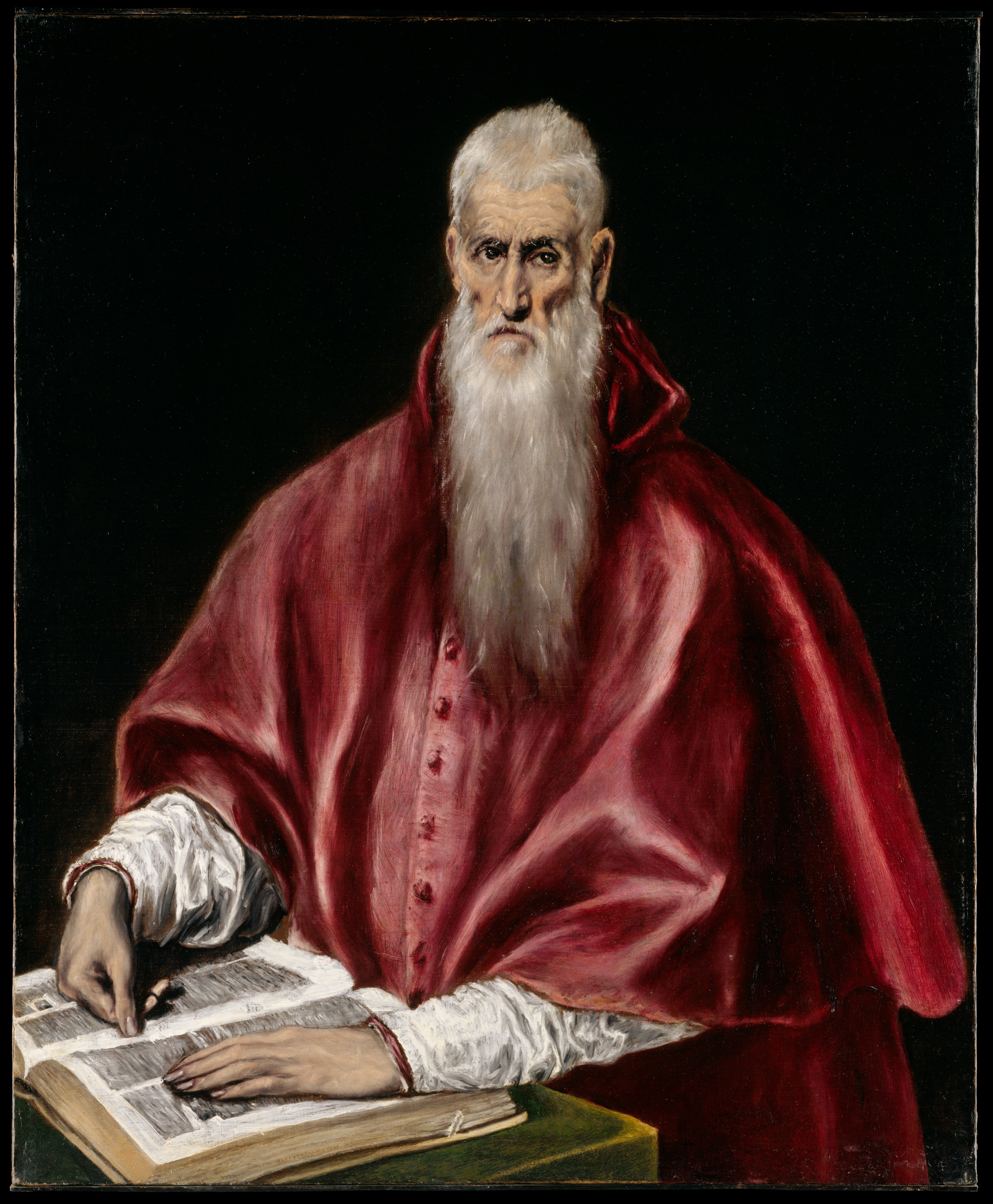
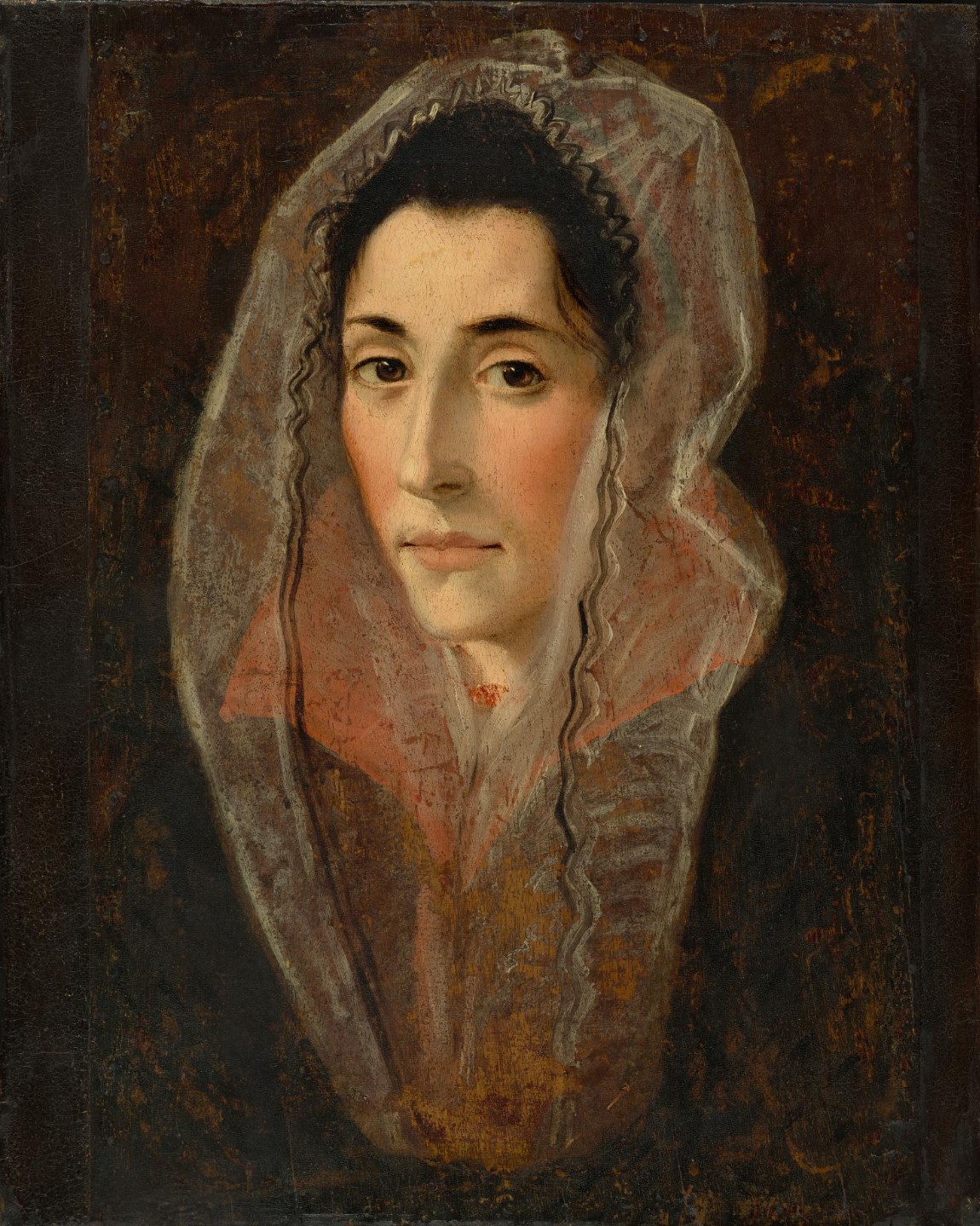
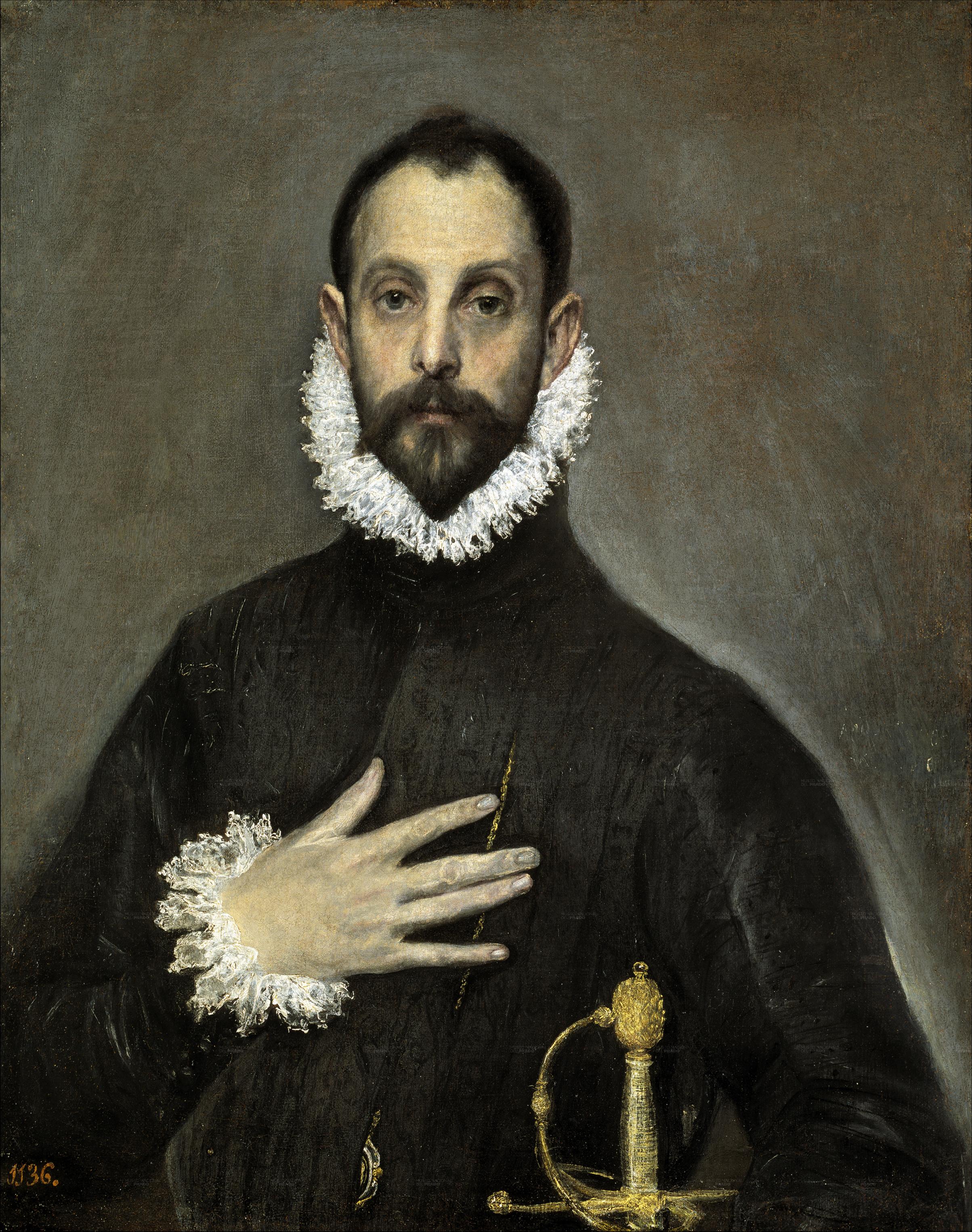
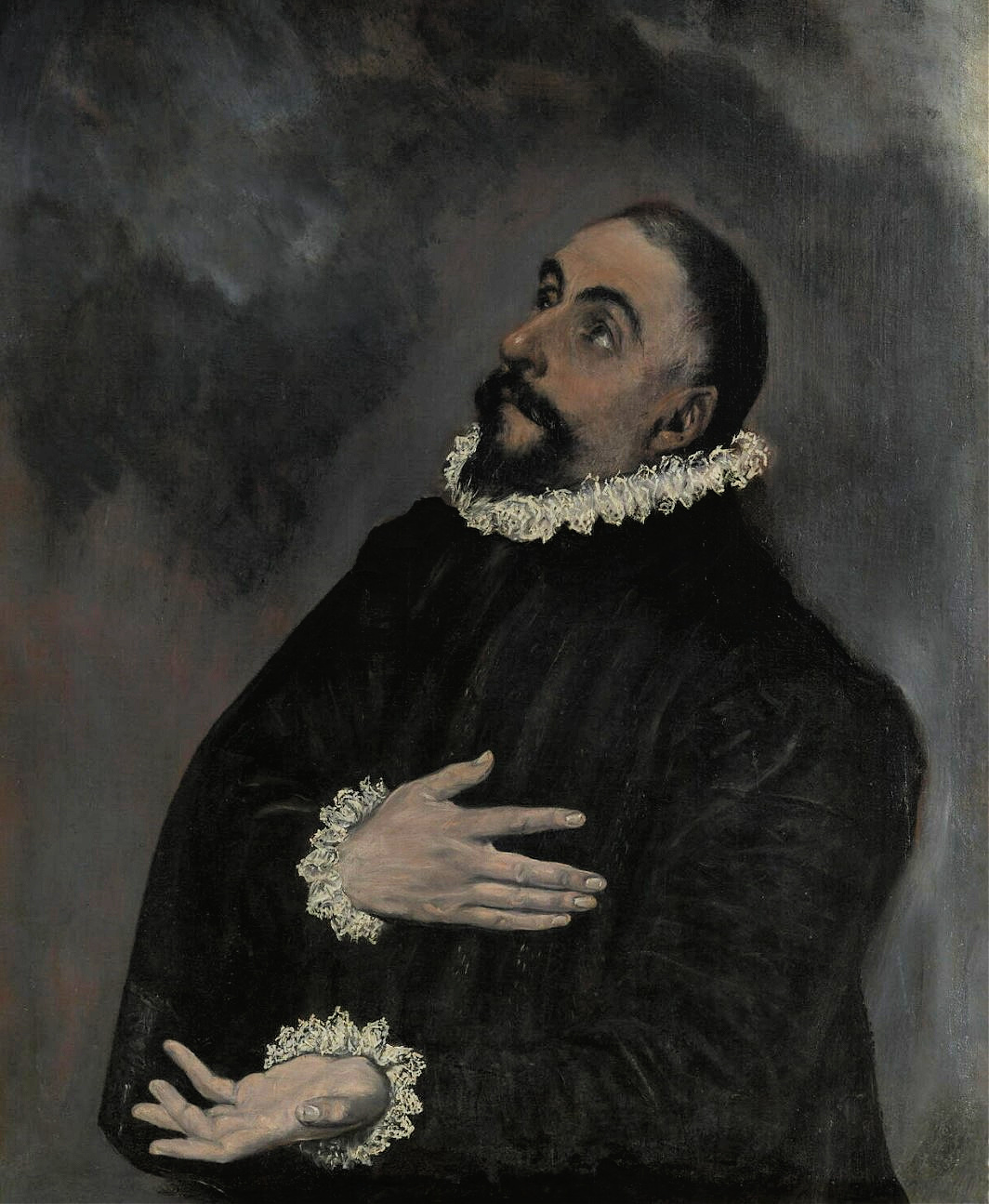
El Greco (Domenikos Theotokopoulos), Self-Portrait or Portrait of an Old Man, oil on canvas, 52.7 cm × 46.7 cm (20.7 in × 18.4 in), The Metropolitian Museum of Art, New York.

Usually identified as a self-portrait, it is supported by the fact that the same figure appears several times in El Greco’s oeuvre and ages alongside the artist. The portrait shows the influence of Titian (1489-1576) and Tintoretto (c.1518-1594) whose artwork El Greco saw in Venice.

THE ARTWORKS:

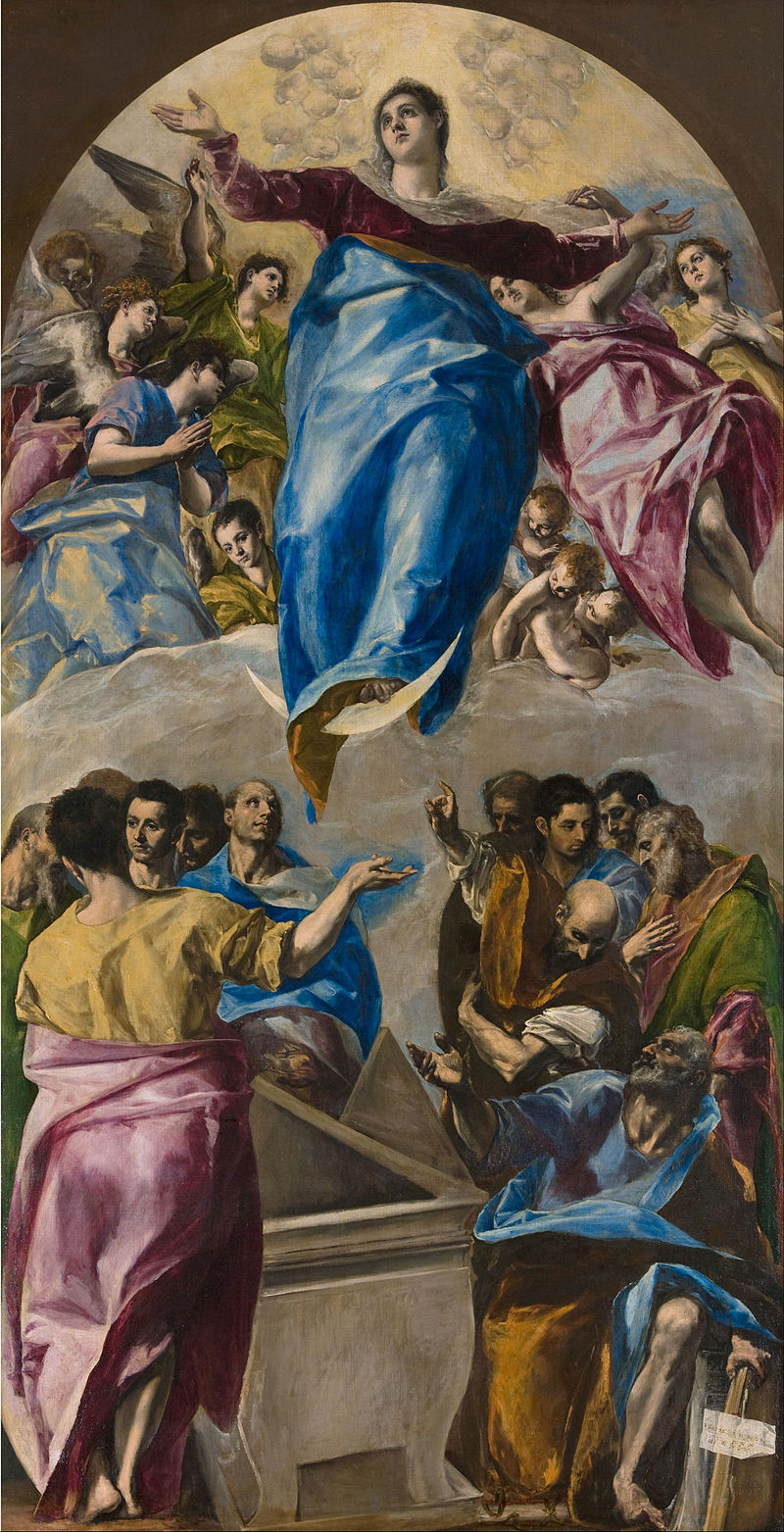
El Greco, The Assumption of the Virgin (Church of Santo Domingo el Antiguo, Toledo, Spain), 1577-79, The Art Institute of Chicago.

Part of an altar ensemble, Assumption of the Virgin is 13 feet high and 7 feet 6 inches wide. In the painting there are two principal groups – the Virgin and angels above and, below, the 12 apostles and an empty sarcophagus. It was the first major commission for El Greco for the Bernadine Convent Santo Domingo el Antiguo in Toledo, Spain. It was in the funerary chapel of Doña María de Silva. El Greco in Spain is first recorded on July 2, 1577 (Toledo Museum of Art, El Greco of Toledo, (exhibition catalog), Boston: Little, Brown and Company, 1982, p.16). On August 8, 1577 a contract was made for the main altar series  which included The Assumption of the Virgin. El Greco agreed to complete the project in twenty months for a  payment of 1500 ducats. The artist signed and dated The Assumption in 1577 and was paid in full in 1578. The painting was installed in September 1579 and remained in the church for the next almost 250 years. (Ibid., p 152; Wood, James, AIC – Essential Guide, Chicago, 2003, p.131). In 1827 The Assumption of the Virgin was purchased by Infante Don Sebastián Gabriel de Borbón (“S.G.”). An inventory of S.G.’s estate lists The Assumption as #26, one of only two sixteenth century Spanish paintings in his collection of more than 200 works. The listing reads: “Otro en id de 14 pies y 5 pulgadas de alto por 8 pies y 3 pulgadas de cnaho. Su asunto, la Ascension de la Virgen, y los Apóstoles, alrededor de Sepulcro. Esta restaurado por Bueno. Tiene marco tallado y dorado…Dominico Greco.” [“Another in dimension (ideación) of 14 feet and 5 inches high by 8 feet and 3 inches wide. Its subject, the Assumption of the Virgin, and the Apostles, around the sepulcher. It was restored on the up and up. It has carved and gilt markings.” – my translation.] (Agueda, Mercedes, “La colección de pinturas del infante Don Sebastián Gabriel,” Boletín del Museo de Prado, iii/8 (1982), pp.103 and 106; 102-17; American Art News, Jan. 7, 1905, Vol. III, p.1.; Toledo Museum of Art, El Greco of Toledo, p.153). In 1837 S.G.’s collection of paintings was confiscated because of his political (pro-Carlist) activities. Along with pictures acquired from the suppression of the religious orders during the Napoleonic occupation (1800-12) his collection of paintings (including presumably #26 in his 1835 inventory) was exhibited at the Museo de la Trinidad. (Boletín, p. 103; Groveart.com, “Borbón y Braganza, Don Infante Sebastián Gabriel.”) S.G.’s property was returned to him shortly before his death in 1875. The Prado describes events until 1902 like this: “La colección…a la muerte del Infante…fue nuevamente exhibida en publico por sus herederos con motivo de una venta realizada en Pau en 1876, añadiéndose al núcleo primitivo de la colección la parte correspondiente llevada al matrimonio por su segunda esposa, Ma Cristina de Borbón. En 1890, su hijo Pedro pone en venta en el Hotel Druot de Paris parte de la colección y unos años más tarde se hace lo mismo en Madrid, bajo el nombre de la Infanta Maria Cristina. De las tres ventas sucesivas 1876, 1890 y 1902 se desprende como los colecciónistas fueron despojando del conjunto todo lo que podriamos llamar grandes piezas…”[… the collection at the death of the Infante was exhibited anew in public in a sale held in Pau in 1876 for the benefit of his heirs. Adding itself to the primitive nucleus of the collection was that respective part brought to the marriage by his second wife, Mrs. Cristina de Borbón. In 1890, her son Pedro put up for sale at the Hotel Druot in Paris another part of the collection and some years later did the same thing in Madrid under the name of the Infanta Maria Cristina. From these three successive sales of 1876, 1890 and 1902 the collectors were divesting themselves of whatever would be called the great pieces…” – my translation]. It is not yet clear at which of these three sales if any The Assumption of the Virgin found itself. What remained after the final sale in 1902 stayed in the possession of Borbón heirs. (Boletín, p. 104). In January 1905 The Assumption of the Virgin was purchased by Durand-Ruel and exhibited in his Paris gallery. (American Art News, Jan. 7, 1905, vol. III, p.1). Durand-Ruel had purchased it from the Spanish Bourbon family into whose possession it came in 1811. The painting was being exhibited at the Prado when Durand-Ruel purchased it in January 1905. Durand-Ruel was dealing in other El Grecos around that time such as acquiring his Laocoön in 1910 and selling it to Paul Cassirer in Berlin by October 1915 (today it is in the National Gallery of Art in Washington, D.C.). On July 17, 1906, The Assumption of the Virgin was purchased by The Art Institute of Chicago for 200,000ff from Durand-Ruel in Paris. This purchase for an American museum reflected the daring and independent judgment of its purchasers. The painting had always been praised as the artist’s most beautiful and was considered a homage to Titian’s composition in the Church of Santa Maria Gloriosa dei Frari in Venice while also expressing Roman monumentality. (Horowitz, Helen L., Culture and the City: Cultural Philanthropy in Chicago from the 1880s to 1917, Lexington: The University Press of Kentucky, 1976, p. 101; The Art Institute Chicago 28th Annual Report, June 1, 1906-June 1, 1907, pp.20 and 59; Toledo Museum of Art, El Greco of Toledo, p.153). In February 1915 Mrs. Nancy Atwood Sprague, widow of Art Institute of Chicago Trustee Arnold Sprague, gave $50,000 to defray the artwork’s purchase expenses. From the very beginning this El Greco painting was considered the Museum’s most important acquisition of the year and called the greatest work of El Greco outside Spain. (Chicago Art Institute Bulletin, Mar. 1, 1915, p. 34).

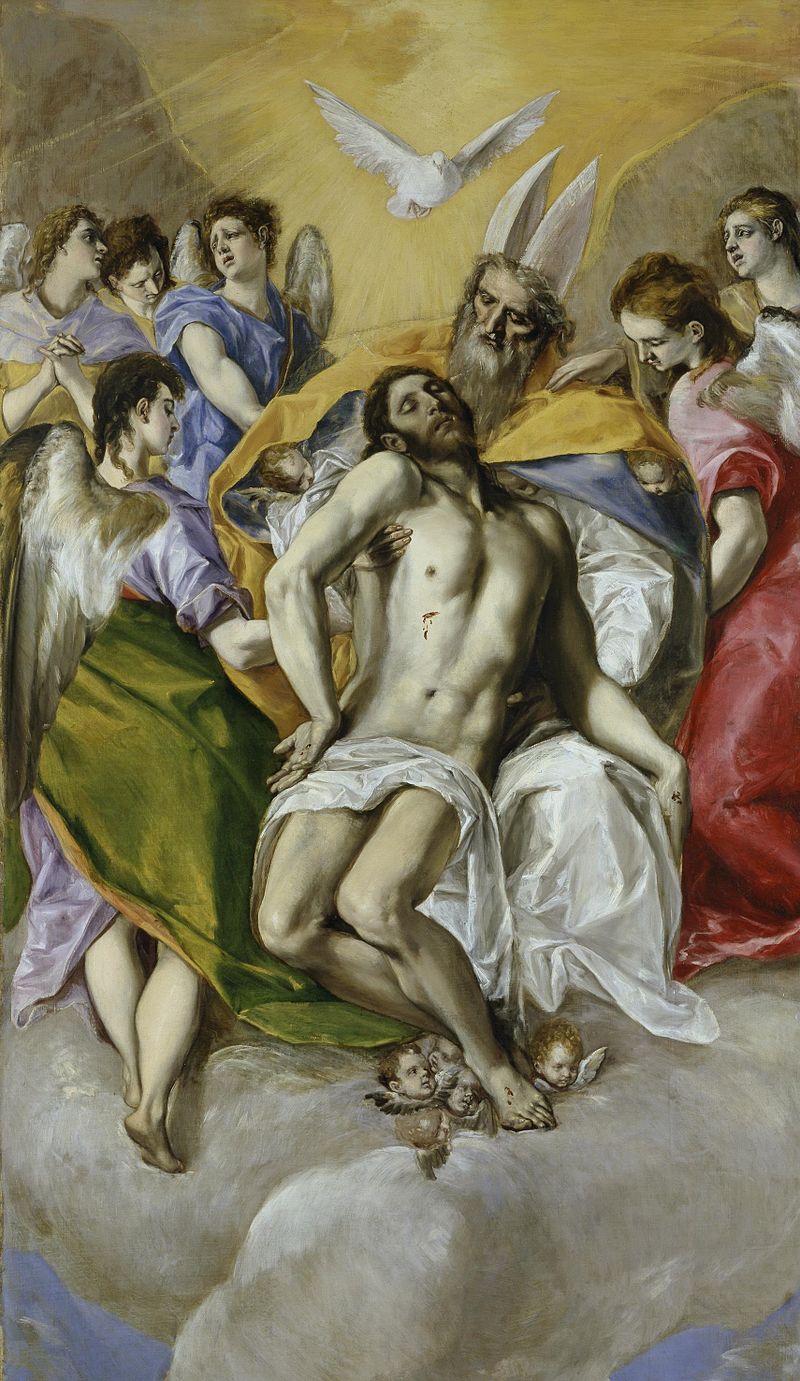
El Greco (Domenikos Theotokopoulos), The Holy Trinity,1577–1579, 300 x 178 cm, oil on canvas, Museo del Prado, Madrid, Spain.

The painting of the Holy Trinity was part of the altar ensemble for El Greco’s first major commission. It was above The Assumption of the Virgin with God the Father holding the dead Christ surrounded by angels and a white dove hovering above signifying the Holy Spirit.

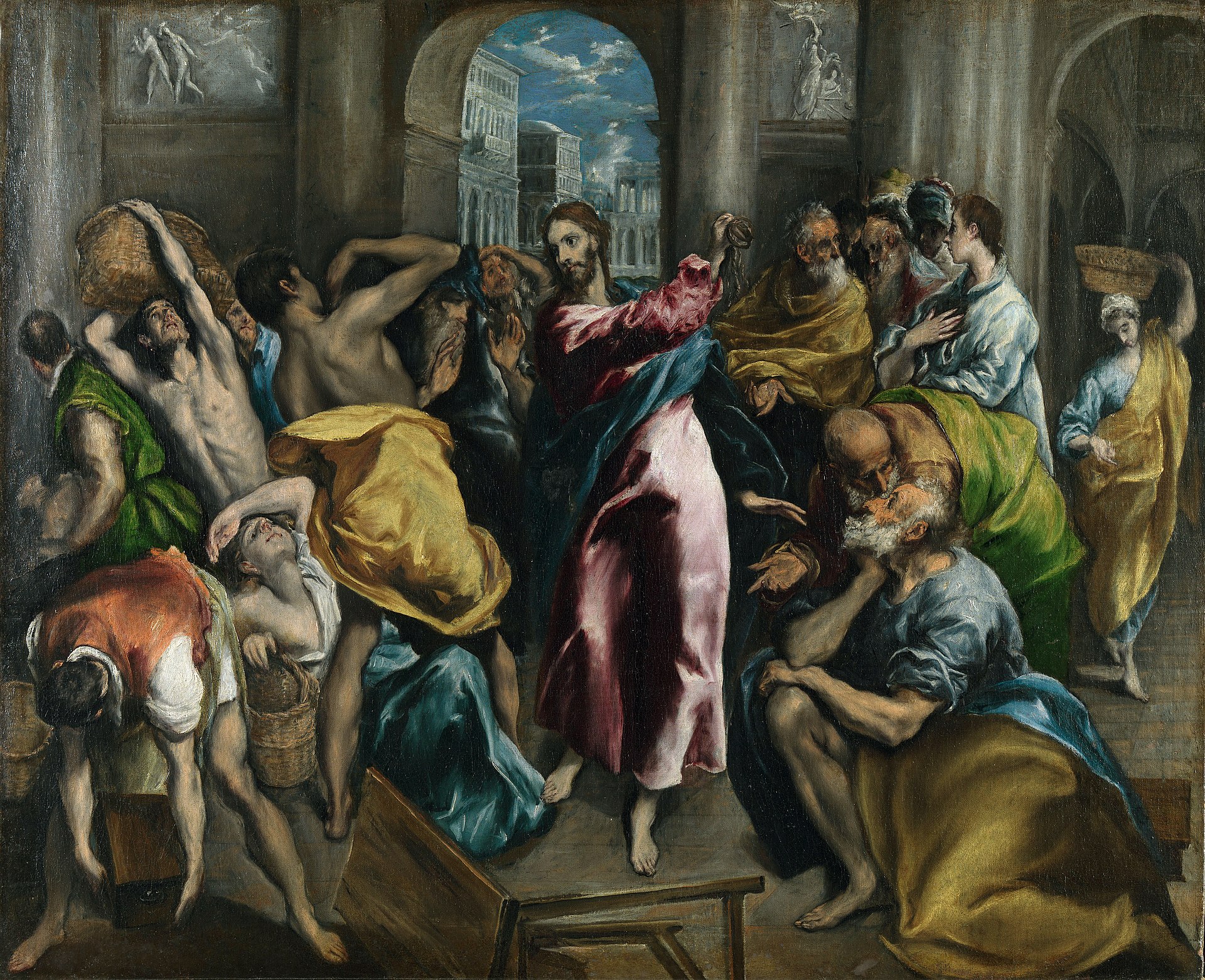
El Greco (Domenikos Theotokopoulos), Cleansing of Temple, 1584-94 or after 1604,  41 ½ x 50 ½ inches, National Gallery London. https://www.nationalgallery.org.uk/paintings/el-greco-christ-driving-the-traders-from-the-temple – retrieved November 18, 2024.

El Greco painted this episode of the Purification of the Temple many times, a story that appears in all four Gospels. The artist used intense colors and exaggerated gestures to express the chaos and disruption of the moment when Jesus Christ, angry that the temple was being used for sinful commerce and not prayer, makes a whip and uses it to drive out the traders selling animals for sacrifice. In the upper left corner is a painted sculpture of the expulsion of Adam and Eve from the Garden by the Angel of God reinforcing the message of sinfulness in the trader’s actions in the scene. At right in contrast, Christ’s apostles stand beneath a painted relief sculpture of faithful Abraham. The story of the Purification of the Temple told in Chapter 2 of John’s Gospel relates: “…Jesus went up to Jerusalem. He found in the temple area those who sold oxen, sheep, and doves, as well as the money-changers seated there. He made a whip out of cords and drove them all out of the temple area, with the sheep and oxen, and spilled the coins of the money-changers and overturned their tables, and to those who sold doves he said, ‘Take these out of here, and stop making my Father’s house a marketplace.'” El Greco painted Christ’s body energetically twisted with his right arm raised and ready to strike the man draped in yellow cloth he is gazing at. The man in yellow mirrors Christ’s pose as he recoils, arching his back and raising his hand to protect himself. The figures behind him lean in the same direction backwards to avoid being struck in the melée. The painting shows El Greco’s debt to Renaissance art such as Titian and Michelangelo (1475-1564) whose artwork El Greco studied during his travels to Venice and Rome. The figures behind Christ are much calmer. The gray-bearded man with his hand on his knee looking up in a yellow and blue costume is identified as Simon Peter. While the foreground setting suggests a grand columned one that is only partially seen, the buildings in the background with their arched arcades were likely inspired by architecture El Greco saw in Venice in 1568.

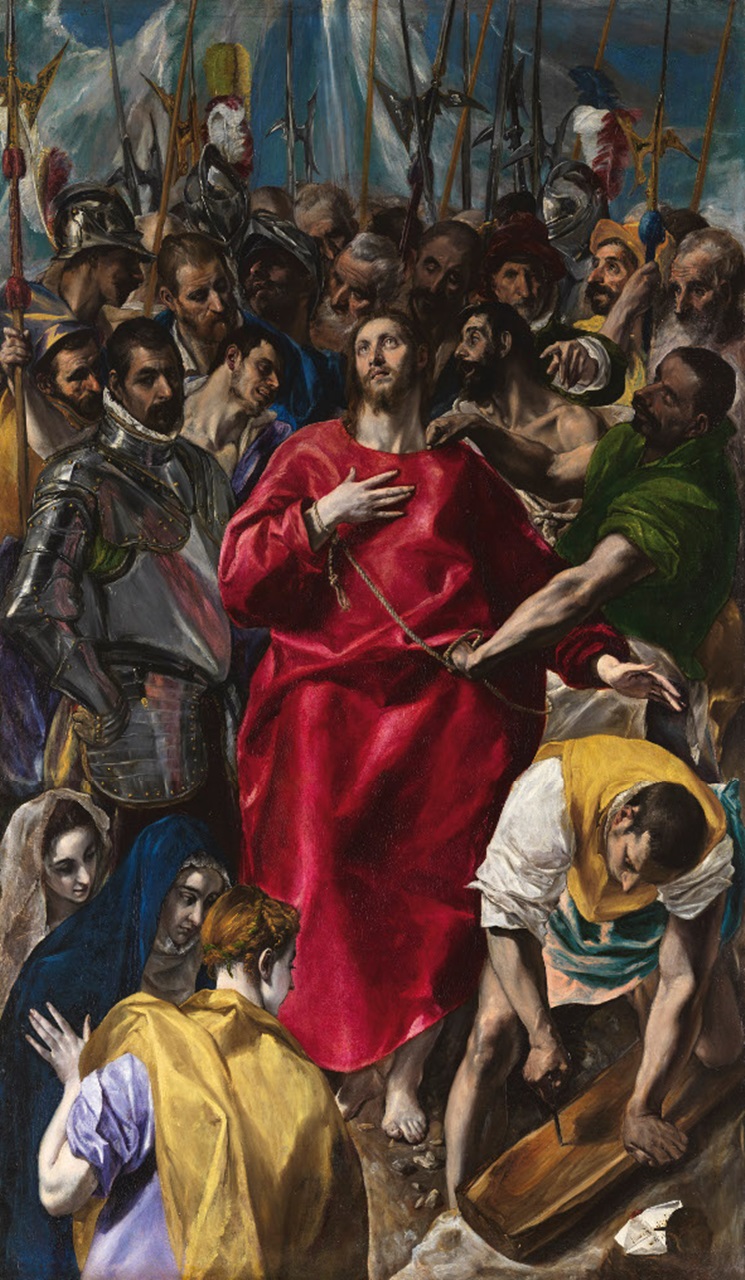
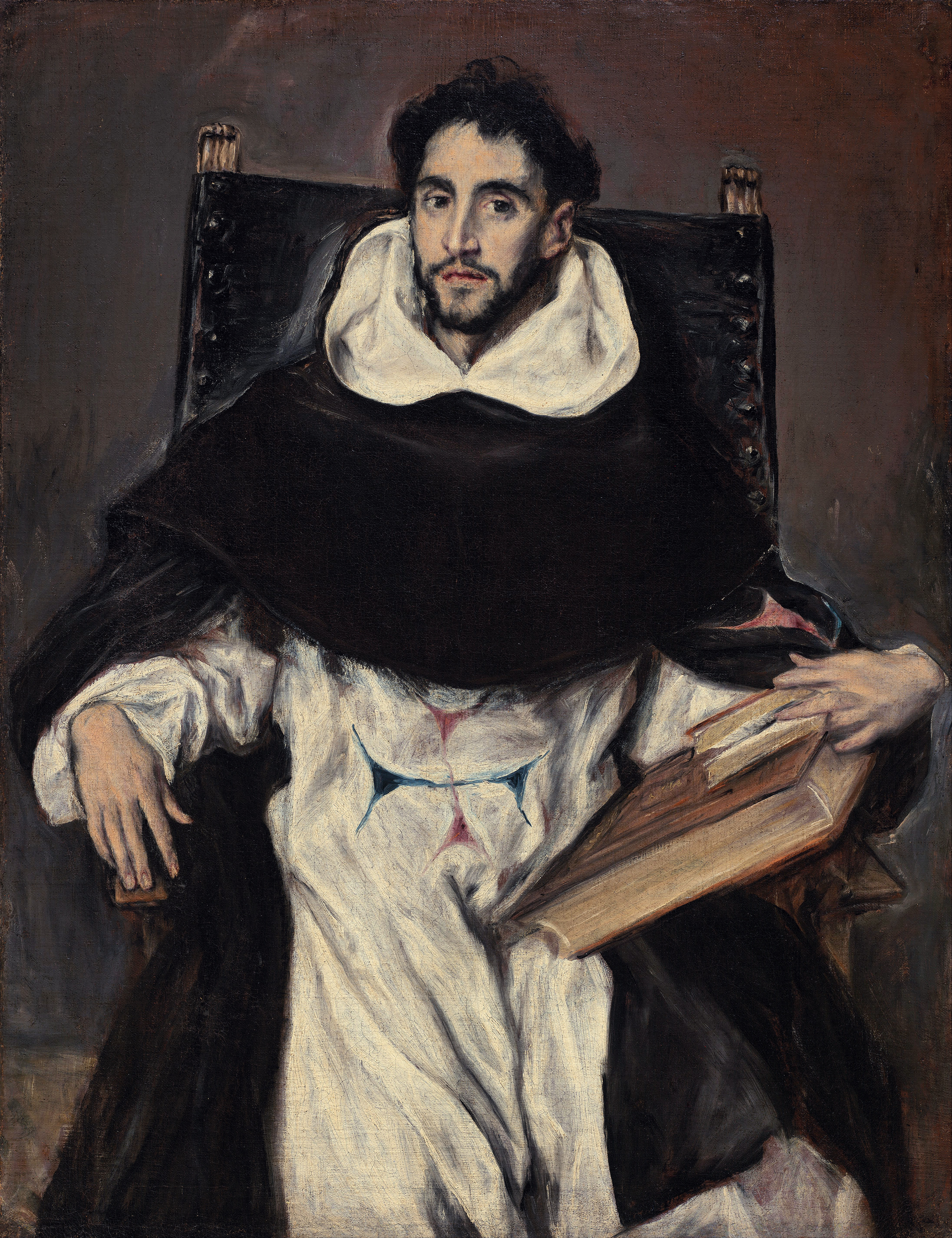
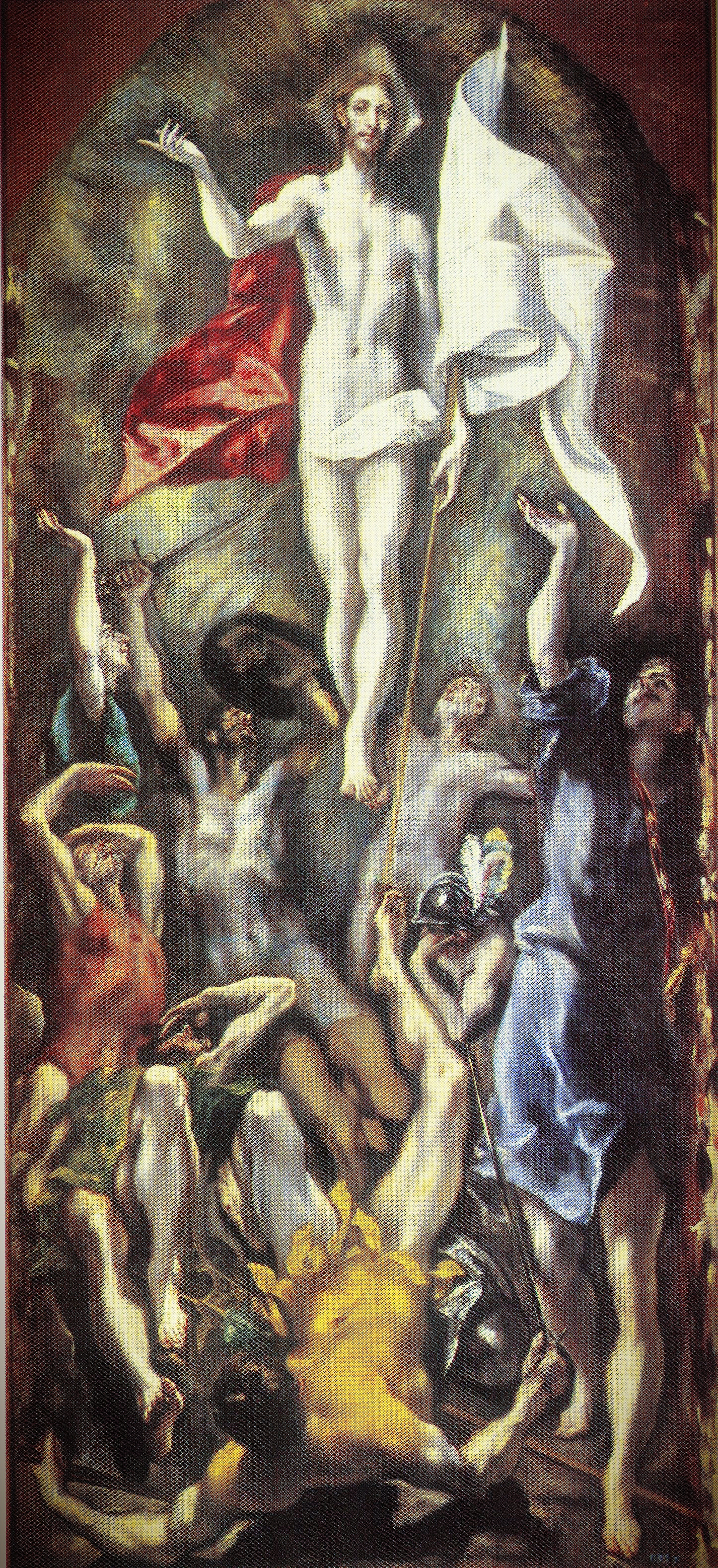
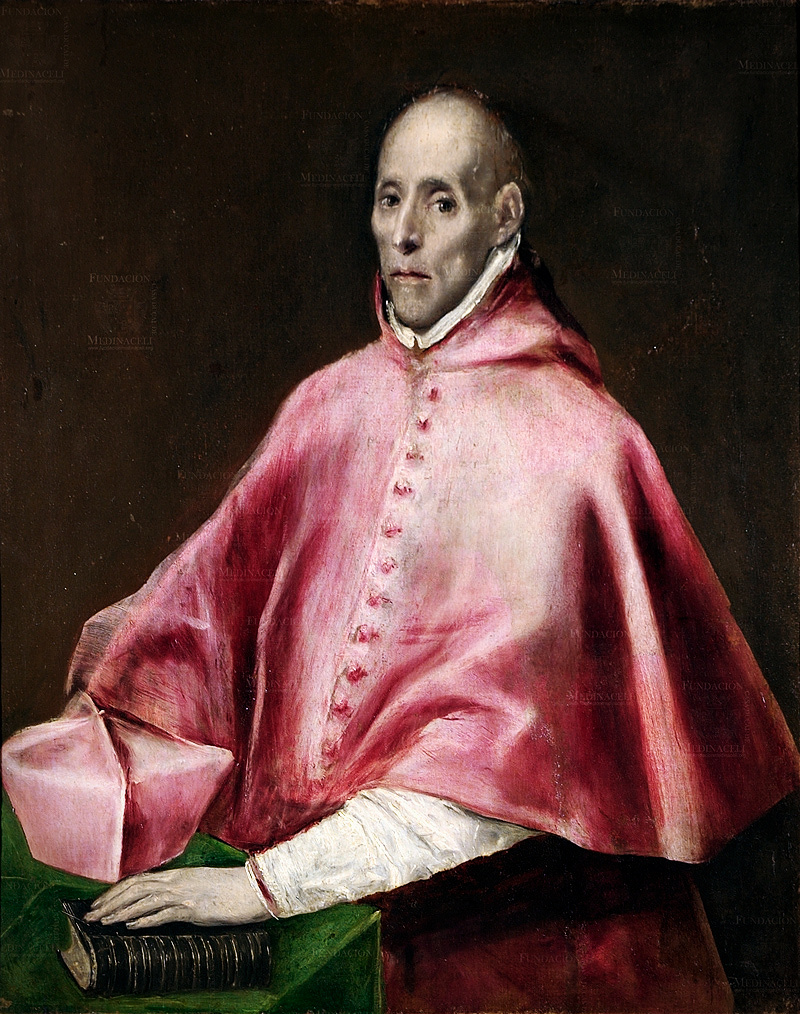
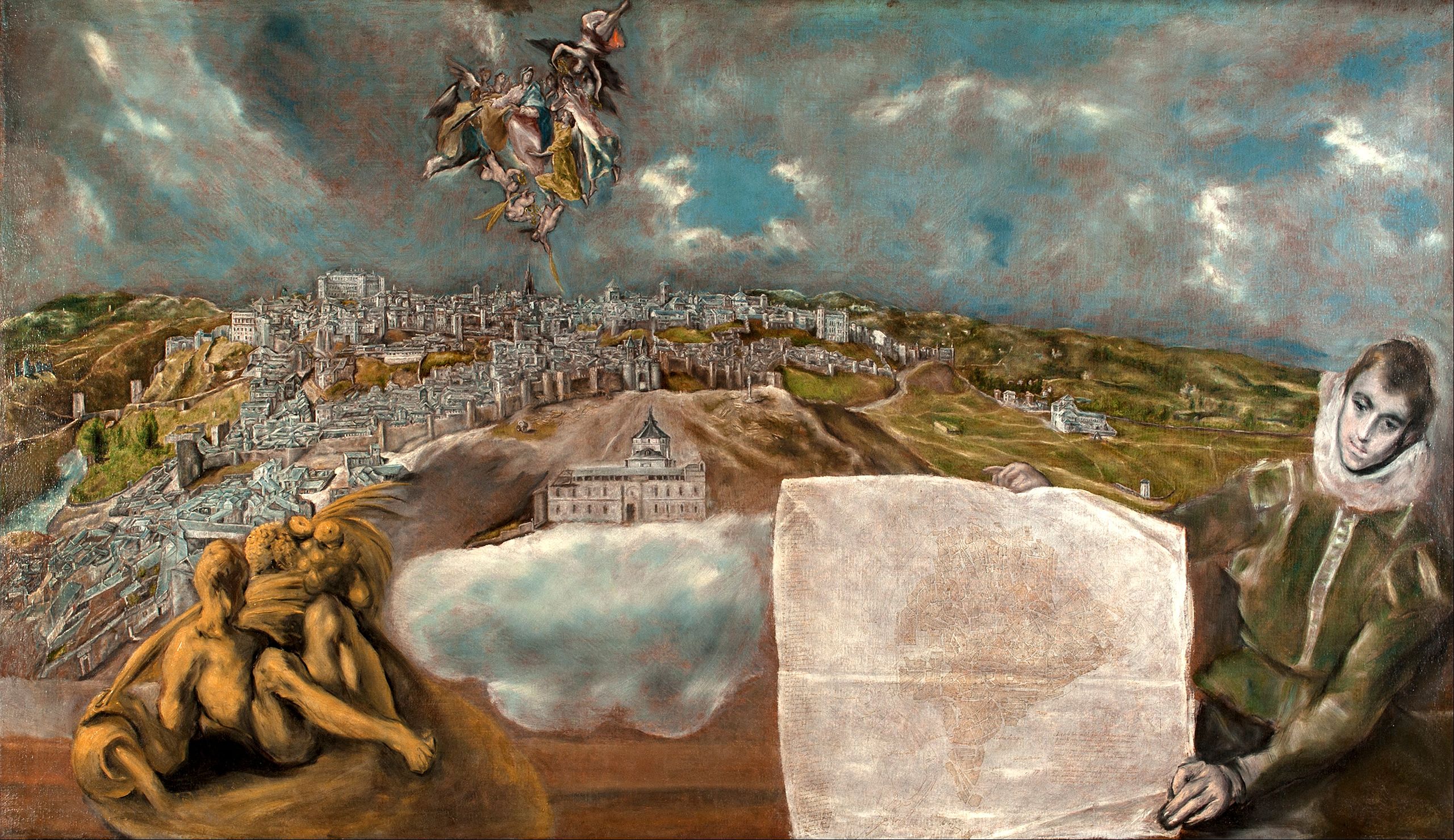
Cathedral, Toledo.
Metropolitan.
Philadelphia Museum of Art.
Church of San Tomé, Toledo
Prado.
Museum of San Vicente, Toledo.
National Gallery of Art, Washington, D.C.
El Greco, Saint Martin of Tours and the Beggar, 1597-1599, oil on canvas, 193.5 × 103 cm (76 3/16 × 40 9/16 in.), National Gallery of Art, Washington, D.C. https://www.nga.gov/collection/art-object-page.1164.html – retrieved November 11, 2024.

The painting was commissioned by Martín Ramírez for the Chapel of San José in Toledo, Spain. El Greco painted miracles as matter of fact. St. Martin and The Beggar depicts a scene from a low vantage point looking up to a monumental knight sharing his cloak with an attenuated, nearly otherworldly figure of a naked beggar. St. Martin of Tours (d.397), part of the Imperial Calvary stationed near Amiens during the times of Roman Emperor Constantine, sits mounted on a magnificent white Arabian steed and is dressed in stylishly practical soldier regalia from head to foot signifying his noble role and power to survey this emerald green landscape that is Toledo and the Tagus river. Martin’s green cloak is one part of his regalia but, on a cold autumn or winter day, his heart burns to divide it with his sword so to share it with this naked bandaged stranger he meets on the road. The encounter and action are modest and profound simultaneously– a typical social setting yet not merely transactional within a rigidly conceived social order but a tender act of charity. Martin rode off with his half cloak and thought of his soldierly duties. Yet it afforded a miracle. That night, tradition relates, Christ appeared to Martin in a dream revealing that the beggar the knoght shared his cloak with was Him.

Hospital of San Juan Bautista, Toledo.
Louvre.
Louvre.
Prado.
Prado.
Metropolitan.
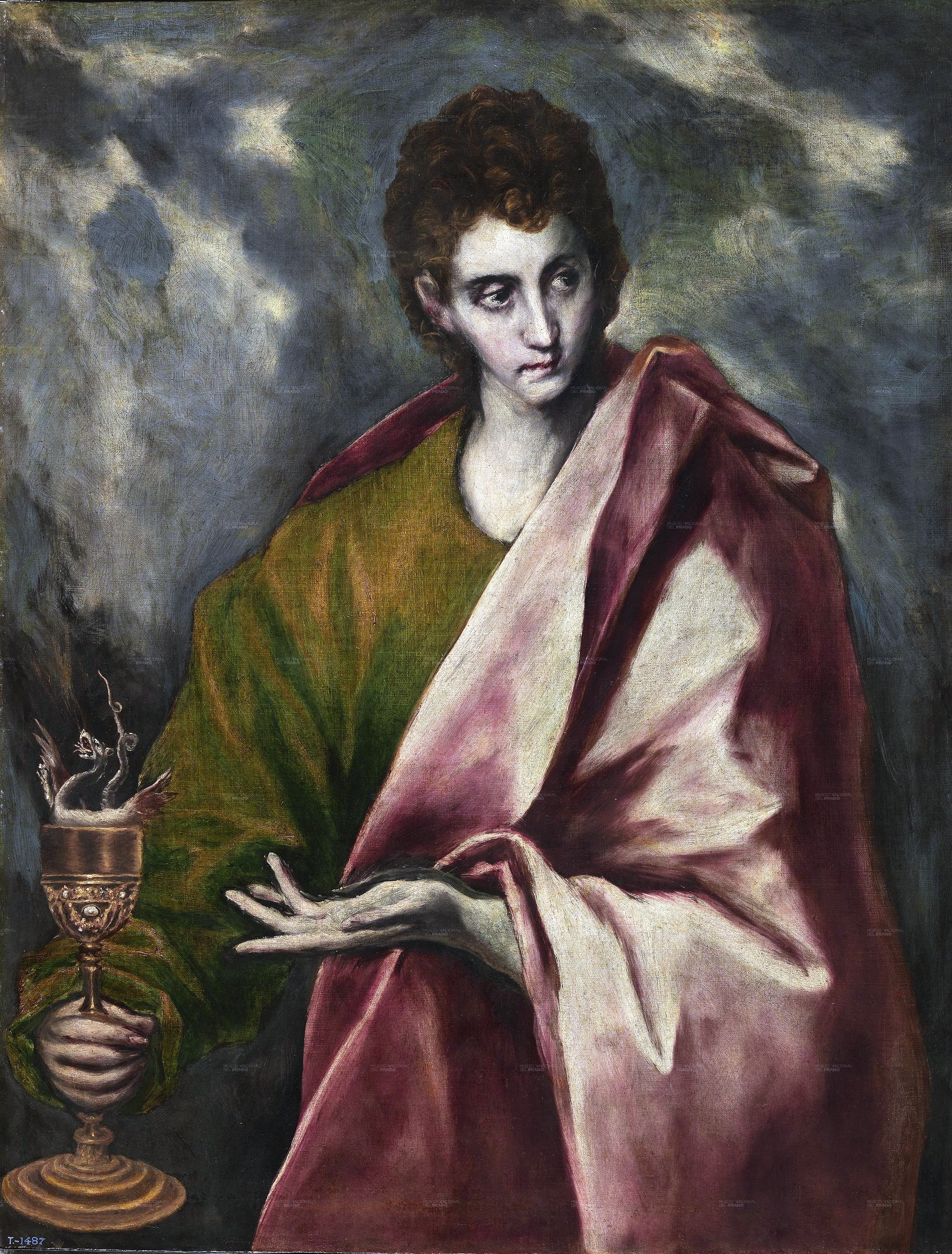
El Greco, Saint John the Evangelist, c. 1605, oil on canvas, 35 1/4 x 30 3/8 in., Prado, Madrid. https://www.museodelprado.es/en/the-collection/art-work/saint-john-the-evangelist/b107d798-268f-41aa-8b4c-f47eff9c1768 – retrieved November 19, 2024.

This painting shows St. John the Evangelist in a half-figure which has a clear precedent in the Venetian school where El Greco completed his training. Crete, where El Greco was born, was a Venetian possession. El Greco arrived to Venice as a teenager in the late 1550s or early 1560s where he worked with Titian (c. 1490-1576) but became the admirer and heir of Tintoretto (c. 1518-1594). El Greco, who studied icon painting in Crete, learned the medium of oil from its virtuoso Titian, but once in Venice, El Greco quite normally was attracted to Tintoretto, the city’s then-modern master. “The Greek” did not simply imitate Tintoretto’s exterior forms but very personally emulated his deeply spiritual and expressive Mannerism. In this later painting, El Greco depicts the tradition that John the Evangelist was in Rome when the Emperor Domitian (51-96) tried to assassinate Jesus of Nazareth’s young apostle by poisoning the wine in his Mass chalice. But the legend relates that the poison turned into a fabulous serpent tipping off John and his holy companions and doing them no harm. Like Lorenzo Lotto (c. 1480-1556), El Greco depicts this story’s externals surrounding John – be it the heavy chalice, poisonous serpent exorcised from it, or the expressive hands of the apostle holding the cup of sacrifice and motioning towards it – to scrutinize the inner conviction or character of the sitter, the young author of the Johannine corpus of a gospel, three letters, and the book of Revelation. On John’s Gospel Cornelius à Lapide (1567-1637) wrote that the Evangelist was indeed the eagle (inspired by a description in Ezekiel) who soars skyward and swoops down to earth for his prey. John wrote the last canonical gospel in 99 with combatting that day’s Christian heresies in mind, specifically those that denied Christ’s divinity – whom in his epistles he called “anti-Christs.” John conveys sacred ideas with a rusticity of style. The 17th century theologian and biblical scholar Cornelius à Lapide affirmed that “John was most like Christ” and that the disciple loved the master supremely and the master held the disciple most dear. Because of the relationship of Jesus and John, the biblical scholar claimed, “when you read and hear John [in his gospel, letters, and book of Revelation] think that you read and hear Christ.” He quotes St. Jerome who claimed that Christ transfused his own spirit and his own love including “the purest streams of Jesus Christ’s Doctrines” into Saint John. This relationship is signaled by John’s reclining on the breast of Christ at the Last Supper. John, now in old age, was pressed by all the bishops in Asia and many others to write a “breakthrough” account claiming of the deepest things of the Divinity of the savior. John agreed with the condition that the whole church fast before he embarked on the project and when the fast ended John began: “In the beginning was the Word, and the Word was with God, and the Word was God. 2He was in the beginning with God. 3All things came to be through him, and without him nothing came to be.” Nothing is stronger to attest to the origin, eternity, and generation of the divinity of the Christ. John wrote in the Greek language because he was addressing Greeks but, again according to Cornelius à Lapide, the gospel is filled with Hebrew phrases and idioms because St. John was a Hebrew who loved his native language. Though John relates Jesus’s miracles as proof that Christ was the Messiah, God as well as man – including the singular accounts of the changing water to wine at the wedding feast of Cana (chapter 2) and the raising of Lazarus from the dead (chapter 11) – John less relates actions of Christ as found in the synoptics Matthew, Mark, and L uke who focused on his humanity and much more of the discourses and disputations that Christ had with the Jews (mostly its rulers), again with none other than the same purpose to prove his theology meant for the whole world that Christ was “God as well as man.” In John’s gospel a careful examination of contexts needs to occur because Christ speaks sometimes as man and sometimes as God. Its high theology which dealt with the inspiration of the Holy Spirit, unity of the Godhead, and divine relations and attributes became that gospel in the next centuries that the bishops referenced to combat their day’s heresies such as Arianism (which denied Christ’s Divinity), the Docetists (who denied Christ’s humanity), and Nestorians (who denied Christ’s dual natures). John had favorite terms and ideas he repeated in his gospel – calling Christ “the Life” and “the Light.” Calling saints “the children of light.” Calling sin “darkness.”

Metropolitan.
Museum of Fine Arts, Boston.
Prado.
Greco Museum, Toledo.
Hospital of San Juan Bautista, Toledo
Greco Museum, Toledo.
Greco Museum Toledo.
Metropolitan.
National Gallery London.
National Gallery of Art, Washington, D.C.

As mentioned in the feature image caption, Laocoön is a Trojan priest in Greek and Roman mythology who warned the Trojans to destroy the Trojan Horse sent by the Athenians by which they won the war. “I fear the Greeks even when they bear gifts,” he told them (see Edith Hamilton, Mythology, p. 285). Laocoön and his two sons are punished for revealing this truth by the gods. They are attacked by giant serpents sent out of the sea by Apollo and Artemis that bit and crushed them to death and then slithered away into Athena’s Temple in the city. The Trojans, instead of heeding their priest’s warning and seeing his death for what it was — the punishment for telling them the truth of the danger of the Trojan Horse — viewed it as warning not to question the entry of the monumental wooden horse into the city. They pulled it in, set it in front of Athena’s Temple, and went to their homes believing they had won a peace that had not happened in ten years. El Greco set the artwork outside Toledo giving the ancient tale a contemporary context and unique interpretation. Though Laocoön and his two sons’ fates are sealed, the artist captures a unified centrifugal movement with individualized figures in bare-faced struggle after exercising their prudential judgment that is witnessed by dispassionate onlookers as if in a dream.

Laocoön and His Sons, 1st CE?, marble, 242 cm high, Vatican Museums, Vatican City. The classical marble sculpture was unearthed in 1506 and housed in the Belvedere in the Vatican. Its discovery aroused great excitement in the Renaissancce art world and numerous copies were made. El Greco’s painted extrapolation was taking this passion of classical suffering to the level of one’s own modern synthetic invention where the colorful sensation of upheaval is dynamic. Laocoön and His Sons” by JuanMa is licensed under CC BY-SA 3.0.
Metropolitan.

SOURCES:

El Greco, Leo Bronstein, Harry N. Abrams, Inc. New York, 1990.
El Greco of Toledo, Jonathan Brown, William B. Jordan, Richard L. Kagan, Alfonso E. Perez Sanchez, Little, Brown, Boston. 1982.
El Greco, David Davies, National Gallery Company, London, 2003.
Mythology Timeless Tales of Gods and Heroes, Edith Hamilton, Grand Central Publishing, New York and Boston (originally published in 1942).


ITALY. CARAVAGGIO (ITALIAN, 1571-1610), BAROQUE MASTER OF DARKNESS. (50+ artworks).

FEATURE Image: Caravaggio (Michelangelo Merisi), Judith Beheading Holofernes, c. 1598, oil on canvas, 56 ¾ x 76 ¾” 145 x 195cm Galleria Nazionale d’Arte Antica, Rome. https://barberinicorsini.org/opera/giuditta-e-oloferne/ – retrieved October 12, 2024.

Ottavio Leoni (1578-1630), Portrait of Caravaggio, c. 1621/25, red and white chalk on blue paper, 23.4 x 16.3 cm, Biblioteca Marucelliana, Florence.

INTRODUCTION.

The chalk portrait above is probably the most faithful likeness of Caravaggio. Born Michelangelo Merisi in 1571, Caravaggio became an influential figure in Italian and European art in and well after his lifetime. He revolutionized painting by his theatrical use of light, dramatic narrative, and the naturalistic physical depiction of everyday people. His depiction of figures in historical narrative using dramatic interplay of light and shadow called chiaroscuro along with its naturalistic composition was further modernized in its scenes’ inclusion of the emotional and psychological human state. These artistic qualities were admired and emulated by many young European artists going forward into the balance of the seventeenth century.

Caravaggio came to Rome around 1592 from Lombardy, where he was influenced by the works of Giovanni Girolamo Savoldo (c.1480-1548), Lorenzo Lotto (c. 1480-1557), Romanino (c.1484-1566) and Moretto (c. 1498-1554?). For a while he worked in the workshop of the leading late mannerist Giuseppe Cesari (1568-1640), but soon broke away from the established course in Roman-Florentine artistic mannerism. His completely new approach of intense realism and chiaroscuro — that is, dramatic use of light and darkness to situate a scene – made him the “master of darkness” and completely revolutionized art in Rome around 1600. Along with Annibale Carracci (1560-1609), Adam Elsheimer (1578-1610) and Peter Paul Rubens (1577-1640), Michelangelo Merisi, called Caravaggio, was one of the progenitors of 17th century painting.

Artworks.

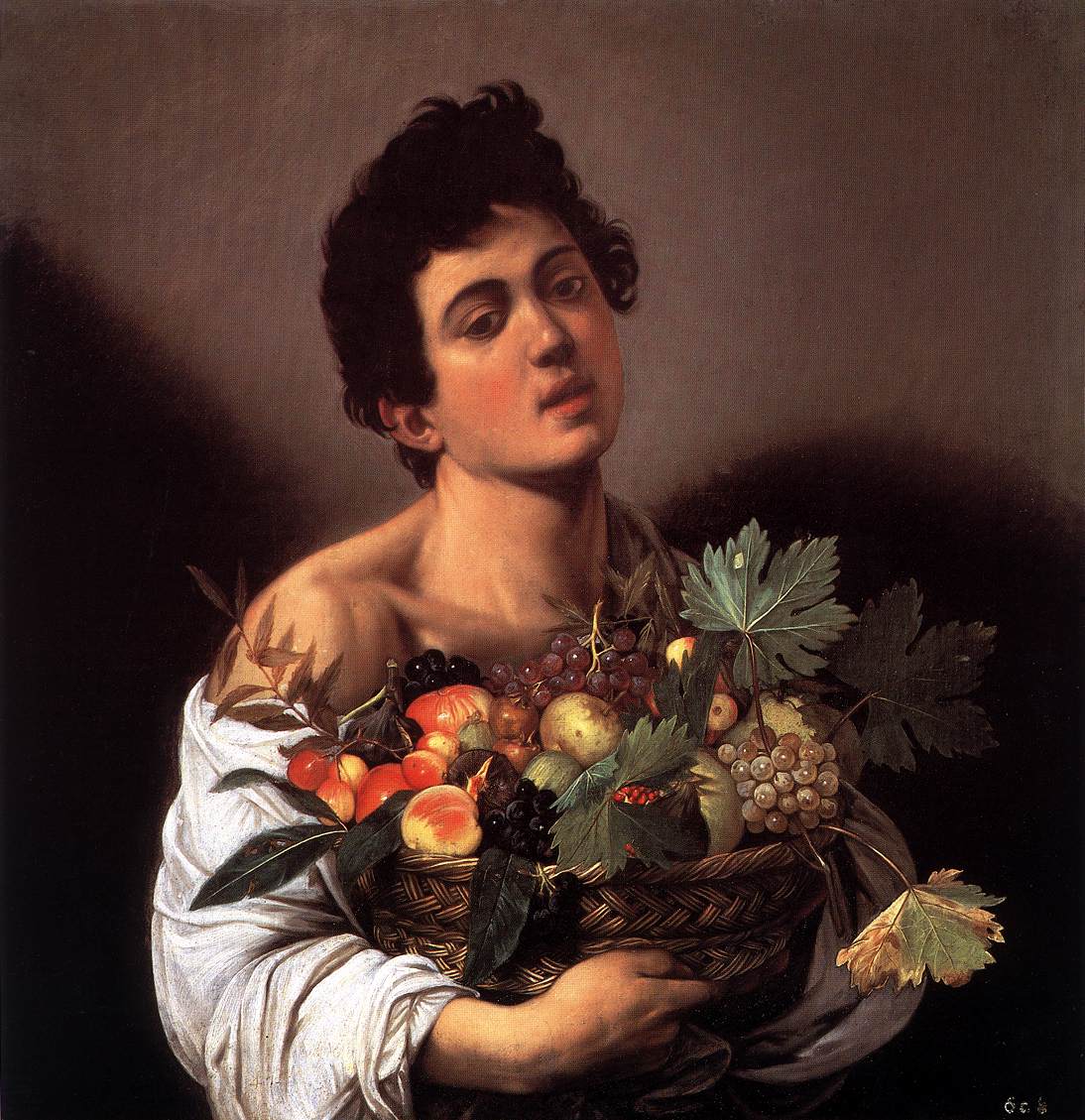
Caravaggio (Michelangelo Merisi), Boy With a Basket of Fruit (“Il Fruttaiuolo”), c. 1593/94, oil on canvas, 27 ½ x 26 3/8” 70 x 67 cm, Galleria Borghese, Rome. https://borghese.gallery/collection/paintings/boy-with-a-basket-of-fruit.html – retrieved October 10, 2024.

Caravaggio’s Il Fruttaiuolo (“Boy with a Basket of Fruit”) presents a remarkable contrast of the detailed, colorful, and sensuous depiction of fruits of the season and the refined and delicate innocence of an adolescent boy holding its basket. The placid scene of typical everyday life is enhanced by an expressive and careful execution. The model was Caravaggio’s friend, Sicilian painter Mario Minniti, at about 16 years old. According to Giovanni Pietro Bellori (1613-1696) who included Caravaggio in his Lives of the Artists, the artist learned “to paint flowers and fruit so well imitated that everybody came to learn from him how to create the beauty that is so popular today.”

Carlo Maratta (1625-1713), Portrait of Gian Pietro Bellori who was Caravaggio’s most important biographer. Other early biographies of Caravaggio’s life were written by his doctor, Giulio Mancini (1559-1630) and by Giovanni Baglione (1566-1643), a rival artist.
Caravaggio (Michelangelo Merisi), The Young Sick Bacchus (Bacchino Malato), c. 1593/94, oil on canvas, 67 x 53 cm, Galleria Borghese, Rome. https://borghese.gallery/collection/paintings/young-sick-bacchus.html – Retrieved October 10, 2024.
https://www.collezionegalleriaborghese.it/en/opere/self-portrait-as-bacchus-known-as-sick-bacchus – retrieved October 10, 2024.

Caravaggio’s Il Bacchino Malato (“The Young Sick Bacchus”), also known as Bacchino malato (“The Sick Bacchus”) or Autoritratto in veste di Bacco (“The Self-Portrait as Bacchus”), is an early self-portrait by Michelangelo Merisi da Caravaggio, dated between 1593 and 1594. The artwork dates from Caravaggio’s first years in Rome when he moved to the Eternal City from his native Milan in 1592. The painting was in the collection of Giuseppe Cesari (1568-1640), Caravaggio’s early employer. In 1607 it was confiscated from Cesari by the Pope in exchange for the Italian mannerist’s freedom following an illegal firearms charge. The pope gifted it to his nephew, Cardinal Scipione Borghese (1577-1633), together with the Boy Peeling Fruit and Boy with a Basket of Fruit (“Il Fruttaiuolo“).

The painting is a realist portrait of a young man displaying the typical attributes of Bacchus, the god of drunkenness. The sitter is turned to the viewer in a three-quarter pose, holding in his hands a bunch green grapes held next to his ailing greenish complexion. The sitter has been identified as the artist since it is documented that he was in the Ospedale della Consolazione in Rome around this time for undefined reasons. This interpretation provides the origin for the artwork’s title.

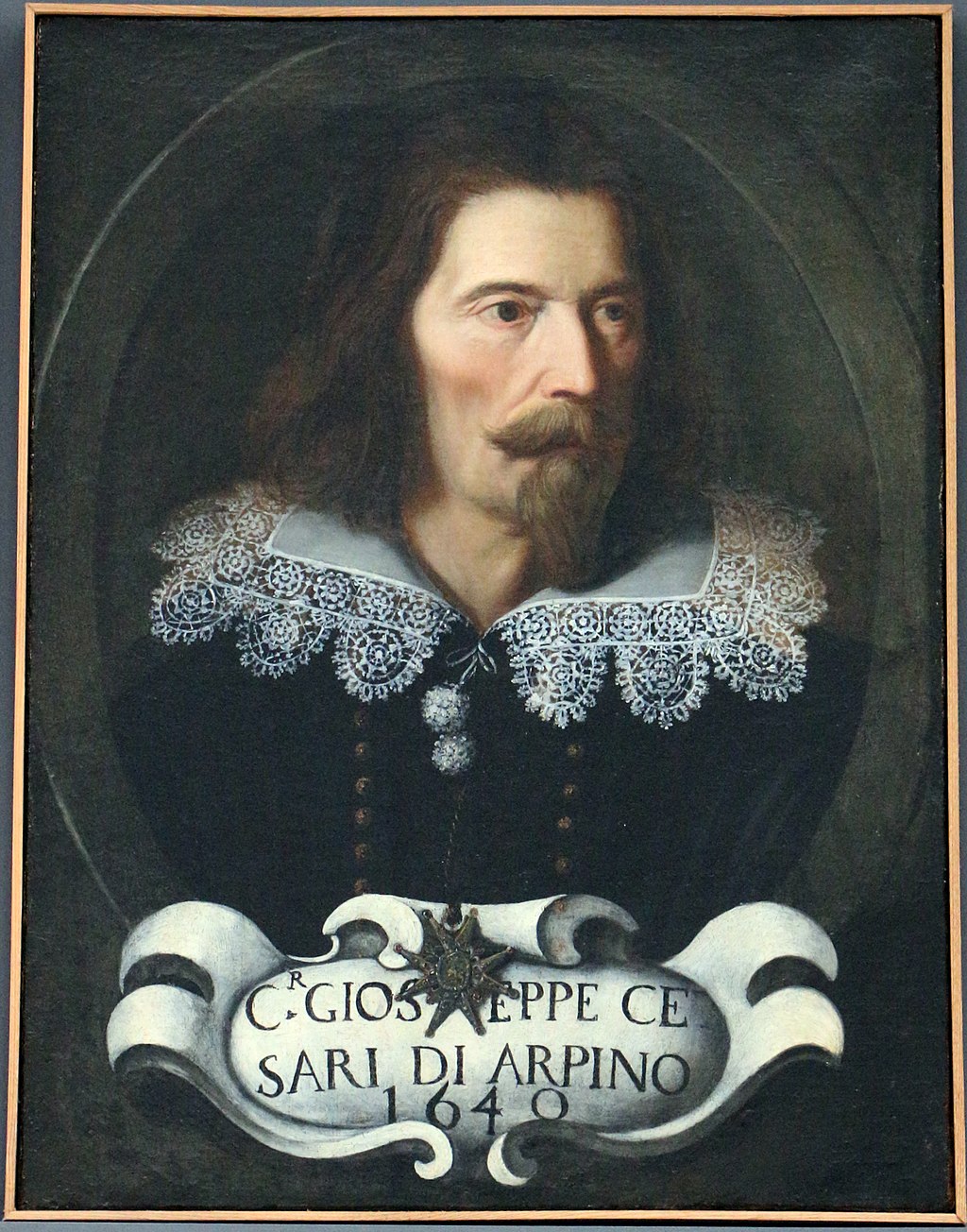
Giuseppe Cesari, Self-portrait, 1640, Accademia di San Luca. Cesari was Caravaggio’s first employer and in possession of The Young Sick Bacchus that was confiscated by the pope.
Ottavio Leoni, Portrait of Cardinal Scipione Borghese. The sitter was not only the pope’s nephew and a Cardinal in the Catholic Church but the recipient of early Caravaggio paintings by gift. Such a gift was not at random: the cardinal’s growing art collection, including Caravaggio and Bernini, formed the basis of the Villa Borghese in Rome.
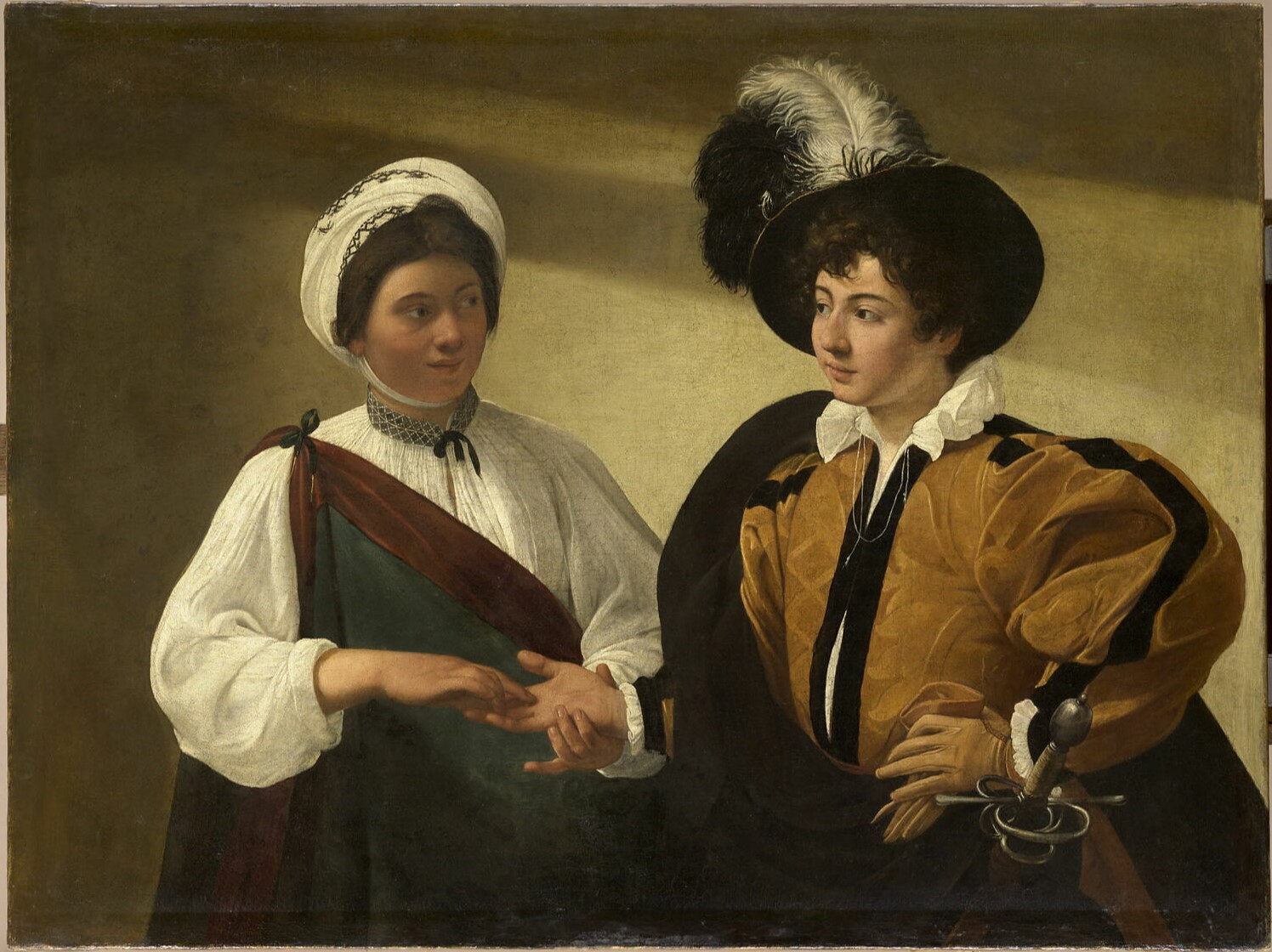
Caravaggio (Michelangelo Merisi), The Fortune-Teller (“La Buona Ventura”), c. 1594, oil on canvas, 39 x 52 3/8”, Louvre, Paris. https://collections.louvre.fr/en/ark:/53355/cl010062329 – retrieved October 10, 2024
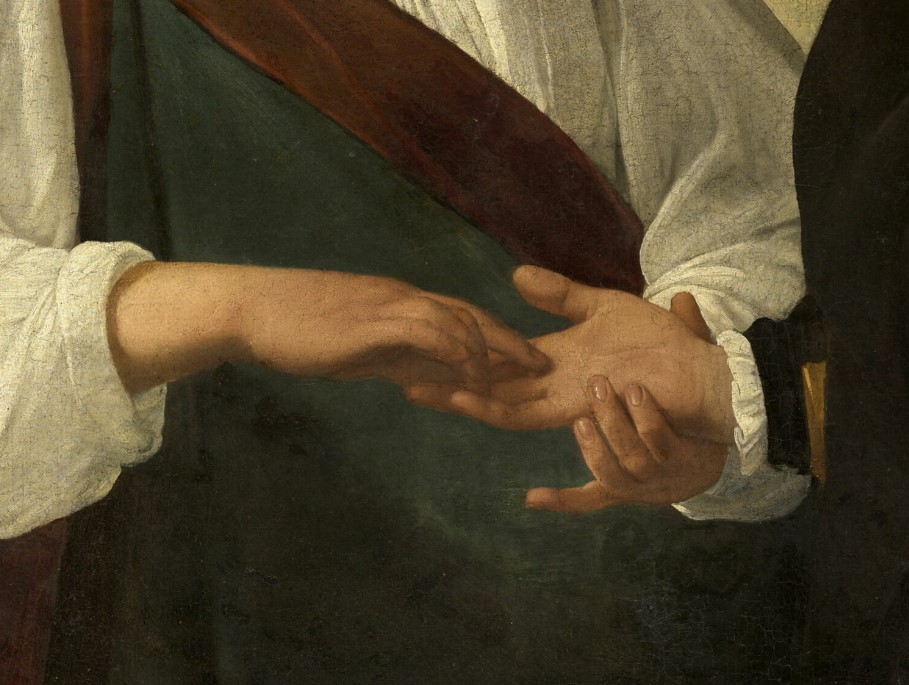
Detail of above.

According to Giulio Mancini, Caravaggio painted The Fortune-Teller for a proverbial song while staying with Archbishop Fantino Petrignani (1577-1601). By 1620 when Mancini was writing, the painting was owned by Roman art collector and Catholic prelate Alessandro Vittrici (d. 1650). Later (1657) it was in the collection of Catholic Cardinal Camillo Francesco Maria Pamphili (1622-1666) who sent it with Bernini (1598-1680) to Paris as a gift to Louis XIV.

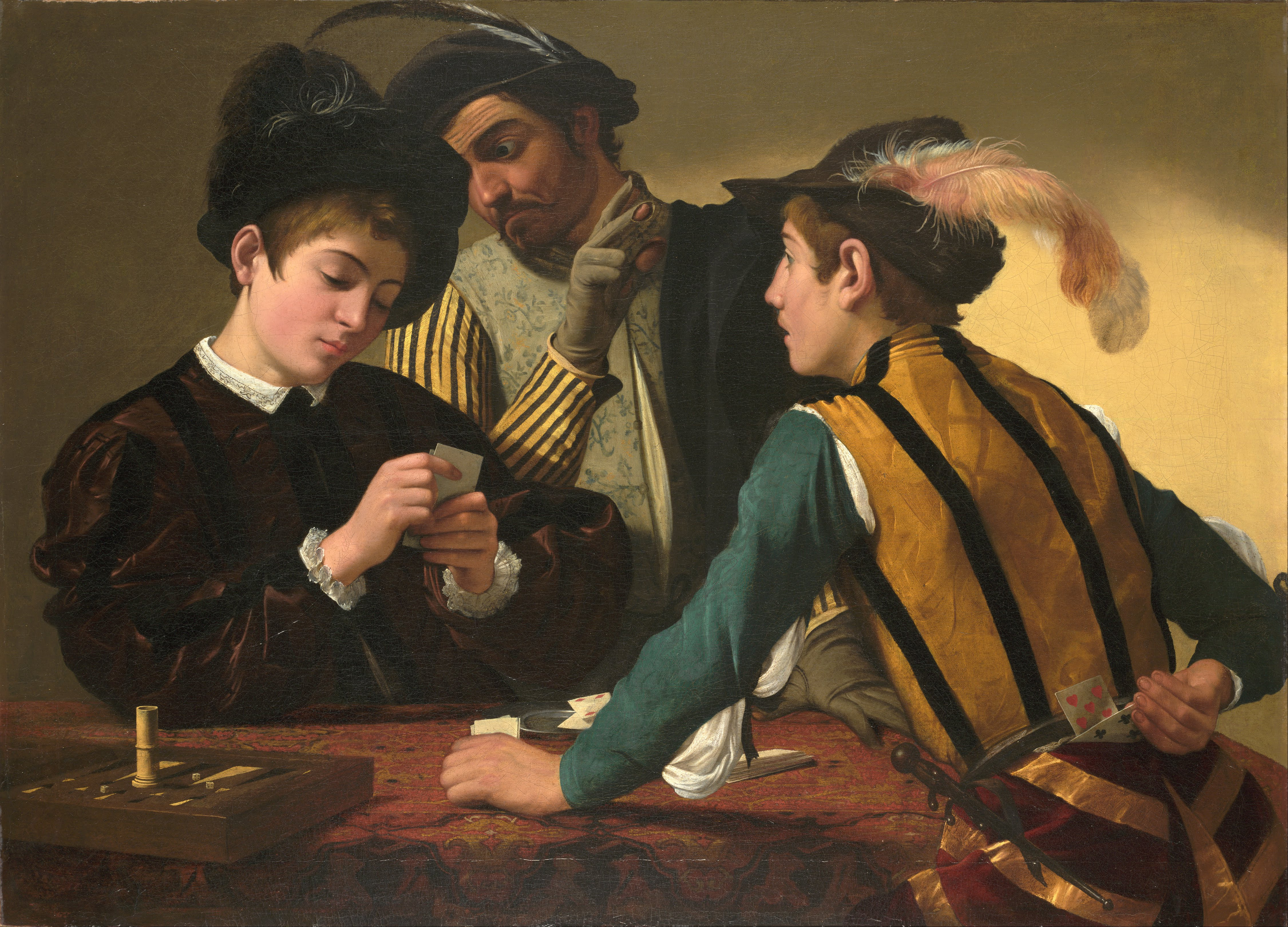
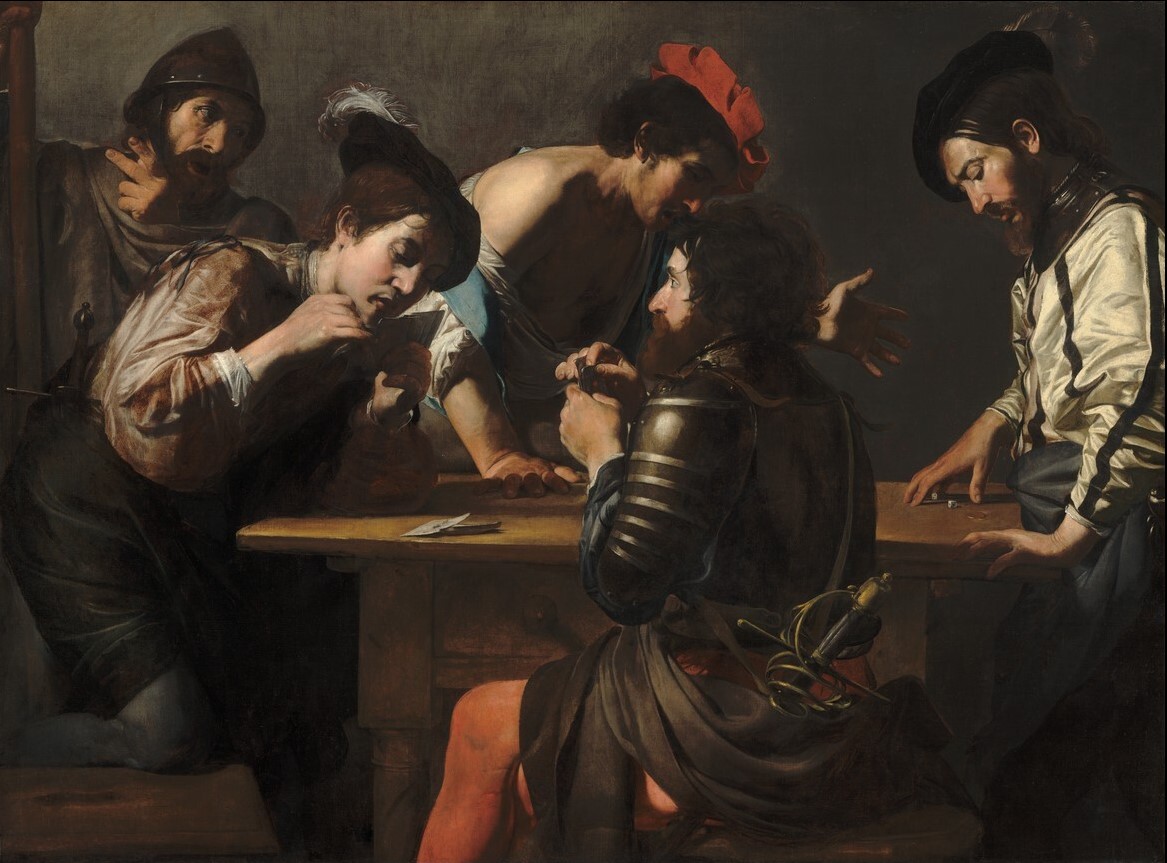
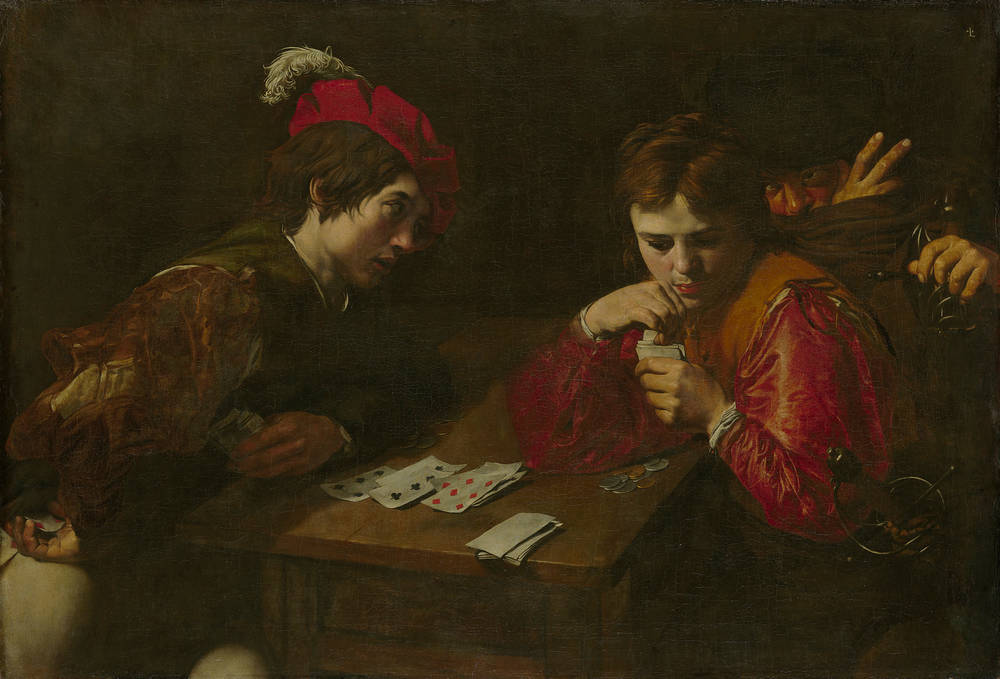
Caravaggio (Michelangelo Merisi), cardsharps,1594/95, oil on canvas, 37 1/16 x 51 9/16 in. (94.2 x 130.9 cm), Fort Worth, Kimbell Art Museum, Fort Worth, Texas. https://kimbellart.org/collection/ap-198706 – retrieved October 18, 2024.

Playing the game of primero the player at left is oblivious to a bearded cardsharp who uses his gloved fingers to signal to the other player the content of the cards. The other cheater is reaching for a hidden card from his pants behind his back. Caravaggio’s composition is novel with a naturalistic treatment of the figures whose distinct expressions and gestures convey a realistic and hard drama of being cheated and cheating. This painting was owned and stamped by Cardinal del Monte and in his inventory of 1627 following his death. It had been lost for almost a century when it was discovered in a European private collection and purchased by the Kimbell in 1987.

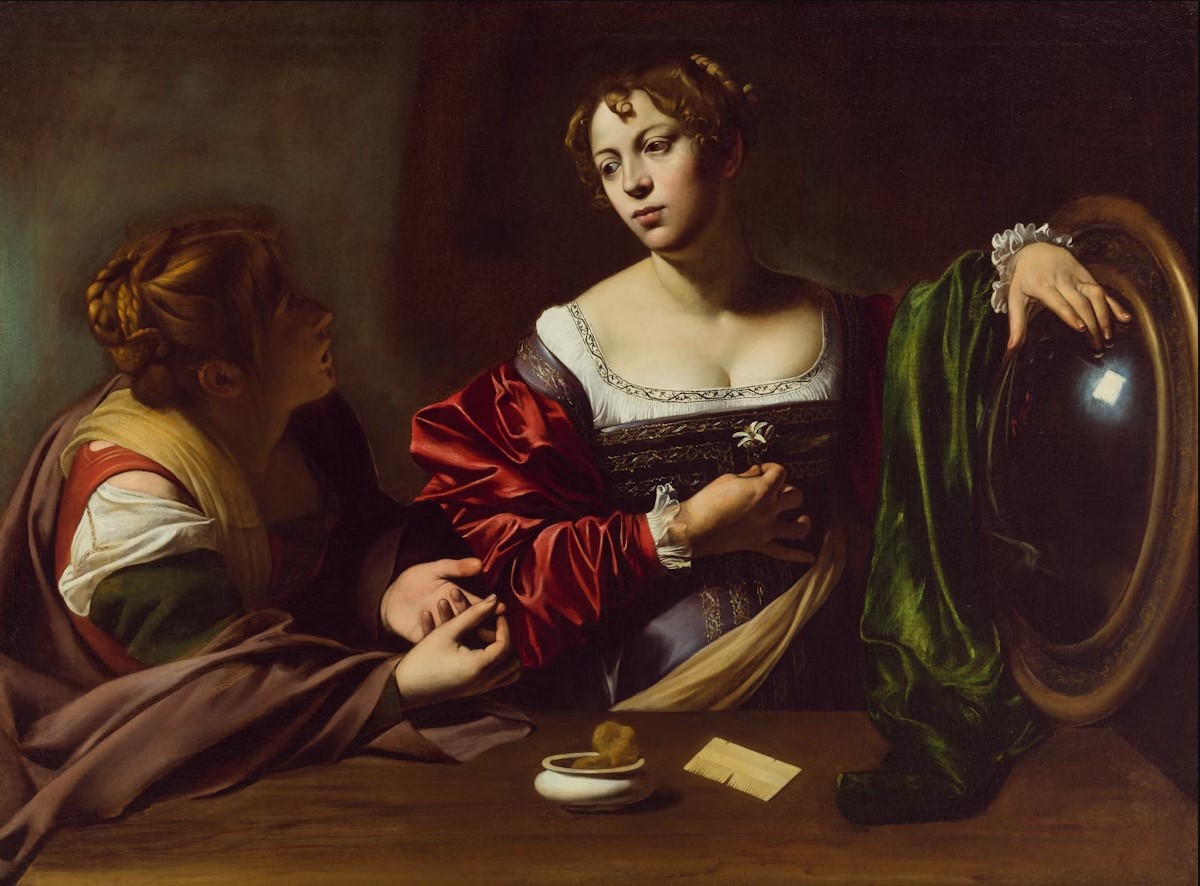
Caravaggio (Michelangelo Merisi), Martha and Mary Magdalene, c. 1598 Detroit Institute of Arts. 

“Caravaggio helped to popularize half-length religious paintings like this, made for private collectors rather than for public church settings. His greatest innovation was in depicting biblical characters as if they belonged to contemporary Roman society, basing them on studio models and dressing them in 17th-century attire, as he does here.” https://www.artic.edu/articles/1071/caravaggio-s-dramatic-life-and-paintings – retrieved October 15, 2024.

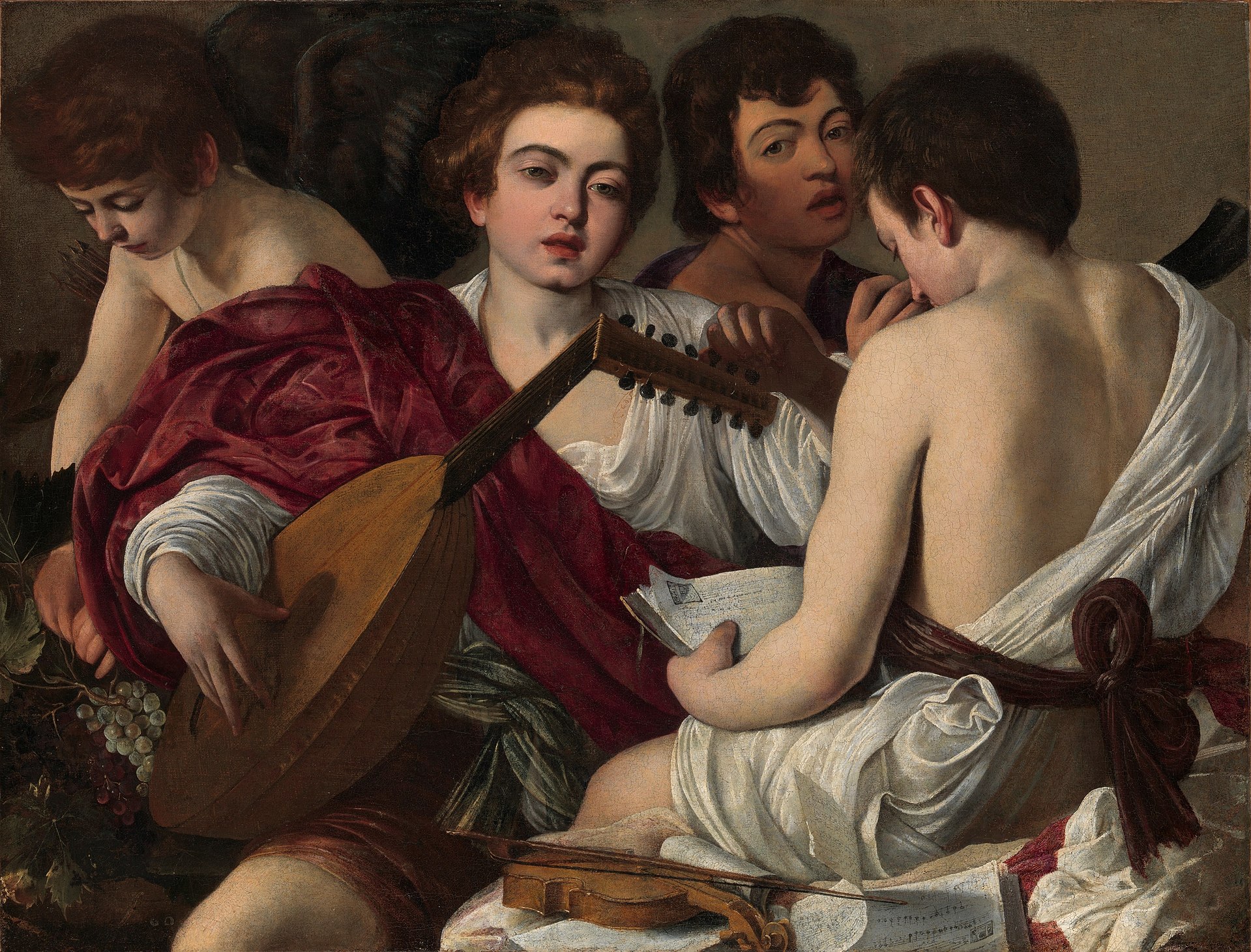
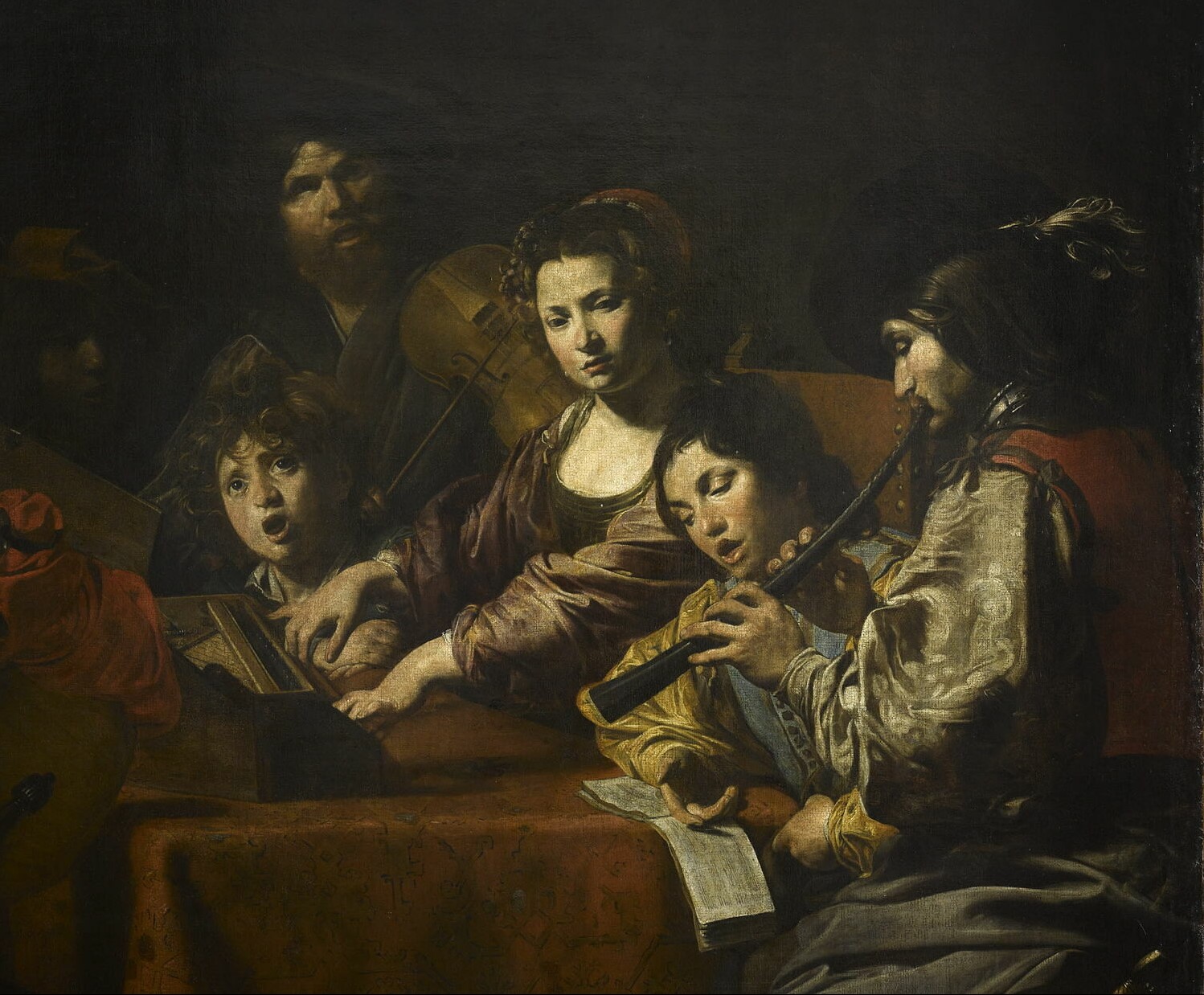
Caravaggio (Michelangelo Merisi), The Musicians, 1595/96, oil on canvas, 36 ¼ x 46 5/8” (92.1 x 118.4 cm), The Metropolitan Museum of Art, New York.  https://www.metmuseum.org/art/collection/search/435844 – retrieved October 10, 2024.

The painting was commissioned by Francesco Maria del Monte (1549-1627), a Catholic cardinal and important arts patron in Rome. This is an allegory painting of music manifested by the presence of Cupid in the background, but also a depiction of contemporary performance with individualized sitters, including Caravaggio’s self portrait second from right.

Ottavio Leoni, Francesco Maria del Monte, 1616. Born in Venice of a Tuscan aristocratic family, Cardinal del Monte was an important connoisseur of the arts.  Four centuries later his fame rests on his early patronage of Caravaggio and his art collection which provides detailed provenance for many important works of the period.
Caravaggio (Michelangelo Merisi), The Lute Player, 1595/96, oil on canvas, 37 x 46 7/8” The Hermitage Leningrad.

The Lute Player was owned by Cardinal del Monte. It was sold to Vincenzo Giustiniani (1564-1637), an aristocrat Italian banker, art collector and intellectual, and appeared in his inventory in 1638. Caravaggio’s model for the painting is the same as for The Musicians.

Nicolas Régnier/Niccolò Renieri (1591-1667), Portrait of Vincenzo Giustiniani, c. 1630.
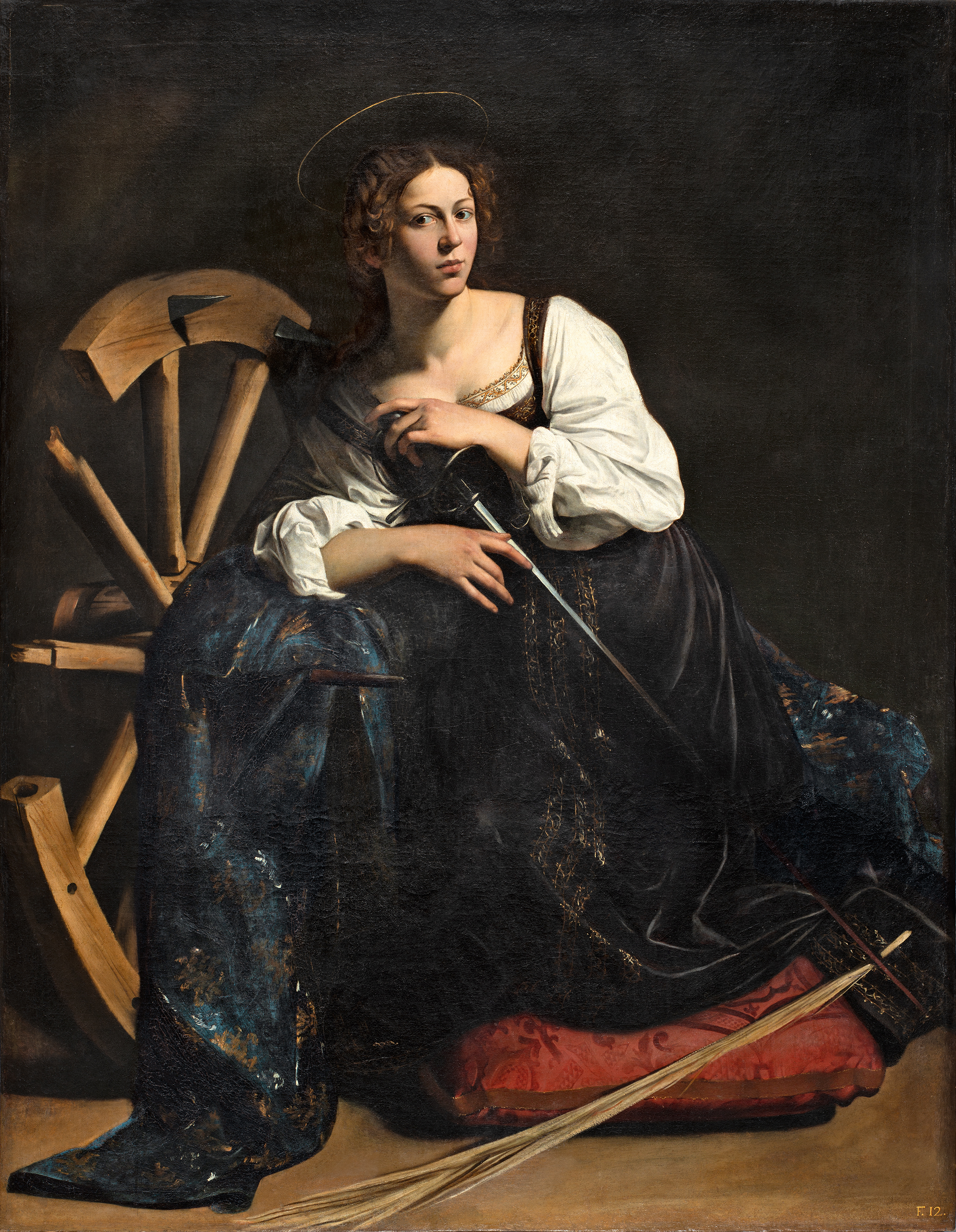
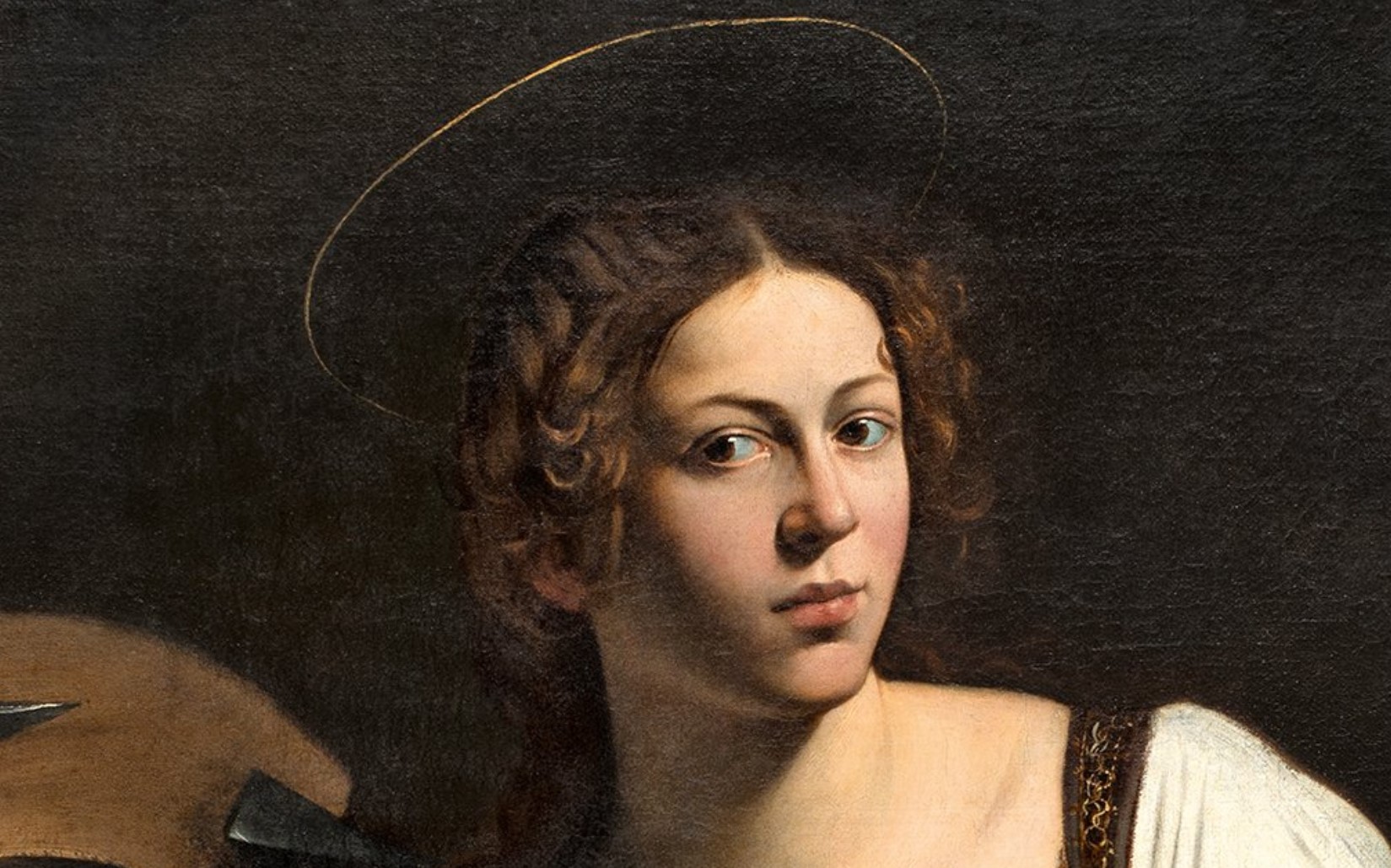
CARAVAGGIO (Michelangelo Merisi), Santa Catalina de Alejandría (St. Catherine of Alexandria), c. 1598-1599, oil on canvas, oil on canvas, 173 x 133 cm, Museo Nacional Thyssen-Bornemisza, Madrid. https://www.museothyssen.org/en/collection/artists/caravaggio-michelangelo-merisi/saint-catherine-alexandria – retrieved October 15, 2024.

Commissioned by Cardinal Francesco Maria del Monte, the figure of St. Catherine of Alexandria (c. 287-c.305) is Fillide Melandroni, a Roman prostitute (or courtesan) who played a significant role in Caravaggio’s art and fortunes. Young artists turned to prostitutes as their models since other women in respectable society were unavailable to them in that role. Richly dressed in robes, and kneeling on a cushion with a palm frond, Catherine fills the picture as she poses naturally fondling a sword and leaning upon a breaking wheel — signs of the manner of her martyrdom — in a dramatically lit scene of chiaroscuro characteristic of Caravaggio. It is the qualities of a picture such as this one that had immense impact on European art in the 17th century.

Detail of above: the face of St. Catherine of Alexandria (Fillide Melandroni).
Caravaggio (Michelangelo Merisi), Saint Francis of Assisi in Ecstasy, c. 1595-96, Oil on canvas, 36 3/8 x 50 5/8” 94 x 129.5 cm Wadsworth Atheneum, Hartford, CT. https://5058.sydneyplus.com/argus/final/Portal/Public.aspx?lang=en-US&p_AAEE=tab4&p_AABB=tab8 – retrieved October 11, 2024.

Saint Francis of Assisi in Ecstasy is Caravaggio’s first known religious composition. Acclaimed for his radical poverty and asceticism, Umbrian saint Francis of Assisi (1182-1226) would fast and pray in solitude for 40 days at a time carrying out literally the Bible’s examples of it. By imitating Jesus Christ in the Gospel simply Saint Francis, too, was ministered by angels. In the painting, shepherds sit in an obscured background as the angel and saint are bathed in light. The scene Caravaggio represents took place in September 1224 on Mount La Verna in central Italy. In that time and place St. Francis received the wounds of the crucified Christ, called the stigmata, one of a handful of saints to have received them. It is partially visible in Caravaggio’s artwork on the side of Francis’ tunic. Caravaggio painted Saint Francis of Assisi in Ecstasy in Rome for the Genoese banker and art collector Ottavio Costa (1554-1639). In 1943, this painting became the first Caravaggio to enter a public collection in the United States.

Caravaggio (Michelangelo Merisi), Rest on the Flight to Egypt, c, 1595/98, oil on canvas, 51 ¼ x 63” Galleria Doria- Pamphili, Rome.

La fête champêtre is a musical picnic whose tradition originated in Italy. Caravaggio’s composition is lyrical and complicated. As it is in the setting of the Holy Family’s flight to Egypt in Matthew’s Gospel, the characters are dressed humbly accompanied by the presence of an angel.

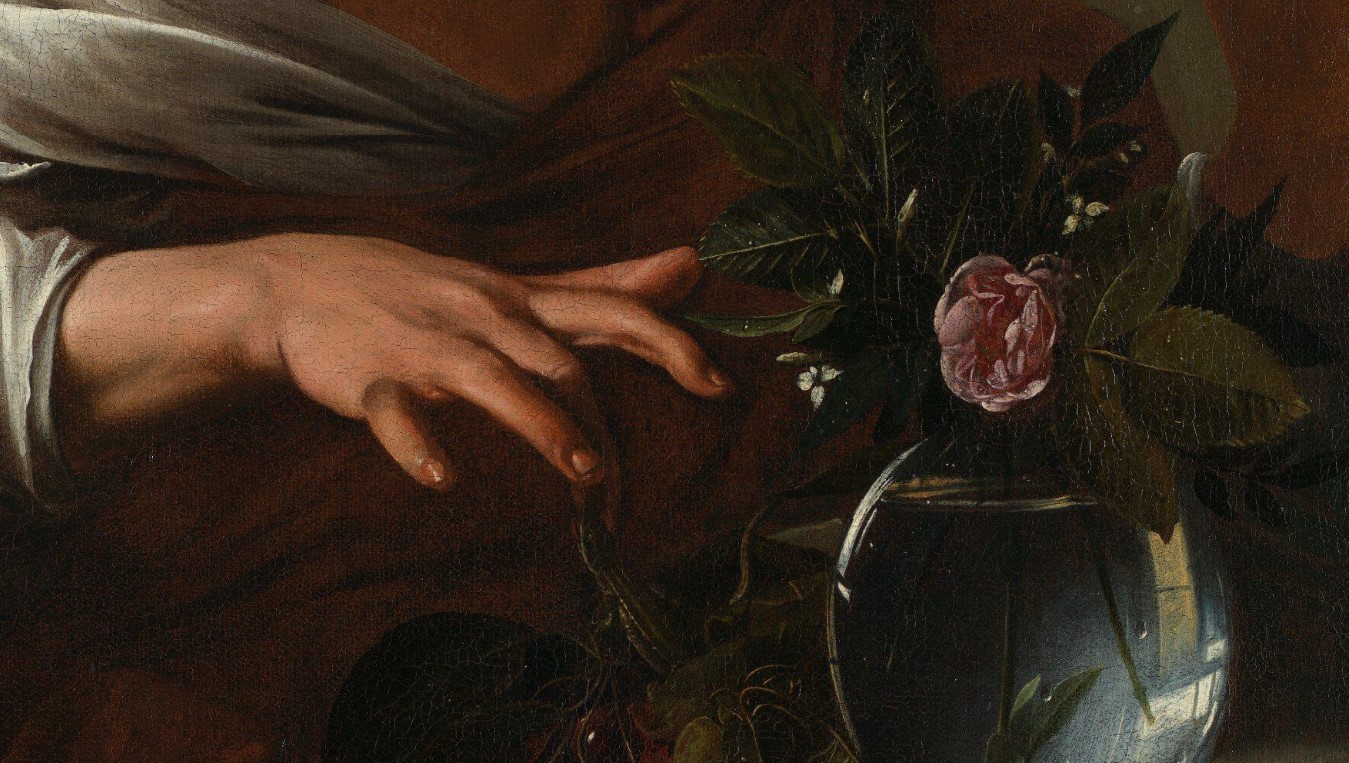
Caravaggio (Michelangelo Merisi), Boy Bitten By A Lizard, 1596/97, oil on cavas, 27 ½ 2 22 3/8”, The National Gallery, London.
Detail of above.

Mancini relates that Caravaggio painted the subject when staying with an old Catholic prelate named Pandolfo Pucci. By the end of his residence Caravaggio nicknamed his temporary benefactor Monsignor Insalata, or “Mister Salad,” for the pittance of solid food he served his artist boarder. The mock heroic painting may be allegorical with the lizard conveying its traditional meaning of lust or death joined to cherries symbolic of love and roses that of sexually transmitted disease — and warning of all three. see – https://www.britannica.com/biography/Caravaggio/First-apprenticeships-in-Rome-Pucci-Cesari-and-Petrigiani – retrieved October 15, 2024.

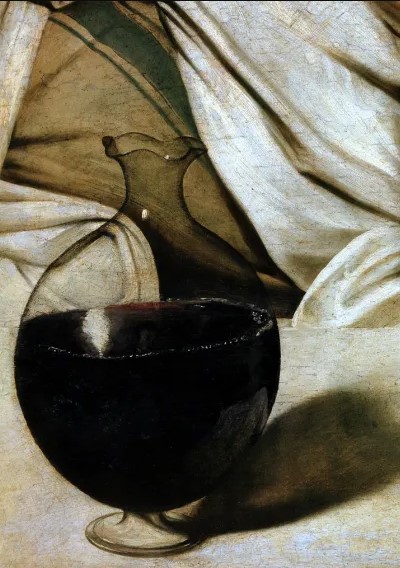
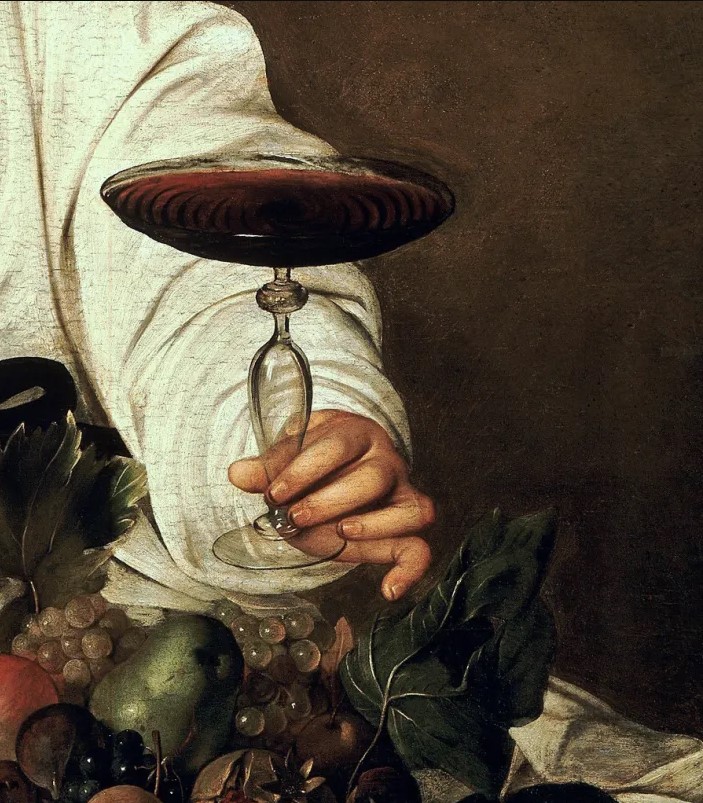
Caravaggio (Michelangelo Merisi), Bacchus, c. 1597, oil on canvas, 37 3/8 x 33 ½”, Uffizi, Florence.
Detail of above.
Detail of above.
Cardinal del Monte commissioned it from Caravaggio for a Medici.
Caravaggio (Michelangelo Merisi), Jupiter, Neptune, and Pluto, 1597, oil on stucco, about 9/9”” x 5’11” Villa Ludovisi, Rome. https://villaludovisi.org/ – retrieved October 12, 2024.

The building and grounds of Villa Ludovisi in Rome, and their rich artwork, includes masterpiece frescoes by Guercino (1591-1666) and other leading lights of the 17th century Bolognese school. Caravaggio’s Jupiter, Neptune and Pluto is his only known oil painting on plaster. Cardinal de Monte purchased the villa and took up residence there in 1596. The cardinal sold it to the Ludovisi in 1621. Bellori relates that the subject matter for the fresco of these gods was to express the cardinal’s interest in medicinal chemistry (today’s pharmaceuticals).

Caravaggio (Michelangelo Merisi), Judith Beheading Holofernes, c. 1598, oil on canvas, 56 ¾ x 76 ¾” 145 x 195cm Galleria Nazionale d’Arte Antica, Rome.  https://barberinicorsini.org/opera/giuditta-e-oloferne/ – retrieved October 12, 2024.

The painting was made for Ottavio Costa. It was later owned by a succession of Roman families until it was acquired by the Galleria Nazionale d’Arte Antica in 1970. It depicts a famous scene from the book of Judith in the Bible. Judith, a beautiful, highly respected, prayerful and eloquent widow, is able to enter the tent of an Assyrian general whose army had surrounded Judith’s home, the city of Bethulia, certain to destroy it. Because of Holofernes’ desire for her, he allows Judith to move about freely in his camp and has her join him at a banquet in his tent where he gets drunk. “Holofernes, charmed by her, drank a great quantity of wine, more than he had ever drunk on any day since he was born” (Judith 12:20). Overcome with drink, the fearsome general passes out and is decapitated by Judith, her heroic action saving her people. The Bible tells it this way: “When all had departed, and no one, small or great, was left in the bedchamber, Judith stood by Holofernes’ bed and prayed silently, “O Lord, God of all might, in this hour look graciously on the work of my hands for the exaltation of Jerusalem. Now is the time for aiding your heritage and for carrying out my design to shatter the enemies who have risen against us.” She went to the bedpost near the head of Holofernes, and taking his sword from it, she drew close to the bed, grasped the hair of his head, and said, “Strengthen me this day, Lord, God of Israel!” Then with all her might she struck his neck twice and cut off his head. She rolled his body off the bed and took the canopy from its posts. Soon afterward, she came out and handed over the head of Holofernes to her maid, who put it into her food bag” (Judith 13: 4-10). For Caravaggio, this is his first painting depicting violent action in dramatic and realistic detail. The moment is captured as if in an eternal frieze.

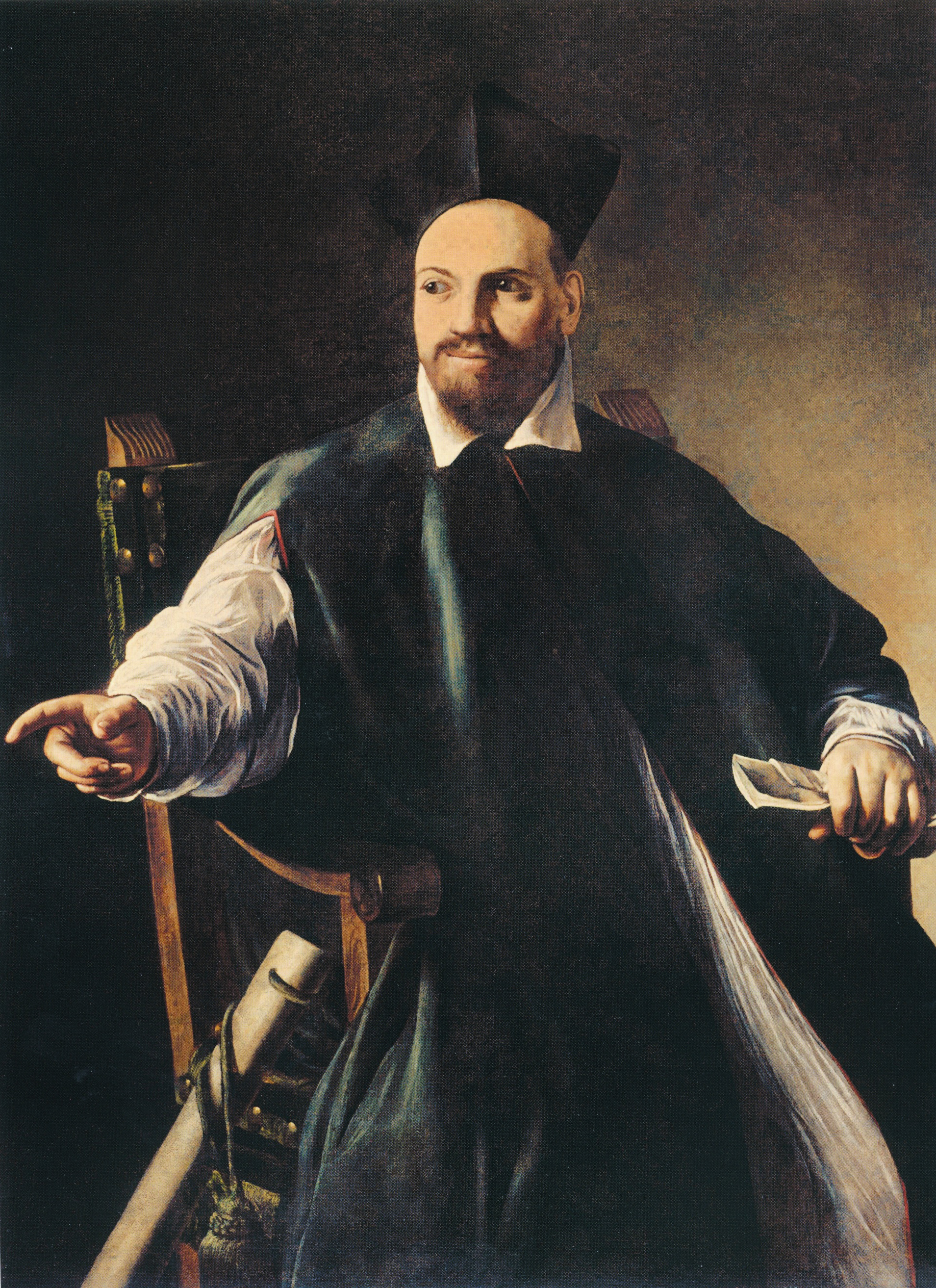
Caravaggio (Michelangelo Merisi), Portrait of Monsignor Maffeo Barberini, c. 1603, Private Collection, Firenze.

Maffeo Vincenzo Barberini (1568-1644) became the future Pope Urban VIII whose reign began in 1623.

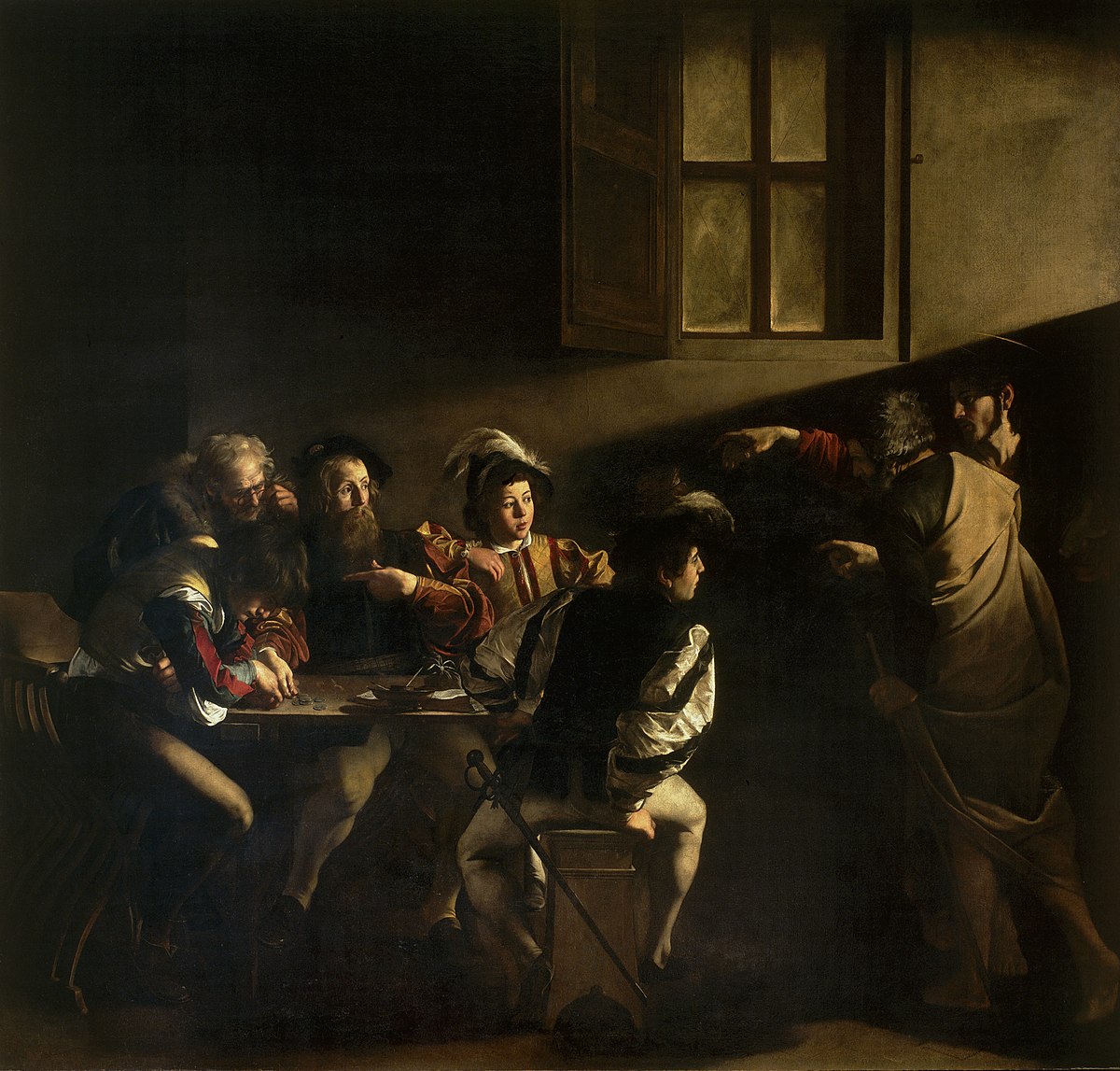
Caravaggio (Michelangelo Merisi), The Calling of Saint Matthew, 1599-1600, oil on canvas, 10’7 1/2 “ x 11’ 2” Contarelli Chapel, Church of Luigi dei Francesi, Rome.
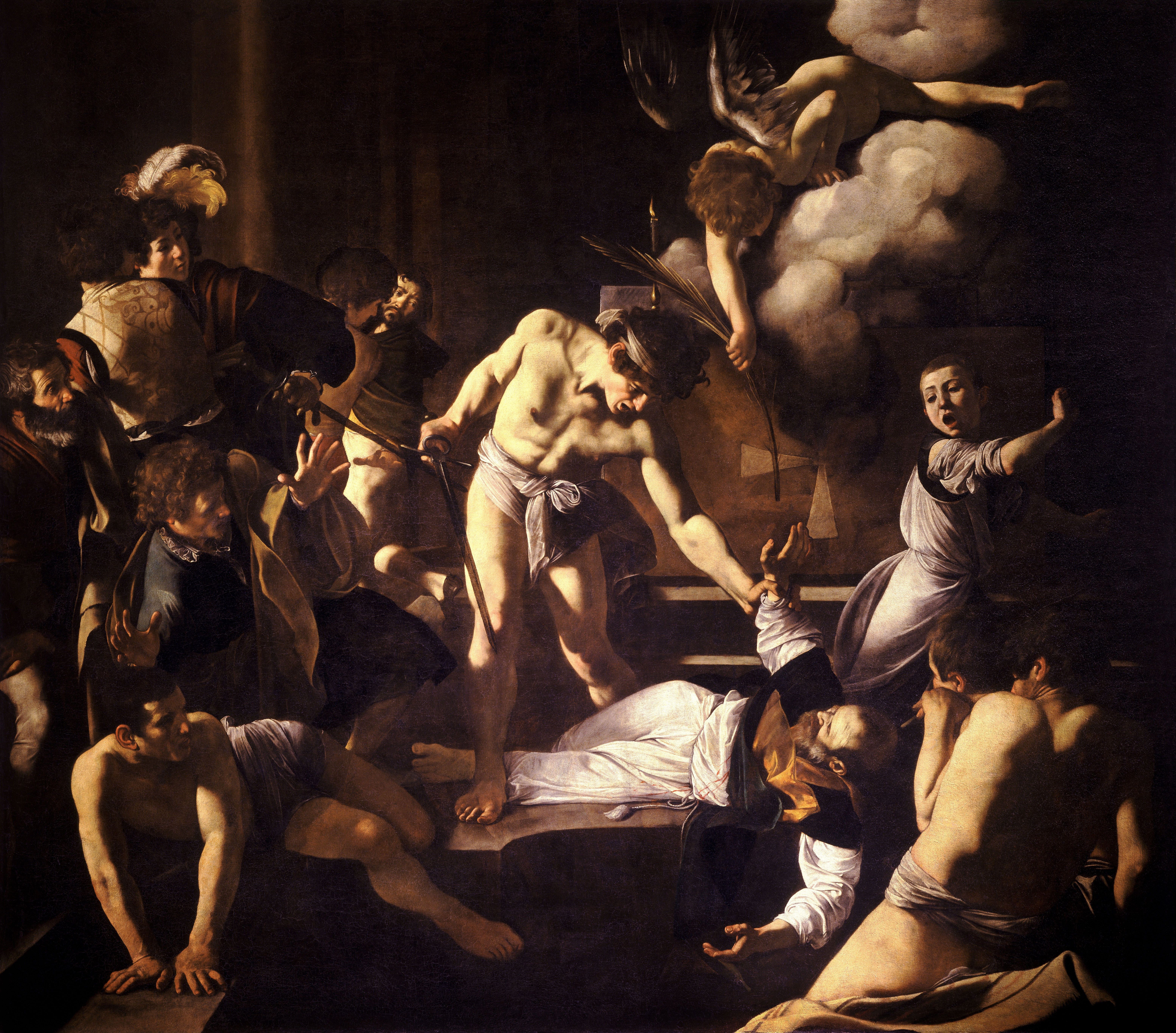
Caravaggio (Michelangelo Merisi), The Martyrdom of Saint Matthew, 1599-1600, oil on canvas, 10’7 1/2 “ x 11’ 3” Contarelli Chapel, Church of Luigi dei Francesi, Rome.
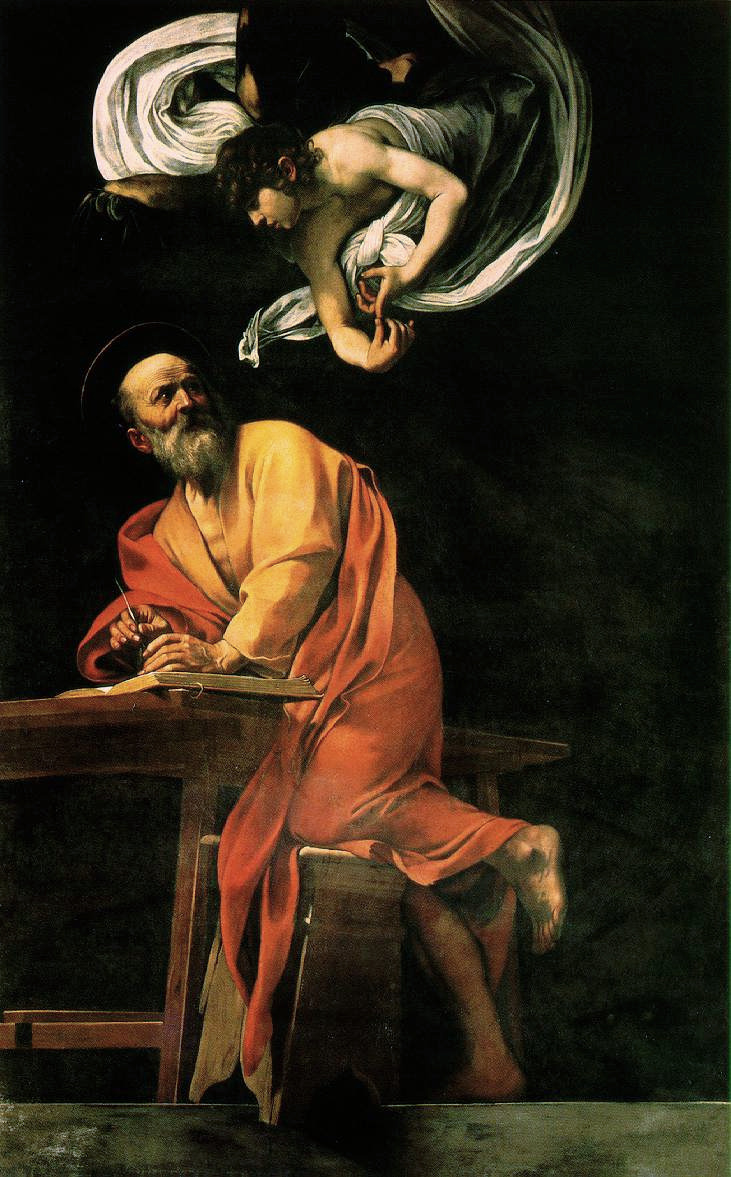
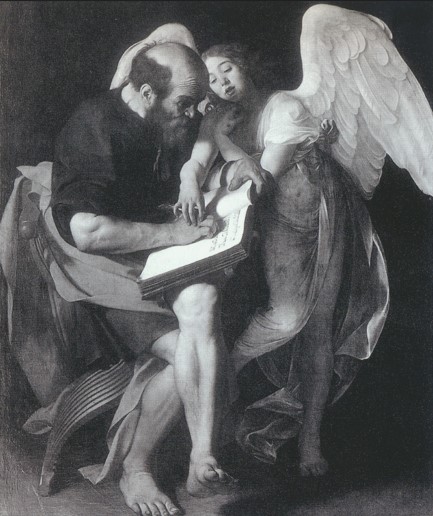
Caravaggio (Michelangelo Merisi), The Inspiration of Saint Matthew, 1602, oil on canvas, 9’8 1/2 “ x 6’ 2 ½” Contarelli Chapel, Church of Luigi dei Francesi, Rome.
This first version of The Inspiration of St. Matthew by Caravaggio was rejected because the evangelist was considered too crude and the angel too familiar. The painting was destroyed during the Fall of Berlin in 1945 and known by photographs.
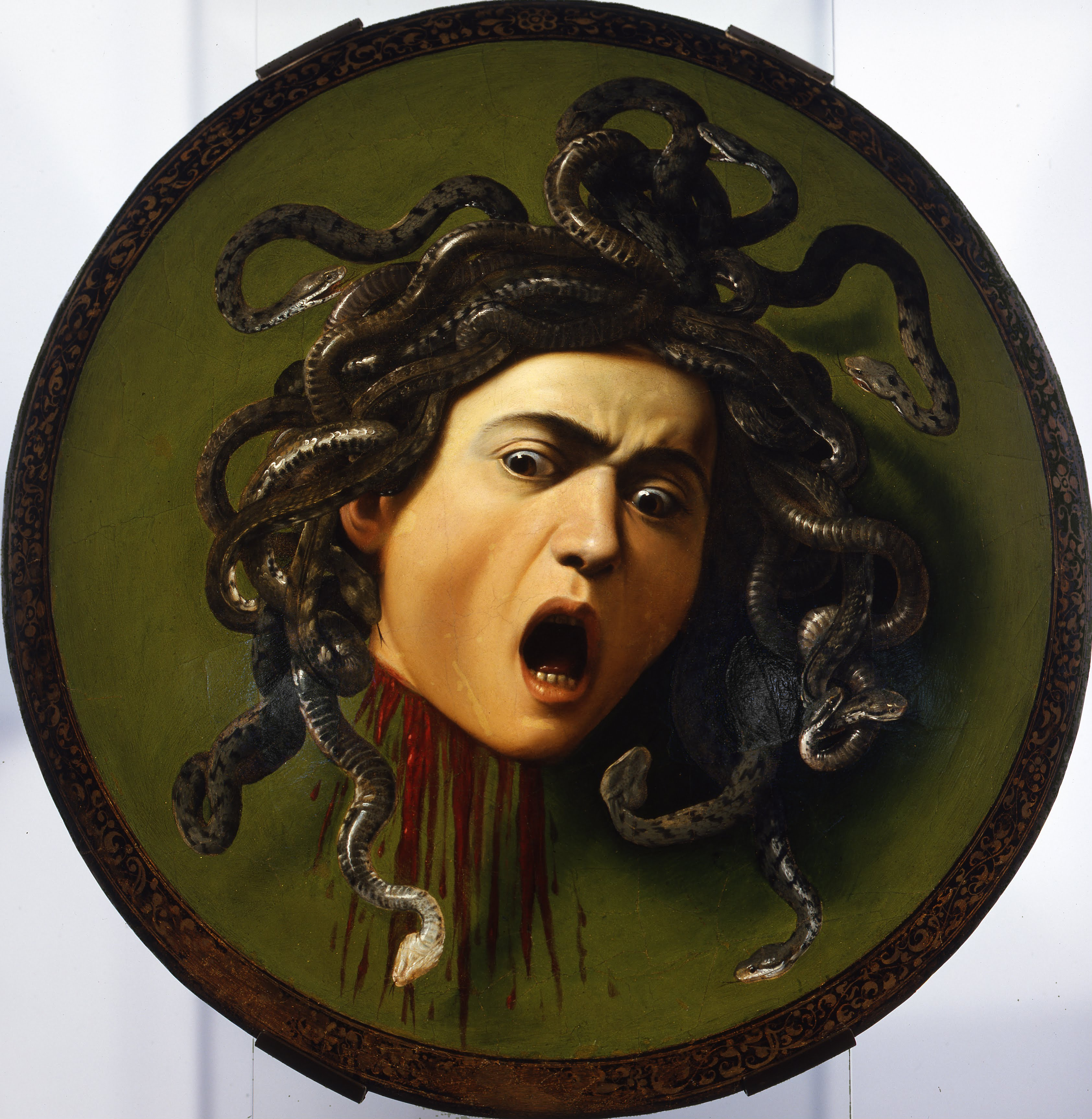
Caravaggio (Michelangelo Merisi), Medusa (detail), 1600/01, oil on canvas mounted on a convex poplar-wood shield, Uffizi, Florence.

Caravaggio’s Medusa is painted on an actual parade shield.

Caravaggio (Michelangelo Merisi), Basket of fruit (canestra di frutta), c. 1600/01, oil on canvas, 18 1/8 x 25 3/8, Biblioteca Ambrosiana, Milan.  https://www.ambrosiana.it/opere/canestra-di-frutta/ – retrieved October 13, 2024.

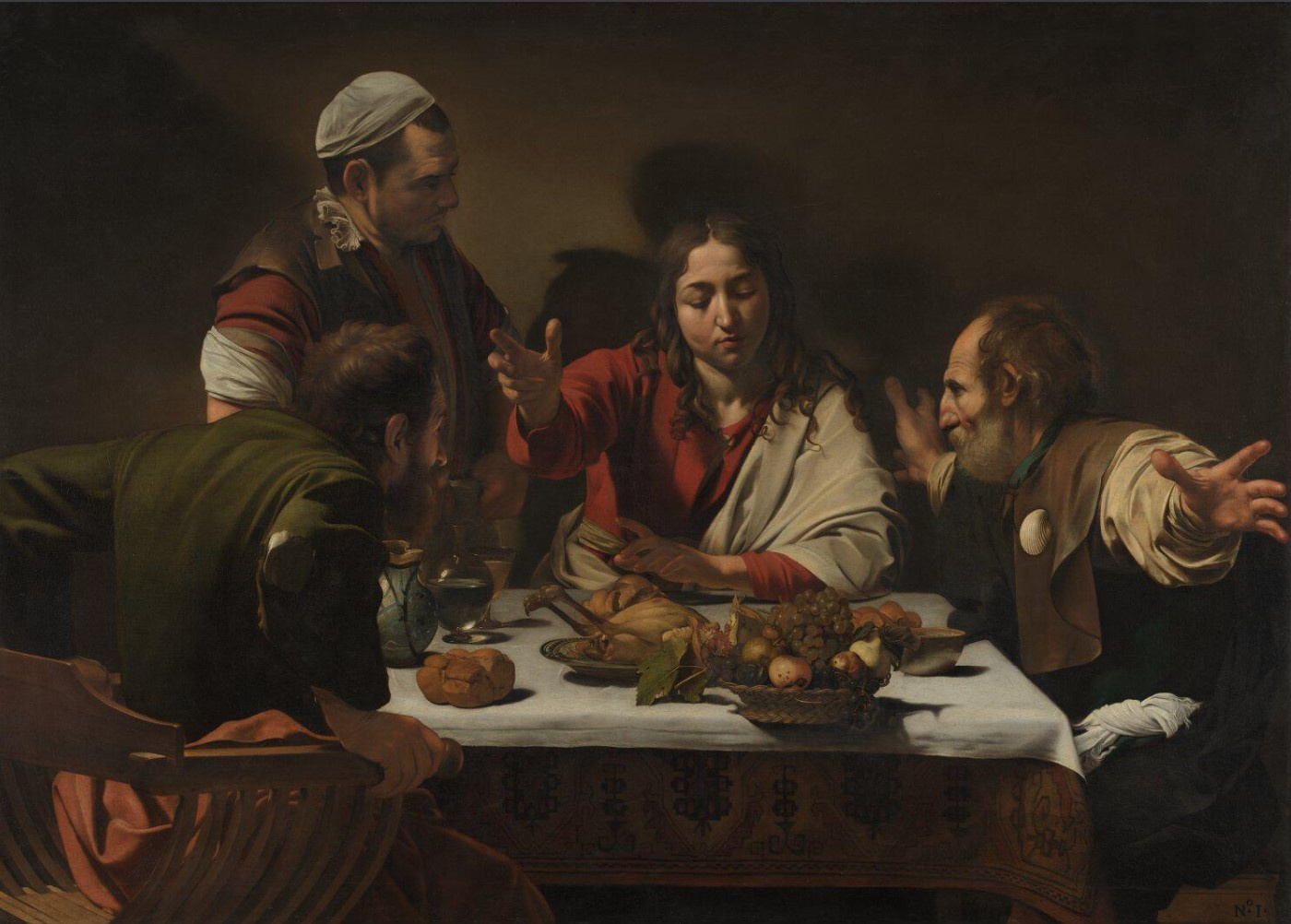
This is Caravaggio’s only still life painting that has survived. Of course there are still life in his figure paintings as details. His paintings of fruit are completely diverse in terms of varieties and arrangements though sharing overall stylistic similarities. The painting was in the possession of Cardinal Federico Borromeo (1564-1631), cousin to Saint Charles Borromeo (d. 1564), and both cardinal archbishops of Milan. Archbishop Federico bequeathed it in his will to the Ambrosiana in Milan, a gallery he co-founded in 1618. The same sort arrangement in the same basket appears in Caravaggio’s Supper at Emmaus in the National Gallery London painted around the same time. Cdl. Borromeo lived in Rome from 1586 to 1601 and grew to become familiar with Caravaggio’s work. It is unclear whether the archbishop commissioned the painting or if it was a gift. Though the Counter-Reformation cardinal was a propagator of the faith using religious art, he also was an avid collector of still life.

Giulio Cesare Procaccini ((1574–1625), Cardinal-Archbishop Federico Borromeo, 1610, Museo diocesano di Milano.
Caravaggio (Michelangelo Merisi), Supper At Emmaus, c. 1600/01, oil on canvas, 54 ¾ x  76 ¾” The National Gallery, London.
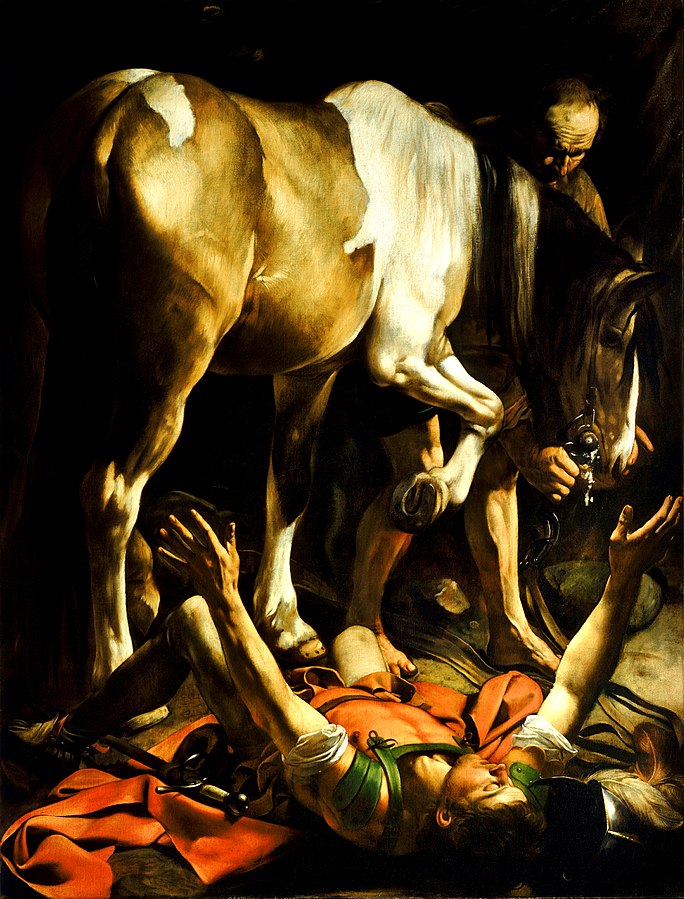
Caravaggio (Michelangelo Merisi), The Conversion of Saint Paul, 100/01, oil on canvas, 90 ½ x 70” Cerasi Chapel, Santa Maria de Popolo, Rome.
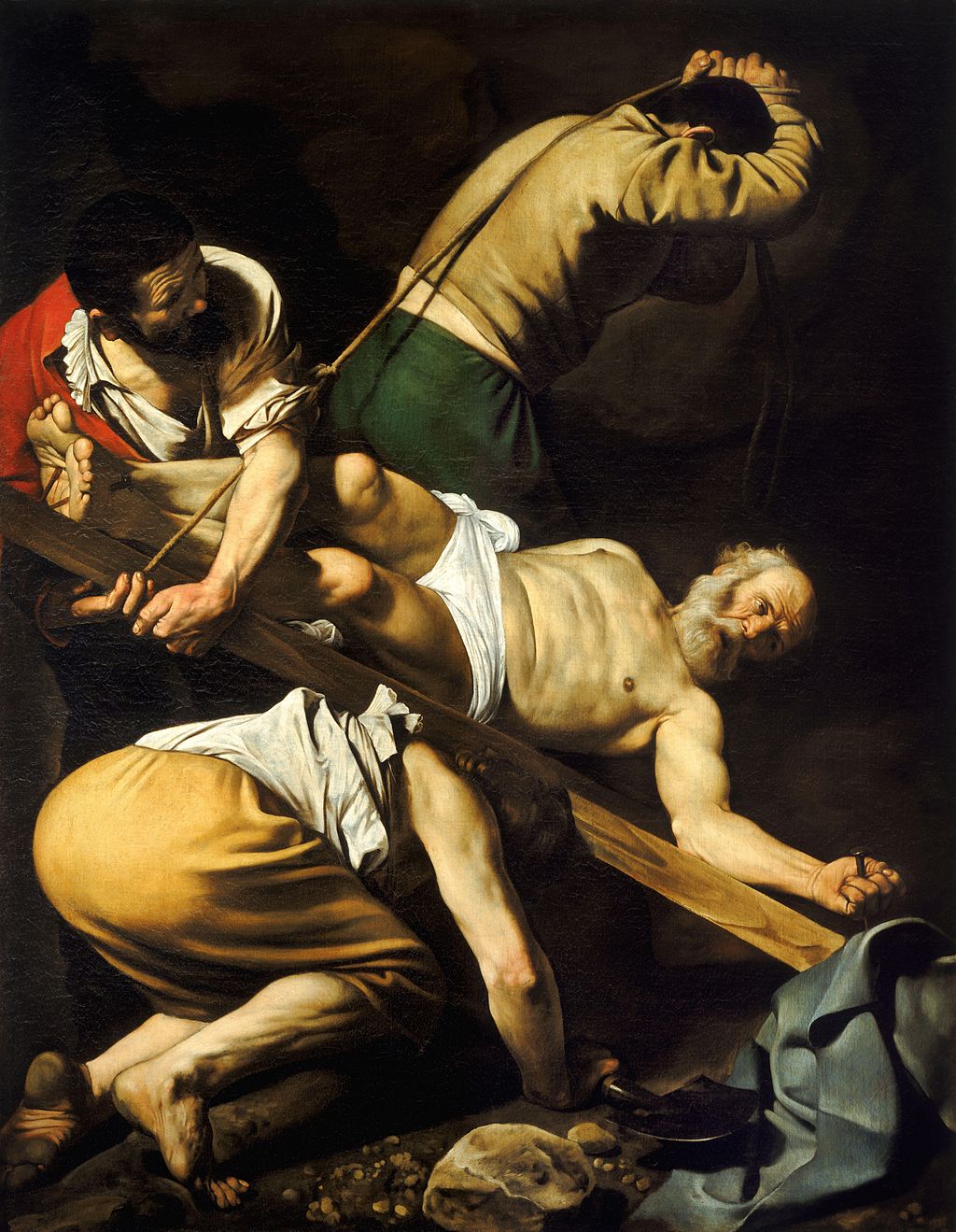
Caravaggio (Michelangelo Merisi), The Crucifixion of St. Peter, 1600/01, oil on canvas, 90 ½ x70” Cerasi Chapel, Santa Maria de Popolo, Rome.

The chapel was purchased by Tiberio Cerasi (1544-1601) in 1600 who worked as Treasurer-General for Pope Clement VIII. Cerasi had the chapel redone by Carlo Maderno (1556-1629). In 1601 Cerasi hired Caravaggio to paint The Conversion of St. Paul and The Crucifixion of St. Paul. Notably, his paintings’ first versions were rejected. The final paintings were installed in 1605 and the chapel consecrated in 1506. The Assumption of Mary over the altar was painted at the same time by Annibale Caracci. See – https://en.wikipedia.org/wiki/Cerasi_Chapel– retrieved October 14, 2024.

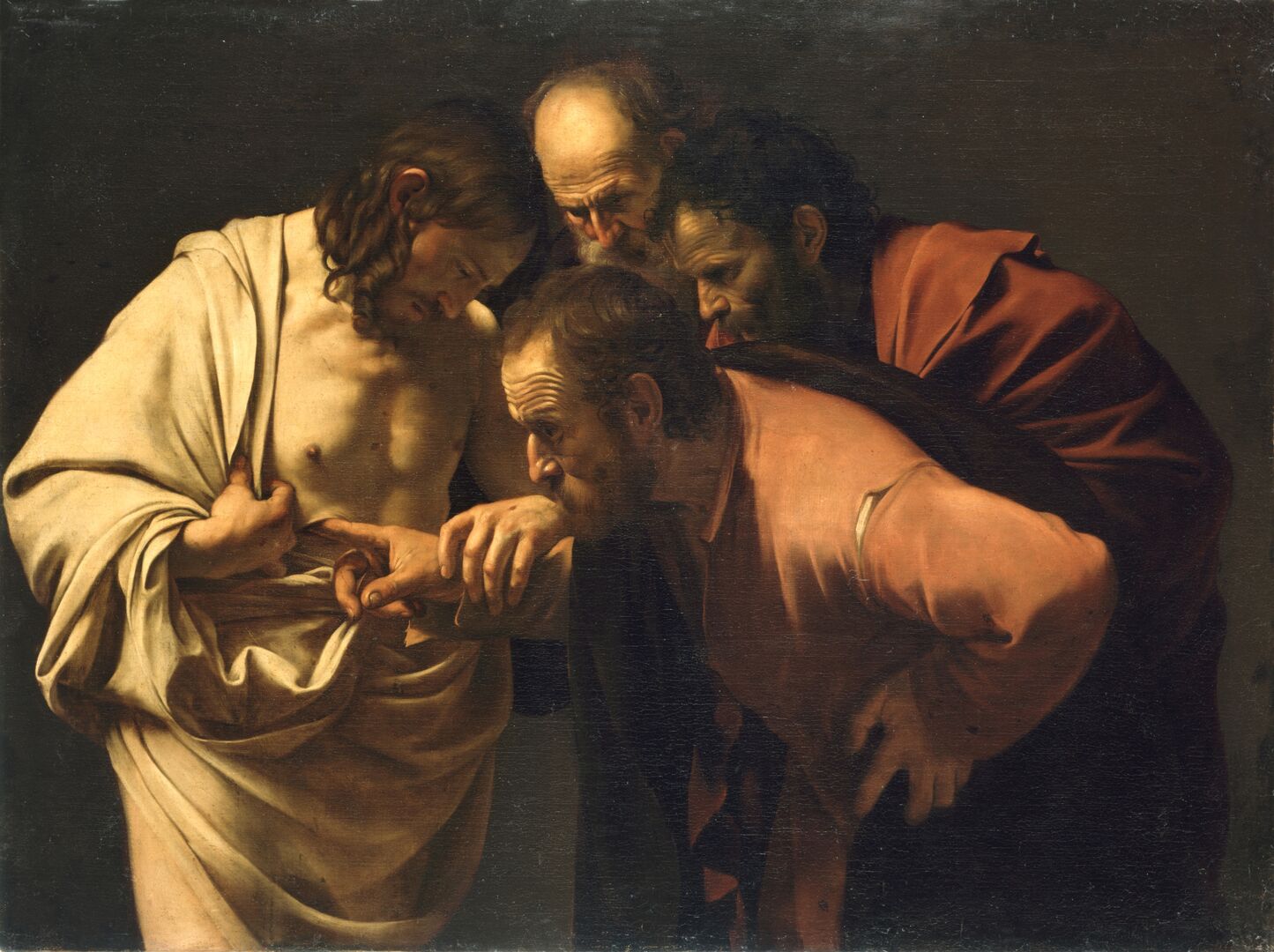
Caravaggio (Michelangelo Merisi), The Incredulity of Saint Thomas, 1601/02, oil on canvas, 42 1/8 x 57 ½” 118 × 156.5 cm Neues Palais, Potsdam.

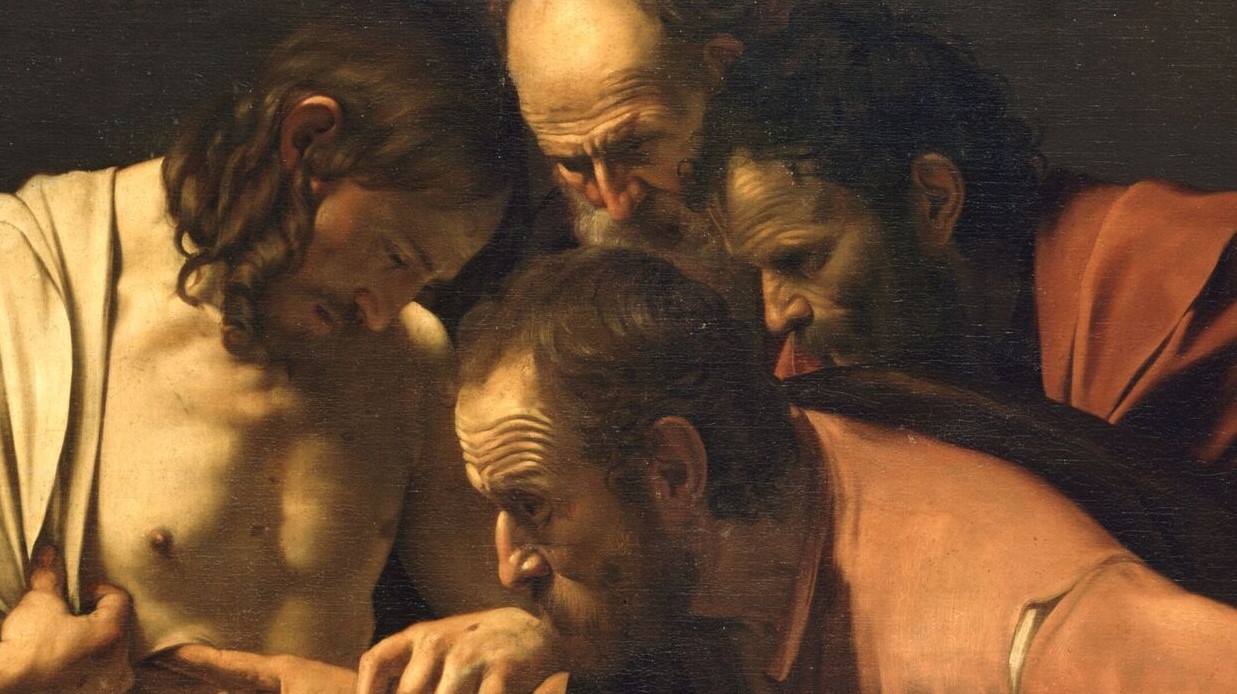
Caravaggio’s depiction of this encounter of a Resurrected Christ with doubting Thomas that is found in the New Testamant (John 20: 27-31) is naturalistic with dramatic chiaroscuro. It was purchased from a Paris art dealer in 1815 after its original owners, the Giustiniani, were forced to sell their collection due to financial distress. Prussian king Frederick William III (1770-1840) bought the collection of paintings with the intention of starting a public art museum in Berlin, though this painting ended up being sorted out as “lower quality” perhaps because it shows no signs of Christ’s divinity. Of the five paintings by Caravaggio the king acquired, three ultimately ended up in the museum, including Cupid as Victorious (Berlin, Gemäldegalerie). The Doubting Thomas was hung in the Berlin Palace and, finally, in 1856 hung in the picture gallery in Sanssouci. https://brandenburg.museum-digital.de/object/11898 – retrieved October 11, 2024.

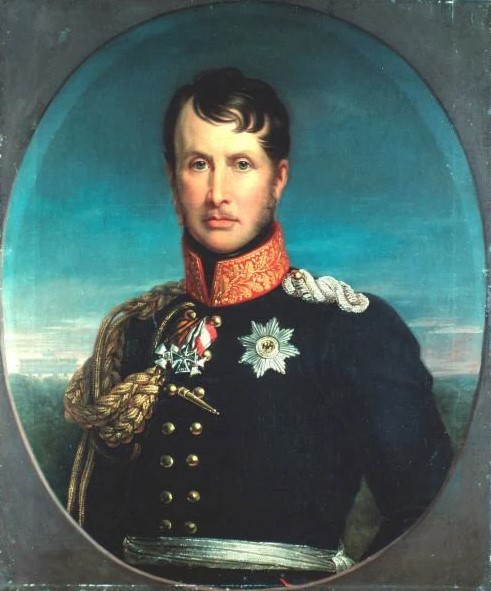
Frederick William III ruled Prussia during the Napoleonic Wars and, while shy and quiet by nature, reluctantly participated in the coalition against Napoleon in the German campaign of 1813. After Napoleon’s defeat in 1815, he took part in the Congress of Vienna and helped established the new postwar order in Europe. For the remainder of his reign, Frederick William III set about reforming Prussian institutions and centralizing royal control.
Detail of above.
Caravaggio (Michelangelo Merisi), Victorious Amor, c. 1601/02, oil on canvas, 60 5/8 x 43 ¼”, Gemäldegalerie, Staatliche Museen, Berlin-Dahlem. https://recherche.smb.museum/detail/862322/amor-als-sieger?language=de&question=caravaggio&limit=15&sort=relevance&controls=none&collectionKey=GG*&objIdx=0 – retrieved October 11, 2024.

Caravaggio shows Eros prevailing over other human endeavors: war, music, science, government.

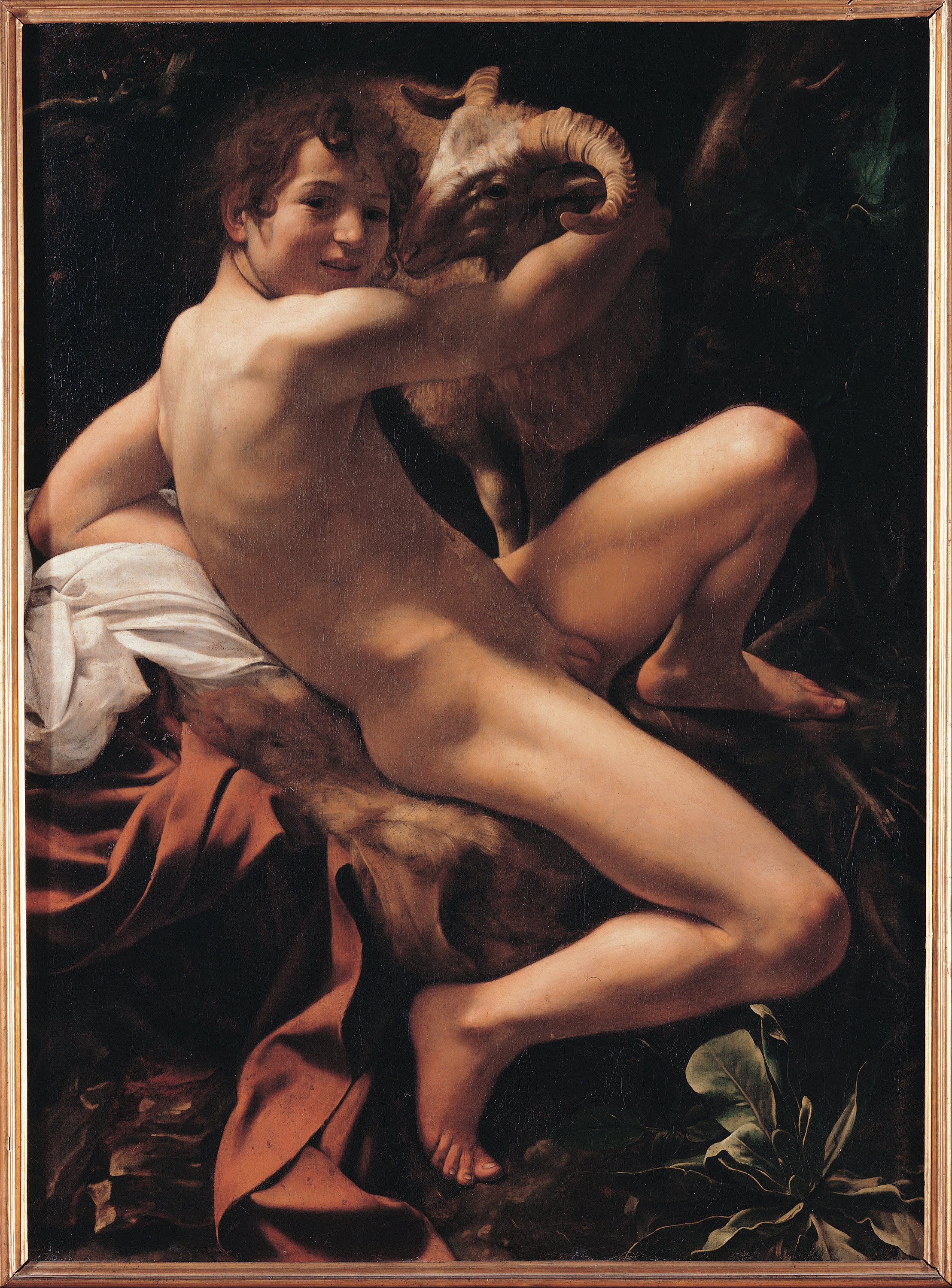
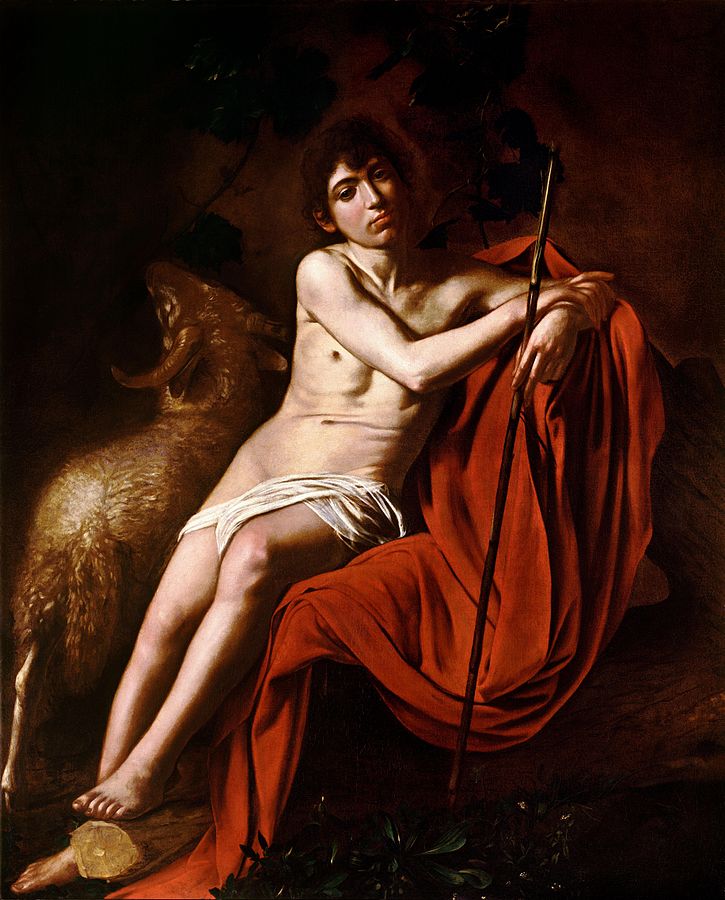
Caravaggio (Michelangelo Merisi), Youth With a Ram, 1602/03, oil on canvas, 52 x 38 ¼” Capitoline Gallery, Rome. https://www.museicapitolini.org/en/percorsi/percorsi_per_sale/pinacoteca_capitolina/sala_di_santa_petronilla_la_grande_pittura_del_seicento_a_roma/san_giovanni_battista – retrieved October 12, 2024.
 

Youth With A Ram was painted for Ciriaco Mattei (d.1614), one of the foremost art collectors of his time, and given to Cardinal del Monte by his son before his death. Mattei also commissioned Caravaggio’s Supper at Emmaus and The Taking of Christ.

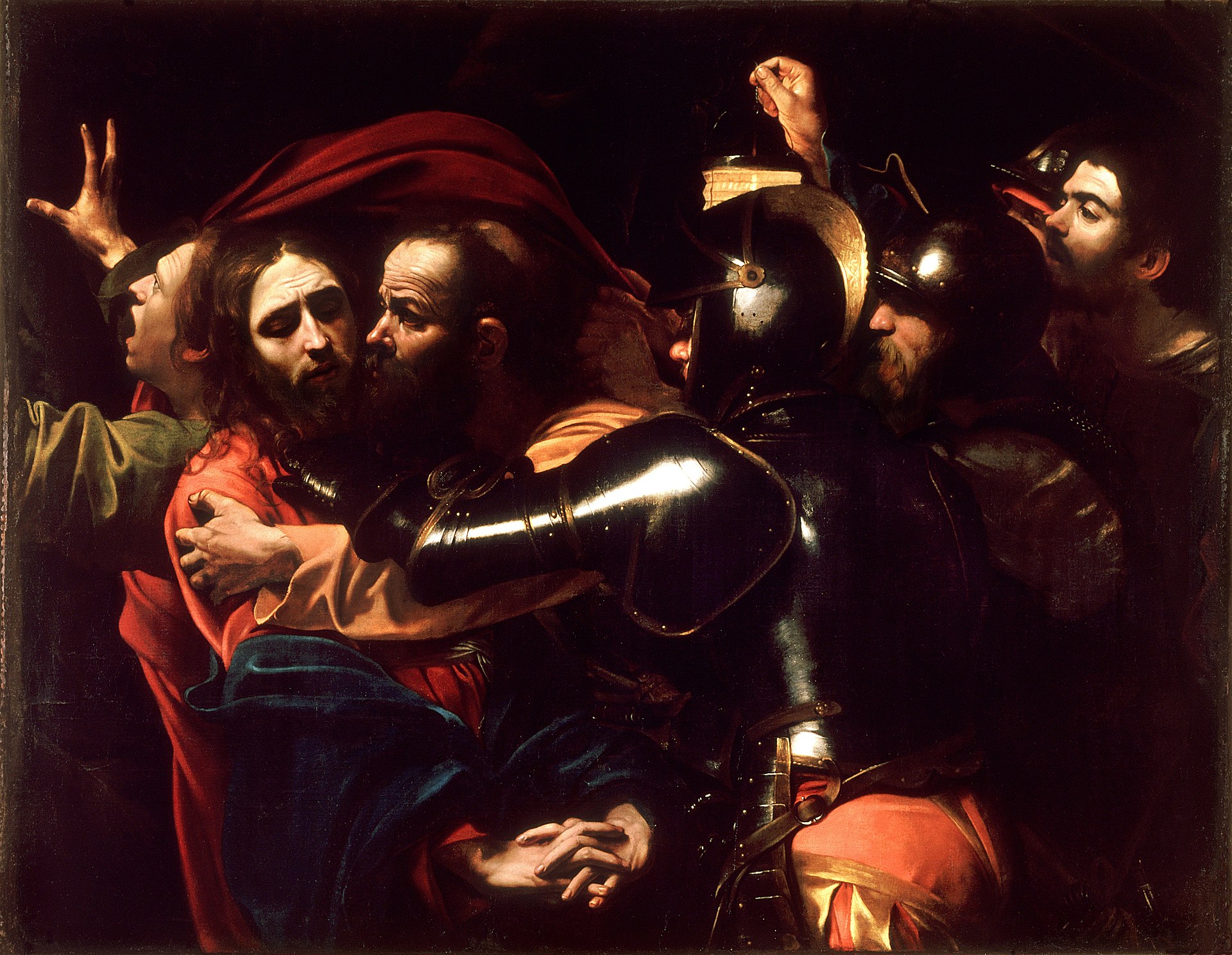
Caravaggio (Michelangelo Merisi), The Taking of Christ, 1602, oil on canvas, 133.5 cm × 169.5 cm (52.6 in × 66.7 in) National Gallery of Ireland. On loan from the Society of Jesus, Leeson Street., Dublin.
The painting includes a self portrait of Caravaggio.
Caravaggio (Michelangelo Merisi), The Sacrifice of Isaac, 1603, oil on canvas, 41 x 53 1/8” Uffizi, Florence. https://www.uffizi.it/en/artworks/sacrifice-of-isaac – retrieved October 12, 2024.

The painting illustrates the Old Testament story in which God subjected Abraham to an extraordinary test of obedience by ordering him to sacrifice his only son Isaac (Genesis 22: 1-19). Caravaggio faithfully depicts the crucial moment of this dramatic story, when old Abraham, at the very moment he is about to immolate a screaming Isaac, is blocked by an angel sent by the Lord.

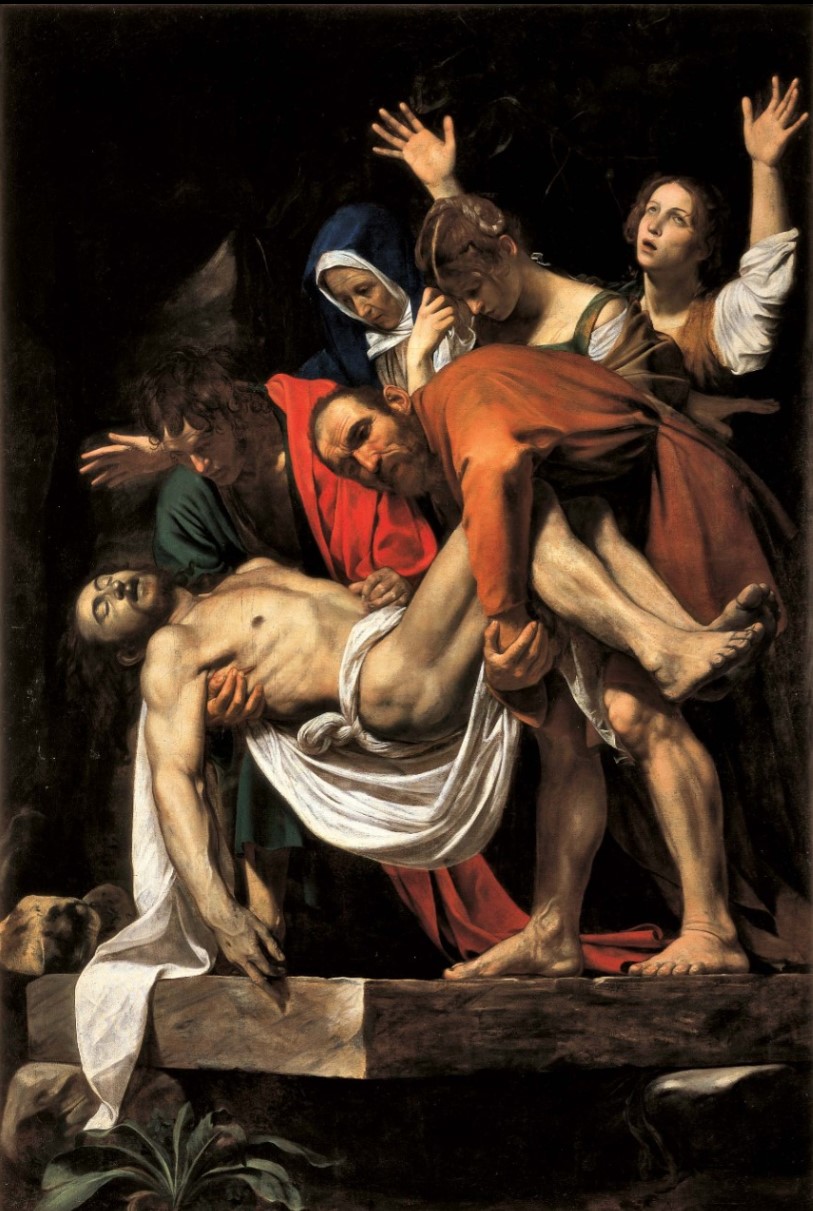
Michelangelo Merisi, called the Caravaggio, Deposition, circa1600-1604, Oil on canvas, 300 x 203 cm, Pinacoteca, Vatican, Rome. https://www.museivaticani.va/content/museivaticani/en/collezioni/musei/la-pinacoteca/sala-xii—secolo-xvii/caravaggio–deposizione-dalla-croce.html – retrieved October 12, 2024.

The Deposition, considered one of Caravaggio’s greatest masterpieces, was commissioned by Girolamo Vittrice for his family chapel in Santa Maria in Vallicella (Chiesa Nuova) in Rome. In 1797 it was included in the group of works transferred to Paris in execution of the Treaty of Tolentino. After its return in 1817 it became part of Pius VII’s Pinacoteca.

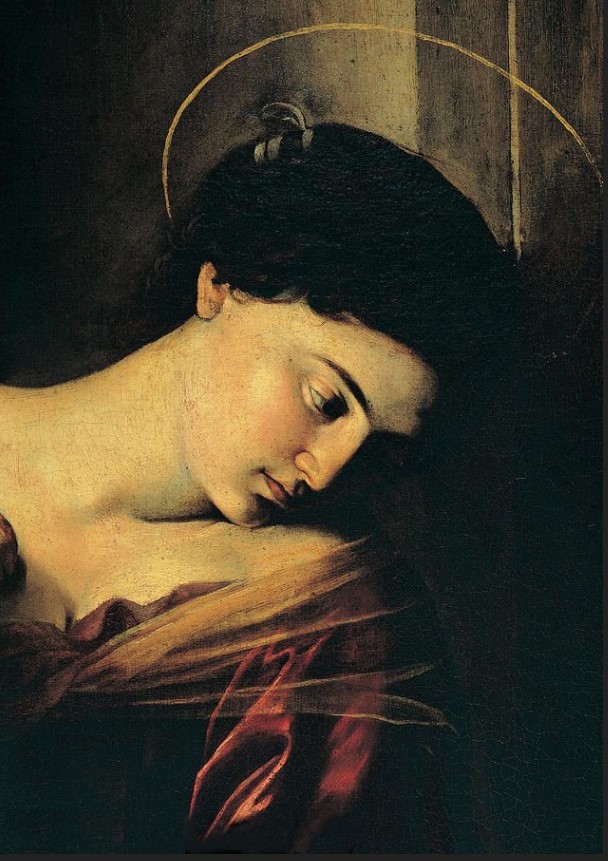
Michelangelo Merisi, called the Caravaggio, DETAIL The Madonna of Loreto (The Madonna of the Pilgrims), circa1603-1604, Oil on canvas, 8’ 8 ½ x 4’ 11”, Cavalletti Chapel, Church of Sant’ Agostino, Rome.
Michelangelo Merisi, called the Caravaggio, The Madonna of Loreto (The Madonna of the Pilgrims), circa1603-1604, Oil on canvas, 8’ 8 ½ x 4’ 11”, Cavalletti Chapel, Church of Sant’ Agostino, Rome.

The painting has been in the Cavalletti chapel in Rome since it was installed at the end of 1604.

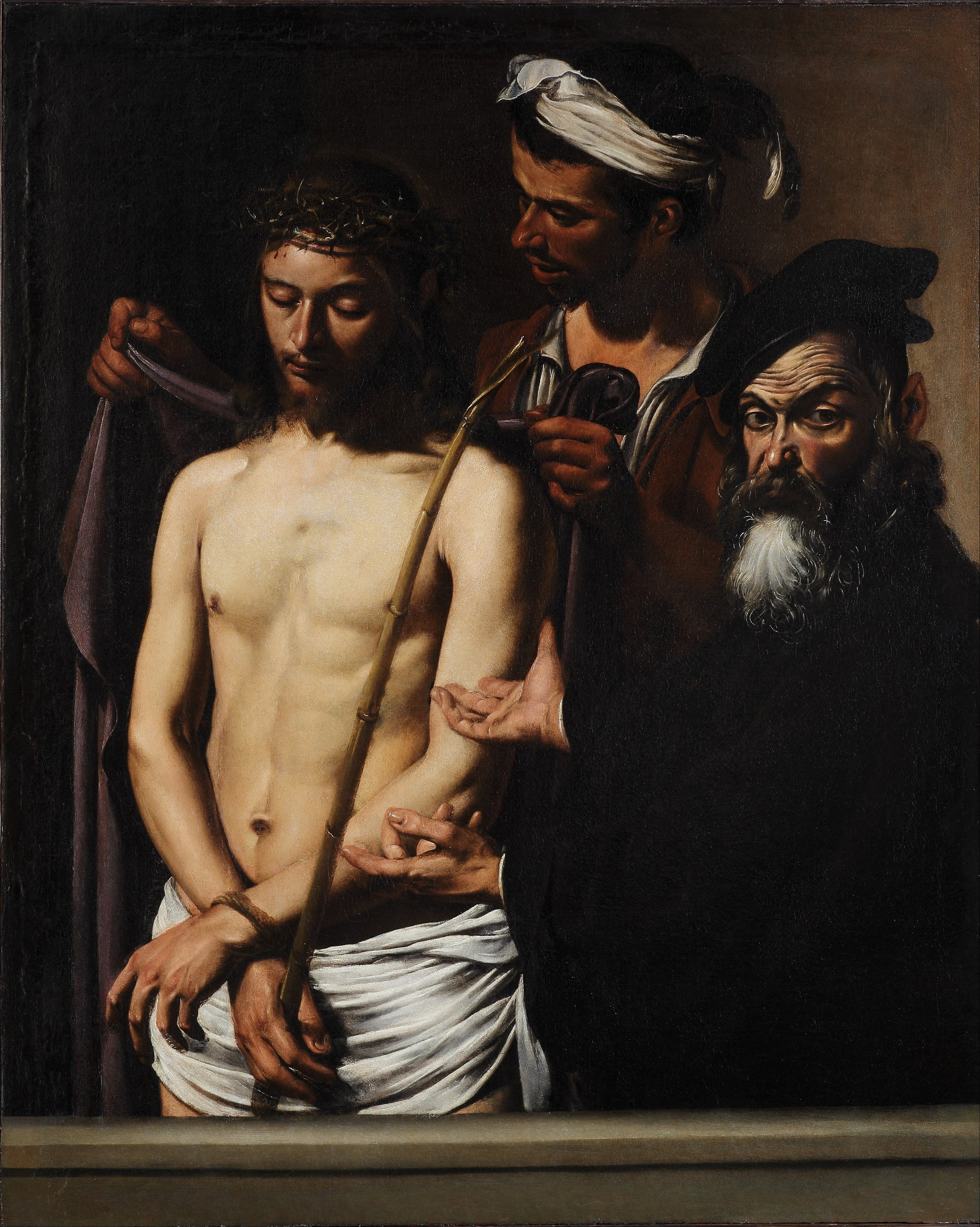
Michelangelo Merisi, called the Caravaggio, Ecce Homo, c. 1604-05, oil on canvas, 50 ½ x 40 ½” Civic Collection, Palazzo Rosso, Genoa.

The painting was made for a competition with Domenico Passignano (1559-1638) and Lodovico Cardi (“Il Cigoli”) (1559-1613) soon after Il Cigoli first arrived in Rome. Il Cigoli won the compettion and the whereabouts of Caravaggio’s painting until it arrived to Genoa is uncertain. It may be that Caravaggio himself took it to Genoa when he visited there in 1605.

Michelangelo Merisi, called the Caravaggio, Saint John the Baptist, c. 1605, oil on canvas, 68 1/4 x 52” Nelson-Atkins Museum of Art, Kansas City, Missouri.

The painting was made for Ottavio Costa who then had a copy made for his chapel in Liguria while the original was lost. It resurfaced in the mid 19th century in England and was acquired by the Nelson-Atkins Museum of Art in the 1950s. Caravaggio reveals the qualities of the saint by his expression and pose. He is sober and downcast with a tense energy as his pose manifests the monumentality of the prophets on the Sistine Chapel ceiling. With his staff he quietly and contemplatively conveys zeal, passion and vitality. There is a sense of his singleness of purpose, joined even to a little madness, as a man driven by making straight the paths of the Lord.

Michelangelo Merisi, called the Caravaggio, Call of Andrew and Simon,1602-1604, oil on canvas,140.1 x 176 cm, Royal Collection Trust, Hampton Court Palace, London, England. https://www.rct.uk/collection/402824/the-calling-of-saints-peter-and-andrew – retrieved November 15, 2024.

The painting was bought by King Charles I of England (1600-1649) in 1637. After the monarch’s defeat in the English Civil War (1642-1645), he was imprisoned and executed for high treason in 1649. During the Commonwealth (1649-1660), the painting was sold in 1651 and recovered at the Restoration. Caravaggio’s painting depicts the call of the very first disciples in the very first New Testament Gospel by Mark: “As he passed by the Sea of Galilee, he saw Simon and his brother Andrew casting their nets into the sea; they were fishermen. Jesus said to them, “Come after me, and I will make you fishers of men.” Then they abandoned their nets and followed him” (Mk 1:16-18). Caravaggio depicts Jesus without a beard as he turns back to invite them to follow him as he moves ahead. Fishermen, Simon Peter holds skewered fish on a stick while Andrew points to himself identifying the object of Jesus’s invitation.

As recently as 1987 this painting came to be attributed to Caravaggio and as the original of this painting’s subject matter. In varying copies of the work the furrow in Christ’s brow is painted faithfully though in this original it is not a painted feature but a canvas fold. There are other design features that, after recent cleaning and conservation, point to a later work of Caravaggio. Many small incisions are present in the artwork’s lower layers of paint that is an uncanny method used by the artist to lay out important points on the canvas for his design. Although the attribution can be argued to the contrary – such as the unusual use of the color blue which Caravaggio saw, according to Bellori, as the “poison of colors” – he did use the color and mostly softened as it is here. Blue, for instance, occurs in the Baptism of Christ (National Gallery of Ireland, c. 1603) and the Annunciation (Nancy, c. 1604). At the Supper at Emmaus (Brera, 1605-6) Christ also wears a robe of softened blue. In its telling broad brushwork, restrained colors, and minimal detail the painting was understood to be a Road to Emmaus painting as discussed by Giulio Mancini and Giovanni Baglione. But these early biographers’ references are likely to the Supper at Emmaus (National Gallery London, 1601). Dated stylistically by its economical, shadowed, and expressive manner, The Calling of Saints Peter and Andrew appears to be from the period of 1603-1606. This would be before Caravaggio killed Ranuccio Tomassoni (c. 1580-1606) in a brawl and fled Rome in May 1606. During the first years of the 17th century, the sensuous surface detail of Caravaggio’s art had become spare, dark and expressive. Further, The Calling of Saints Peter and Andrew places half-length figures interacting against a stark background, similar to such paintings as Doubting Thomas (Sanssouci, Potsdam) and the Betrayal of Christ (National Gallery of Ireland, Dublin), both of 1603. Before this painting reached England, there was a broadly interpreted copy of it that is today in a private collection by Bernardo Strozzi (1582-1644). Strozzi lived and worked in Rome, Genoa and Venice where he may have seen this painting by Caravaggio. When Charles I’s buying agent was later in Italy, he visited the same places as Strozzi had been, except Genoa.

Michelangelo Merisi, called the Caravaggio, Saint Jerome penitent, 1605, oil on canvas,145,5 x 101,5 cm, Museum of Monserrat, Spain. https://www.museudemontserrat.com/ca/coleccions/pinturaantiga/95/caravaggio/490 – October 13, 2024.
Michelangelo Merisi, called the Caravaggio, The Madonna Of the Snake (Palafrenieri), 1605/06, Borghese Gallery, Rome.  https://www.collezionegalleriaborghese.it/opere/la-madonna-dei-palafrenieri – retrieved October 13, 2024.

The painting was commissioned in 1605 by members of the powerful archconfraternity of the Palafrenieri who, following the renovation of St. Peter’s Basilica, asked the painter for a new work intended to replace an old painting that decorated the altar of their chapel dedicated to St. Anne. Painted within a few months, in April 1606 the work was exhibited and shortly afterwards moved to the nearby church of Sant’Anna dei Palafrenieri where, seen by Scipione Borghese, it was bought by him. For whatever reason the painting was controversial – perhaps the cleavage of the Madonna or the rendering of the nudity of the child – but Scipione Borghese proudly hung it in his own picture gallery. The painting depicts Mary as she crushes a snake – a symbol of sin – at her feet with the help of Jesus and witnessed by Anna, mother of the Virgin.

Michelangelo Merisi, called the Caravaggio, Saint Jerome writing, 1605/06, oil on canvas, 116 cm x 153 cm, Borghese Gallery, Rome.

According to Bellori, the painting was made by Caravaggio for Cardinal Scipione Borghese. The cardinal was not only an avid and refined art collector but one of young Caravaggio’s earliest and greatest admirers recognizing the Lombard’s talent despite personality flaws or lack of connections in Rome. The painting depicts Saint Jerome (c. 340s-420), Doctor of the Church, best known for his translation of the Bible from Greek into Latin as well as his commentaries on the Bible. Caravaggio depicts the priest and confessor writing and studying the Holy Scriptures as a scholar, now in old age, who has dedicated his life as a humanist engaged in the complex translation and exegesis of the Church’s sacred text. The composition is divided into large fields of color in warm tones (the saint’s complexion and reddish mantle) and cold tones (the skull and shroud-like white cloth) with Jerome’s arm outstretched with writing instrument in hand across the picture to symbolically portray the unity of the scholar-saint’s dialogue with these opposites of nature including life and death, past and present. As there are many unfinished details in the painting, the artist’s style points to his rapid execution of the work. https://www.collezionegalleriaborghese.it/opere/san-girolamo – retrieved October 13, 2024.

DETAIL Caravaggio (Michelangelo Merisi), The Death of The Virgin, c. 1605-1606, oil on canvas, 12’1 ½” x8’, Louvre, Paris.
Caravaggio (Michelangelo Merisi), The Death of The Virgin, c. 1605-1606, oil on canvas, 12’1 ½” x8’, Louvre, Paris.
Caravaggio (Michelangelo Merisi), The Madonna of the Rosary, c. 1605-1607, oil on canvas, 11’11 ½” x8’ 4”, Kunsthistorisches Museum, Vienna.
Caravaggio (Michelangelo Merisi), The Seven Acts of Mercy, 1606, Oil in canvas, 12’ 9 ½” x 8’ 6 ½” Pio Monte della Misericordia, Naples.

The Seven Acts of Mercy altarpiece was painted between September 23, 1606 and January 9, 1607 for which Caravaggio was paid 400 ducats. The commission required that the artist include the figure of the Madonna of the Misericordia and all the acts of mercy in one vertical canvas and whose overall achievement was a first in Italian art.

Caravaggio (Michelangelo Merisi), Salome, 1609/10, oil on canvas, 35 5/8 x 65 ¾” The National Gallery London.
Caravaggio (Michelangelo Merisi), The Flagellation, 1607, oil on canvas, 9’ 4 ½” x 6’2” Capodimonte Museum, Naples.
Caravaggio (Michelangelo Merisi), David With the Head of Goliath, 1607 or 1609/10, oil on canvas, 49 ¼ x 39 3/8”, Borghese Gallery, Rome. https://borghese.gallery/collection/paintings/david-with-the-head-of-goliath.html – retrieved October 14, 2024.

The dramatic play of light and shadow throws into relief the melancholic expression on David’s face and the hauntingly lifelike head of Goliath, creating a palpable sense of guilt and redemption that resonates deeply with the viewer.

The head of Goliath is Caravaggio’s self portrait.

In addition to developing a considerable name as an artist, Caravaggio was a reputably volatile, bad-tempered and violent man. On May 29, 1606 Caravaggio killed Ranuccio Tomassoni in a fight, the cause of which is disputed, though it may have been over a Roman prostitute, Fillide Melandroni who had posed for Caravaggio several times. The capital crime forced Caravaggio to flee to Naples. A report written by the local coroner declared that the male victim died by Caravaggio’s attempt to castrate him, the code on the Roman street meriting it for a man who insulting another man’s woman. Caravaggio became a fugitive from the law though he continued to paint (Supper at Emmaus) and fled to Naples by the end of 1606. In Naples he painted Flagellation and Seven Works of Mercy, among others. He fled further to Malta and then to Sicily where Caravaggio moved from town to town across the island fearing some unnamed retribution. It was presumed that 38-year-old Caravaggio died from syphilis or perhaps malaria or the Malta Fever though there is current speculation the artist may have been murdered in revenge for his crimes by perhaps members of the Tomassoni family or the Royal Knights. see – https://www.italianartsociety.org/2018/05/on-29-may-1606-the-great-italian-baroque-painter-caravaggio-killed-ranuccio-tommasoni-in-rome/ ; https://thecinemaholic.com/ranuccio-tomassoni-caravaggio/– retrieved October 15, 2024.

Caravaggio (Michelangelo Merisi), Portrait of a Courtesan (Fillide Melandroni), c, 1599. Destroyed Berlin 1945.
Caravaggio (Michelangelo Merisi), Supper at Emmaus,1606, oil on canvas, 141 x 175 cm, Pinacoteca di Brera, Milan.
Caravaggio (Michelangelo Merisi), The Beheading of St John, 1608, St John’s Co-Cathedral, Valetta, Malta.
Caravaggio (Michelangelo Merisi), St. Francis of Assisi in Meditation, 1606/07, oil on canvas, Pinacoteca Civica Museo ala Ponzone Cremona.
Caravaggio (Michelangelo Merisi), Portrait of Alof de Wignacourt with his Page, 1606/07, oil on canvas, 195 x 134 cm, Louvre.

The subject was the Grand Master of the Knights of Malta. In exchange for this grand portrait, according to Bellori and Baglione, Caravaggio became a Knight of Malta on an accelerated timetable though soon after the artist fled the island in disgrace.

Caravaggio (Michelangelo Merisi), The Burial of Saint Lucy, 1608/9, oil on canvas, 13′ 4 1/2″ x 9′ 10″ 408 x 300 cm, Church of Santa Lucia,Syracuse in deposit at the Galleria Regionale, Palazzo Bellomo, Syracuse, Sicily.

The famous Caravaggio painting depicting the burial of Santa Lucia once hung in the Church of Santa Lucia al Sepolcro, but today is in Siracusa’s Palazzo Bellomo museum. The original church, built as early as the 6th century, was on the site of Saint Lucy’s martyrdom in the early 4th century. Beneath the sanctuary is a vast labyrinth of dark catacombs dating from the 3rd century which have never been completely explored and are closed to the public. Once containing the tomb of the decapitated saint, her remains were relocated to Venice during the Crusades and where they can be found today. This painting was made by Caravaggio between October 1608 in Malta and early 1609 in Sicily in a commission arranged by his old friend painter Mario Minniti. Caravaggio was on the run in Sicily starting in late 1608 when he arrived into Siracusa, and then onto Messina followed by Palermo. In Sicily, the exile Caravaggio painted Resurrection of Lazarus, The Adoration of the Shepherds (Adorazione dei pastori) and Ecce Homo. In late 1609 he returned to Naples and continued painting, including another St. John the Baptist and, his final artwork, The Martyrdom of St. Ursula. In Naples the artist was attacked in the street by four armed men shortly after his arrival where Caravaggio was seriously injured. see – https://www.frommers.com/destinations/syracuse-and-ortygia-island/attractions/santa-lucia-al-sepolcro; https://www.great-sicily.com/post/the-byzantine-era-in-sicily – retrieved October 15, 2024.

Caravaggio (Michelangelo Merisi), Adorazione dei pastori (The Adoration of the The Shepherds), 1609, oil on canvas, 10′ 3 1/2 ” x 6′ 11″, Messina, Sicily, Museo regionale interdisciplinare.

The work was painted for the Church of Santa Maria della Concezione in Messina. Francesco Susinno (1670-1739) states that the commision was a civic not religious one, though apparently the Archbishop of Messina, Franciscan Bonaventura Secusio (d. 1618), supported the project. see – https://federica90.wixsite.com/emozionearte/post/caravaggio-in-sicilia-l-adorazione-dei-pastori-di-messina – retrieved October 15, 2024.

Caravaggio (Michelangelo Merisi), La Resurrezione di Lazzaro (The Resurrection of Lazarus), 1609, oil on canvas, 10′ 3 1/2 ” x 6′ 11″, Messina, Sicily, Museo regionale interdisciplinare.

In Malta Caravaggio became a Knight of Malta but got into another violent group brawl where a knight was badly injured. With a warrant put out for his arrest Caravaggio managed to flee to Sicily in October 1608. By December 1608 Caravaggio was found guilty in abstentia and removed from the Maltese order. The commission for this painting came from Giovanni Battista de’ Lazzari, a merchant of Genoese origin who had obtained permission to be buried in the choir chapel of the church of Saints Peter and Paul de’ Pisani (demolished in 1880) in Messina where Camillo de’ Lellis’ religious order, founded in 1591 and dedicated to the care of the sick, had a house. De’Lazzari’s signed contract on December 6, 1608, declared that his new altarpiece would have the Madonna and St. John with saints as its subject. But that was changed to the resurrection of Lazarus (Gospel of John, chapter 11). It is very likely the change was made by De’Lazzari in agreement with the Camillians. According to Susinno, the artwork’s 13 figures were staff members of the hospital where Caravaggio did the painting. see – https://federica90.wixsite.com/emozionearte/post/caravaggio-in-sicilia-la-resurrezione-di-lazzaro – retrieved October 15, 2024.

Caravaggio (Michelangelo Merisi), The Denial of St. Peter,1609/10, oil on canvas, 94 x 125.4 cm, The Metropolitan Museum of Art, New York.

The Denial of Saint Peter is generally thought to be one of the last pair of artworks by Caravaggio, the other being The Martyrdom of Saint Ursula. It was probably finished at Naples in the summer of 1610.

Caravaggio (Michelangelo Merisi), St. John the Baptist, 1610, oil on canvas, 159 x 124.5 cm, Galleria Borghese, Rome.

Caravaggio carried this painting and others sailing from Naples to Rome hoping for a pardon from the pope. Instead, when the desperate artist landed he was arrested and the boat was sent back to Naples with the paintings. Caravaggio died on July 18, 1610 in Porto Ercole. The papal nuncio secured this painting for Cardinal Scipione Borghese. see – https://www.dailyartmagazine.com/caravaggios-martyrdom-of-saintt-ursula/ – retrieved October 15, 2024.

LAST PAINTING.

Caravaggio (Michelangelo Merisi), The Martyrdom of Saint Ursula, 1610, oil on canvas, 142 x180 cm,
Naples, Galleria di Palazzo Zevallos Stigliano.

Caravaggio’s The Martyrdom of Saint Ursula was painted in the last month of his life. It contains his characteristic and revolutionary chiaroscuro, naturalism, and depiction of psychological and physical emotion. The Martyrdom of Saint Ursula was commissioned by Genoese art patron Marcantonio Doria. The painting was finished in May and arrived in Genoa in mid-June 1610. Ursula was a venerated but almost completely legendary figure. In typical fashion Caravaggio dispels traditional religious iconography associated with Ursula — a crown, halo, palm branch, the 11,000 virgin martyr companions — for the painful moment in her story when the Barbarian king shoots the arrow into Ursula’s chest that kills her.

Caravaggio’s The Martyrdom of Saint Ursula marked a watershed in European art. His revolutionary style inspired subsequent generations of painters, such as Artemisia Gentileschi (1593—1651), Giovanni Baglione (1566-1643), and Orazio Gentileschi (1563–1639), that became known as the Caravaggisti. He also influenced international Baroque artists including Spaniard Diego Velázquez (1599-1660) and Dutchman Rembrandt van Rijn (1606-1669). see – https://www.widewalls.ch/magazine/the-martyrdom-of-saint-ursula-caravaggio – retrieved October 15, 2024.

Detail of above.

SOURCES –

Caravaggio, Gilles Lambert, Taschen, Cologne, 2007.

Caravaggio, Alfred Moir, Harry N. Abrams, Inc., New York, 1989.

Caravaggio: The Complete Works, Sebastian Schütze, Taschen, Cologne, 2021.

Caravaggio, Timothy Wilson-Smith, Phaidon, London, 1998.

Caravaggio, Howard Hibbard, Harper & Row Publishers, New York, 1983.

Caravaggio The Artist and His Work, Sybille Ebert-Schifferer, Getty, 2012.

Caravaggio: Detail of The Pentitent Magdalene, c. 1597. Galleria Doria- Pamphili, Rome.

This explanatory article may be periodically updated.

ITALY. RAPHAEL (ITALIAN, 1483-1520), HIGH RENAISSANCE MASTER. (50+ artworks).

FEATURE Image: Raphael, Portraits of Agnolo Doni and Maddalena Doni, c. 1506, oil on panel, 24  ¾  x 17 ¾” Pitti Gallery, Florence.

Raphael, Self-portrait at 23 years old, 1504–1506. Tempera on panel, 47.5 cm × 33 cm (18.7 in × 13 in), Palazzo Pitti, Florence, Italy.

INTRODUCTION.

Born in Urbino in 1483, an environment rich in the arts and humanist learning, Raphael had a remarkable capacity for personal growth and branded new incarnations of his artistic style regularly. He moved to Florence toward the end of 1504. Giorgio Vasari in his chapter on Raphael describes an episode where the artist of Urbino, already in his thirties with a reputation as a master, went back to study the nude (male) form with Michelangelo as his guide. Vasari’s admiration in telling this story goes beyond Raphael’s humility in assuming the role of student again (he studied constantly anyway) but that his learning always improved his artistic output. In the study of nudes, however, artistic growth came perhaps not as the artist expected or intended. Whether Raphael entered the workshop of Perugino at that time or, as seems more likely, many years later when he was already an acknowledged artist, he quickly mastered Perugino’s delicate, ornamental style, with its open landscapes and gentle figures. It was said that contemporaries had trouble distinguishing Perugino’s work from Raphael’s, but Raphael’s compositions were more sophisticated even when he was a young artist. While Raphael mastered Michelangelo’s (and Leonardo’s) art forms convincingly, he also realized he was no match for the creator of the Sistine Chapel and other chiseled works insofar as the nude male forms.1 Yet Raphael consolidated his strengths by testing his limits. A major strength, Vasari believed, was Raphael’s ability to draw and compose a wide range of subjects, such as landscape, architecture, draperies, and the human figure. Up to that time that had been what the artist was doing and would now unflinchingly continue to do on a grander scale, for example, in the Stanzae. In 1508 the pope called Raphael to Rome. Influenced by the idealized, classical art of the city’s ancient past, Raphael’s work took on a new grandeur. He also responded to the more energetic and physical style of Michelangelo, whose works he had already begun to study in Florence. Vasari believed Raphael had the gift to congeal the “poetic moment” by depicting in his painting the most significant gesture and force of action. With the possible exception of Leonardo, he is probably the unparalleled master of excellent design.2 The precocious Raphael Sanzio also benefited from early opportunities given to him by his father to cultivate his talent. The artist’s own determination to succeed in his métier paid off when he was summoned to work at the Vatican by the Pope in 1509, arguably the greatest art patron in an age of art patrons. 3 The early sixteenth century was an age where patrons were as luminous as their artists and the coming together of Raphael and Julius II, and later Leo X, made for a celebrity team. While Vasari meticulously tells the reader of the artist’s “judicious” character – and that Raphael was extremely “amatory” and implying it aided in his death – the chronicler describes, often from memory, his preferences in Raphael’s art work.  His collective response, for example, to all four frescos in the Camera d’Eliodoro is that he is most impressed by Raphael’s interesting decorative details, beautiful movements and gestures, the sheer number of figures portrayed, and his ability to express complex ideas and stories on a two-dimensional surface.4 With Leonardo da Vinci (1452-1519) and Michelangelo (1475-1564) Raphael is one of the great masters of the High Renaissance. Raphael and his large team of assistants left behind a large body of influential work, especially in the Vatican where the artist spent the last 12 years of his life, although Raphael died at 37 years old. For most of the history of Western art, the easy grace and harmonious balance of Raphael’s style has represented an ideal of perfection. His work became widely influential through the dissemination of prints. Raphael was also the city’s leading portraitist, creating penetrating psychological images that engaged viewer and sitter with a new intensity.

ARTWORKS.

Raphael, S. Niccolo Da Tolentino Altarpiece, 1501, oil on panel, 44 x45 ¼ in., Capodimonte Museum, Naples, Italy.

The Baronci Altarpiece is Raphael’s first recorded commission. It was made for the patron’s chapel in the church of Sant’Agostino in Città di Castello, a commune between Arezzo and Urbino, north of Perugia. In 1789 the artwork was badly damaged in an earthquake and surviving fragments were acquired by the Vatican until they mysteriously dispersed in the mid-19th century and found their way into different collections. Raphael’s commission of 1501 was to paint a large altarpiece dedicated to the Augustinian saint Nicholas of Tolentino (c. 1246– September 10, 1305). Nicholas was canonized by Augustinian Pope Eugene IV in 1446.  While today’s saints require 1-2 miracles, St. Nicolas Tolentino was credited at his canonization with 300 miracles – including 3 resurrections. (see – Encyclopedia of the Middle Ages, Volume 2, André Vauchez, Richard Barrie Dobson, Michael Lapidge. Chicago: Fitzroy, Dearborn, 2000).

Raphael, angel, fragment Baronci altarpiece. Pinacoteca Tosio Martinengo, Brescia.
Raphael, The Crucifixion, 1502-03, oil on polar, 283.3 × 167.3 cm, National Gallery, London.

The painting was done in 1503 for Domenico Gavari for his S. Domenico chapel in Città di Castello. Angels are poised on toes on a cloud as their cups catch Christ’s dripping blood. Mary Magdelene and St. Jerome (holding a rock) are on their knees while the Virgin Mary and St. John stand. The sun and moon in the sky was characteristic of Crucifixion paintings in Umbria (p. 13, Jones & Penny). It was bequeathed to the National Gallery in 1924. Gavari was a close friend of Andrea Baronci, for whom Raphael painted the Saint Nicholas of Tolentino Altarpiece for the church of S. Agostino, also in Città di Castello. Saint Jerome, of course, was not present at the Crucifixion but is included in this scene because the chapel was dedicated to him. The overall design is based on several versions of the crucified Christ in a landscape painted by Perugino in the late 1480s and 1490s, and is especially similar to his altarpiece of the Crucifixion for the convent of S. Francesco al Monte in Perugia, commissioned in 1502 and completed 1506. https://www.nationalgallery.org.uk/paintings/raphael-the-mond-crucifixion – retrieved September 5, 2024.

Raphael, Coronation of the Virgin (Oddi Altarpiece), 1503-1504, Oil on canvas, 8’9” x 5’4”, Pinacoteca, Vatican, Rome.
Raphael, Coronation of the Virgin (Oddi Altarpiece), 1503-1504, Oil on canvas, 8’9” x 5’4”, Pinacoteca, Vatican, Rome. DETAIL.

Raphael painted altarpieces for the Augustinians and Dominicans and the Oddi altarpiece (above) was done for the Franciscans. It was commissioned by the Oddi family chapel in S. Francesco al Prato. The Oddi were in exile from Perugia since 1495 because of battles between families and returned in 1503. The altarpiece was part of honoring their family members. The painting is divided into an upper part depicting the coronation of the Virgin and, in the lower part, the Apostles at the time of the Assumption. In the center, the apostle Thomas holds the Virgin’s girdle that the Virgin lowered to him as a token of these supernatural events. This display of theology was precious to the Franciscans at the time who were promoting the Virgin Mary. They were likely very involved in directing the artist in its composition. (Roger & Jones, pp. 15-16).

Raphael, Spozalizio (The Engagement of the Virgin Mary), 1504, oil on panel, 67 x 46 ½” Brera Gallery, Milan.

The painting’s composition reflects the influence of Perugino, specifically the fresco done by him in the Sistine Chapel in 1484. In terms of its architectural setting, Raphael was influenced by Piero della Francesca (c.1416-1492) and Bramante (1444-1514). The painting’s architectural structure shares centrality in the painting with the foreground figures done in a perspectival arrangement. Within the figures are members of the party positioned in depth. Joseph places a ring on Mary’s finger whose positioning bisects the artwork. A tawny gold tone pervades the painting. It was commissioned by the Alberini family for a chapel in S. Francesco of the Friars Minor at Città di Castello in Perugia. (Brera Milan, p 34)

Raphael, The Madonna and Child Enthroned with Five Saints (Colonna Altarpiece), c. 1504-1505, oil on panel, 68 x 68” The Metropolitan Museum of Art, New York City.

Raphael painted this altarpiece for the Franciscan convent of Sant’Antonio in Perugia. It hung in a part of the church reserved for the nuns. The pair of voluminous saints straddling each side of the throne reflect the progressive style of Leonardo da Vinci and Fra Bartolomeo (1472-1517) that Raphael was studying in Florence. The lunette above the main panel depicts God the Father holding a globe and raising his right hand in blessing situated between two angels and two seraphim. https://www.metmuseum.org/art/collection/search/437372 – retrieved September 5, 2024.

Raphael, The Small Cowper Madonna, c. 1505 59.5 x 44 cm (23 7/16 x 17 5/16 in.), National Gallery of Art, Washington D.C.

The Cowper Madonna includes an agreeable background landscape. In a vertical painting, a haloed woman and nude child sit before an expansive grass field extending behind them to a group of trees and buildings on a hill in the distance among hazy blue hills beneath a blue sky. https://www.nga.gov/collection/art-object-page.1196.html – retrieved September 8, 2024.

Raphael, Saint Michael and The Dragon, c. 1505, oil on panel, 12 ¼” x 10 ¼” The Louvre Paris https://collections.louvre.fr/en/ark:/53355/cl010060773 – retrieved September 4, 2024
Raphael, Saint Michael and The Dragon, c. 1505, oil on panel, 12 1/4 x 10 ¼” The Louvre, Paris https://collections.louvre.fr/en/ark:/53355/cl010060772 – retrieved September 4, 2024.
Raphael, Saint George and the Dragon, c. 1506, National Gallery of Art, Washington, D.C.

These early works by the artist depict the popular subjects of St. Michael the Archangel vanquishing Satan and Saint George slaying the Dragon, each showing the martial subject of good combatting evil. These were early private commissions for the court of Urbino. Saint George was a Christian Roman soldier who, pious legend informs, subdued a dragon and, with the daughter of a pagan king, brought it to the city, where St. George killed it with his sword. These heroic actions witnessed by the king and his subjects led to their conversion to Christianity. The historic figure of Saint George was martyred around the year 290.  https://www.nga.gov/collection/art-object-page.28.html – retrieved September 4, 2024.

Raphael, The Three Graces, 1505-1506, oil on panel, 6 ¾ x 6 ¾” Condé Museum, Chantilly.

The panel was recorded in the Borghese collection in 1650. It accompanied the Dream of Scipio, an oil on panel, today in the National Gallery of London. The figures were derived from ancient classical sculpture and depict, likely, Chastity, Beauty and Love. Chastity’s lower torso is veiled and an arm covers her breasts from view. Amor’s breasts, by contrast, are revealed. Chastity also wears no adornment as do Beauty and Amor. While the figures are modeled similarly, the space between them is disparate and Beauty blocks Chastity’s leg. (Jones & Penny, p. 8; Beck, pp. 62-63).

Raphael, Portrait of Agnolo Doni, c. 1506, oil on panel, 24  ¾  x 17 ¾” Pitti Gallery, Florence.
Raphael, Portrait of Maddalena Doni, c. 1506, oil on panel, 24 ¾ x 17 ¾” Pitti Gallery, Florence.

Agnolo Doni is the only Florentine portrait in these first years mentioned by Vasari though paired with its companion portrait of Maddalena Doni. Doni was an art collector who married the daughter of Giovanni Strozzi in 1503. Agnolo was 10 years older than his wife who was in her teens. The portraits are painted on identically sized panel and are intended to hang next to one another. Raphael took great care in depicting the corporeal reality of his subjects, particularly appreciated in their faces and hands (though Agnolo Doni’s portrait is more detailed than his wife’s.) In both Doni portraits the sitters show-off their jewelry – such as rings and, in Maddalena’s portrait, a large pearl hanging around her neck. (Roger & Penny, p. 29-30)

Raphael, The Madonna of the Granduca, c. 1506, Oil on panel, 33 x 21 1/2 “ Pitti gallery, Florence.
Raphael, Lady with a Unicorn, 1506, oil on panel, 65 cm × 51 cm (26 in × 20 in), Galleria Borghese, Rome, Italy.

The work was of uncertain attribution until recent times. In the 1760 inventory of the Gallery, the subject of the painting was identified as Saint Catherine of Alexandria and attributed to Perugino. A restoration of the painting in 1934 revealed a unicorn, the medieval symbol for chastity, and led to the pianting’s attribution to Raphael. In 1959 an x-ray revealed a small dog under the unicorn which symbolized conjugal fidelity.https://en.wikipedia.org/wiki/Young_Woman_with_Unicorn – retrieved September 7, 2024.

Raphael, The Holy Family With Saints Elizabeth and John (The Canigiani Holy Family), c. 1506-07, oil on panel, 51 ½ x 42 1/8” Alte Pinakothek, Munich.

Visible on the hem of the Madonna’s scarf is inscribed, “Rapahel Urbanas.” The fresco and easel painter was active mainly in Umbria, in Florence after 1504, and in Rome in 1509 until his death. It was painted for Domenico Canigiani where Vasari saw it later. It entered the Medici collection and when a Medici daughter married an Elector Palatine it accompanied her over the Alps to Germany. (Pinakothek Munich Great Museums of the World, Roberto Salvini, et. al., Newsweek NY 1969 pp. 126).

Raphael, Madonna del Cardellino, 1506-07, oil on panel, 42 1/8 x 30 ¼” Uffizi Gallery Florence.

The three figures are closely integrated as well as displaying a greater sense of volume. The painting is dated 1507, again on the hem of the Virgin’s garment. In the painting St. John the Baptist presents a goldfinch (cardellino) to the Christ child – a symbol of the Passion. (Roger & Penny, p. 33)

The Deposition, 1507, oil on panel, 72 ½ x 69 ¼” Borghese Gallery, Rome.
The Deposition, 1507, oil on panel, 72 ½ x 69 ¼” Borghese Gallery, Rome. DETAIL.

Upon seeing Leonardo’s Battle of Anghiari and Michelangelo’s Battle of Cascia in Florence Raphael’s style applied its innovative principles immediately changing the trajectory of his artwork up to that point. Leonardo da Vinci and Michelangelo were in a pitched artistic battle for the future of modern art in the first decade of the 16th century in central Italy. Their artwork was for a fabled competition to decorate the Great Council Hall in Florence. Raphael studied closely these complex drawings of heroic violence. Though Raphael was familiar with violent combat in Perugia and elsewhere, it was its containment in these artworks in Florence that such dynamic convolutions appeared as in his own work such as The Deposition though he may have had in mind also Perugino’s work in 1495 of the Lamentation over the Dead Christ. In the finished painting the action takes place from right to left –  a group of women attending to a swooning Virgin to the Magdalene grasping Christ’s hand to look into his
face.  (Roger & Penny, pp. 37-44).

Raphael, La Belle Jardinière, 1507-08, oil on panel, 48 x 31 ½” The Louvre, Paris.

In this painting John the Baptist kneels before the Christ child. The painting has an arched top. It was Leonardo da Vinci who formulated the pyramidal structure for the Holy Family and half-length portrait and it seems Raphael looked to explore his idea for his narrative of the Virgin Mary with cousins Jesus Christ and John the Baptist. (Roger & Penny, p. 33)

Raphael, The Madonna of the Baldacchino, 1508, oil on canvas, 9’ x7’4” Pitti Gallery Florence.

The painting was started by Raphael and finished after his death (Roger & Penny, p. 44). It was Raphael’s first major commission in Florence for the Dei family chapel in the Santo Spirito basilica (1487) and remained unfinished when the 25-year-old artist was summoned to Rome by Pope Julius II, nicknamed the Fearsome, who reigned on Peter’s chair from 1503 to 1513. Pope Julius, born Giuliano della Rovere in 1443, took his name specifically from Julius Caesar (d. 44 BCE). In 1508, this “Battle Pope” as he was also known, commissioned the Raphael Rooms and Michelangelo’s paintings in the Sistine Chapel at the Vatican. Raphael’s enthroned Madonna and Child is with, from left, Sts. Peter, Bernard of Clairvaux, James the Greater and St. Augustine of Hippo. The group is joined by two putti at the foot of the throne’s high pedestal steps. It is a large format painting whose size was increased when it was restored and “completed” at the end of the 17th century to meet the tastes of a Medici prince. Raphael is cited for being an imitator more than originator and this is exampled in the Christ Child playing with his toes whose pudgy type derives from the workshop of Florentine sculptor Luca Della Robbia (c. 1400-1482). The painting can be read right to left as St. Augustine, looking at the viewer, gestures, with St. James gazing in a similar direction, towards the throne and its occupants and then crosses to St. Bernard whose backward glance ends in conversation with St. Peter holding a book and large key. Once in Rome, Raphael continued these simple straight forward readings of his artworks’ often complex network of figures beginning in his famous frescoes in the Stanza della Segnatura (1508-1511) yet by then with greater refinement and heroism. In 1799 The Madonna of the Baldacchino was confiscated by French forces and taken to Paris only to be returned to Florence in 1813.  (Beck, pp. 78-79).

Raphael, St. Catherine of Alexandria, oil on panel, c. 1507, 71 x 56 cm, National Gallery of Art, London.

Raphael’s saint, a 4TH century mystic and martyr, is not an object for devotion but dramatizes an example of devotion. The turned figure derives from Leonardo da Vinci and expresses an emotional animation that is one of the strongest depictions in Raphael’s oeuvre. (Roger & Penny, p. 44). The portrait is joined to a landscape as the saint leans on a spiked wheel which is her symbol as it was the manner of her death. Raphael looks to capture the mystical or visionary aspect of the saint as she places her hand over her heart and gazes upwards to a golden break in the sky. The figure is very dynamic moving beyond Perugino’s influence of angelic air and distant landscapes and towards Michelangelo and Leonardo da Vinci whose monumentality and detailed arrangements Raphael studied in Florence. It is unknown who commissioned the artwork and for exactly what purpose it served.  https://www.nationalgallery.org.uk/paintings/raphael-saint-catherine-of-alexandria – retrieved September 6, 2024.

Raphael, The Niccolini-Cowper Madonna, 1508, oil on panel, 80.7 x 57.5 cm (31 3/4 x 22 5/8 in., National Gallery of Art, Washington, D.C.  https://www.nga.gov/collection/art-object-page.27.html – retrieved September 8, 2024.
Raphael, c. 1509, fresco, 47 ½ x 41 ½” Ceiling, Stanza della Segnatura, Vatican, Rome.
Raphael, The Fall, c. 1509, fresco, 47 ½ x 41 ½” Ceiling, Stanza della Segnatura, Vatican, Rome.DETAIL.

At the time of the papal commission Raphael had little experience painting large frescos but would revolutionize the tradition. The basic scheme of the decoration presents four tondi of abstract ideas of Theology, Poetry, Philosophy and Law. The Fall  – or Adam and Eve on the Brink of Disobedience along with the Judgment of Solomon on the ceiling relates to themes of Theology and Law as the ceiling’s admixture of pagan scenes including Urania and Apollo and Marsyas relate to Poetry and Philosophy.  (Roger & Penny – pp 50-52).

Raphael, The Disputation over the Sacrament (Disputa), 1509-10, fresco, 25’3” at base, Stanza della Segnatura, Vatican, Rome.
Raphael, The Disputation over the Sacrament (Disputa), 1509-10, fresco, 25’3” at base, Stanza della Segnatura, Vatican, Rome. DETAIL.

Raphael’s artwork has the effect of cinema in presenting nearly life-sized figures in space that, hoisted onto the wall like a massive theatre screen, fills the room’s field of vision. Further, as a modern-day film dispels incredulity to its medium and any message it conveys, absorbing the viewer, Raphael’s fresco makes intensely real the Catholic faith.  Angels in the vault accompany God the Father as a white-robed God the Son sits enthroned before a golden disc displaying his sacrificial wounds of the Cross. On each side sit the Virgin Mary and St. John the Baptist while on the raised tier sits figures from the Bible. The Holy Spirit descends in the form of a dove on the monstrance holding the Eucharist. Many preparatory drawings survive for this fresco. (Roger & Penny, pp.57-58)

Raphael, The School of Athens, 1510-11, Fresco, 25’3” at base, Stanza della Segnatura, Vatican, Rome.
Raphael, The School of Athens, 1510-11, Fresco, 25’3” at base, Stanza della Segnatura, Vatican, Rome. DETAIL.

Raphael creatively adapted figures or figural groupings from one fresco to another. Raphael also utilized Michaelangelo’s newly publicly accessible Sistine Chapel ceiling’s prophets and sibyls. Beyond Michaelangelo, Raphael was interested in foreshortening and also arranging numerous figures in a mathmatically constructed perspectival space. Compared to the architecture in his Spozalizio from 1504, Raphael’s architecture in The School of Athens is more massive and yet whose angular lines are softened by curvacious colossal statues in niches. One statue is Minerva above Jurisprudence while Apollo is on the left (and closest to the Parnassus fresco). The central figures below the arches, open sky behind them, are Plato with his Timaeus and Aristotle with his Ethics. Other recognizable figures include Socrates to the left of Plato and Pythagoras to the right of the door. Euclid bends down to use one of his compasses surrounded by students and disciples. (Roger & Penny p 74-78).

Raphael, Parnassus, c. 1511, fresco, 22’1 ½” at base. Stanza della Segnatura, Vatican, Rome.

Raphael painted a poet’s paradise where Apollo has the central place. The window which interupts the base of the artwork looked out onto a hill in Rome called Mons Vaticanus that was known since classical times as sacred to Apollo. This fact with the fresco’s other siting challenges (window glare) Raphael was well aware of. Apollo plays the fiddle surrounded by poets and gorgeous muses with a background of laurel trees. Mortals are below on either side of the window. (Roger & Penny, pp. 68-69)

https://www.nationalgallery.org.uk/paintings/raphael-the-garvagh-madonna – retrieved September 5, 2024.
Raphael’s ‘Garvagh Madonna’ with Matthias Wivel, Curator of 16th-century Italian Paintings.
Raphael, La Vierge nourrissant l’Enfant, assise dans un paysage : la Madone Sergardi n.d. LOUVRE https://collections.louvre.fr/en/ark:/53355/cl020101084 – retrieved September 4, 2024.
Raphael, Portrait of a Young Cardinal, 1510-11, oil on panel 31 1/8 x 24” The Prado, Madrid. https://www.museodelprado.es/en/the-collection/art-work/the-cardinal/4c01eae6-feed-4135-88d9-6736140212fb?searchid=0bd968eb-2e7e-d4a3-a6b4-874288991a63 -retrieved September 4, 2024

Raphael was working on the frescos in the Vatican Palace when he painted this oil on panel portrait of a “Young Cardinal.” The sitter is not known though it likely is Cardinal Francesco Alidosi (1455-1511). Cdl. Alidosi was an influential diplomat and military leader and a favorite of Julius II (1503-1513). The sitter’s expression and pose of a resting arm on the edge of the painting’s base and the slight turn of the body seems to owe much to Leonardo da Vinci. The body is monumental compared to a placid and yet almost inscrutable slightly smaller head whose depiction, while directly observed, is somewhat idealized. When Della Rovere was elected as Pope Julius II in 1503, Alidosi became his secretary and primary collaborator. He was appointed papal chamberlain and then treasurer. Though labeled “unholy” by Venetian cardinal Pietro Bembo (1470-1547), Cld. Alidosi helped guide the vocation of Bl. Elena Duglioli dall’ Olio (1472-1520), an Italian aristocrat, who wanted to be a Poor Clare nun but was forced to marry by her family and for whose endowed chapel in Bologna Raphael painted an altar-piece. In 1504 Alidosi became a bishop whose sees ranged up and down all Italy – of Mileto in 1504 and of Pavia in 1505. He occupied the seat of Pavia until he was murdered in broad daylight in 1511. There were accusations traded back and forth that Cdl. Alidosi was a traitor in a time when the French occupied parts of Italy among its warring Italian families and an independently powerful pope who acted to protect his favorite as long as possible. About Alidosi, one historian noted, ”A favorite has no friends” and there were many unconcerned witnesses to the brutal crime whose attack included blows that split open his head. (Beck, pp. 92-93; Herbert M. Vaughan, B.A., The Medici Popes (Leo X and Clement VII), Methuen & Co., London, 1910, p. 64-65; “Alidosi, Francesco, detto il Cardinal di Pavia”. Dizionario Biografico degli Italiani – Volume 2 (in Italian). Treccani. 1960.)

Raphael, The Alba Madonna, c. 1511, oil on canvas (transferred from panel), diameter 37 ¼” National Gallery of Art, Washington, D.C.

For all his grandiose commissions for the pope and others, Raphael continued to paint Madonnas as he had in the past in Umbria and Florence and with all the creativity and variation in his powers. The Alba Madonna is clearly a Virgin of humility as she sits on the ground. The woman wears a rose-pink dress under a topaz-blue robe and a finger holds a page in a book she rests on her lap as her hair is twisted away from her face. The woman takes up most of the composition as she welcomes John the Baptist who, according to Christian theology, by his works in the desert and at the River Jordan is the figure who prepares and presents the Christ Child to the people with flowers from the fold of his loin cloth. The trio gazes at the cross held by the Christ Child, the Lamb of God, who takes away the sins of the world by his sacrifice as a proper offering to God, his Father. The rounded features of the Madonna figure are in harmony with the circular panel on which the scene is painted. Behind the figures is a wide plain of grass that edges to a body of water painted light turquoise with mountains in the distance painted a deeper shade of blue beneath a blue sky. (Roger & Penny, p. 88.) https://www.nga.gov/collection/art-object-page.26.html – retrieved September 4, 2024.

Raphael, Galatea, c. 1512, fresco, 9’8 1/8” x 7’4”, Villa farnesina, Rome.

Raphael took a poem by Florentine poet Poliziano (1454-1494) for inspiration for this fresco. The poet gives a detailed description of the Palace of Venus. Galatea is described as riding on the sea in a chariot pulled by a pair of dolphins whose reins she holds. Around her is her entourage playing amorously in the sea. In 2007, the bodies of Poliziano and philosopher Giovanni Pico della Mirandola (1463-1464) were exhumed from Florence’s Church of San Marco to determine the causes of their deaths. Forensic tests showed that both men of letters likely were poisoned but how and by whom are only speculation. (see – http://news.bbc.co.uk/2/hi/europe/6920443.stm – retrieved September 7, 2024). (Roger & Penny, p. 93).

Raphael, The Expulsion of Heliodoris From the Temple, 1512-13, Fresco, 24’7” at base. Stanza D’Eliodoro, Vatican, Rome.

The Stanza D’Eliodoro served as a Vatican audience chamber for the Pope. Each fresco depicts a story of divine intervention and the Pope felt impelled to record them like a civic authority would record an important battle scene in the town hall. The Pope had control over the message and even had himself inserted into these works and one of the best portraits of the pope by Raphael.5 Vasari believed that in the Expulsion of Heliodorus the message was clear: it was the Pope chasing avarice out of the church. Still others, more realistic perhaps, believed the theme to be the defense of the Church’s right to worldly possessions.6 While Julius II kept the treasury full and spent lavishly on public works, he also formally condemned his predecessor’s self-enrichment as well as the Church practice of buying and selling its offices. Others impute Pope Julius II making a parallel between Heliodorus’ expulsion and the Pope’s battle to expel rebellious cardinals who supported the French king against Rome.7 The first fresco painted in the Stanza D’Eliodoro and the one the room is named for is also, in my opinion, the finest: The Expulsion of Heliodorus. Heinrich Wölfflin in his book Classic Art provides the most satisfying brief account of this fresco, although there are other observers who offer insight and detail. The painting is based on an account found in 2 Maccabees, a book that treats of the events in Jewish history from the time of the high priest Onias III and King Seleucus IV to the defeat of Nicanor’s army (around 170 B.C). The biblical account of Heliodorus’ attempt to profane the Temple is a rich one and, in terms of the painting’s iconography, can be synopsized as such:

                  “There was great distress throughout the city. Priests prostrated themselves in their priestly robes before the altar, and loudly begged him in heaven…to keep the deposits safe for those who had made them…(T)he changed color of the (high priest’s) face manifested the anguish of his soul. The terror and bodily trembling that had come over the man clearly showed…People rushed out…in crowds to make public supplication because the Place was in danger of being profaned…Women, girded…filled the streets…While they were imploring the almighty Lord to keep the deposits safe and secure… Heliodorus went on with his plan. But just as he was approaching the treasury with his bodyguards, the Lord of spirits… (struck). There appeared to them a richly caparisoned horse, mounted by a dreadful rider. Charging furiously the horse attacked Heliodorus with his front hoofs…Then two other young men, remarkably strong…beautiful…splendidly attired, appeared…they flogged (Heliodorus) unceasingly…Suddenly, he fell to the ground enveloped in a great darkness…The man who a moment ago had entered that treasury with a great retinue and his whole bodyguard was carried away helpless…” (2 Maccabees, Chapter 3:14-28)

Raphael followed the biblical text closely. He depicts the three major parties in the religious story: the divine rider, two youths and Heliodorus; the figure of the anguished priest; and the “girded” women.  As he does in The Deliverance of Saint Peter, the Pope identifies with one of the major priestly characters in the art work if one detects, as some scholars do, the features of Julius II in the High Priest Onias III.8 The Stanza D’Eliodoro and its first fresco The Explusion of Heliodorus is a milestone for its scale, its composition, its form, its treatment of subject, its color, its narrative power, and its graceful draughtmanship.

Raphael, The Mass of Bolsena, c. 1512 Fresco 21’8” Stanza d’Eliodoro, Vatican, Rome.

The fresco depicts a 13th century miracle connected to the Eucharist when a traveling priest, doubting the Real Presence of Jesus in the consecrated host, is given proof of its reality when the altar cloth he uses for Mass becomes stained with blood from the Host. The cloth relic was revered by Julius II and housed in Orvieto Cathedral where it is today. From its inception, the five handsome youths in the bottom right section of the fresco have been admired for their sturdy monumentality perhaps influenced by Michelangelo as well as its colors and costumes showing Venetian influence. (Beck, pp. 100-101).

Raphael, The Mass of Bolsena, c. 1512 Fresco 21’8” Stanza d’Eliodoro, Vatican, Rome. DETAIL.
Raphael, The Mass of Bolsena, c. 1512 Fresco 21’8” Stanza d’Eliodoro, Vatican, Rome DETAIL.

Giuliano della Rovere (1443-1513) was described by Machiavelli in his works as an ideal prince. Becoming pope in 1503, he took the name Julius II in honor of Julius Caesar and was nicknamed the Warrior Pope. In 1506 Julius II organized the famous Swiss Guard for his personal protection and established the Vatican Museums. He was also the pope who instigated the rebuilding of St. Peter’s Basilica that exists today. The pope increased the power of the Papal States and, in 1508, he commissioned the Raphael Rooms and Michelangelo’s paintings in the Sistine Chapel. It was Julius II who also established the first bishoprics in the New World. Although the Tomb of Pope Julius II with its famous sculpture of Moses by Michelangelo is in San Pietro in Vincoli in Rome, the ensemble, extensively abbreviated than originally planned, was not finished until 1545, long after Julius II’s death in 1520. In fact, Julius II is buried in St. Peter’s Basilica.

Raphael, The Liberation of Saint Peter From Prison, 1512-13, Fresco, 22’8” at base. Stanza d’Eliodoro, Vatican, Rome.

San Pietro in Vincoli in Rome (“St. Peter in Chains”) was Julius II’s titular church when he was a cardinal before becoming pope. It was also his uncle’s church before him, pope Sixtus IV (1471-1484). When pope, Julius II made pilgrimage to the church in 1512 after the French evacuated from Italy. The liberation in the title of Raphael’s concurrent fresco probably refers to that of the Papal States with St. Peter taking on the physical characteristics of Julius II. The fresco was being painted during the year when the pope was dying which took place in February 1513. Raphael’s use of light in this fresco is probably the boldest in art taking place at night in the whole of Renaissance art. (Beck, pp. 102-3).

Raphael, The Liberation of Saint Peter From Prison, 1512-13, Fresco, 22’8” at base. Stanza d’Eliodoro, Vatican, Rome.
Raphael, The Sistine Madonna, 1512-13, oil on canvas, 8’8” x 6’5” Gemäldegalerie Alte Meister Staatliche Kunstsammlungen, Dresden.

Raphael’s painting was made for the high altar of a newly rebuilt church of Pope St. Sixtus (d. 257) in Piacenza, Italy. St. Sixtus kneels on a cloud before the Virgin and Christ Child with a hand over his heart. The saint is interceding for the worshippers of Piacenza to whom he gestures outward with his other hand. Opposite is St. Barbara, patron of soldiers, with the symbol of a tower behind her. (Roger & Penny p. 128)

Raphael, The S. Cecilia Altarpiece, 1513-14, oil on canvas, 86 ½ x 53 ½” The National Gallery of Bologna (Pinacoteca Nazionale di Bologna).
Raphael, The S. Cecilia Altarpiece, 1513-14, oil on canvas, 86 ½ x 53 ½” The National Gallery of Bologna (Pinacoteca Nazionale di Bologna). DETAIL.

The painting also includes Sts. Paul, John the Evangelist, Augustine and Mary Magdalene. It was an altarpiece for a chapel in S. Giovanni in Monte in Bologna founded by Elena Duglioli dall’ Olio (1472-1520). The Italian aristocrat wanted to become a Poor Clare nun but was forced to marry by her family. She persuaded her husband, however, not to consummate the marrage attributed to her devotion to St. John (patron of virginity) and St. Cecilia and of which Raphael was commissioned to execute the altarpiece. Elena’s benefactor in this enterprise of her religious vocation was the influential Cardinal Alidosi. Raphael depicts St. Cecilia with an organetto slipping from her hands as she looks skyward to the preferred sound of heavenly music. Elena died on September 23, 1520 and her remains are incorrupt in her church of San Giovanni in Monte. In 1828 she was beatified by Pope Leo XII (1760-1829). Her feast day is September 23. (Roger & Penny, pp. 144-146).

On St. Augustine of Hippo (354-430):

The phrase “When in Rome, do as the Romans do” is credited to St. Ambrose, bishop of Milan, from the 4th century. Their bishop said it to Saint Monica and her son, St. Augustine, on their visit to Rome after they discovered that Saturday was a seasonal “Ember” day of abstinence and prayer which was not the practice in Milan. Saint Ambrose’s answer was to be adaptable, thus: “When in Rome,…” After St. Augustine (354-430) and his successor Boethius (c. 470-c. 525) Europe entered the Dark Ages. There was no really important thinker until the 11th century. Even in 2025 It is said that after St. Paul, there is no greater legacy of Christian thought than that of St. Augustine of Hippo. Augustine died a new man on August 28, 430, a bishop by then himself, as he witnessed his city of Hippo succumb to hordes of invading Vandals as Rome fell. It was all over by the 7th century as the cities were a wasteland and any learning moved to monasteries. One leading aspect of learning was theology and philosophy – grappling with the problems of God’s existence and who He is in relation to man. Before Christianity, Augustine tried Manicheism that explained the world in purely rational and material terms. Finding it unsatisfactory he turned to Skepticism – an old idea in popular practice in the 21st century – which distrusted or denied objective truth for subjective conviction. Finally, Neoplatonism, which had a spiritual bent but, unlike Christianity, had no Supreme Creator and saw the material world as a block to spirituality’s end. Christianity had its philosophical problems also for Augustine and others: while creation was a matter of God’s will for his creature of actual being, where and how did God and man meet? Philosophically, this relationship of Creator and creature remained the central issue for Augustine before and after his becoming a Christian at 32 years old. His battles with the Berber schism of Donatists (who denied the objective value of the sacraments) and Pelagianism (Pelagius being an Irishman who denied original sin and man’s need for grace) led to Augustine’s Doctrine of Creation and Doctrine of Grace for which he is well-known. While fallen man is limited and cannot know God, the desire to know God is itself a sign of grace on a natural level. Augustine asserts one can know God only by faith and, though he offers no formal proof for the existence of God, Augustine reasoned that before one desires or seeks to know anything one must have some idea or believes in its existence. In his battle with Pelagius Augustine determined man needed grace from the beginning – even in the Garden of Eden before the fall. Grace is what led Adam and Eve to God. After the Fall (The LORD God then called to the man and asked him: Where are you? [Adam] answered, “I heard you in the garden; but I was afraid, because I was naked, so I hid.” Genesis 3: 9-10), grace is what heals man. Without grace man’s fallen nature cannot allow his free will to overcome his limitations. Grace is a way to freedom for man to give effect to his desires for good. From here Augustinianism moved beyond these things to self-knowledge and Universals; the Nature of God and the Trinity; Sin; and political philosophy (“City of God”), among other topics. One important characteristic of Augustine as bishop was his living a common “monastic” life with his clergy. Augustine believed strongly in the formation of religious communities for spiritual witness and support and material well-being among Christians.

Augustine was born in Algeria in North Africa. He was likely a Berber and grew up in a family where his mother, Monica, was a Christian and his father, Patricius, was a pagan. His father died in 371 after becoming a Christian and Monica did not remarry. St. Monica prayed for her pagan son to become a Christian and is the human being considered most responsible for that result. Augustine who loved the Latin-language Roman poet Virgil (he was less fond of Greek) followed a normal course of study for students at the time and was trained in rhetoric at Carthage. He lived with a woman for a time and had a son by her named Adeodatus with whom he had a lifelong fatherly relationship. Augustine in these early years was a Manichaean, a former major world religion that disappeared in Europe by the 6th century. To explain evil the Manicheans taught a dualistic cosmology where the spiritual world was good and the material world, uncreated by their concept of God, was bad. These beliefs made life in the world a prison to be escaped from by asceticism and intellectuality. It was directly contrary to Christianity which believed God, who created the material world, became flesh and blood man in Jesus Christ. The Manicheans rejected the Bible and taught that Christ could only be a spiritual being and not human. By the time Augustine traveled to Rome and then to Milan to teach rhetoric in 384, he gave up Manicheanism and entered a difficult period of searching. In Milan he met its great bishop St. Ambrose whose sermons showed him the unity of faith and reason in Christian teaching and an escape from skepticism as well as categorically rigid spiritualism and materialism. Augustine was baptized by St. Ambrose at 32 years old at the Easter Vigil, on April 24, 387 in Milan where he was joined by his son Adeodatus and his lifelong friend (and later bishop) Alypius of Thagaste who were also baptized. Though Augustine’s conversion was delayed when it occurred it was complete and complex insofar as integrating his many background experiences with Christianity. Augustine left teaching and went to Cassiciacum near Milan to become a writer. Adeodatus died prematurely in 390, and when Augustine returned to Africa, he was persuaded by Bishop Valerius of Hippo to become a priest. In 395 Augustine became auxiliary bishop to Valerius and soon succeeded him as bishop of Hippo. Augustine spent the next 35 years as a diocesan bishop and prolific and influential writer. He died in 430 in trying times: the Vandals had begun the destruction of the Roman Empire and invaded Africa in 429 including the sacking of Hippo. Taking it forward almost 1600 years, when Chicago-born Robert Prevost was elected as Pope Leo XIV in 2025, in addition to being a White Sox fan, he is an Augustinian friar, priest, bishop, and cardinal who takes inspiration from St. Augustine of Hippo, Leo XIV is the first Augustinian pope since Pope Eugene IV elected in 1431. see- https://dacb.org/stories/tunisia/adeodatus/ – retrieved August 28, 2025. The Saints: A Concise Biographical Dictionary, edited by John Coulson, Guild Press, New York, 1957. Medieval Thought, Gordon Leff, Humanities Press, Highland, New Jersey, 1958.

Santi, Raffaello, dit Raphaël Rencontre entre Léon Ier et Attila 1512/1513 LOUVRE https://collections.louvre.fr/en/ark:/53355/cl020101100 – retrieved September 4, 2024.
Raphael, the Fire in the Borgo, 1514-15, fresco, 22’1″ at base, Stanza dell’ Incendio, Vatican, Rome.

The name of the room comes from this fresco which Raphael began work on in the summer of 1514. It depicts a newly imagined historical event from the mid-9th century when a fire broke out in Rome. The pope (Leo IV) is seen giving a blessing from the balcony of Old St. Peter’s which, the story goes, tamped down the flames. In the meantime Raphael depicted the event’s panic and drama among its foreground figures in its throes. Once more Raphael is re-inventing his art from only a couple of years earlier. As Raphael continued the practice of borrow ing certain figures and themes from previous frescos, the overall classical style of the Segnatura and Eliodoro frescos are remarkably more spatially complex and intriguing in The Fire in the Borgo. Raphael absorbed what Rome offered – from Michelangelo’s latest art to architecture, both contemporary and ancient, in the city. The Ionic columns of Old St. Peter’s are accurately rendered as are the building fragment of Corinthian columns. (Beck, p. 110).

Raphael, the Fire in the Borgo, 1514-15, fresco, 22’1″ at base, Stanza dell’ Incendio, Vatican, Rome. DETAIL.
Raphael, Madonna della Sedia (The Madonna of the Chair), 1514-15, Oil on Panel, diameter 28” Pitti Gallery, Florence.
Raphael, Portrait of a Nude woman (“Fornarina”), oil on panel, c. 1518, 85 x 80cm, galleria Nazionale ( Palazzo  Barberini), Rome.
Raphael, The Miraculous Draught of Fishes (Luke 5: 1-11), 1514-15, Tempera on paper, 11’10” x 13’2” Victoria and Albert Museum, London


The Raphael Cartoons are designs for tapestries and were commissioned from Raphael by Pope Leo X (1513-21) shortly after his election in 1513. The tapestries were intended to hang in the Sistine Chapel in Rome, built by Pope Sixtus IV (1471-84). The decoration of the chapel under Sixtus addressed the lives of Moses and Christ. The tapestries continued this theme, illustrating scenes from the lives of St. Peter and St. Paul.


Raphael, La Donna Velata, c. 1514, oil on canvas, 33 ½ x 25 ¼” Pitti Gallery, Florence.
Portrait of Baldassare Castiglione, c. 1515, oil on canvas, 32  ¼” x 26” the Louvre Paris https://collections.louvre.fr/en/ark:/53355/cl010066418 – retrieved September 4, 2024.
Raphael’s artwork inspired making copies by many later artists. This is “Etude d’après le portrait de Balthazar Castiglione par Raphaël” by Eugène Delacroix, c. 1818/1820 in the Louvre. https://collections.louvre.fr/en/ark:/53355/cl020142954 – retrieved September 4, 2024.

In La Donna Velata and Portrait of Baldassare Castiglione, Raphael, the master portraitist, present near ideal depictions. Both portraits are of almost identical dimensions. The model Raphael used for La Donna Velata he used in other artworks of this period, including The Sistine Madonna. These mid 1510s’ portraits have progressively become gentler in their modeling than a tight, detailed study of corporeal features done before. Raphael begins a display of a mastery of forms and colors that had great influence on future artists such as Rubens and Rembrandt. However, Raphael’s painting does not forgo his mastery of draughtmanship exampled in the female sitter’s sleeve or the overall nobility of the male sitter. (Beck, pp. 108-09; 116-17).

Raphael. Portrait of Bindo Altoviti c. 1515: Oil on panel 59,7 x 43,8 (24 in × 17 in), National Gallery of Art of Washington, D.C. https://www.nga.gov/collection/art-object-page.12131.html – retrieved September 5, 2024.
Raphael, The Way to Calvary (Lo Spasimo), 1516-17, oil on canvas, 10 ½ x 7’ 6 1/2” The Prado Madrid.

Jacopo Basilio commissioned this painting for the Monastery of Santa Maria dello Spasimo in Palermo, Sicily, from which it derives its popular name, lo Spasimo di Sicilia (“The Wonder of Sicily”). The painting reflects Raphael´s interest in the depiction of extreme physical and psychological states. https://www.museodelprado.es/en/the-collection/art-work/christ-falls-on-the-way-to-calvary/870c8293-1691-4a90-88ff-b554a2bc3fe8?searchid=d42d76c7-eb9f-501b-f628-d03605a6ca9c – retrieved September 4, 2024.

Raphael, Portrait of Leo X and Two cardinals, 1517-18, oil on panel, 60  5/8 x 46 7/8” Uffizi Gallery Florence

This was an important group portrait commission for Raphael: the current Pope Leo X Medici (1513-1521) seated by his cousins, Cardinals Giulio de’ Medici on the left and Luigi de’ Rossi on the right. Giulio de’ Medici was soon to become the future pope Clement VII (1523-1534). Though highly individualized, Raphael captures a family resemblance between these three Medici – then the most powerful family in Italy – who are all about the same age. In 1517 Cardinal Giulio was an important art patron and already commissioned Raphael to do The Transfiguration, his last painting. Raphael demonstrates a wide range of artistic experience and skills so that he pulls from his tool-box whatever is required for a successful outcome of any commission. In Urbino Raphael had been exposed to Flemish art and deploys its detailed technique in the bell and manuscript which 42-year-old Leo X uses a magnifier to see. The setting of the monumental portrait, in a room in the Vatican, is subtly captured by way of Flemish art ingenuity. The doorknob in front of newly-made cardinal Luigi de’ Rossi shows the reflection of an open window while the cape and biretta of the pope are highly detailed by the artist in its natural light. The Portrait of Leo X and Two Cardinals is considered the greatest group portrait of the 16th century. (Beck, pp. 120-121)

Raphael, Tête d’évêque, de trois quarts vers la droite, c. 1514/1517 LOUVRE https://collections.louvre.fr/en/ark:/53355/cl020101216 – retrieved September 4, 2024.
The Visitation, c. 1517. Oil on panel transferred to canvas. The Prado. https://www.museodelprado.es/en/the-collection/art-work/the-visitation/c02d195f-fdc4-4c61-bedf-e19216dd7335?searchid=714a2f53-0e6d-7d8f-5ff7-bee7652ec831 – retrieved September 4, 2024.

This painting was commissioned by Giovanni Branconio, the Apostolic Protonotary, at the behest of his father, Marino Branconio, for the family chapel at the church of San Silvestre de Aquila. Marino´s choice of subject matter was undoubtedly guided by the fact that his wife was named Elizabeth and his son, John. In 1655, this work was acquired by Felipe IV (1605-1665), who deposited it at El Escorial. It entered the Prado Museum in 1837.

Raphael, The Holy Family of Francis I. 1518 Oil on canvas 81 ½ x 55  1/8” The Louvre Paris.
Raphael, The Transfiguration, 1518-20, oil on panel, 13’3 ¾ x 9’1 ½” Pinacoteca, Vatican, Rome.

FOOTNOTES:

1. Giorgio Vasari, Lives of the Artists, translated by George Bull (Penguin Books, Harmondsworth, Middlesex, England, 1965) pages 316-18.

2. Ibid., page 318 and Edizioni Musei Vaticani, Michelangelo and Raphael in the Vatican, (Tipografia Vaticana, Città del Vaticano, 1995) page 169.

3. Vasari, Lives, pages 285 and 291.

4. Ibid., pages 299-302.

5. Roger Jones and Nicholas Penny, Raphael, Yale University Press, New Haven and London, 1983, page 113 and 17. Carlo Ludivico, Vatican Museums Rome, page 119

6. Roger Jones and Nicholas Penny, Raphael, Yale University Press, New Haven and London, 1983, page 117 and Vasari, Lives, page 301.

7. Frederick Hartt, History of Italian Renaissance Art: Painting, Sculpture, Architecture, Harry N. Abrams, Inc. New York, Third Edition, 1987, page 513.

8. New American Bible, (Catholic Book Publishing Company, New York) page 546 and 550; Beck, Raphael, page 98.

BIBLIOGRAPHY:

Brera Milan Great Museums of the World, Carlo Ludovico Ragghianti, Newsweek NY 1970 pp. 34

Pinakothek Munich Great Museums of the World, Roberto Salvini, et. al., Newsweek NY 1969 pp. 126

Lives of the Artists, Giorgio Vasari, translated by George Bull, Penguin Books, Harmondsworth, Middlesex, England, 1965, pages 316-18

Michelangelo and Raphael in the Vatican, Edizioni Musei Vaticani, Tipografia Vaticana, Città del Vaticano, 1995 p. 169

Raffaello. Franzese, Paolo (2008). Milano: Mondadori Arte. 

Raphael, James H. Beck, harry N. Abrams, Inc., Publishers, New York, 1994.

Raphael, Roger Jones and Nicholas Penny, Yale University Press, New Haven and London, 1983.

Encyclopedia of the Middle Ages, Volume 2, André Vauchez, Richard Barrie Dobson, Michael Lapidge, Chicago: Fitzroy, Dearborn, 2000.

History of Italian Renaissance Art: Painting, Sculpture, Architecture, Frederick Hartt, Harry N. Abrams, Inc. New York, Third Edition, 1987.

Raphael, Beck, James H., Harry N. Abrams, Inc. Publishers, New York, 1994.

The Medici Popes (Leo X and Clement VII), Herbert M. Vaughan, B.A., Methuen & Co., London, 1908.

“Alidosi, Francesco, detto il Cardinal di Pavia”. Dizionario Biografico degli Italiani – Volume 2. Treccani. 1960.

This explanatory article may be periodically updated.

FRANCE. French art in the 17th Century: VALENTIN DE BOULOGNE (1591-1632).

FEATURE IMAGE: Valentin de Boulogne (1591-1632), Allegory of Rome, 1628, oil on canvas, 330 x 245 cm, Villa Lante (Institutum Romanum Finlandiae Foundation). Villa Lante in Rome is an example of the work of the 16th century Raphael school in the reign of the Medici popes. The Renaissance villa, which was a residence for Roman aristocracy, was purchased in 1950 by the Finnish state. The Institutum Romanum Finlandiae Foundation started operating there in April 1954.

Ruins of the Coliseum in Rome, Circle of Willem van Nieuwlandt, II, c. 1600,  Pen and brown ink, with brush and brown and gray wash, on pieced cream laid paper,  35.3 × 61.3 cm (13 15/16 × 24 3/16 in.) The Art Institute of Chicago.
https://www.artic.edu/artworks/95904/ruins-of-the-coliseum-in-rome

INTRODUCTION.

Le Valentin de Boulogne (c.1591/1594-1632), sometimes called Jean Valentin, Jean de Boulogne Valentin, or simply Le Valentin, was a French painter. Born in Coulommiers-en-Brie about 35 miles east of Paris, Le Valentin may have been at least half Italian. His artwork was certainly influenced by Italian painting more than any other though he was familiar with Northern or Flemish painting. Le Valentin may have been in Rome as early as 1612 – German painter and art-historian Joachim von Sandrart (1606-1688) remarked in 1675 that Valentin reached Rome before Simon Vouet (1590-1649) who had arrived around 1614. Whether in 1612 or definitely by 1620 (Le Valentin appears in the census), Le Valentin spent the rest of his life In Rome. In the Eternal City Le Valentin  was greatly influenced by Simon Vouet (French, 1590-1649) and Bartolomeo  Manfredi (Italian, 1581-1622), a leading Caravaggiste or follower of Carravaggio (Italian, 1571-1610).

Joachim von Sandrart, Self Portrait, 1641.
Bartolomeo Manfredi, The Martyrdom of St. Bartholomew (detail).
Simon Vouet, Self-portrait, c. 1626–1627 Musée des Beaux-arts de Lyon.

Le Valentin’s oeuvre is today around 55-60 paintings, most of them identified by modern scholarship (i.e., Jacques Bousquet; Roberto Longhi). Le Valentin’s major commissions date from the last seven years of his life. Opportunities to acquire his artwork was  rare, though avid collectors such as Cardinal Mazarin (1602-1661) and Louis XIV collected them.

Cardinal Mazarin by Pierre Mignard, Musée Condé, Chantilly, France.
Louis XIV, Charles Le Brun, Château de Versailles.
Piazza del Popolo, Rome. “Piazza del Popolo.. Rome” by Nick Kenrick.. is licensed under CC BY 2.0

In Rome Le Valentin forged close ties with other French artists and lived with many of them in and around the Piazza del Popolo to the Piazza di Spagna. Most French painters born in the 1590s made a stay in Rome  – and influenced art in France in the 17th century. Reasons young painters fled to Italy in the early 17th century included depletion of opportunity in Paris due to the professionalization of artistic practice in and outside the capital although establishment French art was no longer flourishing. Conversely, Roman art – and not only the schools of Michelangelo and Raphael but new horizons afforded  by Annibale Carracci (1560-1609) and Caravaggio (1571-1610) -was at an apex. The Eternal City was drawing international artists from Paris and elsewhere and, between 1610 and 1630, the Roman style became internationalized. The dialogue among artists in Rome in this period was exciting – and its outcomes often unpredictable. The culture of Rome (and the papacy) could actually be liberating for foreign, usually destitute, often libertine talented young artists who had great ambitions for a prominent commission as they were exposed to Rome’s virtue and vice almost equally. Many of these young artists, even ones whose artworks survive, exist today virtually anonymously. Le Valentin de Boulogne is one of the better-known artists of the period, although his precise name is uncertain and his artwork requires connoisseurship based on modern scholarship.

Annibile Carracci, Self-portrait, 1604, Hermitage Museum, St. Petersburg, Russia.
Caravaggio, David with the Head of Goliath, included a self portrait of the artist, 1610, oil on canvas, Borghese Gallery, Rome.

In 1626 Valentin, in Rome several years, was invited by Vouet to organize with Nicolas Poussin (1594-1665) the festival of the Accademia di San Luca ‘s patron saint. Around the same age, Vouet led the academy whose artists’ association was founded in 1593 by Federico Zuccari (1539-1609). This appointment signaled that Valentin was an active and respected rising French artist in Rome in these years. Though Caravaggio died in 1610 his influence was still felt very strongly in Rome in the 1620s.

Two of Caravaggio’s masterpieces—The Martyrdom of Saint Peter and The Conversion of Saint Paul—hung in the neighboring church of Santa Maria del Popolo which Le Valentin certainly had opportunity to study. In Italy, Valentin took swift, direct, and enduring inspiration from Caravaggio’s chiaroscuro and realistic depiction of characters drawn from Roman street life, including extensive use of half figures. As one of the young Caravaggisti, Valentin applies these elements to his artwork, whether genre or, later, Biblical subjects.

Valentin de Boulogne (1591-1632), Group of figures seen mid-body, Louvre. https://collections.louvre.fr/en/ark:/53355/cl020210527

None of the works from Le Valentin’s earliest Roman years is documented, but it is believed he produced his Card Sharps (Dresden, Staatliche Kunstsammlungen), The Fortune Teller (Toledo Museum of Art), and Soldiers Playing Cards and Dice (The Cheats) (NGA) – and probably in this order – between 1615 and 1620.

In Le Valentin’s compositions which often contain several actors in a scene, the French artist’s realism and Caravaggio-inspired technique is often imbued with energetic rhythm in which diagonals and geometric concurrences play a role. This schematic suggests animation in the subject matter while retaining the human figures’ inner reserve and mystery. This creates a psychological quality in his artwork that is unique whichever drama is unfolding in the picture. Louis XIV who was an admirer of le Valentin acquired and hung several of his paintings in his bedroom at Versailles. Cardinal Mazarin, another art collector with a keen eye, acquired works by Valentin, some of which today are in the Louvre.

Andrea Sacci, Cardinal Francesco Barberini, Wallraf-Richartz-Museum, Cologne, Germany, oil on canvas, c. 1631-1633 (detail).

By way of Le Valentin’s important young patron, Cardinal Francesco Barberini (1597-1679) – made a cardinal in 1624 by his uncle, Pope Urban VIII (1568-1644) – Valentin became a competitor to his artist friend Nicholas Poussin. Le Valentin’s first documented work commissioned in May 1629 and completed in the spring of 1630 called Martyrdom of SS. Processus and Martinian is a compendium to a slightly earlier work by Poussin–both  in the Vatican (Poussin’s was a different stylistic statement called Martyrdom of S. Erasmus). Valentin had further won the patronage of Cavaliere del Pozzo (1588-1657), the secretary of Cardinal Francesco Barberini and one of Rome’s leading art patrons. Paid the handsome sum of 350 crowns for Martyrdom of SS. Processus and Martinian , after 1630 Valentin’s artwork continued to command high prices and prestige.

Valentin de Boulogne, Martyrdom of Saints Processus and Martinian, 1629–30, Oil on canvas, 118 7/8 × 75 9/16 in. (302 × 192 cm), Vatican Museums, Vatican City/
Jan van den Hoecke (Flemish, 1611-1651), Portrait of Cassiano dal Pozzo. Pozzo’s portrait was painted by Le Valentin though it is lost.

Though SS. Processus and Martinian is Le Valentin’s most important public work, he also produced many pictures for private commissions. There are several pictures by, or today attributed to, Le Valentin in many of the world’s leading art museums. Le Valentin produced artwork especially for the ruling Barberini family and their circle.

How Le Valentin died in 1632 is not certain though it was sudden and of natural causes. The professional artist who is admired in today’s major art institutions reportedly left no money to pay for a funeral. Identified as a “Pictor famosus” on his death certificate, Le Valentin was buried at Santa Maria de Popolo on August 20, 1632 paid for by Cassiano dal Pozzo (1588-1657).

Façade – Basilica di Santa Maria del Popolo –Rome. Valentin lived in Rome on or near Via Margutta which is steps from the 15th century church.
File:Roma – Basilica di Santa Maria del Popolo – Facade.jpg” by M0tty is licensed under CC BY-SA 3.0

SELECTION OF PAINTINGS BY LE VALENTIN DE BOULOGNE.

Valentin de Boulogne (1591-1632), The Judgment of Solomon, 1627/29, Louvre. 68 ¼ x 83 ¾ inches, 1.76m x 2.1m, oil on canvas.  https://collections.louvre.fr/en/ark:/53355/cl010061974

One of the most moving and beautiful stories in the Bible is the judgment of King Solomon in the case involving two disputing harlots over who was the mother of a living child (I Kings).

Both had had a child, though one died and the other lived. To have an offspring was considered a blessing. One harlot claimed that her living child had been taken from her bosom at night by the other harlot. She replaced the child with her dead child after “she had smothered him by lying on him” (I Kings 3:19).

Since this was a case of one harlot’s word against another’s Solomon had no simple and fair resolution at hand. King Solomon said: “Cut the child in two and give half to one woman and half to the other” (I Kings 3:25). Le Valentin shows the viewer what is at stake – a real flesh and blood child. The import of Solomon’s judgment could not be missed. Le Valentin’s women are modeled on those mothers and others the artist observed along Via Margutta.

Detail. Judgment of Solomon. Le Valentin.

When one harlot said, “Divide it! it shall be neither mine nor yours!” and  the other harlot said, “Please, my lord, give her the living child. Please do not kill it!”, the king’s judgement changed.

Solomon spoke again and said, “Give her the child alive, and let no one kill him, for she is his mother” (1 Kings 3: 16-28). Solomon knew a woman privileged to be a mother would seek to see the child live most of all.

It is this final pronouncement that Solomon appears to give in Le Valentin’s painting, as the complete biblical episode can be readily seen in the gestures and expressions of its characters.

Acquired by Louis XIV at Cardinal Mazarin’s death in 1661, The Judgment of Solomon has long been presented as a counterpart to The Judgment of Daniel. These canvases, which may actually be pendants, share the same format and show examples of just judgment in the Bible. The Judgment of Solomon is dated later than The Judgment of Daniel. There is a variant of it by Le Valentin in Rome at the Barberini Gallery in the same format and oil medium. The Louvre painting was restored in 1966.

Valentin de Boulogne (1591-1632), The Judgment of Daniel, 1621/22, oil on canvas, 68 ¼ x 83 ¾ inches, 1.76m x 2.1m, Louvre. https://collections.louvre.fr/en/ark:/53355/cl010061975

The subject is taken from chapter 13 of the Book of Daniel, the book’s addendum. In Babylon, a pair of wicked elders covet Suzanne, “a very beautiful and God-fearing woman” who was the wife of the “very rich” and “most respected” Joachim. After these wicked elders surprised Suzanne in her bath, she refuses their advances and they denounce her for adultery with the intent to put her to death.

Daniel condemns these wicked elders for “growing evil with age” including their past sins of “passing unjust sentences, condemning the innocent, and freeing the guilty.” Daniel interrogates them and, by their own words, shows the assembly they are lying. The painting depicts that moment of judgment.

Detail. Judgment of Daniel. Le Valentin.

Le Valentin depicts Daniel in the painting instead of Suzanne in her bath which was a more popular subject. Suzanne is at right, her hands across her chest, “As she wept, she looked up to heaven, for she trusted in the Lord wholeheartedly” (Daniel 13:35). A guard seizes one of the wicked elders as the other shows surprise and incredulity. Young Daniel, at left, is seated on a throne under a red canopy and stretches out his hand in judgment over the scene for their sin. For each judgment by Le Valentin the artist was inspired in some of its details by Raphael’s artwork in Rome. Louis XIV acquired the painting in 1662.

Valentin de Boulogne, Martyrdom of Saints Processus and Martinian, 1629–30, Oil on canvas, 118 7/8 × 75 9/16 in. (302 × 192 cm), Vatican Museums, Vatican City.

Within iconography that is cyclonic, two Roman soldiers are placed on the rack to be tortured after they refused their commander’s orders to sacrifice to an idol. The soldiers had been converted to Christianity by Saints Peter and Paul when they guarded them in prison. The altar to Jupiter is on the upper left while, at right, the commander clutches his eye with his left hand after God blinded him in retribution for the idolatry. The foreground figures build on 16th century Franco Italian Mannerist style. One has his back to the viewer; another grinds the wheel of the rack; and, a third bends down with his arm outstretched. All are advanced expressions of realistic figural development and rendered in spatial perspective correctly.

Le Valentin’s powerful painting is an artwork with a psychological dimension. To the left, a hooded figure, Lucina, is a Christian woman who encourages the martyrs to be steadfast as an angel out of heaven extends a palm of martyrdom. To the right, realistically portrayed, is a Roman soldier indifferent to another brutal slaying by the authoritarian government in the face of nascent, meddling, heroic, and expanding Christians in their pagan global empire.

With his attention to detail, Le Valentin’s picture accomplishes an exciting imagined drama based on Renaissance-inspired natural world observation and by way of colorful contemporary 17th century formulations that give a viewer visionary immersion into a complex and significant Bible scene.

Valentin de Boulogne (1591-1632 A Musical Party, 1623/26, oil on canvas, 44 × 57 3/4 in. (111.76 × 146.69 cm),Los Angeles County Museum of Art.
https://collections.lacma.org/node/186803
Valentin de Boulogne (1591-1632), Concert in an Interior, 1628/30, oil on canvas, 1.75m x 2.16m, Louvre. https://collections.louvre.fr/en/ark:/53355/cl010061973

Some of Le Valentin’s great ambition as an artist is demonstrated by this large format canvas whose composition includes eight realistically delineated  figures including 5 musicians and 3 singing youths. The five instruments are depicted accurately as well as the demeanors of the musicians and singers. Instruments have been identified by others as a polyphonic spinet, an alto, a chitarrone, a bass viol and a cornetto.

Detail. Concert in an Interior. Le Valentin.

The painting had been dated at around 1626, though more recent connoisseurship dates it to around 1628 or 1630. It was restored in 1940. It was owned by that avid art collector, Cardinal Mazarin.

Valentin de Boulogne (1591-1632), The Concert in bas-relief, 1624/26, oil on canvas, 1.73 m x 2.14m, Louvre.
Detail. The Concert in bas relief. Le Valentin.

Le Valentin painted seven figures gathered around a classical bas-relief. There are a pair of drinkers, one in the foreground, the other in the background; two singers; and three musicians – a violinist, guitarist and lutenist.

The painting, filled with mystery and gravity, is Caravaggesque and not merely telling a story or depicting a genre scene of performance. The painting has been dated to as early as 1622 by some connoisseurs. It was owned by Cardinal Mazarin and restored in 1959. It entered the collection of the Louvre in 1742.

Valentin never ceased producing genre paintings as attested by Concert with Eight Figures and Fortune Teller (both Musée du Louvre, c. 1628), and what is thought to be his very last painting, the Gathering with a Fortune Teller (Vienna, Liechtenstein Collection) in 1632.

Valentin de Boulogne (1591-1632), Musicians and Soldiers, c. 1626, oil in canvas, 155 x 200 cm, Musée des Beaux-Arts, Strasbourg.

This is a tavern scene with impromptu music-making among transitory musicians. They are playing for a pair of drinking soldiers. Le Valentin’s painting is Caravaggesque with its interplay of shadows and light, dark palette, and depiction of realistic figures, and a psychological vivacity that is imbued by Le Valentin. It is by his passion and energy for Caravaggio that Le Valentin helped  revolutionize art in 17th century Europe.

Valentin de Boulogne (1591-1632), Jesus and Caesar’s Coin, around 1624, oil on canvas, 1.11 m x 1.54m, Louvre.

In Matthew’s Gospel the Pharisees were plotting to entrap Jesus by his own words. They sent some of their followers along with local government types (“Herodians”) to flatter Jesus as a truthful and humble man. They asked him to reply to a question: “Is it lawful to pay the census tax to Caesar or not?” (Mt 22:17).

Jesus, knowing their motivation, responded hardly very nicely, by calling them “hypocrites.” He asked them to show the coin that paid Caesar’s tax.

Le Valentin’s painting depicts the moment when the Pharisee’s henchmen show Jesus the coin with Caesar’s image and inscription on it. Jesus tells them: ”Repay to Caesar what belongs to Caesar and to God what belongs to God” (Mt 22: 21).

Owned by Louis XIV it was put in his dressing room at Versailles in 1680. The Louvre acquired it during the French Revolution in 1793.

Valentin de Boulogne (1591-1632), Soldiers Playing Cards and Dice (The Cheats), c. 1618/1620, oil on canvas, 121 x 152 cm (47 5/8 x 59 13/16 in.), The National Gallery of Art, Washington DC.
https://www.nga.gov/collection/art-object-page.107315.html

This painting is inspired by Caravaggio’s The Cheats in the Kimbell Art Museum in Fort Worth, Texas. Le Valentin’s painting, only discovered in 1989, shows a group of soldiers idling in Rome and identifiable by their piecemeal armor and other livery. The crowding of the figures into the picture space adds to the scene’s tension.

In this early painting in Rome, Le Valentin presents a scene of its contemporary street life. These figures are seriously gaming at a table where two players (center and right) roll dice and two others (left and center) play cards. A fifth figure in the background signals to his accomplice what is in the hand of the card player in a feathered hat. It is an early artwork that Le Valentin gives a psychological dimension.

As had been Caravaggio’s practice, the artwork is painted alla prima, that is, directly onto the prepared canvas without under-drawing or any preliminary work which works to give it greater spontaneity. The painting is indebted to Caravaggio not only for its subject, but for its vivid sense of actuality with which Le Valentin invested his protagonists as well as for the chiaroscuro, and a thinly and rapidly-applied brushed execution.

Valentin de Boulogne (French, Coulommiers-en-Brie 1591–1632 Rome). Cardsharps. c. 1614-15. Oil on canvas. Gemäldegalerie Alte Meister, Staatliche Kunstsammlungen Dresden
https://skd-online-collection.skd.museum/Details/Index/415366

This painting is one of the first genre pictures Le Valentin painted in Rome. It is a pair of figures to which Le Valentin would soon numerically expand in his pictures. The composition is simple and sturdy.

Valentin de Boulogne (1591-1632), Herminia among the Shepherds, c. 1630, oil on canvas, 134.6 x 185.6 cm (53 1/8 x 61 5/8”) Bayerische Staatsgemäldesammlungen – Alte Pinakothek München. https://www.sammlung.pinakothek.de/de/artwork/RQ4XPr8410 

Erminia, the king’s daughter, escapes her persecutors and asks a peaceful shepherd family for shelter. The scene is based on a contemporary (1576) epic poem The Liberated Jerusalem by Torquato Tasso (1544-1595). The picture was a private commission whose patron was likely a Roman art collector and cognoscente. Valentin’s painting combines Caravaggesque chiaroscuro with exquisite coloring. In this realistic depiction of a human encounter between characters who represent contrasting social experiences, the subject matter is rendered psychologically sensitively.

Valentin de Boulogne (1591-1632), Crowning of thorns of Christ, around 1616/17, oil on canvas, 173 x 241 cm Bayerische Staatsgemäldesammlungen München-Alte Pinakothek, Munich
https://www.sammlung.pinakothek.de/de/artwork/bwx0jkJGm8

One of the great artworks of Le Valentin’s early phase in Rome, biblical subjects painted before 1620 such as The Crowning of Thorns of Christ were interpreted in the street-life idiom, with expressive protagonists and bystanders resembling the cast of characters in his genre paintings. Although the painting was earlier believed to be by Caravaggio, it may have been a pendant to Le Valentin’s much-later Abraham Sacrificing Isaac (c. 1629) in The Montreal Museum of Fine Arts.

This is Le Valentin’s most ambitious of 3 such “crowning with thorns” pictures. The artist in horizontal-format depicts Jesus before his going to Calvary. Christ is mocked and tormented; a crown of thorns is pressed onto his head (Matthew 27: 27-31; Mark 15:16-21; Luke 23:11; John 19: 1-3). With its dramatic lighting and shadows, the naturalistic depiction of Christ’s body and soldiers in contemporary costume is Caravaggesque.

Le Valentin’s scene adheres to the Bible episode: a whole cohort of soldiers surrounded Jesus, stripped off his clothes and threw a scarlet military cloak on  him. Henchmen have weaved a crown out of thorns and are placing it on Jesus’s head. Another puts a reed as a faux scepter into Jesus’s right hand. To mock him they kneel before him and say: “Hail, King of the Jews!” The soldiers spit on Jesus and then take the reed away and strike him repeatedly with it. When they were done with these violent actions, the soldiers stripped Jesus of the military cloak, dressed him in his own clothes and led him out to be crucified.

Valentin de Boulogne (1591-1632), Crowning with Thorns, around 1627/28, oil on canvas, 51 15/16 × 37 15/16 in. (132 × 96.3 cm) Bayerische Staatsgemäldesammlungen München-Alte Pinakothek, Munich https://www.sammlung.pinakothek.de/de/artwork/Dn4ZR224aK/valentin-de-boulogne/dornenkroenung-und-verspottung-christi

Le Valentin’s Passion theme is a later vertical-format picture of a subject he had painted masterly before. In these last years the subject matter had gained in classical beauty as well as psychological involvement compared to Le Valentin’s earlier artwork. The painting covers over a discarded portrait of Cardinal Barberini which suggests Valentin’s close relationship with the ecclesial prince, very likely being in his employ. What caused the artist to revisit the subject of a brutalized Christ is unclear though it may have been based on the artist’s own struggles or that of his employer whose portrait he painted over.

Valentin de Boulogne (French, 1591–1632), Noli me tangere  c. 1620. Oil on canvas. Perugia, Galleria Nazionale dell’Umbria.
Valentin de Boulogne (French, 1591–1632), Christ and the Samaritan Woman c. 1620. Oil on canvas. Perugia, Galleria Nazionale dell’Umbria.
Valentin de Boulogne (1591-1632), Martyrdom of St. Lawrence, 1622/24, oil on canvas, 195 x 261 cm, Prado, Madrid. Spain.

St. Laurence (225-258)—Laurentius is Latin for ”laurelled”—became a popular early Roman martyr. Laurence has been continually highly honored by the church since the 4th century and is a patron of Rome.

In the mid 3rd century, Laurence was archdeacon to the new pope, Sixtus II (257-258). Sixtus II was martyred along with his seven deacons, including Laurence, during the persecution of Christians by Emperor Valerian (199-264). When Laurence met the pope, the pope was under arrest and Laurence expressed the desire to join him in his sufferings. Sixtus promised Laurence that martyrdom would soon be his but in the meantime asked his archdeacon to distribute the church property among the poor. Word of this planned dispersal reached the ears of the Emperor and Laurence was arrested.

Following the pope’s martyrdom by decapitation, Laurence, in prison, was ordered three days’ reprieve to collect and hand over the church treasures to the emperor. Instead, Laurence gathered and distributed these goods to Rome’s poor folk and presented the people to the emperor. These paupers appeared in Le Valentin’s painting to the left.

Infuriated, the emperor ordered the Catholic deacon to sacrifice to Rome’s gods which Laurence refused to do (in prison Laurence converted his guard) and was summarily condemned. After undergoing a series of tortures, the 32-year-old Laurence was martyred by the method of being roasted alive over a fire on a spit. The saint is famously quoted as telling his executioners: “One side is roasted, so you can turn me over and roast the other side.”

In the Prado Le Valentin gives orderly arrangement to a complex scene of 15 figures and a horse. It shows the saint during his martyrdom isolated in the center of the composition. As with Caravaggio’s figures, the soldiers are in modern costume, use of chiaroscuro is evident, and further drama is added by the use of diagonals whose construction suggest movement that add to the tension of the naturally rendered figures. However, Le Valentin uses these derived elements unconventionally.

St. Laurence is the patron saint of people whose occupation involves working with fire such as traditionally cooks, bakers, brewers, textile cleaners, and tanners and also those whose occupation values fire prevention such as traditionally librarians, archivists, miners, and poor people. St. Laurence of Rome is also, truly, the patron saint of comedians.

Valentin de Boulogne (1591-1632), St Luke, Evangelist, 1624/26, oil on canvas, 120 x 146 cm, Palace of Versailles, Versailles.
Detail. St. Luke Evangelist. Le Valentin.

Dating from the years 1624-1626, le Valentin painted all four Evangelists (Matthew, Mark, Luke and John) for the same religious order in Rome whose name is unknown. They entered the collections of the Sun King in 1670.

Valentin de Boulogne (1591-1632), The Last Supper, c. 1625, oil on canvas, Galleria Nazionale d’Arte Antica, Palazzo Barberini, Rome.

For his The Last Supper, Le Valentin was, at least through engravings, aware of Leonardo da Vinci’s Last Supper (c. 1495–1498) in Milan and Raphael’s Last Supper (1518-1519) in Palazzi Pontifici, Vatican. Le Valentin explores the 12 apostles’ reactions. Commissioned by Asdrubale Mattei (d. 1638), one of Rome’s nobili, to decorate a gallery in his family’s palace, the picture depicts a central event presented in the gospels. The moment that is depicted in these Last Supper paintings is when Christ announces that one of his disciples will betray him. Judas, in the foreground left, was treasurer for Jesus’s disciples and betrayed Jesus for a bribe payment of 30 pieces of silver. The picture, with its simple and monumental composition, so impressed Jacques-Louis David  (1748-1825) in 1779 that he copied it and sent it from Rome to Paris.

Portrait of Asdrubale Mattei di Giove, 17th century, attributed to Caravaggio, Condé Museum, Chantilly, France.
https://www.musee-conde.fr/fr/notice/pe-61-portrait-d-asdrubale-mattei-di-giove-1318fe15-3a5f-48ef-9486-e6920ed8d0b8
Valentin de Boulogne, Samson, 1631, Oil on canvas, 135.6 x 102.8 cm (53 3/8 x 40 1/2 in.), The Cleveland Museum of Art. https://www.clevelandart.org/art/1972.50

An Old Testament Judge, Samson was born in a miraculous fashion and with an angel telling his mother and father, “No razor shall touch his head” (Judges 13:5). Samson is often depicted with his locks unshorn. As a youth Samson displayed an incredible physical strength attributed to “the spirit of the Lord rushing upon him” (Judges 14:6).

Le Valentin’s picture presents Samson’s legendary strength by showing the solid demeanor of his physical body as well as objects which hold symbolic value of his strength. These include that he killed a lion with his bare hands and liberated the Israelites by slaughtering a thousand Philistines with a donkey’s jawbone (Judges 15: 15-16). The strength of his arm is displayed as his fingers curl under his jaw as his wandering gaze looks off with intense interiority. One contemporary allusion in the painting is Samson’s breastplate which is joined at the shoulder by a clasp in the form of a bee which was the emblem of the Barberini family who commissioned the painting. It is speculated that the facial features of Samson in a picture before his fateful meeting with Delilah (Judges 16), may be a self-portrait of Le Valentin.

Valentin de Boulogne (1591–1632), Judith with the Head of Holofernes. c. 1626-27. Oil on canvas. Musée des Augustins, Toulouse.

The story of Judith in the Old Testament relates of a woman of great beauty and reverence to the God of Israel who is highly respected by her people and its leaders. The nation, desperate for survival, turns to Judith who is given the opportunity to kill their enemy’s military leader which she believes she can and must do and that all believed impossible as Israel’s military defeat by their enemies was a foregone conclusion.

The story has a femme fatale aspect as Holofernes was captivated by Judith’s physical appearance, but the Biblical episode of the execution, while a climax of her mission, pales in comparison with the relating of Judith’s overall dedication to her people and her God, a femme forte, which carries on into her long life of blessedness to her natural death. Le Valentin chooses that sacred element of the Bible book when he shows an iconic Judith, triumphant woman of Israel, holding in her hands the decapitated head of one of Israel’s once-formidable mortal enemies. Judith is shown as a heroic woman with her hand raised as she admonishes: “But the Almighty Lord hath disappointed them by the hand of a woman.”

For Le Valentin’s artwork, Judith is an icon of God’s justice to his obedient people. Purchased for French King Louis XIV from German banker Everhard Jabach, the picture was installed in the king’s bedroom at Versailles to be especially admired.

The picture belongs to Le Valentin’s period of maturity for it displays the artist’s full interpretation of the realism of Caravaggio and Manfredi though, as expressed here, with a new appreciation for colors. The pretext of a Judith who, according to the Bible, had adorned herself in her best finery so not to dissuade Holofernes’s gaze (Judith, 13, 14), allows le Valentin to illuminate the dress’s rich fabrics with monochrome refractions, while the jewels and hair are bathed in ethereal light.

Detail. Valentin de Boulogne (1591–1632), David with the head of Goliath, c. 1615/16, oil on canvas, 99 x 134 cm, Museo Thyssen-Bornemisza Madrid,
Valentin de Boulogne (1591-1632), The Four Ages of Man, c. 1627/30, oil on canvas,. London, National Gallery.
https://www.nationalgallery.org.uk/paintings/valentin-de-boulogne-the-four-ages-of-man

The Four Ages of Man is a painting commissioned by Cardinal Barberini. It is an allegorical work whose human figures are painted by Le Valentin in natural poses. Groups of figures around a table were common in the work of Caravaggio and his northern followers. The allegory of the ages of man was a common subject for paintings during the sixteenth and seventeenth century, though its quantity of ages varied.

The allegory presents humanity in four categories of age – childhood (holding an empty bird trap); youth (playing a lute); adulthood (with a book and victor’s laurel); old age (with coins of wealth and delicate glassware).

The theme had its origin in classical literature: Ovid’s Metamorphoses and Dante’s Inferno acknowledged the stages of human life according to physical growth and decline. Contemporary poems were written on the subject that Le Valentin may have known.

In the 17th century, the painting was owned by Michel Particelli, seigneur d’Emery (1596–1650) in Paris. In the 18th century it was in the Orléans collection at the Palais Royal. During the French Revolution and the dispersal of the collection in 1791, the painting was brought to England where it is today.

Valentin de Boulogne (1591-1632), Christ Expelling the Merchants from the Temple c. 1626. 192 x 266.5 cm, oil on canvas, State Hermitage Museum, St. Petersburg, Russia. https://www.hermitagemuseum.org/wps/wcm/connect/8276ab63-4bcc-40e9-83ab-91aa57903031/WOA_IMAGE_1.jpg?MOD=AJPERES&1677c4b2-bad6-47ed-b628-27cda4f71809

Le Valentin painted many half- or three-quarter-length figures of saints, prophets and narrative scenes including this painting. The scene of Christ expelling the moneychangers from the Temple of Jerusalem is told in all four gospels of the New Testament. Le Valentin adapted the method of half-length, full size street figures depicted in dark, precisely lighted spaces and emerging in relief from the shadows from the Caravaggistes.

Gospel readers would recognize that the cleansing of the temple was prophesied in the Old Testament as a  sign of the ushering in of the Messianic Age (Zechariah 14:21). In the synoptic gospels (Matthew, Mark and Luke) the episode appears at the close of Jesus’s public ministry and in John’s gospel at the start (2:13-17). The chronology of the episode in Jesus‘ ministry is generally not considered its most important element.

Le Valentin shows the “whip of cords” held by Christ, a detail mentioned only in John (Jn 2:15). There are overturned tables, a bench, and scattered coins. Le Valentin depicts the gestures, movements and emotions of the characters involved, focused on a wrathful Christ and fear of the unrighteous.

While in Synoptics the point of the episode appears to be the dishonesty of the Temple money changers, in John’s gospel Jesus’s wrath is directed to the Temple institution itself. In John’s Gospel Jesus declares the Temple is to be “My Father’s house.” Though not a term unique to John, he uses it more than any other Gospel writer (27 times).

Derived from Caravaggio are the types of ordinary people, distinct contrasts of light and shade and the natural plasticity of the figures involved in the composition.

The painting entered the Hermitage collection in 1772.

Valentin de Boulogne (French, 1591–1632), Expulsion of the Money Changers from the Temple. Oil on canvas, 195 x 260 cm (76 ¾ x 103 1/8 in.). Palazzo Corsini, Rome.

The painting’s structural asymmetry lends energy to the scene. With Christ’s raised arm, he is a menace to the money changers. Le Valentin, taking inspiration from Caravaggio, unabashedly renders a scene in grand format of violence in the gospels. The painting was rediscovered in Rome in the mid19th century.

Valentin de Boulogne (1591-1632), Allegory of Rome, 1628, oil on canvas, 330 x 245 cm, Villa Lante – Institutum Romanum Finlandiae Foundation. https://irfrome.org/en/villa-lante-4/architecture/salone-en/

The oil painting called Allegoria d’Italia by Le Valentin was originally called Historia d’Italia. Its massive volumes imbued with inner life are rendered using a brown palette and highlights that retained the Caravaggiste tradition. Le Valentin’s redoubling his commitment to Caravaggio in the late 1620s was on display in this painting as other leading painters, such as Vouet, Poussin, Giovanni Lanfranco (1582-1647) and Pietro da Cortona (1597-1669), were deploying brighter “modern” colors.

In March 1628 Cardinal Barberini gave Le Valentin the commission for the Extraordinary Jubilee of 1628 and paid 113 crowns for it. This major painting which renewed Caravaggio-inspired technique in the late 1620s attracted greater attention to Le Valentin’s artwork not only by Caravaggeschi but the broader Roman art circles.

A young Roman girl wears an emperor’s cuirass, holds a spear and shield, as the personification of Italy. At her feet are the fruit and nuts of the land’s bounty. Below her image are two male figures, naked and bearded, who represent the Tiber and the Arno, Italy’s great rivers. The figure of the Tiber is joined by Romulus and Remus and the suckling wolf who founded Rome and the later Papal States. The Arno that runs through Florence is joined by its symbol of the lion. In the top left corner, a tree stump with a bee swarm symbolizes the Barberini.

Valentin de Boulogne (1591-1632), Christ and the Adulteress,, 1618-22, oil on canvas, 167 x 221.3 cm, Getty Museum, Los Angeles.  https://museum-essays.getty.edu/paintings/ebeeny-valentin/

The gospel story that Le Valentin depicts using the typical Caravaggiste method (half-length, full size street figures in shadow and light) is from John 8. The story had been painted by the Flemish and the Venetians. The plump young woman in a torn garment exposing her shoulders and full-formed breasts is taken into custody by soldiers in armor to Jesus. According to the law the woman should be publicly stoned for adultery. The Pharisees lay verbal and other traps repeatedly in the gospels for Jesus to say or do something that is expungable. Jesus’s response moves past their premise. Whereas Jesus will soon be arrested, tried, and condemned by the authorities for his “transgressions,” the focus of le Valentin’s artwork is Jesus showing mercy to the sinful woman. From a theological viewpoint, Jesus’s innovative teaching is again based on the appeal to an extant biblical tradition of God’s anger towards, and forgiveness of, harlotry or unfaithfulness when such sin is repented (Hosea 5:4). Jesus tells her: “Go and sin no more” (John 8:11). While the woman’s disheveled look suggests the nature of her sin, she represents humankind and points to Christ, the God-Man and prophesied suffering servant (Isaiah 53). Christ  takes the harlot’s place as the arrested agitator and manhandled by soldiers along the Via Dolorosa. In that episode, Christ goes to the cross to shed his blood in the new covenant whose outcome for “adulterous” humankind is  eternal forgiveness of sins and rising to new life.

Valentin de Boulogne (1591-1632), Lute Player, c. 1625/26, 128.3 x 99.1 cm The Metropolitian Museum of Art, New York. https://www.metmuseum.org/art/collection/search/439933

The image of a young soldier singing in armor breastplate a love madrigal is unique in Valentin’s oeuvre. The painting was part of the collection of Cardinal Mazarin, minister to Louis XIV.

Valentin de Boulogne (1591-1632), Return of the Prodigal Son, c. 1615–16, oil on canvas, 59 1/16 × 70 1/16 in. (150 × 178 cm), Museo della Venerabile Arciconfraternita della Misericordia, Florence.

One of Jesus’s most famous parables, The Prodigal Son tells the story of a young man who demanded his “full share of [his father’s] estate that should come to [him],” and departed to waste it “on a life of dissipation” (Luke 15). When the lost son falls on hard times, he seeks his father’s house though “only as a hired servant.” The forgiving father who has been on the look-out for his lost son (dressed in rags) since the day of his departure welcomes him back as a son “who was dead and has come back to life.” Which of the other figures may be the older brother who is unhappy about his dissolute brother’s return is not clear. Le Valentin treats the parable as a human story of repentance, forgiveness, and unconditional love.

Valentin de Boulogne (French (active Rome), 1591-1632), Fortune-Teller with Soldiers, 58 7/8 x 93 7/8 in. (149.5 x 238.4 cm), Toledo Museum of Art.
http://emuseum.toledomuseum.org/objects/54884/fortuneteller-with-soldiers?ctx=99a0dbca-6a24-444e-a66b-95c576c7395c&idx=1

The attribution to Le Valentin and its dating for this artwork is the result of modern scholarship. Art historians can thereby draw conclusions and make conjectures about the development of Le Valentin’s early artwork in Rome -he uses a larger format, growing complexity of compositional qualities and its subject matter, and the retention of low-life characters and stylistic indebtedness to Caravaggio as he moves beyond him.

A dark tavern filled with low-life characters provides the setting for a scene of fortune and deceit. As a gypsy fortuneteller reads the palm of a young soldier he is looking pensively as she speaks his fate, there are carousers and thieves in the scene.  The picture is emblematic of Le Valentin – the techniques of a somber palette and dramatic lighting and tabletop groupings but also a mysterious mood and psychological depth to the complex interplay among its characters.

Valentin de Boulogne (French (active Rome), 1591-1632), Portrait of Roman Prelate, 128 x 94 cm, private collection.

The prelate is dressed in the robes of a papal chamberlain. Modern scholarship has proposed various individuals as the sitter from cardinals to lawyers.

Denial of St. Peter, c. 1623/25, Pushkin State Museum of Fine Arts, Moscow, 119 x 172 cm.
https://collection.pushkinmuseum.art/entity/PERSON/273?query=valentin%20de%20boulogne&index=0
Valentin de Boulogne (French (active Rome), 1591-1632), Abraham Sacrificing Isaac, 1629/32, 149.2 x 186.1 cm The Montreal Museum of Fine Arts.
https://www.mbam.qc.ca/en/works/8394/
Valentin de Boulogne (French (active Rome), 1591-1632), Moses, 1625/27. Kunsthistorisches Museum Wien, 131 x 103.5 cm. https://www.khm.at/en/objectdb/detail/2012/

Moses led the Israelites out the slavery of Egypt into the freedom of the Promised Land during the Exodus. The event is told and retold in the Old Testament and Moses as Liberator and Law Giver is its most significant figure. Le Valentin shows him holding a miraculous rod that he used  to open the Red Sea (Exodus 14), struck the rock to produce water (Numbers 20) and, after its transformation into an iron snake, healed the ill (Numbers 21). Moses points to the stone tablets of the Ten Commandments of God (Exodus 20; Deuteronomy 5). This late work by Valentin is characteristic in its dark and pensive tone that is reminiscent of Caravaggio.

Valentin de Boulogne (1591-1632),Cheerful company with Fortune Teller, 190 × 267cm, oil on canvas, 1631 Vienna Liechtenstein.
https://www.liechtensteincollections.at/en/collections-online/cheerful-company-with-fortune-teller
Detail. Cheerful Company with Fortune Teller. Le Valentin.

The picture is one of Valentin’s last paintings before his death in 1632. Prince Hans Adam Il von und zu Liechtenstein (b. 1945) acquired the work in 2004.  Throughout his painting career, Le Valentin never ceased producing genre paintings.
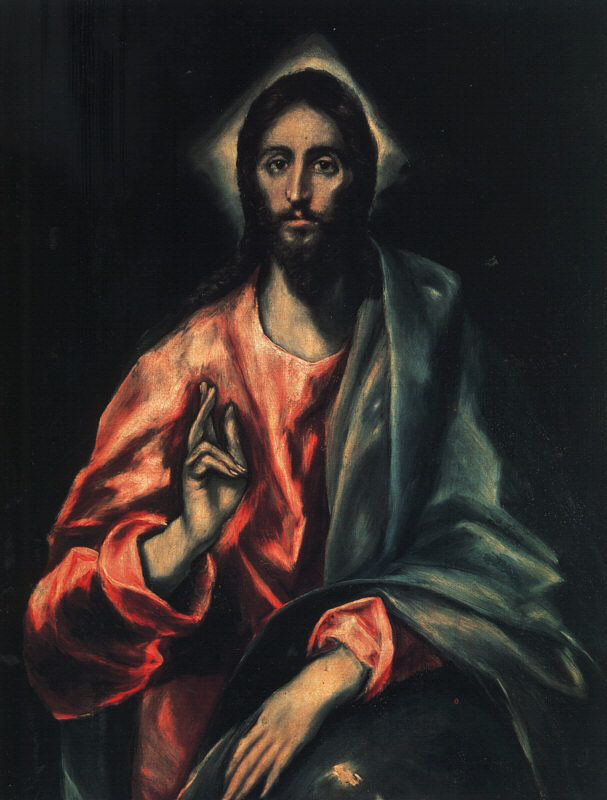
SOURCES:

A Dictionary of Art and Artists, Peter and Linda Murray, Penguin Books; Revised,1998.

French Paintings of the Fifteenth through the Eighteenth Century, The Collection of the National Gallery of Art Systematic Catalogue, Philip Conisbee and Frances Gage, Washington, D.C., 2009 pp, 413-414.
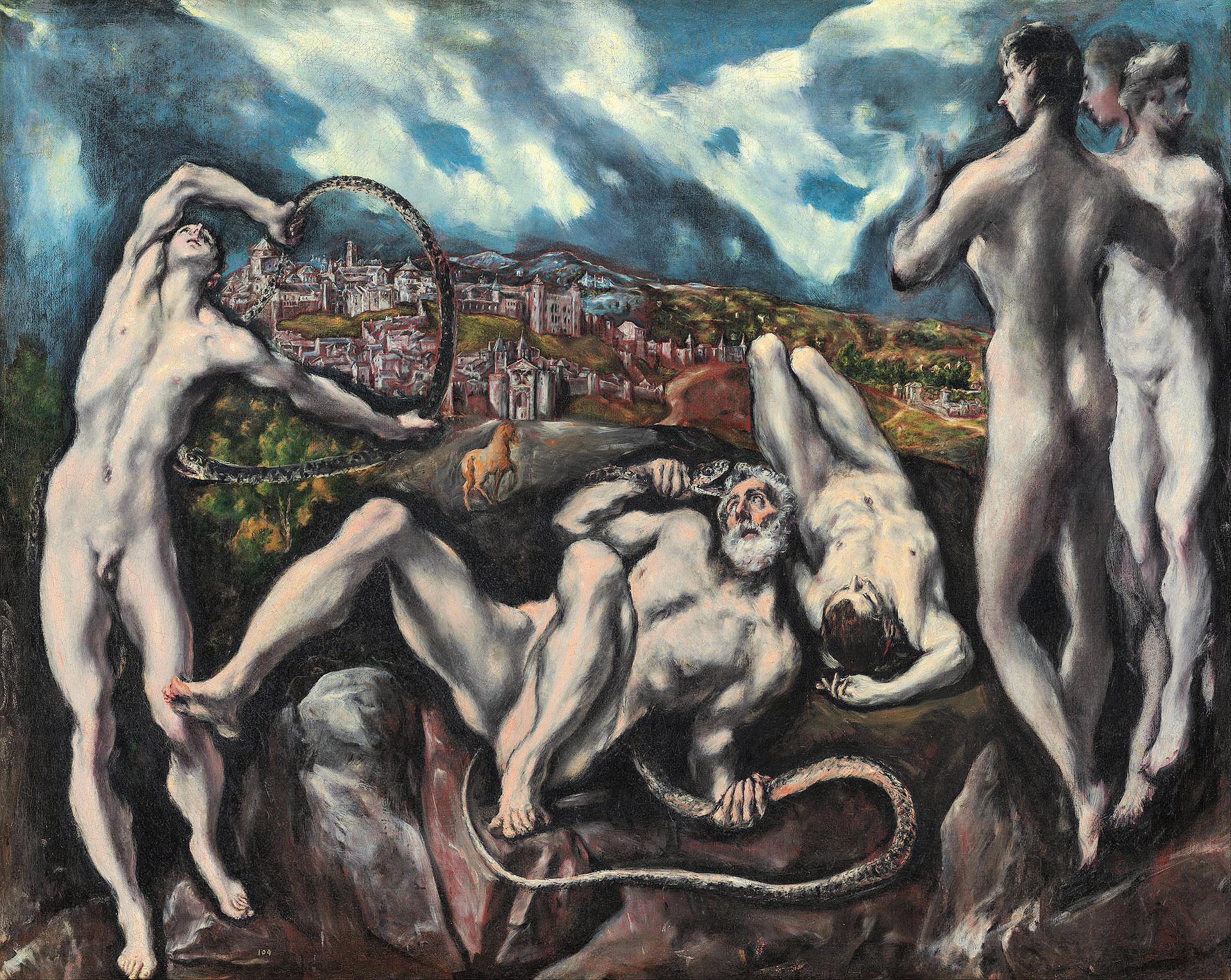
Art for the Nation, text by Philip Conisbee, National Gallery of Art exhibition catalogue, 2000.
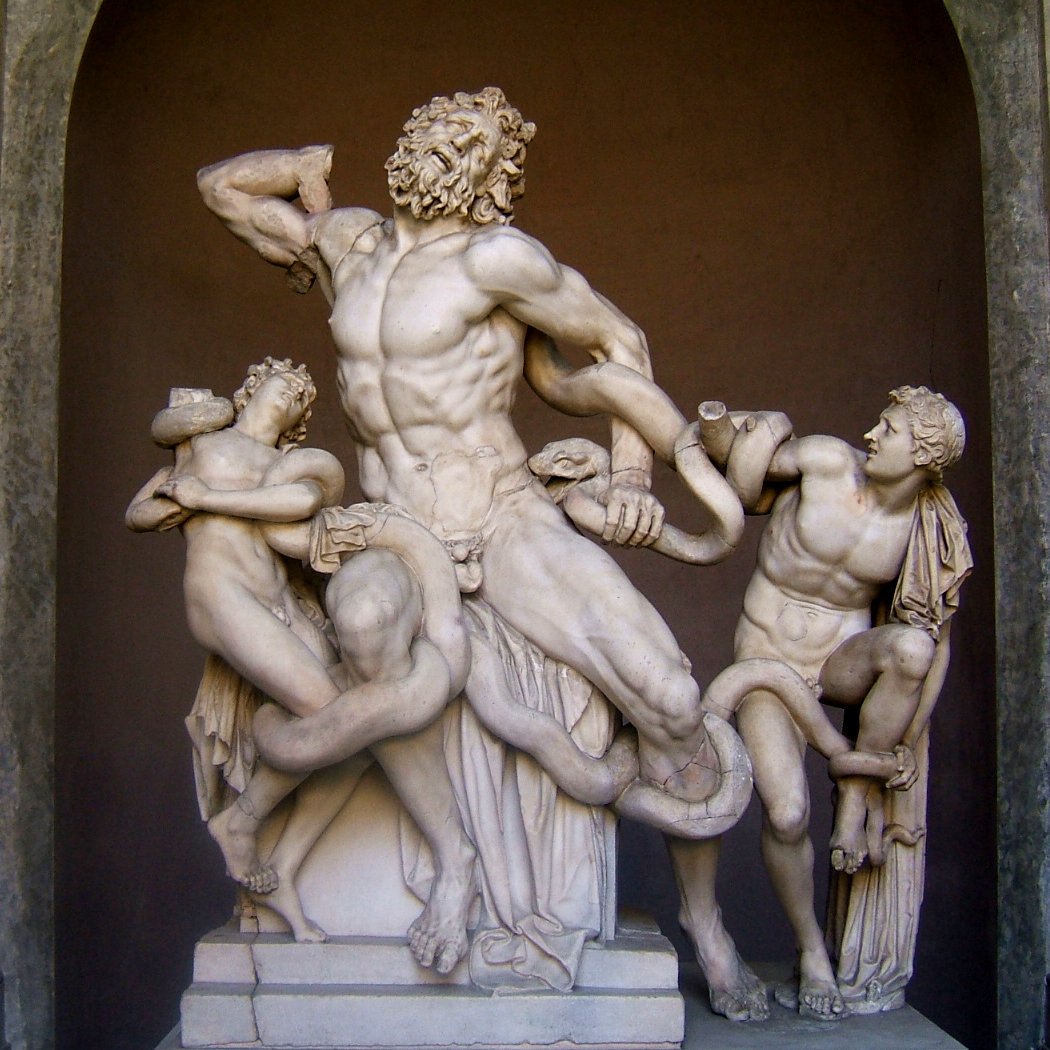
French Painting From Fouquet to Poussin, Albert Chatâlet and Jacques Thuillier, trans. from French by Stuart Gilbert, Skira, 1963.

https://www.metmuseum.org/art/collection/search/663663

https://www.metmuseum.org/press/exhibitions/2016/valentin-de-boulogne

https://arthistorians.info/bousquet

https://arthistorians.info/hoogewerffg

https://arthistorians.info/longhir

https://www.kulturelles-erbe-koeln.de/documents/obj/05011488/rba_d054126_01

The Saints: A Concise Biographical Dictionary, edited by John Coulson, Guild Press, New York, 1957.

The New American Bible, Catholic Book Publishing Corp, New York, 1993.

Mannerism: The Painting and Style of The Late Renaissance,  Jacques Bousquet, trans, by Simon Watson Taylor, Braziller, 1964.
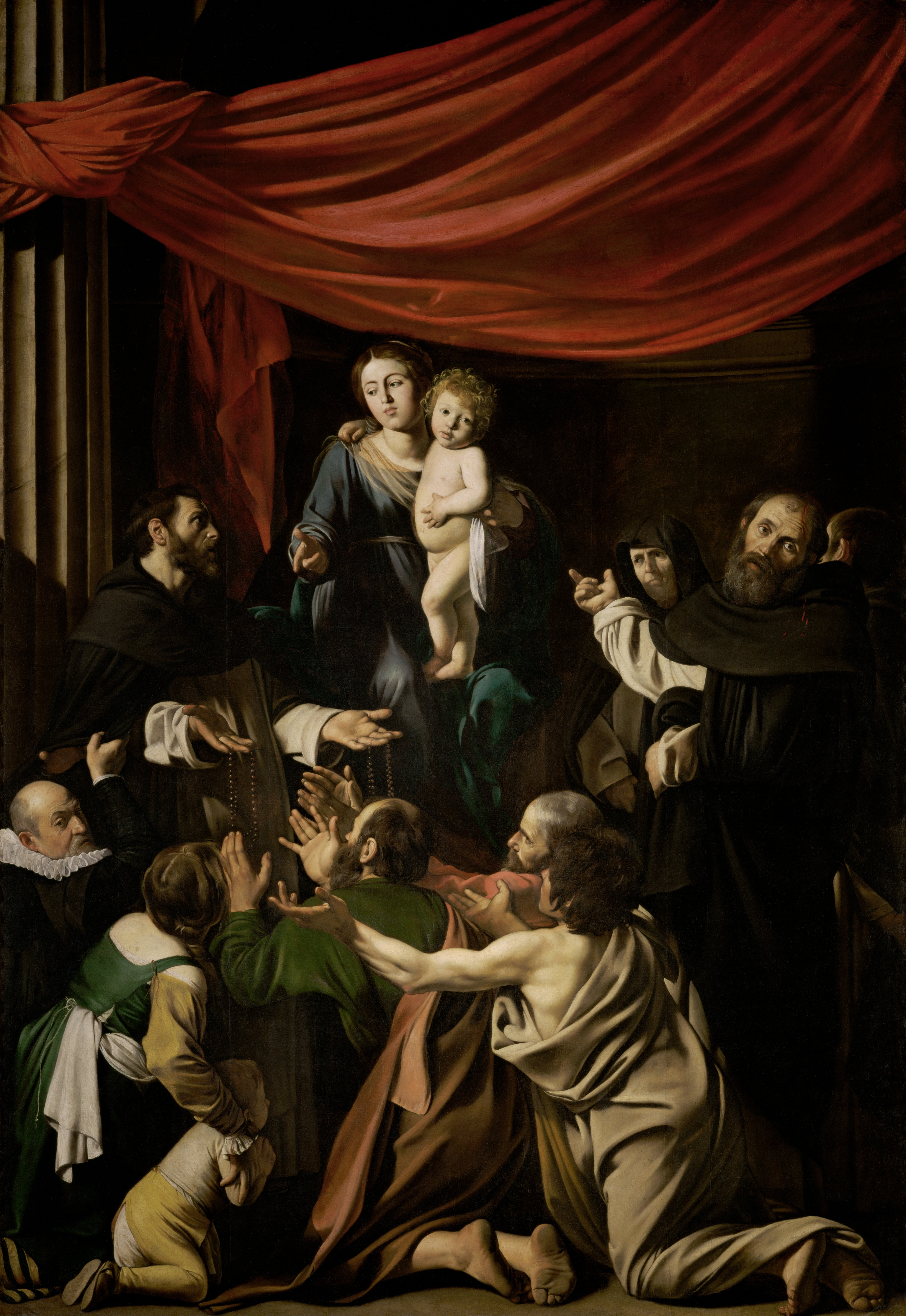
The Liberation of Jerusalem, Torquato Tasso, trans by Max Wicker, Oxford World’s Classics, 2009.
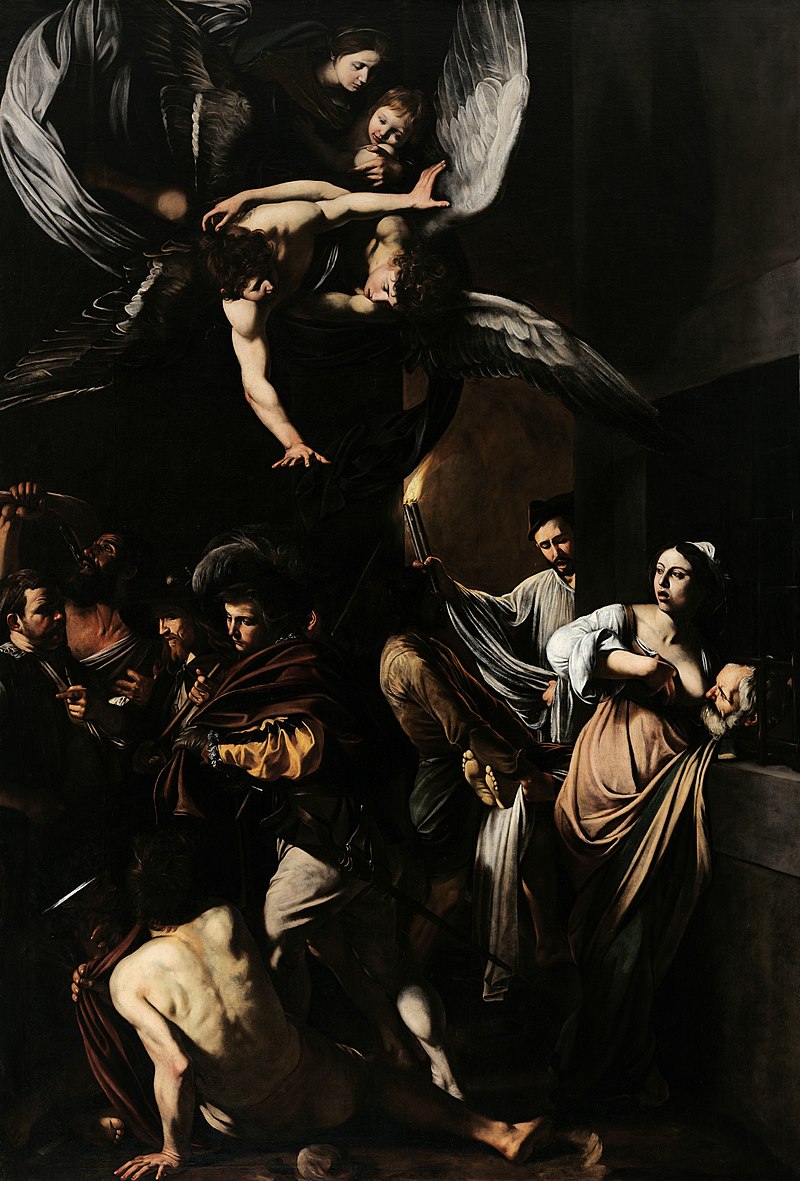
Valentin de Boulogne: Beyond Caravaggio, Annick Lemoine, Keith Christiansen, Patrizia Cavazzini, Jean Pieere Cuzin, Gianni Pappi, Metropolitan Museum of Art; 2016.

https://france3-regions.francetvinfo.fr/hauts-de-france/somme/amiens/six-tableaux-de-la-chambre-du-roi-du-chateau-de-versailles-exceptionnellement-exposes-au-musee-de-picardie-2620412.html

https://www.liechtensteincollections.at/en/

Raymond E. Brown, Joseph A. Fitzmyer, S.J,  and Roland E. Murphy, O. Carm.,The Jerome Biblical Commentary, Prentice Hall Englewood Cliffs, NJ, 1968.

Lehmbeck, Leah, editor. Gifts of European Art from The Ahmanson Foundation. Vol. 2, French Painting and Sculpture. Los Angeles: Los Angeles County Museum of Art, 2019.

Marandel, J. Patrice and Gianni Papi. 2012. Caravaggio and his Legacy. Los Angeles: Los Angeles County Museum of Art.

Fried, Michael. After Caravaggio. New Haven: Yale University Press, 2016.

Schmid, Vanessa I., with Julia Armstrong-Totten. The Orléans Collection. New Orleans: New Orleans Museum of Art; Lewes: In association with D. Giles, 2018.

Merle Du Bourg, Alexis. “L’omniprésence de la musique.” Dossier de L’Art no.246 (2017): 64-67.

FRANCE. French art in the 16th Century.

FEATURE image: Ulysses and Penelope, Francesco Primaticcio called Le Primatice (1504-1570), Toledo Museum of Art, c. 1560, oil on canvas, 44 3/4 x 48 3/4 in. (113.6 x 123.8 cm).

Jean Perréal (1455-1529), Portrait Louis XII, c. 1514, Windsor collections de S.M. la Reine d’Angleterre.

Jean Perréal’s most important attribution is this portrait of Louis XII who was King of France from 1498 to 1515. Louis XII was married three times – the first annulled; the second leaving the king a widower, and, in his last three months of life, to Mary Tudor (1496-1533), the favorite sister of King Henry VIII of England. Despite these wives, the king had no living sons. The Salic Law prohibited his line to continue on the French throne through his daughters. When Louis died in 1515, his throne eventually passed to his cousin, Francis I.

Jean Perréal (1455-1529), Portrait of a woman, c. 1500, Louvre. https://collections.louvre.fr/ark:/53355/cl010059108
Detail of above.

Jean Perréal (c.1455-1530) was Court painter to the Bourbons and later worked for the kings of France starting with Charles VII. Perréal journeyed to Italy several times. In 1514 he went to London to paint Mary Tudor’s portrait and supervise her new dresses as Mary, aged 18 years, sister of the English king, married the 52-year-old King Louis XII of France.

Master of Saint Giles (active 1490-1510), St. Giles protects a wounded deer for Charles Martel, c. 1500, National Gallery, London, oil on oak, 63.4 × 48.4 cm.
Master of Saint Giles (active 1490-1510),Virgin with Child, c. 1500, Louvre.
Master of Saint Giles (active 1490-1510), St. Giles’ Mass, c. 1500, National Gallery, London, oil on oak.

The Master of Saint Giles was a Flemish or Flemish-trained painter who was active in France. He is named after artworks in London attributed to the artist called Scenes from the Legend of St. Giles. As the artist’s identity is obscure, the saint depicted in his artwork is shrouded in legend.

St. Giles is possibly an 8th century hermit in France who became the patron saint of beggars, the handicapped, and blacksmiths which was an important trade in the Middle Ages. In one work, the artist depicts a famous story about St. Giles. Before King Flavius’s hunting party, he protected a deer from their bows and arrows. The king was apologetic and Giles persuaded him to establish a Provençal monastery in which St. Giles served as its first abbot.

Le Rosso (1494-1540), La Fontaine de Jouvence, c 1535, fresco, Chateau de Fontainebleau, Galerie Francois I.

France conducted wars in Italy starting in 1494 that continued into the 16th century. By this pugilistic means, many of the Italian Renaissance’s ideas and practices were brought back to France. It had been just the opposite in the 12th century when French ideas, particularly that of troubadours and chivalry, were brought back to Italy following trade expeditions by merchants.

After fighting ceased, King Francis I invited Italian artists into France, most famously Leonardo da Vinci (1452-1519) in 1516. Following more war in Spain, Francis I began in earnest a revolution in art in France in 1526. The king made the Château de Fontainebleau one of the most active artistic centers in Europe, attracting many Italian artists such as Le Rosso (1495-1540) and Primaticcio or Primatice (c. 1504-1570). The French Renaissance, under the influence of these Italian masters, synthesized French and Italian art whose style was later described as the School of Fontainebleau.

Le Rosso or Rosso Fiorentino was a friend of Pontormo (1494-1557) and worked under Andrea del Sarto (1486-1530), a founder of Italian Mannerism. He first worked in Florence (1513-1523) and then in Rome (1524-1527). With the sack of Rome in 1527 by German troops of the Holy Roman Emperor Charles V (1500-1558), Rosso wandered about Italy for a while. In 1530 he was in Venice and, in that same year, went to France.

Rosso arrived to Fontainebleau and, with Primaticcio, became one of the founders of the Fontainebleau style which had a tremendous influence on French painting. Reputedly a neurotic person, Rosso’s death was accounted a suicide by Vasari though that is unconfirmed. The classic style found in Rosso’s The Fountain of Youth was increasingly replaced by his later emotionally charged style.

https://www.chateaudefontainebleau.fr/en/espace-groupe/visites-scolaires-chateau-de-fontainebleau/les-dossiers-pedagogiques/la-renaissance/

Le Rosso (1494-1540), Pietà, c. 1540, Louvre. https://collections.louvre.fr/ark:/53355/cl010061332

Primaticcio (c.1504-1570) was a founder of the Fontainebleau School in France with his fellow Italian artist Le Rosso in the 1530s. Primaticcio was a talented artist of universal range – from painting and interior decoration to sculpture and architecture.

From the mid1520s to 1532 Primiticcio trained in Mantua under Giulio Romano (c. 1499-1546). He was called to France by King Francis I in 1532 where he worked at Fontainebleau with Le Rosso. Between 1540 and 1542 the artist represented the king in Italy on an art buying expedition. In that time when he was away Rosso died, and Primiticcio, upon his return to France, began working with Niccolò dell’Abbate (c. 1509-1571) at Fontainebleau. It was in this period that he produced decorations in the galerie d’Ulysses that have been lost. In 1546, and again in 1563, Primaticcio went to Italy where on one trip he made casts of Michelangelo’s sculpture and in the other met Vasari.

Ulysses and Penelope, Francesco Primaticcio called Le Primatice (1504-1570), Toledo Museum of Art, c. 1560, oil on canvas, 44 3/4 x 48 3/4 in. (113.6 x 123.8 cm). http://emuseum.toledomuseum.org/objects/54742/ulysses-and-penelope?ctx=2f264d6c-812c-4e21-83c3-07cd963ab760&idx=0

The style of the painting is Mannerist which predominated in the 16th century. Mannerists went beyond the depiction of nature to flights of imagination and invention. For a stylistic statement, forms were twisting and elongated giving them greater pliability. Mannerists rejected the High Renaissance’s reliance on strict perspective and symmetry and preferred to construct compressed spaces with shaded tones, harsh colors, and the overall feeling of dreaming while awake.

After battling the Trojans and other subsequent troubled adventures, Greek hero Odysseus (Ulysses) has returned home to his wife, the faithful Penelope. Into the night, the reunited lovers recount their lives apart from one another. While Penelope counts the number of suitors on her hands who she held at bay, Ulysses cradles her chin in a gesture of tenderness and compassion. The composition is based on one of 58 wall frescos of scenes from Homer’s Odyssey at the palace of Fontainebleau near Paris. Unfortunately, the Gallery of Ulysses, Primaticcio’s masterpiece, was destroyed in 1738 after it had been allowed to decay over 200 years.

A kneeling woman, gathering wheat in sheaves, attributed to Francesco Primaticcio called Le Primatice (1504-1570), Louvre. https://collections.louvre.fr/ark:/53355/cl020005673
Mascarade de Persépolis, Francesco Primaticcio called Le Primatice (1504-1570), Louvre. https://collections.louvre.fr/en/ark:/53355/cl020005563

A preparatory drawing by Primaticcio in the Louvre for a lost composition of the cycle of L’Histoire d’Alexandre painted in the Room of the Duchess of Etampes in Fontainebleau. It was the masquerade that brought about the fire in Persepolis, an historic event that took place in 330 BCE when Alexander the Great conquered the Achaemenid Persian Empire following the battle of Guagamela the year before.

It is not disputed in history that after Alexander arrived to the Persian capital city of Persepolis it was looted and burned to the ground, destroying many great cultural treasures. Though recorded by several historians, accounts vary. The first century Roman historian Quintus Curtius Rufus wrote that while drunk during a large celebration with his companions, attendants and  courtesans, Alexander himself started the fire as the rest joined in. (see – https://www.worldhistory.org/article/214/alexander-the-great–the-burning-of-persepolis/

Niccolò dell’Abbate (c. 1509-1571), The Death of Eurydice, c. 1550s-1560s, oil on canvas, 189.2 × 237.5 cm, National Gallery London.

Niccolò dell’Abbate was from Modena in Italy. He was influenced by the sculptural and optical illusion achieved in the artwork of Andrea Mantegna (1431-1506). He was also influenced by Correggio (1489-1534), a master of chiaroscuro. By 1552 dell’ Abbate was in France helping Primaticcio at Fontainebleau with the royal chateau’s interior decorations though most of his artwork has disappeared. The Death of Eurydice is a fine example of the Mannerist landscape which the artist is responsible for having introduced into France.

Le Maître de Flore (active 1540-1560), Le triomphe de Flore (The Triumph of Flora), private collection (Vicenza).

Le Maître de Flore is a  French painter of the mid16th century Fontainebleau School. The use of the moniker Maître de Flore derives from this and another artwork.

Le Maître de Flore, The Birth of Cupid, after 1550, Oil on wood, The Metropolitan Museum of Art, New York. https://www.metmuseum.org/art/collection/search/437006?ft=master+of+flore&offset=0&rpp=40&pos=7

The painting above by the Master of Flore in the Metropolitan Museum of Art in New York is seen as depicting the birth of Cupid, with attendants in the birthing room assisting Venus. The composition, which is animated and decorative, is an example of the School of Fontainebleau, the high art style developed in 16th century France by Italian artists under the sponsorship of the French king.

Attributed to Le Maître de Flore (active 1540-1560), La Charité, c. 1552. Louvre.
https://collections.louvre.fr/ark:/53355/cl010065400.
School of Fontainebleau, Diana the Hunter, c. 1550, 75 5/8 x52 3/8 in. Louvre. https://collections.louvre.fr/ark:/53355/cl010064749https://collections.louvre.fr/CGU

Perhaps the most famous artwork to come out of the School of Fontainebleau is an anonymous work in the Louvre entitled Diana the Hunter. With influences of both Le Rosso and dell’ Abbate, Italian masters of the school, it is believed to depict Diana de Poitiers, the legendary French beauty and mistress of Henry II.

School of Fontainebleau, Woman in her Toilet, c, 1550,  Musée des Beaux-Arts, Dijon.

A recurring theme of the Italian masters and French artists in the 16th century is that of the naked woman, shown half-figure in her bath, or dressing. Some have an allegorical significance, others are combined with a portrait. This particular work which depicts some beauty of the day was so admired that there are known 16th century copies of it in Basel and in Massachusetts.

Jean Cousin the Elder (1490-1560), Saint Mammès coming to surrender to the court of the governor of Cappadocia, around 1541, tapestry, 440 × 450cm, Paris, Louvre Museum.

Jean Cousin was born in Sens and died in Paris. He was a French painter, engraver and sculptor.

St. Mammès was martyred under Emperor Aurelian in Cappadocia around 275. In Asia Minor he was highly revered by early Christians. In the 8th century his relics were taken to France and into Langres cathedral. Around 1540, eight tapestries were produced for the cathedral chancel depicting scenes from the saint’s life. Three of the tapestries survive: two in Langres and one in the Louvre.

In the Louvre tapestry, St. Mammès is accompanied by a lion to visit Aurelian who condemned him to death. In the background building the saint’s execution is already taking place. The tapestry’s elements point to the wave of influence that was the Italian Renaissance: its expansive landscape; its compositional use of perspective; and its classicizing architecture and buildings’ decoration, all of which came together in Francis I’s School of Fontainebleau. The tapestry’s varied and nuanced use of color lend a painterly appearance to the woven artwork.

Pseudo Félix Chrétien (active 1535-37), Three men lower barrels into the cave, Städel Museum Frankfort.

The picture displays a scene at one of the likely nearby hôtels that housed merchants, diplomats and others so to be close by the king. It is evident by Félix Chrétien ‘s artwork that creative activity went far beyond the confines of the royal chateaux. Many painters whose names and works are unknown flourished in 16th century France. Italian Renaissance techniques are used in the painting such as its correctly rendered spatial perspective, realistic figural development, and the typical gestures found in the latest Franco-Italian Mannerist style.

Jean Clouet (1485-1540), François Ier, 1524, Louvre.

Jean Clouet was the Court Painter to King Francis I. While Clouet was an influential artist in the establishment of Renaissance portraiture in France, his only documented painted portrait is that of Francis I’s librarian, Guillaume Budé (1467–1540).

A leading humanist of the sixteenth century, Budé’s fingers hold his page and a quill in the midst of writing. The words on the page in Greek presents an epigram: “While it seems to be good to get what one desires, the greatest good is not to desire what one does not need.”

Jean Clouet, Guillaume Budé, c. 1536, The Metropolitan Museum of Art, New York, oil on wood, 15 5/8 x 13 1/2 in. (39.7 x 34.3 cm).

Jean Clouet, also called Jean Clouet II and Janet, was probably the son of a Flemish painter who was the Court Painter to the Duke of Burgundy. Jean Clouet II made a number of portrait drawings of the Court that survive, most in Chantilly.

Jean Clouet, Portrait of Admiral Bonnivet, c. 1516. Musée Condé, Chantilly, France.
French Anonymous, Head of a bearded man, capped with a hat, three-quarters to the right. End of 16th century. Louvre.
Francois Clouet (before 1520-1572), Portrait of Pierre Quthe, 1562, Louvre.

François Clouet was the son of Jean Clouet II and succeeded him as Court Painter to the king in 1541. Like his father, he was also called Janet and specialized in portrait drawings, most of which are housed in Chantilly. Francois Clouet’s first signed painting was the 1562 portrait of Pierre Quthe in the Louvre. Its style was influenced by the Florentine artists, particularly Angelo Bronzino (1503-1572).

François Clouet, A Lady in Her Bath, c. 1571, oil on oak, 92.3 × 81.2 cm (36 5/16 × 31 15/16 in.), National Gallery of Art, Washington, D.C.

The identity of Clouet’s model has long been debated. She may have been Marie Touchet, the mistress of Charles IX, or possibly Diane de Poitiers, the legendary French beauty and mistress of Henry II. The painting is boldly composed as it evokes poses of Venus, the love goddess, found in Italian art but also in its presentation of fecundity such as the nurse suckling a child and a bowl of ripe fruit of the season. The raised curtain is a device used in royal portraiture though here it may be just decorative.

François Clouet, La reine Marguerite enfant, c. 1560, Chantilly.
Workshop of François Clouet, Marie de Gaignon, marquise de Boissy (1524-1565), c. 1550-1565, Louvre.
Corneille de Lyon (active 1533-1574), Portrait de Marot, c. 1540, Louvre.

Corneille de Lyon (active 1533-1574) was born in The Hague and worked in Lyons, France for over 30 years starting around 1540. A contemporary and rival of François Clouet (c. 1520-1574), Corneille de Lyon is well documented as a popular leading painter in the French style. As the artist did not sign or date his works, it is virtually impossible to positively identify his artwork. It was only in 1962 that his first work –and nearly all of them are miniature in scale – was positively identified. The nature of his work was described by contemporaries. In 1551 the Venetian ambassador who visited the artist’s studio observed: “We paid a call to an excellent painter who…showed us the whole Court of France, both gentleman and ladies, depicted with the utmost likeness on a great many small panels.”

Working in oil on wood panel, Corneille de Lyon was Peintre et Valet de Chambre du Roi to Henry II (1519-1559) and Charles IX (1550-1574). Corneille likely did paint the entire court. Portraits usually show half-length figures dressed in dark colors against a neutral, somewhat iridescent and greenish background. Groups of such portraits are of uneven quality marking studio artists supervised by the master. The precise drawing of facial features with its smooth planes and enamel-like techniques conveys sitters of placid expression whether their gaze is distant or engaged. Costumes are portrayed with detailed realism yet in a rich, modulated and less definite form.

Painter to the king since 1551, Corneille became a landowner by gift of the king in 1564. In June 1564 one of the artist’s high-born visitors to his home was Catherine de‘ Medici (1519-1589), then regent. Before his death in 1574, the Netherlandish-born Corneille, with his family and household, became Roman Catholics after working in the French Court for nearly 35 years.

https://en.wahooart.com/@@/8Y352R-Corneille-De-Lyon-Portrait-of-Gabrielle-de-Rochechouart
https://www.wga.hu/html_m/c/corneill/rochecho.html

Corneille de Lyon (active 1533-1574), Portrait of Gabrielle de Rochechouart, c. 1574, Oil on wood, 16.5 x 14 cm, Musée Condé, Chantilly.
Pierre Dumonstier “the Uncle” (c.1545-c.1610), Portrait of an Unknown Man, chalk drawing with watercolor, c. 1580, Musée Jacquemart-André.

Towards the close of the 16th century, there were two families of French artists who were active – namely, the Dumonstiers and the Quesnels.

The Dumonstiers were descendants of one of Le Rosso’s fellow workers at Fontainebleau in the 1530s. Pierre Dumonstier (c.1545-c.1610) was one of three brothers, all of whom were portrait painters. The brothers had close links to the royal house, particularly to Catherine de’ Medici. Pierre produced several drawings, many in color giving them a somewhat painted appearance. Portrait of an Unknown Man is a chalk drawing with watercolor.

In terms of style, what in the beginning of the 16th century produced precise drawing of facial features in portraiture gave way by the end of the century to greater modeling fluency so to achieve intense expression. Portraiture’s overall format, however, remained constant: a face isolated on a neutral background rendered with close analytic attention.

The Quesnel artistic dynasty began with a court painter to James V of Scotland (1513-1542). One of that painter’s sons, François Quesnel (1543-1619), produced many drawings. His painted portrait of Mary Ann Waltham is signed and dated by the artist. Quesnel concentrates on rendering the face with the rest of the body and costume handled perfunctorily. This dichotomy of attention to form was the case in the drawings as well. It may be that the master produced the face in these portraits and left the body and costume to studio assistants.

François Quesnel (1543-1619), Mary Ann Waltham, 1572. 22 x17.5 in., Private, UK.

SOURCES:

A Dictionary of Art and Artists, Peter and Linda Murray, Penguin Books; Revised,1998.

La Peinture Française: XVe et XVIe Siècles, Albert Châtelet, Skira, Genève Suisse, 1992.

French Painting: From Fouquet to Poussin, Albert Châtelet and Jacques Thuillier, Skira, 1963.

FRANCE. French art in the 15th Century.

FEATURE image: DETAIL, Henri Bellechose (1415-1440), École de Bourgogne, Retable de saint Denis, 1416, https://collections.louvre.fr/ark:/53355/cl010063178

Anonymous master. Portrait of John le Bon (1319-1364) c. 1360. Musée de Louvre, Paris (“Louvre”).
Henri Bellechose (1415-1440), École de Bourgogne, Retable de saint Denis, 1416, https://collections.louvre.fr/ark:/53355/cl010063178

Retable de Saint Denis, (above), was completed in 1416 for the church of the Charterhouse of Champmol that is adjacent to Dijon. The artwork’s attribution has long been debated between Bellechose and Jean Malouel (1370-1415). Written evidence points to Bellechose possibly only completing the painting started by Malouel who was Bellechose’s predecessor at the head of the ducal workshop. However, recent connoisseurship does not see two different styles that would indicate two painters and the artwork in the Louvre is not the same size as the artwork mentioned in the early 15th century document that supports the dual attribution.

DETAIL, Henri Bellechose (1415-1440), École de Bourgogne, Retable de saint Denis, 1416, https://collections.louvre.fr/ark:/53355/cl010063178

St. Denis is the most famous cephalophore (beheaded saint holding his head) in Christian history. Denis and two companions were martyred on Montmartre in what became a future Paris in the mid-3rd century. Much later, in the ninth century, an anonymous chronicler told the tale of the martyr Denis and mentioned his carrying his head from his execution spot on Montmartre to Saint-Denis. There the abbey of St-Denis rose to become the burial place of French kings. Soon after, this preposterous but delicious tale of Denis’ post-mortem pilgrimage received further embellishment by an abbot chronicler so that the legend took hold in St. Denis’ hagiography and iconography. St. Denis is the patron of Paris in France and against headaches and any strife or frenzy.

Anonymous, École de Île-de-France? Bourgogne? Studio Henri Bellechose? Dead Christ Placed in the Tomb,
1400-1425. Louvre. https://collections.louvre.fr/ark:/53355/cl010065413
Anonymous master, The Annunciation, France, possibly Netherlands, late 14th century (1380s), tempera and oil with gold on wood, 15 7/8 x 12 3/8 x 1 7/8 in. Cleveland Museum of Art.

The angel Gabriel’s wings resemble peacock feathers. The panel painting was once joined to another panel to form a diptych. Its opulent ornate style and small size allowing for easy mobility points to its use as a devotional artwork for an aristocratic patron around 1400.

Anonymous, The Crowning of the Virgin, c. 1400-1410, Paris, oak on wood. 20.5 cm. Staatliche Museum, Berlin.

In Christian Biblical tradition, the Virgin Mary was the only human person to be received into heaven after her death as a physical body prior to the Last Judgment. By the Middle Ages, the event’s narrative was elaborated so that the Virgin in Heaven came to be understood as a royal court where angels acted as court pages. In Heaven’s throne room, Mary is crowned as Queen by her son, Jesus Christ.

In the French tondo, Christ wears a red cloak symbolizing his Resurrection and a violet robe symbolizing his Passion. He sits on a stone throne and sets the crown on his mother Mary’s head as she kneels on a splendid cushion.

Strewn on the green-tiled floor of the celestial throne room are a variety of cut flowers which point to Mary’s purity and love for humanity. One angel carries her dress’s train and is himself dressed in a liturgical-type costume.

The tiny panel is remarkable for its delicate execution, lovely colors, and precise articulation of details such as the angels’ multi-colored wings. Its overall imagery was 14th century Italian in origin and arrived into Paris in the 15th century. Like the Annunciation panel in the Cleveland Museum of Art (above), this panel was likely produced as a private devotional image for a patron of high rank who dwelt among the milieu of the Parisian court.

Les Frères de Limbourg, Meeting of the Three Wise Men c. 1416 from Les Très riches heures du duc de Berry folio 51 verso. Chantilly, Musée Condé.
Entourage des Frères de Limbourg. Adoration de L’Enfant, c. 1415, Glasgow Art Gallery and Museum.
Maître des heures de Rohan (active 1410-1435), The Last Judgment c. 1420, Paris, Bibliothèque nationale.
Maître des heures de Rohan, Annunciation Angel and donor, c. 1420/30, Musée de Laon.
 Maître des heures de Rohan, Portrait de Louis II d’Anjou, c 1420. Paris, Bibliothèque nationale.

Not much more is known of the Maître des heures de Rohan than if he were anonymous. The artist had ties to Troyes, a Burgundian market town, and settled in Paris between 1415 and 1420. He was a commercial illuminator and is found in the service of the Dukes of Anjou around 1420. In addition to the Grandes Heures de Rohan, c.1430-1435, he produced other exceptional books, including the Hours of René d’Anjou (Bibliothèque nationale de France), the Hours of Isabelle Stuart (Fitzwilliam Museum, Cambridge, UK) and the Hours for the Use of Angers (former Martin Le Roy collection).

Artwork by Maître des heures de Rohan reflects a highly personal vision. The artist was completely unconcerned with his contemporaries’ preoccupation to introduce Renaissance realism into painting. The artist ignored perspective and chiaroscuro through concrete depictions and continued to develop his artistic meditations on faith and death using highly original invention of forms. In this way, the Maître des heures de Rohan is an enduring artist from early 15th century France as some of his more fashionably progressive contemporaries are not as he stayed true to his vision to create some of the most expressive pages of medieval Christian mysticism.

Maître of the Aix Annunciation, Annunciation, before 1445, Église de la Madeleine d’Aix-en-Provence.

The precise identification of the artist called the Maître of the Aix Annunciation is unknown. The artist is believed to be male and French, and could be Jean Chapus who lived in Aix and was working for King Réne of Anjou in the 1430s and 1440s. The Annunciation which was placed in the church in 1445 and has been there since, was part of a triptych. The other wings have been split off and are in Brussels, Amsterdam, and a private Dutch collection (one wing was also split). The style shows influence from Italy (Naples) and Flemish art.

DETAIL. Maître of the Aix Annunciation, before 1445, Église de la Madeleine d’Aix-en-Provence.
Maître du Coeur l’amour épris, Rencontre de Coeur et d’Humble requête, c. 1479, Vienna, National Library.
Anonymous. Annunciation, c. 1447-1450, Stained glass, Bourges cathedral, Chapel of Jacques Coeur.
Jean Fouquet (1420-1480), Diptych de Melun, c. 1450, right panel: The Virgin and Child Jesus. Antwerp, Museum of Fine Arts.
Jean Fouquet (1420-1480), Diptych de Melun, c. 1450, left panel: Chevalier Stephan presented by Saint Stephan. Staatliche Museum Berlin.

Jean Fouquet was a major French painter of the 15th century. He was in Rome in the mid-1440s and is presumed to have painted portraits. Under what circumstances the twenty-something Fouquet traveled to Rome is unknown. In any event Fouquet returned to Tours in 1448 and was working in the court of Charles VII. Louis XI appointed him official painter to the king in 1475. A handful of miniatures are documented artworks by Fouquet though other pictures, such as the Melun diptych and others, are attributed to him.

Jean Fouquet (1420-1480), Medallion, self-portrait, 1452/1455. Louvre.
Jean Fouquet (1420-1480), Charles VII, 1440/1460. Louvre.
Jean Fouquet (1420-1480), The Visitation, c. 1450. The Musée Condé, Chantilly.
Jean Fouquet (1420-1480), Announcement of the Death of Saul to David, c. 1470. Les Antiquités Judaïques, Ms. fr. 247, folio 135 verso. Paris Bibliothèque Nationale.
Jean Fouquet (1420-1480), Pietà, c. 1470-1480. Parish church, Nouans (Indre-et-Loire).
Jean Fouquet (1420-1480), Pietà (detail), c. 1470-1480. Parish church, Nouans (Indre-et-Loire).
Retable du Parlement de Paris, c.1455. Louvre. see – https://collections.louvre.fr/en/ark:/53355/cl010061369 – retrieved September 15, 2025.

It depicts the scene on Calvary on Good Friday with Jesus Christ crucified in the center with saints at its base including, left to right, Saint Louis, John the Baptist, the Virgin Mary, Saint John, a beheaded Saint Denis, and Charlemagne. In the background is the tour de Nesle (c. 1200-1665), Seine, the Louvre, Hôtel du Petit-Bourbon, and Palais de la Cité. Formerly identified as an artwork by Philippe de Mazerolles, it is currently identified by the Louvre as “anonymous“ in the School of France influenced by the Master of Dreux Budé who is likely André d’Ypres, active between 1425-1450. Philippe de Mazerolles was also a French painter and illuminator who was active in Paris and in Bruges. Trained in Paris, Philippe de Mazerolles’ style was directly inspired by the Maître de Bedford, an anonymous illuminator active in Paris slightly earlier between 1415 and 1435. The Master of Dreux Budé was a Parisian illuminator whose works show his knowledge of the repertoire of models of the Master of Flémalle (1375-1444). see – https://initiale.irht.cnrs.fr/en/intervenant/3443 – retrieved September 15, 2025.

DETAILS retable du Parlement de Paris (above), c.1455. Louvre:

AnonymeFranceMaître de Dreux Budé (André d’Ypres?), Musée du Louvre, Département des Peintures, RF 2065 – https://collections.louvre.fr/ark:/53355/cl010061369https://collections.louvre.fr/CGU
DETAIL retable du Parlement de Paris (detail), c.1455. Louvre.
AnonymeFranceMaître de Dreux Budé (André d’Ypres?), Musée du Louvre, Département des Peintures, RF 2065 – https://collections.louvre.fr/ark:/53355/cl010061369https://collections.louvre.fr/CGU
Enguerrand Quarton (1410-1466), The Coronation of the Virgin, 1452-53, Altar of the Charterhouse (hospice) of Villeneuve-lès-Avignon.

Also known as Charonton, the French painter worked in Avignon in southern France. His large Coronation of the Virgin is a documented artwork that was completed in 1454. It is one of the most important surviving 15th century French paintings.

Enguerrand Quarton (1410-1466), The Coronation of the Virgin (detail), 1452-53, Altar of the Charterhouse (hospice) of Villeneuve-lès-Avignon.
DETAIL. Enguerrand Quarton (1410-1466), The Coronation of the Virgin, 1452-53, Altar of the Charterhouse (hospice) of Villeneuve-lès-Avignon.
Enguerrand Quarton (1410-1466), attributed, Pietà de Villeneuve-lès-Avignon. École de Provence, c. 1455. Louvre. https://collections.louvre.fr/ark:/53355/cl010063345

DETAILS Pietà de Villeneuve-lès-Avignon (above), c.1455. Louvre:

Nicolas Froment (1461-1483), Triptych (center panel): Mary in the Burning Bush, 1476. Cathedral St. Sauveur, Aix-en-Provence.

DETAIL Triptych (center panel): Mary in the Burning Bush (above), 1476. Cathedral St. Sauveur, Aix-en-Provence:

Nicolas Froment (1461-1483), Mary in the Burning Bush (detail), 1476. Aix-en-Provence, Cathedral St. Sauveur.Triptych (center panel).
Nicolas Froment (1461-1483) The Burning Bush, 1476. Aix-en-Provence, Cathedral St. Sauveur.Triptych (right and left panels).

Nicolas Froment worked in the south of France and was painter to Réne d’Anjou. The triptych is a documented artwork by the artist.

Josse Lieferinxe, called Maître de Saint-Sébastien, Part of an altarpiece shutter. The marriage of the Virgin. Musées royaux des Beaux-Arts de Belgique.
Maître de Moulins, active 1475 to 1505, Triptych de Moulins, center panel: The Virgin and the Child in Glory, c. 1498. Cathedral de Moulins.

DETAILS Triptych de Moulins, center panel: The Virgin and the Child in Glory (above), c. 1498, Cathedral de Moulins:

The Master of Moulins is one of the great French painters of the 15th century. He was influenced by Hugo van der Goes (died 1482) and takes his name from the triptych painting of the Madonna and Child with angels and Donors (above) in Moulins Cathedral dated from 1498/99. Other works attributed to the Master of Moulins are in Autun, Paris, Chicago, Brussels, London, Munich, and Glasgow.

Maître de Moulins, active 1475 to 1505, Meeting of Saints Joachim and Anne at the Golden Gate with Charlemagne, oil on oak, about 1491-1494. 72.6 x 60.2 cm, National Gallery, London.
Maître de Moulins, active 1475 to 1505, The Virgin with Child surrounded by angels, c. 1490, Musées royaux des Beaux-Arts de Belgique.
Maître de Moulins, active 1475 to 1505, François de Chateaubriand presented by St. Maurice or St. Victor with Donor, c. 1485, Kelvingrove Art Gallery and Museum Glasgow.
Jean Bourdichon (1457-1521), King David and Bathsheba, Leaf from the Hours of Louis XII, 1498–1499, Tempera and gold, Leaf: 24.3 × 17 cm (9 9/16 × 6 11/16 in.), The J. Paul Getty Museum, Los Angeles, Ms. 79, 2003.105.

Jean Bourdichon served as official court painter to four successive French kings: Louis XI, Charles VIII, Louis XII, and François I. Bourdichon was almost certainly a pupil of Jean Fouquet, the previous court painter.

Simon Marmion (active 1449-1489), The miracle of the True Cross in Jerusalem in the presence of Saint Helena Empress, 2nd half of 15th century (1450/1500). Louvre. https://collections.louvre.fr/ark:/53355/cl010061655

Simon Marmion (died 1489) who worked in Amiens and Valenciennes and temporarily in Tournai was a painter and illuminator where his miniatures were admired for their rich decoration and landscape details. In the mid1440s the artist moved from Amiens to Valenciennes where he became a leading painter. His most important painting is the Saint Bertin Altarpiece in Berlin and London.

St. Bertin Altarpiece, 1459:

Simon Marmion, The Soul of Saint Bertin carried up to God. Fragment of Shutters from the St. Bertin Altarpiece, 1459. National Gallery London.

The Soul of Saint Bertin carried up to God was the upper section of a wing for an altarpiece for the high altar of the abbey church of St Bertin at Saint-Omer in northern France. It was commissioned by the influential Guillaume Fillastre, Abbot of St Bertin (1450-73), Bishop of Verdun (1437-49), Bishop of Toul (1449-60), Bishop of Tournai (1460–73), Chancellor of the Order of the Golden Fleece and a close confidant of the powerful Duke of Burgundy, Philip the Good. The artwork, whose main parts are in the Gemäldegalerie, Berlin, was consecrated in 1459. The altarpiece was intact in the abbey until 1791 when, as with many church goods, it fell victim to the French Revolution. https://www.nationalgallery.org.uk/paintings/simon-marmion-the-soul-of-saint-bertin-carried-up-to-god

Simon Marmion, A Choir of Angels. Fragment of Shutters from the St. Bertin Altarpiece, 1459. National Gallery London.
Simon Marmion, St. Bertin Altarpiece, 1459. Gemäldegalerie, Berlin. http://www.smb-digital.de/eMuseumPlus?service=direct/1/ResultLightboxView/result.t1.collection_lightbox.$TspTitleImageLink.link&sp=10&sp=Scollection&sp=SfieldValue&sp=0&sp=0&sp=3&sp=Slightbox_3x4&sp=0&sp=Sdetail&sp=0&sp=F&sp=T&sp=4
Simon Marmion, St. Bertin Altarpiece, 1459. Gemäldegalerie, Berlin. http://www.smb-digital.de/eMuseumPlus?service=direct/1/ResultLightboxView/result.t1.collection_lightbox.$TspTitleImageLink.link&sp=10&sp=Scollection&sp=SfieldValue&sp=0&sp=0&sp=3&sp=Slightbox_3x4&sp=0&sp=Sdetail&sp=0&sp=F&sp=T&sp=5

A Dictionary of Art and Artists, Peter and Linda Murray, Penguin Books; Revised,1998.

La Peinture Française: XVe et XVIe Siècles, Albert Châtelet, Skira, Genève Suisse, 1992.

French Painting: From Fouquet to Poussin, Albert Châtelet and Jacques Thuillier, Skira, 1963.

ITALY. Italian art in the 13th-18th Centuries.

FEATURE image: Dosso Dossi (c. 1489–1542), Melissa, 1520s. 69.25 x 68.5 inches, Borghese Gallery, Rome.

Duccio Di Buoninsegna (c.1255-c.1319).

Duccio Di Buoninsegna (c.1255-c.1319), The Apparition of Jesus at the Closed Doors. The Museo dell’Opera del Duomo, Siena, Italy.

The artistic tradition of the Sienese master, Duccio di Buoninsegna (c. 1255-c. 1319) was based on older Greek painting. Duccio, however, was no less “modern” than Giotto (1266-1377). Giotto, who was trained by Cimabue (1240-1302), directed his creative artistry towards concrete reality whose perception derived from the artist’s thoughts and feelings of it. Duccio would achieve a similar but unique synthesis through and from a different direction. 

Duccio modernized the older Greek style creating the painting styles of the Sienese school as well as all of early Renaissance painting. Duccio’s artwork is distinguished by his discriminating advance of the Byzantine Post-Hellenism tradition in Tuscany—and following his own encounter with Cimabue who gave the Sienese artist his first important commission in Florence in 1285 —in a masterly delicate way. This delicacy and discrimination are seen in Duccio’s elegant, often light and airy, compositions and rich colors.

Over the next almost 25 years Duccio learned and deployed the elements of various pictorial traditions that, by his constant intelligent blending, enriched them. Duccio’s style used the iconographic schemata of the ancient Oriental-Byzantine tradition including its glorious color and poetic composition along with the ultra-contemporary French and Gothic linear style. Duccio’s oeuvre epitomizes the artist’s temperament and taste as well as a lifetime of artistic education and culture.  

Beyond its representation of an event in a scene, Duccio’s painting, not unlike Giotto’s histories, is raised to another level by some of its formal elements –- a figure, episode, or gesture -– into the artist’s magical world. This quality of Duccio’s art provides a textually clear and comprehensibly observed episode—such as of the Gospels— within a setting that is carefully observed and delineated—and with its totality imbued in finer artistic and aesthetic sensibilities.

The imminent drama manifested in Duccio’s iconography transcends its representational anecdote, even as figures or episodes of the Bible are easily recognizable. His artwork’s plasticity, with figures and surroundings in serene harmony, emanates a power whose message supersedes, or at least is contiguous to, the painting’s ostensible, usually religious, subject matter.

In the display of such a unique artistic quality, Duccio’s artwork functions in a dream-like and imaginatively timeless dimension—a unique poetical language—while it conveys an historical condition in any of his intentionally-varying episodes. Duccio’s carefully delineated religious scenes, softly and carefully conveyed, would characterize emerging Sienese painting and make religious painting exceedingly popular in Europe over the next 450 years. see – Giotto and His Contemporaries, Enzo Carli, trans. Susan Bellamy, New York: Crown Publishers, Inc., 1958.

Benozzo Gozzoli (c. 1421-October 4, 1497).

Benozzo Gozzoli (c. 1421-October 4, 1497), Saint Anthony of Padua, 1450, Santa Maria in Aracoeli, Rome, Italy. In art, the saint’s iconography often depicts him with one or more of the following: a book, a heart, a flame, a lily, or the child Jesus.

Anthony of Padua (1195-1231) had a cult in Italy that grew around him quickly and continues to today. He was born with the name Ferdinand in the last decade of the 12th century in Lisbon, Portugal. His father was a high financial official in the king’s court and a knight under Alfonso II of Aragon. Young Ferdinand was educated at the cathedral school in Lisbon and, at 15 years old, became an Augustinian Canon regular in Lisbon. After two years he transferred to a house in Coimbra in part to get away from his well-to-do relatives who were constantly seeking after their promising progeny who had decided to become a Catholic religious and priest. At Coimbra Ferdinand studied at the monastery’s renown biblical studies school for eight years. Steeped in the scriptures he became a theological and scripture scholar of unparalleled high caliber. One day the young Augustinian canon was serving as guest master for the house in Coimbra when 5 Franciscans sent out from Assisi in Italy by St. Francis (1181-1226)– the order had been founded in 1209 – stopped on their way to the missions in in Morocco. Not soon after Anthony learned that all 5 of these zealous Franciscans were butchered in Morocco as martyrs as soon as they arrived there. Their bodies brought back to Coimbra for their funeral deeply moved Anthony who wanted to emulate these Franciscans’ active witness and he decided to become a Franciscan himself in order to take their place. His family, who had been wary of his becoming a scholarly Augustinian following a venerable old rule in nearby Coimbra, grew even more upset as their son who threw away a knight’s career at court now joined a fly by night ragtag group in far flung Italy founded by another rich kid named Francesco who also renounced wealth to focus on evangelical poverty following his brand-new skeletal rule based on a few bible verses. Ferdinand was determined in his inspirations and took the difficult path of leaving the Augustinian canons for the Franciscans and then insisting on leaving Portugal for the missions in Morocco. But Ferdinand’s ambitions were stymied – he fell ill and was ordered home. But the ship he was traveling on was caught in a storm that drove Anthony off course to Sicily. From there he took the long journey to Assisi where he met St. Francis and was present at the famous Chapter of Mats in 1221 that drew, perhaps symbolically, 5,000 brethren of the new order. Though highly educated among a group of mendicants whose founder was suspicious of book learning, Anthony disappeared into menial duties in a small hospice in Forli. But the Franciscans, many of them former sons of the wealthy themselves, recognized Anthony’s brilliant abilities and he was ordered to preach to the whole of Italy. Anthony of Padua became this great preacher and, later, famous worker of miracles. In a time of heresy and controversy throughout Christendom Anthony, who was gentle, poised, charming, intelligent, thoughtful, and deeply well-versed in theology and scripture, served as a personable and effective counterweight. From that point forward until his death, Anthony was active and always on the road from Italy’s south to the north of France. Townspeople and rural folk were positively responsive to his efforts and wherever Anthony went next, churches, plazas and surrounding countryside would be packed with people to hear his sermons. Speaking events would be advertised by word of mouth so that towns often declared a holiday in anticipation of his arrival so that everyone could go out to listen to Anthony. Anthony’s preeminent issue was on the corruption of the secular clergy which scandalized the church, the faithful in the pews, and the wider world to the detriment of the faith. During a time of the rise of cities and the bourgeoisie, as the hierarchical church progressively attached themselves to the bankers and such, Anthony inveighed against the society’s greed, its lust for elite luxuriant living, with its necessary exploitation of labor to maintain themselves at such an unfair level. Anthony called such social behavior “tyrannical.” At a synod in Bourges, France, in the presence of the bishop, Anthony called him out – “as for you with the mitre on your head” and proceeded to denounce his abuses in the diocese before a petrified and perhaps also thrilled audience. Anthony happened to be in Padua when he preached his last sermons – and thus his nomenclature. Miracles and stories have a Franciscan flavor -such as preaching to the fishes or a giant walnut tree unexpectedly providing sustenance and shade to a tired evangelizing preacher. After 10 years of constant travel and preaching, like the Franciscan founder who died blind and naked on the ground outside the Portiuncula in 1226 at 44 years old, Anthony’s body had worn out at an early age. He was 36 years old. In the spring of 1231, his health deteriorated, he took a period of rest and prayer in a small hermitage in Camposampiero close to Padua. His health did not recover and he asked to return to St. Mary’s in Padua. As he was transported to the city in an ox cart he got as far Arcella, just opposite the city, where he died in a convent of Poor Clares. Though his cult hails him as a miracle worker — at his canonization 56 were recorded -– only one occurred in Anthony’s lifetime. Anthony‘s reputation, who was called the “hammer of the heretics” by his contemporaries, rests mainly on his persuasive preaching filled with the fire of the Holy Spirit. Pope Gregory IX (1227-1241) canonized Anthony less than a year after his death – faster than St. Francis himself – as this once rich kid with excellent theological and biblical training became the patron saint of losing things and the illiterate. On January 16, 1946, Pope Pius XII (1939-1958) declared Anthony a doctor of the church. In art, the saint’s iconography often depicts him with one or more of the following: a book, a heart, a flame, a lily, or the child Jesus. see – https://www.findagrave.com/memorial/5118/anthony_of_padua – retrieved June 13, 2025. The Saints: A Concise Biographical Dictionary, edited by John Coulson, Guild Press, New York, 1957, pp.73-76.

Dosso Dossi (c. 1489-1542).

Dosso Dossi (c. 1489–1542), Melissa, 1520s. 69.25 x 68.5 inches, Borghese Gallery, Rome.

Dosso Dossi (c. 1489-1542)– whose actual name was Giovanni de Lutero–was an Italian Renaissance painter who belonged to the School of Ferrara. Among scores of artists who painted mainly in the Venetian style influenced by Giorgione (c. 1477-1510), Dosso Dossi dominated the school that maintained its tradition of painterly artificiality.

Melissa is Dosso Dossi’s masterpiece: a benign personage in the Italian epic poem Orlando Furioso (1516) of Ludovico Ariosto (1574-1533). The enchantress frees humans from the black arts of the wicked sorceress Alcina. The painting depicts Melissa at the moment she burns the seals and spells of Alcina and liberates two men from the tree trunks.

The realistic dog is certainly a human being under Alcina’s spell who will be liberated by Melissa and take up again the suit of armor he watches earnestly. The trees are stylized, artificially-lighted elements – that is, Giorgionesque – that provide a magical setting for the poem’s characters.

The figure of Melissa is draped in a fringed red-and-gold-brocaded robe and enriched by Titianesque glazes. She is particularly alluring in a sparkling gold and green setting moored by meticulously and softly portrayed meadows, background figures, and distant city towers.

SOURCE: History of Italian Renaissance Art: Painting, Sculpture, Architecture, Third Edition, Frederick Hartt, New York: Harry N. Abrams, Inc. 1987.
A Dictionary of Art and Artists, Peter and Linda Murray, Penguin Books; Revised,1998.
Italian Paintings of the Sixteenth Century, Allan Braham, The National Gallery, London (William Collins), 1985.

Giovanni Battista Tiepolo (1696-1770), The Immaculate Conception, 1767-1769, oil on canvas, 152x 279 cm, Prado, Madrid. 88% 7.88 mb

Tiepolo depicts Mary with proud, almost sculptural, beauty of a human being free from original sin from the moment of her conception. Mary stands as a fully mature woman who is triumphant over the tempter, the serpent, that slithers and writhes itself across the globe. Mary is surrounded by cherubim with her halo pictured as a circle of stars, usually 12 in number, though some here are implicitly hidden from view. In chapter 12 of the Book of Revelation in the New Testament, “a woman clothed with the sun, with the moon under her feet, and on her head a crown of twelve stars” (Rev. 12: 1) stands against the Dragon who is about “to devour her child when she gave birth” (Rev. 12: 4). That Biblical woman has been identified with Mary, particularly as The Immaculate Conception. The dove that hovers above her in the painting represents the Holy Spirit who emanates from the Father and the Son and rests on Mary fundamentally at her Annunciation (Luke 1) which leads to the birth of Jesus and at Pentecost (Acts 2) which is the birth of the Christian Church. Augmented by roses and lilies, Mary is clothed in her traditional symbolic colors representing her virginal purity (white) as she became pregnant by the Holy Spirit, her role as the sinless human Mother of God (red), her character of fidelity, truth and spiritual serenity (blue), and the glory of her birth as The Immaculate Conception and crowning as Queen of Heaven following her Assumption (gold). Though its dogma was not settled definitively until 1854 by Pope Pius IX (reign, 1846-1878), The Feast of the Immaculate Conception (December 8th) was on the Church calendar as early as 1708 and a popular subject for Catholic Church art throughout the 18th century.
Tiepolo was invited to Madrid in 1762 by Charles III (1716-1788). The artist was accompanied to Spain by his sons, Domenico and Lorenzo, and immediately began the frescoes in the Royal Palace that he finished in 1766. His next commission was for altar paintings, seven in number, for the new Franciscan Convent of San Pascual in Aranjuez, a Royal seat, including The Immaculate Conception. As soon as the series of paintings were finished in 1769, they were considered passé as Tiepolo’s late Baroque Rococo style had given way to the rise of neo-classicism as the next new thing that took hold of Carlos III, Europe and beyond to the United States into the first quarter of the 19th century. Tiepolo, who died in 1770, wasn’t around to see his church paintings fragmented and stored away and replaced by neo-classical artwork of the same subjects by another artist. However, The Immaculate Conception survived intact as King Carlos III ‘s confessor, the powerful Franciscan bishop Joaquín de Eleta (1707-1788) who, holding sway over artistic commissions, favored depictions of The Immaculate Conception as one of his important subjects that shaped late 18th century Spain’s visual culture. Tiepolo’s emotional and elegant version, which he signed, was conserved as a masterful contrast to neo-classicism’s colder rationality. The painting has been in the Prado since 1828 – Mary not content with being relegated to a storage closet – while a preparatory drawing that exists for the artwork made its way into the picture collection of the Lords Kinnaird in London. See- A Basic Guide to The Prado, J. Rogelio Buendia, translated by Patricia S. Parrent, Silex, 1973, pp. 240-241.

FRANCE. GUSTAVE CAILLEBOTTE (1848-1894) and the 4th, 5th, 6th and 7th Impressionist Art Exhibitions in Paris, 1879-1882.

FEATURE image: P.A.-Renoir, A Luncheon at Bougival, 1881, The Phillips Collection, Washington, D.C. The Seventh Impressionist Exhibition – 1882.

Gustave Caillebotte, The Bezique Game (Partie de bésigue), 1880, private collection. The Seventh Impressionist Exhibition-1882.

By John P. Walsh

In the five years between the “balanced and coherent” Third Impressionist Art Exhibition in April 1877 and the penultimate Seventh Impressionist Art Exhibition in March 1882 which included Gustave Caillebotte’s The Bezique Game, significant changes had occurred in the art world.

One major development that was especially impactful for the band of independent and ever-varying avant-garde artists known as the “impressionists” was that, after 1877, the group had fallen apart.

The Third Impressionist Exhibition in 1877 organized by Caillebotte and Camille Pissarro (1830-1903) demonstrated the benefit of a detailed marketing plan within a professional arts organization. Caillebotte’s attempted follow-up to host an impressionist exhibition in 1878, however, failed to get off the ground.

It wasn’t for any lack of his trying. In 1877, Caillebotte could measure success in the Third show by 18-count modern artists under a new brand name, along with 230 works. Show attendance numbers were up from the first and second exhibitions almost four fold. Picture sales were up.

In less than one year, the enterprise devolved to nothing tangible. This was because of a lack of collective coherence among the artists in terms of artistic and business outlook. Seeds of destruction among this klatch of mostly young, avant-garde artists became increasingly evident during the “glorious” 1877 show.

Caillebotte’s genius in the Third Exhibition was to know strengths to promote and problem to ignore. He avoided the veritable train wreck coming from associated artists who were antagonistic creatively by keeping them mostly literally physically apart. 

The Impressionists had two major factions. One was led by classically-trained Edgar Degas (1834-1917) with his realist urban figure drawing. The other was the nonacademic, “broken-brush” innovators or strict impressionists such as Claude Monet (1840-1926) and Pierre-Auguste Renoir (1841-1919) who explored the effects of light.

For the duration of the Third Impressionist exhibition, all of Degas’s 25 beach and ballet works hung in a room of their own. 

220px-Edgar_Degas_(1834-1917)
 EDGAR DEGAS (1834 – 1917).
cm_1860
CLAUDE MONET (1840-1926).
7601_m_gustave_caillebotte___french_artist
GUSTAVE CAILLEBOTTE (1848-1894).

As a business seeks popular and financial success, a caveat towards that objective for the third and upcoming 4th, 5th, 6th and 7th impressionist art shows was “the terrible Monsieur Degas.”

Although Degas had an argumentative personality, major reasons for Degas’s dispute with Caillebotte’s impresionist show were not Degas’ making. After 1877, the battle line which ensued between Degas and his group of trained artists and Monet and his nonacademic group affected every next impressionist show up to the 8th and last one in 1886.

The catalyst for the Impressionists’ artistic divisions was their different understandings of what became another major development to affect the art world and all contemporary artists.

Throughout the 1860s, the Salon continued to be anti-democratic. By the late 1870s, there was a clear trend towards a more liberalized Salon. In 1881, the French government took itself out of the Salon. Even before that, in 1878, the year of the scrapped 4th Impressionist show, the government allowed strict or “broken brush” Impressionists like Monet and Renoir to participate in their “Exhibition of Living Artists.”

Édouard Dantan, Un Coin du Salon en 1880 (A Corner of the Salon in 1880), 1880, oil on canvas, 97.2 x 130.2 cm (38.2 x 51.2 in.). Private collection.

Biggest art show in Paris.

Whatever its drawbacks, the Salon remained the biggest art show in Paris.

While Caillebotte’s Third Impressionist Exhibition in 1877 attracted 15,000 visitors in its one month run—a remarkable statistic—the Salon attracted 23,000 visitors per day.

The Salon displayed around 23x more art than the Impressionist show and attracted 50x more visitors. Opportunities for sales and new clients at one of these nineteenth-century warehouse events was immense.

In 1878, after years of fighting for greater participation in the Salon— the Salon des Refusés took place in 1863—innovative Impressionists were finally allowed to freely hang their artwork in an annual show that for hundreds of years had been the institurional enclave of the Paris art world’s elite.

Yet, In terms of the 4th impressionist art show, the bourgeois Degas devised an ingeniously small-minded idea that he presented ennobled by some principle.

Despite this historic opening of the Salon to young avant-garde artists—Monet and Renoir were in their late 30’s, Degas in his mid 40’s—the older and financially secure artist insisted that all impressionists must make a choice.

Either exhibit in the Salon or with the Impressionists.

Degas’s ultimatum was crafted to pressure the “broken brush” impressionists such as Renoir, Monet, Sisley and Cézanne to break ranks to the Salon—and likely improve their sales and reputations in a rapidly changing art market—and leave the impressionist art organization to Degas and his followers.

Degas’s wedge actually worked. By 1880, the “broken brush” impressionists were purged from the Impressionist exhibitions by their own choice to exhibit in the Salon. Though they saw no conflict with the Impressionist art organization per se that broken brush artists helped found, Degas’s ultimatum had been permitted to stand for the 4th, 5th, and 6th impressionist art shows and helped secure these Impressionist shows of 1879, 1880, and 1881 under the leadership of Degas.

Pierre-Auguste Renoir (French, 1841-1919).
Paul Cézanne (French 1839-1906) and Camille Pissarro (French, 1830-1903).
Alfred Sisley (British, born France, 1839-1899).

The 4th, 5th, and 6th exhibitions featured Degas and his favorite artists. It was in these Degas-led shows that the public had their first in-depth look at Mary Cassatt (1844-1926) and Paul Gauguin (1848-1903), among others.

Not all of the Impressionists’ original members and strict impressionists decided to exhibit in the Salon. Camille Pissarro and Berthe Morisot (1841-1895) chose to stay in the independent art group and continued doing so for the eight shows. (Morisot had a baby during the 4th and didn’t participate).

Gustave Caillebotte had invested his talent, reputation and resources into the independents since 1876 and continued to organize and exhibit with them in 1879 and 1880. Before the 6th show in 1881, Caillebotte himself finally broke with the Degas regime in a dispute nominally over a advertising issue.

As the calendar proclaimed a new decade, new opportunities for Impressionist exhibitions began percolating in Caillebotte’s head as he painted The Bezique Game (1880) within the shifting artistic environment.

Mary Cassatt (American, 1844 –1926) in later years.
Édouard Manet (French, 1832-1883).
Berthe Morisot (French, 1841-1895) in 1875.

Card games

The game of Bezique is a 64-card game for two players and curiously French. In the game two singles players sit across the net to compete to 1000 points. The rest are score keepers or observers. As the game carries on, card “tricks” pile up on the table.

Some art critics viewing Caillebotte’s contemporary subject of a popular game identified the painting as a “legible and tightly ordered” image out of the long-held pictorial tradition of card playing. Yet idiomatic clichés related to card playing such as “playing one’s cards right” or “holding one’s cards close to the chest” may be read into the painting. It is one of the canvasses painted by impressionist artists during this time that relate to the Impressionist group’s recent and ongoing exhibition experiences.

Nineteenth-century art critics usually grouped together the artwork of Caillebotte and Degas, Neither artist was among the “strict” impressionists such as of Monet and Renoir. Several critics wondered aloud in the newspaper why Caillebotte would even have dealings with those “broken-brush” daubers now at the Salon with Édouard Manet.

4th (1879):

Competition between Degas’s partisans and the mostly younger strict impressionists such as Claude Monet, Renoir, and others, resulted in a schism in 1879. In addition to himself, Degas recruited talented newcomers such as Mary Cassatt (1844-1926), Jean-Louis Forain (1852-1931), and Federico Zandomeneghi (1841-1917) for the 4th.

Edgar Degas, Chevaux de course (Jockeys before the Race), 1869-1872, oil, essence, pastel on paper, 107 x 73 cm, 42 1/8 x 28 3/4 in., The Barber Institute of Fine Arts, University of Birmingham. The Fourth Impressionist Exhibition-1879.
Gustave Caillebotte, The Skiffs, 1877, oil on canvas, 88.9 x 116.2 cm (35 x 45 3/4 in.), National Gallery of Art, Washington, D.C. The Fourth Impressionist Exhibition-1879.
Mary Cassatt, Femme dans une loge (Woman in a Loge), 1879, oil on canvas, 80.3 x 58.4 cm (31 5/8 x 23 in.), Philadelphia Museum of Art. The Fourth Impressionist Exhibition-1879.
Edgar Degas, Miss Lola, au Cirque Fernando, 1879, oil on canvas, 117 x 77.5 cm ( 46 x 30 1/2 in.), National Gallery, London. The Fourth Impressionist Exhibition-1879.
Claude Monet, Jardin à Sainte-Adresse (Garden at Sainte-Adresse), 1867, oil on canvas, 38 5/8 x 51 1/8 in. (98.1 X 129.9 cm), The Metropolitan Museum of Art, New York. The Fourth Impressionist Exhibition-1879.
Jean-Louis Forain, Café Interior, c.1879, gouache on paper, 12 7/8 x 10 in. (32.8 x 25.5 cm). The Fourth Impressionist Exhibition-1879.
Federico Zandomeneghi, Portrait of M. Diego Martelli, 1879, oil of canvas, 28 3/8 x 36 1/4 in. (72 x 92 cm), Galleria D’Arte Moderna, Florence. The Fourth Impressionist Exhibition-1879.

The Third Impressionist Art Exhibition held in April 1877 is known as “Caillebotte’s Exhibition.” It is the highlight of the eight Impressionist exhibitions held between 1874 and 1886. While scholars agree that the Third Impressionist Exhibition was in every sense “glorious,” the show’s euphoria was short lived. Two weeks after the show closed, as hope for picture sales grew high, there was a Constitutional crisis in the French government. The political turmoil resulted in a consolidation of Republican power defeating Royalists which led to a national economic recession. The Impressionist group, conceived and carefully built to unity by Gustave Caillebotte, resorted to squabbling as the artists jostled to survive in receding good times.

Gustave Caillebotte’s efforts for a fourth impressionist exhibition in 1878 were stymied and the next 3 exhibitions would be under Degas’s rule. In 1879 Degas exclude the “broken brish” artists Pierre-Auguste Renoir, Paul Cézanne and Alfred Sisley. In 1880, Degas cast out Claude Monet. The destructive outcome of these intramural politics was not lost on Caillebotte. 

Caillebotte built the group’s brand in the Third Impressionist Art Exhibition in 1877 largely on  “broken brush” impressionists nwho were excluded from Degas’s shows. Caillebotte, however, worked with Edgar Degas and his artistic coterie in 1879, 1880 and 1881. Oy was before the opening of the Sixth Impressionist Exhibition in 1881 that Caillebotte finally departed the Degas-led organization. Caillebotte cited differences on an advertising issue.

Yet Caillebotte’s nonparticipation with the Impressionists was short lived.

The 32-year-old Caillebotte looked to a retro-style vision for an Impressionist Art Exhibition in 1882. His emerging partner was 51-year-old Impressionist art dealer Paul Durand-Ruel (1831-1922).

5th (1880):

The Fifth exhibition lost Monet to the Salon which per Degas’s ultimatum excluded the figurehead through which the term “impressionism” received its label in 1874 from exhibiting with the group of independents in 1880. Other broken or free brush painters such as Camille Pissarro and Berthe Morisot did continue to exhibit in the 5th show. Ironically, critics responded to the truncated, Degas-led show, by wondering out loud what made this Impressionist show any different than a recently liberated Salon. While Morisot and American Mary Cassatt’s artwork received especial attention and praise in the 5th show, the month-long April 1880 show also introduced important newcomers to its Paris audience such as Paul Gauguin (1848-1903) and Jean-François Raffaëlli (1850-1924).

Marie Bracquemond (1840-1916), La dame en blanc Ithe woman in white), oil on canvas, 180×100 cm. Musée de Cambrai.
Marie Bracquemond (1840-1916), Sur la terrasse à Sèvres, 1880, oil on canvas, 88 x 155 cm, Petit Palais, Geneva.
Félix Henri Bracquemond (1833-1914), Edmond de Goncourt, charcoal on canvas (original), 1880. Louvre. (This is a slightly later 1882 engraving.)
Gustave Caillebotte (1848-1894), Interior (Woman at the Window), 1880, 116×89 cm, private.
Gustave Caillebotte (1848-1894), Still Life, 1879, oil on canvas, 50×60 cm, private.
Mary Cassatt (1844-1926), Portrait of Madame J. , c. 1880, oil on canvas, 80.6×64.6 cm, The Peabody Institute, Baltimore MD.
Edgar Degas (1834-1917), Toilette, c. 1879, 21×15.9 cm. Private New York.
Edgar Degas (1834-1917), The Dance Examination, pastel and charcoal on paper, 63.4×48.2 cm, Denver Art Museum
Edgar Degas (1834-1917), The Dance Lesson, oil on canvas, 38×86.3 cm, Private Virginia.
Paul Gauguin (1848-1903), The Market Gardens of Vaugirard, c. 1879, oil on canvas, 65×100 cm, Smith College Museum of Art, Northampton MA.
Berthe Morisot (1841-1895), Summer (Young Woman By the Window), oil on canvas, 76×61 cm, Musée Fabre, Montpellier.
Berthe Morisot (1841-1895), Woman at Her Toilette, c. 1875, 60.3×80.4 cm, The Art Institute of Chicago.
Berthe Morisot (1841-1895), portrait (Young Woman Dressed for the Ball), oil on canvas, 71×54 cm, Musée d’Orsay.
Camille Pissarro (1830-1903), The Woodcutter, 1879, oil on canvas, 89×116.2 cm, Holmes à Court Gallery Australia.
Camille Pissarro (1830-1903), Autumn Path through the Woods, oil on canvas, 81×65 cm, Private Paris.
Jean-François Raffaëlli (1850-1924), Mayor and Town Counselor, oil on canvas, 53.5×73 cm, Private New York.
Henri Rouart (1833-1912), Melun (Terrace on the Banks of the Seine), oil on canvas, 46.5×65.5 cm, Musée d’Orsay.
Federico Zandomeneghi (1841-1917), Mother and Daughter, 1879, oil on canvas, 62×52 cm, Private Italy.

6th (1881):

Mary Cassatt and Berthe Morisot continued their impact as the most progressive impressionists according to critics during the 6th Impressionist show in 1881. Morisot’s Nurse and Baby was startlingly abstract to viewers of the 1881 show. Zandomeneghi’s Place d’Anvers quietly inspired artists to explore anew early Renaissance Italian mural painting. Raffaëlli, displaying over 30 works in the 6th show, made a huge impact for his realist, socially aware artwork. The 6th show’s centerpiece was Degas’ statuette of the ballet student in a fabric tutu that put impressionism in 3D and affected modern sculpture going forward. Gustave Caillebotte who had participated in the 2nd, 3rd, 4th and 5th impressionist exhibitions (and would the 7th) as well as organized the 3rd, 4th, and 5th (and would the 7th), bowed out of participating at all in the 6th show.

Mary Cassatt (1844-1926), The Garden (Lydia Crocheting in the Garden at Marly), oil on canvas, 66×94 cm, The Metropolitan Museum of Art.
Mary Cassatt (1844-1926), The Cup of Tea, 1879, oil on canvas, 92.4×65.4 cm, The Metropolitan Museum of Art.
Edgar Degas (1834-1917), Cabaret, c. 1877, The National Gallery of Art, Washington, D.C., (Formerly, Corcoran Gallery of Art).
Edgar Degas (1834-1917), The Little 14-Year-Old Dancer, wax statuette, c.1881, The National Gallery of Art, Washington, D.C. Author’s photograph, 2010.
Edgar Degas (1834-1917), Room in a Brothel, monotype in black ink on laid paper, 21×15.9cm, The Iris & B. Gerald Cantor Center for Visual Arts at Stanford University, formerly the Stanford University Museum of Art
Jean-Louis Forain (1852-1931), Loge d’actrice, 1880, watercolor with gouache, 28×23 cm, private Paris.
J.-B. Armand Guillaumin (1841-1927), Quai de la Rapée, oil on canvas,50×79 cm, Private Paris.
Berthe Morisot (1841-1895), Nurse and Baby, 1880, oil on canvas, 50.2 x 61 cm, Private New York.
Camille Pissarro (1830-1903), Thatched Cottages at Val Hermé, 54×64.7 cm, private.
Jean-François Raffaëlli (1850-1924), Les déclassés (Les buveurs d’abstinthe), oil on canvas, 110.2×110.2 cm, Private.
Federico Zandomeneghi (1841-1917), La place d’anvers, 1880, oil on canvas, 100×135 cm, Galleria d’arte moderna Ricci Oddi Piacenza.

The Seventh Impressionist Art Exhibition: Caillebotte and Paul Durand-Ruel (1831-1922)

The changing art market in the 1870s had taken a financial toll on the art dealer’s modern art business. Durand-Ruel re-tooled his dealership to focus not on large-scale group shows but small shows of individual artists. Overall the French economy had sunk into hard times and big shows cost more money. Following the disastrous Hôtel Drouot auction in 1875—which Durand-Ruel believed was an attempt by his critics to discredit him as an art dealer—the well-stocked Impressionist art dealer reluctantly agreed to go forward with Caillebotte’s exhibition plan for 1882. Caillebotte convinced the dealer that the Seventh show would earn a small profit.

P.A.-Renoir, A Luncheon at Bougival, 1881, The Phillips Collection, Washington, D.C. The Seventh Impressionist Exhibition – 1882.

Caillebotte’s main hook was to re-integrate the excluded “broken brush” or “strict” impressionists including Renoir and Claude Monet. Degas and his faction of artists including Mary Cassatt stayed away from the Seventh Impressionist exhibition though Paul Gauguin was represented. Also missing was the artist of Aix, Paul Cézanne, who was experimenting with volumes in the south of France. Cézanne would not be seen in a Paris art show until 1895 when a huge body of his work was featured in a landmark retrospective exhibition at Ambroise Vollard’s gallery.

Caillebotte’s first move was to secure the popular Renoir for the upcoming March 1882 show. Renoir sent 24 new works, including his iconic large-format A Luncheon at Bougival (Un déjeuner à Bougival). Durand-Ruel insisted on a standardized presentation, including simple white frames for every work. In addition to Monet and Renoir, the seventh show hailed a triumphant return for Alfred Sisley. Camille Pissarro displayed several paintings of peasant girls. His tiny pseudo-pointillist brushstrokes overlaid with occasional dabs of thicker paint, built up an uneven surface that integrated the figure and background which worked to visually mimic the textures of the sitter’s wool clothing.

Caillebotte, “Rising Road (Chemin Montant).” 1881. The Seventh Impressionist Art Exhibition-1882.

Caillebotte sent 17 works to the show. The Bezique Game (Partie de bésigue) painted in 1880, was joined by Rising Road (Chemin Montant) painted in 1881. This latter work’s path hardly rises—a feature that contributed to the canvas’s mystery. The question was asked whether it was a reprise of the “enhanced perspective” that aggravated critics in 1876 when they saw it in The Floor Scrapers.

Rising Road is painted with a free handling of colors in the loose brushwork style of Monet and Renoir whose closer re-acquaintance Caillebotte made. One critic poked fun at the painting’s mysterious pair as viewers wondered with him who is “the conjugal couple…seen from the back” ? Their identities and location are uncertain although speculation has put Caillebotte in the painting with his lifelong companion Charlotte Berthier.

Rising Road (Chemin Montant) has had only two owners since 1881. It sold in 2003 for nearly $7 million ($6,727,500) at Christie’s in New York City,

7th (1882):

Gustave Caillebotte and Impressionist art dealer Paul Durand-Ruel organized the exhibition which marked the triumphant return of the broken-brush or strict Impressionists, such as Claude Monet, Alfred Sisley, and Pierre-Auguste Renoir. In many ways it was Renoir’s wide-ranging artwork that was the star of the 7th show.

Gustave Caillebotte, Balcon (Balcony), 1880, oil on canvas, 26 1/4 x 24 in. (68 x 61 cm). Private Collection, Paris. The Seventh Impressionist Exhibition-1882.
Paul Gauguin, A la Fenêtre, nature morte (At the Window, Still Life),1881, oil on canvas, 7.5 x 10.625 in (19 x 27 cm), Musée des Beaux-Arts de Rennes. The Seventh Impressionist Exhibition-1882.
Jean-Baptiste-Armand Guillaumin (1841-1927), Paysage (fin octobre) (Landscape, End of October), c, 1876, oil on canvas, 17 7/8 x 48 1/8 in. (180 x 123 cm), Nasjonalgallereit, Oslo. The Seventh Impressionist Exhibition-1882.
Claude Monet (1840-1926), Soleil couchant, sur la Seine, effet d’hiver (Sunset on the Seine, Winter Effect), 1880, oil on canvas, 39 3/8 x 59 7/8 (100 x 152 cm), Musée du Petit Palais, Paris. The Seventh Impressionist Exhibition-1882.
Camille Pissarro, Jeune paysanne prenant son café, (Young Peasant Woman Drinking Her Coffee), 1881, oil on canvas, 65.3 × 54.8 cm (25 11/16 × 21 9/16 in.), The Art Institute of Chicago. The Seventh Impressionist Exhibition-1882.
Pierre-Auguste Renoir, Jongleuses au Cirque Fernando, (Jugglers/acrobats at the Cirque Fernando), 1879, oil on canvas, 131.2 × 99.2 cm (51 ½ × 39 1/16 in.), The Art Institute of Chicago. The Seventh Impressionist Exhibition-1882.
Alfred Sisley, Saint-Mammès, temps gris (Saint-Mammès, Cloudy Weather), c. 1880, oil on canvas, 21 5/8 x 29 1/8 in. (54.8 x 74 cm), Museum of Fine Arts, Boston. The Seventh Impressionist Exhibition-1882.
Claude Monet, Bouquet de soliels (Bouquet of Sunflowers), c. 1880, oil on canvas, 39 3/4 x 32 in. (101 x 81.3 cm), Metropolitan Museum of Art, New York. The Seventh Impressionist Exhibition-1882.

Sources: 
Charles Moffett, The New Painting, 1986.
Anne Distel, Urban Impressionist, 1995.
Ross King, The Judgment of Paris: The Decade that Gave Us Impressionism, 2006.
John Milner, The Studios of Paris, 1990.
Alfred Werner, Degas Pastels, 1998.
http://www.christies.com/LotFinder/lot_details.aspx?intObjectID=4181485