
Category Archives: Art History – Spain

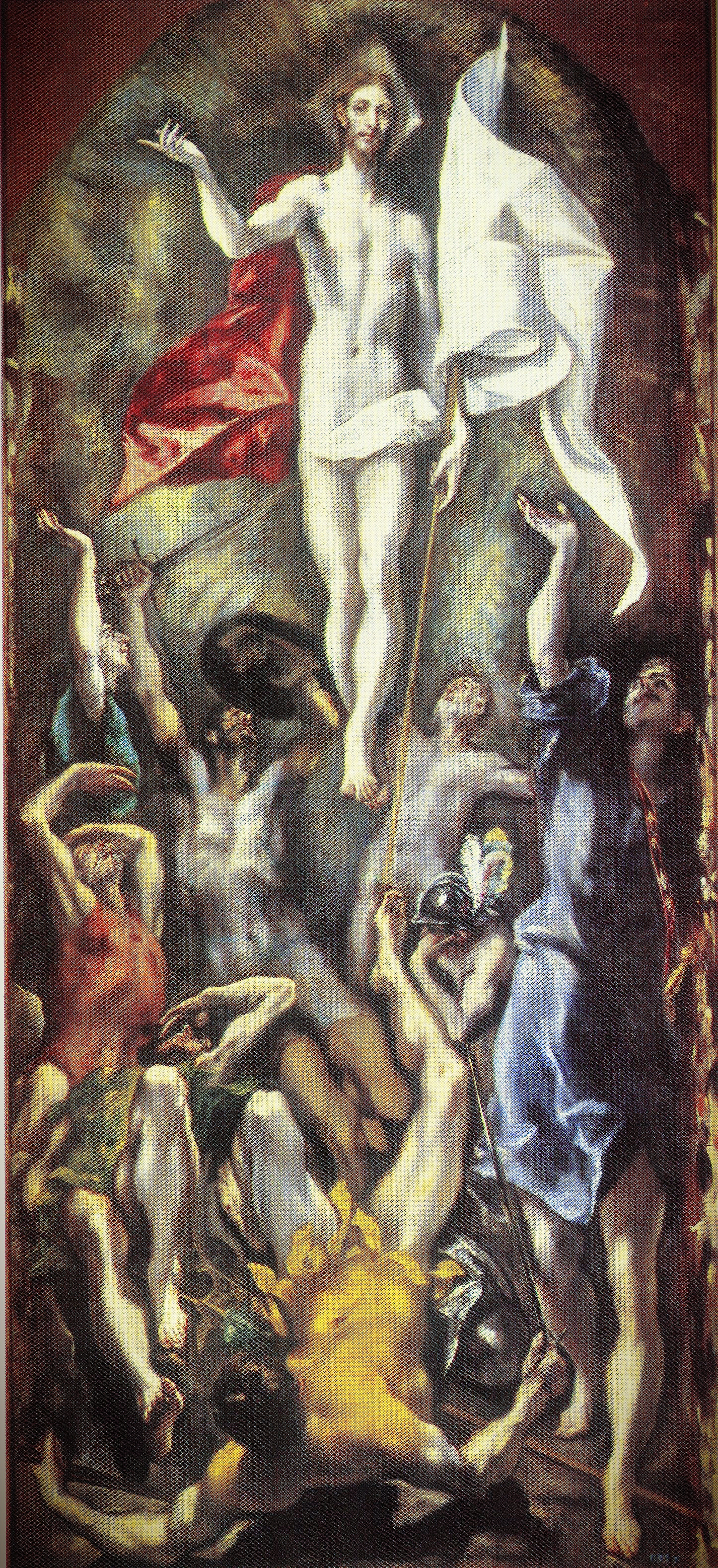
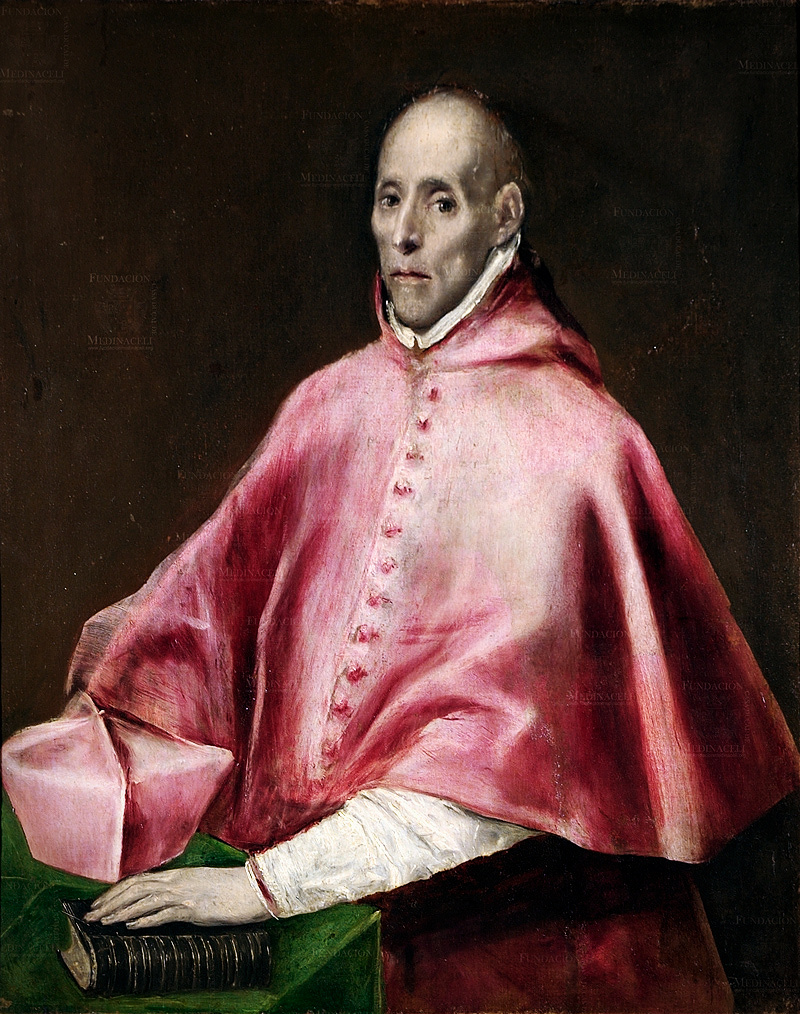
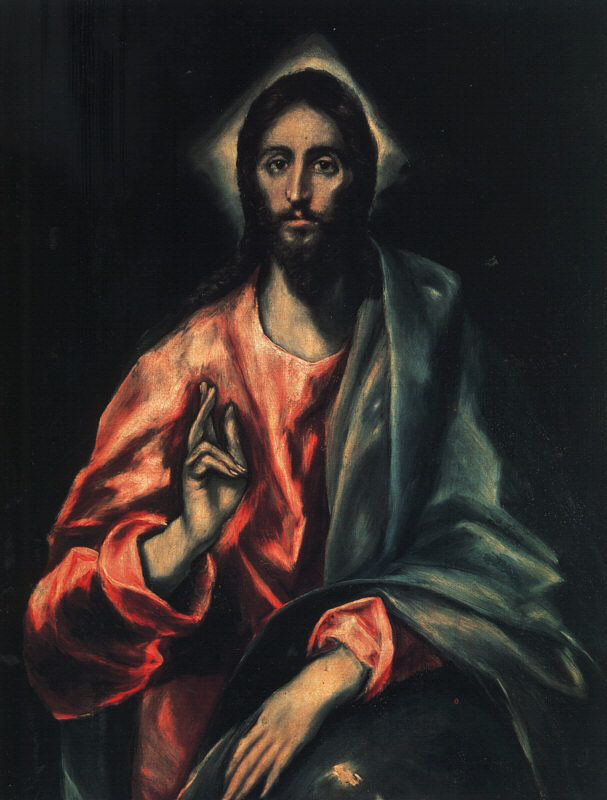
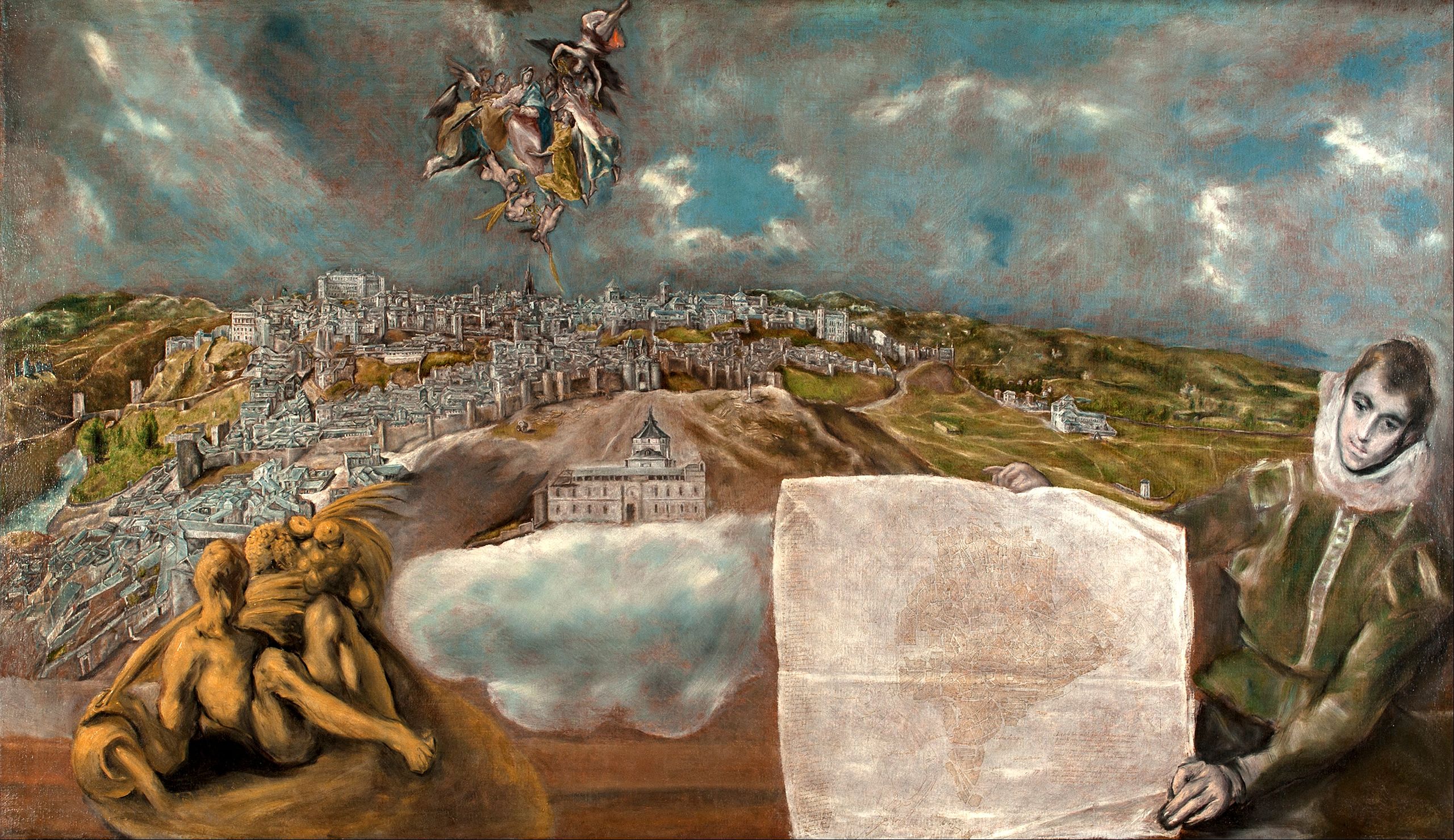
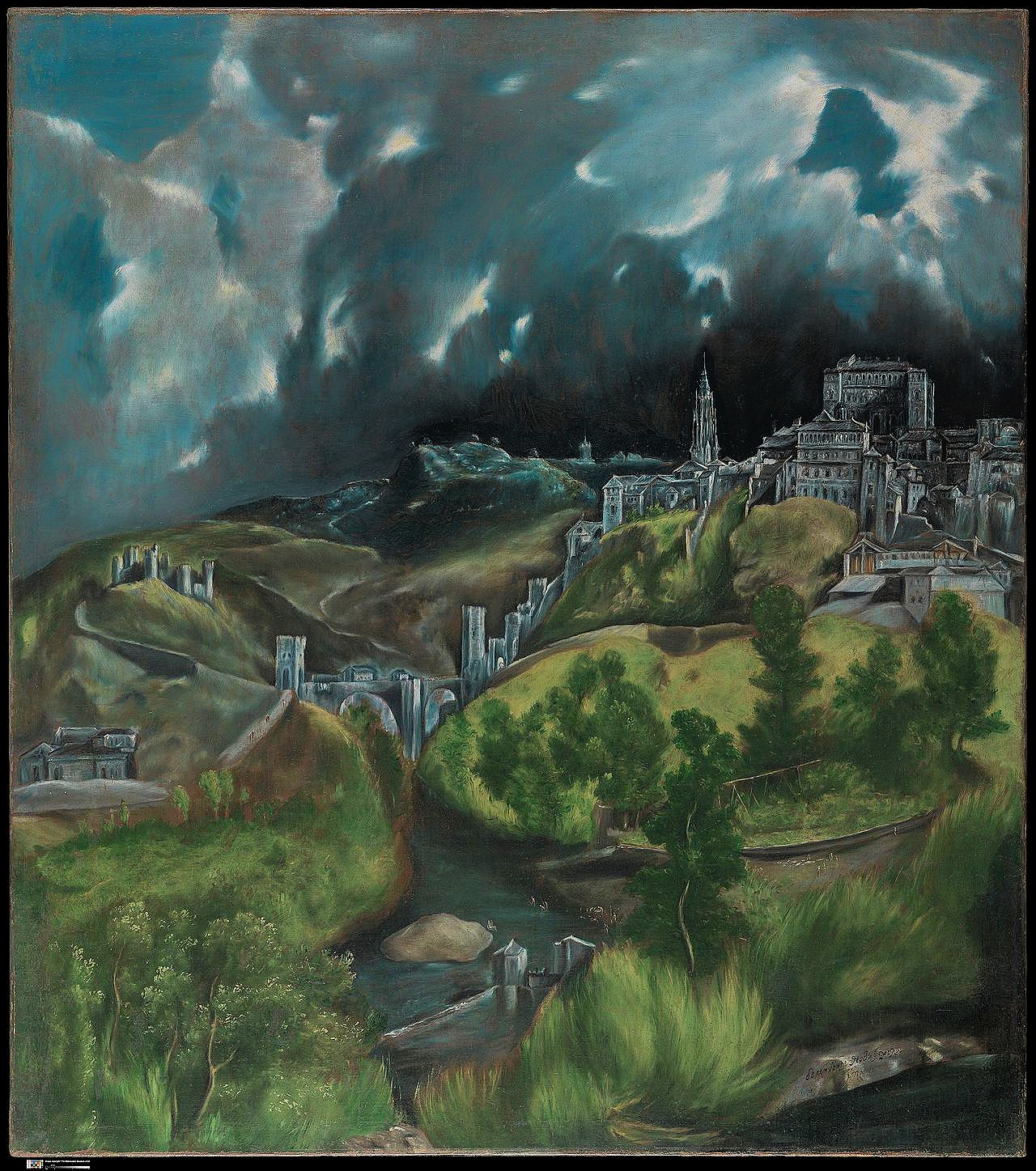
SPAIN. EL GRECO (Domenikos Theotokopoulos)(Greek, 1541-1614), Brilliant painter of mystical events.

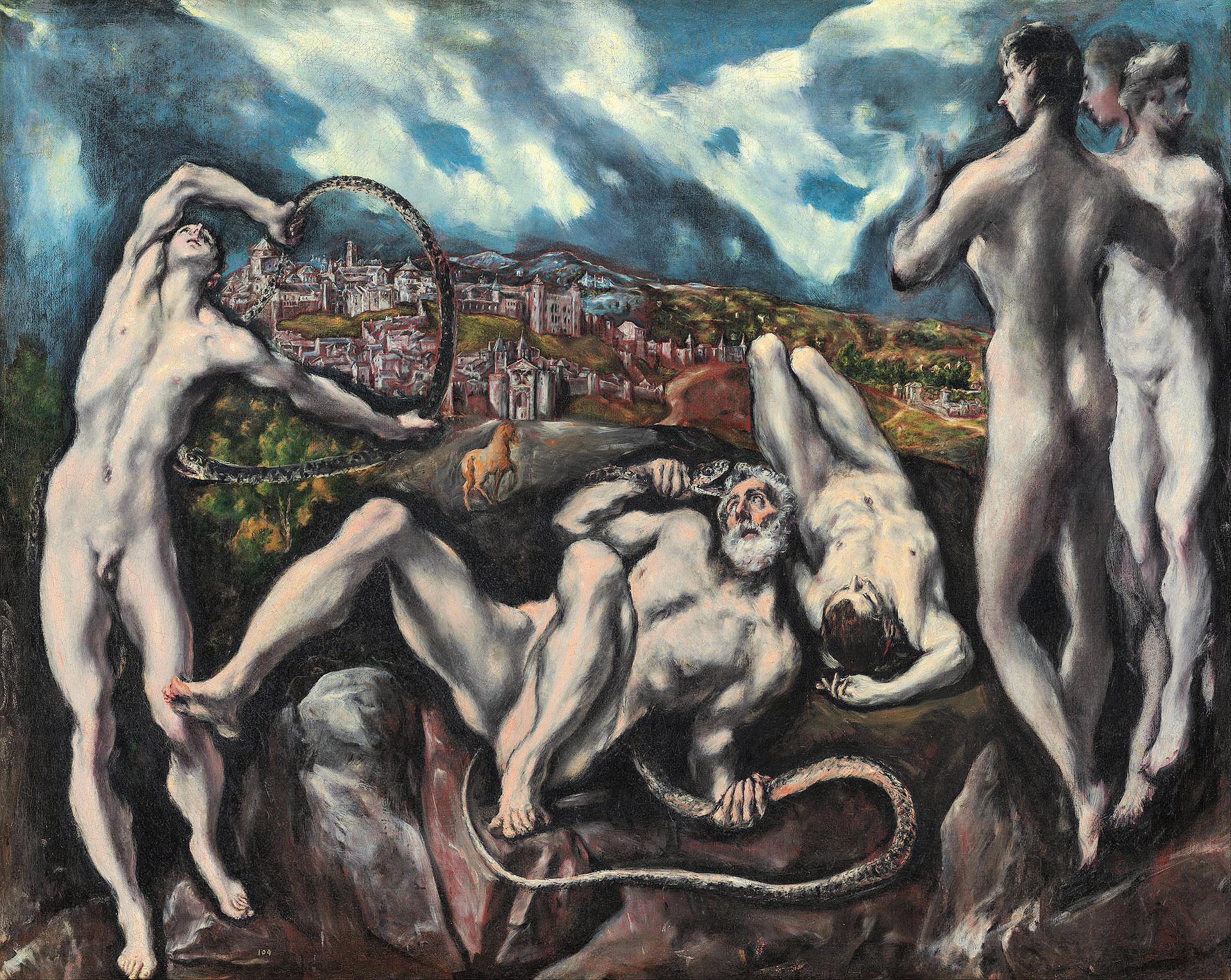
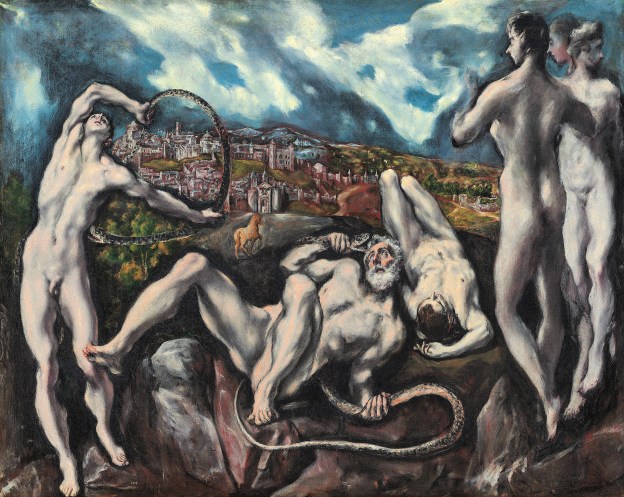
FEATURE Image: El Greco (Domenikos Theotokopoulos), Laocoön, oil on canvas, 1604-1614, 55 7/8 x 76″, National Gallery of Art, Washington, D.C. In Greek and Roman mythology, Laocoön is a Trojan priest who warned the Trojans to destroy the Trojan Horse sent by the Athenians and is punished with death by the gods for it. See the artwork again below for details about El Greco’s painting.
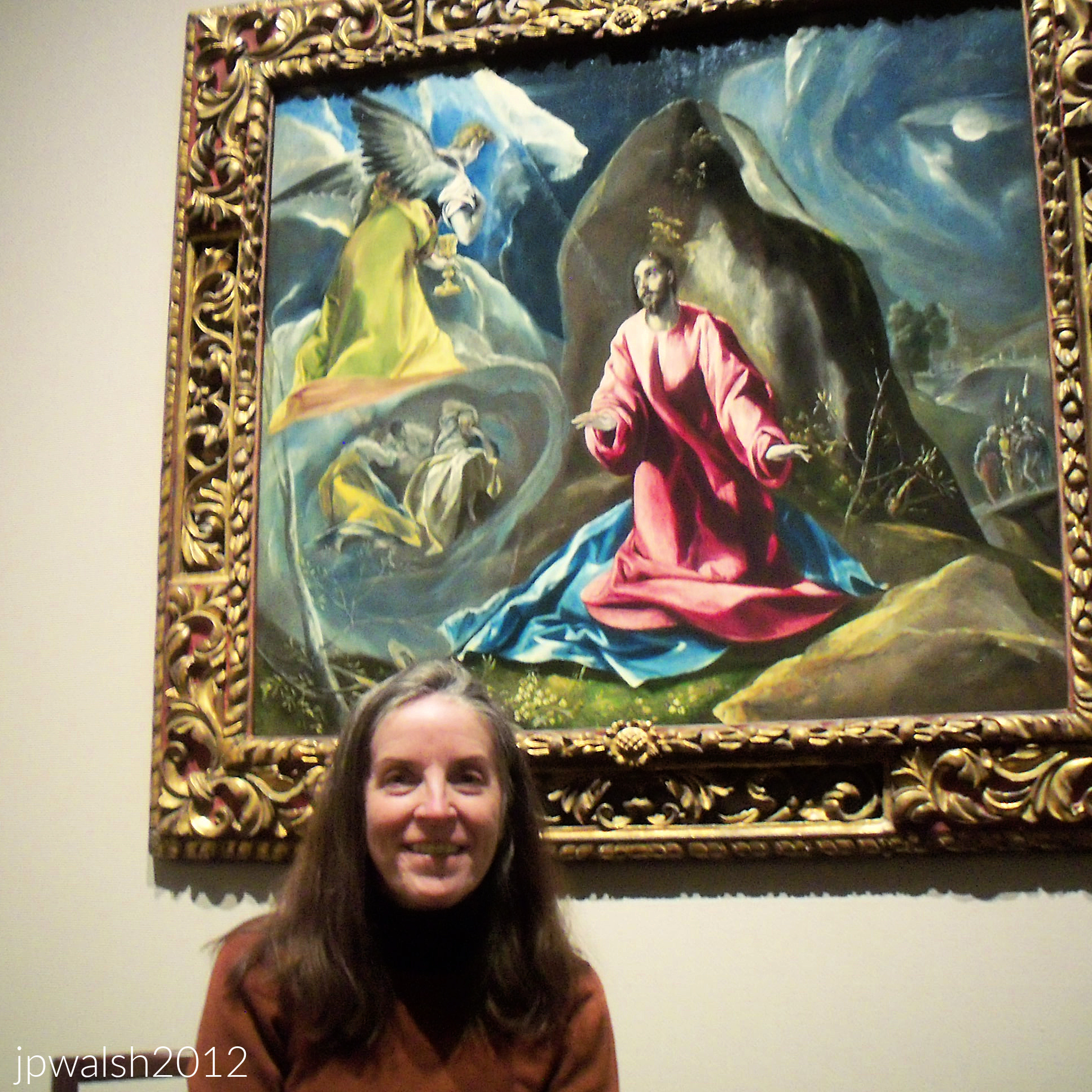
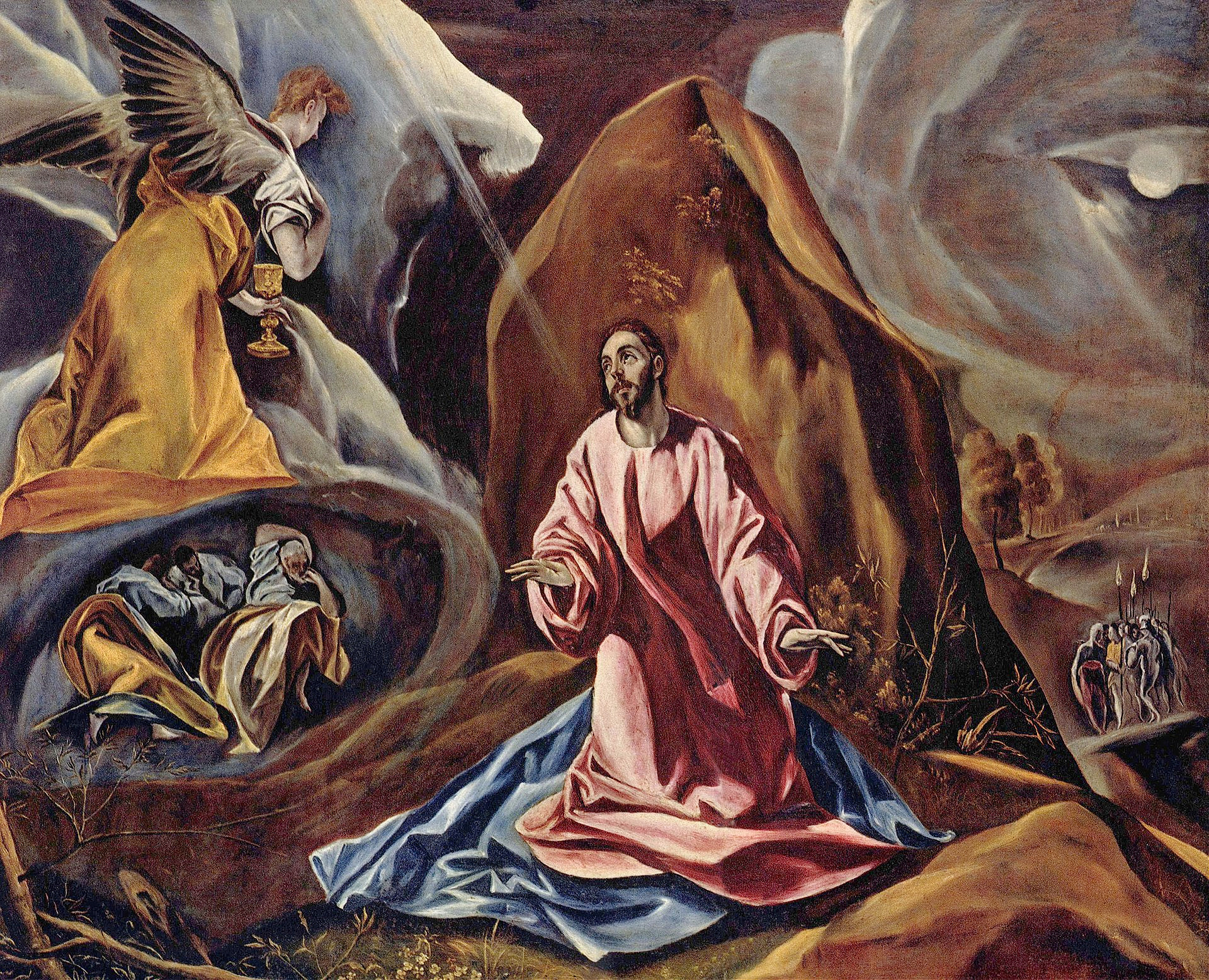
The Agony in the Garden, Domenikos Theotokopoulos, called El Greco, c. 1590-1595, oil on canvas, 40 1/4 x 44 3/4 in. (102.2 x 113.7 cm) Toledo Museum of Art, Gallery 15. November 2012 .1.32mb 101_0977.

From the museum label: With his intensely personal style, El Greco (“the Greek”) is one of the most original artistic visionaries of any era. Born Doménikos Theotókopoulos on the Greek island of Crete, he trained in Venice and Rome before settling in Toledo, Spain, where he painted this picture. Jesus is shown praying in the Garden of Gethsemane, outside Jerusalem, just before his arrest for his teachings (Judas and the Roman soldiers are approaching at the right). His disciples Peter, James, and John sleep at left. The consciously manipulated scale of the elongated figures, the intentionally jarring colors, and the deliberately confusing space (where exactly is the angel in relationship to the sleeping apostles?) add to the drama and emotion of the scene and capture Christ’s spiritual struggle as he agonizes over his coming crucifixion. Combining aspects from all four biblical accounts of the narrative for his own interpretation of the story, El Greco gives visual form to Christ’s metaphor in Matthew 26:42—”Oh my Father, if this cup may not pass away from me, except I drink it, thy will be done.” see – The Agony in the Garden – Search el greco (Objects) – Search – eMuseum – retrieved December 10, 2025.
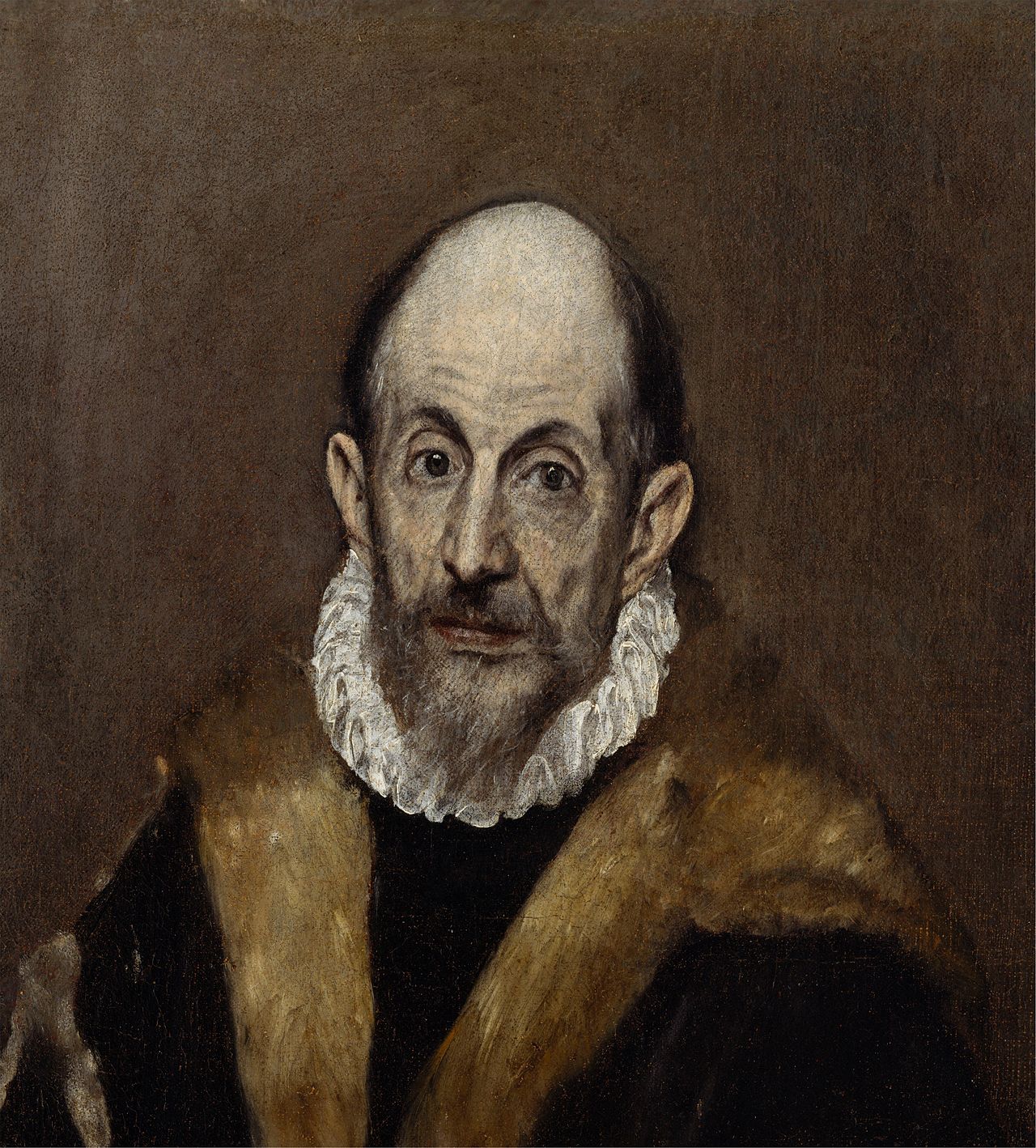
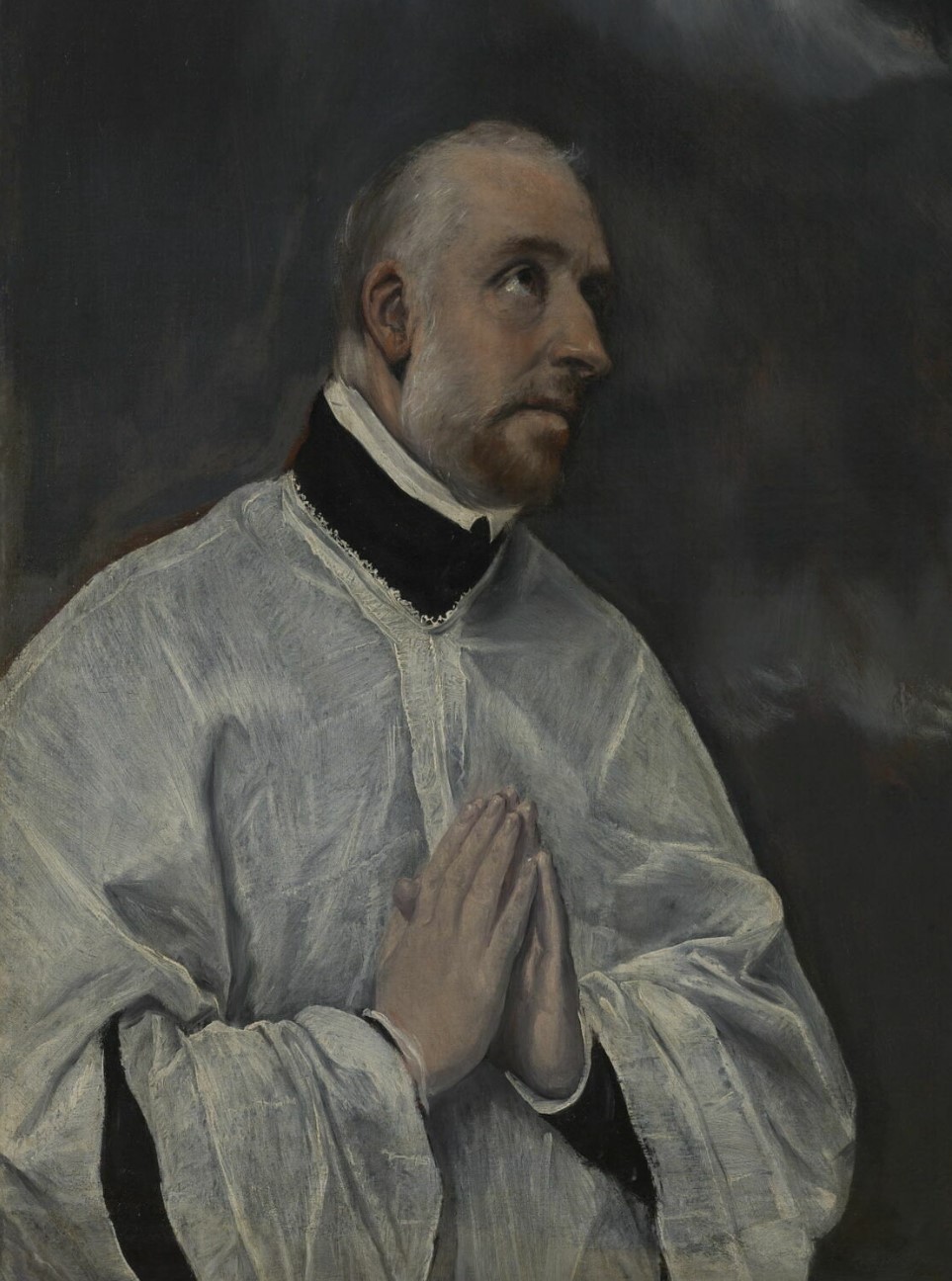
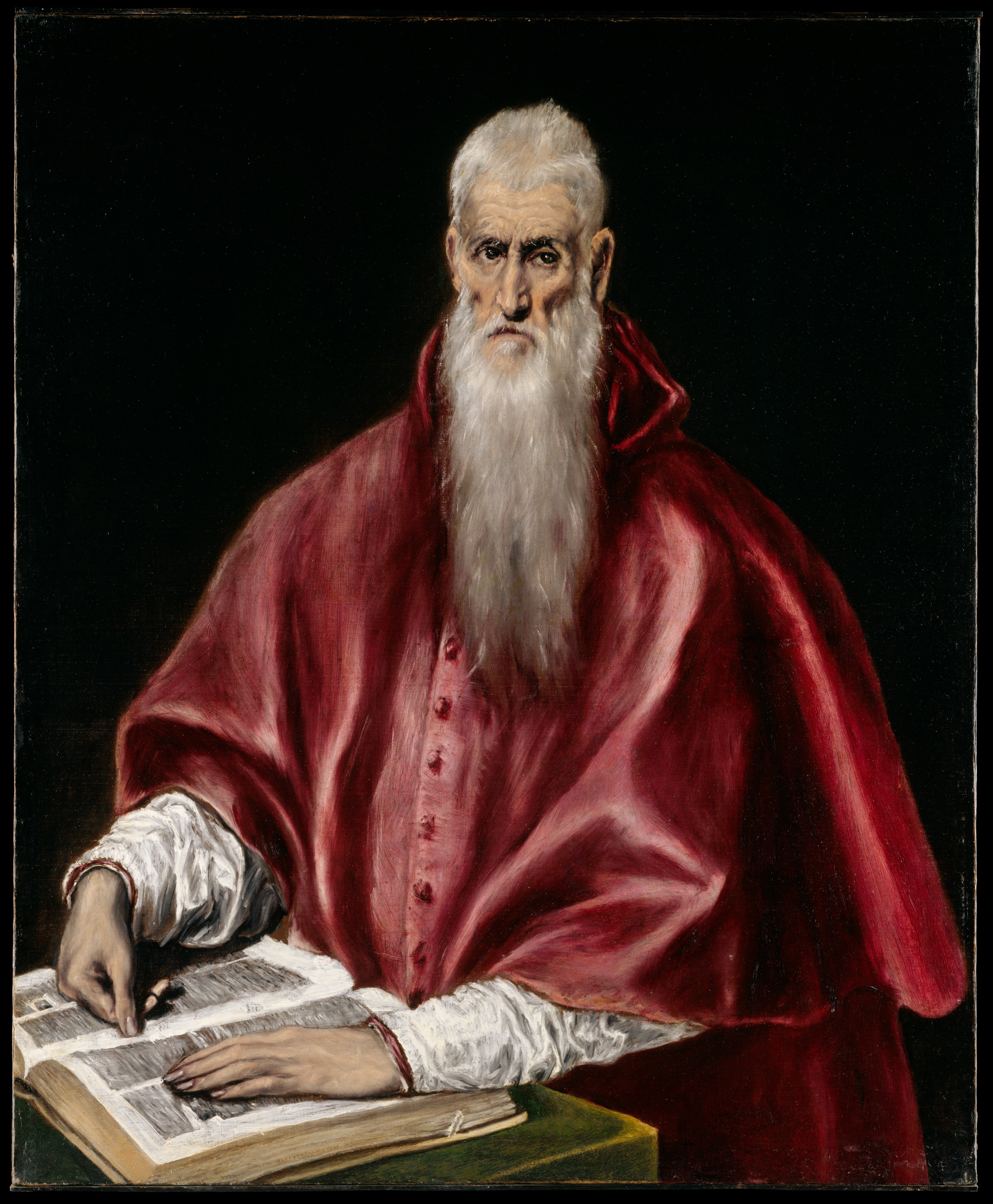
El Greco (Domenikos Theotokopoulos), Self-Portrait or Portrait of an Old Man, oil on canvas, 52.7 cm × 46.7 cm (20.7 in × 18.4 in), The Metropolitian Museum of Art, New York.

Usually identified as a self-portrait, it is supported by the fact that the same figure appears several times in El Greco’s oeuvre and ages alongside the artist. The portrait shows the influence of Titian (1489-1576) and Tintoretto (c.1518-1594) whose artwork El Greco saw in Venice.

THE ARTWORKS:
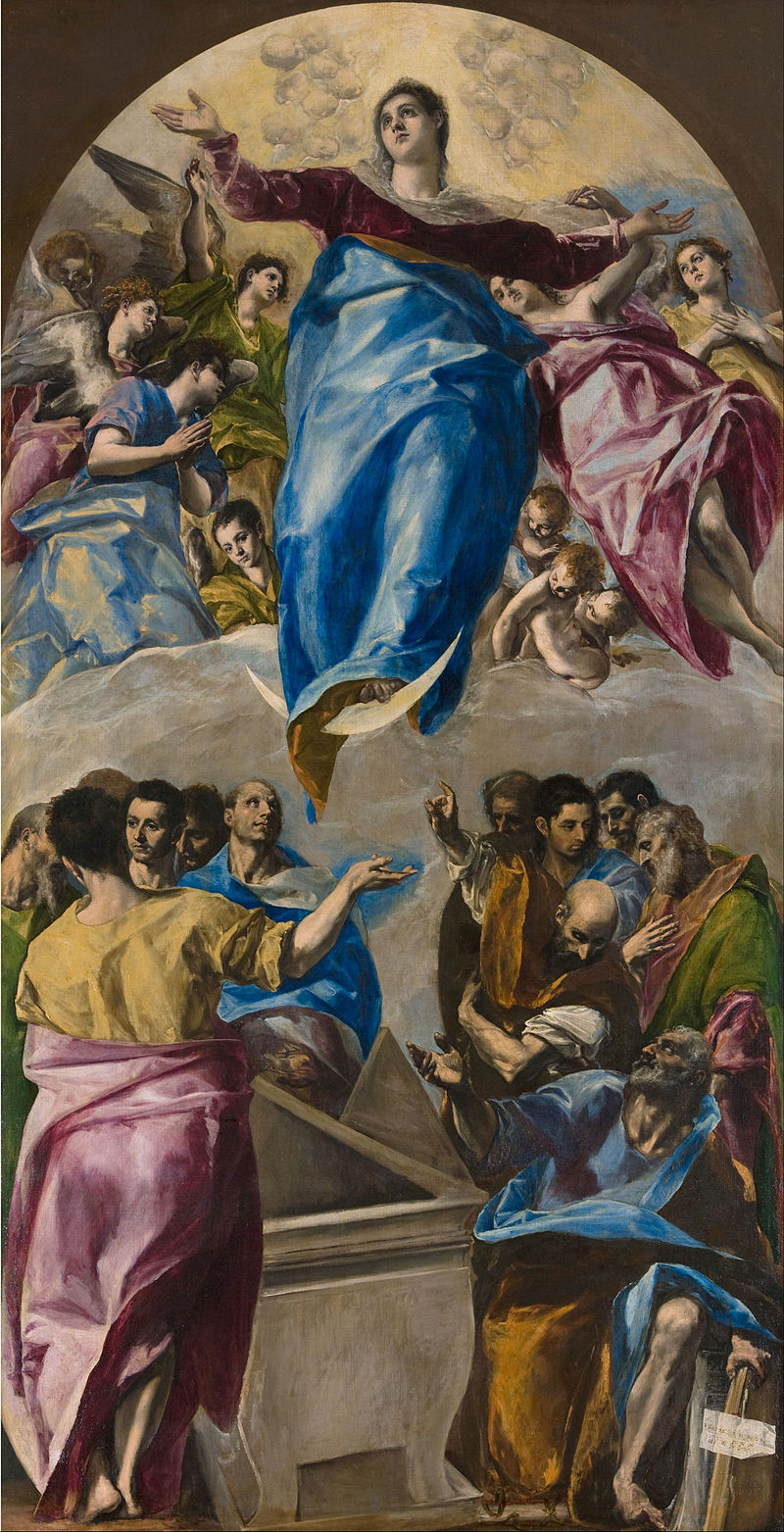
El Greco, The Assumption of the Virgin (Church of Santo Domingo el Antiguo, Toledo, Spain), 1577-79, The Art Institute of Chicago.

Part of an altar ensemble, Assumption of the Virgin is 13 feet high and 7 feet 6 inches wide. In the painting there are two principal groups – the Virgin and angels above and, below, the 12 apostles and an empty sarcophagus. It was the first major commission for El Greco for the Bernadine Convent Santo Domingo el Antiguo in Toledo, Spain. It was in the funerary chapel of Doña María de Silva. El Greco in Spain is first recorded on July 2, 1577 (Toledo Museum of Art, El Greco of Toledo, (exhibition catalog), Boston: Little, Brown and Company, 1982, p.16). On August 8, 1577 a contract was made for the main altar series  which included The Assumption of the Virgin. El Greco agreed to complete the project in twenty months for a  payment of 1500 ducats. The artist signed and dated The Assumption in 1577 and was paid in full in 1578. The painting was installed in September 1579 and remained in the church for the next almost 250 years. (Ibid., p 152; Wood, James, AIC – Essential Guide, Chicago, 2003, p.131). In 1827 The Assumption of the Virgin was purchased by Infante Don Sebastián Gabriel de Borbón (“S.G.”). An inventory of S.G.’s estate lists The Assumption as #26, one of only two sixteenth century Spanish paintings in his collection of more than 200 works. The listing reads: “Otro en id de 14 pies y 5 pulgadas de alto por 8 pies y 3 pulgadas de cnaho. Su asunto, la Ascension de la Virgen, y los Apóstoles, alrededor de Sepulcro. Esta restaurado por Bueno. Tiene marco tallado y dorado…Dominico Greco.” [“Another in dimension (ideación) of 14 feet and 5 inches high by 8 feet and 3 inches wide. Its subject, the Assumption of the Virgin, and the Apostles, around the sepulcher. It was restored on the up and up. It has carved and gilt markings.” – my translation.] (Agueda, Mercedes, “La colección de pinturas del infante Don Sebastián Gabriel,” Boletín del Museo de Prado, iii/8 (1982), pp.103 and 106; 102-17; American Art News, Jan. 7, 1905, Vol. III, p.1.; Toledo Museum of Art, El Greco of Toledo, p.153). In 1837 S.G.’s collection of paintings was confiscated because of his political (pro-Carlist) activities. Along with pictures acquired from the suppression of the religious orders during the Napoleonic occupation (1800-12) his collection of paintings (including presumably #26 in his 1835 inventory) was exhibited at the Museo de la Trinidad. (Boletín, p. 103; Groveart.com, “Borbón y Braganza, Don Infante Sebastián Gabriel.”) S.G.’s property was returned to him shortly before his death in 1875. The Prado describes events until 1902 like this: “La colección…a la muerte del Infante…fue nuevamente exhibida en publico por sus herederos con motivo de una venta realizada en Pau en 1876, añadiéndose al núcleo primitivo de la colección la parte correspondiente llevada al matrimonio por su segunda esposa, Ma Cristina de Borbón. En 1890, su hijo Pedro pone en venta en el Hotel Druot de Paris parte de la colección y unos años más tarde se hace lo mismo en Madrid, bajo el nombre de la Infanta Maria Cristina. De las tres ventas sucesivas 1876, 1890 y 1902 se desprende como los colecciónistas fueron despojando del conjunto todo lo que podriamos llamar grandes piezas…”[… the collection at the death of the Infante was exhibited anew in public in a sale held in Pau in 1876 for the benefit of his heirs. Adding itself to the primitive nucleus of the collection was that respective part brought to the marriage by his second wife, Mrs. Cristina de Borbón. In 1890, her son Pedro put up for sale at the Hotel Druot in Paris another part of the collection and some years later did the same thing in Madrid under the name of the Infanta Maria Cristina. From these three successive sales of 1876, 1890 and 1902 the collectors were divesting themselves of whatever would be called the great pieces…” – my translation]. It is not yet clear at which of these three sales if any The Assumption of the Virgin found itself. What remained after the final sale in 1902 stayed in the possession of Borbón heirs. (Boletín, p. 104). In January 1905 The Assumption of the Virgin was purchased by Durand-Ruel and exhibited in his Paris gallery. (American Art News, Jan. 7, 1905, vol. III, p.1). Durand-Ruel had purchased it from the Spanish Bourbon family into whose possession it came in 1811. The painting was being exhibited at the Prado when Durand-Ruel purchased it in January 1905. Durand-Ruel was dealing in other El Grecos around that time such as acquiring his Laocoön in 1910 and selling it to Paul Cassirer in Berlin by October 1915 (today it is in the National Gallery of Art in Washington, D.C.). On July 17, 1906, The Assumption of the Virgin was purchased by The Art Institute of Chicago for 200,000ff from Durand-Ruel in Paris. This purchase for an American museum reflected the daring and independent judgment of its purchasers. The painting had always been praised as the artist’s most beautiful and was considered a homage to Titian’s composition in the Church of Santa Maria Gloriosa dei Frari in Venice while also expressing Roman monumentality. (Horowitz, Helen L., Culture and the City: Cultural Philanthropy in Chicago from the 1880s to 1917, Lexington: The University Press of Kentucky, 1976, p. 101; The Art Institute Chicago 28th Annual Report, June 1, 1906-June 1, 1907, pp.20 and 59; Toledo Museum of Art, El Greco of Toledo, p.153). In February 1915 Mrs. Nancy Atwood Sprague, widow of Art Institute of Chicago Trustee Arnold Sprague, gave $50,000 to defray the artwork’s purchase expenses. From the very beginning this El Greco painting was considered the Museum’s most important acquisition of the year and called the greatest work of El Greco outside Spain. (Chicago Art Institute Bulletin, Mar. 1, 1915, p. 34).
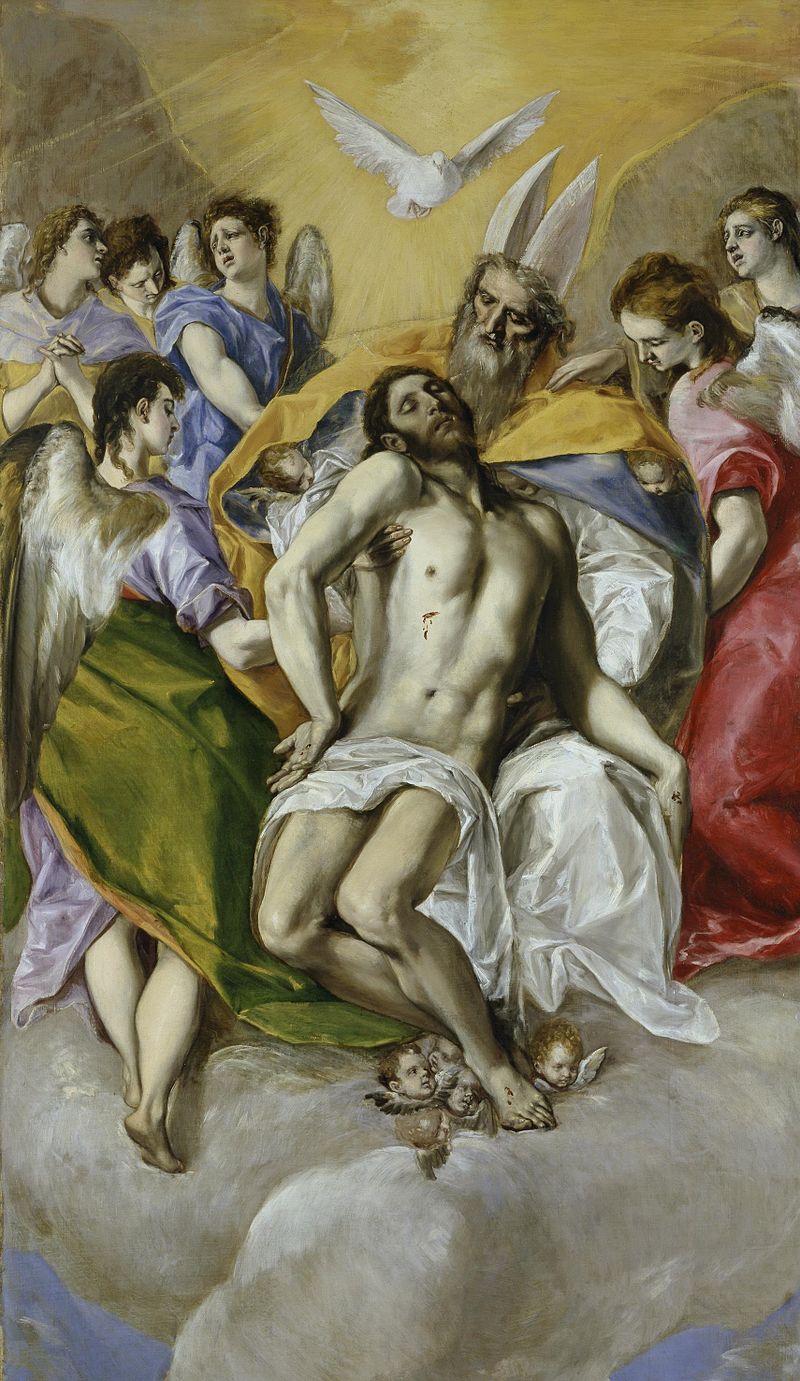
El Greco (Domenikos Theotokopoulos), The Holy Trinity,1577–1579, 300 x 178 cm, oil on canvas, Museo del Prado, Madrid, Spain.

The painting of the Holy Trinity was part of the altar ensemble for El Greco’s first major commission. It was above The Assumption of the Virgin with God the Father holding the dead Christ surrounded by angels and a white dove hovering above signifying the Holy Spirit.
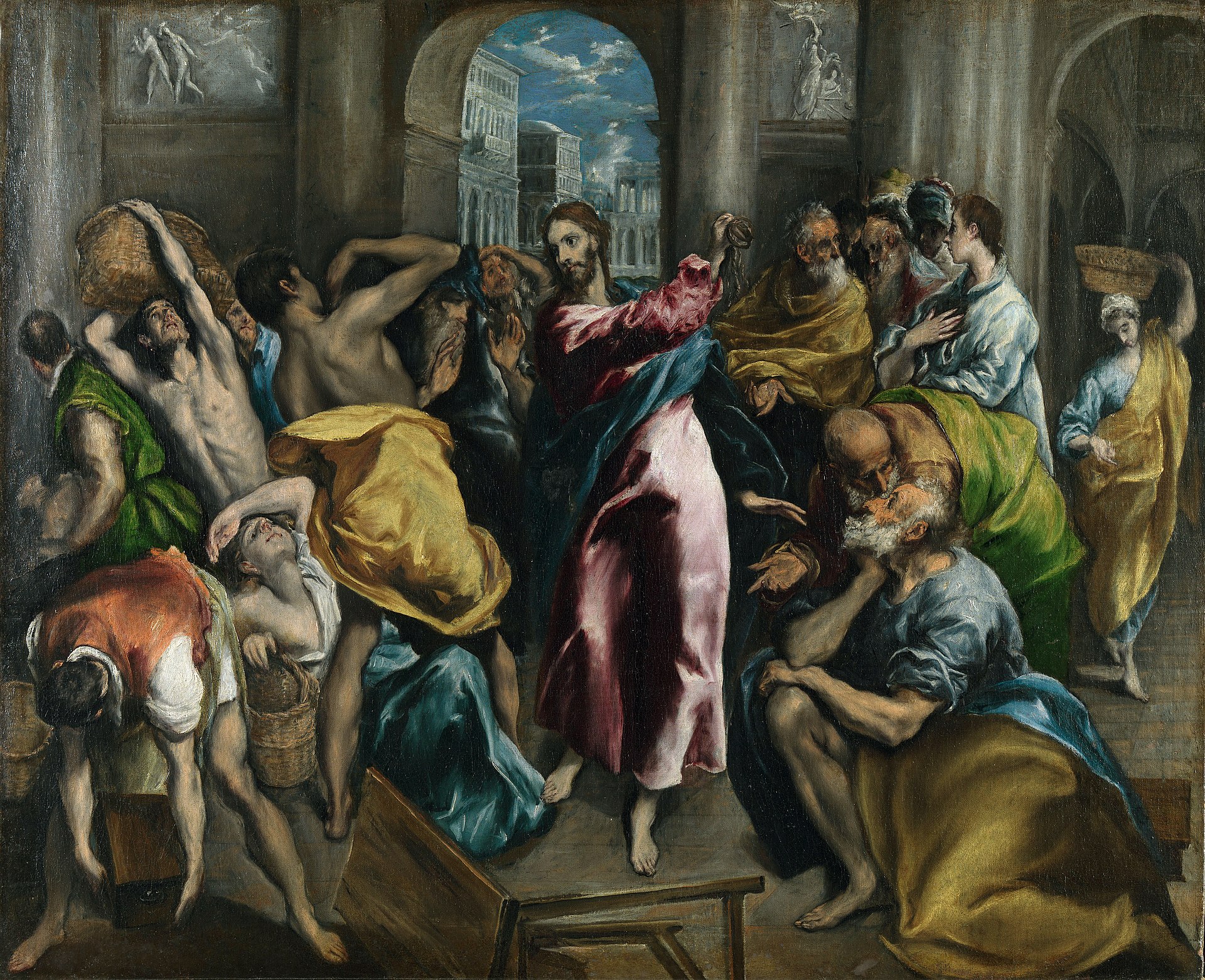
El Greco (Domenikos Theotokopoulos), Cleansing of Temple, 1584-94 or after 1604,  41 ½ x 50 ½ inches, National Gallery London. https://www.nationalgallery.org.uk/paintings/el-greco-christ-driving-the-traders-from-the-temple – retrieved November 18, 2024.

El Greco painted this episode of the Purification of the Temple many times, a story that appears in all four Gospels. The artist used intense colors and exaggerated gestures to express the chaos and disruption of the moment when Jesus Christ, angry that the temple was being used for sinful commerce and not prayer, makes a whip and uses it to drive out the traders selling animals for sacrifice. In the upper left corner is a painted sculpture of the expulsion of Adam and Eve from the Garden by the Angel of God reinforcing the message of sinfulness in the trader’s actions in the scene. At right in contrast, Christ’s apostles stand beneath a painted relief sculpture of faithful Abraham. The story of the Purification of the Temple told in Chapter 2 of John’s Gospel relates: “…Jesus went up to Jerusalem. He found in the temple area those who sold oxen, sheep, and doves, as well as the money-changers seated there. He made a whip out of cords and drove them all out of the temple area, with the sheep and oxen, and spilled the coins of the money-changers and overturned their tables, and to those who sold doves he said, ‘Take these out of here, and stop making my Father’s house a marketplace.'” El Greco painted Christ’s body energetically twisted with his right arm raised and ready to strike the man draped in yellow cloth he is gazing at. The man in yellow mirrors Christ’s pose as he recoils, arching his back and raising his hand to protect himself. The figures behind him lean in the same direction backwards to avoid being struck in the melée. The painting shows El Greco’s debt to Renaissance art such as Titian and Michelangelo (1475-1564) whose artwork El Greco studied during his travels to Venice and Rome. The figures behind Christ are much calmer. The gray-bearded man with his hand on his knee looking up in a yellow and blue costume is identified as Simon Peter. While the foreground setting suggests a grand columned one that is only partially seen, the buildings in the background with their arched arcades were likely inspired by architecture El Greco saw in Venice in 1568.
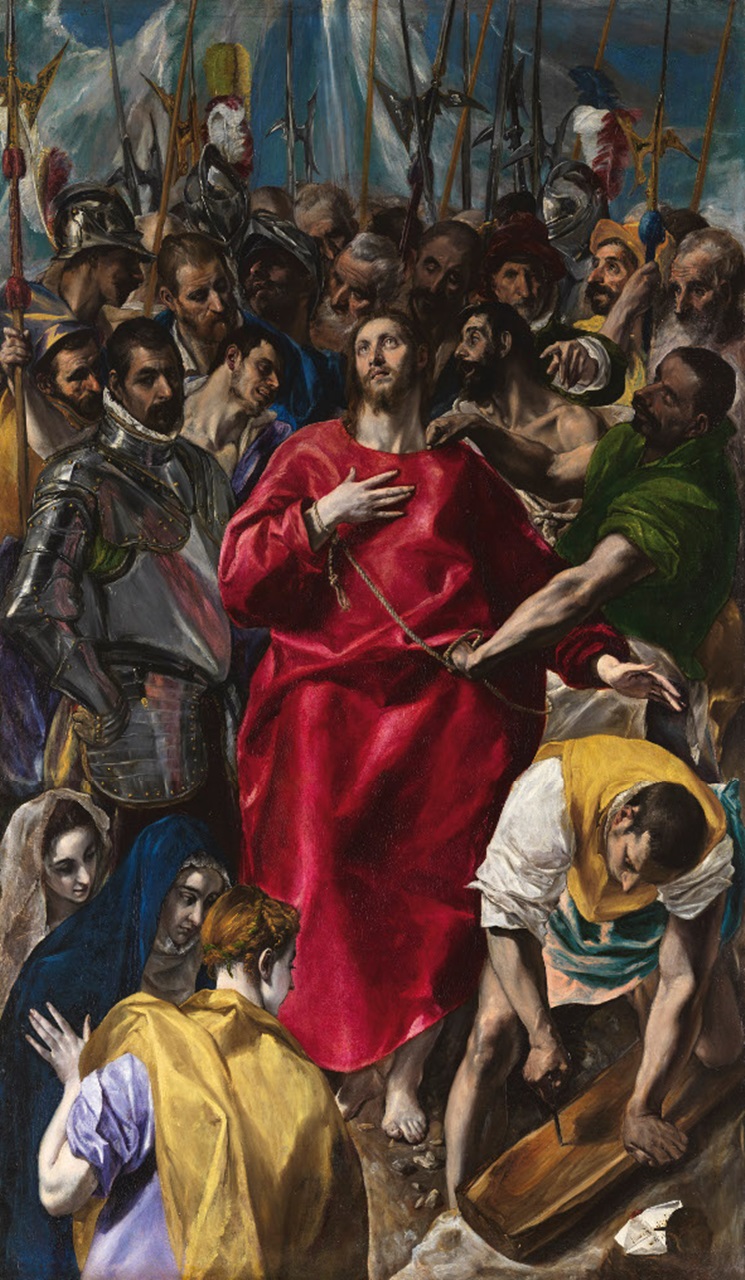
El Greco (Domenikos Theotokopoulos), The Disrobing of Christ (“El Espolio”), 1577-1579, oil on canvas, 285 x 173 cm, Sacristy, Cathedral, Toledo.

One of the finest and most important paintings of El Greco’s career, El Espolio was commissioned on July 2, 1577, by Diego de Castilla, the dean of the cathedral in Toledo, Spain, and hung in the vestry (where clergy dress in their vestments). In 1612 it was moved into a re-modelled sacristy (where the sacred vessels are held) and placed in a new post and lintel frame in the 1790’s. El Greco shows Christ looking serenely skyward, a pathway of clouds signaling upwards to his Father in Heaven. In the center of the painting, Christ is dressed in a bright red robe as he is being tormented by his captors. A figure behind his left shoulder points at Christ accusingly while a man in green holds a rope tied around Christ with one hand as the other is ready to disrobe his garment. Two others behind Christ argue over who will get his garments. Christ’s imminent crucifixion is signaled by the man in yellow at the lower right bending over a cross and drilling holes into the wood preparing it for the nails to be driven through Christ’s feet. At the lower left are the three Mary’s who contemplate the crucifixion scene with distress. The man dressed in typical 16th century armor was likely a contemporary portrait and may be intended to represent the Roman centurion. The disrobing incident may be inferred by the mention in all four gospels of the Roman soldiers playing dice for his robe. Apocryphal sources describe this moment of disrobing that include the figural and narrative elements depicted in El Greco’s painting. The artwork was intended for the vestry where a priest dresses for the Mass, a ritual action that mystically re-presents under the sacramental signs of bread and wine the same sacrifice of Christ on Calvary’s cross. This significance becomes El Greco’s main focus in the picture as Christ’s blood red robe is executed with a dynamic and energetic technique. see – El Greco, David Davies, National Gallery Company, London, 2003, p.122.
Metropolitan.
Philadelphia Museum of Art.
Church of San Tomé, Toledo
Prado.
Museum of San Vicente, Toledo.
National Gallery of Art, Washington, D.C.
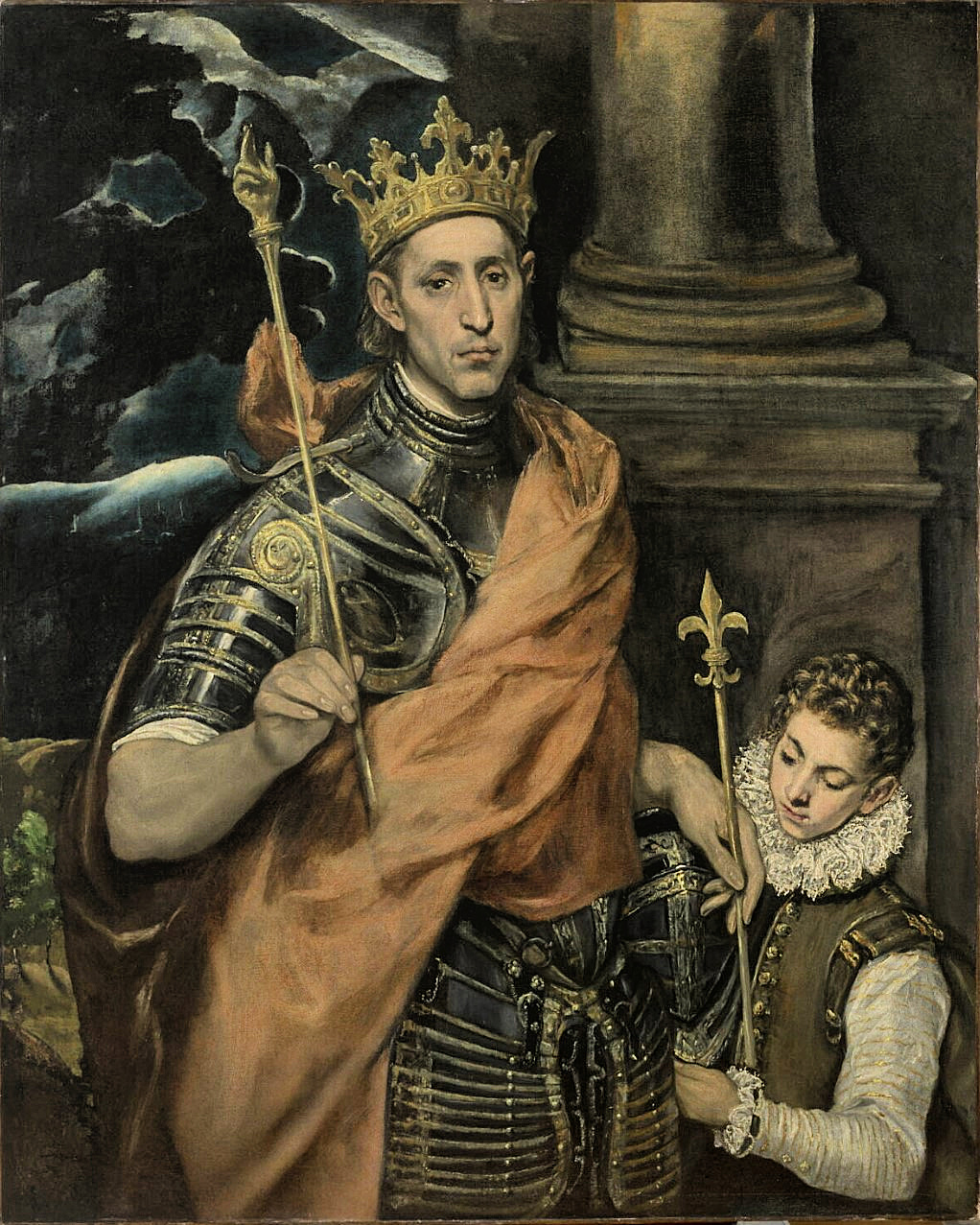
El Greco, Saint Martin of Tours and the Beggar, 1597-1599, oil on canvas, 193.5 × 103 cm (76 3/16 × 40 9/16 in.), National Gallery of Art, Washington, D.C. https://www.nga.gov/collection/art-object-page.1164.html – retrieved November 11, 2024.

The painting was commissioned by Martín Ramírez for the Chapel of San José in Toledo, Spain. El Greco painted miracles as matter of fact. St. Martin and The Beggar depicts a scene from a low vantage point looking up to a monumental knight sharing his cloak with an attenuated, nearly otherworldly figure of a naked beggar. St. Martin of Tours (d.397), part of the Imperial Calvary stationed near Amiens during the times of Roman Emperor Constantine, sits mounted on a magnificent white Arabian steed and is dressed in stylishly practical soldier regalia from head to foot signifying his noble role and power to survey this emerald green landscape that is Toledo and the Tagus river. Martin’s green cloak is one part of his regalia but, on a cold autumn or winter day, his heart burns to divide it with his sword so to share it with this naked bandaged stranger he meets on the road. The encounter and action are modest and profound simultaneously– a typical social setting yet not merely transactional within a rigidly conceived social order but a tender act of charity. Martin rode off with his half cloak and thought of his soldierly duties. Yet it afforded a miracle. That night, tradition relates, Christ appeared to Martin in a dream revealing that the beggar the knoght shared his cloak with was Him.
Hospital of San Juan Bautista, Toledo.
Louvre.
Louvre.
Prado.
Prado.
Metropolitan.
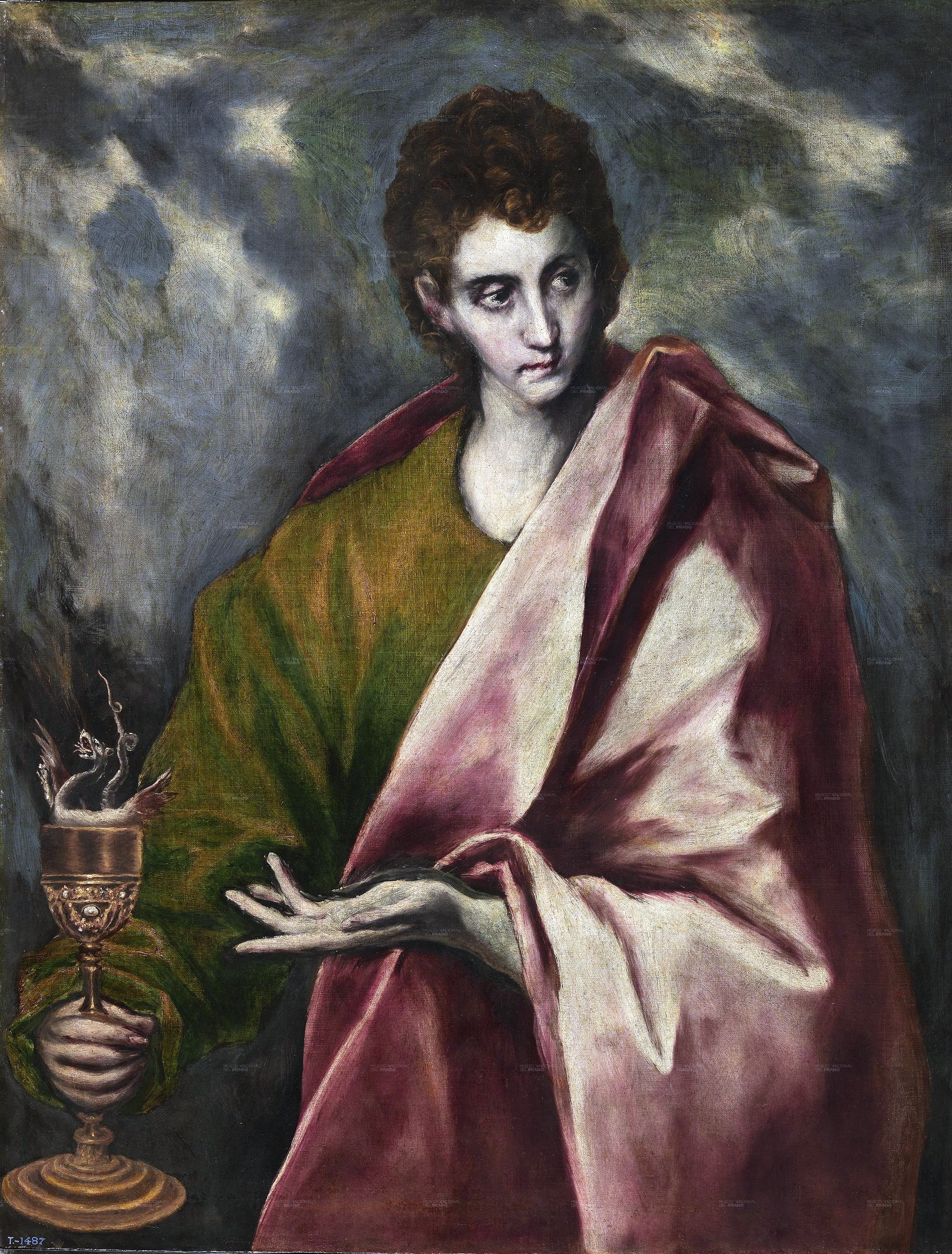
El Greco, Saint John the Evangelist, c. 1605, oil on canvas, 35 1/4 x 30 3/8 in., Prado, Madrid. https://www.museodelprado.es/en/the-collection/art-work/saint-john-the-evangelist/b107d798-268f-41aa-8b4c-f47eff9c1768 – retrieved November 19, 2024.

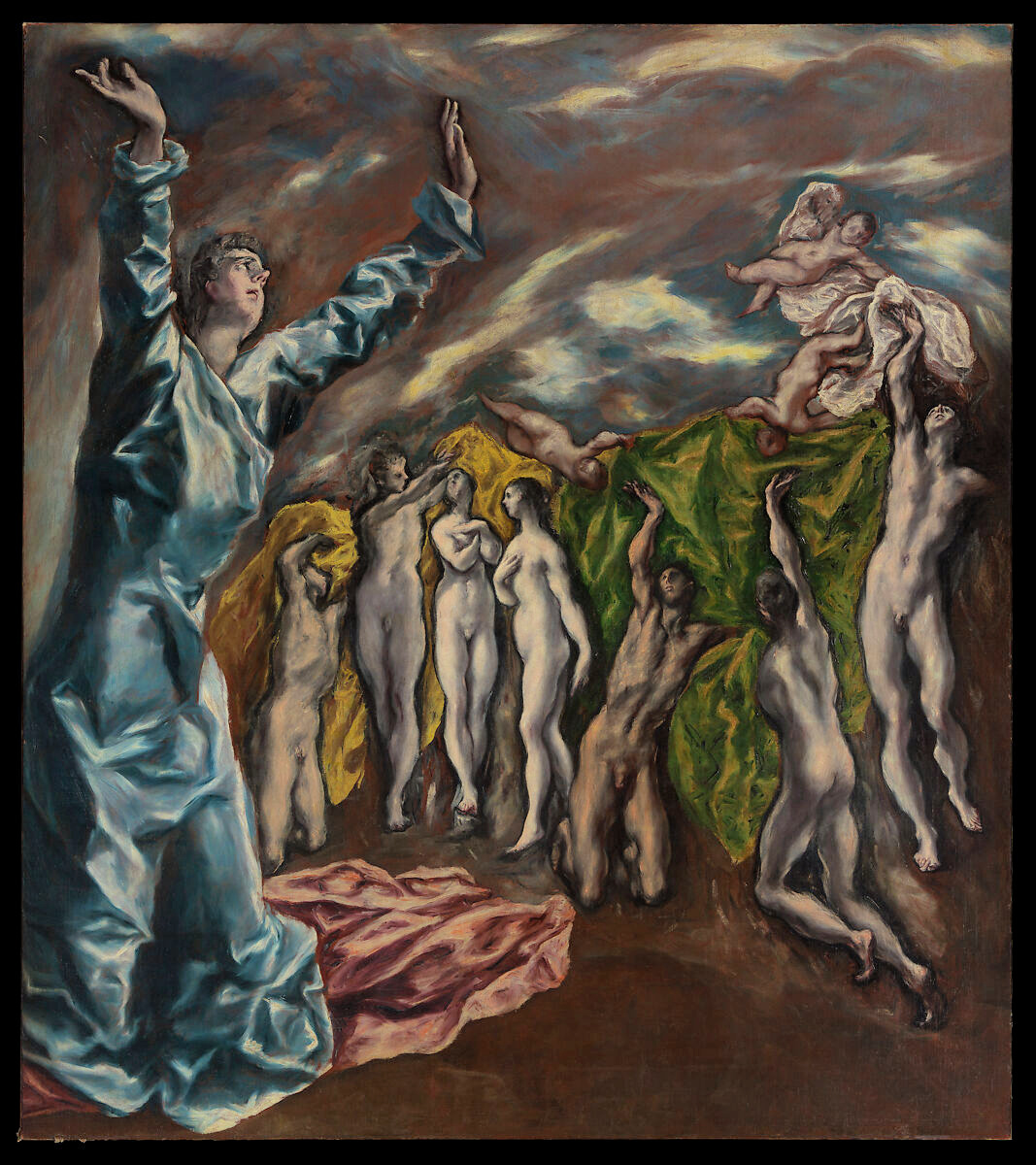
This painting shows St. John the Evangelist in a half-figure which has a clear precedent in the Venetian school where El Greco completed his training. Crete, where El Greco was born, was a Venetian possession. El Greco arrived to Venice as a teenager in the late 1550s or early 1560s where he worked with Titian (c. 1490-1576) but became the admirer and heir of Tintoretto (c. 1518-1594). El Greco, who studied icon painting in Crete, learned the medium of oil from its virtuoso Titian, but once in Venice, El Greco quite normally was attracted to Tintoretto, the city’s then-modern master. “The Greek” did not simply imitate Tintoretto’s exterior forms but very personally emulated his deeply spiritual and expressive Mannerism. In this later painting, El Greco depicts the tradition that John the Evangelist was in Rome when the Emperor Domitian (51-96) tried to assassinate Jesus of Nazareth’s young apostle by poisoning the wine in his Mass chalice. But the legend relates that the poison turned into a fabulous serpent tipping off John and his holy companions and doing them no harm. Like Lorenzo Lotto (c. 1480-1556), El Greco depicts this story’s externals surrounding John – be it the heavy chalice, poisonous serpent exorcised from it, or the expressive hands of the apostle holding the cup of sacrifice and motioning towards it – to scrutinize the inner conviction or character of the sitter, the young author of the Johannine corpus of a gospel, three letters, and the book of Revelation. On John’s Gospel Cornelius à Lapide (1567-1637) wrote that the Evangelist was indeed the eagle (inspired by a description in Ezekiel) who soars skyward and swoops down to earth for his prey. John wrote the last canonical gospel in 99 with combatting that day’s Christian heresies in mind, specifically those that denied Christ’s divinity – whom in his epistles he called “anti-Christs.” John conveys sacred ideas with a rusticity of style. The 17th century theologian and biblical scholar Cornelius à Lapide affirmed that “John was most like Christ” and that the disciple loved the master supremely and the master held the disciple most dear. Because of the relationship of Jesus and John, the biblical scholar claimed, “when you read and hear John [in his gospel, letters, and book of Revelation] think that you read and hear Christ.” He quotes St. Jerome who claimed that Christ transfused his own spirit and his own love including “the purest streams of Jesus Christ’s Doctrines” into Saint John. This relationship is signaled by John’s reclining on the breast of Christ at the Last Supper. John, now in old age, was pressed by all the bishops in Asia and many others to write a “breakthrough” account claiming of the deepest things of the Divinity of the savior. John agreed with the condition that the whole church fast before he embarked on the project and when the fast ended John began: “In the beginning was the Word, and the Word was with God, and the Word was God. 2He was in the beginning with God. 3All things came to be through him, and without him nothing came to be.” Nothing is stronger to attest to the origin, eternity, and generation of the divinity of the Christ. John wrote in the Greek language because he was addressing Greeks but, again according to Cornelius à Lapide, the gospel is filled with Hebrew phrases and idioms because St. John was a Hebrew who loved his native language. Though John relates Jesus’s miracles as proof that Christ was the Messiah, God as well as man – including the singular accounts of the changing water to wine at the wedding feast of Cana (chapter 2) and the raising of Lazarus from the dead (chapter 11) – John less relates actions of Christ as found in the synoptics Matthew, Mark, and L uke who focused on his humanity and much more of the discourses and disputations that Christ had with the Jews (mostly its rulers), again with none other than the same purpose to prove his theology meant for the whole world that Christ was “God as well as man.” In John’s gospel a careful examination of contexts needs to occur because Christ speaks sometimes as man and sometimes as God. Its high theology which dealt with the inspiration of the Holy Spirit, unity of the Godhead, and divine relations and attributes became that gospel in the next centuries that the bishops referenced to combat their day’s heresies such as Arianism (which denied Christ’s Divinity), the Docetists (who denied Christ’s humanity), and Nestorians (who denied Christ’s dual natures). John had favorite terms and ideas he repeated in his gospel – calling Christ “the Life” and “the Light.” Calling saints “the children of light.” Calling sin “darkness.”
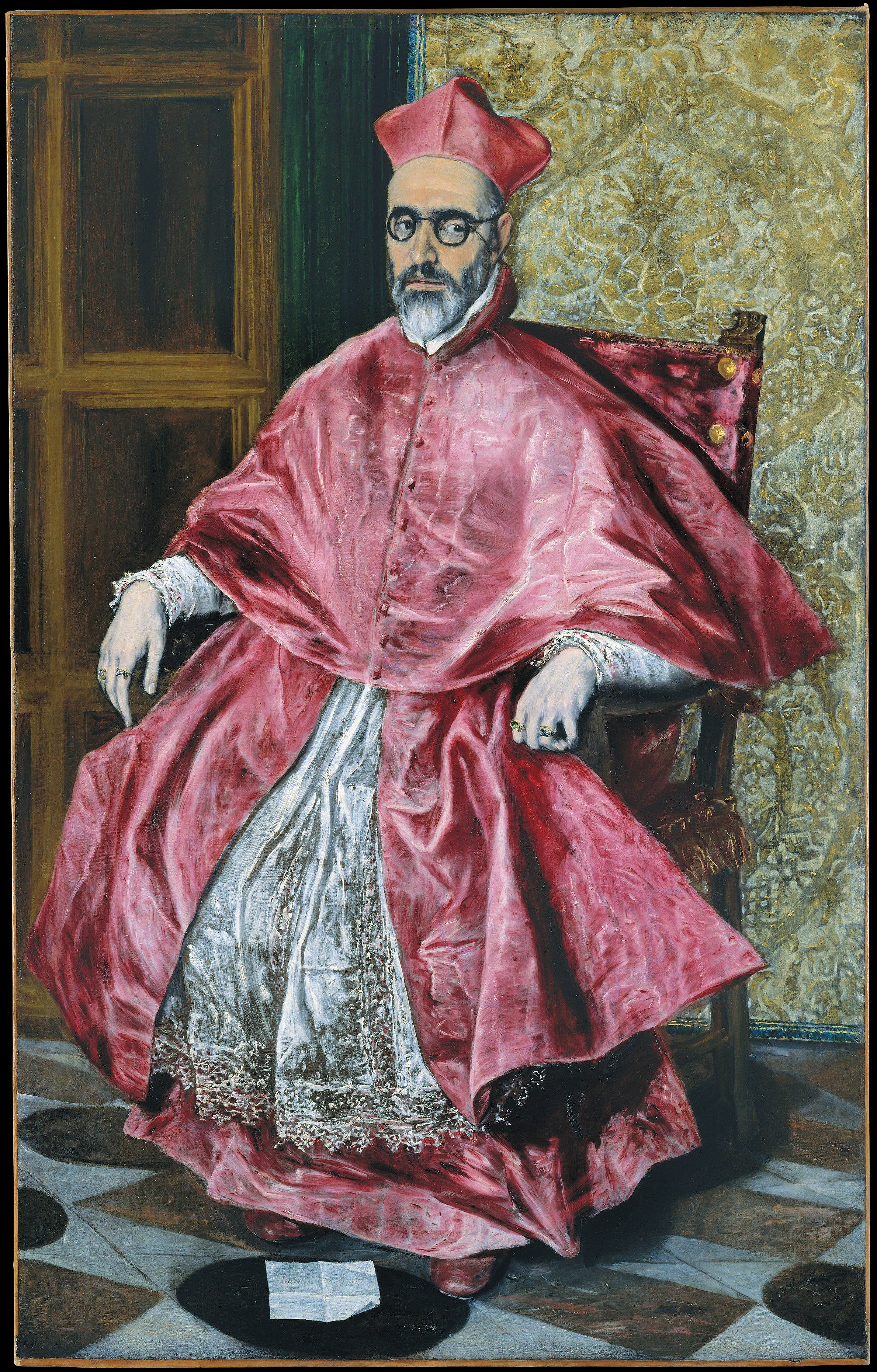
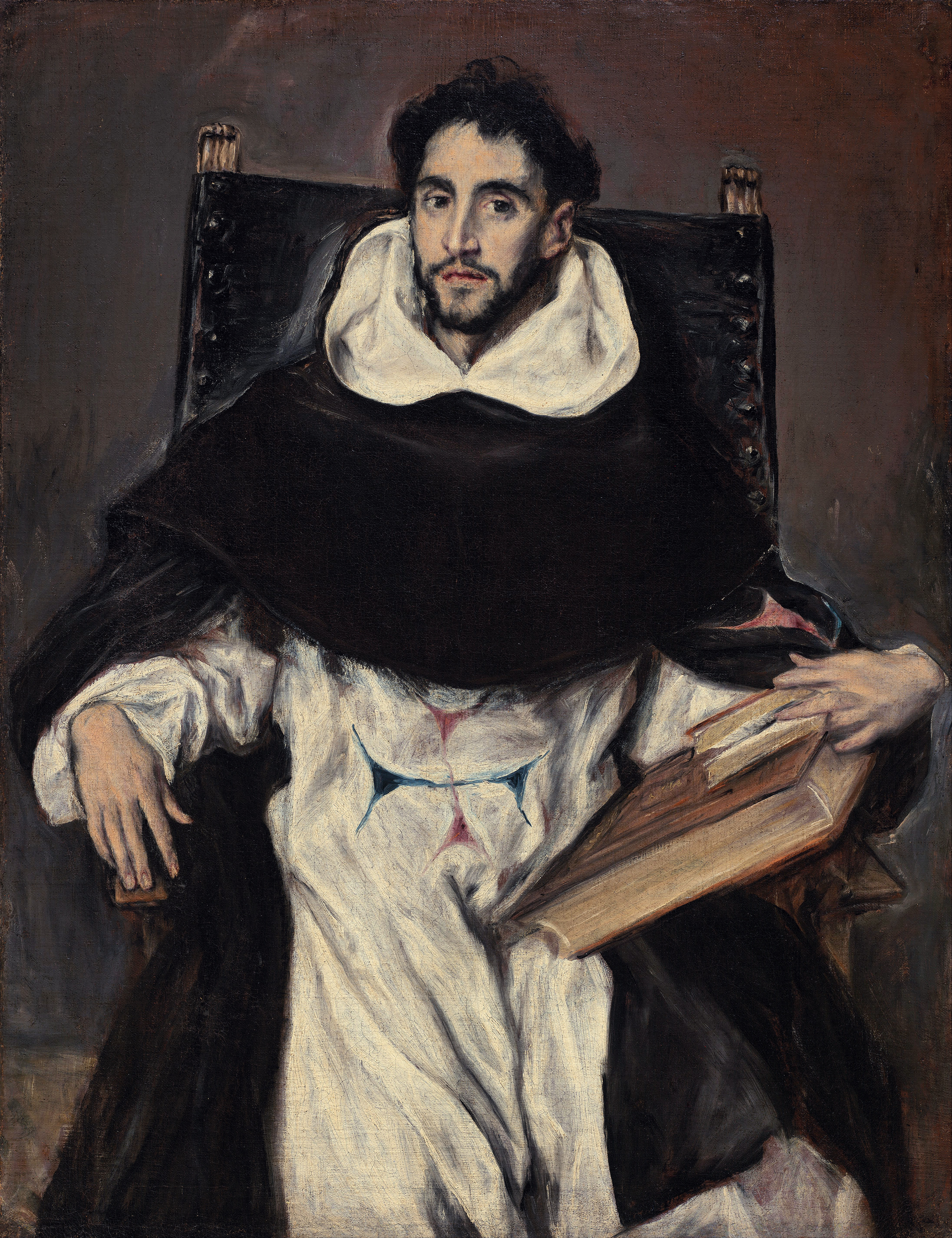
Metropolitan.
Museum of Fine Arts, Boston.
Prado.
Greco Museum, Toledo.
Hospital of San Juan Bautista, Toledo
Greco Museum, Toledo.
Greco Museum Toledo.
Metropolitan.
National Gallery London.
National Gallery of Art, Washington, D.C.

As mentioned in the feature image caption, Laocoön is a Trojan priest in Greek and Roman mythology who warned the Trojans to destroy the Trojan Horse sent by the Athenians by which they won the war. “I fear the Greeks even when they bear gifts,” he told them (see Edith Hamilton, Mythology, p. 285). Laocoön and his two sons are punished for revealing this truth by the gods. They are attacked by giant serpents sent out of the sea by Apollo and Artemis that bit and crushed them to death and then slithered away into Athena’s Temple in the city. The Trojans, instead of heeding their priest’s warning and seeing his death for what it was — the punishment for telling them the truth of the danger of the Trojan Horse — viewed it as warning not to question the entry of the monumental wooden horse into the city. They pulled it in, set it in front of Athena’s Temple, and went to their homes believing they had won a peace that had not happened in ten years. El Greco set the artwork outside Toledo giving the ancient tale a contemporary context and unique interpretation. Though Laocoön and his two sons’ fates are sealed, the artist captures a unified centrifugal movement with individualized figures in bare-faced struggle after exercising their prudential judgment that is witnessed by dispassionate onlookers as if in a dream.
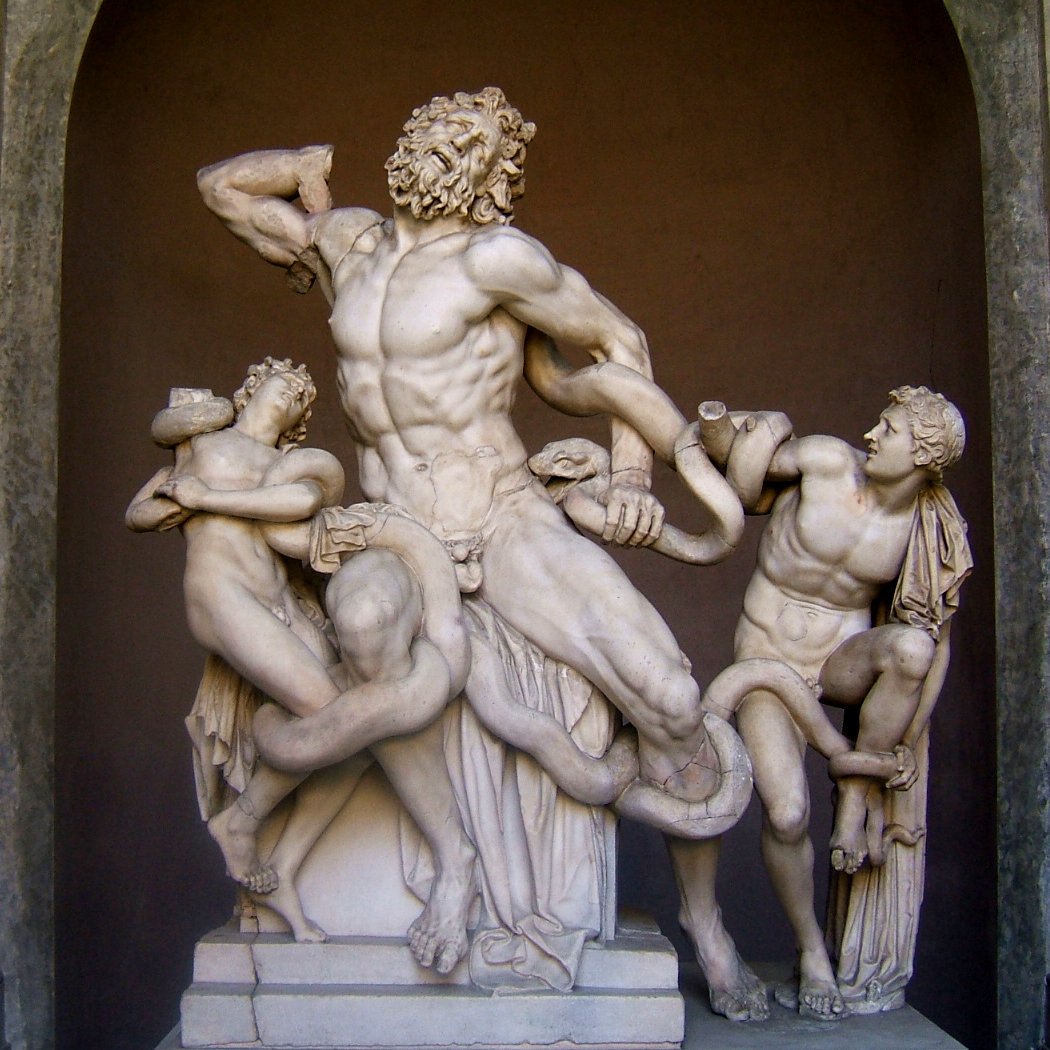
Laocoön and His Sons, 1st CE?, marble, 242 cm high, Vatican Museums, Vatican City. The classical marble sculpture was unearthed in 1506 and housed in the Belvedere in the Vatican. Its discovery aroused great excitement in the Renaissancce art world and numerous copies were made. El Greco’s painted extrapolation was taking this passion of classical suffering to the level of one’s own modern synthetic invention where the colorful sensation of upheaval is dynamic. Laocoön and His Sons” by JuanMa is licensed under CC BY-SA 3.0.
Metropolitan.

SOURCES:

El Greco, Leo Bronstein, Harry N. Abrams, Inc. New York, 1990.
El Greco of Toledo, Jonathan Brown, William B. Jordan, Richard L. Kagan, Alfonso E. Perez Sanchez, Little, Brown, Boston. 1982.
El Greco, David Davies, National Gallery Company, London, 2003.
Mythology Timeless Tales of Gods and Heroes, Edith Hamilton, Grand Central Publishing, New York and Boston (originally published in 1942).


UNITED STATES. My Art Photography: JOAN MIRÓ (1893-1983, Spanish), Joan Miró’s Chicago, 1967 (installed 1981), Chicago, Illinois.

FEATURE image: July 2015. Joan Miró, Joan Miró’s Chicago (sometimes Miss Chicago), steel reinforced-concrete, colored ceramics, 1967, Brunswick Building Plaza, 69 W. Washington Street, Chicago. This artwork is Miró’s only monumental sculpture. 7.04 mb. Author’s photograph.

Joan Miró (1893-1983) is a Catalan who is a major dadaist artist  “Dada” is a nonsense word but its artistic movement that started around 1915 in Zürich, Switzerland, has brought into existence many famous artworks by a range of artists. As World War I raged on in Europe between 1914 and 1918, young artists and intellectuals reacted with art, performance, and poetry that was radically experimental, dissident and anarchic. These artists countered the horrors of the war and capitalist culture by moving past a degradation of art to contributing to an anti-art under the banner of “dada.” These ideas and ideals of dada quickly spread to the art capitals of Paris and New York – and beyond.

Joan Miró’s Chicago is the artist’s first monumental sculpture in the world.

Joan Miró’s Chicago is in this dada milieu as it sits in the Brunswick Building Plaza, directly across Washington Street from another Spanish artist’s 50-foot-tall Cor-Ten steel sculpture from the same time (1967): Chicago’s Picasso in Daley Plaza. Miró’s sculpture expresses the neck, bustline, and slim and wasp-waisted hips of a woman’s torso with outstretched arms and a simplified head. She is made of steel-reinforced concrete with brightly colored ceramics that are added to the scooped-out hem of her skirt. Like other of Miró’s sculptures of female figures from the 1950s, the shape of the skirt is that of an overturned broad-lipped cup or chalice. The bronze, crown-like headdress is like the dadaist found objects that populated Miró’s artwork whether paintings, sculptures, ceramics and more throughout his career. Joan Miró’s Chicago possesses qualities evocative of primitive fertility or earth goddesses similar to those found in the ancient Mediterranean world.

One of Dada’s major sculptural forms to emerge and which was masterly accomplished by Marcel Duchamp (1887-1968), was the “readymade” which used familiar mass-produced objects (i.e., ceramic urinals, household tools, etc.) for high art pieces. The dada expression of the readymade increasingly asked the viewer to take seriously these consumer items and found objects as high art on an equal platform with lofty traditional productions of a monied arts establishment.

Dadaists experimented boldly with new media such as collage (Jean Arp, 1886-1966), airbrushed photography (Man Ray, 1890-1976) and nonsensical poetry (Hugo Ball, 1886-1927). These art forms freely combined as well as crossed over its categories, i.e., nonsensical poetry interpreted in performance art.

Joan Miró, Barcelona, June 13, 1935 by Carl Van Vechten (1880-1964). Public Domain. This work is from the Carl Van Vechten Photographs collection at the Library of Congress. According to the library, there are no known copyright restrictions on the use of this work. As the restrictions on this collection expired in 1986, the Library of Congress believes this image is in the public domain. The Carl Van Vechten estate has asked that use of Van Vechten’s photographs “preserve the integrity” of his work, i.e, that photographs not be colorized or cropped, and that proper credit is given to the photographer which is the photograph here.

Miró’s art does not accept the world as it is.

In the 1930’s and 1940’s Miró worked with material such as paper, string and even toothbrushes and, sometime later, natural objects such as rocks and fruits to make loose, playlike assemblies, many of which due to fragility or destruction, did not survive. Miró did not transform or repurpose these found objects – bells, jars, vases – but by leaving them alone saw they retained what the artist called their own “magical powers.” Miró’s more permanent artworks – paintings, ceramics, plaster or bronze sculptures, etc. – possess the same randomness as his looser assemblies which is the artist’s intended reflection of nature’s promiscuous progeny. The artist turns his back on established art principles and pursues his own independence which, following intuition unto slow resolve, improbably marries diverse objects of recognizable forms making for an assembly of more than one class or nature. They are of a realm not always of this world.

July 2015. Miró with City Hall in background. Chicago. 5.77mb DSC_0308 (1) Author’s photograph.

Though Miró completed a maquette of the sculpture in 1967 (called Project for a Monument for Barcelona), its production into a 40-foot sculpture – the artist’s only monumental sculpture – was delayed until 1979. The hundreds of thousands of dollars for the production and installation of Joan Miró’s Chicago was provided by a private-public partnership in Chicago.

SOURCES:

A Guide to Chicago Public Sculpture, Ira J. Bach and Mary Lackritz Gray, The University of Chicago Press, Chicago and London, 1983, pp. 73-74.

https://magazine.artland.com/what-is-dadaism/ – retrieved June 29, 2023.

Joan Miró, Janis Mink, Taschen, 2006, p. 93.

Miró, Guy Weelen, translated by Robert Erich Wolf, New York: Harry N. Abrams, Inc., 1989, pp. 178-179.

SPAIN. My Art Photography: PABLO PICASSO (1881-1973, Spanish). Gift to the People – The Chicago Picasso in Daley Plaza (1967).

FEATURE image: Chicago’s Picasso in Daley Plaza. Author’s photograph (July 2015).

Chicago’s Picasso in Daley Plaza. Author’s photo (July 2015).

Chicago’s “Picasso” in today’s downtown Daley Plaza was officially unveiled on Tuesday, August 15, 1967 at 12 noon.

Weeks before the public event excitement (and some dread) swirled among Chicagoans and others as to what Pablo Picasso’s monumental outdoor sculpture would be like.

In the photograph on the wall, Mayor Daley and others pull the cord on August 15, 1967 unveiling Chicago’s iconic Picasso.

The famous Andulsian-born artist was first approached by Chicago leaders in May 1963. This encounter led more than four years later to the Cor-Ten steel sculpture’s installation and unveiling on a beautiful Tuesday summer’s afternoon in the Chicago Civic Center Plaza. Many in the crowd of thousands who had gathered to witness the historic event gasped and jeered at the modernist art work when the fabric cover was taken off. Local newspaperman Mike Royko wrote in The Daily News that the art work looked like a “giant insect.” Photo Credit: “Picasso in Chicago” by Emily Barney is licensed under CC BY-NC 2.0

Chicago’s Picasso in Daley Plaza. Author’s photo (October 2011).

Chicago’s first major public outdoor sculpture started a long term national trend to display massive outdoor contemporary art for the public

The now-iconic Picasso unveiled in 1967 is credited with being the first public outdoor sculpture installed in Chicago that put Chicago on the map as one of America’s first major cities to display massive outdoor contemporary art for the public.

In 1958 there was an untitled art work by Richard Lippold (1915-2002) constructed in the lobby of the Inland Steel Building (1954-58) by Skidmore, Owings & Merrill in downtown Chicago. It is four blocks from City Hall and the new Civic Center Plaza that the same architectural firm was helping to design and build in the early 1960’s.

Untitled (known today as The Radiant One), Richard Lippold, commissioned in 1957, Inland Steel Building, Chicago. Author’s photo (December 2017).

This was followed in 1964 by a large modernist work unveiled at the University of Chicago Law School entitled, Construction in Space and in the Third and Fourth Dimensions. It was made in 1959 by Russian Constructionist Antoine Pevsner (1886-1962).
The reputation and fame of Pablo Picasso (1881-1973) in 1967 helped catapult the idea and cultural practice of the installation of modern art, often monumental, in high-profile public spaces across the country, and starting in large measure, in Chicago.

In the following years and decades installation of public art that had broadened beyond the commemorative extended to established artists, many with international reputations, as well as more recent and sometimes emerging artists. In 2021, one online list of public art on campus at the University of Chicago demonstrates its extensive practice that was largely ushered in with Chicago’s Picasso (Ira J. Bach and Mary Lackritz Gray, A Guide to Chicago’s Public Sculpture, University of Chicago Press, 1983, p. xiii; https://arts.uchicago.edu/public-art-campus/public-art-campus#Antoine_Pevsner – retrieved June 9, 2021).

Since before the mid-20th century, public art in America has been often characterized by Modernism (i.e., MoMA’s modernist sculpture garden dated from the 1940’s). Modernism began as a cultural rebellion against prevailing classical-romantic art work. Until around Rodin’s Balzac in 1898, art work in the classical and romantic style filled parks and plazas throughout the 19th century and afterwards that memorialized people, places, and events. Modernists identified the classical-romantic style as old, trite, exhausted, and artistically bankrupt in rapidly changing times. Instead, Modernism offered artistic forms and creative responses that met and expressed an increasingly global and machine age – and not by grand depictions and tired motifs of old Romans standing (or lying) on privileged porticos in togas (i.e., Thomas Couture (1815-1879) Romans during the Decadence, 1847, oil on canvas, Musée d’Orsay).

Thomas Couture (1815-1879), Romans during the Decadence, 1847, oil on canvas, Musée d’Orsay. Starting no later than 1900, contemporary society was increasingly artistically influenced by Modernism. Characterized by the rejection of centuries-old literary and historical subjects and forms, it turned to abstraction and imaginative artistic responses as more fitting expression for a rapidly changing modern society.

Pablo Picasso had dominated the modern art scene for most of the 20th century, starting and particularly as the innovator of Cubism with French painter Georges Braque (1882-1963). Picasso was one of several artists who, as Harper’s Bazaar observed about the magazine’s engagement with modern artists, “broke new ground, challenged established thinking, and signaled seismic shifts in the culture” (Harper’s Bazaar, March 2021, p. 236).

Pablo Picasso, Three Women, 1908, oil on canvas, 200x 178 cm, The Hermitage Museum, St. Petersburg, Russia.

Picasso, Student with a pipe, Paris, 1913, Oil, gouache, cut-and-pasted paper, gesso, sand, and charcoal on canvas, 28 ¾ x 23 1/8 inches, The Museum of Modern Art, New York.

Chicago’s Picasso in Daley Plaza from the side looking to the southeast. Author’s photo (July 2015).

On a representational level, a woman’s facial profile (eye, nose, lips, chin) followed by two “wings” of flowing hair, and rounded shoulders are in plain sight. Yet other interpretations for the sculpture are also reasonably feasible. For example, from the back, are the top symmetrical curves of the wings reflective of the curves of a woman’s buttocks with legs constituting the rest? Are the cut-out shapes like a head and neck in this context possibly a phallus? Picasso famously did many pieces of art that were highly sexualized. In 1932 Pablo Picasso produced an entire series of what would become iconic paintings of Marie-Thérèse Walter, his young, blonde-haired mistress, in the most lascivious and sensual positions imaginable. Picasso’s Minotaur and Wounded Horse is one example of it produced in Boisgeloup (outside Paris) on April 17, 1935 and today in the permanent collection of The Art Institute of Chicago. (See – https://johnpwalshblog.com/2013/05/15/picasso-and-chicago-the-show-may-be-over-but-its-best-parts-stay-on-display-its-called-the-art-institute-of-chicagos-permanent-collection/).

Picasso narrowed the central plane of the head toward the top, and indicated its slight tilt backward. Using Student with Pipe as a guide, what is usually interpreted as flowing hair past a woman’s head and body, these immense curved symmetrical “wings” in Chicago’s Picasso may be conceived as the shadow or shadows of a head and body. If the rods are not representative of something specific – i.e., guitar strings – but, as Picasso alluded in the LOOK interview of November 1967, an aesthetical connection, then this interpretation of a figural foreground and shadowed background that makes for a sculptural whole is also feasible.

The Chicago sculpture’s circular eyes and long flat nose are typical of Picasso heads of the 1913-1914 period which were translations of the features of African, specifically Wobé, masks. Picasso used their economy and schema to transform them into his personal and whimsical art work. (William Rubin, Picasso in the Collection of the Museum of Modern Art, MoMA, New York, 1972, pp. 88-89).

Chicago’s Picasso in Daley Plaza, Author’s photo. (December 2017).

Mask (Kifwebe), Songye, late 19th or early 20th century. Wood, pigment, 12 x 7 1/8 x 6 1/8 in. (30.5 x 18.1 x 15.6 cm). Brooklyn Museum. The object is a female mask with projecting mouth, triangular nose, pierced eyes, overall concentric linear carving, and polychrome pigment.

The mask type that was shared by other African societies is characterized by angular and thrusting forms, and the entire face is covered in unique patterns of geometric grooves. Female masks, such as this one, are distinguished by the predominant use of white clay and, in a feature shared by Chicago’s Picasso, the rounded form of the head crest. (See – https://www.brooklynmuseum.org/opencollection/objects/169088– retrieved June 9, 2021).

Picasso with wife, Jacqueline. Photo credit: “picasso” by ombrelle is licensed under CC BY-NC-SA 2.0.

Picasso was 72 years old and  Jacqueline Roque was 26 years old when they met in 1953. Picasso’s first wife, Olga Khokhlova, died in 1955. Picasso romanced Jacqueline until she agreed to date him and they married in 1961. During their courtship and marriage of 20 years, Picasso created over 400 portraits of Jacqueline, more than any of his other muses.

Picasso’s widow, Jacqueline Roque Picasso (1927-1986), gave her portrait to the president of Iceland and the bust was consigned in 1988 to the National Gallery of Iceland. A more realistic figure, Picasso’s slightly earlier art work evokes features and forms found in the abstracted sculpture for Chicago done a little later, such as the wing-shaped curves of the flowing hair that comes to a point at the bottom. https://www.listasafn.is/english/exhibitions/nr/476

Pablo Picasso, Jacqueline with a Yellow Ribbon, 1962, sheet metal, cut-out, bent, and painted, 19 5/8 inches, National Gallery of Iceland, Reykjavik.

Chicago’s Picasso in Daley Plaza. Completed no later than 5 years after Jacqueline with a Yellow Ribbon in 1962 the dramatic shapes and formulations of the monumental sculpture share recognizable affinities. Author’s photo (July 2015).

Perfect Summer’s Day for Unveiling Ceremony

August 15, 1967 was a perfect summer’s day with temperatures in the low 80s and no rain to worry about in the forecast. The Woods Theater across the Plaza on Dearborn was playing Jack Nicholson’s new film, Hells Angels On Wheels. Before the unveiling, Mayor Richard J. Daley (1902-1976) spoke before the crowd. The mayor told the crowd that he was “very happy” that they had “come to share” in the dedication of what was “a great gift to our city” by Picasso. That Mayor Daley and Pablo Picasso, both Roman Catholics, unveiled Picasso’s gift on August 15 would be coincidental to the significant Catholic religious holiday of the Assumption of the Virgin Mary that also falls on the date.

A lunch-time crowd packed the new Civic Center Plaza on the day of the unveiling. The new plaza fronted a new modernist courthouse skyscraper and a modern outdoor sculpture – Chicago’s Picasso – as the major components of architectural plans virtually from its start.

In 1963, the Public Building Commission of Chicago decided to build a new modernist 31-story civic center fronted by a public plaza. The new complex would complement and contrast with the 10-story City Hall across Clark Street that opened in 1911. The new courthouse and plaza development was part of Mayor Daley’s overall downtown development that by 1963 was in high gear and would remain so past his unexpected death 5 days before Christmas in 1976 at 74 years old.

Skidmore, Owings & Merrill, the architectural firm associated with the project, wanted the art work to be by Pablo Picasso. When the project’s coordinator, architect William E. Hartmann (1916-2003), told Mayor Daley of these plans, the mayor quickly supported the choice. The challenge now was to convince Picasso.

Chicago Civic Center, 1963. (see- https://www.artic.edu/artworks/107284/chicago-civic-center-perspective-view-of-plaza– retrieved June 9, 2021).

The Chicago Civic Center’s supervising architects was C.F. Murphy led by the Aurora, Illinois-born architect Jacques Brownson (1924-2012). Skidmore, Owings & Merrill and Loebl, Schlossman, Bennett & Dart were associated architects. Al Francik was this drawing’s delineator.

The Chicago Civic Center was the first of several important new public buildings constructed in Chicago from the late 1950s to the 1980s as part of Mayor Richard J. Daley’s development of municipal government. The glass-and-steel modernist building held over 100 courtrooms, office space and a large law library. It boasted wide spans between weight bearing columns and 18-foot-tall floor to floor heights. Though the plan included a sculpture in the public plaza, Picasso’s sculpture came later after he was persuaded by William Hartmann of Skidmore, Owings & Merrill to make the artwork. Chicago’s Picasso continues to draw Chicagoans and visitors from all over the world to the plaza. 

On August 15, 1967, Mayor Daley continued his remarks to the assembled crowd: “Today, with its unveiling, it becomes a permanent part of the Chicago scene. As mayor, I dedicate this gift, in the name of the people of Chicago, confident that it will have an abiding and happy place in the city’s heart.”

The Deed of Gift, dated August 21, 1966, was signed by Picasso with one of its witnesses being, Jacqueline, his wife and written in both English and French. The entirety of the Deed of Gift in English reads: “The Monumental sculpture portrayed by the maquette pictured above has been expressly created by me, Pablo Picasso, for installation on the plaza of the Civic Center in the City of Chicago, State of Illinois, United States of America. This sculpture was undertaken by me for the Public Building Commission of Chicago at the request of William E. Hartmann, acting on behalf of the Chicago Civic Center Architects. I hereby give this work and the right to reproduce it to the Public Building Commission, and I give the maquette to The Art Institute of Chicago. Desiring that these gifts shall, through them, belong to the people of Chicago” (Balton-Stratton, The Chicago Picasso, p. 33).

Picasso donated his sculpture to the people of Chicago in 1967. Skateboarder on Chicago’s Picasso in Daley Plaza. Author’s photo (July 2015).

Children’s slide on Chicago’s Picasso in Daley Plaza. Author’s photo (May 2021).

Picasso’s “gift” cost $300,000 to fabricate–or around $2 million today

Picasso donated his sculpture to the people of Chicago in 1967. The artist’s gift constituted the 42-inch maquette and the rights and privileges surrounding it. The monumental sculpture based on Picasso’s “gift” of the maquette cost $300,000 to fabricate–or around $2 million today – and paid for by private monies (Bach, p. 76).

The Picasso sculpture could not be completely a matter of artist largesse (though he did not accept a fee). Gertrude Stein in Picasso, her memoir of the artist written in 1938, writes of the young and then-impoverished Picasso who gave a prominent collector one of his desirable art works when he might have paid for it. Picasso told Stein about the collector: “He doesn’t understand that at that time the difference between a sale and gift was negligible” (Stein, Picasso, p. 8). Fast forward about fifty years and something similar might have applied for Picasso in 1967 in terms of acknowledging the people (and collectors) of Chicago.

Chicago’s Picasso in Daley Plaza. Author’s photo (May 2021) .

Chicago’s Picasso in Daley Plaza. Author’s photo (July 2015) .

Not everyone who gathered at Daley Plaza in August 1967 during the “Summer of Love” and then-escalating Vietnam War was there to welcome Picasso’s sculpture. Though Chicago had a long and venerable history with Picasso’s art – The Art Institute of Chicago began collecting it in 1923 and the first Picasso exhibition was at The Arts Club of Chicago that same year—protesters held signs at the unveiling, some of which read: “Let’s give it back now!!!,” “The Colossal Boo Boo,” and “It’s a Monsterment.” To what degree connoisseurship influenced protesters in August 1967 would appear to lie in the outright rejection of Modernism though more nuanced criticism could include crass commercialization of Picasso’s art work.

From its unveiling in August 1967 until today, Chicagoans have been mystified by their publicly owned “Picasso.” Picasso’s untitled artwork has had its boosters and detractors. Over the years, it appears public opinion has mellowed about the 50-foot-tall, 162-ton Cor-Ten (self-weathering) steel sculpture, even turning mostly in favor of the enigmatic work of art.

In more than 50 years of debate, Chicagoans have come to accept that they probably will never know exactly what it is that Picasso gave “to the people of Chicago.”

Though mysterious – is it a butterfly or bird? or, as Sir Roland Penrose (1900-1984) interpreted it, the abstracted head of a woman with ample flowing hair – many seek it out or find it as they cross the plaza. It adds grace, beauty, personality, proportionality and perspective to the urban space between Dearborn and Clark Streets at Washington Street.

Chicago’s Picasso in Daley Plaza looking to the northeast. Author’s photo (May 2021).

The sculpture’s rods have been compared to the strings of a guitar (Bach, pp.75-76). Always in the public domain, it is a popular icon for Chicago.

The Picasso bestows international and modernist value to the “City of the (19th) Century” which in 1911 – the year City Hall was erected – poet Carl Sandburg (1878-1967) called “hog butcher for the world” in his poem, Chicago. Though Sandburg wrote these literary images in and of another era, the famous poet was just 3 years older than Picasso and died in July 1967, only weeks before the official unveiling of the Picasso that ushed in a new age for the city.

In May 1963, Picasso was a vigorous 81 years old and living in Mougins, France. By way of literary and artistic contacts in Chicago and Europe, William Hartmann was helped on his mission to visit Picasso as the young American architect headed to the south of France to await the outcome of his request to meet the aging Spanish artist.

Picasso was 81 years old and living in the south of France when Chicago architect William Hartmann tracked the artist down to ask him to consider creating a sculpture on a monumental scale for Chicago’s new modernist Civic Center development project.  Photo credit: “PABLO PICASSO” by marsupilami92 is licensed under CC BY 2.0.

William Hartmann, 47 years old in 1963, was born in New Jersey and started his architectural career in Boston after attending MIT. He joined Skidmore, Owings & Merrill in New York City following World War II and was working in its Chicago office since 1947. Hartmann, elected to the College of Fellows of the American Institute of Architects (AIA) in 1963, is credited for personally enticing Picasso to design a sculpture for Daley Center Plaza in Chicago. In 1968, the year after the installation of the Picasso sculpture in Chicago, Hartmann was awarded an honorary Doctorate of Humane Letters from Lake Forest College. (For Hartmann biographical information and interviews, see the Ryerson & Burnham art and architecture archive – https://digital-libraries.artic.edu/digital/collection/caohp/id/26834/rec/1– retrieved June 9, 2021).

At their meeting Hartmann looked to familiarize the artist with the downtown Chicago project: he brought photographs of Chicago, the building site, and its people. Hartmann included photographs of the many Picasso works owned by Chicagoans and its institutions to show him this city’s longstanding regard and love for him.

Picasso told Hartmann he would think about it.

Hartmann continued to visit over the next months and years bringing various Americana and Chicago-related items as gifts, such as major sports team paraphernalia. Hartmann also updated the artist on the modernist Civic Center construction project.

Picasso produced a draft.

Before starting his maquette, Picasso asked Chicago leaders to keep the art project “relatively confidential” and out of the public eye

Hartmann told him, “We want to commission you so that I end up with a study I can take back.” Maintaining his flexibility, Picasso told Hartmann, “I may not produce anything—or produce something that you don’t like. It’s best that we keep this low-key from start to finish, calm, and relatively confidential.”

Thus, out of “relative confidentiality” was born much of the mystery and intriguing quality of the “Picasso” at its unveiling in Chicago in August 1967.

Maquette for Richard J. Daley Center Sculpture,1964. The Art Institute of Chicago. Maquette for Richard J. Daley Center Monument, 1965. Welded steel (simulated and oxidized) 41 ¼ x 27 ½ x 19 inches, The Art Institute of Chicago. The artist; given to The Art Institute of Chicago, 1966. See – https://www.artic.edu/artworks/25809/maquette-for-richard-j-daley-center-sculpture — June 6, 2021.

In 1963 Mayor Daley looked to persuade Picasso to do a monument. In 1965, Picasso looked to persuade Mayor Daley to accept his foremost Cubist original work that would be seen and interpreted each day by thousands in the heart of Chicago’s downtown government, business and shopping district.

Chicago’s collection of public art was initiated on August 15, 1967, when Mayor Richard J. Daley dedicated an untitled sculpture commonly known as “The Picasso” in Chicago’s new Civic Center (now the Richard J. Daley Center). Four years earlier, architect William Hartmann of Skidmore, Owings & Merrill had approached Pablo Picasso with the commission. The artist accepted and crafted two steel maquettes: one he kept in his studio at Mougins and gave the other to the architect to use in planning the potential fabrication of the sculpture. With the Picasso sculpture’s unveiling in 1967, its presence inspired private and public investment in many more artworks throughout the cityscape, including Anish Kapoor’s Cloud Gate (“The Bean”) completed in 2006 at Millennium Park.

Cloud Gate (“The Bean”), Anish Kapoor, 2006, Millennium Park, Chicago. Chicago’s Picasso in 1967 inspired private and public investment in art works throughout the cityscape well into the future. Author’s photo (May 2021).

When Picasso produced a 42-inch maquette of the sculpture, the board of the Public Building Commission of Chicago was given a private viewing of it. Afterwards, they passed a resolution authorizing the payment of $100,000 to Picasso (about $850,000 today) with the sum to include the purchase price for the right, title and interest in and to the maquette as well as copyright and copyright renewals. When Hartmann offered the $100,000 check to Picasso, he asked the artist to sign the “Formal Acknowledgment and Receipt.”

Picasso refused to accept the money or to sign the document.

Rather it was Picasso’s wish that a “Deed of Gift” be prepared and which Picasso signed on August 21, 1966. (see- https://en.wikisource.org/wiki/Letter_Edged_in_Black_Press,_Inc._v._Public_Building_Commission_of_Chicago – retrieved June 4, 2021).

Chicago’s Picasso in Daley Plaza from the back looking to the south. As in every cubist art work, a visit to the sculpture provides multiple viewpoints. Author’s photo (July 2016).

Richard J. Daley Center Sculpture, 1967, White chalk on plywood, 100 x 81 cm, Signed recto, upper right, in magenta pastel: “Picasso” (underlined); The artist; given to The Art Institute of Chicago, 1967. – https://www.artic.edu/artworks/28019/richard-j-daley-center-sculpture– retrieved June 9, 2021.

In the chalk drawing (above) the importance of the sculpture’s forms, both empty of steel and fabricated thereof, carry greater significance to the outcome of the piece. In the drawing Picasso does not include the rods of which much representational conjecture has been made (i.e., guitar strings) as the artist himself admits adds value for structural stability of the modernist monument.

Based on Picasso’s design and the 42-inch maquette he made, the monumental statue was built by U.S. Steel in Gary, Indiana. Anatol Rychalski was the engineer in charge of the design and construction.

Rods of the Chicago Picasso in Daley Plaza, Author’s photo (July 2015).

“My job was to make an exact but giant likeness of Picasso’s 42-inch original. Being a follower of Picasso’s works, I knew that no snap judgement of this one would suffice. But those of us who built it accepted the challenge of its interpretation with as much enthusiasm as the challenge of its construction” (Chicago Tribune, August 20, 1967). Rychalski, a Polish immigrant to the U.S. in 1950 and, in 1967, senior designer in the American Bridge Division of U.S. Steel corporation, observed, “We had to roll steel to sizes which never have been rolled which means that the whole technology had to be to some extent improvised at the time.” Nearly 50 years later, in 2016, the 91-year-old Rychalski, said about the sculpture, “It defines the city as ‘spirit in flight.’ You look at the wings and the profile of an overwhelmingly powerful lady…the value of it is enormous.” (quoted in https://www.shawlocal.com/2016/07/28/shorewood-man-expresses-the-profound-through-his-acrylic-paintings/askc2p1/-retrieved June 9, 2021.)

Pablo Picasso and William E. Hartmann with the maquette in the artist’s Mougins studio in August 1966. This image appeared in the 1967 program pamphlet. Picasso made two maquettes – one he kept in his studio and the other he gave to The Art Institute of Chicago for the behalf of the people of Chicago.

Daley pulled the cord on the multi-color fabric that hid Picasso’s gift to the people of Chicago. Chicago poet Gweldolyn Brooks (1917-2000) read remarks and members of the Chicago Symphony Orchestra played music.

Collective gasp from the crowd followed by jeers at unveiling

With the veil removed, the crowd let out a collective gasp and began to shout negative comments about the art work. In its first public appearance, the crowd of potential Picasso admirers turned into a Picasso peanut gallery – an unintended, unwanted but not wholly unforeseen consequence by city authorities. Bemused criticisms of the Picasso were also part of what became – in the mayor’s words at the sculpture’s unveiling – “a permanent part of the Chicago scene.”

The Chicago Picasso at the dedication ceremony before the unveiling on August 15, 1967. Photo credit: case 69C353: The Letter Edged in Black Press, Inc. vs. Public Building Commission of Chicago in records of the U.S. District Court, Northern District of Illinois, Eastern Division, RG 21.

Controversial reaction better than “no reaction at all”

For William Hartmann and others responsible for bringing the Picasso to Chicago the local crowd’s visceral and negative reaction to the monumental public art work in the downtown location was better than no reaction at all.

“Picasso’s work, frequently, if not always has been the center of controversy,” Hartmann philosophically observed, “So it all fit into that pattern beautifully.”

Mayor Richard J. Daley (right), c. 1971. Photo credit: “File:Chicago Mayor Daley and Keith Kingbay.jpg” by Chester R. Kropidlowski P.E. is licensed under CC BY-SA 2.5.

A few days after the unveiling, Mayor Daley offers his thoughts at a press conference about the Picasso

A couple of days after the unveiling ceremony, Mayor Daley at a press conference offered what he thought about the Picasso sculpture. Though it was “wonderful,” Daley admitted like the rest of Chicago that he did not know what the sculpture really represents.

One idea the mayor floated was that it was a woman as some believed and that it was very appropriate that she stood in front of the courthouse.

“We’ve always looked at justice as a woman and it is outside a hall of justice,“ the 65-year-old Big-City Irish Democratic mayor said. He speculated further: “But it could also be a Phoenix. It would symbolize the rise of Chicago as a city of vitality out of the ashes caused by [the Great Chicago Fire]” (Chicago Tribune, August 19, 1967).

Considering the many conversations that were held over four years with city planners and the Spanish artist through William Hartmann about Chicago’s Picasso it is fair to say that the mayor – the city’s biggest booster – would state his interpretation on the art work based on what he believed he saw after talking to the experts.

Chicago’s Picasso in Daley Plaza, made from a 42-inch maquette in Mougins, France into a 50-foot-tall, 162-ton Cor-Ten steel sculpture in Gary, Indiana, is an engineering marvel. Author’s photo (July 2015).

From 42-inch maquette in Mougins, France, to 50-foot-tall, 162-ton Cor-Ten steel sculpture in Gary, Indiana

In those same days, Anatol Rychalski (b. 1925) was open-minded about the Picasso’s precise artistic representation. “It doesn’t really matter how you personally interpret the sculpture,“ he told the Chicago Tribune on August 20, 1967, “as long as you not ridicule for the sake of ridicule.” He then shared his interpretation: “To me it represents the winged spirit of justice, with the serenity and compassion of a woman. It is a benevolent but stern and powerful justice.”

LOOK magazine interviews Pablo and Jacqueline Picasso and they talk about Chicago’s Picasso

In November 1967, LOOK magazine interviewed Picasso and Jacqueline and the Chicago sculpture came up. They were both amused by the baffled reaction of Chicagoans to the art work. Jacqueline offered that it was obviously “a woman’s head” and shoulders but “no more.” Picasso observed that the “cage” of steel rods was more an aesthetic than a representation. In the LOOK interview Picasso observed: “I am touched that the [Chicago] public could mysteriously share my joy over the results of many years work in sculpture. In a way, my sculptures are more my children than my paintings. I am caught up in shaping my vision of the world. In sculpture, I cut through appearances to the marrow, and rebuild the essentials from there. I cannot invent a detail that has not been carefully planned and my wish is that the public, through thinking and meditation, may retrace my intentions” (LOOK, November 28, 1967). Picasso’s challenge to the viewer to discover an objective answer to his artistic intentions makes the sculpture’s meaning more intriguing.

Chicago’s Picasso in Daley Plaza. In a November 1967 LOOK magazine interview, Picasso and Jacqueline expressed amusement at Chicagoans’ reaction to the art work. Jacqueline said it was obviously “a woman’s head” and shoulders but “no more.” Author’s photo (July 2015).

“Eyes that are pitiless, cold, mean…”

Probing the artist’s intentions was met soon with succinct anecdotal insight from Chicago’s newspaperman, Mike Royko (1932-1997). Royko wrote creatively and personally about the significance of the art work for Chicago in 1967. The columnist’s cynical eye on the possible relationship of the modernist steel art work and the city he loved was published in the afternoon newspaper, the Chicago Daily News:

“That is all there is to it. Some soaring lines, yes. Interesting design, I’m sure. But the fact is, it has a long stupid face and looks like some giant insect that is about to eat a smaller, weaker insect. It has eyes that are pitiless, cold, mean.

But why not? Everybody said it had the spirit of Chicago. And from thousands of miles away, accidentally or on purpose, Picasso captured it.

Up there in that ugly face is the spirit of Al Capone, the Summerdale scandal cops, the settlers who took the Indians but good.

ITS EYES ARE LIKE the eyes of every slum owner who made a buck off the small and weak. And of every building inspector who took a wad from a slum owner to make it all possible.

It has the look of the dope pusher and of the syndicate technician as he looks for just the right wire to splice the bomb to.

Any bigtime real estate operator will be able to look into the face of the Picasso and see the spirit that makes the city’s rebuilding possible and profitable.

It has the look of the big corporate executive who comes face to face with the reality of how much water pollution his company is responsible for – and then thinks of the profit and loss and of his salary.

IT IS ALL THERE in that Picasso thing – the I will spirit. The I will get you before you will get me spirit.

Picasso has never been here, they say. You’d think he’s been riding the L all his life.”

Soft Version of Maquette for a Monument Donated to the City of Chicago by Pablo Picasso, Claes Oldenburg (b. 1929), 1969. Canvas and rope, painted with synthetic polymer, dimensions variable (38 x 28¾ x 21 inches, full height), Musée National d’Art Moderne, Centre Georges Pompidou, Paris.

What could be seen as an early parody of the Picasso sculpture by Claes Oldenburg is, in fact, the artist’s homage to the art work as well as conversation with it on aesthetics.

In Oldenburg’s version Picasso’s steel becomes soft cloth; straight rods become limp ropes. More malleable than the original, Oldenburg dubbed his work “Super-Cubism” in that where a Cubist work offers the viewer multiple viewpoints, Oldenburg’s piece offers viewpoints that are unlimited (Picasso and American Art, Michael FitzGerald, Whitney Museum of American Art, New York, 2006, p. 259).

Gertrude Stein by Pablo Picasso, 1905–6, The Metropolitan Museum of Art, New York. The Met writes about this work: “[Picasso] reduces her body to simple masses—a foreshadowing of his adoption of Cubism—and portrays her face like a mask with heavy lidded eyes, reflecting his recent encounter with Iberian sculpture.” see- https://www.metmuseum.org/art/collection/search/488221 – retrieved June 4, 2021.

Reaching farther back in Picasso’s career at the start of the 20th century, American writer Gertrude Stein (1874-1946) knew Picasso in Paris and later wrote about him. Stein observed that Picasso was “the only one in painting who saw the twentieth century with his eyes and saw its reality and consequently his struggle was terrifying …for himself and for the others, because he had nothing to help him…he had to do it all alone and, as in spite of much strength he is often very weak…” (Stein, Picasso, p. 22).

In 1906 when Picasso was 25 years old, he painted Gertrude Stein’s portrait. According to Stein, she posed for him in Paris “eighty times” but, finally, he “painted out the head” and, following a break in Spain, painted in a new head without seeing her again beforehand (see G. Stein, Picasso, 1938, p. 8). Though Stein was “satisfied” with the portrait and remained so over 30 years later, Picasso was criticized in 1906 for the depiction. The artist responded with a remark now considered famous and certainly, as Stein and the world discovered, prescient: “Everybody says that she does not look like it but that does not make any difference, she will.” (See G. Stein, The Autobiography of Alice B. Toklas).

The bold creative vision of the Cubist artist is very much in evidence in Picasso’s gift to the people of Chicago that stands in Daley Plaza. It may be that Picasso’s intentions for the iconic untitled sculpture may only be known in future days. For, at first, they said it did not look like Chicago, but it didn’t make any difference – because it will.

Chicago’s Picasso in Daley Plaza from the back looking to the southwest. Author’s photo (October 2015).

6/2022 5.98 mb 99%

Chicago’s Picasso (June 2022).

SOURCES:

Bach, Ira J. and Mary Lackritz Gray, A Guide to Chicago’s Public Sculpture, University of Chicago Press, 1983.

FitzGerald, Michael, Picasso and American Art, Exh. Cat. Whitney Museum of American Art/Yale University press, New York, 2006.

Rubin, William, Picasso in the Collection of the Modern of Modern Art, , MoMA, New York, 1972.

Stein, Gertrude, Picasso, B.T. Batsford, Ltd. London, 1938.

Stein, Gertrude, The Autobiography of Alice B. Toklas, Illustrated (PENGUIN PRESS). 2020.

Stratton, Patricia Balton, The Chicago Picasso: A Point of Departure, Ampersand Inc. Chicago New Orleans, 2017.

https://arts.uchicago.edu/public-art-campus/public-art-campus#Antoine_Pevsner

Harper’s Bazaar, March 2021.

https://www.brooklynmuseum.org/opencollection/objects/169088

https://www.listasafn.is/english/exhibitions/nr/476

https://www.artic.edu/artworks/107284/chicago-civic-center-perspective-view-of-plaza

https://digital-libraries.artic.edu/digital/collection/caohp/id/26834/rec/1

https://en.wikisource.org/wiki/Letter_Edged_in_Black_Press,_Inc._v._Public_Building_Commission_of_Chicago – retrieved June 4, 2021.
https://interactive.wttw.com/playlist/2017/08/02/colossal-booboo-incredible-story-chicago-picasso – retrieved June 1, 2021

https://www.artic.edu/artworks/28019/richard-j-daley-center-sculpture

https://www.shawlocal.com/2016/07/28/shorewood-man-expresses-the-profound-through-his-acrylic-paintings/askc2p1/)

Chicago Tribune, August 19, 1967.

Chicago Tribune, August 20, 1967.

https://www.metmuseum.org/art/collection/search/488221 – retrieved June 4, 2021.

LOOK, November 28, 1967.

FURTHER READING (see – https://www.artic.edu/artworks/25809/maquette-for-richard-j-daley-center-sculpture – retrieved June 5, 2021):

“The Chicago Picasso,” Progressive Architecture (November 1966), p. 66 (ill.).

The Art Institute of Chicago, Annual Report (1966–1967), pp. 26–27 (ill.).

Chicago Picasso Dedication program (August 15, 1967) (ill.).

Lael Wertenbaker, The World of Picasso (New York: Time-Life Books, 1967), p. 153 (ill.).

“A Picasso Statue for Chicago,” The Burlington Magazine 109:766 (January 1967), pp. 34–36, figs. 68 and 70.

Burton Wasserman, “Picasso: The Touch of Magic,” Art Education 21:4 (April 1968), p. 29 (ill.).

Clarence Page, “Giant Iron Sculpture: Picasso Leaves His Mark on the City,” Chicago Tribune (April 9, 1973), section 1, p. 6.

Roberto Otero, Forever Picasso: An Intimate Look at his Last Years (New York: Harry N. Abrams, 1974), pp. 46, 50, 52–55 (ill.).

Roberto Otero, “It’s more charming this way: How the master made us a gift,” Chicago Guide, vol. 23, no. 10 (October 1974), pp. 86–87.

Marilyn McCully, A Picasso Anthology: Documents, Criticism, Reminiscences (London: Arts Council of Great Britain, 1981), pp. 266–267 (ill.).

Sally Fairweather, Picasso’s Concrete Sculptures (New York: Hudson Hills Press, 1982), p. 85.

The Picasso Project, Picasso’s Paintings, Watercolors, Drawings, and Sculpture: A Comprehensive Illustrated Catalogue 1885–1973, The Sixties II 1964–1967 (San Francisco: Alan Wofsy Fine Arts, 2002), p. 133, no. 64–373 (ill.).

Gary Tinterow, Master Drawings by Picasso, exh. cat. (Cambridge, Mass., 1981), p. 255, no. 27.

Stephanie d’Alessandro, “Picasso and Chicago,” (Art Institute of Chicago, 2013), p.26, cat 245 (ill.)

https://www.academia.edu/49215007/A_GIFT_TO_THE_PEOPLE_THE_CHICAGO_PICASSO_1967


SPAIN. Francisco de GOYA (1746-1828), Madrid, Spain, First Suites of Tapestry Cartoons for the Princes of Asturias, 1775 to 1778.

FEATURED image: Francisco de Goya (1746-1828), The Kite (detail), 1777/78. Oil on canvas, 269 x 285 cm.

These are a selection of the first two suites of decorative tapestry cartoons (or designs) completed for El Escorial in 1775 and El Palacio Real del Pardo between 1776 and 1778 by Spanish artist Francisco de Goya (1746-1828) .

Both of these palaces were the residences of the future Carlos IV (reigned, 1788-1808) and his wife, Queen consort of Spain, María Luisa de Parma—they are the Prince and Princess of Asturias for whom the artist did these works.

1. DINING ROOM OF THE PRINCES OF ASTURIAS IN SAN LORENZO DE EL ESCORIAL, 1775.

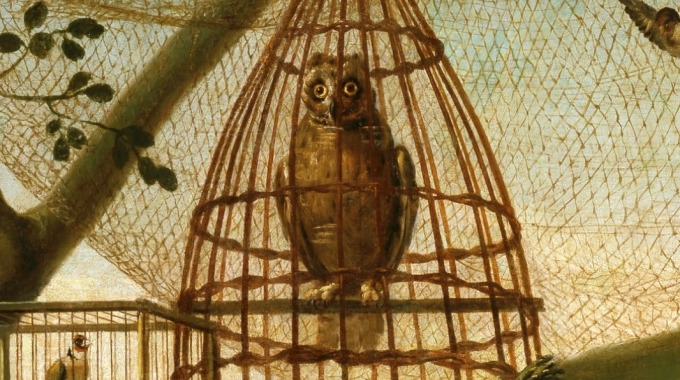
1. Decoy Hunting 1775. Oil on canvas, 112 x 179 cm.

The cartoon called Decoy Hunting is part of the first commission that Goya received for the Royal Tapestry Factory of Santa Bárbara in 1774-1775.

It was part of a series of fourteen tapestries—of which Goya rendered nine of them. They depicted hunting subjects, a keen passion for the Spanish nobility, to hang as decoration in the dining room at El Escorial of the Prince and Princess of Asturias.

Newly arrived to Madrid in January 1775 , Goya completed and submitted his cartoons for this commission between May and October 1775.

untitled6fixed
untitled10fixed

The cartoon called Decoy Hunting is part of the first commission that Goya received for the Royal Tapestry Factory of Santa Bárbara in 1774-1775.

It was part of a series of fourteen tapestries—of which Goya rendered nine of them. They depicted hunting subjects, a keen passion for the Spanish nobility, to hang as decoration in the dining room at El Escorial of the Prince and Princess of Asturias.

Newly arrived to Madrid in January 1775 , Goya completed and submitted his cartoons for this commission between May and October 1775.

2. Dogs on a leash 1775. Oil on canvas, 112 x 174 cm.

This is Goya’s tapestry cartoon of two hunting dogs chained together—one of which sits up and holds a fixed gaze on the viewer—with hunters’ tools on the ground. It is part of a series of decorative tapestries depicting hunting subjects for the new Bourbon rooms installed in 1773 by the architect Juan de Villanueva (1739-1811) at El Escorial.

Goya, newly arrived to Madrid from Zaragoza in 1775, was brought into the project because one of its originators, Ramón Bayeu y Subías (1746-1793), after having completed five of the intended fourteen cartoons by March 1775, was appointed to assist painter Anton Raphael Mengs (1728–1779) at El Palacio Real de Madrid in the execution of several frescoes there. 

Goya rendered the remaining nine cartoons, six of which are included in this blog post.

untitled16fixed2

3. Hunting Party 1775. Oil on canvas, 290 x 226 cm.

Hunting Party is one of the nine cartoons Goya provided for the royal dining room at El Escorial. This cartoon scene displays different types of hunting.

While Goya worked closely with the designs of Ramón and elder brother Francisco Bayeu y Subías (1734-1795), the originators of this project, the young artist placed his own stamp upon the commissioned work.

For instance, in the background, Goya’s sprinting greyhound provides an original and engaging study of how to represent rapid animal movement in a painting.

untitled4fixed

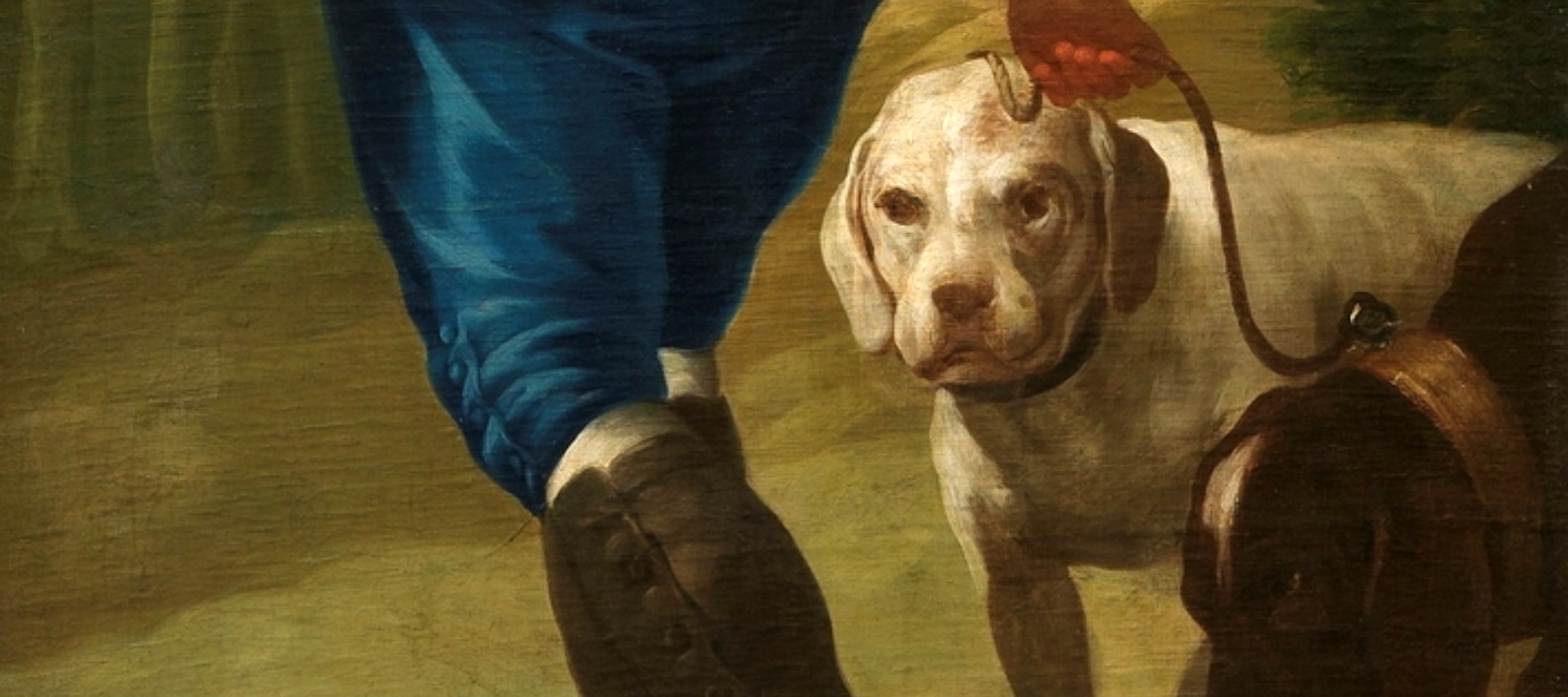
4. Hunter with his Hounds 1775. Oil on canvas, 268 x 67.5 cm.

The two cartoons below called Hunter with his hounds and Hunter Loading his Rifle are paired for a tapestry in El Escorial to hang by a window or door.

The cartoon is notable in part for Goya’s successful rendering of a hunter depicted from the back with a rifle on his shoulder and two leashed dogs — a “modern figure in a landscape.” Goya’s late 18th-century artistic accomplishment became a leading challenge for later 19th century French Impressionists such as Claude Monet (1840-1926) and Pierre-Auguste Renoir (1841-1919) to attempt the same sort of figural art work.

untitled8fixed

5. Hunter loading his Rifle 1775. Oil on canvas, 292 x 50 cm.

Goya’s cartoon is called Hunter loading his rifle. It is paired with Hunter with his hounds. the cartoon depicts a face-forward hunter with a sitting dog who stares at the viewer. In the background are others in the hunting party.

The design is for a dining room tapestry at El Escorial for the future Carlos IV (1748-1819) and his wife, María Luisa de Parma (1751-1819).

untitled9fixed

6. The Angler 1775. Oil on canvas, 289 x 110 cm.

Two activities are represented in this cartoon scene—fishing and hunting. A transition between them is marked by the sports’ different tools that overlap in the middle of the canvas. 

The Angler completed the commission begun in 1774 by Francisco and Ramón Bayeu to prepare a set of fourteen tapestry cartoons for the decoration of the dining room of the future Carlos IV and María Luisa de Parma at El Escorial, of which Goya produced nine of them. 

The theme of hunting was specifically selected to merge with the monarchs’ use of El Escorial in the autumn as a hunting grounds.

Two activities are represented in this cartoon scene—fishing and hunting—with a transition between them marked in the sports’ different tools overlapping in the middle of the canvas. 

The Angler completed the commission begun in 1774 by Francisco and Ramón Bayeu to prepare a set of fourteen tapestry cartoons for the decoration of the dining room of the future Carlos IV and María Luisa de Parma at El Escorial, of which Goya produced nine of them. The theme of hunting was specifically selected to merge with the monarchs’ use of El Escorial in the autumn as a hunting grounds.

2. DINING ROOM OF THE PRINCES OF ASTURIAS IN THE PALACE OF EL PARDO, 1776-1778.

7. The Picnic 1776. Oil on canvas, 271 x 295 cm.

The Picnic is part of Goya’s 10-tapestry decorative cartoon series depicting leisure in the countryside for a dining room tapestry at El Pardo for the Prince and Princess of Asturias.

Notable for its foreground still life, this scene depicts young revelers sitting on the banks of the Manzanares River at Madrid’s periphery.

The Picnic is joined in Goya’s second cartoon series by Dance on the Banks of the Manzanares, A Fight at the Venta Nueva, An Avenue in Andalusia (or The Maja and the cloaked Men), The Drinker, The Parasol, The Kite, The Card Players, Children blowing up a Bladder, and Boys picking Fruit. 

untitled13fixed
untitled12fixed

8. A Fight at the Cock Inn 1777. Oil on canvas, 41.9 x 67.3 cm.

An early draft called El Mesón del Gallo by Goya for his preparatory sketch for the cartoon of A Fight at the New Inn.

Goya’s artistic models for the cartoon range from typical seventeenth century Flemish and Dutch genre scenes to elements of Italian classicism.

The 32-year-old Goya displays a creative edginess in a tapestry that is to hang in the royal house. The artist presents a brutal and ironically humorous scene showing country folk from diverse regions of Spain and of varying social roles using several weapon types to violently contest a card game involving money.

untitled15fixed

9. Dance on the Banks of the Manzanares 1776 – 1777. Oil on canvas, 272 x 295 cm.

The resulting tapestry was to be hung on a wall of the dining room at the Palacio de El Pardo in Madrid for the princes of Asturias. Progressing from his hunting cartoon suite done on behalf of the brothers Bayeu the year or so before, this 10-part series of country life scenes was completely Goya’s own invention.

Goya’s cartoon called Dance on the Banks of the Manzanares depicts a scene of majos and majas (country folk) dancing the seguidillas, a dance that was popular in Madrid and throughout Spain’s Castile region.

The view of the river banks and the figure of the man clapping his hands are composition elements preserved in Goya’s drawing notebook suggesting they were taken from life.

untitled17fixed-2

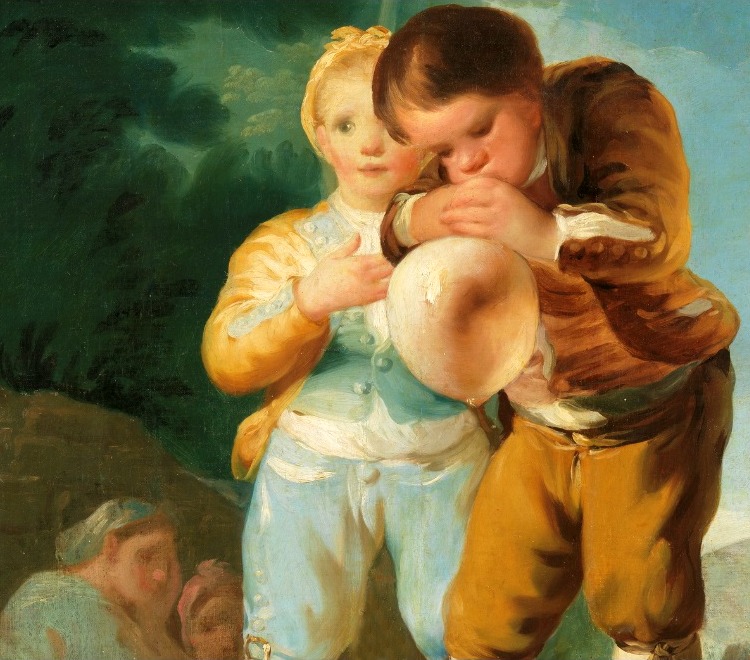
10. Children blowing up a Bladder 1777 – 1778. Oil on canvas, 116 x 124 cm.

The tapestry resulting from this cartoon hung in the dining room of the future Carlos IV and Queen consort María Luisa de Parma in El Palacio de El Pardo in Madrid.

With his cartoon Goya started his childhood scenes in this series of ten tapestries of “country” subjects for the royal house.

In a playful yet dramatic scene, a boy of about 7 years old inflates an animal bladder as his companion awaits the outcome raising one hand to her heart.

Two women seated in the background are perhaps the children’s mothers. One of the women displays a melancholic disposition as she holds a hand to the head while the other looks straight at the viewer.

untitled18fixed

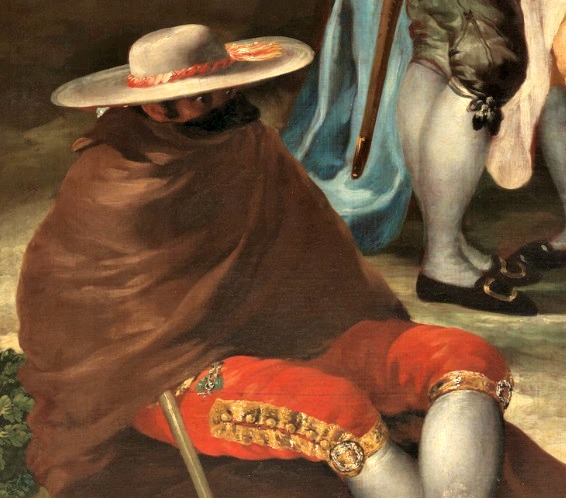
11. An Avenue in Andalusia or The Maja and the cloaked Men 1777. Oil on canvas, 275 x 190 cm.

This tapestry cartoon presents an ostensible love scene of a well-dressed young woman with her companion. in the tapestry factory invoice Goya identified both figures as gitanos, or gypsy people.

The scene is populated with other stealthily dressed figures, perhaps with their own sinister intent, suggesting an undercurrent of jealous spying on the gitano pair.

For a Madrid royal palace’s dining room (El Pardo), Goya considered this scene a fanciful contemporary walk in far-off Andalucia in southern Spain.

untitled21fixed
untitled20fixed
untitled19fixed

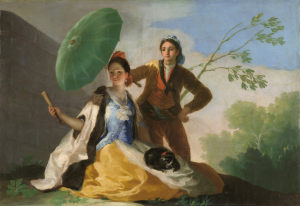
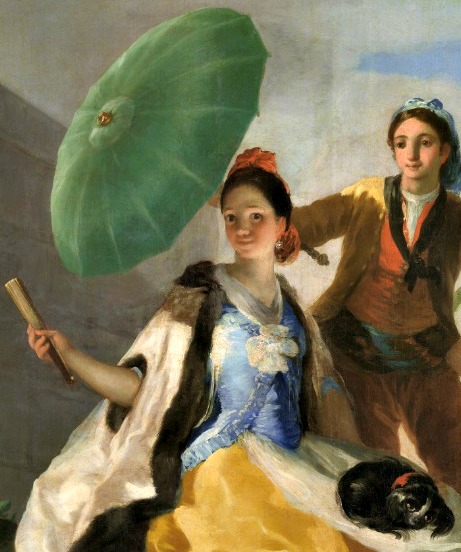
12. The Parasol 1777. Oil on canvas, 104 x 152 cm.

A bottom-to-top perspective view joined to its format indicates that this tapestry cartoon for the El Pardo dining room was intended to decorate an over-arch.

A cortejo holds a green-color parasol to shade an elegant young woman from the Iberian sunshine.

Goya’s cartoon could have possibly been modeled on the work of Jean Ranc (1674–1735), a French portrait painter or on a lunette entitled Vertumnus and Pomano by Italian painter Pontormo (1494-1557).

If it is the Pontormo that inspired Goya then, in this instance, the artist creatively transformed what was an ancient mythological subject into a scene of modern Spanish life.

untitled22fixed-closer

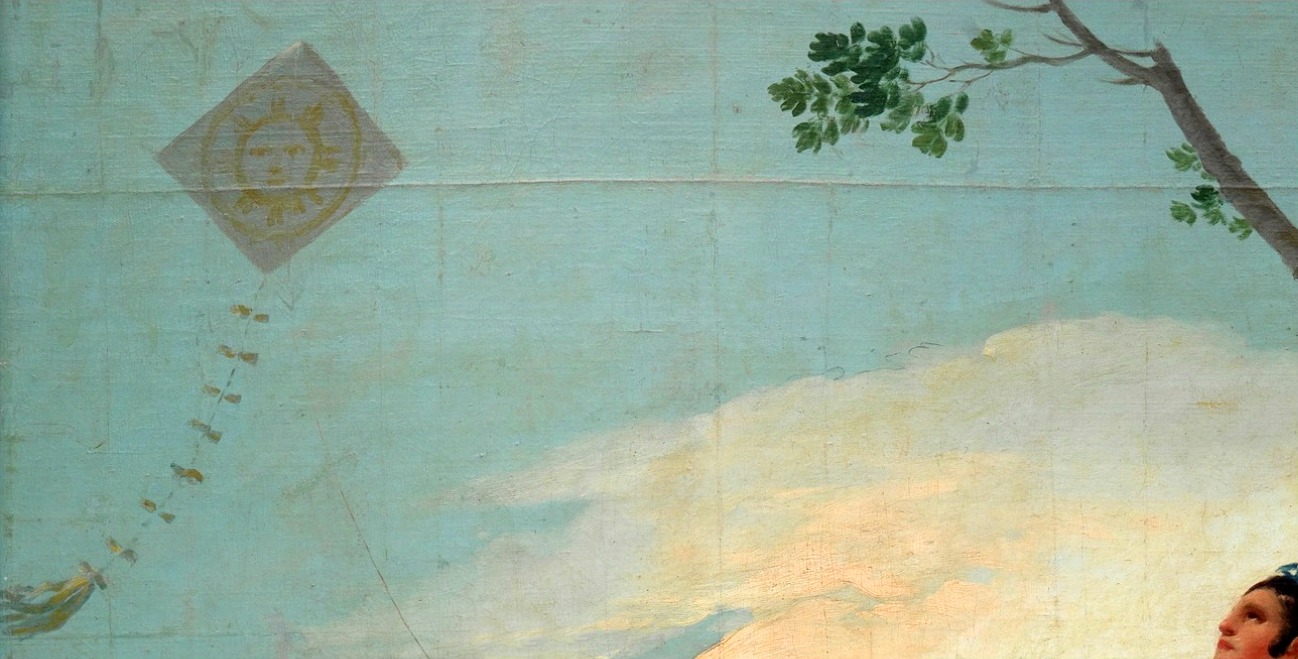
13. The Kite 1777 – 1778. Oil on canvas, 269 x 285 cm.

In this mid-to-late eighteenth century contemporary scene, possibly drawn from life, Goya describes it as young people who “have gone out to the field to fly a kite.”

A majo is smoking, body splayed upon the ground, sending smoke into the air. In the cartoon’s center three majos fly the popular kite with a sun face on it. One figure holds the spindle, another guides its string, and a third in heroic stance, launches and maintains the kite aloft.

In the background, couples chat and watch the kite’s flight, while a dog sits and looks towards the viewer.

The building in the cartoon’s upper right part has been interpreted as an astronomical observatory, a scientific project popularly spoken of in the days of Carlos III (1716-1788).

untitled23fixed
untitled24fixed
untitled25fixed
untitled26fixed

14. The Drinker 1777. Oil on canvas, 107 x 151 cm.

A cartoon for a tapestry in the dining room in the Palace of El Pardo in Madrid, one of a series of ten made by Goya between 1776 and 1778.

The scene has been interpreted as has been seen as Goya’s allegory of gluttony. A young man drinks from a boot and a boy eats a raw turnip snatched out of a collection of meager vegetables with a round loaf of bread that constitutes the cartoon’s still life.  

These images would be based on characters from a 1554 Spanish novella entitled The Life of Lazarillo de Tormes and of His Fortunes and Adversities. The novella tells the story of a boy named Lazarillo who learns the world’s wiles from a blind beggar with whom he is apprenticed.

The format and bottom-to-top perspective view indicates the modern tapestry cartoon was for an over-window decoration.

untitled28fixed
untitled29fixed

15. Boys picking Fruit 1778. Oil on canvas, 119 x 122 cm.

Boys picking Fruit is another of Goya’s childhood scenes. It is one of four scenes of a set with Children blowing up a Bladder, The Parasol, and The Drinker which hung as overhead decorations in the dining room at El Pardo. 

The joyful and playful cartoon depicts four boys gathered at a tree to shake down its fruit.  It is part of a series of ten tapestry cartoons of “country” subjects—all conserved in the Prado Museum in Madrid—that Goya composed and produced.

untitled30fixed
untitled31fixed

16. The Card Players 1777 – 1778. Oil on canvas, 270 x 167 cm.

To give this scene an appearance of realism, Goya carefully crafted each individual face and unique expression for each figure. These creative details enriches the depiction of country folk cheating and being cheated at cards.

Goya’s accurate study of the contrast of light and shadow enhances his varied colors which works to heighten the scene’s realism.

A group of majos situate themselves in a field as three of them play card. They gather under a man’s cloak placed on a tree branch which shadows them from the sun at siesta.

With gold coins tossed into a hat on the ground by one of the players, the two other majos study their hands, each with an expression of concern.

Darkly humorous, the cartoon revealed to its viewer the accomplices standing behind two players and who are sending signals to a third player about the unsuspecting victims’ cards.

The Card Players concludes Goya’s 10-part cartoon series of scenes of country life for the tapestries in the dining room of El Pardo for the princes of Asturias.

untitled32fixed

CONCLUSION.

Between 1775 and 1792, Goya painted more than 60 cartoons for the Royal Tapestry Factory located in Madrid since 1720. (It moved to its present site by the main train station in the nineteenth century). Like Les Gobelins, an older counterpart in Paris, the Royal Tapestry Factory supplied the Spanish royal court with tapestries which were among the most prestigious objects owned by them.

By the late eighteenth century, large tapestries were hung in palaces mainly for decoration. Goya’s contemporary scenes from that period illuminated newly-built Bourbon rooms at El Escorial and the dining room at El Pardo.

In 1775, that the Prince and Princess of Asturias were hanging tapestry scenes about the hunt—an activity that would become the future Carlos IV’s passion —or about peasant life had been the fashionable choice for the ruling class for around two hundred years already.

For Goya’s designs to display the artist’s playfully sensuous inventions joined with a dark and ironically humorous wit—along with the candid appreciation of the modern scene based on first-hand observation (especially the costumes) as well as using stock social characters doing things that can intelligently impress and amuse a royal audience and their guests—makes these disposable cartoons the more remarkable.

Further, the fact that they were retrieved largely intact from the basement of a Madrid royal palace almost a century after Goya’s death and are now housed in the Prado makes their firsthand study in the 21st century altogether amazing.

SOURCES:

On Goya’s cartoons:

https://www.goyaenelprado.es/obras/lista/?tx_gbgonline_pi1%5Bgocollectionids%5D=5-56;

Goya, Robert Hughes, Knopf, New York, 2003.

On tapestries:

http://www.artic.edu/aic/collections/exhibitions/divineart/usefunctap;

http://www.millefleurstapestries.com/en/history-of-tapestries.

SPAIN. Review: PICASSO AND CHICAGO, The Art Institute of Chicago, February 20–May 12, 2013.

FEATURE image: Pablo Picasso IN STUDIO, c. 1915. Public Domain.

Armory Show, Art Institute of Chicago, March 24–April 16, 1913.

Armory Show, International Exhibition of Modern Art. The Cubist room, Gallery 53 (northeast view), Art Institute of Chicago, March 24–April 16, 1913. On the long wall are three of seven Picasso artworks included in that landmark exhibition. None are in “Picasso and Chicago” in 2013.

By John P. Walsh.

Almost as long as Pablo Picasso (1881-1973) was making his art, there have been bragging rights on the Catalan artist that have come from others. Even 40 years after the artist’s death at 91 years old, media talk in 2013 for Picasso and Chicago, a large art exhibition at The Art Institute of Chicago from February 20 to May 12, 2013, revolves around American collector “firsts” associated with Picasso.

Which institution collected Picasso first? The Art Institute of Chicago in 1923.

Which institution collected Picasso most? The Chicago Renaissance Society by 1930.

Which institution had the first Picasso exhibition? The Arts Club of Chicago in 1923.

Which institution had the first Picasso retrospective? The Wadsworth Atheneum in Hartford, Connecticut in 1934.

The Art Institute of Chicago is able to put imagination aside and quote itself in Picasso and Chicago. Nearly all of the same inventory of Picasso artwork in this 2013 show were assembled and displayed in the exact same order in a previous exhibition at the museum called Picasso in Chicago held from February 3 to March 31, 1968. According to the museum director writing at that time, that exhibition had been inspired by the dedication of the Picasso sculpture on August 15, 1967, a five-story Cor-10 steel Chicago icon that still stands enigimatically in Daley Plaza.  If public attention is what Pablo Picasso craves, then he should have no worries.

Picasso, Nude with a Pitcher, summer 1906.
Pablo Picasso, Nude with a Pitcher, Gósol, summer 1906, oil on canvas, 39 5/8 x 31 7/8 in. (100.6 x 81 cm), Signed, l.r.: “Picasso.” The Art Institute of Chicago.

In the summer of 1906, during a working sojourn to Gósol in the Spanish Pyrenees, Picasso painted his mistress and muse, Fernande Olivier (French, 1881-1966).

Picasso Nude with a pitcher summer 1906 Gosol Spain

Image above and below: Pablo Picasso, Nude with a Pitcher (detail).

nude-with-a-pitcher-detail-summer-1906-gosol-spain-2
fernande-1905

Fernande Olivier and Pablo Picasso in 1905 in Paris.

Pablo Picasso, Fernande Olivier, summer 1906. Charcoal, with stumping, on cream laid paper, 610 x 458 mm. Signed recto, lower right, in graphite: “Picasso” (underlined), The art Insitute of Chicago.
Pablo Picasso, The Two Saltimbanques, 1905, printed and published 1913. Drypoint on ivory wove paper 120 x 91 mm (image/plate); 193 x 129 mm (sheet) The Art Institute of Chicago.
Picasso, Study for La Coiffure, 1906.
Picasso, Study for “La Coiffure,” 1905-1906. Pen and brown ink, with colored crayons and charcoal applied with stump, over graphite, on blue-gray laid paper 184 x 307 m. Signed recto, upper right, in graphite: “Picasso.” The Art Institute of Chicago.

The pairs of figures are related by both being involved in intimate activities, but represent two different subjects Picasso studied months apart. One dates from 1905 and the other from 1906. The pair on the right is a study for a major painting, La Coiffure, in The Metropolitan Museum of Art in New York.

There are several excellent reasons to see Picasso and Chicago in 2013 and they don’t always revolve around his art. It is a matter for city pride to know that Chicago possesses within its own collections the breadth of art resources to showcase, in chronological order, this Picasso show comprehensive of every major period. In these tight economic times kudos goes out to museum curators who have effectively displayed a vast amount and range of artwork by Pablo Picasso to produce a blockbuster show. The chronological exhibition of Picasso’s art includes works from The Art Institute of Chicago, The Arts Club of Chicago and The Renaissance Society and is front loaded providing for immediate pleasures.

The visitor is greeted nearly at the door by The Old Guitarist painted by Picasso in 1903-1904—a revered Blue Period painting in the Art Institute—and for the viewer to be edified by its presence is worth any exhibition’s admission price though there was no special exhibition fee beyond the price of general admission to the museum.

Picasso, The Old Guitarist, 1903–1904.
Picasso, The Old Guitarist, 1903–1904, oil on panel, 48 3/8 x 32 1/2 in. signed, l.r.: “Picasso.” The Art Institute of Chicago.

If front-loaded, does the rest of the show retain the same high interest? The answer is: yes and no. For all future Picasso shows in Chicago, curators can find several avenues to whittle away at the volume of artwork on display for Picasso and Chicago to present its most interesting parts. That downsizing opportunity intimates this show’s arguable shortcoming: as it displays the Spanish master’s later, increasingly commercial artwork, the Art Institute of Chicago’s 500 Picasso works in all mediums begins to reveal the challenges of building a seamlessly qualitative collection of contemporary art even when the artist is Picasso.

Picasso woman with her hair up 1904
Picasso, Woman with her hair up, 1904, Gouache on tan wood pulp board, 427 x 313 mm, Signed and dated recto, upper left, in blue gouache: “Picasso / 1904.” The Art Institute of Chicago.
Picasso, "Beggar with Crutch," 1904.
Images above and below (detail): Pablo Picasso, Beggar with Crutch, Barcelona  1904, pen, brown ink and colored crayon on paper. The Art Institute of Chicago. 
beggar-with-crutch-barcelona-1904 pen-brown-ink-and-colored-crayon-on-paper-detail

Crazy Woman with Cats, 1901. Oil on pulp board 17 7/16 x 16 1/16 in. (44.3 x 40.8 cm). Signed. l.r.: “Picasso.” Amy McCormick Memorial Collection, 1942. The Art Institute of Chicago.
picasso-crazy-woman-with-cats-detail-early-summer-1901-paris-oil-on-cardboard

In late May 1901 Picasso came to Paris with three weeks to prepare for an exhibition at Vollard’s gallery. The exhibition was arranged by a Catalan dealer who roomed with the 19-year-old Picasso on the Boulevard de Clichy. Crazy Woman with Cats is one of the 64 paintings and several drawings Picasso prepared for the show. 

Picasso, Sketch of a young woman (detail), pen and brush and black ink on paper, Paris 1904, gift of Robert Allerton, 1924, The Art Institute of Chicago.

Robert Allerton, a museum trustee since 1918, began to acquire Picasso drawings in 1923 with the sole purpose of donating them to the museum. Sketch of a young woman was Allerton’s first Picasso drawing purchase and museum donation in 1923 purchased in Chicago from Albert Roullier Galleries.

Pablo Picasso. Salomé from the Saltimbanques series. 1905 102B0518 (1)
Picasso, Study of a Seated Man, 1905
Picasso, Portrait of a Seated Man, 1905. Black chalk on cream wove paper, laid down on cream Japanese paper, 329 x 216 mm, Signed recto, lower left, in graphite: “Picasso.”Gift of Robert Allerton, 1924. The Art Institute of Chicago.
Picasso, Study of Four Nudes, Paris, 1906-07.
Picasso, Study of Four Nudes, Paris, 1906-07, black crayon paper, Johnson Family collection.

By the end of 1906 Picasso stopped painting and instead started to fill sketchbooks for a new major composition: Les Demoiselles d’Avignon (1907) today in The Metropolitan Museum of Art in New York.

Picasso, Female Nude, 1906. Fabricated Black chalk with graphite and smudging on paper, 31.8 x 23.5 cm. Gray Collection Trust. The Art Institute of Chicago.
Picasso, Two Nudes, Standing, fall 1906
Picasso, Two Nudes, Standing (detail), fall 1906 Graphite, with stumping, on cream laid paper (detail).

Picasso, Two Nudes, Standing, fall 1906 Graphite, with stumping, on cream laid paper (detail).

Picasso, Two Nudes, Standing, fall 1906 Graphite, with stumping, on cream laid paper 630 x 469 mm Signed verso, upper left, in graphite: “Picasso.” Gift of Mrs. Potter Palmer, 1944. The Art Institute of Chicago .

In the early 1920’s as Chicago started a buying frenzy of Picasso, another young Spanish painter twelve years younger than Picasso arrived into Paris and was immediately overtly critical of the great Picasso’s work at that time. That younger painter was Joan Miró (1893-1983).

Miró’s criticism of Picasso as well as of Henri Matisse (1869-1954)— it was more a kind of disgust—was basically that the pair, once young avant-gardists, were making all their art for their dealer. In other words, the older artists were making contemporary art mainly for the money. Such may be an inherent risk in making art that meets a market demand in that the artist is tempted to, after a fashion, sell-out. Miró knew at first look—and history has proven him basically correct—that the future of contemporary painting no longer rested in Picasso’s hands after about 1920. This is partly the reason why Miró turned to the “nonsense” art of the Dadaists for the future of his own painting.

Keeping Miro’s judgment in one’s mind at Picasso and Chicago one sees that, notable exceptions made, an earlier Picasso painting—from the Blue Period after 1901 to Picasso’s period of synthetic cubism until around 1920—offers cohesive artwork that contains a germ or seed of progress.  The art collection in Picasso and Chicago, much of it produced following Miró’s critical judgment of Picasso, shares his problematic.

The Red Armchair of 1931 is hung at what is about the show’s halfway point. At this point, I might have exited. Yet where Miró’s critical judgment lags for me is that Picasso’s art is never incompetent or boring. His art is perceptibly linear and, despite its erotic themes, often contains qualities which satisfy and cleanse an art-hungry eye. Picasso’s art is ever ancient and ever new, and distinctly European. For me, seeing a Picasso connotes a stroll in Paris or feeling a sunburn on the face after revelry and reverie along some Mediterranean coast. Quite readily the show produced these kinds of vicarious experiences for me as i soaked up a plethora of Picasso’s later, lesser work in utilitarian Regenstein Hall.

nessus-and-deianira-juan-les-pins-september-22-1920-graphite-on-papere-with-white-ground
Nessus and Deianira, September 22, 1920, Graphite on tan wove paper, prepared with a white ground, signed recto, upper left, in pen and blue ink: “Picasso” (underlined); inscribed upper left, in graphite: “22-9-20.”

Just before leaving Paris in September 1920, Picasso made a series of drawings of the Greek myth of the abduction of Hercules’ bride Deianira by the centaur Nessus. With this, Picasso became fascinated with Greek mythology and continued to make artwork using its themes.

Picasso, Head of A Woman (Fernande), Paris winter 1909-10, brush and gray wash on paper. Private Collection.

Paintings and drawings by Picasso in winter 1909-10 continued to explore Cubism as it related to the human face and figure and its surroundings. 

Picasso studio Horta de Ebro summer 1909.
Picasso’s studio at Horta de Ebro (now Horta de San Juan) in Spain between May and September 1909.

The painting (at left) of a Head of a Woman is one of the early Cubist artworks in “Picasso and Chicago.”

Picasso, Head of a Woman, summer 1909, Oil on canvas 23 3/4 x 20 1/8 in. (60.3 x 51.1 cm), Winterbotham Collection, 1940.

The painting above dates to one of the most productive and inventive periods of Pablo Picasso’s career, a summer stay in the town of Horta de Ebro (now Horta de San Juan) in Spain, which lasted, with minor interruptions, from May to September of 1909. In these months, Picasso produced a series of landscapes, heads, and still lifes that are among the most highly acclaimed achievements of early Cubism. Fernande Olivier, Picasso’s mistress, was the model for the series of heads that the artist produced at this time.

Picasso Bust of a Woman, late 1909
Picasso, Bust of a Woman, late 1909, Watercolor and gouache on cream laid paper, laid down on buff laid paper, 363 x 278 mm overall; signed recto, lower left, in graphite: “Picasso (underlined)/ 09” Gift of Mr. and Mrs. Roy J. Friedman, 1964. The Art Institute of Chicago.
Head of a Woman (Fernande), fall 1909, bronze, 16 1/8 x 9 7/8 x 10 9/16 in. (40.7 x 20.1 x 26.9 cm), cast 1910, Alfred Stieglitz Collection, 1949.

This work is Pablo Picasso’s first large Cubist sculpture and represents the distinctive physiognomy of Fernande Olivier, who was the artist’s model and mistress from 1905 to 1912. Before making the bust, Picasso produced countless drawings and gouaches to explore the specific form and structure of his subject’s facial features. Her hair is in a coil and a topknot; her bulging jaw; her well-defined depression in the center of her upper lip. The Fernande series’ evolved from an agility of facial expression to fixed signs of its individual features.

artist-and-model-cannes-july-24-1933-watercolor-and-pen-and-black-ink-on-paper-1
Picasso, Artist and Model, 1933.
artist-and-model-cannes-july-24-1933-watercolor-and-pen-and-black-ink-on-paper-2
Picasso signature
Pablo Picasso (1881-1973), Artist and Model, Cannes, July 24, 1933, watercolor and pen and black ink on paper. Gray Collection trust.
Picasso, Daniel-Henry Kahnweiler, autumn 1910, Oil on canvas, 39 9/16 x 28 9/16 in. (100.4 x 72.4 cm) Gift of Mrs. Gilbert W. Chapman in memory of Charles B. Goodspeed, 1948. The Art Institute of Chicago.

German-born Daniel-Henry Kahnweiler (1884-1979) opened an art gallery in Paris in 1907. In 1908 Kahnweiler began representing Pablo Picasso (1881-1973) and introduced him to Georges Braque (1882-1963). Kahnweiler championed these artists’ revolutionary experiment with Cubism and purchased most of their paintings between 1908 and 1915. Kahnweiler sat for Picasso up to thirty times for this portrait.

Portrait_de_Picasso,_1908

Portrait photograph of Pablo Picasso, 1908.

Picasso, Head of Harlequin, 1916, The Art Institute of Chicagio. Photograph by author.
Picasso, Harlequin Playing the Guitar, c. 1916, Elden collection.
Picasso Head Arts Club
Picasso, Head of a Woman, 1922, The Arts Club of Chicago, purchased 1926.
Olga_Khokhlova_in_Picasso's_Montrouge_studio,_spring_1918 (1)

Olga Khokhlova (1891-1955) in Picasso’s Montrouge studio, spring 1918. Olga married Picasso on July 12, 1918, at the Russian Orthodox Cathedral in Paris. On February 4, 1921, she gave birth to their son Paulo (1921-1975). After that, Olga and Picasso’s relationship deteriorated though they never divorced. Olga died in Cannes in 1955.

Picasso still life 1922

See article in Architectural Digest by Nick Mafi dated July 28, 2020 on the recent discovery associated with the Picasso painting above.  https://www.architecturaldigest.com/story/famed-pablo-picasso-painting-reveals-abandoned-artwork-beneath

Picasso, Still Life, February 4, 1922, Oil on canvas 32 1/8 x 39 5/8 in. (81.6 x 100.3 cm), Dated, u.l.: “4-2-22-.” Ada Turnbull Hertle Endowment, 1953. Picasso produced a series of Cubist still lifes in 1922 that are simplified to flat planes in a patterned framework. Gertrude Stein (1874-1946) bought this canvas in 1923 to add to her collection of more than 30 Picasso paintings and even more of his drawings and watercolors. This still life was Stein’s last purchase of a painting by Picasso.

Picasso flute and nude, 1932
Above: Picasso, Double Flute Player and Reclining Nude, October 22, 1932, pen and ink with brush and black wash and scraping on paper, Shapiro collection, 1992. The Art Institute of Chicago.

In late summer and fall of 1932, Picasso and Marie-Thérèse Walter (French, 1909-1977), the artist’s mistress from 1927 to 1935, were together in Boisgeloup. Picasso made three drawings on the same day on a theme of lovers serenading one another.

Picasso_marietherese

Marie-Thérèse Walter and Pablo Picasso. Their relationship began when she was seventeen and Picasso was 45 years old and married to Olga Khokhlova.

Picasso Minotaur and Wounded Horse 1935

Picasso transforms the bullfighting theme where the half-man and half-bull Minotaur is the aggressor in the ring terrorizing a horse.

Picasso, Minotaur and horse, 1935
Images above and below: Picasso, Minotaur and Wounded Horse, Boisgeloup, April 17, 1935, Pen and brush and black inks, graphite, and colored crayons, with smudging, over incising, on cream laid paper, 343 x 515 mm Signed recto, lower right, in graphite: “Picasso” (underlined); inscribed upper right, in graphite: “Boisgeloup–17 Avril XXXV” The Art Institute of Chicago.
Picasso
Picasso, The Red Armchair, and detail below, oil and ripolin on panel; signed, u.r.: “Picasso,” oil and ripolin on panel, The Art Institute of Chicago.
Picasso, Head of Woman (Dora Maar), Paris, April 1, 1939, oil on canvas, 92 x 73 cm. Private collection.

Dora Maar (French, 1907-1997) met Picasso in 1936 at the Café des Deux Magots in Paris. Her liaison with Picasso ended in 1943.

weeping woman dora maar 1937
Weeping Woman I, July 1, 1937. Drypoint, aquatint, and etching, with scraping on copper in black on ivory laid paper, 695 x 497 mm (plate); 774 x 568 mm (sheet). The Art Institute of Chicago.

About making portraits of his mistress Dora Maar weeping, Picasso explained: “For years, I’ve painted her in tortured forms, not through sadism and not through pleasure either – just obeying a vision that forced himself on me.” At the end of their relationship Picasso confessed, “I can only see her weeping.”

Dora Maar Picasso Lee Miller 1937
From left: Dora Maar, Picasso, Lee Miller in 1937.
1951 Villa in Vallauris
Picasso, Villa in Vallauris, Vallauris, Feb., 4, 1951, oil on panel. 88.9 x 116.2 cm, The Art Institute of Chicago.
Picasso, large vase with dancers, Vallauris, 1950, red earthenware clay, ground painted in white engobe, 71.2 cm Crown collection.
picasso-gilot-madoura-pottery
Picasso and Françoise Gilot (b. 1921) at Madoura pottery, Vallauris, 1953.

Gilot was lover and muse to Picasso from 1943 to 1953. In the early 1990s I met Françoise Gilot accompanied by her husband, Jonas Sauk (1914-1995), when she was the featured speaker at the Alliance Française in Chicago. That evening Gilot made it perfectly clear upfront that she was not going to talk about Picasso.

Picasso Jacqueline 1962
Picasso, Portrait of Jacqueline, Mougins, Dec. 28, 1962, graphite with smudging and black ballpoint pen on paper. 34.9 x 25 cm., Gray Collection Trust.
Picasso Jacqueline 1959
Picasso, Jacqueline, Cannes or Vauvenargues, October 17, 1959, Linocut in colors on paper, 63.8 x 53 cm., Crown collection.

Jacqueline Roque was muse and second wife of Pablo Picasso. Their marriage lasted 11 years until his death, during which time he created over 400 portraits of her, more than any of Picasso’s other loves.

Jacqueline and Pablo Picasso.

Picasso and Jacqueline, his second wife. Pablo Picasso met Jacqueline Roque (1927-1986) in 1953 when she was 26 years old and he was 72. He romanced her until she agreed to date him. Only in 1955, when Picasso’s first wife Olga Khokhlova died, did Picasso decide to marry Jacqueline in Vallauris in 1961. They were married until Picasso’s death in 1973.

The Chicago Picasso, 1967. In situ in Daley Plaza in Downtown Chicago, July 2015. Photograph by author.

There are 250 items on display in Picasso and Chicago—including paintings, prints, drawings, sculptures, and ceramics—and only begins to manifest the prodigious genius of Pablo Picasso.

Picasso and Chicago may have closed, but many, if not most, of these works in Chicago’s cultural institutions and private collections can be savored with the simplicity of a museum visit. A visitor can do no better than visit The Art Institute of Chicago and see Picasso’s The Old Guitarist and The Red Armchair. By that begins one’s own new adventure of absorption of the Spanish master’s artwork whose home is Chicago. The 2013 show is over but more than a few of its best parts are on display right now in these institutions’ permanent collections.

SOURCES:
Miró, Janis Mink, Taschen, 2006.
Je suis Le Cahier: The Sketchbooks of Picasso, 1986, Arnoldo  Mondadori Editore, Verona, Italy.
Picasso and Chicago 100 years, 100 works, Stephanie D’Alessandro, The Art Institute of Chicago, 2013.
Picasso in Chicago, The Art Institute of Chicago, 1968.
http://michiganavemag.com/living/articles/aic-opens-picasso-and-chicago
http://www.indiebound.org/book/9780300184525http://chicagoist.com/2013/05/11/last_chance_to_see_picasso_and_chic.php