

FEATURE image: “Chartres, North Porch, Central Portal, LeftJamb” by profzucker is licensed under CC BY-NC-SA 2.0. The North Porch was constructed at the start of the 13th century. The North Porch, like the North Rose Window (below) crafted in the same time, depicts the glories of the Virgin Mary along with Old Testament figures.
I visited Chartres Cathedral for the first time in 1985, and again in 1989, 2002, and 2005. I participated in my first Malcolm Miller tour in Chartres Cathedral in 1985. A guide there since 1958 his work, as I was backpacking through Europe, inspired me to see how a person can dedicate his energies to one major work. Chartres Cathedral is famous perhaps mostly for its stained glass from the 12th and early 13th centuries. The shimmering beauty of these intact colorful windows from over 800 years ago is unparalleled. Almost all the windows are “read” from left to right starting at the base and ascending to the top. Once a Roman site, several cathedrals have stood where today’s monumental building stands. Previous cathedrals were literally destroyed during the Merovingian and Viking eras and in 12th century fires. A cult of the Virgin Mary as protectress developed around the cathedral that led to a gift in the 9th century of its famous Marian relic known as Sancta Camisa, or the Virgin’s veil. When the cult of the Virgin Mary arose universally in the church in the 12th century Chartres Cathedral, which was dedicated to Mary’s Assumption, was poised to become an important place of pilgrimage.

On my first visit to Chartres cathedral in 1985, after having breakfast in Paris, I walked to Gare Montparnasse and boarded a train direct to Chartres. On that visit Malcolm Miller explored the North Rose Window (c. 1231) with the Blue Virgin Window (c. 1194) below it as well as parts of the Noah Window (c. 1210). The Noah window included a depiction of the 6th century bishop of Chartres, St. Lubin, who was the patron of wine merchants, a group that helped pay for the window. Miller also took us outside to discuss the 12th century statuary on the West portal that I photographed in 1989. Following a fire in 1120 a large Romanesque church was built in the same period as Vézelay Abbey. Another fire in 1134 damaged the church and precipitated the construction of the north tower completed in 1150. The south tower was begun and completed about 10 years later than the north tower. The Royal Portal was built between 1145 and 1155. Most of the present church was rebuilt following a devastating fire in July 1194 which destroyed not only the church but much of the city. Notable exceptions to the fire’s destruction were the cathedral’s mid12th-century west front with its royal doors and two contrasting towers. The rest of the church visited today – including, with some exceptions, its magnificent stained glass windows – was rebuilt and crafted between 1195 and 1220. The North Rose Window was donated by King Saint Louis IX of France (1214-1270) and his mother Blanche de Castille (1188-1252). During the French Revolution, the church was desecrated and used as a temple to the Goddess Reason. It wasn’t returned to the church and reconsecrated until 1855.
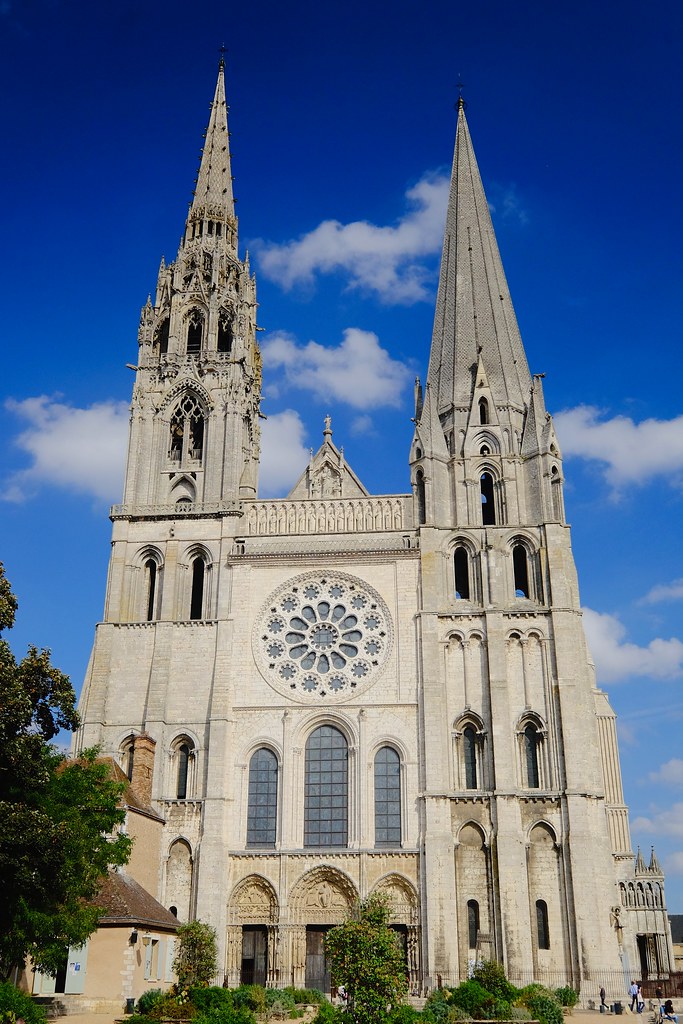
By the 11th century there was a renewal of learning in Europe that, particularly in Northern Europe, was centered in monastic and, slightly later, cathedral schools. One Gerbert of Aurillac (c. 946-1003) who later became Pope Sylvester II, had studied in Spain, and was head of the cathedral school in Reims in the 970’s. Gerbert’s pupil, St. Fulbert of Chartres, as bishop of Chartres, opened its cathedral school which became the most illustrious center of learning in the 12th century and marked a new era for Western civilization. These were schools grappling with varying philosophical concepts of God and man that were hotly debated in the 12th century. Though the present Gothic building was, after 25 years of construction, roofed and finished around 1220, Chartres Cathedral was reconsecrated in October 1260. Three popes visited Chartres in the 12th century and in the next centuries several saints prayed there including St. Thomas Becket (1118-1170) as well as French saints Bernard of Clairvaux (1090-1153), Francis de Sales (1567-1622), Vincent de Paul (1581-1660), Louis de Montfort (1673-1716) and, bien sûr, Benedict Joseph Labre (1748-1783). While pilgrimages to Chartres began before the 12th century and important pilgrimages continued into the 16th and 17th centuries, these had waned since the French Revolution. Though pilgrims were returning to Chartres by the end of the 19th century, French poet Charles Péguy is held responsible for restarting the traditional Paris to Chartres pilgrimage route. It was on June 14, 1912 that Charles Péguy set out on this pilgrimage when he walked its almost 150 kilometers in three days. The previous year he had made a vow to do so at the bedside of his son who was ill. “Chartres is my cathedral,” Péguy later wrote. On September 5, 1914 as a lieutenant in the 19th company of the French 276th Infantry Regiment during World War I, Péguy was killed, shot in the head, near Villeroy, Seine-et-Marne. Charles Péguy was 41.

The 12th century artist’s ambition was to concentrate the life of these statues in their faces. While Chartres cathedral’s flying buttresses and its stained glass are rightly world famous, some art historians believe that it is the statuary that is the cathedral’s most interesting aspect. The statuary certainly represents 12th century art at its zenith.
SOURCES: Chartres: Guide of the Cathedral, Étienne Houvet, revised Malcolm B. Miller, B.A., Editions Houvet-la Crypte, n.d.; Medieval Thought, Gordon Leff, Humanities Press, Highland, NJ, 1958. https://drupal.americamagazine.org/issue/681/article/voice-chartres – retrieved Aug. 23, 2025; https://www.worldhistory.org/article/1277/the-stained-glass-windows-of-chartres-cathedral/ – retrieved Aug. 23, 2025; https://www.cathedrale-chartres.org/en/cathedrale/pilgrimages/the-great-pilgrimages/ – retrieved Aug. 23, 2025.
This explanatory article may be periodically updated.


Pingback: My Street Photography: Europe 1970s-2000s (46 Photos). - CORRIDORS│An Educational Website in the Arts and History. Featuring My Photography and Videos.