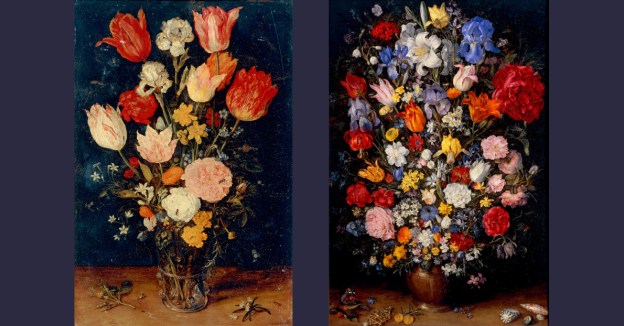

Feature Image: Flowers in a Vase and Flower Vase with Jewel, Coins, and Shells, both 1608, oil on copper, by Jan Brueghel the Elder and in the Pinacoteca Ambrosiana, Milan, Italy.
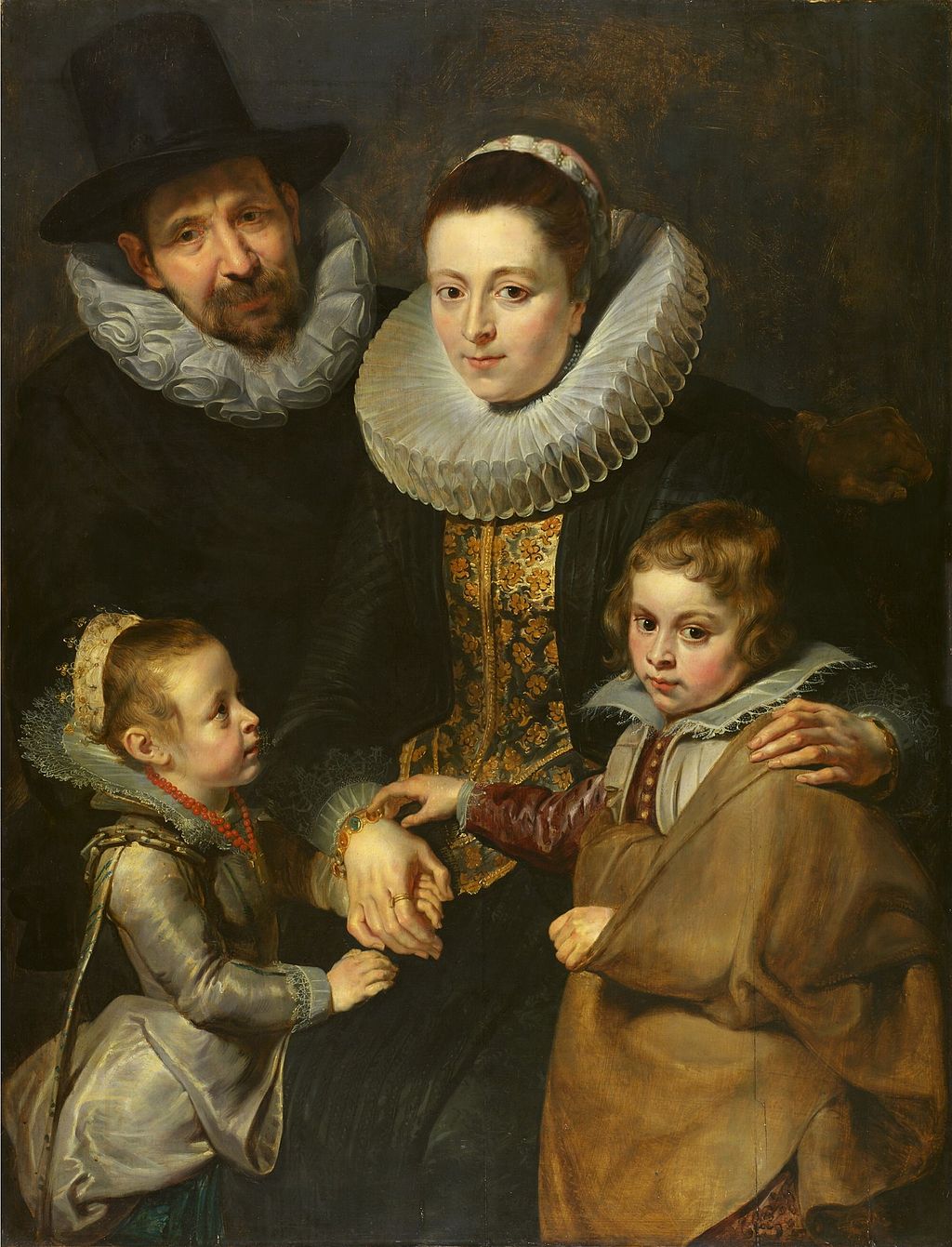
Jan Brueghel the Elder (Flemish, 1568-1625) produced hundreds of paintings by his own hand and in collaboration with other master painters. His painterly skill ranged over an immense variety of subject matter including these innovative still life floral artworks of which the artist is seen as the founder of the genre. These flowers are not allegorical or imaginative accessories nor merely decorative but a stand-alone subject whose sole focus is the opportunity for a close observation of nature through the artistic lens. Brueghel’s pioneering still lifes show a bouquet bursting with a wide variety of colorful flowers seen from an elevated viewpoint that have been carefully delineated and are clearly visible. Born in Brussels in 1568, Jan Brueghel was the son of Pieter Brueghel the Elder (c. 1525–1530-1569) and younger brother of Pieter Brueghel the Younger (1564-1638). Brothers Jan and Pieter were both sent to Antwerp to study oil painting. In 1568, at 20 years old, Jan Brueghel left Antwerp for Italy where he settled and worked in Naples and, by 1592, in Rome. In Rome Jan Brueghel worked for Cardinals Ascanio Colonna (1560-1608), Benedetto Giustiniani (1554-1621), Francesco Maria del Monte (1549-1627) and Federico Borromeo (1564-1631) who patronized Caravaggio and was the official “Cardinal Protector” of the Roman Accademia di San Luca, an artists’ association founded in 1593 by Federico Zuccari (1539-1609).


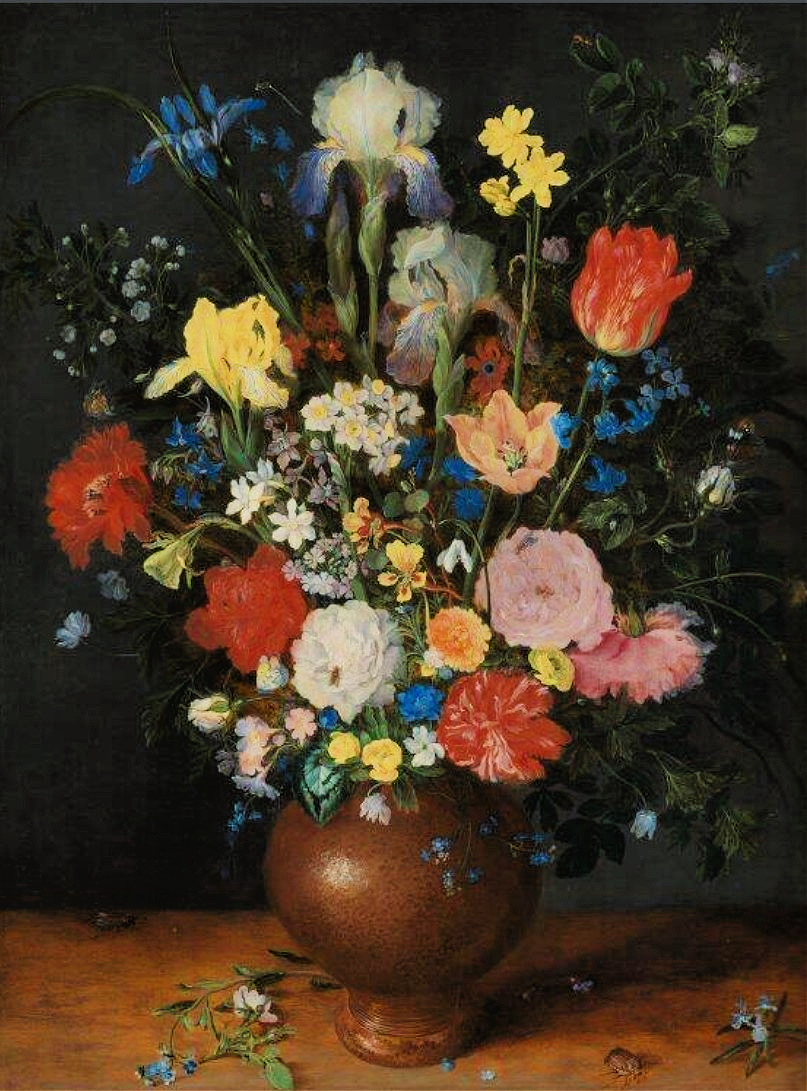
FLOWERS IN A VASE, 1608, oil on copper, 43 × 30 cm by Jan Brueghel the Elder. Pinacoteca Ambrosiana, Milan, Italy.

In a Römer glass vase, typical of Rhenish manufactures and often depicted in Northern European painting of this period, there are colorful blooms with tulips used to anchor his bouquet. The painting was likely the one mentioned by Brueghel in a letter dated June 13, 1608. The letter is evidence for the origin of the painting as well as that these Flemish artists, in dialogue with the Italian renaissance, practiced copying nature from life, frequently with a scientific precision. Brueghel, the younger son of Flemish Renaissance painter Pieter Bruegel the Elder (c. 1525-1569), was a close friend and frequent collaborator with Peter Paul Rubens (1577-1640). Both Jan Brueghel and Rubens were the leading Flemish painters in Flemish Baroque painting of the first three decades of the 17th century.
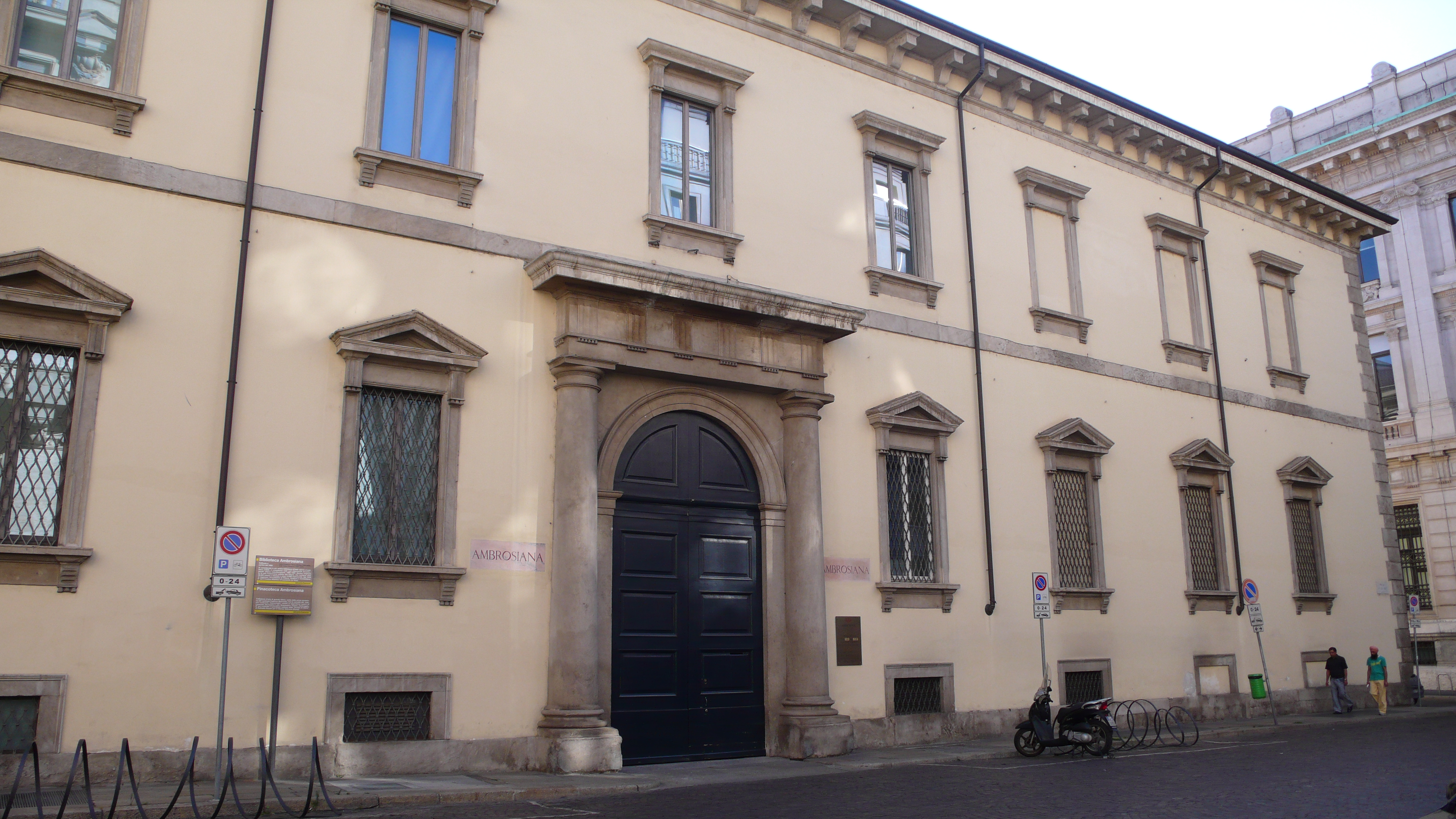
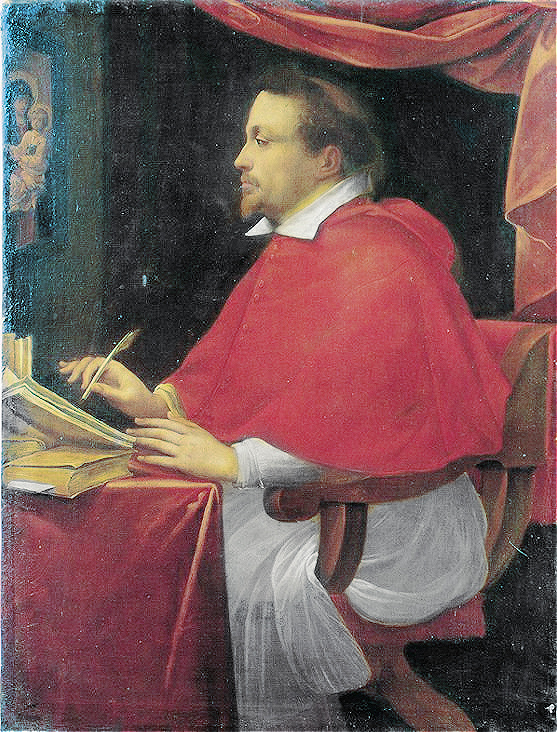
The painting Flowers in a Vase is in the collection of the Ambrosian Art Gallery (Pinacoteca Ambrosiana) of the Biblioteca Ambrosiana in Milan, Italy. It was in the possession of Cardinal Federico Borromeo, cousin to Saint Charles Borromeo (1538-1584), both cardinal archbishops of Milan.

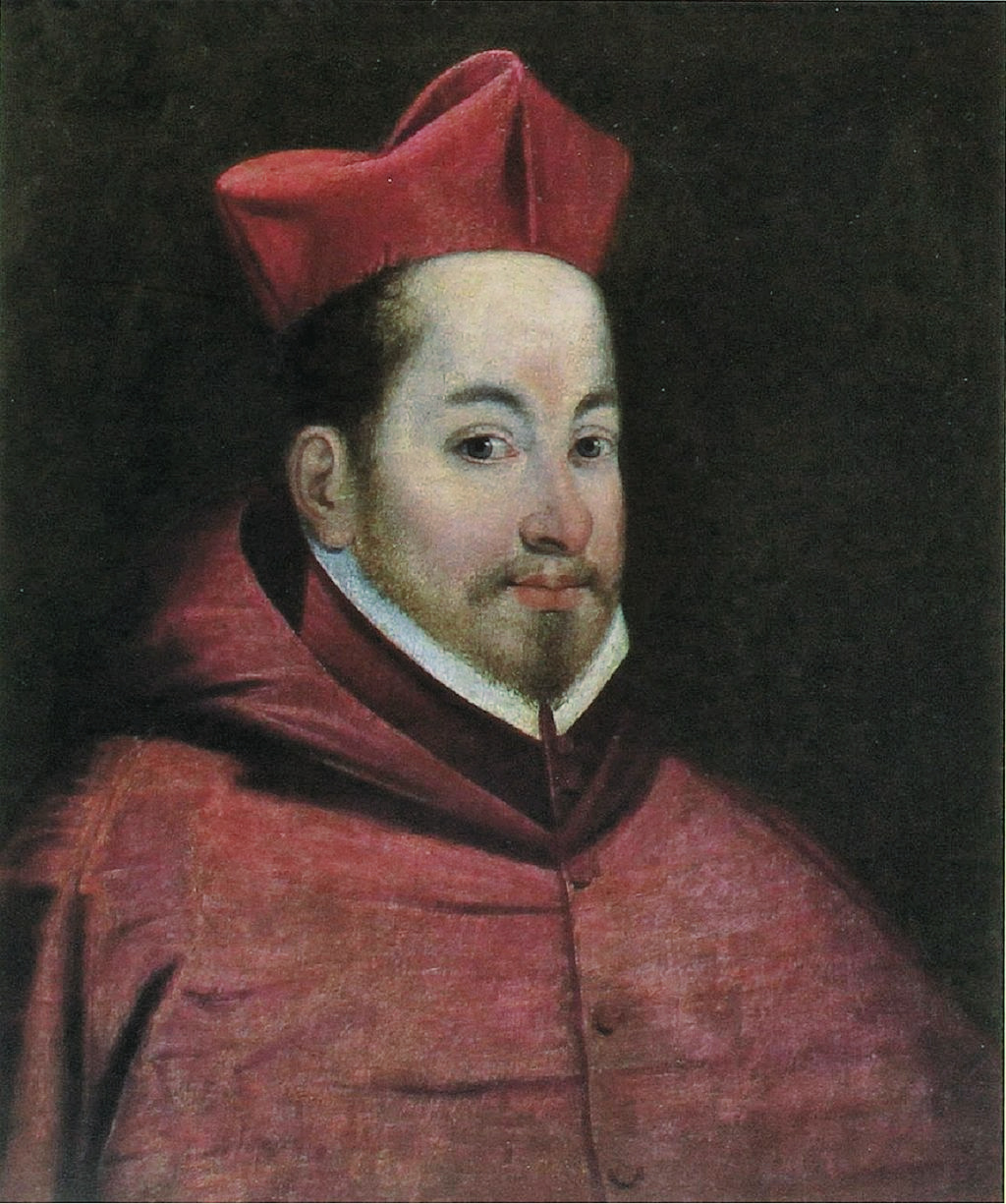
In May 1585 Federico earned a doctorate in theology at the University of Pavia and was sent to Rome where he was made a cardinal at 23 years old by Pope Sixtus V. Federico voted in the papal conclaves of 1590 (Urban VII, Gregory XIV), 1591 (Innocent IX), 1592 (Clement VIII), 1605 (Leo XI, Paul V) and 1623 (Urban VIII). He missed the 1621 conclave (Gregory XV). At the August 1623 papal conclave Cardinal Borromeo received 18 votes out of 54 votes but was opposed by the Spanish party, one of the church’s major factions. The church had to compromise with Urban VIII, a neutral candidate known as the first pope to actively campaign for votes.
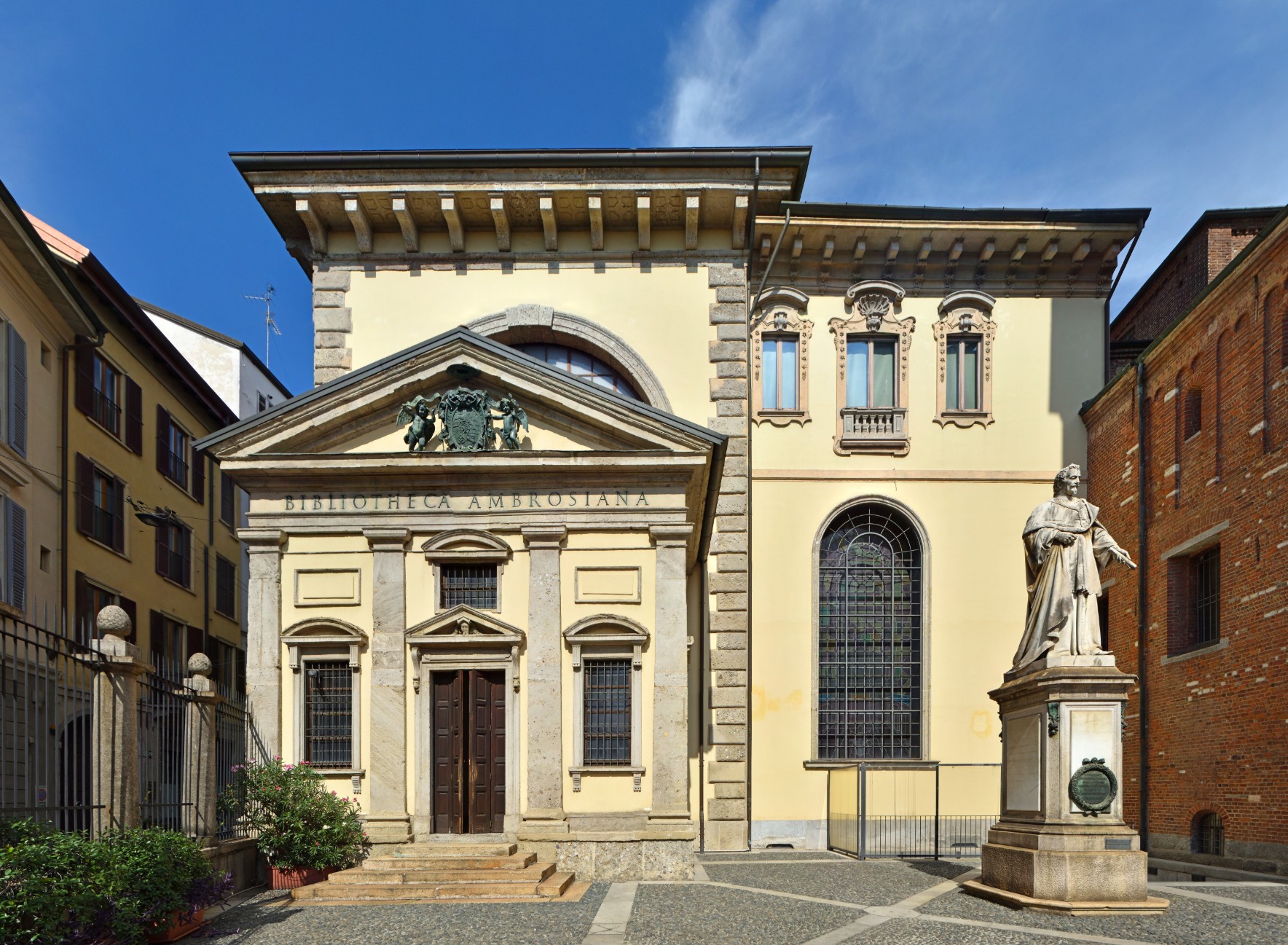
In April 1618 Archbishop Federico Borromeo bequeathed Flowers in a Vase with his collection of paintings, drawing, and statues in his will to the Biblioteca Ambrosiana, which he founded on September 7, 1607 and opened on December 8, 1609. Conceived by the cardinal as a center for study and culture it was open to the public from the beginning. The library collections include over one million printed volumes (including thousands of incunabula and books dating from the 16th century), 40,000 manuscripts (including the celebrated Codex Atlanticus) in many languages, 12,000 drawings (including works by Raphael, Pisanello, and Leonardo), 22,000 engravings, and miscellanea including old maps and musical manuscripts. Along with the cardinal’s achievement, other institutions flourished beside it such as the Board of Fellows (Collegio dei Dottori, 1607), the Art Gallery (Pinacoteca Ambrosiana, 1618) and the Academy of Drawing for teaching painting, sculpture and architecture (Accademia del Disegno, 1620). The Pinacoteca Ambrosiana consists of some of the Italian Renaissance’s great masterpieces such as the Portrait of a Musician by Leonardo da Vinci, The Basket of Fruit by Caravaggio, the cartoon for the School of Athens by Raphael, the Adoration of the Magi by Titian, the Madonna of the Pavilion by Sandro Botticelli and the magnificent Flowers in a Vase by Jan Brueghel. The museum’s collection today includes paintings by 17th-century Lombard artists such as il Morazzone (1573–1626), Giulio Cesare Procaccini (1574–1625), Daniele Crespi (1598 – 1630) and Carlo Francesco Nuvolone (1608-1669) and 18th-century artists such as Giovanni Domenico Tiepolo (1727-1804), Fra’ Galgario (1655-1743), and Francesco Londonio (1723-1783). Cardinal Federico Borromeo, who lived in Rome from 1586 to 1601, was not particularly interested in politics, but focused on classical and oriental scholarship and prayer. In the Counter-Reformation, the cardinal was a great propagator of the faith using religious art, but also was an avid collector of still life. Jan Brueghel the Elder, nicknamed “Velvet,” was a contemporary artist who was erudite and innovative – he invented new types of paintings such as flower garland paintings and paradise landscapes – and his art did not escape the cardinal’s cultivated eye. The Cardinal and young artist met in Rome where the Cardinal became his patron so that the artist took up residence in Cardinal Borromeo’s palazzo.
When Borromeo became archbishop of Milan in June 1595, Brueghel followed him and became part of the Cardinal’s household. Cardinal Borromeo was a reformer in the sense of promoting discipline among the clergy, founding new parishes and schools, as the faith flourished in the 50 years since the Council of Trent completed in 1564. The archbishop was accessible to the flock. Under his leadership, Milan underwent both prosperity and significant cultural flourishing and renewed spiritual energy for a generation. Brueghel stayed with the Cardinal for a year where he painted landscapes and flower paintings and then returned to Antwerp where he lived and worked for the rest of his life. Also nicknamed “Flower” Brueghel, the artist’s flower pieces such as Flowers in a Vase, are dominated by floral arrangements placed against a neutral dark background. Brueghel repeated these motifs in his flower pieces and yet each work was imbued with its own singular freshness and vitality.
FLOWER VASE WITH JEWEL, COINS, AND SHELLS. 1608, oil on copper, 65 × 45 cm by Jan Brueghel the Elder. Pinacoteca Ambrosiana, Milan, Italy.
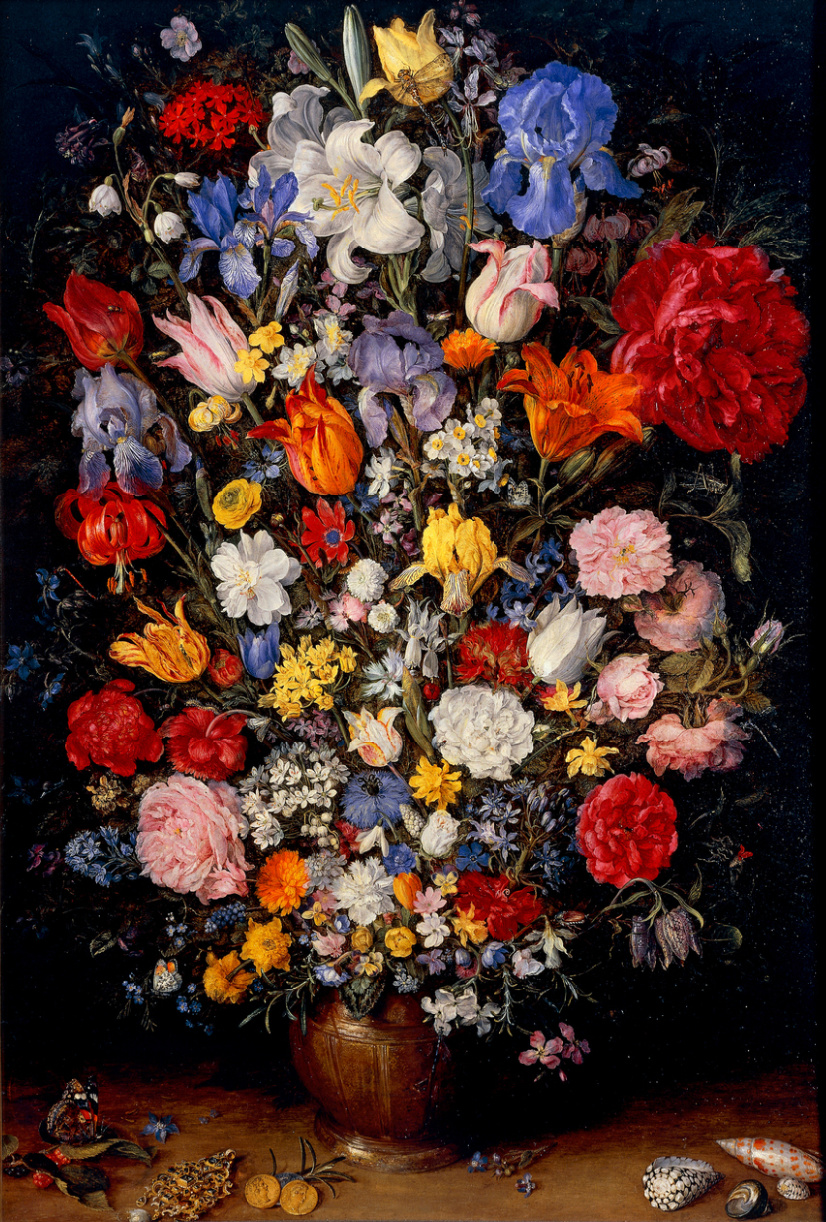
A lush bouquet of flowers, executed by the artist for Cardinal Federico Borromeo (1564-1631), was innovative as a stand-alone bouquet painting of its kind. The subject is composed of around one hundred different species of flowers, some of which are very rare and of great value. In addition to its execution of profuse natural beauty, the picture expressed the nature of the early 17th century culture’s encyclopedic curiosity which extended, among leading collectors, into the natural sciences. It is known by way of a letter that Brueghel was working on the picture in 1606 after he had seen many of these flower varieties in the garden in Brussels of Albert VII, Archduke of Austria (1559-1621) and Isabella Clara Eugenia (1566-1633), who jointly ruled the Spanish Netherlands (1556-1714). The artist’s picture of these flowers was, in a scientific approach, intended to “portray them from nature.” Virtually nothing today remains of the Archdukes Albert and Isabella’s Palace of Codenberg in Brussels nor of their summer retreat at the Château of Mariemont (today’s Morlanwelz in Belgium) south of Brussels which was painted frequently by Jan Brueghel the Elder nor anything of their hunting lodge in nearby Tervuren east of Brussels. In 1633, at the death of Isabella, Albert (who died in 1621) and Isabella’s magnificent collections of art works, scientific instruments, naturalia and artificialia were scattered and much of it lost.

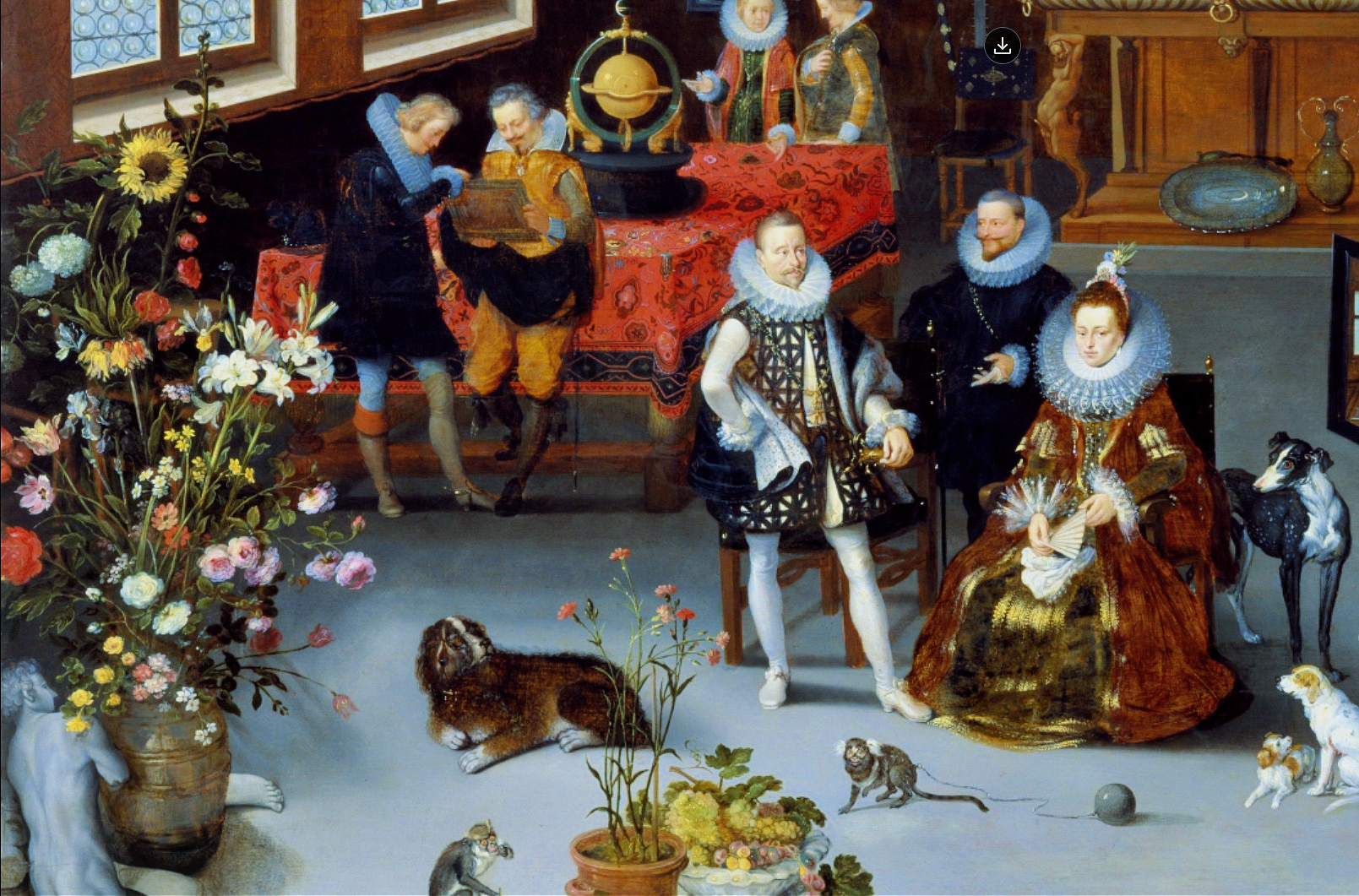
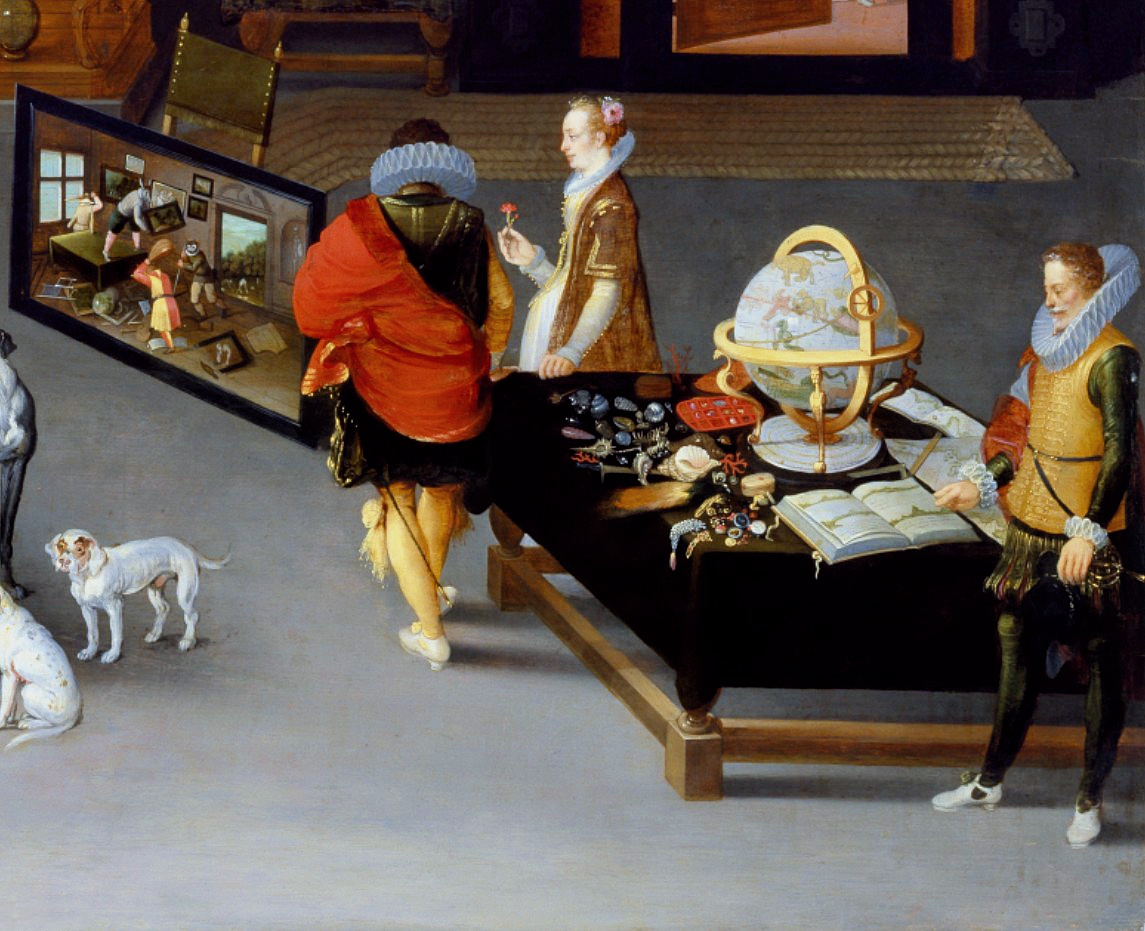
Some of that magnificence was evoked in a picture from 1621-23 by Jan Brueghel the Elder with Hieronymus Francken II (1578-1623) called Albert and Isabella visiting an art gallery. The large format painting (around 3 feet by 4 feet) in the Walters Art Museum depicts a private gallery (or cabinet) of Pierre Roose in Brussels being visited by the Archdukes Albert and Isabella. It includes in a foreground corner an immense vase of flowers by Jan Brueghel and depicts how these collectors are as interested in natural botany and scientific instruments as they are of paintings and sculpture.
Following Albert’s death, Isabella continued to rule on behalf of her nephew Philip IV of Spain (1605-1665) though it was Albert and Isabella’s reign which marked the consolidation of Catholic rule in the Southern Netherlands following severe persecutions of Protestants that ended only in 1597. Though most Protestants had left the region, in 1609 an act of toleration was granted to the Protestants that remained though they could not publicly practice their religion. Conversely, Catholic religious orders like the Jesuits, Capuchins, and Discalced Carmelites received large cash grants and endowments by the wealthy governing elite which helped fund many of these religious groups’ ambitious building and artistic programs in Brussels and Antwerp. As a widow Isabella joined the Third Order of Franciscans until her death. Though despotic and kingly, these rulers have earned a well merited reputation in art history as patrons of the arts. A most notable example is that, in 1609, one year after the Pinacoteca Ambrosiana’s flower picture was created, the Archdukes, whose gardens inspired the work in Italy, appointed Peter Paul Rubens (1577-1640) as their court painter. Commenting on this flower artwork in Milan, Cardinal Borromeo wrote in the Musaeum: “Brueghel painted a diamond on the lower part of the vase…: the author wanted to indicate that the value of his work was equal to that of the gems and this is the price we paid to the artist.”
This explanatory article may be periodically updated.
SOURCES:
https://art.thewalters.org/object/37.2010
https://en.wikipedia.org/wiki/Isabella_Clara_Eugenia
https://en.wikipedia.org/wiki/Albert_VII,_Archduke_of_Austria
https://en.wikipedia.org/wiki/The_Archdukes_Albert_and_Isabella_Visiting_a_Collector%27s_Cabinet
http://janbrueghel.net/janbrueghel/about-janbrueghel/