Category Archives: U.S. Presidents

BLOG JOHN FITZGERALD KENNEDY (May 29, 1917–November 22, 1963), 35th U.S. PRESIDENT.

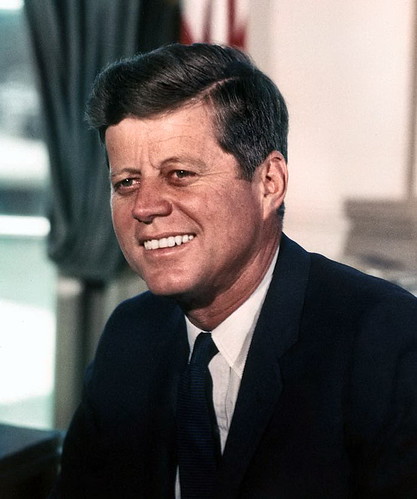
FEATURE image: Portrait of President John F. Kennedy. “President John F. Kennedy” by U.S. Embassy New Delhi is licensed under CC BY-ND 2.0.

INTRODUCTION.
by John P. Walsh
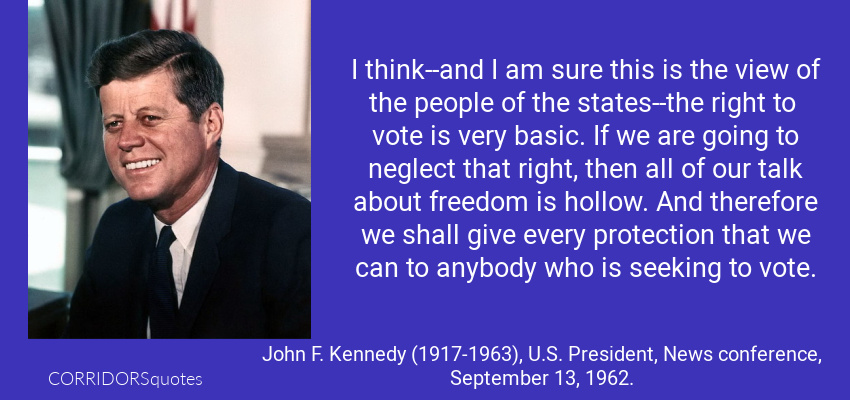
I think – and I am sure this is the view of the people and the states- the right to vote is very basic. If we are going to neglect that right, then all of our talk about freedom is hollow. And therefore we shall give every protection that we can to anybody who is seeking the vote. News conference, September 13, 1962.

The men who create power make an indispensible contribution to the nation’s greatness. But the men who question power make a contribution just as indispensible for they determine whether we use power or power uses us. Remarks at Amherst College, October 26, 1963.

(starts @ 28 seconds) Grand Prairie, Texas, in September 1960. https://youtu.be/iJHrgw8-QEc?si=NMUyZjDxJZXTy1bi – retrieved November 2, 2025.

One of the rare joint appearances of Senators John Kennedy and Lyndon Johnson, the Democratic Presidential ticket, during the 1960 campaign which they prevailed over the Republican ticket of Nixon-Lodge. Here the two men make a joint campaign appearance in Grand Prairie, Texas, in September 1960. Kennedy nor Johnson were natural campaigners—Kennedy’s hands would be shaking hidden under a table or podium as he spoke, his voice growing hoarse. Johnson, who was uncomfortable in crowds and tried too hard, often worked himself on the campaign trail into a sick exhaustion.

Though both candidates wanted to have more joint appearances on the campaign trail, both senators’ aides mutually agreed it mostly hurt the ticket’s—and more precisely, Kennedy’s —image. Though Johnson was only nine years older than Kennedy—both men were the first U.S. presidents born in the 20th century— aides believed that wherever they showed up together Kennedy looked as if he might be LBJ’s son. However, the press and LBJ griped for weeks and months that the candidates should make more joint campaign appearances running as they were for the highest offices in the land.

When it was hinted in the press that there was a growing rift between the candidates and that that was to blame for their not campaigning together, another joint appearance of JFK and LBJ was scheduled in November 1960 five days before Election Day. For the campaign event at the Biltmore in Los Angeles Lyndon Johnson flew out especially to be there and the event received glowing national print and television coverage. On that Thursday before the Tuesday when Americans went to the polls, both candidates and their campaigns viewed the event as a big plus.
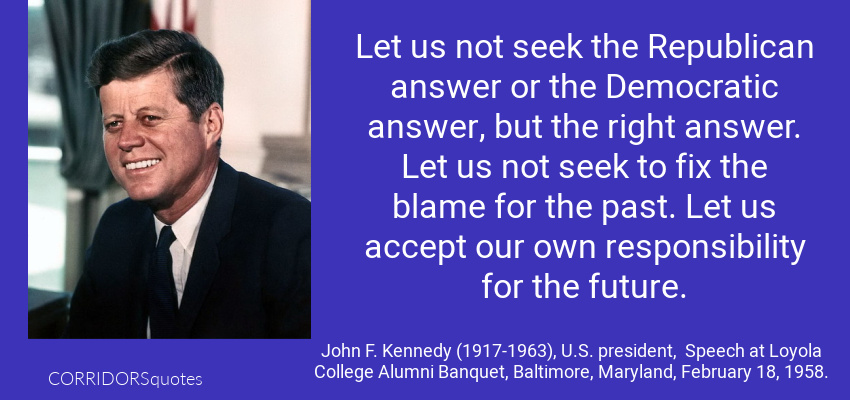
Let us not seek the Republican answer or the Democratic answer, but the right answer. Let us not seek to fix the blame for the past. Let us accept our own responsibility for the future. Speech at Loyola College Alumni Banquet, Baltimore, Maryland, February 18, 1958.

Above: Rev. Dr. Michael Ramsey (1904-1988), Archbishop of Canterbury, and JFK, met on Halloween in 1962. Their Wednesday meeting took place just 3 days following the end of the Cuban Missile Crisis. The world breathed a great sigh of relief that armed confrontation which likely would lead to nuclear war between superpowers was avoided. The previous Saturday, October 27, 1962, was in fact one of the tensest days in the entire ordeal. A U-2 plane was shot down by Soviet-supplied SAM missiles. They killed the USAF pilot and Kennedy’s own ExCOMM demanded immediate military action against those sites. Kennedy resisted the advice. Upon shooting down and killing the U.S. pilot, the Soviets demanded tougher terms for negotiating the removal of 42 mid and long-range nuclear missiles in Cuba. That night, Robert Kennedy met secretly with Soviet Ambassador Anatoly Dobrynin in Washington, D.C. where they reached a basic understanding that only needed approval by Moscow. The next morning. Sunday, October 28, 1962, Radio Moscow announced that the Soviet Union had accepted Kennedy’s proposed solution. The 13-day Cuban Missile Crisis was over. Michael Ramsey was appointed Archbishop of Canterbury on May 31, 1961, and installed in June 1961. He served in this position until 1974. In 1962 Dr. Ramsey was then serving as president of the World Council of Churches (1961 to 1968) and, during his archbishopric, the first woman Anglican priest – Chicago-born high altitude balloonist Jeannette Piccard (1895 -1981) – was ordained in the United States in 1974.
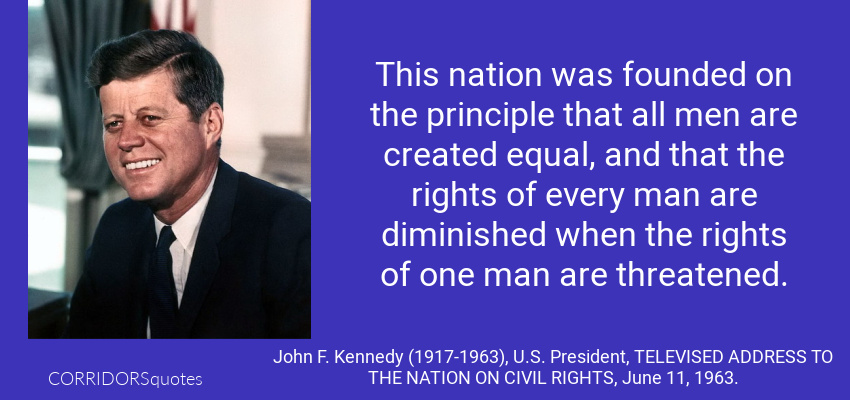
This nation was founded on the principle that all men are created equal, and that the rights of every man are diminished when the rights of one man are threatened. Televised address to the nation on Civil Rights, June 11, 1963.
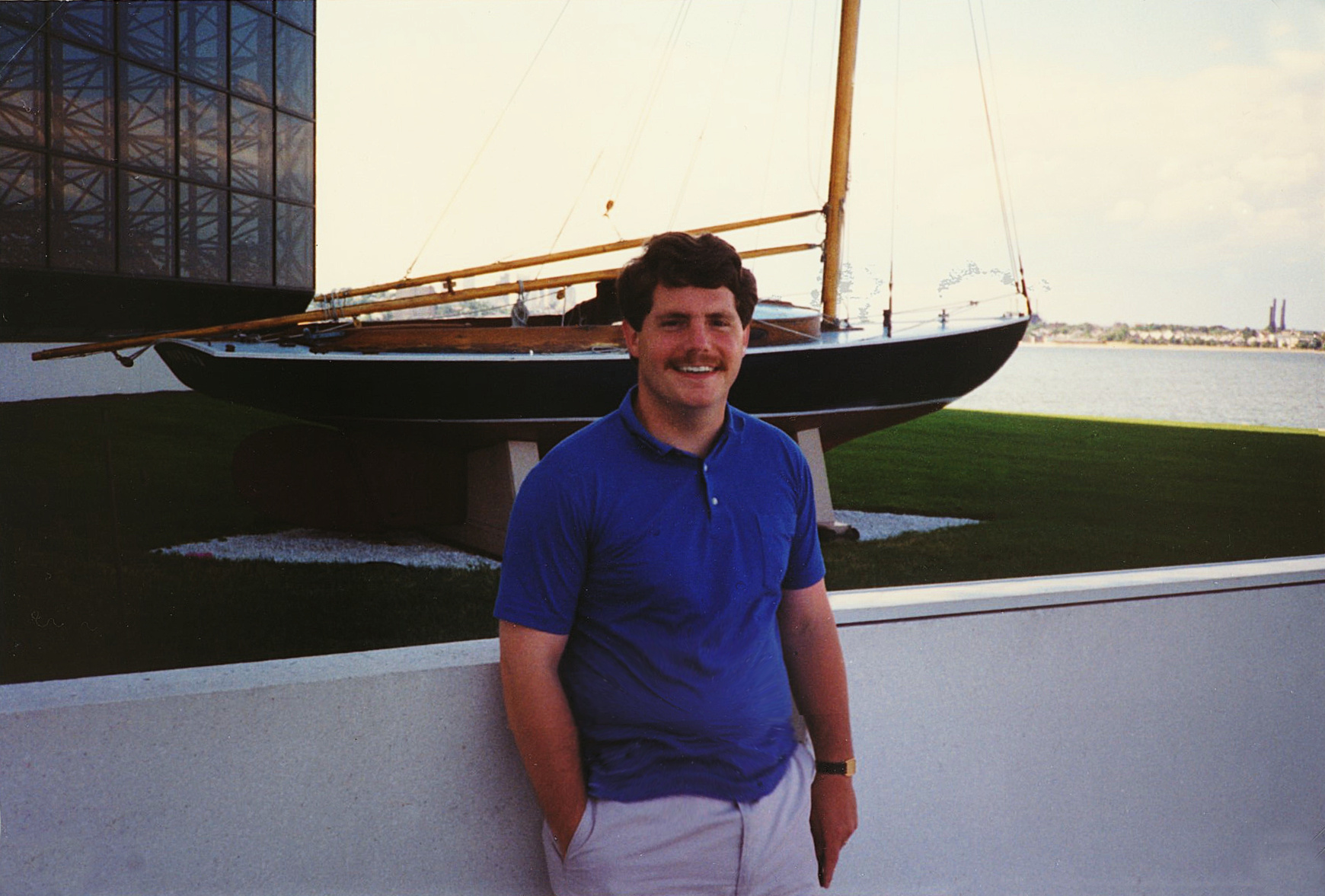
July 1989. John F. Kennedy Library, Columbia Point, Boston, MA.
President-Elect John F. Kennedy and Chester Bowles emerge from a breakfast conference at Kennedy’s Georgetown home in Washington, on Nov. 29, 1960. Bowles was appointed Under Secretary of State and later was Kennedy and Johnson’s ambassador to India.
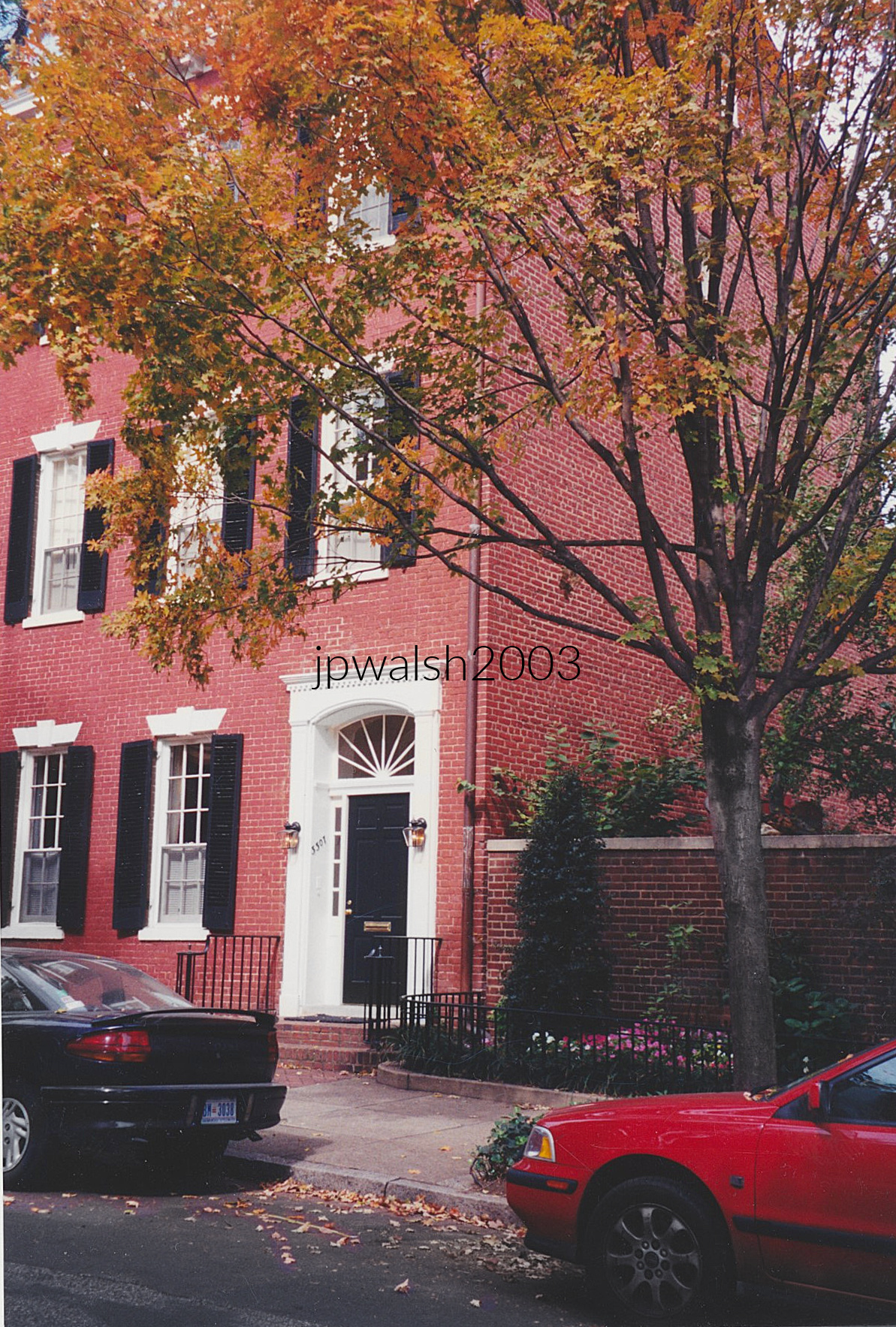
October 2003. 3307 N Street, Georgetown, Washington, D.C. In June 1957 Massachusetts Senator John F. Kennedy (1917-1963) bought this three story Federal-style house as a gift for his wife, Jackie, following the birth of their daughter, Caroline. John Jr. was also born while the Kennedys lived here. Jackie hosted teas in the house’s double living room after JFK’s 1958 Senate re-election campaign and during the 1960 presidential campaign. The front entrance became famous when President-elect Kennedy made regular announcements of national news such as cabinet appointments, including younger brother and campaign manager, Robert F. Kennedy as U.S. Attorney General. The house was sold when the Kennedys moved into the White House in 1961.
August 2005. The John Fitzgerald Kennedy National Historic Site in Brookline, Massachusetts, a suburb adjacent to Boston, is the birthplace and childhood home of President John F. Kennedy. The house on Beals Street was purchased by Kennedy’s father, Joseph Patrick Kennedy in August 1914 in anticipation of his marriage to Rose Elizabeth Fitzgerald in October 1914. JFK’s father was a shrewd, opportunistic and driven bank president and businessman who started to make his fortune by building warships and transports in Quincy shipyards in World War I. Joe Kennedy was an affectionate father who instilled a spirited sense of competition in the Kennedy children starting in their years in Brookline.
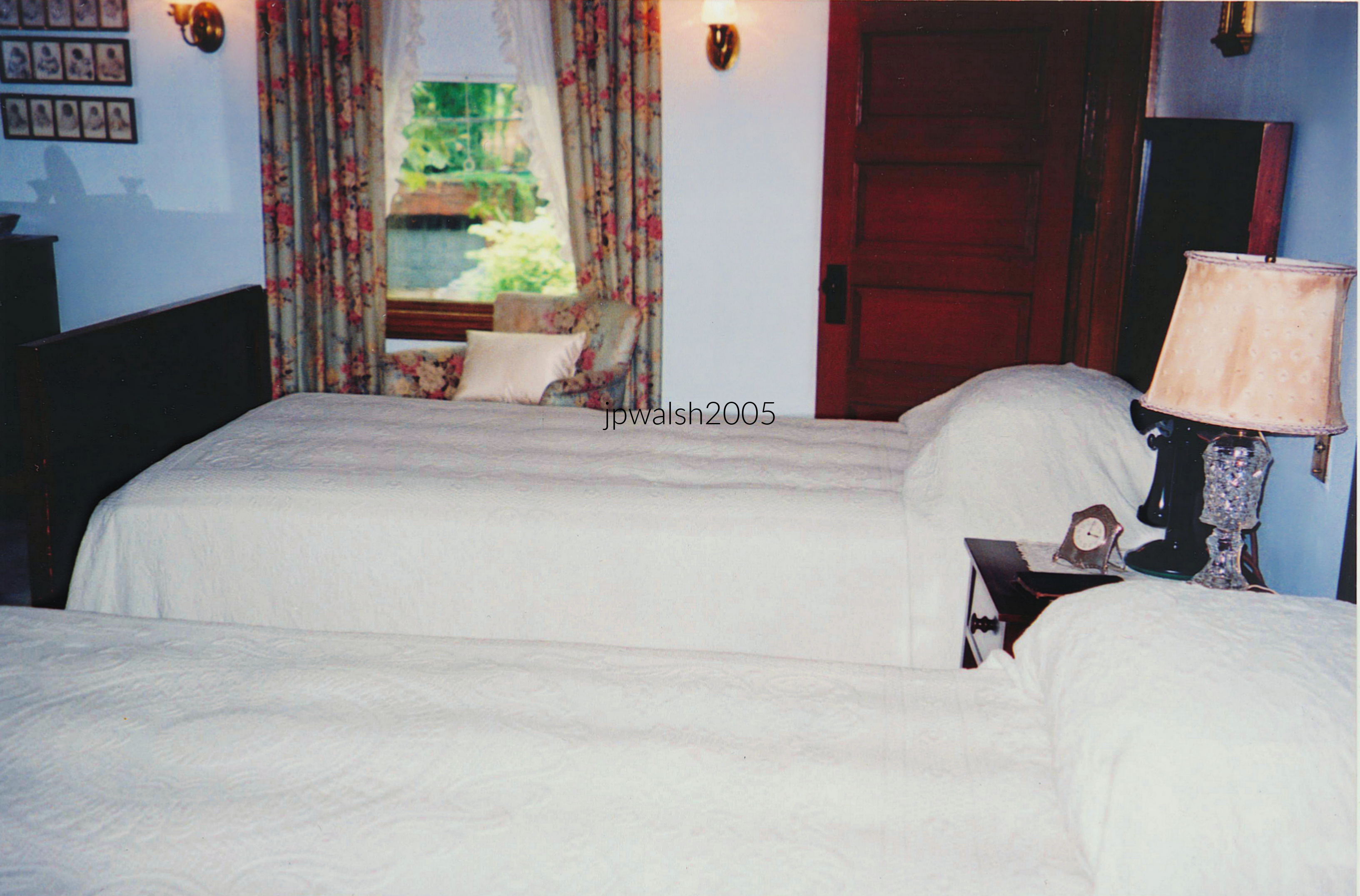
August 2005. The John Fitzgerald Kennedy National Historic Site in Brookline, Massachusetts. John Kennedy was born in this upstairs master bedroom on May 29, 1917. The family lived here until 1920 when they moved a 5-minute walk away to a larger home on Abbottsford where they lived until 1927. Then the Kennedys moved to New York. Rose Fitzgerald, who was the daughter of Boston’s first American-born Irish mayor, had seven of her nine children in Brookline and was reluctant to leave. Joe’s father was a saloonkeeper and politician. While Joe instilled the competitive spirit in to his children, Rose, who as a young woman studied in Europe, taught her children an appreciation of the arts: music, painting, and history. A deeply religious person she would take her young children on walks with the family dog in tow, as they went to the weekday market and afterward to the church so they would know that their faith was not restricted to Sunday. After JFK’s assassination in 1963, Rose Kennedy established this house as a gift to the American people so that, as she said, “Future generations will be able to visit it and see how people lived in 1917 and thus get a better appreciation of the history of this wonderful country.” see – https://www.nps.gov/jofi/index.htm – retrieved May 29, 2025.
(56 seconds). “We are not afraid to entrust the American people with unpleasant facts, foreign ideas, alien philosophies, and competitive values. For a nation that is afraid to let its people judge the truth and falsehood in an open market is a nation that is afraid of its people.” -John F. Kennedy, Voice of America speech, February 26, 1962.

SPEAKING OF FREEDOM OF INFORMATION IN A FREE COUNTRY TO THE ENTIRE WORLD. Voice of America speech, February 26, 1962. FULLER CONTEXT: “What we do here in this country, and what we are, what we want to be, represents really a great experiment in a most difficult kind of self-discipline, and that is the organization and maintenance and development of the progress of free government. And it is your task, as the executives and participants in the Voice of America, to tell that story around the world.
This is an extremely difficult and sensitive task. On the one hand you are an arm of the Government and therefore an arm of the Nation, and it is your task to bring our story around the world in a way which serves to represent democracy and the United States in its most favorable light. But on the other hand, as part of the cause of freedom, and the arm of freedom, you are obliged to tell our story in a truthful way, to tell it, as Oliver Cromwell said.. with all our blemishes and warts, …And we hope that the bad and the good is sifted together by people of judgment and discretion and taste and discrimination, that they will realize what we are trying to do here.
This presents to you an almost impossible challenge, ..The first words that the Voice of America spoke were [IN 1942]. They said, “The Voice of America speaks. Today America has been at war for 79 days. Daily at this time we shall speak to you about America and the war, and the news may be good or bad. We shall tell you the truth”…
In 1946 the United Nations General Assembly passed a resolution reading in part, “freedom of information is a fundamental human right, and the touchstone of all the freedoms to which the United Nations is consecrated.” This is our touchstone…We seek a free flow of information across national boundaries and oceans, across iron curtains and stone walls. We are not afraid to entrust the American people with unpleasant facts, foreign ideas, alien philosophies, and competitive values. For a nation that is afraid to let its people judge the truth and falsehood in an open market is a nation that is afraid of its people.
The Voice of America thus carries a heavy responsibility. Its burden of truth is not easy to bear. It must explain to a curious and suspicious world what we are. It must tell them of our basic beliefs. It must tell them of a country which is in some ways a rather old country–certainly old as republics go. And yet it must make our ideas alive and new and vital in the high competition which goes on around the world since the end of World War II.
…The advent of the communications satellite, the modernization of education of less-developed nations, the new wonders of electronics and technology, all these and other developments will give our generation an unprecedented opportunity to tell our story. And we must not only be equal to the opportunity, but to the challenge as well. For in the next 20 years your problem and ours as a country, in telling our story, will grow more complex. …
We believe that people are capable of standing the burdens and the pressures which choice places upon them, …And as you tell it, it spreads. And as it spreads, not only is the security of the United States assisted, but the cause of freedom.” See – https://www.presidency.ucsb.edu/documents/remarks-the-20th-anniversary-the-voice-america – retrieved May 29, 2025.
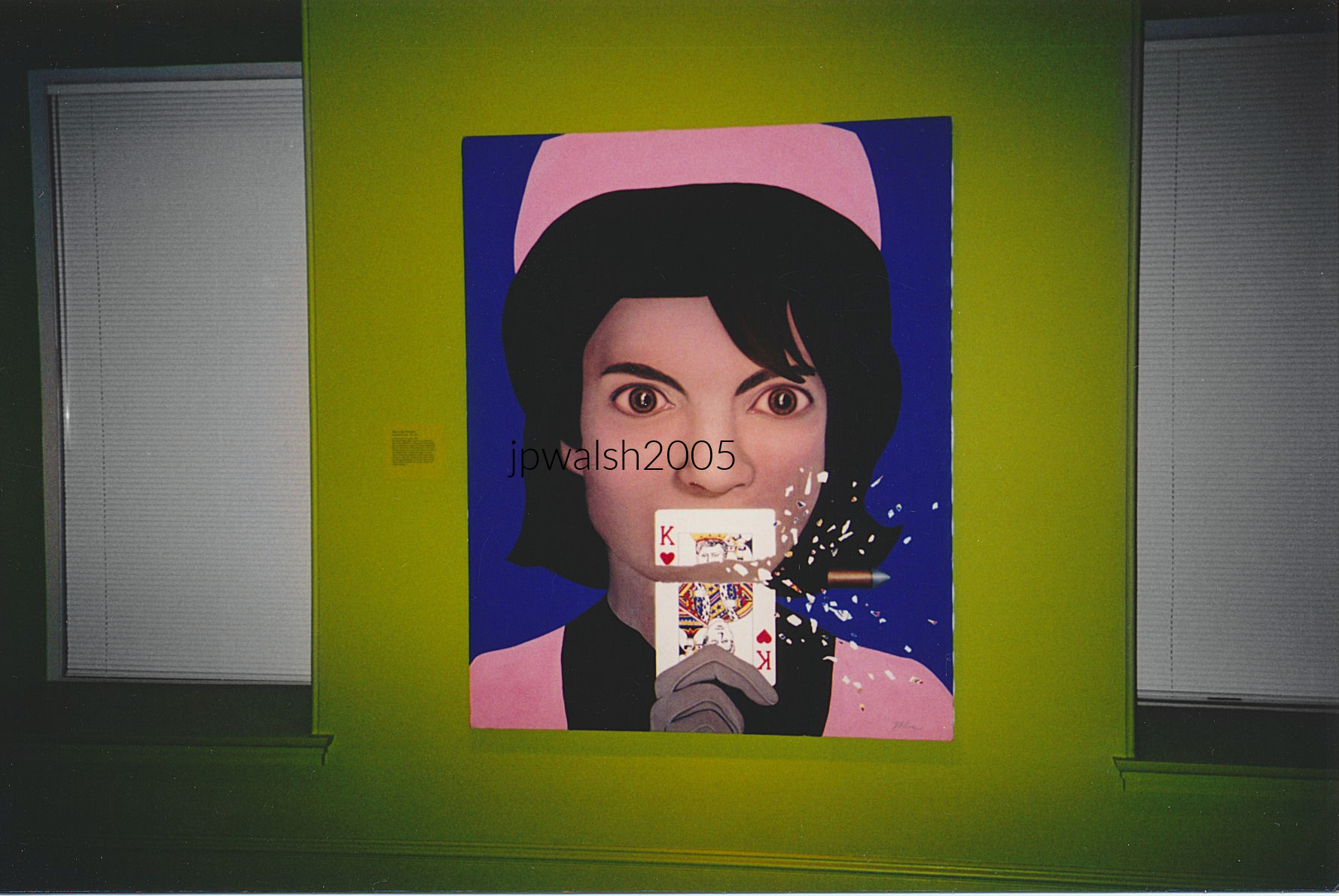
August 2005. National Portrait Gallery, Washington, D.C. Jacqueline Kennedy, the King of Hearts – Stop Action Reaction, 1997, by Tian Mion (b. 1960). see – https://www.si.edu/object/jacqueline-kennedy-king-hearts-stop-action-reaction:npg_S_NPG.2007.6 – retrieved May 29, 2025.

Report to the American People on Civil Rights – June 11, 1963.

https://www.youtube.com/watch?v=PTHowggASwY

June 11, 2025 – (13.23 minutes). On May 27, 1963 the Supreme Court stated that it was not going to tolerate the evasion of its 1954 landmark decision Brown v. Board of Education that segregated schools. They stated such in another desegregation case involving public parks. When the High Court made their decision in 1954, in no way could they have foreseen the years of delay. On June 5, 1963 a federal court enjoined Alabama Gov. George Wallace from in any way impeding the admission of two qualified Black citizens from enrolling in the University of Alabama. President John F. Kennedy, on June 10, 1963, reinforced this decision by writing to Gov. Wallace urging him not to interfere. The following day, June 11, 1963, Wallace carried out his pledge to “stand in the schoolhouse door” and blocked the Black students from enrolling. When Wallace was confronted by Kennedy’s federal marshals, and refused the students’ entry, the president nationalized the Alabama Guard. When troops appeared on the scene the governor relented and the Black students entered and registered for classes. That evening from the Oval Office Kennedy appeared on radio and television to deliver what is called the “Report to the American People on Civil Rights” in which he set out the moral and legal issues involved with Civil Rights and proposed legislation that would later become the landmark Civil Rights Act of 1964. In the first two years of Kennedy’s term, he had been slow and cautious in his support of civil rights and desegregation in the United States. Ever the politician he was concerned that any bold actions or initiatives on his part in this area would alienate Congressmen he needed to get through his stalled legislative agenda. On June 11, 1963 in a radical departure from his and the nation’s past Kennedy gave his full-throated endorsement to Civil Rights and Civil Rights legislation in this 13-minute speech. Later that night, in the early hours of June 12, 1963, civil rights activist Medgar Evers, who had been listening to Kennedy’s remarks on the radio, was killed by a sniper as he returned to his home in Jackson, Mississippi. On June 13, 1963 82 black marchers protesting Evers’ death were arrested by Jackson police. On June 19, 1963 Kennedy asked Congress to introduce his bill to desegregate public facilities, take federal action to end job discrimination, and allow the U.S. Attorney General to start desegregation suits. In the meantime, as Congressional negotiation and debate was beginning on the Civil Rights bill, Kennedy asked civil rights leaders to suspend protests and marches which they refused to do. Instead, in the face of a Congressional filibuster of Kennedy’s civil rights bill, they announced a March for Jobs and Freedom in Washington, D.C. to take place in August 1963. Within a week of Evers’s murder, a white suspect was arrested and charged with the slaying. See- Kennedy and the Press, edit. Harold W. Chase and Allen H. Lerman, introduction by Pierre Salinger, Thomas Y. Crowell Company, New York, 1965, p. 452.

(27 seconds). Berlin speech at Rudolph Wilde Platz, June 26 1963
Texas motorcade & remarks at the dedication of the Aerospace Medical Health Center, San Antonio – November 21, 1963
White house 1963  – color recording of remarks for “Seas around us”.
Moon speech, Rice University, Houston, Texas – September 12, 1962
.
https://youtu.be/cgHGg8PiAqo?si=aSZpzJKa_NEeHsP4 – retrieved November 1, 2025. For transcript of speech SEE – The President and the Press: Address before the American Newspaper Publishers Association, April 27, 1961 | JFK Library

On April 27, 1961, President John F. Kennedy delivered his 2400-word+ major speech known as “President and the Press” before the American Newspaper Publishers Association at the Waldorf-Astoria Hotel in New York City. In the speech delivered just days after the failed Bay of Pigs Invasion the new president made a plea for responsible journalism in the face of Cold War threats. The remarks remain relevant today on the topics of press freedom, misinformation, and national security.
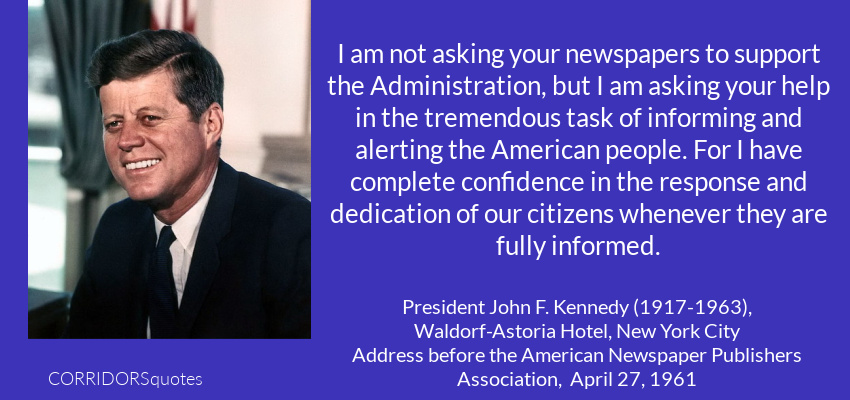
I am not asking your newspapers to support the Administration, but I am asking your help in the tremendous task of informing and alerting the American people. For I have complete confidence in the response and dedication of our citizens whenever they are fully informed. Waldorf-Astoria Hotel, New York City, Address before the American Newspaper Publishers Association, April 27, 1961. see – https://www.jfklibrary.org/archives/other-resources/john-f-kennedy-speeches/american-newspaper-publishers-association-19610427#:~:text=This%20Administration%20intends%20to%20be,out%20when%20we%20miss%20them. – retrieved March 25, 2025.
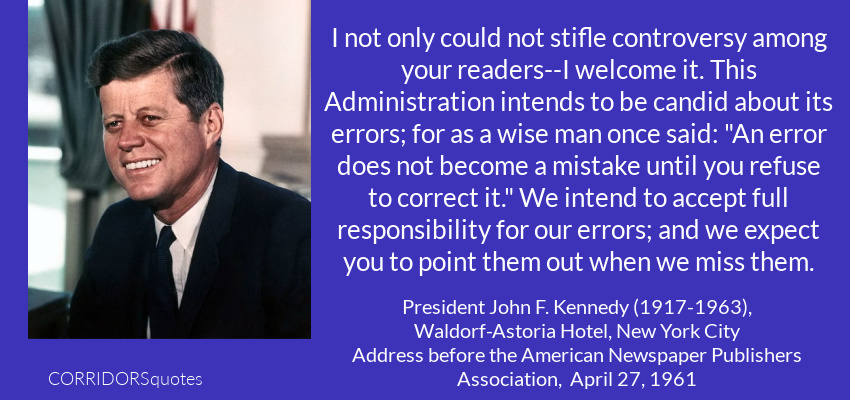
I not only could not stifle controversy among your readers–I welcome it. This Administration intends to be candid about its errors; for as a wise man once said: “An error does not become a mistake until you refuse to correct it.” We intend to accept full responsibility for our errors; and we expect you to point them out when we miss them. Waldorf-Astoria Hotel, New York City, Address before the American Newspaper Publishers Association, April 27, 1961. see – https://www.jfklibrary.org/archives/other-resources/john-f-kennedy-speeches/american-newspaper-publishers-association-19610427#:~:text=This%20Administration%20intends%20to%20be,out%20when%20we%20miss%20them. – retrieved March 25, 2025.

This explanatory article is periodically updated.

Watching U.S. PRESIDENTS.

FEATURE Image: “White House” by Diego Cambiaso is licensed under CC BY-SA 2.0.

“The advent of the new president changed everything. The Roosevelts transformed the White House as completely as the swift march of public thoughts and events had changed the country. No longer did the Executive Mansion resemble a medieval castle besieged by the forces of progress. The drawbridges were figuratively let down, and the moats drained of their timeworn prejudices. The archers of reaction withdrew from their turrets, and the victorious New Deal army took over the battlements.” George Abell and Evelyn Gordon, Let Them Eat Caviar, Dodge Publishing Co., New York, 1937.

The Roosevelts. Franklin and Eleanor (FDR Bio, part 1)” by Tony Fischer Photography is licensed under CC BY 2.0.

“Even that son of a bitch looks impressive in that getup!” Alice Roosevelt Longworth (1884-1980), at the White House after visiting President Warren Harding in the Oval Office. Quoted in Katherine Graham’s Washington, Knopf, 2002.

Alice Roosevelt was President Teddy Roosevelt’s oldest child and the only child of Roosevelt and his first wife, Alice Hathaway Lee, who died in childbirth. Alice grew up to be an independent, unconventional and outspoken “first daughter” and was an important figure in the women’s movement in the first half of the 20th century.

Alice Longworth was perfectly realistic about Harding—and didn’t like the Republican president very much. Sen. Brandegee of Connecticut, a member of Harding’s own inner circle, called the former newspaper owner of The Marion Star, Senator from Ohio, and 29th U.S. President, “no world-beater, but he’s the best of the second-raters.”

“[The Wilsons] finally settled on a house in the 2300 block of S Street, Northwest, and purchased it…[W]e rode by everyday, and the President was eager as a bridegroom about getting back to private life. He seemed to gain new strength as he shed the idea of responsibility and assumed the freedom of a civilian. But he did not forget his dreams.” Colonel Edmund W. Starling, Starling of the White House…as told to Thomas Sugrue…, Simon & Schuster.

Colonel Edmund William Starling (1875-1944) was chief of the Secret Service detail in the White House from 1914 to 1943. In his thirty years of service at the White House he was responsible for the personal safety of five President of the United States—Woodrow Wilson, Warren G. Harding, Calvin Coolidge, Herbert Hoover and Franklin D. Roosevelt. Starling idolized Woodrow Wilson. His first exposure to Wilson left him “in a daze.” Born in Hopkinsville, Kentucky, the posthumous book is based on over 11,000 personal letters Starling wrote over the decades, mostly to his mother back home. Starling’s ashes are buried at Arlington National Cemetery.

SOURCES: http://www.arlingtoncemetery.net/ewstarling.htm; https://hoptownchronicle.org/hopkinsville-native-edmund-w-starling-protected-five-presidents-as-a-secret-service-agent/

“As Senate majority leader, I participated in many private conferences with President Franklin D. Roosevelt….Usually we would talk in his bedroom at the White House, and the President, wrapped in his cherished gray bathrobe, which he clung to year after year….would interrupt work on a pile of papers and puff at a cigarette through his long ivory holder as we exchanged views.” Alben W. Barkley (1877-1956), That Reminds Me, 1954.

Senator Barkley (later Vice President Barkley under President Harry S. Truman) describes an almost iconic FDR- one can almost imagine a bespectacled 32nd president smoking a cigarette from a long cigarette (in this instance, ivory) holder and jauntily thrusting his chin forward.

Alben W. Barkley, Democrat of Kentucky, was one of the most prominent American politicians of the first half of the 20th Century. Barkley hoped expectantly to someday be the U.S. President–or at least his party’s sometime presidential nominee, particularly in 1952. The longtime majority leader of the U.S. Senate had to settle, however, for being a one-term vice-president in the executive branch. After Truman chose Barkley to be his running mate in 1948 and that ticket triumphed in one of American history’s most astounding upsets, Alben Barkley became a popular national figure known everywhere as “The Veep.” Like his Kentucky forebear Abraham Lincoln, Vice President Barkley was a noted story-teller and often started his sentence with, “And that reminds me…” 

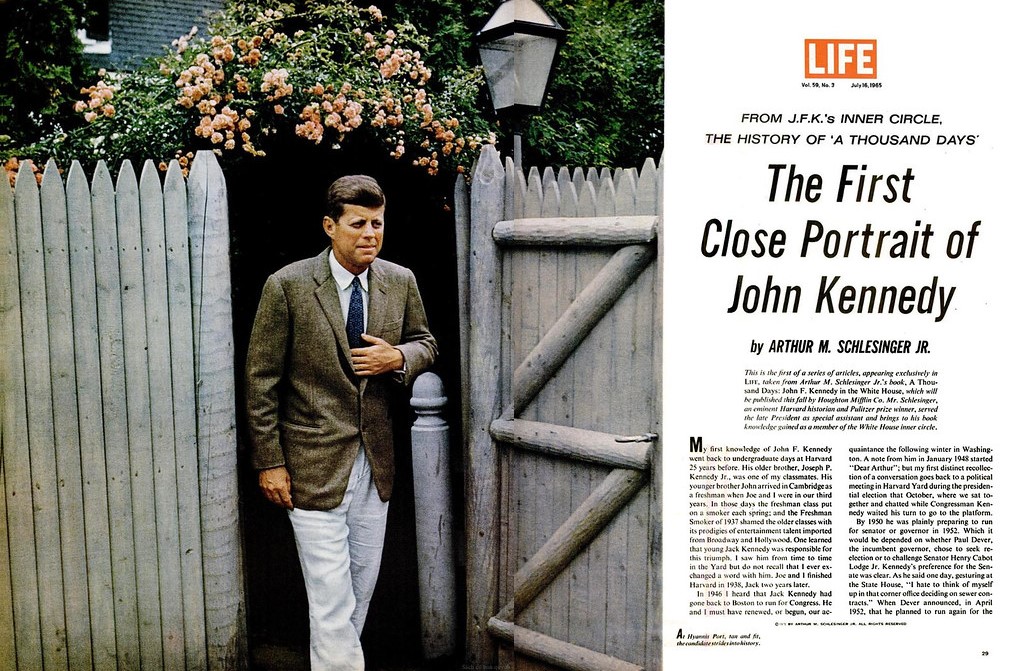
“It was all gone now-the life-affirming, life-enhancing zest, the brilliance, the wit, the cool commitment, the steady purpose….[President Kennedy] had so little time: it was as if Jackson had died before the nullification controversy and the Bank War, as if Lincoln had been killed six months after Gettysburg or Franklin Roosevelt at the end of 1935 or Truman before the Marshall Plan.” Arthur M. Schlesinger, Jr. (1917-2007) on the death of JFK. From A Thousand Days: John F. Kennedy in the White House, Houghton Mifflin, 1965.

LIFE Magazine JULY 16, 1965 (3) – The First Close Portrait of John Kennedy – by Arthur M. Schlesinger Jr.LIFE Magazine JULY 16, 1965 (3) – The First Close Portrait of John Kennedy – by Arthur M. Schlesinger Jr.” by manhhai is licensed under CC BY 2.0.
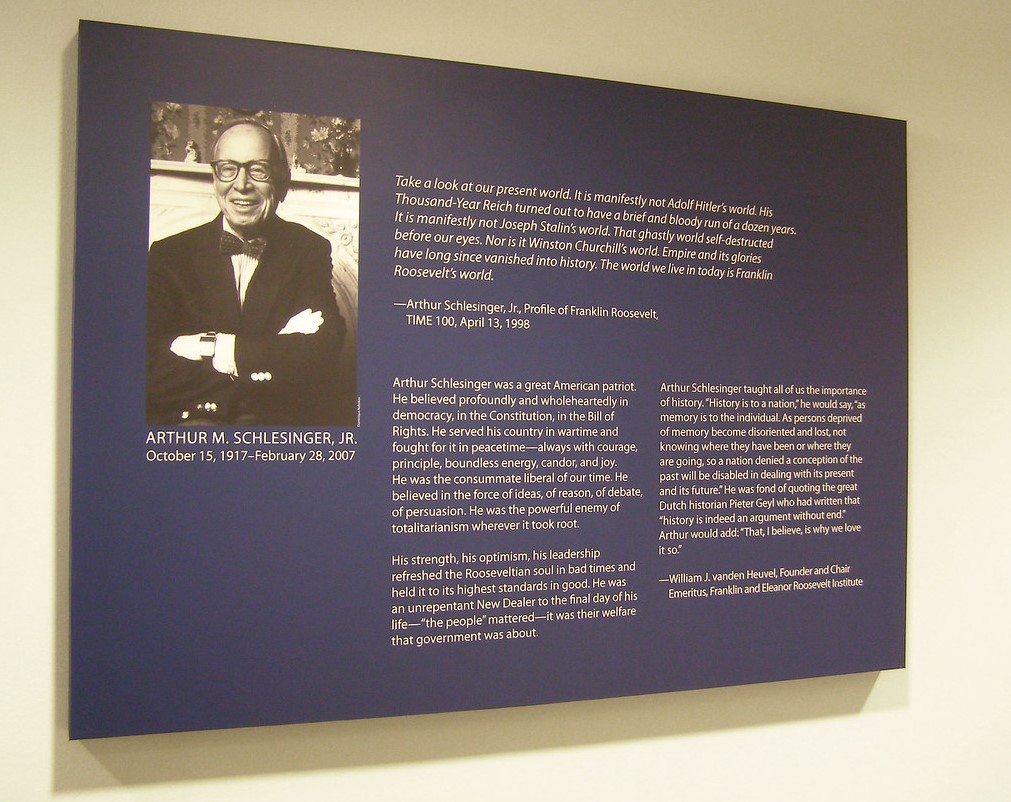
Arthur M. Schlesinger Research Room a the FDR Presidential Library & Museum in Hyde Park, NY.Arthur M. Schlesinger Research Room” by FDR Presidential Library & Museum is licensed under CC BY 2.0.

Arthur M. Schlesinger, Jr. was an American historian who resigned from Harvard and was appointed Special Assistant to the President in the Kennedy Administration in January 1961. Per Kennedy’s desire, Schlesinger served as a sort of ad hoc roving reporter and troubleshooter on behalf of the president. In February 1961, Schlesinger was told of the plans for what developed into the disastrous Bay of Pigs invasion in April 1961 and wrote a memorandum to the president telling him that he opposed the action. During the Cuban Missile Crisis in October 1962 Schlesinger aided United Nations ambassador Adlai Stevenson on his presentation to the world body on behalf of the Kennedy Administration’s ultimately successful efforts to peacefully remove Soviet nuclear missiles in Cuba. On November 22, 1963, Schlesinger had flown to New York for a luncheon with Washington Post owner Katharine Graham and the editors of her magazine, Newsweek. As they still sipped pre-luncheon libations and amiably talked about upcoming college football games that weekend, a young man in shirtsleeves suddenly entered the gathering. He tentatively announced to the group that, as Schlesinger relates in A Thousand Days, “the President has been shot in the head in Texas.”

“[George Washington’s] mind was great and powerful, without being of the very first order; his penetration strong, though not so acute as that of a Newton, Bacon, or Locke; and as far as he saw, no judgment was ever sounder. It was slow in operation, being little aided by invention or imagination, but sure in conclusion.” Thomas Jefferson (1743-1826), U.S. president, Letter, January 1814.

After returning from France where he served as Minister Plenipotentiary with John Adams and Benjamin Franklin in Paris in the mid-to-late 1780’s, Thomas Jefferson accepted President George Washington’s invitation to serve as the nation’s first Secretary of State in the early 1790’s. Jefferson eventually left Washington’s cabinet over his opposition to Treasury Secretary Alexander Hamilton’s promotion of a national debt and national bank in contrast to Jefferson’s vision of a minimalist federal government (see Joseph J. Ellis, American Sphinx: The Character of Thomas Jefferson, Random House, 1998, pp. 221-222). Thomas Jefferson was elected the third president of the United States in 1800 and served two terms as president. In 1803 Jefferson transacted the Louisiana Purchase that doubled the size of the United States and in the process acquired the most fertile tract of land of its size on Earth.

“During the inaugural parade [President George H.W.] Bush kept darting in and out of his limousine…These pop-outs were much better received than the Jimmy Carter business of walking the whole parade route. We Americans like our populists in small doses and preferably from an elitist.” P.J. O’Rourke, PARLIAMENT OF WHORES, Atlantic Monthly Press, 1991.

George H.W. Bush, President 1989 – 1993. George H.W. Bush, President 1989 – 1993” by US Department of State is licensed under CC BY-NC 2.0.

The Bushes were a big family and family oriented. O’Rourke reported in his best-selling book that on the first night of Bush’s presidency 28 members of the Bush family spent it at the White House.

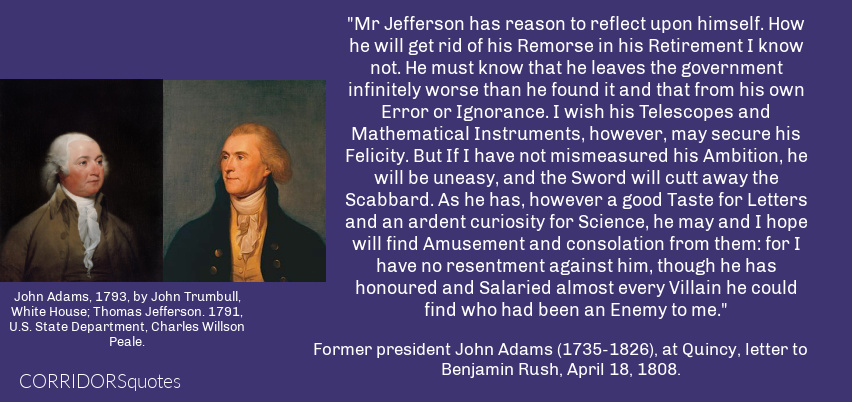
“Mr Jefferson has reason to reflect upon himself. How he will get rid of his Remorse in his Retirement I know not. He must know that he leaves the government infinitely worse than he found it and that from his own Error or Ignorance. I wish his Telescopes and Mathematical Instruments, however, may secure his Felicity. But If I have not mismeasured his Ambition, he will be uneasy, and the Sword will cutt away the Scabbard. As he has, however a good Taste for Letters and an ardent curiosity for Science, he may and I hope will find Amusement and consolation from them: for I have no resentment against him, though he has honoured and Salaried almost every Villain he could find who had been an Enemy to me.” Former president John Adams (1735-1826), at Quincy, letter to Benjamin Rush, April 18, 1808.

The punctuation and capitalization are Adams’ original. see– https://founders.archives.gov/documents/Adams/99-02-02-5238

John Adams (1735-1826), the second president of the United States, a Federalist, and Thomas Jefferson (1743-1826), a Democratic-Republican, were fierce political rivals. Both lawyers—Adams from Massachusetts and Jefferson from Virginia—each were enlightened political liberals who served in the Continental Congress in Philadelphia as well as headed the committee that drafted the Declaration of Independence. Adams and Jefferson also served together as ministers to France in the 1780’s. Into the 1790’s, as president (Adams) and vying to be (Jefferson), each served opposing visions for the direction of the new nation. At their extreme, the Federalists advocated to establish a strong Federal government that could alienate the individual rights of large groups. Jefferson’s vision of limited government included his advocacy in certain instances for state government to have the right to resist those federal laws that were injurious to local interest.

efferson’s narrow victory in the presidential election of 1800 made John Adams the nation’s first one-term president and sent the New England patriarch into early retirement at Peacefield in Quincy, Massachusetts. For the next decade, during Jefferson’s two terms as president, John Adams harbored a barely hidden resentment of his political rival, if not enemy when measured by some of their florid rhetoric towards one another. Though these two sparring giants of the early republic eventually resumed civil correspondence – Adams writing a New Year’s Day greeting to Jefferson in 1812 that Jefferson responded to three weeks later – it became these once friends and political collaborators’ first contact since 1801 – Adams had been especially upset by the relentless propaganda campaign of Jefferson’s Republican party against him during the second president’s first term. Jefferson’s years-long accusations against President Adams inscluded descriptions of the second president as narcissistic, incompetent, dangerous to democracy, unbalanced, and corrupt. All these public proclamations were approved and personally paid for by Jefferson, a profligate spender, and which led to the premature and hasty departure by Adams as chief executive from Washington, D.C. on March 4, 1801, not attending Jefferson’s inauguration. At least two remarkable outcomes resulted in this renewed friendship of political rivals in these resumed letters – one, that Adams and Jefferson stayed in close contact until the day they died and, two, that that was on the same day – July 4, 1826. Which of these conspicuous marvels s most noteworthy among fierce rivals and Founding fathers may be debated. see – https://founders.archives.gov/documents/Jefferson/03-04-02-0296-0002; https://openendedsocialstudies.org/2018/09/25/adams-jefferson-and-two-visions-for-the-united-states/; Joseph J. Ellis, American Sphnix: The Character of Thomas Jefferson, Random House, 1998, pp. 281-82).

“Isn’t it nice that Calvin is President? You know we never really had room before for a dog.” Grace Coolidge (1879-1957), First Lady of the U.S. (1923-1929), in 1927.

Grace Coolidge was the wife of the 30th President of the U.S., Calvin Coolidge. Throughout her husband’s career, whether as Governor of Massachusetts, Vice-President, or President, Grace Coolidge avoided politics. Though the young Grace broke off a marriage engagement to marry Coolidge, her mother advised against marrying this young man. Calvin Coolidge and Grace Coolidge married on October 4, 1905—and Calvin Coolidge never settled his differences with his mother-in-law who felt her daughter was completely responsible for his rising political fortunes. The Coolidges had two sons, John (1906–2000) and Calvin (1908–1924). After Calvin Coolidge, Jr. died of blood poisoning in July 1924, the Coolidges were inconsolable. The story is well-known: while playing lawn tennis with his brother, John, at the White House, the teenager developed a blister on one of his toes. Within the week, the 16-year-old was dead of a blood infection despite being admitted to Walter Reed Army Medical Center. (see- https://www.coolidgefoundation.org/blog/the-medical-context-of-calvin-jr-s-untimely-death/)

Calvin Coolidge, President 1923 – 1929” by US Department of State is licensed under CC BY-NC 2.0.

By 1921, the wife of Vice-President Coolidge entered Washington society and quickly became the most popular woman in the capital. In 1927 when Mrs. Coolidge made these remarks, the world that her husband was facing was in flux. In 1927, as France called to outlaw war, which was endorsed by the U.S, a Great Depression already began in Germany with its economic collapse on “Black Friday.” After President Coolidge called for a Naval Disarmament Conference, only a couple of global powers showed up.

The world seemed to be getting smaller in 1927. In May 1927 American Charles Lindbergh flew solo, nonstop, from New York to Paris and started the era of transatlantic air travel. Regular transatlantic telephone service also began in 1927. In the U.S., as the stock market boomed, much of it on shaky credit, lawyers and doctors earned around 3½ times more than a teacher or factory worker. Baltimore-born “Babe” Ruth hit a record 60 home runs in New York.

The first full-length sound motion picture, The Jazz Singer, opened in 1927. In Chicago there was an important art exhibition of Chinese Buddhist art of the Wei Dynasty. In 1927, Hemingway published Men without Women; Willa Cather published Death Comes for the Archbishop; and Thomas Mann published The Magic Mountain. That year’s Pulitzer Prize went to Thornton Wilder’s second novel, The Bridge of the San Luis Rey. It told the story of people who unexpectedly die together in a rope bridge collapse in Peru and the friar who witnessed the accident looking to figure out the possibly cosmic answers as to why.

“The days of transition from Kennedy to Johnson were as hard on me as they were on anyone else–harder. I was losing a dog and gaining a President I didn’t know. Not only didn’t I know him, I didn’t think I wanted to know him. He wasn’t boyish or good-natured or quick-witted like Kennedy and I heard him cussing out the help when things weren’t done fast enough.” Traphes Bryant, Dog Days at the White House, 1975.

In 1951, Traphes Bryant started out at the White House working as an electrician in the afternoons. Bryant moved on to respond to general maintenance calls including a broken White House elevator. In the 1950’s Bryant was already looking after the First Family’s pets, both for the Trumans and, later, the Eisenhowers. The line of work became official for Traphes Bryant in 1961 when John Kennedy became president.

Kennedy asked Bryant to become the new presidential kennel keeper. The president liked how Bryant trained the dogs to meet the presidential helicopter that would often be seen in photographs and films.

Though Kennedy himself was allergic to some animals, First Lady Jackie Kennedy adored all sorts of animals. During the next 1000 days while in office, the Kennedys kept several pets. At one point the first family, which included children Caroline and John, Jr., had nine dogs. The Kennedys also kept hamsters, horses, birds, a rabbit, and a cat. Some of the animals were gifts from foreign heads of state.

In 1961 Soviet Premier Nikita Khrushchev sent the Kennedys a mixed breed dog named Pushinka. The dog’s mother had been sent into orbit in 1960 on Korabl-Sputnik 2. While a surprise, the Kennedy’s welcomed the Russian’s canine gift. In fact, Kennedy’s Welsh terrier, Charlie, not only had a new companion but a new mate: Pushinka gave birth to four puppies fathered by Charlie. Kennedy called the litter, “the pupniks.”

Bryant was officially in charge of Pushinka’s and Charlie’s grooming, exercise, and diet—and all the rest though those responsibilities ended abruptly for Kennedy in November 1963.

see BRYANT, TRAPHES L.: ORAL HISTORY INTERVIEW – JFK #1, 5/13/1964; Traphes Bryant, Dog Days at the White House, 1975; Katherine Graham’s Washington, Knopf, 2002, pp. 542-43; https://www.facebook.com/WhiteHouseHistory/posts/traphes-bryant-pictured-here-had-been-a-white-house-electrician-since-1948-worki/3374666809225225/

“Nancy Dickerson wrote that ‘The LBJ social style was something of a shock to the capital. Starting right at the White House, the Johnson way was different…It’s difficult to comprehend the LBJ style because even by Texas standards he had large impulses. When the Johnsons said, ‘You all come,’ they meant it. Their lack of inhibition was new in Washington, a Southern city in the East. LBJ was a cowboy, and though that mythic figure is in the best American tradition, the Washington establishment, the press and the country were unaccustomed to a cowboy in the White House. The city shook its collective head.’ …However, the Johnsons gradually began to put their own mark on the city.” Katharine Graham, Katharine Graham’s Washington, Knopf, 2002, p. 458.

I always thought [President Jimmy] Carter was great…That kind of brain power made him the smartest president we’ve had in my time. His failing was as a politician. He did not know how to organize the White House and how to get along with Congress. Carter promised he was not going to work with the bureaucracy in Washington. He would be the people’s president.. He did it — and it doesn’t work. [Carter] proved that. Conversations with Cronkite: Walter Cronkite and Don Carleton, University of Texas at Austin, 2010, p.320.

“In a way the criticism of Washington is extremely healthy. Because the idea of Thomas Jefferson was that to make the system work, Americans always had to be in a state of semi-revolution against the government. He would have been terrified to think that in 2001 Americans might be uncritical of Washington and let it steal their liberties.” Michael Beschloss, U.S. historian, quoted in “Why Do They Hate Washington?” by Sally Quinn, The Washington Post, April 12, 2001.

“Just the day before, I’d joked about being the vice president when I addressed a group of newspapermen covering the Senate. One of them called me Mr. Vice President and I said, “Smile when you say that,” and I told them that the Senate was the greatest place in the world and that I wish I was still a senator. “I was getting along fine,” I said, “until I stuck out my neck too far and got too famous. And then they made me VP and now I can’t do anything.” But now I wasn’t the vice president any longer, and there was plenty to do.” Harry S. Truman, 33rd U.S. President, Where the Buck Stops: The Personal and Private Writings of Harry S. Truman, ed. Margaret Truman, 1989.

“Do you know who the patient is in the emergency room?” “Yes.” “Would you give me his name, please?” I said, “It’s Reagan. R-E-A-G-A-N.” I waited for a reaction. “First name?” “Ron.” “Address?” I said, “1600 Pennsylvania.” His pencil stopped in mid-scratch. He finally looked up. “You mean…?” I said, “Yes. You have the president of the United States in there.” Michael K. Deaver at George Washington University Hospital in Washington, D.C. after the assassination attempt on President Reagan on March 30, 1981. From his Behind the Scenes, 1987.

On Monday afternoon, March 30, 1981, after giving a speech at the Washington Hilton Hotel at 1919 Connecticut Avenue, N.W., in Washington, D.C., President Reagan was shot by 25-year-old would-be assassin, John Hinckley, Jr. The president was slammed to the floor of the presidential limousine by a Secret Service agent during the first split seconds of the shooting in a bid to save his life. Later Reagan expressed his anger for being treated very roughly by the agent though the agent knew he was just doing his job. Under a pile of agents, the 70-year-old president was raced in the limousine to George Washington University Hospital about a mile away.

At first it was believed that the president was unhurt, but within minutes, still on the way to the emergency room, Reagan coughed up blood from his lungs.

At the hospital, the president walked on his own power about 15 yards into the emergency room. Once inside the hospital, Reagan slumped and was helped by Secret Service agents into a private room off the lobby.

As the hospital’s trauma team assembled, it was still not clear whether Reagan had been hit or not in the hail of 6 bullets shot in quick succession by the would-be assassin’s .22 caliber gun. Bullets struck James Brady, Reagan’s Press Secretary, in the head above his left eye; Secret Service agent Timothy McCarthy in the chest; and D.C. police officer Thomas Delahanty in the back of his neck ricocheting off his spine. All of them would receive medical attention and survive.

The doctors were just starting their examination of the president when a green smocked-hospital orderly with a clipboard approached Michael K. Deaver, White House Deputy Chief of Staff and Reagan confidante, looking for information on the new patient. It soon became clear that Reagan had, indeed, been hit in the assassination attempt. A fragment of a bullet had ricocheted off the limousine’s armored car door and entered the new president below the armpit, traveled down his left side, bounced off a rib, punctured his lung, and stopped just inches from his heart.

“What convinces is conviction. You simply have to believe in the argument you are advancing. If you don’t you are as good as dead. The other person will sense something isn’t there, and no chain of reasoning, no matter how logical or elegant or brilliant, will win your case for you.” Lyndon B. Johnson, quoted in Doris Kearns Goodwin, Lyndon Johnson and the American Dream, St. Martin’s Press, 1991, p. 130.

“I have been searching for the fundamental fact that converted Europe to believe in us. Before this war, Europe did not believe in us as she does now. She did not believe in us throughout the first three years of the war. She seems really to have believed that we were holding off because we thought we could make more by staying out than by going in. And, all of a sudden, in a short eighteen months, the whole verdict is reversed. There can be but one explanation for it. They saw what we did—that, without making a single claim, we put all our men and all our means at the disposal of those who were fighting for their homes, in the first instance, but also for a cause, the cause of human rights and justice, and that we went in, not to support their national claims, but to support the great cause which they held in common. And when they saw that America not only held ideals, but acted ideals, they were converted to America and became firm partisans of those ideals.” Woodrow Wilson, February 24, 1919. Address Following Arrival from the Paris Peace Conference in Boston, Massachusetts. For more, see – https://www.presidency.ucsb.edu/documents/address-following-arrival-from-the-paris-peace-conference-boston-massachusetts – retrieved January 26, 2025.

August 28, 1963: the 72-minute MEETING AT THE WHITE HOUSE OF CIVIL RIGHTS LEADERS WITH PRESIDENT JOHN F. KENNEDY following the historic March On Washington for Jobs and Freedom.

FEATURE image: Civil Rights March on Washington, D.C. (Leaders of the march posing in front of the statue of Abraham Lincoln, Lincoln Memorial.) by Rowland Scherman (b. 1937), for the U.S. Information Agency. Press and Publications Service. Public Domain/U.S. National Archives and Records Administration.

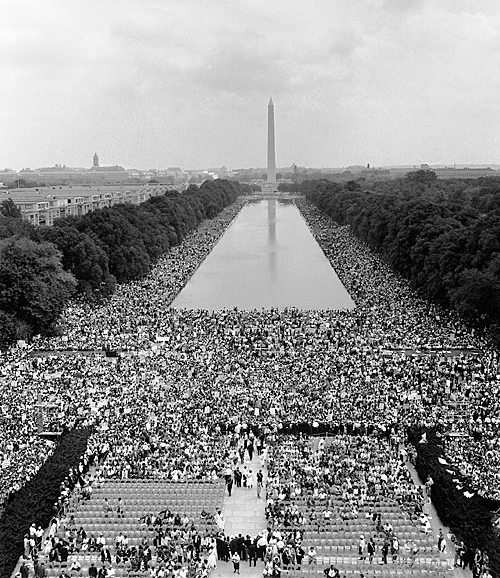
Sensing a national breakthrough for civil rights, Rev. Dr. Martin Luther King, Jr. joined civil rights leaders to plan a March on Washington for Wednesday, August 28, 1963. The great march filled the VIP section at the Lincoln Memorial and the National Mall to past the Washington Monument, a distance of almost one mile. The March on Washington is remembered for King’s “I Have a Dream” speech and the massive crowd’s hopeful jubilation. The meeting with President John F. Kennedy afterwards was more than a polite courtesy call to the White House–it helped coordinate political strategy for the movement that would have concrete ramifications for the Civil Rights Act of 1964 following Kennedy’s death.

By John P. Walsh

President John F. Kennedy watched the march—and Martin Luther King, Jr.’s “I Have A Dream” speech—from the White House on television.

Both Kennedy and King were young men—King was 34 years old, Kennedy was 46 years old. Mature beyond their years, each American proffered green oak in some ways—Kennedy was especially more personally sensitive than his “cool” public persona belied him to be. King, too, was mostly uncomfortable on August 28, 1963 with the particular attention, from the media and others, that he was receiving for his remarks at the Lincoln Memorial.

As the civil rights leaders filed into the Cabinet Room at the White House the first thing Kennedy said when he took King’s hand was “I have a dream…” The president was repeating King’s line that immediately impressed him and the nation when they heard it on TV live only a short time before.

King deflected the president’s compliment and immediately asked him what the president thought of United Automobile Workers president Walter Reuther’s excellent speech. It had included a criticism of Kennedy for defending freedom around the world but not always at home. Kennedy replied to King: “Oh, I’ve heard [Walter] plenty of times.”

King and Kennedy hardly talked any more during the visit, though when they did it led to an outcome for action.

Civil Rights leaders in this group photograph at the Lincoln Memorial followed-up the March on Washington with a visit to the White House to meet President Kennedy. Seated left to right: National Urban League executive director Whitney Young (1921-1971); chairman of the Demonstration Committee Cleveland Robinson (1914-1995); labor union leader A. Philip Randolph (1889-1979); Dr. Rev. Martin Luther King, Jr. (1929-1968); National Association for the Advancement of Colored People (NAACP) leader Roy Wilkins (1901-1981). Standing left to right: director of the National Catholic Conference for Interracial Justice Matthew Ahmann (1931-2001); Rabbi Joachim Prinz (1902-1998); Student Nonviolent Coordinating Committee (SNCC) leader John Lewis (1940-2020); Protestant minister Eugene Carson Blake (1906-1985); Congress of Racial Equality (CORE) leader Floyd McKissick (1922-1991); labor union leader Walter Reuther (1907-1970).
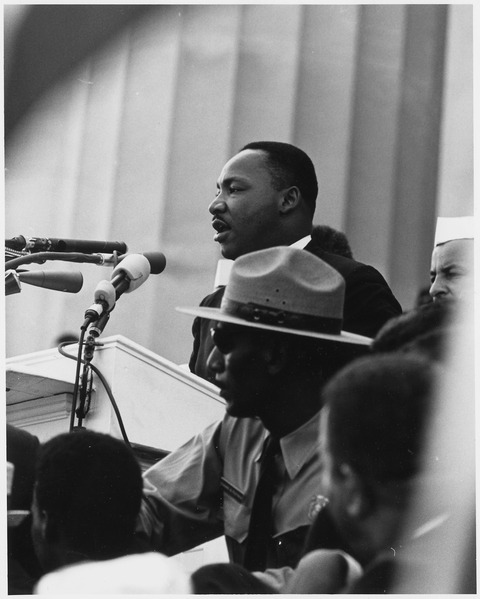
Rev. Dr. Martin Luther King, Jr., speaking at the March on Washington from the Lincoln Memorial on August 28, 1963. Following the successful march for jobs and freedom, civil rights leaders went to the White House to visit with President Kennedy and pushed measures to strengthen the Civil Rights bill.

Kennedy and NAACP leader Roy Wilkins talked at length about strengthening the civil rights bill following that day’s completely peaceful march. King moved away from the president and down the line to near then-23-year-old John Lewis, head of the Student Nonviolent Coordinating Committee (SNCC).

One section to the civil rights bill these activists wanted the president to add was a ban on employment exclusion based on race.

As White House and other photographers filmed and snapped pictures of the historic White House meeting of leading progressive personalities of the early 1960s, the civil rights leaders told the president about the accelerating automation in the job market that would potentially depress the availability of jobs.

They also discussed the plight of the inner city, telling Kennedy that Black teenagers were dropping out of school in epidemic numbers. A. Philip Randolph told the president that the entire current generation of young Blacks “had no faith” in whites. They also dismissed Black leadership, government and God. To these young Americans, U.S. society as it was presently constituted meant nothing to them but despair.

During the visit, Kennedy was lobbied to re-insert into the act a section that was stripped in 1957 giving authority to the Attorney General to investigate and initiate lawsuits on behalf of blatant civil rights infringements.

President Kennedy responded that with Robert Kennedy, his Attorney General, he had looked into joblessness and the school drop-out rate among Blacks in Chicago and New York City. At the August 28, 1963 meeting Kennedy encouraged the civil rights leaders to have the Black community do more.

“It seems to me,” the president said, “with all the influence that all you gentleman have in the Negro community that we could emphasize…educating [your]children, on making them study, making them stay in school and all the rest.”

White House, August 28, 1963, meeting with President Kennedy after the march.

Any add-ons now to the civil rights bill joined existing legislation that was already on the brink of defeat in the Democrat-controlled Senate and too close to call in a Democrat-controlled House.

Despite these close margins, Wilkins countered that the Speaker of the House had assured him that an even stronger civil rights bill could pass the House and would work to pressure the Senate to act. Wilkins suggested that the president go over the heads of the Congress who obstructed passage of the bill and lead a crusade to win voter approval for the civil rights measures.

Kennedy replied frankly to the leaders that civil rights must be a bipartisan effort. For a Democrat president to lead a crusade would allow Republicans to support civil rights and blame the Democrats for it which would hurt the Democratic Party in the South. Kennedy assured the civil rights leaders that “treacherous” political games were being played in the Federal legislature on the bill by both Republicans and Democrats.

Kennedy was countered again – this time by Walter Reuther.

“Look, you can’t escape this problem,“ the white labor leader said, “and there are two ways of resolving it—either by reason or riots. But now the civil war is not gonna be fought at Gettysburg, it’s gonna be fought in your backyard, in your plant, where your kids are growing up.” Reuther further told JFK he didn’t much like the young president’s “seminar” style of governing where “you call a big meeting…and nothing happens.” Reuther told Kennedy that he preferred his vice-president’s governing style where Lyndon B. Johnson “jawbone[d]” an issue until he would “get difficult things done.”

King stayed silent for most of this back and forth debate. When King finally spoke he asked JFK that if the sitting president led a crusade then perhaps his predecessor, Republican president Dwight D. Eisenhower, might get involved. It would then, King suggested, become the bipartisan push Kennedy was looking for.

Kennedy snapped back at King: “No, it won’t.”

In reply, King made a knowing joke: “Doesn’t [President Eisenhower] happen to be in the other denomination?”

Ike’s personal pastor was Rev. Eugene Blake who was in the Cabinet Room. Blake, a powerful force and no pushover, had been the march’s only white speaker.

One reason that Rev. Blake spoke at the march was that he had been arrested in a civil rights demonstration in Baltimore and had gone to jail.

Just hours earlier, Rev. Blake orated: “We come late, late we come, in the reconciling and repentant spirit.” The Protestant clergyman embraced the march’s agenda of civil and economic rights for African Americans and the end to racism. Still, Blake rejected words like “revolution” and “the masses” used by some civil rights activists.

At that day’s White House visit, Blake told Kennedy that Ike could be approached about civil rights. The president pivoted and urged Blake to visit the former president at his home in Gettysburg to discover any political role Ike might be willing to take for the civil rights bill. Kennedy advised: “And include a Catholic and maybe a businessman or two.”

Then pointing to Reuther, Kennedy lightly said: “And leave Walter in the background.” Amid chuckles, Kennedy then left the room of civil rights leaders. Before exiting, the president turned to assure them he would keep in touch on the civil rights bill in the months ahead.

SOURCES:

TAYLOR BRANCH, PARTING THE WATERS AMERICA IN THE KING YEARS 1954-1963. NEW YORK: SIMON & SCHUSTER, 1988.

DAVID GARROW, BEARING THE CROSS: MARTIN LUTHER KING, JR., AND THE SOUTHERN LEADERSHIP CONFERENCE, WILLIAM MORROW AND COMPANY, 1986.

On August 28, 1963 about 250,000 peaceful protesters descended on Washington, D.C. for the March on Washington for Jobs and Freedom. The march was one of the largest political rallies for human rights in United States history.

OTHER VOICES AT THE MARCH:

Harry Belafonte (1927-2023) was born in New York City died there at 96 years old. Harry Belafonte won a Tony, an Emmy, and 3 Grammy Awards in his career as a film actor and singer that stretched over 70 years. Belafonte was also a civil rights activist who brought and introduced a rafter of Hollywood A-list entertainers to the March On Washington for Jobs and Freedom on August 28, 1963 where Dr. King gave his “I Have a Dream” speech.

Among the more than 200-250,000 attendees at the march were these Hollywood stars. Belafonte chartered a plane from Los Angeles for the historic event to show their support for what was going on in the civil rights movement in America. The great march filled the VIP section at the Lincoln Memorial and the National Mall to past the Washington Monument, a distance of almost one mile. The mood of this massive crowd was one of hopeful jubilation. Afterwards, Dr. King and other civil rights leaders went to the White House to meet with President Kennedy. There they talked about the march, and discussed what was ahead in terms of social conditions and the civil rights movement, including the legislative effort that led to the Civil Rights Act of 1964 following Kennedy’s death. Some of the artists and film stars at the Lincoln Memorial that day in addition to Harry Belafonte were Marlon Brando, Rita Moreno, James Garner, Tony Franciosa, Sammy Davis, Jr., Joanne Woodward, Paul Newman, Susan Strasberg, Burt Lancaster, Robert Ryan, Gregory Peck, Anthony Quinn, James Baldwin, Lena Horne, Ruby Dee, Sidney Poitier, Charlton Heston and several more.

REMARKS BY HARRY BELAFONTE: “We are here to bear witness to what we know. We know that this country, America, to which we are committed, and which we love, aspires to become that country in which all men are free. We also know that freedom is not license. Everyone in a democracy ought to be free to vote. But no one has the license to oppress or demoralize another. We also know or we would not be here, that the American negro has endured for many generations in this country which he helped to build the most intolerable injustices. To be a negro in this country means several unpleasant things. In the Deep South it often means he is prevented from exercising his right to vote by all manner of intimidation up to and including death. This fact of intimidation is a great weight in the life of any negro and though it varies in degree it never varies in intent which is simply to limit, to demoralize and to keep in subservient status more than 20 million negro people. We are here, therefore, to protest this evil and make known our resolve to do everything we can possibly do to bring it to an end. As artists and as human beings we rejoice in the knowledge that human experience has no color and that excellence in any endeavor is the fruit of individual labor and love. We believe artists have a valuable function in any society since it is the artists who reveal society to itself. But any society that ceases to respect the human aspirations of all its citizens courts political chaos and artistic sterility. We need the energies of these people to whom we have for so long denied full humanity. We need their vigor, their joy, the authority which their pain has brought them and cutting ourselves off from them then we are punishing and diminishing ourselves. As long as we do so our society is in great danger. Our growth as artists is severely menaced and no American can boast of freedom since he cannot be considered an example of it. We are here then in an attempt to strike the chains of the ex-master no less than the ex-slave and to invest with reality that deep and universal longing which has sometimes been called the American Dream.”

PHOTO CREDITS:

Hundreds of thousands descended on Washington, D.C.’s, Lincoln Memorial Aug. 28, 1963. Public Domain/U.S. Government Photo.

Civil Rights March on Washington, D.C. (Leaders of the march posing in front of the statue of Abraham Lincoln, Lincoln Memorial.) by Rowland Scherman (b. 1937), for the U.S. Information Agency. Press and Publications Service. Public Domain/U.S. National Archives and Records Administration.

Martin Luther King, Jr., speaking from the Lincoln Memorial during the March on Washington by Rowland Scherman (b. 1937), for the U.S. Information Agency. Press and Publications Service. Public Domain/U.S. National Archives and Records Administration.

Civil Rights March on Washington, D.C. (Aerial view of Washington Monument showing marchers.) U.S. Information Agency. Press and Publications Service. Public Domain/U.S. National Archives and Records Administration.

Leaders of the march leading marchers down the street. U.S. Information Agency. Press and Publications Service. Public Domain/U.S. National Archives and Records Administration.