
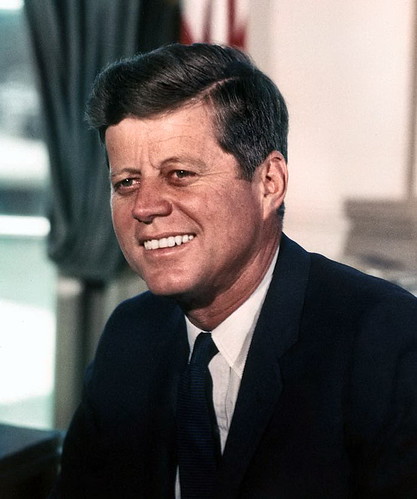
FEATURE image: Portrait of President John F. Kennedy. “President John F. Kennedy” by U.S. Embassy New Delhi is licensed under CC BY-ND 2.0.
On January 3, 1960—just one day after launching his historic campaign for the Democratic nomination—Senator John F. Kennedy sat down for a special broadcast of NBC’s Meet the Press. His entry into the race immediately thrust a long-standing national anxiety back into the spotlight: could a Roman Catholic serve as president without divided loyalties? As the first Catholic with a viable path to the White House, Kennedy faced sharp questioning over whether his allegiance to the Pope would compromise his constitutional duties.
(20) Looking back at JFK discussing his faith 60 years after his assassination – YouTube – retrieved June 2, 2026.
Recognizing the threat to his campaign, Kennedy swiftly moved to defuse the controversy. He firmly pledged to execute the responsibilities of the presidency independent of any outside religious authority, including any criticism or instruction. Advocating for an unyielding separation of church and state, he went so far as to declare that he would oppose a national church even if 99 percent of the country shared his faith.
Beyond addressing the religious debate, Kennedy used the high-profile broadcast to map out his broader electoral strategy. He rejected the concept of identity politics when forming a major party’s presidential ticket, arguing that balance should be based on geography and political experience rather than religious background. He then flatly dismissed speculation that he might settle for the vice presidential nod himself, stating bluntly that he had no interest in “waiting for the president to die.” The remarkably candid remark made it clear that Kennedy was playing to win, setting a determined and independent tone for the rest of his historic run.
INTRODUCTION.
by John P. Walsh
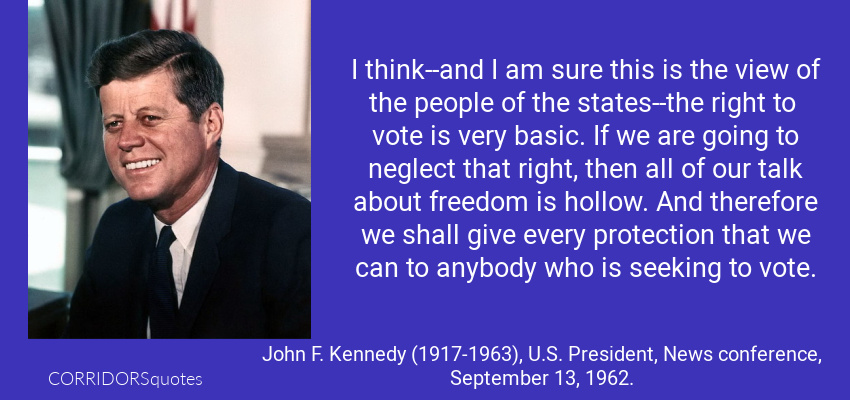
I think – and I am sure this is the view of the people and the states- the right to vote is very basic. If we are going to neglect that right, then all of our talk about freedom is hollow. And therefore we shall give every protection that we can to anybody who is seeking the vote. News conference, September 13, 1962.

The men who create power make an indispensible contribution to the nation’s greatness. But the men who question power make a contribution just as indispensible for they determine whether we use power or power uses us. Remarks at Amherst College, October 26, 1963.
One of the rare joint appearances of Senators John Kennedy and Lyndon Johnson, the Democratic Presidential ticket, during the 1960 campaign which they prevailed over the Republican ticket of Nixon-Lodge. Here the two men make a joint campaign appearance in Grand Prairie, Texas, in September 1960. Kennedy nor Johnson were natural campaigners—Kennedy’s hands would be shaking hidden under a table or podium as he spoke, his voice growing hoarse. Johnson, who was uncomfortable in crowds and tried too hard, often worked himself on the campaign trail into a sick exhaustion.
Though both candidates wanted to have more joint appearances on the campaign trail, both senators’ aides mutually agreed it mostly hurt the ticket’s—and more precisely, Kennedy’s —image. Though Johnson was only nine years older than Kennedy—both men were the first U.S. presidents born in the 20th century— aides believed that wherever they showed up together Kennedy looked as if he might be LBJ’s son. However, the press and LBJ griped for weeks and months that the candidates should make more joint campaign appearances running as they were for the highest offices in the land.
When it was hinted in the press that there was a growing rift between the candidates and that that was to blame for their not campaigning together, another joint appearance of JFK and LBJ was scheduled in November 1960 five days before Election Day. For the campaign event at the Biltmore in Los Angeles Lyndon Johnson flew out especially to be there and the event received glowing national print and television coverage. On that Thursday before the Tuesday when Americans went to the polls, both candidates and their campaigns viewed the event as a big plus.
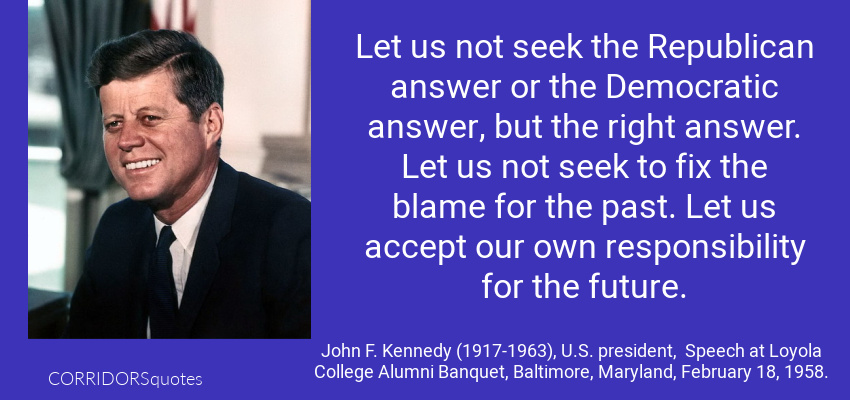
Let us not seek the Republican answer or the Democratic answer, but the right answer. Let us not seek to fix the blame for the past. Let us accept our own responsibility for the future. Speech at Loyola College Alumni Banquet, Baltimore, Maryland, February 18, 1958.
In response to the rapid buildup of Soviet nuclear missiles in Cuba, President John F. Kennedy announced that the United States would impose a naval blockade—officially termed a “quarantine”—around the island. It went into effect on the morning of October 24, 1962, when American warships and aircraft tightened a ring around Cuba with orders to intercept any vessel suspected of carrying offensive military equipment.
Tension spiked almost immediately. Roughly 25 Soviet ships, some believed to be transporting nuclear missile components, continued steaming toward the quarantine line. U.S. commanders had standing instructions: any vessel refusing inspection could be stopped, diverted, and, if necessary, sunk. At 10:00 a.m., as the quarantine became active, Kennedy convened ExComm to assess the situation when new intelligence came in that made the situation immediately more precarious. Reports were that the approaching Soviet ships were joined by a Soviet sub armed with nuclear weapons, raising the risk of an existential, catastrophic confrontation. At the same time, aerial reconnaissance showed Soviet crews working feverishly in western Cuba to complete missile sites armed with nuclear warheads pointed at the U.S.—further evidence that the threat to U.S. national security, already considered imminent by the Kennedy Administration, was growing by the minute.
On the diplomatic front, the crisis was unresolved as it was debated by delegates at the U.N. whether Kennedy’s blockade was even legal under international law. Soviet leaders accused the United States of issuing an ultimatum and warned that force would be met with force. Meanwhile protests were organized on each side across the globe as political maneuvering accelerated.
By the end of October 24, 1962, the first signs of restraint appeared: several Soviet ships slowed or halted before reaching the quarantine line, suggesting Moscow might be reconsidering its next move. Even so, the world understood, some for the first time, that it stood on the precipice of nuclear war. The day ended with both superpowers locked in the most dangerous equilibrium of the crisis so far – both armed, alert, and waiting for the next move – with no one knowing whether diplomacy or confrontation would ultimately prevail.
Above: Rev. Dr. Michael Ramsey (1904-1988), Archbishop of Canterbury, and JFK, met on Halloween in 1962. Their Wednesday meeting took place just 3 days following the end of the Cuban Missile Crisis. The world breathed a great sigh of relief that armed confrontation which likely would lead to nuclear war between superpowers was avoided. The previous Saturday, October 27, 1962, was in fact one of the tensest days in the entire ordeal. A U-2 plane was shot down by Soviet-supplied SAM missiles. They killed the USAF pilot and Kennedy’s own ExCOMM demanded immediate military action against those sites. Kennedy resisted the advice. Upon shooting down and killing the U.S. pilot, the Soviets demanded tougher terms for negotiating the removal of 42 mid and long-range nuclear missiles in Cuba. That night, Robert Kennedy met secretly with Soviet Ambassador Anatoly Dobrynin in Washington, D.C. where they reached a basic understanding that only needed approval by Moscow. The next morning. Sunday, October 28, 1962, Radio Moscow announced that the Soviet Union had accepted Kennedy’s proposed solution. The 13-day Cuban Missile Crisis was over. Michael Ramsey was appointed Archbishop of Canterbury on May 31, 1961, and installed in June 1961. He served in this position until 1974. In 1962 Dr. Ramsey was then serving as president of the World Council of Churches (1961 to 1968) and, during his archbishopric, the first woman Anglican priest – Chicago-born high altitude balloonist Jeannette Piccard (1895 -1981) – was ordained in the United States in 1974.
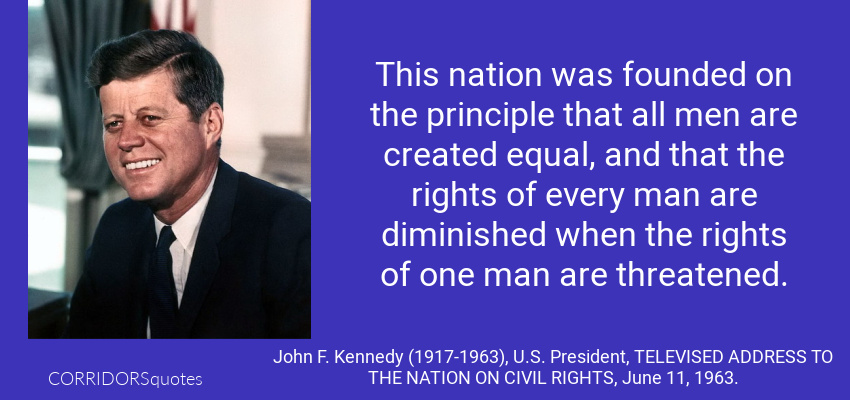
This nation was founded on the principle that all men are created equal, and that the rights of every man are diminished when the rights of one man are threatened. Televised address to the nation on Civil Rights, June 11, 1963.
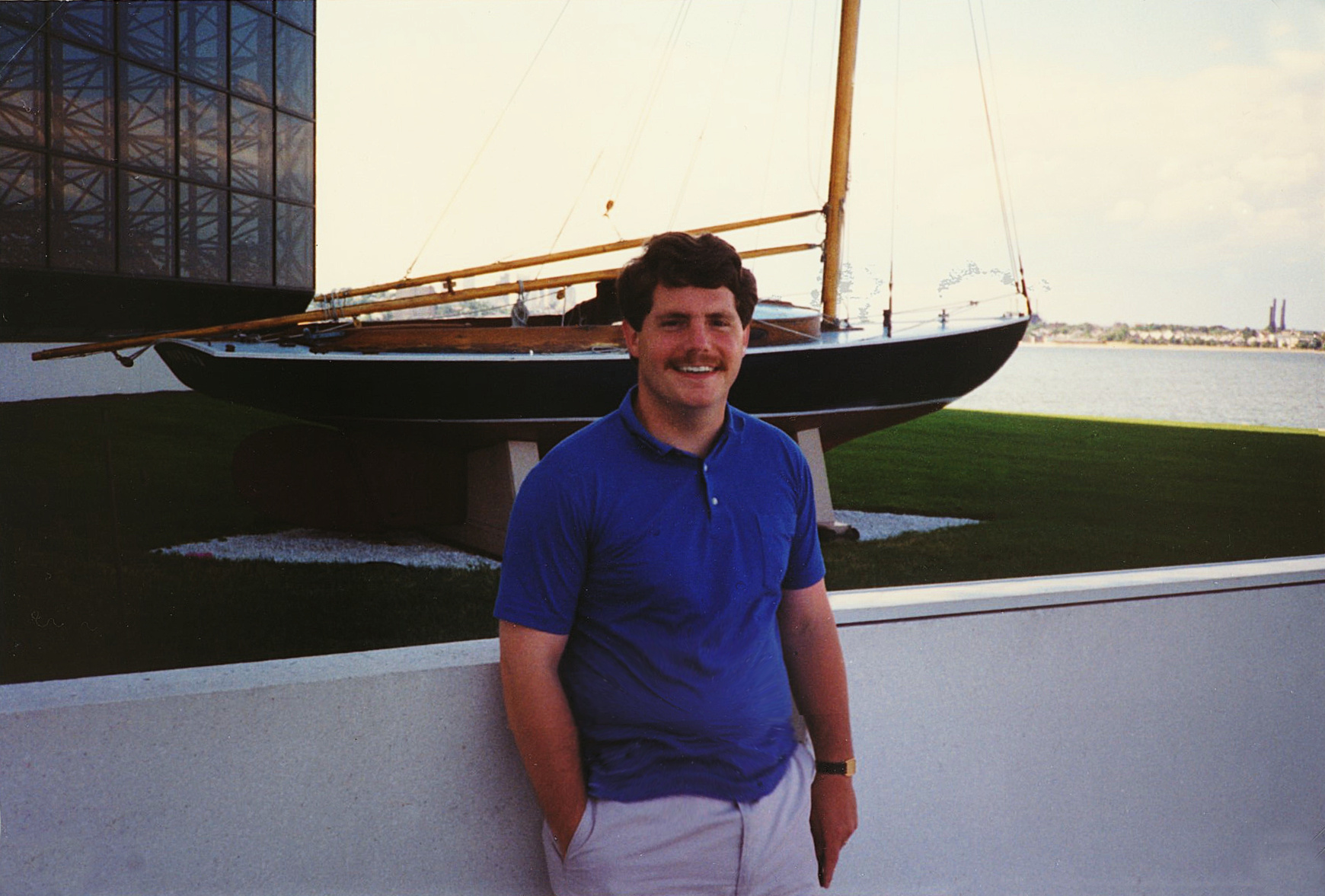
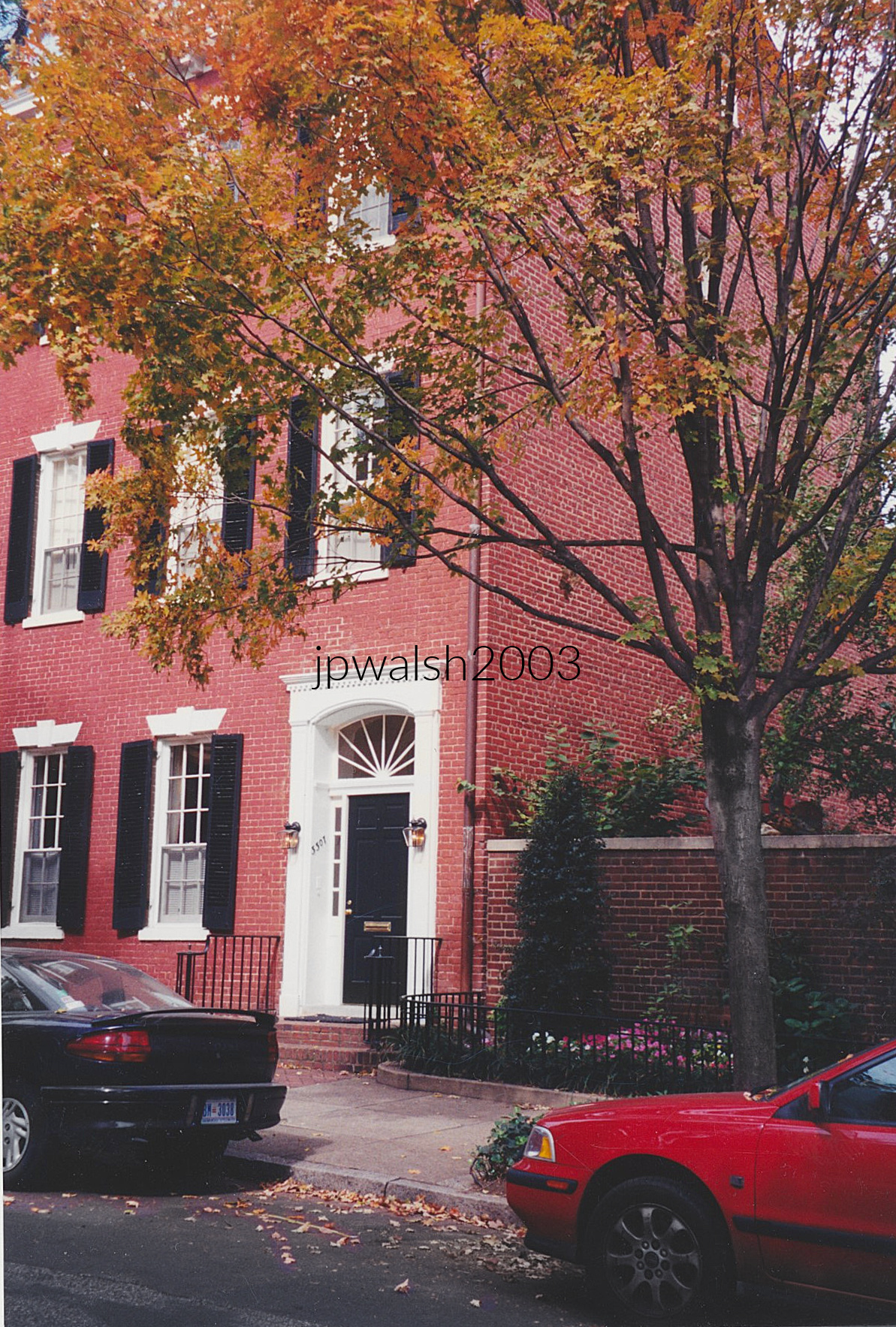
In June 1957 Massachusetts Senator John F. Kennedy (1917-1963) bought this three story Federal-style house as a gift for his wife, Jackie, following the birth of their daughter, Caroline. John Jr. was also born while the Kennedys lived here. Jackie hosted teas in the house’s double living room after JFK’s 1958 Senate re-election campaign and during the 1960 presidential campaign. The front entrance became famous when President-elect Kennedy made regular announcements of national news such as cabinet appointments, including younger brother and campaign manager, Robert F. Kennedy as U.S. Attorney General. On January 20, 1961, JFK famously left from the doorstep of this very dwelling to head to the United States Capitol for his swearing-in ceremony as the 35th President of the United States. The house was sold when the Kennedys moved into the White House in 1961. Beyond its presidential provenance, the home was built in 1811-12 for William Marbury (1762-1835), the prominent local financier and plaintiff in the landmark 1803 Supreme Court case Marbury v. Madison, a decision which established the foundational principle of judicial review. The Kennedys used the brick-walled garden at 3307 N Street as a quiet refuge notably during the 1960 presidential campaign. As JFK spent most of his time traveling, he rarely found time to pursue his painting hobby, though did spend occasional Sunday afternoons with Jackie and Caroline in the garden away from the public spotlight. To balance Jackie’s preference for classical European aesthetics, the home featured a selection of historical maritime art and paintings of naval vessels, reflecting John F. Kennedy’s U.S. Navy background and lifelong passion for the sea.

A suburb adjacent to Boston, Brookline is the birthplace and childhood home of President John F. Kennedy. The house on Beals Street was purchased by Kennedy’s father, Joseph Patrick Kennedy in August 1914 in anticipation of his marriage to Rose Elizabeth Fitzgerald in October 1914. JFK’s father was a shrewd, opportunistic and driven bank president and businessman who started to make his fortune by building warships and transports in Quincy shipyards in World War I. Joe Kennedy was an affectionate father who instilled a spirited sense of competition in the Kennedy children starting in their years in Brookline.
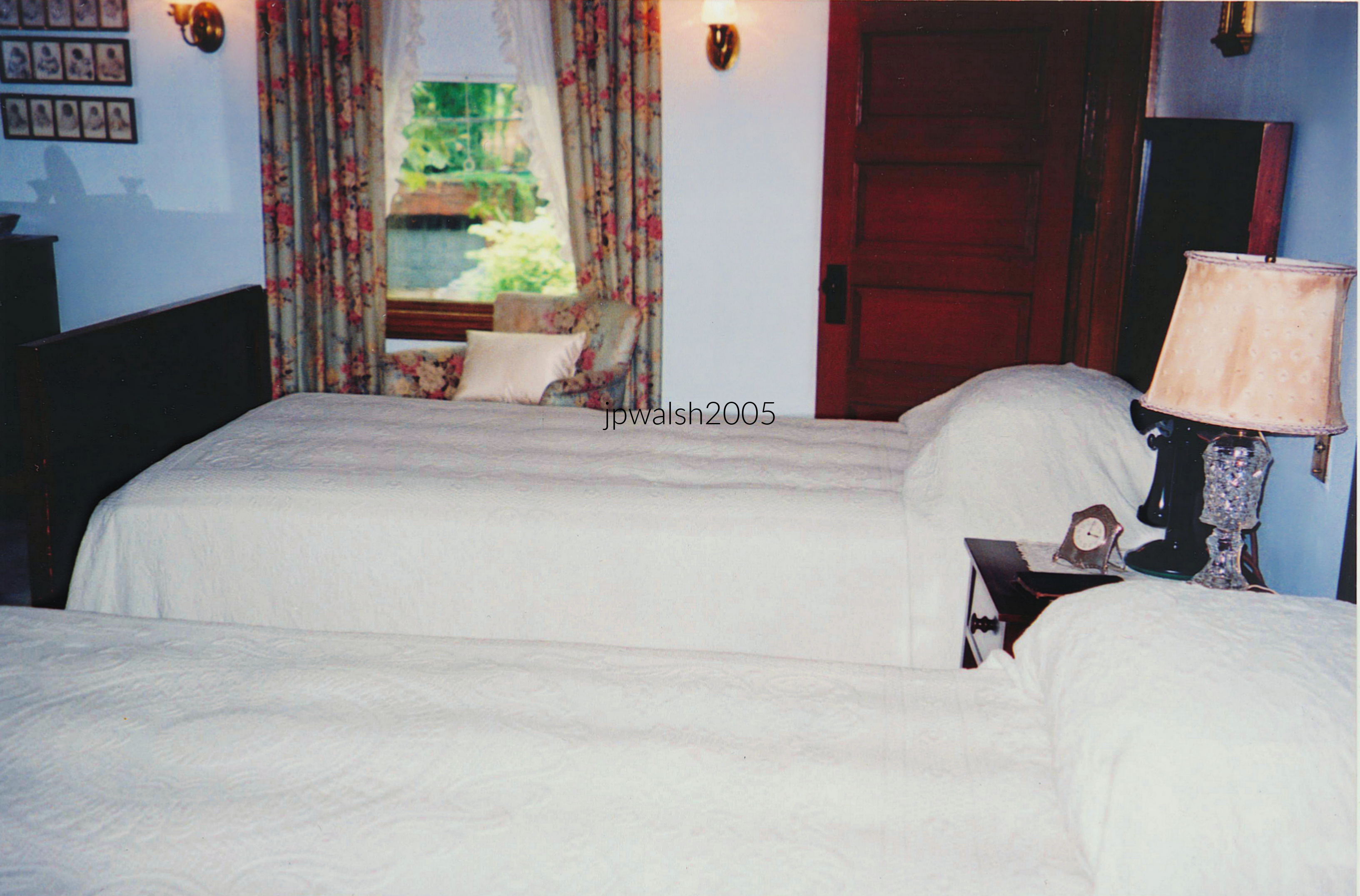
John Kennedy was born in this upstairs master bedroom on May 29, 1917. The family lived here until 1920 when they moved a 5-minute walk away to a larger home on Abbottsford where they lived until 1927. Then the Kennedys moved to New York. Rose Fitzgerald, who was the daughter of Boston’s first American-born Irish mayor, had seven of her nine children in Brookline and was reluctant to leave. Joe’s father was a saloonkeeper and politician. While Joe instilled the competitive spirit in to his children, Rose, who as a young woman studied in Europe, taught her children an appreciation of the arts: music, painting, and history. A deeply religious person she would take her young children on walks with the family dog in tow, as they went to the weekday market and afterward to the church so they would know that their faith was not restricted to Sunday. After JFK’s assassination in 1963, Rose Kennedy established this house as a gift to the American people so that, as she said, “Future generations will be able to visit it and see how people lived in 1917 and thus get a better appreciation of the history of this wonderful country.” see – https://www.nps.gov/jofi/index.htm – retrieved May 29, 2025.
SPEAKING OF FREEDOM OF INFORMATION IN A FREE COUNTRY TO THE ENTIRE WORLD. Voice of America speech, February 26, 1962. FULLER CONTEXT: “What we do here in this country, and what we are, what we want to be, represents really a great experiment in a most difficult kind of self-discipline, and that is the organization and maintenance and development of the progress of free government. And it is your task, as the executives and participants in the Voice of America, to tell that story around the world.
This is an extremely difficult and sensitive task. On the one hand you are an arm of the Government and therefore an arm of the Nation, and it is your task to bring our story around the world in a way which serves to represent democracy and the United States in its most favorable light. But on the other hand, as part of the cause of freedom, and the arm of freedom, you are obliged to tell our story in a truthful way, to tell it, as Oliver Cromwell said.. with all our blemishes and warts, …And we hope that the bad and the good is sifted together by people of judgment and discretion and taste and discrimination, that they will realize what we are trying to do here.
This presents to you an almost impossible challenge, ..The first words that the Voice of America spoke were [IN 1942]. They said, “The Voice of America speaks. Today America has been at war for 79 days. Daily at this time we shall speak to you about America and the war, and the news may be good or bad. We shall tell you the truth”…
In 1946 the United Nations General Assembly passed a resolution reading in part, “freedom of information is a fundamental human right, and the touchstone of all the freedoms to which the United Nations is consecrated.” This is our touchstone…We seek a free flow of information across national boundaries and oceans, across iron curtains and stone walls. We are not afraid to entrust the American people with unpleasant facts, foreign ideas, alien philosophies, and competitive values. For a nation that is afraid to let its people judge the truth and falsehood in an open market is a nation that is afraid of its people.
The Voice of America thus carries a heavy responsibility. Its burden of truth is not easy to bear. It must explain to a curious and suspicious world what we are. It must tell them of our basic beliefs. It must tell them of a country which is in some ways a rather old country–certainly old as republics go. And yet it must make our ideas alive and new and vital in the high competition which goes on around the world since the end of World War II.
…The advent of the communications satellite, the modernization of education of less-developed nations, the new wonders of electronics and technology, all these and other developments will give our generation an unprecedented opportunity to tell our story. And we must not only be equal to the opportunity, but to the challenge as well. For in the next 20 years your problem and ours as a country, in telling our story, will grow more complex. …
We believe that people are capable of standing the burdens and the pressures which choice places upon them, …And as you tell it, it spreads. And as it spreads, not only is the security of the United States assisted, but the cause of freedom.” See – https://www.presidency.ucsb.edu/documents/remarks-the-20th-anniversary-the-voice-america – retrieved May 29, 2025.
NOVEMBER 22, 1963, a portion of President John F. Kennedy’s remarks at the Citizen’s Rally in front of the Texas Hotel in Fort Worth, Texas on a rainy morning. In his brief speech the president explains that the country’s overall security relies on (1) military strength, (2) economic prosperity, and (3) superiority in space exploration and that Fort Worth again “will play its proper part.” KENNEDY: “What we are trying to do in this country and what we are trying to do around the world, I believe, is quite simple: and that is to build a military structure which will defend the vital interests of the United States. And in that great cause, Fort Worth, as it did in World War II, as it did in developing the best bomber system in the world, the B-58, and as it will now do in developing the best fighter system in the world, the TFX, Fort Worth will play its proper part. And that is why we have placed so much emphasis in the last 3 years in building a defense system second to none, until now the United States is stronger than it has ever been in its history. And secondly, we believe that the new environment, space, the new sea, is also an area where the United States should be second to none.”
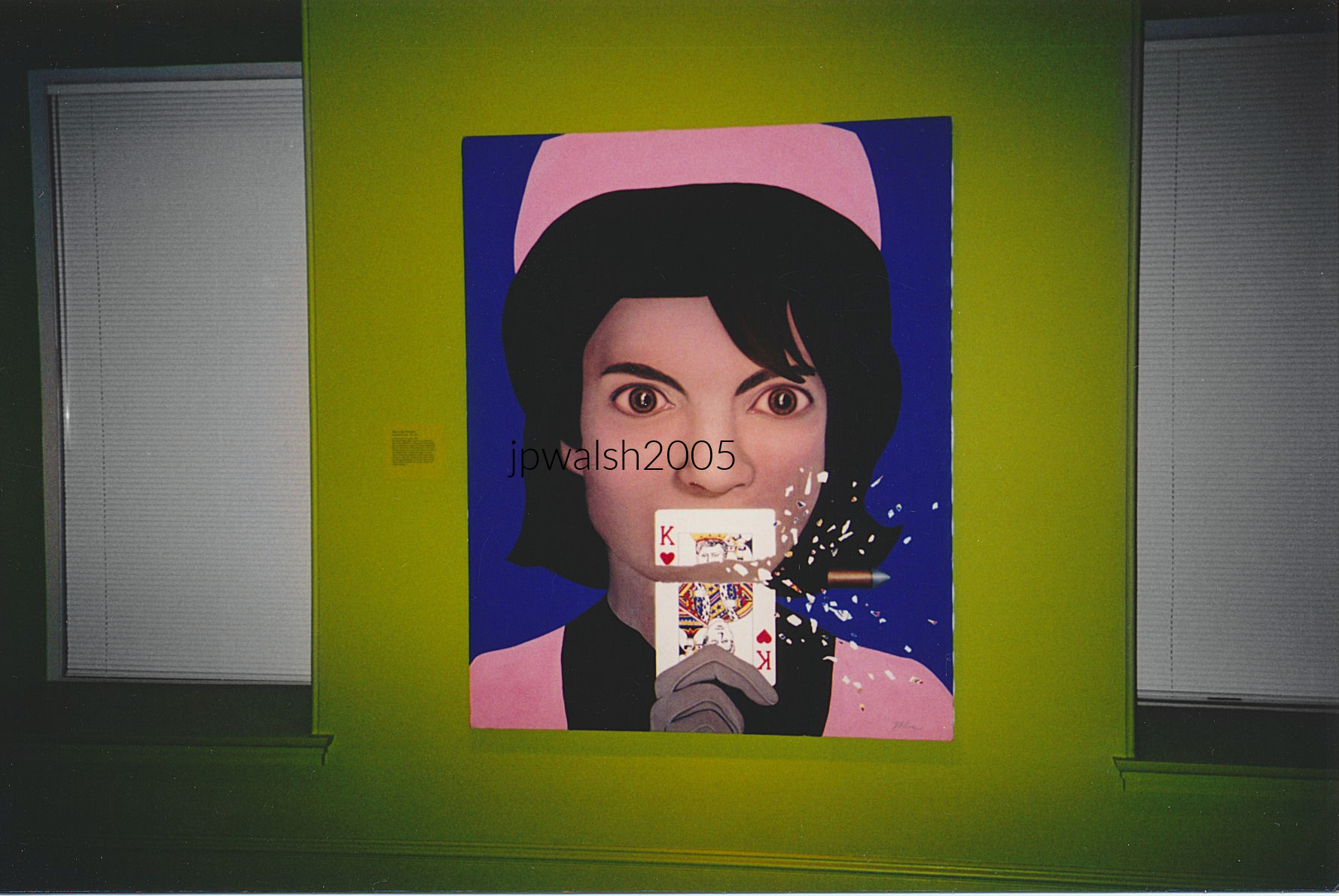
Rose and Joe Kennedy were at the Hyannis Port compound on November 22, 1963. It was a clear, crisp day – a “bluebird.” Rose attended morning Mass, as usual, then returned to have lunch with Joe, who was still severely debilitated from his 1961 stroke. Afterward, they went for a short drive. When they returned, Rose received a call from her son, Attorney General Robert Kennedy: the President—her son Jack—had been shot. A second call followed, telling her he was dead. Rose withdrew to grieve alone, walking the beach and sitting quietly in her room. She later said she asked God how years of raising and preparing her children for service could be undone in seconds. Around 4:15 p.m., she took a call from the new president, Lyndon Johnson, speaking from Air Force One shortly after being sworn in and as he returned to Washington with President Kennedy’s body. Composed, Rose addressed him as “Mr. President.”
Report to the American People on Civil Rights – June 11, 1963.
June 11, 2025 – (13.23 minutes). On May 27, 1963 the Supreme Court stated that it was not going to tolerate the evasion of its 1954 landmark decision Brown v. Board of Education that segregated schools. They stated such in another desegregation case involving public parks. When the High Court made their decision in 1954, in no way could they have foreseen the years of delay. On June 5, 1963 a federal court enjoined Alabama Gov. George Wallace from in any way impeding the admission of two qualified Black citizens from enrolling in the University of Alabama. President John F. Kennedy, on June 10, 1963, reinforced this decision by writing to Gov. Wallace urging him not to interfere. The following day, June 11, 1963, Wallace carried out his pledge to “stand in the schoolhouse door” and blocked the Black students from enrolling. When Wallace was confronted by Kennedy’s federal marshals, and refused the students’ entry, the president nationalized the Alabama Guard. When troops appeared on the scene the governor relented and the Black students entered and registered for classes. That evening from the Oval Office Kennedy appeared on radio and television to deliver what is called the “Report to the American People on Civil Rights” in which he set out the moral and legal issues involved with Civil Rights and proposed legislation that would later become the landmark Civil Rights Act of 1964. In the first two years of Kennedy’s term, he had been slow and cautious in his support of civil rights and desegregation in the United States. Ever the politician he was concerned that any bold actions or initiatives on his part in this area would alienate Congressmen he needed to get through his stalled legislative agenda. On June 11, 1963 in a radical departure from his and the nation’s past Kennedy gave his full-throated endorsement to Civil Rights and Civil Rights legislation in this 13-minute speech. Later that night, in the early hours of June 12, 1963, civil rights activist Medgar Evers, who had been listening to Kennedy’s remarks on the radio, was killed by a sniper as he returned to his home in Jackson, Mississippi. On June 13, 1963 82 black marchers protesting Evers’ death were arrested by Jackson police. On June 19, 1963 Kennedy asked Congress to introduce his bill to desegregate public facilities, take federal action to end job discrimination, and allow the U.S. Attorney General to start desegregation suits. In the meantime, as Congressional negotiation and debate was beginning on the Civil Rights bill, Kennedy asked civil rights leaders to suspend protests and marches which they refused to do. Instead, in the face of a Congressional filibuster of Kennedy’s civil rights bill, they announced a March for Jobs and Freedom in Washington, D.C. to take place in August 1963. Within a week of Evers’s murder, a white suspect was arrested and charged with the slaying. See- Kennedy and the Press, edit. Harold W. Chase and Allen H. Lerman, introduction by Pierre Salinger, Thomas Y. Crowell Company, New York, 1965, p. 452.
Texas motorcade & remarks at the dedication of the Aerospace Medical Health Center, San Antonio – November 21, 1963
White house 1963 – color recording of remarks for “Seas around us”.
Moon speech, Rice University, Houston, Texas – September 12, 1962.
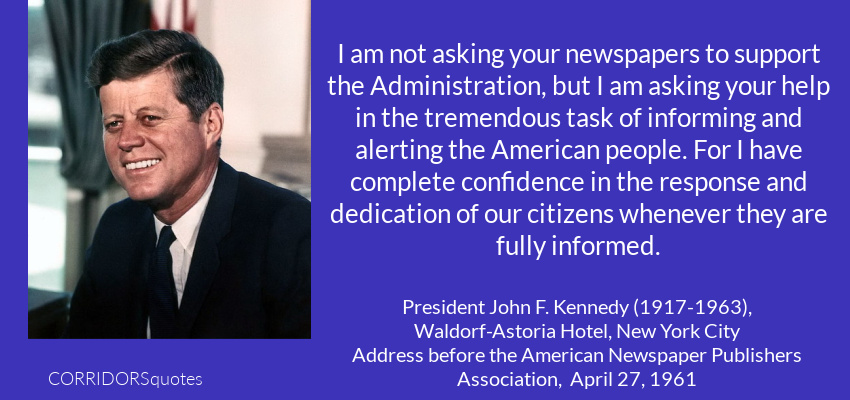
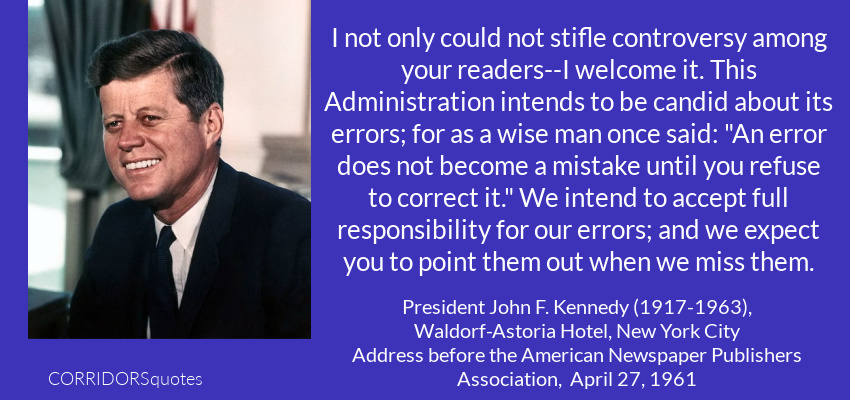
On April 27, 1961, President John F. Kennedy delivered his 2400-word+ major speech known as “President and the Press” before the American Newspaper Publishers Association at the Waldorf-Astoria Hotel in New York City. In the speech delivered just days after the failed Bay of Pigs Invasion the new president made a plea for responsible journalism in the face of Cold War threats. The remarks remain relevant today on the topics of press freedom, misinformation, and national security.

When Franklin Delano Roosevelt signed the Social Security Act on August 14, 1935, the 32nd president called the program a “cornerstone.” In 1998 when I met Jimmy Carter, the 39th president, at a book signing (“The Virtues of Aging”) in Chicago I asked him if he thought that Social Security was destined to go away. He said to me he didn’t think so. In 2026, the federal retirement benefits program is under threat like never before. This is due for many reasons including a large aging population. There are 75 million seniors on Social Security today, three times more than in 1975. As well as a smaller work force who contribute payroll taxes to the program compared to the growing number of beneficiaries. Reserves are being depleted and insolvency is projected for the mid-2030s. In the presidential campaign of 1960 Democratic Party’s nominee John F Kennedy visited the national shrine home of Franklin Delano Roosevelt in Hyde Park, New York. It was the 25th anniversary of the signing of the Social Security law, The Democratic candidate for president spoke to 2,000 senior citizens who had come to honor the memory of the late president and to listen to the soon-to-be 35th president. Kennedy proposed a federal medical care bill (Medicare was signed into law in 1965). Social Security benefits to meet the rising cost of living (implemented in 1975). Incentivize workers to earn more money and still enjoy Social Security. Vocational guidance for persons of retirement age. Provide adequate housing for the aged. Expand research into the causes and prevention of diseases associated with advancing age. Increased survivor benefits for spouses responsible for under-age children.
News Conference 29 — March 29, 1962. THE PRESS CONFERENCE TOOK PLACE THE SAME WEEK THE HOUSE WAYS AND MEANS COMMITTEE PASSED THE PRESIDENT’S TAX CUT BILL. IN THIS SAME PRESS CONFERENCE JFK WAS CONCERNED TO CLOSE TAX LOOPHOLES THAT PERMIT AND ENCOURAGE AMERICAN INDUSTRY TO INVEST OVERSEAS. SIGNIFICANTLY THE CONGRESS WAS CONCERNED WITH REVENUE BALANCING BETWEEN WHAT WAS LOST FROM THE TAX CUTS AND WHAT WAS GAINED BY TAX REFORMS SO THAT THE TAX BILL WAS REVENUE NEUTRAL. IT WAS AN EXERCISE TO ECONOMIC STIMULUS AND NOT THE BROAD-BRUSH ANSWER THAT IT HAS BECOME IN REGARD TO THE COUNTRY’S ECONOMICS (OR, CONVERSELY, TAX HIKES FOR THAT MATTER). THE 1962 TAX BILL WAS MODIFIED AND PASSED ACCORDINGLY TO BALANCE THOSE FIGURES. KENNEDY PROPOSED SIGNIFICANT REDUCTIONS IN TAX RATES FOR INDIVIDUALS AND CORPORATIONS WHICH WOULD LEAD TO AN INITIAL LOSS OF TAX REVENUE FOR THE GOVERNMENT. BROADLY PRO-GROWTH, IT WAS NOT A TAX GIVEAWAY AS THE COUNTRY PRACTICES TODAY AS IT WAS SEEN AS NOT BEING ABLE TO AFFORD IT WHICH OF COURSE IT CAN’T. RATHER, THE GOAL WAS TO BALANCE OUT THE REVENUE LOST FROM THE TAX RATE CUTS AND TO GENERATE REVENUES BY REFORMS RESULTING IN REVENUE GAINS AND THUS A REVENUE-NEUTRAL BILL. THESE TAX GAINS FOR THE GOVERNMENT INCLUDED ELIMINATING THE DIVIDEND CREDIT AND EXCLUSION, INTRODUCING WITHHOLDING TAXES ON DIVIDENDS AND INTEREST INCOME, RESTRICTING CERTAIN BUSINESS EXPENSE DEDUCTIONS, PARTICULARLY FOR ENTERTAINMENT AND MEALS, ADDRESSING THE TAX TREATMENT OF COOPERATIVES AND FINANCIAL INSTITUTIONS, AND CHANGES TO THE TAXATION OF GAINS FROM THE SALE OF DEPRECIABLE PROPERTY. WHILE THE FINAL VERSION OF THE REVENUE ACT OF 1962, AS PASSED BY CONGRESS, ACTUALLY RESULTED IN A NET LOSS OF REVENUE IN THE SHORT TERM THE ADVENT OF REAGANOMICS HAS BROUGHT MASSIVE TAX CUTS SKEWED TO THE RICH WITH NO OFFSETTING TAX REVENUE STREAMS FOR THE GOVERNMENT BUT RELYING SOLELY ON REVENUE FROM THE GROWTH OF THE TAX STIMULUS AND, COUPLED TO OVERSPENDING, DEFICIT SPENDING (BORROWING) FOR THE REST. THIS HAS RESULTED IN MASSIVE BUDGET DEFICITS KENNEDY COULD NEVER HAVE IMAGINED. IN FACT, THAT YEAR OF 1962 THE PRESIDENT WAS AIMING FOR A TAX CUT AND A BALANCED BUDGET.
The line most associated with John F. Kennedy’s 1961 Inaugural Address—“Ask not what your country can do for you; ask what you can do for your country”—has endured as a defining call to civic action. Delivered by the nation’s first Catholic president, the phrase urged Americans to view national progress as a shared personal duty rather than a service provided by, or reliant on, the government.
Its resonance is echoed in the 1965 documentary, Years of Lightning, Day of Drums, one of the earliest films to chronicle Kennedy’s presidency and assassination. Near the conclusion, narrator Gregory Peck reflects, “All this took place in the early 1960s, and someday the early 1960s will be a long time ago.” Hearing that line as a child, I was struck by its existential reminder that even the most vivid present moments inevitably recede into memory and become history.
Some historians have suggested that Kennedy’s famous inaugural exhortation may trace back to his years at Choate, the Connecticut boarding school he entered in 1931 as a ninth-grade student. In his chapel addresses, headmaster George St. John frequently reminded students: “The youth who loves his alma mater will always ask not ‘what can she do for me?’ but ‘what can i do for her?’” Kennedy would have heard this refrain repeatedly during his formative years.
Kennedy arrived at Choate following his older brother, Joe Jr., a standout athlete two years ahead of him. By contrast, Kennedy was frail, thin, and saddled with the nickname “rat face” among classmates. His early years at the school were marked less by distinction than by mischief. He gathered around him a circle of friends he called “The Muckers Club,” a tongue-in-cheek embrace of headmaster St. John’s term for troublemakers. Their antics were largely harmless—witty pranks and playful irreverence—and the group included Kennedy’s roommate and lifelong friend, Lem Billings.
Despite his unremarkable start, Kennedy’s trajectory at Choate shifted. By the time he graduated in 1935, he was not valedictorian, but his peers voted him “Most Likely To Succeed,” a judgment that proved prescient.
JFK, May 4, 1963: First, it is to make sure that our private schools are increasingly representative of the diversity of American life. These schools will not survive if they become the exclusive possession of a single class or creed or color. They will enlarge their influence only as they incorporate within themselves the variety which accounts for so much of the drive and the creativity of the American tradition. The second is to make sure that our private schools prepare young men and women for service to the community and to the Nation. The inheritance of wealth creates responsibilities; so does privilege in education.
On May 19, 1962—ten days before President Kennedy turned 45—more than 15,000 people packed Madison Square Garden for his birthday celebration, a star‑studded night of politicians, entertainers, and Hollywood royalty. The evening became legendary when Marilyn Monroe stepped onto the main stage in a sheer, flesh‑colored gown studded with 2,500 rhinestones and delivered her breathy rendition of “Happy Birthday, Mr. President” as a giant cake was brought out.
Kennedy followed her to the microphone and quipped, “I can now retire from politics after having had Happy Birthday sung to me in such a sweet, wholesome way,” a wink at Monroe’s sultry delivery and famously skintight dress.
Monroe had flown to New York with jazz pianist Hank Jones, leaving the troubled production of Something’s Got to Give to make the cross‑country appearance. The decision cost her: 20th Century‑Fox fired her in June 1962 for violating her contract. Kennedy attended the event alone; Jackie Kennedy skipped the celebration entirely, spending the day at the Loudoun Benefit Horse Show in Virginia with Caroline and John Jr.
The Madison Square Garden performance would become one of Monroe’s final public appearances before her death that August.
This explanatory article is periodically updated.



quaint! UN Calls for Immediate Action on Plastic Pollution 2025 charming