
7 POSTS.
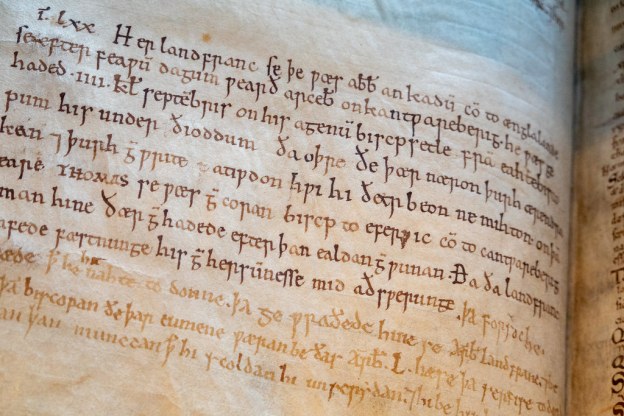
FEATURE Image: Anglo-Saxon Chronicle, a collection of Old English annals. The oldest manuscript of the Chronicle that survives was begun at the Old Minster in Winchester, England, during the reign of King Alfred the Great (871–899). The manuscript begins with a genealogy of Alfred, and the first chronicle entry is for the year 60 B.C. “Parker Anglo-Saxon Chronicle” by Nick in exsilio is licensed under CC BY-NC-SA 2.0.
BRITAIN. A 1000-year-plus tradition says, “Rain On Saint Swithun’s Day (July 15), Rain 40 Days More.” The Legend in Winchester, England, is so Famous that English Novelist Jane Austen, who died in Winchester in 1817, wrote her last poem about It.
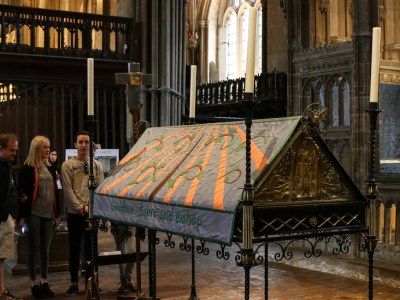
FEATURE image: The shrine of Saint Swithun (or Swithin) in Winchester Cathedral in England, The official name of the old minster or mynster ( from monasterium) is the Cathedral Church of Holy Trinity, Saint Peter, Saint Paul, and Saint Swithun. Since July 15, 971 the shrine at the grave of St. Swithun has been inside…


FRANCE. Thirty miles west of Paris, the 1000-year-old fortified royal town of MONTFORT L’AMAURY, showcases its 11th century crusaders’ castle, 16th century flamboyant Gothic church with 37 intact Renaissance stained-glass windows and homes of 20th century composer Maurice Ravel and playwright Jean Anouilh.
FEATURED image: Manuscript 16th century (detail): Queen consort Anne of Brittany (1477-1514) receiving a Book of Hours from her Dominican confessor, Antoine Dufour (d.1509). Montfort L’Amaury returned to the crown of France after Anne of Brittany married Charles VIII “the Affable” (1470-1498) in 1491. At the north edge of the Rambouillet forest the city of…

FRANCE. Last battles, death mask of NAPOLEON BONAPARTE (1769-1821) at the 200th anniversary of his death on May 5, 1821, on remote Saint Helena.
FEATURED image: Napoleon near Borodino, Vasily Vereshchagin (1842–1904), 1897, oil on canvas, State Historical Museum, Moscow. Major facts of the life of Napoleon Bonaparte (1769-1821) are well known. Known as Napoleon I, the French Emperor who died two centuries ago was a shrewd, ambitious and skilled military leader who conquered much of Europe in the…

GERMANY. Long Live Freedom! HANS SCHOLL AND SOPHIE SCHOLL and The White Rose in Germany (1942-1943).
FEATURE image: Hans and Sophie Scholl, painting –“Hans and Sophie Scholl, painting” by Ralf van Bühren is licensed under CC BY-NC-ND 2.0 By John P. Walsh On February 18, 1943, following the illegal distribution of anti-Nazi leaflets by the White Rose at Ludwig-Maximilians-Universität München—the leaflets instructing students and all others to actively resist the 10-year-old Nazi regime—three young German…

FRANCE. “NOTRE DAME IS ON FIRE!”: architectural history of the 12th century Gothic cathedral and its shocking blaze of April 15, 2019.
FEATURE image: Notre Dame under re-construction, 2019. N.B. Following more than five years of restorative work gathering artisans, donors, and planners from across the spectrum of global society, Notre Dame de Paris was gloriously re-opened at a celebratory dedication ceremony attended by the world’s dignitaries, including 40 heads of state, on December 8, 2024. Begun…

IRELAND. 14 IRISH LEADERS executed for proclaiming the Irish Republic during the 1916 Easter Rising in Dublin, Ireland.
FEATURE image: Cú Chulainn dying in battle, 1911, bronze, by Oliver Sheppard (1865 – 1941), General Post Office (G.P.O.), Dublin, Ireland. Public Domain. By John P. Walsh. May 12, 2016. Today marks the centenary of the final executions of Irish rebel leaders by British firing squads in connection with the 1916 Easter Rising which proclaimed an…

BRITAIN. 40-year-old Scottish KING JAMES IV (1473-1513), king since 1488, walked the world stage and is killed instantly on September 9, 1513, in northernmost England at the Battle of Flodden Field. His successor, James V, is 17 months old.
FEATURE image: Portrait of James IV, after 1578, artist unknown, 41.2 x 33 cm, National Galleries Scotland. Public Domain. The earliest Middleton church was dedicated to Saint Cuthbert around 880 as pagan Danes were then attacking the north of England. Following William the Conqueror in 1066, the Normans built a larger church dedicated to Saint…
