
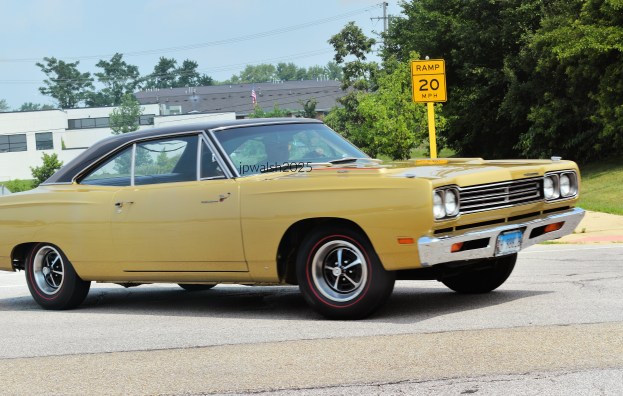
FEATURE image: August 2025. 1969 Plymouth Road Runner. 87% 7.54 mb DSC_4556 (1).

Since the Great Depression years Chrysler Plymouth was the number three budget brand car in America following Ford and Chevrolet. By the1960’s that number three position had been held by General Motors’ Pontiac though Chrysler Plymouth reached that third position on occasion. In the 1970’s Plymouth would be overshadowed by Oldsmobile but in the late 1960’s that was a near future not yet revealed and, starting in 1968, Plymouth had a couple of incredible end-of-decade model years. In 1969 the two-door pony car Plymouth Barracuda (1964-1974) continued to have its own identity in the Chrysler line up and received only a modest makeover that year that included a new grill, interior trim and optional ‘Cuda 340 package. The mid-sized Belvedere (1954-1970) in its seventh generation and Satellite (1965-1974) in its second generation returned in 1969 with slight new treatments as did the compact Plymouth Valiant (1960-1976) in its third generation with a new grill and taillights. In 1969, after four years, The Plymouth Fury (1955/1959-1989) entered a fifth generation with a totally redesigned model line.
In 1969 Plymouth’s advertising tag line was Look what Plymouth’s up to now and it was the new Plymouth Road Runner that captured the car world’s imagination. A Plymouth first, Motor Trend magazine selected the 2-door convertible and 2-door coupe Road Runner as their 1969 Car of the Year. A powerful engine with a spartan trim level, the Road Runner muscle car was introduced by Chrysler in 1968. In 1969 Plymouth added a new Road Runner Convertible. Initially based on the lower-priced Plymouth Belvedere, the sporty Road Runner was a mid-size, performance-focused car designed to itself be a lower-priced option compared to the upscale Plymouth GTX or Pontiac GTO. In its heyday the Chrysler Plymouth Road Runner was the spartan alternative to the highly equipped Plymouth (Belvedere) GTX. All these Plymouth mid-sized models (along with the Satellite) were sold in 1969 with the tag line: The name of the game this year is “sport.” In 1969, the base price for a Plymouth Road Runner coupe was approximately $2,945 ($25,888 in 2025 dollars). The hardtop version listed for around $3,083 ($27,099) and the convertible model was $3,313 ($29,121). The mid-size Road Runner was introduced as a 2-door pillared coupe whose spare interior belied an exclusive “Roadrunner” 383 cu in B-series V8 engine with a 4-barrel Carter Carburetor and high-performance camshaft under the hood.
“Beep, Beep.”
Plymouth paid $50,000 to Warner Bros.-Seven Arts (about $465,500 today) to use the Road Runner name and likeness including the “beep, beep” horn sound that Plymouth developed for its customers with an investment of around $100,000 in today’s money. Produced from 1968 to 1980, the Road Runner was built on the mid-sized B-Platform for three generations. Like most muscle cars, in the 1970’s its performance capabilities declined — and, with it, sales — as the car industry was mandated to focus on fuel economy and emission standards. In 1976 the Road Runner nameplate became a trim and graphics package for the new Plymouth F-body compact two-door Volaré platform until discontinued in 1980. Having no special performance capability and with car manufacturers actively downsizing their lineups, the Volaré was discontinued on the same day in 1980 the Dodge Main Assembly plant in Detroit, Michigan, closed after being in continuous operation since 1911.
SOURCES: See – J. “Kelly” Flory, Jr., American Cars, 1966 to 1972, McFarland & Company, Inc. pp. 297-303.
This explanatory article may be periodically updated.


