Category Archives: Cars

My Street Photography. GENERAL MOTORS: CHEVROLET IMPALA (1958–1985; 1994–1996; 2000–2020).

FEATURE IMAGE: The 1966 Chevrolet Impala is 6 foot 7 inches wide (79.9 inches). See –https://www.conceptcarz.com/s9332/chevrolet-impala-series.aspx – retrieved May 7, 2024. May 2024. 94% 7.65mb Author’s photograph.

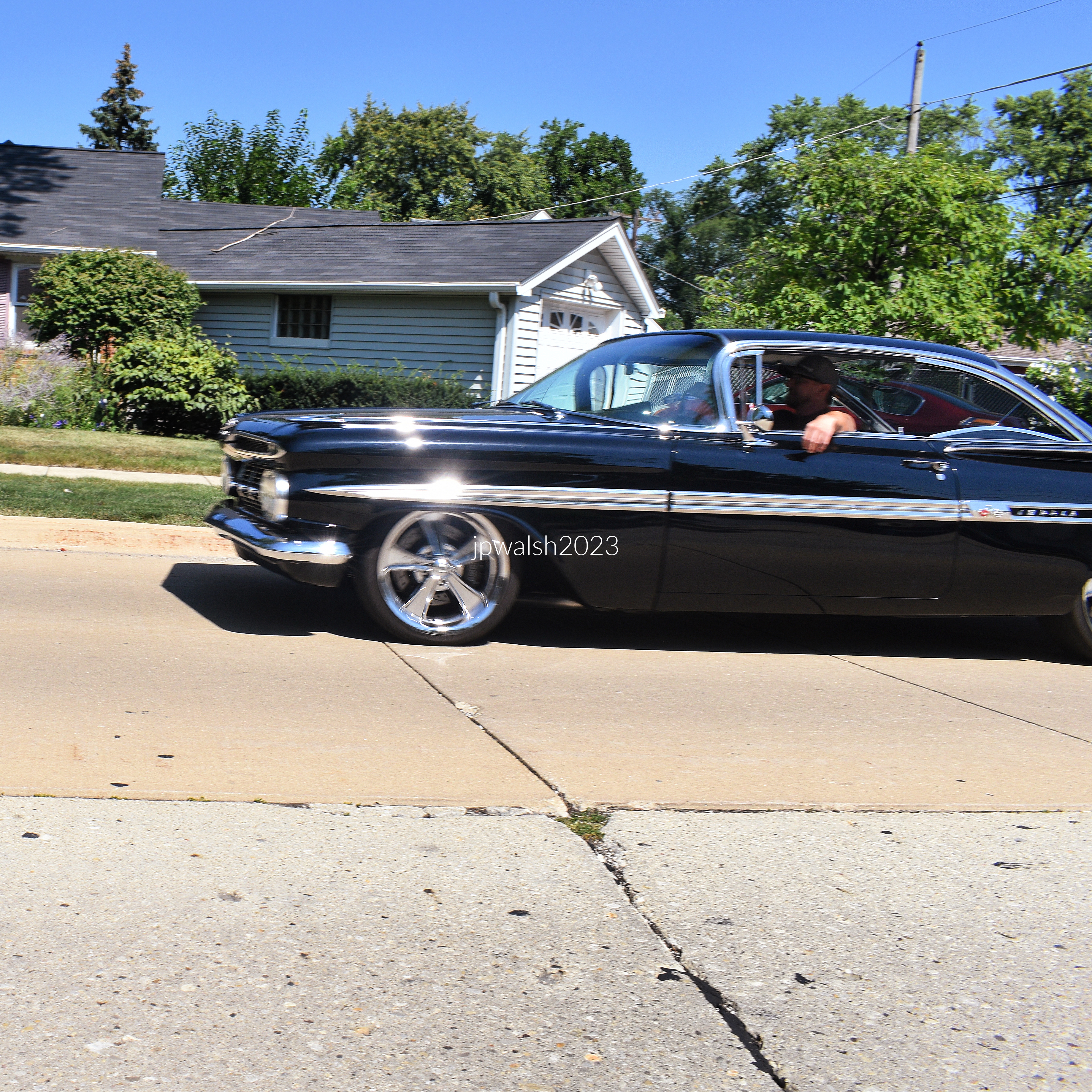
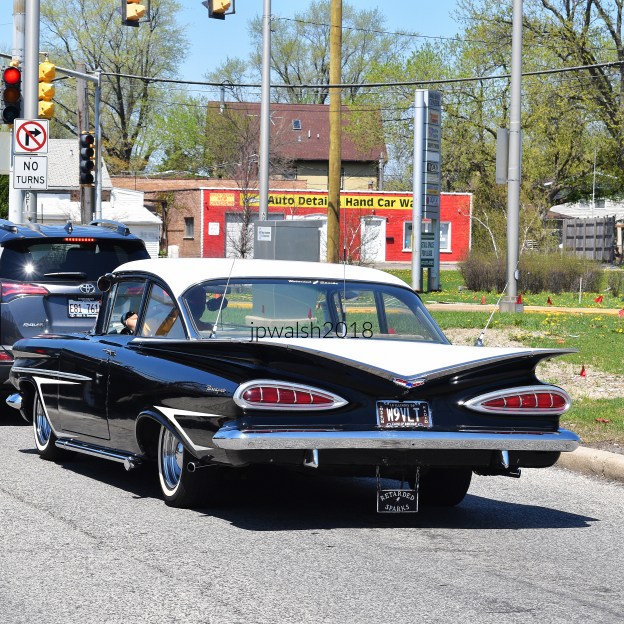
1959 Chevrolet Impala 2-door hardtop. Second Generation (1959-1960). August 2023. Author’s photograph.

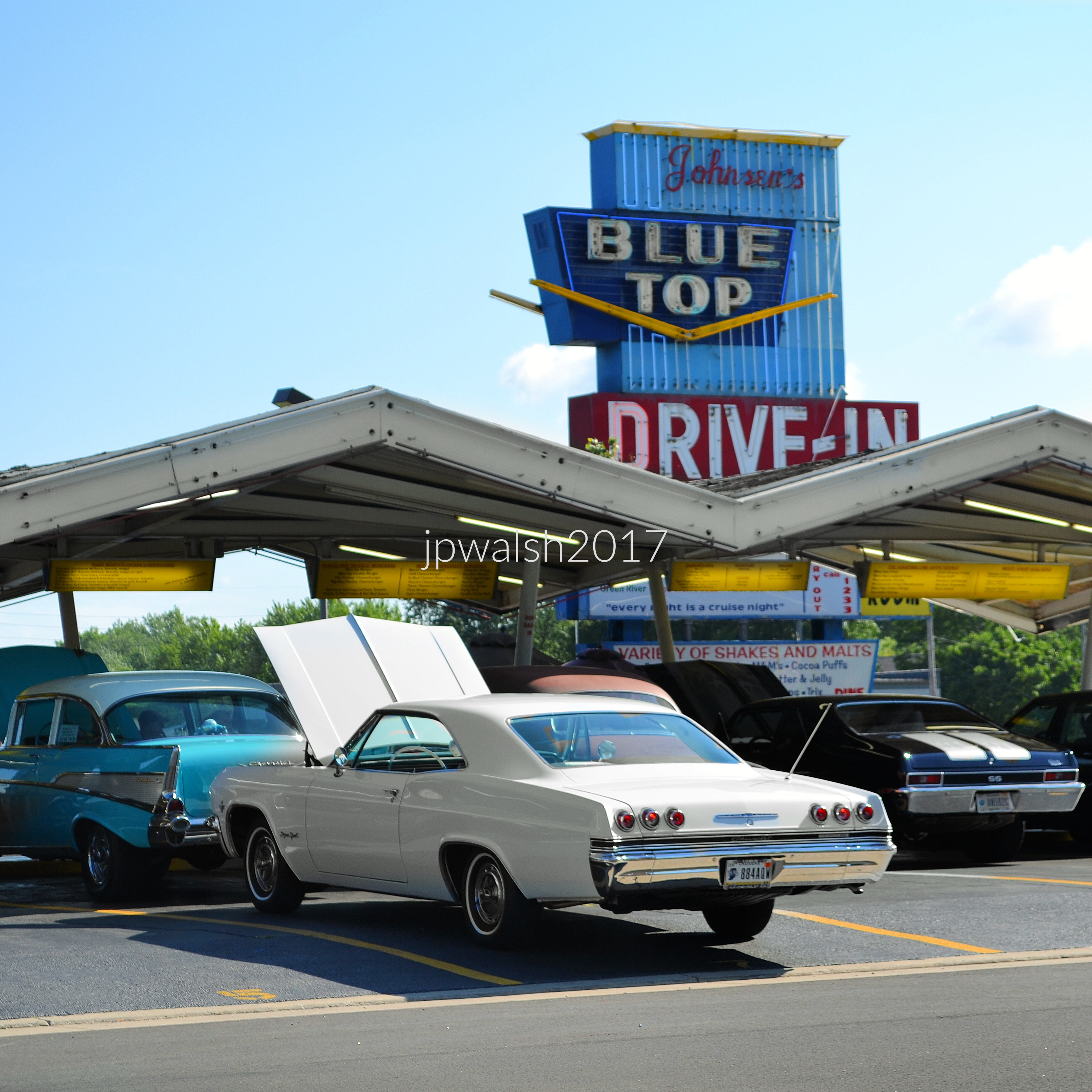
1965 Chevrolet Impala, Fourth Generation (1965–1970). Recognizable by its signature triple taillight design and flowing full-size body, the Chevy Impala was commonly equipped with a V8 engine, such as the 350 or 409ci. Redesigned in 1965, the Impala set an all-time industry annual sales record that year. July 2017. 2.77mb DSC_0419 (1). Author’s photograph.

1965 Chevrolet Impala SS, Fourth Generation (1965–1970). The Impala SS (Super Sport) was introduced as an option in 1960 as an appearance/performance package. Soon it was limited to hardtop and convertible coupe models. From 1964 through 1967 (Impala’s third and fourth generations), the Super Sport was a separate model, with its own VIN prefix: for instance, in 1965-67 cars 166/68 was the prefix for a V8-equipped Impala SS. August 2021. 10.9 mb. Author’s photograph.
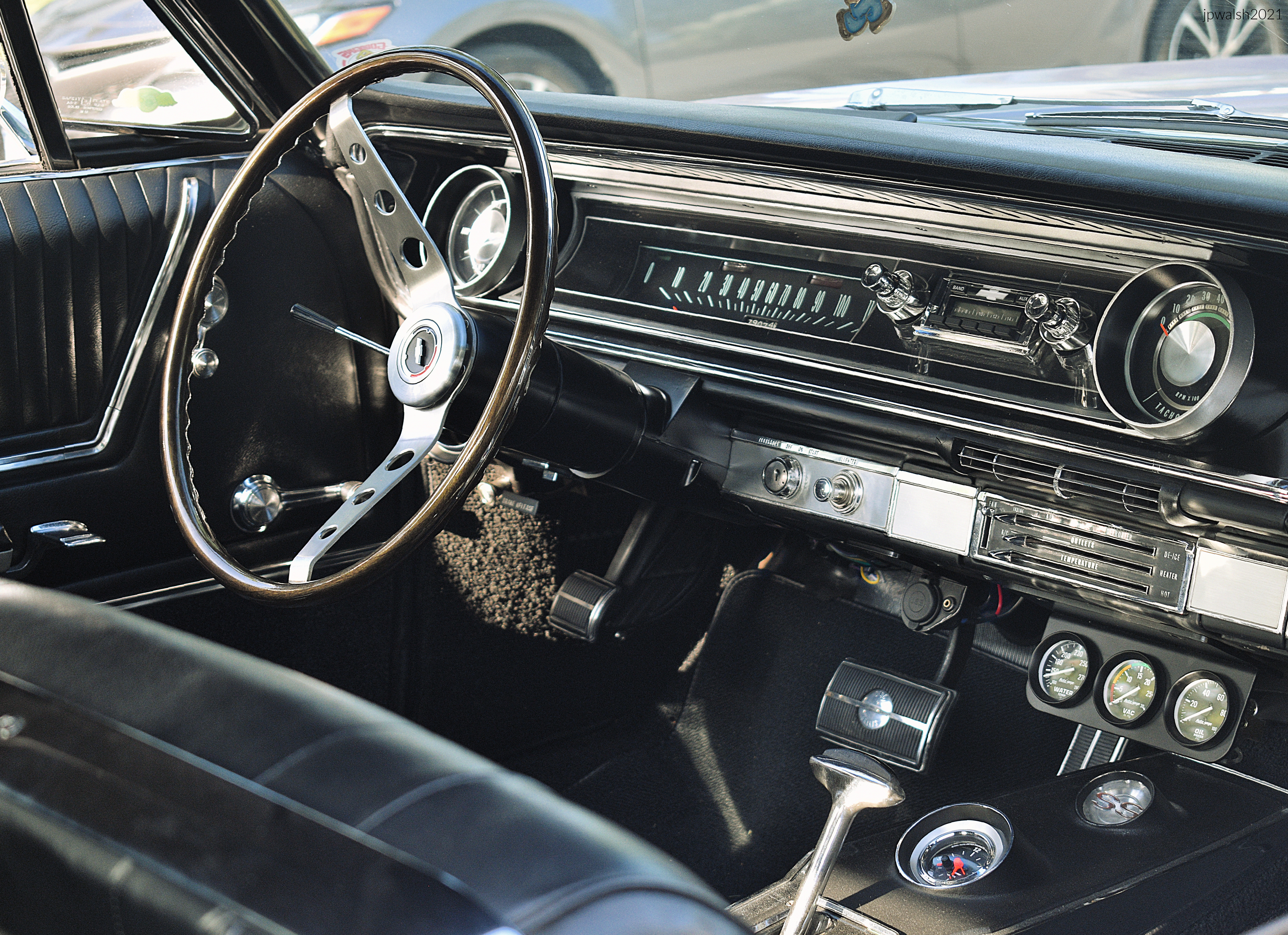
1965 Chevrolet Impala SS, Fourth Generation (1965-1970). From 1962 to 1964, Super Sports came with engine-turned aluminum trim which was used to fill the side moldings of the car. In 1965 this was replaced by a “blackout” trim strip that ran below the taillights. August 2021. 11.4 mb. Author’s photograph.

1965 Chevrolet Impala SS, Fourth Generation (1965-1970). At its debut in 1958, the Chevrolet Impala was distinguished from other models by its symmetrical triple taillights. By the late 1960’s, classic muscle or “big block” cars focused on smaller models. The last model year for the Chevrolet Impala Super Sport series was 1969. August 2021. 7.71 mb. Author’s photograph.

1966 Chevrolet Impala 2D Coupe. As cited above, from its debut in 1958, the Chevrolet Impala was distinguished by its symmetrical triple taillights. For the model year 1965 the Chevrolet Caprice was introduced as a top-line Impala Sport Sedan and later a separate series above the Impala in 1966. The Impala remained above the Chevrolet Bel Air and the Chevrolet Biscayne and continued as Chevrolet’s most popular full-sized model through the end of its initial production run in model year 1985. The 1966 Impala had a sexy sleek appearance with a 396 Turbo Jet that gave plenty of power and a smooth ride. May 2024. 89% 7.94mb Author’s photograph.

The 1966 Impala was a mild restyle of the 1965, featuring a new instrument panel, grille, wheel covers (except for SS models), and, instead of six round taillights, rectangular taillights that wrapped around to the side of the quarter panels. May 2024. 79% 7.85mb Author’s photograph.

Standard features on the 1966 Chevrolet Impala included lap belts front and rear, reverse lamps, day/night rearview mirror, and a padded dashboard. In a year of the introduction of the luxury Caprice and a slight redesign, sales plummeted compared to its record sales the year before. May 2024 97% 7.77mb Author’s photograph.
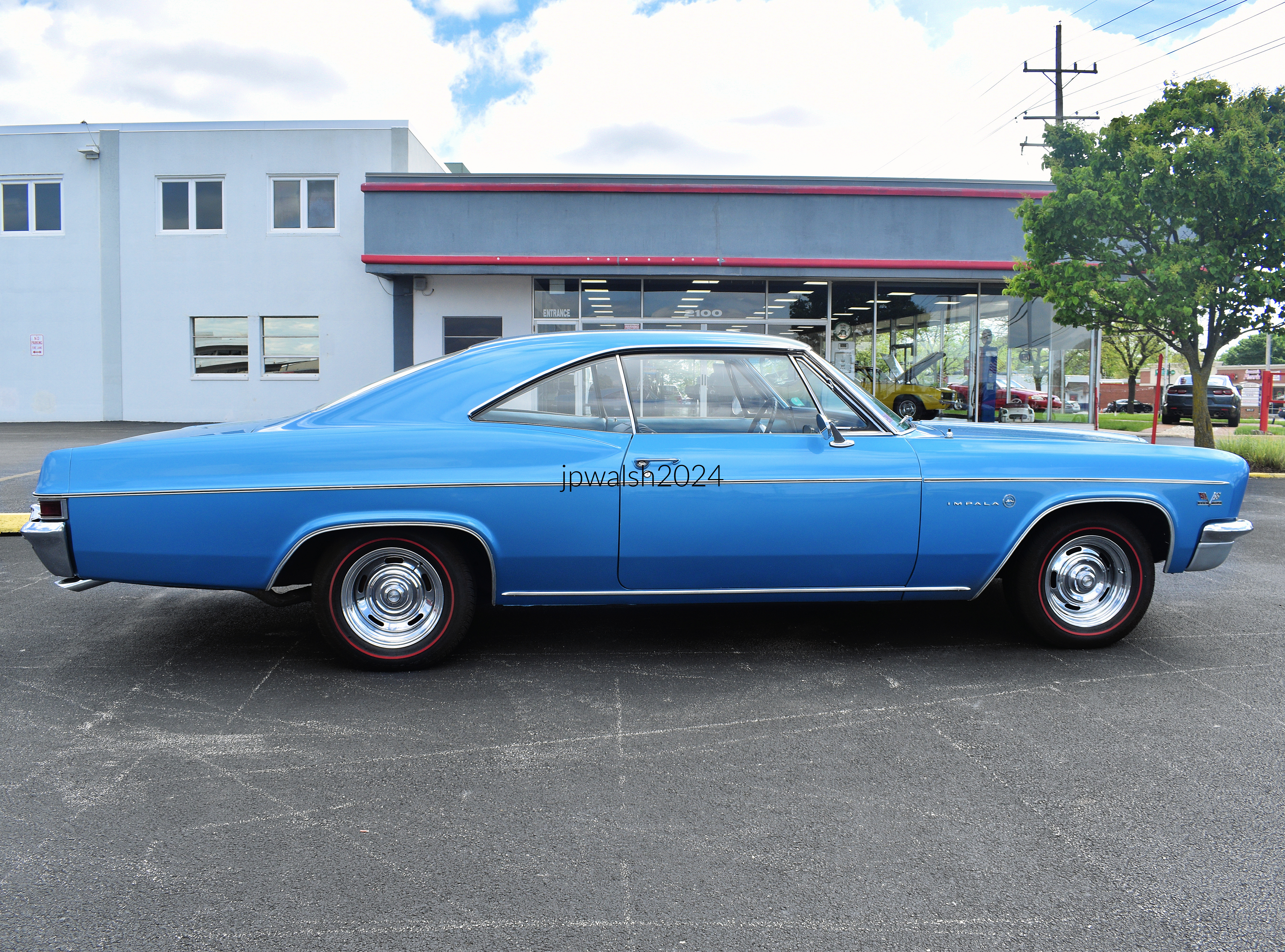
The 1966 Chevrolet Impala is nearly 18 feet long (213.2 inches). see –https://www.conceptcarz.com/s9332/chevrolet-impala-series.aspx – retrieved May 7, 2024. May 2024. 85% 7.56mb Author’s photograph.

1969 Chevrolet Impala. The 1969 models were unique in several ways. Disc brakes were optional in previous years and standard in 1969 joined to 15-inch wheels. This was also the only year that the cars had the name Impala anywhere on the body. May 2024. 84% 7.93mb Author’s photograph.

Nearly 40% of the Chevrolet’s entire production for 1969 (2,082,947) was the Impala (777,000) and topped Caprice production. see –https://www.conceptcarz.com/s24095/chevrolet-impala.aspx – retrieved May 8, 2024. May 2024. 90% 7.42mb. Author’s photograph.

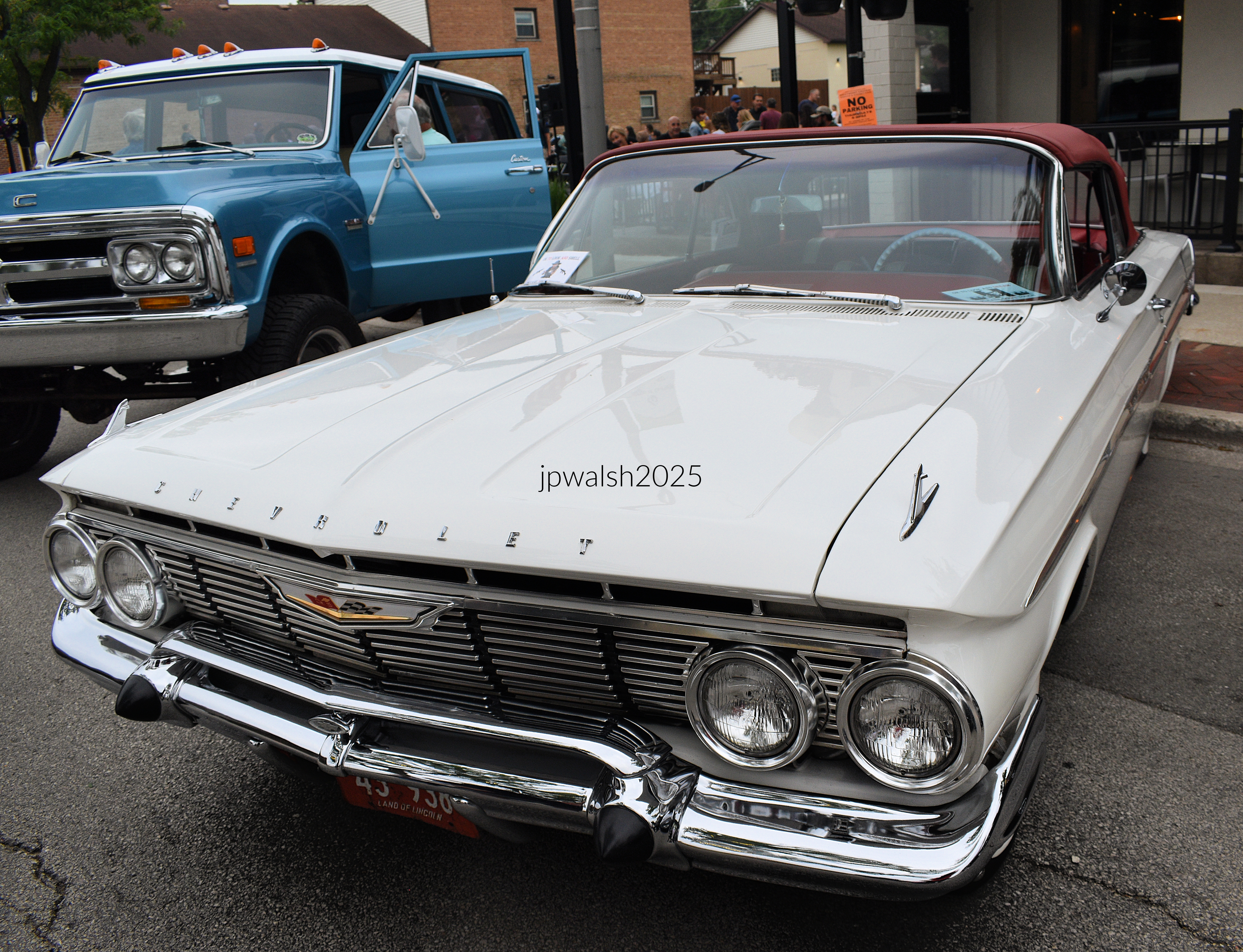
1970 Chevy Impala. September 2022. 67% Author’s photograph.

Chevrolet Impala Evolution: All Generations (1958–2020s) (https://www.youtube.com/watch?v=5Q-mu16nfvY) – retrieved April 27, 2026.

This explanatory article may be periodically updated.

My Street Photography. Ford Galaxie (1959-1974).

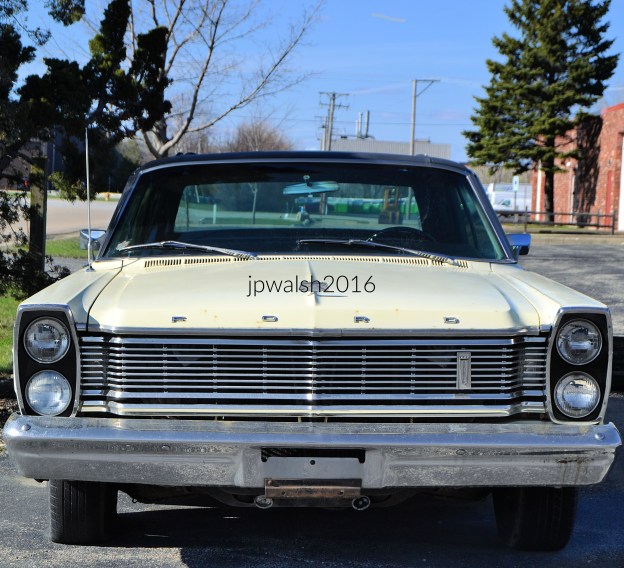
Feature Image: The 1965 Ford Galaxie 500 features a distinctive full-width grille with vertically stacked dual headlights. Available in various body styles, including hardtops and convertibles, the model was part of an all-new design for full-size Fords, highlighting crisp lines and engines that included V8 options such as the 352 cubic inch “Thunderbird Special.” Author’s photograph. April 2016. 3.34mb DSC_0471 (1).

In 1960, 44-year-old Robert McNamara was the new president of Ford Motor Company. In his career at Ford, McNamara was an executive who thought like and fought for the ordinary consumer. Unlike other car industry execs, McNamara was passionate about providing a highly affordable and great car for the ordinary American man and woman. McNamara was ahead of his time and actually might have been more useful or successful in the 1970’s when the introduction of emissions standards and fuel economy made weight and design more significant to meet government mandates. The Falcon was McNamara’s brainchild. Its average price point of $2,100 (about $23,000 today) fulfilled McNamara’s vision for a great American utilitarian car for the masses and it became a bestseller. The middling Ford Fairlane had an average base MSRP of less than $2,300. Next up the lower priced chain of Ford car models was Ford Galaxie. At a little over $2,700 MSRP ($29,500 today) Galaxie was a full-size Ford sedan throughout its production run.

Meet the aristocrats of the low-priced field—ad tag line in 1960 for Ford Galaxie.  

1965 Ford Galaxie (above). With a classic full-size body, the Ford Galaxie 500 was available with various engines, including a high-performance 427 cubic inch V8. Options included a 3-speed automatic or 4-speed manual transmission. The spacious interior was known for its large bench seats. Author’s photograph. April 2016. 4.32 mb DSC_0468 (1).

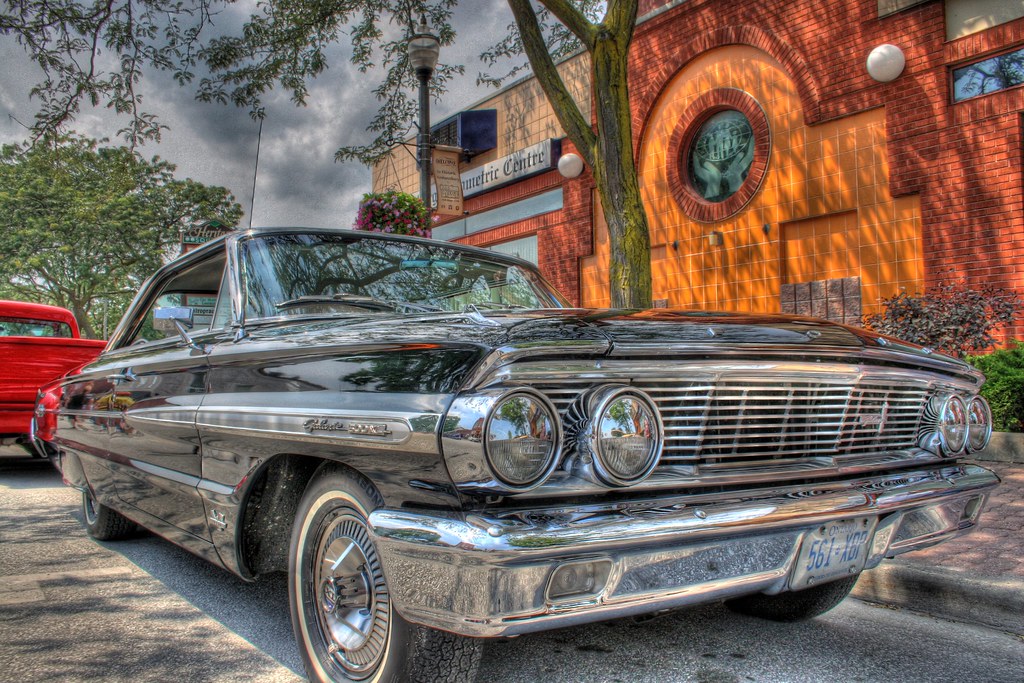
1964 Ford Galaxie 500XL (above). This full-size American car was a top choice in its era combining luxury features and power. The 2-door hardtop coupe could be equipped with a V8 engine, known for robust performance. Between the Custom and the LTD (the XL was discontinued after 1970), the Galaxie remained slotted as the mid-range full-size Ford into the 1970s. FORD GALAXIE HDR” by abux_77 is licensed under CC BY-NC 2.0.

On November 9, 1960, Robert McNamara (1916-2009) became the youngest president in Ford Motor Company history and the first from outside the Ford family since 1906. One month on the job, McNamara was contacted on December 8, 1960, by president-elect John F. Kennedy’s transition team and offered the job of US Secretary of Defense. Though McNamara’s first reaction was that he wasn’t qualified for the defense job, he finally accepted and became the youngest defense secretary in US history up to that time. McNamara’s compensation at Ford was $3 million a year. At the Defense Department he made $25,000 a year. See – Our Vietnam The War 1954–1975, A.J. Langguth, 2000, Simon & Schuster, pp. 42-43 and McNamara At War: A New History, P. Taubman and W. Taubman, 2025, W.W. Norton, p. 120.  PHOTO: “Robert McNamara” by DoDEA Communications is licensed under CC BY-NC-ND 2.0.

In addition to a shiny nameplate, Galaxie included cloth/vinyl bench seating, chrome exterior trim on all windows and body sides and an aluminum rear quarter covering with upgrades available. Under McNamara, Ford took a heavy risk in 1960 when it introduced a totally revamped design on its bestseller compact Falcon as well as its line of full-sized cars. Fords were lighter and sleeker, with a body no longer sculpted but molded from fender to bumper trimmed in chrome. And for the first time in Ford history the full width grill had its headlights inset at each end instead of above. This design choice continued throughout Galaxie’s second generation into 1964.

By 1974, things were very much changed. The Mustang II was that year’s Motor Trend Car of the Year – and it was Galaxie’s last model year. The Galaxie had essentially been co-opted by what started in 1965 as its highest trim level: namely Ford LTD. Strictly Galaxie production had, in fact, fallen from its peak in 1963 of nearly 650,000 vehicles to under 120,000 in 1974.

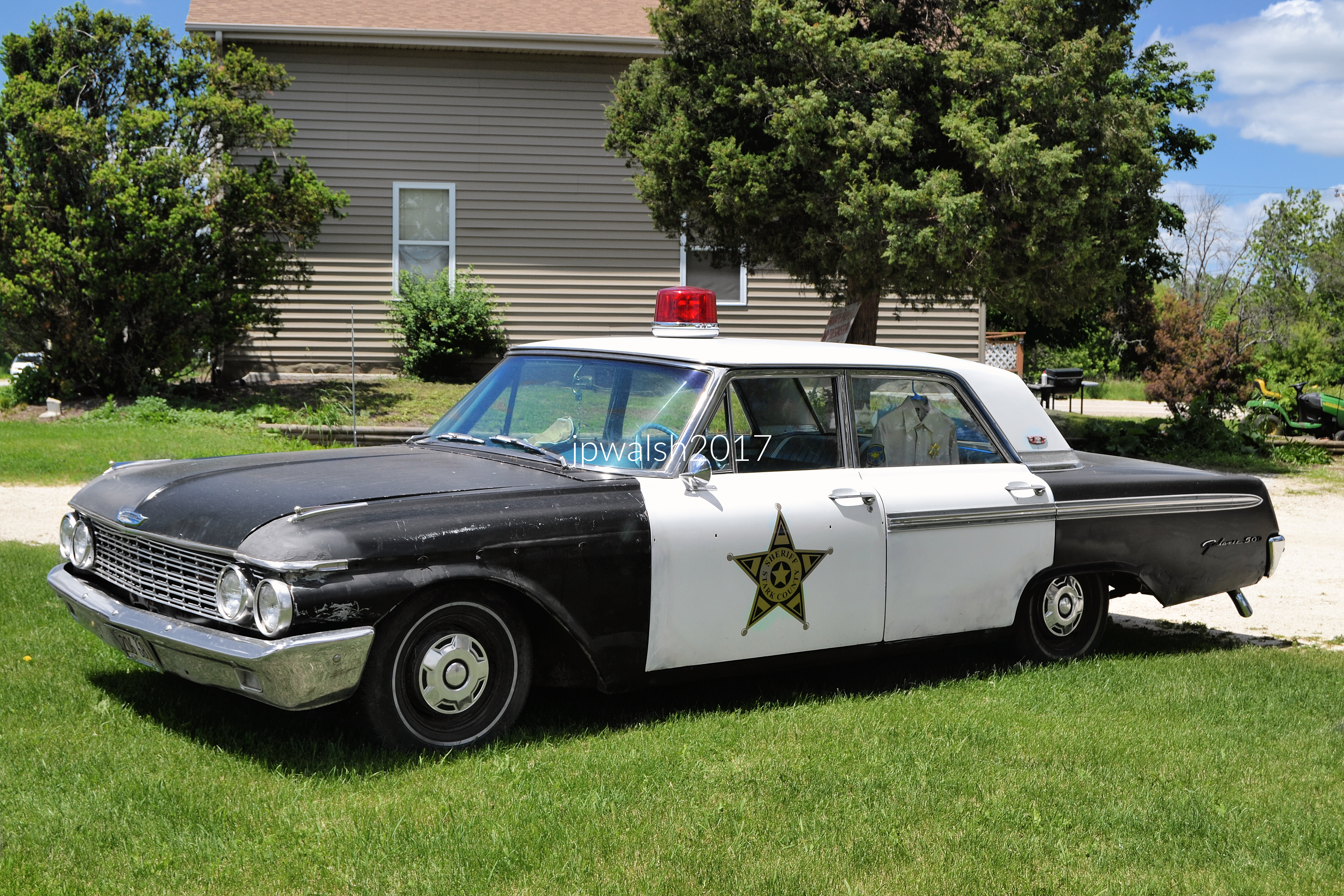
Mayberry tribute: 1962 Ford Galaxie. May 2017. Author’s photograph. 6.44mb DSC_0170 (1)

The Andy Griffith Show, which aired from 1960 to 1968, remains one of the era’s most-watched series, spanning 249 episodes across eight seasons. Andy Griffith stars as Sheriff Andy Taylor of Mayberry, North Carolina. For Ford enthusiasts, the show is notable for its recurring lineup of Fairlanes, Galaxies, and Custom sedans. Over the years, fans have built numerous tributes — including this 1962 Ford Galaxie.

https://www.youtube.com/watch?v=viElz-ow5O0 – retrieved April 13, 2026.

The Andy Griffith Show offered a portrait of small‑town life that millions of viewers embraced. Sheriff Andy Taylor’s Ford patrol cars — mostly Fairlanes and Galaxies — became part of the show’s visual identity. Because Ford supplied vehicles to the production, Mayberry’s streets were lined with the latest models, giving the series a consistent look and a subtle sense of realism. Today, that new line of Ford cars in the 1960’s are fan favorites, inspiring countless replicas and restorations.

SOURCES: J. “Kelly” Flory, Jr., American Cars, 1960 to 1965, McFarland & Company, Inc., pp. 41-45; J. “Kelly” Flory, Jr., American Cars, 1973 to1980, McFarland & Company, Inc., pp. 178-179.

This explanatory article may be periodically updated.

My Street Photography. GENERAL MOTORS: CHEVROLET BISCAYNE (1958-1975).

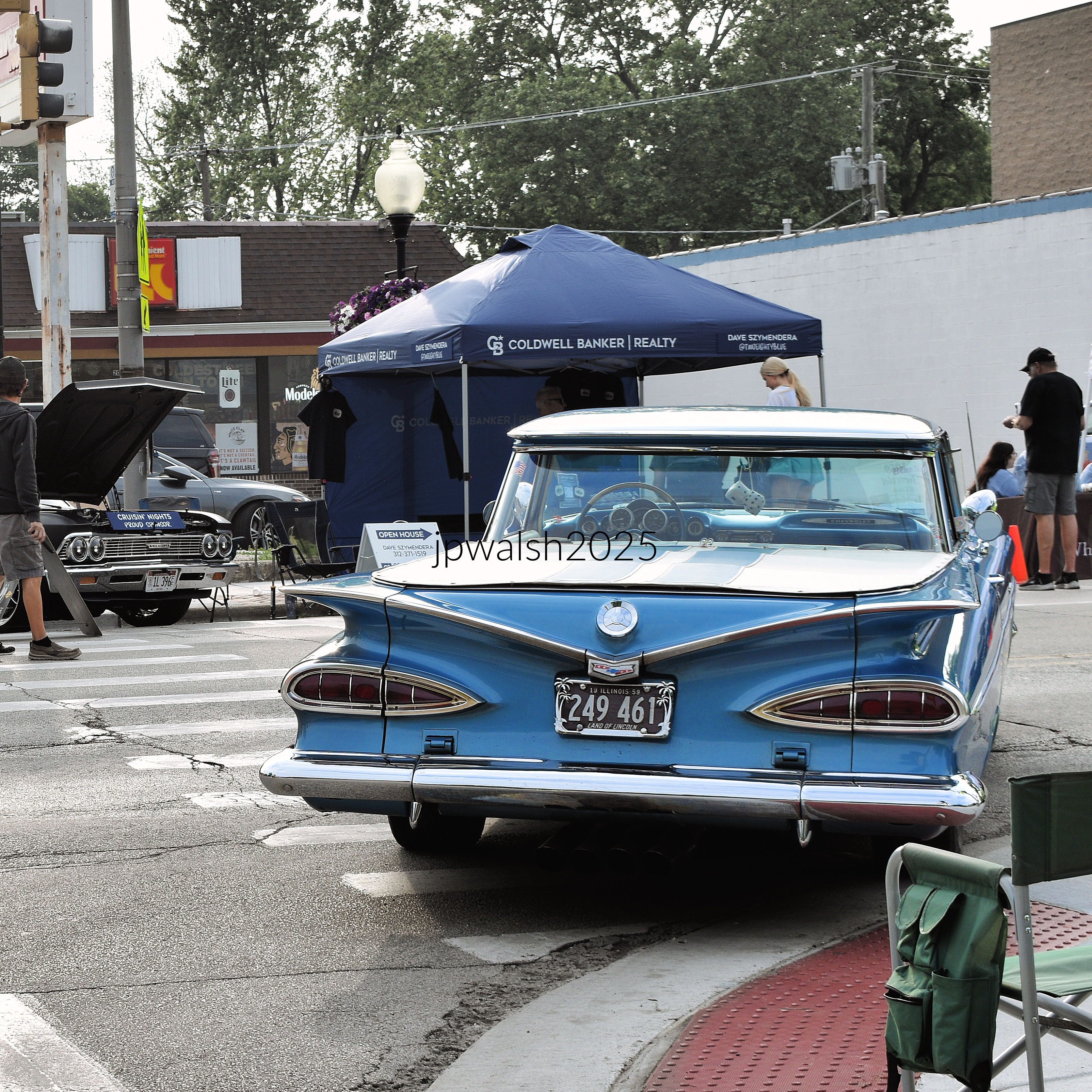
Feature Image: 1959 Chevy Biscayne, 7.89 mb, author’s photograph, May 2018.

In the 1950’s, American cars were noted for their V-8 engines, chrome, and tailfins of one kind or another. The late 1950’s was also marked by a recession which began in 1957 and continued into 1958 that led to a drop in car production in that period by nearly a third. “What is good for General Motors is good for America” could be true in 1950’s America when it was said, attributable to a 1953 Senate hearing, but its converse was also clearly the situation in the last years of that decade.

“From the Progress of the Past – the Promise of the Future.”

This was the tag line for General Motors that was celebrating its 50th anniversary in 1958. Many cars were painted golden to mark the “Golden Milestone.” It was the same year that the full-size Biscayne model made its first appearance. All Chevrolets in 1958 underwent an all-new “Sculptutamic Styling” that included the “gull wing” style fenders and twin taillights in the back of the Chevy Biscayne. The gull wing back extended along the body side to a “v” dip or gap. Another subtle styling addition was the quarter panel bulge between the rear wheel opening and the rear bumper. The Biscayne series replaced the Chevy 210 where the interior was made more colorful and instrumentation had a horizontal bias that, by 1959, was designed to be within easy sight of the driver. In 1958 Chevy introduced the X- shaped frame chassis and full coil suspension that provided greater stability that included 6-cylindar and V8 models, the 283 CID V8 replacing the 265 CID V8, with an optional 348 CID.

“Dollars never went further or bought longer lasting pride than in Chevrolet’s new Biscayne series for ’59.”

In 1959 General Motors – emulating a Chrysler corporate revamp in 1957 – redesigned the bodies of its entire fleet line so that many interior parts and some exterior parts were interchangeable on cars. In the process Chevy reshuffled their brands so that the Impala, that was a luxury option on the Bel Air in its first year in 1958, became Chevy’s own top-of-the-line brand in 1959. The Bel Air took the place of the Biscayne and the Biscayne in 1959 replaced the budget-priced Delray that was discontinued. Chevy Biscayne was produced in its second generation over two model years (1959 and 1960) and would be produced in five generations whose last model year was 1975.  

The 1959 Chevy: a.k.a. “Batmobile.”

In 1959 the most remarkable design change was an enlarged windshield and rear window on all cars for greater driver visibility of the road and a “flat top roof.” The bodyside was characterized, at the front, by a slight crease at the turn signal which joined a gentle, sloping bodyside curve. The tail fin started at the rear of the front door that carried to the slightly higher back-end splaying in a “v” shape above the “teardrop”-shaped taillights. The design of the 1959 Chevrolet later came to be known as the “Batmobile” for its body design affinities, particularly the wing-shaped tailfins, and that was featured in the Caped Crusaders’ custom built “bat motif” vehicle during the popular ABC “Batman” TV series in 1966 to 1968.

Batmobile, rear view. With its ‘bat motif” wing-shaped tail fins, the 1959 Chevys, including the Biscayne, shared similarities with the Caped Crusaders’ custom built vehicle. PHOTO: “Batmobile, rear view” by KWH703 is licensed under CC BY-NC-SA 2.0.

Drag racing footage of what looks like a 1960 Chevy Biscayne. The Biscayne was introduced as a full-sized Chevrolet model in 1958 in tandem that year with the top-of-the-line luxury Impala. They joined the Bel Air which has been offered since 1950. These cars constituted about 85% of all Chevy sales in 1960. The Biscayne was the slightly lowest price model with a Biscayne 2-door hardtop like this one setting back the American consumer $2230 BASE MSRP (less than $25,000 in 2025) and weighing about 3500 pounds. https://youtube.com/shorts/7oJPm104q0Y?si=ytYL4v1ruWa2jDTx – retrieved November 30, 2025.

The Feature Image 1959 Biscayne represented over a quarter of all Chevy sales that year. Its main competition was the Ford Custom 300, Plymouth Savoy, and Rambler. The Biscayne featured nylon and vinyl upholstery, cloth headliner, dual sun visors, color-keyed floor coverings, two-spoke steering wheel, stainless steel trim on the windshield and rear window, tail fins, small hubcaps, and 7.50 x 14 BSW tires. In 1959 the average price of a Chevy Biscayne was $2, 383 ($26,597.88).

SOURCES:

J. “Kelly” Flory, Jr., American Cars, 1946-1958, McFarland & Company, Inc. pp. 855-857, 866-867, 870-871, 949.

J. “Kelly” Flory, Jr., American Cars, 1960-1965, McFarland & Company, Inc. pp. 23-24, 26.

This explanatory article may be periodically updated.

My Street Photography. GENERAL MOTORS: CHEVROLET CAPRICE (1965-1996).

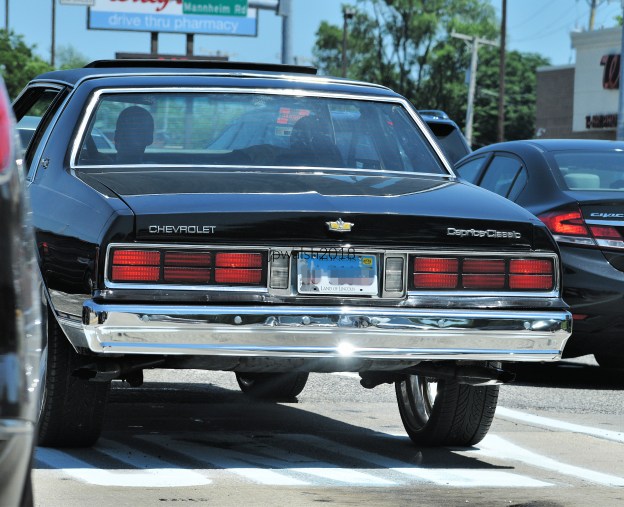
Feature Image: 1982 Chevy Caprice Classic. June 2018. Author’s photograph. 92% 7.79 mb.

Chevrolet had a golden year in 1965. Sales had not been that stellar since 1955. What a difference one model year makes. In 1966 Chevrolet took a beating from Ford mainly from Ford’s new sporty Mustang for which Chevy had no direct competition yet. The closest was the Chevy II V-8 with its front engine rear-wheel drive but it wasn’t sporty and became competition for Ford’s Falcon. Further headaches for Chevy included negative publicity from consumer advocate Ralph Nadar’s book “Unsafe at Any Speed,” published in 1965 that criticized the automotive industry for its safety record, focusing on the Corvair, particularly driver handling concerns with the rear-engine economy car. As Nader’s work led to the passage of the National Traffic and Motor Vehicle Safety Act in 1966, which mandated federal safety standards for vehicles, it impacted Chevrolet sales in the short term adversely. In 1966 the Chevrolet Full Size whose model lines included the Bel Air (1950), Biscayne (1958), and Impala (1958) that represented more than 70% of Chevrolet’s sales volume now included the bumped-up Caprice in 1966 as the new top of the line model. The Caprice, which started in 1965 as a luxury option to the Impala 4 Door Hardtop, became popular as its own model and competed with the Plymouth VIP and new Ford Galaxie 500 LTD.

“The New Chevrolet. We Made It Right For the ‘80s.” – Ad tag line in 1980 for Impala and Caprice Classic.

The Chevrolet Caprice is a full-size car produced by Chevrolet in North America for the 1965 through 1996 model years. Full-size Chevys were touted as “The New Chevrolet.”

By 1980 the full-size Caprice Classic received with the Impala (1958-1985) an exterior makeover to be more aerodynamic for fuel economy with all new sheet metal as it retained the same chassis and basic interior and exterior design and appearance. In the pursuit of reducing drag, the front fenders and hood were lowered and the back trunk lid and rear quarter were raised. The roofline was formalized and body sides were smoothed. A new grille insert was “egg crate” style that was 4 rows high and five times as wide. On behalf of better fuel economy, the weight of this streamlined Chevy Caprice was reduced by 100-150 pounds.

The 1982 model year was part of the Caprice’s Third Generation that went from 1977 to 1990. In 1982 the Caprice Landau Coupe was dropped with only the three-seat Caprice Wagon, Sports Coupe and Four-Door Sedan offered. Both the two-door six -passenger V6 Sports Coupe and Four Door Sedan had an optional V8 engine. The Sports Coupe listed for $8,221– $8,291 (about $27,479.52 today) while the Four Door Sedan listed for $8,367 – $8,437 (about $27,967 today). Fully loaded options inside and out could add over $3000 ($10,000 today). In 1980 the Impala and Caprice Classic amounted to over 25% of Chevy’s sales volume. Caprice featured specific triple unit taillights, bright roof trim moldings, stand up hood ornament, and full wheel covers along with an interior velvet-look knit cloth or all-vinyl front bench seat, fold down center armrest (4-doors only), front door pull straps and lower door panel carpeting, electric clock, and extra acoustical insulation and courtesy lights.  

SOURCES:

See – https://www.capriceclassic.com/onamarie.geo/chevy1982.html – retrieved July 17, 2025.
J. “Kelly” Flory, Jr., American Cars, 1966 to 1972, McFarland & Company, Inc. pp. 32-33; 38-39.
J. “Kelly” Flory, Jr., American Cars, 1973 to 1980, McFarland & Company, Inc. pp. 798-800; 809-810.

This explanatory article may be periodically updated.
My Street Photography. FORD FALCON (1960-1970).

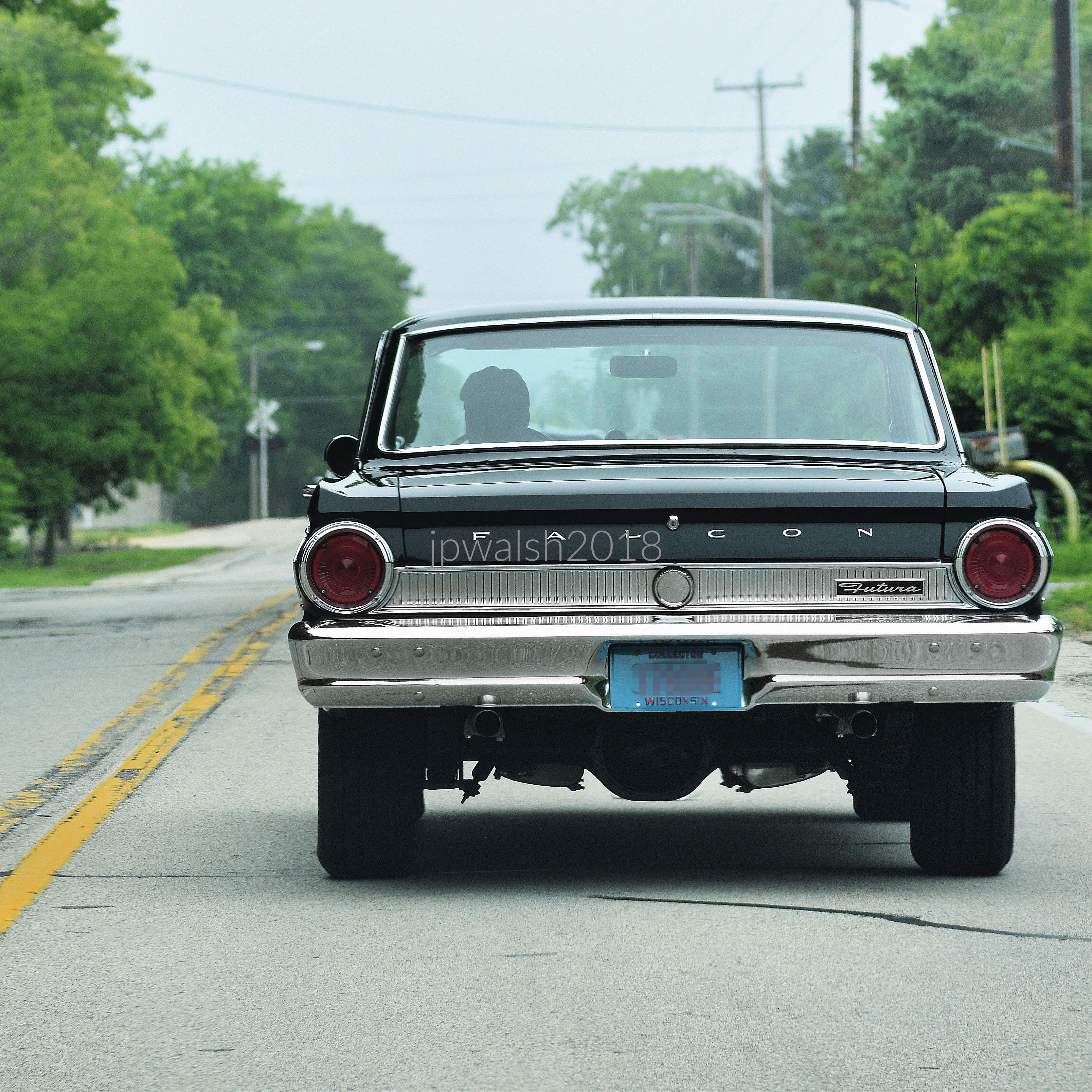
FEATURE image: 1964 Ford Futura Falcon. Author’s photograph. June 2018. 4.54 mb DSC_0136 (1).

In 1964, Falcon was included under Ford’s umbrella tag line of “The Total Performance Cars for 1964.”

In 1964 all of Ford’s models were given upgrades including under the hood, such as the 289 CID V8 engine for the Mustang and mid-sized cars. The renewal that year of all its models was so important that the entire Ford line was named “Car of the Year” by Motor Trend magazine. In 1964 Falcon received a major restyling that included an angular and modern appearance while retaining its original performance components. Falcon, along with the Fairlane, were big sellers comprising together more than a third of all Ford sales. But the biggest news in 1964 was the arrival of Ford’s brand-new pony car at the World’s Fair in New York: the Mustang. The sporty Mustang was an instant hit and had taken some of its enduring design inspiration from the Falcon in terms of its practicality.

https://www.youtube.com/watch?v=7PwQB59yFaM – retrieved October 23, 2025.

In 1960, Ford’s ad tag line for the Falcon was “the easiest car in the world to own.”

The Ford Falcon was Ford General Manager Robert McNamara’s idea. Robert McNamara (1916–2009) joined Ford after serving in the U.S. Army Air Forces during World War II, and his sharp analytical approach to the company’s operations soon earned him a place among the so‑called “Whiz Kids.” In 1960 Ford Motor played the industry’s high stakes profitability game with its new line of cars that included a new and affordable compact for the ordinary American. Naysayers and conventional wisdom said compact car manufacturing was unprofitable. But the Ford Falcon came up a big winner as Ford’s biggest seller in 1960 and in its entire history up to that time. By 1961 all the majors—Ford, Chevy and Plymouth—offered basic compact cars for Americans to drive. Ford being its leader (they were there first, offered the lowest price, and had 2- and 4-door models) won the compact car marketplace battle definitively.

Ford Futura Falcon. Author’s photograph. June 2018.7.36mb DSC_0122.

When it comes to their cars Americans like tradition and from its powertrain to exterior and interior styling Falcon was all that.

Standard equipment on the 1964 Falcon included cloth and vinyl interior trim, front door arm rests, chrome windshield and chrome rear window moldings, and hub caps. The FUTURA Falcon added features such as deluxe interior trim, side window moldings, hood ornament, full-length side trim molding, and full wheel covers. Further upgrades on Futura included bucket seats. SQUIRE included wood-grain exterior trim, power tailgate window and carpeted floors. SPRINT added bucket seats, a console, sports steering wheel, tachometer and wire wheel covers. The Falcon ranged from the Falcon 2-door sedan with a base MSRP of $1,996 ($20,859.87 in today’s dollars) all the way up to the Falcon Sprint 2-door convertible with a base MSRP of $2,671 ($27,914.19 in today’s dollars). The average price for a new Ford Falcon in 1964 for the American consumer was $2,345 ($24,507.22 in today’s dollars).

SOURCES:
J. “Kelly” Flory, Jr., American Cars, 1960 to 1965, McFarland & Company, Inc. pp. 41-43; 269-70; 299-300.

My Street Photography. CHRYSLER: PLYMOUTH ROAD RUNNER (1968-1980).

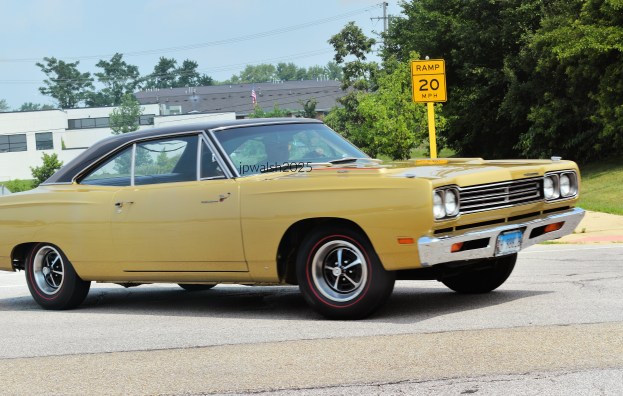
FEATURE image: August 2025. 1969 Plymouth Road Runner. 87% 7.54 mb DSC_4556 (1). 

Since the Great Depression years Chrysler Plymouth was the number three budget brand car in America following Ford and Chevrolet. By the1960’s that number three position had been held by General Motors’ Pontiac though Chrysler Plymouth reached that third position on occasion. In the 1970’s Plymouth would be overshadowed by Oldsmobile but in the late 1960’s that was a near future not yet revealed and, starting in 1968, Plymouth had a couple of incredible end-of-decade model years. In 1969 the two-door pony car Plymouth Barracuda (1964-1974) continued to have its own identity in the Chrysler line up and received only a modest makeover that year that included a new grill, interior trim and optional ‘Cuda 340 package. The mid-sized Belvedere (1954-1970) in its seventh generation and Satellite (1965-1974) in its second generation returned in 1969 with slight new treatments as did the compact Plymouth Valiant (1960-1976) in its third generation with a new grill and taillights. In 1969, after four years, The Plymouth Fury (1955/1959-1989) entered a fifth generation with a totally redesigned model line.

In 1969 Plymouth’s advertising tag line was Look what Plymouth’s up to now and it was the new Plymouth Road Runner that captured the car world’s imagination. A Plymouth first, Motor Trend magazine selected the 2-door convertible and 2-door coupe Road Runner as their 1969 Car of the Year. A powerful engine with a spartan trim level, the Road Runner muscle car was introduced by Chrysler in 1968. In 1969 Plymouth added a new Road Runner Convertible. Initially based on the lower-priced Plymouth Belvedere, the sporty Road Runner was a mid-size, performance-focused car designed to itself be a lower-priced option compared to the upscale Plymouth GTX or Pontiac GTO. In its heyday the Chrysler Plymouth Road Runner was the spartan alternative to the highly equipped Plymouth (Belvedere) GTX. All these Plymouth mid-sized models (along with the Satellite) were sold in 1969 with the tag line: The name of the game this year is “sport.” In 1969, the base price for a Plymouth Road Runner coupe was approximately $2,945 ($25,888 in 2025 dollars). The hardtop version listed for around $3,083 ($27,099) and the convertible model was $3,313 ($29,121). The mid-size Road Runner was introduced as a 2-door pillared coupe whose spare interior belied an exclusive “Roadrunner” 383 cu in B-series V8 engine with a 4-barrel Carter Carburetor and high-performance camshaft under the hood.

“Beep, Beep.”

Plymouth paid $50,000 to Warner Bros.-Seven Arts (about $465,500 today) to use the Road Runner name and likeness including the “beep, beep” horn sound that Plymouth developed for its customers with an investment of around $100,000 in today’s money. Produced from 1968 to 1980, the Road Runner was built on the mid-sized B-Platform for three generations. Like most muscle cars, in the 1970’s its performance capabilities declined — and, with it, sales — as the car industry was mandated to focus on fuel economy and emission standards. In 1976 the Road Runner nameplate became a trim and graphics package for the new Plymouth F-body compact two-door Volaré platform until discontinued in 1980. Having no special performance capability and with car manufacturers actively downsizing their lineups, the Volaré was discontinued on the same day in 1980 the Dodge Main Assembly plant in Detroit, Michigan, closed after being in continuous operation since 1911.

SOURCES: See –  J. “Kelly” Flory, Jr., American Cars, 1966 to 1972, McFarland & Company, Inc. pp. 297-303.

This explanatory article may be periodically updated.

My Street Photography. GENERAL MOTORS: CHEVROLET CORVETTE  (1953-).

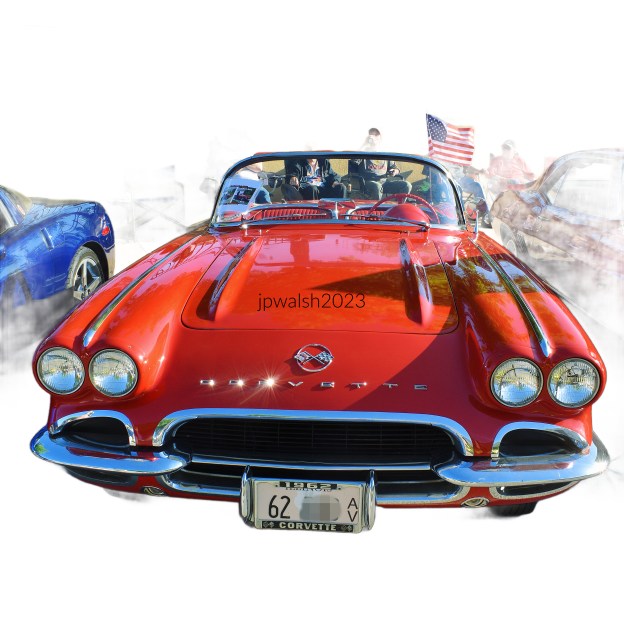
Feature Image: 1962 Corvette. Advertising in 1962 included the tag line: New power. New profile for America’s sports car! May 2023. 4.20mb DSC_2074 (1). Author’s photograph.

While in 1962 Chevrolet was focused on its competition with Ford Motor Company in compact cars (Chevy Corvair; Chevy II), there was a big change in 1962 under the hood for the sporty Corvette. A 250 h.p,, 327-cid V8 engine came standard and was an option on full-sized Chevys as well. The engine was more powerful and weighed no more than its 283 predecessor on which it was built. The 327-cid V8 engine was so efficiently made that with fuel injection it increased to 375 horses under the hood.

1962 Chevrolet Corvette. July 2022. 96% 7.89 mb DSC_6582 Author’s photograph.
1962 corvette July 2022. 88% 7.92mb DSC_6581 Author’s photograph.
1962 Corvette May 2023 92% 7.90 DSC_2078 Author’s photograph.
1962 Corvette. May 2023. 82% 7.90mb DSC_2076 Author’s photograph.
1962 Chevy Corvette August 2025. 7.66mb DSC_4553. Author’s photograph.

The Corvette originated in 1953 and in its first generation introduced a new body for the 1956 model year that featured a revised front end and side coves that continued through the 1962 model year. The first generation Corvette was equipped with deep contoured bucket seats, deep pile carpeting, and complete instrumentation. In 1962 the two -door convertible Corvette listed for $4,038 ($43,129.18 in 2025 dollars).

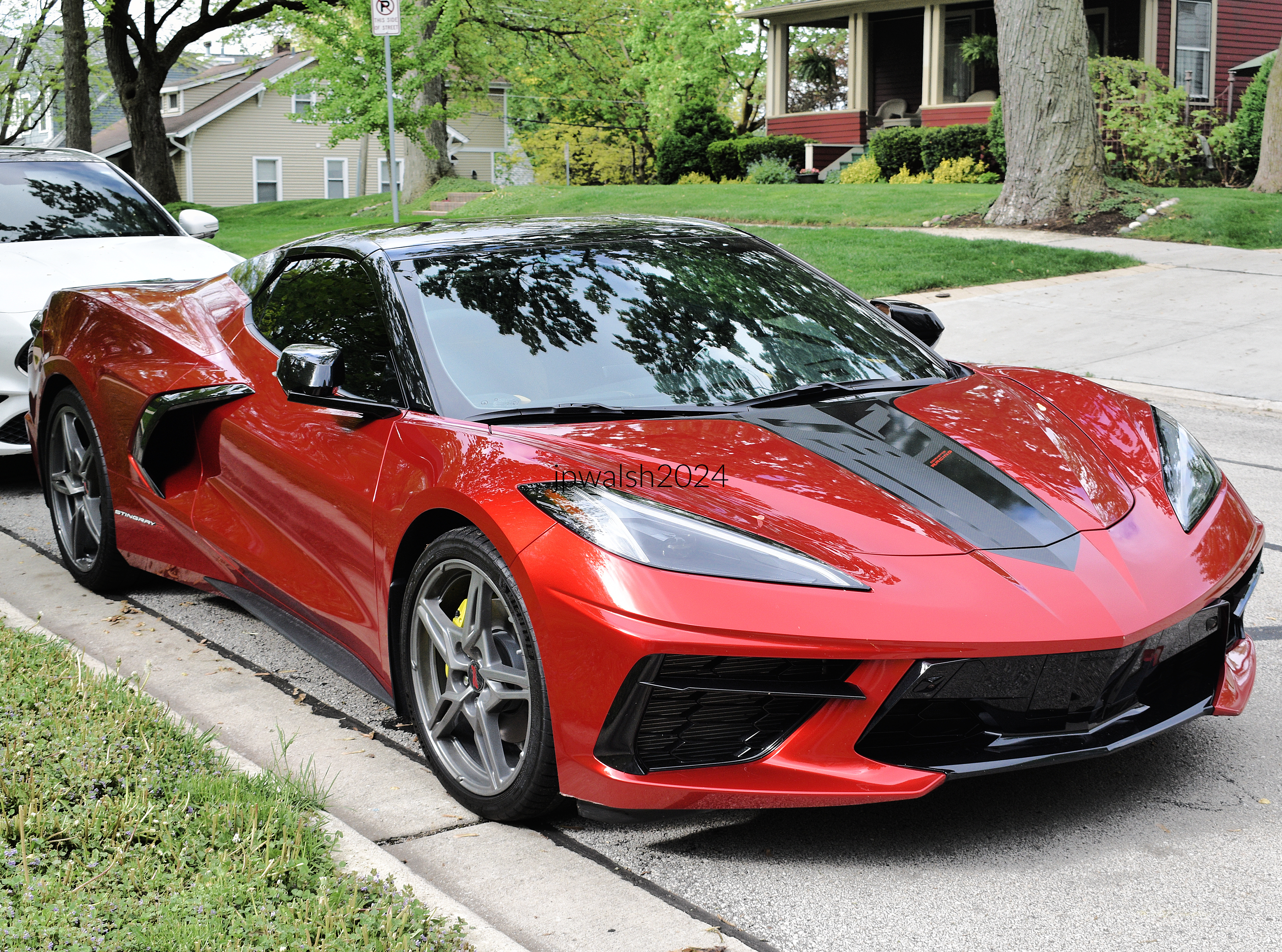
2023 Chevrolet Corvette Stingray, May 2024. 7.93mb DSC_5381 Author’s photograph.

Since the 2020 model year the Chevrolet Corvette Stingray is in its eighth generation. The sports car is assembled in Bowling Green, Kentucky. The 8th generation Corvette introduced GM’s first rear mid-engine since the Pontiac Fiero was discontinued in 1988. The engine has two radiators, one on each side in the front and offers an 8-speed dual-clutch automated transmission which is the first time Corvette offered a no manual transmission option since model year 1982 (third generation). The C8 features a new design from previous Corvettes with aluminum architecture, coil-over springs and more aggressive aerodynamics such as bigger air intakes and prominent side scoops. The base price for the 2023 1LT coupe was $65,595 and $70,795 to $73,095 for the 1LT convertible. – https://www.motorauthority.com/news/1136183_2023-chevy-corvette-price-increases-again-this-time-by-2-300 retrieved April 9, 2025. 

1970 Chevrolet Corvette Stingray. September 2023. 87% 7.76mb.Author’s photograph.

In 1970 the advertising pitch line for the Corvette was People have the idea you can tell what cars of the future will be like looking at Chevrolet’s Corvette. They’re right. Well, the future is here and unfortunately cars on the road in 2025 don’t look much like this gem of classic sports car. Major standard equipment in the 1970 Corvette included all-vinyl bucket seats with full-length center floor console, complete instrumentation, Astro ventilation, removable roof panels on the coupe and manually operating folding top on the convertible, 4-wheel disc brakes and F70x 15 WSW tires and wheels with trim ring and ribbed center hub. In 1970 a Corvette 2-Door-Coupe set the customer back $5,192 ($43,228.48 in 2025 dollars).

1965 Corvette. September 2014. 3.74 mb Author’s photograph.

From rubber to roof, still America’s true sports car. In a league all its own, the Corvette was in the midst of its second generation in 1965. It was the same year that saw the introduction of the popular Ford Mustang. There were only minor trim changes from the year before including tweaking the hood design, sill moldings and a new grille. For the $4,022 Base MRSP ($41,247.59 in 2025 dollars) major standard equipment included bucket seats, cockpit cluster console, walnut-like steering wheel, full carpeting, complete instrumentation, manually operating folding top and 6.70 x 15 BSW tires.

2016 Chevy Corvette. May 2022 7.92 mb 82% Author’s photograph.

The 2016 Corvette is 7th generation. By the 2000’s the 50 year old Corvette was increasingly viewed as a car purchased by the older buyer (55 years and up). Though in development since 2007, the Corvette 7th generation was delayed until the 2014 model to make the classic sports car more appealing to younger buyers including a design that kept production costs lower. The new generation Corvette in 2014 started using the “Stingray” name again which started in 1963 and was discontinued in 1976. Whereas the 1965 Corvette Stingray weighed less than 3,000 pounds (2,980) the C7 was almost 15% heavier at 3,444 pounds. For 2017 model year Chevrolet also re-introduced the Grand Sport (GS) model that cost $66,446 (87,570.36 in 2025 dollars). “2017 Corvette Grand Sport Priced at $66,445”media.gm.com (Press release).

2001 Chevy Corvette. April 2025. 5.89mb DSC_9337 (1) Author’s photograph.
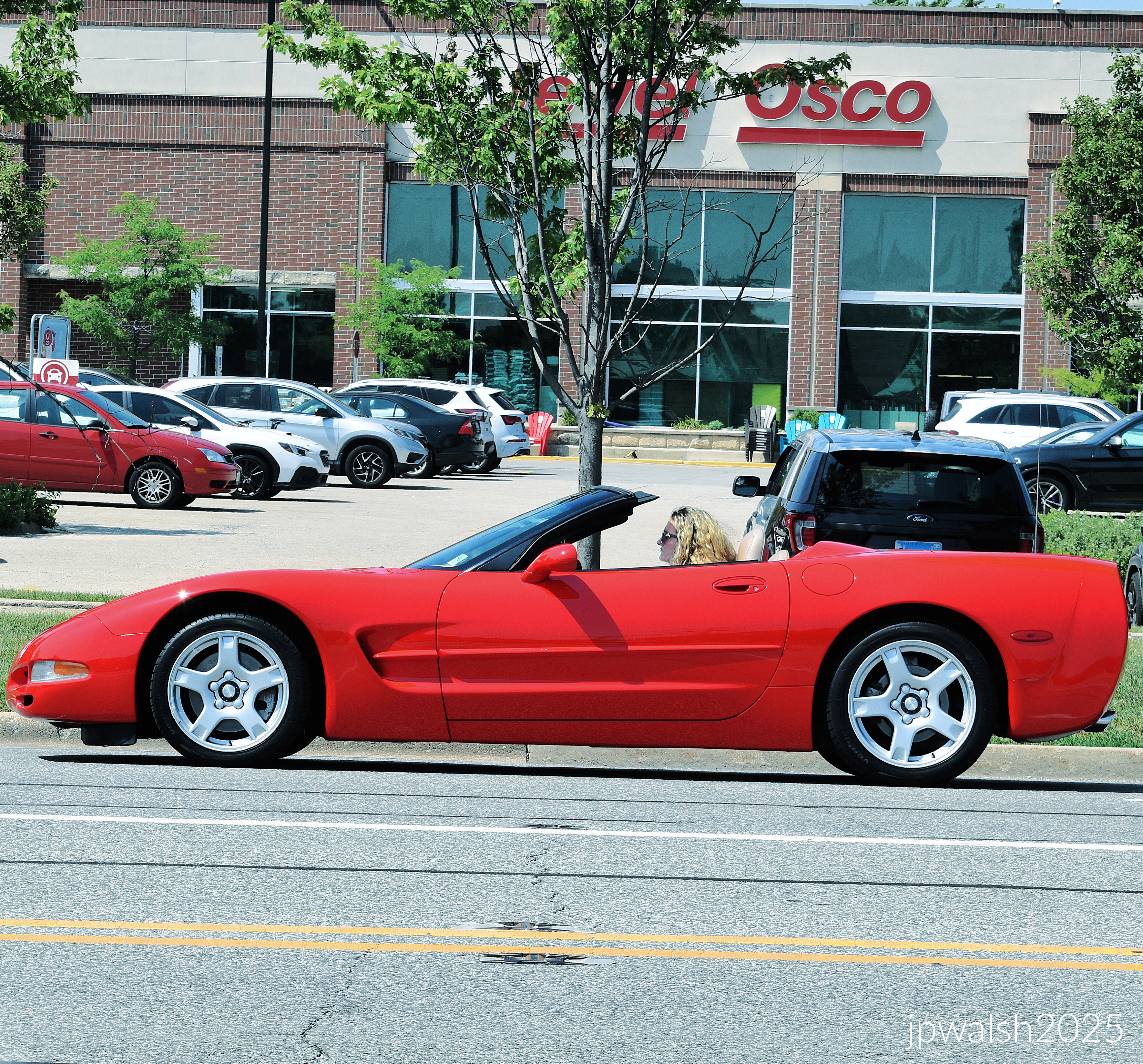
1999 Chevrolet Corvette Convertible in Torch Red. July 2025. 99% 7.63mb DSC_3802 (1) Author’s photograph.

The two cars above and the one below are all C5 (5th Gen) Chevrolet Corvettes produced between 1997 and 2004.  The base-model Chevrolet Corvette C5 includes a 5.7-liter V8 LS1 engine that from 1997 to 2000 produced 345 horsepower and 350 lb-ft of torque. For 2001, Chevrolet revised the LS1, raising output to 350 horsepower and up to 365 lb-ft of torque, a specification that carried through the end of C5 production in 2004. The C5 is equipped with a 4-speed automatic or 6-speed manual transmission and includes rear wheel drive.

2000 C5 Corvette. April 2026. 83% 7.95mb DSC_4179 Author’s photograph.
2014 Corvette Stingray. October 2015. 3.54 mb Author’s photograph.

A green premium edition 2014 Chevrolet Corvette Stingray (C7 generation) with chrome wheels and a carbon fiber hood. The model is powered by an all-new 6.2-liter LT1 V8 engine with 455 horsepower and 460 lb-ft of torque. Active Fuel Management is a feature that allows cylinder deactivation so that the engine can run as a 3.1-liter V4 under light loads to improve fuel efficiency.

2020 Chevrolet Corvette Stingray. June 2022. C7.66 mb 74% Author’s photograph.

Available in 1LT, 2LT, and 3LT trim levels, it offers a 6.2-liter V8 engine producing 490-495 horsepower. 

2003(?) Chevrolet Corvette. June 2017. 3.08 mb Author’s photograph.

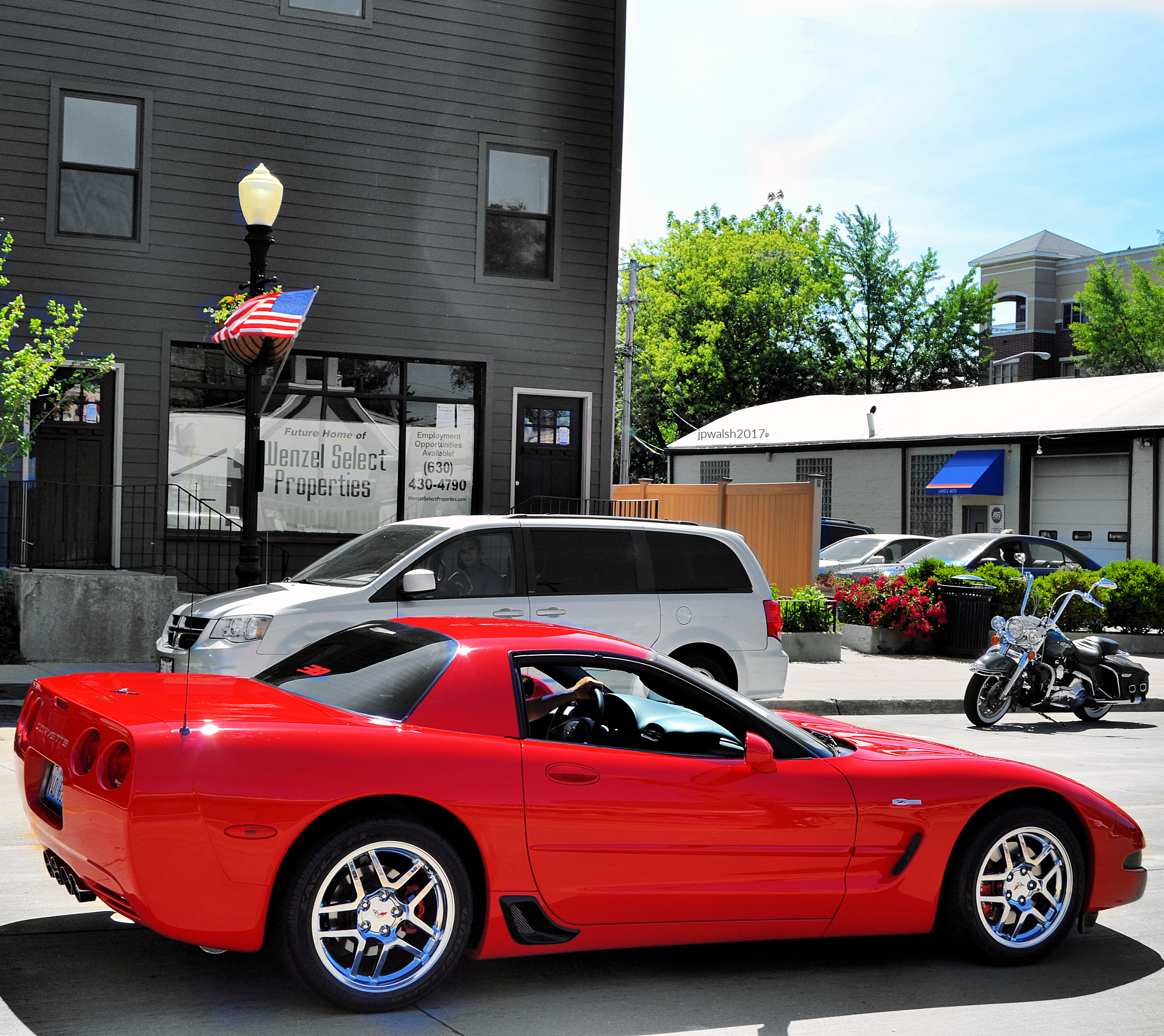
Torch Red Chevrolet Corvette Z06, 2001-2004, C5 generation. Powered by a 5.7-liter LS6 V8 engine that produces 405 horsepower paired with a 6-speed manual transmission.  Distinguishing features include a fixed-roof coupe design, functional rear brake cooling scoops, and lightweight alloy wheels.

SOURCES:

J. “Kelly” Flory, Jr., American Cars, 1960 to 1965, McFarland & Company, Inc. pps. 155-156; 352, 357-358; J. “Kelly” Flory, Jr., American Cars, 1966 to 1972, McFarland & Company, Inc. page 338.

This explanatory article may be periodically updated.
My Street Photography. GENERAL MOTORS: BUICK GS455 (1970-1972).

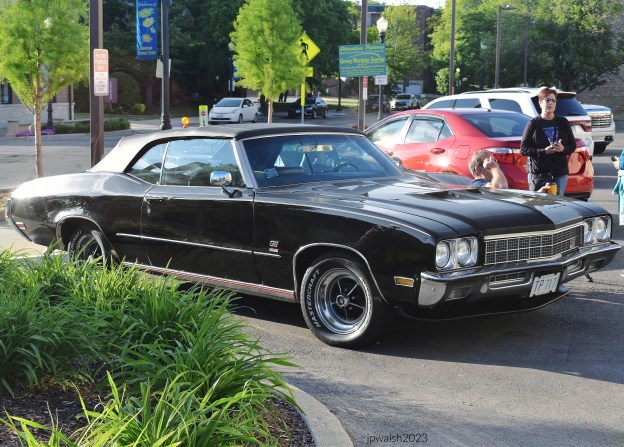
Feature Image: May 2023. 1971 Buick (Gran Sport)GS455 Convertible 7.72 mb 73%

Wouldn’t you really rather have a Buick? 1971’s advertising tag line for this GM American automobile maker.

The GS 455 was an option to the base GS during the 1971 and 1972 model years. The GM A-body platform was the base for many iconic American cars including Buick. Approximately 81 GS 455 Stage 1 convertibles were produced for the model year. Just as manufacturers were producing some of the most desirable muscle cars of all time the U.S. government required unleaded gasoline that reduced these machines’ power (compression). Due to these government mandates starting for 1971, the advertised power of the car’s 455ci V8 with a single four-barrel carburetor and factory-rated 345 horsepower and 460 lb-ft of torque dropped variously at installation. The GS 455 engine was the same basic big-block that had been introduced in the 1970 model year. The Stage 2 version of the 455 did not go much further than Stage 1 and there was about the same number produced as Stage 1 though aftermarket did take things further. GS buyers could choose between automatic or manual transmission. The Turbo Hydra-matic had an option of column-mounted lever or full-length center console. Manual was a 3- or 4-speed floor-shift stick. The 1971 Buick GS 455 convertible is one of the rarest of Buick muscle cars. Major standard equipment exclusive to the GS included dual exhausts, functional hood air scoops, and heavy duty springs, shocks and stabilizer bar. In 1971, total GS 2-Door Convertible production was 902 vehicles with a base MRSP of $3,476 ($27,726.29 in 2025 dollars). In 2025 the Buick GS 455 had an average resale price of $52, 250.

SOURCES: See – https://bringatrailer.com/listing/1971-buick-gs-9/ https://www.classic.com/m/buick/gran-sport/455/year-1971/
https://www.hemmings.com/stories/1971-72-buick-gs-455/ https://classiccarsbay.com/for-sale-1971-buick-gs-455-in-mooresville-north-carolina-49118 – retrieved August 30, 2025.
J. “Kelly” Flory, Jr., American Cars, 1966 to 1972, McFarland & Company, Inc. pp. 396-399.

This explanatory article may be periodically updated.

My Street Photography. GENERAL MOTORS: CHEVROLET CAMARO (1967-2002; 2010-2014).

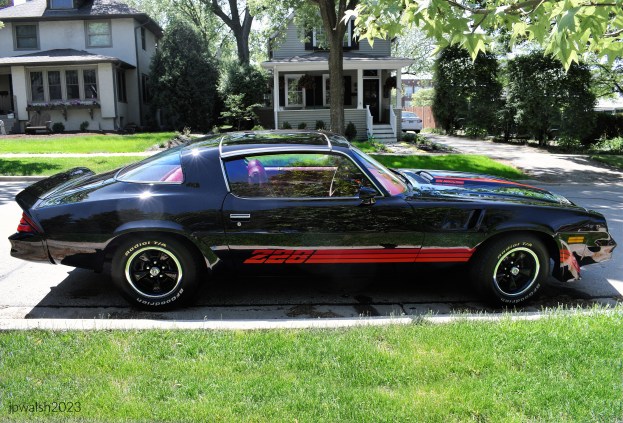
Feature Image: 1979-1981 Chevrolet Camaro Z28 (Details in post). May 2023. 7.72 mb 66%. Author’s photograph.

1979-1981 Chevrolet Camaro. May 2023. 7.74 mb 88% Author’s photograph.

Interior packages included cloth and custom cloth, and vinyl and custom vinyl. In 1980 the five interior colors included oyster, black, blue, carmine and tan. In 1981 the five interior colors changed to silver, black, blue, camel and red. In 1980, to save gas during the gas crisis, the car’s 130-mph speedometer was reduced to an 85-mph speedometer. See – https://mikeduman.com/blog/history-z28https://www.caranddriver.com/news/a43578551/2025-chevrolet-camaro-z28-future-cars/https://www.hemmings.com/stories/article/1980-81-chevrolet-camaro-z-28 – retrieved May 22, 2023.

1979-1981 Chevrolet Camaro (above). The name Z/28 was introduced by General Motors in December 1966. In 1967 to 1969, Chevrolet continued to improve the car’s list of engine and performance options. The year 1970 introduced Gen II in a new Camaro design. In 1982 the car was redesigned again marking Gen III. There have been more redesigns over the decades with Chevrolet announcing that production of the Gen VI Camaro would officially end in December 2023, with the 2024 model year serving as the final run and the Z/28s with it.

Classic muscle car.

Among debates about classic muscle cars, none gets hotter than the Chevrolet Camaro versus the Ford Mustang. With the exception of the 6.6-liter Trans Am, the Z/28 represents the best Detroit had to offer in the early 1980s, and an excellent entry point. A great car with its own ups and downs as its model developments moved ahead, the Camaro Z/28 at the outset was known for its good looks and sleek, crisp styling. It hugged the road and moved fast with superb handling. By 1980, the standard wheel cover was matched by a rear deck spoiler and hood and deck stripes and, soon, a front spoiler to reduce drag. The 1980 models were the last that offered the quintessential muscle car power-train combination-a 350-cu.in. V-8 with four-speed transmission. The loaded Z in 1981 would cost around $12,000 (or $40,000 in 2023 dollars). The Z/28 was 197.6 inches long and rode on a 108-inch wheelbase. It stood at a height of 49.2 inches and was 74.5 inches wide. The body was all steel. Author’s photograph. May 2023. 7.72 mb 66%.

2018 Chevrolet Camaro 2LT Coupe. Author’s photograph. June 2024. 73% 7.83 mb 8246

2011(?) Chevrolet Camaro. Author’s photograph, June 2017. 4.19 mb

2010 Chevrolet Camaro. The Chevrolet Camaro is a pony car that began production in model year 1967. It ceased production in model year 2002 in its Gen IV. Starting in 1993 the iconic American car was produced exclusively in Canada in Sainte-Thérèse, Quebec. In 2008 GM faced a severe liquidity crisis, having lost over $30 billion in 2008. In 2009 Chevrolet restarted its Camaro production in Gen V that was built exclusively in Canada though shifted to Oshawa, Ontario. Then-GM Chairman and CEO Rick Wagoner said about his Canadian-made car: “Camaro is much more than a car; it symbolizes America’s spirit and its love affair with the automobile.” That same year the Obama administration demanded he resign for GM to receive a massive taxpayer-funded federal bailout. Without this federal assistance, the company was expected to go into liquidation, which officials estimated would cost more than one million jobs. The total bailout for General Motors and Chrysler amounted to approximately $80 billion, with the government taking a majority stake in GM during the process to guide its reorganization. The 2010 Camaro became the model’s best seller (81,299 units) since 1995 (122,738 units). The first half of the 2010s was a renaissance for Camaro though its heyday remained the late 1960’s and 1970’s. The 2010 Camaro was intentionally designed and produced along the lines of the 1969 model and is almost identical to the car’s original concept. The original MSRP for a 2010 Chevrolet Camaro ranged from $22,680 ($33,187.71 in 2025) for the LS coupe to $33,945 ($49,671.82 in 2025) for the 2SS coupe. Author’s photograph. April 2025. 7.16mb DSC_8471

1998(?) Chevrolet Camaro SS. The Chevrolet Camaro SS model is equipped with a 6.2L LT1 V8 engine and offered as a 6-speed manual and 8-speed automatic. The SS is capable of 455 horsepower and 455 lb.-ft. of torque, performing a 0-60 in 4.0 seconds. Author’s photograph. May 2018. 7.39 mb

May 2023. 1969 Chevrolet Camaro Z28. 7.85mb 98%

This explanatory article may be periodically updated.
My Street Photography: CARS & TRUCKS II. FORD. MERCURY. PONTIAC. CADILLAC. OLDS. BUICK. Japanese. British.

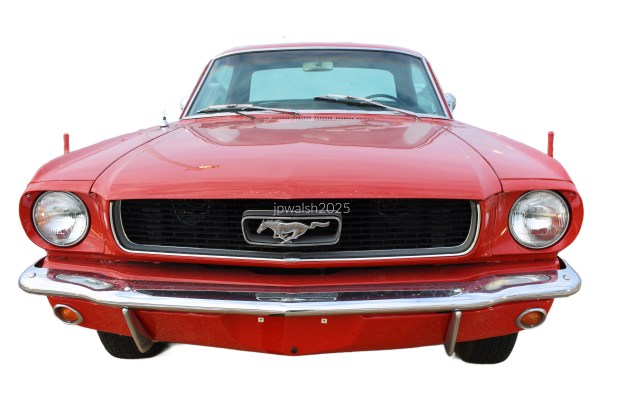
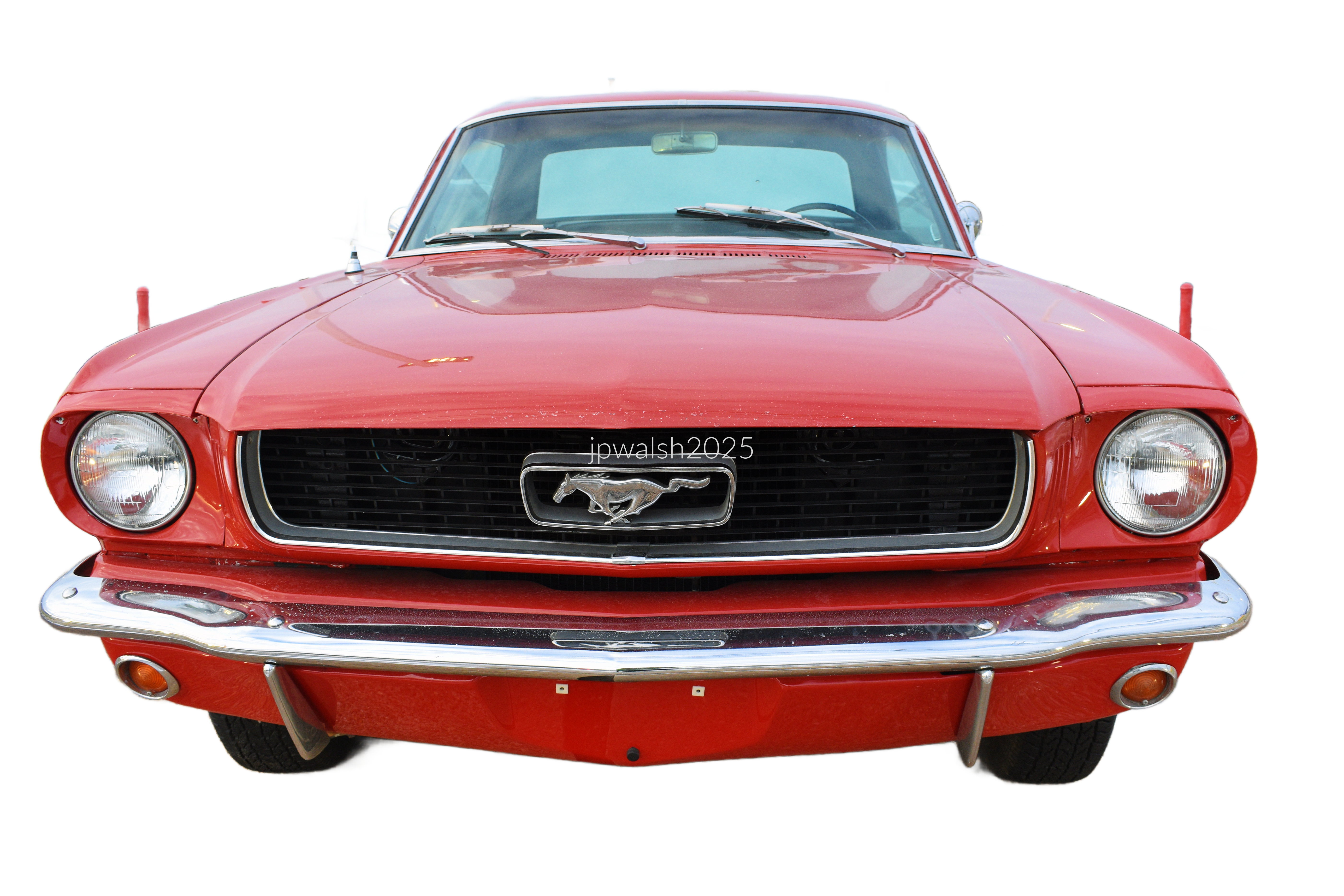
FEATURE Image: For the FORD MUSTANG in 1966 the only changes in its second model year was a new front grille, redesigned side emblems and a few trim modifications.

FORD Victoria

May 2022. 1934 Ford Victoria. 7.72mb 99%

FORD F-100 F-150 F-250 F-350

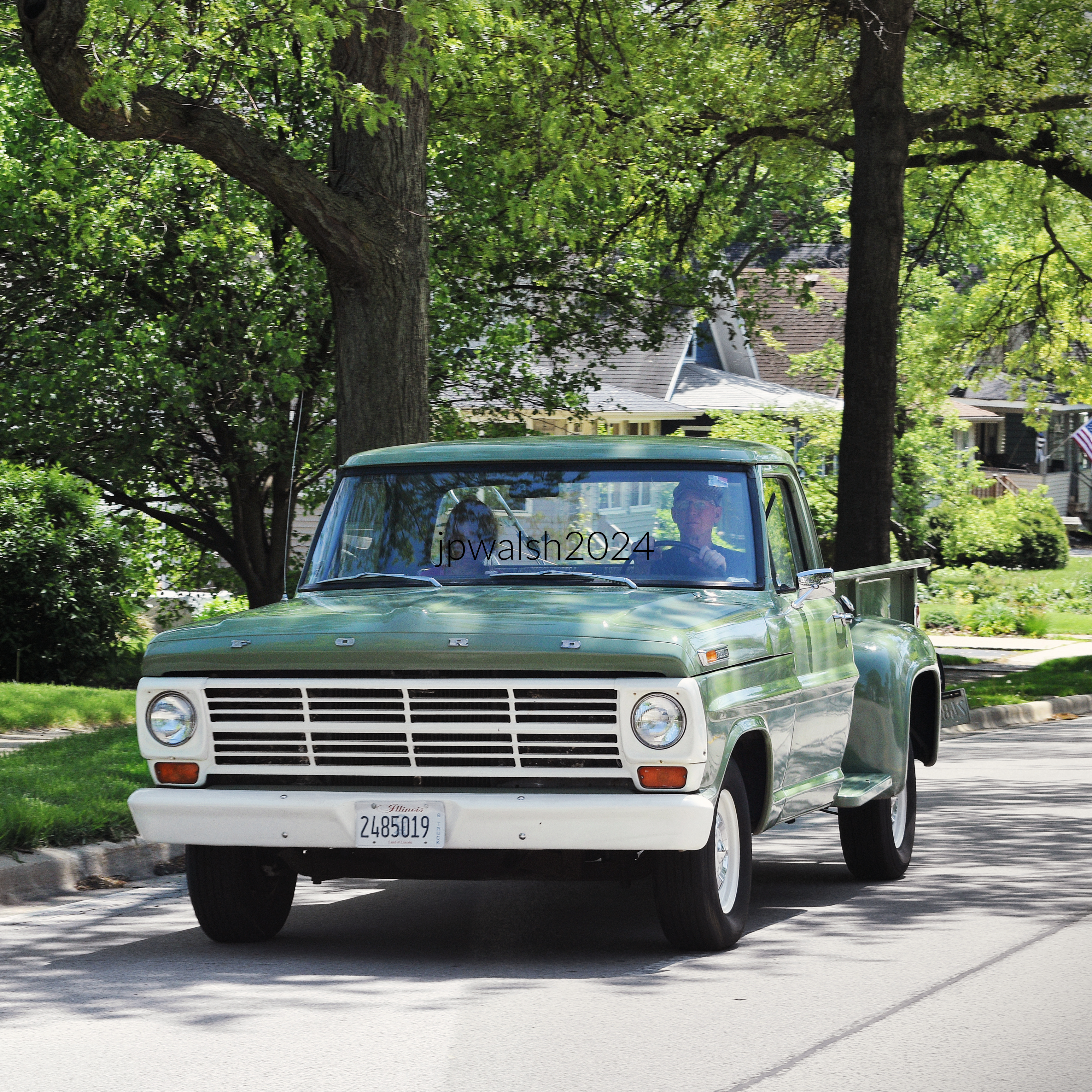
May 2024. 1967 Ford F-250. 5.75 mb
June 2017. 1984(?) Ford F-150. 6.71 mb The F-150 started in 1975 as a truck model between the F-100 and F-250 (there was also the F-350). By 1976 it quickly became America’s favorite truck. In towns across America even today, Ford trucks from the 1950s era still work alongside today’s newest models. In 1983, F-100 production ended. In addition to work loads, the F-150 offered an additional new focus on lifestyle and comfort. Starting in the 1980s, Ford truck customers could select custom paint packages and, for the first time, the blue-oval Ford emblem was affixed on the front grille.
August 2021. 2017(?) Ford F-150, 7.99mb 97%
The 2021 Ford F-150 ‘s solid performance and durability have few competitors in the modern truck market and is one of the most popular trucks. The XL is a more budget-friendly option compared to the XLT. The XL’s basic engine is the same as the XLT  3.3L Ti-VCT V6, 290 hp, and 265 lb-ft of torque. The F-150 XL offers first-rate amenities and excellent performance making for an incredible value.
June 2023. 1970 Ford F-100 Ranger XLT 7.89mb 93%
The F-100 and F-250 came in Styleside or Flareside although the Ranger XLT model was available in Styleside only. The combination two-tone option had the Regular Two-Tone (roof only) and the Deluxe where the lower body side and tailgate moldings were part of the paint option.
January 2025. Ford F-350 truck. 74% 7.76mb 6151 (1)
July 2023. 2003 Ford Ranger XLT 7.39mb 75%
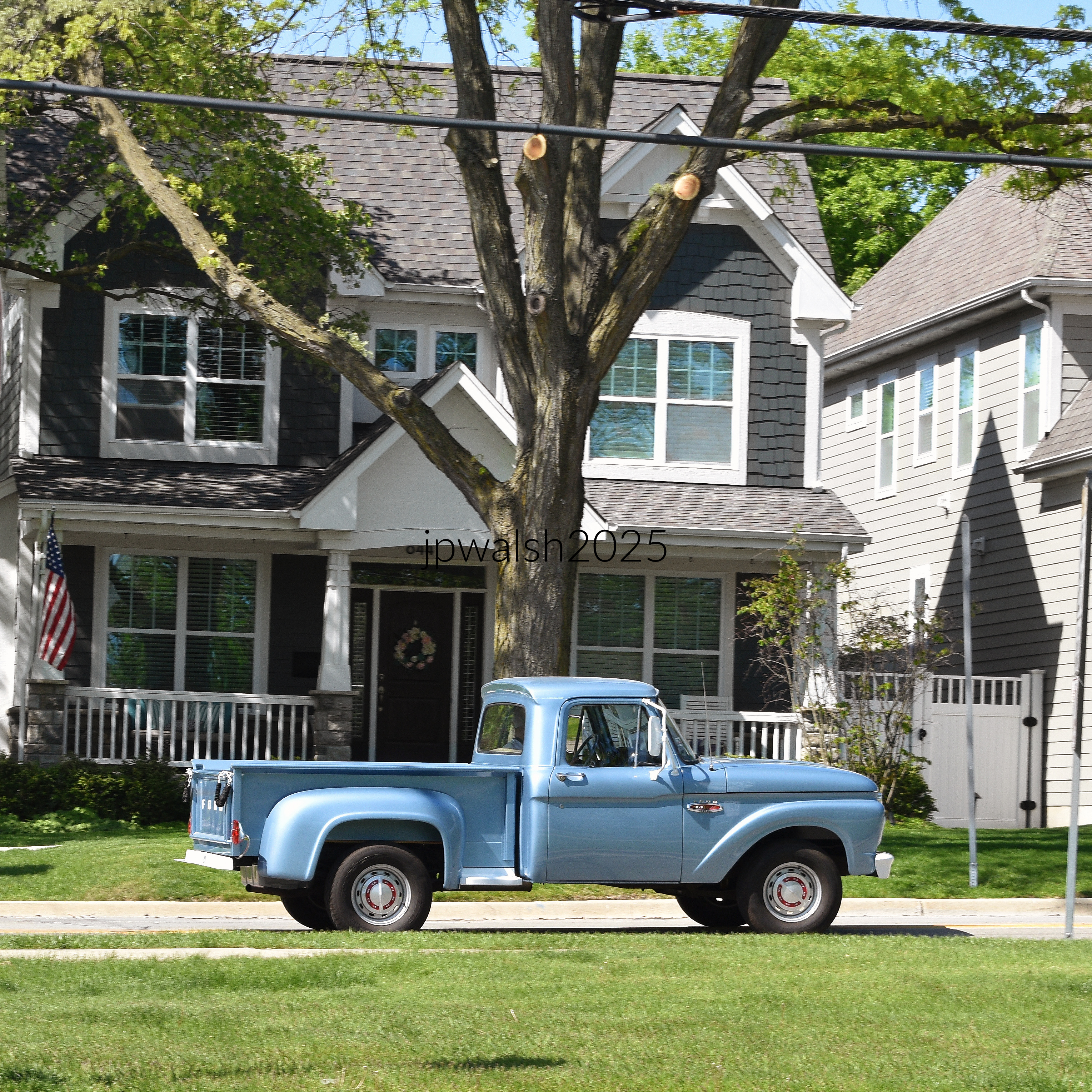
May 2023. 1965 Ford F-100. 7.70 mb 87%
May 2025. 1964 Ford F-100. 5.71mb DSC_0002 (1)

FORD Expedition

June 1918. Ford Expedition (1997-present).7.88 mb 81%
The Ford Expedition was the first full-size Ford SUV sold with a four-door body introduced for the 1997 model year as the successor of the Ford Bronco. The Bronco was introduced in 1966 and discontinued after five generations in 1996 (a sixth generation of the Bronco was introduced in 2021). Since 1996, the Ford Expedition, which is sold in regular and extended lengths, has shared some body parts and mechanical components with the Ford F-150, the car market’s favorite truck. Like the F-150, the Ford Expedition is known as being one of the longest-lasting vehicles on the road with many vehicles with over 200,000 miles on the odometer.

FORD Escape

February 2023. Ford Escape (2000-). 9.53 mb

Ford Galaxie (1959-1974).

FORD GALAXIE HDR” by abux_77 is licensed under CC BY-NC 2.0.

The ad tag line for the Galaxie in 1960 was: ”Meet the aristocrats of the low-priced field.” In 1960 Robert McNamara was the new president of Ford Motor Company and he was an executive who in his career at Ford, thought like and fought for the consumer. Unlike other car industry execs he was passionate about providing a utilitarian car for the masses, a highly affordable and great car for the common man or woman. He was ahead of his time and might actually have been more useful or successful a decade and half later with the introduction of emissions standards and fuel economy where design and weight had to be taken into account to meet government mandates leading to the expensive boxes they build today. The Falcon, McNamara’s baby, at the average price point of $2100 (about $23,000 today) fulfilled McNamara’s vision and became America’s bestseller. The middling Ford Fairlane had an average base MSRP of less than $2300. The Ford Galaxie was next up the lower priced chain at a little over $2,700 MSRP ($29,500 today). In addition to a shiny nameplate, Galaxie included cloth/vinyl bench seating, chrome exterior trim on all windows and body sides and an aluminum rear quarter covering with upgrades available. Under McNamara, Ford took a heavy risk in 1960 when it introduced a totally revamped design on its bestseller compact Falcon as well as its line of full-sized cars. Fords were lighter and sleeker, with a body no longer sculpted but molded from fender to bumper trimmed in chrome. And for the first time in Ford history the full width grill had its headlights inset at each end instead of above. This design choice continued throughout Galaxie’s second generation into 1964. By 1974, things were very much changed. The Mustang II was that year’s Motor Trend Car of the Year – and it was Galaxie’s last model year. The Galaxie had essentially been co-opted by what started in 1965 as its highest trim level: namely Ford LTD. Strictly Galaxie production had in fact fallen from its peak in 1963 of nearly 650,000 vehicles to under 120,000 in 1974. see – J. “Kelly” Flory, Jr., American Cars, 1960 to 1965, McFarland & Company, Inc. pps. 41-45; J. “Kelly” Flory, Jr., American Cars, 1973 to1980, McFarland & Company, Inc. pps. 178-179.
FORD Thunderbird

June 2023. 1964 Ford T-bird 7.35mb (70)
1964 Ford Thunderbird Convertible with chrome headlights, grill, and bumper along with the Thunderbird hood script. The car is finished in “Rangoon Red” with black vinyl upholstery. Particular Thunderbirds were powered by a 390ci V8 engine joined with Ford’s 3-speed “Cruise-O-Matic” auto transmission. There are bucket seats upfront. The Ford T-bird was produced across 11 generations between 1955 to 1997 and 2002 to 2005. Originally produced as an upscale 2 seater it was expanded in 1958 with a rear seat and became a personal luxury car that after 1968 was often rebadged by Lincoln-Mercury.  
September 2023.1964 Thunderbird. 92,456 Thunderbird’s were produced in 1964. 7.66 mb 78%
March 2024. 1964 Thunderbird 87% 7.67mb
July 2025. 1960 Ford 2-door hardtop T-bird. The year 1960 was the first year that American manufacturers produced compact cars to counter the popularity of the VW Beetle and other European and Japanese brands. Though Ford had its Falcon and slightly larger and better trimmed Comet, the move to the compact arena would never be the Ford Thunderbird’s route. In 1960 Ford pushed aside the boxy upright models of the late 1950’s for an overall lighter and sleeker appearance although the current body style of the Ford Thunderbird continued from 1958. This was the second generation of T-Bird and followed by its third generation in 1961. As a personal luxury car, the term Ford used, the Thunderbird was of a car category all its own. What started as a two-seater in 1955, the Thunderbird added a backseat in 1958 as the model became successively larger with each generation over the next 19 years. The car only had its first downsize in the seventh generation in 1977. In 1960 the 2-door Thunderbird’s taillights and side trim were among its notable changes from 1959. The base price of a hardtop was $3755 ($41000 today) – but you couldn’t buy that today – with the convertible costing about 10% more.See – American Cars,1960 to 1965, J Kelly Flory Jr. , 2023. pp. 41 and 45. 83% 7.80 mb DSC_9180

FORD Mustang

June 2023. 1965 Ford Mustang. 7.78 mb 88%
September 2023. 1970 Ford Mustang. 6/2023 6.32mb
January 2025. The only changes for the 1966 Ford Mustang was its new front grille, redesigned side emblems and various trim modifications. The average price was $2,560 ($25,200 in 2025 dollars). 4.19mb DSC_6136 (1)
January 2025. In 1966 Ford was the largest car manufacturer in the nation. The 1966 Ford Mustang Coupe is an example of a mid-60’s pony car that changed the American automotive landscape forever. Starting in 2024 the Mustang is in its 7th generation. The first-generation Ford Mustang was manufactured from March 1964 until 1973 with modifications. 99% 6.64 mb_6134
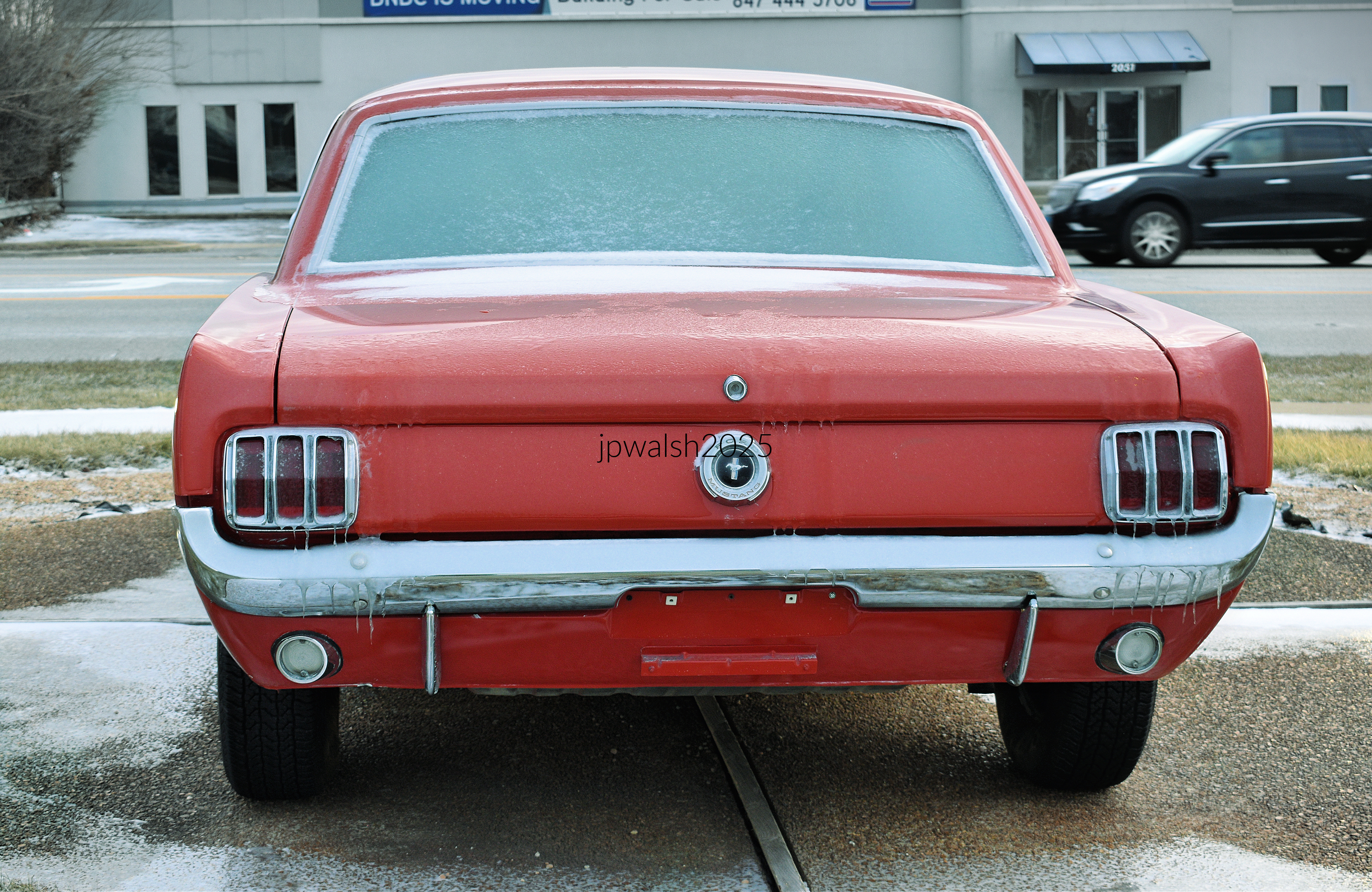
January 2025. Back end of 1966 Ford Mustang Coupe. Developed by Donald N. Frey (1923-2010) and styled by L. David Ash (d. 1991), along with Lee Iacocca (1924-2019) and others, the Mustang used chassis, suspension, and drivetrain components derived from the Ford Falcon and Fairlane to save costs. 83% 7.82mb DSC_6133
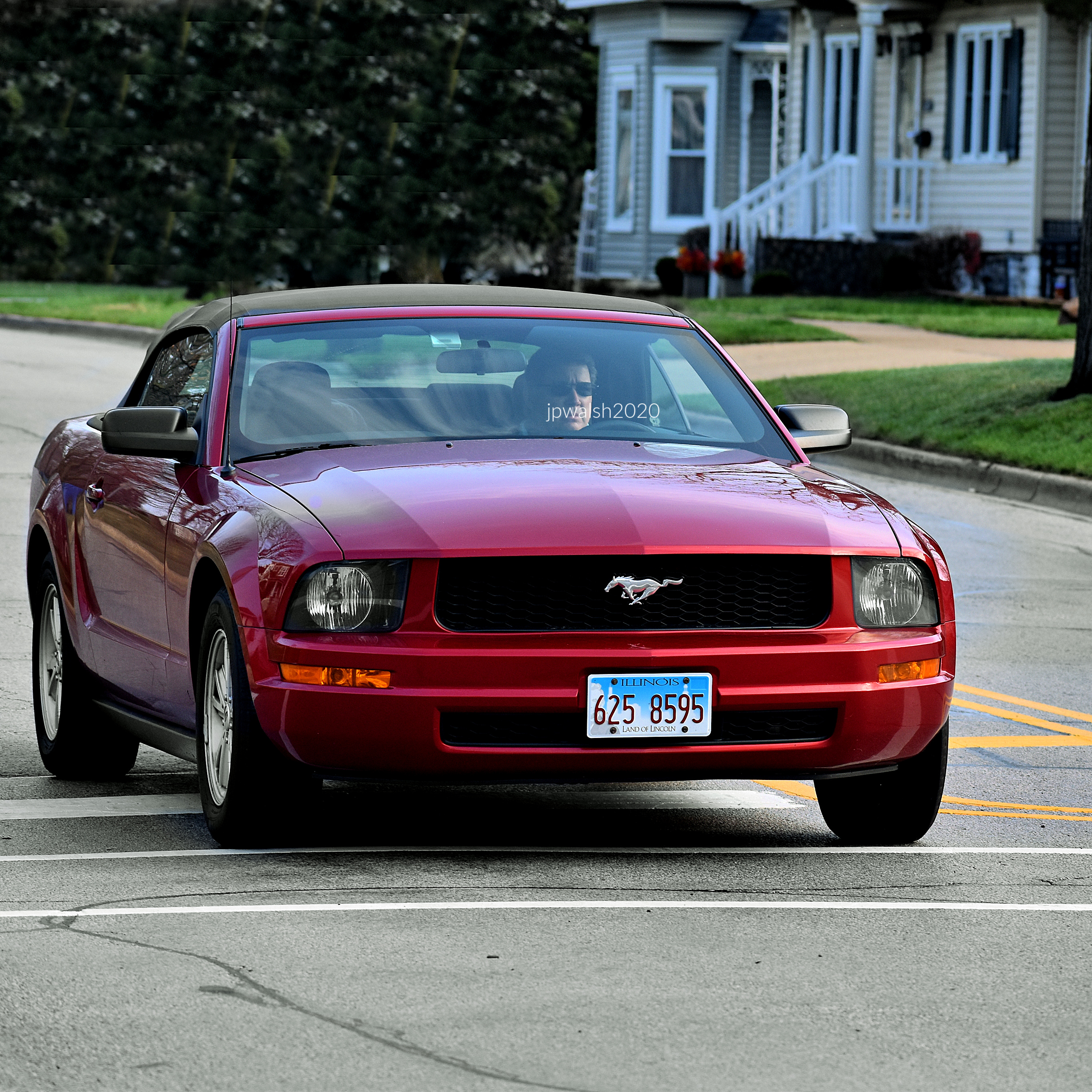
May 2022. (2008?) Ford Mustang GT 5/2022 7.60 mb 99%
April 2020. 2008(?) Ford Mustang. 3.38 mb
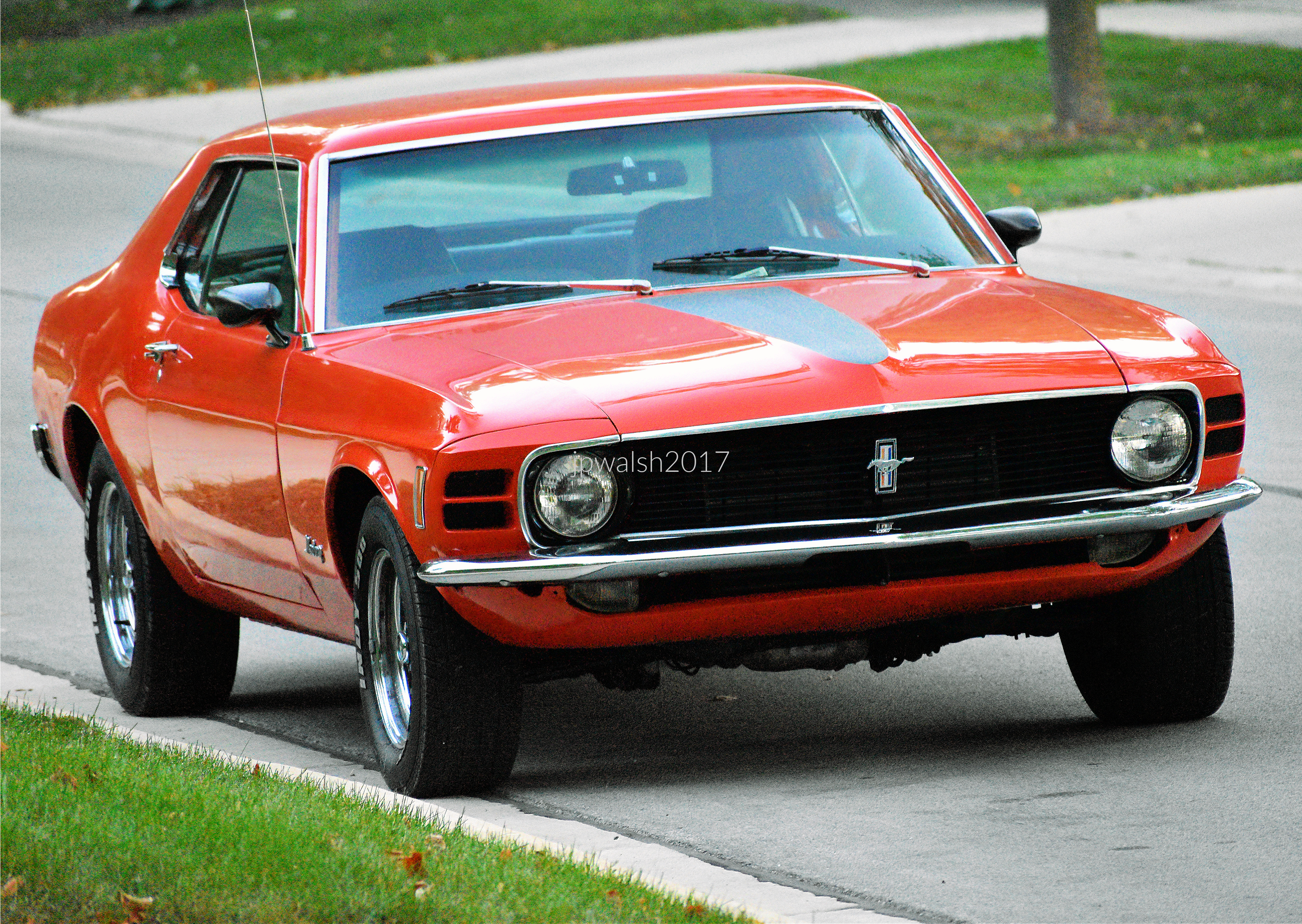
August 2017. 1970 Ford Mustang. It was the final model year for the horsepower race in the American auto industry. From 1971 onwards engines were required to run on unleaded fuel with more strict emissions that both reduced output. Ford, the second largest car manufacturer by volume, had made a lot of changes to its products in 1970. This included to the Mustang which received a facelift such as new headlamps and parking lights. For the first time since 1964 the original side scoop was eliminated in 1970. The average price for Mustangs was just over $3000 ($25,000 in 2025). 68% 7.68 mb DSC_1965
September 2022. 1970 Mustang Mach 1. 7.95 mb 93%
June 2023. 2014 Ford Mustang GT. 7.92 mb 79%

FORD Fairlane

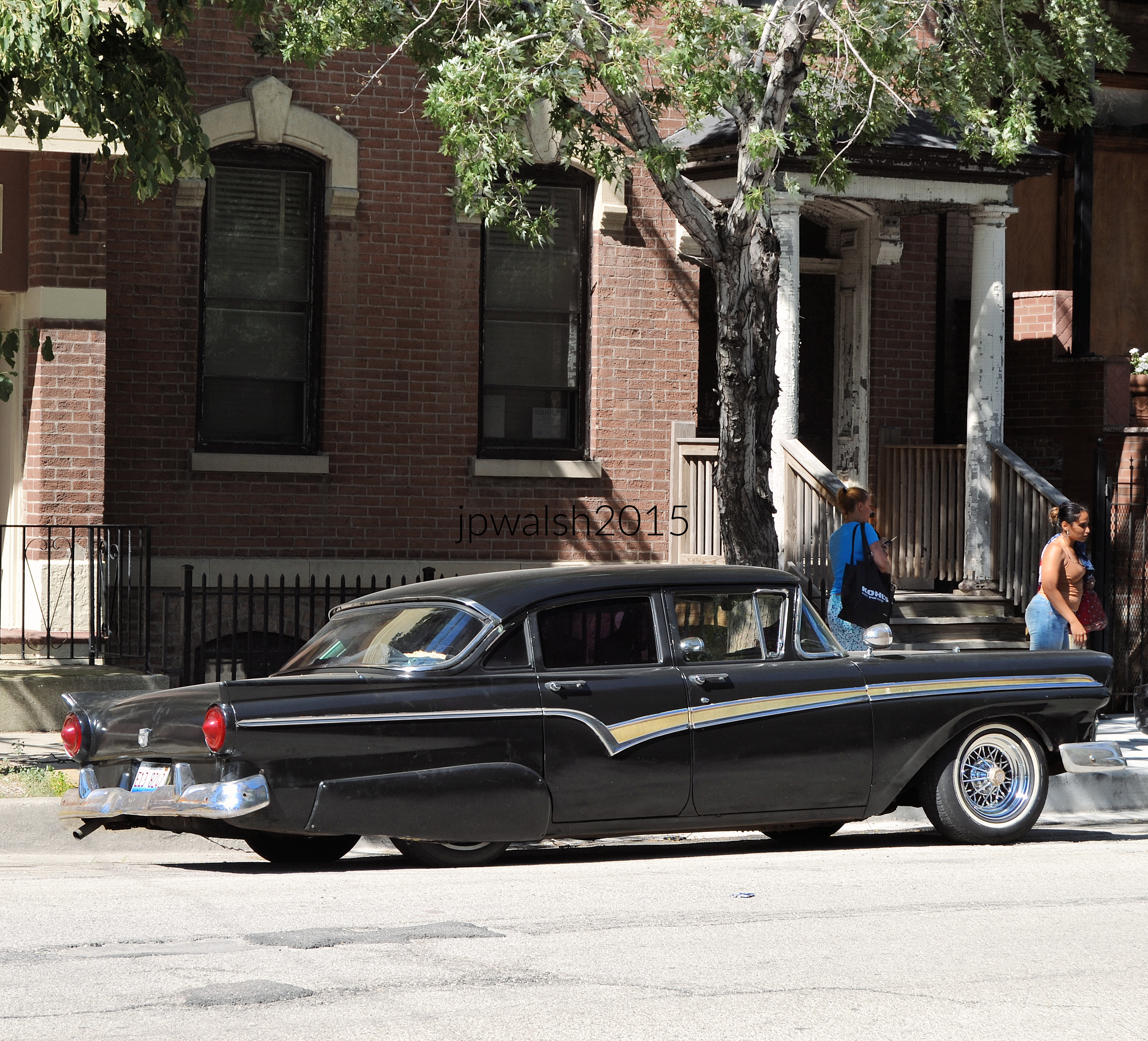
July 2015. 1957 Ford Fairlane 4.28mb_0949 (1)

MERCURY Comet

May 2024.1964 Mercury Comet. In 1964 Chevrolet and Ford were the largest car manufacturers (about 4 million units combined). Mercury, a smaller middling car producer (303,000 units) had been in business 25 years in 1964. The Comet, introduced in 1960, had a brand-new look in 1964. The Comet’s more powerful engine, grill and lines gave it an expensive pseudo-muscle car look. The average price was $2415 ($23,800 in 2025 dollars). 99% 7.77mb

MERCURY Grand Marquis

May 2018. The 1989 Mercury Grand Marquis. The Grand Marquis was the top of the model line produced in four generations from 1975 until 2011. It was assembled in Missouri until 1985 and then in Canada. From 1988, the Grand Marquis was available only as a four-door sedan. After the Mercury Cougar, the Grand Marquis was the second-best-selling Mercury (2.7 million units) and, with 36 years in production, the longest-running Mercury nameplate. First stand-alone generation (1979–1991), Second generation (1992–1997), Third generation (1998–2002), Fourth generation (2003–2011). 73% 7.78mb DSC_7179.

PONTIAC Solstice

September 2023. 2008 Pontiac Solstice. 7.83 mb 87%.
Concept car 2002. Production started in 2005 for 2006 model year. In the first year, Pontiac produced 10,000 cars that did not meet the unexpected orders demand. Due to the 2008 economic recession, GM discontinued the Pontiac division, a venerable American automobile brand founded in 1926. The last model year for the Pontiac Solstice was 2010. The car can do zero to 60 m.p.h in under 6 seconds.

PONTIAC Tempest

May 2023 1967 Pontiac Tempest. 7.57 mb 99%
1967 Pontiac Tempest interior. 7.37 mb 95%
The Pontiac Tempest was produced from 1960 to 1970 and from 1987 to 1991. The line offered the LeMans trim upgrade. By 1964 the Tempest, Tempest Custom, and LeMans were separate trim packages with, in 1964 and 1965, the GTO performance option upgrade available to the LeMans trim package. Beginning in 1966 the GTO was offered as a separate model line. There have been four generations of Pontiac Tempest, the 1967 model year the last of the second generation.

PONTIAC Grand Prix

July 2022. 1962 Pontiac Grand Prix 2-Door Hardtop (coupe). 7.93mb 80%
The Pontiac Grand Prix from GM was an all-new model in the 1962 model year. The performance-oriented coupe went through 4 generations until it was discontinued 40 years later in 2002. It was succeeded by the fifth generation Pontiac GTO. There was a much later sedan version of the Pontiac Grand Prix that was launched in 1988 and produced through 2008 after which that year GM discontinued its 82-year-old Pontiac division.

July 2022. 1962 Pontiac Grand Prix 2-Door Hardtop coupe (interior). 7.91 mb 67%

PONTIAC Firebird Trans Am

October 2024. 1978 Pontiac Firebird Trans Am 2-Door Coupe.In 1978 Pontiac’s theme was “The Best Year” based on the previous year’s sales increases achieved by models that that included the Trans Am. The Firebird Trans Am recorded another sales gain in 1978. The body style in 1978 was current since 1970 with minor trim and detail changes from 1977. With its Morrokide bucket seats and plush cut pile carpet and deluxe 3-spoke steering wheel it was 1970’s style with no primary competition. The average price for a Firebird was $5,228 ($25,585 in 2025 dollars) with the Trans Am topping model production at $5,889 ($28,869.09 in 2025 dollars). There were 187,285 Firebirds produced in 1978 with the Trans Am representing about half of them. 99% 7.84 mb DSC_3497 (1)

CADILLAC de VILLE

July 2023. 1964 Cadillac de Ville convertible. While the appearance is close to its immediate predecessors, the 1964 Cadillac had a new and improved automatic transmission (“Hydra-matic”) for smoother thrust. But in 1964 Cadillac’s quality of drivability and ride were being successfully challenged by the Ford Lincoln Continental and Chrysler Imperial Crown. The Cadillac de Ville had been in production since 1949 with this current body style in production from 1961 to 1964. The average price of a 1964 Cadillac de Ville was $5,582 ($57,434.76 in 2025 dollars). The last model marketed specifically as a de Ville was in 2005. 78% 7.92 mb 4022 (1)
January 2024. 1977 Cadillac Coupe de Ville. 7.77mb 68%
April 2025.1984 Cadillac de Ville. 91% 7.90mb DSC_8528

CADILLAC Escalade

OLDSMOBILE Cutlass

July 2015. 1970 Oldsmobile Cutlass Supreme 7.88 mb 99%
July 2015. 1970 Oldsmobile Cutlass Supreme 6.53 mb
June 2023. 1983 Oldsmobile Cutlass Supreme (1961-1999). 3.49mb
August 2024. Cutlass Supreme 99% 6.98 mb 1469

OLDSMOBILE Delta 88

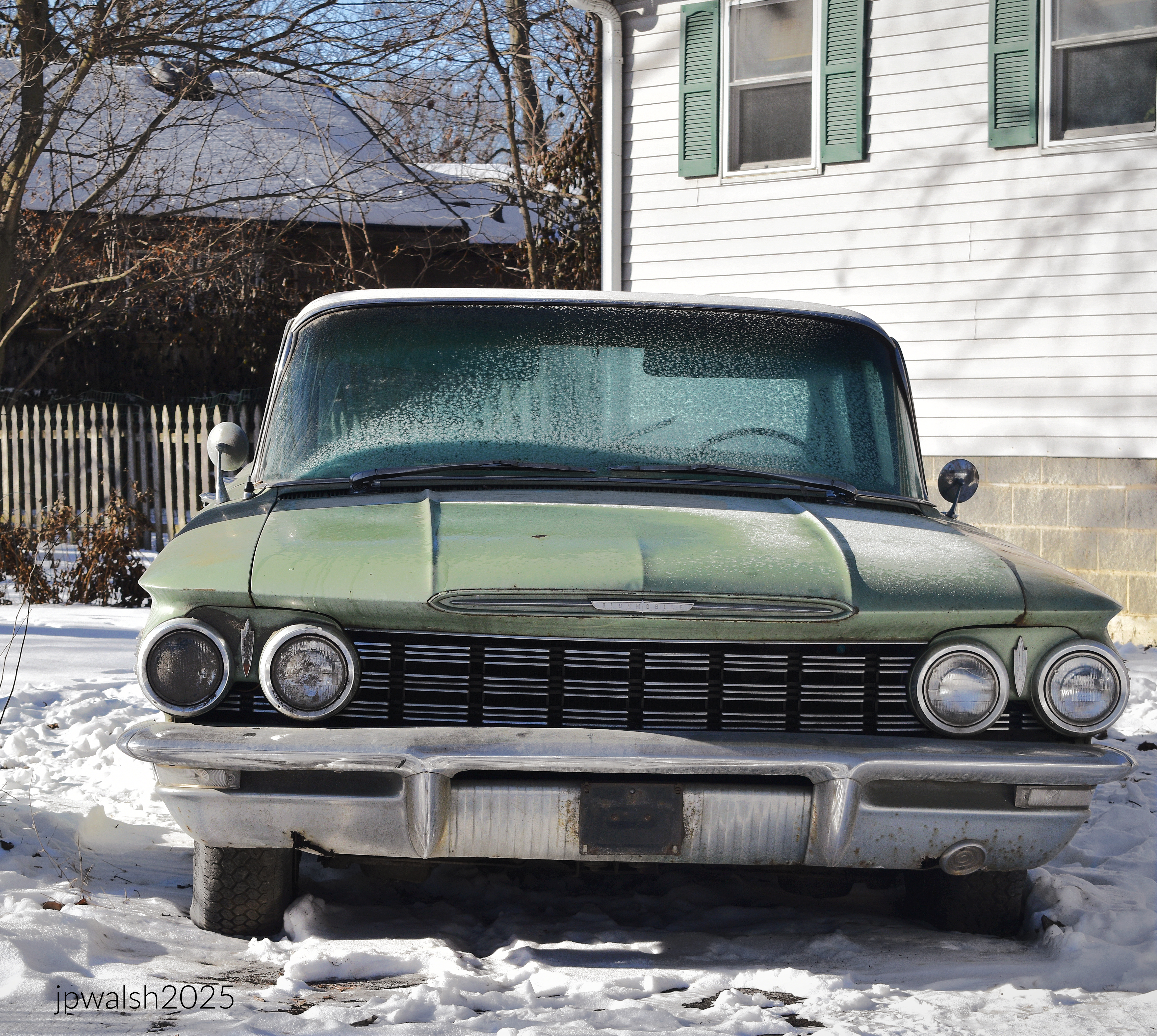
February 2025. 1960 Oldsmobile 88. Manufactured since 1949, the fourth generation in 1959 and 1960 was the shortest of its ten generations (until 1999). Critics and customers liked the 1959 Oldsmobile, buying close to 383,000 cars. So when in 1960 output slid to 347,141 it was not good news for Olds. Recently 4th in the industry rankings, Oldsmobile fell behind Dodge to seventh place. A big job lay ahead for the fifth generation (1961-1964) of Oldsmobiles which revived a performance image to go along with the traditional Oldsmobile reputation for easy motoring. The budget buy was the entry-level model Dynamic two-door sedan at $2,835 or $30,425.58 in today’s dollars. see – https://auto.howstuffworks.com/1960-oldsmobile.htm – retrieved February 21, 2025. 99% 7.62mb DSC_7216.
July 2022. 1970 Oldsmobile Delta 88 Convertible (lipstick red). 7.88 mb 93%

British

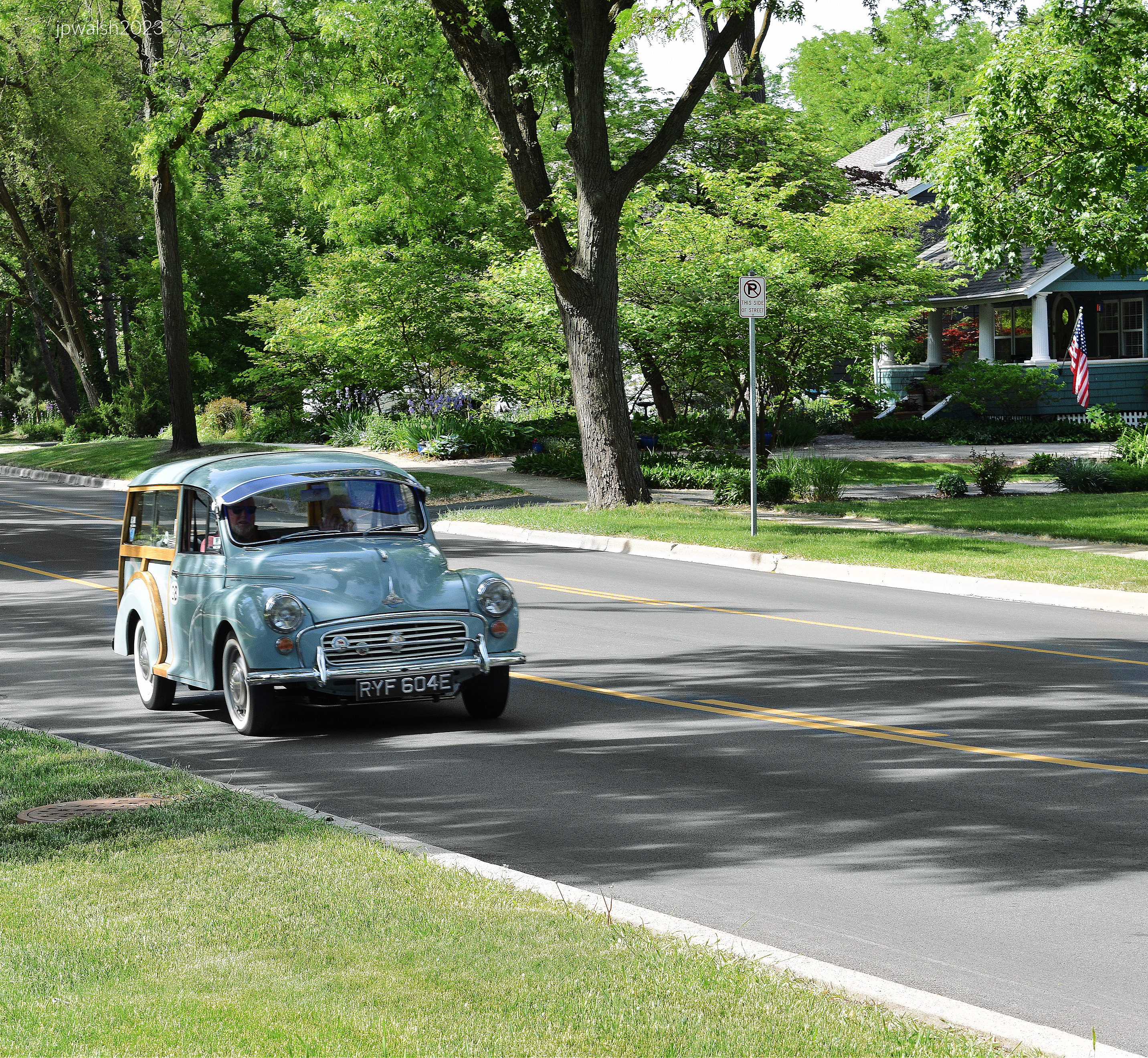
May 2023. Morris Minor (UK, 1948-1971). 7.77 mb 66%
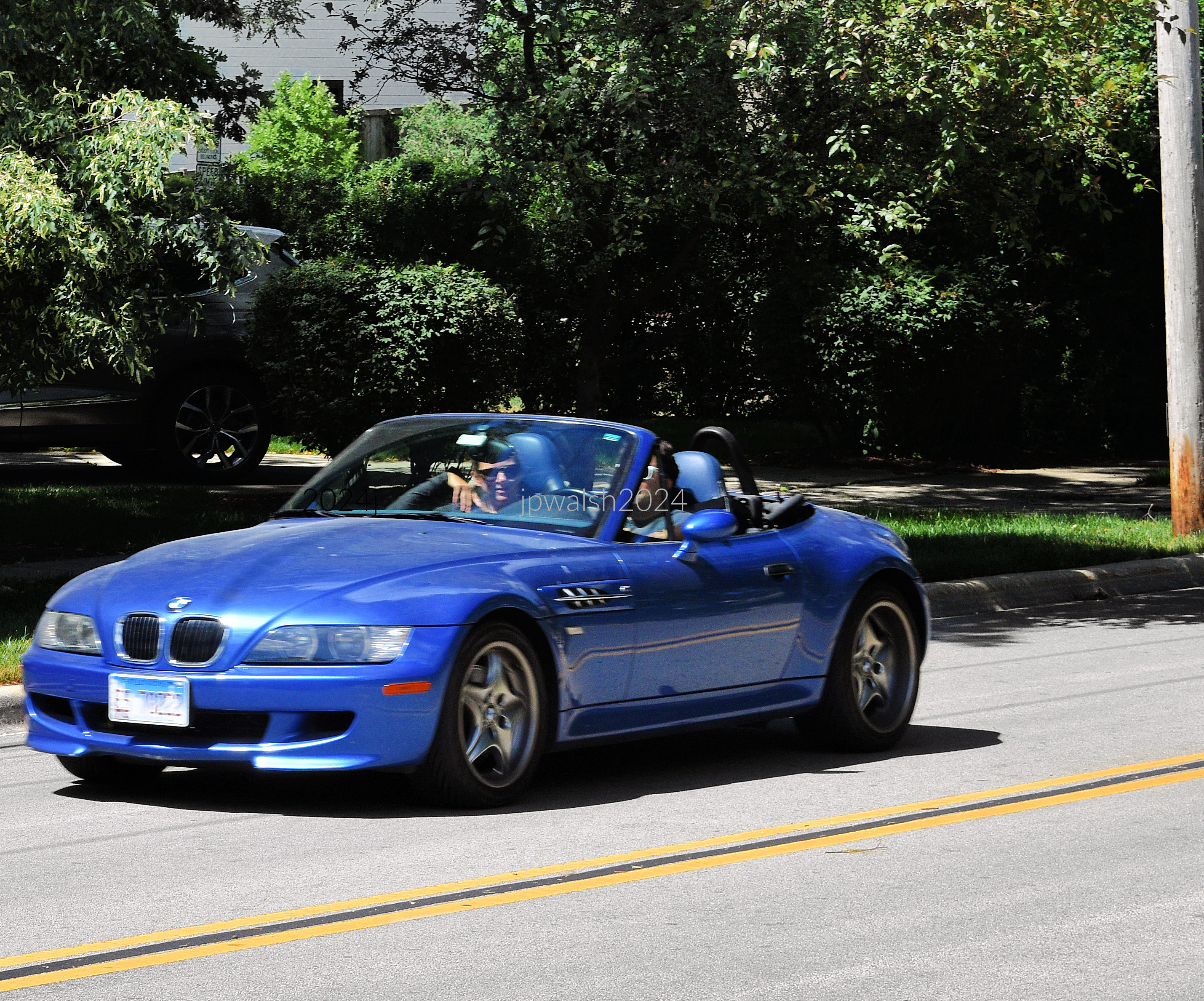
June 2024. 1999 BMW Z3 M Roadster with estoril blue glossy finish and 17-inch style 40 ”Roadstar” wheels. 3.82 mb.
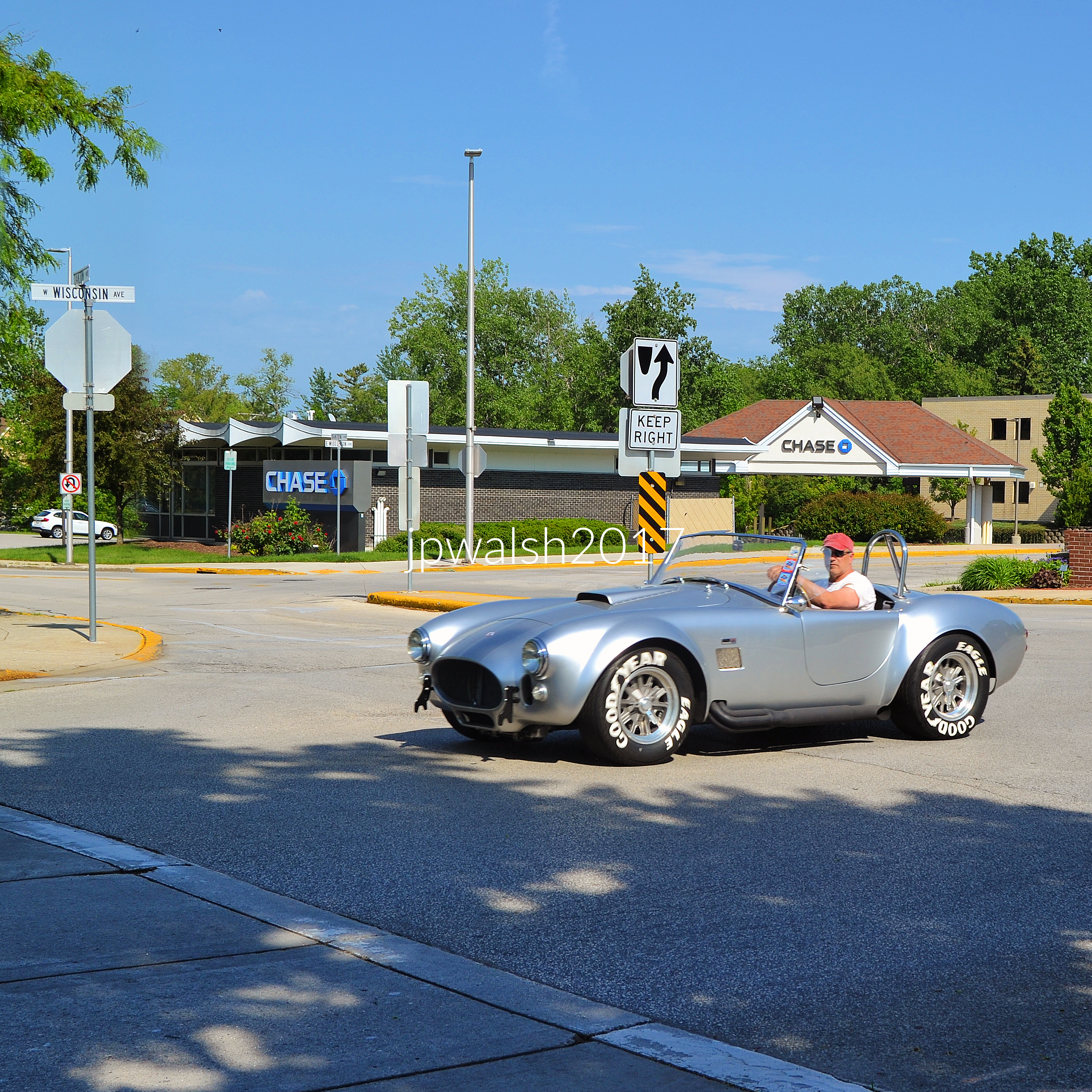
June 2017. Shelby Cobra. 4.40mb DSC_0318
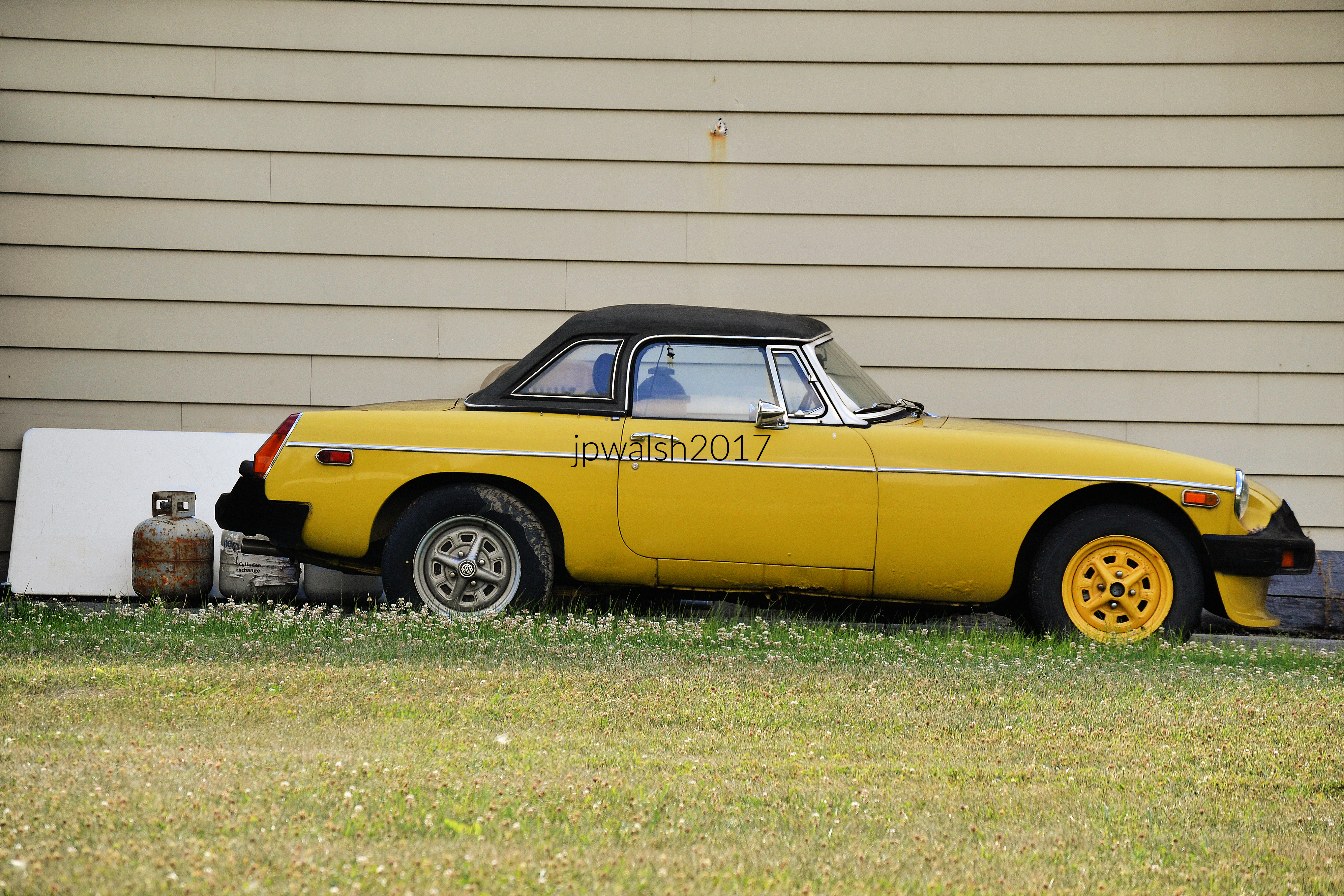
July 2017. 1978(?) MG MGB 2-door Roadster. From 1962 to 1968 the MGB two-door sports car was manufactured and marketed as a four-cylinder, soft-top sports car by the British Motor Corporation (BMC). It was produced by the Austin-Morris division of British Leyland from 1968 to 1980. Combined sales for the MGB and its variants MGC and MGB GT V8 was 523,836 cars. In 1992 the MGB re-entered limited production of 2000 cars as a MG RV8 before its final replacement in 1995 by the MG F. 99% 7.23mb DSC_0010
May 2025.1976 (?) MG MGB Roadster. 99% 7.50mb DSC_9942 (1)
 May 2018. 2006(?) BMW Mini Cooper Hatch. 3.24 mb

Japanese

August 2016. 2001 Toyota MR2 Spyder 2-door convertible. 94% 7.62mb 3824.
May 2016. 2015 Mazda MX-5 Miata GT 6.22mb DSCN2965 (1)
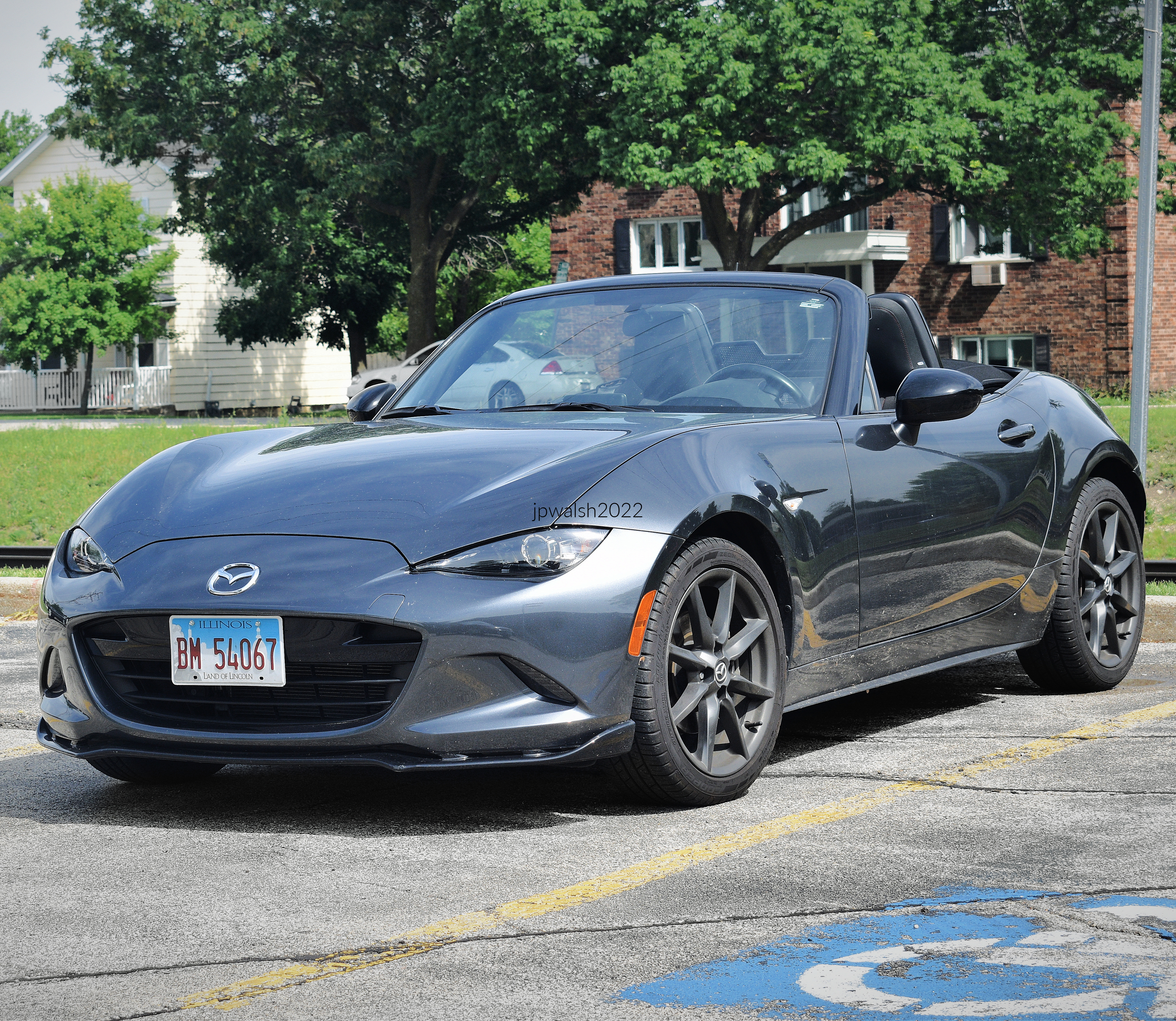
June 2022. Mazda MX-5 (1989-). 7.94 mb 90%
July 2021. Honda S2000 (1999-2009) 7.89 mb
August 2021. Mitsubishi 3000GT (1990-2000). 7.91 mb 86%
May 2025. Mazda MX-5 (NC). The Mazda MX-5 (NC) is the third generation of the Mazda MX-5 manufactured from 2005 to 2015. At its introduction in 2005, it won the Car of the Year Japan Award and made Car and Driver’s 10 Best list from 2006 to 2013. 65% 7.82mb DSC_0353
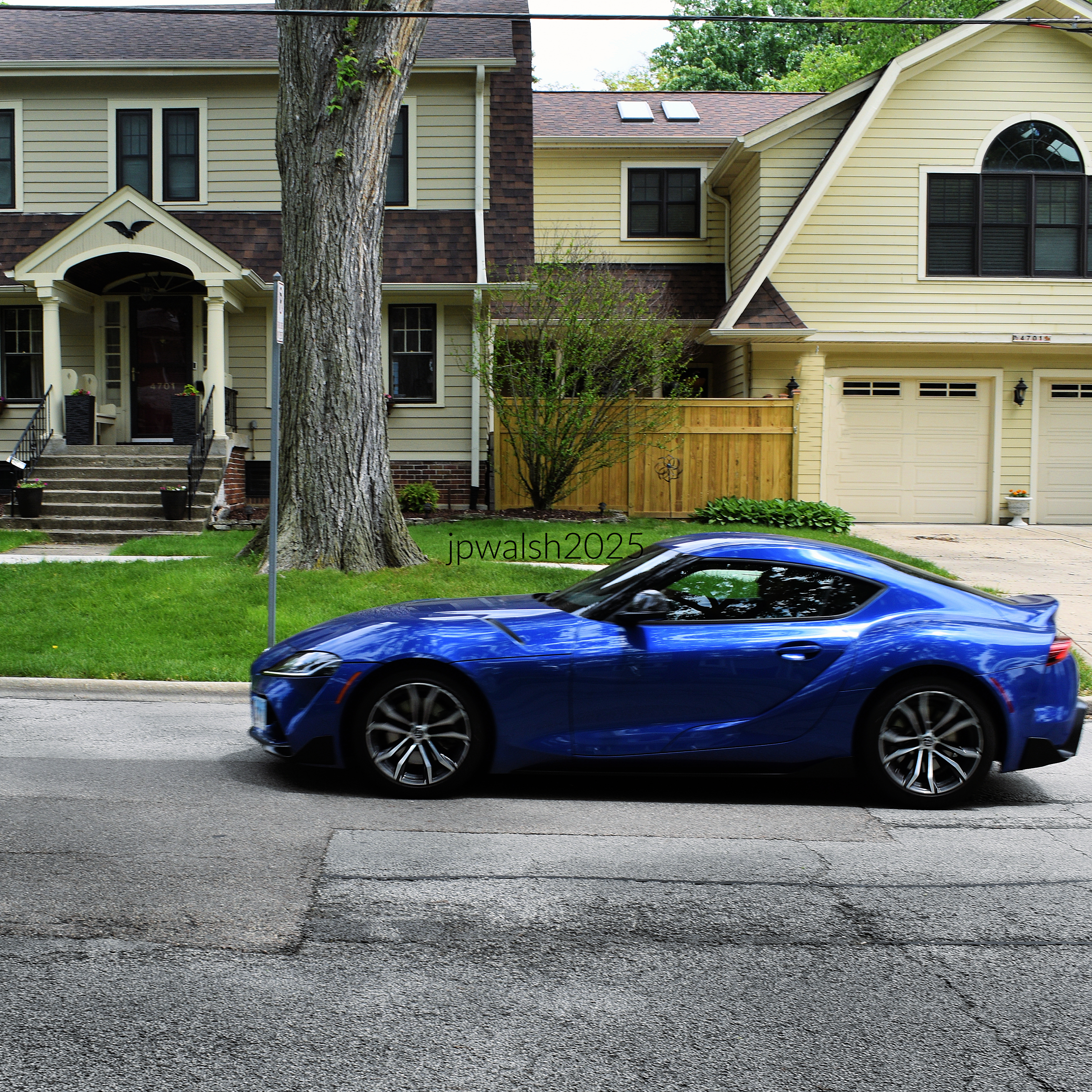
May 2025. 2024 Toyota GR Supra 99% 7.28mb DSC_1082