Tag Archives: Music

50 years ago today: The Wreck of the SS Edmund Fitzgerald (November 10, 1975).

FEATURE image: Edmund Fitzgerald in 1971.

Canadian singer-songwriter Gordon Lightfoot began releasing solo albums in 1966. The first six were on United Artists label and sold moderately well (up to 200,000 copies). Switching to Reprise in 1969 his debut album with the label, Sit Down Young Stranger, coincided with his first U.S. hit, If You Could Read My Mind, in 1970 and became Lightfoot’s first Gold album. This was followed by Lightfoot’s second Gold album (Platinum today) and no.1 single both called Sundown in 1974. The Wreck of the Edmund Fitzgerald – a true story of an ore vessel named after a Milwaukee, Wisconsin, civic leader, that sank in a Lake Superior storm in November 1975 – was Lightfoot’s next big hit appearing on Summertime Dream, a 1976 album that has gone Platinum.1

On November 10, 1975, during basically the colliding of two freshwater storms on Lake Superior, the largest of the five Great Lakes, the SS Edmund Fitzgerald, in service since 1958 and, when launched, the largest ship on the Great Lakes at over 700 feet long, went down into deep waters. For a cargo ship that should have normally expected more decades of service, the sinking caused the loss of its entire crew of 29 men. At 7 p.m. on November 10, 1975, the Fitzgerald radioed another cargo ship, the Anderson, telling them that, despite losing their radar, they were “holding their own.” Shortly thereafter the Fitzgerald was lost.

Location of the SS Edmund Fitzgerald wreck in Lake Superior approximately 17 miles (27 kilometers) north-northwest of Whitefish Point, Michigan. The ship now rests beneath about 535 feet (165 meters) of water and is considered a protected gravesite.2

Recovery Efforts involved the U.S. Navy and U.S. Coast Guard.

Whitefish Point, located on the southeastern shore of Lake Superior in Michigan, houses the Great Lakes Shipwreck Museum, which holds memorial events for the SS Edmund Fitzgerald each November. The wreck’s location, being 17 miles north-northwest of the point, places it beyond safe navigation lines, illustrating why the ship never reached shelter that fateful night. On a personal note, I have had the opportunity to visit the Great Lakes Shipwreck Museum in Whitefish Point, Michigan that contains the bell from the SS Edmund Fitzgerald recovered in 1995.3

The ultimate cause and circumstances of the wreck of the SS Edmund Fitzgerald in Lake Superior remain a mystery, weather conditions surrounding the sinking are well known – extraordinarily severe storm conditions, including 60 m.p.h. winds, towering waves of 25-30 feet, and heavy thick ice, which impacted possible structural vulnerabilities of the large, nearly 20-year-old cargo ship. The exact sequence of the events leading to the sinking are also unknown, as no distress signal detailing mechanical failure was received, so that the wreck has been attributed to adverse weather and lake conditions that impacted the vessel suddenly.4

The disaster, unlike the other hundreds of shipwrecks that have taken place on the Great Lakes, has entered into American mythology with Gordon Lightfoot’s ballad The Wreck of the Edmund Fitzgerald, written within a couple weeks after the disaster that same November 1975. Though the song by a bestselling recording artist about a recent shipwreck carried some risk where it was too early to know every fact, the verses are meticulously based on news stories of the basics that were known. By Lightfoot’s 7th studio album, Don Quixote, released in 1972, the Canadian singer-songwriter had begun in earnest to explore nautical themes. The Wreck of the Edmund Fitzgerald, released in June 1976 on Lightfoot’s 11th studio album, Summertime Dream, stayed on the same course.

Summertime Dream was released in June 1976 and peaked at no. 12 on the Billboard 200 (no. 1 on Canada Top Albums). The Wreck of the Edmund Fitzgerald was the album’s second track and, in August 1976, became its second single peaking at no. 2 in the U.S. and no. 1 in Canada.

The song was getting local airplay from the album in Minnesota, Wisconsin, and Michigan. Its popularity led to its release as a single in August 1976 and became Lightfoot’s biggest and most unlikely hit record commemorating the sinking of a transport cargo ship with its lives lost from less than a year before. The six-and-one-half minute folk rock song reached no. 1 in Canada and no. 2 in the U.S. where it was kept out of the top spot by Rod Stewart’s Tonight’s the Night. After the song’s release, Lightfoot never lost contact with the surviving family members of that shipwreck. Gordon Lightfoot, who was born in a town on Lake Simcoe in Ontario, Canada, died less than 90 miles away on Lake Ontario in Toronto in May 2023 at 84 years old.

The legend lives on from the Chippewa on down
Of the big lake, they called Gitche Gumee
The lake, it is said, never gives up her dead
When the skies of November turn gloomy
With a load of iron ore, twenty-six thousand tons more
Than the Edmund Fitzgerald weighed empty
That good ship and true was a bone to be chewed
When the gales of November came early

The ship was the pride of the American side
Coming back from some mill in Wisconsin
As the big freighters go, it was bigger than most
With a crew and good captain well seasoned
Concluding some terms with a couple of steel firms
When they left fully loaded for Cleveland
And later that night when the ship’s bell rang
Could it be the north wind they’d been feeling?

The wind in the wires made a tattle-tale sound
And a wave broke over the railing
And every man knew, as the captain did too
‘Twas the witch of November come stealing
The dawn came late, and the breakfast had to wait
When the gales of November came slashin’
When afternoon came, it was freezin’ rain
In the face of a hurricane west wind

When suppertime came, the old cook came on deck sayin’
“Fellas, it’s too rough to feed ya”
At seven p.m., a main hatchway caved in, he said
“Fellas, it’s been good to know ya”
The captain wired in he had water comin’ in
And the good ship and crew was in peril
And later that night when his lights went outta sight
Came the wreck of the Edmund Fitzgerald

Does anyone know where the love of God goes
When the waves turn the minutes to hours?
The searchers all say they’d have made Whitefish Bay
If they’d put 15 more miles behind her
They might have split up or they might have capsized
They may have broke deep and took water
And all that remains is the faces and the names
Of the wives and the sons and the daughters

Lake Huron rolls, Superior sings
In the rooms of her ice-water mansion
Old Michigan steams like a young man’s dreams
The islands and bays are for sportsmen
And farther below Lake Ontario
Takes in what Lake Erie can send her
And the iron boats go as the mariners all know
With the gales of November remembered

In a musty old hall in Detroit, they prayed
In the Maritime Sailors’ Cathedral
The church bell chimed ’til it rang twenty-nine times
For each man on the Edmund Fitzgerald
The legend lives on from the Chippewa on down
Of the big lake, they call Gitche Gumee
Superior, they said, never gives up her dead
When the gales of November come early

SS Edmund Fitzgerald in MacArthur Lock, Sault Ste. Marie, Michigan.

Lighthouse photo copyright 2007 Jim Sorbie.

NOTES:

  1. The Rolling Stone Encyclopedia of Rock & Roll, Third Edition (2001), p. 566.
  2. https://spectrumlocalnews.com/mi/michigan/news/2025/11/10/retired-ap-reporter-helped-cement-the-legend-of-the-wreck-of-the-edmund-fitzgerald – retrieved November 10, 2025.
  3. https://fieldethos.com/wreck-of-the-edmund-fitzgerald/ – retrieved November 10, 2025.
  4. https://www.history.com/articles/edmund-fitzgerald-sinking-lake-superior – retrieved November 10, 2025.

PHOTO CREDITS:

Edmund Fitzgerald in 1971 – “Edmund Fitzgerald, 1971, 3 of 4 (restored; cropped)” by Greenmars is licensed under CC BY-SA 3.0.

Gordon Lightfoot guitar – “Gordon Lightfoot” by Original uploader was Piedmontstyle at en.wikipedia is licensed under CC BY 3.0.

map – “File:SS Edmund Fitzgerald wreck.png” by Oaktree b is licensed under CC BY-SA 3.0.

bell – “The Bell of the Edmund Fitzgerald” by TheGreenHeron is licensed under CC BY-NC 2.0.

mystery – “Edmund Fitzgerald” by jpellgen (@1179_jp) is licensed under CC BY-NC-ND 2.0.

Summertime Dream album cover – 2025 01 06 Record – Gordon Lightfoot 7” by Blake Handley is licensed under CC BY 2.0.

at MacArthur Lock – “Edmund Fitzgerald in MacArthur Lock” by Detroit District is licensed under CC BY-SA 2.0.

lighthouse – PHOTO: “DSC_6472” by Jim Sorbie is licensed under CC BY 2.0.

Bessie Coleman, first Black woman licensed aviator and civil rights figure was born today, January 26, in 1892. She died in an accident doing the work she loved on April 30,1926. Bessie Coleman’s important professional aviator and civil rights legacy lives on.

FEATURE image: Contemporary poster of American aviator Bessie Coleman (1892-1926) along Bessie Coleman Street in the Gateway Gardens district at Frankfurt Airport in Germany. PHOTO CREDIT: DSC06136 Frankfurt Flughafen Gateway Gardens Bessie-Coleman-Straße” by X-angel is licensed under CC BY-SA 4.0.

Bessie Coleman, first licensed Black female aviator, was born on January 26, 1892 in Texas. Her father was American Indian and separated from the family when Bessie was 7 years old to live in Oklahoma. Bessie Coleman lived with her mother in Texas as her older siblings had moved away. In the 1890s and into the first half of the 20th century, segregation and discrimination against Blacks and people of color was not only the prevailing and demeaning social practice but also, to one degree or another, the law of the land. In this milieu of racism, Bessie was encouraged by her mother to work hard in school where Bessie became an avid reader. At 18 years old she spent one semester at today’s Langston University in Oklahoma but like many people then and now, she didn’t have the funds to continue. She returned to live and work beside her mother who was a maid and sharecropper. When Bessie was 23, full of life and ambition, she moved to Chicago to live with her older brothers where she worked hard at menial jobs – manicurist, restaurant server. But she also enjoyed living in the free(r) air of Chicago. During the war, her brothers served overseas in France and came back and told Bessie how much better the French treated women and Blacks than in America, even Chicago at the time of its Great Migration. In America, women could not even vote until 1920. Coleman’s brothers told Bessie that in France some women even flew airplanes! Stateside, that kind of thing was reserved for very wealthy, virtually all white men, who flew mostly for fun. Bessie applied to American flight schools anyway – and appallingly received a blanket rejection. Enter Black Chicago millionaire Robert Abbott (1870-1940), owner of the Chicago Defender. Abbott met and liked Bessie’s goals – he told her to go to France and get that pilot’s license. The French accepted her application and she crossed the Atlantic to enroll in flight school there. Flying in those days was an especially dangerous enterprise. There was not even a seat belt in the open cockpit to secure pilots in their seats. There were many accidents of the relatively new technology that involved what were often fragile and sometimes rickety aircraft and inexperienced pilots. Bessie became the first Black and American Indian woman to receive a pilot’s license and returned to the United States to practice her skills. But she had no money to execute her dream just yet. One way to earn money and eventually buy her own plane – as well as inspire other women and girls and people of color to fly – was to find regular, if acutely dangerous, jobs as a stunt pilot. But she ran into the same dead end as before – no American schools would accept a Black woman for the specialized training even though she had earned her pilot’s license.

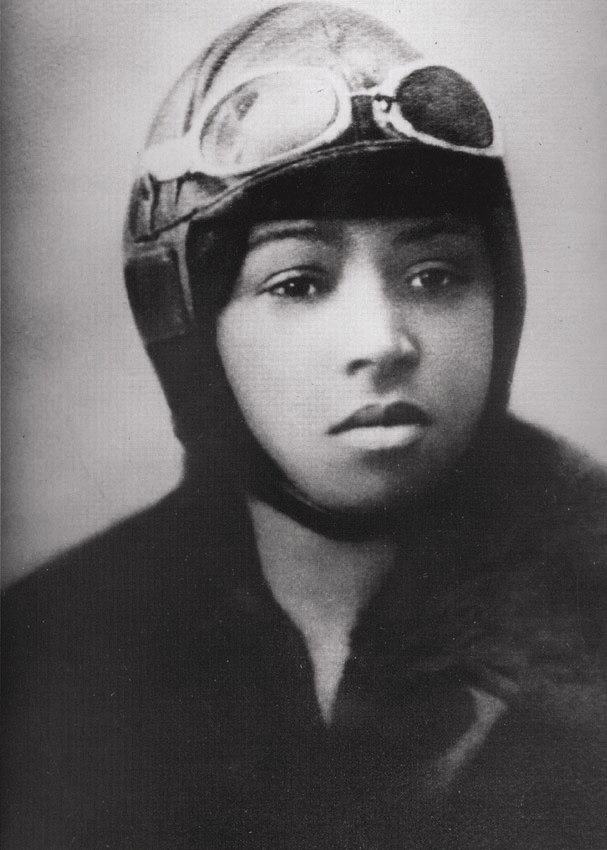
Bessie Coleman’s photo on her first pilot’s license, issued June 15, 1921. Public Domain.

Bessie returned to France to find the training she needed. All her travails and successes were not ignored in America, and at her second return home from France as a licensed pilot and stunt person Bessie enjoyed mostly positive attention in the press. It was 1922 and Bessie was prepared to soar. Her lifelong friend, Robert Abbott stepped up to arrange her first show in New York City which got the press buzzing. Back to Chicago, her home, Bessie performed in more and more air shows. To be a stunt pilot meant to be fearless and Bessie’s stunts across the country were making her very popular. Bessie wanted to work and maintain her own plane but didn’t have the money to do so. So, she borrowed any plane she could get her hands on to continue her work as a Black woman licensed stunt pilot who was famous for her figure eights and loop-de-loops in the air. While some woman walked on airplane wings, none piloted the plane also like Bessie did. Americans nicknamed her “Queen Bess” and “Brave Bess” and she was a cultural phenomenon as the roaring 1920’s got going.

Bessie Coleman and airplane, 1922. Public Domain.

As she was determined to do so, Bessie Coleman was making a difference in the nation. Of all these remarkable things in the air Bessie was known for, none was more significant than what she also achieved on the ground. Bessie Coleman told show promoters and managers that she would not perform at any show whose audience or performers were segregated by race or anything else. “Brave Bess” insisted that for all shows she performed in, there had to be just one gate for all people to walk through. At the time this was a profoundly radical request, particularly south of the Mason-Dixon line. In addition to her stunt pilot work, Bessie lectured at schools and churches and proselytized for aviation, particularly to the young. Still wanting to buy her own airplane, in 1923 she bought one but ended up crashing it and broke her leg and several ribs. As she recovered in Chicago, Bessie didn’t fly for a year. When she finally returned to flying in 1926, she had no money to buy another plane and was generously given a used one by a wealthy businessman. It was more rickety than anyone desired and Bessie hired a mechanic to get it to hum. In Florida for what would be her final airshow, her plane was flown from Texas by her trusted mechanic, William Wills. Along the way Wills had to make several emergency landings -the plane’s engine kept conking out. Following repairs made in Florida, he and Bessie went up for a practice dry run on April 30, 1926, the day before the show. They tested the plane as Bessie hunted for locations for her stunts. During that practice flight, something went wrong mechanically and, as Bessie leaned out of the cockpit not wearing a seatbelt to surveil the landscape, she fell out to her death. When the plane crashed, William Wills also died. Coleman was 34; Wills was 24. By the third memorial service in Chicago where Bessie Coleman is buried (Lincoln Cemetery in Blue Island), over 20,000 people had attended her services. In Chicago there were 15,000 mourners and famous Black journalist and Chicagoan, Ida B. Wells (1862-1931), read an essay where she spoke on the important work and legacy of Bessie Coleman. In 1929 Black engineer, business owner, and aviator William J. Powell (1897-1942) founded a flight school in Los Angeles named for Bessie Coleman that taught Black men and woman to fly. By the 1930’s, large groups of Black female stunt pilots such as the Blackbirds, took their inspiration from Bessie Coleman to new heights. In 1940 Robert Abbott, the millionaire newspaper publisher who supported Bessie Coleman at the beginning, was also buried in Lincoln Cemetery, among many of its Black Chicago notables.

Bessie Coleman, first Black and American Indian licensed aviator, two days before her 31st birthday, January 24, 1923. Public Domain.

SOURCES:

Bessie Coleman Bold Pilot Who Gave Women Wings, Martha London, 2021, Capstone Press, North Mankato, MN.

Brave Bessie Flying Free, Lillian M. Fisher, 1995, Hendrick Long, Houston, TX.