Tag Archives: Museum – Le Gallerie degli Uffizi Florence Italy

ITALY. RAPHAEL (ITALIAN, 1483-1520), HIGH RENAISSANCE MASTER. (50+ artworks).

FEATURE Image: Raphael, Portraits of Agnolo Doni and Maddalena Doni, c. 1506, oil on panel, 24  ¾  x 17 ¾” Pitti Gallery, Florence.

Raphael, Self-portrait at 23 years old, 1504–1506. Tempera on panel, 47.5 cm × 33 cm (18.7 in × 13 in), Palazzo Pitti, Florence, Italy.

INTRODUCTION.

Born in Urbino in 1483, an environment rich in the arts and humanist learning, Raphael had a remarkable capacity for personal growth and branded new incarnations of his artistic style regularly. He moved to Florence toward the end of 1504. Giorgio Vasari in his chapter on Raphael describes an episode where the artist of Urbino, already in his thirties with a reputation as a master, went back to study the nude (male) form with Michelangelo as his guide. Vasari’s admiration in telling this story goes beyond Raphael’s humility in assuming the role of student again (he studied constantly anyway) but that his learning always improved his artistic output. In the study of nudes, however, artistic growth came perhaps not as the artist expected or intended. Whether Raphael entered the workshop of Perugino at that time or, as seems more likely, many years later when he was already an acknowledged artist, he quickly mastered Perugino’s delicate, ornamental style, with its open landscapes and gentle figures. It was said that contemporaries had trouble distinguishing Perugino’s work from Raphael’s, but Raphael’s compositions were more sophisticated even when he was a young artist. While Raphael mastered Michelangelo’s (and Leonardo’s) art forms convincingly, he also realized he was no match for the creator of the Sistine Chapel and other chiseled works insofar as the nude male forms.1 Yet Raphael consolidated his strengths by testing his limits. A major strength, Vasari believed, was Raphael’s ability to draw and compose a wide range of subjects, such as landscape, architecture, draperies, and the human figure. Up to that time that had been what the artist was doing and would now unflinchingly continue to do on a grander scale, for example, in the Stanzae. In 1508 the pope called Raphael to Rome. Influenced by the idealized, classical art of the city’s ancient past, Raphael’s work took on a new grandeur. He also responded to the more energetic and physical style of Michelangelo, whose works he had already begun to study in Florence. Vasari believed Raphael had the gift to congeal the “poetic moment” by depicting in his painting the most significant gesture and force of action. With the possible exception of Leonardo, he is probably the unparalleled master of excellent design.2 The precocious Raphael Sanzio also benefited from early opportunities given to him by his father to cultivate his talent. The artist’s own determination to succeed in his métier paid off when he was summoned to work at the Vatican by the Pope in 1509, arguably the greatest art patron in an age of art patrons. 3 The early sixteenth century was an age where patrons were as luminous as their artists and the coming together of Raphael and Julius II, and later Leo X, made for a celebrity team. While Vasari meticulously tells the reader of the artist’s “judicious” character – and that Raphael was extremely “amatory” and implying it aided in his death – the chronicler describes, often from memory, his preferences in Raphael’s art work.  His collective response, for example, to all four frescos in the Camera d’Eliodoro is that he is most impressed by Raphael’s interesting decorative details, beautiful movements and gestures, the sheer number of figures portrayed, and his ability to express complex ideas and stories on a two-dimensional surface.4 With Leonardo da Vinci (1452-1519) and Michelangelo (1475-1564) Raphael is one of the great masters of the High Renaissance. Raphael and his large team of assistants left behind a large body of influential work, especially in the Vatican where the artist spent the last 12 years of his life, although Raphael died at 37 years old. For most of the history of Western art, the easy grace and harmonious balance of Raphael’s style has represented an ideal of perfection. His work became widely influential through the dissemination of prints. Raphael was also the city’s leading portraitist, creating penetrating psychological images that engaged viewer and sitter with a new intensity.

ARTWORKS.
Raphael, S. Niccolo Da Tolentino Altarpiece, 1501, oil on panel, 44 x45 ¼ in., Capodimonte Museum, Naples, Italy.

The Baronci Altarpiece is Raphael’s first recorded commission. It was made for the patron’s chapel in the church of Sant’Agostino in Città di Castello, a commune between Arezzo and Urbino, north of Perugia. In 1789 the artwork was badly damaged in an earthquake and surviving fragments were acquired by the Vatican until they mysteriously dispersed in the mid-19th century and found their way into different collections. Raphael’s commission of 1501 was to paint a large altarpiece dedicated to the Augustinian saint Nicholas of Tolentino (c. 1246– September 10, 1305). Nicholas was canonized by Augustinian Pope Eugene IV in 1446.  While today’s saints require 1-2 miracles, St. Nicolas Tolentino was credited at his canonization with 300 miracles – including 3 resurrections. (see – Encyclopedia of the Middle Ages, Volume 2, André Vauchez, Richard Barrie Dobson, Michael Lapidge. Chicago: Fitzroy, Dearborn, 2000).
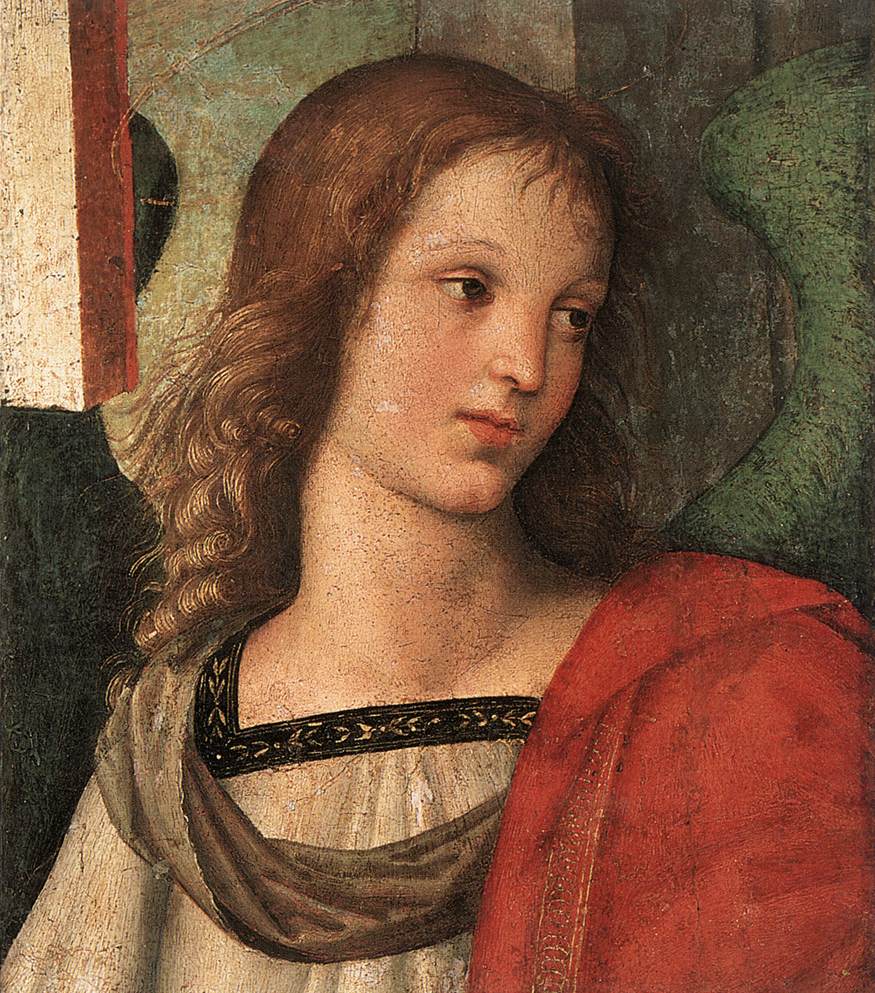
Raphael, angel, fragment Baronci altarpiece. Pinacoteca Tosio Martinengo, Brescia.
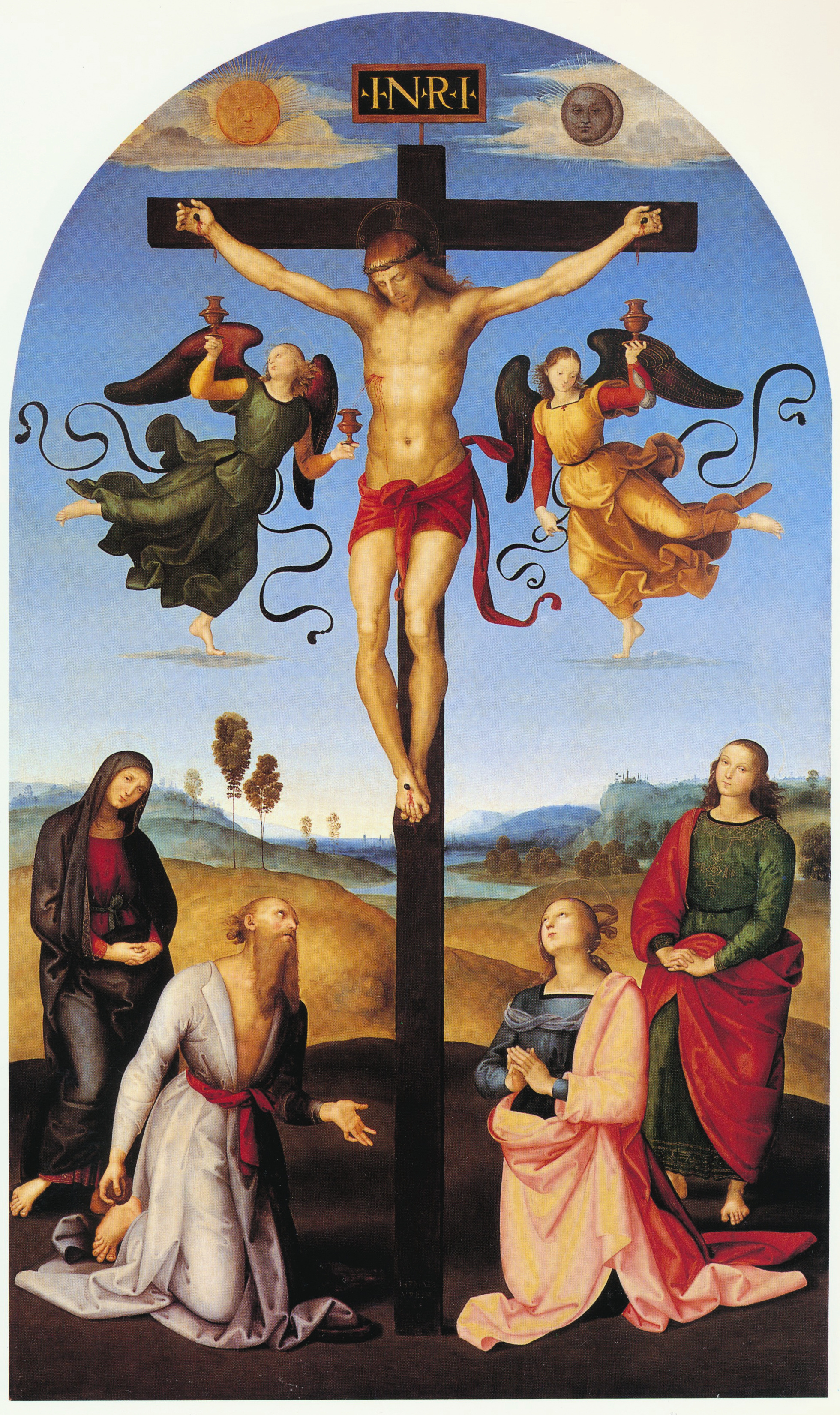
Raphael, The Crucifixion, 1502-03, oil on polar, 283.3 × 167.3 cm, National Gallery, London.

The painting was done in 1503 for Domenico Gavari for his S. Domenico chapel in Città di Castello. Angels are poised on toes on a cloud as their cups catch Christ’s dripping blood. Mary Magdelene and St. Jerome (holding a rock) are on their knees while the Virgin Mary and St. John stand. The sun and moon in the sky was characteristic of Crucifixion paintings in Umbria (p. 13, Jones & Penny). It was bequeathed to the National Gallery in 1924. Gavari was a close friend of Andrea Baronci, for whom Raphael painted the Saint Nicholas of Tolentino Altarpiece for the church of S. Agostino, also in Città di Castello. Saint Jerome, of course, was not present at the Crucifixion but is included in this scene because the chapel was dedicated to him. The overall design is based on several versions of the crucified Christ in a landscape painted by Perugino in the late 1480s and 1490s, and is especially similar to his altarpiece of the Crucifixion for the convent of S. Francesco al Monte in Perugia, commissioned in 1502 and completed 1506. https://www.nationalgallery.org.uk/paintings/raphael-the-mond-crucifixion – retrieved September 5, 2024.

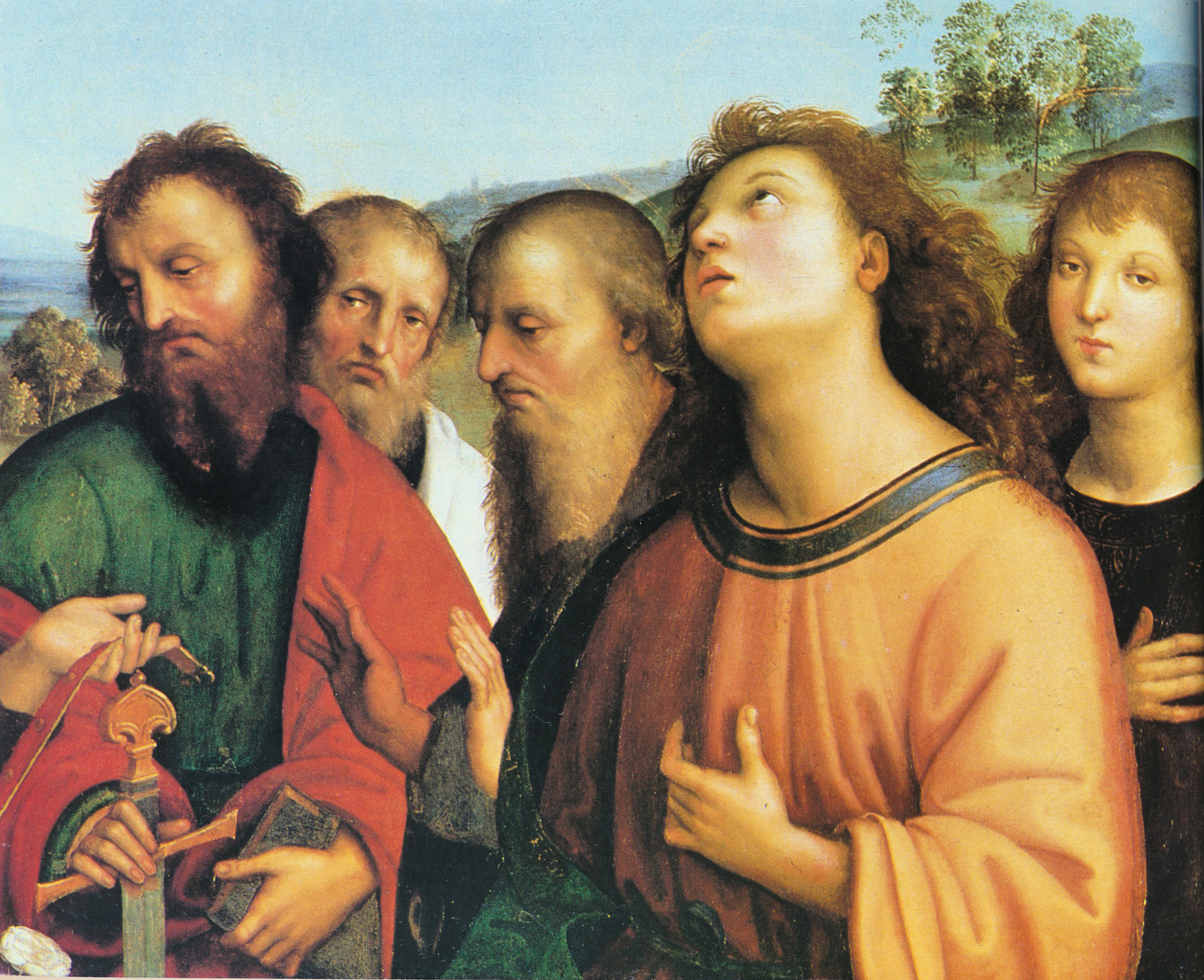
Raphael, Coronation of the Virgin (Oddi Altarpiece), 1503-1504, Oil on canvas, 8’9” x 5’4”, Pinacoteca, Vatican, Rome.
Raphael, Coronation of the Virgin (Oddi Altarpiece), 1503-1504, Oil on canvas, 8’9” x 5’4”, Pinacoteca, Vatican, Rome. DETAIL.

Raphael painted altarpieces for the Augustinians and Dominicans and the Oddi altarpiece (above) was done for the Franciscans. It was commissioned by the Oddi family chapel in S. Francesco al Prato. The Oddi were in exile from Perugia since 1495 because of battles between families and returned in 1503. The altarpiece was part of honoring their family members. The painting is divided into an upper part depicting the coronation of the Virgin and, in the lower part, the Apostles at the time of the Assumption. In the center, the apostle Thomas holds the Virgin’s girdle that the Virgin lowered to him as a token of these supernatural events. This display of theology was precious to the Franciscans at the time who were promoting the Virgin Mary. They were likely very involved in directing the artist in its composition. (Roger & Jones, pp. 15-16).
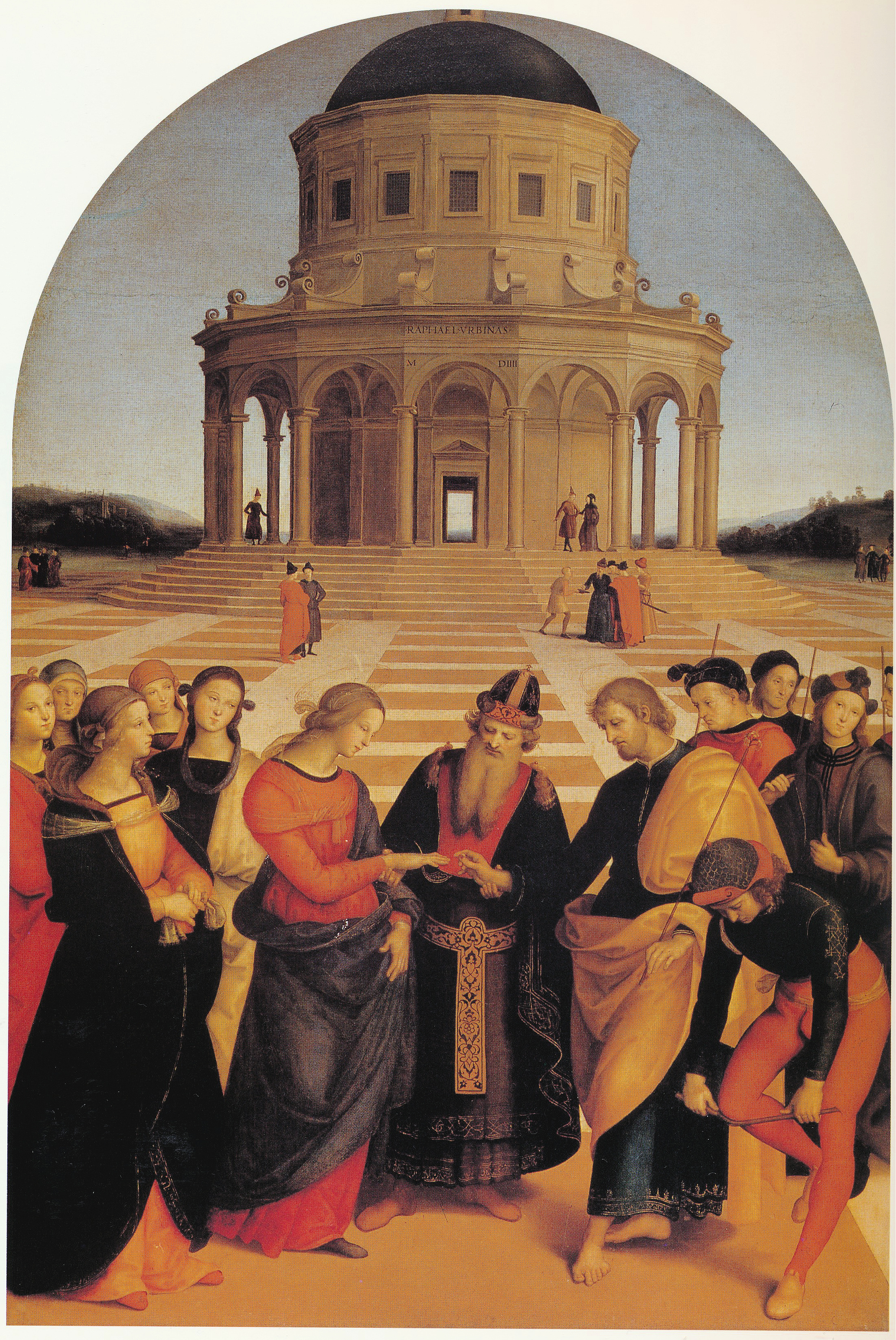
Raphael, Spozalizio (The Engagement of the Virgin Mary), 1504, oil on panel, 67 x 46 ½” Brera Gallery, Milan.

The painting’s composition reflects the influence of Perugino, specifically the fresco done by him in the Sistine Chapel in 1484. In terms of its architectural setting, Raphael was influenced by Piero della Francesca (c.1416-1492) and Bramante (1444-1514). The painting’s architectural structure shares centrality in the painting with the foreground figures done in a perspectival arrangement. Within the figures are members of the party positioned in depth. Joseph places a ring on Mary’s finger whose positioning bisects the artwork. A tawny gold tone pervades the painting. It was commissioned by the Alberini family for a chapel in S. Francesco of the Friars Minor at Città di Castello in Perugia. (Brera Milan, p 34)

Raphael, The Madonna and Child Enthroned with Five Saints (Colonna Altarpiece), c. 1504-1505, oil on panel, 68 x 68” The Metropolitan Museum of Art, New York City.

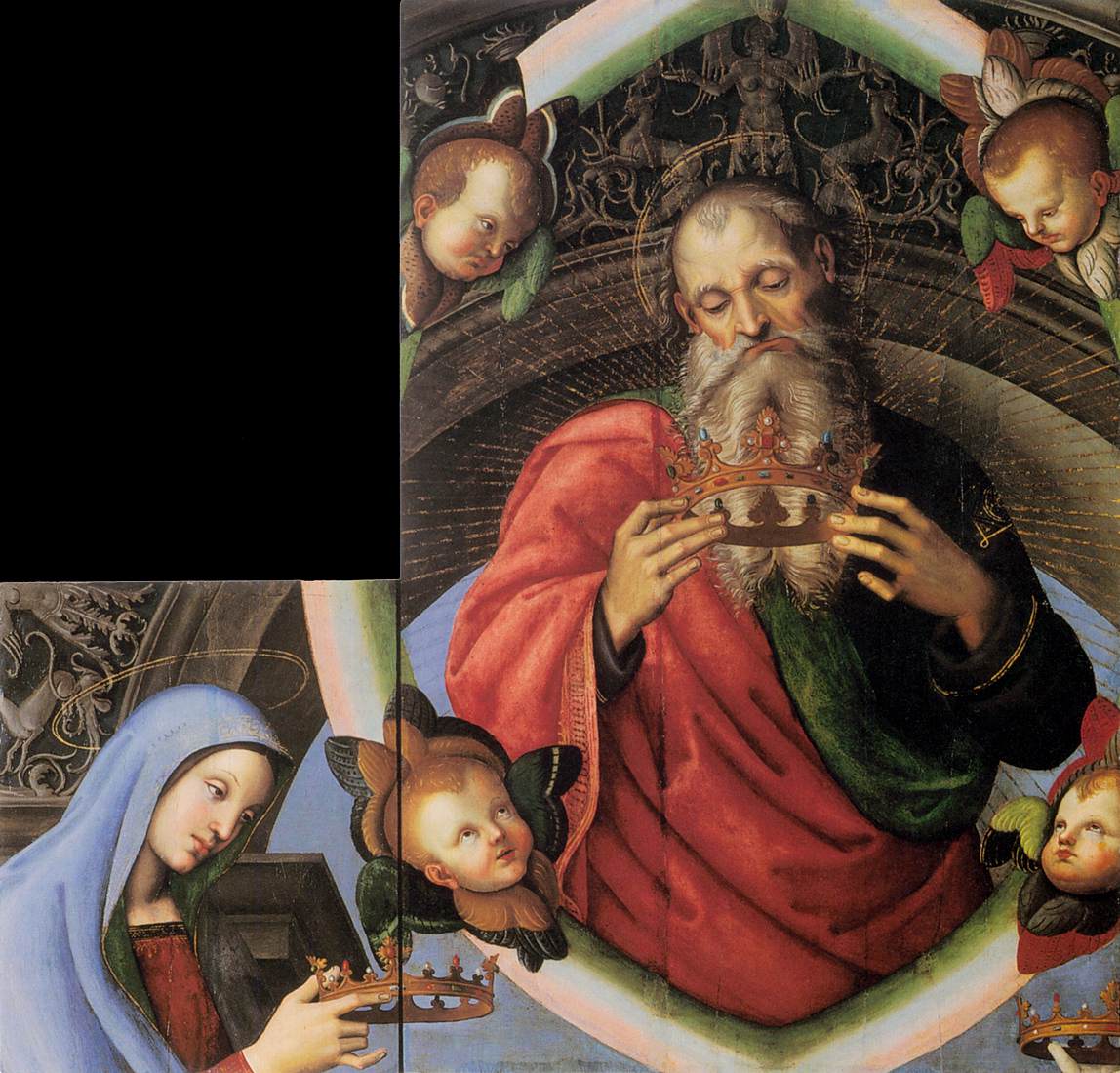
Raphael painted this altarpiece for the Franciscan convent of Sant’Antonio in Perugia. It hung in a part of the church reserved for the nuns. The pair of voluminous saints straddling each side of the throne reflect the progressive style of Leonardo da Vinci and Fra Bartolomeo (1472-1517) that Raphael was studying in Florence. The lunette above the main panel depicts God the Father holding a globe and raising his right hand in blessing situated between two angels and two seraphim. https://www.metmuseum.org/art/collection/search/437372 – retrieved September 5, 2024.

Raphael, The Small Cowper Madonna, c. 1505 59.5 x 44 cm (23 7/16 x 17 5/16 in.), National Gallery of Art, Washington D.C.

The Cowper Madonna includes an agreeable background landscape. In a vertical painting, a haloed woman and nude child sit before an expansive grass field extending behind them to a group of trees and buildings on a hill in the distance among hazy blue hills beneath a blue sky. https://www.nga.gov/collection/art-object-page.1196.html – retrieved September 8, 2024.
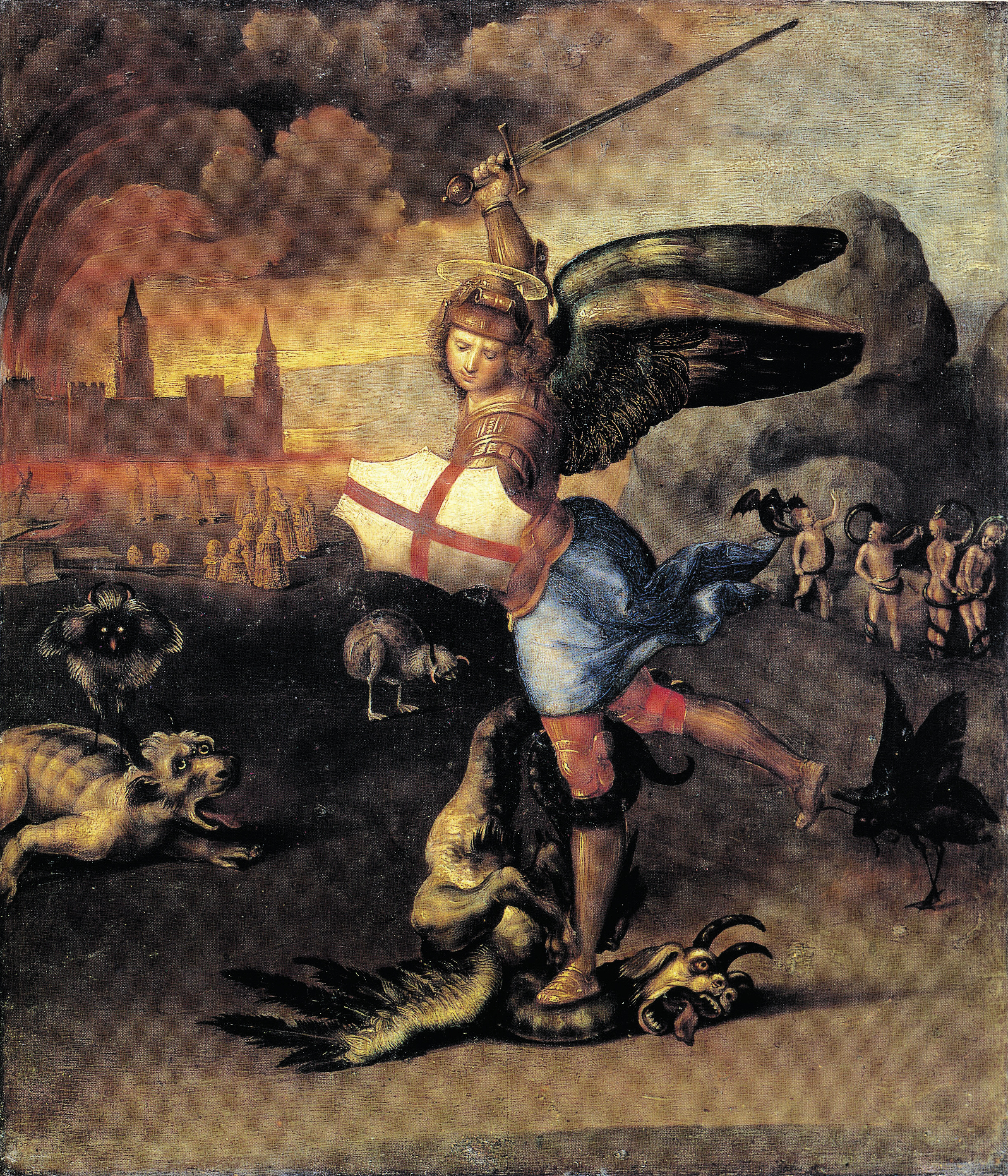
Raphael, Saint Michael and The Dragon, c. 1505, oil on panel, 12 ¼” x 10 ¼” The Louvre Paris https://collections.louvre.fr/en/ark:/53355/cl010060773 – retrieved September 4, 2024
Raphael, Saint Michael and The Dragon, c. 1505, oil on panel, 12 1/4 x 10 ¼” The Louvre, Paris https://collections.louvre.fr/en/ark:/53355/cl010060772 – retrieved September 4, 2024.
Raphael, Saint George and the Dragon, c. 1506, National Gallery of Art, Washington, D.C.

These early works by the artist depict the popular subjects of St. Michael the Archangel vanquishing Satan and Saint George slaying the Dragon, each showing the martial subject of good combatting evil. These were early private commissions for the court of Urbino. Saint George was a Christian Roman soldier who, pious legend informs, subdued a dragon and, with the daughter of a pagan king, brought it to the city, where St. George killed it with his sword. These heroic actions witnessed by the king and his subjects led to their conversion to Christianity. The historic figure of Saint George was martyred around the year 290.  https://www.nga.gov/collection/art-object-page.28.html – retrieved September 4, 2024.

Raphael, The Three Graces, 1505-1506, oil on panel, 6 ¾ x 6 ¾” Condé Museum, Chantilly.

The panel was recorded in the Borghese collection in 1650. It accompanied the Dream of Scipio, an oil on panel, today in the National Gallery of London. The figures were derived from ancient classical sculpture and depict, likely, Chastity, Beauty and Love. Chastity’s lower torso is veiled and an arm covers her breasts from view. Amor’s breasts, by contrast, are revealed. Chastity also wears no adornment as do Beauty and Amor. While the figures are modeled similarly, the space between them is disparate and Beauty blocks Chastity’s leg. (Jones & Penny, p. 8; Beck, pp. 62-63).

Raphael, Portrait of Agnolo Doni, c. 1506, oil on panel, 24  ¾  x 17 ¾” Pitti Gallery, Florence.
Raphael, Portrait of Maddalena Doni, c. 1506, oil on panel, 24 ¾ x 17 ¾” Pitti Gallery, Florence.

Agnolo Doni is the only Florentine portrait in these first years mentioned by Vasari though paired with its companion portrait of Maddalena Doni. Doni was an art collector who married the daughter of Giovanni Strozzi in 1503. Agnolo was 10 years older than his wife who was in her teens. The portraits are painted on identically sized panel and are intended to hang next to one another. Raphael took great care in depicting the corporeal reality of his subjects, particularly appreciated in their faces and hands (though Agnolo Doni’s portrait is more detailed than his wife’s.) In both Doni portraits the sitters show-off their jewelry – such as rings and, in Maddalena’s portrait, a large pearl hanging around her neck. (Roger & Penny, p. 29-30)

Raphael, The Madonna of the Granduca, c. 1506, Oil on panel, 33 x 21 1/2 “ Pitti gallery, Florence.
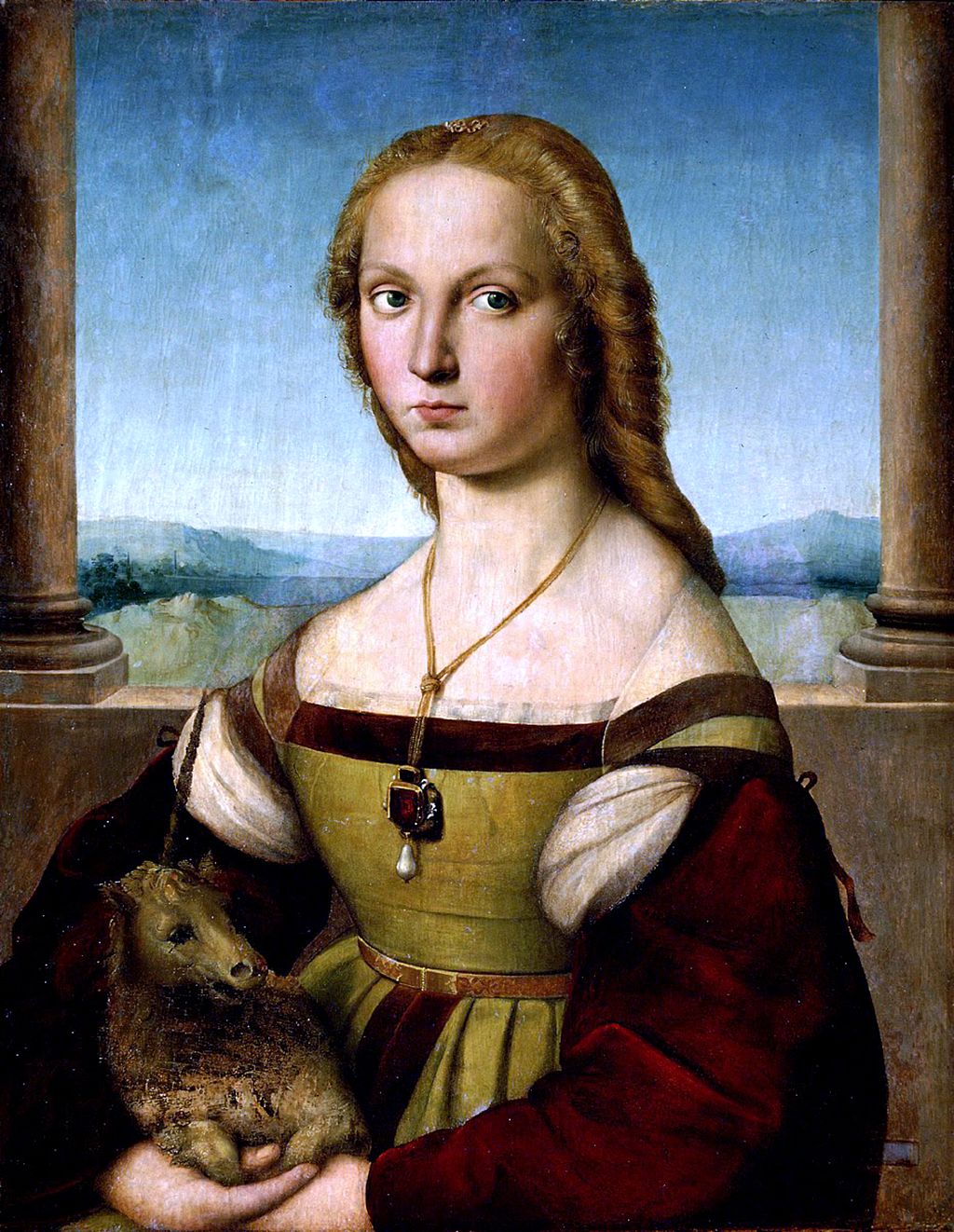
Raphael, Lady with a Unicorn, 1506, oil on panel, 65 cm × 51 cm (26 in × 20 in), Galleria Borghese, Rome, Italy.

The work was of uncertain attribution until recent times. In the 1760 inventory of the Gallery, the subject of the painting was identified as Saint Catherine of Alexandria and attributed to Perugino. A restoration of the painting in 1934 revealed a unicorn, the medieval symbol for chastity, and led to the pianting’s attribution to Raphael. In 1959 an x-ray revealed a small dog under the unicorn which symbolized conjugal fidelity.https://en.wikipedia.org/wiki/Young_Woman_with_Unicorn – retrieved September 7, 2024.

Raphael, The Holy Family With Saints Elizabeth and John (The Canigiani Holy Family), c. 1506-07, oil on panel, 51 ½ x 42 1/8” Alte Pinakothek, Munich.

Visible on the hem of the Madonna’s scarf is inscribed, “Rapahel Urbanas.” The fresco and easel painter was active mainly in Umbria, in Florence after 1504, and in Rome in 1509 until his death. It was painted for Domenico Canigiani where Vasari saw it later. It entered the Medici collection and when a Medici daughter married an Elector Palatine it accompanied her over the Alps to Germany. (Pinakothek Munich Great Museums of the World, Roberto Salvini, et. al., Newsweek NY 1969 pp. 126).

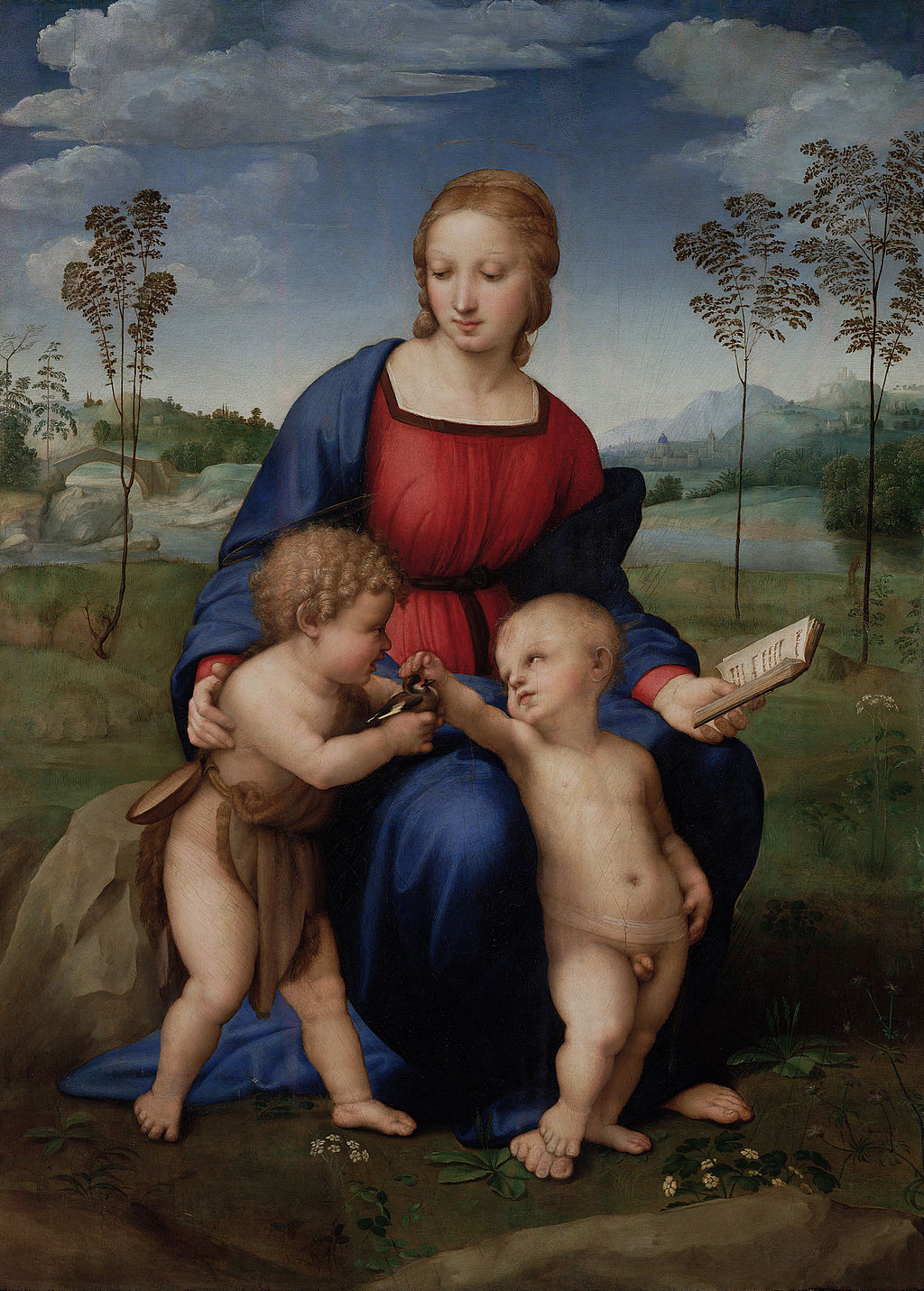
Raphael, Madonna del Cardellino, 1506-07, oil on panel, 42 1/8 x 30 ¼” Uffizi Gallery Florence.

The three figures are closely integrated as well as displaying a greater sense of volume. The painting is dated 1507, again on the hem of the Virgin’s garment. In the painting St. John the Baptist presents a goldfinch (cardellino) to the Christ child – a symbol of the Passion. (Roger & Penny, p. 33)

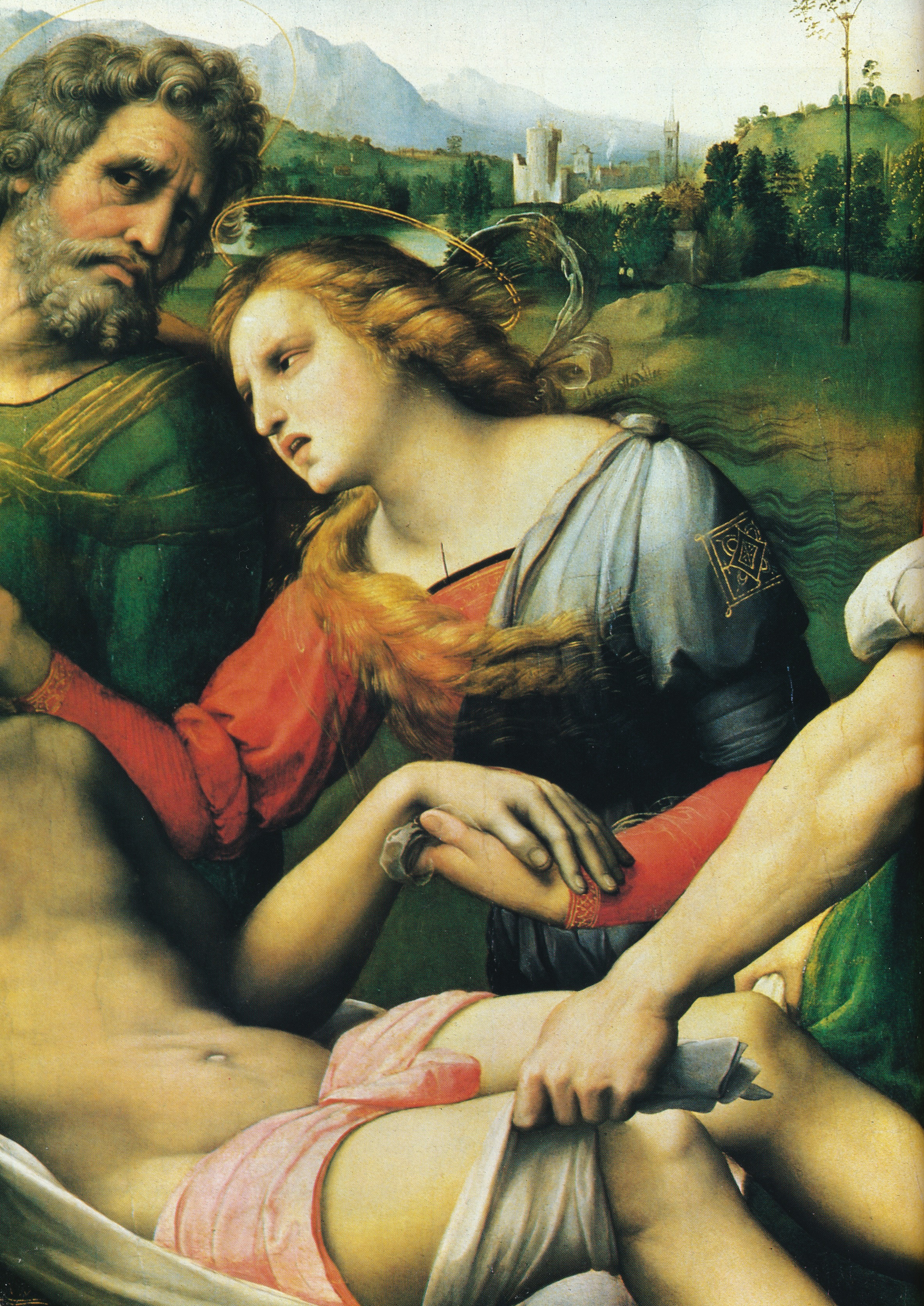
The Deposition, 1507, oil on panel, 72 ½ x 69 ¼” Borghese Gallery, Rome.
The Deposition, 1507, oil on panel, 72 ½ x 69 ¼” Borghese Gallery, Rome. DETAIL.

Upon seeing Leonardo’s Battle of Anghiari and Michelangelo’s Battle of Cascia in Florence Raphael’s style applied its innovative principles immediately changing the trajectory of his artwork up to that point. Leonardo da Vinci and Michelangelo were in a pitched artistic battle for the future of modern art in the first decade of the 16th century in central Italy. Their artwork was for a fabled competition to decorate the Great Council Hall in Florence. Raphael studied closely these complex drawings of heroic violence. Though Raphael was familiar with violent combat in Perugia and elsewhere, it was its containment in these artworks in Florence that such dynamic convolutions appeared as in his own work such as The Deposition though he may have had in mind also Perugino’s work in 1495 of the Lamentation over the Dead Christ. In the finished painting the action takes place from right to left –  a group of women attending to a swooning Virgin to the Magdalene grasping Christ’s hand to look into his
face.  (Roger & Penny, pp. 37-44).

Raphael, La Belle Jardinière, 1507-08, oil on panel, 48 x 31 ½” The Louvre, Paris.

In this painting John the Baptist kneels before the Christ child. The painting has an arched top. It was Leonardo da Vinci who formulated the pyramidal structure for the Holy Family and half-length portrait and it seems Raphael looked to explore his idea for his narrative of the Virgin Mary with cousins Jesus Christ and John the Baptist. (Roger & Penny, p. 33)

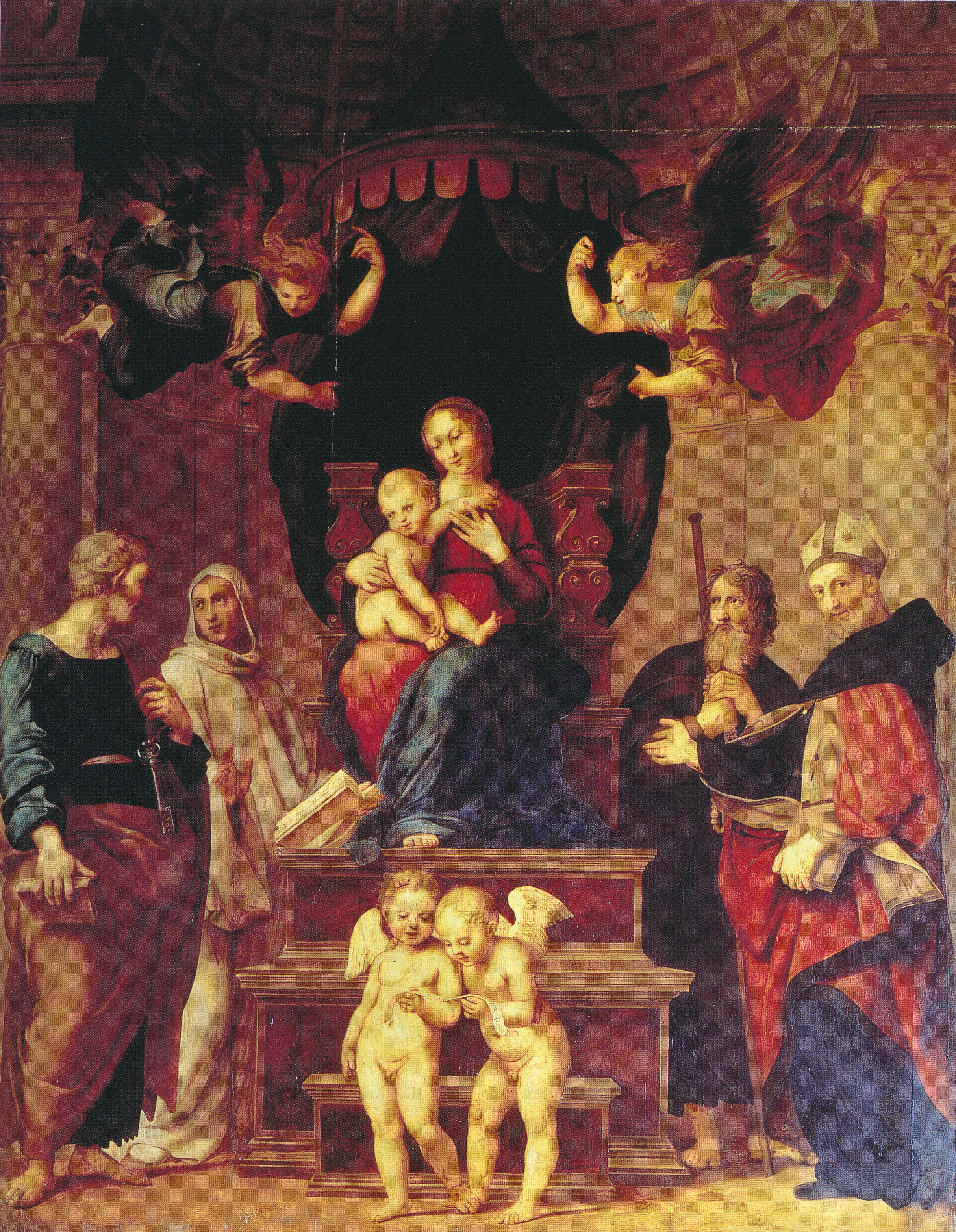
Raphael, The Madonna of the Baldacchino, 1508, oil on canvas, 9’ x7’4” Pitti Gallery Florence.

The painting was started by Raphael and finished after his death (Roger & Penny, p. 44). It was Raphael’s first major commission in Florence for the Dei family chapel in the Santo Spirito basilica (1487) and remained unfinished when the 25-year-old artist was summoned to Rome by Pope Julius II, nicknamed the Fearsome, who reigned on Peter’s chair from 1503 to 1513. Pope Julius, born Giuliano della Rovere in 1443, took his name specifically from Julius Caesar (d. 44 BCE). In 1508, this “Battle Pope” as he was also known, commissioned the Raphael Rooms and Michelangelo’s paintings in the Sistine Chapel at the Vatican. Raphael’s enthroned Madonna and Child is with, from left, Sts. Peter, Bernard of Clairvaux, James the Greater and St. Augustine of Hippo. The group is joined by two putti at the foot of the throne’s high pedestal steps. It is a large format painting whose size was increased when it was restored and “completed” at the end of the 17th century to meet the tastes of a Medici prince. Raphael is cited for being an imitator more than originator and this is exampled in the Christ Child playing with his toes whose pudgy type derives from the workshop of Florentine sculptor Luca Della Robbia (c. 1400-1482). The painting can be read right to left as St. Augustine, looking at the viewer, gestures, with St. James gazing in a similar direction, towards the throne and its occupants and then crosses to St. Bernard whose backward glance ends in conversation with St. Peter holding a book and large key. Once in Rome, Raphael continued these simple straight forward readings of his artworks’ often complex network of figures beginning in his famous frescoes in the Stanza della Segnatura (1508-1511) yet by then with greater refinement and heroism. In 1799 The Madonna of the Baldacchino was confiscated by French forces and taken to Paris only to be returned to Florence in 1813.  (Beck, pp. 78-79).

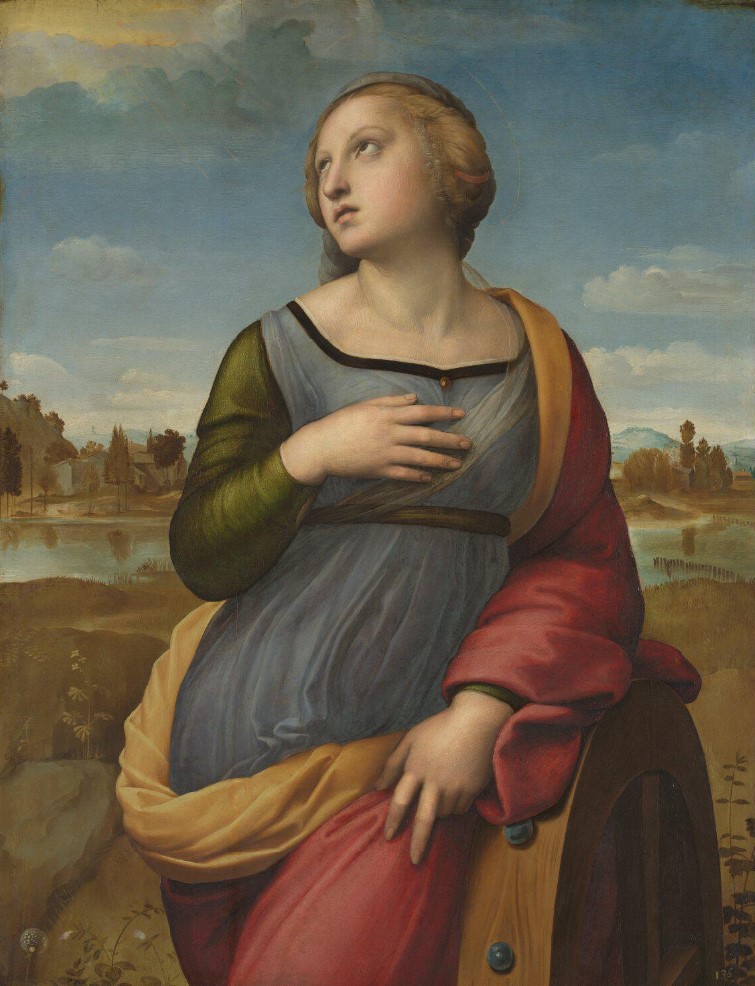
Raphael, St. Catherine of Alexandria, oil on panel, c. 1507, 71 x 56 cm, National Gallery of Art, London.

Raphael’s saint, a 4TH century mystic and martyr, is not an object for devotion but dramatizes an example of devotion. The turned figure derives from Leonardo da Vinci and expresses an emotional animation that is one of the strongest depictions in Raphael’s oeuvre. (Roger & Penny, p. 44). The portrait is joined to a landscape as the saint leans on a spiked wheel which is her symbol as it was the manner of her death. Raphael looks to capture the mystical or visionary aspect of the saint as she places her hand over her heart and gazes upwards to a golden break in the sky. The figure is very dynamic moving beyond Perugino’s influence of angelic air and distant landscapes and towards Michelangelo and Leonardo da Vinci whose monumentality and detailed arrangements Raphael studied in Florence. It is unknown who commissioned the artwork and for exactly what purpose it served.  https://www.nationalgallery.org.uk/paintings/raphael-saint-catherine-of-alexandria – retrieved September 6, 2024.

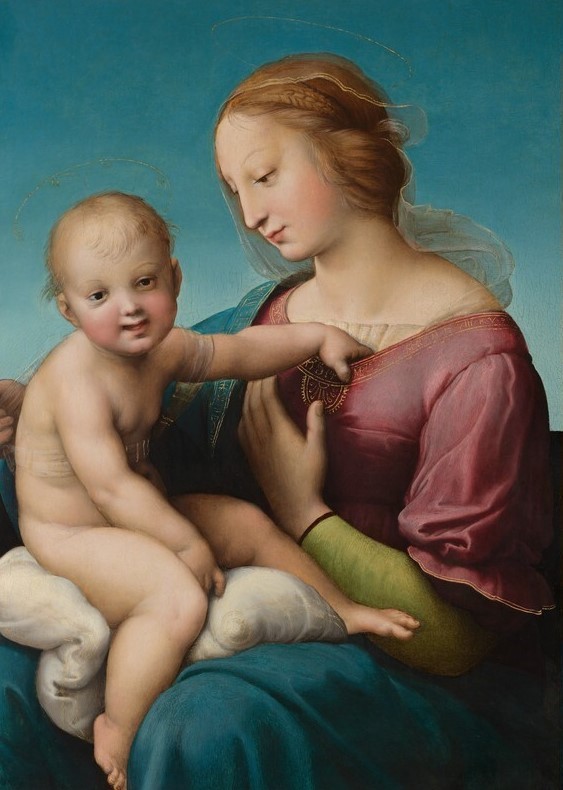
Raphael, The Niccolini-Cowper Madonna, 1508, oil on panel, 80.7 x 57.5 cm (31 3/4 x 22 5/8 in., National Gallery of Art, Washington, D.C.  https://www.nga.gov/collection/art-object-page.27.html – retrieved September 8, 2024.
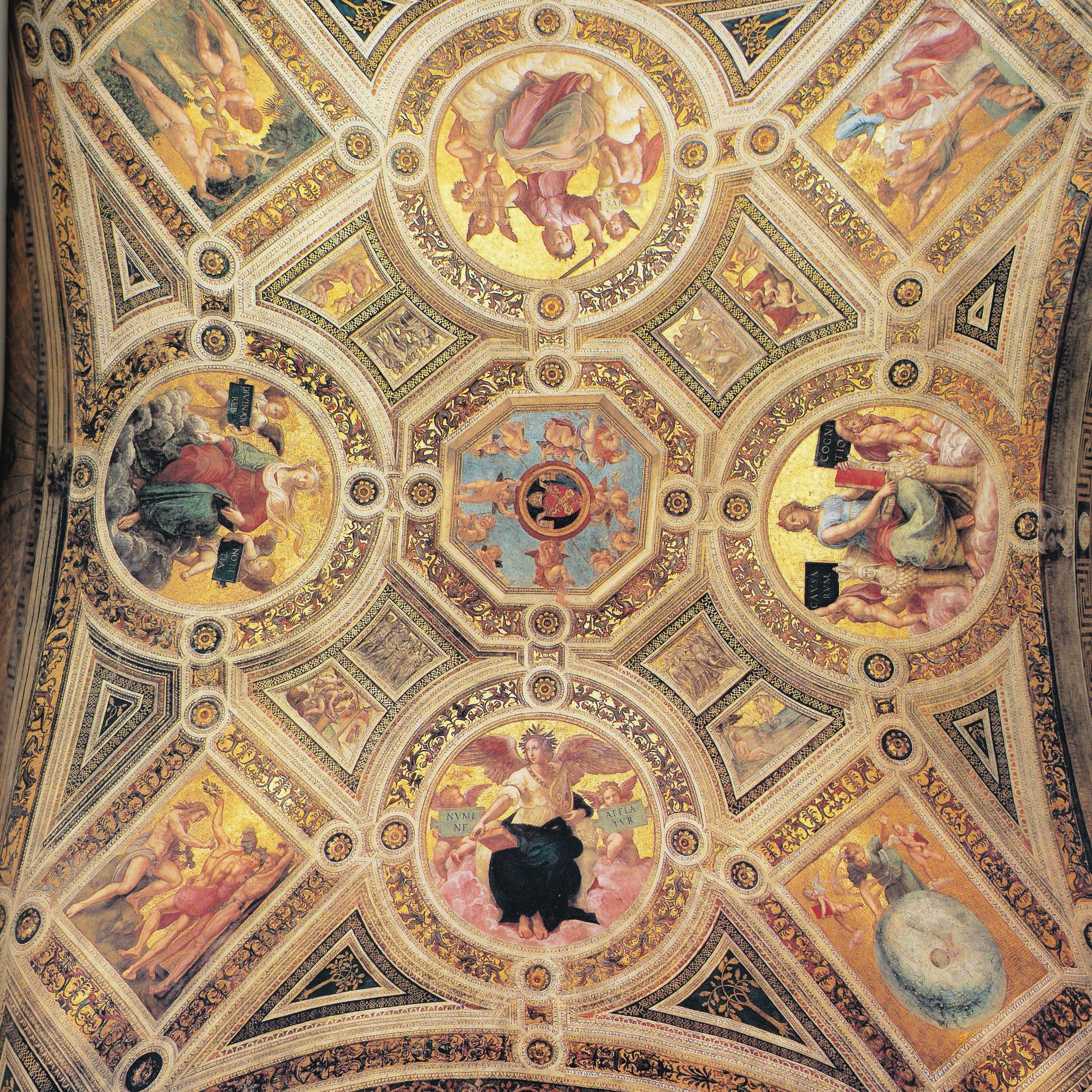
Raphael, c. 1509, fresco, 47 ½ x 41 ½” Ceiling, Stanza della Segnatura, Vatican, Rome.
Raphael, The Fall, c. 1509, fresco, 47 ½ x 41 ½” Ceiling, Stanza della Segnatura, Vatican, Rome.DETAIL.

At the time of the papal commission Raphael had little experience painting large frescos but would revolutionize the tradition. The basic scheme of the decoration presents four tondi of abstract ideas of Theology, Poetry, Philosophy and Law. The Fall  – or Adam and Eve on the Brink of Disobedience along with the Judgment of Solomon on the ceiling relates to themes of Theology and Law as the ceiling’s admixture of pagan scenes including Urania and Apollo and Marsyas relate to Poetry and Philosophy.  (Roger & Penny – pp 50-52).
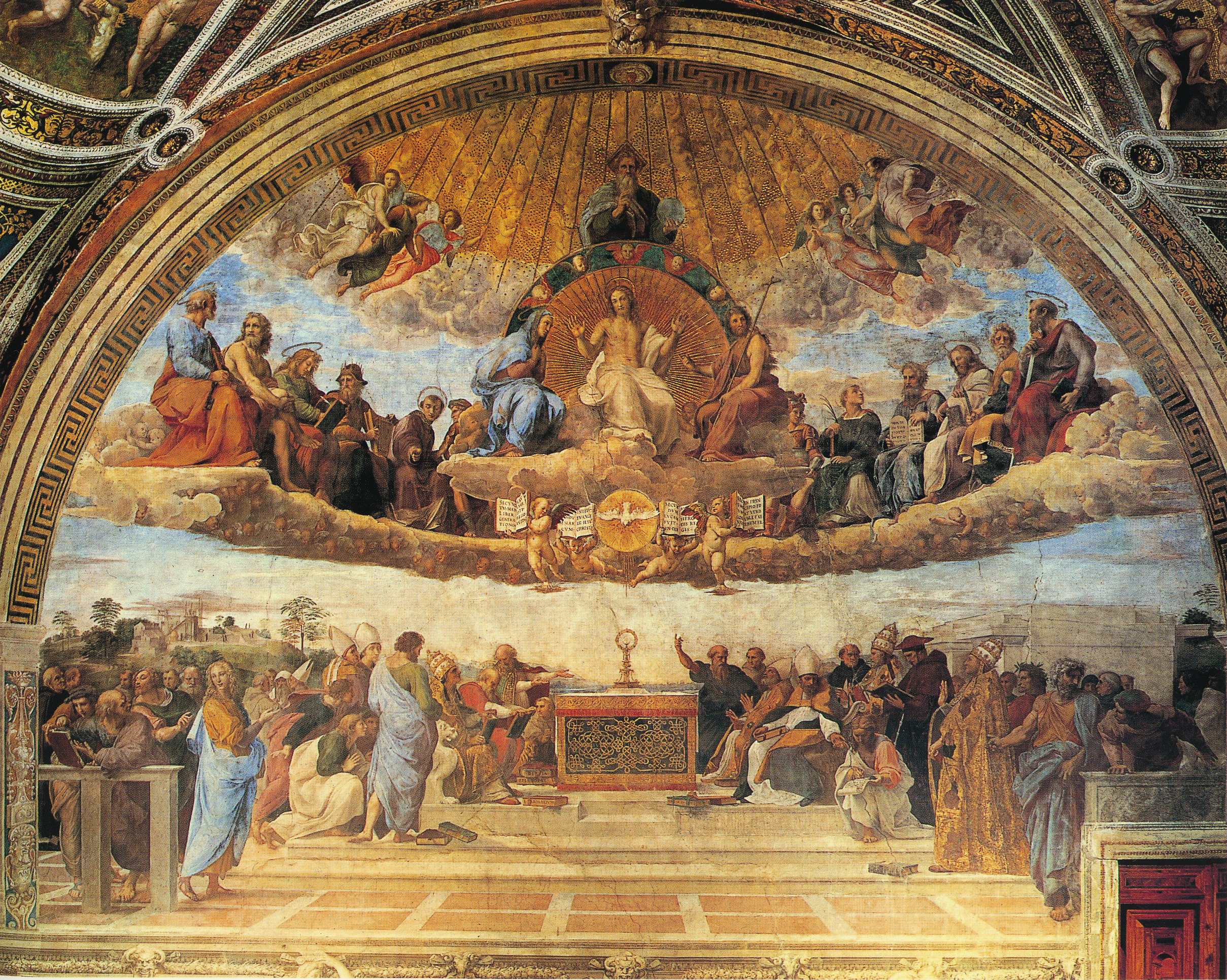
Raphael, The Disputation over the Sacrament (Disputa), 1509-10, fresco, 25’3” at base, Stanza della Segnatura, Vatican, Rome.
Raphael, The Disputation over the Sacrament (Disputa), 1509-10, fresco, 25’3” at base, Stanza della Segnatura, Vatican, Rome. DETAIL.

Raphael’s artwork has the effect of cinema in presenting nearly life-sized figures in space that, hoisted onto the wall like a massive theatre screen, fills the room’s field of vision. Further, as a modern-day film dispels incredulity to its medium and any message it conveys, absorbing the viewer, Raphael’s fresco makes intensely real the Catholic faith.  Angels in the vault accompany God the Father as a white-robed God the Son sits enthroned before a golden disc displaying his sacrificial wounds of the Cross. On each side sit the Virgin Mary and St. John the Baptist while on the raised tier sits figures from the Bible. The Holy Spirit descends in the form of a dove on the monstrance holding the Eucharist. Many preparatory drawings survive for this fresco. (Roger & Penny, pp.57-58)

Raphael, The School of Athens, 1510-11, Fresco, 25’3” at base, Stanza della Segnatura, Vatican, Rome.
Raphael, The School of Athens, 1510-11, Fresco, 25’3” at base, Stanza della Segnatura, Vatican, Rome. DETAIL.

Raphael creatively adapted figures or figural groupings from one fresco to another. Raphael also utilized Michaelangelo’s newly publicly accessible Sistine Chapel ceiling’s prophets and sibyls. Beyond Michaelangelo, Raphael was interested in foreshortening and also arranging numerous figures in a mathmatically constructed perspectival space. Compared to the architecture in his Spozalizio from 1504, Raphael’s architecture in The School of Athens is more massive and yet whose angular lines are softened by curvacious colossal statues in niches. One statue is Minerva above Jurisprudence while Apollo is on the left (and closest to the Parnassus fresco). The central figures below the arches, open sky behind them, are Plato with his Timaeus and Aristotle with his Ethics. Other recognizable figures include Socrates to the left of Plato and Pythagoras to the right of the door. Euclid bends down to use one of his compasses surrounded by students and disciples. (Roger & Penny p 74-78).
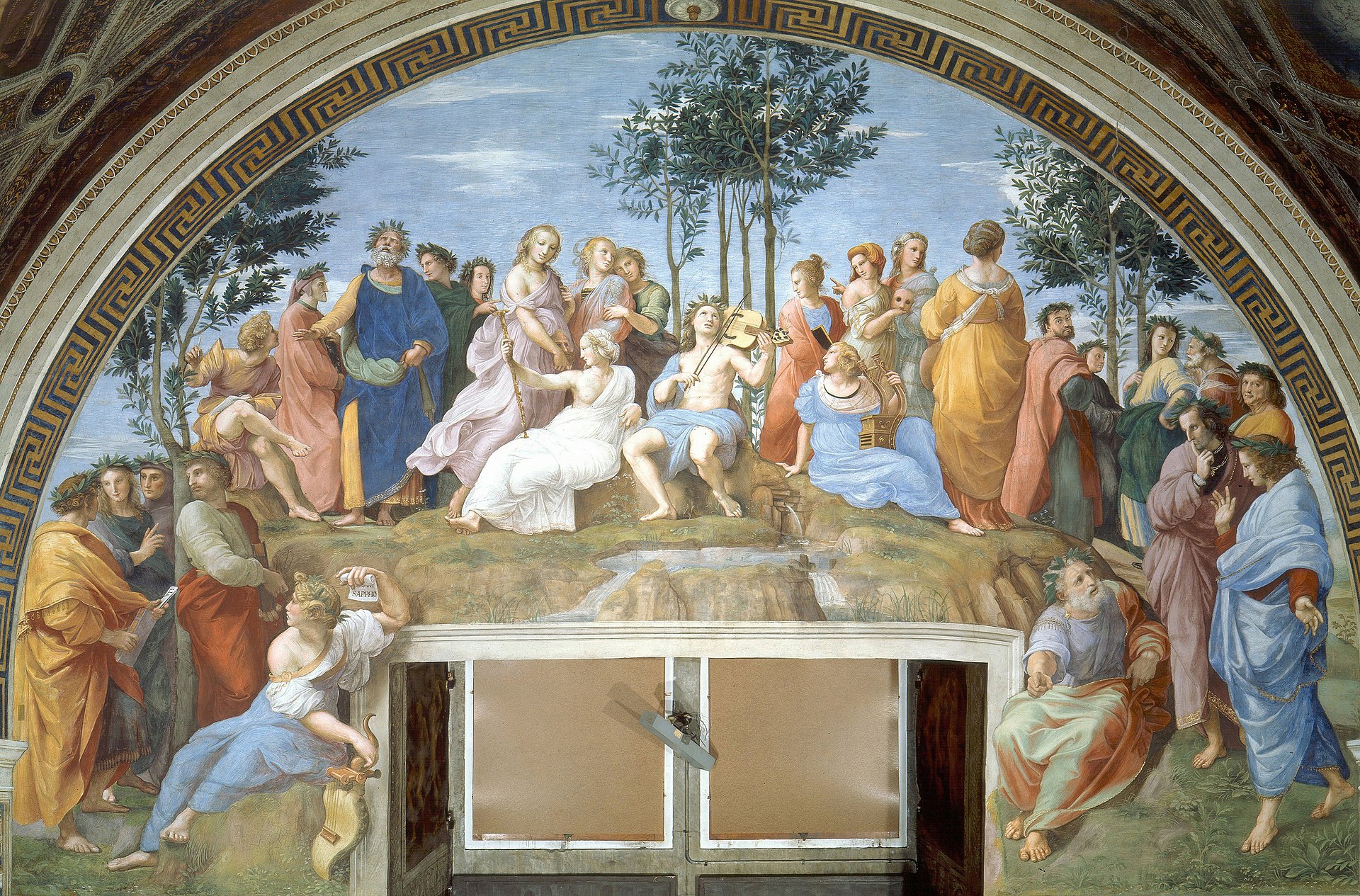
Raphael, Parnassus, c. 1511, fresco, 22’1 ½” at base. Stanza della Segnatura, Vatican, Rome.

Raphael painted a poet’s paradise where Apollo has the central place. The window which interupts the base of the artwork looked out onto a hill in Rome called Mons Vaticanus that was known since classical times as sacred to Apollo. This fact with the fresco’s other siting challenges (window glare) Raphael was well aware of. Apollo plays the fiddle surrounded by poets and gorgeous muses with a background of laurel trees. Mortals are below on either side of the window. (Roger & Penny, pp. 68-69)

https://www.nationalgallery.org.uk/paintings/raphael-the-garvagh-madonna – retrieved September 5, 2024.
Raphael’s ‘Garvagh Madonna’ with Matthias Wivel, Curator of 16th-century Italian Paintings.
Raphael, La Vierge nourrissant l’Enfant, assise dans un paysage : la Madone Sergardi n.d. LOUVRE https://collections.louvre.fr/en/ark:/53355/cl020101084 – retrieved September 4, 2024.
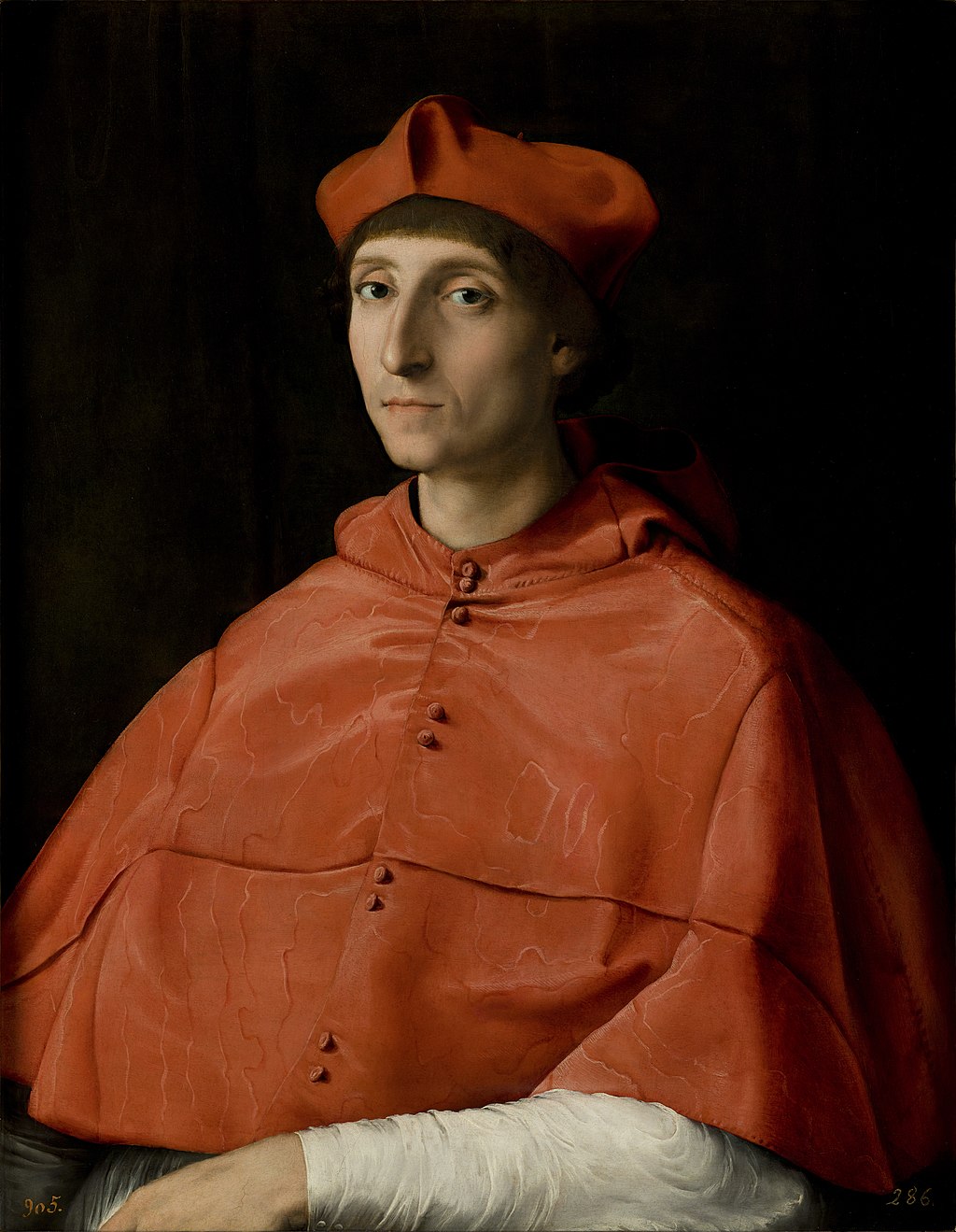
Raphael, Portrait of a Young Cardinal, 1510-11, oil on panel 31 1/8 x 24” The Prado, Madrid. https://www.museodelprado.es/en/the-collection/art-work/the-cardinal/4c01eae6-feed-4135-88d9-6736140212fb?searchid=0bd968eb-2e7e-d4a3-a6b4-874288991a63 -retrieved September 4, 2024

Raphael was working on the frescos in the Vatican Palace when he painted this oil on panel portrait of a “Young Cardinal.” The sitter is not known though it likely is Cardinal Francesco Alidosi (1455-1511). Cdl. Alidosi was an influential diplomat and military leader and a favorite of Julius II (1503-1513). The sitter’s expression and pose of a resting arm on the edge of the painting’s base and the slight turn of the body seems to owe much to Leonardo da Vinci. The body is monumental compared to a placid and yet almost inscrutable slightly smaller head whose depiction, while directly observed, is somewhat idealized. When Della Rovere was elected as Pope Julius II in 1503, Alidosi became his secretary and primary collaborator. He was appointed papal chamberlain and then treasurer. Though labeled “unholy” by Venetian cardinal Pietro Bembo (1470-1547), Cld. Alidosi helped guide the vocation of Bl. Elena Duglioli dall’ Olio (1472-1520), an Italian aristocrat, who wanted to be a Poor Clare nun but was forced to marry by her family and for whose endowed chapel in Bologna Raphael painted an altar-piece. In 1504 Alidosi became a bishop whose sees ranged up and down all Italy – of Mileto in 1504 and of Pavia in 1505. He occupied the seat of Pavia until he was murdered in broad daylight in 1511. There were accusations traded back and forth that Cdl. Alidosi was a traitor in a time when the French occupied parts of Italy among its warring Italian families and an independently powerful pope who acted to protect his favorite as long as possible. About Alidosi, one historian noted, ”A favorite has no friends” and there were many unconcerned witnesses to the brutal crime whose attack included blows that split open his head. (Beck, pp. 92-93; Herbert M. Vaughan, B.A., The Medici Popes (Leo X and Clement VII), Methuen & Co., London, 1910, p. 64-65; “Alidosi, Francesco, detto il Cardinal di Pavia”. Dizionario Biografico degli Italiani – Volume 2 (in Italian). Treccani. 1960.)

Raphael, The Alba Madonna, c. 1511, oil on canvas (transferred from panel), diameter 37 ¼” National Gallery of Art, Washington, D.C.

For all his grandiose commissions for the pope and others, Raphael continued to paint Madonnas as he had in the past in Umbria and Florence and with all the creativity and variation in his powers. The Alba Madonna is clearly a Virgin of humility as she sits on the ground. The woman wears a rose-pink dress under a topaz-blue robe and a finger holds a page in a book she rests on her lap as her hair is twisted away from her face. The woman takes up most of the composition as she welcomes John the Baptist who, according to Christian theology, by his works in the desert and at the River Jordan is the figure who prepares and presents the Christ Child to the people with flowers from the fold of his loin cloth. The trio gazes at the cross held by the Christ Child, the Lamb of God, who takes away the sins of the world by his sacrifice as a proper offering to God, his Father. The rounded features of the Madonna figure are in harmony with the circular panel on which the scene is painted. Behind the figures is a wide plain of grass that edges to a body of water painted light turquoise with mountains in the distance painted a deeper shade of blue beneath a blue sky. (Roger & Penny, p. 88.) https://www.nga.gov/collection/art-object-page.26.html – retrieved September 4, 2024.

Raphael, Galatea, c. 1512, fresco, 9’8 1/8” x 7’4”, Villa farnesina, Rome.

Raphael took a poem by Florentine poet Poliziano (1454-1494) for inspiration for this fresco. The poet gives a detailed description of the Palace of Venus. Galatea is described as riding on the sea in a chariot pulled by a pair of dolphins whose reins she holds. Around her is her entourage playing amorously in the sea. In 2007, the bodies of Poliziano and philosopher Giovanni Pico della Mirandola (1463-1464) were exhumed from Florence’s Church of San Marco to determine the causes of their deaths. Forensic tests showed that both men of letters likely were poisoned but how and by whom are only speculation. (see – http://news.bbc.co.uk/2/hi/europe/6920443.stm – retrieved September 7, 2024). (Roger & Penny, p. 93).
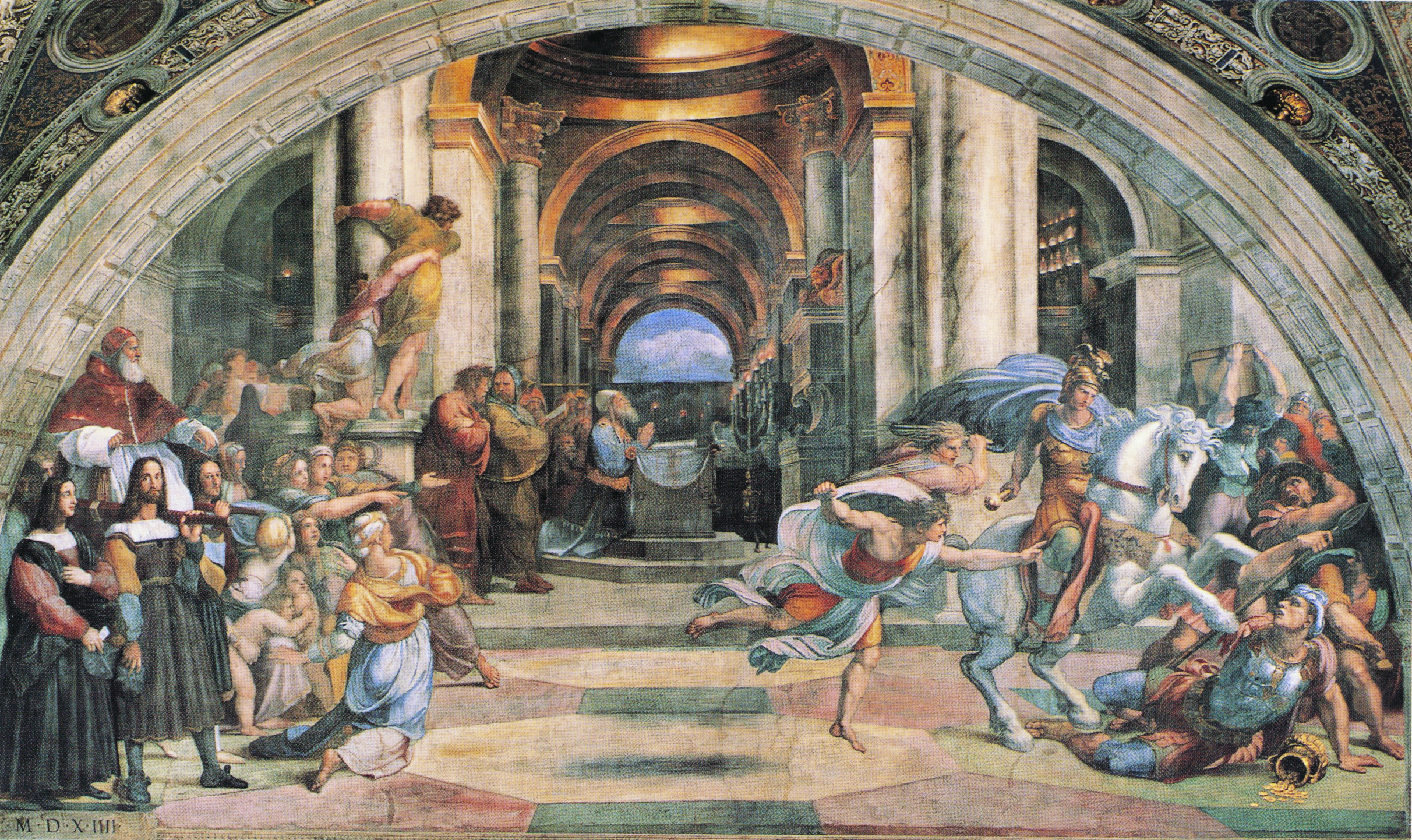
Raphael, The Expulsion of Heliodoris From the Temple, 1512-13, Fresco, 24’7” at base. Stanza D’Eliodoro, Vatican, Rome.

The Stanza D’Eliodoro served as a Vatican audience chamber for the Pope. Each fresco depicts a story of divine intervention and the Pope felt impelled to record them like a civic authority would record an important battle scene in the town hall. The Pope had control over the message and even had himself inserted into these works and one of the best portraits of the pope by Raphael.5 Vasari believed that in the Expulsion of Heliodorus the message was clear: it was the Pope chasing avarice out of the church. Still others, more realistic perhaps, believed the theme to be the defense of the Church’s right to worldly possessions.6 While Julius II kept the treasury full and spent lavishly on public works, he also formally condemned his predecessor’s self-enrichment as well as the Church practice of buying and selling its offices. Others impute Pope Julius II making a parallel between Heliodorus’ expulsion and the Pope’s battle to expel rebellious cardinals who supported the French king against Rome.7 The first fresco painted in the Stanza D’Eliodoro and the one the room is named for is also, in my opinion, the finest: The Expulsion of Heliodorus. Heinrich Wölfflin in his book Classic Art provides the most satisfying brief account of this fresco, although there are other observers who offer insight and detail. The painting is based on an account found in 2 Maccabees, a book that treats of the events in Jewish history from the time of the high priest Onias III and King Seleucus IV to the defeat of Nicanor’s army (around 170 B.C). The biblical account of Heliodorus’ attempt to profane the Temple is a rich one and, in terms of the painting’s iconography, can be synopsized as such:

                  “There was great distress throughout the city. Priests prostrated themselves in their priestly robes before the altar, and loudly begged him in heaven…to keep the deposits safe for those who had made them…(T)he changed color of the (high priest’s) face manifested the anguish of his soul. The terror and bodily trembling that had come over the man clearly showed…People rushed out…in crowds to make public supplication because the Place was in danger of being profaned…Women, girded…filled the streets…While they were imploring the almighty Lord to keep the deposits safe and secure… Heliodorus went on with his plan. But just as he was approaching the treasury with his bodyguards, the Lord of spirits… (struck). There appeared to them a richly caparisoned horse, mounted by a dreadful rider. Charging furiously the horse attacked Heliodorus with his front hoofs…Then two other young men, remarkably strong…beautiful…splendidly attired, appeared…they flogged (Heliodorus) unceasingly…Suddenly, he fell to the ground enveloped in a great darkness…The man who a moment ago had entered that treasury with a great retinue and his whole bodyguard was carried away helpless…” (2 Maccabees, Chapter 3:14-28)

Raphael followed the biblical text closely. He depicts the three major parties in the religious story: the divine rider, two youths and Heliodorus; the figure of the anguished priest; and the “girded” women.  As he does in The Deliverance of Saint Peter, the Pope identifies with one of the major priestly characters in the art work if one detects, as some scholars do, the features of Julius II in the High Priest Onias III.8 The Stanza D’Eliodoro and its first fresco The Explusion of Heliodorus is a milestone for its scale, its composition, its form, its treatment of subject, its color, its narrative power, and its graceful draughtmanship.
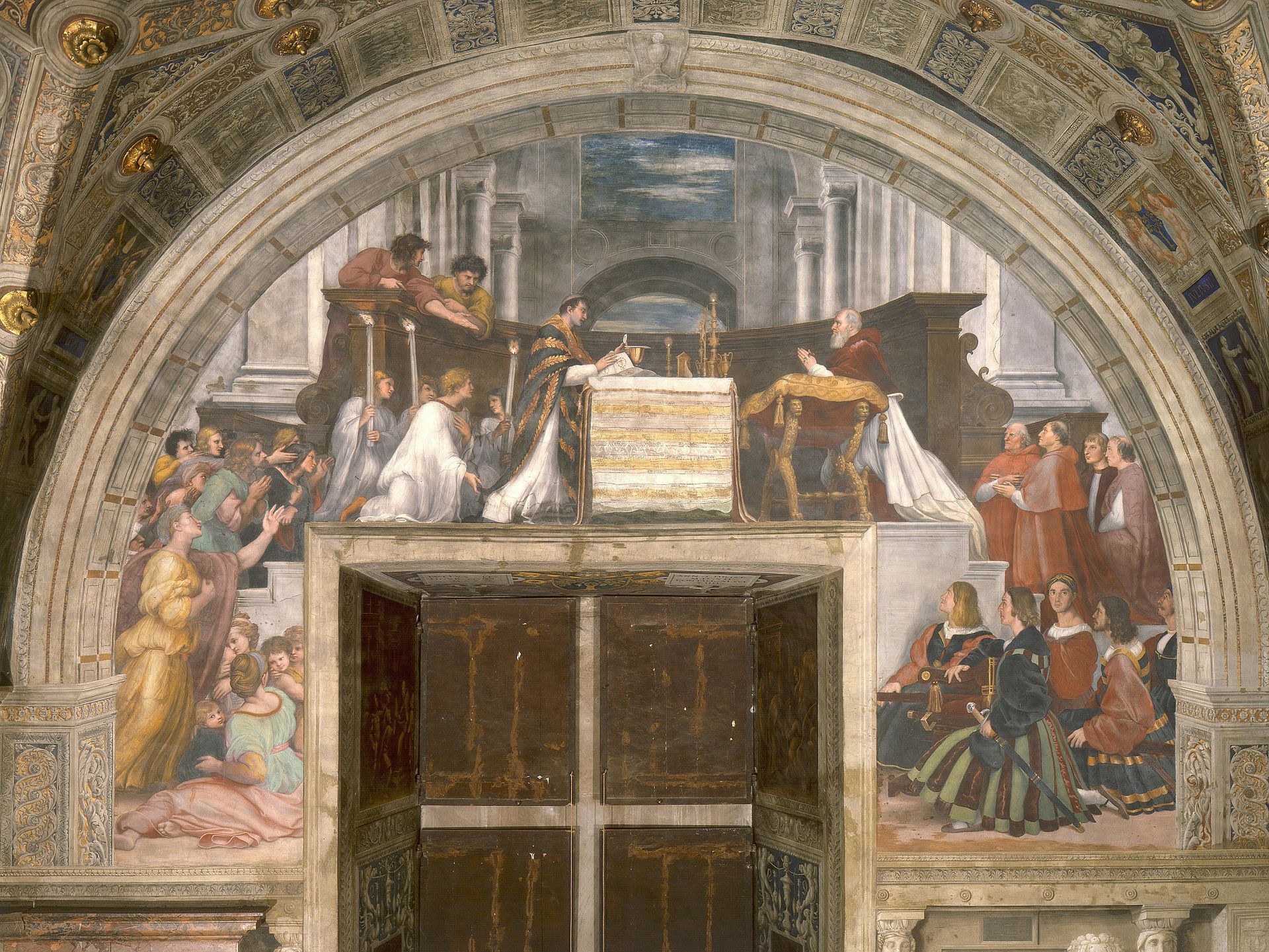
Raphael, The Mass of Bolsena, c. 1512 Fresco 21’8” Stanza d’Eliodoro, Vatican, Rome.

The fresco depicts a 13th century miracle connected to the Eucharist when a traveling priest, doubting the Real Presence of Jesus in the consecrated host, is given proof of its reality when the altar cloth he uses for Mass becomes stained with blood from the Host. The cloth relic was revered by Julius II and housed in Orvieto Cathedral where it is today. From its inception, the five handsome youths in the bottom right section of the fresco have been admired for their sturdy monumentality perhaps influenced by Michelangelo as well as its colors and costumes showing Venetian influence. (Beck, pp. 100-101).

Raphael, The Mass of Bolsena, c. 1512 Fresco 21’8” Stanza d’Eliodoro, Vatican, Rome. DETAIL.
Raphael, The Mass of Bolsena, c. 1512 Fresco 21’8” Stanza d’Eliodoro, Vatican, Rome DETAIL.

Giuliano della Rovere (1443-1513) was described by Machiavelli in his works as an ideal prince. Becoming pope in 1503, he took the name Julius II in honor of Julius Caesar and was nicknamed the Warrior Pope. In 1506 Julius II organized the famous Swiss Guard for his personal protection and established the Vatican Museums. He was also the pope who instigated the rebuilding of St. Peter’s Basilica that exists today. The pope increased the power of the Papal States and, in 1508, he commissioned the Raphael Rooms and Michelangelo’s paintings in the Sistine Chapel. It was Julius II who also established the first bishoprics in the New World. Although the Tomb of Pope Julius II with its famous sculpture of Moses by Michelangelo is in San Pietro in Vincoli in Rome, the ensemble, extensively abbreviated than originally planned, was not finished until 1545, long after Julius II’s death in 1520. In fact, Julius II is buried in St. Peter’s Basilica.
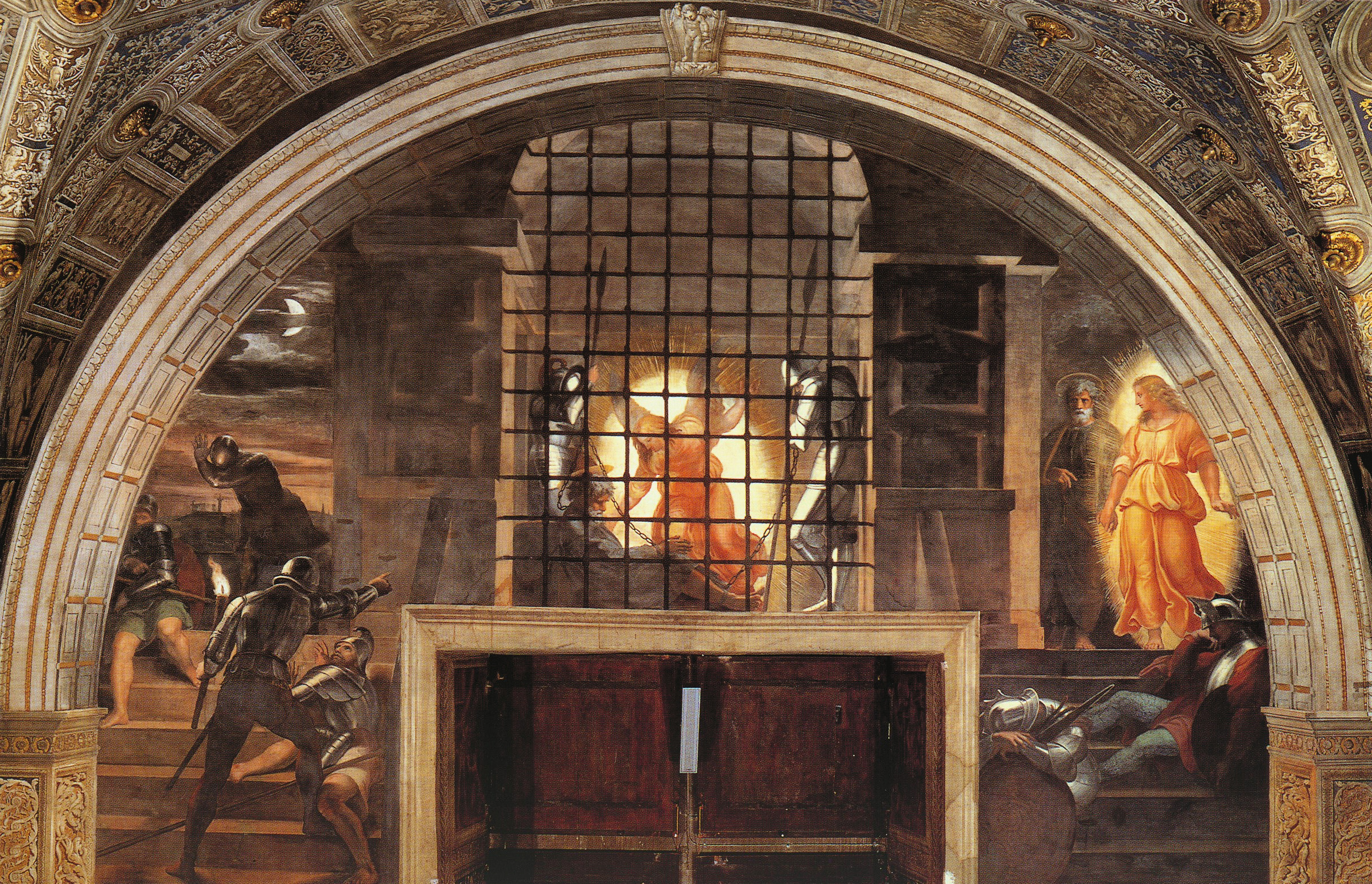
Raphael, The Liberation of Saint Peter From Prison, 1512-13, Fresco, 22’8” at base. Stanza d’Eliodoro, Vatican, Rome.

San Pietro in Vincoli in Rome (“St. Peter in Chains”) was Julius II’s titular church when he was a cardinal before becoming pope. It was also his uncle’s church before him, pope Sixtus IV (1471-1484). When pope, Julius II made pilgrimage to the church in 1512 after the French evacuated from Italy. The liberation in the title of Raphael’s concurrent fresco probably refers to that of the Papal States with St. Peter taking on the physical characteristics of Julius II. The fresco was being painted during the year when the pope was dying which took place in February 1513. Raphael’s use of light in this fresco is probably the boldest in art taking place at night in the whole of Renaissance art. (Beck, pp. 102-3).
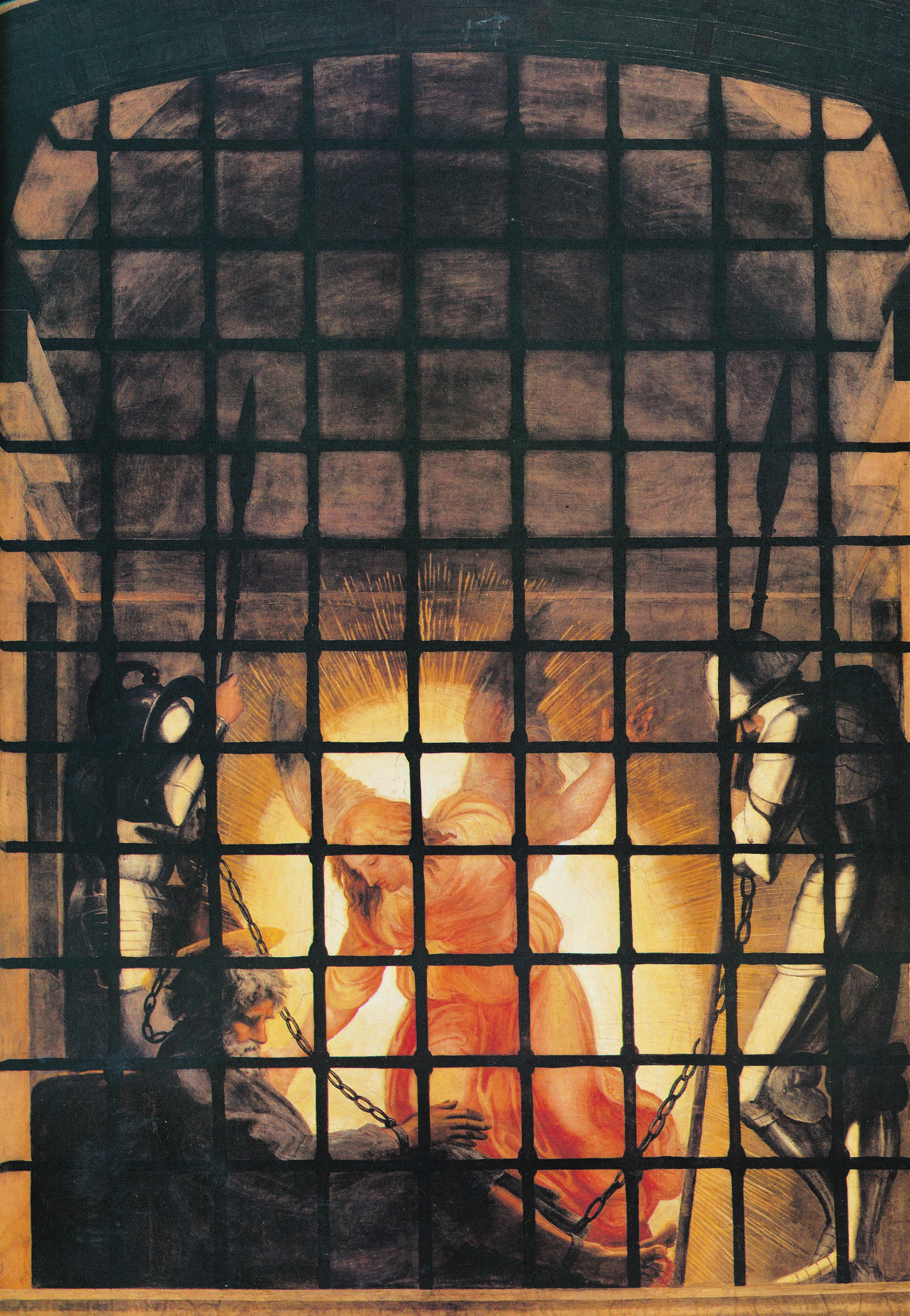
Raphael, The Liberation of Saint Peter From Prison, 1512-13, Fresco, 22’8” at base. Stanza d’Eliodoro, Vatican, Rome.
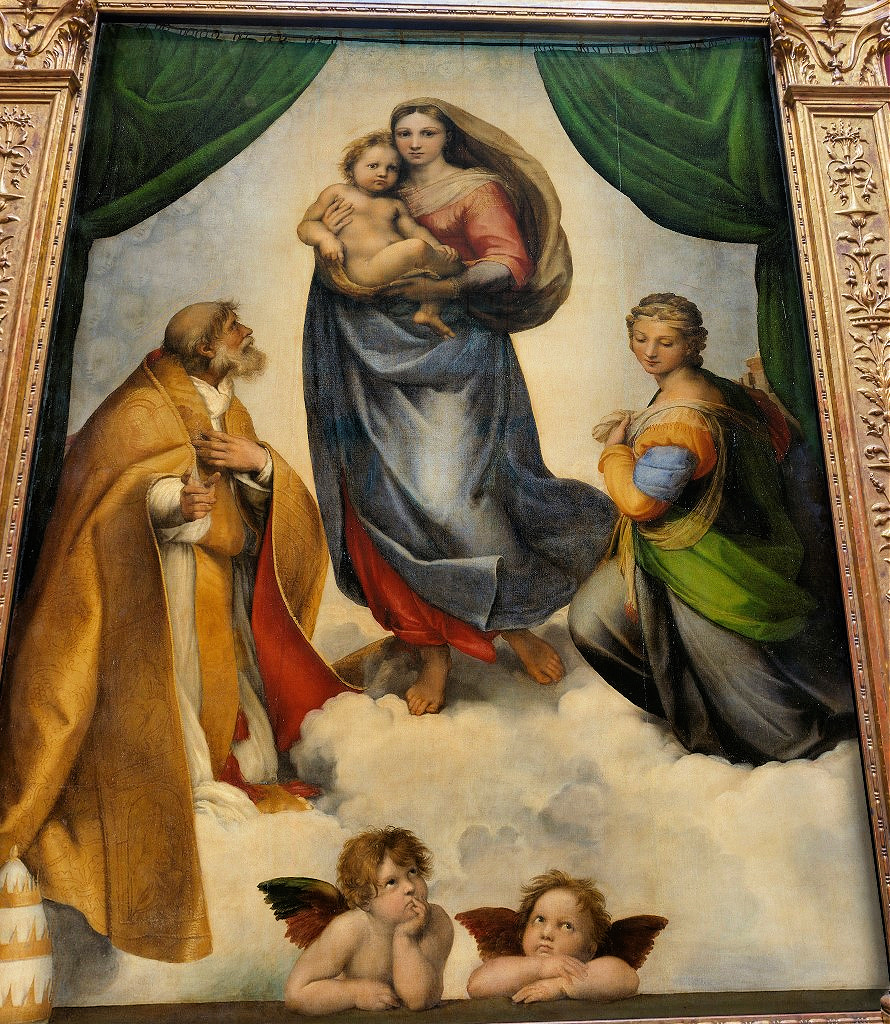
Raphael, The Sistine Madonna, 1512-13, oil on canvas, 8’8” x 6’5” Gemäldegalerie Alte Meister Staatliche Kunstsammlungen, Dresden.

Raphael’s painting was made for the high altar of a newly rebuilt church of Pope St. Sixtus (d. 257) in Piacenza, Italy. St. Sixtus kneels on a cloud before the Virgin and Christ Child with a hand over his heart. The saint is interceding for the worshippers of Piacenza to whom he gestures outward with his other hand. Opposite is St. Barbara, patron of soldiers, with the symbol of a tower behind her. (Roger & Penny p. 128)

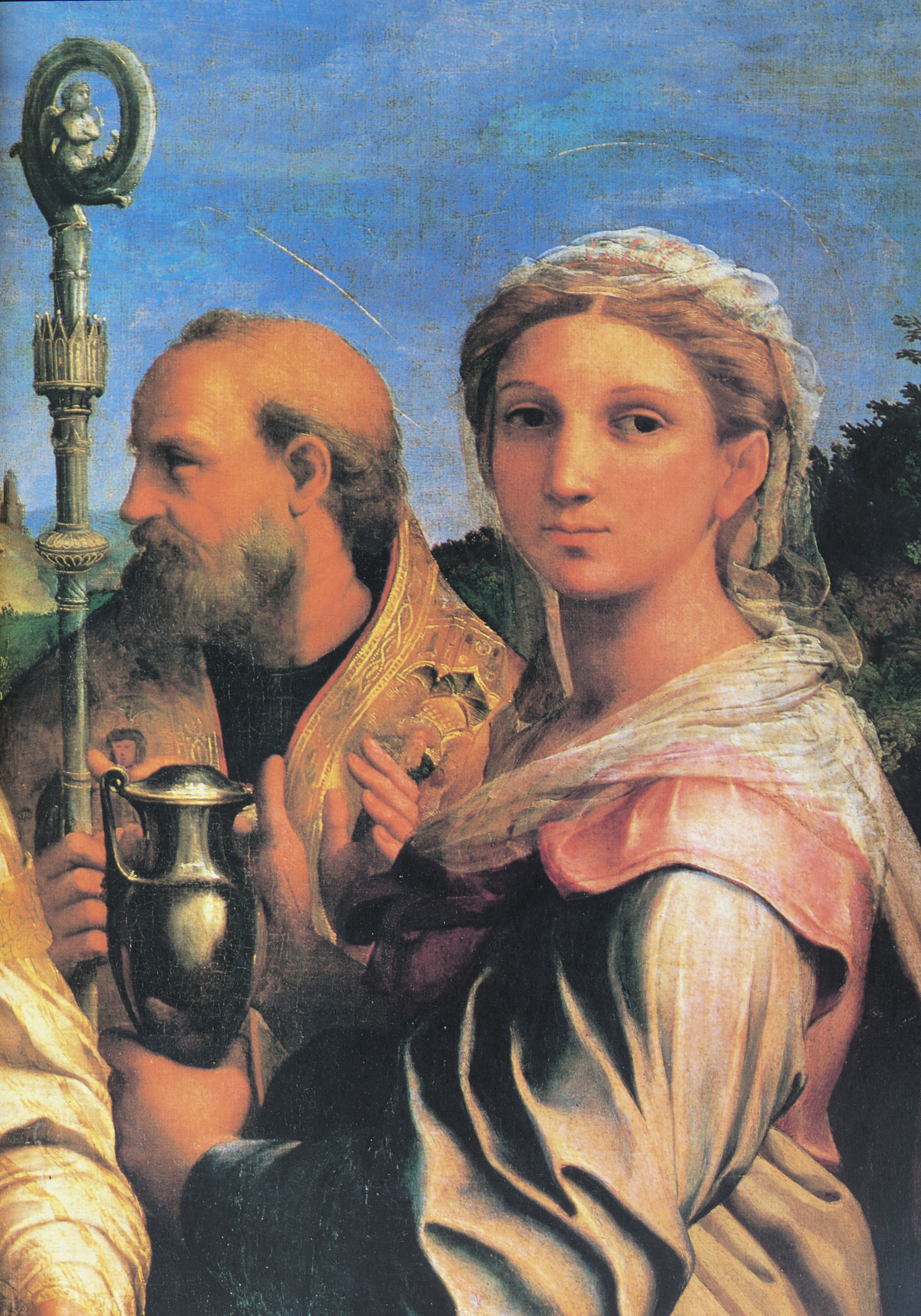
Raphael, The S. Cecilia Altarpiece, 1513-14, oil on canvas, 86 ½ x 53 ½” The National Gallery of Bologna (Pinacoteca Nazionale di Bologna).
Raphael, The S. Cecilia Altarpiece, 1513-14, oil on canvas, 86 ½ x 53 ½” The National Gallery of Bologna (Pinacoteca Nazionale di Bologna). DETAIL.

The painting also includes Sts. Paul, John the Evangelist, Augustine and Mary Magdalene. It was an altarpiece for a chapel in S. Giovanni in Monte in Bologna founded by Elena Duglioli dall’ Olio (1472-1520). The Italian aristocrat wanted to become a Poor Clare nun but was forced to marry by her family. She persuaded her husband, however, not to consummate the marrage attributed to her devotion to St. John (patron of virginity) and St. Cecilia and of which Raphael was commissioned to execute the altarpiece. Elena’s benefactor in this enterprise of her religious vocation was the influential Cardinal Alidosi. Raphael depicts St. Cecilia with an organetto slipping from her hands as she looks skyward to the preferred sound of heavenly music. Elena died on September 23, 1520 and her remains are incorrupt in her church of San Giovanni in Monte. In 1828 she was beatified by Pope Leo XII (1760-1829). Her feast day is September 23. (Roger & Penny, pp. 144-146).

On St. Augustine of Hippo (354-430):

The phrase “When in Rome, do as the Romans do” is credited to St. Ambrose, bishop of Milan, from the 4th century. Their bishop said it to Saint Monica and her son, St. Augustine, on their visit to Rome after they discovered that Saturday was a seasonal “Ember” day of abstinence and prayer which was not the practice in Milan. Saint Ambrose’s answer was to be adaptable, thus: “When in Rome,…” After St. Augustine (354-430) and his successor Boethius (c. 470-c. 525) Europe entered the Dark Ages. There was no really important thinker until the 11th century. Even in 2025 It is said that after St. Paul, there is no greater legacy of Christian thought than that of St. Augustine of Hippo. Augustine died a new man on August 28, 430, a bishop by then himself, as he witnessed his city of Hippo succumb to hordes of invading Vandals as Rome fell. It was all over by the 7th century as the cities were a wasteland and any learning moved to monasteries. One leading aspect of learning was theology and philosophy – grappling with the problems of God’s existence and who He is in relation to man. Before Christianity, Augustine tried Manicheism that explained the world in purely rational and material terms. Finding it unsatisfactory he turned to Skepticism – an old idea in popular practice in the 21st century – which distrusted or denied objective truth for subjective conviction. Finally, Neoplatonism, which had a spiritual bent but, unlike Christianity, had no Supreme Creator and saw the material world as a block to spirituality’s end. Christianity had its philosophical problems also for Augustine and others: while creation was a matter of God’s will for his creature of actual being, where and how did God and man meet? Philosophically, this relationship of Creator and creature remained the central issue for Augustine before and after his becoming a Christian at 32 years old. His battles with the Berber schism of Donatists (who denied the objective value of the sacraments) and Pelagianism (Pelagius being an Irishman who denied original sin and man’s need for grace) led to Augustine’s Doctrine of Creation and Doctrine of Grace for which he is well-known. While fallen man is limited and cannot know God, the desire to know God is itself a sign of grace on a natural level. Augustine asserts one can know God only by faith and, though he offers no formal proof for the existence of God, Augustine reasoned that before one desires or seeks to know anything one must have some idea or believes in its existence. In his battle with Pelagius Augustine determined man needed grace from the beginning – even in the Garden of Eden before the fall. Grace is what led Adam and Eve to God. After the Fall (The LORD God then called to the man and asked him: Where are you? [Adam] answered, “I heard you in the garden; but I was afraid, because I was naked, so I hid.” Genesis 3: 9-10), grace is what heals man. Without grace man’s fallen nature cannot allow his free will to overcome his limitations. Grace is a way to freedom for man to give effect to his desires for good. From here Augustinianism moved beyond these things to self-knowledge and Universals; the Nature of God and the Trinity; Sin; and political philosophy (“City of God”), among other topics. One important characteristic of Augustine as bishop was his living a common “monastic” life with his clergy. Augustine believed strongly in the formation of religious communities for spiritual witness and support and material well-being among Christians.

Augustine was born in Algeria in North Africa. He was likely a Berber and grew up in a family where his mother, Monica, was a Christian and his father, Patricius, was a pagan. His father died in 371 after becoming a Christian and Monica did not remarry. St. Monica prayed for her pagan son to become a Christian and is the human being considered most responsible for that result. Augustine who loved the Latin-language Roman poet Virgil (he was less fond of Greek) followed a normal course of study for students at the time and was trained in rhetoric at Carthage. He lived with a woman for a time and had a son by her named Adeodatus with whom he had a lifelong fatherly relationship. Augustine in these early years was a Manichaean, a former major world religion that disappeared in Europe by the 6th century. To explain evil the Manicheans taught a dualistic cosmology where the spiritual world was good and the material world, uncreated by their concept of God, was bad. These beliefs made life in the world a prison to be escaped from by asceticism and intellectuality. It was directly contrary to Christianity which believed God, who created the material world, became flesh and blood man in Jesus Christ. The Manicheans rejected the Bible and taught that Christ could only be a spiritual being and not human. By the time Augustine traveled to Rome and then to Milan to teach rhetoric in 384, he gave up Manicheanism and entered a difficult period of searching. In Milan he met its great bishop St. Ambrose whose sermons showed him the unity of faith and reason in Christian teaching and an escape from skepticism as well as categorically rigid spiritualism and materialism. Augustine was baptized by St. Ambrose at 32 years old at the Easter Vigil, on April 24, 387 in Milan where he was joined by his son Adeodatus and his lifelong friend (and later bishop) Alypius of Thagaste who were also baptized. Though Augustine’s conversion was delayed when it occurred it was complete and complex insofar as integrating his many background experiences with Christianity. Augustine left teaching and went to Cassiciacum near Milan to become a writer. Adeodatus died prematurely in 390, and when Augustine returned to Africa, he was persuaded by Bishop Valerius of Hippo to become a priest. In 395 Augustine became auxiliary bishop to Valerius and soon succeeded him as bishop of Hippo. Augustine spent the next 35 years as a diocesan bishop and prolific and influential writer. He died in 430 in trying times: the Vandals had begun the destruction of the Roman Empire and invaded Africa in 429 including the sacking of Hippo. Taking it forward almost 1600 years, when Chicago-born Robert Prevost was elected as Pope Leo XIV in 2025, in addition to being a White Sox fan, he is an Augustinian friar, priest, bishop, and cardinal who takes inspiration from St. Augustine of Hippo, Leo XIV is the first Augustinian pope since Pope Eugene IV elected in 1431. see- https://dacb.org/stories/tunisia/adeodatus/ – retrieved August 28, 2025. The Saints: A Concise Biographical Dictionary, edited by John Coulson, Guild Press, New York, 1957. Medieval Thought, Gordon Leff, Humanities Press, Highland, New Jersey, 1958.

Santi, Raffaello, dit Raphaël Rencontre entre Léon Ier et Attila 1512/1513 LOUVRE https://collections.louvre.fr/en/ark:/53355/cl020101100 – retrieved September 4, 2024.
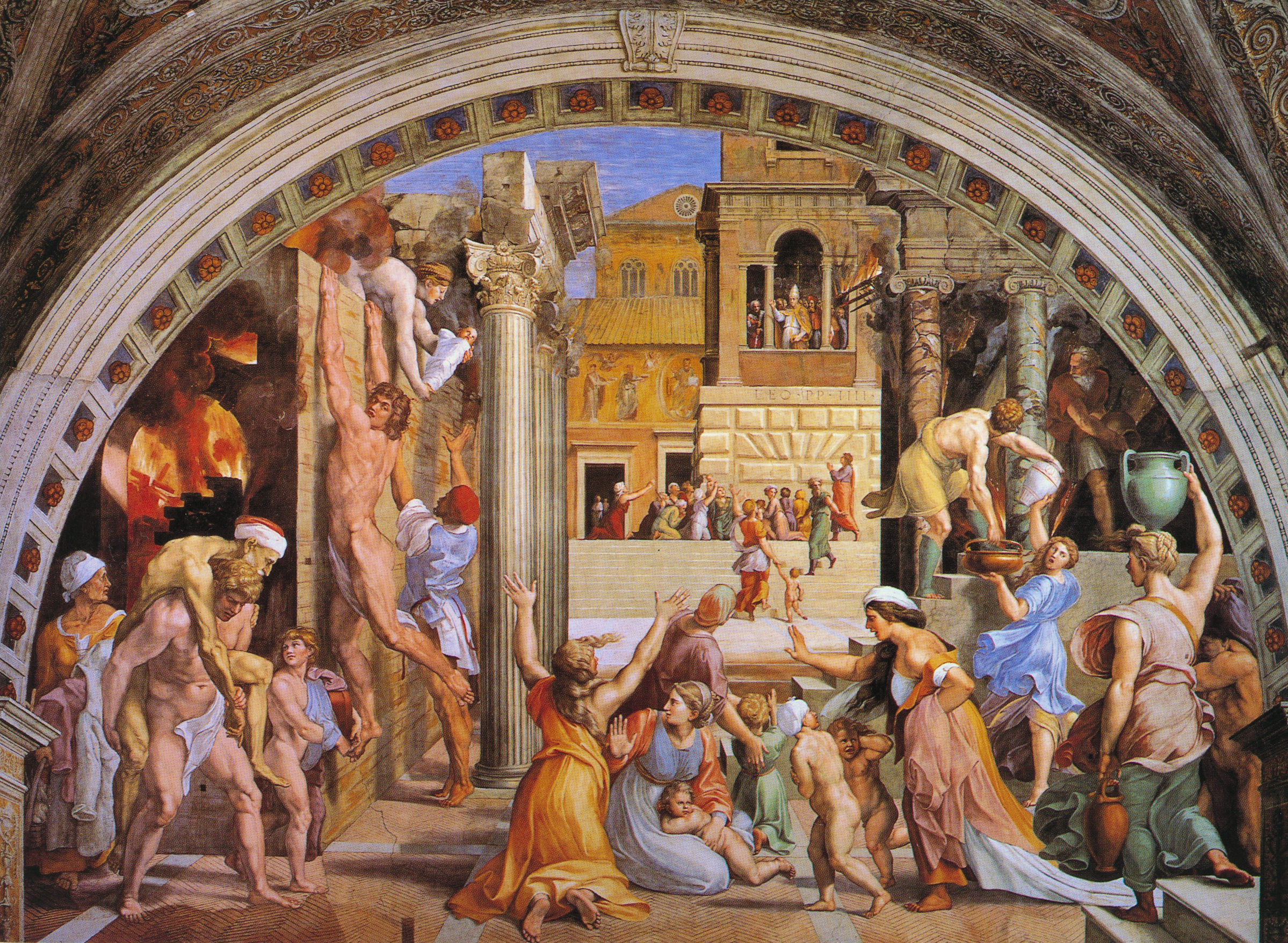
Raphael, the Fire in the Borgo, 1514-15, fresco, 22’1″ at base, Stanza dell’ Incendio, Vatican, Rome.

The name of the room comes from this fresco which Raphael began work on in the summer of 1514. It depicts a newly imagined historical event from the mid-9th century when a fire broke out in Rome. The pope (Leo IV) is seen giving a blessing from the balcony of Old St. Peter’s which, the story goes, tamped down the flames. In the meantime Raphael depicted the event’s panic and drama among its foreground figures in its throes. Once more Raphael is re-inventing his art from only a couple of years earlier. As Raphael continued the practice of borrow ing certain figures and themes from previous frescos, the overall classical style of the Segnatura and Eliodoro frescos are remarkably more spatially complex and intriguing in The Fire in the Borgo. Raphael absorbed what Rome offered – from Michelangelo’s latest art to architecture, both contemporary and ancient, in the city. The Ionic columns of Old St. Peter’s are accurately rendered as are the building fragment of Corinthian columns. (Beck, p. 110).

Raphael, the Fire in the Borgo, 1514-15, fresco, 22’1″ at base, Stanza dell’ Incendio, Vatican, Rome. DETAIL.
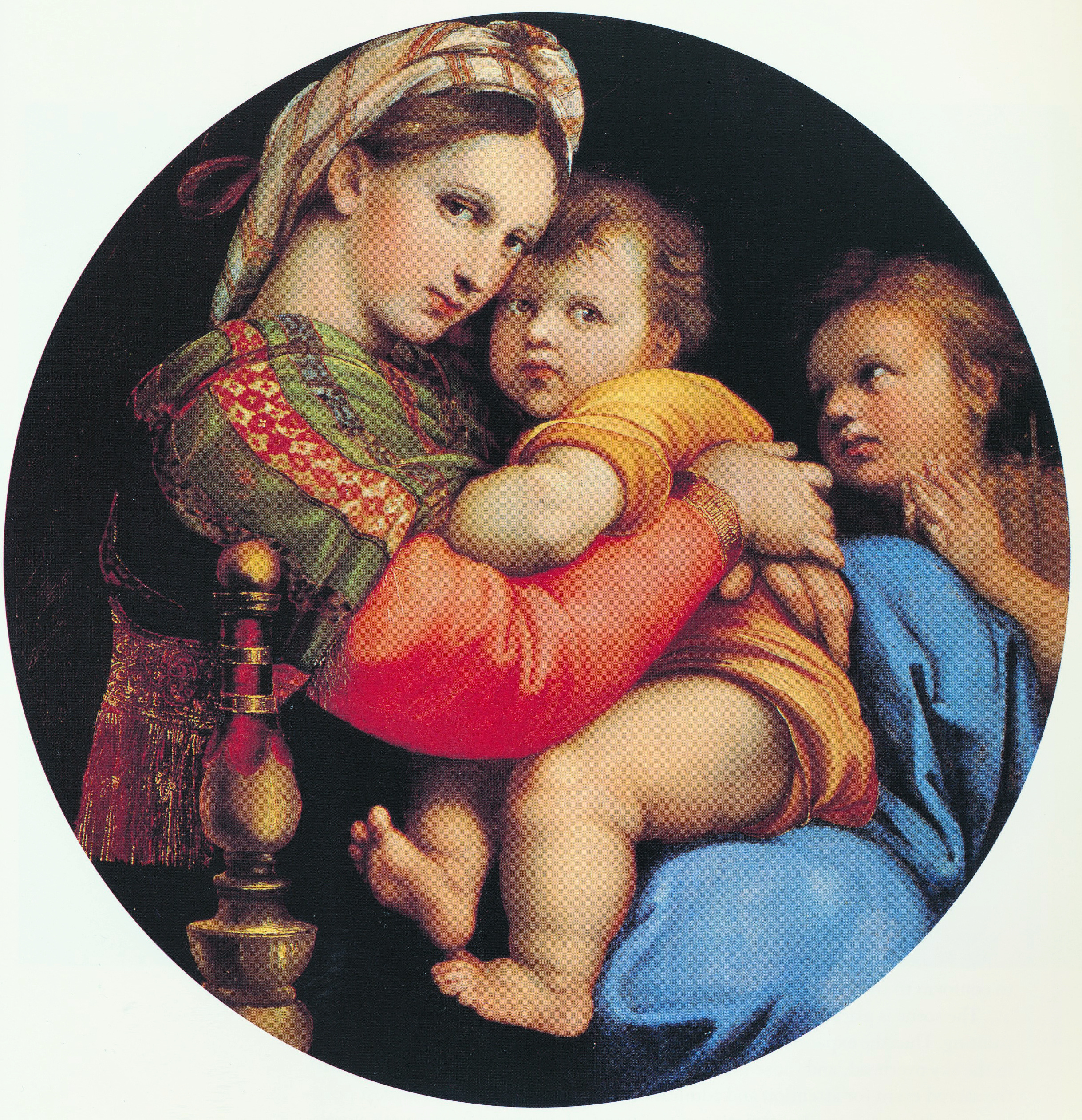
Raphael, Madonna della Sedia (The Madonna of the Chair), 1514-15, Oil on Panel, diameter 28” Pitti Gallery, Florence.
Raphael, Portrait of a Nude woman (“Fornarina”), oil on panel, c. 1518, 85 x 80cm, galleria Nazionale ( Palazzo  Barberini), Rome.
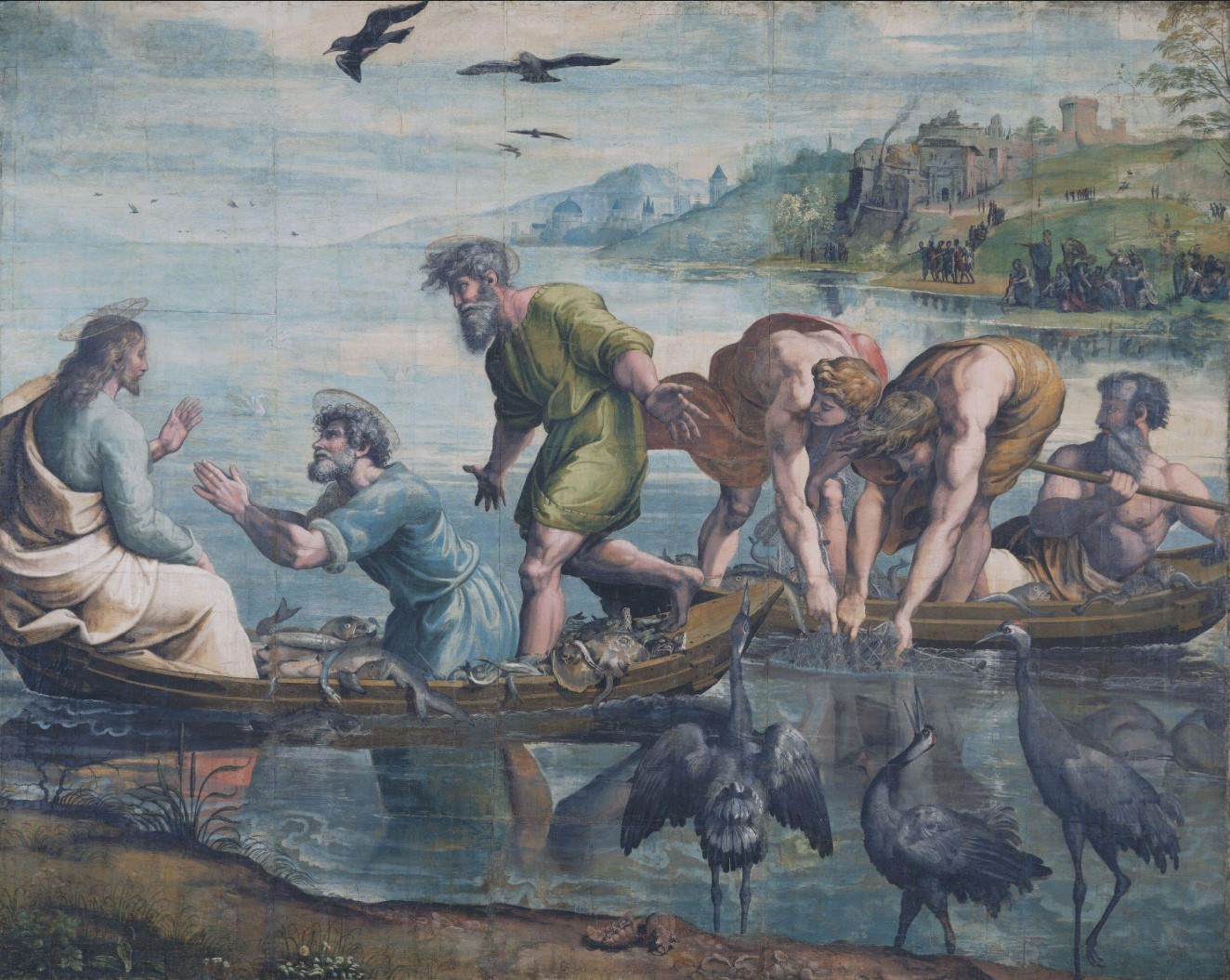
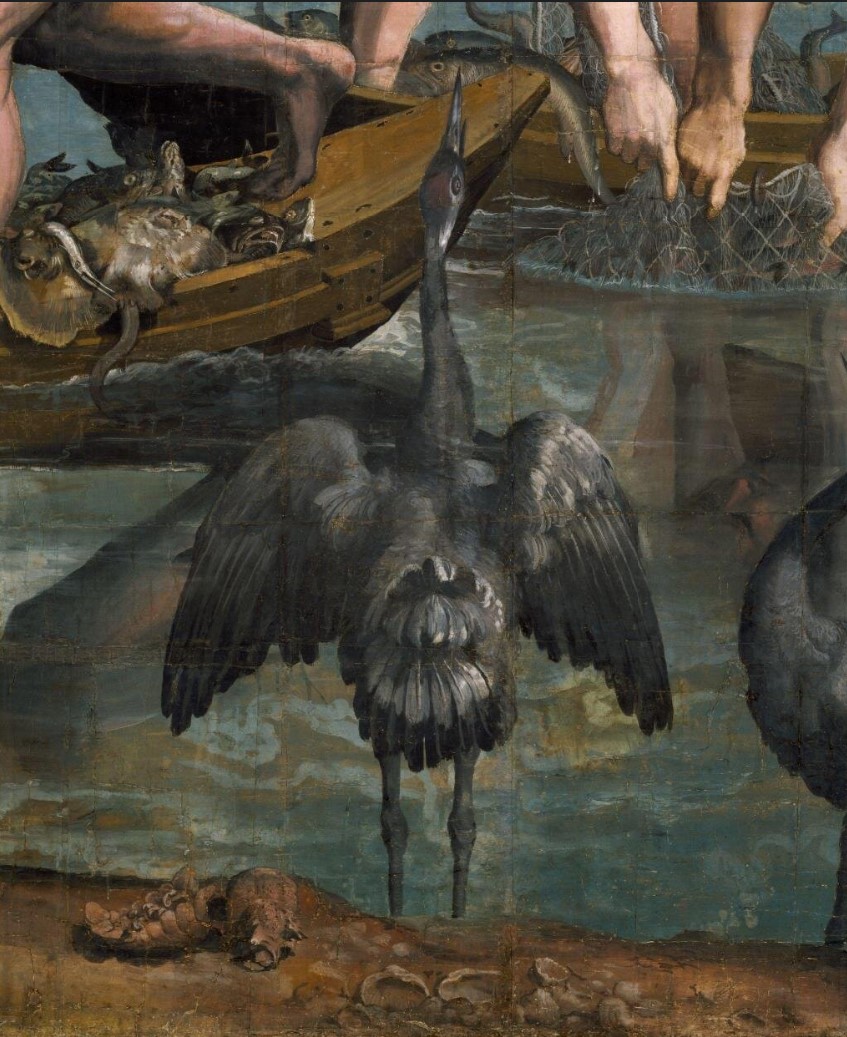
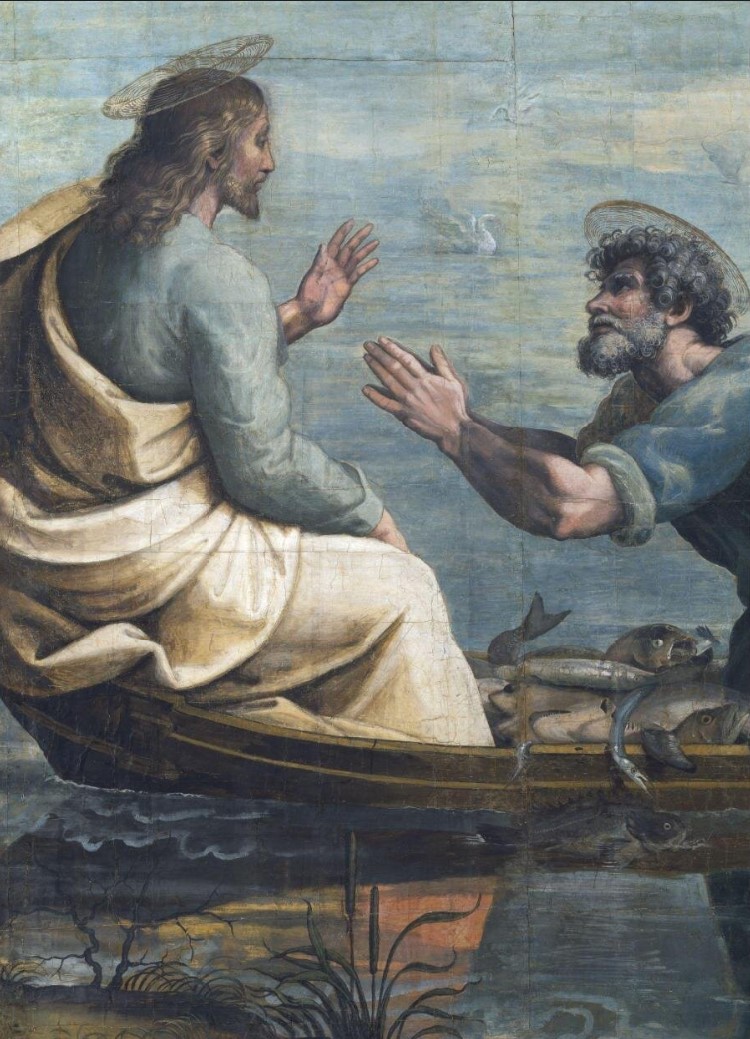
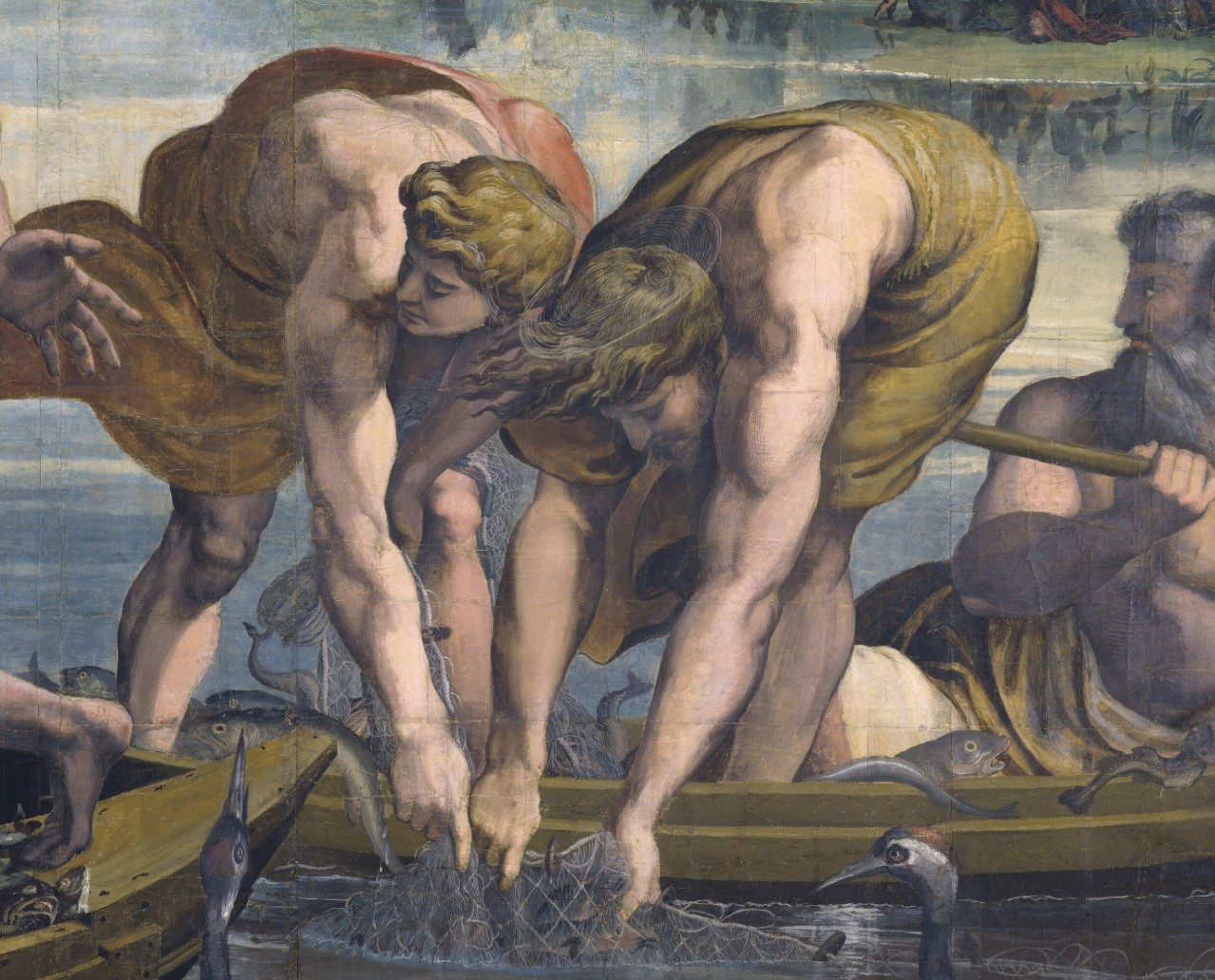
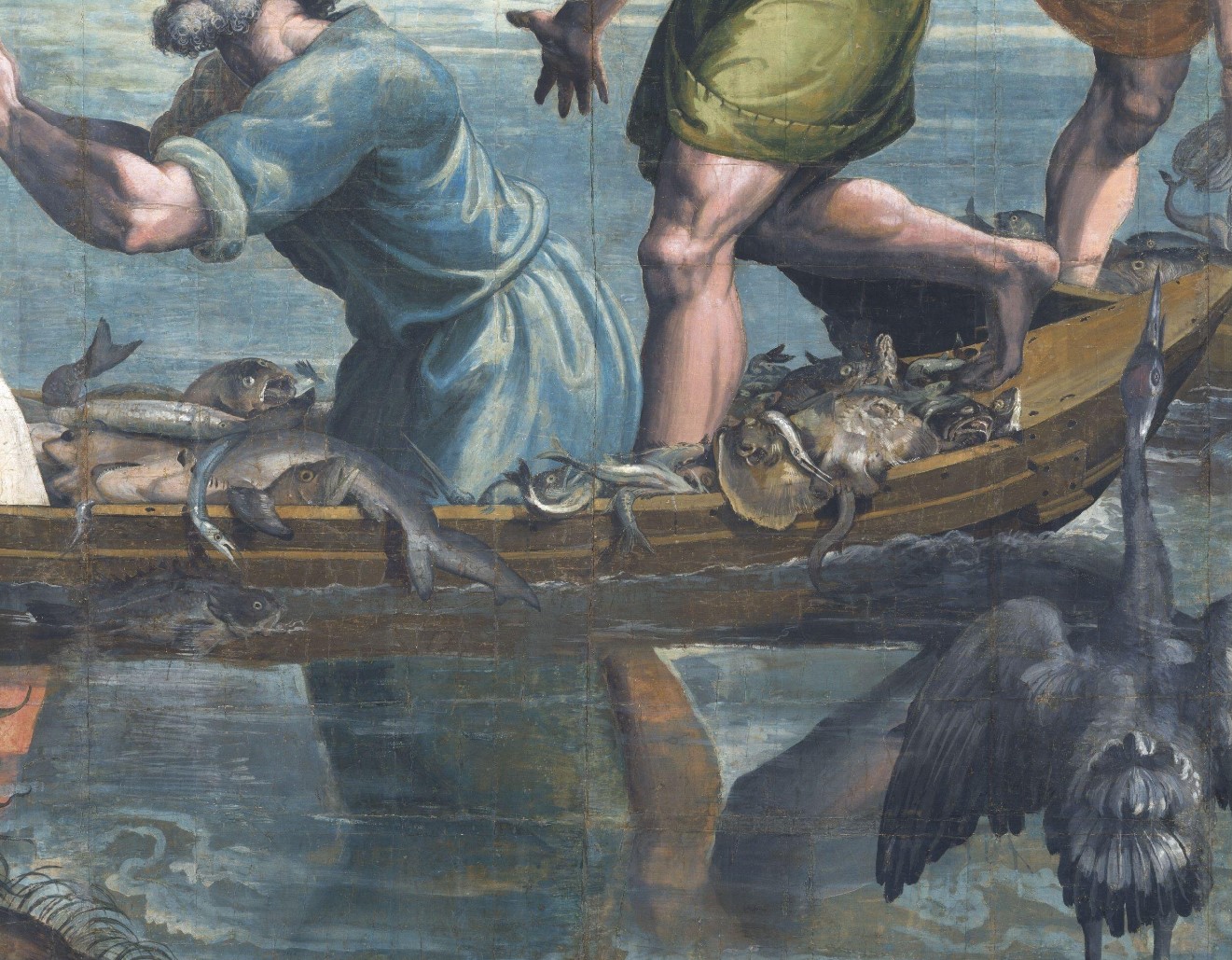
Raphael, The Miraculous Draught of Fishes (Luke 5: 1-11), 1514-15, Tempera on paper, 11’10” x 13’2” Victoria and Albert Museum, London


The Raphael Cartoons are designs for tapestries and were commissioned from Raphael by Pope Leo X (1513-21) shortly after his election in 1513. The tapestries were intended to hang in the Sistine Chapel in Rome, built by Pope Sixtus IV (1471-84). The decoration of the chapel under Sixtus addressed the lives of Moses and Christ. The tapestries continued this theme, illustrating scenes from the lives of St. Peter and St. Paul.
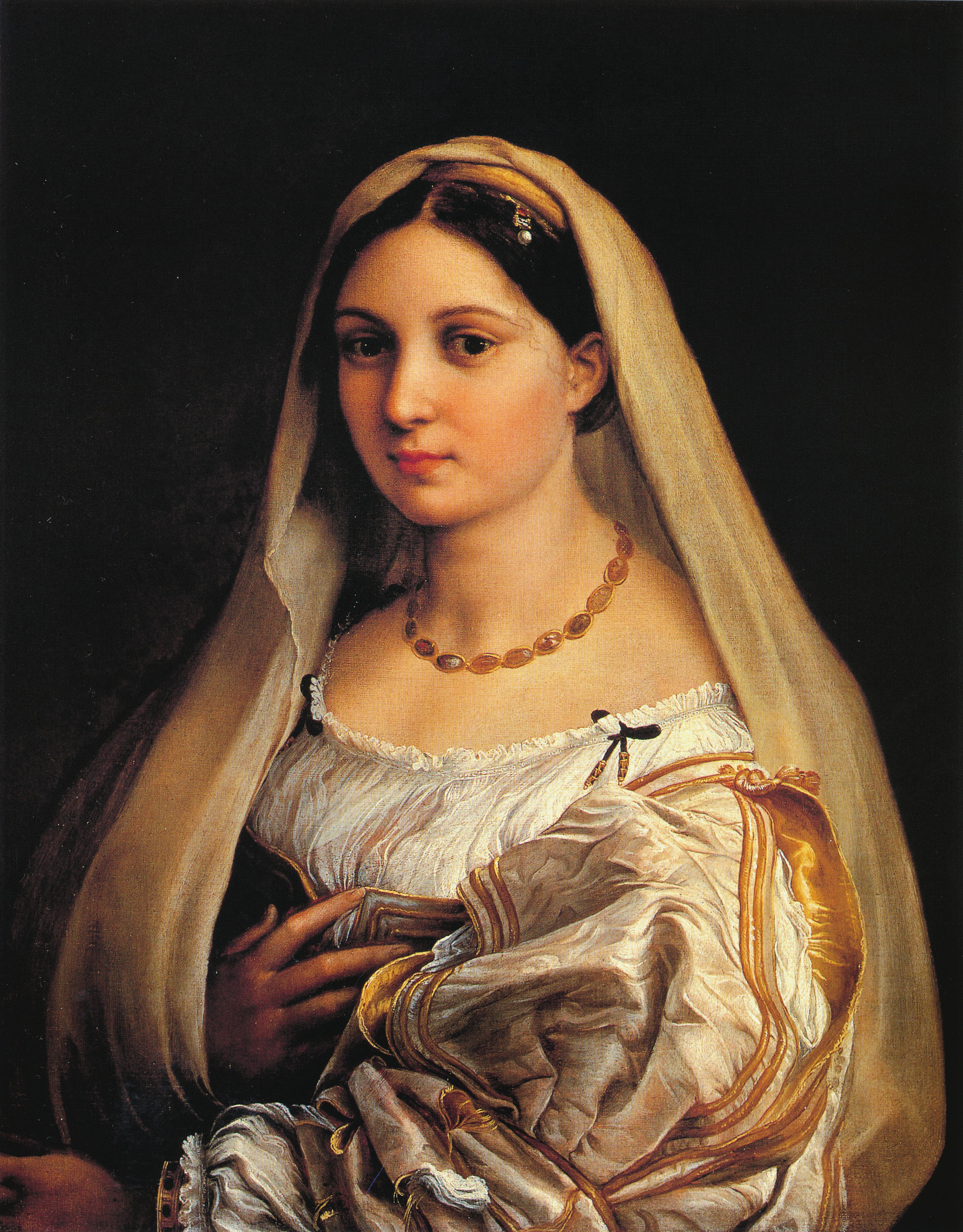
Raphael, La Donna Velata, c. 1514, oil on canvas, 33 ½ x 25 ¼” Pitti Gallery, Florence.
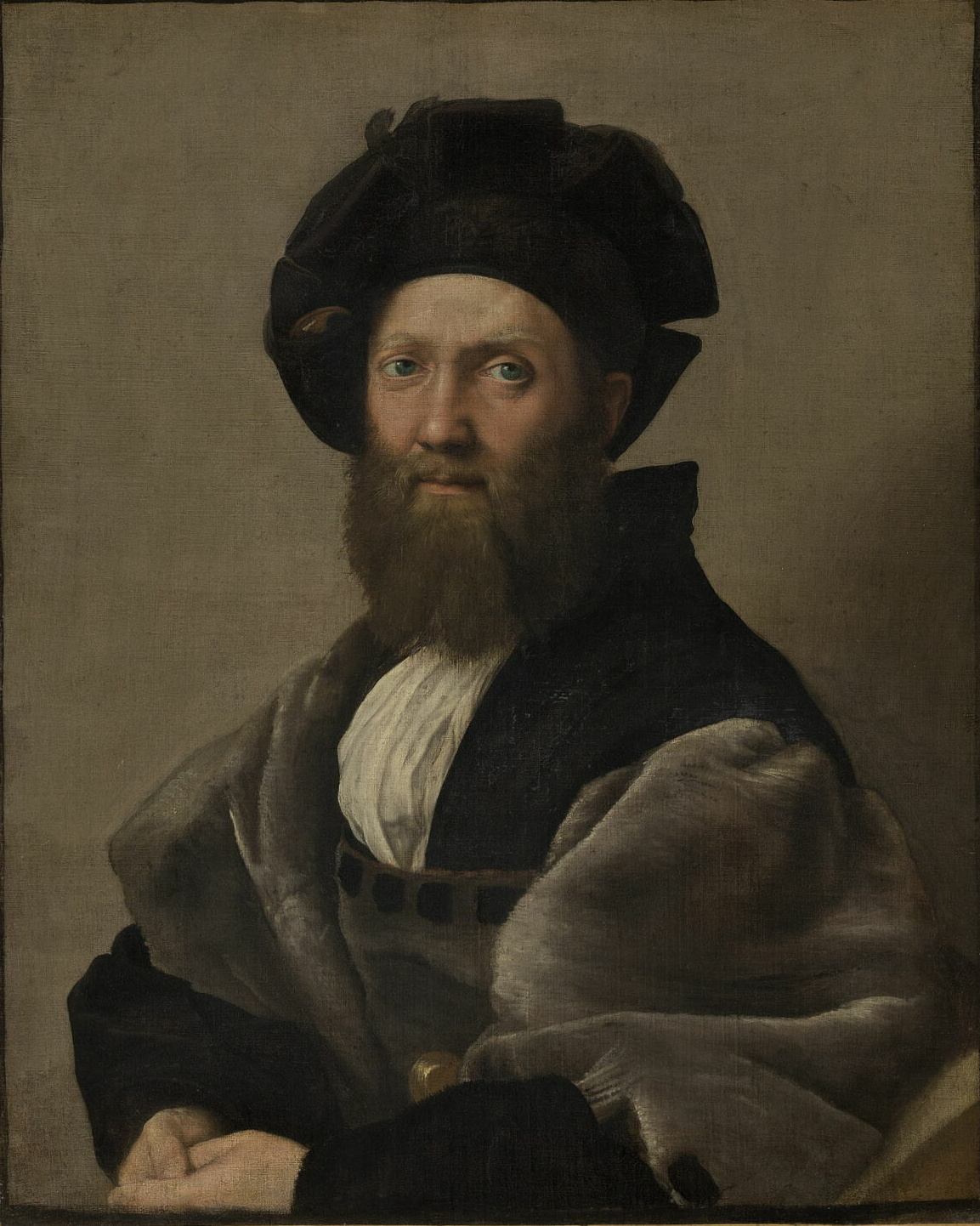
Portrait of Baldassare Castiglione, c. 1515, oil on canvas, 32  ¼” x 26” the Louvre Paris https://collections.louvre.fr/en/ark:/53355/cl010066418 – retrieved September 4, 2024.
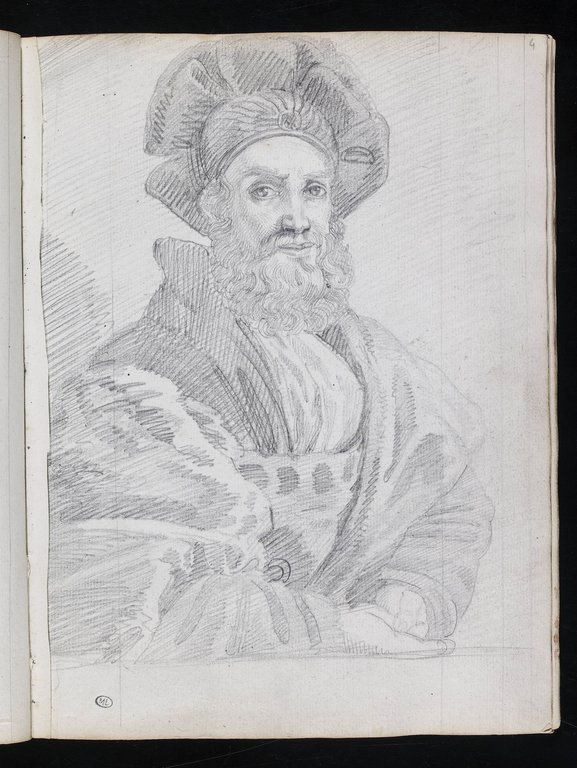
Raphael’s artwork inspired making copies by many later artists. This is “Etude d’après le portrait de Balthazar Castiglione par Raphaël” by Eugène Delacroix, c. 1818/1820 in the Louvre. https://collections.louvre.fr/en/ark:/53355/cl020142954 – retrieved September 4, 2024.

In La Donna Velata and Portrait of Baldassare Castiglione, Raphael, the master portraitist, present near ideal depictions. Both portraits are of almost identical dimensions. The model Raphael used for La Donna Velata he used in other artworks of this period, including The Sistine Madonna. These mid 1510s’ portraits have progressively become gentler in their modeling than a tight, detailed study of corporeal features done before. Raphael begins a display of a mastery of forms and colors that had great influence on future artists such as Rubens and Rembrandt. However, Raphael’s painting does not forgo his mastery of draughtmanship exampled in the female sitter’s sleeve or the overall nobility of the male sitter. (Beck, pp. 108-09; 116-17).
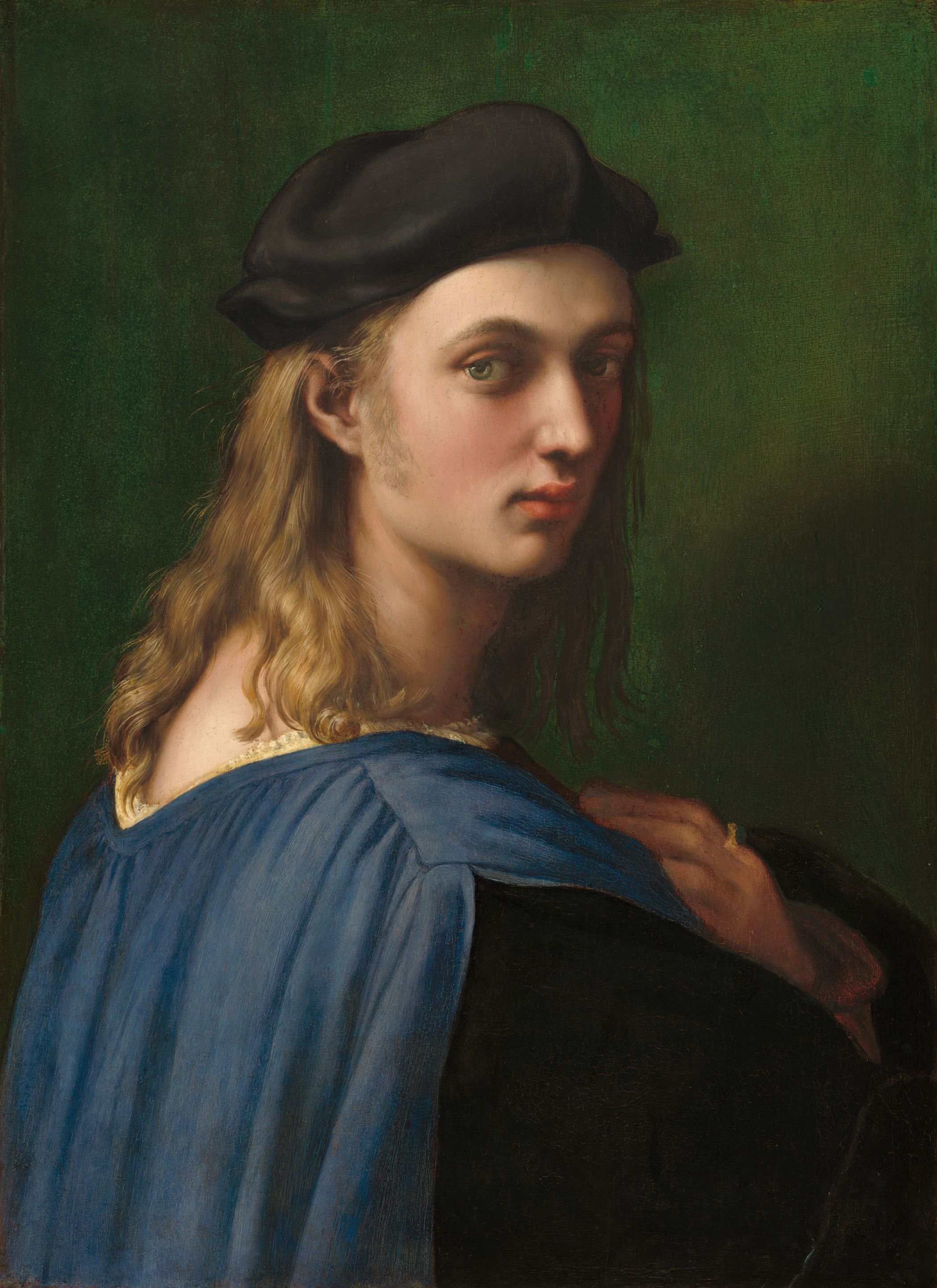
Raphael. Portrait of Bindo Altoviti c. 1515: Oil on panel 59,7 x 43,8 (24 in × 17 in), National Gallery of Art of Washington, D.C. https://www.nga.gov/collection/art-object-page.12131.html – retrieved September 5, 2024.
Raphael, The Way to Calvary (Lo Spasimo), 1516-17, oil on canvas, 10 ½ x 7’ 6 1/2” The Prado Madrid.

Jacopo Basilio commissioned this painting for the Monastery of Santa Maria dello Spasimo in Palermo, Sicily, from which it derives its popular name, lo Spasimo di Sicilia (“The Wonder of Sicily”). The painting reflects Raphael´s interest in the depiction of extreme physical and psychological states. https://www.museodelprado.es/en/the-collection/art-work/christ-falls-on-the-way-to-calvary/870c8293-1691-4a90-88ff-b554a2bc3fe8?searchid=d42d76c7-eb9f-501b-f628-d03605a6ca9c – retrieved September 4, 2024.

Raphael, Portrait of Leo X and Two cardinals, 1517-18, oil on panel, 60  5/8 x 46 7/8” Uffizi Gallery Florence

This was an important group portrait commission for Raphael: the current Pope Leo X Medici (1513-1521) seated by his cousins, Cardinals Giulio de’ Medici on the left and Luigi de’ Rossi on the right. Giulio de’ Medici was soon to become the future pope Clement VII (1523-1534). Though highly individualized, Raphael captures a family resemblance between these three Medici – then the most powerful family in Italy – who are all about the same age. In 1517 Cardinal Giulio was an important art patron and already commissioned Raphael to do The Transfiguration, his last painting. Raphael demonstrates a wide range of artistic experience and skills so that he pulls from his tool-box whatever is required for a successful outcome of any commission. In Urbino Raphael had been exposed to Flemish art and deploys its detailed technique in the bell and manuscript which 42-year-old Leo X uses a magnifier to see. The setting of the monumental portrait, in a room in the Vatican, is subtly captured by way of Flemish art ingenuity. The doorknob in front of newly-made cardinal Luigi de’ Rossi shows the reflection of an open window while the cape and biretta of the pope are highly detailed by the artist in its natural light. The Portrait of Leo X and Two Cardinals is considered the greatest group portrait of the 16th century. (Beck, pp. 120-121)
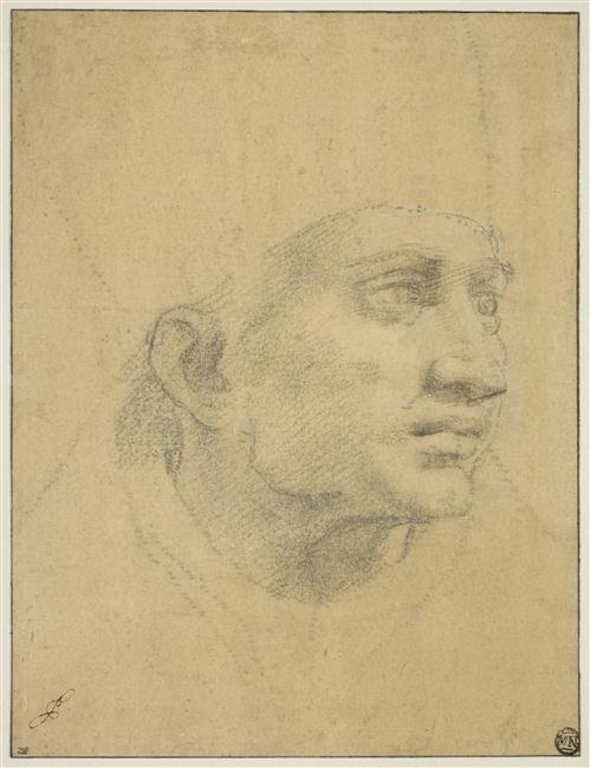
Raphael, Tête d’évêque, de trois quarts vers la droite, c. 1514/1517 LOUVRE https://collections.louvre.fr/en/ark:/53355/cl020101216 – retrieved September 4, 2024.
The Visitation, c. 1517. Oil on panel transferred to canvas. The Prado. https://www.museodelprado.es/en/the-collection/art-work/the-visitation/c02d195f-fdc4-4c61-bedf-e19216dd7335?searchid=714a2f53-0e6d-7d8f-5ff7-bee7652ec831 – retrieved September 4, 2024.

This painting was commissioned by Giovanni Branconio, the Apostolic Protonotary, at the behest of his father, Marino Branconio, for the family chapel at the church of San Silvestre de Aquila. Marino´s choice of subject matter was undoubtedly guided by the fact that his wife was named Elizabeth and his son, John. In 1655, this work was acquired by Felipe IV (1605-1665), who deposited it at El Escorial. It entered the Prado Museum in 1837.

Raphael, The Holy Family of Francis I. 1518 Oil on canvas 81 ½ x 55  1/8” The Louvre Paris.
Raphael, The Transfiguration, 1518-20, oil on panel, 13’3 ¾ x 9’1 ½” Pinacoteca, Vatican, Rome.

FOOTNOTES:

1. Giorgio Vasari, Lives of the Artists, translated by George Bull (Penguin Books, Harmondsworth, Middlesex, England, 1965) pages 316-18.

2. Ibid., page 318 and Edizioni Musei Vaticani, Michelangelo and Raphael in the Vatican, (Tipografia Vaticana, Città del Vaticano, 1995) page 169.

3. Vasari, Lives, pages 285 and 291.

4. Ibid., pages 299-302.

5. Roger Jones and Nicholas Penny, Raphael, Yale University Press, New Haven and London, 1983, page 113 and 17. Carlo Ludivico, Vatican Museums Rome, page 119

6. Roger Jones and Nicholas Penny, Raphael, Yale University Press, New Haven and London, 1983, page 117 and Vasari, Lives, page 301.

7. Frederick Hartt, History of Italian Renaissance Art: Painting, Sculpture, Architecture, Harry N. Abrams, Inc. New York, Third Edition, 1987, page 513.

8. New American Bible, (Catholic Book Publishing Company, New York) page 546 and 550; Beck, Raphael, page 98.

BIBLIOGRAPHY:

Brera Milan Great Museums of the World, Carlo Ludovico Ragghianti, Newsweek NY 1970 pp. 34

Pinakothek Munich Great Museums of the World, Roberto Salvini, et. al., Newsweek NY 1969 pp. 126

Lives of the Artists, Giorgio Vasari, translated by George Bull, Penguin Books, Harmondsworth, Middlesex, England, 1965, pages 316-18

Michelangelo and Raphael in the Vatican, Edizioni Musei Vaticani, Tipografia Vaticana, Città del Vaticano, 1995 p. 169

Raffaello. Franzese, Paolo (2008). Milano: Mondadori Arte. 

Raphael, James H. Beck, harry N. Abrams, Inc., Publishers, New York, 1994.

Raphael, Roger Jones and Nicholas Penny, Yale University Press, New Haven and London, 1983.

Encyclopedia of the Middle Ages, Volume 2, André Vauchez, Richard Barrie Dobson, Michael Lapidge, Chicago: Fitzroy, Dearborn, 2000.

History of Italian Renaissance Art: Painting, Sculpture, Architecture, Frederick Hartt, Harry N. Abrams, Inc. New York, Third Edition, 1987.

Raphael, Beck, James H., Harry N. Abrams, Inc. Publishers, New York, 1994.

The Medici Popes (Leo X and Clement VII), Herbert M. Vaughan, B.A., Methuen & Co., London, 1908.

“Alidosi, Francesco, detto il Cardinal di Pavia”. Dizionario Biografico degli Italiani – Volume 2. Treccani. 1960.

This explanatory article may be periodically updated.

LOW COUNTRIES. Flemish art in the 15th Century.

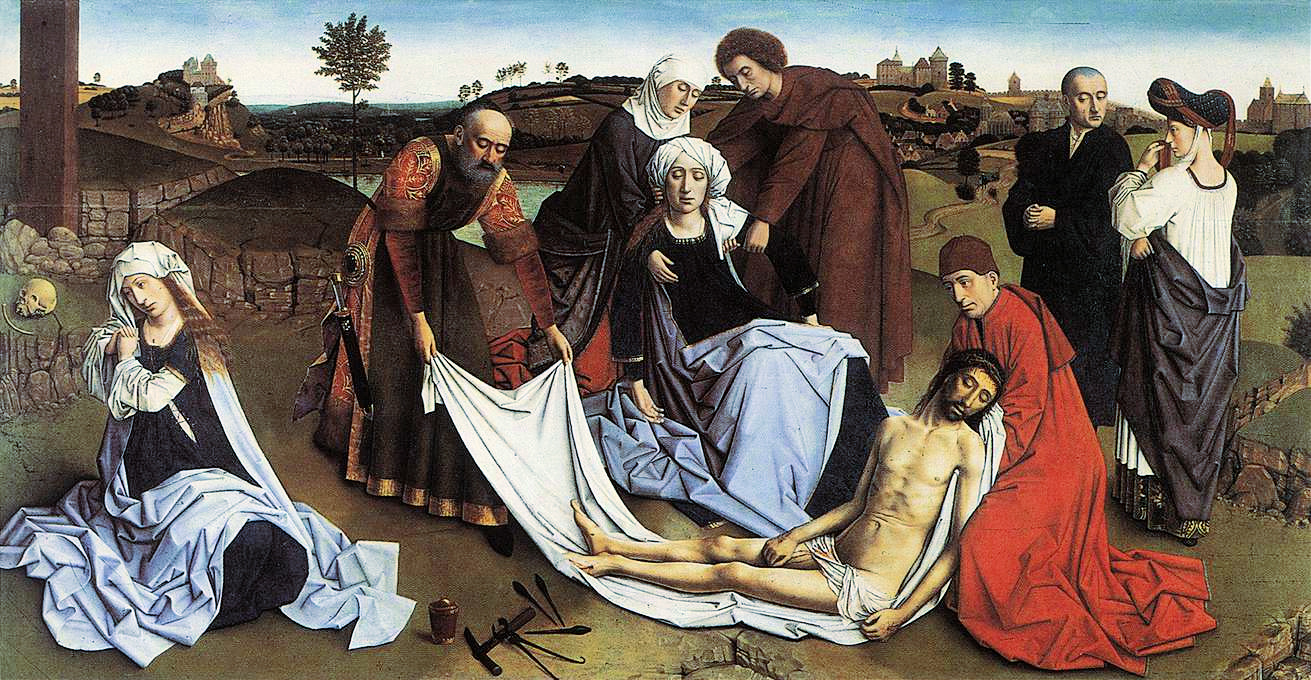
FEATURE Image: Petrus Christus (c. 1395-1472), Pietà, c. 1455–60. 39 ¾ x 75 ½ inches, Royal Museums of Fine Arts of Belgium, Brussels.

Jan Van Eyck (or John of Bruges) (c. 1385-1441), detail, Marriage of Giovanni Arnolfini and Giovanna Cenami, 1434; National Gallery, London.

Brief Introduction to Flemish art in the 15th century.

Flemish art, as the name suggests, originates in Flanders which includes the Low Countries (Netherlands and Belgium) as well as northeastern France. The centers of Flemish art in the 15th century are Brussels, Bruges, and, later, Antwerp as well as other cities such as Liège and Tournai. Though the area had been settled as early as the 6th century, great growth and prosperity came to the region starting in the 14th century. As an international trade center centered in Bruges and, following the silting up of Bruges’ port, in Antwerp starting around 1525, Flanders experienced an influx of tremendous wealth joined to its attendant political connections and power. Such factors led to a high demand for Flemish art locally and far beyond its borders to royal courts, churches and other public and private patrons having marked influence on the European Renaissance. These rich cultural conditions in and around Flanders provided incentive for leading Flemish art masters to perfect their art technique and create magnificent pictures, particularly altarpieces, and display the latest naturalist styles, delineated forms, and bright colors within a European context. Flemish art developed systematically including its use of oil painting. This newly discovered and controversial medium greatly affected Flemish paintings’ surface luminosity by way of its range of cool colors and its ability to be applied in smooth facile layers. Most of these noteworthy Flemish painters in the 15th century found positions at court or as officials in prosperous urban centers. They became leading citizens whose workshops trained artists and made artwork for public and private consumption which worked to assure Flemish art’s primacy for the Northern European Renaissance into the 16th century.

Hugo Van Der Goes (c. 1440-1482), Detail, Portinari Altarpiece, 1476-78, Uffizi Gallery, Florence, Italy.

PAINTINGS.

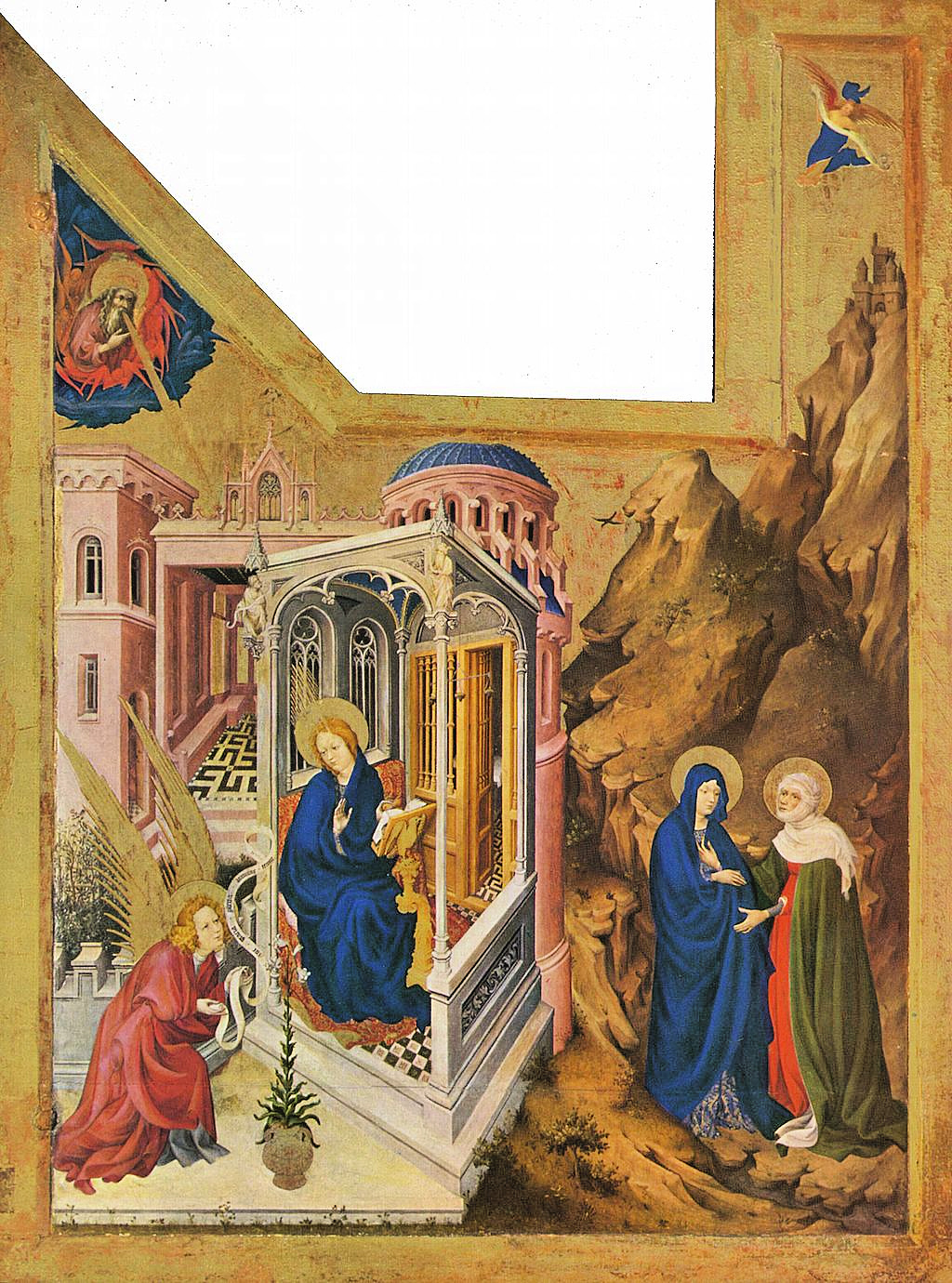
1 – Melchior Broederlam (c. 1350-1409), Champmol Altarpiece (The Annunciation and Meeting of Mary and Elizabeth), oil on wood, 1399, 65 ½ x 48 ¼ inches and 66 3/8 x 511/4 inches. Musée des Beaux-Arts de Dijon, France.
1 – Melchior Broederlam (c. 1350-1409), Champmol Altarpiece (The presentation in the Temple and Flight Into Egypt), oil on wood, 1399, 65 ½ x 48 ¼ inches and 66 3/8 x 511/4 inches. Musée des Beaux-Arts de Dijon, France.

This large diptych done for Philip the Bold, Duke of Burgundy (1342-1402) around 1399 is certainly painted over 600 years ago by Melchior Broederlam (c.1350-1409?). Broederlam was a painter in Ypres, Belgium, who entered the service as painter to Philip the Bold in 1385 and was in Paris by the early 1390’s. In the Champmol altarpiece – considered the earliest example of International Gothic in painting – Broederlam presents four stories in the life of the Virgin, some of which are contained in Luke themselves as scriptural diptychs including the Annunciation and the Birth stories of John the Baptist and Jesus. The first panel of the altarpiece presents the Annunciation (Luke 1:26–38) and the Visitation (Luke 1:39-56) while the second panel depicts the Presentation in the Temple (Luke 2:22-40) and The Flight into Egypt (Matthew 2:13-23). In the Champmol Altarpiece there is an attempt at realism by its placid gesturing figures in a landscape of crags and paths and also flowers at the foot of the picture’s imposing structures. At the same time there is a sense of unreality in the sense of it being a theatrical or stage setting in its flat, unitive display.
The Presentation of the Temple is the climax of the birth narratives. Up to now Luke and Matthew recounted the annunciations of Jesus and John, the Visitation of Mary to Elizabeth, the births of John and Jesus as well as the star, the stable, the Magi, the shepherds, the angels, surrounding Jesus’s birth in Bethlehem. The Presentation in the Temple was the highly anticipated strictly required formal religious ceremony for the “redemption of the firstborn” male and the first communal recognition and capstone of all these dramatic birth events described so far in Luke. Further, the setting is the Temple in Jerusalem, the very center of Jewish worship and life. This exciting and important place is where the infant Jesus and his mother are each presented for their purification in accordance with Mosaic Law. Jesus had been circumcised eight days after his birth and is now publicly presented to Yahweh in Jerusalem and formally stamped as a member of God’s chosen people. It is through the Jews that the salvation of the world is to be achieved, and Luke’s Gospel announces such hopes as fulfilled in Jesus. Though Mary’s purification at the Temple is ceremonial, it publicly reveals its agreement with what was told to her by the angel Gabriel at the Annunciation: that she is the symbol of the Jerusalem Temple (Luke 1:35).
Also featured in this episode is Simeon, a righteous and devout man living in Jerusalem who, according to Luke 2:25-35, was promised by the Holy Spirit that he would not die until he had seen the Lord’s Messiah. Guided by the Spirit into the Temple, he recognized the infant Jesus during his presentation, took him up in his arms, and praised God, proclaiming Jesus as the savior for both Gentiles and Israel, a dramatic public witness to these public events whose testimony about the child “amazed” Mary and Joseph (Luke 2:33). Also present is Anna, an old prophetess, an honorable role found in both Jewish and Christian tradition who typically was a widow in service to the community. Both Anna with Judith, a devout widow in the Old Testament, are over 100 years old. Anna “never left the temple, but worshiped night and day with fasting and prayer” (Luke 2: 37). In the Rabbinic literature seven prophetesses are recognized – namely, Sarah; Miriam (Ex. 15); Deborah (Jgs. 4); Samuel’s mother, Hannah (1 Sm. 2); David’s wife, Abigail (1 Sm. 25); Huldah (2 Kgs 2); and Esther. Isaiah’s wife is also mentioned as a prophetess (Is. 8). With Anna, all these women were recognized for at least their holy lives, sometimes speaking in God’s name, as well as often their advanced years. At the Presentation Anna “gave thanks to God and spoke about the child to all who were awaiting the redemption of Jerusalem” (Lk 2:35).

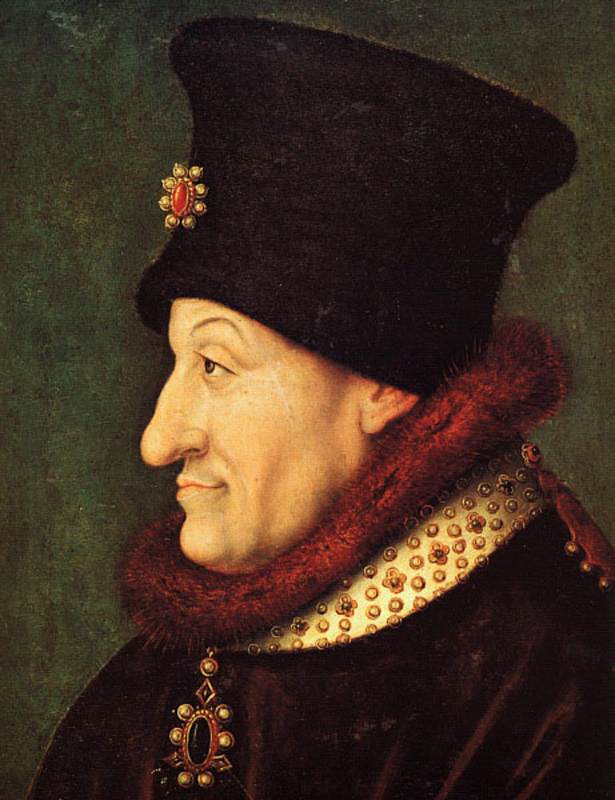
Philip II the Bold, anonymous, 16th century, 40 cm (15.7 in); width: 30 cm (11.8 in), Palace of Versailles, oil on wood.
2 – Jan Van Eyck (c. 1385-1441), Madonna of Chancellor Rolin (or The Virgin of Autun), Oil on wood, c. 1435, 26 x 24 ¾ inches (66x 62 cm), Musée du Louvre, Paris.

From 1422 to 1424 Jan Van Eyck (or John of Bruges) worked for John III the Pitiless (1374–1425) of the House of Wittelsbach, who was bishop of Liège (1389–1418) as well as duke of Bavaria-Straubing and count of Holland and Hainaut (1418–1425). The artist was appointed court painter to Philip III the Good (1396-1467) who was born in Dijon and died in Bruges and who founded the Burgundian state that was France’s rival in the 15th century. Philip III was the most important of the Valois dukes of Burgundy.

Philip III wearing the chain of office. Copy of painting by Rogier Van der Weyden, c, 1450.

Van Eyck lived in Lille between 1425 and 1429 but relocated to bustling Bruges in 1430 where he bought a house and lived until his death in 1441. On behalf of the Duke’s business concerns (including a secret marriage), Jan Van Eyck made trips to Spain and Portugal in 1427-28, and several others into the mid1430’s. There are many authenticated paintings by Jan Van Eyck, although Madonna of Chancellor Rolin is considered highly likely. The concept of composing the work to be divided into a shadowed interior and bright exterior landscape – and unified in the picture – is original. The contrasts of light, subject and form and their relation is appealing to the eye. The figures of the Virgin and the Child are delineated gently and beautifully for the donor, who is depicted behind a prayer desk, to adore. Like Italian master Leonardo da Vinci (1452-1519), Van Eyck had many cultural interests and talents in the service of Philip III such as studies in anatomy, cartography, geometry and perspective that created the illusion of three-dimensional space. These artists’ common preoccupations and concerns in the arts united the Northern and Italian Renaissance more closely. If Van Eyck did not actually invent oil painting, his work perfected its techniques. Van Eyck’s abilities make him the major artist of the Early Netherlandish School whose position is challenged only by the Master of Flémalle (Robert Campin). It was painted for the chancellor of Philip III, Nicolas Rolin (c. 1376/80-1462) to decorate a personal chapel (Saint-Sébastien chapel) that he decided to build in 1426-1428 (completed in 1430) in the church of Notre-Dame-du-Châtel in Autun, a church destroyed in 1793.

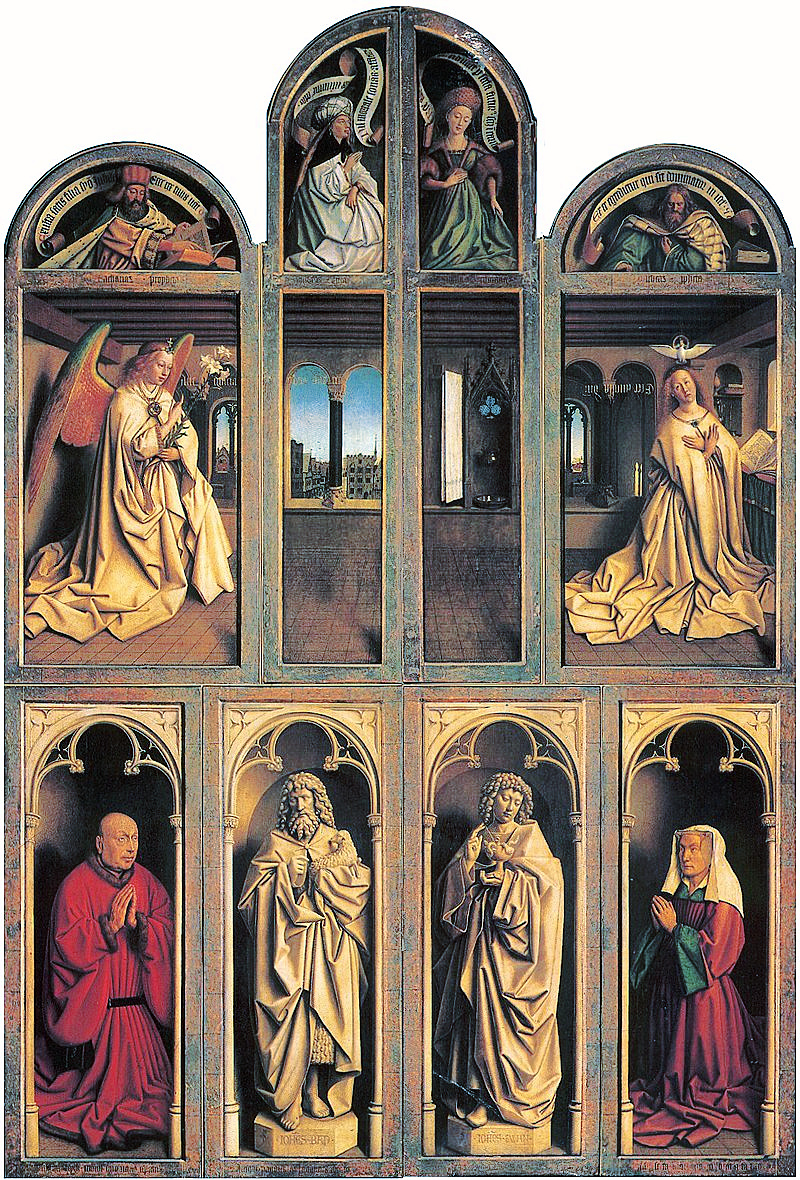
3 – 4 Hubert Van Eyck (c. 1370-1426) and Jan Van Eyck (c. 1385-1441), Closed (above) and open panel of The Ghent Altarpiece, also called the Adoration of the Mystic Lamb, c. 1425, 53 ¾ x 93 ¼ inches, Saint Bavo’s Cathedral, Ghent.
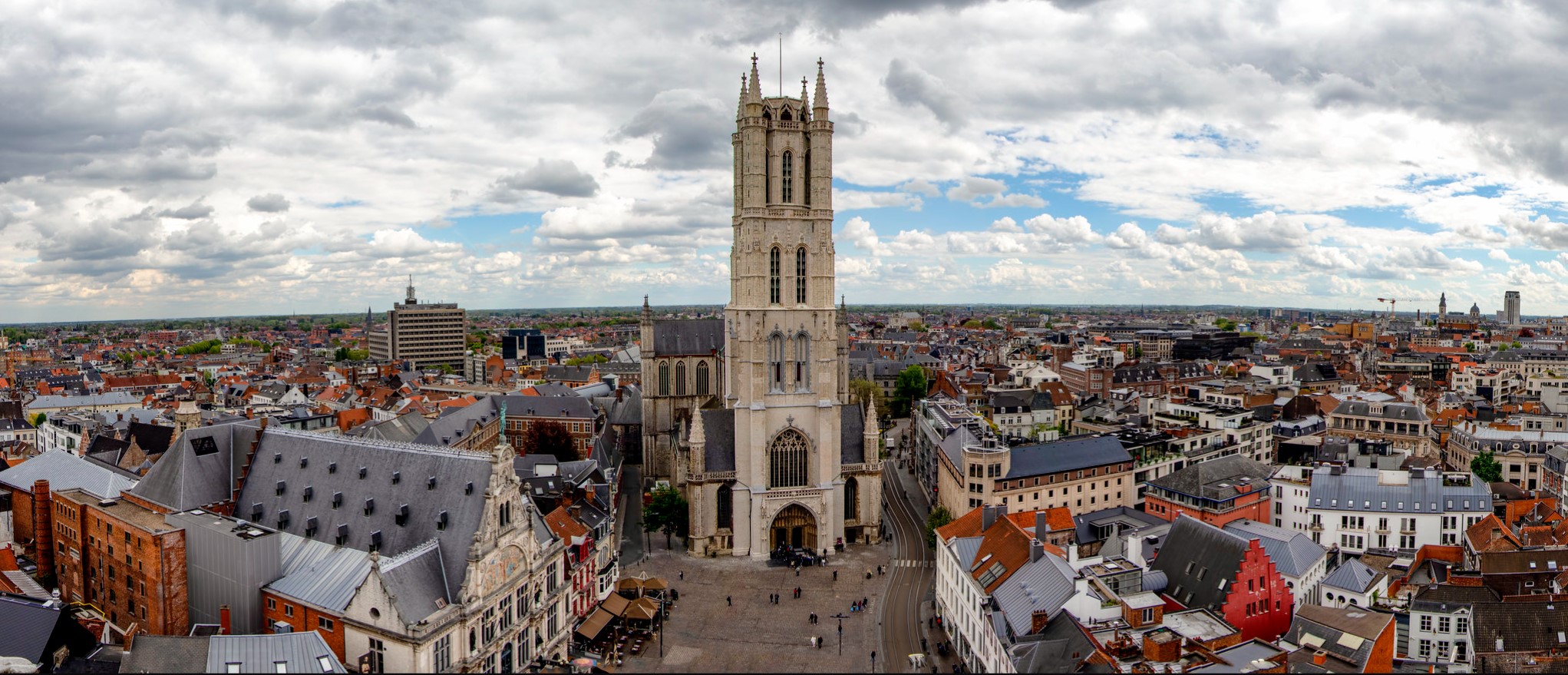
St. Bavo’s Cathedral, Ghent, houses the Van Eyck brothers’ Ghent altarpiece. Saint Bavo’s Cathedral, Ghent” by Arran Bee is licensed under CC BY 2.0.

Jan Van Eyck’s masterpiece is Adoration of the Mystic Lamb (1432), known as the Ghent Altarpiece, which he painted with his brother Hubert Van Eyck (c. 1370–1426). The Van Eycks’ artwork is known for its technical brilliance, intellectual complexity, and rich symbolism of which this very large (almost eight feet wide) and complex 15th-century polyptych is a prime testament. It was begun in the mid-1420s and completed by 1432. It marks a transition from the Middle Ages to the Renaissance in Northern European art. Its 22 panels opens and closes. When open, inside there are two rows of paintings. The middle section is Christ the King flanked by the Virgin and Saint John the Baptist. Other panels depict musicians, singing angels, and Adam and Eve. The center lower row depicts the Adoration of the Lamb with knights, hermits. judges and pilgrims who stream to behold the Lamb. In its 600-year history, there have been re-paintings, restorations and modern replacements (the original Judges panel was stolen in 1934). Little is known about Hubert Van Eyck to the point where he has been speculated in his obscurity to be a mythical figure, though this is quite unfounded. The painting was done for a nobleman’s family chapel in what become St. Bavo’s church in Ghent. The Eycks’ detail, fullness of form and luminous colors presents the mystery of the Mass whose subject is the miracle of the unity of heaven and earth in eternity. In contrast, the closed panel is beautifully calm and restrained in colors and composition. But it is just as masterful and, as it sits closed, offers a different mood for devotion.

5 – Jan Van Eyck (c. 1385-1441), Portrait of Margaret van Eyck, 12 7/8 x 11 ½ inches (41.2cm x 34.6 cm), 1439, oil on wood, Groeningemuseum, Bruges, Belgium.

The portrait is of the artist’s wife executed in Bruges. The Van Eycks married in 1439. Like his other portraits the sitter is turned three-quarters to the left. Painted 60 years before Leonardo Da Vinci’s Mona Lisa (1503), there are affinities between them – a placid enigmatic female sitter, leftward turn, hands crossed at the lap, a possible landscape background that in the Van Eyck has been repainted.

Leonardo da Vinci, Mona Lisa (1503), Musée du Louvre, Paris.
6 – Petrus Christus (c. 1395-1472), The Legend of Saints Eligius and Godeberta, 38 5/8 x 33 ½ inches, 1449, The Metropolitan Museum of Art, New York.

Following the death of Jan Van Eyck, Petrus Christus became the most important modern painter in Bruges who had settled there in 1444. The artwork was commissioned by the jewelers’ corporation in Bruges and depicts seventh century Saints Godeberta being given a ring by Saint Eligius to marry the Lord God as she decided to enter religious life. Though a religious painting, it is essentially a 15th century Flemish genre painting. And while not as graceful as Van Eyck’s artwork, the painting holds interest for its bold forms of figures and objects and the authority of a well-observed still life.

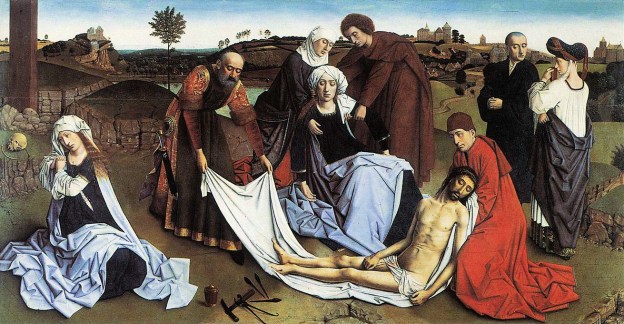
7 – Petrus Christus (c. 1395-1472), Pietà, c. 1455–60. 39 ¾ x 75 ½ inches, Royal Museums of Fine Arts of Belgium, Brussels.

One of Petrus Christus’s most important works, the scene of the Deposition is poetically rendered in a mother’s lamentation over the dead Christ, her son, within the setting of a late afternoon landscape which is also perfectly rendered. The figures in the foreground are large and emphasize their placement in the space. The face of the Virgin constitutes the painting’s center. Holding the dead Christ in a sheet is NIcodemus and Joseph of Arimathea who asked Pilate for the body of Jesus so to bury him. The three figures who stand apart from the narrative’s central figures are depicted with equal stylistic power and whose strained grief they share.

Gustave Courbet, 1849-50, A Burial at Ornans, 315 cm × 660 cm (124 in × 260 in), Musée d’Orsay, Paris. The 19th century French realist artist made a trip to Amsterdam before he painted The Burial at Ornans and was likely influenced by Netherlandish painting he had seen on that trip.
8 – Master of Flémalle/Robert Campin (1375-1444), workshop, The Bad Thief (fragment), c. 1420, 56 ¾ x 20 3/8, Städel Museum, Frankfurt am Main, Germany.

The painterly style of the Master of Flémalle is earlier than Jan Van Eyck yet also progressing a naturalism that is realistic and of ordinary folk. The Master of Flémalle has been identified by consensus as Robert Campin whose pupils were Rogier van der Weyden (1399-1464)  and Jacques Daret (c. 1404- c. 1470). Campin is known to have lived and worked in Tournai, Belgium. This imposing, cruelly exact image depicts the corpse of one of the two criminals crucified with Jesus. Executed in the workshop of Robert Campin in Tournai around 1420 – around the same time as the Van Eycks’ Ghent Altarpiece – the fragment is all that remains though copies of the rest exist that show the Deposition and John the Baptist. The painting presents the bad thief in a corporeal monumentality next to an embossed gold background which is a legacy of medieval art. The painting’s unwavering physicality, however, is 15th century modern. The well-constructed faces of the two observers are modeled by shadows as foreshortening suggests movement. The lower left of the picture at the thief’s broken legs reveals, as Delevoy states, “the perspective of a landscape that is concisely constructed, geometric, and intellectual.”

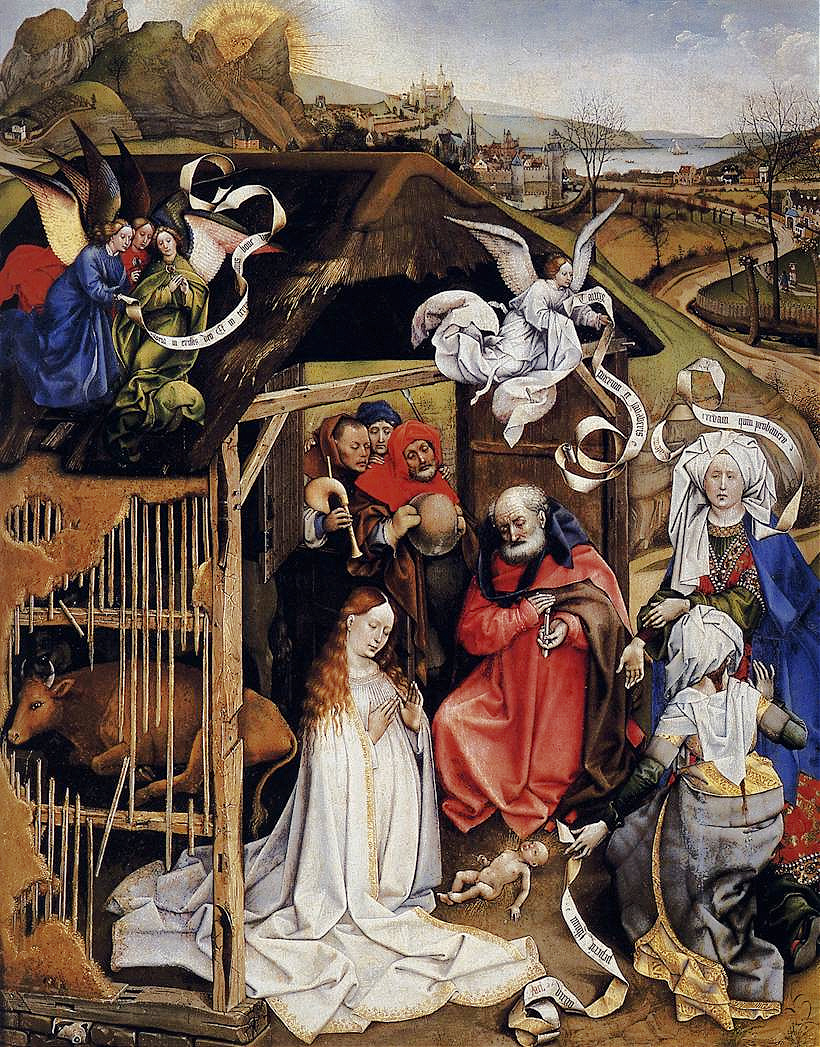
9 – Master of Flémalle/Robert Campin (1375-1444), The Nativity, c. 1420, oil on wood 87 x 70 cm, 32 5/8 x 27 ½, Musée des Beaux-Arts de Dijon, France.

The Nativity is the most famous work of the Master of Flémalle (Robert Campin). The single panel combines dreamed up images, and meticulous objective observation and rational knowledge to depict three episodes – (1) the legend of the midwives, (2) adoration of the shepherds, (3) the Nativity. The wooden stable, with its ox and ass, has a broken wall and holes in the roof. The Virgin dressed in white is kneeling with her hands held up in adoration as the Christ Child lies naked on the ground. Joseph is depicted as an old man and holds a lit candle that he shelters. The legend of the midwives is an apocryphal Gospel tale regarding Joseph’s anxiety during the birth and summoning these midwives with complicated headdresses. The stable door is swung open and three shepherds enter behind Mary and Joseph. Four angel figures hover above the scene holding strips of parchment with messages. There is an extensive, condensed, and detailed winter landscape in the background with a wide, curving road and castle perched on a hill.
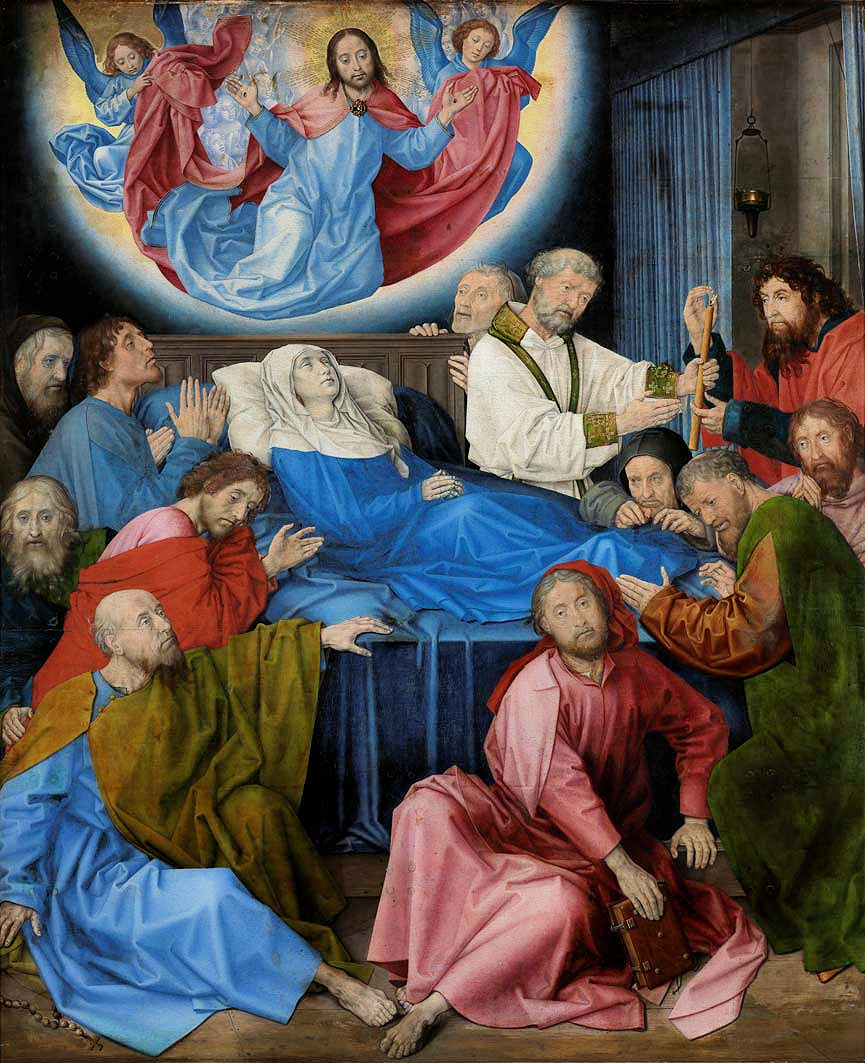
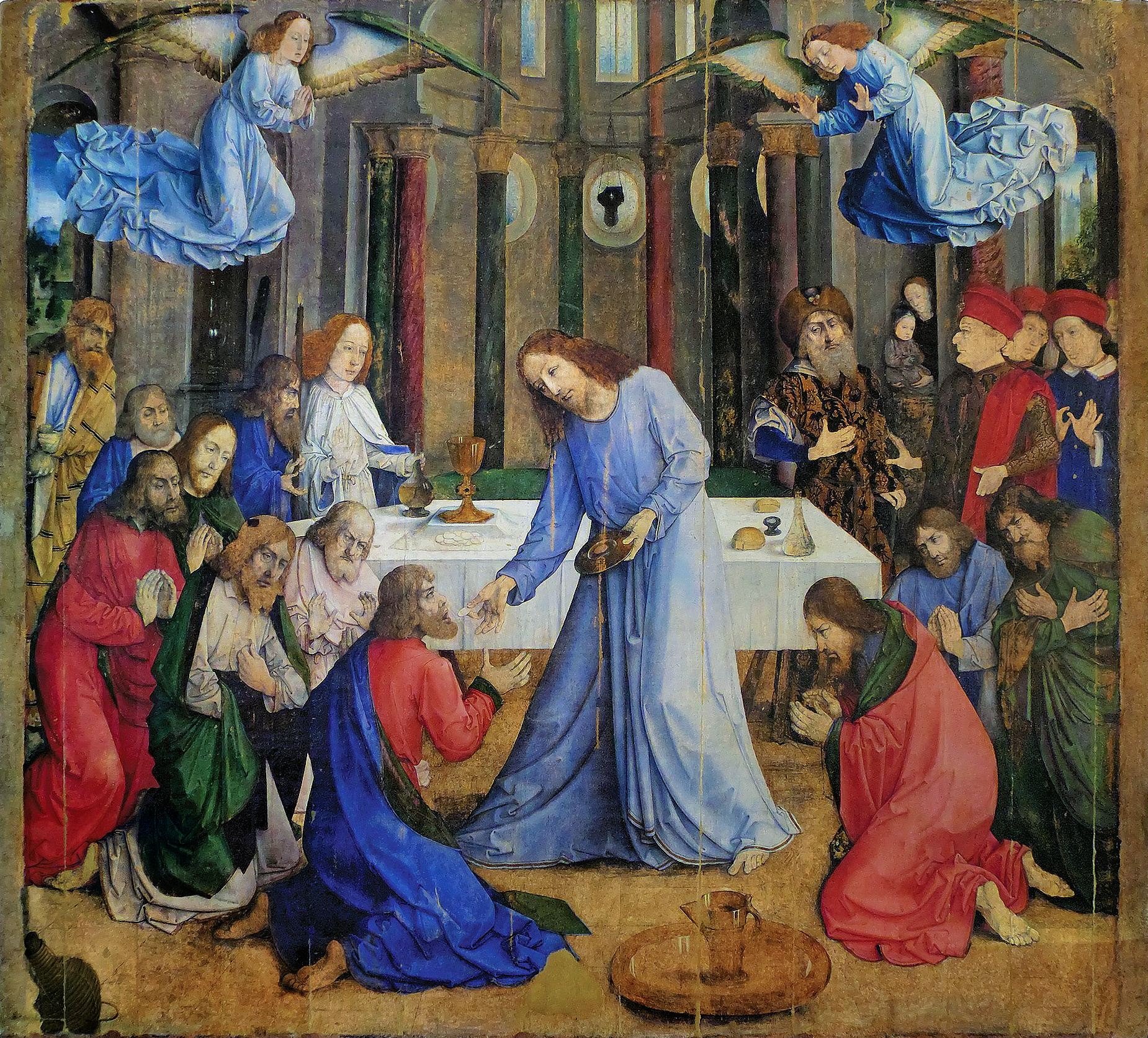
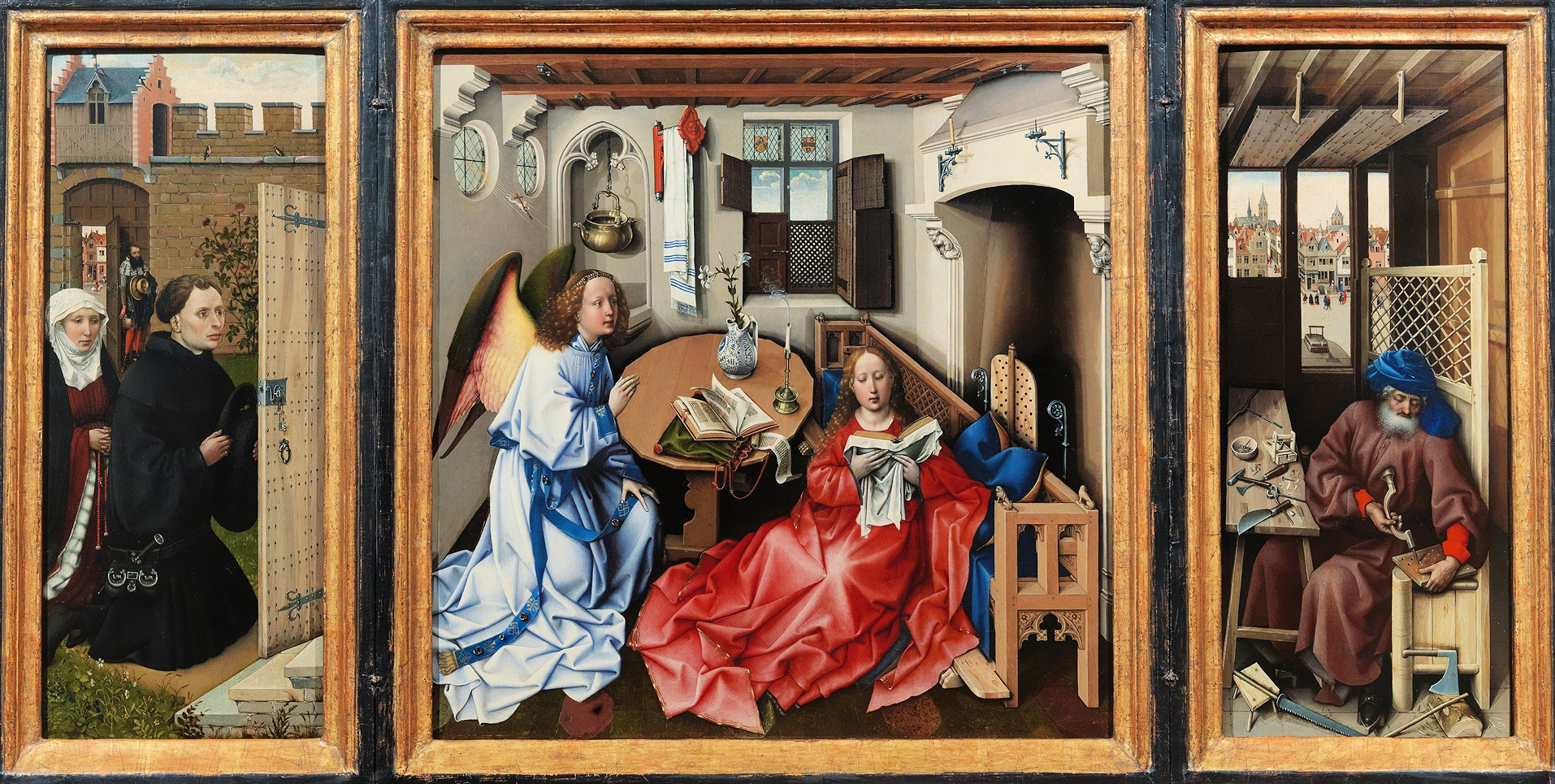
10– Master of Flémalle/Robert Campin (1375-1444), Annunciation Triptych (Merode Altarpiece), c. 1427-32, The Cloisters (Metropolitan Museum of Art), New York.

St. Luke 1: 26-29. “In the sixth month, the angel Gabriel was sent from God to a town of Galilee called Nazareth, to a virgin betrothed to a man named Joseph, of the house of David, and the virgin’s name was Mary. And coming to her, he said, “Hail, favored one! The Lord is with you.” Placid depiction of the Annunciation at the moment when the angel Gabriel alights in the Virgin’s chamber. The setting is a middle-class home and Mary is, for the moment, still completely unaware of the mystery that will now be told to her. A miniature figure with a cross comes through the oculus above the angel. The objects in the room– a lily, an immaculate towel, an extinguished taper– may be symbolic but certainly work to hold realistic tactile value. The robes in the foreground, one red, the other light blue, provide focus for the painting’s harmony and color. The Master of Flémalle experiments with Renaissance applications of perspective, depth, proportion (foreshortening) with material objects such as open shutters, an open door (left panel), and an unforgiving diagonal of the room’s bench. These material objects in varying perspectival space as well as varying light sources give the painting complexity. The right panel depicts old Joseph in his carpenter workshop. The left panel shows the painting’s donors on their knees witnessing this remarkable scene through the open door. There is speculation that the Master of Flémalle had painted the center panel and, as buyers showed interest, these donors commissioned the wings that were painted by workshop artists such as, likely, young Rogier van der Weyden (ca. 1400–1464) and Jacques Daret (ca. 1404–1468).

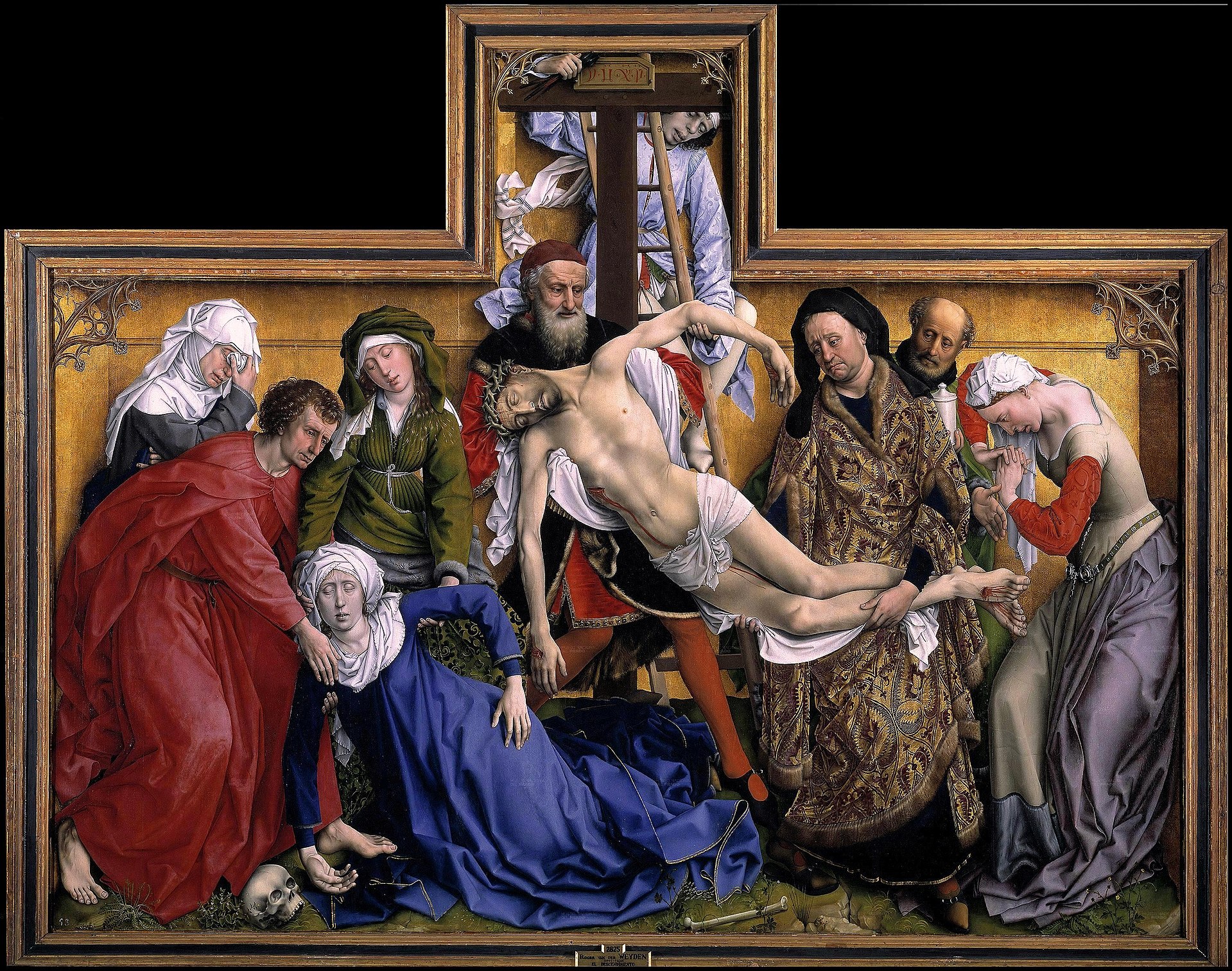
11-Rogier Van der Weyden (1399-1464), The Deposition or The Descent from the Cross, c. 1435, oil on oak panel, 86 ¾ x 110 inches, 220 × 262 cm. El Museo Nacional del Prado, Madrid.

Rogier Van der Weyden was a major artist in Flanders in the mid15th century. He was a pupil of Robert Campin, the Master of Flémalle, from which he imbued his realistic, ordinary naturalism with, what Murray said, was “more emotion, warmth and sensitiveness.” Insofar as the power of his artistic technique, Van der Weyden is a peer of Jan Van Eyck. Van der Weyden’s colors are cooler than Van Eyck’s and he subordinates his technical abilities to display the feelings of his paintings’ subject matter, typically religious. In terms of composition the striking difference between Van Eyck and Van der Weyden is that Van Eyck crafts a setting for his panorama of iconic vignettes while Van der Weyden paints flat-on action, often intensely emotional – all of which contributes to the artwork as a whole. Both Van Eyck’s Adoration of the Lamb and Van der Weyden’s The Deposition or Descent from the Cross are the most influential Flemish paintings of the mid15th century. Van der Weyden’s overall oeuvre makes him, arguably, 15th century Flemish art’s most influential figure.

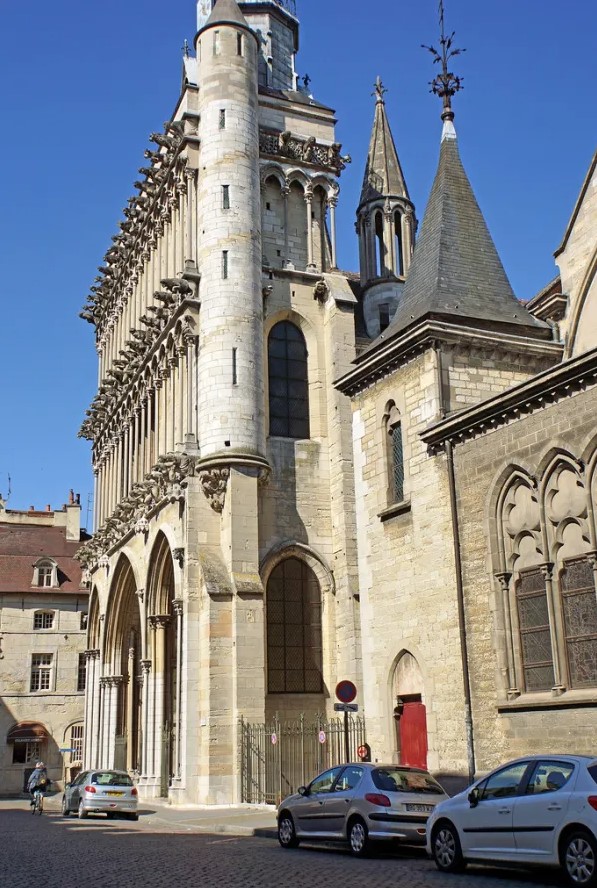
Van der Weyden’s The Deposition or Descent from the Cross are the most influential Flemish paintings of the mid15th century. The altarpiece was commissioned by the Grand Order of Crossbowman for the Church of Notre-Dame-Outside-the Walls of Dijon (13th century). PHOTO CREDIT: France-003095 – Notre-Dame of Dijon” by archer10 (Dennis) is licensed under CC BY-SA 2.0.
12- Rogier Van der Weyden (1399-1464), Triptych of the Seven Sacraments Altarpiece, c. 1445–1450, 78 ¾ x 87 ¾ inches. Royal Museum of Fine Arts, Antwerp.
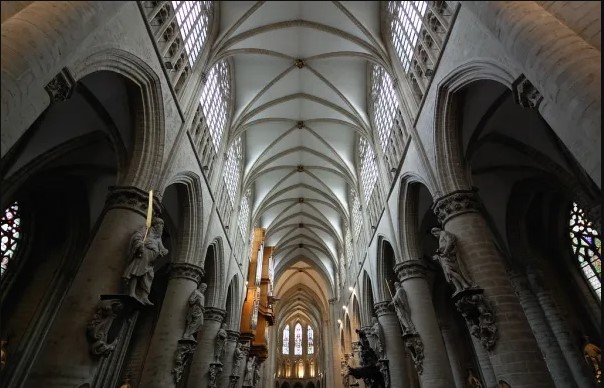
Van de Weyden’s painting, The Seven Sacraments, set in St. Gudule Church in Brussels, makes evident that the purpose for this grand and modern building is to manifest the presence of Jesus Christ in the sacraments.  “St. Michael and St. Gudula Cathedral, Brussels” by tabula_electronica is licensed under CC BY-NC 2.0.

Van der Weyden married a woman from Brussels and relocated to that growing and prosperous city in the marshes of Flanders in 1426. By the mid1430’s Van der Weyden was the City Painter and did work for the Burgundian Court. In 1450 the artist traveled to Rome and Florence where the early Italian Renaissance was in full swing and whose art greatly influenced the Flemish master’s art through the 1450s and into the 1460’s. The Triptych of the Seven Sacraments Altarpiece was a return to the artist’s native city as it was painted for the Bishop of Tournai whose coat of arms appear on the upper portions of each panel. Set in the impressive Cathedral of St. Michael and St. Gudula in Brussels, the painting presents profound religious content in a finely drafted and colorful work – the left panel depicting the sacraments of initiation (baptism, confession and confirmation), the center of the Eucharist under a giant cross, and the right panel depicting the sacraments of ordination, marriage, and last rites.

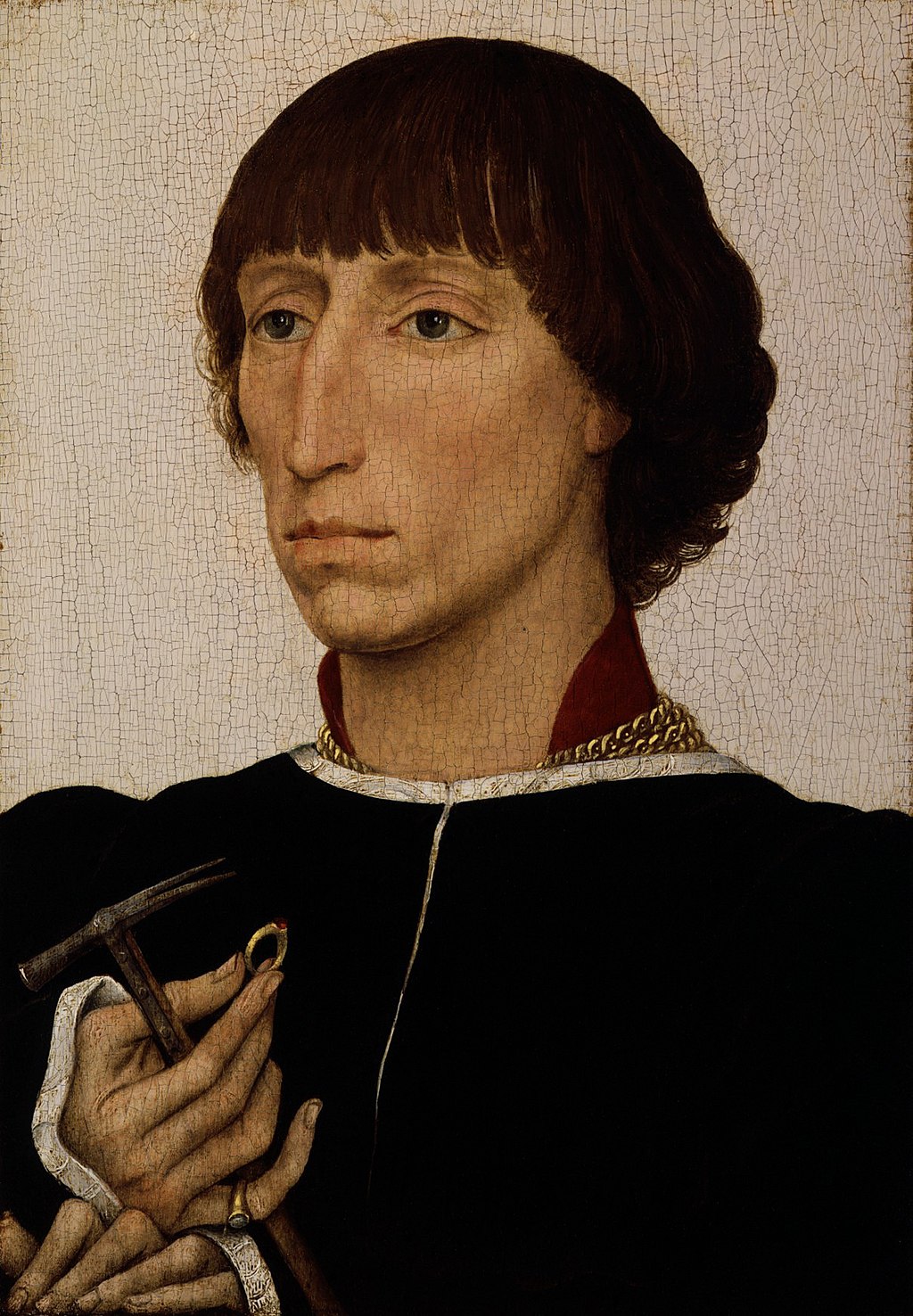
13- Rogier Van der Weyden (1399-1464), Portrait of Francesco d’Este (c. 1429-1476), ca. 1460, Oil on wood, 11 9/16 x 7 7/8 inches, The Metropolitan Museum of Art, New York.

Rogier van der Weyden painted several superb and sensitive portraits including Charles the Bold (Berlin), Le Grand Bâtard of Burgundy (Brussels), a Lady (National Gallery of Art, D.C.). Francesco d’Este was an Italian who received an education at the Burgundian Court. The d’Este family in Ferrara, Italy, was all-powerful when Rogier Van der Weyden visited there in 1450, though this portrait is done later. The sitter holds a hammer and ring whose significance is not explained with certainty.

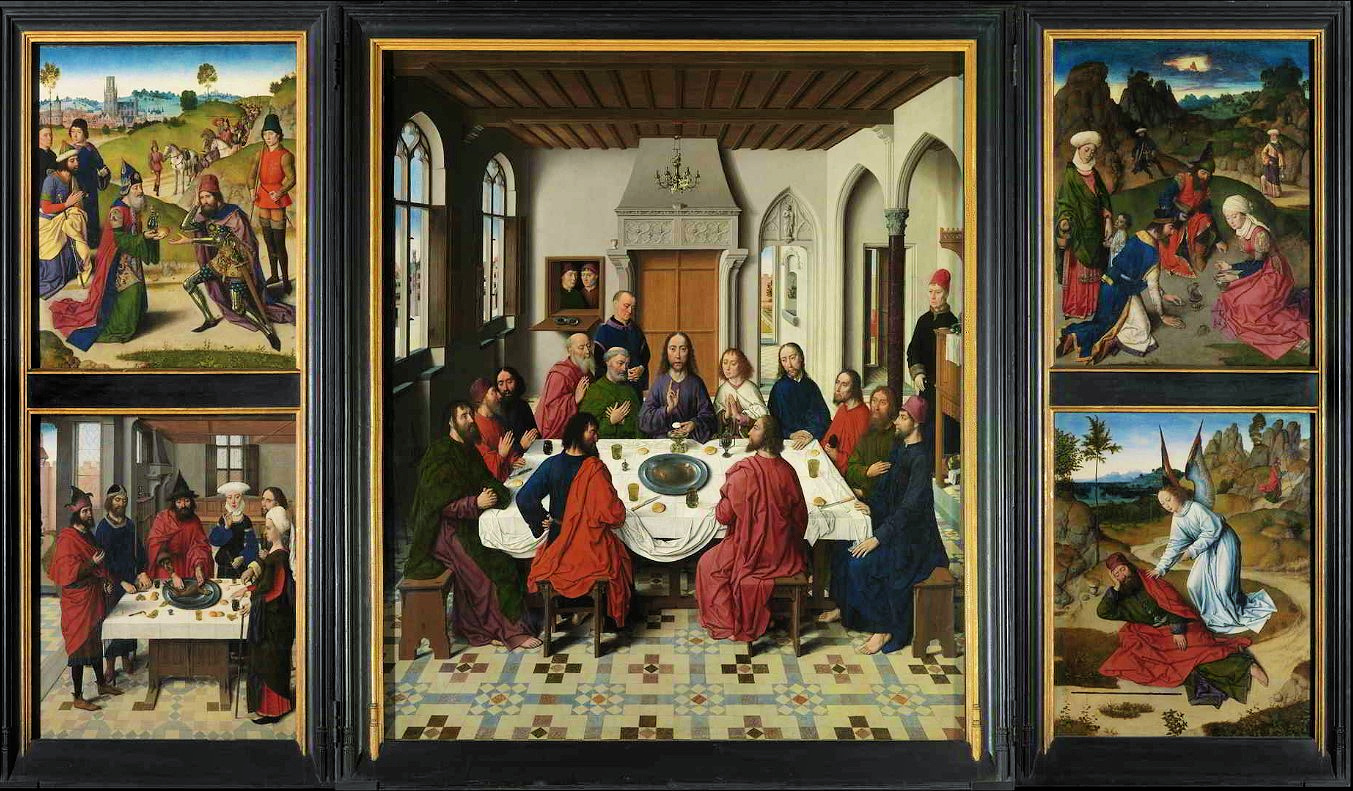
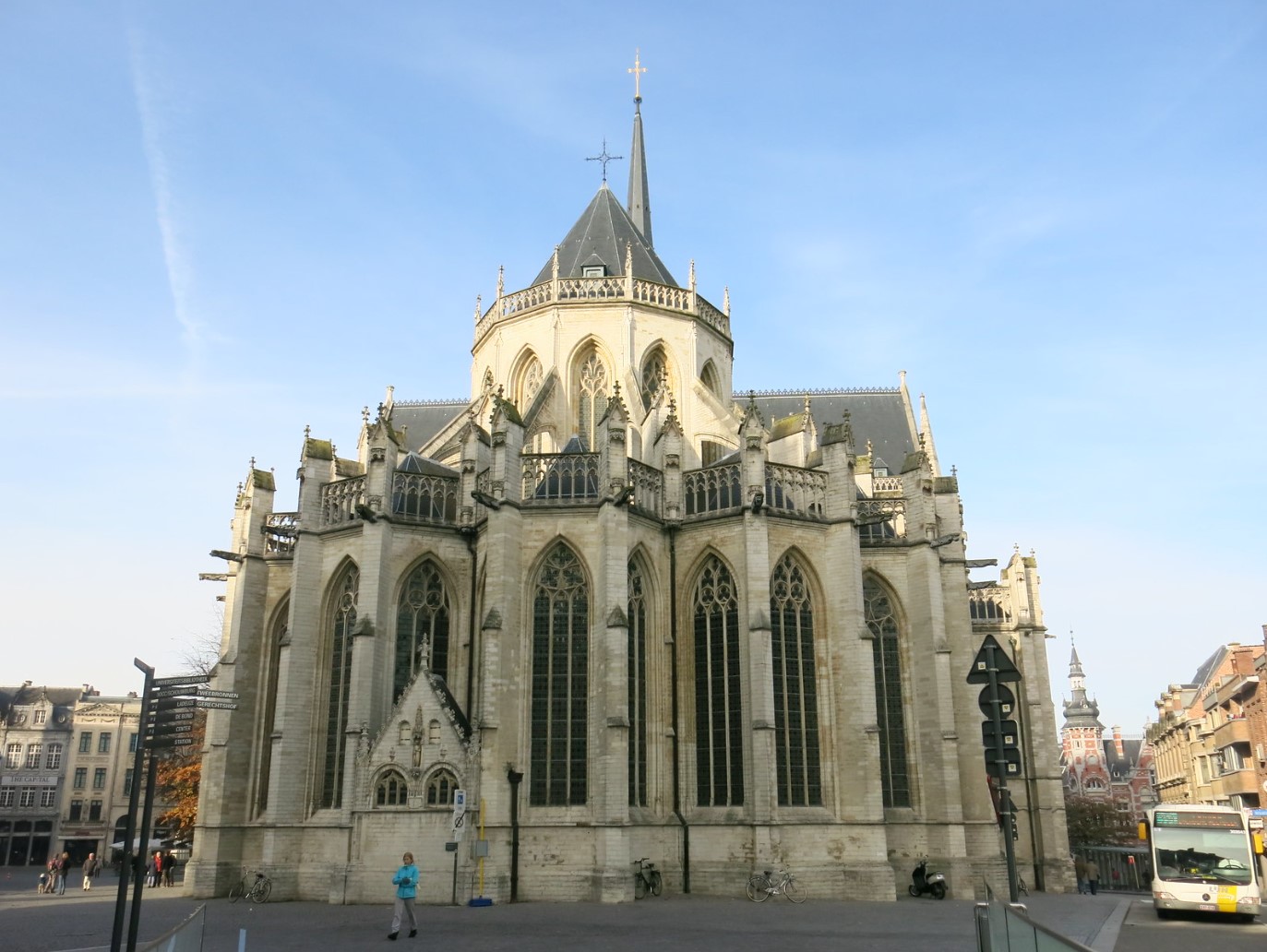
14 – Dieric Bouts (c. 1415-1475), The Altarpiece of the Last Supper or Five Mystic Meals, 1464-67, 70 ¾ x 114 inches, Church of St. Peter, Louvain, Belgium.

Dieric Bouts was born in Haarlem, the Netherlands, around 1415, where little is known of his early life. Before 1448 Bouts was working in Louvain where he married a wealthy Catharina Van der Brugghen and would work there until his death in 1475. Bouts’ finest paintings are characterized by their subtle depiction of colors and light on semi-inert and dignified and emotionally calm figures in detailed and delicately beautiful landscapes. Rogier van der Weyden influenced Bouts’ earlier work (Bouts may have trained with him in Brussels) in its greater emotionalism. In the year of Van der Weyden’s death the Brotherhood of the Blessed Sacrament of Louvain commissioned an altarpiece to place in St. Peter’s Church in Louvain. The artist worked with theologians to establish an iconography for the Eucharist which he then translated to contemporary Louvain with an exceptional plasticity whose result is that it is one of 15th century Europe’s greatest artworks. Jan Van Eyck’s influence is manifest in Bouts’ elegant intellectuality (in turn, Bouts was influential on 15th century German painting). Its perspectival calculus is matched to shapes and forms that convey emotion within the work’s compositional rigor. The head of Christ whose raised hand blesses the bread occupies the center of the artwork as the apostles gather in groupings around a table which itself develops within the room’s structure. The four side panels are scenes from the Old Testament transmitted likely by those same Catholic theologians who advised Bouts as to Biblical precedents to Christ’s Last Supper – here, the Feast of the Passover, Elijah in the Desert, the Gathering of Manna, and Abraham and Melchizedek. In 1472, Bouts was appointed city painter in Louvain, an honorary title at a time when the city was undergoing massive urban development. After Bouts’ wife died in 1473, the artist remarried in 1474 but died himself in 1475. Bouts was buried beside his first wife in the Franciscan church in Louvain. His sons, Dieric and Albrecht, were artists who continued the family tradition into the 16th century.

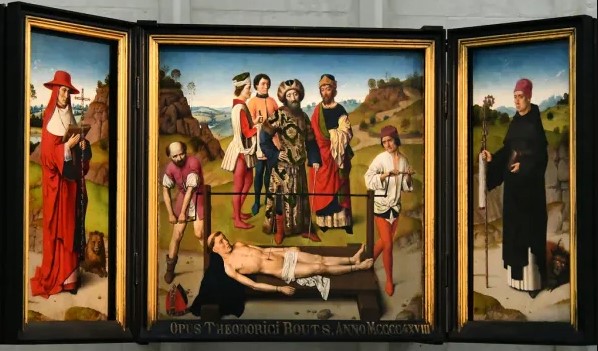
Bouts’ The Altarpiece of the Last Supper of Five Mystic Meals was to be placed in a chapel across from Bouts’ The Martyrdom of St. Erasmus in St. Peter’s, Louvain. Both artworks are hanging in the same place where it was intended for almost 600 years. BELGIUM – LEUVEN – St Peter’s Church (7)” by eso2 is licensed under CC BY-NC-ND 2.0.
St. Peter’s, Louvain. Choir and ridge 15th century. “St. Peter’s Church, Leuven” by dungodung is licensed under CC BY-SA 2.0.
15 – Dieric Bouts (c. 1415-1475), The Martyrdom St. Hippolytus Triptych, 1470 – 1475 oil on wood, 35 ¾ x 35 ¾“ Groeningemuseum, Bruges, Belgium.

Unusual for Bouts this painting depicts the torture of martyrdom. There are many figures named Hippolytus in the early church. According to Prudentius’ 5th century account, one was the martyr Hippolytus who was dragged to his death by wild horses. The account led to this Hippolytus being considered the patron saint of horses. The square format panel preferred by Bouts depicts the martyrdom from above with foreshortened horsemen shown from the front. It is the first Flemish painting to depict movement not simply by using gesture. As Delevoy assesses, “The success of the picture lies in its timeless definition, its iconographic originality, its pictorial poetry, its popular feeling, its anecdotal interest.”

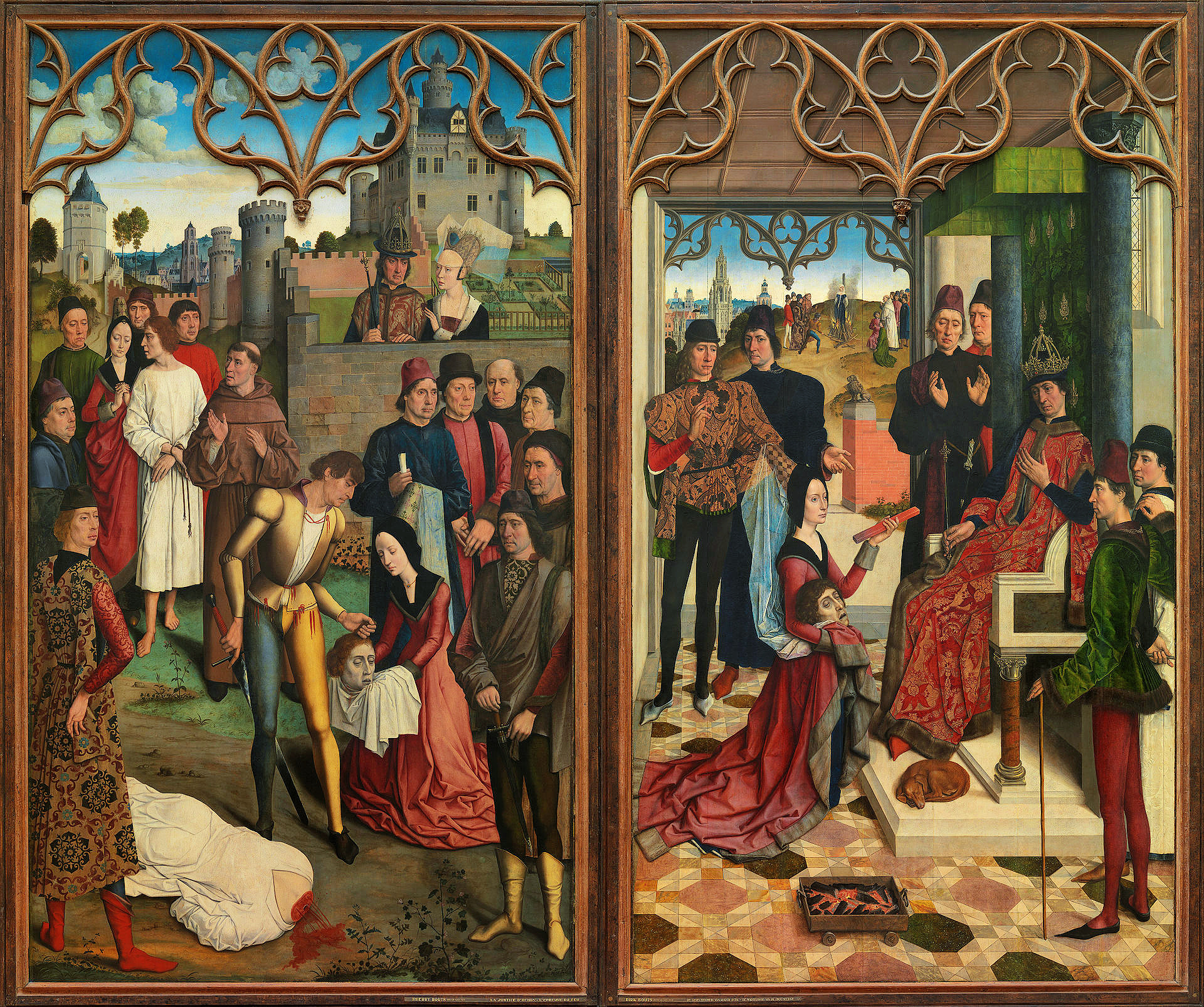
16 – Dieric Bouts (c. 1415-1475), Justice of Emperor Otto III Beheading of the Innocent Count and Ordeal by Fire, 1470 – 1475. oil on wood, 127 ½ x 72 ¼ inches, Royal Museums of Fine Arts, Brussels.

This is one of two paintings that is certain to be by Bouts (the other is Five Mystic Meals). It was commissioned in 1468 by a Louvain magistrate for the new city hall and intended to be an ambitious project on the Last Judgment. But it remained uncompleted at Bouts’s death. Panels representing heaven and hell survive and these two thematically related panels illustrating an episode from the legend of the Holy Roman emperor Otto III (980-1002). A 13th century chronicle tells how the Empress falsely accused an innocent man of a crime and persuades Otto and his court to behead him (left panel). The second panel shows the beheaded man’s wife, convinced of her husband’s innocence, approaching Otto’s throne with his head and a hot iron. Calling on God as judge, the Empress’s guilt is revealed and the royal is burned at the stake depicted in the distance. There is no lack of drama in the skillfully drawn episodes with elongated bodies, fanciful clothes, and unique facial expressions. The central focus of the panels is neither Otto nor his court but the put-upon widow of the innocent man murdered by the state through duplicity.

17 – Hugo Van Der Goes (c.1440-1482), Portinari Altarpiece: The Adoration of the Shepherds, 1476-78, 96 ½ x228 Inches, Le Gallerie degli Uffizi, Florence, Italy.

Hugo Van Der Goes (c.1440-1482) was the most important Netherlandish painter working in Ghent after Jan Van Eyck. A Ghent native, Van der Goes was in a guild there in 1467 and rose to its leadership between 1473 and 1475. Soon afterwards, the artist completed the Portinari Altarpiece for an Italian who was then residing in the Netherlands. The painting was sent immediately to Florence. Though not having the opportunity to have any great influence in the Netherlands, the Flemish 15th century art practice of cool colors and exquisite oil technique impressed the Renaissance Italians, notably Domenico Ghirlandaio (1448-1494). Also, its immense size – eight feet tall and 19 feet wide – and its virtuosity made an impact. By synthesizing Van der Weyden’s drama and sensuous expression and Bouts’ three-dimensional space, Van der Goes gives increased everyday tangible reality to his sacred subjects. Sharing Broederlam’s inquiries for visual appearances, Van Der Goes’ artwork creates new forms, types, and the impetus behind them based in popular sentiments and an edgy mysticism. So, in a 15th century sort of way, this is not your father’s Nativity (i.e, Master of Flémalle’s in 1420). It is ponderable, dense, significantly tactile and spatially voluminous. The Virgin, in prayer and in maternal caress, is in the exact center of the immense triptych. Also in the circle are St. Joseph, the shepherds, angels in the air and the Christ Child. The painting is a masterpiece of contrasts – between religious, secular, and rustic architectures; heavenly and earthly figures; peace and agitation; filled space and void; warm tones and cool colors.

Hugo Van Der Goes (c.1440-1482), Portinari Altarpiece (detail).
18 – Hugo Van Der Goes (c.1440-1482), The Death of the Virgin, c 1472–1480. 58 ½ x 47 ¾  inches, 147.8cm x 122.5cm. Groeningemuseum, Bruges, Belgium.

Around 1475 Hugo Van Der Goes became a lay brother in an Augustinian Priory, the Roode Cloister. Founded in 1367, the cloister is on the southeastern edge of modern Brussels. The artist continued to paint and receive visitors there, traveled to Louvain and Cologne, and died in 1482.

19 – Justus (Joos) van Gent (c.1435-1475), Communion of the Apostles or Institution of the Eucharist, 1473-75, 113 x125 inches, Ducal Palace, Urbino, Italy.

Justus van Ghent was a master in Antwerp in 1460 and in Ghent four years later where he met Hugo van der Goes. By the time of his death Justus van Ghent was in Rome, a city that was increasingly attracting international artists, including from northern Europe. Van Ghent was in Urbino where he painted Institution of the Eucharist in Urbino. The commission was originally given to Italian artist Piero della Francesca (1415-1492) and its predella (the altarpiece’s painting at its lower edge) was completed by Uccello (1397-1475).

20 – Hans Memling (c. 1433-1494), The Adoration of the Magi (c. 1470), 37 ¼ x 57 inches, c. 1480, oil on panel, El Museo Nacional del Prado, Madrid.

Hans Memling was a German, born near Frankfurt-am-Main. Memling was likely a student of Rogier van der Weyden and completely Netherlandish in his artistic style. Memling lived in Bruges and became a citizen in 1465. By 1480 the successful artist was one Bruges denizen who was paying the city’s largest amount of taxes. Though not innovative, Memling’s artwork depicts calm and peaceful figures full of piety. Memling also painted portraits successfully. Examples of his artwork are in collections all over the world.

21 – Hans Memling (c. 1433-1494), Bathsheba at her Bath, c. 1480-1485, 37 ¾ x 33 inches, Staatsgalerie Stuttgart, Germany.
22 – Hans Memling (c. 1433-1494), The Martyrdom of Saint Sebastian, c. 1475, 26 ¼ x 25 ½ (67.4 x 67.7 cm), oil on wood, Royal Museums of Fine Arts of Belgium, Brussels.
23 – Gerard David (c.1460-1523), The Justice of Cambyses: the arrest of the Dishonest Judge, 1498, Groeningemuseum, Bruges, Belgium.

Gerard David was a Dutch painter born in Oudewater. David was in Bruges by 1484. He was the last major painter from Bruges and painted pious pictures in a gentle Netherlandish style right before the rise of a new Italianate style in Antwerp. David traveled to Antwerp in 1515 and joined the Guild but returned to Bruges and died there in 1523. Though many pictures are attributed to David, the pair of Justice paintings are certainly his.

24 – Gerard David (c.1460-1523), Altarpiece of the Baptism of Christ, 1502-1508, 52 ¾ x 73 ½ inches, Groeningemuseum, Bruges, Belgium.

SOURCES:

A Dictionary of Art and Artists, Peter and Linda Murray, Penguin Books; Revised,1998.

Early Flemish Painting, Robert L. Delevoy, New York: McGraw-Hill Book Company, Inc., 1963.

https://www.britannica.com/summary/Jan-van-Eyck –  retrieved February 5, 2024.

https://www.britannica.com/summary/Philip-III-duke-of-Burgundy – retrieved February 5, 2024.

https://www.uffizi.it/en/online-exhibitions/portinari-triptych#2 – retrieved February 6, 2024.

https://www.youtube.com/watch?v=e5I_MKCs8Zo – retrieved February 7, 2024.

https://sammlung.staedelmuseum.de/en/work/the-bad-thief-to-the-left-of-christ – retrieved February 4, 2024.

 https://www.mleuven.be/en/even-more-m/last-supper – retrieved February 2, 2024.

https://collections.louvre.fr/en/ark:/53355/cl010061856 – retrieved January 29, 2024

https://www.codart.nl/guide/agenda/dieric-bouts-creator-of-images/ – retrieved January 29, 2024

https://collectie.museabrugge.be/en/collection/work/id/O_SJ0188_I – retrieved January 29, 2024

https://www.metmuseum.org/art/collection/search/110001938?rndkey=20120109&pos=145&pg=10&rpp=15&ft=*&high=on– retrieved January 29, 2024

https://www.wga.hu/html_m/m/master/flemalle/nativity/nativi_.html – retrieved January 29, 2024

Both above: detail, Master of Flémalle, Annunciation Triptych (Merode Altarpiece), c. 1427-32, The Cloisters (Metropolitan Museum of Art), New York.

FRANCE. French art in the 17th Century: SIMON VOUET (1590-1649).

https://johnpwalshblog.com/2022/12/07/french-art-in-the-17th-century-simon-vouet-1590-1649/

FEATURE Image: Simon Vouet (1590-1649), Self-portrait, c. 1626–1627, Musée des Beaux-arts de Lyon. https://www.mba-lyon.fr/fr/article/simon-vouet In Simon Vouet’s self portrait painted in his final years in Rome he displays his signature rapid brushwork and desire for movement in the picture.

Simon Vouet was born into modest circumstances in Paris on January 9, 1590. After stays in England in 1604, Constantinople in 1611 and Venice in 1613 of which little is known, the French painter Simon Vouet (1590-1649) spent nearly 15 years in Rome starting around 1614. In 1624 Vouet was elected to lead the Accademia di San Luca, an artists’ association founded in 1593 by Federico Zuccari (1539-1609).

Most French painters born in the 1590s made a stay in Rome which influenced art in France in the 17th century. Vouet was in Italy, primarily in Rome, between around 1613 until 1627 and received a special privilege from the French crown in 1617. It was this traffic of young French, Flemish and other international artists between Italy and their home countries in the first third of the 17th century that, for France, helped revolutionize French art. This was achieved by way of the contemporary application of ideas and styles influenced by late Renaissance Italian realist artists such as the aesthetic of Caravaggio (1571-1610) and the history painting method of Annibale Carracci (1560-1609), among many others, to which French artists were exposed while in Italy. In Rome Vouet, like other French artists such as Valentin de Boulogne (1591-1632), was patronized by Cardinal Francesco Barberini (1597-1679) and Cavaliere del Pozzo (1588-1657), among others. In 1624 Vouet was commissioned to paint the fresco to accompany Michelangelo’s Pietà in St. Peter’s and while greatly admired it was destroyed in the 18th century.

In addition to Rome, Vouet traveled to Naples, Genoa in 1620 and 1621, and, in 1627, Modena, Florence, Parma, Milan, Piancenza, Bologna and again Venice where he copied Titian (1488-1576), Tintoretto (1518-1594) and Paolo Veronese (1528-1588). During these visits Vouet studied the chief art collections that informed Vouet’s own style which amounted to a free form of temperate, classicized Baroque. This is the style, along with the latest Venetian-influenced brighter colors, vivid light, and painterly execution that Vouet returned and introduced to France in the 1630s. In France, Vouet had taken to himself as a painter his particular appreciation for the classicized compositions of Nicolas Poussin (1594-1665) and the cool colors of Philippe de Champaigne (1602-1674).

In 1627, King Louis XIII (1601-1643) called Vouet back to Paris to be his court painter. Vouet refined Caravaggio’s innovations into a style that would become the French school of painting starting in the 1630s and extending into the middle of the 18th century. Until about 1630 it was Late Mannerism which dominated in  French painting and included unnatural physiognomy, strained poses, and untenable draperies. This changed with Vouet’s return who brought back from Italy a style with classical, realist, and Baroque painting components that was unknown in France until then and which Vouet stamped with his own style.

Simon Vouet (1590-1649), Portrait of a Young Man, c. 1616/1618, 55 x .41 m, oil on canvas. Musée du Louvre. https://collections.louvre.fr/en/ark:/53355/cl010061288

This painting entered the Louvre as a work of the Neapolitan school. It was recent scholarship that attributed it to Vouet which would make it one of his earliest portraits in Rome. Building on the premise, scholars have proposed Francesco Maria Maringhi (1593-1653), a Florentine patrician and lover and protector of Italian Baroque painter Artemisia Gentileschi (1593-1656), as the model.

Vouet married twice. His first wife was a young Italian woman he met in 1625 – Virginia da Vezzo  (1600–1638). In France Vouet’s wife, who bore him 4 children, was well received by the French court. After Virginia died in 1638, Vouet married Radegonde Béranger (b. 1615), a young beauty from Paris, in July 1640. Radegonde bore Vouet another 3 children (one died in infancy), and survived him.

Simon Vouet (1590-1649), Virginia da Vezzo, the Artist’s Wife, as the Magdalen, oil on canvas, 40 × 31 in. (101.6 × 78.7 cm), oil on canvas,  c. 1627, Los Angeles County Museum of Art. https://collections.lacma.org/node/247903
Simon Vouet (1590-1649), Judith with the head of Holofernes, 1620/1625, 97 x 73,5 cm, oil on canvas, Bayerische Staatsgemäldesammlungen München-Alte Pinakothek, https://www.sammlung.pinakothek.de/de/artwork/jWLpZea4KY/simon-vouet/judith-mit-dem-haupt-des-holofernes
Simon Vouet (1590-1649), The Birth of the Virgin c. 1620 Rome S. Francesco a Ripa.
Detail: The Birth of the Virgin.

The Birth of the Virgin was one of many paintings in a somber palette that Vouet produced in Rome influenced by Caravaggio though its mood is more vibrant. The composition is broad, low and somewhat setback from the picture plane. Amidst the swirling movement and vitality of the drawing and figures, including sumptuous draperies, it is observed that the head of the maid servant in the middle of the composition is modeled on one by Michelangelo Buonarroti (1475-1564). These early qualities that Vouet had  taken from Italian painting were, when he returned to France, taken over by a heightened decorative style in the 1630s and 1640s.

Ottavio Leoni (1578–1630), Simon Vouet in Italy, engraving, sheet 9 3/8 × 7 1/16 in. (23.34 × 17.94 cm), Carnegie Museum of Art, Pittsburgh.
Simon Vouet (1590-1649), Portrait presumed of Aubin Vouet, c.1625. Musée Réattu, Arles.
Simon Vouet (1590-1649), The Temptation of Saint Francis, c. 1620 Rome Basilica of Saint Lawrence in Lucina.

Simon Vouet (1590-1649), The Temptation of Saint Francis, c. 1620, Basilica of Saint Lawrence in Lucina, Rome. In Rome Frenchman Simon Vouet adopted a Caravaggesque style coupled with elements from Michelangelo such as in this painting for an ancient (4th century) church in Rome. While Vouet worked directly from the model and used closely observed poses from reality, the head of St. Francis of Assisi seems to be taken from one by Michelangelo. In Franciscan spirituality and tradition there is much greater emphasis on the presence of God and the joys of living the evangelical counsels (poverty, chastity, and obedience) in community and in nature than there is on the vocation’s temptations, trials or penances that could only be part of any religious saint’s story. While the early Franciscans tell tales of the devil, these are always quickly resolved as they relate the saint’s or another Franciscan brother’s beautiful victories over the Tempter by prayer, fasting and humility. Simon Vouet’s early painting in Rome presents an ostensibly Franciscan subject but with a Renaissance modern sensibility focusing on the twisting bodies of the figures of a contemporary woman presenting herself to the young Italian 13th century saint who, himself half naked, is all muscles and who gestures at the moment of first encounter with fleshly temptation to an unresolved ending adding to the painting’s worldly intrigue. see –https://www.finestresullarte.info/en/works-and-artists/-almost-as-unbelievable-as-a-church-painting–simon-vouet-and-his-saint-francis-tempted

Attributed to Vouet, Annunciation, Uffizi, c. 1621. oil on canvas 1.20 x 0.86m (see Crelly, pp. 162-63).
Simon Vouet (1590-1649), The Circumcision, oil on canvas, Church of Sant’ Angelo a Segno Naples.
Simon Vouet (1590-1649), The Crucifixion with Mary and John, oil on canvas, Church of Jesus and Saints Ambrogio and Andrea Genoa
Simon Vouet (1590-1649), Appearance of the Virgin to St Bruno, c. 1624, Naples, S. Martino.

As Vouet stayed in Italy he increasingly turned to a Baroque style of which The Crucifixion with Mary and John in Genoa is an early example. The Appearance of the Virgin to St. Bruno in the Carthusian monastery of San Martino in Naples is a later and more fully realized Baroque style example. The atmosphere of each showing saints in ecstasy is a clear element in Baroque’s intensified and elaborated religious representation. In Italy Vouet’s paintings are more restrained than the full contemporary Baroque art of Pietro da Cortona (1597-1669) and his followers such that the French painter’s figure of the Virgin in his Naples’ picture tends towards a classical Renaissance tradition that would be an important part of the expression of French taste in the 1630s and 1640s.

Simon Vouet (1590-1649), Modelli for Altarpiece St-Peters Rome, 1625, Los Angeles County Museum of Art.
Simon Vouet, The Clothing of St. Francis of Assisi, Rome, S. Lorenzo in Lucina, Alaleoni Chapel, 1624. Vouet decorated the chapel with dozens of paintings.
Simon Vouet, Allegory of the Human Soul, Rome, Capitoline Musem, 1.79 x 1.44 m. It probably entered the collection of the Capitoline Museum in the 17th century (See Crelly, p.213).
Simon Vouet (1590-1649), The ill-matched couple (Vanitas), c. 1621.
Simon Vouet (1590-1649), David with the Head of Goliath, c. 1621,Palazzo Bianco, Genoa.
Simon Vouet (1590-1649), St. Catherine, c. 1621.
Simon Vouet (1590-1649), Young Man wearing armor, c. 1625/271,165 m x .91 m, oil on canvas. Musée du Louvre. https://collections.louvre.fr/en/ark:/53355/cl010061299

The painting by Vouet towards the end of his Roman period, the identity of the young man above is unknown though speculation by modern scholars is impressive (i.e., St. Thomas Aquinas, among others). The painting’s copies are numerous which points to the composition’s success. These copies can be found in major museums throughout Europe.

Vouet, Sophonisbe receives the poison cup through a messenger, c. 1623, oil on canvas, 125,5 x 156,5 cm, Kassel, Staatliche Gemäldegalerie. The painting was previously attributed to Guido Reni (1575-1642). The painting was in Kassel by 1738. (see Crelly, p. 167). https://altemeister.museum-kassel.de/33982/0/0/147/s1/0/100/objekt.html. The tragic events are condensed in the expressive eye contact. Sophonisbe, the patriotic daughter of the Carthaginian general Hasdrubal, knew how to keep her husband Syphax on the Carthaginian side in the war with Rome. He was captured by the Numidian prince Masinissa, who was allied with Rome, and Sophonisbe threatened with extradition to the Romans. When she begged Masinissa for protection, he fell in love with her and married her. Now the Romans sensed betrayal and demanded the surrender of the dangerous enemy. Masinissa did not dare to resist, but he sent Sophonisbe a servant with a poisoned cup, which she drank (Livy 30:15). The subject topic could also be Agrippina receives the poison cup sent by Nero.
Simon Vouet (1590-1649), Saint Jerome and the Angel, c. 1622/1625, 144.8 x 179.8 cm (57 x 70 13/16 in.), oil on canvas, The National Gallery of Art, Washington D.C. https://www.nga.gov/collection/art-object-page.46151.html

In 1627 Vouet painted Saint Jerome and the Angel featuring an elderly bearded saint and a winged curly-haired angel holding a trumpet that signifies the Last Judgment. While the composition is Caravaggesque in its naturalistic depiction of half figures, stark lighting, and dark-brown palette, Vouet’s painting features brighter colors in the robes and clothes which was a departure from the Caravaggesque tradition and, among some contemporary artists in Rome in the late 1620s, an aesthetic innovation. The painting demonstrates Vouet’s superb fluid handling of paint which he brought back to and deployed in France starting in the 1630s.

Vouet, Cupid and Psyche, c. 1650, 11.5 x165 cm, Musée des Beaux-arts de Lyon. https://collections.mba-lyon.fr/fr/notice/1938-40-psyche-et-l-amour-66103ce7-f9de-4d1a-9b96-eef92185be48. Though dated around 1650, scholars believe the work was completed in Italy in the late 1620s. (see Crelly, p. 176).
Nicolas Mignard (1606-1666), Portrait de Simon Vouet, Louvre.

Vouet was a leading French artist in Rome when asked to return to France by the king in 1627. At his arrival, though embraced by King Louis XIII and his mother, Marie de’ Medici, Vouet was kept at a distance by Cardinal Richelieu (1585-1642) who viewed the ambitious artist as a social climber. Though modest compared to the great collections in London and Madrid, Cardinal Richelieu collected about 272 pictures, the canvasses listed in an inventory compiled by Vouet and his student, Laurent de la Hyre. Though Richelieu succeeded in getting Poussin to return to France from Rome in 1641and as “First Painter,” this direct competition to Vouet was short-lived. Richelieu died in 1642 and Poussin left for Italy the same year.

The king set Vouet to the task of painting portraits of the court nobility though just one survives today – that of Richelieu’s secretary. In 1648, when the Académie Royale de Peinture et de Sculpture was established – an organization that held monopoly power over the arts in France for the next 150 years – Vouet was not invited to join. Vouet understood that the academy, which included his pupils Le Brun and Le Sueur, was established in part as a generational shift that challenged his influence and authority. Vouet countered by modernizing the old painter’s guild but did not live to see the battle joined. He died of exhaustion in June 1649. The Academy went on to school artists, provide access to prestigious commissions, and hosted the Salon to exhibit their work. After Vouet’s death, the Académie soon rose to prominence with Jean-Baptiste Colbert, First Minister of State from 1661 until his death in 1683 under Louis XIV, as its protector and Charles Le Brun as First Painter and the Académie’s director.

Atelier of Simon Vouet (1590-1649), Michel le Masle (1573-1662), 1628,, oil on canvas, musée Carnavalet, Paris.

Upon Vouet’s return to France in late November 1627, his French style set to work mainly on religious subjects which were admired by the public, particularly in diocesan and religious orders’ churches of Paris. As late as 1630, the eye of the Paris art consumer was used to prevailing late 16th century mannerism. It took time for the French to better accept Vouet’s new Caravaggesque naturalism. Further, while France was a so-called eldest daughter of the Catholic Church, Parisians did not share the intense religious enthusiasm that was the art expression in the papal states. Parisians did not fully accept the swirling heavenly masses found in Italian Baroque. In France Vouet had to temper his stylistic synthesis of classicism, naturalism and baroque as the French expression of and contribution to a great international style.

Simon Vouet (1590-1649), Madonna and Child, 1633 oil on canvas, overall: 110.3 × 89.4 cm (43 7/16 × 35 3/16 in.) The National Gallery of Art, Washington D.C. https://www.nga.gov/collection/art-object-page.206070.html

Vouet’s new and tempered French style is exquisitely represented in Madonna and Child (1633). During the religious reformation period in the 16th century one of the Catholic Church’s responses was the renewal of devotion to the Virgin Mary. This cult of the Virgin, once blossomed in the 12th century, was in renewed full maturity in the 1630s and even inspired the French king to dedicate his North American empire to her in 1638. Vouet painted more than a dozen compositions of the Virgin and her son at half-length. While the blank background and figurative monumentality remain from his Roman days, Vouet’s mastery of light and use of bright colors signal the realization of the new French style. The monumental figure of the seated Virgin depicted in a Mannerist and Classical synthesis holds her son on her lap and looks at him with drooping eyes.Her arm supported by the foundation of a classical column, Mary’s dark hair is held back by a fabric band as her neck and shoulder are exposed. The Christ child reaches up to kiss his mother, his body in a Baroque twist as he caresses her face. The brilliantly executed moment expresses intimacy and tenderness while maintaining religious seriousness.

Simon Vouet (1590-1649), Lot and his Daughters, 1633, 160 x 130 cm, oil on canvas, Musée des Beaux-arts, Strasbourg. https://www.musees.strasbourg.eu/oeuvre-musee-des-beaux-arts/-/entity/id/220480?_eu_strasbourg_portlet_entity_detail_EntityDetailPortlet_returnURL=https%3A%2F%2Fwww.musees.strasbourg.eu%2Frechercher-oeuvre-musee-beaux-arts%3Fp_p_id%3Deu_strasbourg_portlet_search_asset_SearchAssetPortlet%26p_p_lifecycle%3D0%26p_p_state%3Dnormal%26p_p_mode%3Dview%26_eu_strasbourg_portlet_search_asset_SearchAssetPortlet_checkboxNames%3DclassName%252CclassName%26_eu_strasbourg_portlet_search_asset_SearchAssetPortlet_keywords%3Dsimon%2Bvouet%26p_p_lifecycle%3D1%26_eu_strasbourg_portlet_search_asset_SearchAssetPortlet_formDate%3D1669662298707%26_eu_strasbourg_portlet_search_asset_SearchAssetPortlet_vocabulariesCount%3D0%26_eu_strasbourg_portlet_search_asset_SearchAssetPortlet_className%3Deu.strasbourg.service.artwork.model.Artwork%26_eu_strasbourg_portlet_search_asset_SearchAssetPortlet_className%3Deu.strasbourg.service.artwork.model.ArtworkCollection

The Bible story of depravity that Vouet depicts is that of Lot and his daughters found in Genesis 19. The angels have warned Lot who is an upright man that Sodom and Gomorrah are to be destroyed for its sins. As Lot’s family escapes, they are warned not to look back on the Divine destruction. Lot’s wife disobeys and is turned into a pillar of salt. Despairing of finding husbands where they are going and so carry on their own people, Lot’s daughters devise to get their father drunk and lie with him. Both daughters become pregnant in this way.

Vouet depicts Lot of the Old Testament story as they break the taboo of incest to carry on the race in desperate times using Renaissance artistic language of a god from pagan mythology. In place of moralizing, Vouet composes a sensual scene showing Lot, a male figure of late middle age, tasting the company of two nymph-like young women in a canvas filled with the attraction of the flesh and drunken debauchery. The lines and forms of Vouet’s new painting give priority to its narrative power which will be the manner of his artwork following his return to France. It is noted that Vouet used a contemporary engraving of an ancient relief to model the figure of the seated daughter.

Simon Vouet (1590-1649), Gaucher de Châtillon (1250–1328), Constable of France, c. 1632/35,2.18m x 1.37m, oil on canvas. Musée du Louvre. https://collections.louvre.fr/en/ark:/53355/cl010065607

Commissioned by Cardinal Richelieu for his Palais Royal’s Gallery of Illustrious Men the painting of Gaucher de Châtillon was set into one of its bays. The portrait was greatly admired in that generation for the figure’s resolute pose as well as the execution of Vouet’s drawing and painting. Critics assessed that since the pose and head were so artistically beautiful Vouet’s subject was not modeled from life but inspired by Carracci. Seeing the subject turned and from behind was in the Mannerist tradition that Vouet loved and adopted for this historical figure of Gaucher de Châtillon (1250-1328), a constable of France and advisor to Capet kings, Philip IV the Fair (1268-1314), and then to his sons, Louis X the Quarreler (1289-1316), Philip V the Tall (1293-1322) and Charles IV the Bald (1294-1328). The Louvre’s picture has been restored.

Back in France Vouet had a successful career as the painter of large decorations and religious and allegorical paintings. His studio was the largest international workshop and school in Paris. Vouet was a most sought-after and beloved teacher and his art collaborators were numerous (Le Brun, Le Sueur, Mignard, Du Fresnoy, Le Nostre, among others). Per usual practice among professional artists in Europe, those with talent were encouraged to marry into the master’s family so to keep the training, skill and social connections “in house.”

The 1630’s began an age of cultural realignment and reorientation in France that would remain until about the French Revolution. In 1634 the Académie Française was founded under Cardinal Richelieu. In 1637 René Descartes published in French his Discourse on Method (“Je pense, donc je suis” “I think, therefore I am”) ushering in radical subjectivity in philosophical thought. That same year Peter Corneille’s Le Cid was produced, the first great stage play. In 1640 the Imprimerie Royale was founded to publish scholarly books and improve societal erudition. The decade’s innovations continued to transform culture over the next 30 years. By the 1660s French artists, writers and others in France viewed their language, thought, and artistic culture as the world’s most refined and unparalleled in history. Vouet’s return in 1627 was well situated for him to contribute to this prolonged period of interest in artistic matters in France.

In the mid17th century, wealthy French patrons began to collect Italian and Italian-inspired art. This included Louis Phélypeaux de La Vrillière (1599-1681) who collected 240 major paintings for his house in Paris. Critics have observed about Vouet that as he played the role of art functionary by  importing and translating Italian art tradition into France, he remained less of a truly profound original artist.

Louis Phélypeaux de La Vrillière, secrétaire d’Etat de la religion prétendue réformée. He built the Hôtel de la Vrillière in 1st arrondissement in Paris designed  by François Mansart (1598-1666) between 1635 and 1650.

In the 1630s, classical understanding of Carraci from Domenichino (1581-1641) was giving way to a different understanding of history painting from Giovanni Lanfranco (1582-1647). Lanfranco viewed Caracci’s legacy as decoration in search of vitality more than a spatial or formal articulation which extended to include figures in action. Vouet worked rapidly to populate the churches, monasteries and abbeys, royal palaces and private mansions, many newly built, of Paris, with his artwork. Vouet also produced large public commissions, all of which expressed a prevailing Baroque potpourri.

Vouet’s most significant contribution to French painting is his innovations in decorative painting whose influence was felt in France into the mid18th century. Vouet’s influence may be out sized to his intellectual quality and artistic originality but he made a tremendous impression on his contemporaries and was the artist, in a city of intense competition, who was the leading figure of the new Italian art manner for the French public and in many different projects for over 20 years. Vouet’s position as painter is on par with architects Jacques Lemercier (c.1585-1654) and Louis Le Vau (1612-1660) as part of that same generation in France who formed the classicizing French Baroque. They used French art practice since King Francis I (1494-1547) and solid current Roman practice forged into a French synthesis associated with Cardinal Richelieu and Louis XIII. Vouet’s pupils, Charles Le Brun (1619-1690), Pierre Mignard (1612-1695), Nicolas Mignard (1606-1668). Le Sueur (1617-1655), and François Perrier (1590–1650) carried on the tradition of Vouet’s artwork.

Philippe de Champaigne (1602-1674), Jacques Lemercier with dome of Sorbonne.
Louis le Vau.
Philippe de Champaigne (1602-1674), Cardinal Richelieu, 1642, Musée des Beaux-Arts de Strabourg.
Peter Paul Rubens (1577-1640), Young Louis XIII.

For his decorative work Vouet collaborated with artists in other media such as sculptor Jacques Sarrazin (1592-1660). Vouet painted large-scale decorations for royal patrons such as Anne of Austria (1601-1666), wife and mother of French Kings, at Fontainebleau in 1644  and at the Palais Royal between 1643 and 1647. Vouet did a decorative series at the Arsenal. At Hôtel Séguier (no. 16 rue Séguier) in Paris for the chancellor of France, Pierre Séguier (1588-1572), Vouet painted the chapel, library, and lower gallery. In these projects, Vouet reintroduced forgotten French painting traditions of illusionism practiced by Italian artists at Fontainebleau in the 1530s. Vouet synthesized it with the new Italian style in the 1630s, including imitating the use of gold mosaic and big oval designs derived from Venice. Today these decorations survive only by others’ engravings of them.

Pierre Séguier.

Some of Vouet’s decorative schemes survive at the Château de Wideville west of Paris. The castle was originally built in the late 16th century and sold to King Louis XIII’s minister of finances, Claude de Bullion (1569-1640), in 1630. Starting in 1632, the new owner set about building and expanding the castle in the Louis XIII style, with red bricks, white quoins and a pair of chimneys. Bullion involved the best decorators including Vouet for painting as well as Jacques Sarrazin (1591-1660) and Philippe de Buyster (1595-1653) for sculpture. Château de Wideville later became base for Louise de La Vallière (1644-1710), maitresse d’amour of King Louis XIV.

Claude de Bullion, oil on panel, 33 x 23,5 cm.

Vouet completed a later decorative panel, Muses Urania and Calliope in or around 1640, with the help of his studio. Likely commissioned as an altarpiece for the private chapel of a wealthy Parisian, the painting depicts porcelain skin women, bejeweled drapery, and putti in a classical architecture setting.

Simon Vouet (1590-1649), Armida carrying the sleeping Rinaldo, 63 x 47 in, n.d., private collection.
Simon Vouet (1590-1649), The Muses Urania and Calliope, c. 1634, oil on wood, The National Gallery of Art, Washington D.C. https://www.nga.gov/collection/art-object-page.46160.html
Simon Vouet, The Toilet of Venus, c. 1640, 64 15/16 × 45 1/16 in164.94 × 114.46 cm, Carnegie Museum of Art, Pittsburgh https://collection.cmoa.org/objects/7093a02e-4ea1-4892-9ace-6538065ebdab

With his patrons Vouet was an amenable creator and he was a facile painter. His wealthy and powerful patrons wanted showy decorative artwork painted in the modern Italian manner without very serious religious or political messages for their often newly-acquired or built residences. The Toilet of Venus is exuberant and intriguing though based on the latest Italian art of the day – the theme is inspired by a treatment of Francesco Albani (1578-1660) while the figure of Venus is derived from Annibale Carracci. Though the figures remain weighty in the mode of Italian Naturalism, Vouet transforms the group into curvaceous polished and floating interlocking forms.

Simon Vouet (1590-1649), The Presentation at the Temple, 1641, oil on canvas, 3.93 m x 2.5 m, Musée du Louvre. https://collections.louvre.fr/en/ark:/53355/cl010062002

As many of Vouet’s large-scale decorative and other works were virtually systematically destroyed in the Revolution so that the connoisseur must assess Vouet’s artistic merit by way of surviving decorative schemes more than individual canvases or fragments, The Presentation in the Temple is an important extant painting by the hand of Vouet that allows qualitative comparisons to other 17th century French artists such as Laurent de La Hyre (1606-1656), Eustache Le Sueur, Charles Le Brun, and Jean-Baptiste Jouvenet (1644-1717). Commissioned for the Jesuits by Richelieu in 1641 for what is today’s Saint-Paul-Saint Louis in Paris’s Marais it was part of a rich ensemble of artifacts  whose overall artistic scheme was dedicated to Christ and the French monarchy. Vouet’s presentation theme evokes the birth of Louis XIV and the painting was flanked by sculptures of Jesuit saints and French political figures.

There remains some similarity to what Vouet had produced in Italy in the mid1620s, particularly in The Appearance of the Virgin to St Bruno in Naples, such as his use of diagonals. Yet 15 years later in France Vouet’s composition is more classical in orientation including a rational not emotional or supernatural treatment of the subject more in the style of Nicolas Poussin who was called back to France from Italy the year before.

To give the illusion of grandeur, Vouet provides a very low position at the bottom of the stairs surrounded by gigantic religious architecture of which he paints a fragmentary synecdoche. For depth, Vouet interposes firmly-modeled foreground figures that partly mask more distant such figures in statuesque draping. Vouet’s cool colors reflect the influence of Philippe de Champaigne and the Baroque turning movement extends into the entablature of the architecture of the temple of Jerusalem, as well as the inclined position of the two angels painted in the upper portion.

By 1762, 20 years after Vouet painted The Presentation, politics changed unpleasantly for the Jesuits as they were suppressed by the Pope and their Paris flagship church’s high altar ensemble was dismantled. The painting was housed in the Royal Academy of Painting and Sculpture and later transferred to the Louvre during the French Revolution.

Simon Vouet (1590-1649), The Adoration of the Holy Name by Four Saints, oil on canvas,265 x176 cm, Église Saint Merri, Paris.
Simon Vouet (1590-1649), Altar piece, Église Saint-Nicolas-des-Champs, Paris.
Simon Vouet (1590-1649), Virgin with oak branch, known as Madonna Hesselin, c. 1640/1645, Musée du Louvre. https://collections.louvre.fr/en/ark:/53355/cl010067259

In 1651, two years after the death of Vouet, the painting above was inscribed in Latin to state that Vouet had painted the artwork and in the house of “very noble lord” Louis de Hesselin, one of the king’s advisors. The inscription also gives the meaning of the palm branch the Virgin holds – it is a sign of the means of her effectual assistance to the afflicted. Sieur Hesselin was a confident to the artist who was both godfather to Vouet’s eldest son in 1638 and witness to the marriage of Vouet’s daughter 10 years later. Two other known versions of the painting are found in the United States and in England. X-rays revealed that Vouet fully completed the neckline of the virgin before he added the painted golden robe upon it.

Simon Vouet (workshop), Christ at the Column, c. 1635/40, 1.28 m x .66m, oil on canvas. Musée du Louvre.

Louis XIV owned this painting of Christ being scourged by Roman soldiers at the pillar during his Passion. In the 18th century the painting was attributed to Eustache Le Sueur which still has its defenders today. Attribution to Simon Vouet began in the 20th century among scholars. In the 21st century scholars have proposed Charles le Brun (1619-1690) and the “Workshop of Simon Vouet” which the Louvre has settled upon. Preparatory drawings for the painting exist at the Bayerische Staatsbibliothek in Munich and at the Musée des Beaux-Arts in Besançon. The artwork may have come from a chapel of the Château in Saint-Germain-en-Laye. The painting was restored twice in the 18th century and in the 1960s.

Simon Vouet (1590-1649), Standing Angel, hands joined, 0.212 m ; L. 0.137 m Louvre.https://collections.louvre.fr/en/ark:/53355/cl020227558
Simon Vouet (1590-1649), Head of a man with disheveled hair, three quarters view. 0,155 m ; L. 0,148 m Louvre https://collections.louvre.fr/en/ark:/53355/cl020227444

Preparation drawing for a Last Supper picture.

Vouet, Crucifixion, 1637, 215.9 x 146 cm. Musée des Beaux-arts de Lyon. https://collections.mba-lyon.fr/fr/notice/a-139-la-crucifixion-3a886bea-64a6-4741-9866-fb0f935fd688
Vouet, Last Supper, 1637,  153,4 x 132,5cm. Musée des Beaux-arts de Lyon. https://collections.mba-lyon.fr/fr/notice/1996-121-la-cene-573eb24f-b3a3-4204-b166-82effe883109
Vouet, Doubting Thomas, 1637, 149.7 x 114 cm, Musée des Beaux-arts de Lyon. https://collections.mba-lyon.fr/fr/notice/1998-6-l-incredulite-de-saint-thomas-c96df49c-abb6-4cc5-8127-3103e527b49b

At the same time that Vouet was painting religious subjects for churches in Paris he was painting allegorical and poetical artwork. For these paintings Vouet’s designs are freer, modeling looser and, in the Venetian style, the composition determined more by color and light.

Simon Vouet (1590-1649), Charity, c. 1635, 1.92 m x 1.32m, oil on canvas. Musée du Louvre.https://collections.louvre.fr/en/ark:/53355/cl010062000

Vouet painted this artwork and two other allegorical paintings for the decoration of the châteauneuf of Saint-Germain-en-Laye. In the 17th century the painting was known as “Seated Victory.” The female figure holds a flaming heart in her right hand and palm leaf in her left hand as a Cupid-like figure of love places a laurel wreath on her head. Later, the allegorical figure was called “Faith.” The painting was heavily restored in the mid1960s.

Simon Vouet (1590-1649), Allegory of Faith and Contempt for Riches, c. 1638/1640, 1.7 m x 1.24m, oil on canvas. Musée du Louvre. https://collections.louvre.fr/en/ark:/53355/cl010061999

The painting was made for the decoration of the Château Neuf de Saint-Germain-en-Laye. In the 18th century the female figure wearing a laurel was described as “Victory” and holding Louis XIV in her arms. In the 19th century the female figure was viewed as an allegory for “Wealth” though other attributes such as the main figure’s foot resting on a cornerstone and strewn open books point to a figure representing “Christian Faith.” The standing cherub who offers her sparkling necklaces and the child on her lap have been interpreted as figures representing earthly and heavenly love, respectively.

Vouet depicts a scene on the standing silver vase of the nymph Daphne being pursued by Apollo, god of the arts. It is a classical mythological story which, despite aid from Cupid, the god of love, relates the vanity of earthly goods and pleasures. The scholarly theory of what is depicted in Vouet’s painting adds up to “Christian Faith” holding onto the figure of heavenly love as she is being tempted by baubles and pleasures of earthly love. The painting was restored in the 1950s and 1980s.

Beyond the thoughtful allegorical presentation, Vouet’s innovative style and reliance on lyrical emotion and sentiment more than ordered arrangement is in evidence as he presents a sensual winged goddess with healthy, chubby children in a fantasia of rich draperies and elegant linear architecture amid a metallic treasure hoard, all of which together enlivens the picture. Its languorous elegance derives from the Italian Baroque. Though a dictatorial teacher, unrivaled ambitious artist, and living in Paris during the grim era of the Thirty Years’ War, in Vouet’s painting for the French nobility there is no sense of unease and any subject’s forthrightness is tempered by superficiality.

Simon Vouet (1590-1649),The Three Marys at the Tomb, n.d., 52 1/4 x 66 1/2” Église Sainte Marie Madeleine de Davron Seine-et-Oise (11th century).

A chasm of space between the two angels holding up the shroud and the three women at the tomb before dawn on the third day delineates the heavenly from the earthly although all these figures are linked by vibrant colors and a reflective animation of spirals. Detailed drawing is forgone for conventional pose and vague, mannered forms. Inasmuch as Vouet is interested in the Biblical story or its meaning he is involved with the vivacity of the narrative by way of its stylistic elements. In contrast to Nicolas Poussin’s statuesque figures or Le Valentin’s introspective art, Vouet introduced Baroque lyricism and fancy into French art.

Simon Vouet (1590-1649), Time Defeated by Love, Beauty and Hope, oil on canvas, 107x 142 cm, Prado, Madrid.  https://www.museodelprado.es/en/the-collection/art-work/time-defeated-by-hope-and-beauty/ebaeb191-f3ff-43b1-9207-fb36a3e5ad5a

Saturn who represents Time in Roman mythology has tumbled next to a scythe and hourglass, his attributes. Holding him by the hair the bare breasted figure has been identified as Beauty but also Truth and is likely a portrait of Vouet’s Italian wife. Virginia da Vezzo. She holds a lance over him. To the left is Hope who holds out a hook, her symbol, as a trio of cupids pluck feathers from Time’s wings. The allegorical message may be that Love defies Time.

Simon Vouet (1590-1649), Saturn Conquered by Love, Venus and Hope, 1643/45, , Musée de Berry, Bourges.

In another allegorical painting of the same theme, Saturn is Father Time. The old man is overcome by Love (Cupid), Beauty or Truth (a bare breasted figure, perhaps Venus), and Hope (holding an anchor, her traditional symbol). Above these in colorful robes is Fama, the figure of fame, who announces herself blowing her trumpet. Fama embraces Occasio, her hair traditionally blowing forward, holding an emblem of wealth, and signifying the fortunate occasion. In Vouet’s picture which synthesizes classical elements such as statuesque figures in the style of Poussin and swirling masses and vibrant colors of the international Baroque style, Time is the victim of what he usually despoils. The large painting originally hung in the Hôtel de Bretonvilliers in Paris.

Simon Vouet (1590-1649), Allegory of Good Government, 1644/45, oil on canvas, 2.37 m x 2.71 m, Musée du Louvre.

In the collection of Louis-Philippe d’Orléans (1725-1785) in the Palais-Royal in Paris before 1785, it entered the collection of Louis Philippe Joseph d’Orléans (1747-1793), known as Philippe Égalité afterwards, and was sold in 1800. In 1961 Friends of the Louvre acquired it in New York City and donated it to the Louvre that same year.

The young woman seated on an elevated throne wearing armor is, according to the influential Iconologia of 1593 by Cesare Ripa (1555-1622), the allegory for Reason. The pair of young women, one offering an olive branch and the other a palm branch, are allegories for Peace and Prosperity. The golden vase is decorated with a bacchanalia. Above the main scene are two cherubs bringing a palm frond and laurel with a twisted column wrapped with a vine that symbolizes Friendship.

Vouet painted this allegory of good government about Anne of Austria as she cooperated with Cardinal Mazarin’s peace policies. The painting was probably commissioned for the decoration of Anne of Austria’s apartment at the Palais-Royal around 1645. It was kept in the collection of the Dukes of Orleans at the Palais-Royal in the 18th century. and moved to London after the death of Philippe Égalité. It was purchased in New York by the Société des Amis du Louvre in 1961. The work was re-oiled with glue by Jacques Joyerot and restored in a pictorial layer by Jeanine Roussel-Nazat between 1979 and 1981.

Simon Vouet died in Paris on June 30, 1649 at 59 years old. His burial details are unknown.

Vouet, Spadassin, 83 x 68.5 cm, Musée des Beaux-arts de Tours. https://mba.tours.fr/TPL_CODE/TPL_COLLECTIONPIECE/158-france-17e.htm?COLLECTIONNUM=16&PIECENUM=1294&NOMARTISTE=VOUET+Simon

SOURCES:

A Dictionary of Art and Artists, Peter and Linda Murray, Penguin Books; Revised,1998.

French Painting in the Golden Age, Christopher Allen, Thames & Hudson, London, 2003.

https://fr.wikipedia.org/wiki/Louis_Ier_Ph%C3%A9lypeaux_de_La_Vrilli%C3%A8re

https://fr.wikipedia.org/wiki/Fran%C3%A7ois_Mansart

https://fr.wikipedia.org/wiki/Louis_Ier_Ph%C3%A9lypeaux_de_La_Vrilli%C3%A8re

French Paintings of the Fifteenth through the Eighteenth Century, Philip Conisbee, The National Gallery of Art, Washington, D.C., 2009.

Baroque, Hermann Bauer, Andreas Prater, Ingo F. Walther, Köln: Taschen, 2006.

The Painting of Simon Vouet, William Crelly, New Haven: Yale University Press, 1962.

Art and Architecture in France 1500-1700 (Pelican History of Art), Anthony Blunt, New Haven and London: Yale University Press, 1982.

French Painting From Fouquet to Poussin, Albert Chatâlet and Jacques Thuillier, trans. from French by Stuart Gilbert, Skira, 1963.

https://gw.geneanet.org/garric?n=beranger&oc=0&p=radegonde

17th and 18th Century Art Baroque Painting Sculpture Architecture, Julius S. Held, Donald Posner, H.W. Janson, editor, Englewood Cliffs, N.J.: Prentice-Hall, Inc. and New York: Harry N. Abrams, Inc., 1972.

French Painting in the Seventeenth Century, Alain Mérot, trans. by Caroline Beamish, New Haven and London: Yale University Press, 1995.

Kings & Connoisseurs Collecting Art in Seventeenth-Century Europe, Jonathan Brown, The National Gallery of Art, Washington, D.C. and Princeton, NJ: Princeton University Press, 1995.

Mannerism: The Painting and Style of The Late Renaissance,  Jacques Bousquet, trans, by Simon Watson Taylor, Braziller, 1964.

Valentin de Boulogne: Beyond Caravaggio, Annick Lemoine, Keith Christiansen, Patrizia Cavazzini, Jean Pierre Cuzin, Gianni Pappi, Metropolitan Museum of Art; 2016.

https://www.findagrave.com/memorial/194104613/simon-vouet

http://www.museereattu.arles.fr/reattu-collectionneur.html