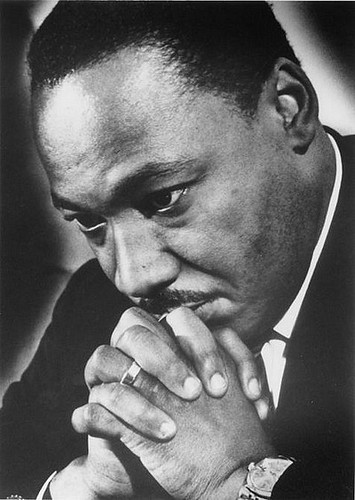
FEATURE image: “martin luther king” by caboindex is licensed under CC BY 2.0.
“The Other America” speech, Stanford University, April 14, 1967 –

In “The Other America” speech Dr. King presents “two Americas” – one that is “beautiful” and the “other America ” that is an “arena of blasted hopes and dreams.” In these remarks on racism and civil rights in American society, Dr. King explains that his campaign is about people who “are seeking to make America one nation.”
Letter From Birmingham Jail, April 16, 1963 –

Christmas Sermon on Peace and Nonviolence, December 24, 1967 –
(29.52 minutes) On Christmas Eve, December 24, 1967, the Rev. Dr. Martin Luther King, Jr. delivered his Christmas Sermon on Peace and Nonviolence in his pastorate, Ebenezer Baptist Church in Atlanta, Georgia. It is also known as A Christmas Sermon on Peace and Peace on Earth Sermon.
For many people this is their very favorite of Dr. King’s sermons. It was broadcast by the Canadian Broadcasting Corporation as the fifth and final part of the 1967 Massey Lecture Series. In the sermon, Dr. King articulates the values and tactics of his broad and long-term vision of nonviolence as the path to world peace. At one point Dr. King states: “In 1963, on a sweltering August afternoon, we stood in Washington, D.C. and talked to the nation about many things. Toward the end of that afternoon, I tried to talk to the nation about a dream that I had had, and I must confess to you today that not long after talking about that dream I started seeing it turn into a nightmare. I remember the first time I saw that dream turn into a nightmare, just a few weeks after I had talked about it. It was when four beautiful, unoffending, innocent Negro girls were murdered in a church in Birmingham, Alabama. I watched that dream turn into a nightmare as I moved through the ghettos of the nation and saw my black brothers and sisters perishing on a lonely island of poverty in the midst of a vast ocean of material prosperity and saw the nation doing nothing to grapple with the Negroes’ problem of poverty. I saw that dream turn into a nightmare as I watched my black brothers and sisters in the midst of anger and understandable outrage, in the midst of their hurt, in the midst of their disappointment, turn to misguided riots to try to solve that problem. I saw that dream turn into a nightmare as I watched the war in Vietnam escalating, and as I saw so-called military advisors, 16,000 strong, turn into fighting soldiers until today over 500,000 American boys are fighting on Asian soil. Yes, I am personally the victim of deferred dreams, of blasted hopes, but in spite of that I close today by saying I still have a dream, because, you know, you can’t give up in life. If you lose hope, somehow you lose that vitality that keeps life moving, you lose that courage to be, that quality that helps you go on in spite of all. And so today I still have a dream.”

Martin Luther King, Jr., San Francisco, June 30, 1964. “Martin Luther King, Jr. San Francisco June 30 1964” by geoconklin2001 is licensed under CC BY-NC-ND 2.0.
NBC News, August 9, 1966 –

Meet The Press, August 21, 1966 –
“Remaining Awake Through a Great Revolution,” National Cathedral, Washington, D.C. (March 31, 1968) –
The Poor People’s Campaign, planned at the time of Dr. King’s assassination, aimed to confront the nation with the moral crisis of poverty. Conceived as a more radical successor to the 1963 March on Washington, it called for a multiracial Poor People’s March and the creation of “Resurrection City,” a sustained occupation on the National Mall until Congress enacted an Economic Bill of Rights. Its demands—full employment, guaranteed income, large-scale anti-poverty investment, and expanded low-income housing—reflected King’s growing conviction that racial justice required a restructuring of economic power.
The campaign emerged in a moment of profound social change: urban uprisings, stalled civil rights gains, and a Vietnam War that drained resources from the poor. King linked race and class more explicitly than ever, arguing that the nation had to shift from a “thing-oriented” to a “people-oriented” society and that capitalism itself required not dismissal but moral examination.
In late 1967, Dr.King announced the Poor People’s Campaign, framing poverty as a national emergency that demanded direct federal action. He set the terms in the SCLC campaign announcement (December 4, 1967), stating that rising inequality threatened the country’s stability. He established the campaign’s moral footing in “The Drum Major Instinct” (February 4, 1968), describing service to the poor as the proper use of ambition. He defined the economic program in “Where Do We Go from Here?” (March 1968), calling for guaranteed income and a redistribution of power. He linked these goals to labor rights in “All Labor Has Dignity” (March 18, 1968), identifying the Memphis sanitation strike as part of the same struggle for economic justice. He widened the frame in “Remaining Awake Through a Great Revolution” (March 31, 1968), warning that the nation faced moral decline if it failed to confront poverty. And, the night before he died, in “I’ve Been to the Mountaintop” (April 3, 1968), he tied the Memphis campaign directly to the planned Poor People’s March, presenting unified economic action as the next phase of the movement.
After King’s death, Ralph Abernathy and Coretta Scott King carried the campaign forward, though without his unifying presence. Its legacy endured. In 2012, Tavis Smiley and Cornel West launched Ending Poverty: America’s Silent Spaces, explicitly invoking the 1968 vision and renewing its call to confront structural poverty in the United States.


We’re going to bring children and adults and old people, people who’ve never seen a doctor or dentist in their lives. We are not coming to engage in any histrionic gesture. … We are coming to demand that the government will address itself to the problem of poverty. “Remaining Awake Through a Great Revolution,” National Cathedral, Washington, D.C. (March 31, 1968).

… It has played havoc with our domestic destinies. This day we are spending $500,000 to kill every Viet Cong soldier. Every time we kill one, we spend about $500,000, while we spend only $53 a year for every person characterized as poverty stricken in the so called poverty program, which is not even a good skirmish against poverty…“Remaining Awake Through a Great Revolution,” National Cathedral, Washington, D.C. (March 31, 1968).
According to the Supreme Court Historical Society, Thurgood Marshall (1908-1993) was a pioneering civil rights lawyer who established the legal foundation for Martin Luther King Jr.’s mass protests by successfully dismantling state-sponsored segregation in cases like Brown v. Board of Education. While Dr. King and Justice Marshall shared a mutual respect for each other’s work, they could prefer different tactics, so that Marshall used the courts to change law, while King’s movement often included nonviolent civil disobedience to push back against existing unjust law.
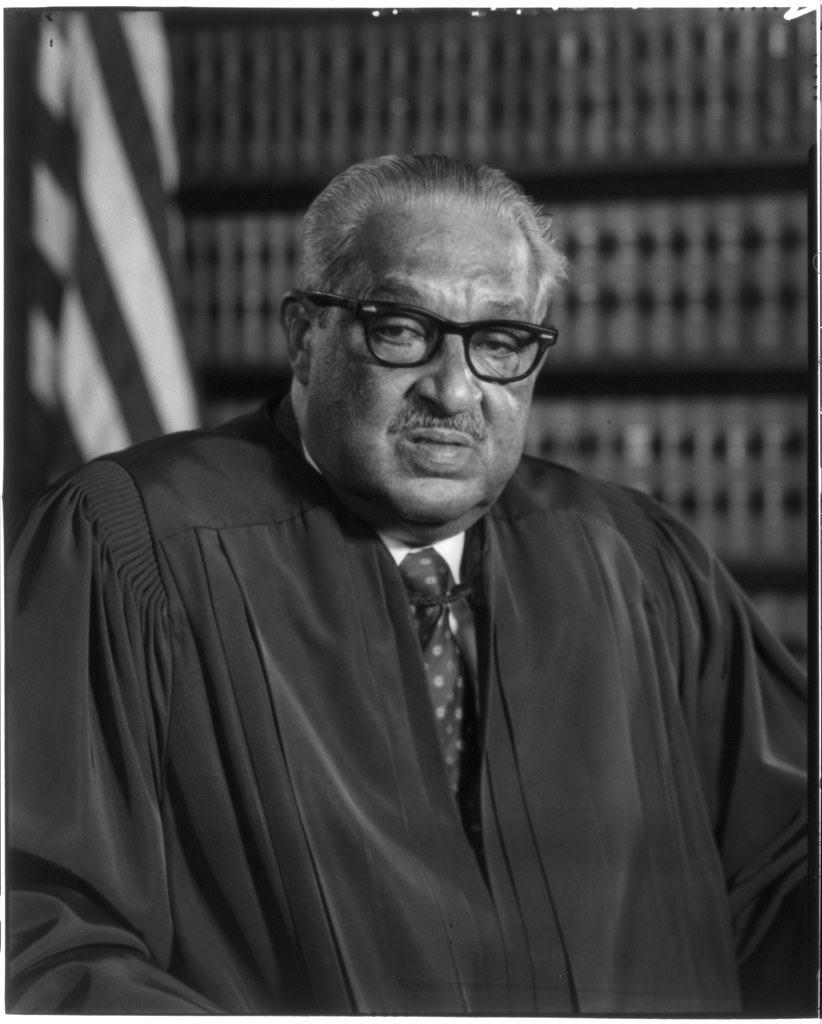
Supreme Court Justice Thurgood Marshall. “No Known Restrictions: Supreme Court Justice Thurgood Marshall (LOC)” by pingnews.com is marked with Public Domain Mark 1.0.
Appointment to the Supreme Court
Following his nomination by President Lyndon B. Johnson, Thurgood Marshall was confirmed by the U.S. Senate on August 30, 1967, becoming the first African American to serve on the nation’s highest court. He sat as an Associate Justice of the U.S. Supreme Court for 24 years, from October 2, 1967, until his retirement on October 1, 1991.
Career before the Court
Before joining the Supreme Court, Marshall built one of the most consequential legal careers in American history. He served as Director‑Counsel of the NAACP Legal Defense Fund from 1940 to 1961; as a Judge on the U.S. Court of Appeals for the Second Circuit from 1961 to 1965; and as U.S. Solicitor General from 1965 to 1967. As a trial and appellate advocate, he argued 32 cases before the U.S. Supreme Court and prevailed in 29 of them.
Landmark civil rights litigation
Marshall’s major civil rights victories reshaped American law. In Smith v. Allwright (1944), he helped end whites‑only primary elections. In Shelley v. Kraemer (1948), he secured a ruling barring state enforcement of racially restrictive housing covenants. Morgan v. Virginia (1946) struck down segregation on interstate buses, while Sweatt v. Painter (1950) forced the University of Texas to admit Black law students. His most famous case, Brown v. Board of Education (1954), ended legal segregation in public schools and became a cornerstone of the modern civil rights movement.
Influential opinions as a justice
On the Supreme Court, Marshall continued to expand constitutional protections. In Stanley v. Georgia (1969), he helped establish a constitutional right to privacy in the home. In Bounds v. Smith (1977), he required prisons to provide adequate legal resources so incarcerated people could meaningfully access the courts. In Linmark Associates v. Willingboro (1977), he protected commercial free speech, reinforcing First Amendment safeguards in the context of real estate advertising.
Powerful dissents and constitutional vision
Marshall also became one of the Court’s most forceful dissenters when he believed the majority was retreating from equality and rights. He argued that the death penalty was unconstitutional in all circumstances in Furman v. Georgia (1972) and Gregg v. Georgia (1976). In San Antonio ISD v. Rodriguez (1973), he rejected the Court’s conclusion that education is not a fundamental right. He defended affirmative action in Regents of the University of California v. Bakke (1978) and supported cross‑district desegregation remedies in Milliken v. Bradley (1974). Together, these opinions and dissents reflect Marshall’s enduring commitment to racial justice, individual rights, and a robust reading of the Constitution’s guarantees.
Strength to Love (1963) –

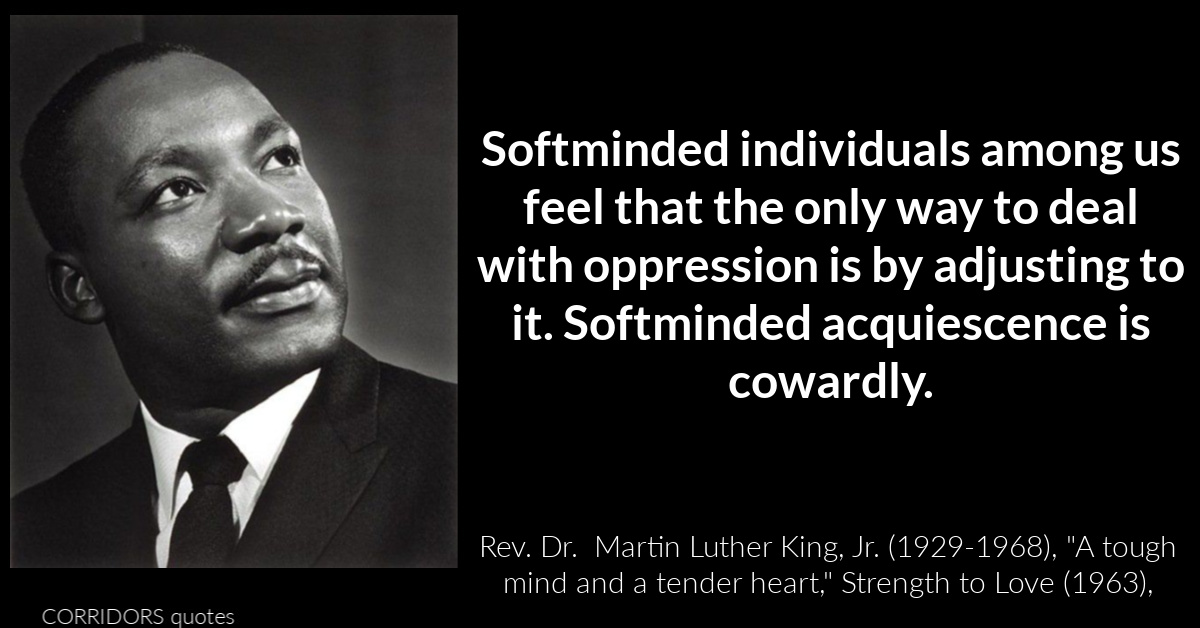


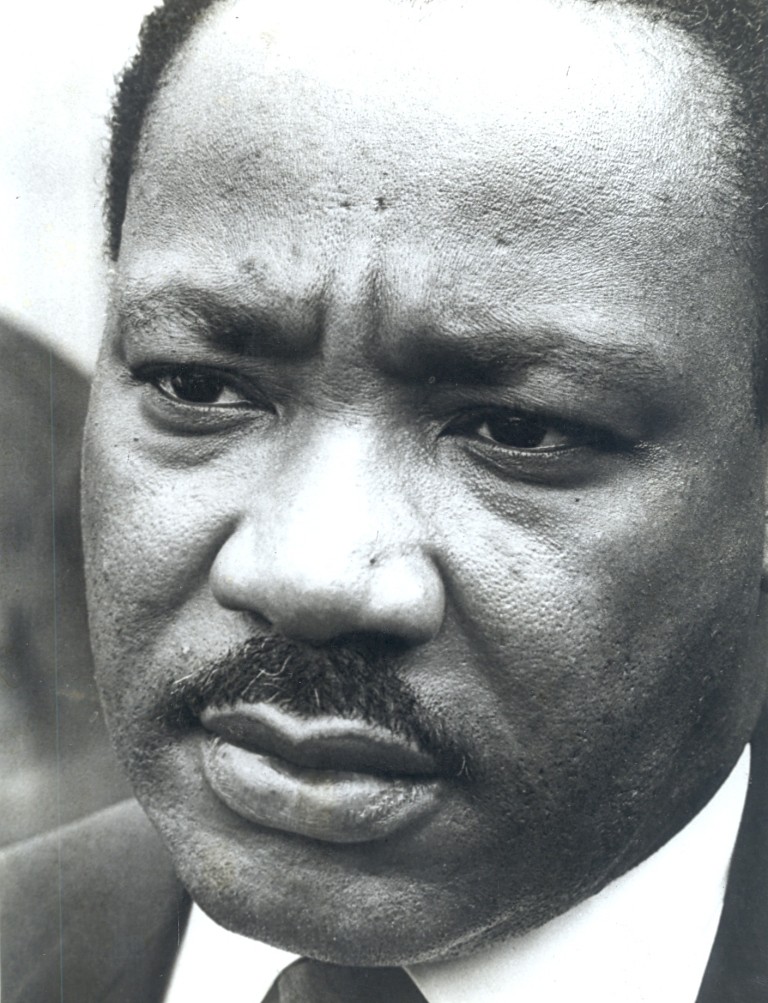
“Desegregation and the Future,” Address Delivered at the Annual Luncheon of the National Committee for Rural Schools, New York City, December 15, 1956.
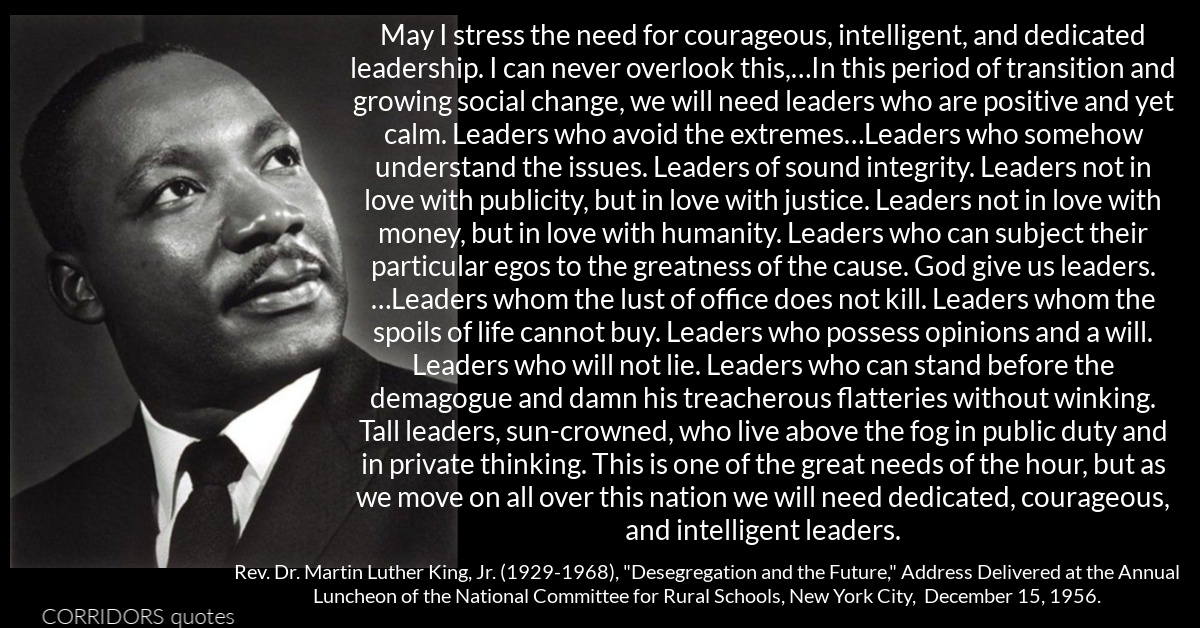
In “Desegregation and the Future,” delivered on December 15, 1956—just days before the federal injunction ending bus segregation in Montgomery took effect—Dr. King described the moment as a test of calm, disciplined, principled leadership. He said the shift from protest to enforcement required steady resolve and a refusal to meet hostility with retaliation. The bus victory, he noted, was only an early step in a larger social transformation that demanded the same patience and moral restraint that had sustained the boycott.
Speaking in the tense post‑Brown climate of massive resistance and the rise of White Citizens’ Councils, King appealed to moderates to defend equal education and civil rights so the decade’s constitutional gains would not be undone. He argued that federal authority had to act decisively, with Congress and the executive branch matching the judiciary’s commitment to enforcing desegregation. He insisted the movement remain strictly nonviolent, warning that hatred or retaliation would poison the future. He also called on people of goodwill to speak out and press for desegregation wherever discrimination persisted.
To define the character of leadership required, King drew on Josiah Gilbert Holland’s 1872 poem “Wanted,” whose call for integrity and public virtue he often quoted in this period. In New York, he used it to signal that desegregation would not be secured by anger or opportunism but by leaders marked by steadiness, honesty, and moral discipline. The reference worked as both a standard and a warning, signaling that guiding communities through change required leadership anchored in principle.
“I Have a Dream” speech, at the Lincoln Memorial, Washington D.C., August 28, 1963 –

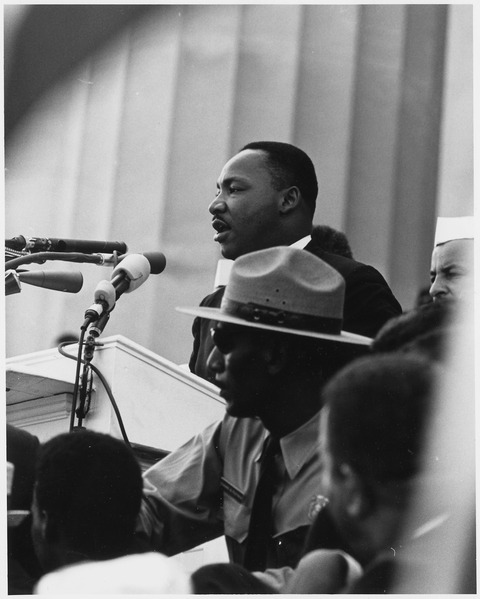
Rev. Dr. Martin Luther King, Jr. (1929-1968), “I Have a Dream” speech, August 28, 1963, at the Lincoln Memorial, Washington D.C.
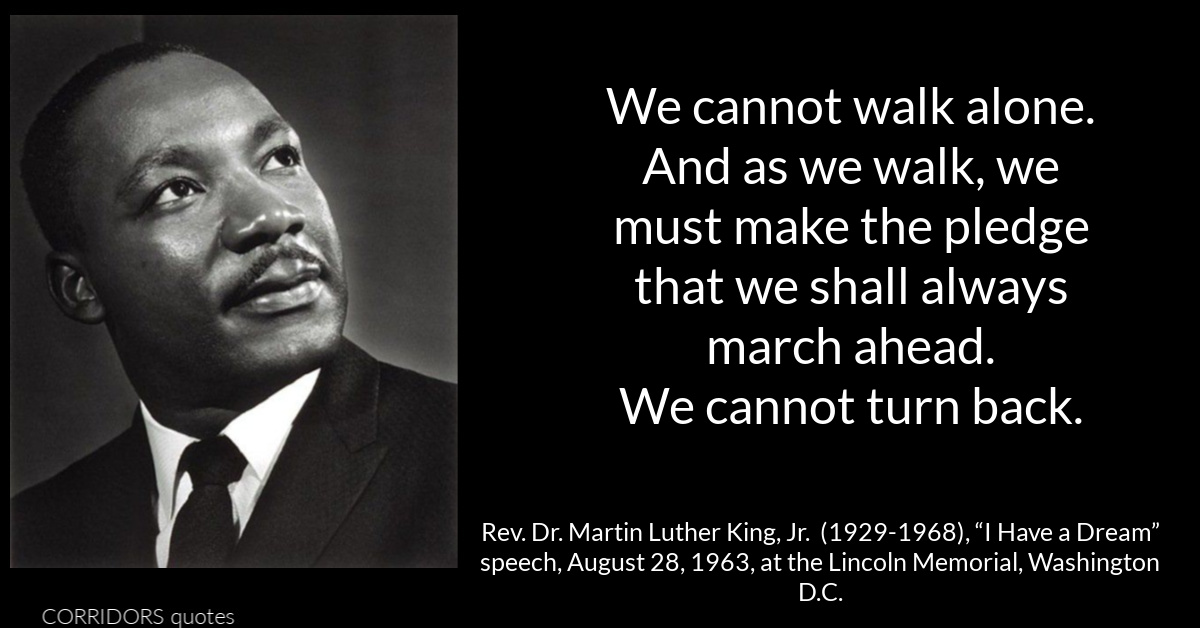
We cannot turn back.
Rev. Dr. Martin Luther King, Jr. (1929-1968), “I Have a Dream” speech, August 28, 1963, at the Lincoln Memorial, Washington D.C.