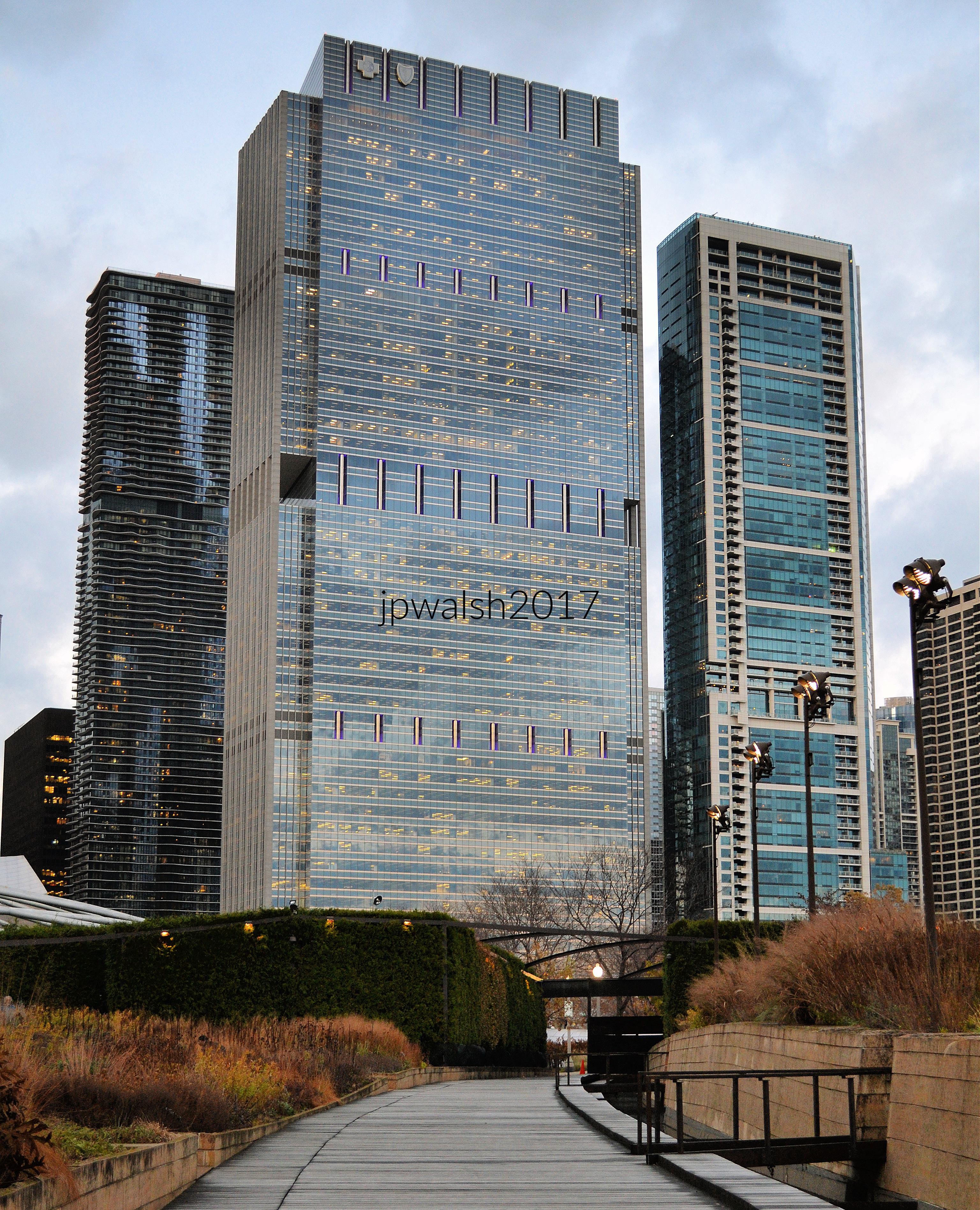
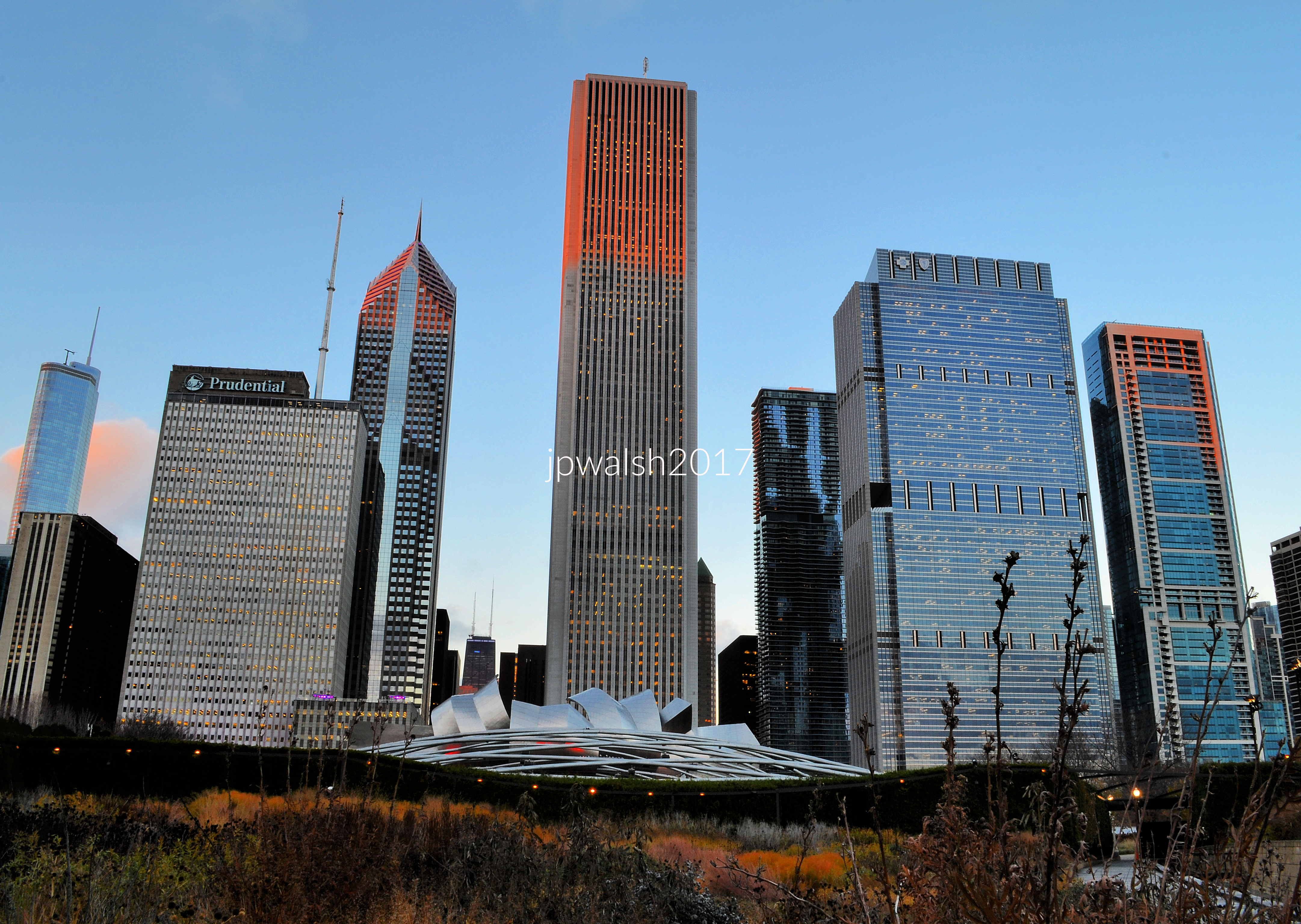
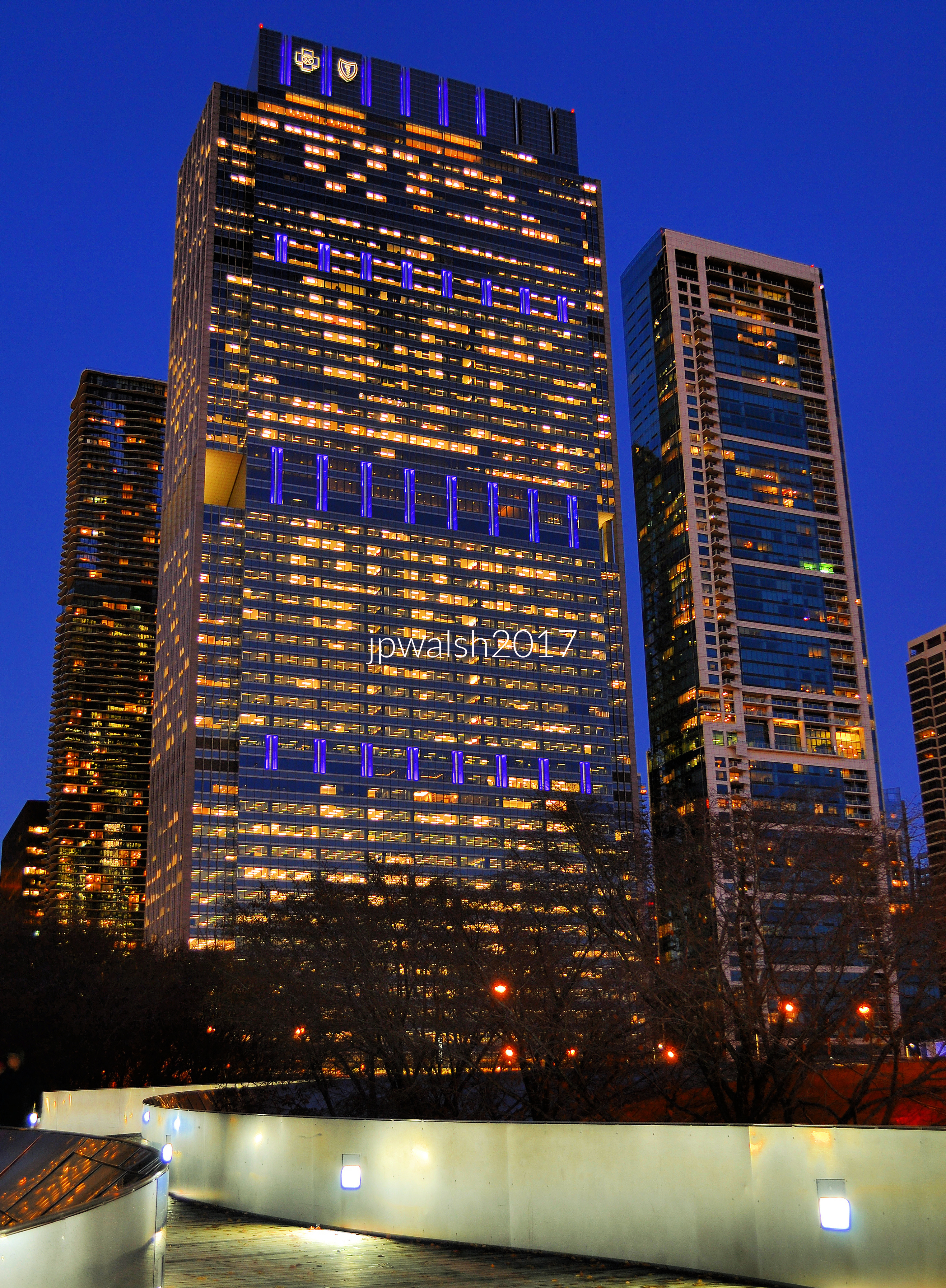
FEATURE image: Blue Cross Blue Shield Tower building, Day and Night. November 2017. It was designed by Goettsch Partners (GP) an architecture firm based in Chicago, with additional offices in Denver and Shanghai.
The Blue Cross Blue Shield Tower sits on the northeast corner of East Randolph Street and Columbus Drive in Chicago, Illinois. It is on the north side of Millennium Park. The tower is the headquarters of Health Care Services Corporation, a company founded in 1936 and based in Chicago, Illinois. HCSC is the licensee of the Blue Cross and Blue Shield Association that provides health insurance to more than 115 million people in the U.S. as of 2022.
The Blue Cross Blue Shield Tower was built in two stages. The first stage was the original 32-story building completed by Lohan Associates (today Goettsch Partners) in 1997. It was built with the potential for a vertical expansion so that the client could grow in the same location. An expansion occurred in 2007 with a 24-story addition completed in 2010. It became the first building project in downtown Chicago that built upon an existing tower.The views are from inside Millennium Park. November 2017 7.38 mb 3417 (1)The Blue Cross Blue Shield Tower (second from right) in its setting on the north side of Millennium Park which was established in 1998. From left: One Prudential Plaza (1955), Two Prudential Plaza (1990), Aon Center (1973/1994). The Blue Cross Blue Shield Tower is next to the Aon Center with original plans to connect the two buildings via an underground pedway but did not come to fruition. November 2017 5.76mb 3397 (1)The Blue Cross Blue Shield Tower was designed by Jim Goettsch, chairman of Goettsch Partners. November 2017 99% 7.41mb3480
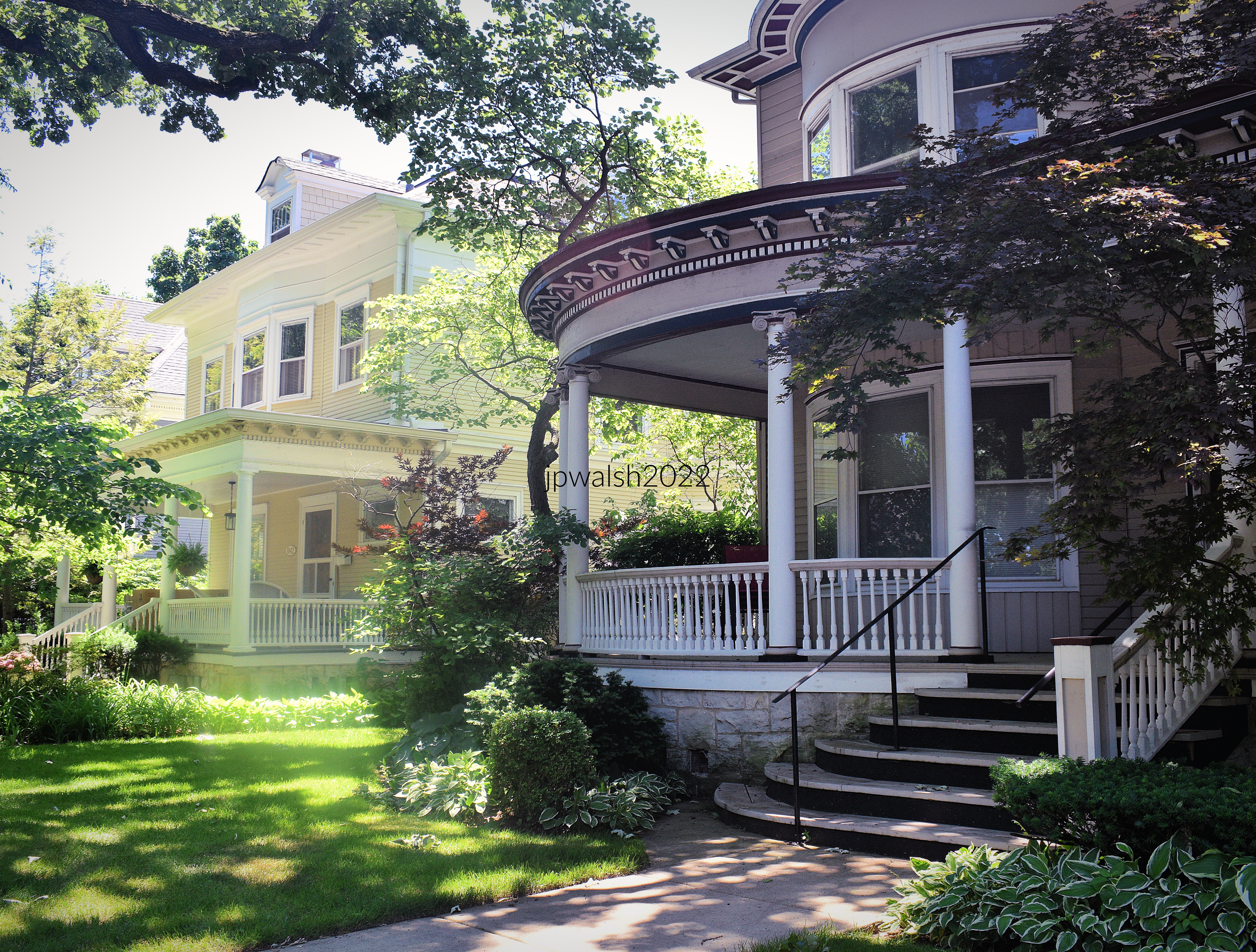
FEATURE Image: 1432 Forest Avenue, Evanston, IL, 1885. Stylish single family home, nearly 5,000 square feet, has 6 bedrooms and 3.5 bathrooms. Author’s photograph. 6/2022 7.7.mb 53%
Text & Photographs John P. Walsh.
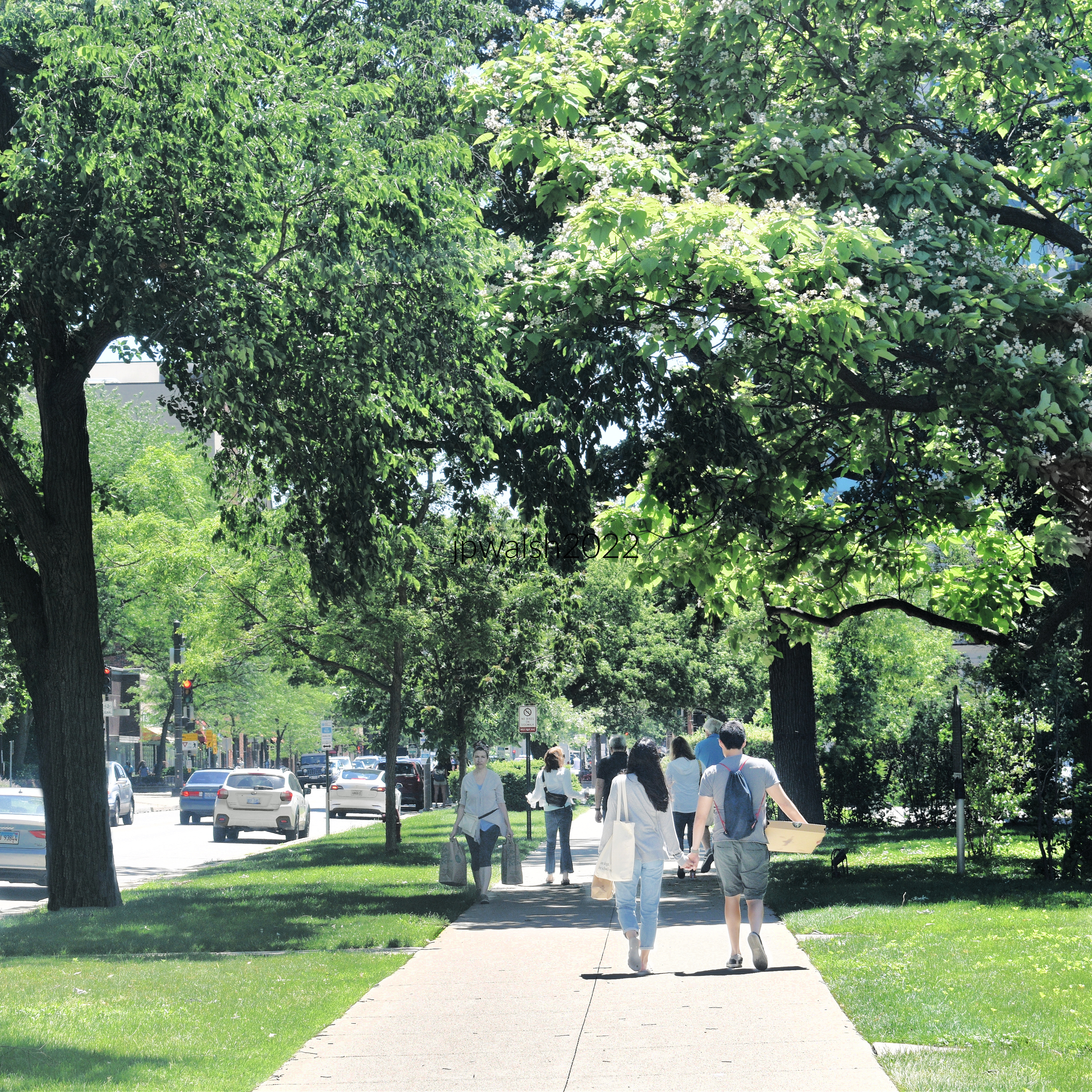
1032 and 1034 Michigan Avenue, 1899. Double house designed by Myron Hunt (1868-1952) shortly before he relocated his practice to Los Angeles, CA. Each shingled dwelling is given a distinctive design. The northern side has a projecting porch and two-story polygonal bay. The southern side has a recessed porch. The house is tied together by a single gable with a quartet of double-hung windows and a cornice part of which is integrated to the polygonal bay. 6/2022. 7.84mb 70%Myron Hunt (1868-1952) in February 1905. The American architect did numerous projects which are noted landmarks in Southern California and Evanston, Illinois. Born in Massachusetts he moved to Chicago and attended Northwestern University and later MIT where he graduated in 1893. Traveling and studying in Europe, he returned to Evanston where he worked as a draftsman in the local office of the Boston firm of Shepley, Rutan and Coolidge. In 1903 Hunt moved to Los Angeles, where he entered into a partnership with architect Elmer Grey (1871–1963). Opening an office in Pasadena, the firm of Hunt and Grey built houses for the wealthy. These included the summer ranch house for cereal magnate Will Keith Kellogg (1860-1951) in Pomona, CA, nearby to Los Angeles. Hunt and Grey also built hospitals, schools, churches and hotels. Public Domain.1026 Michigan Avenue, 1915. Prairie style house designed by John Van Bergen (1885-1969) in 1915. The Oak Park, IL-born American architect did numerous such stylish house projects from DeKalb, IL, to Winnetka, IL in the 1910’s. 6/2022 7.78mb 79%Architect John Van Bergen (above in c. 1927) was born and grew up in Oak Park, IL. He began his career as an apprentice draftsman working with Walter Burley Griffin (1867-1937) and for Frank Lloyd Wright (1867-1959) at his Oak Park Studio. Van Bergen’s early projects, mostly in Oak Park, were predominantly residential and largely in the Prairie School style, which he learned in Griffin’s and Wright’s studios. See- https://highlandparkhistory.com/highland-park-legends-program/john-van-bergen/ – retrieved December 5, 2023. Public Domain.1049 Michigan Avenue, 1910. The Prairie-style house was designed and built by C.H. Thompson, a local developer. It is a basic block with a hipped roof, albeit on a grand scale and with dormers and porch projects that emphasize horizontality along with typical Prairie hoods. There is stucco façade with brick detailing of varying geometric design patterns. 6/2022 7.95 mb 88%1010 Michigan Avenue, 1911. The Tudor style brick mansion was designed by Ernest Mayo (1864-1946). Once sitting on an even more expansive corner lot, Mayo designed the house and garden together. 6/2022. 7.91mb 65%Another view of 1010 Michigan Avenue. Built in 1911, it is one of Evanston’s most formal examples of the popular Tudor Revival style whose design takes inspiration from Elizabeth I manor houses and is imposing. It is a symmetrical and complex design of porches, bows, gables, chimneys and window groupings. Architect Ernest Mayo was born in Birmingham, England in 1864 and began his career in South Africa. Mayo immigrated to Chicago in 1891 where he established the firm of Mayo and Curry. The Chicago firm designed factories, hotels, and office buildings, and Mayo worked on administrative buildings for the 1893 World’s Columbian Exposition. Mayo split with Curry and worked independently until he partnered with his 24-year-old son Peter Mayo in 1919 to form Mayo and Mayo. While Ernest Mayo received his architectural apprentice training in England, Peter received his degree from Yale University and further design education at The Art Institute of Chicago. See – https://www.winnetkahistory.org/gazette/140-sheridan-road-2/ and https://prabook.com/web/ernest.mayo/1717173 – retrieved December 5, 2023. 6/2022. 7.63mb 66%Interior room, Dawes Mansion, 225 Greenwood Street, 1894. Designed by New York architect Henry Edwards Ficken (1852-1929), the house sits on a large lot overlooking Lake Michigan. The basic square block building is met by round tourelles on each corner with conical roofs that meet the same height of the main block’s hipped roof. The Châteauesque-style house was bought by Charles Gates Dawes (1865-1951) who was vice-president under Calvin Coolidge and, with its stunning cherry paneling, is furnished much as it was during Dawes’ residency. 10/2015 4.20mb“Charles Gates Dawes House, Evanston, Illinois” by StevenM_61 is licensed under CC BY-NC-ND 2.0.1037 Michigan Ave, Evanston, IL, 1895. 6/2022 7.52mb 99%940-950 Michigan Avenue, 1927. Michigan-Lee apartment building was erected by N.J Lareau and associates and sits on a 20,000 square foot lot on the southwest corner of Michigan and Lee. Georgian Colonial is the style of architecture for the new structure which is made of red brick and Bedford stone. The structure was built to house 24 total apartments: three 7-room, three 6-room, fifteen 5-room, and three 4-room apartments. https://www.archinform.net/arch/202206.htm and http://www.michiganleecondoassociation.com/history.html – retrieved November 28, 2023. The swanky apartment complex was designed by Frank William Cauley (1898-1984) architect and lawyer. 6/2022. 7.68mb 66% Frank Cauley, architect of the Michigan-Lee building (above) in 1927, graduated from the Armour Institute of Technology in 1922. Before he received his license to practice architecture, he designed the $2,000,000 three-hundred room (each with its own bath) Orrington Hotel in 1923 in Evanston, Illinois, for local developer Victor Ca[r]landrie Carlson. Carlson built the Carlson Building on Church Street in downtown Evanston as well as two landmark hotels, including The Library Plaza Hotel in 1922. Cauley went into business on his own, practicing until the 1929 crash. In the depression years he went to law school in Chicago and received his L.L.B. in 1938. In April 1969, the Illinois Institute of Technology awarded him a J.D. https://undereverytombstone.blogspot.com/2015/10/he-left-his-mark-on-downtown-evanston.html – retrieved November 28, 2023“The Hotel Orrington” by Mark Blevis is licensed under CC BY-NC-SA 2.0.Evanston front porches. 6/2022 7.80mb 79%1210 Michigan Avenue, 1880. Started as a simple clapboard farmhouse one block from Lake Michigan. there have been several expansive additions since that time The front exterior is marked by a simple veranda with grouped struts in the lintel which is supported by turned posts.6/2022 7.68mb 75%1332 Forest Avenue Evanston, IL, 1894, is a stylish home with several additions on an expansive corner lot. 6/2022 7.32mn 90%1005 Michigan Avenue, 1913. The light-colored brick house is Colonial Revival with modifications is by Howard Van Doren Shaw (1869-1926). The façade’s symmetry is prominently displayed in its 5 equal openings for its two main floors and topped by a shortened pitched roof with three flat-roofed dormers. A chimney protrudes at the roof line to the north. For the main mass there are aligned windows with a middle opening for both the first and second floor symmetrically displaying diverse residential functionality: a broad-arched porchway and genteel fanlight above a double door entry on the first floor and, at the second level. a wrought iron balcony providing a small, mainly decorative step landing. The great house is situated on the northeast corner lot of a leafy yet trafficked suburban residential intersection, with the main building’s symmetry broken to the south by the then-popular sun porch extension. It is a low, two-story flat-roofed projection with an enclosed porch on the first floor and an open porch originally on the upper level. 6/2022. 7.58mb 73% Howard Van Doren Shaw (1869-1926). Public Domain.Evanston fashion, c. 1918. Most Evanstonians used local dressmakers and tailors to have their clothes made. The white cotton summer dress with embroidery and lace insertions and natural waistline was typical for the era. 10.2015 4.24mb“Northwestern University Gate” by AcidFlask is licensed under CC BY-NC-SA 2.0.Chicago Avenue at Clark Street. Evanston is home to Northwestern University. 6/2022 7.84mb 87%“Fortress Northwestern: University Library and Norris University Center, June 1977” by A.Davey is licensed under CC BY 2.0. Divvy bike (with basket!) to get around campus and the neighborhood. 6/2022 7.77mb 83%The longtime Chicago-Main Newsstand at 860 Chicago Avenue in Evanston is open 7 days a week from 7:00a.m. – 10:00p.m. 6/2022 7.74mb 85%Left: 1730 Chicago Ave, Evanston, IL Built in 1865, it was the home of Frances Willard (1839-1898) and her family and was the headquarters of the Woman’s Christian Temperance Union. 6/2022 7.73mb 88%Grosse Point Lighthouse, 1873, is a tapering column to a catwalk supported by Italianate brackets built by the U.S. Government. The lighthouse marks the approach into Chicago. The promontory on which it stands was named Grosse Point in the 17th century by French explorers and the area was mapped in 1673 by Louis Jolliet and Father Jacques Marquette, a Jesuit missionary. The lighthouse is topped by a polygonal glass lantern containing the light and lens. See – http://www.grossepointlighthouse.net/history.html – retrieved December 5, 2023.6/2014 4.03mb
Sources:
A Guide to Chicago’s Historic Suburbs on Wheels and on Foot, Ira J. Bach, Swallow Press/Ohio University Press, 1981, pp. 499-530.
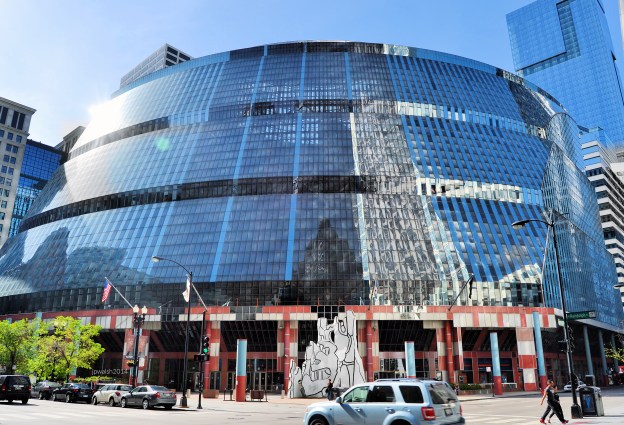
FEATURE image: Helmut Jahn, State of Illinois (Thompson) Center, 100 W. Randolph, Chicago, Illinois, 1979-1985. The Thompson Center was officially bought by Google in 2022 for a reported $105 million. Author’s photograph. 5/2014 4.75 mb
Helmut Jahn was famous in Chicago and around the world for his prolific postmodern architecture particularly his work in steel and glass.
Born in Germany near Nuremberg, in 1940, Jahn graduated from Technische Hochschule in Munich and moved to Chicago in 1966. Jahn arrived in Chicago just as “downtown development” during the administration of Mayor Richard J. Daley (1902-1976) was finding its greatest momentum. Jahn began to study under Ludwig Mies van der Rohe (1886-1969) at the Illinois Institute of Technology (IIT) and, in 1967, joined Charles (C.F.) Murphy Associates which later became Murphy/Jahn. The younger man would carry on the powerful influence and energy of these Chicago personalities for building big, creatively, and prolifically for the next fifty years into the first quarter of the 21st century. Jahn would add his own significant contribution and footprint in Chicago and around the nation and world in those same long years of his activity.
One of Jahn’s early projects in his first years in Chicago was McCormick Place. The original concrete and steel permanent exposition hall on the lakefront that opened in 1960 was destroyed in a fire in January 1967, just as Jahn was starting to work as a professional architect. Named for Col. McCormick of the Chicago Tribune, the newspaper owner and publisher had boosted the idea of a permanent exposition hall on Chicago’s lakefront for years prior to his death in 1955.
Jahn had come to Chicago at an exciting time to be building there — during Jahn’s first years in Chicago the John Hancock Building was completed in 1969 and the Sears Tower, the tallest building in the world for the next 24 years, was completed in 1974. In 1971, C.F. Murphy completed the new and massive McCormick Place, a powerful steel and glass structure with enormous cantilever eaves, on the same lakefront site as the old exposition hall. Out of that single successful building project, Helmut Jahn and the rest of the world saw the significant development in Chicago that would blossom around this important and functional modern architecture over ensuing decades — including the North building constructed across Lake Shore Drive in 1986; the South building built in 1996; a hotel built in 1998; the massive West building built in 2007; and, in 2017, the Wintrust Arena.
In the mid 1980’s one of Jahn’s most significant creations was the James R. Thompson Center in Chicago. Aesthetically grandiose and controversial, the “State of Illinois Building” was put up for sale in 2021 by the administration of Governor J.B. Pritzker, citing its historically high operating and maintenance costs.
Jahn designed the 23-story addition to the Chicago Board of Trade in 1980 and Accenture Tower at 500 W. Madison in the West Loop which opened in 1987. Across the nation and world Helmut Jahn’s fresh, grand, and innovative designs have made their way into the annals of postmodern architecture. Any complete list of Helmut Jahn’s active and completed projects extends necessarily into the many scores. A list of notable buildings could include the 1999 K St. NW, a 12-story structure, in Washington D.C. completed in 2009; the twin 37-story Veers Towers in Las Vegas, Nevada opened in 2010; and, in his native Germany, the 63-story Messeturm in Frankfurt opened in 1990 and the Sony Center, a complex of eight buildings, in Potsdamer Platz in Berlin completed in 2000. The hard-driving list goes on…and on.
In Chicago Jahn designed the exposed steel frame United Airlines Terminal 1 at O’Hare International Airport between 1985 and 1988. Air travelers for decades have enjoyably traversed its entertaining walkway connecting concourses that include moving sidewalks, colorful lighting and futuristic sounds.
At the time of his death at 81 years old on May 8, 2021 in a bike road accident in the far western suburbs of Chicago, Helmut Jahn was working on a 74-story residential building in Chicago at 1000 S. Michigan. It was scheduled to be opened in 2022 but its construction was already delayed because of the Covid-19 pandemic that postponed construction. Helmut Jahn taught at IIT, the University of Illinois-Chicago, Harvard University, and Yale University. In 2012 Murphy/Jahn became JAHN and, according to a recent report from Dun & Bradstreet, the firm had a total of 55 employees and generated a little over $6 million in annual sales.
Xerox Center, 55 West Monroe, Chicago, 1977-1980.
In what was one of Helmut Jahn’s first great urban achievements, the 40-story office tower on an important corner in downtown Chicago was built on speculation and soon took the name of its major tenant (Xerox). The sleek and simple curtain wall of enameled off-white fluoropolymer aluminum panels and reflective glass slide over a reinforced concrete structure and around its soft postmodern corners in contrast to the modernist box.
The tower is fitted to its site where the building’s corner is exaggerated at street level with varying glaze percentages, and the white-black-silver palette of the lobby follows a diagonal pattern (also on the roof) in contrast to the exterior curvilinear design.
Silver double-glazed reflective glass pays homage to 1950’s and 1960’s Chicago modernism and the Xerox building’s closest neighbors: the kitty-corner Inland Steel Building (1954-1958, Skidmore, Owings and Merrill) and, directly across to the north, the First National (today, Chase) Bank building (1964-1969, C.F. Murphy Associates with Perkins and Will).
Helmut Jahn (C.F. Murphy Associates)/Murphy Jahn. Xerox Center, 55 West Monroe, Chicago, 1977-1980. 12/2014 5.60 mb 99%
Some have observed that Jahn’s curving tower may have been inspired by Louis Sullivan’s 1899 Schlesinger and Mayer department store building on State Street (what became in 1904 Carson, Pirie, Scott and Company Building and today is The Sullivan Center). The 1980 project’s original conception was for two curvilinear towers though obviously only one was constructed obfuscating and negating the original design’s uniquely bold impacts.
The glass and aluminum are arranged to alternate in horizontal bands which have modernist predecessors in Chicago and Europe. Hidden from the street view are more diagonals that cut a pattern across the roof. The building is a major transition for Jahn who, steeped in mid-20th century Modernism, harkened back to earlier 1920s modernist sources for the 55 W. Monroe (Xerox) building. The author’s photograph was taken on December 24, 2014.
SOURCES for 55 W. Monroe: Building Chicago: The Architectural Masterworks, John Zukowsky, New York: Rizzoli with Chicago History Museum, 2016, p. 237.
AIA Guide to Chicago, 2nd Edition, Alice Sinkevitch, Harcourt, Inc., Orlando, 2004, p. 67.
The Sky’s The Limit: A Century of Chicago Skyscrapers, Jane H. Clarke, Pauline A. Saliga, John Zukowsky, New York: Rizzoli, 1990, p. 233.
Chicago Architecture and Design, 3rd Edition, Jay Pridmore and George A. Larson. New York: Abrams, 2018, pp. 210-211.
Helmut Jahn, Nory Miller, New York: Rizzoli, 1986, pp. 76-81.
Thompson Center, 100 W. Randolph, Chicago, 1979-1985.
May 2014. Helmut Jahn, State of Illinois (Thompson) Center, 100 W. Randolph, Chicago, Illinois, 1979-1985. The building is massive at 1.15 million square feet. The rounded facade was intended to embody the traditional architectural history of monumental rotundas and domes. When it was built in the early 1980s it was one of the most exciting projects taking place downtown. Sitting across the street from a classical revival City Hall (1911) and a modernist Daley Center (1965), the postmodern 1980’s monstrosity by Murphy/Jahn was criticized for being out of context in the neighborhood. Yet, over the following decades, that criticism increasingly faded. 4.75 mb
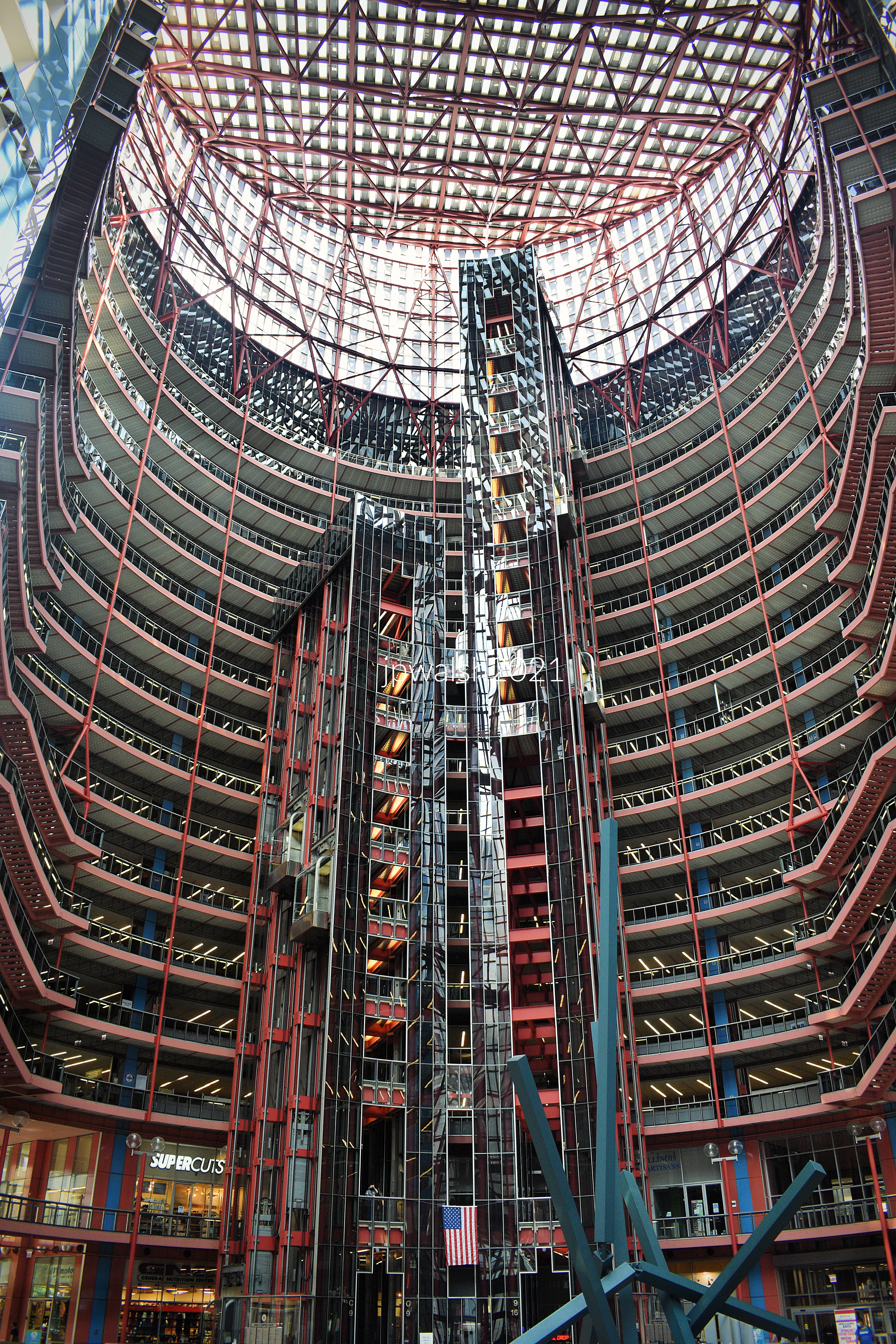
There were mixed reviews for Helmut Jahn’s massive semi-circular Thompson Center at 100 W. Randolph completed in 1985. The criticism begins at its entrance where Jahn saw placed “Outsider” French artist Jean Dubuffet’s fiberglass Monument with Standing Beast. During the building’s planning and construction some of the architect’s dazzling concepts met with resistance from contractors. For example, the contractors prevailed over Jahn’s idea for a completely locked-down outer skin using silicone glazing. In the final construction the appearance of red, white, and blue locked-down skin belies the several places throughout the design where windows are made to be opened. Inside, though its soaring 17-story atrium is airy and impressive exposing floors that hold various state bureaucracy—and signaling the idea of state government’s day-to-day practice towards transparency — the practicalities of the new building’s heating and cooling design proved seriously problematic during Chicago’s summer heat and winter cold though that major issue appeared to be eventually resolved. In 2021 Jahn’s mega-structure has been put up for sale by Illinois Gov. J.B. Pritzker from Chicago citing that the building costs hundreds of millions of dollars to operate and maintain. The photograph was taken by the author on May 25, 2014.
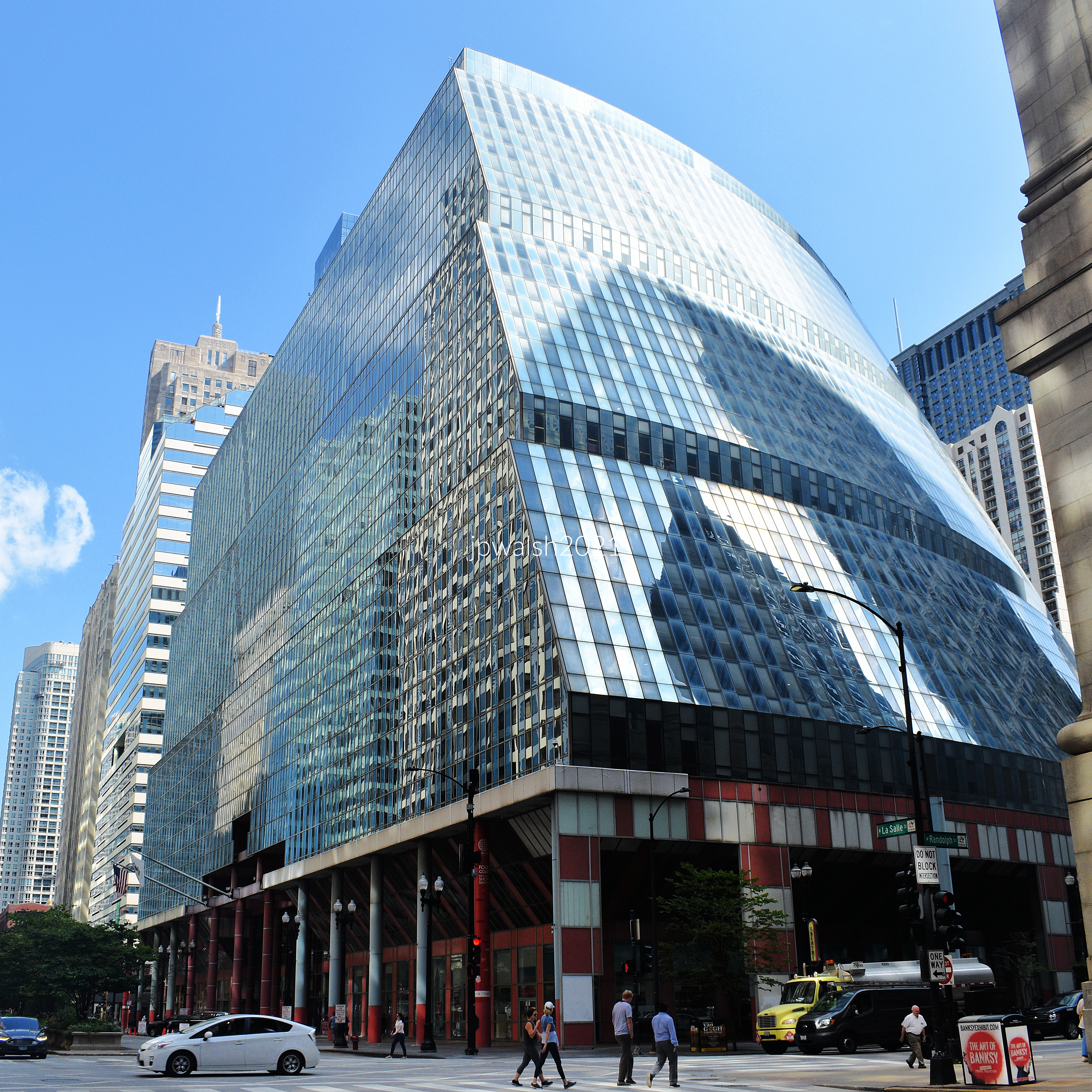
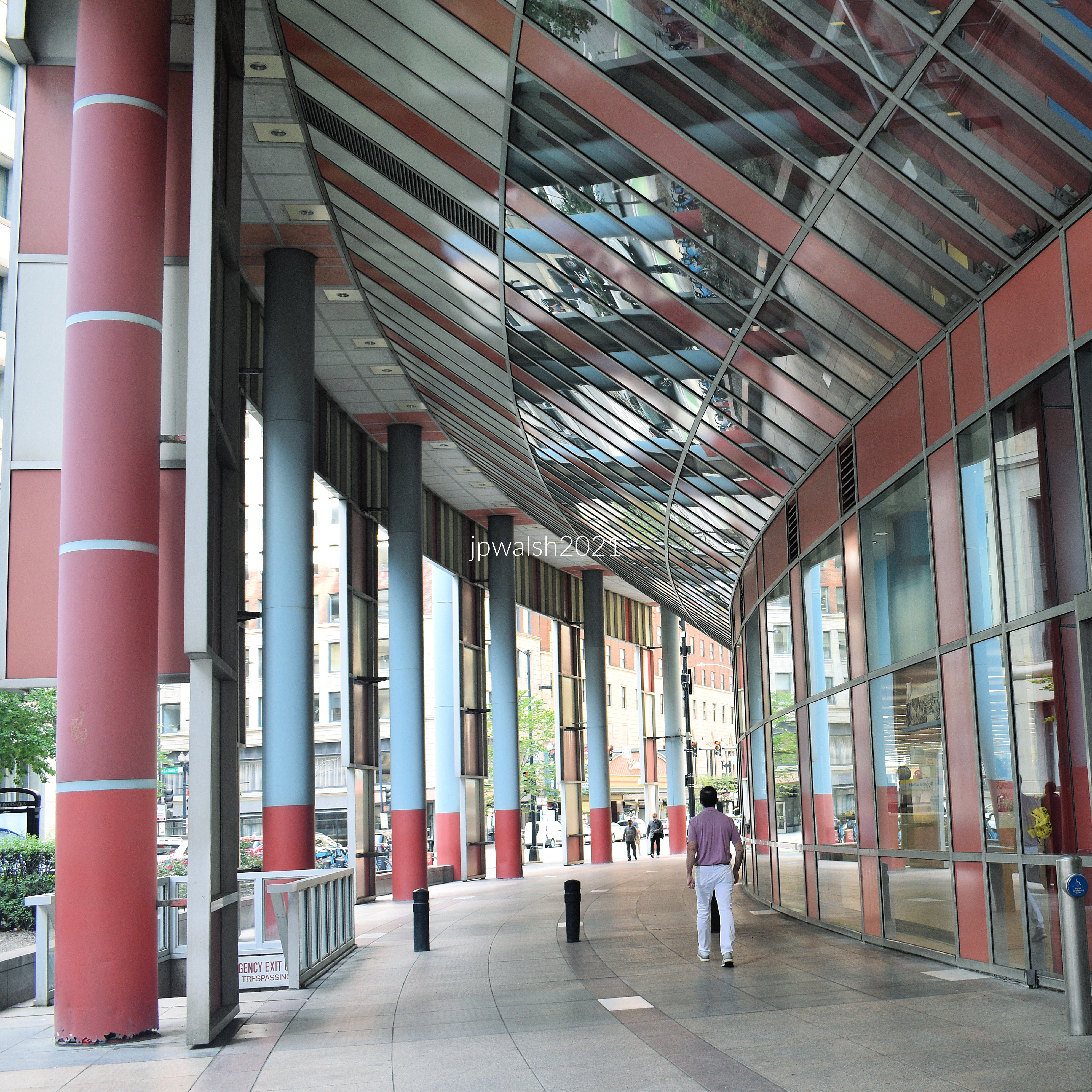
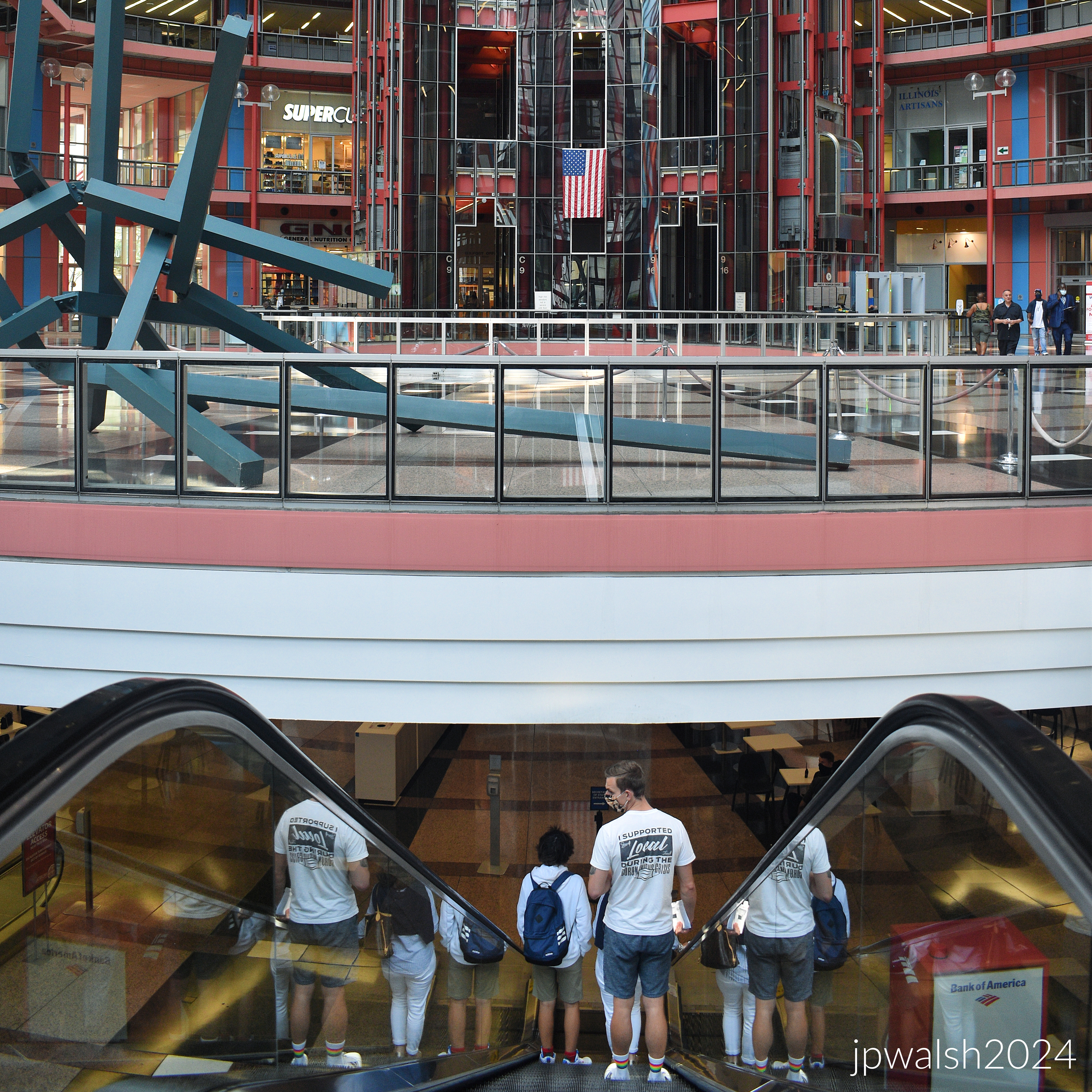
August 2021. The State of Illinois Center from the southwest Randolph and LaSalle Streets. Setbacks divide the building into three tiers seen here 99% 7.65mb _9369August 2021. The pink and gray granite arcade at street level is a contrast to the silver and opaque blue ornamental glass and provides a covered passageway. 99% 7.22mb_9380August 2021. The rotunda with its skylit atrium is 160 feet in diameter. The massive airy space is met by circular walkways and freestanding bank of glass elevators. 70% 7.87 mb_9381August 2021.The rotunda has an elaborately paved granite floor with tens of thosand of square feet of retail space. 99% 6.87 mb_9384
1 S. Wacker Drive, Chicago, 1982.
May 2014. Helmut Jahn, One South Wacker Drive, Chicago, Illinois, 1979-1982. On a corner site, Jahn’s design is a freely translated interpretation of a 1920s stepped back tower with the building’s skin a stylized exaggeration of vertical windows and stone facades of the same 1920s’ period structures. 4.45 mb
To the left is UBS Tower (1 N. Wacker) built in 2001 and to the right is Hyatt Center ( 71 S. Wacker) built in 2005. At 42 years old, Jahn spoke of his building at 1 S. Wacker as a synthesis of two major Chicago architectural styles—that of Louis Sullivan (1856-1924) and, Jahn’s mentor and fellow German, Mies van der Rohe (1886-1969). The building is a concrete stepped-back 50-story building with a curtain wall of dark glass defining the vertical bands of windows. Its vision remains fresh and stunning as it sits majestically between two postmodern buildings built in Chicago a generation later. The author’s photograph was taken on May 25, 2014.
August 2021. Floors in each section of the stepped back tower are of three different sizes, each 6,000 square feet less as the building ascends. The setbacks’ atria allow in natural daylight. 78% 7.77mb _9293December 2017. 6.27mb DSC_0567 (1)
IIT’s Rowe Village, Chicago, 2005.
Helmut Jahn, Jeanne and John Rowe Village at the Illinois Institute of Technology (IIT), Chicago, Illinois, 2003. 8/2015 3.67 mb
Originally called the State Street Village Dormitories, Jahn’s postmodern structure that anchors the campus to the east, consists of three five-story buildings. Jahn’s design was the first major architectural addition to the IIT campus since the early 1960’s. U.S. News & World Report called it one of the “coolest dorms in the nation.” Stretching one city block along busy State Street from 33rd to 34th Streets, Rowe Village is next to the El tracks whose Green Line zips back and forth to Chicago’s Loop. Each dorm building consists of two wings that flank an interior courtyard. The building is finished at the rear on 34th street by an insulated five-story glass wall. Entry is through the courtyard which leads into a corridor that connects the two wings. It is built of reinforced concrete with the front elevations and roof dressed in custom corrugated stainless steel panels and tinted glass framed in aluminum. The building’s sleek curvature, three compartments and chained block-long length, reflects and evokes the image of a streamlined train making for a building as Art Moderne object in the Miesian tradition. From its rooftop the Rowe Village looks north for views of Chicago’s downtown skyline while the dorm offers suite-style living in a modern setting surrounded by the mind, serious and playful, of Helmut Jahn. The photograph was taken by the author on August 21, 2015.