FEATURE image: The shrine of Saint Swithun (or Swithin) in Winchester Cathedral in England, The official name of the old minster or mynster ( from monasterium) is the Cathedral Church of Holy Trinity, Saint Peter, Saint Paul, and Saint Swithun. Since July 15, 971 the shrine at the grave of St. Swithun has been inside Winchester Cathedral. “St Swithun’s Shrine” by Lawrence OP is licensed under CC BY-NC-ND 2.0.
St. Swithun (c.800-c.863) is a name from Old English which means “Strong Bear Cub.” Swithun was a late 9th century bishop of the royal city of Winchester in England. Only a few important facts are known in history about Swithun – one is that he became Winchester’s 18th bishop in 852. Prior to that, Swithun was apparently a secular clerk with a reputation for virtue and learning. In addition to the few remaining historical facts, there are important surviving artifacts as well as a treasury of lore associated with this medieval figure living in the days of the Saxons and Angles, Vikings and Jutes in southern England.
Winchester Cathedral in the rain. The complete name of Winchester Cathedral is the Cathedral of the Holy Trinity, St. Peter, St. Paul, and St. Swithun. “Winchester Cathedral in the Rain” by Spencer Means is licensed under CC BY-SA 2.0.
Swithun, who was attached to the West Saxon Court, was responsible for educating Æthelwulf (“Noble Wolf”), the king’s son, who became the father of Alfred the Great (c. 848-899). King Alfred had a reputation for learning and for being a gracious, level-headed king in a raucous time. Swithun is credited for some of the royal court’s civilized culture which encouraged education, improved the legal system, reformed the military structure, and added to the ordinary people’s overall quality of life. These improvements helped make Swithun beloved in his lifetime.
Wessex under Alfred’s leadership was the only one of the Anglo-Saxon kingdoms to survive the Danish attacks (the Vikings and Jutes) of the 9th century. Significantly, England in the 10th century was unified under Æthelwulf’s and Alfred’s line.
Map of England showing Anglo-Saxon Kingdoms and Danish (Viking/Jutes) Districts, From Cassell’s History of England, Vol. I (Anonymous author, artist), 1909. Public Domain.
Anglo-Saxons made merry and other things by way of music. A successor to Saint Swithun, Æthelwold, bishop of Winchester from 963 to 984, had a large organ installed in the cathedral. See –https://www.bl.uk/anglo-saxons/articles/music-in-anglo-saxon-englandAn illuminated manuscript of St. Swithun. It is in the Anglo-Saxon Benedictional of St. Æthelwold (10th century) which is the most famous early medieval book of blessings in the world. It is kept in London. Public Domain. https://www.bl.uk/manuscripts/FullDisplay.aspx?ref=add_ms_49598. Public Domain.
Miracle of Broken Egg Shells.
Bishop Swithun was a builder as well as one of the original contributors to the Anglo-Saxon Chronicle, a collection of Old English annals. Humble miracles were attributed to Swithun in his lifetime and after his death. One of the most charming and which is memorialized in the modern shrine marker is the “miracle of broken eggshells.” On St. Swithun’s bridge in Winchester – a bridge has crossed the River Itchen into the city of Winchester since around 500 A.D. – a woman rushing to market encountered the saint, dropping her basketful of eggs and breaking them all in the process. After the saint stooped down to pick them up, he returned the eggs to the woman fully restored.
When Swithun died in 862 or 863, the charismatic personality was buried per his request in the cathedral churchyard. Swithun wanted passers-by to be able to walk over his grave and for the rain to fall upon it. Over 100 years later, on July 15, 971, the remains of St, Swithun, who was regarded as the patron saint of the city of Winchester, were moved to inside the old minster to a magnificent shrine on the high altar.
There is a tale that when Saint Swithun’s remains were moved from the simple grave outside to a resplendent one inside the cathedral, he was so discombobulated by it that it rained torrents on that day of July 15, 971 as a result – and for the next 40 days. It is not precisely known, however, how Swithun became directly associated with the stormy weather. “If on St. Swithun’s day it really pours, You’re better off to stay indoors” was one English ditty. It is the case that a few earlier saints in France had similar meteorological tales that were told about them.
‘St Swithun’s day if thou dost rain For forty days it will remain; St Swithun’s day if thou be fair For forty days ’twill rain na mair.’
One of the positive outcomes to this summer deluge is that St. Swithun became patron saint of apples as these begin to appear in glorious abundance in the late summer and early fall.
The modern shrine marker over the grave of St Swithun in the east end of the cathedral was built in 1962—literally 1000 years after St. Swithun’s death. “St Swithun’s Shrine” by Lawrence OP is licensed under CC BY-NC-ND 2.0.
Jane Austen on her deathbed in Winchester writes her last poem about St. Swithun and is herself buried in the cathedral.
Three days before her death on July 18, 1817, in Winchester, 41-year-old novelist Jane Austen (1775-1817) wrote a short poem, her last, about Winchester, rainy weather, and St Swithun’s Day. From the poem it is evident that Jane Austen, who had sought medical help for her health in Winchester beginning in May 1817, knew she was dying when she wrote her witty, playful verse. Austen wrote the poem at 8, College Street, just steps from the Cathedral. Austen was 16 miles from Chawton, her home, also in (East) Hampshire, when she died. Following her death, Jane Austen was buried in Winchester Cathedral less than a week after she wrote the poem.
“When Winchester races first took their beginning It is said the good people forgot their old Saint Not applying at all for the leave of Saint Swithin And that William of Wykeham’s approval was faint.
The races however were fixed and determined The company came and the Weather was charming The Lords and the Ladies were satine’d and ermined And nobody saw any future alarming.–
But when the old Saint was informed of these doings He made but one Spring from his Shrine to the Roof Of the Palace which now lies so sadly in ruins And then he addressed them all standing aloof.
‘Oh! subjects rebellious! Oh Venta depraved When once we are buried you think we are dead But behold me immortal! By vice you’re enslaved You have sinned and must suffer, ten farther he said
These races and revels and dissolute measures With which you’re debasing a neighboring Plain Let them stand–You shall meet with your curse in your pleasures Set off for your course, I’ll pursue with my rain.
Ye cannot but know my command o’er July Henceforward I’ll triumph in shewing my powers Shift your race as you will it shall never be dry The curse upon Venta is July in showers–“
Swithun at St-Swithun-upon-Kingsgate, Winchester. St. Swithun was an incredibly charismatic personality in his day who made a great impact on those he served and who served him so much so that after his death his grave became a place of pilgrimage with many miracles attested to his intercession. Public Domain.
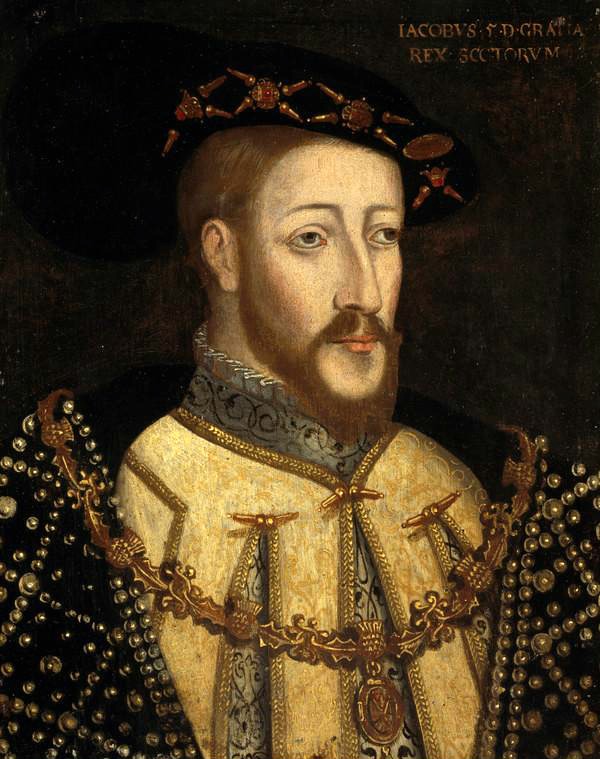
FEATURE image: Portrait of James IV, after 1578, artist unknown, 41.2 x 33 cm, National Galleries Scotland. Public Domain.
Detail of The Flodden Window, showing sixteen named archers who fought at the battle, St. Leonard Middleton, England.
The earliest Middleton church was dedicated to Saint Cuthbert around 880 as pagan Danes were then attacking the north of England. Following William the Conquerorin 1066, the Normans built a larger church dedicated to Saint Leonard, a French saint and patron of prisoners. In 1412, Thomas Langley (1363-1437), Prince Bishop of Durham and Lord Chancellor of England under kings Henry IV, V and VI, built a new Gothic style church though incorporating parts of the old Norman building. In 1513, Sir Richard Assheton, Lord of the Manor and member of an illustrious military and religious family, spear-headed further changes. Completed in 1524 today’s St. Leonard was built on the previous church buildings so to celebrate Sir Richard’s knighthood by King Henry VIII for his part in the Battle of Flodden Field in 1513. The stained-glass window memorializes archers from Middleton who joined the battle on the side of the English. The battle took place in England only a few miles south of the Scottish border near Branxton and about 200 miles north of Middleton.
“The Flodden Window,” c. 1524, Parish Church of St. Leonard in Middleton near Manchester in England.
Not yet 40 years old, the reign of charismatic Scottish King James IV (1473-1513) came to an abrupt halt on September 9, 1513 when he was instantly killed in battle fighting against an English army in northernmost England.
Continental politics with its entangling alliances put Scotland in armed conflict against its neighbor for which it had signed a peace treaty only 11 years earlier.
In 1502 a treaty was signed pledging everlasting peace between the kingdoms of Scotland and England. The political settlement was sealed in the sacrament of marriage between ambitious (and religious) James IV to Margaret Tudor (1489-1541), the sister of future English King Henry VIII (1491-1547).
The Scots also had a treaty with France, their traditional ally. When the Pope in Italy excluded France from political gain in Italy—and England endorsed the pope’s action—France called on Scotland for help. In the summer of 1513, James invaded England.1
Much later in 1534 in England, papal interference in English political affairs where the pope denied the English King Henry the annulment he sought from Catherine of Aragon (1485-1536), led to England breaking with Rome and the formation of the Church of England.
After his father, James III of Scotland (1451-1488), was killed in battle in 1488, James IV became king at 15 years old
James IV of Scotland (1473-1513). Published by Peter Stent, line engraving, c.1643-1667. 6 7/8 in. x 4 3/4 in. (17.6 mm x 12.2 cm) paper size. Given to the National Portrait Gallery, London, by Sir Herbert Henry Raphael, 1st Bt, 1916.Portrait of James IV, after 1578, artist unknown, 41.2 x 33 cm, National Galleries Scotland.
When James III was killed on June 11, 1488 at The Battle of Sauchieburn in Scotland, his 15-year-old son James IV succeeded him. He had been the rebels’ assumed figurehead, and for his indirect role in his father’s death James decided to wear a heavy iron belt for the rest of his life. A highly intelligent man, James IV proved an effective ruler. He spoke several languages and took an interest in literature, science, and law. Determined to establish strong central leadership he suppressed The Lord of the Isles and created a powerful navy. In 1503 he married the English king’s daughter, Margaret Tudor, in an attempt to create peace between the two countries. When England invaded France, James felt obliged to assist his old Continental ally. In 1513 he confronted the English army but was killed in the disastrous Battle of Flodden Field.
James IV, 1473 – 1513. King of Scots, 17th century, artist unknown, work on paper, 13.33 x 10.16 cm, Scottish National Portrait Gallery (Print Room).
James IV married Margaret Tudor (1489-1541), the sister of future English King Henry VIII (1491-1547). While their marriage was an important part of the Truce of Perpetual Peace which was signed between Scotland and England in 1502, it did not prevent the Battle of Flodden Field over a decade later.
The Battle of Flodden Field was fought in the county of Northumberland in northern England on September 9, 1513. The battle was between the invading Scots army under King James IV and the English army commanded by the Earl of Surrey.
Thomas Howard, 2nd Duke of Norfolk, Earl of Surrey (1443-1524).
Battle strength and casualties are disputed but the Scots likely numbered more than 30,000 men and, after some delay, engaged an English force of around 20,000 men under Lieutenant-General Thomas Howard, 2nd Duke of Norfolk, Earl of Surrey (1443-1524). Howard would become the grandfather of future queens Anne Boleyn (1501-1536) and Catherine Howard (1521-1542).²
Battlefield today.
The Battle begins with an artillery duel and the Scot king is quickly killed in action. Bogged down, a third of the Scot army is destroyed
On September 9, 1513 the two armies clashed at Flodden Field in the far north of England. The battle proved a disaster for the Scots. Scotland’s inspiring king was quickly killed in action with a third of his army, including many officers. English losses were but a small fraction of their total.³
The battle started with an artillery duel. The Scots brought heavy guns and had difficulty aiming at the English army at close range below them. Lighter English guns were able to target and pick off the Scots’ guns. In response, the Scottish left wing advanced downhill and wreaked havoc on the English right wing. The rest of the Scottish army then advanced. But a marshy valley floor bogged the army down. The Scottish pikemen became easy targets for the English infantry. The end result was that a third of the Scottish army was destroyed.
New Scot King, James V, is 17 months old, in 1513. When he dies prematurely in 1542, Mary, Queen of Scots, his daughter and successor, is 6 days old
One immediate consequence of The Battle of Flodden Field was to put James V on the Scottish throne. James was born in April 1512 and not yet two years old.
The Scots were made to wait a generation for kingly leadership in very trying times. Thirty years later, in 1542, James V would die prematurely and was succeeded on the throne by his only legitimate daughter, Mary, Queen of Scots, who was only six days old.
Posthumous portrait of James V, 1512 – 1542, artist unknown, c. 1579, 41.30 x 33.00 cm, National Galleries Scotland.
James V (reigned 1513 – 1542), father of Mary, Queen of Scots, became king at one-year old when his father, James IV, was killed at Flodden, fighting the English. Ignoring the advice of English King Henry VIII, his uncle, to become a Protestant, James V strengthened Scotland’s alliance with its traditional ally, France. He married the French king, Francis I ‘s daughter, Madeleine of Valois (1520 –1537). When she died, he married Mary of Guise (1515-1560), another high-born Catholic French woman. James V died at Falkland Palace, soon after his army’s defeat by the English at Solway Moss, on November 24, 1542. His six-day-old daughter Mary succeeded to his throne.
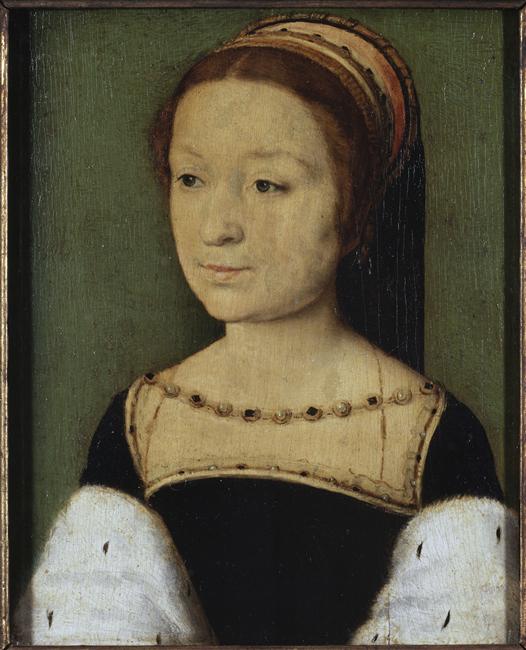
Madeleine of Valois (1520 –1537), Corneille de Lyon (1500/1510–1575), Musée des Beaux-arts de Blois.
First wife of James V of Scotland. They married on New Year’s Day 1537 at Notre Dame Cathedral in Paris. Of delicate health from birth, Madeleine died in July 1537 at 17 years old.
Portrait of Mary of Guise (1515 – 1560), Corneille de Lyon, c. 1579, 41.3 x 33 cm, Scottish National Portrait Gallery.
Queen of James V of Scotland and mother of Mary, Queen of Scots. The daughter of a French duke, Mary of Guise had just been widowed when she married James V to strengthen the alliance between France and Scotland. Their two sons died in infancy and James died a few days after their daughter, Mary, was born in 1542. Mary of Guise chose to stay in Scotland, ruling as Regent to protect her daughter’s interests. Courageous and determined, her effort to keep Scotland in the French Roman Catholic sphere was unsuccessful in the rising tide of Protestantism on the British Isles.
Mary, Queen of Scots, 1542 – 1587, artist unknown (after Francois Clouet, c. 1510 – 1572), 32.90 x 27.40 cm, National Galleries Scotland.
This is probably a 19th century replica after an image made around 1561. Within eighteen months Mary, Queen of Scots, lost three members of her closest family — her father-in-law (Henry II of France), mother (Mary of Guise) and, on December 5, 1560, her husband, Francois II of France. Mary is depicted here in mourning, wearing a white hood and veil. According to the Venetian Ambassador to the French court, Mary was inconsolable. Her “tears and lamentations inspired a great pity” in everyone, the diplomat observed. Eight months later, having lost her position as Queen of France, Mary landed at Leith to take up her duties as Queen of Scotland.
Over two hundred years later Scottish poet Jane (or Jean) Elliot (1727-1805) wrote a poetic lamentation to an ancient Scottish tune about Flodden’s martial calamity. Published in 1776, it is called The Flowers of The Forest and is Elliot’s only surviving work.
Dule and wae for the order sent our lads to the Border; The English for ance, by guile wan the day; The Flowers of the Forest, that foucht aye the foremost, The prime o’ our land are cauld in the clay.
We’ll hear nae mair lilting at our yowe-milking, Women and bairns are heartless and wae; Sighing and moaning on ilka green loaning: ‘The Flowers of the Forest are a’ wede away.4
King James IV corpse riddled with arrows on the battlefield
King James IV died at Flodden on September 9, 1513. His corpse was disfigured by arrows. The bow and arrow is an ancient weapon. Arrows inflicted some of medieval battle’s worst wounds when the victim was struck. Though guns and cannonade take pride of place in terms of firepower, arrows caused wounds that could be more fatal than those produced by other weapons.
Battle of Flodden Field weapons: guns, cannon, pikes, and arrows
The heavier the arrowhead, usually made of metal, the larger the feathers needed to spin it towards its target. Victims did not die usually in battle from a single arrow wound. Expert bowman could shoot one arrow every 5 to 10 seconds.
Complicating multiple wounds was that each arrowhead had to be removed. Since the arrow was constructed to have the arrowhead dislodge in the body, it made its location and removal highly dangerous and difficult. Arrowheads could not remain in the body. They were too large, sharp, and angular for bodily tissue to heal around it. They could easily become infected and caused intense pain with the slightest of bodily movement. A general medical procedure was to cut off limbs with arrow wounds. If the arrowhead was lodged into bone, it made its removal even more painful and difficult. Lodged arrows could cause nerve damage or intense muscle contractions. Arrows to the head might not penetrate the skull but could cause cerebral compression whose pressure would be alleviated by surgery. Bowmen knew to hit the trunk of the body was going to be likely fatal and this is where most combatant injuries by arrows are found.5
Taken to England after battle, the fate of the Scottish king’s disfigured corpse
After the battle, James IV’s corpse was identified and taken to Berwick-upon-Tweed where it was cleaned up and embalmed. Placed in a lead coffin, the body was transported to London.
The body was received by Catherine of Aragon (1486-1536), the wife of King Henry VIII of England who was fighting in France. The body remained in Richmond upon Thames with a monastery. James IV might have been buried at the monastery except that the Scottish king had been excommunicated for breaking the Truce signed between Scotland and England in 1502. Although the pope granted permission for burial, the corpse was left in a monastery shed to, quite literally, rot.
In England the body of the Scottish king was soon forgotten about. It is conjectured someone stole the head and, after a time, that detached body part was thrown into a popular London charnel pit. The body presumably stayed at the monastery. When the monastery was demolished during the Dissolution in the 1530’s, the headless body of James IV was lost with it.
NOTES:
1 Trevor Royle, Precipitous City: The Story of Literary Edinburgh, Mainstream Publishing, Edinburgh, 1980. pp. 16-17.
2 Stanford E. Lehmberg, “The Life of Thomas Howard, Earl of Surrey and Second Duke of Norfolk, 1443-1524 by Melvin J. Tucker,” The American Historical Review, Vol. 71, No. 1 (Oct., 1965), p. 158.
3 “The Flodden Death-Roll,” The Scottish Antiquary, or, Northern Notes and Queries, Vol. 13, No. 51 (Jan., 1899), Edinburgh University Press, p. 102.