FEATURE image: The shrine of Saint Swithun (or Swithin) in Winchester Cathedral in England, The official name of the old minster or mynster ( from monasterium) is the Cathedral Church of Holy Trinity, Saint Peter, Saint Paul, and Saint Swithun. Since July 15, 971 the shrine at the grave of St. Swithun has been inside Winchester Cathedral. “St Swithun’s Shrine” by Lawrence OP is licensed under CC BY-NC-ND 2.0.
St. Swithun (c. 800–c. 863), whose Old English name means “Strong Bear Cub,” served as a leading churchman in the royal city of Winchester during the late ninth century. History preserves only a handful of firm details about him: he was appointed Winchester’s eighteenth bishop in 852, and before that he appears to have been a secular clerk known for his learning and upright character. Yet the sparse record is balanced by what survives—relics, early medieval artifacts, and a rich body of lore that grew around his memory. Swithun stands at the crossroads of early English history, a figure shaped by the world of Saxons, Angles, Vikings, and Jutes who contested southern England in his lifetime.
Winchester Cathedral in the rain. The complete name of Winchester Cathedral is the Cathedral of the Holy Trinity, St. Peter, St. Paul, and St. Swithun. “Winchester Cathedral in the Rain” by Spencer Means is licensed under CC BY-SA 2.0.
Swithun, long associated with the West Saxon court, played a formative role in educating Æthelwulf (“Noble Wolf”), the king’s son who would become the father of Alfred the Great (c. 848–899). Alfred’s later reputation for learning, steadiness, and good judgment in a turbulent age reflects the intellectual climate Swithun helped cultivate.
Within the royal household, Swithun is credited with fostering a more civilized court culture—one that valued education, strengthened the legal system, reformed military organization, and improved the daily life of ordinary people. These advances, modest in scale but lasting in influence, helped make Swithun a beloved figure in his own lifetime.
Imagined 1790 profile of Alfred the Great by British painter Samuel Woodforde (1763–1817), portraying the ninth‑century king with neoclassical dignity rather than historical accuracy. Public Domain.
Wessex under Alfred’s leadership emerged as the sole Anglo‑Saxon kingdom to withstand the ninth‑century Danish onslaught, preserving a political and cultural core while neighboring realms fell to Viking and Jutish pressure. In the century that followed, this survival proved decisive: by the 900s, England was unified under the line of Æthelwulf and Alfred, the dynasty whose resilience and statecraft shaped the first truly consolidated English kingdom.
Map of England showing Anglo-Saxon Kingdoms and Danish (Viking/Jutes) Districts, From Cassell’s History of England, Vol. I (Anonymous author, artist), 1909. Public Domain.
An illuminated manuscript of St. Swithun. It is in the Anglo-Saxon Benedictional of St. Æthelwold (10th century) which is the most famous early medieval book of blessings in the world. It is kept in London. Public Domain. https://www.bl.uk/manuscripts/FullDisplay.aspx?ref=add_ms_49598. Public Domain.
Miracle of Broken Egg Shells.
Bishop Swithun was not only a builder but also one of the early contributors to the Anglo‑Saxon Chronicle, the great collection of Old English annals. Throughout his life—and long after—humble miracles were attributed to him. One of the most charming, still recalled in the modern shrine marker, is the “miracle of the broken eggshells.”
According to the tale, on St. Swithun’s Bridge in Winchester—a crossing over the River Itchen that has existed since around A.D. 500—a woman hurrying to market met the saint and accidentally dropped her basket of eggs, smashing them on the stones. Swithun stooped to help, gathered the fragments, and returned the eggs to her perfectly restored, a small act of compassion that became one of the most beloved stories in his legend.
St. Swithun’s bridge in Winchester. The present bridge is from the 19th century although a bridge has been at this same crossing for over 1500 years. “St. Swithun’s Bridge Winchester” by neilalderney123 is licensed under CC BY-NC 2.0.
A map showing the places where the various chronicles were written (Winchester, Abingdon, Worcester, Canterbury and Peterborough) and kept today (Oxford, Cambridge, and London). “Anglo-Saxon Chronicle – Locations with Old Way” by Adam37 is licensed under CC BY-SA 3.0.
When Swithun died in 862 or 863, the charismatic personality was buried per his request in the cathedral churchyard. Swithun wanted passers-by to be able to walk over his grave and for the rain to fall upon it. Over 100 years later, on July 15, 971, the remains of St, Swithun, who was regarded as the patron saint of the city of Winchester, were moved to inside the old minster to a magnificent shrine on the high altar.
When Saint Swithun’s remains were moved from their simple outdoor grave to a splendid new shrine inside Winchester Cathedral, legend says the saint was so displeased that torrential rain fell on July 15, 971—and continued for forty days. How Swithun became directly linked to stormy weather is not precisely known, though similar meteorological tales were told of a few earlier French saints. In England, the lore settled firmly on Swithun, inspiring rhymes such as the old ditty:
“If on St. Swithun’s day it really pours,You’re better off to stay indoors.”
and the more famous verse:
“St Swithun’s day if thou dost rainFor forty days it will remain;St Swithun’s day if thou be fairFor forty days ’twill rain na mair.”
One cheerful outcome of this soggy tradition is Swithun’s later role as patron saint of apples, since the fruit begins to appear in abundance during the late summer and early autumn.
The modern shrine marker over the grave of St Swithun in the east end of the cathedral was built in 1962—literally 1000 years after St. Swithun’s death. “St Swithun’s Shrine” by Lawrence OP is licensed under CC BY-NC-ND 2.0.
Jane Austen’s final days in Winchester: a dying novelist writes her last poem on St. Swithun before being laid to rest in the cathedral
Three days before her death on July 18, 1817, the forty‑one‑year‑old novelist Jane Austen (1775–1817) wrote what would be her final poem—a brief, witty meditation on Winchester, rainy weather, and St. Swithun’s Day. Composed at 8 College Street, only steps from the cathedral, the verse shows that Austen, who had come to Winchester in May 1817 seeking medical care, understood she was nearing the end of her life even as she maintained her playful tone.
She died just sixteen miles from her home in Chawton, still within her beloved Hampshire. Less than a week after writing the poem, Austen was laid to rest in Winchester Cathedral, the great church whose bells and legends framed her final days.
“When Winchester races first took their beginning It is said the good people forgot their old Saint Not applying at all for the leave of Saint Swithin And that William of Wykeham’s approval was faint.
The races however were fixed and determined The company came and the Weather was charming The Lords and the Ladies were satine’d and ermined And nobody saw any future alarming.–
But when the old Saint was informed of these doings He made but one Spring from his Shrine to the Roof Of the Palace which now lies so sadly in ruins And then he addressed them all standing aloof.
‘Oh! subjects rebellious! Oh Venta depraved When once we are buried you think we are dead But behold me immortal! By vice you’re enslaved You have sinned and must suffer, ten farther he said
These races and revels and dissolute measures With which you’re debasing a neighboring Plain Let them stand–You shall meet with your curse in your pleasures Set off for your course, I’ll pursue with my rain.
Ye cannot but know my command o’er July Henceforward I’ll triumph in shewing my powers Shift your race as you will it shall never be dry The curse upon Venta is July in showers–“
Swithun at St-Swithun-upon-Kingsgate, Winchester. Public Domain.
Swithun’s quiet presence still lingers at Winchester, a reminder of a bishop whose influence far outlasted his ninth‑century lifetime. By every surviving account, Swithun was a deeply charismatic figure, admired by those he served and respected by those who served under him. His humility, learning, and pastoral care left such a vivid impression that, after his death, his simple grave became a place of pilgrimage, drawing the faithful who sought his intercession.
In the years that followed, miracles were attributed to Swithun with striking regularity, reinforcing his reputation as a saint whose holiness expressed itself not in grand gestures but in small acts of compassion and restoration. This enduring devotion—rooted in memory, legend, and lived experience—ensured that Swithun’s legacy would remain woven into the spiritual life of Winchester for more than a millennium.
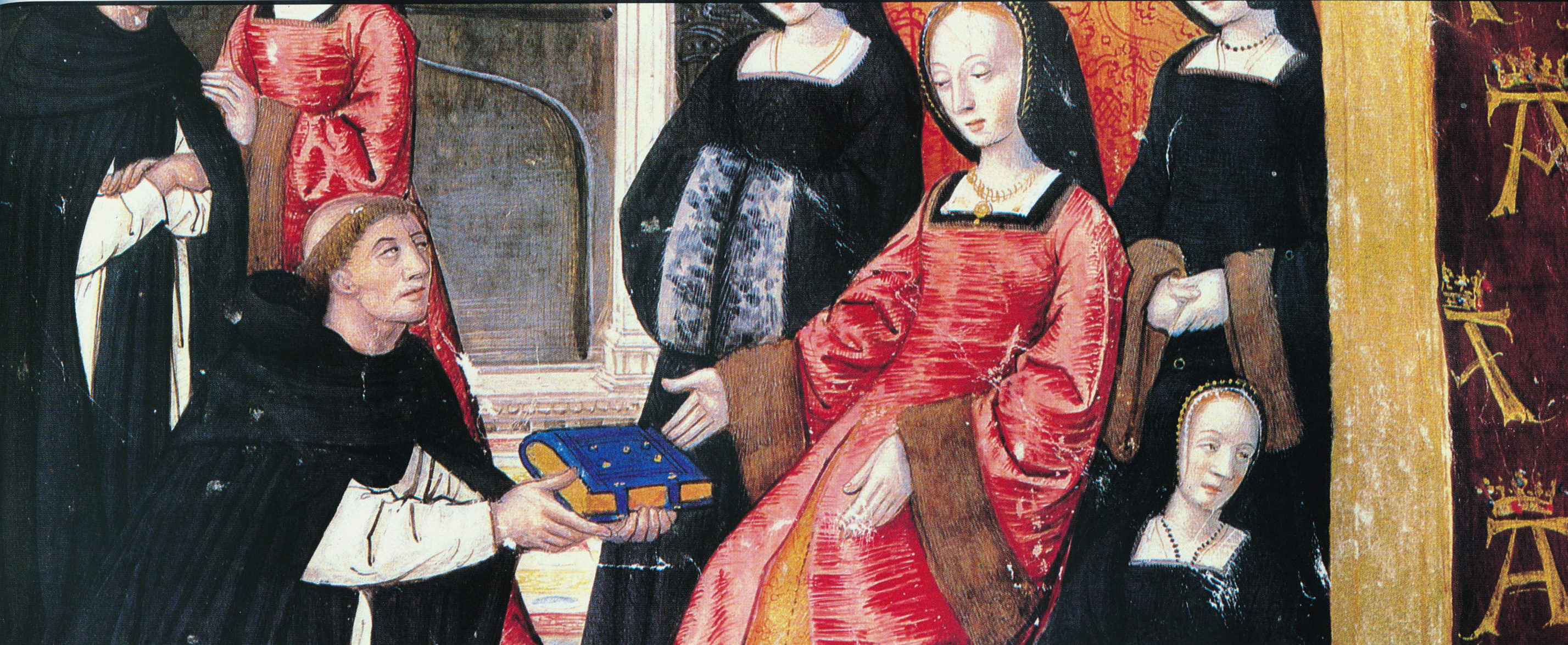
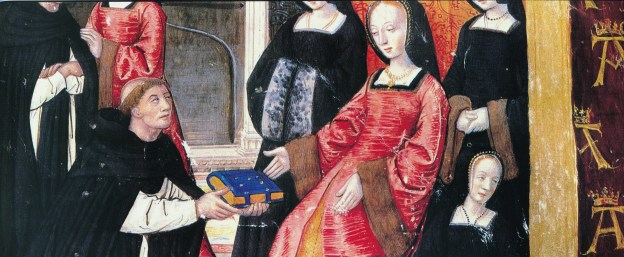
FEATURED image: Manuscript 16th century (detail): Queen consort Anne of Brittany (1477-1514) receiving a Book of Hours from her Dominican confessor, Antoine Dufour (d.1509). Montfort L’Amaury returned to the crown of France after Anne of Brittany married Charles VIII “the Affable” (1470-1498) in 1491.
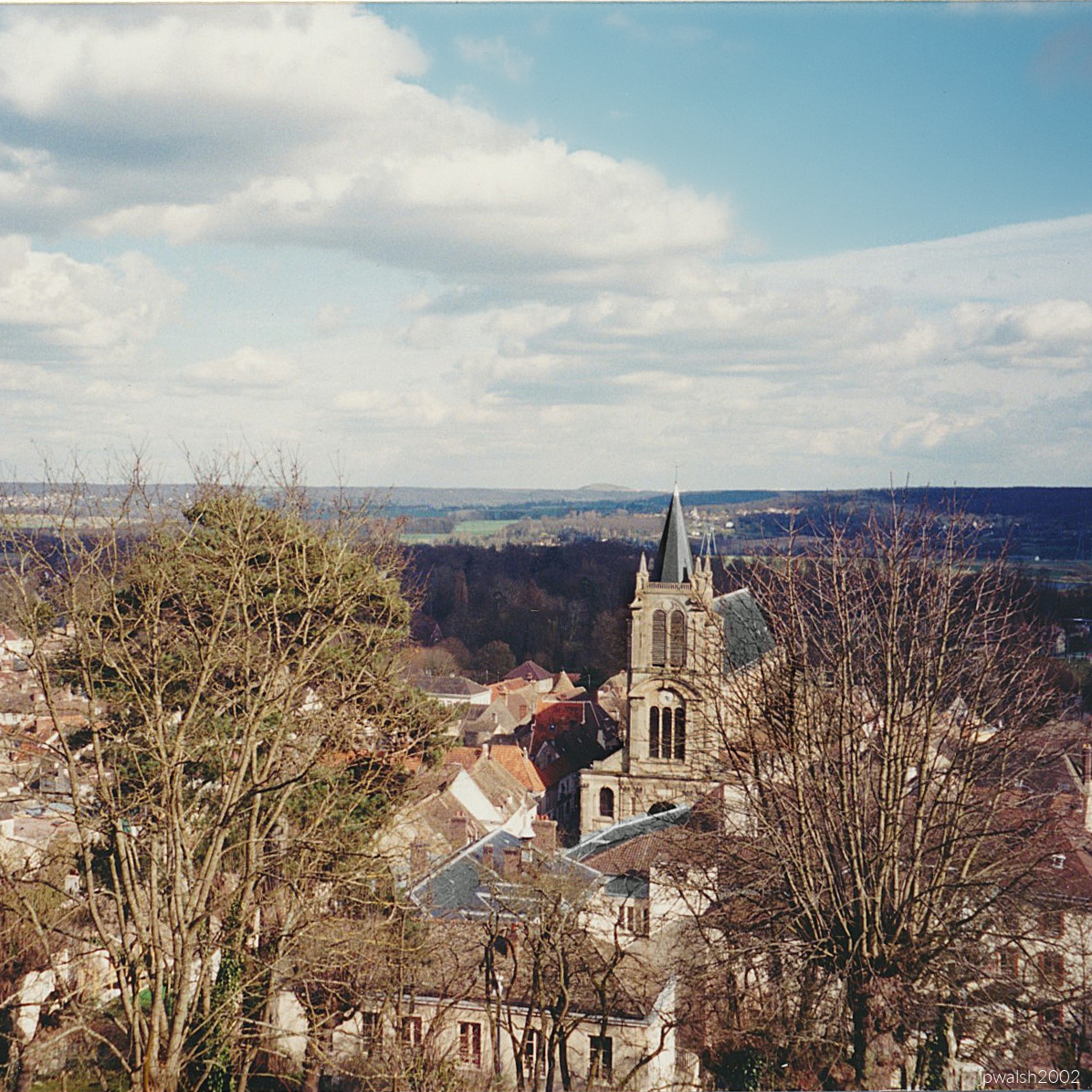
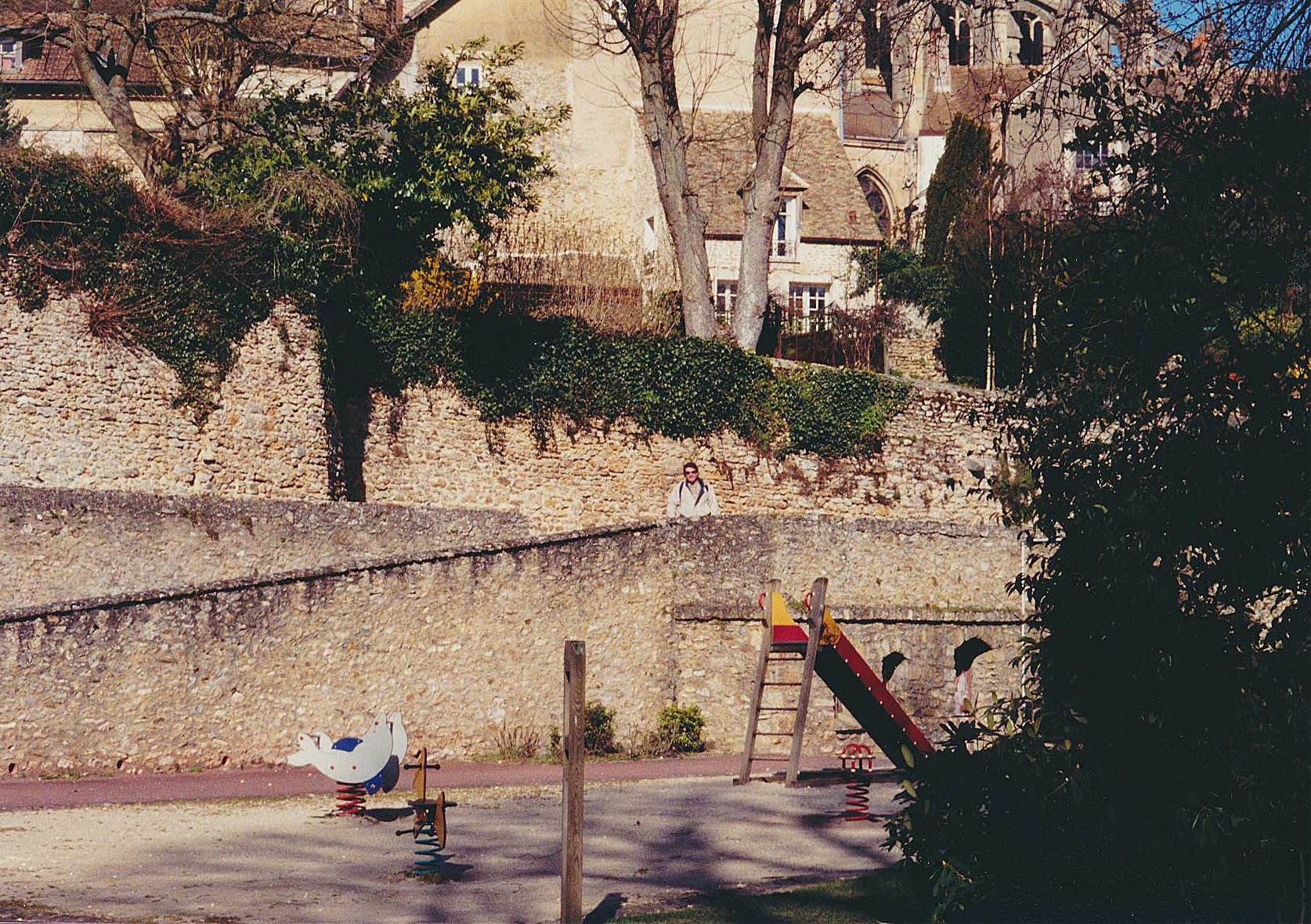
Started in the 11th century, L’Église St. Pierre anchors part of the centre ville of Montfort L’Amaury, a town in France about 30 miles west of Paris. The photograph is taken from the ruins of the chateau on the town’s heights. The late 10th century Frankish king Robert II built a castle in the hills of Montfort. From the start of the 11th century, Montfort-l’Amaury was the stronghold of the Montfort family. Author’s photograph.
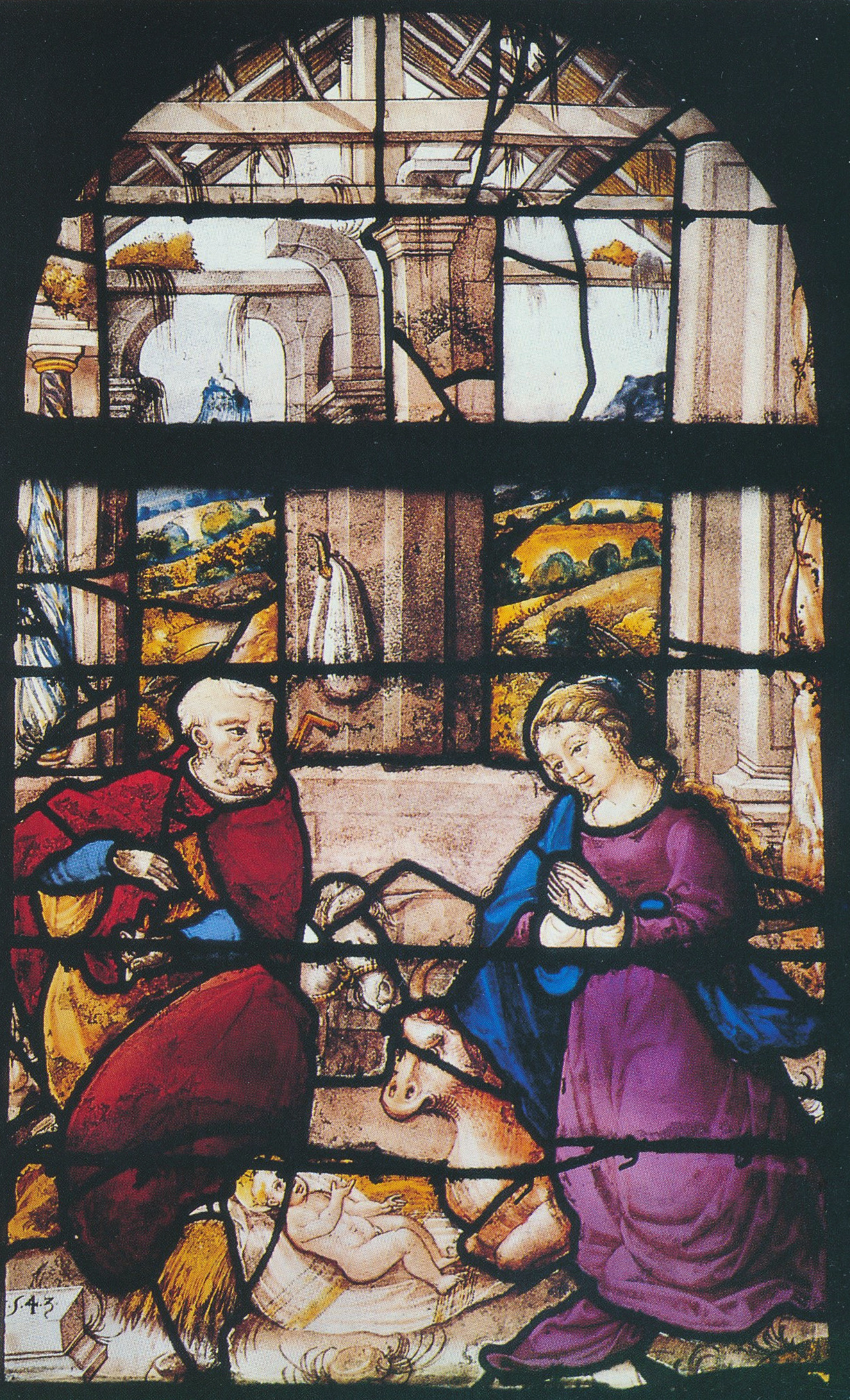
At the north edge of the Rambouillet forest the city of Montfort L’Amaury spreads along the restored ruins of its ancient fortified castle. Founded under the Capetian kings, the city owes its fame to Simon de Montfort (1208-1265), Anne de Bretagne (1477-1514), the Valois royal dynasty, and Henry IV (1553-1610). Its monuments begin in the 11th century, stretch towards exceptional Renaissance stained-glass windows and half-timbered houses as its civilization has attracted writers, artists, and musicians to live there. This would include the house of Maurice Ravel (1875-1937) called Le Belvédère where he lived from 1921 until his death and where we were invited to sit at, and play, the piano where Ravel composed Boléro. It was in March 2002 during a visit to Paris and the Île-de France that we ventured through Yvelines by train to Montfort-L’Amaury for a day trip which included a memorable déjeuner in a restaurant that has since disappeared.
Interior, L’Église Saint-Pierre (Church of St. Peter), late 15th century, Montfort L’Amaury, France. Author’s photograph.
The interior of Saint Pierre church is bright and intimate. Like other French monuments, today’s Saint-Pierre was completed over many centuries. Its origin is in the 11th century. A notable reconstruction of the edifice began in the late 15th century by initiative of Queen Consort, Anne of Bretagne. There is a vast ambulatory around both sides of the nave. Since 1840, the church has been an historic monument because of its unique ensemble of 37 stained glass windows. The oldest date from the 1540s and 1570s. The others were installed in the late16th century. That ecclesial project was started by Catherine de Medicis (1519-1589) in 1562. The windows were installed during the time of the Council of Trent (1545-1563) and some of the glass commemorates that event. As none of the glasswork is signed, it is not known whether its painters are from Montfort L’Amaury or elsewhere.
St. Peter Window. L’Église Saint-Pierre, Montfort L’Amaury, France. Throughout France starting in the 1540s there was a growing taste and demand for stained glass windows in their local churches. The experimentation in glasswork and painting by the middle of the 16th century allowed for the iconography in these stained glass windows to express numerous details and refined techniques. Public Domain.Detail. St. Peter Window. Public Domain.Detail. Nativity Window. Public Domain.The south exterior of L’Église Saint-Pierre along Rue de Dion in Montfort L’Amaury. The exterior wall shows flying buttresses designed in the French Renaissance style as well as gargoyles that were sculpted in the late 15th century. The building is constructed of calcified stone that came from towns to the north, precisely, Maule, and a more distant Vernon on the Seine. The interior ambulatory that surrounds the nave on both sides and ends at the chevet expresses the building’s gothic aspect. Street lamps and a narrow street with tight parking has room for a small tree next to the church. Author’s photograph.Montfort L’Amaury has half-timbered houses dating to the 16th century. This is no. 16, Place de la Libération, just steps from the front entrance of Église St. Pierre. At the beginning of October 1825 young Victor Hugo (1802-1885) lived in Montfort L’Amaury for a few days. He wrote a letter to his father in Paris and described it as “a charming little town ten leagues from Paris, where there are ruins, woods, and one of my friends…” Author’s photograph.Portrait de Victor Hugo sur fond de Notre-Dame de Reims, Jean Alaux, 1825, Maison de Victor Hugo – Hauteville House, oil on cardboard. Public Domain. https://www.parismuseescollections.paris.fr/fr/maison-de-victor-hugo/oeuvres/portrait-de-victor-hugo-sur-fond-de-notre-dame-de-reimsView of the church from the east. The church of Saint Pierre is of late gothic origin. It was rebuilt and decorated in the 15th, 16th, and early 17th centuries. Following the French Revolution and its aftermath, the church building received an extensive restoration in the mid19th century, including a new steeple. Except for one stained glass window that was restored in situ, all the 16th-century stained glass windows were taken out, restored, and reinstalled by a master painter in Metz between 1851 and 1857. Author’s photograph.Chevet. L’Église Saint-Pierre. Public Domain.On Saint Pierre’s front stoop is busy Place de la Libération and with Rue de la Libération just beyond. At the end of the street is the rounded 16th century La Porte Bardoul, one of gateways to the chateau. It was named in the 16th century for the Captain who built the ramparts of Montfort L’Amaury in the 11th century (Hugues Bardoul). Author’s photograph.“Charles Aznavour – Disque D’Or” by Piano Piano! is licensed under CC BY 2.0. Charles Aznavour (1924-2018), dubbed France’s Frank Sinatra, never lived in Montfort L’Amaury. For 60 years, the singer lived in Galluis, a neighboring town just 5 minutes by car up the road. Yet, in those many years, Aznavour frequently came to Montfort L’Amaury, sometimes to go shopping or visit friends or eat at one of its excellent restaurants. In 2018 Aznavour was buried in the cemetery in Montfort L’Amaury and has become a pilgrimage site for his many fans.The cemetery at Montfort L’Amaury dates from the sixteenth century and is an interesting site to visit for its history, architecture, and people buried within. As dead bodies were originally buried in the ground as they are today, over the many centuries the bones were later exhumed and deposited in ossuaries. This was essential during epidemics that occurred regularly when ground-space for burials was at a premium for the bodies of the newly dead. Built to give the appearance of a cloister, these galleries are actually a mass grave. Its architecture is charming and conveys the aspect of a Romantic bone-yard. Fair Use. Ruins of the castle of Montfort-l’Amaury. In the foreground is Le Belvédère, the house of Maurice Ravel. Montfort-l’Amaury Donjon by ℍenry Salomé(Jaser !) 08:12, 21 November 2006 (UTC) – Cliché personnel, own work is licensed under CC BY-SA 3.0
The role of Montfort l’Amaury as a town began to develop in the High Middle Ages when Capetian king, Robert II (976-1031), built a castle there in the forest of Yvelines which was then a royal prerogative. William of Hainaut built the castle whose walls were finished around 1050. Hugues Bardoule was captain of the castle and thus a later 16th century gateway is named after him. It is in the 11th century that L’Église Saint-Pierre and L’Église Saint Laurent begin to be built. Robert II was married three times, and excommunicated by the Catholic Church – one of the early examples of French royals who married as they wished.
In the twelfth century, Bertrade de Montfort (1070-1117), after giving birth to a boy who would become King of Jerusalem, left her husband, the Duke of Anjou, Fulk IV (1043-1109) in 1092. She married the king of France, Philip I “the Amorous” whose spouse, Bertha of Holland, was also still living.
Philip was so in love with Bertrade that he refused to leave her even when threatened and finally excommunicated by Pope Urban II (1035-1099) in 1095. Because of his excommunication Philip was prevented from taking part in the First Crusade (1096-1099).
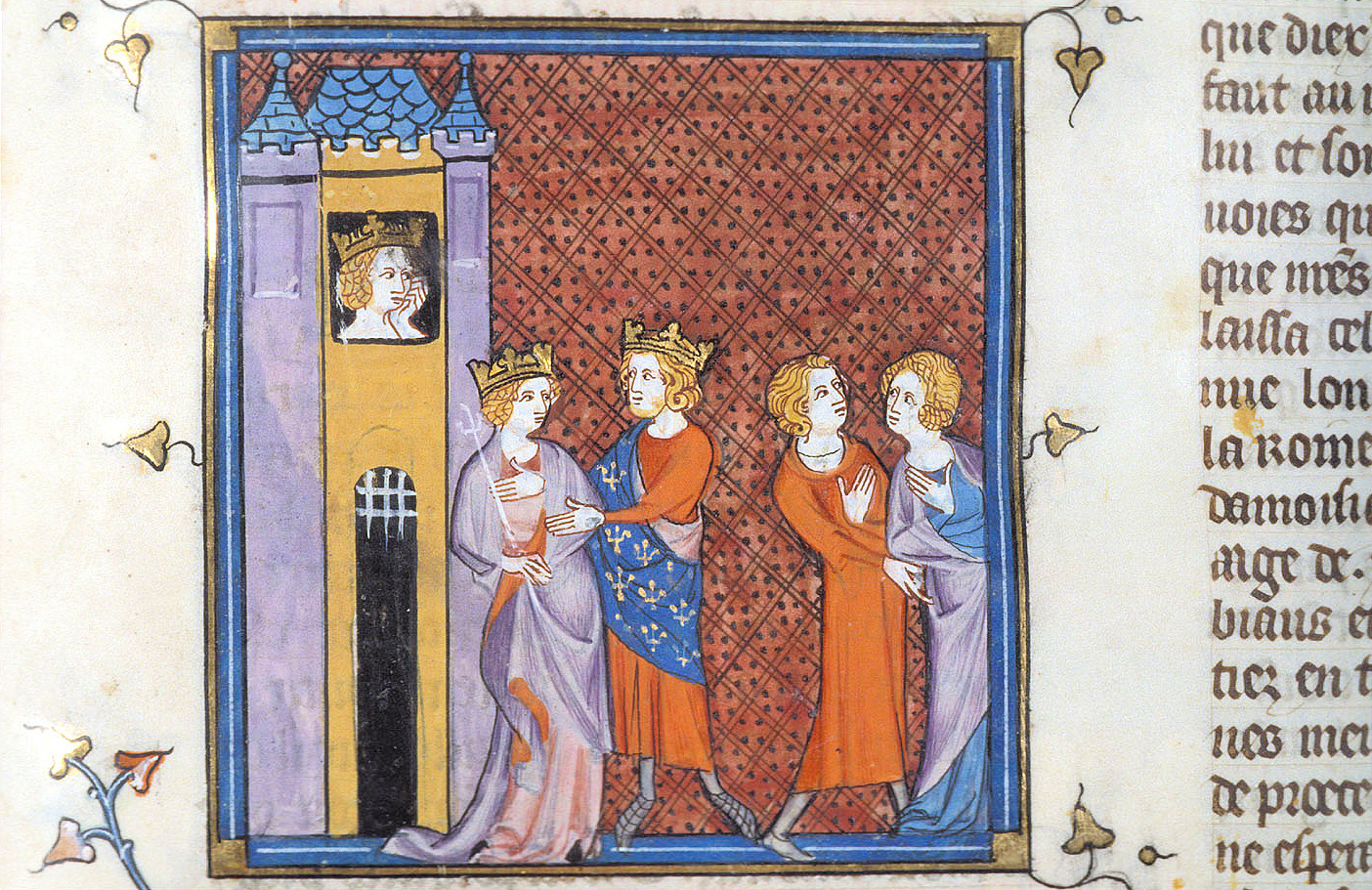
Bertrade de Montfort and King Philip I “the Amorous.” Chroniques de Saint-Denis (ou de France), British Library, Royal 16 G VI f. 271. 14th Century (1332-1350). https://www.bl.uk/IllImages/Kslides%5Cbig/K137/K137596.jpgThe ramparts and castle. Author’s photograph.
The ramparts and castle were destroyed by the English during the Hundred Years’ War in the 15th century. After the battle of Agincourt in 1419, the English occupied the French domain and it was during this time that the castle at Montfort was destroyed. The two rebuilt towers were named for Anne of Brittany after she assisted in the castle’s restoration. From this height, the fort overlooked the old Roman road from Beauvais to Chartres.
Also from this place, troops assembled at Montfort L’Amaury in the 12th century as Amaury III raised lords and knights to fight alongside Louis VI (1081-1137) against the Emperor of Germany. Simon IV fought alongside Philippe II Auguste (1165-1223) against the English as well as to the Crusades in the Middle East and the Albigensian Crusade in southern France. The Montforts distinguished themselves especially in this crusade against the Cathars.
At the beginning of the Third Crusade (1189-1192), not wanted by King Philippe Auguste (1165-1223), the future Louis VIII “the Lion” (1187-1226) was looking for companions. Simon IV, Lord of Montfort (1175-1218), embarked on the crusade where victory was equalled by its terror.
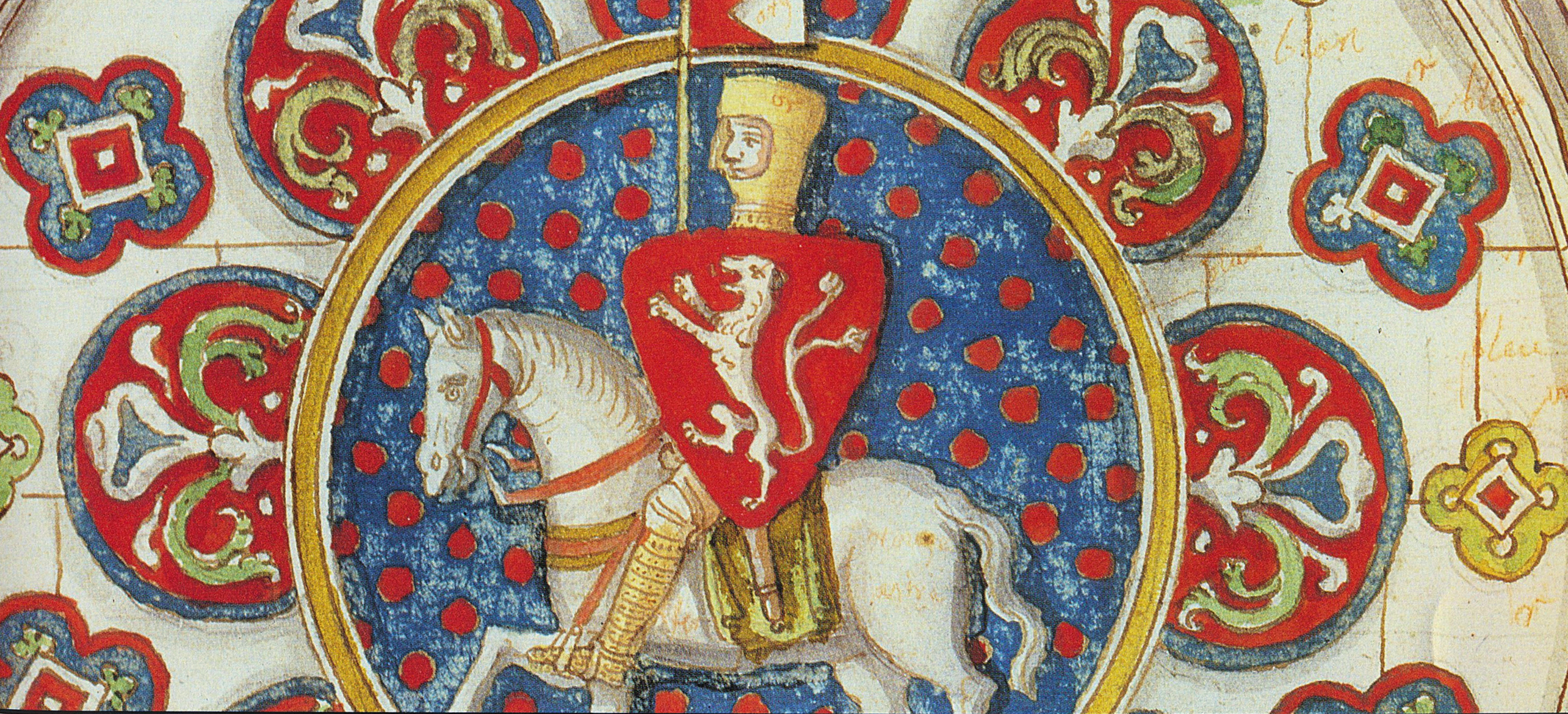
Stained glass (detail) Chartres cathedral: Simon de Montfort V (1208-1265). Simon was born in the chateau in 1208. Whereas his brother Amaury V (1191-1241) inherited his father’s French properties, including in the south of France owing to his father’s Cathar crusade, Simon V is known to history as having a major role in the constitutional development of England where he successfully led the barons’ opposition to the absolute rule of King Henry III (1207-1272) of England. During his rule of England Simon de Montfort V called two famous parliaments, one of which recognized the voices of ordinary town citizens in the affairs of government making him one of the progenitors of modern parliamentary democracy. Public Domain.
In January 1238, Montfort married Eleanor of England, daughter of King John and Isabella of Angoulême and sister of English King Henry III. While this marriage took place with the king’s approval, the act itself was performed secretly and without consulting the great barons. Eleanor had previously been married and swore a vow of perpetual widowhood after her husband died. This vow was broken when she married Montfort and, for that reason, the Archbishop of Canterbury condemned it. The English nobles protested the marriage of the king’s sister to a foreigner who was only of modest rank. Most notably, Richard, 1st Earl of Cornwell, the king’s and Eleanor’s brother, rose up in revolt over the marriage. King Henry III eventually bought off his brother and peace was restored. The marriage brought property to Montfort and when a child was born of the union in late 1238, he was baptized Henry, in honor of his uncle, the king. In February 1239, Montfort was finally invested as Earl of Leicester where he acted as the king’s advisor and became godfather to Henry’s eldest son, Edward, who became King Edward I (“Longshanks”).
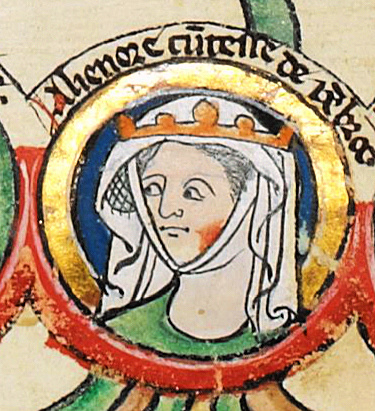
Eleanor of England who married Simon de Montfort V in 1238 in an early-fourteenth-century Genealogical Roll of the Kings of England. Public Domain.The author at the ramparts. These fortifications were originally built over 1000 years ago in the early 11th century by Amaury I. The walls run from east to west creating a superficial size of Montfort at about 4 to 5 hectares (one hectare equals about two and a half acres). Portions of the wall were dismantled during the 100 Years War but rebuilt during the Wars of Religion (1562-1598) as well as Montfort’s reception of a royal charter by Charles IX in the mid16th century. The rebuilt wall had to expand to meet the development of Montfort under Anne de Bretagne a half a century before, though substantial portions of the original 11th century wall were incorporated into the construction. Author’s collection.Manuscript 16th century (detail): Queen consort Anne of Brittany (1477-1514) receiving a Book of Hours from her Dominican confessor, Antoine Dufour (d.1509). Montfort L’Amaury returned to the crown of France after Anne of Brittany married Charles VIII “the Affable” (1470-1498) in 1491.
From Montfort L’Amaury, the lords continued to assist the French kings in the crusades. After John I, only a daughter allowed the continuity of the Montfort family. Beatrice d’Albidon married Robert, Count of Dreux. The Comté de Montfort was related to the Duchy of Brittany following the marriage of Yolande de Dreux-Montfort (1263-1330) with Arthur II of Brittany (1261-1312) in 1294. With their marriage in February 1492, Anne of Brittany became the first Queen of France crowned in St. Denis basilica. The marriage contract of Anne to Charles VIII “the Affable” stipulated a union of France and Brittany though the ruthless Charles forbade her to reign with her title, “Duchess of Brittany.” The contract also stated that if the queen were to die first and was childless, the king would inherit all her property. In this pre-nuptial agreement, it further stipulated that if Charles VIII died first Anne must marry his successor. This would be his cousin and brother-in-law, the handsome and seductive Louis II of Orléans, later, Louis XII (1462-1515). Though Charles and Anne often lived apart, she was pregnant for most of her married life with a child on average every fourteen months that produced two sons who died and two daughters who lived. After the accidental death of warring Charles in April 1498 (he hit his head on a door lintel), there was no male heir and 22-year-old Anne duly married Louis. Before she married French kings, Anne was engaged 8 times and briefly was married in 1490 to the Holy Roman Emperor, Maximilian, which the French did not like. Anne was still a married woman when she and Charles the Affable exchanged vows in December 1491. To prevent scandal the marriage had to be regularized by the pope who annulled Anne’s marriage to Maximilian in February 1492 and granted the royal couple a dispensation for each marrying their relative. Before new king Louis XII could marry Anne he had his 22-year marriage to Joan of France – a marriage of longer duration than Anne was then alive – annulled. In 1476 Louis believed he had had Joan forced on him by Louis XI (“The Universal Spider”) and never really cared for her. In what has been described as one of the seamiest lawsuits of the Middle Ages, Joan went on childless from her disappeared marriage to die in a nunnery. In 1499 it was the king’s second marriage and Anne’s third. Anne was quite aware that she was no longer a child but a 33-year-old woman, divorced and widowed with two children. She proceeded to actively insist at court on her rights and prerogatives. Though King Louis XII ruled Brittany, he officially recognized Anne’s title Charles had forbade and Louis promulgated decisions in her name. Their contract stipulated that Anne’s second child with Louis XII would rule Brittany. But with Anne’s death at 36 years old in 1514 this was not honored. Anne was coronated again in St. Denis basilica in 1504. She lived mostly at Blois and was an important patron of the Italian and French fine arts. Louis XII died the next year without a legitimate heir and his cousin and son-in-law Francis I mounted the throne. The couple were buried in St. Denis basilica. During the French Revolution in the wake of the frenzy of having decapitated the king in January 1793, revolutionaries made their way to St. Denis basilica and desecrated the graves of Anne of Brittany and Louis XII and threw their remains into a mass grave. This 15-16th century union of Brittany and France brought increased benefits to Montfort L’ Amaury compared to a union with Brittany alone. The new period saw the town’s castle ruins restored and there was new construction everywhere. The cemetery was relocated outside city walls. Churches were rebuilt and enhanced with that day’s art. While reaping these material improvements from its royal benefactors, Montfort maintained a semi-autonomy from the crown of France that would not be changed until 1550 when Brittany and the French Crown finally united under a single sovereign, Henry II (1519-1559).
Jean Perréal (1455-1529), Portrait Louis XII, c. 1514, Windsor collections de S.M. la Reine d’Angleterre. Jean Perréal’s most important attribution is this portrait of Louis XII who was King of France from 1498 to 1515. Louis XII was married three times – the first annulled; the second leaving the king a widower, and, in his last three months of life, to Mary Tudor (1496-1533), the favorite sister of King Henry VIII of England. Despite these wives, the king had no living sons. The Salic Law prohibited his line to continue on the French throne through his daughters. When Louis died in 1515, his throne eventually passed to his cousin, Francis I.
Under the Valois the Yvelines region of which Montfort is a central part received royal favor. Catherine de Medici (1519-1589) was named the Lady of Montfort in 1561. When the Wars of Religion broke out (1562-1598), the king, Charles IX (1550-1574), offered to the city home-rule in exchange for the reconstruction of its medieval ramparts at his expense. At the end of these wars, the passage of the future king, Henry IV (1553-1610) on the road that led him to Paris to take power, allowed Montfort L’Amaury to prove its loyalty to the new king. Montfort provided Henry Navarre with weapons and later obtained special rights in exchange. During the reigns of the first two Bourbon kings of France, Henry IV and Louis XIII (1601-1643), there are frequent royal visits to Montfort L’Amaury.
A canonized Catholic saint among the Valois- Joan of Valois (1464 – 1505), sister of Charles VIII, and betrothed of Louis XII.
Portrait of Joan of Valois as abbess by Jean Perréal (1455-1530).
The second daughter of Louis XI (1423-1483) and Charlotte of Savoy (1411-1483), Joan of Valois was a fleeting Queen of France as the wife of King Louis XII following the death of her brother, King Charles VIII. Her marriage was soon annulled so that Louis could, as pre-arranged by contract, marry Charles VIII’s widow, Anne of Brittany.
Joan’s demeanor was characterized by an accepting and placid countenance. When she retired from court politics to become Duchess of Berry, the former Queen of France remarked: “If so it is to be, praised be the Lord.”
In Bourges, Joan of Valois founded a monastic order of sisters and served them as their abbess. In terms of her personality, Joan could be autocratic as an administrator of her nuns, which may have been a vestige of her former high-born role. Joan was canonized in May 1950, almost 450 years after her death.
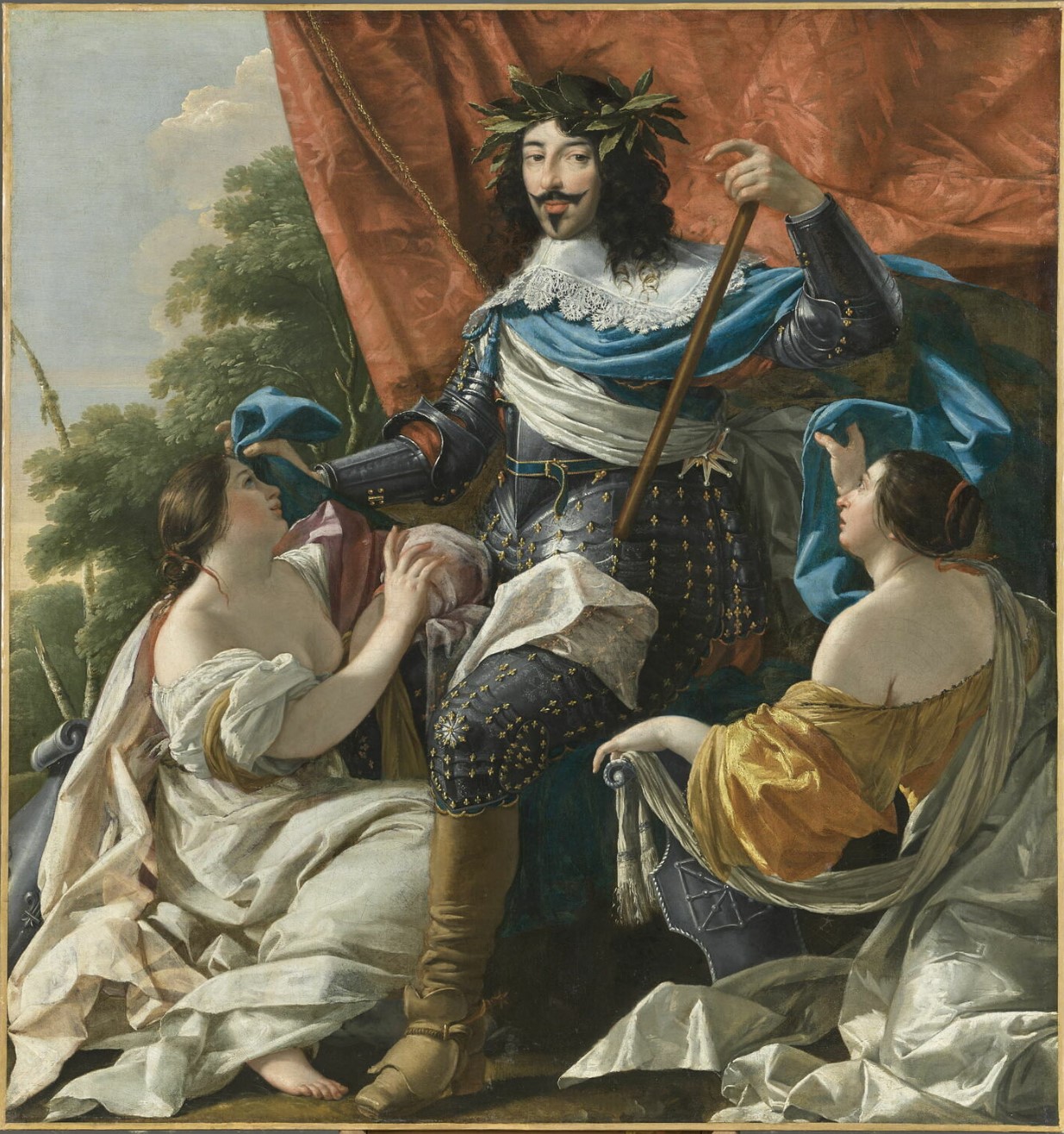
Workshop of François Clouet. Catherine de’ Medici wears the black cap and veil of widow, after 1559. Upon seeing Catherine in the flesh, an Italian diplomat noted that “her mouth is too large and her eyes too prominent and colorless for beauty. But she is very distinguished-looking, has beautiful skin, a shapely figure, and exquisitely made hands.”Portrait de Henri IV, roi de France et de Navarre (1553-1610) 1600 / 1700 (XVIIe siècle), Atelelier de Frans Pourbus II Louvre. Hung in Versailles chateau. https://collections.louvre.fr/en/ark:/53355/cl010057776Marie de’ Medici, 1616, Frans Pourbus the Younger (Flemish, 1569-1622), oil on canvas, The Art Institute of Chicago. Marie de Medici (1575-1642) married Henry IV of France in 1600. After the king was assassinated in Paris in 1610, Marie de Medici served as the regent for their young son, Louis XIII. Marie de Medici brought Frans Pourbus to the French court to make regal portraits of the royal family.Louis XIII between the figures of two young women symbolizing France and Navarre. 1636/38, School of Simon Vouet (1590-1649). Louvre, Paris. https://collections.louvre.fr/en/ark:/53355/cl010062003
Le Belvédère: the House of Maurice Ravel from 1921 to his death in 1937 at Montfort L’Amaury.
The author in front of Le Belvédère, the house of Maurice Ravel, and ready to go inside for a visit. Author’s collection.Pianist Jacques Février with Maurice Ravel in 1925 in Le Belvédère, the house of the composer in Montfort-l’Amaury. Public Domain.The salon of the Ravel house. Author’s photograph.
Ravel’s house sits on an ascent from the centre ville where Ravel could look out his garden-side window to back towards town and south and east to the green countryside between Montfort and Paris. Author’s photograph.
Jean Anouilh (1910-1987) was a French dramatist who lived in Montfort-L’Amaury in France. Anouilh’s 1944 play, Antigone, was an adaptation play of Sophocles’ play of the same name. The 34-year-old Anouilh’s work was seen as an attack on the Vichy government of Marshal Pétain (1856-1951) in World War II.
Anouiih also wrote Becket. The original French play is titled Becket ou l‘Honneur de Dieu. It was staged in Paris at the Théâtre Montparnasse-Gaston Baty in October 1959 and directed by Anouilh. The play dramatizes historical martyr and Catholic saint Thomas Becket (1120-1170), the Archbishop of Canterbury In England, whose feast day is December 29.
Becket was the best friend to younger King Henry II of England. Cunning and proud, vulnerable and lonely, pent-up King Henry is interested in hunting and women, and not necessarily in that order. Henry is bored with political affairs and as king has his one friend, Thomas Becket, who is his companion in vice and debauchery.
Becket serves his king loyally, without compromise. Wanting to strengthen his power over the Church in England and believing his idea to be an excellent one, Henry appoints Becket as chancellor of England and he later becomes Archbishop of Canterbury. But nothing goes as planned. Becket, on his path to sainthood, finds he cannot serve both king and God.
For Henry the arrangement is one of disillusionment, resentment, hatred, and torn friendship – and, later, repentance. For Becket it is a tale of courage, renunciation, and honor as the archbishop seeks to defend church freedom in England against an ambitious secular power. Such conflict provokes Becket’s murder by the king’s knights in the archbishop’s own cathedral.
Anouilh’s Becket became an international sensation. Successive productions in English translation were mounted in London (starring Christopher Plummer and Eric Porter) and in New York City (starring Laurence Olivier and Anthony Quinn). In 1964 Becket became a major motion picture starring Richard Burton and Peter O’Toole which won the Academy Award for Best Screenplay.
SOURCES:
Montfort L’Amaury de l’an mil à nos jours, Marie-Huguette Hadrot, Paris: Somogy Editions d’Art, 2002.
Montfort-L’Amaury, Le Syndicat d’Initiative des Fêtes et des Arts de Montfort-L’Amaury et ses Environs, 1972.
Montfort-L’Amaury Les Verrières de L’Eglise Paroissiale Saint-Pierre(Yvelines), Laurence de Finance and Marie-Huguette Hadrot, Paris: Centre de Documentation du Patrimoine, 1994.
FEATURED image: Napoleon near Borodino, Vasily Vereshchagin (1842–1904), 1897, oil on canvas, State Historical Museum, Moscow.
The Emperor Napoleon in His Study at the Tuileries, 1812, Jacques-Louis David (1748-1825), National Gallery of Art, Washington, D.C.
Major facts of the life of Napoleon Bonaparte (1769-1821) are well known. Known as Napoleon I, the French Emperor who died two centuries ago was a shrewd, ambitious and skilled military leader who conquered much of Europe in the early 19th century.
Born on the island of Corsica that had recently handed authority from Italy to France, Napoleon rose rapidly in the French military during the unsettled period of the French Revolution after 1789 and until 30-year-old Napoleon seized power in a coup d’état in 1799.
In 1804 Napoleon crowned himself emperor in Notre Dame Cathedral in Paris in the presence of the pope. In the next decade Napoleon successfully waged war against various coalitions of European nations and expanded his empire. Following his disastrous French invasion of Russia in 1812 explored in some detail in this post, Napoleon abdicated his throne in 1814 and was exiled to the island of Elba not far from his native Corsica in the Mediterranean Sea near Italy.
In 1815, he escaped Elba and returned to France where he briefly returned to power in his Hundred Days campaign. He received a crushing defeat at the Battle of Waterloo in today’s Belgium and was exiled until his death on May 5, 1821 to the remote island of Saint Helena in the South Atlantic Ocean. Napoleon Bonaparte was just 51 years old at the time of his death stemming from mysterious circumstances, though likely something such as stomach cancer.1
Napoleon on St. Helena, Franz Josef Sandmann (1805-1856), c. 1820. Musée national des châteaux de Malmaison et de Bois-Préau.
In 2021, the bicentenary of the death of Napoleon I is commemorated. While 200 years is a long time ago, in terms of History it is a relatively short span amount of time. In other words, Napoleon, who might have come to the United States (New Orleans) after his exile, is not very far away from modern times.
Napoleon Bonaparte, born in Corsica which had just switched allegiance from Italy to France, was born in 1769. In 1821 when he died on May 5 he was 51 years old. The former French emperor died far away from Europe on the island of Saint Helena in the middle of the South Atlantic Ocean. Napoleon had been exiled there following his defeat at Waterloo in Belgium in 1815 and escape from Elba in the Mediterranean, the British Government’s first location for his confinement.
Between the continents of Africa and South America, St. Helena is much more remote. The island built its first airport only in 2011.
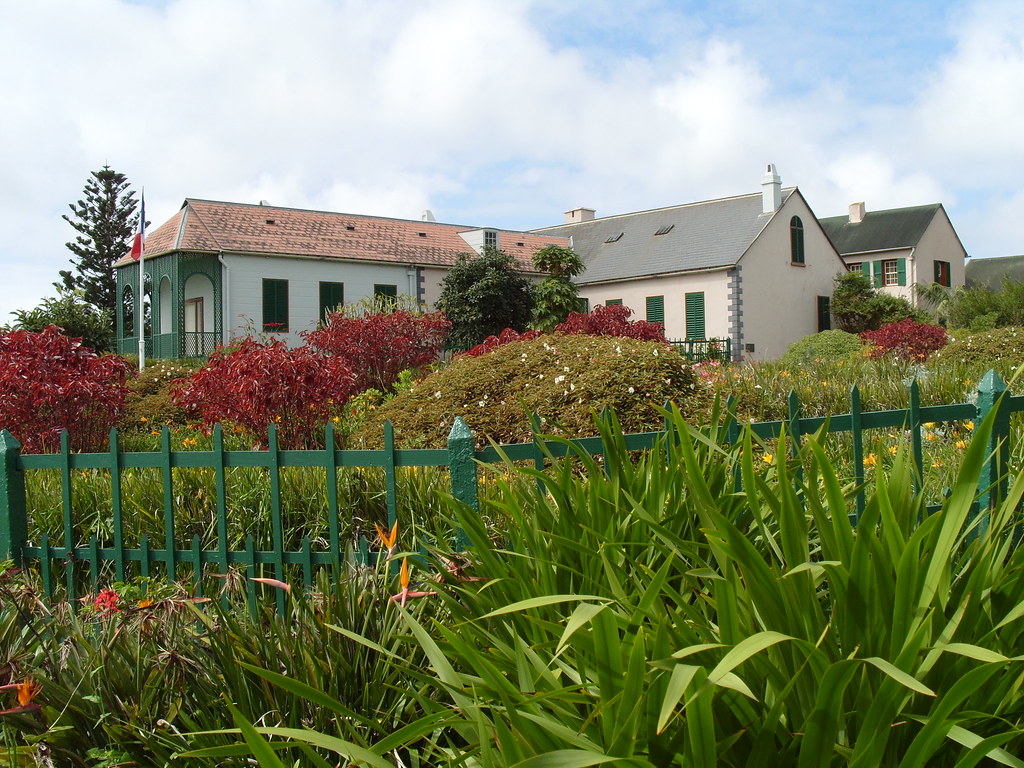
Napoleon lived on St. Helena for about 6 years and died there, somewhat unexpectedly, at Longwood House. Napoleon’s permanent residencewas completed for him in December 1815.
Napoleon was buried on St. Helena. In 1840, stirring old wounds of controversy, the remains of the warring General and French despot were transferred to Paris. Napoleon’s tomb in Les Invalides had been a military hospital whose construction was by Louis XIV (1638-1715).
Napoleon’s plaster death mask, known as the Malmaison mask, May 1821.
In 1858, French emperor Napoleon III, nephew of Napoleon I, purchased Longwood House and various other lands associated with Napoleon I on St. Helena for the French government. Though Napoleon’s remains were returned to France in 1840, Napoleon III’s purchase on St. Helena remains the property of France . It is administered by a French representative under the authority of the French Ministry of Foreign Affairs. (see –https://fondationnapoleon.org/en/activities-and-services/preserving-heritage/operation-st-helena/ – retrieved May 5, 2021).
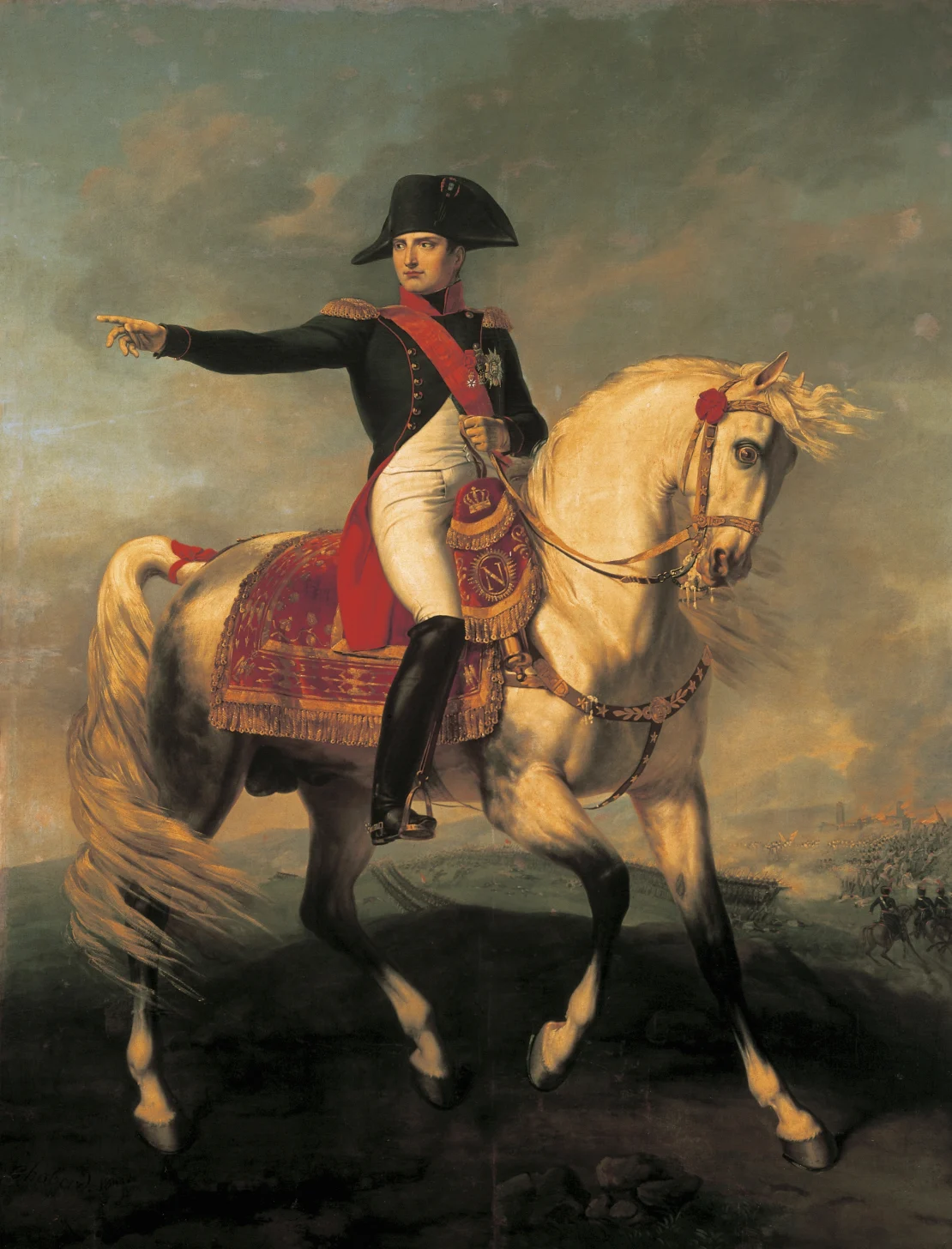
Napoléon at Battle of Wagram, July 5-6, 1809, Joseph Chabord (Chambèry 1786-Paris 1848), 293 cm (115.3 in) x 224 cm (88.1 in), Museo Napoleónico, Rome, Italy. On July 5-6, 1809 took place north of Vienna the greatest battle in world history up to that time – the Battle of Wagram. It was Napoleon’s last and greatest victory. It opposed the Austrian army led by Archduke Charles, Duke of Teschen (1771-1847) against the Franco-Italo-German army under Napoleon I, Emperor of the French, King of Italy, Protector of the Confederation of the Rhine. The painting depicts the plain of Wagram, the scene of the battle with the dominant figure of Napoleon, perfectly settled upon a wild-eyed horse. The Emperor wears the uniform of Colonel of the Chasseurs on Horseback with the insignia of the Legion of Honor and the Iron Crown. The grandeur of the rider-horse group, which contrasts with the small figures of the soldiers in the background, accentuates the heroic character of Napeoleon, a charismatic strategist who dominates the events. The commemoration painting probably was linked to an official commission. The painting was in the collection of Hortense de Beauharnais (1783-1837), the daughter of Napoleon’s first wife, Joséphine de Beauharnais. in Arenenberg, where the former Queen of Holland lived from 1817 until her death. It remained there until 1905, when the last owner of the castle, the former Empress Eugenie, wife of Napoleon III, donated it to Count Giuseppe Primoli. Public Domain. See – https://www.museonapoleonico.it/it/percorsi/percorsi_per_sale/sale_i_e_ii_il_primo_impero/napoleone_sul_campo_di_battaglia_di_wagram
IN THE YEAR 1812 – A BAD ECONOMY, CONTINENTAL BLOCKADES, AND A DISASTROUS INVASION OF RUSSIA BY NAPOLEON
During the War of 1812 which had ramifications for the U.S., world domination by Napoleon was being attempted within a sagging, uncooperative economy in Europe.
France had 300,000 French troops and a rafter of French generals occupying Spain to keep the blockaded British from invading. Napoleon, in a near constant state of war since 1793, had created an Empire whose subjected parts didn’t cooperate. In 1812, Napoleon had to choose between losing his blockade in Spain or in Russia.
Since the Treaty of Tilsit in 1807 which followed the Battle of Friedland where Napoleon defeated the Russian army, Russia continued to transact business with England. This was a violation of the agreement and the pretext for Napoleon’s invasion of Russia in 1812.
While over 1,500 miles away from Paris, Napoleon wanted to shut down Russia’s economy and take full control. For Russia, Napoleon’s invasion required the defense of their homeland.
NAPOLEON’S NEW WAR CAMPAIGN NEEDS 700,000 CONSCRIPTED SOLDIERS
Napoleon needed fresh conscripts but a third of Napoleon’s French draftees didn’t report for duty. Many of Napoleon’s generals advised the dictator to stay in Paris and enjoy life’s spoils. Napoleon refused. He explained that he would not rest until he fulfilled the dream to form a United States of Europe.2
Napoleon assembled 700,000 men with the monumental task to pay for it. For years the Emperor had been stockpiling supplies along the route to Russia and even arranged for their delivery on the battlefield.
Napoleon left St. Cloud for Moscow in June 1812. His high stakes gamble would affect not just Napoleon’s fortunes but the Empire’s inhabitants.
Ernest Meissonier (1815-1891), Campaign of France, 1814, 1864. Oil on wood, 51.5 x 76.5 cm, Paris, Musée d’Orsay.
Ernest Meissonier’s Campaign of France, 1814, was the artist’s first painting produced in a cycle of Napoleon’s conquests. Though the episode Meissonier depicts was painted for the fiftieth anniversary of Napoleon’s invasion of France from Elba in 1814, it captures the overall desolation that surrounded the former French Emperor by the time of his invasion of Russia in 1812.
The series made by the 49-year-old artist, an admirer of seventeenth-century Flemish and Dutch small-format painting, captures the desolate landscape the Grande Armée endured. It also depicted a solitary, unusually unkempt, and tenuous figure of Napoleon who is leading the General Staff and troops in an over-extended military campaign that spelled defeat.
For the painting, the artist’s imagination was informed by historical documentation including interviews of surviving eyewitnesses, including the detail of the Emperor’s grey coat. Its realist style was a prevailing aspect of mid-19th century artistic taste during the Second Empire headed by Napoleon III from 1852 to 1870.
The army marched 1,200 miles to Lithuania to defeat the Russian army. But the Russians had retreated. Napoleon’s men had to march another 550 miles to Moscow. The generous supply lines got snarled. French troops turned sick and exhausted.
In the Battle of Smolensk, the French invaders—viewed by some to be fighting for a united liberal Europe over small state autocrats—set that town on fire. Napoleon’s criminal reputation preceded him – he murdered without mercy and often by treachery. Royalists criticized him but also articulate liberals like Alexis de Tocqueville (1805-1859) and François-René de Chateaubriand (1768-1848). The emperor was the enemy of liberty. Chateaubriand wrote: “Les Français vont indistinctement au pouvoir, ils n’aiment pas la liberté, l’égalité est leur idole. Or l’égalité et le despotisme ont des liaisons secrètes” (“The French go to power indiscriminately, they don’t like liberty, equality is their idol. But equality and despotism have secret links”).
With casualties for the Battle of Smolensk around 15,000 for both sides, the Czar appointed Mikhail Kutuzov (1745-1813) as commander of Russian forces. Napoleon called Kutuzov, “The sly old fox of the north“ (cited in Roger Parkinson, The Fox of the North, 1976). At 67 years old, Kutuzov was lazy and lecherous, but knew how to fight—and, regarding Napoleon’s invasion of Russia, how to retreat strategically. It made Napoleon’s thirst for further battle on his own terms impossible.
Portrait of Mikhail Kutuzov, 1829, George Dawe (1781–1829). Oil on canvas, State Hermitage Museum, Winter Palace War Gallery, St. Petersburg, Russia.
70 MILES WEST OF MOSCOW, THE BATTLE OF BORODINO PITS 242,000 TOTAL COMBATANTS WITH OVER 1,000 BIG GUNS ON SEPTEMBER 7, 1812
In his address to troops before the Battle of Borodino General Kutuzov told his men: “Napoleon is a torrent we are yet unable to stem. Moscow will be the sponge that sucks him dry.”3 Napoleon knew what he was up against. Without supplies, Napoleon ordered his men to keep marching: “Motion alone keeps this army together.”4
The march from Smolensk to Moscow took 3 weeks. Many soldiers of the Grande Armée died on the march. Kutuzov set up a defensive position in Borodino, about 70 miles west of Moscow. On Sept. 7, 1812, French forces engaged the Russians. Both sides were evenly matched – Napoleon had 587 guns and 130,000 troops and the Russians had 640 guns and 112,000 troops.
Hanging over the battlefield was the feeling that the destiny of Europe lay in the balance. The battle’s outcome was a draw. The French were masters of the field as the Russians retreated. It was another day for war’s slaughter— combined French and Russian losses was 80,000 soldiers.
Battle of Moscow (or Borodino), the Capture of the Great Redoubt. Engraving by unknown artist, 1820’s. State Borodino Military Historical Museum, Russia.Battle of Moscow (or Battle of Borodino) in 1812. Attack of the Lithuanian Life Guards Regiment, oil on canvas, 1912, Nikolay Semyonovich Samokish (1860-1944). State Borodino Military Historical Museum, Russia.General Uvarov at Borodino, Auguste-Joseph Desarnod (1788-1840), State Hermitage Museum, St. Petersburg, Russia.
In the War of 1812 Fedor Petrovich Uvarov (1769 -1824) commanded the 1st Cavalry Corps and then the Cavalry of the 1st and 2nd Russian Armies. With the Cossacks of Matvei Platov (1753-1818), Uvarov distinguished himself in the Battle of Borodino when he turned the left flank of the French army and made a raid to its rear. The Russian attack of the main French forces delayed Napoleon’s battle plans for two crucial hours.
Napoleon near Borodino, Vasily Vereshchagin (1842–1904), 1897, oil on canvas, State Historical Museum, Moscow.
The image of a sullen dictator (above) seated on his field chair with boots raised onto a battle drum, as his General Staff views in their spyglasses the men of the Grande Armée in harm’s way at the Battle of Borodino, can be seen as indicative of Napoleon’s exercise of arbitrary power as the first of modern history’s tyrants.
Battle of Borodino, 7th September 1812, 1822, Louis-François Lejeune (1775-1848).
WHEN LEJEUNE’S BATTLE-PICTURES WERE SHOWN IN LONDON, EAGER CROWDS CAME TO SEE THEM FOR THEIR REALISTIC, DETAILED DEPICTIONS OF SIGNIFICANT CONTEMPORARY EVENTS.
In the French invasion of Russia in 1812, Lejeune was made général de brigade and chief of staff to Davout (1770-1823). During the retreat, Lejeune was frostbitten on the face and left his post where he was subsequently arrested on Napoleon’s orders.
During his military service, Lejeune produced a series of important battle-pictures based on his experiences. They were generally executed from sketches and studies made on the battlefield. Known for their lofty perspective which, according to Chase Maenius in The Art of War[s], “offer[ed] a panoramic view of the totality of the battle’s events,” the Battle of Borodino… of 1822 is considered his masterwork.
In his Memoirs of Baron Lejeune, aide-de-camp to marshals Berthier, Davout, and Oudinot (translation, 1897), Lejeune related one of the many wretched scenes that the Napoleonic Wars produced. He wrote: “As we were pushing on the next day, we came upon two poor creatures at a turn in the road whose condition tore our hearts. They were a handsome well-built man of about forty and a woman of about thirty, also with a fine figure, both stark naked. They approached us and said to us in very good French, ‘Our home has been sacked by Cossacks, who stripped us of everything and left us as you see us. For pity’s sake help us.’ We could do nothing for them but give them a little food, and we felt very wretched as we turned away. The next day at a bivouac some distance off a fresh irresistible demand was made upon our pity, and our stock of provisions was so much reduced that I don’t know what we should have done but that some German peasants brought us a few sheep, with which we replenished our larder.” (p. 158, https://archive.org/details/memoirsbaronlej01maurgoog/page/n170/mode/2up —retrieved May 5, 2021.)
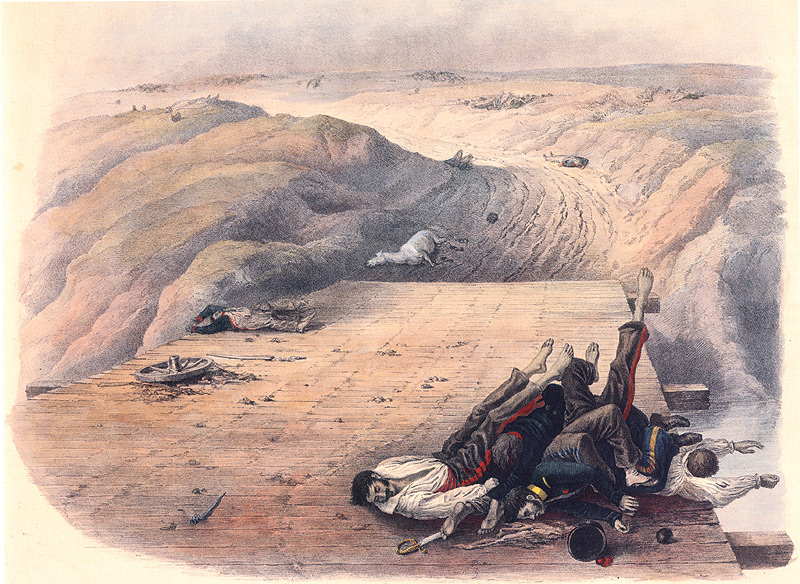
The bodies of dead soldiers of Napoleon’s Grand Armée left on the bridge over the River Kolocha after the Battle of Borodino, 1812. Christian Wilhelm von Faber du Faur (1780-1857), published 1830’s.Gen. Kutuzov at the conference of Fili deciding to surrender Moscow to Napoleon, Aleksey Kivshenko (1851–1895), 1880, oil on canvas, Tretyakov Gallery, Moscow.
Following the Battle of Borodino on September 7, 1812, the Russian army retreated towards Moscow and camped near Fili. A military council led by General Kutuzov assembled in a hut in Fili where, despite objections from younger generals, Kutuzov insisted on his plan to abandon Moscow.
The action not only saved the remains of the Russian army but worked to stymie and ultimately defeat Napoleon’s invasion drive. The personalities in the painting include Prince Michael Andreas Barclay de Tolly (1761-1818), who was replaced by Kutuzov on order of the Czar and sits in the corner below the Virgin Mary and Child Jesus icon. Fyodor Uvarov sits near Barclay holding a paper. Nikolay Raevsky (1771-1829) sits by the window with his fingers locked together. Aleksey Petrovich Yermolov (1777-1861) stands on the far right. The much younger Yermolov resented old general Kutuzov’s plan and demanded to fight the enemy.
Napoleon and about 100,000 French troops reached Moscow on September 8, 1812, Napoleon found only Russia’s poor and displaced. Moscow was Russia’s largest city, its capital, and its Holy City—and French troops of the Enlightenment set it ablaze. The fires burned for 4 days as Napoleon’s army looted it.
Napoleon wrote a letter of apology and condolence to the Czar, Alexander I Pavlovich, the Blessed (1777-1825). One result was that Tthe Russians resolved never to surrender to their would-be conqueror. Only some of the wealthy in Russia looked to negotiate with Napoleon mainly out of fear of losing their assets, that is, the serfs. Napoleon surmised, “I beat the Russians every time—but that does not get me anywhere.”5 Old general Kutuzov’s inaction attained his objective to defend Russia whereas 43-year-old Napoleon failed to rally his men for his Empire these many hundreds of miles from home.
In Ridley Scott’s Napoleon, after trudging with his conscripts through most of Europe, the French Emperor (Joaquin Phoenix) reaches Moscow in Russia. Itching for a fight, the Holy City is, instead, deserted. Disappointed and mocked, Moscow is looted and set ablaze by Napoleon’s men before they retreat. Posthumous Portrait of Czar Alexander I of Russia, 1826, George Dawe, State Hermitage Museum, St. Petersburg, Russia.
Napoleon’s interest became retreat. There was an intended coup d’état in Paris that Napoleon had to raise more fresh recruits to crush. Other parts of the Empire also raised their head following Napoleon’s inglorious retreat. But it grew worse to become one of world history’s worst defeats.
Weather in Russia turned to snow and ice. The Russians retreated into Mother Russia before they were defeated. The French retreated to the west in defeat. Reports of cannibalism among Napoleon’s army is recorded. Turning back to Paris, the French army lost another half of their men. All of Napoleon’s supply lines had been sacked. Adding further injury, the French were chased out of Russia by Kutuzov’s 80,000 troops.
Famous tell-all graph by French civil engineer Charles Joseph Minard (1781-1870) showing the size of Napoleon’s Grande Armée as it marched towards Moscow (top gray line, left to right) in summer of 1812 and its retreat (bottom black line, from right to left) in the late fall of 1812. Frozen temperatures during the humiliating retreat are plotted on the bottom graph.
On the retreat, surviving warriors fought among themselves over any existing supplies. Napoleon’s retreat included the humiliation of being chased out of Russia by Kutuzov’s redeployed 80,000 troops. The old man’s hot pursuit did not allow Napoleon, the once young Enlightenment military figure, to rest.
Under military surgeon Baron Dominique Jean Larrey (1766-1842), the Grand Army’s medical and sanitary measures were the finest in the world but the retreat route offered no food and no medical care. As a remedy for possible future ills, including his capture, Napoleon convinced his doctor to give him a vial of poison which the dictator could ingest if conditions deteriorated to become inescapably dire.
Portrait of Dominique-Jean Larrey, oil on canvas, 1804, Marie-Guillemine Benoist (1768-1826), Musée des Augustins, Toulouse, France.
Baron Dominique Jean Larrey was a French surgeon and military doctor who distinguished himself during the near endless wars of the French Revolution and under Napoleon. Baron Larrey served as the Grand Army’s medical and sanitation leader and was an important innovator in triage who is considered the first modern military doctor and surgeon.
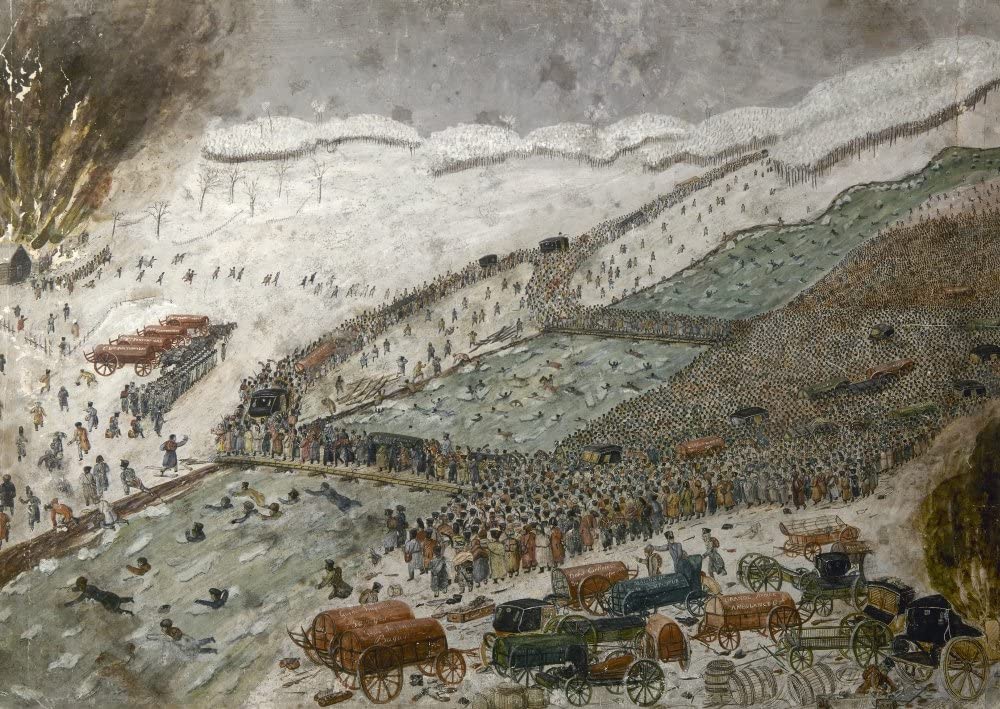
Napoleon: Retreat, 1812. /Ncrossing The Beresina River In Russia During The Retreat Of The Grand Army Under Napoleon Bonaparte, December 1812; Baggage Carts And Ambulances Have Been Abandoned In The Foreground. Watercolor, c. 1812, attributed to General François Louis Fournier-Sarlovèze (1773-1827).
During the Russian Campaign, Fournier commanded a brigade of light cavalry composed of French, German, and Central European horsemen, and led a noted cavalry charge at the Battle of Smolensk.
Generals Kutuzov and Wittgenstein attacked at a bridge crossing in what today is Belarus. Hundreds of Frenchmen drowned. To slow the attack, Napoleon ordered the bridges destroyed. In the process the general stranded hundreds of his troops to enemy gunfire.
Napoleon now told his aide-de-camp, Armand-Augustin-Louis de Caulaincourt, what the Russian campaign taught him: “I can hold my grip on Europe only from the Tuileries.” In Warsaw, Napoleon met Abbé de Pradt, his ambassador, and told him: “From the sublime to the ridiculous is but a step.”6
As Tchaikovsky’s 1812 Overture with its famous climax using cannon fire, ringing chimes and brass fanfare, commemorates a Russian defensive victory, French losses were staggering. Of Napoleon’s 700,000 men led into Russia, only 30,000 survived. Only 1,000 soldiers returned to active duty.7
NAPOLEON IN RUSSIA, HIS FORCES LOSE THE PENINSULAR WAR IN SPAIN; THE FOLLOWING YEAR, IN 1813, NAPOLEON LOSES THE BATTLE OF LIEPZIG, THE LARGEST LAND BATTLE UNTIL WORLD WAR I.
Simultaneous with the debacle of Napoleon’s Russian invasion, French forces lost the long fight (since 1808) in Spain and Portugal to keep the British off the Continent.
Significant losses in the east and west of the Empire were followed in 1813 by the Battle of Leipzig, Napoleon’s penultimate defeat by an international coalition that included Austria, Prussia, Russia and Sweden.
NAPOLEON FORCED TO ABDICATE IN 1814. EXILED TO ELBA; DEFEATED IN 1815 AT WATERLOO.
After Napoleon withdrew into France, in March 1814 these allied forces captured Paris. By early April 1814 Napoleon was forced to abdicate as Emperor. Napoleon had to go for his pursuit of glory had become a menace to his country and the world.
With the Treaty of Fontainebleau, Napoleon was exiled to Elba, and, following his brief escape into France in 1814, he was defeated for the final time at the Battle of Waterloo and exiled to St. Helena which held him until his death at 51 years old on May 5, 1821.
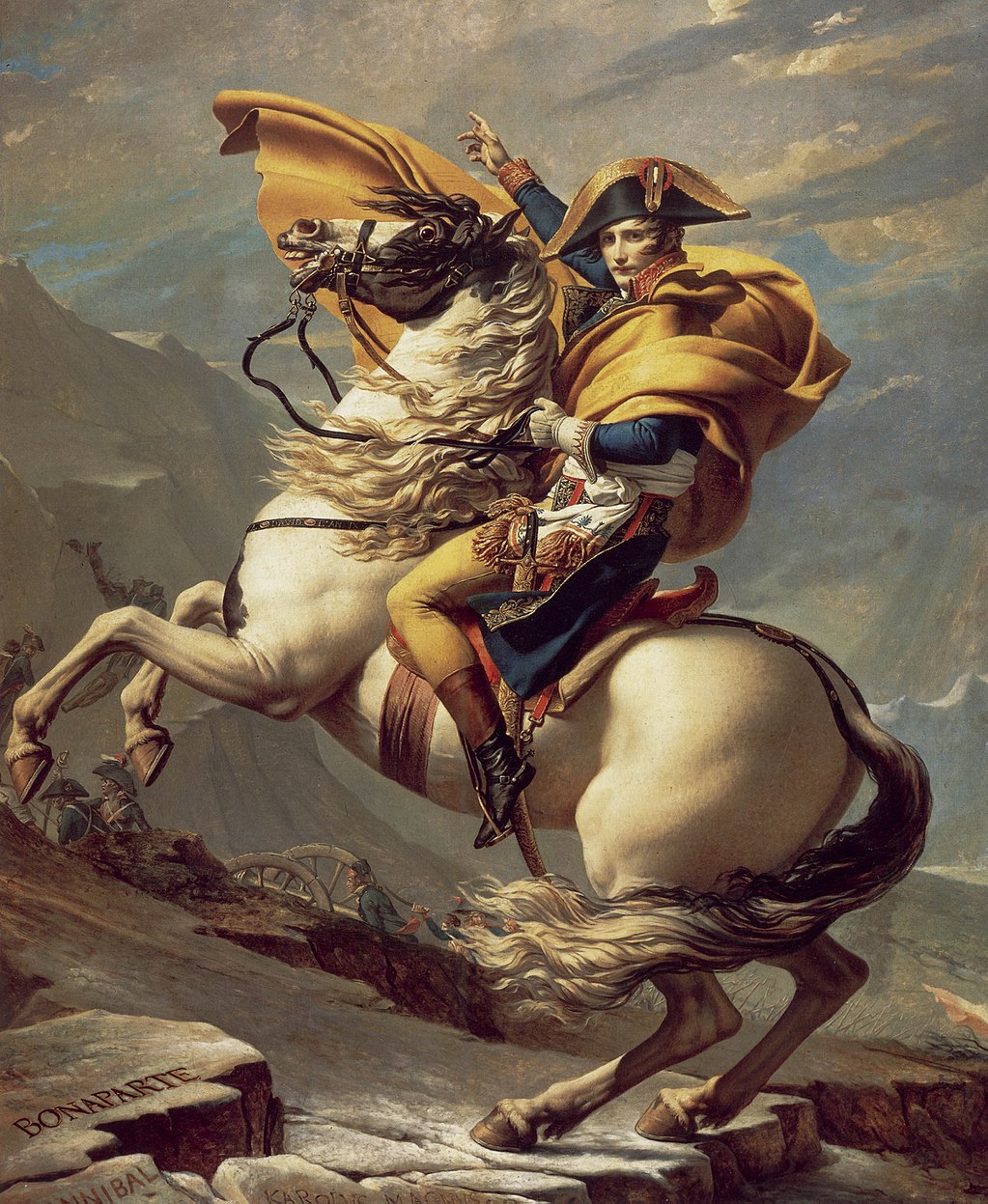
Napoleon Crossing the Alps, Jacques-Louis David, 1801, oil on canvas, 102 1⁄3 × 87 in., Château du Malmaison.
On February 18, 1943, following the illegal distribution of anti-Nazi leaflets by the White Rose at Ludwig-Maximilians-Universität München—the leaflets instructing students and all others to actively resist the 10-year-old Nazi regime—three young German university students were arrested. In the next four days these students will be tried in a Nazi kangaroo court, convicted of treason, and condemned to death. Their crime?—public vocal resistance to the totalitarian state that suppresses freedom of speech, freedom of religion, and freedom of conscience in addition to reprehensible war crimes, including the Holocaust, during World War II.
On February 22, 1943, in Stadelheim Prison in Munich, Germany, these three White Rose resisters are the first of their group to die for freedom and whose legacy in the 21st century is to be listed as some of the most important Germans of all time—namely, 21-year-old Sophie Scholl, her brother, 24-year-old Hans Scholl, and 23-year-old Christoph Probst, a married father with three children.
Christoph Probst: It wasn’t in vain.
Sophie Scholl: The sun is still shining.
The execution scene from Marc Rothemund’s 2005 German film, Sophie Scholl – The Final Days (“Sophie Scholl – Die letzten Tage”). On February 22, 1943 the three condemned White Rose students—Sophie Scholl (Julia Jentsch), Christoph Probst (Florian Stetter) and Hans Scholl (Fabian Hinrichs)—are allowed a final moment together before being beheaded in Munich’s Stadelheim Prison.
By the start of 1943, the Nazis were badly losing the Battle of Stalingrad in Russia that had been raging since August 1942. Its outcome was a major turning point in the war. The German armed forces experienced nearly one million casualties in six months. The American, British, and the Russian armed forces were closing in on Hitler’s Third Reich from many sides.
Since June 1942 five anti-Nazi leaflets had been written and distributed in and around the university in Munich. The distribution channels as well as the network of this new clandestine anti-Nazi group—who eventually called themselves the German Resistance Movement, a.k.a. the White Rose—had steadily expanded during the creation of these leaflets.
Conditions were growing tense in Germany. There was a developing global consensus—that included some even in Germany— that Hitler’s war was ultimately unwinnable for the Fascist tyrant. As these totalitarian thugs had lashed out to consolidate power so, as ultimate military victory was slipping away, the regime stooped to any means to crush its internal enemies.
Sophie Scholl, May 9, 1921-February 22, 1943.
Sophie Scholl had almost not graduated from high school in May 1940 because she was sick and tired of the curriculum’s relentless political (Nazi) indoctrination. Scholl was fond of children and took a job teaching kindergarten. But her motivation was not simply that she had found an early vocation but hoped to steer clear of Germany’s six-month National Labor Service (Reichsarbeitsdienst).
The Nazis found her anyway— and Sophie taught at a National Labor Service-approved nursery as part of the war effort. Scholl might not have bothered with the National Labor Service at all except that the Nazis had set it up as a prerequisite for attending university.
In her personal reading Sophie Scholl had already developed an interest in philosophy and theology and wanted to pursue these subjects academically. The Labor Service experience did contribute, however, to Sophie’s outlook—she reacted completely against its militaristic aspects to the point where she started to practice forms of nonviolent resistance.
1940 Letter from Sophie Scholl to a Friend – White Rose Memorial Room – Interior of Main Building of Ludwig-Maximilians-Universitat – Munich – Germany.
In May 1942, 21-year-old Sophie started at the University in Munich. Her older brother Hans, studying medicine and philosophy at the school, introduced his younger sister to all his friends. Though Hans had evolving and increasingly strong anti-Nazi views, as did his friends, camaraderie revolved around the arts, music, philosophy and theology. The Scholls were also physically active—especially hiking and swimming.
Sophie pursued her intellectual interests at the university making connections with artists, writers, and philosophers. Her father, a hometown mayor, had been put in prison for an indirect critical remark he made about Hitler—and Sophie’s quest to understand how she, as an individual, should act under a dictatorship was intensely personal.
The White Rose formed and began writing and publishing anti-Nazi leaflets in June and July 1942—but Hans Scholl kept his dangerous undertaking secret from Sophie. But, in November 1942, when Sophie learned about the White Rose, she immediately joined.
Hans Scholl (Fabian Hinrichs), left, and Sophie Scholl (Julia Jentsch) in the 2005 German historical film, Sophie Scholl – The Final Days.
On February 18, 1943, in the wake of the battle of Stalingrad, and major Allied victories in Africa which had the Americans and British closing in on Hitler’s Europe, the sixth and final leaflet produced by the White Rose was distributed by Hans and Sophie Scholl and others of the White Rose at Munich University. The leaflet had been written by Kurt Huber, a university faculty and White Rose member, and stated that the “day of reckoning” had finally come for “[Hitler,] the most contemptible tyrant that the German people has ever endured.”
The Atrium, Munich University, where the Scholls dropped the sixth leaflets on February 18, 1943, which led to their arrest by the Gestapo.
Atrium, Munich University.
Bringing the leaflets in suitcases, the Scholls stacked them in corridors of the main building—and the hurried activity, including tossing the last leaflets into the atrium, was noticed by a maintenance man who reported it. Before their arrest by the Gestapo, Sophie had successfully gotten rid of any incriminating evidence. But the Gestapo did find fragments of a seventh leaflet by Christoph Probst on Hans Scholl’s person and, upon searching the Scholls’ apartment, confirmed the White Rose writings. The Gestapo was going to let Sophie free, but when she discovered her older brother had been arrested, she confessed to her full role.
Hans and Sophie Scholl lived in the rear of this apartment building at 13 Franz-Joseph Strasse in Munich from June 1942 until their arrest on February 18, 1943 and execution on February 22, 1943.
Sophie Scholl and Christoph Probst.
During the interrogation following her arrest, transcripts show that Sophie defended herself mainly by claiming her right to act based on an individual “theology of conscience.”
On February 22, 1943, the Scholls and Christoph Probst were tried in the Volksgerichtshof (The People’s Court) before rabid Nazi judge Roland Freisler. Sophie interrupted the judge several times during his tirades. The court record shows her saying to the judge: “Somebody—after all—had to make a start. What we wrote and said is believed by many others. They just don’t dare to express themselves as we did.” The trio were found guilty of treason and condemned to death. They were guillotined the same day at Munich’s Stadelheim Prison.
Sophie Scholl, Hans Scholl and Christoph Probst, a married father of three children, were tried in the Volksgerichtshof (The People’s Court) before the rabid Nazi judge Roland Freisler.Transcripts show Sophie told the judge, Somebody—after all—had to make a start. What we wrote and said is believed by many others. They just don’t dare to express themselves as we did.
White Rose stamp – Sophie and Hans Scholl.
Hans Scholl was, with Alexander Schmorell (1917-executed by the Nazis in prison, July 13, 1943), a founding member of the White Rose in 1942. After serving as a medic on the Eastern Front in 1939, Hans Scholl became determined to do something to change the German people’s minds about the Nazi regime and its war effort.
By June 1942 the White Rose (Weiße Rose) had been founded on principles of nonviolent intellectual resistance to the Nazis—a highly dangerous proposition in a totalitarian regime.
Detail of Typewriter Used to Produce White Rose Anti-Nazi Leaflets – White Rose Memorial Room – Interior of Main Building of Ludwig-Maximilians-Universitat – Munich – Germany.
Between June and mid-July 1942, Hans Scholl and Alexander Schmorell wrote four leaflets against the Nazis appealing to the truth of the people’s consciences based on facts. “Isn’t it true that every honest German is ashamed of the government these days?’ the writers asked in their first leaflet. “Who among us has any conception of the dimensions of the shame that will befall us and our children when one day the veil has fallen from our eyes and the most horrible crimes reach the light of day?”
Alexander Schmorell was, with Hans Scholl, a co-founder of the White Rose. Schmorell co-wrote their leaflets. A Russian-German student at Munich University, Schmorell was sentenced to death at 25 years old on April 19, 1943 at the second trial of the White Rose at the Volksgerichtshof. With Munich University faculty member Kurt Huber, also a White Rose member and leaflet writer, Schmorell was beheaded at Munich’s Stadelheim Prison on July 13, 1943. In 2012, Schmorell was declared a saint and martyr in the Russian Orthodox Church.
In the second leaflet the White Rose spoke of the crimes of the Holocaust: “Since the conquest of Poland, 300,000 Jews have been murdered in this country in the most bestial way…The German people sleep in a stupid sleep and encourage the Fascist criminals…”
The third leaflet appealed to the German people’s “spirit” to eliminate the Nazi system in their midst.
Leaflets, Memorial to Scholls at Munich University.
For the next four months, until November 1942, Scholl, Schmorell, and other young members of the White Rose were drafted to again serve as medics on the Eastern Front. War’s ongoing horrors that they witnessed only strengthened their resolve to resist.
At their return to Germany in autumn 1942 Sophie Scholl, Hans’ younger sister (born May 9, 1921), learned about the White Rose and Hans’ involvement in it, and eagerly joined the group.
Sophie Scholl bust, Munich University.
With the Battle of Stalingrad raging since August 1942, the White Rose (now called the German Resistance Movement) produced a fifth leaflet in January 1943. It was an appeal addressed to all Germans and the White Rose made almost 10,000 copies to distribute. The leaflet presented a straightforward analysis of the situation so to jog people’s intellect to take moral action. To state, as the leaflet did, that “Hitler cannot win the war; he can only prolong it.” was pure heresy to the all-encompassing propaganda arm of the dictatorship.
In the Battle of Stalingrad which the Nazis lost—it was the major turning point in the war—Hitler made an intense appeal to the German people’s patriotism. By one count, the German armed forces experienced nearly one million casualties in about six months.
The German populace—as well as people around the world– understood that Hitler’s defeat was inevitable. But, unlike the Americans and British who, in November 1942, successfully began and concluded Operation Torch in French Morocco pushing the Germans east and out of North Africa and next out of Southern Europe, few Germans were willing to even yet criticize the Nazi regime let alone take action as did the handful of young students and faculty of the White Rose.
White Rose Leaflets, memorial.
The White Rose’s fifth leaflet called all Germans to “Support the resistance movement!” The leaflet labeled Nazi policies as racist and subhuman, imperialist and militarist—and to be resisted. But further, a future Germany and Europe must, stated the White Rose in this penultimate leaflet, protect “freedom of speech, freedom of religion, and the individual citizen from the arbitrary action of any dictator states.”
It was in January 1943 that the White Rose was beginning to expand its operation to make connection with older anti-Nazi groups already formed and operating in Germany, such as the Kreisau Circle led by Helmuth James von Moltke (1907-executed by the Nazis in prison, January 23, 1945).
Helmuth James Graf von Moltke (1907–1945) was one of the leaders of an early diverse group of anti-Nazi intellectuals known as the Kreisau Circle. In prison since January 1944, Von Moltke is photographed at his trial in July 1944. The Nazis executed Moltke in prison in January 1945. By early 1943, members of the mostly student-led White Rose were starting to expand their network of contacts to include other anti-Nazi groups such as the Kriesau Circle.
With the defeat at Stalingrad officially announced by the Nazis in early February 1943, the totalitarian regime blamed the German people. This included pointing a finger at university students as unpatriotic who did not serve in the army. Such slanderous and cowardly accusations from Nazi leaders who pompously impugned German intellectual youth in the wake of a massive Hitler-led military defeat making for one million casualties and devastating the nation’s morale, sparked a riot by students at the university in Munich. A growing chaos under the totalitarian regime had a heartbeat—and as in all totalitarian regimes, scapegoats must be found and made examples of. The leaflets of the White Rose had been disseminating anti-Nazi literature since June 1942. Its perpetrators had yet to be found out—and stood square at the tip of the Fascist dictatorship’s spear.
The White Rose, its members actively looking to capitalize on the energy of the students’ righteous indignation, decided to send out their sixth and last leaflet—which they did on February 18, 1943. The sixth leaflet, written by Munich faculty Kurt Huber (1893-executed by the Nazis in prison, July 13, 1943), and revised by Hans Scholl and Alexander Schmorell, said that with “the dead of Stalingrad [to] adjure us!,” the “day of reckoning” had finally come for “[Hitler,] the most contemptible tyrant that the German people has ever endured.” The group also stenciled slogans on university walls and buildings throughout Munich, the Nazi Party’s home base, stating “Down with Hitler!” and “Freedom!”
Munich University, Main Corridor.
The distribution of the leaflets packed in suitcases—this time including the public participation of Sophie Scholl—took place on Thursday, February 18, 1943. It is what led to the arrest, trial, conviction, and execution by beheading of Hans and Sophie Scholl and Christoph Probst by the Nazis within the span of the next four days.
Sophie Scholl’s last words were: It is such a splendid sunny day, and I have to go. But how many have to die on the battlefield in these days? How many young, promising lives? What does my death matter if by our acts thousands are warned and alerted? Among the student body there will certainly be a revolt!
Hans Scholl’s last words were Es lebe die Freiheit! (Let Freedom live!)
Christoph Probst, Hans and Sophie Scholl graves, Perlach Cemetery in Munich.
FEATURE image: Notre Dame under re-construction, 2019.
N.B. Following more than five years of restorative work gathering artisans, donors, and planners from across the spectrum of global society, Notre Dame de Paris was gloriously re-opened at a celebratory dedication ceremony attended by the world’s dignitaries, including 40 heads of state, on December 8, 2024. Begun in 1163, Notre Dame was first dedicated at its completion in 1345.
By John P. Walsh, May 21, 2019.
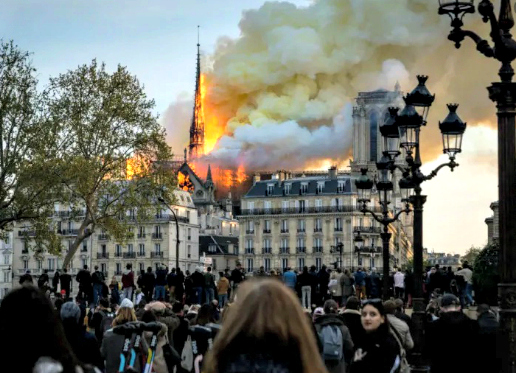
Flames engulf Notre Dame de Paris in an early evening blaze on Monday, April 15, 2019. The fire left the 850-year-old Gothic cathedral standing, but with extensive structural damage.Hundreds of Paris firefighters battled the blaze for hours. First responders saved the cathedral though its timber roof, frame and spire crashed into the nave.
Fire broke out with 1,000 people inside the building
Notre Dame de Paris suffered a devastating fire on April 15, 2019 causing most of its roof and a 300-foot oak spire to collapse. The fire broke out during an early evening Mass when more than 1,000 people were in the cathedral which is the most touristic site in the center of the most touristic city in the world. The priest had been in the middle of reading that day’s Gospel of John. It was Holy Monday, the first day of Holy Week where the gospel tells the story of Mary pouring oil over the feet of Jesus which will anoint him for burial. Judas complains the perfume could have been sold and the money given to the poor.1
Pledges to rebuild
Notre Dame de Paris (“Our Lady of Paris” named in honor of the Virgin Mary) will take years, even decades, to rebuild and at great expense. This will be the case whether the edifice is simply restored or, as some have argued for, more creatively re-imagined for modern times. Whichever rebuilding vision or visions are followed – and there will be voices from many quarters involved in the restoration process ahead – French president Emmanuel Macron promised to complete its rebuilding by around 2024. Within 48 hours of the fire, donations poured in from around the world to rebuild the cathedral amounting to more than one billion dollars whose substantial amount may prove inadequate to fully cover rebuilding costs.2
Spotty maintenance for 850-year-old stone & wood building
While the fire’s precise ultimate cause is yet to be fully determined, the conditions surrounding the blaze are recognizably available: its spotty maintenance record over 10 centuries; complex 21st century renovation when fire broke out; the flammable oak “forest” of the medieval frame and roof; the challenges of fighting a fire owing to the cathedral’s size and location in central Paris. In a turn of irony, the cathedral roof that burned had been the 12th century builder’s largest monied investment.3
BRIEF ACCOUNT OF NOTRE DAME DE PARIS’S ARCHITECTURAL HISTORY
Notre Dame de Paris is one of Paris’s famous icons–an historical and religious treasure–and one of France’s great cathedrals along with Reims (which was nearly destroyed by fire during World War I) and Chartres (reconstructed after a fire in 1194). Others on any short list of great French cathedrals would include Amiens and Bourges, among others.
Notre Dame de Paris before the April 15, 2019 blaze. The cathedral is an important part of Paris’s identity and a tourist mecca.
After the April 15, 2020 fire: the cathedral’s great nave.Reims Cathedral on fire in World War I. The cathedral was the site of the coronation of French kings. The Gothic cathedral was virtually destroyed by bombing. After the war, the massive cathedral was completely rebuilt.
In 1163 when it became time to roof the superstructure of Notre Dame de Paris’s choir which was the first part of the church to be constructed, Paris bishop Maurice de Sully (1120-1196) provided 5000 French livres so that it could be richly and securely layered with lead. That and other of the Cathedral roof’s protective lead covering was stolen during the French Revolution in the eighteenth century.
The roof’s space and design provided a large part of the church’s riddle of secret passages -– including spiral staircases in the nave’s columns -– that served mainly for the needs of the religious complex’s operation and maintenance. Engineering of the 12th and 13th centuries proved resilient over nearly 1000 years — through hardly impervious to obsolescence and decay.
The 2019 blaze caused serious damage to the cathedral infrastructure. The flames left behind many questions to be answered about the medieval stone and timber building’s ultimate stability. History’s endurance for more than a church was at stake. Notre Dame de Paris is Paris Point Zero – the very center of the Île-de la-Cité, Paris, and all distances in France and, by extension, the world, are to be judged.4
Paris bishop Maurice de Sully (1120-1196). The bishop with his chapter of cathedral canons started the building of Notre Dame de Paris in 1163. The Gothic structure was mostly completed by 1250.Episodes from the Life of a Bishop Saint, c. 1500, oil on panel, 61.5 x 47 cm, Master of Giles, National Gallery of Art, Washington, D.C. The scene is from about 300 years after the death of Bishop de Sully yet captures the history of the archbishop on the front steps of his cathedral in Paris. Public Domain. see – https://www.nga.gov/collection/art-object-page.41596.html#provenance.
The Gothic Cathedral: A Quintessentially French Story
The French Gothic building project stretched from a Collégiale Notre-Dame-et-Saint-Laurent d’Eu (1186) in northeastern France to Toulouse Cathedral (13th century) in France’s Languedoc in the south.
The story of the Gothic cathedral, such as Notre Dame de Paris, is essentially a French story.
By the end of the Gothic Movement in the late 14th century, all corners of France -– and points between — possessed a Gothic church that displayed pointed arch, stained glass, and buttresses, some of them magnificently flying.
The style and power of Gothic art reflected not only a new theological thinking in the Renaissance of the 12th century but also an assertion of royal power.5
Notre Dame de Paris viewed from the other side of the Seine. The building’s flying buttresses support the nave and apse. The oak spire that was added in 1860 went up in flames like a torch and crashed into the nave in the April 15, 2019 fire.The Gothic church called Collégiale Notre-Dame-et-Saint-Laurent d’Eu is in northeastern France. looking to paris for inspiration, it was constructed between 1186 and 1240. Its subterranean crypt contains the tomb of Irish St. Laurence O’Toole (1128-1180). The saint’s heart is in Dublin at Christ Church Cathedral. The main impetus for the building of the new Gothic church was to accommodate pilgrims who came to venerate at O’Toole’s tomb.
Impact of the 13th century Crusades on Notre Dame de Paris
The Gothic age was characterized by international crusades of Western conquest to the Holy Land. The French king, Louis IX, or St. Louis (1214-1270) led its seventh manifestation from 1248 to 1254. Louis died while on its Eighth.
In the Holy Land the French king purchased relics to bring back to France, including the highly prized Crown of Thorns reputedly worn by Jesus Christ at his crucifixion. Relics were an investment that could pay off by generating pilgrimages.
In the April 2019 fire, scores of ordinary people and cathedral personnel formed a human chain to save the cathedral’s artifacts, most irreplaceable, and prevent their consumed in the hellish blaze.
Louis IX (St. Louis) with counselors and mother, Blanche de Castile (1188-1252). Miniature, 15th century.King Louis IX, or St. Louis (1214-1270) led the Seventh Crusade from 1248 to 1254.
As one of the first cathedrals built, Notre Dame de Paris is of enduring architectural significance. Monday, April 15, 2019 was a tragic day in history as fire broke out in the 850-year old edifice while the world watched.
Notre Dame de Paris is on fire, April 15, 2019. Countless pictures were taken anonymously and transmitted instantaneously around the world.Extent of the fire damage (in red) at Notre Dame de Paris on April 15, 2019. Fair use.
Thousands of people gathered in the streets of Paris, and transmitted pictures of the dramatic blaze from smartphones and other devices onto the internet and television as a major live news event. It caused many to shed tears and ask questions about what is ahead for a beloved symbol of Paris.
THE FIRE’S IMMEDIATE AFTERMATH
In the aftermath of the 2019 fire, workers aimed to secure and protect the edifice which will take several months to finalize.
By May 2019, the north tower was stabilized and secured while the transept’s beams were declared in good condition.
Although the interior was not damaged, the structural integrity of the high vaults that protected it remains uncertain and requires further close study. The cathedral is undergoing a major effort to remove fire debris including the oak spire (or flèche) dating from 1860 as well as the arch that burned and crashed into the nave.
Cataloguing debris and predicting the building’s future
To the highest degree possible, each bit of fallen debris will be deciphered, cataloged and saved for potential reuse in a restoration. One month after the fire, it was declared premature to know if the building is completely stable or if it might further collapse.
Working on the cathedral in the 21st century are virtually the same type of skilled laborers who built it in the first place in the 12th and 13th centuries – namely, masons, stonecutters, carpenters, roofers, iron workers, and master glassmakers.6
The work associated with the Notre Dame de Paris in the aftermath of the 2019 fire promises to concentrate centuries of history into one location looking to sustain its continued thriving existence for future generations.
NOTES:
1. “Vows to Restore Notre Dame Following a Harrowing
Rescue,” by Sam Schechner and Stacy Meichtry, The Wall Street Journal, April 17, 2019; see Gospel of John, Chapter 12.
5. Duby, Georges, The
Age of the Cathedrals: Art and Society, 980-1420, translated by Eleanor
Levieux and Barbara Thompson, The University of Chicago Press, Chicago and
London, 1981, p.97.
January 2024: “What’s there looks exactly like what was there before…It’s so impressive to be around all the other trades….500 or 600 people are on the site everyday all with different specialties…”
FEATURE image: Cú Chulainn dying in battle, 1911, bronze, by Oliver Sheppard (1865 – 1941), General Post Office (G.P.O.), Dublin, Ireland. Public Domain.
Dublin’s O’Connell Street in the wake of The Easter Rising in 1916. The centenary of that event which proclaimed an Irish Republic is this year.
By John P. Walsh. May 12, 2016.
Today marks the centenary of the final executions of Irish rebel leaders by British firing squads in connection with the 1916 Easter Rising which proclaimed an Irish Republic and left Dublin in ruins. James Connolly and Seán Mac Diarmada—the final two of 14 executions that began on May 3, 1916 with the executions of Pádraic Pearse, Thomas MacDonagh and Thomas Clarke—died in the same fashion as the others: taken at dawn from their cells into a Kilmainham Jail yard—Connolly tied to a chair because his battle wounds in the Rising made him too weak to stand—and summarily shot dead. Three years later, in April 1919, military forces under British command halfway around the world in India reacted with similar cruel and vindictive logic to national protest—this time one that was nonviolent—which by official British statistics killed 379 and wounded 1200 Indians in what is known as the Jallianwala Bagh massacre.
Proclamation of the Irish Republic with its seven signatories. Public Domain.
EXECUTED ON MAY 3, 1916:
Pádraic Pearse.
PÁDRAIC PEARSE (1879-1916), school headmaster, orator, and writer. The extended court-martials and executions by British General Maxwell of Irish rebel leaders—as well as arrests of hundreds without trial following the general surrender on April 29, 1916—fulfilled Pearse’s romantic and revolutionary ideology expressed in notions of “blood sacrifice.” Pearse’s idea was that Ireland “was owed all fidelity and always asked for service (from its people), and sometimes asked, not for something ordinary, but for a supreme service.” Pearse was one of seven signatories of the Irish Proclamation.
Thomas MacDonagh.
THOMAS MACDONAGH (1878-1916). Poet, playwright, educationalist. A leader of the Easter Rising – MacDonagh was one of the seven signatories of the Proclamation of the Irish Republic. He wrote letters to loved ones in jail before being executed expressing the hope that his death would share in the custom of blood sacrifice for Irish freedom. MacDonagh wrote that he was proud to “die for Ireland, the glorious Fatherland” and anticipated that his blood would “bedew the sacred soil of Ireland.”
Thomas J. Clarke.
THOMAS J. “TOM” CLARKE (1858-1916). Deeply involved with the Irish Republican Brotherhood (IRB) since youth, Clarke established in 1915 the Military Committee of the IRB to plan what became the Easter Rising. A signatory of the Irish Proclamation, Clarke was the oldest rebel to be shot by the British in May 1916. Sergeant Major Samuel Lomas who helped shoot the three Irishmen on May 3, wrote that unlike Pearse and MacDonagh who died instantly, “the…old man, was not quite so fortunate requiring a bullet from the officer to complete the ghastly business (it was sad to think that these three brave men who met their death so bravely should be fighting for a cause which proved so useless and had been the means of so much bloodshed).”
The rising involved a treasonable conspiracy that resulted in the deaths of British soldiers among the 418 people killed in and around Dublin. The penalty for such action would certainly call for capital punishment in Western European countries in 1916. It is surprising that executions were kept to under 15 rebels, although British Prime Minister Herbert Asquith (1852-1928), following the first three executions on May 3, 1916, expressed concern that the trials and death sentences were being briskly implemented. General Maxwell’s blunder was to stretch out the executions over two weeks, where the element of daily shock and surprise as to who made the list of the dead forever changed the tide of Irish public opinion against British rule.
General Sir John Maxwell.
General Sir John Maxwell (1859-1929) was the military governor in Ireland. He ignored all appeals by British politicians — including the Prime Minister and Roman Catholic bishops in the United Kingdom — to halt the executions.
EXECUTED ON MAY 4, 1916:
Joseph Plunkett.
JOSEPH PLUNKETT (1887-1916). Hours before he was executed on May 4, 1916, sickly Joseph Plunkett married his fiancée Grace Gifford in the prison chapel. Thomas MacDonagh, who was executed on May 3, had married Grace’s sister Muriel Gifford in 1912. Plunkett, who came from a wealthy background, was a poet and journalist, a member of the Gaelic League, and a standing member of the IRB Military Committee that planned the Easter Rising. During the Rising, Plunkett’s aide de camp was Michael Collins. Plunkett signed the Irish Proclamation.
Ned Daly.
EDWARD “NED” DALY (1891-1916). From Limerick, Ned Daly was commandant of the 4th Battalion, where some of the fiercest fighting of the Rising took place. Daly’s father had taken part in the Fenian Rising of 1867; his uncle, John Daly, served 12 years in English jails; and his sister, Kathleen, was married to Thomas Clarke. Daly commanded the Four Courts garrison during Easter Week 1916. Though there were not enough Volunteers to hold all posts, following the bitter battle of Mount Street Bridge, Daly and his comrades still held the Four Courts, and other significant outposts in Dublin until called by Pearse to a general surrender.
Willie Pearse.
WILLIAM “WILLIE” PEARSE (1881–1916) was the younger brother of Padraic Pearse. Willie stayed by his brother’s side during the entire Rising at the General Post Office (G.P.O.) which served as rebel headquarters. In Kilmainham Jail Willie was promised he could visit his brother before he died on May 3, but the British hid the truth of it since Padraic Pearse was shot as Willie was being taken to see him.
Michael O’ Hanrahan.
MICHAEL O’HANRAHAN (1877-1916). Michael O’Hanrahan had come to a newly-formed Sinn Féin out of his work with the Gaelic League as a linguist and published writer where he founded its Carlow Branch and later worked with Maude Gonne and Arthur Griffith. Like Edward Daly, his father had been deeply involved in the Fenian Rising in 1867. O’Hanrahan was the National Quartermaster for the Irish Volunteers and, during the Easter Rising, served under Thomas MacDonagh of the 2nd battalion based at Jacobs Factory.
EXECUTED ON MAY 5, 1916:
Major John MacBride.
MAJOR JOHN MACBRIDE (1868-1916). Second in command at Jacob’s Biscuit Factory during the Easter Rising. MacBride had had a colorful career previously as an Irish émigré to South Africa where in 1899 when the Second Boer War broke out he raised a brigade of other Irish emigrants who fought bravely against the British. Upon his return to Ireland he married (and divorced) Maude Gonne. Now facing the British firing squad in May 1916 at Kilmainham Jail, MacBride refused a blind fold. He told his executioners, “I have looked down the muzzles of too many guns in the South African war to fear death and now please carry out your sentence,” which they did.
Irish public opinion changed virtually overnight regarding the rebels who had brought the central city of Dublin down onto their heads during the 1916 Easter Rising. At the surrender Volunteers were jeered and cursed on their way into British hands. Two weeks and 14 executions later, they were forever-after hailed as Irish heroes. The attitude of the Irish populace to their British overlords during martial law turned spiteful. The British lost their credibility as a civilizing force for the island. The executed Irish rebel leaders were not saints although some such as forty-one-year-old Michael Mallin, thirty-four-year-old Éamonn Ceannt and twenty-seven-year-old Con Colbert were devoutly religious Catholics. They offered a modern dream of an independent Irish Republic and did it at the supreme sacrifice of their lives. These rebels’ fixity in the pantheon of Irish history rests in large measure on imagery and legend for their undeniably courageous but failed six-day insurrection. Self-appointed, this group of mostly young idealists who by force of arms, will, and words were able, despite a dastardly outcome, to have had an enduring impact on an independent Ireland is well worth remembering today.
EXECUTED ON MAY 8, 1916:
Éamonn Ceannt.
ÉAMONN CEANNT (1881-1916). Inspired by nationalist events such as the Second Boer War, Éamonn Ceannt joined the Gaelic League which promoted Irish culture. There he met Padraic Pearse and his future wife, Aine O’Brennan. A talented musician and Irish linguist, he joined Sinn Féin and the IRB which was sworn to achieve Irish independence. With Joseph Plunkett and Sean Mac Diarmada, Éamonn Ceannt served on the IRB Military Committee which planned the Easter Rising. He signed the Irish Proclamation. During the Rising, Ceannt saw intense fighting as commandant of the 4th Battalion of the Volunteers stationed south of Kilmainham Jail where he would later be executed. In prison he wrote: “I die a noble death, for Ireland’s freedom.”
Michael Mallin.
MICHAEL MALLIN (1874–1916). With Constance Markievicz as his deputy, Michael Mallin commanded the Irish Citizen Army under James Connolly at St. Stephen’s Green in Dublin during the Rising. At his court martial Michael Mallin, the father of five children, claimed he was not a Rising leader nor had a commission in the Irish Citizen Army. Since the British refused to execute Countess Markievicz, Mallin became their best alternative although his garrison had inflicted little damage from the Green. Mallin had had a fourteen year career in the British Army where, while stationed in India, he became anti-British. In Ireland he rose to become a leading official in the silk weavers’ union where he successfully negotiated a 13-week strike lockout. His negotiating skills led to an appointment as deputy commander and chief training officer of the Irish Citizen Army which was formed by James Connolly to protect workers from employer-funded gangs of strike-breakers. In 2015, Mallin’s youngest child, who became a Jesuit priest, celebrated his 102nd birthday.
Séan Heuston.
SÉAN HEUSTON (1891-1916). A railway clerk, Séan was a member of Fianna Éireann, a youth organization which helped raise soldiers for the Irish Volunteers and had outreach to the IRB. During the 1916 Easter Rising, he held the Mendicity Institution on the River Liffey with only 26 Volunteers when after more than two days, “dog-tired, without food, trapped, hopelessly outnumbered, [they] had reached the limit of [their] endurance” and surrendered. Heuston Train Station in Dublin is named for this Irish rebel who had worked there in a traffic manager’s office.
Con Colbert.
“Con” Colbert (1888-1916). Like Séan Heuston, Colbert joined Fianna Éireann – an Irish nationalist youth organization founded by Bulmer Hobson and Constance Markievicz – at its first meeting in 1909. The night before Con Colbert was shot on May 8 – he had been a student of Pádraic Pearse at St. Enda’s School – he asked to see a Mrs. Séamus Ó Murchadha who was a prisoner since she cooked meals for the Irish Volunteers during the Rising, including Colbert. The 27-year-old rebel told Mrs. Ó Murchadha he would be “passing away” tomorrow at dawn and that he was “one of the lucky ones” to die for Ireland’s freedom. Colbert told her he was going to leave his prayer book to one of his twelve siblings and gave Mrs. Ó Murchadha three buttons from his Volunteers uniform. He asked her that when she heard the shots at first light that would kill him, Éamonn Ceannt, Sean Heuston, and Michael Mallin to say a “Hail Mary” for each of their departed souls. Colbert also requested that the other women prisoners, reprimanded that morning for saluting the men going to the jail’s Sunday Mass, to do the same. According to the surviving Mrs. Ó Murchadha, the British soldier guarding Colbert began to cry as he heard their exchange and said: “If only we could die such deaths.”
May 12, 1916 now arrived. Twelve rebel leaders had been shot since May 3 and there would be two more today. In that short amount of time the traitors of Easter week became Ireland’s martyrs and ascendant heroes. Their pictures started to be hung in Irish homes and their poetry read for inspiration. W.B. Yeats wrote his famous verse about Ireland shortly after the Rising and its executions: “a terrible beauty is born.” A mythical Cú Chulainn dying in battle, an image beloved by Pádraic Pearse, had suddenly become real.
EXECUTED ON MAY 12, 1916:
Séan Mac Diarmada.
SÉAN MAC DIARMADA (1883-1916). Séan Mac Diarmada was on the IRB Military Committee which planned the Rising and a signer of the Proclamation of the Irish Republic. Mac Diarmada promoted Irish nationalism in the Gaelic League and in the Irish Catholic fraternity of the Ancient Order of Hibernians. He organized for Sinn Féin, managed Irish Freedom, a radical newspaper started in 1910 by Bulmer Hobson, and helped found the Irish Volunteers. After the surrender, Mac Diarmada, who had been with Pearse at the G.P.O., nearly escaped but was identified by Daniel Hoey of G Division who, in 1919, was shot himself by a firing squad with Michael Collins standing behind it. The British Officer Lee-Wilson who ordered Mac Diarmada to be shot rather than imprisoned, was also murdered on Collins’s order during the Irish War of Independence. Before his execution, Mac Diarmada wrote: “I feel happiness the like of which I have never experienced. I die that the Irish nation might live!”
James Connolly.
JAMES CONNOLLY (1868-1916). James Connolly stood aloof from the Irish Volunteers because he considered the leadership to be too bourgeois and not concerned enough with the plight of Ireland’s workers. Roman Catholic by birth and committed socialist by choice, Connolly considered using his Irish Citizen Army to strike a blow for Irish independence in early 1916 (Michael Collins later announced that he “would have followed [Connolly] through hell”). The IRB’s Tom Clarke and Padraic Pearse fostered a partnership between the Irish Volunteers and Connolly’s ICA for the Easter Rising in 1916. Connolly became the de facto Dublin commander at the G.P.O. After his capture, because he was severely wounded, Connolly was held in a makeshift infirmary at Dublin Castle instead of at Kilmainham Jail. He might have died just from his wounds, but the execution order was given out and on May 12, 1916 the last prisoner was shot. To his executioners Connolly reportedly said: “I will say a prayer for all men who do their duty according to their lights.”
On May 12, 1916 at Kilmainham Jail in Dublin, James Connolly is brought to his execution by British soldiers. Connolly was shot by a firing squad after being carried in on a stretcher from a first-aid station at Dublin Castle.
“James Connolly” is a tribute to the Irish revolutionary who played a key role in the Easter Rising of 1916. The song was written and performed by The Wolfe Tones, a popular Irish folk band and released on their 1972 album “Let the People Sing.”
NOTES –
“died in the same fashion” – see Britain & Irish Separatism: from the Fenians to the Free State 1867/1922, Thomas E. Hachey, The Catholic University of America Press, Washington, D.C., 1984, p. 176.
For the Jallianwala Bagh massacre see – Jallianwala Bagh Massacre (Monograph series / Indian Council of Historical Research), V.N. Datta and S. Settar, Pragati Publications, 2002; Imperial Crime and Punishment: The Massacre at Jallianwala Bagh and British Judgment, 1919-1920, Helen Fein, University of Hawaii Press, 1977; Jallianwala Bagh Massacre; A Premeditated Plan, Raja Ram, Publication Bureau, Punjabi University, 2002; The Historiography of the Jallianwala Bagh Massacre, 1919,Savita Narain, Spantech & Lancer, 1998.
Pearse’s idea of blood sacrifice – quoted in Dividing Ireland: World War I and Partition, Thomas Hennessy, Routledge, London, 1998, p.126.
MacDonagh letter excerpts – quoted in Last Words: Letters and Statements of the Leaders Executed after the Rising at Easter 1916, edited by Piaras F. MacLochiliann, The Stationary Office, Dublin, 1990, pp.55-56.
418 people killed – Myths and Memories of the Easter Rising: Cultural and Political Nationalism in Ireland, Jonathan Githens-Mazer, Irish Academic Press, Portland, OR, 2006, p.120.
FEATURE image: Portrait of James IV, after 1578, artist unknown, 41.2 x 33 cm, National Galleries Scotland. Public Domain.
Detail of The Flodden Window, showing sixteen named archers who fought at the battle, St. Leonard Middleton, England.
The earliest Middleton church was dedicated to Saint Cuthbert around 880 as pagan Danes were then attacking the north of England. Following William the Conquerorin 1066, the Normans built a larger church dedicated to Saint Leonard, a French saint and patron of prisoners. In 1412, Thomas Langley (1363-1437), Prince Bishop of Durham and Lord Chancellor of England under kings Henry IV, V and VI, built a new Gothic style church though incorporating parts of the old Norman building. In 1513, Sir Richard Assheton, Lord of the Manor and member of an illustrious military and religious family, spear-headed further changes. Completed in 1524 today’s St. Leonard was built on the previous church buildings so to celebrate Sir Richard’s knighthood by King Henry VIII for his part in the Battle of Flodden Field in 1513. The stained-glass window memorializes archers from Middleton who joined the battle on the side of the English. The battle took place in England only a few miles south of the Scottish border near Branxton and about 200 miles north of Middleton.
“The Flodden Window,” c. 1524, Parish Church of St. Leonard in Middleton near Manchester in England.
Not yet 40 years old, the reign of charismatic Scottish King James IV (1473-1513) came to an abrupt halt on September 9, 1513 when he was instantly killed in battle fighting against an English army in northernmost England.
Continental politics with its entangling alliances put Scotland in armed conflict against its neighbor for which it had signed a peace treaty only 11 years earlier.
In 1502 a treaty was signed pledging everlasting peace between the kingdoms of Scotland and England. The political settlement was sealed in the sacrament of marriage between ambitious (and religious) James IV to Margaret Tudor (1489-1541), the sister of future English King Henry VIII (1491-1547).
The Scots also had a treaty with France, their traditional ally. When the Pope in Italy excluded France from political gain in Italy—and England endorsed the pope’s action—France called on Scotland for help. In the summer of 1513, James invaded England.1
Much later in 1534 in England, papal interference in English political affairs where the pope denied the English King Henry the annulment he sought from Catherine of Aragon (1485-1536), led to England breaking with Rome and the formation of the Church of England.
After his father, James III of Scotland (1451-1488), was killed in battle in 1488, James IV became king at 15 years old
James IV of Scotland (1473-1513). Published by Peter Stent, line engraving, c.1643-1667. 6 7/8 in. x 4 3/4 in. (17.6 mm x 12.2 cm) paper size. Given to the National Portrait Gallery, London, by Sir Herbert Henry Raphael, 1st Bt, 1916.Portrait of James IV, after 1578, artist unknown, 41.2 x 33 cm, National Galleries Scotland.
When James III was killed on June 11, 1488 at The Battle of Sauchieburn in Scotland, his 15-year-old son James IV succeeded him. He had been the rebels’ assumed figurehead, and for his indirect role in his father’s death James decided to wear a heavy iron belt for the rest of his life. A highly intelligent man, James IV proved an effective ruler. He spoke several languages and took an interest in literature, science, and law. Determined to establish strong central leadership he suppressed The Lord of the Isles and created a powerful navy. In 1503 he married the English king’s daughter, Margaret Tudor, in an attempt to create peace between the two countries. When England invaded France, James felt obliged to assist his old Continental ally. In 1513 he confronted the English army but was killed in the disastrous Battle of Flodden Field.
James IV, 1473 – 1513. King of Scots, 17th century, artist unknown, work on paper, 13.33 x 10.16 cm, Scottish National Portrait Gallery (Print Room).
James IV married Margaret Tudor (1489-1541), the sister of future English King Henry VIII (1491-1547). While their marriage was an important part of the Truce of Perpetual Peace which was signed between Scotland and England in 1502, it did not prevent the Battle of Flodden Field over a decade later.
The Battle of Flodden Field was fought in the county of Northumberland in northern England on September 9, 1513. The battle was between the invading Scots army under King James IV and the English army commanded by the Earl of Surrey.
Thomas Howard, 2nd Duke of Norfolk, Earl of Surrey (1443-1524).
Battle strength and casualties are disputed but the Scots likely numbered more than 30,000 men and, after some delay, engaged an English force of around 20,000 men under Lieutenant-General Thomas Howard, 2nd Duke of Norfolk, Earl of Surrey (1443-1524). Howard would become the grandfather of future queens Anne Boleyn (1501-1536) and Catherine Howard (1521-1542).²
Battlefield today.
The Battle begins with an artillery duel and the Scot king is quickly killed in action. Bogged down, a third of the Scot army is destroyed
On September 9, 1513 the two armies clashed at Flodden Field in the far north of England. The battle proved a disaster for the Scots. Scotland’s inspiring king was quickly killed in action with a third of his army, including many officers. English losses were but a small fraction of their total.³
The battle started with an artillery duel. The Scots brought heavy guns and had difficulty aiming at the English army at close range below them. Lighter English guns were able to target and pick off the Scots’ guns. In response, the Scottish left wing advanced downhill and wreaked havoc on the English right wing. The rest of the Scottish army then advanced. But a marshy valley floor bogged the army down. The Scottish pikemen became easy targets for the English infantry. The end result was that a third of the Scottish army was destroyed.
New Scot King, James V, is 17 months old, in 1513. When he dies prematurely in 1542, Mary, Queen of Scots, his daughter and successor, is 6 days old
One immediate consequence of The Battle of Flodden Field was to put James V on the Scottish throne. James was born in April 1512 and not yet two years old.
The Scots were made to wait a generation for kingly leadership in very trying times. Thirty years later, in 1542, James V would die prematurely and was succeeded on the throne by his only legitimate daughter, Mary, Queen of Scots, who was only six days old.
Posthumous portrait of James V, 1512 – 1542, artist unknown, c. 1579, 41.30 x 33.00 cm, National Galleries Scotland.
James V (reigned 1513 – 1542), father of Mary, Queen of Scots, became king at one-year old when his father, James IV, was killed at Flodden, fighting the English. Ignoring the advice of English King Henry VIII, his uncle, to become a Protestant, James V strengthened Scotland’s alliance with its traditional ally, France. He married the French king, Francis I ‘s daughter, Madeleine of Valois (1520 –1537). When she died, he married Mary of Guise (1515-1560), another high-born Catholic French woman. James V died at Falkland Palace, soon after his army’s defeat by the English at Solway Moss, on November 24, 1542. His six-day-old daughter Mary succeeded to his throne.
Madeleine of Valois (1520 –1537), Corneille de Lyon (1500/1510–1575), Musée des Beaux-arts de Blois.
First wife of James V of Scotland. They married on New Year’s Day 1537 at Notre Dame Cathedral in Paris. Of delicate health from birth, Madeleine died in July 1537 at 17 years old.
Portrait of Mary of Guise (1515 – 1560), Corneille de Lyon, c. 1579, 41.3 x 33 cm, Scottish National Portrait Gallery.
Queen of James V of Scotland and mother of Mary, Queen of Scots. The daughter of a French duke, Mary of Guise had just been widowed when she married James V to strengthen the alliance between France and Scotland. Their two sons died in infancy and James died a few days after their daughter, Mary, was born in 1542. Mary of Guise chose to stay in Scotland, ruling as Regent to protect her daughter’s interests. Courageous and determined, her effort to keep Scotland in the French Roman Catholic sphere was unsuccessful in the rising tide of Protestantism on the British Isles.
Mary, Queen of Scots, 1542 – 1587, artist unknown (after Francois Clouet, c. 1510 – 1572), 32.90 x 27.40 cm, National Galleries Scotland.
This is probably a 19th century replica after an image made around 1561. Within eighteen months Mary, Queen of Scots, lost three members of her closest family — her father-in-law (Henry II of France), mother (Mary of Guise) and, on December 5, 1560, her husband, Francois II of France. Mary is depicted here in mourning, wearing a white hood and veil. According to the Venetian Ambassador to the French court, Mary was inconsolable. Her “tears and lamentations inspired a great pity” in everyone, the diplomat observed. Eight months later, having lost her position as Queen of France, Mary landed at Leith to take up her duties as Queen of Scotland.
Over two hundred years later Scottish poet Jane (or Jean) Elliot (1727-1805) wrote a poetic lamentation to an ancient Scottish tune about Flodden’s martial calamity. Published in 1776, it is called The Flowers of The Forest and is Elliot’s only surviving work.
Dule and wae for the order sent our lads to the Border; The English for ance, by guile wan the day; The Flowers of the Forest, that foucht aye the foremost, The prime o’ our land are cauld in the clay.
We’ll hear nae mair lilting at our yowe-milking, Women and bairns are heartless and wae; Sighing and moaning on ilka green loaning: ‘The Flowers of the Forest are a’ wede away.4
King James IV corpse riddled with arrows on the battlefield
King James IV died at Flodden on September 9, 1513. His corpse was disfigured by arrows. The bow and arrow is an ancient weapon. Arrows inflicted some of medieval battle’s worst wounds when the victim was struck. Though guns and cannonade take pride of place in terms of firepower, arrows caused wounds that could be more fatal than those produced by other weapons.
Battle of Flodden Field weapons: guns, cannon, pikes, and arrows
The heavier the arrowhead, usually made of metal, the larger the feathers needed to spin it towards its target. Victims did not die usually in battle from a single arrow wound. Expert bowman could shoot one arrow every 5 to 10 seconds.
Complicating multiple wounds was that each arrowhead had to be removed. Since the arrow was constructed to have the arrowhead dislodge in the body, it made its location and removal highly dangerous and difficult. Arrowheads could not remain in the body. They were too large, sharp, and angular for bodily tissue to heal around it. They could easily become infected and caused intense pain with the slightest of bodily movement. A general medical procedure was to cut off limbs with arrow wounds. If the arrowhead was lodged into bone, it made its removal even more painful and difficult. Lodged arrows could cause nerve damage or intense muscle contractions. Arrows to the head might not penetrate the skull but could cause cerebral compression whose pressure would be alleviated by surgery. Bowmen knew to hit the trunk of the body was going to be likely fatal and this is where most combatant injuries by arrows are found.5
Taken to England after battle, the fate of the Scottish king’s disfigured corpse
After the battle, James IV’s corpse was identified and taken to Berwick-upon-Tweed where it was cleaned up and embalmed. Placed in a lead coffin, the body was transported to London.
The body was received by Catherine of Aragon (1486-1536), the wife of King Henry VIII of England who was fighting in France. The body remained in Richmond upon Thames with a monastery. James IV might have been buried at the monastery except that the Scottish king had been excommunicated for breaking the Truce signed between Scotland and England in 1502. Although the pope granted permission for burial, the corpse was left in a monastery shed to, quite literally, rot.
In England the body of the Scottish king was soon forgotten about. It is conjectured someone stole the head and, after a time, that detached body part was thrown into a popular London charnel pit. The body presumably stayed at the monastery. When the monastery was demolished during the Dissolution in the 1530’s, the headless body of James IV was lost with it.
NOTES:
1 Trevor Royle, Precipitous City: The Story of Literary Edinburgh, Mainstream Publishing, Edinburgh, 1980. pp. 16-17.
2 Stanford E. Lehmberg, “The Life of Thomas Howard, Earl of Surrey and Second Duke of Norfolk, 1443-1524 by Melvin J. Tucker,” The American Historical Review, Vol. 71, No. 1 (Oct., 1965), p. 158.
3 “The Flodden Death-Roll,” The Scottish Antiquary, or, Northern Notes and Queries, Vol. 13, No. 51 (Jan., 1899), Edinburgh University Press, p. 102.