


FEATURE image: “Supertramp – Crime of the Century” by vinylmeister is licensed under CC BY-NC 2.0. Crime of the Century was Supertramp’s third album released in September 1974. The album went Gold in the U.S., Diamond in Canada, and Platinum in France.
N.B. Rick Davies, co-founder, songwriter and lead singer of Supertramp died on Saturday, September 6, 2025. Rick Davies was 81 years old.


1970: Supertramp (debut studio album).

For an enterprising American traveler in the 1970’s, the acquisition of an album released only in Europe or the UK could add special purpose to an overseas trip. This proved true for me during various trips to England in the mid-to-late 1970’s. In addition to seeing plays, touring art museums, and visiting historic pubs, there was the hunt for releases and formats not yet available in the United States by the Rolling Stones, the Who, the Kinks, the Ramones, and many more. There were several such vinyl records I bought in London and elsewhere which I carefully packed into the carry-on bag for the flight home.
This was also true for the debut album of Supertramp. Though released in the UK in 1970, it did not appear in the U.S. until 1977 following the English progressive rock band’s ascent on the charts here.
Music for the album Supertramp was composed by Supertramp co-founders Rick Davies and Roger Hodgson. The lyrics were written by guitarist Richard Palmer-James. This was because no one else in the band wanted to write lyrics.
Rare film soundtrack in 1971
Along with Arc, Crucible, and other bands, Aubade/I Am Not Like Other Birds of Prey was featured as part of a rare soundtrack for a 1971 UK docufilm called Extremes. The film was directed by 19-year-old Tony Klinger and 21-year-old Mike Lytton and displayed the adventures and pursuits of young people of that era (it can be rediscovered in a 2017 DVD release).
1971: Indelibly Stamped (second studio album).

Despite band’s creativity and critical success, Supertramp’s first two albums flop commercially
The debut album received positive reviews. Supertramp’s musical innovations were moving ahead so quickly that the first album’s ten songs were dropped from their promotional live mega-tours almost as soon as they were recorded and released.
Indelibly Stamped, Supertramp’s second album in 1971, was a major change for the band to the rock sound. This was followed by the group’s multi-platinum albums, Crime of the Century in 1974 and Breakfast in America in 1979.
Despite their creativity and critical success, Supertramp’s first two albums were commercial flops. Its new rock sound was also a commercial flop. Crisis? What Crisis?
Supertramp never returned to its first days’ output as musician-poets. Yet hit songs such as Dreamer in 1974 and Give A Little Bit in 1977 were written in this earlier period around 1970. Their high level of creativity adds to the debut album’s appeal. Supertramp’s other first songs also make for worthwhile listening.

Music critics in 1970 and (50 years later) in 2020 react to Supertramp’s first songs
Even after Supertramp was world famous, critics still had somewhat harsh words for Supertramp, their debut album.
Critics, both in 1970 and today, acknowledge that the 1970 album Supertramp offers almost 50 minutes of enjoyable melodies. They especially cite Surely, its lead track, and Words Unspoken, Nothing to Show and Try Again, a 12-minute track. Yet original and later critics continue to dismiss the album’s first songs overall.
Their main criticism is that Supertramp‘s musical and lyrical effort was too loosely conceived and, according to a review in AllMusic, wanders “pretentiously.” Critics generally agree that Supertramp’s progressive pop music on their 1970 debut album is melodious and poetic yet –lacking this compositional rigor– rambles.
Instrumentally meandering among pretty patches of subtle melody is not all bad. Appreciating the music from the viewpoint of a new group who seem to savor the pleasure of making music together for its own sake rather than attempting to make a powerfully cohesive statement, makes Supertramp’s first songs more enjoyable on its own terms.
Revamping Supertramp and the turning point to rock stardom
Following these commercial disasters—but before fame—Supertramp broke up. Co-founders Rick Davies and Roger Hodgson recruited new band-mates. Dougie Thompson replaced bassist Frank Farrell, Bob “C.” Benberg replaced drummer Kevin Currie and pub rocker John Helliwell was added on saxophone.
1974: Crime of the Century (third studio album).
The revamped Supertramp’s third album, Crime of The Century, after being given a massive millionaire-bankrolled promotional campaign, soared to no.1 in the UK. This chart and air play success fueled a following in the U.S.

“Supertramp – Crime of the Century” by vinylmeister is licensed under CC BY-NC 2.0.
“Bloody Well Right”: Supertramp’s breakthrough hit single in the U.S. in 1975.
Crime of the Century was recorded between February and June 1974. Released on September 16, 1974, it was Supertramp’s first Gold record in the U.S. The album also produced Supertramp’s first Top 40 hit single in the U.S. Bloody Well Right was written by Rick Davies and Roger Hodgson and became the breakthrough the band was working towards. With Crime of the Century Supertramp believed they had entered into its one of its most creative original periods. Sung by Davies who performs its opening keyboard bars, the song climbed to no. 35 on the Billboard Hot 100 in April 1975. It stayed on the chart until mid-summer 1975. The song features Hodgson’s and Thomson’s impressive guitar work that, at turns, is reverb, twangy and sustaining fuzz as well as John Helliwell’s smooth steady sax.
Bloody Well Right was not Supertramp’s odds-on, or even favored, hit song from the album. Bloody Well Right appeared on the B-side of the single with “Dreamer” on side A written by Hodgson at 19 years old in 1970. But listeners in the U.S. flipped the 45 r.p.m. and Bloody Well Right became Supertramp’s first top-40 hit. Dreamer charted only in Canada.
So you think your schooling’s phony
I guess it’s hard not to agree
You say it all depends on money
And who is in your family tree
Right (right), you’re bloody well right
You got a bloody right to say
Right, you’re bloody well right
You know you got a right to say
Ha, ha, you’re bloody well right
You know you’re right to say
Yeah, yeah, you’re bloody well right
You know you’re right to say
Me, I don’t care anyway
Write your problems down in detail
Take them to a higher place
You’ve had your cry, no, I shouldn’t say wail
In the meantime hush your face
Right (quite right) you’re bloody well right
You got a bloody right to say
Right, you’re bloody well right
You know you got a right to say
Ha, ha, you’re bloody well right
You know you’re right to say
Yeah, yeah, you’re bloody well right
You know you got a right to say
You got a bloody right to say
You got a bloody right to say
You got a bloody right to say
You got a bloody right to say, yeah
The lyrics by Rick Davies and Roger Hodgson present what appear to be a mysterious duo in conversation, with the narrator reiterating the other’s opinions and telling them, “Yeah, yeah, you’re bloody well right You know you got a right to say.” Though the precise problem or situation is not known nor explained its social (“schooling’s phony”), financial or class (“all depends on money”) and human (“family tree”) relationships are made plainer. Whether the narrator’s advice or assistance is being sought, or if he’s just haggling with the other, the conversation is a fragment or incoherent beyond the narrator acknowledging the other’s crying and that they are “bloody well right.” Whatever the situation, the narrator concludes with instructions to “write your problems down in detail” and, though not specific, “Take it to a higher place” and, finally, possibly more gently and personally, “hush your face.” It could be a break up. It could be some other kind of work or school or any problem. Who knows? Bloody Well Right may be the perfect synthesis of Supertramp’s writers and co-founders, Davies and Hodgson, who were originally and at heart musician poets and whose first hit song is brilliantly straightforward and authoritative, catchy, and a musical tour de force across band-mates. Its lyrics, evocative and opaque, blend to the whole.
Crime of the Century went Gold in the U.S., Diamond in Canada and Platinum in France. A Supertramp classic, Bloody Well Right remains a staple in the band’s live shows and over the airwaves and internet. During 1975, with singles from Crime of The Century charting, the bank-rolled group toured the U.S. and filled arenas by giving away most of the tickets.

Hide In Your Shell is a song from Supertramp’s third studio album, Crime of the Century. Released in late 1974, the album turned Gold in many countries, including the U.S., and Diamond in Canada and Platinum in France and New Zealand. Hide In Your Shell was written and sung by Roger Hodgson though credited, like other Supertramp songs, to Rick Davies and Hodgson. Having met and started collaborating in the late 1960’s, the initial Davies-Hodgson collaborations attracted the attention of A&M Records that stayed as Supertramp’s label until 1987 after their first album Supertramp was released in 1970. With Supertramp’s second album Indelibly Stamped in 1971, the pair began to write their songs separately. Hodgson wrote Hide in Your Shell in 1973 at 23 years old when Supertramp was in flux. Though the first two albums were creative and critical successes, they were also commercial flops. The band broke up and Davies and Hodgson searched to remake their line up with new pub-rockers and a new pop sound. Crime of the Century, their third studio album, was the first album following this shake-up. Hodgson typically wrote the music first followed by lyrics. He then brought a demo to the studio so the rest of the band learned the parts. In addition to the song’s musical tour de force across band-mates, its musical creativity in Hide in Your Shell includes a chorus or bridge accompanied by the unique and evocative sound of a bowed saw. Hodgson claimed the song was about his personal insecurities as, he wrote, “I was feeling very lonely – both in life and within the band – with no one who shared my spiritual yearnings. It’s a song that speaks to that place in all of us that feels alone or misunderstood, that place where we just want to hide from the world, that longs for connection yet doesn’t feel safe to reach out for help. Many people have written to me over the years saying how ‘Hide In Your Shell’ has comforted them, made them not feel so alone, and helped them through tough times in their life. It is my most requested song in concerts and to have written something so vulnerable and have it come to mean so much to so many is very fulfilling to me as an artist.” In 1983 Roger Hodgson left the band and Supertramp agreed that they would not play his songs in concert. In 2006 at a Roger Hodgson concert in Winnipeg, Canada, fans were treated to his distinctive voice for Hide In Your Shell and some expressed surprise to the press how angrily he shouted “We’re such damn fools,” during the climax of the song. Musically, Hodgson’s style blends progressive rock with introspective lyrics, creating a song that is melodious, exhilarating, and thought-provoking. see – https://www.rogerhodgson.com/documents/songlist.html , https://www.rogerhodgson.com/documents/bio.html and https://www.rogerhodgson.com/documents/whatsonwinnipeg.html – September 8, 2025.
LYRICS
Hide in your shell, ’cause the world is out to bleed you for a ride
What will you gain making your life a little longer?
Heaven or hell, was the journey cold that gave you eyes of steel?
Shelter behind painting your mind and playing joker
Too frightening
To listen to a stranger
Too beautiful
To put your pride in danger
You’re waiting for
Someone to understand you
But you’ve got demons in your closet
(You’ve got demons in your closet)
And you’re screaming out to stop it
(And you’re screaming out to stop it)
Saying life’s begun to cheat you
Friends are out to beat you
Grab on to what you can scramble for
CHORUS Don’t let the tears linger on inside now
‘Cause it’s sure time you gained control
If I can help you
If I can help you
If I can help you
Just let me know
Well, let me show you the nearest signpost
To get your heart back and on the road
If I can help you
If I can help you
If I can help you
Just let me know
All through the night as you lie awake and hold yourself so tight
What do you need, a second-hand movie star to tend you?
I as a boy, I believed the saying the cure for pain was love
How would it be if you could see the world through my eyes?
Too frightening
The fire’s becoming colder
Too beautiful
To think you’re getting older
You’re looking for
Someone to give an answer
What you see is just illusion
(What you see is just illusion)
You’re surrounded by confusion
(You’re surrounded by confusion)
Saying life’s begun to cheat you
Friends are out to beat you
Grab on to what you can scramble for
CHORUS…
I wanna know
I wanna know
I wanna know
Oh I’ve got to know
I wanna know you
I wanna know you
Well let me know you
I wanna feel you
Oh I wanna touch you
Please let me near you
Let me near you
Can you hear what I’m sayin’?
Well I’m hopin’, I’m dreamin’, I’m prayin’
I know what you’re thinkin’
See what you’re seein’
Never ever let yourself go
Hold yourself down
Hold yourself down
Why d’ya hold yourself down?
Why don’t you listen? You can trust me
(So what you gonna take it to?)
Oh there’s a place I know the way to
(So what you gonna make it do?)
A place there is no need to
(So what’s he gonna)
To feel you
(So what’s he gonna)
To feel that you are alone
(So what’s he gonna do?)
I wanna feel you
(So what you gonna take it to?)
I know exactly what you’re feelin’
(So what you gonna make it do?)
‘Cause all your troubles are within you
(So what’s he gonna)
So begin to
(So what’s he gonna)
See that I’m just bleeding too
(So what’s he gonna do?)
Oh, love me, love you, loving is the way to
(So what you gonna take it to?)
Help me, help you
(So what you gonna make it do?)
Why must we be so cool?
(So what’s he gonna)
Oh so cool
(So what’s he gonna)
Oh, we’re such damn fools
(So what’s he gonna do?)
1975: Crisis? What Crisis? (fourth studio album).

Crisis? What Crisis? is the fourth album by the English progressive-rock band.
Recorded in the summer of 1975 in London and Los Angeles, it was released on November 29, 1975. Hastily assembled from second-hand discards of Crime of the Century to capitalize quickly on the third album’s success, Rolling Stone magazine panned the album. Though the album contains some pleasant melodies, Supertramp came to see it as a low point of their career.
1977: Even in the Quietest Moments… (fifth studio album).

Even in the Quietest Moments…, Supertramp’s fifth studio album, was a major comeback for the band. Recorded between November 1976 and January 1977, it was released on April 10, 1977 and contained Give A Little Bit another song that Roger Hodgson wrote in 1970. Written years earlier when Supertramp was just starting out and in their “musical poets” stage, the single Give A Little Bit became their second top 40 hit in the U.S. (no.15) and in Canada (no. 8) and reached no.2 in the Netherlands and no. 29 in the UK.. Even in the Quietest Moments… repeated Crime of the Century‘s success and became Supertramp’s second U.S. Gold record. During this period, Supertramp relocated permanently to Los Angeles.
1979: Breakfast in America (sixth studio album).
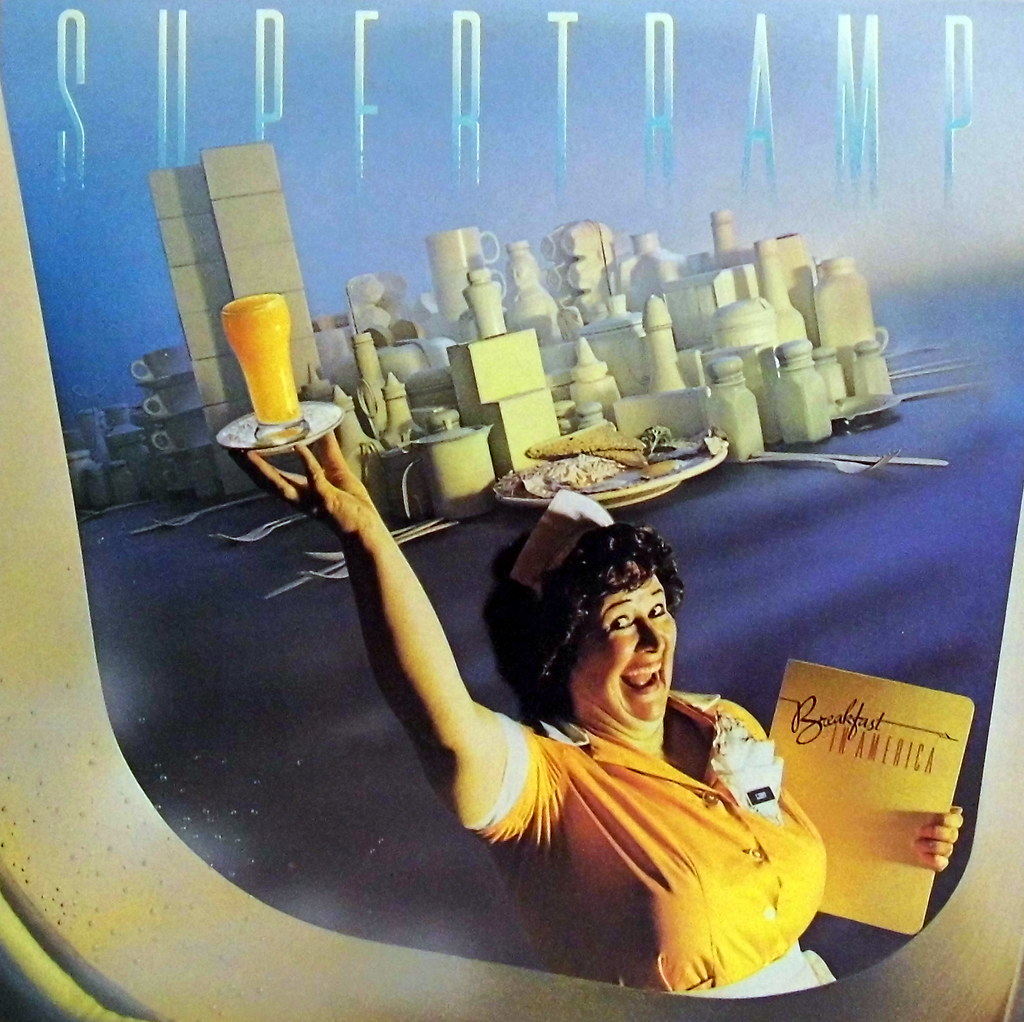
Album cover of Supertramp’s sixth album Breakfast in America. Breakfast in America album cover–“Vintage Vinyl LP Record Album – Breakfast In America Vinyl LP By Supertramp, Catalog Number SP-3708, Rock, A&M Records, 1979” by France1978 is licensed under CC BY-SA 2.0
Breakfast in America became the no.1 LP around the world and went 4x Platinum in the U.S., selling over 4 million copies. Recorded from May to December 1978, Supertramp’s sixth album was released on March 29, 1979. The album produced four singles and three U.S. top-40 hits that year: The Logical Song (no. 6), Goodbye Stranger (no. 15), and Take the Long Way Home (no. 10). Breakfast in America went Platinum in Europe and (4x) in the U.S. The Logical Song written and sung by Roger Hodgson became Supertramp’s biggest hit.
Melody, vocal mix, and musical tour de force across band-mates with a feature of guitar and Wurlitzer that characterized the best of Supertramp’s work, is on full display in “Goodbye Stranger” from 1979. Written and sung by Rick Davies, “Goodbye Stranger” was one of the four singles released from their no.1 album that year, “Breakfast in America.” Following their 1977 Platinum album Even in the Quietest Moments…, Supertramp relocated permanently to Los Angeles and which marked a shift towards a more pop-oriented sound. According to the July 14, 1979 issue of Record World the epic lyrics from “one of the hottest groups around” present the musician poet’s “optimistic view from a drifter.” https://www.worldradiohistory.com/Archive-All-Music/Record-World/70s/79/RW-1979-07-14.pdf – retrieved September 8, 2025.
Goodbye stranger it’s been nice
Hope you find your paradise
Tried to see your point of view
Hope your dreams will all come true
Goodbye Mary, goodbye Jane
Will we ever meet again
Feel no sorrow, feel no shame
Come tomorrow, feel no pain
SOURCES:
The Rolling Stone Encyclopedia of Rock & Roll, Third Edition, edited by Holly George Warren and Patricia Romanowski, New York: A Rolling Stone Press Book, 2001.
https://www.glotime.tv/extremes-classic-1971-supertramp-film-released-dvd/
https://www.allmusic.com/album/supertramp-mw0000191983
This explanatory article may be periodically updated.




.jpg)