


FEATURE image: At the top of the high altar’s retable in St. Michael Church in Chicago’s Old Town is the figure of St. Michael the Archangel, the parish church’s patron. St. Michael is mentioned in several places in both the Hebrew and Christian scriptures. The near northside Chicago parish has been administered by the Redemptorist Order since 1860. Author’s photograph.
In October 1871, the Great Chicago Fire reduced the surrounding neighborhood to absolute ash. Yet, the stone walls of St. Michael Church remained standing. Built by German immigrants, this Romanesque landmark stands as a literal monument to Chicago’s resilience. If you look closely at the historic brickwork, you can still trace the legacy of the fire. Inside, the structure holds a massive, hand-carved Bavarian high altar and towering stained-glass windows crafted by the renowned Mayer of Munich studio in Germany.
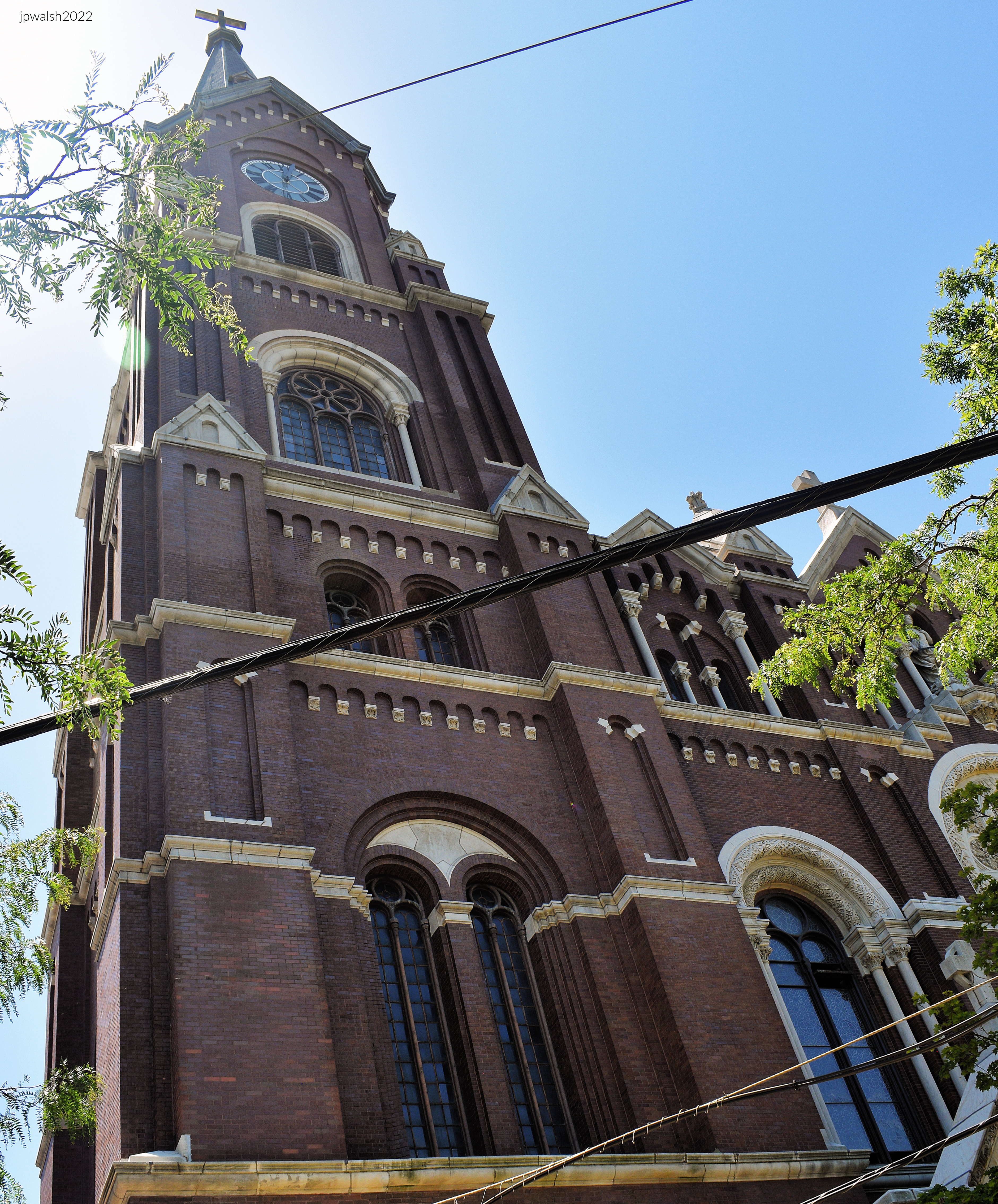
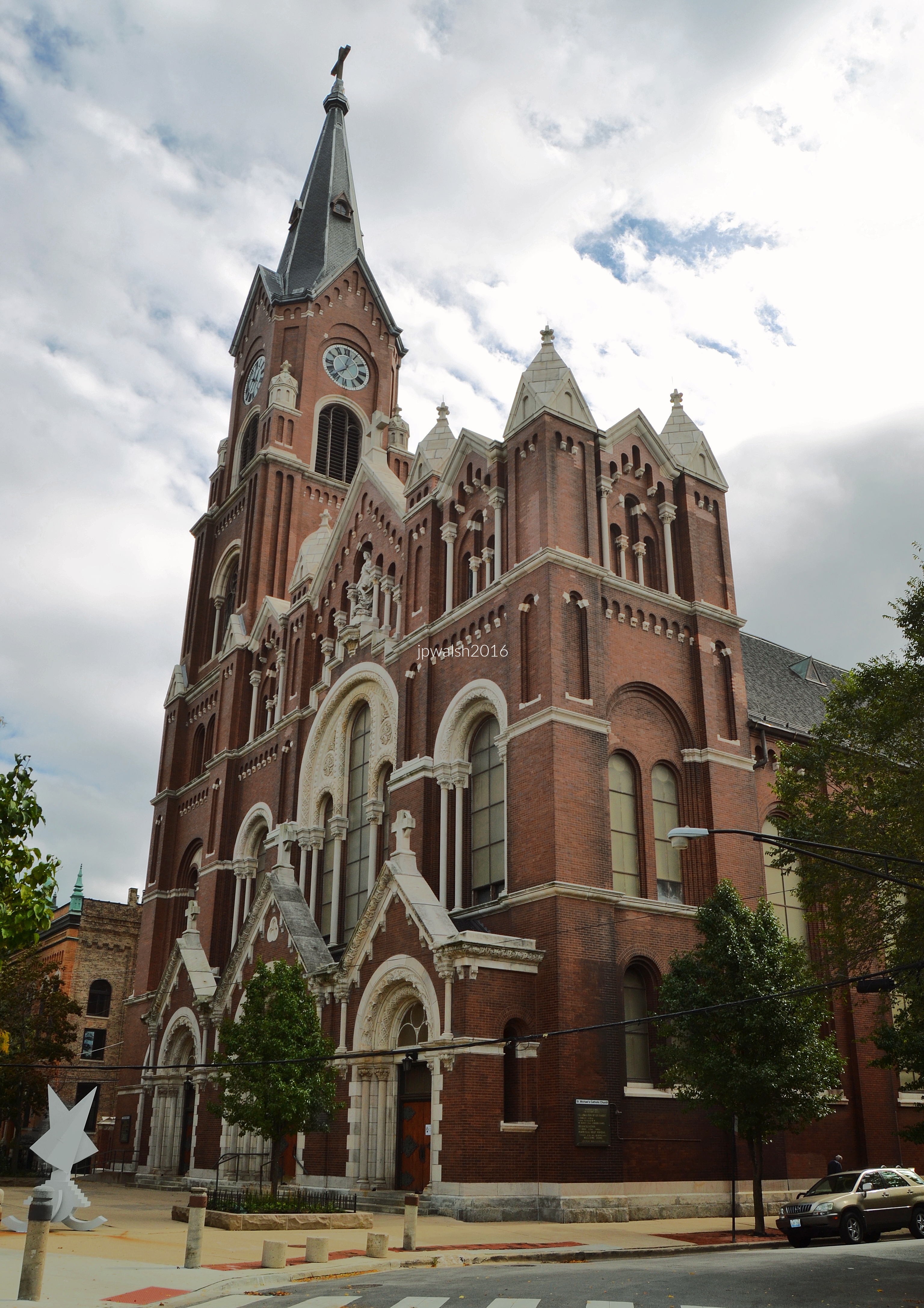
The great tower of St. Michael Church on the Near North Side of Chicago identifies the Old Town Triangle historic district. St. Michael Old Town Chicago. June 2022. Author’s photograph. 8.03mb
By John P. Walsh
The story is told that if you can hear the five 2-to-6-ton bells peel from the 290-feet-tall tower of St. Michael Church you live in Chicago’s Old Town. Yet it depends on which way the wind is blowing.
St. Michael Church is one of Chicago’s oldest parishes and church buildings. It was founded by German Catholics in 1852. From their arrival in the 1830s and 1840s until World War I, German immigrants of all faiths made up Chicago’s most numerous nationality.
The bell tower of St. Michael Church in Chicago’s Old Town at 1633 N. Cleveland Avenue. From 1869 to 1885, this church tower was the tallest building in Chicago. It was surpassed by the old Board of Trade Building.
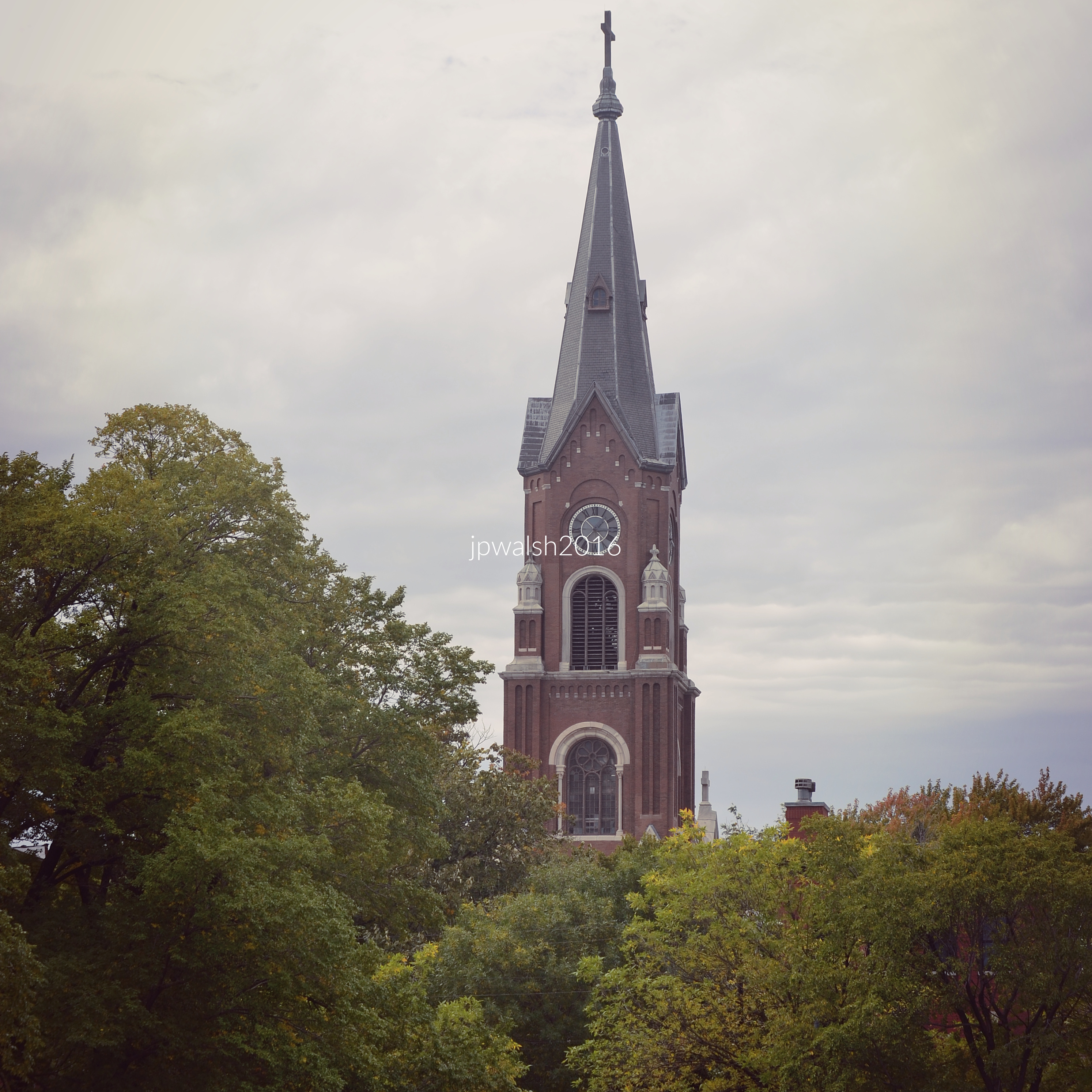
Saint Michael Old Town Chicago. October 2016. Author’s photograph. 2.31mb DSC_0941 (1)
German immigrants soon migrated out of downtown Chicago and about two miles north to North Avenue. The east-west thoroughfare became known as “German Broadway.”
This European immigrant community expanded to eventually settle a four-mile square area that was called “North Town.” St. Michael Church was situated in the virtual center of North Town on land donated by successful German-born Chicago businessman and brewer Michael Diversey (1810-1869). Diversey had immigrated to the United States in the 1830s from Saarland in western Germany.

Built on land donated by successful German-born brewer, businessman, and Chicago alderman Michael Diversey (1810–1869).
St. Michael Church stands on land donated expressly for the purpose of building it by successful German-American brewer Michael Diversey (1810-1869). Diversey emigrated from Germany in 1830, and by 1844 he was a Chicago alderman. The church is named after the wealthy beer maker’s patron saint, St Michael the Archangel, whose limestone figure stands in the high niche on the façade (see photograph below). Diversey’s so-called Chicago Brewery, first established in Chicago in 1839, grew to become one of the most extensive establishments of its kind in the West.
In 1876, five years after the Great Chicago Fire that ravaged the city, the rebuilt St. Michael Church raised five new bells cast by McShane Company into the tower. The four-sided clock was installed in 1888. Atop the steeple, a twenty-four-foot-tall cross weighs over one ton.

St. Michael Old Town Chicago. June 2022. Author’s photograph. 18.70mb
The church building is built of red brick with limestone trim in the Romanesque style. Construction started in 1866 and was finished three years later. In 1871 the new building was virtually destroyed in the Great Chicago Fire along with its North Town neighborhood. Only the church’s exterior walls remained. Using these existing walls, the fire-gutted St. Michael Church was rebuilt and rededicated in 1873. Ashes from that infamous conflagration can still be seen in the church’s basement.

St. Michael Old Town Chicago. June 2022. Author’s photograph. 11.43 mb
Gabled three-portal main entrance (above) was added to the façade in 1913 by a Chicago architect. The architectural design harkens back to the cathedrals of Europe.
Redecorated for its 1902 Golden Jubilee, the church features extensive European craft, including a 56-foot wood-carved Main Altar by the E. Hackner Company, stained glass by Franz Mayer & Co. of Munich, and a certified 1870 replica of the Mother of Perpetual Help icon that survived the 1871 fire intact.

St. Michael Old Town. Main altar at one end of a 190-foot central nave. June 2022. Author’s photograph. 10.01 mb
The church was gutted by the Great Chicago Fire of 1871, leaving only the exterior red brick walls. It was rapidly rebuilt and rededicated using those same walls in 1873.

St. Michael Church, Chicago. February 2013. Author’s phtograph.

St. Michael Church, Chicago. Main Altar. February 2013. Author’s phtograph.
The Main Altar of the Angels, dating from 1902, is a cacophony of German-style wood carving whose immense weight required the building of its own foundation.
In 1851 when St Michael was founded, Chicago’s total population was around 30,000 making it the twenty-fourth largest city in the United States.
Ten years later, in 1860, right before the outbreak of the American Civil War, Chicago’s population had nearly quadrupled and ranked in the nation’s top ten largest cities.
Chicago’s Catholic Church hierarchy in the middle of the nineteenth century was mostly Irish. These English-speaking bishops relied on religious orders to handle a tidal wave of non-English-speaking immigrants to Chicago, including the Germans.
In 1860, the St. Michael Church parish was entrusted to the Redemptorists, a religious order founded in 1748 in Italy. The Redemptorists with their German congregation built the St. Michael Church in Old Town that stands today. Over 170 years later, the Redemptorist order continues to shepherd the parish.

St. Michael Old Town Chicago. June 2022. Author’s photograph. 14.16 mb
A peaceful, breathtaking sanctuary in the middle of a bustling neighborhood.

A mosaic of Saint Michael the Archangel (above) in the floor at the entrance of the church. “Archangel” is a title that signifies he is the leader of all God’s angels.
The mosaic of the patron angel in the floor starts the church’s 190-foot-long nave. It is one of the many religious images—others in stone, wood and paint—that constitutes the interior and exterior decoration of St. Michael Church.
St. Michael the Archangel is mentioned four times in the Bible: twice in the Book of Daniel and in the Epistle of Jude and the Book of Revelation. In the Book of Daniel, St. Michael the archangel helps the prophet Daniel and is linked to the “end times” of the world. In the Epistle of Jude, St. Michael the archangel guards the tombs of Eve and Moses and combats Satan to protect these holy sites.
In the Book of Revelation St. Michael and his angels do battle with the “dragon.” In addition to being charged with expelling Satan from Heaven (as depicted in the retable), St. Michael is charged with the care of all departed souls to introduce them to the holy light. St. Michael the Archangel is the patron saint of soldiers, police, and doctors.

St. Michael Old Town Chicago. June 2022. Author’s photograph. 20%
Detail of the Main Altar retable depicts St. Michael the archangel in the traditional iconography of armor with sword and shield casting Satan out of Heaven by God’s command. St. Michael the Archangel is the patron saint of soldiers, police, and doctors.

The spacious, airy, and dramatic church sanctuary today looks basically as it did by 1902. The motivation for the church’s extensive redecoration in 1902 was its Golden Jubilee as well as one expression of the parishioners’ decided prosperity by the later 1890s.
Created and installed by Mayer & Company of Munich for St. Michael Church’s Golden Jubilee in 1902, the tall and thin stained glass windows —the fourth set of windows to be installed into architect August Walbaum’s original design— depicted Biblical and other scenes. The window’s artistic technique drew upon centuries of European craft and design – and were recently cleaned in 2012.
A Golden Jubilee Window: The Presentation of the Blessed Virgin Mary
This stained-glass window is part of the renowned 1902 cycle created by Franz Mayer & Company (the Royal Bavarian Establishment for Ecclesiastical Art) of Munich, Germany, installed to commemorate the Golden Jubilee of St. Michael Church in Old Town. Along the west side of the nave, the church’s soaring Romanesque-arched windows trace key moments in the life of the Virgin Mary, beginning with her childhood consecration in the Temple and continuing through the Annunciation and Assumption. Across the nave, the east-side windows depict major events from the life of Jesus Christ.
Based on the second-century Protoevangelium of James, the Feast of the Presentation of the Blessed Virgin Mary commemorates the moment when Saints Joachim and Anne brought their three-year-old daughter to the Temple in Jerusalem and dedicated her to God’s service. Celebrated in Jerusalem from at least the sixth century and extended to the universal Roman Catholic Church by Pope Sixtus IV in 1472, the feast is observed on November 21. In the Eastern Orthodox tradition it is known as the Entry of the Most Holy Theotokos into the Temple.
The Presentation of Mary at the Temple
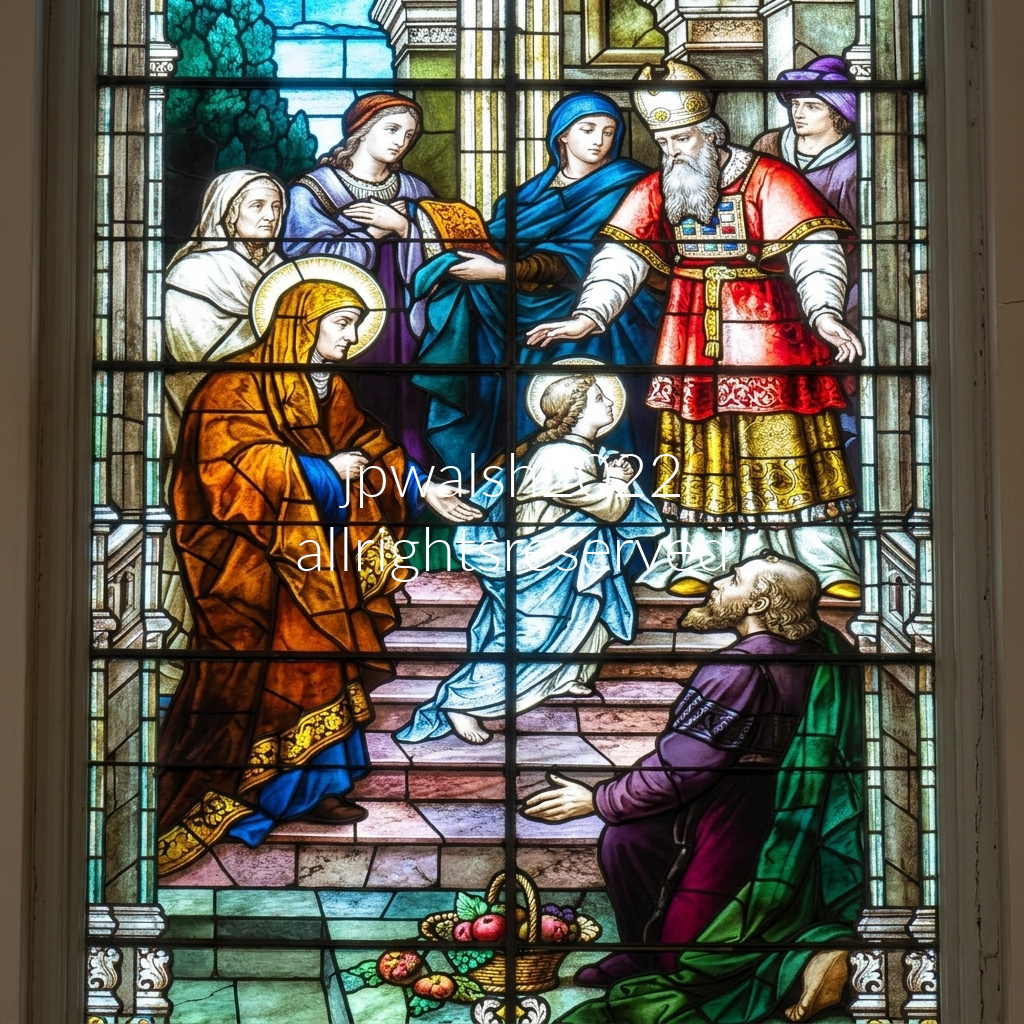
Presentation of Mary in the Temple (detail). Author’s photograph. June 2022.
At the center of the stained-glass composition, the young Virgin Mary, clothed in white and blue and surrounded by a halo, ascends the Temple steps in Jerusalem. Awaiting her at the top is the Jewish High Priest, dressed in richly ornamented red-and-gold vestments, extending his arms in welcome. Beside the staircase stand Mary’s parents, Saint Anne, shown in a gold-brown cloak, and Saint Joachim, kneeling in prayerful reverence. At the foot of the steps rests a woven basket of fruit and flowers, a traditional offering presented at the Temple. Attendants and witnesses gather beneath classical architectural forms and a draped crimson curtain, emphasizing the solemn significance of Mary’s dedication to God.
A Window Within the Church
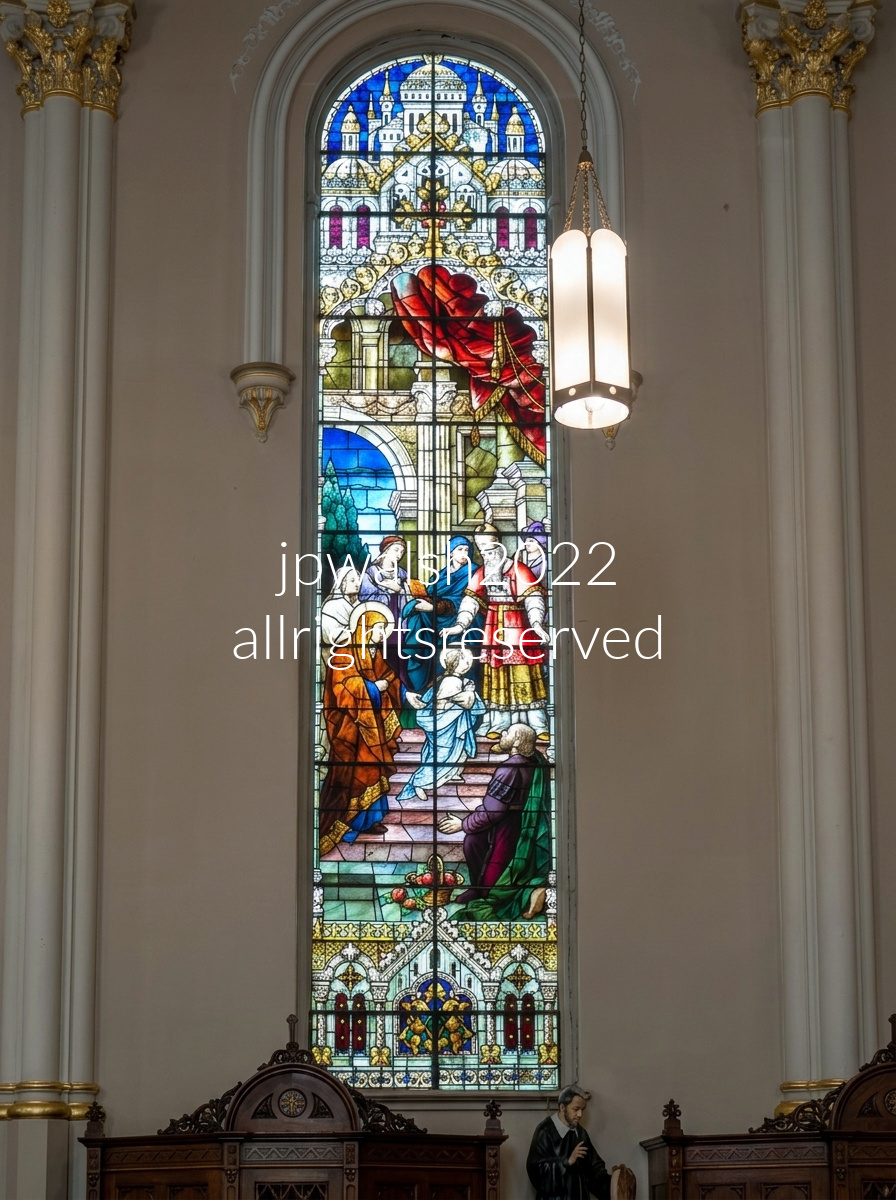
Presentation of Mary in the Temple. Author’s photograph. June 2022.
Viewed in its architectural setting, the towering stained-glass window rises between the church’s gilded columns and beneath a Romanesque arch, illustrating how the Mayer studio designed each scene to function both as sacred storytelling and as an integral part of the church interior. The brilliant blues, reds, and golds draw the eye upward toward a heavenly Jerusalem depicted in the upper register, visually linking Mary’s entry into the Temple with her unique role in salvation history. The window forms the opening chapter in St. Michael’s Marian stained-glass cycle, introducing the theme of a life wholly dedicated to God’s will.
The Meaning of the Feast
The feast celebrates far more than a childhood event. It is fundamentally a feast of consecration and total availability to God. Unlike the Immaculate Conception, which was entirely God’s gift of grace, the Presentation emphasizes Mary’s willing cooperation with that grace. Even as a child, she is portrayed as responding freely and completely to God’s call, becoming a model for every Christian vocation and every life dedicated to divine service.
Mary as the Living Temple
In Christian theology, the Presentation carries profound symbolic meaning. The Jerusalem Temple was regarded as God’s earthly dwelling place under the Old Covenant. By entering the Temple for a life of prayer and dedication, Mary was being prepared to become the new and living Temple, the Ark of the New Covenant, in whose womb the Son of God would dwell at the Annunciation.
Preparing for Christ’s Presentation
The Presentation of Mary also foreshadows the later Presentation of Jesus in the Temple (Luke 2:22–38), celebrated on February 2. Luke’s passage describing Jesus at age twelve in the temple is the one place in the canonical Gospels that steps beyond the infancy stories to show the Savior in early adolescence. It offers a rare look at his formative years and stands as the only sustained biblical account of his childhood. When Mary and Joseph brought the infant Jesus to the Temple in fulfillment of the Mosaic Law, Simeon’s prophecy that a sword would pierce her soul linked her childhood act of self-offering with her lifelong participation in Christ’s redemptive mission. Her early “yes” on the Temple steps anticipated her fiat at the Annunciation and ultimately led to her faithful presence at the foot of the Cross, where Jesus entrusted her to the Church as the mother of all Christians (John 19:26–27).
A Life Ordered to God’s Will
Mary’s ascent of the Temple stairs also anticipates Jesus’s own relationship with the Temple throughout the Gospels: his presentation as an infant, his return there at age twelve when he declared that he must be “in my Father’s house” (Luke 2:49), and his adult ministry when—after cleansing the Temple—he identified his own body as the true Temple, declaring, “Destroy this temple, and in three days I will raise it up” (John 2:19–21). The scene depicted in this window reminds viewers that Mary’s motherhood was profoundly spiritual, both containing and transcending biology. Long before Bethlehem, her life had already been shaped by a complete and unwavering dedication to God’s will.
The Feast’s Ancient Roots
Historically, the feast is connected to the dedication of the Basilica of St. Mary the New in Jerusalem in 543 AD, erected near the site of the ancient Temple. Although the basilica suffered severe damage during the Persian conquest of Jerusalem in 614 AD and was later devastated by earthquakes, especially the great earthquake of 746/749 AD, its memory endured through the liturgical celebration that continues to honor Mary’s presentation and consecration to God.
The Finding in the Temple
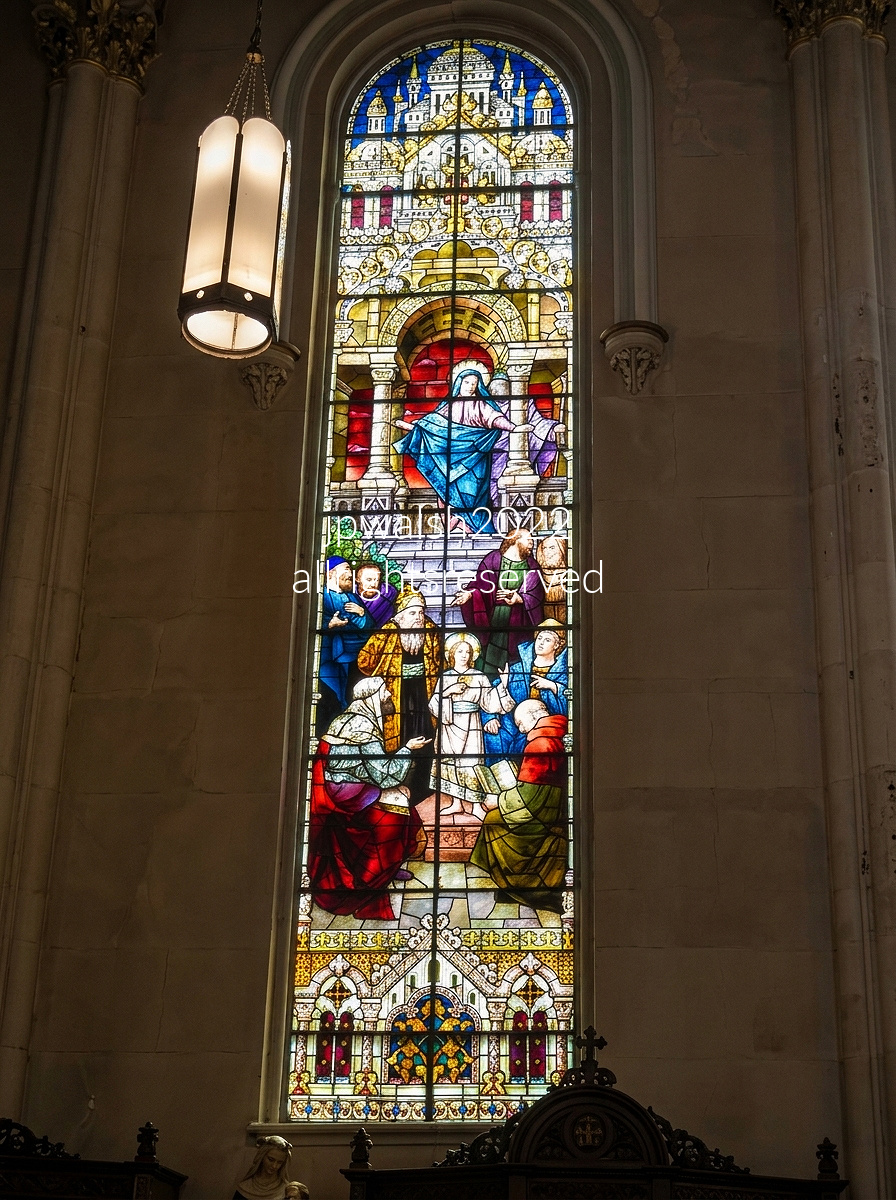
The Finding in the Temple. Author’s photograph. June 2022.
A Masterpiece of Munich Pictorial Stained Glass
The Finding in the Temple, crafted in 1902 by the renowned Franz Mayer & Company of Munich, Germany, is executed in the classic Munich Pictorial style. Positioned as the first window on the east side of the nave nearest the entrance, the tall Romanesque-arched lancet employs architectural framing to organize the scene into distinct spatial levels.
Mary, Joseph, and the Young Jesus
The upper portion of the window is crowned by a glowing Gothic-Renaissance baldachin symbolizing the majesty of the Jerusalem Temple. Beneath a classical arch supported by Corinthian columns, the Virgin Mary, clothed in a vibrant blue mantle over a white tunic, and St. Joseph, dressed in purple and gold robes, stand at the top of a stone staircase. Mary’s outstretched arms convey a mixture of relief, astonishment, and maternal concern as she finally discovers her twelve-year-old son after three anxious days of searching.
At the foot of the steps, Jesus occupies the center of the composition. Clad in a luminous white tunic, he gestures upward while engaged in theological discussion with a circle of Jewish elders and teachers. The scholars, dressed in rich crimson, olive-green, and gold robes, surround him with open scrolls and attentive expressions, visibly captivated by the extraordinary wisdom of a child whose understanding surpasses their own.
The Significance of the Finding in the Temple
The scene illustrates the account in Luke 2:41-51, the only Gospel story describing Jesus between his infancy and adulthood. In Catholic tradition, the Finding in the Temple is the Fifth Joyful Mystery of the Rosary and marks a pivotal moment in Christ’s life. Here, for the first time, Jesus publicly reveals an awareness of his unique relationship with God, reminding Mary and Joseph that he must be in his “Father’s house.”
The episode represents the transition from Jesus’ hidden childhood to the first glimpse of his divine mission. While Mary and Joseph experience the very human anxiety of losing a child, they are also confronted with the deeper mystery of his identity. The window beautifully captures this intersection of family devotion, spiritual revelation, and growing understanding, portraying both the humanity of the Holy Family and the dawning recognition of Christ’s divine purpose.
The stunning stained glass was crafted by the famous Mayer of Munich in Germany.

Annunciation to Mary Window (Luke 1: 26-38. St. Michael Old Town Chicago. Annunciation to Mary Window (Luke 1: 26-38). Mary’s virginal conception of Jesus is stated explicitly in verses 34-35. In Hebrew her name, Miryām, means “exalted one.” June 2022. Author’s photograph. 10.71 mb
In that Jubilee year, the stained glass was installed along with the 56-foot-high carved wood retable of the High (or main) Altar of the Angels. Though there are five altars in St. Michael Church, the main altar is the most spectacular, drawing the eye forward and upward from practically anywhere in the church. Crowning this painted construct—which is so heavy that it required a new local foundation to be dug for it—is the figure of St. Michael the Archangel described in the Book of Revelation. The angel is garbed in his panzer (“armor”) running rebellious angels out of heaven. St. Michael is flanked by the archangels Gabriel and Raphael. Nine choirs of angels and the saints Peter and Paul are also depicted in wood. Smaller human figures depict the four evangelists identified by their Christian symbols—specifically, the Winged Man (Matthew), Winged Lion (Mark), Winged Ox (Luke) and Eagle (John). All five altars were made by E. Hackner Company of La Crosse, Wisconsin, an early twentieth century designer, manufacturer and importer of artistic ecclesiastic furnishings.

St. Michael Church, Chicago. Annunciation Window, detail (above), Franz Mayer & Co. of Munich. The angel Gabriel’s greeting, “Hail, full of grace,” is a greeting that is full of peace, joy and wisdom. Mary is the object of God’s grace and favor and is shown to be chosen for a long time past. The depiction of lilies, whether in the angel’s hand or arranged into a bouquet by Mary’s side, is traditional imagery for purity. February 2013. Author’s photograph.
In 1869 the St. Michael Church building cost over $130,000 to build which is approximately $2.65 million today. After the fire the repairs in 1872 cost an additional $40,000 plus unknown amounts of insurance money–or upwards of $700,000 today. Reconstruction did not include the stained glass windows which were installed in 1902. For a history of the stained glass in St. Michael church go to: https://johnpwalshblog.com/2016/05/10/angels-in-stained-glass-1902-complete-st-michael-church-in-old-town-chicago/.

St. Michael Church, Chicago. Anointing of Jesus by Mary Magdalene at Bethany Window, 1902, Franz Mayer & Co., Munich. This stained-glass window depicts the anointing of Jesus at Bethany by the sinful woman traditionally identified as Mary Magdalene. Although the Gospel accounts differ in certain details, all four describe a meal in a house during which a woman pours costly ointment upon Jesus, prompting objections from some of those present. In Mark’s account (Mark 14:3), the ointment is identified as pure nard, a perfume of extraordinary value estimated at more than a year’s wages (Mark 14:5). Luke’s Gospel recounts a woman known for her sinful life who anoints Jesus’ feet while weeping; her tears fall upon his feet, which she then kisses and wipes with her hair (Luke 7:38). While none of the biblical texts explicitly identify this woman as Mary Magdalene, Christian tradition and artistic iconography have long associated her with the figure portrayed in these Gospel narratives. Spikenard was grown in India, China, and Nepal and known in ancient Rome where it was used as a cooking agent. By the time of Jesus, in the early Roman Empire, spikenard was used primarily in perfume. May 2016. Author’s photograph,

Coat of Arms of Pope Francis (2013-2025). According to the Vatican, the image of the plant to the right of the star on the blue background is spikenard and represents St. Joseph.
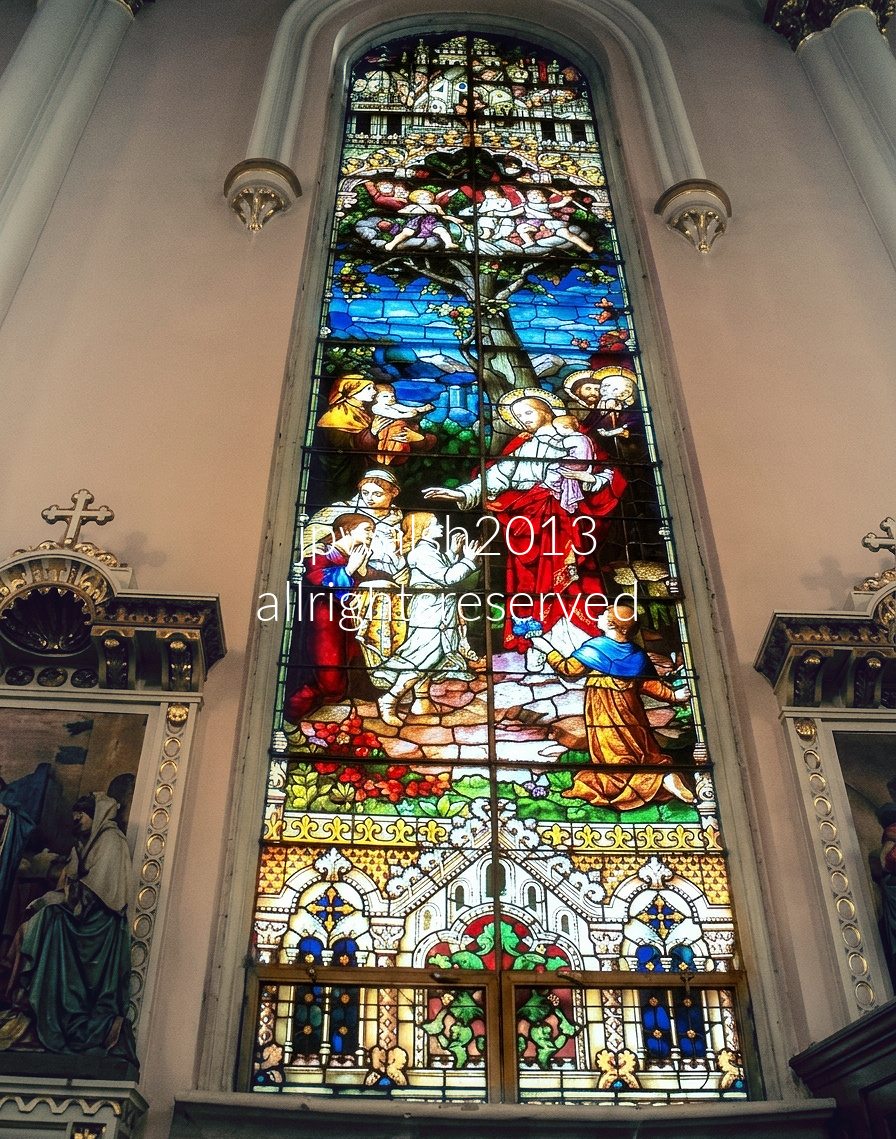
Jesus Blessing the Children Window. During Jesus’ public ministry, crowds frequently gathered around him, bringing not only themselves but also their children and even their infants to receive his blessing. The disciples attempted to turn them away, but Jesus rebuked them. His well-known words, recorded in all three Synoptic Gospels (Matthew 19:14, Mark 10:14, and Luke 18:16), affirm the special place of children in the Kingdom of God: “Let the little children come to me; do not prevent them, for the kingdom of God belongs to such as these.” He continued, “Amen, I say to you, whoever does not accept the kingdom of God like a child will not enter it” (Mark 10:14-15). This stained-glass window commemorates one of the most beloved episodes in the Gospels, emphasizing the humility, trust, and openness that Jesus presented as models of faith. February 2013. Author’s photograph.
Children at the Heart of the Kingdom
In the ancient Greco-Roman and Jewish worlds, children possessed little legal standing or social influence. By presenting them as the supreme model for discipleship, Jesus overturns conventional ideas of status and power, teaching that entry into God’s kingdom depends not on wealth, learning, or position, but on openness, trust, humility, and complete dependence upon God. By drawing a child into his embrace, Christ affirms the sacred worth of every human life regardless of age or social standing and establishes a lasting mandate for the Church to welcome, protect, and nurture the young.
A Golden Jubilee Window
The Jesus Blessing the Children window at St. Michael in Old Town forms part of the church’s 1902 Golden Jubilee stained-glass cycle created by Franz Mayer & Company of Munich. Installed along the east wall of the nave immediately after The Finding in the Temple, it marks the transition from Christ’s youth to the beginning of his adult ministry.
The episode appears in all three Synoptic Gospels. In Matthew 19:13–15, parents bring little children to Jesus so that he might lay his hands upon them and pray. When the disciples attempt to send them away, Jesus famously responds: “Let the little children come to me, and do not hinder them, for the kingdom of heaven belongs to such as these.” Mark 10:13–16 adds that Jesus became indignant at the disciples’ actions and personally took the children into his arms and blessed them. Luke 18:15–17 emphasizes that even infants were brought before him, reinforcing Christ’s teaching that whoever does not receive the kingdom of God like a little child will never enter it.
A Scene of Welcome and Blessing
Set within a lush garden landscape, the composition employs the rich painterly realism and jewel-toned glass that distinguish Munich stained-glass workshops. Standing on a rocky path, Jesus is clothed in a flowing crimson mantle over a luminous white tunic. With his left arm, he cradles a small child against his chest, while his right hand extends outward in a gesture of welcome and blessing toward the children gathering around him.
To the left, a young boy kneels with hands folded in prayer beside a mother and another child. In the lower right foreground, a kneeling girl offers a bouquet of wildflowers to Christ. Behind them, another mother raises an infant so the child may see Jesus. Two bearded disciples, partially visible behind Christ on the right, observe the encounter. Overhead, the spreading branches of a gnarled tree frame a vivid cobalt sky and rolling hills beyond, creating a sense of warmth, peace, and spiritual intimacy.
Heavenly Glory Above
At the top of the lancet, a choir of winged cherubs rests upon clouds beneath delicate Gothic tracery, linking the earthly scene below with the heavenly realm above. At the base of the window, a bed of red and pink roses rises into ornate Neo-Gothic arches set against fields of deep sapphire and emerald glass, providing a richly decorative foundation for one of Christ’s most tender and enduring lessons: that the kingdom of heaven belongs to those who approach God with the trust and openness of a child.

St. Michael Church, Chicago. Sacred Heart Window. The first of four great visions in which Jesus Christ revealed his Sacred Heart to French nun St. Margaret Mary Alacoque (1647-1690) took place on December 27, 1673, in her Visitation convent in Paray-le-Monial in Burgundy France. In each of these visions Christ revealed messages that the young saint was to communicate. The greatest of all the visions took place in 1676. Before the Tabernacle on the altar that exposed the Eucharist, Jesus said: “Behold this Heart which has so loved mankind, that it has spared nothing, even to exhausting and consuming itself in order to demonstrate and prove its love for them.” St. Margaret Mary was ordered by her confessor, St. Claude de la Colombière, a Jesuit priest, to write down all her visions. Afterwards, the saint suffered great persecutions from the Church and others for these visions until she fell ill and died in 1690 at 43 years old. She was beatified in 1864 and canonized in 1920. Author’s photograph.
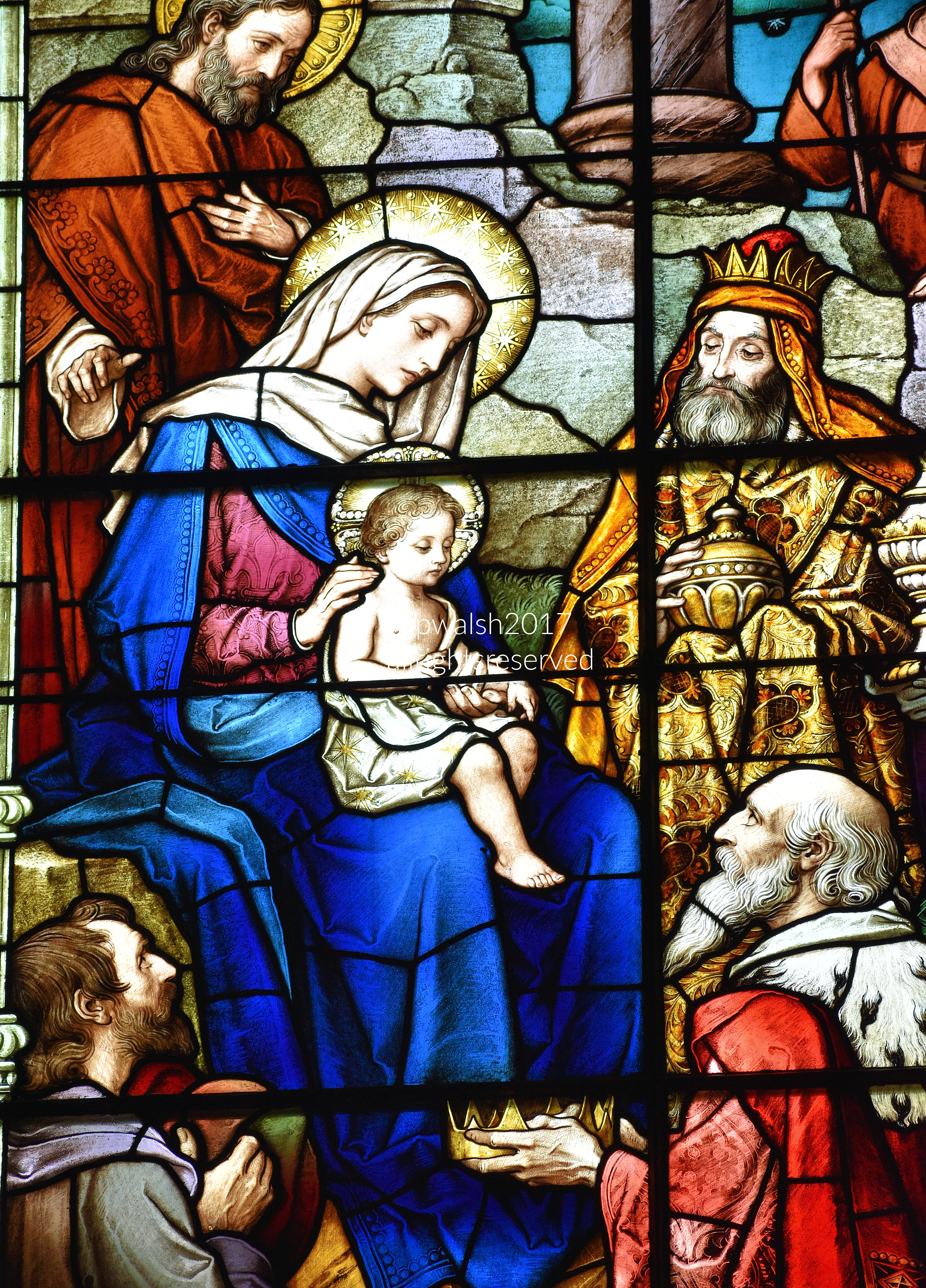
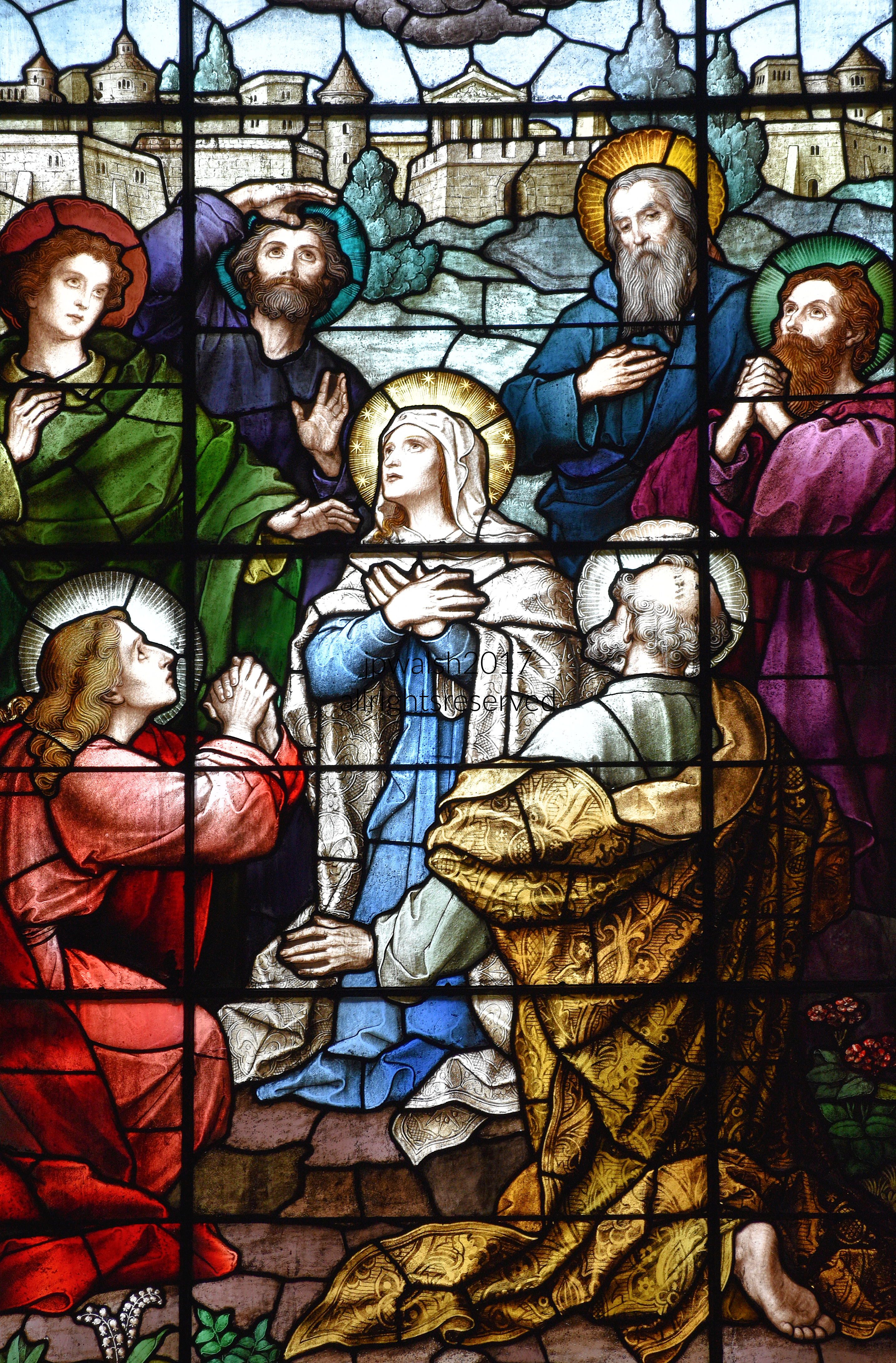
Ceiling mural.
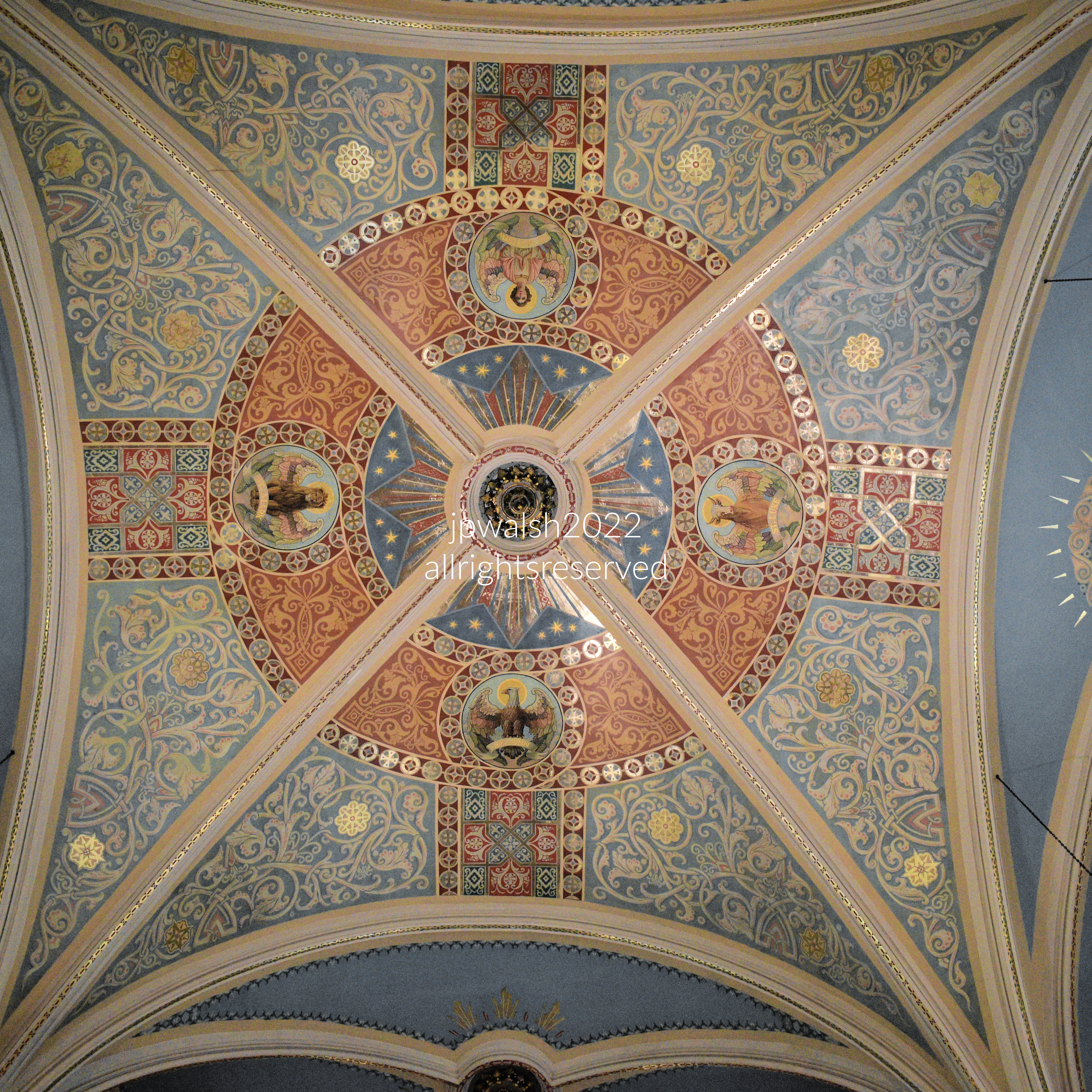
The central nave vault at St. Michael in Old Town illustrates a foundational Christian iconographic tradition—the Tetramorph (the Four Evangelists). Its filigree evokes medieval illuminated manuscripts and perhaps is inspired by a scene painted in the 15th century in the dome of The Basilica of St Mark in Venice. Placed directly overhead at the intersection of the vault ribs, the Evangelists act as architectural and spiritual pillars carrying the Word of God outward to the four corners of the church and world. June 2022. Author’s photograph. 8.21mb
The Theme of the Four Evangelists
Positioned radially around the central boss of the groin vault, the four medallions depict the authors of the canonical Gospels using their ancient symbolic attributes drawn from the visions of Ezekiel (Ezekiel 1:10) and the Book of Revelation (Revelation 4:7). In early and medieval Christian art, these four winged creatures represent distinct theological facets of Christ’s identity and earthly mission, namely:
- The Winged Man (St. Matthew) Representing Christ’s human genealogy and Incarnation, Matthew’s Gospel opens with Jesus’s earthly lineage from Abraham and David, emphasizing his humanity and fulfillment of Jewish prophecy.
- The Winged Lion (St. Mark). Symbolizing royal power, courage, and resurrection, the lion echoes the “voice crying out in the wilderness” at the beginning of Mark’s Gospel and medieval bestiary lore that lions sleep with their eyes open, signifying Christ’s vigilance in the tomb.
- The Winged Ox (St. Luke) Representing sacrifice, service, and priesthood, the ox—an essential beast of burden and traditional temple sacrificial animal—reflects Luke’s opening scene in the Jerusalem Temple with Zechariah and underscores Christ’s self-offering on the cross.
- The Eagle (St. John) Signifying spiritual ascent, divine vision, and the celestial heights of theology, the eagle reflects the soaring prologue of John’s Gospel (“In the beginning was the Word“), which contemplates from above Christ’s eternal divinity.
The intricate Victorian/Germanic Revival scrollwork, floral rosettes, and geometric border bands—originally inspired by medieval illuminated manuscripts— bring out fine gold-leaf accents, delicate vine tendrils, and the sharp star-studded blue sunbursts radiating from the central boss of the central ceiling mural.
Original Pulpit.

St. Michael Old Town Chicago. June 2022. Author’s photograph. 15.27 mb
This magnificent, elevated pulpit inside St. Michael Church in Chicago’s Old Town is a masterwork of historic liturgical art. While the church building itself was rebuilt immediately after the Great Chicago Fire in 1873, the highly detailed altars and intricate interior wood carvings are largely attributed to the grand 1902 Golden Jubilee renovation by the E. Hackner Company. The design combines elements of Romanesque Revival and Bavarian Baroque styles, relying on theology built directly into the woodwork.
Deep-Rooted Symbolism
- The Scallop Shell Canopy: The massive scallop shell serving as the soundboard (abat-voix) holds a double meaning. In Catholic tradition, the shell is the universal symbol of pilgrimage (specifically the Camino de Santiago) and baptismal rebirth. It reminds the listener that the Word being preached guides the soul’s earthly journey.
- The Dove of the Holy Spirit: Tacked at the very top underside of the shell canopy is a carved white dove. It is positioned above the priest’s head, symbolizing that the words spoken from this pulpit should be directly inspired by the Holy Spirit.
- The Ten Commandments: Directly below the shell, two overlapping tablets showing Roman numerals I through X represent the law given to Moses, rooting the New Testament preaching firmly in Old Testament foundational law.
- The Carved Figures: In addition to the two angels holding up the shell, surrounding the octagonal basket of the pulpit are niche carvings depicting prominent Church figures, popes, or bishops—identifiable by their liturgical mitres and croziers—representing the historic lineage, authority, and continuity of Catholic teaching.
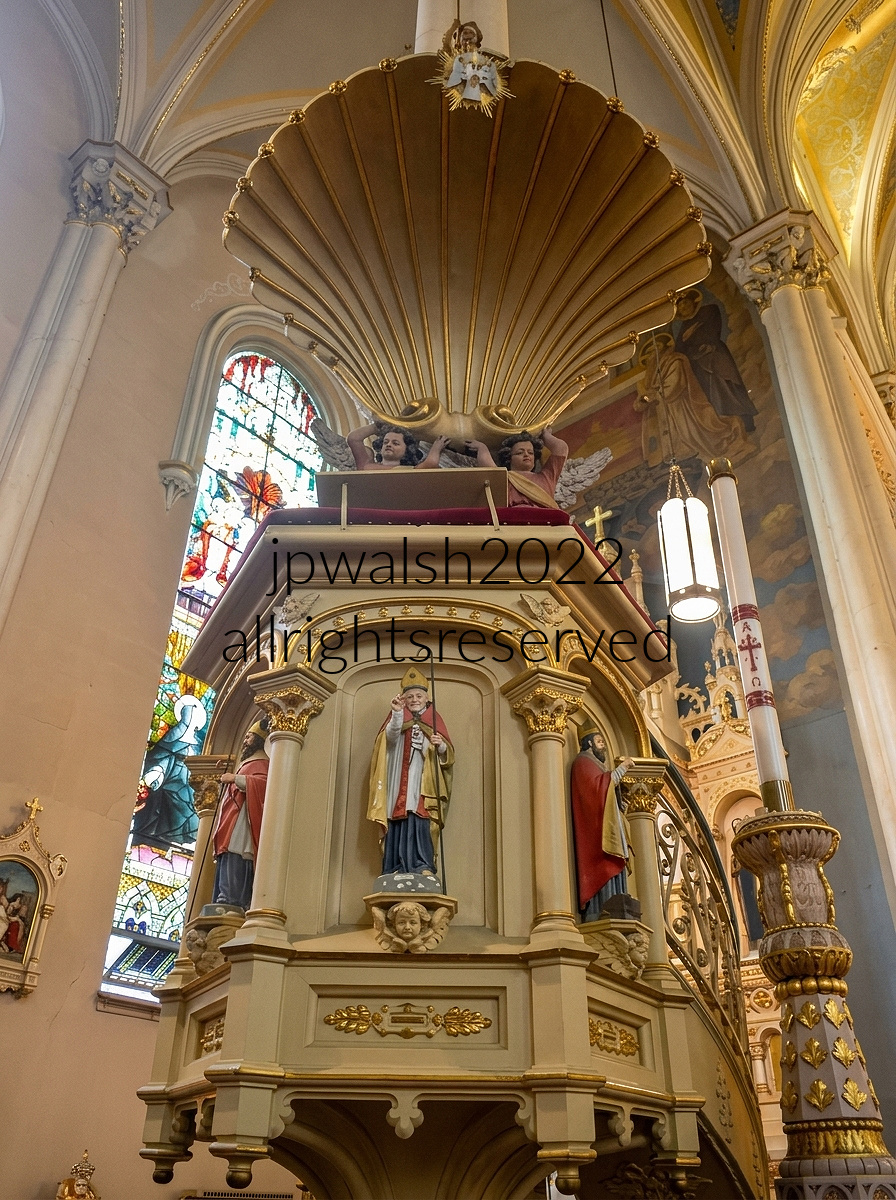
St. Michael Old Town Chicago. June 2022. Author’s photograph.

St. Michael Old Town Chicago. June 2022. Author’s photograph. 19.11 mb
As with other American church building adaptations of earlier European architectural styles, the use of Romanesque rounded arches and corbels accentuated the use of Gothic-style glass in Chicago’s Old Town Roman Catholic church.

St. Michael Old Town Chicago. June 2022. Author’s photograph. 20%
Pietà, copy of a 16th-century Swabian-style artwork made around 1913.

A Place to Bring Your Sorrows
This devotional and deeply moving Pietà is in the foyer of St. Michael Church. The foyer (narthex) acts as the boundary between the chaotic, bustling streets of Chicago’s Old Town and the sacred interior of the sanctuary. Encountering the raw vulnerability of the Pietà forces an immediate pause, inviting quiet reflection and reverence. By placing a monument of profound maternal grief right at the entrance, the church sends an unspoken message to its community: bring your sorrows inside. It reassures visitors that the church is a sanctuary for those carrying heavy burdens.
The Pietà Tradition
Though the heartbreaking image of the Virgin Mary cradling the dead body of Jesus after the Crucifixion emerged from Late Medieval and Renaissance European devotion, German and especially Swabian Pietàs often emphasized intense human suffering, a devotional sensibility sometimes described as dolorism.
Swabian Woodcarving and Sacred Emotion
Swabia, a historic region of southwestern Germany, was renowned during the late fifteenth and early sixteenth centuries for its emotionally charged religious woodcarvings, produced by masters such as Michel Erhart and Jörg Syrlin. Unlike Michelangelo’s serene and idealized marble Pietà in St. Peter’s Basilica, these German works frequently stressed the physical wounds of Christ and the overwhelming grief of his mother, encouraging worshippers to contemplate the realities of sacrifice, death, and redemption through an intensely personal and emotional encounter.
A Meditation on Sacrifice and Redemption
By emphasizing both Christ’s suffering and Mary’s sorrow, these works transform a biblical event into a deeply human drama. The faithful are invited not merely to observe the scene, but to enter into it emotionally, reflecting on loss, compassion, and the hope of redemption that lies beyond death.
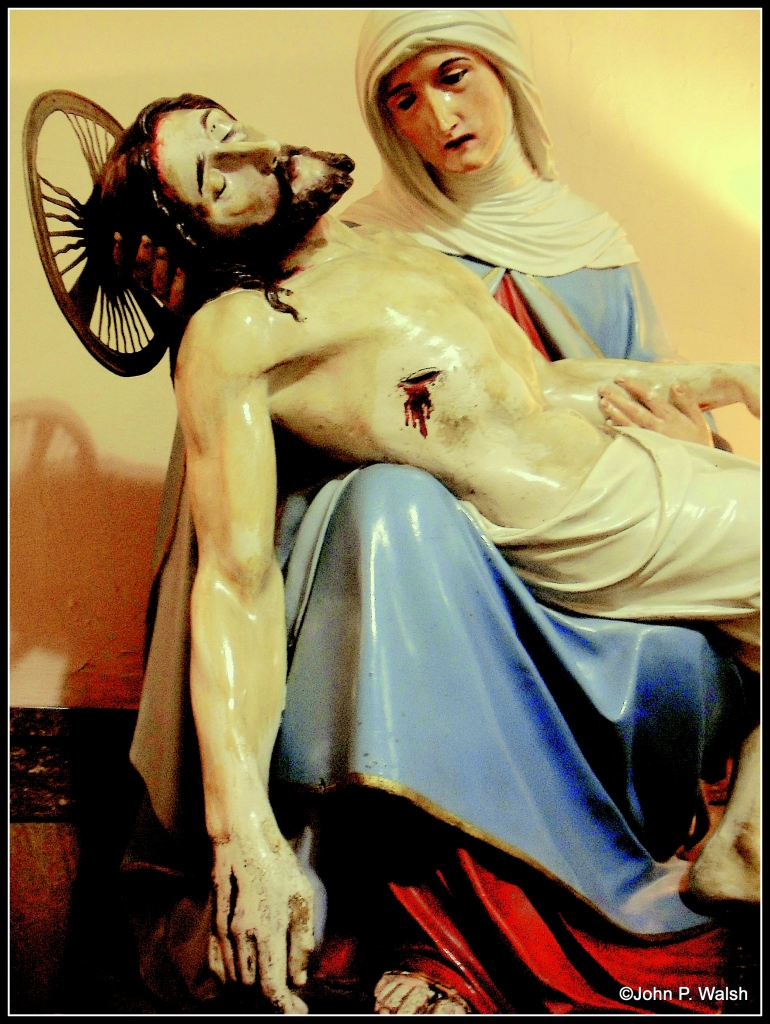
Pieta. St. Michael Church, Chicago. February 2013. Author’s photograph.
Emotional Realism
- The Sorrow of Mary: Mary is depicted not as a youthful queen, but as a grieving mother. Her face is heavy with sorrow, her head tilted tenderly over her son, and her heavy drapery realistically bundles around her figure, grounding the scene in heavy, earthbound grief.
- The Wounds of Christ: The sculpture vividly details the physical toll of the Passion. The spear wound in Christ’s side (the Holy Wound) is prominently visible and painted with realistic blood droplets, a hallmark of Northern European devotional art designed to evoke deep empathy (compassio) from the viewer.

Sacred Heart side altar. The Sacred Heart side altar (east nave). In addition to the central statue of Christ are those depicting Redemptorist Order founder, St. Alphonsus Liguori (Italian, 1696-1787) and Discalced Carmelite Order founder, St. Teresa of Avila (Spanish, 1515-1582). February 2013. Author’s photograph.

St. Michael Old Town Chicago. St. Joseph altar (west nave) with a mural above it of Redemptorists before Christ’s Heavenly throne. In this photograph’s foreground at right is a wood confessional box. Italian-born St. Alphonsus Liguori, founder of the Redemptorists, was highly educated and spent much of his life hearing the confessions of the ordinary people as a home missionary in his city of Naples, Italy. June 2022. Author’s photograph. 25%
Side altar honors Mary, Mother of Perpetual Help.

St. Michael Old Town Chicago. The Redemptorists—a Catholic religious order founded in Italy by St. Alphonsus Liguori—became the custodians of this icon long after their founder’s death. On December 11, 1865, Pope Pius IX formally entrusted the original 15th‑century Byzantine icon to the order, handing it to Father Nicholas Mauron, the Redemptorist Superior General in Rome. By April 1866, the original icon was placed on public display at the Church of Saint Alphonsus on Rome’s Esquiline Hill, where it remains permanently enshrined. June 2022. Author’s photograph. 12.53 mb
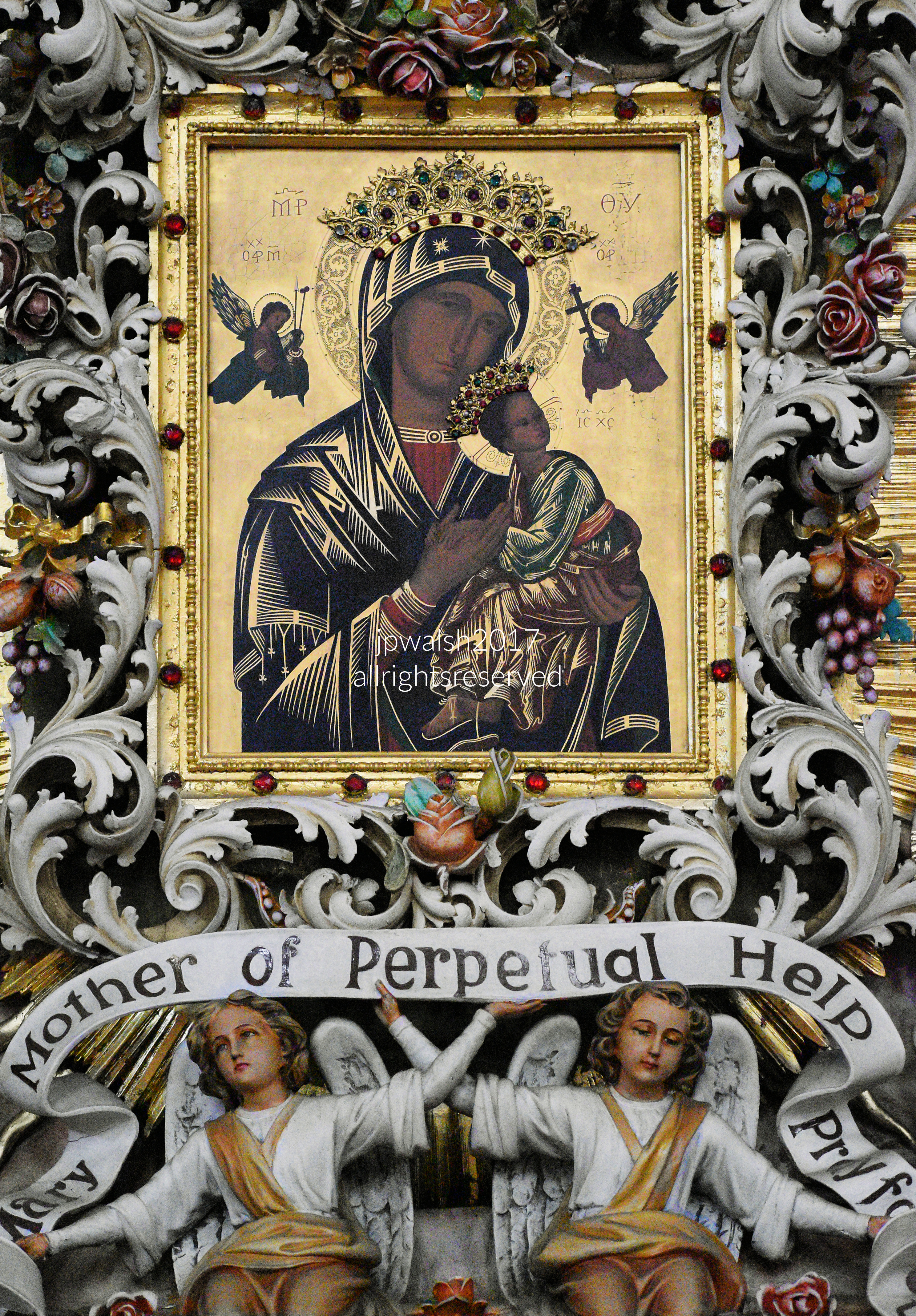
Following the Pope’s directive to “make her known throughout the world,” the Redemptorists began distributing authorized copies to their missions and parishes. In 1870, one of the first four official copies sent to the United States was dispatched to St. Michael Church in Chicago. Although not placed directly into the pastor’s hands by the Pope, it was a certified first‑generation replica produced under the authority of the 1865 decree.
After the Great Chicago Fire of 1871, the Chicago icon was recovered intact from the rubble—an event taken as a sign to rebuild the church. It was later installed in the present German Baroque‑style retable.
The icon of Our Lady of Perpetual Help is regarded as miraculous because of centuries of reported healings, apparitions, and its own improbable survival. In 1798, French revolutionary forces destroyed San Matteo, the church where it had been housed in Rome. Augustinian monks rescued the icon and hid it; it remained forgotten for decades until the 1860s, when an elderly Augustinian friar and a former altar server—by then a Redemptorist priest—identified it.
When the icon was restored to public veneration on April 26, 1866, a major street procession accompanied its installation at Saint Alphonsus in Rome. Contemporary accounts record several immediate physical cures among the crowd. In the decades that followed, the Redemptorists documented hundreds of unexplained medical healings associated with prayers before the image.
Because of this long record of devotion, survival, and reported grace, the Vatican crowned the icon with gold and precious stones in 1867, a distinction reserved for ancient images linked to extraordinary divine favors. August 2017 Author’s photograph. 78% 7.75mb DSC_0981
The Stations of the Cross at St. Michael Church

Second and Third Stations of the Cross. June 2022. Author’s photograph. 12.60 mb
These magnificent high-relief panels depict the Second and Third Stations of the Cross, Jesus Is Laden with the Cross and Jesus Falls the First Time. Installed during St. Michael Church’s extensive late nineteenth- and early twentieth-century decorative campaigns, they are exceptional examples of European-influenced polychrome plaster relief sculpture. Rich in color, depth, and dramatic expression, the panels were created to draw worshippers into a meditative participation in Christ’s Passion, transforming sacred history into a vivid devotional experience.
St. Alphonsus Liguori and the Modern Stations
The fourteen traditional Stations of the Cross found in churches throughout the world today were codified in 1761 by St. Alphonsus Liguori (1696-1787). One of the most accomplished figures of the eighteenth-century Catholic Church, Liguori was a bishop, theologian, philosopher, lawyer, poet, composer, musician, artist, spiritual writer, and founder of a religious order. His reflections on Christ’s Passion became enormously influential because of their ability to move the faithful toward prayer, humility, repentance, and a deeper appreciation of Christ’s sacrifice.
Born in Naples in 1696, Liguori initially pursued a distinguished legal career before discerning a vocation to the priesthood and being ordained in 1726. Though his parents were devout Catholics, they were disappointed by his decision, in part because the clergy of the era often suffered from a reputation for corruption and worldliness. Liguori nevertheless devoted his life to pastoral ministry, becoming especially beloved for his work among ordinary people, spending countless hours hearing confessions and serving as a missionary in and around Naples.
Scholar, Bishop, and Founder
In 1732, Liguori founded the Congregation of the Most Holy Redeemer, better known as the Redemptorists, a religious community dedicated to preaching missions and serving the spiritual needs of ordinary people. His influential work Moral Theology, published in 1748, received papal approbation and helped establish his reputation as one of the Church’s foremost moral theologians. He was appointed a bishop in 1762 and, nearly a century after his death, was declared a Doctor of the Church in 1871, recognizing the enduring value of his theological and spiritual writings.
The Redemptorists and St. Michael Church
The connection between St. Alphonsus and St. Michael Church is more than devotional. In 1860, the parish was entrusted to the Redemptorists, who ministered to Chicago’s growing German Catholic population. Under their leadership, the present church was completed in 1869 in the Old Town neighborhood. Remarkably, it survived the Great Chicago Fire of 1871 and continues to stand as one of the city’s most important historic churches. More than 165 years after their arrival, the Redemptorists remain entrusted with the spiritual care of the parish.
A Living Tradition of Devotion
The Stations of the Cross at St. Michael are therefore more than decorative works of religious art. They embody a devotional tradition shaped by St. Alphonsus Liguori, preserved by the Redemptorists, and passed down through generations of Chicago Catholics. Through their vivid imagery and emotional power, these sculptures continue to invite worshippers to walk spiritually beside Christ on the road to Calvary, reflecting on suffering, sacrifice, redemption, and hope.

St. Michael Old Town. June 2022 5.83mb DSC_5296 (1)
Conclusion
The Rise of German Chicago
The history of St. Michael Church is inseparable from the rise of Chicago itself. In scarcely half a century, Chicago transformed from a frontier settlement built on low, marshy ground into the second-largest city in the United States. As railroads, industry, and commerce propelled the city onto the national stage, German immigrants emerged as one of its most influential communities, shaping neighborhoods, churches, schools, businesses, associations, and civic life.
The Age of Deutschtum
Between the Great Fire of 1871 and the years following World War I, Chicago’s astonishing growth coincided with the flourishing of Deutschtum, or “Germanness.” German-language newspapers, singing societies, breweries, social clubs, educational institutions, and Roman Catholic parishes formed a vibrant cultural world that touched nearly every aspect of urban life. St. Michael Church stood not only as a place of worship but also as an expression of the confidence, prosperity, and cultural identity of German Chicago during its height.
The End of an Era
Yet the prominence of German Chicago proved less permanent than the architecture its community left behind. The defeat of Imperial Germany in World War I unleashed powerful currents of anti-German sentiment across the United States and accelerated pressures toward assimilation. Institutions that had once proudly proclaimed their German heritage increasingly abandoned the language and public expressions of ethnic identity. By the eve of World War II, much of the cultural hegemony that Germans had exercised in Chicago for generations had largely disappeared.
A Lasting Legacy
Although Deutschtum faded as a public cultural force, its legacy remains embedded in Chicago’s built environment. Churches such as St. Michael preserve the artistic, religious, and historical aspirations of the immigrant community that helped transform Chicago from a frontier town into a world city. Their architecture and stained glass stand today as enduring witnesses to the rise, influence, and eventual assimilation of one of the city’s most important ethnic populations.
Saint Michael Old Town Chicago. October 2016. 4.52mb DSC_0836 (5)
Sources:
G. Lane and A. Kezys, Chicago Churches and Synogogues.
P. d’A Jones and M.G. Holli, Ethnic Chicago.
D.A. Pacyga and E. Skerrett, Chicago, City of Neighborhoods.
D. McNamara, Heavenly City.
The Saints: A Concise Biographical Dictionary, edited by John Coulson, Guild Press, New York, 1957.
The New American Bible, Catholic Book Publishing Corp, New York, 1993.
Catechism of the Catholic Church, 2nd Edition, Doubleday, New York, 1997.
The Jerome Biblical Commentary, edited by Raymond E. Brown, S.S., Joseph a Fitzmyer, S.J., and Roland E. Murphy, O. Carm., 1982.
St. Michael Church website.
https://iamjesus.net/traditional-stations-of-the-cross/https://www.emporis.com/buildings/136851/st-michael-church-chicago-il-usa
Photographs taken by author in February 2013; May and October 2016; June 2022.
This explanatory article may be periodically updated.



Did you happen to see the news account today in which a man committed suicide within Notre Dame Cathedral in Paris? It seems that he was a rather elderly historian and right-wing political activist (obviously one who missed the memo on the Ten Commandments).
It does rather cause one to wonder what such a suicide in such a place might mean? Surely the symbolism doesn’t go unnoticed in a city such as Paris.
Now if only to decipher the symbols which the old coot used.
Looking for a copy of the St Michaels parish Chicago 1952 Centennial Book (my original grammar school copy issued to me was destroyed during one of the 50’s era flooded basement episodes on Hudson avenue .
Thank You, B. G.
Dear John,
I am associate Pastor at St. Michaels in Old Town. I am writing an article for our
Redemptorist Newsletter, DENVERLINK, and wondered if I might submit any of the
photos from this page for one time use?
Father, thanks for your interest and contacting me. Go right ahead for the newsletter. that’s great. I hope I’m not too late getting back to you to be useful. Please give the photographer credit as space allows. John