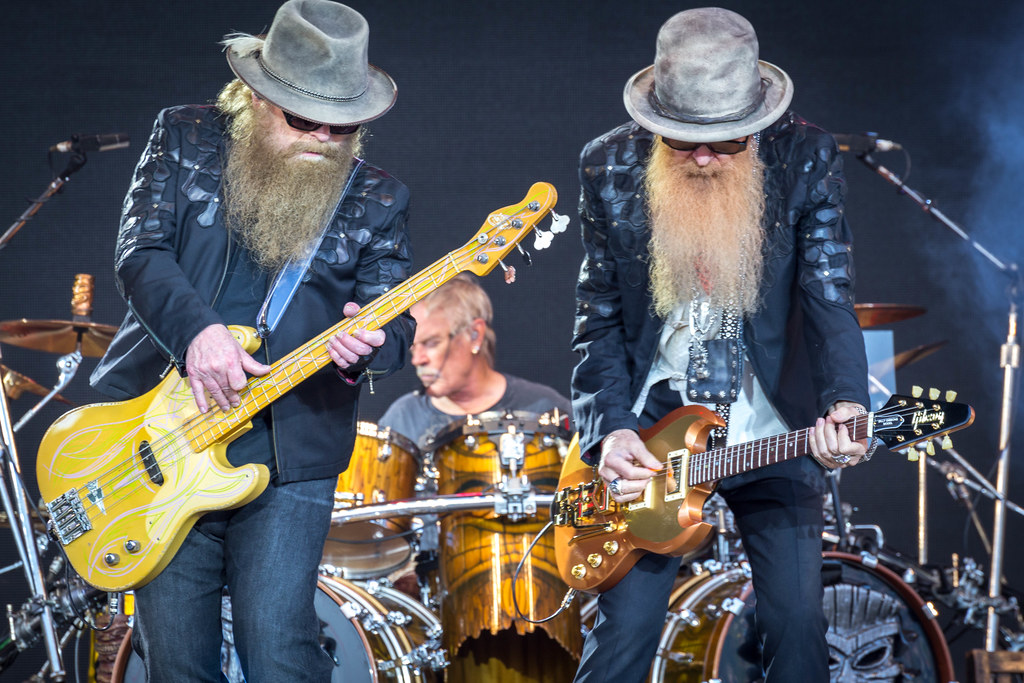
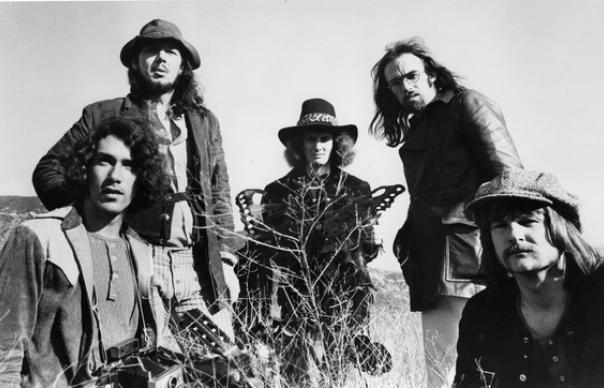
ZZ Top bandmates Dusty Hill (left) and Billy Gibbons (right) lock into a signature groove downstage while drummer Frank Beard keeps time in the background during a live performance. PHOTO: “ZZ Top” by beanmunster is licensed under CC BY 2.0.
Condolences & Context
First, sending sincere condolences on the passing of Frank Beard. Moments like this make the band’s cultural peaks hit even harder. He truly was the rock-solid backbone of that Little Ol’ Band from Texas.
Frank Beard’s Passing
Frank Beard—ZZ Top’s precision timekeeper and long‑running rhythmic anchor—has passed on, leaving Billy Gibbons as the last surviving member of the classic three‑man lineup formed in Houston in 1969. Beard died on Monday, August 17, 2026, at 77, according to a statement from the band’s publicist and Gibbons. He passed peacefully in hospice care at his ranch in Richmond, Texas, surrounded by family.
A young visitor admires a beautifully restored 1930s Ford Model A street rod on display at an indoor car show, showcasing its pristine candy-apple red paint job and custom leather-bound rear travel trunk. PHOTO: “ZZ Top” by Matthew Kenwrick is licensed under CC BY-NC-ND 2.0.
The Eliminator Trilogy
These three videos form what MTV fans celebrate as The Eliminator Trilogy: “Gimme All Your Lovin’,” “Sharp Dressed Man,” and “Legs.” Directed by Tim Newman, they didn’t just promote singles—they built a highly stylized mythology that transformed a gritty 1970s blues-rock outfit into full-blown 1980s MTV royalty.
Each video consistently deploys the same four “magic tools of transformation”:
The Eliminator Coupe: Billy Gibbons’ custom, candy-apple red 1933 Ford—the band’s ultimate chariot of freedom.
The Silver “Z” Keychain: The literal “key to the kingdom,” handed off to grant the protagonist immediate confidence and power.
The Band as Blues Prophets: Billy, Dusty, and Frank popping up randomly in the background like omniscient, instrument-playing guardians.
The Eliminator Girls: Jeana Tomasino, Kymberly Herrin, and Danièle Arnaud acting as glamorous fairy godmothers who rescue ordinary people from oppressive lives.
“Gimme All Your Lovin’” (May 1983)
Running a tight 4:37, “Gimme All Your Lovin’” dropped the hammer on Eliminator the moment the album hit shelves on March 23, 1983. Hill, Beard, and Gibbons fused synthesizers and electronic drums into their signature Texas boogie, rebuilding classic blues-rock for the neon age without losing an ounce of their trademark grit.
The single hit radio airwaves in April 1983 and became the band’s very first Top 40 track by July. The music video officially premiered on MTV on May 21, 1983. In it, actor Peter Tramm plays a bored gas station grease monkey whose luck instantly turns when the Eliminator Girls roll up and whisk him away on a midnight escape. Filmed at a dusty filling station in the Palmdale–Littlerock flats of California, the setting perfectly captures an iconic, “middle-of-nowhere” desert vibe.
The track cemented ZZ Top—and that cherry-red ’33 Ford—as MTV fixtures. Eliminator peaked at No. 9, sold 10 million copies, and parked itself on the Billboard 200 charts until 1987.
“Sharp Dressed Man” (November 1983)
The trilogy’s second single was a major hit, sitting on the Billboard Hot 100 for nearly four months and peaking at No. 22. It propelled the band to unprecedented rock superstardom, keeping the Eliminator album on the charts for a staggering three and a half years. Decades later, the track surged again in March 2020, hitting No. 14 on Hot Rock Songs and No. 8 on Mainstream Rock Songs due to a wave of streaming interest.
For ZZ Top, being “sharp-dressed” was entirely subjective. While the track cites a fashionable silk suit, bass player Dusty Hill beautifully summarized the song’s timeless ethos to Spin magazine in 1985:
“Sharp-dressed depends on who you are. If you’re on a motorcycle, really sharp leather is great. If you’re a punk rocker, you can get sharp that way… If you feel sharp, you be sharp.”
“Legs” (May 1984)
Released in May 1984, “Legs” tells a highly stylized empowerment story. Wendy Frazier plays a shy, timid young woman working at a small-town diner who finds her independence after a dramatic makeover from the Eliminator Girls.
Shot in Santa Clarita, California, the video deliberately contrasts her transformation with exaggerated, often cruel behavior from the townspeople who belittle her. This stark contrast sharpens the theme of self-agency beneath the song’s surface-level flash.
Billy, Dusty, and Frank appear throughout alongside their spinning sheepskin fur guitars. Amid the town’s rough-edged supporting cast, actor David Wakefield plays a kind short-order cook, serving as an emotional anchor for the main character’s journey. The production went on to win MTV’s Best Group Video that year.
Legacy of the Trilogy
Before these videos hit the airwaves, ZZ Top was a critically respected but visually modest blues-rock band. Tim Newman’s cinematic storytelling—combined with the hot rod, fur-lined guitars, and heavy visual swagger—turned the trilogy into definitive pop art. It perfectly mirrored the escapist, theatrical culture of the 1980s and permanently embedded Frank Beard’s driving, electronic-infused backbeat directly into the decade’s visual fabric.
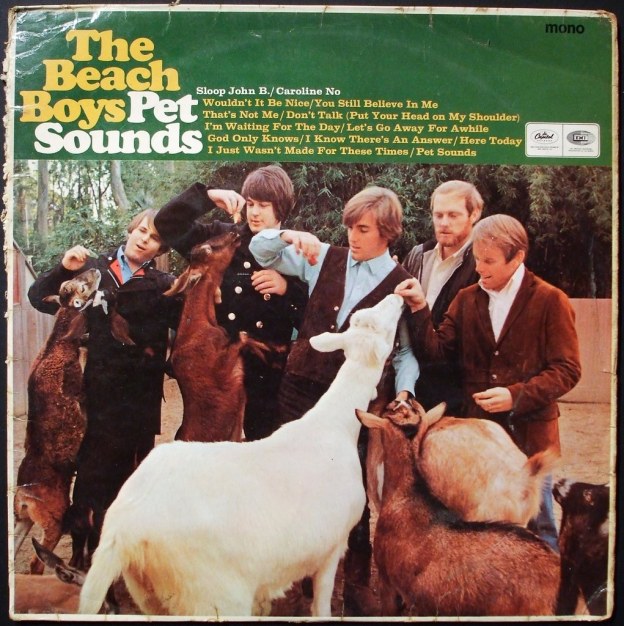
Feature Image: By leveraging the legendary Wrecking Crew and an arsenal of unconventional instruments, Brian Wilson transformed The Beach Boys from a surf-pop act into the architects of “symphonic pop.” Released on May 16, 1966, Pet Sounds didn’t just alter the band’s trajectory; it redefined mid-60s music and famously challenged the Beatles to respond with Sgt. Pepper’s Lonely Hearts Club Band. The Beach Boys – Pet Sounds. PHOTO: “The Beach Boys – Pet Sounds” by Jacob Whittaker is licensed under CC BY-NC-SA 2.0.
Pet Sounds was not simply a successful Beach Boys album but a revolutionary artistic breakthrough that transformed popular music from a singles-driven commercial product into a sophisticated studio art form.
AUTHOR’S NOTE: I am deeply indebted to the scholars, historians, archivists, and dedicated fans whose research has preserved the factual record of the Beach Boys’ Pet Sounds sessions. The narrative presented here draws on their meticulous documentation of dates, locations, personnel, and production details listed in the Sources. While I’ve shaped these facts into a continuous story, the underlying information comes from the work of others who have spent decades assembling session logs, interviews, studio records, and contemporary reporting. Any clarity or cohesion in this account is my own; the factual backbone belongs to the sources that made this history accessible.
A Masterpiece of Sound and Sentiment
Released on May 16, 1966, The Beach Boys’ Pet Sounds is a landmark,11th studio album—and a pioneer of pop-rock concept albums. Crafted by 23-year-old Brian Wilson with lyricist Tony Asher, the project explored bittersweet love, longing, and lost innocence through sophisticated, avant-garde arrangements that blended pop, jazz, and exotica. While featuring a romantic, progressive, and at times psychedelic sound, it still retained the band’s signature vocal harmonies.
An Artistic Leap Forward
By 1966, the Beach Boys were a polished, matured unit, with the members playing a significant role in both studio recording and live performance, marking a significant artistic leap from their 1962 beginnings.
Internal Doubts and Early Resistance
Despite producing both this masterpiece and the masterpiece single “Good Vibrations” (October 1966) between July 1965 and May 1966, the evolution to “pocket symphonies” initially received a mixed reception. While critics and artists like the Beatles adored it, the general public was slow to embrace the change. Band member Mike Love famously questioned how to replicate the complex studio sound live, and Capitol Records found more commercial success with the Best of the Beach Boys compilation, which outsold Pet Sounds upon its release.
The Long Road to Critical Reevaluation
When Pet Sounds, the Beach Boys’ 11th studio album, was released in May 1966, reviews were generally negative and sales were poor. It took 30 years for the album — on which Brian Wilson and Tony Asher’s God Only Knows appears — to be certified Gold. In 1966 critics were praising Dylan’s Blonde on Blonde, the Rolling Stones’ Aftermath, the Beatles’ Revolver, rock and pop’s new masters that were easily recognizable. In contrast, Brian Wilson who continued to invent himself, was viewed as a poignant and possibly tortured pop artist. In 1967 Jules Siegal may have best captured the gaps between the group’s musical development and the audience when he wrote in the debut issue of Cheetah magazine: “Brian Wilson and the Beach Boys were still too square. It would take more than “Good Vibrations” and Pet Sounds to erase three and a half years of “Little Deuce Coupe” – a lot more if you count in those…custom tailored, kandy striped sport shirts they insisted on wearing on stage.” Later reevaluations of Brian’s work in Pet Sounds by critics, including God Only Knows which artists covered immediately and down through the decades to today, is recognized as the work of a genius. Pet Sounds missed the top-five peak of previous albums, yet still reached the top 10 (No. 2 UK) and was certified RIAA Gold/Platinum in 2000.
At its heart, “Wouldn’t It Be Nice”—the opening track of Pet Sounds—is a daydream or child’s rhyme, its music likely remotely influenced by Burt Bacharach. The song captures two young lovers longing for the freedom and certainty of adulthood, wishing to skip ahead to a life shared together. What emerged was a recording that felt both innocent and intricate—an opening statement that announced Pet Sounds as something deeper, more ambitious, and more emotionally searching than anything the band had attempted before. To give this adolescent daydream musical form, Brian Wilson spent the early months of 1966 meticulously building the track, layering the Beach Boys’ signature harmonies over an ensemble of sixteen elite studio musicians. By marrying a radiant “Wall of Sound” shimmer with weightless vocal clarity, this Wilson-Asher-Love collaboration strikes a perfect balance between sonic joy and a subtle lyrical ache and remains a foundational moment for power pop, bridging towards the sophisticated world of progressive pop. Released as a single in July 1966, “Wouldn’t It Be Nice” peaked at No. 8 on the Billboard Hot 100, sharing airplay and acclaim with its legendary B-side, “God Only Knows.”
The Studio as a Personal Laboratory
Following the November 8, 1965, release of the Beach Boys’ tenth album, Beach Boys’ Party!, Brian Wilson plunged headfirst into the sessions for Pet Sounds. The studio became his personal laboratory, a space where ideas spilled out faster than he could capture them.
Sonic Experiments and James Bond Influences
The first experiment was a quirky instrumental inspired by the James Bond craze. Initially titled “Run James Run,” it was reborn in March 1966 as the album’s namesake track, “Pet Sounds.” Wilson approached the recording like an artist at a canvas, using long, free-form sessions to chase the sounds in his head—layering rhythms and textures until they clicked.
Collaborating with the Wrecking Crew
Supported by Carl Wilson and occasionally Dennis, Al Jardine, and Bruce Johnston, Brian leaned heavily on the Wrecking Crew, the elite L.A. session musicians capable of translating his most avant-garde impulses into music. Recorded on November 17, the track was tuneful, offbeat, and unmistakably Wilson. Its percussion featured a pair of empty Coca-Cola cans, shaken and tapped to add a playful metallic rattle that fit perfectly into the song’s collage of unconventional sounds.
Immediately after recording the instrumental “Pet Sounds,” the Beach Boys departed for a “Thanksgiving Tour” (Nov 18 – Dec 4, 1965), playing arenas from Boston to Albuquerque. During the tour, Brian’s avant-garde single “The Little Girl I Once Knew” hit the airwaves. Its experimental “dead air” segments spooked radio programmers, causing it to stall at No. 20. The modest reception disappointed Brian and fueled the band’s fears that his “new music” might alienate their fans.
TURNING POINTS — The Sonic Bridge to Pet Sounds: The Story Behind “The Little Girl I Once Knew.”
Through Brian Wilson’s visionary production, innovative use of the Wrecking Crew, advanced recording techniques, and emotionally mature songwriting, the album redefined both the Beach Boys’ identity and the possibilities of pop music itself.
The Forgotten Bridge to Innovation
Before Brian Wilson changed pop music forever with Pet Sounds, he took a radical, often-forgotten creative gamble in October 1965. Recorded between October 13–24 at Hollywood’s Western Recorders, “The Little Girl I Once Knew” stands as the definitive bridge between The Beach Boys’ sunny surf-pop past and their future as studio avant-gardists. Released as a standalone single on November 22, 1965, the track offered a fascinating glimpse into a musical mind operating on a completely new frequency.
A New Creative Horizon
The song marked a massive shift in Brian Wilson’s personal and professional life. Having recently retired from touring to focus entirely on production, Wilson found himself with the time and freedom to truly master Hollywood’s best tracking spaces alongside legendary engineer Chuck Britz.
It was also a period of profound internal expansion. Conceived after Wilson’s first experience with LSD, the track accelerated his departure from formulaic radio pop, steering him toward dense, non-traditional song structures that mirrored his evolving worldview.
Breaking the Rules of Pop Production
Architecturally, “The Little Girl I Once Knew” was dangerously bold for 1965. The song opens with a burst of vibrant, fully orchestrated energy—only to instantly collapse into two separate, four-second blocks of near-total silence right before the verses.
To anchor this experimental arrangement, Wilson bypassed the touring Beach Boys on instruments, calling in the elite session musicians of the Wrecking Crew. Carol Kaye’s driving electric bass lines, Hal Blaine’s precision drumming, and Don Randi’s organ provided a sophisticated foundation. On top of this canvas, the group delivered a masterclass in vocal tracking. With lead parts split between Brian and Carl Wilson, and backed by layered harmonies from Mike Love, Al Jardine, and Bruce Johnston, Brian would later look back on these sessions as the absolute peak of the band’s vocal abilities.
The Radio Backlash and “Barbara Ann”
Despite its brilliance, the single ran into the wall of Top 40 radio. In the mid-1960s, “dead air” was a strict industry taboo. As the single stalled at a disappointing No. 20 on the Billboard charts, Capitol Records executives panicked. Eager to reclaim their reliable hitmakers, the label rushed out a party-vibe cover of “Barbara Ann” just weeks later. The high-energy, safe alternative immediately dominated the airwaves, completely eclipsing the momentum of Wilson’s most ambitious work to date.
Today, “The Little Girl I Once Knew” remains a thrilling artifact—the exact moment the Beach Boys stopped riding the waves and started rewriting the rules of the recording studio.
TURNING POINTS — The release of the Beatles’ Rubber Soul (Dec. 6, 1965).
The Beatles’ Rubber Soul (Dec. 6, 1965) marked a turning point, prompting Brian Wilson to recognize a shift in the industry toward the concept album. Seeking to top it, Brian and Carl turned to prayer for inspiration. Brian then hired jingle writer Tony Asher to redefine his lyrical voice. At their first meeting, Brian played Rubber Soul, declared his intent to surpass it, and introduced the “Sloop John B” backing track and “In My Childhood” (later “You Still Believe In Me”), launching the Pet Sounds sessions in January 1966.
Wilson moved the Beach Boys beyond their surf-and-car image into a more introspective, ambitious musical world. Inspired by the Beatles’ Rubber Soul, he set out to create a unified album statement rather than a collection of hit singles.
For Brian Wilson, the piano was where raw intuition met technical strategy. He would begin with simple “feels”—rhythmic patterns and melodic fragments—nurturing them until a song began to blossom into a complete structure. Working in near‑total isolation, Wilson built the arrangements himself—every chord, every voicing, every instrumental line—then walked into the studio with fully formed blueprints. The Wrecking Crew would cut these intricate tracks long before the rest of the band even heard what he was creating.Even in those early stages, his creative vision was anchored by a practical awareness of the Beach Boys’ specific vocal range and capabilities, ensuring his most ambitious ideas always remained tailored to the band’s unique sound.PHOTO: Rock Dreams: Brian Wilson” by Jim the Chin is licensed under CC BY-NC-SA 2.0.
The Beach Boys’ Party! album peaked at No. 6 on the Billboard 200, but Capitol still wanted a stronger commercial follow‑up after the disappointing performance of “The Little Girl I Once Knew.” To fill the gap, the label pulled “Barbara Ann” — a loose, good‑humored cover of the Regents’ 1961 doo‑wop hit, recorded on September 23, 1965, during the Party! sessions — and released it as a single on December 20, 1965. Its B‑side, Brian Wilson’s “Girl Don’t Tell Me,” sung by Carl, came from the earlier Summer Days (And Summer Nights!!) album issued that July.
The single exploded on both sides of the Atlantic, reaching No. 2 in the U.S. and the U.K., held off the top spot only by the Beatles’ standalone smash “We Can Work It Out” recorded during Rubber Soul sessions. Brian, however, distanced the band from the cover track. He was baffled that a casual cover of a 1961 Fred Fassert tune was suddenly overshadowing the more adventurous music he was trying to make — and frustrated that Capitol wanted more of the same.
Instead of repeating the formula, Brian pushed forward. He turned his attention fully to the new, more ambitious sound he’d been chasing, the work that would become the most important album of his career: Pet Sounds.
In 1963 or 1964, a friend snapped a real candid photograph of Brian Wilson washing his 1963 Pontiac Grand Prix in the driveway of the Wilson family home at 3701 W. 119th Street in Hawthorne, California. Brian had bought the Grand Prix new, choosing the high‑performance Trophy V8 421 HO, a 375‑horsepower engine capable of pushing the car past 119 mph. The car’s split grille, stacked headlights, and formal, squared‑off roofline made the ’63 model instantly recognizable.
The enthusiasm ran in the family — Carl Wilson soon picked up a 1964 Grand Prix of his own. Brian’s earlier cars included a 1957 Chevrolet Impala, and later, a 1966 Ford Mustang and 1966 Chevrolet Corvette Sting Ray. Inside, the ’63 Grand Prix featured bucket seats, a center console, and a floor shifter, giving it a sporty, upscale feel.The photograph freezes a small but vivid moment: Brian, early in the Beach Boys’ rise, tending to the car he loved — a slice of his real, everyday life amid the band’s growing success.
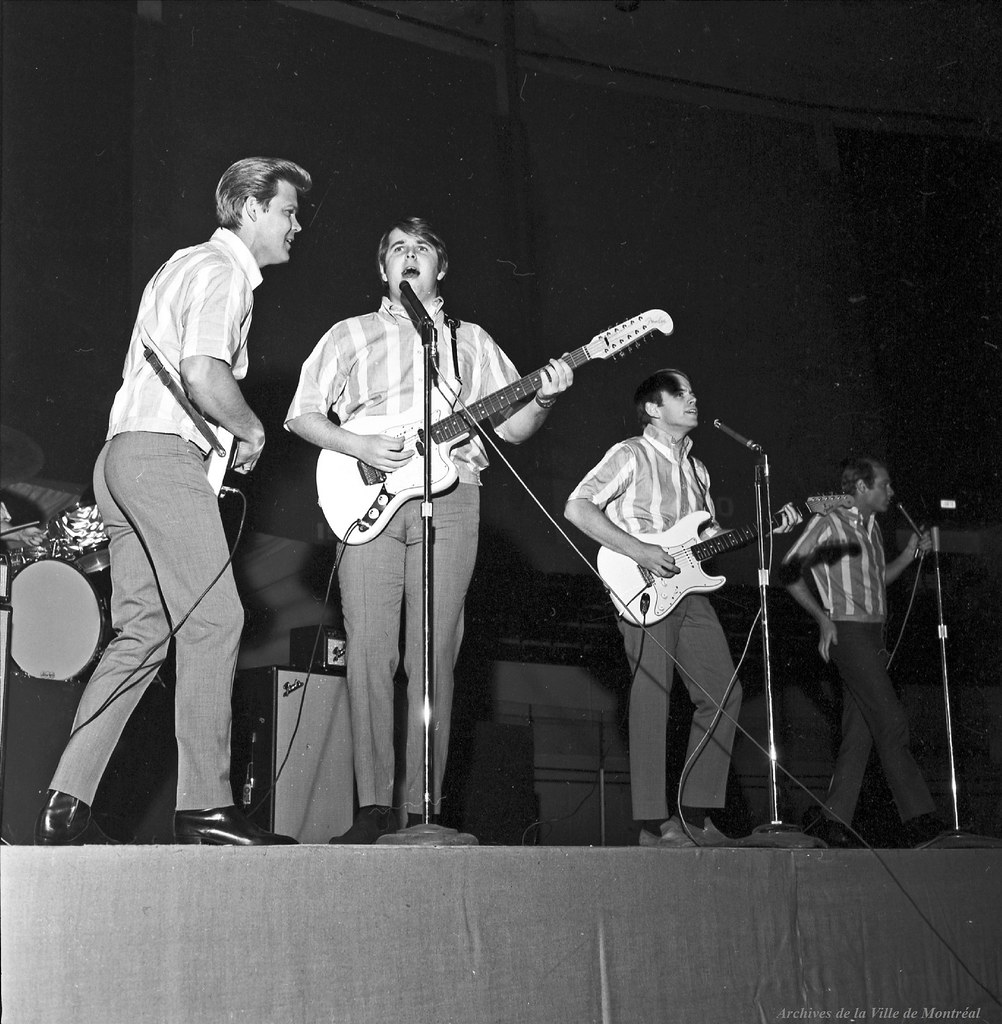
The Beach Boys performing in Montreal on February 19, 1965. From left to right: Glen Campbell (temporarily replacing Brian Wilson), Carl Wilson, Al Jardine, and Mike Love. By this point, Brian had stepped off the touring schedule, but he stayed closely connected to the group, keeping them updated on the studio developments while they continued fulfilling their tour dates on the road. The spark for Pet Sounds ignited the moment Brian Wilson heard the Beatles’ Rubber Soul in December 1965. The album stunned him — not because of one standout track, but because every song felt purposeful, unified, and artistically alive. Wilson walked away convinced of one thing – the Beach Boys had to create an album that matched it, and if they could, surpassed it. By then, Brian had been a professional musician for five years, long enough to sense that the pop industry was shifting beneath his feet. Practically overnight, the market that once revolved around disposable singles opened itself to ambitious, album‑length artistic statements. Brian Wilson recognized the shift immediately and moved fast. He began gathering ideas already in motion: the instrumentation for “Sloop B” (tracked in July 1965, with vocals added that December); “In My Childhood,” which would evolve into “You Still Believe in Me”; and “Run James Run,” later transformed into “Pet Sounds,” the album’s title track — both recorded in November 1965. But the real momentum didn’t begin until mid‑January 1966, when the Pet Sounds sessions officially got underway. PHOTO: “Les Beach Boys en concert à l’aréna Maurice-Richard. 19 février 1965. De gauche à droite : Glen Campbell (qui remplace Brian Wilson), Carl Wilson, Al Jardine et Mike Love. VM94-S32-008. Archives de la Ville de Montréal.” by Archives de la Ville de Montréal is licensed under CC BY-NC-SA 2.0.
The new year 1966 started with Capitol presenting the Beach Boys with three gold record albums signifying one million dollars each (about $10 million each today) in sales – Surfin’ USA (March 1963), Surfer Girl (September 1963), and The Beach Boys Today! (March 1965). The next month the RIAA in the United States certified gold the Beach Boys’ earlier album Summer Days (And Summer Nights!!).
Following the Beach Boys’ first tour in Japan, The Beach Boys begin the recording for Pet Sounds on January 18, 1966. The Pet Sound sessions will end four months later over 27 sessions, using four different recording studios.
Sloop John B; mono alternate mix, Carl sings first verse.
JANUARY 1966
The first major recording session for Pet Sounds is January 22, 1966.
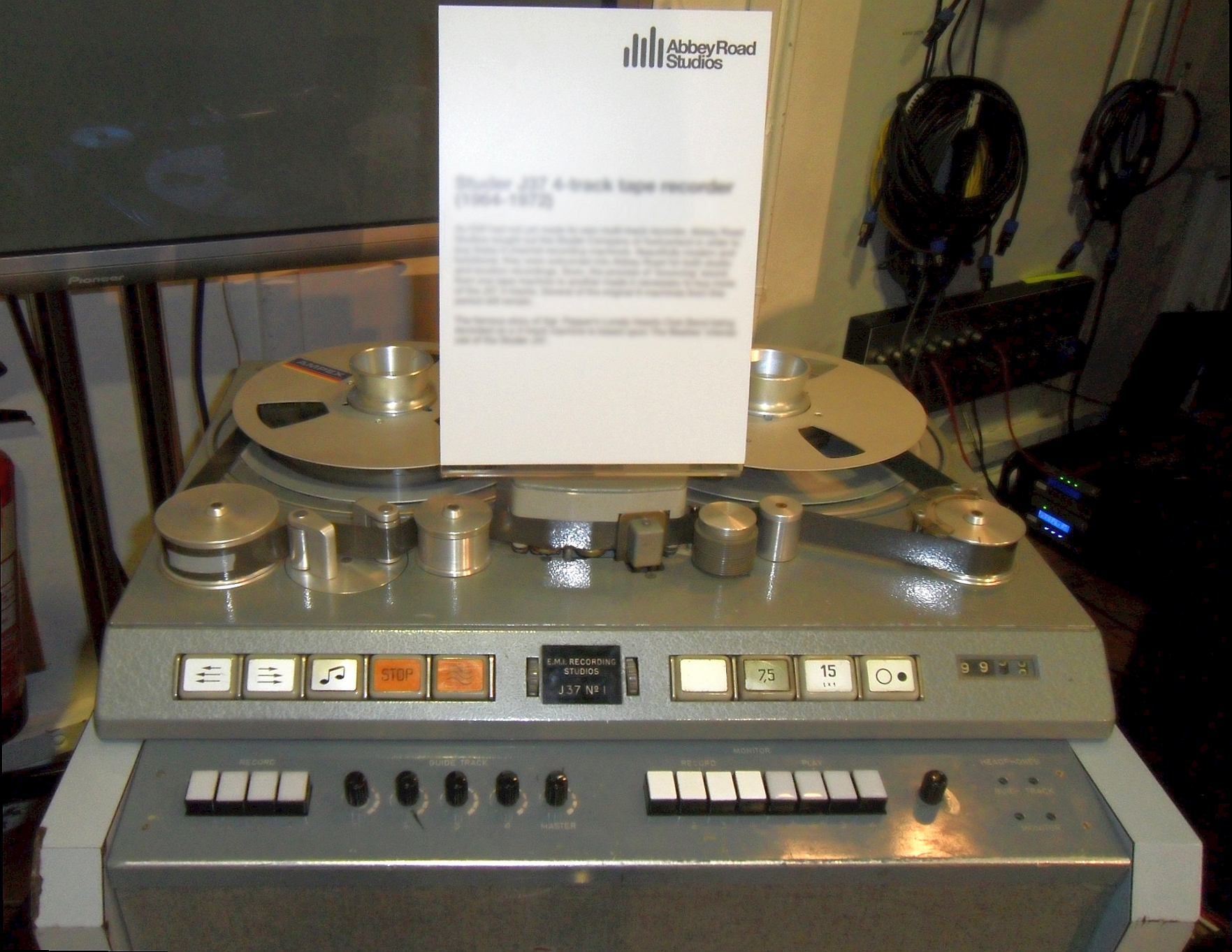
For the sessions Brian used a Scully 280 Tape Machine with 4 tracks – track 1 for drums, percussion, keyboards, track 2 for horns, track 3 for bass and guitars, and track 4 for a rough mix of the 3 other tracks. Then another 4-track machine mixed the instrumentation to mono ready for vocal overdubs. Pet Sounds is the first album that Brian provided worked out songs for each session that he thoroughly explained to the sometimes dozen or more session musicians. PHOTO: “Stax Records Memphis recording equipment” by Mr. Littlehand is licensed under CC BY 2.0.
In the first three‑and‑a‑half‑hour morning session on January 18, 1966, at Western Recorders on Sunset Boulevard, Brian Wilson built the instrumental foundation for “Untitled Ballad” — later titled “Let’s Go Away for Awhile” — a lush, meticulously shaped piece he viewed as his personal tribute to Burt Bacharach.
The following afternoon, during a six‑hour overdub session, Brian supervised an array of unconventional sounds: a guitarist drawing a coke bottle across the strings, alongside more traditional orchestral instruments.
Across these two days, the music made one thing unmistakably clear: Brian wasn’t crafting just another Beach Boys record. He was pushing further down his avant‑garde path, building something far more daring.
Wilson used elite session musicians, unconventional instruments, layered arrangements, and meticulous recording methods to build complex soundscapes that could not easily be replicated live.Pet Sounds pioneered the concept of the studio as an instrument.
“Let’s Go Way For Awhile” was Brian’s tribute to Burt Bacharach who was one influence on Brian’s work.
Western Recorders (now EastWest Studios) at 6000 Sunset Boulevard, Los Angeles, served as the primary recording home for The Beach Boys’ landmark Pet Sounds LP, with production spanning from January 18 to April 13, 1966. The iconic Studio 3 was the venue for the first, crucial sessions on January 18 and 19, where Brian Wilson—leading a “Wrecking Crew” of world-class session musicians—began crafting the pop album’s sophisticated orchestral sound. PHOTO: “Exterior of 6000 Sunset Boulevard, Los Angeles” by Blz 2049 is marked with CC0 1.0. (Public Domain).
The third Pet Sounds session took place on the morning of January 22, 1966, at Gold Star Recorders on Santa Monica Boulevard in Los Angeles. Brian Wilson specifically wanted to work with engineer Larry Levine, and across 21 takes he shaped the instrumental backing track — plus one vocal overdub — for the first session of “Wouldn’t It Be Nice.” The fourteen session musicians needed several early takes simply to grasp what Brian was after: an intricate, interlocking instrumental language that stretched from drums to accordions.
Two days later, Brian returned to Western Recorders for the album’s fourth session. Here he pushed his players toward unusual timbres and techniques — including plucking the strings of a normally percussive instrument like the piano — as he began work on “You Still Believe in Me.” The track required 23 takes for the instrumental foundation, followed by Brian’s overdubbed vocals.
The album introduced a new emotional depth to pop music. Songs such as “Wouldn’t It Be Nice,” “You Still Believe in Me,” “Don’t Talk,” and “Caroline, No” explored vulnerability, longing, self-doubt, innocence, and emotional maturity.
“You Still Believe in Me” landed as one of Pet Sounds’ most intimate moments, with Brian Wilson’s fragile lead vocal carrying a quiet emotional weight. The song distills guilt, insecurity, and unconditional love into a spare, tender arrangement, tracing a narrator who marvels at a partner’s steadfast loyalty even as he confronts his own shortcomings.
On the final day of January, Brian was back at Western for the afternoon’s fifth Pet Sounds session. This time he focused on “Caroline, No,” which demanded 17 takes for the instrumental and insert tracks before he recorded his lead vocal. If “Wouldn’t It Be Nice” was a fantasy about Brian’s secretary, “Caroline, No” — written with Tony Asher — was its emotional opposite: a portrait of a disillusioned man reflecting on a lost love whose fading innocence leaves behind a tender, aching sadness.
Like “You Still Believe in Me,” Brian’s vocal was double‑tracked live‑to‑tape as engineer Chuck Britz mixed the mono master on or before February 9, 1966. The recording is distinguished by its striking instrumentation: Billy Green’s bass flute, Glen Campbell’s 12‑string electric guitar, Al De Lory’s muted harpsichord, and Hal Blaine’s deep, hollow opening created by striking an overturned Sparkletts water bottle. The track closes with the sound of a passing train and Brian’s dogs — the final sonic image of the album.
FEBRUARY 1966
Brian Wilson builds the instrumental core of Pet Sounds, shaping intricate tracks with top L.A. session players at Western Recorders and Gold Star before the Beach Boys added their vocals.
On February 2, 1966, Brian returned to Western Recorders (Studio 3) in Hollywood for the sixth Pet Sounds session, beginning at 2 p.m. with no scheduled end time. He continued shaping “Caroline, No”, overdubbing keyboards, a second bass, drums, and a saxophone onto the January 31 track. Four key session players were present: Hal Blaine on drums, Al De Lory on harpsichord, Steve Douglas on tenor sax, and Carol Kaye on bass guitar.
The following afternoon, during the seventh session at Western, Brian finished the tracking for “Caroline, No”, starting work at 12:30 p.m.
Meanwhile in Los Angeles, 19‑year‑old Carl Wilson secretly married 16‑year‑old Annie Hinsche, sister of Billy Hinsche. Carl hoped to keep the marriage out of the press, but entertainment and teen magazines quickly picked up the story. Soon after, Carl and Annie moved into his newly purchased home in Coldwater Canyon, Beverly Hills.
On Monday the 7th, Brian Wilson held Session 8 for Pet Sounds at Western Recorders Studio 3 in Hollywood, starting at 1:00 p.m. with no set end time. The focus was “Hang On to Your Ego”—also known as “Let Go of Your Ego” and that will be “I Know There’s An Answer” on the album During this session, Brian recorded a lead vocal and completed two alternate mono mixes, with take 12 marked as the preferred version. The song, written by Brian and road manager Terry Sachen, predates his important partnership with Tony Asher on Pet Sounds.
A large group of top Los Angeles session players contributed, including Hal Blaine (drums), Glen Campbell (guitar/banjo), Al De Lory (piano), Steve Douglas, Jim Horn, and Jay Migliori (saxophones), Barney Kessel (guitar), Larry Knechtel (organ), Tommy Morgan (bass harmonica), Ray Pohlman (bass guitar), Lyle Ritz (upright bass), and Julius Wechter (percussion).
Returning from their Far East tour, the Beach Boys went directly to Western Recorders on February 9, 1966, to work on vocals for what would become “I Know There’s an Answer.” Despite Glen Campbell joining on guitar and banjo and Chuck Britz engineering, the session was marked by tension. The band remained skeptical of Brian Wilson’s new, sophisticated direction, with Mike Love—working with lyricist Tony Asher—worrying that the material had strayed too far from their signature surf sound. While Brian pushed for artistic evolution, Mike, Al Jardine, and Bruce Johnston were visibly unsure of the shift.
Beach Boys in 1965. Public Domain.
The chaotic, lengthy session saw frequent interruptions from laughter and chatter, delaying takes of the vocal inserts. An impatient Brian finally intervened, demonstrating the precise vocal part at the piano. After 17 takes, he approved Al’s lines, followed by four more passes. Later, the group joined Brian to record the short vocal insert, capping off a session that focused on layering the backing vocals that would help define Pet Sounds.
“I Know There’s An Answer” included some of the first vocals the Beach Boys did for Pet Sounds.
The Wrecking Crew was essential to realizing Wilson’s vision. Their technical skill allowed Wilson to translate abstract musical ideas into fully realized recordings, creating what became known as “symphonic pop.”
Though never pictured on the album sleeve, interviewed in teen magazines, or standing under stage lights, The Wrecking Crew was the smooth engine powering Pet Sounds. When Brian Wilson stopped touring in late 1964, he didn’t just escape the road; he opened the door to a new, experimental studio world where he could build songs with meticulousness. The architects of this sound were Los Angeles’ finest session musicians.
By early 1966, Wilson had developed a near-telepathic rapport with these players. The Wrecking Crew was indispensable not merely for their technical mastery, but for their ability to translate Wilson’s abstract, emotional language into music. When he bypassed traditional chords to say, “Make it feel like the sun coming up,” or “Play it like you’re underwater,” they understood. They turned metaphors into rhythm and moods into harmonic shifts.
Before a single Beach Boys vocal was added, the tracks already breathed with life. The Wrecking Crew didn’t just play notes; they provided the album’s pulse, architecture, and emotional weight. They were the unseen collaborators on one of the most ambitious pop records ever made—an orchestra of specialists who transformed Brian Wilson’s imagination into a sonic reality that still resonates over sixty years later.
L.A.’s Finest: The Wrecking Crew on Pet Sounds
Rhythm Section Hal Blaine — drums, percussion Jim Gordon — drums (select sessions) Frank Capp — percussion Gary Coleman — percussion, timpani, temple blocks Lyle Ritz — upright bass Carol Kaye — electric bass, 12‑string guitar Ray Pohlman — electric bass Bill Pitman — Danelectro 6‑string bass, guitar Guitars & Keyboards Glen Campbell — 12‑string guitar Billy Strange — electric 12‑string guitar Jerry Cole — guitar Don Peake — guitar Al De Lory — piano, organ, harpsichord Larry Knechtel — organ, piano Don Randi — piano, tack piano Mike Melvoin — organ, keyboards Horns Steve Douglas — tenor saxophone Jay Migliori — saxophone Plas Johnson — saxophone Roy Caton — trumpet Tony Terran — trumpet Ollie Mitchell — trumpet Lew McCreary — trombone Strings Sid Sharp — violin (concertmaster) Leonard Malarsky — violin Ralph Schaeffer — violin William Kurasch — violin Harry Hyams — viola Justin DiTullio — cello Featured Instruments Jim Horn — flute, clarinet Billy Green — bass flute (“Caroline, No”) Paul Tanner — Electro‑Theremin (“I Just Wasn’t Made for These Times”) Julius Wechter — vibraphone, percussion Gene Estes — percussion
In preparation for what would be Pet Sounds, Brian’s extraordinary musical instincts were at this moment in the band’s evolution transforming not only their repertoire but that of mid-1960s rock pop. On February 11, 1966, at session 10 for Pet Sounds Brian worked on a song the band first rehearsed on October 13, 1965: “Don’t Talk (Put Your Head on My Shoulder).” Starting at 9 a.m. and with no fixed finish time, Brian supervised the instrumental tracking and vocal recording and completed inserts as well as Brian’s lead vocal. As usual at Western, Chuck Britz engineers the date.
WHAT ARE VOCAL INSERTS? Brian Wilson used them as modular building blocks to achieve his signature “Wall of Sound” vocal density. Vocal inserts are short —sometimes just a few seconds—of a specific harmony or a brief vocal line recorded as overdubs to be “inserted” into the main track to fix a line or create a richer, choir-like texture.
The Beach Boys first rehearsed “Don’t Talk (Put Your Head on My Shoulder)” on October 13, 1965. Four months later, during Pet Sounds session 10, Brian Wilson returned to the song. Beginning at 9 a.m. with no set end time, he oversaw the instrumental tracking, supervised the vocal recording, completed several inserts, and cut his own lead vocal. No other Beach Boys appear on the track. The song itself is a quiet meditation on nonverbal connection — the way intimacy, stillness, and the wish to freeze a moment with a loved one can speak louder than words. Its orchestral writing and inward‑looking lyrics mark Brian’s shift toward deeper emotional complexity and a more sophisticated musical language. As the group headed back on the road in April 1966 for a nine‑date Southern tour with The Lovin’ Spoonful and Chad & Jeremy, Brian stayed in the studio refining the track. Working from previously recorded instrumental foundations, he guided a chamber‑sized string section through overdubs, recorded two lead vocals, and experimented with several rough mono mixes. What emerged was one of Pet Sounds’ most intimate statements — a piece built entirely around Brian’s voice, his arranging instincts, and his growing fascination with the emotional power of silence and restraint.
On February 14, 1966, the 11th and 12th sessions for Pet Sounds took place across two different studios. The day began at Western Recorders, where Brian Wilson supervised the instrumental tracking for “I Just Wasn’t Made for These Times” from noon until 6:00 p.m. When another artist’s booking forced them to move, Brian relocated to Gold Star Studios to finish the session with engineer Larry Levine. There, they completed the instrumentation, Brian’s lead vocal, and the group’s backing vocal overdubs and inserts.
Coordinated by contractor Diane Rovell, the Gold Star session featured an impressive lineup of “Wrecking Crew” musicians, including Hal Blaine on drums, Glen Campbell on guitar, and Michael Melvoin on harpsichord. Notably, this session marked Brian’s first use of a theremin-style sound. While the original 1920s theremin was known for its eerie sci-fi tones, musician Paul Tanner used a simplified “electro-theremin.” Invented in 1958, this version used a sliding mechanism and volume knob rather than hand gestures, allowing for the precise control Brian required.
Left to right: Buce Johnston, Terry Melcher, Tony Asher, Brian Wilson in Western Recorders, during a session for Pet Sounds. Cashbox advertisement for the Pet Sounds album, published May 7, 1966. Public Domain. This advertisement (or image from an advertisement) is in the public domain because it was published in a collective work (such as a periodical issue) in the United States between 1931 and 1977 and without a copyright notice specific to the advertisement.
Tanner, a veteran jazz trombonist with the ABC Orchestra, admitted he had never heard of The Beach Boys before the session. Despite this, his distinct electro-theremin contribution became a hallmark of the track and would later define the sound of “Good Vibrations” and “Wild Honey.”
“I Just Wasn’t Made for These Times” emerges as one of the most revealing documents of Brian Wilson’s inner life, an archival window into the alienation that shadowed his most creative period. With Tony Asher’s melancholy lyrics and Wilson’s plaintive, multi‑tracked vocals, the track frames mid‑1960s pop as a vessel for anxiety, artistic isolation, and the feeling of moving out of step with the world around him.
On February 15, 1966, the Beach Boys began their day at the San Diego Zoo, where photographer George Jerman captured the iconic cover for Pet Sounds. Because of contractual restrictions with Columbia Records, Bruce Johnston was unable to appear in the shot. Although Brian Wilson intended the “Pet Sounds” title to represent his favorite musical textures, Capitol Records interpreted it literally, resulting in the petting zoo theme.
Later that afternoon, between 2:00 and 5:00 PM, the band moved to Western Recorders for session 13. Brian took charge of the instrumental tracking for “That’s Not Me,” eventually marking take 15 as the master. This track stands out in the Pet Sounds sessions as the only one featuring the Beach Boys themselves as the primary instrumentalists: Brian played organ, Carl handled guitar, and Dennis was on drums. The day concluded with instrumental inserts and a lead vocal overdub by Mike Love.
On February 16, 1966, Brian spent the day at Western Recorders in Hollywood. Though the studio was booked, no new recording took place; instead, he focused on creating alternate mixes of “You Still Believe in Me” and “Hang On to Your Ego,” alongside a rough mono mix of “Wouldn’t It Be Nice” with engineer Chuck Britz, which notably featured swapped verse lyrics in Brian’s lead vocal.
“That’s Not Me” reads like a field report from the fault line between youth and adulthood, an archival snapshot of a young man testing the promise of independence and finding mostly loneliness in its wake. Built on a stark, almost skeletal arrangement and carried by Mike Love’s steady lead, the track dramatizes the moment when ambition—being “big in the eyes of the world”—gives way to a deeper search for authenticity, belonging, and the self he nearly lost in the chase.
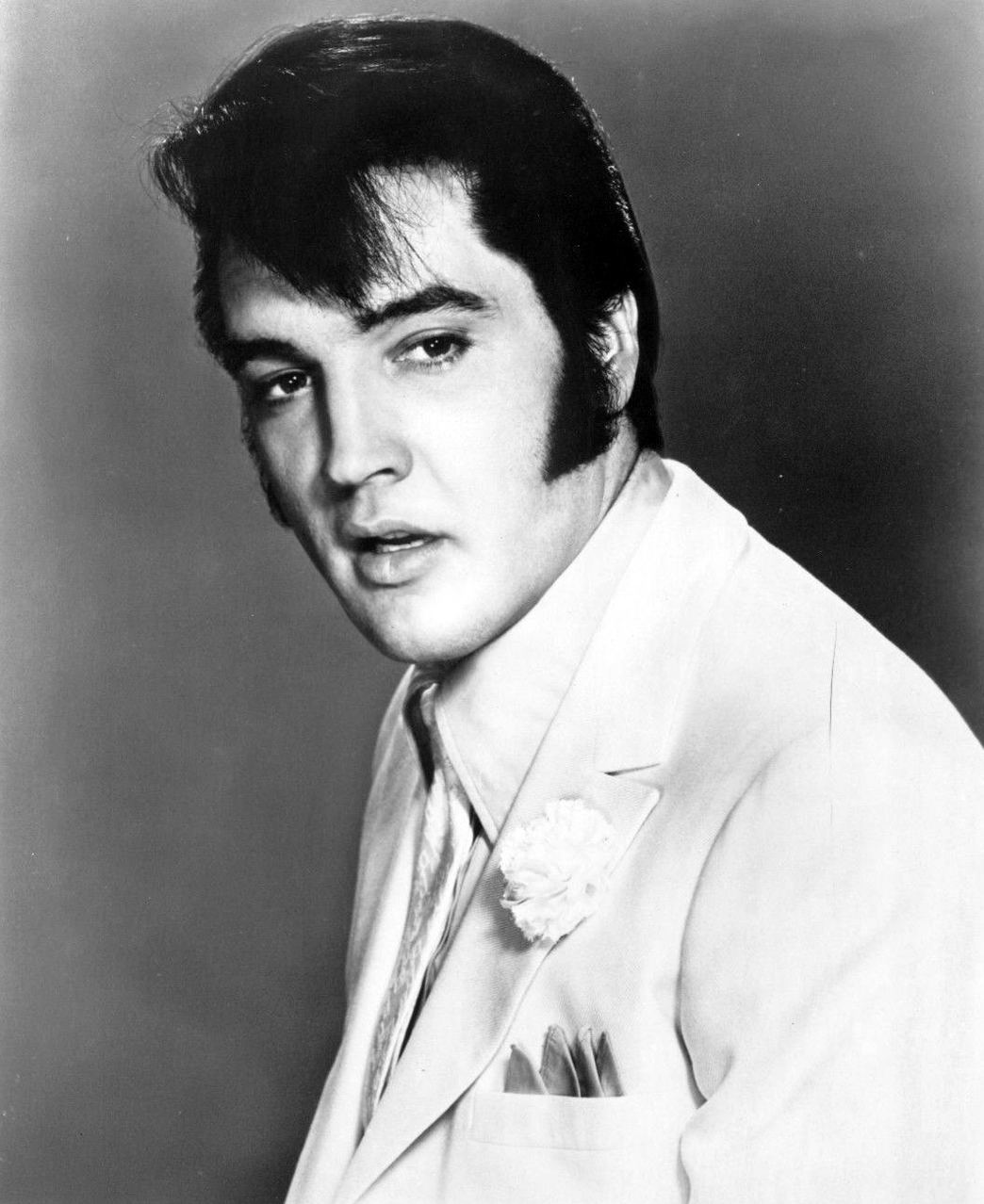
Elvis Presley publicity photo for The Trouble with Girls, 1968. Toward the end of the February 16, 1966 session st Western recorders, the Beach Boys shifted to vocal rehearsals but struggled to focus. Just down the street at Radio Recorders on 7000 Santa Monica Blvd, Elvis Presley was recording for the Spinout soundtrack, covering tracks like “Never Say Yes” and “Adam and Evil.” Distracted by the presence of Brian’s idol of the last decade, the group struggled with the session. Bruce eventually went over to meet Elvis, and upon his return to Western Recorders, a captivated Brian eagerly asked for every detail of the encounter. Public Domain. This work is in the public domain in the United States because it was published in the United States between 1931 and 1977, inclusive, without a copyright notice. “Publicity photos (star headshots) have traditionally not been copyrighted. Since they are disseminated to the public, they are generally considered public domain, and therefore clearance by the studio that produced them is not necessary” – film production expert Eve Light Honthaner in The Complete Film Production Handbook, (Focal Press, 2001 p. 211.).
On Thursday, February 17, 1966, Brian Wilson pushed deeper into his sonic experimentation, dividing his time between two Hollywood studios. The afternoon began at Western Recorders with continued work on Pet Sounds (Session 14), before shifting to Gold Star Studios from 11:30 p.m. to 3:00 a.m. for the very first dedicated session for “Good Vibrations.”
Wilson was already envisioning the track as a “pocket symphony,” meticulously layering ideas in fragments. At Gold Star, he collaborated with engineer Cal Harris and musician Paul Tanner to integrate the electro-theremin, a custom instrument that provided the song’s signature wavering, “sci-fi” sound. By the end of the night, this unique, psychedelic texture helped bridge the gap between pop and experimental music, setting a new greatly imitated aesthetic for the era.
While this initial “pet sound” experiment did not make it onto the Pet Sounds album, its release as a single later that year became a landmark in 1960s pop, sparking massive interest in electronic instruments and influencing contemporaries like the Beatles and the Rolling Stones in this direction. During the intense, 26-take session, Wilson also explored organ textures with musician Larry Knechtel, ending the night with a rough mono mix—an early snapshot of what would become one of his most ambitious productions.
On February 18, 1966, during the 18th session for Pet Sounds, Brian Wilson recorded a new, fuller instrumental track for “Good Vibrations.” After 28 takes, he finally marked the last as the best. However, when he began tracking guide vocals, he grew unhappy with the results and started questioning Tony Asher’s lyrics. These early setbacks foreshadowed the song’s exclusion from the album.
Major elements remained unresolved: the iconic bridge had yet to be written, the Electro-Theremin parts were unfinished, and Wilson’s “modular” recording process—eventually spanning over 90 hours of tape across multiple studios—became increasingly overwhelming. As the track grew more ambitious, Wilson began viewing it as a “pocket symphony” better suited for his next project rather than Pet Sounds.
Instead, “Good Vibrations” was released as a standalone single on October 10, 1966, with “Let’s Go Away For Awhile” as the B-side. It was an immediate sensation, selling over 230,000 copies in its first four days and topping the Billboard Hot 100 on December 12. Despite its massive success, the song didn’t appear on a studio album until the release of Smiley Smile in September 1967.
Good Vibes to Good Vibrations: The lyrical transition from Tony Asher to Mike Love.
Initially, Tony Asher—Brian Wilson’s primary collaborator on Pet Sounds—provided the song’s structural foundation. He helped define the title, changing it from “Good Vibes “ to “Good Vibrations.” Asher refined the “good, good, good vibrations” chorus, and drafted introspective verses about a psychic connection, While the lyrics fit the mood of Pet Sounds, Wilson eventually felt they lacked commercial punch.
When the project stretched beyond Pet Sounds, Wilson turned to Mike Love who grounded the song in a more commercial “boy-girl” theme. Love supplied the vivid 1966 sensory imagery of the “colorful clothes” she wears and the “sunlight” in her hair. Love provided the famous “excitations” hook, and a radio‑ready tone that carried the song to No. 1.
Mike Love Feb. 13, 1965. Public Domain. This work is in the public domain in the United States because it was published in the United States between 1931 and 1977, inclusive, without a copyright notice.
Good Vibrations the Lost Studio Footage.
On February 23, 1966, Brian returned to Western Recorders for Pet Sounds session 16. Still treating “Good Vibrations” as a preliminary track for the album, he devoted the third session to supervising new insert recordings. The date featured organ, drums, harpsichord, harmonica, electro‑theremin, piano, and bass guitar. Brian continued refining the arrangement — even asking the organist to play an octave higher — and completed the first basic instrumental tracks for the song’s verses, still aligned with Tony Asher’s draft lyrics.
Brian Wilson wrapped up the week at Western Recorders in Hollywood, working with The Wrecking Crew to arrange “Good Vibrations” for the Pet Sounds sessions. Despite taping rehearsals, he was dissatisfied with the track’s direction and, recognizing the immense work needed, paused it until March 24th, prioritizing the completion of the Pet Sounds album instead.
TAKING CARE OF BUSINESS.
Barbara Ann continued its strong run in Europe, reaching No. 3 in the UK and No. 2 in the Dutch charts. Around the same time, The Beach Boys’ management shifted: Nick Grillo took over day‑to‑day operations, and Brian brought in Derek Taylor as the group’s publicist. Taylor, fresh from his celebrated work with the Beatles, quickly became a key ally, championing Brian’s vision and helping shape the early positive reception of Pet Sounds. In Los Angeles, Taylor’s reputation as a sharp, witty operator preceded him, but not everyone warmed to him. He later recalled Murry Wilson bristling at a set of promotional photos, convinced Taylor was steering the band’s image in the wrong direction — an early sign of the tension that would shadow Taylor’s significant and short-lived relationship with the Beach Boys.
In late 1967, Beatles press officer and journalist Derek Taylor hosted a freeform Sunday‑evening show on KRLA 1110 AM, capturing the spirit of the “Summer of Love.” His September 17 broadcast reflected his sharp perspective on the rising psychedelic scene, which he had championed since serving as publicist for the Monterey Pop Festival. At the same time, he edited the KRLA Beat, steering it toward deeper coverage of California’s counterculture. Widely respected — often dubbed a “fifth Beatle” — Taylor returned to London in 1968 to lead publicity for Apple Corps.
MARCH 1966
The Breakneck Studio Marathon That Forged the Final Shape of Pet Sounds.
On March 1, 1966, Brian Wilson entered Hollywood’s Western Recorders to breathe life into “I’m Waiting for the Day,” a track he had first sketched two years prior. Leading the Wrecking Crew through rigorous takes, Wilson layered flutes and English horns to build the song’s intricate foundation. The following day, the action split into three high-stakes fronts: (1) Brian moved to Columbia Studios to leverage their advanced 8-track technology, where he finalized an alternate mono mix of “Wouldn’t It Be Nice”; (2) Capitol Records issued a pivotal memo, officially pulling “Good Vibrations” from the Pet Sounds lineup and replacing it with the Bond-inspired instrumental “Run James Run” (renamed “Pet Sounds”); and (3) Back at Western, engineer Chuck Britz prepped mono mixes of “I Know There’s an Answer” and “Wouldn’t It Be Nice,” capturing the album’s evolution through their incomplete vocal tracks.
The week of March 6 kicked off Sunday afternoon at Western Recorders with the 18th session for Pet Sounds. Under the guidance of engineer H. Bowen David, Brian Wilson refined “I’m Waiting for the Day,” layering new string and woodwind parts onto the previous week’s recordings before capturing the final vocal pass. Between takes, Brian also began sketching an untitled work, experimenting with new rhythmic and harmonic concepts using a fresh lineup of session musicians.
While Brian remained immersed in the studio, the rest of the Beach Boys—now led by Carl Wilson—shifted gears, hitting the road for a brief five-date tour to keep the band’s live momentum alive.
On Tuesday, March 8, the air inside Western Recorders crackled with a different kind of electricity. Brian Wilson took his post for Pet Sounds Session 19, ready to capture the soul of “God Only Knows.” Alongside engineer Chuck Britz, Brian relentlessly chased perfection through twenty grueling takes until the instrumental foundation finally locked into place. The song was still a skeleton, but even then, its heartbeat was undeniable.
The pace carried into the early hours of Wednesday, March 9, when Brian returned for a second instrumental session from 12:30 to 4:00 a.m. A small string ensemble—Harry Hyams, William Kurasch, Lenny Malarsky, and Ralph Schaeffer—added a new layer of warmth and clarity. By take 19, the blend of strings and rhythm settled into a tone Brian recognized as the right direction.
The album was initially misunderstood. Critics and fellow musicians admired the work, but many fans, Capitol Records executives, and even members of the Beach Boys struggled to understand the band’s new direction. Commercially, the album’s success grew slowly and was fully appreciated only through later critical reevaluation.
The musicians around him sensed the significance of the work. Bruce Johnston remembered the late‑night calls and the feeling, upon entering the studio, that something unusually strong was taking shape. Carl Wilson later described the sound coming through the monitors as something that changed the atmosphere of the room—music that seemed to resonate physically. To him, the song had come together in a brief moment of inspiration. To him, the song felt like a five-minute flash of divine clarity—an otherworldly gift that changed everything.
By Thursday, March 10, the sessions moved to Columbia Studio A for another late‑night stretch. This time the focus was vocals. Carl stepped up to record his lead for “God Only Knows,” followed by the group adding their harmonies with the precision that defined their sound.
Even as the track grew more assured, Brian was aware of the risk in its title. Using the word “God” in a pop song was unusual in 1966, and he hesitated. But the emotional clarity of the music pushed him forward, and the song continued to take shape exactly as he felt it needed to.
In My Life: Paul McCartney’s favorite Beach Boys song.
God Only Knows: how radio stations and the public reacted to the Beach Boys’ song in 1966 and 1967.
Brian Wilson feared the title alone might get the song banned, a valid concern in the conservative mid-1960s. Using “God” in a pop song crossed a line, making many American programmers hesitant. The reaction was drastically different in the UK, where it hit No. 2, trailing only the Beatles’ “Yellow Submarine.” British critics praised its sophistication, and Paul McCartney famously hailed it as “the greatest song ever written,” directly influencing the creative momentum behind Sgt. Pepper.
In America, however, southern radio stations dismissed the title as blasphemous, leading to a slow, uneven rollout. Capitol Records buried it on the B-side of “Wouldn’t It Be Nice,” resulting in a disappointing No. 39 peak on the Billboard Hot 100. Furthermore, its baroque arrangement and honest opening line—”I may not always love you”—were unheard of in pop music.
Yet, its brilliance was undeniable. When added to the live set in 1966, audiences responded differently; from D.C. to Hawaii, they listened with rapt attention, waiting for the final chord to fade before applauding. This quiet, sincere appreciation proved that while the chart impact was slow, the music had found its mark. What began as a misunderstood track soon became a cultural fixture, appearing in countless films, TV shows, and retrospectives. Today, it is revered as a masterpiece.
Carl Wilson in Cashbox advertisement for the Pet Sounds album, published May 7, 1966. Public Domain.
On March 7, 1966, “Caroline, No” was released as Brian Wilson’s debut solo single, backed with the instrumental “Summer Means New Love” from Summer Days (And Summer Nights!!). The audience response was tepid, similar to “The Little Girl I Once Knew” in November 1965. It debuted at no. 37 on the Billboard Hot 100 in April 1966 and ultimately peaked at no. 32 during its seven‑week chart run.
On Sunday, March 13, 1966, while the touring band kept to the road, Brian Wilson spent the afternoon and evening in Western Recorders, Studio 3, mixing a rough “God Only Knows” and speaking with reporter Ken Gravatt. He said his focus had shifted fully to production — the reason he’d stepped off the stage — and described the past five months as a golden creative stretch, influenced by producer Phil Spector’s dense, layered, and resonant “Wall of Sound” and the Beatles’ artistic evolution and studio focus. Working from his hillside home at 1448 Laurel Way, he was already shaping new singles, including “Sloop John B.” While the touring Beach Boys crisscrossed the country, Brian Wilson stayed behind in early 1966, locking in with lyricist Tony Asher to shape the album’s emotional palette and musical “feels.”
From mid‑March, the Beach Boys bounced between studio prep and the final leg of their winter tour. On Tuesday, March 15, Brian booked Western to refine arrangements with the Wrecking Crew, though no new tracks were cut.
Two days later, Thursday, March 17, the touring band hit the UP Fieldhouse in Dayton, Ohio, followed by a sold‑out double show at Fordham College in the Bronx on Friday, March 18, closing the tour.
The next week, Monday, March 21, Capitol issued “Sloop John B”/“You’re So Good to Me,” aiming to regain momentum after the softer reception to “Caroline, No” (released in the U.K. on April 1 it failed to chart). The marketing strategy worked — “Sloop John B” surged quickly, becoming the band’s next major hit.
In early 1966, while the touring Beach Boys crisscrossed the country, Brian Wilson stayed home in Los Angeles, deep in a creative surge shaped by Phil Spector, The Beatles, and his growing partnership with Tony Asher. From his Laurel Way home and Western Recorders, he pushed further into layered production and more personal songwriting — a shift that made “Sloop John B” the perfect bridge into the emotional world of Pet Sounds. Originally suggested by Al Jardine the previous summer, the Bahamian folk tune fit Brian’s new first‑person, introspective style. He reshaped it into a bright, tightly arranged pop single with stacked vocals and a rising sense of homesick tension. When Capitol released “Sloop John B” on March 21, 1966, it quickly outpaced the softer response to “Caroline, No,” entering the Billboard Top Ten by April 23 and peaking at No. 3 on May 7. Its success gave Brian the momentum — and confidence — to push the rest of Pet Sounds even deeper into personal territory.
SETLIST FOR BEACH BOYS MARCH 11, 1966 ONE NIGHT ONLY SOLD-OUT SHOW IN CLEVELAND, OHIO.
While Brian Wilson was in Los Angeles pushing the boundaries for Pet Sounds, the touring lineup—Mike Love, Carl Wilson, Dennis Wilson, Al Jardine, and Bruce Johnston—delivered a high-energy set to 3,000 screaming fans at the Cleveland Public Music Hall. Supporting acts for the 8:30 PM show included The Lovin’ Spoonful, Noel Harrison, and local act Mickey and The Clean Cuts.
Fun, Fun, Fun Little Honda Surfin’ U.S.A. Surfer Girl The Little Old Lady from Pasadena (Jan & Dean cover) Hawaii Papa-Oom-Mow-Mow (The Rivingtons cover) You’ve Got to Hide Your Love Away (The Beatles cover) Then I Kissed Her California Girls Help Me, Rhonda I Get Around Do You Wanna Dance? (Bobby Freeman cover) Barbara Ann (The Regents cover) Johnny B. Goode (Chuck Berry cover)
Mickey & the Clean Cuts was a local band in Cleveland, Ohio, that supported the Beach Boys on stage in 1966.
The week pulsed with restless creativity as Brian chased new textures across Los Angeles. On Tuesday the 22nd, he worked with Chuck Britz at Western Recorders, shaping alternate mixes of “God Only Knows,” “I Know There’s an Answer,” and “Wouldn’t It Be Nice” to sharpen the album’s emotional core. Later, at Western, he recorded the family dogs, Banana and Louie, for the album’s closing wink. By nightfall, he was at Columbia, testing his own lead vocal for “God Only Knows” and refining “Here Today.”
Returning to Columbia on Thursday the 24th, Brian dove into the fourth session for “Good Vibrations,” resuming the complex, modular recording process as if no time had passed. Across these sessions, the pattern was clear: Brian was moving between studios, relentlessly refining both the album and the single in real time to reach a more perfect sound.
By Friday the 25th, work on Pet Sounds returned to Columbia’s Los Angeles studio, where Brian Wilson continued refining the album’s vocal architecture in session 24. With Ralph Balantin engineering, Mike Love recorded his lead for “Here Today,” completing the vocal layer that would later be paired with instrumental material tracked earlier in March and mixed on the 22nd for the master tape.
“Here Today” serves as a melancholy warning about heartbreak on Pet Sounds, utilizing a powerful arrangement of surging trombones and a high-octave bass line. The track conveys that love can vanish instantly, emphasizing the sudden nature of the emotional fall.
Accounts from the period underscore the increasingly exacting standards shaping Brian’s studio process. Mike Love recalled the repeated takes required to eliminate even the slightest pitch or timing irregularity, while Carl noted Brian’s ability to halt a performance only a few bars in after detecting a single misplaced note within a dense arrangement. These moments illustrate the heightened precision that defined the album’s late‑March sessions.
Released on March 28, 1966, Bruce & Terry’s final 1960s single for Columbia Records, “Don’t Run Away,” is driven by intricate vocal harmonies and advanced, Brian Wilson-influenced chord progressions reminiscent of The Beach Boys Today! era.
Amidst the heavy studio, touring, and publicity demands of early 1966, Bruce [Johnston] & Terry [Melchor] released “Don’t Run Away” on March 28. Co-written by Mike Love, the sophisticated single traded their early sun-soaked surf-rock sound for a mature, thoughtful style. The track stands out as a hidden gem, that blended the duo’s signature studio style of lush vocal harmonies with intricate pop arrangements.
APRIL 1966
Sprint of final vocals and rapid‑fire mixes brings a 10‑month Pet Sounds odyssey to a close.
The Beach Boys opened April 1966 by diving straight back onto the road after a brief break, launching a nine-date Southern tour alongside The Lovin’ Spoonful and Chad & Jeremy. The band hit Dallas on April 1 and moved through Fort Worth the following night. By Sunday, April 3, they were juggling the punishing, cross-country pace that defined this era. While the touring lineup rushed to Texas for two consecutive Houston shows that evening, Brian Wilson remained at Western Recorders in Hollywood for late-night Pet Sounds sessions. In the studio, Brian used previously recorded instrumental tracks to shape “Don’t Talk (Put Your Head on My Shoulder),” guiding a chamber-sized string section through overdubs, capturing two lead vocals, and cutting several rough mono mixes.
While Brian worked through the night in California, the touring group kept their momentum alive across Texas and into Tennessee. Stops in San Antonio on April 4 and Austin on April 5 led into a packed Easter week spectacle at Memphis’s Ellis Auditorium Amphitheater on April 6. More than 6,300 fans packed the venue, with hundreds more spilling into the balconies. Local newspapers marveled at the massive turnout, the orderly crowd, and the sheer energy of a hit-heavy setlist that included “Fun, Fun, Fun,” “Surfin’ U.S.A.,” “Sloop John B,” “Help Me, Rhonda,” and “Barbara Ann.” The tour pressed onward to Jacksonville on April 7 and St. Petersburg on April 8, keeping the band moving from city to city while Brian stayed behind, refining the album that would soon redefine their sound and legacy.
“I’m Waiting for the Day” hits with a burst of timpani, bass, and swelling dynamics, capturing the emotional turbulence at the heart of Pet Sounds. Brian Wilson builds the track around shifting moods—tender verses, explosive instrumental breaks, and lush vocal blends. Lyrically, it follows a narrator promising patience and devotion as someone heals from past heartbreak, a mix of vulnerability and optimism that deepens the album’s emotional arc.
On Saturday, April 9, Brian Wilson returned to Gold Star Studios for the fifth major tracking date on “Good Vibrations,” picking up the project sixteen days after the previous session. Working beside engineer Larry Levine at Gold Star’s custom 12‑input console, Brian drove a full ensemble of top Los Angeles session players through another round of intricate instrumental building. The studio’s famously tight acoustics and its plaster‑lined echo chambers—central to the Wall of Sound aesthetic—gave the session its distinctive density.
Capitol deemed the work substantial enough to assign a formal master number, 55949, identifying this 2:28 performance as a potentially releasable version. To capture the arrangement’s complexity, Levine tracked the ensemble live with Gold Star’s tube microphones, whose warm saturation and high headroom made them ideal for the session’s heavy sound pressure levels. As the main date wrapped, a small group of musicians stayed on while Brian experimented with tape‑delay textures and modular overdubs, refining the track’s evolving architecture.
Meanwhile, nearly 3,000 miles away, the touring Beach Boys were onstage at the Miami Beach Convention Hall, sharing a bill with The Lovin’ Spoonful and several local acts. Their nine‑date run carrying the existing hits to packed houses across the country was grossing $200,000 (over $2 million today), even as Brian remained in Los Angeles, isolated from the road and immersed in cutting‑edge studio work that was reshaping the group’s future.
On April 16, 1966, Brian Wilson arrived at Capitol’s mastering suite to put the finishing touches on Pet Sounds, incorporating pre-recorded train sounds and his dogs, Banana and Louie. In the dimly lit, technical room, Brian sat on the floor, guiding the engineer through the album from “Wouldn’t It Be Nice” to “Caroline, No,” adjusting levels on the fly. Following the playback, his companion, stunned by the sound, reassured a vulnerable Brian that this was his finest work, regardless of what the other Beach Boys might think.
Later, at home, Marilyn Wilson listened in silence with Brian to Pet Sounds, overwhelmed by the emotional weight of his creation. With final sessions wrapped on April 13, 1966, after months of experimentation across various studios, that mastering session sealed a project that transformed the band from surf-pop icons into studio visionaries. Pet Sounds was released on May 16, 1966.
The Beach Boys’ Pet Sounds (1966) reset the boundaries of pop, its bold arrangements and studio‑first approach shattered conventional songwriting constraints and, in a cross-Atlantic artistic competition, sparked the Beatles toward Sgt. Pepper’s in 1967. Brian Wilson’s innovations — from stacked vocals to melodic basslines — also helped drive the Beatles to abandon traditional touring and fully embrace the studio-centric, psychedelic orchestration that defined Sgt. Pepper’s and ultimately reshaped modern rock history.
“That’s Not Me” stands as a quiet turning point on Pet Sounds, a lean, organ‑driven track shaped by Brian Wilson’s stripped‑back production and the group’s finely layered vocals. Beneath its minimalist groove, the song captures the unease of early adulthood: Mike Love’s lead expresses the dawning realization that chasing independence and success far from home can’t replace the grounding pull of love, belonging, and the life he left behind at home.
Legacy: Pet Sounds became one of the most influential albums in popular music history. Its innovations influenced countless artists and famously challenged the Beatles to raise their own artistic ambitions, culminating in Sgt. Pepper’s Lonely Hearts Club Band.
Brian Wilson’s Pet Sounds (1966) set a new standard for popular music, introducing rich arrangements, emotional depth, and a level of studio experimentation that reshaped what an album could be. After Sgt. Pepper, King Crimson’s In the Court of the Crimson King (1969) carried that shift into progressive rock, blending jazz, classical forms, and dark Mellotron layers in a way that echoed Wilson’s studio‑driven approach. Steely Dan’s Can’t Buy a Thrill (1972) continued this lineage with its precise production and jazz‑leaning polish, while the Rolling Stones’ Goats Head Soup (1973) used Jamaican recording sessions to create a smoother, more processed sound that still held traces of their grit. Nearly twenty years later, the Cocteau Twins’ Heaven or Las Vegas (1990) pushed this tradition further, using layered effects, intricate processing, and ethereal vocals to create music that was both atmospheric and melodically clear. Together, these albums show how artists built on the innovations of Pet Sounds, expanding the possibilities of mood, arrangement, and emotional expression in modern music.
The Beach Boys: The Definitive Diary of America’s Greatest Band on Stage and in the Studio, Keith Badman, Backbeat Books; First Edition, 2004, p. 95-142.
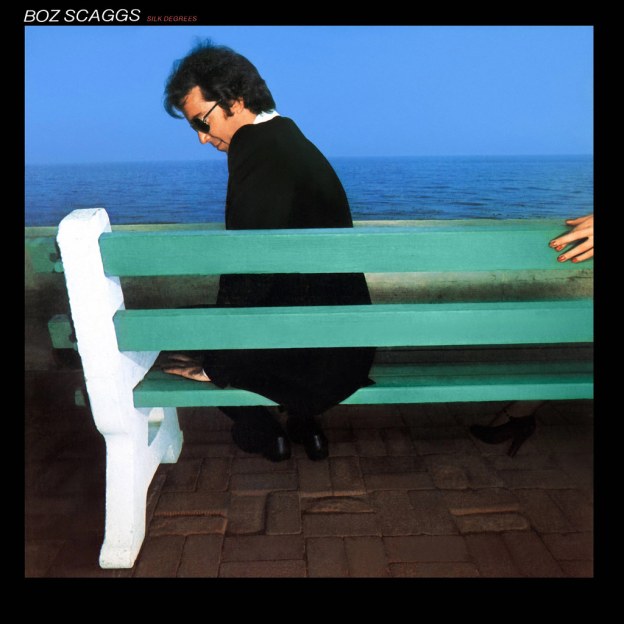
Feature Image: The 1976 cover of Boz Scaggs’ Silk Degrees, photographed by Moshe Brakha at Casino Point in Avalon, California, presents a stylish and contemplative Scaggs seated on a green-and-white seaside bench overlooking the Pacific. Dressed in a light suit and tie, he appears against a sunlit coastal backdrop while the partial view of a woman’s hand and high-heeled shoe introduces an element of mystery and cinematic intrigue. The image’s polished elegance perfectly complements the album’s sophisticated blend of soul, jazz, R&B, and pop, helping make Silk Degrees one of the most memorable record sleeves of the 1970s. “Silk Degrees – Boz Scaggs” by Brett Jordan is licensed under CC BY 2.0.
Silk Degrees was Boz Scaggs’ career-defining breakthrough album, a landmark fusion of blue-eyed soul, R&B, jazz, funk, and pop whose commercial success, enduring hit singles, and influence on the future members of Toto secured its place as one of the most important albums of the mid-1970s.
The song about a hustler looking for his next big score, Lido Shuffle was the fourth and final single released from Boz Scaggs’ 1976 album, Silk Degrees, in February 1977, about one year after the album’s February 1976 release. It’s Over (No. 38), Lowdown (No. 3) and What Can I Say (No. 42) already had been released as singles from an album that debuted in March 1976 on the Billboard 200 and peaked at no. 2 on September 18, 1976. Though Silk Degrees spun off the chart in May 1978, 115 weeks after it first appeared, Scaggs’ 7th studio album had best-selling staying power, remaining in the top 20 (no. 17) at the end of 1976 and higher at no. 8 at the end of 1977. Before its chart departure, Silk Degrees had been certified Platinum by the RIAA and is certified 5x multi-Platinum today. see – Boz Scaggs | Biography, Music & News | Billboard – retrieved February 18, 2026.
Lido Shuffle is a breezy, upbeat number that hit no. 11 on the Hot 100 in 1977. LYRICS Lido missed the boat that day he left the shack But that was all he missed and he ain’t comin’ back At a tombstone bar in a jukejoint car, he made a stop Just long enough to grab a handle off the top Next stop Chi town, Lido put the money down and let it roll He said one more job ought to get it One last shot ‘fore we quit it One more for the road Lido, whoa-oh-oh-oh He’s for the money, he’s for the show Lido’s waitin’ for the go Lido, whoa-oh-oh-oh He said one more job ought to get it One last shot ‘fore we quit it One more for the road Lido be runnin’, havin’ great big fun, until he got the note Sayin’ toe the line or blow, and that was all she wrote He be makin’ like a beeline, headin’ for the borderline Goin’ for broke Sayin’ one more hit ought to do it This joint ain’t nothin to it One more for the road Lido, whoa-oh-oh-oh He’s for the money, he’s for the show Lido’s waitin’ for the go Lido, whoa-oh-oh-oh One more job ought to get it One last shot and we quit it One more for the road Lido, whoa-oh-oh-oh He’s for the money, he’s for the show Lido’s waitin’ for the go Lido, whoa-oh-oh-oh…
While inspiration for the unmistakably contemporary “Lido Shuffle” can be drawn from Carl Perkins’ energetic rockabilly style and Fats Domino’s infectious rhythm-and-blues groove, Boz Scaggs and David Paich fashioned a modern tale of a gambler forever chasing the next big win.
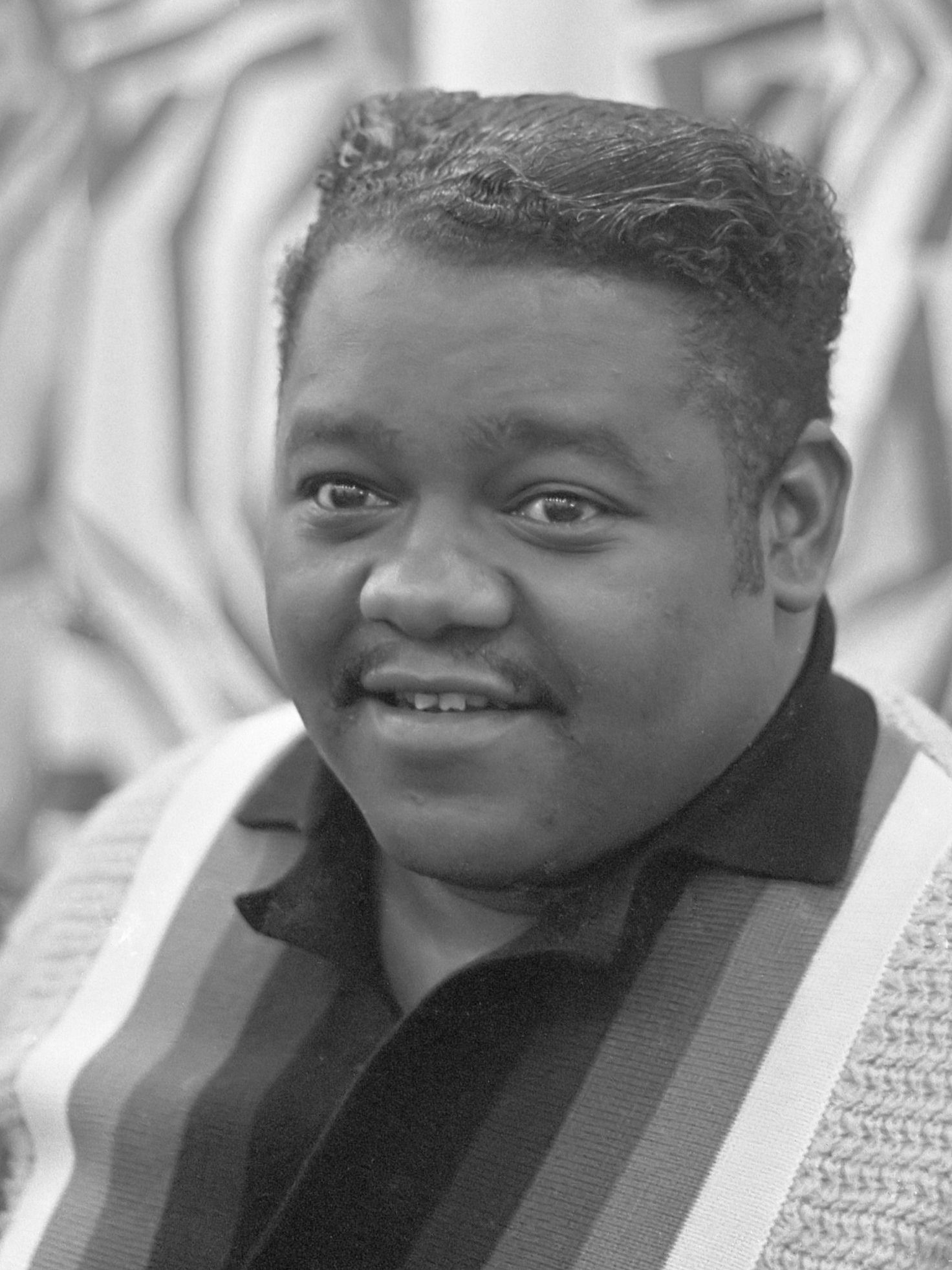
November 3, 1962: Fats Domino in Amsterdam. “Fats Domino (1962)” by Hugo van Gelderen / Anefo is marked with CC0 1.0.
The idea for, and beat of, pop-rock Lido Shuffle was inspired by songs by Carl Perkins (1932-1988) and Fats Domino (1928-2017) and whose lyrics are about a gambler who left home to chase bets (even to Chicago) and ends up losing more winning.
Though promising to do better, the big gambler gets wrapped up in bets, so that each time is the last time – until the next time. “He’s for the money, he’s for the show, Lido’s waitin’ for the go.” Spending wildly and getting deeper and deeper into debt, he’s having fun. That is, until the note finally comes due and the big gambler has to go for broke running for the border – or that’s the plan. Because he can neither escape his gambling addiction nor his debts he goes for one more gambling hit “goin’ for broke” expecting a bailout that won’t be coming. Like the American buffalo hunted to extinction so ends up the gambling Lido Shuffle.
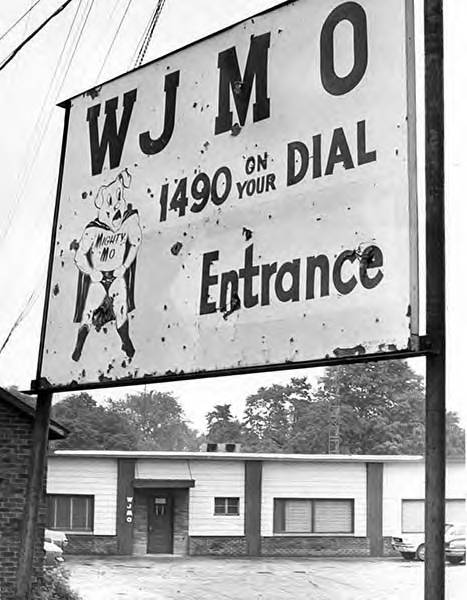
A sales turnaround for Silk Degrees started in Cleveland, Ohio. It’s Over, the album’s first, and up to that point, only single, had modest top 40 success and Scaggs had no plans to release anything more. But an enterprising Cleveland R&B radio DJ at WJMO- AM started playing the Steely-Dan-styled Lowdown right off the album to Ohio’s North Coast – and the public response was massively positive. Scaggs’ label, Columbia, sent the song around to other R&B and Top 40 radio stations across the country and released Lowdown as a single in June 1976. By October 1976 Lowdown was no. 3 on the Billboard Hot 100 and, always having had crossover appeal, was no. 5 on the Hot Soul Singles chart. Lowdown was no. 1 on the Cash Box Top 100 and sold over one million copies to be certified Gold. It also won that year’s Grammy Award for Best R & B song making 32-year-old Boz Scaggs the first white musical artist to ever win in that award category.
The success of “Lowdown” was pivotal, becoming the album’s breakthrough hit and winning a Grammy for Best R&B Song.
Lowdown is the standout hit on Silk Degrees. Released on June 4, 1976, the smooth, jazzy R&B ballad became the breakthrough hit of the album, peaking at no. 3 on the Billboard Hot 100 and winning the 1977 Grammy for Best R&B Song. LYRICS Baby’s into runnin’ around, hangin’ with the crowd Puttin’ your business in the street, talkin’ out loud Sayin’ you bought her this and that And how much you done spent I swear she must believe it’s all heaven sent Hey, boy You better bring the chick around To the sad, sad truth The dirty lowdown (Oohooohooohooo I wonder, wonder, wonder, wonder who) Taught her how to talk like that (Oohooohooohooo I wonder, wonder, wonder, wonder who) Gave her that big idea Nothin’ you can’t handle, nothin’ you ain’t got Put your money on the table and drive it off the lot Turn on that old lovelight and turn a “Maybe” to a “Yes” Same old schoolboy game got you into this mess Hey son Better get on back to town Face the sad old truth The dirty lowdown (Oohooohooohooo I wonder, wonder, wonder, wonder who) Put those ideas in your head (Oohooohooohooo I wonder, wonder, wonder, wonder who) Yeah Come on back down, little son Dig the low, low, low, low, lowdown! You ain’t got to be so bad, got to be so cold This dog eat dog existence sure is getting old Got to have a jones for this, jones for that This runnin’ with the Joneses, boy, just ain’t where it’s at, no, no… You gonna come back around To the sad, sad truth The dirty lowdown (Oohooohooohooo) I wonder, wonder, wonder, wonder who) Got you thinking like that, boy (Oohooohooohooo I wonder, wonder, wonder, wonder who) I wonder, wonder, wonder, wonder who Said I wonder, wonder, wonder, I wonder who Oh, look out for that lowdown (I wonder, wonder, wonder, wonder who) That dirty, dirty, dirty, dirty lowdown (Ooohooohooohooo) I wonder, wonder, wonder, wonder who Ooohooohooohooo I wonder, wonder, wonder, wonder who Got you thinkin’ like that Got you thinkin’ just like that (Ooohooohooohooo) (I wonder, wonder, wonder, wonder who) Lookin’ that girl in the face is so sad I’m ashamed of you I wonder, wonder, wonder, wonder who
The album served as a creative incubator for musicians such as David Paich, Jeff Porcaro, and David Hungate, who would soon form Toto.
It was Silk Degree’s producer, Joe Wissert, who introduced Scaggs and David Paich of the future Toto, and Lowdown was the first song on the album they wrote together. The song came about when Scaggs and Paich took off to a weekend getaway spot outside L.A. and pounded out song ideas. When they returned to the city, they immediately recorded funk-disco Lowdown with the band. To talk about “the lowdown” is a slang term for “what’s really going on” – what’s factual and not just fancied. In Scaggs’s Lowdown, the singer looks to convey to the man in the song that he face “the sad, sad truth” about his woman. “The dirty lowdown” is that she is “into runnin’ around, hangin’ with the crowd” and not appreciating him or what he gives to her. Though she is “Puttin’ your business in the street,” the singer understands and is sympathetic to what the man wants. He seems to identify with the man’s hope that there’s “Nothin’ you can’t handle, nothin’ you ain’t got, Put your money on the table…Turn a Maybe to a Yes.” But the singer concludes that the man’s rosy outlook, born of overconfidence or desperation, is missing the mark: “Same old schoolboy game got you into this mess…” The singer could legitimately wonder “who got you thinking’ like that” but then iterates the lowdown: “Lookin’ that girl in the face is so sad I’m ashamed of you…”
“WJMO – Radio – 11821 Euclid Ave” by Timothy Culek (photographer) Cleveland State University, Michael Schwartz Library, Special Collections is marked with CC0 1.0.
The album transformed Scaggs from a respected cult artist into a major commercial star, reaching No. 2 on the Billboard 200 and eventually earning multi-platinum status.
Following this success that Scaggs admitted was the pure “accident” of a chain of events that had Lowdown released as a single, Lido Shuffle landed on the pop chart within a couple of weeks in March 1977, peaking at no. 11 on the Billboard Hot 100 in May 1977 (no. 6 on Cash Box) and remaining on the pop chart throughout that summer. Like Lowdown, Lido Shuffle was co-written with David Paich who was featured on keyboards. The track also featured drummer Joe Porcaro and bassist David Hungate, all of whom formed the band Toto later in 1977. Of Silk Degrees Robert Christgau of the Village Voice gave the album a “B PLUS (Later A-)” observing: “Scaggs is criticized for his detachment, but I say it’s subtlety and I say thank god for it. In the past, he’s sometimes bought (not to mention sold) his own lushness, but this collection is cooled by droll undercurrents–white soul with a sense of humor that isn’t consumed in self-parody. Inspirational Verse [from Lowdown]: “Gotta have a jones for this/Jones for that/This runnin’ with the joneses, boy/Just ain’t where it’s at.” See – Robert Christgau: Consumer Guide July 12, 1976 – retrieved February 18, 2026.
“Lido Shuffle,” “Lowdown,” and “It’s Over” demonstrated the album’s blend of sophisticated musicianship and mainstream appeal. Its longevity on the charts and continued reputation illustrate its lasting cultural significance.
It’s Over is the second track on side two of Boz Scaggs’ 1976 album, Silk Degrees, and was its lead single released in March 1976. Co‑written by Scaggs and David Paich, the track distills Silk Degrees into one smooth hit — a blue-eyed soul, tight R&B, soft-rock glide. Paich, Jeff Porcaro, and David Hungate anchor the groove, the same trio that would launch Toto later that year. It’s Over cracked the top 40 at no. 38 on the Billboard Hot 100. LYRICS Your baby doesn’t love you any more Golden days before they end Whisper secrets to the wind Your baby won’t be near you anymore Tender nights before they fly Send falling stars that seem to cry Your baby doesn’t want you any more It’s over It breaks your heart in two To know she’s been untrue But, oh, what will you do? When she says to you There’s someone new We’re through, we’re through It’s over, it’s over, it’s over All the rainbows in the sky Start to weep, then say goodbye You won’t be seeing rainbows anymore Setting suns before they fall Echo to you that’s all that’s all But you’ll see lonely sunsets after all It’s over, it’s over, it’s over It’s over
Brian Wilson was not simply a successful songwriter or Beach Boys leader, but a transformative musical innovator whose emotional songwriting, sophisticated studio experimentation, and groundbreaking harmonic arrangements expanded the artistic possibilities of pop music in the 1960’s and beyond.
Founding a Family Band
In 1961, Brian Wilson formed the Beach Boys with his brothers Carl and Dennis, their cousin Mike Love, and school friend Al Jardine. Brian, the eldest Wilson brother, quickly emerged as the group’s musical center of gravity. The family story would later carry deep shadows: Dennis drowned in 1983, and Carl died of cancer in 1998. But in the early 1960s, the band’s rise was swift and bright.
Chart Breakthrough and an American Peak
By December 1963, the Beach Boys had reached a national summit with “Surfin’ U.S.A.”, the number‑one song in America. Their sound—sun‑drenched, harmony‑driven, and unmistakably Californian—seemed to define the country’s musical mood. Brian’s melodic instincts and arranging talent were already pushing the group beyond surf‑rock formulas toward something more ambitious.
Wilson’s response to the Beatles and the British Invasion was artistic innovation rather than imitation.
The British Invasion Arrives
Everything changed two months later. On February 9, 1964, the Beatles appeared on The Ed Sullivan Show before an audience of 73 million Americans (see – https://www.edsullivan.com/the-beatles-on-the-ed-sullivan-show-on-february-9-1964/ – retrieved June 11, 2025). Overnight, the British Invasion reshaped the pop landscape. For Brian Wilson, the moment landed like a challenge. The Beach Boys—still riding high—suddenly found themselves in an informal, transatlantic competition with the Fab Four, especially Paul McCartney, for the artistic future of 1960s pop.
Rather than retreat, Brian accelerated. He began writing more original material, experimenting with new arrangements, unusual instrumentation, and increasingly sophisticated harmonic structures. His goal was not imitation but innovation—a new sound that could stand beside the Beatles’ evolving artistry and, at times, even inspire it.
A Remarkable Run of Hits
The result was one of the most productive bursts in American pop history. Between “Surfin’ U.S.A.” (1963) and “God Only Knows” (1966), the Beach Boys scored 15 top‑20 hits, including two number‑ones that held the top spot for multiple weeks. Brian’s studio experiments—lush textures, emotional directness, and fluid four‑part harmonies—reshaped what pop music could be and earned the admiration of McCartney himself.
A New Era of Studio Experimentation
Pet Sounds marked a turning point for rock and pop bands, ushering in an era of studio experimentation. It predated—and directly inspired—the Beatles’ Sgt. Pepper’s Lonely Hearts Club Band in 1967, one of pop’s first concept albums and a catalyst for the psychedelic imagery that shaped mainstream culture into the mid‑1970s.
God Only Knows exemplified Wilson’s blend of vulnerability, spirituality, orchestral ambition, and emotional depth.Wilson’s true significance lies in his artistic innovation and enduring influence, not merely his commercial success.
Though not fully recognized at the time, God Only Knows and Pet Sounds are some the clearest evidence of Wilson’s genius and his achievement and has since been acknowledged as trendsetting and profoundly influential.
Crafting the Sound of “God Only Knows”
For God Only Knows, the Beach Boys assembled a 15‑piece orchestra alongside a rock band of top Los Angeles session players to realize Brian Wilson’s “sophisticated soundscape.” The group’s 11th studio album represented a clear break from their earlier catalog—described not as rock and roll but as “futuristic, progressive and experimental.” (Stebbins, The Beach Boys FAQ, p. 74)
Writing a Song of Faith and Vulnerability
According to Brian Wilson, God Only Knows was written in about 45 minutes. For many listeners, it stands as the greatest Beach Boys song—and, for some, the greatest song of its era or perhaps of all time. Its lyrics revolve around faith, emotion, and the fear of losing a deep personal connection. The stakes are high throughout.
Carl Wilson’s Defining Vocal
Brian gave the lead vocal to his brother Carl, believing Carl could deliver the words with clarity and meaning—without the self‑consciousness Brian feared in his own voice. Carl’s performance became one of the defining moments of the Beach Boys’ recorded legacy.
A Private Vision of the Divine and Message of Feeling and Eternity
Wilson’s use of the word “God” was unusual in a pop context. But it was not the public God of church or country. For him, God was a private force who “helps a person control their hopes and doubts.” (I Am Brian Wilson, p. 180). Brian Wilson remained most proud of God Only Knows because he believed it carried a genuine message—one rooted in feeling, vulnerability, and a sense of eternity.
“God Only Knows” by andreboeni is licensed under CC BY 2.0. When Pet Sounds was released in May 1966, reviews In America were largely tepid and sales did not match previous albums. The album—featuring Brian Wilson and Tony Asher’s God Only Knows—would not be certified Gold for 30 years. At the time, critics were praising Dylan’s Blonde on Blonde, the Rolling Stones’ Aftermath, and the Beatles’ Revolver, artists whose roles as rock’s new masters were already clear. Brian Wilson, still reinventing himself, was instead seen as a poignant and possibly troubled pop figure. Later reevaluations of Pet Sounds, including God Only Knows, now regard the album as the trendsetting work of a genius.
Carl Wilson’s Voice and the Song’s Reception
Mike Love agreed that God Only Knows “became one of the album’s most celebrated numbers,” noting that Carl Wilson’s “dulcet voice” actually heightened the song’s “spiritual dimensions.” Love also believed it marked a moment when Carl—four and a half years younger than Brian—emerged as a talented leader within the Beach Boys. (Love, Good Vibrations, pp. 130–131)
Brian Wilson’s Studio Authority
During the Pet Sounds sessions, Brian acted as a virtual dictator in the studio, prompting Love to nickname him “General Patton,” a reference to the four‑star American general of World War II. Other nicknames were less patriotic. Love also confirmed Brian’s reluctance to use the word “God” in the song and, by inference, the courage and honesty required to include it.
With Carl Wilson on lead vocals, the lyrics of God Only Knows speak from the perspective of someone who believes that life without his lover can only be fathomed by God. Brian Wilson was married to Marilyn Rovell at the time, though in a 1976 radio interview he said the song was not written for anyone in particular, even if he had written other songs with specific girls in mind. Wilson and Rovell divorced amicably in 1979.
Brian Wilson on Love and Meaning
In 2016, Brian Wilson reflected on the emotional core that shaped so much of his writing: “I wasn’t in love often. I thought about girls, but if they didn’t think about me, how was that love? …When friends would tell me that they were seeing a new girl, I would ask them if they were really in love. That was important to me. It seemed like a real thing. Were they in love? Did something happen inside them that made them feel closer to that other person and closer to themselves? It’s why I wrote so many love songs, because it’s the real thing.” (I Am Brian Wilson, p. 124)
The initial commercial and critical underappreciation for Pet Sounds stands in stark contrast to its later recognition as a timeless masterpiece. At the heart of this legacy is “God Only Knows,” a track that perfectly captured Brian Wilson’s unique blend of vulnerability, spirituality, and orchestral ambition. This emotional depth was not lost on live audiences at the time, who famously fell into a hushed, captivated silence to listen closely whenever the song was performed.
Release and Chart Performance
God Only Knows was issued in the United States in July 1966 as the B‑side to “Wouldn’t It Be Nice,” peaking at no. 39 on the Billboard Hot 100. Abroad, the song fared far better, reaching no. 2 in the United Kingdom and entering the top ten in Canada and across Europe.
Bruce Johnston remembered squeezing into the tiny studio one Wednesday night as Brian Wilson recorded “God Only Knows.” A full ensemble jammed shoulder‑to‑shoulder — violinists perched on French horn players, Carl playing his guitar from a booth, and the room overflowing with bodies and sounds. It was, he said, “incredible.”
A Shared Session and a Distinctive Sound
Both God Only Knows and “Wouldn’t It Be Nice” were recorded during the same session on April 11, 1966. Brian Wilson worked on an 8‑track recorder at Columbia, and Terry Melcher—California producer and singer‑songwriter—was present to provide backup vocals for “God Only Knows.” The session reflected Wilson’s increasingly intricate studio methods during the Pet Sounds period.
A Song Written for Carl
Carl Wilson later said that Brian told him he had written God Only Knows for him to sing as recognition of his “beautiful spirit” (Badman, The Beach Boys: The Definitive Diary, Backbeat Books, 2004, p. 126). Carl’s vocal would become one of the defining performances in the Beach Boys’ catalog, carrying the emotional clarity Brian believed the song required.
A Closing Perspective
Taken together—the modest U.S. chart showing, the strong international reception, the shared April 11 session, Melcher’s presence, and Brian’s intention for Carl’s voice—God Only Knows stands as a carefully crafted work whose meaning was shaped as much by the people in the room as by the song on the page. It remains one of the most personal statements in Brian Wilson’s body of work, anchored in the bond between two brothers and the evolving artistry of the Beach Boys at their creative peak.
God Only Knows LYRICS I may not always love you But long as there are stars above you You never need to doubt it I’ll make you so sure about it God only knows what I’d be without you If you should ever leave me Though life would still go on, believe me The world could show nothing to me So what good would living do me? God only knows what I’d be without you God only knows what I’d be without you If you should ever leave me Though life would still go on, believe me The world could show nothing to me So what good would living do me? God only knows what I’d be without you God only knows what I’d be without you (God only knows what I’d be without you) God only knows what I’d be without you (ooh-ooh) (God only knows what I’d be without you) God only knows God only knows what I’d be without you (ooh-ooh) (God only knows what I’d be without you) God only knows God only knows what I’d be without you (ooh-ooh) (God only knows what I’d be without you) God only knows God only knows what I’d be without you (ooh-ooh) (God only knows what I’d be without you) God only knows God only knows what I’d be without you (ooh-ooh) (God only knows what I’d be without you) God only knows
SOURCES:
Badman, Keith. The Beach Boys: The Definitive Diary of America’s Greatest Band on Stage and in the Studio. 1st ed. New York: Backbeat Books, 2004, p. 126.
Love, Mike. Good Vibrations: My Life as a Beach Boy. New York: Penguin Publishing Group, 2016, pp. 130-131.
Morgan, Johnny. The Beach Boys: America’s Band. Illustrated ed. New York: Union Square & Co., 2015, pp. 108-109.
Stebbins, Jon. The Beach Boys FAQ: All That’s Left to Know about America’s Band. New York: Backbeat Books, 2011, p. 74.
Wilson, Brian, with Ben Greenman. I Am Brian Wilson: A Memoir. Boston: Da Capo Press, 2016, pp. 124 and 180.
Feature image: The site of the Wilson family home in Hawthorne, California, at 3701 W. 119th Street where Brian Wilson composed Don’t Worry Baby with lyrics by Roger Christian (a DJ at KFWB in L.A.) over the course of a couple days in late 1963 or early 1964. With parents Murry and Audree Wilson, moved into the modest, single-story tract home in the 1940s where Brian, along with his brothers Carl and Dennis, lived throughout their entire childhood and teenage years. . In the mid-1980s, the property was demolished for the construction of the Century Freeway (I-105). The entire block was cleared, and the original address along with an important piece of music history, vanished overnight. PHOTO: “Beach Boys Landmark – Plano general I” by tkksummers is licensed under CC BY-SA 2.0.
“Don’t Worry Baby” was more than a hot-rod song or a B-side. It was Brian Wilson’s first fully realized emotional masterpiece, capturing vulnerability, romance, and sophisticated pop craftsmanship at the precise moment the Beatles and the British Invasion were transforming popular music.
Beach Boys in 1963. Brian Wilson, Carl Wilson, Dennis Wilson, David Marks, Mike Love. Since spring of 1963 they had 3 top-5 hits (and two more top-10 hits). “Surfin’ U.S.A.” peaked at no. 3 in May 1963 and became Billboard’s no.1 song for the year. “Little Saint Nick” released in December 1963 peaked at no. 3 on the Billboard Christmas Singles chart. It was in this time period that Brian Wilson with Roger Christian wrote “Don’t Worry Baby,” one of the Beach Boys’ finest songs pre-British Invasion about a guy who agrees to drag race but regrets it and, confiding his situation to his girlfriend, is tenderly consoled by her with the song’s title phrase. Public Domain.*
The Hawthorne House: Where the Beach Boys Began
The Wilson family home in Hawthorne was where Brian, Dennis, and Carl Wilson honed their musical skills and formed the Beach Boys in 1961 with cousin Mike Love and friend Al Jardine. It was within these walls that they created the group and famously recorded their first breakthrough single, Surfin’, in the living room over Labor Day weekend in 1961.
Brian Wilson lived at the family home into his early adulthood. By the time the Beach Boys became one of America’s most successful pop groups, the band’s success enabled family members to move on from the modest Hawthorne neighborhood where it had all started. Yet the house remained central to the Beach Boys story. It was there that Brian developed as a songwriter and, just a few years later, composed one of the group’s most enduring songs, Don’t Worry Baby.
Though the Beach Boys scored the No. 1 song of 1963 with Surfin’ U.S.A., the direction of popular music changed almost overnight following the Beatles’ first appearance on The Ed Sullivan Show on February 9, 1964. Seen by an estimated 73 million viewers, the broadcast launched the British Invasion and transformed rock and roll, challenging American artists such as the Beach Boys to evolve or risk being left behind.
Cars, California Youth, and Brian Wilson’s Imagination
Brian Wilson’s first car was a light burgundy Mercury passed down from his mother. He called it “the Merc.” After failing his first driver’s test, Wilson gained a reputation as an inattentive driver because his mind constantly wandered to other interests, especially music. His father eventually coached him through a second successful attempt.
Wilson later compared driving a car to playing a musical instrument. Both required touch, timing, and control to achieve the desired result. Yet he quickly realized that music offered infinitely more possibilities for creativity and self-expression. After a year behind the wheel of the Mercury, he purchased a used 1957 Ford Fairlane, a car he admired despite envying the more powerful machines driven by other Southern California teenagers.
The Fairlane became part of Beach Boys lore. Wilson later recalled hearing the group’s first single, Surfin’, on the radio while driving the car in 1962. He claimed he raced it enthusiastically, though few believed him. Cars, competition, and youthful bravado would soon become recurring themes in his songwriting.
Brian Wilson wrote “Don’t Worry Baby” as a response to the emotional power of the Ronettes’ “Be My Baby,” blending teenage themes with richer emotional depth.
From Be My Baby to Don’t Worry Baby
By 1963, Wilson had begun linking the imagery of cars and romance in his music while also developing a deeper understanding of how records could convey emotion. A crucial influence was Be My Baby by the Ronettes. Wilson became captivated by the song’s emotional impact, production, and vocal performance. He also admired how singers such as Aretha Franklin and Dionne Warwick could communicate profound feeling through the simplest vocal gestures.
Inspired by Be My Baby, Wilson wrote Don’t Worry Baby with Los Angeles disc jockey and lyricist Roger Christian. Initially intended for the Ronettes, the song was offered to the group but declined. The Beach Boys then recorded it themselves, producing what would become one of the defining tracks of their early career.
Written over several days at the Wilson family home in Hawthorne, Don’t Worry Baby borrowed the emotional spirit of Be My Baby while transforming it into something distinctly Wilson’s own. Ostensibly a story about a drag racer seeking reassurance from his girlfriend, the song elevated familiar hot-rod themes into a moving portrait of vulnerability, trust, and love. Looking back years later, Wilson described it simply: “It was a very simple and beautiful song. It’s a really heart and soul song. I really did feel that in my heart.”
At an August 1961 audition with Hite Morgan, a L.A. music publisher, Dennis Wilson said that Brian was working on a song about surfing. The truth was that no song existed. But the music publisher was intrigued and told the soon-to-be Beach Boys to come back when they had their new surfing song ready. “Surfin'” was recorded in October 1961 with Mike Love doing lead vocals, Brian on percussion/vocals, Carl Wilson on guitar/vocals, Al Jardine on acoustic bass/vocals and Dennis Wilson doing vocals. It was released in November 1961 on the independent label Candix. Though it peaked at no.75 on the Billboard Hot 100, its lyric which included the line”Surfin’ is the only life, the only way for me” capitivated listeners and was unique on the radio in late 1961.
LYRICS Surfin’ is the only life, the only way for me Now surf Surf with me I got up this mornin’, turned on my radio (Ooh, surfin’) I was checkin’ out the surfin’ scene to see if I would go (Ooh, surfin’) And when the DJ tells me that the surfin’ is fine (Ooh, surfin’) That’s when I know my baby and I will have a good time We’re goin’ surfin’, surfin’ Surfin’, surfin’, surfin’ Surfin’, surfin’, surfin’ Surfin’ is the only life, the only way for me Now surf Surf with me From the early mornin’ to the middle of the night (Ooh, surfin’) Any time the surf is up, the time is right (Ooh, surfin’) And when the surf is down to take its place (Ooh, surfin’) We’ll do the Surfer’s Stomp, it’s the latest dance craze We’re goin’ surfin’, surfin’ Surfin’, surfin’, surfin’ Surfin’, surfin’, surfin’ Surfin’ is the only life, the only way for me Now surf Surf with me Now the dawn is breaking and we really gotta go (Ooh, surfin’) But we’ll be back here very soon, that you better know (Ooh, surfin’) Yeah, my surfer knots are rising and my board is losing wax (Ooh, surfin’) But that won’t stop me, baby, ’cause you know I’m comin’ back We’re goin’ surfin’, surfin’ Surfin’, surfin’, surfin’ Surfin’, surfin’, surfin’ Surfin’ is the only life, the only way for me Now come on, pretty baby and surf with me, yeah
“Don’t Worry Baby” transformed a simple drag-racing narrative into a universal story about fear, reassurance, and love.
While the Beach Boys were known for cars, surfing, and California youth culture, Don’t Worry Baby revealed the deeper artistic direction that would soon define Brian Wilson’s greatness.
Feature Image: The Beach Boys in 1964; clockwise from left: Al Jardine, Mike Love, Brian Wilson, Carl Wilson, Dennis Wilson. Trade ad for The Beach Boys’s single “California Girls”/”Let Him Run Wild.” Public Domain.**
Although buried on a hot-rod-themed album and issued as the B-side to “I Get Around,” the song emerged as the album’s enduring masterpiece and a signpost toward Wilson’s later innovations.
The Masterpiece Hidden on Shut Down Volume 2
While the music industry was being transformed by the British Invasion, the Beach Boys were creating one of the defining pop records of the era. Recorded during sessions in early January and mid-February 1964, spanning the very weeks surrounding the Beatles’ landmark appearance on The Ed Sullivan Show, Shut Down Volume 2 introduced “Don’t Worry Baby.”
The track features one of Brian Wilson’s most tender and convincing lead vocal performances, supported by Mike Love’s resonant bass part and the rich harmonies of Al Jardine, Carl Wilson, and Dennis Wilson. Released on March 2, 1964, the Beach Boys’ fifth studio album followed the enormous success of Surfin’ U.S.A., Billboard’s No. 1 song of 1963 and the centerpiece of an album that reached No. 2 nationally. Although the hot-rod-themed Shut Down Volume 2 climbed only to No. 13 on the Billboard 200, “Don’t Worry Baby” quickly distinguished itself as the album’s emotional centerpiece.
A Hit in Its Own Right
Rather than retreating as Beatlemania swept America, Brian Wilson became even more determined to compete at the highest artistic level. Following the Top 5 success of “Fun, Fun, Fun” in March 1964, the Beach Boys released “I Get Around” in May with “Don’t Worry Baby” on the B-side.
The pairing proved remarkably strong. By July 4, 1964, “I Get Around” had become the Beach Boys’ first No. 1 hit on the Billboard Hot 100, while “Don’t Worry Baby” charted independently and reached the Top 30, peaking at No. 24. What began as a B-side had emerged as one of the group’s most beloved recordings.
The Beatles’ arrival forced nearly every American act to reconsider its future, and Brian Wilson was no exception. With the British group setting new standards for songwriting and innovation, Wilson began drawing on older musical influences while experimenting more boldly with arrangements, harmonies, and instrumentation. His goal was not merely to keep pace with the changing musical landscape but to push the Beach Boys into new artistic territory.
Wilson set about reinventing the Beach Boys just as he had succeeded in inventing them. By year’s end, the Beatles occupied the top two positions on Billboard’s year-end singles chart with “I Want to Hold Your Hand” and “She Loves You.” Yet amid the British wave, the Beach Boys remained firmly in the conversation, placing “I Get Around” among the year’s five biggest hits. “Don’t Worry Baby” stands today as an early sign of the creative ambitions that would soon produce some of Brian Wilson’s most celebrated work.
Released during the weeks surrounding the Beatles’ arrival in America, “Don’t Worry Baby” demonstrated that the Beach Boys could compete artistically in a rapidly changing musical landscape.
This Foxes and Fossils rendition of the Beach Boys’ 1964 top‑40 hit “Don’t Worry Baby” is a fine one — faithful yet fresh. The song has been covered countless times, but Brian Wilson would likely appreciate this version: his original was inspired by, and meant for, a girl group. He might also smile because the Beach Boys always loved seeing a new generation discover their music and claim it as their own.
LYRICS Well, its been building up inside of me For, oh, I don’t know how long I don’t know why, but I keep thinking Something’s bound to go wrong But she looks in my eyes And makes me realize And she says (now don’t) (don’t worry, baby) Don’t worry, baby (don’t you worry) (don’t worry, baby) Everything will turn out alright (now don’t) (don’t worry, baby) Don’t worry, baby (don’t you worry) (don’t worry, baby) I guess I should’ve kept my mouth shut When I started to brag about my car But I can’t back down now, because I pushed the other guys too far She makes me come alive And makes me wanna drive When she says (now don’t) (don’t worry, baby) Don’t worry, baby (don’t you worry) (don’t worry, baby) Everything will turn out alright (now don’t) (don’t worry, baby) Don’t worry baby (don’t you worry) (don’t worry, baby) She told me, “Baby, when you race today Just take along my love with you And if you knew how much I loved you Baby, nothing could go wrong with you” Oh, what she does to me When she makes love to me And she says (now don’t) (don’t worry, baby) Don’t worry, baby (don’t you worry) (don’t worry, baby) Everything will turn out alright (now don’t) (don’t worry, baby) Don’t worry, baby (don’t you worry) (don’t worry, baby) Everything will turn out alright (now don’t) (don’t worry, baby) Don’t worry, baby (don’t you worry) (don’t worry, baby)
*This is a publicity still taken and publicly distributed to promote the subject or a work relating to the subject. As stated by film production expert Eve Light Honathaner in The Complete Film Production Handbook (Focal Press, 2001, p. 211.): “Publicity photos (star headshots) have traditionally not been copyrighted. Since they are disseminated to the public, they are generally considered public domain, and therefore clearance by the studio that produced them is not necessary.” Nancy Wolff, in The Professional Photographer’s Legal Handbook (Allworth Communications, 2007, p. 55.), notes: “There is a vast body of photographs, including but not limited to publicity stills, that have no notice as to who may have created them.” Film industry author Gerald Mast, in Film Study and the Copyright Law (1989, p. 87), writes: “According to the old copyright act, such production stills were not automatically copyrighted as part of the film and required separate copyrights as photographic stills. The new copyright act similarly excludes the production still from automatic copyright but gives the film’s copyright owner a five-year period in which to copyright the stills. Most studios have never bothered to copyright these stills because they were happy to see them pass into the public domain, to be used by as many people in as many publications as possible.” Kristin Thompson, committee chairperson of the Society for Cinema and Media Studies writes in the conclusion of a 1993 conference of cinema scholars and editors[1], that: “[The conference] expressed the opinion that it is not necessary for authors to request permission to reproduce frame enlargements… [and] some trade presses that publish educational and scholarly film books also take the position that permission is not necessary for reproducing frame enlargements and publicity photographs.”
**Permission details The ad appeared in the 11 September 1965 issue of Billboard and can be dated from that publication; it is pre-1978. There are no copyright markings as can be seen at the full view link. The ad is not covered by any copyrights for Billboard. US Copyright Office page 3-magazines are collective works (PDF) “A notice for the collective work will not serve as the notice for advertisements inserted on behalf of persons other than the copyright owner of the collective work. These advertisements should each bear a separate notice in the name of the copyright owner of the advertisement.”
SOURCES:
Badman, Keith. The Beach Boys: The Definitive Diary of America’s Greatest Band on Stage and in the Studio. 1st ed. New York: Backbeat Books, 2004, p. 53.
Love, Mike. Good Vibrations: My Life as a Beach Boy. New York: Penguin Publishing Group, 2016, pp. 64-65, 96-97, and 248.
Morgan, Johnny. The Beach Boys: America’s Band. Illustrated ed. New York: Union Square & Co., 2015, p. 67.
Stebbins, Jon. The Beach Boys FAQ: All That’s Left to Know about America’s Band. New York: Backbeat Books, 2011, pp. 8, 25-26, and 49. Wilson, Brian, with Ben Greenman. I Am Brian Wilson: A Memoir. Boston: Da Capo Press, 2016. pp. 115-116.
Feature Image: The Beach Boys in 1964; clockwise from left: Al Jardine, Mike Love, Brian Wilson, Carl Wilson, Dennis Wilson. Trade ad for The Beach Boys’s single “California Girls”/”Let Him Run Wild.” Public Domain.*
1964 was the pivotal year in which the Beach Boys evolved from a surf-and-cars pop phenomenon into a more ambitious and mature artistic force, led by Brian Wilson’s growing musical sophistication and introspective songwriting. The song“When I Grow Up (To Be a Man)” serves as year’s key symbol of that transition.
The Beach Boys in Europe in late 1964. The Beach Boys appearing in a Billboard magazine in 1964. Public Domain.
When the Beach Boys Grew Up: The Transformative Year of 1964
The American Invasion of Britain
On November 2, 1964, the Beach Boys landed in London for a television appearance and concert, arriving as one of America’s most successful rock bands. Their visit came just months after the Beatles had launched the British Invasion in the United States, making the Beach Boys’ trip something of a musical counteroffensive. At a London press conference, 22-year-old Brian Wilson spoke confidently about the group’s future and even expressed a desire to record in Europe someday. (Eventually in 1972 they did record in Holland.)
Yet Wilson was equally determined to redefine the band’s image. Frustrated by attempts to pigeonhole the group as a novelty act built on surfing and hot rods, he heatedly argued that the Beach Boys had not originated the genre and had moved beyond those subjects. Their music was just their sound that people liked to listen to. Their music, he insisted, was about the experiences and concerns of young people in the mid1960’s, not simply beaches and automobiles.
Mike Love and Brian Wilson wrote “When I Grow Up (To be a Man)” and most of “The Beach Boys Today!” released in March 1965 on which it appeared. Trade ad for The Beach Boys’s single “California Girls”/”Let Him Run Wild.” Public Domain.*
Beyond Surfboards and Hot Rods
The clearest example of that evolution was “When I Grow Up (To Be a Man),” released in August 1964 and written by Brian Wilson and Mike Love. Unlike the carefree themes that had dominated earlier Beach Boys records, the song confronted uncertainty about adulthood, identity, relationships, and the future. The song’s concerns about adulthood may have reflected Brian Wilson’s own life. During the Beach Boys’ January 1964 tour of Australia and New Zealand, Wilson repeatedly telephoned 16-year-old Marilyn Rovell to ask for her hand in marriage. Back in California, he continued working closely with Marilyn and her group, the Honeys, producing their single “He’s a Doll.” Mike Love later suggested that “When I Grow Up (To Be a Man)” reflected tensions surrounding Brian Wilson’s impending marriage to Marilyn Rovell as well as criticisms from Brian’s father, Murry Wilson, who frequently questioned his son’s maturity and masculinity in the “glitzy” music business. As his December 1964 wedding approached, Brian was navigating the pressures of fame, and questions about maturity, commitment, and the future that were no longer merely lyrical themes but real-life concerns.
Originally performing as the Rovell Sisters, the Los Angeles girl group was rechristened The Honeys in 1962 by Brian Wilson, who served as their primary songwriter and visionary record producer. Intended as a female vocal counterpart to the Beach Boys, the trio became an essential ingredient in crafting the sun-drenched “California Sound.” Their creative alliance quickly turned personal when Wilson married group member Marilyn Rovell in December 1964. Pictured from left are Marilyn Rovell, Diane Rovell, and Ginger Blake.
This 1964 Premier Gas Station marketing photo captures the hot-rod car culture The Beach Boys soundtracked that year. The open hood of the 1964 Chevrolet Impala embodies the automotive freedom of “I Get Around,” where status meant cruising to the hippest local spots; while the carefree youth contrasts some of the anxious vulnerability of “When I Grow Up (To Be a Man),” where Brian Wilson questioned if his idealized teenage dream world as he moved towards adulthood. PHOTO: “New gas station, Fort Worth, Texas 1964” by | El Caganer – Over 8.5 Million views! is licensed under CC BY 2.0.
The Beatles Challenge America
The Beach Boys entered 1964 as one of the hottest acts in music. Since 1963 they had piled up hit records, including “Surfin’ U.S.A.,” which became Billboard’s top song of the year. But everything changed in February 1964 when the Beatles appeared on The Ed Sullivan Show before an audience of 74 million viewers.
Brian Wilson later admitted that the impact of Beatlemania was profound. For a moment he considered giving up, stunned by how quickly the British quartet had captured the public imagination. Instead, he responded creatively. Wilson threw himself into songwriting, arranging, and studio experimentation, determined to push the Beach Boys into new musical territory. The result was not retrenchment but a period of artistic innovation that would soon be matched by profound changes in Wilson’s personal life.
Peaking at No. 3 in May 1963, The Beach Boys’ “Surfin’ U.S.A.” exploded into Billboard’s No. 1 song of the year, transforming a niche California counterculture into a global phenomenon. Capturing a burgeoning youth movement, the track became the definitive anthem for the “California Sound”—soundtracking a sun-drenched lifestyle found in popular feature films and magazines built on surfboards, loud print apparel, and a universal love for the ocean.
“I Get Around” and a New Maturity
That growth was already evident in “I Get Around,” the Beach Boys’ first No. 1 single, released in May 1964. More sophisticated than their early surf hits, the song reflected a band growing restless with fame and searching for new experiences.
Their sixth album, All Summer Long, released in July 1964 with “I Get Around” its first track, became the group’s first truly unified artistic statement. Songs that once celebrated youthful freedom increasingly revealed a deeper awareness of ambition, identity, and change. Critics and historians have often pointed to the album as the moment when the Beach Boys began their transition from wunderkind into serious artists. As Dennis Wilson biographer Jon Stebbins wrote about “I Get Around,” the song “is clearly ahead of its time, and it signals the speed at which Brian had developed. With its edgy guitar/sax bursts doubled with trebly reverbed Fender flicks, electric-organ fills, and an arrangement that stops, goes, accelerates, and then stops and goes a few more times, the song is nearly otherworldly in its inventiveness. Each band member’s voice is showcased, and this helps to make this single as good as any pop record ever made.”
By the time they arrived in Britain in November 1964, they were carrying considerable momentum: a No. 1 single, a string of Top 10 hits, successful albums, and a rapidly expanding international audience.
Released on May 11, 1964, the Brian Wilson-Mike Love composition “I Get Around” paired with the equally brilliant “Don’t Worry Baby” on its B-side. By mid-June, the single was racing up the Billboard Hot 100, reaching No. 1 for the first two weeks of July. Yet success brought little time for celebration. As Mike Love later recalled, every chart-topping hit simply increased the pressure to deliver the next one. In 1964, the Beach Boys were caught in a relentless cycle of writing, recording, and promoting new music, determined to keep their remarkable streak alive.
“Carl’s Big Chance,” the final surfer instrumental on a Beach Boys studio album, was recorded to showcase Carl Wilson’s guitar playing.
The End of One Era
Another sign of the band’s evolution could be found in Shut Down Volume Two, released in March 1964 (no. 13 on the Billboard 200). Although much of the material had been written before Beatlemania exploded, songs such as “The Warmth of the Sun” hinted at a new degree of emotional sophistication. The lead track, Fun, Fun, Fun was recorded in the first week of January 1964 and released as a single on February 3, 1964, less than a week before the Beatles’ first appearance on The Ed Sullivan Show.
Written by Brian Wilson and Mike Love on the night of President Kennedy’s assassination in November 1963, “The Warmth of the Sun” possessed a reflective melancholy rarely heard in early rock and roll. While the Beatles were helping usher in a new era of popular music, the Beach Boys freely admitted to the passing of their car and surfer craze and the carefree California themes that had first made them famous. Whether “The Warmth of the Sun” was written for JFK and Camelot, or not, it marked the era’s ending.
Written on the night of JFK’s assassination, “The Warmth of the Sun” became one of Brian Wilson’s most poignant early compositions. Released just a week before the Beatles’ historic debut on The Ed Sullivan Show, it stood at the crossroads of pop history, closing one chapter as the British Invasion opened another.
A creative rivalry was beginning to emerge as well. As the mid-1960s unfolded, Brian Wilson and Paul McCartney would become two of popular music’s most innovative young composers, each inspiring the other to reach new artistic heights. All Summer Long (I Get Around; Wendy) in July 1964 had anticipated The Beach Boys Today! (When I Grow Up (To Be a Man); Help Me, Rhonda) in March 1965. Both studio LPs (the Beach Boys’ sixth and eighth). grabbed back some of the rock pop critical and popular initiative they had prior to the Beatles.
Broadcast on April 18, 1964, the Beach Boys appeared on American Bandstand. They lip-synched “Don’t Worry Baby” and host Dick Clark interviewed them. The rest of the show was dedicated to the music of the Beatles. In 1964 the Beach Boys decided it was time to move past popular surfer and car songs.
Following the release of Shut Down Volume Two, the Beach Boys appeared on the Steve Allen Show. Allen in his introduction said, “I’m sure you’re familiar with them they’ve had so many big hit records this last year. Let’s welcome the Beach Boys with Fun, Fun, Fun.”
A Rock Song About Adulthood
“When I Grow Up (To Be a Man)” stands today as one of the most groundbreaking songs of 1964. Instead of celebrating cars, surfing, or romance, it explored the anxieties of present a teenager thinking in the first person about serious matters on future adulthood. The narrator wonders whether adulthood will change his tastes, his ambitions, or even his capacity to love. Questions such as “Will I love my wife for the rest of my life?” gave the song a level of personal introspection that was rare in Top 40 music. Number one Iin Canada and number nine in the U.S. it is one of the first to use the idiomatic term “turn on” as in “Will I dig the same things that turned me on as a kid?” It also asks an intelligent question, in Mike Love’s part, of what sort of woman he will pursue in the near future as a man. Because Brian Wilson himself was preparing for marriage, the lyrics carried an authenticity that resonated beyond simple teenage curiosity. The song managed to examine serious issues while maintaining an innocent optimism, making it one of the first genuinely mature statements in mainstream rock.
LYRICS When I grow up to be a man Will I dig the same things that turn me on as a kid? Will I look back and say that I wish I hadn’t done what I did? Will I joke around and still dig those sounds When I grow up to be a man? Will I look for the same things in a woman that I dig in a girl? (Fourteen fifteen) Will I settle down fast or will I first wanna travel the world? (Sixteen seventeen) Now I’m young and free, but how will it be When I grow up to be a man? Ooh ooh ooh Ooh ooh ooh Will my kids be proud or think their old man is really a square? (Eighteen nineteen) When they’re out having fun yeah, will I still wanna have my share? (Twenty twenty-one) Will I love my wife for the rest of my life, rest of my life When I grow up to be a man? What will I be when I grow up to be a man? (Twenty-two twenty-three) Won’t last forever (Twenty-four twenty-five) It’s kind of sad (Twenty-six twenty-seven) Won’t last forever (Twenty-eight twenty-nine) It’s kind of sad (Thirty thirty-one) Won’t last forever (Thirty-two)
The Beach Boys Today! was recorded starting in August 1964 and released in March 1965.It peaked at no. 4 on the Billboard 200 and was certified Gold. “beach boys- today!” by cdrummbks is licensed under CC BY 2.0.
Brian Wilson Takes Control
The year also marked a major turning point in Brian Wilson’s personal life. Before the March 1965 album, The Beach Boys Today!, was completed whose recording started with “When I Grow Up (To Be A Man)” in August 1964, Murry Wilson was fired by Brian and didn’t return. The band’s manager and Brian’s domineering father, Murry increasingly clashed with his son over creative and business matters. The move represented a declaration of independence and cemented Brian’s role as the group’s unquestioned creative leader.
Surrounded by the smell of cannabis that Brian started smoking regularly, new musical insight is heard in When I Grow Up (To Be A Man). It is one of the first Beach Boys’ songs featuring unusual chord changes, sophisticated harmonies, and a harpsichord arrangement that foreshadowed the innovations that would later define records such as Pet Sounds. The young producer also again deployed a harpsichord – it can be heard in I Get Around – which was a creative use of a 16th century Baroque instrument which was unusual for a mid-1960’s pop rock song. The Beach Boys’ example led to its use, and that of other classical music instruments, by other rock bands soon afterwards. The track also features, as Jon Stebbins maintains, “one of Dennis’s best studio drum performances.”
The Cost of Genius
The Beach Boys Today! started recording in August 1964 and was completed in January 1965. It was recorded at three different studios in Hollywood: United Western Recorders, Gold Star Studios, and RCA Studios and deployed over 30 session musicians. It was released on March 8, 1965. Creative breakthroughs came at a personal cost. During the recording of The Beach Boys Today!, Wilson found himself overwhelmed by constant touring, producing, arranging, songwriting, and performing. The relentless schedule eventually led to emotional and physical exhaustion. Even as his music reached new heights, Wilson struggled to balance artistic ambition with the demands of stardom. Said Brian Wlsion later: “I used to be Mr. Everything.” Mike Love attributed some of it to the psychedelic drug culture and Brian’s limited involvement. Murry stayed in Hawthorne at home where Carl Wilson was living and, in his room, listening intently to Introducing… The Beatles and Meet the Beatles!
In April and May 1964, members of the Beach Boys appeared in two films, while Brian Wilson’s songs surfaced in several others. In April, Wilson spent two days on the set of Girls on the Beach (released in 1965), performing “Lonely Sea” from Surfin’ U.S.A. for a group of teenagers. The film centers on a sorority house trying to book the Beatles for a benefit concert, only to settle for the Beach Boys. That era of corny, low-budget beach and surf movies was soon eclipsed when A Hard Day’s Night arrived in August 1964. The Beatles played themselves in a sharp, witty film that showcased both their music and personalities, a world away from the California surfer boys and girls who populated Beach Boys screen vehicles.
Yet the pressure also fueled some of Brian Wilson’s most important work. “When I Grow Up (To Be a Man)” became the first recording session for The Beach Boys Today! and signaled the band’s future direction. Rock critic Richard Meltzer would later write that the song marked the moment when the Beach Boys “abruptly ceased to be boys.”
In June 1964 they recorded The Beach Boys’ Christmas Album (released in November 1964) and since July had been in Hawaii and Arizona to begin their 33-day, 42-concert Surfin’ Safari tour. After Murry was fired the Beach Boys became more involved in their concert date strategy, such as playing nearby secondary and tertiary cities as well as playing in big ones (see Love, p. 98). In early August 1964, “When I Grow Up (To Be A Man)” was the first song recorded for The Beach Boys Today! and released as a single on August 24, 1964. It is a philosophical song whose music is an artistic progression for Brian Wilson and the Beach Boys with its rich and profound instrumental arrangement and 4-part vocal harmonies that are fluid and ethereal. In his 2016 memoir, Love wrote that the song was “probably influenced” by Murry Wilson who constantly challenged Brian’s manhood.
In May 1964, the Beach Boys were still on the rise when they appeared alongside Annette Funicello in the opening credits of Disney’s Monkey’s Uncle, released the following summer. Lip-synching a lively Sherman Brothers tune, the group provided the vocal spark for Funicello’s final Disney film. Looking back, she praised the Beach Boys’ remarkable harmonies and recalled how enjoyable they were to work with, both on the film and during appearances at Disneyland. At the time, they were simply a talented young band on the way up. Only later would it become clear that they were destined to become one of the biggest acts in popular music.
In September 1964 the Beach Boys picked up the Surfin Safari tour that they broke off in August 1964 to return to the studio to record and release When I Grow Up (To Be a Man). After touring up and down the East Coast from Florida to New York, they made an appearance on The Ed Sullivan Show on September 27, 1964. In front of screaming fans they performed “I Get Around,” their no.1 hit that year and what would become a top-5 Billboard song of the year.
Released October 19, 1964, the live album Beach Boys Concert was the first Beach Boys album to be no. 1 on the Billboard 200. The only other album to achieve the top spot is Endless Summer in 1974. Recorded in Sacramento, California, Beach Boys Concert was the first live album to top the pop music record charts (see – Moskowitz, David V., ed. (2015). The 100 Greatest Bands of All Time: A Guide to the Legends Who Rocked the World, p.42). It was on the charts for nearly a year and in the no. 1 spot for 4 consecutive weeks. Because Brian Wilson was not going to perform live with the group in the future, it is a relatively rare recording of the original line-up.
In October of 1964, the Beach Boys, crowd pleasers mostly wherever they went, played four songs at the T.A.M. I. (Teenage Awards Music International show) in Santa Monica, California. The Beach Boys played Surfin’ USA, I Get Around, Surfer Girl, Dance, Dance, Dance. Others in that show included Chuck Berry, James Brown, the Supremes, Smokey Robinson and the Rolling Stones who played right before the Beach Boys. According to Mike Love’s “Good Vibrations,” he met and made friends with Marvin Gaye at that show. “Surfin’ U.S.A.” peaked at no. 3 in May 1963 and became Billboard’s no.1 song for the year. The concert was held at the Santa Monica Civic Auditorium on October 28 and 29, 1964.
November 1964: A Band at the Crossroads
When the Beach Boys touched down in London, they were no longer simply America’s premier surf band. They had become serious competitors in a rapidly changing musical landscape dominated by the Beatles. There was an electricity in the air surrounding the Beach Boys in Europe. Since February they had a top 5 hit (“Fun, Fun, Fun”), no. 1 song (“I Get Around”), a no.1 album (“Beach Boys Concert”), and numerous TV and movie appearances and live concert tours. The band had two follow-up top 10 singles (“When I Grow Up (To Be Man)” and “Dance, Dance, Dance”) – and their leader, Brian Wilson, was getting married in December.
Their European visit capped an extraordinary year. Their arrival into Britain was greeted with screaming fans and lots of media attention. Yet even greater challenges lay ahead.
Brian Wilson married Marilyn Rovell on December 7, 1964, but only weeks later suffered a breakdown brought on by the pressures of maintaining the Beach Boys’ momentum. On December 23, 1964, Brian Wilson was on an airplane from L.A. to Houston, Texas, to start a 25-date concert tour when he announced he was stepping away from touring. Glen Campbell temporarily filled his place on the road. Brian returned to the vacant family homestead in Hawthorne and had a long talk with his mother who “sort of straightened me out,” the Beach Boys’ leader said (quoted in The Beach Boys’ America’s Band, Johnny Morgan, p.81).
The decision marked the end of one chapter and the beginning of another. As 1965 dawned, Brian Wilson would increasingly focus on studio creation, launching the Beach Boys toward their most innovative and influential period.
Five singles. Four albums. No slowdown in sight. While the Beatles ruled the charts, Brian Wilson faced relentless pressure to keep up, delivering hit after hit while transforming the Beach Boys into a world-class band.
In November 1964, after eight days of television and radio appearances in England, the Beach Boys embarked on their first major European tour, traveling through France, Italy, Germany, Denmark, and Sweden. During their first visit to Paris, the band played the role of wide-eyed American tourists, exploring Montmartre with cameras in hand before performing at the Olympia, where they were greeted by thousands of screaming French fans. The trip left a lasting impression on Mike Love, who later said that the experiences of seeing beautiful women across Europe, while also thinking fondly of home, helped inspire the lyrics to “California Girls” the following year.
Legacy
If “Surfin’ U.S.A.” defined who the Beach Boys were, “When I Grow Up (To Be a Man)” revealed who they were becoming. In 1964, Brian Wilson and his bandmates moved beyond carefree images of California youth and began exploring deeper emotional and musical territory. It was the year they stopped being America’s favorite boys and started becoming one of rock music’s most important artistic forces.
Beach Boys in 1965. Public Domain.
*Permission details The ad appeared in the 11 September 1965 issue of Billboard and can be dated from that publication; it is pre-1978. There are no copyright markings as can be seen at the full view link. The ad is not covered by any copyrights for Billboard. US Copyright Office page 3-magazines are collective works (PDF) “A notice for the collective work will not serve as the notice for advertisements inserted on behalf of persons other than the copyright owner of the collective work. These advertisements should each bear a separate notice in the name of the copyright owner of the advertisement.”
SOURCES:
Badman, Keith. The Beach Boys: The Definitive Diary of America’s Greatest Band on Stage and in the Studio. 1st ed. San Francisco: Backbeat Books, 2004.
Funicello, Annette, and Patricia Romanowski. A Dream Is a Wish Your Heart Makes: My Story. New York: Hyperion, 199, p.13.
Love, Mike. Good Vibrations: My Life as a Beach Boy. New York: Penguin Publishing Group, 2016, p. 97; pp. 159-160.
Morgan, Johnny. The Beach Boys: America’s Band. Illustrated ed. New York: Union Square & Co., 2015, pp. 63-81.
O’Regan, Jody. “When I Grow Up: The Development of the Beach Boys’ Sound (1962–1966).” PhD diss., Queensland Conservatorium, 2014.
Santoli, Lorraine. “Annette—As Ears Go By.” Disney News Magazine, Spring 1993.
FEATURE Image: The Beatles – The Beatles Book no. 64 (November 1968). For Yellow Submarine the voices of the cartoon Beatles’ characters were provided by professional actors. Wanting no involvement with the film project, the Beatles were available to appear for the project only at the last minute and at the fade-out of the 1968 landmark animation film. PHOTO credit:”68-1115-02 – The Beatles – The Beatles Book 64 (November 1968)” by Bradford Timeline is licensed under CC BY-NC 2.0.
“When I’m Sixty-Four” demonstrates how one of Paul McCartney’s earliest teenage compositions evolved from a youthful music hall-inspired song into a significant Beatles recording, revived by the personal milestone of his father turning 64 and ultimately becoming part of both Sgt. Pepper’s Lonely Hearts Club Band and the landmark animated film Yellow Submarine.
Yellow Submarine was a British cartoon feature film in 1968 starring comic strip figures of the Beatles in a colorful and surrealistic musical adventure featuring Beatles hits. Though it was a box office flop in the U.K., it was wildly successful in the U.S. The film title and concept were based on the Lennon-McCartney song of the same name and the screenplay was by Al Brodax, Jack Mendelsohn, Erich Segal (who did Love Story in 1970) and Lee Monoff. In the kingdom of Pepperland that is being attacked by the Blue Meanies, Fred, the conductor of Sgt. Pepper’s Lonely Hearts Club Band, escapes in a yellow submarine. He surfaces in Liverpool where he meets the Beatles and they set off together in the yellow submarine through the Seas of Time, Monsters and Holes to restore music and color to Pepperland. With 11 Beatles’ tunes and eye-popping animation in a host of styles, the De Luxe Color film from United Artists and King Features Syndicate epitomized the pop music culture of the late 1960’s.
The iconic yellow submarine floating against a deep blue background, features the stylized, psych-pop typography of The Beatles’ 1968 animated film and album, Yellow Submarine. The groundbreaking aesthetic was a collaborative triumph led by director George Dunning, a Canadian animator with a background in experimental, non-commercial filmmaking, and art director and chief designer Heinz Edelmann, a German graphic artist and illustrator who was responsible for the movie’s “visual overload” style, character designs, and the creation of the villainous Blue Meanies. The visual style of the film famously rejected the traditional, realism-focused style of standard mid-century animation—such as Disney—and instead took inspiration from a vast melting pot of artistic and cultural movements.
To mimic the dizzying, kinetic energy of the 1960s counterculture movement, the creators utilized highly unconventional techniques like rotoscoping and mixed media. The film’s distinct look heavily integrated the flat, bold colors, heavy black outlines, and commercial graphics popularized by Pop Art and psych-pop. This was paired with the mind-bending, illogical sequences characteristic of Surrealism and Dada, the elegant, curving, organic line-work of Art Nouveau, and the geometric patterns, black-and-white illusions, and vibrating colors of Op-art. PHOTO credit: “yellow submarine” by youngdoo is licensed under CC BY-NC 2.0.
Paradoxically, When I’m Sixty-Four about relationships as one grows older, is probably one of the first songs Paul McCartney ever wrote. He was 13 or 14 years old when he composed it sometime in late spring 1956 although, in the mid-1960’s, it fit into the current fashion of rock music looking back to emulate pre-war English pop music hall styles (i.e., New Vaudeville Band’s “Winchester Cathedral” in 1966). In 1967 and credited to Lennon–McCartney, the song was released on the Sgt. Pepper’s Lonely Hearts Club Band studio album. When I’m Sixty-Four was also included in the Beatles’ 1968 animated film and pop phenomenon, Yellow Submarine that is a landmark of the genre.
Released in June 1967, Sgt. Pepper’s Lonely Hearts Club Band included When I’m 64. One of Paul McCartney’s earliest compositions from the mid-1950’s was used by the Beatles as filler during their club days and emerged again in July 1966. PHOTO Credit: “The Beatles” by John Oxton is licensed under CC BY-NC-SA 2.0.
The song’s importance lies not only in its melody and lyrics but also in its journey across time, its connection to McCartney’s family history, its innovative studio production, and its role in late-1960s Beatles culture.
When I’m Sixty-Four, while seemingly just a cute and simple ditty, was the result of several recordings and mixing stages before it reached the album. It was recorded by the Beatles on December 6, 1966. Two days later, alone, McCartney dubbed his lead vocal onto a December 6 take. Two weeks later, the Beatles dubbed backing vocals and the sound of bells. A new mix of the song was then created by producer (and later Sir) George Martin (1926-2016). The next day, 3 session musicians overdubbed the clarinets which added a fuller and fatter focal point for the song. The magic of mixing carried forward until the end of the year when 24-year-old McCartney suggested speeding up the track, which raised the key, in an attempt to make him sound “younger” and enliven the tune. Released during the Summer of Love in 1967, this was at the height of the LSD influence around music culture so that some viewed the song’s lyric “digging the weeds” as another possible dope allusion.
In Yellow Submarine the cartoon characters (voiced by professional actors, not the Beatles) appealed to audiences as the artistic expression of their mythic celebrity status which was, as Jonathan Gould identified in Can’t Buy Me Love, “droll, mod, mock-heroic saviors, appearing out of nowhere to free a beleaguered population from the grip of repression and fear…” PHOTO Credit: “beatles-yellow-submarine-characters” by anathea is licensed under CC BY 2.0.
The animated film, Yellow Submarine, released in the U.S. in November 1968, had already caused a stir in London that July. With its 11 Beatles’ tunes, solid script, and direction by Canadian animation producer George Dunning (1920-1979), the United Artists’ and King Features Syndicate’s production was an almost effortlessly surreal animation and music experience. The film, originally intended for a juvenile audience, was attracting instead full-grown Flower Children which shocked its marketeers who now wanted to cancel, and, ultimately, delayed, its general release. Yet, unlike in Britain where the film was a box office failure – as the UK’s homegrown pop entertainments often were (even the Beatles wanted nothing much to do with the animated film project) – it was an immediate success at its release Stateside in November 1968.
In the U.S. there were more tickets sold for Yellow Submarine that year than any other film except The Sound Of Music. Though U.S. critics were unimpressed with Yellow Submarine, the film’s core audience of American teenagers and twenty-somethings bought tickets to see it over and over again and escaped for a time some of the late 1960’s turmoil of war, riots, assassinations as well as 1968’s divisive, razor-close presidential election. Over 55 years after its initial release, Yellow Submarine remains one of cartoon history’s landmark entertainments.
Captured by legendary American fashion and portrait photographer Richard Avedon, the “Mount Rushmore” banner portrait of The Beatles was taken on Friday, August 11, 1967, at a penthouse photographic studio inside Thompson House on Gray’s Inn Road in London. The band and their manager, Brian Epstein, commissioned Avedon to design a visual layout that would translate the boundary-pushing, psychedelic spirit of their latest musical innovations into a commercial art project. The final composite was famously published in January 1968 inside Look magazine. PHOTO: “1968 … the Beatles – by Avedon” by x-ray delta one is licensed under CC BY-NC-SA 2.0.
While the photo session did not yield the actual sleeve art for either release, it stands as the ultimate aesthetic connective tissue between the June 1967 album Sgt. Pepper’s Lonely Hearts Club Band and the 1968 animated film Yellow Submarine. Avedon’s main objective for this August session was to visually anchor the bold new era the album introduced. The portrait showcases the band mid-transformation: shedding their clean-cut “mop-top” personas, embracing facial hair, and displaying the mature, artistic independence that defined the Sgt. Pepper countercultural movement.
Furthermore, the physical appearance of the band members during this photo session served as the direct visual blueprint for their animated character designs in Yellow Submarine. John Lennon’s distinct circular spectacles and sideburns, Paul McCartney’s clean-shaven look, and the specific mustache shapes worn by Ringo Starr and George Harrison were precisely illustrated by the film’s animation team. This ensured the cartoon Beatles perfectly mirrored their real-world counterparts during this exact window of time.
SOURCES:
Bergan, Ronald. The United Artists Story. New York: Crown Publishers, Inc., 1986, p. 243. Gould, Jonathan. Can’t Buy Me Love: The Beatles, Britain, and America. New York: Harmony Books, 2007, pp. 484-486 and 505-507. MacDonald, Ian. Revolution in the Head: The Beatles’ Records and the Sixties. 3rd ed. Chicago: Chicago Review Press, 2007, pp. 220-221
FEATURE image: Navigating the turbulent backstories behind classic rock’s greatest seafaring anthems, from Blues Image’s “Ride Captain Ride” to The Beach Boys’ “Sail On, Sailor.” PHOTO: “Sailing to Cape Cod” by ShaneTaremi is licensed under CC BY-NC-ND 2.0.
Rock music frequently utilizes maritime imagery as a powerful metaphor for human endurance, personal discovery, and professional struggle; this is vividly demonstrated through the turbulent creation, charting histories, and resilient lyrical themes of Blues Image’s “Ride Captain Ride” and The Beach Boys’ “Sail On, Sailor.”
Blues Image: Ride Captain Ride (1970):
Released in April 1970, “Ride Captain Ride” by Blues Image reached no.4 on pop charts in the U.S. and Canada. The song was no. 32 on the year-end Billboard chart for 1970. At 3:43 minutes, there was a shorter radio version.
The Story of “Ride Captain Ride”
“Ride Captain Ride” was a No. 4 hit in the U.S. and Canada during the spring and summer of 1970. Written and performed by the Tampa, Florida-based rock band Blues Image, the song is a fantasy about a captain and crew seeking laughter and freedom on a mystery ship bound for an uncharted world.
Co-written by lead singer/guitarist Mike Pinera and keyboardist “Skip” Konte, the track sold over one million copies and earned a Gold certification in August 1970. While best known for this defining anthem, Blues Image was much more than a one-hit wonder.
Miami, Florida’s late 1960’s psych-rock music scene
Concert poster for the Miami Pop Festival with the Grateful Dead, Gulfstream Park Race Track, Hallandale, Florida, December 28, 29, 30, 1968. PHOTO: “concert poster: Miami Pop Festival with the Grateful Dead, Gulfstream Park Race Track, Hallandale, Florida, December 28, 29, 30, 1968 [borrowed from http://www.wolfgangsvault.com]” by Zooomabooma is licensed under CC BY-NC-SA 2.0.
Grounding the Miami Psych-Rock Scene
Formed in Tampa in 1966, Blues Image relocated to Miami in 1968. They played a pivotal role in helping promoters establish “Thee Image,” a popular new music club housed in a former bowling alley in Sunny Isles Beach. It quickly became South Florida’s premier venue for emerging psychedelic rock, drawing massive crowds.
The innovative venue featured three stages, a meditation room, and a black-light room. It hosted local acts alongside legendary names like Cream, The Doors, the Grateful Dead, Led Zeppelin, and Frank Zappa.
Cultural Impact and Innovation
The club served as the brainchild, construction project, and gathering spot for the region’s hippie counterculture, bringing messages of peace, love, and brotherhood to beachfront Miami. Massive outdoor jam sessions and “love-ins” in nearby public parks once drew an impromptu crowd of 3,000 fans for a joint performance by the Grateful Dead and Blues Image. Beyond their local impact, Blues Image was one of the first rock groups to experiment with Latin-infused rock, a hybrid style that exploded across the wider rock music scene in the 1970s.
Ride Captain Ride is the 6th track on Blues Image’s second album, Open, released in April 1970. Written by bandmates Mike Pinera and “Skip” Konte, the song is about joining a cruise into an uncharted world. PHOTO: “Mystery ship” by Guru Sno Studios is licensed under CC BY-ND 2.0.
The End of an Era and The Move to Los Angeles
The beginning of the end for Miami’s late-1960s psych-rock scene arrived with The Doors’ infamous concert appearance in March 1969. Following the August 1968 Republican National Convention in Miami—which helped propel Richard Nixon to the U.S. presidency—local public opinion soured on the hippie subculture, leading to the permanent closure of Thee Image.
That same year, Blues Image packed up and moved to Los Angeles, seeking a fresh start as the Miami scene faded.
In 1969, Blues Image relocated to Los Angeles, where they signed with Atco Records and released their self-titled debut album. They were not alone; the shifting social climate forced many bands to exit Miami, with some heading to New York City. For a brief moment, the cultural energy of Thee Image was transplanted to the West Coast through a similar venue, but South Florida’s legendary psych-rock era had officially drawn to a close.
Brushes with Greatness
The band quickly integrated into the thriving California music scene. In the summer of 1969, Blues Image drummer Manny Bertematti was seen jamming with Jimi Hendrix at “Thee Experience,” a Sunset Strip club that evoked the spirit of their old Miami haunt. The band clearly left an impression on the guitar icon; shortly before his death, Hendrix praised Blues Image in Melody Maker magazine, calling them “one of the best up and coming bands around.”
In 1970, Florida rock band Blues Image scored a Gold-certified, No. 4 hit with “Ride Captain Ride,” a mystical fantasy about a ship bound for an uncharted world. Before conquering the radio, the band pioneered Latin-infused rock and anchored Miami’s legendary psychedelic scene at “Thee Image” club. After jamming with Jimi Hendrix in Los Angeles, they released this iconic anthem, featuring dynamic guitar solos by Kent Henry and Mike Pinera. The group disbanded in 1971, but the track remains a timeless classic rock radio staple.
Anatomy of a Hit
In April 1970, the band released their breakthrough single, “Ride Captain Ride.” Hidden as the sixth track on their second album, Open, the song featured dynamic guitar work, with Kent Henry handling the main solo and fills, and Mike Pinera delivering the final, soaring outro solo. The track became a massive success, landing at No. 32 on the 1970 year-end Billboard chart. Decades later, the anthem remains a rock staple and has been covered by numerous artists, most notably by Blood, Sweat & Tears in 1975 and frequently by Phish between 1987 and 2013.
Legacy and Aftermath
The band’s peak was short-lived. Following Pinera’s departure, Blues Image officially disbanded in 1971. Despite their breakup, the members remained highly influential fixtures in rock history. Keyboardist “Skip” Konte joined Three Dog Night, while Pinera and other alumni went on to play with an incredible roster of iconic bands, including Iron Butterfly, Steppenwolf, Crosby, Stills, Nash & Young, Manassas, Jackson Browne, Joe Walsh, and Alice Cooper.
Taken in Los Angeles in 1970, Mike Pinera and Iron Butterfly. Left to right: Larry “Rhino” Reinhardt (guitar), Mike Pinera (guitar, vocals) who just left Blues Image to join Iron Butterfly, Doug Ingle (organ, lead vocals), Lee Dorman (bass) and Ron Bushy (drums). The promotional photo was taken for Iron Butterfly’s fourth studio album Metamorphosis, which was released in August 1970. PHOTO: “Mike Pinera and Iron Butterfly” by ClassicRockHistory is licensed under CC BY-SA 4.0.
RIDE CAPTAIN RIDE LYRICS: Seventy three men sailed up from the San Francisco Bay Rolled off of their ship, and here’s what they had to say We’re callin’ everyone to ride along to another shore We can laugh our lives away and be free once more
But no one heard them callin’, no one came at all ‘Cause they were too busy watchin’ those old raindrops fall As a storm was blowin’ out on the peaceful sea Seventy-three men sailin’ off to history
Ride Captain Ride upon your mystery ship Be amazed at the friends you have here on your trip Ride Captain Ride upon your mystery ship On your way to a world that others might have missed
Seventy-three men sailed up from the San Francisco Bay Got off the ship, and here’s what they had to say We’re callin’ everyone to ride along to another shore We can laugh our lives away and be free once more
Ride Captain Ride upon your mystery ship Be amazed at the friends you have here on your trip Ride Captain Ride upon your mystery ship On your way to a world that others might have missed
Ride Captain Ride upon your mystery ship Be amazed at the friends you have here on your trip
“Sail on, Sailor” was released in February 1973 as the album Holland’s lead single. It peaked at no. 79 on the Billboard Hot 100. When it was re-released two years later, in 1975, it jumped to no.49.
The Beach Boys Move to Holland
Following the demise of Blues Image, the Beach Boys, Al Jardine, Dennis Wilson, Brian Wilson, Carl Wilson, and Mike Love, made an unusual decision in the summer of 1972. Seeking a fresh environment and renewed creative focus, they relocated with their families to the Netherlands to record a new album.
Once there, they discovered that no existing studio met their needs. Their solution was as ambitious as the move itself: import recording equipment and construct a temporary studio inside a converted Dutch barn. Throughout the summer they worked on Holland, the band’s 19th album.
When the finished record was presented to Warner Bros., executives were unconvinced. The label believed Holland lacked a commercially viable hit single. According to those involved, the group was told that without a clearly identifiable single, the album could not be released.
Searching for a Hit
Brian Wilson and the brand-new head of Warner Bros.’ music video department, Van Dyke Parks, set out to work on a song. Van Dyke Parks was a collaborator on Good Vibrations and they came up with Sail On, Sailor.
A sailing song with deeper connotations of a searching journey that could be personal or professional, the music was remembered to have been drafted by Wilson in 1970 and, with Van Dyck Parks, to fuller form in 1971. At that point the song was headed to Three Dog Night and with lyrics by Ray Kennedy and Tandyn Almer.
More Than a Sailing Song
On the surface, Sail On, Sailor is a nautical song. Beneath that imagery, however, lies a deeper meditation on perseverance, survival, and personal struggle.
The narrator’s voyage is both literal and symbolic:
“I sailed an ocean, unsettled ocean / Through restful waters and deep commotion…”
The sailor battles uncertainty, fear, and adversity:
“I wrest the waters, fight Neptune’s waters / Sail through the sorrows of life’s marauders…”
The song’s vibrant melody, intricate harmonies, and driving rhythm can make it easy to glide along with the music while overlooking the turbulence within its lyrics. Lines such as:
“Seldom stumble, never crumble / Try to tumble, life’s a rumble…”
reveal a protagonist constantly confronting hardship while refusing to surrender.
A Song Forged by Many Hands
The lyric underwent several revisions before completion. Beach Boys manager Jack Rieley returned to Los Angeles in 1972 and contributed additional lines, later expressing particular pride in the phrase:
“Lost like a sewer rat alone but I sail…”
Official songwriting credits ultimately went to Brian Wilson, Tandyn Almer, and Van Dyke Parks as composers, with Jack Rieley and Ray Kennedy credited for lyrics. Lead vocals were delivered by South African singer Blondie Chaplin, whose powerful performance became one of the song’s defining features.
In 1972, The Beach Boys relocated to the Netherlands to record their album Holland. When Warner Bros. demanded a commercial hit, Brian Wilson and Van Dyke Parks crafted “Sail On, Sailor.” Featuring a powerful lead vocal by Blondie Chaplin, the track uses nautical imagery as a deeper metaphor for perseverance and survival through adversity. Releasing as a single, it eventually climbed to No. 49 on the Billboard Hot 100 in 1975, cementing its legacy as a timeless classic rock radio staple about enduring life’s roughest storms.
Composer Brian Wilson of the Beach Boys at the piano. At one point in the recording process, Wilson was barred from the studio for tinkering too much with “Sail On, Sailor,” the group’s intended hit song, PHOTO: “Rock Dreams: Brian Wilson” by Jim the Chin is licensed under CC BY-NC-SA 2.0.
From Holland to the Charts
The path to release was not entirely smooth. By November 28, 1972, Brian Wilson had reportedly been barred from further work on the track at Village Recorder in Los Angeles because of endless artistic tinkering, with Carl Wilson assuming control of the final production process to assure the album’s commercial release.
Holland was released on January 8, 1973. The album earned strong critical reviews, reached No. 36 on the Billboard 200, and cracked the Top 20 in the United Kingdom. Sail On, Sailor followed as a single in February 1973, reaching No. 79 on the Billboard Hot 100.
Yet the song’s reputation continued to grow. When reissued as a single in 1975, it climbed higher, reaching No. 49 and securing its place as one of the most admired tracks from the Beach Boys’ 1970s catalog.
An Anthem of Endurance
Part of the song’s enduring appeal lies in how closely its themes mirrored the experiences of its creators. Throughout Sail On, Sailor, the lyrics return repeatedly to struggle, resilience, and hard-earned survival:
“Always needing, even bleeding / Never feeding all my feelings…”
Those words reflected not only the sailor’s journey but also the personal and professional challenges faced by many of the song’s collaborators during a turbulent period in their lives.
Without an apparent hit single on the new album “Holland,” Warner Bros. wasn’t going to release it. Already in a draft form by Wilson, “Sail on, Sailor” was finished to replace another song and released in February 1973 as the album’s first single. PHOTO: “beach boys- holland” by cdrummbks is licensed under CC BY 2.0.
SAIL ON, SAILOR LYRICS: I sailed an ocean, unsettled ocean Through restful waters and deep commotion Often frightened, unenlightened Sail on, sail on sailor I wrest the waters, fight Neptune’s waters Sail through the sorrows of life’s marauders Unrepenting, often empty Sail on, sail on sailor Caught like a sewer rat alone but I sail Bought like a crust of bread, but oh do I wail Seldom stumble, never crumble Try to tumble, life’s a rumble Feel the stinging I’ve been given Never ending, unrelenting Heartbreak searing, always fearing Never caring, persevering Sail on, sail on, sailor I work the seaways, the gale-swept seaways Past shipwrecked daughters of wicked waters Uninspired, drenched and tired Wail on, wail on, sailor Always needing, even bleeding Never feeding all my feelings Damn the thunder, must I blunder There’s no wonder all I’m under Stop the crying and the lying And the sighing and my dying Sail on, sail on sailor Sail on, sail on sailor Sail on, sail on sailor Sail on, sail on sailor Sail on, sail on sailor Sail on, sail on sailor Sail on, sail on sailor
The Long Tradition of Rock and the Sea
Rock music has long been drawn to the imagery of sailors, ships, and open water. Sail On, Sailor stands within a larger tradition that uses the sea as a metaphor for freedom, uncertainty, longing, and self-discovery. Sail On, Sailor has been covered many times, including recently by Los Lobos on their 2022 Grammy-Award winning Native Sons album.
Notable examples include the Grateful Dead’s Lost Sailor (1980), Rod Stewart’s Sailing (1975), Christopher Cross’s Sailing (1980), and Crosby, Stills & Nash’s Southern Cross (1981). Earlier still, Van Morrison’s Into the Mystic (1970) explored similar maritime imagery.
The Beach Boys themselves had already contributed one of the genre’s most famous seafaring songs with Sloop John B in 1966. For that recording, Brian Wilson adapted a traditional Bahamian folk song whose lyrics centered on hoisting sails and life at sea.
More than fifty years after its release, Sail On, Sailor endures because its voyage feels universal. Beneath the nautical imagery lies a timeless story of adversity, perseverance, and the determination to keep moving forward when the waters turn rough.
Of the 25 or so notable covers since 1973 of the Beach Boys’ song, “Sail On, Sailor,” Jimmy Buffet’s came into port in 2003 on his compilation album, “Meet Me in Margaritaville: The Ultimate Collection.” The self-produced double album of 38 songs on MCA/Mailboat/UTV Records is, by one count, Buffet’s 37th of 50 albums in a music recording career that started in 1970. The 2003 album, certified 2x Platinum, included two brand new recordings of covers, “Sail on, Sailor,” being one of them (Harry Nilsson’s “Everybody’s Talkin'” being the other) and which Jimmy Buffet afterwards frequently performed as an encore on his live concert tours.
Shut Down is a song by Brian Wilson and Roger Christian that appeared on a pair of 1963 Beach Boys’ albums: Surfin’ U.S.A. in March 1963 and Little Deuce Coupe in October 1963. The song was first released in March 1963 on side B of the Surfin’ U.S.A. single that climbed to no.3 on the Billboard Hot 100 chart. Six months later, Shut Down was released as its own single and peaked at no.23.
The lyrics of Shut Down describe the dangerous activity of drag racing that is also illegal. Drag races were once popularly held on the public streets of southern California using muscle cars. As these races attracted many enthusiastic supporters, streets were sometimes closed off for the race cars and even had the cooperation of local police though unofficially.
The Beach Boys’ lyrics are filled with technical and slang terms for drag racing.
IT HAPPENED ON THE STRIP WHERE THE ROAD IS WIDE (Oooo rev it up now) TWO COOL SHORTS STANDING SIDE BY SIDE (Oooo rev it up now) YEAH, MY FUEL INJECTED STINGRAY AND A FOUR-THIRTEEN (Oooo rev it up now) REVVING UP OUR ENGINES AND IT SOUNDS REAL MEAN (Oooo rev it up now)
One dragstrip in the early 1960s was Glenoaks Boulevard in southern California between Glendale/Burbank and San Fernando/Sylmar. It is a major thoroughfare which stretches over 20 miles. Since a drag race caused disruption to public traffic’s normal flow as well as likely increased harm to law-abiding bystanders, drag races were usually held at night when traffic volume tapered off and was low.
“Two cool shorts” refer not to some spectators’ bermudas, but the truncated length of the race cars.
In 1963, a “fuel injected Stingray” was very much the latest cool car feature. While computerized fuel injection became standard on passenger cars it was, from 1963 to 1965, a specialized mechanical feature found only on the Stingray. What fuel injection accomplished was to optimize the air-to-fuel mixture that made for powerfully efficient engine performance.
TACH IT UP, TACH IT UP BUDDY GOING TO SHUT YOU DOWN
“Tach it up” refers to the moments before the start of the race when muscle cars revved their engines to achieve high rpms. This idling pedal-to-the-metal stores energy in the car’s flywheel so that when the car accelerates it literally jumps off the start line with extra power. Tach it up too much and the car accelerates and does a wheel stand or “wheelie.” While the car’s front wheels lifting off the ground is cool, it is also quite dangerous as the car could more easily lose control.
BUT THE FOUR-THIRTEEN’S REALLY DIGGING IN… SUPERSTOCK DART IS WINDING OUT IN LOW…
The Dart is the other car in the Beach Boys song’s drag race. The 413 is a super-sized engine in the body of the 1962 Dodge Dart. The 413, also called a “hemmie” for its hemispheric dual combustion chambers, started being made by Chrysler way back in 1951.
BUDDY, GOING TO SHUT YOU DOWN.
“Shut Down” is slang for beating the opponent in the race by any and all means. After a car crosses the finish line it enters the shut-down lane. The first car in and out of the shut down lane is the winner.
Since its release in 1963, Shut Down has generated controversy—that it glorifies drag racing, an illegal activity and using what Cash Box at the time identified as “top rock-a-teen sounds.” But some believe the song’s greater scandal is that it seems to imply that the 327 fuel-injected Stingray beat the 413 Super Stock Dodge.
Dodge fans who really know what’s under the hood understand that that outcome couldn’t possibly be real.
1978 marked a watershed moment for Olivia Newton-John as she successfully transitioned from a wholesome country-pop ingénue to a sleek pop-rock performer, driven by her role in Grease and the release of Totally Hot.
Olivia Newton John on March 13, 1979, outside Buckingham Palace in London taken immediately following an official Royal Investiture Ceremony. In uncropped versions of this photo series, Olivia is proudly holding open her official presentation case to display her freshly minted medal. named to the Queen’s New Year Honours List at the very end of 1978 following her monumental, global success starring as Sandy in Grease, she was at the palace to be personally invested as an Officer of the Order of the British Empire (OBE) by Queen Elizabeth II. At the absolute zenith of her career and instead of wearing a traditional, conservative court outfit, John opted for a striking, mod, high-fashion statement: a sharp white pantsuit paired with a vibrant red blouse, matching red gloves, and her iconic halo-style red hat. Public Domain*
The Queen literally awarded ONJ the OBE because Grease and Totally Hot completely shattered her old image and turned her into a dominant global force.
In 1978 Olivia Newton-John starred in Grease which grossed over $150 million worldwide (more than $680 million in 2022 dollars). The movie musical produced three hit singles that year: You’re the One That I Want sung with John Travolta (no.1 – June 10), Hopelessly Devoted to You (no.3 – September 23) and Summer Nights (no. 5 – September 30). Newton-John also appeared in 1978 in the film Xanadu, whose soundtrack went Double Platinum. With Totally Hot released in November 1978, Newton-John had a top-ten album (no.7) and single, A Little More Love (no.4). As Totally Hot reinforced the singer’s new sexier image, it reached No. 4 on the Billboard Country Albums chart.
In a recording career that spanned over five decades, the singer, actress, environmentalist and animal rights activist, won 4 Grammy Awards, had 5 no.1 hit singles and several Platinum-selling singles and albums.
A Little More Love is a song recorded and released as a single in October 1978 by Olivia Newton-John. It was her follow-up to her latest hit single Summer Nights, released in August 1978, which reached no.5 on the Billboard Hot 100. The single A Little More Love anticipated the release of Newton-John’s 10th studio album, Totally Hot, on November 21, 1978 where the song appeared as the lead track on side 2. .
A Little More Love became a worldwide top-ten hit single in 1979. Both the new album and single were another wildly successful collaboration for Olivia Newton-John and John Farrar, her record producer and songwriter, in the 1970’s and 1980’s.
John Farrar, 1972. Public Domain. “A Little More Love” was written and produced by John Farrar, Olivia Newton‑John’s longtime studio architect and closest musical collaborator. Farrar shaped many of her biggest hits, including “You’re the One That I Want” and “Hopelessly Devoted to You” from Grease, as well as her 1980 chart‑topper “Magic.”
A Little More Love peaked at no.4 on the Billboard Hot 100 in February 1979 and Totally Hot became Newton-John’s first top-ten album (no.7) on the Billboard 200 chart since Have You Never Been Mellow in 1975.
In the course of 1979, when My Sharona by The Knack, Y.M.C.A. by Village People, Ring My Bell by Anita Wood, Too Much Heaven by the Bee Gees, and Heart Of Glass by Blondie were some of Billboard’s year-end top 20 singles, Olivia Newton-John’s A Little More Love ranked no. 17.
Across a recording career that stretched more than five decades, singer, actress, environmental advocate, and animal‑rights activist Olivia Newton‑John earned four Grammy Awards, five No. 1 singles, and a long run of Platinum‑selling albums and singles. Her breakthrough film moment came in 1978 with Grease, which grossed more than $150 million worldwide (over $770 million today) and generated three hit singles. That same year she appeared in Xanadu, whose soundtrack went Double Platinum.
“You’re the One That I Want” and “Hopelessly Devoted to You” were both written by ONJ’s long-time producer John Farrar specifically for the movie version. Neither song was part of the original Broadway musical stage show. Their staggering chart success made Olivia Newton-John one of the first female artists in Billboard history to simultaneously hold two singles in the Top 5 – “You’re the One That I Want” (with John Travolta) reached no.1 on June 10, 1978 and “Hopelessly Devoted to You” peaked at no. 3 on September 23, 1978.
In the 1978 film version of Grease, Sandy (Olivia Newton-John) — mocked by Sandra Dee (Stockard Channing) and the Pink Ladies for her wholesome image — walks out into the backyard alone and sits by the kiddie pool where she launches into “Hopelessly Devoted to You” to express her lingering feelings for Danny Zuko (John Travolta). Remarkably, this song, which rocketed to No. 3 on the Billboard Hot 100, wasn’t yet written by Olivia’s longtime producer John Farrar. Per her contract, Olivia Newton-John was entitled to a big solo vocal showcase in the movie – and the production team realized they hadn’t written one. Olivia returned to the studio to record the track, and the backyard scene was filmed entirely on its own after the rest of the movie was finished. However, the director, Randal Kleiser, was reluctant to include the song because he felt it was a 1970s pop ballad out of place in a rock ‘n’ roll film set in the 1950s. Grease‘s powerful main producers, Allan Carr and Robert Stigwood, essentially overrode Kleiser’s artistic objections about the timeline conflict. They listened to the recorded track and immediately recognized its massive commercial radio potential. Stigwood, who also ran RSO Records, knew that a sweeping ballad by an established star like ONJ would also sell millions of soundtracks. With its prominent, weeping pedal steel guitar beneath Olivia’s smooth vocals, “Hopelessly Devoted to You” was a crossover hit that peaked at No. 20 on the Billboard Country chart so that it played seamlessly on pop and country radio stations simultaneously in the summer of 1978. It also went on to become the film’s only track nominated for the Academy Award for Best Original Song. LYRICS Guess mine is not the first heart broken My eyes are not the first to cry I’m not the first to know There’s just no getting over you I know I’m just a fool who’s willing To sit around and wait for you But baby, can’t you see there’s nothing else for me to do? I’m hopelessly devoted to you But now there’s nowhere to hide Since you pushed my love aside I’m out of my head, hopelessly devoted to you Hopelessly devoted to you Hopelessly devoted to you My head is saying, “Fool, forget him” My heart is saying, “Don’t let go” Hold on to the end, that’s what I intend to do I’m hopelessly devoted to you But now there’s nowhere to hide Since you pushed my love aside I’m out of my head, hopelessly devoted to you Hopelessly devoted to you, ooh-ooh Hopelessly devoted to you (hopelessly devoted to you)
With the release of her tenth studio album, Totally Hot, in November 1978—an album that cemented her shift to a bolder, more contemporary pop‑rock image—Newton‑John scored a Top 10 album (No. 7) and a Top 5 single, “A Little More Love” (No. 4), on Billboard’s Hot 100 and Country Albums charts. The single ultimately ranked as Billboard’s No. 17 song of 1979.
The official music video for “A Little More Love,” directed by Alan Metter, places Newton‑John in a late‑’70s club setting—small stage, neon lighting, and a mood that captures her transition in 1978 from country‑pop ingénue to sleek, leather‑edged pop‑rock performer. Singing into a prominent vintage studio microphone to a live audience, she channels the immediacy of a live television appearance, feeding that raw, on‑camera energy directly into the lens, and reflecting the clean, performance-driven promotional clips that director Metter specialized in for musicians during that era. The lineup miming along in the club‑stage video is the very same circle of West Coast A‑list session players who performed on the studio recording—an ensemble whose presence underscores just how tightly the video is tied to the record’s original sound.
LYRICS: Night is dragging her feet I wait alone in the heat I know, know that you’ll have your way ‘Til you have to go home No is a word I can’t say
‘Cause it gets me nowhere to tell you no And it gets me nowhere to make you go
Will a little more love make you stop depending? Will a little more love bring a happy ending? Will a little more love make it right? Will a little more love make it right?
Where, where did my innocence go? How, how was a young girl to know? I’m trapped, trapped in the spell of your eyes In the warmth of your arms, in the web of your lies
But it gets me nowhere to tell you no And it gets me nowhere to make you go
Will a little more love make you stop depending? Will a little more love bring a happy ending? Will a little more love make it right? Will a little more love make it right?
Gets me nowhere to tell you no And it gets me nowhere to make you go
Will a little more love make you stop depending? Will a little more love bring a happy ending? Will a little more love make it right? Will a little more love make it right? Hey
Gets me nowhere to tell you no And it gets me nowhere to make you go
Will a little more love make you stop depending? Will a little more love bring a happy ending? Will a little more love make it right? Will a little more love make it right? Gets me nowhere to tell you no
Note: British-Australian singer Olivia Newton-John died of cancer on Monday, August 8, 2022. Newton-John was 73 years old.
*Because they were distributed globally for news reporting without proper copyright registration or subsequent renewals under the rules of the era, the images effectively entered the public domain.