FEATURE Image: The Pickwick Theatre Building, an Art Deco movie palace, opened in 1928. Its marquee is one of the most recognized structures in Park Ridge, Illinois, a suburb of Chicago. The marquee became famous nationwide when it was featured in the opening sequence of the nationally syndicated television show, Gene Siskel & Roger Ebert’s At the Movies. Author’s photograph.
Pickwick architects’ rendering, exterior, 1927. Public Domain.
The Pickwick Theatre Building was designed by architectural partners R. Harold Zook (1889-1949) and younger engineer and architect William F. McCaughey (pronounced McCoy). The complex includes a movie auditorium, restaurant, storefronts and offices. Both architects apprenticed under Howard Van Doren Shaw (1869-1926), a leading Arts and Crafts architect and early colleague to Frank Lloyd Wright. Zook and McCaughey did significant work in other affluent Chicago suburbs and out of state. Zook designed homes in Iowa, Wisconsin, and Illinois, including his own quirky home in Hinsdale, Illinois, in 1924 where he resided until his death in 1949 (see –https://www.ourmidland.com/realestate/article/Designed-by-R-Harold-Zook-This-Quirky-Illinois-16056515.php – retrieved April 25, 2023). Zook’s public buildings included the St. Charles Municipal Building (1939) and the DuPage County Courthouse (1937). Zook and McCaughey had also partnered to design and build Maine East High School (1927). For a photograph of R. Harold Zook, see-http://www.zookhomeandstudio.org/r-harold-zook.html – retrieved April 25, 2023. McCaughey was born in Virginia and came to Illinois in 1916. He made his home in Park Ridge for many years and maintained an office in the new Pickwick Theater Building he designed.
Originally, the theater had a seating capacity of 1,450. The tower is 100 feet tall with a decorative limestone sunburst carving and capped by an ornamental 15-foot iron lantern. The sunburst is filled by stained glass while on each side of the central tower are two shorter matching pedestals capped with their own lanterns. The building faces both Northwest Highway and Prospect Avenue in nearly equal dimensions (the Prospect side is about 12 feet longer).The building is capped by a cornice with dentils as its second-floor window bays are separated by art deco piers. Each façade meets at a rounded corner. The base of the tower is met by its massive cast-iron theatre marquee.
Pickwick Exterior, 1929 “Pickwick Exterior 1929” by BWChicago is licensed under CC BY 2.0.The marquee became famous nationwide in 1983 when it was featured on syndicated television in the opening sequence for Siskel & Ebert’s “At the Movies.” It was restored to its original 1928 appearance in 2012. Author’s photograph.
The Pickwick Theater Building was erected at a major intersection not far from today’s Metra Union Pacific line commuter railroad station. By 1930, when the theater building was new, the population of Park Ridge had grown to 10,000 residents. (In 2020 there were almost 40,000 residents).
Classic Art Deco
In addition to being on the National Register of Historic Places, The Pickwick Theater Building is noted for its Art Deco style of architecture. Art Deco is defined by its emphasis on geometric designs, bright colors, and a range of ornament and motifs. Zook and McCaughey’s romantic style demonstrates that they were as much artists as architects evident in their distinctive designs, use of natural materials, and quality of craftsmanship.
The marquee before its restoration to its original colors of 1928. “Pickwick Theatre” by swanksalot is licensed under CC BY-NC-SA 2.0.Alfonso Iannelli and wife, 1916. The artist’s home and studio at 255 N. Northwest Highway was literally half a mile away from the new movie palace in Park Ridge. Public Domain.
Sculptor and designer Alfonso Iannelli (1888-1965), who maintained a studio and home in Park Ridge, contributed much to the Pickwick’s interior architecture and ornamentation. Iannelli ‘s decorative work for the building extended to the sculptures, murals, fire curtain, plaster panels, and even its Wurlitzer organ console as well as the cast-iron marquee outside. In 1990, the theater expanded the Pickwick’s screenings without altering the original auditorium while the marquee’s original 1928 red-and-gold color scheme and treatment was restored in 2012.
On December 6, 2022 it was announced the Pickwick Theatre would be closed in January 2023. At the time of this post’s publishing, the theatre was still open and showing a roster of new films. See – https://www.pickwicktheatre.com/ – retrieved April 25, 2023.
SOURCES:
Alice Sinkevitch, AIA Guide to Chicago, 2nd Edition, Harcourt, Inc., Orlando, 2004, p. 417.
Green, Betty. Zook: A Look at R. Harold Zook’s Unique Architecture. Chicago: Ampersand, Inc., 2010.
Jameson, David. Alfonso Iannelli: Modern by Design. Oak Park, IL: Top Five Books, 2013. Alfonso Iannelli: Modern by Design(Top-Five-Books, 2013)
Preservation Real Estate Advisors. Pickwick Theater Building Nomination for Landmark Designation.Park Ridge, IL: Park Ridge Historic Preservation Commission, 2010.
Yanul, Thomas G., and Paul E. Sprague, “Pickwick Theater Building,” Cook County, Illinois. National Register of Historic Places Inventory–Nomination Form, 1974. National Park Service, U.S. Department of the Interior, Washington, D.C.
FEATURE image: The Loma Theatre with its vertical sign in San Diego, California. was opened in 1945. This is a true transitional/hybrid building for American architect S. Charles Lee. The architect retains the curves (in the sign) of his pre-war theatre buildings and moves to the angles (in the main structure) that increasingly marked his movie theatres post war. The Loma Theatre was built in the later part of Lee’s career and is one of the scores of movie theatres built by the architect between 1926 and 1950. It was operated by Mann Theatres from 1973 until it closed on December 17, 1987. In San Diego’s Midway District, the Loma Theatre had a reputation of being a friendly, classy place (see video below). Author’s photograph, October 1999 60%.
The Loma Theatre was designed by S. Charles Lee (1899-1990) and opened on May 5, 1945 with its first feature, 20th Century-Fox’s Technicolor musical film, Diamond Horseshoe, starring Betty Grable. While the year 1936 was the most prolific year for Lee’s building designs – no less than 32 individual structures in California – the years 1945-46 of which the Loma Theatre is a part were prolific with 17 new movie theatres erected in California as well as one each in Arizona (250 seats), Miami, Florida (2000 seats), and Managua, Nicaragua (2000 seats). The Loma Theatre was originally opened with 1,188 seats.
Betty Grable was a 1940’s musical star. The Loma Theatre opened their doors with “Diamond Horseshoe,” a Technicolor Fox musical that was very successful at its release. “Betty Grable, 1940s musical star” by Movie-Fan is licensed under CC BY-NC-SA 2.0.
S. Charles Lee was one of the foremost mid20th-century architects of movie houses on the West Coast. Simeon Charles Levi was born and grew up in Chicago. There Lee worked for Rapp & Rapp, the renowned Chicago architectural firm that specialized in movie theatre design. Rapp & Rapp’s significant work in this period included State Street’s Chicago Theatre in 1921, and the Bismarck Hotel and Theatre, and the Oriental Theatre both in 1926.
S. Charles Lee was born in Chicago who had a prolific and successful career as a motion picture theatre archtitect and designer, particularly in the large state of California. Lee was a pilot who often flew to job sites for time efficiency. That it also impressed clients was not missed. Fair use.
The Loma Theatre’s architect was influenced by Louis Sullivan (1856-1924) and Frank Lloyd Wright (1867-1959). In 1922, before moving to Los Angeles, Lee was impressed by the Chicago Tribune building competition on North Michigan Avenue whose competitors juxtaposed historicism, such as the Beaux-Arts, with modernism. Lee considered himself a modernist, and his design career expressed the Beaux-Arts discipline and a modernist functionalism and freedom of form.
S. Charles Lee who developed his own style for his movie theatres in California was originally inspired by leading Chicago modern architects who he worked for and studied as a young architect.
Beginning his career in California in the 1920’s, by the 1930’s S. Charles Lee was the principal designer of motion picture theaters in Los Angeles. Throughout the 1930s and 1940s, Lee is credited with designing many hundreds of movie theaters in California, including San Diego’s Loma Theatre at 3150 Rosecrans Boulevard.
Mann Theatres operated it from 1973 to December 1987. Its last feature was Paramount Pictures’ Fatal Attraction, starring Michael Douglas and Glenn Close. The Loma ’s vintage signage is intact along with some of its movie-house interior although today it serves as a bookstore. For other interesting memories of this friendly and classy movie house, see – http://cinematreasures.org/theaters/1716– retrieved December 29, 2022.
Architect S. Charles Lee in the early 1920s. Public Domain.
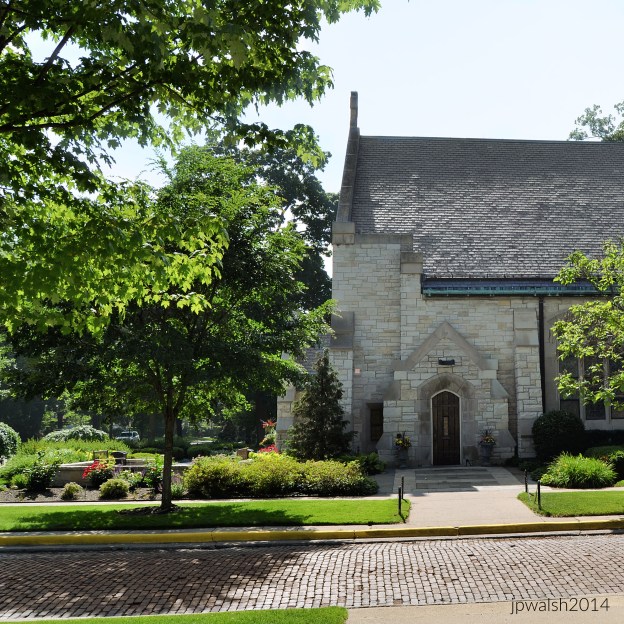
FEATURE image: St. Francis Xavier Church was erected in 1939 in an established well-maintained residential neighborhood in Wilmette, Illinois, just blocks inland from Lake Michigan. The attempt was made by the area’s Roman Catholics to fit in unobtrusively and harmonize with its neighbors on Chicago’s Northshore. 6/2014 3.56mb
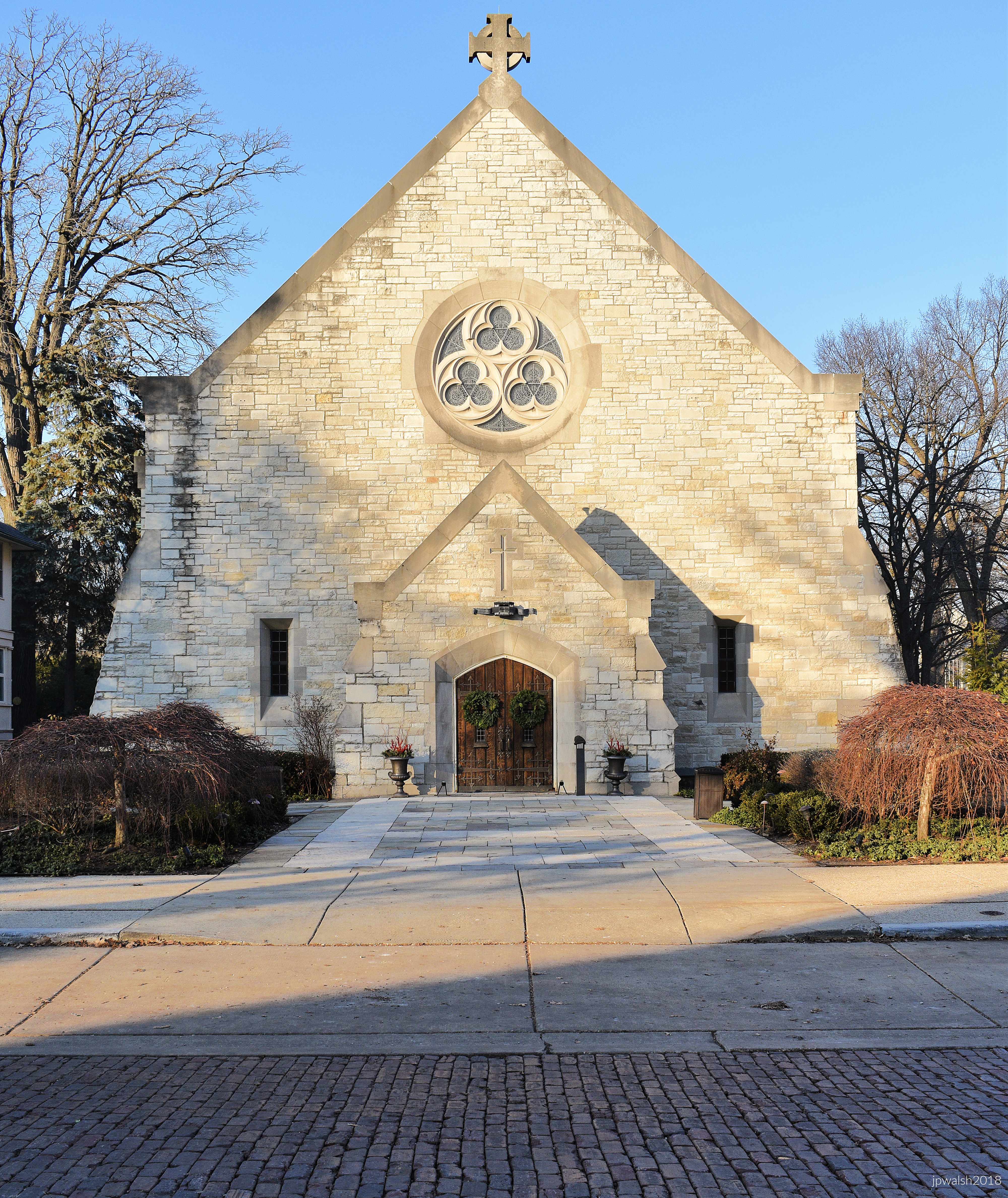
The English Gothic-style church is usually associated with establishment mainline Protestants. The church is built to be sophisticated and simple. 12/2018 11.6mb
Built by the firm of McCarthy, Smith & Eppig, St. Francis Xavier Church is built in the style of a sturdy country church. It is characterized by low walls, massive external buttresses, and a sloped, elongated roof. 6/2014 4.64mb
WHO IS ST. FRANCIS XAVIER (1506-1552), FIRST JESUIT MISSIONARY TO THE FAR EAST AND CO-PATRON OF CHURCH MISSIONS?
St. Francis Xavier. 6/2014 4.05 mb
Depicted in marble at the entrance to the sanctuary in Wilmette, Illinois, is St. Francis Xavier, S.J. (1506-1552), the parish church’s patron and namesake. Holding a crucifix, the Basque Jesuit priest is dressed in a black cassock draped by an alb and stole.
St. Francis Xavier’s feast day of December 3 marks his death day in 1552 at 46 years old on a lonely island off mainland China. In 1927 Pope Pius XI (1857-1939) named him co-patron with St. Thérèse of Lisieux of all foreign missions. (see – https://www.papalencyclicals.net/Pius11/P11APOST.htm). In life Francis Xavier came from a good family and had a naturally magnanimous personality. He was a student in Paris whose room-mate happened to be the older and wiser Ignatius of Loyola who patiently turned Francis’s thoughts and desires heavenward. Francis Xavier became the first Roman Catholic missionary to the Far East and as if by happenstance, since Ignatius’s first choice fell ill and was unavailable. When Francis set out for Asia, Loyola’s Jesuit Order had been officially approved by St. Pope Paul III (1468-1549) only a couple years before.
It was by sheer audacity that Francis Xavier established a template for the Jesuit missionary and evangelizer – prayerful, prepared to go where need was greatest, friendly, sincere, personally austere, hard-working, and joyful in the adventure of doing God’s will.
Leaving by ship from Lisbon, Portugal, in 1542 St. Francis Xavier became the first Jesuit missionary to India in 1545 and, in 1549, to Japan – 300 years before Commander Matthew Perry’s first American expedition to China and Japan in 1853. For one hundred years, the Jesuits were the only Roman Catholic missionaries in Asia. The long physical distances Francis Xavier traveled in the 1540s were remarkable. In his last days, on the return trip to India from Japan – almost 6000 km by air – St. Francis Xavier found his ship thrown off course in a sea storm and stopping at an island near Guangzhou, Guangdong, China.
Once back in India, St. Francis Xavier immediately wanted to return to China. After some delays, he reached Shangchuan Island, about 15 miles from the mainland and to which 46-year-old Francis Xavier had made arrangements to sail. While awaiting permission on the island to cross the inlet to enter mainland China, Francis died, without the benefit of the sacraments, of the fever. He was buried on Shangchuan in quicklime, a chemical compound normally used which worked to speedily consume the flesh so to leave just bones for health concerns and safer and easier transport. Francis was known on his journeys to live in a most austere manner insisting only on a good pair of boots for moving on foot over long distances in difficult terrain. Seeking the approval of local rulers, Francis occupied his days meeting the needs of the poor and sick, often in sweltering or frigid conditions. Over ten years Francis Xavier worked hard to bring the Christian faith to the greater part of the Far East.
Two months later, In February 1553, when the saint’s remains were exhumed, the witnesses were met by the body of Francis Xavier that, despite being buried in quicklime, had not rotted. His remains were taken to Portuguese Malacca and, a year after his death in December 1553, taken to Goa in India which had been the saint’s headquarters. In Goa, Francis received a hero’s welcome. Today St. Francis Xavier is still buried in Goa’s basilica. Reports of miracles were made in India and Japan following his death. Pope Paul V beatified St. Francis Xavier In 1619 and he was made saint on March 12, 1622, by Pope Gregory XV.
WHO IS ST. IGNATIUS OF LOYOLA (1491-1556), FOUNDER OF THE SOCIETY OF JESUS (JESUITS)?
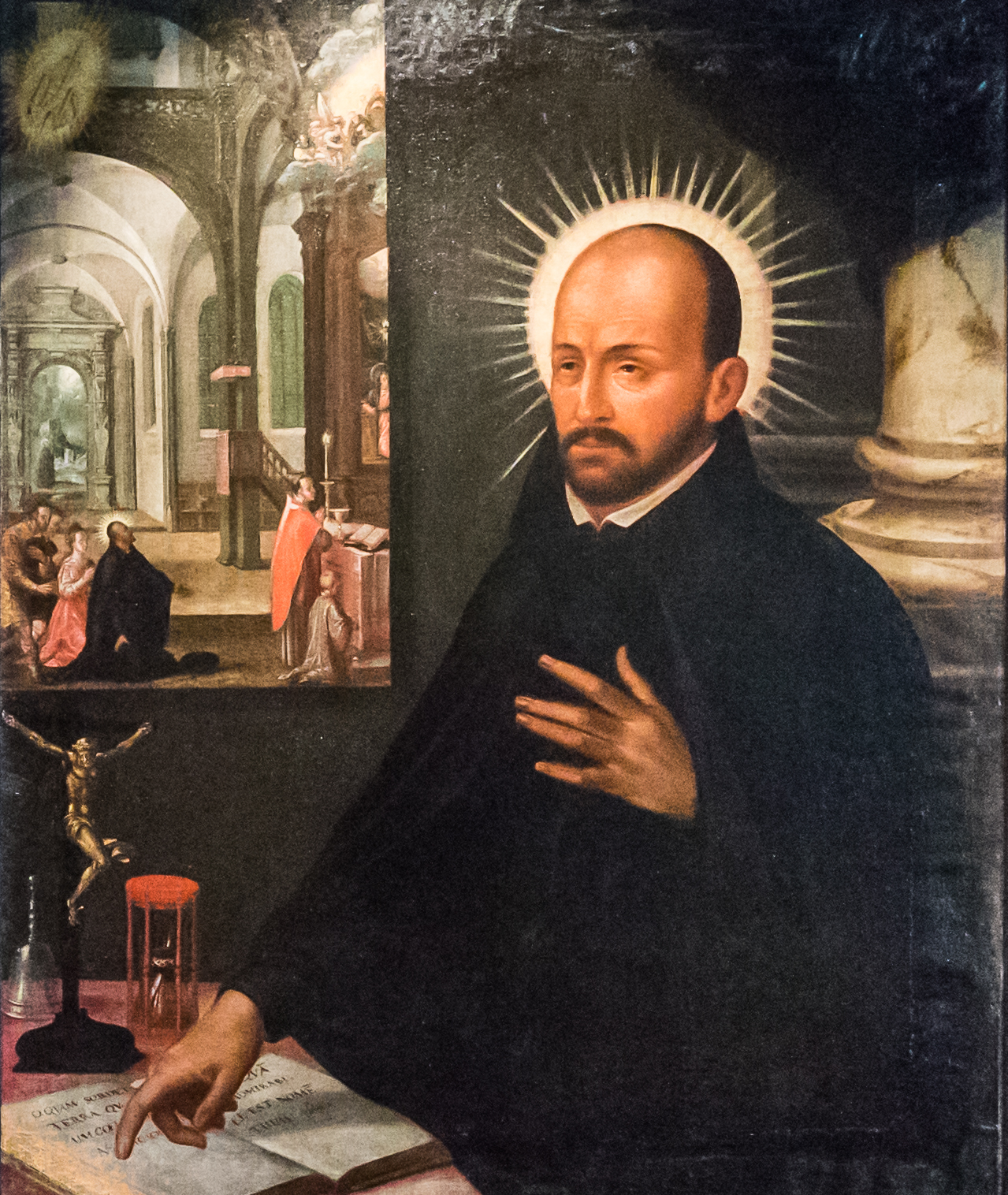
St. Ignatius of Loyola (1491-1556), after 1600, Jan Dammeszoon de Hoey (c.1545-1615), Stiftsmuseum Xanten (Germany). The artist was a Netherlandish painter who worked at the court of French king Henry IV (reign, 1589-1610) and is associated with the School of Fontainebleau. He is best known for his history paintings. St. Ignatius, before he became the founder of the Jesuits, was given a lives of saints when he was recovering from a bullet wound in the leg he received in 1521 during combat as a soldier in Pamplona in Spain. Though he naturally asked for “novels” to pass the time, it is sometimes related or implied that he may have had reason to be disappointed with the saints’ lives though it may actually have been a pleasant development for him since he took to the stories quite readily. As a knight from a prominent noble family in Spain, he latched onto and appreciated those various lives of peace and religious glory displayed in the Christian saints, and responded concretely to it. Where to trace this trail of grace to this point of life-changing conversion is of existential purpose. Ignatius, whether he knew it or not, learned now more fully how his soul desired to emulate the Christian heroes. The result was immediate and profound. Like St. Francis of Assisi (1182-1226) centuries earlier who the manly Ignatius deeply admired – Francis was another rich soldier boy who by experience in war of capture and prison moved from knight to penitent – Ignatius went and did the same. Ignatius would co-operate with God’s grace for whom he had met his match and hung up his sword in noble surrender. He started a pilgrimage from shrine to shrine. His natural self of elegant dress, excellent manners, and a measure of violent force in his personality, he channeled towards religion. As a youngster he had a mature bearing beyond his years so that the adult Ignatius continued to be a risk taker, as well as disciplined, prudent, despising greed, and persevering. The wonder of Ignatius is that he took his innate qualities and delivered them from the power of darkness and transferred them into the kingdom of God’s Light. Ignatius’s famous Spiritual Exercises (1548) were written early in the life of the Jesuit Order and communicated for others his own sublime ascetic character in action. Again, like the Poverello, Ignatius would be wrapped for days in prayer’s contemplative ecstasy. Also, like Francis in his early days as a pilgrim, he journeyed to the Holy Land in September 1523. Not yet a Jesuit as he had not founded them, he departed the Holy Land on September 23 and returned to Europe. He studied first in Barcelona and then in Paris where he met and gathered around him six companions: Spaniards Alfonso Salmeron (1515-1585), Diego Laynez (1512-1565), Francis Xavier (1506-1552) and Nicholas Bobadilla (c. 1509-1590), Portuguese Simão Rodrigues (1510-1579) and Savoyard Peter Faber (1506-1546). As the “Society of Jesus” the seven left for Rome in 1537 to obtain the pope’s approval for a new religious order. On the way there Christ, wrapped in His light and carrying his cross, said to Ignatius – in Latin – Ego vobis Romae propitious ero (“I will be good to you in Rome”) for which Jesuits then and now share that promise of accompanied mission in the Roman Catholic Church. It was while Pope Paul III (reign, 1534-1549) was on summer retreat from the heat of Rome at the Tivoli gardens that he further considered and ruminated over Ignatius’s group of six companions who had come to the Eternal City. One hot summer day the pope declared, reading Ignatius’s writings, – “The finger of God is here!” and then, in Latin, he said, “”Societatem hanc, id temporis…afflictis Ecclesiae rebus, non levi presidio atque ornamento fore.” (“This Society of Jesus [Jesuits] would prove an invaluable auxiliary and splendid ornament to the Church in these eventful times…”) The Jesuits were officially approved in 1540. Ignatius sent his companions across Europe and around the globe to create schools, colleges, seminaries and Christian missions that had an exhilaratingly mainly positive impact on society and culture.
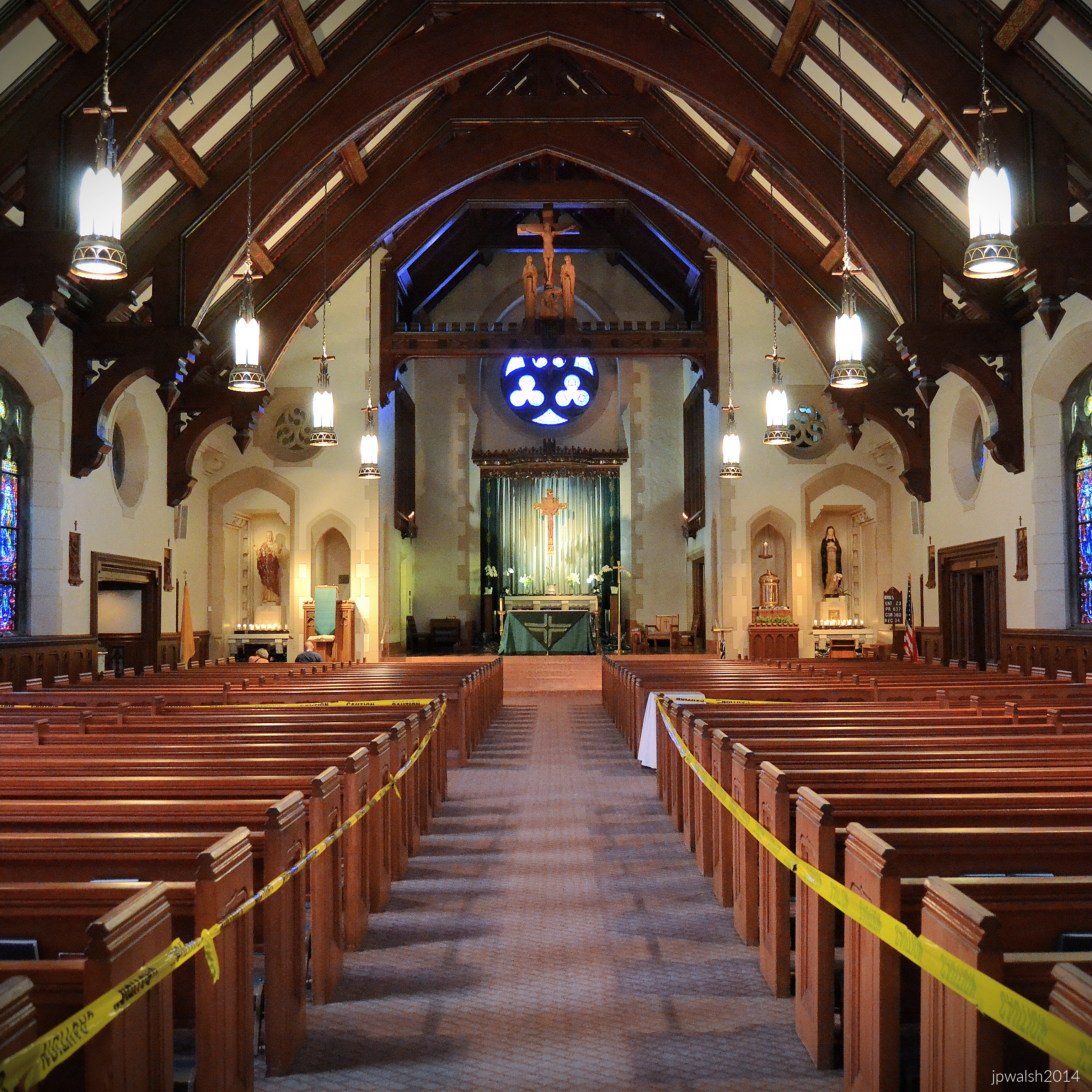
Nave looking to main altar. There are no columns to obstruct the view to the marble altar with a crucifix above. With Vatican II reforms, the tabernacle was set in a niche to the right. Originally the tabernacle was on the main altar below the crucifix. An extra-wide altar rail with cross legs whose form served as “being at table with Christ” for the communicant was also removed. Though St. Francis Xavier Church is traditional in its architecture, its design elements are modern, chic, and streamlined, which makes the sanctuary flexible and adaptable to change.The ceiling is constructed like an upside barque. This evokes the missionary journeys of St. Francis Xavier, by sea to and in the Far East. 6/2014 5.99 mb
July 2014. 5.85 mb Interior of St. Francis Xavier Church from the altar looking towards the main entrance. McCarthy, Smith & Eppig was a design firm that worked in the 1930’s extensively with Chicago Cardinal George Mundelein (1872-1939). Architect Joseph W. McCarthy (1884-1965), had been a young architect under Daniel Burnham (1846-1912), a major design force in Chicago. McCarthy built, under his own name and with various firms, churches and other church-related structures in the Chicago area from the 1910s to 1930s. In 1939, for instance, McCarthy built St. Francis Xavier Catholic Church and the more grandiose St. Joseph Catholic Church, both in Wilmette, about one mile apart. The design of St. Francis Xavier Church was handled by the firm’s younger partners, David Smith and Arthur Eppig (1909-1982). The church building’s simple architecture with its fine details cost $200,000 to construct in the waning years of the Great Depression – about $4 million in 2022 (see- https://www.dollartimes.com/inflation/). While the majority of McCarthy’s church buildings were built in the Chicago area, some of his important church projects included the cathedral church in Springfield, Illinois, (1928) and the parish church (1918) of what became the diocese of Joliet, Illinois.
December 2017. Organ loft. 7.90 mb 77%
There are 8 major stained-glass windows in St. Francis Xavier Church: four in the west wall and four in the east wall.
Smaller stained-glass oculi and panels are scattered throughout the interior. These stained-glass windows were designed by Henry Schmidt, a parishioner. They are quite beautiful, scintillating in their pseudo-English Tudor style, illumined in usually soft eastern and tree-obscured western exposures, although their subject matter is somewhat chaotic and a hodge-podge in its traditional and idiosyncratic admixture of hagiography, scripture, and popular piety. One aspect of their enduring appeal is that the glass can be seen close up and at eye level.
ST. PETER WINDOW.
CENTER PANEL: Saint Peter, leader of the apostles, holds the keys of the kingdom of heaven (Matthew 16:19). Peter holds a book, a representation of St. Peter’s New Testament letters (1 and 2 Peter) and sermons (Acts). Below is St. Peter’s Basilica in Vatican City in Rome with its famous dome.
LEFT PANEL: Crowning of Mary as Queen of Heaven by Triune God (Father, Son and Holy Spirit). From the Council of Ephesus in 431, depicting the Blessed Virgin Mary wearing a regal crown was used in Christendom.
RIGHT PANEL: Assumption of Mary into Heaven is not in the New Testament though biblical texts point to the doctrine of Mary as Theotokos (Mother of God), taken (“assumed”) body and soul into heaven at death. Going “up” to heaven is imagery used to express the spiritual and related to Jesus’ Ascension (Acts 1:6-17 and Luke 24:50-53). The assumption phenomenon occurred in the Old Testament with Moses and Elijah who were also present at Christ’s Transfiguration (Matt 17:1-9; Mk 9:2-10: Lk 9:28-36; and 2 Peter 1:16-21). Below the panels are identical angel figures. 6/2014 4.98 mb
ST. BONIFACE WINDOW.
CENTER PANEL: St. Boniface (675-754) is the St. Patrick of Germany. He was a bishop who lived during Europe’s Dark Ages. Boniface was responsible for organizing the church in western Germany and established the bishoprics of Cologne and Mainz. On direction by the Roman pope, Boniface anointed Pepin the Short (714-768) — son of Charles Martel (c. 688-741) and father of Charlemagne (747-814) — as king of the Franks. Pepin’s coronation became the model for future royal coronations and the beginning of the modern European state.
LEFT PANEL: Jesus meets his mother is the fourth station of the cross. The Holy Face, below, is a devotion proclaimed by Pope Leo XIII in 1885.
RIGHT PANEL: Jesus mocked and crowned with thorns (Luke 22:63-65 and John 19:2-3) is the sixth station of the cross and an important marker of the suffering of Jesus. 6/2014 3.93 mb
ST. PATRICK WINDOW.
CENTER PANEL: St. Patrick (418-493) is one of the patron saints of Ireland (St. Brigid (c. 451–525) and St. Columba (540-615) are the others). In Wilmette, IL, St. Joseph Church was established in 1847 for German immigrants and St. Francis Xavier Church for Irish. The depiction of Patrick as the archetypal Irish bearded bishop — dressed in green with miter and staff – emerged in late 1700’s. St. Patrick’s symbology includes a book, refering to the Holy Scriptures and his own writings: the Confessio and Epistola to Coroticus, both in Latin. Patrick holds the legendary 3-leafed clover which he used to teach the Irish about the Holy Trinity. Below is the harp which is Ireland’s national emblem and one of the world’s oldest musical instruments.
LEFT PANEL: Jesus Christ’s Resurrection from the dead is the cornerstone of the Christian faith (1 Corinthians 15:17). His empty tomb is proof of Christ’s deity (John 5:26; Romans 1:4). By rising from the dead, Jesus Christ saved us from our sins (Romans 4:24–25; Hebrews 7:25), gave hope for our future resurrection (John 14:19; 1 Corinthians 15:20–23), and provides believers with spiritual power (Romans 6:3–4; Ephesians 1:19–21). The window depicts the resurrected Jesus holding the banner of victory over death as a Roman guard cowers in the dazzling light of a Risen Christ with an angel in attendance. Christ’s cruciform halo (elaborated in three parts) usually contains three Greek letters that in translation spell out “I Am Who Am,” again, a reference to Christ’s Divinity. All four gospels contain passages pertaining to the resurrection, but none of them describe the moment or essence of resurrection itself.
RIGHT PANEL: Crucifixion of Jesus with his mother Mary and John the Apostle at the foot of the cross. Above Christ’s head are the letters INRI, an acronym for Jesus Nazarenus, rex Judæorum. This was the charge against jesus written in Latin by Pontius Pilate who condemned him to death. It translates as “Jesus Nazarene, King of the Jews.” The title appears in the Passion narrative of John’s Gospel (19:19). Below each side panel are identical angel figures. 7/2014 7.58 mb
The altar design includes tall candlesticks and compact, detailed baldacchino. 6/2014 4.61 mb
A depiction of the crucifixion in basswood stands atop a rood beam at the ceiling line above the main altar. The scene includes the figure of a crucified Jesus, half-naked, wearing a crown of thorns, and the INRI inscription overhead. Three figures at the foot of the cross are (at left) his mother Mary and (at right) John, the Apostle. The bowed middle figure could represent the other named and unnamed women present at the crucifixion (John 19:25; Luke 23:27 and 49). The artwork is by Fritz Mullhauser. 12/2018 8.47 mb
MARY QUEEN OF HEAVEN WITH INFANT JESUS WINDOW.
CENTER PANEL: The Queen of Heaven who reigns from the right hand of her son, is depicted in her role as mother of Jesus Christ. Below a crown hovers above what may be a heart-shaped letter “M” for Mary’s first initial and/or her sacred heart.
LEFT PANEL: Presentation of Jesus by Mary and Joseph in the Temple and meeting with Simeon, the “just and devout” man of Jerusalem (Luke 2:25–35). The Presentation is the Fourth Joyful Mystery of the Rosary. In Luke, 40 days after Jesus’s birth, Mary and Joseph took the baby to the Temple in Jerusalem to complete Mary’s ritual purification after childbirth, and to perform the redemption of the firstborn, as prescribed by Mosaic Law (Leviticus 12 and Exodus 13:12-15).
RIGHT PANEL: Nativity of Jesus in Bethlehem (Luke 2: 1-7 and Matthew 1: 18-25) is the Third Joyful Mystery of the Rosary. Below each side panel are identical Angel figures. 12/2018 12.5 mb
ST. ANNE AND THE CHILD VIRGIN MARY WINDOW.
CENTER PANEL: Child Mary with Saint Anne, her mother. Nothing is known about Mary’s mother though early apocryphal writings provide information for stories about Mary’s lineage and early life that have resulted in a legendary tradition.
LEFT PANEL: Visitation of the Blessed Virgin Mary to her cousin Elizabeth (Luke 1: 39-45). After the Annunciation, Mary set out into the hill country to stay in the house of Elizabeth and her husband Zechariah for three months. Both women were miraculously pregnant at the time–-Mary with Jesus by virgin birth and Elizabeth with John the Baptist in her old age. Depicted is the moment when John the Baptist leapt with joy in Elizabeth’s womb at hearing Mary’s voice (Luke 1:41). The Visitation is the Second Joyful Mystery of the Rosary. Below is an ark (or tabernacle). Luke structured his narrative passages of the Visitation on stories in 2 Samuel and 1 Kings about the ark of the Covenant in the Old Testament. The Catechism of the Catholic Church identifies Mary as the Ark of the New Covenant (2276): “Mary, in whom the Lord himself has just made his dwelling, is the daughter of Zion in person, the Ark of the Covenant, the place where the glory of the Lord dwells. She is ‘the dwelling of God . . . with men.”
RIGHT PANEL: Annunciation to Mary by the angel Gabriel aanouncing that she would bear the Son of God, Jesus Christ. “Hail Mary, full of grace, the Lord is with you!” It is by Mary’s joyful acceptance of God’s will – “Behold, I am the handmaid of the Lord; let it be to me according to your word” (Luke 1:26-38) – that the Incarnation takes place. The Annunciation is the First Joyful Mystery of the Rosary. Below, the two angel figures are distinct. 12/2018 16.24 mb
ST. JOSEPH WINDOW.
CENTER PANEL: St. Joseph was the foster father of Jesus and served as Jesus’ guardian protector. Jospeh’s symbology includes his holding a carpenter’s square (Mt 13:55) and holds a white lily to symbolize his faithfulness and chastity to Mary (MT 1: 25) as well as his holiness and obedience to God (Mt 1:24; Mt 2:14, 21, 22). An angel figure Is below St. Joseph.
LEFT PANEL: Holy Family in Nazareth. Jesus was obedient to Mary and Joseph and “progressed steadily in wisdom, age and grace before God and men” (Lk 2:52). Jesus was instructed by St. Joseph in the carpenter trade and holds a wooden cross on his knees. Flowering grass below is decorative and could indicate the flowering staff of St. Joseph which symbolized that he was specially chosen by God to be Mary’s husband. That imagery was drawn from the Old Testament when Aaron’s staff, placed before the Ten Commandments, sprouted with almond blossoms as a sign that he was chosen by God (Num 17:22-23).
RIGHT PANEL: Mary and St. Joseph find Jesus at 12 years old in the Temple with the doctors of the Law (Luke 2:41-52). It is the Fifth Joyful Mystery of the Rosary. The event is the only time in the New Testament where Jesus makes a public appearance before His baptism in the Jordan by John the Baptist and the start of his public ministry at 30 years old (Matthew 3:3-17, Mark 1:9-11; Luke 3:21-23; John 1:29-33). Below the scene are the tablets of the Ten Commandments with a symbol of the Trinity, including the sacred eye, hovering above. 12/2018 12.34 mb
ST. PAUL THE APOSTLE WINDOW.
CENTER PANEL: St. Paul is depicted holding a sword, a symbol for this Apostle to the Gentiles. Describing spiritual warfare in his letter to the Ephesians, Paul writes, “Take the sword of the Spirit, which is the word of God” (Ephesians 6:17). In symbology of martyrs, they are traditionally depicted with the instrument of their death. Paul is a known martyr (c. 64-68 CE), though its details are not. Early Christian writers said St. Paul was beheaded using a sword.
LEFT PANEL: The Pentecost (Acts 2: 1-13) followed the Ascension, It is where the 12 Apostles with Mary, the Mother of Jesus Christ, gathered together to receive the Holy Spirit symbolized by a dove from Heaven.
RIGHT PANEL: Ascension of Jesus into Heaven is mentioned many times in the New Testament and primarily in Luke and Acts (Luke 24:50-53, Acts 1: 6-12, John 3:13, John 6:62, John 20:17, Romans 8:34, Ephesians 1:19-20, Colossians 3:1, Philippians 2:9-11, 1 Timothy 3:16, and 1 Peter 3:21-22). The Ascension is where the Resurrected Christ physically departed from Earth by rising into Heaven which was witnessed by eleven of his apostles (Judas betrayed Jesus). Heaven incorporates the resurrected fleshly body of Christ as the divine humanity of Christ enters into the intimacy of the Father and becomes the perfect God-Man. 6/2014 4.28 mb
ST. PAUL THE APOSTLE WINDOW in situ on the east wall. WINDOW DETAIL An angel figure graces one of the stained-glass windows in St. Francis Xavier Church. There are several different angel figures throughout the church’s stained glass panels.
THE GOOD SHEPHERD WINDOW.
CENTER PANEL: Jesus called himself “the good shepherd” (John 10). In the Old Testament there is a prophecy about shepherds who are overseers for the sheep who are the people of God. Ezekiel prophesies of a shepherd to come who is the Messiah of Israel. Jesus is claiming to be the Messiah that the scriptures foretold. Christ’s cruciform halo (in three parts) contains three Greek letters that spell out “ I Am Who Am,” a reference to Christ’s Divinity. Jesus holds the shepherd’s staff and has a lamb slung over his shoulders referring to the people of God he cares for. A lamb in a bramble below refers to Jesus as “the lamb of God,” a title found in John’s Gospel (John 1:29; 1:36). It also alludes to the Old Testament when God sent a ram caught in a bramble to change places with Isaac who God called to be sacrificed as a burnt offering (Genesis 22:13). This Old Testament story foretold the sacrifice of the Son of God at Calvary.
LEFT PANEL: Scourging of Christ is the 4th Station of the Cross (John 19:1-3). It is part of the brutalities that Jesus endured in his Passion. Jesus was slapped, beaten, punctured by thorns, and whipped with a reed stick. Two of these torture instruments are depicted below the pillar. An angel figure is below that.
RIGHT PANEL: Jesus is depicted in the garden of Gethsemane following the Last Supper where, knowing of Judas’s betrayal, Jesus prayed: “Father, if you are willing, take this cup from me. Yet not my will, but yours be done” (Luke 22:42). With his prayer, “an angel from heaven appeared to him and strengthened him” (Luke 22:43). At the foot of the Mount of Olives outside Jerusalem all four Gospels relate that Jesus underwent an agony in the garden of Gethsemane where he was betrayed and arrested the night before his crucifixion. Below is an angel figure. 12/2018 12.6 mb
Organ loft. St. Francis Xavier Church, Wilmette, IL. 12/2018 446 kb 25%
SOURCES:
Heavenly City: The Architectural Tradition of Catholic Chicago, Denis Robert McNamara, James Morris, Liturgy Training Publications, Chicago, Illinois, 2005, pp. 138-140 Chicago Churches and Synagogues: An Architectural Pilgrimage, George Lane, S.J., and Algimantas Kezys, Loyola University Press, Chicago, 1981. Saint Ignatius and His First Companions, Chas. Constantine Pise, P.J. Kenedy & Sons, New York, 1892, pp.105-151. The Saints: A Concise Biographical Dictionary, edited by John Coulson, Guild Press, New York, 1957. The New American Bible, Catholic Book Publishing Corp, New York, 1993. Catechism of the Catholic Church, 2nd Edition, Doubleday, New York, 1997.