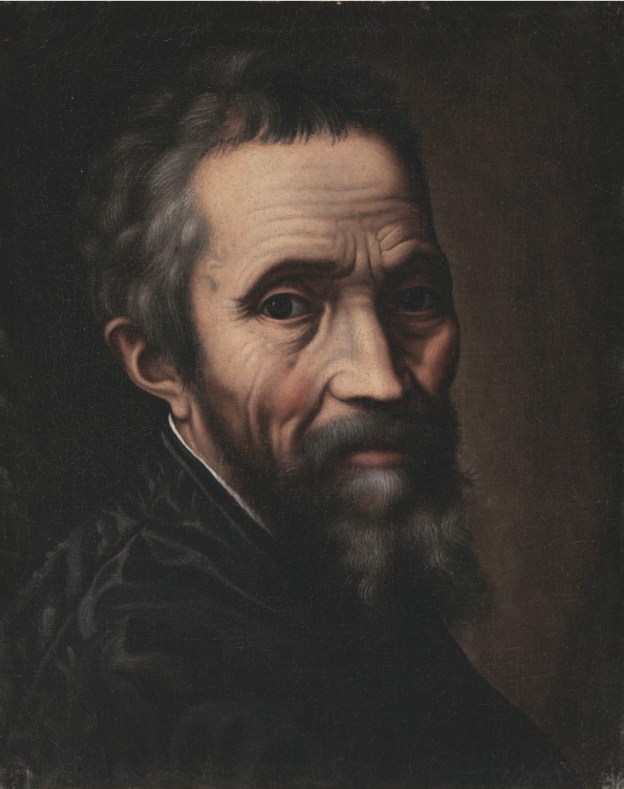
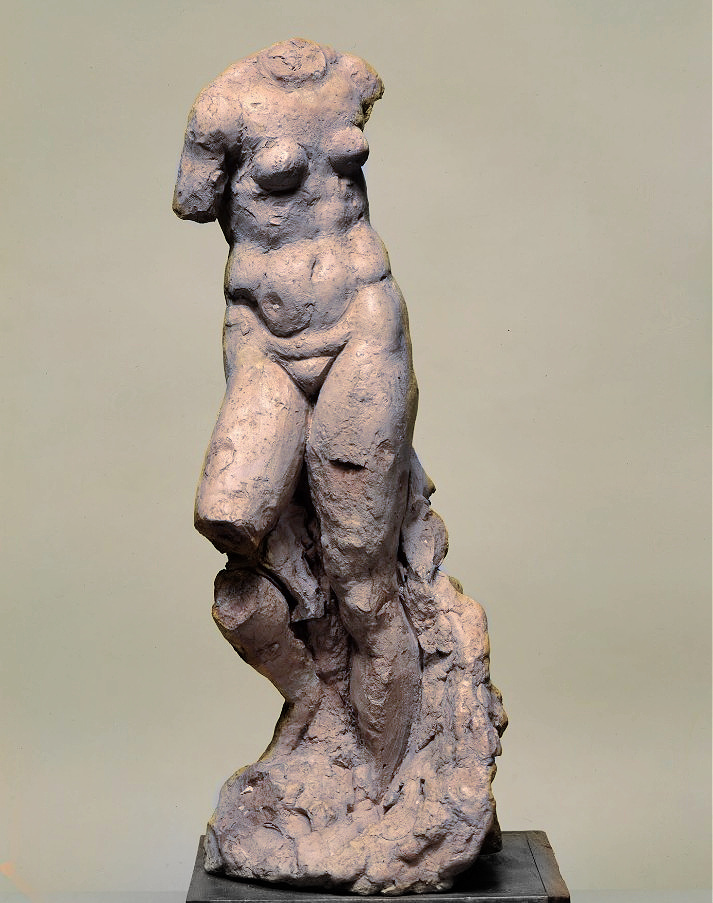
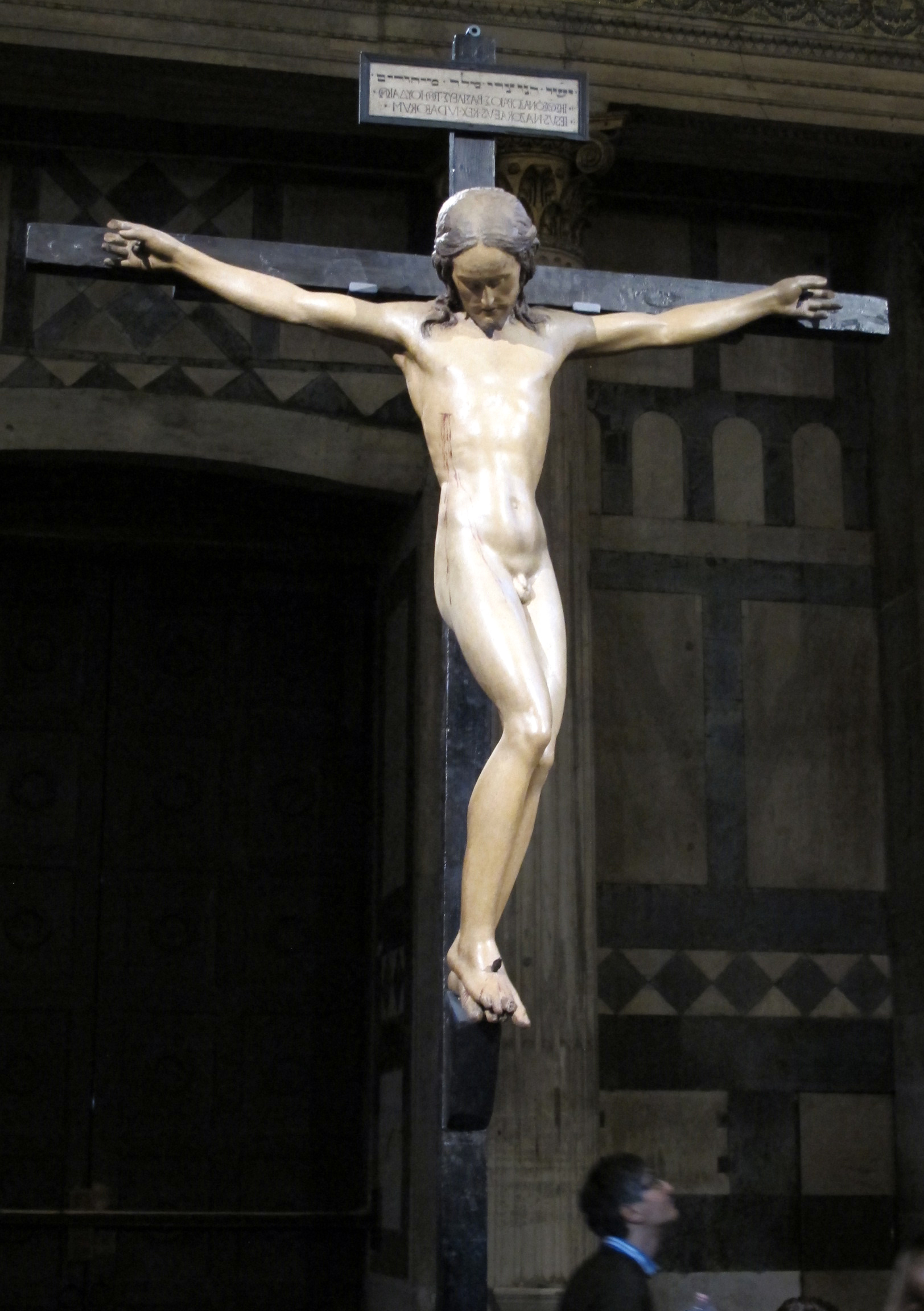
Attributed to Michelangelo Buonarotti, 1513, terracotta, Casa Buonarroti, Florence, Italy. The work is a study of a male torso, conceived to be without the head and upper and lower limbs. The work has been identified as a preparatory model for one of the figures of the Prisoners, intended to decorate the tomb of Julius II in Rome. see – https://artsandculture.google.com/asset/torso-virile/zQGx46asE5jBIg?hl=it&ms=%7B%22x%22%3A0.5%2C%22y%22%3A0.5%2C%22z%22%3A9.086882915528859%2C%22size%22%3A%7B%22width%22%3A3.3866676762513332%2C%22height%22%3A1.2375000000000005%7D%7D – retrieved March 6, 2025. Michelangelo Buonarotti, Madonna della Scala, 1490. Casa Buonarroti, Florence, Italy. Though it is small-sized the relief subject of the Madonna and child presents a monumental scope. The female figure fills the entire space. The meaning of the ladder (“scala”) in the title is ambiguous and may have reference to the children playing and holding a drape behind the Madonna. The date of the relief has been much discussed. However, a placement around 1490, before the Battle of the Centaurs, seems to be confirmed.see – https://artsandculture.google.com/asset/madonna-della-scala/xQF2nwLhAXd26w?hl=it – retrieved March 6, 2025. Michelangelo Buonarotti, Nude female, 1533, Casa Buonarroti, Florence, Italy. This figure of a female nude is linked to the New Sacristy in Florence to accompany the marble effigy of Giuliano de’ Medici. It has been linked to the figure of the Earth that, together with the Sky, was to be part of Giuliano’s marble effigy. The project of building a proper Medici family mausoleum was conceived in 1520, when Michelangelo began work on the New Sacristy upon the request of Cardinal Giulio de Medici, the future Pope Clement VII, who expressed a desire to erect the mausoleum for some members of his family including Lorenzo the Magnificent and his brother Giuliano assassinated in Florence’s Duomo in 1478. After completing the architectural works in 1524, Michelangelo worked until 1533 on the sculptures and the sarcophagi that were to be featured on the chapel walls. The only ones actually completed were the statues of Lorenzo, the Duke of Urbino; Giuliano, the Duke of Nemours; the four statues of the allegories of Day and Night, and Dawn and Dusk; and the group representing the Madonna and Child. see – https://artsandculture.google.com/asset/nudo-femminile/xgHfNWIKU6r13g?hl=it – retrieved March 6, 2025 and http://www.museumsinflorence.com/musei/Medici_chapels.html#:~:text=The%20project%20of%20building%20a,the%20Magnificent%20and%20his%20brother – retrieved March 6, 2025. Michelangelo, crucifix, 1493, wood, Santo Spirito, Florence. It was placed by the artist in 1493 above the lunette of the high altar and has been there since.
The Italian Renaissance artist was born in Florentine territory in Caprese in the provinces of Tuscany where his father was a government bureaucrat. The family soon relocated to Florence where Michaelangelo grew up. Becoming friends with Francesco Granacci (1469-1543) who saw Michaelangelo’s drawing talent, at 13 years old Michelangelo announced he wanted to be an artist. Despite his parents objection, they eventually yielded to their son’s aspirations, and he was apprenticed to Domenico Ghirlandaio (1448-1494) for the next three years.
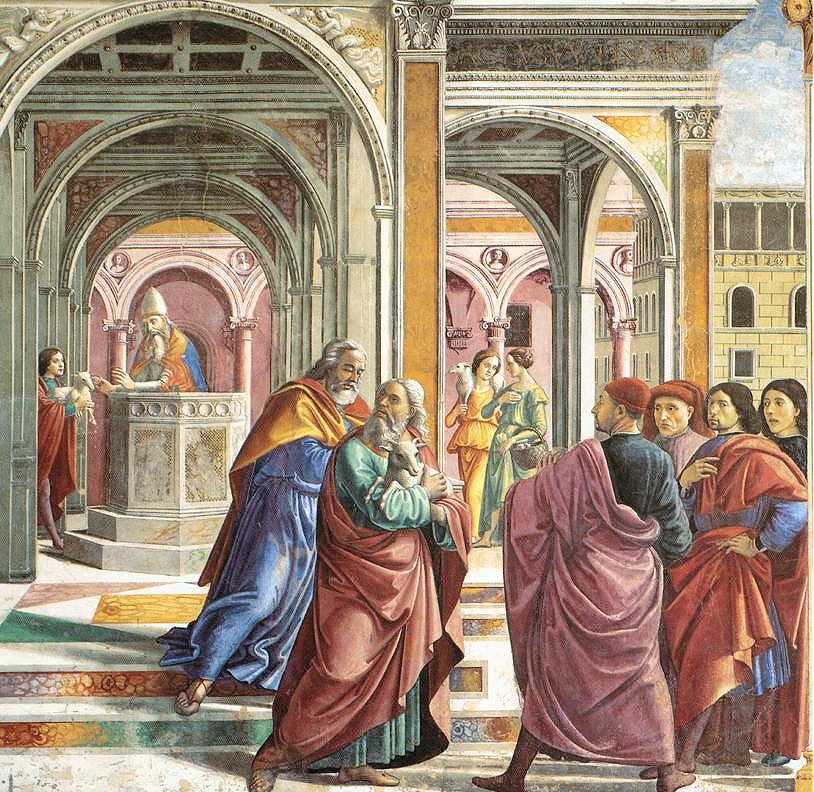
Domenico Ghirlandaio (1448-1494), Expulsion of Joachim From the Temple, fresco (detail), 1486-1490. Santa Maria Novella, Cappella Tornabuoni, Florence. In the background, the mitered high priest receives sacrificial lambs at the altar where a fire burns. Joachim, according to sacred tradition, father of the Virgin Mary and grandfather of Jesus Christ, is sent away at this time since he is childless. He is married to Anne. To the right Ghirlandaio depicts an assembled group of contemporary Florentines including, second from right, Ghirlandaio himself. In 2nd century apocryphal writings, childless Joachim left for the desert where he prayed and fasted for 40 days. Angels appeared to Joachim and his wife Anne, and promised them a child. Joachim then returned to Jerusalem and embraced Anne at the city gate, a scene popularly depicted in medieval and Renaissance art. After this, Anne became pregnant and became the mother of the Virgin Mary and Jesus’s grandmother. This apocryphal relating of Joachim and Anne to Biblical figures Elizabeth and Zechariah and the birth of their son, John the Baptist (Luke 1) and Abraham and Sarah and the birth of their son, Isaac (Genesis 21) was a popular subject depicted in Christian art until the Council of Trent (1545–1563) when the church restricted public displays of these simple stories and events from apocryphal sources in a severe reaction to the Protestant reformation.
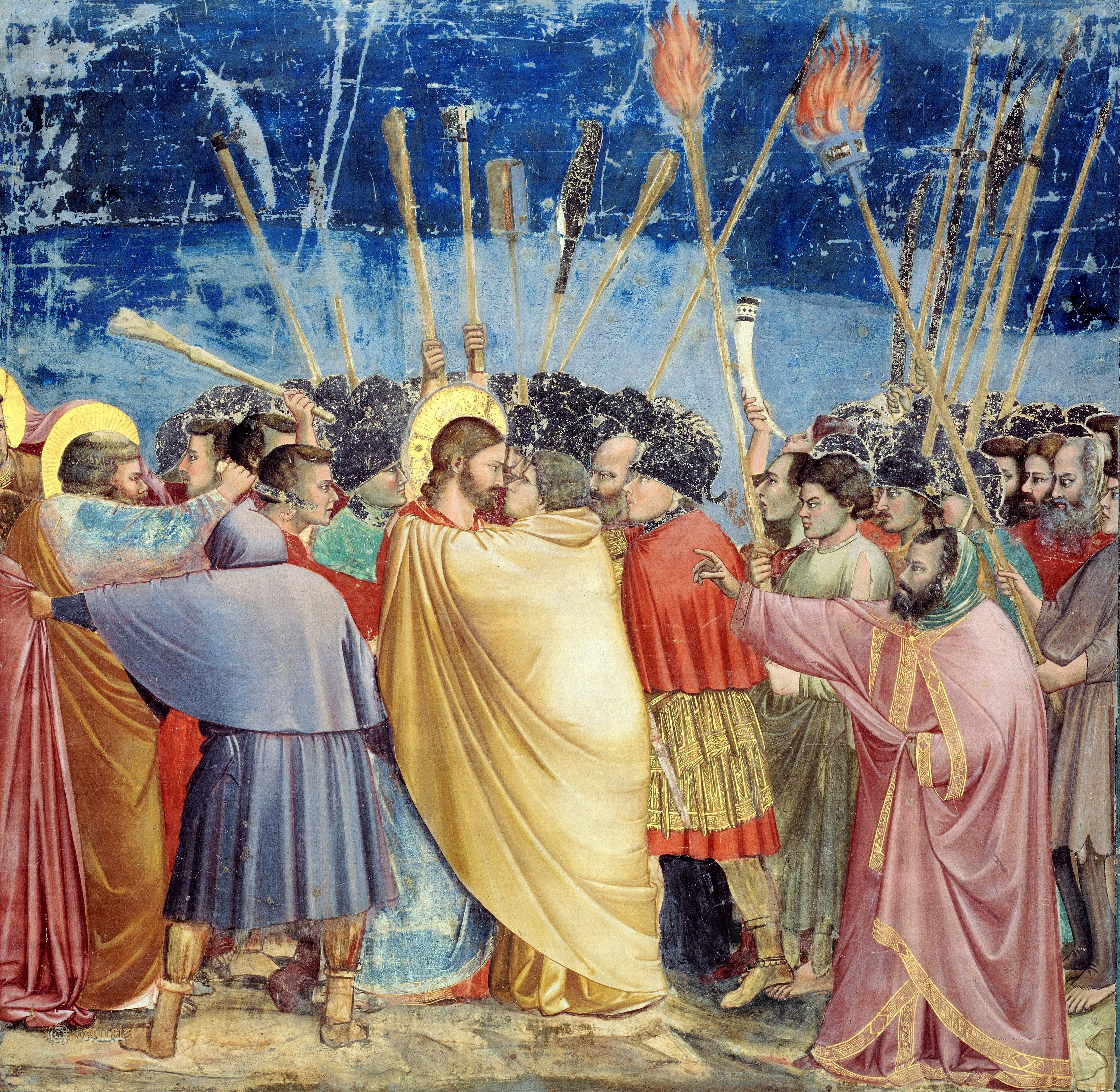
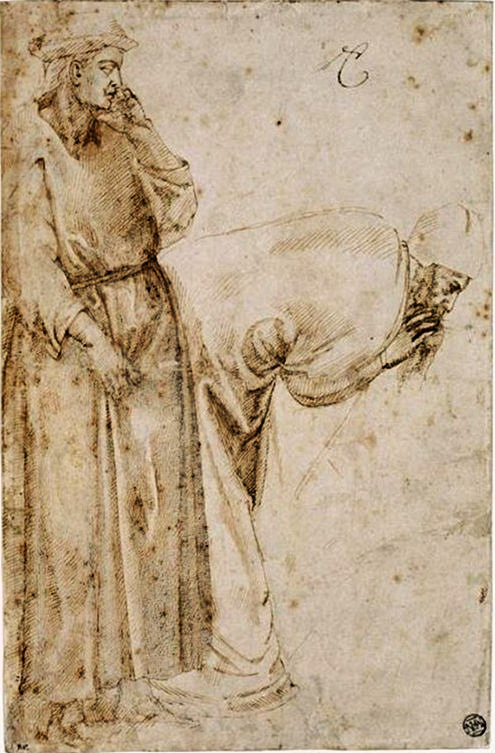
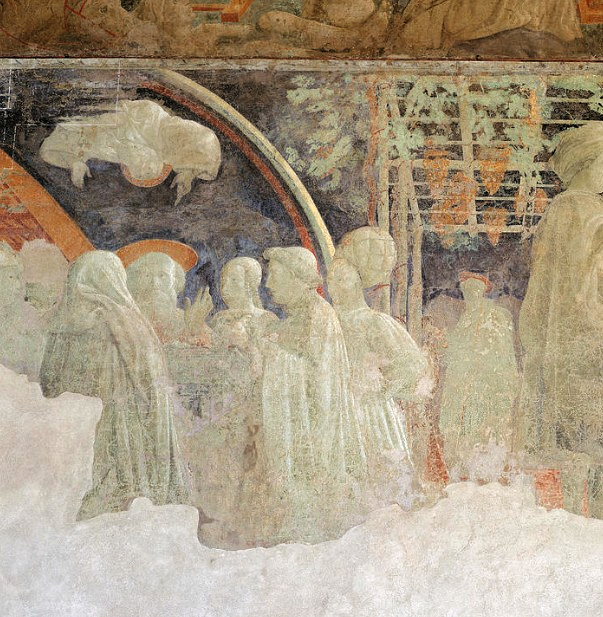
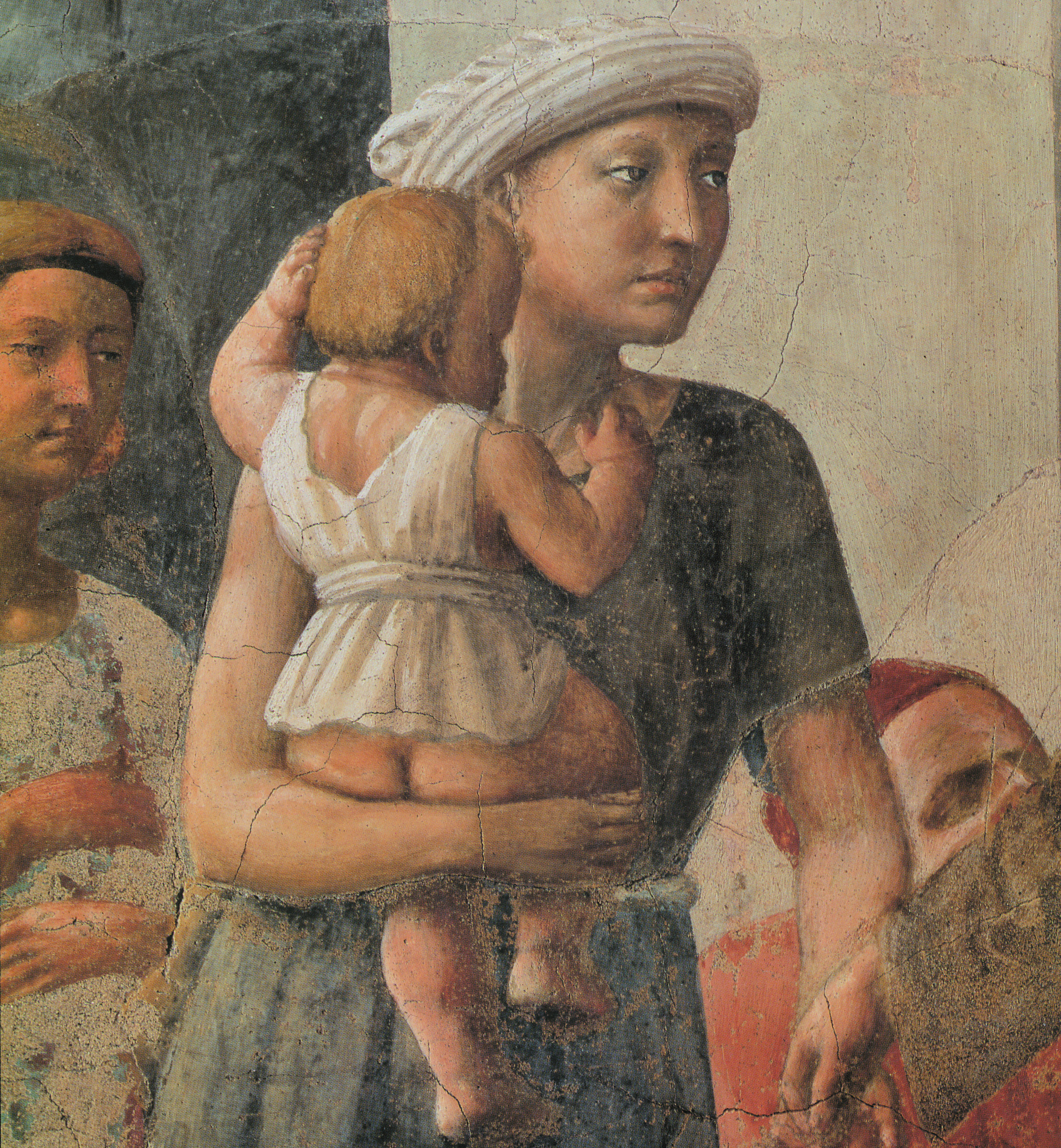
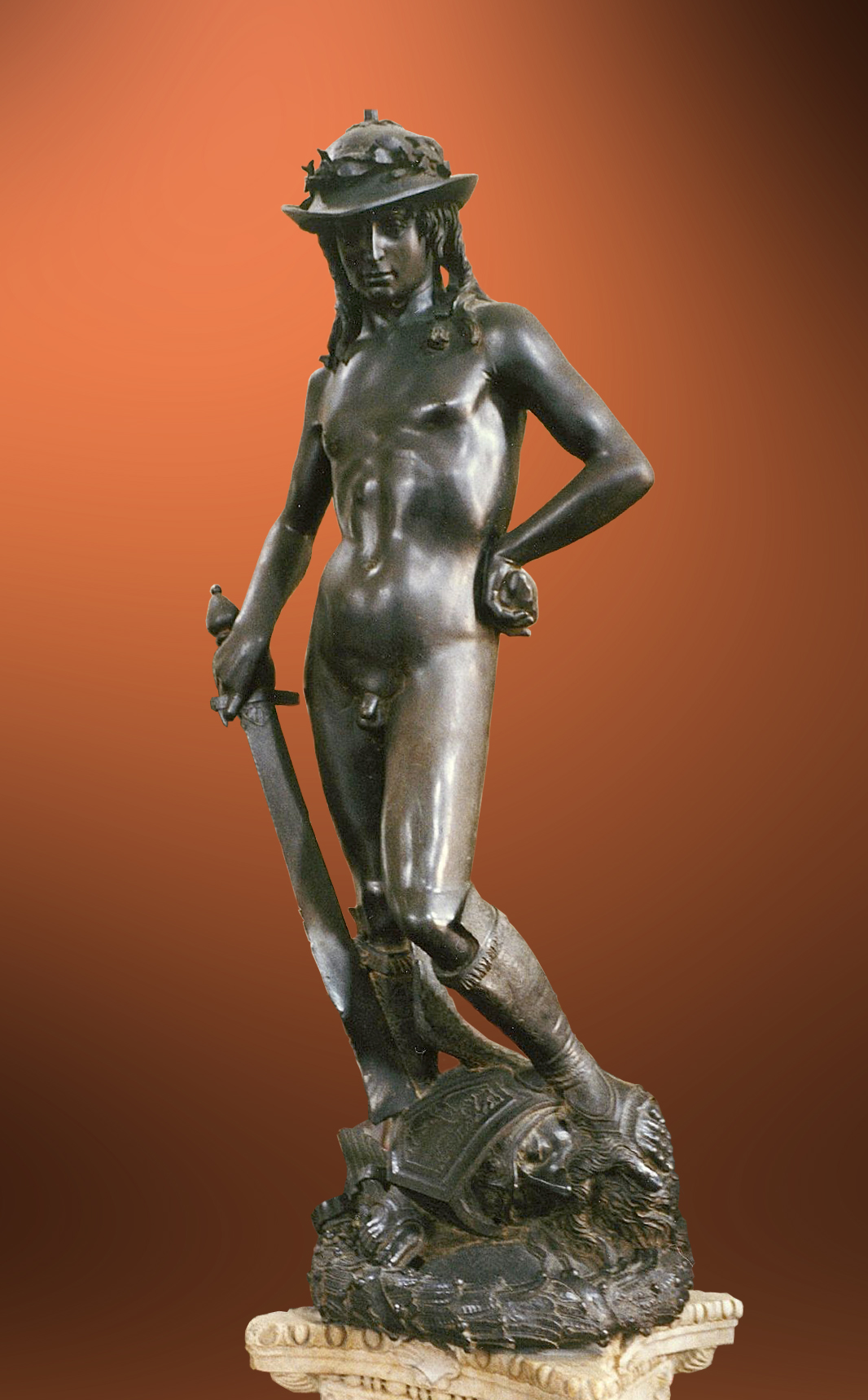
Michelangelo’s training was erratic, likely having left Ghirlandaio before his contract was complete, and working under the city’s ruler, Lorenzo de Medici for his contracted master, Bertoldo (1420-1491). Later in life Michelangelo did not advertise his training credentials as he believed art – such as freeing subjects from stone – emerged by the sheer artistic power of the individual. In this period, as a teenager, Michelangelo learned the art of fresco painting and drawing, copying previous masters such as Giotto (1267-1337) and Masaccio (1401-1428). Michelangelo absorbed the artwork of the naturalists, such as Paolo Uccello (1397-1475), whose artwork looked to present subjects with a viewpoint like a scientist interested in objective fact rather than looking to convey some established figural attitude. Where young Michelangelo was materially as great as Giotto and Masaccio, he also possessed a new means undreamt by those previous masters, as he drunk of the art of Donatello (1386-1466), Pollaiuolo (1429-1498), Verrocchio (c.1435-1488) and Leonardo da Vinci (1452-1519). Further, Michelangelo understood better than these others, that the epitome of these Renaissance artistic studies was to be expressed by one subject above all: the human nude.
Bernard Berenson described Michelangelo as “the pupil of nobody, the heir of everybody, who felt profoundly and powerfully what to his precursors had been vague instinct, who saw and expressed the meaning of it all.”
Giotto, The Arrest of Christ (Kiss of Judas ), 1304, Padua, Scrovegni Chapel.Michelangelo after Giotto, Drawing from “Ascension of the Evangelist,” 1490-1492. Louvre. see – https://collections.louvre.fr/en/ark:/53355/cl020001224 – retrieved March 6, 2025. Paolo Uccello, Sacrifice of Noah And Noah’s Drunkenness (detail), 1447-48. Uccello was not interested primarily in conveying in art the possible “artistic” intention of this story’s scene. Instead, as Bernard Berenson described it, the artist produced “nothing but the scientific intention to find out how a man swooping down head-foremost would have looked if at a given instant of his fall he had been suddenly congealed and suspended in space.” These studies of reproducing objects as they really are, in anatomy and perspective, had a great bearing for the art of Leonardo da Vinci and Michelangelo. quoted in Berenson, p.54.Masaccio, Distribution of Alms and Death of Ananias (detail), 1425-1427, Brancacci Chapel, Florence. An episode from Acts of the Apostles (4:43-37 and 5: 1-11) depicting Ananias’s wife and child whose husband withheld their tithe from the early church leaders with the outcome being that Ananias dropped dead in divine retribution. When it was painted, viewers in the 1420’s and afterwards, read it as an artistic display of a New Testament endorsement of the equitable redistribution of wealth and the divine punishment of death forthwith for those who falsely withheld their fair share. 67% 7.95mb
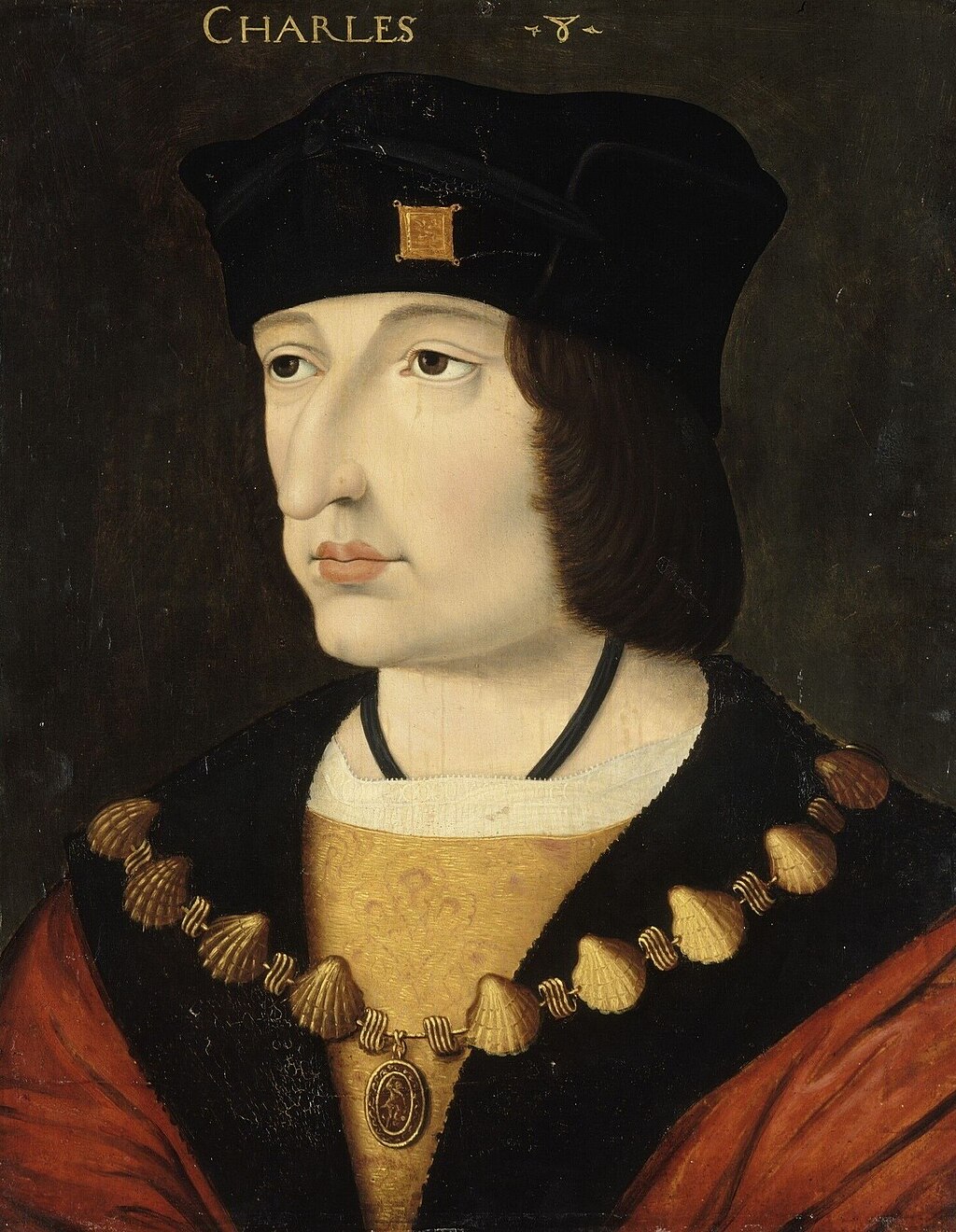
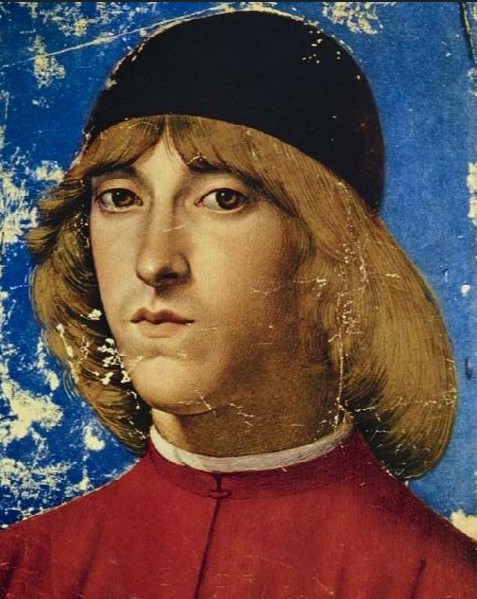
When the Medici fell and Florence became a theocracy under Savonarola (1452-1498), 19-year-old Michelangelo decided to leave Florence. He lamented the fall of Lorenzo the Magnificent, his artistic patron, and the young artist lived hand to mouth going to Bologna, then to Venice, and back to Bologna, and finally to Rome in June 1496. The popes’ tremendous influence in capitalist Italy started in the 13th century and augmented into the 17th century, leading to what art critic Bernard Berenson (1865-1959) called an encroachment of “soulless Vaticanism” towards modern art. But clearly Rome had no use for a firebrand friar who refused to support the pope’s troops against the invading French army. As Columbus set out to discover America, It was the unpleasant chapter of the Italian War of the 1490s that helped fill the times with ongoing brutality, duplicity, complicity, intrigue, opportunism and expedience. A looming danger of looting and violence of the invading French army were emphasized by the impassioned sermons of Girolamo Savonarola that frightened the people and led to their heightened resentment against the ruling Medici. Florence was traditionally pro-French, but Piero di Lorenzo de’ Medici (“Piero the Unfortunate”) (1472-1504), son of Lorenzo the Magnificent, had deployed against them to defend Naples. Under pressure from citizens and outside French forces promising church reforms and civic transparency, the Medici was forced to flee and the city was proclaimed a Republic. The Florentines, with Savonarola in the lead, facilitated the invasion of French king Charles VIII (1470-1498) and against the pope which they considered corrupt. Pope Alexander VI (1431-1503), a Borgia and one of the most corrupt popes in history, ascended to the papal throne in 1492 and was immediately condemned in fiery sermons by Savonarola. Yet all was not well between “liberator” Charles VIII and his Florentine supporters. Immediately the French king demanded a huge sum of money, a ransom payment of sorts, from the Florentines in appreciation, as well as to pay for, the pro-French liberation. The Florentine government refused and the king threatened to loot the city. Faced with a backlash and real threat of popular revolt, the French bully relented and continued onto Rome. Charles postured, but was constantly fearful of antagonizing the European powers and announced his decision that he would not depose the corrupt old pope after all. By having kidnapped the pope’s mistress Giulia Farnese, wife of the pope’s military ally Orsino Orsini, who commanded 4,000 Neapolitan soldiers freshly landed to defend papal interests on the peninsula, Charles VIII was able to extract full entry into Rome in exchange for her release. Once in Rome the French troops looted the city. The pope, in a panic, arranged a quick safe passage for Charles VIII out of the Papal States towards Naples during which the king’s army massacred many hundreds of local inhabitants.
Charles VIII, roi de France, anonymous, c. 1550. Entering Florence in a power vacuum the invading French king demanded a huge sum of money from the citizens who refused to pay and leading to a stand-off. Public Domain. Domenico Ghirlandaio’s 15th century portrait of Piero the Unfortunate. Eldest son of Lorenzo the Magnificent, Piero di Lorenzo de’ Medicisucceeded him as ruler of Florence in 1492. When Piero determined in 1494 to stay neutral during French king Charles VIII’s invasion of Italy, effectively defending Naples the object of the king’s campaign, he was challenged. Suffering from an abandonment of the Florentine elite under the spell of Savonarola, Piero totally capitulated to Charles VIIi’s demands. Having succeeded in alienatating everyone in Florence, Piero fled to Venice, aided by a French diplomat, in November 1494. Attempting to make a comeback several times to Florence he was constantly rebuked, Piero drowned in the Garigliano River while attempting to flee the aftermath of the Battle of Garigliano in 1503, Public Domain.Pope Alexander VI Borgia, c.1495, attributed to Spanish painter Pedro Berruguete (c. 1450-1504), Vatican Museums. Alexander Vi was a wily politician from a prominent family who practiced nepotism and sired several children by way of his many mistresses.
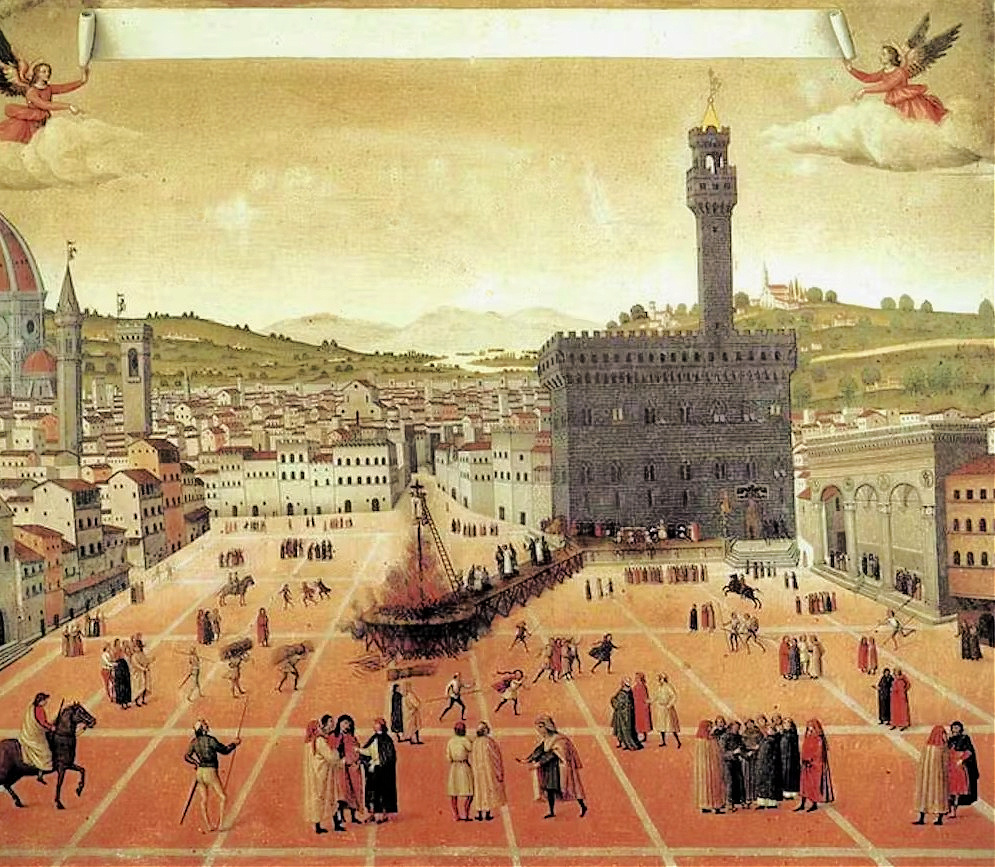
Savonarola played an important role in this French infiltration in Italy — and Rome did not forget. Then, in February 1497, during Mardi Gras of that year, Savonarola, whose message was a combination of religious purist and civic republican preached his most dramatic act of cultural desecration by seeking that artworks, books, clothing items and cosmetics were thrown into a bonfire of the vanities as a sign of monied and other social decadence. The flames became his final undoing: Savonarola was excommunicated for heresy and sedition by Pope Alexander VI on May 12, 1497 after the preacher called “the contemporary Church leadership…a pockmarked whore sitting on Solomon’s throne.” The pope also threatened Florence with severe interdictions if they continued to be a sanctuary for Savonarola and his ilk. Savonarola was imprisoned on April 7, 1498 after failing a literal public trial by fire (it rained). Finally, he was dragged from his prison cell and with two other contemptible friars was condemned as a heretic and schismatic and hanged and burned at the stake on May 23, 1498, with the Vatican and the Medici observing it all from a safe distance. Yet the cult of Savonarola, his person as well as his political and religious ideas, did not go quietly up in smoke. Though seen today as a sort of vile figure, his supporters around 1500 and afterwards saw him as a martyr and encouraged his veneration as a saint to which many complied. In Florence Savonarola’s disputed legacy went on until the Medici more or less permanently re-installed themselves in 1530. Yet Protestant reformers in Germany and Switzerland were intrigued and influenced by Savonarola’s ideas and, in 1558, even Pope Paul IV, who was 22 years old when Savonarola was executed, declared him not a heretic and always in communion with the Catholic Church. Saint Philip Neri (1515-1595), a Florentine established in Rome, and regularly characterized as a most relatable prelate of and for the masses, also defended Savonarola’s memory.
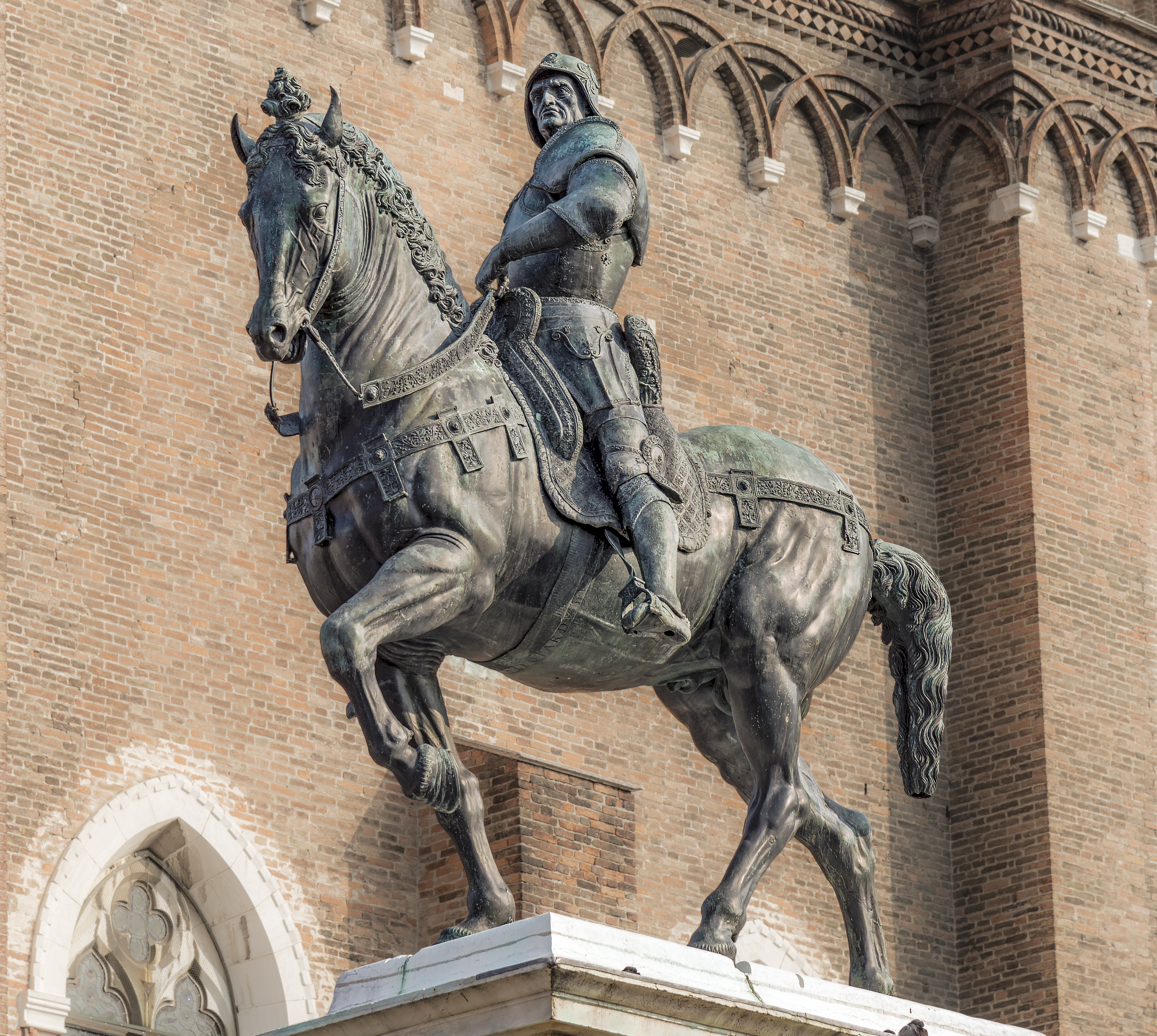
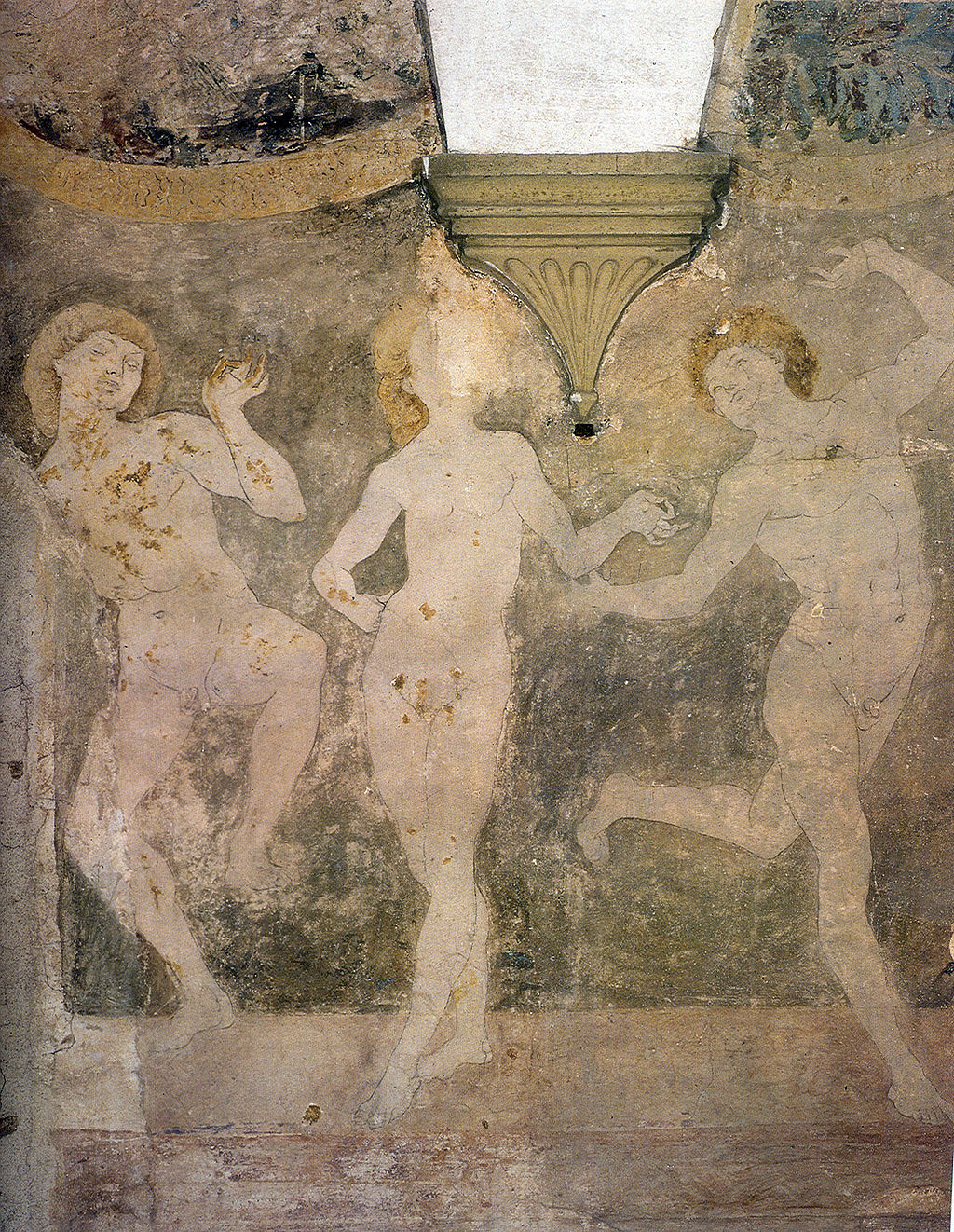
Francesco Rosselli (1445-1513), The Execution of Savonarola and Two Companions at Piazza della Signoria, 16th century, oil on canvas, Galeria CorsiniBernard Berenson as a young man, Berenson described Michelangelo as “the pupil of nobody, the heir of everybody, who felt profoundly and powerfully what to his precursors had been vague instinct, who saw and expressed the meaning of it all.” quoted in Berenson p. 72. Public Domain. “Donatello – David – Florença” by original file by Patrick A. Rodgers is licensed under CC BY-SA 2.0. Verrocchio, Equestrian Statue of Bartolomeo Colleoni, 1480s, Venice. Bartolomeo Colleoni (1400-1475) was an Italian condottiero, who became captain-general of the Republic of Venice. Colleoni gained a reputation as the foremost tactician and disciplinarian of the 15th century. “Bartolomeo Colleoni by Andrea del Verrocchio” by Didier Descouens is licensed under CC BY-SA 4.0.Antonio del Pollaiuolo, Nude Dancers, 1470s, Fresco Arcetri, Villa La Gallina. A fresco frieze of dancing nude figures, in a villa near Florence, shows the artist’s same interest in extreme body poses. Public Domain.
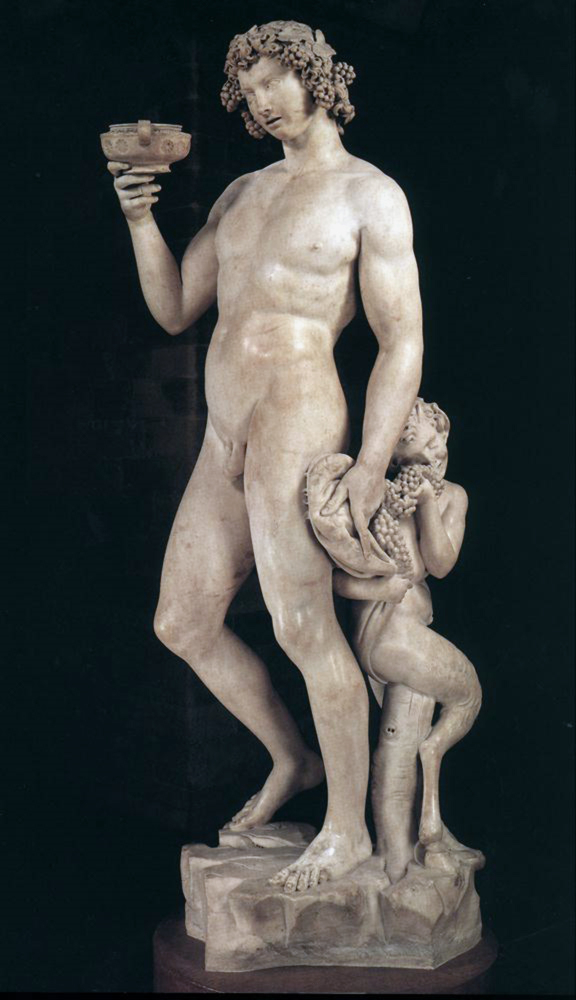
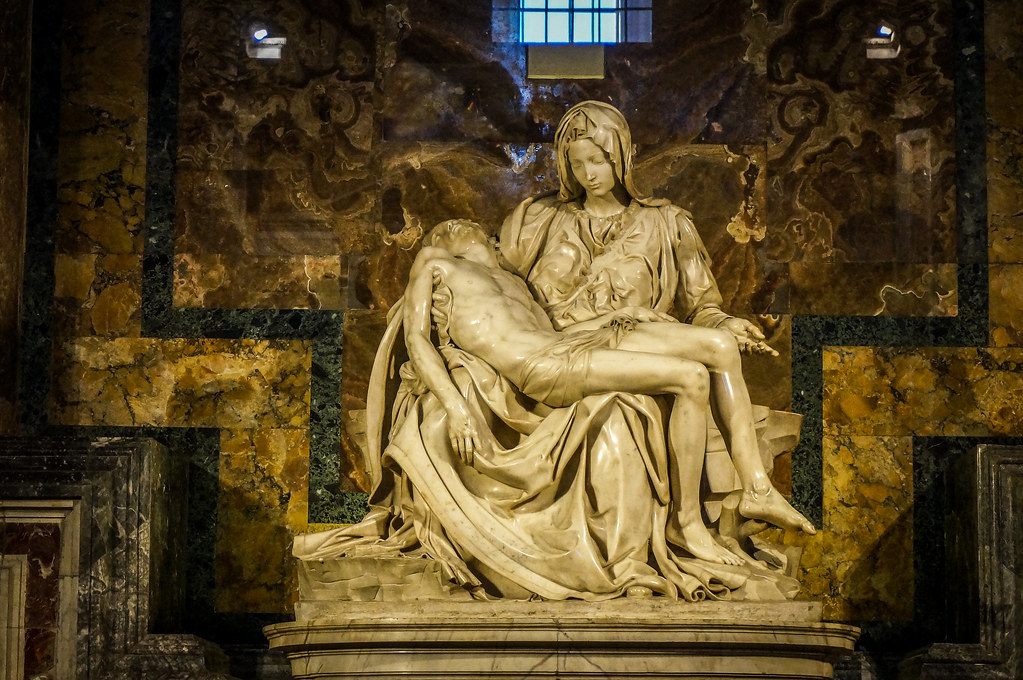
Meanwhile, in Rome, Michelangelo sculpted his first major marble works. The first, Bacchus, was commissioned by Cardinal Raffaele Riario (1461-1521) in partnership with Jacopo Galli, a Roman collector, that was displayed in Galli’s garden until it was sold in 1572 to the Medici and is today in the Bargello. The second is the sublime Pietà (St. Peter’s Basilica, Vatican City) that was commissioned by a French cardinal in Rome and placed in the Santa Maria della Febbre. Vasari described the Pietà as “a revelation of all the potentialities and force of the art of sculpture.” Though the Pietà made Michelangelo famous in Rome, he returned to Florence following its installation to work on the David, a commission made by the Florentine republic after the expulsion of the Medici.
Michelangelo, Bacchus, marble. 1497, Bargello, Florence.Michelangelo, Pietà, marble, 1498-1499, St. Peter’s Basilica, Rome. A 24-year-old Michelangelo was all the rage in Rome as an artist in the late 1490’s and wrote his name promonently across the sash of the Blessed Mother. The artist did this after it was completed and heard a group admiring the artwork and attributing it to a different artist. Michelangelo was having none of it and one night whet into the chapel and chiseled his name for none to miss seeing. “Pieta (Michelangelo)” by elixirk is licensed under CC BY-NC-SA 2.0.Michelangelo’s David, created in c. 1501-1504, has been in the Galleria dell’Accademia since 1873, The biblical figure of David came to symbolize the defense of civil liberties embodied in the 1494 constitution of the Republic of Florence, an independent city-state threatened on all sides by more powerful rival states and by the political aspirations of the Medici family.Author’s collection.
This explanatory article may be periodically updated.
SOURCES:
Bernard Berenson, The Italian Painters of the Renaissance, Phaidon, New York, 1959.
Ornella Casazza, Masaccio and the Brancacci Chapel, Scala, 1990.
Enzo Carli, translated by Susan Bellamy, Giotto and His Contemporaries, Crown Publishers, 1958.
Andreas Quermann, Ghirlandaio, Könemann, 1998.
A Dictionary of Art and Artists, Peter and Linda Murray, Penguin Books; Revised,1998.
Giorgio Vasari, trans. George Bull, Lives of the Artists, Penguin Books, Harmondsworth, Middlesex, England, 1965.