Tag Archives: Museum – The Getty Museum Los Angeles

ITALY. Venetian art in the 16th Century: Bellini, Conegliano, Carpaccio, Giorgione, del Piombo, Vecchio, Cariani, Lotto, Bordon/e.

FEATURE Image: Paris Bordon/e (1500-1571), Fisherman Presenting a Ring to the Doge Gradenigo, 1534, oil on canvas, 370 x 301 cm (145.7 in × 118.5 in), Gallerie dell’Accademia, Venice.

INTRODUCTION TO PART 1.

Venice is one of the great Italian cities for Renaissance art and its wide-ranging influences. Reflecting a city in the sea, its art is characterized by light and color. Its most remarkable artistic production was between 1470 and 1590 – the rise, height, and decline of the Italian Renaissance. Developed into a powerful maritime empire between the 9th and 11th centuries, Venice was an independent city state that rivaled all other Italian maritime empires such as Genoa, Pisa, and Amalfi; and lesser-known Ragusa, Ancona, Gaeta and Noli, and until the fall of the Republic in 1797. From its trade routes Venice inherited and fortified the coloristic tradition of Byzantium and the Eastern Mediterranean, Islamic countries and the Far East, Ravenna along the Italian coast to the south, and Aquileia near Trieste. Trade routes also included to the Free Cities of the North and its medieval Gothic culture. These activities led to a cosmopolitan culture manifested in Venice’s art and architecture. Around 1500 the Republic also had expanded its territorial holdings to a great extent across Italy, Dalmatia, the Alps, and the Aegean Sea.

The Tuscan Renaissance came to Venice starting around 1430 via Padua, a prestigious university town known for its science and philosophy departments, and part of the Venetian state. Artists such as Giotto (c.1267-1337), Filippo Lippi (c. 1406-1469), Donatello (c. 1386– 1466), Andrea Mantegna (1431-1506) and Paolo Uccello (1397-1475) brought essential elements of the Early Florentine Renaissance to Venice. Since 1469 Venice was a publishing center and had been a stop since late medieval times for humanist authors such as Petrarch (1304-1374). As the Mediterranean’s dominant naval force, Venice’s cosmopolitan mercantile culture brought financial and human capital to the lagoon city whose concentration spawned technological innovation. Politically, since Venice was a Republic and not a duchy or bishopric, publications and ideas were unencumbered by censorship present elsewhere. For example, Aldine Press established in 1495 began by printing Greek and Roman classics and later worked with leading humanists such as Desiderius Erasmus (1466 – 1536), Pietro Bembo (1470-1547) and Giovanni Pico (1463-1494). The Aldine Press also produced the first proto-type of today’s lightweight and portable paperbacks. By the 16th century over 250 publishing houses operated in Venice making the city a beacon for humanist writers and artists. (see – https://www.bbc.com/travel/article/20190708-the-city-that-launched-the-publishing-industry – retrieved December 15, 2024).

These propitious contacts and developments led to the establishment of Venetian Renaissance art by GIOVANNI BELLINI (c. 1430-1516). From an old family of painters, Bellini established a dialogue between Florentine artistic principles of space and form and its philosophy of the natural world with man at the center with Venetian painterly practice. His major discovery was, beginning in his artwork of the 1490s, the situating of naturalistic color to replace the urbane decorative palette used in medieval painting. He also moved past the older mythological subject matter to a naturalistic presentation of religious themes.

Bellini was joined by Sicilian painter Antonello da Messina (1430-1479) who studied with Piero della Francesca (c. 1416-1492) and introduced the influential geometric design to his compositions that influenced CIMA DA CONEGLIANO (c. 1459 – c. 1517). More isolated in his work – and thereby more important for art practice – was the work of VITTORE CARPACCIO (1465-1526) who introduced his synthesis of strict realism, including a sense of space and proportion. Carpaccio captured not only Venice’s contemporary architecture in the work of classicist Mauro Codussi (1440-1504) and sculptor Pietro Lombardo (1435-1515) but its social activity as well. Following Antonello da Messina and Piero della Francesca, Carpaccio used original and expressive colors. Though Carpaccio’s output faded before 1510, Bellini’s work continued until 1516 and through him formed a continuity of style between the late 1400’s and early 1500’s in Venice.

In this first period, GIORGIONE (1478–1510), a student of Bellini, was another important figure in exploring color in Venetian art. Though influenced by Bellini, Giorgione was original in his transformation of his teacher’s stoic elite classicism to a grounding in intimacy and humanity. Many of his religious subjects are based on individualized portraits. In his unidealized landscape painting based on the realism of German Albrecht Dürer (1471-1528), Giorgione replicates feelings produced in nature rather than rigid archeological reconstructions that Bellini, Mantegna and Donatello produced. Giorgione was also imbued in Flemish painting including Gerard David (c.1460-1523) and Hans Memling (c. 1433-1494). When Giorgione died at 32 years old in a pandemic in 1510, he left to others his melancholic contemplation of the natural world as a direction for Venetian painting, particularly TITIAN (1488-1576) who is to be featured in another post.

Titian was part of a family of artists who, in 13th-century and 14th century in Italy, had been civic leaders such as mayors, magistrates, and notaries. In Italian his name is Tiziano Vecellio, but in English the artist is famously known as Titian. Titian became the leading painter in Venice and an influential artist throughout sixteenth-century Italy. In the 15th century, two Vecellio brothers had children who became artists. Titian was the grandson of one of those brothers who was ambassador to Venice where the family had a timber trade. A follower of Giorgione, Titian was more intense and dominating in vision and style than the earlier master including his rich dark hues without drawing. Titian also took advantage of Germanic engraving and painting sources for his art, particularly its compositional realism, dynamism and classical references as manifest in Dürer. Though a perfunctory colorist, PARIS BORDON/E (1500-1571) was another artist who came under the influence of Titian’s imperially theatrical style and made a success of it.

There were other artists who followed Giorgione by way of his subject matter rather than, as Titian had, his color. This included artwork of SEBASTIANO DEL PIOMBO (1485-1547), particularly his early Venetian work before he departed for Rome in 1511, and JACOPO NEGRETTI, CALLED PALMA IL VECCHIO (c.1480–1528) who eventually fell into Titian’s orbit but painted arcadian subject matter inspired by Giorgione.

Prolific Venetian artist LORENZO LOTTO (c. 1480 – 1556) retained his independence and highly individual style in a prolific career influenced by Bellini’s composition, Antonello da Messina’s color, and Dürer’s realism. Lotto started in Treviso in 1503 and returned to Venice in 1525 via Recanati, Rome (where he worked with Raphael in the Vatican apartments making his drawing pliant and coloring mellow) and Bergamo. Lotto’s output was primarily deeply spiritual religious paintings and portraits which plumbed psychological depth, and were very popular. In Venice Lotto became one of the leading artists with Titian and Il Pordenone (1484-1539), painting altarpieces, devotional scenes, and portraits for wealthy patrons in the city. Lotto left Venice in 1533 to return to the papal states of the Marches where he intermittently returned to Venice. In 1554 Lotto became a lay brother at the Santa Casa in Loreto and died there in 1556.

ARTWORKS.

Giovanni Bellini (c. 1430-1516) Madonna with the Child, 1470-1476, oil on canvas transferred from wood, 20.4 in. x 16.9 in (52 x 43 cm), Museo Correr, Venice.

Giovanni Bellini came from a family of artists and began work in his father, Jacopo’s workshop. The Bellini brothers Giovanni and Gentile (d. 1507) were greatly influenced by their contemporary Andrea Mantegna who married their sister Nicolosia in 1454. The chronology of Bellini’s paintings is challenging to definitively settle upon since he ran a large workshop of pupils and assistants whose production output was signed with his name. Bellini’s pupils and influences extended to great names of Renaissance Venetian painting: Giorgione, Titian, Palma Vecchio, Sebastiano de Piombo and had influence beyond his direct contacts and into the future. Bellini also studied Donatello so to develop his personal style in the 1450’s and 1460’s. This is manifested in this Madonna and child of which there are several which expresses in light and color harmonious formal three-dimensional beauty and human feeling.

Giovanni Bellini (c. 1430-1516), Portrait of Joerg Fugger, 1474, oil on panel, 10.2 in. x 7.8 in., 26 cm x20 cm, Norton Simon Museum, Pasadena, California. https://www.nortonsimon.org/art/detail/M.1969.13.P – retrieved December 17, 2024.

In the mid 1470’s, following a practice popularized by Sicilian Antonello da Messina, Bellini moved from tempura painting to oil. Bellini began to use more rounded figures, also taken from Antonello. He also adapted Piero della Francesca’s perspective system. These artistic elements were evident in Northern European artwork commissioned by Italian families from Rogier Van der Weyden (1399-1464), Hugo Van Der Goes (c.1440-1482),  Jan Van Eyck (c. 1385-1441), Petrus Christus (c. 1395-1472), Dieric Bouts (c. 1415-1475) and Hans Memling (c. 1433-1494). Bellini’s oil on panel portrait is the artist’s first. The sitter is of Joerg Fugger, the 21-year-old heir to a wealthy banking family in Germany. Bellini depicts his subject with small blue blossoms in his hair, the sign of a scholar. The portrait is three-quarter length instead of profile and set against a neutral background or, later, with landscape and sky. The portrait informed a coming generation of portraiture and religious images in Italy including Raphael (1483 – 1520), Leonardo da Vinci (1452-1519), and Fra Bartolomeo (1472-1517).

Giovanni Bellini (c. 1430-1516). St. Francis in Ecstasy, c. 1475-1480, 49 1/16 x 55 7/8 in. (124.6 x 142 cm), Frick Collection, New York. https://collections.frick.org/objects/39/st-francis-in-the-desert?ctx=852c9ba455cb52cd75e5f9beca0c0713376389db&idx=4

The 1470’s saw Bellini produce his most glorious landscapes including the warm and glowing St. Francis at the Frick. Specific details about this painting’s provenance are speculative. It is presumed to have been painted in the late 1470’s for Venetian patrician Zuan Michiel, and was destined for the monastery of San Francesco del Deserto on a remote Venetian island. By 1525, the painting hung in the palace of Taddeo Contarini in Venice. (further reading- https://www.frick.org/exhibitions/bellini_giorgione – retrieved December 17, 2024.). Francis is shown receiving the stigmata in a natural mystical light surrounded by a variety of animals. Bellini’s setting for this religious event that took place in September 1224 is a valley in the Venetian countryside (it took place in Umbria), with a small hilltop town in the background and Francis standing outside his hermit’s dwelling. Saint Francis is said to have composed his Canticle of Creatures also in late 1224, considered one of the first masterpieces of Italian verse.
“Bellini and Giorgione in the House of Taddeo Contarini” on view until February 4, 2024, reunited for the first time in about four hundred years the Frick’s “St. Francis in Ecstasy” by Giovanni Bellini with Giorgione’s “Three Philosophers,” on rare loan from Vienna’s Kunsthistorisches Museum which hung in the palace of Venetian art collector Taddeo Contarini.
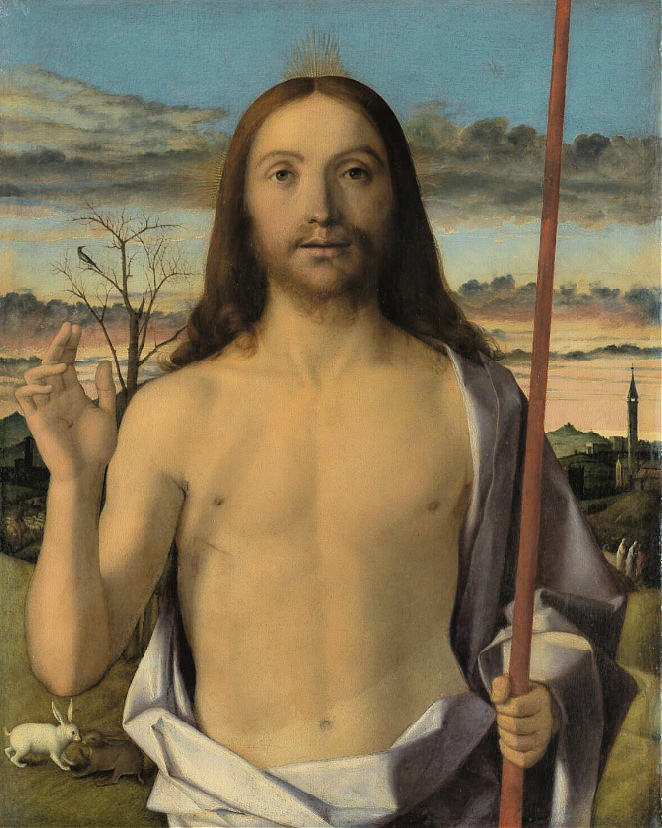
Giovanni Bellini (c. 1430-1516), Christ Blessing c. 1500, Tempera, oil, and gold on panel, 23 1/4 x 18 1/2 in. (59 x 47 cm), Kimbell Art Museum, Fort Worth, Texas. https://kimbellart.org/collection/ap-196707 – retrieved December 17, 2024.

In Bellini’s long career he depicted Jesus Christ differently over time. In his early years he often depicted the dead Christ in a lonely solitude. Later he added angels, and grief-stricken figures of his mother Mary and the apostle John. Bellini developed to depict Christ as triumphant or beatified in his miraculous apparitions of the Transfiguration, Resurrection and Ascension. In Christ Blessing Bellini animatedly portrays the God-Man sent to bless the world on one hand and holding the shepherd’s rod to guide his flock in the other (it may also be logically seen, though not completely in view, as his staff with the traditional red cross on a white flag atop symbolizing his triumph over death). A devotional image presenting the Resurrected Savior, its vibrant figure is brought close to the picture plane where his level gaze and shadowed arm of blessing informs the viewer of the matter-of-fact reality of the scene in quiet harmonious colors. Yet, at the same time, golden rays of light emanate from the top and sides of his head, making thoroughly evident His Divinity. In the background Bellini depicts prolific rabbits, shepherds tending their flock and three shrouded figures who likely are the three Marys at the tomb on Easter morning. There is also a lighted church bell tower to convey the presence of Christ in his Church.

Giovanni Bellini (c. 1430-1516), Drunkenness of Noah,  oil on canvas, c. 1515, 40.5 in. x 61.8 in (103 cm x 157 cm), Musée des Beaux-Arts et d’Archéologie de Besançon.

In one of Bellini’s last works the master shows how he adapts his work to the developing artistic style after 1510 led by Giorgione and Titian: the composition is fluid and dynamically conceived, with dramatic realism, aqueous colors and excited brushstrokes. Its attribution to Bellini has been accepted by scholars since 1927 though it remains open to debate.

Cima da Conegliano (c. 1459-c.1518), Virgin and Child in a Landscape, 1496-99, North Carolina Museum of Art, Raleigh, oil on panel, 28 x 24 3/4 in. (71.1 x 62.9 cm). https://ncartmuseum.org/object/virgin-and-child-in-a-landscape/ – retrieved December 12, 2024.

Cima was a Venetian artist who admired Bellini’s use of color and Antonello’s style of the Netherlandish masters. In contrast to renewed classicism which appeared in Venice in its art and architecture, Cima attempted a sophisticated art reliant on the study of nature that was prevalent in the provinces. Born in Treviso in about 1459, Cima worked in Vicenza in Mantegna’s circle and then moved to Venice in 1492. He was associated with the school of Alvise Vivarini (1442/1453–1503/1505), though Cima remained linked to the gentle and rustic naturalism of the provinces. His models included Madonnas and religious figures in peaceful landscapes such as this painting of a peasant mother and her child in a landscape that includes behind them a monastery and hilltop fortification. The crystalline colors and fluid drawing indicate Antonello’s influence while its overall placidness is characteristic of Cimi’s artwork.

Vittore Carpaccio (1465-1526), Apparition of the Martyrs of the Mount Ararat in the Church of Sant’ Antonio di Castello, c.1513-14, oil on canvas, 47 5/8 x 68 ½ in. (121x 174 cm), Gallerie dell’ Accademia, Venice.

A pupil of Gentile Bellini (Giovanni’s brother), and a follower of Giovanni and Giorgione, his finest work began in 1490. The Legend of Saint Ursula and other pageant-type pictures was early and masterful Italian genre painting. Carpaccio depicted detailed episodes of sacred history and legend using the settings and minutiae of contemporary everyday Venetian society within a formal pictorial schema. This Apparition of the Martyrs of the Mount Ararat in the Church of Sant’ Antonio di Castello is a small canvas that captures the compelling simplicity and authentic emotion of a religious scene that was present in his earlier larger format cycles and series. The painting is of a vision of the prior of  St. Anthony monastery kneeling at the altar on the far left. He turns to see the 10,000 martyrs of Mount Ararat he called upon in prayer during a plague that had broken out among the friars. As the martyrs process into the church, they are blessed by St. Peter, the first pope. Carpaccio depicts the interior of a Gothic Church  – including an elaborate wooden screen at left and cargo ships suspended from the ceiling – that was demolished in 1807.

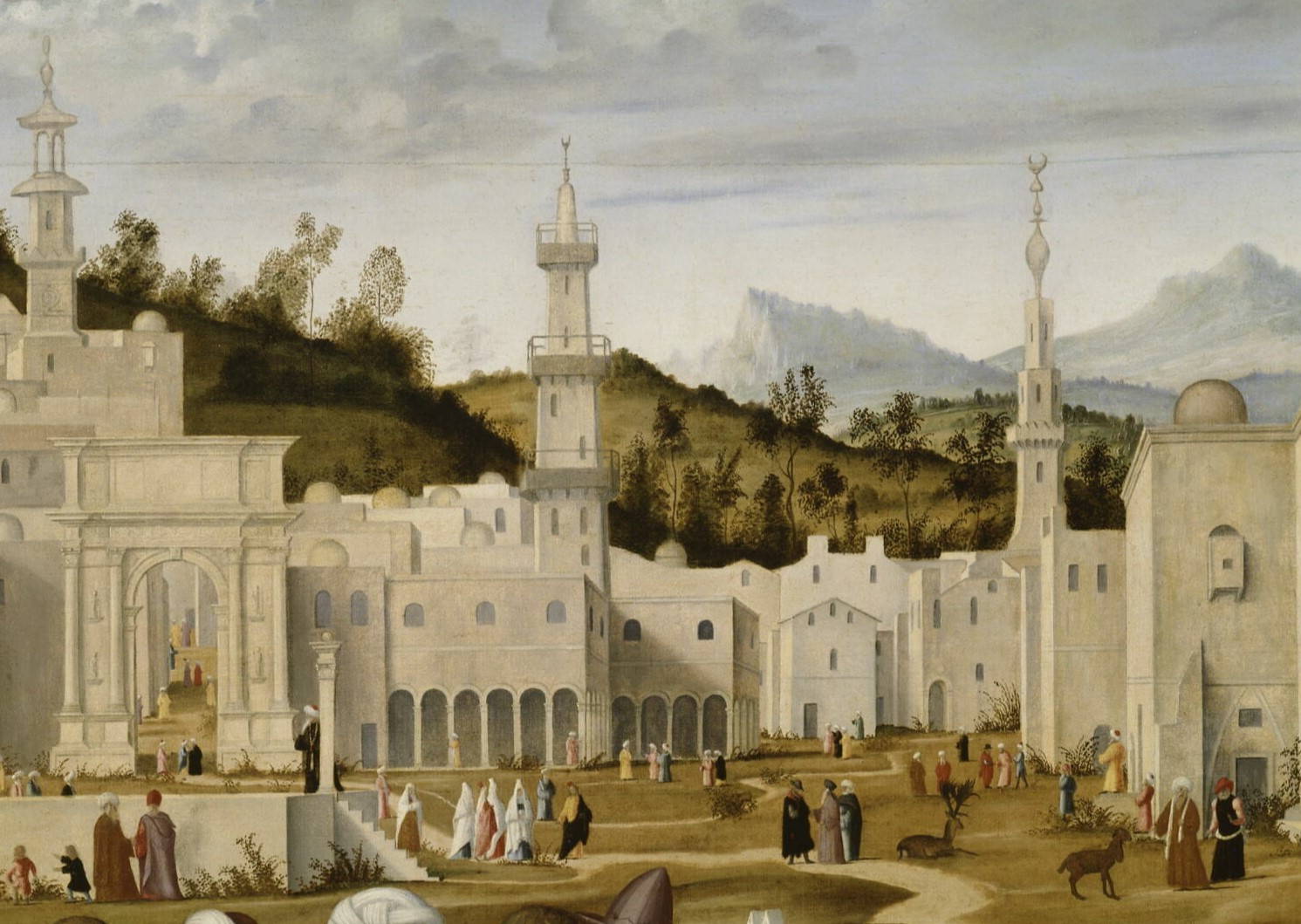
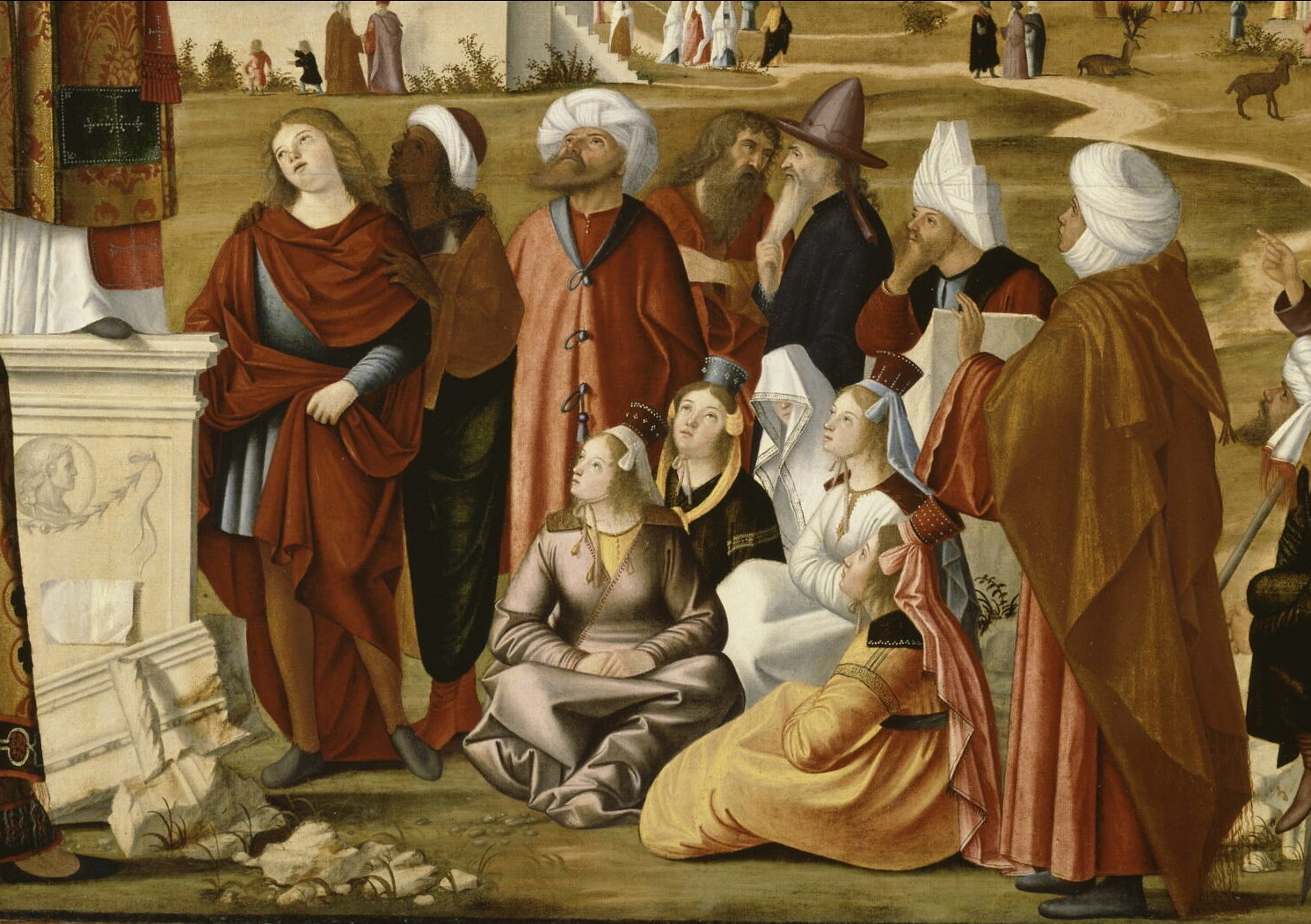
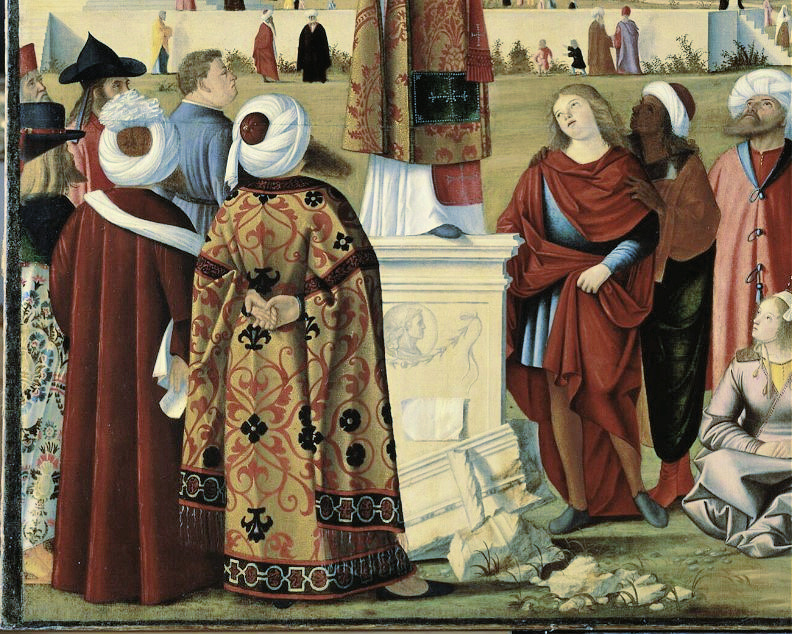
Vittore Carpaccio (1465-1526), Preaching of St. Stephen, 1500-1525, oil on canvas, 1.48 x 1.94m, Louvre. In place until the abolition of the brotherhood in 1806; P. Edwards, 1807; Pinacoteca di Brera, Milan, 1808; entered the Louvre by way of exchange, 1812. https://collections.louvre.fr/en/ark:/53355/cl010062650 – retrieved December 19, 2024.
detail.
detail.
detail.

Preaching of Saint Stephen by Vittore Carpaccio was done on the first quarter of the 16th century. It depicts the first Christian martyr, St. Stephen, giving a sermon whose actions and words involve its audience as active witnesses. Set within a spacious landscape it reflects an ideal city view, reminiscent to Jerusalem. It is suggested that Carpaccio may have been in Jerusalem as this scene is reminiscent of life in that city and of the Haram-ash-Sharif with the Mosque of Omar.
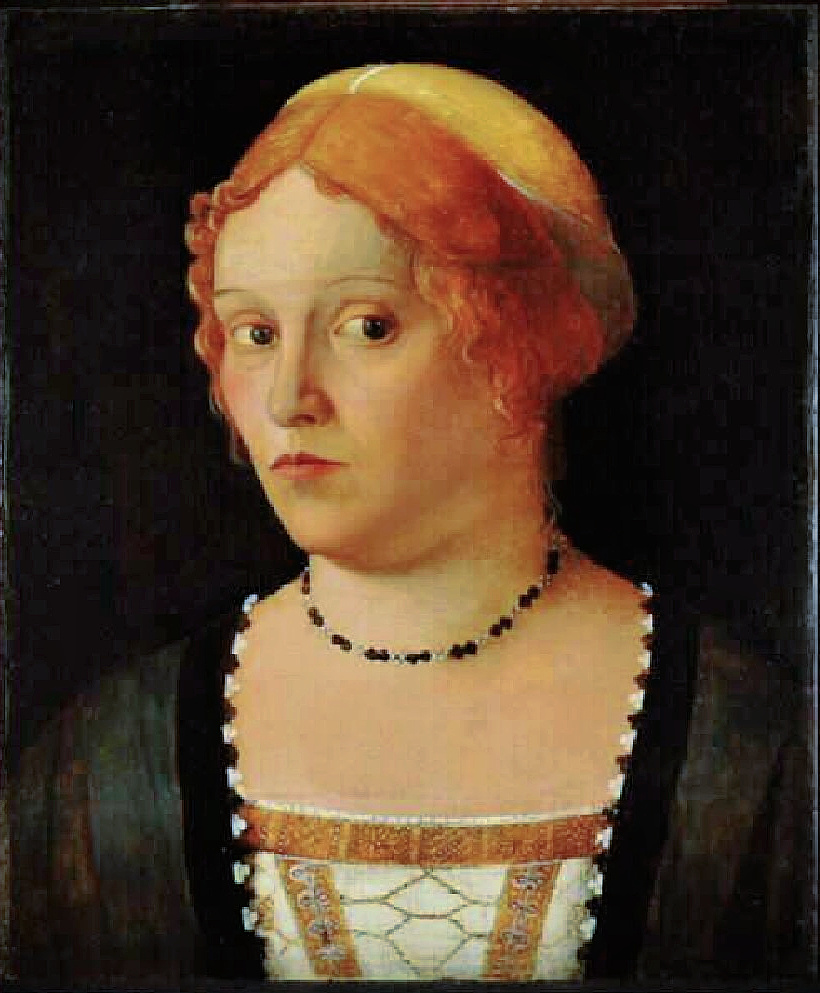
Portrait of a Lady, formerly attributed to Vittore Carpaccio (Italian, 1465 – 1526),:ca. 1505, Oil on panel with traces of tempera, 10 7/16 × 8 13/16 × 7/8 inches (26.47 × 22.4 × 2.21 cm) see – https://art.nelson-atkins.org/objects/16018/portrait-of-a-venetian-woman?ctx=0721b3e2-2547-4733-9f9a-582aecdcd7b0&idx=0 – retrieved December 5, 2024.

Carpaccio’s realism in numerous portraits in his ceremonial pictures was influenced by the Flemish masters already popular in Italy in the 1490’s. This bust-length independent portrait of a woman set against a plain dark background is almost an abstract construct of eyes, mouth and hairstyle. Her large head is turned slightly in one direction while her limpid  eyes look in the other direction. Her reddish hair is pulled loosely back from her face and, at the crown of her head she wears a yellow net to hold some of it. Her square-neck dress is slate blue edged in black, with a white and gold embroidered front panel. Around her neck she wears a choker of white and black beads.
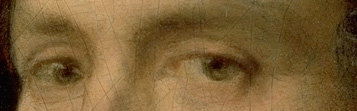
detail of picture below.
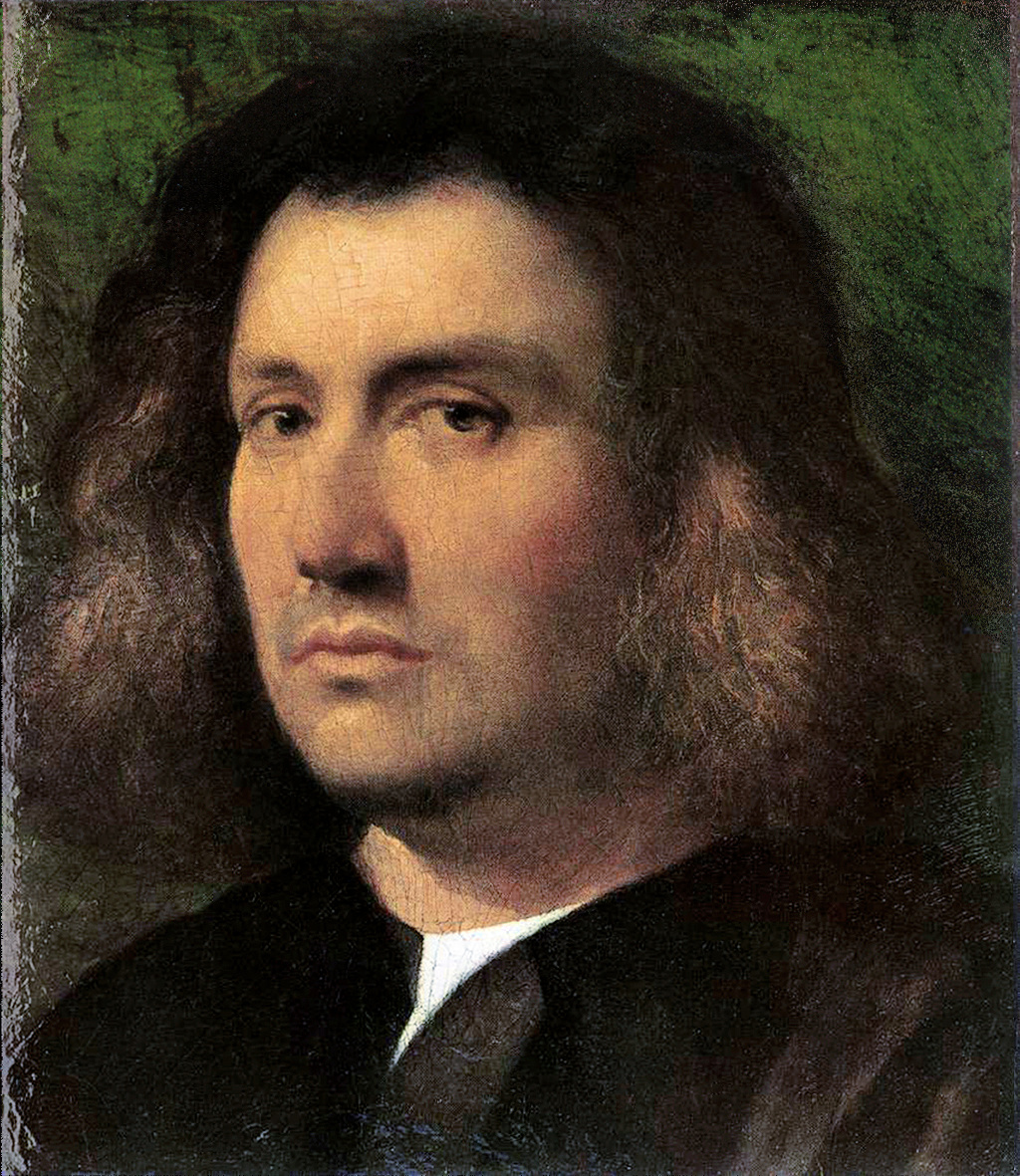
Giorgione (1478–1510), Portrait of a Man, 1506-10, oil on panel, 11 7/8 x 10 1/8 in. (30.16 x 25.72 cm), San Diego Museum of Art.https://collection.sdmart.org/objects-1/portfolio?records=50&query=sort_artist%20has%20words%20%22giorgione%22&sort=9 – December 18, 2024.

Giorgione who moved to Venice around 1500 is the transitional figure between Bellini and Titian. Instead of a prevailing late 15th century practice of precise brushstrokes and sculptural composition in his art, Giorgio expressed his subject matter in studied tonal gradations of color and precise analysis of human emotional expression described in gentle brushstrokes. Vasari saw Giorgione’s painting as if having no intermediary between art and life. Painted in the same period as Old Woman (Gallerie dell’ Accademia, Venice), this Portrait of a Man epitomizes what Vasari called the “modern manner” where Giorgione sought to paint “living and natural things.” With its plain dark background and close head crop the man’s carefully observed turning gaze and ambiguous expression is wholly engaging and alive.
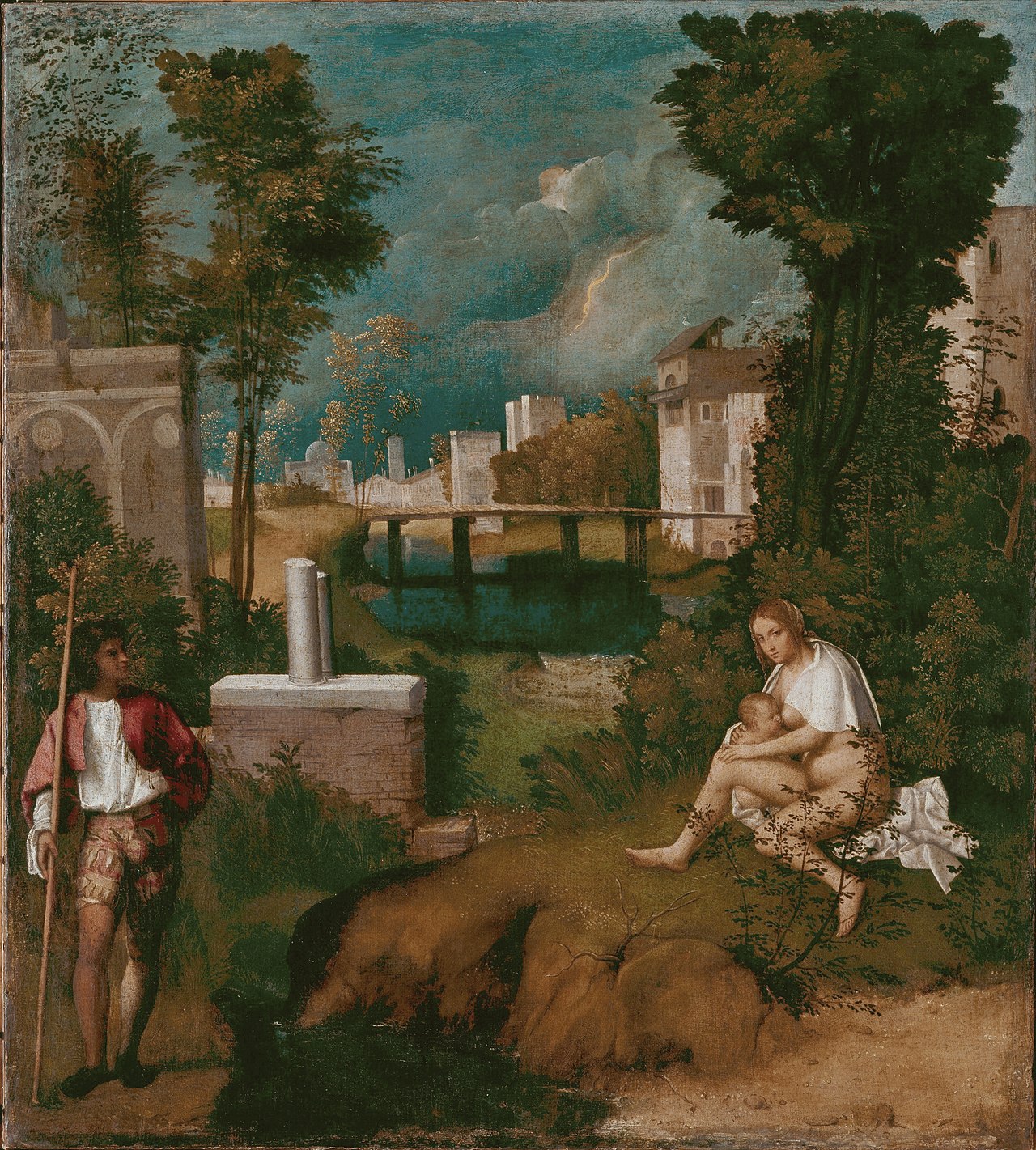
Giorgione (1478–1510), The Tempest, c. 1508, oil on canvas, 83 cm × 73 cm (33” × 29”), Gallerie dell’Accademia.

With Leonardo da Vinci, Giorgione is ranked as one of the founders of modern art. He was the first artist in Venice who often painted small artworks in oil of mysterious and evocative subjects for private commissions instead of public church works. The Tempest, originally commissioned by a Venetian noble of the House of Vendramin, is one of those artworks. Known as “a landscape of mood,” it has no discernable subject matter outside of expressing the tension and heat of an approaching storm. Its meaning remains elusive today. Giorgione’s career and personal life are equally mysterious. The artist is known to have shared a studio with Venetian painter Vincenzo Catena (c. 1480-1531) in Venice, worked on the Doges’ palace (though these works are lost) and on frescoes on the exterior of the German Merchants headquarters in Venice where Titian was working as well in a lesser role. Giorgione was an innovator but his known output is small, questionable, and, dying in the plague in 1510 at 32 years old, sometimes completed by others including his pupils, Titian and Sebastiano del Piombo, who were profoundly influenced by him.

Circle of Titian, formerly Giorgione, The Dead Christ supported by an Angel, oil on canvas, 1508-1510, 77.7 x 64.5 cm.; 30½ x 25⅜ in. Property from the Estate of Barbara Piasecka Johnson (1937–2013), https://www.sothebys.com/en/buy/auction/2022/old-masters-evening-sale/the-dead-christ-supported-by-an-angel – retrieved December 5, 2024.

Because of Giorgione’s early death in 1510 and other circumstances he did not complete many of his later paintings, making their ultimate identification difficult. That Titian completed many of these works is documented. Once in the collection of the House of Vendramin, this painting is such of jumble of painterly hands it is today attributed to the Circle of Titian though when earlier it was attributed to Giorgione the hand of Titian was apparent particularly in the figure of Christ. Titian was more aggressive in his use of colors –such as browns and grays- than Giorgione’s refined yellows and blues. X-rays reveal another composition – believed to be Giorgione-like- over the ponderous right hand of the angel painted over it.
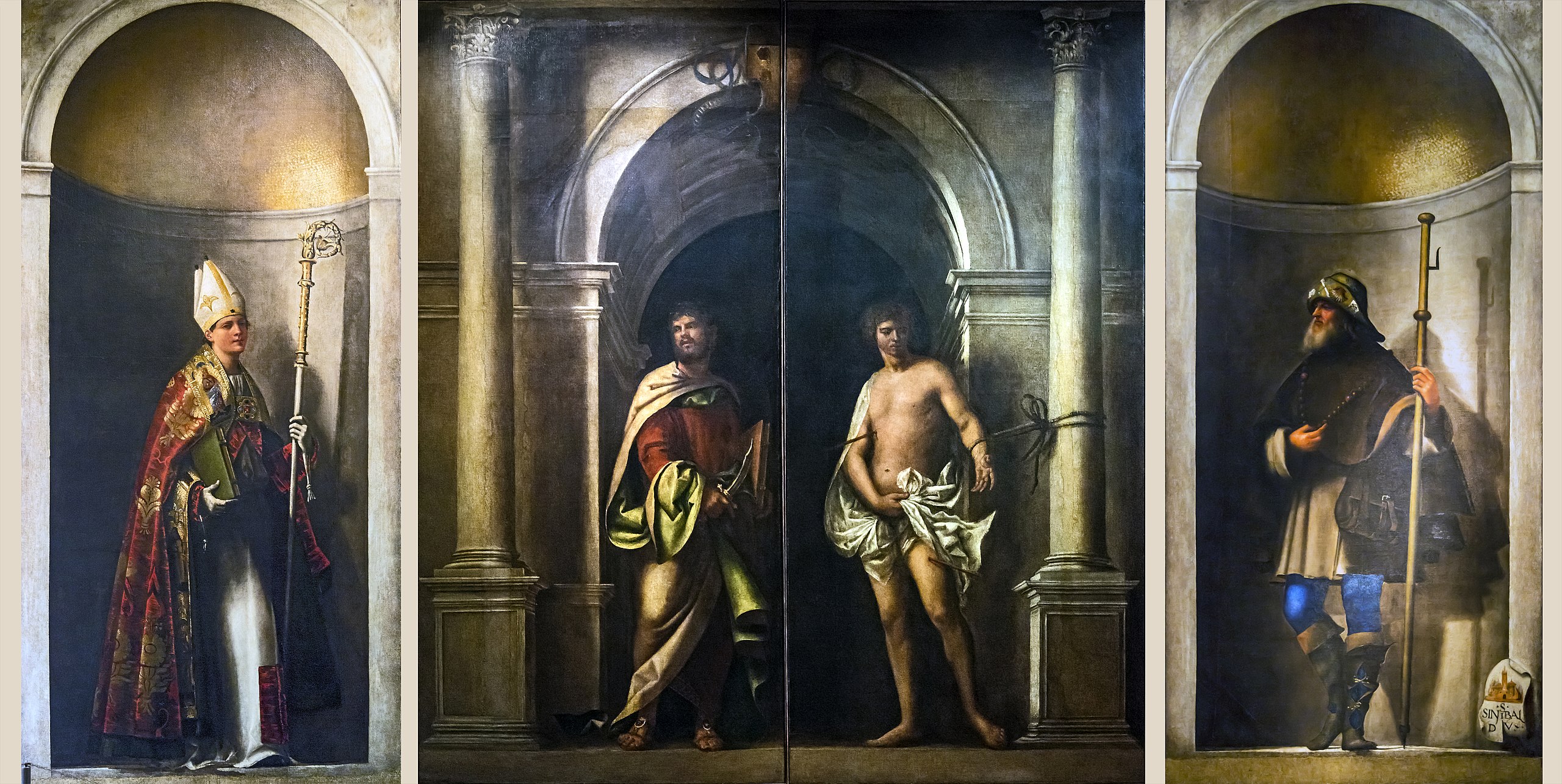
Sebastiano de Piombo (1485-1547), Organ Shutters, Four Saints, c. 1507-09, 115.3 in. x 53.9 in., 293 cm  x 137 cm  Gallerie delle’ Accademia, Venice (formerly in the Church of San Bartolomeo al Rialto).

When the organ shutter doors closed they formed a single image of two martyrs: Saint Batholomeo and Saint Sebastian. These organ shutters for San Bartolomeo al Rialto are the earliest documented works of Sebastiano. Commissioned by the church’s vicar in late 1507, it was completed in 1509.

Detail of above. St. Louis of Toulouse.

St. Louis of Toulouse was a bishop of Toulouse in France consecrated by Boniface VIII in 1297. Because of his princely standing Louis won the episcopal appointment, but as bishop he turned his office and efforts to meeting the material and spiritual needs of the poor in his diocese, feeding the hungry, and ignoring his own material interests. After six months, exhausted by his labors, he abandoned the position of bishop and died at Brignoles of fever, possibly typhoid, at 23 years old. St. Louis of Toulouse is one of the inside panels inside a niche of gray stone and gold mosaic (the other is St. Sebald of Nürnberg) by Sebastiano in his first documented commission.
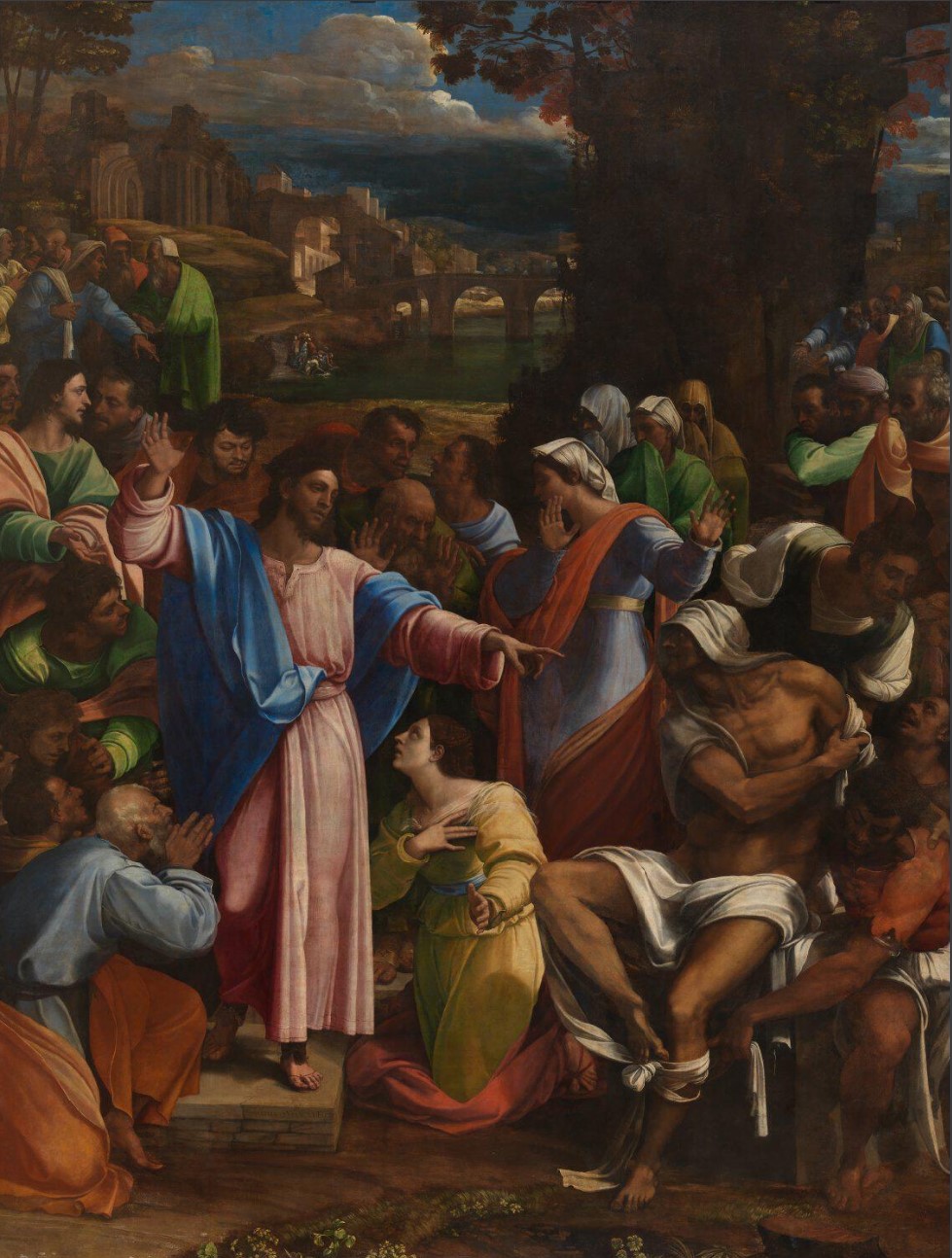
Sebastiano del Piombo (1485-1547), The Raising of Lazarus, 1517-19, oil, originally on wood, transferred to board, 381 × 289.6 cm, National Gallery of Art London. https://www.nationalgallery.org.uk/paintings/sebastiano-del-piombo-incorporating-designs-by-michelangelo-the-raising-of-lazarus – retrieved December 18, 2024.

Sebastiano Luciani, a pupil of Giorgione who deeply influenced him, was born in Venice in 1485. He didn’t become “del Piombo” until after 1531 when he became Keeper of the Papal Seal (“Il Piombo”). After Giorgione’s death in 1510 del Piombo may have completed some of Giorgione’s work and, in 1511, moved to Rome. Working at Villa Farnesina in Raphael’s circle that included Baldassare Peruzzi (1481-1536), del Piombo fell out with Raphael and became a devoted follower of Michaelangelo (1475-1564). Both eagerly worked to outperform Raphael, an artistic rival, and Michelangelo lent del Piombo some of his drawings to work from for some of the main figures in the complex composition of The Raising of Lazarus. The gigantic painting was commissioned for Narbonne Cathedral in southern France by Cardinal Giulio de’ Medici (1478-1534), later pope Clement VII, who had also commissioned Raphael’s last painting Transfiguration for the same cathedral.

“The Raising of Lazarus” by Sebastiano del Piombo is introduced by curator Matthias Wivel in this talk as part of the series ‘The History of the National Gallery in Six Paintings.’
Sebastiano del Piombo (1485-1547), Portrait of Clement VII, c. 1531, oil on slate, 105.4 × 87.6 cm (41 1/2 × 34 1/2 in.), J. Paul Getty Museum, Los Angeles. https://www.getty.edu/art/collection/object/103RJN – retrieved December 18, 2024.

The pope visited the artist’s studio and was pleased with his original three-quarter length portrait seated in a chair positioned diagonally, and ordered this oil copy on slate. The practice originated in Rome around 1500 in an attempt towards immortality in art. However, the material was heavy and would shatter if not handled with care. After 1531 del Piombo painted rather less and turned to making admirable portraits which combined his Venetian training in color and Roman discipline in form.
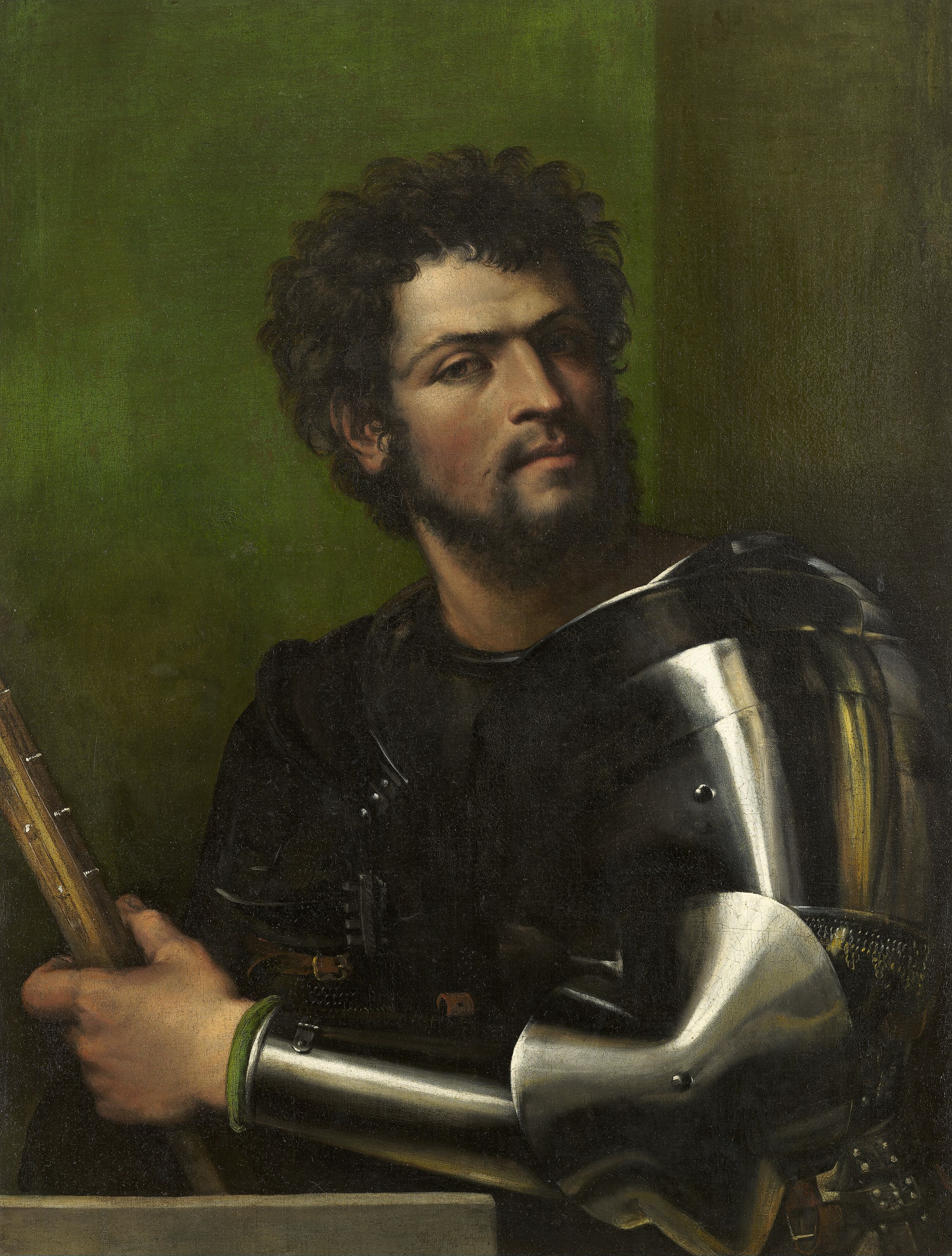
Sebastiano del Piombo (1485-1547), Portrait of a Man in Armor, c. 1511-15, oil on canvas, 34 ½ x 26 ¼ in (87.6 x 66.7 cm) Wadsworth Atheneum, Hartford.

Sebastiano made this portrait under the influence of Giorgione in terms of its gentle, engaging expression and subtly dramatic “over the shoulder” pose. Until more recently, this painting was attributed to Giorgione and, as it is Sebastiano, it recalls the deep influence Giorgione had on his pupils who imitated him profoundly. It has been postulated that the sitter is the Florentine general Francesco Ferrucci (1489-1530) who fought in the Italian Wars.

Jacopo Negretti called Palma il Vecchio (c. 1480-1528), Diana and Callisto, c. 1525/28, oil on canvas, 30 ½ x 48 ¾ in. (77.5 x 124 cm), Kunsthistorisches Museum, Vienna (Kunsthistorisches Museum Wien, Gemäldegalerie) https://www.khm.at/en/objectdb/detail/1291/?offset=34&lv=list – retrieved December 12, 2024.

Palma Il Vecchio was a Venetian painter who was a pupil of Bellini and influenced by Titian, Giorgione and Lotto. He is chiefly remembered for his paintings of female figures, particularly a blonde Venetian type of ample charm which extended even to paintings of several female saints. The subject of the naked woman located in a natural setting was pioneered by Giorgione and Titian but Palma Il Vecchio progressed the subject to work out the figure in three-dimensions and reliant on the linear curves in and of a complex assembly and interplay of naked female figures. In this painting, Palma il Vecchio adapted the poses of the sculptors of antiquity and drew on Mannerist contemporaries such as Giulio Romano (1499-1546) and Marc Antonio Raimondi (c. 1470/82–c. 1534). The sensuous surface texture typically found in Venetian art has given way to porcelain-like coolness.
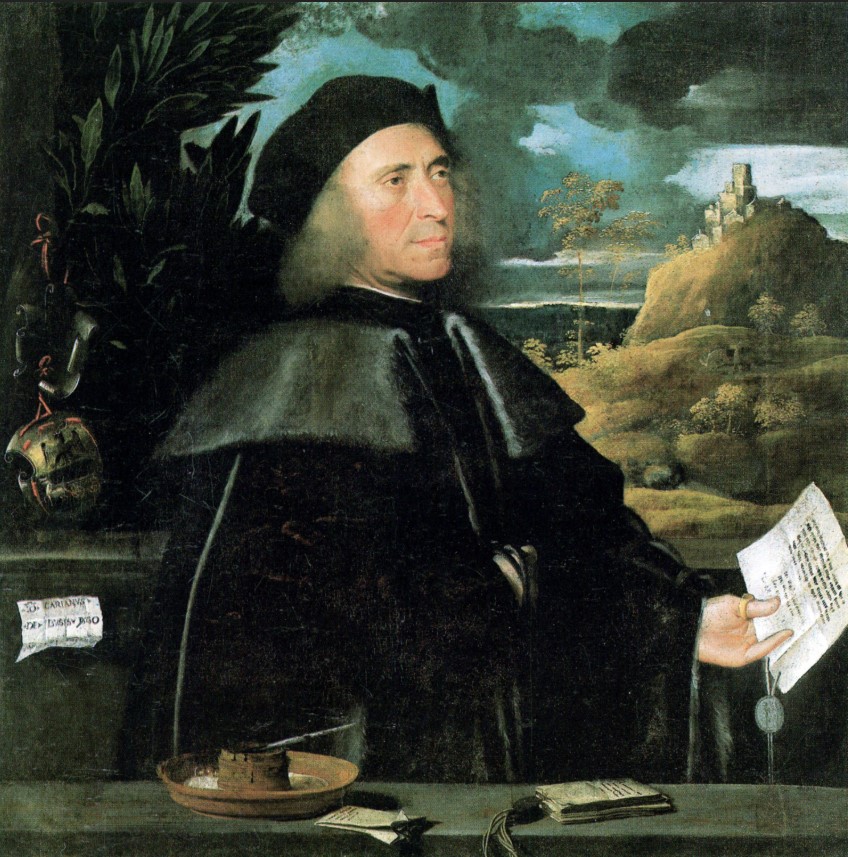
Giovanni Cariani (a. 1490-1547), Portrait of a Man, 1525-30, oil on canvas, 36 1/2 x 36 1/2 in. (92.7 x 92.7 cm), National Gallery of Canada, Ottawa.

Little is known about Cariani’s biography though it is speculated he was born in Bergamo in or before 1490. In his gentle, soft shaded subjects and arcadian elements Cariani’s early work is Venetian influenced by Giorgione. The artist was also inspired by Bellini and close to Palma Il Vecchio. He moved to Bergamo before 1520 and mastered portraiture under the influence of Lorenzo Lotto which are the highlight of his career. One of Cariani’s masterpieces is this portrait of a man of letters holding a seal that is possibly imperial or papal. The luminous colors are influenced by Palma Il Vecchio while the psychological insight of the sitter is learned from Lorenzo Lotto. The sitter is believed to possibly be Giovanni Benedetto da Caravaggio, a professor and administrator at the University of Padua.
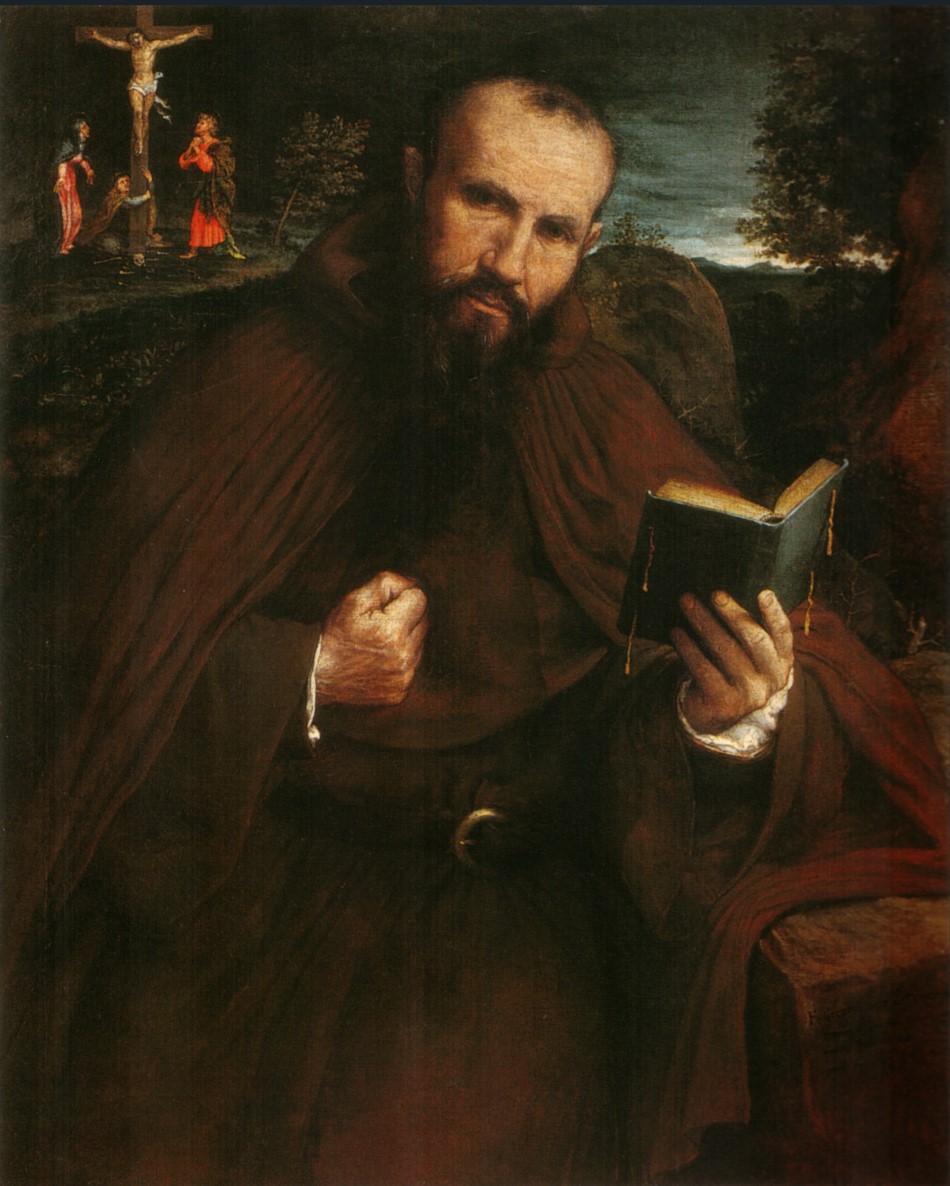
Lorenzo Lotto (c. 1480 – 1556), Fra Gregorio Belo of Vincenza, 1547, oil on canvas, 34 3/8 x 28 in (87.3 x 71.1 cm) The Metropolitan Museum of Art, New York City. https://www.metmuseum.org/art/collection/search/436917 – December 18, 2024.

The sitter beats his fist into his chest in penance, lifts an open book of Passion meditations, and is surrounded by a brooding sky and background living scene of Calvary, all of which works for the artist to scrutinize the mental state or inner thoughts of his sitter, here a religious brother in an order of poor hermits. Lotto had studied portraits of Albrecht Dürer, who made two trips to Venice, to learn to convey these deeper psychological states. Lotto’s assertively confessional portraits under his intense handling of light and dourly earthy colors, were astutely new and sometimes rejected by clients.
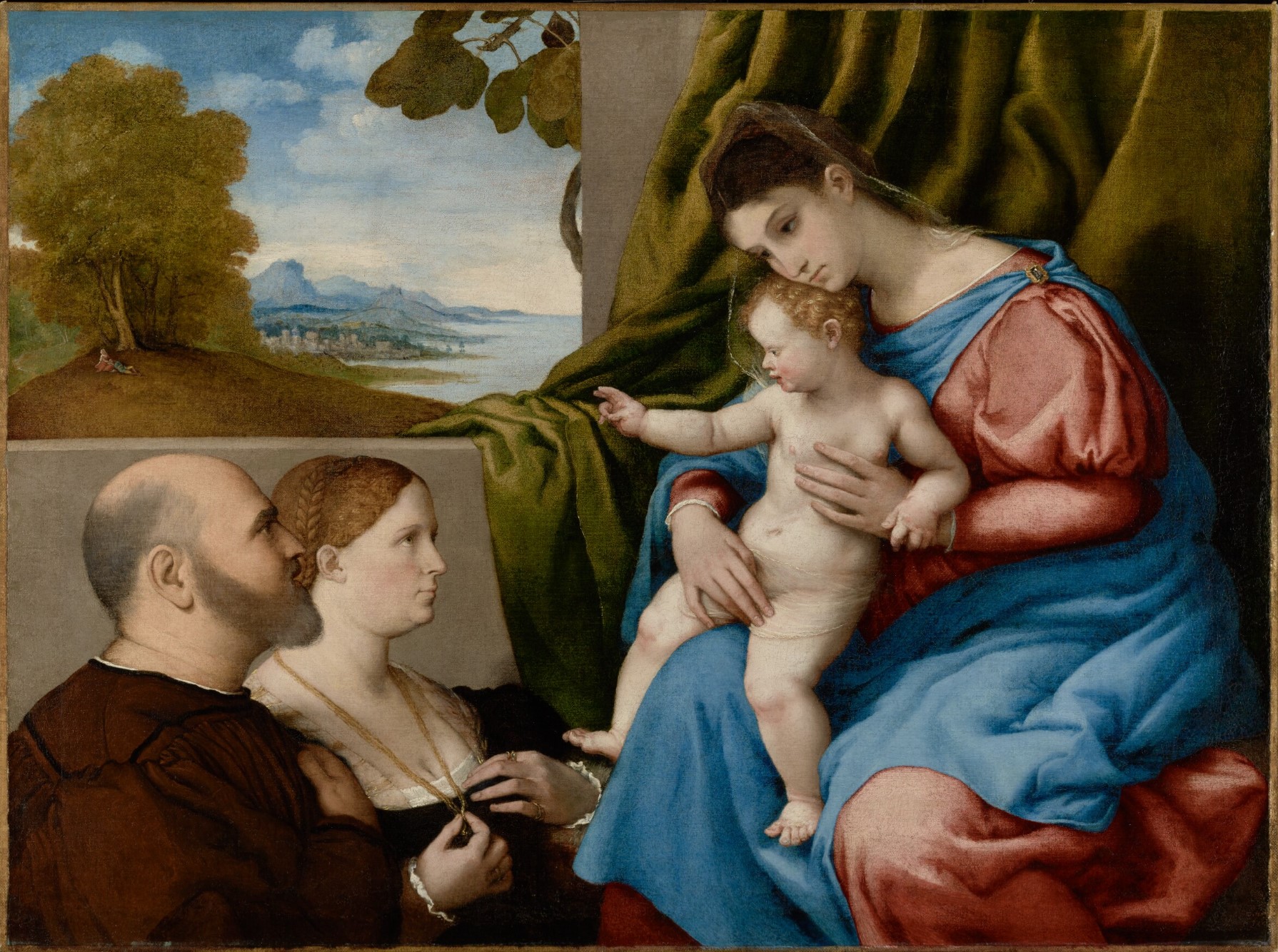
Lorenzo Lotto (c. 1480 – 1556), Madonna and Child with Two Donors, about 1525–1530, Getty Center https://www.getty.edu/art/collection/object/103RDE – retrieved December 11, 2024.

Lotto, a deeply religious man and one of the most independent of the 16th century Venetian artists, had a highly singular artistic vision with penetrating insight into the human personality. This painting is a mixture of the artist’s realism and idealism. The setting is natural as are the donors who Lotto draws with a Northern European Art sensibility. The Madonna and child are not derived from models, but expressed from an artistic conception of spiritual superiority. Kneeling donors in profile with the Virgin and Child was a motif developed in Venice in the 1490’s by Bellini. From the medieval period forward, donors were frequently portrayed in artworks they commissioned and such was more popular than ever in the early 1500’s.
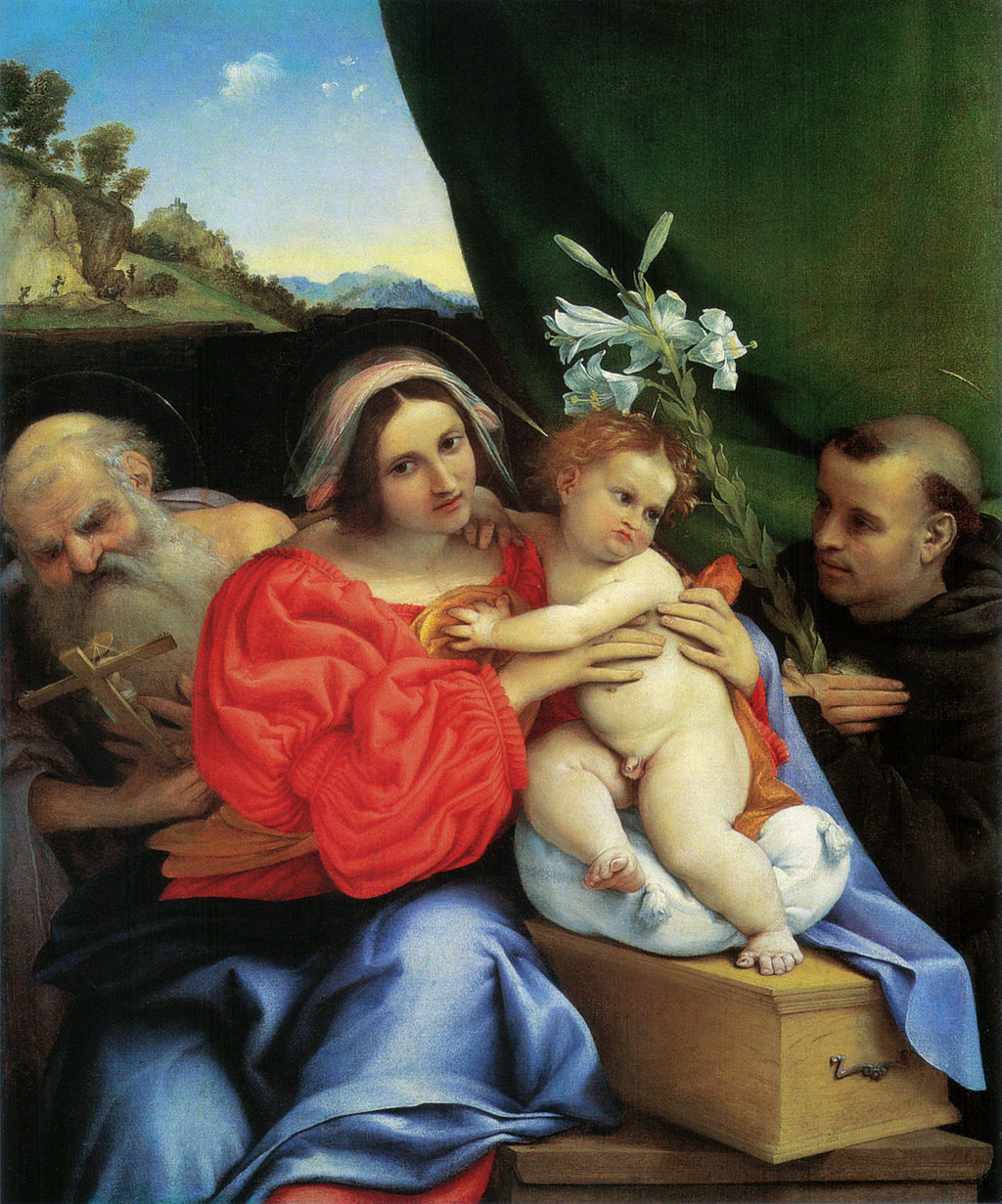
Lorenzo Lotto (c. 1480 – 1556), Madonna and Child with Sts. Jerome  and Anthony of Padua, 1521, oil on canvas, 37 1/8 x 30 5/8/ in. (94.3 x 77.8 cm),  Museum of Fine Arts, Boston.

While strongly influenced by Bellini at the start Lotto developed an independent chameleon-like style influenced by a range of contemporary Renaissance artists such as Sandro Botticelli (1445-1510), Fra Bartolomeo, Raphael, Corregio (1489-1534), Giorgione, Titian, as well as Germans, Dürer and Hans Holbein the Elder (1460-1524). But Lotto’s well-known character of independence had as much an historical context as a personal one. About Lotto, Bernard Berenson observed that the Venetian painter was “a psychological painter in an age which ended by esteeming little but force and display, a personal painter at a time when personality was getting to be of less account than conformity, evangelical at heart in a country upon which a rigid and soulless Vaticanism was daily strengthening its hold” (quoted in Pignatti, page 66). This painting from the 1520’s is remarkable for its renewed vision of the picture plane, here with an interlocking group of figures filling a shallow foreground like a frieze and a delimited background.
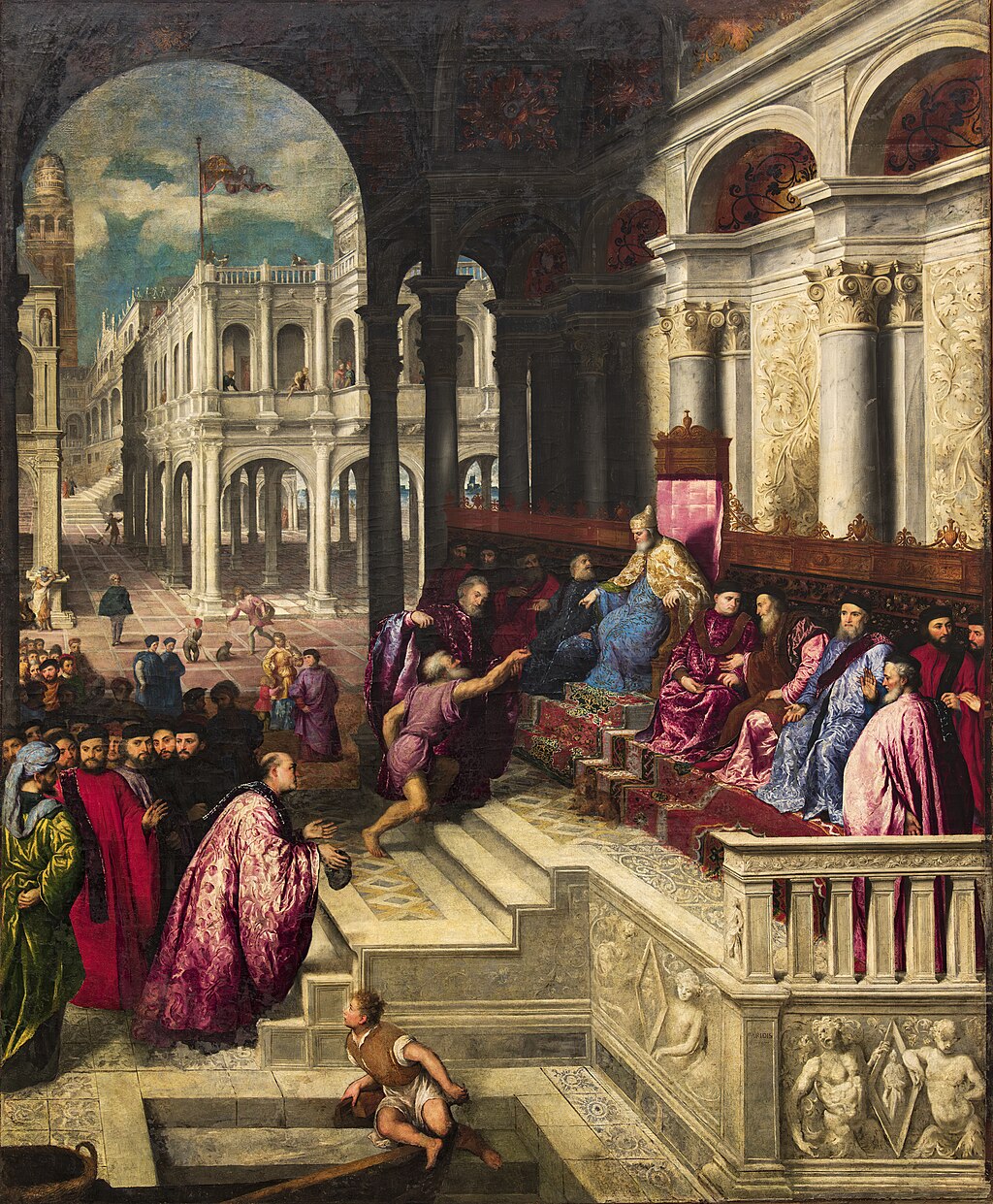
Paris Bordon/e (1500-1571), Fisherman Presenting a Ring to the Doge Gradenigo, 1534, oil on canvas, 370 x 301 cm (145.7 in × 118.5 in), Gallerie dell’Accademia, Venice.

It was painted in Venice for the confraternity of San Marco in 1540. Bartolomeo Gradenigo (1263-1342) was the 53rd Doge of Venice for three years, from 1339 to 1342. He was born in Venice to an ancient noble family and was a rich trader who practiced politics from an early age and lived a life of luxury. The painting depicts a famous legend that occurred in Gradenigo’s reign when a storm was pushed back by the intercession of Venice’s saints. Afterwards the saints gave a humble fisherman the “Ring of the Fisherman” to present to the doge.
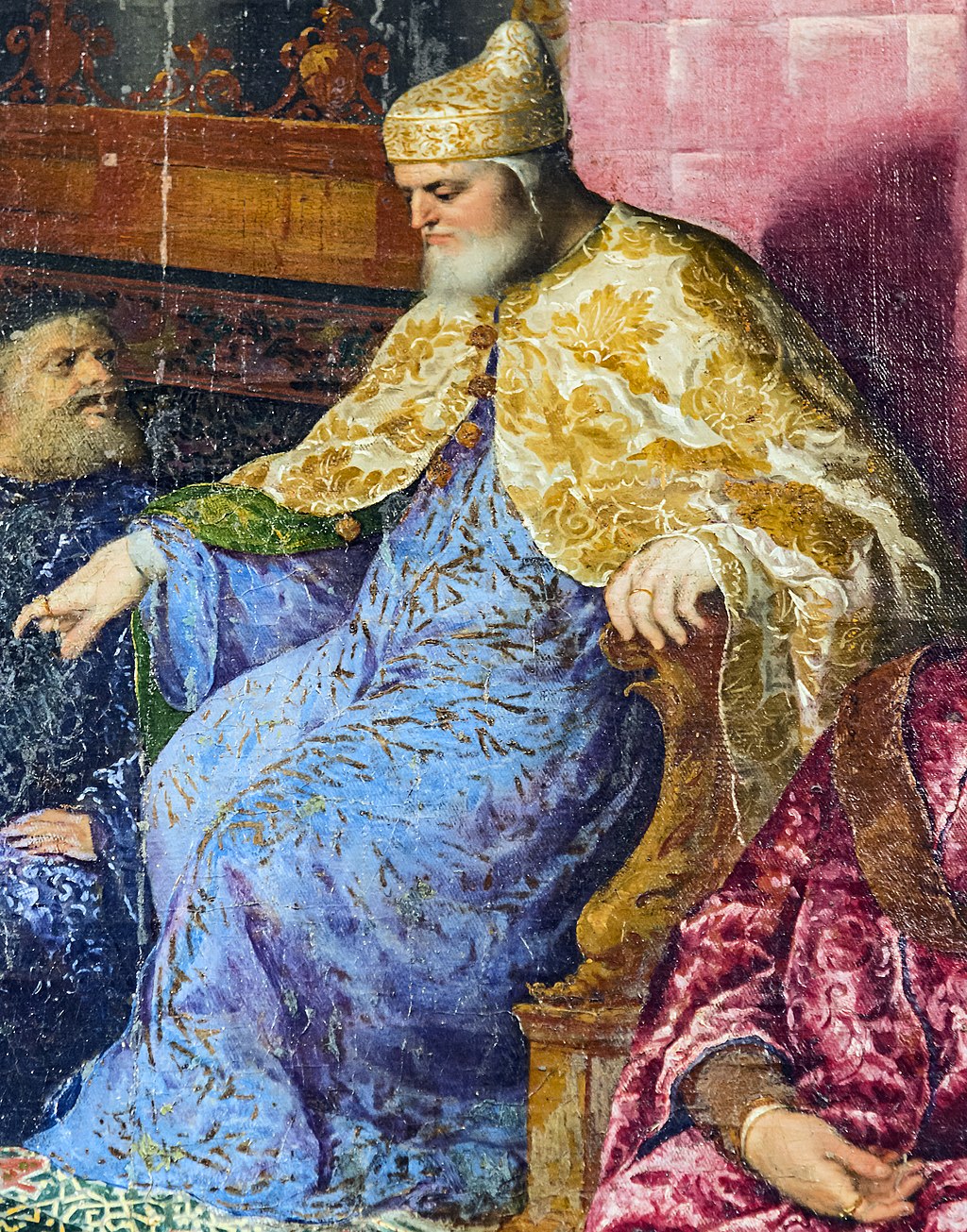
Accademia – Doge Bartolomeo Gradenigo by Paris Bordon/e.
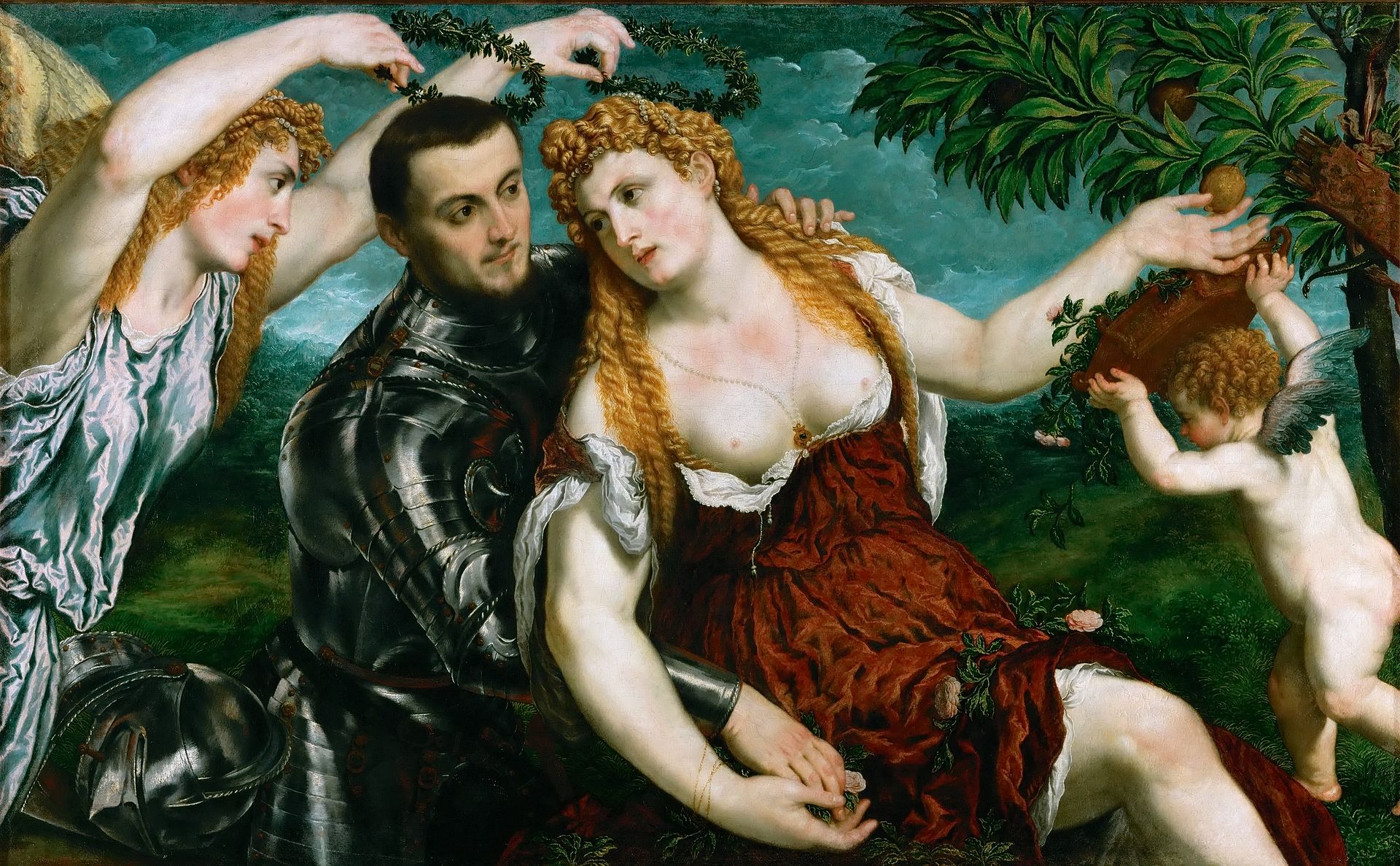
Paris Bordon/e (1500-1571), Portrait of a Knight in Armor, oil on canvas, 36 x 30 in. (91.4 x 76.2 cm) Frame: 44 3/4 x 38 x 3 1/2 in. (113.7 x 96.5 x 8.9 cm), North Carolina Museum of Art, Raleigh. https://ncartmuseum.org/object/portrait-of-a-man-in-armor/ – retrieved December 13, 2024.

Paris Bordon/e was born in Treviso in 1500 and moved to Venice in 1508. where he was based his entire life until his death in 1571. His training is unknown though apparently in Venice where he listed as an independent painter in 1518. As a young professional he reflected the influence of Giorgione in his sentimental portraits and Titian in his use of bold and fluid colors. In the mid 1520s he took on a figural monumentality reminiscent of Pordenone. In the late 1530s Bordon/e was in France at the court of Francis I making realistic portraits and, in 1540, in Augsburg, where he painted for the wealthy Fuggers. Bordon/e was well known for his subjects’ delineated costumes and detailed intellectual landscapes.

Paris Bordon/e (1500-1571). Gladiator fight, c. 1560, oil on canvas, 218 × 329 cm, Kunsthistorisches Museum Wien, Gemäldegalerie. https://www.khm.at/en/objectdb/detail/292/?offset=0&lv=list – retrieved December 13, 2024.
Paris Bordon/e.
Paris Bordon/e.
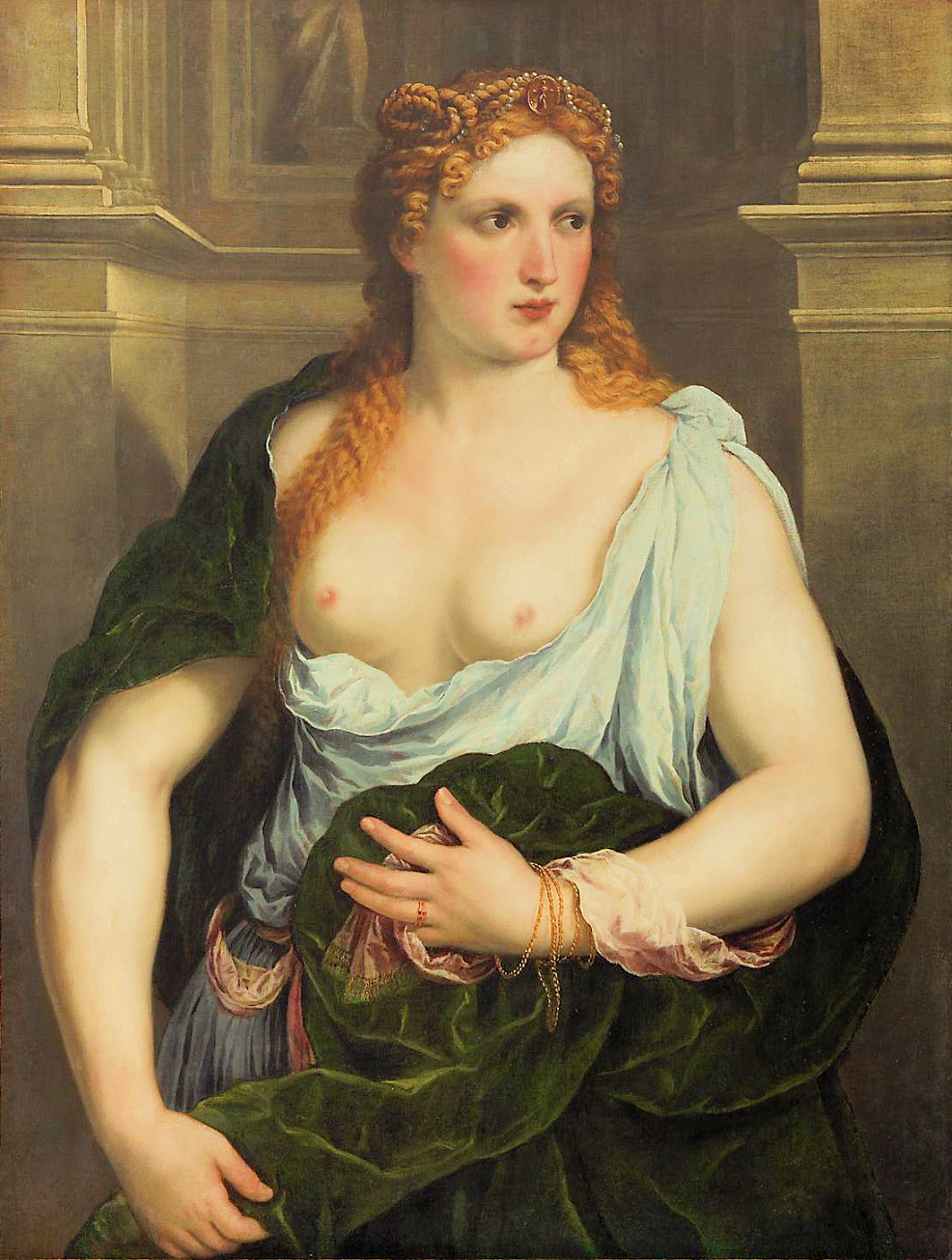
Paris Bordon/e (1500-1571), Portrait of a Young Woman in a Green Coat, c. 1550, oil on canvas, 40 1/8 x 30 ½ in. (102 cm × 77.5 cm), Kunsthistorisches Museum Wien, Gemäldegalerie.https://www.khm.at/en/objectdb/detail/288/?offset=11&lv=list – retrieved December 13, 2024.

Bordon/e’s painting is closely related to Titian’s style yet in this female figure expresses with elegance and refinement Bordon/e’s own sophisticated stylistic vision. This may be a portrait of Veronica Franco, a Venetian courtesan who played an outsized role in the social and cultural life of the city in the mid16th century.
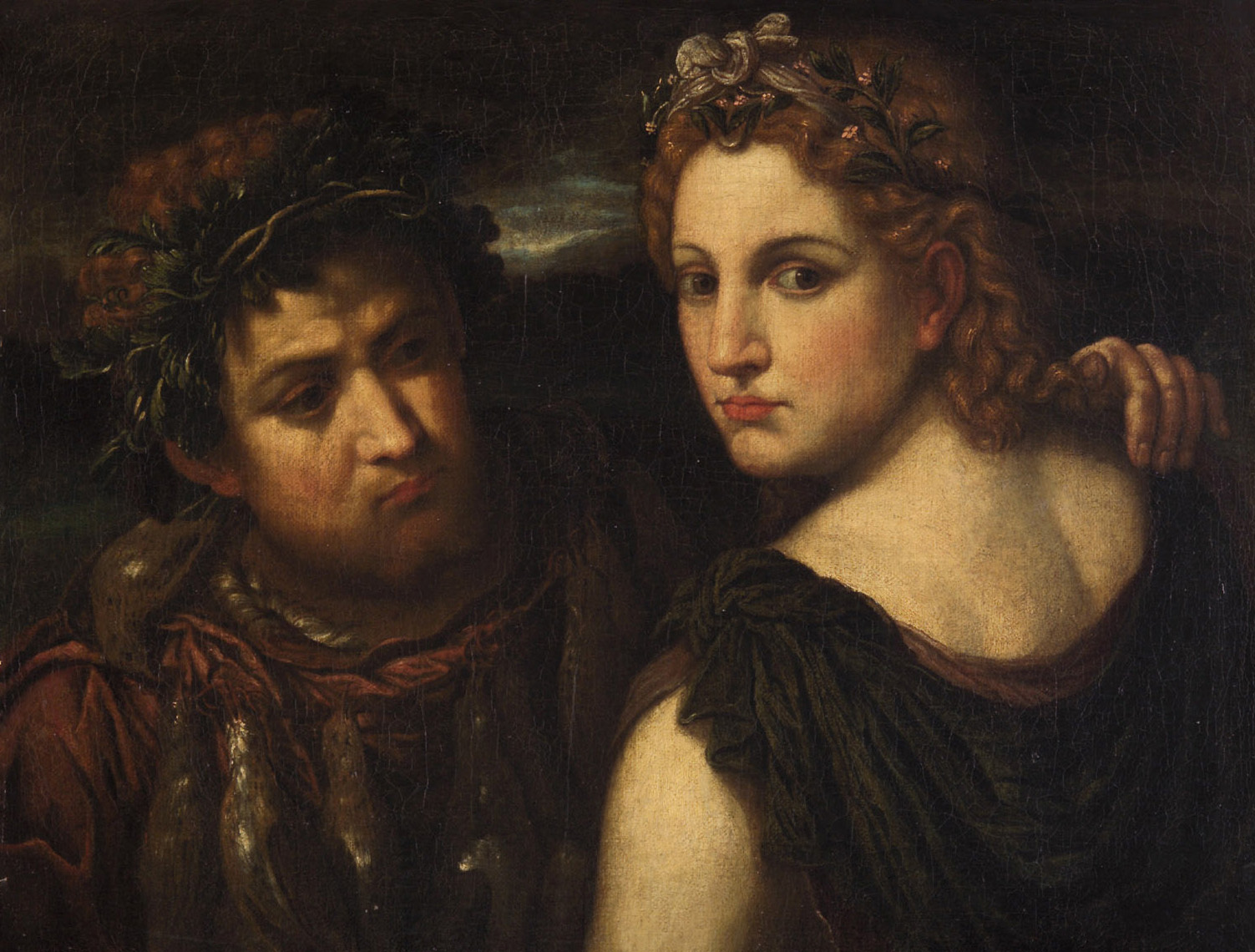
Paris Bordon/e (1500-1571), Nymph and hunter, 1550s, 45 × 61 × 2.4 cm, Kunsthistorisches Museum Wien, Gemäldegalerie. https://www.khm.at/en/objectdb/detail/294/?offset=1&lv=list – retrieved December 13, 2024.
Titian (c.1511-1576), The Death of Actaeon. c. 1559-75, oil on canvas, 178.8 × 197.8 cm. National Gallery London.

SOURCES: The Golden Century of Venetian Painting,  Terisio Pignatti, Los Angeles County Museum of Art and New York: George Braziller, Inc., 1979.

A Dictionary of Art and Artists, Peter and Linda Murray, Penguin Books; Revised,1998.

History of Italian Renaissance Art, 2nd edition, Frederick Hartt, Harry N Abrams. 1987.

Architectural History of Venice, 2nd edition, Deborah Howard, Yale University Press, New Haven and London, 2004.


FRANCE. French art in the 17th Century: VALENTIN DE BOULOGNE (1591-1632).

FEATURE IMAGE: Valentin de Boulogne (1591-1632), Allegory of Rome, 1628, oil on canvas, 330 x 245 cm, Villa Lante (Institutum Romanum Finlandiae Foundation). Villa Lante in Rome is an example of the work of the 16th century Raphael school in the reign of the Medici popes. The Renaissance villa, which was a residence for Roman aristocracy, was purchased in 1950 by the Finnish state. The Institutum Romanum Finlandiae Foundation started operating there in April 1954.

Ruins of the Coliseum in Rome, Circle of Willem van Nieuwlandt, II, c. 1600,  Pen and brown ink, with brush and brown and gray wash, on pieced cream laid paper,  35.3 × 61.3 cm (13 15/16 × 24 3/16 in.) The Art Institute of Chicago.
https://www.artic.edu/artworks/95904/ruins-of-the-coliseum-in-rome

INTRODUCTION.

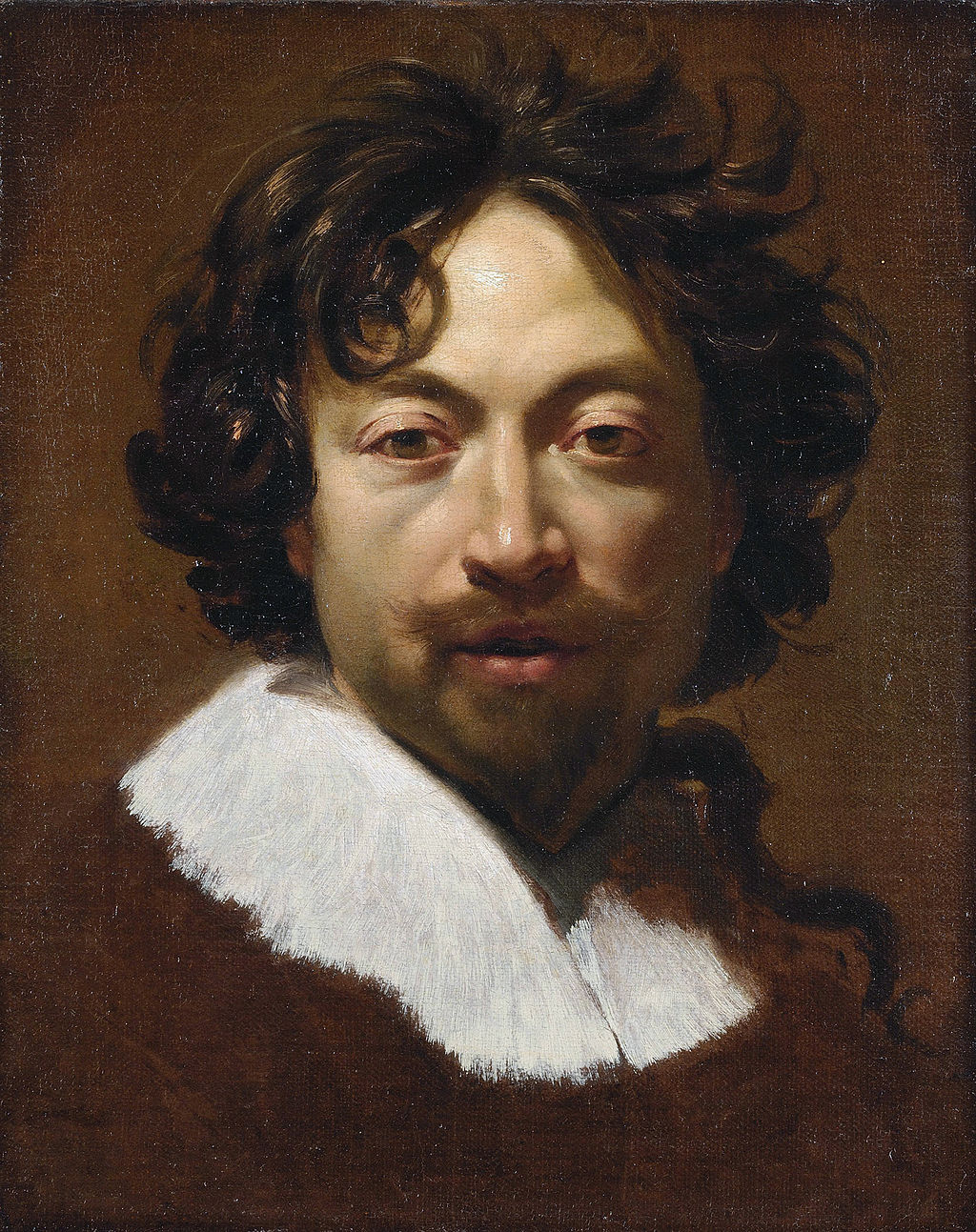
Le Valentin de Boulogne (c.1591/1594-1632), sometimes called Jean Valentin, Jean de Boulogne Valentin, or simply Le Valentin, was a French painter. Born in Coulommiers-en-Brie about 35 miles east of Paris, Le Valentin may have been at least half Italian. His artwork was certainly influenced by Italian painting more than any other though he was familiar with Northern or Flemish painting. Le Valentin may have been in Rome as early as 1612 – German painter and art-historian Joachim von Sandrart (1606-1688) remarked in 1675 that Valentin reached Rome before Simon Vouet (1590-1649) who had arrived around 1614. Whether in 1612 or definitely by 1620 (Le Valentin appears in the census), Le Valentin spent the rest of his life In Rome. In the Eternal City Le Valentin  was greatly influenced by Simon Vouet (French, 1590-1649) and Bartolomeo  Manfredi (Italian, 1581-1622), a leading Caravaggiste or follower of Carravaggio (Italian, 1571-1610).

Joachim von Sandrart, Self Portrait, 1641.
Bartolomeo Manfredi, The Martyrdom of St. Bartholomew (detail).
Simon Vouet, Self-portrait, c. 1626–1627 Musée des Beaux-arts de Lyon.

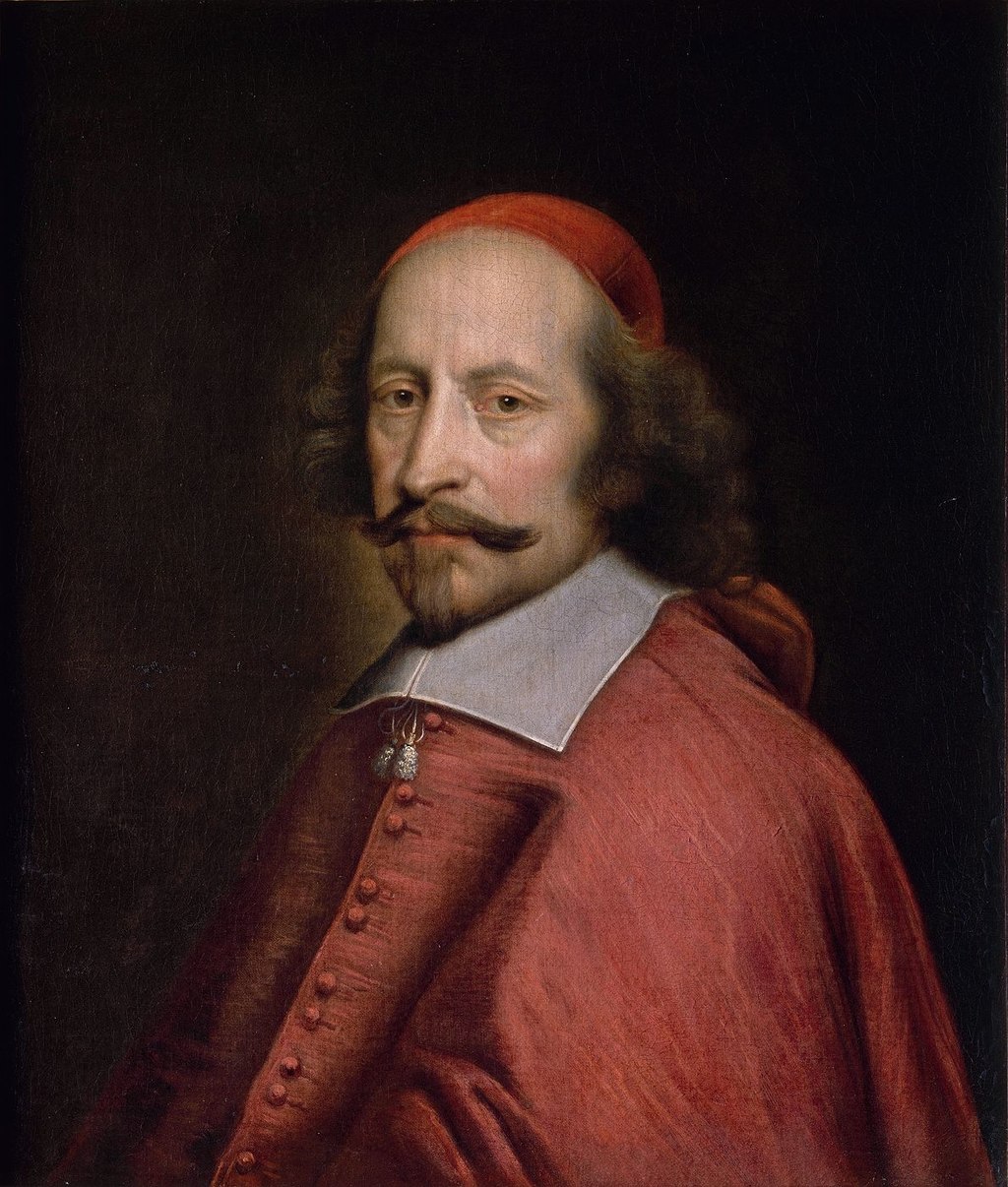
Le Valentin’s oeuvre is today around 55-60 paintings, most of them identified by modern scholarship (i.e., Jacques Bousquet; Roberto Longhi). Le Valentin’s major commissions date from the last seven years of his life. Opportunities to acquire his artwork was  rare, though avid collectors such as Cardinal Mazarin (1602-1661) and Louis XIV collected them.

Cardinal Mazarin by Pierre Mignard, Musée Condé, Chantilly, France.
Louis XIV, Charles Le Brun, Château de Versailles.
Piazza del Popolo, Rome. “Piazza del Popolo.. Rome” by Nick Kenrick.. is licensed under CC BY 2.0

In Rome Le Valentin forged close ties with other French artists and lived with many of them in and around the Piazza del Popolo to the Piazza di Spagna. Most French painters born in the 1590s made a stay in Rome  – and influenced art in France in the 17th century. Reasons young painters fled to Italy in the early 17th century included depletion of opportunity in Paris due to the professionalization of artistic practice in and outside the capital although establishment French art was no longer flourishing. Conversely, Roman art – and not only the schools of Michelangelo and Raphael but new horizons afforded  by Annibale Carracci (1560-1609) and Caravaggio (1571-1610) -was at an apex. The Eternal City was drawing international artists from Paris and elsewhere and, between 1610 and 1630, the Roman style became internationalized. The dialogue among artists in Rome in this period was exciting – and its outcomes often unpredictable. The culture of Rome (and the papacy) could actually be liberating for foreign, usually destitute, often libertine talented young artists who had great ambitions for a prominent commission as they were exposed to Rome’s virtue and vice almost equally. Many of these young artists, even ones whose artworks survive, exist today virtually anonymously. Le Valentin de Boulogne is one of the better-known artists of the period, although his precise name is uncertain and his artwork requires connoisseurship based on modern scholarship.

Annibile Carracci, Self-portrait, 1604, Hermitage Museum, St. Petersburg, Russia.
Caravaggio, David with the Head of Goliath, included a self portrait of the artist, 1610, oil on canvas, Borghese Gallery, Rome.

In 1626 Valentin, in Rome several years, was invited by Vouet to organize with Nicolas Poussin (1594-1665) the festival of the Accademia di San Luca ‘s patron saint. Around the same age, Vouet led the academy whose artists’ association was founded in 1593 by Federico Zuccari (1539-1609). This appointment signaled that Valentin was an active and respected rising French artist in Rome in these years. Though Caravaggio died in 1610 his influence was still felt very strongly in Rome in the 1620s.

Two of Caravaggio’s masterpieces—The Martyrdom of Saint Peter and The Conversion of Saint Paul—hung in the neighboring church of Santa Maria del Popolo which Le Valentin certainly had opportunity to study. In Italy, Valentin took swift, direct, and enduring inspiration from Caravaggio’s chiaroscuro and realistic depiction of characters drawn from Roman street life, including extensive use of half figures. As one of the young Caravaggisti, Valentin applies these elements to his artwork, whether genre or, later, Biblical subjects.

Valentin de Boulogne (1591-1632), Group of figures seen mid-body, Louvre. https://collections.louvre.fr/en/ark:/53355/cl020210527

None of the works from Le Valentin’s earliest Roman years is documented, but it is believed he produced his Card Sharps (Dresden, Staatliche Kunstsammlungen), The Fortune Teller (Toledo Museum of Art), and Soldiers Playing Cards and Dice (The Cheats) (NGA) – and probably in this order – between 1615 and 1620.

In Le Valentin’s compositions which often contain several actors in a scene, the French artist’s realism and Caravaggio-inspired technique is often imbued with energetic rhythm in which diagonals and geometric concurrences play a role. This schematic suggests animation in the subject matter while retaining the human figures’ inner reserve and mystery. This creates a psychological quality in his artwork that is unique whichever drama is unfolding in the picture. Louis XIV who was an admirer of le Valentin acquired and hung several of his paintings in his bedroom at Versailles. Cardinal Mazarin, another art collector with a keen eye, acquired works by Valentin, some of which today are in the Louvre.

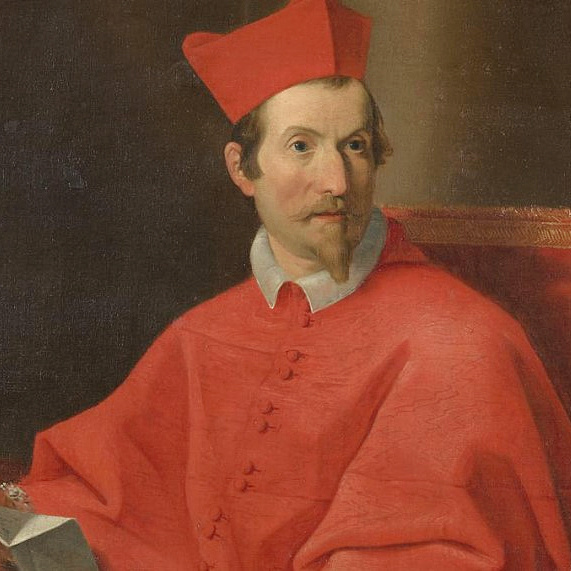
Andrea Sacci, Cardinal Francesco Barberini, Wallraf-Richartz-Museum, Cologne, Germany, oil on canvas, c. 1631-1633 (detail).

By way of Le Valentin’s important young patron, Cardinal Francesco Barberini (1597-1679) – made a cardinal in 1624 by his uncle, Pope Urban VIII (1568-1644) – Valentin became a competitor to his artist friend Nicholas Poussin. Le Valentin’s first documented work commissioned in May 1629 and completed in the spring of 1630 called Martyrdom of SS. Processus and Martinian is a compendium to a slightly earlier work by Poussin–both  in the Vatican (Poussin’s was a different stylistic statement called Martyrdom of S. Erasmus). Valentin had further won the patronage of Cavaliere del Pozzo (1588-1657), the secretary of Cardinal Francesco Barberini and one of Rome’s leading art patrons. Paid the handsome sum of 350 crowns for Martyrdom of SS. Processus and Martinian , after 1630 Valentin’s artwork continued to command high prices and prestige.

Valentin de Boulogne, Martyrdom of Saints Processus and Martinian, 1629–30, Oil on canvas, 118 7/8 × 75 9/16 in. (302 × 192 cm), Vatican Museums, Vatican City/
Jan van den Hoecke (Flemish, 1611-1651), Portrait of Cassiano dal Pozzo. Pozzo’s portrait was painted by Le Valentin though it is lost.

Though SS. Processus and Martinian is Le Valentin’s most important public work, he also produced many pictures for private commissions. There are several pictures by, or today attributed to, Le Valentin in many of the world’s leading art museums. Le Valentin produced artwork especially for the ruling Barberini family and their circle.

How Le Valentin died in 1632 is not certain though it was sudden and of natural causes. The professional artist who is admired in today’s major art institutions reportedly left no money to pay for a funeral. Identified as a “Pictor famosus” on his death certificate, Le Valentin was buried at Santa Maria de Popolo on August 20, 1632 paid for by Cassiano dal Pozzo (1588-1657).

Façade – Basilica di Santa Maria del Popolo –Rome. Valentin lived in Rome on or near Via Margutta which is steps from the 15th century church.
File:Roma – Basilica di Santa Maria del Popolo – Facade.jpg” by M0tty is licensed under CC BY-SA 3.0

SELECTION OF PAINTINGS BY LE VALENTIN DE BOULOGNE.

Valentin de Boulogne (1591-1632), The Judgment of Solomon, 1627/29, Louvre. 68 ¼ x 83 ¾ inches, 1.76m x 2.1m, oil on canvas.  https://collections.louvre.fr/en/ark:/53355/cl010061974

One of the most moving and beautiful stories in the Bible is the judgment of King Solomon in the case involving two disputing harlots over who was the mother of a living child (I Kings).

Both had had a child, though one died and the other lived. To have an offspring was considered a blessing. One harlot claimed that her living child had been taken from her bosom at night by the other harlot. She replaced the child with her dead child after “she had smothered him by lying on him” (I Kings 3:19).

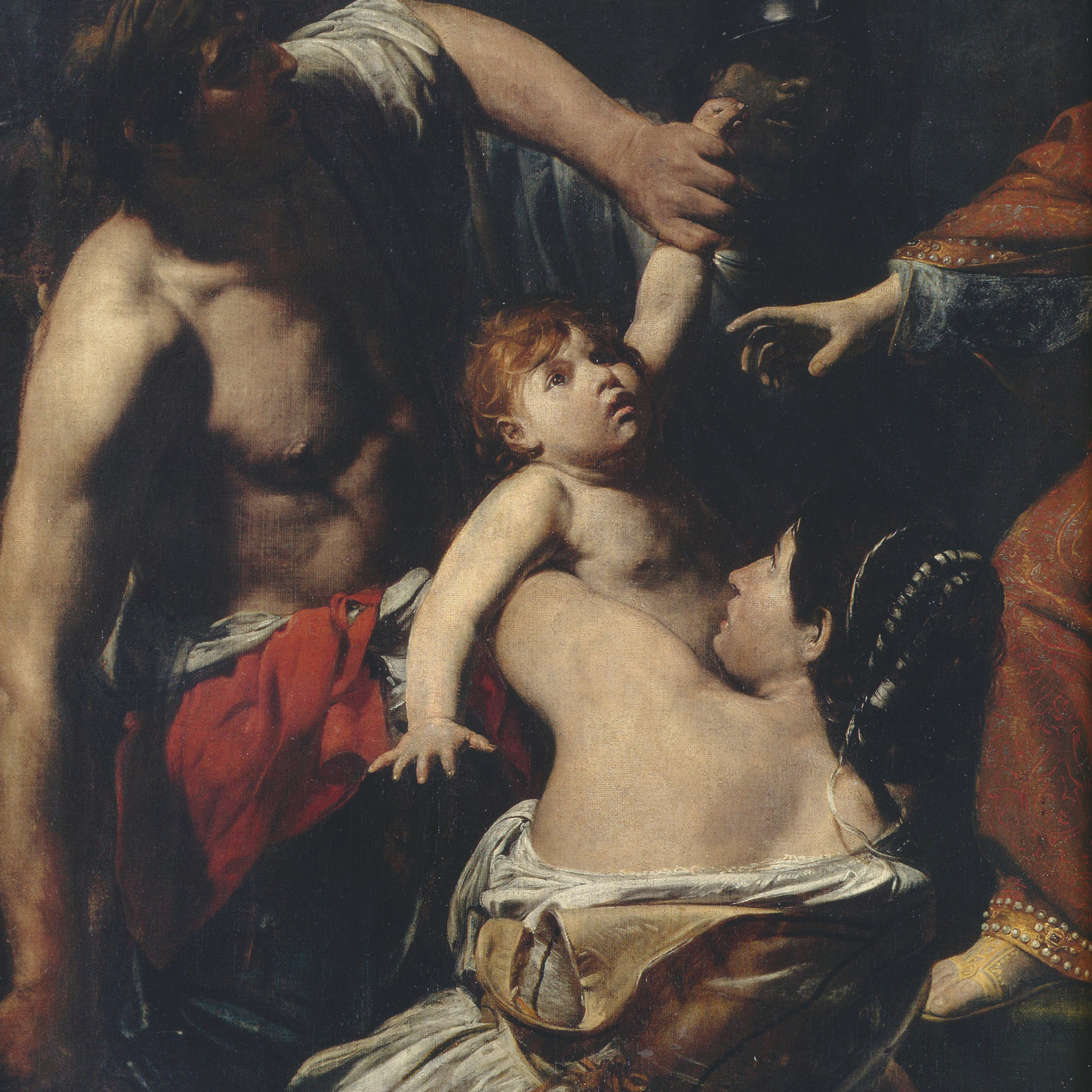
Since this was a case of one harlot’s word against another’s Solomon had no simple and fair resolution at hand. King Solomon said: “Cut the child in two and give half to one woman and half to the other” (I Kings 3:25). Le Valentin shows the viewer what is at stake – a real flesh and blood child. The import of Solomon’s judgment could not be missed. Le Valentin’s women are modeled on those mothers and others the artist observed along Via Margutta.

Detail. Judgment of Solomon. Le Valentin.

When one harlot said, “Divide it! it shall be neither mine nor yours!” and  the other harlot said, “Please, my lord, give her the living child. Please do not kill it!”, the king’s judgement changed.

Solomon spoke again and said, “Give her the child alive, and let no one kill him, for she is his mother” (1 Kings 3: 16-28). Solomon knew a woman privileged to be a mother would seek to see the child live most of all.

It is this final pronouncement that Solomon appears to give in Le Valentin’s painting, as the complete biblical episode can be readily seen in the gestures and expressions of its characters.

Acquired by Louis XIV at Cardinal Mazarin’s death in 1661, The Judgment of Solomon has long been presented as a counterpart to The Judgment of Daniel. These canvases, which may actually be pendants, share the same format and show examples of just judgment in the Bible. The Judgment of Solomon is dated later than The Judgment of Daniel. There is a variant of it by Le Valentin in Rome at the Barberini Gallery in the same format and oil medium. The Louvre painting was restored in 1966.

Valentin de Boulogne (1591-1632), The Judgment of Daniel, 1621/22, oil on canvas, 68 ¼ x 83 ¾ inches, 1.76m x 2.1m, Louvre. https://collections.louvre.fr/en/ark:/53355/cl010061975

The subject is taken from chapter 13 of the Book of Daniel, the book’s addendum. In Babylon, a pair of wicked elders covet Suzanne, “a very beautiful and God-fearing woman” who was the wife of the “very rich” and “most respected” Joachim. After these wicked elders surprised Suzanne in her bath, she refuses their advances and they denounce her for adultery with the intent to put her to death.

Daniel condemns these wicked elders for “growing evil with age” including their past sins of “passing unjust sentences, condemning the innocent, and freeing the guilty.” Daniel interrogates them and, by their own words, shows the assembly they are lying. The painting depicts that moment of judgment.

Detail. Judgment of Daniel. Le Valentin.

Le Valentin depicts Daniel in the painting instead of Suzanne in her bath which was a more popular subject. Suzanne is at right, her hands across her chest, “As she wept, she looked up to heaven, for she trusted in the Lord wholeheartedly” (Daniel 13:35). A guard seizes one of the wicked elders as the other shows surprise and incredulity. Young Daniel, at left, is seated on a throne under a red canopy and stretches out his hand in judgment over the scene for their sin. For each judgment by Le Valentin the artist was inspired in some of its details by Raphael’s artwork in Rome. Louis XIV acquired the painting in 1662.

Valentin de Boulogne, Martyrdom of Saints Processus and Martinian, 1629–30, Oil on canvas, 118 7/8 × 75 9/16 in. (302 × 192 cm), Vatican Museums, Vatican City.

Within iconography that is cyclonic, two Roman soldiers are placed on the rack to be tortured after they refused their commander’s orders to sacrifice to an idol. The soldiers had been converted to Christianity by Saints Peter and Paul when they guarded them in prison. The altar to Jupiter is on the upper left while, at right, the commander clutches his eye with his left hand after God blinded him in retribution for the idolatry. The foreground figures build on 16th century Franco Italian Mannerist style. One has his back to the viewer; another grinds the wheel of the rack; and, a third bends down with his arm outstretched. All are advanced expressions of realistic figural development and rendered in spatial perspective correctly.

Le Valentin’s powerful painting is an artwork with a psychological dimension. To the left, a hooded figure, Lucina, is a Christian woman who encourages the martyrs to be steadfast as an angel out of heaven extends a palm of martyrdom. To the right, realistically portrayed, is a Roman soldier indifferent to another brutal slaying by the authoritarian government in the face of nascent, meddling, heroic, and expanding Christians in their pagan global empire.

With his attention to detail, Le Valentin’s picture accomplishes an exciting imagined drama based on Renaissance-inspired natural world observation and by way of colorful contemporary 17th century formulations that give a viewer visionary immersion into a complex and significant Bible scene.

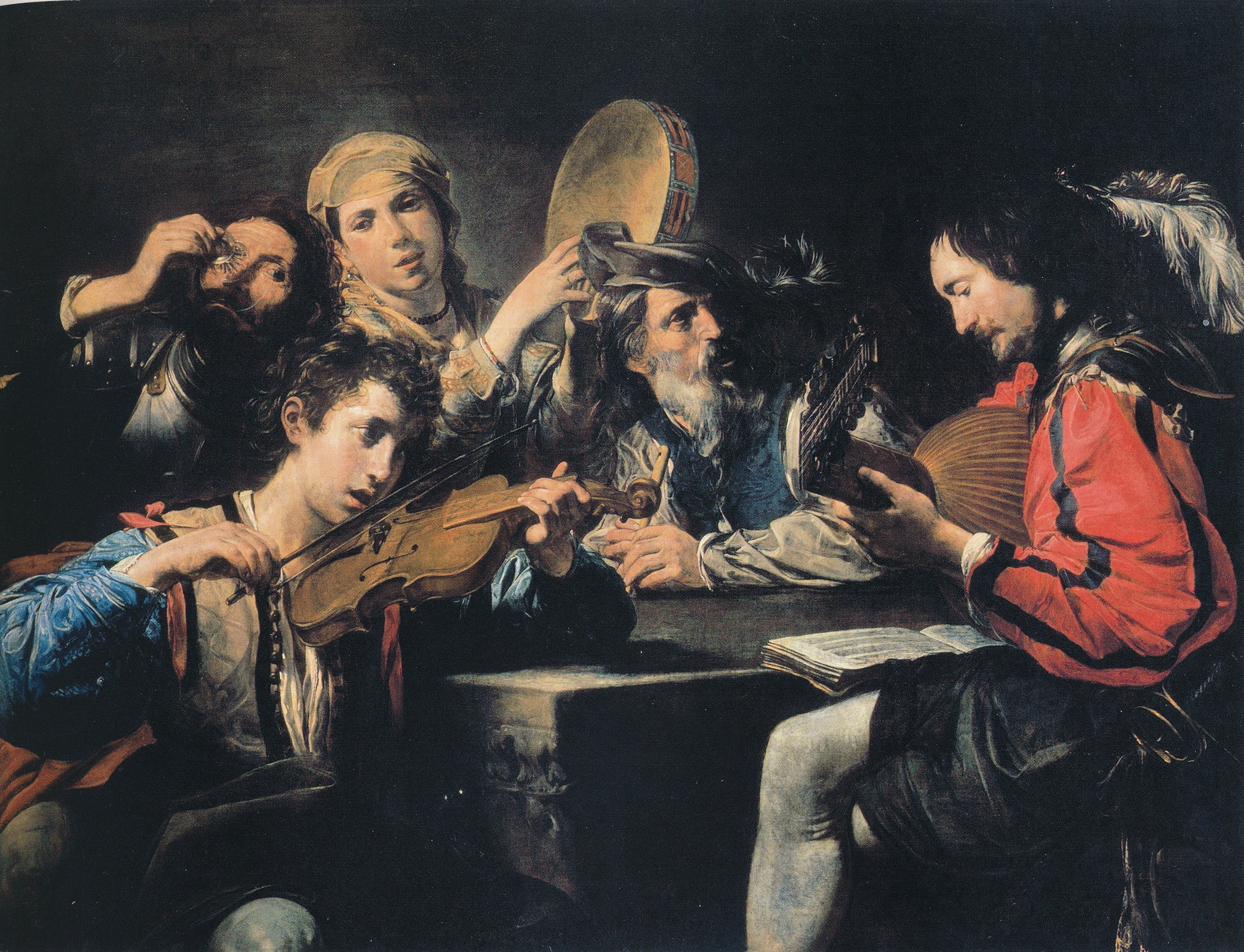
Valentin de Boulogne (1591-1632 A Musical Party, 1623/26, oil on canvas, 44 × 57 3/4 in. (111.76 × 146.69 cm),Los Angeles County Museum of Art.
https://collections.lacma.org/node/186803
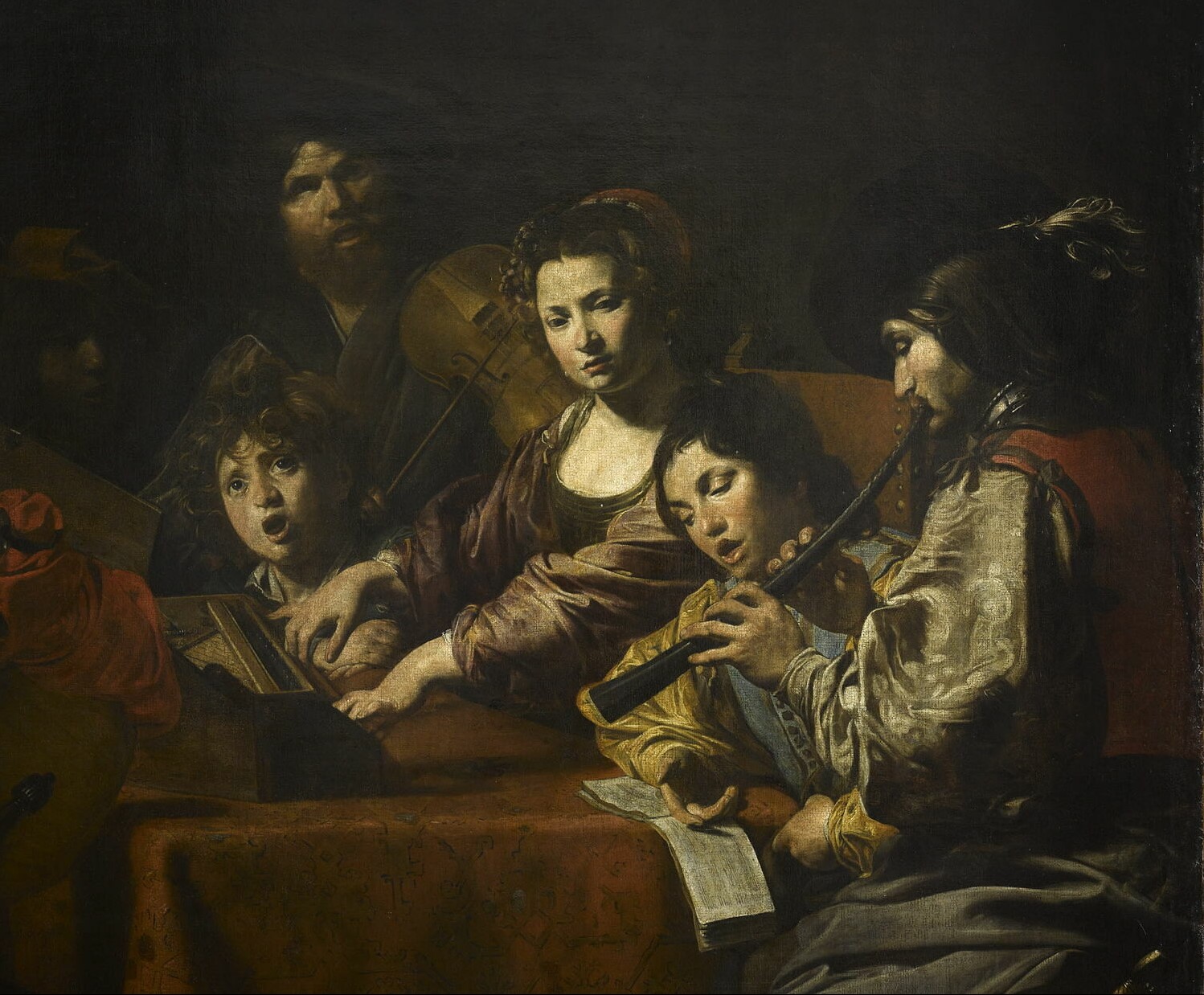
Valentin de Boulogne (1591-1632), Concert in an Interior, 1628/30, oil on canvas, 1.75m x 2.16m, Louvre. https://collections.louvre.fr/en/ark:/53355/cl010061973

Some of Le Valentin’s great ambition as an artist is demonstrated by this large format canvas whose composition includes eight realistically delineated  figures including 5 musicians and 3 singing youths. The five instruments are depicted accurately as well as the demeanors of the musicians and singers. Instruments have been identified by others as a polyphonic spinet, an alto, a chitarrone, a bass viol and a cornetto.

Detail. Concert in an Interior. Le Valentin.

The painting had been dated at around 1626, though more recent connoisseurship dates it to around 1628 or 1630. It was restored in 1940. It was owned by that avid art collector, Cardinal Mazarin.

Valentin de Boulogne (1591-1632), The Concert in bas-relief, 1624/26, oil on canvas, 1.73 m x 2.14m, Louvre.
Detail. The Concert in bas relief. Le Valentin.

Le Valentin painted seven figures gathered around a classical bas-relief. There are a pair of drinkers, one in the foreground, the other in the background; two singers; and three musicians – a violinist, guitarist and lutenist.

The painting, filled with mystery and gravity, is Caravaggesque and not merely telling a story or depicting a genre scene of performance. The painting has been dated to as early as 1622 by some connoisseurs. It was owned by Cardinal Mazarin and restored in 1959. It entered the collection of the Louvre in 1742.

Valentin never ceased producing genre paintings as attested by Concert with Eight Figures and Fortune Teller (both Musée du Louvre, c. 1628), and what is thought to be his very last painting, the Gathering with a Fortune Teller (Vienna, Liechtenstein Collection) in 1632.

Valentin de Boulogne (1591-1632), Musicians and Soldiers, c. 1626, oil in canvas, 155 x 200 cm, Musée des Beaux-Arts, Strasbourg.

This is a tavern scene with impromptu music-making among transitory musicians. They are playing for a pair of drinking soldiers. Le Valentin’s painting is Caravaggesque with its interplay of shadows and light, dark palette, and depiction of realistic figures, and a psychological vivacity that is imbued by Le Valentin. It is by his passion and energy for Caravaggio that Le Valentin helped  revolutionize art in 17th century Europe.

Valentin de Boulogne (1591-1632), Jesus and Caesar’s Coin, around 1624, oil on canvas, 1.11 m x 1.54m, Louvre.

In Matthew’s Gospel the Pharisees were plotting to entrap Jesus by his own words. They sent some of their followers along with local government types (“Herodians”) to flatter Jesus as a truthful and humble man. They asked him to reply to a question: “Is it lawful to pay the census tax to Caesar or not?” (Mt 22:17).

Jesus, knowing their motivation, responded hardly very nicely, by calling them “hypocrites.” He asked them to show the coin that paid Caesar’s tax.

Le Valentin’s painting depicts the moment when the Pharisee’s henchmen show Jesus the coin with Caesar’s image and inscription on it. Jesus tells them: ”Repay to Caesar what belongs to Caesar and to God what belongs to God” (Mt 22: 21).

Owned by Louis XIV it was put in his dressing room at Versailles in 1680. The Louvre acquired it during the French Revolution in 1793.

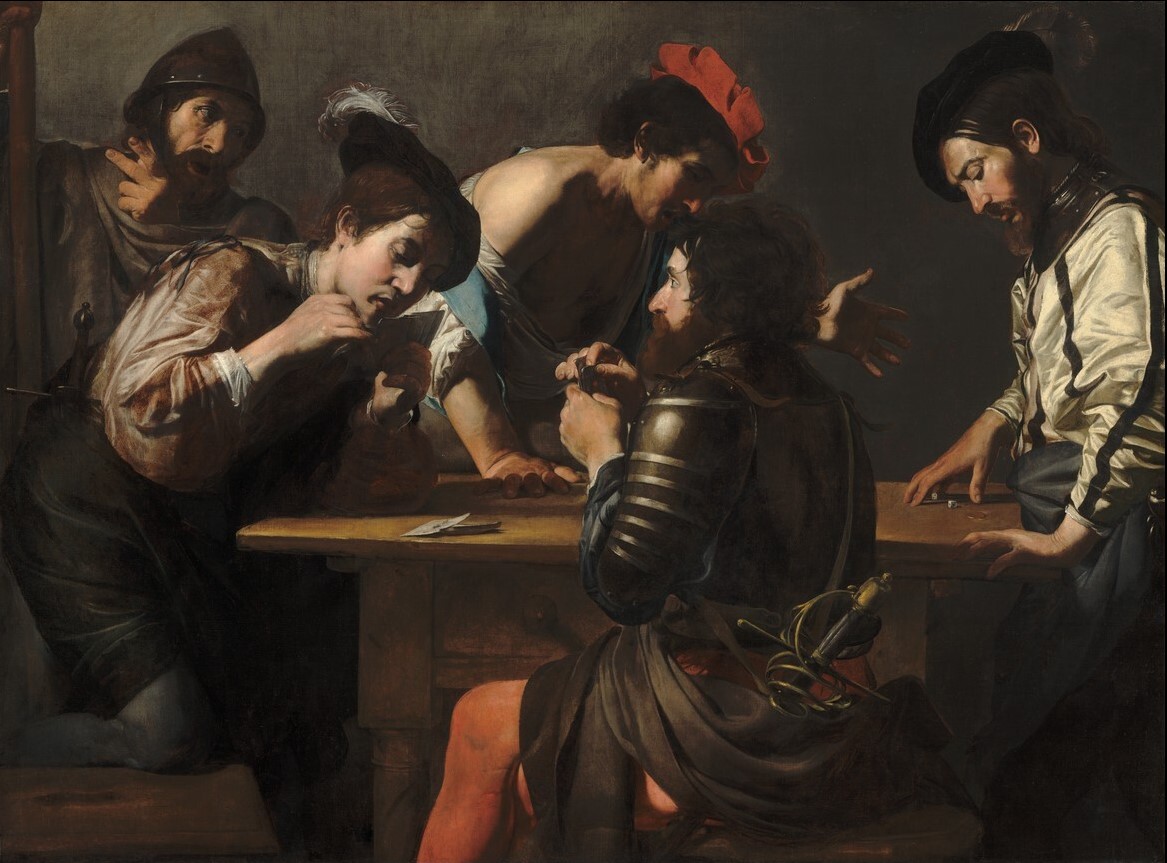
Valentin de Boulogne (1591-1632), Soldiers Playing Cards and Dice (The Cheats), c. 1618/1620, oil on canvas, 121 x 152 cm (47 5/8 x 59 13/16 in.), The National Gallery of Art, Washington DC.
https://www.nga.gov/collection/art-object-page.107315.html

This painting is inspired by Caravaggio’s The Cheats in the Kimbell Art Museum in Fort Worth, Texas. Le Valentin’s painting, only discovered in 1989, shows a group of soldiers idling in Rome and identifiable by their piecemeal armor and other livery. The crowding of the figures into the picture space adds to the scene’s tension.

In this early painting in Rome, Le Valentin presents a scene of its contemporary street life. These figures are seriously gaming at a table where two players (center and right) roll dice and two others (left and center) play cards. A fifth figure in the background signals to his accomplice what is in the hand of the card player in a feathered hat. It is an early artwork that Le Valentin gives a psychological dimension.

As had been Caravaggio’s practice, the artwork is painted alla prima, that is, directly onto the prepared canvas without under-drawing or any preliminary work which works to give it greater spontaneity. The painting is indebted to Caravaggio not only for its subject, but for its vivid sense of actuality with which Le Valentin invested his protagonists as well as for the chiaroscuro, and a thinly and rapidly-applied brushed execution.

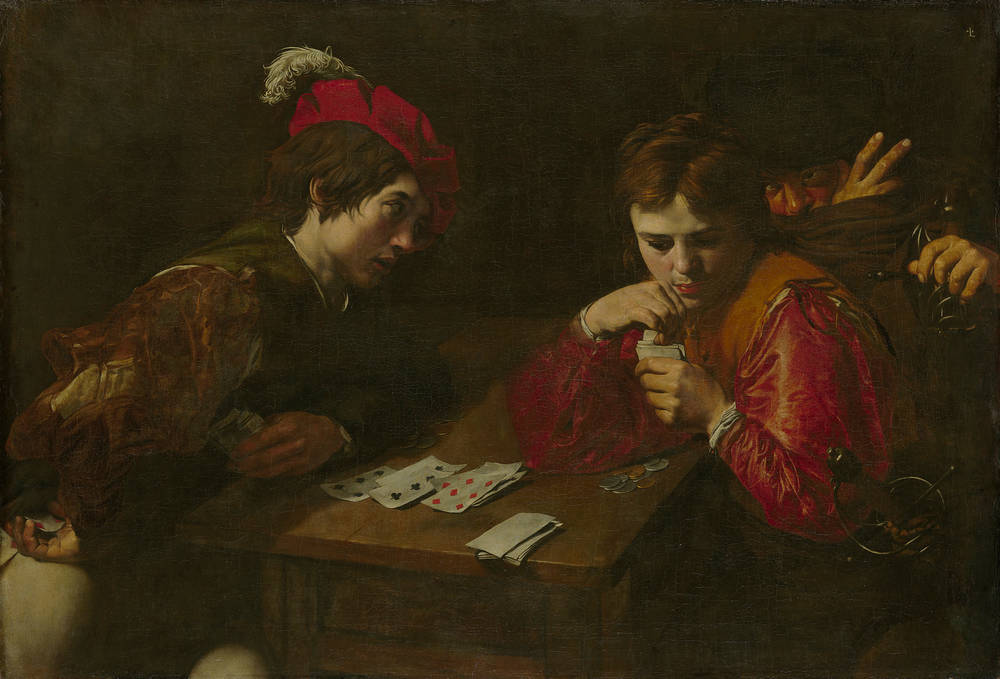
Valentin de Boulogne (French, Coulommiers-en-Brie 1591–1632 Rome). Cardsharps. c. 1614-15. Oil on canvas. Gemäldegalerie Alte Meister, Staatliche Kunstsammlungen Dresden
https://skd-online-collection.skd.museum/Details/Index/415366

This painting is one of the first genre pictures Le Valentin painted in Rome. It is a pair of figures to which Le Valentin would soon numerically expand in his pictures. The composition is simple and sturdy.

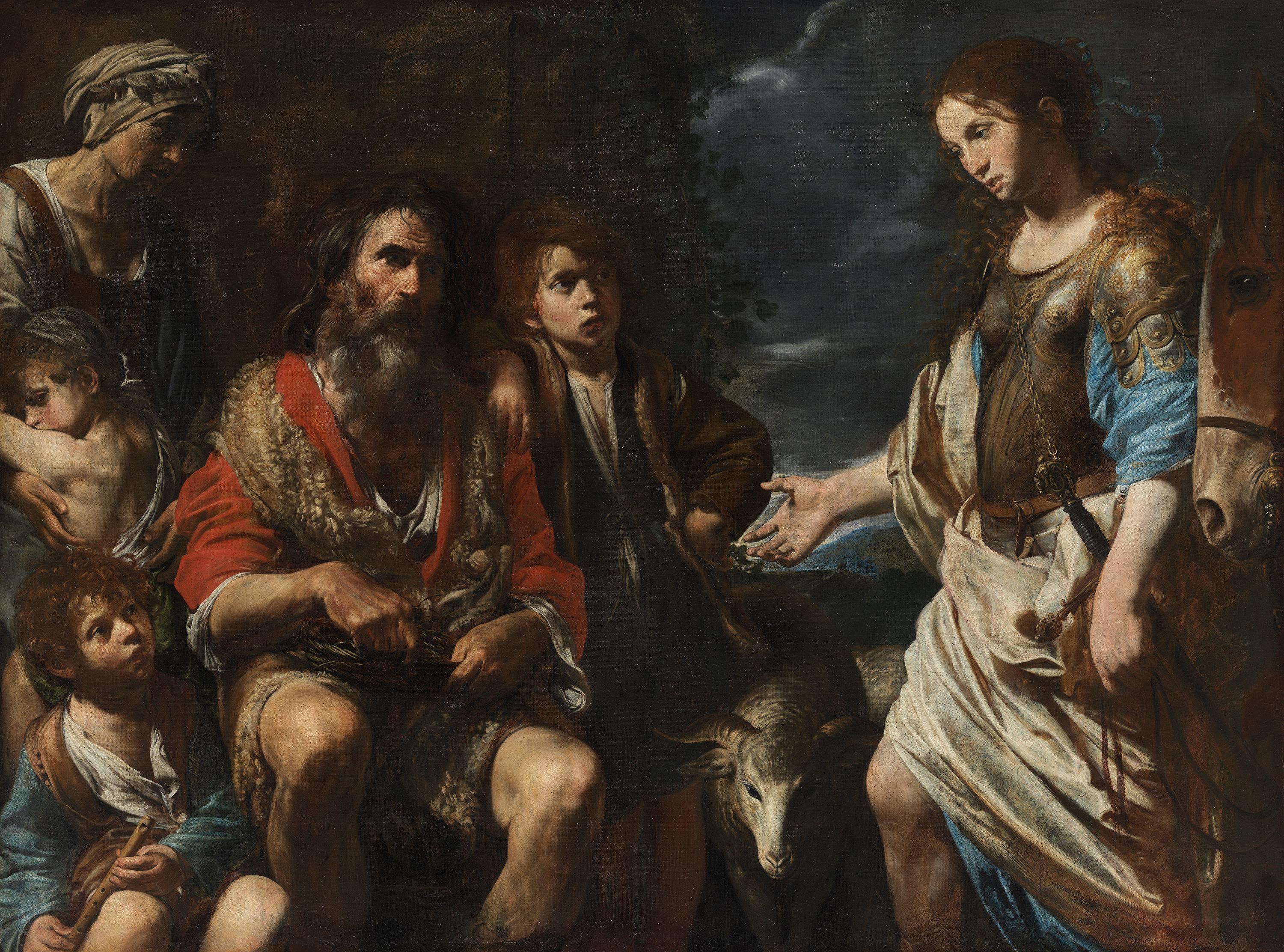
Valentin de Boulogne (1591-1632), Herminia among the Shepherds, c. 1630, oil on canvas, 134.6 x 185.6 cm (53 1/8 x 61 5/8”) Bayerische Staatsgemäldesammlungen – Alte Pinakothek München. https://www.sammlung.pinakothek.de/de/artwork/RQ4XPr8410 

Erminia, the king’s daughter, escapes her persecutors and asks a peaceful shepherd family for shelter. The scene is based on a contemporary (1576) epic poem The Liberated Jerusalem by Torquato Tasso (1544-1595). The picture was a private commission whose patron was likely a Roman art collector and cognoscente. Valentin’s painting combines Caravaggesque chiaroscuro with exquisite coloring. In this realistic depiction of a human encounter between characters who represent contrasting social experiences, the subject matter is rendered psychologically sensitively.

Valentin de Boulogne (1591-1632), Crowning of thorns of Christ, around 1616/17, oil on canvas, 173 x 241 cm Bayerische Staatsgemäldesammlungen München-Alte Pinakothek, Munich
https://www.sammlung.pinakothek.de/de/artwork/bwx0jkJGm8

One of the great artworks of Le Valentin’s early phase in Rome, biblical subjects painted before 1620 such as The Crowning of Thorns of Christ were interpreted in the street-life idiom, with expressive protagonists and bystanders resembling the cast of characters in his genre paintings. Although the painting was earlier believed to be by Caravaggio, it may have been a pendant to Le Valentin’s much-later Abraham Sacrificing Isaac (c. 1629) in The Montreal Museum of Fine Arts.

This is Le Valentin’s most ambitious of 3 such “crowning with thorns” pictures. The artist in horizontal-format depicts Jesus before his going to Calvary. Christ is mocked and tormented; a crown of thorns is pressed onto his head (Matthew 27: 27-31; Mark 15:16-21; Luke 23:11; John 19: 1-3). With its dramatic lighting and shadows, the naturalistic depiction of Christ’s body and soldiers in contemporary costume is Caravaggesque.

Le Valentin’s scene adheres to the Bible episode: a whole cohort of soldiers surrounded Jesus, stripped off his clothes and threw a scarlet military cloak on  him. Henchmen have weaved a crown out of thorns and are placing it on Jesus’s head. Another puts a reed as a faux scepter into Jesus’s right hand. To mock him they kneel before him and say: “Hail, King of the Jews!” The soldiers spit on Jesus and then take the reed away and strike him repeatedly with it. When they were done with these violent actions, the soldiers stripped Jesus of the military cloak, dressed him in his own clothes and led him out to be crucified.

Valentin de Boulogne (1591-1632), Crowning with Thorns, around 1627/28, oil on canvas, 51 15/16 × 37 15/16 in. (132 × 96.3 cm) Bayerische Staatsgemäldesammlungen München-Alte Pinakothek, Munich https://www.sammlung.pinakothek.de/de/artwork/Dn4ZR224aK/valentin-de-boulogne/dornenkroenung-und-verspottung-christi

Le Valentin’s Passion theme is a later vertical-format picture of a subject he had painted masterly before. In these last years the subject matter had gained in classical beauty as well as psychological involvement compared to Le Valentin’s earlier artwork. The painting covers over a discarded portrait of Cardinal Barberini which suggests Valentin’s close relationship with the ecclesial prince, very likely being in his employ. What caused the artist to revisit the subject of a brutalized Christ is unclear though it may have been based on the artist’s own struggles or that of his employer whose portrait he painted over.

Valentin de Boulogne (French, 1591–1632), Noli me tangere  c. 1620. Oil on canvas. Perugia, Galleria Nazionale dell’Umbria.
Valentin de Boulogne (French, 1591–1632), Christ and the Samaritan Woman c. 1620. Oil on canvas. Perugia, Galleria Nazionale dell’Umbria.
Valentin de Boulogne (1591-1632), Martyrdom of St. Lawrence, 1622/24, oil on canvas, 195 x 261 cm, Prado, Madrid. Spain.

St. Laurence (225-258)—Laurentius is Latin for ”laurelled”—became a popular early Roman martyr. Laurence has been continually highly honored by the church since the 4th century and is a patron of Rome.

In the mid 3rd century, Laurence was archdeacon to the new pope, Sixtus II (257-258). Sixtus II was martyred along with his seven deacons, including Laurence, during the persecution of Christians by Emperor Valerian (199-264). When Laurence met the pope, the pope was under arrest and Laurence expressed the desire to join him in his sufferings. Sixtus promised Laurence that martyrdom would soon be his but in the meantime asked his archdeacon to distribute the church property among the poor. Word of this planned dispersal reached the ears of the Emperor and Laurence was arrested.

Following the pope’s martyrdom by decapitation, Laurence, in prison, was ordered three days’ reprieve to collect and hand over the church treasures to the emperor. Instead, Laurence gathered and distributed these goods to Rome’s poor folk and presented the people to the emperor. These paupers appeared in Le Valentin’s painting to the left.

Infuriated, the emperor ordered the Catholic deacon to sacrifice to Rome’s gods which Laurence refused to do (in prison Laurence converted his guard) and was summarily condemned. After undergoing a series of tortures, the 32-year-old Laurence was martyred by the method of being roasted alive over a fire on a spit. The saint is famously quoted as telling his executioners: “One side is roasted, so you can turn me over and roast the other side.”

In the Prado Le Valentin gives orderly arrangement to a complex scene of 15 figures and a horse. It shows the saint during his martyrdom isolated in the center of the composition. As with Caravaggio’s figures, the soldiers are in modern costume, use of chiaroscuro is evident, and further drama is added by the use of diagonals whose construction suggest movement that add to the tension of the naturally rendered figures. However, Le Valentin uses these derived elements unconventionally.

St. Laurence is the patron saint of people whose occupation involves working with fire such as traditionally cooks, bakers, brewers, textile cleaners, and tanners and also those whose occupation values fire prevention such as traditionally librarians, archivists, miners, and poor people. St. Laurence of Rome is also, truly, the patron saint of comedians.

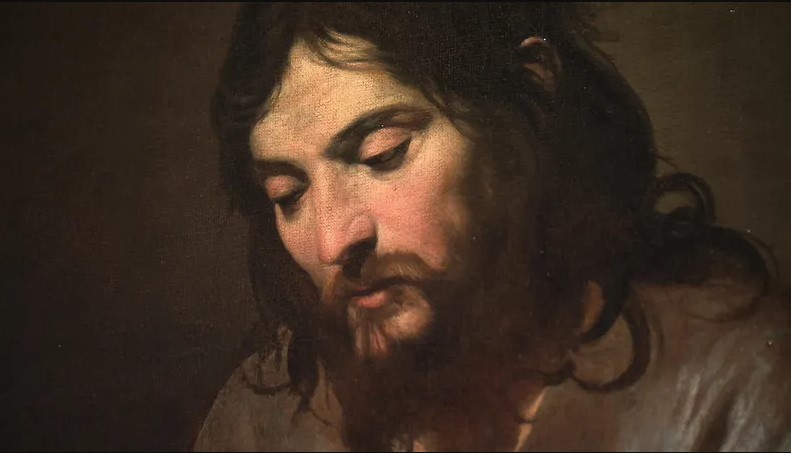
Valentin de Boulogne (1591-1632), St Luke, Evangelist, 1624/26, oil on canvas, 120 x 146 cm, Palace of Versailles, Versailles.
Detail. St. Luke Evangelist. Le Valentin.

Dating from the years 1624-1626, le Valentin painted all four Evangelists (Matthew, Mark, Luke and John) for the same religious order in Rome whose name is unknown. They entered the collections of the Sun King in 1670.

Valentin de Boulogne (1591-1632), The Last Supper, c. 1625, oil on canvas, Galleria Nazionale d’Arte Antica, Palazzo Barberini, Rome.

For his The Last Supper, Le Valentin was, at least through engravings, aware of Leonardo da Vinci’s Last Supper (c. 1495–1498) in Milan and Raphael’s Last Supper (1518-1519) in Palazzi Pontifici, Vatican. Le Valentin explores the 12 apostles’ reactions. Commissioned by Asdrubale Mattei (d. 1638), one of Rome’s nobili, to decorate a gallery in his family’s palace, the picture depicts a central event presented in the gospels. The moment that is depicted in these Last Supper paintings is when Christ announces that one of his disciples will betray him. Judas, in the foreground left, was treasurer for Jesus’s disciples and betrayed Jesus for a bribe payment of 30 pieces of silver. The picture, with its simple and monumental composition, so impressed Jacques-Louis David  (1748-1825) in 1779 that he copied it and sent it from Rome to Paris.

Portrait of Asdrubale Mattei di Giove, 17th century, attributed to Caravaggio, Condé Museum, Chantilly, France.
https://www.musee-conde.fr/fr/notice/pe-61-portrait-d-asdrubale-mattei-di-giove-1318fe15-3a5f-48ef-9486-e6920ed8d0b8
Valentin de Boulogne, Samson, 1631, Oil on canvas, 135.6 x 102.8 cm (53 3/8 x 40 1/2 in.), The Cleveland Museum of Art. https://www.clevelandart.org/art/1972.50

An Old Testament Judge, Samson was born in a miraculous fashion and with an angel telling his mother and father, “No razor shall touch his head” (Judges 13:5). Samson is often depicted with his locks unshorn. As a youth Samson displayed an incredible physical strength attributed to “the spirit of the Lord rushing upon him” (Judges 14:6).

Le Valentin’s picture presents Samson’s legendary strength by showing the solid demeanor of his physical body as well as objects which hold symbolic value of his strength. These include that he killed a lion with his bare hands and liberated the Israelites by slaughtering a thousand Philistines with a donkey’s jawbone (Judges 15: 15-16). The strength of his arm is displayed as his fingers curl under his jaw as his wandering gaze looks off with intense interiority. One contemporary allusion in the painting is Samson’s breastplate which is joined at the shoulder by a clasp in the form of a bee which was the emblem of the Barberini family who commissioned the painting. It is speculated that the facial features of Samson in a picture before his fateful meeting with Delilah (Judges 16), may be a self-portrait of Le Valentin.

Valentin de Boulogne (1591–1632), Judith with the Head of Holofernes. c. 1626-27. Oil on canvas. Musée des Augustins, Toulouse.

The story of Judith in the Old Testament relates of a woman of great beauty and reverence to the God of Israel who is highly respected by her people and its leaders. The nation, desperate for survival, turns to Judith who is given the opportunity to kill their enemy’s military leader which she believes she can and must do and that all believed impossible as Israel’s military defeat by their enemies was a foregone conclusion.

The story has a femme fatale aspect as Holofernes was captivated by Judith’s physical appearance, but the Biblical episode of the execution, while a climax of her mission, pales in comparison with the relating of Judith’s overall dedication to her people and her God, a femme forte, which carries on into her long life of blessedness to her natural death. Le Valentin chooses that sacred element of the Bible book when he shows an iconic Judith, triumphant woman of Israel, holding in her hands the decapitated head of one of Israel’s once-formidable mortal enemies. Judith is shown as a heroic woman with her hand raised as she admonishes: “But the Almighty Lord hath disappointed them by the hand of a woman.”

For Le Valentin’s artwork, Judith is an icon of God’s justice to his obedient people. Purchased for French King Louis XIV from German banker Everhard Jabach, the picture was installed in the king’s bedroom at Versailles to be especially admired.

The picture belongs to Le Valentin’s period of maturity for it displays the artist’s full interpretation of the realism of Caravaggio and Manfredi though, as expressed here, with a new appreciation for colors. The pretext of a Judith who, according to the Bible, had adorned herself in her best finery so not to dissuade Holofernes’s gaze (Judith, 13, 14), allows le Valentin to illuminate the dress’s rich fabrics with monochrome refractions, while the jewels and hair are bathed in ethereal light.

Detail. Valentin de Boulogne (1591–1632), David with the head of Goliath, c. 1615/16, oil on canvas, 99 x 134 cm, Museo Thyssen-Bornemisza Madrid,
Valentin de Boulogne (1591-1632), The Four Ages of Man, c. 1627/30, oil on canvas,. London, National Gallery.
https://www.nationalgallery.org.uk/paintings/valentin-de-boulogne-the-four-ages-of-man

The Four Ages of Man is a painting commissioned by Cardinal Barberini. It is an allegorical work whose human figures are painted by Le Valentin in natural poses. Groups of figures around a table were common in the work of Caravaggio and his northern followers. The allegory of the ages of man was a common subject for paintings during the sixteenth and seventeenth century, though its quantity of ages varied.

The allegory presents humanity in four categories of age – childhood (holding an empty bird trap); youth (playing a lute); adulthood (with a book and victor’s laurel); old age (with coins of wealth and delicate glassware).

The theme had its origin in classical literature: Ovid’s Metamorphoses and Dante’s Inferno acknowledged the stages of human life according to physical growth and decline. Contemporary poems were written on the subject that Le Valentin may have known.

In the 17th century, the painting was owned by Michel Particelli, seigneur d’Emery (1596–1650) in Paris. In the 18th century it was in the Orléans collection at the Palais Royal. During the French Revolution and the dispersal of the collection in 1791, the painting was brought to England where it is today.

Valentin de Boulogne (1591-1632), Christ Expelling the Merchants from the Temple c. 1626. 192 x 266.5 cm, oil on canvas, State Hermitage Museum, St. Petersburg, Russia. https://www.hermitagemuseum.org/wps/wcm/connect/8276ab63-4bcc-40e9-83ab-91aa57903031/WOA_IMAGE_1.jpg?MOD=AJPERES&1677c4b2-bad6-47ed-b628-27cda4f71809

Le Valentin painted many half- or three-quarter-length figures of saints, prophets and narrative scenes including this painting. The scene of Christ expelling the moneychangers from the Temple of Jerusalem is told in all four gospels of the New Testament. Le Valentin adapted the method of half-length, full size street figures depicted in dark, precisely lighted spaces and emerging in relief from the shadows from the Caravaggistes.

Gospel readers would recognize that the cleansing of the temple was prophesied in the Old Testament as a  sign of the ushering in of the Messianic Age (Zechariah 14:21). In the synoptic gospels (Matthew, Mark and Luke) the episode appears at the close of Jesus’s public ministry and in John’s gospel at the start (2:13-17). The chronology of the episode in Jesus‘ ministry is generally not considered its most important element.

Le Valentin shows the “whip of cords” held by Christ, a detail mentioned only in John (Jn 2:15). There are overturned tables, a bench, and scattered coins. Le Valentin depicts the gestures, movements and emotions of the characters involved, focused on a wrathful Christ and fear of the unrighteous.

While in Synoptics the point of the episode appears to be the dishonesty of the Temple money changers, in John’s gospel Jesus’s wrath is directed to the Temple institution itself. In John’s Gospel Jesus declares the Temple is to be “My Father’s house.” Though not a term unique to John, he uses it more than any other Gospel writer (27 times).

Derived from Caravaggio are the types of ordinary people, distinct contrasts of light and shade and the natural plasticity of the figures involved in the composition.

The painting entered the Hermitage collection in 1772.

Valentin de Boulogne (French, 1591–1632), Expulsion of the Money Changers from the Temple. Oil on canvas, 195 x 260 cm (76 ¾ x 103 1/8 in.). Palazzo Corsini, Rome.

The painting’s structural asymmetry lends energy to the scene. With Christ’s raised arm, he is a menace to the money changers. Le Valentin, taking inspiration from Caravaggio, unabashedly renders a scene in grand format of violence in the gospels. The painting was rediscovered in Rome in the mid19th century.

Valentin de Boulogne (1591-1632), Allegory of Rome, 1628, oil on canvas, 330 x 245 cm, Villa Lante – Institutum Romanum Finlandiae Foundation. https://irfrome.org/en/villa-lante-4/architecture/salone-en/

The oil painting called Allegoria d’Italia by Le Valentin was originally called Historia d’Italia. Its massive volumes imbued with inner life are rendered using a brown palette and highlights that retained the Caravaggiste tradition. Le Valentin’s redoubling his commitment to Caravaggio in the late 1620s was on display in this painting as other leading painters, such as Vouet, Poussin, Giovanni Lanfranco (1582-1647) and Pietro da Cortona (1597-1669), were deploying brighter “modern” colors.

In March 1628 Cardinal Barberini gave Le Valentin the commission for the Extraordinary Jubilee of 1628 and paid 113 crowns for it. This major painting which renewed Caravaggio-inspired technique in the late 1620s attracted greater attention to Le Valentin’s artwork not only by Caravaggeschi but the broader Roman art circles.

A young Roman girl wears an emperor’s cuirass, holds a spear and shield, as the personification of Italy. At her feet are the fruit and nuts of the land’s bounty. Below her image are two male figures, naked and bearded, who represent the Tiber and the Arno, Italy’s great rivers. The figure of the Tiber is joined by Romulus and Remus and the suckling wolf who founded Rome and the later Papal States. The Arno that runs through Florence is joined by its symbol of the lion. In the top left corner, a tree stump with a bee swarm symbolizes the Barberini.

Valentin de Boulogne (1591-1632), Christ and the Adulteress,, 1618-22, oil on canvas, 167 x 221.3 cm, Getty Museum, Los Angeles.  https://museum-essays.getty.edu/paintings/ebeeny-valentin/

The gospel story that Le Valentin depicts using the typical Caravaggiste method (half-length, full size street figures in shadow and light) is from John 8. The story had been painted by the Flemish and the Venetians. The plump young woman in a torn garment exposing her shoulders and full-formed breasts is taken into custody by soldiers in armor to Jesus. According to the law the woman should be publicly stoned for adultery. The Pharisees lay verbal and other traps repeatedly in the gospels for Jesus to say or do something that is expungable. Jesus’s response moves past their premise. Whereas Jesus will soon be arrested, tried, and condemned by the authorities for his “transgressions,” the focus of le Valentin’s artwork is Jesus showing mercy to the sinful woman. From a theological viewpoint, Jesus’s innovative teaching is again based on the appeal to an extant biblical tradition of God’s anger towards, and forgiveness of, harlotry or unfaithfulness when such sin is repented (Hosea 5:4). Jesus tells her: “Go and sin no more” (John 8:11). While the woman’s disheveled look suggests the nature of her sin, she represents humankind and points to Christ, the God-Man and prophesied suffering servant (Isaiah 53). Christ  takes the harlot’s place as the arrested agitator and manhandled by soldiers along the Via Dolorosa. In that episode, Christ goes to the cross to shed his blood in the new covenant whose outcome for “adulterous” humankind is  eternal forgiveness of sins and rising to new life.

Valentin de Boulogne (1591-1632), Lute Player, c. 1625/26, 128.3 x 99.1 cm The Metropolitian Museum of Art, New York. https://www.metmuseum.org/art/collection/search/439933

The image of a young soldier singing in armor breastplate a love madrigal is unique in Valentin’s oeuvre. The painting was part of the collection of Cardinal Mazarin, minister to Louis XIV.

Valentin de Boulogne (1591-1632), Return of the Prodigal Son, c. 1615–16, oil on canvas, 59 1/16 × 70 1/16 in. (150 × 178 cm), Museo della Venerabile Arciconfraternita della Misericordia, Florence.

One of Jesus’s most famous parables, The Prodigal Son tells the story of a young man who demanded his “full share of [his father’s] estate that should come to [him],” and departed to waste it “on a life of dissipation” (Luke 15). When the lost son falls on hard times, he seeks his father’s house though “only as a hired servant.” The forgiving father who has been on the look-out for his lost son (dressed in rags) since the day of his departure welcomes him back as a son “who was dead and has come back to life.” Which of the other figures may be the older brother who is unhappy about his dissolute brother’s return is not clear. Le Valentin treats the parable as a human story of repentance, forgiveness, and unconditional love.

Valentin de Boulogne (French (active Rome), 1591-1632), Fortune-Teller with Soldiers, 58 7/8 x 93 7/8 in. (149.5 x 238.4 cm), Toledo Museum of Art.
http://emuseum.toledomuseum.org/objects/54884/fortuneteller-with-soldiers?ctx=99a0dbca-6a24-444e-a66b-95c576c7395c&idx=1

The attribution to Le Valentin and its dating for this artwork is the result of modern scholarship. Art historians can thereby draw conclusions and make conjectures about the development of Le Valentin’s early artwork in Rome -he uses a larger format, growing complexity of compositional qualities and its subject matter, and the retention of low-life characters and stylistic indebtedness to Caravaggio as he moves beyond him.

A dark tavern filled with low-life characters provides the setting for a scene of fortune and deceit. As a gypsy fortuneteller reads the palm of a young soldier he is looking pensively as she speaks his fate, there are carousers and thieves in the scene.  The picture is emblematic of Le Valentin – the techniques of a somber palette and dramatic lighting and tabletop groupings but also a mysterious mood and psychological depth to the complex interplay among its characters.

Valentin de Boulogne (French (active Rome), 1591-1632), Portrait of Roman Prelate, 128 x 94 cm, private collection.

The prelate is dressed in the robes of a papal chamberlain. Modern scholarship has proposed various individuals as the sitter from cardinals to lawyers.

Denial of St. Peter, c. 1623/25, Pushkin State Museum of Fine Arts, Moscow, 119 x 172 cm.
https://collection.pushkinmuseum.art/entity/PERSON/273?query=valentin%20de%20boulogne&index=0
Valentin de Boulogne (French (active Rome), 1591-1632), Abraham Sacrificing Isaac, 1629/32, 149.2 x 186.1 cm The Montreal Museum of Fine Arts.
https://www.mbam.qc.ca/en/works/8394/
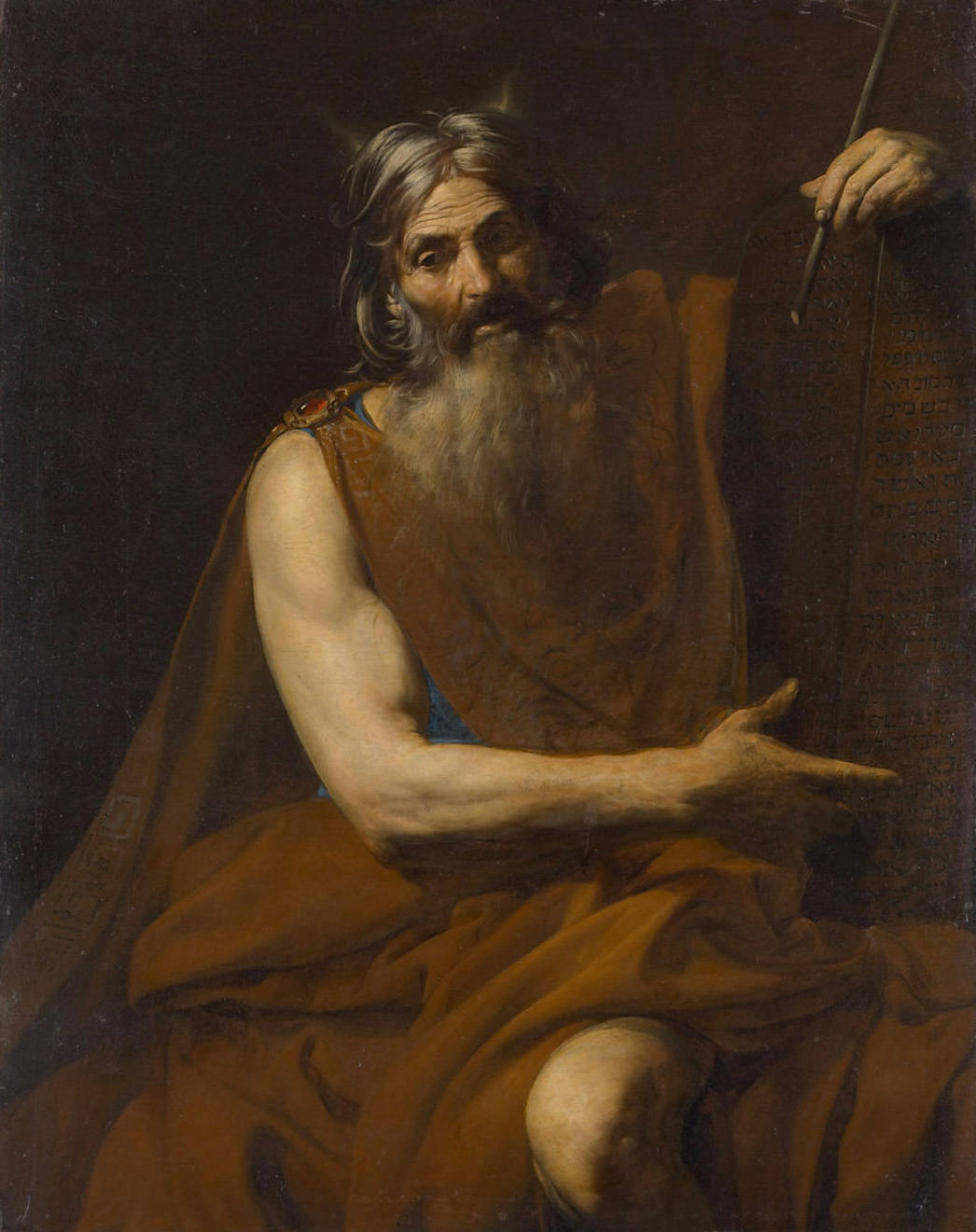
Valentin de Boulogne (French (active Rome), 1591-1632), Moses, 1625/27. Kunsthistorisches Museum Wien, 131 x 103.5 cm. https://www.khm.at/en/objectdb/detail/2012/

Moses led the Israelites out the slavery of Egypt into the freedom of the Promised Land during the Exodus. The event is told and retold in the Old Testament and Moses as Liberator and Law Giver is its most significant figure. Le Valentin shows him holding a miraculous rod that he used  to open the Red Sea (Exodus 14), struck the rock to produce water (Numbers 20) and, after its transformation into an iron snake, healed the ill (Numbers 21). Moses points to the stone tablets of the Ten Commandments of God (Exodus 20; Deuteronomy 5). This late work by Valentin is characteristic in its dark and pensive tone that is reminiscent of Caravaggio.

Valentin de Boulogne (1591-1632),Cheerful company with Fortune Teller, 190 × 267cm, oil on canvas, 1631 Vienna Liechtenstein.
https://www.liechtensteincollections.at/en/collections-online/cheerful-company-with-fortune-teller
Detail. Cheerful Company with Fortune Teller. Le Valentin.

The picture is one of Valentin’s last paintings before his death in 1632. Prince Hans Adam Il von und zu Liechtenstein (b. 1945) acquired the work in 2004.  Throughout his painting career, Le Valentin never ceased producing genre paintings.
SOURCES:

A Dictionary of Art and Artists, Peter and Linda Murray, Penguin Books; Revised,1998.

French Paintings of the Fifteenth through the Eighteenth Century, The Collection of the National Gallery of Art Systematic Catalogue, Philip Conisbee and Frances Gage, Washington, D.C., 2009 pp, 413-414.

Art for the Nation, text by Philip Conisbee, National Gallery of Art exhibition catalogue, 2000.

French Painting From Fouquet to Poussin, Albert Chatâlet and Jacques Thuillier, trans. from French by Stuart Gilbert, Skira, 1963.

https://www.metmuseum.org/art/collection/search/663663

https://www.metmuseum.org/press/exhibitions/2016/valentin-de-boulogne

https://arthistorians.info/bousquet

https://arthistorians.info/hoogewerffg

https://arthistorians.info/longhir

https://www.kulturelles-erbe-koeln.de/documents/obj/05011488/rba_d054126_01

The Saints: A Concise Biographical Dictionary, edited by John Coulson, Guild Press, New York, 1957.

The New American Bible, Catholic Book Publishing Corp, New York, 1993.

Mannerism: The Painting and Style of The Late Renaissance,  Jacques Bousquet, trans, by Simon Watson Taylor, Braziller, 1964.

The Liberation of Jerusalem, Torquato Tasso, trans by Max Wicker, Oxford World’s Classics, 2009.

Valentin de Boulogne: Beyond Caravaggio, Annick Lemoine, Keith Christiansen, Patrizia Cavazzini, Jean Pieere Cuzin, Gianni Pappi, Metropolitan Museum of Art; 2016.

https://france3-regions.francetvinfo.fr/hauts-de-france/somme/amiens/six-tableaux-de-la-chambre-du-roi-du-chateau-de-versailles-exceptionnellement-exposes-au-musee-de-picardie-2620412.html

https://www.liechtensteincollections.at/en/

Raymond E. Brown, Joseph A. Fitzmyer, S.J,  and Roland E. Murphy, O. Carm.,The Jerome Biblical Commentary, Prentice Hall Englewood Cliffs, NJ, 1968.

Lehmbeck, Leah, editor. Gifts of European Art from The Ahmanson Foundation. Vol. 2, French Painting and Sculpture. Los Angeles: Los Angeles County Museum of Art, 2019.

Marandel, J. Patrice and Gianni Papi. 2012. Caravaggio and his Legacy. Los Angeles: Los Angeles County Museum of Art.

Fried, Michael. After Caravaggio. New Haven: Yale University Press, 2016.

Schmid, Vanessa I., with Julia Armstrong-Totten. The Orléans Collection. New Orleans: New Orleans Museum of Art; Lewes: In association with D. Giles, 2018.

Merle Du Bourg, Alexis. “L’omniprésence de la musique.” Dossier de L’Art no.246 (2017): 64-67.